Boron Neutron Capture Therapy for High-Grade CNS Tumors: Mechanisms, Carriers, and Clinical Progress: A Narrative Review

 , ,
, ,  , and
, and 
Abstract
1. Introduction
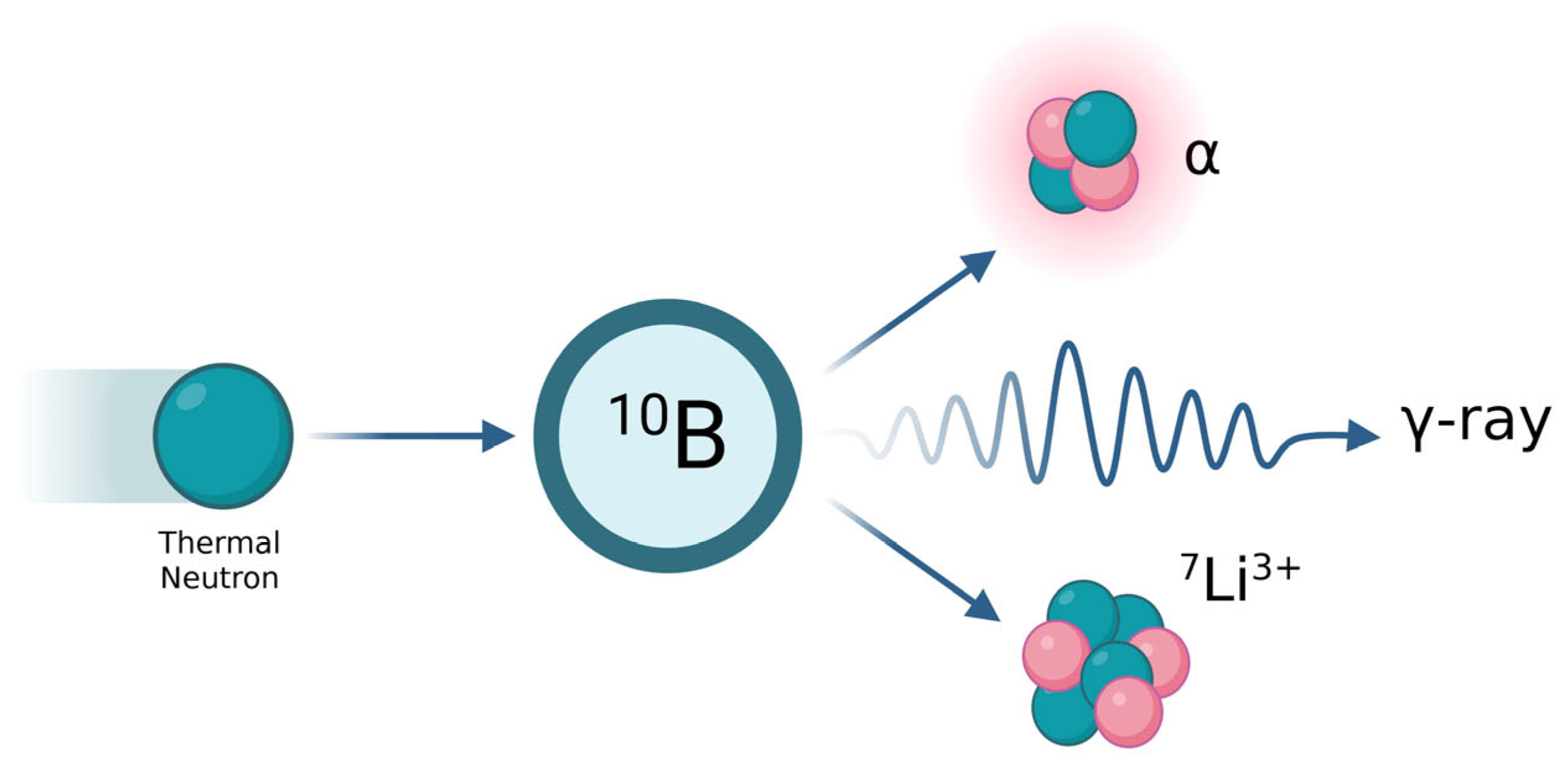
2. Mechanism of Action
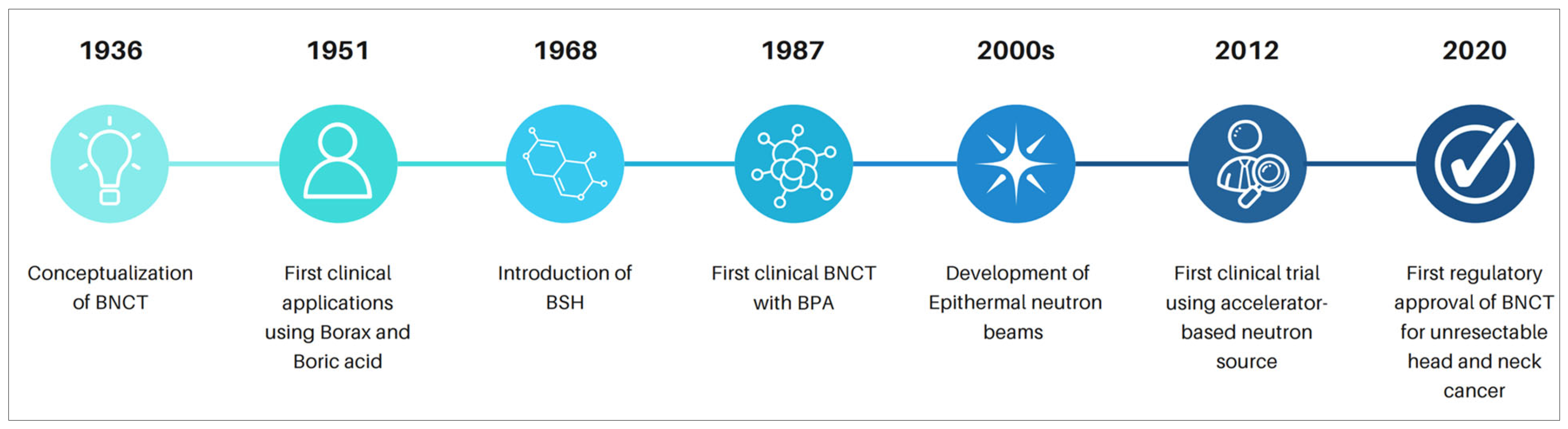
3. Historical Background
4. Workflow
5. Boron Delivery Agents
5.1. First Generation
5.2. Second Generation
5.3. Third Generation
6. Neutron Sources for BNCT
7. BNCT Compared with Proton and Carbon Ion Radiotherapy
8. BNCT for CNS Tumors
8.1. Recurrent GBM
8.2. Newly Diagnosed GBM
8.3. Pediatric HGGs
8.4. Meningiomas
9. Limitations
10. Conclusions
Author Contributions
Funding
Institutional Review Board Statement
Informed Consent Statement
Data Availability Statement
Acknowledgments
Conflicts of Interest
Abbreviations
References
- Stupp, R.; Mason, W.P.; van den Bent, M.J.; Weller, M.; Fisher, B.; Taphoorn, M.J.; Belanger, K.; Brandes, A.A.; Marosi, C.; Bogdahn, U.; et al. Radiotherapy plus concomitant and adjuvant temozolomide for glioblastoma. N. Engl. J. Med. 2005, 352, 987–996. [Google Scholar] [CrossRef] [PubMed]
- Singh, S.; Dey, D.; Barik, D.; Mohapatra, I.; Kim, S.; Sharma, M.; Prasad, S.; Wang, P.; Singh, A.; Singh, G. Glioblastoma at the crossroads: Current understanding and future therapeutic horizons. Signal Transduct. Target. Ther. 2025, 10, 213. [Google Scholar] [CrossRef] [PubMed]
- Stupp, R.; Taillibert, S.; Kanner, A.; Read, W.; Steinberg, D.; Lhermitte, B.; Toms, S.; Idbaih, A.; Ahluwalia, M.S.; Fink, K.; et al. Effect of Tumor-Treating Fields Plus Maintenance Temozolomide vs Maintenance Temozolomide Alone on Survival in Patients With Glioblastoma: A Randomized Clinical Trial. JAMA 2017, 318, 2306–2316, Erratum in JAMA 2018, 319, 1824. https://doi.org/10.1001/jama.2017.18718. [Google Scholar] [CrossRef] [PubMed]
- Ostrom, Q.T.; Price, M.; Neff, C.; Cioffi, G.; Waite, K.A.; Kruchko, C.; Barnholtz-Sloan, J.S. CBTRUS Statistical Report: Primary Brain and Other Central Nervous System Tumors Diagnosed in the United States in 2016–2020. Neuro Oncol. 2023, 25, iv1–iv99. [Google Scholar] [CrossRef]
- Mehta, M.P.; Pugh, S.; Mahajan, A.; Shih, H.A.; Tsien, C.; Chenevert, T.; Gilbert, M.; Omuro, A.; Aldape, K.; Teo, B.K.K.; et al. Signal-Seeking P2R Trial of Proton or IMRT Dose Intensification in GBM: NRG-BN001. Int. J. Radiat. Oncol. Biol. Phys. 2025, 123, 1204. [Google Scholar] [CrossRef]
- Kutuk, T.; Tolakanahalli, R.; McAllister, N.C.; Hall, M.D.; Tom, M.C.; Rubens, M.; Appel, H.; Gutierrez, A.N.; Odia, Y.; Mohler, A.; et al. Pulsed-Reduced Dose Rate (PRDR) Radiotherapy for Recurrent Primary Central Nervous System Malignancies: Dosimetric and Clinical Results. Cancers 2022, 14, 2946. [Google Scholar] [CrossRef]
- Koosha, F.; Ahmadikamalabadi, M.; Mohammadi, M. Review of Recent Improvements in Carbon Ion Radiation Therapy in the Treatment of Glioblastoma. Adv. Radiat. Oncol. 2024, 9, 101465. [Google Scholar] [CrossRef]
- Palavani, L.B.; de Barros Oliveira, L.; Reis, P.A.; Batista, S.; Santana, L.S.; de Freitas Martins, L.P.; Rabelo, N.N.; Bertani, R.; Welling, L.C.; Figueiredo, E.G.; et al. Efficacy and Safety of Intraoperative Radiotherapy for High-Grade Gliomas: A Systematic Review and Meta-Analysis. Neurosurg. Rev. 2024, 47, 47. [Google Scholar] [CrossRef]
- Wernicke, A.G.; Taube, S.; Smith, A.W.; Herskovic, A.; Parashar, B.; Schwartz, T.H. Cs-131 brachytherapy for patients with recurrent glioblastoma combined with bevacizumab avoids radiation necrosis while maintaining local control. Brachytherapy 2020, 19, 705–712. [Google Scholar] [CrossRef]
- Malouff, T.D.; Seneviratne, D.S.; Ebner, D.K.; Stross, W.C.; Waddle, M.R.; Trifiletti, D.M.; Krishnan, S. Boron Neutron Capture Therapy: A Review of Clinical Applications. Front. Oncol. 2021, 11, 601820. [Google Scholar] [CrossRef]
- Punshon, L.D.; Fabbrizi, M.R.; Phoenix, B.; Green, S.; Parsons, J.L. Current Insights into the Radiobiology of Boron Neutron Capture Therapy and the Potential for Further Improving Biological Effectiveness. Cells 2024, 13, 2065. [Google Scholar] [CrossRef]
- Barth, R.F.; Vicente, M.G.; Harling, O.K.; Kiger, W.S., 3rd; Riley, K.J.; Binns, P.J.; Wagner, F.M.; Suzuki, M.; Aihara, T.; Kato, I.; et al. Current status of boron neutron capture therapy of high grade gliomas and recurrent head and neck cancer. Radiat. Oncol. 2012, 7, 146. [Google Scholar] [CrossRef]
- Coderre, J.A.; Morris, G.M. The radiation biology of boron neutron capture therapy. Radiat. Res. 1999, 151, 1–18. [Google Scholar] [CrossRef]
- Beck-Sickinger, A.G.; Becker, D.P.; Chepurna, O.; Das, B.; Flieger, S.; Hey-Hawkins, E.; Hosmane, N.; Jalisatgi, S.S.; Nakamura, H.; Patil, R.; et al. New Boron Delivery Agents. Cancer Biother. Radiopharm. 2023, 38, 160–172. [Google Scholar] [CrossRef]
- Mechetin, G.V.; Zharkov, D.O. DNA Damage Response and Repair in Boron Neutron Capture Therapy. Genes 2023, 14, 127. [Google Scholar] [CrossRef]
- Locher, G.L. Biological effects and therapeutic possibilities of neutron. Am. J. Roentgenol. 1936, 36, 1–13. [Google Scholar]
- Farr, L.E.; Sweet, W.H.; Robertson, J.S.; Foster, C.G.; Locksley, H.B.; Sutherland, D.L.; Mendelsohn, M.L.; Stickley, E.E. Neutron capture therapy with boron in the treatment of glioblastoma multiforme. Am. J. Roentgenol. Radium Ther. Nucl. Med. 1954, 71, 279–293. [Google Scholar]
- Goodwin, J.T.; Farr, L.E.; Sweet, W.H.; Robertson, J.S. Pathological study of eight patients with glioblastoma multiforme treated by neutron-capture therapy using boron 10. Cancer 1955, 8, 601–615. [Google Scholar] [CrossRef]
- Takahashi, Y.; Imahori, Y.; Mineura, K. Prognostic and therapeutic indicator of fluoroboronophenylalanine positron emission tomography in patients with gliomas. Clin. Cancer Res. 2003, 9, 5888–5895. [Google Scholar]
- Aihara, T.; Hiratsuka, J.; Morita, N.; Uno, M.; Sakurai, Y.; Maruhashi, A.; Ono, K.; Harada, T. First clinical case of boron neutron capture therapy for head and neck malignancies using 18F-BPA PET. Head Neck 2006, 28, 850–855. [Google Scholar] [CrossRef]
- Matsumura, A.; Asano, T.; Hirose, K.; Igaki, H.; Kawabata, S.; Kumada, H. Initiatives Toward Clinical Boron Neutron Capture Therapy in Japan. Cancer Biother. Radiopharm. 2023, 38, 201–207, Correction in Cancer Biother. Radiopharm. 2023, 38, 273. https://doi.org/10.1089/cbr.2022.0056.correx. [Google Scholar] [CrossRef] [PubMed]
- Hu, N.; Tanaka, H.; Kakino, R.; Yoshikawa, S.; Miyao, M.; Akita, K.; Aihara, T.; Nihei, K.; Ono, K. Improvement in the neutron beam collimation for application in boron neutron capture therapy of the head and neck region. Sci. Rep. 2022, 12, 13778. [Google Scholar] [CrossRef]
- Chen, J.; Teng, Y.C.; Shu, D.; Gong, Q.; Xie, Q.; Liu, Y.H. Automated robotic-assisted patient positioning method and dosimetric impact analysis for boron neutron capture therapy. Sci. Rep. 2024, 14, 28995. [Google Scholar] [CrossRef] [PubMed]
- Chen, J.; Xie, Q.L.; Ping, J.J.; Hou, T.T.; Liu, Y.H. Development and evaluation of surface-guided patient position system for boron neutron capture therapy. Sci. Rep. 2026, 16, 5818. [Google Scholar] [CrossRef] [PubMed]
- Porra, L.; Wendland, L.; Seppala, T.; Koivunoro, H.; Revitzer, H.; Tervonen, J.; Kankaanranta, L.; Anttonen, A.; Tenhunen, M.; Joensuu, H. From Nuclear Reactor-Based to Proton Accelerator-Based Therapy: The Finnish Boron Neutron Capture Therapy Experience. Cancer Biother. Radiopharm. 2023, 38, 184–191. [Google Scholar] [CrossRef]
- Kakino, R.; Hu, N.; Isohashi, K.; Aihara, T.; Nihei, K.; Ono, K. Comprehensive evaluation of dosimetric impact against position errors in accelerator-based BNCT under different treatment parameter settings. Med. Phys. 2022, 49, 4944–4954. [Google Scholar] [CrossRef]
- Sato, H.; Takata, T.; Sakurai, Y. Investigation of the usability of cone-beam computed tomography images using digital radiography equipment for boron neutron capture therapy treatment planning in the sitting position. Appl. Radiat. Isot. 2023, 196, 110793. [Google Scholar] [CrossRef]
- Torres-Sanchez, P.; Lerendegui-Marco, J.; Balibrea-Correa, J.; Babiano-Suarez, V.; Gameiro, B.; Ladarescu, I.; Alvarez-Rodriguez, P.; Daugas, J.M.; Koester, U.; Michelagnoli, C.; et al. The potential of the i-TED Compton camera array for real-time boron imaging and determination during treatments in Boron Neutron Capture Therapy. Appl. Radiat. Isot. 2025, 217, 111649. [Google Scholar] [CrossRef]
- Kobayashi, T.; Sakurai, Y.; Ishikawa, M. A noninvasive dose estimation system for clinical BNCT based on PG-SPECT--conceptual study and fundamental experiments using HPGe and CdTe semiconductor detectors. Med. Phys. 2000, 27, 2124–2132. [Google Scholar] [CrossRef]
- Sakai, M.; Tamaki, S.; Murata, I.; Parajuli, R.K.; Matsumura, A.; Kubo, N.; Tashiro, M. Experimental study on Compton camera for boron neutron capture therapy applications. Sci. Rep. 2023, 13, 22883, Correction in Sci. Rep. 2024, 14, 3154. https://doi.org/10.1038/s41598-024-53559-2. [Google Scholar] [CrossRef]
- Hawthorne, M.F. The Role of Chemistry in the Development of Boron Neutron Capture Therapy of Cancer. Angew. Chem. Int. Ed. Engl. 1993, 32, 950–984. [Google Scholar] [CrossRef]
- Barth, R.F.; Gupta, N.; Kawabata, S. Evaluation of sodium borocaptate (BSH) and boronophenylalanine (BPA) as boron delivery agents for neutron capture therapy (NCT) of cancer: An update and a guide for the future clinical evaluation of new boron delivery agents for NCT. Cancer Commun. 2024, 44, 893–909. [Google Scholar] [CrossRef] [PubMed]
- Soloway, A.H.; Hatanaka, H.; Davis, M.A. Penetration of brain and brain tumor. VII. Tumor-binding sulfhydryl boron compounds. J. Med. Chem. 1967, 10, 714–717. [Google Scholar] [CrossRef] [PubMed]
- Hideghéty, K.; Sauerwein, W.; Wittig, A.; Götz, C.; Paquis, P.; Grochulla, F.; Haselsberger, K.; Wolbers, J.; Moss, R.; Huiskamp, R.; et al. Tissue uptake of BSH in patients with glioblastoma in the EORTC 11961 phase I BNCT trial. J. Neurooncol. 2003, 62, 145–156. [Google Scholar] [CrossRef] [PubMed]
- Järvinen, J.; Pulkkinen, H.; Rautio, J.; Timonen, J.M. Amino Acid-Based Boron Carriers in Boron Neutron Capture Therapy (BNCT). Pharmaceutics 2023, 15, 2663. [Google Scholar] [CrossRef]
- Yokoyama, K.; Miyatake, S.; Kajimoto, Y.; Kawabata, S.; Doi, A.; Yoshida, T.; Asano, T.; Kirihata, M.; Ono, K.; Kuroiwa, T. Pharmacokinetic study of BSH and BPA in simultaneous use for BNCT. J. Neurooncol. 2006, 78, 227–232. [Google Scholar] [CrossRef]
- Miyatake, S.; Kawabata, S.; Kajimoto, Y.; Aoki, A.; Yokoyama, K.; Yamada, M.; Kuroiwa, T.; Tsuji, M.; Imahori, Y.; Kirihata, M.; et al. Modified boron neutron capture therapy for malignant gliomas performed using epithermal neutron and two boron compounds with different accumulation mechanisms: An efficacy study based on findings on neuroimages. J. Neurosurg. 2005, 103, 1000–1009. [Google Scholar] [CrossRef]
- Barth, R.F.; Yang, W.; Rotaru, J.H.; Moeschberger, M.L.; Boesel, C.P.; Soloway, A.H.; Joel, D.D.; Nawrocky, M.M.; Ono, K.; Goodman, J.H. Boron neutron capture therapy of brain tumors: Enhanced survival and cure following blood-brain barrier disruption and intracarotid injection of sodium borocaptate and boronophenylalanine. Int. J. Radiat. Oncol. Biol. Phys. 2000, 47, 209–218. [Google Scholar] [CrossRef]
- Dymova, M.A.; Taskaev, S.Y.; Richter, V.A.; Kuligina, E.V. Boron neutron capture therapy: Current status and future perspectives. Cancer Commun. 2020, 40, 406–421. [Google Scholar] [CrossRef]
- Kawasaki, R.; Oshige, A.; Yamana, K.; Hirano, H.; Nishimura, K.; Miura, Y.; Yorioka, R.; Sanada, Y.; Bando, K.; Tabata, A.; et al. HER-2-Targeted Boron Neutron Capture Therapy with Carborane-integrated Immunoliposomes Prepared via an Exchanging Reaction. Chem. Eur. J. 2023, 29, e202302486. [Google Scholar] [CrossRef]
- Rudawska, A.; Szermer-Olearnik, B.; Szczygiel, A.; Mierzejewska, J.; Wegierek-Ciura, K.; Zeliszewska, P.; Kozien, D.; Chaszczewska-Markowska, M.; Adamczyk, Z.; Rusiniak, P.; et al. Functionalized Boron Carbide Nanoparticles as Active Boron Delivery Agents Dedicated to Boron Neutron Capture Therapy. Int. J. Nanomed. 2025, 20, 6637–6657. [Google Scholar] [CrossRef] [PubMed]
- Yamana, K.; Kawasaki, R.; Kondo, K.; Hirano, H.; Kawamura, S.; Sanada, Y.; Bando, K.; Tabata, A.; Azuma, H.; Takata, T.; et al. HER-2-targeted boron neutron capture therapy using an antibody-conjugated boron nitride nanotube/β-1,3-glucan complex. Nanoscale Adv. 2023, 5, 3857–3861. [Google Scholar] [CrossRef] [PubMed]
- Wei, Q.; Kullberg, E.B.; Gedda, L. Trastuzumab-conjugated boron-containing liposomes for tumor-cell targeting; development and cellular studies. Int. J. Oncol. 2003, 23, 1159–1165. [Google Scholar] [CrossRef] [PubMed]
- Nakase, I.; Aoki, A.; Sakai, Y.; Hirase, S.; Ishimura, M.; Takatani-Nakase, T.; Hattori, Y.; Kirihata, M. Antibody-Based Receptor Targeting Using an Fc-Binding Peptide-Dodecaborate Conjugate and Macropinocytosis Induction for Boron Neutron Capture Therapy. ACS Omega 2020, 5, 22731–22738. [Google Scholar] [CrossRef] [PubMed]
- Michiue, H.; Kitamatsu, M.; Fukunaga, A.; Tsuboi, N.; Fujimura, A.; Matsushita, H.; Igawa, K.; Kasai, T.; Kondo, N.; Matsui, H.; et al. Self-assembling A6K peptide nanotubes as a mercaptoundecahydrododecaborate (BSH) delivery system for boron neutron capture therapy (BNCT). J. Control. Release 2021, 330, 788–796. [Google Scholar] [CrossRef]
- Hoppenz, P.; Els-Heindl, S.; Kellert, M.; Kuhnert, R.; Saretz, S.; Lerchen, H.G.; Kobberling, J.; Riedl, B.; Hey-Hawkins, E.; Beck-Sickinger, A.G. A Selective Carborane-Functionalized Gastrin-Releasing Peptide Receptor Agonist as Boron Delivery Agent for Boron Neutron Capture Therapy. J. Org. Chem. 2020, 85, 1446–1457. [Google Scholar] [CrossRef]
- Yoneyama, T.; Hatakeyama, S.; Yoneyama, M.S.; Yoshiya, T.; Uemura, T.; Ishizu, T.; Suzuki, M.; Hachinohe, S.; Ishiyama, S.; Nonaka, M.; et al. Tumor vasculature-targeted (10)B delivery by an Annexin A1-binding peptide boosts effects of boron neutron capture therapy. BMC Cancer 2021, 21, 72, Erratum in BMC Cancer 2021, 21, 105. https://doi.org/10.1186/s12885-020-07760-x. [Google Scholar]
- Worm, D.J.; Hoppenz, P.; Els-Heindl, S.; Kellert, M.; Kuhnert, R.; Saretz, S.; Kobberling, J.; Riedl, B.; Hey-Hawkins, E.; Beck-Sickinger, A.G. Selective Neuropeptide Y Conjugates with Maximized Carborane Loading as Promising Boron Delivery Agents for Boron Neutron Capture Therapy. J. Med. Chem. 2020, 63, 2358–2371. [Google Scholar] [CrossRef]
- Xiang, J.; Ma, L.; Tong, J.; Zuo, N.; Hu, W.; Luo, Y.; Liu, J.; Liang, T.; Ren, Q.; Liu, Q. Boron-peptide conjugates with angiopep-2 for boron neutron capture therapy. Front. Med. 2023, 10, 1199881. [Google Scholar] [CrossRef]
- Worm, D.J.; Els-Heindl, S.; Kellert, M.; Kuhnert, R.; Saretz, S.; Koebberling, J.; Riedl, B.; Hey-Hawkins, E.; Beck-Sickinger, A.G. A stable meta-carborane enables the generation of boron-rich peptide agonists targeting the ghrelin receptor. J. Pept. Sci. 2018, 24, e3119. [Google Scholar] [CrossRef]
- Farhat, S.; Shuaib, A.; Bukhari, S.M.S.; Shah, F.A.; Naseeb, I.K.; Ahmad, S.; Alamoudi, M.K.; Shah, M. Ghrelin's modulation of growth hormone secretagogue receptors in primary glioblastoma and meningioma: A comprehensive in-vitro study. Biochem. Biophys. Res. Commun. 2025, 751, 151397. [Google Scholar] [CrossRef] [PubMed]
- Okada, Y.; Sugita, Y.; Ohshima, K.; Morioka, M.; Komaki, S.; Miyoshi, J.; Abe, H. Signaling of ghrelin and its functional receptor, the growth hormone secretagogue receptor, promote tumor growth in glioblastomas. Neuropathology 2016, 36, 535–543. [Google Scholar] [CrossRef] [PubMed]
- Khalil, A.; Adam, M.S.S. Nucleoside Scaffolds and Carborane Clusters for Boron Neutron Capture Therapy: Developments and Future Perspective. Curr. Med. Chem. 2024, 31, 5739–5754. [Google Scholar] [CrossRef] [PubMed]
- Wang, M.; Tong, Y.; Luo, Q.; Hu, S. Comparative Study on Neutron Irradiation Sensitization Effects of Nucleotide Borate Esters and Several Other Boron Agents. Radiat. Res. 2020, 193, 249–262. [Google Scholar] [CrossRef]
- Liu, L.; Barth, R.F.; Tjarks, W.; Soloway, A.H.; Anisuzzaman, A.K. In vitro and in vivo evaluation of carboranyl uridines as boron delivery agents for neutron capture therapy. Anticancer Res. 1996, 16, 113–120. [Google Scholar]
- Lee, W.; Sarkar, S.; Ahn, H.; Kim, J.Y.; Lee, Y.J.; Chang, Y.; Yoo, J. PEGylated liposome encapsulating nido-carborane showed significant tumor suppression in boron neutron capture therapy (BNCT). Biochem. Biophys. Res. Commun. 2020, 522, 669–675. [Google Scholar] [CrossRef]
- Wu, F.; Sun, P.; Guo, X.; Zhang, Y.; Meng, X.; Li, X.; Li, J.; Chen, N.; Pei, P. Nanocarrier-driven neutron capture therapy: Strategies and perspectives. Acta Biomater. 2025, 203, 78–93. [Google Scholar] [CrossRef]
- Nishikawa, M.; Yu, J.; Kang, H.G.; Suzuki, M.; Komatsu, N. Rational Design, Multistep Synthesis and in Vitro Evaluation of Poly(glycerol) Functionalized Nanodiamond Conjugated with Boron-10 Cluster and Active Targeting Moiety for Boron Neutron Capture Therapy. Chem. Eur. J. 2023, 29, e202302073, Erratum in Chem. Eur. J. 2024, 30, e202304048. https://doi.org/10.1002/chem.202302073. [Google Scholar] [CrossRef]
- Qin, Y.; Sun, X.; Zhang, Z.; Yang, Y.; Dai, Q.; Tan, X.; Jiang, R.; Bao, X.; Wu, L.; Geng, C.; et al. Dual-Functional Nanoliposome with High BPA Loading for Targeted MRI-Guided BNCT of Glioblastoma. ACS Appl. Mater. Interfaces 2025, 17, 52474–52487. [Google Scholar] [CrossRef]
- Fu, W.Y.; Chiu, Y.L.; Huang, S.C.; Huang, W.Y.; Hsu, F.T.; Lee, H.Y.; Wang, T.W.; Keng, P.Y. Boron Neutron Capture Therapy Enhanced by Boronate Ester Polymer Micelles: Synthesis, Stability, and Tumor Inhibition Studies. Biomacromolecules 2024, 25, 4215–4232. [Google Scholar] [CrossRef]
- Tang, H.; Wang, Z.; Hao, H.; Luo, W.; Yang, J.; Li, M.; Yang, M.; Chen, Z.; Yan, R.; Li, H.; et al. Boron-Containing Mesoporous Silica Nanoparticles with Effective Delivery and Targeting of Liver Cancer Cells for Boron Neutron Capture Therapy. ACS Appl. Mater. Interfaces 2024, 16, 22934–22945. [Google Scholar] [CrossRef] [PubMed]
- Miura, K.; Araki, T.; Morita, T.; Nishimura, K.; Okada, S.; Suzuki, M.; Nakamura, H. Alanine-serine-cysteine transporter-targeted small-molecule boron carriers for neutron capture therapy of L-4-boronophenylalanine-refractory tumors. J. Control. Release 2026, 390, 114566. [Google Scholar] [CrossRef] [PubMed]
- Raitano, A.; Martin, T.; Zhang, C.; Malinao, M.C.; Capo, L.; Ikeura, M.; Carroll, R.; Quintana, J.C.; Dlamini, S.; Kulenovic, L.; et al. Boronotyrosine, a Borylated Amino Acid Mimetic with Enhanced Solubility, Tumor Boron Delivery, and Retention for the Re-emerging Boron Neutron Capture Therapy Field. J. Med. Chem. 2023, 66, 13809–13820. [Google Scholar] [CrossRef] [PubMed]
- Tsujino, K.; Kashiwagi, H.; Nishimura, K.; Fujikawa, Y.; Kayama, R.; Fukuo, Y.; Hiramatsu, R.; Nonoguchi, N.; Takata, T.; Tanaka, H.; et al. Nonclinical pharmacodynamics of boron neutron capture therapy using direct intratumoral administration of a folate receptor targeting novel boron carrier. Neurooncol. Adv. 2024, 6, vdae062. [Google Scholar] [CrossRef]
- Zheng, D.; Han, G.; Lemus, O.D.M.; Podgorsak, A.; Webster, M.; Li, F.; Zhou, Y.; Jung, H.; Yoon, J. Boron Neutron Capture Therapy: A Technology-Driven Renaissance. Cancers 2026, 18, 498. [Google Scholar] [CrossRef]
- Shuai, H.; Dian, E.; Mezei, F.; Sipos, P.; Czifrus, S. Optimization of a collimator design for an epithermal neutron source based on 7Li (p,n) Be reaction and 2.5 MeV protons for BNCT. Appl. Radiat. Isot. 2025, 226, 112230. [Google Scholar] [CrossRef]
- Shuai, H.; Dian, E.; Mezei, F.; Sipos, P.; Czifrus, S. An accelerator-based neutron source design with a thermal neutron port and an epithermal neutron port for boron neutron capture therapy. Appl. Radiat. Isot. 2025, 217, 111647. [Google Scholar] [CrossRef]
- Torres-Sanchez, P.; Porras, I.; Ramos-Chernenko, N.; de Saavedra, F.A.; Praena, J. Optimized beam shaping assembly for a 2.1-MeV proton-accelerator-based neutron source for boron neutron capture therapy. Sci. Rep. 2021, 11, 7576. [Google Scholar] [CrossRef]
- Green, S.; Phoenix, B.; Nakamura, S.; Liu, Y.H.; Shu, D.; Hu, N.; Suzuki, S.; Koivunoro, H.; Kumada, H.; Tanaka, H. Accelerator neutron sources for BNCT: Current status and some pointers for future development. Appl. Radiat. Isot. 2025, 217, 111656. [Google Scholar] [CrossRef]
- Verdera, A.; Praena, J. Study on novel neutron irradiation without beam shaping assembly in Boron Neutron Capture Therapy. Sci. Rep. 2024, 14, 22434. [Google Scholar] [CrossRef]
- Paganetti, H.; Niemierko, A.; Ancukiewicz, M.; Gerweck, L.E.; Goitein, M.; Loeffler, J.S.; Suit, H.D. Relative biological effectiveness (RBE) values for proton beam therapy. Int. J. Radiat. Oncol. Biol. Phys. 2002, 53, 407–421. [Google Scholar] [CrossRef]
- Tinganelli, W.; Durante, M. Carbon Ion Radiobiology. Cancers 2020, 12, 3022. [Google Scholar] [CrossRef] [PubMed]
- Pellettieri, L.; H-Stenstam, B.; Rezaei, A.; Giusti, V.; Sköld, K. An investigation of boron neutron capture therapy for recurrent glioblastoma multiforme. Acta Neurol. Scand. 2008, 117, 191–197. [Google Scholar] [CrossRef] [PubMed]
- Miyatake, S.; Kawabata, S.; Yokoyama, K.; Kuroiwa, T.; Michiue, H.; Sakurai, Y.; Kumada, H.; Suzuki, M.; Maruhashi, A.; Kirihata, M.; et al. Survival benefit of Boron neutron capture therapy for recurrent malignant gliomas. J. Neurooncol. 2009, 91, 199–206. [Google Scholar] [CrossRef] [PubMed]
- Carson, K.A.; Grossman, S.A.; Fisher, J.D.; Shaw, E.G. Prognostic factors for survival in adult patients with recurrent glioma enrolled onto the new approaches to brain tumor therapy CNS consortium phase I and II clinical trials. J. Clin. Oncol. 2007, 25, 2601–2606. [Google Scholar] [CrossRef]
- Kawabata, S.; Suzuki, M.; Hirose, K.; Tanaka, H.; Kato, T.; Goto, H.; Narita, Y.; Miyatake, S.I. Accelerator-based BNCT for patients with recurrent glioblastoma: A multicenter phase II study. Neurooncol Adv. 2021, 3, vdab067. [Google Scholar] [CrossRef]
- Nagane, M.; Nishikawa, R.; Narita, Y.; Kobayashi, H.; Takano, S.; Shinoura, N.; Aoki, T.; Sugiyama, K.; Kuratsu, J.; Muragaki, Y.; et al. Phase II study of single-agent bevacizumab in Japanese patients with recurrent malignant glioma. Jpn. J. Clin. Oncol. 2012, 42, 887–895. [Google Scholar] [CrossRef]
- Kawabata, S.; Goto, H.; Narita, Y.; Furuse, M.; Nonoguchi, N.; Shidoh-Kazuki, R.; Eza, K.; Hirose, K.; Ohno, M.; Kondo, N.; et al. Extended follow-up of recurrent glioblastoma patients treated with boron neutron capture therapy (BNCT): Long-term survival from a Phase II trial (JG002) using Cyclotron Neutron Source and Boronophenylalanine. Appl. Radiat. Isot. 2025, 226, 112118. [Google Scholar] [CrossRef]
- Furuse, M.; Kawabata, S.; Wanibuchi, M.; Shiba, H.; Takeuchi, K.; Kondo, N.; Tanaka, H.; Sakurai, Y.; Suzuki, M.; Ono, K.; et al. Boron neutron capture therapy and add-on bevacizumab in patients with recurrent malignant glioma. Jpn. J. Clin. Oncol. 2022, 52, 433–440. [Google Scholar] [CrossRef]
- Yamamoto, T.; Nakai, K.; Kageji, T.; Kumada, H.; Endo, K.; Matsuda, M.; Shibata, Y.; Matsumura, A. Boron neutron capture therapy for newly diagnosed glioblastoma. Radiother. Oncol. 2009, 91, 80–84. [Google Scholar] [CrossRef]
- Yamamoto, T.; Nakai, K.; Tsurubuchi, T.; Matsuda, M.; Shirakawa, M.; Zaboronok, A.; Endo, K.; Matsumura, A. Boron neutron capture therapy for newly diagnosed glioblastoma: A pilot study in Tsukuba. Appl. Radiat. Isot. 2009, 67, S25–S26. [Google Scholar] [CrossRef]
- Kageji, T.; Nagahiro, S.; Mizobuchi, Y.; Matsuzaki, K.; Nakagawa, Y.; Kumada, H. Boron neutron capture therapy (BNCT) for newly-diagnosed glioblastoma: Comparison of clinical results obtained with BNCT and conventional treatment. J. Med. Investig. 2014, 61, 254–263. [Google Scholar] [CrossRef] [PubMed][Green Version]
- Skold, K.; Gorlia, T.; Pellettieri, L.; Giusti, V.; H-Stenstam, B.; Hopewell, J.W. Boron neutron capture therapy for newly diagnosed glioblastoma multiforme: An assessment of clinical potential. Br. J. Radiol. 2010, 83, 596–603. [Google Scholar] [CrossRef]
- Henriksson, R.; Capala, J.; Michanek, A.; Lindahl, S.A.; Salford, L.G.; Franzen, L.; Blomquist, E.; Westlin, J.E.; Bergenheim, A.T. Boron neutron capture therapy (BNCT) for glioblastoma multiforme: A phase II study evaluating a prolonged high-dose of boronophenylalanine (BPA). Radiother. Oncol. 2008, 88, 183–191. [Google Scholar] [CrossRef] [PubMed]
- Nakai, K.; Kumada, H.; Matsumoto, Y.; Baba, K.; Murakami, M.; Ishida, T.; Saito, T.; Nakamura, M.; Numajiri, H.; Mizumoto, M.; et al. Boron neutron capture therapy (BNCT) phase I clinical trial for newly diagnosed glioblastoma by newly developed accelerator at University of Tsukuba. Appl. Radiat. Isot. 2025, 226, 112152. [Google Scholar] [CrossRef] [PubMed]
- Nakagawa, Y.; Kageji, T.; Mizobuchi, Y.; Kumada, H.; Nakagawa, Y. Clinical results of BNCT for malignant brain tumors in children. Appl. Radiat. Isot. 2009, 67, S27–S30. [Google Scholar] [CrossRef]
- Chen, Y.-W.; Lan, T.-L.; Lee, Y.-Y.; Lin, K.-H.; Liang, M.-L.; Chen, H.-H.; Pan, P.-S.; Chang, F.-C.; Wu, C.-C.; Lin, S.-C.; et al. Using precise boron neutron capture therapy as a salvage treatment for pediatric patients with recurrent brain tumors. Ther. Radiol. Oncol. 2020, 4, 30. [Google Scholar] [CrossRef]
- Huang, W.H.; Huang, T.Y.; Lin, C.M.; Mu, P.F.; Lee, Y.Y.; Liu, S.H.; Hsu, S.M.; Chen, Y.W. Salvage boron neutron capture therapy for pediatric patients with recurrent diffuse midline glioma. Child’s Nerv. Syst. 2023, 39, 1529–1536. [Google Scholar] [CrossRef]
- Nakahara, Y.; Ito, H.; Masuoka, J.; Abe, T. Boron Neutron Capture Therapy and Photodynamic Therapy for High-Grade Meningiomas. Cancers 2020, 12, 1334. [Google Scholar] [CrossRef]
- Lan, T.L.; Lin, C.F.; Lee, Y.Y.; Chang, F.C.; Lin, S.C.; Chou, F.I.; Peir, J.J.; Pan, P.S.; Chen, J.K.; Lai, L.H.; et al. Recurrent meningioma treated with boron neutron capture therapy: A feasibility study with dosimetric and clinical correlates. J. Neurooncol. 2025, 175, 879–886. [Google Scholar] [CrossRef]
- Tamura, Y.; Miyatake, S.-I.; Nonoguchi, N.; Miyata, S.; Yokoyama, K.; Doi, A.; Kuroiwa, T.; Asada, M.; Tanabe, H.; Ono, K. Boron neutron capture therapy for recurrent malignant meningioma: Case report. J. Neurosurg. 2006, 105, 898–903. [Google Scholar] [CrossRef] [PubMed]
- Kawabata, S.; Hiramatsu, R.; Kuroiwa, T.; Ono, K.; Miyatake, S.-I. Boron neutron capture therapy for recurrent high-grade meningiomas: Clinical article. J. Neurosurg. 2013, 119, 837–844. [Google Scholar] [CrossRef] [PubMed]
- Takeuchi, K.; Kawabata, S.; Hiramatsu, R.; Matsushita, Y.; Tanaka, H.; Sakurai, Y.; Suzuki, M.; Ono, K.; Miyatake, S.I.; Kuroiwa, T. Boron Neutron Capture Therapy for High-Grade Skull-Base Meningioma. J. Neurol. Surg. Part B Skull Base 2018, 79, S322–S327. [Google Scholar] [CrossRef]
- Miyatake, S.-I.; Tamura, Y.; Kawabata, S.; Iida, K.; Kuroiwa, T.; Ono, K. Boron neutron capture therapy for malignant tumors related to meningiomas. Neurosurgery 2007, 61, 82–91. [Google Scholar] [CrossRef] [PubMed]
- Takai, S.; Wanibuchi, M.; Kawabata, S.; Takeuchi, K.; Sakurai, Y.; Suzuki, M.; Ono, K.; Miyatake, S.I. Reactor-based boron neutron capture therapy for 44 cases of recurrent and refractory high-grade meningiomas with long-term follow-up. Neuro Oncol. 2022, 24, 90–98. [Google Scholar] [CrossRef]
- Lan, T.L.; Lin, C.F.; Lee, Y.Y.; Lin, K.H.; Chang, F.C.; Lin, S.C.; Lee, J.C.; Chou, F.I.; Peir, J.J.; Liu, H.M.; et al. Advances in Boron Neutron Capture Therapy (BNCT) for Recurrent Intracranial Meningioma. Int. J. Mol. Sci. 2023, 24, 4978. [Google Scholar] [CrossRef]
- Lin, L.C.; Chow, W.H.; Wu, Y.J.; Wu, Y.H.; Shen, W.L.; Chang, C.H.; Ho, S.Y. Salvage boron neutron capture therapy for recurrent intracranial malignant meningioma: Case report and literature review. Medicine 2025, 104, e43743. [Google Scholar] [CrossRef]
- Kashiwagi, H.; Wanibuchi, M.; Ikeda, N.; Nonoguchi, N.; Furuse, M.; Kawabata, S.; Nihei, K.; Hu, N.; Akita, K.; Ono, K.; et al. Investigator-led clinical trial of boron neutron capture therapy system for recurrent high-grade meningiomas after radiation therapy: Randomized phase II study. Neuro Oncol. 2026, 8, noaf279. [Google Scholar] [CrossRef]



| Center | Country | Source Type (Accelerator + Target) | Neutron Energy | Current Status |
|---|---|---|---|---|
| Kansai BNCT Medical Center (Osaka Medical and Pharmaceutical University) | Japan | Cyclotron (HM-30, Sumitomo Heavy Industries) → Be | ~30 MeV | Routine clinical treatment; BNCT approved in Japan (2020) and reimbursed by National Health Insurance |
| Southern Tohoku BNCT Research Center (NeuCure BNCT30) | Japan | Cyclotron (HM-30) → Be | ~30 MeV | Routine clinical treatment; active treatment of head and neck cancer and other malignancies |
| National Cancer Center Hospital -Division of BNCT Medical Research | Japan | RFQ Accelerator → solid Li | ~2.5 MeV | Phase I/II clinical trials; vertical downward neutron beam configuration |
| University of Tsukuba Hospital | Japan | Accelerator-based system → Li | ~2.5 MeV | Phase I clinical trials, including newly diagnosed GBM |
| Helsinki University Hospital | Finland | Electrostatic Cockcroft–Walton proton accelerator (nuBeam) → Li | ~2.6 MeV (≈30 mA) | Clinical trials; first European accelerator-based BNCT facility |
| Xiamen Humanity Hospital | China | Tandem electrostatic accelerator (NeuPex platform) → Li | ~2.5 MeV | Early clinical research/limited patient treatments reported; peer-reviewed data remain limited |
| Compound/Platform | Mechanism of Tumor Uptake | Advantages | Limitations/Status |
|---|---|---|---|
| First generation | |||
| Borax, simple boron salts | Passive, non-specific distribution | Proof of concept in early trials | Poor tumor selectivity; systemic toxicity; abandoned |
| Sodium decahydrodecaborate (Na2B10H10) | Non-specific distribution | High boron content | Unfavorable biodistribution; discontinued |
| Second generation | |||
| BSH (sodium borocaptate) | Predominantly extracellular; accumulation in BBB-disrupted regions | High boron density; clinical experience | Limited intracellular uptake; modest tumor:normal ratio |
| BPA (boronophenylalanine; BPA-fructose) | LAT1 transporter-mediated cellular uptake; PET-quantifiable | Gold standard; intracellular delivery; supports 18F-BPA PET planning | Heterogeneous distribution; LAT1 dependence |
| Third generation (preclinical/translational) | |||
| Boronated nucleosides/DNA-intercalators | Nuclear targeting; mitotic trapping | Direct DNA targeting; high biological effectiveness | Preclinical only; toxicity/dosimetry under investigation |
| Antibody-boron conjugates (ABC) | Antigen-specific binding (e.g., EGFR, HER2) | High specificity; large boron payload | Complex synthesis; immunogenicity; preclinical only |
| Antibody-functionalized nanoparticles/immunoliposomes | Receptor-mediated uptake via antibody targeting | Combines high payload with active targeting | Tumor penetration heterogeneity; preclinical only |
| Peptide-conjugated boron clusters (e.g., GRPR, hY1R) | Peptide ligands for tumor cell surface receptors | Enhanced selectivity; modular design | Preclinical only; pharmacokinetics not yet standardized, variable receptor expression |
| Tumor vasculature-targeted peptides (e.g., SP94, Annexin A1) | Vascular/microenvironment targeting | High tumor–blood ratios in models | Target heterogeneity; preclinical only |
| Cell-penetrating/BBB-penetrating peptides (R8, TAT, Angiopep-2) | Cellular penetration or transcytosis | Improved intracellular and CNS delivery | Safety optimization needed |
| Boron-rich liposomes/nanoparticles | Enhanced permeability and retention (EPR); targeted modifications (e.g., folate, transferrin) | High boron payload; potential for controlled release | Heterogeneous tumor penetration; clinical translation pending |
| Boronosomes (carboranyl lipid vesicles) | Lipid-based tumor accumulation | Long tumor retention; imaging compatibility | Heterogeneous penetration; preclinical only |
| Theranostic Gd-B nanocarriers | Targeted delivery with MRI guidance | Image-guided BNCT potential | Complex design; regulatory hurdles |
| Transporter-targeted small molecules (e.g., GluB-2/ASCT2) | Alternative amino-acid transporter uptake | Active in BPA-refractory models | Early-stage; preclinical only |
| Modality | Proton Therapy | Carbon-Ion Therapy | Boron Neutron Capture Therapy |
|---|---|---|---|
| LET (keV/µm) | ~0.5–2 (low-LET; modest rise at Bragg peak) | ~50–80 at Bragg peak (high-LET) | ~150 (ultra–high LET for α and 7Li) |
| RBE | ~1.1 | 2–3 (tissue/endpoint dependent) | Variable; high (effective only within boron-containing cells) |
| Range in tissue | Several cm (beam penetration; depth dose conformality) | Several cm (Bragg peak range) | 5–9 µm (cellular diameter) |
| Mechanism of selectivity | Physical dose distribution (Bragg peak) | Physical + radiobiological (high-LET effect in target volume) | Biological selectivity via boron compound uptake |
| Key Features | Conformal dose shaping; no significant intrinsic radiobiological advantage | Dense ionization, complex DNA damage; effective in radioresistant tumors | Ultra-localized cell kill; efficacy determined by boron delivery and microdistribution |
| Study | Design | Population | N | Boron Agent | Neutron Source | Key Outcomes |
|---|---|---|---|---|---|---|
| Yamamoto et al. [80,81] | Pilot study (2 protocols) | Newly diagnosed GBM | 15 | BSH (all); BSH + BPA (protocol-2 only) | Reactor (epithermal) | Median OS 25.7 mo; TTP 11.9 mo; 1-year OS 80%, 2-year OS 53.3% |
| Kageji et al. [82] | Retrospective | GBM (newly diagnosed and recurrent) | 23 | BSH ± BPA | Reactor | Median OS 19.5 mo; 2-year OS 26.1%; 5-year OS 5.8% |
| Sköld et al. (Studsvik) [83,84] | Phase II | Newly diagnosed GBM | 29 | BPA-fructose (6-hr infusion) | Reactor (epithermal) | Median OS 17.6 mo; comparable to RT alone; possible advantage in MGMT unmethylated |
| TB-GB-01 (Tsukuba) [85] | Phase I (ongoing) | Newly diagnosed GBM | 12–18 (target) | BPA + EBRT (40 Gy) + TMZ | Accelerator | Dose-escalation; primary endpoint DLT |
| Miyatake et al. [74] | Retrospective | Recurrent malignant glioma | 22 (19 GBM) | BPA ± BSH | Reactor (epithermal) | Median OS 10.8 mo (all MG); 9.6 mo (GBM); High-risk RPA 9.1 mo vs. 4.4 mo historical |
| JG002 [76,78] | Phase II | Recurrent GBM | 24 | BPA | Accelerator (cyclotron) | Median OS 19.2 mo; 1-year OS 79.2%; 2-year OS 33.3%; 3-year OS 20.8% |
| Furuse et al. [79] | Retrospective | Recurrent malignant glioma | 25 (14 primary GBM, 11 non-primary) | BPA + BSH | Reactor | Primary GBM: median OS 21.4 mo, PFS 8.3 mo; non-primary: median OS 73.6 mo, PFS 15.6 mo |
| Huang et al. [88] | Case series | Recurrent pediatric DMG | 6 | BPA | Reactor (Tsing Hua) | 3 PR, 3 SD; OS 6.39 mo; PFS 4.35 mo; low toxicity |
| Osaka Medical College series [95] | Retrospective | Recurrent/refractory HGM | 46 | BPA ± BSH | Reactor | Favorable outcomes in refractory cases |
| Lan et al. [90] | Retrospective feasibility | Recurrent meningioma (1 grade 3, 6 grade 2, 6 grade 1) | 13 | BPA | Reactor (Tsing Hua) | Response rate 38%; responders had higher tumor dose (45.10 vs. 25.85 GyE, p = 0.003) |
| Kashiwagi et al. [98] | Phase II RCT (2:1) | Recurrent HGM after RT | 18 (12 BNCT, 6 control) | BPA | Accelerator (cyclotron) | Median PFS 14.4 mo (BNCT) vs. 1.4 mo (control), p = 0.0157; ORR 27.3% |
Disclaimer/Publisher’s Note: The statements, opinions and data contained in all publications are solely those of the individual author(s) and contributor(s) and not of MDPI and/or the editor(s). MDPI and/or the editor(s) disclaim responsibility for any injury to people or property resulting from any ideas, methods, instructions or products referred to in the content. |
© 2026 by the authors. Licensee MDPI, Basel, Switzerland. This article is an open access article distributed under the terms and conditions of the Creative Commons Attribution (CC BY) license.
Share and Cite
Kutuk, T.; Atak, E.; Harrell, M.; Raval, R.R.; Fekrmandi, F.; Zhu, S.; Beyer, S.; Singh, P.K.; Giglio, P.; Mohtashami, H.; et al. Boron Neutron Capture Therapy for High-Grade CNS Tumors: Mechanisms, Carriers, and Clinical Progress: A Narrative Review. Int. J. Mol. Sci. 2026, 27, 2765. https://doi.org/10.3390/ijms27062765
Kutuk T, Atak E, Harrell M, Raval RR, Fekrmandi F, Zhu S, Beyer S, Singh PK, Giglio P, Mohtashami H, et al. Boron Neutron Capture Therapy for High-Grade CNS Tumors: Mechanisms, Carriers, and Clinical Progress: A Narrative Review. International Journal of Molecular Sciences. 2026; 27(6):2765. https://doi.org/10.3390/ijms27062765
Chicago/Turabian StyleKutuk, Tugce, Ece Atak, Marshall Harrell, Raju R. Raval, Fatemeh Fekrmandi, Simeng Zhu, Sasha Beyer, Pawan K. Singh, Pierre Giglio, Hamid Mohtashami, and et al. 2026. "Boron Neutron Capture Therapy for High-Grade CNS Tumors: Mechanisms, Carriers, and Clinical Progress: A Narrative Review" International Journal of Molecular Sciences 27, no. 6: 2765. https://doi.org/10.3390/ijms27062765
APA StyleKutuk, T., Atak, E., Harrell, M., Raval, R. R., Fekrmandi, F., Zhu, S., Beyer, S., Singh, P. K., Giglio, P., Mohtashami, H., Wu, K. C., Elder, J. B., Mahase, S. S., Singh, R., Chakravarti, A., & Palmer, J. D. (2026). Boron Neutron Capture Therapy for High-Grade CNS Tumors: Mechanisms, Carriers, and Clinical Progress: A Narrative Review. International Journal of Molecular Sciences, 27(6), 2765. https://doi.org/10.3390/ijms27062765