Activated Memory Cytotoxic T-Lymphocytes and T-Cell Receptor Vβ Clonality Predict Treatment-Free Remission After Tyrosine Kinase Inhibitor Discontinuation in Chronic-Phase Chronic Myeloid Leukemia: A 1-Year Prospective Immuno-Monitoring Study
 , and
, and
Abstract
1. Introduction
2. Results
2.1. Patient Characteristics
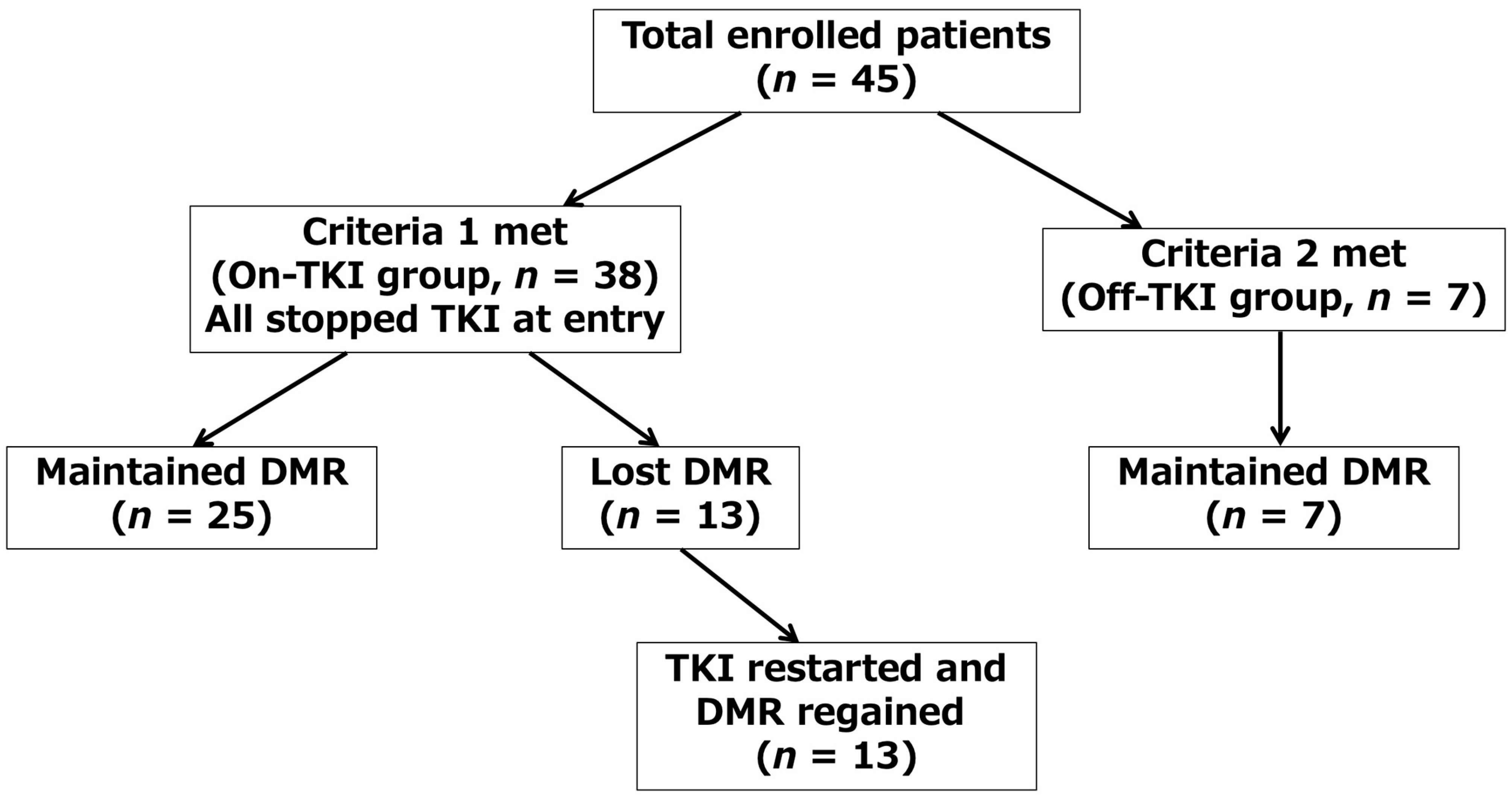
2.2. Loss or Maintenance of MR
2.3. Rates of CD4, CD8, and CTL Clonality
2.4. Conditions Required for Safe TKI Discontinuation
2.5. Other Biological Markers
2.6. Exploratory Analysis of Prior Dasatinib Exposure
3. Discussion
4. Materials and Methods
4.1. Patients
- Sustained DMR (≥MR4) for >1 year while continuing TKI treatment (Criteria 1; On-TKI group), or
- Sustained DMR for >1 year after prior discontinuation of TKI treatment (Criteria 2; Off-TKI group).
- Mental illness or psychiatric symptoms that interfere with participation or informed consent.
- Known immunodeficiency or current immunosuppressive therapy.
- Any condition deemed unsuitable by the treating physician.
4.2. Study Design
4.3. Analysis of Biomarkers
- MR5: bcr::abl1IS ≤ 0.001%
- MR4.5: bcr::abl1IS ≤ 0.0032%
- MR4: bcr::abl1IS ≤ 0.01%.
- DMR: defined as ≥ MR4.
- TFR failure was defined as loss of MR4.
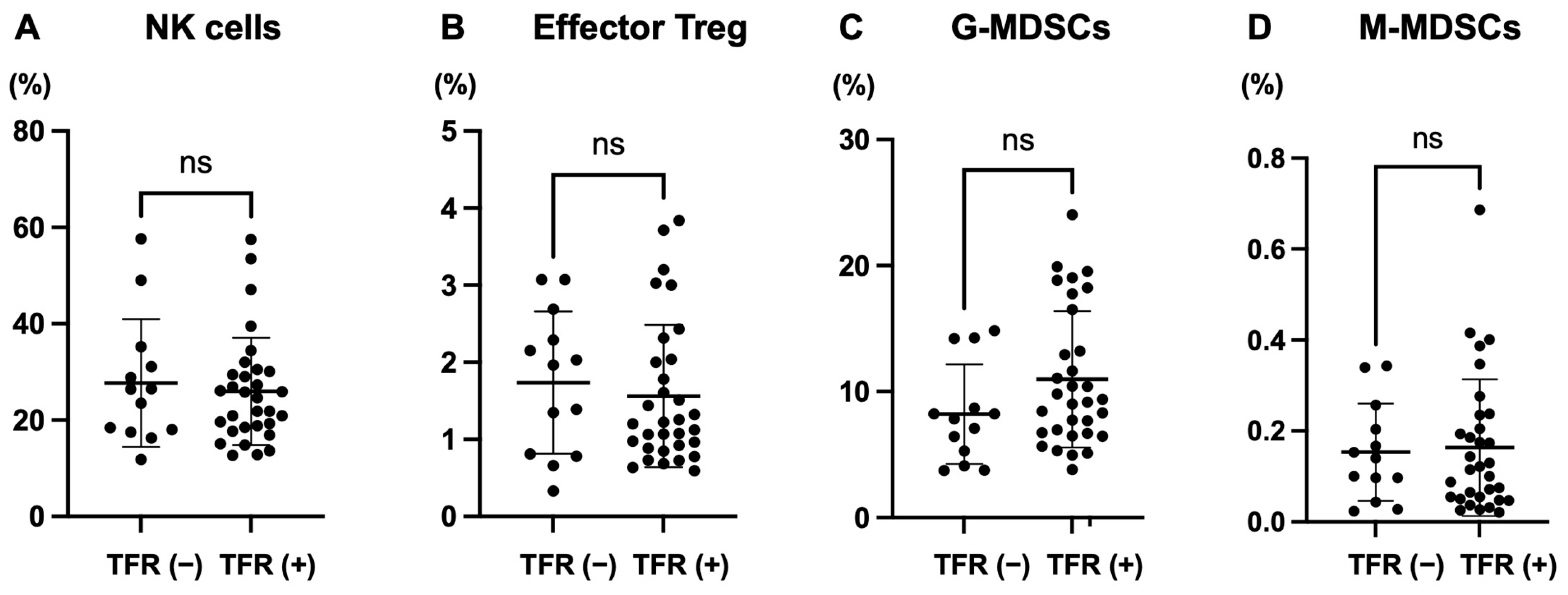
- Flow cytometry acquisition and analysis:
- Treg analysis with fixation/permeabilization:
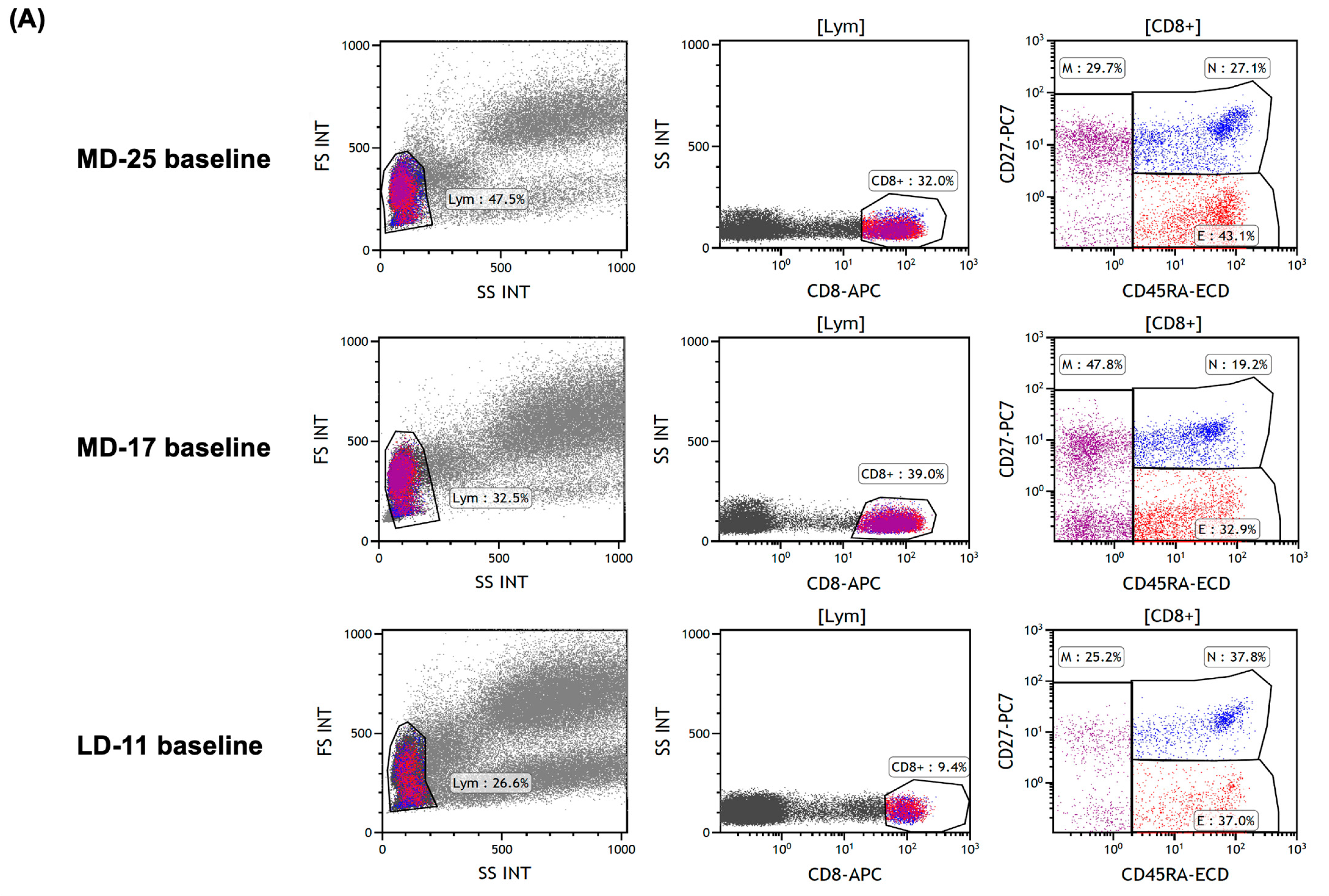
- Gating strategy:
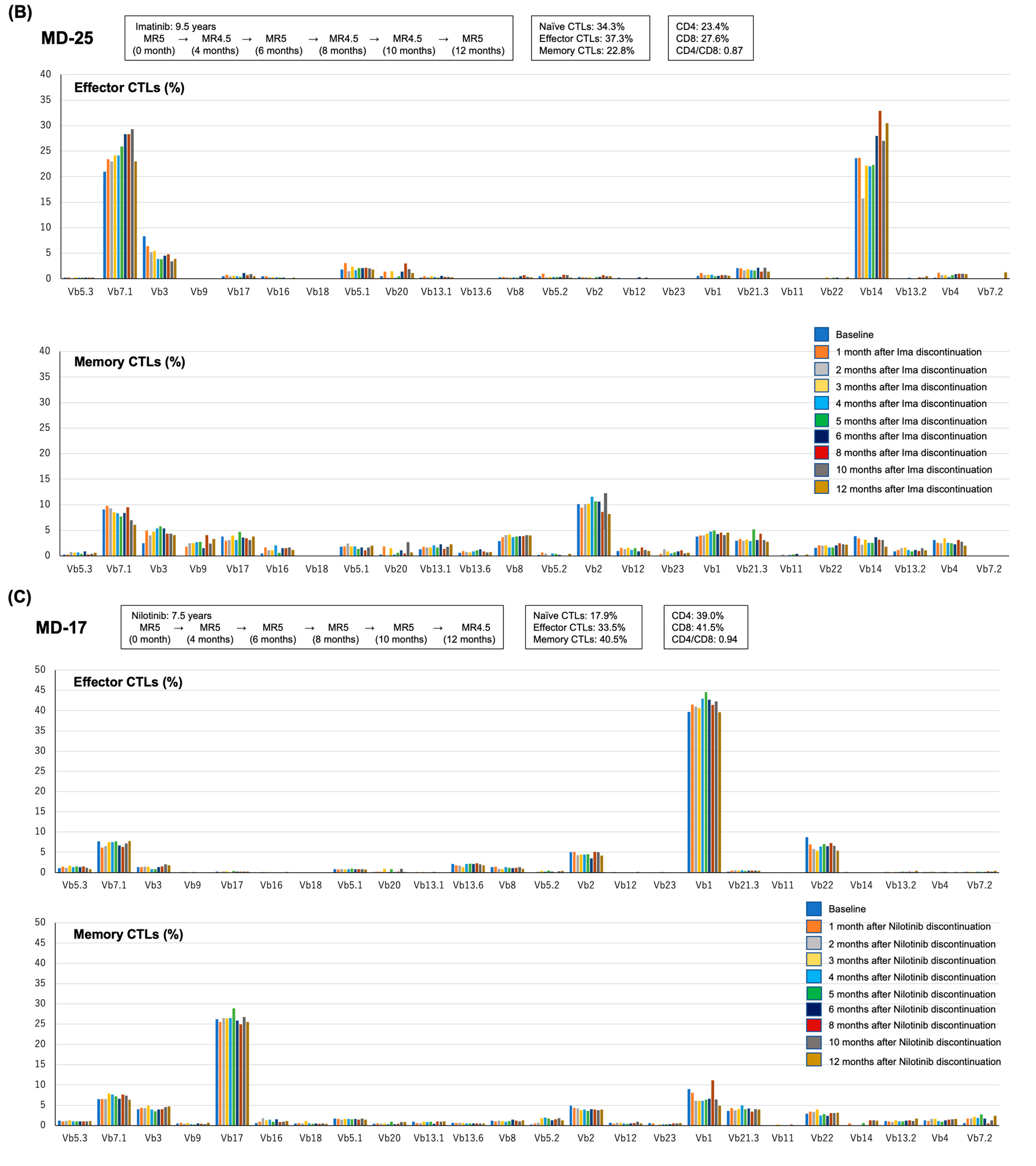
- Naïve CTLs: CD8+CD27+CD45RA+
- Effector CTLs were defined as CD8+CD27−CD45RA+
- Memory CTLs were defined as CD8+CD27+/−CD45RA−
- Weakly activated clones: 5–9.9%
- Activated clones: 10–14.9%
- Highly activated CTL clones: ≥15% of a given Vβ family.
- Assessment schedule:
- On-TKI group: MR and immune markers assessed at 0, 1, 2, 3, 4, 5, 6, 8, 10, and 12 months after TKI discontinuation.
- Off-TKI group: Evaluated at 0, 2, 4, 6, 8, 10, and 12 months post-enrollment.
- All time points were flexible based on outpatient visits.
4.4. Endpoints
4.5. Statistical Analysis
Supplementary Materials
Author Contributions
Funding
Institutional Review Board Statement
Informed Consent Statement
Data Availability Statement
Acknowledgments
Conflicts of Interest
References
- Hochhaus, A.; Baccarani, M.; Silver, R.T.; Schiffer, C.; Apperley, J.F.; Cervantes, F.; Clark, R.E.; Cortes, J.E.; Deininger, M.W.; Guilhot, F.; et al. European LeukemiaNet 2020 recommendations for treating chronic myeloid leukemia. Leukemia 2020, 34, 966–984. [Google Scholar] [CrossRef]
- Mahon, F.X.; Réa, D.; Guilhot, J.; Guilhot, F.; Huguet, F.; Nicolini, F.; Legros, L.; Charbonnier, A.; Guerci, A.; Varet, B.; et al. Discontinuation of imatinib in patients with chronic myeloid leukaemia who have maintained complete molecular remission for at least 2 years: The prospective, multicentre Stop Imatinib (STIM) trial. Lancet Oncol. 2010, 11, 1029–1035. [Google Scholar] [CrossRef] [PubMed]
- Ross, D.M.; Branford, S.; Seymour, J.F.; Schwarer, A.P.; Arthur, C.; Yeung, D.T.; Dang, P.; Goyne, J.M.; Slader, C.; Filshie, R.J.; et al. Safety and efficacy of imatinib cessation for CML patients with stable undetectable minimal residual disease: Results from the TWISTER study. Blood 2013, 122, 515–522. [Google Scholar] [CrossRef] [PubMed]
- Rousselot, P.; Charbonnier, A.; Cony-Makhoul, P.; Agape, P.; Nicolini, F.E.; Varet, B.; Gardembas, M.; Etienne, G.; Réa, D.; Roy, L.; et al. Loss of major molecular response as a trigger for restarting tyrosine kinase inhibitor therapy in patients with chronic-phase chronic myelogenous leukemia who have stopped imatinib after durable undetectable disease. J. Clin. Oncol. 2014, 32, 424–430. [Google Scholar] [CrossRef] [PubMed]
- Ross, D.M.; Masszi, T.; Casares, M.T.G.; Hellmann, A.; Stentoft, J.; Conneally, E.; Garcia-Gutierrez, V.; Gattermann, N.; le Coutre, P.D.; Martino, B.; et al. Durable treatment-free remission in patients with chronic myeloid leukemia in chronic phase following frontline nilotinib: 96-week update of the ENESTfreedom study. J. Cancer Res. Clin. Oncol. 2018, 144, 945–954. [Google Scholar] [CrossRef]
- Saussele, S.; Richter, J.; Guilhot, J.; Gruber, F.X.; Hjorth-Hansen, H.; Almeida, A.; Janssen, J.J.W.M.; Mayer, J.; Koskenvesa, P.; Panayiotidis, P.; et al. Discontinuation of tyrosine kinase inhibitor therapy in chronic myeloid leukaemia (EURO-SKI): A prespecified interim analysis of a prospective, multicentre, non-randomised, trial. Lancet Oncol. 2018, 19, 747–757. [Google Scholar] [CrossRef]
- Atallah, E.; Schiffer, C.A.; Radich, J.P.; Weinfurt, K.P.; Zhang, M.J.; Pinilla-Ibarz, J.; Kota, V.; Larson, R.A.; Moore, J.O.; Mauro, M.J.; et al. Assessment of outcomes after stopping tyrosine kinase inhibitors among patients with chronic myeloid leukemia: A nonrandomized clinical trial. JAMA Oncol. 2021, 7, 42–50. [Google Scholar] [CrossRef]
- Shah, N.P.; García-Gutiérrez, V.; Jiménez-Velasco, A.; Larson, S.M.; Saussele, S.; Rea, D.; Mahon, F.X.; Levy, M.Y.; Gómez-Casares, M.T.; Mauro, M.J.; et al. Treatment-free remission after dasatinib in patients with chronic myeloid leukaemia in chronic phase with deep molecular response: Final 5-year analysis of DASFREE. Br. J. Haematol. 2023, 202, 942–952. [Google Scholar] [CrossRef]
- Fefer, A.; Dean Buckner, C.; Donnall Thomas, E.; Cheever, M.A.; Clift, R.A.; Glucksberg, H.; Neiman, P.E.; Storb, N. Cure of hematologic neoplasia with transplantation of marrow from identical twins. N. Engl. J. Med. 1977, 297, 146–148. [Google Scholar] [CrossRef]
- Talpaz, M.; Kantarjian, H.M.; McCredie, K.; Trujillo, J.M.; Keating, M.J.; Gutterman, J.U. Hematologic remission and cytogenetic improvement induced by recombinant human interferon alpha A in chronic myelogenous leukemia. N. Engl. J. Med. 1986, 314, 1065–1069. [Google Scholar] [CrossRef]
- Kolb, H.J.; Mittermüller, J.; Clemm, C.; Holler, E.; Ledderose, G.; Brehm, G.; Heim, M.; Wilmanns, W. Donor leukocyte transfusions for treatment of recurrent chronic myelogenous leukemia in marrow transplant patients. Blood 1990, 76, 2462–2465. [Google Scholar] [CrossRef] [PubMed]
- Warren, E.H.; Fujii, N.; Akatsuka, Y.; Chaney, C.N.; Mito, J.K.; Loeb, K.R.; Gooley, T.A.; Brown, M.L.; Koo, K.K.W.; Rosinski, K.V.; et al. Therapy of relapsed leukemia after allogeneic hematopoietic cell transplantation with T cells specific for minor histocompatibility antigens. Blood 2010, 115, 3869–3878. [Google Scholar] [CrossRef] [PubMed]
- Dazzi, F.; Szydlo, R.M.; Goldman, J.M. Donor lymphocyte infusions for relapse of chronic myeloid leukemia after allogeneic stem cell transplant: Where we now stand. Exp. Hematol. 1999, 27, 1477–1486. [Google Scholar] [CrossRef]
- Rousselot, P.; Loiseau, C.; Delord, M.; Cayuela, J.M.; Spentchian, M. Late molecular recurrences in patients with chronic myeloid leukemia experiencing treatment-free remission. Blood Adv. 2020, 4, 3034–3040. [Google Scholar] [CrossRef]
- Molldrem, J.J.; Lee, P.P.; Wang, C.; Felio, K.; Kantarjian, H.M.; Champlin, R.E.; Davis, M.M. Evidence that specific T lymphocytes may participate in the elimination of chronic myelogenous leukemia. Nat. Med. 2000, 6, 1018–1023. [Google Scholar] [CrossRef] [PubMed]
- Gannagé, M.; Abel, M.; Michallet, A.S.; Delluc, S.; Lambert, M.; Giraudier, S.; Kratzer, R.; Niedermann, G.; Saveanu, L.; Guilhot, F.; et al. Ex vivo characterization of multiepitopic tumor-specific CD8 T cells in patients with chronic myeloid leukemia: Implications for vaccine development and adoptive cellular immunotherapy. J. Immunol. 2005, 174, 8210–8218. [Google Scholar] [CrossRef]
- Imagawa, J.; Tanaka, H.; Okada, M.; Nakamae, H.; Hino, M.; Murai, K.; Ishida, Y.; Kumagai, T.; Sato, S.; Ohashi, K.; et al. Discontinuation of dasatinib in patients with chronic myeloid leukaemia who have maintained deep molecular response for longer than 1 year (DADI trial): A multicentre phase 2 trial. Lancet Haematol. 2015, 2, e528–e535. [Google Scholar] [CrossRef]
- Schütz, C.; Inselmann, S.; Saussele, S.; Dietz, C.T.; Müller, M.C.; Eigendorff, E.; Brendel, C.A.; Metzelder, S.K.; Brümmendorf, T.H.; Waller, C.; et al. Expression of the CTLA-4 ligand CD86 on plasmacytoid dendritic cells (pDC) predicts risk of disease recurrence after treatment discontinuation in CML. Leukemia 2017, 31, 829–836, Erratum in Leukemia 2018, 32, 1054. [Google Scholar] [CrossRef]
- Kaech, S.M.; Wherry, E.J.; Ahmed, R. Effector and memory T-cell differentiation: Implications for vaccine development. Nat. Rev. Immunol. 2002, 2, 251–262. [Google Scholar] [CrossRef]
- Burchert, A.; Müller, M.C.; Kostrewa, P.; Erben, P.; Bostel, T.; Liebler, S.; Hehlmann, R.; Neubauer, A.; Hochhaus, A. Sustained molecular response with interferon alfa maintenance after induction therapy with imatinib plus interferon alfa in patients with chronic myeloid leukemia. J. Clin. Oncol. 2010, 28, 1429–1435. [Google Scholar] [CrossRef]
- Patterson, S.D.; Copland, M. The bone marrow immune microenvironment in CML: Treatment Responses, treatment-free remission, and therapeutic vulnerabilities. Curr. Hematol. Malig. Rep. 2023, 18, 19–32. [Google Scholar] [CrossRef] [PubMed]
- Dunn, G.P.; Old, L.J.; Schreiber, R.D. The immunobiology of cancer immunosurveillance and immunoediting. Immunity 2004, 21, 137–148. [Google Scholar] [CrossRef] [PubMed]
- Mittal, D.; Gubin, M.M.; Schreiber, R.D.; Smyth, M.J. New insights into cancer immunoediting and its three component phases—Elimination, equilibrium and escape. Curr. Opin. Immunol. 2014, 27, 16–25. [Google Scholar] [CrossRef] [PubMed]
- Jo, T.; Noguchi, K.; Hayashi, S.; Irie, S.; Hayase, R.; Shioya, H.; Kaneko, Y.; Horio, K.; Taguchi, J. Long-lasting memory of cellular immunity in a chronic myeloid leukemia patient maintains molecular response 5 after cessation of dasatinib. Oncol. Lett. 2018, 15, 2935–2938. [Google Scholar] [CrossRef]
- Jo, T.; Kaneko, Y.; Noguchi, K.; Hayashi, S.; Hayase, R.; Shioya, H.; Irie, S.; Horio, K.; Taguchi, J. Cytotoxic immune response can be obtained earlier in chronic phase chronic myeloid leukemia patients treated with dasatinib than with other tyrosine kinase inhibitors. Blood 2018, 132, 3016. [Google Scholar] [CrossRef]
- Jo, T.; Sakai, T.; Matsuzaka, K.; Noguchi, K.; Hayashi, S.; Matsuo, M.; Taguchi, J. Clonal upregulation of effector cytotoxic T lymphocytes in a patient with multiple tyrosine kinase inhibitor-refractory chronic myeloid leukemia with long-term survival. Case Rep. Oncol. 2021, 14, 493–499. [Google Scholar] [CrossRef] [PubMed]
- Shanmuganathan, N.; Pagani, I.S.; Ross, D.M.; Park, S.; Yong, A.S.M.; Braley, J.A.; Altamura, H.K.; Hiwase, D.K.; Yeung, D.T.; Kim, D.W.; et al. Early BCR-ABL1 kinetics are predictive of subsequent achievement of treatment-free remission in chronic myeloid leukemia. Blood 2021, 137, 1196–1207. [Google Scholar] [CrossRef]
- Polakova, K.M.; Zizkova, H.; Zuna, J.; Motlova, E.; Hovorkova, L.; Gottschalk, A.; Glauche, I.; Koblihova, J.; Pecherkova, P.; Klamova, H.; et al. Analysis of chronic myeloid leukaemia during deep molecular response by genomic PCR: A traffic light stratification model with impact on treatment-free remission. Leukemia 2020, 34, 2113–2124. [Google Scholar] [CrossRef] [PubMed]
- Ureshino, H.; Shindo, T.; Tanaka, H.; Saji, H.; Kimura, S. HLA polymorphisms are associated with treatment-free remission following discontinuation of tyrosine kinase inhibitors in chronic myeloid leukemia. Mol. Cancer Ther. 2021, 20, 142–149, Erratum in Mol. Cancer Ther. 2022, 21, 855. [Google Scholar] [CrossRef]
- Caocci, G.; Greco, M.; Delogu, G.; Secchi, C.; Martino, B.; Labate, C.; Abruzzese, E.; Trawinska, M.M.; Galimberti, S.; Orru, F.; et al. Telomere length shortening is associated with treatment-free remission in chronic myeloid leukemia patients. J. Hematol. Oncol. 2016, 9, 63. [Google Scholar] [CrossRef]
- Rinaldetti, S.; Pfirrmann, M.; Manz, K.; Guilhot, J.; Dietz, C.; Panagiotidis, P.; Spiess, B.; Seifarth, W.; Fabarius, A.; Müller, M.; et al. Effect of ABCG2, OCT1, and ABCB1 (MDR1) gene expression on treatment-free remission in a EURO-SKI subtrial. Clin. Lymphoma Myeloma Leuk. 2018, 18, 266–271. [Google Scholar] [CrossRef]
- Illander, M.; Olsson-Strömberg, U.; Schlums, H.; Guilhot, J.; Brück, O.; Lähteenmäki, H.; Kasanen, T.; Koskenvesa, P.; Söderlund, S.; Höglund, M.; et al. Increased proportion of mature NK cells is associated with successful imatinib discontinuation in chronic myeloid leukemia. Leukemia 2017, 31, 1108–1116. [Google Scholar] [CrossRef] [PubMed]
- Vigón, L.; Luna, A.; Galán, M.; Rodríguez-Mora, S.; Fuertes, D.; Mateos, E.; Piris-Villaespesa, M.; Bautista, G.; José, E.S.; Rivera-Torres, J.; et al. Identification of immunological parameters as predictive biomarkers of relapse in patients with chronic myeloid leukemia on treatment-free remission. J. Clin. Med. 2020, 10, 42. [Google Scholar] [CrossRef] [PubMed]
- Irani, Y.D.; Hughes, A.; Clarson, J.; Kok, C.H.; Shanmuganathan, N.; White, D.L.; Yeung, D.T.; Ross, D.M.; Hughes, T.P.; Yong, A.S.N. Successful treatment-free remission in chronic myeloid leukaemia and its association with reduced immune suppressors and increased natural killer cells. Br. J. Haematol. 2020, 191, 433–441. [Google Scholar] [CrossRef]
- Corbin, A.S.; Agarwal, A.; Loriaux, M.; Cortes, J.; Deininger, M.W.; Druker, B.J. Human chronic myeloid leukemia stem cells are insensitive to imatinib despite inhibition of BCR-ABL activity. J. Clin. Investig. 2011, 121, 396–409. [Google Scholar] [CrossRef] [PubMed]
- Réa, D.; Mauro, M.J.; Boquimpani, C.; Minami, Y.; Lomaia, E.; Voloshin, S.; Turkina, A.; Kim, D.W.; Apperley, J.F.; Abdo, A.; et al. A phase 3, open-label, randomized study of asciminib, a STAMP inhibitor, vs bosutinib in CML after 2 or more prior TKIs. Blood 2021, 138, 2031–2041. [Google Scholar] [CrossRef]
- White, H.E.; Matejtschuk, P.; Rigsby, P.; Gabert, J.; Lin, F.; Wang, Y.L.; Branford, S.; Müller, M.C.; Beaufils, N.; Beillard, E.; et al. Establishment of the first World Health Organization International Genetic Reference Panel for quantitation of BCR-ABL mRNA. Blood 2010, 116, e111–e117. [Google Scholar] [CrossRef]




| On-TKI Group * (n = 38) | Off-TKI Group ** (n = 7) | p Value | |
|---|---|---|---|
| Age, years, median (range) | 57.5 (29–85) | 65 (56–87) | 0.058 |
| Male/Female | 25/13 | 5/2 | >0.999 |
| Sokal score n (%) | |||
| Low | 20 (53) | 2 (29) | |
| Intermediate | 10 (26) | 3 (43) | 0.492 |
| High | 8 (21) | 1 (14) | |
| Missing values | 0 (0) | 1 (14) | |
| Hasford score n (%) | |||
| Low | 15 (39) | 3 (43) | |
| Intermediate | 19 (50) | 3 (43) | 0.680 |
| High | 4 (11) | 0 (0) | |
| Missing values | 0 (0) | 1 (14) | |
| ELTS score n (%) | |||
| Low | 35 (92) | 6 (86) | |
| Intermediate | 3 (8) | 0 (0) | n/a |
| High | 0 (0) | 0 (0) | |
| Missing values | 0 (0) | 1 (14) | |
| Duration of TKI treatment, years | |||
| Median (range) | 7.65 (1.5–17.4) | 10.0 (3.3–18.3) | 0.3568 |
| Time since TKI discontinuation at study onset, years | |||
| Median (range) | n/a | 4.9 (1.1–7.1) | n/a |
| Maintenance of DMR n (%) | Loss of DMR n (%) | p Value | |
|---|---|---|---|
| On-TKI group n = 38 | 25 (65.8%) | 13 (34.2%) | |
| Off-TKI group n = 7 | 7 (100%) | 0 (0%) | |
| Duration of TKI treatment (years) Median (range) | 9.45 (3.3–18.3) | 4.9 (1.5–11.9) | 0.005 |
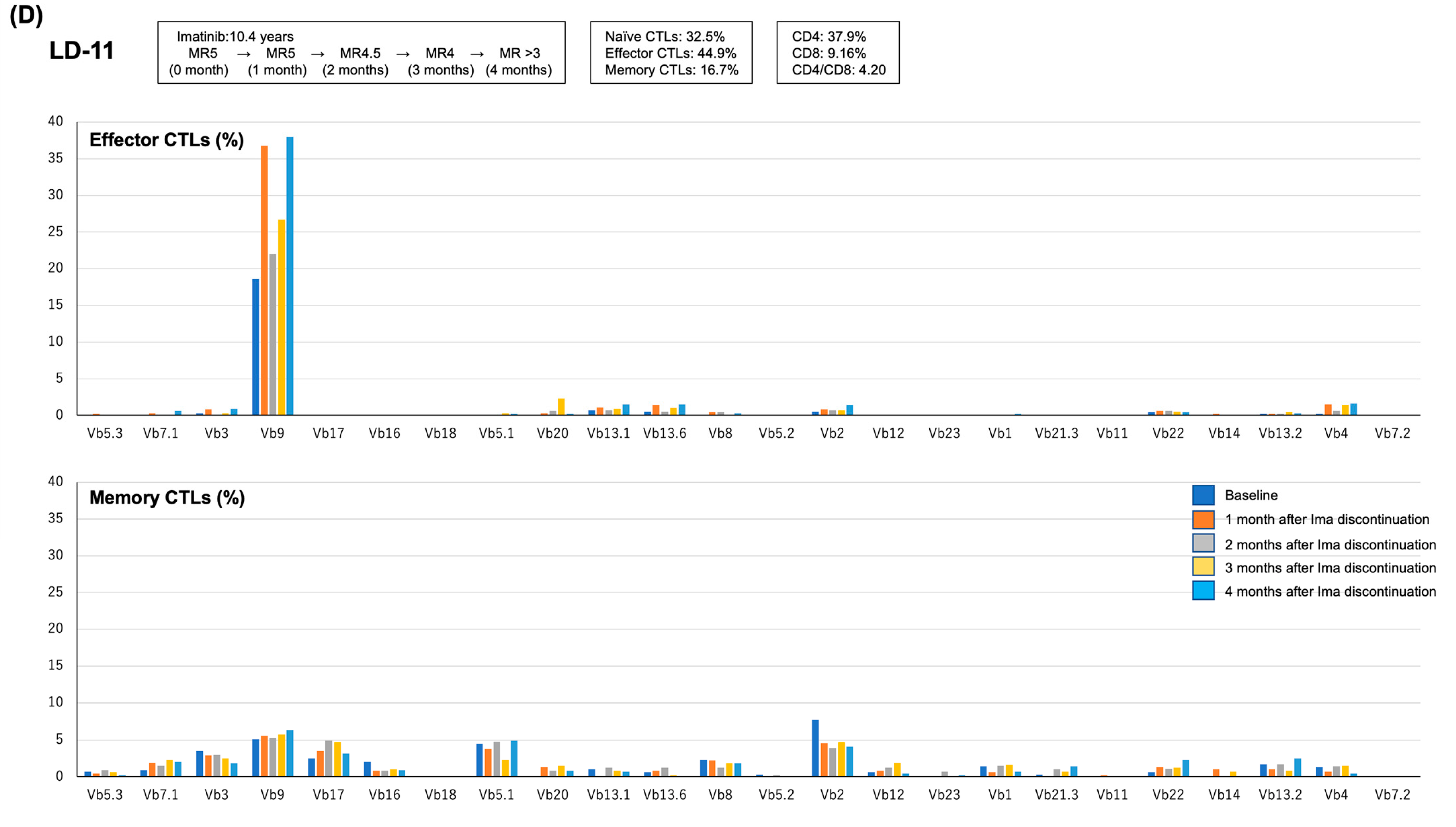
| Patient ID | LD-4 | LD-7 | LD-11 | LD-13 |
|---|---|---|---|---|
| Duration of TKI treatment (years) | Ima: 0.2, Dasa: 10.8 (Total: 11.0) | Ima: 4.1, Nilo: 0.01, Ima: 3.4, Dasa: 4.4 (Total: 11.91) | Ima: 10.4 | Ima: 11.4 |
| CD4 (%) | 36.0 | 34.8 | 37.9 | 18 |
| CD8 (%) | 10.1 | 27.8 | 9.2 | 10.2 |
| CD4/CD8 | 3.6 | 1.2 | 4.2 | 1.8 |
| Naïve CTLs (%) | 22.6 | 11.3 | 32.5 | 8.3 |
| Effector CTLs (%) | 50.2 | 71.8 | 44.9 | 68.3 |
| Memory CTLs (%) | 23.7 | 14.0 | 16.7 | 20.6 |
| CTL clonality | ||||
| Effector CTLs | ||||
| Highly activated: | (−) | (−) | Vb9 | (−) |
| Activated: | (−) | Vb2 | (−) | Vb23 |
| Weakly activated: | Vb8 | (−) | (−) | Vb13.1 |
| Memory CTLs | ||||
| Highly activated: | (−) | (−) | (−) | (−) |
| Activated: | Vb13.1, Vb2 | Vb2 | (−) | Vb13.6 |
| Weakly activated: | Vb1, Vb3, Vb14, Vb22 | Vb17, Vb3 | Vb9 | Vb1 |
| Essential Conditions: | Tyrosine kinase inhibitor treatment duration of ≥7 years Deep molecular response maintained for ≥1 year |
| Condition 1: | CD8 > CD4 in T lymphocyte ratio |
| Condition 2: | Memory cytotoxic T lymphocytes > effector cytotoxic T lymphocytes in total cytotoxic T lymphocyte ratio |
| Condition 3: | Presence of a highly activated memory cytotoxic T lymphocyte clone |
| Condition 4: | Presence of a highly activated effector cytotoxic T lymphocyte clone |
| Safety Condition 1. | Essential conditions and at least one of conditions 1–3 are met: The probability of treatment-free remission is close to 100% |
| Safety Condition 2. | Essential conditions and condition 4 are met but none of conditions 1–3: The probability of treatment-free remission is >90% |
| TKI ≥7 Years & | TKI ≥7 Years & | p Value | Odds Ratio for DMR Maintenance | |
|---|---|---|---|---|
| Maintenance of DMR | Loss of DMR | (95% Confidence Interval) | ||
| n = 21 | n = 4 | |||
| CD8 > CD4 | 16 | 0 | 0.0100 | Infinity |
| (1.950 to infinity) | ||||
| Total memory CTLs > total effector CTLs | 7 | 0 | 0.2945 | Infinity |
| (0.3270 to infinity) | ||||
| Presence of highly activated memory CTL clone | 3 | 0 | >0.9999 | Infinity |
| (0.1443 to infinity) | ||||
| Presence of highly activated effector CTL clone | 10 | 1 | 0.6043 | 2.727 |
| (0.3424 to 38.50) |
Disclaimer/Publisher’s Note: The statements, opinions and data contained in all publications are solely those of the individual author(s) and contributor(s) and not of MDPI and/or the editor(s). MDPI and/or the editor(s) disclaim responsibility for any injury to people or property resulting from any ideas, methods, instructions or products referred to in the content. |
© 2026 by the authors. Licensee MDPI, Basel, Switzerland. This article is an open access article distributed under the terms and conditions of the Creative Commons Attribution (CC BY) license.
Share and Cite
Jo, T.; Saburi, Y.; Masunari, T.; Noguchi, K.; Sakai, T.; Taguchi, J.; Ohtsuka, E.; Sezaki, N.; Kubota-Koketsu, R.; Kiguchi, T. Activated Memory Cytotoxic T-Lymphocytes and T-Cell Receptor Vβ Clonality Predict Treatment-Free Remission After Tyrosine Kinase Inhibitor Discontinuation in Chronic-Phase Chronic Myeloid Leukemia: A 1-Year Prospective Immuno-Monitoring Study. Int. J. Mol. Sci. 2026, 27, 2713. https://doi.org/10.3390/ijms27062713
Jo T, Saburi Y, Masunari T, Noguchi K, Sakai T, Taguchi J, Ohtsuka E, Sezaki N, Kubota-Koketsu R, Kiguchi T. Activated Memory Cytotoxic T-Lymphocytes and T-Cell Receptor Vβ Clonality Predict Treatment-Free Remission After Tyrosine Kinase Inhibitor Discontinuation in Chronic-Phase Chronic Myeloid Leukemia: A 1-Year Prospective Immuno-Monitoring Study. International Journal of Molecular Sciences. 2026; 27(6):2713. https://doi.org/10.3390/ijms27062713
Chicago/Turabian StyleJo, Tatsuro, Yoshio Saburi, Taro Masunari, Kazuhiro Noguchi, Takahiro Sakai, Jun Taguchi, Eiichi Ohtsuka, Nobuo Sezaki, Ritsuko Kubota-Koketsu, and Toru Kiguchi. 2026. "Activated Memory Cytotoxic T-Lymphocytes and T-Cell Receptor Vβ Clonality Predict Treatment-Free Remission After Tyrosine Kinase Inhibitor Discontinuation in Chronic-Phase Chronic Myeloid Leukemia: A 1-Year Prospective Immuno-Monitoring Study" International Journal of Molecular Sciences 27, no. 6: 2713. https://doi.org/10.3390/ijms27062713
APA StyleJo, T., Saburi, Y., Masunari, T., Noguchi, K., Sakai, T., Taguchi, J., Ohtsuka, E., Sezaki, N., Kubota-Koketsu, R., & Kiguchi, T. (2026). Activated Memory Cytotoxic T-Lymphocytes and T-Cell Receptor Vβ Clonality Predict Treatment-Free Remission After Tyrosine Kinase Inhibitor Discontinuation in Chronic-Phase Chronic Myeloid Leukemia: A 1-Year Prospective Immuno-Monitoring Study. International Journal of Molecular Sciences, 27(6), 2713. https://doi.org/10.3390/ijms27062713