

Biosensor-Based Detection of Calprotectin and Lactoferrin as Neutrophil-Derived Markers of Inflammatory Bowel Diseases: From Molecular Pathophysiology to Point-of-Care Platforms
 , , , , ,
  and
and 
Abstract
1. Introduction
2. Calprotectin and Lactoferrin as Biological Markers of IBD
3. Biosensor-Based Detection of Calprotectin
3.1. ELISA-Based and Related Methods
3.2. Electrochemical Registration of Calprotectin
3.3. Optical Detection of Calprotectin
3.4. Microorganism-Based Biosensors for Calprotectin
4. Biosensor-Based Detection of Lactoferrin
4.1. ELISA-Based LF-Biosensors
4.2. Fluorescence-Based and Colorimetric LF-Biosensors
4.3. Electrochemical LF-Biosensors
4.4. SPR-Based LF-Biosensors
4.5. The Biosensors Based on the Other LF-Detection Principles and LF-Based Biosensors
5. Current Challenges and Perspectives
5.1. Material and Technical Barriers: Receptor Stability, Degradation, Drift, and Reproducibility
5.2. Matrix Effects: The Complexity of the Fecal Matrix for Ensuring Analytical Functionality
5.3. Sample Preparation: Extraction, Storage, Temperature, and Transfer of Procedures to a PoC Format
5.4. Scaling Up Development: From Laboratory Prototype to Ready-to-Use Product
5.5. Certification, Clinical Validation, and Integration into the Diagnostic Environment
5.6. Integration with Artificial Intelligence and Machine Learning
5.7. Architectonics and Design of Biorecognition Elements
5.8. Formation of Multimodal Platforms
6. Conclusions
Author Contributions
Funding
Institutional Review Board Statement
Informed Consent Statement
Data Availability Statement
Conflicts of Interest
Abbreviations
| AGA | American Gastroenterological Association |
| AI | Artificial Intelligence |
| BSA | Bovine Serum Albumin |
| CD | Crohn’s Disease |
| Cdl | Double-layer capacitance |
| CL | Chemiluminescence |
| CV | Cyclic Voltammetry |
| DNA | Deoxyribonucleic Acid |
| DPV | Differential Pulse Voltammetry |
| ECL | Electrochemiluminescence |
| ECCO | European Crohn’s and Colitis Organisation |
| EIS | Electrochemical Impedance Spectroscopy |
| ELISA | Enzyme-Linked Immunosorbent Assay |
| FC | Fecal Calprotectin |
| FL | Fecal Lactoferrin |
| GI | Gastrointestinal |
| IBD | Inflammatory Bowel Disease |
| IDE | Interdigitated Electrode |
| LFA | Lateral Flow Assay |
| LF | Lactoferrin |
| LoD | Limit of Detection |
| ML | Machine Learning |
| MIP | Molecularly Imprinted Polymer |
| NETs | Neutrophil Extracellular Traps |
| PBS | Phosphate-Buffered Saline |
| PoC | Point-of-Care |
| QCM | Quartz Crystal Microbalance |
| RCA | Rolling Circle Amplification |
| Rct | Charge Transfer Resistance |
| RNA | Ribonucleic Acid |
| SAM | Self-Assembled Monolayer |
| SAW | Surface Acoustic Waves |
| SERS | Surface-Enhanced Raman Spectroscopy |
| SPR | Surface Plasmon Resonance |
| T2T | Treat-to-Target |
| UC | Ulcerative Colitis |
References
- Le Berre, C.; Danese, S.; Peyrin-Biroulet, L. Can We Change the Natural Course of Inflammatory Bowel Disease? Ther. Adv. Gastroenterol. 2023, 16, 17562848231163118. [Google Scholar] [CrossRef] [PubMed]
- Ng, S.C.; Shi, H.Y.; Hamidi, N.; Underwood, F.E.; Tang, W.; Benchimol, E.I.; Panaccione, R.; Ghosh, S.; Wu, J.C.Y.; Chan, F.K.L.; et al. Worldwide Incidence and Prevalence of Inflammatory Bowel Disease in the 21st Century: A Systematic Review of Population-Based Studies. Lancet 2017, 390, 2769–2778, Erratum in Lancet 2020, 396, e56. https://doi.org/10.1016/s0140-6736(20)32028-6. [Google Scholar] [CrossRef]
- Caron, B.; Honap, S.; Peyrin-Biroulet, L. Epidemiology of Inflammatory Bowel Disease across the Ages in the Era of Advanced Therapies. J. Crohns Colitis 2024, 18, ii3–ii15. [Google Scholar] [CrossRef] [PubMed]
- Plevris, N.; Lees, C.W. Disease Monitoring in Inflammatory Bowel Disease: Evolving Principles and Possibilities. Gastroenterology 2022, 162, 1456–1475.e1. [Google Scholar] [CrossRef]
- Turner, D.; Ricciuto, A.; Lewis, A.; D’Amico, F.; Dhaliwal, J.; Griffiths, A.M.; Bettenworth, D.; Sandborn, W.J.; Sands, B.E.; Reinisch, W.; et al. STRIDE-II: An Update on the Selecting Therapeutic Targets in Inflammatory Bowel Disease (STRIDE) Initiative of the International Organization for the Study of IBD (IOIBD): Determining Therapeutic Goals for Treat-To-Target Strategies in IBD. Gastroenterology 2021, 160, 1570–1583. [Google Scholar] [CrossRef] [PubMed]
- Bencardino, S.; D’Amico, F.; Zilli, A.; Parigi, T.L.; Allocca, M.; Fiorino, G.; Danese, S.; Furfaro, F. Fecal, Blood, and Urinary Biomarkers in Inflammatory Bowel Diseases. J. Transl. Gastroenterol. 2024, 2, 61–75. [Google Scholar] [CrossRef] [PubMed]
- Devi, J.; Samaan, S.; Syal, G.; Deepak, P. Biomarkers for Disease Activity in Inflammatory Bowel Disease. Gastroenterol. Clin. N. Am. 2025, 55, 107–123. [Google Scholar] [CrossRef]
- Rasmussen, M.H.; Brodersen, J.B.; Brasen, C.L.; Madsen, J.S.; Knudsen, T.; Kjeldsen, J.; Jensen, M.D. The Diagnostic Accuracy of Plasma and Serum Calprotectin Is Inferior to C-Reactive Protein in Patients with Suspected Crohn’s Disease. Scand. J. Gastroenterol. 2025, 60, 235–242. [Google Scholar] [CrossRef]
- Chatterjee, S.; Chakraborty, A.; Roy, S.; Roychowdhury, D.; Karmakar, A.; Saha, A.; Dhali, G.K.; Banerjee, S.; Banerjee, A. DEFB4A/HBD2, a Non-Invasive Serum Biomarker for Detection of Ulcerative Colitis. Sci. Rep. 2025, 15, 38949. [Google Scholar] [CrossRef]
- Boodaghidizaji, M.; McGovern, D.P.B.; Li, D. Imputation Methods for Serologic Biomarkers in Inflammatory Bowel Disease. Sci. Rep. 2026, 2026. [Google Scholar] [CrossRef] [PubMed]
- Abraham, B.P.; Kane, S. Fecal Markers: Calprotectin and Lactoferrin. Gastroenterol. Clin. 2012, 41, 483–495. [Google Scholar] [CrossRef]
- Bohra, A.; Mohamed, G.; Vasudevan, A.; Lewis, D.; Van Langenberg, D.R.; Segal, J.P. The Utility of Faecal Calprotectin, Lactoferrin and Other Faecal Biomarkers in Discriminating Endoscopic Activity in Crohn’s Disease: A Systematic Review and Meta-Analysis. Biomedicines 2023, 11, 1408. [Google Scholar] [CrossRef] [PubMed]
- Singh, S.; Ananthakrishnan, A.N.; Nguyen, N.H.; Cohen, B.L.; Velayos, F.S.; Weiss, J.M.; Sultan, S.; Siddique, S.M.; Adler, J.; Chachu, K.A. AGA Clinical Practice Guideline on the Role of Biomarkers for the Management of Ulcerative Colitis. Gastroenterology 2023, 164, 344–372. [Google Scholar] [CrossRef]
- Hejl, J.; Theede, K.; Møllgren, B.; Madsen, K.V.; Heidari, A.; Steig, A.á; Fenger, M. Point of Care Testing of Fecal Calprotectin as a Substitute for Routine Laboratory Analysis. Pract. Lab. Med. 2017, 10, 10–14. [Google Scholar] [CrossRef]
- Hamer, H.M.; Mulder, A.L.; de Boer, N.K.; Crouwel, F.; van Rheenen, P.F.; Spekle, M.; Vermeer, M.; Wagenmakers-Huizinga, L.; Muller Kobold, A.C. Impact of Preanalytical Factors on Calprotectin Concentration in Stool: A Multiassay Comparison. J. Appl. Lab. Med. 2022, 7, 1401–1411. [Google Scholar] [CrossRef] [PubMed]
- Fu, W.; Xue, R.; Shivdasani, M.N.; Wu, Y.; Chen, D.; Guo, T.; Lovell, N.H.; Goldys, E.M.; Xiang, T.; Huang, Y.; et al. Advances in Biosensors for Diagnosis and Monitoring of Inflammatory Bowel Disease: A Review. Bioeng. Transl. Med. 2025, 10, e70064. [Google Scholar] [CrossRef]
- Clough, J.; Colwill, M.; Poullis, A.; Pollok, R.; Patel, K.; Honap, S. Biomarkers in Inflammatory Bowel Disease: A Practical Guide. Ther. Adv. Gastroenterol. 2024, 17, 17562848241251600. [Google Scholar] [CrossRef]
- Yamakawa, T.; Miyake, T.; Yokoyama, Y.; Kazama, T.; Hayashi, Y.; Hirayama, D.; Yoshii, S.; Yamano, H.; Takahashi, S.; Nakase, H. Clinical Performance of Fecal Calprotectin, Lactoferrin, and Hemoglobin for Evaluating the Disease Activity of IBD and Detecting Colorectal Tumors. JGH Open 2024, 8, e13077. [Google Scholar] [CrossRef] [PubMed]
- Baum, S.; Hamedi, K.; Loftus, C.; Loftus, G.; Zhou, E.-R.; Arce, S. From Cytokines to Biomarkers: Mapping the Immunopathology of Inflammatory Bowel Disease. Cells 2025, 14, 1589. [Google Scholar] [CrossRef]
- Othman, A.; Sekheri, M.; Filep, J.G. Roles of Neutrophil Granule Proteins in Orchestrating Inflammation and Immunity. FEBS J. 2021, 289, 3932–3953. [Google Scholar] [CrossRef]
- Mumolo, M.G.; Bertani, L.; Ceccarelli, L.; Laino, G.; Fluri, G.D.; Albano, E.; Tapete, G.; Costa, F. From Bench to Bedside: Fecal Calprotectin in Inflammatory Bowel Diseases Clinical Setting. World J. Gastroenterol. 2018, 24, 3681–3694. [Google Scholar] [CrossRef]
- Conesa, C.; Bellés, A.; Grasa, L.; Sánchez, L. The Role of Lactoferrin in Intestinal Health. Pharmaceutics 2023, 15, 1569. [Google Scholar] [CrossRef] [PubMed]
- Britzen-Laurent, N.; Weidinger, C.; Stürzl, M. Contribution of Blood Vessel Activation, Remodeling and Barrier Function to Inflammatory Bowel Diseases. Int. J. Mol. Sci. 2023, 24, 5517. [Google Scholar] [CrossRef]
- Alarfaj, S.J.; Mostafa, S.A.; Negm, W.A.; El-Masry, T.A.; Kamal, M.; Elsaeed, M.; El Nakib, A.M. Mucosal Genes Expression in Inflammatory Bowel Disease Patients: New Insights. Pharmaceuticals 2023, 16, 324. [Google Scholar] [CrossRef] [PubMed]
- Sejersen, K.; Havelka, A.M.; Lipcsey, M.; Larsson, A. Comparison of Total Calprotectin Levels with S100A8 and S100A9 Subunit Levels in Critically Ill Patients. Scand. J. Clin. Lab. Investig. 2025, 85, 299–304. [Google Scholar] [CrossRef]
- Polakowska, M.; Steczkiewicz, K.; Szczepanowski, R.H.; Wysłouch-Cieszyńska, A. Toward an Understanding of the Conformational Plasticity of S100A8 and S100A9 Ca2+-Binding Proteins. J. Biol. Chem. 2023, 299, 102952. [Google Scholar] [CrossRef] [PubMed]
- Wang, W.; Cao, W.; Zhang, S.; Chen, D.; Liu, L. The Role of Calprotectin in the Diagnosis and Treatment of Inflammatory Bowel Disease. Int. J. Mol. Sci. 2025, 26, 1996. [Google Scholar] [CrossRef]
- Ehrchen, J.; Sunderkötter, C.; Foell, D.; Vogl, T.J.; Roth, J. The Endogenous Toll–like Receptor 4 Agonist S100A8/S100A9 (Calprotectin) as Innate Amplifier of Infection, Autoimmunity, and Cancer. J. Leukoc. Biol. 2009, 86, 557–566. [Google Scholar] [CrossRef]
- Urban, C.F.; Ermert, D.; Schmid, M.; Abu-Abed, U.; Goosmann, C.; Nacken, W.; Brinkmann, V.; Jungblut, P.R.; Zychlinsky, A. Neutrophil Extracellular Traps Contain Calprotectin, a Cytosolic Protein Complex Involved in Host Defense against Candida albicans. PLoS Pathog. 2009, 5, e1000639. [Google Scholar] [CrossRef]
- Voganatsi, A.; Panyutich, A.; Miyasaki, K.T.; Murthy, R.K. Mechanism of Extracellular Release of Human Neutrophil Calprotectin Complex. J. Leukoc. Biol. 2001, 70, 130–134. [Google Scholar] [CrossRef] [PubMed]
- Zou, F.; Wang, X.; Glitza, I.C.; McQuade, J.L.; Wang, J.; Zhang, H.C.; Thompson, J.A.; Thomas, A.S.; Wang, Y. Fecal Calprotectin Concentration to Assess Endoscopic and Histologic Remission in Patients with Cancer with Immune-Mediated Diarrhea and Colitis. J. Immunother. Cancer 2021, 9, e002058, Correction in J. Immunother. Cancer 2021, 9, e002058corr1. https://doi.org/10.1136/jitc-2020-002058corr1. [Google Scholar] [CrossRef]
- Lu, Z.; Ni, W.; Wu, Y.; Zhai, B.; Zhao, Q.; Zheng, T.; Liu, Q.; Ding, D. Application of Biomarkers in the Diagnosis of Kidney Disease. Front. Med. 2025, 12, 1560222. [Google Scholar] [CrossRef] [PubMed]
- Hong, R.; Xie, A.; Jiang, C.; Guo, Y.; Zhang, Y.; Chen, J.; Shen, X.; Li, M.; Yue, X. A Review of the Biological Activities of Lactoferrin: Mechanisms and Potential Applications. Food Funct. 2024, 15, 8182–8199. [Google Scholar] [CrossRef]
- Liang, L.; Wang, Z.-J.; Ye, G.; Tang, X.-Y.; Zhang, Y.-Y.; Kong, J.-X.; Du, H.-H. Distribution of Lactoferrin Is Related with Dynamics of Neutrophils in Bacterial Infected Mice Intestine. Molecules 2020, 25, 1496. [Google Scholar] [CrossRef] [PubMed]
- Kayazawa, M.; Saitoh, O.; Kojima, K.; Nakagawa, K.; Tanaka, S.; Tabata, K.; Matsuse, R.; Uchida, K.; Hoshimoto, M.; Hirata, I.; et al. Lactoferrin in Whole Gut Lavage Fluid as a Marker for Disease Activity in Inflammatory Bowel Disease: Comparison with Other Neutrophil-Derived Proteins. Am. J. Gastroenterol. 2002, 97, 360–369. [Google Scholar] [CrossRef]
- Legrand, D. Overview of Lactoferrin as a Natural Immune Modulator. J. Pediatr. 2016, 173, S10–S15. [Google Scholar] [CrossRef]
- Kell, D.B.; Heyden, E.L.; Pretorius, E. The Biology of Lactoferrin, an Iron-Binding Protein That Can Help Defend against Viruses and Bacteria. Front. Immunol. 2020, 11, 1221. [Google Scholar] [CrossRef]
- Rosa, L.; Cutone, A.; Lepanto, M.S.; Paesano, R.; Valenti, P. Lactoferrin: A Natural Glycoprotein Involved in Iron and Inflammatory Homeostasis. Int. J. Mol. Sci. 2017, 18, 1985. [Google Scholar] [CrossRef]
- Singh, A.; Bhardwaj, A.; Sharma, R.; Kahlon, B.K.; Dhaliwal, A.S.; Singh, D.; Kaur, S.; Jain, D.; Bansal, N.; Mahajan, R.; et al. Predictive Accuracy of Fecal Calprotectin for Histologic Remission in Ulcerative Colitis. Intest. Res. 2025, 23, 144–156. [Google Scholar] [CrossRef] [PubMed]
- Murray, J.; Kok, K.B.; Ayling, R.M. Fecal Calprotectin in Gastrointestinal Disease. Clin. Chem. 2023, 69, 699–710. [Google Scholar] [CrossRef] [PubMed]
- Banigo, A.T.; Obasi, C.C. Nanobiosensors for Early Diagnosis and Detection of Gastrointestinal Diseases. In Nano-Bio-Medicine for Gastrointestinal Diseases; Academic Press: Cambridge, MA, USA, 2026; pp. 197–216. [Google Scholar] [CrossRef]
- Teixeira, B.; Gonçalves, H.M.R.; Martins-Lopes, P. Gut Feeling: Biomarkers and Biosensors’ Potential in Revolutionizing Inflammatory Bowel Disease (IBD) Diagnosis and Prognosis—A Comprehensive Review. Biosensors 2025, 15, 513. [Google Scholar] [CrossRef]
- Saidova, M.; Xamrakulova, N.; Mirzayeva, N.; Abitov, I.; Turayeva, F.; Shagazatova, B.; Bekenova, G.; Butaboyev, M.; Kadirov, I.; Kendjaev, B.; et al. Electrochemical Biosensors for Inflammatory Bowel Disease. Clin. Chim. Acta 2025, 579, 120651. [Google Scholar] [CrossRef]
- Qaiser, N.; Suryaprabha, T.; Vetrano, F.; Hwang, B.; Elatab, N. Mechanics and Bio-Interface Engineering in Flexible Biosensors for Continuous Health Monitoring. npj Flex. Electron. 2026, 10, 23. [Google Scholar] [CrossRef]
- Zhang, Y.; Hu, F.; Zhou, R.; Yang, T.; Cai, P.; Picchetti, P.; Huang, X.; Li, Z.; Zhai, X.; Zhang, R.; et al. Enhancing Selectivity in Affinity Biosensors through Biorecognition-Driven Suppression of Nonspecific Binding. ACS Sens. 2026, 11, 853–884. [Google Scholar] [CrossRef] [PubMed]
- Nava-Granados, J.; Vasquez, K.; Medina, B.U.; Wang, C.; Moreto, J.R.; Sempionatto, J. Flow by Design: A Guided Review of Microfluidics for Wearable Biosensors. Lab Chip 2026, 26, 1080–1107. [Google Scholar] [CrossRef]
- Silvers, R.; Stephan, J.R.; Griffin, R.G.; Nolan, E.M. Molecular Basis of Ca(II)-Induced Tetramerization and Transition-Metal Sequestration in Human Calprotectin. J. Am. Chem. Soc. 2021, 143, 18073–18090. [Google Scholar] [CrossRef] [PubMed]
- Damms, A.; Bischoff, S.C. Validation and Clinical Significance of a New Calprotectin Rapid Test for the Diagnosis of Gastrointestinal Diseases. Int. J. Color. Dis. 2008, 23, 985–992. [Google Scholar] [CrossRef] [PubMed]
- Kido, J.; Abe, K.; Yatsushiro, S.; Bando, M.; Hiroshima, Y.; Nagata, T.; Ooie, T.; Tanaka, M.; Kataoka, M. Determination of Calprotectin in Gingival Crevicular Fluid by Immunoassay on a Microchip. Clin. Biochem. 2012, 45, 1239–1244. [Google Scholar] [CrossRef] [PubMed]
- Díaz-Perlas, C.; Ricken, B.; Farrera-Soler, L.; Guschin, D.; Pojer, F.; Lau, K.; Gerhold, C.-B.; Heinis, C. High-Affinity Peptides Developed against Calprotectin and Their Application as Synthetic Ligands in Diagnostic Assays. Nat. Commun. 2023, 14, 2774. [Google Scholar] [CrossRef]
- Dong, L.; Yin, L.; Tian, G.; Wang, Y.; Peng, H.; Wu, Q.; Cheng, W.; Ding, S.; Xia, Q. An Enzyme-Free Ultrasensitive Electrochemical Immunosensor for Calprotectin Detection Based on PtNi Nanoparticles Functionalized 2D Cu-Metal Organic Framework Nanosheets. Sens. Actuators B Chem. 2020, 308, 127687. [Google Scholar] [CrossRef]
- Chandio, I.; Jiao, Q.; Li, R.; Ai, Y.; Liang, Q. Dual-Signal Electrochemical Aptasensor Based on High-Entropy Alloy Nanosheets for Calprotectin Detection in Inflammatory Bowel Disease. ACS Appl. Mater. Interfaces 2025, 17, 38960–38970. [Google Scholar] [CrossRef]
- Aslan, Ç.G.; Ertugrul Uygun, H.D.; Uygun, Z.O.; Ünal, N.G.; Akcay, Y. Non-Invasive Detection of Crohn’s Disease with Label-Free Detection of Calprotectin by Impedimetric Aptasensor. Electroanalysis 2023, 35, e202300119. [Google Scholar] [CrossRef]
- Jagannath, B.; Lin, K.-C.; Pali, M.; Shahub, S.; Sardesai, A.; Muthukumar, S.; Prasad, S. An Observational Study Demonstrating the Measurement, Characterization and Validation of Expression of Calprotectin in Human Sweat through a Sweat Wearable. Biosens. Bioelectron. X 2023, 13, 100314. [Google Scholar] [CrossRef]
- Shahub, S.; Ramasubramanya, A.; Singh, P.; Kumar, R.M.; Lin, K.-C.; Muthukumar, S.; Prasad, S. Longitudinal Tracking of Chronic Inflammation through Calprotectin and Interleukin-6 Using a Sweat Wearable Device. Biosens. Bioelectron. X 2025, 24, 100622. [Google Scholar] [CrossRef]
- Lv, F.; Chen, J.; Wan, Y.; Si, J.; Song, M.; Zhu, F.; Du, S.; Shang, Y.; Man, T.; Zhu, L.; et al. Amplification of an Electrochemiluminescence-Emissive Aptamer into DNA Nanotags for Sensitive Fecal Calprotectin Determination. Anal. Chem. 2023, 95, 18564–18571. [Google Scholar] [CrossRef]
- Resende, S.; Frasco, M.F.; Freitas, P.P.; Sales, F. Detection of Serum Calprotectin Based on Molecularly Imprinted Photonic Hydrogels: A Novel Approach for IBD Diagnosis. Biosens. Bioelectron. X 2023, 13, 100313. [Google Scholar] [CrossRef]
- Si, J.; Zhou, W.; Zhou, D.; Fang, Y.; Shen, X.; Zhu, C. A Turn-Off Fluorescent Strategy for Calprotectin Detection Based on the Inhibitory Effect of Calprotectin upon the Activity of Zn(II)-Dependent DNAzyme. Chemosensors 2022, 10, 495. [Google Scholar] [CrossRef]
- Chia, S.; Guo, T.; Goldys, E.M.; Payne, S.C.; Duan, W.; Lovell, N.H.; Shivdasani, M.N.; Deng, F. A CRISPR Mediated Point-Of-Care Assay for the Detection of Mucosal Calprotectin in an Animal Model of Ulcerative Colitis. Bioeng. Transl. Med. 2024, 10, e10725. [Google Scholar] [CrossRef]
- Lan, T.; Slezak, T.; Pu, J.; Zinkus-Boltz, J.; Adhikari, S.; Pekow, J.R.; Taneja, V.; Zuniga, J.; Gómez-García, I.A.; Regino-Zamarripa, N.; et al. Development of Luminescent Biosensors for Calprotectin. ACS Chem. Biol. 2024, 19, 1250–1259. [Google Scholar] [CrossRef] [PubMed]
- Xia, J.Y.; Hepler, C.; Tran, P.; Waldeck, N.J.; Bass, J.; Prindle, A. Engineered Calprotectin-Sensing Probiotics for IBD Surveillance in Humans. Proc. Natl. Acad. Sci. USA 2023, 120, e2221121120. [Google Scholar] [CrossRef] [PubMed]
- Zhu, D.; Galley, J.; Pizzini, J.; Musteata, E.; Douglas, M.V.; Chazin, W.J.; Skaar, E.P.; Tabor, J.J.; Britton, R.A. Microbial Biosensor for Sensing and Treatment of Intestinal Inflammation. Adv. Sci. 2025, 12, e2504364. [Google Scholar] [CrossRef]
- Zhang, Y.; Lu, C.; Zhang, J. Lactoferrin and Its Detection Methods: A Review. Nutrients 2021, 13, 2492. [Google Scholar] [CrossRef]
- Taleat, Z.; Khoshroo, A.; Mazloum-Ardakani, M. Screen-Printed Electrodes for Biosensing: A Review (2008–2013). Microchim. Acta 2014, 181, 865–891. [Google Scholar] [CrossRef]
- Birgens, H.S. Lactoferrin in Plasma Measured by an ELISA Technique: Evidence That Plasma Lactoferrin Is an Indicator of Neutrophil Turnover and Bone Marrow Activity in Acute Leukaemia. Scand. J. Haematol. 1985, 34, 326–331. [Google Scholar] [CrossRef]
- Chen, Z.; Li, H.; Jia, W.; Liu, X.; Li, Z.; Wen, F.; Zheng, N.; Jiang, J.; Xu, D. Bivalent Aptasensor Based on Silver-Enhanced Fluorescence Polarization for Rapid Detection of Lactoferrin in Milk. Anal. Chem. 2017, 89, 5900–5908. [Google Scholar] [CrossRef] [PubMed]
- Choi, C.J.; Block, I.D.; Bole, B.; Dralle, D.; Cunningham, B.T. Label-Free Photonic Crystal Biosensor Integrated Microfluidic Chip for Determination of Kinetic Reaction Rate Constants. IEEE Sens. J. 2009, 9, 1697–1704. [Google Scholar] [CrossRef]
- Campanella, L.; Martini, E.; Tomassetti, M. New Immunosensor for Lactoferrin Determination in Human Milk and Several Pharmaceutical Dairy Milk Products Recommended for the Unweaned Diet. J. Pharm. Biomed. Anal. 2008, 48, 278–287. [Google Scholar] [CrossRef]
- Campanella, L.; Martini, E.; Pintore, M.; Tomassetti, M. Determination of Lactoferrin and Immunoglobulin G in Animal Milks by New Immunosensors. Sensors 2009, 9, 2202–2221. [Google Scholar] [CrossRef]
- Tomassetti, M.; Martini, E.; Campanella, L.; Favero, G.; Sanzò, G.; Mazzei, F. Lactoferrin Determination Using Flow or Batch Immunosensor Surface Plasmon Resonance: Comparison with Amperometric and Screen-Printed Immunosensor Methods. Sens. Actuators B Chem. 2013, 179, 215–225. [Google Scholar] [CrossRef]
- Goicolea, M.A.; Gómez-Caballero, A.; Saumell-Esnaola, M.; García del Caño, G.; Unceta, N.; Sallés, J.; Barrio, R.J. A Linear-Polymer-Based Lactoferrin-Selective Recognition Element for an ELISA Mimic: A Proof of Concept. Anal. Chim. Acta 2022, 1191, 339309. [Google Scholar] [CrossRef] [PubMed]
- Li, Z.; Wen, F.; Li, Z.; Zheng, N.; Jiang, J.; Xu, D. Simultaneous Detection of α-Lactoalbumin, β-Lactoglobulin and Lactoferrin in Milk by Visualized Microarray. BMC Biotechnol. 2017, 17, 72. [Google Scholar] [CrossRef]
- Wang, R.; Wang, J.; Liu, H.; Gao, Y.; Zhao, Q.; Ling, S.; Wang, S. Sensitive Immunoassays Based on Specific Monoclonal IgG for Determination of Bovine Lactoferrin in Cow Milk Samples. Food Chem. 2021, 338, 127820. [Google Scholar] [CrossRef]
- Yamada, K.; Takaki, S.; Suzuki, K.; Citterio, D. Microfluidic Paper-Based Analytical Device for Fluorescence Detection of Lactoferrin in Tear Fluid. In Proceedings of the 17th International Conference on Miniaturized Systems for Chemistry and Life Sciences, MicroTAS 2013, Freiburg, Germany, 27–31 October 2013; Volume 2, pp. 895–897. [Google Scholar]
- Aravind, M.; George, S.D. A Surface-Engineered Contact Lens for Tear Fluid Biomolecule Sensing. Lab Chip 2024, 24, 2327–2334. [Google Scholar] [CrossRef]
- Baveye, S.; Elass, E.; Fernig, D.G.; Blanquart, C.; Mazurier, J.; Legrand, D. Human Lactoferrin Interacts with Soluble CD14 and Inhibits Expression of Endothelial Adhesion Molecules, E-Selectin and ICAM-1, Induced by the CD14-Lipopolysaccharide Complex. Infect. Immun. 2000, 68, 6519–6525. [Google Scholar] [CrossRef] [PubMed]
- Camerlingo, C.; Lisitskiy, M.; Lepore, M.; Portaccio, M.; Montorio, D.; Del Prete, S.; Cennamo, G. Characterization of Human Tear Fluid by Means of Surface-Enhanced Raman Spectroscopy. Sensors 2019, 19, 1177. [Google Scholar] [CrossRef]
- Gao, B.; He, Z.; He, B.; Gu, Z. Wearable Eye Health Monitoring Sensors Based on Peacock Tail-Inspired Inverse Opal Carbon. Sens. Actuators B Chem. 2019, 288, 734–741. [Google Scholar] [CrossRef]
- Yamada, K.; Takaki, S.; Komuro, N.; Suzuki, K.; Citterio, D. An Antibody-Free Microfluidic Paper-Based Analytical Device for the Determination of Tear Fluid Lactoferrin by Fluorescence Sensitization of Tb3+. Analyst 2014, 139, 1637–1643. [Google Scholar] [CrossRef] [PubMed]
- Yamada, K.; Henares, T.G.; Suzuki, K.; Citterio, D. Distance-Based Tear Lactoferrin Assay on Microfluidic Paper Device Using Interfacial Interactions on Surface-Modified Cellulose. ACS Appl. Mater. Interfaces 2015, 7, 24864–24875. [Google Scholar] [CrossRef]
- Kataoka, Y.; Shinoda, S.; Tsukube, H. Transferrin Terbium Complexes as Luminescent Ph Sensing Devices. J. Nanosci. Nanotechnol. 2009, 9, 655–657. [Google Scholar] [CrossRef]
- Kudo, H.; Maejima, K.; Hiruta, Y.; Citterio, D. Microfluidic Paper-Based Analytical Devices for Colorimetric Detection of Lactoferrin. SLAS Technol. 2020, 25, 47–57. [Google Scholar] [CrossRef]
- Liu, J.; Li, T.; Qin, H.; Li, L.; Yan, M.; Zhu, C.; Qu, F.; Abd El-Aty, A.M. Self-Assembly and Label-Free Fluorescent Aptasensor Based on Deoxyribonucleic Acid Intercalated Dyes for Detecting Lactoferrin in Milk Powder. Front. Nutr. 2022, 9, 992188. [Google Scholar] [CrossRef]
- Liu, H.; Gao, X.; Qin, H.; Yan, M.; Zhu, C.; Li, L.; Qu, F. Self-Responsive Fluorescence Aptasensor for Lactoferrin Determination in Dairy Products. Molecules 2024, 29, 3013. [Google Scholar] [CrossRef] [PubMed]
- Lu, D.; Zhang, D.; Zhao, Q.; Lu, X.; Shi, X. A Critical Factor for Quantifying Proteins in Unmodified Gold Nanoparticles-Based Aptasensing: The Effect of pH. Chemosensors 2020, 8, 98. [Google Scholar] [CrossRef]
- Lu, Y.; Ke, H.; Wang, Y.; Zhang, Y.; Li, H.; Huang, C.; Jia, N. A Ratiometric Electrochemiluminescence Resonance Energy Transfer Platform Based on Novel Dye BODIPY Derivatives for Sensitive Detection of Lactoferrin. Biosens. Bioelectron. 2020, 170, 112664. [Google Scholar] [CrossRef]
- Nangare, S.; Patil, S.; Patil, S.; Khan, Z.; Patil, A.; Patil, P. Design of Graphene Quantum Dots Decorated MnO2 Nanosheet Based Fluorescence Turn “On-Off-On” Nanoprobe for Highly Sensitive Detection of Lactoferrin. Inorg. Chem. Commun. 2022, 143, 109751. [Google Scholar] [CrossRef]
- Shi, Y.; Zhang, Y.; Hu, Y.; Moreddu, R.; Fan, Z.; Jiang, N.; Yetisen, A.K. Smartphone-Based Fluorescent Sensing Platforms for Point-of-Care Ocular Lactoferrin Detection. Sens. Actuators B Chem. 2023, 378, 133128. [Google Scholar] [CrossRef]
- Wang, X.; Zhao, Y.; Wang, T.; Liang, Y.; Zhao, X.; Tang, K.; Guan, Y.; Wang, H. Carboxyl-Rich Carbon Dots as Highly Selective and Sensitive Fluorescent Sensor for Detection of Fe3+ in Water and Lactoferrin. Polymers 2021, 13, 4317. [Google Scholar] [CrossRef]
- Wang, X.; Zu, X.; Wang, T.; Zhao, Y.; Liang, Y.; Wang, X.; Chai, Q.; Zhang, Y.; Chen, H.; Wang, H. N, S-Doped Carbon Dots Prepared by Peanut Protein Isolates and Cysteamine as Highly Sensitive Fluorescent Sensors for Fe2+, Fe3+ and Lactoferrin. Polymers 2023, 15, 216. [Google Scholar] [CrossRef]
- Tsai, C.-Y.; Hong, C.; Hsu, M.-Y.; Lai, T.-T.; Huang, C.-W.; Lu, C.-Y.; Chen, W.-L.; Cheng, C.-M. Fluorescence-based reagent and spectrum-based optical reader for lactoferrin detection in tears: Differentiating Sjögren’s syndrome from non-Sjögren’s dry eye syndrome. Sci. Rep. 2024, 14, 14505. [Google Scholar] [CrossRef]
- Adam, V.; Zitka, O.; Dolezal, P.; Zeman, L.; Horna, A.; Hubalek, J.; Sileny, J.; Krizkova, S.; Trnkova, L.; Kizek, R. Lactoferrin Isolation Using Monolithic Column Coupled with Spectrometric or Micro-Amperometric Detector. Sensors 2008, 8, 464–487. [Google Scholar] [CrossRef]
- Ali, M.; Nasir, S.; Nguyen, Q.H.; Sahoo, J.K.; Tahir, M.N.; Tremel, W.; Ensinger, W. Metal Ion Affinity-Based Biomolecular Recognition and Conjugation inside Synthetic Polymer Nanopores Modified with Iron-Terpyridine Complexes. J. Am. Chem. Soc. 2011, 133, 17307–17314. [Google Scholar] [CrossRef] [PubMed]
- Chircov, C.; Grumezescu, A.M. Microelectromechanical Systems (MEMS) for Biomedical Applications. Micromachines 2022, 13, 164. [Google Scholar] [CrossRef]
- Debuisson, D.; Treizebré, A.; Houssin, T.; Leclerc, E.; Bartès-Biesel, D.; Legrand, D.; Mazurier, J.; Arscott, S.; Bocquet, B.; Senez, V. Nanoscale Devices for Online Dielectric Spectroscopy of Biological Cells. Physiol. Meas. 2008, 29, S213–S225. [Google Scholar] [CrossRef]
- Ebrahimi, F.; Amoli, H.S.; Mozaffari, S.A. Impedimetric and Single-Frequency Capacitance Spectroscopy Strategy in Label-Free Rapid Screening of Lactoferrin. Sens. Actuators B Chem. 2022, 354, 131107. [Google Scholar] [CrossRef]
- Honikel, M.M.; Lin, C.E.; Cardinell, B.A.; LaBelle, J.T.; Penman, A.D. Direct Measurement of a Biomarker’s Native Optimal Frequency with Physical Adsorption Based Immobilization. ACS Sens. 2018, 3, 823–831. [Google Scholar] [CrossRef] [PubMed]
- Huang, J.; He, Z.; Cao, J.; Hong, J.; Wu, Z.; Gao, H.; Liao, X. Electrochemical Immunosensor Detection for Lactoferrin in Milk Powder. Int. J. Electrochem. Sci. 2018, 13, 7816–7826. [Google Scholar] [CrossRef]
- Khan, M.S.; Dighe, K.; Wang, Z.; Daza, E.; Schwartz-Duval, A.S.; Rowley, C.P.; Calvillo, I.A.; Misra, S.K.; Labriola, L.T.; Pan, D. Label-Free Detection of Lactoferrin and Beta-2-Microglobuin in Contrived Tear Film Using a Low-Cost Electrical Biosensor Chip. In Proceedings of the 2017 IEEE Healthcare Innovations and Point of Care Technologies, HI-POCT 2017, Bethesda, MD, USA, 6–8 November 2017; Volume 2017, pp. 72–75. [Google Scholar]
- Mohan, R.; Mach, K.E.; Bercovici, M.; Pan, Y.; Dhulipala, L.; Wong, P.K.; Liao, J.C. Clinical Validation of Integrated Nucleic Acid and Protein Detection on an Electrochemical Biosensor Array for Urinary Tract Infection Diagnosis. PLoS ONE 2011, 6, e26846. [Google Scholar] [CrossRef] [PubMed]
- Naseri, M.; Halder, A.; Mohammadniaei, M.; Prado, M.; Ashley, J.; Sun, Y. A Multivalent Aptamer-Based Electrochemical Biosensor for Biomarker Detection in Urinary Tract Infection. Electrochim. Acta 2021, 389, 138644. [Google Scholar] [CrossRef]
- Pan, Y.; Sonn, G.A.; Sin, M.L.Y.; Mach, K.E.; Shih, M.C.; Gau, V.; Wong, P.K.; Liao, J.C. Electrochemical Immunosensor Detection of Urinary Lactoferrin in Clinical Samples for Urinary Tract Infection Diagnosis. Biosens. Bioelectron. 2010, 26, 649–654. [Google Scholar] [CrossRef]
- Paziewska-Nowak, A.; Urbanowicz, M.; Pijanowska, D.G. Label-Free Impedimetric Biosensor Based on a Novel DNA-Type Receptor for Selective Determination of Lactoferrin in Human Saliva. Sens. Actuators B Chem. 2024, 405, 135377. [Google Scholar] [CrossRef]
- Paziewska-Nowak, A.; Urbanowicz, M.; Sadowska, K.; Pijanowska, D.G. DNA-Based Molecular Recognition System for Lactoferrin Biosensing. Int. J. Biol. Macromol. 2023, 253, 126747. [Google Scholar] [CrossRef]
- Rabbani, G.; Ehtisham Khan, M.; Zakri, W.; Vahid Khan, M.; Bashiri, A.H. An Electrochemical Immunosensor Based on AgNPs/Nafion-GCE for Detection of Salivary Lactoferrin: Alzheimer’s Disease Biomarker. Microchem. J. 2024, 207, 112079. [Google Scholar] [CrossRef]
- Shalini Devi, K.S.; Mahalakshmi, V.T.; Ghosh, A.R.; Kumar, A.S. Unexpected Co-Immobilization of Lactoferrin and Methylene Blue from Milk Solution on a Nafion/MWCNT Modified Electrode and Application to Hydrogen Peroxide and Lactoferrin Biosensing. Electrochim. Acta 2017, 244, 26–37. [Google Scholar] [CrossRef]
- Srivastava, A.; Raghuwanshi, R.; Singh, M. Computational Designing and Synthesis of Epitope Imprinted Sensor with Zwitterionic Polymeric Matrix for Sensitive, Specific and Selective Sensing of Protein. Microchem. J. 2025, 212, 113324. [Google Scholar] [CrossRef]
- Sun, A.; Venkatesh, A.G.; Hall, D.A. A Multi-Technique Reconfigurable Electrochemical Biosensor: Enabling Personal Health Monitoring in Mobile Devices. IEEE Trans. Biomed. Circuits Syst. 2016, 10, 945–954. [Google Scholar] [CrossRef] [PubMed]
- Tomassetti, M.; Martini, E.; Angeloni, R.; Campanella, L.; Merola, G. Determination of Lactoferrin Content and the Total Antioxidant Capacity, in Animal, or Powdered Milks and Food Supplements Available in Drugstore, Using Biosensors. Study of the Possible Correlation Between Them. Curr. Pharm. Anal. 2016, 13, 224–231. [Google Scholar] [CrossRef]
- Wu, H.; Si, S.; Li, Z.; Su, J.; Jia, S.; He, H.; Peng, C.; Cheng, T.; Wu, Q. Determination of Lactoferrin Using High-Frequency Piezoelectric Quartz Aptamer Biosensor Based on Molecular Bond Rupture. Molecules 2024, 29, 5699. [Google Scholar] [CrossRef] [PubMed]
- Yoshida, E.; Hayakawa, T. Adsorption Analysis of Lactoferrin to Titanium, Stainless Steel, Zirconia, and Polymethyl Methacrylate Using the Quartz Crystal Microbalance Method. Biomed Res. Int. 2016, 2016, 3961286. [Google Scholar] [CrossRef]
- Bolognesi, M.; Prosa, M.; Toerker, M.; Lopez Sanchez, L.; Wieczorek, M.; Giacomelli, C.; Benvenuti, E.; Pellacani, P.; Elferink, A.; Morschhauser, A.; et al. A Fully Integrated Miniaturized Optical Biosensor for Fast and Multiplexing Plasmonic Detection of High- and Low-Molecular-Weight Analytes. Adv. Mater. 2023, 35, e2208719. [Google Scholar] [CrossRef]
- Culver, H.R.; Wechsler, M.E.; Peppas, N.A. Label-Free Detection of Tear Biomarkers Using Hydrogel-Coated Gold Nanoshells in a Localized Surface Plasmon Resonance-Based Biosensor. ACS Nano 2018, 12, 9342–9354. [Google Scholar] [CrossRef]
- Gill, B.D.; Kobayashi, T.; Wood, J.E.; Indyk, H.E. Analysis of Bovine Lactoferrin in Infant Formula and Adult Nutritional Products by Optical Biosensor Immunoassay: First Action 2021.07. J. AOAC Int. 2022, 105, 1605–1610. [Google Scholar] [CrossRef] [PubMed]
- Indyk, H.E.; Filonzi, E.L. Determination of Lactoferrin in Bovine Milk, Colostrum and Infant Formulas by Optical Biosensor Analysis. Int. Dairy J. 2005, 15, 429–438. [Google Scholar] [CrossRef]
- Indyk, H.E.; Filonzi, E.L.; Gapper, L.W. Determination of Minor Proteins of Bovine Milk and Colostrum by Optical Biosensor Analysis. J. AOAC Int. 2006, 89, 898–902. [Google Scholar] [CrossRef] [PubMed]
- Indyk, H.E.; McGrail, I.J.; Watene, G.A.; Filonzi, E.L. Optical Biosensor Analysis of the Heat Denaturation of Bovine Lactoferrin. Food Chem. 2007, 101, 838–844. [Google Scholar] [CrossRef]
- Jia, W.; Wang, Z.; Lu, Z.; Ding, B.; Li, Z.; Xu, D. The Discovery of Lactoferrin Dual Aptamers through Surface Plasmon Resonance Imaging Combined with a Bioinformation Analysis. Analyst 2020, 145, 6298–6306. [Google Scholar] [CrossRef]
- Michielsen, C.M.S.; Lin, Y.T.; Yan, J.; de Jong, A.M.; Prins, M.W.J. Continuous Protein Sensing Using Fast-Dissociating Antibody Fragments in Competition-Based Biosensing by Particle Motion. ACS Sens. 2025, 10, 2895–2905. [Google Scholar] [CrossRef]
- Alamer, S.; Eissa, S.; Chinnappan, R.; Herron, P.; Zourob, M. Rapid Colorimetric Lactoferrin-Based Sandwich Immunoassay on Cotton Swabs for the Detection of Foodborne Pathogenic Bacteria. Talanta 2018, 185, 275–280. [Google Scholar] [CrossRef]
- Liu, Z.S.; Lin, C.F.; Lee, C.P.; Hsieh, M.C.; Lu, H.F.; Chen, Y.F.; Ku, Y.W.; Chen, P.W. A Single Plasmid of Nisin-Controlled Bovine and Human Lactoferrin Expressing Elevated Antibacterial Activity of Lactoferrin-Resistant Probiotic Strains. Antibiotics 2021, 10, 120. [Google Scholar] [CrossRef]
- Chodaczek, G.; Zimecki, M.; Lukasiewicz, J.; Lugowski, C. A Complex of Lactoferrin with Monophosphoryl Lipid A is an Efficient Adjuvant of the Humoral and Cellular Immune Response in Mice. Med. Microbiol. Immunol. 2006, 195, 207–216. [Google Scholar] [CrossRef] [PubMed]
- Krolitzki, E.; Steck, S.; Nazifi, A.; Abt, M.; Schwaminger, S.P.; Berensmeier, S. How to Design a Low-Cost Pilot Scale Magnetic Bioseparation Process for Protein Separation from Complex Mixtures Using in-Line Process Analytics. Sep. Purif. Technol. 2023, 323, 124429. [Google Scholar] [CrossRef]
- Narasimhan, V.; Siddique, R.H.; Kim, U.J.; Lee, S.; Kim, H.; Roh, Y.G.; Wang, Y.M.; Choo, H. Glasswing-Butterfly-Inspired Multifunctional Scleral Lens and Smartphone Raman Spectrometer for Point-of-Care Tear Biomarker Analysis. Adv. Sci. 2023, 10, 2205113. [Google Scholar] [CrossRef]
- Popplewell, J.F.; Swann, M.J.; Ahmed, Y.; Turnbull, J.E.; Fernig, D.G. Fabrication of Carbohydrate Surfaces by Using Nonderivatised Oligosaccharides, and Their Application to Measuring the Assembly of Sugar-Protein Complexes. ChemBioChem 2009, 10, 1218–1226. [Google Scholar] [CrossRef]
- Sun, N.N.; Xu, Q.F.; Yang, M.D.; Wang, R.H.; Shu, G.W.; Li, G.L. Pretreatment-Free Aptasensing of Lactoferrin in Complex Biological Samples by Portable Electrophoretic Mobility Shift Assay. Int. J. Biol. Macromol. 2025, 286, 138265. [Google Scholar] [CrossRef] [PubMed]
- Laboria, N.; Fragoso, A.; O’Sullivan, C.K. Storage Properties of Peroxidase Labeled Antibodies for the Development of Multiplexed Packaged Immunosensors for Cancer Markers. Anal. Lett. 2011, 44, 2019–2030. [Google Scholar] [CrossRef]
- Vermeulen, A.; Lopes, P.; Devlieghere, F.; Ragaert, P.; Vanfleteren, J.; Khashayar, P. Optimized Packaging and Storage Strategies to Improve Immunosensors’ Shelf-Life. IEEE Sens. J. 2024, 24, 13122–13128. [Google Scholar] [CrossRef]
- Cheng, Z.; Wang, E.; Yang, X. Capacitive Detection of Glucose Using Molecularly Imprinted Polymers. Biosens. Bioelectron. 2001, 16, 179–185. [Google Scholar] [CrossRef] [PubMed]
- Demir, E.; Kırboga, K.K.; Işık, M. An Overview of Stability and Lifetime of Electrochemical Biosensors. In Novel Nanostructured Materials for Electrochemical Bio-Sensing Applications; Elsevier: Amsterdam, The Netherlands, 2024; pp. 129–158. [Google Scholar] [CrossRef]
- Eng, Y.J.; Nguyen, T.M.; Luo, H.-K.; Antifouling, J. Polymers for Nanomedicine and Surfaces: Recent Advances. Nanoscale 2023, 15, 15472–15512. [Google Scholar] [CrossRef] [PubMed]
- Awawdeh, K.; Jiang, X.; Dahan, L.; Atias, M.; Bahnemann, J.; Segal, E. Porous Silicon Biosensors Meet Zwitterionic Peptides: Tackling Biofouling from Proteins to Cells. Nanoscale Horiz. 2025, 10, 3072–3084. [Google Scholar] [CrossRef]
- Goumas, G.; Vlachothanasi, E.N.; Fradelos, E.C.; Mouliou, D.S. Biosensors, Artificial Intelligence Biosensors, False Results and Novel Future Perspectives. Diagnostics 2025, 15, 1037. [Google Scholar] [CrossRef]
- Docherty, N.; Macdonald, D.; Gordon, A.; Dobrea, A.; Mani, V.; Fu, Y.; Pang, S.; Jimenez, M.; Corrigan, D.K. Maximising the Translation Potential of Electrochemical Biosensors. Chem. Commun. 2025, 61, 13359–13377. [Google Scholar] [CrossRef]
- Szunerits, S.; Pagneux, Q.; M’Barek, Y.B.; Vassal, S.; Boukherroub, R. Do Not Let Electrode Fouling Be the Enemy of Bioanalysis. Bioelectrochemistry 2023, 153, 108479. [Google Scholar] [CrossRef]
- Van Hoof, V.; Barglazan, D.; Blairon, L.; Braekevelt, B.; Debois, R.; De Vos, N.V.J.; Gruson, D.; Jonckheere, J.; Lanckmans, K.; Moens, M.; et al. Organisation and Quality Monitoring for Point-of-Care Testing (POCT) in Belgium: Proposal for an Expansion of the Legal Framework for POCT into Primary Health Care. Acta Clin. Belg. 2021, 77, 329–336. [Google Scholar] [CrossRef]
- Prestedge, J.; Kaufman, C.; Williamson, D.A. Regulation and Governance for the Implementation and Management of Point-of-Care Testing in Australia: A Scoping Review. BMC Public Health 2025, 25, 758. [Google Scholar] [CrossRef]
- Chokkalla, A.K.; Recio, B.D.; Devaraj, S. Best Practices for Effective Management of Point of Care Testing. EJIFCC 2023, 34, 245. [Google Scholar]
- Nixon, M.P.; Momotaz, F.; Smith, C.; Smith, J.S.; Sendak, M.; Polage, C.; Silverman, J.D. From Pre-Test and Post-Test Probabilities to Medical Decision Making. BMC Med. Inform. Decis. Mak. 2024, 24, 210. [Google Scholar] [CrossRef]
- Abensur Vuillaume, L.; Frija-Masson, J.; Hadjiat, M.; Riquier, T.; d’Ortho, M.-P.; Le Borgne, P.; Goetz, C.; Voss, P.L.; Ougazzaden, A.; Salvestrini, J.-P.; et al. Biosensors for the Rapid Detection of Cardiovascular Biomarkers of Vital Interest: Needs, Analysis and Perspectives. J. Pers. Med. 2022, 12, 1942. [Google Scholar] [CrossRef]
- Abramson, J.; Adler, J.; Dunger, J.; Evans, R.; Green, T.; Pritzel, A.; Ronneberger, O.; Willmore, L.; Ballard, A.J.; Bambrick, J.; et al. Accurate Structure Prediction of Biomolecular Interactions with AlphaFold 3. Nature 2024, 630, 493–500. [Google Scholar] [CrossRef] [PubMed]
- Krishna, R.; Wang, J.; Ahern, W.; Sturmfels, P.; Venkatesh, P.; Kalvet, I.; Lee, G.R.; Morey-Burrows, F.S.; Anishchenko, I.; Humphreys, I.R.; et al. Generalized Biomolecular Modeling and Design with RoseTTAFold All-Atom. Science 2024, 384, eadl2528. [Google Scholar] [CrossRef] [PubMed]
- Giulini, M.; Reys, V.; Teixeira, J.M.C.; Jiménez-García, B.; Honorato, R.V.; Kravchenko, A.; Xu, X.; Versini, R.; Engel, A.; Verhoeven, S.; et al. HADDOCK3: A Modular and Versatile Platform for Integrative Modeling of Biomolecular Complexes. J. Chem. Inf. Model. 2025, 65, 7315–7324. [Google Scholar] [CrossRef] [PubMed]
- Martins da Silva, A.Y.; Arouche, T.d.S.; Siqueira, M.R.S.; Ramalho, T.C.; de Faria, L.J.G.; Gester, R.d.M.; Carvalho, R.N.d., Jr.; Santana de Oliveira, M.; Neto, A.M.d.J.C. SARS-CoV-2 External Structures Interacting with Nanospheres Using Docking and Molecular Dynamics. J. Biomol. Struct. Dyn. 2023, 42, 9892–9907. [Google Scholar] [CrossRef]
- Dutta, S.; Corni, S.; Brancolini, G. Atomistic Simulations of Functionalized Nano-Materials for Biosensors Applications. Int. J. Mol. Sci. 2022, 23, 1484. [Google Scholar] [CrossRef] [PubMed]
- Giberti, S.; Dutta, S.; Corni, S.; Frasconi, M.; Brancolini, G. Protein–Surface Interactions in Nano-Scale Biosensors for IL-6 Detection Using Functional Monolayers. Nanoscale 2025, 17, 4389–4399. [Google Scholar] [CrossRef]
- Awawdeh, K.; Buttkewitz, M.A.; Bahnemann, J.; Segal, E. Enhancing the Performance of Porous Silicon Biosensors: The Interplay of Nanostructure Design and Microfluidic Integration. Microsyst. Nanoeng. 2024, 10, 100. [Google Scholar] [CrossRef]
- Kaziz, S.; Saad, Y.; Gazzah, M.H.; Belmabrouk, H. 3D Simulation of Microfluidic Biosensor for SARS-CoV-2 S Protein Binding Kinetics Using New Reaction Surface Design. Eur. Phys. J. Plus 2022, 137, 241. [Google Scholar] [CrossRef] [PubMed]
- Watson, J.L.; Juergens, D.; Bennett, N.R.; Trippe, B.L.; Yim, J.; Eisenach, H.E.; Ahern, W.; Borst, A.J.; Ragotte, R.J.; Milles, L.F.; et al. De Novo Design of Protein Structure and Function with RFdiffusion. Nature 2023, 620, 1089–1100. [Google Scholar] [CrossRef] [PubMed]



| Parameter | Calprotectin (FC) | Lactoferrin (LF) |
| Molecular nature | S100A8/S100A9 heterodimer; Ca2+-dependent tetramerization possible | Iron-binding glycoprotein of the transferrin family |
| Approximate molecular mass | ~24 kDa as heterodimer; ~48 kDa as tetrameric complex | ~80 kDa |
| Main intracellular localization in neutrophils | Cytosol | Specific granules |
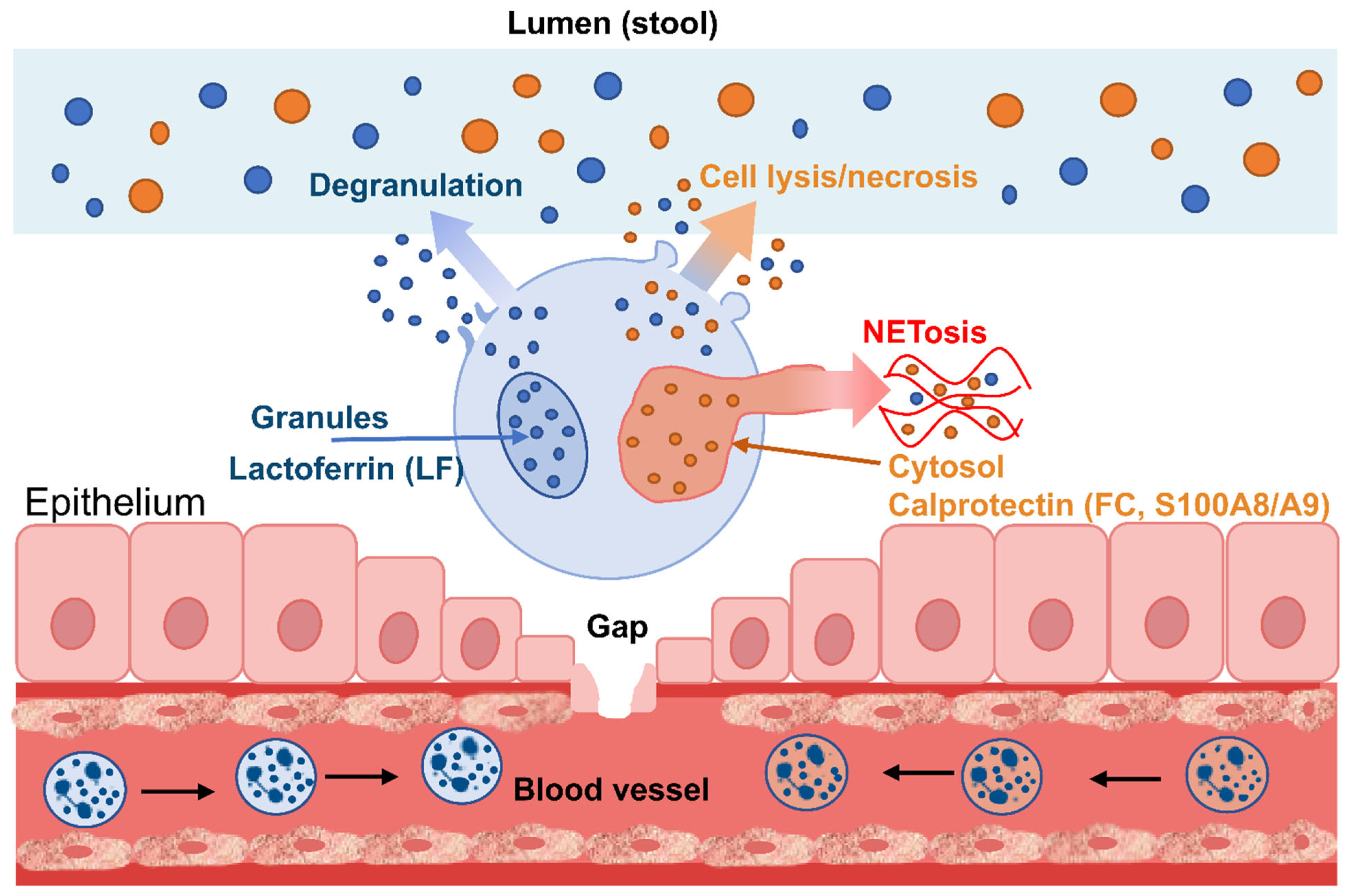
| Main release mechanism in intestinal inflammation | Predominantly associated with neutrophil damage, lysis, NETosis, and inflammatory cell turnover; also rises with intense infiltration | More directly associated with active degranulation and granule exocytosis; may also increase with neutrophil damage |
| Key biochemical feature relevant to biosensor systems | Ca2+-dependent oligomerization; strong transition-metal binding; conformation may vary with ionic conditions | Glycosylated, cationic protein with iron-binding properties; more prone to surface and matrix interactions |
| Stability in fecal matter | Generally regarded as comparatively stable in stool and therefore widely standardized for routine clinical use | Clinically useful but less widely standardized; analytical behavior may be more affected by matrix interactions and handling conditions |
| Typical analytical role in IBD | Most widely used fecal marker of neutrophil-driven intestinal inflammation | Established complementary fecal marker of neutrophilic inflammation |
| Potential matrix-related challenge | Dependence on oligomeric state, ion composition, and metal binding; possible changes in epitope accessibility | Greater tendency toward nonspecific adsorption and interaction with matrix components due to protein size and surface properties |
| Basic Method of Detection | Structure and Composition of Sensing Element | Limit of Detection | Main Features | Refs. |
| Lateral-flow immunoassay (LFA) | LFA strip with test line coated by anti-calprotectin monoclonal antibodies + control line with anti-immunoglobulin antibodies; conjugate pad contains dried gold-conjugated anti-calprotectin antibodies | None | Patient-friendly, fast (~10–15 min), no special equipment. | [48] |
| ELISA | COC microchip (70 × 30 mm) with four microchannels; surface polymer bearing p-nitrophenyl ester for covalent Ab coupling; primary anti-calprotectin Ab deposited as spots via piezoelectric inkjet printing; sealed with PMMA adhesive film. | 2 ng/mL | Uses only 2 µL sample per assay; total assay time ~35 min; enables 4 samples per chip; requires chemiluminescence imaging equipment. | [49] |
| ELISA + LFA | High-affinity synthetic peptide ligand (linear peptide 3; tetramer-specific, Kd ~26 nM) obtained by phage display; in LFA–streptavidin-coated AuNP conjugated with biotin-peptide on conjugate pad; nitrocellulose membrane with test line (anti-CP Ab or neutravidin-bound biotin-peptide) and control line (calprotectin). | 15.6 ng/mL (LFA) | Homogeneous, chemically synthesized ligand and improved thermal stability; requires buffer/storage optimization for AuNP conjugate stability. | [50] |
| Amperometric | Golden electrodes modified with multi-walled carbon nanotubes Au@MWCNTs → immobilized capture antibody Ab1 → BSA blocking → target CP → PtNi@Cu-TCPP(Fe)-Ab2 bioconjugate as catalytic label (2D Cu-TCPP(Fe) MOF nanosheets + PtNi nanospheres. | 137.7 fg/mL | Dual electrocatalysis and high-conductivity base layer drive amplification; need for careful optimization (pH, H2O2, PtNi:MOF ratio, incubation time); real-sample work uses 100× serum dilution. | [51] |
| Electrochemical | Amino acid–functionalized high-entropy alloy nanosheets (HEANSs@AAs) providing mesoporous, multielemental active surface; immobilized NH2-aptamer for calprotectin capture. | 2.02 pg/mL | Dual signal amplification (accelerated electron transfer + improved surface reactivity). | [52] |
| Label-free electrochemical impedance spectroscopy (EIS) | Gold nanoparticle electrode (DropSens 110GNP) modified layer-by-layer: cysteamine SAM → glutaraldehyde activation → avidin → biotinylated DNA aptamer (targets S100A8) → HSA blocking. | 5.57 µg/g | Rapid (15 min) label-free assay; selectivity assessed vs. isolated S100A8 and S100A9. | [53] |
| Non-faradaic EIS | Wearable porous patch with ZnO thin film (90–100 nm, RF sputtering) + screen-printed Ag electrodes (two-electrode); immunolayer: DTSSP 10 mM + anti-CP Ab 50 μg/mL, overnight incubation. | 0.1 μg/mL | Measurement directly in sweat, validated against ELISA; selectivity vs. CRP/IL-6/IL-1β. | [54] |
| Non-faradaic EIS | Removable sweat sensor strip + wearable reader; ZnO-coated substrate functionalized with DTSSP-linked capture antibodies (calprotectin Ab and IL-6 Ab in separate chambers); sensors lyophilized and vacuum-packaged for storage. | 10 ng/mL | Continuous, noninvasive longitudinal tracking; no external sample handling; storage stability shown over 7 days at 4 °C with intra/inter-assay CV < 11%. | [55] |
| Electro chemiluminescence (ECL) | ECL-active DNA scaffold (ZnPDF) hosting Zn-porphyrin cofactors (ZnPPIX/ZnTSPP aptameric loci); calprotectin-binding aptamer motif (AptA8) incorporated/used in probe design; electrochemical readout in PBS/KCl with H2O2 co-reactant on a three-electrode setup. | 0.419 ng/mL | Strong signal amplification via rolling circle amplification nanotags, signal-on design, high matrix viability. | [56] |
| Optical biosensing | Label-free optical photonic sensing via reflection peak (Bragg diffraction) red-shift caused by swelling of a molecularly imprinted photonic hydrogel (MIPH) upon binding serum calprotectin | 0.06 ng/mL (PBS) and 0.07 ng/mL (serum, 1000× diluted). | Fast, label-free, reagentless readout; selectivity shown vs. CRP; sample handling simplified to dilution but requires 1000× serum dilution and 40 min incubation. | [57] |
| Fluorescent | Turn-off fluorescent assay via inhibition of Zn(II)-dependent 17E DNAzyme activity by calprotectin Homogeneous solution sensor: 17E DNAzyme + dual-labeled substrate in HEPES/NaCl buffer; reaction stopped by EDTA and read on fluorimeter. | 9.89 nM | Enzyme-free; requires pH optimization (optimum pH 8.0) and digestion time (30 min), pre-incubation with CP+Zn2+ (30 min). | [58] |
| Fluorescent + colorimetric | Single-pot tube reaction: Cas12a protein + gRNA + quenched ssDNA reporter (Texas Red/BHQ2 for fluorescence; FAM/biotin reporter for LFA) + trigger ssDNA. | 1 ng/mL | Tube format + LFA; specificity tested on a panel of cytokines/proteins (IFN-γ, IL-6, IL-10, TNF-α, IL-1β, BSA); mixture stability at 4 °C for up to 4 weeks and good reproducibility between batches. | [59] |
| Bioluminescent | Two anti-calprotectin Fabs (CP16 ± CP17) genetically fused to SmBiT and LgBiT; detection after furimazine addition; formats: solution + strip-based LFA (biotin-streptavidin immobilization) + paper-based cellulose assay. | 0.1 ng/µL | Multi-readout (plate/CCD/smartphone); strong stool-matrix inhibition in solution (50–170× suppression); Ca2+-dependence; hook effect. | [60] |
| Whole-cell biosensor | Engineered probiotic E. coli Nissle 1917 using calprotectin-responsive promoter (ykgMO-IGS) driving reporter output (sfGFP or luxCDABE). Signal readout by fluorescence/bioluminescence after coculture with stool/in vivo transit. | 25 µg/g | No separate extraction step (vs. ELISA); can operate in complex stool matrix; early activation detectable ~1–3 h (flow cytometry); performance depends on media/metal availability; needs culture/readout equipment. | [61] |
| Living microbial biosensor | Engineered E. coli Nissle 1917 carrying a Zur–Pykg genetic circuit (sfGFP output) optimized by tuning zur expression and a two-plasmid integrase-based memory switch that irreversibly flips sfGFP orientation for permanent readout; therapeutic variants replace sfGFP with YebF–IL10 (secIL10) and include asd for plasmid stability without antibiotic selection. | activation threshold ~10 µg/mL | Non-invasive in vivo sensing; “memory” enables recording patchy inflammation; sense-and-respond module (secIL10) ameliorates DSS colitis. | [62] |
| Basic Method of Detection | Structure and Composition of Sensing Element | Limit of Detection | Main Advantage | Refs. |
| ELISA and ELISA-mimic | Biotin conjugation with LF bound to the plastic receptor | 0.001–0.010 μg/mL | High sensitivity | [71] |
| Visualized microarray for quantitative immune-detection | 30 ng/mL | [72] | ||
| Immunoassay based on monoclonal antibodies and Au nanoflowers | 2.4 ng/mL | [73] | ||
| Commercial ELISA kit | – | [74] | ||
| Fluorescence and colorimetric | Polydimethylsiloxane-based contact lens with adhesive terbium-contrast | 0.25–0.5 mg/mL | Cost-effectiveness | [75] |
| LF-binding sCD14 in a resonant optical biosensor | 10 nM | [76] | ||
| Glass substrates with Au NPs for surface-enhanced Raman scattering | – | [77] | ||
| Photonic crystal biosensor integrated microfluidic chip | 3 μg/mL | [67] | ||
| TbCl3 and NaHCO3 deposited onto microfluidically patterned filter paper with an inkjet printer | 0.3 mg/mL | [79,80] | ||
| Inverse opal carbon rod-based sensors attached to the eyelids | 0.1 mg/mL | [78] | ||
| Tb3+ immobilized on polystyrene | – | [81] | ||
| Colorimetric Fe3+–indicator complex with core–shell structured poly(styrene-block-vinylpyrrolidone) NPs in a microfluidic paper-based sensor | 110 μg/mL | [82] | ||
| Self-assembly fluorescence aptasensor based on the specific embedding dye PicoGreen | 3 nM | [83] | ||
| Self-responsive 6-Carboxyfluorescein aptasensor | 0.46 μg/mL | [84] | ||
| AuNPs-based aptasensing assay | 3.66 pM | [85] | ||
| Ratiometric electrochemiluminescence resonance energy transfer aptasensor | 42 fg/mL | [86] | ||
| Graphene quantum dots and manganese dioxide nanosheets-based fluorescent nanoprobe | 1.69 ng/mL | [87] | ||
| A portable platform for LF detection based on the complexation reaction between LF and Tb3+ | 120 μg/mL | [88] | ||
| Fluorescent sensor based on carboxyl-rich carbon dots | 0.776 μg/mL | [89] | ||
| Fluorescent sensor based on N, S-doped carbon dots | 1.92 μg/mL | [90] | ||
| Fluorescence polarization aptasensor based on bivalent aptamers and Ag NPs | 1.56 pM | [66] | ||
| Electrochemical and impedance | Carbon screen-printed electrodes | 1–10 μg/mL | Miniaturization | [92] |
| Metallic ion chelated in an amine-terminated terpyridine monolayer inside nanopores | – | [93] | ||
| Varios amperometric electrodes as transducers | 0.035 nM | [68,69] | ||
| Facile electrochemical LF detection based on a thin layer of MOP/3-sulfanylpropan-1-ol on the gold surface | 65.2 nM | [96] | ||
| Anti-LF IgG immobilized onto screen-printed carbon electrodes | 50 μg/mL | [97] | ||
| LF monoclonal antibody immobilized on a gold electrode | 4.9 pg/mL | [98] | ||
| Spin-coated composite of graphene nanoplatelets and amphiphilic polymer | 0.1 mg/mL | [99] | ||
| Analogous electrochemical sandwich assay based on capture and detector antibodies | 2–20 pM | [100] | ||
| Multivalent aptamer immobilized on the screen-printed gold electrode | 0.9 ng/mL | [101] | ||
| Biosensor array with alkanethiolate self-assembled monolayer | 145 pg/mL | [102] | ||
| Nonaptamer-type immobilized DNA oligonucleotide bioreceptor | 1.25 nM | [103,104] | ||
| AgNPs/Nafion–modified glassy carbon electrode with anti-LF | 25 ng/mL | [105] | ||
| Multiwalled carbon nanotube/Nafion modified glassy carbon electrode | 3.2 μM | [106] | ||
| An epitope imprinted electrochemical quartz crystal microbalance sensor | 5.25 nM | [107] | ||
| Gold electrodes functionalized with anti-human LF | 1 ng/mL | [108] | ||
| Antibodies to LF immobilized in the membrane Immobilon | 70 nM | [109] | ||
| The quartz crystal microbalance with the thiol-modified aptamer immobilized on the gold electrode surface through an Au-S bond | 8.2 ng/mL | [110] | ||
| Microfluidic system with the gold nanowire for high frequencies and nanoprobes for low frequencies | 0.5 μM | [95] | ||
| SPR | Biofunctionalized nanoplasmonic grating | 1 μg/mL | Label-free | [112] |
| An immunoassay based on an interaction with an immobilized anti-lactoferrin antibody | 0.8 mg/hg | [114] | ||
| Goat and rabbit anti-bovine lactoferrin antibody immobilized on a sensor chip | 19.9 μg/mL | [115,116] | ||
| SPRi microarray chip with aptamer of LF | 1 μg/mL | [118] | ||
| Biofunctionalized particles tethered to a biofunctionalized substrate | 10 nM | [119] | ||
| Gold coated with a self-assembled monolayer containing chemically bonded antibodies to LF | 0.28 μM | [109] | ||
| Silica gold nanoshells coated with poly(N-isopropylacrylamide and methacrylic acid) | 16 μg/mL | [113] |
Disclaimer/Publisher’s Note: The statements, opinions and data contained in all publications are solely those of the individual author(s) and contributor(s) and not of MDPI and/or the editor(s). MDPI and/or the editor(s) disclaim responsibility for any injury to people or property resulting from any ideas, methods, instructions or products referred to in the content. |
© 2026 by the authors. Licensee MDPI, Basel, Switzerland. This article is an open access article distributed under the terms and conditions of the Creative Commons Attribution (CC BY) license.
Share and Cite
Sitkov, N.; Ryabko, A.; Ivanov, S.; Cheburkin, Y.; Kolobov, A.; Khasanova, D.; Nikolaev, V.; Kaplun, D.; Gareev, K. Biosensor-Based Detection of Calprotectin and Lactoferrin as Neutrophil-Derived Markers of Inflammatory Bowel Diseases: From Molecular Pathophysiology to Point-of-Care Platforms. Int. J. Mol. Sci. 2026, 27, 2692. https://doi.org/10.3390/ijms27062692
Sitkov N, Ryabko A, Ivanov S, Cheburkin Y, Kolobov A, Khasanova D, Nikolaev V, Kaplun D, Gareev K. Biosensor-Based Detection of Calprotectin and Lactoferrin as Neutrophil-Derived Markers of Inflammatory Bowel Diseases: From Molecular Pathophysiology to Point-of-Care Platforms. International Journal of Molecular Sciences. 2026; 27(6):2692. https://doi.org/10.3390/ijms27062692
Chicago/Turabian StyleSitkov, Nikita, Andrey Ryabko, Sergei Ivanov, Yuri Cheburkin, Alexey Kolobov, Diana Khasanova, Vladimir Nikolaev, Dmitrii Kaplun, and Kamil Gareev. 2026. "Biosensor-Based Detection of Calprotectin and Lactoferrin as Neutrophil-Derived Markers of Inflammatory Bowel Diseases: From Molecular Pathophysiology to Point-of-Care Platforms" International Journal of Molecular Sciences 27, no. 6: 2692. https://doi.org/10.3390/ijms27062692
APA StyleSitkov, N., Ryabko, A., Ivanov, S., Cheburkin, Y., Kolobov, A., Khasanova, D., Nikolaev, V., Kaplun, D., & Gareev, K. (2026). Biosensor-Based Detection of Calprotectin and Lactoferrin as Neutrophil-Derived Markers of Inflammatory Bowel Diseases: From Molecular Pathophysiology to Point-of-Care Platforms. International Journal of Molecular Sciences, 27(6), 2692. https://doi.org/10.3390/ijms27062692