The Role of 3D Printing in Regenerative Medicine: A Game-Changer in Tissue Engineering


Abstract
1. Introduction
1.1. Significance of 3D Printing in Tissue Engineering
1.2. Role of 3D Printing in Tissue Engineering
2. Fundamentals of 3D Printing in Tissue Engineering
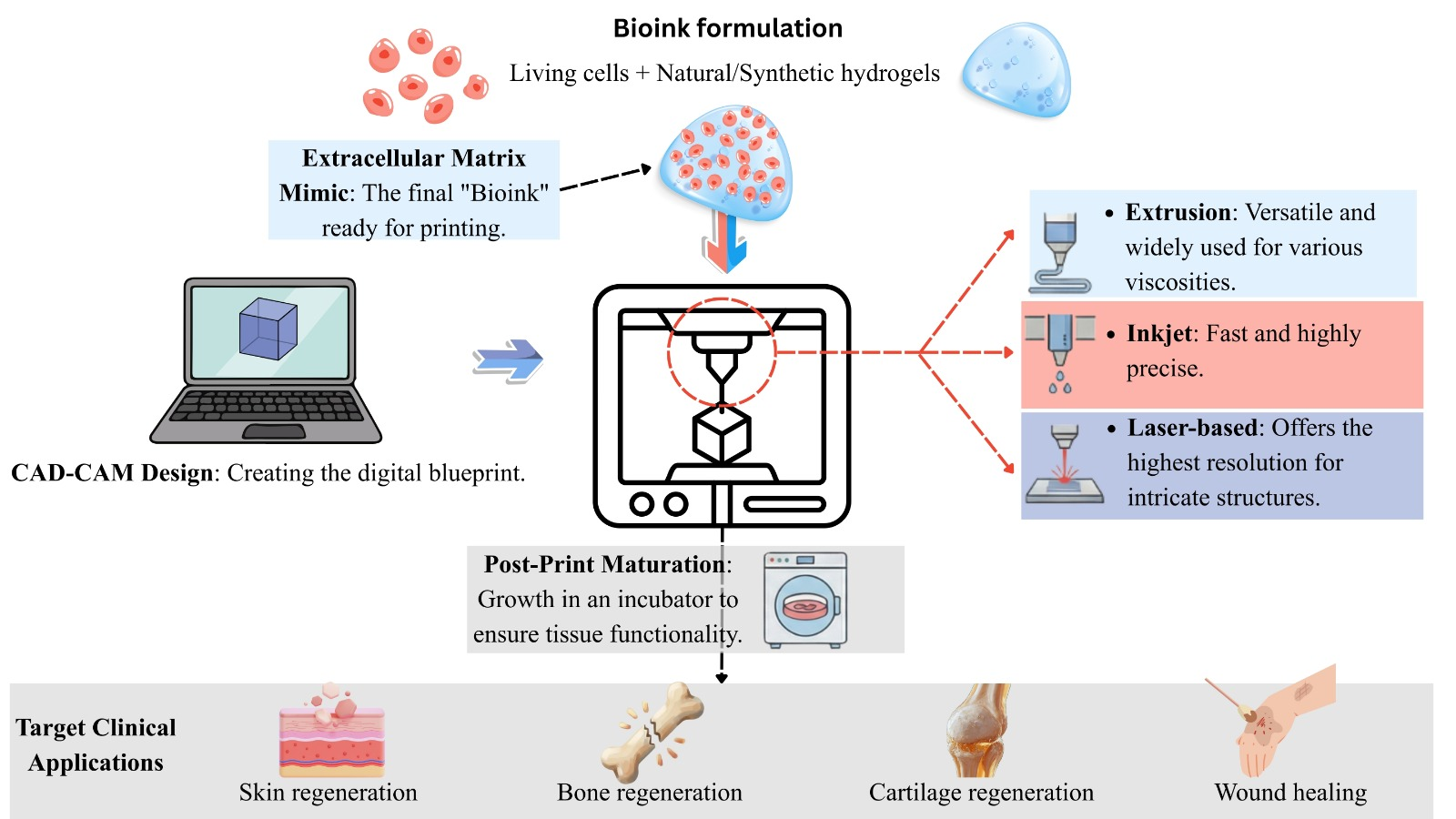
Basic Principles of 3D Bioprinting
3. Materials for 3D Printing in Tissue Engineering
3.1. Natural Polymer Hydrogels
3.1.1. Critical Analysis of Specific Polymer Studies
3.1.2. Challenges and Critical Deficits of Natural Polymer Bioinks
3.2. Synthetic Polymer Hydrogels

| Hydrogel | Cross-Linking Method | Cross- Linking Time | Ink Density | Biological Survival | Key Advantages | Key Disadvantages | Ref. |
|---|---|---|---|---|---|---|---|
| Natural Polymer Hydrogels | |||||||
| Chitosan | pH-mediated (CH3COOH) | 2 h | 3% | Inversely proportional to molecular weight | Strong adsorption capacity and low cost | Slow gel speed and poor mechanical properties; rarely used as sole material | [53] |
| Sodium alginate | Ionic (CaCl2) | 10 min | 1–2% | 95% | Fast forming speed, low cost, and good stability | Poor cell adhesion; easy clogging at high concentrations | [54,55] |
| Hyaluronic acid (HA) | Photocrosslinking; pH-mediated | 3 min | 1.5% | – | Promotes proliferation and biofilm formation; fast gelation | Fast degradation and poor mechanical stability; structure limits application as hydrogel alone | [56,57] |
| Collagen | pH-mediated (NaHCO3) | 1 min | 0.3% | 86% | Facilitates cell attachment; good printing ability | Poor mechanical stability; slow gel speed; easy to block | [58,59] |
| Gelatin | Temperature | 5 min | 5–20% | 90% (after 45 days) | Thermosensitive crosslinking is reversible; promotes cell adhesion | Structurally unstable; unmodified gelatin has poor mechanical ability | [60,61] |
| Silk | – | – | 80% | High biocompatibility and excellent mechanical stability | Low bacterial adhesion, which is not conducive to microbial reproduction | – | [62,63] |
| Synthetic Polymer Hydrogels | |||||||
| Polyacrylic acid (PAA) | – | – | 10–20% | Low cell viability | High water absorption; pH response | Refractory to degradation; high biological toxicity before modification | [64] |
| Polyvinyl alcohol (PVA) | – | – | 30% | 70% | Strong toughness and good biocompatibility | Low cell proliferation and adhesion | [65,66] |
| Pluronic F-127 | Temperature | Minutes | 0.8% | 60% | Reversibility enhances printability | Damage from radiation and temperature to cells | [67,68] |
| Polyethylene Glycol (PEG) | Photo-polymerization | 10 min | 5–6% | 90% | High biocompatibility and low cost | Soluble in organic solvents or water | [69,70] |
| Hydrogel | Degradation Rate | Effect on Vascularization | Optimal Field of Application |
|---|---|---|---|
| Chitosan | Moderate (about 21 days) (Enzymatic) [71] | Enhance vascularization and tissue regeneration thanks to their biocompatibility, biodegradability, and ECM-like structure [72] | Skin tissue engineering and wound healing [73] |
| Sodium Alginate | 1 to 4 weeks depending on crosslinking density [74] | Low; requires bioactive additives [75] | Bone tissue engineering [76] |
| Hyaluronic Acid | A few days to over 42 days depending on crosslinking density, composition, and enzymatic activity [77] | High; promotes cell proliferation (Promotes endothelial lumen formation, branching, and vascular network development) [78] | Viscoelastic tuning; dermal fillers [79] |
| Collagen | High (Proteolytic), rapid degradation rate (often within days to a few weeks) [80] | Type-I collagen hydrogel promotes vascularization by preserving microvascular structure, stimulating sprouting, enabling capillary network formation, and upregulating pro-angiogenic genes [81] | Skin and wound healing applications, bone regeneration scaffolds, vascularized tissue constructs [82] |
| Gelatin/GelMA | Ranging from a few days to several weeks depending on crosslinking density, GelMA concentration, and enzymatic activity [83] | GelMA enables fabrication of porous, perfusable vascular networks that mimic the ECM and support endothelial cell growth and vessel formation [84] | Soft tissue engineering (skin, vascular) and, when enhanced with reinforcing agents, hard tissue regeneration (bone, cartilage) [85] |
| Silk Fibroin | Very Slow (Months) [86] | Enhance vascularization by providing a supportive matrix that promotes endothelial migration and vessel formation [87] | Silk fibroin is widely used in cartilage, bone, skin, and nerve regeneration due to its tunable strength, slow degradation, and ability to form structured 3D-printed scaffolds that support tissue repair [88] |
| Synthetic (PEG/PCL) | Highly tunable 3D-printable hydrogels allow controlled degradation from days to months by adjusting crosslinking and polymer composition [89] | 3D-printed PEG/PCL hydrogels enhance vascularization by combining PCL’s structural support with PEG’s biocompatible environment, improving cell infiltration and capillary formation [90] | PCL and PEG-based hydrogels are used in bone, soft tissue, and neural engineering due to their strength, elasticity, and support for cell growth [91] |
4. Fabrication of Scaffolds in Tissue Engineering
4.1. Importance of Scaffolds in Tissue Regeneration
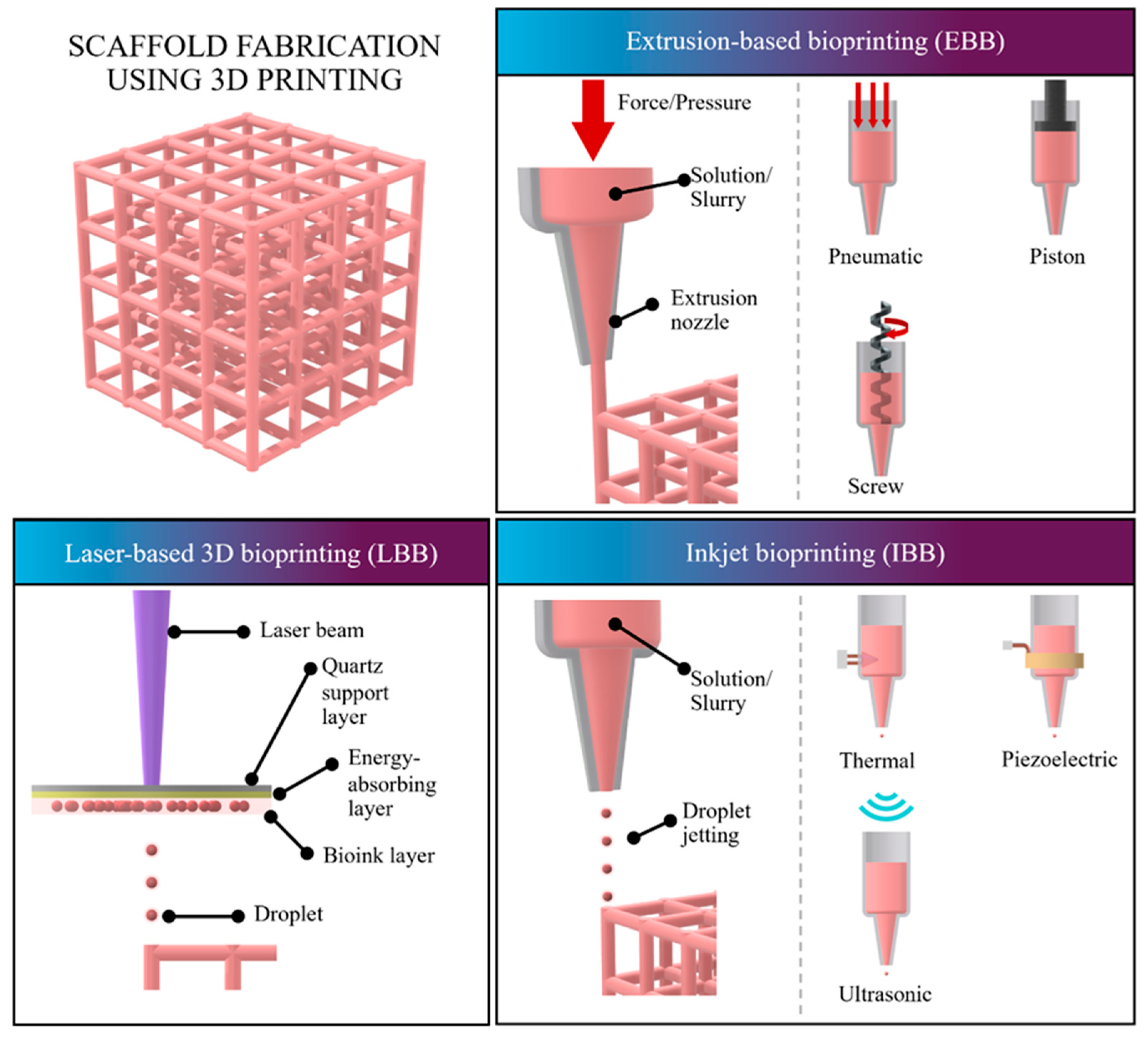
4.2. Methods for Scaffold Fabrication Using 3D Printing
| Technical Parameter | Laser-Based 3D Bioprinting (LBB) | Inkjet-Based 3D Bioprinting (IBB) | Extrusion-Based 3D Bioprinting (EBB) |
|---|---|---|---|
| Resolution | <10 μm | 30–100 μm | >100 μm |
| Printing speed | Fast | Medium (Up to 10,000 drops/s) | Slow (10–50 μm/s) |
| Shape fidelity | High | Low | High |
| Supporting material required | Unnecessary | Necessary | Necessary |
| Material Viscosity Range | Medium (<300 mPa/s) | Low (3–12 mPa/s) | High (30 mPa/s to 6 × 10⁷ mPa/s) |
| Cell Concentration (Max) | High (up to 1 × 10⁸ cells/mL) | Low (<106 cells/mL) | Very high |
| Cell Viability | 95% (but low for microorganisms when UV is used) | >85% | 40–80% (Negatively correlated with extrusion head diameter) |
| Gradient Printing Capability | No | Yes | Yes |
| Common Bioinks | Sodium alginate, collagen, gelatin, matrigel | Agar, alginate, fibrin, GelMA, polyethylene glycol, low viscosity living cell suspension | Alginate, hyaluronic acid, polyethylene glycol, agar, collagen, gelatin, pluronic, matrigel, fibrin, living cell suspension, composite materials |
| Key Disadvantage for Microorganisms | The nanosecond lasers often use ultraviolet (UV) light, which is fatal to bacteria by causing dimerization of thymine bases in their DNA, severely limiting application. | Causes severe thermal damage or mechanical damage, preventing widespread application. | Cell survival rate is lower due to the shear effect during extrusion, but impact on microorganisms is the mildest. |
| Cost | High | Low | Medium |

4.2.1. Extrusion-Based Bioprinting (EBB)
4.2.2. Inkjet Bioprinting (IBB)
4.2.3. Laser-Based Bioprinting (LBB)
5. Tissue Engineering in Wound Healing
5.1. Biopolymeric Scaffolds in Tissue Engineering
5.1.1. Chitosan
5.1.2. Alginate
5.1.3. Gelatin
5.1.4. Collagen
5.1.5. Cellulose
5.1.6. Silk Fibroin
5.2. Bioprinting in Tissue Engineering
6. Challenges in 3D Printing for Tissue Engineering
7. Recent Advances and Innovations
8. Conclusions and Future Trends
Author Contributions
Funding
Institutional Review Board Statement
Data Availability Statement
Acknowledgments
Conflicts of Interest
References
- Ye, H.; Dong, T.; Li, R.; Fang, L.; Xie, K.; Han, G.; Chen, Q.; Chi, S.; Lin, J.H.; Lou, C.W. A pH/glucose dual-responsive Janus dressing with optimized gradient modulus/tissue adhesion promotes diabetic wound healing by dynamic drug-payload release. Chem. Eng. J. 2025, 528, 172227. [Google Scholar] [CrossRef]
- Xie, Y.; Tang, Y.; Mo, Y.; Wan, Q.; Li, Z. Boosting type I ROS to promote healing of bacterial infected wound by synergetic steric effect and ionic engineering of photosensitizer’s acceptor. Chem. Eng. J. 2025, 528, 172482. [Google Scholar] [CrossRef]
- Hu, Y.; Xie, N.; Shi, C.; Zhang, C.; Shen, X.; Zheng, B.; Luo, Z.; Xu, N. Temporal-spatial hierarchical immunomodulating dressing promotes high-quality wound healing through M2 macrophage balancing. Biomaterials 2025, 327, 123775. [Google Scholar] [CrossRef] [PubMed]
- Chen, X.; Zhou, Y.; Zhou, S.; Zhang, D.; Zeng, L.; Zhou, C.; Liu, M. 3D printing of chitosan hydrogel reinforced with tubular nanoclay for hemostasis and infected wound healing. Bioact. Mater. 2025, 54, 404–422. [Google Scholar] [CrossRef]
- Wongso, B.J.; Hartrianti, P.; Adhami, M.; Febriani, E.; Chandra, C.V.; Anginan, T.B.; Salim, E.A.; Domínguez-Robles, J.; Donnelly, R.F.; Larrañeta, E.; et al. Formulation and evaluation of 3D-printed dressings loaded with curcumin and levofloxacin for wound healing application. Mater. Today Adv. 2025, 28, 100649. [Google Scholar] [CrossRef]
- Zhang, S.; Huang, Y.; Gong, N.; Zhang, G.; Wang, J.; Li, J.; Fan, X.; Zeng, X.; Zhang, J.; Yu, Z. 3D-printable reinforced photosynthetic living hydrogel patches for accelerated wound healing. Chem. Eng. J. 2026, 528, 172656. [Google Scholar] [CrossRef]
- Nizam, M.; Purohit, R.; Taufik, M. Role of 3D printing in healthcare: A comprehensive review on treatment and training. Proc. Inst. Mech. Eng. Part H J. Eng. Med. 2025, 239, 239–265. [Google Scholar] [CrossRef]
- Kantaros, A. 3D printing in regenerative medicine: Technologies and resources utilized. Int. J. Mol. Sci. 2022, 23, 14621. [Google Scholar] [CrossRef]
- Li, J.; Wang, Y.; Fan, L.; Wang, X.; Shang, L.; Zhang, H.; Zhao, Y. Liquid metal hybrid antibacterial hydrogel scaffolds from 3D printing for wound healing. Chem. Eng. J. 2024, 496, 153805. [Google Scholar] [CrossRef]
- Lv, J.; Li, M.; Wang, X.; Zhang, L.; Han, D.; Hao, X.; Xu, X.; Xu, Y.; Tang, Y.; Shang, Z.; et al. 4D-printed hydrogel with precise regulation of viability and environment of stem cells for diabetic skin wound healing. Mater. Today Bio 2025, 35, 102366. [Google Scholar] [CrossRef] [PubMed]
- Naik, K.; Tripathi, S.; Ranjan, R.; Agrawal, S.; Srivastava, S.K.; Dhar, P.; Vashisth, P.; Singh, K.; Tiwari, V.; Parmar, A.S. Bioactive Hyaluronic acid–Protein based amyloidogenic hydrogel dressing for rapid diabetic wound healing via enhanced angiogenesis and anti-inflammation. Mater. Today Commun. 2025, 48, 113560. [Google Scholar] [CrossRef]
- Cui, H.; Cai, J.; He, H.; Ding, S.; Long, Y.; Lin, S. Tailored chitosan/glycerol micropatterned composite dressings by 3D printing for improved wound healing. Int. J. Biol. Macromol. 2024, 255, 127952. [Google Scholar] [CrossRef]
- Gillani, S.M.; Mughal, A.; Khan, R.A.; Nawaz, M.H.; Razzaq, Z.; Ismat, M.S.; Hussain, R.; Wadood, A.; Ahmed, S.; Minhas, B.; et al. Development of hybrid polyvinylpyrrolidone/carboxymethyl cellulose/collagen incorporated oregano scaffolds via direct ink write printing for potential wound healing applications. Int. J. Biol. Macromol. 2024, 278, 134528. [Google Scholar] [CrossRef]
- Bidaki, A.; Rezaei, N.; Kazemi, S.; Ali, S.N.; Ziaei, S.; Moeinzadeh, A.; Hosseini, F.; Noorbazargan, H.; Farmani, A.R.; Ren, Q. 3D printed bioengineered scaffold containing chitosan, alginate, and Barijeh-loaded niosomes enabled efficient antibiofilm activity and wound healing. Int. J. Biol. Macromol. 2025, 311, 143743. [Google Scholar] [CrossRef]
- Cheng, F.; Xu, L.; Zhang, X.; He, J.; Huang, Y.; Li, H. Generation of a photothermally responsive antimicrobial, bioadhesive gelatin methacryloyl (GelMA) based hydrogel through 3D printing for infectious wound healing. Int. J. Biol. Macromol. 2024, 260, 129372, Correction in Int. J. Biol. Macromol. 2026, 337, 149874. [Google Scholar] [CrossRef] [PubMed]
- Wu, Q.; You, Y.; Hu, H.; Wang, L.; Lu, Z.; Qin, X. Living biomaterials: A promising approach to promoting wound healing. Biomater. Adv. 2025, 180, 214599. [Google Scholar] [CrossRef]
- Wang, L.; Li, Y.; Zhou, C.; Xue, S.; Peng, C.; Shi, L.; Tang, N. Multifunctional Janus dressing based on gelatin with enhanced interlayer bonding and antibacterial capabilities for sutureless wound closure and electrically accelerated healing. Int. J. Biol. Macromol. 2026, 341, 150115. [Google Scholar] [CrossRef]
- Uchida, D.T.; Bruschi, M.L. 3D printing as a technological strategy for the personalized treatment of wound healing. AAPS PharmSciTech 2023, 24, 41. [Google Scholar] [CrossRef] [PubMed]
- Alshammari, N.D.; Uttreja, P.; Elkanayati, R.; Chakka, L.R.; Vemula, S.K.; Repka, M.A. Development of 3D-printed chitosan/p-coumaric acid scaffolds for wound healing: Antibacterial properties and drug release kinetics. Eur. J. Pharm. Biopharm. 2025, 219, 114953. [Google Scholar] [CrossRef]
- Bashir, S.; Javaid, M.; Haleem, A.; Khan, S.; Jahangir. Assessing appropriate adoption of suitable 3D printing technology of additive manufacturing for healthcare applications through analytic hierarchy process. Cure Care 2025, 1, 100022. [Google Scholar] [CrossRef]
- Yousefshahi, S.; Pohl, E.; Sehn, T.; Jungbluth, M.; Huber, B.; Klein, C.O.; Beuermann, S.; Meier, M.A.; Schepers, U.; Schmitt, C.W.; et al. 3D-Printed Hydrogels from Recycled Cellulose for Biomedical Applications. ChemSusChem 2026, 19, e202501734. [Google Scholar] [CrossRef] [PubMed]
- Guo, J.; Abbas, A.; Barbut, C.; Park, E.J.; Lim, Q.; See, T.; Liow, L.; Zhang, B.; Teo, P. 3D-Printed Biohybrid PE/PCL Biphasic Osteochondral Plug for Knee Cartilage Repair. ACS Mater. Au 2026, 6, 406–414. [Google Scholar] [CrossRef]
- Goswami, K.; Garg, M.; Sharma, P.; Negi, A.; Bhardwaj, D.; Kanwar, M.; Murab, S.; Agrawal, G. 3D Printed PLA Scaffolds Modified With Chitosan-Based Electrospun Nanofibers for Biomimetic Mineralization and Antimicrobial Efficacy. J. Appl. Polym. Sci. 2026, 143, e58022. [Google Scholar] [CrossRef]
- Agarwalla, A.; Ahmed, W.; Al-Marzouqi, A.H.; Zaneldin, E.; Rizvi, T.A.; Khan, M. Advancements in synthetic polymers for 3D bioprinting materials, applications, and future prospects. Int. J. Polym. Mater. Polym. Biomater. 2026, 75, 404–442. [Google Scholar] [CrossRef]
- Zha, X.J.; Ling, T.X.; Xiao, Q.; Chen, Z.X.; Zhang, Y.; Huang, J.G.; Zhou, Z.K. Integrated 3D printing of topologically hierarchical mechanical hydrogel for accelerating osteochondral regeneration. Bioact. Mater. 2026, 55, 679–692. [Google Scholar] [CrossRef]
- Habib, M.A.; Khoda, B. Rheological analysis of bio-ink for 3D bio-printing processes. J. Manuf. Process. 2022, 76, 708–718. [Google Scholar] [CrossRef]
- Huanbutta, K.; Burapapadh, K.; Sriamornsak, P.; Sangnim, T. Practical application of 3D printing for pharmaceuticals in hospitals and pharmacies. Pharmaceutics 2023, 15, 1877. [Google Scholar] [CrossRef]
- Fang, Y.; Guo, Y.; Liu, T.; Xu, R.; Mao, S.; Mo, X.; Zhang, T.; Ouyang, L.; Xiong, Z.; Sun, W. Advances in 3D bioprinting. Chin. J. Mech. Eng. Addit. Manuf. Front. 2022, 1, 100011. [Google Scholar] [CrossRef]
- Kyratsis, P.; Tzotzis, A.; Davim, J.P. A Review on CAD-Based Programming for Design and Manufacturing. In CAD-Based Programming for Design and Manufacturing; Springer: Cham, Switzerland, 2025; pp. 1–26. [Google Scholar]
- Raees, S.; Ullah, F.; Javed, F.; Akil, H.M.; Khan, M.J.; Safdar, M.; Din, I.U.; Alotaibi, M.A.; Alharthi, A.I.; Bakht, M.A.; et al. Classification, processing, and applications of bioink and 3D bioprinting: A detailed review. Int. J. Biol. Macromol. 2023, 232, 123476. [Google Scholar] [CrossRef] [PubMed]
- Ali, F.; Kalva, S.N.; Koc, M. Advancements in 3D printing techniques for biomedical applications: A comprehensive review of materials consideration, post processing, applications, and challenges. Discov. Mater. 2024, 4, 53. [Google Scholar] [CrossRef]
- Kantaros, A.; Ganetsos, T.; Petrescu, F.I.; Ungureanu, L.M.; Munteanu, I.S. Post-production finishing processes utilized in 3D printing technologies. Processes 2024, 12, 595. [Google Scholar] [CrossRef]
- Lai, J.; Liu, Y.; Lu, G.; Yung, P.; Wang, X.; Tuan, R.S.; Li, Z.A. 4D bioprinting of programmed dynamic tissues. Bioact. Mater. 2024, 37, 348–377. [Google Scholar] [CrossRef] [PubMed]
- Shanmugam, D.K.; Anitha, S.C.; Souresh, V.; Madhavan, Y.; Sampath, S.; Catakapatri Venugopal, D.; Saravanan, M. Current advancements in the development of bionic organs using regenerative medicine and 3D tissue engineering. Mater. Technol. 2023, 38, 2242732. [Google Scholar] [CrossRef]
- Mirshafiei, M.; Rashedi, H.; Yazdian, F.; Rahdar, A.; Baino, F. Advancements in tissue and organ 3D bioprinting: Current techniques, applications, and future perspectives. Mater. Des. 2024, 240, 112853. [Google Scholar] [CrossRef]
- Ullah, M.W.; Ul-Islam, M.; Shehzad, A.; Manan, S.; Islam, S.U.; Fatima, A.; Al-Saidi, A.K.; Nokab, M.E.; Sanchez, J.Q.; Sebakhy, K.O. From bioinks to functional tissues and organs: Advances, challenges, and the promise of 3D bioprinting. Macromol. Mater. Eng. 2025, 310, e00251. [Google Scholar] [CrossRef]
- Uysal, B.; Madduma-Bandarage, U.S.; Jayasinghe, H.G.; Madihally, S. 3D-Printed Hydrogels from Natural Polymers for Biomedical Applications: Conventional Fabrication Methods, Current Developments, Advantages, and Challenges. Gels 2025, 11, 192. [Google Scholar] [CrossRef]
- Ahmed, T. Functional biomaterials for biomimetic 3D in vitro tumor microenvironment modeling. In Vitro Model. 2023, 2, 1–23. [Google Scholar] [CrossRef]
- Gorroñogoitia, I.; Urtaza, U.; Zubiarrain-Laserna, A.; Alonso-Varona, A.; Zaldua, A.M. A study of the printability of alginate-based bioinks by 3D bioprinting for articular cartilage tissue engineering. Polymers 2022, 14, 354. [Google Scholar] [CrossRef]
- Lazaridou, M.; Bikiaris, D.N.; Lamprou, D.A. 3D bioprinted chitosan-based hydrogel scaffolds in tissue engineering and localised drug delivery. Pharmaceutics 2022, 14, 1978. [Google Scholar] [CrossRef]
- Abalymov, A.; Pinchasik, B.E.; Akasov, R.A.; Lomova, M.; Parakhonskiy, B.V. Strategies for anisotropic fibrillar hydrogels: Design, cell alignment, and applications in tissue engineering. Biomacromolecules 2023, 24, 4532–4552. [Google Scholar] [CrossRef] [PubMed]
- Zhang, X.; Gao, X.; Zhang, X.; Yao, X.; Kang, X. Revolutionizing Intervertebral Disc Regeneration: Advances and Future Directions in Three-Dimensional Bioprinting of Hydrogel Scaffolds. Int. J. Nanomed. 2024, 19, 10661–10684. [Google Scholar] [CrossRef]
- Sabio, L.; Day, G.J.; Salmeron-Sanchez, M. Probiotic-Based Materials as Living Therapeutics. Adv. Mater. 2026, 38, e08500. [Google Scholar] [CrossRef] [PubMed]
- Patel, P.; Parmar, K. 3D Printing of Organic and Biological Materials. Fluid Dyn. Mater. Process. 2025, 21, 45–68. [Google Scholar] [CrossRef]
- Ahmed, M.S.; Yun, S.; Kim, H.Y.; Ko, S.; Islam, M.; Nam, K.W. Hydrogels and microgels: Driving revolutionary innovations in targeted drug delivery, strengthening infection management, and advancing tissue repair and regeneration. Gels 2025, 11, 179. [Google Scholar] [CrossRef]
- Wang, X.; Wei, R.; Chen, Z.; Pang, H.; Li, H.; Yang, Y.; Hua, Q.; Shen, G. Bioinspired Intelligent Soft Robotics: From Multidisciplinary Integration to Next-Generation Intelligence. Adv. Sci. 2025, 12, e06296. [Google Scholar] [CrossRef] [PubMed]
- Srivastava, N.; Choudhury, A.R. Stimuli-responsive polysaccharide-based smart hydrogels and their emerging applications. Ind. Eng. Chem. Res. 2022, 62, 841–866. [Google Scholar] [CrossRef]
- Guo, X.; Liu, H.; Nail, A.; Meng, D.; Zhu, L.; Li, C.; Li, H. Design and Application of Stimuli-Responsive Nanocomposite Hydrogels: A Review. Macromol. Rapid Commun. 2025, 46, 2401095. [Google Scholar] [CrossRef]
- Zgodova, A.; Pavlova, S.; Nekrasova, A.; Boyarkin, D.; Pinelis, V.; Surin, A.; Bakaeva, Z. Isoliquiritigenin protects neuronal cells against glutamate excitotoxicity. Membranes 2022, 12, 1052. [Google Scholar] [CrossRef] [PubMed]
- Singh, A.; Dowdall, N.; Hoare, T. Poly (oligo (ethylene glycol) methacrylate)-based polymers in biomedical applications: Preparation and applications. Biomacromolecules 2025, 26, 3929–3973. [Google Scholar] [CrossRef]
- Xin, H. Double-network tough hydrogels: A brief review on achievements and challenges. Gels 2022, 8, 247. [Google Scholar] [CrossRef]
- Huang, X.; Mo, Y.; Hu, C. 3D Printing Hydrogel, Perovskite Technology, and Preparation and Application of Hydrogel Perovskite Composite Materials. J. Polym. Sci. 2025, 63, 4003–4018. [Google Scholar] [CrossRef]
- Taghizadeh, M.; Taghizadeh, A.; Yazdi, M.K.; Zarrintaj, P.; Stadler, F.J.; Ramsey, J.D.; Habibzadeh, S.; Rad, S.H.; Naderi, G.; Saeb, M.R.; et al. Chitosan-based inks for 3D printing and bioprinting. Green Chem. 2022, 24, 62–101, Correction in Green Chem. 2025, 27, 5388–5388. https://doi.org/10.1039/D5GC90073E. [Google Scholar]
- Singh, A.K.; Pramanik, K.; Biswas, A. Constructing a biofunctionalized 3D-printed gelatin/sodium alginate/chitosan tri-polymer complex scaffold with improvised biological and mechanical properties for bone-tissue engineering. Bio-Des. Manuf. 2024, 7, 57–73. [Google Scholar] [CrossRef]
- Egorov, A.A.; Fedotov, A.Y.; Mironov, A.V.; Komlev, V.S.; Popov, V.K.; Zobkov, Y.V. 3D printing of mineral–polymer bone substitutes based on sodium alginate and calcium phosphate. Beilstein J. Nanotechnol. 2016, 7, 1794–1799. [Google Scholar] [CrossRef] [PubMed]
- Petta, D.; D’amora, U.; Ambrosio, L.; Grijpma, D.W.; Eglin, D.; D’este, M. Hyaluronic acid as a bioink for extrusion-based 3D printing. Biofabrication 2020, 12, 032001. [Google Scholar] [CrossRef] [PubMed]
- Noh, I.; Kim, N.; Tran, H.N.; Lee, J.; Lee, C. 3D printable hyaluronic acid-based hydrogel for its potential application as a bioink in tissue engineering. Biomater. Res. 2019, 23, 3. [Google Scholar] [CrossRef]
- Debnath, S.; Agrawal, A.; Jain, N.; Chatterjee, K.; Player, D.J. Collagen as a bio-ink for 3D printing: A critical review. J. Mater. Chem. B 2025, 13, 1890–1919. [Google Scholar] [CrossRef]
- Mozdzen, L.C.; Rodgers, R.; Banks, J.M.; Bailey, R.C.; Harley, B.A. Increasing the strength and bioactivity of collagen scaffolds using customizable arrays of 3D-printed polymer fibers. Acta Biomater. 2016, 33, 25–33. [Google Scholar] [CrossRef] [PubMed]
- Afewerki, S.; Sheikhi, A.; Kannan, S.; Ahadian, S.; Khademhosseini, A. Gelatin-polysaccharide composite scaffolds for 3D cell culture and tissue engineering: Towards natural therapeutics. Bioeng. Transl. Med. 2019, 4, 96–115. [Google Scholar] [CrossRef]
- Yap, K.L.; Kong, I.; Abdul Kalam Saleena, L.; Pui, L.P. 3D Printed gelatin film with Garcinia atroviridis extract. J. Food Sci. Technol. 2022, 59, 4341–4351. [Google Scholar] [CrossRef]
- Mu, X.; Fitzpatrick, V.; Kaplan, D.L. From silk spinning to 3D printing: Polymer manufacturing using directed hierarchical molecular assembly. Adv. Healthc. Mater. 2020, 9, 1901552. [Google Scholar] [CrossRef] [PubMed]
- Agostinacchio, F.; Mu, X.; Dirè, S.; Motta, A.; Kaplan, D.L. In situ 3D printing: Opportunities with silk inks. Trends Biotechnol. 2021, 39, 719–730. [Google Scholar] [CrossRef] [PubMed]
- Shin, W.; Chung, K. Preparation and characterization of poly (acrylic acid)-based self-healing hydrogel for 3D shape fabrication via extrusion-based 3D printing. Materials 2023, 16, 2085. [Google Scholar] [CrossRef]
- Couți, N.; Porfire, A.; Iovanov, R.; Crișan, A.G.; Iurian, S.; Casian, T.; Tomuță, I. Polyvinyl Alcohol, a versatile excipient for pharmaceutical 3D printing. Polymers 2024, 16, 517. [Google Scholar] [CrossRef]
- Lin, Z.; Hu, X.; Zhong, L.; Peng, D.; Lu, J.; He, J.; Shen, X.; Xiong, C.; Xu, T.; Niu, W. Doping polyvinyl alcohol can improve the injectability of biological ceramics in 3D printing and influence the adhesion of cells to the scaffolds after sintering. Ceram. Int. 2021, 47, 25363–25372. [Google Scholar] [CrossRef]
- Lee, J.; Chae, S.; Lee, H.; Kim, G.H. A 3D printing strategy for fabricating in situ topographical scaffolds using pluronic F-127. Addit. Manuf. 2020, 32, 101023. [Google Scholar] [CrossRef]
- Shamma, R.N.; Sayed, R.H.; Madry, H.; El Sayed, N.S.; Cucchiarini, M. Triblock copolymer bioinks in hydrogel three-dimensional printing for regenerative medicine: A focus on pluronic F127. Tissue Eng. Part B Rev. 2022, 28, 451–463. [Google Scholar] [CrossRef]
- Salehi, S.; Ghomi, H.; Hassanzadeh-Tabrizi, S.A.; Koupaei, N.; Khodaei, M. The effect of polyethylene glycol on printability, physical and mechanical properties and osteogenic potential of 3D-printed poly (l-lactic acid)/polyethylene glycol scaffold for bone tissue engineering. Int. J. Biol. Macromol. 2022, 221, 1325–1334. [Google Scholar] [CrossRef]
- Kim, M.H.; Lin, C.C. Poly (ethylene glycol)–norbornene as a photoclick bioink for digital light processing 3D bioprinting. ACS Appl. Mater. Interfaces 2023, 15, 2737–2746. [Google Scholar] [CrossRef]
- Zanon, M.; Chiappone, A.; Garino, N.; Canta, M.; Frascella, F.; Hakkarainen, M.; Pirri, C.F.; Sangermano, M. Microwave-assisted methacrylation of chitosan for 3D printable hydrogels in tissue engineering. Mater. Adv. 2022, 3, 514–525. [Google Scholar] [CrossRef]
- Unagolla, J.M.; Jayasuriya, A.C. Hydrogel-based 3D bioprinting: A comprehensive review on cell-laden hydrogels, bioink formulations, and future perspectives. Appl. Mater. Today 2020, 18, 100479. [Google Scholar] [CrossRef]
- Palamidi, A.; Koumentakou, I.; Michopoulou, A.; Bikiaris, D.N.; Terzopoulou, Z. Optimization of chitosan-gelatin-based 3D-printed scaffolds for tissue engineering and drug delivery applications. Int. J. Pharm. 2024, 666, 124776. [Google Scholar] [CrossRef]
- Mujawar, S.S.; Arbade, G.K.; Rukwal, S.; Tripathi, V.; Mane, M.; Sharma, R.K.; Kashte, S.B. 3D printed sodium Alginate-Gelatin hydrogel loaded with Santalum album oil as an antibacterial Full-Thickness wound healing and scar reduction Scaffold: In vitro and in vivo study. Int. J. Pharm. 2025, 670, 125164. [Google Scholar] [CrossRef]
- Miao, A.; Li, Q.; Tang, G.; Lu, Q. Alginate-containing 3D-printed hydrogel scaffolds incorporated with strontium promotes vascularization and bone regeneration. Int. J. Biol. Macromol. 2024, 273, 133038. [Google Scholar] [PubMed]
- Hu, X.; Zhang, Z.; Wu, H.; Yang, S.; Zhao, W.; Che, L.; Wang, Y.; Cao, J.; Li, K.; Qian, Z. Progress in the application of 3D-printed sodium alginate-based hydrogel scaffolds in bone tissue repair. Biomater. Adv. 2023, 152, 213501. [Google Scholar] [PubMed]
- Nagaraja, K.; Bhattacharyya, A.; Jung, M.; Kim, D.; Khatun, M.R.; Noh, I. 3D Bioprintable Self-Healing Hyaluronic Acid Hydrogel with Cysteamine Grafting for Tissue Engineering. Gels 2024, 10, 780. [Google Scholar] [CrossRef] [PubMed]
- Mir, A.; Lee, E.; Shih, W.; Koljaka, S.; Wang, A.; Jorgensen, C.; Hurr, R.; Dave, A.; Sudheendra, K.; Hibino, N. 3D Bioprinting for Vascularization. Bioengineering 2023, 10, 606. [Google Scholar] [CrossRef]
- Bom, S.; Ribeiro, R.; Ribeiro, H.M.; Santos, C.; Marto, J. On the progress of hydrogel-based 3D printing: Correlating rheological properties with printing behaviour. Int. J. Pharm. 2022, 615, 121506, Correction in Int. J. Pharm. 2022, 629, 122334. https://doi.org/10.1016/j.ijpharm.2022.122334. [Google Scholar] [CrossRef]
- Setareyi, R.; Hatamian-Zarmi, A.; Mokhtari-Hosseini, Z.B.; Kianirad, S.; Heidarian, E.; Abbasi-Malati, S.; Feizollahi, N.; Naji, M. Biofabrication and evaluation of 3D printed and cast PCL/collagen-alginate hydrogel tubular scaffolds for urethral tissue engineering. Int. J. Biol. Macromol. 2025, 307, 142143. [Google Scholar] [CrossRef]
- Salamone, M.; Rigogliuso, S.; Nicosia, A.; Campora, S.; Bruno, C.M.; Ghersi, G. 3D Collagen Hydrogel Promotes In Vitro Langerhans Islets Vascularization through ad-MVFs Angiogenic Activity. Biomedicines 2021, 9, 739. [Google Scholar] [CrossRef] [PubMed]
- Barcena, A.J.R.; Dhal, K.; Patel, P.; Ravi, P.; Kundu, S.; Tappa, K. Current Biomedical Applications of 3D-Printed Hydrogels. Gels 2024, 10, 8. [Google Scholar] [CrossRef]
- Xu, L.; Zhang, Z.; Jorgensen, A.M.; Yang, Y.; Jin, Q.; Zhang, G.; Cao, G.; Fu, Y.; Zhao, W.; Ju, J.; et al. Bioprinting a skin patch with dual-crosslinked gelatin (GelMA) and silk fibroin (SilMA): An approach to accelerating cutaneous wound healing. Mater. Today Bio 2023, 18, 100550. [Google Scholar] [CrossRef]
- Im, G.B.; Lin, R.Z. Bioengineering for vascularization: Trends and directions of photocrosslinkable gelatin methacrylate hydrogels. Front. Bioeng. Biotechnol. 2022, 10, 1053491. [Google Scholar] [CrossRef]
- Yue, K.; Trujillo-de Santiago, G.; Alvarez, M.M.; Tamayol, A.; Annabi, N.; Khademhosseini, A. Synthesis, properties, and biomedical applications of gelatin methacryloyl (GelMA) hydrogels. Biomaterials 2015, 73, 254–271. [Google Scholar] [CrossRef] [PubMed]
- Nashchekina, Y.; Militsina, A.; Elokhovskiy, V.; Ivan’kova, E.; Nashchekin, A.; Kamalov, A.; Yudin, V. Precisely Printable Silk Fibroin/Carboxymethyl Cellulose/Alginate Bioink for 3D Printing. Polymers 2024, 16, 1027. [Google Scholar] [CrossRef]
- Wu, S.; Zhou, X.; Ai, Y. Pro-angiogenic photo-crosslinked silk fibroin hydrogel: A potential candidate for repairing alveolar bone defects. J. Appl. Oral Sci. 2023, 31, e20230158. [Google Scholar] [CrossRef]
- Madappura, A.P.; Madduri, S. A comprehensive review of silk-fibroin hydrogels for cell and drug delivery applications in tissue engineering and regenerative medicine. Comput. Struct. Biotechnol. J. 2023, 21, 4868–4886. [Google Scholar] [CrossRef]
- Milojević, M.; Harih, G.; Vihar, B.; Vajda, J.; Gradišnik, L.; Zidarič, T.; Stana Kleinschek, K.; Maver, U.; Maver, T. Hybrid 3D Printing of Advanced Hydrogel-Based Wound Dressings with Tailorable Properties. Pharmaceutics 2021, 13, 564. [Google Scholar] [CrossRef] [PubMed]
- Fan, D.; Liu, Y.; Wang, Y.; Wang, Q.; Guo, H.; Cai, Y.; Song, R.; Wang, X.; Wang, W. 3D printing of bone and cartilage with polymer materials. Front. Pharmacol. 2022, 13, 1044726. [Google Scholar] [CrossRef]
- Malekmohammadi, S.; Sedghi Aminabad, N.; Sabzi, A.; Zarebkohan, A.; Razavi, M.; Vosough, M.; Bodaghi, M.; Maleki, H. Smart and biomimetic 3D and 4D printed composite hydrogels: Opportunities for different biomedical applications. Biomedicines 2021, 9, 1537. [Google Scholar] [CrossRef] [PubMed]
- Arias-Peregrino, V.M.; Tenorio-Barajas, A.Y.; Mendoza-Barrera, C.O.; Román-Doval, J.; Lavariega-Sumano, E.F.; Torres-Arellanes, S.P.; Román-Doval, R. 3D printing for tissue engineering: Printing techniques, biomaterials, challenges, and the emerging role of 4D bioprinting. Bioengineering 2025, 12, 936. [Google Scholar] [CrossRef]
- Kasoju, N.; Sunilkumar, A. Convergence of tissue engineering and sustainable development goals. Biotechnol. Sustain. Mater. 2024, 1, 20. [Google Scholar] [CrossRef]
- Fatimi, A.; Okoro, O.V.; Podstawczyk, D.; Siminska-Stanny, J.; Shavandi, A. Natural hydrogel-based bioinks for 3D bioprinting in tissue engineering: A review. Gels 2022, 8, 179. [Google Scholar] [CrossRef]
- Treccani, L. Processing Methods for Advanced Ceramics. In Surface-Functionalized Ceramics: For Biotechnological and Environmental Applications; Wiley-VCH: Weinheim, Germany, 2023; pp. 47–84. [Google Scholar]
- Bandzerewicz, A.; Gadomska-Gajadhur, A. Into the tissues: Extracellular matrix and its artificial substitutes: Cell signalling mechanisms. Cells 2022, 11, 914. [Google Scholar] [CrossRef]
- Tomić, S.L.; Babić Radić, M.M.; Vuković, J.S.; Filipović, V.V.; Nikodinovic-Runic, J.; Vukomanović, M. Alginate-based hydrogels and scaffolds for biomedical applications. Mar. Drugs 2023, 21, 177. [Google Scholar] [CrossRef]
- Dixit, M.; Shrestha, L.K.; Ariga, K.; Pati, F. Carbon-Based Nanoarchitectonics in Advancing Cardiac Tissue Bioprinting: A Review. ACS Appl. Nano Mater. 2024, 7, 24638–24652. [Google Scholar] [CrossRef]
- Kulkarni, V.; Zhang, K.; Chakka, J.; Heshmati, N.; Duggal, I.; Maniruzzaman, M. Semisolid Extrusion Printing and 3D Bioprinting. In 3D Printing: Emerging Technologies and Functionality of Polymeric Excipients in Drug Product Development; Springer: Cham, Switzerland, 2023; pp. 195–233. [Google Scholar]
- Pan, C.; Gao, Q.; Kim, B.S.; Han, Y.; Gao, G. The biofabrication of diseased artery in vitro models. Micromachines 2022, 13, 326. [Google Scholar] [CrossRef]
- Pu, X.; Wu, Y.; Liu, J.; Wu, B. 3D Bioprinting of microbial-based living materials for advanced energy and environmental applications. Chem. Bio Eng. 2024, 1, 568–592. [Google Scholar] [CrossRef]
- Gupta, D.; Derman, I.D.; Xu, C.; Huang, Y.; Ozbolat, I.T. Droplet-based bioprinting. Nat. Rev. Methods Primers 2025, 5, 25. [Google Scholar] [CrossRef]
- Sun, Z.; Zhao, J.; Leung, E.; Flandes-Iparraguirre, M.; Vernon, M.; Silberstein, J.; De-Juan-Pardo, E.M.; Jansen, S. Three-dimensional bioprinting in cardiovascular disease: Current status and future directions. Biomolecules 2023, 13, 1180. [Google Scholar] [CrossRef] [PubMed]
- Sekar, M.P.; Subramanian, A.; Sundaramurthi, D.; Sethuraman, S. Srishti: A custom-built laser-assisted 3D bioprinter for fabricating high-resolution biological constructs. BMC Methods 2026, 3, 2. [Google Scholar] [CrossRef]
- Saadi, M.A.; Maguire, A.; Pottackal, N.T.; Thakur, M.S.; Ikram, M.M.; Hart, A.J.; Ajayan, P.M.; Rahman, M.M. Direct ink writing: A 3D printing technology for diverse materials. Adv. Mater. 2022, 34, 2108855. [Google Scholar] [CrossRef]
- Elmahjub, N.A. Bioengineering Advances in Tissue Regeneration: Current Trends and Future Prospects. Open Eur. J. Res. Med. Basic Sci. 2025, 4, 1–8. [Google Scholar]
- Alsuraifi, A.; Mouzan, M.M.; Ali, A.A.A.; Algzaare, A.; Aqeel, Z.; Ezzat, D.; Ayad, A. Revolutionizing Tooth Regeneration: Innovations from Stem Cells to Tissue Engineering. Regen. Eng. Transl. Med. 2025, 11, 625–650. [Google Scholar] [CrossRef]
- Abolhassani, S.; Fattahi, R.; Safshekan, F.; Saremi, J.; Hasanzadeh, E. Advances in 4D bioprinting: The next frontier in regenerative medicine and tissue engineering applications. Adv. Healthc. Mater. 2025, 14, 2403065. [Google Scholar] [CrossRef] [PubMed]
- Srivastava, S.; Mathur, P.; Prakash, P.; Falletta, E.; Katha, U.; Pagani, A.; Baranwal, A.; Mishra, A.; Zamboni, P.; Singh, A.V. Mushroom-derived innovations: Sustainable biomaterials for biomedical engineering. Biomed. Mater. Devices 2025, 3, 381–395. [Google Scholar] [CrossRef]
- Dedeloudi, A.; Farzeen, F.; Lesutan, V.N.; Irwin, R.; Wylie, M.P.; Andersen, S.; Eastwood, M.P.; Lamprou, D.A. Biopolymeric 3D printed scaffolds as a versatile tissue engineering treatment for congenital diaphragmatic hernia. Int. J. Pharm. 2025, 672, 125313. [Google Scholar] [CrossRef]
- Shergujri, D.A.; Khanday, M.A.; Noor, A.; Adnan, M.; Arif, I.; Raza, S.N.; Mir, R.H.; Khan, N.A. Next-generation biopolymer gels: Innovations in drug delivery and theranostics. J. Mater. Chem. B 2025, 13, 3222–3244. [Google Scholar] [CrossRef]
- Naveenkumar, S.; Chandramohan, S.; Christyraj, J.R.; Kaviyarasu, K.; Muthukumaran, A. Biopolymers Decorated Selenium Nanoparticle Scaffolds for Cardiac Tissue Engineering in C2C12 Cells. BioNanoScience 2025, 15, 32. [Google Scholar] [CrossRef]
- Kaczmarek-Szczepańska, B.; Grabska-Zielińska, S. Biopolymeric Scaffolds with Melatonin for Tissue Engineering—A Review. Int. J. Mol. Sci. 2025, 26, 2520. [Google Scholar] [CrossRef] [PubMed]
- Santhamoorthy, M.; Kim, S.C. A Review of the Development of Biopolymer Hydrogel-Based Scaffold Materials for Drug Delivery and Tissue Engineering Applications. Gels 2025, 11, 178. [Google Scholar] [CrossRef]
- Tang, Y.; Zhang, Y.; Zou, L.; Sun, C.; Tang, W.; Zou, Y.; Zhou, A.; Fu, W.; Wang, F.; Li, K.; et al. Review of 3D-printed bioceramic/biopolymer composites for bone regeneration: Fabrication methods, technologies and functionalized applications. Biofabrication 2025, 17, 032002. [Google Scholar] [CrossRef] [PubMed]
- Naveedunissa, S.; Meenalotchani, R.; Manisha, M.; Singh, S.A.; Nirenjen, S.; Anitha, K.; Harikrishnan, N.; Prajapati, B.G. Advances in chitosan based nanocarriers for targetted wound healing therapies: A review. Carbohydr. Polym. Technol. Appl. 2025, 11, 100891. [Google Scholar] [CrossRef]
- Feng, P.; Luo, Y.; Ke, C.; Qiu, H.; Wang, W.; Zhu, Y.; Hou, R.; Xu, L.; Wu, S. Chitosan-based functional materials for skin wound repair: Mechanisms and applications. Front. Bioeng. Biotechnol. 2021, 9, 650598. [Google Scholar] [CrossRef]
- Croisier, F.; Jérôme, C. Chitosan-based biomaterials for tissue engineering. Eur. Polym. J. 2013, 49, 780–792. [Google Scholar] [CrossRef]
- Hao, Y.; Zhao, W.; Zhang, H.; Zheng, W.; Zhou, Q. Chitosan-based biopolymeric functional materials in wound healing. Front. Bioeng. Biotechnol. 2022, 10, 875082. [Google Scholar]
- Drishya, P.K.; Reddy, M.V.; Mohanakrishna, G.; Sarkar, O.; Isha; Rohit, M.V.; Patel, A.; Chang, Y.C. Advances in Microbial and Plant-Based Biopolymers: Synthesis and Applications in Next-Generation Materials. Macromol 2025, 5, 21. [Google Scholar] [CrossRef]
- Kruczkowska, W.; Gałęziewska, J.; Grabowska, K.H.; Gromek, P.; Czajkowska, K.; Rybicki, M.; Kciuk, M.; Kłosiński, K.K. From Molecules to Mind: The Critical Role of Chitosan, Collagen, Alginate, and Other Biopolymers in Neuroprotection and Neurodegeneration. Molecules 2025, 30, 1017. [Google Scholar] [CrossRef] [PubMed]
- Abdullah, K.K.; Molnár, K. Current Trends and Future Prospects of Integrating Electrospinning With 3D Printing Techniques for Mimicking Bone Extracellular Matrix Scaffolds. J. Polym. Sci. 2025, 63, 1481–1504. [Google Scholar] [CrossRef]
- Rajasekaran, S.; Kungumaraj, K.K.; Mani, D.; Mani, P. Chitosan/Guar gum–Graphene oxide porous scaffolds for tissue engineering applications. Mater. Today Commun. 2024, 41, 110288. [Google Scholar] [CrossRef]
- Feng, P.Y.; Jing, X. Novel shish-kebab structured nanofibrous decorating chitosan unidirectional scaffolds to mimic extracellular matrix for tissue engineering. J. Mech. Behav. Biomed. Mater. 2024, 158, 106677. [Google Scholar] [CrossRef] [PubMed]
- Yuan, J.; Li, M.; He, X.; Hou, Q.; Fu, X.; Hao, J. A thermally stable bioactive chitosan scaffold with pH-responsive exosome adsorption and release function promotes wound healing. Int. J. Biol. Macromol. 2025, 306, 141552. [Google Scholar] [CrossRef] [PubMed]
- Poddar, N.; Chonzom, D.; Sen, S.; Parihar, N.; Patil, P.M.; Balani, J.; Upadhyayula, S.M.; Pemmaraju, D.B. Biocompatible arabinogalactan-chitosan scaffolds for photothermal pharmacology in wound healing and tissue regeneration. Int. J. Biol. Macromol. 2024, 268, 131837. [Google Scholar] [CrossRef] [PubMed]
- Sahu, M.; Sahoo, J.; Swain, S.R.; Gupta, S.; Fatma, N.; Mehara, G. Synthesis and characterization of ethanolic extract of nutgalls of the plant Quercus infectoria silver nitrate nanoparticles incorporated chitosan based scaffold, and their in-silico study for wound healing activity. Results Surf. Interfaces 2025, 18, 100379. [Google Scholar] [CrossRef]
- Mothilal, N.P.; Pradeep, A.; Arthi, C.; Gopal, K.; Kaliannagounder, V.K.; Park, C.H.; Kumar, V.A.; Rangasamy, J. Amikacin sulphate loaded chitosan-diopside nanoparticles composite scaffold for infectious wound healing. Int. J. Biol. Macromol. 2024, 263, 130217. [Google Scholar] [CrossRef]
- Ejegu, H.; Xu, M.; Kumah, C.; Qingshuai, Y.; Fentahun, B.; Yifan, S.; Xin, B.; Xu, G.; Shen, H. Biocompatible Discopodium Ppenninervium loaded chitosan-PVA electrospun fibrous scaffold wound dressing. Int. J. Biol. Macromol. 2025, 309, 142875. [Google Scholar] [CrossRef]
- Al-Roujayee, A.S.; Hilaj, E.; Deepak, A.; Jyothi, S.R.; Hamid, J.A.; Ariffin, I.A.; Saraswat, V.; Garg, A. Alginate-based systems: Advancements in drug delivery and wound healing. Int. J. Polym. Mater. Polym. Biomater. 2025, 74, 846–874. [Google Scholar] [CrossRef]
- Mroueh, J.; Weber, L.; Endo, Y.; Mroueh, V.; Sinha, I. Acellular Scaffolds for Muscle Regeneration: Advances and Challenges. Adv. Wound Care 2025, 14, 569–587. [Google Scholar] [CrossRef]
- Siafaka, P.I.; Miliotou, A.N.; Okur, M.E.; Karaotmarlı Güven, G.; Karantas, I.D.; Üstündağ Okur, N. Nanoformulations Loaded with Phytochemicals for Combating Wound Infections and Promoting Wound Healing: Current Applications and Innovations. Appl. Sci. 2025, 15, 5413. [Google Scholar] [CrossRef]
- Tamnna; Sharma, T.; Mittal, R.; Kaushik, P. Advances in polymer-based scaffolding for enhanced wound healing: A comprehensive review. Int. J. Polym. Mater. Polym. Biomater. 2025, 74, 684–702. [Google Scholar] [CrossRef]
- Iqbal, Y.; Amin, F.; Usman, Y.; Sarfraz, M.F. Alginate-Based hydrogels with inorganic Nanomaterials: A promising approach for wound healing and bone tissue regeneration. Eur. Polym. J. 2024, 212, 113057. [Google Scholar] [CrossRef]
- Ashrafi, F.; Emami, A.; Sefidbakht, S.; Aghayan, H.; Soleimani, F.; Omidfar, K. Accelerated healing of full-thickness skin wounds by multifunctional exosome-loaded scaffolds of alginate hydrogel/PCL nanofibers with hemostatic efficacy. Int. J. Biol. Macromol. 2025, 307, 142271. [Google Scholar]
- Zare-Gachi, M.; Sadeghi, A.; Choshali, M.A.; Ghadimi, T.; Forghani, S.F.; Pezeshki-Modaress, M.; Daemi, H. Degree of sulfation of freeze-dried calcium alginate sulfate scaffolds dramatically influence healing rate of full-thickness diabetic wounds. Int. J. Biol. Macromol. 2024, 283, 137557. [Google Scholar] [CrossRef] [PubMed]
- Khandan-Nasab, N.; Mahdipour, E.; Askarian, S.; Kalantari, M.R.; Ramezanian, N.; Oskuee, R.K. Design and characterization of adipose-derived mesenchymal stem cell loaded alginate/pullulan/hyaluronic acid hydrogel scaffold for wound healing applications. Int. J. Biol. Macromol. 2023, 241, 124556. [Google Scholar] [CrossRef]
- Sasan, S.; Molavi, A.M.; Moqadam, K.H.; Farrokhi, N.; Oroojalian, F. Enhanced wound healing properties of biodegradable PCL/alginate core-shell nanofibers containing Salvia abrotanoides essential oil and ZnO nanoparticles. Int. J. Biol. Macromol. 2024, 279, 135152. [Google Scholar] [CrossRef]
- Zhao, X.; Wang, W.; Cheng, B.; Li, B.; Qiu, T.; Yan, L.; Wang, X. Preparation of TEMPO-partially oxidized sodium alginate/SF scaffolds with degradation compatibility for skin defect repair. Carbohydr. Polym. 2025, 357, 123437. [Google Scholar] [CrossRef]
- Kheradmandi, R.; Zamani, S.; Farahani, M.K.; Ehterami, A.; Salehi, M. Harnessing Nature’s Power: Plant and Polymeric-Based Antibacterials as Potential Therapeutics for Infectious Skin Wound Healing. Biopolymers 2025, 116, e70007. [Google Scholar] [CrossRef] [PubMed]
- Vishvaja, S.; Priyadharshini, D.; Sabarees, G.; Tamilarasi, G.P.; Gouthaman, S.; Solomon, V.R. Optimizing processes and unveiling the therapeutic potential of electrospun gelatin nanofibers for biomedical applications. J. Mater. Chem. B 2025, 13, 5202–5225. [Google Scholar] [CrossRef]
- Shetty, S.S.; Khurana, D.; Suresh, A.; Somu, P.; Singh, A.K.; Singh, B.N. Advancement in development of antimicrobial multilayered porous-fibrous biopolymeric scaffold for wound healing application. Int. J. Polym. Mater. Polym. Biomater. 2025, 74, 1424–1444. [Google Scholar] [CrossRef]
- Ullah, A.; Ullah, M.; Lee, G.J.; Lim, S.I. A review of recent advances in nanotechnology for the delivery of therapeutics in wound healing. J. Pharm. Investig. 2025, 55, 33–54. [Google Scholar] [CrossRef]
- Sufiyan, M.; Kushwaha, P.; Ahmad, M.; Mandal, P.; Vishwakarma, K.K. Scaffold-mediated drug delivery for enhanced wound healing: A review. AAPS PharmSciTech 2024, 25, 137. [Google Scholar] [CrossRef]
- Dhondale, M.R.; Manjit, M.; Jha, A.; Kumar, M.; Bharti, K.; Kumar, D.; Mishra, B. Heparin sodium enriched gelatin/polycaprolactone based multi-layer nanofibrous scaffold for accelerated wound healing in diabetes. RSC Pharm. 2024, 1, 1021–1032. [Google Scholar] [CrossRef]
- Tennakoon, P.; Chandika, P.; Khan, F.; Kim, T.H.; Kim, S.C.; Kim, Y.M.; Jung, W.K. PVA/gelatin nanofibrous scaffold with high anti-bacterial activity for skin wound healing applications. Mater. Today Commun. 2024, 40, 109356. [Google Scholar] [CrossRef]
- Prakashan, D.; Singh, A.; Deshpande, A.D.; Chandra, V.; Sharma, G.T.; Gandhi, S. Bone marrow derived mesenchymal stem cells enriched PCL-gelatin nanofiber scaffold for improved wound healing. Int. J. Biol. Macromol. 2024, 274, 133447. [Google Scholar] [CrossRef] [PubMed]
- Khalili, M.; Ekhlasi, A.; Solouk, A.; Nazarpak, M.H.; Akbari, S. A hybrid scaffold of modified human amniotic membrane with gelatine/dendrimer-protected silver nanoparticles for skin wound healing applications. RSC Adv. 2025, 15, 6902–6913. [Google Scholar] [CrossRef]
- Song, Y.; Hu, Q.; Liu, S.; Yao, G.; Zhang, H. Electrospinning drug-loaded polycaprolactone/polycaprolactone-gelatin multi-functional bilayer nanofibers composite scaffold for postoperative wound healing of cutaneous squamous cell carcinoma. Biomed. Technol. 2024, 8, 65–80. [Google Scholar] [CrossRef]
- La Monica, F.; Campora, S.; Ghersi, G. Collagen-based scaffolds for chronic skin wound treatment. Gels 2024, 10, 137. [Google Scholar] [CrossRef]
- Sadeghianmaryan, A.; Ahmadian, N.; Wheatley, S.; Sardroud, H.A.; Nasrollah, S.A.; Naseri, E.; Ahmadi, A. Advancements in 3D-printable polysaccharides, proteins, and synthetic polymers for wound dressing and skin scaffolding–a review. Int. J. Biol. Macromol. 2024, 266, 131207. [Google Scholar] [CrossRef]
- Gardeazabal, L.; Izeta, A. Elastin and collagen fibres in cutaneous wound healing. Exp. Dermatol. 2024, 33, e15052. [Google Scholar] [CrossRef]
- Hashemi, S.S.; Rezaeian, R.; Rafati, A.; Sanati, P.; Mehrabani, D.; Malekshah, R.E.; Moghaddam, A.; Khonakdar, H.A. A review on application of herbals and their polymer composites in wound healing. Arab. J. Chem. 2024, 17, 105820. [Google Scholar] [CrossRef]
- Tian, J.; Fu, C.; Li, W.; Li, N.; Yao, L.; Xiao, J. Biomimetic tri-layered artificial skin comprising silica gel-collagen membrane-collagen porous scaffold for enhanced full-thickness wound healing. Int. J. Biol. Macromol. 2024, 266, 131233. [Google Scholar] [CrossRef] [PubMed]
- Siaghi, M.; Karimizade, A.; Mellati, A.; Saeedi, M.; Amiri, F.T.; Kalhori, S.; Shahani, S. Luteolin-incorporated fish collagen hydrogel scaffold: An effective drug delivery strategy for wound healing. Int. J. Pharm. 2024, 657, 124138. [Google Scholar] [CrossRef]
- Zhang, Z.; Huang, C.; Guan, S.; Wang, L.; Yin, H.; Yin, J.; Liu, J.; Wu, J. Hybrid gelatin-ascorbyl phosphate scaffolds accelerate diabetic wound healing via ROS scavenging, angiogenesis and collagen remodeling. Biomater. Adv. 2024, 158, 213779. [Google Scholar] [CrossRef]
- Gouripriya, D.A.; Adhikari, J.; Debnath, P.; Ghosh, S.; Ghosh, P.; Thomas, S.; Ghandilyan, E.; Gorbatov, P.; Kuchukyan, E.; Gasparyan, S.; et al. 3D printing of bacterial cellulose for potential wound healing applications: Current trends and prospects. Int. J. Biol. Macromol. 2024, 279, 135213. [Google Scholar] [CrossRef]
- Ndlovu, S.P.; Alven, S.; Hlalisa, K.; Aderibigbe, B.A. Cellulose acetate-based wound dressings loaded with bioactive agents: Potential scaffolds for wound dressing and skin regeneration. Curr. Drug Deliv. 2024, 21, 1226–1240. [Google Scholar] [CrossRef]
- Datta, D.; Bandi, S.P.; Colaco, V.; Dhas, N.; Saha, S.S.; Hussain, S.Z.; Singh, S. Cellulose-Based Nanofibers Infused with Biotherapeutics for Enhanced Wound-Healing Applications. ACS Polym. Au 2025, 5, 80–104. [Google Scholar] [CrossRef]
- Tabatabaei Hosseini, B.S.; Meadows, K.; Gabriel, V.; Hu, J.; Kim, K. Biofabrication of cellulose-based hydrogels for advanced wound healing: A special emphasis on 3D bioprinting. Macromol. Biosci. 2024, 24, 2300376. [Google Scholar] [CrossRef] [PubMed]
- Bukatuka, C.F.; Mbituyimana, B.; Xiao, L.; Qaed Ahmed, A.A.; Qi, F.; Adhikari, M.; Shi, Z.; Yang, G. Recent Trends in the Application of Cellulose-Based Hemostatic and Wound Healing Dressings. J. Funct. Biomater. 2025, 16, 151. [Google Scholar] [CrossRef] [PubMed]
- Ujjwal, R.R.; Slaughter, G. Advances in Bacterial Cellulose-Based Scaffolds for Tissue Engineering. J. Biomed. Mater. Res. A 2025, 113, e37912. [Google Scholar] [CrossRef]
- Wang, Q.; Yusoff, M.; Khairuddin, N.A.; Roslan, N.A.; Razali, M.H. Antibacterial TiO2 nanoparticles and hydroxyapatite loaded carboxymethyl cellulose bio-nanocomposite scaffold for wound dressing application. Mater. Chem. Phys. 2025, 340, 130835. [Google Scholar] [CrossRef]
- Ma, G.; Fu, L.; Wang, H.; Yin, W.; He, P.; Shi, Z.; Yang, G. A novel multifunctional self-assembled nanocellulose based scaffold for the healing of diabetic wounds. Carbohydr. Polym. 2025, 361, 123643. [Google Scholar] [CrossRef]
- Elbhnsawi, N.A.; Elwakil, B.H.; Hassanin, A.H.; Shehata, N.; Elshewemi, S.S.; Hagar, M.; Olama, Z.A. Nano-Chitosan/Eucalyptus Oil/Cellulose Acetate Nanofibers: Manufacturing, Antibacterial and Wound Healing Activities. Membranes 2023, 13, 604. [Google Scholar] [CrossRef]
- El-Ghoul, Y.; Altuwayjiri, A.S.; Alharbi, G.A. Synthesis and characterization of new electrospun medical scaffold-based modified cellulose nanofiber and bioactive natural propolis for potential wound dressing applications. RSC Adv. 2024, 14, 26183–26197. [Google Scholar] [CrossRef]
- Radulescu, D.M.; Andronescu, E.; Vasile, O.R.; Ficai, A.; Vasile, B.S. Silk fibroin-based scaffolds for wound healing applications with metal oxide nanoparticles. J. Drug Deliv. Sci. Technol. 2024, 96, 105689. [Google Scholar] [CrossRef]
- Teng, M.; Luo, X.; Ao, F.; Li, L.; Feng, J.; Zhang, P.; Zhang, X.; Liu, X.; Yang, C.; Ji, L.; et al. Silk-fibroin-based nanofibrous scaffolds integrated with nano-engineered living bacteria enabling antibiotic-free accelerated infected wound healing. Chem. Eng. J. 2024, 496, 154233. [Google Scholar] [CrossRef]
- Bogadi, S.; Malayandi, R.; Raj, P.V.; Kumar, P.S.; Parvathaneni, M.; Kundu, M.K.; Islam, M.R.; Khan, F.S.; Tagde, P.; Mondal, T.K.; et al. Silk fibroin and sericin: Multifunctional formulations for treating diabetic wound healing. Eur. Polym. J. 2024, 220, 113465. [Google Scholar] [CrossRef]
- Indrakumar, S.; Dash, T.K.; Mishra, V.; Tandon, B.; Chatterjee, K. Silk Fibroin and Its Nanocomposites for Wound Care: A Comprehensive Review. ACS Polym. Au 2024, 4, 168–188. [Google Scholar] [CrossRef]
- Aldahish, A.; Shanmugasundaram, N.; Vasudevan, R.; Alqahtani, T.; Alqahtani, S.; Mohammad Asiri, A.; Devanandan, P.; Thamaraikani, T.; Vellapandian, C.; Jayasankar, N. Silk Fibroin Nanofibers: Advancements in Bioactive Dressings through Electrospinning Technology for Diabetic Wound Healing. Pharmaceuticals 2024, 17, 1305. [Google Scholar] [CrossRef]
- Chai, S.; Wu, H.; Peng, X.; Tan, Z.; Cao, H.; Wei, L.; Mao, X.; Zhang, Z.; Zhou, F.; Zhang, Q.; et al. Progress in research and application of modified silk fibroin fibers. Adv. Mater. Technol. 2024, 9, 2301659. [Google Scholar] [CrossRef]
- Hassan, M.A.; Basha, A.A.; Eraky, M.; Abbas, E.; El-Samad, L.M. Advancements in silk fibroin and silk sericin-based biomaterial applications for cancer therapy and wound dressing formulation: A comprehensive review. Int. J. Pharm. 2024, 662, 124494. [Google Scholar] [CrossRef] [PubMed]
- Kannan, P.R.; Kumar, C.S.; Zhao, R.; Iqbal, M.Z.; Li, Y.; Kong, X. Dual-functional hydrogel with curcumin-loaded GelMA and silk fibroin for wound healing: Characterization and in vitro evaluation. Mater. Today Commun. 2025, 44, 112014. [Google Scholar] [CrossRef]
- Zhou, S.; Wang, Q.; Yang, W.; Wang, L.; Wang, J.; You, R.; Luo, Z.; Zhang, Q.; Yan, S. Development of a bioactive silk fibroin bilayer scaffold for wound healing and scar inhibition. Int. J. Biol. Macromol. 2024, 255, 128350. [Google Scholar] [CrossRef]
- Cai, R.; Zhao, J.; Zhou, P.; Ma, X.; Zhang, C.; Wu, Z.; Hu, L.; Hu, Y.; Chen, Y.; Huang, C.; et al. A brief strategy for the preparation of silk fibroin-copper sulfide-based electrospun nanofibrous membranes with photothermal antimicrobial properties to accelerate the infected wound healing. Mater. Today Bio 2025, 31, 101605. [Google Scholar] [CrossRef] [PubMed]
- Zhao, J.; Wang, Y.; Lu, F.; Hu, E.; Xie, R.; Lan, G.; Yu, K. Development of an aligned nanofiber composite silk fibroin multilayer dressings: Accelerating wound healing and reducing scar formation. Int. J. Biol. Macromol. 2025, 310, 143178. [Google Scholar] [CrossRef]
- Wang, Q.; Zhou, S.; Wang, L.; You, R.; Yan, S.; Zhang, Q.; Li, M. Bioactive silk fibroin scaffold with nanoarchitecture for wound healing. Compos. Part B Eng. 2021, 224, 109165. [Google Scholar] [CrossRef]
- Ma, X.; Xu, M.; Cui, X.; Yin, J.; Wu, Q. Hybrid 3D Bioprinting of Sustainable Biomaterials for Advanced Multiscale Tissue Engineering. Small 2025, 2408947. [Google Scholar] [CrossRef]
- Derman, I.D.; Moses, J.C.; Rivera, T.; Ozbolat, I.T. Understanding the cellular dynamics, engineering perspectives and translation prospects in bioprinting epithelial tissues. Bioact. Mater. 2025, 43, 195–224. [Google Scholar] [CrossRef]
- Halper, J. Narrative Review and Guide: State of the Art and Emerging Opportunities of Bioprinting in Tissue Regeneration and Medical Instrumentation. Bioengineering 2025, 12, 71. [Google Scholar] [CrossRef] [PubMed]
- Kitana, W.; Apsite, I.; Ionov, L. 3D (Bio) Printing Combined Fiber Fabrication Methods for Tissue Engineering Applications: Possibilities and Limitations. Adv. Funct. Mater. 2025, 2500450. [Google Scholar] [CrossRef]
- Bektas, C.K.; Luo, J.; Conley, B.; Le, K.P.; Lee, K.B. 3D Bioprinting Approaches for Enhancing Stem Cell-Based Neural Tissue Regeneration. Acta Biomater. 2025, 193, 20–48. [Google Scholar] [CrossRef]
- Hu, Y.; Zhu, T.; Cui, H.; Cui, H. Integrating 3D Bioprinting and Organoids to Better Recapitulate the Complexity of Cellular Microenvironments for Tissue Engineering. Adv. Healthc. Mater. 2025, 14, 2403762. [Google Scholar] [CrossRef] [PubMed]
- Dutta, S.D.; An, J.M.; Hexiu, J.; Randhawa, A.; Ganguly, K.; Patil, T.V.; Thambi, T.; Kim, J.; Lee, Y.K.; Lim, K.T. 3D bioprinting of engineered exosomes secreted from M2-polarized macrophages through immunomodulatory biomaterial promotes in vivo wound healing and angiogenesis. Bioact. Mater. 2025, 45, 345–362. [Google Scholar] [CrossRef] [PubMed]
- Liu, Y.; Liu, X.; Guo, H.; Wang, X.; Li, A.; Qiu, D.; Gu, Q. 3D bioprinting bioglass to construct vascularized full-thickness skin substitutes for wound healing. Mater. Today Bio 2024, 24, 100899. [Google Scholar] [CrossRef]
- Murali, R.; Balasubramanian, R.V.; Harikrishnan, V.S.; Kasoju, N.; Remya, N.S.; Kartha, R.S.; Priyanka, A.; Sabareeswaran, A.; Kumar, V.A.; Nair, R.P.; et al. Unravelling the wound healing efficiency of 3D bioprinted alginate-gelatin-diethylaminoethyl cellulose-fibrinogen based skin construct in a ratfull thickness wound model. Int. J. Biol. Macromol. 2025, 305, 140816. [Google Scholar] [CrossRef]
- Xu, J.; Su, Y.; Yang, J.; Ma, H.; Fang, H.; Zhu, J.; Du, J.; Cheng, Y.Y.; Kang, Y.; Zhong, Y.; et al. A 3D bioprinted gelatin/quaternized chitosan/decellularized extracellular matrix based hybrid bionic scaffold with multifunctionality for infected full-thickness skin wound healing. Int. J. Biol. Macromol. 2025, 309, 142816. [Google Scholar] [CrossRef] [PubMed]
- Ding, X.; Yu, Y.; Li, W.; Zhao, Y. In situ 3D-bioprinting MoS2 accelerated gelling hydrogel scaffold for promoting chronic diabetic wound healing. Matter 2023, 6, 1000–1014. [Google Scholar] [CrossRef]
- Liu, F.; Jiang, J.; Zhe, M.; Yu, P.; Xing, F.; Xiang, Z. Alginate-based 3D bioprinting strategies for structure–function integrated tissue regeneration. J. Mater. Chem. B 2025, 13, 12765–12811. [Google Scholar] [CrossRef]
- Lihao, Q.; Tingting, L.; Jiawei, Z.; Yifei, B.; Zheyu, T.; Jingyan, L.; Tongqing, X.; Zhongzhi, J. 3D bioprinting of Salvianolic acid B-sodium alginate-gelatin skin scaffolds promotes diabetic wound repair via antioxidant, anti-inflammatory, and proangiogenic effects. Biomed. Pharmacother. 2024, 171, 116168. [Google Scholar] [CrossRef]
- Khoshmaram, K.; Yazdian, F.; Pazhouhnia, Z.; Lotfibakhshaiesh, N. Preparation and characterization of 3D bioprinted gelatin methacrylate hydrogel incorporated with curcumin loaded chitosan nanoparticles for in vivo wound healing application. Biomater. Adv. 2024, 156, 213677. [Google Scholar] [CrossRef]
- Zhang, H.; Luo, Y.; Li, G.; Hu, Z.; Xu, R.; Zhu, T.; Cao, X.; Yao, Y.; Jian, W.; Chen, J.; et al. Micelle-facilitated gelation kinetics and viscoelasticity of dynamic hyaluronan hydrogels for bioprinting of mimetic constructs and tissue repair. Compos. Part B Eng. 2025, 294, 112151. [Google Scholar] [CrossRef]
- Vanaei, H.R.; Khelladi, S.; Tcharkhtchi, A. 3D Printing as a Multidisciplinary Field. In Industrial Strategies and Solutions for 3D Printing: Applications and Optimization; John Wiley & Sons, Inc.: Hoboken, NJ, USA, 2024; pp. 1–24. [Google Scholar]
- Jahani, A.; Nourbakhsh, M.S.; Ebrahimzadeh, M.H.; Mohammadi, M.; Yari, D.; Moradi, A. Biomolecules-loading of 3D-printed alginate-based scaffolds for cartilage tissue engineering applications: A review on current status and future prospective. Arch. Bone Jt. Surg. 2024, 12, 92. [Google Scholar]
- Alam, M.I.; Kashyap, S.; Balaji, P.G.; Yadav, A.K.; Flora, S.J. 3D-printed medical implants: Recent trends and challenges. Biomed. Mater. Devices 2025, 3, 750–770. [Google Scholar] [CrossRef]
- Eghosasere, E.; Osasumwen, E.; Emmanuella, O. 3D bioprinting in tissue engineering: Advancements, challenges, and pathways to clinical translation. JSM Regen. Med. Bioeng. 2025, 7, 1023. [Google Scholar]
- Wang, Q.; Liu, Y.; Zhang, S.; He, F.; Shi, T.; Li, J.; Wang, Z.; Jia, J. Exosome-based bioinks for 3D bioprinting applications in tissue engineering and regenerative medicine. Int. J. Bioprint. 2023, 9, 0114. [Google Scholar] [CrossRef]
- Kim, M.; Kang, D.; Han, H.; Jang, J. Light-activated decellularized extracellular matrix-based bioinks for enhanced mechanical integrity. Mater. Today Bio 2025, 32, 101859. [Google Scholar] [CrossRef] [PubMed]
- Sun, X.; Jiao, X.; Wang, Z.; Ma, J.; Wang, T.; Zhu, D.; Li, H.; Tang, L.; Li, H.; Wang, C.; et al. Polydopamine-coated 3D-printed β-tricalcium phosphate scaffolds to promote the adhesion and osteogenesis of BMSCs for bone-defect repair: mRNA transcriptomic sequencing analysis. J. Mater. Chem. B 2023, 11, 1725–1738. [Google Scholar] [CrossRef]
- Santschi, M.; Vernengo, A.; Eglin, D.; D’Este, M.; Wuertz-Kozak, K. Decellularized matrix as a building block in bioprinting and electrospinning. Curr. Opin. Biomed. Eng. 2019, 10, 116–122. [Google Scholar] [CrossRef]
- Loukelis, K.; Koutsomarkos, N.; Mikos, A.G.; Chatzinikolaidou, M. Advances in 3D bioprinting for regenerative medicine applications. Regen. Biomater. 2024, 11, rbae033. [Google Scholar] [CrossRef]
- Wang, W.; Chen, Z.Q.; Lin, B.; Liu, M.C.; Zhang, Y.; Liu, S.J.; Li, Y.; Zhao, Q. Two-photon polymerization-based 3D micro-scaffolds toward biomedical devices. Chem. Eng. J. 2024, 493, 152469. [Google Scholar] [CrossRef]
- Olawade, D.B.; Oisakede, E.O.; Egbon, E.; Ovsepian, S.V.; Boussios, S. Immune organoids: A review of their applications in cancer and autoimmune disease immunotherapy. Curr. Issues Mol. Biol. 2025, 47, 653. [Google Scholar] [CrossRef]
- Elsen, R.; Nayak, S. Artificial Intelligence-Based 3D Printing Strategies for Bone Scaffold Fabrication and Its Application in Preclinical and Clinical Investigations. ACS Biomater. Sci. Eng. 2024, 10, 677–696. [Google Scholar] [CrossRef] [PubMed]
- Zhao, T.; Liu, Y.; Wu, Y.; Zhao, M.; Zhao, Y. Controllable and biocompatible 3D bioprinting technology for microorganisms: Fundamental, environmental applications and challenges. Biotechnol. Adv. 2023, 69, 108243. [Google Scholar] [CrossRef] [PubMed]
- Bose, M.; Narang, S.; Maurya, S.; Mukherjee, S. A review on 4D tissue bioprinting: New dawn for tissue engineering. Regen. Eng. Transl. Med. 2025, 1–21. [Google Scholar] [CrossRef]
Disclaimer/Publisher’s Note: The statements, opinions and data contained in all publications are solely those of the individual author(s) and contributor(s) and not of MDPI and/or the editor(s). MDPI and/or the editor(s) disclaim responsibility for any injury to people or property resulting from any ideas, methods, instructions or products referred to in the content. |
© 2026 by the authors. Licensee MDPI, Basel, Switzerland. This article is an open access article distributed under the terms and conditions of the Creative Commons Attribution (CC BY) license.
Share and Cite
Sharma, A.; Puri, V.; Huanbutta, K.; Sangnim, T. The Role of 3D Printing in Regenerative Medicine: A Game-Changer in Tissue Engineering. Int. J. Mol. Sci. 2026, 27, 2589. https://doi.org/10.3390/ijms27062589
Sharma A, Puri V, Huanbutta K, Sangnim T. The Role of 3D Printing in Regenerative Medicine: A Game-Changer in Tissue Engineering. International Journal of Molecular Sciences. 2026; 27(6):2589. https://doi.org/10.3390/ijms27062589
Chicago/Turabian StyleSharma, Ameya, Vivek Puri, Kampanart Huanbutta, and Tanikan Sangnim. 2026. "The Role of 3D Printing in Regenerative Medicine: A Game-Changer in Tissue Engineering" International Journal of Molecular Sciences 27, no. 6: 2589. https://doi.org/10.3390/ijms27062589
APA StyleSharma, A., Puri, V., Huanbutta, K., & Sangnim, T. (2026). The Role of 3D Printing in Regenerative Medicine: A Game-Changer in Tissue Engineering. International Journal of Molecular Sciences, 27(6), 2589. https://doi.org/10.3390/ijms27062589