Review

Intracellular Signaling Regulated by Activated α2-Macroglobulin: Expanding Beyond Its Protease Inhibitory Role

NMPA Key Laboratory for Quality Control of Blood Products, Academy of Military Medical Sciences, Beijing 100850, China
*
Authors to whom correspondence should be addressed.
These authors contributed equally to this work.
Int. J. Mol. Sci. 2026, 27(5), 2487; https://doi.org/10.3390/ijms27052487
Submission received: 3 January 2026 / Revised: 27 February 2026 / Accepted: 3 March 2026 / Published: 8 March 2026
(This article belongs to the Section Molecular Biology)

Abstract

Alpha-2-macroglobulin (α2M) is a conserved plasma glycoprotein traditionally known for its broad-spectrum protease inhibitory activity. However, emerging evidence indicates that its activated form, α2M*, generated via proteolytic cleavage or nucleophilic attack, functions as a versatile signaling ligand. By engaging specific cell-surface receptors, most notably low-density lipoprotein receptor-related protein 1 (LRP1) and glucose-regulated protein 78 (GRP78), α2M* orchestrates a diverse array of intracellular programs, including the PI3K/Akt/mTOR, MAPK/ERK, and JAK/STAT cascades, as well as mechanosensitive YAP/TAZ signaling. These pathways collectively govern fundamental cellular processes such as proliferation, metabolic reprogramming, cytoskeletal remodeling, and inflammatory adaptation across various cell types, including macrophages, cardiomyocytes, and malignant cells. Altogether, this review synthesizes current knowledge on α2M activation, structural transitions, receptor interactions, and downstream signaling, highlighting the expanding functional landscape of α2M* as a potent regulator of intracellular communication with implications for physiology and disease.

1. Introduction

Alpha-2-macroglobulin (α2M) is a large, multifunctional plasma glycoprotein [1], originally isolated in 1955 [2]. The native tetrameric molecule (~725 kDa) is composed of four identical subunits with complex domain organization, including macroglobulin-like domains (MG1–7), a bait region domain (BRD), a C1r/C1s-Uegf-Bmp1 (CUB) domain, a thioester domain (TED), and a receptor-binding domain (RBD) [3,4,5,6,7]. Post-translational modifications such as N-glycosylation contribute to structural stability and functional diversity [8]. α2M is widely expressed in hepatocytes, fibroblasts, astrocytes, and macrophages and is present in various body fluids [7,9].
Classically, α2M acts as a broad protease inhibitor, capable of trapping serine proteases, thiol proteases, and metalloproteases [10,11,12,13,14,15,16]. Beyond proteases, α2M binds cytokines [17], growth factors [18], and misfolded or aggregated proteins [19], functioning as a molecular carrier and extracellular chaperone [20]. These properties position α2M as a regulator of protein turnover, immune responses, and extracellular proteostasis.
In recent years, research has uncovered a much broader biological role for α2M, particularly in its activated form, α2M*. Upon proteolytic cleavage or nucleophilic attack, α2M undergoes dramatic conformational changes that expose its receptor-binding domain and enable signaling through cell-surface receptors. This review focuses on α2M activation mechanisms, the structural features of α2M*, and the signaling events it elicits through membrane receptors, aiming to delineate the emerging paradigm of α2M as a signaling mediator.

2. Induced Activation of α2M

2.1. Protease-Induced Transition to α2M*

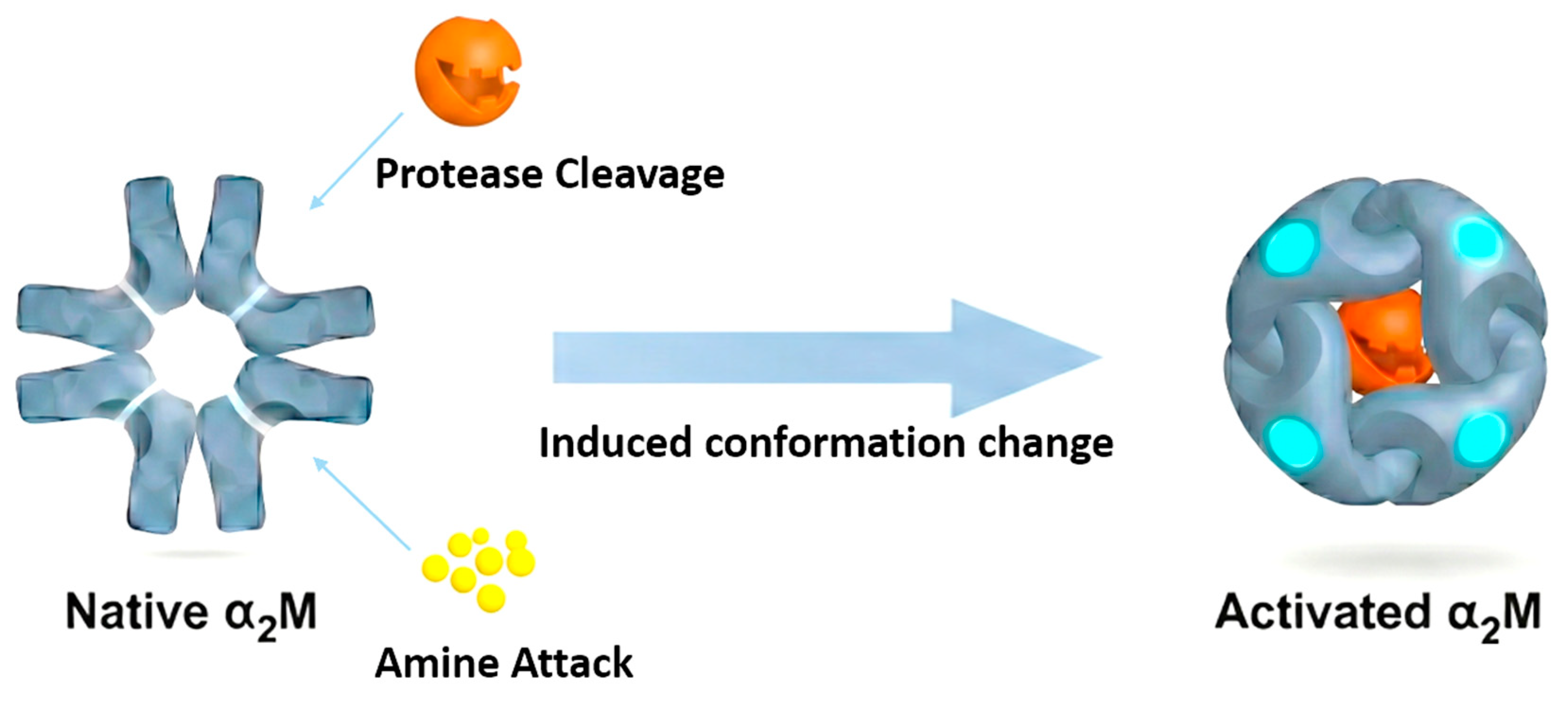
α2M inhibits proteases through a classical “Venus flytrap” mechanism: protease entry through the central cavity results in cleavage of the BRD, initiating a large-scale structural rearrangement that exposes the reactive thiol ester bond and drives coordinated rotations of the TED and CUB domains [21]. These conformational shifts progressively compact the molecule, creating a protease-entrapping cage (Figure 1). In some cases, nucleophilic residues of the protease can react with the exposed thioester, further stabilizing the α2M* state [22]. Cryo-electron microscopy (cryo-EM) analyses reveal substantial reorganization of inter-subunit contacts during this transition, providing structural insight into the enhanced receptor-binding capacity of α2M* [23].

2.2. Nucleophile-Induced Transition to α2M*

Small nucleophiles, such as methylamine (MA), can directly attack the thioester carbonyl to generate a non-protease-dependent activated form [24]. In these cases, though the bait region remains intact, the introduction of polar groups into the hydrophobic thioester site increases solvent accessibility [25], which facilitates a conformational collapse that closely resembles the one induced by protease cleavage and similarly exposes the RBD (Figure 1). Thus, despite the loss of its inhibitory capacity, this α2M* conformer retains the ability to act as a ligand for receptor-mediated signaling.
It should be noted that the majority of existing studies tend to treat both forms, that is, protease-α2M* and MA-α2M*, as functionally interchangeable activated conformations [21,24,26,27]. Nonetheless, the specific operational method of activation might introduce subtle yet critical heterogeneities in the resulting structures [28]. Specifically, protease-induced α2M* displays a distinct stain-excluding domain in its central part, indicating that the cavity is occupied by the protease; in contrast, MA-α2M* retains a longitudinal cavity, a structural divergence originally documented in the studies by Boisset et al. [29]. Meanwhile, the protease may partially protrude from the α2M* complex, resulting in a slightly larger Stokes radius compared to MA-α2M* [30]. Regarding reaction kinetics, the conformational transition triggered by the retraction of the N-terminal region of the truncated α-chain (α’NT) region from the central channel following bait-region cleavage occurs on a timescale of seconds, whereas the changes induced by aminolysis typically proceed over several minutes [31,32,33]. Protease-induced α2M* possesses greater energetic stability than MA-α2M*, as evidenced by Tm values of 68–69 °C versus 62.8 °C, respectively [34]. RBDs have been demonstrated to physically protrude from the molecular surface and exhibit significant dynamic flexibility in both conformers [21,35]; however, likely due to technical limitations, no studies have directly compared the potential differences in RBD exposure between these two activation forms. Thus, the α2M* label encompasses a spectrum of conformational states. In the following sections, we will specify the particular forms employed in each referenced study.

2.3. Hypochlorite Oxidative-Induced Transition to α2M Dimer

Hypochlorite, generated during inflammatory responses, induces oxidative modification of α2M that leads to tetramer dissociation into dimers with enhanced chaperone activity [36,37]. These oxidative-induced dimers exhibit a massive increase in surface hydrophobicity and increased affinity for cytokines and misfolded proteins, potentially exposing receptor-interacting surfaces independent of RBD-mediated activation [38,39]. Although these dimers do not undergo the canonical protease-triggered structural collapse and represent a structural departure from the classical tetrameric “fast” form, they constitute an alternative, functionally relevant species of α2M that operates predominantly under inflammatory or oxidative conditions.

2.4. Techniques for α2M* Characterization

A variety of biophysical and biochemical approaches have been used to distinguish α2M* from its native conformation. Early studies employing native-PAGE revealed that activation generates distinct, faster-migrating molecular species corresponding to α2M* [4,40]. The limitations of native-PAGE in distinguishing α2M species primarily stem from unresolved electrophoretic migration and non-specific mobility shifts. First, the presence of a single band on a gel does not necessarily guarantee a homogeneous population, as traditional fixed-percentage gels (e.g., 8% polyacrylamide) may lack the resolution to separate native and activated forms; in contrast, gradient gels (such as 3–8% or 4–12%) are often required to achieve adequate separation. Furthermore, mobility shifts on native-PAGE are not unique to a single activated state, as various structural alterations can result in similar migration patterns. Complementary spectroscopic analysis using circular dichroism (CD) further demonstrated that α2M activation is accompanied by characteristic alterations in secondary and tertiary structure, including changes in ellipticity and aromatic signals that reflect global domain rearrangements [24,41].
More detailed insights into conformational remodeling have been obtained through differential scanning calorimetry (DSC), which detects shifts in thermal stability between native, protease-activated, and MA-activated α2M*, reflecting structural rearrangements related to bait-region cleavage or covalent protease binding [34,42,43]. In addition, 4,4′-bis(1-anilinonaphthalene-8-sulfonate) (bis-ANS) fluorescence measurements reveal the exposure of hydrophobic surfaces upon activation or partial unfolding, allowing detection of subtle conformational transitions that may not be apparent in electrophoretic analyses [44,45]. However, the essence of this method remains an indicator of differences in surface hydrophobicity to infer the degree of conformational change; as such, it does not establish a one-to-one specific signature for predicting a particular activated form.
In sample preparation for various analytical methods, several experimental conditions, including temperature, buffer environment, gel concentration, protein concentration, detection time, and residual protease, can inadvertently trigger α2M conformational changes. For instance, the heat generated during prolonged high-current electrophoresis and the alkaline environment of loading buffers may induce minor α2M transformation [4,40]. Research has also shown that α2M undergoes slow inactivation when maintained in Tris-containing buffers for extended periods [40]; thus, detection times should be minimized as much as possible while still achieving experimental goals [24]. When utilizing CD, protein concentration should be optimized to balance signal intensity. Furthermore, Cummings et al. noted that residual protease within protease-α2M* complexes can alter the thermal transition properties of free α2M through its enzymatic activity, thereby confounding DSC results [34]. Consequently, purifying α2M* to remove impurities is essential for accurate peak assignment. Finally, as demonstrated by Wyatt et al., lyophilization or repeated freeze–thaw cycles significantly increase α2M hydrophobicity, indicating conformational alterations [45]. To mitigate this, samples should be aliquoted to avoid repeated freezing and thawing, or sucrose may be added as a cryoprotectant during lyophilized storage [45].

3. Receptor Interactions of α2M*

Activation of α2M exposes its C-terminal RBD, enabling interaction with specific cell-surface receptors that mediate both endocytic uptake and intracellular signaling. Among these receptors, LRP1 and GRP78 are the two best-characterized membrane receptors of α2M*, each contributing distinct regulatory functions. Their differential expression patterns and signaling capabilities allow α2M* to elicit diverse cellular responses across tissues.

3.1. LRP1

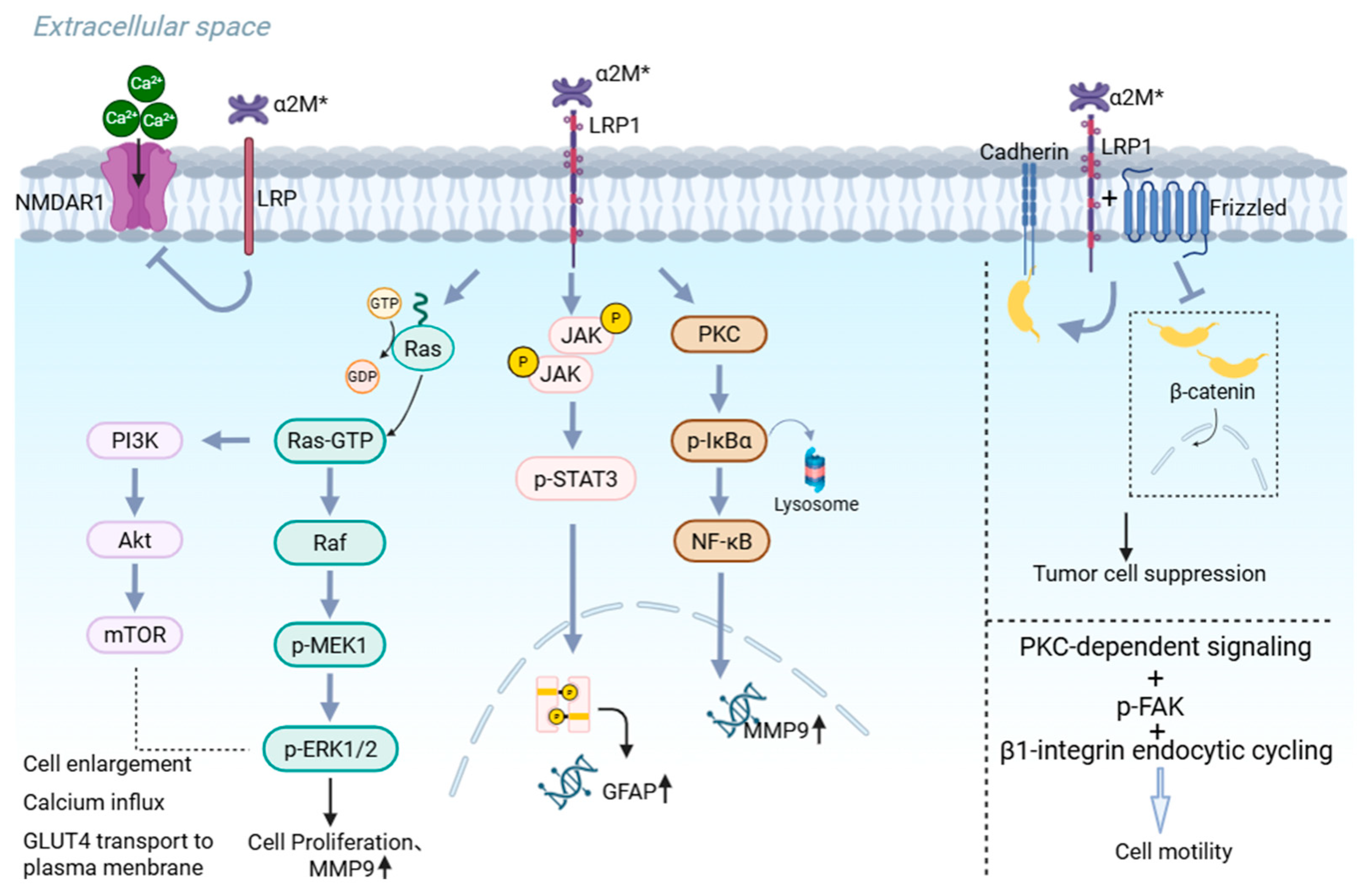
LRP1 is a multifunctional endocytic and signaling receptor that binds α2M* with high affinity. Mutational analyses have identified Lys-1370 and Lys-1374 within α2M* as essential residues for LRP1 recognition [46,47]. Following ligand binding, the α2M*-LRP1 complex undergoes rapid internalization, but ligand engagement also activates intracellular signaling pathways independently of endocytosis [48]. Importantly, LRP1 cooperates with co-receptors such as N-methyl-D-aspartate receptor (NMDAR) to generate ligand-specific responses, enabling α2M* to modulate processes ranging from inflammation to cell survival [49,50,51]. These properties position LRP1 as the principal mediator of α2M*-induced signaling in many cell types (Figure 2).

3.2. GRP78

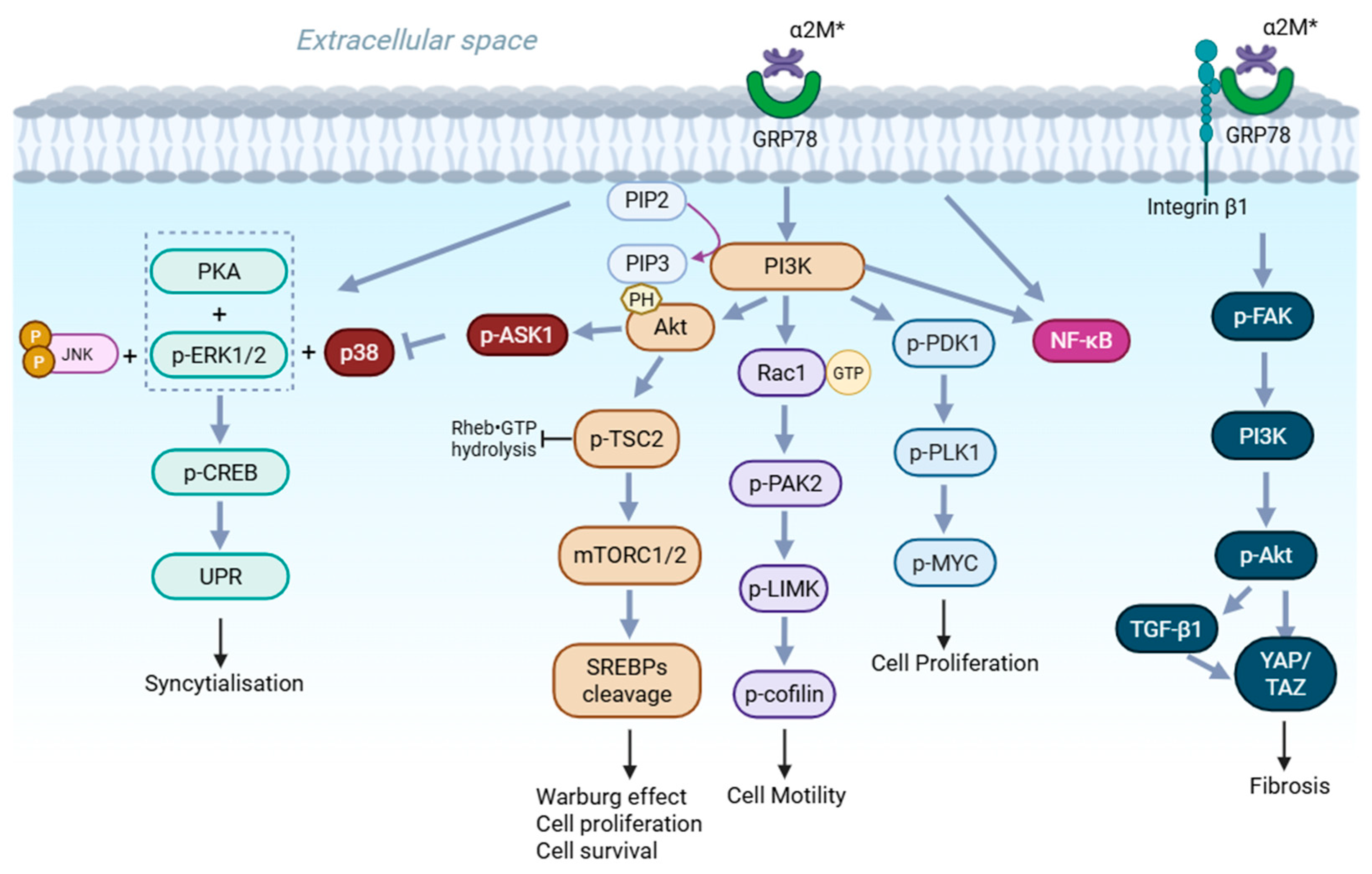
GRP78, a member of the heat shock protein 70 family, is predominantly an endoplasmic reticulum (ER)-resident chaperone but can re-localize to the cell surface during stress [52]. At the plasma membrane, GRP78 functions as a high-sensitivity sensing system for extracellular stress signals and binds α2M* with sub-nanomolar affinity [53,54]. Mechanistically, the signal transduction capability of cell-surface GRP78 is anchored by its ability to organize specific signaling hubs within lipid raft microdomains. Specifically, in murine macrophages, α2M* ligation promotes the assembly of GRP78 into a ternary signaling complex with its transmembrane co-chaperone murine tumor cell DnaJ-like protein 1 (MTJ-1) and the Gαq11 subunit [55]. This complex formation is pertussis toxin-insensitive and indispensable for downstream signaling events, providing direct molecular evidence that GRP78 functions as a non-canonical G protein-coupled receptor (GPCR) adapter to transduce extracellular α2M* stimuli into intracellular responses [55]. Through this unique transduction mechanism, surface GRP78 modulates pathways governing survival, apoptosis, and inflammatory signaling, particularly in cancer cells and stressed tissues where its expression is significantly elevated [56]. Thus, GRP78 represents a context-dependent receptor that enables α2M* to orchestrate cellular adaptation within pathological signaling environments (Figure 3).

4. α2M*-Induced Intracellular Signaling

α2M* activates a diverse set of intracellular signaling pathways through interactions with LRP1, GRP78, and their associated co-receptors. Rather than functioning through a single linear pathway, α2M* engages interconnected signaling networks whose composition varies according to cellular context, receptor availability, and physiological state. Based on current evidence, these pathways can be organized into several functional modules: PI3K-driven growth and metabolic regulation, MAPK-family plasticity, Rac/PAK-dependent cytoskeletal remodeling, NF-κB-centered inflammatory control, JAK/STAT-mediated stress signaling, Wnt/β-catenin antagonism, and non-canonical YAP/TAZ mechanotransduction. This modular framework highlights the versatility of α2M* in coordinating cell-fate decisions across diverse tissues.

4.1. Growth- and Metabolism-Associated PI3K Modules

The PI3K-Akt axis serves as a robust central module for α2M* signaling, integrating extracellular stimuli into coordinated intracellular responses across diverse physiological contexts. Upon engaging cell-surface receptors, particularly GRP78, α2M* initiates a hierarchical signaling cascade that couples rapid kinase activation with long-term transcriptional reinforcement. For instance, the activation of Akt triggers the dual engagement of mTORC1 and mTORC2, which synergistically drive anabolic programs through S6K and 4EBP1 phosphorylation in 1-LN prostate cancer cells with 50 pM MA-α2M* [57]. This growth-promoting signaling is further amplified by a parallel PDK1-PLK1-MYC axis, where PDK1-mediated phosphorylation stabilizes the MYC oncoprotein to promote proliferative gene expression in various cancer cell lines (e.g., 1-LN and DU-145 prostate cancer, A375 melanoma, and U373 glioma cells) with 100 pM MA-α2M* [58]. The necessity of this receptor-specific pathway is underscored by the fact that GRP78 knockdown or PI3K inhibition effectively abolishes these downstream effects, confirming the module’s role as a primary driver of cellular expansion.
Beyond general growth control, the α2M*-driven PI3K-Akt axis acts as a master regulator of metabolic reprogramming. In malignant environments, specifically observed in 1-LN and DU-145 prostate cancer cells, treatment with 100 pM MA-α2M* induces a “Warburg-type” metabolic shift. This transition is characterized by enhanced aerobic glycolysis and a coordinated upregulation of lipogenic programs, including the SREBP1-c/SREBP2 axis and fatty acid synthase (FASN) [59]. This de novo lipid biosynthesis provides the necessary building blocks for rapid membrane biogenesis and tumor proliferation. Crucially, the oncogenic potential of this axis relies on the integrated activity of both mTOR complexes; pharmacological evidence using the dual inhibitor Torin1 demonstrates that simultaneous blockade of mTORC1 and mTORC2 is required to fully abrogate α2M*-mediated survival signaling, offering a more promising therapeutic strategy over traditional mTORC1-only inhibition [57].
The prominence of PI3K signaling is equally evident in tissue-specific responses to metabolic and hemodynamic stress. In the myocardium, ammonium bicarbonate-α2M* engages LRP1 to activate the PI3K-Akt-mTOR and ERK pathways, contributing to compensatory hypertrophy and metabolic adaptation [60,61]. This axis also fine-tunes systemic energy balance by modulating insulin sensitivity. 60 nM MA-α2M* facilitates glucose transporter type 4 (GLUT4) trafficking through Rab-dependent itineraries, thereby alleviating lipid-induced insulin resistance and enhancing glucose utilization efficiency in HL-1 cardiomyocytes [62,63]. However, under chronic pathological conditions such as diabetic kidney disease, this once-adaptive module can become maladaptive. In the renal microenvironment of type 1 diabetic Akita and CD1 mice, as well as human biopsy samples from diabetic kidney disease, high glucose levels have been shown to promote the formation of α2M*-GRP78 complexes [64]. Further mechanistic studies in mesangial cells demonstrate that 100 pM MA-α2M* sustains PI3K/Akt activation, which in turn drives the expression of profibrotic cytokines like transforming growth factor beta 1 (TGF-β1) and connective tissue growth factor (CTGF), ultimately leading to excessive extracellular matrix deposition and structural tissue pathology [64].
Also, the α2M*/LRP1-PI3K axis extends its regulatory reach to extracellular proteostasis and neuroprotection, particularly in the context of amyloid-beta (Aβ) metabolism. In amyloid precursor protein/presenilin 1 (APP/PS1) transgenic mice and neuroblastoma 2a cells, indomethacin promotes the expression of α2M. Upon activation by methylamine, 50 nM MA-α2M* triggers the PI3K-Akt and ERK1/2 pathways, which enhances a disintegrin and metalloproteinase 10 (ADAM10) activity for non-amyloidogenic APP processing and stabilizes LRP1 against Aβ-mediated degradation [65]. By facilitating the efflux and clearance of Aβ from the brain, this signaling module functions as a critical homeostatic mechanism against neurotoxic protein aggregation. Collectively, these findings position the PI3K-Akt axis as a recurring integration node through which α2M* coordinates cellular growth, metabolic flexibility, and the transition from homeostasis to disease.

4.2. MAPK-Family Regulatory Modules

MAPK signaling constitutes a second major node downstream of α2M*, functioning as a highly plastic regulatory hub that dictates cellular outcomes based on the specific receptor landscape and microenvironmental context. The functional versatility of this module is exemplified by its ability to oscillate between proliferative and anti-inflammatory roles. In mitogenic contexts, 60 nM MA-α2M* triggers ERK1/2 and c-jun activation primarily through LRP1 to drive cell cycle progression in J774 cells [66,67]. However, the assembly of a distinct LRP1-NMDAR signaling complex can pivot this response toward immune modulation, where ERK1/2 activation serves to suppress the production of pro-inflammatory cytokines [51]. This flexibility underscores the “context-dependent” nature of α2M* activity, where the co-receptor composition determines whether the MAPK cascade promotes expansion or resolution.
The regulatory reach of α2M* is further amplified through the extensive integration of MAPK modules with lipid mediators and cyclic nucleotide signaling. Within the immune microenvironment, 100 pM MA-α2M* triggers a phospholipase C (PLC)-dependent mobilization of intracellular Ca2+, which sequentially activates protein kinase C (PKC) and the broader MAPK family, including ERK, p38, and JNK. This network converges on the phosphorylation and translocation of cytosolic phospholipase A2 (cPLA2), thereby linking kinase cascades to arachidonic acid release and the transcriptional induction of c-fos and c-myc in mouse peritoneal macrophages [68]. Concurrently, α2M* orchestrates a multi-axis signaling program that integrates Ca2+-dependent pathways with cAMP signaling. Specifically, in macrophages, treatment with 100 pM MA-α2M* triggers the parallel activation of the PKA, PI3K, and MAPK pathways. This concerted signaling network converges on the phosphorylation of cAMP responsive element binding protein (CREB), establishing it as a central node for driving immune cell proliferation and survival [69].
Beyond basic growth control, this signaling architecture is essential for specialized cellular differentiation and developmental programs. A striking example is found in placental development, where α2M* engages a specific GRP78-ERK/CREB axis that uniquely couples with the unfolded protein response (UPR). This mechanistic integration, independent of canonical human chorionic gonadotropin (hCG) secretion, is indispensable for regulating trophoblast fusion, providing a novel paradigm for how 100 pM trypsin-α2M* or MA-α2M* coordinates extracellular stimuli with ER-stress pathways to govern tissue morphogenesis [70]. Such layered regulation is also evident in malignant and inflammatory states, where ERK activation frequently coincides with the recruitment of Akt, p38, and NF-κB triggered by picomolar to nanomolar concentrations of MA-α2M*, forming a robust survival network that reinforces tumor resistance and matrix remodeling through the induction of matrix metalloproteinase-9 (MMP-9) [71,72,73].
The α2M*-MAPK module functions as a critical homeostatic rheostat in neural and ocular tissues. In retinal environments, 100 nM MA-α2M* acts as a suppressor of uncontrolled glial proliferation by antagonizing GPCR-induced mitogenic signaling. This is achieved through a dual mechanism: the LRP1-mediated endocytic clearance of extracellular growth factors and proteases, coupled with the attenuation of Ca2+-dependent signaling and the stabilization of membrane conductance in Müller cells, thereby preventing the overactivation of downstream MAPK-dependent proliferative pathways [74]. This homeostatic counter-regulation highlights the importance of α2M* in maintaining retinal stability and preventing pathological states such as proliferative vitreoretinopathy. Collectively, these findings illustrate that the MAPK module is not a linear pathway but a multi-dimensional integration point that fine-tunes cell fate, differentiation, and tissue homeostasis.

4.3. Rac-PAK-Dependent Cytoskeletal Remodeling Modules

Beyond its roles in growth and metabolism, α2M* serves as a key regulator of cytoskeletal architecture, acting largely through a Rac1-centered signaling axis. The fundamental framework of this module involves the activation of Rac1 upon 50 pM MA-α2M* binding to surface GRP78, which subsequently recruits p21-activated kinase 2 (PAK2). This interaction releases the autoinhibitory conformation of PAK2, enabling its autophosphorylation (Thr-402) and the subsequent activation of the LIM domain kinase (LIMK)-cofilin cascade in murine peritoneal macrophages [75]. By inhibiting the actin-filament-severing activity of cofilin, this pathway stabilizes F-actin structures, providing the mechanical basis for cellular protrusions and directed migration.
Recent mechanistic dissections have refined this model by identifying a high degree of isoform specificity and the requirement for specialized adapter proteins. In the context of malignant progression, 50–100 pM MA-α2M* drives the assembly of a plasma membrane-associated ternary complex consisting of GRP78, the adapter protein non-catalytic region of tyrosine kinase adaptor protein (NCK), and PAK2 in 1-LN cells [76]. Notably, this signaling requirement is specific to PAK2, as PAK1 cannot substitute in this context. This specialized GRP78-NCK-PAK2 module serves as a dual-function hub: while it regulates actin dynamics through the LIMK-cofilin axis to facilitate invasion, it simultaneously phosphorylates the pro-apoptotic protein Bad to suppress programmed cell death. This sophisticated coupling of cytoskeletal reorganization with survival signaling suggests that α2M* does not merely move a cell but actively sustains its viability during the high-stress process of metastasis.
The versatility of α2M*-driven motility is further exemplified by its ability to coordinate complex mesenchymal migration programs. This is particularly evident during tissue remodeling and inflammatory infiltration, where 60 nM MA-α2M* engagement of LRP1 activates a PKC-dependent motility program in Raw264.7 cells [77]. Unlike simple chemotaxis, this axis involves the active redistribution of membrane-type 1 matrix metalloproteinase (MT1-MMP) and the rapid endocytic cycling of β1-integrin to the leading edge of cellular protrusions. By integrating proteolytic activity (via MT1-MMP) with adhesive dynamics (via integrins) and mechanical force, the α2M*/LRP1 pathway enables cells to navigate through dense extracellular matrices. Collectively, these findings position Rac-PAK-dependent modules as critical integration points where α2M* facilitates the transition from stationary to invasive cellular phenotypes in both physiological and pathological environments.

4.4. NF-κB-Driven Inflammatory Modules

The NF-κB transcription factor family represents a critical convergence hub through which α2M* translates acute extracellular stimuli into sustained changes in the cellular transcriptional landscape. In macrophages, 20 nM MA-α2M* initiates a PKC-dependent cascade that drives the nuclear translocation of NF-κB, leading to the targeted induction of MMP-9 [71]. Rather than acting in isolation, this pathway is closely integrated with the ERK1/2 signaling module, forming a coordinated regulatory program that governs macrophage-mediated matrix remodeling and tissue infiltration.
The functional significance of the NF-κB module is further amplified in malignant settings, where it operates as a cornerstone of cellular resilience. In this context, 50 pM MA-α2M* generates a high-order, multi-axis signaling network by simultaneously engaging NF-κB alongside the PI3K/Akt, ERK1/2, and p38 MAPK pathways [72,73]. This integrative signaling program may confer a notable survival advantage, helping cancer cells to maintain proliferative momentum and counteract environmental stressors or apoptotic triggers. By positioning NF-κB at the intersection of growth, survival, and stress-response signaling, α2M* appears to function as a broad-spectrum modulator of gene expression, potentially bridging the gap between mitogenic signaling and inflammatory adaptation.

4.5. JAK-STAT-Mediated Stress-Response Modules

α2M* also modulates cellular responses to stress via activation of JAK-STAT signaling. In retinal Müller glial cells, 60 nM MA-α2M* binding to LRP1 triggers time-dependent STAT3 phosphorylation, leading to increased expression of glial fibrillary acidic protein (GFAP)—an established indicator of glial reactivity. This pathway’s physiological relevance is validated in vivo, where intravitreal 1.075 μg per mouse MA-α2M* recapitulates STAT3-dependent GFAP induction, identifying α2M* as a key molecular sentinel in neural tissues [78,79]. JAK-STAT signaling represents a conserved stress-response mechanism that may extend to other tissues. By modulating STAT3 activity, α2M* may influence broader aspects of tissue homeostasis.

4.6. Wnt/β-Catenin Antagonism Modules

In certain pathological contexts, such as glial malignancies, 0–0.1 μM MA-α2M* can function as a negative regulator of the canonical Wnt/β-catenin pathway. This inhibitory effect is mediated through the engagement of LRP1, which triggers the sequestration of Frizzled receptors and a concomitant up-regulation of E-cadherin and N-cadherin [71]. These molecular changes promote the redistribution of β-catenin, shifting its localization from the nucleus to the plasma membrane. By reducing the nuclear pool of β-catenin, this module effectively suppresses Wnt-driven transcriptional programs [80], thereby limiting cellular invasive potential and the formation of multicellular spheroids. Such findings suggest that the α2M*/LRP1 axis may act as a biological constraint on tumor progression, particularly within the nervous system [81].

4.7. Non-Canonical Profibrotic Signaling

Beyond classical kinase cascades, α2M* participates in the regulation of tissue fibrosis through non-canonical signaling pathways. In renal tubular epithelial cells and fibroblasts, the interaction between protease-α2M* and cell-surface GRP78 is a required step for profibrotic responses induced by high glucose levels. Although this axis intersects with TGF-β signaling, its downstream effects are independent of the canonical Smad3 pathway [82]. Instead, protease-α2M* signaling through GRP78 promotes the activation of the YAP-TAZ transcriptional complex, a key mediator of fibrosis and extracellular matrix deposition [82,83]. In vivo studies have demonstrated that pharmacological or genetic blockade of the protease-α2M*/GRP78 interaction effectively suppresses this pathway and attenuates the progression of renal fibrosis. These findings identify α2M* as a modulator of matrix-associated transcriptional programs, potentially linking extracellular ligand status to mechanosensitive signaling components like YAP/TAZ [82].

5. Perspective

α2M has long been viewed primarily as a broad-spectrum protease inhibitor, yet recent structural and mechanistic advances reveal that its activated form, α2M*, plays a far more expansive biological role. The signaling landscape of α2M* appears to be characterized by a remarkable pleiotropy, often engaging multiple intracellular cascades at concentrations as low as the picomolar to nanomolar range. In certain cell types, these α2M*-mediated responses may exhibit distinct dose-dependent activation patterns, suggesting a potentially sensitive and finely regulated mechanism for modulating extracellular signals. As summarized in Table 1, α2M* modulates a wide array of pathways, including the classical kinase cascades (MAPK/ERK, PI3K/Akt), master transcriptional regulators (NF-κB, STAT3, Wnt/β-catenin), mechanosensitive modules (YAP/TAZ), and neuronal function [84]. This functional diversity is largely dictated by the specific receptor-ligand interface and the cellular context. Evidence suggests that LRP1 remains a predominant and highly versatile receptor for α2M*, functioning as a signaling scaffold in macrophages, glial cells, and various tumor lineages. Within these cells, it can trigger divergent downstream effects depending on the physiological state. In contrast, the α2M*/GRP78 axis appears to represent a more specialized signaling module, predominantly observed in epithelial cells and fibroblasts.
Despite substantial progress, several major gaps continue to constrain our understanding of α2M* biology. A primary challenge in α2M* biology is deciphering the molecular logic that governs signaling specificity. That is, α2M* can elicit starkly divergent outcomes (i.e., enhancing survival in cancer cells, suppressing inflammation in macrophages, or supporting homeostatic responses in neuronal cells), yet the molecular logic underlying these differences remains unknown. Also, it remains unclear how different conformational states alter receptor engagement and pathway choice. Establishing a rigorous structural framework that links specific conformational ensembles to receptor or pathway selection will be attractive for the field.
Another intriguing aspect to note lies in the clinical relevance of α2M* dysregulation. Altered α2M levels have been associated with neurodegeneration, bladder cancer, and bone disorders [20,85,86,87], yet the biological significance of these correlations remains opaque. It is not known whether such changes reflect compensatory responses to systemic stress, contribute causally to disease progression, or simply act as biomarkers of upstream dysfunction. The extent to which α2M* contributes to disease heterogeneity also remains unexplored. Emerging methodologies offer the precision required to map α2M* signaling dynamics in complex tissue environments. Specifically, high-resolution cryo-EM could be employed to elucidate the structural divergence between α2M activated via different pathways, specifically focusing on the exposure of the RBD and how these conformational nuances dictate its interaction with receptors. Live-cell biosensors could test hypotheses regarding the spatiotemporal activation of α2M within the microenvironment of living tissues. These tools will be instrumental in validating α2M* as a viable therapeutic target. As α2M* continues to emerge as a versatile regulator of extracellular signaling, defining its mechanistic diversity will be essential for translating fundamental discoveries into clinical impact.

Author Contributions

Conceptualization, F.Y.; investigation: L.L. and F.Y.; project administration: F.Y. and Y.M.; supervision: Y.M.; visualization: L.L.; writing—original draft: F.Y. and L.L.; writing—review and editing: F.Y., Y.M. and J.J.; funding acquisition, F.Y. All authors have read and agreed to the published version of the manuscript.

Funding

This work was supported by Beijing Natural Science Foundation, grant number 7244471.

Institutional Review Board Statement

Not applicable.

Informed Consent Statement

Not applicable.

Data Availability Statement

No new data were created or analyzed in this study. Data sharing is not applicable to this article.

Acknowledgments

We thank the Beijing Natural Science Foundation for providing fundings for this work. During the preparation of this work, the authors used DeepSeek V3.2 for language polishing and readability improvement, and Gemini 3 Flash for schematic diagram drawing. The authors have reviewed and edited the output and take full responsibility for the content of this publication.

Conflicts of Interest

The authors declare no competing interests.

Abbreviations

The following abbreviations are used in this manuscript:
α2MAlpha-2-macroglobulin
α2M*Activated alpha-2-macroglobulin
AβAmyloid-beta
AktProtein kinase B
APPAmyloid precursor protein
BRDBait region domain
cAMPCyclic adenosine monophosphate
CDCircular dichroism
cPLA2Cytosolic phospholipase A2
CREBcAMP responsive element binding protein
Cryo-EMCryo-electron microscopy
CTGFConnective tissue growth factor
CUB C1r/C1s-Uegf-Bmp1
DSCDifferential scanning calorimetry
EREndoplasmic reticulum
ERK1/2Extracellular signal-regulated kinase 1/2
FASNFatty acid synthase
4EBP1Eukaryotic translation initiation factor 4E-binding protein 1
GFAPGlial fibrillary acidic protein
GPCRG protein-coupled receptor
GRP78Glucose-regulated protein 78
JAKJanus kinase
JNKc-Jun N-terminal kinase
LIMKLIM domain kinase
LRP1Low-density lipoprotein receptor-related protein 1
MAMethylamine
MAPKMitogen-activated protein kinase
MG1–7Macroglobulin-like domains
MMP-9Matrix metalloproteinase 9
MTJ-1Murine tumor cell DnaJ-like protein 1
MT1-MMPMembrane-type 1 matrix metalloproteinase
mTORMammalian target of rapamycin
mTORC1/2Mechanistic target of rapamycin complex 1/2
MYCMYC proto-oncogene, bHLH transcription factor
NCKnon-catalytic region of tyrosine kinase adaptor protein
NF-κBNuclear factor kappa B
NMDARN-methyl-D-aspartate receptor
PAKp21-activated kinase
PDK13-phosphoinositide-dependent protein kinase-1
PI3KPhosphoinositide 3-kinase
PKCProtein kinase C
PLCPhospholipase C
PLK1Polo-like kinase 1
PS1Presenilin 1
p38p38 mitogen-activated protein kinase
RabRas-related in brain
RacRas-related C3 botulinum toxin substrate
RBDReceptor-binding domain
SREBPSterol regulatory element-binding protein
S6KRibosomal protein S6 kinase
STATSignal transducer and activator of transcription
TAZTranscriptional coactivator with PDZ-binding motif
TEDThioester domain
TGF-β1Transforming growth factor beta 1
T2D-DKD urineType 2 diabetes with diabetic kidney disease urine
UPRUnfolded protein response
YAPYes-associated protein 1

References

  1. Harpel, P.C. Human α2-macroglobulin. Methods Enzym. 1976, 45, 639–652. [Google Scholar] [CrossRef]
  2. Schultze, H.E.; Göllner, I.; Heide, K.; Schönenberger, M.; Schwick, G. Zur kenntnis der α-globuline des menschlichen normalserums. Z. Naturforschung B 1955, 10, 463–473. [Google Scholar] [CrossRef]
  3. Roberts, R.C.; Riesen, W.A.; Hall, P.K. Studies on the quaternary structure of human serum α2-macroglobulin. In Proteinase Inhibitor, Proceedings of the Bayer-Symposium V, Munich, Germany, 16–21 October 1973; Fritz, H., Tschesche, H., Greene, L.J., Truscheit, E., Eds.; Springer: Berlin/Heidelberg, Germany, 1974; pp. 63–71. [Google Scholar] [CrossRef]
  4. Saunders, R.; Dyce, B.J.; Vannier, W.E.; Haverback, B.J. The separation of alpha-2 macroglobulin into five components with differing electrophoretic and enzyme-binding properties. J. Clin. Investig. 1971, 50, 2376–2383. [Google Scholar] [CrossRef] [PubMed]
  5. Kan, C.C.; Solomon, E.; Belt, K.T.; Chain, A.C.; Hiorns, L.R.; Fey, G. Nucleotide sequence of cDNA encoding human α2-macroglobulin and assignment of the chromosomal locus. Proc. Natl. Acad. Sci. USA 1985, 82, 2282–2286. [Google Scholar] [CrossRef]
  6. Doan, N.; Gettins, P.G. Human alpha2-macroglobulin is composed of multiple domains, as predicted by homology with complement component C3. Biochem. J. 2007, 407, 23–30. [Google Scholar] [CrossRef] [PubMed]
  7. Yuan, F.; Jia, J.T.; Ma, Y.Y. Research progress in the molecular mechanism of α2-macroglobulin. Mil. Med. Sci. 2025, 49, 396–400. [Google Scholar] [CrossRef]
  8. Lin, Z.X.; Lo, A.; Simeone, D.M.; Ruffin, M.T.; Lubman, D.M. An N-glycosylation analysis of human alpha-2-macroglobulin using an integrated approach. J. Proteom. Bioinform. 2012, 5, 127–134. [Google Scholar] [CrossRef]
  9. Matthijs, G.; Devriendt, K.; Cassiman, J.J.; Van den Berghe, H.; Marynen, P. Structure of the human alpha-2 macroglobulin gene and its promotor. Biochem. Biophys. Res. Commun. 1992, 184, 596–603. [Google Scholar] [CrossRef]
  10. Nagasawa, S.; Han, B.H.; Sugihara, H.; Suzuki, T. Studies on α2-macroglobulin in bovine plasma. II. Interaction of α2-macroglobulin and trypsin. J. Biochem. 1970, 67, 821–832. [Google Scholar] [CrossRef]
  11. Boyde, T.R.; Pryme, I.F. Alpha2-macroglobulin binding of trypsin, chymotrypsin, papain, and cationic aspartate aminotransferase. Clin. Chim. Acta 1968, 21, 9–14. [Google Scholar] [CrossRef]
  12. Lagrange, J.; Lecompte, T.; Knopp, T.; Lacolley, P.; Regnault, V. Alpha-2-macroglobulin in hemostasis and thrombosis: An underestimated old double-edged sword. J. Thromb. Haemost. 2022, 20, 806–815. [Google Scholar] [CrossRef]
  13. Starkey, P.M.; Barrett, A.J. Inhibition by α2-macroglobulin and other serum proteins. Biochem. J. 1973, 131, 823–831. [Google Scholar] [CrossRef]
  14. Barrett, A.J.; Starkey, P.M. The interaction of α2-macroglobulin with proteinases. Characteristics and specificity of the reaction, and a hypothesis concerning its molecular mechanism. Biochem. J. 1973, 133, 709–724. [Google Scholar] [CrossRef]
  15. Werb, Z.; Burleigh, M.C.; Barrett, A.J.; Starkey, P.M. The interaction of α2-macroglobulin with proteinases. Binding and inhibition of mammalian collagenases and other metal proteinases. Biochem. J. 1974, 139, 359–368. [Google Scholar] [CrossRef] [PubMed]
  16. Straight, D.L.; McKee, P.A. Characterization of thrombin binding to α2-macroglobulin. J. Biol. Chem. 1984, 259, 1272–1278. [Google Scholar] [CrossRef] [PubMed]
  17. Webb, D.J.; Roadcap, D.W.; Dhakephalkar, A.; Gonias, S.L. A 16-amino acid peptide from human alpha2-macroglobulin binds transforming growth factor-beta and platelet-derived growth factor-BB. Protein Sci. 2000, 9, 1986–1992. [Google Scholar] [CrossRef]
  18. Westwood, M.; Aplin, J.D.; Collinge, I.A.; Gill, A.; White, A.; Gibson, J.M. α2-Macroglobulin: A new component in the insulin-like growth factor/insulin-like growth factor binding protein-1 axis. J. Biol. Chem. 2001, 276, 41668–41674. [Google Scholar] [CrossRef]
  19. Whiten, D.R.; Cox, D.; Horrocks, M.H.; Taylor, C.G.; De, S.; Flagmeier, P.; Tosatto, L.; Kumita, J.R.; Ecroyd, H.; Dobson, C.M.; et al. Single-molecule characterization of the interactions between extracellular chaperones and toxic α-synuclein oligomers. Cell Rep. 2018, 23, 3492–3500. [Google Scholar] [CrossRef] [PubMed]
  20. Cater, J.H.; Wilson, M.R.; Wyatt, A.R. Alpha-2-macroglobulin, a hypochlorite-regulated chaperone and immune system modulator. Oxidative Med. Cell. Longev. 2019, 2019, 5410657. [Google Scholar] [CrossRef]
  21. Harwood, S.L.; Lyngsø, J.; Zarantonello, A.; Kjøge, K.; Nielsen, P.K.; Andersen, G.R.; Pedersen, J.S.; Enghild, J.J. Structural investigations of human A2M identify a hollow native conformation that underlies its distinctive protease-trapping mechanism. Mol. Cell. Proteom. 2021, 20, 100090. [Google Scholar] [CrossRef]
  22. Salvesen, G.S.; Sayers, C.A.; Barrett, A.J. Further characterization of the covalent linking reaction of α2-macroglobulin. Biochem. J. 1981, 195, 453–461. [Google Scholar] [CrossRef]
  23. Huang, X.; Wang, Y.; Yu, C.; Zhang, H.; Ru, Q.; Li, X.; Song, K.; Zhou, M.; Zhu, P. Cryo-EM structures reveal the dynamic transformation of human alpha-2-macroglobulin working as a protease inhibitor. Sci. China Life Sci. 2022, 65, 2491–2504. [Google Scholar] [CrossRef]
  24. Björk, I.; Fish, W.W. Evidence for similar conformational changes in α2-macroglobulin on reaction with primary amines or proteolytic enzymes. Biochem. J. 1982, 207, 347–356. [Google Scholar] [CrossRef]
  25. Gettins, P.G. Thiol ester cleavage-dependent conformational change in human alpha 2-macroglobulin. Influence of attacking nucleophile and of Cys949 modification. Biochemistry 1995, 34, 12233–12240. [Google Scholar] [CrossRef]
  26. Thieme, R.; Kurz, S.; Kolb, M.; Debebe, T.; Holtze, S.; Morhart, M.; Huse, K.; Szafranski, K.; Platzer, M.; Hildebrandt, T.B.; et al. Analysis of alpha-2 macroglobulin from the long-lived and cancer-resistant naked mole-rat and human plasma. PLoS ONE 2015, 10, e0130470. [Google Scholar] [CrossRef]
  27. Shi, Y.; Yamauchi, T.; Gaultier, A.; Takimoto, S.; Campana, W.M.; Gonias, S.L. Regulation of cytokine expression by Schwann cells in response to α2-macroglobulin binding to LRP1. J. Neurosci. Res. 2011, 89, 544–551. [Google Scholar] [CrossRef]
  28. Dangott, L.J.; Puett, D.; Cunningham, L.W. Changes in alpha 2-macroglobulin conformation by reaction with trypsin and methylamine. Ann. N. Y. Acad. Sci. 1983, 421, 158–159. [Google Scholar] [CrossRef]
  29. Boisset, N.; Taveau, J.C.; Pochon, F.; Tardieu, A.; Barray, M.; Lamy, J.N.; Delain, E. Image processing of proteinase- and methylamine-transformed human alpha 2-macroglobulin. Localization of the proteinases. J. Biol. Chem. 1989, 264, 12046–12052. [Google Scholar] [CrossRef]
  30. Gonias, S.L.; Reynolds, J.A.; Pizzo, S.V. Physical properties of human alpha 2-macroglobulin following reaction with methylamine and trypsin. Biochim. Biophys. Acta 1982, 705, 306–314. [Google Scholar] [CrossRef] [PubMed]
  31. Harwood, S.L.; Diep, K.; Nielsen, N.S.; Jensen, K.T.; Enghild, J.J. The conformational change of the protease inhibitor α2-macroglobulin is triggered by the retraction of the cleaved bait region from a central channel. J. Biol. Chem. 2022, 298, 102230. [Google Scholar] [CrossRef] [PubMed]
  32. Christensen, U.; Sottrup-Jensen, L. Mechanism of alpha 2-macroglobulin-proteinase interactions. Studies with trypsin and plasmin. Biochemistry 1984, 23, 6619–6626. [Google Scholar] [CrossRef]
  33. Strickland, D.K.; Bhattacharya, P.; Olson, S.T. Kinetics of the conformational alterations associated with nucleophilic modification of alpha 2-macroglobulin. Biochemistry 1984, 23, 3115–3124. [Google Scholar] [CrossRef] [PubMed]
  34. Cummings, H.S.; Pizzo, S.V.; Strickland, D.K.; Castellino, F.J. Effect of methylamine and plasmin on the conformation of human alpha 2-macroglobulin as revealed by differential scanning calorimetric analysis. Biophys. J. 1984, 45, 721–724. [Google Scholar] [CrossRef]
  35. Marrero, A.; Duquerroy, S.; Trapani, S.; Goulas, T.; Guevara, T.; Andersen, G.R.; Navaza, J.; Sottrup-Jensen, L.; Gomis-Rüth, F.X. The crystal structure of human α2-macroglobulin reveals a unique molecular cage. Angew. Chem. Int. Ed. 2012, 51, 3340–3344. [Google Scholar] [CrossRef]
  36. Wyatt, A.R.; Kumita, J.R.; Mifsud, R.W.; Gooden, C.A.; Wilson, M.R.; Dobson, C.M. Hypochlorite-induced structural modifications enhance the chaperone activity of human α2-macroglobulin. Proc. Natl. Acad. Sci. USA 2014, 111, E2081–E2090. [Google Scholar] [CrossRef]
  37. Reddy, V.Y.; Desorchers, P.E.; Pizzo, S.V.; Gonias, S.L.; Sahakian, J.A.; Levine, R.L.; Weiss, S.J. Oxidative dissociation of human α2-macroglobulin tetramers into dysfunctional dimers. J. Biol. Chem. 1994, 269, 4683–4691. [Google Scholar] [CrossRef]
  38. Wu, S.M.; Boyer, C.M.; Pizzo, S.V. The binding of receptor-recognized α2-macroglobulin to the low density lipoprotein receptor-related protein and the α2M signaling receptor is decoupled by oxidation. J. Biol. Chem. 1997, 272, 20627–20635. [Google Scholar] [CrossRef]
  39. Xie, W.; Gao, L.; Deng, H.; Liu, D.; Pang, Q. The evolution, oligomerization, function, and action mechanism of α2-macroglobulin. Cells 2026, 15, 353. [Google Scholar] [CrossRef]
  40. Barrett, A.J.; Brown, M.A.; Sayers, C.A. The electrophoretically ‘slow’ and ‘fast’ forms of the α2-macroglobulin molecule. Biochem. J. 1979, 181, 401–418. [Google Scholar] [CrossRef]
  41. Lah, T.; Vihar, M.; Dubin, A.; Turk, V. Horse α2-macroglobulin. Circular dichroism studies of conformational changes upon reaction with proteinases and methylamine. Biol. Chem. Hoppe-Seyler 1987, 368, 487–492. [Google Scholar] [CrossRef] [PubMed]
  42. Chlebowski, J.F.; Williams, K. Differential scanning calorimetry of α2-macroglobulin and α2-macroglobulin-proteinase complexes. Biochem. J. 1983, 209, 725–730. [Google Scholar] [CrossRef]
  43. Kaczowka, S.J.; Madding, L.S.; Epting, K.L.; Kelly, R.M.; Cianciolo, G.J.; Pizzo, S.V. Probing the stability of native and activated forms of α2-macroglobulin. Int. J. Biol. Macromol. 2008, 42, 62–67. [Google Scholar] [CrossRef]
  44. Strickland, D.K.; Steiner, J.P.; Feldman, S.R.; Pizzo, S.V. Fluorescent probes as a measure of conformational alterations induced by nucleophilic modification and proteolysis of bovine α2-macroglobulin. Biochemistry 1984, 23, 6679–6685. [Google Scholar] [CrossRef]
  45. Wyatt, A.R.; Kumita, J.R.; Farrawell, N.E.; Dobson, C.M.; Wilson, M.R. Alpha-2-macroglobulin is acutely sensitive to freezing and lyophilization: Implications for structural and functional studies. PLoS ONE 2015, 10, e0130036. [Google Scholar] [CrossRef]
  46. Leuven, F.V.; Marynen, P.; Sottrup-Jensen, L.; Cassiman, J.J.; Berghe, H.V.D. The receptor-binding domain of human α2-macroglobulin. Isolation after limited proteolysis with a bacterial proteinase. J. Biol. Chem. 1986, 261, 11369–11373. [Google Scholar] [CrossRef]
  47. Nielsen, K.L.; Holtet, T.L.; Etzerodt, M.; Moestrup, S.K.; Gliemann, J.; Sottrup-Jensen, L.; Thøgersen, H.C. Identification of residues in α-macroglobulins important for binding to the α2-macroglobulin receptor/low density lipoprotein receptor-related protein. J. Biol. Chem. 1996, 271, 12909–12912. [Google Scholar] [CrossRef] [PubMed]
  48. Rehman, A.A.; Ahsan, H.; Khan, F.H. Alpha-macroglobulin: A physiological guardian. J. Cell. Physiol. 2013, 228, 1665–1675. [Google Scholar] [CrossRef]
  49. Mantuano, E.; Lam, M.S.; Gonias, S.L. LRP1 assembles unique co-receptor systems to initiate cell signaling in response to tissue-type plasminogen activator and myelin-associated glycoprotein. J. Biol. Chem. 2013, 288, 34009–34018. [Google Scholar] [CrossRef]
  50. Hansen, K.B.; Yi, F.; Perszyk, R.E.; Furukawa, H.; Wollmuth, L.P.; Gibb, A.J.; Traynelis, S.F. Structure, function, and allosteric modulation of NMDA receptors. J. Gen. Physiol. 2018, 150, 1081–1105. [Google Scholar] [CrossRef]
  51. Mantuano, E.; Azmoon, P.; Banki, M.A.; Gunner, C.B.; Gonias, S.L. The LRP1/CD91 ligands, tissue-type plasminogen activator, α2-macroglobulin, and soluble cellular prion protein have distinct co-receptor requirements for activation of cell-signaling. Sci. Rep. 2022, 12, 17594. [Google Scholar] [CrossRef]
  52. Rozpedek, W.; Pytel, D.; Mucha, B.; Leszczynska, H.; Diehl, J.A.; Majsterek, I. The role of the PERK/eIF2α/ATF4/CHOP signaling pathway in tumor progression during endoplasmic reticulum stress. Curr. Mol. Med. 2016, 16, 533–544. [Google Scholar] [CrossRef]
  53. Misra, U.K.; Gonzalez-Gronow, M.; Gawdi, G.; Hart, J.P.; Johnson, C.E.; Pizzo, S.V. The role of grp 78 in α2-macroglobulin-induced signal transduction. Evidence from RNA interference that the low density lipoprotein receptor-related protein is associated with, but not necessary for, GRP 78-mediated signal transduction. J. Biol. Chem. 2002, 277, 42082–42087. [Google Scholar] [CrossRef] [PubMed]
  54. Ibrahim, I.M.; Abdelmalek, D.H.; Elfiky, A.A. GRP78: A cell’s response to stress. Life Sci. 2019, 226, 156–163. [Google Scholar] [CrossRef]
  55. Misra, U.K.; Pizzo, S.V. Heterotrimeric Gαq11 co-immunoprecipitates with surface-anchored GRP78 from plasma membranes of α2M*-stimulated macrophages. J. Cell. Biochem. 2008, 104, 96–104. [Google Scholar] [CrossRef] [PubMed]
  56. Lee, A.S. Glucose-regulated proteins in cancer: Molecular mechanisms and therapeutic potential. Nat. Rev. Cancer 2014, 14, 263–276. [Google Scholar] [CrossRef] [PubMed]
  57. Misra, U.K.; Pizzo, S.V. iTorin1—An active site inhibitor of mtor, suppresses prostate cancer cell growth induced by activated α2m-macroglobulin ligation of cell surface GRP78. J. Cancer Ther. 2013, 4, 74–85. [Google Scholar] [CrossRef]
  58. Gopal, U.; Gonzalez-Gronow, M.; Pizzo, S.V. Activated α2-macroglobulin regulates transcriptional activation of c-MYC target genes through cell surface GRP78 Protein. J. Biol. Chem. 2016, 291, 10904–10915. [Google Scholar] [CrossRef]
  59. Misra, U.K.; Pizzo, S.V. Activated α2-macroglobulin binding to human prostate cancer cells triggers insulin-like responses. J. Biol. Chem. 2015, 290, 9571–9587. [Google Scholar] [CrossRef]
  60. Rajamanickam, C.; Sakthivel, S.; Babu, G.J.; Lottspeich, F.; Kadenbach, B. Cardiac isoform of alpha-2 macroglobin, a novel serum protein, may induce cardiac hypertrophy in rats. Basic Res. Cardiol. 2001, 96, 23–33. [Google Scholar] [CrossRef]
  61. Padmasekar, M.; Nandigama, R.; Wartenberg, M.; Schlüter, K.D.; Sauer, H. The acute phase protein alpha2-macroglobulin induces rat ventricular cardiomyocyte hypertrophy via ERK1,2 and PI3-kinase/Akt pathways. Cardiovasc. Res. 2007, 75, 118–128. [Google Scholar] [CrossRef]
  62. Dato, V.A.; Benitez-Amaro, A.; de Gonzalo-Calvo, D.; Vazquez, M.; Bonacci, G.; Llorente-Cortés, V.; Chiabrando, G.A. LRP1-mediated aggLDL endocytosis promotes cholesteryl ester accumulation and impairs insulin response in HL-1 Cells. Cells 2020, 9, 182. [Google Scholar] [CrossRef]
  63. Dato, V.A.; Chiabrando, G.A. Activated alpha-2 macroglobulin improves insulin response via LRP1 in lipid-loaded HL-1 cardiomyocytes. Int. J. Mol. Sci. 2021, 22, 6915. [Google Scholar] [CrossRef]
  64. Trink, J.; Li, R.; Palarasah, Y.; Troyanov, S.; Andersen, T.E.; Sidelmann, J.J.; Inman, M.D.; Pizzo, S.V.; Gao, B.; Krepinsky, J.C. Activated alpha 2-macroglobulin is a novel mediator of mesangial cell profibrotic signaling in diabetic kidney disease. Biomedicines 2021, 9, 1112. [Google Scholar] [CrossRef]
  65. Guan, P.P.; Yang, L.Q.; Xu, G.B.; Wang, P. Indomethacin disrupts the formation of β-amyloid plaques via an α2-macroglobulin-activating lrp1-dependent mechanism. Int. J. Mol. Sci. 2021, 22, 8185. [Google Scholar] [CrossRef]
  66. Bonacci, G.R.; Cáceres, L.C.; Sánchez, M.C.; Chiabrando, G.A. Activated alpha(2)-macroglobulin induces cell proliferation and mitogen-activated protein kinase activation by LRP-1 in the J774 macrophage-derived cell line. Arch. Biochem. Biophys. 2007, 460, 100–106. [Google Scholar] [CrossRef]
  67. Laithwaite, J.E.; Benn, S.J.; Yamate, J.; FitzGerald, D.J.; LaMarre, J. Enhanced macrophage resistance to Pseudomonas exotoxin A is correlated with decreased expression of the low-density lipoprotein receptor-related protein. Infect. Immun. 1999, 67, 5827–5833. [Google Scholar] [CrossRef]
  68. Misra, U.K.; Pizzo, S.V. Regulation of cytosolic phospholipase A2 activity in macrophages stimulated with receptor-recognized forms of alpha 2-macroglobulin: Role in mitogenesis and cell proliferation. J. Biol. Chem. 2002, 277, 4069–4078. [Google Scholar] [CrossRef] [PubMed]
  69. Misra, U.K.; Akabani, G.; Pizzo, S.V. The role of cAMP-dependent signaling in receptor-recognized forms of alpha 2-macroglobulin-induced cellular proliferation. J. Biol. Chem. 2002, 277, 36509–36520. [Google Scholar] [CrossRef] [PubMed]
  70. Bastida-Ruiz, D.; Wuillemin, C.; Pederencino, A.; Yaron, M.; de Tejada, B.M.; Pizzo, S.V.; Cohen, M. Activated α2-macroglobulin binding to cell surface GRP78 induces trophoblastic cell fusion. Sci. Rep. 2020, 10, 9666, Erratum in Sci. Rep. 2025, 15, 28725. [Google Scholar] [CrossRef]
  71. Cáceres, L.C.; Bonacci, G.R.; Sánchez, M.C.; Chiabrando, G.A. Activated α2 macroglobulin induces matrix metallopro-teinase 9 expression by low-density lipoprotein receptor-related protein 1 through MAPK-ERK1/2 and NF-κB activation in macrophage-derived cell lines. J. Cell. Biochem. 2010, 111, 607–617. [Google Scholar] [CrossRef]
  72. Misra, U.K.; Deedwania, R.; Pizzo, S.V. Activation and cross-talk between Akt, NF-kappaB, and unfolded protein response signaling in 1-LN prostate cancer cells consequent to ligation of cell surface-associated GRP78. J. Biol. Chem. 2006, 281, 13694–13707. [Google Scholar] [CrossRef] [PubMed]
  73. Kim, A.H.; Khursigara, G.; Sun, X.; Franke, T.F.; Chao, M.V. Akt phosphorylates and negatively regulates apoptosis sig-nal-regulating kinase 1. Mol. Cell. Biol. 2001, 21, 893–901. [Google Scholar] [CrossRef] [PubMed]
  74. Milenkovic, I.; Birkenmeier, G.; Wiedemann, P.; Reichenbach, A.; Bringmann, A. Effect of alpha2-macroglobulin on retinal glial cell proliferation. Graefe’s Arch. Clin. Exp. Ophthalmol. 2005, 243, 811–816. [Google Scholar] [CrossRef]
  75. Misra, U.K.; Sharma, T.; Pizzo, S.V. Ligation of cell surface-associated glucose-regulated protein 78 by receptor-recognized forms of alpha 2-macroglobulin: Activation of p21-activated protein kinase-2-dependent signaling in murine peritoneal macrophages. J. Immunol. 2005, 175, 2525–2533. [Google Scholar] [CrossRef]
  76. Misra, U.K.; Deedwania, R.; Pizzo, S.V. Binding of activated alpha2-macroglobulin to its cell surface receptor GRP78 in 1-LN prostate cancer cells regulates PAK-2-dependent activation of LIMK. J. Biol. Chem. 2005, 280, 26278–26286. [Google Scholar] [CrossRef]
  77. Ferrer, D.G.; Dato, V.A.; Jaldín-Fincati, J.R.; Lorenc, V.E.; Sánchez, M.C.; Chiabrando, G.A. Activated α2 -Macroglobulin induces mesenchymal cellular migration of raw264.7 cells through low-density lipoprotein receptor-related protein 1. J. Cell. Biochem. 2017, 118, 1810–1818. [Google Scholar] [CrossRef] [PubMed]
  78. Barcelona, P.F.; Ortiz, S.G.; Chiabrando, G.A.; Sánchez, M.C. alpha2-Macroglobulin induces glial fibrillary acidic protein expression mediated by low-density lipoprotein receptor-related protein 1 in Müller cells. Investig. Ophthalmol. Vis. Sci. 2011, 52, 778–786. [Google Scholar] [CrossRef]
  79. Wang, Y.; Smith, S.B.; Ogilvie, J.M.; McCool, D.J.; Sarthy, V. Ciliary neurotrophic factor induces glial fibrillary acidic protein in retinal Müller cells through the JAK/STAT signal transduction pathway. Curr. Eye Res. 2002, 24, 305–312. [Google Scholar] [CrossRef]
  80. Hu, L.; Chen, W.; Qian, A.; Li, Y.P. Wnt/β-catenin signaling components and mechanisms in bone formation, homeostasis, and disease. Bone Res. 2024, 12, 39. [Google Scholar] [CrossRef]
  81. Lindner, I.; Hemdan, N.Y.; Buchold, M.; Huse, K.; Bigl, M.; Oerlecke, I.; Ricken, A.; Gaunitz, F.; Sack, U.; Naumann, A.; et al. Alpha2-macroglobulin inhibits the malignant properties of astrocytoma cells by impeding beta-catenin signaling. Cancer Res. 2010, 70, 277–287, Erratum in: Cancer Res. 2010, 70, 2140. [Google Scholar] [CrossRef]
  82. Trink, J.; Nmecha, I.K.; Pilely, K.; Li, R.; Yang, Z.; Kwiecien, S.; MacDonald, M.; Gao, B.; Mamai, M.A.; Lu, C.; et al. Inhibition of cell surface GRP78 and activated α2M interaction attenuates kidney fibrosis. JCI Insight 2025, 10, e183998. [Google Scholar] [CrossRef] [PubMed]
  83. Szeto, S.G.; Narimatsu, M.; Lu, M.; He, X.; Sidiqi, A.M.; Tolosa, M.F.; Chan, L.; De Freitas, K.; Bialik, J.F.; Majumder, S.; et al. YAP/TAZ are mechanoregulators of TGF-β-Smad signaling and renal fibrogenesis. J. Am. Soc. Nephrol. 2016, 27, 3117–3128. [Google Scholar] [CrossRef]
  84. Qiu, Z.; Strickland, D.K.; Hyman, B.T.; Rebeck, G.W. alpha 2-Macroglobulin exposure reduces calcium responses to N-methyl-D-aspartate via low density lipoprotein receptor-related protein in cultured hippocampal neurons. J. Biol. Chem. 2002, 277, 14458–14466. [Google Scholar] [CrossRef] [PubMed]
  85. Varma, V.R.; Varma, S.; An, Y.; Hohman, T.J.; Seddighi, S.; Casanova, R.; Beri, A.; Dammer, E.B.; Seyfried, N.T.; Pletnikova, O.; et al. Alpha-2 macroglobulin in Alzheimer’s disease: A marker of neuronal injury through the RCAN1 pathway. Mol. Psychiatry 2017, 22, 13–23. [Google Scholar] [CrossRef] [PubMed]
  86. Lee, J.; Park, H.S.; Han, S.R.; Kang, Y.H.; Mun, J.Y.; Shin, D.W.; Oh, H.W.; Cho, Y.K.; Lee, M.S.; Park, J. Alpha-2-macroglobulin as a novel diagnostic biomarker for human bladder cancer in urinary extracellular vesicles. Front. Oncol. 2022, 12, 976407. [Google Scholar] [CrossRef]
  87. Fang, S.H.; Wu, S.Y.; Chen, P. Alpha-2-macroglobulin mitigates glucocorticoid-induced osteonecrosis via Keap1/Nrf2 pathway activation. Free Radic. Biol. Med. 2024, 225, 501–516. [Google Scholar] [CrossRef]
Figure 1. Induced activation of α2M. Native α2M undergoes conformational change upon induction by proteases or amines, which primarily act by cleaving the BRD (white segments in the native α2M tetramer). This transforms the protein from a loose tetrameric molecular cage into a tightly contracted encapsulating structure (α2M*), exposing the RBD (the cyan structural regions within α2M*) for subsequent membrane receptor engagement.
Ijms 27 02487 g001
Figure 2. Schematic diagram of α2M* induced signaling via LRP1. Intracellular signaling pathways and associated biological effects triggered by the interaction between α2M* and LRP1. From left to right, the pathways are broadly categorized into phosphoinositide 3-kinase (PI3K) signaling, extracellular signal-regulated kinase 1/2 (ERK1/2) signaling, janus kinase-signal transducer and activator of transcription (JAK-STAT) 3 signaling, nuclear factor kappa B (NF-κB) signaling, Wnt-β-catenin signaling, and protein kinase C (PKC)-dependent signaling cascades, which collectively modulate various cellular processes including proliferation, survival, migration, and protein expression. Additionally, upon interaction with LRP1, α2M* can suppress NMDAR1 co-receptor-mediated calcium responses. Created with BioRender.com, with permission (https://BioRender.com/b3ahoqj (accessed on 2 February 2026)).
Ijms 27 02487 g002
Figure 3. Schematic diagram of α2M* induced signaling via GRP78. Intracellular signaling pathways and associated biological effects triggered by the interaction between α2M* and GRP78. From left to right, the pathways are broadly categorized into mitogen-activated protein kinase (MAPK) signaling cascades (JNK, ERK1/2, p38), PI3K signaling cascades (Akt, PAK2, PDK1), and NF-κB signaling. In addition to their individual functional roles, cross-talks among these pathways collectively contribute to diverse cellular outcomes, including cell fusion, proliferation, survival, migration, and fibrosis. Created with BioRender.com, with permission (https://BioRender.com/b3ahoqj (accessed on 2 February 2026)).
Ijms 27 02487 g003
Table 1. Summary of signaling and biological effects induced by α2M* interaction in different cells.
Experimental SystemCell LineStimulatorDosageInduced SignalingBiological EffectsMediating ReceptorReceptor ValidationReference
In vitro (murine prostate cancer cells)1-LNMA-α2M*50 pMPI3K activation, Akt1 phosphorylation, mTORC1/2 activation, S6K/4EBP1 phosphorylationCell proliferationGRP78α-GRP78[57]
In vitro (murine and human prostate cancer cells, human melanoma cells, human glioma cells )1-LN, DU145, A375, U373MA-α2M*100 pMPDK1 phosphorylation, PLK1 phosphorylation, c-MYC phosphorylation, target genes transcriptionCell proliferation, Cell survivalGRP78α-GRP78, GRP78 mutation[58]
In vitro (rat ventricular cardiomyocytes)Primary cellsAmmonium bicarbonate-α2M*/ERK1/2 activation, PI3Kactivation, Akt activationHypertrophic cell growth, Contractile responsivenessLRP1RAP[61]
In vitro (murine cardiomyocytes)HL-1MA-α2M*60 nMERK phosphorylation, Akt phosphorylation, Rab4/Rab8A/Rab10 GTPase activationImproved insulin responseLRP1α-LRP1[63]
In vitro (murine and human prostate cancer cells)1-LN, DU145MA-α2M*100 pMPI3K activation, Akt activation, mTORC activation, SREBPs cleavage, FASNCell proliferation, Warburg effectGRP78α-GRP78, dsRNA-mediated GRP78 knockdown[59]
In vitro (murine mesangial cells, T2D-DKD urine); in vivo (type 1 diabetic Akita and CD1 mice)Primary cellsMA-α2M*100 pMAkt phosphorylation, TGF-β1 activation, ECM protein upregulation, CTGF expressionFibrogenesisGRP78Peptide-mediated GRP78 blockade[64]
In vitro (murine macrophage cells)J774MA-α2M*60 nMERK1/2 phosphorylation, c-jun phosphorylationCell proliferationLRP1RAP, reducing LRP1 expression using LPS[66]
In vitro (murine macrophage cells)J774, Raw264.7MA-α2M*20 nMPKC activation, ERK1/2 activation, NF-κB activationMMP-9 expressionLRP1RAP[71]
In vitro (murine prostate cancer cells)1-LNMA-α2M*50 pMAkt phosphorylation, ERK1/2 phosphorylation, p38 MAPK activation, NF-κB activationCell proliferation, Anti-apoptoticGRP78α-GRP78, dsRNA-mediated GRP78 knockdown[72]
In vitro (human choriocarcinoma cells)BeWoMA-α2M*, trypsin-α2M*100 pMERK1/2 phosphorylation, PKA activation, CREB phosphorylation, UPR activation, JNK phosphorylationSyncytializationGRP78α-GRP78[70]
In vitro (murine bone marrow-derived macrophages)Primary cellsMA-α2M*2–120 nMReduced IκBα phosphorylation, Src family kinases activation, ERK1/2 phosphorylationAntagonism of LPS-induced responseLRP1LRP1 knockout[51]
In vitro (human Müller cells); in vivo (C57BL/6 mice)MIO-M1MA-α2M*60 nM, 1.075 μg per mouseSTAT3 phosphorylationGFAP expressionLRP1α-LRP1, RAP[78]
In vitro (murine peritoneal macrophages)Primary cellsMA-α2M*50 pMRasGAP upregulation, Rac-1 activation, NCK recruitment, PAK2 phosphorylation, LIMK phosphorylation, cofilin phosphorylation, PI3K phosphorylationCellular motilityGRP78α-GRP78, dsRNA-mediated GRP78 knockdown[75]
In vitro (murine prostate cancer cells)1-LNMA-α2M*50–100 pMPI3K activation, PAK2 phosphorylation, LIMK phosphorylation, cofilin phosphorylation, Bad phosphorylationRegulation of cell motility, Antiapoptotic effectGRP78dsRNA-mediated GRP78 knockdown[76]
In vitro (human proximal tubular epithelial cells, rat renal fibroblasts); in vivo (type 1 diabetic Akita mice)Primary cellsProtease-α2M*/FAK phosphorylation, PI3K activation, Akt phosphorylation, TGF-β1 activation, noncanonical YAP/TAZ activationTubulointerstitial fibrosisGRP78α-GRP78, peptide- mediated GRP78 blockade[82]
In vitro (rat hippocampal neurons)Primary cellsMA-α2M*50 nMNMDA-mediated Ca2+ signaling inhibition, NMDAR1 down-regulatedAlteration of neuronal
function
LRP1RAP[84]
In vitro (human astrocytoma cells)3121N1MA-α2M*0.1 μM/0.2 μM/0.5 μMWnt/β-catenin signaling antagonism; E-cadherin and N-cadherin upregulationTumor suppressionLRP1α-LRP1, RAP[81]
In vitro (murine macrophage cells)Raw264.7MA-α2M*60 nMPKC-dependent signaling activation; FAK phosphorylation, β1-integrin endocytic cycling activationInduction of mesenchymal cellular migration, Cytoskeletal remodelingLRP1RAP[77]
In vitro (murine peritoneal macrophages)Primary cellsMA-α2M*100 pMGq-PLCβ, upregulation of Ca2+/DAG, PKC/MAPKs activation, cPLA2 phosphorylation, NF-κB activation, CREB phosphorylationMitogenesis, Cell proliferationUnidentified/[68]
In vitro (murine peritoneal macrophages)Primary cellsMA-α2M*100 pMIP3/Ca2+-dependent signaling
cAMP-dependent signaling
Cellular proliferationUnidentified/[69]
Disclaimer/Publisher’s Note: The statements, opinions and data contained in all publications are solely those of the individual author(s) and contributor(s) and not of MDPI and/or the editor(s). MDPI and/or the editor(s) disclaim responsibility for any injury to people or property resulting from any ideas, methods, instructions or products referred to in the content.