1. Introduction
Liquid biopsy has reshaped the landscape of cancer diagnostics by enabling minimally invasive access to tumor-associated molecular information through peripheral blood sampling [
1,
2,
3,
4]. Over the past decade, circulating tumor DNA (ctDNA) has dominated the field, demonstrating clinical utility in mutation profiling, detection of minimal residual disease, monitoring of clonal evolution, and assessment of therapeutic resistance [
5,
6,
7,
8]. These advances have firmly established ctDNA as a cornerstone of precision oncology [
1,
9].
Nevertheless, ctDNA-based approaches are intrinsically constrained by the nature of the information they encode [
7,
10]. As fragments of genomic DNA released primarily through cell death, ctDNA reflects the structural presence of tumor-derived genetic alterations but provides limited insight into dynamic biological processes such as transcriptional activity, cellular stress responses, immune interactions, and adaptive reprogramming under therapeutic pressure [
6,
9]. Consequently, ctDNA often lags behind functional changes in tumor behavior and host response, particularly in early disease stages or during treatment adaptation [
5,
11].
Circulating RNA represents a complementary and conceptually distinct class of liquid biopsy biomarkers [
12,
13]. By capturing transcriptional outputs rather than static genomic blueprints, circulating RNA conveys real-time information on cellular identity, functional state, and biological activity of both tumor and host tissues [
14,
15]. RNA molecules respond rapidly to environmental cues, metabolic stress, and therapeutic perturbations, positioning circulating RNA as a functional liquid biopsy capable of interrogating not only the presence of cancer but also its biological behavior and systemic impact [
13,
16].
Importantly, circulating RNA is not a monolithic entity [
17,
18,
19]. RNA molecules circulate in multiple physical forms, including freely circulating cell-free RNA (cfRNA), RNA encapsulated within extracellular vesicles (EVs), and RNA associated with ribonucleoprotein complexes [
20,
21,
22,
23]. In addition, circulating RNA encompasses diverse biotypes—such as messenger RNA (mRNA), microRNA (miRNA), long non-coding RNA (lncRNA), and circular RNA (circRNA)—each contributing distinct layers of regulatory and diagnostic information [
24,
25,
26]. Advances in low-input RNA sequencing, improved library preparation protocols, and computational deconvolution methods have substantially enhanced the feasibility of analyzing these heterogeneous RNA populations [
27,
28,
29,
30,
31,
32,
33].
In this review, we present a comprehensive conceptual framework for circulating RNA as a liquid transcriptome, propose a structured classification system based on physical carriers, RNA biotypes, and biological meaning, and critically examine emerging applications in cancer diagnosis and therapy. We further discuss technical challenges and outline future directions for clinical translation, with a particular focus on integrating circulating RNA into functional precision oncology [
34].
In this context, the term
functional liquid biopsy refers to biomarker strategies that extend beyond mutation-centric detection of tumor-derived DNA. Whereas traditional liquid biopsy has largely focused on identifying genomic alterations to infer tumor presence and clonal architecture [
1,
7], a functional approach emphasizes dynamic biological states, including transcriptional activity, cellular stress responses, and tumor–host interactions [
13,
15]. Circulating RNA therefore represents not a replacement for DNA-based assays, but a complementary modality that captures temporally responsive and system-level biological information not directly encoded in the genome [
9,
13].
2. Conceptual Framework of Circulating RNA as a Liquid Transcriptome
Circulating RNA can be broadly defined as RNA molecules present in the circulation that originate from tumor cells, normal tissues, immune cells, and stromal compartments [
15,
17]. Collectively, these molecules constitute the liquid transcriptome, representing an integrated snapshot of transcriptional activity across the organism at a given time point [
12,
14,
35,
36].
A central conceptual distinction between circulating RNA and circulating DNA lies in the type of biological information conveyed [
9,
13]. ctDNA reflects genomic alterations accumulated over time and released primarily through apoptosis or necrosis [
5,
7]. In contrast, circulating RNA reflects active transcriptional programs, enabling interrogation of cellular function, state transitions, and biological responsiveness [
12,
15]. This distinction has important implications for temporal resolution: RNA signals often change on the scale of hours to days, whereas DNA-based signals may remain stable despite substantial functional reprogramming [
1,
6,
13].
Another defining feature of circulating RNA is its systemic nature [
13,
14,
37]. While tumor-derived transcripts contribute to the circulating RNA pool, host-derived RNA—particularly from immune and inflammatory cells—often dominates the signal [
15,
35]. Rather than representing a limitation, this characteristic enables circulating RNA to capture tumor–host interactions, immune activation states, and systemic responses to malignancy or therapy [
9,
15,
38]. Accordingly, interpretation of circulating RNA requires a system-level perspective that extends beyond tumor-centric paradigms [
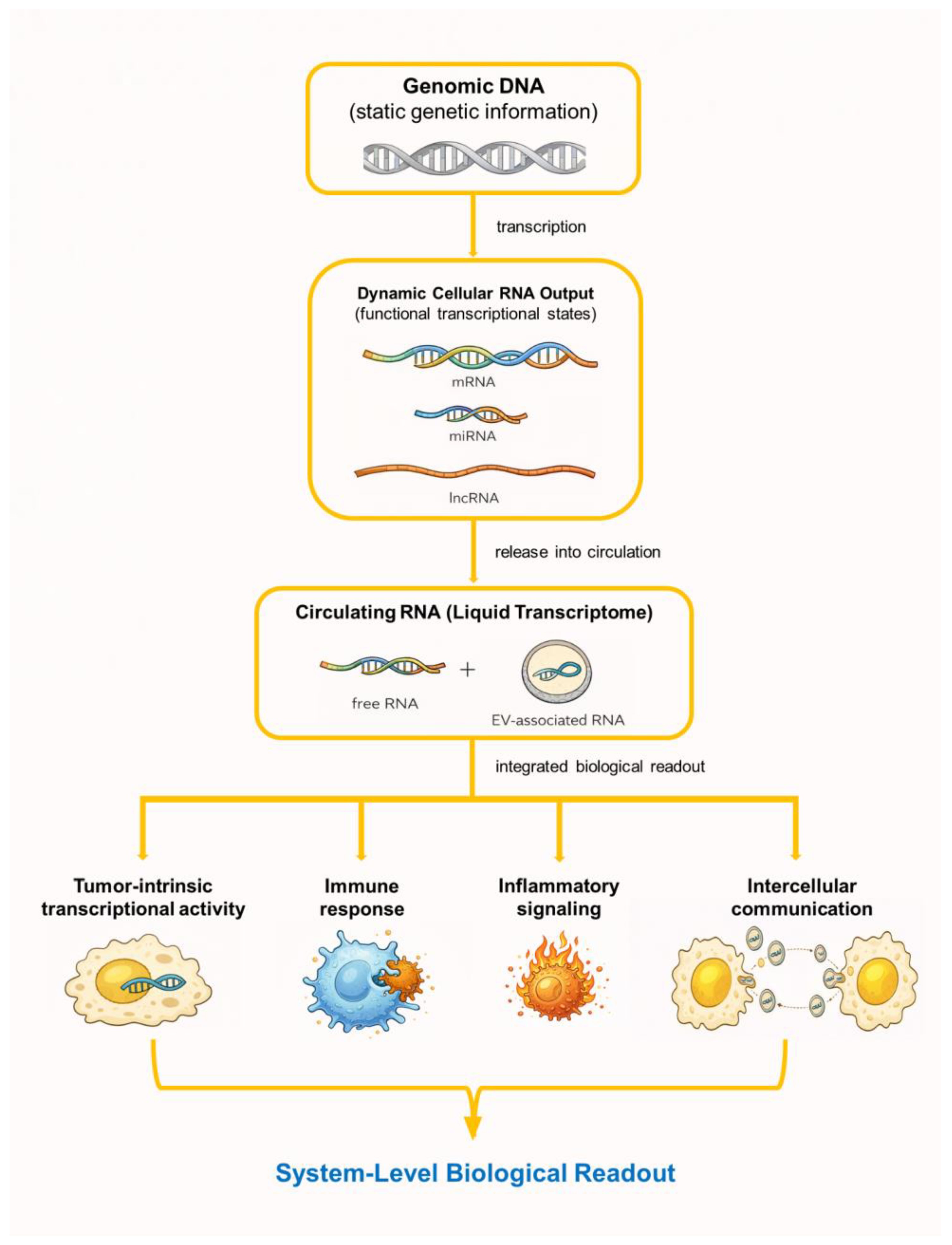
9,
13]. A schematic overview of circulating RNA as an integrated liquid transcriptome is presented in
Figure 1.
3. Physical Origins and Carriers of Circulating RNA
Circulating RNA originates from multiple biological processes that collectively shape its composition in blood. Passive release through apoptosis or necrosis contributes fragmented RNA species derived from dying tumor and normal cells [
5,
12]. In parallel, active secretion mechanisms—including selective RNA packaging into extracellular vesicles—reflect biologically regulated intercellular communication pathways [
20,
22]. Platelets and immune cells can also acquire and redistribute RNA signals, further contributing to the circulating transcriptome and amplifying tumor-associated signatures [
19,
39]. These diverse origins underscore that circulating RNA represents not merely cellular debris, but a composite signal integrating tumor-intrinsic activity and systemic host responses [
15,
36].
3.1. Cell-Free RNA
Cell-free RNA (cfRNA) refers to RNA fragments freely circulating in plasma or serum [
12,
17]. cfRNA is typically highly fragmented and present at low abundance, reflecting rapid turnover and susceptibility to degradation by ribonucleases [
15,
40]. Despite these challenges, cfRNA retains tissue- and cell-type-specific expression patterns that can be exploited for tissue-of-origin inference and disease detection [
12,
14]. The transient nature of cfRNA confers both advantages and limitations [
15]. On one hand, cfRNA is well suited for capturing acute biological changes, such as rapid transcriptional responses to therapy or stress [
13]. On the other hand, cfRNA analysis is highly sensitive to pre-analytical variables, including sample collection, processing time, and storage conditions [
40,
41,
42,
43]. Standardization of these factors remains critical for reproducible cfRNA profiling [
9,
41].
3.2. Extracellular Vesicle-Associated RNA
Extracellular vesicles, including exosomes and microvesicles, encapsulate RNA molecules within lipid bilayers, providing protection from enzymatic degradation [
20,
22,
44]. EV-associated RNA is often selectively packaged, suggesting active biological processes rather than passive release [
20,
22,
44,
45,
46]. This selectivity enhances biological interpretability and stability, making EV-associated RNA an attractive target for diagnostic and prognostic applications [
18,
34,
47,
48,
49,
50]. In cancer, EV-derived RNA has been implicated in intercellular communication, tumor progression, immune modulation, and pre-metastatic niche formation [
22,
51,
52]. These functional roles further support the relevance of EV-associated RNA as a biologically meaningful circulating biomarker [
18,
36].
3.3. Ribonucleoprotein-Associated RNA
A subset of circulating RNA is bound to ribonucleoprotein complexes, such as Argonaute proteins or lipoproteins [
21,
23]. This carrier form is particularly relevant for miRNAs, which frequently circulate in protein-bound states [
21]. Ribonucleoprotein association contributes to RNA stability and influences detection strategies, particularly for small RNA sequencing or targeted assays [
15,
17].
3.4. Conceptual Integration of Carrier-Dependent Properties
While the physical carriers of circulating RNA—cell-free RNA, extracellular vesicle–associated RNA, and ribonucleoprotein-bound RNA—determine molecular stability, protection from degradation, and analytical accessibility, these categories alone do not define the clinical or biological relevance of circulating RNA signals [
39]. Rather, carrier-dependent properties should be viewed as enabling layers that shape how transcriptional information is preserved and detected in the circulation.
Similarly, classification by RNA biotype provides a molecular vocabulary through which circulating transcriptomic signals are expressed, but does not fully capture their functional or clinical significance. The translational value of circulating RNA ultimately resides not in its physical form or molecular class, but in the biological meaning encoded by its expression patterns.
Accordingly, interpretation of circulating RNA requires a hierarchical framework in which physical carriers represent the mode of signal transport, RNA biotypes define the molecular constituents, and biological interpretation constitutes the central layer linking circulating RNA to cancer diagnosis and treatment. This perspective provides the conceptual foundation for understanding how diverse circulating RNA species converge into clinically actionable signals, as discussed in the following section. The carrier-dependent properties of circulating RNA are summarized in
Table 1.
4. RNA Biotype-Based Classification
Circulating RNA encompasses multiple RNA biotypes with distinct biological roles and analytical characteristics [
13,
24,
25]. mRNA fragments retain tissue-specific expression patterns and enable inference of transcriptional programs active in tumors or host tissues [
12,
14,
53]. These features make circulating mRNA a powerful tool for tissue-of-origin analysis and functional state assessment [
14,
15].
miRNAs represent the most extensively studied circulating RNA species due to their stability, abundance, and regulatory roles in oncogenesis [
17,
18,
24]. Numerous miRNAs have been implicated in cancer development, progression, and therapeutic resistance [
11,
18,
54], although single-miRNA biomarkers often lack sufficient specificity for clinical application [
9,
18].
lncRNAs exhibit greater tissue and disease specificity but pose analytical challenges related to lower abundance and incomplete annotation [
24,
25]. circRNAs, characterized by covalently closed loop structures, demonstrate exceptional stability and are emerging as potential cancer biomarkers [
17,
18,
26,
55], although their functional interpretation remains an active area of research [
15,
26].
Integration of multiple RNA biotypes can enhance diagnostic robustness by capturing complementary regulatory layers within the circulating transcriptome. The major circulating RNA biotypes and their analytical features are summarized in
Table 2.
5. Biological Meaning of Circulating RNA Signals
From a functional perspective, circulating RNA signals can be categorized according to the biological information they convey [
9,
13,
15]. Tissue-of-origin signatures arise from expression of organ-specific transcripts and enable localization of disease processes [
12,
14]. Cell-state-associated signals reflect proliferation, hypoxia, metabolic stress, epithelial–mesenchymal transition, and other adaptive programs relevant to cancer progression [
15].
Host-response signals, including immune activation and inflammatory pathways, provide insight into tumor–host interactions and therapeutic responsiveness [
6,
15,
38]. These signals are particularly relevant in the context of immuno-oncology, where systemic immune states critically influence treatment outcomes [
9,
38].
Distinguishing functional biomarkers from correlative signals remains a central challenge in circulating RNA research and underscores the need for integrative analytical frameworks [
9,
13,
16]. These layers of biological interpretation and their clinical relevance are summarized in
Table 3, which provides a conceptual bridge to the diagnostic and therapeutic applications discussed in the following sections.
6. Circulating RNA in Cancer Diagnosis
6.1. Early Cancer Detection and Screening
Early cancer detection remains one of the most compelling yet challenging goals of liquid biopsy research [
1,
5,
16]. In contrast to ctDNA-based approaches, which rely on the presence of tumor-derived genomic material and therefore often suffer from limited sensitivity in early-stage disease, circulating RNA offers access to transcriptional signals that may arise from small tumor burdens or even premalignant states [
5,
12,
13]. Circulating RNA signatures can capture both tumor-intrinsic transcriptional activity and host responses, such as immune activation or inflammatory remodeling, that accompany early oncogenesis [
15,
38]. This dual contribution enables detection of biologically active disease even when tumor-derived DNA fragments are scarce [
12,
14].
Several studies have demonstrated that cfRNA or EV-associated RNA profiles can distinguish early-stage cancers from healthy controls with performance comparable to or exceeding that of mutation-based assays [
15,
16,
29,
35,
56].
However, the increased sensitivity of circulating RNA comes at the cost of greater complexity [
9,
13]. Unlike ctDNA mutations, which provide relatively binary signals, transcriptomic signatures are inherently continuous and context-dependent [
6,
15]. As a result, early detection strategies based on circulating RNA often rely on multigene signatures and machine learning-based classifiers rather than individual biomarkers [
57].
Beyond simple signal abundance, several biological and technical factors contribute to the apparent sensitivity advantage of circulating RNA-based assays in early-stage disease. In the earliest phases of tumor development, the absolute fraction of tumor-derived DNA in circulation is often exceedingly low, limiting the detectability of somatic mutations by ctDNA-based approaches [
5,
7,
12,
58]. In contrast, transcriptional signals captured through circulating RNA reflect not only tumor-intrinsic gene expression but also amplified downstream responses from the tumor microenvironment and host tissues, including stromal remodeling, immune activation, and inflammatory signaling [
12,
14,
15]. This transcriptional amplification effect enables circulating RNA profiles to register disease-associated perturbations even when direct tumor burden is minimal [
14,
15,
29].
Importantly, early oncogenic processes frequently manifest as coordinated changes in gene expression programs rather than as stable, clonally fixed genetic alterations. Such transcriptional reprogramming can precede overt tumor expansion, shedding, or radiographic detectability, thereby providing a temporal window in which circulating RNA signatures may outperform mutation-centric assays [
9,
13,
15]. Furthermore, because circulating RNA integrates signals from multiple cellular sources, including immune and non-malignant compartments, it may capture systemic responses to nascent malignancy that are inherently invisible to tumor-restricted DNA-based analyses [
12,
15,
35]. Together, these features position circulating RNA not merely as an alternative analyte, but as a functionally distinct biomarker modality for early cancer detection and multi-cancer screening [
15,
16,
29,
35].
6.2. Multi-Cancer Detection and Tissue-of-Origin Inference
Multi-cancer early detection represents a particularly attractive application of circulating RNA [
9,
51,
59,
60]. Because RNA expression patterns retain tissue specificity, circulating RNA enables inference of tissue-of-origin through organ-enriched transcriptomic signatures [
12,
14,
61]. This capability addresses a key limitation of many multi-cancer ctDNA assays, which may detect malignancy but provide limited information regarding tumor localization [
1,
55]. Transcriptome-based tissue-of-origin inference leverages expression patterns from both protein-coding and non-coding RNAs, often integrating signals across multiple carriers and RNA biotypes [
15,
17].
Importantly, host-derived signals can further refine tissue localization by reflecting organ-specific immune or stromal responses [
15,
38]. Such integrative approaches position circulating RNA as a promising platform for biologically informed multi-cancer screening [
9,
13].
6.3. Discrimination of Malignant and Benign Conditions
A persistent challenge in cancer screening is the differentiation of malignant disease from benign or inflammatory conditions [
9]. Circulating RNA offers potential advantages in this context by capturing functional differences in transcriptional programs rather than relying solely on the presence of genetic alterations [
13,
15,
62]. For example, transcriptional signatures associated with sustained proliferative signaling, metabolic reprogramming, or immune evasion may distinguish malignant processes from transient inflammatory responses [
36].
Nevertheless, overlap between cancer-associated and inflammation-associated transcriptomic signals remains a significant confounder, underscoring the need for careful feature selection and validation in diverse clinical cohorts [
9,
57,
63].
7. Circulating RNA in Cancer Treatment
7.1. Monitoring Treatment Response
In the therapeutic setting, circulating RNA provides a dynamic window into treatment response [
13,
15]. Transcriptional changes often precede detectable changes in tumor size or genomic composition, enabling earlier assessment of therapeutic efficacy [
6,
9]. Longitudinal monitoring of circulating RNA can reveal rapid suppression or reactivation of oncogenic pathways, offering actionable insights into treatment dynamics [
13,
16,
64].
Unlike ctDNA, which primarily reflects changes in tumor burden or clonal composition, circulating RNA captures functional adaptation at the cellular and systemic levels [
5,
7,
13,
15,
65]. This distinction is particularly relevant for therapies that induce transcriptional reprogramming without immediate tumor cell death [
6,
9,
66].
7.2. Detection of Adaptive Resistance
Adaptive resistance to cancer therapy frequently involves transcriptional rewiring rather than acquisition of new genetic mutations [
6,
67]. Circulating RNA is uniquely suited to capture such adaptations, including activation of compensatory signaling pathways, stress response programs, and phenotypic plasticity [
13,
15].
For example, emergence of epithelial–mesenchymal transition signatures or metabolic reprogramming patterns in circulating RNA may signal impending therapeutic failure [
16]. Early detection of these changes could enable timely modification of treatment strategies before overt clinical progression [
9,
13].
7.3. Applications in Immuno-Oncology
Immunotherapy has highlighted the importance of host immune states in determining treatment outcomes [
9,
67]. Circulating RNA enables non-invasive profiling of immune activation, exhaustion, and cytokine signaling, providing insights that are difficult to obtain from tumor-derived DNA alone [
15,
35,
38].
Transcriptomic signatures reflecting interferon signaling, T cell activation, or immunosuppressive pathways have been associated with response or resistance to immune checkpoint inhibitors [
11,
38,
68]. By integrating tumor-intrinsic and immune-derived RNA signals, circulating RNA offers a holistic approach to monitoring immunotherapeutic efficacy [
9,
13].
In the context of immuno-oncology, the utility of circulating RNA extends beyond tumor burden estimation to the functional inference of host immune states. Immune checkpoint blockade and other immunotherapies exert their effects primarily by modulating pre-existing immune activity rather than directly targeting tumor cells, rendering static genomic alterations insufficient to capture treatment-relevant biology [
9,
38]. Circulating RNA profiles, by contrast, can reflect dynamic transcriptional programs associated with immune activation, exhaustion, and immune evasion, including interferon signaling, cytotoxic T-cell activity, and inflammatory pathways [
15,
35,
38].
Importantly, such immune-related transcriptional states are often systemic and temporally variable, evolving in response to therapy and tumor–host interactions [
69]. Longitudinal analysis of circulating RNA therefore offers a means to monitor immune engagement and functional response trajectories over time, potentially preceding radiographic changes or clinical response assessments [
9,
15,
70]. Because these signals may arise from multiple immune and non-malignant compartments, circulating RNA enables a systems-level view of immunotherapy response that is inherently difficult to achieve through tumor-restricted or mutation-centric assays alone [
12,
15,
35]. Collectively, these features position circulating RNA as a promising modality for immunotherapy guidance, response monitoring, and the early detection of immune escape or functional exhaustion [
9,
15,
38].
7.4. Mini-Synthesis of Diagnostic and Therapeutic Applications
Taken together, applications of circulating RNA in cancer diagnosis and treatment underscore a fundamental distinction from mutation-centric liquid biopsy approaches. Whereas circulating DNA primarily reflects tumor burden and clonal architecture, circulating RNA captures functional adaptation, biological state transitions, and tumor–host interactions across the disease continuum. In diagnostic settings, this enables detection of biologically active malignancy even under conditions of low tumor burden, while preserving tissue-of-origin information. In therapeutic contexts, circulating RNA provides early insight into transcriptional reprogramming, adaptive resistance, and immune dynamics that often precede radiographic or genomic evidence of progression.
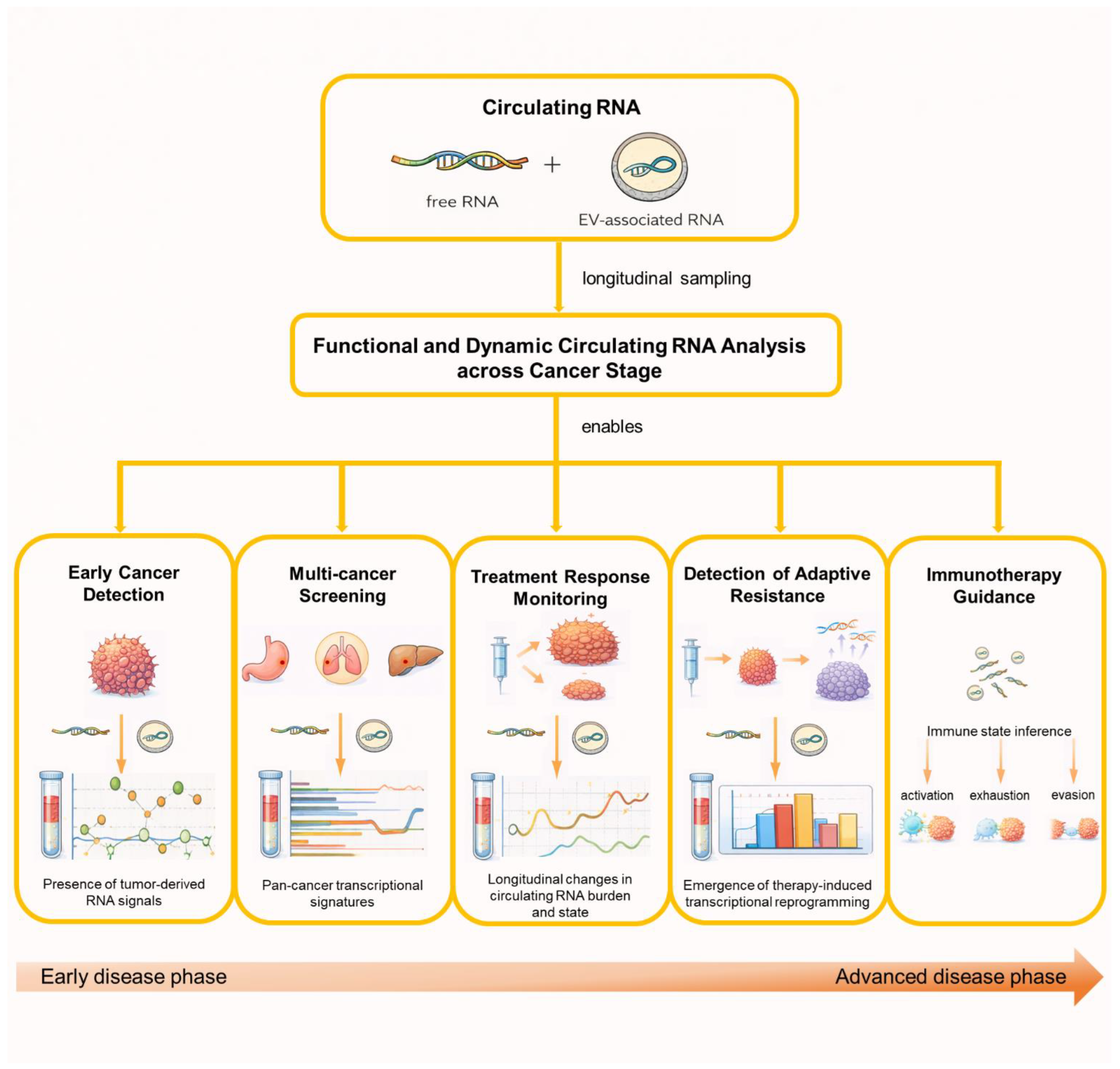
These features position circulating RNA not merely as an alternative analyte, but as a functionally complementary layer of liquid biopsy, capable of informing clinical decision-making at stages where genomic signals alone may be insufficient. The challenge, therefore, is not whether circulating RNA is biologically informative, but how its complexity can be harnessed in a robust, reproducible, and clinically actionable manner. An overview of circulating RNA applications across the cancer continuum is illustrated in
Figure 2.
8. Technical and Analytical Challenges
Beyond assay-specific considerations, the clinical translation of circulating RNA biomarkers is further constrained by challenges related to standardization, reproducibility, and cross-cohort comparability. Pre-analytical variables, including blood collection, processing time, RNA stabilization, and storage conditions, can introduce substantial variability in circulating RNA profiles, complicating inter-study comparisons [
17,
40,
41,
42,
71]. At the analytical level, differences in library preparation, sequencing depth, and bioinformatic pipelines may amplify batch effects or platform-dependent biases, particularly for low-abundance transcripts [
27,
28,
72].
These sources of technical heterogeneity underscore the need for harmonized workflows, rigorous quality control, and multi-center validation to ensure that circulating RNA signatures identified in discovery cohorts remain robust under real-world clinical conditions [
9,
13,
73,
74,
75,
76]. Without such standardization, reproducible yet fragile transcriptomic signals may fail to generalize beyond their original study context, limiting clinical utility despite promising initial performance.
8.1. Pre-Analytical Variability
Pre-analytical factors represent one of the most significant sources of variability in circulating RNA analysis [
17,
40]. Differences in blood collection tubes, processing times, centrifugation protocols, and storage conditions can profoundly influence RNA yield and composition [
40,
41,
42]. Hemolysis and residual cellular contamination further complicate interpretation by introducing confounding transcripts [
17,
40].
Standardization of pre-analytical workflows is therefore essential for reproducibility and cross-study comparability, particularly in multi-center clinical trials [
9,
41].
8.2. Analytical Limitations
Analytical challenges include low RNA input quantities, fragmentation, and uneven transcript coverage [
15,
17]. Library preparation methods can introduce bias, particularly for low-abundance transcripts or specific RNA biotypes [
27,
28]. Batch effects and platform-dependent variability further complicate quantitative comparisons across datasets [
15,
17].
Addressing these limitations requires careful experimental design, inclusion of appropriate controls, and adoption of robust normalization strategies [
9,
27,
30].
8.3. Computational Challenges
Computational analysis of circulating RNA data poses unique challenges due to high dimensionality, low signal-to-noise ratios, and mixed biological origins [
13,
15]. Source deconvolution—distinguishing tumor-derived from host-derived signals—remains a critical and unresolved problem [
13,
15].
Machine learning approaches offer powerful tools for feature selection and classification but carry risks of overfitting and limited generalizability [
13,
57,
73]. Transparent modeling strategies and external validation are essential to ensure clinical robustness [
9,
57].
9. Clinical Translation and Validation
9.1. Study Design Considerations
The clinical translation of circulating RNA biomarkers requires rigorous and carefully structured study designs, including the use of appropriate control populations, longitudinal sampling strategies, and clinically meaningful endpoints [
1,
9,
16]. As with other liquid biopsy modalities, retrospective analyses can provide valuable biological insights and generate testable hypotheses; however, they are insufficient to establish clinical utility on their own. Prospective validation in well-defined patient cohorts remains essential to demonstrate robustness, reproducibility, and real-world applicability [
9,
11,
77].
In the context of circulating RNA, study design considerations are further complicated by biological and technical heterogeneity, including variability in RNA carriers, RNA biotypes, and analytical platforms. These factors necessitate harmonized pre-analytical and analytical workflows to ensure that observed signals reflect true biological variation rather than technical artifacts. Without such rigor, promising circulating RNA signatures risk failing during external validation or clinical implementation.
9.2. Clinical Utility Versus Statistical Performance
High analytical sensitivity and specificity, while important, are not sufficient criteria for clinical adoption of liquid biopsy assays [
1,
9]. Circulating RNA-based tests must ultimately demonstrate that they provide actionable information that improves clinical decision-making, patient outcomes, or healthcare efficiency beyond existing diagnostic modalities [
9,
10,
13]. This distinction between statistical performance and clinical utility is particularly critical in screening and disease monitoring settings, where false positives, overdiagnosis, or unclear clinical interpretation can lead to unintended harm [
6,
9,
11].
Compared with DNA-based assays, circulating RNA approaches are uniquely positioned to capture dynamic biological states, including transcriptional activity, immune responses, and treatment-induced adaptations. However, the clinical value of such information depends on whether these signals can be reliably interpreted and translated into defined clinical actions. As a result, circulating RNA biomarkers must be evaluated not only on their ability to discriminate disease states, but also on their capacity to inform clinically relevant decisions within specific therapeutic contexts.
In practical terms, the clinical value of circulating RNA will depend on whether it can alter management decisions earlier than existing modalities. For example, the emergence of transcriptional signatures associated with adaptive resistance may prompt modification of targeted therapy before radiographic progression becomes evident [
6,
67]. In immunotherapy settings, immune-related RNA signatures—such as interferon-γ-associated programs—may help distinguish true progression from pseudo-progression, thereby informing decisions to continue or discontinue therapy [
38,
68]. Similarly, sustained suppression of oncogenic transcriptional programs in circulation could support treatment de-escalation strategies in selected patients. Such decision-oriented applications represent the critical threshold for translating transcriptomic biomarkers from statistical discrimination to actionable clinical utility [
9,
13].
9.3. Regulatory and Implementation Perspectives
Regulatory approval of circulating RNA-based diagnostics will require clear demonstration of analytical validity, clinical validity, and clinical utility, consistent with established frameworks for molecular diagnostic assays [
1,
9]. Experiences from the clinical translation of ctDNA assays underscore the importance of standardized protocols, robust quality control measures, and clearly defined clinical indications [
1,
7,
41]. In the absence of such standardization, variability in sample handling, RNA extraction, library preparation, and data analysis continues to undermine reproducibility across studies and institutions.
Despite these challenges, a growing body of clinical and translational evidence supports the feasibility of circulating RNA profiling across diverse cancer types and clinical scenarios [
78,
79]. Studies have reported potential utility in early cancer detection, disease characterization, treatment response monitoring, and immunotherapy stratification, particularly in settings where functional and dynamic biological information is clinically relevant. Representative examples of these clinical and translational studies are summarized in
Table 4, highlighting both the promise and the current limitations of circulating RNA-based approaches in oncology. While multiple meta-analyses have evaluated specific RNA classes—particularly circulating miRNAs—in individual cancer types [
17,
18], the studies summarized here emphasize transcriptome-level and integrative approaches that illustrate broader functional applications of circulating RNA.
Collectively, these findings indicate that while circulating RNA biomarkers have not yet achieved routine clinical implementation, they offer complementary and functionally informative signals that extend beyond static genomic alterations. Continued progress will depend on systematic prospective validation, improved standardization, and careful alignment of circulating RNA assays with clearly defined clinical questions.
10. Future Perspectives
Despite increasing technical sophistication and growing biological insight, no single circulating biomarker modality has yet proven sufficient to address the full spectrum of clinical questions encountered across the cancer continuum. DNA-based assays excel at capturing tumor-derived genomic alterations and disease burden, but provide limited information on dynamic cellular states, transcriptional adaptation, and host–tumor interactions. Conversely, circulating RNA offers a functional and temporally responsive readout of biological activity, yet remains vulnerable to pre-analytical variability and context-dependent interpretation. These complementary strengths and limitations underscore the need for integrated liquid biopsy strategies rather than continued reliance on any single analyte class.
From a clinical perspective, integration is particularly relevant in scenarios where static genomic information alone fails to fully explain therapeutic response, resistance, or toxicity. Combining circulating RNA with genomic, proteomic, or clinical data may enable more robust biological inference, reduce false-positive signals, and improve interpretability by anchoring transcriptional changes to underlying molecular or phenotypic contexts. Importantly, integration should not be viewed as a simple aggregation of multiple biomarkers, but as a hypothesis-driven framework in which each modality addresses a distinct layer of disease biology. Such an approach has the potential to enhance clinical relevance while mitigating the limitations that currently constrain the standalone use of circulating RNA assays.
10.1. Integration with Multi-Modal Liquid Biopsy
Future liquid biopsy strategies are increasingly expected to adopt multi-modal designs that integrate circulating RNA with other analytes, including circulating tumor DNA, protein biomarkers, and clinical variables [
9,
13,
81,
82,
83]. Such integrative approaches reflect the growing recognition that distinct biomarker classes capture complementary dimensions of cancer biology. While ctDNA provides high specificity for tumor-derived genomic alterations and disease burden, circulating RNA offers functional insight into transcriptional activity, cellular states, and systemic host responses that are not readily inferred from DNA alone.
By combining these modalities, multi-modal liquid biopsy frameworks may improve biological interpretability and clinical robustness. For instance, a decline in ctDNA mutation burden accompanied by concurrent activation of immune-related RNA signatures may provide complementary evidence of therapeutic response during immune checkpoint blockade [
38,
66]. Conversely, persistence of oncogenic mutations detected by ctDNA together with circulating RNA signatures indicative of epithelial–mesenchymal transition or metabolic reprogramming may signal early adaptive resistance [
6,
16]. These examples illustrate how genomic and transcriptomic layers can anchor and contextualize each other, enabling more nuanced biological inference than either modality alone [
9,
13]. Genomic alterations detected by ctDNA can anchor transcriptional signals to tumor origin, while RNA-based readouts can contextualize these alterations within dynamic biological processes such as immune activation, stress responses, or treatment-induced adaptation [
13,
15,
31]. Importantly, integration may also mitigate limitations inherent to individual assays by reducing false-positive signals and enhancing signal stability across heterogeneous patient populations. Rather than replacing existing liquid biopsy platforms, circulating RNA is therefore likely to function as a complementary layer within integrated diagnostic and monitoring strategies.
10.2. AI-Driven Transcriptomic Signatures
The analytical complexity of circulating RNA data, characterized by high dimensionality, biological heterogeneity, and context-dependent signal patterns, positions artificial intelligence and deep learning approaches as central tools for future development [
13,
45,
74]. Unlike traditional univariate or rule-based methods, machine learning models can capture complex, non-linear relationships across large transcriptomic feature spaces, enabling the identification of composite RNA signatures associated with disease presence, progression, or therapeutic response.
In the context of circulating RNA, AI-driven models offer particular advantages by accommodating variability in RNA abundance, carrier composition, and technical noise while extracting clinically relevant patterns [
15,
58]. These approaches are especially well suited for integrating transcriptomic data with genomic, proteomic, and clinical variables, thereby supporting the development of multi-modal predictive frameworks. However, the successful clinical deployment of such models will depend on transparent model construction, rigorous external validation, and careful consideration of interpretability to ensure that algorithmic predictions can be meaningfully translated into clinical decision-making.
10.3. Toward Functional Precision Oncology
Ultimately, the integration of circulating RNA into liquid biopsy platforms supports a broader shift toward functionally informed precision oncology. In this paradigm, treatment decisions are guided not only by static genomic alterations but also by dynamic transcriptional states, pathway activity, and host–tumor interactions that evolve over time [
4,
9,
13]. Circulating RNA provides a unique window into these processes, offering the potential to capture real-time biological responses to therapy and disease progression.
Realizing this vision will require continued methodological innovation, including improved standardization of analytical workflows, large-scale prospective validation, and close alignment with clinical care pathways [
9,
15,
16]. Equally important will be the development of clinically interpretable frameworks that link circulating RNA signatures to actionable therapeutic strategies. As liquid biopsy technologies mature beyond mutation-centric approaches, circulating RNA is poised to become a key component of integrated platforms designed to support adaptive, biologically informed cancer management.
11. Conclusions
Circulating RNA represents a biologically rich yet analytically challenging dimension of liquid biopsy that complements mutation-centric approaches based on circulating DNA. This review is intended for researchers and clinician–scientists seeking a systems-level framework that bridges molecular liquid biopsy technologies with functionally informed oncology applications. By reflecting active transcriptional programs, cellular states, and systemic host responses, circulating RNA provides access to functional information that is often invisible to genomic analyses alone.
Throughout this review, circulating RNA was conceptualized as a liquid transcriptome, emphasizing its value as an integrated readout of tumor-intrinsic activity, host immune and inflammatory responses, and intercellular communication. Importantly, the clinical relevance of circulating RNA emerges not from isolated biomarkers, but from integrative interpretation across physical carriers, RNA biotypes, and biological meaning.
Although substantial challenges remain—including pre-analytical variability, analytical instability, and computational complexity—ongoing methodological advances and an expanding body of clinical evidence suggest that these barriers are increasingly tractable. In particular, integration with other liquid biopsy modalities and adoption of transparent, externally validated analytical frameworks are expected to accelerate clinical translation.
As liquid biopsy strategies continue to evolve beyond static genomic profiling, circulating RNA is well positioned to play a central role in enabling functionally informed precision oncology, where clinical decisions are guided by dynamic biological states rather than genetic alterations alone.
Author Contributions
Conceptualization, K.-H.K. and B.C.Y.; literature review and data curation, K.-H.K.; writing—original draft preparation, K.-H.K.; writing—review and editing, K.-H.K. and B.C.Y.; visualization and figure preparation, K.-H.K.; supervision, B.C.Y. All authors have read and agreed to the published version of the manuscript.
Funding
This work was supported by the Korea-US Collaborative Cancer R&D Program funded by the Ministry of Health & Welfare, Republic of Korea (RS-2025-02243055), and by the new faculty research program (C2024-0023) of Kookmin University in Korea.
Institutional Review Board Statement
Not applicable.
Informed Consent Statement
Not applicable.
Data Availability Statement
No new data were created or analyzed in this study. Data sharing is not applicable to this article.
Conflicts of Interest
The authors declare no conflicts of interest.
References
- Wan, J.C.M.; Massie, C.; Garcia-Corbacho, J.; Mouliere, F.; Brenton, J.D.; Caldas, C.; Pacey, S.; Baird, R.; Rosenfeld, N. Liquid biopsies come of age: Towards implementation of circulating tumour DNA. Nat. Rev. Cancer 2017, 17, 223–238. [Google Scholar] [CrossRef] [Scilit] [PubMed]
- Alix-Panabières, C.; Marchetti, D.; Lang, J.E. Liquid biopsy: From concept to clinical application. Sci. Rep. 2023, 13, 21685. [Google Scholar] [CrossRef] [Scilit]
- Borea, R.; Reduzzi, C. The growing field of liquid biopsy and its Snowball effect on reshaping cancer management. J. Liq. Biopsy 2025, 8, 100293. [Google Scholar] [CrossRef] [Scilit]
- Abreu, R.D.S.; Ferreira, D.D.P.; de Araujo, N.S.; Horita, S.; Tilli, T.M.; Degrave, W.; Moreira, A.D.S.; Waghabi, M.C. Liquid biopsy in cancer diagnosis and prognosis: A paradigm shift in precision oncology. Front. Mol. Biosci. 2026, 12, 1708518. [Google Scholar] [CrossRef] [Scilit]
- Bettegowda, C.; Sausen, M.; Leary, R.J.; Kinde, I.; Wang, Y.; Agrawal, N.; Bartlett, B.R.; Wang, H.; Luber, B.; Alani, R.M.; et al. Detection of circulating tumor DNA in early- and late-stage human malignancies. Sci. Transl. Med. 2014, 6, 224ra24. [Google Scholar] [CrossRef] [Scilit] [PubMed]
- Siravegna, G.; Marsoni, S.; Siena, S.; Bardelli, A. Integrating liquid biopsies into the management of cancer. Nat. Rev. Clin. Oncol. 2017, 14, 531–548. [Google Scholar] [CrossRef] [Scilit]
- Heitzer, E.; Haque, I.S.; Roberts, C.E.S.; Speicher, M.R. Current and future perspectives of liquid biopsies in genomics-driven oncology. Nat. Rev. Genet. 2019, 20, 71–88. [Google Scholar] [CrossRef] [Scilit] [PubMed]
- Abbosh, C.; Frankell, A.M.; Harrison, T.; Kisistok, J.; Garnett, A.; Johnson, L.; Veeriah, S.; Moreau, M.; Chesh, A.; Chaunzwa, T.L.; et al. Tracking early lung cancer metastatic dissemination in TRACERx using ctDNA. Nature 2023, 616, 553–562. [Google Scholar] [CrossRef] [Scilit]
- Ignatiadis, M.; Sledge, G.W.; Jeffrey, S.S. Liquid biopsy enters the clinic—Implementation issues and future challenges. Nat. Rev. Clin. Oncol. 2021, 18, 297–312. [Google Scholar] [CrossRef] [Scilit]
- Nikanjam, M.; Kato, S.; Kurzrock, R. Liquid biopsy: Current technology and clinical applications. J. Hematol. Oncol. 2022, 15, 131. [Google Scholar] [CrossRef] [Scilit]
- Sidaway, P. New data confirm clinical utility of ctDNA. Nat. Rev. Clin. Oncol. 2023, 20, 63. [Google Scholar] [CrossRef] [Scilit]
- Koh, W.; Pan, W.; Gawad, C.; Fan, H.C.; Kerchner, G.A.; Wyss-Coray, T.; Blumenfeld, Y.J.; El-Sayed, Y.Y.; Quake, S.R. Noninvasive in vivo monitoring of tissue-specific global gene expression in humans. Proc. Natl. Acad. Sci. USA 2014, 111, 7361–7366, Correction in Proc. Natl. Acad. Sci. USA 2014, 111, 11223.. [Google Scholar] [CrossRef] [Scilit]
- Loy, C.; Ahmann, L.; De Vlaminck, I.; Gu, W. Liquid Biopsy Based on Cell-Free DNA and RNA. Annu. Rev. Biomed. Eng. 2024, 26, 169–195. [Google Scholar] [CrossRef] [Scilit]
- Larson, M.H.; Pan, W.; Kim, H.J.; Mauntz, R.E.; Stuart, S.M.; Pimentel, M.; Zhou, Y.; Knudsgaard, P.; Demas, V.; Aravanis, A.M.; et al. A comprehensive characterization of the cell-free transcriptome reveals tissue- and subtype-specific biomarkers for cancer detection. Nat. Commun. 2021, 12, 2357, Correction in Nat. Commun. 2022, 13, 2553.. [Google Scholar] [CrossRef] [Scilit]
- Vorperian, S.K.; Moufarrej, M.N.; Tabula Sapiens Consortium; Quake, S.R. Cell types of origin of the cell-free transcriptome. Nat. Biotechnol. 2022, 40, 855–861, Correction in Nat. Biotechnol. 2022, 40, 974.. [Google Scholar] [CrossRef] [Scilit] [PubMed]
- Ma, L.; Guo, H.; Zhao, Y.; Liu, Z.; Wang, C.; Bu, J.; Sun, T.; Wei, J. Liquid biopsy in cancer current: Status, challenges and future prospects. Signal Transduct. Target. Ther. 2024, 9, 336. [Google Scholar] [CrossRef] [Scilit]
- Valihrach, L.; Androvic, P.; Kubista, M. Circulating miRNA analysis for cancer diagnostics and therapy. Mol. Asp. Med. 2020, 72, 100825. [Google Scholar] [CrossRef] [Scilit]
- Anfossi, S.; Babayan, A.; Pantel, K.; Calin, G.A. Clinical utility of circulating non-coding RNAs—An update. Nat. Rev. Clin. Oncol. 2018, 15, 541–563. [Google Scholar] [CrossRef] [Scilit]
- Best, M.G.; Sol, N.; Kooi, I.; Tannous, J.; Westerman, B.A.; Rustenburg, F.; Schellen, P.; Verschueren, H.; Post, E.; Koster, J.; et al. RNA-Seq of Tumor-Educated Platelets Enables Blood-Based Pan-Cancer, Multiclass, and Molecular Pathway Cancer Diagnostics. Cancer Cell 2015, 28, 666–676. [Google Scholar] [CrossRef] [Scilit] [PubMed]
- Valadi, H.; Ekström, K.; Bossios, A.; Sjöstrand, M.; Lee, J.J.; Lötvall, J.O. Exosome-mediated transfer of mRNAs and microRNAs is a novel mechanism of genetic exchange between cells. Nat. Cell Biol. 2007, 9, 654–659. [Google Scholar] [CrossRef] [Scilit] [PubMed]
- Arroyo, J.D.; Chevillet, J.R.; Kroh, E.M.; Ruf, I.K.; Pritchard, C.C.; Gibson, D.F.; Mitchell, P.S.; Bennett, C.F.; Pogosova-Agadjanyan, E.L.; Stirewalt, D.L.; et al. Argonaute2 complexes carry a population of circulating microRNAs independent of vesicles in human plasma. Proc. Natl. Acad. Sci. USA 2011, 108, 5003–5008. [Google Scholar] [CrossRef] [Scilit]
- Kalluri, R.; LeBleu, V.S. The biology, function, and biomedical applications of exosomes. Science 2020, 367, eaau6977. [Google Scholar] [CrossRef] [Scilit] [PubMed]
- Vickers, K.C.; Palmisano, B.T.; Shoucri, B.M.; Shamburek, R.D.; Remaley, A.T. MicroRNAs are transported in plasma and delivered to recipient cells by high-density lipoproteins. Nat. Cell Biol. 2011, 13, 423–433, Erratum in Nat. Cell Biol. 2015, 17, 104. [Google Scholar] [CrossRef] [Scilit] [PubMed]
- Esteller, M. Non-coding RNAs in human disease. Nat. Rev. Genet. 2011, 12, 861–874. [Google Scholar] [CrossRef] [Scilit]
- Mercer, T.R.; Dinger, M.E.; Mattick, J.S. Long non-coding RNAs: Insights into functions. Nat. Rev. Genet. 2009, 10, 155–159. [Google Scholar] [CrossRef] [Scilit] [PubMed]
- Kristensen, L.S.; Andersen, M.S.; Stagsted, L.V.W.; Ebbesen, K.K.; Hansen, T.B.; Kjems, J. The biogenesis, biology and characterization of circular RNAs. Nat. Rev. Genet. 2019, 20, 675–691. [Google Scholar] [CrossRef] [Scilit]
- Androvic, P.; Benesova, S.; Rohlova, E.; Kubista, M.; Valihrach, L. Small RNA-Sequencing for Analysis of Circulating miRNAs: Benchmark Study. J. Mol. Diagn. 2022, 24, 386–394. [Google Scholar] [CrossRef] [Scilit]
- Nesselbush, M.C.; Luca, B.A.; Jeon, Y.J.; Jabara, I.; Meador, C.B.; Garofalo, A.; Binkley, M.S.; Hui, A.B.; van’t Erve, I.; Xu, N.; et al. An ultrasensitive method for detection of cell-free RNA. Nature 2025, 641, 759–768. [Google Scholar] [CrossRef] [Scilit]
- Wang, J.; Huang, J.; Hu, Y.; Guo, Q.; Zhang, S.; Tian, J.; Niu, Y.; Ji, L.; Xu, Y.; Tang, P.; et al. Terminal modifications independent cell-free RNA sequencing enables sensitive early cancer detection and classification. Nat. Commun. 2024, 15, 156. [Google Scholar] [CrossRef] [Scilit]
- Bloom, J.S.; Sathe, L.; Munugala, C.; Jones, E.M.; Gasperini, M.; Lubock, N.B.; Yarza, F.; Thompson, E.M.; Kovary, K.M.; Park, J.; et al. Massively scaled-up testing for SARS-CoV-2 RNA via next-generation sequencing of pooled and barcoded nasal and saliva samples. Nat. Biomed. Eng. 2021, 5, 657–665. [Google Scholar] [CrossRef] [Scilit]
- Srinivasan, S.; Yeri, A.; Cheah, P.S.; Chung, A.; Danielson, K.; De Hoff, P.; Filant, J.; Laurent, C.D.; Laurent, L.D.; Magee, R.; et al. Small RNA Sequencing across Diverse Biofluids Identifies Optimal Methods for exRNA Isolation. Cell 2019, 177, 446–462. [Google Scholar] [CrossRef] [Scilit]
- Wang, H.; Zhan, Q.; Ning, M.; Guo, H.; Wang, Q.; Zhao, J.; Bao, P.; Xing, S.; Chen, S.; Zuo, S.; et al. Depletion-assisted multiplexed cell-free RNA sequencing reveals distinct human and microbial signatures in plasma versus extracellular vesicles. Clin. Transl. Med. 2024, 14, e1760. [Google Scholar] [CrossRef] [Scilit]
- Bao, P.; Wang, T.; Liu, X.; Xing, S.; Ruan, H.; Ma, H.; Tao, Y.; Zhan, Q.; Belmonte-Reche, E.; Qin, L.; et al. Peak analysis of cell-free RNA finds recurrently protected narrow regions with clinical potential. Genome Biol. 2025, 26, 119. [Google Scholar] [CrossRef] [Scilit] [PubMed]
- Das, S.; Extracellular RNA Communication Consortium; Ansel, K.M.; Bitzer, M.; Breakefield, X.O.; Charest, A.; Galas, D.J.; Gerstein, M.B.; Gupta, M.; Milosavljevic, A.; et al. The Extracellular RNA Communication Consortium: Establishing Foundational Knowledge and Technologies for Extracellular RNA Research. Cell 2019, 177, 231–242. [Google Scholar] [CrossRef] [Scilit]
- Hulstaert, E.; Morlion, A.; Avila Cobos, F.; Verniers, K.; Nuytens, J.; Vanden Eynde, E.; Yigit, N.; Anckaert, J.; Geerts, A.; Hindryckx, P.; et al. Charting Extracellular Transcriptomes in The Human Biofluid RNA Atlas. Cell Rep. 2020, 33, 108552. [Google Scholar] [CrossRef] [Scilit]
- Murillo, O.D.; Thistlethwaite, W.; Rozowsky, J.; Subramanian, S.L.; Lucero, R.; Shah, N.; Jackson, A.R.; Srinivasan, S.; Chung, A.; Laurent, C.D.; et al. exRNA Atlas Analysis Reveals Distinct Extracellular RNA Cargo Types and Their Carriers Present across Human Biofluids. Cell 2019, 177, 463–477. [Google Scholar] [CrossRef] [Scilit] [PubMed]
- Wang, X.; Li, S.; Ou, R.; Pang, W.; Wang, Y.; Zhang, Y.; Lin, Y.; Yang, C.; Chen, W.; Lei, C.; et al. Wide-spectrum profiling of plasma cell-free RNA and the potential for health-monitoring. RNA Biol. 2025, 22, 1–15. [Google Scholar] [CrossRef] [Scilit] [PubMed]
- Ayers, M.; Lunceford, J.; Nebozhyn, M.; Murphy, E.; Loboda, A.; Kaufman, D.R.; Albright, A.; Cheng, J.D.; Kang, S.P.; Shankaran, V.; et al. IFN-γ-related mRNA profile predicts clinical response to PD-1 blockade. J. Clin. Investig. 2017, 127, 2930–2940. [Google Scholar] [CrossRef] [Scilit]
- Nilsson, R.J.; Balaj, L.; Hulleman, E.; van Rijn, S.; Pegtel, D.M.; Walraven, M.; Widmark, A.; Gerritsen, W.R.; Verheul, H.M.; Vandertop, W.P.; et al. Blood platelets contain tumor-derived RNA biomarkers. Blood 2011, 118, 3680–3683. [Google Scholar] [CrossRef] [Scilit]
- El Messaoudi, S.; Rolet, F.; Mouliere, F.; Thierry, A.R. Circulating cell free DNA: Preanalytical considerations. Clin. Chim. Acta 2013, 424, 222–230. [Google Scholar] [CrossRef] [Scilit]
- van der Leest, P.; Schuuring, E. Critical Factors in the Analytical Work Flow of Circulating Tumor DNA-Based Molecular Profiling. Clin. Chem. 2024, 70, 220–233. [Google Scholar] [CrossRef] [Scilit]
- Zhelankin, A.V.; Iulmetova, L.N.; Sharova, E.I. The Impact of the Anticoagulant Type in Blood Collection Tubes on Circulating Extracellular Plasma MicroRNA Profiles Revealed by Small RNA Sequencing. Int. J. Mol. Sci. 2022, 23, 10340. [Google Scholar] [CrossRef] [Scilit]
- Sorber, L.; Zwaenepoel, K.; Jacobs, J.; De Winne, K.; Goethals, S.; Reclusa, P.; Van Casteren, K.; Augustus, E.; Lardon, F.; Roeyen, G.; et al. Circulating Cell-Free DNA and RNA Analysis as Liquid Biopsy: Optimal Centrifugation Protocol. Cancers 2019, 11, 458. [Google Scholar] [CrossRef] [Scilit]
- Oka, Y.; Tanaka, K.; Kawasaki, Y. A novel sorting signal for RNA packaging into small extracellular vesicles. Sci. Rep. 2023, 13, 17436. [Google Scholar] [CrossRef] [Scilit] [PubMed]
- Ibsen, S.D.; Wright, J.; Lewis, J.M.; Kim, S.; Ko, S.Y.; Ong, J.; Manouchehri, S.; Vyas, A.; Akers, J.; Chen, C.C.; et al. Rapid Isolation and Detection of Exosomes and Associated Biomarkers from Plasma. ACS Nano 2017, 11, 6641–6651. [Google Scholar] [CrossRef] [Scilit] [PubMed]
- Tosar, J.P.; Witwer, K.; Cayota, A. Revisiting Extracellular RNA Release, Processing, and Function. Trends Biochem. Sci. 2021, 46, 438–445. [Google Scholar] [CrossRef] [Scilit] [PubMed]
- Li, S.; Li, Y.; Chen, B.; Zhao, J.; Yu, S.; Tang, Y.; Zheng, Q.; Li, Y.; Wang, P.; He, X.; et al. exoRBase: A database of circRNA, lncRNA and mRNA in human blood exosomes. Nucleic Acids Res. 2018, 46, D106–D112. [Google Scholar] [CrossRef] [Scilit]
- Yu, W.; Hu, J.; Lin, P.; Zhao, J.; Zhang, H.; Wang, Y.; Su, Y.; Li, Y.; Fang, Z.; Huang, Z.; et al. exoRBase 3.0: An updated resource for extracellular RNAs from human biofluids. Nucleic Acids Res. 2026, 54, D135–D146. [Google Scholar] [CrossRef] [Scilit]
- Zayakin, P.; Sadovska, L.; Eglītis, K.; Romanchikova, N.; Radoviča-Spalviņa, I.; Endzeliņš, E.; Liepniece-Karele, I.; Eglītis, J.; Linē, A. Extracellular Vesicles-A Source of RNA Biomarkers for the Detection of Breast Cancer in Liquid Biopsies. Cancers 2023, 15, 4329. [Google Scholar] [CrossRef] [Scilit]
- Minami, S.; Chikazu, D.; Ochiya, T.; Yoshioka, Y. Extracellular vesicle-based liquid biopsies in cancer: Future biomarkers for oral cancer. Transl. Oncol. 2023, 38, 101786. [Google Scholar] [CrossRef] [Scilit]
- Hoshino, A.; Kim, H.S.; Bojmar, L.; Gyan, K.E.; Cioffi, M.; Hernandez, J.; Zambirinis, C.P.; Rodrigues, G.; Molina, H.; Heissel, S.; et al. Extracellular Vesicle and Particle Biomarkers Define Multiple Human Cancers. Cell 2020, 182, 1044–1061. [Google Scholar] [CrossRef] [Scilit]
- Li, Y.; Zheng, Y.; Tan, X.; Du, Y.; Wei, Y.; Liu, S. Extracellular vesicle-mediated pre-metastatic niche formation via altering host microenvironments. Front. Immunol. 2024, 15, 1367373. [Google Scholar] [CrossRef] [Scilit]
- Li, M.; Yu, Y.; Liu, G.; Zhang, S.; Luo, C.; Hu, S.; Wan, S.; Zhao, L. A promising frontier of circulating messenger RNA in liquid biopsy: From mechanisms to clinical applications. Int. J. Cancer 2025, 157, 1519–1537. [Google Scholar] [CrossRef] [Scilit]
- Lim, S.Y.; Boyd, S.C.; Diefenbach, R.J.; Rizos, H. Circulating MicroRNAs: Functional biomarkers for melanoma prognosis and treatment. Mol. Cancer 2025, 24, 99. [Google Scholar] [CrossRef] [Scilit]
- Xiao, K.; Li, S.; Ding, J.; Wang, Z.; Wang, D.; Cao, X.; Zhang, Y.; Dong, Z. Expression and clinical value of circRNAs in serum extracellular vesicles for gastric cancer. Front. Oncol. 2022, 12, 962831. [Google Scholar] [CrossRef] [Scilit]
- Moore, T.W.; Spiliotopoulos, E.; Callahan, R.L.; Kirschbaum, C.W.; Bailey, C.F.; Kim, H.J.; Roskams-Hieter, B.; Goncalves, F.; Keith, D.; Grossberg, A.J.; et al. Cell free RNA detection of pancreatic cancer in pre diagnostic high risk and symptomatic patients. Nat. Commun. 2025, 16, 7345. [Google Scholar] [CrossRef] [Scilit]
- Tsui, W.H.A.; Ding, S.C.; Jiang, P.; Lo, Y.M.D. Artificial intelligence and machine learning in cell-free-DNA-based diagnostics. Genome Res. 2025, 35, 1–19. [Google Scholar] [CrossRef] [Scilit] [PubMed]
- Mouliere, F.; Smith, C.G.; Heider, K.; Su, J.; van der Pol, Y.; Thompson, M.; Morris, J.; Wan, J.C.M.; Chandrananda, D.; Hadfield, J.; et al. Fragmentation patterns and personalized sequencing of cell-free DNA in urine and plasma of glioma patients. EMBO Mol. Med. 2021, 13, e12881. [Google Scholar] [CrossRef] [Scilit] [PubMed]
- Liu, M.C.; Oxnard, G.R.; Klein, E.A.; Swanton, C.; Seiden, M.V.; CCGA Consortium. Sensitive and specific multi-cancer detection and localization using methylation signatures in cell-free DNA. Ann. Oncol. 2020, 31, 745–759. [Google Scholar] [CrossRef] [Scilit]
- Hinestrosa, J.P.; Kurzrock, R.; Lewis, J.M.; Schork, N.J.; Schroeder, G.; Kamat, A.M.; Lowy, A.M.; Eskander, R.N.; Perrera, O.; Searson, D.; et al. Early-stage multi-cancer detection using an extracellular vesicle protein-based blood test. Commun. Med. 2022, 2, 29. [Google Scholar] [CrossRef] [Scilit] [PubMed]
- Vong, J.S.L.; Ji, L.; Heung, M.M.S.; Cheng, S.H.; Wong, J.; Lai, P.B.S.; Wong, V.W.S.; Chan, S.L.; Chan, H.L.Y.; Jiang, P.; et al. Single Cell and Plasma RNA Sequencing for RNA Liquid Biopsy for Hepatocellular Carcinoma. Clin. Chem. 2021, 67, 1492–1502. [Google Scholar] [CrossRef] [Scilit]
- Decruyenaere, P.; Giuili, E.; Verniers, K.; Anckaert, J.; De Grove, K.; Van der Linden, M.; Deeren, D.; Van Dorpe, J.; Offner, F.; Vandesompele, J. Exploring the cell-free total RNA transcriptome in diffuse large B-cell lymphoma and primary mediastinal B-cell lymphoma patients as biomarker source in blood plasma liquid biopsies. Front. Oncol. 2023, 13, 1221471. [Google Scholar] [CrossRef] [Scilit]
- Roskams-Hieter, B.; Kim, H.J.; Anur, P.; Wagner, J.T.; Callahan, R.; Spiliotopoulos, E.; Kirschbaum, C.W.; Civitci, F.; Spellman, P.T.; Thompson, R.F.; et al. Plasma cell-free RNA profiling distinguishes cancers from pre-malignant conditions in solid and hematologic malignancies. npj Precis. Oncol. 2022, 6, 28. [Google Scholar] [CrossRef] [Scilit]
- Mazzeo, R.; Sears, J.; Palmero, L.; Bolzonello, S.; Davis, A.A.; Gerratana, L.; Puglisi, F. Liquid biopsy in triple-negative breast cancer: Unlocking the potential of precision oncology. ESMO Open 2024, 9, 103700. [Google Scholar] [CrossRef] [Scilit]
- Ding, P.N.; Becker, T.; Bray, V.; Chua, W.; Ma, Y.; Xu, B.; Lynch, D.; de Souza, P.; Roberts, T. Plasma next generation sequencing and droplet digital PCR-based detection of epidermal growth factor receptor (EGFR) mutations in patients with advanced lung cancer treated with subsequent-line osimertinib. Thorac. Cancer 2019, 10, 1879–1884. [Google Scholar] [CrossRef] [Scilit]
- Chen, K.; Yang, F.; Shen, H.; Wang, C.; Li, X.; Chervova, O.; Wu, S.; Qiu, F.; Peng, D.; Zhu, X.; et al. Individualized tumor-informed circulating tumor DNA analysis for postoperative monitoring of non-small cell lung cancer. Cancer Cell 2023, 41, 1749–1762. [Google Scholar] [CrossRef] [Scilit]
- Havel, J.J.; Chowell, D.; Chan, T.A. The evolving landscape of biomarkers for checkpoint inhibitor immunotherapy. Nat. Rev. Cancer 2019, 19, 133–150. [Google Scholar] [CrossRef] [Scilit]
- Friedlander, P.; Wassmann, K.; Christenfeld, A.M.; Fisher, D.; Kyi, C.; Kirkwood, J.M.; Bhardwaj, N.; Oh, W.K. Whole-blood RNA transcript-based models can predict clinical response in two large independent clinical studies of patients with advanced melanoma treated with the checkpoint inhibitor, tremelimumab. J. Immunother. Cancer 2017, 5, 67. [Google Scholar] [CrossRef] [Scilit] [PubMed]
- Friedlander, P.; Wood, K.; Wassmann, K.; Christenfeld, A.M.; Bhardwaj, N.; Oh, W.K. A whole-blood RNA transcript-based gene signature is associated with the development of CTLA-4 blockade-related diarrhea in patients with advanced melanoma treated with the checkpoint inhibitor tremelimumab. J. Immunother. Cancer 2018, 6, 90. [Google Scholar] [CrossRef] [Scilit] [PubMed]
- Hernando-Calvo, A.; Yang, S.Y.C.; Vila-Casadesús, M.; Han, M.; Liu, Z.A.; Berman, A.H.K.; Spreafico, A.; Razak, A.A.; Lheureux, S.; Hansen, A.R.; et al. Combined Transcriptome and Circulating Tumor DNA Longitudinal Biomarker Analysis Associates With Clinical Outcomes in Advanced Solid Tumors Treated With Pembrolizumab. JCO Precis. Oncol. 2024, 8, e2400100. [Google Scholar] [CrossRef] [Scilit] [PubMed]
- Van Der Schueren, C.; Decruyenaere, P.; Avila Cobos, F.; Bult, J.; Deleu, J.; Dipalo, L.L.; Helsmoortel, H.H.; Hulstaert, E.; Morlion, A.; Ramos Varas, E.; et al. Subpar reporting of pre-analytical variables in RNA-focused blood plasma studies. Mol. Oncol. 2025, 19, 1968–1978. [Google Scholar] [CrossRef] [Scilit]
- Rozowsky, J.; Kitchen, R.R.; Park, J.J.; Galeev, T.R.; Diao, J.; Warrell, J.; Thistlethwaite, W.; Subramanian, S.L.; Milosavljevic, A.; Gerstein, M. exceRpt: A Comprehensive Analytic Platform for Extracellular RNA Profiling. Cell Syst. 2019, 8, 352–357. [Google Scholar] [CrossRef] [Scilit]
- Eledkawy, A.; Hamza, T.; El-Metwally, S. Precision cancer classification using liquid biopsy and advanced machine learning techniques. Sci. Rep. 2024, 14, 5841. [Google Scholar] [CrossRef] [Scilit] [PubMed]
- Théry, C.; Witwer, K.W.; Aikawa, E.; Alcaraz, M.J.; Anderson, J.D.; Andriantsitohaina, R.; Antoniou, A.; Arab, T.; Archer, F.; Atkin-Smith, G.K.; et al. Minimal information for studies of extracellular vesicles 2018 (MISEV2018): A position statement of the International Society for Extracellular Vesicles and update of the MISEV2014 guidelines. J. Extracell. Vesicles 2018, 7, 1535750. [Google Scholar] [CrossRef] [Scilit] [PubMed]
- EV-TRACK Consortium; Van Deun, J.; Mestdagh, P.; Agostinis, P.; Akay, Ö.; Anand, S.; Anckaert, J.; Martinez, Z.A.; Baetens, T.; Beghein, E.; et al. EV-TRACK: Transparent reporting and centralizing knowledge in extracellular vesicle research. Nat. Methods 2017, 14, 228–232. [Google Scholar] [CrossRef] [Scilit] [PubMed]
- Mateescu, B.; Kowal, E.J.; van Balkom, B.W.; Bartel, S.; Bhattacharyya, S.N.; Buzás, E.I.; Buck, A.H.; de Candia, P.; Chow, F.W.; Das, S.; et al. Obstacles and opportunities in the functional analysis of extracellular vesicle RNA—An ISEV position paper. J. Extracell. Vesicles 2017, 6, 1286095. [Google Scholar] [CrossRef] [Scilit]
- Medford, A.J.; Ellisen, L.W. Optimizing Access to Liquid Biopsy in the Present and Future Cancer Landscape. JCO Precis. Oncol. 2024, 8, e2300609. [Google Scholar] [CrossRef] [Scilit]
- Shetti, D.; Mallela, V.R.; Ye, W.; Sharif, M.; Ambrozkiewicz, F.; Trailin, A.; Liška, V.; Hemminki, K. Emerging role of circulating cell-free RNA as a non-invasive biomarker for hepatocellular carcinoma. Crit. Rev. Oncol. Hematol. 2024, 200, 104391. [Google Scholar] [CrossRef] [Scilit]
- Alrumaihi, F. Role of Liquid Biopsy for Early Detection, Prognosis, and Therapeutic Monitoring of Hepatocellular Carcinoma. Diagnostics 2025, 15, 1655. [Google Scholar] [CrossRef] [Scilit]
- Hon, K.W.; Ab-Mutalib, N.S.; Abdullah, N.M.A.; Jamal, R.; Abu, N. Extracellular Vesicle-derived circular RNAs confers chemoresistance in Colorectal cancer. Sci. Rep. 2019, 9, 16497. [Google Scholar] [CrossRef] [Scilit]
- Albitar, M.; Zhang, H.; Charifa, A.; Ip, A.; Ma, W.; McCloskey, J.; Donato, M.; Siegel, D.; Waintraub, S.; Gutierrez, M.; et al. Combining cell-free RNA with cell-free DNA in liquid biopsy for hematologic and solid tumors. Heliyon 2023, 9, e16261. [Google Scholar] [CrossRef] [Scilit] [PubMed]
- Mzava, O.; Agun, G.F.; Loy, C.J.; Gonzalez-Bocco, I.H.; Djomnang Kounatse, L.A.; Bliss, A.; Wells, S.L.; Lenz, J.; Belcher, E.; Chen, K.; et al. Urine Cell-Free RNA vs. Plasma Cell-Free RNA for Monitoring of Kidney Injury and Immune Complications. Clin. Chem. 2025, 71, 1058–1066. [Google Scholar] [CrossRef] [Scilit] [PubMed]
- Wang, L.; Zhang, M.; Pan, X.; Zhao, M.; Huang, L.; Hu, X.; Wang, X.; Qiao, L.; Guo, Q.; Xu, W.; et al. Integrative Serum Metabolic Fingerprints Based Multi-Modal Platforms for Lung Adenocarcinoma Early Detection and Pulmonary Nodule Classification. Adv. Sci. 2022, 9, e2203786. [Google Scholar] [CrossRef] [Scilit] [PubMed]
| Disclaimer/Publisher’s Note: The statements, opinions and data contained in all publications are solely those of the individual author(s) and contributor(s) and not of MDPI and/or the editor(s). MDPI and/or the editor(s) disclaim responsibility for any injury to people or property resulting from any ideas, methods, instructions or products referred to in the content. |