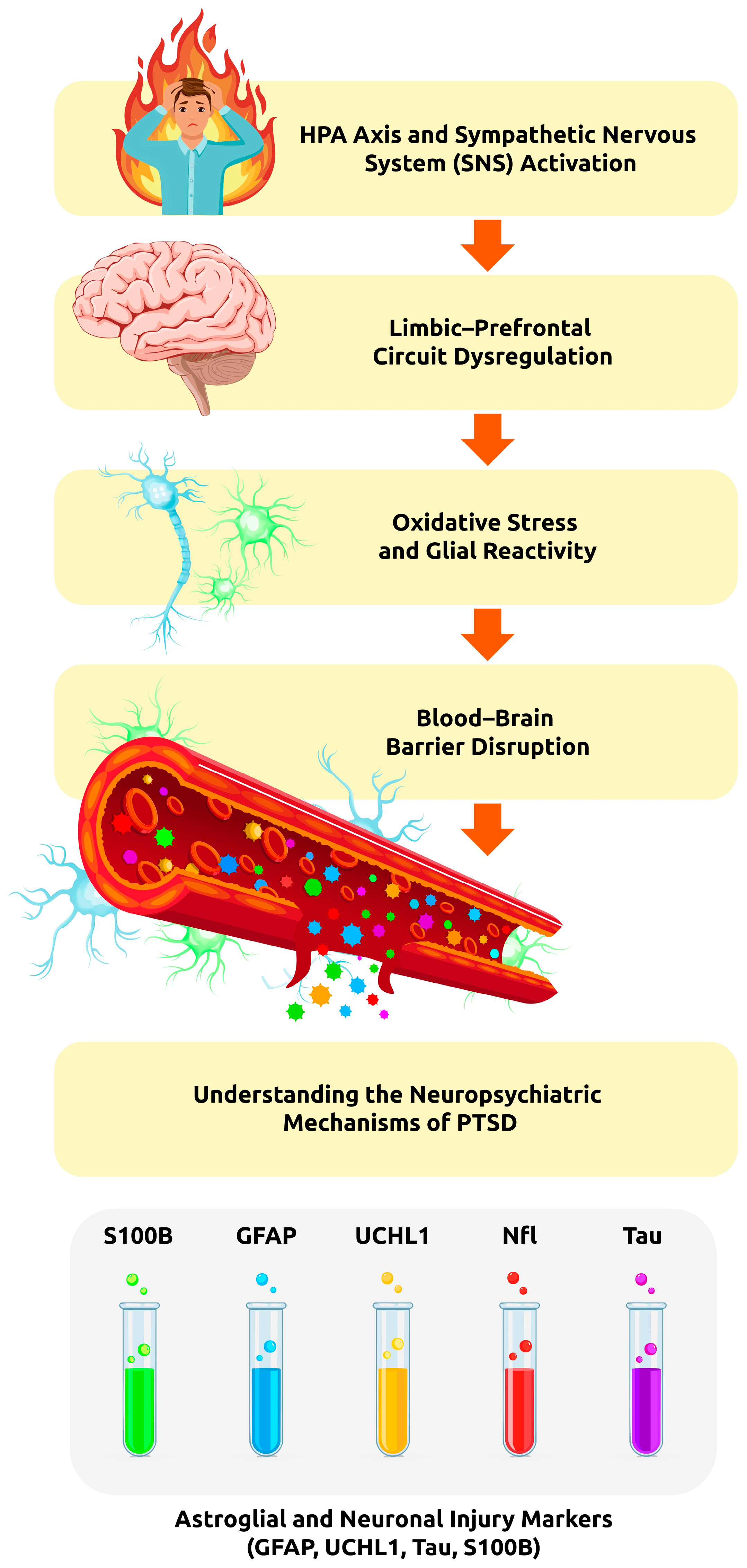
Astroglial and Neuronal Injury Markers (GFAP, UCHL-1, NfL, Tau, S100B) as Diagnostic and Prognostic Biomarkers in PTSD and Neurological Disorders


Abstract
1. Introduction
1.1. PTSD in the Context of Neurological Diseases
1.2. Neurobiological Basis of PTSD: Oxidative Stress, Neuroinflammation, and BBB Dysfunction
1.3. Importance of Glial–Neuronal Biomarkers in PTSD and Neurological Disorders
- (i)
- Biological specificity for cellular compartments relevant to PTSD pathophysiology;
- (ii)
- Mechanistic plausibility within stress-related molecular cascades;
- (iii)
- Translational feasibility, as these proteins can be reliably quantified in peripheral blood and are routinely applied in clinical neuroscience.
2. Neurobiological Mechanisms of Brain Injury in PTSD
2.1. Neuroinflammation and Glial Reactivity
2.2. Cytokine Pathways and NLRP3 Inflammasome Activation
2.3. Disruption of Neuron-Astrocyte-Microglia Communication
2.4. Clinical and Translational Significance
3. Blood–Brain Barrier Dysfunction in PTSD
4. Neuronal Degeneration and Synaptic Dysfunction
4.1. Astroglial and Neuronal Biomarkers of Injury
4.2. Comparative Analysis: PTSD vs. Neurological Disorders
5. Diagnostic and Prognostic Value of Combined Biomarker Panels
6. Clinical and Translational Implications
6.1. Study Design
6.2. Data Sources and Search Strategy
6.3. Eligibility Criteria
6.4. Study Selection and Data Extraction
6.5. Evidence Synthesis
7. Conclusions and Future Directions
Author Contributions
Funding
Institutional Review Board Statement
Informed Consent Statement
Data Availability Statement
Conflicts of Interest
Abbreviations
| AD | Alzheimer’s disease |
| AMPA | α-amino-3-hydroxy-5-methyl-4-isoxazolepropionic acid |
| ASC | apoptosis-associated speck-like protein containing a caspase recruitment domain |
| ATP | adenosine triphosphate |
| BBB | blood–brain barrier |
| BDI | Beck Depression Inventory |
| BDNF | brain-derived neurotrophic factor |
| CAPS-5 | Clinician-Administered PTSD Scale for DSM-5 |
| CBT | cognitive behavioral therapy |
| CD11b | cluster of differentiation 11b |
| CDK5 | cyclin-dependent kinase 5 |
| CECS | Courtauld Emotional Control Scale |
| CNS | central nervous system |
| CSF | cerebrospinal fluid |
| CT | computed tomography |
| CTE | chronic traumatic encephalopathy |
| CX3CL1 | C-X3-C motif chemokine ligand 1 |
| CX3CR1 | C-X3-C motif chemokine receptor 1 |
| CXCL10 | C-X-C motif chemokine ligand 10 |
| DAMPs | danger-associated molecular patterns |
| DNN | deep neural networks |
| DSM-5 | Diagnostic and Statistical Manual of Mental Disorders, Fifth Edition |
| DTI | diffusion tensor imaging |
| EAAT2 | excitatory amino acid transporter 2 |
| EMDR | eye movement desensitization and reprocessing |
| ER | endoplasmic reticulum |
| FDA | U.S. Food and Drug Administration |
| fMRI | functional magnetic resonance imaging |
| GABA | gamma-aminobutyric acid |
| GFAP | glial fibrillary acidic protein |
| GSH | reduced glutathione |
| GSK-3β | glycogen synthase kinase 3 beta |
| HPA | hypothalamic–pituitary–adrenal |
| ICAM-1 | intercellular adhesion molecule 1 |
| IGF-1 | insulin-like growth factor 1 |
| IL-1β | interleukin-1 beta |
| IL-6 | interleukin-6 |
| IL-18 | interleukin-18 |
| IRE1–XBP1 | inositol-requiring enzyme 1–X-box binding protein 1 |
| JNK | c-Jun N-terminal kinase |
| LIME | Local Interpretable Model-agnostic Explanations |
| LTP | long-term potentiation |
| MAPK | mitogen-activated protein kinase |
| MCC950 | CP-456, 773 |
| MCP-1 | monocyte chemoattractant protein-1 |
| MDA | malondialdehyde |
| MFN2 | mitofusin-2 |
| ML | machine learning |
| MMP-2 | matrix metalloproteinase-2 |
| MMP-9 | matrix metalloproteinase-9 |
| MRI | magnetic resonance imaging |
| MS | multiple sclerosis |
| NAA | N-acetylaspartate |
| NF-κB | nuclear factor kappa B |
| NfL | neurofilament light chain; |
| NLRP3 | NOD-like receptor family pyrin domain-containing 3 |
| NMDA | N-methyl-D-aspartate |
| NVU | neurovascular unit |
| PAMPs | pathogen-associated molecular patterns |
| PD | Parkinson’s disease |
| PERK | protein kinase RNA-like endoplasmic reticulum kinase |
| PET | positron emission tomography |
| PET-TSPO | positron emission tomography targeting the 18 kDa translocator protein |
| PKA | protein kinase A |
| PPAR-γ | peroxisome proliferator-activated receptor gamma |
| PSD-95 | postsynaptic density protein 95 |
| PSQI | Pittsburgh Sleep Quality Index |
| PTSD | post-traumatic stress disorder |
| RAGE | receptor for advanced glycation end products |
| RNS | reactive nitrogen species |
| ROS | reactive oxygen species |
| SHAP | SHapley Additive exPlanations |
| SNRI | serotonin–norepinephrine reuptake inhibitor |
| SSRI | selective serotonin reuptake inhibitor |
| SVM | support vector machine |
| S100B | S100 calcium-binding protein B |
| TBI | traumatic brain injury |
| TJs | tight junctions |
| TLR2 | Toll-like receptor 2 |
| TLR4 | Toll-like receptor 4 |
| TNF-α | tumor necrosis factor alpha |
| TNFR1 | tumor necrosis factor receptor 1 |
| TSPO | translocator protein |
| TXNIP | thioredoxin-interacting protein |
| UCHL-1 | ubiquitin C-terminal hydrolase L1 |
| VCAM-1 | vascular cell adhesion molecule 1 |
| ZO-1 | zonula occludens-1 |
References
- Wong, C.S.M.; Leung, C.M.C.; Wu, S.; Flores, F.P.; Kim, Y.; Xiao, X.; Wong, S.B.K.; Chang, W.C.; Chan, W.C.; Yu, N.X.; et al. Prevalence, persistence, and severity of 12-month and 30-day DSM-5 disorders in the World Mental Health Hong Kong Study. Lancet Reg. Health West. Pac. 2025, 65, 101757. [Google Scholar] [CrossRef] [PubMed]
- Hoglund, B.K.; Carfagno, V.; Olive, M.F.; Leyrer-Jackson, J.M. Metabotropic glutamate receptors and cognition: From underlying plasticity and neuroprotection to cognitive disorders and therapeutic targets. Int. Rev. Neurobiol. 2023, 168, 367–413. [Google Scholar] [CrossRef]
- Granger, S.J.; May, V.; Hammack, S.E.; Akman, E.; Jobson, S.A.; Olson, E.A.; Pernia, C.D.; Daskalakis, N.P.; Ravichandran, C.; Carlezon, W.A., Jr.; et al. Circulating PACAP levels are associated with altered imaging measures of entorhinal cortex neurite density in posttraumatic stress disorder. Eur. J. Psychotraumatol. 2024, 15, 2335793. [Google Scholar] [CrossRef]
- Baráth, A.S.; Wu, L.J. Microglial Phagocytosis in Epilepsy: Mechanisms and Impact. J. Physiol. 2025, 604, 1575–1591. [Google Scholar] [CrossRef]
- Zhou, N.; Yan, Y.; Zhang, D.; Di, Y.; Gang, W.; Yuan, Y.; Zhang, J.; Zhang, H.; Qu, K.; Zhao, W.; et al. Discovering molecular drivers of human epileptogenesis through integrative multi-omics profiling. Neurobiol. Dis. 2025, 217, 107165. [Google Scholar] [CrossRef]
- Wu, H.; Mi, Y.; Zheng, C.; Zhang, Y.; Xu, S.; Zhu, J.; Jin, T. Metabolic reprogramming of glial cells: Fatty acid pathways as regulators of remyelination in multiple sclerosis. Neurobiol. Dis. 2025, 217, 107179. [Google Scholar] [CrossRef]
- Vishnumukkala, T.; Che Mohd Nassir, C.M.N.; Hein, Z.M.; Kalerammana Gopalakrishna, P.; Karikalan, B.; Alkatiri, A.; Jagadeesan, S.; Naik, V.R.; Thomas, W.; Mohd Moklas, M.A.; et al. Glial Cells as Emerging Therapeutic Targets in Neurodegenerative Diseases: Mechanistic Insights and Translational Perspectives. Cells 2025, 14, 1497. [Google Scholar] [CrossRef] [PubMed]
- Shokr, M.M. Rewiring brain immunity: Targeting microglial metabolism for neuroprotection in neurodegenerative disorders. Metab. Brain Dis. 2025, 40, 326. [Google Scholar] [CrossRef]
- Azmal, M.; Paul, J.K.; Prima, F.S.; Haque, A.N.M.S.N.B.; Meem, M.; Ghosh, A. Microglial dysfunction in Alzheimer’s disease: Mechanisms, emerging therapies, and future directions. Exp. Neurol. 2025, 392, 115374. [Google Scholar] [CrossRef] [PubMed]
- Dow, C.T.; Obaid, L. Proposing Bromo-Epi-Androsterone (BEA) for Post-Traumatic Stress Disorder (PTSD). Cells 2025, 14, 1120. [Google Scholar] [CrossRef]
- Thakur, S.; Dhapola, R.; Sarma, P.; Medhi, B.; Reddy, D.H. Neuroinflammation in Alzheimer’s Disease: Current Progress in Molecular Signaling and Therapeutics. Inflammation 2023, 46, 1–17. [Google Scholar] [CrossRef] [PubMed]
- Woźny-Rasała, I.; Ogłodek, E.A. NLRP3 Inflammasome in Stress-Related Neuropsychiatric Disorders: Mechanisms of Neuron–Microglia–Astrocyte Crosstalk, HPA Axis Dysregulation, and Therapeutic Perspective. Biomolecules 2025, 15, 1344. [Google Scholar] [CrossRef] [PubMed]
- Chen, C.; Shu, Y.; Yan, C.; Li, H.; Huang, Z.; Shen, S.; Liu, C.; Jiang, Y.; Huang, S.; Wang, Z.; et al. Astrocyte-derived clusterin disrupts glial physiology to obstruct remyelination in mouse models of demyelinating diseases. Nat. Commun. 2024, 15, 7791. [Google Scholar] [CrossRef]
- Zheng, Y.; Zhang, X.; Wang, Z.; Zhang, R.; Wei, H.; Yan, X.; Jiang, X.; Yang, L. MCC950 as a Promising Candidate for Blocking NLRP3 Inflammasome Activation: A Review of Preclinical Research and Future Directions. Arch. Pharm. 2024, 357, e2400459. [Google Scholar] [CrossRef]
- Placeres-Uray, F.; Gorthy, A.S.; Dominguez-Torres, M.; Atkins, C.M. Inhibition of Microglia Priming by NLRP3 Reduces the Impact of Early Life Stress and Mild TBI. J. Neuroinflamm. 2025, 22, 185. [Google Scholar] [CrossRef]
- O’Brien, W.T.; Pham, L.; Symons, G.F.; Monif, M.; Shultz, S.R.; McDonald, S.J. The NLRP3 Inflammasome in Traumatic Brain Injury: Potential as a Biomarker and Therapeutic Target. J. Neuroinflamm. 2020, 17, 104. [Google Scholar] [CrossRef]
- Fan, Y.; Du, L.; Fu, Q.; Zhou, Z.; Zhang, J.; Li, G.; Wu, J. Inhibiting the NLRP3 Inflammasome with MCC950 Ameliorates Isoflurane-Induced Pyroptosis and Cognitive Impairment in Aged Mice. Front. Cell. Neurosci. 2018, 12, 426. [Google Scholar] [CrossRef]
- Gao, L.; Peng, L.; Wang, J.; Zhang, J.H.; Xia, Y. Mitochondrial stress: A key role of neuroinflammation in stroke. J. Neuroinflamm. 2024, 21, 170. [Google Scholar] [CrossRef]
- Cheng, H.; Men, Y.; An, Y.; Yu, J.; Zhang, G.; Li, J.; Wang, X.; Sun, G.; Wu, Y. Overexpression of endothelial S1pr2 promotes blood-brain barrier disruption via JNK/c-Jun/MMP-9 pathway after traumatic brain injury in both in vivo and in vitro models. Front. Pharmacol. 2024, 15, 1448570. [Google Scholar] [CrossRef]
- Abdelhak, A.; Foschi, M.; Abu-Rumeileh, S.; Yue, J.K.; D’Anna, L.; Huss, A.; Oeckl, P.; Ludolph, A.C.; Kuhle, J.; Petzold, A.; et al. Blood GFAP as an Emerging Biomarker in Brain and Spinal Cord Diseases. Nat. Rev. Neurol. 2022, 18, 158–172. [Google Scholar] [CrossRef] [PubMed]
- Spaziani, G.; Rozzi, G.; Baroni, S.; Napoli, G.; De Ninno, G.; Polla, D.D.; Bonadia, N.; De Matteis, G.; Piccioni, A.; Pepa, G.M.D.; et al. Prognostic value of GFAP and UCHL-1 biomarkers in high-risk mild traumatic brain injury: A prospective longitudinal study of short- and long-term outcomes. Am. J. Emerg. Med. 2025, 101, 41–47. [Google Scholar] [CrossRef]
- Edwards, K.A.; Lange, R.T.; Lippa, S.M.; Brickell, T.A.; Gill, J.M.; French, L.M. Serum GFAP, NfL and Tau vs Neurobehavior After TBI. Front. Neurol. 2024, 14, 1223960. [Google Scholar] [CrossRef]
- Shahim, P.; Pham, D.L.; van der Merwe, A.J.; Moore, B.; Chou, Y.Y.; Lippa, S.M.; Kenney, K.; Diaz-Arrastia, R.; Chan, L. Serum NfL and GFAP as biomarkers of progressive neurodegeneration in TBI. Alzheimers Dement. 2024, 20, 4663–4676. [Google Scholar] [CrossRef]
- Welch, R.D.; Ellis, M.; Lewis, L.M.; Ayaz, S.I.; Mika, V.H.; Papa, L.; Sutter, S.; Todd, M.; Schneider, E.B.; Valadka, A.B.; et al. Modeling the kinetics of serum GFAP, UCH-L1, and S100B concentrations in patients with traumatic brain injury. J. Neurotrauma 2017, 34, 1957–1971. [Google Scholar] [CrossRef] [PubMed]
- Prajapati, S.K.; Majumdar, S.; Murari, S.; MachhindraVadak, K.; Krishnamurthy, S. Neurochemical, Neurocircuitry, and Psychopathological Mechanisms of PTSD: Emerging Pharmacotherapies and Clinical Perspectives. ACS Chem. Neurosci. 2025, 16, 2355–2370. [Google Scholar] [CrossRef]
- Lawrence, S.; Scofield, R.H. PTSD-associated HPA Axis Dysregulation and Physical Illness. Brain Behav. Immun. Health 2024, 41, 100849. [Google Scholar] [CrossRef]
- Shalev, A.; Cho, D.; Marmar, C.h.R. Neurobiology and Treatment of Posttraumatic Stress Disorder. Am. J. Psychiatry 2024, 181, 705–719. [Google Scholar] [CrossRef] [PubMed]
- Hinojosa, C.A.; George, G.C.; Ben-Zion, Z. Neuroimaging of posttraumatic stress disorder in adults and youth: Progress over the last decade on three leading questions of the field. Mol. Psychiatry 2024, 29, 3223–3244. [Google Scholar] [CrossRef]
- Wang, X.; Cheng, S.; Guo, X.; Li, J.; Zhao, Y.; Zhang, Q.; Sun, H.; Liu, D.; Yu, M.; Yang, C.; et al. CX3CL1/CX3CR1 signal mediates M1-type microglia and accelerates high-altitude-induced forgetting. Front. Cell. Neurosci. 2023, 17, 1189348. [Google Scholar] [CrossRef]
- Salerno, S.; Viviano, M.; Baglini, E.; Poggetti, V.; Giorgini, D.; Castagnoli, J.; Barresi, E.; Castellano, S.; Da Settimo, F.; Taliani, S. TSPO Radioligands for Neuroinflammation: An Overview. Molecules 2024, 29, 4212. [Google Scholar] [CrossRef]
- Hosseini-Kamkar, N.; Varvani Farahani, M.; Nikolic, M.; Stewart, K.; Goldsmith, S.; Soltaninejad, M.; Rajabli, R.; Lowe, C.; Nicholson, A.A.; Morton, J.B.; et al. Adverse Life Experiences and Brain Function: A Meta-analysis of fMRI Findings. JAMA Netw. Open 2023, 6, e2340018. [Google Scholar] [CrossRef]
- Ben-Zion, Z.; Simon, A.J.; Rosenblatt, M.; Korem, N.; Duek, O.; Liberzon, I.; Shalev, A.Y.; Hendler, T.; Levy, I.; Harpaz-Rotem, I.; et al. Structural Neuroimaging of Hippocampus and Amygdala Subregions in PTSD: A Scoping Review. Biol. Psychiatry Glob. Open Sci. 2024, 4, 120–134. [Google Scholar] [CrossRef] [PubMed]
- Shahim, P.; Zetterberg, H.; Tegner, Y.; Marklund, N.; Blennow, K. Serum neurofilament light as a biomarker for mild TBI in contact sports. Neurology 2017, 88, 1788–1794. [Google Scholar] [CrossRef] [PubMed]
- Herrmann, M.; Vos, P.; Wunderlich, M.T.; de Bruijn, C.H.; Lamers, K.J. Release of glial tissue-specific proteins after acute stroke: Comparison of S-100B and GFAP. Stroke 2000, 31, 2670–2677. [Google Scholar] [CrossRef] [PubMed]
- Strawn, J.R.; Pyne-Geithman, G.J.; Ekhator, N.N.; Horn, P.S.; Uhde, T.W.; Shutter, L.A.; Baker, D.G.; Geracioti, T.D., Jr. Low cerebrospinal fluid and plasma orexin-A (hypocretin-1) concentrations in combat-related posttraumatic stress disorder. Psychoneuroendocrinology 2010, 35, 1001–1007, Corrigendum in Psychoneuroendocrinology 2016, 63, 410. https://doi.org/10.1016/j.psyneuen.2015.04.018. [Google Scholar] [CrossRef]
- Prajapati, S.K.; Ahmed, S.; Rai, V.; Gupta, S.C.; Krishnamurthy, S. Suvorexant improves mitochondrial dynamics with the regulation of orexinergic and mTOR activation in rats exhibiting PTSD-like symptoms. J. Affect. Disord. 2024, 350, 24–38. [Google Scholar] [CrossRef]
- Guardado, P.; Olivera, A.; Rusch, H.L.; Roy, M.; Martin, C.; Lejbman, N.; Lee, H.; Gill, J.M. Altered gene expression of the innate immune, neuroendocrine, and nuclear factor-kappa B (NF-κB) systems is associated with posttraumatic stress disorder in military personnel. J. Anxiety Disord. 2016, 38, 9–20. [Google Scholar] [CrossRef]
- Pinzón-Fernández, M.V.; Saavedra-Torres, J.S.; López Garzón, N.A.; Pachon-Bueno, J.S.; Tamayo-Giraldo, F.J.; Rojas Gomez, M.C.; Arias-Intriago, M.; Gaibor-Pazmiño, A.; López-Cortés, A.; Izquierdo-Condoy, J.S. NLRP3 and Beyond: Inflammasomes as Central Platforms in Neuroinflammation. Front. Immunol. 2025, 16, 1624770. [Google Scholar] [CrossRef]
- Woźny-Rasała, I.; Ogłodek, E.A. Biomarker Correlations in PTSD: IL-18, IRE1, pERK, and ATF6 via Courtauld Emotional Control Scale (CECS). Int. J. Mol. Sci. 2025, 26, 7506. [Google Scholar] [CrossRef]
- Wichmann, T.O.; Babaee, A.; Duch, K.; Rasmussen, M.M.; Lesbo, M.; Brink, O.; Borris, L.C.; Hviid, C.V.B. A head-to-head comparison of S100B and GFAP/UCH-L1 in a Scandinavian trauma cohort. Scand. J. Trauma Resusc. Emerg. Med. 2025, 33, 52. [Google Scholar] [CrossRef]
- Seidenfaden, S.C.; Nixon, A.; Markværn, M.N.; Rasmussen, M.; Nielsen, K.R.; Rasmussen, L.S.; Lippert, F.K.; Nielsen, F.E.; Ravn, J.; Bache, S.; et al. Diagnostic accuracy of prehospital serum S100B and GFAP in adults with mild TBI. Scand. J. Trauma Resusc. Emerg. Med. 2021, 29, 136. [Google Scholar] [CrossRef]
- Zarei, H.; Roshdi Dizaji, S.; Toloui, A.; Yousefifard, M.; Esmaeili, A. Diagnostic and prognostic values of S100B vs NSE for traumatic brain injury: A systematic review and meta-analysis. Arch. Acad. Emerg. Med. 2024, 12, e29. [Google Scholar] [CrossRef]
- Fernandes, L.C.; Rodrigues, A.; Junior, L.A.F.; Guimarães, I.F.; Lima, F.O.; Sales, D.S.; Oliveira, A.C.; Vieira, M.C.; de Souza, M.A.; Ferreira, D.; et al. S100B measured in blood samples as a prognostic biomarker after moderate–severe TBI: Systematic review. J. Neurotrauma 2024, 41, 1866–1881. [Google Scholar] [CrossRef]
- Janigro, D.; Mondello, S.; Posti, J.P.; Unden, J. GFAP and S100B: What you always wanted to know and never dared to ask. Front. Neurol. 2022, 13, 835597. [Google Scholar] [CrossRef]
- Laverse, E.; Ahmed, A.I.; Baron, R.; Teunissen, C.E.; Jacobs, B.; van der Naalt, J.; Vos, P.E. Plasma GFAP and NfL, but not tau, are biomarkers of sports-related mild TBI. Brain Commun. 2020, 2, fcaa137. [Google Scholar] [CrossRef]
- Moraes, B.J.; Hardt, O. Specific behaviors during auditory fear conditioning and postsynaptic expression of AMPA receptors in the basolateral amygdala predict interindividual differences in fear generalization in male rats. Learn. Mem. 2023, 30, 74–84. [Google Scholar] [CrossRef]
- Shahim, P.; Zetterberg, H.; Tegner, Y.; Marklund, N.; Blennow, K. Neurofilament light and tau as blood biomarkers for sports-related concussion. Neurology 2018, 90, 1780–1788. [Google Scholar] [CrossRef]
- Devoto, C.; Dematteis, M.; Lin, Y.; Sabir, S.; Zammit, C.; Kerr, Z.; Carr, W.; Gill, J. Plasma phosphorylated tau181 as a biomarker of mild TBI and concussion. Front. Neurol. 2023, 14, 1202967. [Google Scholar] [CrossRef]
- Hossain, I.; Mohammadian, M.; Takala, R.S.K.; Tenovuo, O. Admission levels of total tau and β-amyloid isoforms after TBI. Front. Neurol. 2020, 11, 325. [Google Scholar] [CrossRef] [PubMed]
- Hossain, I.; Marklund, N.; Czeiter, E.; Hutchinson, P.; Buki, A. Blood Biomarkers for Traumatic Brain Injury: A Narrative Review. Brain Spine 2023, 4, 102735. [Google Scholar] [CrossRef] [PubMed]
- Turner, M.R.; Thompson, A.G.; Teunissen, C.E. Blood level of neurofilament light chain as a biomarker for neurological disorders. BMJ Med. 2025, 4, e000958. [Google Scholar] [CrossRef] [PubMed]
- Papa, L.; McKinley, W.I.; Valadka, A.B.; Newman, Z.C.; Nordgren, R.K.; Pramuka, P.E.; Barbosa, C.E.; Brito, A.M.P.; Loss, L.J.; Tinoco-Garcia, L.; et al. Diagnostic Performance of GFAP, UCH-L1, and MAP-2 Within 30 and 60 Minutes of TBI. JAMA Netw. Open 2024, 7, e2431115. [Google Scholar] [CrossRef] [PubMed]
- Chen, X.; Shi, C.h.; He, M.; Xiong, S.; Xia, X. Endoplasmic Reticulum Stress: Molecular Mechanism and Potential Therapeutic Target. Sig. Transduct. Target. Ther. 2023, 8, 352. [Google Scholar] [CrossRef]
- Bravo-Jimenez, M.A.; Sharma, S.; Karimi-Abdolrezaee, S. The Integrated Stress Response in Neurodegenerative Diseases. Mol. Neurodegener. 2025, 20, 20. [Google Scholar] [CrossRef]
- Miao, Y.; Meng, H. The involvement of α-synucleinopathy in the disruption of microglial homeostasis contributes to the pathogenesis of Parkinson’s disease. Cell Commun. Signal. 2024, 22, 31. [Google Scholar] [CrossRef]
- Chaturvedi, M.; Kaczmarek, L. MMP-9 Inhibition: A Therapeutic Strategy in Ischemic Stroke. Mol. Neurobiol. 2014, 49, 563–573. [Google Scholar] [CrossRef]
- Eo, H.; Kim, J.; Jung, U.J.; Kim, S.R. Alpha-Synuclein and Microglia in Parkinson’s Disease: From Pathogenesis to Therapeutic Prospects. J. Clin. Med. 2024, 13, 7243. [Google Scholar] [CrossRef]
- Rao, R. Oxidative stress-induced disruption of epithelial and endothelial tight junctions. Front. Biosci. 2008, 13, 7210–7226. [Google Scholar] [CrossRef]
- Miao, J.; Ma, H.; Yang, Y.; Liao, Y.; Lin, C.; Zheng, J.; Yu, M.; Lan, J. Microglia in Alzheimer’s disease: Pathogenesis, mechanisms, and therapeutic potentials. Front. Aging Neurosci. 2023, 15, 1201982. [Google Scholar] [CrossRef]
- Wu, M.; Gong, Y.; Jiang, L.; Zhang, M.; Gu, H.; Shen, H.; Dang, B. VEGF regulates the blood-brain barrier through MMP-9 in a rat model of traumatic brain injury. Exp. Ther. Med. 2022, 24, 728. [Google Scholar] [CrossRef] [PubMed]
- Sadeghian, N.; Panahpour, H.; Alipour, M.R.; Farajdokht, F.; Shadman, J. Investigating the therapeutic potential of nasal administration of mitochondria on blood-brain barrier integrity and vasogenic brain Edema in a rat ischemic stroke model. Exp. Neurol. 2025, 398, 115609. [Google Scholar] [CrossRef]
- Andersson, E.; Öst, M.; Dalla, K.; Zetterberg, H.; Blennow, K.; Nellgård, B. Acute-Phase Neurofilament Light and GFAP in CSF and Outcome After Severe TBI. Neurocrit. Care 2024, 41, 813–827. [Google Scholar] [CrossRef]
- Puravet, A.; Oris, C.; Pereira, B.; Kahouadji, S.; Dwamena, B.A.; Sapin, V.; Bouvier, D. Working group on Mild Traumatic Injury Biomarkers; European Federation of the Laboratory Medicine (Sapin). Can the association of the biomarkers GFAP and UCH-L1 predict intracranial injury after mild traumatic brain injury in adults? A systematic review and meta-analysis. Ann. Emerg. Med. 2025, 86, 257–269. [Google Scholar] [CrossRef]
- Welch, R.D.; Bazarian, J.J.; Chen, J.Y.; Chandran, R.; Datwyler, S.A.; McQuiston, B.; Caudle, K. A high-performance core laboratory GFAP/UCH-L1 test for the prediction of intracranial injury after mild traumatic brain injury. Am. J. Emerg. Med. 2025, 89, 129–134. [Google Scholar] [CrossRef]
- Kisler, K.; Nelson, A.R.; Rege, S.V.; Ramanathan, A.; Wang, Y.; Ahuja, A.; Lazic, D.; Tsai, P.S.; Zhao, Z.; Zhou, Y.; et al. Pericyte degeneration leads to neurovascular uncoupling and limits oxygen supply to brain. Nat. Neurosci. 2017, 20, 406–416. [Google Scholar] [CrossRef]
- Korley, F.K.; Jain, S.; Sun, X.; Puccio, A.M.; Yue, J.K.; Gardner, R.C.; Wang, K.K.W.; Okonkwo, D.O.; Yuh, E.L.; Mukherjee, P.; et al. Prognostic value of day-of-injury plasma GFAP and UCH-L1 concentrations for predicting functional recovery after traumatic brain injury in patients from the US TRACK-TBI cohort: An observational cohort study. Lancet Neurol. 2022, 21, 803–813. [Google Scholar] [CrossRef] [PubMed]
- Bazarian, J.J.; Biberthaler, P.; Welch, R.D.; Lewis, L.M.; Barzo, P.; Bogner-Flatz, V.; Gunnar Brolinson, P.; Büki, A.; Chen, J.Y.; Christenson, R.H.; et al. Serum GFAP and UCH-L1 for prediction of absence of intracranial injuries on head CT (ALERT-TBI): A multicentre observational study. Lancet Neurol. 2018, 17, 782–789. [Google Scholar] [CrossRef] [PubMed]
- Papa, L.; Brophy, G.M.; Welch, R.D.; Lewis, L.M.; Braga, C.F.; Tan, C.N.; Ameli, N.J.; Lopez, M.A.; Haeussler, C.A.; Mendez Giordano, D.I.; et al. Time course and diagnostic accuracy of glial and neuronal blood biomarkers GFAP and UCH-L1 in a large cohort of trauma patients with and without mild traumatic brain injury. JAMA Neurol. 2016, 73, 551–560. [Google Scholar] [CrossRef] [PubMed]
- Zylyftari, S.; Luger, S.; Blums, K.; Barthelmes, S.; Humm, S.; Baum, H.; Meckel, S.; Braun, J.; Lichy, G.; Heilgeist, A.; et al. GFAP point-of-care measurement for prehospital diagnosis of intracranial hemorrhage in acute coma. Crit. Care 2024, 28, 109. [Google Scholar] [CrossRef]
- Arena, J.D.; Smith, D.H.; Diaz Arrastia, R.; Cullen, D.K.; Xiao, R.; Fan, J.; Harris, D.C.; Lynch, C.E.; Johnson, V.E. The neuropathological basis of elevated serum neurofilament light chain in traumatic brain injury. Acta Neuropathol. Commun. 2024, 12, 189. [Google Scholar] [CrossRef]
- Papa, L.; Mittal, M.K.; Ramirez, J.; Ramia, M.M.; Nylen, E.S.; Geyer, C.; Baird, A.E.; Brophy, G.M.; Lewis, L.M.; Wang, K.K.; et al. In children and youth with mild/moderate TBI, GFAP outperforms S100β in detecting CT lesions. J. Neurotrauma 2016, 33, 58–64. [Google Scholar] [CrossRef]
- Hasan, H.M.; Alkass, S.Y.; Persike, D.S. Post-traumatic Stress Disorder: The Influence of the Environmental Context and Analysis of Oxidative Stress and Inflammatory and Glycemic Markers in Women Living in Kurdistan Regional Government-Iraq. Cureus 2024, 16, e56661. [Google Scholar] [CrossRef]
- Papa, L.; Lewis, L.M.; Falk, J.L.; Zhang, Z.; Silvestri, S.; Giordano, P.; Brophy, G.M.; Demery, J.A.; Dixit, N.K.; Ferguson, I.; et al. Elevated levels of serum GFAP breakdown products in mild and moderate TBI are associated with intracranial lesions and neurosurgical intervention. Ann. Emerg. Med. 2012, 59, 471–483. [Google Scholar] [CrossRef] [PubMed]
- Diaz-Arrastia, R.; Wang, K.K.; Papa, L.; Sorani, M.; Yue, J.K.; Puccio, A.M.; McMahon, P.J.; Inoue, T.; Yuh, E.L.; Mukherjee, P.; et al. Acute biomarkers of TBI: Relationship between plasma UCH-L1 and GFAP. J. Neurotrauma 2014, 31, 19–25. [Google Scholar] [CrossRef] [PubMed]
- Bhatt, S.; Hillmer, A.T.; Girgenti, M.J.; Rusowicz, A.; Kapinos, M.; Nabulsi, N.; Huang, Y.; Matuskey, D.; Angarita, G.A.; Esterlis, I. PTSD is associated with neuroimmune suppression: Evidence from PET imaging and postmortem transcriptomic studies. Nat. Commun. 2020, 11, 2360. [Google Scholar] [CrossRef]
- Papa, L.; Ladde, J.G.; O’Brien, J.F.; Brophy, G.M.; Welch, R.D.; Lewis, L.M.; Giordano, P.; Silvestri, S.; Demery, J.A.; Ramia, M.M.; et al. Evaluation of GFAP and UCH-L1 vs clinical decision rules for CT after mild TBI. JAMA Netw. Open 2022, 5, 221302. [Google Scholar] [CrossRef]
- Papa, L.; Mittal, M.K.; Ramirez, J.; Silvestri, S.; Giordano, P.; Braga, C.F.; Tan, C.N.; Ameli, N.J.; Lopez, M.A.; Brophy, G.M.; et al. Neuronal biomarker UCH-L1 detects traumatic intracranial lesions on CT in children and youth with mild TBI. J. Neurotrauma 2017, 34, 2132–2140. [Google Scholar] [CrossRef]
- Papa, L.; Zonfrillo, M.R.; Welch, R.D.; Lewis, L.M.; Braga, C.F.; Tan, C.N.; Ameli, N.J.; Lopez, M.A.; Haeussler, C.A.; Hill-Pryor, C.; et al. Evaluating GFAP and UCH-L1 as gradients of brain injury in concussive, subconcussive and non-concussive trauma. BMJ Paediatr. Open 2019, 3, 000473. [Google Scholar] [CrossRef]
- Lewis, L.M.; Schloemann, D.T.; Papa, L.; Fabbri, A.; Braga, C.F.; Ameli, N.J.; Brophy, G.M.; Hill-Pryor, C.; Cardenas, M.; Welch, R.D.; et al. Utility of serum biomarkers in the diagnosis and stratification of mild TBI. Acad. Emerg. Med. 2017, 24, 710–720. [Google Scholar] [CrossRef] [PubMed]
- Daskalakis, N.P.; Iatrou, A.; Chatzinakos, C.; Jajoo, A.; Snijders, C.; Wylie, D.; DiPietro, C.P.; Tsatsani, I.; Chen, C.Y.; Pernia, C.D. Systems biology dissection of PTSD and MDD across brain regions, cell types, and blood. Science 2024, 384, eadh3707. [Google Scholar] [CrossRef]
- Natale, G.; Kritikos, M.; Kuan, P.F.; Carr, M.A.; Yang, X.; Yang, Y.; Kotov, R.; Bromet, E.J.; Clouston, S.A.P.; Luft, B.J. Brain Glial suppression and post-traumatic stress disorder: A cross-sectional study of 1,520 World Trade Center responders. Behav. Immun. Health 2023, 30, 100631. [Google Scholar] [CrossRef]
- Wen, Z.; Hammoud, M.Z.; Siegel, C.E.; Laska, E.M.; Abu-Amara, D.; Etkin, A.; Milad, M.R.; Marmar, C.R. Neuroimaging-based variability in subtyping biomarkers for psychiatric disorders. Mol. Psychiatry 2025, 30, 1966–1975. [Google Scholar] [CrossRef]
- Czeiter, E.; Amrein, K.; Gravesteijn, B.Y.; Lecky, F.; Menon, D.K.; Mondello, S.; Thelin, E.P.; Wilson, L.; Maas, A.I.R.; Buki, A.; et al. Blood biomarkers on admission in acute traumatic brain injury: Relations to severity, CT findings and care path in the CENTER-TBI study. EBioMedicine 2020, 56, 102785. [Google Scholar] [CrossRef] [PubMed]
- Miller, M.W.; Wolf, E.J.; Zhao, X.; Logue, M.W.; Hawn, S.E. An EWAS of dementia biomarkers and their associations with age, African ancestry, and PTSD. Clin. Epigenetics 2024, 16, 38. [Google Scholar] [CrossRef] [PubMed]
- Bavato, F.; Barro, C.; Schnider, L.K.; Simrén, J.; Zetterberg, H.; Seifritz, E.; Quednow, B.B. Introducing neurofilament light chain measure in psychiatry: Current evidence, opportunities, and pitfalls. Mol. Psychiatry 2024, 29, 2543–2559. [Google Scholar] [CrossRef] [PubMed]
- Shahim, P.; Gren, M.; Liman, V.; Andreasson, U.; Norgren, N.; Tegner, Y.; Blennow, K.; Zetterberg, H. Serum neurofilament light protein predicts clinical outcome in TBI. Sci. Rep. 2016, 6, 36791. [Google Scholar] [CrossRef]
- McDonald, S.J.; O’Brien, W.T.; Symons, G.F.; Tonge, B.; Shultz, S.R. Prolonged elevation of serum neurofilament light after sports-related concussion. Biomark. Res. 2021, 9, 54. [Google Scholar] [CrossRef]


| Biomarker | Cellular Origin | Physiological Role | Pathophysiological Significance in PTSD | Clinical and Translational Relevance |
|---|---|---|---|---|
| GFAP | Astrocytes | Structural stability of astrocytic cytoskeleton; maintenance of BBB integrity | Reflects astroglial reactivity, neuroinflammation, and BBB disruption induced by chronic stress and HPA axis dysregulation | Marker of astrocyte activation and BBB damage; useful for monitoring stress-related brain injury and treatment response |
| UCHL-1 | Neurons (cytoplasmic) | Ubiquitin recycling; regulation of proteostasis and synaptic protein turnover | Indicates neuronal stress, impaired protein degradation, synaptic dysfunction, and early neurodegenerative-like processes | Sensitive marker of neuronal and synaptic injury; component of FDA-approved Brain Trauma Indicator |
| NfL | Axons | Structural integrity of axons; impulse conduction | Reflects chronic axonal microdamage driven by oxidative stress and neuroinflammation | Marker of long-term axonal injury; correlates with cognitive impairment and white matter alterations |
| Tau | Neurons (axonal cytoskeleton) | Microtubule stabilization and axonal transport | Hyperphosphorylation under stress leads to cytoskeletal destabilization and synaptic dysfunction | Indicator of microtubular pathology and cognitive deficits; links PTSD with neurodegenerative pathways |
| S100B | Astrocytes | Regulation of neuronal growth and calcium homeostasis | At high levels, promotes inflammation via RAGE signaling and reflects BBB permeability | Marker of astrocyte activation and BBB leakage; correlates with affective and sleep disturbances |
| Biomarker | Cellular Origin | Preclinical Evidence (Animal Models) | Clinical Evidence (Human Studies) | Translational Relevance |
|---|---|---|---|---|
| GFAP | Astrocytes | Increased GFAP expression in hippocampus and prefrontal cortex after chronic stress; reflects astrocyte reactivity and BBB dysfunction | Elevated serum GFAP in PTSD and stress-related disorders; correlates with symptom severity and neuroimaging markers of BBB disruption | Marker of astroglial activation and BBB integrity; useful for monitoring neuroinflammation |
| S100B | Astrocytes | Increased expression in stress-exposed rodents; associated with neuroinflammation and glial activation | Elevated plasma S100B in PTSD; correlates with sleep disturbance, affective symptoms, and BBB permeability | Indicator of astrocyte activation and stress-related BBB leakage |
| UCHL-1 | Neurons (cytoplasmic) | Increased expression after stress-induced neuronal injury; linked to impaired proteostasis and synaptic dysfunction | Elevated serum levels in PTSD and TBI; associated with cognitive impairment and emotional dysregulation | Sensitive marker of neuronal stress and early neurodegeneration |
| NfL | Axons | Increased levels after axonal injury and chronic stress exposure; reflects white matter damage | Elevated serum NfL in PTSD and trauma-exposed populations; correlates with cognitive decline and symptom chronicity | Marker of axonal injury and long-term neurobiological burden |
| Tau | Neuronal cytoskeleton | Stress-induced hyperphosphorylation in animal models; synaptic and microtubule instability | Mild-to-moderate elevation in PTSD; associated with memory impairment and limbic dysfunction | Indicator of cytoskeletal instability and neurodegenerative-like processes |
| Cytokines (IL-6, IL-18) | Microglia, astrocytes | Upregulated following stress exposure; linked to NLRP3 activation | Increased circulating levels in PTSD; correlate with symptom severity | Reflect inflammatory burden and immune–brain interaction |
| Oxidative stress markers (MDA, GSH) | Neuronal and glial metabolism | Elevated oxidative damage in hippocampus and PFC | Altered redox balance in PTSD patients | Support role of oxidative stress in neuroprogression |
| Feature/ Biomarker | PTSD | TBI (Mild–Moderate) | AD |
|---|---|---|---|
| Primary trigger | Psychological trauma, chronic stress | Mechanical brain injury | Progressive neurodegeneration |
| GFAP | Chronically elevated (astroglial reactivity, BBB dysfunction) | Acutely elevated, correlates with injury severity | Moderately elevated (astrocytosis) |
| UCHL-1 | Persistent elevation reflecting neuronal stress and proteostasis imbalance | Sharp acute increase after injury | Variable, linked to neuronal degeneration |
| NfL | Moderately elevated, long-lasting axonal microdamage | Strong elevation proportional to axonal injury | Markedly elevated, progressive |
| Tau/p-tau | Mild to moderate increase, stress-related phosphorylation | Transient increase (especially p-tau) | Strong and progressive accumulation |
| S100B | Elevated, reflects BBB permeability and astrocyte activation | Acutely elevated | Moderately elevated |
| Neuroinflammation | Chronic, low-to-moderate | Acute, intense | Chronic, progressive |
| BBB dysfunction | Functional, potentially reversible | Structural and functional | Progressive |
| Reversibility | High with treatment | Partial | Low |
| Biomarker Panel | Biological Domain | Clinical Application | Interpretative Value |
|---|---|---|---|
| GFAP + S100B | Astroglial activation, BBB integrity | Detection of stress-related BBB dysfunction | Indicates astrocyte reactivity and vascular permeability |
| UCHL-1 + NfL | Neuronal and axonal injury | Assessment of neuronal microdamage | Reflects synaptic and axonal integrity |
| Tau + NfL | Cytoskeletal and axonal degeneration | Evaluation of cognitive impairment risk | Links PTSD with neurodegenerative-like mechanisms |
| GFAP + UCHL-1 | Glial–neuronal interface | Early detection of brain microinjury | High translational value (FDA-approved combination) |
| Biomarkers + cytokines (IL-6, IL-18) | Neuroinflammation | Symptom severity stratification | Reflects inflammatory burden |
| Biomarkers + oxidative stress markers (MDA, GSH) | Oxidative damage | Prognosis and treatment monitoring | Indicates redox imbalance and recovery potential |
| Biomarkers + psychometrics (CAPS-5, PSQI) | Bioclinical integration | Precision diagnosis and outcome prediction | Improves diagnostic accuracy and personalization |
Disclaimer/Publisher’s Note: The statements, opinions and data contained in all publications are solely those of the individual author(s) and contributor(s) and not of MDPI and/or the editor(s). MDPI and/or the editor(s) disclaim responsibility for any injury to people or property resulting from any ideas, methods, instructions or products referred to in the content. |
© 2026 by the authors. Licensee MDPI, Basel, Switzerland. This article is an open access article distributed under the terms and conditions of the Creative Commons Attribution (CC BY) license.
Share and Cite
Ogłodek, E.A.; Bar, M. Astroglial and Neuronal Injury Markers (GFAP, UCHL-1, NfL, Tau, S100B) as Diagnostic and Prognostic Biomarkers in PTSD and Neurological Disorders. Int. J. Mol. Sci. 2026, 27, 2374. https://doi.org/10.3390/ijms27052374
Ogłodek EA, Bar M. Astroglial and Neuronal Injury Markers (GFAP, UCHL-1, NfL, Tau, S100B) as Diagnostic and Prognostic Biomarkers in PTSD and Neurological Disorders. International Journal of Molecular Sciences. 2026; 27(5):2374. https://doi.org/10.3390/ijms27052374
Chicago/Turabian StyleOgłodek, Ewa Alicja, and Michal Bar. 2026. "Astroglial and Neuronal Injury Markers (GFAP, UCHL-1, NfL, Tau, S100B) as Diagnostic and Prognostic Biomarkers in PTSD and Neurological Disorders" International Journal of Molecular Sciences 27, no. 5: 2374. https://doi.org/10.3390/ijms27052374
APA StyleOgłodek, E. A., & Bar, M. (2026). Astroglial and Neuronal Injury Markers (GFAP, UCHL-1, NfL, Tau, S100B) as Diagnostic and Prognostic Biomarkers in PTSD and Neurological Disorders. International Journal of Molecular Sciences, 27(5), 2374. https://doi.org/10.3390/ijms27052374