Article

The Importance of Molecular Testing in the Diagnosis of Genetic Syndromes with Chronic Kidney Disease: Genotype–Phenotype Correlations


by
Lăcrămioara Ionela Butnariu
1,2,*,
Radu Russu
3,
Ramona Geanina Babici
1,4,*,
Aurora Băgiag
5,
Laura Mihaela Trandafir
1,6,
Elena Țarcă
1,7,
Paula Popovici
1,6,
Nicoleta Gimiga
1,6 and
Iuliana Magdalena Starcea
1,3
1
Department of Medical Genetics, Faculty of Medicine, Grigore T. Popa University of Medicine and Pharmacy, 700115 Iasi, Romania
2
Regional Center for Medical Genetics Iasi, Saint Mary’s Emergency Children Hospital, 700309 Iași, Romania
3
Departament of Nefrology, Saint Mary’s Emergency Children Hospital, 700309 Iași, Romania
4
Dr. C.I. Parhon University Hospital, 700503 Iasi, Romania
5
Department of Modern Languages, “Iuliu Haţieganu” University of Medicine and Pharmacy, 400012 Cluj-Napoca, Romania
6
Department of Pediatrics, Saint Mary’s Emergency Children Hospital, 700309 Iași, Romania
7
Department of Surgery II—Pediatric Surgery, Saint Mary’s Emergency Children Hospital, 700309 Iași, Romania
*
Authors to whom correspondence should be addressed.
Int. J. Mol. Sci. 2026, 27(5), 2362; https://doi.org/10.3390/ijms27052362
Submission received: 22 January 2026 / Revised: 21 February 2026 / Accepted: 27 February 2026 / Published: 3 March 2026
(This article belongs to the Special Issue New Insights into Molecular Mechanisms of Chronic Kidney Disease)

Abstract

Globally, chronic kidney disease (CKD) affects over 800 million individuals and is characterized by significant genetic complexity. More than 600 genes are associated with hereditary kidney disease, which may manifest as isolated kidney issues or as part of a syndrome that also includes extrarenal manifestations. The aim of this study was to identify genetic variants in a group of ten patients who presented with clinical signs suggestive of genetic syndromes associated with CKD, or who were asymptomatic but had a positive family history of CKD. Extensive genetic testing (targeted gene panels and whole-exome sequencing—WES) identified a mutation in the PKD1 gene in 3 out of 10 cases. In one patient, a known mutation in the PKD2 gene was identified. Another four patients were diagnosed with Alport syndrome: three of these presented with de novo missense mutations in the COL4A5 gene, and one patient had a mutation in the COL4A3 gene. One patient was diagnosed with MODY5, caused by a known mutation in the HNF1B gene, and one patient was diagnosed with Bartter syndrome type 1, resulting from a known mutation in the SLC12A1 gene. We present genotype–phenotype correlations, highlighting the particularities of each patient within their family context. Our findings emphasize the importance of genotype–phenotype correlations in refining diagnosis, personalizing therapeutic management, and providing essential genetic counseling for at-risk relatives.

1. Introduction

Chronic Kidney Disease (CKD) is a significant cause of morbidity and mortality with a global prevalence exceeding 10% [1,2], affecting over 850 million people worldwide and approximately 100 million Europeans [3,4]. CKD is a progressive condition that encompasses a large number of individual entities that manifest through abnormalities in kidney structure and function [3,4,5].
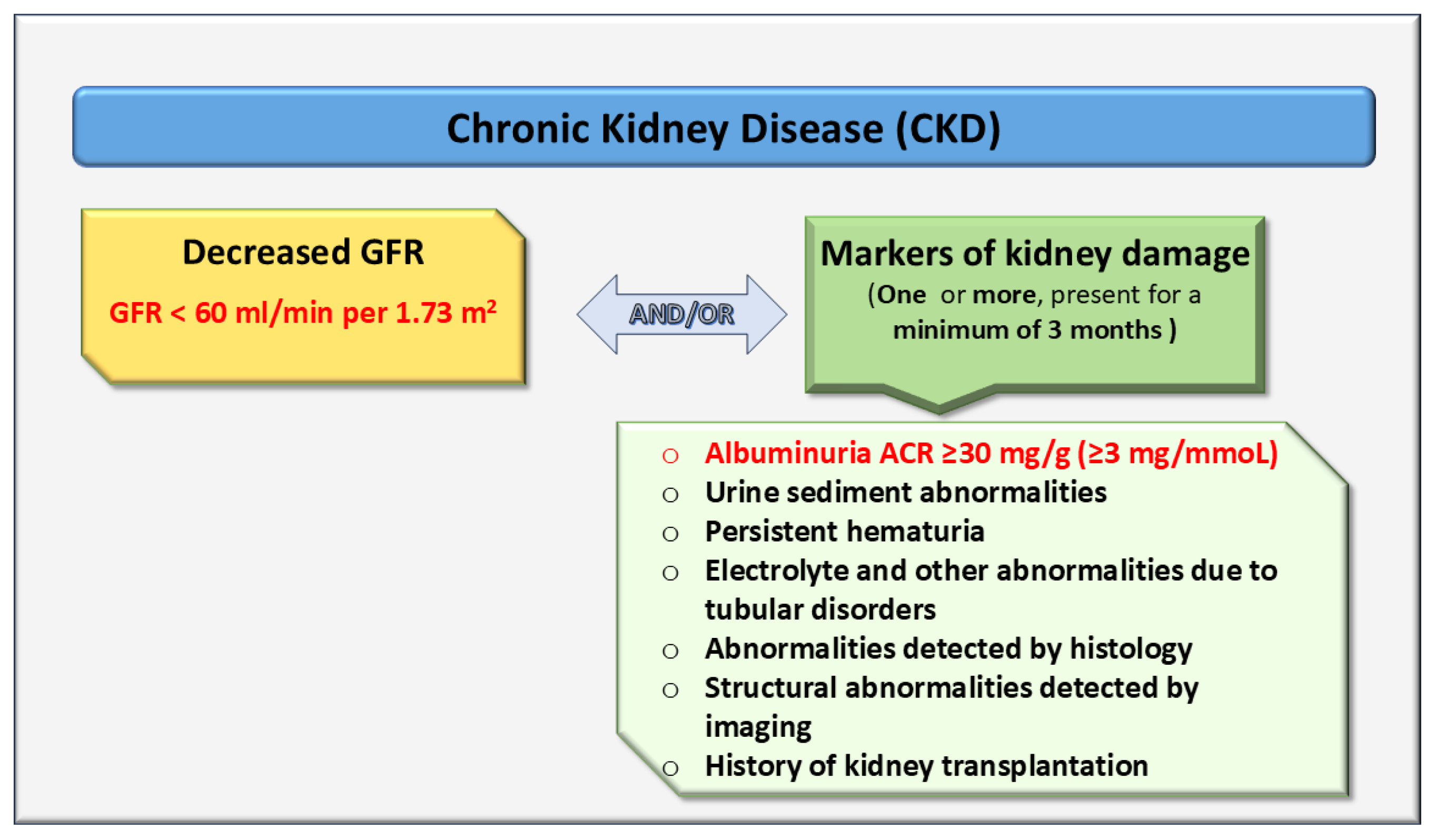
According to the KDIGO guidelines, CKD is characterized by structural or functional abnormalities of the kidney that persist for at least 3 months, with implications for health status. CKD is defined according to its causes, a decreased glomerular filtration rate (GFR <60 mL/min per 1.73 m2), an increased albumin-to-creatinine ratio (ACR ≥30 mg/g (≥3 mg/mmoL), plus additional markers of kidney damage (urinary sediment abnormalities, persistent hematuria, electrolyte disturbances due to tubular dysfunction, histological abnormalities, structural changes on imaging, and history of kidney transplantation) (Figure 1) [4,5].
Similar to other complex diseases, the heritability of CKD varies between 35% and 69% [6]. Impaired kidney function can be caused by monogenic mutations, but many kidney diseases are complex polygenic diseases resulting from the interaction of multiple genetic variants and environmental/lifestyle factors (a multifactorial etiology) [6].
In recent years, advances in genomic research and extensive genetic testing, which includes targeted gene panels, Whole-Exome Sequencing (WES) or Whole-Genome Sequencing (WGS), have improved diagnostic accuracy and prognosis and enabled personalized management of patients with CKD [3,7,8].
Currently, more than 600 monogenic kidney diseases are known, which are responsible for 50% of childhood-onset CKD; most of the causative variants are very rare or family-specific variants [3] (Table 1). Unlike in children, the prevalence of Mendelian kidney diseases is about 10% in adult patients, though this varies based on factors like kidney disease type, family history, age of onset, and other symptoms (extrarenal manifestations) [1,3].
Rare hereditary chronic kidney diseases (CKDs) present a heterogeneous etiology (Table 1) that frequently causes variable phenotypes correlated with genetic phenomena such as pleiotropy, incomplete penetrance, and variable expressivity [1,52].
Congenital anomalies of the kidney and urinary tract (CAKUT), ciliopathies (such as Autosomal Dominant Polycystic Kidney Disease, ADPKD), Alport syndrome (AS), autosomal dominant tubulointerstitial renal disease (ADTKD), and monogenic nephrotic syndromes are the leading causes of CKD in children [53,54].
ADPKD is the most common hereditary kidney disease which can be diagnosed early in patients with a positive family history, but which usually manifests in adulthood [55].
Unlike in children, about two-thirds of kidney failure in adults are caused by hypertension and diabetes mellitus, while monogenic (genetic) causes are responsible for approximately 10% to 15% of all CKD and end-stage renal disease (ESRD) [56].
Rare, highly penetrant genetic mutations (e.g., PAX2, HNF1B, EYA1, SALL1) and copy number variations (CNVs) cause most forms of CAKUT syndrome, but have also been associated with isolated (nonsyndromic) forms of kidney disease [1,57,58,59]. Based on recent literature and genomic studies, 17q12 deletions and 22q11.2 deletions are well-recognized pathogenic hotspots for CNVs that significantly cause structural renal anomalies. Single nucleotide polymorphisms (SNPs) and small insertions and deletions (indels) are correlated with the entire phenotypic spectrum of kidney disease [1,60].
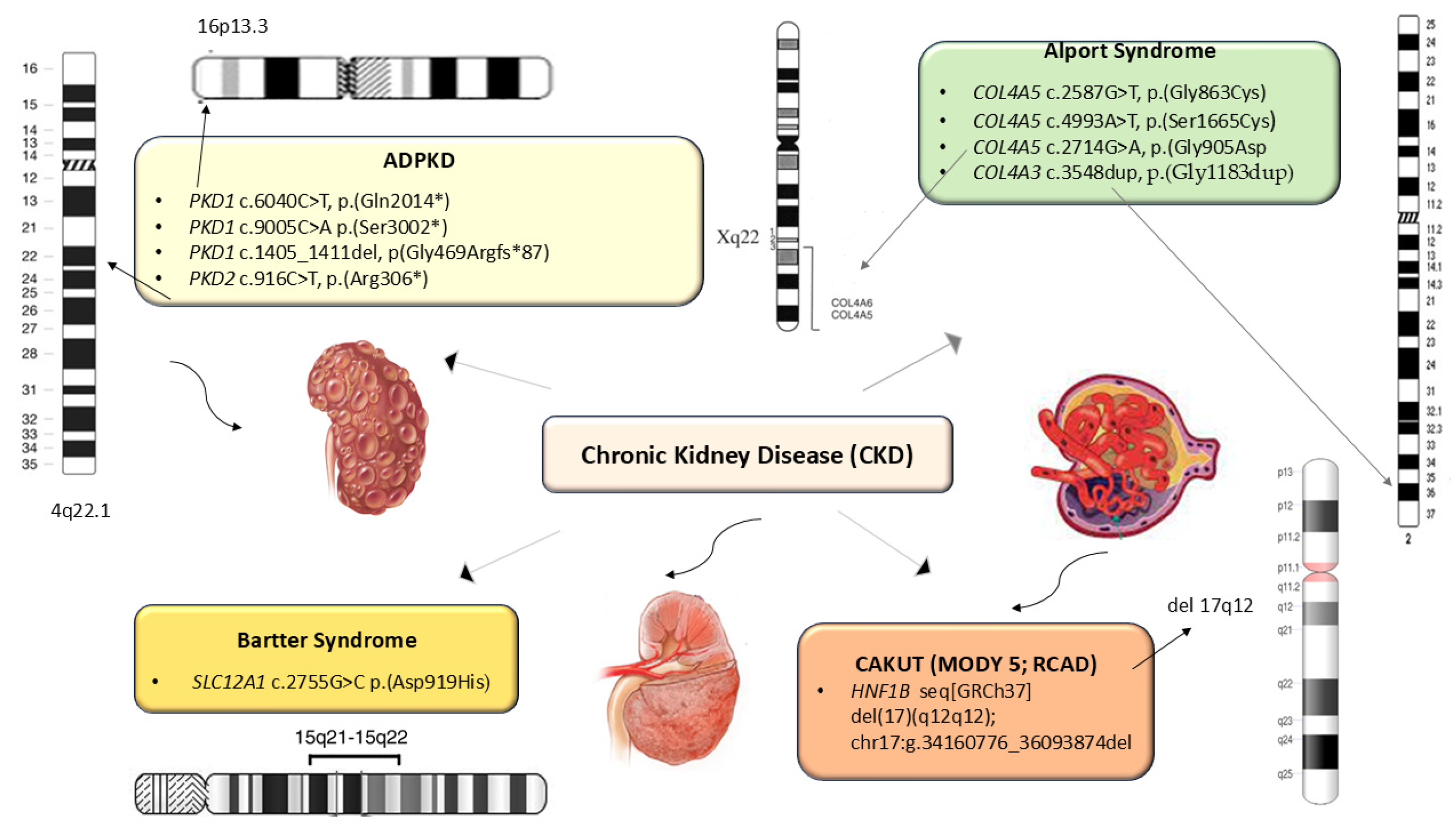
In autosomal dominant polycystic kidney disease (ADPKD), rare somatic variants act as a “second hit” by introducing an additional mutation in the remaining functional copy of either the PKD1 gene (located on chromosome 16p13.3) or the PKD2 gene (located on chromosome 4q22.1), thereby promoting cyst formation [61,62]. This “two-hit” model—in which a germline mutation serves as the first hit and a subsequent somatic mutation as the second—also appears to drive the development of clonal hematopoiesis of indeterminate potential (CHIP). CHIP, in turn, may increase the risk of complications such as renal failure and other adverse outcomes associated with CKD [63].
Recent research has shown that mutations in the genes encoding type IV collagen (COL43, COL4A4 and COL4A5) expressed in glomerular basement membranes are associated with various forms of kidney disease, highlighting its importance in maintaining normal kidney function. Thus, X-linked and autosomal recessive variants of Alport syndrome have been identified. Rare mosaic variants are known to influence phenotypic severity in X-linked Alport syndrome (XLAS). Thus, in male patients, the severity of the disease correlates with the proportion of affected cells (a lower percentage of cells containing the pathogenic variant tends to lead to a milder clinical phenotype) [1,64].
Syndromic Focal Segmental Glomerulosclerosis (FSGS) is a form of inherited kidney disease where FSGS occurs as one component of a broader genetic syndrome caused by mutations in genes (e.g., WT1, LMX1B, LAMB2) that affect both the podocytes and other organs, resulting in extrarenal manifestations (Table 1). The most common syndromes include Denys-Drash, Frasier, Nail-Patella, and Pierson syndromes, which feature abnormalities in vision, hearing, or genitalia alongside proteinuria [28,29,30,31,32]. Unlike primary (idiopathic) FSGS, these genetic forms typically present in childhood or young adulthood with steroid-resistant nephrotic syndrome and frequently require early genetic testing to guide management, as they rarely respond to immunosuppressive therapies [10,11,28,29,30,31,32].
Bardet–Biedl Syndrome (BBS) is a rare autosomal recessive ciliopathy caused by mutations in over 26 different BBS genes (BBS1BBS26) that disrupt cilia function [9,22]. It requires pathogenic mutations in both copies of a gene (biallelic), often involving founder mutations (e.g., BBS1 p.M390R, BBS10 p.C91Lfs*5) [9]. BBS1 and BBS10 are the most common causes, accounting for 40–50% of cases [22,23].
Pathogenic mutations in the TSC1 (located on chromosome 9q34.13) or TSC2 (located on chromosome 16p13.3) genes cause tuberous sclerosis complex (TSC), a rare genetic disorder characterized by the growth of benign tumors (hamartomas) in various organs (brain, kidneys, heart, eyes, lungs and skin) [24,25]. While both genes are involved in regulating cell growth and division, TSC2 pathogenic variants cause a more severe phenotype—including a higher risk of renal angiomyolipomas, renal malignancy, and cognitive impairment—compared to TSC1 mutations. Symptomatic treatment includes anticonvulsant drugs, mTOR inhibitors, surgery, and patient monitoring [24,25].
Bartter syndrome is a group of rare, primarily autosomal recessive genetic disorders caused by mutations in genes (SLC12A1, KCNJ1, CLCNKB, BSND, or MAGED2) that regulate salt reabsorption in the kidney’s loop of Henle (Table 1). This impairs ion transport, resulting in severe salt wasting, hypokalemia, and metabolic alkalosis [9,36,37,38,39,40].
Gitelman syndrome (GTLMNS) is the most common renal tubular disorder in Caucasians (prevalence 1 in 40,000), caused primarily by inactivating mutations in the SLC12A3 gene (located on chromosome 16q13), which encodes the thiazide-sensitive NaCl cotransporter (NCC) in the distal convoluted tubule of the kidney [9,38,39,40,41,42,43,44]. It is an autosomal recessive, salt-wasting disorder characterized by hypokalemic metabolic alkalosis, hypomagnesemia, and hypocalciuria. Clinical manifestations include periods of muscle weakness, tetany, abdominal pain, and chondrocalcinosis. It often presents in adolescence or adulthood, but cases have been reported in younger children [9,38,39,40,41,42,43,44].
Cystinuria is a genetic metabolic disorder caused by mutations in the SLC3A1 (located on chromosome 2p21) or SLC7A9 (located on chromosome 19q13.1) genes, which impair amino acid reabsorption in the proximal tubule of the kidney leading to painful, recurrent cystine nephrolithiasis. It is primarily inherited in an autosomal recessive pattern, though some forms show incomplete dominance [45,46,47].
Clinical forms of cystinosis are caused by autosomal recessive mutations in the CTNS gene (located on chromosome 17p13.2) [9] that interfere with the transport of the amino acid cystine out of lysosomes. These determine the accumulation of intracellular cystine crystals, causing extensive damage to tissues and organs, especially the kidneys and eyes [9,48]. Over 140 mutations have been reported in the literature. Large deletions (including the 57 kb deletion, which is the most common in Northern European and North American populations, accounting for 50–75% of pathogenic alleles) and truncating CTNS pathogenic variants (e.g., W138X) are typically associated with the severe, infantile nephropathic form of the disease [9,48]. Missense variants and splicing mutations often allow for some residual protein function, leading to milder, late-onset or juvenile forms of cystinosis or non-nephropathic (ocular) cystinosis [9,48].
Fabry disease is a rare, hereditary, X-linked lysosomal storage disorder caused by a mutation in the GLA gene (located on chromosome Xq22.1), which results in a deficiency of the enzyme alpha-galactosidase A (α-Gal A), leading to progressive lysosomal deposition of globotriaosylceramide and its derivatives in cells throughout the body [49]. It causes severe, multi-system damage, including neuropathic pain, skin lesions (angiokeratoma), cardiovascular and renal failure. Treatments include Enzyme Replacement Therapy (ERT) and chaperone therapy [49,50].
Pathogenic mutations in AGXT gene (located on chromosome 2q37.3) cause primary hyperoxaluria type 1 (PH1), a rare, autosomal recessive disorder characterized by a deficiency of the hepatic peroxisomal enzyme alanine-glyoxylate aminotransferase (AGT). Over 190 different mutations have been described that cause excessive oxalate production, leading to recurrent nephrolithiasis, nephrocalcinosis, and often end-stage renal disease (ESRD) [51].
Recent advances in genomic research have significantly transformed the landscape of CKD management, enabling a deeper and more personalized understanding of the molecular mechanisms that determine renal pathophysiology. By correlating genetic profiles with clinical data, physicians can now leverage improved diagnostic accuracy, tailor therapeutic interventions, and provide more precise genetic counseling [65].
Thus, recent clinical guidelines, including KDIGO (Kidney Disease Improving Outcomes), emphasize the importance of genetic testing in the diagnosis and management of patients with CKD [65,66].
This retrospective study aims to analyze and identify pathogenic genetic variants in a group of patients diagnosed with genetic syndromes associated with chronic kidney disease (CKD). We also presented genotype–phenotype correlations, highlighting the particularities of each patient and their family, in relation to the identified genetic variant. These targeted the spectrum of clinical manifestations (disease severity, age of onset and progression rate to CKD), management strategies (including family screening and genetic counseling) and personalized treatment.

2. Results

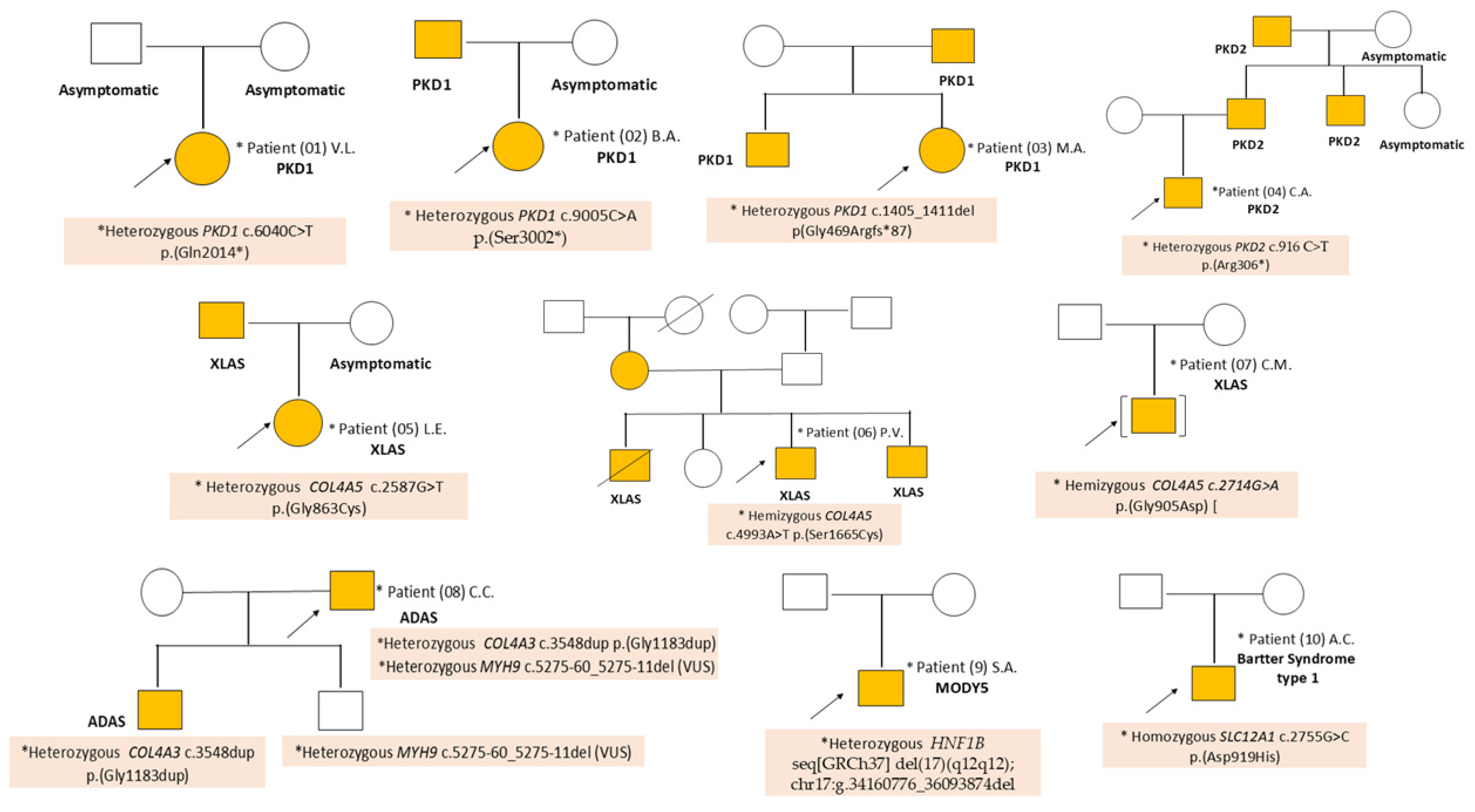
Extensive genetic testing (targeted gene panels that included genes for CKD and WES) in ten patients who had clinical signs specific to genetic syndromes that associate CKD or asymptomatic patients who had a positive family history for CKD, identified in 3/10 cases a mutation in the PKD1 gene (Table 2). In 1/10 patients a known mutation in the PKD2 gene was identified; another 4/10 patients were diagnosed with Alport syndrome: 3/10 patients presenting de novo missense mutations in the COL4A5 gene and 1/10 patients a variant in the COL4A3 gene; 1/10 patients were diagnosed with MODY5 caused by a known mutation in the HNF1B gene, and 1/10 patients were diagnosed with Bartter syndrome type 1, caused by a known mutation in the SLC12A1 gene (Table 2 and Figure 2).
Nonsense variants were found in three of the patients with polycystic kidney disease: PKD1 c.6040C>T, p.(Gln2014*) (P01), PKD1 c.9005C>A p.(Ser3002*) (P02) and PKD2 c.916C>T, p.(Arg306*) (P04) (Table 2 and Figure 2).
Hemizygous missense variants in the COL4A5 gene were identified in two patients with X-linked AS (XLAS): c.4993A>T (P06) and c.2714G>A (P07). Patient P05 (L.E, female) was diagnosed with XLAS caused by a likely pathogenic heterozygous mutation in the COL4A5 (c.2587G>T) of paternal origin. Another patient (P08, C.C.) with AS with autosomal dominant inheritance presented a de novo heterozygous duplication in the COL4A3 (c.3548dup) (Table 2 and Figure 2).
Other variants detected in CKD patients included a large heterozygous deletion involving the HNF1B gene identified in a patient with Maturity-Onset Diabetes of the Young type 5 (MODY5) (P09) and a known missense mutation in the SLC12A1 that caused Bartter syndrome type 1 in another patient (P10) (Table 2 and Figure 2).
Family history was positive for a genetic syndrome associated with CKD in 6/10 patients: 3/10 patients with autosomal dominant polycystic kidney disease (ADPKD) (P02, P03 and P04) and 3/10 patients with Alport syndrome (P05, P06 and P08); in the case of patient (P09) with MODY5 and (P10) with Bartter syndrome there were no other affected individuals in their families (Figure 3).
The clinical data of the ten patients included in the study are presented in Table 3.
The age of the patients at the time of diagnosis ranged between 17 months and 47 years, and most patients were male (7 out of 10 patients). All patients were dynamically monitored, following markers of renal damage and the decrease in glomerular filtration rate (Table 3).

3. Discussion

Three known mutations in the PKD1 (P01 and P02) and PKD2 (P04) genes, and one novel mutation in the PKD1 gene (P03), were identified in patients with ADPKD (Table 1).

3.1. Genotype–Phenotype Correlations in Autosomal Dominant Polycystic Kidney Disease

ADPKD is the most common inherited kidney disease (with a prevalence of 1 in 400 to 1000 individuals) [62,67], manifested by fluid-filled cysts in kidneys and other organs (liver, pancreas, brain, heart), and is caused by mutations in the PKD1 (85%), and PKD2 (15%) genes. Symptoms of the disease usually appear in adulthood (30–40 years), and the evolution is progressive; the growth of cysts causes kidney enlargement, pain, hypertension, infections and, finally, end-stage-renal disease (ESRD). Disease management focuses on symptomatic treatment that includes antihypertensive medication, diet, hydration, and newer therapies like mTOR inhibitors (rapamycin analogs), somatostatin analogs, and tyrosine kinase inhibitors to slow disease progression and preserve kidney function [68,69,70].
Male gender is recognized as a risk factor for faster kidney cyst growth and progression to ESRD, suggesting that androgens might promote it, while estrogen might be protective [62].
Although PKD1 and PKD2 cause a similar phenotype, PKD1 variants are associated with more severe disease and earlier ESRD (around age 53), compared to PKD2 mutations, in which the disease progression is less severe, with fewer renal cysts, and late-onset hypertension and ESRD (around age 72) [71,72,73].
Atypical ADPKD are associated with mutations in the GANAB, DNAJB11, IFT140, and other genes [70,71,72,73]. GANAB mutations are associated with a milder phenotype but with more variable polycystic liver disease [62]. Other variants in the PRKCSH, SEC63, LRP5, ALG8, and SEC61B genes cause autosomal dominant polycystic liver disease (ADPLD) which can be associated with mild kidney disease [74,75].
To date, a large number of PKD1 and PKD2 variants have been reported. Thus, PKD1 nonsense, frameshift, or splice-site alterations associated with truncated protein mutations are more severe than those not associated with truncated protein mutations (e.g., missense and in-frame insertion/deletion mutations) Most are unique to individual families, making genetic screening crucial for early diagnosis [62,75].
TSC2/PKD1 contiguous gene deletion syndrome (also known as Polycystic Kidney Disease with Tuberous Sclerosis, or PKDTS) is a rare, severe disorder resulting from a contiguous deletion on chromosome 16p13.3 [9,24]. Patients present with aggressive, early-onset renal cystic disease, which can be diagnosed prenatally or in early childhood. Together with renal cysts, renal angiomyolipomas lead to rapid progression to renal failure, typically in the first three decades of life [75,76,77,78].
The first patient (P01, V.L), a 1-year-and-10-month-old diagnosed with stage I CKD, had a clinical history notable for recurrent urinary tract infections (UTIs), anemia, and hepatocytolysis. Although his family history was negative for kidney disease, a renal ultrasound showed bilateral renal cystic formations. Through extended sequencing with the Blueprint Genetics (BpG) Cystic Kidney Disease Panel, a heterozygous pathogenic nonsense variant was identified in the PKD1 gene (c.6040C>T, p.(Gln2014*)), as shown in Table 1.
This variant is absent from Genome Aggregation Database (gnomAD) [79] but documented in ClinVar database (variation ID 1253802) [80]. This mutation introduces a premature stop codon in exon 15, likely causing nonsense-mediated mRNA decay or a truncated protein [81]. Loss-of-function (LoF) is an established disease mechanism for PKD1 [81]; this specific variant has been reported in multiple patients with ADPKD (PMID: 12007219, 25646624, 22508176) [82,83,84].
The second patient (P02, B.A.) was initially evaluated at 17 months of age. Although she was asymptomatic at the time, genetic testing was recommended due to her positive family history of ADPKD (her father had renal and hepatic cysts). In this case, the diagnosis of renal disease was made at a presymptomatic stage. Sequence analysis using the Blueprint Genetics (BpG) Cystic Kidney Disease Panel identified a heterozygous nonsense variant, PKD1 c.9005C>A p.(Ser3002*), which is classified as likely pathogenic and associated with polycystic kidney disease (Table 1).
This variant, a nonsense mutation in exon 25 (out of 46) of the relevant gene, was previously reported by Pinto et al. (PMID: 37353797) [85]. It introduces a premature stop codon, which is predicted to result in a loss of protein function [85]. The variant is listed in ClinVar (Variation ID: 1707241) as a likely pathogenic or pathogenic variant associated with a clinical presentation of renal cysts [80]. For patient P02, periodic monitoring of renal function was recommended. This includes biochemical tests (serum and urine) and renal ultrasound, as well as screening of at-risk family members through genetic testing and nephrological evaluation to detect other asymptomatic individuals.
Patient P03, M.A., was diagnosed at the age of 13 with stage I CKD. He presented with a positive family history for ADPKD: his father has polycystic kidney disease and secondary hypertension, and his 4-year-old brother has renal cysts; neither has undergone genetic testing. A renal ultrasound revealed several bilateral cortical cysts. The patient experienced an episode of acute pyelonephritis, developed secondary hypertension, and presented with proteinuria. His clinical evolution was favorable under specific treatment, and recommendations included monitoring of blood pressure values and avoidance of nephrotoxic drugs. Genetic testing using the Blueprint Genetics (BpG) Cystic Kidney Disease Panel identified a novel likely pathogenic heterozygous frameshift variant in PKD1 c.1405_1411del, p.(Gly469Argfs*87) (Table 1).
This variant is reported to be absent from population databases such as gnomAD. It consists of a 7-base pair deletion (c.1405_1411del) located in exon 7 of the PKD1 gene, which results in a frameshift (p.Gly469Argfs*87) and the introduction of a premature stop codon, ultimately leading to loss of protein function. The identification of variants in the first 32 exons of PKD1 is often challenging due to their high homology with pseudogenes (PKD1P1–P6). This requires specialized, high-quality sequencing techniques to accurately differentiate the true gene from its pseudogenes.
The PKD1 variant c.1405_1411del, p(Gly469Argfs*87) was classified as likely pathogenic based on the established association between the gene and the patient’s phenotype, the variant’s absence of in control population, and variant type (frameshift).
Considering that loss-of-function mutations in PKD1 are predictive of a more aggressive disease course and a faster decline in estimated glomerular filtration rate (eGFR), periodic assessment of renal function was advised for the three patients (P01, P02, and P03) to prevent complications.
Patient P04 (C.A.) was diagnosed by ultrasound at the age of 15 years with horseshoe kidneys and polycystic kidney disease, in the context of a positive family history: the child’s father, one of his siblings and his paternal grandfather had renal cysts (Figure 3).
Clinical manifestations included proportionate dwarfism (height = −3.04 SD, weight = −2.04 SD) and mild facial dysmorphism. Endocrinological evaluation, hormonal balance (growth and thyroid hormones) and hand-wrist radiography for bone age assessment were all within normal limits, with no indications for growth hormone therapy. In this case, monitoring of blood pressure values and periodic evaluation of renal function were also recommended. Genetic testing using the Blueprint Genetics (BpG) Cystic Kidney Disease Panel identified a pathogenic heterozygous nonsense PKD2 c.916C>T, p.(Arg306*) variant (Table 2).
This variant introduces a premature stop codon in exon 4 (out of a total of 15 exons) and is predicted to lead to loss of normal protein function [81]. It is classified as pathogenic/likely pathogenic in ClinVar (Variation ID 397507) [80] and is documented in HGMD [81]. The PKD2 c.916C>T, p.(Arg306*) is a well-documented pathogenic variant associated with ADPKD type 2 and has been described several times in the literature (PMID: 9326320, 24113780, 29529603, 29633482, 31740684, 33437033) [86,87,88,89,90,91].
The PKD2 c.916C>T, p.(Arg306)* variant was previously reported by Kim et al. [90] and Mallawaarachchi et al. [91]. Both studies emphasize the critical role of genetic diagnosis in polycystic kidney disease, whether through targeted sequencing of PKD1 and PKD2 or via comprehensive genomic approaches like Whole-Exome Sequencing (WES) and Whole-Genome Sequencing (WGS) [90,91].
Riccio et al. [87] identified the PKD2 c.916C>T, p.(Arg306*) variant in a 31-year-old patient who had been diagnosed with Marfan syndrome at the age of 26, inherited from his father. The patient presented with gross hematuria and abdominal pain [87]. Contrast-enhanced computed tomography of the abdomen revealed an aneurysm of the abdominal aorta and hepatic artery, along with multiple hepatic and bilateral renal cysts, suggestive of autosomal dominant polycystic kidney disease (ADPKD). Although the family history was negative for ADPKD, the patient’s mother had suffered a premature death at age 38 due to a ruptured dissecting thoracic aortic aneurysm.
The coexistence of ADPKD and Marfan syndrome is rare, with only a few cases documented in the literature [92,93]. While renal cysts represent the primary manifestation of ADPKD, extrarenal cystic involvement and connective tissue abnormalities—such as arterial aneurysms—may also occur [94]. These findings have led some researchers to propose that a generalized connective tissue defect may play a central role in the pathogenesis of ADPKD [95].
COL4A5 gene (located on chromosome Xq22.3) (OMIM 303630) [9] encodes a distinct alpha 5 chain for the collagen type IV, a major structural component of the glomerular basement membrane together with chains 3 and 4 of collagen IV [9]. Classically, pathogenic variants in the COL4A5 gene have been associated with X-linked Alport syndrome (XLAS) (OMIM 301050) [9]. The phenotype is variable and includes progressive renal failure due to glomerulopathy associated with sensorineural hearing loss (SNHL) and ocular anomalies [96].
Impaired hearing is frequently detectable by late childhood or early adolescence in boys with XLAS. SNHL develops in 80–90% of males with XLAS by age 40 years. In females with XLAS, hearing loss is less frequent and tends to occur later in life (GeneReviews NBK1207, PMID 37122389) [96,97]. Early-onset aortic disease may be an unusual feature of AS, and has been mainly described in patients with truncating variants (PMID 20494893) [98].
Alport syndrome has an estimated prevalence of approximately 1 in 50,000 live births [9]. The most common form is X-linked inheritance, caused by pathogenic variants in the COL4A5 gene (OMIM 303630), which accounts for about 65% of cases. The remaining cases are attributable to autosomal recessive or dominant variants in either the COL4A3 (OMIM 203780) or COL4A4 (OMIM 104200) genes [9,96].
Although X-linked disorders typically present with more severe manifestations in hemizygous males, heterozygous females carrying recessive or X-linked variants may also experience significant clinical involvement. Moreover, in females with the autosomal dominant form, disease progression tends to be slower compared to the rapid decline often seen in affected males [96].
In XLAS associated with COL4A5, distinct genotype–phenotype correlations have been observed. Patients carrying truncating variants or large rearrangements face a substantially higher risk of ESRD, with 70% to 90% progressing to ESRD by age 30. In contrast, individuals with pathogenic missense variants have a more favorable prognosis, with the risk decreasing to approximately 50% by the same age [96].
The severity and progression of hearing loss are also influenced by the underlying genotype. Patients with truncating variants have a 50% risk of developing deafness by age 10—a progression twice as rapid as that seen in patients with missense variants, who reach the same risk threshold at age 20 [96].
Current genomic databases reflect the broad mutational spectrum underlying Alport syndrome. ClinVar lists over 700 pathogenic variants, including 30% missense, 15% frameshift, 10% splice-site, and 6% nonsense alterations [80]. The HGMD Professional database (v.2023.1) identifies more than 1330 disease-causing variants, with truncating mutations (nonsense, frameshift, and splicing) accounting for 45% of cases, followed by missense mutations (41%) and gross deletions (11%) [81].
Patient P05 (L.E., female) underwent nephrological evaluation at the age 2 years, presenting with proteinuria (microalbuminuria) and macroscopic hematuria. During follow-up, persistent hematuria was accompanied by recurrent respiratory infections and an episode of acute pyelonephritis. At her most recent evaluation (age 10), an audiogram confirmed normal hearing. Given the positive family history—specifically, her father’s diagnosis of Alport syndrome, which required a renal transplant (although he was never genetically tested)—genetic testing was recommended.
Sequence analysis utilizing the Blueprint Genetics Alport Syndrome Panel identified a heterozygous, likely pathogenic missense variant in the COL4A5 gene [c.2587G>T, p.(Gly863Cys)] (Table 1). This specific variant is absent from the gnomAD database and has not been previously documented in medical literature or disease-specific variation databases. However, multiple in silico prediction tools suggest a deleterious effect. The variant involves a highly conserved glycine residue within the triple helical domain of this fibrillar collagen; according to the Human Gene Mutation Database (HGMD) [81], the substitution of such glycine residues is a well-established pathogenic mechanism in Alport syndrome [81]. Furthermore, a different substitution at the same codon [c.2587G>A, p.(Gly863Ser)] is listed in ClinVar (ID: 635542) as associated with COL4A5-related phenotypes, further supporting the critical functional importance of this amino acid position [80].
Due to skewed X-inactivation, heterozygous females with XLAS present with a wide range of clinical phenotypes [96]. Consequently, our patient’s follow-up was comprehensive, including nephrological care as well as regular ophthalmological assessments and audiograms, since hearing loss typically occurs later in females compared to males with XLAS [96].
Patient P06 (P.V.), a 26-year-old male, presented with end-stage renal disease (CKD Stage V, on hemodialysis) and sensorineural hearing loss requiring hearing aids since childhood. A significant family history suggestive of X-linked Alport Syndrome (XLAS) was noted: his mother and two brothers had CKD requiring dialysis, and a sister had microscopic hematuria; however, none had undergone prior genetic testing.
The combination of early-onset hearing loss and a spectrum of renal manifestations—including acidosis, hyperkalemia, anemia, hematuria, and proteinuria—strongly supports the diagnosis of XLAS in this patient.
Genetic testing using the Illumina TruSight Cardio Sequencing Panel (Illumina, Inc., San Diego, United States of America) identified a likely pathogenic, hemizygous missense mutation in the COL4A5 gene: c.4993A>T, p.Ser1665Cys). This specific variant is absent from the gnomAD v4.1.0 databases (both genomes and exomes). In silico predictions suggest a more severe functional impact, including disruption of the canonical splice donor site leading to a frameshift, protein truncation, and a total loss-of-function (LoF). Such LoF variants in the COL4A5 gene are established causes of XLAS. According to ACMG classification guidelines [99], this variant is categorized as likely pathogenic.
Within the same splicing region, another pathogenic missense variant, COL4A5 NM_033380.3(COL4A5):c.4994G>A (p.Ser1665Asn) (ClinVar Variation ID: 1443814) [80], exhibits computational predictions similar to those of the variant identified in the present study. This missense change has been previously documented in individuals with clinical features of Alport syndrome (PMID: 8940267, 22921432; Invitae Laboratory) [100,101].
Additionally, Wang et al. [100] identified two missense mutations—c.2777G>T (p.Gly926Val) and c.1552G>A (p.Gly518Arg)—alongside two intronic variants affecting splicing: c.1424–4C>G, which alters the guanine nucleotide at position—4 of exon 22, and c.4529-2A>T, located at the canonical splice acceptor site of intron 49. These variants were identified in three Chinese families with XLAS caused by mutations in the COL4A5 gene [101].
Patient P07 (C.M.) is a 24-year-old male diagnosed with Stage IV-V CKD, presenting with persistent proteinuria and glomerular hematuria (acanthocytes). His clinical history is notable for childhood-onset bilateral sensorineural hearing loss and ocular involvement -including myopia, astigmatism, and dot-and-fleck retinopathy—a triad highly suggestive of Alport Syndrome. The initial manifestations appeared at age 4, with macroscopic hematuria and albuminuria. Additional symptoms include a chronic cough and recurrent wheezing. Importantly, the patient was adopted, and therefore no biological family medical history is available.
Sequence analysis using the Blueprint Genetics (BpG) Alport Syndrome Panel identified a hemizygous missense COL4A5 c.2714G>A, p.(Gly905Asp) variant which is associated with XLAS. This variant is absent in gnomAD v2 database. It has been previously been reported in three patients with Alport syndrome, including a de novo occurrence in a female patient (PMID: 22921432, 30477285, 30577881) [101,102,103].
In silico prediction using the REVEL computational tool suggests that this variant is disease-associated. This mutation affects a highly conserved glycine residue located within the triple helical domain of this fibrillar collagen. The substitution of glycine residues in the collagen triple helix represents a well-established pathogenic mechanism in this type of network collagen, as documented in the HGMD [81]. Based on these findings and in accordance with the ACMG guidelines, the variant has been classified as likely pathogenic [99].
Patient P08 (C.C.) is a 47-year-old male diagnosed with Stage IV CKD, confirmed by renal biopsy showing global glomerulosclerosis. Clinical manifestations include bilateral renal cysts, microscopic hematuria, marked proteinuria (>2g/24h), and hypertension, in the absence of hearing impairment. Notably, he has two sons, one of whom exhibits symptoms suggestive of Alport syndrome.
Genetic analysis using the Blueprint Genetics (BpG) FLEX Cystic Kidney Disease Panel identified a heterozygous likely pathogenic in-frame insertion in the COL4A3 gene (c.3546_3548dup, p.(Gly1183dup)), associated with Autosomal Dominant Alport Syndrome (ADAS). The patient also carries a heterozygous intronic deletion in the MYH9 (c.5275-60_5275-11del) gene, currently classified as a Variant of Uncertain Significance (VUS).
Pathogenic variants in the MYH9 gene are responsible for an autosomal dominant disorder characterized by macrothrombocytopenia and granulocyte inclusions, which may or may not be accompanied by nephritis or sensorineural hearing loss. This condition is known as MYH9-related disease (MYH9-RD) and corresponds to the clinical entry MATINS in the OMIM database (OMIM 155100) [9]. Although historically classified as four distinct entities—May–Hegglin anomaly (MHA), Sebastian syndrome (SBS), Fechtner syndrome (FTNS), and Epstein syndrome (EPSTNS) [9]—MYH9-RD is now recognized as a single clinical spectrum with variable expressivity [104]. In addition, specific mutations in MYH9 have also been associated with autosomal dominant deafness-17 (DFNA17; OMIM 160775) [9].
Although the patient (P08) exhibited normal platelet levels on complete blood count (CBC), ongoing hematological monitoring was advised. Genetic testing of his son, who presented with renal manifestations (recurrent proteinuria and hematuria) without thrombocytopenia, revealed the same two genetic variants found in the father, confirming a diagnosis of Alport syndrome. As a result, nephrological and hematological follow-up, as well as periodic audiometric assessments, were recommended for the son as well.
The patient’s second son, who exhibited no renal manifestations but was found to have asymptomatic thrombocytopenia, underwent genetic testing that identified the MYH9 c.5275-60_5275-11del variant (VUS). This variant was also present in the father; however, the son did not carry the COL4A3 mutation. Consequently, periodic hematological monitoring—including a complete blood count (CBC) and peripheral blood smear—was recommended.
Patient P09 (S.A.) is a 17-year-old male diagnosed at age 13 with insulin-dependent diabetes mellitus (suspected MODY), obesity, stage II CKD, hepatocytolysis (with positive IgG anti-HEV antibodies), and an emotional disorder. Renal ultrasonography revealed multiple bilateral cortical and corticomedullary cysts of varying sizes, while biochemical markers showed mild azotemia in the absence of hematuria or proteinuria. Given the clinical triad of diabetes, renal cystic disease, and hepatic involvement, HNF1B-MODY syndrome—also known as MODY5 or Renal Cysts and Diabetes Syndrome (RCAD) (OMIM 137920) [9]—is strongly suspected. Genetic testing has been recommended to confirm the diagnosis.
Copy number variant (CNV) analysis using the Blueprint Genetics (BpG) Whole-Exome identified a heterozygous 1.9 Mb deletion on chromosome 17: seq[GRCh37]del(17)(q12q12); chr17:g.34160776_36093874del. This deletion encompasses the exons 3 through 9 of the HNF1B gene. Given that HNF1B haploinsufficiency represents the primary mechanism underlying RCAD syndrome (MODY5), this genomic alteration is considered diagnostic and fully consistent with the patient’s clinical presentation.
This deletion spans approximately 1.9 Mb within the genomic region 17:34160776-36093874 and includes 35 protein-coding genes. Among these, four are clinically significant according to the OMIM database: HNF1B (OMIM 189907), associated with autosomal dominant inheritance, and ACACA (OMIM 200350), PIGW (OMIM 610275), and ZNHIT3 (OMIM 604500), each linked to autosomal recessive disorders [9].
At the molecular level, this deletion results in an out-of-frame loss of exons 3–9 of the HNF1B gene, which is predicted to disrupt the open reading frame. Of note, similar deletions affecting this region have been reported only rarely in control cohorts, including four cases in the Exome Aggregation Consortium (ExAC) [105] and three in the gnomAD SVs v2.1 database [79].
According to HGMD Professional database (2024.3), 74 distinct gross deletions involving the HNF1B gene at the 17q12 locus have been documented [81]. Furthermore, the DECIPHER database records over 110 patients with overlapping deletions in this region [106]. Notably, a deletion of this exact genomic size has not been previously reported in the medical literature or specialized variant databases.
Deletions within the 17q12 region are the underlying cause of Renal Cysts and Diabetes Syndrome (RCAD), frequently referred to as 17q12 microdeletion syndrome (OMIM 614527; GeneReviews NBK401562) [9,107,108]. This recurrent deletion typically spans 1.2–1.4 Mb and encompasses the HNF1B gene. Phenotypically, the syndrome is characterized by a highly variable clinical presentation, primarily involving a triad of features: renal malformations (such as CAKUT and tubulointerstitial disease), maturity-onset diabetes of the young (MODY5), and a spectrum of neurodevelopmental or neuropsychiatric conditions, including autism spectrum disorder, schizophrenia, and intellectual disability (GeneReviews NBK401562) [107].
Diseases caused by HNF1B variants follow an autosomal dominant inheritance pattern. In the case of patient P09, both parents are clinically healthy, suggesting that the mutation likely arose de novo; however, germline mosaicism in one of the parents cannot be entirely excluded. Should the patient have offspring, each child would have a 50% risk of inheriting the variant and developing the condition.
Patient P10 is a 4-year-old male, born prematurely at 28 weeks to consanguineous parents. The pregnancy was complicated by polyhydramnios, and his neonatal course was marked by cerebral hemorrhage and acute renal failure. At two years of age, he developed a urinary tract infection caused by extended-spectrum beta-lactamase (ESBL)-producing Escherichia coli. Notably, a dimercaptosuccinic acid (DMSA) scintigraphy performed following the infection showed no evidence of post-infectious renal scarring.
Clinically, the patient presents with polyuria, polydipsia, and growth failure. These findings, together with biochemical abnormalities including hyposthenuria, hyponatremia, hypokalemia, hypercalciuria, and metabolic alkalosis, as well as the presence of nephrocalcinosis, are highly suggestive of Bartter syndrome. Additionally, cranial computed tomography (CT) revealed ventriculomegaly and hypoplasia of the corpus callosum.
Sequence analysis using the Blueprint Genetics (Bp) Whole-Exome Plus identified three homozygous missense variants: SLC12A1 c.2755G>C, p.(Asp919His), POLG c.1760C>T, p.(Pro587Leu) and POLG c.752C>T, p.(Thr251Ile).
The SLC12A1 gene (OMIM 600839) encodes the kidney-specific sodium-potassium-chloride cotransporter NKCC2, which is located on the luminal membrane of renal epithelial cells in the thick ascending limb of Henle’s loop and the macula densa. This transporter plays a critical role in urine concentration by mediating a substantial portion of sodium, potassium, and chloride reabsorption. Through alternative splicing, the gene generates multiple transcript variants that encode distinct protein isoforms.
Pathogenic variants in SLC12A1 are associated with Bartter syndrome type 1 (BARTS1; OMIM 601678) [9]. According to the HGMD Professional database (2023.1), 117 disease-causing variants have been reported in this gene in association with Bartter syndrome, including 61 missense, 17 nonsense, 7 splice-site, 30 small insertions or deletions, and two gross deletions [81].
The SLC12A1 variant c.2755G>C (p.Asp919His) has been classified as likely pathogenic. This classification is supported by several lines of evidence: a well-established gene–phenotype correlation, its extreme rarity in control populations, consistent in silico predictions of pathogenicity, and its identification in the homozygous state in individuals with similar clinical presentations. The patient’s homozygous genotype is consistent with autosomal recessive inheritance. As both parents are confirmed obligate carriers, each sibling has a 25% risk of being affected (i.e., homozygous for the variant). Accordingly, genetic counseling and cascade testing for family members were recommended.
In patient P10, genetic analysis also identified a homozygous complex variant in the POLG gene: c.[752C>T;1760C>T], resulting in the protein changes p.(Thr251Ile) and p.(Pro587Leu). Both individual variants are classified as pathogenic, and their presence in a homozygous state is consistent with an autosomal recessive inheritance pattern for POLG-related mitochondrial disorders.
The POLG gene (OMIM 174763) encodes DNA polymerase gamma, the enzyme essential for mitochondrial DNA (mtDNA) synthesis [9]. Pathogenic variants in this gene can severely impair polymerase activity, leading to mtDNA depletion or the accumulation of multiple mtDNA deletions—both of which result in systemic mitochondrial dysfunction. Consequently, POLG-related disorders encompass a broad and overlapping spectrum of neurological phenotypes that manifest across the lifespan, from early childhood to late adulthood [109].
The POLG mutational landscape is characterized by significant allelic heterogeneity. The HGMD Professional database (v2023.2) documents over 350 disease-causing variants [81], while the NCBI ClinVar database lists more than 300 pathogenic or likely pathogenic entries [80]. Although the mutational spectrum includes splicing defects, small indels, and gross deletions, missense mutations remain the most prevalent. Among these, the p.(Ala467Thr) and p.(Trp748Ser) variants are the most frequently identified, acting as pleiotropic markers associated with a diverse range of clinical phenotypes (Human DNA Polymerase Gamma Mutation Database) [110].
According to gnomAD, the POLG c.1760C>T (p.Pro587Leu) variant is present in 433 heterozygous individuals and one homozygous individual, while the POLG c.752C>T (p.Thr251Ile) variant is found in 434 heterozygotes and one homozygote [79]. These two variants are frequently documented together on the same chromosome (in cis), forming the complex allele POLG c.[1760C>T;752C>T], p.[Pro587Leu;Thr251Ile], as registered in ClinVar under Variation IDs 13503 and 13505 [80].
This complex allele was first described by Van Goethem et al. [110] in two sisters who presented at age 15 with gastrointestinal symptoms. The variant was identified in trans with a pathogenic POLG c.2591A>G (p.Asn864Ser) variant. Additional manifestations included progressive external ophthalmoplegia (PEO), axonal sensory ataxic neuropathy, muscle weakness, and cachexia (PMID: 12825077) [111].
Since then, the POLG c.[1760C>T;752C>T], p.[Pro587Leu; Thr251Ile] complex variant has been documented in numerous patients and families across a broad spectrum of POLG-related phenotypes. In the majority of reported cases, it occurs in conjunction with a second pathogenic POLG variant, as supported by multiple studies in the literature (PMID: 25660390, 30936349, 18828154, 19578034) [112,113,114,115].
At least three patients harboring the homozygous complex allele have been reported in the literature, each presenting with a broad phenotypic spectrum (PMID: 21138766, 27538604, 29474836) [116,117,118]. These include a case of Alpers-Huttenlocher syndrome (PMID: 21138766) [116], a patient with ptosis and dysphagia (PMID: 27538604) [117], and an individual diagnosed with SANDO (sensory ataxic neuropathy, dysarthria, and ophthalmoparesis) accompanied by movement disorders and depression (PMID: 29474836) [118]. Clinical observations suggest that this homozygous complex allele is associated with reduced penetrance and variable expressivity, typically resulting in a milder or later-onset phenotype compared to other pathogenic POLG mutations [9,109].
A multidisciplinary follow-up plan—including nephrological, neurological, and pediatric evaluations—was recommended for patient P10. Crucially, the administration of valproic acid must be avoided, as pathogenic variants in the POLG gene are strongly associated with an increased risk of drug-induced liver toxicity [109].
Given that the proband is homozygous for all three identified variants, it is highly likely that both parents are asymptomatic carriers. Therefore, molecular testing of the parents was advised to confirm their carrier status and to assess the recurrence risk for future pregnancies.

3.2. Genetic Testing in Genetic Syndromes Associated with CKD—An Important Pillar of Precision Medicine in Nephrology

Advances in molecular genetics have significantly deepened our understanding of the genetic architecture underlying chronic kidney disease (CKD). The widespread implementation of whole-exome sequencing and targeted gene panels has helped bridge the gap between clinical presentation and molecular diagnosis. As a result, the ability to identify pathogenic variants has laid the foundation for personalized management strategies in patients with genetic syndromes associated with CKD.
To improve clinical outcomes in suspected cases of Alport syndrome or steroid-resistant nephrotic syndrome (SRNS), the literature supports performing targeted genetic testing as early as possible in the diagnostic process [119,120]. This approach not only aids in patient stratification but also has a direct impact on therapeutic choices.
The ongoing shift toward Whole-Genome Sequencing (WGS) heralds a new era in precision nephrology, enabling the identification of novel variants that can guide personalized interventions—such as optimizing or discontinuing immunosuppressive therapies—and enhance the strategic planning of post-transplant immunosuppression [121,122].
In accordance with the Kidney Disease Improving Global Outcomes (KDIGO) guidelines, genetic testing is recommended for all patients with CKD when a genetic cause is suspected, regardless of age [65]. This approach proves especially valuable in cases of advanced disease where the underlying etiology remains unclear, and renal biopsy is either not feasible or inconclusive [123,124]. Identifying a pathogenic variant in an index patient also enables early intervention in at-risk relatives through cascade screening [125]. Ultimately, the integration of genomics into routine nephrology practice has the potential to streamline diagnosis, reduce the need for invasive procedures, and optimize therapeutic outcomes [125,126,127].

3.3. Genetic Counseling in Patients with Genetic Syndromes Associated with CKD

Identifying a positive family history and providing genetic counseling significantly enhance diagnostic precision and optimize therapeutic outcomes for patients with genetic syndromes associated with CKD [124].
In the analyzed cohort, molecular genetic testing improved diagnostic accuracy for patients presenting with symptoms suggestive of a genetic syndrome associated with CKD (P01, P03–P10). Notably, the utility of testing was maintained even in the absence of a positive family history (P01, P07, P09, and P10), underscoring the importance of genetic screening in sporadic cases with a suggestive clinical phenotype.
We consider that these findings highlight the value of molecular genetic testing as a first-line diagnostic tool, rather than merely a confirmatory method.
Genetic testing also played an essential role in the presymptomatic diagnosis of patient P02, who was asymptomatic at the time of initial evaluation, in the context of a positive family history. Conversely, the absence of a family history can mislead clinicians and significantly complicate the diagnostic process for genetic syndromes associated with CKD, often leading to diagnostic delays. Modern NGS-based genetic testing has helped overcome these challenges by enabling a highly accurate molecular diagnosis, even in the absence of previous familial cases.
Comprehensive genetic counseling was provided to all participants and their families. Based on the specific monogenic inheritance pattern identified, the management plan included recommendations for genetic testing of symptomatic relatives for the familial variant, as well as ongoing renal monitoring—such as ultrasound, urinalysis, and blood tests—for at-risk family members.
These findings underscore the value of genetic testing in refining diagnoses, enabling the identification of presymptomatic carriers, and guiding familial screening—even in the absence of a clear family history of the disease.
A major benefit of genetic diagnosis in our study cohort, which consisted predominantly of pediatric patients, was the increased diagnostic accuracy and the potential to avoid invasive renal biopsies.
A primary limitation of this study is its small sample size, which restricts the generalizability of our findings to the broader population of patients with suspected genetic syndromes and CKD in the Moldova region. This limitation largely stems from limited access to comprehensive molecular testing, driven by high costs—often borne by patients’ families—and the inherent complexity of genomic data interpretation. In addition, incomplete family histories and a lack of precise genealogical data in some cases hindered a thorough clinical anamnesis.
Despite these challenges and the well-documented population-specific variability of genetic variants, our findings remain consistent with those reported in larger cohorts of patients with genetic syndromes associated with CKD.
In Romania, the primary source of official data on CKD epidemiology is the Romanian Renal Registry (RRR). However, this registry collects information exclusively from patients with ESRD—specifically those undergoing dialysis or transplantation. While a Predialysis Registry for stages 1–5 was initiated in 2019, its coverage is incomplete as it relies on reports that do not encompass the entire asymptomatic patient population. As a result, early-stage CKD (stages 1–2) remains underdiagnosed, particularly in children, due to its often subtle or asymptomatic presentation. Furthermore, specific statistical data on the incidence of CKD in the pediatric population are scarce and are typically either aggregated within general population reports or derived from targeted epidemiological studies.
To the best of our knowledge, no studies to date have investigated the genetic etiology or the spectrum of genetic variants—including those associated with genetic syndromes involving CKD—in the Romanian population affected by this condition.
In this context, although our study includes a limited number of cases, it may serve as a foundational step for future national research involving both pediatric and adult populations with CKD. Identifying risk allelic variants specific to the Romanian population could facilitate the implementation of preventive strategies, such as genetic screening for populations at high risk of developing CKD, including those with genetic syndromes associated with the disease.

4. Materials and Methods

We retrospectively analyzed a group of ten patients (including their families) who were diagnosed via molecular testing (Next-generation sequencing, NGS) with a genetic syndrome associated with CKD. Genetic testing was performed both to confirm the diagnosis in symptomatic patients and for presymptomatic diagnosis in asymptomatic individuals with a positive family history. In these cases, the identification of the pathogenic variant also aimed to establish a management plan that included monitoring renal function, early detection of renal symptoms, and, in correlation with these findings, personalized treatment.
All patients originated from the same geographical region (Moldova area) and were registered at the Nephrology Clinic and the Regional Center for Medical Genetics Iași of the Sf Maria Children’s Emergency Hospital Iași, Romania. Diagnosis confirmation was achieved through extended genetic testing—targeted gene panels or Whole-Exome Sequencing at the Blueprint Genetics (BpG, Espoo, Finland) laboratory using Next-Generation Sequencing (NGS) (Illumina technology, San Diego, CA, USA) or testing of a targeted gene panel using the TruSightCardio Illumina kit (Genomic Medicine Center Laboratory, Timisoara, Romania).
For the WES analysis, the total genomic DNA was extracted from the biological sample using a bead-based method. The quantity of DNA was assessed using a fluorometric method. After the assessment of DNA quantity, the qualified genomic DNA sample was randomly fragmented using non-contact, isothermal sonochemistry processing. A sequencing library was prepared by ligating sequencing adapters to both ends of DNA fragments. Sequencing libraries were size-selected with a bead-based method to ensure the optimal template size and amplified by polymerase chain reaction (PCR). Regions of interest (exons and intronic targets) were targeted using a hybridization-based target capture method. The quality of the completed sequencing library was controlled by ensuring the correct template size and quantity and to eliminate the presence of leftover primers and adapter–adapter dimers. Ready sequencing libraries that passed the quality control were sequenced using Illumina’s sequencing-by-synthesis method with paired-end sequencing (2 × 150 bases). The primary data analysis converting images into base calls and associated quality scores was carried out by the sequencing instrument using Illumina’s proprietary software v2.20 (bcl2fastq), generating CBCL files as the final output. For bioinformatics and quality control, base-called raw sequencing data were transformed into FASTQ format using Illumina’s software v2.20 (bcl2fastq). Sequence reads of each sample were mapped to the human reference genome (GRCh37/hg19). Burrows–Wheeler Aligner (BWA-MEM) software was used for read alignment. Variant data were annotated using a collection of tools (VcfAnno and VEP) with a variety of public variant databases, including but not limited to gnomAD, ClinVar, and HGMD. The patient’s sample was subjected to thorough quality control measures, including assessments for contamination and sample mix-up. Copy number variations (CNVs), defined as single exon or larger deletions or duplications (Del/Dups), were detected from the sequence data using a proprietary bioinformatics pipeline. The pathogenicity potential of the identified variants was assessed by considering the predicted consequence, the biochemical properties of the codon change, the degree of evolutionary conservation, as well as a number of reference population databases and mutation databases, such as but not limited to the 1000 Genomes Project, gnomAD, ClinVar, and HGMD Professional. For missense variants, in silico variant prediction tools such as SIFT, PolyPhen, and MutationTaster were used to assist with variant classification. In addition, the clinical relevance of any identified CNVs was evaluated by reviewing the relevant literature and databases such as the 1000 Genomes Project, Database of Genomic Variants, ExAC, gnomAD, and DECIPHER.
The pathogenicity of the identified gene variants was assessed according to the American College of Medical Genetics and Genomics and Association for Molecular Pathology (ACMG/AMP) guidelines [99]. For the interpretation of the variants identified in patients with CKD, we also used the HGMD Professional [81] and ClinVar databases [80].
In the case of patient P06, the diagnosis of Alport syndrome was confirmed by sequencing a panel of 4813 genes using the Illumina TruSight Cardio Sequencing Panel kit, in the Research Laboratory of the Timișoara Genomic Medicine Center. This panel also includes candidate genes for CKD (eg COL4A5).
The list of genes covered by the panel can be consulted at: https://support.illumina.com/downloads/trusight_one_sequencing_panel_product_file.html, (accessed on 31 January 2026)
It was used the NGS technique using Illumina’s MiSeq platform, which allows the analysis of coding sequences from genomic DNA. In the first step, genomic DNA fragmentation was performed, followed by the amplification of coding sequences and the generation of libraries using the Illumina TruSight Cardio Sequencing Panel kit. End-to-end bioinformatics algorithms were implemented, including nitrogenous base alignment, primary filtering of low-quality reads and likely artifacts, and variant annotation, using Isis (Analysis Software) 2.5.1.3; BWA (Aligner) 0.6.1-r104-tpx; SAMtools 0.1.18 (r982:295); Annovar (Variant Caller) 1.7. The data analysis was performed at the level of current knowledge, using the databases: UCSC (University of California Santa Cruz Genomisc Institute) Genome Browser, OMlM (Online Mendelian Inheritance in Man), DGV (Database of Genomic Variants). All disease-causing variants reported in HGMD®, ClinVar (class 1), as well as all variants with minor allele frequency (MAF) less than 1% in the ExAc database were considered. Evaluation was focused on exons. All transmission patterns were considered, taking into account family history and clinical information Reported variants were correlated with clinical phenotype. The variants were interpreted according to the American College of Medical Genetics and Genomics and Association for Molecular Pathology (ACMG/AMP) guidelines. Mendelian variants were also classified according to ACMG: Pathogenic/Likely pathogenic/Variant of uncertain significance (VUS)/Likely benign/Benign [99].
We analyzed the data obtained through family history—including the family tree for each patient and their family—and established correlations between the identified genetic variant and the corresponding phenotype.
The results were compared with data from the specialized literature, highlighting the particularities of each patient within the context of their family.
The study was conducted according to the Helsinki II declaration and was approved by the Ethics Committee of the Children’s Emergency Clinical Hospital, Sf. Maria Iași, Romania (Certificate no. 43103/2025).
Informed consent from both parents was obtained for each child included in our study, as well as for all adults who were clinically evaluated and who underwent genetic testing.

5. Conclusions

Rare hereditary kidney diseases and genetic syndromes associated with CKD represent significant challenges in modern nephrology. However, recent advances in molecular technology, combined with broader access to genetic testing and the growing potential for targeted therapies, have generated considerable interest in this field. Emerging evidence suggests that precision medicine can significantly improve patient care by enabling more accurate diagnostic approaches.
The implementation of advanced genetic tools—such as targeted gene panels, Whole-Exome Sequencing (WES), and Whole-Genome Sequencing (WGS)—enables precise molecular diagnoses, leading to improved prognostic accuracy and the development of personalized therapeutic strategies. Moreover, a molecular-first approach may obviate the need for invasive renal biopsies, particularly in cases where histological findings are inconclusive. The identification of specific allelic variants is also essential for genetic counseling and for screening at-risk family members, playing a critical role in informed decision-making regarding living donor kidney transplantation.
Comprehensive genetic testing not only enables the identification of known variants but also facilitates the discovery of novel ones, contributing to a deeper understanding of the complex molecular architecture underlying the etiology, morbidity, and mortality associated with CKD. Future research involving large patient cohorts may help elucidate regional differences in CKD prevalence based on specific allelic profiles. Beyond establishing genotype–phenotype correlations, such studies offer a valuable opportunity to investigate the factors driving phenotypic variability—explaining why patients with the same mutation may present with different degrees of disease severity. As testing costs continue to decline and accessibility improves, genetic analysis is expected to become a routine diagnostic tool in standard nephrology practice.

Author Contributions

Conceptualization, L.I.B. and I.M.S.; methodology, L.I.B. and R.G.B.; software, E.Ț.; validation, L.I.B., R.R., L.M.T. and A.B.; formal analysis, P.P.; investigation, R.R. and N.G.; resources, A.B.; data curation, L.I.B.; writing—original draft preparation, L.I.B. and L.M.T.; writing—review and editing, L.I.B.; visualization, E.Ț.; supervision, L.I.B. and I.M.S.; project administration, L.I.B. All authors have read and agreed to the published version of the manuscript.

Funding

This research received no external funding.

Institutional Review Board Statement

The study was conducted in accordance with the Declaration of Helsinki, and approved by the Ethics Committee of the St. Mary’s Emergency Children Hospital, Iasi, approved number 43103/2025, approved date 8 December 2025.

Informed Consent Statement

Informed consent was obtained from all subjects involved in the study.

Data Availability Statement

The original contributions presented in this study are included in the article. Further inquiries can be directed to the corresponding author.

Conflicts of Interest

The authors declare no conflicts of interest.

Abbreviations

The following abbreviations are used in this manuscript:
CKDChronic Kidney Disease
ADPKDAutosomal Dominant Polycystic Kidney Disease
ADTKDAutosomal dominant tubulointerstitial renal disease
XLDX-linked Dominant
ADAutosomal Dominant
ARAutosomal recessive
ESRDEnd-stage renal disease
RRTRenal Replacement Therapy
XLASX-linked Alport Syndrome
ADASAutosomal dominant Alport syndrome
SNHLSensorineural hearing loss

References

  1. Elliott, M.D.; Rasouly, H.M.; Gharavi, A.G. Genetics of Kidney Disease: The Unexpected Role of Rare Disorders. Annu. Rev. Med. 2023, 74, 353–367. [Google Scholar] [CrossRef]
  2. Kil, S.Y.; Yang, W.S.; Kim, Y.N.; Shin, H.S.; Jung, Y.; Rim, H. Genes, kidneys, and the future: Transforming chronic kidney disease management through genomic insights. Child. Kidney Dis. 2025, 29, 39–45. [Google Scholar] [CrossRef]
  3. Ferro, C.J.; Wanner, C.; Luyckx, V.; Fontana, M.; Gallego, D.; Vanholder, R.; Torra, R.; Ortiz, A. Stronger Kidneys Taskforce of the European Renal Association, the European Kidney Health Alliance and the European Kidney Patients Federation. A call for urgent action on chronic kidney disease across Europe. Lancet Reg. Health Eur. 2025, 54, 101347. [Google Scholar] [CrossRef]
  4. Kidney Disease: Improving Global Outcomes (KDIGO) CKD Work Group. KDIGO 2024 Clinical Practice Guideline for the Evaluation and Management of Chronic Kidney Disease. Kidney Int. 2024, 105, S117–S314. [CrossRef]
  5. KDIGO Conference Participants. Genetics in chronic kidney disease: Conclusions from a Kidney Disease: Improving Global Outcomes (KDIGO) Controversies Conference. Kidney Int. 2022, 101, 1126–1141. [Google Scholar] [CrossRef]
  6. Jefferis, J.; Hudson, R.; Lacaze, P.; Bakshi, A.; Hawley, C.; Patel, C.; Mallett, A. Monogenic and polygenic concepts in chronic kidney disease (CKD). J. Nephrol. 2024, 37, 7–21. [Google Scholar] [CrossRef] [PubMed]
  7. Aderinto, N.; Olatunji, G.; Kokori, E.; Ikponmwosa, J.O.; Adetola, E.B.; Komolafe, B.A.; Muhammadul-Awwal, I.B.; Ajekiigbe, V.O.; Ibukunoluwa, V.I. Genomic insights into renal diseases: Advancements and implications. Egypt J. Intern. Med. 2024, 36, 73. [Google Scholar] [CrossRef]
  8. Zacchia, M.; Capolongo, G.; Del Vecchio Blanco, F.; Secondulfo, F.; Gupta, N.; Blasio, G.; Pollastro, R.M.; Cervesato, A.; Piluso, G.; Gigliotti, G.; et al. Next-Generation Sequencing (NGS) Analysis Illustrates the Phenotypic Variability of Collagen Type IV Nephropathies. Genes 2023, 14, 764. [Google Scholar] [CrossRef]
  9. Online Mendelian Inheritance in Man—OMIM. Available online: https://www.omim.org/ (accessed on 17 December 2025).
  10. Bonilla, M.; Efe, O.; Selvaskandan, H.; Lerma, E.V.; Wiegley, N. A Review of Focal Segmental Glomerulosclerosis Classification with a Focus on Genetic Associations. Kidney Med. 2024, 6, 100826. [Google Scholar] [CrossRef] [PubMed]
  11. Woroniecki, R.P.; Kopp, J.B. Genetics of focal segmental glomerulosclerosis. Pediatr. Nephrol. 2007, 22, 638–644. [Google Scholar] [CrossRef] [PubMed]
  12. Fan, L.; Shen, G.; Liu, M.; Liang, Y.; Yao, J.; Ding, Z.; Li, Z.; Feng, X.; Zhang, J.; Shen, X. Renal Hypodysplasia/Aplasia 3 Caused by a Rare Variant of GREB1L with Incomplete Penetrance in a Chinese Family. Urology 2024, 185, 49–53. [Google Scholar] [CrossRef]
  13. Wu, S.; Wang, X.; Dai, S.; Zhang, G.; Zhou, J.; Shen, Y. A novel missense mutation in GREB1L identified in a three-generation family with renal hypodysplasia/aplasia-3. Orphanet J. Rare Dis. 2022, 17, 413. [Google Scholar] [CrossRef]
  14. Muntean, C.; Chirtes, C.; Baczoni, B.; Banescu, C. PAX2 Gene Mutation in Pediatric Renal Disorders—A Narrative Review. Int. J. Mol. Sci. 2023, 24, 12737. [Google Scholar] [CrossRef]
  15. Chang, Y.M.; Chen, C.C.; Lee, N.C.; Sung, J.M.; Chou, Y.Y.; Chiou, Y.Y. PAX2 Mutation-Related Renal Hypodysplasia: Review of the Literature and Three Case Reports. Front. Pediatr. 2022, 9, 765929. [Google Scholar] [CrossRef]
  16. Izzi, C.; Dordoni, C.; Econimo, L.; Delbarba, E.; Grati, F.R.; Martin, E.; Mazza, C.; Savoldi, G.; Rampoldi, L.; Alberici, F.; et al. Variable Expressivity of HNF1B Nephropathy, From Renal Cysts and Diabetes to Medullary Sponge Kidney Through Tubulo-interstitial Kidney Disease. Kidney Int. Rep. 2020, 5, 2341–2350. [Google Scholar] [CrossRef]
  17. Alamri, N.; Lanktree, M.B. Large Kidney Cysts in HNF1B Nephropathy Mimicking Autosomal Dominant Polycystic Kidney Disease. Can. J. Kidney Health Dis. 2024, 11, 20543581241232470. [Google Scholar] [CrossRef]
  18. Kosaraju, A.; Suresh, S.; Elumalai, R.; Ramanathan, G. PKD1 gene rs7185040 polymorphism and progression of chronic kidney disease in patients with ADPKD. J. Nephropathol. 2025, 14, e25553. [Google Scholar] [CrossRef]
  19. Kimura, T.; Kawano, H.; Muto, S.; Muramoto, N.; Takano, T.; Lu, Y.; Eguchi, H.; Wada, H.; Okazaki, Y.; Ide, H.; et al. PKD1 Mutation Is a Biomarker for Autosomal Dominant Polycystic Kidney Disease. Biomolecules 2023, 13, 1020. [Google Scholar] [CrossRef] [PubMed]
  20. Cornec-Le Gall, E.; Audrézet, M.P.; Renaudineau, E.; Hourmant, M.; Charasse, C.; Michez, E.; Frouget, T.; Vigneau, C.; Dantal, J.; Siohan, P.; et al. PKD2-Related Autosomal Dominant Polycystic Kidney Disease: Prevalence, Clinical Presentation, Mutation Spectrum, and Prognosis. Am. J. Kidney Dis. 2017, 70, 476–485. [Google Scholar] [CrossRef] [PubMed]
  21. Chebib, F.T.; Hanna, C.; Harris, P.C.; Torres, V.E.; Dahl, N.K. Autosomal Dominant Polycystic Kidney Disease: A Review. JAMA 2025, 333, 1708–1719. [Google Scholar] [CrossRef]
  22. Priya, S.; Nampoothiri, S.; Sen, P.; Sripriya, S. Bardet-Biedl syndrome: Genetics, molecular pathophysiology, and disease management. Indian J. Ophthalmol. 2016, 64, 620–627. [Google Scholar] [CrossRef]
  23. Chakrabarty, S.; Savantre, S.B.; Ramachandra Bhat, C.; Satyamoorthy, K. Multiple genetic mutations implicate spectrum of phenotypes in Bardet-Biedl syndrome. Gene 2020, 725, 144164. [Google Scholar] [CrossRef]
  24. Northrup, H.; Koenig, M.K.; Pearson, D.A.; Au, K.S. Tuberous Sclerosis Complex. In GeneReviews® 1993–2026; Adam, M.P., Bick, S., Mirzaa, G.M., Pagon, R.A., Pagon, R.A., Amemiya, A., Eds.; University of Washington: Seattle, WA, USA, 1999. Available online: https://www.ncbi.nlm.nih.gov/books/NBK1220/ (accessed on 11 February 2026).
  25. Dufner-Almeida, L.G.; Cardozo, L.F.M.; Schwind, M.R.; Carvalho, D.; Almeida, J.P.G.; Cappellano, A.M.; Alegria, T.G.P.; Nanhoe, S.; Nellist, M.; Passos-Bueno, M.R.; et al. Molecular and Functional Assessment of TSC1 and TSC2 in Individuals with Tuberous Sclerosis Complex. Genes 2024, 15, 1432. [Google Scholar] [CrossRef]
  26. Martín Gómez, M.A.; Caba Molina, M.; León Fradejas, M.; Alonso Titos, J.; Del Pozo Alvarez, R. Focal segmental glomerulosclerosis associated with undescribed mutation in the LMX1B gene. Eur. J. Med. Genet. 2024, 72, 104980. [Google Scholar] [CrossRef]
  27. Boyer, O.; Woerner, S.; Yang, F.; Oakeley, E.J.; Linghu, B.; Gribouval, O.; Tête, M.J.; Duca, J.S.; Klickstein, L.; Damask, A.J.; et al. LMX1B mutations cause hereditary FSGS without extrarenal involvement. J. Am. Soc. Nephrol. 2013, 24, 1216–1222. [Google Scholar] [CrossRef] [PubMed]
  28. Lim, K.; Steele, D.; Fenves, A.; Thadhani, R.; Heher, E.; Karaa, A. Focal segmental glomerulosclerosis associated with mitochondrial disease. Clin. Nephrol. Case Stud. 2017, 5, 20–25. [Google Scholar] [CrossRef][Green Version]
  29. Hotta, O.; Inoue, C.N.; Miyabayashi, S.; Furuta, T.; Takeuchi, A.; Taguma, Y. Clinical and pathologic features of focal segmental glomerulosclerosis with mitochondrial tRNALeu(UUR) gene mutation. Kidney Int. 2001, 59, 1236–1243. [Google Scholar] [CrossRef]
  30. Kambham, N.; Tanji, N.; Seigle, R.L.; Markowitz, G.S.; Pulkkinen, L.; Uitto, J.; D’Agati, V.D. Congenital focal segmental glomerulosclerosis associated with beta4 integrin mutation and epidermolysis bullosa. Am. J. Kidney Dis. 2000, 36, 190–196. [Google Scholar] [CrossRef] [PubMed]
  31. Kopp, J.B.; Winkler, C.A.; Nelson, G.W. MYH9 genetic variants associated with glomerular disease: What is the role for genetic testing? Semin Nephrol. 2010, 30, 409–417. [Google Scholar] [CrossRef] [PubMed]
  32. Sekine, T.; Konno, M.; Sasaki, S.; Moritani, S.; Miura, T.; Wong, W.S.; Nishio, H.; Nishiguchi, T.; Ohuchi, M.Y.; Tsuchiya, S.; et al. Patients with Epstein-Fechtner syndromes owing to MYH9 R702 mutations develop progressive proteinuric renal disease. Kidney Int. 2010, 78, 207–214. [Google Scholar] [CrossRef]
  33. Savige, J. Heterozygous Pathogenic COL4A3 and COL4A4 Variants (Autosomal Dominant Alport Syndrome) Are Common, and Not Typically Associated with End-Stage Kidney Failure, Hearing Loss, or Ocular Abnormalities. Kidney Int. Rep. 2022, 7, 1933–1938. [Google Scholar] [CrossRef]
  34. Gibson, J.T.; Huang, M.; Shenelli Croos Dabrera, M.; Shukla, K.; Rothe, H.; Hilbert, P.; Deltas, C.; Storey, H.; Lipska-Ziętkiewicz, B.S.; Chan, M.M.Y.; et al. Genotype-phenotype correlations for COL4A3-COL4A5 variants resulting in Gly substitutions in Alport syndrome. Sci. Rep. 2022, 12, 2722. [Google Scholar] [CrossRef]
  35. Du, R.; Liu, J.; Hu, Y.; Peng, S.; Fan, L.; Xiang, R.; Huang, H. Novel heterozygous mutation in COL4A4 responsible for Alport syndrome in a Chinese family. Front. Genet. 2022, 13, 899006. [Google Scholar] [CrossRef]
  36. Zhou, L.; Chen, X.; Xiong, J.; Lei, L. A mosaic mutation in the CLCNKB gene causing Bartter syndrome: A case report. Front. Pediatr. 2023, 11, 1034923. [Google Scholar] [CrossRef]
  37. Yaprak, D.; Kara, H.; Calisici, E.; Karagöl, B.S.; Altan, M. A novel homozygous CLCNKB variant: An early presentation of classic Bartter syndrome in a neonate. Birth Defects Res. 2023, 115, 1674–1679. [Google Scholar] [CrossRef]
  38. Yang, W.; Li, Y.; Guo, Z.; Ren, Y.; Huang, J.; Zhao, H.; Liao, S. SLC12A1 variant c.1684+1 G>A causes Bartter syndrome type 1 by promoting exon 13 skipping. Nephrology 2024, 29, 801–805. [Google Scholar] [CrossRef]
  39. Kiuchi, Z.; Nozu, K.; Yan, K.; Jüppner, H. Bartter Syndrome Type 1 Due to Novel SLC12A1 Mutations Associated with Pseudohypoparathyroidism Type II. JCEM Case Rep. 2023, 1, luad019. [Google Scholar] [CrossRef]
  40. Bokhari, S.R.A.; Zulfiqar, H.; Mansur, A. Bartter Syndrome. In StatPearls; StatPearls Publishing: Treasure Island, FL, USA, 2025. Available online: https://www.ncbi.nlm.nih.gov/books/NBK442019/ (accessed on 10 February 2026).
  41. Cunha, T.D.S.; Heilberg, I.P. Bartter syndrome: Causes, diagnosis, and treatment. Int. J. Nephrol. Renovasc. Dis. 2018, 11, 291–301. [Google Scholar] [CrossRef] [PubMed]
  42. Wang, H.H.; Feng, Y.; Li, H.B.; Wu, H.; Mei, L.Y.; Wang, X.W.; Jiang, L.; He, C.F. Digenic mutations involving both the BSND and GJB2 genes detected in Bartter syndrome type IV. Int. J. Pediatr. Otorhinolaryngol. 2017, 92, 17–20. [Google Scholar] [CrossRef] [PubMed]
  43. Jiang, L.; Li, D.; Guo, Q.; Li, Y.; Zan, L.; Ao, R. Adult classic Bartter syndrome: A case report with 5-year follow-up and literature review. Endocr. J. 2024, 71, 537–542. [Google Scholar] [CrossRef] [PubMed]
  44. Correia, A.L.; Marques, M.G.; Alves, R. Gitelman syndrome—A new mutation in the SLC12A3 gene. Nefrologia 2022, 42, 490–492. (In English) [Google Scholar] [CrossRef]
  45. Lee, B.; Lee, S.Y.; Han, D.H.; Park, H.D. Interpretation of SLC3A1 and SLC7A9 variants in cystinuria patients: The significance of the PM3 criterion and protein stability. Urolithiasis 2023, 51, 94. [Google Scholar] [CrossRef] [PubMed]
  46. Liu, D.; Zhao, Y.; Xue, X.; Hou, X.; Xu, H.; Zhao, X.; Tian, Y.; Tang, W.; Guo, J.; Xu, C. Novel compound heterozygous pathogenic variants in the SLC3A1 gene in a Chinese family with cystinuria. BMC Med. Genom. 2023, 16, 333. [Google Scholar] [CrossRef]
  47. Leclerc, D.; Boutros, M.; Suh, D.; Wu, Q.; Palacin, M.; Ellis, J.R.; Goodyer, P.; Rozen, R. SLC7A9 mutations in all three cystinuria subtypes. Kidney Int. 2002, 62, 1550–1559. [Google Scholar] [CrossRef]
  48. Nesterova, G.; Gahl, W.A. Cystinosis. In GeneReviews® 1993–2026; Adam, M.P., Bick, S., Mirzaa, G.M., Pagon, R.A., Pagon, R.A., Amemiya, A., Eds.; University of Washington: Seattle, WA, USA, 2001. Available online: https://www.ncbi.nlm.nih.gov/books/NBK1400 (accessed on 6 February 2026).
  49. Mehta, A.; Hughes, D.A. Fabry Disease. In GeneReviews® 1993–2026; Adam, M.P., Bick, S., Mirzaa, G.M., Pagon, R.A., Pagon, R.A., Amemiya, A., Eds.; University of Washington: Seattle, WA, USA, 2002. Available online: https://www.ncbi.nlm.nih.gov/books/NBK1292/ (accessed on 11 February 2026).
  50. Dai, X.; Zong, X.; Pan, X.; Lu, W.; Jiang, G.R.; Lin, F. Identification and functional characterization of the first deep intronic GLA mutation (IVS4+1326C>T) causing renal variant of Fabry disease. Orphanet J. Rare Dis. 2022, 17, 237. [Google Scholar] [CrossRef] [PubMed]
  51. Milliner, D.S.; Harris, P.C.; Sas, D.J.; Cogal, A.G.; Lieske, J.C. Primary Hyperoxaluria Type 1. In GeneReviews® 1993–2026; Adam, M.P., Bick, S., Mirzaa, G.M., Pagon, R.A., Pagon, R.A., Amemiya, A., Eds.; University of Washington: Seattle, WA, USA, 2002. Available online: https://www.ncbi.nlm.nih.gov/books/NBK1283/ (accessed on 6 February 2026).
  52. Groopman, E.E.; Povysil, G.; Goldstein, D.B.; Gharavi, A.G. Rare genetic causes of complex kidney and urological diseases. Nat. Rev. Nephrol. 2020, 16, 641–656. [Google Scholar] [CrossRef]
  53. Walawender, L.; Becknell, B.; Matsell, D.G. Congenital anomalies of the kidney and urinary tract: Defining risk factors of disease progression and determinants of outcomes. Pediatr. Nephrol. 2023, 38, 3963–3973. [Google Scholar] [CrossRef] [PubMed]
  54. Ortiz, A.; Kramer, A.; Ariceta, G.; Rodríguez Arévalo, O.L.; Gjerstad, A.C.; Santiuste, C.; Trujillo-Alemán, S.; Ferraro, P.M.; Methven, S.; Santamaría, R.; et al. Inherited kidney disease and CAKUT are common causes of kidney failure requiring kidney replacement therapy: An ERA Registry study. Nephrol. Dial. Transplant. 2025, 40, 1020–1031. [Google Scholar] [CrossRef]
  55. Sekine, A.; Hidaka, S.; Moriyama, T.; Shikida, Y.; Shimazu, K.; Ishikawa, E.; Uchiyama, K.; Kataoka, H.; Kawano, H.; Kurashige, M.; et al. Cystic Kidney Diseases That Require a Differential Diagnosis from Autosomal Dominant Polycystic Kidney Disease (ADPKD). J. Clin. Med. 2022, 11, 6528. [Google Scholar] [CrossRef]
  56. Vaidya, S.R.; Aeddula, N.R. Chronic Kidney Disease. In StatPearls; StatPearls Publishing: Treasure Island, FL, USA, 2025. Available online: https://www.ncbi.nlm.nih.gov/books/NBK535404/ (accessed on 24 November 2025).
  57. Mahmoud, A.H.; Talaat, I.M.; Tlili, A.; Hamoudi, R. Congenital anomalies of the kidney and urinary tract. Front. Med. 2024, 11, 111384676. [Google Scholar] [CrossRef]
  58. Knoers, N.V.A.M. The term CAKUT has outlived its usefulness: The case for the defense. Pediatr. Nephrol. 2022, 37, 2793–2798. [Google Scholar] [CrossRef]
  59. Verbitsky, M.; Westland, R.; Perez, A.; Kiryluk, K.; Liu, Q.; Krithivasan, P.; Mitrotti, A.; Fasel, D.A.; Batourina, E.; Sampson, M.G.; et al. The copy number variation landscape of congenital anomalies of the kidney and urinary tract. Nat. Genet. 2019, 51, 117–127. [Google Scholar] [CrossRef]
  60. Tschernoster, N. Genomic profiling in rare kidney disease. 2023. Available online: https://kups.ub.uni-koeln.de/70960/1/Dissertation_Nikolai_Tschernoster_KUPS.pdf (accessed on 12 December 2025).
  61. Zhang, Z.; Bai, H.; Blumenfeld, J.; Ramnauth, A.B.; Barash, I.; Prince, M.; Tan, A.Y.; Michaeel, A.; Liu, G.; Chicos, I.; et al. Detection of PKD1 and PKD2 Somatic Variants in Autosomal Dominant Polycystic Kidney Cyst Epithelial Cells by Whole-Genome Sequencing. J. Am. Soc. Nephrol. 2021, 32, 3114–3129. [Google Scholar] [CrossRef]
  62. Mahboob, M.; Rout, P.; Bokhari, S.R.A. Autosomal Dominant Polycystic Kidney Disease. In StatPearls; StatPearls Publishing: Treasure Island, FL, USA, 2025. Available online: https://www.ncbi.nlm.nih.gov/books/NBK532934/ (accessed on 8 November 2025).
  63. Kestenbaum, B.; Bick, A.G.; Vlasschaert, C.; Rauh, M.J.; Lanktree, M.B.; Franceschini, N.; Shoemaker, M.B.; Harris, R.C., Jr.; Psaty, B.M.; Köttgen, A.; et al. Clonal Hematopoiesis of Indeterminate Potential and Kidney Function Decline in the General Population. Am. J. Kidney Dis. 2023, 81, 329–335. [Google Scholar] [CrossRef]
  64. Bu, L.; Chen, J.; Nelson, A.C.; Katz, A.; Kashtan, C.E.; Kim, Y.; Pierpont, M.E. Somatic Mosaicism in a Male Patient with X-linked Alport Syndrome. Kidney Int. Rep. 2019, 4, 1031–1035. [Google Scholar] [CrossRef] [PubMed]
  65. Kidney Disease: Improving Global Outcomes (KDIGO). Available online: https://kdigo.org/wp-content/uploads/2024/03/KDIGO-2024-CKD-Guideline.pdf (accessed on 6 December 2025).
  66. Levey, A.S.; Eckardt, K.U.; Dorman, N.M.; Christiansen, S.L.; Hoorn, E.J.; Ingelfinger, J.R.; Inker, L.A.; Levin, A.; Mehrotra, R.; Palevsky, P.M.; et al. Nomenclature for kidney function and disease: Report of a Kidney Disease: Improving Global Outcomes (KDIGO) Consensus Conference. Kidney Int. 2020, 97, 1117–1129. [Google Scholar] [CrossRef]
  67. Cornec-Le Gall, E.; Alam, A.; Perrone, R.D. Autosomal dominant polycystic kidney disease. Lancet 2019, 393, 919–935. [Google Scholar] [CrossRef] [PubMed]
  68. Testa, F.; Magistroni, R. ADPKD current management and ongoing trials. J. Nephrol. 2020, 33, 223–237. [Google Scholar] [CrossRef]
  69. Budhram, B.; Akbari, A.; Brown, P.; Biyani, M.; Knoll, G.; Zimmerman, D.; Edwards, C.; McCormick, B.; Bugeja, A.; Sood, M.M. End-Stage Kidney Disease in Patients with Autosomal Dominant Polycystic Kidney Disease: A 12-Year Study Based on the Canadian Organ Replacement Registry. Can. J. Kidney Health Dis. 2018, 5, 2054358118778568. [Google Scholar] [CrossRef] [PubMed]
  70. Bergmann, C.; Guay-Woodford, L.M.; Harris, P.C.; Horie, S.; Peters, D.J.M.; Torres, V.E. Polycystic kidney disease. Nat. Rev. Dis. Primers 2018, 4, 50. [Google Scholar] [CrossRef]
  71. Porath, B.; Gainullin, V.G.; Cornec-Le Gall, E.; Dillinger, E.K.; Heyer, C.M.; Hopp, K.; Edwards, M.E.; Madsen, C.D.; Mauritz, S.R.; Banks, C.J.; et al. Mutations in GANAB, Encoding the Glucosidase IIα Subunit, Cause Autosomal-Dominant Polycystic Kidney and Liver Disease. Am. J. Hum. Genet. 2016, 98, 1193–1207. [Google Scholar] [CrossRef]
  72. Cornec-Le Gall, E.; Olson, R.J.; Besse, W.; Heyer, C.M.; Gainullin, V.G.; Smith, J.M.; Audrézet, M.P.; Hopp, K.; Porath, B.M.; Shi, B.; et al. Monoallelic Mutations to DNAJB11 Cause Atypical Autosomal-Dominant Polycystic Kidney Disease. Am. J. Hum. Genet. 2018, 102, 832–844. [Google Scholar] [CrossRef] [PubMed]
  73. Senum, S.R.; Li, Y.S.M.; Benson, K.A.; Joli, G.; Olinger, E.; Lavu, S.; Madsen, C.D.; Gregory, A.V.; Neatu, R.; Kline, T.L.; et al. Monoallelic IFT140 pathogenic variants are an important cause of the autosomal dominant polycystic kidney-spectrum phenotype. Am. J. Hum. Genet. 2022, 109, 136–156. [Google Scholar] [CrossRef] [PubMed]
  74. Cornec-Le Gall, E.; Torres, V.E.; Harris, P.C. Genetic complexity of autosomal dominant polycystic kidney and liver diseases. J. Am. Soc. Nephrol. 2018, 29, 13–23. [Google Scholar] [CrossRef]
  75. Zhuang, J.; Aierken, A.; Yalikun, D.; Zhang, J.; Wang, X.; Ren, Y.; Tian, X.; Jiang, H. Case report: Genotype-phenotype characteristics of nine novel PKD1 mutations in eight Chinese patients with autosomal dominant polycystic kidney disease. Front. Med. 2023, 10, 1268307. [Google Scholar] [CrossRef] [PubMed]
  76. Valle, E.O.; Guerreiro, M.C.; Reusing Junior, J.O.; Watanabe, E.H.; Onuchic, L.F. TSC2/PKD1 Contiguous Gene Deletion Syndrome: A Case Series. Am. J. Kidney Dis. 2025, 86, 353–359.e1. [Google Scholar] [CrossRef]
  77. Al-orjani, Q.; Alshriem, L.A.; Gallagher, G.; Buqaileh, R.; Azizi, N.; AbouAlaiwi, W. Mechanistic Insights into the Pathogenesis of Polycystic Kidney Disease. Cells 2025, 14, 1203. [Google Scholar] [CrossRef]
  78. Gallo-Bernal, S.; Kilcoyne, A.; Gee, M.S.; Paul, E. Cystic kidney disease in tuberous sclerosis complex: Current knowledge and unresolved questions. Pediatr. Nephrol. 2023, 38, 3253–3264. [Google Scholar] [CrossRef]
  79. Genome Aggregation Database (gnomAD). Available online: https://gnomad.broadinstitute.org/ (accessed on 6 January 2026).
  80. ClinVar Database. Available online: https://www.ncbi.nlm.nih.gov/clinvar/ (accessed on 6 January 2026).
  81. The Human Gene Mutation Database (HGMD). Available online: https://www.hgmd.cf.ac.uk/ac/index.php (accessed on 6 January 2026).
  82. Inoue, S.; Inoue, K.; Utsunomiya, M.; Nozaki, J.; Yamada, Y.; Iwasa, T.; Mori, E.; Yoshinaga, T.; Koizumi, A. Mutation analysis in PKD1 of Japanese autosomal dominant polycystic kidney disease patients. Hum. Mutat. 2002, 19, 622–628. [Google Scholar] [CrossRef]
  83. Eisenberger, T.; Decker, C.; Hiersche, M.; Hamann, R.C.; Decker, E.; Neuber, S.; Frank, V.; Bolz, H.J.; Fehrenbach, H.; Pape, L.; et al. An efficient and comprehensive strategy for genetic diagnostics of polycystic kidney disease. PLoS ONE 2015, 10, e0116680. [Google Scholar] [CrossRef]
  84. Audrézet, M.P.; Cornec-Le Gall, E.; Chen, J.M.; Redon, S.; Quéré, I.; Creff, J.; Bénech, C.; Maestri, S.; Le Meur, Y.; Férec, C. Autosomal dominant polycystic kidney disease: Comprehensive mutation analysis of PKD1 and PKD2 in 700 unrelated patients. Hum. Mutat. 2012, 33, 1239–1250. [Google Scholar] [CrossRef]
  85. Pinto, E.; Vairo, F.; Kemppainen, J.L.; Vitek, C.R.R.; Whalen, D.A.; Kolbert, K.J.; Sikkink, K.J.; Kroc, S.A.; Kruisselbrink, T.; Shupe, G.F.; et al. Implementation of genomic medicine for rare disease in a tertiary healthcare system: Mayo Clinic Program for Rare and Undiagnosed Diseases (PRaUD). J. Transl. Med. 2023, 21, 410. [Google Scholar] [CrossRef]
  86. Veldhuisen, B.; Saris, J.J.; de Haij, S.; Hayashi, T.; Reynolds, D.M.; Mochizuki, T.; Elles, R.; Fossdal, R.; Bogdanova, N.; van Dijk, M.A.; et al. A spectrum of mutations in the second gene for autosomal dominant polycystic kidney disease (PKD2). Am. J. Hum. Genet. 1997, 61, 547–555. [Google Scholar] [CrossRef] [PubMed]
  87. Riccio, E.; Migliaccio, S.; Santangelo, M.; Pisani, A. Arterial aneurysms: Autosomal dominant polycystic kidney disease, Marfan syndrome or both? Clin. Exp. Nephrol. 2014, 18, 672–673. [Google Scholar] [CrossRef] [PubMed]
  88. Xu, D.; Ma, Y.; Gu, X.; Bian, R.; Lu, Y.; Xing, X.; Mei, C. Novel Mutations in the PKD1 and PKD2 Genes of Chinese Patients with Autosomal Dominant Polycystic Kidney Disease. Kidney Blood Press. Res. 2018, 43, 297–309. [Google Scholar] [CrossRef] [PubMed]
  89. Zhang, M.; Liu, S.; Xia, X.; Cui, Y.; Li, X. Identification of novel mutations and risk assessment of Han Chinese patients with autosomal dominant polycystic kidney disease. Nephrology 2019, 24, 504–510. [Google Scholar] [CrossRef]
  90. Kim, H.; Park, H.C.; Ryu, H.; Kim, H.; Lee, H.S.; Heo, J.; Lee, C.; Kim, N.K.D.; Park, W.Y.; Hwang, Y.H.; et al. Genetic Characteristics of Korean Patients with Autosomal Dominant Polycystic Kidney Disease by Targeted Exome Sequencing. Sci. Rep. 2019, 9, 16952. [Google Scholar] [CrossRef]
  91. Mallawaarachchi, A.C.; Lundie, B.; Hort, Y.; Schonrock, N.; Senum, S.R.; Gayevskiy, V.; Minoche, A.E.; Hollway, G.; Ohnesorg, T.; Hinchcliffe, M.; et al. Genomic diagnostics in polycystic kidney disease: An assessment of real-world use of whole-genome sequencing. Eur. J. Hum. Genet. 2021, 29, 760–770. [Google Scholar] [CrossRef]
  92. Sekar, A. Marfan Syndrome and Autosomal Dominant Polycystic Kidney Disease: A Case of Rare Co-occurrence or Coincidence? EMJ 2022, 7, 94–98. [Google Scholar] [CrossRef]
  93. Hateboer, N.; Buchalter, M.; Davies, S.J.; Lazarou, L.P.; Ravine, D. Co-occurrence of autosomal dominant polycystic kidney disease and Marfan syndrome in a kindred. Am. J. Kidney Dis. 2000, 35, 753–760. [Google Scholar] [CrossRef]
  94. Haque, A.; Moatasim, A. Adult polycystic kidney disease: A disorder of connective tissue? Int. J. Clin. Exp. Pathol. 2008, 1, 84–90. [Google Scholar]
  95. Kaplan, B.S.; Kaplan, P.; Kessler, A. Cystic kidneys associated with connective tissue disorders. Am. J. Med. Genet. 1997, 69, 133–137. [Google Scholar] [CrossRef]
  96. Nozu, K.; Yamamura, T.; Horinouchi, T. Alport Syndrome. In GeneReviews® 1993–2026; Adam, M.P., Bick, S., Mirzaa, G.M., Pagon, R.A., Pagon, R.A., Amemiya, A., Eds.; University of Washington: Seattle, WA, USA, 2001. Available online: https://www.ncbi.nlm.nih.gov/books/NBK1207/ (accessed on 7 January 2026).
  97. Gregorio, V.; Caparali, E.B.; Shojaei, A.; Ricardo, S.; Barua, M. Alport Syndrome: Clinical Spectrum and Therapeutic Advances. Kidney Med. 2023, 5, 100631. [Google Scholar] [CrossRef]
  98. Kashtan, C.E.; Segal, Y.; Flinter, F.; Makanjuola, D.; Gan, J.S.; Watnick, T. Aortic abnormalities in males with Alport syndrome. Nephrol. Dial. Transplant. 2010, 25, 3554–3560. [Google Scholar] [CrossRef]
  99. American College of Medical Genetics and Genomics (ACMG). Available online: https://www.acmg.net/ACMG/Home/ACMG/Default.aspx?hkey=3f9eaab1-a34c-41f8-a368-3e997abcfef4 (accessed on 4 February 2026).
  100. Knebelmann, B.; Breillat, C.; Forestier, L.; Arrondel, C.; Jacassier, D.; Giatras, I.; Drouot, L.; Deschênes, G.; Grünfeld, J.P.; Broyer, M.; et al. Spectrum of mutations in the COL4A5 collagen gene in X-linked Alport syndrome. Am. J. Hum. Genet. 1996, 59, 1221–1232. [Google Scholar]
  101. Wang, F.; Zhao, D.; Ding, J.; Zhang, H.; Zhang, Y.; Yu, L.; Xiao, H.; Yao, Y.; Zhong, X.; Wang, S. Skin biopsy is a practical approach for the clinical diagnosis and molecular genetic analysis of X-linked Alport’s syndrome. J. Mol. Diagn. 2012, 14, 586–593. [Google Scholar] [CrossRef]
  102. Han, K.; Park, J.E.; Ki, C.S. De novo mutations in COL4A5 identified by whole exome sequencing in 2 girls with Alport syndrome in Korea. Korean J. Pediatr. 2019, 62, 193–197. [Google Scholar] [CrossRef] [PubMed]
  103. Zhang, X.; Zhang, Y.; Zhang, Y.; Gu, H.; Chen, Z.; Ren, L.; Lu, X.; Chen, L.; Wang, F.; Liu, Y.; et al. X-linked Alport syndrome: Pathogenic variant features and further auditory genotype-phenotype correlations in males. Orphanet J. Rare Dis. 2018, 13, 229. [Google Scholar] [CrossRef]
  104. MalaCards: The Human Disease Database. Available online: https://www.malacards.org/card/macrothrombocytopenia_and_granulocyte_inclusions_with_or_without_nephritis_or_sensorineural_hearing_loss (accessed on 9 January 2026).
  105. Exome Aggregation Consortium (ExAC). Available online: https://avillach-lab.hms.harvard.edu/exome-aggregation-consortium-exac (accessed on 12 January 2026).
  106. DECIPHER Database. Available online: https://www.deciphergenomics.org/ (accessed on 12 January 2026).
  107. Mitchel, M.W.; Moreno-De-Luca, D.; Myers, S.M.; Levy, R.V.; Turner, S.; Ledbetter, D.H.; Martin, C.L. 17q12 Recurrent Deletion Syndrome. In GeneReviews® 1993–2026; Adam, M.P., Bick, S., Mirzaa, G.M., Pagon, R.A., Pagon, R.A., Amemiya, A., Eds.; University of Washington: Seattle, WA, USA, 2016. Available online: https://www.ncbi.nlm.nih.gov/books/NBK401562/ (accessed on 12 January 2026).
  108. ClinGen-Clinical Genome Resource. Available online: https://search.clinicalgenome.org/kb/gene-dosage/region/ISCA-37432 (accessed on 12 January 2026).
  109. Cohen, B.H.; Chinnery, P.F.; Copeland, W.C. POLG-Related Disorders. In GeneReviews® 1993–2026; Adam, M.P., Bick, S., Mirzaa, G.M., Pagon, R.A., Pagon, R.A., Amemiya, A., Eds.; University of Washington: Seattle, WA, USA, 2010. Available online: https://www.ncbi.nlm.nih.gov/books/NBK26471/ (accessed on 12 January 2026).
  110. Human DNA Polymerase Gamma Mutation Database. Available online: https://portal.niehs.nih.gov/polg/ (accessed on 12 January 2026).
  111. Van Goethem, G.; Schwartz, M.; Löfgren, A.; Dermaut, B.; Van Broeckhoven, C.; Vissing, J. Novel POLG mutations in progressive external ophthalmoplegia mimicking mitochondrial neurogastrointestinal encephalomyopathy. Eur. J. Hum. Genet. 2003, 11, 547–549. [Google Scholar] [CrossRef] [PubMed]
  112. Scuderi, C.; Borgione, E.; Castello, F.; Lo Giudice, M.; Santa Paola, S.; Giambirtone, M.; Di Blasi, F.D.; Elia, M.; Amato, C.; Città, S.; et al. The in cis T251I and P587L POLG1 base changes: Description of a new family and literature review. Neuromuscul. Disord. 2015, 25, 333–339. [Google Scholar] [CrossRef] [PubMed]
  113. Meira, B.; Roque, R.; Pinto, M.; Caetano, A. Late-onset presentation of POLG1-associated mitochondrial disease. BMJ Case Rep. 2019, 12, e228482. [Google Scholar] [CrossRef]
  114. Taanman, J.W.; Rahman, S.; Pagnamenta, A.T.; Morris, A.A.; Bitner-Glindzicz, M.; Wolf, N.I.; Leonard, J.V.; Clayton, P.T.; Schapira, A.H. Analysis of mutant DNA polymerase gamma in patients with mitochondrial DNA depletion. Hum. Mutat. 2009, 30, 248–254. [Google Scholar] [CrossRef]
  115. Blok, M.J.; van den Bosch, B.J.; Jongen, E.; Hendrickx, A.; de Die-Smulders, C.E.; Hoogendijk, J.E.; Brusse, E.; de Visser, M.; Poll-The, B.T.; Bierau, J.; et al. The unfolding clinical spetrum of POLG mutations. J. Med. Genet. 2009, 46, 776–785. [Google Scholar] [CrossRef]
  116. Stewart, J.D.; Schoeler, S.; Sitarz, K.S.; Horvath, R.; Hallmann, K.; Pyle, A.; Yu-Wai-Man, P.; Taylor, R.W.; Samuels, D.C.; Kunz, W.S.; et al. POLG mutations cause decreased mitochondrial DNA repopulation rates following induced depletion in human fibroblasts. Biochim. Biophys. Acta 2011, 1812, 321–325. [Google Scholar] [CrossRef]
  117. Béreau, M.; Anheim, M.; Echaniz-Laguna, A.; Magot, A.; Verny, C.; Goideau-Sevrain, M.; Barth, M.; Amati-Bonneau, P.; Allouche, S.; Ayrignac, X.; et al. The wide POLG-related spectrum: An integrated view. J. Neurol. Sci. 2016, 368, 70–76. [Google Scholar] [CrossRef]
  118. Masingue, M.; Adanyeguh, I.; Tchikviladzé, M.; Maisonobe, T.; Jardel, C.; Galanaud, D.; Mochel, F. Quantitative neuroimaging biomarkers in a series of 20 adult patients with POLG mutations. Mitochondrion 2019, 45, 22–28. [Google Scholar] [CrossRef] [PubMed]
  119. Sen, E.S.; Dean, P.; Yarram-Smith, L.; Bierzynska, A.; Woodward, G.; Buxton, C.; Dennis, G.; Welsh, G.I.; Williams, M.; Saleem, M.A. Clinical genetic testing using a custom-designed steroid-resistant nephrotic syndrome gene panel: Analysis and recommendations. J. Med. Genet. 2017, 54, 795–804. [Google Scholar] [CrossRef]
  120. Stein, Q.; Westemeyer, M.; Darwish, T.; Pitman, T.; Hager, M.; Tabriziani, H.; Curry, K.; Collett, K.; Raible, D.; Hendricks, E. Genetic Counseling in Kidney Disease: A Perspective. Kidney Med. 2023, 5, 100668. [Google Scholar] [CrossRef]
  121. Mann, N.; Braun, D.A.; Amann, K.; Tan, W.; Shril, S.; Connaughton, D.M.; Nakayama, M.; Schneider, R.; Kitzler, T.M.; van der Ven, A.T.; et al. Whole-Exome Sequencing Enables a Precision Medicine Approach for Kidney Transplant Recipients. J. Am. Soc. Nephrol. 2019, 30, 201–215. [Google Scholar] [CrossRef] [PubMed]
  122. Bayanova, M.; Bolatov, A.; Malik, D.; Sapargaliyeva, M.; Abdikadirova, A.; Zhenissova, A.; Nazarova, L.; Assykbayev, M.; Abdugafarov, S.; Rakhimzhanova, S.; et al. Whole-exome sequencing of kidney transplant recipients and donors: Insights into end-stage renal disease and post-transplant genetic risk. BMC Nephrol. 2025, 6, 617. [Google Scholar] [CrossRef] [PubMed]
  123. Du, A.; Lemay, K.; Bagga, A.; Bhola, P.T.; Brown, P.A.; Colaiacovo, S.; Charames, G.S.; Lemaire, M.; Lanktree, M.B.; Schenkel, L.; et al. Framework for standardized genetic testing recommendations for chronic kidney disease in Ontario. Genet. Med. Open. 2025, 3, 103442. [Google Scholar] [CrossRef] [PubMed]
  124. de Haan, A.; Eijgelsheim, M.; Vogt, L.; Hoorn, E.J.; Rotmans, J.I.; Fortrie, G.; Marsman, R.F.J.; Rothuizen, T.C.; Spijker, H.S.; Claus, L.R.; et al. Genetic testing in a national cohort of adults with chronic kidney disease of unknown origin. Nephrol. Dial. Transplant. 2025, 40, 1225–1233. [Google Scholar] [CrossRef] [PubMed]
  125. Schott, C.; Arnaldi, M.; Baker, C.; Wang, J.; McIntyre, A.D.; Colaiacovo, S.; Relouw, S.; Offerni, G.A.; Campagnolo, C.; Van Nynatten, L.R.; et al. Implementation of a Kidney Genetic Service Into the Diagnostic Pathway for Patients with Chronic Kidney Disease in Canada. Kidney Int. Rep. 2024, 10, 574–590. [Google Scholar] [CrossRef] [PubMed]
  126. Aron, A.W.; Dahl, N.K.; Besse, W. A Practical Guide to Genetic Testing for Kidney Disorders of Unknown Etiology. Kidney360 2022, 3, 1640–1651. [Google Scholar] [CrossRef]
  127. Benson, K.A.; Murray, S.L.; Doyle, R.; Doyle, B.; Dorman, A.M.; Sadlier, D.; Brennan, E.; Large, M.; Cavalleri, G.L.; Godson, C.; et al. Diagnostic utility of genetic testing in patients undergoing renal biopsy. Cold Spring Harb. Mol. Case Stud. 2020, 6, a005462. [Google Scholar] [CrossRef]
Figure 1. Criteria for Chronic Kidney Disease According to KDIGO [4,5]. ACR: albumin-to-creatinine ratio; GFR: glomerular filtration rate.
Ijms 27 02362 g001
Figure 2. Genetic Variants Identified in Patients with Genetic Syndromes Associated with CKD. ADPKD: Autosomal dominant polycystic kidney disease; CAKUT: Congenital anomalies of the kidney and urinary tract; MODY5: Maturity-Onset Diabetes of the Young type 5; RCAD: Renal Cysts and Diabetes Syndrome.
Ijms 27 02362 g002
Figure 3. Family Trees and Data Collected in the Case of Patients with Genetic Syndromes Associated with CKD.
Ijms 27 02362 g003
Table 1. Genetic Heterogeneity in Syndromes Associated with Chronic Kidney Disease.
DiseaseGene/LocusLocusInheritanceSyndromeOMIM [9]Bibliography
Growth and structural abnormalities
CAKUTGREB1L18q11.1-q11.2ADRenal hypodysplasia/aplasia 3617805[10,11,12,13]
PAX210q24.31ADGlomerulosclerosis, focal segmental, 7;
Papillorenal syndrome
616002:
120330
[14,15]
HNF1B17q12ADRenal cysts and diabetes syndrome137920[16,17]
ADPKDPKD116p13.3ADPolycystic kidney disease 1173900[18,19]
PKD24q22.1ADPolycystic kidney disease 2613095[19,20,21]
Bardet
Biedl Syndrome
BBS ARBardet Biedl (BBS1-26) [22,23]
TSCTSC19q34.13ADTuberous sclerosis-1605284[24,25]
TSC216p13.3ADTuberous sclerosis-2613254[24,25]
Glomerular diseases
Syndromic FSGSWT111p13ADFrasier syndrome: Denys–Drash syndrome607102[10,11]
LMX1B9p33.3ADFocal segmental glomerulosclerosis 10:
Nail-patella syndrome
602575[10,26,27]
LAMB23p21.31ARPierson syndrome (PIERS)609049[10]
tRNALeu(UUR)mDNA MELAS590050[10,11,28,29]
COQ24q21.23ARCoenzyme Q10 deficiency, primary, 1607426[11]
ITGB417q25.1AREpidermolysis bullosa619816[11,30]
MYH922q12.3ADEpstein–Fechtner syndrome155100[10,31,32]
Alport syndromeCOL4A32q36.3ADAlport syndrome 3A, autosomal dominant120070[33,34]
COL4A42q36.3ARAlport syndrome 2, autosomal recessive203780[33,35]
COL4A5Xq22.3XLRAlport syndrome 1, X-linked303630[33,34]
Tubular diseases
Barter SyndromeCLCNKB1p36.13ARBartter syndrome, type 3 (BARTS3)602023[36,37]
SLC12A115q21.1ARBartter syndrome, type 1 (BARTS1)601678[38,39,40]
KCNJ111q24.3ARBartter syndrome, type 2 (BARTS2)241200[9,40]
BSND1p32.3ARBartter syndrome, type 4a (BARS4A)602522[40,41,42]
CLCNKA/
CLCNKB
1p36.13DRBartter syndrome, type 4b, digenic (BARS4B)613090[36,37,43]
MAGED2Xp11.21XLRBartter syndrome, type 5, antenatal, transient300971[9,40]
Gitelman syndromeSLC12A316q13ARHypomagnesemia-hypokalemia, primary renotubular, with hypocalciuria syndrome 263800[38,39,40,41,42,43,44]
CystinuriaSLC3A12p21AR/ADCystinuria type A104614[45,46]
SLC7A919q13.11AR/ADCystinuria Type B604144[45,47]
Metabolic diseases
CystinosisCTNS17p13.2ARCystinosis, nephropathic606272[48]
Fabry diseaseGLAXq22.1XLAngiokeratoma corporis diffusum
Fabry disease
300644[49,50]
HyperoxaluriaAGXT2q37.3ARType I primary hyperoxaluria (HP1)259900[51]
ADPKD: Autosomal dominant polycystic kidney disease; AD: autosomal dominant, AR: autosomal recessive; XLR: X-linked recessive; DR: Digenic, recessive: CAKUT: Congenital abnormalities of the kidney and urinary tract; FSGS: Focal and segmental glomerulosclerosis; TSC: Tuberous Sclerosis Complex; BARS4A: Neonatal Bartter syndrome type 4A with sensorineural deafness; BARS4B: Neonatal Bartter syndrome type 4B with sensorineural deafness (digenic); MELAS: Myopathy, encephalopathy, lactic acidosis, and stroke-like episodes; mDNA: mitochondrial DNA.
Table 2. Genetic Heterogeneity Correlated with Phenotypic Variability in Patients with Genetic Syndromes Associated with CKD.
Patient IDMutationLocusOMIMTranscriptProteinInheritance
Pattern
GenotypeEffect of the
Mutation/Pathogenicity
Variant Previously ReportedSyndrome
P01
(V.L)
PKD1 c.6040C>T16p13.3173900NM_001009944.3p.(Gln2014*)ADHzNonsense/PknownPolycystic kidney disease 1
P02
(B. A)
PKD1 c.9005C>A16p13.3173900NM_001009944.3p.(Ser3002*)ADHzNonsense/LPknownPolycystic kidney disease 1
P03
(M.A)
PKD1
c.1405_1411del
16p13.3173900NM_00100944.3p(Gly469Argfs*87)ADHzFrameshift/LPnewPolycystic kidney disease 1
P04
(C.A)
PKD2
c.916C>T
4q22.1613095NM_000297.4p.(Arg306*)ADHzStop_gained (nonsense)/PknownPolycystic kidney disease 2
P05
(L.E)
COL4A5 c.2587G>TXq22.3303630 NM_000495.5p.(Gly863Cys)XLDHzMissense/LPnewAlport
P06
(P.V.)
COL4A5
c.4993A>T
Xp22.3303630NM_033380.3p.(Ser1665Cys)XLDHmzMissense/LPnewAlport
P07
(C.M.)
COL4A5 c.2714G>A Xp22.3134797NM_000495.5p.(Gly905Asp)XLDHmzMissense/LPknownAlport
P08
(C.C)
COL4A3 c.3548dup2q36.3134797NM_000138.4p.(Gly1183dup)ADHzInframe insertion/LPnewAlport
P09
(S.A)
HNF1B
seq[GRCh37] del(17)(q12q12); chr17:g.34160776_36093874del
15q21.1189907 ADHzDeletion/PKnownMODY5
P10
(A.C)
SLC12A1 c.2755G>C15q21.1600839NM_000338.3p.(Asp919His)ARHoMissense/LPKnownBartter Syndrome type 1
MODY5: Maturity-onset diabetes of the young, type 5; Hmz: Hemizygouse genotype; Hz: Heterozygouse genotype; Ho: Homozygouse genotype; PKD1: Polycystic kidney disease 1; PKD2: Polycystic kidney disease 2; P: Pathogenic: LP: Likely pathogenic; AD: Autosomal dominant; AR: Autosomal recessive; XLD: X-linked dominant.
Table 3. Clinical and Paraclinical Data of Patients with Genetic Syndromes Associated with CKD **.
Criteria
(Normal Value)
P01
(V.L)
P02
(B.A)
P03
(M.A)
P04
(C.A)
P05
(L.E)
P06
(P.V)
P07
(C.M)
P08
(C.C)
P09
(S.A.)
P10
(A.C.)
Age * (years/months)1y 10mo17 mo13y15 y10y26 y24 y47 y17 y4 y
Gender (M/F)FFFMMMMMMM
Family history of CKD++++++
Creatinine
(0.15–0.29 mg/dL)
0.220.190.550.30.560.493.770.71.470.65
Urea
(19.18–47.35 g/dL)
382433243352108338144
Uric acid
(2.20–5.59 mg/dL)
3.22.53.63.554.97.86.210.85.6
eGFR (>60 mL/min/1.73 m2) (91.5 ± 17.8 mL/min/1.73 m2)1051458710813513620546999
Microscopic hematuria+++++++
Macroscopic hematuria-++
Proteinuria/24 h
(0–300 mg/L)
99423200.2199+++<150+
Total protein
(57–82 g/L)
766573.7 68.272.65072.171.86.9
UPCR
(<2)
----0.26–0.32-----
Hemoglobin
(11.3–14.1 g/dL)
9.612.113.79.510.214.510.815.616.112.6
Ferritin
(15–150 µg/L)
35.2145--70.617.85--106.7
Ferrum seric
(16.2–164.8 µg/dL)
5357-5264---159
Triglycerides
(44–197 mg/dL)
--455089-15074144
Total Cholesterol (112–208 mg/dL)145120159180220-250135155
Total Calcium
(8.4–10.2 mg/dL)
--9.7--11-9.810.310.1
Phosphorus
(3.2–5.9 mg/dL)
3.64.94.2---- 3.43.9
Alkaline phosphatase
(113–438 U/L)
12013891----136215230
Fibrinogen (2–4 µmol/L)223-2.5 -2.393-
C-Reactive Protein (0–5 mg/L)1.310.5-1.30.78120.720.61.1
Serum chloride
(103–112 mmol/L)
---------95.4
Serum potassium
(3.87–5.4 mmol/L)
---------3.1
Serum sodium
(139–146 mmol/L)
---------138
Calciuria
(100–300 mg/24 h)
--------<25216.3 mg/24 h = 16 mg/kg/24 h
Diabetes mellitus--------+-
Hypertension------+---
Renal Ultrasoundcystscystscystscysts, horseshoe kidney----cystsHydronephrosis
Renal biopsy----------
BMI (kg/m2)18.8918.219.319.713.616.617.319.6226.215.3
* Age (y/mo): The age of the patients (years/months) at the time of diagnosis; eGFR: Glomerular Filtration Rate; UPCR: Urine Protein Creatinine Ratio. ** The values of the biochemical parameters are those recorded at the time of diagnosis; subsequently all patients were monitored and evaluated periodically (renal ultrasound and biochemical parameters); BMI: Body mass index.
Disclaimer/Publisher’s Note: The statements, opinions and data contained in all publications are solely those of the individual author(s) and contributor(s) and not of MDPI and/or the editor(s). MDPI and/or the editor(s) disclaim responsibility for any injury to people or property resulting from any ideas, methods, instructions or products referred to in the content.