Review

New Strategies for the Prevention and Therapy of Alzheimer’s Disease Based on Stimulation of Brain Drainage and Lymphatic Clearance

by
Oxana Semyachkina-Glushkovskaya
1,*,
Vladislav Sursaev
2,
Mikhail Poluektov
2,
Sergey Diduk
3,4,
Liubov Rychkova
5,
Irina Madaeva
5,
Liudmila Yakubova
6 and
Jürgen Kurths
7,8,*
1
Department of Biology, Saratov State University, Astrakhanskaya 83 Str., 410012 Saratov, Russia
2
Department of Nervous Diseases and Neurosurgery, First Moscow State Medical University (Sechenov University), Bolshaya Pirogovskaya 2, Building 4, 119435 Moscow, Russia
3
Department of Biotechnology, Leeners LLC, 117186 Moscow, Russia
4
Research Institute of Carcinogenesis of the N.N. Blokhin National Medical Research Center of Oncology, Ministry of Health of Russia, Kashirskoe Shosse 24, 115522 Moscow, Russia
5
Federal State Budgetary Scientific Institution Scientific Centre for Family Health and Human Reproduction Problems, 664003 Irkutsk, Russia
6
Department of General Medical Practice and Polyclinic Therapy, Grodno State Medical University, 230009 Grodno, Belarus
7
Research Institute of Intelligent Complex Systems, Fudan University, 220 Handan Rd, Yangpu District, Shanghai 200437, China
8
Potsdam Institute for Climate Impact Research, Telegrafenberg A 31, 14473 Potsdam, Germany
*
Authors to whom correspondence should be addressed.
Int. J. Mol. Sci. 2026, 27(5), 2312; https://doi.org/10.3390/ijms27052312
Submission received: 20 January 2026 / Revised: 24 February 2026 / Accepted: 25 February 2026 / Published: 28 February 2026
(This article belongs to the Special Issue Challenges and Innovation in Neurodegenerative Diseases, 2nd Edition)

Abstract

Alzheimer’s disease (AD) is a serious medical challenge, representing an incurable and insidious disease. Current treatments can slow AD progression but cannot cure it. Promising new methods for AD therapy are essential for addressing the growing number of people with dementia, especially after the COVID-19 pandemic. The review highlights pioneering approaches to AD treatment based on innovative methods for the stimulation of brain drainage and clearance, in which the meningeal lymphatic vessels (MLVs) play a key role. Clinically promising noninvasive technologies using photobiomodulation for the effective clearance of metabolites, including amyloid beta (Aβ), and for the improvement of cognitive impairment during AD progression are discussed. An interesting part of the review is its analysis of innovative methods of improving the efficacy of anti-Aβ immunotherapy by stimulating MLV growth. The review is also focused on lifestyle, including sleep and physical exercises, discussing their support for the efficient lymphatic removal of waste products from the brain. Overall, the review provides an important, informative platform to excite the interest of a wide range of readers in the development of promising and clinically significant strategies for the treatment of AD, based on new strategies for the stimulation of brain drainage and clearance.

1. Introduction

Alzheimer’s disease (AD) is an insidious neurodegenerative disease affecting memory, cognitive functions, and behavior. AD is widely described as an epidemic of the 21st century and a global health crisis due to the progressive increase in the number of people with AD, the lack of effective therapy, and its ranking as the sixth-leading cause of death [1,2,3]. The statistics show that in 2019, there were 55 million people worldwide with dementia [2]. It has recently been suggested that, unless an effective treatment is found, this number will increase 2.5-fold to 139 million by 2050 due to an aging global population [2]. However, the first statistics from the COVID-19 pandemic suggest that the number of people with dementia may rise much higher [4,5,6,7,8,9,10,11,12,13,14]. It has been established that the SARS-CoV-2 virus causes long-term impairments to cognitive function and memory in 30% of cases, even after infection [15]. It is important to note that in the period of 2020–2021, mortality from AD increased by 145%, which is believed to be related to the COVID-19 pandemic [4].
The recognition by the scientific community of the presence of meningeal lymphatic vessels (MLVs) in the central nervous system (CNS) has opened new perspectives for the development of promising preventive and therapeutic strategies for AD [16,17,18,19,20,21,22]. MLVs are involved in brain drainage and thereby are important for the lymphatic mechanism underlying the removal of waste products from the CNS through cerebrospinal fluid (CSF) flow [16,17,23]. Therefore, MLVs are a promising target for the treatment of brain disorders associated with the extensive accumulation of metabolites and toxins, including aging, stress, sleep deficit, and AD [24,25,26,27,28]. It is suggested that the development of methods of stimulating MLV functions will facilitate progress in the treatment of various forms of dementia, including AD [23,28,29,30,31].
This review highlights the current research trends in the development of pharmacological as well as non-pharmacological approaches, including non-invasive photobiomodulation (PBM) and physical exercise, in activating MLVs, brain drainage, and clearance for the prevention and treatment of AD.

2. Meningeal Lymphatic Vessels as a Promising Target for the Prevention and Treatment of AD

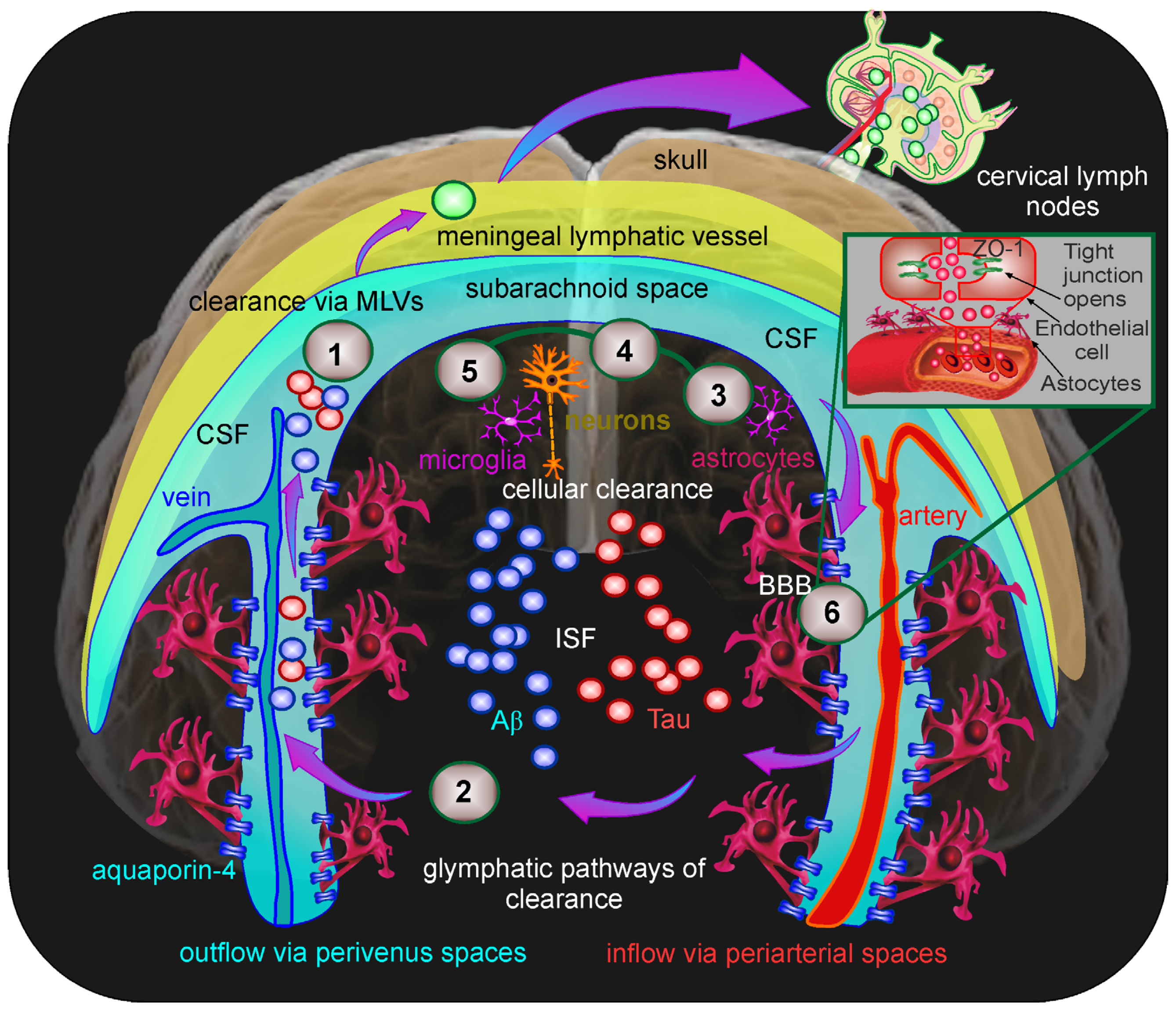
Excessive accumulation of the toxic neuronal metabolite amyloid beta (Aβ) and tau protein in the brain is one of the processes that accompany the development and progression of AD [32,33,34,35,36,37]. Despite the fact that not all forms of cognitive impairment in patients with AD are accompanied by increased Aβ deposition in the brain, new strategies in the pharmacological treatment of AD continue to focus on reducing Aβ levels in the brain [35,37,38]. It is interesting to note that Aβ was first discovered in the meninges of patients with AD [39]. Aβ is a product of the vital activity of neurons, which play a crucial role in the regulation of brain homeostasis [40,41]; it is formed daily and quite intensively (one molecule per second in each neuron) [42]. This means that there must be mechanisms for the effective removal of Aβ from the brain [43,44]. Indeed, it has been established that approximately 8% of the dissolved form of Aβ is removed from the brain per hour [45]. There are various mechanisms of clearance of Aβ from the brain (Figure 1). After production, Aβ is secreted into the extracellular space and undergoes enzymatic degradation [46,47,48] or internalization via micropinocytosis [49]. Microglia also destroy Aβ by phagocytosis, although neurons and astrocytes can neutralize Aβ [50,51,52,53] (Figure 1, pathways 3–5). The clearance of Aβ via transcytosis and the blood–brain barrier (BBB) through specialized endothelial transporters, including the LDL receptor-related protein-1, is the key mechanism underlying the removal of Aβ from the brain into the bloodstream [54,55] (Figure 1, pathway 6).
It has been shown that factors, such as age, sleep deficit, stress, the SARS-CoV-2 virus, and other factors, may lead to an imbalance between the formation and clearance of Aβ, contributing to the development and progression of AD [4,5,6,7,8,9,10,11,12,13,14,56,57,58,59,60,61,62]. Excessive accumulation of Aβ triggers tau aggregation in neurons [63]. Thus, impaired Aβ clearance leads to increased levels of toxic metabolites, both inside and outside the neurons.
However, very little is known about how Aβ is eliminated from the brain via the lymphatic pathways. As noted above, Aβ was first detected in homogenates of the meninges of patients with AD [39]. In 2018, Da Mesquita et al. presented results on mouse 5xFAD, indicating the important role of MLVs in the elimination of Aβ [28] (Figure 1, pathway 1). This work clearly demonstrated that destruction of MLVs by photoablation leads to impaired lymphatic elimination of Aβ and its excessive deposition in the hippocampus and cerebral cortex, which was accompanied by a deterioration in the cognitive abilities of mice [28]. However, in immunohistological studies of the meninges of the brains of people with AD using confocal microscopy, Aβ was not detected directly in the lumens of MLVs [64]. The authors conclude that this may be due to the limitations of the confocal microscopy method and the small size of the studied area of interest. In another study on mice, Aβ was detected in the lumens of MLVs [65]. However, even if MLVs play the role of “tunnels” in the clearance of Aβ, it remains unclear how Aβ gets into MLVs from the brain tissue, including deep parts, for example, the hippocampus, since the meninges are not a part of the brain tissue.
The cerebral lymphatic vessels (CLVs) could be an obvious bridge connecting the lymphatic system and brain tissue. However, convincing evidence for this has yet to be found. Nevertheless, more and more evidence is being published suggesting that this may prove true. In 1979, Prineas was the first to discover lymphatic capillaries with immune cells in the lumens of the lymphatic vessels in human brains with various neurodegenerative diseases [66]. These results were not widely accepted because they were performed without the use of specific markers for the lymphatic endothelium and on inflamed brains. It is known that tertiary lymphatic structures can appear in the CNS during inflammation [67]. Later in 2023, Mezey et al. described lymphatic structures in healthy human brain using lymphatic endothelial markers, such as the lymphatic vessel endothelial hyaluronan receptor 1, podoplanin [68]. Authors also used Quantitative Polymerase Chain Reaction analysis and found other lymphatic endothelial markers expressed in brain tissue, including prospero homeobox protein 1 and vascular endothelial growth factor receptor 3 [68]. Despite these encouraging results, the authors did not find CLVs with distinct walls and valves. This was achieved by other researchers [69]. However, due to the limitations of using human brain biopsies, their group is still searching for additional and reproducible evidence of the presence of CLVs in the human brain. Note that there are no ideal markers of lymphatic endothelial cells in the human brain. Furthermore, human brain samples cannot be taken immediately, unlike those of animals, due to rules surrounding the certification of brain death, which requires a minimum of 2–3 h for confirmation [70]. However, studies in both humans and experimental animals have shown that oxygen stores, global electrical activity, glucose stores in the adenosine triphosphate (ATP), and expression of many proteins in the brain are lost within minutes of interrupted blood flow [71,72]. This explains why the lymphatic vessels have not yet been found in the human brain. The lymphatic vessels are transparent and, unlike the blood vessels, are not always filled with lymph, only when drainage is activated. Furthermore, the brain’s lymphatic system likely has a sparsely branched network, which, along with the need to use a fresh brain, significantly hinders progress in detecting CLVs.
There are other outstanding studies on mice, in which the authors use the term “brain lymphatic vessels” and demonstrate results with the expression of key lymphatic endothelial markers [73]. However, the authors show the brain lymphatic vessels descending from top to bottom, which could be an error in their interpretation of the data, since the meninges are quite deep in the brain tissue and are rich in the region of the middle meningeal artery, as was recently proven in the work of Albayram et al. [74].
Thus, a new player in neuroscience may soon emerge in the form of CLVs, logically resolving the main mechanisms of drainage and clearance.
It is worth noting that the discovery of MLVs has been a two-century-long story. This is due to dogmatic notions in science and the lack of reliable methods for studying the transparent lymphatic vessels. The young Italian anatomist Paulo Mascagni was the first in the world to describe MLVs, and also about 50% of all human lymphatic vessels [75,76,77,78]. This new understanding of the lymphatic system was a true scientific breakthrough, and his work became a brilliant masterpiece of anatomy. Mascagni was called the Prince of Anatomy. In the late 18th century, the Austrian Emperor Joseph II, while visiting Florence, where Mascagni worked, commissioned wax figures to be housed in the Medical Museum in Vienna, where 28 models of lymphatic drainage of tissues, including the brain meninges, are still on display [79]. Among hundreds of brains, Mascagni was able to detect MLVs filled with mercury in only some meninges [76]. Based on these studies, he created wax figurines of MLVs and the peripheral lymphatic vessels, which are still housed in the Medical Museum Vienna [79]. Despite this breakthrough discovery, it remained unrecognized due to the dogmatic thinking of other authoritative scientists, who believed that MLVs could not exist in the brain and that only Mascagni could see them [79]. In 1953, another Italian anatomist, Lecco, also identified MLVs in 4 of 30 human brain meninges [80]. However, only in 2015 was Mascagni’s discovery widely recognized by the scientific community [16,17].
It is important to note that, in the story of the discovery of MLVs, many names around the world have been underrecognized. Erickson P.P. calls this phenomenon historical amnesia [81]. Indeed, Földi scientists published a large series of papers on the study of MLVs [82,83,84,85,86]. They also published a textbook discussing the neglect of previously published research in the field of MLVs [87]. At the end of the 18th century, William Cruikshank in London (15) also studied MLVs, which he called “absorbents” [88]. Cruikshank described MLVs as absorbents on the surface of the brain, between the arachnoid and pia mater. However, Dutch scientist Ruysch was the first who observed this and called them vasa pseudo-lymphatica [89]. Ruysch was also the first to describe lymphatic valves and the direction of lymphatic flow [89]. The studies of Weed mention lymphatic drainage of CSF, but he does not credit this to MLVs [90,91]. He thought that rout for this drainage is around the cranial nerves, particularly the olfactory branches [91].
Nevertheless, for two centuries, active research has been conducted demonstrating the processes of drainage and active clearance in the brain [92,93]. Weller created the hypothesis that waste products are removed from the brain via CSF flow along perivascular spaces [94]. Later, Morris et al. experimentally confirmed the idea of Aβ removal from brain tissue through structures along the basement membrane of the cerebral blood vessels [95]. Ma showed that 80% of interstitial fluid (ISF) enters the lymphatic system [96]. The different experimental data suggest that high-molecular compounds and cells are removed from the CNS into the cervical lymphatics very quickly [93,94]. Such a process is possible only in the presence of special structures that provide direction for the movement of molecules and cells. It should be noted that in 1998, Chikly proposed, in his review, hypotheses about lymphatic structures in the human brain that could transport waste products, immune cells, and proteins [97]. Thus, the hypothesis of the possible existence of CLVs is based on a number of experimental and clinical facts indicating targeted fluid flows in the CNS that ensure brain drainage and the clearance of metabolites, waste products, and cells.
Since there is no reliable evidence for CLVs yet, the glymphatic hypothesis has emerged to fill the knowledge gap. The glymphatic hypothesis is based on the study of the possible movement of metabolites through the glia and aquaporin-4 channels with the flow of ISF in the direction from the perivascular spaces of the cerebral arteries to those of the veins [98,99] (Figure 1, pathway 2). The term “glymphatic system” means that glia perform the functions of CLVs. However, this hypothesis has been criticized, and doubts have been cast on the leading role of aquaporin-4 channels in driving the movement of brain fluids and the removal of waste products, including Aβ [92,93,100,101,102]. According to this hypothesis, it is impossible to explain how cells and large-molecular compounds, such as proteins, are rapidly cleared from the CNS. Importantly, the movement of tracers and Aβ directly through the glia was not detected. The glymphatic concept is based on the hypothesis of a possible such pathway, which remains to be proven. Nevertheless, the glymphatic hypothesis has contributed better understanding of the mechanisms responsible for the movement of dissolved compounds in ISF in the brain.
Figure 1. Schematic illustration of pathways for the removal of metabolites, such as Aβ and tau, from the brain: (1) Clearance of Aβ and tau through MLVs [28,65]. Since 80% of ISF is thought to be eliminated via the lymphatic route [96], the pathway of elimination of Aβ and tau via MLVs may be the major one; (2) The glymphatic pathway is based on the transfer of metabolites with the flow of ISF through glia and aquaporin-4 channels from the perivascular spaces of arteries to those of veins [98,99]; (3–4–5) Cellular mechanisms of Aβ elimination, including phagocytosis of microglia and its intracellular neutralization by neurons and astrocytes [46,47,48,49,50,51,52,53]; (6) The clearance of Aβ via transcytosis in the BBB components by the specialized endothelial transporters [54,55]; Aβ—Amyloid beta, BBB—Blood-brain barrier, CSF—Cerebral spinal fluid, ISF—Interstitial fluid, MLVs—Meningeal lymphatic vessels, Tau—Tau protein, ZO-1—Zonula Occludens-1.
Ijms 27 02312 g001
Among the various pathways for the clearance of metabolites from the brain, MLVs play a special role. Since 80% of ISF is thought to be eliminated via the lymphatic route [96], it can be hypothesized that the excretion of waste products and toxins via MLVs may be the major route of its clearance (Figure 1, pathway 1). The following facts support this hypothesis. Many studies have shown that MLV damage is accompanied by a reduced removal of various substances from the brain, including Aβ [28,103,104,105,106,107]; blood products, in the case of intraventricular [108], subarachnoid [109] or subdural hemorrhages [110]; and brain fluids after traumatic brain injury [111] or during the progression of brain cancer [112,113].
Today, the study of the role of MLVs in maintaining homeostasis and the development of brain diseases is a rapidly growing and promising area in neuroscience [18,19,20,23,28,103,104,105,106,107,108,109,110,111,112,113,114,115,116,117,118,119,120,121,122,123]. In the context of neurodegenerative diseases, the investigation of age-related changes in the function of MLVs is of particular interest [27,28,103,104,105,124,125,126,127,128]. There is evidence that a decline in the MLVs’ functions and their morphological changes with age are associated with excess Aβ deposition in the brain and cognitive dysfunction [103,104,105,125,126,129,130,131,132].

3. New Pharmacological Strategies for Therapy of AD via Augmentation of Brain Drainage and Clearance

Passive anti-Aβ immunotherapy is based on the use of antibodies, like aducanumab, lecanemab, and donanemab, which are approved by the US Food and Drug Administration (FDA), and aimed at reducing Aβ plaque burden and improving cognitive deficits [133,134,135,136,137,138,139,140,141,142,143,144,145,146,147]. However, despite the fact that this therapy can reduce the Aβ level in the brain and improve cognitive decline, it does not halt AD progression [136,140,142]. The clinical impact of these antibodies is limited by their negative consequences, including cerebral edema and microhemorrhages, as well as by low penetration of antibodies across the blood–brain barrier (BBB) [136,140,142]. Indeed, the data from phase 1 clinical trials using aducanumab, sponsored by Biogen, were published in Nature in 2016 and demonstrated a reduction in cognitive decline [138]. However, in 2019, Biogen (Cambridge, MA, USA) published the results of phase 3 clinical trials (1600 patients with AD participated in each, EMERGE and ENGAGE) with the monoclonal antibody aducanumab and reported microhemorrhage (3.9%, 13 of 334), edema (35.2%, 362 of 1029), headache (48 of 104, 46.6%), confusion (15 of 103, 14.6%), dizziness (11 of 103, 10.7%), and nausea (8 of 103, 8.3%) in participants [141,142]. The situation is similar with lecanemab, for which efficacy and safety remain controversia [143,144,145,146,147]. For this antibody, adverse events, including infusion-related reactions, edema, intracranial hemorrhages, and even death, have been reported [144,147].
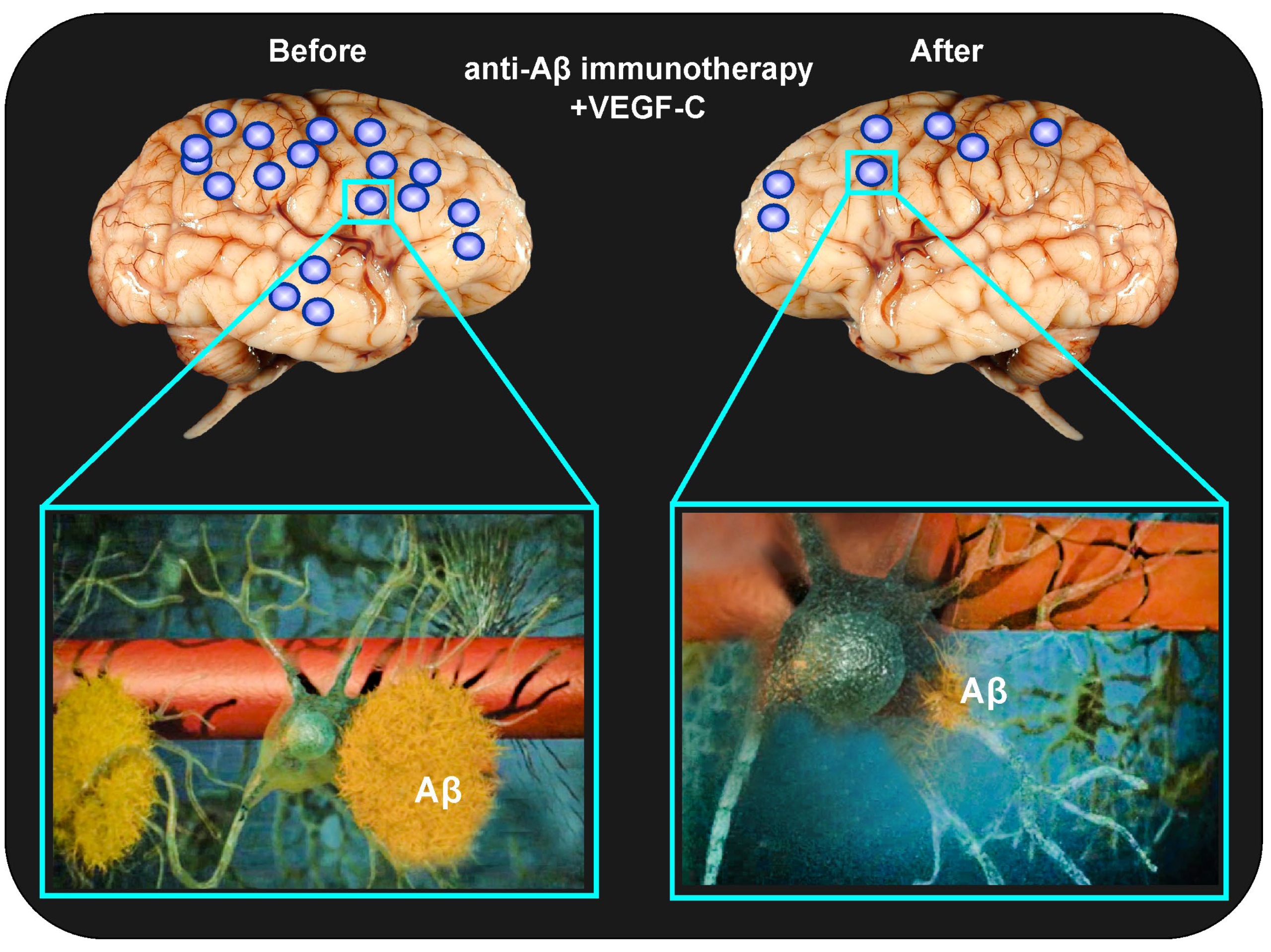
Despite the failure of clinical trials, passive anti-Aβ immunotherapy for AD has recently gained new, promising avenues thanks to a proposed strategy of combining it with the pharmacological activation of MLV functions [21,37] (Figure 2). Indeed, Da Mesquita et al. proposed a combined method of anti-Aβ immunotherapy with intrathecal administration of the vascular endothelial growth factor C (VEGF-C) for activation of lymphangiogenesis [37]. The authors clearly demonstrate that impaired MLV functions in 5xFAD male mice with AD influence the inflammatory response of the microglia, and that the stimulation of the growth of new MLVs significantly improves Aβ clearance, which can contribute to the improvement of anti-Aβ immunotherapy and better clinical outcomes [37]. It is interesting to note that the use of combined immunotherapy with VEGF-C for the treatment of glioblastoma has also been shown to be promising [112,113].
However, the meningeal lymphatic network has no anatomical connection with the blood vessels, meaning that VEGF-C cannot be used to stimulate MLVs through oral administration or by intravenous/intramuscular injection. This explains why VEGF-C was administered through the cisterna magna in Da Mesquita’s study [37]. Obviously, this method of treatment with VEGF-C is highly invasive, which significantly limits its widespread use in everyday clinical practice. However, it is possible that clinically promising methods for temporarily and safely increasing BBB permeability, such as loud music, focal ultrasound, transcranial laser treatment, or intranasal delivery, combined with lymphatic photostimulation, can improve the passage of VEGF-C into the brain tissue [148,149,150,151,152,153,154,155].
Other promising pharmacological approaches include the stimulation of aquaporin-4 channel functions. Since the aquaporin-4 channels are involved in the regulation of brain drainage, new approaches to AD therapy based on stimulation of their expression using adeno-associated virus have recently been proposed [156,157]. Indeed, it has been established in transgenic mice that the absence of aquaporin-4 channels leads to excessive accumulation of Aβ and the suppression of its lymphatic removal from the brain, while increasing their expression significantly improves the removal of Aβ from the CNS, which in turn contributes to improved memory and cognitive function [156,157].
Despite the fact that pharmacological therapy is a cornerstone of medicine, progress in the development of new drugs for the treatment of brain diseases is very slow due to the difficulties in overcoming the BBB [158,159].
Note that the creation of new drugs is a long, expensive (over $1–2 billion for each new medication), and high-risk process that takes approximately 10–15 years [160,161]. Furthermore, 90% of clinical trials of new drugs fail [161]. Therefore, the development of promising non-pharmacological approaches for the treatment of brain diseases, including AD, is a high priority in medicine.

4. Promising Non-Pharmacological Approaches for Therapy of AD Based on Stimulation of Brain Drainage and Clearance

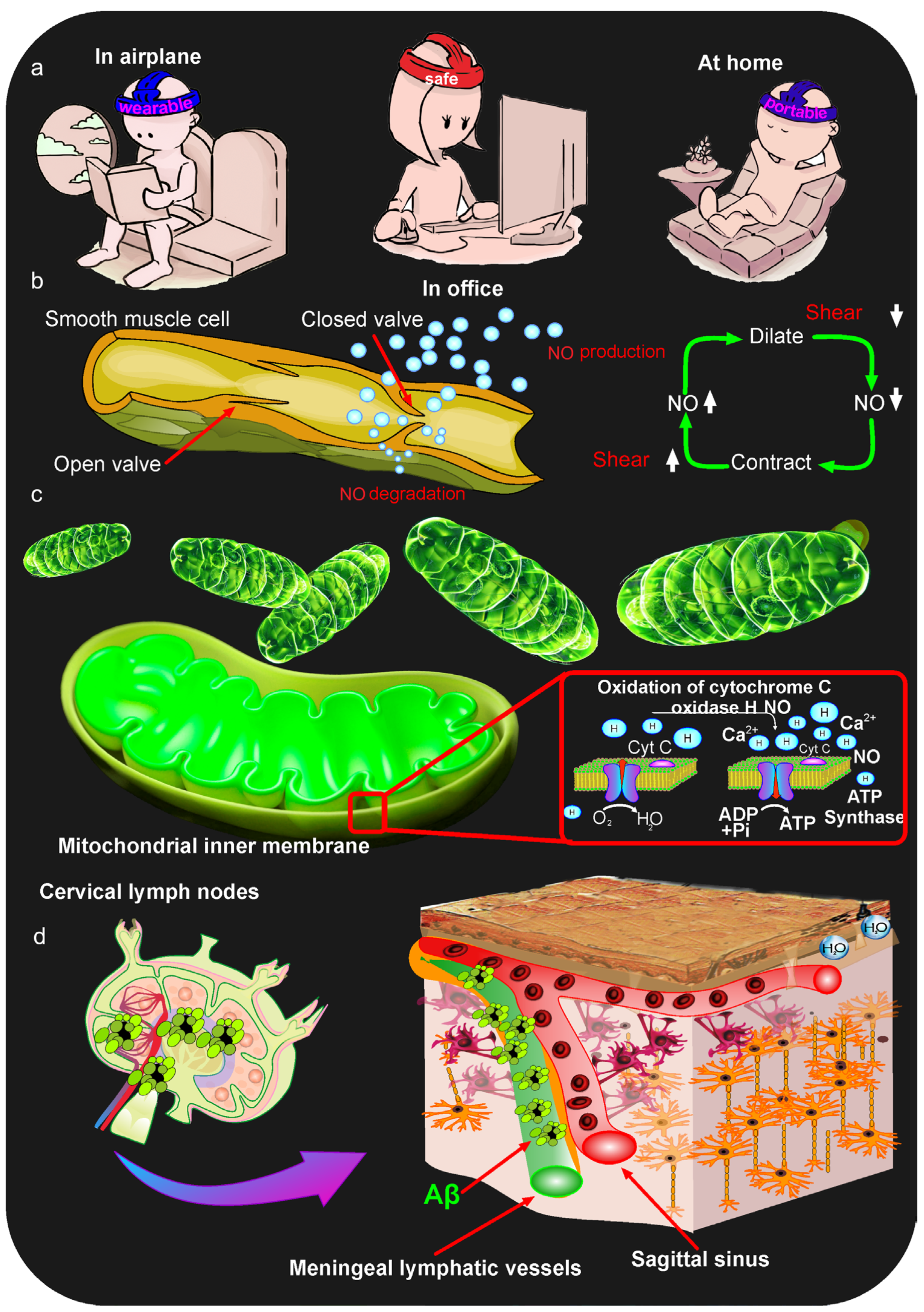
MLVs are located in the meninges directly beneath the skull, making them an ideal target for photobiomodulation (PBM). Transcranial PBM is an effective, non-invasive alternative treatment for brain disorders, including AD, Parkinson’s, TBI, and depression [29,30,108,162,163,164,165,166,167,168]. PBM utilizes light within a therapeutic window, with wavelengths ranging from 800 to 1300 nm [163,167,168]. Light passing through the skull is largely scattered and absorbed by tissue and fluids, but the portion of the energy that reaches the brain exerts a therapeutic effect on its functions. For many years, it was traditionally believed that the therapeutic effects of light are based on its activating effect on light-sensitive structures, such as the cytochrome C oxidase [163,168]. This mitochondrial enzyme, in turn, triggers the synthesis of the ATP energy molecule and the production of vasorelaxant nitric oxide (NO) [104,108,163,168,169,170]. Thus, low-intensity light exposure is capable of triggering two integral recovery mechanisms in the brain, including an increase in neuronal energy and microcirculation, along with the necessary oxygen supply for these processes (Figure 3c).
However, PBM-dependent increases in neuronal energy and microcirculation are important but nonspecific factors in the process of nerve tissue regeneration. In other words, the scientific concept of phototherapy mechanisms has long lacked an understanding of the specific target of the light. Explanations of PBM’s therapeutic effects have been limited to molecular processes, without understanding their relationship with the systemic mechanisms of neural regeneration.
Recently, the phenomenon of the transcranial stimulation of the MLV functions and brain drainage in mice using wavelengths capable of generating singlet oxygen in pulsed mode was discovered [25,26,29,30,31,65,103,104,105,108,125,171,172,173,174,175,176]. We discuss photostimulation of MLVs by singlet oxygen in detail in our previous reviews [29,30,31]. Rafailov’s research group proves in their research that light with maximum effects at wavelengths of 1267 and 1064 nm is capable of stimulating the direct generation of singlet oxygen [177,178]. Blazquez-Castro demonstrates the entire spectrum of wavelengths (1267–1065–920–810–760–690–627–580 nm) that, by decaying in this range, can stimulate the direct formation of singlet oxygen in biological tissues [179]. Considering that light is strongly scattered and absorbed when passing through the skull, the most promising wavelengths for stimulation of MLVs are 1267 nm and 1065 nm, which produce the greatest effects in terms of singlet oxygen formation. Experiments in mice show the results of pilot studies demonstrating that light with wavelengths capable of stimulating direct singlet oxygen generation also effectively stimulates MLVs [176]. Wavelengths that are incapable of stimulating direct singlet oxygen generation do not significantly affect MLVs and brain drainage [176].
Because MLVs are located under the skull, light easily reaches their network, even with energy loss, and stimulates their functions (Figure 3d). Photostimulation of MLVs is a rapidly growing and promising field, known as neurolymphophotonics [30].
The first animal studies in this area were conducted in 2020 using a 1267 nm laser [174,175,176]. This next-generation laser is capable of stimulating the production of singlet oxygen in low concentrations [175,177,178,179]. Previously, it was believed that the generation of singlet oxygen in tissues was only possible with the use of photosensitizers. However, numerous in vitro and in vivo animal studies have demonstrated that the 1267 nm laser directly stimulates singlet oxygen production, including in neurons [175,177,178,179].
A series of experiments on rodents allowed for the study in detail of the mechanisms underlying the photostimulation of MLVs and brain drainage [65,103,104,105,108,125,173,174]. In vivo studies using two-photon microscopy and optical coherence tomography revealed that PBM activates the contractility of the lymphatic vessels, which underlie increased drainage and clearance in the brain [104,108] (Figure 3b). Interestingly, local transcranial photoexposure is accompanied by a systemic response in the lymphatic vessels. Thus, PBM of MLVs in rodents leads to increased contractility of the cervical lymphatic vessels that drain CSF from the brain to the deep cervical lymph nodes, which is clearly related to the anatomical and functional relationship between MLVs and the peripheral lymphatic system [104,108].
Several animal studies have demonstrated that the increased contractility of the lymphatic vessels in response to PBM leads to the effective removal of Aβ, blood products, and a number of studied tracers [104,108]. The key mechanism of the photoactivation of lymphatic vessel contractility is the PBM-dependent increase in the NO production in the lymphatic endothelium [104,108] (Figure 3b). NO is traditionally believed to be a vasorelaxant and dilates the blood vessels [180,181,182]. However, with regard to the lymphatic vessels, the situation is different. In the lymphatic vessels, 50% of the NO synthase is synthesized in the valves [183]. This underlies the physiological significance of the regulation of lymphatic vessel contractility [183,184,185]. Indeed, NO is released predominantly in the valves and enters locally into the lumen of the lymphatic vessel, causing its dilation and the stretching of its walls. Due to its short lifespan, NO is destroyed. However, the dilation of the lymphatic vessel leads to the development of shear stress, triggering the release of calcium (Ca2+) from its depots, which leads to the contraction of this portion of the lymphatic vessel (Figure 3b). This is the mechanism of peristaltic contractility in the lymphatic vessels [183,184,185]. During relaxation, the valve from which NO was released is open; during contraction, it closes, preventing the backflow of lymph [183,184,185] (Figure 3b). NO also leads to an increased permeability of the local portion of the lymphatic vessel due to a temporary decrease in the expression of tight junction proteins [176]. This promotes increased tissue drainage due to the flow of ISF into the lumen of the lymphatic vessels.
Sleep has been shown to be a natural period for activating brain drainage and clearance [186,187]. Based on this phenomenon, a new approach has been proposed of using phototherapy for brain diseases during sleep to enhance the therapeutic effects of PBM [25,26,65,125,188,189,190,191,192,193]. Indeed, PBM is ineffective in aging brains presumably due to the aging of MLVs and their morphological changes [104,105]. However, applying PBM during sleep significantly increases its effectiveness in aged mice, improving their memory and cognitive abilities [125]. PBM during sleep was found to be better than during wakefulness for activating drainage and removing metabolites such as Aβ, tau, lactate, glucose, and glutamate from the mouse brain [125]. A course of PBM during sleep has been shown to promote more rapid restoration of the damaged MLV network [65].
It is discussed that systemic responses to photostimulation of MLVs in mice is associated with an improvement of memory and cognitive function leading to the activation of brain drainage, which can contribute to optimization of the neuronal microenvironment, synaptic contacts, and neurotransmitter release [30,125].
Various animal experiments have shown that PBM-mediated MLV stimulation is effective not only for the treatment of AD but also for other brain diseases, including intraventricular hemorrhages [108], metabolic or age-related brain damage [103,104,105,194], and even cancer [195,196].
PBM of MLVs is a clinically promising approach [25,26,29,30,197]. The FDA recognizes PBM technologies as safe, and they are already used in clinical practice, and even at home [25,163,167]. Technically, PBM devices can easily be made portable, using readily available and inexpensive materials, making them both modern and commercially viable [30,198]. Thus, PBM of MLVs is a highly promising approach to advancing the treatment of brain diseases, including neurodegenerative pathologies. It should be noted that all results studying the mechanisms of PBM’s stimulating effects on MLVs were obtained in animals, which requires further verification in clinical trials to confirm the therapeutic significance of PBM. Currently, a portable medical device for phototherapy of AD through PBM-mediated activation of the MLV functions is being tested in a pilot clinical trial (Figure 3a).
Another noninvasive approach to increasing brain drainage and clearance is physical exercise [199,200,201,202,203]. A Korean group developed a specialized algorithm Aladdin for the analysis of lymph flow in MLVs using magnetic resonance imaging [204]. Later, using this algorithm, they found that physical exercise on a bicycle ergometer increases the lymph flow in the glymphatic system [200]. Other similar studies have also shown that a lifestyle with sufficient sleep and physical exercise promotes the efficient functioning of the glymphatic system [201]. Similar results have been obtained in animals, indicating that physical exercise promotes an increase in the expression of aquaporin-4 channels, which underlie the mechanisms of the glymphatic system [202,203].
Manual lymphatic drainage is another promising approach for a gentle and specialized massage technique designed to reduce swelling (lymphedema) by stimulating the lymphatic system to move excess fluid from tissues into working lymphatic vessels. It uses light, rhythmic, circular motions to move skin, primarily for treating post-surgical recovery, chronic conditions, and general wellness [205,206]. However, massage may not be sufficient for MLVs due to their location beneath the skull. Therefore, acupuncture of specific areas, such as the Feng Chi (Gallbladder 20, GB 20), may be an additional and alternative method for stimulating lymphatic drainage and brain clearance [207].
Erhardt et al. demonstrates that breathing by dilute carbon dioxide, which dilates the cerebral blood vessels, could also increase CSF flow for a short period in older adults and people with Parkinson’s disease [208]. The authors suggest that this method may also stimulate the clearance of metabolites from the brain.
Sound can also stimulate brain drainage. So, brain stimulation by sound 40 Hz promotes both neural activity in multiple brain regions and activation of the influx of CSF and the efflux of ISF in the cortex of the 5xFAD mouse model of AD [209].
Recently, the deep cervical lymphatic-vein anastomosis surgery was proposed as the new direction for invasive AD treatment [210,211,212,213]. The surgical design is a shunt that reconstructs the deep cervical lymphatic system by anastomosing it with adjacent veins, thereby gradually decreasing the accumulation of metabolic proteins in the brain (such as Aβ, Tau, and α-synuclein), and improving and alleviating the symptoms of AD [210,211,212,213].
The innovative approaches for stimulation of brain drainage and clearance in detail are discussed in the following recent reviews [214,215,216].

5. Conclusions

Overall, MLVs are a promising target for the development of both new pharmacological and non-pharmacological treatment strategies for brain diseases associated with suppressed brain drainage and clearance. This review is limited to a discussion of new approaches for the stimulation of the MLV functions, primarily for the treatment of AD. This is because pioneering methods in this area have been proposed for the treatment of AD [28,30]. Since this is a new, promising, and rapidly growing field, approaches based on MLV stimulation will clearly be much broader, as the important role of MLV dysfunction in the development of traumatic brain injury [111], Parkinson’s disease [217], intracranial hemorrhages [108,109,110], and brain cancer [112,113] has already been established.
Impaired glucose metabolism in the brain is considered a leading mechanism in the development of AD, which is called Type 3 Diabetes [218,219,220,221]. This review discusses the pilot results on the photostimulation of MLVs to maintain brain metabolic homeostasis during elevated brain glucose levels [92]. This area of research requires special, detailed attention, given the growing number of people with brain injuries caused by diabetes [222,223,224].
An important aspect is the development of innovative wearable and portable technologies for PBM of MLVs [26,30,198]. The pilot clinical trial of photostimulation of the meninges for the treatment of AD is currently underway, using a wearable device that can be used at home, on a plane, or in the office (The registration number is 17491 from 27 February 2025, https://roszdravnadzor.gov.ru, accessed on 21 January 2026) (Figure 3a).
Of interest is the discussion of breakthrough photo-technologies for non-invasive stimulation of the MLV’s functions, including the choice of light source, wavelength, intensity of exposure, advantages and disadvantages (for example, its ineffectiveness in elderly patients over 75 years of age [125,225,226,227]) of this method, as well as its charging devices [26,30,198].
The topic of overcoming the BBB for VEGF-C in order to stimulate lymphangiogenesis to improve anti-Aβ immunotherapy of AD requires attention. The following reviews present modern approaches to drug delivery to the brain [228,229,230].

Author Contributions

Conceptualization and supervision, O.S.-G. and J.K.; writing—original draft preparation, O.S.-G., V.S., M.P., S.D., L.R., I.M., L.Y.; writing—review and editing, O.S.-G. All authors have read and agreed to the published version of the manuscript.

Funding

O.S.-G. was supported by the RSF grant No. 23-75-30001 and V.S. was supported by the RSF grant No. 24-75-10047; J.K. was supported by Research start-up funds for introduced talents of the Fudan University (IDH2315001 Y).

Data Availability Statement

No new data were created or analyzed in this study. Data sharing is not applicable.

Acknowledgments

We thank our designer Elena Saranseva for preparing the figures for our manuscript.

Conflicts of Interest

Author Sergey Diduk was employed by the company Leeners LLC. The remaining authors declare that the research was conducted in the absence of any commercial or financial relationships that could be construed as a potential conflict of interest.

Abbreviations

The following abbreviations are used in this manuscript:
Amyloid beta
ADAlzheimer’s disease
ATPAdenosine triphosphate
BBBBlood-Brain Barrier
Ca2+Calcium
ISFInterstitial fluid
MLVsMeningeal lymphatic vessels
NONitric oxide
CLVsCerebral lymphatic vessels
CSFCerebral spinal fluid
CNSCentral nervous system
PBMPhotobiomodulation

References

  1. Alzheimer’s Association. 2025 Alzheimer’s disease facts and figures. Alzheimer’s Dement. 2025, 21, e70235. [Google Scholar]
  2. GBD 2019 Dementia Forecasting Collaborators. Estimation of the global prevalence of dementia in 2019 and forecasted prevalence in 2050: An analysis for the Global Burden of Disease Study 2019. Lancet Public Health 2022, 7, e105–e125. [CrossRef]
  3. Vejandla, B.; Savani, S.; Appalaneni, R.; Veeravalli, R.; Gude, S. Alzheimer’s Disease: The Past, Present, and Future of a Globally Progressive Disease. Cureus 2024, 16, e51705. [Google Scholar] [CrossRef] [PubMed]
  4. Alzheimer’s Association. 2023 Alzheimer’s disease facts and figures. Alzheimer’s Dement. 2023, 19, 1598–1695. [Google Scholar]
  5. Shan, D.; Xu, Y.; Yang, C.; Crawford, T.; Holland, C. COVID-19 infection associated with increased risk of new-onset vascular dementia in adults ≥ 50 years. npj Dement. 2025, 1, 28. [Google Scholar] [CrossRef]
  6. Shan, D.; Li, S.; Xu, R.; Nie, G.; Xie, Y.; Han, J.; Gao, X.; Zheng, Y.; Xu, Z.; Dai, Z. Post-COVID-19 human memory impairment: A PRISMA-based systematic review of evidence from brain imaging studies. Front. Aging Neurosci. 2022, 14, 1077384. [Google Scholar] [CrossRef]
  7. Taquet, M.; Sillett, R.; Zhu, L.; Mendel, J.; Camplisson, I.; Dercon, Q.; Harrison, P. Neurological and psychiatric risk trajectories after SARS-CoV-2 infection: An analysis of 2-year retrospective cohort studies including 1 284 437 patients. Lancet Psychiatry 2022, 9, 815–827. [Google Scholar] [CrossRef]
  8. Charnley, M.; Islam, S.; Bindra, G.; Engwirda, J.; Ratcliffe, J.; Zhou, J.; Mezzenga, R.; Hulett, M.; Han, K.; Berryman, J.; et al. Neurotoxic amyloidogenic peptides in the proteome of SARS-CoV-2: Potential implications for neurological symptoms in COVID-19. Nat. Commun. 2022, 13, 3387. [Google Scholar] [CrossRef] [PubMed]
  9. Wang, L.; Davis, P.; Volkow, N.; Berger, N.; Kaelber, D.; Xu, R. Association of COVID-19 with New-Onset Alzheimer’s Disease. J. Alzheimer’s Dis. 2022, 89, 411–414. [Google Scholar] [CrossRef]
  10. Liu, N.; Jiang, X.; Li, H. The viral hypothesis in Alzheimer’s disease: SARS-CoV-2 on the cusp. Front. Aging Neurosci. 2023, 15, 1129640. [Google Scholar] [CrossRef]
  11. Navolokin, N.; Adushkina, V.; Zlatogorskaya, D.; Telnova, V.; Evsiukova, A.; Vodovozova, E.; Eroshova, A.; Dosadina, E.; Diduk, S.; Semyachkina-Glushkovskaya, O. Promising Strategies to Reduce the SARS-CoV-2 Amyloid Deposition in the Brain and Prevent COVID-19-Exacerbated Dementia and Alzheimer’s Disease. Pharmaceuticals 2024, 17, 788. [Google Scholar] [CrossRef]
  12. Hoang, M.T.; Wastesson, J.W.; Szilcz, M.; Maura, G.; Blotière, P.; Johnell, K. Impact of dementia on risks of COVID-19 infection and outcomes among older adults in Sweden. BMC Geriatr. 2025, 25, 843. [Google Scholar] [CrossRef] [PubMed]
  13. Crivelli, L.; Winkler, A.; Keller, G.; Beretta, S.; Calandri, I.L.; De Groote, W.; Fornari, A.; Frontera, J.; Kivipelto, M.; Lopez-Rocha, A.S.; et al. Impact of COVID-19 on functional, cognitive, neuropsychiatric, and health-related outcomes in patients with dementia: A systematic review. eNeurologicalSci 2025, 38, 100539. [Google Scholar] [CrossRef]
  14. Zhu, Y.; Yu, P.; Li, W.; Beretta, S.; Calandri, I.; De Groote, W.; Fornari, A.; Frontera, J.; Kivipelto, M.; Lopez-Rocha, A.; et al. COVID-19 and Its Influence on Prevalence of Dementia and Agitation in Australian Residential Aged Care: A Comparative Study. Psychiatry Int. 2024, 5, 642–659. [Google Scholar] [CrossRef]
  15. Frontera, J.A.; Yang, D.; Lewis, A.; Patel, P.; Medicherla, C.; Arena, V.; Fang, T.; Andino, A.; Snyder, T.; Madhavan, M.; et al. A prospective study of long-term outcomes among hospitalized COVID-19 patients with and without neurological complications. J. Neurol. Sci. 2021, 426, 117486. [Google Scholar] [CrossRef]
  16. Louveau, A.; Smirnov, I.; Keyes, T.; Eccles, J.; Rouhani, S.; Peske, J.; Derecki, N.; Castle, D.; Mandell, J.; Lee, K.; et al. Structural and functional features of central nervous system lymphatic vessels. Nature 2015, 523, 337–341, Erratum in Nature 2016, 533, 278. [Google Scholar] [CrossRef]
  17. Aspelund, A.; Antila, S.; Proulx, S.; Karlsen, T.; Karaman, S.; Detmar, M.; Wiig, H.; Alitalo, K. A dural lymphatic vascular system that drains brain interstitial fluid and macromolecules. J. Exp. Med. 2015, 212, 991–999. [Google Scholar] [CrossRef]
  18. Guo, X.; Zhang, G.; Peng, Q.; Huang, L.; Zhang, Z.; Zhang, Z. Emerging Roles of Meningeal Lymphatic Vessels in Alzheimer’s Disease. J. Alzheimer’s Dis. 2023, 94, S355–S366. [Google Scholar] [CrossRef]
  19. Chachaj, A.; Gąsiorowski, K.; Szuba, A.; Sieradzki, A.; Leszek, J. The Lymphatic System in the Brain Clearance Mechanisms—New Therapeutic Perspectives for Alzheimer’s Disease. Curr. Neuropharmacol. 2023, 21, 380–391. [Google Scholar] [CrossRef] [PubMed]
  20. Yamada, K.; Iwatsubo, T. Involvement of the glymphatic/meningeal lymphatic system in Alzheimer’s disease: Insights into proteostasis and future directions. Cell Mol. Life Sci. 2024, 81, 192. [Google Scholar] [CrossRef] [PubMed]
  21. Ding, J.; Zhao, C.; Hao, X.; Jiao, H. Glymphatic and meningeal lymphatic dysfunction in Alzheimer’s disease: Mechanisms and therapeutic perspectives. Alzheimer’s Dement. 2025, 21, e70709. [Google Scholar] [CrossRef]
  22. Huang, S.; Zhang, Y.; Guo, Y.; Du, J.; Ren, P.; Wu, B.; Feng, J.; Alzheimer’s Disease Neuroimaging Initiative; Cheng, W.; Yu, J. Glymphatic system dysfunction predicts amyloid deposition, neurodegeneration, and clinical progression in Alzheimer’s disease. Alzheimer’s Dement. 2024, 20, 3251–3269. [Google Scholar] [CrossRef]
  23. Zhang, Q.; Niu, Y.; Li, Y.; Xia, C.; Chen, Z.; Chen, Y.; Feng, H. Meningeal lymphatic drainage: Novel insights into central nervous system disease. Signal Transduct. Target. Ther. 2025, 10, 142. [Google Scholar] [CrossRef]
  24. Xiao, M.; Marshall, C.; Yin, K. Glymphatic-meningeal lymphatic system, a new therapeutic target for sleep disorders. Neuroscience 2025, 585, 206–212. [Google Scholar] [CrossRef]
  25. Semyachkina-Glushkovskaya, O.; Penzel, T.; Poluektov, M.; Fedosov, I.; Tzoy, M.; Terskov, A.; Blokhina, I.; Sidorov, V.; Kurths, J. Phototherapy of Alzheimer’s Disease: Photostimulation of Brain Lymphatics during Sleep: A Systematic Review. Int. J. Mol. Sci. 2023, 24, 10946. [Google Scholar] [CrossRef] [PubMed]
  26. Semyachkina-Glushkovskaya, O.; Fedosov, I.; Penzel, T.; Li, D.; Yu, T.; Telnova, V.; Kaybeleva, E.; Saranceva, E.; Terskov, A.; Khorovodov, A.; et al. Brain Waste Removal System and Sleep: Photobiomodulation as an Innovative Strategy for Night Therapy of Brain Diseases. Int. J. Mol. Sci. 2023, 24, 3221. [Google Scholar] [CrossRef] [PubMed]
  27. Jiang, H.; Wei, H.; Zhou, Y.; Xiao, X.; Zhou, C.; Ji, X. Overview of the meningeal lymphatic vessels in aging and central nervous system disorders. Cell Biosci. 2022, 12, 202. [Google Scholar] [CrossRef] [PubMed]
  28. Da Mesquita, S.; Louveau, A.; Vaccari, A.; Smirnov, I.; Cornelison, R.; Kingsmore, K.; Contarino, C.; Onengut-Gumuscu, S.; Farber, E.; Raper, D.; et al. Functional aspects of meningeal lymphatics in ageing and Alzheimer’s disease. Nature 2018, 560, 185–191, Erratum in Nature 2018, 564, E7. [Google Scholar] [CrossRef]
  29. Lin, H.; Li, D.; Zhu, J.; Li, J.; Yu, T.; Tuchin, V.; Semyachkina-Glushkovskaya, O.; Zhu, D. Transcranial photobiomodulation for brain diseases: Review of animal and human studies including mechanisms and emerging trends. Neurophotonics 2024, 11, 010601. [Google Scholar] [CrossRef]
  30. Liu, S.; Semyachkina-Glushkovskaya, O.; Yu, T.; Ilukov, E.; Rafailov, E.; Sokolovski, S.; Kurths, J.; Zhu, D. Neuro-lymphaphotonics opens new horizons of the future technologies for the therapy of brain diseases. Theranostics 2026, 16, 776–793. [Google Scholar] [CrossRef]
  31. Dremin, V.; Semyachkina-Glushkovskaya, O.; Rafailov, E. Direct Laser-Induced Singlet Oxygen in Biological Systems: Application From in Vitro to in Vivo. IEEE J. Sel. Top. Quantum Electron. 2023, 29, 7200911. [Google Scholar] [CrossRef]
  32. Hampel, H.; Hardy, J.; Blennow, K.; Chen, C.; Perry, G.; Kim, S.; Villemagne, V.; Aisen, P.; Vendruscolo, M.; Iwatsubo, T.; et al. The Amyloid-β Pathway in Alzheimer’s Disease. Mol. Psychiatry 2021, 26, 5481–5503. [Google Scholar] [CrossRef]
  33. Kang, J.; Lemaire, H.G.; Unterbeck, A.; Salbaum, J.; Masters, C.; Grzeschik, K.; Multhaup, G.; Beyreuther, K.; Müller-Hill, B. The precursor of Alzheimer’s disease amyloid A4 protein resembles a cell-surface receptor. Nature 1987, 325, 733–736. [Google Scholar] [CrossRef]
  34. Cras, P.; Kawai, M.; Lowery, D.; Gonzalez-DeWhitt, P.; Greenberg, B.; Perry, G. Senile plaque neurites in Alzheimer disease accumulate amyloid precursor protein. Proc. Natl. Acad. Sci. USA 1991, 88, 7552–7556. [Google Scholar] [CrossRef] [PubMed]
  35. Selkoe, D.J.; Hardy, J. The amyloid hypothesis of Alzheimer’s disease at 25 years. EMBO Mol. Med. 2016, 8, 595–608. [Google Scholar] [CrossRef] [PubMed]
  36. Stevens, D.A.; Workman, C.I.; Kuwabara, H.; Butters, M.; Savonenko, A.; Nassery, N.; Gould, N.; Kraut, M.; Joo, J.; Kilgore, J.; et al. Regional amyloid correlates of cognitive performance in ageing and mild cognitive impairment. Brain Commun. 2022, 4, fcac016. [Google Scholar] [CrossRef] [PubMed]
  37. Da Mesquita, S.; Papadopoulos, Z.; Dykstra, T.; Brase, L.; Farias, F.; Wall, M.; Jiang, H.; Kodira, C.; de Lima, K.; Herz, J.; et al. Meningeal lymphatics affect microglia responses and anti-Aβ immunotherapy. Nature 2021, 593, 255–260. [Google Scholar] [CrossRef]
  38. Jagust, W.J.; Teunissen, C.E.; DeCarli, C. The complex pathway between amyloid β and cognition: Implications for therapy. Lancet Neurol. 2023, 22, 847–857. [Google Scholar] [CrossRef]
  39. Joachim, C.L.; Duffy, L.K.; Morris, J.H.; Selkoe, D.J. Protein chemical and immunocytochemical studies of meningovascular β-amyloid protein in Alzheimer’s disease and normal aging. Brain Res. 1988, 474, 100–111. [Google Scholar] [CrossRef]
  40. Schreiner, T.G.; Schreiner, O.D.; Adam, M.; Popescu, B.O. The Roles of the Amyloid Beta Monomers in Physiological and Pathological Conditions. Biomedicines 2023, 11, 1411. [Google Scholar] [CrossRef]
  41. Jeong, H.; Shin, H.; Hong, S.; Kim, Y. Physiological Roles of Monomeric Amyloid-β and Implications for Alzheimer’s Disease Therapeutics. Exp. Neurobiol. 2022, 31, 65–88. [Google Scholar] [CrossRef]
  42. Moghekar, A.; Rao, S.; Li, M.; Ruben, D.; Mammen, A.; Tang, X.; O’Brien, R. Large quantities of Abeta peptide are constitutively released during amyloid precursor protein metabolism in vivo and in vitro. J. Biol. Chem. 2011, 286, 15989–15997. [Google Scholar] [CrossRef] [PubMed]
  43. Yin, K.J.; Cirrito, J.R.; Yan, P.; Hu, X.; Xiao, Q.; Pan, X.; Bateman, R.; Song, H.; Hsu, F.; Turk, J. Matrix metalloproteinases expressed by astrocytes mediate extracellular amyloid-beta peptide catabolism. J. Neurosci. 2006, 26, 10939–10948. [Google Scholar] [CrossRef] [PubMed]
  44. Crouch, P.J.; Harding, S.M.; White, A.R.; Camakaris, J.; Bush, A.; Masters, C. Mechanisms of A beta-mediated neurodegeneration in Alzheimer’s disease. Int. J. Biochem. Cell Biol. 2008, 40, 181–198. [Google Scholar] [CrossRef] [PubMed]
  45. Bateman, R.J.; Munsell, L.Y.; Morris, J.C.; Swarm, R.; Yarasheski, K.E.; Holtzman, D.M. Human amyloid-beta synthesis and clearance rates as measured in cerebrospinal fluid in vivo. Nat. Med. 2006, 12, 856–861. [Google Scholar] [CrossRef]
  46. Iwata, N.; Tsubuki, S.; Takaki, Y.; Shirotani, K.; Lu, B.; Gerard, N.; Gerard, C.; Hama, E.; Lee, H.; Saido, T. Metabolic regulation of brain Abeta by neprilysin. Science 2001, 292, 1550–1552. [Google Scholar] [CrossRef]
  47. Żukowska, J.; Moss, S.J.; Subramanian, V.; Acharya, K.R. Molecular basis of selective amyloid-β degrading enzymes in Alzheimer’s disease. FEBS J. 2024, 291, 2999–3029. [Google Scholar] [CrossRef]
  48. Cerasuolo, M.; Auriemma, M.C.; Di Meo, I.; Lenti, C.; Papa, M.; Paolisso, G.; Rizzo, M. Understanding the Insulin-Degrading Enzyme: A New Look at Alzheimer’s Disease and Aβ Plaque Management. Int. J. Mol. Sci. 2025, 26, 6693. [Google Scholar] [CrossRef]
  49. Nazere, K.; Takahashi, T.; Hara, N.; Muguruma, K.; Nakamori, M.; Yamazaki, Y.; Morino, H.; Maruyama, H. Amyloid Beta Is Internalized via Macropinocytosis, an HSPG- and Lipid Raft-Dependent and Rac1-Mediated Process. Front. Mol. Neurosci. 2022, 15, 804702. [Google Scholar] [CrossRef]
  50. Wang, Y.; Wang, Z.; Liu, Z.; Li, J.; Yang, S.; Zhao, Y.; Huang, Y.; Liao, C.; Zhang, Y.; Zhao, J.; et al. Targeting phagocytosis for amyloid-β clearance: Implications of morphology remodeling and microglia activation probed by bifunctional chimaeras. Nat. Commun. 2025, 16, 8128, Erratum in Nat. Commun. 2025, 16, 10066. [Google Scholar] [CrossRef]
  51. Hassan, H.; Rawlinson, C.; Lan, Y.-L.; Jenkins, S.; Chen, R. Microglia-Mediated Phagocytosis in Alzheimer’s Disease: Mechanisms, Heterogeneity, and Therapeutic Insights. Biomolecules 2025, 15, 1629. [Google Scholar] [CrossRef]
  52. Park, G.; Jin, Z.; Lu, H.; Du, J. Clearing Amyloid-Beta by Astrocytes: The Role of Rho GTPases Signaling Pathways as Potential Therapeutic Targets. Brain Sci. 2024, 14, 1239. [Google Scholar] [CrossRef]
  53. Wang, H.; Kulas, J.A.; Wang, C.; Holtzman, D.M.; Ferris, H.A.; Hansen, S.B. Regulation of beta-amyloid production in neurons by astrocyte-derived cholesterol. Proc. Natl. Acad. Sci. USA 2021, 118, e2102191118. [Google Scholar] [CrossRef]
  54. Chen, J.; Xiang, P.; Duro-Castano, A.; Cai, H.; Guo, B.; Liu, X.; Yu, Y.; Lui, S.; Luo, K.; Ke, B.; et al. Rapid amyloid-β clearance and cognitive recovery through multivalent modulation of blood–brain barrier transport. Signal Transduct. Target. Ther. 2025, 10, 331. [Google Scholar] [CrossRef]
  55. Shibata, M.; Yamada, S.; Ram Kumar, S.; Calero, M.; Bading, J.; Frangione, B.; Holtzman, D.; Miller, C.; Strickland, D.; Ghiso, J.; et al. Clearance of Alzheimer’s amyloid-β1–40 peptide from brain by LDL receptor-related protein-1 at the blood-brain barrier. J. Clin. Investig. 2000, 106, 1489–1499. [Google Scholar] [CrossRef]
  56. Liu, Y.; Tan, Y.; Zhang, Z.; Yi, M.; Zhu, L.; Peng, W. The interaction between ageing and Alzheimer’s disease: Insights from the hallmarks of ageing. Transl. Neurodegener. 2024, 13, 7. [Google Scholar] [CrossRef] [PubMed]
  57. Chen, J.; Zhu, Z.; Xu, Y. Signs of Alzheimer’s Disease: Tied to Aging. Int. J. Mol. Sci. 2025, 26, 4974. [Google Scholar] [CrossRef] [PubMed]
  58. Lacerda, R.A.V.; Desio, J.A.F.; Kammers, C.M.; Henkes, S.; Freitas de Sá, M.; de Souza, E.; da Silva, D.; Teixeira Pinheiro Gusmão, C.; Santos, J. Sleep disorders and risk of Alzheimer’s disease: A two-way road. Ageing Res. Rev. 2024, 101, 102514. [Google Scholar] [CrossRef]
  59. Niazi, N.U.K.; Jiang, J.; Ou, H.; Chen, R.; Yang, Z. Sleep Deprivation and Alzheimer’s Disease: A Review of the Bidirectional Interactions and Therapeutic Potential of Omega-3. Brain Sci. 2025, 15, 641. [Google Scholar] [CrossRef] [PubMed]
  60. Ungvari, Z.; Fekete, M.; Lehoczki, A.; Munkácsy, G.; Fekete, J.; Zábó, V.; Purebl, G.; Varga, P.; Ungvari, A.; Győrffy, B. Sleep disorders increase the risk of dementia, Alzheimer’s disease, and cognitive decline: A meta-analysis. GeroScience 2025, 47, 4899–4920. [Google Scholar] [CrossRef]
  61. Wallensten, J.; Ljunggren, G.; Nager, A.; Wachtler, C.; Bogdanovic, N.; Petrovic, P.; Carlsson, A. Stress, depression, and risk of dementia—A cohort study in the total population between 18 and 65 years old in Region Stockholm. Alzheimer’s Res. Therapy 2023, 15, 161. [Google Scholar] [CrossRef]
  62. Ávila-Villanueva, M.; Gómez-Ramírez, J.; Maestú, F.; Venero, C.; Ávila, J.; Fernández-Blázquez, M. The Role of Chronic Stress as a Trigger for the Alzheimer Disease Continuum. Front. Aging Neurosci. 2020, 12, 561504. [Google Scholar] [CrossRef] [PubMed]
  63. He, Z.; Guo, J.L.; McBride, J.D.; Narasimhan, S.; Kim, H.; Changolkar, L.; Zhang, B.; Gathagan, R.; Yue, C.; Dengler, C.; et al. Amyloid-β plaques enhance Alzheimer’s brain tau-seeded pathologies by facilitating neuritic plaque tau aggregation. Nat. Med. 2018, 24, 29–38. [Google Scholar] [CrossRef] [PubMed]
  64. Goodman, J.R.; Adham, Z.O.; Woltjer, R.L.; Lund, A.; Iliff, J. Characterization of dural sinus-associated lymphatic vasculature in human Alzheimer’s dementia subjects. Brain Behav. Immun. 2018, 73, 34–40. [Google Scholar] [CrossRef]
  65. Semyachkina-Glushkovskaya, O.; Shirokov, A.; Blokhina, I.; Fedosov, I.; Terskov, A.; Dubrovsky, A.; Tzoy, M.; Elovenko, D.; Adushkina, V.; Evsukova, A.; et al. Mechanisms of phototherapy of Alzheimer’s disease during sleep and wakefulness: The role of the meningeal lymphatics. Front. Optoelectron. 2023, 16, 22. [Google Scholar]
  66. Prineas, J.W. Multiple sclerosis: Presence of lymphatic capillaries and lymphoid tissue in the brain and spinal cord. Science 1979, 203, 1123–1125. [Google Scholar] [CrossRef]
  67. Chaitanya, G.V.; Omura, S.; Sato, F.; Martinez, N.; Minagar, A.; Ramanathan, M.; Guttman, B.; Zivadinov, R.; Tsunoda, I.; Alexander, J. Inflammation induces neuro-lymphatic protein expression in multiple sclerosis brain neurovasculature. J. Neuroinflamm. 2013, 14, 125. [Google Scholar] [CrossRef]
  68. Mezey, E.; Szalayova, I.; Hogden, C.T.; Brady, A.; Dósa, Á.; Sótonyi, P.; Palkovits, M. An immunohistochemical study of lymphatic elements in the human brain. Proc. Natl. Acad. Sci. USA 2021, 118, e2002574118. [Google Scholar] [CrossRef] [PubMed]
  69. Semyachkina-Glushkovskaya, O.; Fedosov, I.; Navolokin, N.; Shirokov, A.; Maslyakova, G.; Bucharskaya, A.; Blokhina, I.; Terskov, A.; Khorovodov, A.; Postnov, D.; et al. Pilot identification of the Live-1/Prox-1 expressing lymphatic vessels and lymphatic elements in the unaffected and affected human brain. bioRxiv 2021, 2021.09.05.458990. [Google Scholar] [CrossRef]
  70. Srivastava, V.; Nakra, M.; Anand Shankar, K.; Dhull, P.; Ramprasad, R.; Lamba, N. Brain stem death certification protocol. Med. J. Armed Forces India 2018, 74, 213–216. [Google Scholar] [CrossRef]
  71. Vrselja, Z.; Daniele, S.; Silbereis, J.; Talpo, F.; Morozov, Y.; Sousa, A.; Tanaka, B.; Skarica, M.; Pletikos, M.; Kaur, N.; et al. Restoration of brain circulation and cellular functions hours post-mortem. Nature 2019, 568, 336–343. [Google Scholar] [CrossRef]
  72. Borjigin, J.; Lee, U.C.; Liu, T.; Pal, D.; Huff, S.; Klarr, D.; Sloboda, J.; Hernandez, J.; Wang, M.; Mashour, G. Surge of neurophysiological coherence and connectivity in the dying brain. PNAS 2013, 110, 14432–14437. [Google Scholar] [CrossRef]
  73. Chang, J.; Guo, B.; Gao, Y.; Li, W.; Tong, X.; Feng, Y.; Abumaria, N. Characteristic Features of Deep Brain Lymphatic Vessels and Their Regulation by Chronic Stress. Research 2023, 13, 0120. [Google Scholar] [CrossRef]
  74. Albayram, M.; Richmond, S.B.; Yagmurlu, K.; Tuna, I.; Karakaya, E.; Ravichandran, H.; Tufan, F.; Lesha, E.; Mut, M.; Bunyak, F.; et al. Meningeal lymphatic architecture and drainage dynamics surrounding the human middle meningeal artery. iScience 2025, 28, 113693. [Google Scholar] [CrossRef]
  75. Eimas, R. The Great Anatomy of Paolo Mascagni. The University of Iowa Libraries Special Collections and University Archives. The University of Iowa Libraries. 1983. Available online: http://www.lib.uiowa.edu/scua/bai/eimas.htm (accessed on 21 January 2026).
  76. Mascagni, P.; Bellini, G.B. Istoria Completa Dei Vasi Linfatici; Presso Eusebio Pacini e Figlio: Florence, Italy, 1816; Volume II, p. 195. [Google Scholar]
  77. Orsini, D.; Vannazzi, F.; Agliano, M. The anatomical world of Paulo Mascagni. Reasoned reading of the anatomy works of his library. Med. Hist. 2017, 1, 84–93. [Google Scholar]
  78. Bucchieri, F.; Farina, F.; Zummo, A.G.; Cappello, F. Lymphatic vessels of the dura mater: A new discovery? J. Anat. 2015, 227, 702–703. [Google Scholar] [CrossRef] [PubMed]
  79. Lukić, I.K.; Glunčić, V.; Ivkić, G.; Hubenstorf, M.; Marušić, A. Virtual dissection: A lesson from the 18th century. Lancet 2003, 362, 2110–2113. [Google Scholar] [CrossRef] [PubMed]
  80. Lecco, V. Di una probabile modificazione delle fissure linfatiche della della parte dei seni venosi della dura madre. Arch. Ital. Otol. Rinol. Laringol. 1953, 64, 287–296. [Google Scholar]
  81. Erickson, R. The Re-Discovery of Dural (Meningeal) Lymphatics: Amnesia or Ambition? Lymphology 2024, 56, 125–130. [Google Scholar] [CrossRef]
  82. Földi, M.; Csillik, B.; Zoltan, O.T. Lymphatic drainage of the brain. Experientia 1968, 24, 1283–1287. [Google Scholar] [CrossRef]
  83. Földi, M. Prelymphatic-lymphatic drainage of brain. Am. Heart J. 1977, 93, 121–124. [Google Scholar] [CrossRef]
  84. Földi, M. The brain and the lymphatic system (I). Lymphology 1996, 29, 1–8. [Google Scholar]
  85. Földi, M. The brain and the lymphatic system (II). Lymphology 1996, 29, 10–14. [Google Scholar]
  86. Földi, M. The brain and the lymphatic system revisited. Lymphology 1999, 32, 40–44. [Google Scholar]
  87. Földi, M. Lymphogenous Encephalopathy. In Diseases of Lymphatics and Lymph Circulation; Charles C. Thomas: Springfield, IL, USA, 1969; pp. 91–117. [Google Scholar]
  88. Cruikshank, W. The Anatomy of the Absorbing Vessels of the Human Body, 2nd ed.; B. Nicol: London, UK, 1790. [Google Scholar]
  89. Ruysch, F. Dilucidatio Valvularum in Vasis Lymphaticis et Lacteis, 1665; B. de Graaf: Nieuwkoop, The Netherlands, 1964. [Google Scholar]
  90. Weed, L.H. Studies on cerebrospinal fluid. II. The theories of drainage of cerebrospinal fluid with an analysis of the methods of investigation. J. Med. Res. 1914, 31, 29–41. [Google Scholar]
  91. Weed, L.H. Studies on Cerebro-Spinal Fluid. No. III: The pathways of escape from the Subarachnoid Spaces with particular reference to the Arachnoid Villi. J. Med. Res. 1914, 31, 51–91. [Google Scholar]
  92. Semyachkina-Glushkovskaya, O.; Postnov, D.; Khorovodov, A.; Navolokin, N.; Kurths, J. Lymphatic Drainage System of the Brain: A New Player in Neuroscience. J. Evol. Biochem. Phys. 2023, 59, 1–19. [Google Scholar] [CrossRef]
  93. Hladky, S.B.; Barrand, M.A. The glymphatic hypothesis: The theory and the evidence. Fluids Barriers CNS 2022, 19, 9. [Google Scholar] [CrossRef] [PubMed]
  94. Weller, R.O.; Galea, I.; Carare, R.O.; Minagar, A. Pathophysiology of the lymphatic drainage of the central nervous system: Implications for pathogenesis and therapy of multiple sclerosis. Pathophysiology 2019, 17, 295–306. [Google Scholar] [CrossRef] [PubMed]
  95. Morris, A.W.; Carare, R.O.; Schreiber, S.; Hawkes, C.A. The Cerebrovascular Basement Membrane: Role in the Clearance of β-amyloid and Cerebral Amyloid Angiopathy. Front. Aging Neurosci. 2014, 19, 251. [Google Scholar] [CrossRef]
  96. Ma, Q.; Ineichen, B.V.; Detmar, M.; Proulx, S.T. Outflow of cerebrospinal fluid is predominantly through lymphatic vessels and is reduced in aged mice. Nat. Commun. 2017, 8, 1434. [Google Scholar] [CrossRef] [PubMed]
  97. Chikly, B. Is Human Cerebrospinal Fluid Reabsorbed by Lymph? LDT and Manual drainage of the CNS. J. Am. Acad. Osteopathy 1998, 8, 28–34. [Google Scholar]
  98. Iliff, J.J.; Wang, M.; Liao, Y.; Plogg, B.; Peng, W.; Gundersen, G.; Benveniste, H.; Vates, G.; Deane, R.; Goldman, S. A paravascular pathway facilitates CSF flow through the brain parenchyma and the clearance of interstitial solutes, including amyloid β. Sci. Transl. Med. 2012, 4, 147ra111. [Google Scholar] [CrossRef]
  99. Jessen, N.A.; Munk, A.S.; Lundgaard, I.; Nedergaard, M. The Glymphatic System: A Beginner’s Guide. Neurochem. Res. 2015, 40, 2583–2599. [Google Scholar] [CrossRef]
  100. Dupont, G.; Schmidt, C.; Yilmaz, E.; Oskouian, R.; Macchi, V.; de Caro, R.; Tubbs, R. Our current understanding of the lymphatics of the brain and spinal cord. Clin. Anat. 2019, 32, 117–121. [Google Scholar] [CrossRef]
  101. Smith, A.J.; Jin, B.J.; Verkman, A.S. Muddying the water in brain edema? Trends Neurosci. 2015, 38, 331–332. [Google Scholar] [CrossRef]
  102. Abbott, N.J.; Pizzo, M.E.; Preston, J.E.; Janigro, D.; Thorne, R.G. The role of brain barriers in fluid movement in the CNS: Is there a “glymphatic” system? Acta Neuropathol. 2018, 135, 387–407. [Google Scholar] [CrossRef]
  103. Lin, H.; Liu, S.; Yang, Q.; Li, J.; Wang, J.; Semyachkina-Glushkovskaya, O.; Li, D.; Yu, T.; Zhu, D. 1275-nm Photobiomodulation Alleviates Brain Drainage Impairment as a Promising Therapeutic Strategy for Aging-Related Neurological Decline. Aging Cell 2025, 15, e70261. [Google Scholar] [CrossRef] [PubMed]
  104. Semiachkina-Glushkovskaia, A.; Blokhina, I.; Fedosov, I.; Shirokov, A.; Tsoy, M.; Dubrovsky, A.; Dmitrenko, A.; Terskov, A.; Zlatogorskaya, D.; Adushkina, V.; et al. NO-ergic mechanisms of age differences in photostimulation of lymphatic drainage, filtration and clearance. Biomed. Opt. Express 2025, 16, 5118–5134. [Google Scholar] [CrossRef] [PubMed]
  105. Terskov, A.; Shirokov, A.; Blokhina, I.; Zlatogorskaya, D.; Adushkina, V.; Semiachkina-Glushkovskaia, A.; Atul, K.; Fedosov, I.; Evsukova, A.; Semyachkina-Glushkovskaya, O. Age as a limiting factor for effectiveness of photostimulation of brain drainage and cognitive functions. Front. Optoelectron. 2025, 18, 6. [Google Scholar] [CrossRef]
  106. Harrison, I.F.; Ismail, O.; Machhada, A.; Colgan, N.; Ohene, Y.; Nahavandi, P.; Ahmed, Z.; Fisher, A.; Meftah, S.; Murray, T.K.; et al. Impaired glymphatic function and clearance of tau in an Alzheimer’s disease model. Brain 2020, 143, 2576–2593. [Google Scholar] [CrossRef]
  107. Ishida, K.; Yamada, K.; Nishiyama, R.; Hashimoto, T.; Nishida, I.; Abe, Y.; Yasui, M.; Iwatsubo, T. Glymphatic system clears extracellular tau and protects from tau aggregation and neurodegeneration. J. Exp. Med. 2022, 219, e20211275. [Google Scholar] [CrossRef]
  108. Li, D.-Y.; Liu, S.-J.; Yu, T.-T.; Liu, Z.; Sun, S.; Bragin, D.; Shirokov, A.; Navolokin, N.; Bragina, O.; Hu, Z.; et al. Photostimulation of brain lymphatics in male newborn and adult rodents for therapy of intraventricular hemorrhage. Nat. Commun. 2023, 14, 6104. [Google Scholar] [CrossRef] [PubMed]
  109. Chen, J.; Wang, L.; Xu, H. Meningeal lymphatics clear erythrocytes that arise from subarachnoid hemorrhage. Nat. Commun. 2020, 11, 3159. [Google Scholar] [CrossRef]
  110. Liu, X.; Gao, C.; Yuan, J. Subdural haematomas drain into the extracranial lymphatic system through the meningeal lymphatic vessels. Acta Neuropathol. Commun. 2020, 8, 16. [Google Scholar] [CrossRef]
  111. Bolte, A.C.; Dutta, A.B.; Hurt, M.E. Meningeal lymphatic dysfunction exacerbates traumatic brain injury pathogenesis. Nat. Commun. 2020, 11, 4524. [Google Scholar] [CrossRef]
  112. Hu, X.; Deng, Q.; Ma, L.; Li, Q.; Chen, Y.; Liao, Y.; Zhou, F.; Zhang, C.; Shao, L.; Feng, J.; et al. Meningeal lymphatic vessels regulate brain tumor drainage and immunity. Cell Res. 2020, 30, 229–243. [Google Scholar] [CrossRef]
  113. Song, E.; Mao, T.; Dong, H.; Boisserand, L.; Antila, S.; Bosenberg, M.; Alitalo, K.; Thomas, J.; Iwasaki, A. VEGF-C-driven lymphatic drainage enables immunosurveillance of brain tumours. Nature 2020, 577, 689–694, Erratum in Nature 2021, 590, E34. [Google Scholar] [CrossRef] [PubMed]
  114. Oliver, G.; Kipnis, J.; Randolph, G.J.; Harvey, N.L. The Lymphatic Vasculature in the 21st Century: Novel Functional Roles in Homeostasis and Disease. Cell 2020, 182, 270–296. [Google Scholar] [CrossRef] [PubMed]
  115. Li, G.; Cao, Y.; Tang, X.; Huang, J.; Cai, L.; Zhou, L. The meningeal lymphatic vessels and the glymphatic system: Potential therapeutic targets in neurological disorders. J. Cereb. Blood Flow. Metab. 2022, 42, 1364–1382. [Google Scholar] [CrossRef]
  116. Zhang, R.; Li, J.; Li, X.; Zhang, S. Therapeutic approaches to CNS diseases via the meningeal lymphatic and glymphatic system: Prospects and challenges. Front. Cell Dev. Biol. 2024, 6, 1467085. [Google Scholar] [CrossRef] [PubMed]
  117. Zhao, M.; Ye, C.; Liu, Y.; Wang, X.; Fu, J.; Liu, X.; Zhu, R.; Li, Y.; Tian, Q. Role of meningeal lymphatic vessels in brain homeostasis. Front. Immunol. 2025, 16, 1593630. [Google Scholar] [CrossRef] [PubMed]
  118. Formolo, D.A.; Yu, J.; Lin, K.; Tsang, H.; Ou, H.; Kranz, G.; Yau, S. Leveraging the glymphatic and meningeal lymphatic systems as therapeutic strategies in Alzheimer’s disease: An updated overview of nonpharmacological therapies. Mol. Neurodegener. 2023, 18, 26. [Google Scholar] [CrossRef]
  119. Tian, Y.; Zhao, M.; Chen, Y.; Yang, M.; Wang, Y. The Underlying Role of the Glymphatic System and Meningeal Lymphatic Vessels in Cerebral Small Vessel Disease. Biomolecules 2022, 12, 748, Erratum in Biomolecules 2023, 13, 705. [Google Scholar] [CrossRef]
  120. Chen, J.; Pan, Y.; Liu, Q.; Li, G.; Chen, G.; Li, W.; Zhao, W.; Wang, Q. The Interplay between Meningeal Lymphatic Vessels and Neuroinflammation in Neurodegenerative Diseases. Curr. Neuropharmacol. 2024, 22, 1016–1032. [Google Scholar] [CrossRef]
  121. Salvador, A.F.M.; Abduljawad, N.; Kipnis, J. Meningeal Lymphatics in Central Nervous System Diseases. Annu. Rev. Neurosci. 2024, 47, 323–344. [Google Scholar] [CrossRef] [PubMed]
  122. Yankova, G.; Bogomyakova, O.; Tulupov, A. The glymphatic system and meningeal lymphatics of the brain: New understanding of brain clearance. Rev. Neurosci. 2021, 32, 693–705. [Google Scholar] [CrossRef]
  123. Xu, J.Q.; Liu, Q.Q.; Huang, S.Y.; Duan, C.; Lu, H.; Cao, Y.; Hu, J. The lymphatic system: A therapeutic target for central nervous system disorders. Neural Regen. Res. 2023, 18, 1249–1256. [Google Scholar] [CrossRef]
  124. Ahn, J.H.; Cho, H.; Kim, J.H.; Kim, S.; Ham, J.; Park, I.; Suh, S.; Hong, S.; Song, J.; Hong, Y.; et al. Meningeal lymphatic vessels at the skull base drain cerebrospinal fluid. Nature 2019, 572, 62–66. [Google Scholar] [CrossRef]
  125. Andrey, T.; Viktoria, A.; Alexander, S.; Nikita, N.; Inna, B.; Daria, Z.; Anastasiia, S.G.; Sonina, K.; Arina, E.; Inna, E.; et al. Sleep is a therapeutic window for photostimulation of drainage of aging brain. Front. Optoelectron. 2025, 18, 22. [Google Scholar] [CrossRef]
  126. Jiang-Xie, L.F.; Drieu, A.; Kipnis, J. Waste clearance shapes aging brain health. Neuron 2025, 113, 71–81. [Google Scholar] [CrossRef]
  127. Liu, Q.; Wu, C.; Ding, Q.; Liu, X.; Zhang, N.; Shen, J.; Ou, Z.; Lin, T.; Zhu, H.; Lan, Y.; et al. Age-related changes in meningeal lymphatic function are closely associated with vascular endothelial growth factor-C expression. Brain Res. 2024, 1833, 148868. [Google Scholar] [CrossRef]
  128. Rustenhoven, J.; Pavlou, G.; Storck, S.E.; Dykstra, T.; Du, S.; Wan, Z.; Quintero, D.; Scallan, J.; Smirnov, I.; Kamm, R.; et al. Age-related alterations in meningeal immunity drive impaired CNS lymphatic drainage. J. Exp. Med. 2023, 220, e20221929. [Google Scholar] [CrossRef] [PubMed]
  129. Sabine, A.; Agalarov, Y.; Maby-El Hajjami, H.; Jaquet, M.; Hägerling, R.; Pollmann, C.; Bebber, D.; Pfenniger, A.; Miura, N.; Dormond, O.; et al. Mechanotransduction, PROX1, and FOXC2 cooperate to control connexin37 and calcineurin during lymphatic-valve formation. Dev. Cell 2012, 22, 430–445. [Google Scholar] [CrossRef] [PubMed]
  130. Sweet, D.T.; Jiménez, J.; Chang, J.; Hess, P.; Mericko-Ishizuka, P.; Fu, J.; Xia, L.; Davies, P.; Kahn, M. Lymph flow regulates collecting lymphatic vessel maturation in vivo. J. Clin. Investig. 2015, 125, 2995–3007. [Google Scholar] [CrossRef]
  131. Sabine, A.; Bovay, E.; Demir, C.; Kimura, W.; Jaquet, M.; Agalarov, Y.; Zangger, N.; Scallan, J.; Graber, W.; Gulpinar, E. FOXC2 and fluid shear stress stabilize postnatal lymphatic vasculature. J. Clin. Investig. 2015, 125, 3861–3877. [Google Scholar] [CrossRef]
  132. Cho, H.; Kim, J.; Ahn, J.; Hong, Y.; Mäkinen, T.; Lim, D.; Koh, G. YAP and TAZ negatively regulate Prox1 during developmental and pathologic lymphangiogenesis. Circ. Res. 2019, 124, 225–242. [Google Scholar] [CrossRef]
  133. Schreiner, T.G.; Croitoru, C.G.; Hodorog, D.N.; Cuciureanu, D.I. Passive Anti-Amyloid Beta Immunotherapies in Alzheimer’s Disease: From Mechanisms to Therapeutic Impact. Biomedicines 2024, 12, 1096. [Google Scholar] [CrossRef]
  134. Yi, L.X.; Tan, E.K.; Zhou, Z.D. Passive immunotherapy for Alzheimer’s disease: Challenges & future directions. J. Transl. Med. 2024, 22, 430. [Google Scholar] [CrossRef] [PubMed]
  135. Heneka, M.T.; Morgan, D.; Jessen, F. Passive anti-amyloid β immunotherapy in Alzheimer’s disease-opportunities and challenges. Lancet 2024, 404, 2198–2208. [Google Scholar] [CrossRef]
  136. Xing, M.; Song, W. Improving Alzheimer’s disease immunotherapy. Science 2025, 389, 571–572. [Google Scholar] [CrossRef]
  137. Sims, J.R.; Zimmer, J.A.; Evans, C.D.; Lu, M.; Ardayfio, P.; Sparks, J.; Wessels, A.; Shcherbinin, S.; Wang, H.; Monkul Nery, E. Donanemab in Early Symptomatic Alzheimer Disease: The TRAILBLAZER-ALZ 2 Randomized Clinical Trial. JAMA 2023, 330, 512–527. [Google Scholar] [CrossRef]
  138. Sevigny, J.; Chiao, P.; Bussière, T.; Weinreb, P.; Williams, L.; Maier, M.; Dunstan, R.; Salloway, S.; Chen, T.; Ling, Y.; et al. The antibody aducanumab reduces Aβ plaques in Alzheimer’s disease. Nature 2016, 537, 50–56. [Google Scholar] [CrossRef]
  139. Villain, N.; Planche, V.; Lilamand, M.; Cordonnier, C.; Soto-Martin, M.; Mollion, H.; Bombois, S.; Delrieu, J. French Federation of Memory Clinics Work Group on Anti-Amyloid Immunotherapies. Lecanemab for early Alzheimer’s disease: Appropriate use recommendations from the French federation of memory clinics. J. Prev. Alzheimer’s Dis. 2025, 12, 100094. [Google Scholar] [CrossRef]
  140. Golde, T.E.; Levey, A.I. Immunotherapies for Alzheimer’s disease. Science 2023, 382, 1242–1244. [Google Scholar] [CrossRef]
  141. Howard, R.; Liu, K.Y. Questions EMERGE as Biogen claims aducanumab turnaround. Nat. Rev. Neurol. 2020, 16, 63–64. [Google Scholar] [CrossRef] [PubMed]
  142. Salloway, S.; Chalkias, S.; Barkhof, F.; Burkett, P.; Barakos, J.; Purcell, D.; Suhy, J.; Forrestal, F.; Tian, Y.; Umans, K. Amyloid-Related Imaging Abnormalities in 2 Phase 3 Studies Evaluating Aducanumab in Patients with Early Alzheimer Disease. JAMA Neurol. 2022, 79, 13–21. [Google Scholar] [CrossRef]
  143. Espay, A.; Kepp, K.; Herrup, K. Lecanemab and Donanemab as Therapies for Alzheimer’s Disease: An Illustrated Perspective on the Data. eNeuro 2024, 11, 1–6. [Google Scholar] [CrossRef] [PubMed]
  144. Kurkinen, M. Lecanemab (Leqembi) is not the right drug for patients with Alzheimer’s disease. Adv. Clin. Exp. Med. 2023, 32, 943–947. [Google Scholar] [CrossRef] [PubMed]
  145. Couzin-Frankel, J.; Piller, C. Alzheimer’s drug stirs excitement-and concerns. Science 2022, 378, 1030–1031. [Google Scholar] [CrossRef]
  146. van Dyck, C.H.; Swanson, C.J.; Aisen, P.; Bateman, R.; Chen, C.; Gee, M.; Kanekiyo, M.; Li, D.; Reyderman, L.; Cohen, S.; et al. Lecanemab in Early Alzheimer’s Disease. N. Engl. J. Med. 2023, 388, 9–21. [Google Scholar] [CrossRef]
  147. Abdelazim, K.; Allam, A.A.; Afifi, B.; Abdulazeem, H.; Elbehiry, A.I. The efficacy and safety of lecanemab 10 mg/kg biweekly compared to a placebo in patients with Alzheimer’s disease: A systematic review and meta-analysis of randomized controlled trials. Neurol. Sci. 2024, 45, 3583–3597. [Google Scholar] [CrossRef] [PubMed]
  148. Semyachkina-Glushkovskaya, O.; Karavaev, A.; Prokhorov, M.D.; Runnova, A.; Borovkova, E.; Yu, M.; Hramkov, A.; Kulminskiy, D.; Semenova, N.; Sergeev, K.; et al. EEG biomarkers of activation of the lymphatic drainage system of the brain during sleep and opening of the blood-brain barrier. Comput. Struct. Biotechnol. J. 2023, 21, 758–768. [Google Scholar] [CrossRef]
  149. Semyachkina-Glushkovskaya, O.; Shirokov, A.; Blokhina, I.; Telnova, V.; Vodovozova, E.; Alekseeva, A.; Boldyrev, I.; Fedosov, I.; Dubrovsky, A.; Khorovodov, A.; et al. Intranasal delivery of liposomes to glioblastoma by photostimulation of the lymphatic system. Pharmaceutics 2023, 15, 36. [Google Scholar] [CrossRef]
  150. Semyachkina-Glushkovskaya, O.; Bragin, D.; Bragina, O.; Socolovski, S.; Shirokov, A.; Fedosov, I.; Ageev, V.; Blokhina, I.; Dubrovsky, A.; Telnova, V.; et al. Low-Level Laser Treatment Induces the Blood-Brain Barrier Opening and the Brain Drainage System Activation: Delivery of Liposomes into Mouse Glioblastoma. Pharmaceutics 2023, 15, 567. [Google Scholar] [CrossRef]
  151. Semyachkina-Glushkovskaya, O.; Diduk, S.; Anna, E. Music improves the therapeutic effects of bevacizumab in rats with glioblastoma: Modulation of drug distribution to the brain. Front. Oncol. 2022, 12, 1010188. [Google Scholar] [CrossRef]
  152. Runnova, A.; Zhuravlev, M.; Ukolov, R.; Blokhina, I.; Dubrovski, A.; Lezhnev, N.; Sitnikova, E.; Saranceva, E.; Kiselev, A.; Karavaev, A.; et al. Modified wavelet analysis of ECoG-pattern as promising tool for detection of the blood–brain barrier leakage. Sci. Rep. 2021, 11, 18505. [Google Scholar] [CrossRef]
  153. Semyachkina-Glushkovskaya, O.; Esmat, A.; Bragin, D.; Bragina, O.; Shirokov, A.; Navolokin, N.; Yang, Y.; Abdurashitov, A.; Khorovodov, A.; Terskov, A.; et al. Phenomenon of music-induced opening of the blood-brain barrier in healthy mice. Proc. R. Soc. B 2020, 287, 20202337. [Google Scholar] [CrossRef]
  154. Semenova, N.; Segreev, K.; Slepnev, A.; Runnova, A.; Zhuravlev, M.; Blokhina, I.; Dubrovsky, A.; Semyachkina-Glushkovskaya, O.; Kurths, J. Non-invasive analysis of blood-brain barrier permeability based on wavelet and machine learning approaches. Eur. Phys. J. Plus 2021, 136, 736. [Google Scholar] [CrossRef]
  155. Rezai, A.R.; D’Haese, P.F.; Finomore, V.; Carpenter, J.; Ranjan, M.; Wilhelmsen, K.; Mehta, R.; Wang, P.; Najib, U.; Vieira Ligo Teixeira, C.; et al. Ultrasound Blood-Brain Barrier Opening and Aducanumab in Alzheimer’s Disease. N. Engl. J. Med. 2024, 390, 55–62. [Google Scholar] [CrossRef] [PubMed]
  156. Dong, R.; Han, Y.; Lv, P.; Jiang, L.; Wang, Z.; Peng, L.; Liu, S.; Ma, Z.; Xia, T.; Zhang, B.; et al. Long-term isoflurane anesthesia induces cognitive deficits via AQP4 depolarization mediated blunted glymphatic inflammatory proteins clearance. J. Cerebral Blood Flow. Metab. 2024, 44, 1450–1466. [Google Scholar] [CrossRef]
  157. Abbrescia, P.; Signorile, G.; Valente, O.; Palazzo, C.; Cibelli, A.; Nicchia, G.; Frigeri, A. Crucial role of Aquaporin-4 extended isoform in brain water Homeostasis and Amyloid-β clearance: Implications for Edema and neurodegenerative diseases. Acta Neuropathol. Commun. 2024, 12, 159. [Google Scholar] [CrossRef]
  158. Achar, A.; Myers, R.; Ghosh, C. Drug Delivery Challenges in Brain Disorders across the Blood-Brain Barrier: Novel Methods and Future Considerations for Improved Therapy. Biomedicines 2021, 9, 1834. [Google Scholar] [CrossRef]
  159. Ureña-Vacas, I.; Aznar de la, R.; Belén, M.; Serrano Dolores, R.; González-Burgos, E. A new frontier in neuropharmacology: Recent progress in natural products research for blood–brain barrier crossing. Curr. Res. Biotechnol. 2024, 8, 100235. [Google Scholar] [CrossRef]
  160. Hinkson, I.V.; Madej, B.; Stahlberg, E.A. Accelerating therapeutics for opportunities in medicine: A paradigm shift in drug discovery. Front. Pharmacol. 2020, 11, 770. [Google Scholar] [CrossRef] [PubMed]
  161. Sun, D.; Gao, W.; Hu, H.; Zhou, S. Why 90% of clinical drug development fails and how to improve it? Acta Pharm. Sin. B 2022, 12, 3049–3062. [Google Scholar] [CrossRef]
  162. Nairuz, T.; Sangwoo-Cho; Lee, J.H. Photobiomodulation Therapy on Brain: Pioneering an Innovative Approach to Revolutionize Cognitive Dynamics. Cells 2024, 13, 966. [Google Scholar] [CrossRef] [PubMed]
  163. Hamblin, M.; Ferraresi, C.; Huang, Y.-Y.; Freitas de Freitas, L.; Carroll, J. Low-Level Light Therapy: Photobiomodulation; SPIE PRESS: Bellingham, WA, USA, 2018; p. 388. [Google Scholar]
  164. Wu, C.; Wu, T.; Yang, L. Editorial: Photobiomodulation therapy for brain disorders. Front. Neurol. 2024, 15, 1495715. [Google Scholar] [CrossRef]
  165. Ma, H.; Du, Y.; Dan, X.; Wei, Z.; Pan, Y.; Zhang, Y. Recent advances in light energy biotherapeutic strategies with photobiomodulation on central nervous system disorders. Brain Res. 2024, 1822, 148615. [Google Scholar] [CrossRef]
  166. Dong, S.; Ren, H.; Zhang, R.; Wei, X. Recent advances in photobiomodulation therapy for brain diseases. Interdiscip. Med. 2024, 2, e20230027. [Google Scholar] [CrossRef]
  167. Glass, G.E. Photobiomodulation: The Clinical Applications of Low-Level Light Therapy. Aesthet. Surg. J. 2021, 41, 723–738, Erratum in Aesthet. Surg. J. 2022, 42, 566. [Google Scholar] [CrossRef]
  168. Glass, G.E. Photobiomodulation: A review of the molecular evidence for low level light therapy. J. Plast. Reconstr. Aesthet. Surg. 2021, 74, 1050–1060. [Google Scholar] [CrossRef]
  169. Kashiwagi, S.; Morita, A.; Yokomizo, S.; Ogawa, E.; Komai, E.; Huang, P.; Bragin, D.; Atochin, D. Photobiomodulation and nitric oxide signaling. Nitric Oxide 2023, 130, 58–68. [Google Scholar] [CrossRef]
  170. Yokomizo, S.; Roessing, M.; Morita, A.; Kopp, T.; Ogawa, E.; Katagiri, W.; Feil, S.; Huang, P.; Atochin, D.; Kashiwagi, S. Near-infrared II photobiomodulation augments nitric oxide bioavailability via phosphorylation of endothelial nitric oxide synthase. FASEB J. 2022, 36, e22490. [Google Scholar] [CrossRef]
  171. Wang, M.; Yan, C.; Li, X.; Yang, T.; Wu, S.; Liu, Q.; Luo, Q.; Zhou, F. Non-invasive modulation of meningeal lymphatics ameliorates ageing and Alzheimer’s disease-associated pathology and cognition in mice. Nat. Commun. 2024, 15, 1453. [Google Scholar] [CrossRef]
  172. Semyachkina-Glushkovskaya, O.; Abdurashitov, A.; Dubrovsky, A.; Klimova, M.; Agranovich, I.; Terskov, A.; Shirokov, A.; Vinnik, V.; Kuzmina, A.; Lezhnev, N.; et al. Photobiomodulation of lymphatic drainage and clearance: Perspective strategy for augmentation of meningeal lymphatic functions. Biomed. Opt. Exp. 2020, 11, 725–734. [Google Scholar] [CrossRef] [PubMed]
  173. Zhinchenko, E.; Klimova, M.; Mamedova, A.; Agranovich, I.; Blokhina, I.; Antonova, T.; Terskov, A.; Shirokov, A.; Navolokin, N.; Morgun, A.; et al. Photostimulation of extravasation of beta-amyloid through the model of blood-brain barrier. Electronics 2020, 9, 1056. [Google Scholar]
  174. Semyachkina-Glushkovskaya, O.; Abdurashitov, A.; Klimova, M.; Dubrovsky, A.; Shirokov, A.; Fomin, A.; Terskov, A.; Agranovich, I.; Mamedova, A.; Khorovodov, A.; et al. Photostimulation of cerebral and peripheral lymphatic functions. Transl. Biophoton 2020, 2, e201900036. [Google Scholar] [CrossRef]
  175. Semyachkina-Glushkovskaya, O.; Sokolovski, S.; Fedosov, I.; Shirokov, A.; Navolokin, N.; Bucharskaya, A.; Blokhina, I.; Terskov, A.; Dubrovski, A.; Telnova, V.; et al. Transcranial photosensitiser-free laser treatment of glioblastoma in rat brain. Int. J. Mol. Sci. 2023, 24, 13696. [Google Scholar] [CrossRef] [PubMed]
  176. Zhinchenko, E.; Navolokin, N.; Shirokov, A.; Khlebcov, B.; Dubrovsky, A.; Saranceva, E.; Abdurashitov, A.; Khorovodov, A.; Terskov, A.; Mamedova, A.; et al. Pilot study of transcranial photobiomodulation of lymphatic clearance of beta-amyloid from the mouse brain: Breakthrough strategies for nonpharmacologic therapy of Alzheimer’s disease. Biomed Opt. Exp. 2019, 10, 4003–4017. [Google Scholar] [CrossRef] [PubMed]
  177. Sokolovski, S.G.; Rafailov, E.U.; Abramov, A.Y.; Angelova, P.R. Singlet oxygen stimulates mitochondrial bioenergetics in brain cells. Free Radical Biol. Med. 2021, 163, 306–313. [Google Scholar] [CrossRef]
  178. Makovik, I.; Vinokurov, A.; Dunaev, A.; Rafailov, E.; Dremin, V. Efficiency of direct photoinduced generation of singlet oxygen at different wavelengths, power density and exposure time of laser irradiation. Analyst 2023, 148, 3559–3564. [Google Scholar] [CrossRef] [PubMed]
  179. Blázquez-Castro, A. Direct 1O2 optical excitation: A tool for redox biology. Redox Biol. 2017, 13, 39–59. [Google Scholar] [CrossRef]
  180. Archer, S.L.; Huang, J.M.; Hampl, V.; Nelson, D.P.; Shultz, P.J.; Weir, E.K. Nitric oxide and cGMP cause vasorelaxation by activation of a charybdotoxin-sensitive K channel by cGMP-dependent protein kinase. Proc. Natl. Acad. Sci. USA 1994, 91, 7583–7587. [Google Scholar] [CrossRef]
  181. Walford, G.; Loscalzo, J. Nitric oxide in vascular biology. J. Thromb. Haemost. 2003, 1, 2112–2118. [Google Scholar] [CrossRef] [PubMed]
  182. Chung, B.H.; Kim, S.; Kim, J.D.; Lee, J.J.; Baek, Y.Y.; Jeoung, D.; Lee, H.; Choe, J.; Ha, K.S.; Won, M.H. Syringaresinol causes vasorelaxation by elevating nitric oxide production through the phosphorylation and dimerization of endothelial nitric oxide synthase. Exp. Mol. Med. 2012, 44, 191–201. [Google Scholar] [CrossRef]
  183. Bohlen, H.G.; Gasheva, O.Y.; Zawieja, D.C. Nitric oxide formation by lymphatic bulb and valves is a major regulatory component of lymphatic pumping. AJP Heart Circ. Physiol. 2011, 301, H1897–H1906. [Google Scholar] [CrossRef] [PubMed]
  184. Scallan, J.P.; Zawieja, S.D.; Castorena-Gonzalez, J.A.; Davis, M.J. Lymphatic pumping: Mechanics, mechanisms and malfunction. J. Physiol. 2016, 594, 5749–5768. [Google Scholar] [CrossRef]
  185. Schmid-Schönbein, G.W. Nitric oxide (NO) side of lymphatic flow and immune surveillance. Proc. Natl. Acad. Sci. USA 2012, 109, 3–4. [Google Scholar] [CrossRef]
  186. Xie, L.; Kang, H.; Xu, Q.; Chen, M.J.; Liao, Y.; Thiyagarajan, M.; O’Donnell, J.; Christensen, D.J.; Nicholson, C.; Iliff, J.J.; et al. Sleep drives metabolite clearance from the adult brain. Science 2013, 342, 373–377. [Google Scholar] [CrossRef]
  187. Fultz, N.E.; Bonmassar, G.; Setsompop, K.; Stickgold, R.A.; Rosen, B.R.; Polimeni, J.R.; Lewis, L.D. Coupled electrophysiological, hemodynamic, and cerebrospinal fluid oscillations in human sleep. Science 2019, 366, 628–631. [Google Scholar] [CrossRef]
  188. Semyachkina-Glushkovskaya, O.; Postnov, D.; Penzel, T.; Kurths, J. Sleep as a Novel Biomarker and a Promising Therapeutic Target for Cerebral Small Vessel Disease: A Review Focusing on Alzheimer’s Disease and the Blood-Brain Barrier. Int. J. Mol. Sci. 2020, 21, 6293. [Google Scholar] [CrossRef]
  189. Valverde, A.; Hamilton, C.; Moro, C.; Billeres, M.; Magistretti, P.; Mitrofanis, J. Lights at night: Does photobiomodulation improve sleep? Neural Regen. Res. 2023, 18, 474–477. [Google Scholar]
  190. Moro, C.; Valverde, A.; Dole, M.; Hoh Kam, J.; Hamilton, C.; Liebert, A.; Bicknell, B.; Benabid, A.L.; Magistretti, P.; Mitrofanis, J. The effect of photobiomodulation on the brain during wakefulness and sleep. Front. Neurosci. 2022, 16, 942536. [Google Scholar] [CrossRef]
  191. Semyachkina-Glushkovskaya, O.; Penzel, T.; Blokhina, I.; Khorovodov, A.; Fedosov, I.; Yu, T.; Karandin, G.; Evsukova, A.; Elovenko, D.; Adushkina, V. Night photostimulation of clearance of beta-amyloid from mouse brain: New strategies in preventing Alzheimer’s disease. Cells 2021, 10, 3289. [Google Scholar] [CrossRef] [PubMed]
  192. Postnov, D.; Merkulova, K.; Semyachkina-Glushkovskaya, O.; Kurths, J. Activity Driven Sleep Dynamics: A Conceptual Modeling Study. PLoS ONE 2026, 21, e0341279. [Google Scholar] [CrossRef] [PubMed]
  193. Blokina, I.; Iluykov, E.; Myagkov, D.; Tuktarov, D.; Popov, S.; Inozemzev, T.; Fedosov, I.; Shirokov, A.; Terskov, A.; Dmitrenko, A.; et al. Photobiomodulation under Electroencephalographic Controls of Sleep for Stimulation of Lymphatic Removal of Toxins from Mouse Brain. J. Vis. Exp. 2024, 28, 208. [Google Scholar] [CrossRef] [PubMed]
  194. Shaojun, L.; Dongyu, L.; Yu, T.; Zhu, J.; Semyachkina-Glushkovskaya, O.; Zhu, D. Transcranial photobiomodulation improves insulin therapy in diabetic mice: Modulation of microglia and the brain drainage system. Commun. Biol. 2023, 6, 1239. [Google Scholar]
  195. Shirokov, A.; Navolokin, N.; Bucharskaya, A.; Blokhina, I.; Terskov, A.; Tzoy, M.; Dubrovsky, A.; Fedosov, I.; Semyachkina-Glushkovskaya, O. Mechanisms of Age Differences in the Effectiveness of Phototherapy of Glioblastoma. Discov. Med. 2025, 37, 335–347. [Google Scholar] [CrossRef]
  196. Shirokov, A.; Blokhina, I.; Fedosov, I.; Ilyukov, E.; Terskov, A.; Myagkov, D.; Tuktarov, D.; Tzoy, M.; Adushkina, V.; Zlatogosrkaya, D.; et al. Different Effects of Phototherapy for Rat Glioma during Sleep and Wakefulness. Biomedicines 2024, 12, 262. [Google Scholar] [CrossRef]
  197. Semyachkina-Glushkovskaya, O. Direct generation of 1O2 in living tissues for the treatment of brain diseases. Med. Gas Res. 2025, 15, 208–209. [Google Scholar] [CrossRef] [PubMed]
  198. Cronshaw, M.; Parker, S.; Hamadah, O.; Arnabat-Dominguez, J.; Grootveld, M. Photobiomodulation LED Devices for Home Use: Design, Function and Potential: A Pilot Study. Dent. J. 2025, 13, 76. [Google Scholar] [CrossRef]
  199. Chen, Y.; Cai, J.; She, Y.; He, X.; Feng, H.; Li, X.; Wei, Y.; Fan, Y.; Zhao, W.E.; Yin, M.; et al. Long-term exercise enhances meningeal lymphatic vessel plasticity and drainage in a mouse model of Alzheimer’s disease. Transl. Neurodegener. 2025, 14, 37. [Google Scholar] [CrossRef]
  200. Yoo, R.E.; Kim, J.H.; Moon, H.Y.; Park, J.Y.; Cheon, S.; Shin, H.S.; Han, D.; Kim, Y.; Park, S.H.; Choi, S.H. Long-term physical exercise facilitates putative glymphatic and meningeal lymphatic vessel flow in humans. Nat. Commun. 2025, 16, 3360. [Google Scholar] [CrossRef] [PubMed]
  201. Lee, S.; Yoo, R.E.; Choi, S.H.; Oh, S.H.; Ji, S.; Lee, J.; Huh, K.Y.; Lee, J.Y.; Hwang, I.; Kang, K.M.; et al. Contrast-enhanced MRI T1 mapping for quantitative evaluation of putative dynamic glymphatic activity in the human brain in sleep-wake states. Radiology 2021, 300, 661–668. [Google Scholar] [CrossRef]
  202. He, X.-f.; Liu, D.X.; Zhang, Q.; Liang, F.Y.; Dai, G.Y.; Zeng, J.S.; Pei, Z.; Xu, G.Q.; Lan, Y. Voluntary exercise promotes glymphatic clearance of amyloid beta and reduces the activation of astrocytes and microglia in aged mice. Front. Mol. Neurosci. 2017, 10, 144. [Google Scholar] [CrossRef]
  203. von Holstein-Rathlou, S.; Petersen, N.C.; Nedergaard, M. Voluntary running enhances glymphatic influx in awake behaving, young mice. Neurosci. Lett. 2018, 662, 253–258. [Google Scholar] [CrossRef]
  204. Kim, J.H.; Yoo, R.E.; Choi, S.H.; Park, S.H. Non-invasive flow mapping of parasagittal meningeal lymphatics using 2D interslice flow saturation MRI. Fluids Barriers CNS 2023, 20, 37. [Google Scholar] [CrossRef]
  205. Ramadan, F. Manual lymphatic drainage: The evidence behind the efficacy. Br. J. Community Nurs. 2024, 29, 83–84. [Google Scholar] [CrossRef]
  206. Palmer, S.J. An overview of manual lymphatic drainage. Br. J. Community Nurs. 2024, 29, 438–440. [Google Scholar] [CrossRef] [PubMed]
  207. Semyachkina-Glushkovskaya, O.; Blokhina, I.; Navolokin, N.; Evsukova, A.; Karandin, G.; Khorovodov, A.; Terskov, A.; Fedosov, I.; Dubrovsky, A.; Tzoy, M. GB20 Pharmacopuncture As a Potential Method for Brain Drug Delivery via the Perivascular Spaces. J. Acupunct. Meridian Stud. 2022, 15, 43–49. [Google Scholar] [CrossRef] [PubMed]
  208. Erhardt, E.B.; Mayer, A.R.; Lin, H.C.; Pirio Richardson, S.E.; Shaff, N.A.; Vakhtin, A.A.; Caprihan, A.; van der Horn, H.J.; Hoffman, N.; Phillips, J.P.; et al. The influence of intermittent hypercapnia on cerebrospinal fluid flow and clearance in Parkinson’s disease and healthy older adults. npj Park. Dis. 2025, 11, 334. [Google Scholar] [CrossRef]
  209. Murdock, M.H.; Yang, C.Y.; Sun, N.; Pao, P.C.; Blanco-Duque, C.; Kahn, M.C.; Kim, T.; Lavoie, N.S.; Victor, M.B.; Islam, M.R.; et al. Multisensory gamma stimulation promotes glymphatic clearance of amyloid. Nature 2024, 627, 149–156. [Google Scholar] [CrossRef]
  210. Hong, J.P.; Chen, W.F.; Nguyen, D.H.; Xie, Q. A Proposed Role for Lymphatic Supermicrosurgery in the Management of Alzheimer’s Disease: A Primer for Reconstructive Microsurgeons. Arch. Plast. Surg. 2025, 52, 96–103. [Google Scholar] [CrossRef]
  211. Xie, Q.; Wang, Y.; Pan, W.; Zhao, M.; Zheng, Y.; Guo, Y.; Wu, J.; Liu, Y.; Liu, Y.; He, G.; et al. Expert consensus on lymphatic surgical treatment for Alzheimer’s disease (2025 edition). Chin. J. Clin. Anat. 2025, 43, 121–127. [Google Scholar]
  212. Ma, X.; Wang, F.; Wang, G.; Zhao, M.; Zheng, Y.; Guo, Y.; Wu, J.; Liu, Y.; Liu, Y.; He, G.; et al. A surgical therapy for Alzheimer’s disease with lymphaticovenular anastomosis. J. Alzheimer’s Dis. Rep. 2025, 9, 1–11. [Google Scholar] [CrossRef]
  213. Zhang, R.; Liu, Y.Y.; Xia, X.; Li, X. Unvalidated efficacy and significant risks hinder clinical use of deep cervical lymphatic-venous anastomosis for Alzheimer’s disease. Front. Aging Neurosci. 2025, 17, 1671741. [Google Scholar] [CrossRef]
  214. Smith, J.E. Experimental treatments target the brain’s ‘plumbing’. Science 2025, 390, 968–970. [Google Scholar] [CrossRef]
  215. Kopeć, K.; Koziorowski, D.; Szlufik, S. The Therapeutic Potential of Glymphatic System Activity to Reduce the Pathogenic Accumulation of Cytotoxic Proteins in Alzheimer’s Disease. Int. J. Mol. Sci. 2025, 26, 7552. [Google Scholar] [CrossRef]
  216. Xiaoyue, L.; Zhenghao, L.; Zuobin, G.; Yan, Q.; Tong, L.; Qiu, L.; Liu, Y.; Chen, J.F.; Li, Z. Targeting the glymphatic system to promote α-synuclein clearance: A novel therapeutic strategy for Parkinson’s disease. Neural Regen. Res. 2026, 21, 233–247. [Google Scholar]
  217. Ding, X.; Wang, X.; Xia, D.; Liu, H.; Tian, H.Y.; Fu, Y.; Chen, Y.K.; Qin, C.; Wang, J.Q.; Xiang, Z. Impaired meningeal lymphatic drainage in patients with idiopathic Parkinson’s disease. Nat. Med. 2021, 27, 411–418. [Google Scholar] [CrossRef]
  218. Kciuk, M.; Kruczkowska, W.; Gałęziewska, J. Alzheimer’s Disease as Type 3 Diabetes: Understanding the Link and Implications. Int. J. Mol. Sci. 2024, 25, 11955. [Google Scholar] [CrossRef]
  219. Xue, M.; Xu, W.; Ou, Y.-N.; Cao, X.P.; Tan, M.S.; Tan, L.; Yu, J.T. Diabetes Mellitus and Risks of Cognitive Impairment and Dementia: A Systematic Review and Meta-Analysis of 144 Prospective Studies. Ageing Res. Rev. 2019, 55, 100944. [Google Scholar] [CrossRef]
  220. Cao, F.; Yang, F.; Li, J.; Guo, W.; Zhang, C.; Gao, F.; Sun, X.; Zhou, Y.; Zhang, W. The Relationship between Diabetes and the Dementia Risk: A Meta-Analysis. Diabetol. Metab. Syndr. 2024, 16, 101. [Google Scholar] [CrossRef] [PubMed]
  221. Reinke, C.; Buchmann, N.; Fink, A. Diabetes Duration and the Risk of Dementia: A Cohort Study Based on German Health Claims Data. Age Ageing 2022, 51, afab231. [Google Scholar] [CrossRef] [PubMed]
  222. Nirmal, V.; Florin, D. Contributing Factors to Diabetic Brain Injury and Cognitive Decline. Diabetes Metab. J. 2019, 43, 560–567. [Google Scholar] [CrossRef]
  223. Hamed, S.A. Brain injury with diabetes mellitus: Evidence, mechanisms and treatment implications. Expert. Rev. Clin. Pharmacol. 2017, 10, 409–428. [Google Scholar] [CrossRef]
  224. Shaik, K.; Rasmussen, S.; Rahme, R.; Karsy, M. Exploring the Impact of Diabetes Mellitus on Clinical Outcomes in Patients Following Severe Traumatic Brain Injury Using the TriNetX Database. Surgeries 2025, 6, 38. [Google Scholar] [CrossRef]
  225. Blivet, G.; Relano-Gines, A.; Wachtel, M.; Touchon, J. A Randomized, Double-Blind, and Sham-Controlled 878 Trial of an Innovative Brain-Gut Photobiomodulation Therapy: Safety and Patient Compliance. J. Alzheimer’s Dis. 2022, 90, 811–822. [Google Scholar] [CrossRef] [PubMed]
  226. Herkes, G.; McGee, C.; Liebert, A.; Bicknell, B.; Isaac, V.; Kiat, H.; McLachlan, C.S. A Novel Transcranial Photobiomodulation Device to Address Motor Signs of Parkinson’s Disease: A Parallel Randomised 882 Feasibility Study. eClinicalMedicine 2023, 66, 102338. [Google Scholar] [CrossRef]
  227. Bullock-Saxton, J.; Lehn, A.; Laakso, E.L. Exploring the Effect of Combined Transcranial and Intra-Oral Photobiomodulation Therapy over a Four-Week Period on Physical and Cognitive Outcome Measures for People with Parkinson’s Disease: A Randomized Double-Blind Placebo-Controlled Pilot Study. J. Alzheimer’s Dis. 2021, 83, 1499–1512. [Google Scholar] [CrossRef] [PubMed]
  228. Yang, H.M. Overcoming the Blood-Brain Barrier: Advanced Strategies in Targeted Drug Delivery for Neurodegenerative Diseases. Pharmaceutics 2025, 17, 1041. [Google Scholar] [CrossRef] [PubMed]
  229. Kushagra, N.; Kartik, T.; Nakhate, K.; Krishna, Y.; Amrita, T.; Ajazuddin, M. Innovative strategies for overcoming blood-brain barrier challenges in Alzheimer’s disease: A focus on green-synthesized metallic nanoparticles. Inorg. Chem. Commun. 2025, 171, 113604. [Google Scholar]
  230. Katz, J.S.; Slika, H.; Sattari, S.A.; Malla, A.P.; Xia, Y.; Antar, A.; Ran, K.; Tyler, B. Overcoming the Blood-Brain Barrier for Drug Delivery to the Brain. ACS Omega 2025, 10, 32544–32563. [Google Scholar] [CrossRef] [PubMed]
Figure 2. Illustration of the therapeutic effects of combined anti-Aβ immunotherapy with the introduction of VEGF-C, leading to effective lymphatic clearance of excess levels of dissolved Aβ from the brain: Aβ—amyloid beta, VEGF-C—Vascular endothelial growth factor C.
Ijms 27 02312 g002
Figure 3. The mechanisms of PBM effects on brain drainage and clearance (a) Schematic illustration of a pilot portable medical device for stimulation of MLVs for AD treatment and the possibility of its use at home, in the office, on an airplane (The number of registration of clinical trial is 17491 from 27 February 2025, https://roszdravnadzor.gov.ru, accessed on 21 January 2026); (b) Mechanisms of PBM-mediated activation of lymphatic drainage and clearance of the brain based on photostimulation of NO-ergic and Ca2+-dependent processes of regulation of contractility of the lymphatic vessels (explanations in the text); (c) Depiction of a generally accepted scientific concept about the therapeutic effects of PBM based on the activation of the mitochondrial enzyme cytochrome C oxidase by light and an increase in NO production; (d) A new addition to traditional scientific concepts of the PBM-effects on the brain based on PBM-related stimulation of Aβ clearance through the lymphatic pathways, including MLVs; (bd) The diagrams of the PBM mechanisms on brain drainage and clearance shown in the figure are based on the results of animal experiments; Aβ—Amyloid beta, ADP + Pi—Adenosine diphosphate + Inorganic phosphate, ATP—Adenosine triphosphate, Ca2+—Calcium channels, H2O—Water, NO—Nitric oxide, Cyt C—Cytochrome C oxidase.
Ijms 27 02312 g003
Disclaimer/Publisher’s Note: The statements, opinions and data contained in all publications are solely those of the individual author(s) and contributor(s) and not of MDPI and/or the editor(s). MDPI and/or the editor(s) disclaim responsibility for any injury to people or property resulting from any ideas, methods, instructions or products referred to in the content.