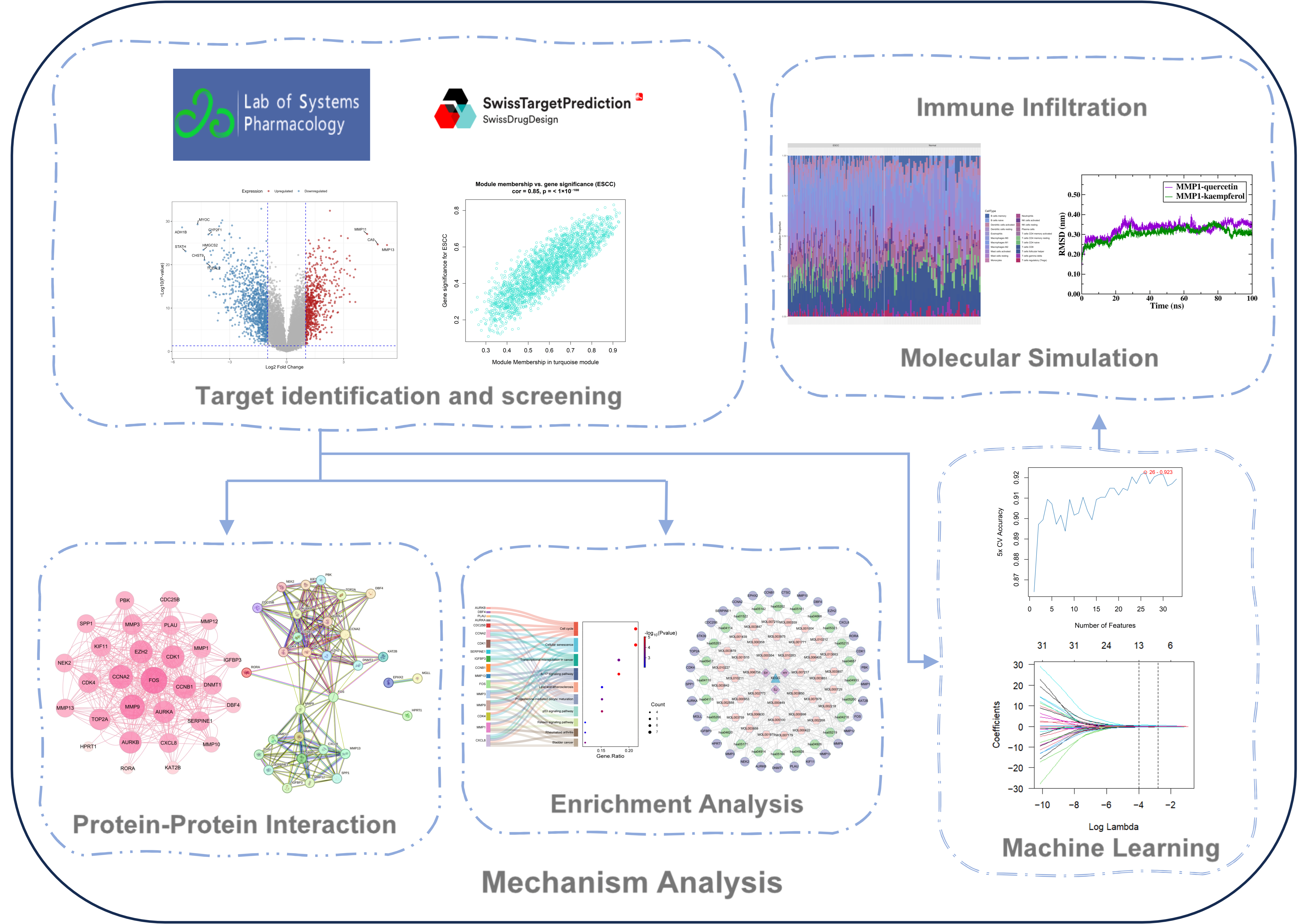
Investigating the Mechanism of Edible Medicinal Plants Against Squamous Cell Carcinomas Based on Network Pharmacology, Bioinformatics, and Molecular Dynamics Simulation

Abstract
Share and Cite
Liang, S.; Yu, S.; Tang, X. Investigating the Mechanism of Edible Medicinal Plants Against Squamous Cell Carcinomas Based on Network Pharmacology, Bioinformatics, and Molecular Dynamics Simulation. Int. J. Mol. Sci. 2026, 27, 2141. https://doi.org/10.3390/ijms27052141
Liang S, Yu S, Tang X. Investigating the Mechanism of Edible Medicinal Plants Against Squamous Cell Carcinomas Based on Network Pharmacology, Bioinformatics, and Molecular Dynamics Simulation. International Journal of Molecular Sciences. 2026; 27(5):2141. https://doi.org/10.3390/ijms27052141
Chicago/Turabian StyleLiang, Shanfeng, Shunzhen Yu, and Xudong Tang. 2026. "Investigating the Mechanism of Edible Medicinal Plants Against Squamous Cell Carcinomas Based on Network Pharmacology, Bioinformatics, and Molecular Dynamics Simulation" International Journal of Molecular Sciences 27, no. 5: 2141. https://doi.org/10.3390/ijms27052141
APA StyleLiang, S., Yu, S., & Tang, X. (2026). Investigating the Mechanism of Edible Medicinal Plants Against Squamous Cell Carcinomas Based on Network Pharmacology, Bioinformatics, and Molecular Dynamics Simulation. International Journal of Molecular Sciences, 27(5), 2141. https://doi.org/10.3390/ijms27052141