Photobiomodulation and Low-Level Laser Therapy as Complementary Strategies in Diabetes Treatment

Abstract
1. Introduction
2. Materials and Methods
3. Characteristics of Different Types of Diabetes
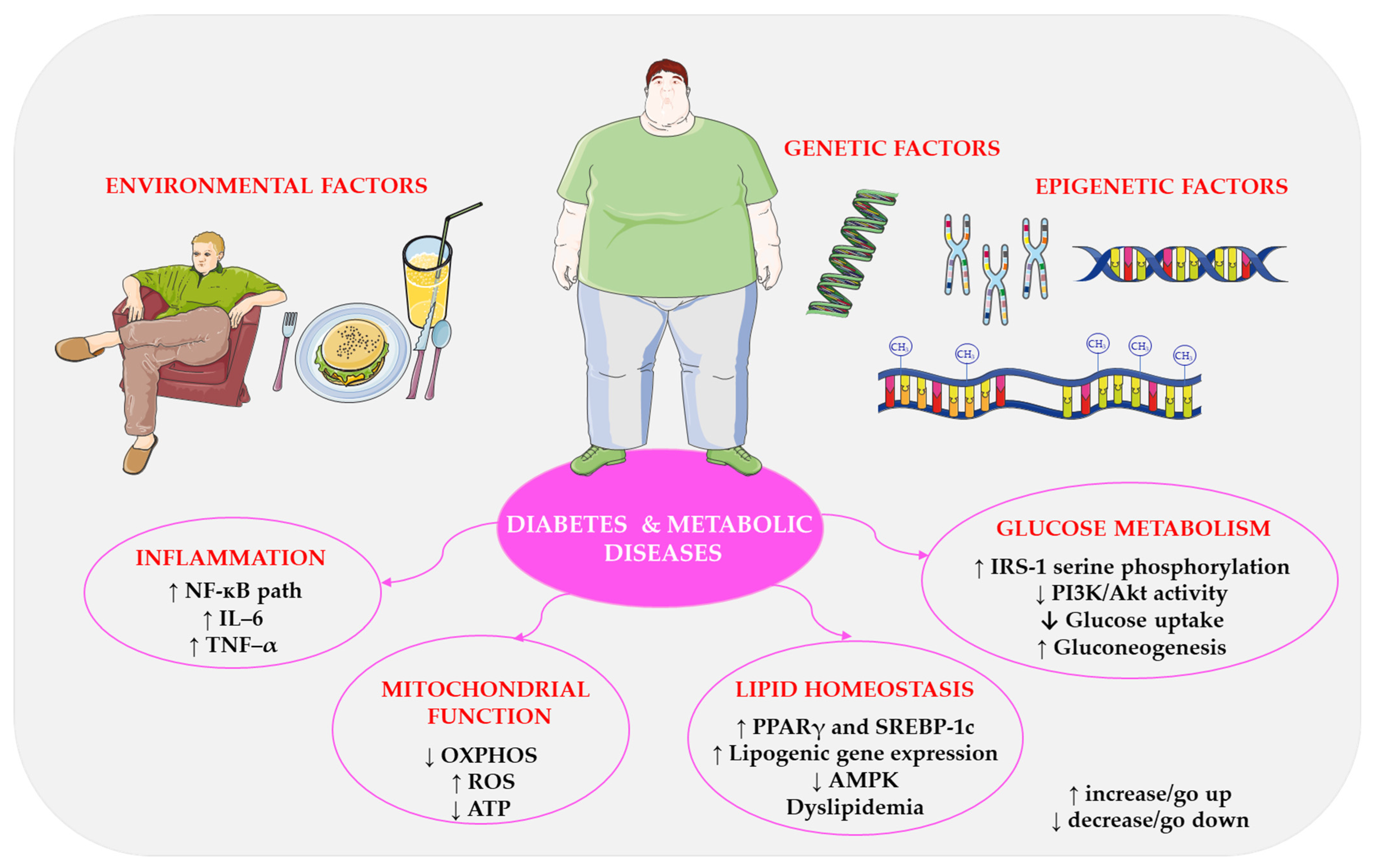
4. Molecular Mechanisms and Therapeutic Perspectives in Diabetes and Metabolic Diseases
5. Therapeutic Applications of Low-Level Laser Therapy
6. Types of Biomodulation Most Commonly Used in LLLT in Medical Practice
6.1. Low-Level Laser Therapy (LLLT)
6.2. High-Intensity Laser Therapy (HILT)
6.3. Pulsed Laser Therapy
6.4. Superpulsed Laser Therapy
6.5. Hot Laser Therapy
6.6. Clinical Relevance and Integration
7. Therapeutic Potential of Low-Level Laser Therapy in Diabetes Management
8. Mechanisms of Action of Laser Therapy
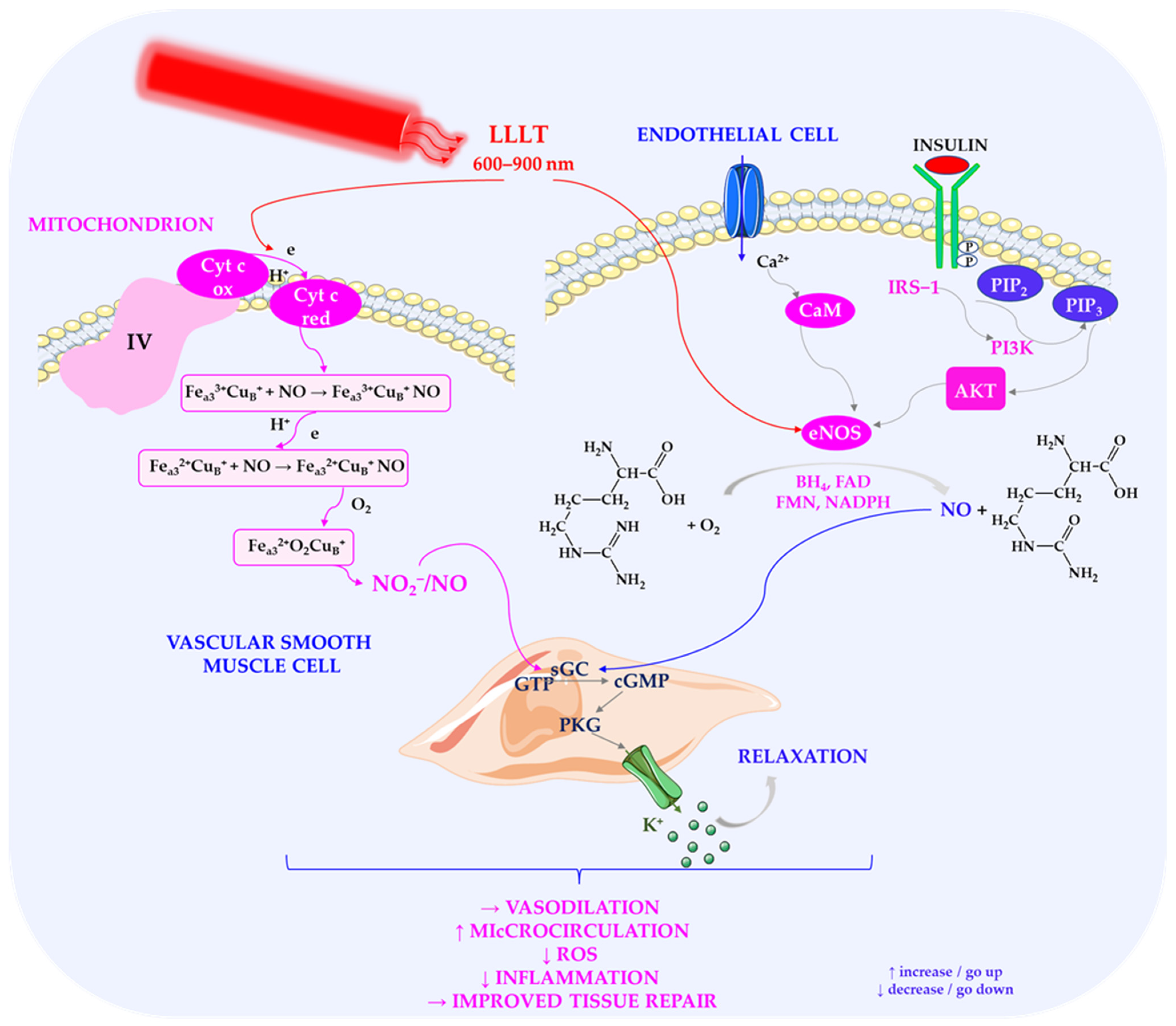
8.1. Photobiomodulation and Mitochondrial Activation
8.2. Effects on Oxidative Stress, Nitric Oxide Release, and Microcirculation
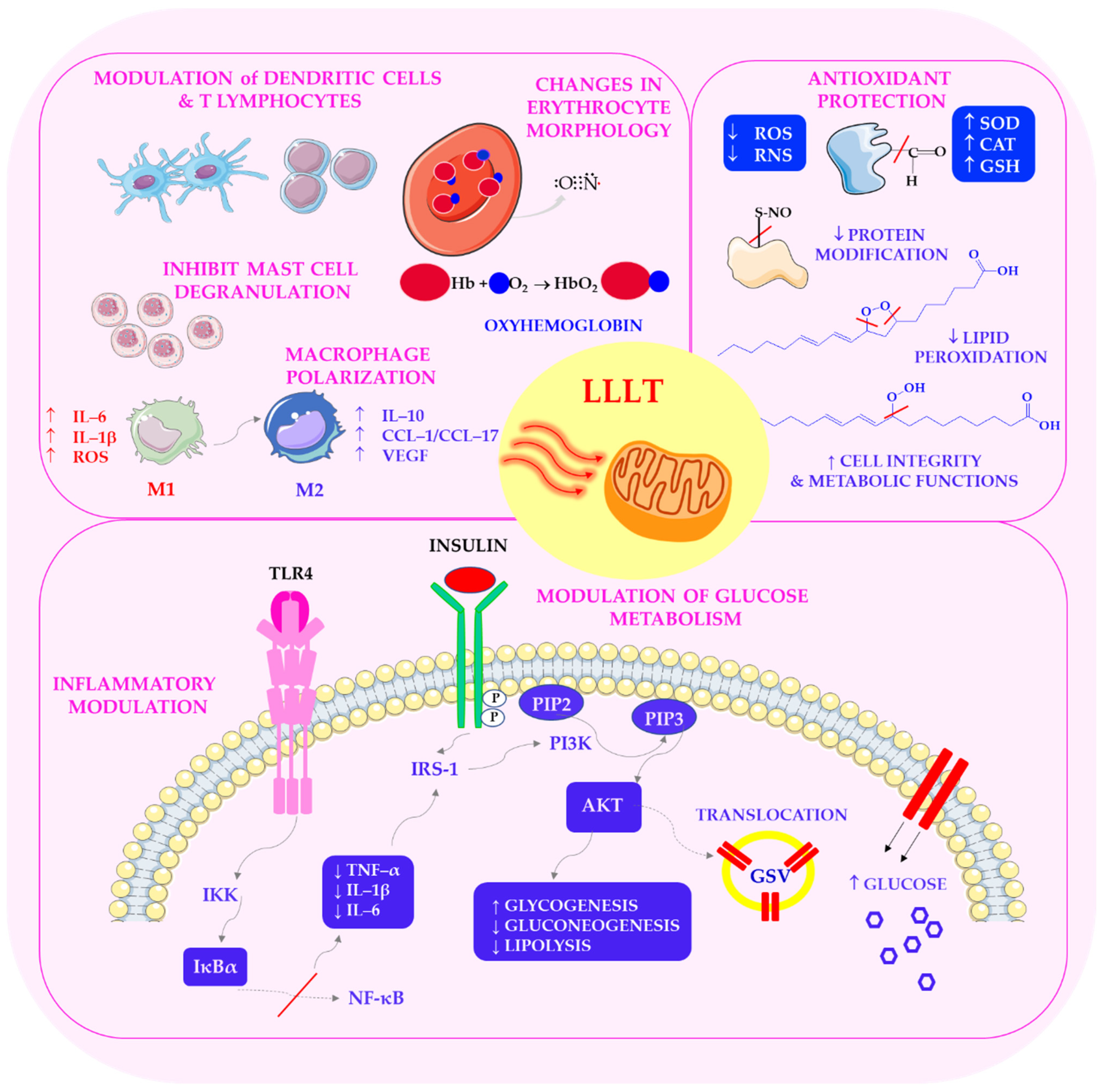
8.3. Anti-Inflammatory and Neuroprotective Mechanisms
8.4. Mast Cells Are Another Important Cellular Target
8.5. Modulatory Effects of Low-Level Laser and LED Therapy on Blood and Vascular Function in Diabetes
9. Laser Therapy for Glycaemic Control
10. Laser Therapy for Managing Diabetes Complications
10.1. Laser Therapy in Diabetic Neuropathy
10.2. Laser Therapy for Diabetic Foot and Wound Healing
10.3. Laser Therapy for Diabetic Retinopathy
10.4. Dental and Periodontal Applications in Diabetes
11. Safety Profile and Adverse Effects
12. Future Applications of Laser Therapy
12.1. Emerging Technologies and Their Potential Significance in Diabetology
12.2. Laser Therapy in Conjunction with Pharmacotherapy and Physiotherapy
12.3. Prospects for Implementation of Laser Therapy in Clinical Practice
13. Conclusions
Author Contributions
Funding
Institutional Review Board Statement
Informed Consent Statement
Data Availability Statement
Conflicts of Interest
References
- Maiman, T.H. Stimulated Optical Radiation in Ruby. Nature 1960, 187, 493–494. [Google Scholar] [CrossRef]
- Mester, E.; Ludany, G.; Selyei, M.; Szende, B.; Total, G.J. The simulating effect of low power laser rays on biological systems. Laser Rev. 1968, 1, 3. [Google Scholar]
- Avci, P.; Gupta, A.; Sadasivam, M.; Vecchio, D.; Pam, Z.; Pam, N.; Hamblin, M.R. Low-level laser (light) therapy (LLLT) in skin: Stimulating, healing, restoring. Semin. Cutan. Med. Surg. 2013, 32, 41–52. [Google Scholar]
- Farivar, S.; Malekshahabi, T.; Shiari, R. Biological effects of low level laser therapy. J. Lasers Med. Sci. 2014, 5, 58–62. [Google Scholar] [PubMed]
- The Nobel Prize in Physiology or Medicine 1903. NobelPrize.org. Nobel Prize Outreach AB 2024. Tue. 23 July 2024. Available online: https://www.nobelprize.org/prizes/medicine/1903/summary/ (accessed on 2 May 2025).
- Agostinis, P.; Berg, K.; Cengel, K.A.; Foster, T.H.; Girotti, A.W.; Gollnick, S.O.; Hahn, S.M.; Hamblin, M.R.; Juzeniene, A.; Kessel, D.; et al. Photodynamic therapy of cancer: An update. CA Cancer J. Clin. 2011, 61, 250–281. [Google Scholar] [CrossRef]
- Surendranath, P.; Arjunkumar, R. Low Level Laser Therapy—A Review. IOSR J. Dent. Med. Sci. (IOSR-JDMS) 2013, 12, 56–59. [Google Scholar] [CrossRef]
- Cloete, L. Diabetes mellitus: An overview of the types, symptoms, complications and management. Nurs. Stand. (R. Coll. Nurs. (Great Br.) 1987) 2022, 37, 61–66. [Google Scholar] [CrossRef]
- Ceriello, A.; Prattichizzo, F. Variability of risk factors and diabetes complications. Cardiovasc. Diabetol. 2021, 20, 101. [Google Scholar] [CrossRef]
- American Diabetes Association. Diagnosis and classification of diabetes mellitus. Diabetes Care 2009, 32, S62–S67. [Google Scholar] [CrossRef] [PubMed]
- Sugandh, F.; Chandio, M.; Raveena, F.; Kumar, L.; Karishma, F.; Khuwaja, S.; Memon, U.A.; Bai, K.; Kashif, M.; Varrassi, G.; et al. Advances in the Management of Diabetes Mellitus: A Focus on Personalized Medicine. Cureus 2023, 15, e43697. [Google Scholar] [CrossRef]
- Annicchiarico, A.; Barile, B.; Buccoliero, C.; Nicchia, G.P.; Brunetti, G. Alternative therapeutic strategies in diabetes management. World J. Diabetes 2024, 15, 1142–1161. [Google Scholar] [CrossRef]
- Everett, L.A.; Paulus, Y.M. Laser Therapy in the Treatment of Diabetic Retinopathy and Diabetic Macular Edema. Curr. Diabetes Rep. 2021, 21, 35. [Google Scholar] [CrossRef]
- Clemente-Suárez, V.J.; Martín-Rodríguez, A.; Redondo-Flórez, L.; López-Mora, C.; Yáñez-Sepúlveda, R.; Tornero-Aguilera, J.F. New Insights and Potential Therapeutic Interventions in Metabolic Diseases. Int. J. Mol. Sci. 2023, 24, 10672. [Google Scholar] [CrossRef] [PubMed]
- Jere, S.W.; Houreld, N.N.; Abrahamse, H. Role of the PI3K/AKT (mTOR and GSK3β) signalling pathway and photobiomodulation in diabetic wound healing. Cytokine Growth Factor Rev. 2019, 50, 52–59. [Google Scholar] [CrossRef] [PubMed]
- Dos Santos Soares, F.; de Souza Pinto, M.; Kruger, A.; Coracini, C.A.; Bertolini, G.R.F. Photobiomodulation therapy on skeletal muscles exposed to diabetes mellitus: A systematic review of animal studies. Lasers Med. Sci. 2023, 38, 185. [Google Scholar] [CrossRef] [PubMed]
- Mosca, R.C.; Ong, A.A.; Albasha, O.; Bass, K.; Arany, P. Photobiomodulation Therapy for Wound Care: A Potent, Noninvasive, Photoceutical Approach. Adv. Ski. Wound Care 2019, 32, 157–167. [Google Scholar] [CrossRef] [PubMed]
- Freire, B.L.; Abreu, L.G.; Costa, F.O.; Cota, L.O.M.; Esteves-Lima, R.P. Effect of photobiomodulation adjunct to periodontal therapy on individuals with type 2 diabetes mellitus regarding periodontal clinical parameters: A systematic review and meta-analysis. Lasers Med. Sci. 2023, 38, 116. [Google Scholar] [CrossRef]
- Sayed, M.A.; El-Sherif, R.M.; Ismail, A.; Abou Warda, A.E.; Mohamed, A.R.; El-Sherif, A.A. Effect of low-level laser physiotherapy on left ventricular function among patients with chronic systolic heart failure. Egypt. Heart J. 2023, 75, 12. [Google Scholar] [CrossRef]
- de Loura Santana, C.; de Fátima Teixeira Silva, D.; Deana, A.M.; Prates, R.A.; Souza, A.P.; Gomes, M.T.; de Azevedo Sampaio, B.P.; Shibuya, J.F.; Bussadori, S.K.; Mesquita-Ferrari, R.A.; et al. Tissue responses to postoperative laser therapy in diabetic rats submitted to excisional wounds. PLoS ONE 2015, 10, e0122042. [Google Scholar] [CrossRef]
- Fernández-Guarino, M.; Bacci, S.; Pérez González, L.A.; Bermejo-Martínez, M.; Cecilia-Matilla, A.; Hernández-Bule, M.L. The Role of Physical Therapies in Wound Healing and Assisted Scarring. Int. J. Mol. Sci. 2023, 24, 7487. [Google Scholar] [CrossRef]
- Chatterjee, P.; Srivastava, A.K.; Kumar, D.A.; Chakrawarty, A.; Khan, M.A.; Ambashtha, A.K.; Kumar, V.; De Taboada, L.; Dey, A.B. Effect of deep tissue laser therapy treatment on peripheral neuropathic pain in older adults with type 2 diabetes: A pilot randomized clinical trial. BMC Geriatr. 2019, 19, 218. [Google Scholar] [CrossRef]
- Miller, K.M.; Foster, N.C.; Beck, R.W.; Bergenstal, R.M.; DuBose, S.N.; DiMeglio, L.A.; Maahs, D.M.; Tamborlane, W.V. T1D Exchange Clinic Network. Current state of type 1 diabetes treatment in the U.S.: Updated data from the T1D Exchange clinic registry. Diabetes Care 2015, 38, 971–978. [Google Scholar] [CrossRef]
- Chiang, J.L.; Maahs, D.M.; Garvey, K.C.; Hood, K.K.; Laffel, L.M.; Weinzimer, S.A.; Wolfsdorf, J.I.; Schatz, D. Type 1 Diabetes in Children and Adolescents: A Position Statement by the American Diabetes Association. Diabetes Care 2018, 41, 2026–2044. [Google Scholar] [CrossRef] [PubMed]
- Niu, F.; Liu, W.; Ren, Y.; Tian, Y.; Shi, W.; Li, M.; Li, Y.; Xiong, Y.; Qian, L. β-cell neogenesis: A rising star to rescue diabetes mellitus. J. Adv. Res. 2024, 62, 71–89. [Google Scholar] [CrossRef]
- Del Chierico, F.; Rapini, N.; Deodati, A.; Matteoli, M.C.; Cianfarani, S.; Putignani, L. Pathophysiology of Type 1 Diabetes and Gut Microbiota Role. Int. J. Mol. Sci. 2022, 23, 14650. [Google Scholar] [CrossRef] [PubMed]
- Patterson, C.C.; Harjutsalo, V.; Rosenbauer, J.; Neu, A.; Cinek, O.; Skrivarhaug, T.; Rami-Merhar, B.; Soltesz, G.; Svensson, J.; Parslow, R.C.; et al. Trends and cyclical variation in the incidence of childhood type 1 diabetes in 26 European centres in the 25 year period 1989–2013: A multicentre prospective registration study. Diabetologia 2019, 62, 408–417. [Google Scholar] [CrossRef]
- Dludla, P.V.; Mabhida, S.E.; Ziqubu, K.; Nkambule, B.B.; Mazibuko-Mbeje, S.E.; Hanser, S.; Basson, A.K.; Pheiffer, C.; Kengne, A.P. Pancreatic β-cell dysfunction in type 2 diabetes: Implications of inflammation and oxidative stress. World J. Diabetes 2023, 14, 130–146. [Google Scholar] [CrossRef]
- Weinberg Sibony, R.; Segev, O.; Dor, S.; Raz, I. Drug Therapies for Diabetes. Int. J. Mol. Sci. 2023, 24, 17147. [Google Scholar] [CrossRef] [PubMed]
- Ali, O. Genetics of type 2 diabetes. World J. Diabetes 2013, 4, 114–123. [Google Scholar] [CrossRef]
- Petersen, M.C.; Shulman, G.I. Mechanisms of Insulin Action and Insulin Resistance. Physiol. Rev. 2018, 98, 2133–2223. [Google Scholar] [CrossRef]
- Dilworth, L.; Facey, A.; Omoruyi, F. Diabetes Mellitus and Its Metabolic Complications: The Role of Adipose Tissues. Int. J. Mol. Sci. 2021, 22, 7644. [Google Scholar] [CrossRef]
- Martín-Timón, I.; Sevillano-Collantes, C.; Segura-Galindo, A.; Del Cañizo-Gómez, F.J. Type 2 diabetes and cardiovascular disease: Have all risk factors the same strength? World J. Diabetes 2014, 5, 444–470. [Google Scholar] [CrossRef]
- Sharma, A.; Verma, S. Mechanisms by Which Glucagon-Like-Peptide-1 Receptor Agonists and Sodium-Glucose Cotransporter-2 Inhibitors Reduce Cardiovascular Risk in Adults with Type 2 Diabetes Mellitus. Can. J. Diabetes 2020, 44, 93–102. [Google Scholar] [CrossRef]
- Chen, J.; Huang, Y.; Liu, C.; Chi, J.; Wang, Y.; Xu, L. The role of C-peptide in diabetes and its complications: An updated review. Front. Endocrinol. 2023, 14, 1256093. [Google Scholar] [CrossRef]
- Sherwani, S.I.; Khan, H.A.; Ekhzaimy, A.; Masood, A.; Sakharkar, M.K. Significance of HbA1c Test in Diagnosis and Prognosis of Diabetic Patients. Biomark. Insights 2016, 11, 95–104. [Google Scholar] [CrossRef] [PubMed]
- Lende, M.; Rijhsinghani, A. Gestational Diabetes: Overview with Emphasis on Medical Management. Int. J. Environ. Res. Public Health 2020, 17, 9573. [Google Scholar] [CrossRef] [PubMed]
- Szmuilowicz, E.D.; Josefson, J.L.; Metzger, B.E. Gestational Diabetes Mellitus. Endocrinol. Metab. Clin. N. Am. 2019, 48, 479–493. [Google Scholar] [CrossRef]
- Albairmani, R.A.; Basheer, B.M.; Macky, M.M.; Al Syouti, T.; AlZubaidy, H.; Elfaki, E.; Kidwai, A.; Basheer, Y.M.; Ahmed, F.; Salaheldin, M. Management of Diabetes in Pregnancy: A Review of Clinical Guidelines and Practices. Cureus 2025, 17, e79334. [Google Scholar] [CrossRef]
- Younis, H.; Ha, S.E.; Jorgensen, B.G.; Verma, A.; Ro, S. Maturity-Onset Diabetes of the Young: Mutations, Physiological Consequences, and Treatment Options. J. Pers. Med. 2022, 12, 1762. [Google Scholar] [CrossRef]
- Popoviciu, M.S.; Paduraru, L.; Nutas, R.M.; Ujoc, A.M.; Yahya, G.; Metwally, K.; Cavalu, S. Diabetes Mellitus Secondary to Endocrine Diseases: An Update of Diagnostic and Treatment Particularities. Int. J. Mol. Sci. 2023, 24, 12676. [Google Scholar] [CrossRef] [PubMed]
- Lin, X.; Xu, Y.; Pan, X.; Xu, J.; Ding, Y.; Sun, X.; Song, X.; Ren, Y.; Shan, P.F. Global, regional, and national burden and trend of diabetes in 195 countries and territories: An analysis from 1990 to 2025. Sci. Rep. 2020, 10, 14790. [Google Scholar] [CrossRef] [PubMed]
- Tian, X.; Wang, L.; Zhang, L.; Chen, X.; Wang, W.; Zhang, K.; Ge, X.; Luo, Z.; Zhai, X.; Shao, H. New discoveries in therapeutic targets and drug development pathways for type 2 diabetes mellitus under the guidance of precision medicine. Eur. J. Med. Res. 2025, 30, 450. [Google Scholar] [CrossRef]
- Babu, M.; Snyder, M. Multi-Omics Profiling for Health. Mol. Cell. Proteom. MCP 2023, 22, 100561. [Google Scholar] [CrossRef]
- Fernandes Silva, L.; Laakso, M. Advances in Metabolomics: A Comprehensive Review of Type 2 Diabetes and Cardiovascular Disease Interactions. Int. J. Mol. Sci. 2025, 26, 3572. [Google Scholar] [CrossRef]
- Galicia-Garcia, U.; Benito-Vicente, A.; Jebari, S.; Larrea-Sebal, A.; Siddiqi, H.; Uribe, K.B.; Ostolaza, H.; Martín, C. Pathophysiology of Type 2 Diabetes Mellitus. Int. J. Mol. Sci. 2020, 21, 6275. [Google Scholar] [CrossRef] [PubMed]
- Giri, B.; Dey, S.; Das, T.; Sarkar, M.; Banerjee, J.; Dash, S.K. Chronic hyperglycemia mediated physiological alteration and metabolic distortion leads to organ dysfunction, infection, cancer progression and other pathophysiological consequences: An update on glucose toxicity. Biomed. Pharmacother. 2018, 107, 306–328. [Google Scholar] [CrossRef]
- Uceda, A.B.; Mariño, L.; Casasnovas, R.; Adrover, M. An overview on glycation: Molecular mechanisms, impact on proteins, pathogenesis, and inhibition. Biophys. Rev. 2024, 16, 189–218. [Google Scholar] [CrossRef]
- Shin, A.; Connolly, S.; Kabytaev, K. Protein glycation in diabetes mellitus. Adv. Clin. Chem. 2023, 113, 101–156. [Google Scholar] [CrossRef]
- Tang, W.H.; Martin, K.A.; Hwa, J. Aldose reductase, oxidative stress, and diabetic mellitus. Front. Pharmacol. 2012, 3, 87. [Google Scholar] [CrossRef] [PubMed]
- Hirano, T. Pathophysiology of Diabetic Dyslipidemia. J. Atheroscler. Thromb. 2018, 25, 771–782. [Google Scholar] [CrossRef]
- Du, Z.; Qin, Y. Dyslipidemia and Cardiovascular Disease: Current Knowledge, Existing Challenges, and New Opportunities for Management Strategies. J. Clin. Med. 2023, 12, 363. [Google Scholar] [CrossRef]
- Bakker, W.; Eringa, E.C.; Sipkema, P.; van Hinsbergh, V.W. Endothelial dysfunction and diabetes: Roles of hyperglycemia, impaired insulin signaling and obesity. Cell Tissue Res. 2009, 335, 165–189. [Google Scholar] [CrossRef]
- Tangvarasittichai, S. Oxidative stress, insulin resistance, dyslipidemia and type 2 diabetes mellitus. World J. Diabetes 2015, 6, 456–480. [Google Scholar] [CrossRef]
- Cho, Y.I.; Mooney, M.P.; Cho, D.J. Hemorheological disorders in diabetes mellitus. J. Diabetes Sci. Technol. 2008, 2, 1130–1138. [Google Scholar] [CrossRef]
- Shi, Y.; Vanhoutte, P.M. Macro- and microvascular endothelial dysfunction in diabetes. J. Diabetes 2017, 9, 434–449. [Google Scholar] [CrossRef]
- Li, X.; Weber, N.C.; Cohn, D.M.; Hollmann, M.W.; DeVries, J.H.; Hermanides, J.; Preckel, B. Effects of Hyperglycemia and Diabetes Mellitus on Coagulation and Hemostasis. J. Clin. Med. 2021, 10, 2419. [Google Scholar] [CrossRef] [PubMed]
- Kakouros, N.; Rade, J.J.; Kourliouros, A.; Resar, J.R. Platelet function in patients with diabetes mellitus: From a theoretical to a practical perspective. Int. J. Endocrinol. 2011, 2011, 742719. [Google Scholar] [CrossRef] [PubMed]
- Tufano, A.; Cimino, E.; Di Minno, M.N.; Ieranò, P.; Marrone, E.; Strazzullo, A.; Di Minno, G.; Cerbone, A.M. Diabetes mellitus and cardiovascular prevention: The role and the limitations of currently available antiplatelet drugs. Int. J. Vasc. Med. 2011, 2011, 250518. [Google Scholar] [CrossRef] [PubMed]
- Yamaoka, K.; Nemoto, A.; Tango, T. Comparison of the Effectiveness of Lifestyle Modification with Other Treatments on the Incidence of Type 2 Diabetes in People at High Risk: A Network Meta-Analysis. Nutrients 2019, 11, 1373. [Google Scholar] [CrossRef]
- Crandall, J.P.; Knowler, W.C.; Kahn, S.E.; Marrero, D.; Florez, J.C.; Bray, G.A.; Haffner, S.M.; Hoskin, M.; Nathan, D.M.; Diabetes Prevention Program Research Group. The prevention of type 2 diabetes. Nature clinical practice. Endocrinol. Metab. 2008, 4, 382–393. [Google Scholar] [CrossRef]
- Colberg, S.R.; Sigal, R.J.; Fernhall, B.; Regensteiner, J.G.; Blissmer, B.J.; Rubin, R.R.; Chasan-Taber, L.; Albright, A.L.; Braun, B.; American College of Sports Medicine; et al. American Diabetes Association. Exercise and type 2 diabetes: The American College of Sports Medicine and the American Diabetes Association: Joint position statement. Diabetes Care 2010, 33, e147–e167. [Google Scholar] [CrossRef]
- Yun, J.S.; Ko, S.H. Current trends in epidemiology of cardiovascular disease and cardiovascular risk management in type 2 diabetes. Metab. Clin. Exp. 2021, 123, 154838. [Google Scholar] [CrossRef]
- Tosti, V.; Bertozzi, B.; Fontana, L. Health Benefits of the Mediterranean Diet: Metabolic and Molecular Mechanisms. J. Gerontol. Ser. A 2018, 73, 318–326. [Google Scholar] [CrossRef]
- Sousa, R.G.; Batista, K.d.N.M. Laser therapy in wound healing associated with diabetes mellitus—Review. An. Bras. Dermatol. 2016, 91, 489–493. [Google Scholar] [CrossRef] [PubMed]
- Everett, J.D.; Rossmann, J.A.; Kerns, D.G.; Al-Hashimi, I. Laser Assisted Non-surgical Periodontal Therapy: A Double Blind, Randomized Clinical Trial. Open Dent. J. 2017, 11, 79–90. [Google Scholar] [CrossRef]
- Al-Azab, I.M.; Abo Elyazed, T.I.; El Gendy, A.M.; Abdelmonem, A.F.; Abd El-Hakim, A.A.; Sheha, S.M.; Mohammed, A.H. Effect of electromagnetic therapy versus low-level laser therapy on diabetic patients with trigeminal neuralgia: A randomized control trial. Eur. J. Phys. Rehabil. Med. 2023, 59, 183–191. [Google Scholar] [CrossRef] [PubMed]
- Gigo-Benato, D.; Geuna, S.; de Castro Rodrigues, A.; Tos, P.; Fornaro, M.; Boux, E.; Battiston, B.; Giacobini-Robecchi, M.G. Low-power laser biostimulation enhances nerve repair after end-to-side neurorrhaphy: A double-blind randomized study in the rat median nerve model. Lasers Med. Sci. 2004, 19, 57–65. [Google Scholar] [CrossRef] [PubMed]
- Beckmann, K.H.; Meyer-Hamme, G.; Schröder, S. Low level laser therapy for the treatment of diabetic foot ulcers: A critical survey. Evid.-Based Complement. Altern. Med. Ecam 2014, 2014, 626127. [Google Scholar] [CrossRef]
- Yoon, S.H.; Huh, B.K.; Abdi, S.; Javed, S. The efficacy of high-intensity laser therapy in wound healing: A narrative review. Lasers Med. Sci. 2024, 39, 208. [Google Scholar] [CrossRef]
- Waluyo, Y.; Hidayat, M.S. Low-Level Laser Therapy (LLLT) for Diabetic Foot Ulcer in Uncontrolled Diabetes: A Case Report of Improved Wound Healing. Am. J. Case Rep. 2024, 25, e944106. [Google Scholar] [CrossRef]
- Gong, L.; Zou, Z.; Liu, L.; Guo, S.; Xing, D. Photobiomodulation therapy ameliorates hyperglycemia and insulin resistance by activating cytochrome c oxidase-mediated protein kinase B in muscle. Aging 2021, 13, 10015–10033. [Google Scholar] [CrossRef]
- Wang, K.; Zhao, H.; Zhao, X.; Zhang, X.; Zhang, W.; Cheng, Y.; Ge, J. Photobiomodulation for diabetes and its complications: A review of general presentation, mechanisms and efficacy. Ann. Med. 2024, 56, 2433684. [Google Scholar] [CrossRef]
- Al Balah, O.F.; Rafie, M.; Osama, A.R. Immunomodulatory effects of photobiomodulation: A comprehensive review. Lasers Med. Sci. 2025, 40, 187. [Google Scholar] [CrossRef]
- Wang, X.; Tian, F.; Soni, S.S.; Gonzalez-Lima, F.; Liu, H. Interplay between up-regulation of cytochrome-c-oxidase and hemoglobin oxygenation induced by near-infrared laser. Sci. Rep. 2016, 6, 30540. [Google Scholar] [CrossRef]
- Covian, R.; Edwards, L.O.; Balaban, R.S. Effect of the mitochondrial membrane potential on the absorbance of the reduced form of cytochrome c oxidase. Biochim. Biophys. Acta (BBA)-Bioenerg. 2024, 1865, 149048. [Google Scholar] [CrossRef]
- Serrage, H.; Heiskanen, V.; Palin, W.M.; Cooper, P.R.; Milward, M.R.; Hadis, M.; Hamblin, M.R. Under the spotlight: Mechanisms of photobiomodulation concentrating on blue and green light. Photochem. Photobiol. Sci. 2019, 18, 1877–1909. [Google Scholar] [CrossRef] [PubMed]
- Kurhaluk, N.; Tkaczenko, H. L-Arginine and Nitric Oxide in Vascular Regulation-Experimental Findings in the Context of Blood Donation. Nutrients 2025, 17, 665. [Google Scholar] [CrossRef] [PubMed]
- Caturano, A.; D’Angelo, M.; Mormone, A.; Russo, V.; Mollica, M.P.; Salvatore, T.; Galiero, R.; Rinaldi, L.; Vetrano, E.; Marfella, R.; et al. Oxidative Stress in Type 2 Diabetes: Impacts from Pathogenesis to Lifestyle Modifications. Curr. Issues Mol. Biol. 2023, 45, 6651–6666. [Google Scholar] [CrossRef]
- Hamblin, M.R. Mechanisms and applications of the anti-inflammatory effects of photobiomodulation. AIMS Biophys. 2017, 4, 337–361. [Google Scholar] [CrossRef] [PubMed]
- Chung, H.; Dai, T.; Sharma, S.K.; Huang, Y.Y.; Carroll, J.D.; Hamblin, M.R. The nuts and bolts of low-level laser (light) therapy. Ann. Biomed. Eng. 2012, 40, 516–533. [Google Scholar] [CrossRef]
- Taylor, D.N.; Winfield, T.; Wynd, S. Low-Level Laser Light Therapy Dosage Variables vs Treatment Efficacy of Neuromusculoskeletal Conditions: A Scoping Review. J. Chiropr. Med. 2020, 19, 119–127. [Google Scholar] [CrossRef]
- Karu, T. Mitochondrial mechanisms of photobiomodulation in context of new data about multiple roles of ATP. Photomed. Laser Surg. 2010, 28, 159–160. [Google Scholar] [CrossRef]
- Huang, Y.Y.; Sharma, S.K.; Carroll, J.; Hamblin, M.R. Biphasic dose response in low level light therapy—An update. Dose-Response 2011, 9, 602–618. [Google Scholar] [CrossRef] [PubMed]
- Zein, R.; Selting, W.; Hamblin, M.R. Review of light parameters and photobiomodulation efficacy: Dive into complexity. J. Biomed. Opt. 2018, 23, 120901. [Google Scholar] [CrossRef] [PubMed]
- Rubinov, A.N. Physical grounds for biological effect of laser radiation. J. Phys. D Appl. Phys. 2003, 36, 2317–2330. [Google Scholar] [CrossRef]
- Feehan, J.; Burrows, S.P.; Cornelius, L.; Cook, A.M.; Mikkelsen, K.; Apostolopoulos, V.; Husaric, M.; Kiatos, D. Therapeutic applications of polarized light: Tissue healing and immunomodulatory effects. Maturitas 2018, 116, 11–17. [Google Scholar] [CrossRef]
- Oron, U.; Yaakobi, T.; Oron, A.; Hayam, G.; Gepstein, L.; Rubin, O.; Wolf, T.; Ben Haim, S. Attenuation of infarct size in rats and dogs after myocardial infarction by low-energy laser irradiation. Lasers Surg. Med. 2001, 28, 204–211. [Google Scholar] [CrossRef]
- Sommer, A.P.; Pinheiro, A.L.; Mester, A.R.; Franke, R.P.; Whelan, H.T. Biostimulatory windows in low-intensity laser activation: Lasers, scanners, and NASA’s light-emitting diode array system. J. Clin. Laser Med. Surg. 2001, 19, 29–33. [Google Scholar] [CrossRef]
- Chow, R.T.; Heller, G.Z.; Barnsley, L. The effect of 300 mW, 830 nm laser on chronic neck pain: A double-blind, randomized, placebo-controlled study. Pain 2006, 124, 201–210. [Google Scholar] [CrossRef]
- Hawkins, D.H.; Abrahamse, H. The role of laser fluence in cell viability, proliferation, and membrane integrity of wounded human skin fibroblasts following helium-neon laser irradiation. Lasers Surg. Med. 2006, 38, 74–83. [Google Scholar] [CrossRef]
- Hawkins, D.; Abrahamse, H. Effect of multiple exposures of low-level laser therapy on the cellular responses of wounded human skin fibroblasts. Photomed. Laser Surg. 2006, 24, 705–714. [Google Scholar] [CrossRef]
- Lubart, R.; Lavi, R.; Friedmann, H.; Rochkind, S. Photochemistry and photobiology of light absorption by living cells. Photomed. Laser Surg. 2006, 24, 179–185. [Google Scholar] [CrossRef] [PubMed]
- Lanzafame, R.J.; Stadler, I.; Kurtz, A.F.; Connelly, R.; Peter, T.A., Sr.; Brondon, P.; Olson, D. Reciprocity of exposure time and irradiance on energy density during photoradiation on wound healing in a murine pressure ulcer model. Lasers Surg. Med. 2007, 39, 534–542, Erratum in Lasers Surg. Med. 2007, 39, 808. [Google Scholar] [CrossRef]
- Cotler, H.B.; Chow, R.T.; Hamblin, M.R.; Carroll, J. The Use of Low Level Laser Therapy (LLLT) For Musculoskeletal Pain. MOJ Orthop. Rheumatol. 2015, 2, 00068. [Google Scholar] [CrossRef]
- Hashmi, J.T.; Huang, Y.Y.; Osmani, B.Z.; Sharma, S.K.; Naeser, M.A.; Hamblin, M.R. Role of low-level laser therapy in neurorehabilitation. PM R J. Inj. Funct. Rehabil. 2010, 2, S292–S305. [Google Scholar] [CrossRef]
- Momenzadeh, S. Low level laser therapy for painful joints. J. Lasers Med. Sci. 2013, 4, 67–69. [Google Scholar]
- Taha, N.; Daoud, H.; Malik, T.; Shettysowkoor, J.; Rahman, S. The Effects of Low-Level Laser Therapy on Wound Healing and Pain Management in Skin Wounds: A Systematic Review and Meta-Analysis. Cureus 2024, 16, e72542. [Google Scholar] [CrossRef]
- Azzam, S.I.; Bashandy, S.A. Biological effects of laser therapy. In Biomedical Applications of Lasers; Springer: Cham, Switzerland, 2019; pp. 61–80. [Google Scholar]
- Gál, P.; Vidinský, B.; Toporcer, T.; Sabo, J. Biological effects of low-level laser therapy. J. Photochem. Photobiol. B Biol. 2019, 195, 78–86. [Google Scholar]
- Wong-Riley, M.T.; Liang, H.L.; Eells, J.T.; Chance, B.; Henry, M.M.; Buchmann, E.; Kane, M.; Whelan, H.T. Photobiomodulation directly benefits primary neurons functionally inactivated by toxins: Role of cytochrome c oxidase. J. Biol. Chem. 2005, 280, 4761–4771. [Google Scholar] [CrossRef] [PubMed]
- Karu, T.I. Mitochondrial signaling in mammalian cells activated by red and near-IR radiation. Photochem. Photobiol. 2008, 84, 1091–1099. [Google Scholar] [CrossRef] [PubMed]
- Passarella, S.; Karu, T. Absorption of monochromatic and narrow band radiation in the visible and near IR by both mitochondrial and non-mitochondrial photoacceptors results in photobiomodulation. J. Photochem. Photobiol. B Biol. 2014, 140, 344–358. [Google Scholar] [CrossRef] [PubMed]
- Hamblin, M.R.; Demidova, T.N. Mechanisms of low level light therapy. In Biological Effects and Medical Applications of Infrared Radiation; Springer: Cham, Switzerland, 2006; pp. 67–84. [Google Scholar]
- Karu, T. Primary and secondary mechanisms of action of visible to near-IR radiation on cells. J. Photochem. Photobiol. B Biol. 1999, 49, 1–17. [Google Scholar] [CrossRef] [PubMed]
- Drochioiu, G. Laser-induced ATP formation: Mechanism and consequences. Photomed. Laser Surg. 2010, 28, 573–574. [Google Scholar] [CrossRef] [PubMed]
- Suardi, N.; Sodipo, B.K.; Mustafa, M.Z.; Ali, Z. Effect of visible laser light on ATP level of anaemic red blood cell. J. Photochem. Photobiol. B Biol. 2016, 162, 703–706. [Google Scholar] [CrossRef]
- Mester, E.; Mester, A.F.; Mester, A. The biomedical effects of laser application. Lasers Surg. Med. 1985, 5, 31–39. [Google Scholar] [CrossRef]
- Otsuka, M.; Egawa, G.; Kabashima, K. Uncovering the Mysteries of Langerhans Cells, Inflammatory Dendritic Epidermal Cells, and Monocyte-Derived Langerhans Cell-Like Cells in the Epidermis. Front. Immunol. 2018, 9, 1768. [Google Scholar] [CrossRef]
- Barkovskiĭ, V.S.; Kozlov, V.I.; Saprykin, P.I.; Nikol’skaia, G.M. Reaktsiia sosudov mikrotsirkuliatornogo rusla podkozhnoĭ kletchatki na vozdeĭstvie lucha argonovogo lazera [Reaction of vessels of the microcirculatory bed of subcutaneous tissue to exposure to an argon laser beam]. Biul. Eksp. Biol. I Med. 1978, 85, 670–673. [Google Scholar]
- Lambert, V.; Lecomte, J.; Hansen, S.; Blacher, S.; Gonzalez, M.L.; Struman, I.; Sounni, N.E.; Rozet, E.; de Tullio, P.; Foidart, J.M.; et al. Laser-induced choroidal neovascularization model to study age-related macular degeneration in mice. Nat. Protoc. 2013, 8, 2197–2211. [Google Scholar] [CrossRef]
- Spampinato, S.F.; Caruso, G.I.; De Pasquale, R.; Sortino, M.A.; Merlo, S. The Treatment of Impaired Wound Healing in Diabetes: Looking among Old Drugs. Pharmaceuticals 2020, 13, 60. [Google Scholar] [CrossRef]
- Zhang, G.; Yi, L.; Wang, C.; Yang, P.; Zhang, J.; Wang, J.; Lu, C.; Zhang, X.; Liu, Y. Photobiomodulation promotes angiogenesis in wound healing through stimulating the nuclear translocation of VEGFR2 and STAT3. J. Photochem. Photobiol. B Biol. 2022, 237, 112573. [Google Scholar] [CrossRef]
- Ando, T.; Xuan, W.; Xu, T.; Dai, T.; Sharma, S.K.; Kharkwal, G.B.; Huang, Y.Y.; Wu, Q.; Whalen, M.J.; Sato, S.; et al. Comparison of therapeutic effects between pulsed and continuous wave 810-nm wavelength laser irradiation for traumatic brain injury in mice. PLoS ONE 2011, 6, e26212. [Google Scholar] [CrossRef] [PubMed]
- Al-Watban, F.A.; Zhang, X.Y. The comparison of effects between pulsed and CW lasers on wound healing. J. Clin. Laser Med. Surg. 2004, 22, 15–18. [Google Scholar] [CrossRef]
- Lopes-Martins, R.A.; Marcos, R.L.; Leonardo, P.S.; Prianti, A.C., Jr.; Muscará, M.N.; Aimbire, F.; Frigo, L.; Iversen, V.V.; Bjordal, J.M. Effect of low-level laser (Ga-Al-As 655 nm) on skeletal muscle fatigue induced by electrical stimulation in rats. J. Appl. Physiol. 2006, 101, 283–288. [Google Scholar] [CrossRef] [PubMed]
- Amaroli, A.; Benedicenti, A.; Ferrando, S.; Parker, S.; Selting, W.; Gallus, L.; Benedicenti, S. Photobiomodulation by Infrared Diode Laser: Effects on Intracellular Calcium Concentration and Nitric Oxide Production of Paramecium. Photochem. Photobiol. 2016, 92, 854–862. [Google Scholar] [CrossRef]
- Mussttaf, R.A.; Jenkins, D.F.L.; Jha, A.N. Assessing the impact of low level laser therapy (LLLT) on biological systems: A review. Int. J. Radiat. Biol. 2019, 95, 120–143. [Google Scholar] [CrossRef]
- Baczewska, M.; Stępień, P.; Mazur, M.; Krauze, W.; Nowak, N.; Szymański, J.; Kujawińska, M. Method to analyze effects of low-level laser therapy on biological cells with a digital holographic microscope. Appl. Opt. 2022, 61, B297–B306. [Google Scholar] [CrossRef]
- Kim, S.; Jeong, S. Effects of temperature-dependent optical properties on the fluence rate and temperature of biological tissue during low-level laser therapy. Lasers Med. Sci. 2014, 29, 637–644. [Google Scholar] [CrossRef]
- Reis, C.L.B.; de Souza Furtado, T.C.; Mendes, W.D.; Matsumoto, M.A.N.; Alves, S.Y.F.; Stuani, M.B.S.; Borsatto, M.C.; Corona, S.A.M. Photobiomodulation impacts the levels of inflammatory mediators during orthodontic tooth movement? A systematic review with meta-analysis. Lasers Med. Sci. 2022, 37, 771–787. [Google Scholar] [CrossRef]
- Heiskanen, V.; Hamblin, M.R. Photobiomodulation: Lasers vs. light emitting diodes? Photochem. Photobiol. Sci. 2018, 17, 1003–1017, Erratum in Photochem. Photobiol. Sci. 2018, 18, 259. https://doi.org/10.1039/c8pp90049c. [Google Scholar] [CrossRef] [PubMed]
- Glass, G.E. Photobiomodulation: A review of the molecular evidence for low level light therapy. J. Plast. Reconstr. Aesthet. Surg. 2021, 74, 1050–1060. [Google Scholar] [CrossRef]
- Glass, G.E. Photobiomodulation: The Clinical Applications of Low-Level Light Therapy. Aesthet. Surg. J. 2021, 41, 723–738, Erratum in Aesthet. Surg. J. 2022, 42, 566. [Google Scholar] [CrossRef] [PubMed]
- de Freitas, L.F.; Hamblin, M.R. Proposed Mechanisms of Photobiomodulation or Low-Level Light Therapy. IEEE J. Sel. Top. Quantum Electron. 2016, 22, 7000417. [Google Scholar] [CrossRef]
- Chow, R.T.; Johnson, M.I.; Lopes-Martins, R.A.; Bjordal, J.M. Efficacy of low-level laser therapy in the management of neck pain: A systematic review and meta-analysis of randomised placebo or active-treatment controlled trials. Lancet 2009, 374, 1897–1908. [Google Scholar] [CrossRef]
- Chacur, M.; Rocha, I.R.C.; Harland, M.E.; Green-Fulgham, S.M.; de Almeida, S.R.Y.; Ciena, A.P.; Watkins, L.R. Prevention and reversal of neuropathic pain by near-infrared photobiomodulation therapy in male and female rats. Physiol. Behav. 2024, 286, 114680. [Google Scholar] [CrossRef]
- Tam, S.Y.; Tam, V.C.W.; Ramkumar, S.; Khaw, M.L.; Law, H.K.W.; Lee, S.W.Y. Review on the Cellular Mechanisms of Low-Level Laser Therapy Use in Oncology. Front. Oncol. 2020, 10, 1255. [Google Scholar] [CrossRef]
- Kingsley, J.D.; Demchak, T.; Mathis, R. Low-level laser therapy as a treatment for chronic pain. Front. Physiol. 2014, 5, 306. [Google Scholar] [CrossRef]
- Hopkins, J.T.; McLoda, T.A.; Seegmiller, J.G.; David Baxter, G. Low-Level Laser Therapy Facilitates Superficial Wound Healing in Humans: A Triple-Blind, Sham-Controlled Study. J. Athl. Train. 2004, 39, 223–229. [Google Scholar]
- Wickenheisser, V.A.; Zywot, E.M.; Rabjohns, E.M.; Lee, H.H.; Lawrence, D.S.; Tarrant, T.K. Laser Light Therapy in Inflammatory, Musculoskeletal, and Autoimmune Disease. Curr. Allergy Asthma Rep. 2019, 19, 37. [Google Scholar] [CrossRef]
- Builin, V.A. The Use of Low-Intensity Lasers in Extreme Medicine; TOO FirmaTekhnika: Moscow, Russia, 2000; 80p. [Google Scholar]
- Dompe, C.; Moncrieff, L.; Matys, J.; Grzech-Leśniak, K.; Kocherova, I.; Bryja, A.; Bruska, M.; Dominiak, M.; Mozdziak, P.; Skiba, T.H.I.; et al. Photobiomodulation-Underlying Mechanism and Clinical Applications. J. Clin. Med. 2020, 9, 1724. [Google Scholar] [CrossRef] [PubMed]
- Arjmand, B.; Khodadost, M.; Jahani Sherafat, S.; Rezaei Tavirani, M.; Ahmadi, N.; Hamzeloo Moghadam, M.; Okhovatian, F.; Rezaei Tavirani, S.; Rostami-Nejad, M. Low-Level Laser Therapy: Potential and Complications. J. Lasers Med. Sci. 2021, 12, e42. [Google Scholar] [CrossRef] [PubMed]
- Nishi, H.; Horikoshi, S.; Ohta, K.; Yoshida, T.; Fukushima, N.; Oshita, K.; Munenaga, S.; Edahiro, T.; Ureshino, H.; Shigeishi, H.; et al. Efficacy of Low-Level Laser Therapy for Oral Mucositis in Hematologic Patients Undergoing Transplantation: A Single-Arm Prospective Study. J. Pers. Med. 2023, 13, 1603. [Google Scholar] [CrossRef]
- Albuquerque-Pontes, G.M.; Vieira, R.P.; Tomazoni, S.S.; Caires, C.O.; Nemeth, V.; Vanin, A.A.; Santos, L.A.; Pinto, H.D.; Marcos, R.L.; Bjordal, J.M.; et al. Effect of pre-irradiation with different doses, wavelengths, and application intervals of low-level laser therapy on cytochrome c oxidase activity in intact skeletal muscle of rats. Lasers Med. Sci. 2015, 30, 59–66. [Google Scholar] [CrossRef]
- Dima, R.; Tieppo Francio, V.; Towery, C.; Davani, S. Review of Literature on Low-level Laser Therapy Benefits for Nonpharmacological Pain Control in Chronic Pain and Osteoarthritis. Altern. Ther. Health Med. 2018, 24, 8–10. [Google Scholar]
- De Oliveira, M.F.; Johnson, D.S.; Demchak, T.; Tomazoni, S.S.; Leal-Junior, E.C. Low-intensity LASER and LED (photobiomodulation therapy) for pain control of the most common musculoskeletal conditions. Eur. J. Phys. Rehabil. Med. 2022, 58, 282–289. [Google Scholar] [CrossRef]
- Ahmad, M.A.; A Hamid, M.S.; Yusof, A. Effects of low-level and high-intensity laser therapy as adjunctive to rehabilitation exercise on pain, stiffness and function in knee osteoarthritis: A systematic review and meta-analysis. Physiotherapy 2022, 114, 85–95. [Google Scholar] [CrossRef]
- da Silva, J.P.; da Silva, M.A.; Almeida, A.P.; Lombardi, I., Jr.; Matos, A.P. Laser therapy in the tissue repair process: A literature review. Photomed. Laser Surg. 2010, 28, 17–21. [Google Scholar] [CrossRef]
- Starzec-Proserpio, M.; Grigol Bardin, M.; Fradette, J.; Tu, L.M.; Bérubè-Lauzière, Y.; Paré, J.; Carroll, M.S.; Morin, M. High-Intensity Laser Therapy (HILT) as an Emerging Treatment for Vulvodynia and Chronic Musculoskeletal Pain Disorders: A Systematic Review of Treatment Efficacy. J. Clin. Med. 2022, 11, 3701. [Google Scholar] [CrossRef] [PubMed]
- Wu, M.; Luan, L.; Pranata, A.; Witchalls, J.; Adams, R.; Bousie, J.; Han, J. Is high intensity laser therapy more effective than other physical therapy modalities for treating knee osteoarthritis? A systematic review and network meta-analysis. Front. Med. 2022, 9, 956188. [Google Scholar] [CrossRef]
- Ezzati, K.; Laakso, E.L.; Salari, A.; Hasannejad, A.; Fekrazad, R.; Aris, A. The Beneficial Effects of High-Intensity Laser Therapy and Co-Interventions on Musculoskeletal Pain Management: A Systematic Review. J. Lasers Med. Sci. 2020, 11, 81–90. [Google Scholar] [CrossRef] [PubMed]
- Hamblin, M.R. Mechanisms and Mitochondrial Redox Signaling in Photobiomodulation. Photochem. Photobiol. 2018, 94, 199–212. [Google Scholar] [CrossRef] [PubMed]
- Wang, Z.; Zhan, M.; Hu, X. Pulsed Laser Excited Photoacoustic Effect for Disease Diagnosis and Therapy. Chemistry 2022, 28, e202200042. [Google Scholar] [CrossRef]
- Chaki, C.; De Taboada, L.; Tse, K.M. Comparative Analysis of Pulsed and Continuous Wave Modes in High-Intensity Laser Light Therapy: Implications for Deep Tissue Treatment. J. Biophotonics 2025, 18, e202400164. [Google Scholar] [CrossRef]
- Vogel, A.; Venugopalan, V. Mechanisms of pulsed laser ablation of biological tissues. Chem. Rev. 2003, 103, 577–644, Erratum in Chem. Rev. 2003, 103, 2079. [Google Scholar] [CrossRef] [PubMed]
- Yamashita, D.; Matsumoto, Y.; Tamaoki, Y.; Ueda, Y.; Okada, H.; Kawashima, T.; Yamashita, Y.; Nakayama, T.; Umemura, K. In vitro analysis of mechanism of pulsed-laser thrombolysis. PLoS ONE 2022, 17, e0262991. [Google Scholar] [CrossRef]
- Zhang, A.; Xu, D.; Zhuo, D. Efficacy and Safety of Super-pulsed Fractional Carbon Dioxide Laser in the Treatment of Chinese Facial Aging. Dermatol. Surg. 2022, 48, 1262–1264. [Google Scholar] [CrossRef]
- Larkin, K.A.; Martin, J.S.; Zeanah, E.H.; True, J.M.; Braith, R.W.; Borsa, P.A. Limb blood flow after class 4 laser therapy. J. Athl. Train. 2012, 47, 178–183. [Google Scholar] [CrossRef]
- Ailioaie, L.M.; Litscher, G. Photobiomodulation and Sports: Results of a Narrative Review. Life 2021, 11, 1339. [Google Scholar] [CrossRef] [PubMed]
- Cg, S.K.; Maiya, A.G.; Hande, H.M.; Vidyasagar, S.; Rao, K.; Rajagopal, K.V. Efficacy of low level laser therapy on painful diabetic peripheral neuropathy. Laser Ther. 2015, 24, 195–200. [Google Scholar] [CrossRef] [PubMed]
- Lin, L.; Li, J.; Lin, J.; Tang, S.; Li, Y. Effectiveness and safety of low-level laser therapy in diabetic peripheral neuropathy: A protocol for a systematic review and meta-analysis. Syst. Rev. 2021, 10, 96. [Google Scholar] [CrossRef] [PubMed]
- Pastore, D.; Greco, M.; Petragallo, V.A.; Passarella, S. Increase in <--H+/e- ratio of the cytochrome c oxidase reaction in mitochondria irradiated with helium-neon laser. Biochem. Mol. Biol. Int. 1994, 34, 817–826. [Google Scholar]
- Wang, L.; Zhou, X.; Lu, T. Role of mitochondria in physiological activities, diseases, and therapy. Mol. Biomed. 2025, 6, 42. [Google Scholar] [CrossRef]
- Manteĭfel’, V.M.; Karu, T.I. Structure of mitochondria and activity of their respiratory chain in subsequent generations of yeast cells exposed to He-Ne laser light. Izv. Akad. Nauk. Ser. Biol. 2005, 6, 672–683. (In Russian) [Google Scholar]
- Casanova, A.; Wevers, A.; Navarro-Ledesma, S.; Pruimboom, L. Mitochondria: It is all about energy. Front. Physiol. 2023, 14, 1114231. [Google Scholar] [CrossRef]
- Pastore, D.; Greco, M.; Passarella, S. Specific helium-neon laser sensitivity of the purified cytochrome c oxidase. Int. J. Radiat. Biol. 2000, 76, 863–870. [Google Scholar] [CrossRef] [PubMed]
- Manteĭfel’, V.M.; Karu, T.I. Increase in the number of contacts of endoplasmic reticulum with mitochondria and plasma membrane in yeast cells stimulated to division with He-Ne laser light. Tsitologiia 2004, 46, 498–505. (In Russian) [Google Scholar]
- Lebiedzinska, M.; Szabadkai, G.; Jones, A.W.; Duszynski, J.; Wieckowski, M.R. Interactions between the endoplasmic reticulum, mitochondria, plasma membrane and other subcellular organelles. Int. J. Biochem. Cell Biol. 2009, 41, 1805–1816. [Google Scholar] [CrossRef]
- Amaroli, A.; Ravera, S.; Baldini, F.; Benedicenti, S.; Panfoli, I.; Vergani, L. Photobiomodulation with 808-nm diode laser light promotes wound healing of human endothelial cells through increased reactive oxygen species production stimulating mitochondrial oxidative phosphorylation. Lasers Med. Sci. 2019, 34, 495–504. [Google Scholar] [CrossRef]
- Vladimirov, I.A.; Klebanov, G.I.; Borisenko, G.G.; Osipov, A.N. Molecular and cellular mechanisms of the low intensity laser radiation effect. Biofizika 2004, 49, 339–350. (In Russian) [Google Scholar]
- Ferraresi, C.; Kaippert, B.; Avci, P.; Huang, Y.Y.; de Sousa, M.V.; Bagnato, V.S.; Parizotto, N.A.; Hamblin, M.R. Low-level laser (light) therapy increases mitochondrial membrane potential and ATP synthesis in C2C12 myotubes with a peak response at 3–6 h. Photochem. Photobiol. 2015, 91, 411–416. [Google Scholar] [CrossRef] [PubMed]
- Vacca, R.A.; Moro, L.; Petragallo, V.A.; Greco, M.; Fontana, F.; Passarella, S. The irradiation of hepatocytes with He-Ne laser causes an increase of cytosolic free calcium concentration and an increase of cell membrane potential, correlated with it, both increases taking place in an oscillatory manner. Biochem. Mol. Biol. Int. 1997, 43, 1005–1014. [Google Scholar] [CrossRef]
- Greco, M.; Vacca, R.A.; Moro, L.; Perlino, E.; Petragallo, V.A.; Marra, E.; Passarella, S. Helium-Neon laser irradiation of hepatocytes can trigger increase of the mitochondrial membrane potential and can stimulate c-fos expression in a Ca2+-dependent manner. Lasers Surg. Med. 2001, 29, 433–441. [Google Scholar] [CrossRef]
- Hu, W.P.; Wang, J.J.; Yu, C.L.; Lan, C.C.; Chen, G.S.; Yu, H.S. Helium-neon laser irradiation stimulates cell proliferation through photostimulatory effects in mitochondria. J. Investig. Dermatol. 2007, 127, 2048–2057. [Google Scholar] [CrossRef]
- Yang, L.; Liu, G.; Jiang, D.; Lin, G.; Ren, Z.; Fan, H.; Yang, B.; Mu, L.; Lue, T.F.; He, D. Effect of near-infrared laser treatment on improving erectile function in rats with diabetes mellitus. Andrology 2023, 11, 1472–1483. [Google Scholar] [CrossRef] [PubMed]
- Sekhejane, P.R.; Houreld, N.N.; Abrahamse, H. Irradiation at 636 nm positively affects diabetic wounded and hypoxic cells in vitro. Photomed. Laser Surg. 2011, 29, 521–530. [Google Scholar] [CrossRef] [PubMed]
- Bandarra, D.; Biddlestone, J.; Mudie, S.; Müller, H.A.; Rocha, S. HIF-1α restricts NF-κB-dependent gene expression to control innate immunity signals. Dis. Models Mech. 2015, 8, 169–181. [Google Scholar] [CrossRef] [PubMed]
- Dasari, N.; Jiang, A.; Skochdopole, A.; Chung, J.; Reece, E.M.; Vorstenbosch, J.; Winocour, S. Updates in Diabetic Wound Healing, Inflammation, and Scarring. Semin. Plast. Surg. 2021, 35, 153–158. [Google Scholar] [CrossRef]
- Gao, X.; Xing, D. Molecular mechanisms of cell proliferation induced by low power laser irradiation. J. Biomed. Sci. 2009, 16, 4. [Google Scholar] [CrossRef]
- Lois, N.; Campbell, C.; Waugh, N.; Azuara-Blanco, A.; Maredza, M.; Mistry, H.; McAuley, D.; Acharya, N.; Aslam, T.M.; Bailey, C.; et al. Diabetic Macular Edema and Diode Subthreshold Micropulse Laser: A Randomized Double-Masked Noninferiority Clinical Trial. Ophthalmology 2023, 130, 14–27. [Google Scholar] [CrossRef]
- Feng, C.; Ding, Y.; Tang, L.; Gui, Y.; Shen, X.; He, L.; Lu, X.; Leung, W.K. Adjunctive Er:YAG laser in non-surgical periodontal therapy of patients with inadequately controlled type 2 diabetes mellitus: A split-mouth randomized controlled study. J. Periodontal Res. 2022, 57, 63–74. [Google Scholar] [CrossRef]
- Magalhães, F.C.; Ferraresi, C. Photobiomodulation Therapy on the Treatment of Insulin Resistance: A Narrative Review. Photobiomodul. Photomed. Laser Surg. 2022, 40, 597–603. [Google Scholar] [CrossRef]
- Jusuf, A.A.; Viventius, Y.; Djaali, W. Comparison between the Effectiveness of Manual Acupuncture and Laser Acupuncture at EX-B3 Weiwanxiashu in a Rat Model of Type 2 Diabetes. J. Acupunct. Meridian Stud. 2021, 14, 75–81. [Google Scholar] [CrossRef]
- Li, Y.; Qian, Z.Y.; Cheng, K.; Zhao, L.; Shen, X.Y.; Deng, H.P. Effect of Compound Laser Acupuncture-Moxibustion on Blood Glucose, Fasting Insulin and Blood Lipids Levels in Type 2 Diabetic Rats. Chin. J. Integr. Med. 2020, 26, 33–38. [Google Scholar] [CrossRef]
- Lois, N.; Campbell, C.; Waugh, N.; Azuara-Blanco, A.; Maredza, M.; Mistry, H.; McAuley, D.; Acharya, N.; Aslam, T.M.; Bailey, C.; et al. Standard threshold laser versus subthreshold micropulse laser for adults with diabetic macular oedema: The DIAMONDS non-inferiority RCT. Health Technol. Assess. 2022, 26, 1. [Google Scholar] [CrossRef]
- Wadee, A.N.; Aref, M.H.F.; Nassar, A.A.; Aboughaleb, I.H.; Fahmy, S.M. The influence of low- intensity laser irradiation versus hyperbaric oxygen therapy on transcutaneous oxygen tension in chronic diabetic foot ulcers: A controlled randomized trial. J. Diabetes Metab. Disord. 2021, 20, 1489–1497. [Google Scholar] [CrossRef]
- Mota, L.R.; Duarte, I.D.S.; Galache, T.R.; Pretti, K.M.D.S.; Neto, O.C.; Motta, L.J.; Horliana, A.C.R.T.; Silva, D.F.T.D.; Pavani, C. Photobiomodulation Reduces Periocular Wrinkle Volume by 30%: A Randomized Controlled Trial. Photobiomodul. Photomed. Laser Surg. 2023, 41, 48–56. [Google Scholar] [CrossRef]
- Hajhosseini, B.; Chiou, G.J.; Dori, G.; Fukaya, E.; Chandra, V.; Meyer, S.; Gurtner, G.C. Er:YAG laser vs. sharp debridement in management of chronic wounds: Effects on pain and bacterial load. Wound Repair Regen. 2020, 28, 118–125. [Google Scholar] [CrossRef] [PubMed]
- Nair, H.K.R.; Chong, S.S.Y.; Selvaraj, D.D.J. Photobiomodulation as an Adjunct Therapy in Wound Healing. Int. J. Low. Extrem. Wounds 2023, 22, 278–282. [Google Scholar] [CrossRef] [PubMed]
- Al-Barki, A.; Al-Hijji, L.; High, R.; Schatz, P.; Do, D.; Nguyen, Q.D.; Luttrull, J.K.; Kozak, I. Comparison of short-pulse subthreshold (532 nm) and infrared micropulse (810 nm) macular laser for diabetic macular edema. Sci. Rep. 2021, 11, 14. [Google Scholar] [CrossRef]
- Lee, J.H.; Kong, S.C.; Chen, C.H.; Lin, Y.C.; Lee, K.T.; Wang, Y.H. The Effects of Photobiomodulation on Bone Defect Repairing in a Diabetic Rat Model. Int. J. Mol. Sci. 2021, 22, 11026. [Google Scholar] [CrossRef] [PubMed]
- Tatmatsu-Rocha, J.C.; Manzano, R.M.; Colnago, L.A.; Mendes Costa, L.D.S.; Hamblin, M.R.; Parizotto, N.A. Effect of light-emitting diode photobiomodulation on rat liver metabolomics after streptozotocin-induced diabetes—An evidence from nuclear magnetic resonance spectroscopy. Lasers Med. Sci. 2025, 40, 343. [Google Scholar] [CrossRef]
- Hjazi, A. A collagen-based amniotic membrane scaffold combined with photobiomodulation accelerates wound repair in diabetic rats through modulation of inflammation and tissue regeneration. Tissue Cell 2025, 97, 103063. [Google Scholar] [CrossRef]
- da Silva Oliveira, V.R.; Varsani, R.; Zehra, M.; Dale, C.S.; Arany, P. Endothelial Cell Responses to Photobiomodulation Treatments in Diabetic Wounds Are Mediated via Concerted PDGF, VEGF and TGF-β Signalling. Wound Repair Regen. 2025, 33, e70068. [Google Scholar] [CrossRef]
- Çıtak Demirez, S.; Erkut, T.S.; Çakmak, A.S.; Gürpınar, Ö.A.; Gümüşderelioğlu, M. Therapeutic potential of near-infrared polychromatic light in hyperglycemic human cell models: Toward improved diabetic wound healing. J. Photochem. Photobiol. B Biol. 2025, 270, 113224. [Google Scholar] [CrossRef]
- Anita, L.; Choi, M.J.; Yin, G.N.; Ock, J.; Kwon, M.H.; Hong, S.S.; Kang, J.H.; Suh, J.K.; Ryu, J.K. Photobiomodulation therapy for diabetic erectile dysfunction targeting neuroinflammation and neurovascular regeneration. Sci. Rep. 2025, 15, 20513. [Google Scholar] [CrossRef]
- Mathew, P.A.; Bharmappa, R.; Reshmi, T.S.; Wodeyar, S.S.; Elchuri, A.; Prakash, N. Effect of Low-Level Laser Therapy as an Adjunct to Scaling and Root Planning on TNF-Alpha Levels in Gingival Crevicular Fluid and Glycosylated Haemoglobin Levels in Type-2 Diabetic Patients with Periodontitis: A Comparative Study. Indian J. Dent. Res. 2025, 36, 64–68. [Google Scholar] [CrossRef]
- Zafari, J.; Sadeghi, H.; Abbasinia, H.; Najjar, N.; Jamali, S.; Javani Jouni, F. Photobiomodulation therapy: A promising treatment for insulin resistance in type 2 diabetes. In vitro cellular & developmental biology. Animal 2025, 61, 703–711. [Google Scholar] [CrossRef]
- Tsai, S.R.; Hamblin, M.R. Biological effects and medical applications of infrared radiation. J. Photochem. Photobiol. B Biol. 2017, 170, 197–207. [Google Scholar] [CrossRef] [PubMed]
- Gherardini, L.; Ciuti, G.; Tognarelli, S.; Cinti, C. Searching for the perfect wave: The effect of radiofrequency electromagnetic fields on cells. Int. J. Mol. Sci. 2014, 15, 5366–5387. [Google Scholar] [CrossRef]
- Ross, C.L.; Siriwardane, M.; Almeida-Porada, G.; Porada, C.D.; Brink, P.; Christ, G.J.; Harrison, B.S. The effect of low-frequency electromagnetic field on human bone marrow stem/progenitor cell differentiation. Stem Cell Res. 2015, 15, 96–108. [Google Scholar] [CrossRef] [PubMed]
- Karu, T.I.; Pyatibrat, L.V.; Afanasyeva, N.I. Cellular effects of low power laser therapy can be mediated by nitric oxide. Lasers Surg. Med. 2005, 36, 307–314. [Google Scholar] [CrossRef]
- Karu, T. Photobiology of low-power laser effects. Health Phys. 1989, 56, 691–704. [Google Scholar] [CrossRef] [PubMed]
- Schindl, A.; Heinze, G.; Schindl, M.; Pernerstorfer-Schön, H.; Schindl, L. Systemic effects of low-intensity laser irradiation on skin microcirculation in patients with diabetic microangiopathy. Microvasc. Res. 2002, 64, 240–246. [Google Scholar] [CrossRef]
- Atum, A.L.B.; da Silva, J.A.A.; Marques, D.; Prates, R.A.; Consolim-Colombo, F.M.; Irigoyen, M.C.C.; Dalboni, M.A.; Chavantes, M.C.; Silva, J.A., Jr. Photobiomodulation therapy preconditioning modifies nitric oxide pathway and oxidative stress in human-induced pluripotent stem cell-derived ventricular cardiomyocytes treated with doxorubicin. Lasers Med. Sci. 2022, 37, 1667–1675. [Google Scholar] [CrossRef]
- Tsalamandris, S.; Antonopoulos, A.S.; Oikonomou, E.; Papamikroulis, G.A.; Vogiatzi, G.; Papaioannou, S.; Deftereos, S.; Tousoulis, D. The Role of Inflammation in Diabetes: Current Concepts and Future Perspectives. Eur. Cardiol. 2019, 14, 50–59. [Google Scholar] [CrossRef]
- de Brito Sousa, K.; Rodrigues, M.F.S.D.; de Souza Santos, D.; Mesquita-Ferrari, R.A.; Nunes, F.D.; de Fátima Teixeira da Silva, D.; Bussadori, S.K.; Fernandes, K.P.S. Differential expression of inflammatory and anti-inflammatory mediators by M1 and M2 macrophages after photobiomodulation with red or infrared lasers. Lasers Med. Sci. 2020, 35, 337–343. [Google Scholar] [CrossRef]
- Ju, C.; Ma, Y.; Zuo, X.; Wang, X.; Song, Z.; Zhang, Z.; Zhu, Z.; Li, X.; Liang, Z.; Ding, T.; et al. Photobiomodulation promotes spinal cord injury repair by inhibiting macrophage polarization through lncRNA TUG1-miR-1192/TLR3 axis. Cell. Mol. Biol. Lett. 2023, 28, 5. [Google Scholar] [CrossRef]
- Rahbar Layegh, E.; Fadaei Fathabadi, F.; Lotfinia, M.; Zare, F.; Mohammadi Tofigh, A.; Abrishami, S.; Piryaei, A. Photobiomodulation therapy improves the growth factor and cytokine secretory profile in human type 2 diabetic fibroblasts. J. Photochem. Photobiol. B Biol. 2020, 210, 111962. [Google Scholar] [CrossRef] [PubMed]
- Salehpour, F.; Mahmoudi, J.; Kamari, F.; Sadigh-Eteghad, S.; Rasta, S.H.; Hamblin, M.R. Brain Photobiomodulation Therapy: A Narrative Review. Mol. Neurobiol. 2018, 55, 6601–6636. [Google Scholar] [CrossRef]
- Ramezani, F.; Razmgir, M.; Tanha, K.; Nasirinezhad, F.; Neshastehriz, A.; Bahrami-Ahmadi, A.; Hamblin, M.R.; Janzadeh, A. Photobiomodulation for spinal cord injury: A systematic review and meta-analysis. Physiol. Behav. 2020, 224, 112977. [Google Scholar] [CrossRef] [PubMed]
- Cardoso, F.D.S.; Salehpour, F.; Coimbra, N.C.; Gonzalez-Lima, F.; Gomes da Silva, S. Photobiomodulation for the treatment of neuroinflammation: A systematic review of controlled laboratory animal studies. Front. Neurosci. 2022, 16, 1006031. [Google Scholar] [CrossRef]
- Yang, L.; Tucker, D.; Dong, Y.; Wu, C.; Lu, Y.; Li, Y.; Zhang, J.; Liu, T.C.-Y.; Zhang, Q. Photobiomodulation therapy promotes neurogenesis by improving post-stroke local microenvironment and stimulating neuroprogenitor cells. Exp. Neurol. 2018, 299, 86–96. [Google Scholar] [CrossRef] [PubMed]
- Pan, W.-T.; Liu, P.-M.; Ma, D.; Yang, J.-J. Advances in photobiomodulation for cognitive improvement by near-infrared derived multiple strategies. J. Transl. Med. 2023, 21, 135. [Google Scholar] [CrossRef] [PubMed]
- Wu, Z.; Zhou, Y.; Chen, J.; Zhou, L. Mitochondrial signaling for histamine releases in laser-irradiated RBL-2H3 mast cells. Lasers Surg. Med. 2010, 42, 503–509. [Google Scholar] [CrossRef] [PubMed]
- Kouhkheil, R.; Fridoni, M.; Abdollhifar, M.-A.; Amini, A.; Bayat, S.; Ghoreishi, S.K.; Chien, S.; Kazemi, M.; Bayat, M. Impact of Photobiomodulation and Condition Medium on Mast Cell Counts, Degranulation, and Wound Strength in Infected Skin Wound Healing of Diabetic Rats. Photobiomodul. Photomed. Laser Surg. 2019, 37, 706–714. [Google Scholar] [CrossRef]
- Bagheri, M.; Amini, A.; Abdollahifar, M.-A.; Ghoreishi, S.K.; Piryaei, A.; Pouriran, R.; Chien, S.; Dadras, S.; Rezaei, F.; Bayat, M. Effects of Photobiomodulation on Degranulation and Number of Mast Cells and Wound Strength in Skin Wound Healing of Streptozotocin-Induced Diabetic Rats. Photomed. Laser Surg. 2018, 36, 415–423. [Google Scholar] [CrossRef]
- Das Neves, L.M.S.; Leite, G.D.P.M.F.; Marcolino, A.M.; Pinfildi, C.E.; Garcia, S.B.; De Araújo, J.E.; Guirro, E.C.D.O. Laser photobiomodulation (830 and 660 nm) in mast cells, VEGF, FGF, and CD34 of the musculocutaneous flap in rats submitted to nicotine. Lasers Med. Sci. 2017, 32, 335–341. [Google Scholar] [CrossRef]
- Kaviani, A.; Djavid, G.E.; Ataie-Fashtami, L.; Fateh, M.; Ghodsi, M.; Salami, M.; Zand, N.; Kashef, N.; Larijani, B. A Randomized Clinical Trial on the Effect of Low-Level Laser Therapy on Chronic Diabetic Foot Wound Healing: A Preliminary Report. Photomed. Laser Surg. 2011, 29, 109–114. [Google Scholar] [CrossRef]
- Santos, J.d.A.F.; Campelo, M.B.D.; de Oliveira, R.A.; Nicolau, R.A.; Rezende, V.E.A.; Arisawa, E.Â.L. Effects of Low-Power Light Therapy on the Tissue Repair Process of Chronic Wounds in Diabetic Feet. Photomed. Laser Surg. 2018, 36, 298–304. [Google Scholar] [CrossRef]
- Choi, J.; Ban, M.J.; Gil, C.H.; Hur, S.S.; Anggradita, L.D.; Kim, M.-K.; Son, J.W.; Kim, J.E.; Hwang, Y. Multispectral Pulsed Photobiomodulation Enhances Diabetic Wound Healing via Focal Adhesion-Mediated Cell Migration and Extracellular Matrix Remodeling. Int. J. Mol. Sci. 2025, 26, 6232. [Google Scholar] [CrossRef]
- Alster, T.S.; Khoury, R.R. Treatment of Laser Complications. Facial Plast. Surg. 2009, 25, 316–323. [Google Scholar] [CrossRef]
- Linares, S.N.; Beltrame, T.; Ferraresi, C.; Galdino, G.A.M.; Catai, A.M. Photobiomodulation effect on local hemoglobin concentration assessed by near-infrared spectroscopy in humans. Lasers Med. Sci. 2020, 35, 641–649. [Google Scholar] [CrossRef]
- Pereira, P.C.; de Lima, C.J.; Fernandes, A.B.; Fernandes, F.B.; Zângaro, R.A.; Villaverde, A.B. Systemic Effects of Photobiomodulation on Blood Components in the Treatment of Community-Acquired Pneumonia. Photobiomodul. Photomed. Laser Surg. 2022, 40, 51–58. [Google Scholar] [CrossRef]
- Pasternak-Mnich, K.; Kujawa, J.; Agier, J.; Kozłowska, E. Impact of photobiomodulation therapy on pro-inflammation functionality of human peripheral blood mononuclear cells—A preliminary study. Sci. Rep. 2024, 14, 23111. [Google Scholar] [CrossRef]
- Borisenko, G.G.; Osipov, A.N.; Kazarinov, K.D. Photochemical reactions of nitrosyl hemoglobin during exposure to low-power laser irradiation. Biochemistry 1997, 62, 661–666. [Google Scholar] [PubMed]
- Osipov, A.N.; Borisenko, G.G.; Kazarinov, K.D.; Vladimirov, I.A. Oksid azota, gemoglobin i lazernoe obluchenie [Nitric oxide, hemoglobin and laser irradiation]. Vestn. Ross. Akad. Med. Nauk. 2000, 4, 48–52. [Google Scholar]
- Khorsandi, K.; Hosseinzadeh, R.; Esfahani, H.; Zandsalimi, K.; Shahidi, F.K.; Abrahamse, H. Accelerating skin regeneration and wound healing by controlled ROS from photodynamic treatment. Inflamm. Regen. 2022, 42, 40. [Google Scholar] [CrossRef] [PubMed]
- Houreld, N.N.; Abrahamse, H. Shedding Light on a New Treatment for Diabetic Wound Healing: A Review on Phototherapy. Sci. World J. 2014, 2014, 398412. [Google Scholar] [CrossRef]
- Tkaczenko, H.; Tomin, V.; Osmólska, U.; Kurhaluk, N. In vitro effects of low-intensity infrared laser irradiation on oxidative stress biomarkers in blood samples from diabetes mellitus patients. Opt. Laser Technol. 2024, 169, 110116. [Google Scholar] [CrossRef]
- Kurhaluk, N.; Tkachenko, H.; Tomin, V. Invitro impact of a combination of red and infrared LEDs, infrared laser and magnetic field on biomarkers of oxidative stress and hemolysis of erythrocytes sampled from healthy individuals and diabetes patients. J. Photochem. Photobiol. B Biol. 2023, 242, 112685. [Google Scholar] [CrossRef]
- Jere, S.W.; Abrahamse, H.; Houreld, N.N. Interaction of the AKT and β-catenin signalling pathways and the influence of photobiomodulation on cellular signalling proteins in diabetic wound healing. J. Biomed. Sci. 2023, 30, 81. [Google Scholar] [CrossRef]
- Leyane, T.S.; Jere, S.W.; Houreld, N.N. Cellular Signalling and Photobiomodulation in Chronic Wound Repair. Int. J. Mol. Sci. 2021, 22, 11223. [Google Scholar] [CrossRef]
- Perrier, Q.; Moro, C.; Lablanche, S. Diabetes in spotlight: Current knowledge and perspectives of photobiomodulation utilization. Front. Endocrinol. 2024, 15, 1303638. [Google Scholar] [CrossRef]
- Aguilar-Núñez, D. Short- and Long-Term Effects of Whole-Body Photobiomodulation in Type II Diabetes Patients: A Protocol for a Controlled Clinical Trial. ClinicalTrials.gov Identifier: NCT07047248. 2025. Available online: https://clinicaltrials.gov/study/NCT07047248 (accessed on 3 September 2025).
- Silva, G.; Ferraresi, C.; de Almeida, R.T.; Motta, M.L.; Paixão, T.; Ottone, V.O.; Fonseca, I.A.; Oliveira, M.X.; Rocha-Vieira, E.; Dias-Peixoto, M.F.; et al. Infrared photobiomodulation (PBM) therapy improves glucose metabolism and intracellular insulin pathway in adipose tissue of high-fat fed mice. Lasers Med. Sci. 2018, 33, 559–571. [Google Scholar] [CrossRef]
- Silva, G.; Ferraresi, C.; de Almeida, R.T.; Motta, M.L.; Paixão, T.; Ottone, V.O.; Fonseca, I.A.; Oliveira, M.X.; Rocha-Vieira, E.; Dias-Peixoto, M.F.; et al. Insulin resistance is improved in high-fat fed mice by photobiomodulation therapy at 630 nm. J. Biophotonics 2020, 13, e201960140. [Google Scholar] [CrossRef] [PubMed]
- Costa, J.S.R.; Silva, G.; Guimarães, I.C.; Silva, L.F.R.; da Silva, S.S.; Almeida, J.P.d.P.; Coimbra, C.C.; Parizotto, N.A.; Gripp, F.; Dias-Peixoto, M.F.; et al. Photobiomodulation Enhances the Effect of Strength Training on Insulin Resistance Regardless of Exercise Volume in Mice Fed a High-Fat Diet. J. Biophotonics 2024, 17, e202400274. [Google Scholar] [CrossRef]
- Son, Y.; Lee, H.; Yu, S.; Kim, H.J.; Park, J.; Woo, S.; Lee, H.; Fond, G.; Boyer, L.; Rahmati, M.; et al. Effects of photobiomodulation on multiple health outcomes: An umbrella review of randomized clinical trials. Syst. Rev. 2025, 14, 160. [Google Scholar] [CrossRef]
- Cheng, Y.; Du, Y.; Liu, H.; Tang, J.; Veenstra, A.; Kern, T.S. Photobiomodulation Inhibits Long-term Structural and Functional Lesions of Diabetic Retinopathy. Diabetes 2018, 67, 291–298. [Google Scholar] [CrossRef]
- Opazo, G.; Tapia, F.; Díaz, A.; Vielma, A.H.; Schmachtenberg, O. Prolonged Photobiomodulation with Deep Red Light Mitigates Incipient Retinal Deterioration in a Mouse Model of Type 2 Diabetes. Int. J. Mol. Sci. 2024, 25, 12128. [Google Scholar] [CrossRef] [PubMed]
- Elafros, A.M.; Andersen, H.; Bennett, D.L.; Savelieff, M.G.; Viswanathan, V.; Callaghan, B.C.; Feldman, E.L. Towards prevention of diabetic peripheral neuropathy: Clinical presentation, pathogenesis, and new treatments. Lancet Neurol. 2022, 21, 922–936. [Google Scholar] [CrossRef] [PubMed]
- da Silva, A.P.; Oliveira, V.R.d.S.; Dale, C.S. Effect of photobiomodulation on neuropathic pain of diabetic origin: A narrative review of the literature. Lasers Med. Sci. 2023, 38, 244. [Google Scholar] [CrossRef]
- Fan, X.; Yan, G.; Cao, J.; Zhao, Y.; Wang, Y.; Wang, X.; Mi, J. Effectiveness and safety of photobiomodulation therapy in diabetic peripheral neuropathy: Protocol for a systematic review and meta-analysis. PLoS ONE 2024, 19, e0308537. [Google Scholar] [CrossRef]
- Wang, J.-Y.; Huang, Z.-Q.; Deng, H.-P.; Zhao, L.; Deng, H.-Y.; Liu, J.-P.; Shen, X.-Y.; Cheng, K. Low level light therapy/photobiomodulation for diabetic peripheral neuropathy: Protocol of a systematic review and meta-analysis. BMJ Open 2022, 12, e059476. [Google Scholar] [CrossRef]
- Zinman, L.H.; Ngo, M.; Ng, E.T.; Nwe, K.T.; Gogov, S.; Bril, V. Low-Intensity Laser Therapy for Painful Symptoms of Diabetic Sensorimotor Polyneuropathy. Diabetes Care 2004, 27, 921–924. [Google Scholar] [CrossRef]
- Muraleedharan, A.; Ummer, V.S.; Maiya, A.G.; Hande, M. Low level laser therapy for the patients with painful diabetic peripheral neuropathy—A systematic review. Diabetes Metab. Syndr. Clin. Res. Rev. 2019, 13, 2667–2670, Erratum in Diabetes Metab. Syndr. Clin. Res. Rev. 2021, 15, 475. [Google Scholar] [CrossRef]
- Akkus, G.; Sert, M. Diabetic foot ulcers: A devastating complication of diabetes mellitus continues non-stop in spite of new medical treatment modalities. World J. Diabetes 2022, 13, 1106–1121. [Google Scholar] [CrossRef] [PubMed]
- Lee, S.H.; Kim, S.H.; Kim, K.B.; Kim, H.S.; Lee, Y.K. Factors Influencing Wound Healing in Diabetic Foot Patients. Medicina 2024, 60, 723. [Google Scholar] [CrossRef] [PubMed]
- Jere, S.W.; Houreld, N.N. Photobiomodulation (PBM): A therapeutic technique targeting fibroblast cell regeneration and survival in diabetic wounds. Front. Photon. 2024, 5, 1423280. [Google Scholar] [CrossRef]
- Borges, N.C.d.S.; Soares, L.R.; Perissini, M.M.; Carvalho, M.S.; Guirro, E.C.d.O.; de Freitas, M.C.F.; Guirro, R.R.d.J. Photobiomodulation using red and infrared spectrum light emitting-diode (LED) for the healing of diabetic foot ulcers: A controlled randomized clinical trial. Lasers Med. Sci. 2024, 39, 253. [Google Scholar] [CrossRef]
- Houreld, N. Healing Effects of Photobiomodulation on Diabetic Wounds. Appl. Sci. 2019, 9, 5114. [Google Scholar] [CrossRef]
- Miranda, M.B.; Alves, R.F.; da Rocha, R.B.; Cardoso, V.S. Effects and parameterization of low-level laser therapy in diabetic ulcers: An umbrella review of systematic reviews and meta-umbrella. Lasers Med. Sci. 2025, 40, 109. [Google Scholar] [CrossRef]
- Huang, J.; Chen, J.; Xiong, S.; Huang, J.; Liu, Z. The effect of low-level laser therapy on diabetic foot ulcers: A meta-analysis of randomised controlled trials. Int. Wound J. 2021, 18, 763–776. [Google Scholar] [CrossRef] [PubMed]
- Brandão, M.G.S.A.; Ximenes, M.A.M.; Ramalho, A.d.O.; Veras, V.S.; Barros, L.M.; de Araújo, T.M. Effects of low-level laser therapy on the healing of foot ulcers in people with diabetes mellitus. ESTIMA Braz. J. Enteros. Ther. 2020, 18, e0320. [Google Scholar] [CrossRef]
- Wang, S.; Hua, R.; Zhao, Y.; Liu, L. Laser Treatment for Diabetic Retinopathy: History, Mechanism, and Novel Technologies. J. Clin. Med. 2024, 13, 5439. [Google Scholar] [CrossRef]
- Sabal, B.; Teper, S.; Wylęgała, E. Subthreshold Micropulse Laser for Diabetic Macular Edema: A Review. J. Clin. Med. 2022, 12, 274. [Google Scholar] [CrossRef]
- Mei, J.H.; Lin, Z. Subthreshold micropulse diode laser treatment in diabetic macular edema: Biological impact, therapeutic effects, and safety. Int. Ophthalmol. 2024, 44, 3. [Google Scholar] [CrossRef]
- Laursen, M.L.; Moeller, F.; Sander, B.; Sjoelie, A.K. Subthreshold micropulse diode laser treatment in diabetic macular oedema. Br. J. Ophthalmol. 2004, 88, 1173–1179. [Google Scholar] [CrossRef]
- Rapone, B.; Ferrara, E.; Corsalini, M.; Qorri, E.; Converti, I.; Lorusso, F.; Delvecchio, M.; Gnoni, A.; Scacco, S.; Scarano, A. Inflammatory Status and Glycemic Control Level of Patients with Type 2 Diabetes and Periodontitis: A Randomized Clinical Trial. Int. J. Environ. Res. Public Health 2021, 18, 3018. [Google Scholar] [CrossRef]
- Zhao, M.; Xie, Y.; Gao, W.; Li, C.; Ye, Q.; Li, Y. Diabetes mellitus promotes susceptibility to periodontitis—Novel insight into the molecular mechanisms. Front. Endocrinol. 2023, 14, 1192625. [Google Scholar] [CrossRef] [PubMed]
- Ranbhise, J.S.; Ju, S.; Singh, M.K.; Han, S.; Akter, S.; Ha, J.; Choe, W.; Kim, S.S.; Kang, I. Chronic Inflammation and Glycemic Control: Exploring the Bidirectional Link Between Periodontitis and Diabetes. Dent. J. 2025, 13, 100. [Google Scholar] [CrossRef]
- Engebretson, S.; Kocher, T. Evidence that periodontal treatment improves diabetes outcomes: A systematic review and meta-analysis. J. Periodontol. 2013, 84, S153–S163. [Google Scholar] [CrossRef] [PubMed]
- Slot, D.E.; Jorritsma, K.H.; Cobb, C.M.; Van der Weijden, F.A. The effect of the thermal diode laser (wavelength 808–980 nm) in non-surgical periodontal therapy: A systematic review and meta-analysis. J. Clin. Periodontol. 2014, 41, 681–692. [Google Scholar] [CrossRef]
- Qadri, T.; Javed, F.; Johannsen, G.; Gustafsson, A. Role of Diode Lasers (800–980 Nm) as Adjuncts to Scaling and Root Planing in the Treatment of Chronic Periodontitis: A Systematic Review. Photomed. Laser Surg. 2015, 33, 568–575. [Google Scholar] [CrossRef]
- Chandra, S.; Shashikumar, P. Diode Laser—A Novel Therapeutic Approach in the Treatment of Chronic Periodontitis in Type 2 Diabetes Mellitus Patients: A Prospective Randomized Controlled Clinical Trial. J. Lasers Med. Sci. 2019, 10, 56–63. [Google Scholar] [CrossRef]
- Soi, S.; Bains, V.K.; Srivastava, R.; Madan, R. Comparative evaluation of improvement in periodontal and glycemic health status of type 2 diabetes mellitus patients after scaling and root planing with or without adjunctive use of diode laser. Lasers Med. Sci. 2021, 36, 1307–1315. [Google Scholar] [CrossRef]
- Koçak, E.; Sağlam, M.; Kayış, S.A.; Dündar, N.; Kebapçılar, L.; G.LOos, B.; Hakkı, S.S. Nonsurgical periodontal therapy with/without diode laser modulates metabolic control of type 2 diabetics with periodontitis: A randomized clinical trial. Lasers Med. Sci. 2016, 31, 343–353. [Google Scholar] [CrossRef] [PubMed]
- Sufaru, I.-G.; Martu, M.-A.; Luchian, I.; Stoleriu, S.; Diaconu-Popa, D.; Martu, C.; Teslaru, S.; Pasarin, L.; Solomon, S.M. The Effects of 810 nm Diode Laser and Indocyanine Green on Periodontal Parameters and HbA1c in Patients with Periodontitis and Type II Diabetes Mellitus: A Randomized Controlled Study. Diagnostics 2022, 12, 1614. [Google Scholar] [CrossRef] [PubMed]
- Lalli, A.K.; Dhingra, S.; Lalli, A.S.; Kaur, G.; Gupta, H.; Goyal, S. Clinical Evaluation of Diode Laser as an Adjunct to Scaling and Root Planing in Patients with Chronic Periodontitis and Type II Diabetes Mellitus: A Split-Mouth Study. Cureus 2024, 16, e54178. [Google Scholar] [CrossRef]
- Aoki, A.; Mizutani, K.; Taniguchi, Y.; Lin, T.; Ohsugi, Y.; Mikami, R.; Katagiri, S.; Meinzer, W.; Iwata, T. Current status of Er:YAG laser in periodontal surgery. Jpn. Dent. Sci. Rev. 2024, 60, 1–14. [Google Scholar] [CrossRef]
- Al Asmari, D.; Alenezi, A. Laser Technology in Periodontal Treatment: Benefits, Risks, and Future Directions—A Mini Review. J. Clin. Med. 2025, 14, 1962. [Google Scholar] [CrossRef]
- Lin, T.; Yu, C.-C.; Liu, C.-M.; Hsieh, P.-L.; Liao, Y.-W.; Yu, C.-H.; Chen, C.-J. Er:YAG laser promotes proliferation and wound healing capacity of human periodontal ligament fibroblasts through Galectin-7 induction. J. Formos. Med. Assoc. 2021, 120, 388–394. [Google Scholar] [CrossRef] [PubMed]
- Ng, M.Y.; Lin, T.; Chen, S.-H.; Liao, Y.-W.; Liu, C.-M.; Yu, C.-C. Er:YAG laser suppresses pro-inflammatory cytokines expression and inflammasome in human periodontal ligament fibroblasts with Porphyromonas gingivalis-lipopolysaccharide stimulation. J. Dent. Sci. 2024, 19, 1135–1142. [Google Scholar] [CrossRef] [PubMed]
- Alkari, S.; Hamadah, O.; Parker, S. Comparison between the surgical scalpel and carbon dioxide laser in managing excessive gingival display using lip repositioning technique: A randomized controlled clinical study. Maxillofac. Plast. Reconstr. Surg. 2025, 47, 20. [Google Scholar] [CrossRef]
- Elavarasu, S.; Suthanthiran, T.; Thangavelu, A.; Mohandas, L.; Selvaraj, S.; Saravanan, J. LASER curettage as adjunct to SRP, compared to SRP alone, in patients with periodontitis and controlled type 2 diabetes mellitus: A comparative clinical study. J. Pharm. Bioallied Sci. 2015, 7, 636–642. [Google Scholar] [CrossRef]
- Romanos, G.; Nentwig, G. Present and Future of Lasers in Oral Soft Tissue Surgery: Clinical Applications. J. Clin. Laser Med. Surg. 1996, 14, 179–184. [Google Scholar] [CrossRef]
- Yang, Y.; Sun, X.; Yang, Y.; Qie, Y. Insight of the interrelationship and association mechanism between periodontitis and diabetes mellitus. Regen. Ther. 2024, 26, 1159–1167. [Google Scholar] [CrossRef]
- Zecha, J.A.E.M.; Raber-Durlacher, J.E.; Nair, R.G.; Epstein, J.B.; Elad, S.; Hamblin, M.R.; Barasch, A.; Migliorati, C.A.; Milstein, D.M.J.; Genot, M.-T.; et al. Low-level laser therapy/photobiomodulation in the management of side effects of chemoradiation therapy in head and neck cancer: Part 2: Proposed applications and treatment protocols. Support. Care Cancer 2016, 24, 2793–2805. [Google Scholar] [CrossRef]
- Dhlamini, T.; Houreld, N.N. Clinical Effect of Photobiomodulation on Wound Healing of Diabetic Foot Ulcers: Does Skin Color Needs to Be Considered? J. Diabetes Res. 2022, 2022, 3312840. [Google Scholar] [CrossRef]
- Borrelli, E.; Coco, G.; Pellegrini, M.; Mura, M.; Ciarmatori, N.; Scorcia, V.; Carnevali, A.; Lucisano, A.; Borselli, M.; Rossi, C.; et al. Safety, Tolerability, and Short-Term Efficacy of Low-Level Light Therapy for Dry Age-Related Macular Degeneration. Ophthalmol. Ther. 2024, 13, 2855–2868. [Google Scholar] [CrossRef]
- Geneva, I.I. Photobiomodulation for the treatment of retinal diseases: A review. Int. J. Ophthalmol. 2016, 9, 145–152. [Google Scholar] [CrossRef] [PubMed]
- Carroll, J.D.; Milward, M.R.; Cooper, P.R.; Hadis, M.; Palin, W.M. Developments in low level light therapy (LLLT) for dentistry. Dent. Mater. 2014, 30, 465–475. [Google Scholar] [CrossRef] [PubMed]
- Mansouri, V.; Arjmand, B.; Tavirani, M.R.; Razzaghi, M.; Rostami-Nejad, M.; Hamdieh, M. Evaluation of Efficacy of Low-Level Laser Therapy. J. Lasers Med. Sci. 2020, 11, 369–380. [Google Scholar] [CrossRef]
- Allameh, F.; Javadi, A.; Dadkhahfar, S.; Naeeji, Z.; Moridi, A.; Tadayon, N.; Alahyari, S. A Systematic Review of Elective Laser Therapy during Pregnancy. J. Lasers Med. Sci. 2021, 12, e50. [Google Scholar] [CrossRef]
- Cardoso, V.S.; Silveira, P.R.d.S.L.d.; dos Santos, C.M.; Miranda, M.B.; Barros, A.C.S.; Veloso, L.C.; Magalhães, A.T.; da Rocha, R.B.; Hazime, F.A. Dose-response and efficacy of 904 nm photobiomodulation on diabetic foot ulcers healing: A randomized controlled trial. Lasers Med. Sci. 2024, 39, 142. [Google Scholar] [CrossRef]
- Torkaman, G.; Hoseini-Sanati, M.; Hedayati, M.; Mofid, M.; Alamdari, M.I. Effects of Photobiomodulation Therapy on the Expression of Hypoxic Inducible Factor, Vascular Endothelial Growth Factor, and Its Specific Receptor: A Randomized Control Trial in Patients with Diabetic Foot Ulcer. Photobiomodul. Photomed. Laser Surg. 2024, 42, 275–284. [Google Scholar] [CrossRef] [PubMed]
- Serry, Z.M.H.; El-Khashab, S.O.; El-Monaem, H.A.E.-M.A.; Elrefaey, B.H. Response of glycaemic control to extravascular low level laser therapy in type 2 diabetic patients: A randomized clinical trial. Physiother. Q. 2021, 29, 42–48. [Google Scholar] [CrossRef]
- Di Filippo, D.; Sunstrum, F.N.; Khan, J.U.; Welsh, A.W. Non-Invasive Glucose Sensing Technologies and Products: A Comprehensive Review for Researchers and Clinicians. Sensors 2023, 23, 9130. [Google Scholar] [CrossRef] [PubMed]
- Li, T.; Wang, Q.; An, Y.; Guo, L.; Ren, L.; Lei, L.; Chen, X. Infrared absorption spectroscopy-based non-invasive blood glucose monitoring technology: A comprehensive review. Biomed. Signal Process. Control. 2025, 106, 107750. [Google Scholar] [CrossRef]
- Dadpay, M.; Sharifian, Z.; Bayat, M.; Bayat, M.; Dabbagh, A. Effects of pulsed infra-red low level-laser irradiation on open skin wound healing of healthy and streptozotocin-induced diabetic rats by biomechanical evaluation. J. Photochem. Photobiol. B Biol. 2012, 111, 1–8. [Google Scholar] [CrossRef]
- Rojas, J.C.; Gonzalez-Lima, F. Low-level light therapy of the eye and brain. Eye Brain 2011, 3, 49–67. [Google Scholar] [CrossRef] [PubMed]
- Rola, P.; Włodarczak, S.; Lesiak, M.; Doroszko, A.; Włodarczak, A. Changes in Cell Biology under the Influence of Low-Level Laser Therapy. Photonics 2022, 9, 502. [Google Scholar] [CrossRef]
- Abdelgawad, L.M.; El-Hamed, M.M.A.; Sabry, D.; Abdelgwad, M. Efficacy of Photobiomodulation and Metformin on Diabetic Cell Line of Human Periodontal Ligament Stem Cells through Keap1/Nrf2/Ho-1 Pathway. Rep. Biochem. Mol. Biol. 2021, 10, 30–40. [Google Scholar] [CrossRef]
- Bakhrushina, E.O.; Shumkova, M.M.; Avdonina, Y.V.; Ananian, A.A.; Babazadeh, M.; Pouya, G.; Grikh, V.V.; Zubareva, I.M.; Kosenkova, S.I.; Krasnyuk, I.I. Transdermal Drug Delivery Systems: Methods for Enhancing Skin Permeability and Their Evaluation. Pharmaceutics 2025, 17, 936. [Google Scholar] [CrossRef] [PubMed]
- Morozov, A.; Skossyrskiy, V.; Babaevskaya, D.; Gauhar, V.; Enikeev, D. Differences in lasers and laser technologies: What does a clinician need to know? Curr. Opin. Urol. 2025, 35, 354–359. [Google Scholar] [CrossRef] [PubMed]
- Kaneko, S. Safety Guidelines for Diagnostic and Therapeutic Laser Applications in the Neurosurgical Field. Laser Ther. 2012, 21, 129–136. [Google Scholar] [CrossRef] [PubMed]
- Smalley, P.J. Keys to Building a Safe and Effective Healthcare Laser Program. Laser Ther. 2018, 27, 11–20. [Google Scholar] [CrossRef][Green Version]
- Smalley, P.J. Laser Safety: Risks, Hazards, and Control Measures. Laser Ther. 2011, 20, 95–106. [Google Scholar] [CrossRef]



| Clinical Target | Wavelength (nm) | Power Output | Energy Density (Fluence, J/cm2) | Mode | Exposure Time | Notes |
|---|---|---|---|---|---|---|
| Superficial diabetic wounds | 630–685 nm | 10–200 mW | 1–5 J/cm2 | CW or pulsed | 30–120 s per point | Red light; optimal for epidermal/dermal penetration |
| Deep or infected ulcers | 780–904 nm | 50–500 mW | 4–10 J/cm2 | Pulsed preferred | 60–180 s per point | Greater tissue penetration; improved microcirculation |
| Diabetic neuropathy (peripheral nerves) | 808–980 nm | 100–500 mW | 8–30 J/cm2 | Pulsed | 60–180 s per point | Deeper penetration; analgesic and anti-inflammatory effects |
| Musculoskeletal pain in diabetes | 780–1064 nm | 200–1000 mW | 10–50 J/cm2 | CW or superpulsed | 1–5 min | For deeper structures; monitor thermal effect |
| Pancreatic region (experimental models) | 630–850 nm | 10–300 mW | 2–10 J/cm2 | CW | 30–120 s | Mostly animal studies; requires further clinical validation |
| Laser Therapy Type | Power/Emission Mode | Mechanism of Action | Clinical Applications | Essential Notes |
|---|---|---|---|---|
| Low-level laser therapy (LLLT) | 1–500 mW; Continuous or pulsed | Photobiomodulation via cytochrome c oxidase activation; ATP synthesis; anti-inflammatory effects | Musculoskeletal pain, wound healing, dermatology, oral mucositis prevention | Non-thermal; safe for superficial tissues and mucosal surfaces |
| High-intensity laser therapy (HILT) | >500 mW to several watts; Continuous | Biostimulation + thermal effect; deep tissue penetration; increased blood flow and tissue relaxation | Chronic pain, arthritis, joint stiffness, rehabilitation | Requires precise dosing; ideal for deep structures and neuropathic pain |
| Superpulsed laser therapy | High peak power; Short pulses | Rapid energy delivery without heat buildup; stimulates microcirculation and regeneration | Sports injuries, chronic pain, post-operative recovery | Combines deep penetration with patient comfort; minimizes thermal risk |
| Pulsed laser therapy | Pulsed emission; (ns-μs range) | Controlled energy bursts; angiogenesis, cytokine modulation, ATP stimulation | Orthopedics, dermatology, sports medicine | Allows fine-tuning of pulse parameters: frequency, peak power, duty cycle |
| Hot laser therapy | High power; Continuous emission | Thermal response: collagen remodeling, increased elasticity, muscle relaxation | Physiotherapy, muscle spasms, chronic inflammation | Used primarily for deep heating; risk of overheating if misused |
| Mechanism/Biological Target | Common to All Types of Diabetes | More Relevant in T1DM | More Relevant in T2DM |
|---|---|---|---|
| Improved microcirculation (NO release, eNOS activation) | ✓ | ✓ | ✓ |
| Reduction in oxidative stress (ROS modulation, mitochondrial stabilisation) | ✓ | ✓ | ✓ |
| Enhanced ATP production | ✓ | ✓ | ✓ |
| Acceleration of wound healing | ✓ | ✓ | ✓ |
| Modulation of inflammatory cytokines (TNF-α, IL-6, MCP-1) | ✓ | ✓ (autoimmune context) | ✓ (chronic low-grade inflammation) |
| Immunomodulation (NF-κB, macrophage polarization) | ✓ | High relevance—autoimmune β-cell destruction | Moderate relevance |
| Protection of pancreatic β-cells | Possible | High relevance | Moderate relevance |
| Improvement of insulin sensitivity (PI3K/Akt pathway, GLUT4 translocation) | Limited | - | High relevance |
| Reduction in insulin resistance | Limited | - | High relevance |
| Modulation of adipose tissue metabolism | Limited | - | High relevance |
| Neuroprotection in peripheral neuropathy | ✓ | ✓ | ✓ |
| No | Model (Animal/Human) | Laser Therapy Type, Study Description | Proposed Mechanism of Action | References |
|---|---|---|---|---|
| 1 | Adults with diabetic macular edema (DME), CRT < 400 μm, BCVA > 24 ETDRS (n = 266) | Subthreshold micropulse laser (SML) vs. standard laser (SL); SML required more retreatments than SL | Comparable efficacy to SL; preservation of retinal sensitivity with fewer adverse effects (noted better safety profile vs. conventional laser) | [172] |
| 2 | 120 diabetic patients with trigeminal neuralgia | LLLT (LASER SCANNER PAGANI, 2014) vs. EMT vs. control (drugs only) | LLLT reduced pain intensity, improved compound action potentials; enhanced neuromuscular function and lowered recurrence | [67] |
| 3 | Streptozotocin-induced diabetic rats (n = 40, 10 weeks DM) | Near-infrared laser (0–16 J/cm2, 2 weeks) | Mitochondrial activation, oxidative stress reduction, restoration of cavernosal tissue, improved erectile function | [167] |
| 4 | 44 patients with T2DM and periodontitis | Non-surgical periodontal therapy ± Er:YAG laser | Adjunctive Er:YAG improved clinical attachment levels and periodontal outcomes (reduced HbA1c levels noted at 3 months) | [173] |
| 5 | 40 patients with painful diabetic peripheral neuropathy (12 weeks) | Deep tissue laser (980/810 nm, 80:20, 0.8 W/cm2) vs. sham | Reduced pain, improved QoL, decreased IL-6, TNF-α, RANTES, MCP-1 | [22] |
| 6 | Preclinical murine models of T1DM/T2DM with muscle injury | PBMT (LED/laser), PROSPERO-registered review | Reduced oxidative stress, improved muscle regeneration, pro-angiogenesis, reduced myosteatosis | [16] |
| 7 | In vitro and in vivo T2DM insulin resistance models | PBMT, LLLT | Improved insulin sensitivity, ↓ inflammation, ↓ oxidative stress, modulation of gut microbiota | [174] |
| 8 | Streptozotocin-induced T2DM rats | Manual vs. laser acupuncture at EX-B3 (785 nm, 0.3 J, 5 mW, 60 s) | Improved Langerhans islets morphology, ↑ β-cell density; both safe, laser more effective | [175] |
| 9 | T2DM rats (STZ 1%) | Compound laser acupuncture-moxibustion (10.6 μm + 650 nm, BL20, BL23, SP6, 5×/week, 5 weeks) | Improved glucose tolerance, ↓ insulin resistance | [176] |
| 10 | Adults with poorly controlled diabetes and center-involving DME (n = 266) | 577 nm SML vs. argon/532 nm SL | Comparable efficacy, fewer side effects, but higher retreatment rates | [177] |
| 11 | Patients with chronic diabetic foot ulceration | LILI (1440 mW, 4 J/cm2, 6 weeks) vs. HBOT | HBOT more effective in ↑ TcPO2 and accelerating healing; LILI showed adjunctive benefit | [178] |
| 12 | 137 women (40–65 yrs, skin phototypes II-IV) | PBM (660 & 590 nm, 3.8 J/cm2, 10 sessions) | 30% wrinkle reduction; safe in diabetes/keloids (anti-inflammatory rejuvenation) | [179] |
| 13 | Patients with chronic wounds | Er:YAG laser vs. sharp debridement | Better patient preference (52.9% vs. 35.3%), ↓ bacterial load, ↓ wound size | [180] |
| 14 | Diabetic foot & non-healing ulcers | PBMT (660, 800, 970 nm; 30 kJ) | 68–99% wound area reduction, ↑ granulation tissue | [181] |
| 15 | Patients with DME | Short-pulse CW (PASCAL, 532 nm) vs. micropulse (810 nm) | Infrared micropulse showed better functional outcomes, ↓ edema | [182] |
| 16 | Human model—19 patients with type 2 diabetes mellitus and painful peripheral neuropathy | Pre-post observational design; 19 T2DM subjects; LLLT (632.8 nm, 660 nm & 850 nm), dose 3.1–3.4 J/cm2; 10 sessions (plantar, dorsal foot, popliteal fossa, fibular neck); outcome measures: VAS, MNSI, VPT, and skin temperature | LLLT improved microcirculation and nerve regeneration; significant reduction in pain (VAS: 6.47 → 1.21), improved neuropathic scores (MNSI: 5.52 → 2.71), decreased vibration perception threshold (32.68 → 24.84), increased skin temperature (30.01 °C → 31.75 °C); biostimulatory effect linked to cytokine release (IL-1α, IL-2, IFN-γ, TNF-α) and enhanced ATP production | [152] |
| 17 | Diabetic rat model (STZ-induced; 3 groups: Control, DM, DM + PBMT; n = 15) | PBMT with GaAlAs red laser (660 nm); in vitro: 8 J/cm2 on D1 cells; in vivo: 4 J/cm2 daily for 12 weeks applied to 3 mm calvarial bone defects | PBMT enhanced osteogenic differentiation of bone marrow stem cells (↑ calcium deposition, ↑ mineralization); improved bone regeneration in vivo (↑ bone volume fraction, ↑ bone matrix formation); partially restored healing capacity in diabetic rats; mechanism linked to ATP production, collagen synthesis, osteoblast activation, and reduced inflammation; BMP-2 expression unchanged at 12 weeks | [183] |
| 18 | Streptozotocin-induced diabetic rat model (n = 15; 10 diabetic, 5 control) | LED PBM, 850 nm, 48 mW, 22 s, 1.0 J applied to liver region; groups: Sham (n = 5), untreated diabetic (n = 5), PBM-treated diabetic (n = 5); evaluation with NMR spectroscopy at 600 MHz | PBM modulated systemic and hepatic metabolism in diabetic rats: ↓ glucose and glycogen signals, ↑ acetate signal, normalization of lipid metabolism. Findings suggest PBM restores hepatic metabolic balance through mitochondrial and enzymatic regulation | [184] |
| 19 | Rat (STZ-induced diabetic wounds) | PBMT combined with collagen-based amniotic membrane scaffold (CSAM); daily application for 8 days post-wounding | Reduction in inflammation (↓ neutrophils, IL-1β, TNF-α, NF-κB); enhanced fibroblast proliferation, collagen deposition, angiogenesis; upregulation of VEGF and bFGF; acceleration of wound closure | [185] |
| 20 | Human (umbilical vein endothelial cells, HUVECs) under hyperglycemic conditions (in vitro) | Photobiomodulation (660 nm, CW, 10 mW/cm2, 200 s, 0.84 Einstein) | Enhanced endothelial cell proliferation, migration, and tubulogenesis; mediated via PDGF, VEGF, and TGF-β1 signalling; modulation of MMP-2 and MMP-9 activity | [186] |
| 21 | Human (dermal fibroblasts, keratinocytes, endothelial cells) under hyperglycemic conditions (in vitro) | Photobiomodulation with near-infrared polychromatic light (600–1200 nm, 2.4 J/cm2/min, 3 min, alternate days for 7 days) | Enhanced proliferation and migration of fibroblasts and keratinocytes; increased fibronectin and collagen synthesis; improved endothelial tube formation; restoration of cellular functions impaired by hyperglycemia | [187] |
| 22 | Mouse (C57BL/6, STZ-induced diabetes) | LED therapy: RED (660 nm) and NIR (830 nm), separately and combined, 10 days over 2 weeks | Improved neurovascular function: increased intra-cavernous pressure, endothelial cell density, angiogenesis, pericyte recruitment, neural regeneration; upregulation of NGF, NT-3, BDNF, VEGF, eNOS, phosphorylated PI3K; reduced apoptosis and increased cell proliferation | [188] |
| 23 | Human (Type 2 diabetic patients with chronic periodontitis) | LLLT adjunct to scaling and root planing (SRP), 6 sessions over 3 months | Anti-inflammatory: reduced TNF-α in gingival crevicular fluid; improved glycemic control (HbA1c); enhanced periodontal clinical parameters (PI, GI, BOP, PPD, CAL) | [189] |
| 24 | In vitro (3T3-L1 preadipocytes/adipocytes) | PBMT, low-power light on insulin-resistant cells | Improves glucose metabolism; reduces triglyceride accumulation; modulates gene expression related to adipogenesis; activates PI3K/AKT signaling pathway, affecting insulin signaling and GLUT4 function | [190] |
| Parameter | Retinal Photocoagulation (PRP) | PBMT/LLLT |
|---|---|---|
| Energy level | High | Low |
| Thermal effect | Yes (intentional) | No (non-thermal) |
| Tissue effect | Coagulation/ablation | Cellular modulation |
| Biological goal | Destroy ischemic retina to reduce neovascularisation | Improve cellular metabolism and repair |
| Mechanism | Photothermal | Photochemical/mitochondrial |
Disclaimer/Publisher’s Note: The statements, opinions and data contained in all publications are solely those of the individual author(s) and contributor(s) and not of MDPI and/or the editor(s). MDPI and/or the editor(s) disclaim responsibility for any injury to people or property resulting from any ideas, methods, instructions or products referred to in the content. |
© 2026 by the authors. Licensee MDPI, Basel, Switzerland. This article is an open access article distributed under the terms and conditions of the Creative Commons Attribution (CC BY) license.
Share and Cite
Kurhaluk, N.; Tomin, V.; Kołodziejska, R.; Tkaczenko, H. Photobiomodulation and Low-Level Laser Therapy as Complementary Strategies in Diabetes Treatment. Int. J. Mol. Sci. 2026, 27, 2078. https://doi.org/10.3390/ijms27042078
Kurhaluk N, Tomin V, Kołodziejska R, Tkaczenko H. Photobiomodulation and Low-Level Laser Therapy as Complementary Strategies in Diabetes Treatment. International Journal of Molecular Sciences. 2026; 27(4):2078. https://doi.org/10.3390/ijms27042078
Chicago/Turabian StyleKurhaluk, Natalia, Vladimir Tomin, Renata Kołodziejska, and Halina Tkaczenko. 2026. "Photobiomodulation and Low-Level Laser Therapy as Complementary Strategies in Diabetes Treatment" International Journal of Molecular Sciences 27, no. 4: 2078. https://doi.org/10.3390/ijms27042078
APA StyleKurhaluk, N., Tomin, V., Kołodziejska, R., & Tkaczenko, H. (2026). Photobiomodulation and Low-Level Laser Therapy as Complementary Strategies in Diabetes Treatment. International Journal of Molecular Sciences, 27(4), 2078. https://doi.org/10.3390/ijms27042078