Article

SMURF1 Downregulation Highlights Its Potential Role in Breast Cancer

1
Department of Pathology, Faculty of Medicine, Muğla Sıtkı Koçman University, Muğla 48000, Turkey
2
Department of Radiology, Faculty of Medicine, Muğla Sıtkı Koçman University, Muğla 48000, Turkey
3
Department of Surgical Medical Sciences, Faculty of Medicine, Muğla Sıtkı Koçman University, Muğla 48000, Turkey
4
Department of Medical Biology, Institute of Health Sciences, Muğla Sıtkı Koçman University, Muğla 48000, Turkey
5
Department of Bioinformatics, Graduate School of Natural and Applied Sciences, Muğla Sıtkı Koçman University, Muğla 48000, Turkey
6
Department of Medical Biology, Faculty of Medicine, Muğla Sıtkı Koçman University, Muğla 48000, Turkey
*
Author to whom correspondence should be addressed.
Int. J. Mol. Sci. 2026, 27(4), 1921; https://doi.org/10.3390/ijms27041921
Submission received: 19 December 2025 / Revised: 7 February 2026 / Accepted: 13 February 2026 / Published: 17 February 2026
(This article belongs to the Special Issue 25th Anniversary of IJMS: Updates and Advances in Molecular Oncology)

Abstract

This study aimed to evaluate the mRNA and protein levels of SMURF1 and SMURF2 in breast cancer and to elucidate their potential biological roles through in silico analyses. Tumor and adjacent normal tissue samples were collected from 30 newly diagnosed breast cancer patients who underwent mastectomy. The mRNA expression levels of SMURF1 and SMURF2 were analyzed by quantitative PCR (qPCR), and their protein expression patterns were evaluated using immunohistochemistry (IHC). In addition, protein–protein interaction (PPI) and functional enrichment analyses were performed via the STRING database to identify potential molecular interactions and biological pathways associated with these genes. The mRNA expression level of SMURF1 was significantly downregulated in tumor tissues compared to normal breast tissues (p = 0.002), whereas no significant difference was observed in SMURF2 mRNA expression (p = 0.981). IHC results revealed that SMURF1 and SMURF2 protein levels did not differ significantly between tumor and normal samples. The in silico analysis demonstrated that SMURF1 and SMURF2 interact with multiple proteins involved in key signaling pathways, particularly the TGF-β/BMP and Wnt/β-catenin pathways. The findings suggest that the downregulation of SMURF1 in breast cancer may contribute to tumor progression by enhancing Wnt/β-catenin signaling activity. The interactions of SMURF1 and SMURF2 with TGF-β/BMP pathway regulators indicate that these genes may play dual roles in both tumor-suppressive and oncogenic mechanisms, depending on the cellular context.

1. Introduction

Breast cancer accounts for approximately 12% of all cancer types worldwide and 25% of cancer diagnoses in women. Due to its heterogeneous nature, breast cancer poses clinical challenges in diagnosis and treatment; breast tumors display diverse morphologies and molecular characteristics [1]. Transforming growth factor-beta (TGF-β) is a dynamic growth factor that regulates various cellular functions and serves as a key regulator in normal mammary gland development as well as in cancer progression and metastasis [2]. In cancer pathogenesis, the activation or inhibition of the TGF-β pathway is associated with carcinogenic processes such as epithelial–mesenchymal transition (EMT), tumor cell resistance to chemotherapy, metastasis, cancer stem cell behavior and angiogenesis [3,4].
SMURF1 and SMURF2 (Smad Ubiquitin Regulatory Factors 1 and 2) are negative regulators of the BMP/TGF-β pathway and play roles in tissue homeostasis, embryogenesis, and various human diseases, including cancer. These proteins mediate the proteasomal degradation or autophagic removal of target proteins by tagging them with ubiquitin [5]. SMURF1, an E3 ubiquitin ligase, regulates intracellular protein degradation and predominantly exhibits oncogenic properties. In cancer, SMURF1 promotes lamellipodia formation, cell migration, and invasion by modulating RhoA/ROCK/MLC2 signaling [6]. Overexpression of SMURF1 in gastric cancer has been associated with increased cell motility, invasion, and poor clinical prognosis [7]. At the level of hormonal signaling, SMURF1 interacts with estrogen receptor alpha (ERα) and androgen receptor (AR), enhancing their stability and thereby promoting tumor growth in breast and prostate cancers [8,9].
SMURF2, which shares a similar structure with SMURF1, is also an E3 ubiquitin ligase that exerts dual roles—both tumor-suppressive and oncogenic—depending on the cellular context. In normal cells, SMURF2 maintains genomic integrity by participating in DNA damage response, chromatin organization, and cell cycle regulation. It ensures genetic stability and prevents tumor formation by targeting proteins such as RNF20 and Topo IIα [10,11]. Moreover, SMURF2 limits cell proliferation by degrading oncogenic transcription factors including KLF5, YY1, ID1/3, and EZH2 [12,13,14]. However, in certain cancer types, SMURF2 expression is upregulated, leading to activation of signaling pathways such as EGFR, RAS and Wnt/β-catenin which promote cell growth, drug resistance and metastasis [5]. Overexpression of SMURF2 has been detected in esophageal squamous cell carcinoma and chemoresistant hepatocellular carcinoma [15,16]. In breast cancer cells, suppression of SMURF2 has been shown to enhance in vitro cell migration and in vivo bone metastasis [17].
Although the involvement of SMURF1 and SMURF2 in the progression of various cancers such as colorectal, lung, and gastric cancers has been well-documented, comprehensive investigation into their combined roles and clinical implications specifically in breast cancer remains limited [5,7]. Given their critical regulatory functions in other malignancies, there is a clear need to elucidate their expression patterns and potential as prognostic biomarkers in breast cancer. This study aims to address this gap by providing a thorough analysis of SMURF1 and SMURF2, highlighting their importance in the molecular landscape of breast cancer.
The aim of this study was to determine the expression levels of SMURF1 and SMURF2 genes in breast cancer at both the mRNA and protein levels and to elucidate their potential biological roles. For this purpose, the mRNA expression levels of SMURF1 and SMURF2 were analyzed using quantitative PCR (qPCR), while their protein expression patterns were determined by immunohistochemistry (IHC). In addition, PPI network and functional enrichment analyses were performed using the STRING database to explore the potential molecular interactions and biological pathways associated with these genes.

2. Results

2.1. Clinic and Pathological Profile of Cases

Among the study cohort, 15 patients (50%) exhibited a Ki67 index of 14% or higher, while 11 patients had tumors smaller than 2 cm. Seven patients were younger than 50 years, and 23 patients were 50 years or older. The lymphovascular invasion (LVI) was observed in 16 patients, and the perineural invasion (PNI) was present in 11 patients. Two patients were classified as triple-negative (Table 1).

2.2. Immunohistochemical Analysis

Immunohistochemical evaluation of ER (clone 6F11, 1:50; Leica Biosystems, Nussloch, Germany, Thermo Fisher Scientific, Waltham, MA, USA), PR (clone Pgr16, 1:100; Leica Biosystems), Ki67 (clone MM1-optimized; Leica Biosystems), cerbB2 (clone 10A7, 1:40; Leica Biosystems), the SMURF1 antibody (1:100; Proteintech, polyclonal, Manchester, UK) and the SMURF2 antibody (1:600; Proteintech, polyclonal, Manchester, UK) was performed using the Leica Bond-Max automated staining system. Immunohistochemical staining was evaluated using a light microscope (BX46 Clinical Microscope, Olympus, Tokyo, Japan).
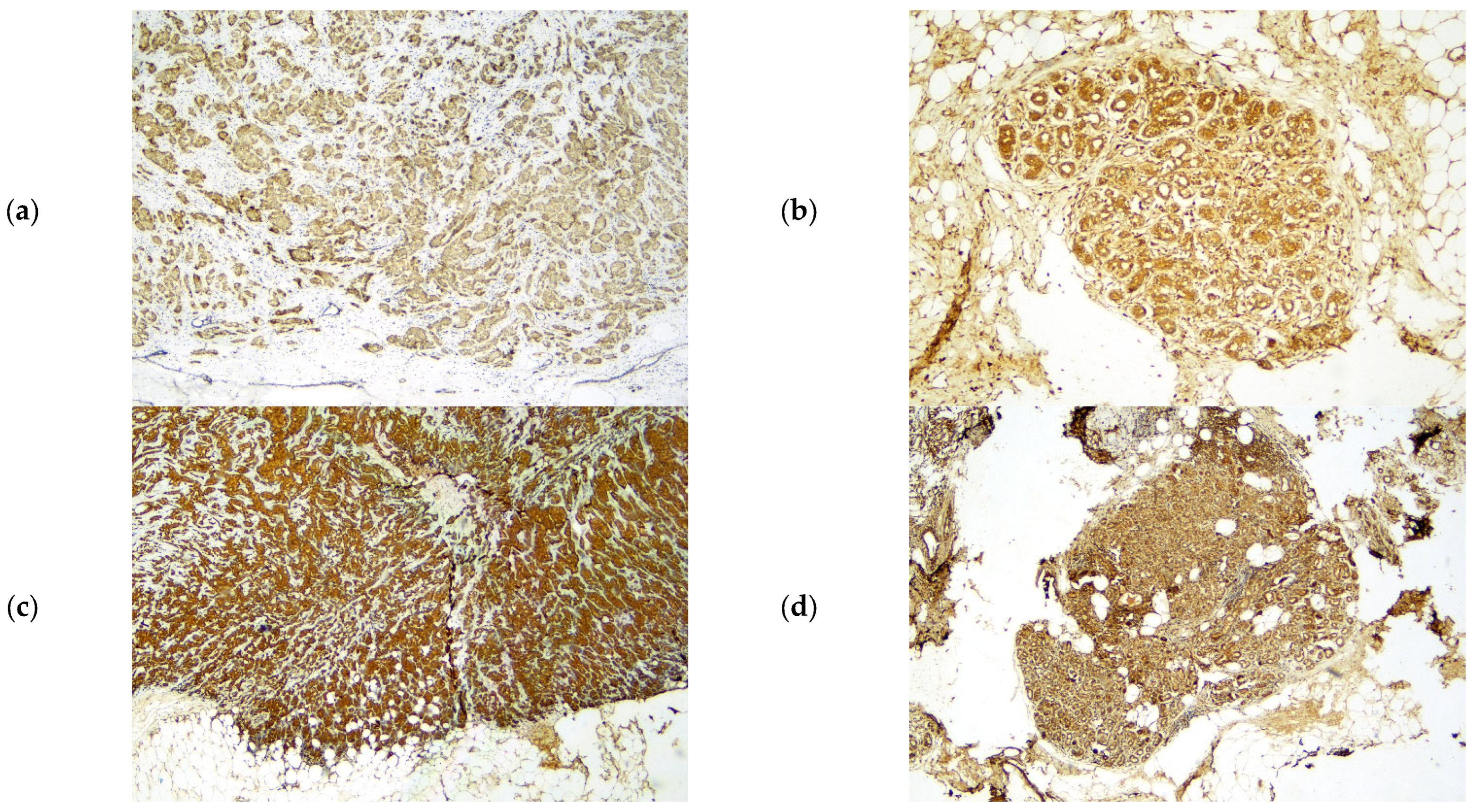
PR and ER expression levels were assessed using the Allred scoring system, in which staining intensity in positively stained tumor nuclei was graded as 0 (no staining), 1 (weak), 2 (moderate), or 3 (strong). CerbB2 status was interpreted as negative for scores of 0 or 1+, and positive for scores of 3+, while cases with a 2+ score were further analyzed using SISH for confirmation. ER and PR positivity was defined as nuclear staining in more than 1% of tumor cells. For Ki67, it was defined as high and low staining based on 14% of tumor cells. SMURF1 and SMURF2 immunoreactivity was evaluated semiquantitatively based on staining intensity, scored from 0 to 3 (0 = absent, 1 = weak, 2 = moderate, 3 = strong) [18] (Figure 1). SMURF1 and SMURF2 immunoreactivity predominantly displayed cytoplasmic staining in both tumor and adjacent normal tissues. The intensity and proportion of positive cells were evaluated semi-quantitatively on a four-tiered scale: 0 = absent, 1 = weak (≤10%), 2 = moderate (11–50%), 3 = strong (>50%). Representative examples of each positivity level and all patient scores are listed in Table 1. Scale bars (50 µm) were added to Figure 1.

2.3. Expression Levels of SMURF1 and SMURF2

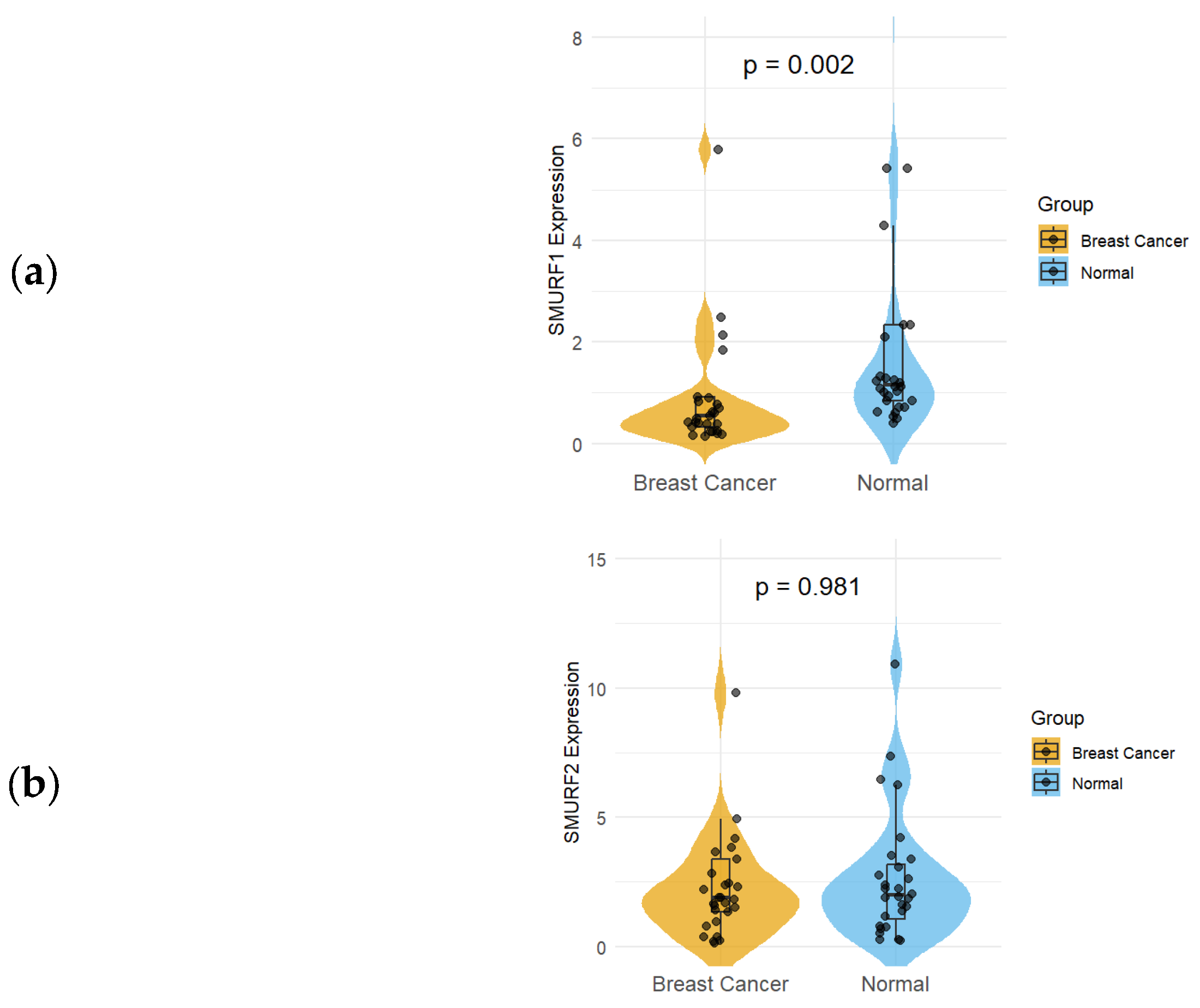
Tumor and normal tissue samples from breast cancer patients were stained with anti-SMURF1 and anti-SMURF2 antibodies to evaluate differences in SMURF1 and SMURF2 expression using immunohistochemistry. The results showed that SMURF1 and SMURF2 protein expression levels did not differ significantly between tumor and normal tissues (p > 0.05). However, when SMURF1 and SMURF2 mRNA expression levels were compared, SMURF1 was found to be significantly reduced in tumor tissues (p = 0.002), whereas SMURF2 expression did not differ significantly between the groups (p = 0.981) (Table 2) (Figure 2).

2.4. In Silico Validation of Experimental Findings

We constructed PPI networks based on SMURF1 and SMURF2 interactions at three hierarchical levels (Table 3). The first-level network, which included SMURF1 and SMURF2, showed a significant interaction (p = 0.0193). Gene Ontology (GO) enrichment revealed that “ubiquitin-dependent SMAD protein catabolic process” (GO:0030579) and “Wnt signaling pathway” (GO:0060071) were the most prominent cellular processes. KEGG pathway analysis revealed enrichment of “Hedgehog signaling pathway” (hsa04340). The second-level network consists of 11 proteins, including SMURF1, SMURF2, SMAD5, RUNX2, SMAD1, SMAD6, SMAD7, SMAD2, TGFBR1, TGFBR2, and RHOA. GO analysis highlighted the “transmembrane receptor protein serine/threonine kinase signaling pathway” (GO:0007178) and the “BMP signaling pathway” (GO:0030509) as significantly enriched processes. KEGG analysis revealed the “TGF-beta signaling pathway” (hsa04350) as the most enriched pathway. Similarly, in the third-level network, which includes SMURF2, SMURF1, SMAD3, SMAD6, SMAD2, TGFBR1, USP15, UBC, SMAD7, RPS27A, and UBE2L3, GO terms such as “Transmembrane receptor protein serine/threonine kinase signaling pathway” and “BMP signaling pathway” were enriched, and KEGG analysis again showed enrichment of “TGF-beta signaling pathway.” These results indicate that SMURF1 and SMURF2 interact with multiple proteins involved in important signaling pathways, particularly those related to the TGF-beta and BMP signaling pathways, highlighting their potential roles in regulating cellular signaling processes. To further substantiate our results, we performed an additional in silico validation using the TCGA breast cancer (BRCA) dataset via the GEPIA2 web server (http://gepia2.cancer-pku.cn/ accessed on 8 May 2025). Consistent with our qPCR data, SMURF1 mRNA showed significantly lower expression levels in tumor tissues compared with matched normal samples (p < 0.01), while SMURF2 expression remained unchanged. These findings provide independent support for our experimental observations.

2.4.1. Prognostic Value and Patient Survival Analysis

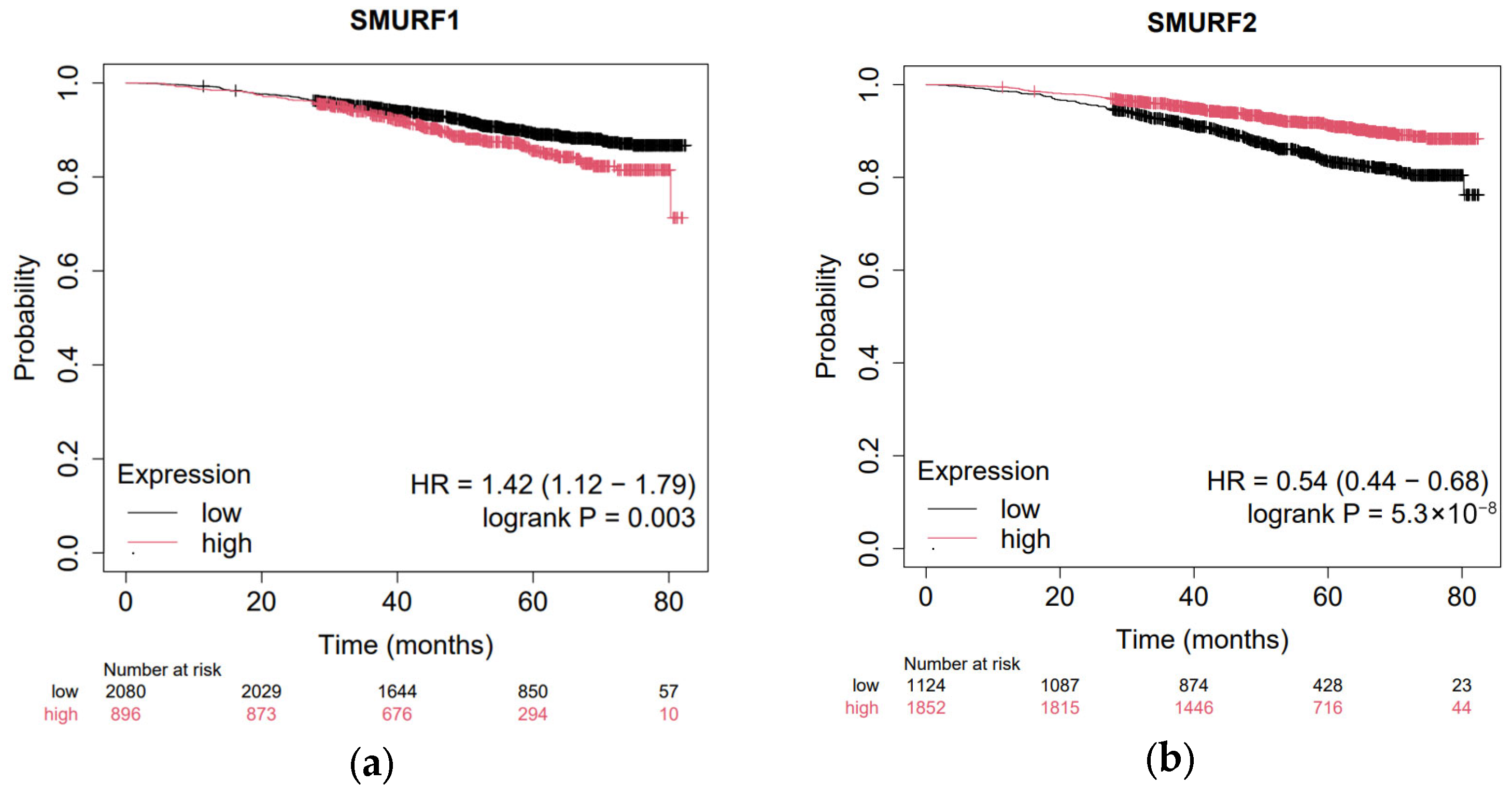
Kaplan–Meier survival analysis revealed that high SMURF1 expression was significantly associated with poorer overall survival in breast cancer patients, indicating an adverse prognostic impact. In contrast, SMURF2 expression did not show a significant association with overall survival, suggesting distinct clinical roles for these two SMURF family members (Figure 3).

2.4.2. Differential Expression of SMURF1 and SMURF2 in Breast Cancer Tissues

Analysis of TCGA-BRCA and GTEx datasets using GEPIA3 demonstrated that SMURF1 expression was significantly altered in breast cancer tissues compared to normal breast samples (p = 2.89 × 10⁻¹⁹). Conversely, SMURF2 did not exhibit a significant differential expression pattern (p = 0.238), further supporting the notion that SMURF1 may play a more prominent role in breast cancer biology.

2.4.3. Single-Cell RNA Sequencing Revealed Cell-Type-Specific Expression of SMURF Genes

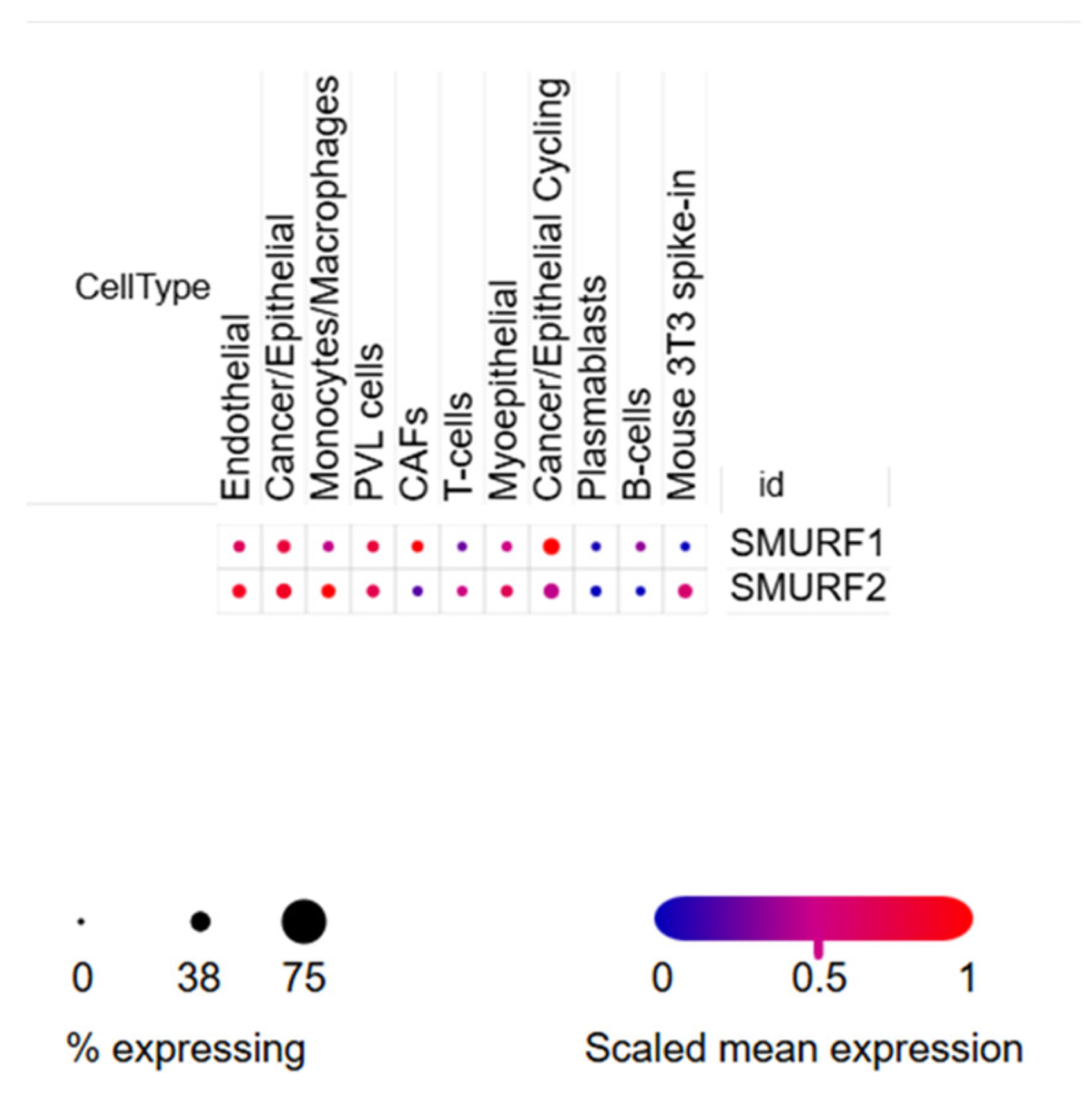
Single-cell RNA sequencing (scRNA-seq) analyses showed that both genes clustered in different cell populations within the tumor microenvironment. The highest expression density and prevalence were detected in the “Cancer/Epithelial Cycling” cell group. Moderate expression was also observed in CAFs, endothelial, and PVL cells. Compared to SMURF1, it exhibited a more widespread distribution, being highly expressed in endothelial, cancer/epithelial, monocyte/macrophage, and PVL cells (Figure 4).

3. Discussion

In this study, we investigated the expression patterns of SMURF1 and SMURF2 in breast cancer tissues and their adjacent normal counterparts, as well as their potential molecular interactions and functional implications, through in silico analyses. Our findings revealed a significant downregulation of SMURF1 mRNA levels in tumor tissues compared to normal breast tissues, while SMURF2 expression did not show a statistically significant difference. Immunohistochemical analysis indicated no significant difference in SMURF1 and SMURF2 protein levels between tumor and normal samples. Furthermore, the in silico functional enrichment analysis demonstrated that both SMURF1 and SMURF2 are strongly associated with the TGF-β, BMP, and Wnt signaling pathways, supporting their involvement in oncogenic and tumor-suppressive processes.
A notable finding in our study is the apparent paradox between the downregulation of SMURF1 mRNA in our clinical cohort and its association with poorer prognosis at higher expression levels in the in silico survival analysis. This observation highlights the context-dependent dual role of SMURF1 in breast cancer. While SMURF1 downregulation might be an early event in tumorigenesis to bypass certain regulatory checkpoints (such as the inhibition of Wnt signaling), its relative maintenance or later upregulation in established tumors could drive aggressive behavior. High SMURF1 levels have been shown to promote epithelial-to-mesenchymal transition (EMT) and metastasis through the degradation of RhoA. Therefore, while typically reduced in tumor tissues compared to normal, patients who retain higher relative SMURF1 levels within the tumor population may face a higher risk of disease progression.
Regarding SMURF2, despite its strong prognostic significance (HR = 0.54), we observed no significant differential expression between tumor and normal tissues. This suggests that SMURF2 may not serve as a primary diagnostic marker for malignancy in breast tissue, but rather functions as a crucial stratification marker once the tumor is established. The stability of SMURF2 levels in our cohort, combined with its protective effect in survival datasets, indicates that its biological impact is likely mediated through its functional activity on specific substrates rather than gross changes in transcript levels.
Interestingly, despite its significant prognostic impact (HR = 0.54) observed in silico, SMURF2 did not show differential expression in our clinical cohort. This suggests that SMURF2 may function more as a predictive marker for disease progression rather than a primary diagnostic marker for malignancy. The stable expression of SMURF2 across tumor and normal tissues further supports its complex, context-dependent role, where its biological impact is likely mediated through the selective ubiquitination of specific oncogenic or tumor-suppressive substrates rather than gross changes in its transcript levels.
Although SMURF1 has predominantly been characterized as an oncogenic E3 ubiquitin ligase promoting cell migration and invasion, emerging evidence suggests that it may exert tumor-suppressive functions under specific cellular contexts. Recent studies have revealed that SMURF1 negatively regulates several oncogenic pathways through selective ubiquitination of cancer-promoting substrates. SMURF1 targets TRIB2, a positive regulator of hepatocellular carcinoma (HCC) survival and transformation, for ubiquitin-mediated degradation following its phosphorylation by p70S6K, thereby limiting TRIB2-driven tumorigenesis [19]. Moreover, SMURF1 acts as a scaffold component in a complex with COP1 and β-TrCP, suppressing TCF4/β-catenin signaling and reducing oncogenic transcriptional activity in liver cancer cells [20]. Another important tumor-suppressive mechanism of SMURF1 involves the AXIN1–Wnt signaling axis. SMURF1 promotes non-proteolytic Lys29-linked polyubiquitination of AXIN1, preventing its binding to the Wnt co-receptor LRP5/6, thereby inhibiting Wnt-induced LRP6 phosphorylation and subsequent pathway activation [21]. Since aberrant activation of Wnt/β-catenin signaling is a hallmark of aggressive breast cancer subtypes, the reduced SMURF1 expression observed in our study may lead to a loss of this negative regulation, potentially contributing to enhanced Wnt activity and tumor progression.
SMURF1 has also been reported to mediate the degradation of MCAM (melanoma cell adhesion molecule), which drives proliferation, metastasis, and angiogenesis in HCC cells [22]. By promoting MCAM degradation in cooperation with β-TrCP, SMURF1 may counteract pro-metastatic processes. Furthermore, SMURF1 induces ubiquitination of the splicing factor SRSF5, a pro-oncogenic regulator of alternative splicing that favors tumor growth [23]. SMURF1-dependent degradation of SRSF5 leads to the accumulation of the tumor-suppressive isoform CCAR1L, thereby inhibiting proliferation and promoting cell-cycle arrest [24].
Recent studies have further elucidated the complex role of the TGF-beta pathway in the tumor microenvironment of solid tumors. It is now understood that SMURF1 and SMURF2 mediate the ubiquitination and degradation of TGF-beta receptors and SMAD proteins, acting as molecular switches that control the transition of TGF-beta from a tumor suppressor to a pro-metastatic factor. Particularly in breast cancer, the dysregulation of this pathway is closely linked to epithelial–mesenchymal transition (EMT) and chemoresistance [25].
In our study, we observed a significant downregulation of SMURF1 mRNA levels in tumor tissues, whereas SMURF1 protein expression remained relatively unchanged. This apparent discrepancy between mRNA and protein levels is a well-recognized phenomenon in cancer biology. Recent large-scale proteogenomic studies have shown that the correlation between mRNA and protein abundance is often modest, typically ranging from 0.40 to 0.60, as protein levels are heavily influenced by translational regulation and post-translational stability. Specifically, SMURF1 is an E3 ubiquitin ligase that can undergo self-ubiquitination and proteasomal degradation. The maintenance of SMURF1 protein levels despite decreased mRNA transcripts might suggest an increased protein half-life or a compensatory reduction in its degradation rate within the tumor microenvironment. Our findings are consistent with the TCGA-BRCA dataset, which also demonstrates significant mRNA downregulation, highlighting the complex regulatory landscape of SMURF1 in breast cancer.
The in silico PPI network and enrichment analyses revealed that SMURF1 and SMURF2 are functionally connected with several critical regulators of TGF-β and BMP pathways, including SMAD2/3/5/6/7, TGFBR1/2, RUNX2, and RHOA. These results corroborate previous findings showing that SMURF1 and SMURF2 act as E3 ligases that ubiquitinate receptor-regulated SMADs (R-SMADs) and TGF-β receptors, thereby modulating the intensity and duration of TGF-β/BMP signaling [5]. The enrichment of pathways such as “TGF-beta signaling”, “BMP signaling,” and “Wnt signalling pathway” in our network analysis further supports the dual regulatory role of SMURF1/2 in both tumor-suppressive and pro-metastatic mechanisms. The observation that SMURF1 is downregulated in tumor tissues while high expression correlates with poorer overall survival highlights the multifaceted role of this E3 ligase in breast cancer. This suggests that while SMURF1 may initially act to suppress early oncogenic signaling (such as Wnt), its presence at higher levels in established tumors could switch to an oncogenic role, promoting more aggressive clinical behavior.
The present study has some limitations. The sample size was relatively small, limiting the power for subtype-specific analyses. Moreover, the mechanistic link between SMURF1 and Wnt/β-catenin signaling was inferred solely by in silico analysis. Future studies with larger patient cohorts and functional in vitro experiments are warranted to verify these mechanisms.

4. Material and Methods

4.1. Study Population

The study included 30 newly diagnosed, treatment-naïve breast cancer patients aged between 38 and 82 years. Both tumor and adjacent non-tumorous tissues were collected during mastectomy; normal tissues were obtained from healthy breast tissue surrounding the tumor. The inclusion criterion was a new diagnosis of breast cancer, while patients with carcinoma in situ or bilateral breast cancer were excluded. This study was approved by the Clinical Research Ethics Committee of Muğla Sıtkı Koçman University (Decision No: 240177).

4.2. Immunohistochemistry

In this study, a prospective analysis was conducted on tumors diagnosed as invasive breast carcinoma (not otherwise specified) in patients who underwent mastectomy between 2023 and 2024. The study included 30 patients, from whom both tumor and adjacent normal tissue samples were collected from fresh mastectomy specimens. For histopathological examination, tissues were fixed in 10% neutral buffered formalin, embedded in paraffin blocks, and sectioned at 4 μm thickness, followed by hematoxylin and eosin (H&E) staining. After routine microscopic evaluation, the block with the highest tumor content from each case was selected, and 3–4 μm tissue sections were placed on poly-L-lysine-coated glass slides (Thermo Scientific, Waltham, MA, USA) for immunohistochemical (IHC) staining.

4.3. RNA Isolation and qPCR

To prevent RNA degradation, tissue samples were preserved in an RNA stabilization reagent (NucleoGene Stabilizer Solution Tissue & Cell DNA/RNA, Cat. No: NGP001) and stored at −80 °C. The collected tissues from each experimental group were then homogenized using a homogenizator (PRO25D Digital Homogenizer). RNA was extracted from breast tissue using the TRIzol™ Reagent (Cat. No: 15596026). cDNA was synthesized using the High-Capacity cDNA Reverse Transcription Kit (ThermoFisher, Cat. No: 4368814). The mRNA levels of SMURF1 and SMURF2 were determined with the ABI StepOne Plus instrument using the SYBR Green reagent (NucleoGene, Cat. No: NGMM007). The primer sequences used in this study are summarized in Table 4. ACTB was used as the endogenous reference gene, and SMURF1 and SMURF2 expression levels were quantified using the 2−ΔΔCT method. The experiments were repeated three times [26].

4.4. In Silico Analysis

Our study design and findings were confirmed using several in silico analyses. We used STRING (https://string-db.org/, accessed on 11 November 2025) for the potential interactions and functional enrichment analysis of SMURF1 and SMURF2. The default minimum required interaction score was set to medium confidence (0.400). In addition, STRING reported significant functional enrichment in the pathways associated with these identified interaction networks [27].

4.4.1. Survival Analysis

The prognostic impact of SMURF1 and SMURF2 expression was assessed using the Kaplan–Meier Plotter platform (https://kmplot.com/analysis/, accessed on 26 January 2026). Breast cancer patients were stratified into high- and low-expression groups based on the best-performing cutoff expression of each gene. Overall survival (OS) was analyzed using default settings, and hazard ratios (HRs), 95% confidence intervals (CIs), and log-rank p-values were recorded.

4.4.2. Differential Expression Analysis

Gene expression levels of SMURF1 and SMURF2 in breast tumor tissues and normal breast samples were evaluated using the GEPIA3 web server (https://gepia3.bioinfoliu.com/, accessed on 26 January 2026), which integrates data from the TCGA and GTEx projects. Differential expression was assessed in the TCGA-BRCA cohort.

4.4.3. Single-Cell RNA Sequencing Analysis

To explore the cell-type-specific expression of SMURF genes within the breast tumor, single-cell RNA sequencing datasets were interrogated using the Broad Institute Single Cell Portal (https://singlecell.broadinstitute.org/single_cell, accessed on 26 January 2026). Human breast cancer datasets with annotated cell types were analyzed. SMURF1 and SMURF2 expression levels were visualized across major cellular compartments, including malignant epithelial cells, stromal cells, and immune populations. Low-abundance or technically uninformative cell populations were excluded to improve interpretability.

4.5. Statistical Analysis

To analyze the obtained gene expression and clinical data, we used R (version 4.12). For paired continuous variables (tumor vs. adjacent normal tissue), the paired t-test or Wilcoxon signed-rank test was applied depending on the data distribution. p-values < 0.05 were considered statistically significant.
The chi-square test was used for the statistics of categorical variables. The normality of the data distribution was assessed using the Shapiro–Wilk test. The Independent Samples t-test was utilized to evaluate statistical differences between groups for continuous variables with a normal distribution. Pairwise comparisons were performed using the Wilcoxon–Mann–Whitney test for continuous variables with a non-normal distribution. For continuous variables, data were summarized as mean ± standard deviation when the distribution was normal, and as median with interquartile range (IQR) when the distribution was non-normal. If the p-value was less than 0.05, it was deemed statistically significant.

5. Conclusions

This study represents one of the few investigations to comprehensively analyze SMURF1 and SMURF2 expression profiles in breast cancer. The results demonstrated a significant reduction in SMURF1 mRNA levels, suggesting that its downregulation may disrupt the balance of the TGF-β/BMP/Wnt signaling networks, thereby promoting tumor progression. In contrast, the lack of a significant change in SMURF2 expression indicates that this gene may exert context-dependent functions that vary according to tumor subtype or microenvironmental conditions. The in silico analyses further revealed close interactions of SMURF1 and SMURF2 with critical signaling regulators such as SMAD proteins, TGF-β receptors, and RUNX2, emphasizing their importance in maintaining cellular homeostasis and fine-tuning signaling activity. Overall, the decreased SMURF1 expression observed in breast cancer highlights its potential as a candidate biomarker, whereas the multifaceted role of SMURF2 warrants deeper investigation. Further functional and translational studies in larger patient cohorts are needed to clarify the roles of these genes across different molecular subtypes of breast cancer and to evaluate their potential as therapeutic targets.

Author Contributions

Conceptualization—L.T. and T.E.; Methodology—F.D. and C.Y.; Formal Analysis—M.C. and Ç.Ö.; Investigation—O.A.; Writing—Original Draft—L.T.; Writing—Review and Editing—T.E. and F.D. All authors have read and agreed to the published version of the manuscript.

Funding

This research received no external funding.

Institutional Review Board Statement

This study was approved by the Clinical Research Ethics Committee of Muğla Sıtkı Koçman University (Decision No: 240177, Approval date 14 November 2024).

Informed Consent Statement

Written informed consent was obtained from all participants.

Data Availability Statement

All data are available from the corresponding author upon reasonable request.

Acknowledgments

The authors thank the Muğla Sıtkı Koçman University Central Research Laboratory (MUTAGEM) for technical assistance.

Conflicts of Interest

The authors declare no conflicts of interest.

References

  1. Lerman, M.I.; Minna, J.D. The 630-kb Lung Cancer Homozygous Deletion Region on Human Chromosome 3p21.3: Identification and Evaluation of the Resident Candidate Tumor Suppressor Genes. Cancer Res. 2000, 60, 6116–6133. [Google Scholar] [PubMed]
  2. Kretzschmar, M. Transforming growth factor-β and breast cancer: Transforming growth factor-β/SMAD signaling defects and cancer. Breast Cancer Res. 2000, 2, 107–115. [Google Scholar] [CrossRef] [PubMed]
  3. Colak, S.; Ten Dijke, P. Targeting TGF-β Signaling in Cancer. Trends Cancer 2017, 3, 56–71. [Google Scholar] [CrossRef] [PubMed]
  4. Guo, X.; Wang, X.-F. Signaling cross-talk between TGF-β/BMP and other pathways. Cell Res. 2009, 19, 71–88. [Google Scholar] [CrossRef]
  5. Koganti, P.; Levy-Cohen, G.; Blank, M. Smurfs in Protein Homeostasis, Signaling, and Cancer. Front. Oncol. 2018, 8, 295. [Google Scholar] [CrossRef]
  6. Sahai, E.; Garcia-Medina, R.; Pouysségur, J.; Vial, E. Smurf1 regulates tumor cell plasticity and motility through degradation of RhoA leading to localized inhibition of contractility. J. Cell Biol. 2007, 176, 35–42. [Google Scholar] [CrossRef]
  7. Tao, Y.; Sun, C.; Zhang, T.; Song, Y. SMURF1 promotes the proliferation, migration and invasion of gastric cancer cells. Oncol. Rep. 2017, 38, 1806–1814. [Google Scholar] [CrossRef]
  8. Gang, X.; Wang, G.; Huang, H. Androgens regulate SMAD ubiquitination regulatory factor-1 expression and prostate cancer cell invasion. Prostate 2015, 75, 561–572. [Google Scholar] [CrossRef]
  9. Yang, H.; Yu, N.; Xu, J.; Ding, X.; Deng, W.; Wu, G.; Li, X.; Hou, Y.; Liu, Z.; Zhao, Y.; et al. SMURF1 facilitates estrogen receptor a signaling in breast cancer cells. J. Exp. Clin. Cancer Res. 2018, 37, 24. [Google Scholar] [CrossRef]
  10. Blank, M.; Tang, Y.; Yamashita, M.; Burkett, S.S.; Cheng, S.Y.; E Zhang, Y. A tumor suppressor function of Smurf2 associated with controlling chromatin landscape and genome stability through RNF20. Nat. Med. 2012, 18, 227–234. [Google Scholar] [CrossRef]
  11. Emanuelli, A.; Borroni, A.P.; Apel-Sarid, L.; Shah, P.A.; Ayyathan, D.M.; Koganti, P.; Levy-Cohen, G.; Blank, M. Smurf2-mediated stabilization of DNA topoisomerase IIα controls genomic integrity. Cancer Res. 2017, 77, 4217–4227. [Google Scholar] [CrossRef] [PubMed]
  12. Du, J.X.; Hagos, E.G.; Nandan, M.O.; Bialkowska, A.B.; Yu, B.; Yang, V.W. The E3 ubiquitin ligase SMAD ubiquitination regulatory factor 2 negatively regulates Krüppel-like factor 5 protein. J. Biol. Chem. 2011, 286, 40354–40364. [Google Scholar] [CrossRef] [PubMed]
  13. Khachigian, L.M. The Yin and Yang of YY1 in tumor growth and suppression. Int. J. Cancer 2018, 143, 460–465. [Google Scholar] [CrossRef] [PubMed]
  14. Kim, K.H.; Roberts, C.W.M. Targeting EZH2 in cancer. Nat. Med. 2016, 22, 128–134. [Google Scholar] [CrossRef]
  15. Fukuchi, M.; Fukai, Y.; Masuda, N.; Miyazaki, T.; Nakajima, M.; Sohda, M.; Manda, R.; Tsukada, K.; Kato, H.; Kuwano, H. High-level expression of the Smad ubiquitin ligase Smurf2 correlates with poor prognosis in patients with esophageal squamous cell carcinoma. Cancer Res. 2002, 62, 7162–7165. [Google Scholar]
  16. Wang, S.M.; Ooi, L.L.P.; Hui, K.M. Identification and Validation of a Novel Gene Signature Associated with the Recurrence of Human Hepatocellular Carcinoma. Clin. Cancer Res. 2007, 13, 6275–6283. [Google Scholar] [CrossRef]
  17. Fukunaga, E.; Inoue, Y.; Komiya, S.; Horiguchi, K.; Goto, K.; Saitoh, M.; Miyazawa, K.; Koinuma, D.; Hanyu, A.; Imamura, T. Smurf2 induces ubiquitin-dependent degradation of Smurf1 to prevent migration of breast cancer cells. J. Biol. Chem. 2008, 283, 35660–35667. [Google Scholar] [CrossRef]
  18. Tekin, L.; Edgünlü, T.; Genç, D. Immunohistochemical and molecular evaluation of TUSC2 expression in breast cancer. Mol. Biol. Rep. 2024, 51, 394. [Google Scholar] [CrossRef]
  19. Wang, J.; Park, J.-S.; Wei, Y.; Rajurkar, M.; Cotton, J.L.; Fan, Q.; Lewis, B.C.; Ji, H.; Mao, J. TRIB2 acts downstream of Wnt/TCF in liver cancer cells to regulate YAP and C/EBPα function. Mol. Cell 2013, 51, 211–225. [Google Scholar] [CrossRef]
  20. Xu, S.; Tong, M.; Huang, J.; Zhang, Y.; Qiao, Y.; Weng, W.; Liu, W.; Wang, J.; Sun, F. TRIB2 inhibits Wnt/β-Catenin/TCF4 signaling through its associated ubiquitin E3 ligases, β-TrCP, COP1 and Smurf1, in liver cancer cells. FEBS Lett. 2014, 588, 4334–4341. [Google Scholar] [CrossRef]
  21. Fei, C.; Li, Z.; Li, C.; Chen, Y.; Chen, Z.; He, X.; Mao, L.; Wang, X.; Zeng, R.; Li, L. Smurf1-Mediated Lys29-Linked Nonproteolytic Polyubiquitination of Axin Negatively Regulates Wnt/β-Catenin Signaling. Mol. Cell. Biol. 2013, 33, 4095–4105. [Google Scholar] [CrossRef]
  22. Fu, L.; Cui, C.-P.; Zhang, X.; Zhang, L. The functions and regulation of Smurfs in cancers. Semin. Cancer Biol. 2020, 67, 102–116. [Google Scholar] [CrossRef]
  23. Tang, X.; Chen, X.; Xu, Y.; Qiao, Y.; Zhang, X.; Wang, Y.; Guan, Y.; Sun, F.; Wang, J. CD166 positively regulates MCAM via inhibition to ubiquitin E3 ligases Smurf1 and βTrCP through PI3K/AKT and c-Raf/MEK/ERK signaling in Bel-7402 hepatocellular carcinoma cells. Cell. Signal. 2015, 27, 1694–1702. [Google Scholar] [CrossRef]
  24. Chen, Y.; Huang, Q.; Liu, W.; Zhu, Q.; Cui, C.-P.; Xu, L.; Guo, X.; Wang, P.; Liu, J.; Dong, G.; et al. Mutually exclusive acetylation and ubiquitylation of the splicing factor SRSF5 control tumor growth. Nat. Commun. 2018, 9, 2464. [Google Scholar] [CrossRef]
  25. Rahavi, H.; Alizadeh-Navaei, R.; Tehrani, M. Efficacy of therapies targeting TGF-beta in solid tumors: A Systematic review and meta-analysis of clinical trials. Immunotherapy 2023, 15, 283–292. [Google Scholar] [CrossRef]
  26. Turkyilmaz, A.; Akin, M.N.; Kasap, B.; Ozdemİr, C.; Bilgic, A.D.; Edgunlu, T.G. AKT1 and MAPK8: New Targets for Gestational Diabetes Mellitus? Fetal Pediatr. Pathol. 2024, 43, 427–435. [Google Scholar] [CrossRef]
  27. Szklarczyk, D.; Kirsch, R.; Koutrouli, M.; Nastou, K.; Mehryary, F.; Hachilif, R.; Gable, A.L.; Fang, T.; Doncheva, N.T.; Pyysalo, S.; et al. The STRING database in 2023: Protein–protein association networks and functional enrichment analyses for any sequenced genome of interest. Nucleic Acids Res. 2023, 51, D638–D646. [Google Scholar] [CrossRef] [PubMed]
Figure 1. Immunohistochemical Expression of SMURF1 and SMURF2 in Breast Tumor and Normal Tissues. Immunohistochemical staining of SMURF1 (a) and SMURF2 (c) proteins in breast tumor tissue, and SMURF1 (b) and SMURF2 (d) in normal breast tissue (4× magnification). (scale bar = 50 µm). Brown staining indicates positive immunohistochemical expression.
Ijms 27 01921 g001
Figure 2. Expression levels of (a) SMURF1 and (b) SMURF2 between tumor and normal tissues.
Ijms 27 01921 g002
Figure 3. Patient stratification was performed using the “auto-select best cutoff” feature, which explains the unequal distribution of patients in high- and low-expression groups (n values), aimed at identifying the most clinically significant prognostic impact. Kaplan–Meier survival analysis of breast cancer patients stratified by SMURF gene expression. (a) Patients were divided into high- and low-expression groups based on the median expression of SMURF1 using the Kaplan–Meier Plotter platform. High SMURF1 expression was significantly associated with poorer overall survival. (b) Kaplan–Meier survival analysis of patients stratified by SMURF2 expression. No significant association between SMURF2 expression levels and overall survival was observed. Hazard ratios (HRs), 95% confidence intervals (CIs), and log-rank p-values are shown.
Ijms 27 01921 g003
Figure 4. Cell-type-specific expression of SMURF1 and SMURF2 in breast cancer assessed by single-cell RNA sequencing. Dot plots show SMURF1 and SMURF2 expression across major cellular compartments within breast tumors, including malignant epithelial cells, stromal cells, and immune populations.
Ijms 27 01921 g004
Table 1. Distribution of Clinicopathological Variables Among Patients.
Parameters n (%)p *
Grade11 (3.3)<0.001
218 (60.0)
311 (36.7)
ER+26 (86.67)<0.001
4 (13.3)
PR+27 (90)<0.001
3 (10)
cerbB2+3 (10)<0.001
27 (90)
Ki67≥14%15 (50)>0.05
<14%15 (50)
Tumor size˃2 cm11 (36.7)0.003
≤2 cm19 (63.3)
Age˃507 (23.3)0.003
≤5023 (76.7)
LVI+16 (53.3)0.72
14 (46.7)
PNI+11 (36.7)0.003
19 (63.3)
Lymph node metastasis+17 (56.7)0.47
13 (43.3)
* Chi-square test; ER: Estrogen Receptor; PR: Progesterone Receptor; LVI: Lymphovascular invasion; PNI: Perineural invasion.
Table 2. Expression levels of SMURF1 and SMURF2 in breast cancer and normal tissues.
Median (IQR)
GenesBreast Cancer
(n = 30)
Normal
(n = 30)
p *
SMURF10.55 (0.59)1.16 (1.49)0.002
SMURF21.89 (2.03)1.98 (2.09)0.981
* Mann–Whitney U test; IQR: Interquartile range.
Table 3. Functional enrichments of networks based on SMURF1 and SMURF2 interactions.
NetworkProteinsNetwork StatsDatabaseDescriptionStrength 1FDR 2
1Ijms 27 01921 i001SMURF1
SMURF2
number of nodes: 2
number of edges: 1
average node
degree: 1
avg. local clustering coefficient: 1
expected number of edges: 0
PPI enrichment
p-value: 0.0193
Gene Ontology GO:0030579
Ubiquitin-dependent SMAD protein catabolic process
3.520.0023
0.0348
GO:0060071
Wnt signaling pathway, planar cell polarity pathway
2.69
KEGG Pathwayshsa04340
Hedgehog signaling pathway
2.630.0020
2Ijms 27 01921 i002SMURF1
SMURF2
SMAD5
RUNX2
SMAD1
SMAD6
SMAD7
SMAD2
TGFBR1
TGFBR2
RHOA
number of nodes: 11
number of edges: 51
average node degree: 9.27
avg. local clustering coefficient:0.941
expected number of edges:13
PPI enrichment p-value: 6.66 × 10⁻¹⁶
Gene OntologyGO:0007178
Transmembrane receptor protein
serine/threonine kinase signaling
pathway
1.943.46 × 10−15
GO:0030509
BMP signaling pathway
2.131.21 × 10−10
KEGG Pathwayshsa04350
TGF-beta signaling pathway
2.292.91 × 10−20
3Ijms 27 01921 i003SMURF2
SMURF1
SMAD3
SMAD6
SMAD2
TGFBR1
USP15
UBC
SMAD7
RPS27A
UBE2L3
number of nodes: 11
number of edges: 48
average node degree: 8.73
avg. local clustering coefficient: 0.917
expected number of edges: 17
PPI enrichment p-value: 3.4 × 10⁻¹⁰
Gene OntologyGO:0007178
Transmembrane receptor protein
serine/threonine kinase signaling
pathway
1.844.26 × 10−10
GO:0030509
BMP signaling pathway
2.074.59 × 10−8
KEGG Pathwayshsa04350
TGF-beta signaling pathway
2.146.59 × 10−12
Ijms 27 01921 i004 Nodes represent proteins and edges represent protein–protein associations. Colored nodes indicate query proteins and first shell interactors, while white nodes indicate second shell interactors. Edge colors represent different types of interaction evidence, including curated databases, experimental data, gene neighborhood, gene fusion, co-occurrence, text mining, co-expression, and homology.
1 Strength: Log10 (observed/expected). This measure describes how large the enrichment effect is. It is the ratio between (i) the number of proteins in your network that are annotated with a term and (ii) the number of proteins that we expect to be annotated with this term in a random network of the same size. 2 False Discovery Rate: This measure describes how significant the enrichment is. Shown are p-values corrected for multiple testing within each category using the Benjamini–Hochberg procedure.
Table 4. Primer sequences used for qPCR.
Gene/RNAPrimer Sequences
SMURF1F:5′-GTCCAGAAGCTGAAAGTCCTCAGA-3′
R: 5′-CACGGAATTTCACCATCAGCC-3′
SMURF2F: 5′-GATCCAAAGTGGAATCAGCA-3′
R: 5′-TGGCATTGGAAAGAAGACG-3′
ACTBF: 5′-CCTGGCACCCAGCACAAT-3′
R: 5′-GGGCCGGACTCGTCATAC-3′
Disclaimer/Publisher’s Note: The statements, opinions and data contained in all publications are solely those of the individual author(s) and contributor(s) and not of MDPI and/or the editor(s). MDPI and/or the editor(s) disclaim responsibility for any injury to people or property resulting from any ideas, methods, instructions or products referred to in the content.