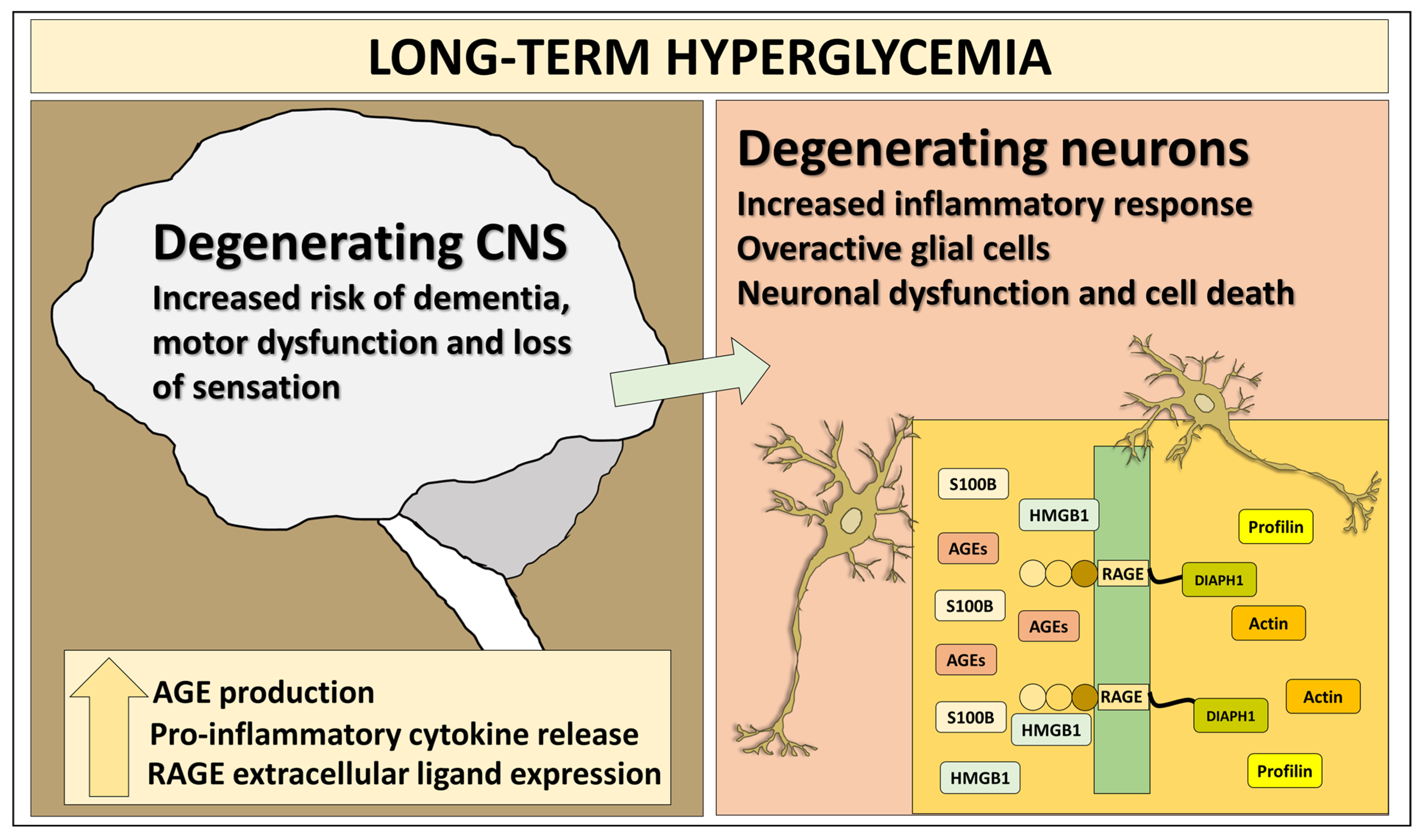
RAGE Axis in the Pathogenesis and Treatment of CNS Neurodegeneration in Long-Term Hyperglycemia

Abstract
1. Introduction
2. RAGE Signaling Axis in the Pathogenesis of CNS Neurodegeneration
2.1. RAGE and AGEs
2.2. RAGE, HMGB1 and Toll-like Receptor 4 (TLR4)
2.3. RAGE, S100B, S100A8
3. RAGE, Diaph1 and Profilins
3.1. Diaph1
3.2. Profilins
4. RAGE Signaling Axis—Therapeutic Potential
4.1. RAGE-Related Pathways in Diabetes-Driven CNS-Neurodegenation
4.2. Human Studies
4.3. Large Animal Models
4.4. Direct RAGE Antagonists
4.5. Indirect Modulation of RAGE
4.5.1. Metformin
4.5.2. Thiazolidinediones
4.5.3. GLP-1 Receptor Agonists
4.5.4. Antioxidants
4.6. Potential Novel Therapeutics Indirectly Targeting RAGE-Ligand Binding—Alagebrium (ALT-711) and C-Phycocyanin

| Drug/Agent | Short Characteristics | Mechanism of Action | Development Stage | Key Reference(s) |
|---|---|---|---|---|
| C-phycocyanin (C-PC) | Algae-derived pigment–protein complex; likely BBB permeable | Strong antioxidant and antiglycation activity; suppresses RAGE-driven endoplasmic reticulum stress and mitochondrial apoptosis | Preclinical (cell cultures, mouse models); biotherepeutic candidate for diabetes-associated neurodegeneration | [132,147,149,150] |
| Alagebrium (ALT-711) | Thiazolium derivative; no clear data on BBB permeability | Cleaves pre-formed AGE cross-links in extracellular matrix, reducing tissue stiffness and AGE load | Preclinical (rodent and cell culture) and phase III clinical trials; | [145,146,151] |
5. Unresolved Questions, Limitations and Conflicting Findings
6. Conclusions and Future Directions
Author Contributions
Funding
Data Availability Statement
Conflicts of Interest
Abbreviations
| RAGE | Receptor for advanced glycation end-products |
| AGEs | Advanced glycation end-products |
| ROS | Reactive oxygen species |
| HMGB1 | High mobility group box 1 |
| TLR | Toll-like receptor |
| BBB | Brain–blood barrier |
| SMA | Spinal muscular atrophy |
| CNS | Central nervous system |
| Pfn | Profilin |
| TNF | Tumor necrosis factor |
| ROCK | RhoA-associated kinase |
| MGO | Methylglyoxal |
| AD | Alzheimer’s disease |
| SMN | Survival motor neuron |
| CML | N-epsilon-carboxymethyl lysine |
| DRF | Diaphanous-related formins |
| IL | Interleukin |
| GO | Glyoxal |
| RIPK1 | Receptor-Interacting Protein Kinase |
| NLRP3 | Nucleotide-binding and oligomerization (NOD) like receptor (NLR) |
| BDNF | Brain-derived neurotrophic factor |
| ALS | Amyotrophic lateral sclerosis |
| Aβ | Amyloid beta |
| ICAM | Intercellular adhesion molecule |
| JNK | c-Jun N-terminal kinase |
| MAPK | Mitogen-activated protein kinase |
| NF-κB | Nuclear factor-kappa B |
References
- Sun, H.; Saeedi, P.; Karuranga, S.; Pinkepank, M.; Ogurtsova, K.; Duncan, B.B.; Stein, C.; Basit, A.; Chan, J.C.; Mbanya, J.C. IDF Diabetes Atlas: Global, regional and country-level diabetes prevalence estimates for 2021 and projections for 2045. Diabetes Res. Clin. Pract. 2022, 183, 109119, Erratum in Diabetes Res. Clin. Pract. 2023, 204, 110945. [Google Scholar] [CrossRef]
- Santiago, J.A.; Karthikeyan, M.; Lackey, M.; Villavicencio, D.; Potashkin, J.A. Diabetes: A tipping point in neurodegenerative diseases. Trends Mol. Med. 2023, 29, 1029–1044. [Google Scholar] [CrossRef] [PubMed]
- Harding, J.L.; Pavkov, M.E.; Magliano, D.J.; Shaw, J.E.; Gregg, E.W. Global trends in diabetes complications: A review of current evidence. Diabetologia 2019, 62, 3–16. [Google Scholar] [CrossRef] [PubMed]
- Ritter, S. Chapter 9 Monitoring and maintenance of brain glucose supply: Importance of hindbrain catecholamine neurons in this multifaceted task. In Appetite and Food Intake; CRC Press/Taylor & Francis: Boca Raton, FL, USA, 2017; pp. 177–204. [Google Scholar]
- Papatheodorou, K.; Papanas, N.; Banach, M.; Papazoglou, D.; Edmonds, M. Complications of Diabetes 2016. J. Diabetes Res. 2016, 2016, 6989453. [Google Scholar] [CrossRef]
- Dal Canto, E.; Ceriello, A.; Rydén, L.; Ferrini, M.; Hansen, T.B.; Schnell, O.; Standl, E.; Beulens, J.W. Diabetes as a cardiovascular risk factor: An overview of global trends of macro and micro vascular complications. J. Cardiovasc. Risk 2019, 26, 25–32. [Google Scholar] [CrossRef]
- Zhang, T.; Shaw, M.; Cherbuin, N. Association between Type 2 Diabetes Mellitus and Brain Atrophy: A Meta-Analysis. Diabetes Metab. J. 2022, 46, 781–802. [Google Scholar] [CrossRef]
- Dolatshahi, M.; Sanjari Moghaddam, H.; Saberi, P.; Mohammadi, S.; Aarabi, M.H. Central nervous system microstructural alterations in Type 1 diabetes mellitus: A systematic review of diffusion Tensor imaging studies. Diabetes Res. Clin. Pract. 2023, 205, 110645. [Google Scholar] [CrossRef]
- Zang, Y.; Jiang, D.; Zhuang, X.; Chen, S. Changes in the central nervous system in diabetic neuropathy. Heliyon 2023, 9, e18368. [Google Scholar] [CrossRef]
- Luna, R.; Talanki Manjunatha, R.; Bollu, B.; Jhaveri, S.; Avanthika, C.; Reddy, N.; Saha, T.; Gandhi, F. A Comprehensive Review of Neuronal Changes in Diabetics. Cureus 2021, 13, e19142. [Google Scholar] [CrossRef]
- Yan, C.; Zhou, Y.; Chen, Q.; Luo, Y.; Zhang, J.H.; Huang, H.; Shao, A. Dysfunction of the neurovascular unit in diabetes-related neurodegeneration. Biomed. Pharmacother. 2020, 131, 110656. [Google Scholar] [CrossRef]
- Ohiagu, F.O.; Chikezie, P.C.; Chikezie, C.M. Pathophysiology of diabetes mellitus complications: Metabolic events and control. Biomed. Res. Ther. 2021, 8, 4243–4257. [Google Scholar] [CrossRef]
- Neeper, M.; Schmidt, A.M.; Brett, J.; Yan, S.D.; Wang, F.; Pan, Y.C.; Elliston, K.; Stern, D.; Shaw, A. Cloning and expression of a cell surface receptor for advanced glycosylation end products of proteins. J. Biol. Chem. 1992, 267, 14998–15004. [Google Scholar] [CrossRef]
- Schmidt, A.M.; Hasu, M.; Popov, D.; Zhang, J.H.; Chen, J.; Yan, S.D.; Brett, J.; Cao, R.; Kuwabara, K.; Costache, G.; et al. Receptor for advanced glycation end products (AGEs) has a central role in vessel wall interactions and gene activation in response to circulating AGE proteins. Proc. Natl. Acad. Sci. USA 1994, 91, 8807–8811. [Google Scholar] [CrossRef]
- Schmidt, A.M.; Hofmann, M.; Taguchi, A.; Yan, S.D.; Stern, D.M. RAGE: A multiligand receptor contributing to the cellular response in diabetic vasculopathy and inflammation. Semin. Thromb. Hemost. 2000, 26, 485–493. [Google Scholar] [CrossRef]
- Coker, L.H.; Wagenknecht, L.E. Advanced glycation end products, diabetes, and the brain. Neurology 2011, 77, 1326–1327. [Google Scholar] [CrossRef]
- Sasaki, N.; Fukatsu, R.; Tsuzuki, K.; Hayashi, Y.; Yoshida, T.; Fujii, N.; Koike, T.; Wakayama, I.; Yanagihara, R.; Garruto, R.; et al. Advanced glycation end products in Alzheimer’s disease and other neurodegenerative diseases. Am. J. Pathol. 1998, 153, 1149–1155. [Google Scholar] [CrossRef] [PubMed]
- Ceriello, A. The emerging challenge in diabetes: The “metabolic memory”. Vasc. Pharmacol. 2012, 57, 133–138. [Google Scholar] [CrossRef]
- Rom, S.; Zuluaga-Ramirez, V.; Gajghate, S.; Seliga, A.; Winfield, M.; Heldt, N.A.; Kolpakov, M.A.; Bashkirova, Y.V.; Sabri, A.K.; Persidsky, Y. Hyperglycemia-Driven Neuroinflammation Compromises BBB Leading to Memory Loss in Both Diabetes Mellitus (DM) Type 1 and Type 2 Mouse Models. Mol. Neurobiol. 2019, 56, 1883–1896. [Google Scholar] [CrossRef] [PubMed]
- Shibata, N.; Hirano, A.; Kato, S.; Nagai, R.; Horiuchi, S.; Komori, T.; Umahara, T.; Asayama, K.; Kobayashi, M. Advanced glycation endproducts are deposited in neuronal hyaline inclusions: A study on familial amyotrophic lateral sclerosis with superoxide dismutase-1 mutation. Acta Neuropathol. 1999, 97, 240–246. [Google Scholar] [CrossRef] [PubMed]
- Chou, S.M.; Han, C.Y.; Wang, H.S.; Vlassara, H.; Bucala, R. A receptor for advanced glycosylation endproducts (AGEs) is colocalized with neurofilament-bound AGEs and SOD1 in motoneurons of ALS: Immunohistochemical study. J. Neurol. Sci. 1999, 169, 87–92. [Google Scholar] [CrossRef]
- de la Monte, S.M.; Wands, J.R. Alzheimer’s Disease is Type 3 Diabetes—Evidence Reviewed. J. Diabetes Sci. Technol. 2008, 2, 1101–1113. [Google Scholar] [CrossRef] [PubMed]
- Michailidis, M.; Moraitou, D.; Tata, D.A.; Kalinderi, K.; Papamitsou, T.; Papaliagkas, V. Alzheimer’s Disease as Type 3 Diabetes: Common Pathophysiological Mechanisms between Alzheimer’s Disease and Type 2 Diabetes. Int. J. Mol. Sci. 2022, 23, 2687. [Google Scholar] [CrossRef] [PubMed]
- Lue, L.F.; Walker, D.G.; Brachova, L.; Beach, T.G.; Rogers, J.; Schmidt, A.M.; Stern, D.M.; Yan, S.D. Involvement of microglial receptor for advanced glycation endproducts (RAGE) in Alzheimer’s disease: Identification of a cellular activation mechanism. Exp. Neurol. 2001, 171, 29–45. [Google Scholar] [CrossRef]
- Deane, R.; Du Yan, S.; Submamaryan, R.K.; LaRue, B.; Jovanovic, S.; Hogg, E.; Welch, D.; Manness, L.; Lin, C.; Yu, J.; et al. RAGE mediates amyloid-beta peptide transport across the blood-brain barrier and accumulation in brain. Nat. Med. 2003, 9, 907–913. [Google Scholar] [CrossRef]
- Schmidt, A.M.; Sahagan, B.; Nelson, R.B.; Selmer, J.; Rothlein, R.; Bell, J.M. The role of RAGE in amyloid-beta peptide-mediated pathology in Alzheimer’s disease. Curr. Opin. Investig. Drugs 2009, 10, 672–680. [Google Scholar] [PubMed]
- Southern, L.; Williams, J.; Esiri, M.M. Immunohistochemical study of N-epsilon-carboxymethyl lysine (CML) in human brain: Relation to vascular dementia. BMC Neurol. 2007, 7, 35. [Google Scholar] [CrossRef]
- Kong, Y.; Liu, C.; Zhou, Y.; Qi, J.; Zhang, C.; Sun, B.; Wang, J.; Guan, Y. Progress of RAGE Molecular Imaging in Alzheimer’s Disease. Front. Aging Neurosci. 2020, 12, 227. [Google Scholar] [CrossRef]
- Chambers, A.; Bury, J.J.; Minett, T.; Richardson, C.D.; Brayne, C.; Ince, P.G.; Shaw, P.J.; Garwood, C.J.; Heath, P.R.; Simpson, J.E.; et al. Advanced Glycation End Product Formation in Human Cerebral Cortex Increases With Alzheimer-Type Neuropathologic Changes but Is Not Independently Associated With Dementia in a Population-Derived Aging Brain Cohort. J. Neuropathol. Exp. Neurol. 2020, 79, 950–958. [Google Scholar] [CrossRef]
- Toth, C.; Schmidt, A.M.; Tuor, U.I.; Francis, G.; Foniok, T.; Brussee, V.; Kaur, J.; Yan, S.F.; Martinez, J.A.; Barber, P.A.; et al. Diabetes, leukoencephalopathy and rage. Neurobiol. Dis. 2006, 23, 445–461. [Google Scholar] [CrossRef]
- Andersson, U.; Tracey, K.J. HMGB1 is a therapeutic target for sterile inflammation and infection. Annu. Rev. Immunol. 2011, 29, 139–162. [Google Scholar] [CrossRef] [PubMed]
- Feldman, P.; Due, M.R.; Ripsch, M.S.; Khanna, R.; White, F.A. The persistent release of HMGB1 contributes to tactile hyperalgesia in a rodent model of neuropathic pain. J. Neuroinflamm. 2012, 9, 180. [Google Scholar] [CrossRef] [PubMed]
- Harris, H.E.; Andersson, U.; Pisetsky, D.S. HMGB1: A multifunctional alarmin driving autoimmune and inflammatory disease. Nat. Rev. Rheumatol. 2012, 8, 195–202. [Google Scholar] [CrossRef] [PubMed]
- Laird, M.D.; Shields, J.S.; Sukumari-Ramesh, S.; Kimbler, D.E.; Fessler, R.D.; Shakir, B.; Youssef, P.; Yanasak, N.; Vender, J.R.; Dhandapani, K.M. High mobility group box protein-1 promotes cerebral edema after traumatic brain injury via activation of toll-like receptor 4. Glia 2014, 62, 26–38. [Google Scholar] [CrossRef]
- Jovanović Stojanov, S.; Martinović, V.; Bogojević, D.; Poznanović, G.; Petrović, A.; Ivanović-Matić, S.; Grigorov, I. Modulation of diabetes-related liver injury by the HMGB1/TLR4 inflammatory pathway. J. Physiol. Biochem. 2018, 74, 345–358. [Google Scholar] [CrossRef]
- Sims-Robinson, C.; Kim, B.; Rosko, A.; Feldman, E.L. How does diabetes accelerate Alzheimer disease pathology? Nat. Rev. Neurol. 2010, 6, 551–559. [Google Scholar] [CrossRef]
- Jeong, J.H.; Lee, D.H.; Song, J. HMGB1 signaling pathway in diabetes-related dementia: Blood-brain barrier breakdown, brain insulin resistance, and Aβ accumulation. Biomed. Pharmacother. 2022, 150, 112933. [Google Scholar] [CrossRef]
- Moran, C.; Münch, G.; Forbes, J.M.; Beare, R.; Blizzard, L.; Venn, A.J.; Phan, T.G.; Chen, J.; Srikanth, V. Type 2 diabetes, skin autofluorescence, and brain atrophy. Diabetes 2015, 64, 279–283. [Google Scholar] [CrossRef]
- Janelidze, S.; Hertze, J.; Nägga, K.; Nilsson, K.; Nilsson, C.; Wennström, M.; van Westen, D.; Blennow, K.; Zetterberg, H.; Hansson, O. Increased blood-brain barrier permeability is associated with dementia and diabetes but not amyloid pathology or APOE genotype. Neurobiol. Aging 2017, 51, 104–112. [Google Scholar] [CrossRef]
- Guo, X.; Shi, Y.; Du, P.; Wang, J.; Han, Y.; Sun, B.; Feng, J. HMGB1/TLR4 promotes apoptosis and reduces autophagy of hippocampal neurons in diabetes combined with OSA. Life Sci. 2019, 239, 117020. [Google Scholar] [CrossRef]
- Han, R.; Liu, Z.; Sun, N.; Liu, S.; Li, L.; Shen, Y.; Xiu, J.; Xu, Q. BDNF Alleviates Neuroinflammation in the Hippocampus of Type 1 Diabetic Mice via Blocking the Aberrant HMGB1/RAGE/NF-κB Pathway. Aging Dis. 2019, 10, 611–625. [Google Scholar] [CrossRef]
- Zlokovic, B.V. The blood-brain barrier in health and chronic neurodegenerative disorders. Neuron 2008, 57, 178–201. [Google Scholar] [CrossRef]
- Chen, Y.; Wang, L.; Pitzer, A.L.; Li, X.; Li, P.L.; Zhang, Y. Contribution of redox-dependent activation of endothelial Nlrp3 inflammasomes to hyperglycemia-induced endothelial dysfunction. J. Mol. Med. 2016, 94, 1335–1347. [Google Scholar] [CrossRef]
- Liu, L.; Wang, N.; Kalionis, B.; Xia, S.; He, Q. HMGB1 plays an important role in pyroptosis induced blood brain barrier breakdown in diabetes-associated cognitive decline. J. Neuroimmunol. 2022, 362, 577763. [Google Scholar] [CrossRef]
- Goldwaser, E.L.; Acharya, N.K.; Sarkar, A.; Godsey, G.; Nagele, R.G. Breakdown of the Cerebrovasculature and Blood-Brain Barrier: A Mechanistic Link Between Diabetes Mellitus and Alzheimer’s Disease. J. Alzheimers Dis. 2016, 54, 445–456. [Google Scholar] [CrossRef]
- Abderrazak, A.; Syrovets, T.; Couchie, D.; El Hadri, K.; Friguet, B.; Simmet, T.; Rouis, M. NLRP3 inflammasome: From a danger signal sensor to a regulatory node of oxidative stress and inflammatory diseases. Redox Biol. 2015, 4, 296–307. [Google Scholar] [CrossRef]
- Chi, W.; Chen, H.; Li, F.; Zhu, Y.; Yin, W.; Zhuo, Y. HMGB1 promotes the activation of NLRP3 and caspase-8 inflammasomes via NF-κB pathway in acute glaucoma. J. Neuroinflamm. 2015, 12, 137. [Google Scholar] [CrossRef] [PubMed]
- Yang, L.; Li, X.; Zhu, X.; Ge, F.; Wang, Y. Involvement of role of HMGB1-NLRP3 pathway in systemic disorders. Front. Cell Dev. Biol. 2025, 13, 1600596. [Google Scholar] [CrossRef] [PubMed]
- Ye, X.; Chopp, M.; Liu, X.; Zacharek, A.; Cui, X.; Yan, T.; Roberts, C.; Chen, J. Niaspan reduces high-mobility group box 1/receptor for advanced glycation endproducts after stroke in type-1 diabetic rats. Neuroscience 2011, 190, 339–345. [Google Scholar] [CrossRef]
- Huang, J.; Liu, B.; Yang, C.; Chen, H.; Eunice, D.; Yuan, Z. Acute hyperglycemia worsens ischemic stroke-induced brain damage via high mobility group box-1 in rats. Brain Res. 2013, 1535, 148–155. [Google Scholar] [CrossRef] [PubMed]
- Qiu, J.; Xu, J.; Zheng, Y.; Wei, Y.; Zhu, X.; Lo, E.H.; Moskowitz, M.A.; Sims, J.R. High-mobility group box 1 promotes metalloproteinase-9 upregulation through Toll-like receptor 4 after cerebral ischemia. Stroke 2010, 41, 2077–2082. [Google Scholar] [CrossRef] [PubMed]
- Ren, P.C.; Zhang, Y.; Zhang, X.D.; An, L.J.; Lv, H.G.; He, J.; Gao, C.J.; Sun, X.D. High-mobility group box 1 contributes to mechanical allodynia and spinal astrocytic activation in a mouse model of type 2 diabetes. Brain Res. Bull. 2012, 88, 332–337. [Google Scholar] [CrossRef] [PubMed]
- Juranek, J.K.; Kothary, P.; Mehra, A.; Hays, A.; Brannagan, T.H., 3rd; Schmidt, A.M. Increased expression of the receptor for advanced glycation end-products in human peripheral neuropathies. Brain Behav. 2013, 3, 701–709. [Google Scholar] [CrossRef]
- Zglejc-Waszak, K.; Korytko, A.; Kordas, B.; Pomianowski, A.; Lewczuk, B.; Wojtkiewicz, J.; Wasowicz, K.; Babinska, I.; Mukherjee, K.; Juranek, J.K. The Effect of RAGE-Diaph1 Signaling Inhibition on the Progression of Peripheral Neuropathy in Diabetic Mice. Int. J. Mol. Sci. 2025, 26, 11182. [Google Scholar] [CrossRef]
- García-Domínguez, M. Relationship of S100 Proteins with Neuroinflammation. Biomolecules 2025, 15, 1125. [Google Scholar] [CrossRef]
- Nardin, P.; Zanotto, C.; Hansen, F.; Batassini, C.; Gasparin, M.S.; Sesterheim, P.; Gonçalves, C.A. Peripheral Levels of AGEs and Astrocyte Alterations in the Hippocampus of STZ-Diabetic Rats. Neurochem. Res. 2016, 41, 2006–2016. [Google Scholar] [CrossRef]
- Manigrasso, M.B.; Juranek, J.; Ramasamy, R.; Schmidt, A.M. Unlocking the biology of RAGE in diabetic microvascular complications. Trends Endocrinol. Metab. 2014, 25, 15–22. [Google Scholar] [CrossRef]
- Donato, R.; Sorci, G.; Riuzzi, F.; Arcuri, C.; Bianchi, R.; Brozzi, F.; Tubaro, C.; Giambanco, I. S100B’s double life: Intracellular regulator and extracellular signal. Biochim. Biophys. Acta 2009, 1793, 1008–1022. [Google Scholar] [CrossRef]
- MacLean, M.; Derk, J.; Ruiz, H.H.; Juranek, J.K.; Ramasamy, R.; Schmidt, A.M. The Receptor for Advanced Glycation End Products (RAGE) and DIAPH1: Implications for vascular and neuroinflammatory dysfunction in disorders of the central nervous system. Neurochem. Int. 2019, 126, 154–164. [Google Scholar] [CrossRef]
- Wartchow, K.M.; Tramontina, A.C.; de Souza, D.F.; Biasibetti, R.; Bobermin, L.D.; Goncalves, C.A. Insulin Stimulates S100B Secretion and These Proteins Antagonistically Modulate Brain Glucose Metabolism. Neurochem. Res. 2016, 41, 1420–1429. [Google Scholar] [CrossRef] [PubMed]
- Hansen, F.; Battú, C.E.; Dutra, M.F.; Galland, F.; Lirio, F.; Broetto, N.; Nardin, P.; Gonçalves, C.A. Methylglyoxal and carboxyethyllysine reduce glutamate uptake and S100B secretion in the hippocampus independently of RAGE activation. Amino Acids 2016, 48, 375–385. [Google Scholar] [CrossRef]
- Nardin, P.; Tramontina, F.; Leite, M.C.; Tramontina, A.C.; Quincozes-Santos, A.; de Almeida, L.M.; Battastini, A.M.; Gottfried, C.; Goncalves, C.A. S100B content and secretion decrease in astrocytes cultured in high-glucose medium. Neurochem. Int. 2007, 50, 774–782. [Google Scholar] [CrossRef] [PubMed]
- Ergenc, M.; Ozacmak, H.S.; Turan, I.; Ozacmak, V.H. Melatonin reverses depressive and anxiety like-behaviours induced by diabetes: Involvement of oxidative stress, age, rage and S100B levels in the hippocampus and prefrontal cortex of rats. Arch. Physiol. Biochem. 2022, 128, 402–410. [Google Scholar] [CrossRef]
- Wang, J.; Li, X.Q.; Sun, R.L.; Yang, Y.H.; Li, W.J.; Shen, Y.K.; Wang, J.J.; Zhang, Z.X.; Yang, Q.S.; Wu, S.J. Advanced glycation end products mediated diabetic neuropathic pain via activation protein tyrosine phosphatase 1B in the spinal cord dorsal horn. Diabet. Med. 2026, 43, e70141. [Google Scholar] [CrossRef] [PubMed]
- Kubis-Kubiak, A.; Wiatrak, B.; Piwowar, A. Hyper-glycemia and insulinemia induce morphological changes and modulate secretion of S100B, S100A8, amyloid beta 1-40 and amyloid beta 1-42, in a model of human dopaminergic neurons. Biomed. Pharmacother. 2022, 156, 113869. [Google Scholar] [CrossRef] [PubMed]
- Kühn, S.; Geyer, M. Formins as effector proteins of Rho GTPases. Small GTPases 2014, 5, e983876. [Google Scholar] [CrossRef] [PubMed]
- Jaroslawska, J.; Kordas, B.; Milowski, T.; Juranek, J.K. Mammalian Diaphanous1 signalling in neurovascular complications of diabetes. Eur. J. Neurosci. 2024, 59, 2628–2645. [Google Scholar] [CrossRef]
- Alasmari, B.G.; Alpakra, M.; Hassanien, S.S.; Elmugadam, A.A.; Elzubair, L.; Suliman, E.A.; Alghubishi, S.A. A Novel Variant in the DIAPH1 Gene Causing Macrothrombocytopenia and Non-syndromic Hearing Loss in a Pediatric Saudi Girl. Cureus 2024, 16, e61044. [Google Scholar] [CrossRef]
- Neuhaus, C.; Lang-Roth, R.; Zimmermann, U.; Heller, R.; Eisenberger, T.; Weikert, M.; Markus, S.; Knipper, M.; Bolz, H.J. Extension of the clinical and molecular phenotype of DIAPH1-associated autosomal dominant hearing loss (DFNA1). Clin. Genet. 2017, 91, 892–901. [Google Scholar] [CrossRef]
- Ercan-Sencicek, A.G.; Jambi, S.; Franjic, D.; Nishimura, S.; Li, M.; El-Fishawy, P.; Morgan, T.M.; Sanders, S.J.; Bilguvar, K.; Suri, M.; et al. Homozygous loss of DIAPH1 is a novel cause of microcephaly in humans. Eur. J. Hum. Genet. 2015, 23, 165–172. [Google Scholar] [CrossRef]
- Kaustio, M.; Nayebzadeh, N.; Hinttala, R.; Tapiainen, T.; Astrom, P.; Mamia, K.; Pernaa, N.; Lehtonen, J.; Glumoff, V.; Rahikkala, E.; et al. Loss of DIAPH1 causes SCBMS, combined immunodeficiency, and mitochondrial dysfunction. J. Allergy Clin. Immunol. 2021, 148, 599–611, Erratum in J. Allergy Clin. Immunol. 2021, 148, 1603. [Google Scholar] [CrossRef]
- Schmidt, E.J.; Funes, S.; McKeon, J.E.; Morgan, B.R.; Boopathy, S.; O’Connor, L.C.; Bilsel, O.; Massi, F.; Jégou, A.; Bosco, D.A. ALS-linked PFN1 variants exhibit loss and gain of functions in the context of formin-induced actin polymerization. Proc. Natl. Acad. Sci. USA 2021, 118, e2024605118. [Google Scholar] [CrossRef]
- Zglejc-Waszak, K.; Schmidt, A.M.; Juranek, J.K. The receptor for advanced glycation end products and its ligands’ expression in OVE26 diabetic sciatic nerve during the development of length-dependent neuropathy. Neuropathology 2023, 43, 84–94. [Google Scholar] [CrossRef] [PubMed]
- Matuszewski, W.; Mazur, U.; Tomaszek, L.; Kordas, B.; Mizia, P.; Mukherjee, K.; Juranek, J. RAGE signaling pathway in inflammatory and vascular pathology of diabetic retinopathy: Implications for interventional strategies. Acta Neurobiol. Exp. 2025, 85, 138–148. [Google Scholar] [CrossRef]
- Ferron, F.; Rebowski, G.; Lee, S.H.; Dominguez, R. Structural basis for the recruitment of profilin-actin complexes during filament elongation by Ena/VASP. EMBO J. 2007, 26, 4597–4606. [Google Scholar] [CrossRef] [PubMed]
- Dominguez, R. Structural insights into de novo actin polymerization. Curr. Opin. Struct. Biol. 2010, 20, 217–225. [Google Scholar] [CrossRef]
- Yarmola, E.G.; Bubb, M.R. How depolymerization can promote polymerization: The case of actin and profilin. Bioessays 2009, 31, 1150–1160. [Google Scholar] [CrossRef] [PubMed]
- Qu, Z.; Silvan, U.; Jockusch, B.M.; Aebi, U.; Schoenenberger, C.A.; Mannherz, H.G. Distinct actin oligomers modulate differently the activity of actin nucleators. FEBS J. 2015, 282, 3824–3840. [Google Scholar] [CrossRef]
- Ackermann, M.; Matus, A. Activity-induced targeting of profilin and stabilization of dendritic spine morphology. Nat. Neurosci. 2003, 6, 1194–1200. [Google Scholar] [CrossRef]
- Neuhoff, H.; Sassoe-Pognetto, M.; Panzanelli, P.; Maas, C.; Witke, W.; Kneussel, M. The actin-binding protein profilin I is localized at synaptic sites in an activity-regulated manner. Eur. J. Neurosci. 2005, 21, 15–25. [Google Scholar] [CrossRef]
- Sungur, A.Ö.; Zeitouny, C.; Gabele, L.; Metz, I.; Wöhr, M.; Michaelsen-Preusse, K.; Rust, M.B. Transient reduction in dendritic spine density in brain-specific profilin1 mutant mice is associated with behavioral deficits. Front. Mol. Neurosci. 2022, 15, 952782. [Google Scholar] [CrossRef] [PubMed]
- Michaelsen, K.; Murk, K.; Zagrebelsky, M.; Dreznjak, A.; Jockusch, B.M.; Rothkegel, M.; Korte, M. Fine-tuning of neuronal architecture requires two profilin isoforms. Proc. Natl. Acad. Sci. USA 2010, 107, 15780–15785. [Google Scholar] [CrossRef]
- Michaelsen-Preusse, K.; Zessin, S.; Grigoryan, G.; Scharkowski, F.; Feuge, J.; Remus, A.; Korte, M. Neuronal profilins in health and disease: Relevance for spine plasticity and Fragile X syndrome. Proc. Natl. Acad. Sci. USA 2016, 113, 3365–3370. [Google Scholar] [CrossRef] [PubMed]
- Xie, Q.; Ma, L.; Xiao, Z.; Yang, M.; Chen, M. Role of profilin-1 in vasculopathy induced by advanced glycation end products (AGEs). J. Diabetes Its Complicat. 2023, 37, 108415. [Google Scholar] [CrossRef]
- Reinhard, M.a.; Giehl, K.; Abel, K.; Haffner, C.; Jarchau, T.; Hoppe, V.; Jockusch, B.; Walter, U. The proline-rich focal adhesion and microfilament protein VASP is a ligand for profilins. EMBO J. 1995, 14, 1583–1589. [Google Scholar] [CrossRef]
- Jin, F.; Dong, B.; Georgiou, J.; Jiang, Q.; Zhang, J.; Bharioke, A.; Qiu, F.; Lommel, S.; Feltri, M.L.; Wrabetz, L. N-WASp is required for Schwann cell cytoskeletal dynamics, normal myelin gene expression and peripheral nerve myelination. Development 2011, 138, 1329–1337. [Google Scholar] [CrossRef]
- Novak, N.; Bar, V.; Sabanay, H.; Frechter, S.; Jaegle, M.; Snapper, S.B.; Meijer, D.; Peles, E. N-WASP is required for membrane wrapping and myelination by Schwann cells. J. Cell Biol. 2011, 192, 243–250. [Google Scholar] [CrossRef]
- Shao, J.; Welch, W.J.; DiProspero, N.A.; Diamond, M.I. Phosphorylation of profilin by ROCK1 regulates polyglutamine aggregation. Mol. Cell. Biol. 2008, 28, 5196–5208. [Google Scholar] [CrossRef]
- Montani, L.; Buerki-Thurnherr, T.; de Faria, J.P.; Pereira, J.A.; Dias, N.G.; Fernandes, R.; Goncalves, A.F.; Braun, A.; Benninger, Y.; Bottcher, R.T.; et al. Profilin 1 is required for peripheral nervous system myelination. Development 2014, 141, 1553–1561. [Google Scholar] [CrossRef]
- Wu, J.; Shen, E.; Shi, D.; Sun, Z.; Cai, T. Identification of a novel Cys146X mutation of SOD1 in familial amyotrophic lateral sclerosis by whole-exome sequencing. Genet. Med. 2012, 14, 823–826. [Google Scholar] [CrossRef] [PubMed]
- Dräger, N.M.; Sattler, S.M.; Huang, C.T.-L.; Teter, O.M.; Leng, K.; Hashemi, S.H.; Hong, J.; Aviles, G.; Clelland, C.D.; Zhan, L. A CRISPRi/a platform in human iPSC-derived microglia uncovers regulators of disease states. Nat. Neurosci. 2022, 25, 1149–1162. [Google Scholar] [CrossRef]
- Zglejc-Waszak, K.; Mukherjee, K.; Korytko, A.; Lewczuk, B.; Pomianowski, A.; Wojtkiewicz, J.; Banach, M.; Zalecki, M.; Nowicka, N.; Jaroslawska, J.; et al. Novel insights into the nervous system affected by prolonged hyperglycemia. J. Mol. Med. 2023, 101, 1015–1028. [Google Scholar] [CrossRef]
- Horrevoets, A.J. Profilin-1: An unexpected molecule linking vascular inflammation to the actin cytoskeleton. Circ. Res. 2007, 101, 328–330. [Google Scholar] [CrossRef] [PubMed]
- Romeo, G.R.; Pae, M.; Eberle, D.; Lee, J.; Shoelson, S.E. Profilin-1 haploinsufficiency protects against obesity-associated glucose intolerance and preserves adipose tissue immune homeostasis. Diabetes 2013, 62, 3718–3726. [Google Scholar] [CrossRef]
- Portugal, C.C.; Almeida, T.O.; Tedim-Moreira, J.; Silva, C.; Canedo, T.; Galvao, J.; Magalhaes, A.; Summavielle, T.; Bai, X.; Kirchhoff, F.; et al. Profilin 1 controls a microglial cytoskeleton checkpoint to prevent senescence and premature synaptic decline. J. Neuroinflamm. 2025, 22, 264. [Google Scholar] [CrossRef]
- Yao, W.; Cai, X.; Liu, C.; Qin, Y.; Cheng, H.; Ji, S.; Xu, W.; Wu, C.; Chen, T.; Xu, J.; et al. Profilin 1 potentiates apoptosis induced by staurosporine in cancer cells. Curr. Mol. Med. 2013, 13, 417–428. [Google Scholar][Green Version]
- Fan, Y.; Potdar, A.A.; Gong, Y.; Eswarappa, S.M.; Donnola, S.; Lathia, J.D.; Hambardzumyan, D.; Rich, J.N.; Fox, P.L. Profilin-1 phosphorylation directs angiocrine expression and glioblastoma progression through HIF-1alpha accumulation. Nat. Cell Biol. 2014, 16, 445–456. [Google Scholar] [CrossRef] [PubMed]
- Fan, Y.; Arif, A.; Gong, Y.; Jia, J.; Eswarappa, S.M.; Willard, B.; Horowitz, A.; Graham, L.M.; Penn, M.S.; Fox, P.L. Stimulus-dependent phosphorylation of profilin-1 in angiogenesis. Nat. Cell Biol. 2012, 14, 1046–1056. [Google Scholar] [CrossRef]
- Yang, D.; Wang, Y.; Jiang, M.; Deng, X.; Pei, Z.; Li, F.; Xia, K.; Zhu, L.; Yang, T.; Chen, M. Downregulation of Profilin-1 Expression Attenuates Cardiomyocytes Hypertrophy and Apoptosis Induced by Advanced Glycation End Products in H9c2 Cells. Biomed. Res. Int. 2017, 2017, 9716087. [Google Scholar] [CrossRef]
- Socodato, R.; Relvas, J.B. A cytoskeleton symphony: Actin and microtubules in microglia dynamics and aging. Prog. Neurobiol. 2024, 234, 102586. [Google Scholar] [CrossRef] [PubMed]
- Da Silva, J.S.; Medina, M.; Zuliani, C.; Di Nardo, A.; Witke, W.; Dotti, C.G. RhoA/ROCK regulation of neuritogenesis via profilin IIa–mediated control of actin stability. J. Cell Biol. 2003, 162, 1267–1279. [Google Scholar] [CrossRef]
- Das, T.; Bae, Y.H.; Wells, A.; Roy, P. Profilin-1 overexpression upregulates PTEN and suppresses AKT activation in breast cancer cells. J. Cell Physiol. 2009, 218, 436–443. [Google Scholar] [CrossRef]
- Li, M.; Yasumura, D.; Ma, A.A.; Matthes, M.T.; Yang, H.; Nielson, G.; Huang, Y.; Szoka, F.C.; Lavail, M.M.; Diamond, M.I. Intravitreal administration of HA-1077, a ROCK inhibitor, improves retinal function in a mouse model of huntington disease. PLoS ONE 2013, 8, e56026. [Google Scholar] [CrossRef] [PubMed]
- Li, X.; Liu, J.; Chen, B.; Fan, L. A Positive Feedback Loop of Profilin-1 and RhoA/ROCK1 Promotes Endothelial Dysfunction and Oxidative Stress. Oxid. Med. Cell Longev. 2018, 2018, 4169575. [Google Scholar] [CrossRef]
- Allen, A.; Gau, D.; Roy, P. The role of profilin-1 in cardiovascular diseases. J. Cell Sci. 2021, 134, jcs249060. [Google Scholar] [CrossRef] [PubMed]
- Bowerman, M.; Shafey, D.; Kothary, R. Smn depletion alters profilin II expression and leads to upregulation of the RhoA/ROCK pathway and defects in neuronal integrity. J. Mol. Neurosci. 2007, 32, 120–131. [Google Scholar] [CrossRef]
- Witke, W.; Podtelejnikov, A.V.; Di Nardo, A.; Sutherland, J.D.; Gurniak, C.B.; Dotti, C.; Mann, M. In mouse brain profilin I and profilin II associate with regulators of the endocytic pathway and actin assembly. EMBO J. 1998, 17, 967–976. [Google Scholar] [CrossRef]
- Meberg, P.J.; Ono, S.; Minamide, L.S.; Takahashi, M.; Bamburg, J.R. Actin depolymerizing factor and cofilin phosphorylation dynamics: Response to signals that regulate neurite extension. Cell Motil. Cytoskelet. 1998, 39, 172–190. [Google Scholar] [CrossRef]
- Endo, M.; Ohashi, K.; Mizuno, K. LIM kinase and slingshot are critical for neurite extension. J. Biol. Chem. 2007, 282, 13692–13702. [Google Scholar] [CrossRef]
- Fujita, H.; Okada, F.; Hamada, J.; Hosokawa, M.; Moriuchi, T.; Koya, R.C.; Kuzumaki, N. Gelsolin functions as a metastasis suppressor in B16-BL6 mouse melanoma cells and requirement of the carboxyl-terminus for its effect. Int. J. Cancer 2001, 93, 773–780. [Google Scholar] [CrossRef] [PubMed]
- Jockusch, B.M.; Murk, K.; Rothkegel, M. The profile of profilins. Rev. Physiol. Biochem. Pharmacol. 2007, 159, 131–149. [Google Scholar] [CrossRef]
- Sharma, A.; Lambrechts, A.; Haole, T.; Le, T.T.; Sewry, C.A.; Ampe, C.; Burghes, A.H.; Morris, G.E. A role for complexes of survival of motor neurons (SMN) protein with gemins and profilin in neurite-like cytoplasmic extensions of cultured nerve cells. Exp. Cell Res. 2005, 309, 185–197. [Google Scholar] [CrossRef]
- Nölle, A.; Zeug, A.; van Bergeijk, J.; Tönges, L.; Gerhard, R.; Brinkmann, H.; Al Rayes, S.; Hensel, N.; Schill, Y.; Apkhazava, D. The spinal muscular atrophy disease protein SMN is linked to the Rho-kinase pathway via profilin. Human. Mol. Genet. 2011, 20, 4865–4878. [Google Scholar] [CrossRef] [PubMed]
- Giesemann, T.; Rathke-Hartlieb, S.; Rothkegel, M.; Bartsch, J.r.W.; Buchmeier, S.; Jockusch, B.M.; Jockusch, H. A role for polyproline motifs in the spinal muscular atrophy protein SMN: Profilins bind to and colocalize with SMN in nuclear gems. J. Biol. Chem. 1999, 274, 37908–37914. [Google Scholar] [CrossRef] [PubMed]
- Sharma, A.; Anderson, K.I.; Müller, D.J. Actin microridges characterized by laser scanning confocal and atomic force microscopy. FEBS Lett. 2005, 579, 2001–2008. [Google Scholar] [CrossRef]
- Diamond, M.I.; Cai, S.; Boudreau, A.; Carey, C.J., Jr.; Lyle, N.; Pappu, R.V.; Swamidass, S.J.; Bissell, M.; Piwnica-Worms, H.; Shao, J. Subcellular localization and Ser-137 phosphorylation regulate tumor-suppressive activity of profilin-1. J. Biol. Chem. 2015, 290, 9075–9086. [Google Scholar] [CrossRef]
- Momeni, Z.; Neapetung, J.; Pacholko, A.; Kiir, T.A.B.; Yamamoto, Y.; Bekar, L.K.; Campanucci, V.A.D. Hyperglycemia induces RAGE-dependent hippocampal spatial memory impairments. Physiol. Behav. 2021, 229, 113287. [Google Scholar] [CrossRef] [PubMed]
- Gao, L.; Wu, S.; Hu, B.; Zhang, Q.; Wu, Y.; Li, H.; Qian, Y.; Huang, C.; Wen, X.; Li, H.; et al. Targeting the RAGE-RIPK1 binding site attenuates diabetes-associated cognitive deficits. J. Neuroinflamm. 2025, 22, 162. [Google Scholar] [CrossRef]
- Zhang, H.; Chu, Y.; Zheng, H.; Wang, J.; Song, B.; Sun, Y. Liraglutide improved the cognitive function of diabetic mice via the receptor of advanced glycation end products down-regulation. Aging 2020, 13, 525–536. [Google Scholar] [CrossRef]
- Wang, P.; Huang, R.; Lu, S.; Xia, W.; Cai, R.; Sun, H.; Wang, S. RAGE and AGEs in Mild Cognitive Impairment of Diabetic Patients: A Cross-Sectional Study. PLoS ONE 2016, 11, e0145521. [Google Scholar] [CrossRef]
- Bestall, S.M.; Hulse, R.P.; Blackley, Z.; Swift, M.; Ved, N.; Paton, K.; Beazley-Long, N.; Bates, D.O.; Donaldson, L.F. Sensory neuronal sensitisation occurs through HMGB-1-RAGE and TRPV1 in high-glucose conditions. J. Cell Sci. 2018, 131, jcs215939. [Google Scholar] [CrossRef] [PubMed]
- Park, S.Y.; Kim, Y.A.; Hong, Y.H.; Moon, M.K.; Koo, B.K.; Kim, T.W. Up-regulation of the receptor for advanced glycation end products in the skin biopsy specimens of patients with severe diabetic neuropathy. J. Clin. Neurol. 2014, 10, 334–341. [Google Scholar] [CrossRef]
- Juranek, J.K.; Aleshin, A.; Rattigan, E.M.; Johnson, L.; Qu, W.; Song, F.; Ananthakrishnan, R.; Quadri, N.; Yan, S.D.; Ramasamy, R.; et al. Morphological Changes and Immunohistochemical Expression of RAGE and its Ligands in the Sciatic Nerve of Hyperglycemic Pig (Sus Scrofa). Biochem. Insights 2010, 2010, 47–59. [Google Scholar] [CrossRef] [PubMed]
- Han, C.; Lu, Y.; Wei, Y.; Wu, B.; Liu, Y.; He, R. D-ribosylation induces cognitive impairment through RAGE-dependent astrocytic inflammation. Cell Death Dis. 2014, 5, e1117. [Google Scholar] [CrossRef]
- Csiha, S.; Hernyak, M.; Molnar, A.; Lorincz, H.; Katko, M.; Paragh, G.; Bodor, M.; Harangi, M.; Sztanek, F.; Berta, E. Alpha-Lipoic Acid Treatment Reduces the Levels of Advanced End Glycation Products in Type 2 Diabetes Patients with Neuropathy. Biomedicines 2025, 13, 438. [Google Scholar] [CrossRef]
- Okabayashi, S.; Shimozawa, N.; Yasutomi, Y.; Yanagisawa, K.; Kimura, N. Diabetes mellitus accelerates Abeta pathology in brain accompanied by enhanced GAbeta generation in nonhuman primates. PLoS ONE 2015, 10, e0117362. [Google Scholar] [CrossRef]
- Abou Zaki, R.; El-Osta, A. Metformin: Decelerates biomarkers of aging clocks. Signal Transduct. Target. Ther. 2024, 9, 319. [Google Scholar] [CrossRef]
- Burstein, A.H.; Dunn, I.; Gooch, A.M.; Valcarce, C. Effects of azeliragon on ADAS-cog and CDR domains and individual items in patients with mild Alzheimer’s disease and type 2 diabetes (T2D). Alzheimer’s Dement. 2020, 16, e041198. [Google Scholar] [CrossRef]
- Burstein, A.H.; Sabbagh, M.; Andrews, R.; Valcarce, C.; Dunn, I.; Altstiel, L. Development of Azeliragon, an Oral Small Molecule Antagonist of the Receptor for Advanced Glycation Endproducts, for the Potential Slowing of Loss of Cognition in Mild Alzheimer’s Disease. J. Prev. Alzheimers Dis. 2018, 5, 149–154. [Google Scholar] [CrossRef] [PubMed]
- Yang, L.; Liu, Y.; Wang, Y.; Li, J.; Liu, N. Azeliragon ameliorates Alzheimer’s disease via the Janus tyrosine kinase and signal transducer and activator of transcription signaling pathway. Clinics 2021, 76, e2348. [Google Scholar] [CrossRef]
- Wang, C.; Wang, X.; Han, A.; Wang, Y.; Jiang, H. Proof-of-concept study investigating the role of S100P-RAGE in nasopharyngeal carcinoma. Exp. Ther. Med. 2021, 21, 470. [Google Scholar] [CrossRef]
- Lai, M.C.; Liu, W.Y.; Tzeng, Y.-C.; Liu, I.-M. Algae-Derived C-Phycocyanin Mitigates AGE–RAGE-Induced ER Stress and Mitochondrial Apoptosis: Implications for Diabetes-Associated Neurodegeneration. Int. J. Mol. Sci. 2025, 26, 11077. [Google Scholar] [CrossRef] [PubMed]
- Deane, R.; Singh, I.; Sagare, A.P.; Bell, R.D.; Ross, N.T.; LaRue, B.; Love, R.; Perry, S.; Paquette, N.; Deane, R.J.; et al. A multimodal RAGE-specific inhibitor reduces amyloid β-mediated brain disorder in a mouse model of Alzheimer disease. J. Clin. Invest. 2012, 122, 1377–1392. [Google Scholar] [CrossRef]
- Hong, Y.; Shen, C.; Yin, Q.; Sun, M.; Ma, Y.; Liu, X. Effects of RAGE-Specific Inhibitor FPS-ZM1 on Amyloid-β Metabolism and AGEs-Induced Inflammation and Oxidative Stress in Rat Hippocampus. Neurochem. Res. 2016, 41, 1192–1199. [Google Scholar] [CrossRef]
- Schmidt, A.M. Soluble RAGEs—Prospects for treating & tracking metabolic and inflammatory disease. Vasc. Pharmacol. 2015, 72, 1–8. [Google Scholar] [CrossRef]
- Taguchi, K.; Fukami, K. RAGE signaling regulates the progression of diabetic complications. Front. Pharmacol. 2023, 14, 1128872. [Google Scholar] [CrossRef]
- Shimizu, Y.; Harashima, A.; Munesue, S.; Oishi, M.; Hattori, T.; Hori, O.; Kitao, Y.; Yamamoto, H.; Leerach, N.; Nakada, M.; et al. Neuroprotective Effects of Endogenous Secretory Receptor for Advanced Glycation End-products in Brain Ischemia. Aging Dis. 2020, 11, 547–558. [Google Scholar] [CrossRef] [PubMed]
- Juranek, J.K.; Daffu, G.K.; Geddis, M.S.; Li, H.; Rosario, R.; Kaplan, B.J.; Kelly, L.; Schmidt, A.M. Soluble RAGE Treatment Delays Progression of Amyotrophic Lateral Sclerosis in SOD1 Mice. Front. Cell Neurosci. 2016, 10, 117. [Google Scholar] [CrossRef]
- Chen, F.; Dong, R.R.; Zhong, K.L.; Ghosh, A.; Tang, S.S.; Long, Y.; Hu, M.; Miao, M.X.; Liao, J.M.; Sun, H.B.; et al. Antidiabetic drugs restore abnormal transport of amyloid-beta across the blood-brain barrier and memory impairment in db/db mice. Neuropharmacology 2016, 101, 123–136. [Google Scholar] [CrossRef]
- Akimoto, H.; Negishi, A.; Oshima, S.; Wakiyama, H.; Okita, M.; Horii, N.; Inoue, N.; Ohshima, S.; Kobayashi, D. Antidiabetic Drugs for the Risk of Alzheimer Disease in Patients with Type 2 DM Using FAERS. Am. J. Alzheimers Dis. Other Demen 2020, 35, 1533317519899546. [Google Scholar] [CrossRef] [PubMed]
- Jiang, L.Y.; Tang, S.S.; Wang, X.Y.; Liu, L.P.; Long, Y.; Hu, M.; Liao, M.X.; Ding, Q.L.; Hu, W.; Li, J.C.; et al. PPARgamma agonist pioglitazone reverses memory impairment and biochemical changes in a mouse model of type 2 diabetes mellitus. CNS Neurosci. Ther. 2012, 18, 659–666. [Google Scholar] [CrossRef] [PubMed]
- Sharma, B.; Singh, N. Behavioral and biochemical investigations to explore pharmacological potential of PPAR-gamma agonists in vascular dementia of diabetic rats. Pharmacol. Biochem. Behav. 2011, 100, 320–329. [Google Scholar] [CrossRef] [PubMed]
- Fei, L.; Yong-Jun, H.; Zhang-Min, M.; Bing, X.; Shuang, W.; Qian-qian, S.; Jun, L. Rosiglitazone Attenuates Memory Impairment in Aged Rat with Diabetes by Inhibiting NF-kappa B Signal Pathway Activation. Exp. Clin. Endocrinol. Diabetes 2015, 123, 536–542. [Google Scholar] [CrossRef]
- Chawla, D.; Bansal, S.; Banerjee, B.D.; Madhu, S.V.; Kalra, O.P.; Tripathi, A.K. Role of advanced glycation end product (AGE)-induced receptor (RAGE) expression in diabetic vascular complications. Microvasc. Res. 2014, 95, 1–6. [Google Scholar] [CrossRef]
- Toprak, C.; Yigitaslan, S. Alagebrium and Complications of Diabetes Mellitus. Eurasian J. Med. 2019, 51, 285–292. [Google Scholar] [CrossRef]
- Harb, A.; Elbatreek, M.H.; Elshahat, A.; El-Akabawy, N.; Barakat, W.; Elkomy, N.M.I.M. Repurposing alagebrium for diabetic foot ulcer healing: Impact on AGEs/NFκB/NOX1 signaling. Eur. J. Pharmacol. 2023, 959, 176083. [Google Scholar] [CrossRef] [PubMed]
- Husain, A.; Alouffi, S.; Khanam, A.; Akasha, R.; Farooqui, A.; Ahmad, S. Therapeutic Efficacy of Natural Product ‘C-Phycocyanin’ in Alleviating Streptozotocin-Induced Diabetes via the Inhibition of Glycation Reaction in Rats. Int. J. Mol. Sci. 2022, 23, 14235. [Google Scholar] [CrossRef]
- Hao, S.; Li, F.; Li, Q.; Yang, Q.; Zhang, W. Phycocyanin Protects against High Glucose High Fat Diet Induced Diabetes in Mice and Participates in AKT and AMPK Signaling. Foods 2022, 11, 3183. [Google Scholar] [CrossRef]
- Husain, A.; Khanam, A.; Alouffi, S.; Shahab, U.; Alharazi, T.; Maarfi, F.; Khan, S.; Hasan, Z.; Akasha, R.; Farooqui, A.; et al. “C-phycocyanin from cyanobacteria: A therapeutic journey from antioxidant defence to diabetes management and beyond”. Phytochem. Rev. 2025, 24, 4489–4507. [Google Scholar] [CrossRef]
- Piniella-Matamoros, B.; Marín-Prida, J.; Pentón-Rol, G. Nutraceutical and therapeutic potential of Phycocyanobilin for treating Alzheimer’s disease. J. Biosci. 2021, 46, 42. [Google Scholar] [CrossRef]
- Zakaria, M.N.; El-Bassossy, H.M.; Barakat, W. Targeting AGEs Signaling Ameliorates Central Nervous System Diabetic Complications in Rats. Adv. Pharmacol. Pharm. Sci. 2015, 2015, 346259. [Google Scholar] [CrossRef]
- Bhattacharya, R.; Alam, M.R.; Kamal, M.A.; Seo, K.J.; Singh, L.R. AGE-RAGE axis culminates into multiple pathogenic processes: A central road to neurodegeneration. Front. Mol. Neurosci. 2023, 16, 1155175. [Google Scholar] [CrossRef]
- Rojas, A.; Lindner, C.; Schneider, I.; Gonzalez, I.; Uribarri, J. The RAGE Axis: A Relevant Inflammatory Hub in Human Diseases. Biomolecules 2024, 14, 412. [Google Scholar] [CrossRef] [PubMed]
- Otero, M.G.; Henao-Romero, N.; Krysak, T.M.; Vu-Lu, M.T.; Morales, O.O.M.; Momeni, Z.; Yamamoto, Y.; Falzone, T.L.; Campanucci, V.A. Hyperglycemia-induced mitochondrial abnormalities in autonomic neurons via the RAGE axis. Sci. Rep. 2025, 15, 25231. [Google Scholar] [CrossRef]
- Juranek, J.; Mukherjee, K.; Kordas, B.; Zalecki, M.; Korytko, A.; Zglejc-Waszak, K.; Szuszkiewicz, J.; Banach, M. Role of RAGE in the Pathogenesis of Neurological Disorders. Neurosci. Bull. 2022, 38, 1248–1262. [Google Scholar] [CrossRef]

| Drug/Agent | Short Characteristics | Mechanism of Action | Development Stage | Key Reference(s) |
|---|---|---|---|---|
| Azeliragon (TTP488) | Orally bioavailable small-molecule RAGE inhibitor; BBB permeable | Binds RAGE and blocks extracellular ligand (AGE, HMGB1, S100) interactions, inhibiting downstream RAGE signaling pathways | Phase II/III trials in AD; not yet approved, but mechanistic template for RAGE blockade in diabetic neurodegeneration | [128,129,130] |
| FPS-ZM1 | High-affinity RAGE inhibitor; BBB permeable | Blocks amyloid β binding and inhibits RAGE-mediated ROS, and inflammatory signaling in vitro (cell cultures) and in vivo (mouse brain) | Preclinical (mouse and cell culture studies); tool compound for proof-of-concept in RAGE-driven neurotoxicity studies | [131,132,133,134] |
| sRAGE (soluble, endogenous secretory <es> RAGE) | Circulating extracellular domain of RAGE; BBB permeable | Sequesters AGEs and other ligands, preventing their binding to membranous RAGE. | Preclinically used in mouse model of ALS and in human brain endothelial cell | [135,136,137,138] |
| Agent/Class | Mechanism of Action | Neuroprotective Effects/Findings |
|---|---|---|
| Metformin |
|
|
|
| |
|
| |
| ||
| ||
| Thiazolidinediones (e.g., Pioglitazone) |
|
|
|
| |
|
| |
|
| |
| ||
| GLP-1 Receptor Agonists (e.g., Liraglutide) |
|
|
|
| |
|
| |
|
| |
| ||
| Antioxidants (e.g., Alpha-lipoic acid, N-acetylcysteine, Vitamin E, Polyphenols) |
|
|
|
| |
|
| |
| ||
|
| Key Issue | Main Limitation | Relevance |
|---|---|---|
| Disease duration | Short duration—weeks or months in animal models vs. years or decades in patients with diabetes | Impaired translation of results from animal studies to clinical trials |
| Species/strain | Rodent-restricted, few strains | Limited generalizability and immune/metabolic mismatch |
| RAGE biology | Oversimplified view of “RAGE = bad” | Missed ligand diversity, co-receptors, and compensatory pathways |
| CNS specificity | Most studies performed on peripheral nervous system; brain and spinal cord less studies | Understudied relation between RAGE signaling and defined neural circuits |
| Clinical application | Sparse human longitudinal data; lack of data from pediatric/adolescent patients | Hard to validate targets, biomarkers, and therapies |
Disclaimer/Publisher’s Note: The statements, opinions and data contained in all publications are solely those of the individual author(s) and contributor(s) and not of MDPI and/or the editor(s). MDPI and/or the editor(s) disclaim responsibility for any injury to people or property resulting from any ideas, methods, instructions or products referred to in the content. |
© 2026 by the authors. Licensee MDPI, Basel, Switzerland. This article is an open access article distributed under the terms and conditions of the Creative Commons Attribution (CC BY) license.
Share and Cite
Wasilewska, B.; Mazur, U.; Kordas, B.; Mizia, P.; Juranek, J. RAGE Axis in the Pathogenesis and Treatment of CNS Neurodegeneration in Long-Term Hyperglycemia. Int. J. Mol. Sci. 2026, 27, 1881. https://doi.org/10.3390/ijms27041881
Wasilewska B, Mazur U, Kordas B, Mizia P, Juranek J. RAGE Axis in the Pathogenesis and Treatment of CNS Neurodegeneration in Long-Term Hyperglycemia. International Journal of Molecular Sciences. 2026; 27(4):1881. https://doi.org/10.3390/ijms27041881
Chicago/Turabian StyleWasilewska, Barbara, Urszula Mazur, Bernard Kordas, Patryk Mizia, and Judyta Juranek. 2026. "RAGE Axis in the Pathogenesis and Treatment of CNS Neurodegeneration in Long-Term Hyperglycemia" International Journal of Molecular Sciences 27, no. 4: 1881. https://doi.org/10.3390/ijms27041881
APA StyleWasilewska, B., Mazur, U., Kordas, B., Mizia, P., & Juranek, J. (2026). RAGE Axis in the Pathogenesis and Treatment of CNS Neurodegeneration in Long-Term Hyperglycemia. International Journal of Molecular Sciences, 27(4), 1881. https://doi.org/10.3390/ijms27041881