Article

Multi-State Structural Genomics Enables Large-Scale, Mechanistic, and Context-Specific Classification of ABCC6 Genetic Variants Implicated in Calcification Diseases

by
Jessica B. Wagenknecht
1,
Neshatul Haque
1,
Salomao D. Jorge
2,
Brian D. Ratnasinghe
1,
Raul Urrutia
2,3,4,
William A. Gahl
5,
Shira G. Ziegler
6 and
Michael T. Zimmermann
1,3,7,*
1
Computational Structural Genomics Unit, Linda T. and John A. Mellowes Center for Genomic Sciences and Precision Medicine, Medical College of Wisconsin, Milwaukee, WI 53226, USA
2
Discovery and Innovation Laboratory, Linda T. and John A. Mellowes Center for Genomic Sciences and Precision Medicine, Medical College of Wisconsin, Milwaukee, WI 53226, USA
3
Department of Biochemistry, Medical College of Wisconsin, Milwaukee, WI 53226, USA
4
Department of Surgery, Medical College of Wisconsin, 8701 Watertown Plank Road, Milwaukee, WI 53226, USA
5
Medical Genetics Branch, National Human Genome Research Institute, National Institutes of Health, Bethesda, MD 20892, USA
6
Department of Genetic Medicine, Johns Hopkins University School of Medicine, Baltimore, MD 21205, USA
7
Data Science Institute, Medical College of Wisconsin, Milwaukee, WI 53226, USA
*
Author to whom correspondence should be addressed.
Int. J. Mol. Sci. 2026, 27(4), 1832; https://doi.org/10.3390/ijms27041832
Submission received: 2 December 2025 / Revised: 7 February 2026 / Accepted: 12 February 2026 / Published: 14 February 2026
(This article belongs to the Special Issue Genomic Research of Rare Diseases)

Abstract

Genetic variation in ATP Binding Cassette Subfamily C Member 6 (ABCC6) can cause both pseudoxanthoma elasticum (PXE) and generalized arterial calcification of infancy (GACI). There are 930 distinct missense variants in ABCC6 reported, 87% of which are of uncertain clinical significance (VUS). New approaches are needed to mechanistically interpret and classify these VUS. We developed 3D protein models of ABCC6 in three functionally relevant conformations to calculate the structural effects of variants. We also used three-dimensional (3D) hotspot detection and developed a mechanistic ontology for critical structure-based functions of ABCC6, enabling us to categorize genomic variants. We identified two 3D hotspots and six specific functions of ABCC6 which variants impact. From this, we propose a mechanism for pathogenicity for 41% of VUS according to their impacted function. We propose that 33 of these variants could be reclassified as Likely Pathogenic with the addition of these structure-based evidence. The mechanistic information we present will guide future research to better address calcification disorders and understand genetic variants. This work emphasizes the benefits of thorough, holistic, and protein-based approaches to genetic interpretation. Further, our VUS reclassification approach will improve the diagnosis of ABCC6-driven diseases, shortening diagnostic odysseys. We believe that computational structural genomics approaches will soon take prominence in genomics data interpretation and variant classification.

1. Introduction

ATP-Binding Cassette (ABC) proteins are among the most ubiquitous transport proteins, harnessing ATP hydrolysis to translocate substrates across vesicle and plasma membranes. While proteins in ABC subfamily C are most known for their role in drug resistance, they also cause heritable diseases when mutated [1]. Loss-of-function variants in ABCC6 (HGNC:57) are associated with the recessive disease pseudoxanthoma elasticum (PXE; OMIM #264800 and #177850) and, less frequently, Generalized Arterial Calcification of Infancy (GACI; OMIM #614473). Both diseases are characterized by ectopic calcification. In PXE, progressive calcification of the elastic fibers in the skin, eyes, and arteries cause dermal papules and angioid streaks, although PXE is typically not lethal. On the other hand, patients with GACI have extensive vascular calcification that leads to 50% mortality by six months of age [2,3]. Notably, GACI is more frequently caused by Ectonucleotide Pyrophosphatase/Phosphodiesterase 1 (ENPP1) deficiency. While genetic variation in ABCC6 has long been understood to underly PXE and, more recently, GACI [4,5,6,7], the molecular mechanisms affected by its dysregulation are not fully understood. This is partly because the normal physiologic function of ABCC6 remains elusive despite recent work studying the role of ABCC6 in ATP and nucleotide transport. Loss of ABCC6 has been correlated with low plasma PPi levels and decreased ATP release from cells [8,9], linking ABCC6 to ENPP1, which converts extracellular ATP into PPi, and as such, mutations in ENPP1 lead to loss of extracellular PPi [10]. However, in patients with ABCC6 variants, PPi levels do not correspond with phenotype severity [5,11], and studies suggest other factors may also be at play [12,13,14]. This lack of a precise mechanism adds to the challenge of diagnosing and treating PXE and GACI. Moreover, there are hundreds of rare variants in ABCC6 whose clinical significance is uncertain (VUS; n = 782) [15]; far fewer are clinically classified as benign (n = 41) or pathogenic (n = 84). The large number of VUS needing interpretation leaves many individuals without clear answers about their health status, limiting diagnostic and therapeutic research options.
Our work to increase the scale and rigor of computational structural genomics [16,17,18,19] and increased adoption of related approaches by other labs [20,21] demonstrate the high value of a proteogenomic approach that leverages structural bioinformatics to interpret the mechanisms of dysfunction of missense genetic variation. We anticipate that the ever expanding national and international genomics datasets will continue to increase the need for more accurate approaches to mechanistically interpreting human genetic variation.
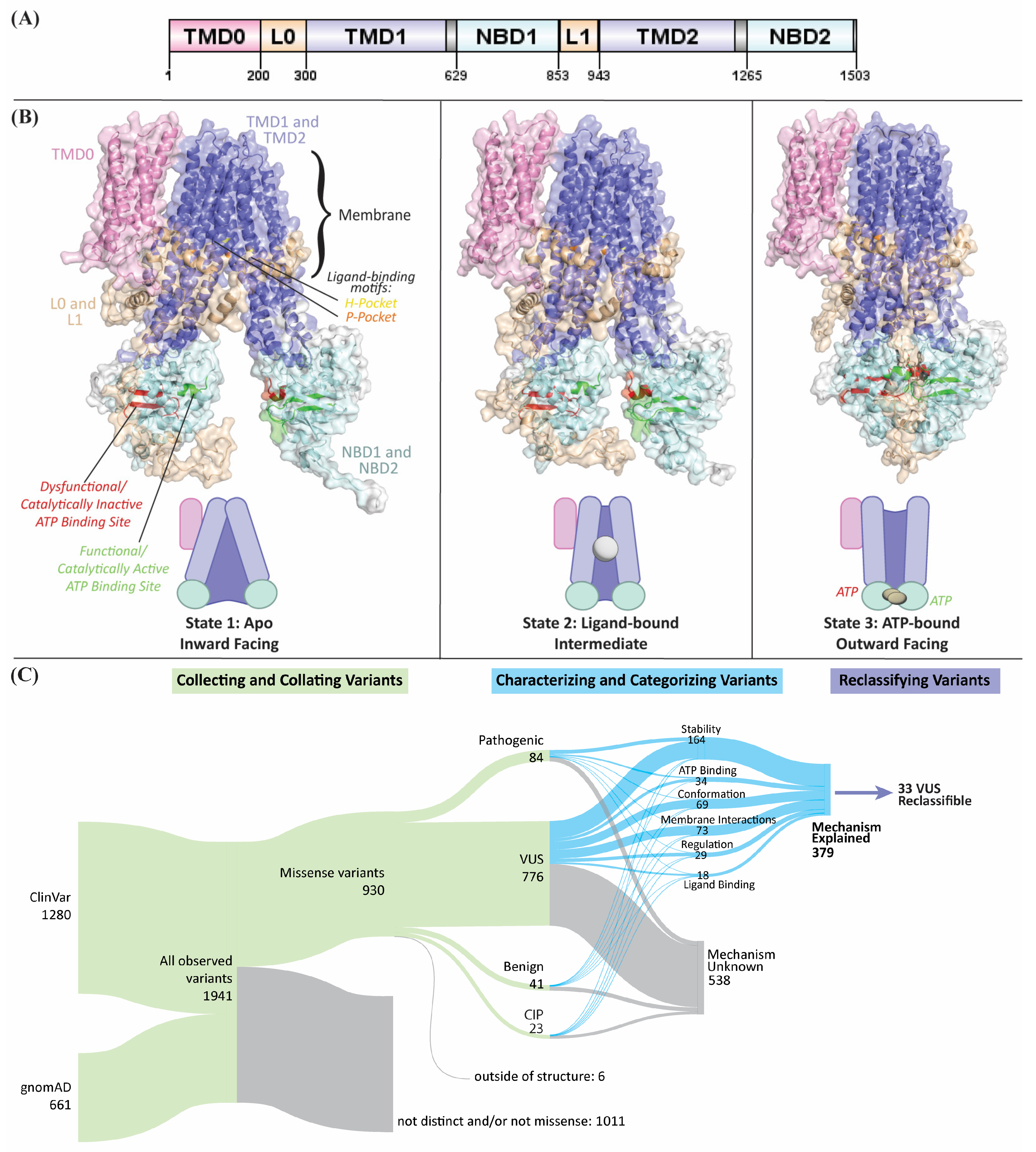
While there is currently no full-length experimental structure of ABCC6, information from other members of its conserved family of transport proteins can be leveraged to predict the structure of ABCC6 and infer basic features of its catalytic and transport mechanisms. ABCC6 is a long-type multidrug resistance protein [22], meaning it contains two transmembrane domains (TMD1 and TMD2), two nucleotide-binding domains (NBD1 and NBD2), and an initial transmembrane domain (TMD0) [23]. TMD0 is linked to TMD1 through a loop designated L0; a second loop, L1, links NBD1 to TMD2 (Figure 1A). TMDs 1 and 2 create a gated channel through the cellular membrane, open to the intracellular side at baseline, allowing ligand binding. When two ATP-Mg+2 bind at the interface between the two cytoplasmic NBDs, the extracellular facing conformation is formed, completing transport. ATP hydrolysis returns the protein to its initial state (Figure 1B). Thus, despite the lack of experimentally solved structures, there is considerable opportunity to apply structural bioinformatics approaches to mechanistically interpret ABCC6 genetic variation.
The current study uses a proteogenomic approach, leveraging multidisciplinary, mechanical, and functional information to characterize 924 ABCC6 missense genetic variants. Our approach includes calculating state-specific scores to harness the dynamic nature of the transport process to identify key functional regions more holistically. From these investigations, we categorize 319 (41%) VUS by their likelihood to alter specific protein features (Figure 1C). Additionally, we propose that 33 VUS can be reclassified as likely pathogenic according to their underlying molecular mechanisms. Another 134 VUS, with the additional evidence we propose, are on the cusp of a likely pathogenic interpretation. Through our process, we aim to better understand which variants may cause PXE and GACI. Finally, we anticipate that by accounting for molecular context, such as we have herein through integrative 3D modeling and biophysical characterizations, more genetic variants can be clearly categorized, functional genomics tests better designed, and clinical diagnostics improved.

2. Results

We used a proteogenomic approach [24], applying structural bioinformatics and computational biochemistry to analyze ABCC6 missense genomic variation. The full dataset contains 84 pathogenic variants from ClinVar, 776 VUS from the union of ClinVar and gnomAD, and 41 benign variants from ClinVar (Supplementary Table S1). Our study was initiated from deep structural analysis of the ten variants from our patient cohort, eight of which are pathogenic and two are VUS.

2.1. Categorizing Clinical Genetic Variants into Three Mechanisms of Dysfunction

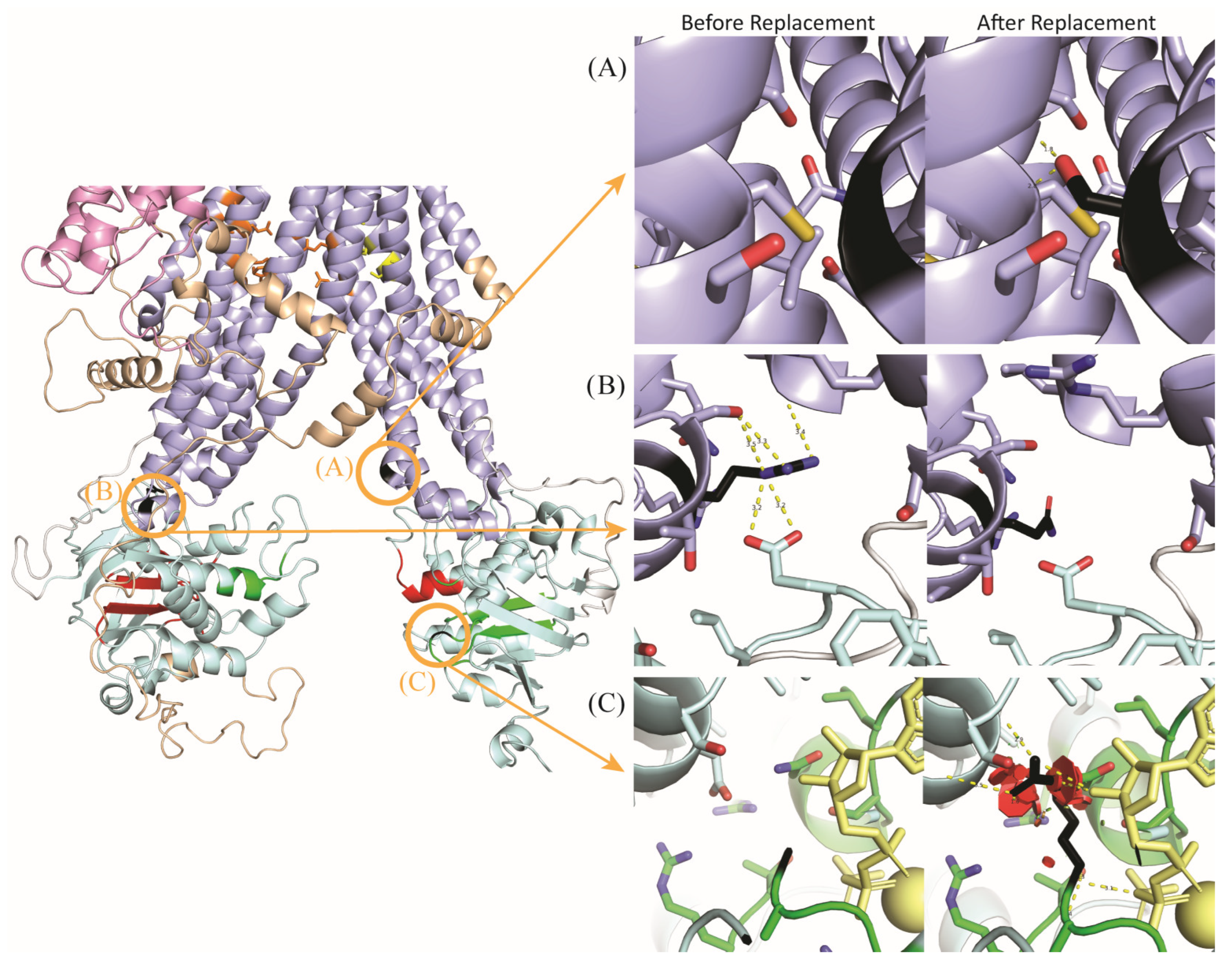
Reviewing the variants identified in our clinical cohort revealed three main mechanisms through which genetic variants affected the protein: (1) preventing conformational changes; (2) directly destabilizing the protein structure; and (3) disrupting ATP binding (Table 1). Variants impair conformational dynamics by changing the transmembrane domain stability in one state, impacting its ability to move into the next state. For example, replacing the glycine with a serine at position 1042 creates new interactions between adjacent helices in state 3, impairing ABCC6’s ability to reset to its state 1 conformation after ATP hydrolysis (Figure 2A) (NP_001162.5:p.G1042S). On the other hand, variants that destabilize the protein structure in different regions or multiple states will not impact ABCC6’s ability to move between conformations but still damage its structural integrity and, therefore, ability to function as efficiently. For example, Arg1138 in TMD2 is necessary to stabilize the TMD-NBD joint due to arginine’s capacity to make multiple bonds with nearby residues; when arginine is replaced with glutamine (variant NP_001162.5:p.R1138Q), it loses essential bonds (such as with Glu679 in NBD1) that hold the two domains together in the proper orientation (Figure 2B). Finally, any nonconservative variant within 5 Å of the ATP binding site in 3D space will likely disrupt ATP binding by losing site-specific properties. One example is Gly1302, which is nearby (3.8 Å) to ATP. Replacing small glycine with large and charged arginine causes many steric clashes, contorting the ATP binding site and hindering ATP binding (Figure 2C) (variant NP_001162.5:p.G1302R). Overall, inspection of each variant’s effects on ABCC6’s structure and function reveals mechanisms by which all ten disease-associated variants impact ABCC6 in ways we can both measure and biochemically explain.
Guided by the above considerations and our understanding of wildtype (WT) ABCC6 functioning, we developed an algorithm for systematically categorizing the mechanistic effect of ABCC6 variants. The 10 cohort variants were run through the algorithm, and eight were predicted to have the same mechanistic effect as we had assigned through our manual study. The remaining two, NP_001162.5:p.S317R and NP_001162.5:p.T1130M, were noted above as having mild differences by our manual review but were not classified by our algorithm. This provides evidence that our new algorithm can categorize ABCC6 genetic variants with precision comparable to an in-depth manual study.

2.2. Pathogenic Variants Cluster in Three Hotspots and Mostly Affect ATP Binding or Structural Stability

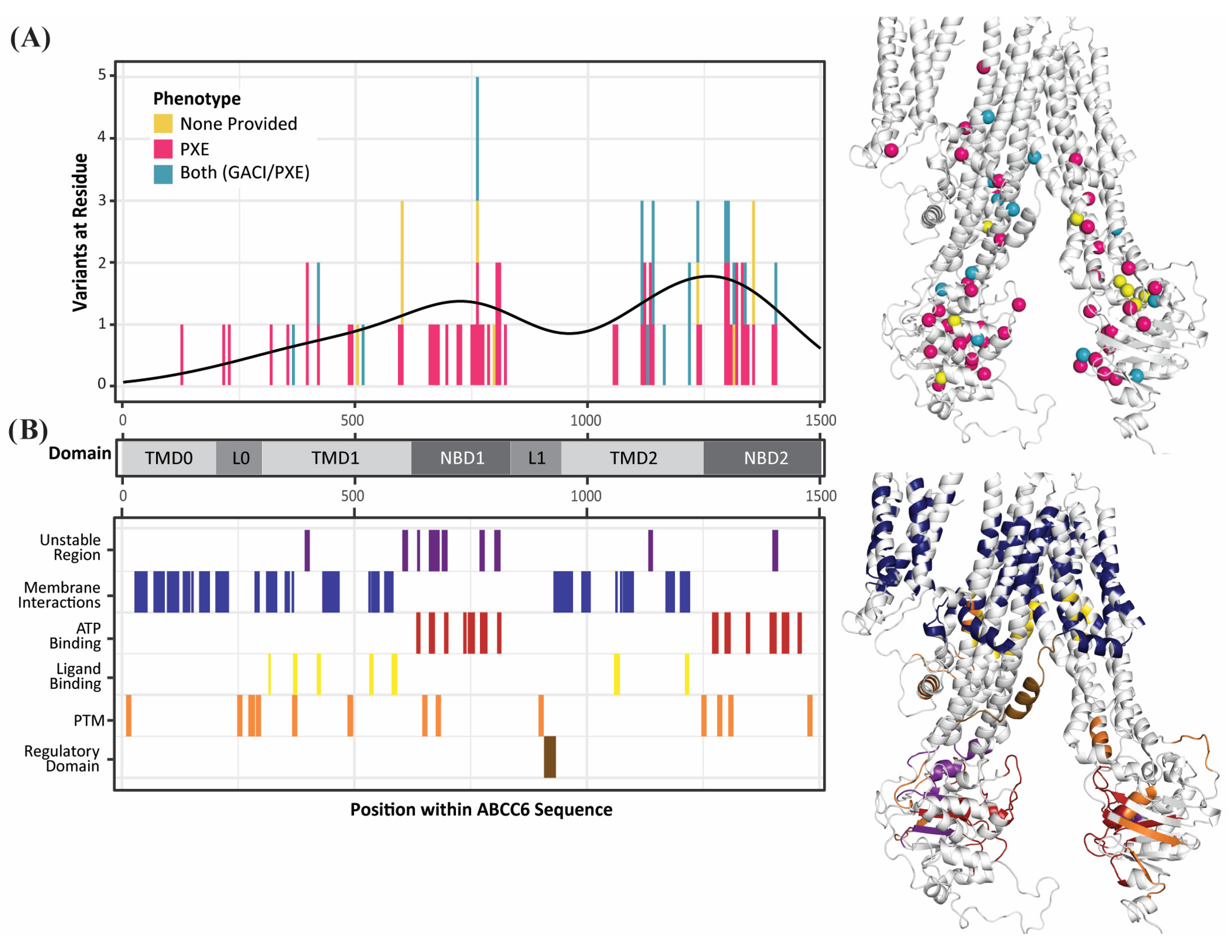
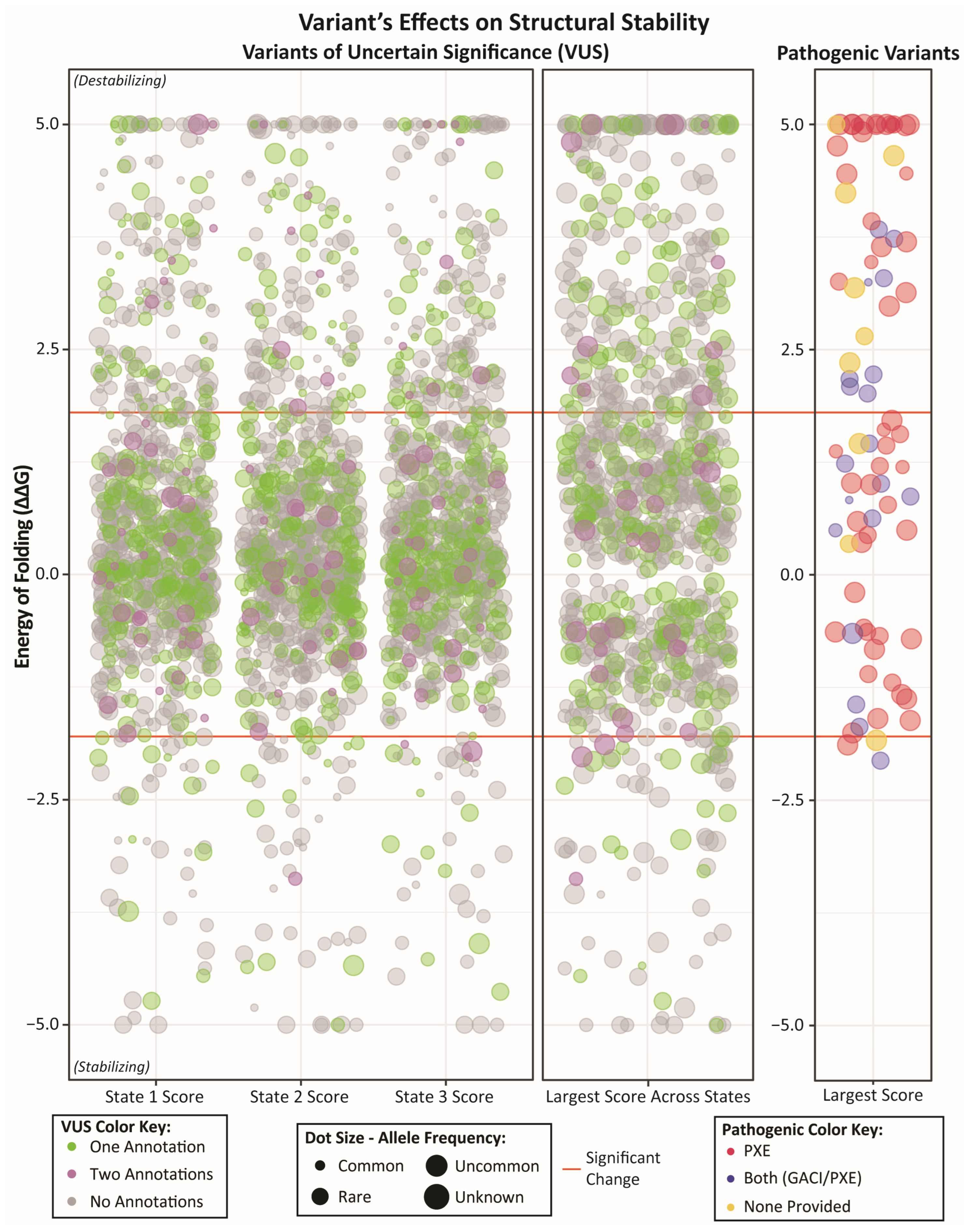
We analyzed the effect of pathogenic variants on ABCC6 functionality since these are all likely to have a deleterious impact on the functioning of ABCC6. First, we analyzed whether patterns differentiate the PXE and GACI variants (Figure 3). Interestingly, TMD2 contains the largest portion of GACI/PXE variants (47%), while most variants associated with just PXE are in NBD1 or NBD2 (34% and 27%, respectively). NBD1 and NBD2 contain many ATP-binding residues, while NBD1 specifically has many canonical residues that destabilize ABCC proteins (compared to other ABC-family proteins). On the other hand, TMD2 contains many membrane-interacting and ligand-binding residues. However, one trend observed across both phenotypes was towards instability—almost half (46%) of the pathogenic variants’ most significant effect was destabilizing the protein, while less than 4% of the variants’ most considerable effect was stabilizing (Figure 4).
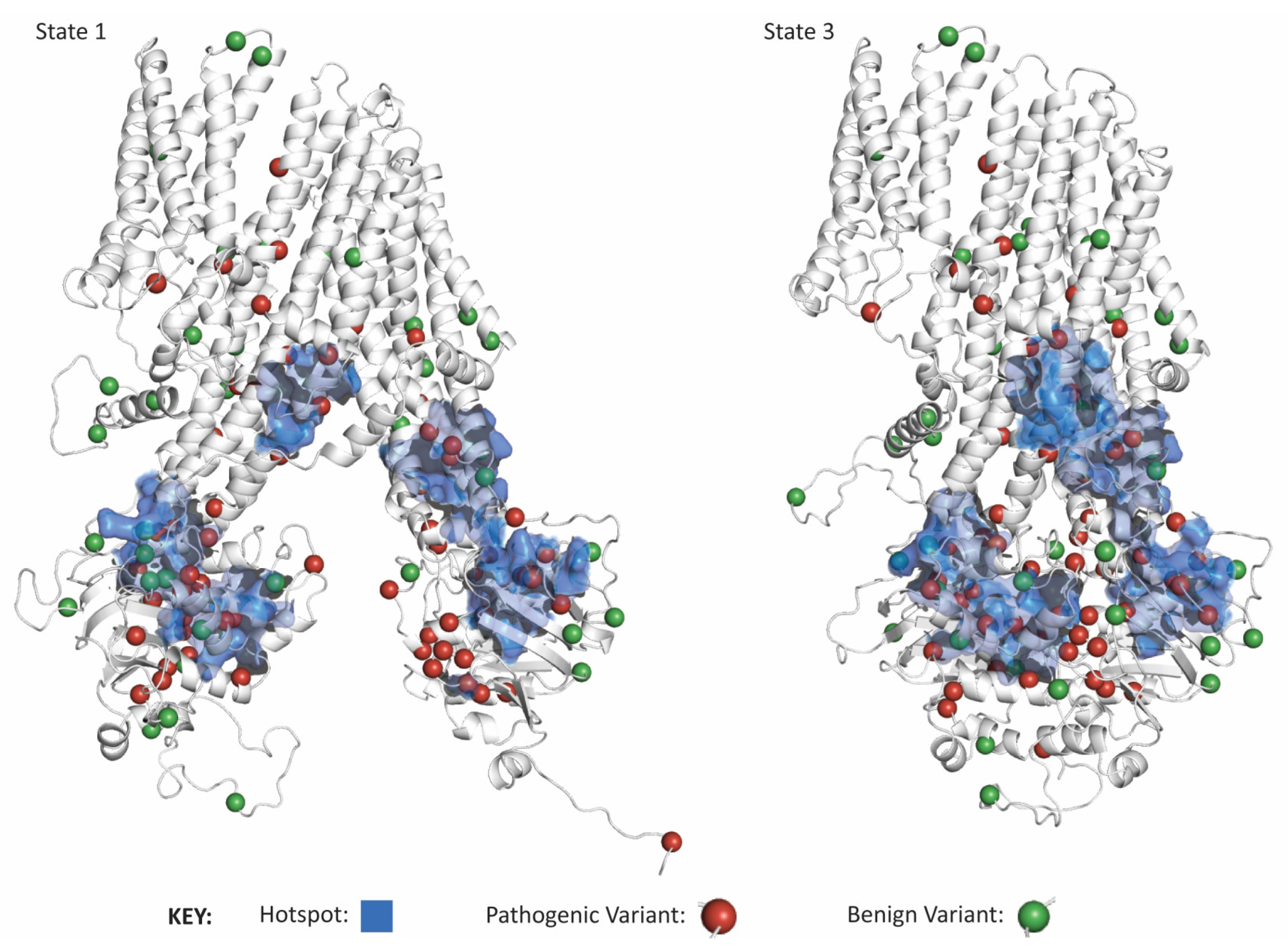
Next, we performed a 3D hotspot analysis of pathogenic variants to reveal any deeper pattern across variants location in 3D. Since we only had the allele count for some pathogenic variants, we counted variants in one region and the total allele count of variants in one area. Despite seeking hotspots of two different groups of variants, and in both states 1 and 3, we found hotspots in the same three regions in all analyses—one hotspot within each NBD and one spanning between the divide in the TMD bundles (Figure 5; Appendix A). These hotspots were statistically significant (p < 0.0001). Furthermore, 62 of the 82 hotspot residues (76%) were shared amongst the hotspot analyses we ran. It is worth noting that hotspots correspond to critical functions of ABCC6: the first two hotspots are in the NBDs where ATP binding and hydrolysis facilitate ligand movement out of the cell, and the third hotspot is in between the TMDs where the ligand initially binds to initiate transport, and transiently interacts with ABCC6. Thus, pathogenic genetic variations which appear heterogeneous along the linear sequence, form 3D hotspots that more homogeneously affect ABCC6’s nucleotide and ligand binding capacities.
Finally, we predicted the likely impact of ABCC6’s pathogenic variants on its core functions, categorizing over half (58%) (Supplementary Figure S1). Interestingly, more variants without a reported phenotype could be predicted than those associated with PXE or GACI. Most variants impact ABCC6’s ability to bind ATP or its structural stability—PXE variants more frequently influenced ATP binding, while variants unassociated with any phenotype more often affected structural stability. This categorization goes further than predicting variant pathogenicity by providing a mechanism by which known pathogenic variants likely contribute to PXE and GACI, while also providing a dysfunctional variant baseline for VUS comparison.

2.3. A Large Portion of Variants of Unknown Significance May Damage ABCC6 Function

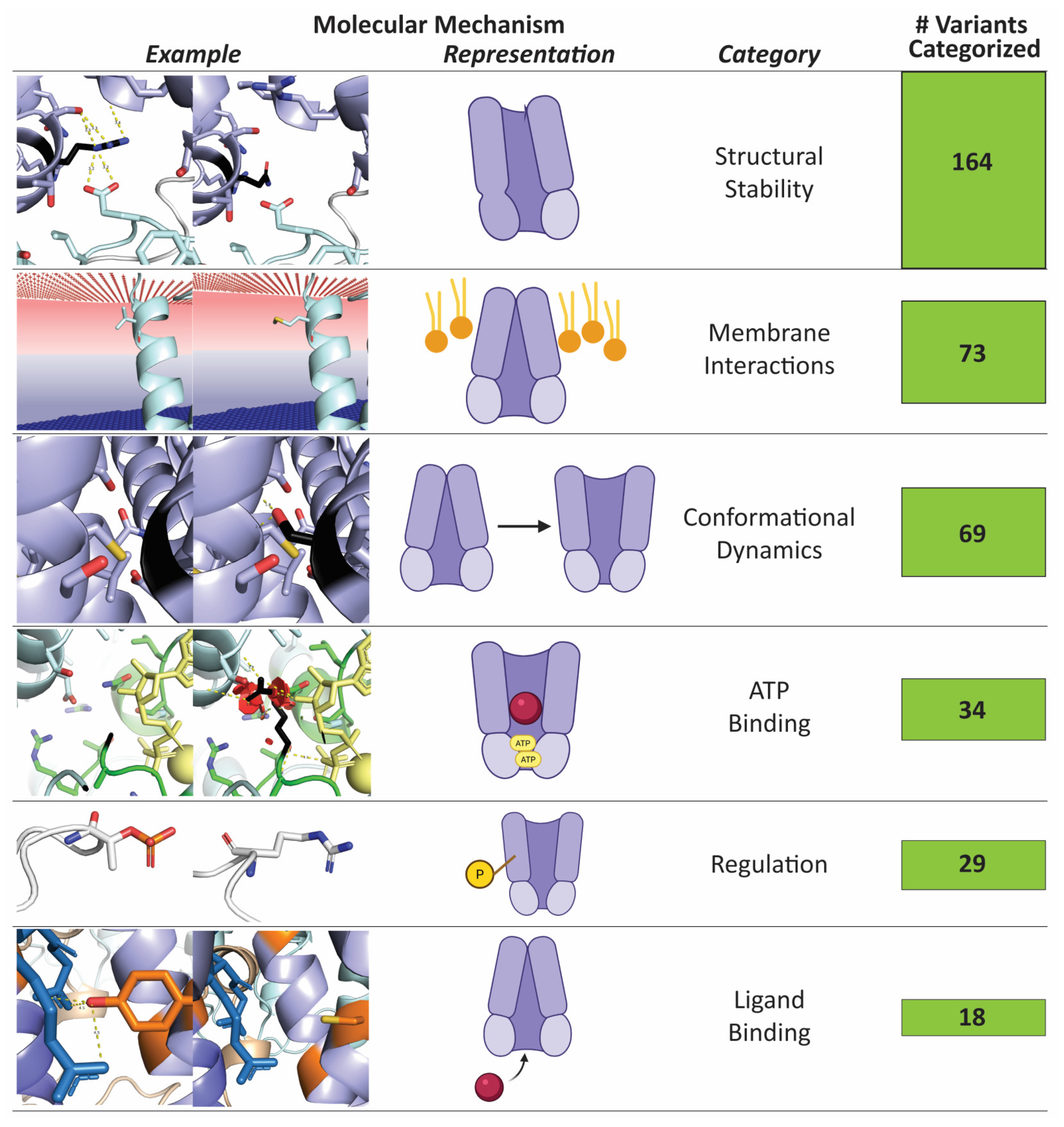
We could confidently categorize a large percentage (319 variants; 41% of the total) of VUS by their likely effect on ABCC6’s core functions (Supplementary Figure S2), proposing how each likely damages ABCC6 function from a topological and biochemical perspective and, therefore, whether likely damaging effects could underly disease causality. Further, of the 168 VUS associated with either phenotype, 49% were predicted to have a specific mechanistic effect. More variants associated only with PXE were classified (65%), while fewer variants associated with both or neither phenotype were predicted (37%). Similarly, more VUS were destabilizing (27%) than stabilizing (9%) (Figure 4). Further, while state-specific average stability changes were neutral, most variants exhibited a non-zero structural stability shift in a state-specific manner. As such the main impact of many variants is on structural stability (whether global or local stability), followed by impaired membrane interactions and conformational dynamics, especially the PXE variants. Altogether, from 860 VUS, we categorize the impacted molecular mechanism for 379 variants (44%) (Figure 6).

2.4. A Lack of Clear Differences Between GACI and PXE Variants

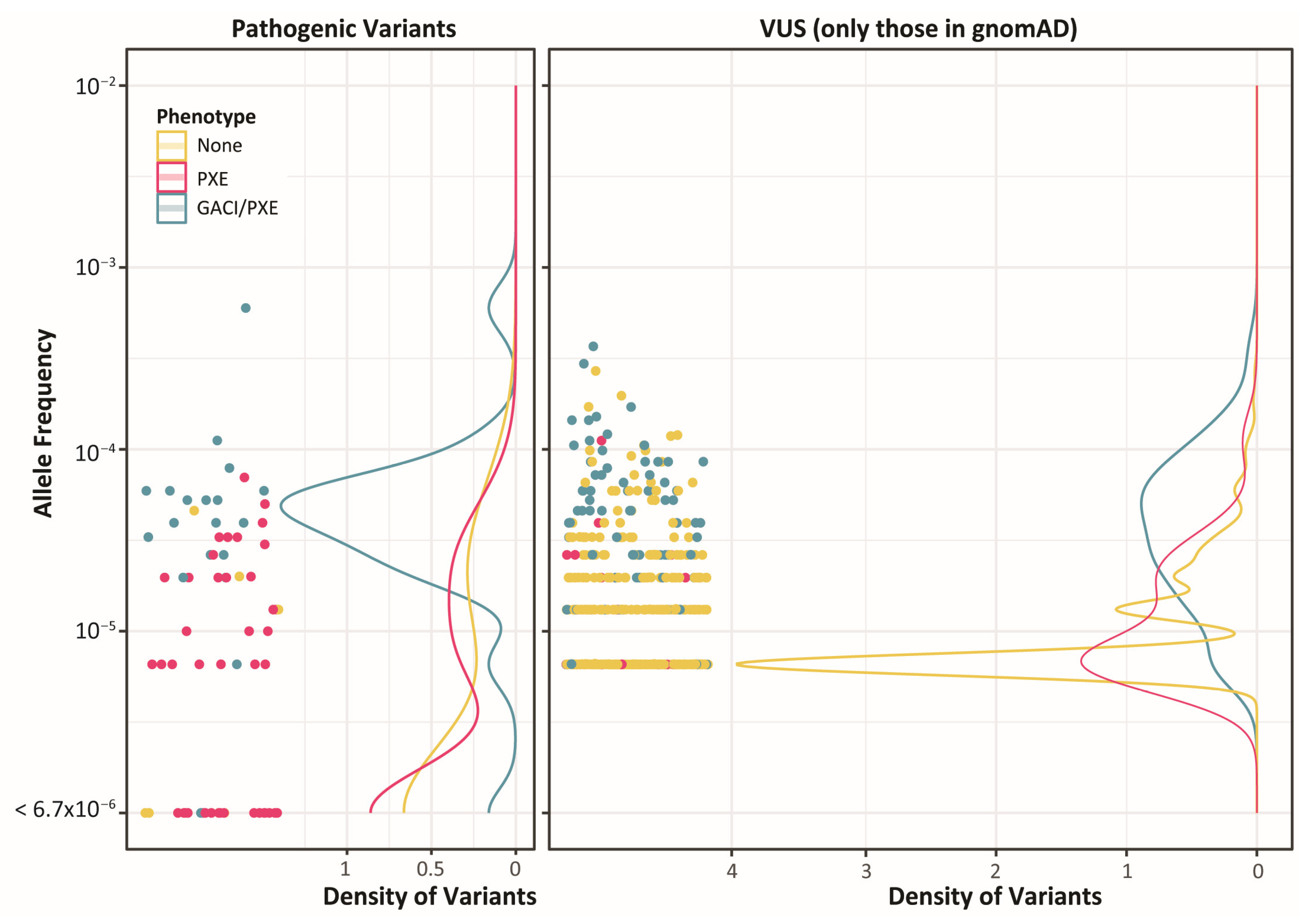
Reviewing all 860 distinct non-benign missense variants, only one was associated with GACI alone. For the other variants, 131 were associated with PXE, and another 111 were associated with both GACI and PXE diagnoses (which we will refer to as GACI/PXE variants). Further, for both the pathogenic variants and VUS, the allele frequency was, on average, higher in variants associated with GACI/PXE than those associated with just PXE or neither phenotype (Figure 7). Despite apparent differences in the clinical severity and allele frequency between the variants responsible for PXE and those responsible for GACI, the lack of genetic variants that are unique to GACI makes it challenging to delineate PXE-causing variants from GACI-causing variants.

2.5. Structural Bioinformatics Links VUS Mechanisms to Pathogenicity

We find 33 VUS where structural calculations provide a robust level of evidence that could be used to interpret patient variants, concordant with ACMG guidelines. Specifically, in this manuscript we provide novel, mechanistic-based evidence for PM1 (i.e., “Mutational hot spot or well-studied functional domain without benign variation”) based on our 3D hotspots and functional annotations. Further, we propose new PP3 (i.e., “multiple lines of computational evidence support a deleterious effect on the gene/gene product”) evidence that is distinct from in silico tools [25,26] and based on the specific mechanism affected (Supplementary Table S1; Appendix B). Using this novel evidence along with readily and publicly available annotations of PM2 (i.e., “absent in population databases”), PM5 (i.e., “novel missense change at an amino acid residue where a different pathogenic missense change has been seen before”), and PP4 (i.e., “patient’s phenotype or FH highly specific for gene”), we make a simple and illustrative comparison wherein the number of likely pathogenic variants could increase by 39% (Table 2). Furthermore, another 141 VUS will only require one additional line of evidence to be reclassified as likely pathogenic, which would likely be readily available for a familial case. Similarly, one variant with conflicting interpretations of pathogenicity would now have enough evidence to potentially be reclassified as likely pathogenic, and 11 would require only one additional line of evidence. Furthermore, using the same lines of evidence as with the VUS, our data would be consistent with classifying 51 of the 84 pathogenic or likely pathogenic variants in ClinVar as likely pathogenic, and the remaining 33 variants only need one more line of evidence to reach this status. This strong congruency, before the necessary addition of patient-specific clinical data, demonstrates the strong likelihood for computational structural genomics analyses to enhance the classification and interpretation of human genetic variation.
We propose that our analysis of variants’ effects on key functions of ABCC6 is a robust and biophysically justified evidence of alteration, which could be a novel way of reframing the PM1 criteria as altering a “key function” in three dimensions—energetically, quantitatively, and at atomic resolution—rather than a “key functional site” as defined by sequence data and low throughput mutational experiments. If our categorization were used as PM1, and a combination of CADD and REVEL used as PP3, 100% of benign variants and 94% of pathogenic variants would be classified the same as ClinVar (achieving 96% accuracy), and 80 VUS would have enough evidence to be reclassifiable as Likely Pathogenic (Supplementary Table S2), again demonstrating the potential power of this approach.
In summary, this study elucidates complex mechanisms underlying ABCC6 dysfunctions and underscores the need for increasing our understanding of population-specific genetic variations that are applicable to n = 1 cases. We conclude that integrating biophysical and biochemical metrics, proteogenomic approaches, and computational algorithms has substantially enhanced our comprehension of ABCC6 variants. This understanding builds a trajectory for more accurate and mechanistic clinical diagnoses, leaving less ambiguity for patients.

3. Discussion

Currently, less than 14% of ABCC6 alleles reported in ClinVar and gnomAD have a confident clinical interpretation. Among variants with an interpretation, there is no clear underlying disease mechanism. These gaps in knowledge make variant interpretation and treatment difficult. To further investigate this issue, we used a multi-tiered proteogenomic approach to study ABCC6 variants. We analyzed the variants in three steps to characterize their molecular context and mechanistic effect. Our findings show that our approach is effective and insightful in determining the functional mechanism of ABCC6 genetic variants. By encoding this process as an algorithm, we mechanistically categorized 41% of VUS to high confidence (See Supplementary Table S1). Further, with the information gathered, we also explored differences between variants associated with GACI and PXE—differences that may help us better understand the relationship between the two fundamentally similar yet distinct disorders. Projecting currently identified pathogenic variants onto our 3D structures enabled us to find mutational hotspots. Finally, we provide evidence for five ACMG categories across all 924 variants based on novel structural biology insights, which can be used to aid in classification. Our study adds to what is currently known about both the mechanistic effect of ABCC6 variants and the deleteriousness of VUS, which can help clinicians better interpret patient genotypes.
Previous studies of ABCC6 variants have relied on a singular homology model [27,28], characterized up to tens of variants [29,30,31,32,33,34,35], or have relied on purely clinical and/or functional information [36], revealing how ABCC6 mutations impair membrane localization, regulation, NBD structural stability, and ligand transportation. Building off those, this is the first study of ABCC6 to describe nearly a thousand variants using multi-state models and extensive mechanistic data, expanding the categories of dysfunction to include general stability and conformational dynamics. This integrative approach enables us to characterize far more variants than we could if we used one model or only functional information. Furthermore, by developing an algorithm to perform our analysis and evaluate evidence of ACMG classifications, and by providing the code to do so (Supplemental Text), any additional variants can be analyzed in the same fashion, making this study both repeatable and applicable to any possible variant in ABCC6 (besides those in the six initial residues not included in our modeled structures). Our results demonstrate the utility of our multi-tiered proteogenomic approach and lead to novel conclusions about ABCC6.
Few studies have directly compared PXE-causing variants to GACI-causing variants in ABCC6; therefore, our study boasts new information about ABCC6 variants’ disease associations. We discovered few variants observed exclusively in GACI patients and few differences in mechanisms between variants associated with PXE and those associated with GACI/PXE. This may, in part, be due to lack of specificity in ClinVar variant reporting, especially when a variant is added by large-scale genetics companies which don’t provide phenotypic information. Further, we found that GACI/PXE variants have a higher allele frequency. Since GACI is less common than PXE [37,38], GACI would be more statistically likely to be associated with more common variants if all variants were equally likely to lead to GACI on their own. Altogether, this suggests that the molecular differences between PXE and GACI are not caused by specific variants, which is supported by the divergent diagnoses, sometimes even within siblings [39]; instead, other distinguishing factors are likely at play, such as a genetic or epigenetic modifier, a metabolic environment, a change in regulation, an external stressor, etc.—as current studies are investigating [40]. This directs future studies of ABCC6 to focus on patient-to-patient differences, rather than variant-to-variant differences, in differentiating GACI and PXE.
This study also represents a significant advance in understanding genetic variants in ABCC6 through methodologies that could help with other rare disease genes. Our approach predicted the mechanistic effect of 319 VUS that likely impair ABCC6 function enough to cause protein dysfunction. These six functions cover an array of variant effects, which is critical given recent research revealing that, while structural stability is important, many other detriments can cause disease [41]. While we maintain a similar precision (96%) to current best-in-class pathogenicity prediction algorithms, such as CADD and AlphaMissense (100%), and Sherloc (100% in prior study [36]), our accuracy (72%) is only slightly lower than CADD’s (86%) but higher than AlphaMissense (67%). This is due to using cautious thresholds to prevent false positives, as well as the lack of patient-specific information. However, the mechanistic nature of our structure-based classification provides additional value which could also inform potential treatment options. It also enables hypothesis testing, an improvement over standard genomic in silico scores—in fact, 30 of the variants we studied have already been tested in vitro [29,31,33,42]. Our predicted functional impact was supported in 17 of the 25 comparable variants (Supplementary Table S3), with our methodology not identifying a mechanism on six variants which were dysfunctional, possibly due to overly cautious thresholds or lack of information. Further functional study designs can be guided by the results of this study.
Another significant contribution of this study is its methodology, which can be applied to many other proteins and variants. Indeed, our study takes a new approach to genomic variant analysis and interpretation, focusing on the mechanistic effect of a variant on the translated gene product rather than the likelihood of pathogenicity. The damaging potential of a variant is clearly related to its probability of pathogenicity. However, our current calculations do not capture all contexts (such as changes to protein folding or impacts on any potential protein interactions that have yet to be discovered). Creating an algorithm specifically for ABCC6 that considers a large amount of specific contextual information enables even the rare and singleton variants to be understood—something statistics-based approaches struggle with. Furthermore, our study revealed clusters of pathogenic variants within three main hotspots, which are spatially near functionally significant zones of ATP binding and ligand binding. This demonstrates the close relationship between a variant’s pathogenicity and the protein’s function—making understanding protein function especially critical in advancing better variant interpretation. These hotspots are similar to those identified by prior studies, [32,33,43], which identified hotspots in one nucleotide binding domain, as well as at the interfaces between TMDs and NBDs and between TMDs (such as the ligand binding pocket), providing further granularity to this ongoing effort. Our hotspot analysis and functional annotations enabled much of our variant reclassification and will continue to provide PM1 evidence for further reclassification of VUS. Overall, our results demonstrate that a protein-specific structural bioinformatics approach like ours helps us better understand the mechanisms of pathogenicity for VUS, and this methodology can be used to study variants of any protein with some known structural and functional information.
Through future studies, additional cell-based data will provide further understanding of the differences between PXE and GACI. Using multiple functional conformations to structurally characterize variants, integrated with additional functional genomics information, can create more specific and accurate studies. Results from the current work can guide future studies of other variants with the methods described herein, leading to better interpretation of patient genomes and, eventually, more successful treatment of both diseases.

4. Materials and Methods

4.1. Integrative Three-State Protein Structure Modeling Captures Details of ABCC6 Function

There are no full-length experimentally determined models of ABCC6. We used integrative modeling to generate the first models of ABCC6 for use in scoring genomic variation. ABCC6’s closest homologous protein, ABCC1, has a series of 3 bovine models published in the Protein Data Bank (PDB) [44,45,46] that show the range of motion ABCC1 goes through at the un-liganded inward-facing conformation to an intermediate conformation with substrate bound, and then to the outward-facing conformation with ATP bound at the hydrolytic domain. After these three steps, ABCC1 hydrolyzes ATP to return to its apo conformation. Because each structure highlights an essential step in ABCC1’s function, and ABCC6 is thought to have a similar series and mechanism of motion, we used each structure as a template in Modeller [47] to generate 3D models of ABCC6 in 3 functional states. However, the ABCC1 models (and consequently ABCC6 models) lacked the TMD0 domain of ABCC6. YCF1, the yeast ortholog of ABCC1, has two structures on the PDB [27,48], which include a well-resolved TMD0 and has better resolution on L0 and L1 than ABCC1’s structures. Therefore, these two structures were used as templates with Phyre [49] to create two models of ABCC6 in the inward-facing conformation (state 1) and intermediary conformation (state 2). There is no structure of outward-facing (state 3) YCF1, but TMD0 and L0 had negligible conformational differences between states 1 and 2, so an improved series of models were created by replacing the TMD0 and L0 domains from the ABCC1-template structures with the YCF1-template state one domains, and replacing L1 in states 1 and 2 with the YCF1-template model L1 (but retaining the ABCC1-template L1 in state 3) (Figure 1B). PyMOL v2.5 was used to visualize structures [50]. These steps combined generated molecular models for mechanistic interpretation of ABCC6 genetic variations.

4.2. Genomic Variation Collection and Annotation

We generated three datasets of genomic variation. First, our team selected ten missense variants from our clinical cohort with deep clinical phenotyping data. Second, we assembled 1280 ABCC6 variants from the May 2023 ClinVar release [15] and 661 missense ABCC6 variants from gnomAD v3.1.222 using the canonical transcript (ENST00000205557). Nomenclature was validated with VariantValidator [51]. Annotations about each variant, such as associated phenotype, pathogenicity, and allele frequency, were provided by ClinVar and gnomAD, respectively (when available). Ensembl’s [52] Variant Recorder was used to obtain variant HGVS Protein labels for ClinVar variants. These data were collated into one dataset of 930 distinct missense variants to compare information and context on each variant. We divided this dataset into two subsets: (1) all 84 pathogenic (and likely pathogenic) missense variants from ClinVar as true positives and (2) the 805 missense variants that are annotated as variants of uncertain significance (VUS) or variants with conflicting interpretations of pathogenicity (CIP), or those for which there were no clinical annotations available. However, six variants (P4H, A9E, G12E, E18D, P21S, and A23T) were at amino acids not shown in our structures (which began at residue 26). These variants were excluded from analysis, leaving 84 pathogenic missense variants, 776 VUS, 41 benign (and likely benign) variants, and 23 variants with CIP to be analyzed.

4.3. Annotating Motifs, Biochemical Regions, and Post Translational Modification Sites

We first gathered sequence-based information about ABCC6’s motifs and post-translational modifications (PTM) to understand the mechanistic effects of the above variants. First, within the nucleotide-binding domain, there are five highly conserved motifs across the ABC family: Walker A (also called P-loop or phosphate-binding loop), Walker B, Switch region (also called H-loop or histidine loop), signature motif (also called C-loop), and Q-loop. These motifs, among other residues, form the nucleotide-binding pocket, which classically consists of the Walker A and B, Q-loop, and H-loop from one NBD and the signature motif of the other NBD [53,54,55]. Variants within these motifs, or spatially supporting each motif, could affect motif functions. This has been documented already, as ABC Subfamily C (ABCC) proteins all carry a mutation of Glu778 to Asp in the Walker B sequence of NBD1, causing decreased efficiency of ATP hydrolysis for that ATP binding site [44,56,57]; hence, NBD1 is considered dysfunctional. Similarly, ABCC proteins are missing 10–13 highly conserved residues in NBD1, residues which in other ABC proteins stabilize the TMD-NBD interface; due to this loss of essential contacts, ABCC proteins are less stable in this region [45,57]. As such, variants in these regions are likely to impact the already-unstable NBD1-TMD interface or the functionally-critical Walker motifs.
Linker regions are also regulatory domains. Within L1, also sometimes called the regulatory domain or R-domain, lies a highly conserved phosphorylation site at S902, where studies in YCF1 (a yeast homolog for ABCC1) demonstrated PKA phosphorylation of that site to regulate YCF1 activity by inducing structural changes upon phosphorylation. L1 also contacts NBD1 through Q906 binding with Q715, stabilizing and regulating activity [48]. Beyond the PTMs in L1, residues 911–931 are also known to be of regulatory importance [58]. Within L0, a CK2 phosphorylation site is highly conserved at S244, which negatively regulates substrate transport, and a predicted basolateral localization sequence aids in proper localization [48,59]. All these residues, as well as residues within three amino acids of a PTM, were considered of regulatory importance. Finally, there are 13 other PTMs without an experimentally-discovered function suggested by both iPMTnet [60] and PhosphoSitePlus [61], 9 of which are phosphorylations, two acetylations, one ubiquitination (on the same amino acid as one of the acetylations), and one n-glycosylation. Any variants sequentially or spatially near these PTMs were noted as well.

4.4. Structure-Based Biophysical Annotations and Fold Stability

Since the ABCC1 substrate and ATP binding pockets are well-defined [44,45,56,57,62], sequence alignment was used to predict the ABCC6 substrate binding sites. To obtain further 3D contacts for both ATP and the ligand, we aligned the template ABCC1 structures with our ABCC6 structure in states 2 and 3 to confirm the homology-based prediction of ligand-binding pockets. We defined the pockets as the union of conserved ligand-binding sites, ATP-binding sequence motifs, and all residues within 5 Å of aligned ABCC1 experimentally-determined ligand positions.
The membrane-spanning portion of ABCC6 was predicted with the PPM 3.0 webserver [63] and all residues within this region and an accessible surface area of >50% were tagged as lipid-interacting. We also noted three positively charged helices, which rest upon the membrane’s outer layer at residues 204–208, 217–228, and 931–943. These residues were tagged for their likely role in charge-stabilizing membrane head group interactions.
FoldX [64] was used to obtain the change in folding free energy (ΔΔGfold) for each variant compared to the wildtype structure. The same procedure was performed with all three conformations as input and across all pathogenic variants from all three cohorts. For the 10 cohort variants, FrustratometeR [65] was also used to obtain the change in folding frustration energy. Finally, for all variants, the PAM30 score for the replacement was obtained, as well as the difference in sidechain hydrophobicity using the Peptides R package [66] and the Kyte–Doolittle scale [67].

4.5. Discovery of 3D Genetic Variant Hotspots

We determined amino acid contact maps using those within 10 Å of each amino acid in the state 1 and state 3 structures. Since 39 of the 84 pathogenic variants are also reported in gnomAD, we performed two rounds of hotspot analysis. First, we weighted variants by their population incidence by summing the allele counts for all gnomAD-reported variants within 10 Å of each residue. Second, we weighted distinct variants by summing the total number of variants (out of the 84 total pathogenic variants) within 10 Å of each residue. The residues with 15 or more alleles and 7 or more variants, respectively, were considered within the hotspot since all residues with that number of alleles/variants had a p-value < 0.0001. To calculate statistical significance, we first made two null sets with the same number of randomly selected variants as each of our observations (total allele count of 269 and 84 total variants, respectively) and repeated a similar procedure, permuting selection 10,000 times to obtain the number of times that randomly distributed variants were more densely populated around each residue than our observations. Dividing that number by 10,000 gave an empirical p-value.

4.6. Categorizing Mechanistic Effect of Variants

To characterize the range of effects that genetic variants have on ABCC6, we describe six essential aspects of ABCC6 function: ATP Binding, Ligand Binding, Membrane Interactions, Regulation, Conformational Dynamics, and Functional Stability (Table 3). These six categories of functional effect were chosen based on our study of wild-type ABCC6 and a cursory review of the variants’ impacts. They formed the basis of our ABCC6-specific context-guided variant effect algorithm—a unique approach to variant effect interpretation that focuses on understanding the mechanism of variant impact rather than correlating features to clinical information. This decision-tree algorithm uses all the annotations and scores described in prior sections to categorize variants into one of the six categories (see Supplementary Materials for the code). Its rules are logically derived: a series of metrics were chosen to define each function, and thresholds set for those metrics (Suppmentary Text S2). Then, each function is tested based on order of specificity—for example, if a variant is destabilizing, and destabilizing to the ATP binding region, it is impacting ATP binding specifically. We tested our algorithm on the cohort variants and compared it with the manual categorization we performed, then applied it to missense pathogenic variants, benign variants, and VUS. R packages ComplexHeatmap [68] and Tidyverse [69] were used in our analysis. Finally, other pathogenicity prediction scores from CADD [26], REVEL [25], PolyPhen2 [70], AlphaMissense [71], and SIFT [72] were obtained through their respective servers or databases. The threshold for which variants were predicted to be pathogenic was set at their respective recommended thresholds: ≥20 for CADD (using the PHRED score) [26], ≥0.5 for REVEL [25] and PolyPhen2 [73], ≥0.564 for AlphaMissense [71], and ≤0.05 for SIFT [73].

4.7. Reclassifying Variants of Uncertain Significance

The American College of Medical Genetics and Genomics (ACMG) guidelines for interpreting variant effects were used to organize evidence for VUS classification [74]. We propose that our computational structural genomics approach can provide evidence types PM1 and PP3. How to apply computational structural genomics to these additional lines of evidence for clinical interpretation is a crucial advancement from the current study. We directly compare our categorization of variants to the existing classification (Figure 1C and Table 3). For additional comparisons to our novel variant classification approaches, we also used evidence lines PM2, PM5, and PP4, established in the field and obtainable through publicly available data. For PM1, variants were noted that reside within the well-defined Walker A motif, Walker B motif, Signature Loop, H-loop, and Q-loop [53,54,56] as well as variants residing within the variant-rich three 3D-hotspots identified herein. For PP3, all variants predicted by our methodology to impact key ABCC6 functionalities were noted. For PM2, variants that were present within the ClinVar database but not gnomAD were noted [15,75], as well as those with an allele frequency less than 0.33% and at residues past 250. The allele frequency was chosen as 0.33% since the carrier frequency for PXE is expected to be between 1 in 150 and 1 in 300 people [76], and the carrier frequency for GACI is expected to be around 1 in 200 people [77]. Residues before 250 were not included since the coverage of residues 0–250 in gnomAD was lacking, i.e., the fraction of individuals with coverage over 30 was less than 50%. The coverage of ABCC6 within gnomAD v3 was confirmed to be of sufficient read depth. For PM5, all variants at the same residue position as a pathogenic variant from the ClinVar database were noted. Finally, for PP4, all variants with an associated phenotype of PXE, GACI, or both in ClinVar were noted. The 2015 ACMG guidelines [74] were used to count evidence and determine whether sufficient evidence is present for potential reclassification.

5. Conclusions

With a large range of phenotypes emerging from variants in ABCC6, determining the deleteriousness of genetic variants and their mechanisms for impairing function is critical for diagnostic and therapeutic research. The current study employs a novel multi-tiered approach to ABCC6 variant analysis and identifies the underlying molecular effects for 60% of pathogenic variants and 43% of VUS, identifying additional information that supports 33 VUS to be reclassified as Likely Pathogenic. In a sense, this is the first mechanistic proteogenomic ontology for ABCC6. Approaches such as we report here not only enable more genetic diagnoses, but also provide a new kind of information for clinical interpretation that is applicable to the one-of-a-kind genetic variation that frequently underlies rare diseases. The most common function affected was structural stability, yet the other five categories cumulatively account for 57% of variant classification, highlighting the importance of more holistic consideration of the structural implications of genetic variants on their encoded products. This study supports a different way of thinking about variant interpretation in general: the mechanistic effects of DNA changes can be enhanced by closely considering the intersection of structure and function.

Supplementary Materials

The following supporting information can be downloaded at: https://www.mdpi.com/article/10.3390/ijms27041832/s1.

Author Contributions

Conceptualization: W.A.G., S.G.Z., R.U., M.T.Z., N.H. and B.D.R.; data curation: S.G.Z. and J.B.W.; formal analysis: J.B.W. and S.D.J.; investigation: J.B.W.; methodology: J.B.W., N.H., S.D.J., B.D.R., S.G.Z. and M.T.Z.; software: J.B.W., N.H., B.D.R. and M.T.Z.; supervision: W.A.G., R.U. and M.T.Z.; visualization: J.B.W., N.H. and M.T.Z.; writing-original draft: J.B.W.; writing-review and editing: J.B.W., N.H., B.D.R. and M.T.Z. All authors have read and agreed to the published version of the manuscript.

Funding

This work was supported by The Linda T. and John A. Mellowes Center for Genomic Sciences and Precision Medicine at the Medical College of Wisconsin. This project is funded in part by the Advancing a Healthier Wisconsin Endowment at the Medical College of Wisconsin and the Intramural Research Program of the National Human Genome Research Institute.

Data Availability Statement

All data used in assigning variant effects and the assigned variant effect and pathogenicity is available in Supplementary Table S1. In Supplementary Text S1, we also include the code for the algorithm used to make our structure-based predictions and our derived ACMG-based classifications. Any additional variants can also be tested with this code, provided the same input data is obtained (allele frequency, phenotype, change in free energy of folding (such as from FoldX or other algorithms) in all three conformational states, PAM30 score, Hydrophobicity, location-based functional annotations, and domain). Our models of ABCC6 in three states are available via ModelArchive (www.modelarchive.org) with the accession codes: ma-s37e8, ma-xktqt, and ma-kyp1k.

Acknowledgments

This research was completed in part with computational resources and technical support provided by the Research Computing Center at the Medical College of Wisconsin.

Conflicts of Interest

The authors declare no conflicts of interest.

Abbreviations

The following abbreviations are used in this manuscript:
ABCC6ATP Binding Cassette Subfamily C Member 6
PXEPseudoxanthoma Elasticum
GACIGeneralized Arterial Calcification of Infancy
VUSVariant of Uncertain Significance
ABCATP Binding Cassette
ENPP1Ectonucleotide Pyrophosphatase/Phosphodiesterase 1
TMDTransmembrane Domain
NBDNucleotide Binding Domain
WTWildtype
PTMPost-Translational Modification

Appendix A

The 3D hotspots consist of the following residues: 394, 483, 484, 503, 513, 514, 515, 516, 517, 521, 693, 695, 696, 761, 762, 763, 764, 766, 781, 1032, 1109, 1110, 1111, 1112, 1113, 1115, 1116, 1117, 1118, 1119, 1133, 1134, 1135, 1136, 1137, 1143, 1160, 1161, 1272, 1299, 1307, 1308, 1309, 1310, 1311, 1312, 1313, 1315, 1316, 1317, 1318, 1330, 1331, 1335, 1338, 1339, 679, 694, 776, 780, 231, 232, 233, 486, 502, 711, 726, 754, 755, 756, 757, 758, 783, 926, 1228, 1231, 1232, 1235, 1246, 1323, 700, 808.

Appendix B

Description of Table S1. In this file, each variant analyzed is listed, along with all data used in analysis and our results. Below is a description of each column.
  • HGVS cDNA: the HGVS description of the variant at the cDNA level.
  • HGVS protein: the HGVS description of the variant at the amino acid level.
  • Allele frequency: the global allele frequency for the variant, as per gnomAD v3.
  • Clinical significance: the current variant interpretation, as per ClinVar. For simplicity’s sake, variants which were labeled as pathogenic, likely pathogenic, or pathogenic/likely pathogenic were all simplified to “Pathogenic/Likely Pathogenic”; the same was done with benign and likely benign variants.
  • Phenotype: the simplified associated phenotype, as per ClinVar. All phenotype descriptions which include pseudoxanthoma elasticum (including more informative descriptions such as “autosomal recessive inherited pseudoxanthoma elasticum”, etc.) were simplified to “PXE”, descriptions including generalized arterial calcification of infancy were simplified to “GACI”, and descriptions with both were simplified to “Both.”
  • State 1 Stabilization: FoldX’s change in free energy of folding (in kcal/mol) for the State 1 structure of ABCC6 for each variant, in comparison to the WT State 1 structure.
  • State 2 Stabilization: FoldX’s change in free energy of folding (in kcal/mol) for the State 2 structure of ABCC6 for each variant, in comparison to the WT State 2 structure.
  • State 3 Stabilization: FoldX’s change in free energy of folding (in kcal/mol) for the State 3 structure of ABCC6 for each variant, in comparison to the WT State 3 structure.
  • Number of Damaged States: a string describing how many states are destabilized or stabilized (having a change in free energy of folding of >1.8 or < −1.8).
  • PAM30 Conservation Score: the amino acid change’s score from the Point accepted mutation (PAM) matrix of amino acid similarity.
  • Hydrophobicity Change (Kyte-Doolittle): the difference in Kyte-Doolittle hydrophobicity score between the original and alternative amino acid.
  • Location-Based Annotations: all functional information about residues within 5 residues and/or within 5 Å of the variant location.
  • Domain: which functional domain the protein family is in.
  • In a Hotspot?: whether the variant is located within a 3D hotspot, as defined in this manuscript.
  • Predicted Affected Function: which mechanism of ABCC6 WT functioning we predict the variant may be impacting, if any.
  • ACMG_PM1: whether this variant has the ACMG PM1 criterion for being pathogenic: “Located in a mutational hot spot and/or critical and well-established functional domain (e.g., active site of an enzyme) without benign variation.”
  • ACMG_PM5: whether this variant has the ACMG PM5 criterion for being pathogenic or not: “Novel missense change at an amino acid residue where a different missense change determined to be pathogenic has been seen before.”
  • ACMG_PM2: whether this variant has the ACMG PM2 criterion for being pathogenic or not: “Absent from controls (or at extremely low frequency if recessive) […] in Exome Sequencing Project, 1000 Genomes or ExAC.”
  • ACMG_PP3: whether this variant has the ACMG PP3 criterion for being pathogenic or not: “Multiple lines of computational evidence support a deleterious effect on the gene or gene product (conservation, evolutionary, splicing impact, etc.).”
  • ACMG_PP4: whether this variant has the ACMG PP4 criterion for being pathogenic or not: “Patient’s phenotype or family history is highly specific for a disease with a single genetic etiology.”
  • Suggested Clinical Significance: Variants which have enough evidence to be reclassifyable as “Likely Pathogenic” are labeled as “Updated: Likely Pathogenic”, while all other variants were labeled as “No Change”. When a variant has almost enough evidence to be reclassified as likely pathogenic, it is labeled as “Close to Reclassifyable.”

References

  1. Stefková, J.; Poledne, R.; Hubácek, J.A. ATP-binding cassette (ABC) transporters in human metabolism and diseases. Physiol. Res. 2004, 53, 235–243. [Google Scholar] [CrossRef]
  2. O’Neill, M.J.F. Online Mendelian Inheritance in Man, OMIM. Johns Hopkins University, Baltimore, MD. MIM Number: 610508. OMIM. 2010. Available online: http://omim.org/entry/610508 (accessed on 16 May 2022).
  3. Stelzer, G.; Rosen, N.; Plaschkes, I.; Zimmerman, S.; Twik, M.; Fishilevich, S.; Iny Stein, T.; Nudel, R.; Lieder, I.; Mazor, Y.; et al. The GeneCards Suite: From Gene Data Mining to Disease Genome Sequence Analyses. Curr. Protoc. Bioinform. 2016, 54, 1.30.1–1.30.33. [Google Scholar] [CrossRef]
  4. Bergen, A.A.; Plomp, A.S.; Schuurman, E.J.; Terry, S.; Breuning, M.; Dauwerse, H.; Swart, J.; Kool, M.; van Soest, S.; Baas, F.; et al. Mutations in ABCC6 cause pseudoxanthoma elasticum. Nat. Genet. 2000, 25, 228–231. [Google Scholar] [CrossRef] [PubMed]
  5. Nitschke, Y.; Baujat, G.; Botschen, U.; Wittkampf, T.; du Moulin, M.; Stella, J.; Le Merrer, M.; Guest, G.; Lambot, K.; Tazarourte-Pinturier, M.F.; et al. Generalized arterial calcification of infancy and pseudoxanthoma elasticum can be caused by mutations in either ENPP1 or ABCC6. Am. J. Hum. Genet. 2012, 90, 25–39. [Google Scholar] [CrossRef]
  6. Ferreira, C.R.; Kintzinger, K.; Hackbarth, M.E.; Botschen, U.; Nitschke, Y.; Mughal, M.Z.; Baujat, G.; Schnabel, D.; Yuen, E.; Gahl, W.A.; et al. Ectopic Calcification and Hypophosphatemic Rickets: Natural History of ENPP1 and ABCC6 Deficiencies. J. Bone Miner. Res. 2021, 36, 2193–2202. [Google Scholar] [CrossRef] [PubMed]
  7. Li, Q.; Brodsky, J.L.; Conlin, L.K.; Pawel, B.; Glatz, A.C.; Gafni, R.I.; Schurgers, L.; Uitto, J.; Hakonarson, H.; Deardorff, M.A.; et al. Mutations in the ABCC6 gene as a cause of generalized arterial calcification of infancy: Genotypic overlap with pseudoxanthoma elasticum. J. Investig. Dermatol. 2014, 134, 658–665. [Google Scholar] [CrossRef] [PubMed]
  8. Jansen, R.S.; Küçükosmanoglu, A.; de Haas, M.; Sapthu, S.; Otero, J.A.; Hegman, I.E.; Bergen, A.A.; Gorgels, T.G.; Borst, P.; van de Wetering, K. ABCC6 prevents ectopic mineralization seen in pseudoxanthoma elasticum by inducing cellular nucleotide release. Proc. Natl. Acad. Sci. USA 2013, 110, 20206–20211. [Google Scholar] [CrossRef]
  9. Jansen, R.S.; Duijst, S.; Mahakena, S.; Sommer, D.; Szeri, F.; Váradi, A.; Plomp, A.; Bergen, A.A.; Oude Elferink, R.P.; Borst, P.; et al. ABCC6-mediated ATP secretion by the liver is the main source of the mineralization inhibitor inorganic pyrophosphate in the systemic circulation-brief report. Arterioscler. Thromb. Vasc. Biol. 2014, 34, 1985–1989. [Google Scholar] [CrossRef]
  10. Rutsch, F.; Ruf, N.; Vaingankar, S.; Toliat, M.R.; Suk, A.; Höhne, W.; Schauer, G.; Lehmann, M.; Roscioli, T.; Schnabel, D.; et al. Mutations in ENPP1 are associated with ‘idiopathic’ infantile arterial calcification. Nat. Genet. 2003, 34, 379–381. [Google Scholar] [CrossRef]
  11. Van Gils, M.; Depauw, J.; Coucke, P.J.; Aerts, S.; Verschuere, S.; Nollet, L.; Vanakker, O.M. Inorganic Pyrophosphate Plasma Levels Are Decreased in Pseudoxanthoma Elasticum Patients and Heterozygous Carriers but Do Not Correlate with the Genotype or Phenotype. J. Clin. Med. 2023, 12, 1893. [Google Scholar] [CrossRef]
  12. Zhao, J.; Kingman, J.; Sundberg, J.P.; Uitto, J.; Li, Q. Plasma PPi Deficiency Is the Major, but Not the Exclusive, Cause of Ectopic Mineralization in an Abcc6(-/-) Mouse Model of PXE. J. Investig. Dermatol. 2017, 137, 2336–2343. [Google Scholar] [CrossRef]
  13. Kauffenstein, G.; Martin, L.; Le Saux, O. The Purinergic Nature of Pseudoxanthoma Elasticum. Biology 2024, 13, 74. [Google Scholar] [CrossRef]
  14. Ziegler, S.G.; Ferreira, C.R.; MacFarlane, E.G.; Riddle, R.C.; Tomlinson, R.E.; Chew, E.Y.; Martin, L.; Ma, C.T.; Sergienko, E.; Pinkerton, A.B.; et al. Ectopic calcification in pseudoxanthoma elasticum responds to inhibition of tissue-nonspecific alkaline phosphatase. Sci. Transl. Med. 2017, 9, eaal1669. [Google Scholar] [CrossRef] [PubMed]
  15. Landrum, M.J.; Chitipiralla, S.; Brown, G.R.; Chen, C.; Gu, B.; Hart, J.; Hoffman, D.; Jang, W.; Kaur, K.; Liu, C.; et al. ClinVar: Improvements to accessing data. Nucleic Acids Res. 2020, 48, D835–D844. [Google Scholar] [CrossRef]
  16. Zimmermann, M.T.; Urrutia, R.; Cousin, M.A.; Oliver, G.R.; Klee, E.W. Assessing Human Genetic Variations in Glucose Transporter SLC2A10 and Their Role in Altering Structural and Functional Properties. Front. Genet. 2018, 9, 276. [Google Scholar] [CrossRef] [PubMed]
  17. Zimmermann, M.T.; Urrutia, R.; Oliver, G.R.; Blackburn, P.R.; Cousin, M.A.; Bozeck, N.J.; Klee, E.W. Molecular modeling and molecular dynamic simulation of the effects of variants in the TGFBR2 kinase domain as a paradigm for interpretation of variants obtained by next generation sequencing. PLoS ONE 2017, 12, e0170822. [Google Scholar] [CrossRef]
  18. Ratnasinghe, B.D.; Haque, N.; Wagenknecht, J.B.; Jensen, D.R.; Valdivia Esparza, G.K.; Leverence, E.N.; Milech De Assuncao, T.; Mathison, A.J.; Lomberk, G.; Smith, B.C.; et al. Beyond structural bioinformatics for genomics with dynamics characterization of an expanded KRAS mutational landscape. Comput. Struct. Biotechnol. J. 2023, 21, 4790–4803. [Google Scholar] [CrossRef] [PubMed]
  19. Haque, N.; Kawai, T.; Ratnasinghe, B.D.; Wagenknecht, J.B.; Urrutia, R.; Notarangelo, L.D.; Zimmermann, M.T. RAG genomic variation causes autoimmune diseases through specific structure-based mechanisms of enzyme dysregulation. iScience 2023, 26, 108040. [Google Scholar] [CrossRef]
  20. Niu, B.; Scott, A.D.; Sengupta, S.; Bailey, M.H.; Batra, P.; Ning, J.; Wyczalkowski, M.A.; Liang, W.W.; Zhang, Q.; McLellan, M.D.; et al. Protein-structure-guided discovery of functional mutations across 19 cancer types. Nat. Genet. 2016, 48, 827–837, Correction in Nat. Genet. 2017, 49, 1286. https://doi.org/10.1038/ng0817-1286a. [Google Scholar] [CrossRef]
  21. Maryami, F.; Rismani, E.; Davoudi-Dehaghani, E.; Khalesi, N.; Motlagh, F.Z.; Kordafshari, A.; Talebi, S.; Rahimi, H.; Zeinali, S. Identifying and predicting the pathogenic effects of a novel variant inducing severe early onset MMA: A bioinformatics approach. Hereditas 2023, 160, 25. [Google Scholar] [CrossRef]
  22. Chen, Z.S.; Tiwari, A.K. Multidrug resistance proteins (MRPs/ABCCs) in cancer chemotherapy and genetic diseases. FEBS J. 2011, 278, 3226–3245. [Google Scholar] [CrossRef]
  23. Paysan-Lafosse, T.; Blum, M.; Chuguransky, S.; Grego, T.; Pinto, B.L.; Salazar, G.A.; Bileschi, M.L.; Bork, P.; Bridge, A.; Colwell, L.; et al. InterPro in 2022. Nucleic Acids Res. 2022, 51, D418–D427. [Google Scholar] [CrossRef]
  24. Nesvizhskii, A.I. Proteogenomics: Concepts, applications and computational strategies. Nat. Methods 2014, 11, 1114–1125. [Google Scholar] [CrossRef]
  25. Ioannidis, N.M.; Rothstein, J.H.; Pejaver, V.; Middha, S.; McDonnell, S.K.; Baheti, S.; Musolf, A.; Li, Q.; Holzinger, E.; Karyadi, D.; et al. REVEL: An Ensemble Method for Predicting the Pathogenicity of Rare Missense Variants. Am. J. Hum. Genet. 2016, 99, 877–885. [Google Scholar] [CrossRef]
  26. Rentzsch, P.; Witten, D.; Cooper, G.M.; Shendure, J.; Kircher, M. CADD: Predicting the deleteriousness of variants throughout the human genome. Nucleic Acids Res. 2019, 47, D886–D894. [Google Scholar] [CrossRef]
  27. Bickers, S.C.; Benlekbir, S.; Rubinstein, J.L.; Kanelis, V. Structure of Ycf1p reveals the transmembrane domain TMD0 and the regulatory region of ABCC transporters. Proc. Natl. Acad. Sci. USA 2021, 118, e2025853118. [Google Scholar] [CrossRef]
  28. Fülöp, K.; Barna, L.; Symmons, O.; Závodszky, P.; Váradi, A. Clustering of disease-causing mutations on the domain-domain interfaces of ABCC6. Biochem. Biophys. Res. Commun. 2009, 379, 706–709. [Google Scholar] [CrossRef] [PubMed]
  29. Pomozi, V.; Brampton, C.; Fülöp, K.; Chen, L.H.; Apana, A.; Li, Q.; Uitto, J.; Le Saux, O.; Váradi, A. Analysis of pseudoxanthoma elasticum-causing missense mutants of ABCC6 in vivo; pharmacological correction of the mislocalized proteins. J. Investig. Dermatol. 2014, 134, 946–953. [Google Scholar] [CrossRef] [PubMed]
  30. Iliás, A.; Urbán, Z.; Seidl, T.L.; Le Saux, O.; Sinkó, E.; Boyd, C.D.; Sarkadi, B.; Váradi, A. Loss of ATP-dependent transport activity in pseudoxanthoma elasticum-associated mutants of human ABCC6 (MRP6). J. Biol. Chem. 2002, 277, 16860–16867, Correction in J. Biol. Chem. 2002, 277, 24842. https://doi.org/10.1016/S0021-9258(19)66670-6. [Google Scholar] [CrossRef] [PubMed]
  31. Ran, Y.; Zheng, A.; Thibodeau, P.H. Structural analysis reveals pathomechanisms associated with pseudoxanthoma elasticum-causing mutations in the ABCC6 transporter. J. Biol. Chem. 2018, 293, 15855–15866. [Google Scholar] [CrossRef]
  32. Ran, Y.; Thibodeau, P.H. Stabilization of Nucleotide Binding Domain Dimers Rescues ABCC6 Mutants Associated with Pseudoxanthoma Elasticum. J. Biol. Chem. 2017, 292, 1559–1572. [Google Scholar] [CrossRef] [PubMed]
  33. Arányi, T.; Bacquet, C.; de Boussac, H.; Ratajewski, M.; Pomozi, V.; Fülöp, K.; Brampton, C.N.; Pulaski, L.; Le Saux, O.; Váradi, A. Transcriptional regulation of the ABCC6 gene and the background of impaired function of missense disease-causing mutations. Front. Genet. 2013, 4, 27. [Google Scholar] [CrossRef] [PubMed]
  34. Le Saux, O.; Fülöp, K.; Yamaguchi, Y.; Iliás, A.; Szabó, Z.; Brampton, C.N.; Pomozi, V.; Huszár, K.; Arányi, T.; Váradi, A. Expression and in vivo rescue of human ABCC6 disease-causing mutants in mouse liver. PLoS ONE 2011, 6, e24738. [Google Scholar] [CrossRef]
  35. Szeri, F.; Corradi, V.; Niaziorimi, F.; Donnelly, S.; Conseil, G.; Cole, S.P.C.; Tieleman, D.P.; van de Wetering, K. Mutagenic Analysis of the Putative ABCC6 Substrate-Binding Cavity Using a New Homology Model. Int. J. Mol. Sci. 2021, 22, 6910. [Google Scholar] [CrossRef]
  36. Verschuere, S.; Navassiolava, N.; Martin, L.; Nevalainen, P.I.; Coucke, P.J.; Vanakker, O.M. Reassessment of causality of ABCC6 missense variants associated with pseudoxanthoma elasticum based on Sherloc. Genet. Med. 2021, 23, 131–139. [Google Scholar] [CrossRef] [PubMed]
  37. Legrand, A.; Cornez, L.; Samkari, W.; Mazzella, J.-M.; Venisse, A.; Boccio, V.; Auribault, K.; Keren, B.; Benistan, K.; Germain, D.P.; et al. Mutation spectrum in the ABCC6 gene and genotype-phenotype correlations in a French cohort with pseudoxanthoma elasticum. Genet. Med. 2017, 19, 909–917. [Google Scholar] [CrossRef]
  38. Ferreira, C.R.; Hackbarth, M.E.; Ziegler, S.G.; Pan, K.S.; Roberts, M.S.; Rosing, D.R.; Whelpley, M.S.; Bryant, J.C.; Macnamara, E.F.; Wang, S.; et al. Prospective phenotyping of long-term survivors of generalized arterial calcification of infancy (GACI). Genet. Med. 2021, 23, 396–407. [Google Scholar] [CrossRef]
  39. Le Boulanger, G.; Labrèze, C.; Croué, A.; Schurgers, L.J.; Chassaing, N.; Wittkampf, T.; Rutsch, F.; Martin, L. An unusual severe vascular case of pseudoxanthoma elasticum presenting as generalized arterial calcification of infancy. Am. J. Med. Genet. A 2010, 152A, 118–123. [Google Scholar] [CrossRef]
  40. De Vilder, E.Y.G.; Martin, L.; Lefthériotis, G.; Coucke, P.; Van Nieuwerburgh, F.; Vanakker, O.M. Rare Modifier Variants Alter the Severity of Cardiovascular Disease in Pseudoxanthoma Elasticum: Identification of Novel Candidate Modifier Genes and Disease Pathways Through Mixture of Effects Analysis. Front. Cell Dev. Biol. 2021, 9, 612581. [Google Scholar] [CrossRef]
  41. Beltran, A.; Jiang, X.e.; Shen, Y.; Lehner, B. Site-saturation mutagenesis of 500 human protein domains. Nature 2025, 637, 885–894. [Google Scholar] [CrossRef]
  42. Kowal, L.; Huang, J.; Luo, H.; Singh, J.; Snook, A.E.; Uitto, J.; Li, Q. Functional Assessment of Missense Variants in the ABCC6 Gene Implicated in Pseudoxanthoma Elasticum, a Heritable Ectopic Mineralization Disorder. J. Investig. Dermatol. 2022, 142, 1085–1093. [Google Scholar] [CrossRef]
  43. Le Saux, O.; Beck, K.; Sachsinger, C.; Silvestri, C.; Treiber, C.; Göring, H.H.; Johnson, E.W.; De Paepe, A.; Pope, F.M.; Pasquali-Ronchetti, I.; et al. A spectrum of ABCC6 mutations is responsible for pseudoxanthoma elasticum. Am. J. Hum. Genet. 2001, 69, 749–764. [Google Scholar] [CrossRef]
  44. Johnson, Z.L.; Chen, J. ATP Binding Enables Substrate Release from Multidrug Resistance Protein 1. Cell 2018, 172, 81–89.e10. [Google Scholar] [CrossRef]
  45. Johnson, Z.L.; Chen, J. Structural Basis of Substrate Recognition by the Multidrug Resistance Protein MRP1. Cell 2017, 168, 1075–1082. [Google Scholar] [CrossRef]
  46. Wang, L.; Johnson, Z.L.; Wasserman, M.R.; Levring, J.; Chen, J.; Liu, S. Characterization of the kinetic cycle of an ABC transporter by single-molecule and cryo-EM analyses. eLife 2020, 9, e56451. [Google Scholar] [CrossRef] [PubMed]
  47. Sali, A.; Blundell, T.L. Comparative protein modelling by satisfaction of spatial restraints. J. Mol. Biol. 1993, 234, 779–815. [Google Scholar] [CrossRef]
  48. Khandelwal, N.K.; Millan, C.R.; Zangari, S.I.; Avila, S.; Williams, D.; Thaker, T.M.; Tomasiak, T.M. The structural basis for regulation of the glutathione transporter Ycf1 by regulatory domain phosphorylation. Nat. Commun. 2022, 13, 1278. [Google Scholar] [CrossRef]
  49. Kelley, L.A.; Mezulis, S.; Yates, C.M.; Wass, M.N.; Sternberg, M.J. The Phyre2 web portal for protein modeling, prediction and analysis. Nat. Protoc. 2015, 10, 845–858. [Google Scholar] [CrossRef] [PubMed]
  50. The PyMOL Molecular Graphics System, Version 2.5; Schrödinger, LLC: New York, NY, USA, 2021.
  51. Freeman, P.J.; Hart, R.K.; Gretton, L.J.; Brookes, A.J.; Dalgleish, R. VariantValidator: Accurate validation, mapping, and formatting of sequence variation descriptions. Hum. Mutat. 2018, 39, 61–68. [Google Scholar] [CrossRef] [PubMed]
  52. Cunningham, F.; Allen, J.E.; Allen, J.; Alvarez-Jarreta, J.; Amode, M.R.; Armean, I.M.; Austine-Orimoloye, O.; Azov, A.G.; Barnes, I.; Bennett, R.; et al. Ensembl 2022. Nucleic Acids Res. 2021, 50, D988–D995. [Google Scholar] [CrossRef]
  53. Schneider, E.; Hunke, S. ATP-binding-cassette (ABC) transport systems: Functional and structural aspects of the ATP-hydrolyzing subunits/domains. FEMS Microbiol. Rev. 1998, 22, 1–20. [Google Scholar] [CrossRef] [PubMed]
  54. Higgins, C.F. ABC transporters: Physiology, structure and mechanism—An overview. Res. Microbiol. 2001, 152, 205–210. [Google Scholar] [CrossRef]
  55. Kumar, M.; Gouw, M.; Michael, S.; Sámano-Sánchez, H.; Pancsa, R.; Glavina, J.; Diakogianni, A.; Valverde, J.A.; Bukirova, D.; Čalyševa, J.; et al. ELM—The eukaryotic linear motif resource in 2020. Nucleic Acids Res. 2019, 48, D296–D306. [Google Scholar] [CrossRef]
  56. Stockner, T.; Gradisch, R.; Schmitt, L. The role of the degenerate nucleotide binding site in type I ABC exporters. FEBS Lett. 2020, 594, 3815–3838. [Google Scholar] [CrossRef]
  57. Deeley, R.G.; Westlake, C.; Cole, S.P.C. Transmembrane Transport of Endo- and Xenobiotics by Mammalian ATP-Binding Cassette Multidrug Resistance Proteins. Physiol. Rev. 2006, 86, 849–899. [Google Scholar] [CrossRef]
  58. Ford, R.C.; Marshall-Sabey, D.; Schuetz, J. Linker Domains: Why ABC Transporters ‘Live in Fragments no Longer’. Trends Biochem. Sci. 2020, 45, 137–148. [Google Scholar] [CrossRef]
  59. Stolarczyk, E.I.; Reiling, C.J.; Pickin, K.A.; Coppage, R.; Knecht, M.R.; Paumi, C.M. Casein kinase 2α regulates multidrug resistance-associated protein 1 function via phosphorylation of Thr249. Mol. Pharmacol. 2012, 82, 488–499. [Google Scholar] [CrossRef] [PubMed]
  60. Huang, H.; Arighi, C.N.; Ross, K.E.; Ren, J.; Li, G.; Chen, S.C.; Wang, Q.; Cowart, J.; Vijay-Shanker, K.; Wu, C.H. iPTMnet: An integrated resource for protein post-translational modification network discovery. Nucleic Acids Res. 2018, 46, D542–D550. [Google Scholar] [CrossRef] [PubMed]
  61. Hornbeck, P.V.; Zhang, B.; Murray, B.; Kornhauser, J.M.; Latham, V.; Skrzypek, E. PhosphoSitePlus, 2014: Mutations, PTMs and recalibrations. Nucleic Acids Res. 2015, 43, D512–D520. [Google Scholar] [CrossRef]
  62. Deeley, R.G.; Cole, S.P.C. Substrate recognition and transport by multidrug resistance protein 1 (ABCC1). FEBS Lett. 2006, 580, 1103–1111. [Google Scholar] [CrossRef]
  63. Lomize, A.L.; Todd, S.C.; Pogozheva, I.D. Spatial arrangement of proteins in planar and curved membranes by PPM 3.0. Protein Sci. 2022, 31, 209–220. [Google Scholar] [CrossRef] [PubMed]
  64. Schymkowitz, J.; Borg, J.; Stricher, F.; Nys, R.; Rousseau, F.; Serrano, L. The FoldX web server: An online force field. Nucleic Acids Res. 2005, 33, W382–W388. [Google Scholar] [CrossRef] [PubMed]
  65. Parra, R.G.; Schafer, N.P.; Radusky, L.G.; Tsai, M.Y.; Guzovsky, A.B.; Wolynes, P.G.; Ferreiro, D.U. Protein Frustratometer 2: A tool to localize energetic frustration in protein molecules, now with electrostatics. Nucleic Acids Res. 2016, 44, W356–W360. [Google Scholar] [CrossRef]
  66. Osorio, D.; Rondón-Villarreal, P.; Torres, R. Peptides: A Package for Data Mining of Antimicrobial Peptides. R J. 2015, 7, 4–14. [Google Scholar] [CrossRef]
  67. Kyte, J.; Doolittle, R.F. A simple method for displaying the hydropathic character of a protein. J. Mol. Biol. 1982, 157, 105–132. [Google Scholar] [CrossRef]
  68. Gu, Z. Complex heatmap visualization. iMeta 2022, 1, e43. [Google Scholar] [CrossRef]
  69. Wickham, H.; Averick, M.; Bryan, J.; Chang, W.; McGowan, L.D.; François, R.; Grolemund, G.; Hayes, A.; Henry, L.; Hester, J.; et al. Welcome to the tidyverse. J. Open Source Softw. 2019, 4, 1686. [Google Scholar] [CrossRef]
  70. Adzhubei, I.A.; Schmidt, S.; Peshkin, L.; Ramensky, V.E.; Gerasimova, A.; Bork, P.; Kondrashov, A.S.; Sunyaev, S.R. A method and server for predicting damaging missense mutations. Nat. Methods 2010, 7, 248–249. [Google Scholar] [CrossRef]
  71. Cheng, J.; Novati, G.; Pan, J.; Bycroft, C.; Žemgulytė, A.; Applebaum, T.; Pritzel, A.; Wong, L.H.; Zielinski, M.; Sargeant, T.; et al. Accurate proteome-wide missense variant effect prediction with AlphaMissense. Science 2023, 381, eadg7492. [Google Scholar] [CrossRef]
  72. Dana, J.M.; Gutmanas, A.; Tyagi, N.; Qi, G.; O’Donovan, C.; Martin, M.; Velankar, S. SIFTS: Updated Structure Integration with Function, Taxonomy and Sequences resource allows 40-fold increase in coverage of structure-based annotations for proteins. Nucleic Acids Res. 2019, 47, D482–D489. [Google Scholar] [CrossRef]
  73. Gunning, A.C.; Fryer, V.; Fasham, J.; Crosby, A.H.; Ellard, S.; Baple, E.L.; Wright, C.F. Assessing performance of pathogenicity predictors using clinically relevant variant datasets. J. Med. Genet. 2021, 58, 547–555. [Google Scholar] [CrossRef] [PubMed]
  74. Richards, S.; Aziz, N.; Bale, S.; Bick, D.; Das, S.; Gastier-Foster, J.; Grody, W.W.; Hegde, M.; Lyon, E.; Spector, E.; et al. Standards and guidelines for the interpretation of sequence variants: A joint consensus recommendation of the American College of Medical Genetics and Genomics and the Association for Molecular Pathology. Genet. Med. 2015, 17, 405–424. [Google Scholar] [CrossRef]
  75. Chen, S.; Francioli, L.C.; Goodrich, J.K.; Collins, R.L.; Kanai, M.; Wang, Q.; Alföldi, J.; Watts, N.A.; Vittal, C.; Gauthier, L.D.; et al. A genome-wide mutational constraint map quantified from variation in 76,156 human genomes. bioRxiv 2022. [Google Scholar] [CrossRef]
  76. Uitto, J.; Bercovitch, L.; Terry, S.F.; Terry, P.F. Pseudoxanthoma elasticum: Progress in diagnostics and research towards treatment: Summary of the 2010 PXE International Research Meeting. Am. J. Med. Genet. A 2011, 155A, 1517–1526. [Google Scholar] [CrossRef] [PubMed]
  77. Kawai, K.; Sato, Y.; Kawakami, R.; Sakamoto, A.; Cornelissen, A.; Mori, M.; Ghosh, S.; Kutys, R.; Virmani, R.; Finn, A.V. Generalized Arterial Calcification of Infancy (GACI): Optimizing Care with a Multidisciplinary Approach. J. Multidiscip. Healthc. 2022, 15, 1261–1276. [Google Scholar] [CrossRef] [PubMed]
Figure 1. The interpretation and classification of genetic variants in ABCC6 is greatly enhanced by our novel process, which uses 3 state models of the protein. (A) The domains of ABCC6 are shown linearly along the protein sequence where transmembrane domains 1 and 2 (TMD1 and TMD2) are colored purple, nucleotide binding domains 1 and 2 (NBD1 and NBD2) are light blue, loop 0 and 1 (L0 and L1) are colored tan, and transmembrane domain 0 (TMD0) is pink. (B) ABCC6 was represented in three states: on the left, the inward-facing and apo conformation (also called “state 1”); in the middle, the intermediate or ligand-bound conformation (also called “state 2”); and on the right, the outward-facing or ATP-bound conformation (also called “state 3”). In the diagram, the domains are colored the same as in (B). Further, the P-pocket is colored orange, the H-pocket yellow, the catalytically active nucleotide binding site is colored green and the inactive site red. (C) The flow of variants through our process, as described in Section 4, is shown as a Sankey plot. Variants are first collected and collated to those within our structures, then characterized and categorized by their structural and functional information, which was used to identify the mechanism by which variants impact ABCC6 function.
Ijms 27 01832 g001
Figure 2. Structural modeling of ABCC6 reveals three specific mechanisms of variant effects. (A) NP_001162.5:p.G1042S (black) disrupts conformational dynamics, as shown within the state 3 model. The serine replacement will interact with the backbone of the helix opposite to it—a helix that, despite having five serines within a 9-residue range, does not normally interact with its opposite helix. As these helices are not supposed to interact but instead be free to fall back to the state 1 conformation after hydrolysis, this substitution will inhibit the dynamics of ABCC6. (B) NP_001162.5:p.R1138Q (black) disrupts structural stability, as shown in the state 2 model, with many bonds connecting the TMD’s arginine to the NBD’s atoms. This arginine stabilizes the crucial joint between the two domains; when this arginine is lost for an uncharged glutamine, all these bonds are lost, and the structural stability of this joint is lost in all three states. Therefore, this variant disrupts the stability of ABCC6. (C) NP_001162.5:p.G1302R (black) disrupts ATP binding, as shown in the state 3 model. This glycine is close to many sidechains and ATP at the turn of a loop. Replacing glycine with arginine causes many steric clashes, which would cause the nucleotide-binding site to disform and the nucleotide to not bind within the pocket. This will disrupt the ATP binding of ABCC6.
Ijms 27 01832 g002
Figure 3. Many pathogenic variants are spatially and sequentially near functionally significant residues across ABCC6, with the majority of PXE variants found in the nucleotide-binding domains and the majority of GACI/PXE variants in the transmembrane domains. (A) Demonstrates the location of ABCC6 variants across the protein (shown here in state 1), with the black line of distribution shown, while (B) shows the location of functionally significant zones, including domains and regions with known functional impact. Both have the same scale graphically and the same model structurally for ease of comparison.
Ijms 27 01832 g003
Figure 4. Structural Stability of ABCC6 in 3 functional states reveals that pathogenic variants and, to a lesser extent, VUS are most often destabilizing. The “largest score across states” corresponds to the highest or lowest value (whichever has the greater absolute value) for energetic stability across all three states. Hence, variants with the largest score as highly destabilizing are highly destabilizing in at least one state. Orange horizontal lines denote a significant change (in either direction) from WT, at −1.8 kcal/mol and 1.8 kcal/mol.
Ijms 27 01832 g004
Figure 5. ABCC6 pathogenic variants are highly clustered within three distinct regions. The hotspots of ABCC6 pathogenic alleles are shown in blue, with pathogenic variants shown as red spheres and benign variants shown as green spheres. Structures are of State 1 and State 3.
Ijms 27 01832 g005
Figure 6. Pathogenic variants and VUS impair six key functions of ABCC6, with 45% able to be categorized by impact. For each function, we show an example variant (left column, colors as in Figure 1), and a schematic diagram illustrating the function (center). Then, our category name for the function followed by the number of distinct variants that our analysis indicates disrupt each function.
Ijms 27 01832 g006
Figure 7. Allele frequencies for both pathogenic and uncertain significance variants are higher in variants that cause GACI/PXE than variants that cause PXE alone. On the (left), missense pathogenic variants are shown by their allele frequency, whereas variants found only in the ClinVar dataset with no known allele frequency are at the bottom of the plot. The density of variants across the allele frequency range reveals that most GACI/PXE variants are rarer than 1 × 10⁻⁴. In contrast, most PXE-only variants have lower allele frequencies or are unobserved in the healthy population. On the (right), all missense VUS from the gnomAD dataset are similarly arranged by their allele frequency, revealing once again that the density of PXE variants is greatest at a lower allele frequency than variants that cause GACI/PXE.
Ijms 27 01832 g007
Table 1. Single amino acid variants disrupt local conformation, ATP binding, and molecular dynamics of ABCC6. The change in energy of folding (as calculated by FoldX v5.0) and energy of conformation (as calculated by FrustratometeR v0.1.0) describe the impact of a variant on the stability of ABCC6, where a more positive score is more destabilizing, and a more negative score is more stabilizing.
ΔEnergy of Folding (kcal/mol)ΔEnergy of Conformation (kcal/mol)
Protein
Variant
State 1State 2State 3State 1State 2State 3Allele
Frequency (from gnomAD)
Clinical
Significance (from ClinVar)
DomainPredicted
Affected
Function
S317R00.1−1.4−1.1−0.9−0.9-PathogenicTMD1Structural
Stability
G755R−0.7−0.3−0.12.43.2−3.73.30 × 10−5PathogenicNBD1ATP Binding
G1042S−0.1085.42.55.25.30 × 10−5Uncertain
Significance
TMD2Conformational Dynamics
T1130M−0.7−1.4−11.21−0.3-PathogenicTMD2Structural
Stability
R1138Q1.20.50.41.11.10.75.90 × 10−5PathogenicTMD2Structural
Stability
G1302R1.63.33.643.910.43.90 × 10−5PathogenicNBD2ATP Binding
R1114C11.42−0.61.21.83.90 × 10−5PathogenicTMD2Conformational Dynamics
G1263R5.610.96.5−3.2−3.4−7.84.00 × 10−5Uncertain
Significance
NBD2Structural
Stability
G1296D0.55.12.2−0.8015.90 × 10−5PathogenicNBD2Structural
Stability
R1314W−0.5−1.85.2−0.4−1.30.26.00 × 10−5PathogenicNBD2Structural
Stability
Table 2. VUS with strong structural evidence towards reclassification as Likely Pathogenic. After categorizing the impact of 319 VUS, we combined this categorization with functional annotations and hotspots to gather evidence of potential pathogenicity, with 33 VUS potentially reclassifiable.
Variant DataNovel ContributionsDerived from Prior Data
VariantAllele
Frequency
Phenotype Predicted Affected FunctionIn a Hotspot?PM1PP3PM2PM5PP4
R487G6.57 × 10−6NoneStability-YesYesYesYes-
R487W6.57 × 10−6NoneConformation-YesYesYesYes-
K502M-PXE-YesYes-YesYesYes
E521D-PXEConformationYesYesYes-YesYes
L522P-BothStability-YesYes-YesYes
R600L-PXEConformation--YesYesYesYes
G663R-NoneATP Binding-YesYesYesYes-
G663S-PXEStability-YesYesYesYesYes
E699G6.57 × 10−6 BothATP Binding-YesYes-YesYes
L753P6.57 × 10−6PXEATP Binding-YesYes-YesYes
S754C1.97 × 10−6BothATP BindingYesYesYes-YesYes
A766V-None-YesYes-YesYes-
R807G-PXEStability--YesYesYesYes
V810M3.29 × 10−6BothStability-YesYes-YesYes
T811A-NoneStability-YesYesYesYes-
L1063P-PXEStability--YesYesYesYes
R1235G6.58 × 10−6None-YesYes-YesYes-
G1299R-NoneATP BindingYesYesYesYesYes-
A1303T6.57 × 10−6NoneATP Binding-YesYesYesYes-
G1311E-PXERegulationYesYesYes-YesYes
A1318T-GACI-YesYes-YesYesYes
R1339S6.58 × 10−6NoneStabilityYesYesYesYesYes-
R1339L-PXE-YesYes-YesYesYes
P1346S6.57 × 10−6PXEStability-YesYes-YesYes
V1404M5.91 × 10−6BothATP Binding-YesYes-YesYes
Q1406H6.57 × 10−6None--Yes-YesYes-
I1424T-PXEStability-YesYes-YesYes
R1459C1.31 × 10−6BothATP Binding-YesYes-YesYes
G1481S3.94 × 10−6BothStability-YesYes-YesYes
P1483Q1.31 × 10−6BothRegulation-YesYes-YesYes
P1483L5.26 × 10−6BothRegulation-YesYes-YesYes
F1493L5.92 × 10−6BothStability-YesYes-YesYes
G1501C1.31 × 10−6NoneStability-YesYesYesYes-
Table 3. Our categorization process focuses on delineating the mechanistic impacts of a variant on ABCC6, while the ACMG classification of a variant describes its likelihood of causing a specific disease. Therefore, each variant was given both a category of mechanistic impact (if possible), as well as a class of pathogenicity. Furthermore, the categorization of a variant was used as PP3 criteria of pathogenicity.
MethodologyGroups/TermsDefinition/Meaning
Categorizing variants via our protein-based structural genomics method yielding mechanistic impact.ATP BindingVariants impacting the ability of ATP to bind in the nucleotide binding domains
Ligand BindingVariants impacting the ability of the ligand to bind in the conserved binding domain
Membrane InteractionsVariants impairing the stability of ABCC6 within the basolateral membrane
RegulationVariants impairing mechanisms of regulating ABCC6 expression and activity
Conformational
Dynamics
Variants hindering ABCC6 from moving between key conformations
Functional StabilityVariants destabilizing ABCC6 overall
Classifying variants via the ACMG guidelines for interpretation of variant effect and likelihood to cause disease.PathogenicVariants considered disease-causing for a specific disease
Likely PathogenicVariants with >90% certainty of being disease-causing for a specific disease
Variant of Uncertain Significance (VUS)Variants which may or may not cause a specific disease
Likely BenignVariants with >90% certainty of not causing a specific disease
BenignVariants not considered to cause a specific disease
Disclaimer/Publisher’s Note: The statements, opinions and data contained in all publications are solely those of the individual author(s) and contributor(s) and not of MDPI and/or the editor(s). MDPI and/or the editor(s) disclaim responsibility for any injury to people or property resulting from any ideas, methods, instructions or products referred to in the content.