Molecular Mechanisms, Dynamic Lesions, and Therapeutic Targets in Intestinal Ischemia–Reperfusion Injury: A Systematic Review

 , ,
, ,  ,
,  and
and
Abstract
1. Introduction
2. Materials and Methods
2.1. Study Design
2.2. Literature Search Strategy
- “Intestinal ischemia reperfusion”;
- “Intestinal ischemia reperfusion injury”;
- “Oxidative stress AND intestine”;
- “Intestinal barrier”;
- “Tight junctions ischemia”;
- “Microcirculation intestine I/R”;
- “Gut microbiota AND ischemia reperfusion”;
- “Ischemic conditioning intestine”;
- “Hyperbaric oxygen AND intestinal I/R”;
- “Dexmedetomidine AND I/R”.
2.3. Eligibility Criteria
- Investigated intestinal ischemia–reperfusion injury, using:
- ○
- In vivo animal models;
- ○
- Ex vivo perfusion models;
- ○
- Clinical or perioperative human data;
- ○
- Molecular in vitro studies directly related to intestinal I/R mechanisms.
- Reported at least one of the following outcomes:
- ○
- Histological injury scores;
- ○
- Oxidative stress markers (MDA, SOD, CAT, GSH-Px);
- ○
- Inflammatory cytokines (TNF-α, IL-1β, IL-6);
- ○
- Tight junction protein expression;
- ○
- Microvascular flow parameters;
- ○
- Mitochondrial structure/function;
- ○
- Molecular pathway activation;
- ○
- Therapeutic intervention outcomes.
- Were published in peer-reviewed journals in English.
- Studies not directly related to intestinal tissue (e.g., isolated hepatic/cerebral I/R);
- Insufficient methodological description;
- Conference abstracts without full text;
- Reviews lacking primary data (excluded from synthesis but used for contextual interpretation).
2.4. Data Extraction
- Experimental organism and characteristics;
- Ischemia duration and type (occlusive, non-occlusive, SMA ligation);
- Reperfusion period;
- Tissue sampling techniques;
- Biomarkers of oxidative stress and inflammation;
- Molecular pathways assessed (e.g., NF-κB, PI3K/Akt, MAPK, Nrf2);
- Histopathological scoring systems;
- Measurement of tight junction proteins (occludin, claudin-1, ZO-1);
- Microcirculation assessments (laser Doppler, intravital microscopy);
- Therapeutic agents and dosing protocols;
- Probiotic strains and microbiota analysis methods;
- Primary outcomes and reported statistical significance.
2.5. Quality Assessment
2.6. Data Synthesis and Analytical Framework
- Microcirculatory and endothelial dysfunction;
- Oxidative and nitrosative stress pathways;
- Inflammatory and immune signaling cascades;
- Epithelial barrier structure and permeability;
- Gut microbiota modulation and systemic propagation.
3. Pathways Involved in IRI Development
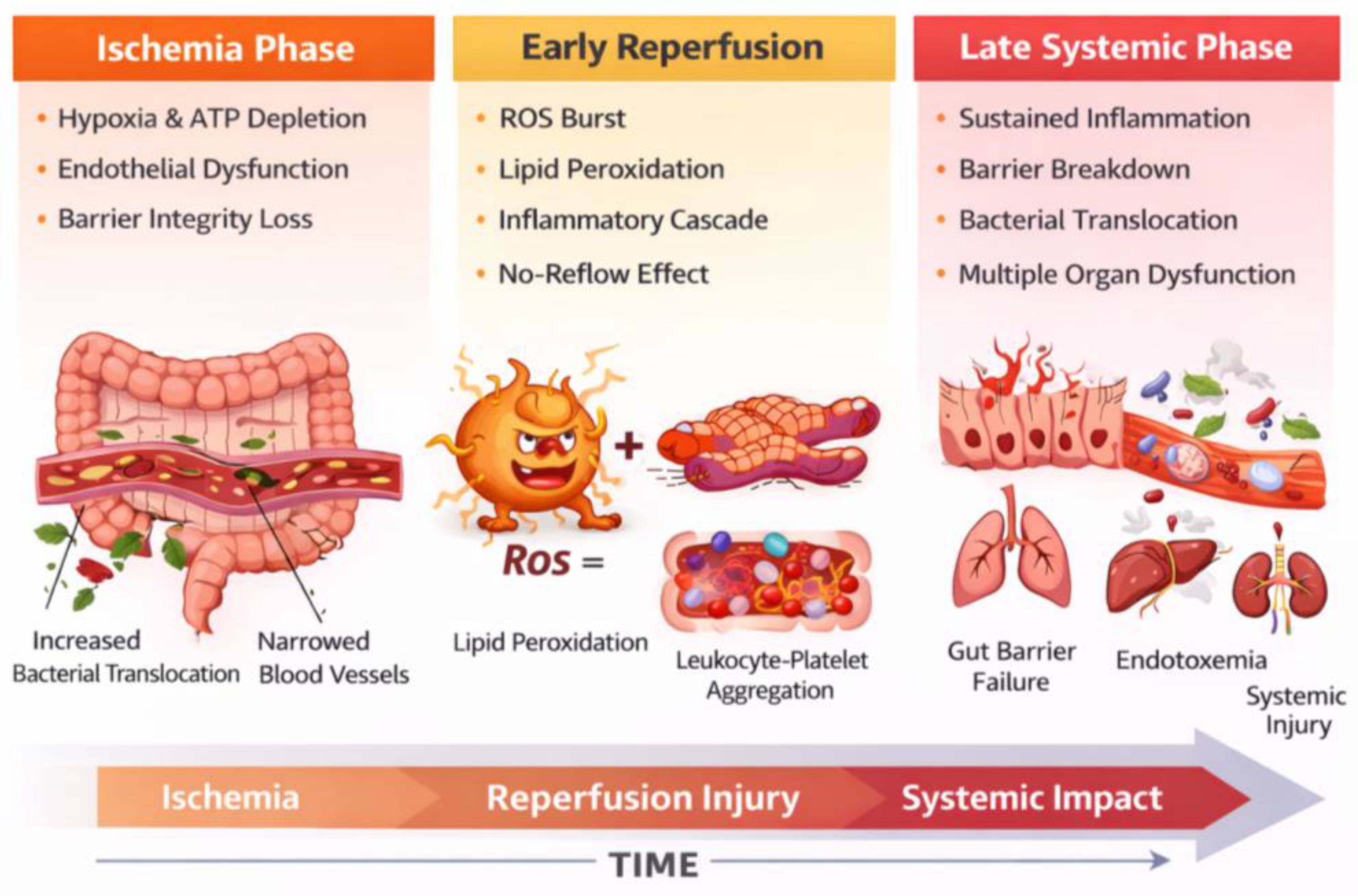
3.1. Microvascular Injury, Epithelial Barrier Failure, and Lesion Evolution
3.2. Oxidative Stress and Inflammatory Signaling
3.3. Gut Microbiota–Immune Axis and Systemic Propagation of Injury
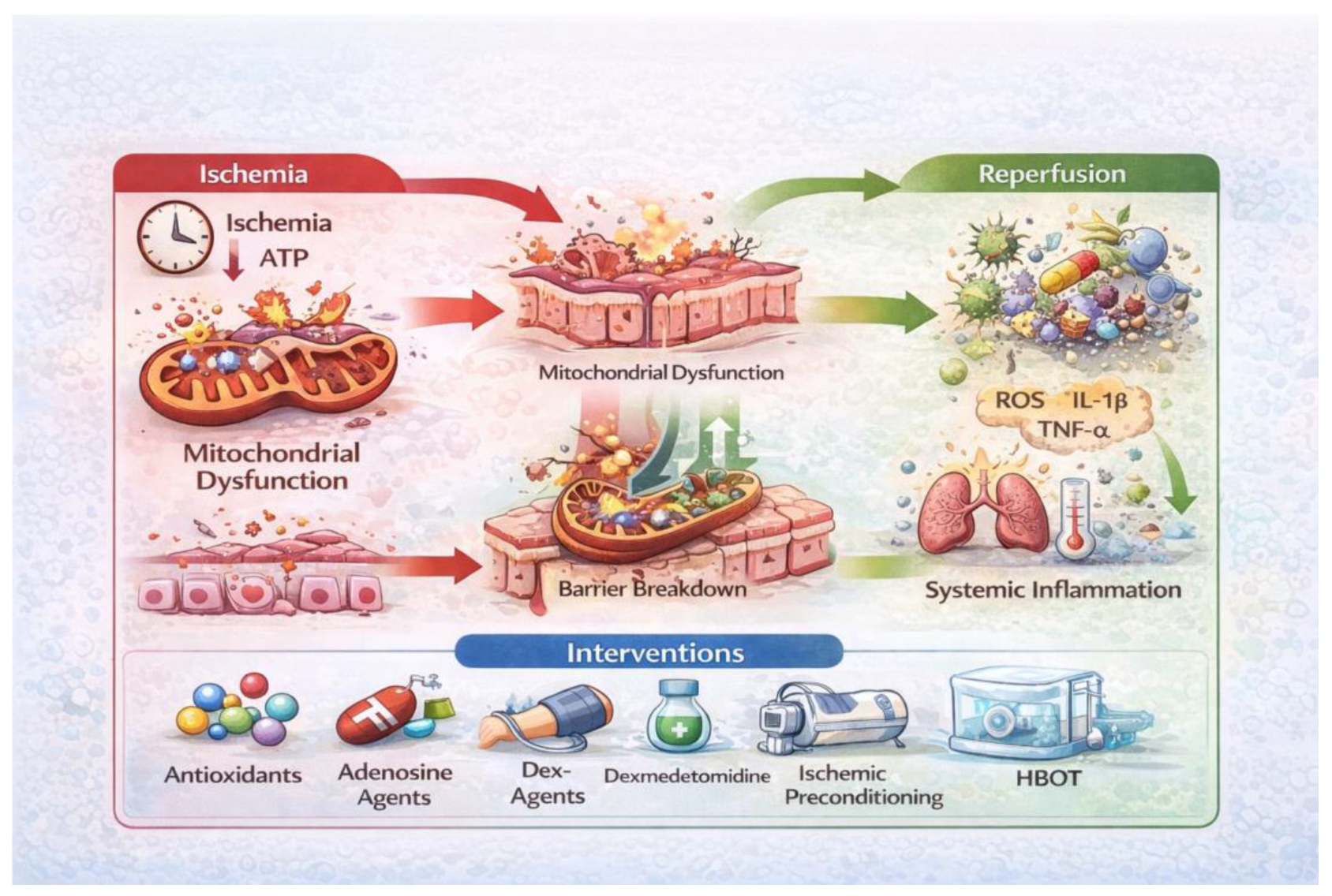
3.4. Apoptosis, Ferroptosis and Pyroptosis Mechanisms of Intestinal Cell Death
3.4.1. Apoptosis
3.4.2. Ferroptosis
3.4.3. Pyroptosis
3.4.4. Integrated Perspective
4. Pharmacological Therapeutic Strategies
4.1. Antioxidants and Redox Modulators
4.2. Adenosine-Based and Anti-Inflammatory Interventions
4.3. Dexmedetomidine
4.4. Microbiota-Targeted Therapies
4.4.1. Probiotics and Prebiotics
4.4.2. Microbiota Modulation and Immune Crosstalk
4.4.3. Fecal Microbiota Transplantation and Emerging Approaches
4.4.4. Translational Limitations and Future Directions
5. Non-Pharmacological and Conditioning Approaches
5.1. Ischemic Preconditioning (IPC) and Postconditioning (IPoC)
5.2. Hyperbaric Oxygen Therapy (HBOT)
5.3. Controlled Hypothermia and Ex Vivo Perfusion Models
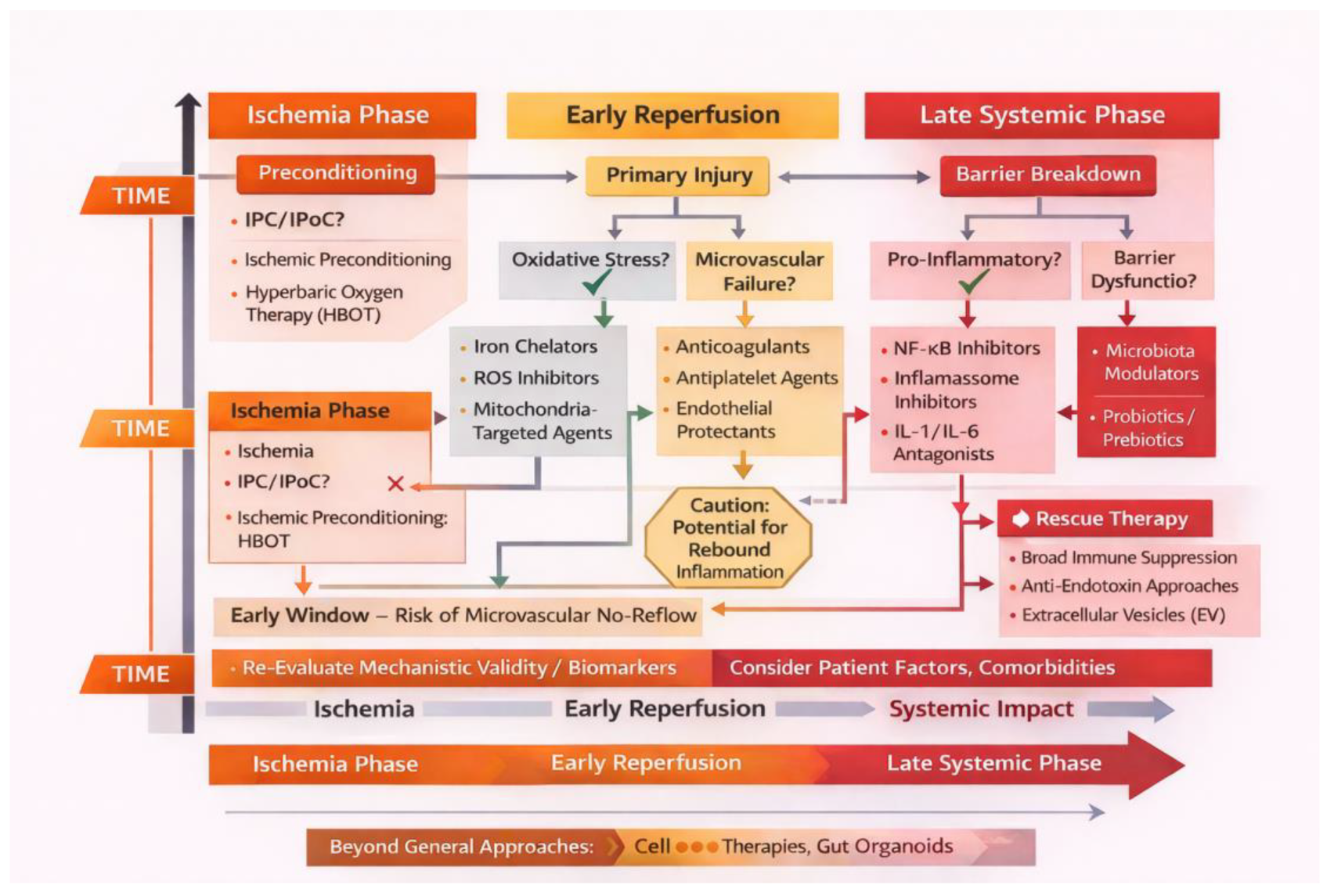
5.4. Translational Barriers and Evidence Hierarchy in Intestinal Ischemia–Reperfusion Injury
5.5. Structural Reasons for Translational Failure in Intestinal Ischemia–Reperfusion Injury
6. Future Directions
7. Conclusions
Author Contributions
Funding
Institutional Review Board Statement
Informed Consent Statement
Data Availability Statement
Acknowledgments
Conflicts of Interest
Abbreviations
| Akt | Protein kinase B |
| AP-1 | Activator protein 1 |
| ATP | Adenosine triphosphate |
| A2AR | Adenosine A2A receptor |
| BBB | Blood–brain barrier |
| Bcl-2 | B-cell lymphoma 2 |
| Bax | Bcl-2-associated X protein |
| CAT | Catalase |
| cGAS | Cyclic GMP–AMP synthase |
| Chiu Score | Histological injury grading system for intestinal I/R |
| CLDN-1 | Claudin-1 |
| COX | Cyclooxygenase |
| CXCL | C-X-C motif chemokine ligand |
| DAMPs | Damage-associated molecular patterns |
| DEX | Dexmedetomidine |
| DNA | Deoxyribonucleic acid |
| ECM | Extracellular matrix |
| eNOS | Endothelial nitric oxide synthase |
| ER | Endoplasmic reticulum |
| FABP2 | Fatty acid binding protein 2 (enterocyte injury marker) |
| FRAP | Ferric reducing antioxidant power |
| GSH | Reduced glutathione |
| GSH-Px | Glutathione peroxidase |
| GSH/GSSG | Reduced/oxidized glutathione ratio |
| GI | Gastrointestinal |
| HBOT | Hyperbaric oxygen therapy |
| H&E | Hematoxylin and eosin staining |
| HIF-1α | Hypoxia-inducible factor 1-alpha |
| HSP70/HSP90 | Heat shock proteins 70/90 |
| ICAM-1 | Intercellular adhesion molecule-1 |
| IL-1β, IL-6, IL-18 | Interleukins 1β, 6, and 18 |
| IPC | Ischemic preconditioning |
| IPoC | Ischemic postconditioning |
| IRI | Ischemia–reperfusion injury |
| I/R | Ischemia–reperfusion |
| iNOS | Inducible nitric oxide synthase |
| LDH | Lactate dehydrogenase |
| LPS | Lipopolysaccharide |
| LTA | Lipoteichoic acid |
| MDA | Malondialdehyde |
| MAPK | Mitogen-activated protein kinase |
| MLCK | Myosin light-chain kinase |
| MODS | Multiple organ dysfunction syndrome |
| MPO | Myeloperoxidase |
| NADPH oxidase | Nicotinamide adenine dinucleotide phosphate oxidase |
| NF-κB | Nuclear factor-κB |
| NLRP3 | NOD-like receptor family pyrin domain containing 3 |
| NO | Nitric oxide |
| NOS | Nitric oxide synthase |
| Nrf2 | Nuclear factor erythroid 2-related factor 2 |
| Occludin (OCLN) | Tight junction protein |
| OXPHOS | Oxidative phosphorylation |
| PI3K | Phosphoinositide 3-kinase |
| PRISMA | Preferred Reporting Items for Systematic Reviews and Meta-Analyses |
| PAMPs | Pathogen-associated molecular patterns |
| PGE2 | Prostaglandin E2 |
| RNS | Reactive nitrogen species |
| ROS | Reactive oxygen species |
| RNA | Ribonucleic acid |
| SCFAs | Short-chain fatty acids |
| SIRS | Systemic inflammatory response syndrome |
| SMA | Superior mesenteric artery |
| SOD | Superoxide dismutase |
| TJ | Tight junctions |
| TLR | Toll-like receptor |
| TNF-α | Tumor necrosis factor-alpha |
| UC | Ulcerative colitis (contextual comparison) |
| VCAM-1 | Vascular cell adhesion molecule-1 |
| VEGF | Vascular endothelial growth factor |
References
- Chen, J.; Wang, Y.; Shi, Y.; Liu, Y.; Wu, C.; Luo, Y.; Zhang, X.; Li, H.; Hu, Q.; Zhou, Z.; et al. Association of gut microbiota with intestinal ischemia–reperfusion injury. Front. Cell. Infect. Microbiol. 2022, 12, 962782. [Google Scholar] [CrossRef] [Scilit]
- Deng, F.; Lin, Z.B.; Sun, Q.S.; Min, Y.; Zhang, Y.; Chen, Y.; Chen, W.T.; Hu, J.J.; Liu, K.X. The role of intestinal microbiota and its metabolites in intestinal and extraintestinal organ injury induced by intestinal ischemia–reperfusion injury. Int. J. Biol. Sci. 2022, 18, 3981–3992. [Google Scholar] [CrossRef] [Scilit]
- Garzelli, L.; Branchini, F.; Gentili, F.; Cappelli, A.; Mazzoni, L.; Pradella, S.; Rengo, M.; Reginelli, A.; Barile, A.; Giovagnoni, A.; et al. Insights into acute mesenteric ischaemia: An up-to-date overview. Br. J. Radiol. 2023, 96, 20230232. [Google Scholar] [CrossRef] [Scilit] [PubMed]
- Gries, J.J.; Aguilera, D.; Khan, S.U.; Oderich, G.S.; Gloviczki, P.; Chaer, R.A.; Kashyap, V.S.; Arhuidese, I.J.; Schneider, D.B.; Powell, R.J.; et al. Revascularization strategies for acute and chronic mesenteric ischemia: A narrative review. J. Clin. Med. 2024, 13, 1217. [Google Scholar] [CrossRef] [Scilit] [PubMed]
- Kumar, K.; Singh, N.; Jaggi, A.S.; Maslov, L. Clinical applicability of conditioning techniques in ischemia–reperfusion injury: A review of the literature. Curr. Cardiol. Rev. 2021, 17, 306–318. [Google Scholar] [CrossRef] [Scilit]
- Song, S.; Li, R.; Wu, C.; Dong, J.; Wang, P. Effects of hyperbaric oxygen therapy on intestinal ischemia–reperfusion and its mechanism. Shock 2024, 61, 650–659. [Google Scholar] [CrossRef] [Scilit] [PubMed]
- Liu, X.; Liang, F.; Zhang, J.; Li, Z.; Yang, J.; Kang, N. Hyperbaric oxygen treatment improves intestinal barrier function after spinal cord injury in rats. Front. Neurol. 2020, 11, 563281. [Google Scholar] [CrossRef] [Scilit]
- Archontakis-Barakakis, P.; Theodorakopoulou, M.; Rozos, G.; Karavokyros, I.; Gkremoutis, A.; Liakakos, T.; Papalois, A.; Perrea, D.; Arkadopoulos, N.; Smyrniotis, V.; et al. Intestinal oxygen utilisation and cellular adaptation during ischaemia and reperfusion. Clin. Transl. Med. 2025, 14, e70136. [Google Scholar] [CrossRef] [Scilit]
- Hammed, O.; Xu, X.; Li, P.; Zhang, Y.; Chen, H.; Wang, L.; Zhao, Q.; Liu, J.; Zhou, Y.; Yang, S.; et al. Intestinal ischemia–reperfusion and blood–brain barrier compromise: Pathways to cognitive dysfunction. Front. Neurosci. 2025, 19, 1597170. [Google Scholar] [CrossRef] [Scilit]
- Wong, Y.L.; Simons, J.; Kampmann, C.; van den Heuvel, M.C.; Leuvenink, H.G.D.; Ploeg, R.J.; de Boer, M.T.; Porte, R.J.; Lisman, T.; Martins, P.N.; et al. Effects of different ischemic preconditioning strategies on physiological and cellular mechanisms of intestinal ischemia/reperfusion injury. PLoS ONE 2021, 16, e0256957. [Google Scholar] [CrossRef] [Scilit]
- Laubach, V.E.; French, B.A.; Okusa, M.D. Targeting of adenosine receptors in ischemia–reperfusion injury. Expert Opin. Ther. Targets 2011, 15, 103–118. [Google Scholar] [CrossRef] [Scilit] [PubMed]
- Bao, N.; Tang, B. Organ-protective effects and mechanisms of dexmedetomidine in ischemia–reperfusion injury. Oxid. Med. Cell. Longev. 2020, 2020, 6136105. [Google Scholar] [CrossRef] [Scilit]
- Zhao, Z.; Wu, Y.; Leng, Y.; Chang, L.; Wang, Y.; Li, D.; Xing, Y. Probiotics improve intestinal ischemia–reperfusion injury: A systematic review and meta-analysis. Front. Med. 2025, 12, 1546650. [Google Scholar] [CrossRef] [Scilit]
- Alicehajic, A.; Duivenvoorden, A.A.M.; Lenaerts, K. Unveiling the molecular complexity of intestinal ischemia–reperfusion injury through omics technologies. Proteomics 2024, 24, e2300160. [Google Scholar] [CrossRef] [Scilit]
- Garcia-Alonso, I.; Velasco-Oraa, X.; Cearra, I.; Iturrizaga Correcher, S.; Mar Medina, C.; Alonso-Varona, A.; García Ruiz de Gordejuela, A.; Ruiz-Montesinos, I.; Herrero de la Parte, B. Prophylactic treatment of intestinal ischemia–reperfusion injury reduces mucosal damage and improves intestinal absorption. J. Inflamm. Res. 2023, 16, 4141–4152. [Google Scholar] [CrossRef] [Scilit]
- Li, Q.; Zhang, Q.; Wang, C.; Liu, X.; Qu, L.; Gu, L.; Li, N.; Li, J. Altered distribution of tight junction proteins after intestinal ischaemia/reperfusion injury in rats. J. Cell. Mol. Med. 2009, 13, 4061–4076. [Google Scholar] [CrossRef] [Scilit]
- Eltzschig, H.K.; Collard, C.D. Vascular ischaemia and reperfusion injury. Br. Med. Bull. 2004, 70, 71–86. [Google Scholar] [CrossRef] [Scilit]
- Du, B.; Fu, Q.; Yang, Q.; Yang, Y.; Li, R.; Yang, X.; Yang, Q.; Li, S.; Tian, J.; Liu, H. Different types of cell death and their interactions in myocardial ischemia–reperfusion injury. Cell Death Discov. 2025, 11, 87. [Google Scholar] [CrossRef] [Scilit] [PubMed]
- Wolnicka-Glubisz, A.; Wisniewska-Becker, A. Dual action of curcumin as an anti- and pro-oxidant from a biophysical perspective. Antioxidants 2023, 12, 1725. [Google Scholar] [CrossRef] [Scilit] [PubMed]
- Shen, Y.; Wang, J.; Li, Y.; Kang, X.; Gu, L. Intestinal injury and changes of the gut microbiota after ischemic stroke. Front. Cell. Neurosci. 2025, 19, 1557746. [Google Scholar] [CrossRef] [Scilit]
- Bellanti, F. Ischemia–reperfusion injury: Evidences for translational research. Ann. Transl. Med. 2016, 4, S55. [Google Scholar] [CrossRef] [Scilit]
- Eltzschig, H.K.; Eckle, T. Ischemia and reperfusion—From mechanism to translation. Nat. Med. 2011, 17, 1391–1401. [Google Scholar] [CrossRef] [Scilit]
- Barry, M.; Pati, S. Targeting repair of the vascular endothelium and glycocalyx after traumatic injury with plasma and platelet resuscitation. Matrix Biol. Plus 2022, 14, 100107. [Google Scholar] [CrossRef] [Scilit]
- Chen, C.L.; Zhang, L.; Jin, Z.; Kasumov, T.; Chen, Y.R. Mitochondrial redox regulation and myocardial ischemia–reperfusion injury. Am. J. Physiol. Cell Physiol. 2022, 322, C12–C23. [Google Scholar] [CrossRef] [Scilit]
- Soleimani, P.; Nekoonam, S.; Zafari, F.; Sabbaghziarani, F. Effects of the combination of melatonin and N-acetylcysteine on the inflammatory response in a rat model of cerebral ischemia. IBRO Neurosci. Rep. 2025, 19, 83–90. [Google Scholar] [CrossRef] [Scilit]
- Yoshikawa, N.; Hirata, N.; Kurone, Y.; Shimoeda, S. Edaravone is a therapeutic candidate for doxorubicin-induced cardiomyopathy by activating the Nrf2 pathway. Pharmacol. Res. Perspect. 2025, 13, e70066. [Google Scholar] [CrossRef] [Scilit]
- Gutiérrez-Sánchez, G.; García-Alonso, I.; Gutiérrez Sáenz de Santa María, J.; Alonso-Varona, A.; Herrero de la Parte, B. Antioxidant-based therapy reduces early-stage intestinal ischemia–reperfusion injury in rats. Antioxidants 2021, 10, 853. [Google Scholar] [CrossRef] [Scilit] [PubMed]
- Hausenloy, D.J.; Yellon, D.M. Preconditioning and postconditioning: Underlying mechanisms and clinical application. Atherosclerosis 2009, 204, 334–341. [Google Scholar] [CrossRef] [Scilit] [PubMed]
- Grootjans, J.; Lenaerts, K.; Buurman, W.A.; Dejong, C.H.C.; Derikx, J.P.M. Life and death at the mucosal–luminal interface: New perspectives on human intestinal ischemia–reperfusion. World J. Gastroenterol. 2016, 22, 2760–2770. [Google Scholar] [CrossRef] [Scilit]
- Acosta, S. Mesenteric ischemia. Curr. Opin. Crit. Care 2015, 21, 171–178. [Google Scholar] [CrossRef] [Scilit] [PubMed]
- Vollmar, B.; Menger, M.D. Intestinal ischemia/reperfusion: Microcirculatory pathology and functional consequences. Langenbecks Arch. Surg. 2011, 396, 13–29. [Google Scholar] [CrossRef] [Scilit] [PubMed]
- Kalogeris, T.; Baines, C.P.; Krenz, M.; Korthuis, R.J. Cell biology of ischemia–reperfusion injury. Int. Rev. Cell Mol. Biol. 2012, 298, 229–317. [Google Scholar] [CrossRef] [Scilit]
- Schellekens, D.H.; Hundscheid, I.H.; Leenarts, C.A.; Grootjans, J.; Lenaerts, K.; Buurman, W.A.; Dejong, C.H.; Derikx, J.P. Human small intestine is capable of restoring barrier function after short ischemic periods. World J. Gastroenterol. 2017, 23, 8452–8464. [Google Scholar] [CrossRef] [Scilit]
- Derikx, J.P.; Matthijsen, R.A.; de Bruïne, A.P.; van Bijnen, A.A.; Heineman, E.; van Dam, R.M.; Dejong, C.H.; Buurman, W.A. Rapid reversal of human intestinal ischemia–reperfusion-induced damage by shedding of injured enterocytes and reepithelialisation. PLoS ONE 2008, 3, e3428. [Google Scholar] [CrossRef] [Scilit] [PubMed]
- Abassi, Z.; Armaly, Z.; Heyman, S.N. Glycocalyx degradation in ischemia–reperfusion injury. Am. J. Pathol. 2020, 190, 752–767. [Google Scholar] [CrossRef] [Scilit] [PubMed]
- van Abel, M.; Hoenderop, J.G.J.; van der Kemp, A.W.C.M.; van Leeuwen, J.P.T.M.; Bindels, R.J.M. Regulation of intestinal Ca2+ absorption by luminal Ca2+ availability. Am. J. Physiol. Gastrointest. Liver Physiol. 2003, 285, G78–G85. [Google Scholar] [CrossRef] [Scilit]
- Han, X.; Lang, Z.; Lv, X.; Xing, Y.; Hou, M.; Tan, Z.; Zhang, Y.; Leng, Y. Mitochondrial function in intestinal ischemia–reperfusion injury: Mechanisms and therapeutic perspectives. Mol. Biol. Rep. 2025, 52, 784. [Google Scholar] [CrossRef] [Scilit]
- Wen, X.; Tang, L.; Zhong, R.; Liu, L.; Chen, L.; Zhang, H. Role of mitophagy in regulating intestinal oxidative damage. Antioxidants 2023, 12, 480. [Google Scholar] [CrossRef] [Scilit]
- Granger, D.N.; Kvietys, P.R. Reperfusion injury and reactive oxygen species: The evolution of a concept. Redox Biol. 2015, 6, 524–551. [Google Scholar] [CrossRef] [Scilit]
- Menu, P.; Vince, J.E. The NLRP3 inflammasome in health and disease: The good, the bad and the ugly. Clin. Exp. Immunol. 2011, 166, 1–15. [Google Scholar] [CrossRef] [Scilit]
- Kumar, H.; Kawai, T.; Akira, S. Toll-like receptors and innate immunity. Biochem. Biophys. Res. Commun. 2009, 388, 621–625. [Google Scholar] [CrossRef] [Scilit] [PubMed]
- Wang, S.; Zhang, K.; Huang, Q.; Meng, F.; Deng, S. TLR4 signalling in ischemia/reperfusion injury: A promising target for linking inflammation, oxidative stress and programmed cell death. Front. Immunol. 2024, 15, 1447060. [Google Scholar] [CrossRef] [Scilit] [PubMed]
- Guo, H.; Tang, X.; He, X.; Weng, Y.; Zhang, Q.; Fang, Q.; Zhang, L. A comprehensive review of the microbiota–gut–brain axis via neuroinflammation: Advances and therapeutic implications for ischemic stroke. Biomolecules 2025, 15, 920. [Google Scholar] [CrossRef] [Scilit] [PubMed]
- Dithmer, S.; Blasig, I.E.; Fraser, P.A.; Qin, Z.; Haseloff, R.F. The basic requirement of tight junction proteins in blood–brain barrier function and their role in pathologies. Int. J. Mol. Sci. 2024, 25, 5601. [Google Scholar] [CrossRef] [Scilit]
- Cowled, P.; Fitridge, R. Pathophysiology of reperfusion injury. In Mechanisms of Vascular Disease: A Reference Book for Vascular Specialists; Fitridge, R., Thompson, M., Eds.; University of Adelaide Press: Adelaide, Australia, 2011; Chapter 18. Available online: https://www.ncbi.nlm.nih.gov/books/NBK534267/ (accessed on 1 February 2026).
- Strang, S.G.; Van Waes, O.J.; Van der Hoven, B.; Ali, S.; Verhofstad, M.H.; Pickkers, P.; Van Lieshout, E.M. Intestinal fatty acid binding protein as a marker for intra-abdominal pressure-related complications in intensive care patients (I-Fabulous study). Scand. J. Trauma Resusc. Emerg. Med. 2015, 23, 6. [Google Scholar] [CrossRef] [Scilit]
- McDowell, C.; Farooq, U.; Haseeb, M. Inflammatory bowel disease. In StatPearls; StatPearls Publishing: Treasure Island, FL, USA, 2025. Available online: https://www.ncbi.nlm.nih.gov/books/NBK470312/ (accessed on 1 February 2026).
- Mao, Z.J.; Lin, H.; Xiao, F.Y.; Huang, Z.Q.; Chen, Y.H. Melatonin against myocardial ischemia–reperfusion injury: A meta-analysis and mechanism insight from animal studies. Oxid. Med. Cell. Longev. 2020, 2020, 1241065. [Google Scholar] [CrossRef] [Scilit]
- Guan, Y.F.; Pritts, T.A.; Montrose, M.H. Ischemic post-conditioning to counteract intestinal ischemia/reperfusion injury. World J. Gastrointest. Pathophysiol. 2010, 1, 137–143. [Google Scholar] [CrossRef] [Scilit]
- Lim, S.; Halandras, P.M.; Bechara, C.; Aulivola, B.; Crisostomo, P. Contemporary management of acute mesenteric ischemia in the endovascular era. Vasc. Endovasc. Surg. 2019, 53, 42–50. [Google Scholar] [CrossRef] [Scilit]
- Kuznetsov, A.V.; Javadov, S.; Margreiter, R.; Grimm, M.; Hagenbuchner, J.; Ausserlechner, M.J. The role of mitochondria in the mechanisms of cardiac ischemia–reperfusion injury. Antioxidants 2019, 8, 454. [Google Scholar] [CrossRef] [Scilit]
- Ouyang, J.; Yan, J.; Zhou, X.; Isnard, S.; Harypursat, V.; Cui, H.; Routy, J.P.; Chen, Y. Relevance of biomarkers indicating gut damage and microbial translocation in people living with HIV. Front. Immunol. 2023, 14, 1173956. [Google Scholar] [CrossRef] [Scilit]
- Kouroumalis, E.; Tsomidis, I.; Voumvouraki, A. Autophagy and apoptosis in inflammatory bowel disease. Gastroenterol. Insights 2023, 14, 598–636. [Google Scholar] [CrossRef] [Scilit]
- Slifer, Z.M.; Hernandez, L.; Pridgen, T.A.; Carlson, A.R.; Messenger, K.M.; Madan, J.; Krishnan, B.R.; Laumas, S.; Blikslager, A.T. Larazotide acetate induces recovery of ischemia-injured porcine jejunum via repair of tight junctions. PLoS ONE 2021, 16, e0250165. [Google Scholar] [CrossRef] [Scilit]
- Jia, Z.; Chen, Q.; Qin, H. Ischemia-induced apoptosis of intestinal epithelial cells correlates with altered integrin distribution and disassembly of F-actin triggered by calcium overload. J. Biomed. Biotechnol. 2012, 2012, 617539. [Google Scholar] [CrossRef] [Scilit]
- Sun, Y.; Yang, X.; Xu, L.; Jia, M.; Zhang, L.; Li, P.; Yang, P. The Role of Nrf2 in Relieving Cerebral Ischemia-Reperfusion Injury. Curr. Neuropharmacol. 2023, 21, 1405–1420. [Google Scholar] [CrossRef] [Scilit]
- Wu, K.; Wang, Q.; Zhang, Z.; Luo, W.; Peng, J.; Ma, X.; Wang, L.; Xie, C.; Guo, W. Honokiol ameliorates pyroptosis in intestinal ischemia–reperfusion injury by regulating SIRT3-mediated NLRP3 inflammasome. Int. J. Mol. Med. 2025, 55, 96. [Google Scholar] [CrossRef] [Scilit]
- Archontakis-Barakakis, P.; Mavridis, T.; Chalkias, A. Oxygen-mediated molecular mechanisms involved in intestinal ischemia and reperfusion injury. Int. J. Mol. Sci. 2025, 26, 8398. [Google Scholar] [CrossRef] [Scilit]
- Yang, M.; Linn, B.S.; Zhang, Y.; Ren, J. Mitophagy and mitochondrial integrity in cardiac ischemia–reperfusion injury. Biochim. Biophys. Acta Mol. Basis Dis. 2019, 1865, 2293–2302. [Google Scholar] [CrossRef] [Scilit]
- Oldenburg, W.A.; Lau, L.L.; Rodenberg, T.J.; Edmonds, H.J.; Burger, C.D. Acute mesenteric ischemia: A clinical review. Arch. Intern. Med. 2004, 164, 1054–1062. [Google Scholar] [CrossRef] [Scilit]
- Acosta, S. Epidemiology of mesenteric vascular disease: Clinical implications. Semin. Vasc. Surg. 2010, 23, 4–8. [Google Scholar] [CrossRef] [Scilit] [PubMed]
- Clavien, P.A.; Petrowsky, H.; DeOliveira, M.L.; Graf, R. Strategies for safer liver surgery and partial liver transplantation. N. Engl. J. Med. 2007, 356, 1545–1559. [Google Scholar] [CrossRef] [Scilit] [PubMed]
- Mallick, I.H.; Yang, W.; Winslet, M.C.; Seifalian, A.M. Ischemia–reperfusion injury of the intestine and protective strategies against injury. Dig. Dis. Sci. 2004, 49, 1359–1377. [Google Scholar] [CrossRef] [Scilit]
- Oltean, M.; Olausson, M. The Chiu/Park scale for grading intestinal ischemia–reperfusion: If it ain’t broke don’t fix it! Intensive Care Med. 2010, 36, 1095–1096. [Google Scholar] [CrossRef] [Scilit]
- Kiwit, A.; Lu, Y.; Lenz, M.; Knopf, J.; Mohr, C.; Ledermann, Y.; Klinke-Petrowsky, M.; Pagerols Raluy, L.; Reinshagen, K.; Herrmann, M.; et al. The Dual Role of Neutrophil Extracellular Traps (NETs) in Sepsis and Ischemia-Reperfusion Injury: Comparative Analysis across Murine Models. Int. J. Mol. Sci. 2024, 25, 3787. [Google Scholar] [CrossRef] [Scilit]
- Li, J.; Liu, Y.; Li, Y.; Sun, T.; Xiang, H.; He, Z. The Role of Gut Microbiota and Circadian Rhythm Oscillation of Hepatic Ischemia–Reperfusion Injury in Diabetic Mice. Biomedicines 2024, 12, 54. [Google Scholar] [CrossRef] [Scilit]
- Sun, X.; Wu, S.; Mao, C.; Qu, Y.; Xu, Z.; Xie, Y.; Jiang, D.; Song, Y. Therapeutic Potential of Hydrogen Sulfide in Ischemia and Reperfusion Injury. Biomolecules 2024, 14, 740. [Google Scholar] [CrossRef] [Scilit]
- Mami, W.; Znaidi-Marzouki, S.; Doghri, R.; Ben Ahmed, M.; Znaidi, S.; Messadi, E. Inflammatory Bowel Disease Increases the Severity of Myocardial Infarction after Acute Ischemia–Reperfusion Injury in Mice. Biomedicines 2023, 11, 2945. [Google Scholar] [CrossRef] [Scilit] [PubMed]
- Canovai, E.; Farré, R.; Accarie, A.; Lauriola, M.; De Hertogh, G.; Vanuytsel, T.; Pirenne, J.; Ceulemans, L.J. INT-767—A Dual Farnesoid-X Receptor (FXR) and Takeda G Protein-Coupled Receptor-5 (TGR5) Agonist Improves Survival in Rats and Attenuates Intestinal Ischemia Reperfusion Injury. Int. J. Mol. Sci. 2023, 24, 14881. [Google Scholar] [CrossRef] [Scilit] [PubMed]
- Kitala, K.; Tanski, D.; Godlewski, J.; Krajewska-Włodarczyk, M.; Gromadziński, L.; Majewski, M. Copper and Zinc Particles as Regulators of Cardiovascular System Function—A Review. Nutrients 2023, 15, 3040. [Google Scholar] [CrossRef] [Scilit] [PubMed]
- Zhang, Y.; Zhong, C.; Wang, Q.; Zhang, J.; Zhao, H.; Huang, Y.; Zhao, D.; Yang, J. Nanoemulsions of Hydroxysafflor Yellow A for Enhancing Physicochemical and In Vivo Performance. Int. J. Mol. Sci. 2023, 24, 8658. [Google Scholar] [CrossRef] [Scilit]
- Zhou, P.; Zhang, S.; Wang, M.; Zhou, J. The Induction Mechanism of Ferroptosis, Necroptosis, and Pyroptosis in Inflammatory Bowel Disease, Colorectal Cancer, and Intestinal Injury. Biomolecules 2023, 13, 820. [Google Scholar] [CrossRef] [Scilit]
- Clarysse, M.; Accarie, A.; Farré, R.; Canovai, E.; Monbaliu, D.; Gunst, J.; De Hertogh, G.; Vanuytsel, T.; Pirenne, J.; Ceulemans, L.J. Protective Effect of Oxygen and Isoflurane in Rodent Model of Intestinal Ischemia-Reperfusion Injury. Int. J. Mol. Sci. 2023, 24, 2587. [Google Scholar] [CrossRef] [Scilit]
- Doukas, P.; Hellfritsch, G.; Krabbe, H.; Frankort, J.; Jacobs, M.J.; Gombert, A.; Simon, F. Onset of Adverse Abdominal Events Due to Intestinal Ischemia-Reperfusion Injury after Aortic Cross-Clamping Is Associated with Elevated HSP70 Serum Levels in the Early Postoperative Phase. Int. J. Mol. Sci. 2022, 23, 15063. [Google Scholar] [CrossRef] [Scilit]
- Afolabi, A.O.; Akhigbe, T.M.; Odetayo, A.F.; Anyogu, D.C.; Hamed, M.A.; Akhigbe, R.E. Restoration of Hepatic and Intestinal Integrity by Phyllanthus amarus Is Dependent on Bax/Caspase 3 Modulation in Intestinal Ischemia-/Reperfusion-Induced Injury. Molecules 2022, 27, 5073. [Google Scholar] [CrossRef] [Scilit] [PubMed]
- Korbecki, J.; Szatkowska, I.; Kupnicka, P.; Żwierełło, W.; Barczak, K.; Poziomkowska-Gęsicka, I.; Wójcik, J.; Chlubek, D.; Baranowska-Bosiacka, I. The Importance of CXCL1 in the Physiological State and in Noncancer Diseases of the Oral Cavity and Abdominal Organs. Int. J. Mol. Sci. 2022, 23, 7151. [Google Scholar] [CrossRef] [Scilit]
- Katada, K.; Takagi, T.; Iida, T.; Ueda, T.; Mizushima, K.; Fukui, A.; Okayama, T.; Kamada, K.; Uchiyama, K.; Ishikawa, T.; et al. Role and Potential Mechanism of Heme Oxygenase-1 in Intestinal Ischemia-Reperfusion Injury. Antioxidants 2022, 11, 559. [Google Scholar] [CrossRef] [Scilit] [PubMed]
- de Holanda, G.S.; dos Santos Valença, S.; Carra, A.M.; Lichtenberger, R.C.L.; de Castilho, B.; Franco, O.B.; de Moraes, J.A.; Schanaider, A. Translational Application of Fluorescent Molecular Probes for the Detection of Reactive Oxygen and Nitrogen Species Associated with Intestinal Reperfusion Injury. Metabolites 2021, 11, 802. [Google Scholar] [CrossRef] [Scilit]
- Erwin, S.J.; Blikslager, A.T.; Ziegler, A.L. Age-Dependent Intestinal Repair: Implications for Foals with Severe Colic. Animals 2021, 11, 3337. [Google Scholar] [CrossRef] [Scilit]
- Hou, J.; Strand-Amundsen, R.; Tronstad, C.; Høgetveit, J.O.; Martinsen, Ø.G.; Tønnessen, T.I. Automatic Prediction of Ischemia-Reperfusion Injury of Small Intestine Using Convolutional Neural Networks: A Pilot Study. Sensors 2021, 21, 6691. [Google Scholar] [CrossRef] [Scilit] [PubMed]
- Caleb, I.; Erlitz, L.; Telek, V.; Vecsernyés, M.; Sétáló, G., Jr.; Hardi, P.; Takács, I.; Jancsó, G.; Nagy, T. Characterizing Autophagy in the Cold Ischemic Injury of Small Bowel Grafts: Evidence from Rat Jejunum. Metabolites 2021, 11, 396. [Google Scholar] [CrossRef] [Scilit]
- Potì, F.; Giorgio, C.; Zini, I.; Nofer, J.-R.; Vivo, V.; Palese, S.; Ballabeni, V.; Barocelli, E.; Bertoni, S. Impact of S1P Mimetics on Mesenteric Ischemia/Reperfusion Injury. Pharmaceuticals 2020, 13, 298. [Google Scholar] [CrossRef] [Scilit]
- Wang, J.; Qiao, L.; Li, S.; Yang, G. Protective Effect of Ginsenoside Rb1 Against Lung Injury Induced by Intestinal Ischemia-Reperfusion in Rats. Molecules 2013, 18, 1214–1226. [Google Scholar] [CrossRef] [Scilit] [PubMed]
- Sun, Q.; Meng, Q.-T.; Jiang, Y.; Xia, Z.-Y. Ginsenoside Rb1 Attenuates Intestinal Ischemia Reperfusion Induced Renal Injury by Activating Nrf2/ARE Pathway. Molecules 2012, 17, 7195–7205. [Google Scholar] [CrossRef] [Scilit] [PubMed]



| Mechanistic Domain | Key Findings | Molecular/Cellular Markers |
|---|---|---|
| Microvascular dysfunction | Capillary no-reflow; endothelial swelling; perfusion failure | ICAM-1 ↑, VCAM-1 ↑, P-selectin ↑, eNOS ↓ |
| Endothelial glycocalyx degradation | Increased permeability; leukocyte adhesion | Syndecan-1 ↑, Heparan sulfate fragments ↑ |
| Mitochondrial injury | Cristae disruption; ROS burst; impaired OXPHOS | MDA ↑, SOD ↓ |
| Tight junction disruption | Loss of barrier integrity; bacterial translocation | Occludin ↓, Claudin-1 ↓, ZO-1 ↓ |
| Apoptosis/Pyroptosis | Enterocyte apoptosis and pyroptosis | Caspase-3 ↑, Bax ↑, Bcl-2 ↓, NLRP3 ↑ |
| Pathway | Molecular Events | Consequences | Key References |
|---|---|---|---|
| NF-κB Activation | ROS → IκB degradation → NF-κB nuclear translocation | TNF-α ↑, IL-1β ↑, IL-6 ↑ | [25,26] |
| Nrf2 Suppression | Reduced antioxidant response | SOD ↓, CAT ↓, GSH/GSSG imbalance | [27] |
| MAPK Pathway | ROS and cytokine activation | Apoptosis, inflammation | [28,29] |
| TLR4–NLRP3 Inflammasome | TLR4 activation → caspase-1 activation | Pyroptosis, IL-18 ↑ | [30,31] |
| Nitrosative Stress | NO–peroxynitrite formation | Endothelial injury, lipid peroxidation | [32,33] |
| Therapeutic Class | Representative Agents/Strategies | Primary Molecular Targets/Mechanisms | Key Experimental or Clinical Effects | Stage of Clinical Development |
|---|---|---|---|---|
| Antioxidants | N-acetylcysteine (NAC), melatonin, edaravone | ROS scavenging; Nrf2 activation; mitochondrial protection | ↓ Lipid peroxidation; ↓ apoptosis; preserved villus architecture | Preclinical; several agents clinically approved for other indications |
| Adenosine-based therapies | Adenosine A2A/A2B receptor agonists | NF-κB inhibition; vasodilation; anti-inflammatory signaling | Improved microcirculation; ↓ cytokine release | Preclinical; early clinical studies |
| α2-Adrenergic agonists | Dexmedetomidine | PI3K/Akt activation; mitochondrial stabilization | Barrier protection; ↓ inflammation | Clinically approved (sedation); preclinical I/R evidence |
| Anti-inflammatory agents | Cytokine inhibitors; NLRP3 inhibitors | Suppression of inflammatory signaling | ↓ TNF-α, IL-1β; ↓ tissue injury | Preclinical |
| Ferroptosis-targeted therapies | Iron chelators; GPX4 activators | Inhibition of lipid peroxidation | Preserved epithelial integrity | Preclinical/proof-of-concept |
| Microcirculatory modulators | Nitric oxide donors | Endothelial protection | Improved oxygen delivery | Preclinical |
| Barrier-protective strategies | Probiotics; SCFAs | Tight junction stabilization | ↓ Permeability; ↓bacterial translocation | Preclinical; limited early clinical data |
| Strategy | Mechanistic Basis | Protective Effects | References |
|---|---|---|---|
| Ischemic Preconditioning (IPC) | Brief ischemia → HSPs ↑, NO ↑ | ↓ Mucosal injury, improved microcirculation | [19,68] |
| Ischemic Postconditioning (IPoC) | Intermittent reperfusion cycles | ↓ ROS burst, ↓ apoptosis | [23,41] |
| Hyperbaric Oxygen Therapy | ↑ Oxygen pressure; ↓ neutrophil adhesion | Improved villus structure; ↓ Oxidative stress | [6,7,69] |
| Hypothermia | Reduced metabolic demand | Preserves mucosa and mitochondria | [57,70] |
| Ex Vivo Perfusion Models | Controlled ischemia/reperfusion | Mechanistic insights without systemic variables | [10,72] |
Disclaimer/Publisher’s Note: The statements, opinions and data contained in all publications are solely those of the individual author(s) and contributor(s) and not of MDPI and/or the editor(s). MDPI and/or the editor(s) disclaim responsibility for any injury to people or property resulting from any ideas, methods, instructions or products referred to in the content. |
© 2026 by the authors. Licensee MDPI, Basel, Switzerland. This article is an open access article distributed under the terms and conditions of the Creative Commons Attribution (CC BY) license.
Share and Cite
Marton, J.; Ciocan, R.A.; Bâldea, I.; Gherman, M.L.; Gheban, D.; Filip, A.; Pașcalău, I.R.; Mihăileanu, F.V.; Pop, R.M.; Gherman, C.D. Molecular Mechanisms, Dynamic Lesions, and Therapeutic Targets in Intestinal Ischemia–Reperfusion Injury: A Systematic Review. Int. J. Mol. Sci. 2026, 27, 1763. https://doi.org/10.3390/ijms27041763
Marton J, Ciocan RA, Bâldea I, Gherman ML, Gheban D, Filip A, Pașcalău IR, Mihăileanu FV, Pop RM, Gherman CD. Molecular Mechanisms, Dynamic Lesions, and Therapeutic Targets in Intestinal Ischemia–Reperfusion Injury: A Systematic Review. International Journal of Molecular Sciences. 2026; 27(4):1763. https://doi.org/10.3390/ijms27041763
Chicago/Turabian StyleMarton, Julia, Răzvan Alexandru Ciocan, Ioana Bâldea, Mădălina Luciana Gherman, Dan Gheban, Adriana Filip, Ionuț Răzvan Pașcalău, Florin Vasile Mihăileanu, Raluca Maria Pop, and Claudia Diana Gherman. 2026. "Molecular Mechanisms, Dynamic Lesions, and Therapeutic Targets in Intestinal Ischemia–Reperfusion Injury: A Systematic Review" International Journal of Molecular Sciences 27, no. 4: 1763. https://doi.org/10.3390/ijms27041763
APA StyleMarton, J., Ciocan, R. A., Bâldea, I., Gherman, M. L., Gheban, D., Filip, A., Pașcalău, I. R., Mihăileanu, F. V., Pop, R. M., & Gherman, C. D. (2026). Molecular Mechanisms, Dynamic Lesions, and Therapeutic Targets in Intestinal Ischemia–Reperfusion Injury: A Systematic Review. International Journal of Molecular Sciences, 27(4), 1763. https://doi.org/10.3390/ijms27041763