Stage-Dependent Role of Eicosanoids in Colorectal Cancer

 , , , , , , , and
Abstract
1. Introduction
2. Results
2.1. Population Sample Characteristics
2.2. Insights from Multivariate Modelling
2.3. Primary Outcome—TNM Stage
2.4. Ordinal Model
2.5. Binomial Model (Odds for TNM ≥ III)
2.6. Secondary Outcomes—T and N Substages
2.7. Exploratory Analysis Outcomes—Angio/Neuroinvasion
2.8. Interpretation Summary
3. Discussion
3.1. The Impact of PGE2 and COX-2
3.2. The Importance of LTB4, TXB2, and PGD2
3.3. Study Limitations
4. Materials and Methods
4.1. Studied Group and Material
4.2. Biological Material Analysis
4.2.1. Materials
4.2.2. Targeted Metabolomic Analysis
4.3. Data Analysis Strategy
4.4. Multivariate Modeling
- Ordinal outcomes: TNM, T, and N.
- Binary endpoints (TNM ≥ III, angioinvasion, and neuroinvasion).
- Penalized regression (Strategy A):
- (a)
- Elastic net regularized proportional odds model (cumulative logit link, α = 0.75, 5-fold CV, 1-SE rule; ranking by sum of |β| across thresholds);
- (b)
- Elastic net binomial model (logit link, α = 0.75, 5-fold stratified CV, λ.1se; ranking by |β|).
- Likelihood-based stepwise regression (Strategy B): Bidirectional LRT with enter p < 0.05/stay p < 0.10 (max 100 steps) on scaled data. Final sets were refit without penalty.
5. Conclusions
Supplementary Materials
Author Contributions
Funding
Institutional Review Board Statement
Informed Consent Statement
Data Availability Statement
Conflicts of Interest
Abbreviations
| CRC | Colorectal Cancer; |
| AA | Arachidonic Acid; |
| PUFAs | Polyunsaturated Fatty Acids; |
| COX | Cyclooxygenase; |
| LOX | Lipoxygenase; |
| GPCRs | G Protein-Coupled Receptors; |
| NSAID | Non-Steroidal Anti-Inflammatory Drug; |
| EV | Extracellular Vesicle; |
| BMI | Body Mass Index; |
| TNM | Tumor, Node, Metastasis (Staging System); |
| CEA | Carcinoembryonic Antigen; |
| IHC | Immunohistochemistry; |
| MSI | Microsatellite Instability; |
| ASA | Acetylsalicylic Acid (Aspirin); |
| DM | Diabetes Mellitus; |
| T2DM | Type 2 Diabetes Mellitus; |
| ACEI | Angiotensin-Converting Enzyme Inhibitor; |
| PGD2 | Prostaglandin D2; |
| PGE2 | Prostaglandin E2; |
| TXB2 | Thromboxane B2; |
| LTB4 | Leukotriene B4; |
| PGF2α | Prostaglandin F2 alpha; |
| 6-Keto-PGF1α | 6-Keto Prostaglandin F1 alpha; |
| 15-deoxy-PGJ2 | 15-deoxy-Δ12,14-Prostaglandin J2; |
| 13,14-DH-PGE1 | 13,14-dihydro Prostaglandin E1. |
References
- Xi, Y.; Xu, P. Global colorectal cancer burden in 2020 and projections to 2040. Transl. Oncol. 2021, 14, 101174. Available online: https://www.sciencedirect.com/science/article/pii/S1936523321001662?via%3Dihub (accessed on 13 September 2025). [CrossRef] [PubMed]
- Siegel, R.L.; Miller, K.D.; Goding Sauer, A.; Fedewa, S.A.; Butterly, L.F.; Anderson, J.C.; Cercek, A.; Smith, R.A.; Jemal, A. Colorectal cancer statistics. CA Cancer J. Clin. 2020, 70, 145–164. [Google Scholar] [CrossRef]
- Siegel, R.L.; Miller, K.D.; Jemal, A. Cancer statistics. CA Cancer J. Clin. 2020, 70, 7–30. [Google Scholar] [CrossRef]
- Calde, P.C. Eicosanoids. Essays Biochem. 2020, 64, 423–441. Available online: https://portlandpress.com/essaysbiochem/article/64/3/423/226134/Eicosanoids (accessed on 13 September 2025).
- Larsson, S.C.; Carter, P.; Vithayathil, M.; Mason, A.M.; Michaëlsson, K.; Baron, J.A.; Burgess, S. Genetically predicted plasma phospholipid arachidonic acid concentrations and 10 site-specific cancers in UK Biobank and genetic consortia participants: A Mendelian randomization study. Clin. Nutr. 2020, 40, 3332. Available online: https://pmc.ncbi.nlm.nih.gov/articles/PMC7612929/ (accessed on 14 September 2025). [CrossRef] [PubMed]
- Wang, D.; Cabalag, C.S.; Clemons, N.J.; DuBois, R.N. Cyclooxygenases and Prostaglandins in Tumor Immunology and Microenvironment of Gastrointestinal Cancer. Gastroenterology 2021, 161, 1813–1829. Available online: https://pubmed.ncbi.nlm.nih.gov/34606846/ (accessed on 7 September 2025). [CrossRef]
- Lenihan-Geels, G.; Bishop, K.S.; Ferguson, L.R. Cancer Risk and Eicosanoid Production: Interaction between the Protective Effect of Long Chain Omega-3 Polyunsaturated Fatty Acid Intake and Genotype. J. Clin. Med. 2016, 5, 25. Available online: https://pmc.ncbi.nlm.nih.gov/articles/PMC4773781/ (accessed on 13 September 2025). [CrossRef]
- Aoki, T.; Narumiya, S. Prostaglandin E2-EP2 signaling as a node of chronic inflammation in the colon tumor microenvironment. Inflamm. Regen. 2017, 37, 4. Available online: https://pmc.ncbi.nlm.nih.gov/articles/PMC5725845/ (accessed on 13 September 2025). [CrossRef]
- Majima, M.; Matsuda, Y.; Watanabe, S.I.; Ohtaki, Y.; Hosono, K.; Ito, Y.; Amano, H. Prostanoids Regulate Angiogenesis and Lymphangiogenesis in Pathological Conditions. Cold Spring Harb. Perspect. Med. 2024, 14, a041182. Available online: https://pubmed.ncbi.nlm.nih.gov/38565267/ (accessed on 11 September 2025).
- Yamaguchi, A.; Botta, E.; Holinstat, M. Eicosanoids in inflammation in the blood and the vessel. Front. Pharmacol. 2022, 13, 997403. [Google Scholar] [CrossRef] [PubMed]
- Belayneh, Y.M.; Amare, G.G.; Meharie, B.G. Updates on the molecular mechanisms of aspirin in the prevention of colorectal cancer: Review. J. Oncol. Pharm. Pract. 2021, 27, 954–961. Available online: https://pubmed.ncbi.nlm.nih.gov/33427041/ (accessed on 7 September 2025). [CrossRef]
- Rashid, G.; Khan, N.A.; Elsori, D.; Rehman, A.; Tanzeelah; Ahmad, H.; Maryam, H.; Rais, A.; Usmani, M.S.; Babker, A.M.; et al. Non-steroidal anti-inflammatory drugs and biomarkers: A new paradigm in colorectal cancer. Front. Med. 2023, 10, 1130710. Available online: https://pubmed.ncbi.nlm.nih.gov/36950511/ (accessed on 7 September 2025).
- Drew, D.A.; Schuck, M.M.; Magicheva-Gupta, M.V.; Stewart, K.O.; Gilpin, K.K.; Miller, P.; Parziale, M.P.; Pond, E.N.; Takacsi-Nagy, O.; Zerjav, D.C.; et al. Effect of Low-dose and Standard-dose Aspirin on PGE2 Biosynthesis Among Individuals with Colorectal Adenomas: A Randomized Clinical Trial. Cancer Prev. Res. 2020, 13, 877–888. Available online: https://aacrjournals.org/cancerpreventionresearch/article/13/10/877/47296/Effect-of-Low-dose-and-Standard-dose-Aspirin-on (accessed on 11 September 2025). [CrossRef] [PubMed]
- Macia Guardado, M.; Lutz, V.; Hengstschläger, M.; Dolznig, H. The Role of Prostaglandins as Major Inflammatory Mediators in Colorectal Cancer. Int. J. Mol. Sci. 2025, 26, 12191. Available online: https://pmc.ncbi.nlm.nih.gov/articles/PMC12734000/ (accessed on 17 January 2026). [CrossRef]
- Jara-Gutiérrez, Á.; Baladrón, V. The Role of Prostaglandins in Different Types of Cancer. Cells 2021, 10, 1487. Available online: https://pmc.ncbi.nlm.nih.gov/articles/PMC8231512/ (accessed on 17 January 2026). [CrossRef]
- Contursi, A.; Schiavone, S.; Dovizio, M.; Hinz, C.; Fullone, R.; Tacconelli, S.; Tyrrell, V.J.; Grande, R.; Lanuti, P.; Marchisio, M.; et al. Platelets induce free and phospholipid-esterified 12-hydroxyeicosatetraenoic acid generation in colon cancer cells by delivering 12-lipoxygenase. J. Lipid. Res. 2021, 62, 100109. Available online: https://pmc.ncbi.nlm.nih.gov/articles/PMC8456051/ (accessed on 14 January 2026). [CrossRef]
- Martinez, J.A.; Skiba, M.B.; Chow, H.H.S.; Chew, W.M.; Saboda, K.; Lance, P.; Ellis, N.A.; Jacobs, E.T. A Protective Role for Arachidonic Acid Metabolites against Advanced Colorectal Adenoma in a Phase III Trial of Selenium. Nutrients 2021, 13, 3877. Available online: https://pmc.ncbi.nlm.nih.gov/articles/PMC8621008/ (accessed on 14 September 2025). [CrossRef]
- Wang, F.; Wang, M.; Yin, H.; Long, Z.; Zhu, L.; Yu, H.; Sun, H.; Bi, H.; Li, S.; Zhao, Y.; et al. Association between plasma prostaglandin E2 level and colorectal cancer. Eur. J. Cancer Prev. 2021, 30, 59–68. Available online: https://journals.lww.com/10.1097/CEJ.0000000000000583 (accessed on 7 September 2025). [CrossRef]
- Shirakami, Y.; Nakanishi, T.; Ozawa, N.; Ideta, T.; Kochi, T.; Kubota, M.; Sakai, H.; Ibuka, T.; Tanaka, T.; Shimizu, M. Inhibitory effects of a selective prostaglandin E2 receptor antagonist RQ-15986 on inflammation-related colon tumorigenesis in APC-mutant rats. PLoS ONE 2021, 16, e0251942. Available online: https://pubmed.ncbi.nlm.nih.gov/34003864/ (accessed on 11 September 2025).
- Cuenca-Escalona, J.; Bödder, J.; Subtil, B.; Sánchez-Sánchez, M.; Vidal-Manrique, M.; Sweep, M.W.D.; Fauerbach, J.A.; Cambi, A.; Flórez-Grau, G.; de Vries, J.M. EP2/EP4 targeting prevents tumor-derived PGE2-mediated immunosuppression in cDC2s. J. Leukoc. Biol. 2024, 116, 1554–1567, Correction in J. Leukoc. Biol. 2025, 117, qiae213. Available online: https://pubmed.ncbi.nlm.nih.gov/39041661/ (accessed on 11 September 2025). [CrossRef]
- Francica, B.J.; Holtz, A.; Lopez, J.; Freund, D.; Chen, A.; Wang, D.; Powell, D.; Kipper, F.C.; Panigrahy, D.; Dubois, R.N.; et al. Dual Blockade of EP2 and EP4 Signaling is Required for Optimal Immune Activation and Antitumor Activity Against Prostaglandin-Expressing Tumors. Cancer Res. Commun. 2023, 3, 1486–1500. Available online: https://pubmed.ncbi.nlm.nih.gov/37559947/ (accessed on 2 November 2025). [CrossRef] [PubMed]
- Goodla, L.; Xue, X. The Role of Inflammatory Mediators in Colorectal Cancer Hepatic Metastasis. Cells 2022, 11, 2313. Available online: https://pubmed.ncbi.nlm.nih.gov/35954156/ (accessed on 2 November 2025).
- Kamei, D.; Murakami, M.; Nakatani, Y.; Ishikawa, Y.; Ishii, T.; Kudo, I. Potential role of microsomal prostaglandin E synthase-1 in tumorigenesis. J. Biol. Chem. 2003, 278, 19396–19405. Available online: https://pubmed.ncbi.nlm.nih.gov/12626523/ (accessed on 2 November 2025). [CrossRef] [PubMed]
- Wei, J.; Zhang, J.; Wang, D.; Cen, B.; Lang, J.D.; DuBois, R.N. The COX-2-PGE2 pathway promotes tumor evasion in colorectal adenomas. Cancer Prev. Res. 2022, 15, 285. Available online: https://pmc.ncbi.nlm.nih.gov/articles/PMC9064954/ (accessed on 11 September 2025). [CrossRef]
- Jiang, J.; Li, A.; Lai, X.; Zhang, H.; Wang, C.; Wang, H.; Li, L.; Liu, Y.; Xie, L.; Yang, C.; et al. Correlation between Metabolite of Prostaglandin E2 and the incidence of colorectal adenomas. Front. Oncol. 2023, 13, 1068469. Available online: https://pubmed.ncbi.nlm.nih.gov/36923425/ (accessed on 11 September 2025).
- Wang, D.; Fu, L.; Sun, H.; Guo, L.; Dubois, R.N. Prostaglandin E2 Promotes Colorectal Cancer Stem Cell Expansion and Metastasis in Mice. Gastroenterology 2015, 149, 1884. Available online: https://pmc.ncbi.nlm.nih.gov/articles/PMC4762503/ (accessed on 2 November 2025). [CrossRef] [PubMed]
- Zhang, C.; Hu, Z.; Pan, Z.; Ji, Z.; Cao, X.; Yu, H.; Qin, X.; Guan, M. The arachidonic acid metabolome reveals elevation of prostaglandin E2 biosynthesis in colorectal cancer. Analyst 2024, 149, 1907–1920. Available online: https://pubmed.ncbi.nlm.nih.gov/38372525/ (accessed on 11 September 2025). [CrossRef] [PubMed]
- Kim, Y.H.; Kim, K.J. Upregulation of prostaglandin E2 by inducible microsomal prostaglandin E synthase-1 in colon cancer. Ann. Coloproctol. 2022, 38, 153–159. Available online: https://pubmed.ncbi.nlm.nih.gov/34465013/ (accessed on 2 November 2025). [CrossRef]
- Suwatthanarak, T.; Tanjak, P.; Suwatthanarak, T.; Acharayothin, O.; Thanormjit, K.; Chaiboonchoe, A.; Tawantanakorn, T.; Phalanusitthepha, C.; Trakarnsanga, A.; Methasate, A.; et al. Exploring extracellular matrix and prostaglandin pathway alterations across varying resection margin distances of right-sided colonic adenocarcinoma. BMC Cancer 2023, 23, 1202. Available online: https://pubmed.ncbi.nlm.nih.gov/38062443/ (accessed on 11 September 2025).
- Geng, S.; Zhan, H.; Cao, L.; Geng, L.; Ren, X. Targeting PTGES/PGE2 axis enhances sensitivity of colorectal cancer cells to 5-fluorouracil. Biochem. Cell Biol. 2023, 101, 501–512. Available online: https://pubmed.ncbi.nlm.nih.gov/37358009/ (accessed on 11 September 2025). [CrossRef]
- Karpisheh, V.; Joshi, N.; Zekiy, A.O.; Beyzai, B.; Hojjat-Farsangi, M.; Namdar, A.; Edalati, M.; Jadidi-Niaragh, F. EP4 receptor as a novel promising therapeutic target in colon cancer. Pathol. Res. Pract. 2020, 216, 153247. Available online: https://pubmed.ncbi.nlm.nih.gov/33190014/ (accessed on 11 September 2025).
- Wyrwicz, L.; Saunders, M.; Hall, M.; Ng, J.; Hong, T.; Xu, S.; Lucas, J.; Lu, X.; Lautermilch, N.; Formenti, S.; et al. AN0025, a novel antagonist of PGE2-receptor E-type 4 (EP4), in combination with total neoadjuvant treatment of advanced rectal cancer. Radiother. Oncol. 2023, 185, 109669. Available online: https://pubmed.ncbi.nlm.nih.gov/37054987/ (accessed on 11 September 2025).
- Nanda, N.; Dhawan, D.K. Role of cyclooxygenase-2 in colorectal cancer. Front. Biosci. 2021, 26, 706–716. Available online: https://pubmed.ncbi.nlm.nih.gov/33049690/ (accessed on 7 September 2025). [CrossRef] [PubMed]
- de Araújo, W.M.; Tanaka, M.N.; Lima, P.H.S.; de Moraes, C.F.; Leve, F.; Bastos, L.G.; Rocha, M.R.; Robbs, B.K.; Viola, J.P.B.; Morgado‐Diaz, J.A. TGF-β acts as a dual regulator of COX-2/PGE2 tumor promotion depending of its cross-interaction with H-Ras and Wnt/β-catenin pathways in colorectal cancer cells. Cell Biol. Int. 2021, 45, 662–673. Available online: https://pubmed.ncbi.nlm.nih.gov/33300198/ (accessed on 11 September 2025). [CrossRef]
- Yang, L.; Akanyibah, F.A.; Yao, D.; Jin, T.; Mao, F. The role of COX-2 and its use as a therapeutic target in IBD and related colorectal cancer. Arch. Biochem. Biophys. 2025, 771, 110516. Available online: https://pubmed.ncbi.nlm.nih.gov/40550348/ (accessed on 7 September 2025).
- Narayana, S.H.; Mushtaq, U.; Shaman Ameen, B.; Nie, C.; Nechi, D.; Mazhar, I.J.; Yasir, M.; Sarfraz, S.; Shlaghya, G.; Khan, S.; et al. Protective Effects of Long-Term Usage of Cyclo-Oxygenase-2 Inhibitors on Colorectal Cancer in Genetically Predisposed Individuals and Their Overall Effect on Prognosis: A Systematic Review. Cureus 2023, 15, e41939. Available online: https://pubmed.ncbi.nlm.nih.gov/37588311/ (accessed on 7 September 2025).
- Reyes-Uribe, L.; Wu, W.; Gelincik, O.; Bommi, P.V.; Francisco-Cruz, A.; Solis, L.M.; Lynch, P.M.; Lim, R.; Stoffel, E.M.; Kanth, P.; et al. Naproxen chemoprevention promotes immune activation in Lynch syndrome colorectal mucosa. Gut 2021, 70, 555–566. Available online: https://pubmed.ncbi.nlm.nih.gov/32641470/ (accessed on 11 September 2025). [CrossRef] [PubMed]
- Lanas, A.; Tacconelli, S.; Contursi, A.; Piazuelo, E.; Bruno, A.; Ronci, M.; Marcone, S.; Dovizio, M.; Sopeña, F.; Falcone, L.; et al. Biomarkers of Response to Low-Dose Aspirin in Familial Adenomatous Polyposis Patients. Cancers 2023, 15, 2457. Available online: https://pubmed.ncbi.nlm.nih.gov/37173923/ (accessed on 11 September 2025).
- Obeidat, A.E.; Mahfouz, R.; Monti, G.; Mansour, M.M.; Darweesh, M.; Acoba, J. Pre-Diagnosis Aspirin Use Has No Effect on Overall Survival in Patients With Colorectal Cancer: A Study of a Multi-Racial Population. Cureus 2022, 14, e22769. Available online: https://pubmed.ncbi.nlm.nih.gov/35371873/ (accessed on 2 November 2025).
- Das, S.; Martinez, L.R.; Ray, S. Phospholipid Remodeling and Eicosanoid Signaling in Colon Cancer Cells. Indian J. Biochem. Biophys. 2014, 51, 512. Available online: https://pmc.ncbi.nlm.nih.gov/articles/PMC4460191/ (accessed on 2 November 2025).
- Cathcart, M.C.; Lysaght, J.; Pidgeon, G.P. Eicosanoid signalling pathways in the development and progression of colorectal cancer: Novel approaches for prevention/intervention. Cancer Metastasis Rev. 2011, 30, 363–385. Available online: https://pubmed.ncbi.nlm.nih.gov/22134655/ (accessed on 2 November 2025). [CrossRef]
- Rao, C.V.; Janakiram, N.B.; Mohammed, A. Lipoxygenase and Cyclooxygenase Pathways and Colorectal Cancer Prevention. Curr. Color. Cancer Rep. 2012, 8, 316. Available online: https://pmc.ncbi.nlm.nih.gov/articles/PMC3535427/ (accessed on 2 November 2025). [CrossRef]
- Savari, S.; Vinnakota, K.; Zhang, Y.; Sjölander, A. Cysteinyl leukotrienes and their receptors: Bridging inflammation and colorectal cancer. World J. Gastroenterol. 2014, 20, 968. Available online: https://pmc.ncbi.nlm.nih.gov/articles/PMC3921548/ (accessed on 2 November 2025). [CrossRef]
- Hudaib, F.; Bardaweel, S.; Darwish, W.; Abdelrazig, S.; Dahabiyeh, L.A. LC-MS-based metabolomics revealed promising role of leukotriene receptor antagonists against colorectal cancer. J. Chromatogr. B Analyt. Technol. Biomed. Life Sci. 2025, 1267, 124824. Available online: https://pubmed.ncbi.nlm.nih.gov/41109082/ (accessed on 2 November 2025). [CrossRef] [PubMed]
- Zhang, Y.; Ye, L.; Qin, Y.; Qiu, C.; Sun, Q.; Fan, T.; Chen, Y.; Jiang, Y. Serum metabolomics to identify molecular subtypes and predict XELOX efficacy in colorectal cancer. Sci. Rep. 2025, 15, 13671. Available online: https://pmc.ncbi.nlm.nih.gov/articles/PMC12012017/ (accessed on 2 November 2025). [CrossRef] [PubMed]
- Jala, V.R.; Maturu, P.; Bodduluri, S.R.; Krishnan, E.; Mathis, S.; Subbarao, K.; Wang, M.; Jenson, A.B.; Proctor, M.L.; Rouchka, E.C.; et al. Leukotriene B4-receptor-1 mediated host response shapes gut microbiota and controls colon tumor progression. Oncoimmunology 2017, 6, e1361593. Available online: https://www.tandfonline.com/doi/pdf/10.1080/2162402X.2017.1361593 (accessed on 11 January 2026). [CrossRef]
- Tang, C.; Wang, A.; Zhao, Y.; Mou, W.; Jiang, J.; Kuang, J.; Sun, B.; Tang, E. Leukotriene B4 receptor knockdown affects PI3K/AKT/mTOR signaling and apoptotic responses in colorectal cancer. Biomol. Biomed. 2024, 24, 968–981. Available online: https://europepmc.org/articles/PMC11293244 (accessed on 11 January 2026).
- Ballerini, P.; Contursi, A.; Bruno, A.; Mucci, M.; Tacconelli, S.; Patrignani, P. Inflammation and Cancer: From the Development of Personalized Indicators to Novel Therapeutic Strategies. Front. Pharmacol. 2022, 13, 838079. Available online: https://pmc.ncbi.nlm.nih.gov/articles/PMC8927697/ (accessed on 2 November 2025). [CrossRef] [PubMed]
- Wang, D.; DuBois, R.N. Pro-inflammatory prostaglandins and progression of colorectal cancer. Cancer Lett. 2008, 267, 197. Available online: https://pmc.ncbi.nlm.nih.gov/articles/PMC2553688/ (accessed on 2 November 2025). [CrossRef]
- Nakahata, N. Thromboxane A2: Physiology/pathophysiology, cellular signal transduction and pharmacology. Pharmacol. Ther. 2008, 118, 18–35. Available online: https://pubmed.ncbi.nlm.nih.gov/18374420/ (accessed on 2 November 2025). [CrossRef]
- Contursi, A.; Fullone, R.; Szklanna-Koszalinska, P.; Marcone, S.; Lanuti, P.; Taus, F.; Meneguzzi, A.; Turri, G.; Dovizio, M.; Bruno, A.; et al. Tumor-Educated Platelet Extracellular Vesicles: Proteomic Profiling and Crosstalk with Colorectal Cancer Cells. Cancers 2023, 15, 350. Available online: https://pmc.ncbi.nlm.nih.gov/articles/PMC9856452/ (accessed on 2 November 2025). [CrossRef]
- Gottschall, H.; Schmöcker, C.; Hartmann, D.; Rohwer, N.; Rund, K.; Kutzner, L.; Nolte, F.; Ostermann, A.I.; Schebb, N.H.; Weylandt, K.H. Aspirin alone and combined with a statin suppresses eicosanoid formation in human colon tissue. J. Lipid. Res. 2018, 59, 864. Available online: https://pmc.ncbi.nlm.nih.gov/articles/PMC5928440/ (accessed on 2 November 2025). [CrossRef]
- Dash, P.; Ghatak, S.; Topi, G.; Satapathy, S.R.; Ek, F.; Hellman, K.; Olsson, R.; Mehdawi, L.M.; Sjölander, A. High PGD2 receptor 2 levels are associated with poor prognosis in colorectal cancer patients and induce VEGF expression in colon cancer cells and migration in a zebrafish xenograft model. Br. J. Cancer 2022, 126, 586–597. Available online: https://pubmed.ncbi.nlm.nih.gov/34750492/ (accessed on 11 September 2025). [CrossRef] [PubMed]
- Soundararajan, R.; Maurin, M.M.; Rodriguez-Silva, J.; Upadhyay, G.; Alden, A.J.; Gowda, S.G.B.; Schell, M.J.; Yang, M.; Levine, N.J.; Gowda, D.; et al. Integration of lipidomics with targeted, single cell, and spatial transcriptomics defines an unresolved pro-inflammatory state in colon cancer. Gut 2024, 74, e332535. Available online: https://pmc.ncbi.nlm.nih.gov/articles/PMC11885055/ (accessed on 11 November 2025). [CrossRef] [PubMed]
- Krzystek-Korpacka, M.; Fleszar, M.G.; Fortuna, P.; Gostomska-Pampuch, K.; Lewandowski, Ł.; Piasecki, T.; Kosyk, B.; Szeląg, A.; Trocha, M. Modulation of Prostanoids Profile and Counter-Regulation of SDF-1α/CXCR4 and VIP/VPAC2 Expression by Sitagliptin in Non-Diabetic Rat Model of Hepatic Ischemia-Reperfusion Injury. Int. J. Mol. Sci. 2021, 22, 13155. Available online: https://pubmed.ncbi.nlm.nih.gov/34884960/ (accessed on 23 November 2025).


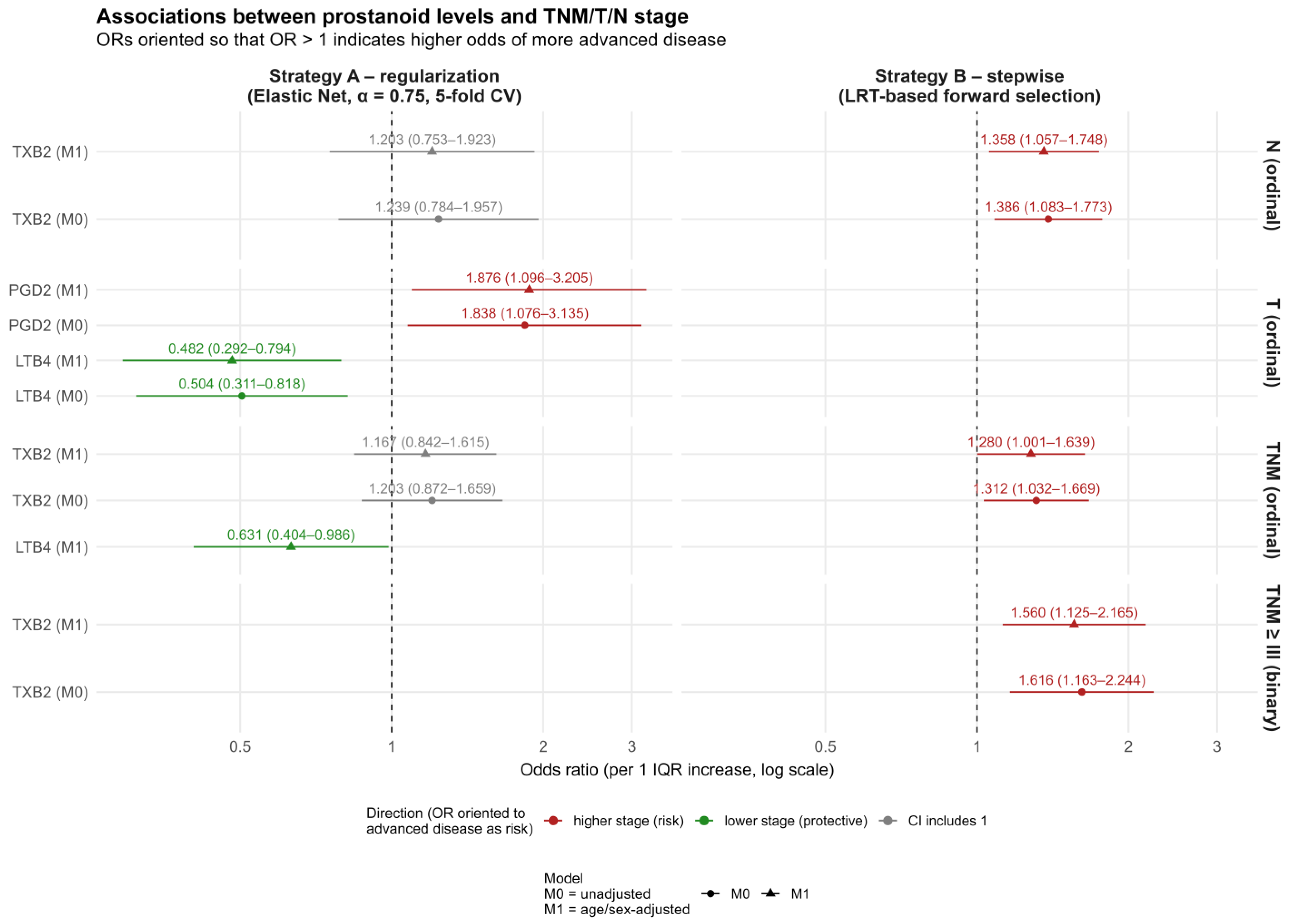
| Modelled: TNM (ordinal) | ||||||||||
| Metabolite | Values used for centering | Strategy A: unadjusted (M0) | Strategy A: adjusted (M1) | Strategy B: unadjusted (M0) | Strategy B: adjusted (M1) | |||||
| Median | IQR | OR (95% CI) | p | OR (95% CI) | p | OR (95% CI) | p | OR (95% CI) | p | |
| X13_14_DH_PGE1 | 0.010 | 0.022 | - | - | - | - | - | - | - | - |
| X15_DEOXY_PGJ2 | 0.117 | 0.257 | 1.171 (0.911–1.504) | 0.219 | 1.250 (0.929–1.683) | 0.141 | - | - | - | - |
| X6_KETO_PGF1ALPHA | 0.028 | 0.029 | - | - | - | - | - | - | - | - |
| LTB4 | 0.688 | 3.495 | 0.672 (0.437–1.036) | 0.072 | 0.631 (0.404–0.986) | 0.043 | - | - | - | - |
| PGD2 | 0.084 | 0.143 | - | - | - | - | - | - | - | - |
| PGE2 | 0.074 | 0.126 | 1.130 (0.869–1.468) | 0.362 | 1.122 (0.862–1.462) | 0.392 | - | - | - | - |
| PGF2ALPHA | 0.104 | 0.151 | - | - | - | - | - | - | - | - |
| TXB2 | 4.528 | 8.535 | 1.203 (0.872–1.659) | 0.259 | 1.167 (0.842–1.615) | 0.355 | 1.312 (1.032–1.669) | 0.027 | 1.280 (1.001–1.639) | 0.049 |
| Modelled: TNM ≥ III (binomial) | ||||||||||
| Metabolite | Values used for centering | Strategy A: unadjusted (M0) | Strategy A: adjusted (M1) | Strategy B: unadjusted (M0) | Strategy B: adjusted (M1) | |||||
| Median | IQR | OR (95% CI) | p | OR (95% CI) | p | OR (95% CI) | p | OR (95% CI) | p | |
| X13_14_DH_PGE1 | 0.010 | 0.022 | - | - | - | - | - | - | - | - |
| X15_DEOXY_PGJ2 | 0.117 | 0.257 | - | - | - | - | - | - | - | - |
| X6_KETO_PGF1ALPHA | 0.028 | 0.029 | - | - | - | - | - | - | - | - |
| LTB4 | 0.688 | 3.495 | - | - | - | - | - | - | - | - |
| PGD2 | 0.084 | 0.143 | - | - | - | - | - | - | - | - |
| PGE2 | 0.074 | 0.126 | - | - | - | - | - | - | - | - |
| PGF2ALPHA | 0.104 | 0.151 | - | - | - | - | - | - | - | - |
| TXB2 | 4.528 | 8.535 | - | - | - | - | 1.616 (1.163–2.244) | 0.004 | 1.560 (1.125–2.165) | 0.008 |
| Modelled: T (ordinal) | ||||||||||
| Metabolite | Values used for centering | Strategy A: unadjusted (M0) | Strategy A: adjusted (M1) | Strategy B: unadjusted (M0) | Strategy B: adjusted (M1) | |||||
| Median | IQR | OR (95% CI) | p | OR (95% CI) | p | OR (95% CI) | p | OR (95% CI) | p | |
| X13_14_DH_PGE1 | 0.010 | 0.022 | - | - | - | - | - | - | - | - |
| X15_DEOXY_PGJ2 | 0.117 | 0.257 | 1.297 (0.966–1.742) | 0.083 | 1.349 (0.971–1.880) | 0.075 | - | - | - | - |
| X6_KETO_PGF1ALPHA | 0.028 | 0.029 | - | - | - | - | - | - | - | - |
| LTB4 | 0.688 | 3.495 | 0.504 (0.311–0.818) | 0.006 | 0.482 (0.292–0.794) | 0.004 | - | - | - | - |
| PGD2 | 0.084 | 0.143 | 1.838 (1.076–3.135) | 0.026 | 1.876 (1.096–3.205) | 0.022 | - | - | - | - |
| PGE2 | 0.074 | 0.126 | - | - | - | - | - | - | - | - |
| PGF2ALPHA | 0.104 | 0.151 | - | - | - | - | - | - | - | - |
| TXB2 | 4.528 | 8.535 | 0.728 (0.469–1.127) | 0.155 | 0.706 (0.453–1.101) | 0.125 | - | - | - | - |
| Modelled: N (ordinal) | ||||||||||
| Metabolite | Values used for centering | Strategy A: unadjusted (M0) | Strategy A: adjusted (M1) | Strategy B: unadjusted (M0) | Strategy B: adjusted (M1) | |||||
| Median | IQR | OR (95% CI) | p | OR (95% CI) | p | OR (95% CI) | p | OR (95% CI) | p | |
| X13_14_DH_PGE1 | 0.010 | 0.022 | - | - | - | - | - | - | - | - |
| X15_DEOXY_PGJ2 | 0.117 | 0.257 | - | - | - | - | - | - | - | - |
| X6_KETO_PGF1ALPHA | 0.028 | 0.029 | - | - | - | - | - | - | - | - |
| LTB4 | 0.688 | 3.495 | 0.811 (0.522–1.259) | 0.351 | 0.807 (0.521–1.253) | 0.341 | - | - | - | - |
| PGD2 | 0.084 | 0.143 | - | - | - | - | - | - | - | - |
| PGE2 | 0.074 | 0.126 | 1.095 (0.836–1.435) | 0.511 | 1.091 (0.832–1.431) | 0.530 | - | - | - | - |
| PGF2ALPHA | 0.104 | 0.151 | 1.102 (0.744–1.634) | 0.627 | 1.116 (0.747–1.667) | 0.591 | - | - | - | - |
| TXB2 | 4.528 | 8.535 | 1.239 (0.784–1.957) | 0.358 | 1.203 (0.753–1.923) | 0.437 | 1.386 (1.083–1.773) | 0.009 | 1.358 (1.057–1.748) | 0.017 |
| Quantitative features | |||||
| Variable | TNM < III | TNM ≥ III | p (Mann–Whitney U) | ||
| Median [Q1–Q3] | Mean (SD) | Median [Q1–Q3] | Mean (SD) | ||
| Age | 71.500 [66.250–77.750] | 70.833 (10.200) | 69.000 [58.500–74.000] | 66.893 (11.223) | 0.046 |
| BMI | 26.680 [23.678–28.080] | 26.610 (4.456) | 26.330 [22.318–29.460] | 26.382 (4.998) | 0.823 |
| Tumor size | 40.000 [30.000–45.000] | 39.030 (14.815) | 40.000 [30.000–50.000] | 41.036 (15.347) | 0.456 |
| Cigarettes [package years] if smoking | 30.000 [17.000–40.000] | 30.280 (13.719) | 25.000 [10.000–40.000] | 29.227 (20.683) | 0.485 |
| CEA | 2.490 [1.688–5.465] | 6.843 (13.056) | 3.520 [1.675–16.220] | 20.574 (45.359) | 0.200 |
| X13_14_DH_PGE1 | 0.008 [0.000–0.021] | 0.014 (0.018) | 0.011 [0.002–0.023] | 0.015 (0.015) | 0.535 |
| X15_DEOXY_PGJ2 | 0.102 [0.044–0.302] | 0.192 (0.236) | 0.131 [0.048–0.310] | 0.322 (0.659) | 0.318 |
| X6_KETO_PGF1ALPHA | 0.025 [0.016–0.040] | 0.038 (0.048) | 0.031 [0.020–0.051] | 0.044 (0.042) | 0.107 |
| LTB4 | 0.540 [0.266–2.941] | 2.334 (3.488) | 0.942 [0.393–3.871] | 2.605 (3.173) | 0.150 |
| PGD2 | 0.065 [0.025–0.119] | 0.111 (0.158) | 0.099 [0.048–0.244] | 0.184 (0.189) | 0.008 |
| PGE2 | 0.056 [0.030–0.123] | 0.110 (0.165) | 0.098 [0.041–0.285] | 0.207 (0.257) | 0.006 |
| PGF2ALPHA | 0.084 [0.043–0.167] | 0.136 (0.150) | 0.129 [0.053–0.250] | 0.255 (0.319) | 0.053 |
| TXB2 | 3.626 [0.919–6.746] | 5.698 (7.432) | 6.602 [1.780–17.306] | 12.727 (15.145) | 0.008 |
| Qualitative features | |||||
| Variable | Level | TNM < III n (%) | TNM ≥ III n (%) | p (Chi-square) | |
| Gender | female | 36 (54.5%) | 25 (44.6%) | 0.364 | |
| male | 30 (45.5%) | 31 (55.4%) | |||
| Tumor type | adenocarcinoma | 54 (81.8%) | 46 (82.1%) | 0.533 | |
| mucinous adenocarcinoma or adenocarcinoma with mucinous component | 12 (18.2%) | 9 (16.1%) | |||
| complete pathological response | 0 (0%) | 1 (1.8%) | |||
| Tumor localization | cecum | 9 (13.6%) | 10 (17.9%) | 0.887 | |
| ascending colon | 12 (18.2%) | 10 (17.9%) | |||
| hepatic flexure | 3 (4.5%) | 3 (5.4%) | |||
| transverse colon | 2 (3%) | 0 (0%) | |||
| splenic flexure | 1 (1.5%) | 0 (0%) | |||
| descending colon | 1 (1.5%) | 1 (1.8%) | |||
| sigmoid colon | 23 (34.8%) | 20 (35.7%) | |||
| rectum | 15 (22.7%) | 12 (21.4%) | |||
| Preoperative radiotherapy | 0 | 58 (87.9%) | 51 (91.1%) | 0.783 | |
| 1 | 8 (12.1%) | 5 (8.9%) | |||
| Preoperative chemotherapy | 0 | 63 (95.5%) | 52 (92.9%) | 0.823 | |
| 1 | 3 (4.5%) | 4 (7.1%) | |||
| Grade (G) | 1 | 33 (50%) | 23 (41.1%) | 0.425 | |
| 2 | 29 (43.9%) | 31 (55.4%) | |||
| 3 | 4 (6.1%) | 2 (3.6%) | |||
| Extent of resection | right hemicolectomy | 26 (39.4%) | 21 (37.5%) | 0.844 | |
| left hemicolectomy | 2 (3%) | 1 (1.8%) | |||
| anterior rectal resection | 25 (37.9%) | 20 (35.7%) | |||
| abdominoperineal resection | 2 (3%) | 3 (5.4%) | |||
| sigmoidectomy | 10 (15.2%) | 8 (14.3%) | |||
| pancolectomy | 1 (1.5%) | 3 (5.4%) | |||
| R-status | R0 | 63 (96.9%) | 49 (87.5%) | 0.096 | |
| R1 | 1 (1.5%) | 6 (10.7%) | |||
| R2 | 1 (1.5%) | 1 (1.8%) | |||
| Operation method | laparoscopic | 16 (24.2%) | 10 (17.9%) | 0.525 | |
| open | 50 (75.8%) | 46 (82.1%) | |||
| Acetylsalicylic acid | no | 58 (87.9%) | 50 (89.3%) | >0.999 | |
| yes | 8 (12.1%) | 6 (10.7%) | |||
| Diabetes mellitus (DM) | no | 48 (72.7%) | 45 (80.4%) | 0.439 | |
| t2dm | 18 (27.3%) | 11 (19.6%) | |||
| hypertension | no | 20 (30.3%) | 24 (42.9%) | 0.211 | |
| yes | 46 (69.7%) | 32 (57.1%) | |||
| Heart failure | no | 56 (84.8%) | 53 (94.6%) | 0.146 | |
| yes | 10 (15.2%) | 3 (5.4%) | |||
| Ischemic heart disease | no | 51 (77.3%) | 48 (85.7%) | 0.339 | |
| yes | 15 (22.7%) | 8 (14.3%) | |||
| Arrhythmia | no | 53 (80.3%) | 45 (80.4%) | >0.999 | |
| yes | 13 (19.7%) | 11 (19.6%) | |||
| Hyperlipidemia | no | 47 (71.2%) | 39 (69.6%) | >0.999 | |
| yes | 19 (28.8%) | 17 (30.4%) | |||
| Asthma | no | 63 (95.5%) | 54 (96.4%) | >0.999 | |
| yes | 3 (4.5%) | 2 (3.6%) | |||
| copd | no | 63 (95.5%) | 53 (94.6%) | >0.999 | |
| yes | 3 (4.5%) | 3 (5.4%) | |||
| Chronic kidney disease | no | 59 (89.4%) | 55 (98.2%) | 0.111 | |
| yes | 7 (10.6%) | 1 (1.8%) | |||
| Thyroid illness | none | 58 (87.9%) | 53 (94.6%) | 0.333 | |
| hypothyroidism | 7 (10.6%) | 2 (3.6%) | |||
| hyperthyroidism | 1 (1.5%) | 1 (1.8%) | |||
| Liver illness | no | 65 (98.5%) | 56 (100%) | >0.999 | |
| yes | 1 (1.5%) | 0 (0%) | |||
| Prostate disease | none | 16 (53.3%) | 21 (67.7%) | 0.337 | |
| benign prostate hyperplasia | 12 (40%) | 7 (22.6%) | |||
| prostate cancer | 2 (6.7%) | 3 (9.7%) | |||
| Smoking | none | 39 (59.1%) | 33 (58.9%) | 0.803 | |
| current smoker | 2 (3%) | 3 (5.4%) | |||
| ex-smoker | 25 (37.9%) | 20 (35.7%) | |||
| Metformin | no | 45 (68.2%) | 44 (78.6%) | 0.279 | |
| yes | 21 (31.8%) | 12 (21.4%) | |||
| ACEI | no | 42 (63.6%) | 32 (57.1%) | 0.585 | |
| yes | 24 (36.4%) | 24 (42.9%) | |||
| Sartans | no | 56 (84.8%) | 52 (92.9%) | 0.272 | |
| yes | 10 (15.2%) | 4 (7.1%) | |||
| Statins | no | 34 (51.5%) | 35 (62.5%) | 0.300 | |
| yes | 32 (48.5%) | 21 (37.5%) | |||
| Ezetimibe | no | 63 (95.5%) | 53 (94.6%) | >0.999 | |
| yes | 3 (4.5%) | 3 (5.4%) | |||
| B-blockers | no | 37 (56.1%) | 32 (57.1%) | >0.999 | |
| yes | 29 (43.9%) | 24 (42.9%) | |||
| A-blockers | no | 57 (86.4%) | 50 (89.3%) | 0.831 | |
| yes | 9 (13.6%) | 6 (10.7%) | |||
| Angioinvasion | no | 48 (72.7%) | 12 (21.4%) | <0.001 | |
| yes | 18 (27.3%) | 44 (78.6%) | |||
| Neuroinvasion | no | 56 (84.8%) | 34 (60.7%) | 0.005 | |
| yes | 10 (15.2%) | 22 (39.3%) | |||
| KRAS mutation | negative | 4 (66.7%) | 12 (60%) | >0.999 | |
| positive | 2 (33.3%) | 8 (40%) | |||
| NRAS mutation | negative | 5 (83.3%) | 19 (95%) | 0.946 | |
| positive | 1 (16.7%) | 1 (5%) | |||
| BRAF mutation | negative | 6 (100%) | 16 (80%) | 0.585 | |
| positive | 0 (0%) | 4 (20%) | |||
| MSI | Genetic test: negative | 2 (3.8%) | 6 (12.5%) | 0.209 | |
| Genetic test: positive | 0 (0%) | 1 (2.1%) | |||
| IHC: low probability | 39 (75%) | 35 (72.9%) | |||
| IHC: high probability | 11 (21.2%) | 6 (12.5%) | |||
| MLH1 expression (IHC) | negative | 10 (20%) | 4 (10%) | 0.313 | |
| positive | 40 (80%) | 36 (90%) | |||
| MSH2 expression (IHC) | negative | 1 (2%) | 0 (0%) | >0.999 | |
| positive | 49 (98%) | 40 (100%) | |||
| MSH6 expression (IHC) | negative | 1 (2%) | 0 (0%) | >0.999 | |
| positive | 49 (98%) | 41 (100%) | |||
| PMS2 expression (IHC) | negative | 10 (20%) | 6 (14.6%) | 0.695 | |
| positive | 40 (80%) | 35 (85.4%) | |||
| TNM stage | I | 16 (24.2%) | 0 (0%) | - | |
| II | 50 (75.8%) | 0 (0%) | |||
| III | 0 (0%) | 41 (73.2%) | |||
| IV | 0 (0%) | 15 (26.8%) | |||
| T stage | T0/T1 | 9 (13.6%) | 1 (1.8%) | 0.009 | |
| T2 | 7 (10.6%) | 5 (8.9%) | |||
| T3 | 39 (59.1%) | 28 (50%) | |||
| T4 | 11 (16.7%) | 22 (39.3%) | |||
| N stage | N0 | 66 (100%) | 2 (3.6%) | <0.001 | |
| N1 | 0 (0%) | 33 (58.9%) | |||
| N2 | 0 (0%) | 21 (37.5%) | |||
| M stage | M0 | 66 (100%) | 41 (73.2%) | <0.001 | |
| M1 | 0 (0%) | 15 (26.8%) | |||
Disclaimer/Publisher’s Note: The statements, opinions and data contained in all publications are solely those of the individual author(s) and contributor(s) and not of MDPI and/or the editor(s). MDPI and/or the editor(s) disclaim responsibility for any injury to people or property resulting from any ideas, methods, instructions or products referred to in the content. |
© 2026 by the authors. Licensee MDPI, Basel, Switzerland. This article is an open access article distributed under the terms and conditions of the Creative Commons Attribution (CC BY) license.
Share and Cite
Klekowski, J.; Fortuna, P.; Chabowski, M.; Lewandowski, Ł.; Szewczak, W.; Mosna, K.; Maciejewska, G.; Zawadzki, M.; Krzystek-Korpacka, M.; Fleszar, M. Stage-Dependent Role of Eicosanoids in Colorectal Cancer. Int. J. Mol. Sci. 2026, 27, 1641. https://doi.org/10.3390/ijms27041641
Klekowski J, Fortuna P, Chabowski M, Lewandowski Ł, Szewczak W, Mosna K, Maciejewska G, Zawadzki M, Krzystek-Korpacka M, Fleszar M. Stage-Dependent Role of Eicosanoids in Colorectal Cancer. International Journal of Molecular Sciences. 2026; 27(4):1641. https://doi.org/10.3390/ijms27041641
Chicago/Turabian StyleKlekowski, Jakub, Paulina Fortuna, Mariusz Chabowski, Łukasz Lewandowski, Wioleta Szewczak, Karolina Mosna, Gabriela Maciejewska, Marek Zawadzki, Małgorzata Krzystek-Korpacka, and Mariusz Fleszar. 2026. "Stage-Dependent Role of Eicosanoids in Colorectal Cancer" International Journal of Molecular Sciences 27, no. 4: 1641. https://doi.org/10.3390/ijms27041641
APA StyleKlekowski, J., Fortuna, P., Chabowski, M., Lewandowski, Ł., Szewczak, W., Mosna, K., Maciejewska, G., Zawadzki, M., Krzystek-Korpacka, M., & Fleszar, M. (2026). Stage-Dependent Role of Eicosanoids in Colorectal Cancer. International Journal of Molecular Sciences, 27(4), 1641. https://doi.org/10.3390/ijms27041641