Natural Killer Cell Phenotype and Function as a Predictive Factor for Treatment Response to Neoadjuvant Therapy in Breast Cancer Patients

 ,
,
Abstract
1. Introduction
2. Results
2.1. Patient Characteristics and Clinical Demographics
2.2. NK Cell Subpopulations Change Following Neoadjuvant Therapy
2.3. Effect of NST on Peripheral NK Cell Populations Classified Based on the Expression of CD56 and CD16
2.4. UMAP Analysis Identifies a Distinct NK Cell Cluster in Healthy Donors Absent in Breast Cancer Patients
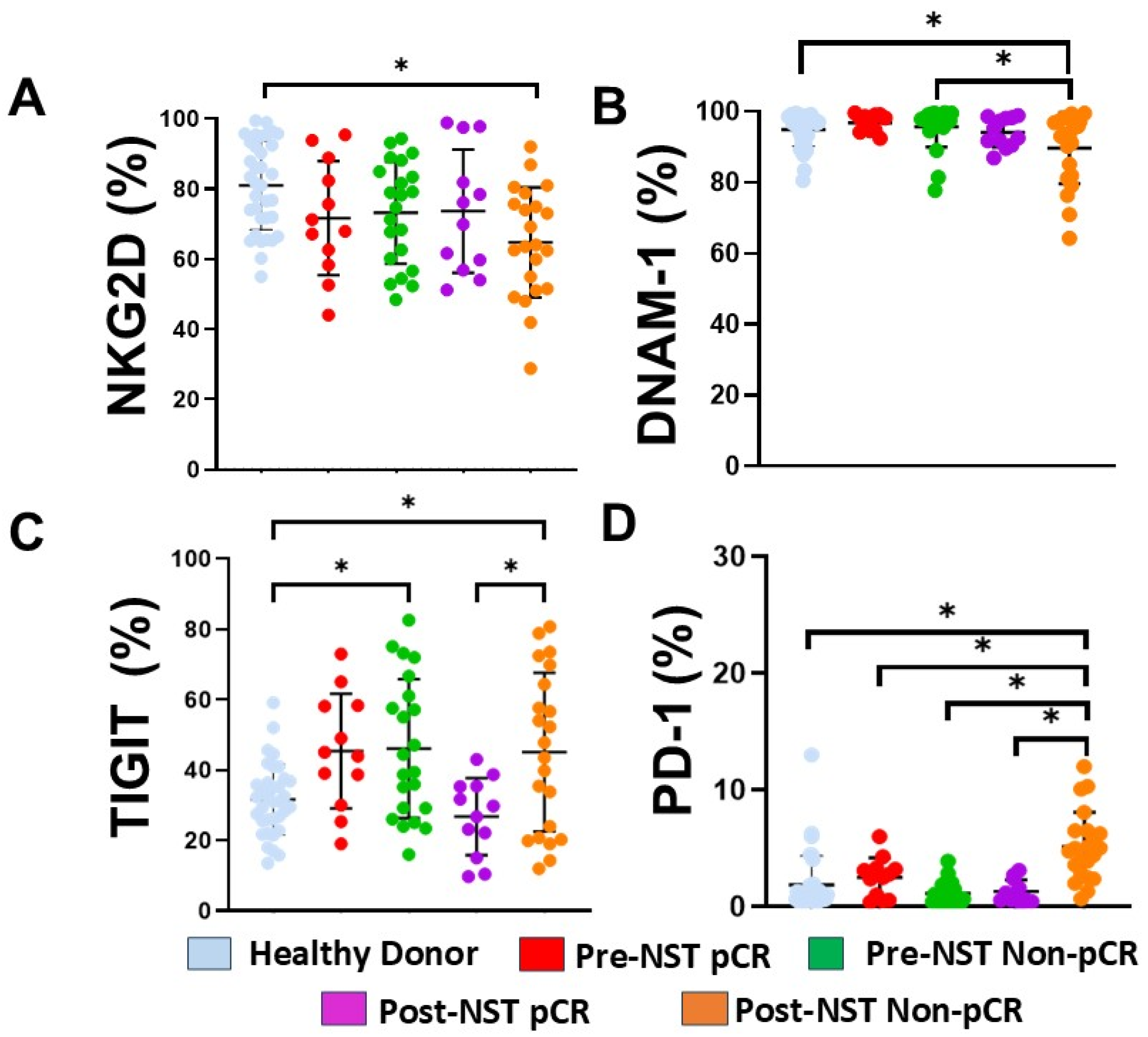
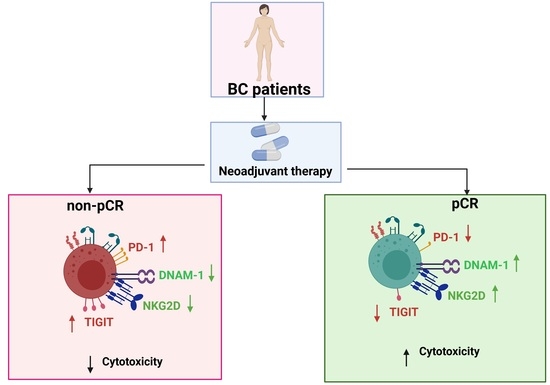
2.5. Differential Expression of NKG2D, DNAM-1, TIGIT, and PD-1 in NK Cells Based on NST Response
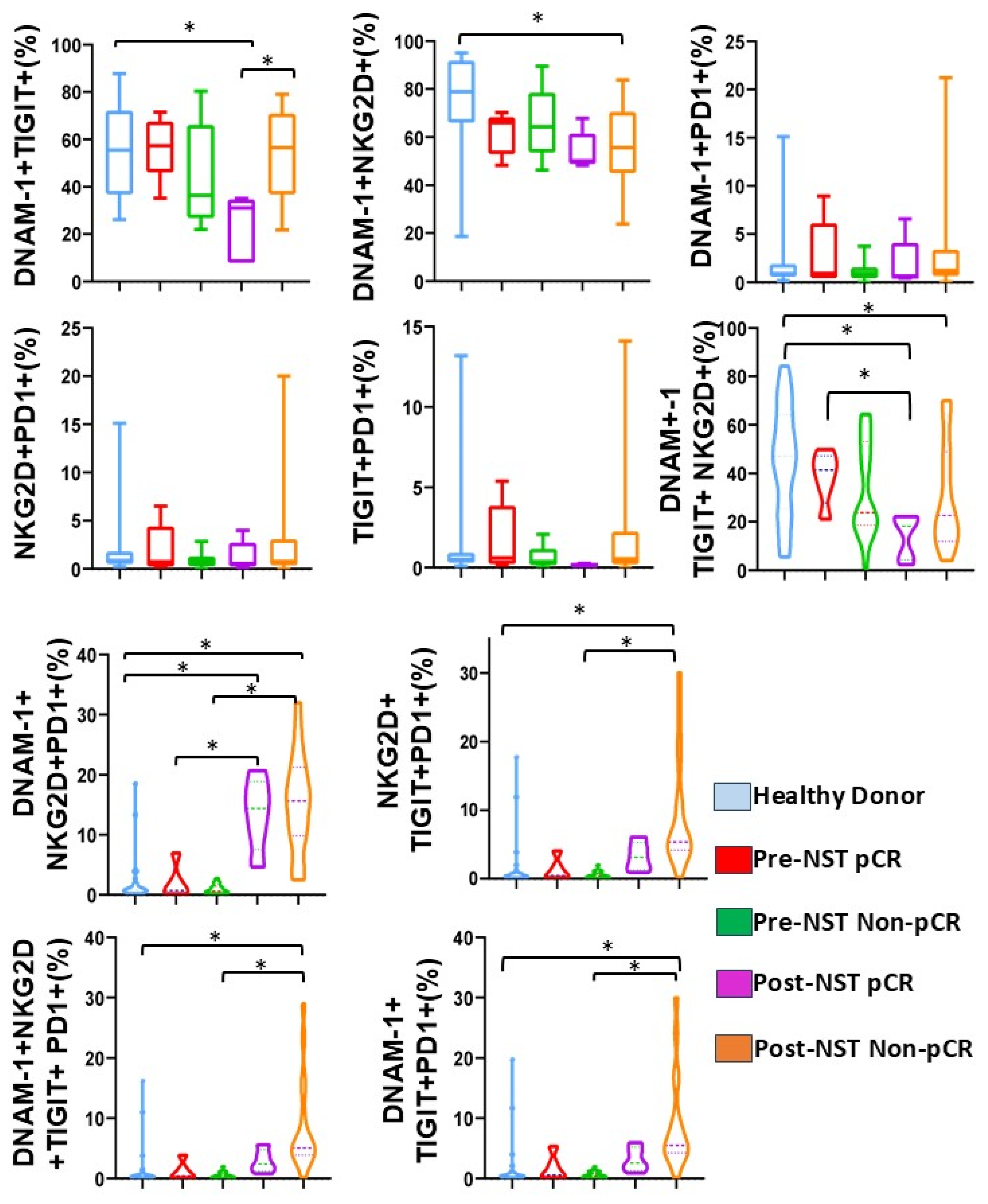
2.6. Post-Treatment Non-pCR Breast Cancer Patients Exhibit Higher Percentages of NK Cells Co-Expressing Inhibitory Receptors
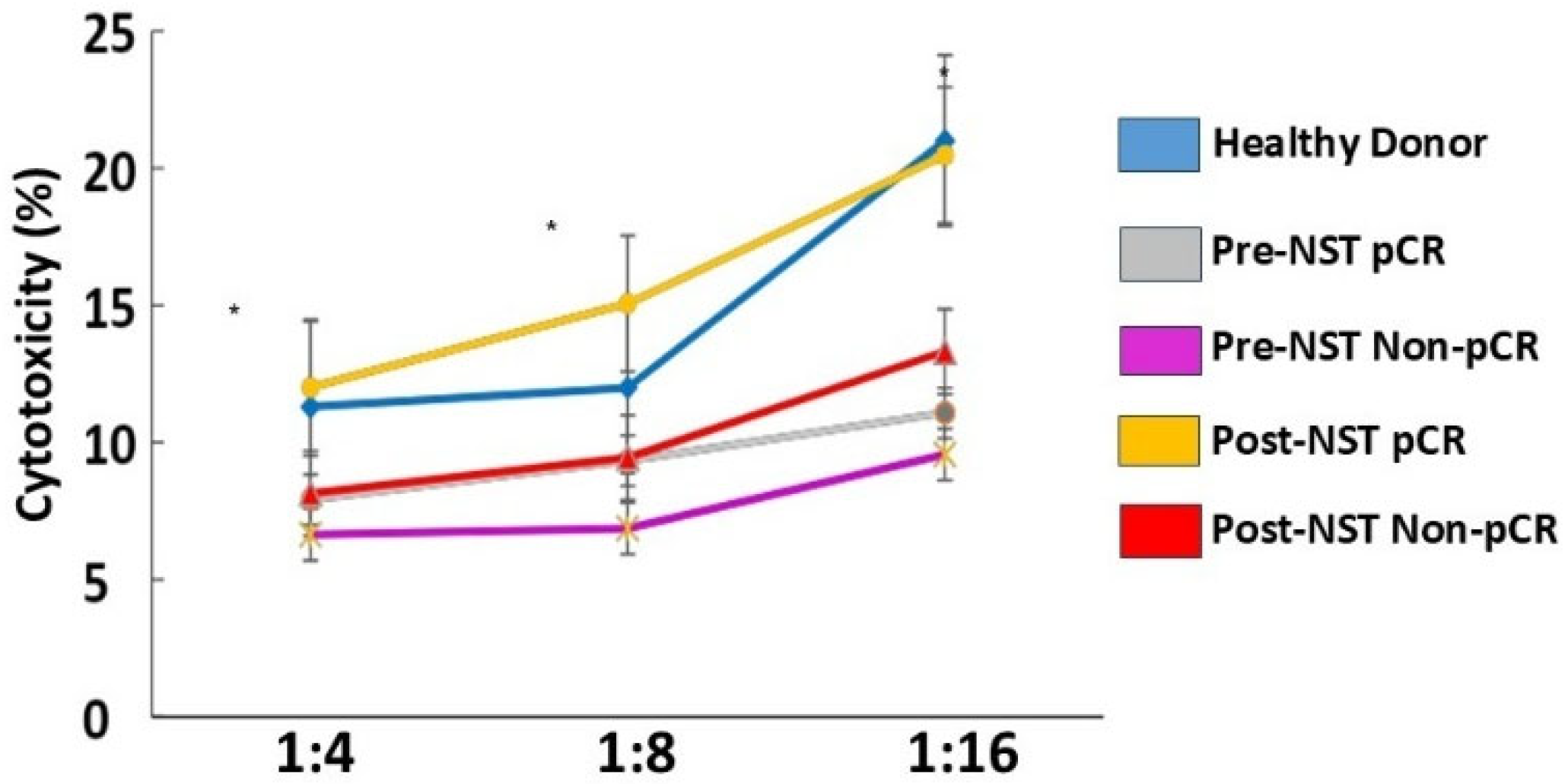
2.7. Peripheral Blood NK Cells from Breast Cancer Patients with pCR Showed Increased Cytotoxicity After Therapy
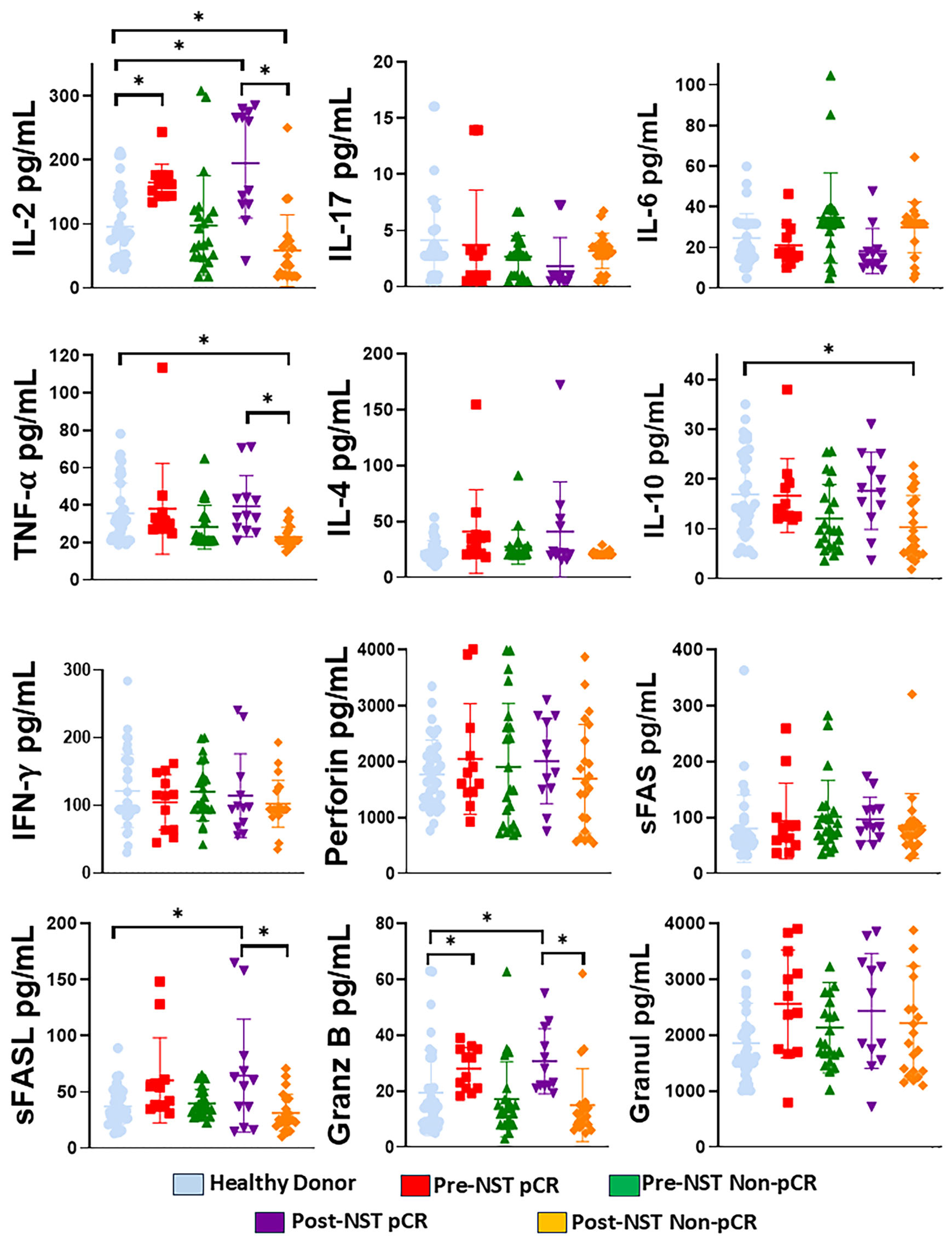
2.8. IL-2, sFASL, and Granzyme B Are Increased in Breast Cancer Patients with pCR After Treatment. Meanwhile, IL-2, IL-10, TNF-α, sFASL, and Granzyme B Are Decreased in Non-pCr Patients After Treatment
3. Discussion
4. Materials and Methods
4.1. Outcome Measure: Pathological Complete Response
4.2. PBMC Isolation
4.3. PBMC Staining by Flow Cytometry Analysis
4.4. PBMC NK Cell Cytotoxicity Assay
4.5. Determination of IL-17A, IL-2, IL-4, IL-10, IL-6, TNF-α, Fas, FasL, IFN-γ, Granzyme A, Granzyme B, Perforin, and Granulysin
4.6. Ethics
4.7. Statistical Analysis
5. Conclusions
Supplementary Materials
Author Contributions
Funding
Institutional Review Board Statement
Informed Consent Statement
Data Availability Statement
Acknowledgments
Conflicts of Interest
Abbreviations
| BC | Breast cancer |
| HD | Healthy donors |
| NK cells | Natural killer cells |
| pCR | Pathological complete response |
| Non-pCR | No pathological complete response. |
| DNAM-1 | DNAX accessory molecule-1 |
| NKG2D | Natural killer group 2, member D |
| PD-1 | Programmed cell death protein 1 |
| TIGIT | T cell immunoreceptor with Ig and ITIM domains |
| IL-2 | Interleukin-2 |
| TNF-α | Tumor necrosis factor-alpha |
| IFN-γ | Interferon-gamma |
| IL-10 | Interleukin-10 |
| TME | Tumor microenvironment |
| PBMCs | Peripheral blood mononuclear cells |
| CXCR3 | C-X-C motif chemokine receptor 3 |
| BMI | Body mass index |
References
- Bray, F.; Laversanne, M.; Sung, H.; Ferlay, J.; Siegel, R.L.; Soerjomataram, I.; Jemal, A. Global cancer statistics 2022: GLOBOCAN estimates of incidence and mortality worldwide for 36 cancers in 185 countries. CA Cancer J. Clin. 2024, 74, 229–263. [Google Scholar] [CrossRef] [PubMed]
- Turashvili, G.; Brogi, E. Tumor Heterogeneity in Breast Cancer. Front. Med. 2017, 4, 227. [Google Scholar] [CrossRef]
- Freitas, A.J.A.; Causin, R.L.; Varuzza, M.B.; Hidalgo Filho, C.M.T.; Silva, V.D.D.; Souza, C.P.; Marques, M.M.C. Molecular Biomarkers Predict Pathological Complete Response of Neoadjuvant Chemotherapy in Breast Cancer Patients: Review. Cancers 2021, 13, 5477. [Google Scholar] [CrossRef]
- Hirmas, N.; Holtschmidt, J.; Loibl, S. Shifting the Paradigm: The Transformative Role of Neoadjuvant Therapy in Early Breast Cancer. Cancers 2024, 16, 3236. [Google Scholar] [CrossRef]
- Haque, W.; Verma, V.; Hatch, S.; Suzanne Klimberg, V.; Brian Butler, E.; Teh, B.S. Response rates and pathologic complete response by breast cancer molecular subtype following neoadjuvant chemotherapy. Breast Cancer Res. Treat. 2018, 170, 559–567. [Google Scholar] [CrossRef]
- Ivanovic, N.; Bjelica, D.; Loboda, B.; Bogdanovski, M.; Colakovic, N.; Petricevic, S.; Gojgic, M.; Zecic, O.; Zecic, K.; Zdravkovic, D. Changing the role of pCR in breast cancer treatment—An unjustifiable interpretation of a good prognostic factor as a “factor for a good prognosis”. Front. Oncol. 2023, 13, 1207948. [Google Scholar] [CrossRef]
- Wang, J.; He, Y.; Hu, F.; Hu, C.; Sun, Y.; Yang, K.; Yang, S. Metabolic Reprogramming of Immune Cells in the Tumor Microenvironment. Int. J. Mol. Sci. 2024, 25, 12223. [Google Scholar] [CrossRef]
- Benvenuto, M.; Focaccetti, C. Tumor Microenvironment: Cellular Interaction and Metabolic Adaptations. Int. J. Mol. Sci. 2024, 25, 3642. [Google Scholar] [CrossRef] [PubMed]
- Zingoni, A.; Fionda, C.; Borrelli, C.; Cippitelli, M.; Santoni, A.; Soriani, A. Natural Killer Cell Response to Chemotherapy-Stressed Cancer Cells: Role in Tumor Immunosurveillance. Front. Immunol. 2017, 8, 1194. [Google Scholar] [CrossRef]
- Franks, S.E.; Wolfson, B.; Hodge, J.W. Natural Born Killers: NK Cells in Cancer Therapy. Cancers 2020, 12, 2131. [Google Scholar] [CrossRef] [PubMed]
- Barberini, F.; Pietroni, R.; Ielpo, S.; Lucarini, V.; Nardozi, D.; Melaiu, O.; Benvenuto, M.; Focaccetti, C.; Palumbo, C.; Rossin, F.; et al. Combined IFN-gamma and TNF-alpha treatment enhances the susceptibility of breast cancer cells and spheroids to Natural Killer cell-mediated killing. Cell Death Dis. 2025, 16, 729, Erratum in Cell Death Dis. 2026, 17, 54. https://doi.org/10.1038/s41419-025-08381-7. [Google Scholar] [CrossRef]
- Escoto, A.; Hecksel, R.; Parkinson, C.; Crane, S.; Atwell, B.; King, S.; Ortiz Chavez, D.; Jannuzi, A.; Sands, B.; Bitler, B.G.; et al. Nuclear EGFR in breast cancer suppresses NK cell recruitment and cytotoxicity. Oncogene 2025, 44, 288–295. [Google Scholar] [CrossRef]
- Yang, P.; Wang, W.; Liu, Q.; Mu, S.; Zha, Y.; Yan, W.; Yuan, B.; Yang, J. Metabolic reprogramming of NK cells drives anti-tumor immunity. Crit. Rev. Oncol. Hematol. 2025, 215, 104859. [Google Scholar] [CrossRef]
- Sohn, H.; Cooper, M.A. Metabolic regulation of NK cell function: Implications for immunotherapy. Immunometabolism 2023, 5, e00020. [Google Scholar] [CrossRef]
- Imsirovic, V.; Wensveen, F.M.; Polic, B.; Jelencic, V. Maintaining the Balance: Regulation of NK Cell Activity. Cells 2024, 13, 1464. [Google Scholar] [CrossRef] [PubMed]
- Ferrari de Andrade, L.; Tay, R.E.; Pan, D.; Luoma, A.M.; Ito, Y.; Badrinath, S.; Tsoucas, D.; Franz, B.; May, K.F., Jr.; Harvey, C.J.; et al. Antibody-mediated inhibition of MICA and MICB shedding promotes NK cell-driven tumor immunity. Science 2018, 359, 1537–1542. [Google Scholar] [CrossRef] [PubMed]
- Marangio, C.; Milito, N.D.; Putro, E.; Carnevale, A.; Capuano, C.; Zingoni, A.; Cippitelli, M.; Santoni, A.; Paolini, R.; Molfetta, R. NKG2D triggering hampers DNAM-1-mediated signaling in human NK cells. Front. Immunol. 2025, 16, 1575059. [Google Scholar] [CrossRef]
- Zhang, Q.; Bi, J.; Zheng, X.; Chen, Y.; Wang, H.; Wu, W.; Wang, Z.; Wu, Q.; Peng, H.; Wei, H.; et al. Blockade of the checkpoint receptor TIGIT prevents NK cell exhaustion and elicits potent anti-tumor immunity. Nat. Immunol. 2018, 19, 723–732. [Google Scholar] [CrossRef] [PubMed]
- Hsu, J.; Hodgins, J.J.; Marathe, M.; Nicolai, C.J.; Bourgeois-Daigneault, M.C.; Trevino, T.N.; Azimi, C.S.; Scheer, A.K.; Randolph, H.E.; Thompson, T.W.; et al. Contribution of NK cells to immunotherapy mediated by PD-1/PD-L1 blockade. J. Clin. Investig. 2018, 128, 4654–4668. [Google Scholar] [CrossRef]
- Lu, H.; Zhao, X.; Liu, L.; Zhang, L.; Wang, H. Increased TIGIT expression correlates with impaired NK cell function in diffuse large B-cell lymphoma. Front. Oncol. 2025, 15, 1551061. [Google Scholar] [CrossRef]
- Sanchez-Correa, B.; Valhondo, I.; Hassouneh, F.; Lopez-Sejas, N.; Pera, A.; Bergua, J.M.; Arcos, M.J.; Banas, H.; Casas-Aviles, I.; Duran, E.; et al. DNAM-1 and the TIGIT/PVRIG/TACTILE Axis: Novel Immune Checkpoints for Natural Killer Cell-Based Cancer Immunotherapy. Cancers 2019, 11, 877. [Google Scholar] [CrossRef]
- Morvan, M.G.; Lanier, L.L. NK cells and cancer: You can teach innate cells new tricks. Nat. Rev. Cancer 2016, 16, 7–19. [Google Scholar] [CrossRef]
- Chauvin, J.M.; Zarour, H.M. TIGIT in cancer immunotherapy. J. Immunother. Cancer 2020, 8, e000957. [Google Scholar] [CrossRef] [PubMed]
- Shimasaki, N.; Jain, A.; Campana, D. NK cells for cancer immunotherapy. Nat. Rev. Drug Discov. 2020, 19, 200–218. [Google Scholar] [CrossRef]
- Morcillo-Martin-Romo, P.; Valverde-Pozo, J.; Ortiz-Bueno, M.; Arnone, M.; Espinar-Barranco, L.; Espinar-Barranco, C.; Garcia-Rubino, M.E. The Role of NK Cells in Cancer Immunotherapy: Mechanisms, Evasion Strategies, and Therapeutic Advances. Biomedicines 2025, 13, 857. [Google Scholar] [CrossRef] [PubMed]
- Zhao, Y.; Jia, S.; Zhang, K.; Zhang, L. Serum cytokine levels and other associated factors as possible immunotherapeutic targets and prognostic indicators for lung cancer. Front. Oncol. 2023, 13, 1064616. [Google Scholar] [CrossRef] [PubMed]
- Martins, I.; Ribeiro, I.P.; Jorge, J.; Goncalves, A.C.; Sarmento-Ribeiro, A.B.; Melo, J.B.; Carreira, I.M. Liquid Biopsies: Applications for Cancer Diagnosis and Monitoring. Genes 2021, 12, 349. [Google Scholar] [CrossRef]
- Dalloul, Z.; Briend, J.G.; Diawara, M.; Taylor, C.; Ouellette, R.J. Leveraging liquid biopsy to uncover resistance mechanisms and guide personalized immunotherapy. Transl. Oncol. 2025, 59, 102445. [Google Scholar] [CrossRef]
- Loibl, S.; Poortmans, P.; Morrow, M.; Denkert, C.; Curigliano, G. Breast cancer. Lancet 2021, 397, 1750–1769, Erratum in Lancet 2021, 397, 1710. https://doi.org/10.1016/S0140-6736(21)00838-2. [Google Scholar] [CrossRef]
- von Minckwitz, G.; Untch, M.; Blohmer, J.U.; Costa, S.D.; Eidtmann, H.; Fasching, P.A.; Gerber, B.; Eiermann, W.; Hilfrich, J.; Huober, J.; et al. Definition and impact of pathologic complete response on prognosis after neoadjuvant chemotherapy in various intrinsic breast cancer subtypes. J. Clin. Oncol. 2012, 30, 1796–1804. [Google Scholar] [CrossRef]
- Wolf, N.K.; Kissiov, D.U.; Raulet, D.H. Roles of natural killer cells in immunity to cancer, and applications to immunotherapy. Nat. Rev. Immunol. 2023, 23, 90–105. [Google Scholar] [CrossRef]
- Poli, A.; Michel, T.; Theresine, M.; Andres, E.; Hentges, F.; Zimmer, J. CD56bright natural killer (NK) cells: An important NK cell subset. Immunology 2009, 126, 458–465. [Google Scholar] [CrossRef]
- Marcelin, H.N.; Dasse, R.S.; Yeboah, R.O.; Tariam, A.D.; Kagambega, A.G.Z.; Oseni, A.M.; Kouassi, Y.K.K.; Bile, M.A.; Toure, M.; Thakar, M.; et al. Circulating natural killer cells and their association with breast cancer and its clinico-pathological characteristics. ecancermedicalscience 2023, 17, 1567. [Google Scholar] [CrossRef]
- Arianfar, E.; Khandoozi, S.R.; Mohammadi, S.; Memarian, A. Suppression of CD56bright NK cells in breast cancer patients is associated with the PD-1 and TGF-betaRII expression. Clin. Transl. Oncol. 2023, 25, 841–851. [Google Scholar] [CrossRef]
- Zu, S.; Lu, Y.; Xing, R.; Chen, X.; Zhang, L. Changes in subset distribution and impaired function of circulating natural killer cells in patients with colorectal cancer. Sci. Rep. 2024, 14, 12188. [Google Scholar] [CrossRef] [PubMed]
- Del Zotto, G.; Antonini, F.; Pesce, S.; Moretta, F.; Moretta, L.; Marcenaro, E. Comprehensive Phenotyping of Human PB NK Cells by Flow Cytometry. Cytom. Part A 2020, 97, 891–899. [Google Scholar] [CrossRef]
- Amand, M.; Iserentant, G.; Poli, A.; Sleiman, M.; Fievez, V.; Sanchez, I.P.; Sauvageot, N.; Michel, T.; Aouali, N.; Janji, B.; et al. Human CD56dimCD16dim Cells As an Individualized Natural Killer Cell Subset. Front. Immunol. 2017, 8, 699. [Google Scholar] [CrossRef] [PubMed]
- Penack, O.; Gentilini, C.; Fischer, L.; Asemissen, A.M.; Scheibenbogen, C.; Thiel, E.; Uharek, L. CD56dimCD16neg cells are responsible for natural cytotoxicity against tumor targets. Leukemia 2005, 19, 835–840. [Google Scholar] [CrossRef]
- Coenon, L.; Geindreau, M.; Ghiringhelli, F.; Villalba, M.; Bruchard, M. Natural Killer cells at the frontline in the fight against cancer. Cell Death Dis. 2024, 15, 614. [Google Scholar] [CrossRef]
- Almawash, S. Revolutionary Cancer Therapy for Personalization and Improved Efficacy: Strategies to Overcome Resistance to Immune Checkpoint Inhibitor Therapy. Cancers 2025, 17, 880. [Google Scholar] [CrossRef] [PubMed]
- Kyrysyuk, O.; Wucherpfennig, K.W. Designing Cancer Immunotherapies That Engage T Cells and NK Cells. Annu. Rev. Immunol. 2023, 41, 17–38. [Google Scholar] [CrossRef]
- Cao, Y.; Wang, X.; Jin, T.; Tian, Y.; Dai, C.; Widarma, C.; Song, R.; Xu, F. Immune checkpoint molecules in natural killer cells as potential targets for cancer immunotherapy. Signal Transduct. Target. Ther. 2020, 5, 250. [Google Scholar] [CrossRef]
- Sun, H.; Huang, Q.; Huang, M.; Wen, H.; Lin, R.; Zheng, M.; Qu, K.; Li, K.; Wei, H.; Xiao, W.; et al. Human CD96 Correlates to Natural Killer Cell Exhaustion and Predicts the Prognosis of Human Hepatocellular Carcinoma. Hepatology 2019, 70, 168–183. [Google Scholar] [CrossRef]
- Zhu, Y.; Huang, B.; Shi, J. Fas ligand and lytic granule differentially control cytotoxic dynamics of natural killer cell against cancer target. Oncotarget 2016, 7, 47163–47172. [Google Scholar] [CrossRef]
- Hou, Y.; Xiang, B.; Yang, Z.; Liu, J.; Xu, D.; Geng, L.; Zhan, M.; Xu, Y.; Zhang, B. Down-regulation of interleukin-2 predicts poor prognosis and associated with immune escape in lung adenocarcinoma. Int. J. Immunopathol. Pharmacol. 2023, 37, 3946320231202748. [Google Scholar] [CrossRef] [PubMed]
- Wang, T.; Xu, Y.; Zhang, Z.; Wu, Y.; Chen, L.; Zheng, X.; Peng, H.; Zou, Q.; Sun, R.; Ma, H.; et al. alphaTIGIT-IL2 achieves tumor regression by promoting tumor-infiltrating regulatory T cell fragility in mouse models. Nat. Commun. 2025, 16, 9223. [Google Scholar] [CrossRef]
- Lukasiewicz, S.; Czeczelewski, M.; Forma, A.; Baj, J.; Sitarz, R.; Stanislawek, A. Breast Cancer-Epidemiology, Risk Factors, Classification, Prognostic Markers, and Current Treatment Strategies-An Updated Review. Cancers 2021, 13, 4287. [Google Scholar] [CrossRef] [PubMed]
- DeVita, V.T., Jr. Devita, Hellman, and Rosenberg’s Cancer: Principles and Practice of Oncology, 11th ed.; Lippincott Williams & Wilkins, a Wolters Kluwer Business: Philadelphia, PA, USA, 2019. [Google Scholar]
- Emmaneel, A.; Quintelier, K.; Sichien, D.; Rybakowska, P.; Maranon, C.; Alarcon-Riquelme, M.E.; Van Isterdael, G.; Van Gassen, S.; Saeys, Y. PeacoQC: Peak-based selection of high quality cytometry data. Cytom. Part A 2022, 101, 325–338. [Google Scholar] [CrossRef] [PubMed]
- McInnes, L.; Healy, J.; Melville, J. UMAP: Uniform Manifold Approximation and Projection for Dimension Reduction. arXiv 2018, arXiv:1802.03426. [Google Scholar]
- Levine, J.H.; Simonds, E.F.; Bendall, S.C.; Davis, K.L.; Amir, E.-a.D.; Tadmor, M.D.; Litvin, O.; Fienberg, H.G.; Jager, A.; Zunder, E.R.; et al. Data-Driven Phenotypic Dissection of AML Reveals Progenitor-like Cells that Correlate with Prognosis. Cell 2015, 162, 184–197. [Google Scholar] [CrossRef]



| Variable | pCR n = 12 | Non-pCR n = 22 | p-Value |
|---|---|---|---|
| Age (years) | 52.8 ± 14.1 | 56.5 ± 14.3 | 0.47 |
| Contraceptive use, n (%) | 3 (25) | 11 (50) | 0.27 |
| Clinical stage, n (%) | 0.1 | ||
| IIA | 2 (17) | 6 (27) | |
| IIB | 3 (25) | 5 (23) | |
| IIIA | 2 (17) | 9 (41) | |
| IIIB | 4 (33) | 2 (9) | |
| IIIC | 1 (8) | 0 | |
| Tumor phenotype, n (%) | 0.03 | ||
| ER+/PR+ | 0 | 5 (23) | |
| ER+/PR− | 2 (16) | 9 (41) | |
| HER2 +++ | 5 (42) | 6 (27) | |
| Triple negative | 5 (42) | 2 (9) | |
| Histological grade, n (%) | 0.13 | ||
| Well-differentiated | 2 (17) | 1 (4) | |
| Moderately differentiated | 6 (50) | 16 (72) | |
| Poorly differentiated | 4 (33) | 4 (18) |
Disclaimer/Publisher’s Note: The statements, opinions and data contained in all publications are solely those of the individual author(s) and contributor(s) and not of MDPI and/or the editor(s). MDPI and/or the editor(s) disclaim responsibility for any injury to people or property resulting from any ideas, methods, instructions or products referred to in the content. |
© 2026 by the authors. Licensee MDPI, Basel, Switzerland. This article is an open access article distributed under the terms and conditions of the Creative Commons Attribution (CC BY) license.
Share and Cite
Anguiano Serrato, C.Y.; Solorzano-Ibarra, F.; Mariscal-Ramirez, I.; Torres-Bustamante, M.I.; Totsuka-Sutto, S.E.; Vázquez-Urrutia, J.R.; Alcaraz-Wong, A.; Contreras-Haro, B.; Ortiz-Lazareno, P.C. Natural Killer Cell Phenotype and Function as a Predictive Factor for Treatment Response to Neoadjuvant Therapy in Breast Cancer Patients. Int. J. Mol. Sci. 2026, 27, 1634. https://doi.org/10.3390/ijms27041634
Anguiano Serrato CY, Solorzano-Ibarra F, Mariscal-Ramirez I, Torres-Bustamante MI, Totsuka-Sutto SE, Vázquez-Urrutia JR, Alcaraz-Wong A, Contreras-Haro B, Ortiz-Lazareno PC. Natural Killer Cell Phenotype and Function as a Predictive Factor for Treatment Response to Neoadjuvant Therapy in Breast Cancer Patients. International Journal of Molecular Sciences. 2026; 27(4):1634. https://doi.org/10.3390/ijms27041634
Chicago/Turabian StyleAnguiano Serrato, Cinthya Yareli, Fabiola Solorzano-Ibarra, Ignacio Mariscal-Ramirez, Maria Iyali Torres-Bustamante, Sylvia Elena Totsuka-Sutto, Jorge Raúl Vázquez-Urrutia, Aldo Alcaraz-Wong, Betsabé Contreras-Haro, and Pablo Cesar Ortiz-Lazareno. 2026. "Natural Killer Cell Phenotype and Function as a Predictive Factor for Treatment Response to Neoadjuvant Therapy in Breast Cancer Patients" International Journal of Molecular Sciences 27, no. 4: 1634. https://doi.org/10.3390/ijms27041634
APA StyleAnguiano Serrato, C. Y., Solorzano-Ibarra, F., Mariscal-Ramirez, I., Torres-Bustamante, M. I., Totsuka-Sutto, S. E., Vázquez-Urrutia, J. R., Alcaraz-Wong, A., Contreras-Haro, B., & Ortiz-Lazareno, P. C. (2026). Natural Killer Cell Phenotype and Function as a Predictive Factor for Treatment Response to Neoadjuvant Therapy in Breast Cancer Patients. International Journal of Molecular Sciences, 27(4), 1634. https://doi.org/10.3390/ijms27041634