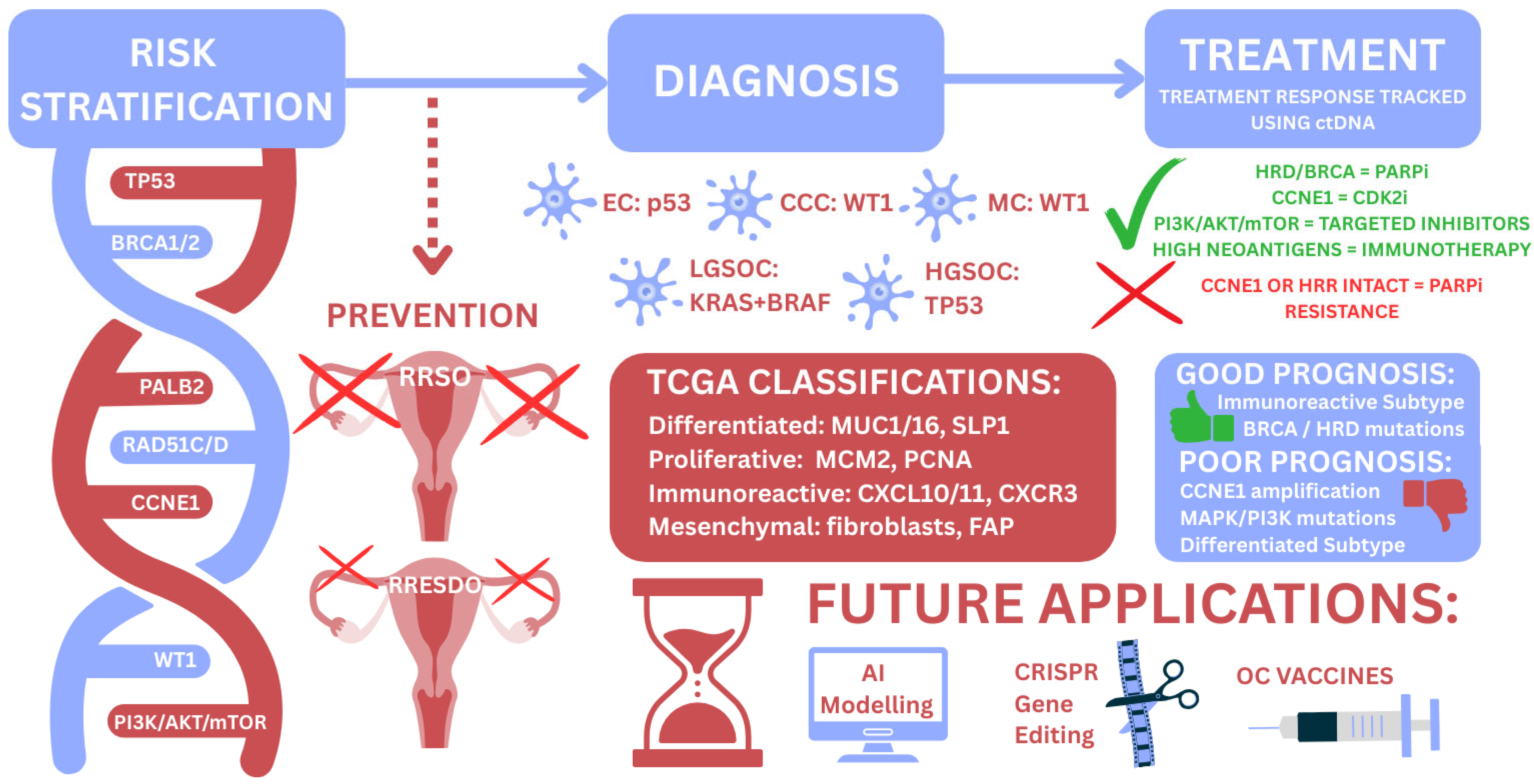
High-Grade Serous Ovarian Carcinoma in the Genomics Era: Current Applications, Challenges and Future Directions

 , , , and
Abstract
1. Introduction
2. Genomic Landscape of HGSOC
3. Current Applications of Genomics in HGSOC
3.1. Early Detection and Risk Stratification
3.2. Diagnosis and Classification
3.3. Prognostic and Predictive Biomarkers
3.4. Therapeutic Applications
4. Integration of Multi-Omics and System Genomics
5. Challenges and Limitations of Genomics in HGSOC
6. Future Perspectives
7. Conclusions
Author Contributions
Funding
Data Availability Statement
Conflicts of Interest
Abbreviations
| AI | Artificial Intelligence |
| CCC | Clear Cell Carcinoma |
| cfDNA | Cell-Free DNA |
| CPTAC | Clinical Proteomic Tumour Analysis Consortium |
| CRISPR | Clustered Regularly Interspaced Short Palindromic Repeats |
| CSG | Cancer Susceptibility Genes |
| ctDNA | Circulating Tumour DNA |
| EC | Endometrioid Carcinoma |
| HGSOC | High-Grade Serous Ovarian Carcinoma |
| HRD | Homologous Recombination Deficiency |
| HRR | Homologous Recombination Repair |
| MC | Mucinous Carcinoma |
| MCED | Multi-Cancer Early Detection |
| MMR | Mismatch Repair |
| NICE | National Institute for Health and Care Excellence |
| NGS | Next-Generation Sequencing |
| OC | Ovarian Cancer |
| OXPHOS | Oxidative Phosphorylation |
| PARPi | Poly ADP-Ribose Polymerase inhibitor |
| PPI | Protein–Protein Interaction |
| PRS | Polygenic Risk Score |
| RRESDO | Risk-Reducing Early Salpingectomy and Delayed Oophorectomy |
| RRSO | Risk-Reducing Salpingo-Oophorectomy |
| SEEFIM | Sectioning and Extensively Examining the Fimbria |
| SNP | Single-Nucleotide Polymorphism |
| SQLE | Squalene Epoxidase |
| STIC | Serous Tubal Intraepithelial Carcinoma |
| TCGA | The Cancer Genome Project |
References
- Bray, F.; Laversanne, M.; Sung, H.; Ferlay, J.; Siegel, R.L.; Soerjomataram, I.; Jemal, A. Global cancer statistics 2022: GLOBOCAN estimates of incidence and mortality worldwide for 36 cancers in 185 countries. CA Cancer J. Clin. 2024, 74, 229–263. [Google Scholar] [CrossRef] [Scilit]
- (IARC), International Agency for Research on Cancer. Cancer Tomorrow: Predictions of the Future Cancer Incidence and Mortality Burden Worldwide up Until 2050. 2025. Available online: https://gco.iarc.fr/tomorrow/en (accessed on 19 December 2025).
- Smits, S.; Boivin, J.; Menon, U.; Brain, K. Influences on anticipated time to ovarian cancer symptom presentation in women at increased risk compared to population risk of ovarian cancer. BMC Cancer 2017, 17, 814. [Google Scholar] [CrossRef] [Scilit]
- (NATCAN), National Cancer Audit Collaborating Centre. National Ovarian Cancer Audit (NOCA) State of the Nation Report; National Cancer Audit Collaborating Centre: London, UK, 2024; Available online: https://www.natcan.org.uk/reports/noca-state-of-the-nation-report-2024/ (accessed on 15 December 2025).
- Punzón-Jiménez, P.; Lago, V.; Domingo, S.; Simón, C.; Mas, A. Molecular Management of High-Grade Serous Ovarian Carcinoma. Int. J. Mol. Sci. 2022, 23, 13777. [Google Scholar] [CrossRef] [Scilit]
- Lisio, M.A.; Fu, L.; Goyeneche, A.; Gao, Z.H.; Telleria, C. High-Grade Serous Ovarian Cancer: Basic Sciences, Clinical and Therapeutic Standpoints. Int. J. Mol. Sci. 2019, 20, 952. [Google Scholar] [CrossRef] [Scilit] [PubMed]
- Bowtell, D.D.; Böhm, S.; Ahmed, A.A.; Aspuria, P.J.; Bast, R.C., Jr.; Beral, V.; Berek, J.S.; Birrer, M.J.; Blagden, S.; Bookman, M.A.; et al. Rethinking ovarian cancer II: Reducing mortality from high-grade serous ovarian cancer. Nat. Rev. Cancer 2015, 15, 668–679. [Google Scholar] [CrossRef] [Scilit] [PubMed]
- National Cancer Institute. Cancer Stat Facts: Ovarian Cancer. Available online: https://seer.cancer.gov/statfacts/html/ovary.html (accessed on 2 November 2024).
- Excellence, National Institute for Health and Care Excellence. Ovarian Cancer: Recognition and Initial Management; National Institute for Health and Care Excellence: London, UK, 2023. [Google Scholar]
- Köbel, M.B.; Brenton, J.D. Genomic Applications in Ovarian Cancer. In Genomic Applications in Pathology; Netto, G.J., Kaul, K.L., Eds.; Springer: Cham, Switzerland, 2019; pp. 471–482. [Google Scholar]
- Garsed, D.W.; Pandey, A.; Fereday, S.; Kennedy, C.J.; Takahashi, K.; Alsop, K.; Hamilton, P.T.; Hendley, J.; Chiew, Y.E.; Traficante, N.; et al. The genomic and immune landscape of long-term survivors of high-grade serous ovarian cancer. Nat. Genet. 2022, 54, 1853–1864. [Google Scholar] [CrossRef] [Scilit] [PubMed]
- The Cancer Genome Atlas Research Network. Integrated genomic analyses of ovarian carcinoma. Nature 2011, 474, 609–615, Correction in Nature 2012, 490, 292. [Google Scholar] [CrossRef] [Scilit]
- Vang, R.; Levine, D.A.; Soslow, R.A.; Zaloudek, C.; Shih Ie, M.; Kurman, R.J. Molecular Alterations of TP53 are a Defining Feature of Ovarian High-Grade Serous Carcinoma: A Rereview of Cases Lacking TP53 Mutations in The Cancer Genome Atlas Ovarian Study. Int. J. Gynecol. Pathol. 2016, 35, 48–55. [Google Scholar] [CrossRef] [Scilit]
- Tornesello, M.L. TP53 mutations in cancer: Molecular features and therapeutic opportunities (Review). Int. J. Mol. Med. 2025, 55, 7. [Google Scholar] [CrossRef] [Scilit]
- Manchana, T.; Phoolcharoen, N.; Tantbirojn, P. BRCA mutation in high grade epithelial ovarian cancers. Gynecol. Oncol. Rep. 2019, 29, 102–105. [Google Scholar] [CrossRef] [Scilit]
- Roy, R.; Chun, J.; Powell, S.N. BRCA1 and BRCA2: Different roles in a common pathway of genome protection. Nat. Rev. Cancer 2011, 12, 68–78. [Google Scholar] [CrossRef] [Scilit]
- Kuchenbaecker, K.B.; Hopper, J.L.; Barnes, D.R.; Phillips, K.A.; Mooij, T.M.; Roos-Blom, M.J.; Jervis, S.; van Leeuwen, F.E.; Milne, R.L.; Andrieu, N.; et al. Risks of Breast, Ovarian, and Contralateral Breast Cancer for BRCA1 and BRCA2 Mutation Carriers. JAMA 2017, 317, 2402–2416. [Google Scholar] [CrossRef] [Scilit] [PubMed]
- Sullivan, M.R.; Prakash, R.; Rawal, Y.; Wang, W.; Sung, P.; Radke, M.R.; Kaufmann, S.H.; Swisher, E.M.; Bernstein, K.A.; Jasin, M. Long-term survival of an ovarian cancer patient harboring a RAD51C missense mutation. Mol. Case Stud. 2021, 7, a006083. [Google Scholar] [CrossRef] [Scilit] [PubMed]
- Kausar, M.A.; Alshammari, K.F.; Alenazi, F.; Anwar, S.; Khalifa, A.M.; Ginawi, T.; Asiri, A.; Najm, M.Z.; Rabbani, S.A.; El-Tanani, M.; et al. RAD51 and PALB2 in precision oncology: Clinical implications for HRD associated breast and ovarian cancers (Review). Int. J. Oncol. 2025, 67, 65. [Google Scholar] [CrossRef] [Scilit] [PubMed]
- Khokhlova, S.; Alnaqqash, M.A.; Bahaj, W.; Bujassoum, S.; Lee, J.; Mokhtar, M.; Tyulyandina, A.; Vargas Malaga, C.L.; Wu, C.H. Prevalence of homologous recombination deficiency among women with newly diagnosed ovarian, primary peritoneal, and/or fallopian tube cancer: The international HALO study. Int. J. Gynecol. Cancer 2025, 35, 101645. [Google Scholar] [CrossRef] [Scilit]
- Kraus, C.; Hoyer, J.; Vasileiou, G.; Wunderle, M.; Lux, M.P.; Fasching, P.A.; Krumbiegel, M.; Uebe, S.; Reuter, M.; Beckmann, M.W.; et al. Gene panel sequencing in familial breast/ovarian cancer patients identifies multiple novel mutations also in genes others than BRCA1/2. Int. J. Cancer 2017, 140, 95–102. [Google Scholar] [CrossRef] [Scilit]
- Song, H.; Dicks, E.M.; Tyrer, J.; Intermaggio, M.; Chenevix-Trench, G.; Bowtell, D.D.; Traficante, N.; Group, A.; Brenton, J.; Goranova, T.; et al. Population-based targeted sequencing of 54 candidate genes identifies PALB2 as a susceptibility gene for high-grade serous ovarian cancer. J. Med. Genet. 2021, 58, 305–313. [Google Scholar] [CrossRef] [Scilit]
- Tischkowitz, M.; Sabbaghian, N.; Hamel, N.; Pouchet, C.; Foulkes, W.D.; Mes-Masson, A.M.; Provencher, D.M.; Tonin, P.N. Contribution of the PALB2 c.2323C>T [p.Q775X] founder mutation in well-defined breast and/or ovarian cancer families and unselected ovarian cancer cases of French Canadian descent. BMC Med. Genet. 2013, 14, 5. [Google Scholar] [CrossRef] [Scilit]
- Wei, W.; Dizon, D.; Vathipadiekal, V.; Birrer, M.J. Ovarian cancer: Genomic analysis. Ann. Oncol. 2013, 24, x7–x15. [Google Scholar] [CrossRef] [Scilit]
- Gasparri, M.L.; Bardhi, E.; Ruscito, I.; Papadia, A.; Farooqi, A.A.; Marchetti, C.; Bogani, G.; Ceccacci, I.; Mueller, M.D.; Benedetti Panici, P. PI3K/AKT/mTOR Pathway in Ovarian Cancer Treatment: Are We on the Right Track? Geburtshilfe Frauenheilkd. 2017, 77, 1095–1103. [Google Scholar] [CrossRef] [Scilit]
- Karst, A.M.; Jones, P.M.; Vena, N.; Ligon, A.H.; Liu, J.F.; Hirsch, M.S.; Etemadmoghadam, D.; Bowtell, D.D.; Drapkin, R. Cyclin E1 deregulation occurs early in secretory cell transformation to promote formation of fallopian tube-derived high-grade serous ovarian cancers. Cancer Res. 2014, 74, 1141–1152. [Google Scholar] [CrossRef] [Scilit]
- Toska, E.; Roberts, S.G. Mechanisms of transcriptional regulation by WT1 (Wilms’ tumour 1). Biochem. J. 2014, 461, 15–32. [Google Scholar] [CrossRef] [Scilit]
- Casey, L.; Köbel, M.; Ganesan, R.; Tam, S.; Prasad, R.; Böhm, S.; Lockley, M.; Jeyarajah, A.J.; Brockbank, E.; Faruqi, A.; et al. A comparison of p53 and WT1 immunohistochemical expression patterns in tubo-ovarian high-grade serous carcinoma before and after neoadjuvant chemotherapy. Histopathology 2017, 71, 736–742. [Google Scholar] [CrossRef] [Scilit] [PubMed]
- Lee, S.; Piskorz, A.M.; Le Page, C.; Mes Masson, A.M.; Provencher, D.; Huntsman, D.; Chen, W.; Swanson, P.E.; Gilks, C.B.; Köbel, M. Calibration and Optimization of p53, WT1, and Napsin A Immunohistochemistry Ancillary Tests for Histotyping of Ovarian Carcinoma: Canadian Immunohistochemistry Quality Control (CIQC) Experience. Int. J. Gynecol. Pathol. 2016, 35, 209–221. [Google Scholar] [CrossRef] [Scilit] [PubMed]
- Tsuchimochi, S.; Yamamoto, Y.; Taguchi, A.; Kawazu, M.; Sone, K.; Ikemura, M.; Tamai, K.; Kitamura, S.; Yoshimoto, D.; Fukaya, S.; et al. BRCA1 Promoter Methylation in Ovarian Cancer: Clinical Relevance and a Novel Diagnostic Approach Using Fragment Analysis. Cancer Sci. 2025, 116, 1996–2007. [Google Scholar] [CrossRef] [Scilit] [PubMed]
- Blons, H.; Abdelli, J.; Landman, S.; Taly, V.; Mulot, C.; Laurent-Puig, P.; You, B.; Harter, P.; Lorusso, D.; García-García, Y.; et al. Predictive value of BRCA1/RAD51C methylation in HGSOC—An ancillary study of the PAOLA-1/ENGOT-ov25 phase 3 trial. Eur. J. Cancer 2025, 225, 115534. [Google Scholar] [CrossRef] [Scilit]
- Roque, R.; Ribeiro, I.P.; Figueiredo-Dias, M.; Gourley, C.; Carreira, I.M. Current Applications and Challenges of Next-Generation Sequencing in Plasma Circulating Tumour DNA of Ovarian Cancer. Biology 2024, 13, 88. [Google Scholar] [CrossRef] [Scilit]
- Jacobs, I.J.; Menon, U.; Ryan, A.; Gentry-Maharaj, A.; Burnell, M.; Kalsi, J.K.; Amso, N.N.; Apostolidou, S.; Benjamin, E.; Cruickshank, D.; et al. Ovarian cancer screening and mortality in the UK Collaborative Trial of Ovarian Cancer Screening (UKCTOCS): A randomised controlled trial. Lancet 2016, 387, 945–956, Correction in Lancet 2016, 387, 944. [Google Scholar] [CrossRef] [Scilit]
- Excellence, National Institute for Health and Care Excellence. Ovarian Cancer: Identifying and Managing Familial and Genetic Risk; National Institute for Health and Care Excellence: London, UK, 2024. [Google Scholar]
- Sideris, M.; Menon, U.; Manchanda, R. Screening and prevention of ovarian cancer. Med. J. Aust. 2024, 220, 264–274. [Google Scholar] [CrossRef] [Scilit]
- Dareng, E.O.; Tyrer, J.P.; Barnes, D.R.; Jones, M.R.; Yang, X.; Aben, K.K.H.; Adank, M.A.; Agata, S.; Andrulis, I.L.; Anton-Culver, H.; et al. Polygenic risk modeling for prediction of epithelial ovarian cancer risk. Eur. J. Hum. Genet. 2022, 30, 349–362, Correction in Eur. J. Hum. Genet. 2022, 30, 630–631. [Google Scholar] [CrossRef] [Scilit]
- Mak, T.S.H.; Porsch, R.M.; Choi, S.W.; Zhou, X.; Sham, P.C. Polygenic scores via penalized regression on summary statistics. Genet. Epidemiol. 2017, 41, 469–480. [Google Scholar] [CrossRef] [Scilit] [PubMed]
- Flaum, N.; Bowes, J.; Smith, M.J.; Crosbie, E.J.; Edmondson, R.; Lophatananon, A.; Evans, D.G. Optimization of polygenic risk scores in BRCA1/2 pathogenic variant heterozygotes in epithelial ovarian cancer. Genet. Med. 2023, 25, 100898. [Google Scholar] [CrossRef] [Scilit] [PubMed]
- Pessoa, L.S.; Heringer, M.; Ferrer, V.P. ctDNA as a cancer biomarker: A broad overview. Crit. Rev. Oncol. Hematol. 2020, 155, 103109. [Google Scholar] [CrossRef] [Scilit] [PubMed]
- Elias, K.M.; Guo, J.; Bast, R.C., Jr. Early Detection of Ovarian Cancer. Hematol. Oncol. Clin. N. Am. 2018, 32, 903–914. [Google Scholar] [CrossRef] [Scilit]
- Berger, M.F.; Mardis, E.R. The emerging clinical relevance of genomics in cancer medicine. Nat. Rev. Clin. Oncol. 2018, 15, 353–365. [Google Scholar] [CrossRef] [Scilit]
- Tsoulos, N.; Papadopoulou, E.; Agiannitopoulos, K.; Grigoriadis, D.; Tsaousis, G.N.; Bouzarelou, D.; Gogas, H.; Troupis, T.; Venizelos, V.; Fountzilas, E.; et al. Polygenic Risk Score (PRS) Combined with NGS Panel Testing Increases Accuracy in Hereditary Breast Cancer Risk Estimation. Diagnostics 2024, 14, 1826. [Google Scholar] [CrossRef] [Scilit]
- Peres, L.C.; Cushing-Haugen, K.L.; Köbel, M.; Harris, H.R.; Berchuck, A.; Rossing, M.A.; Schildkraut, J.M.; Doherty, J.A. Invasive Epithelial Ovarian Cancer Survival by Histotype and Disease Stage. J. Natl. Cancer Inst. 2019, 111, 60–68. [Google Scholar] [CrossRef] [Scilit]
- Calapre, L.; Giardina, T.; Beasley, A.B.; Reid, A.L.; Stewart, C.; Amanuel, B.; Meniawy, T.M.; Gray, E.S. Identification of TP53 mutations in circulating tumour DNA in high grade serous ovarian carcinoma using next generation sequencing technologies. Sci. Rep. 2023, 13, 278. [Google Scholar] [CrossRef] [Scilit]
- Kim, S.Y.; Jeong, S.; Lee, W.; Jeon, Y.; Kim, Y.J.; Park, S.; Lee, D.; Go, D.; Song, S.H.; Lee, S.; et al. Cancer signature ensemble integrating cfDNA methylation, copy number, and fragmentation facilitates multi-cancer early detection. Exp. Mol. Med. 2023, 55, 2445–2460. [Google Scholar] [CrossRef] [Scilit]
- Medina, J.E.; Annapragada, A.V.; Lof, P.; Short, S.; Bartolomucci, A.L.; Mathios, D.; Koul, S.; Niknafs, N.; Noë, M.; Foda, Z.H.; et al. Early Detection of Ovarian Cancer Using Cell-Free DNA Fragmentomes and Protein Biomarkers. Cancer Discov. 2025, 15, 105–118. [Google Scholar] [CrossRef] [Scilit]
- Schrag, D.; Beer, T.M.; McDonnell, C.H.; Nadauld, L., 3rd; Dilaveri, C.A.; Reid, R.; Marinac, C.R.; Chung, K.C.; Lopatin, M.; Fung, E.T.; et al. Blood-based tests for multicancer early detection (PATHFINDER): A prospective cohort study. Lancet 2023, 402, 1251–1260. [Google Scholar] [CrossRef] [Scilit] [PubMed]
- Lennon, A.M.; Buchanan, A.H.; Kinde, I.; Warren, A.; Honushefsky, A.; Cohain, A.T.; Ledbetter, D.H.; Sanfilippo, F.; Sheridan, K.; Rosica, D.; et al. Feasibility of blood testing combined with PET-CT to screen for cancer and guide intervention. Science 2020, 369, eabb9601. [Google Scholar] [CrossRef] [Scilit] [PubMed]
- Moss, E.; Taylor, A.; Andreou, A.; Ang, C.; Arora, R.; Attygalle, A.; Banerjee, S.; Bowen, R.; Buckley, L.; Burbos, N.; et al. British Gynaecological Cancer Society (BGCS) ovarian, tubal and primary peritoneal cancer guidelines: Recommendations for practice update 2024. Eur. J. Obstet. Gynecol. Reprod. Biol. 2024, 300, 69–123. [Google Scholar] [CrossRef] [Scilit] [PubMed]
- Bachert, S.E.; McDowell, A., Jr.; Piecoro, D.; Baldwin Branch, L. Serous Tubal Intraepithelial Carcinoma: A Concise Review for the Practicing Pathologist and Clinician. Diagnostics 2020, 10, 102. [Google Scholar] [CrossRef] [Scilit]
- Kim, J.; Park, E.Y.; Kim, O.; Schilder, J.M.; Coffey, D.M.; Cho, C.H.; Bast, R.C., Jr. Cell Origins of High-Grade Serous Ovarian Cancer. Cancers 2018, 10, 433. [Google Scholar] [CrossRef] [Scilit]
- Visvanathan, K.; Vang, R.; Shaw, P.; Gross, A.; Soslow, R.; Parkash, V.; Shih, I.-M.; Kurman, R.J. Diagnosis of serous tubal intraepithelial carcinoma based on morphologic and immunohistochemical features: A reproducibility study. Am. J. Surg. Pathol. 2011, 35, 1766–1775. [Google Scholar] [CrossRef] [Scilit]
- Kuhn, E.; Kurman, R.J.; Vang, R.; Sehdev, A.S.; Han, G.; Soslow, R.; Wang, T.L.; Shih, I.-M. TP53 mutations in serous tubal intraepithelial carcinoma and concurrent pelvic high-grade serous carcinoma–evidence supporting the clonal relationship of the two lesions. J. Pathol. 2012, 226, 421–426. [Google Scholar] [CrossRef] [Scilit]
- Zweemer, R.P.; van Diest, P.J.; Verheijen, R.H.; Ryan, A.; Gille, J.J.; Sijmons, R.H.; Jacobs, I.J.; Menko, F.H.; Kenemans, P. Molecular evidence linking primary cancer of the fallopian tube to BRCA1 germline mutations. Gynecol. Oncol. 2000, 76, 45–50. [Google Scholar] [CrossRef] [Scilit]
- Perets, R.; Wyant, G.A.; Muto, K.W.; Bijron, J.G.; Poole, B.B.; Chin, K.T.; Chen, J.Y.; Ohman, A.W.; Stepule, C.D.; Kwak, S.; et al. Transformation of the fallopian tube secretory epithelium leads to high-grade serous ovarian cancer in Brca;Tp53;Pten models. Cancer Cell 2013, 24, 751–765. [Google Scholar] [CrossRef] [Scilit]
- Labidi-Galy, S.I.; Papp, E.; Hallberg, D.; Niknafs, N.; Adleff, V.; Noe, M.; Bhattacharya, R.; Novak, M.; Jones, S.; Phallen, J.; et al. High grade serous ovarian carcinomas originate in the fallopian tube. Nat. Commun. 2017, 8, 1093. [Google Scholar] [CrossRef] [Scilit]
- Gaba, F.; Robbani, S.; Singh, N.; McCluggage, W.G.; Wilkinson, N.; Ganesan, R.; Bryson, G.; Rowlands, G.; Tyson, C.; Arora, R.; et al. Preventing Ovarian Cancer through early Excision of Tubes and late Ovarian Removal (PROTECTOR): Protocol for a prospective non-randomised multi-center trial. Int. J. Gynecol. Cancer 2021, 31, 286–291. [Google Scholar] [CrossRef] [Scilit] [PubMed]
- Köbel, M.; Kang, E.Y. The Evolution of Ovarian Carcinoma Subclassification. Cancers 2022, 14, 416. [Google Scholar] [CrossRef] [Scilit] [PubMed]
- Höhn, A.K.; Brambs, C.E.; Hiller, G.G.R.; May, D.; Schmoeckel, E.; Horn, L.C. 2020 WHO Classification of Female Genital Tumors. Geburtshilfe Frauenheilkd. 2021, 81, 1145–1153. [Google Scholar] [CrossRef] [Scilit] [PubMed]
- Assem, H.; Rambau, P.F.; Lee, S.; Ogilvie, T.; Sienko, A.; Kelemen, L.E.; Köbel, M. High-grade Endometrioid Carcinoma of the Ovary: A Clinicopathologic Study of 30 Cases. Am. J. Surg. Pathol. 2018, 42, 534–544. [Google Scholar] [CrossRef] [Scilit]
- Gershenson, D.M. Low-grade serous carcinoma of the ovary or peritoneum. Ann. Oncol. 2016, 27, i45–i49. [Google Scholar] [CrossRef] [Scilit]
- Drymiotou, S.; Theodorou, E.; Rallis, K.S.; Nicolaides, M.; Sideris, M. Molecular Biomarkers in Borderline Ovarian Tumors: Towards Personalized Treatment and Prognostic Assessment. Cancers 2025, 17, 545. [Google Scholar] [CrossRef] [Scilit]
- Sun, T.; Zhang, Z.; Tian, L.; Zheng, Y.; Wu, L.; Guo, Y.; Li, X.; Li, Y.; Shen, H.; Lai, Y.; et al. Dualistic classification of high grade serous ovarian carcinoma has its root in spatial heterogeneity. J. Adv. Res. 2023, 48, 213–225. [Google Scholar] [CrossRef] [Scilit]
- Kordowitzki, P.; Lange, B.; Elias, K.M.; Haigis, M.C.; Mechsner, S.; Braicu, I.E.; Sehouli, J. Transforming treatment paradigms: Focus on personalized medicine for high-grade serous ovarian cancer. CA Cancer J. Clin. 2025, 75, 436–460. [Google Scholar] [CrossRef] [Scilit]
- Kassuhn, W.; Klein, O.; Darb-Esfahani, S.; Lammert, H.; Handzik, S.; Taube, E.T.; Schmitt, W.D.; Keunecke, C.; Horst, D.; Dreher, F.; et al. Classification of Molecular Subtypes of High-Grade Serous Ovarian Cancer by MALDI-Imaging. Cancers 2021, 13, 1512. [Google Scholar] [CrossRef] [Scilit]
- Azzalini, E.; Stanta, G.; Canzonieri, V.; Bonin, S. Overview of Tumor Heterogeneity in High-Grade Serous Ovarian Cancers. Int. J. Mol. Sci. 2023, 24, 15077. [Google Scholar] [CrossRef] [Scilit]
- Santoro, A.; Angelico, G.; Travaglino, A.; Inzani, F.; Spadola, S.; Pettinato, A.; Mazzucchelli, M.; Bragantini, E.; Maccio, L.; Zannoni, G.F. The multiple facets of ovarian high grade serous carcinoma: A review on morphological, immunohistochemical and molecular features. Crit. Rev. Oncol. Hematol. 2025, 208, 104603. [Google Scholar] [CrossRef] [Scilit] [PubMed]
- Handley, K.F.; Sims, T.T.; Bateman, N.W.; Glassman, D.; Foster, K.I.; Lee, S.; Yao, J.; Yao, H.; Fellman, B.M.; Liu, J.; et al. Classification of High-Grade Serous Ovarian Cancer Using Tumor Morphologic Characteristics. JAMA Netw. Open 2022, 5, e2236626. [Google Scholar] [CrossRef] [Scilit] [PubMed]
- Chen, G.M.; Kannan, L.; Geistlinger, L.; Kofia, V.; Safikhani, Z.; Gendoo, D.M.A.; Parmigiani, G.; Birrer, M.; Haibe-Kains, B.; Waldron, L. Consensus on Molecular Subtypes of High-Grade Serous Ovarian Carcinoma. Clin. Cancer Res. 2018, 24, 5037–5047. [Google Scholar] [CrossRef] [Scilit] [PubMed]
- Miyagawa, C.; Nakai, H.; Otani, T.; Murakami, R.; Takamura, S.; Takaya, H.; Murakami, K.; Mandai, M.; Matsumura, N. Histopathological subtyping of high-grade serous ovarian cancer using whole slide imaging. J. Gynecol. Oncol. 2023, 34, e47. [Google Scholar] [CrossRef] [Scilit]
- Asaturova, A.; Tregubova, A.; Magnaeva, A. Molecular Subtypes of High-Grade Serous Ovarian Carcinoma. In Gynaecological Cancers: An Interdisciplinary Approach; Rezaei, N., Ed.; Interdisciplinary Cancer Research; Springer: Cham, Switzerland, 2022. [Google Scholar]
- Colombo, P.E.; Taoum, C.; Fabbro, M.; Quesada, S.; Rouanet, P.; Ray-Coquard, I. Impact of molecular testing on the surgical management of advanced epithelial ovarian cancer. Crit. Rev. Oncol. Hematol. 2024, 202, 104469. [Google Scholar] [CrossRef] [Scilit]
- Weinstein, J.N.; Collisson, E.A.; Mills, G.B.; Shaw, K.R.; Ozenberger, B.A.; Ellrott, K.; Shmulevich, I.; Sander, C.; Stuart, J.M. The Cancer Genome Atlas Pan-Cancer analysis project. Nat. Genet. 2013, 45, 1113–1120. [Google Scholar] [CrossRef] [Scilit]
- Tothill, R.W.; Tinker, A.V.; George, J.; Brown, R.; Fox, S.B.; Lade, S.; Johnson, D.S.; Trivett, M.K.; Etemadmoghadam, D.; Locandro, B.; et al. Novel molecular subtypes of serous and endometrioid ovarian cancer linked to clinical outcome. Clin. Cancer Res. 2008, 14, 5198–5208. [Google Scholar] [CrossRef] [Scilit]
- Konecny, G.E.; Wang, C.; Hamidi, H.; Winterhoff, B.; Kalli, K.R.; Dering, J.; Ginther, C.; Chen, H.W.; Dowdy, S.; Cliby, W.; et al. Prognostic and therapeutic relevance of molecular subtypes in high-grade serous ovarian cancer. J. Natl. Cancer Inst. 2014, 106, dju249. [Google Scholar] [CrossRef] [Scilit]
- Bukłaho, P.A.; Kiśluk, J.; Nikliński, J. Diagnostics and treatment of ovarian cancer in the era of precision medicine-opportunities and challenges. Front. Oncol. 2023, 13, 1227657. [Google Scholar] [CrossRef] [Scilit]
- Sosinsky, A.; Ambrose, J.; Cross, W.; Turnbull, C.; Henderson, S.; Jones, L.; Hamblin, A.; Arumugam, P.; Chan, G.; Chubb, D.; et al. Insights for precision oncology from the integration of genomic and clinical data of 13,880 tumors from the 100,000 Genomes Cancer Programme. Nat. Med. 2024, 30, 279–289. [Google Scholar] [CrossRef] [Scilit]
- Wang, G.; Yang, H.; Wang, Y.; Qin, J. Ovarian cancer targeted therapy: Current landscape and future challenges. Front. Oncol. 2025, 15, 1535235. [Google Scholar] [CrossRef] [Scilit]
- Soberanis Pina, P.; Lheureux, S. Overcoming PARP inhibitor resistance in ovarian cancer. Int. J. Gynecol. Cancer 2023, 33, 364–376. [Google Scholar] [CrossRef] [Scilit] [PubMed]
- Miller, R.E.; Leary, A.; Scott, C.L.; Serra, V.; Lord, C.J.; Bowtell, D.; Chang, D.K.; Garsed, D.W.; Jonkers, J.; Ledermann, J.A.; et al. ESMO recommendations on predictive biomarker testing for homologous recombination deficiency and PARP inhibitor benefit in ovarian cancer. Ann. Oncol. 2020, 31, 1606–1622. [Google Scholar] [CrossRef] [Scilit] [PubMed]
- Lin, Z.; Wang, L.; Xing, Z.; Wang, F.; Cheng, X. Update on Combination Strategies of PARP Inhibitors. Cancer Control 2024, 31, 10732748241298329. [Google Scholar] [CrossRef] [Scilit] [PubMed]
- Agrawal, M.; Agrawal, S.K.; Chopra, K. Overcoming drug resistance in ovarian cancer through PI3K/AKT signaling inhibitors. Gene 2025, 948, 149352. [Google Scholar] [CrossRef] [Scilit]
- Miller, R.E.; Elyashiv, O.; El-Shakankery, K.H.; Ledermann, J.A. Ovarian Cancer Therapy: Homologous Recombination Deficiency as a Predictive Biomarker of Response to PARP Inhibitors. OncoTargets Ther. 2022, 15, 1105–1117. [Google Scholar] [CrossRef] [Scilit]
- Sideris, M.; Jamdade, K.; Essangri, H.; Zalawadia, S.; Oxley, S.G.; Selek, K.; Phadnis, S. The Role of Cytoreductive Surgery in Platinum-Resistant Ovarian Cancer (PROC): A Systematic Review. Cancers 2025, 17, 217. [Google Scholar] [CrossRef] [Scilit]
- Wessman, S.; Fuentes, B.B.; Törngren, T.; Kvist, A.; Kokaraki, G.; Menkens, H.; Hjerpe, E.; Hugo, Y.; Petta, T.B.; Borg, Å.; et al. Precision Oncology of High-Grade Ovarian Cancer Defined through Targeted Sequencing. Cancers 2021, 13, 5240. [Google Scholar] [CrossRef] [Scilit]
- Scanlon, L.R.; Gabor, L.; Khouri, O.; Ahmad, S.; Levy, E.; Buckley, E.; Ouedraogo, A.; Kuo, D.Y.; Lin, K.; Nevadunsky, N.; et al. Immunotherapy for ovarian cancer is improved by tumor-targeted delivery of a neoantigen surrogate. bioRxiv 2025. [Google Scholar] [CrossRef] [Scilit]
- Wang, D.; Li, C.; Zhang, Y.; Wang, M.; Jiang, N.; Xiang, L.; Li, T.; Roberts, T.M.; Zhao, J.J.; Cheng, H.; et al. Combined inhibition of PI3K and PARP is effective in the treatment of ovarian cancer cells with wild-type PIK3CA genes. Gynecol. Oncol. 2016, 142, 548–556. [Google Scholar] [CrossRef] [Scilit]
- Yap, T.A.; Kristeleit, R.; Michalarea, V.; Pettitt, S.J.; Lim, J.S.J.; Carreira, S.; Roda, D.; Miller, R.; Riisnaes, R.; Miranda, S.; et al. Phase I Trial of the PARP Inhibitor Olaparib and AKT Inhibitor Capivasertib in Patients with BRCA1/2- and Non-BRCA1/2-Mutant Cancers. Cancer Discov. 2020, 10, 1528–1543. [Google Scholar] [CrossRef] [Scilit]
- Wang, D.; Wang, M.; Jiang, N.; Zhang, Y.; Bian, X.; Wang, X.; Roberts, T.M.; Zhao, J.J.; Liu, P.; Cheng, H. Effective use of PI3K inhibitor BKM120 and PARP inhibitor Olaparib to treat PIK3CA mutant ovarian cancer. Oncotarget 2016, 7, 13153–13166. [Google Scholar] [CrossRef] [Scilit]
- Xie, N.; Shen, G.; Gao, W.; Huang, Z.; Huang, C.; Fu, L. Neoantigens: Promising targets for cancer therapy. Signal Transduct. Target. Ther. 2023, 8, 9. [Google Scholar] [CrossRef] [Scilit] [PubMed]
- McNeish, I.A. Neoantigens in Ovarian Cancer: Embarrassment of Riches or Needles in a Haystack? Clin. Cancer Res. 2018, 24, 5493–5495. [Google Scholar] [CrossRef] [Scilit] [PubMed]
- Wu, M.; Zhou, S. Harnessing tumor immunogenomics: Tumor neoantigens in ovarian cancer and beyond. Biochim. Biophys. Acta Rev. Cancer 2023, 1878, 189017. [Google Scholar] [CrossRef] [Scilit] [PubMed]
- Yang, C.; Xia, B.R.; Zhang, Z.C.; Zhang, Y.J.; Lou, G.; Jin, W.L. Immunotherapy for Ovarian Cancer: Adjuvant, Combination, and Neoadjuvant. Front. Immunol. 2020, 11, 577869. [Google Scholar] [CrossRef] [Scilit]
- Connor, A.E.; Lyons, P.M.; Kilgallon, A.M.; Simpson, J.C.; Perry, A.S.; Lysaght, J. Examining the evidence for immune checkpoint therapy in high-grade serous ovarian cancer. Heliyon 2024, 10, e38888. [Google Scholar] [CrossRef] [Scilit]
- Moore, K.N.; Angelergues, A.; Konecny, G.E.; García, Y.; Banerjee, S.; Lorusso, D.; Lee, J.Y.; Moroney, J.W.; Colombo, N.; Roszak, A.; et al. Mirvetuximab Soravtansine in FRα-Positive, Platinum-Resistant Ovarian Cancer. N. Engl. J. Med. 2023, 389, 2162–2174. [Google Scholar] [CrossRef] [Scilit]
- Secord, A.; Corr, B.; Lewin, S.; Diver, E.; Ayuk, S.-M.; Wang, Y.; Murphy, C.; Salutari, V.; Garcia, A.B.; Montosa, F.G.; et al. 718MO Mirvetuximab soravtansine (MIRV) in recurrent platinum-sensitive ovarian cancer (PSOC) with high folate receptor-alpha (FRα) expression: Results from the PICCOLO trial. Ann. Oncol. 2024, 35, S549–S550. [Google Scholar] [CrossRef] [Scilit]
- Silverstein, J.; Smick, A.; Johnson, B.; Konecny, G.E. Mirvetuximab soravtansine for the treatment of epithelial ovarian, fallopian tube, or primary peritoneal cancer. Future Oncol. 2025, 21, 2143–2153. [Google Scholar] [CrossRef] [Scilit]
- El Bairi, K.; Madariaga, A.; Trapani, D.; Al Jarroudi, O.; Afqir, S. New horizons for platinum-resistant ovarian cancer: Insights from the 2023 American Society of Clinical Oncology (ASCO) and European Society for Medical Oncology (ESMO) Annual Meetings. Int. J. Gynecol. Cancer 2024, 34, 760–772. [Google Scholar] [CrossRef] [Scilit]
- Van Gorp, T.; Moore, K.N.; Konecny, G.E.; Leary, A.; García-García, Y.; Banerjee, S.; Lorusso, D.; Lee, J.Y.; Moroney, J.W.; Caruso, G.; et al. Patient-reported outcomes from the MIRASOL trial evaluating mirvetuximab soravtansine versus chemotherapy in patients with folate receptor α-positive, platinum-resistant ovarian cancer: A randomised, open-label, phase 3 trial. Lancet Oncol. 2025, 26, 503–515, Correction in Lancet Oncol. 2025, 26, e349. [Google Scholar] [CrossRef] [Scilit]
- Alvarez Secord, A.; Lewin, S.N.; Murphy, C.G.; Cecere, S.C.; Barquín, A.; Gálvez-Montosa, F.; Mathews, C.A.; Konecny, G.E.; Ray-Coquard, I.; Oaknin, A.; et al. The efficacy and safety of mirvetuximab soravtansine in FRα-positive, third-line and later, recurrent platinum-sensitive ovarian cancer: The single-arm phase II PICCOLO trial. Ann. Oncol. 2025, 36, 321–330. [Google Scholar] [CrossRef] [Scilit] [PubMed]
- Taghizadeh, H.; Mader, R.M.; Müllauer, L.; Aust, S.; Polterauer, S.; Kölbl, H.; Seebacher, V.; Grimm, C.; Reinthaller, A.; Prager, G.W. Molecular Guided Treatments in Gynecologic Oncology: Analysis of a Real-World Precision Cancer Medicine Platform. Oncologist 2020, 25, e1060–e1069. [Google Scholar] [CrossRef] [Scilit] [PubMed]
- Mitri, Z.; Goodyear, S.M.; Mills, G. Strategies for the prevention or reversal of PARP inhibitor resistance. Expert Rev. Anticancer Ther. 2024, 24, 959–975. [Google Scholar] [CrossRef] [Scilit] [PubMed]
- Zhang, H.; Liu, T.; Zhang, Z.; Payne, S.H.; Zhang, B.; McDermott, J.E.; Zhou, J.Y.; Petyuk, V.A.; Chen, L.; Ray, D.; et al. Integrated Proteogenomic Characterization of Human High-Grade Serous Ovarian Cancer. Cell 2016, 166, 755–765, Erratum in Cell 2025, 188, 7016. [Google Scholar] [CrossRef] [Scilit]
- Vázquez-García, I.; Uhlitz, F.; Ceglia, N.; Lim, J.L.P.; Wu, M.; Mohibullah, N.; Niyazov, J.; Ruiz, A.E.B.; Boehm, K.M.; Bojilova, V.; et al. Ovarian cancer mutational processes drive site-specific immune evasion. Nature 2022, 612, 778–786. [Google Scholar] [CrossRef] [Scilit]
- Hu, Y.; Pan, J.; Shah, P.; Ao, M.; Thomas, S.N.; Liu, Y.; Chen, L.; Schnaubelt, M.; Clark, D.J.; Rodriguez, H.; et al. Integrated Proteomic and Glycoproteomic Characterization of Human High-Grade Serous Ovarian Carcinoma. Cell Rep. 2020, 33, 108276. [Google Scholar] [CrossRef] [Scilit]
- Chowdhury, S.; Kennedy, J.J.; Ivey, R.G.; Murillo, O.D.; Hosseini, N.; Song, X.; Petralia, F.; Calinawan, A.; Savage, S.R.; Berry, A.B.; et al. Proteogenomic analysis of chemo-refractory high-grade serous ovarian cancer. Cell 2023, 186, 3476–3498.e35, Erratum in Cell 2024, 187, 1016. [Google Scholar] [CrossRef] [Scilit]
- Hu, Y.; Sun, L.; Zhang, Y.; Lang, J.; Rao, J. Phosphoproteomics Reveals Key Regulatory Kinases and Modulated Pathways Associated with Ovarian Cancer Tumors. OncoTargets Ther. 2020, 13, 3595–3605. [Google Scholar] [CrossRef] [Scilit]
- Rao, Z.; Ding, Y. Ubiquitin pathway and ovarian cancer. Curr. Oncol. 2012, 19, 324–328, Erratum in Curr. Oncol. 2013, 20, e280. [Google Scholar] [CrossRef] [Scilit] [PubMed]
- Hou, R.; Sun, X.; Cao, S.; Wang, Y.; Jiang, L. Stabilization of SQLE mRNA by WTAP/FTO/IGF2BP3-dependent manner in HGSOC: Implications for metabolism, stemness, and progression. Cell Death Dis. 2024, 15, 872. [Google Scholar] [CrossRef] [Scilit] [PubMed]
- Lahiguera, Á.; Hyroššová, P.; Figueras, A.; Garzón, D.; Moreno, R.; Soto-Cerrato, V.; McNeish, I.; Serra, V.; Lazaro, C.; Barretina, P.; et al. Tumors defective in homologous recombination rely on oxidative metabolism: Relevance to treatments with PARP inhibitors. EMBO Mol. Med. 2020, 12, e11217. [Google Scholar] [CrossRef] [Scilit] [PubMed]
- Turkoglu, O.; Zeb, A.; Graham, S.; Szyperski, T.; Szender, J.B.; Odunsi, K.; Bahado-Singh, R. Metabolomics of biomarker discovery in ovarian cancer: A systematic review of the current literature. Metabolomics 2016, 12, 60. [Google Scholar] [CrossRef] [Scilit]
- Warburg, O. On the origin of cancer cells. Science 1956, 123, 309–314. [Google Scholar] [CrossRef] [Scilit]
- Bokil, A.; Sancho, P. Mitochondrial determinants of chemoresistance. Cancer Drug Resist 2019, 2, 634–646. [Google Scholar] [CrossRef] [Scilit]
- Ohta, T.; Sugimoto, M.; Ito, Y.; Horikawa, S.; Okui, Y.; Sakaki, H.; Seino, M.; Sunamura, M.; Nagase, S. Profiling of metabolic dysregulation in ovarian cancer tissues and biofluids. Sci. Rep. 2024, 14, 21555. [Google Scholar] [CrossRef] [Scilit]
- Kalachand, R.D.; Stordal, B.; Madden, S.; Chandler, B.; Cunningham, J.; Goode, E.L.; Ruscito, I.; Braicu, E.I.; Sehouli, J.; Ignatov, A.; et al. BRCA1 Promoter Methylation and Clinical Outcomes in Ovarian Cancer: An Individual Patient Data Meta-Analysis. J. Natl. Cancer Inst. 2020, 112, 1190–1203. [Google Scholar] [CrossRef] [Scilit]
- Nougarede, L.; Hazane-Puch, F.; de Fraipont, F.; Jacquet, E.; Bidart, M. BRCA1 promoter methylation predicts PARPi response in ovarian cancer: Insights from the KOMET study. Clin. Epigenet. 2025, 17, 140. [Google Scholar] [CrossRef] [Scilit]
- Zhao, H.; Wang, J.; Zhang, Y.; Yuan, M.; Yang, S.; Li, L.; Yang, H. Prognostic Values of CCNE1 Amplification and Overexpression in Cancer Patients: A Systematic Review and Meta-analysis. J. Cancer 2018, 9, 2397–2407. [Google Scholar] [CrossRef] [Scilit]
- Fang, D.; Huang, S.; Su, S.B. Cyclin E1-CDK 2, a potential anticancer target. Aging 2016, 8, 571–572. [Google Scholar] [CrossRef] [Scilit] [PubMed]
- Matassa, D.S.; Amoroso, M.R.; Lu, H.; Avolio, R.; Arzeni, D.; Procaccini, C.; Faicchia, D.; Maddalena, F.; Simeon, V.; Agliarulo, I.; et al. Oxidative metabolism drives inflammation-induced platinum resistance in human ovarian cancer. Cell Death Differ. 2016, 23, 1542–1554. [Google Scholar] [CrossRef] [Scilit] [PubMed]
- Yoon, H.; Lee, S. Fatty Acid Metabolism in Ovarian Cancer: Therapeutic Implications. Int. J. Mol. Sci. 2022, 23, 2170. [Google Scholar] [CrossRef] [Scilit] [PubMed]
- Wu, Y.; Zhang, X.; Wang, Z.; Zheng, W.; Cao, H.; Shen, W. Targeting oxidative phosphorylation as an approach for the treatment of ovarian cancer. Front. Oncol. 2022, 12, 971479. [Google Scholar] [CrossRef] [Scilit]
- Baião, A.R.; Cai, Z.; Poulos, R.C.; Robinson, P.J.; Reddel, R.R.; Zhong, Q.; Vinga, S.; Gonçalves, E. A technical review of multi-omics data integration methods: From classical statistical to deep generative approaches. Brief. Bioinform. 2025, 26, bbaf355. [Google Scholar] [CrossRef] [Scilit]
- Maniati, E.; Berlato, C.; Gopinathan, G.; Heath, O.; Kotantaki, P.; Lakhani, A.; McDermott, J.; Pegrum, C.; Delaine-Smith, R.M.; Pearce, O.M.T.; et al. Mouse Ovarian Cancer Models Recapitulate the Human Tumor Microenvironment and Patient Response to Treatment. Cell Rep. 2020, 30, 525–540.e7. [Google Scholar] [CrossRef] [Scilit]
- Feng, S.; Xu, Y.; Dai, Z.; Yin, H.; Zhang, K.; Shen, Y. Integrative Analysis From Multicenter Studies Identifies a WGCNA-Derived Cancer-Associated Fibroblast Signature for Ovarian Cancer. Front. Immunol. 2022, 13, 951582. [Google Scholar] [CrossRef] [Scilit]
- Jin, N.; Wu, H.; Miao, Z.; Huang, Y.; Hu, Y.; Bi, X.; Wu, D.; Qian, K.; Wang, L.; Wang, C.; et al. Network-based survival-associated module biomarker and its crosstalk with cell death genes in ovarian cancer. Sci. Rep. 2015, 5, 11566. [Google Scholar] [CrossRef] [Scilit]
- Hijazi, M.; Smith, R.; Rajeeve, V.; Bessant, C.; Cutillas, P.R. Reconstructing kinase network topologies from phosphoproteomics data reveals cancer-associated rewiring. Nat. Biotechnol. 2020, 38, 493–502. [Google Scholar] [CrossRef] [Scilit]
- Kliuchnikova, A.; Gordeeva, A.; Abdurakhimov, A.; Materova, T.; Tarbeeva, S.; Sarygina, E.; Kozlova, A.; Kiseleva, O.; Ponomarenko, E.; Ilgisonis, E. Ovarian Cancer: Multi-Omics Data Integration. Int. J. Mol. Sci. 2025, 26, 5961. [Google Scholar] [CrossRef] [Scilit]
- McGrail, D.J.; Lin, C.C.; Garnett, J.; Liu, Q.; Mo, W.; Dai, H.; Lu, Y.; Yu, Q.; Ju, Z.; Yin, J.; et al. Improved prediction of PARP inhibitor response and identification of synergizing agents through use of a novel gene expression signature generation algorithm. npj Syst. Biol. Appl. 2017, 3, 8. [Google Scholar] [CrossRef] [Scilit]
- Boehm, K.M.; Aherne, E.A.; Ellenson, L.; Nikolovski, I.; Alghamdi, M.; Vázquez-García, I.; Zamarin, D.; Long Roche, K.; Liu, Y.; Patel, D.; et al. Multimodal data integration using machine learning improves risk stratification of high-grade serous ovarian cancer. Nat. Cancer 2022, 3, 723–733. [Google Scholar] [CrossRef] [Scilit]
- Yang, H.; Chen, R.; Li, D.; Wang, Z. Subtype-GAN: A deep learning approach for integrative cancer subtyping of multi-omics data. Bioinformatics 2021, 37, 2231–2237. [Google Scholar] [CrossRef] [Scilit] [PubMed]
- Argelaguet, R.; Velten, B.; Arnol, D.; Dietrich, S.; Zenz, T.; Marioni, J.C.; Buettner, F.; Huber, W.; Stegle, O. Multi-Omics Factor Analysis-a framework for unsupervised integration of multi-omics data sets. Mol. Syst. Biol. 2018, 14, e8124. [Google Scholar] [CrossRef] [Scilit] [PubMed]
- Thapa, K.; Kinali, M.; Pei, S.; Luna, A.; Babur, Ö. Strategies to include prior knowledge in omics analysis with deep neural networks. Patterns 2025, 6, 101203, Correction in Patterns 2025, 6, 101235. [Google Scholar] [CrossRef] [Scilit] [PubMed]
- Geistlinger, L.; Oh, S.; Ramos, M.; Schiffer, L.; LaRue, R.S.; Henzler, C.M.; Munro, S.A.; Daughters, C.; Nelson, A.C.; Winterhoff, B.J.; et al. Multiomic Analysis of Subtype Evolution and Heterogeneity in High-Grade Serous Ovarian Carcinoma. Cancer Res. 2020, 80, 4335–4345. [Google Scholar] [CrossRef] [Scilit]
- Godbole, N.; Quinn, A.; Carrion, F.; Pelosi, E.; Salomon, C. Extracellular vesicles as a potential delivery platform for CRISPR-Cas based therapy in epithelial ovarian cancer. Semin. Cancer Biol. 2023, 96, 64–81. [Google Scholar] [CrossRef] [Scilit]
- Veneziani, A.C.; Gonzalez-Ochoa, E.; Alqaisi, H.; Madariaga, A.; Bhat, G.; Rouzbahman, M.; Sneha, S.; Oza, A.M. Heterogeneity and treatment landscape of ovarian carcinoma. Nat. Rev. Clin. Oncol. 2023, 20, 820–842. [Google Scholar] [CrossRef] [Scilit]
- McGuire, A.L.; Gabriel, S.; Tishkoff, S.A.; Wonkam, A.; Chakravarti, A.; Furlong, E.E.M.; Treutlein, B.; Meissner, A.; Chang, H.Y.; López-Bigas, N.; et al. The road ahead in genetics and genomics. Nat. Rev. Genet. 2020, 21, 581–596. [Google Scholar] [CrossRef] [Scilit]
- Meghnani, V.; Mohammed, N.; Giauque, C.; Nahire, R.; David, T. Performance Characterization and Validation of Saliva as an Alternative Specimen Source for Detecting Hereditary Breast Cancer Mutations by Next Generation Sequencing. Int. J. Genom. 2016, 2016, 2059041. [Google Scholar] [CrossRef] [Scilit]
- De Paolis, E.; Perrucci, A.; Marchetti, C.; Pietragalla, A.; Scambia, G.; Urbani, A.; Fagotti, A.; Minucci, A. BRCA testing on buccal swab to improve access to healthcare and cancer prevention: A performance evaluation. Int. J. Gynecol. Cancer 2022, 32, 1419–1426. [Google Scholar] [CrossRef] [Scilit]
- Direct to Patient Testing at Cancer Diagnosis for Precision Prevention-2 – DETECT-2 Trial. Available online: https://www.detect-2.co.uk (accessed on 2 November 2025).
- Madden, E.B.; Hindorff, L.A.; Bonham, V.L.; Akintobi, T.H.; Burchard, E.G.; Baker, K.E.; Begay, R.L.; Carpten, J.D.; Cox, N.J.; Di Francesco, V.; et al. Advancing genomics to improve health equity. Nat. Genet. 2024, 56, 752–757. [Google Scholar] [CrossRef] [Scilit] [PubMed]
- Smit, A.K.; Reyes-Marcelino, G.; Keogh, L.; Cust, A.E.; Newson, A.J. ‘There is a lot of good in knowing, but there is also a lot of downs’: Public views on ethical considerations in population genomic screening. J. Med. Ethics 2020, 47, e28. [Google Scholar] [CrossRef] [Scilit] [PubMed]
- Carlsson, L.; Bedard, P.L.; Kim, R.H.; Metcalfe, K. Psychological distress following multi-gene panel testing for hereditary breast and ovarian cancer risk. J. Genet. Couns. 2025, 34, e1940. [Google Scholar] [CrossRef] [Scilit] [PubMed]
- Lucassen, A.; Gilbar, R. Alerting relatives about heritable risks: The limits of confidentiality. BMJ 2018, 361, k1409. [Google Scholar] [CrossRef] [Scilit]
- Yu, T.; Huang, Q.; Zhao, X.; Zhang, S.; Zhang, Q.; Fan, X.; Liu, G. Tumour purity as an underlying key factor in tumour mutation detection in colorectal cancer. Clin. Transl. Med. 2023, 13, e1252. [Google Scholar] [CrossRef] [Scilit]
- Xiao, W.; Ren, L.; Chen, Z.; Fang, L.T.; Zhao, Y.; Lack, J.; Guan, M.; Zhu, B.; Jaeger, E.; Kerrigan, L.; et al. Toward best practice in cancer mutation detection with whole-genome and whole-exome sequencing. Nat. Biotechnol. 2021, 39, 1141–1150. [Google Scholar] [CrossRef] [Scilit]
- Cochran, D.; NourEldein, M.; Bezdekova, D.; Schram, A.; Howard, R.; Powers, R. A Reproducibility Crisis for Clinical Metabolomics Studies. Trends Anal. Chem. 2024, 180, 117918. [Google Scholar] [CrossRef] [Scilit]
- Plummer, J.T.; Dezem, F.S.; Cook, D.P.; Park, J.; Zhang, L.; Liu, Y.; Marção, M.; DuBose, H.; Wani, A.; Wise, K.; et al. Standardized metrics for assessment and reproducibility of imaging-based spatial transcriptomics datasets. Nat. Biotechnol. 2025. [Google Scholar] [CrossRef] [Scilit]
- Rush, A.; Spring, K.; Byrne, J.A. A critical analysis of cancer biobank practices in relation to biospecimen quality. Biophys. Rev. 2015, 7, 369–378. [Google Scholar] [CrossRef] [Scilit]
- Wang, D.; Zhang, Y.; Li, R.; Li, J.; Zhang, R. Consistency and reproducibility of large panel next-generation sequencing: Multi-laboratory assessment of somatic mutation detection on reference materials with mismatch repair and proofreading deficiency. J. Adv. Res. 2023, 44, 161–172. [Google Scholar] [CrossRef] [Scilit]
- Schrijver, I.; Aziz, N.; Farkas, D.H.; Furtado, M.; Gonzalez, A.F.; Greiner, T.C.; Grody, W.W.; Hambuch, T.; Kalman, L.; Kant, J.A.; et al. Opportunities and challenges associated with clinical diagnostic genome sequencing: A report of the Association for Molecular Pathology. J. Mol. Diagn. 2012, 14, 525–540. [Google Scholar] [CrossRef] [Scilit]
- Hatamikia, S.; Nougaret, S.; Panico, C.; Avesani, G.; Nero, C.; Boldrini, L.; Sala, E.; Woitek, R. Ovarian cancer beyond imaging: Integration of AI and multiomics biomarkers. Eur. Radiol. Exp. 2023, 7, 50. [Google Scholar] [CrossRef] [Scilit]
- Li, G.; Zhang, Y.; Li, K.; Liu, X.; Lu, Y.; Zhang, Z.; Liu, Z.; Wu, Y.; Liu, F.; Huang, H.; et al. Transformer-based AI technology improves early ovarian cancer diagnosis using cfDNA methylation markers. Cell Rep. Med. 2024, 5, 101666. [Google Scholar] [CrossRef] [Scilit]
- Bergstrom, E.N.; Abbasi, A.; Díaz-Gay, M.; Galland, L.; Ladoire, S.; Lippman, S.M.; Alexandrov, L.B. Deep Learning Artificial Intelligence Predicts Homologous Recombination Deficiency and Platinum Response From Histologic Slides. J. Clin. Oncol. 2024, 42, 3550–3560. [Google Scholar] [CrossRef] [Scilit]
- University of Oxford; Medical Sciences Division. Oxford Researchers Awarded Funding to Pioneer Ovarian Cancer Vaccine Development. Available online: https://www.medsci.ox.ac.uk/news/oxford-researchers-awarded-funding-to-pioneer-ovarian-cancer-vaccine-development (accessed on 4 December 2025).
- Health Research Authority. Detect-2. Available online: https://www.hra.nhs.uk/planning-and-improving-research/application-summaries/research-summaries/detect-2/ (accessed on 4 December 2025).


| Gene(s) or PathWays | Type of Alteration(s) | Frequency in HGSOC | Normal Biological Role | Clinical Implications |
|---|---|---|---|---|
| TP53 | Missense, Loss of Function | >96% | Cell Cycle Checkpoint | Diagnosis (Non-Specific) |
| BRCA1/2 | Germline or Somatic Loss of Function | >20% | HRR | HRD Signature, Treatment (PARPi) Response |
| RAD51C/D | Germline or Somatic | 3–5% | HRR | HRD Signature, Treatment (PARPi) Response |
| PALB2 | Germline, Deletion | <1% | BRCA Tethering | HRD Signature |
| CCNE1 | Amplification | 15–20% | Cell Cycle Progression | Treatment (Platinum) Response |
| PI3K/AKT/mTOR | Activation | ~45% | Cell Growth | Targeted Therapy (e.g., Temsirolimus, Everolimus) |
| WT1 | Overexpression | Up to 97% | Mullerian Lineage Marker, Cell Cycle Regulation | Diagnosis |
| BRCA1, RAD51C | Promoter Hypermethylation | 10–15% | HRR | HRD Signature, Treatment (PARPi) Response |
| Application | Marker(s) | Strengths | Limitations |
|---|---|---|---|
| Risk Stratification | BRCA1/2 and RAD51C/D testing, PRS | Identify high-risk individuals, increase access to RRSO/RRESDO | Limited diversity in PRS data, PRS not yet validated |
| Early detection | ctDNA methylation panels | Minimally invasive, potential adjunct to CA-125 | Low sensitivity in early disease, no screening programme, protocol deviations |
| Diagnosis and Classification | TP53, WT1, KRAS, BRAF, CXCL10/11, CXCR3, PDL-1, MCM2, PCNA, HMGA2, SOX11, MUC1/16, SLP1, HOX, fibroblasts | Improvement upon histotype classification accuracy, molecular subtyping | Time-consuming, expensive, requires sequencing, intratumoural heterogeneity |
| Prognostic Markers | HRD score, CCNE1 amplification, copy number instability | Predicts platinum and PARPi response and outcome | Variability in HRD testing |
| Therapeutic Guidance | BRCA1/2, HRD, neoantigen load, PI3K/AKT/mTOR | Enables precision treatment, more personalised medicine | Resistance evolution, expensive, intratumoural heterogeneity |
| Monitoring and Resistance | ctDNA tracking, reverse mutation sequencing | Detects molecular progression | Not yet standardised |
Disclaimer/Publisher’s Note: The statements, opinions and data contained in all publications are solely those of the individual author(s) and contributor(s) and not of MDPI and/or the editor(s). MDPI and/or the editor(s) disclaim responsibility for any injury to people or property resulting from any ideas, methods, instructions or products referred to in the content. |
© 2026 by the authors. Licensee MDPI, Basel, Switzerland. This article is an open access article distributed under the terms and conditions of the Creative Commons Attribution (CC BY) license.
Share and Cite
Lewis, M.E.; Caricato, C.; Roberts, H.L.; Ganesan, S.; Seksaf, N.A.; Maniati, E.; Sideris, M. High-Grade Serous Ovarian Carcinoma in the Genomics Era: Current Applications, Challenges and Future Directions. Int. J. Mol. Sci. 2026, 27, 1617. https://doi.org/10.3390/ijms27031617
Lewis ME, Caricato C, Roberts HL, Ganesan S, Seksaf NA, Maniati E, Sideris M. High-Grade Serous Ovarian Carcinoma in the Genomics Era: Current Applications, Challenges and Future Directions. International Journal of Molecular Sciences. 2026; 27(3):1617. https://doi.org/10.3390/ijms27031617
Chicago/Turabian StyleLewis, Molly Elizabeth, Chiara Caricato, Hannah Leigh Roberts, Subhasheenee Ganesan, Nadia Amel Seksaf, Eleni Maniati, and Michail Sideris. 2026. "High-Grade Serous Ovarian Carcinoma in the Genomics Era: Current Applications, Challenges and Future Directions" International Journal of Molecular Sciences 27, no. 3: 1617. https://doi.org/10.3390/ijms27031617
APA StyleLewis, M. E., Caricato, C., Roberts, H. L., Ganesan, S., Seksaf, N. A., Maniati, E., & Sideris, M. (2026). High-Grade Serous Ovarian Carcinoma in the Genomics Era: Current Applications, Challenges and Future Directions. International Journal of Molecular Sciences, 27(3), 1617. https://doi.org/10.3390/ijms27031617