Gout Inflammation Time Programming: Molecular Clock from Crystal Triggering to Tissue Remodeling


Abstract
1. Introduction
2. Gout Inflammatory Three-Stage Transformation
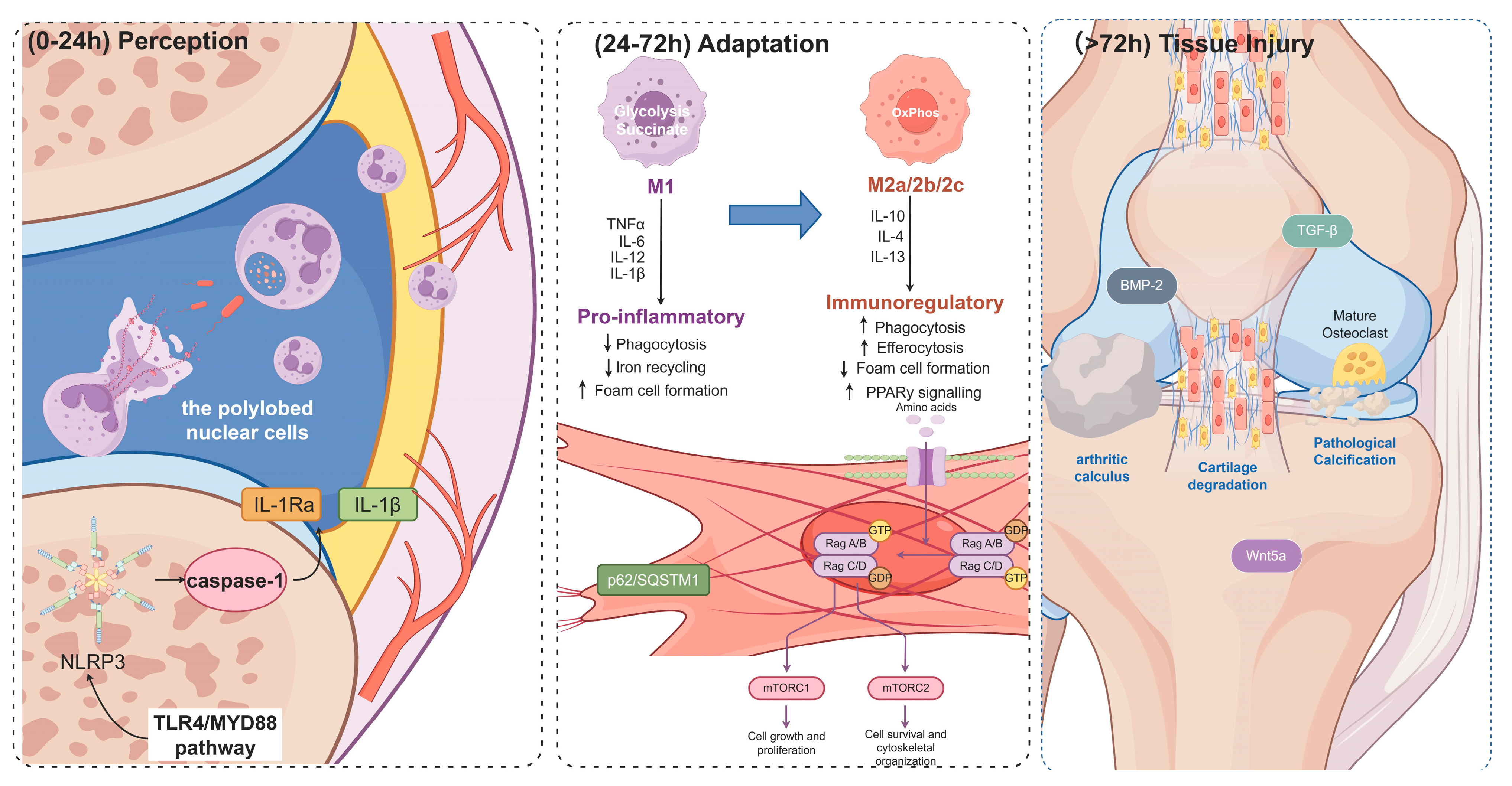
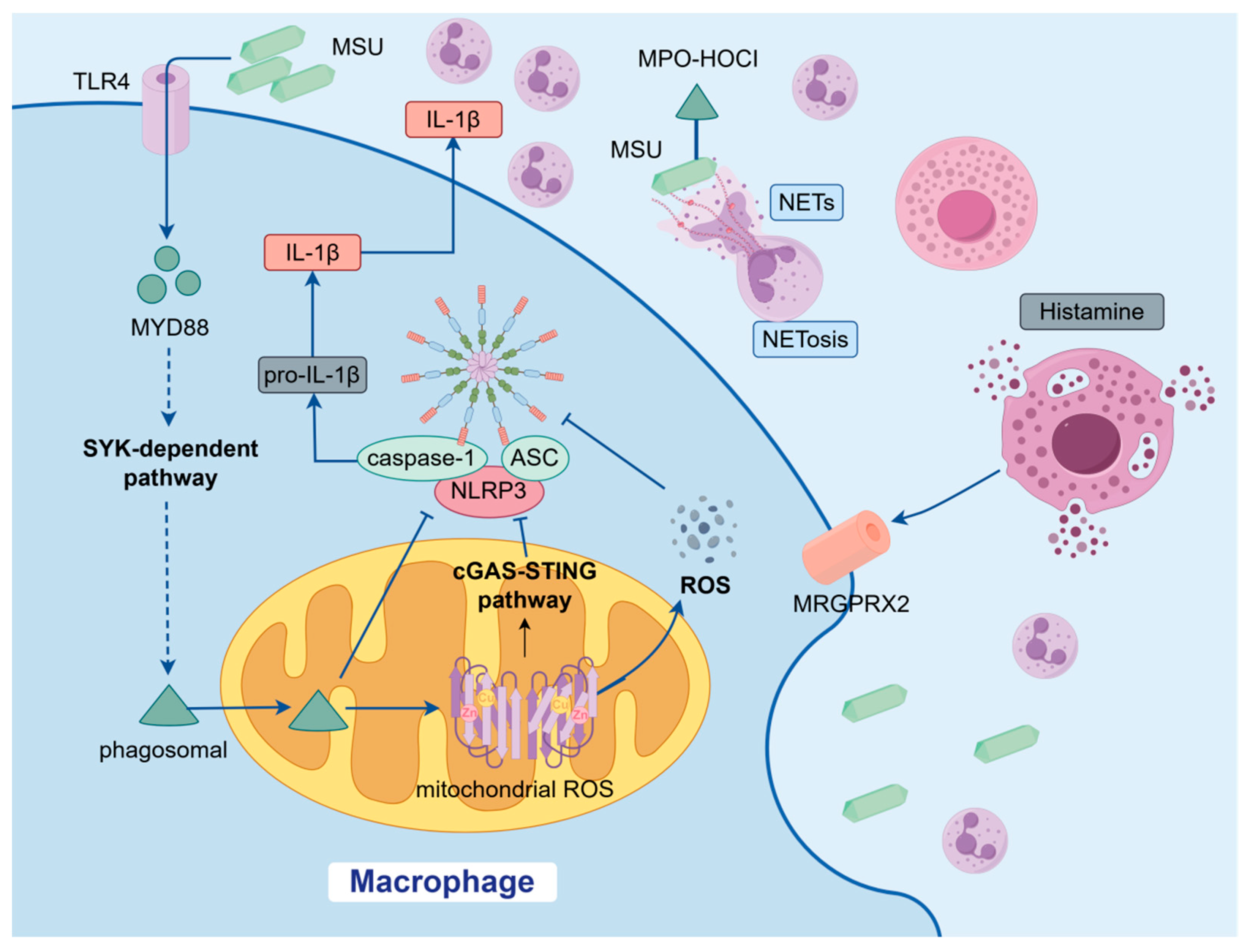
2.1. Acute Phase (0–24 h): Crystal Trigger and Outbreak Response
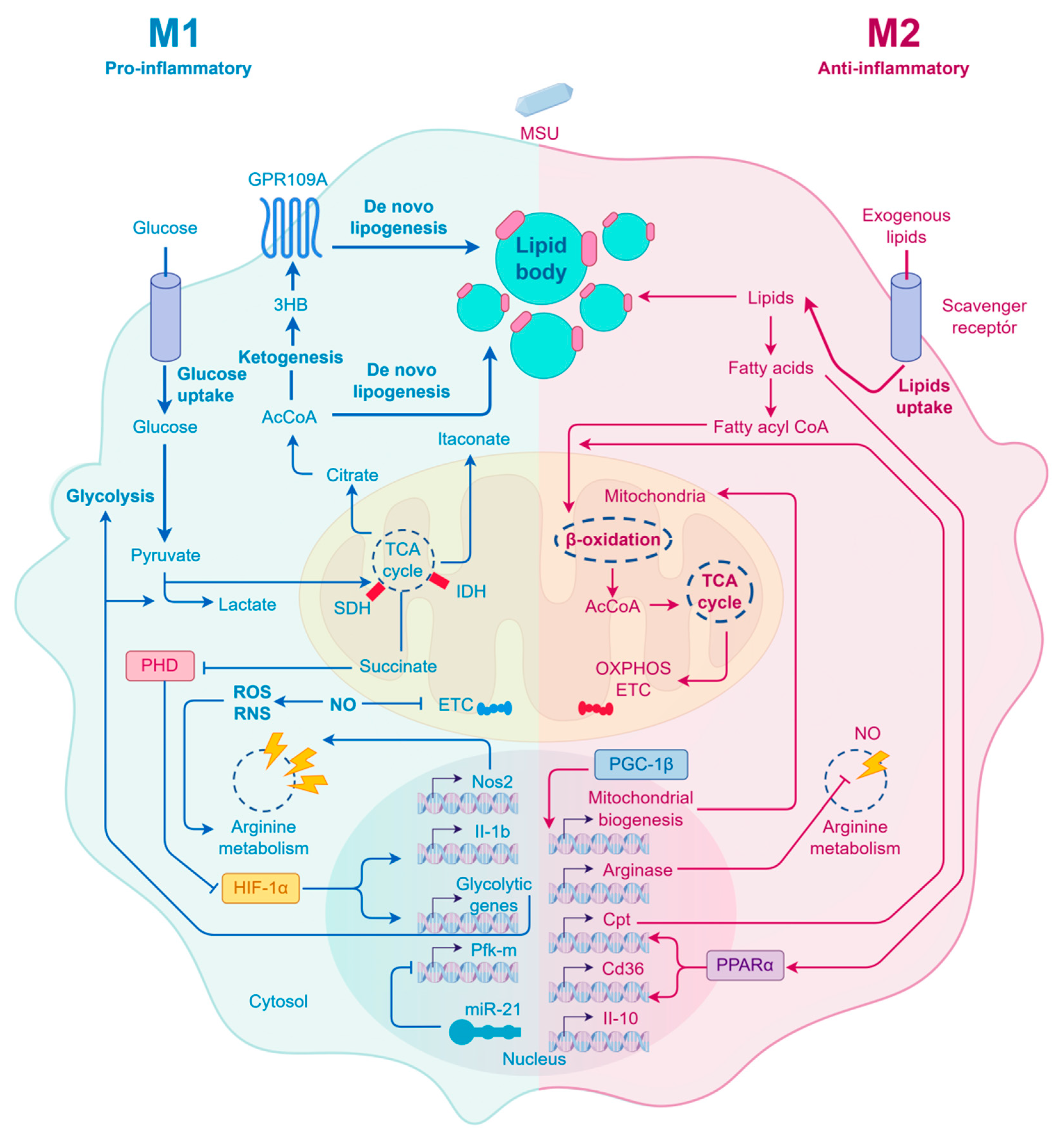
2.2. Transition Phase (24–72 h): Immunometabolic Reprogramming
2.3. Chronic Phase (>72 h): Tissue Memory Formation
2.3.1. Epigenetic Memory Formation
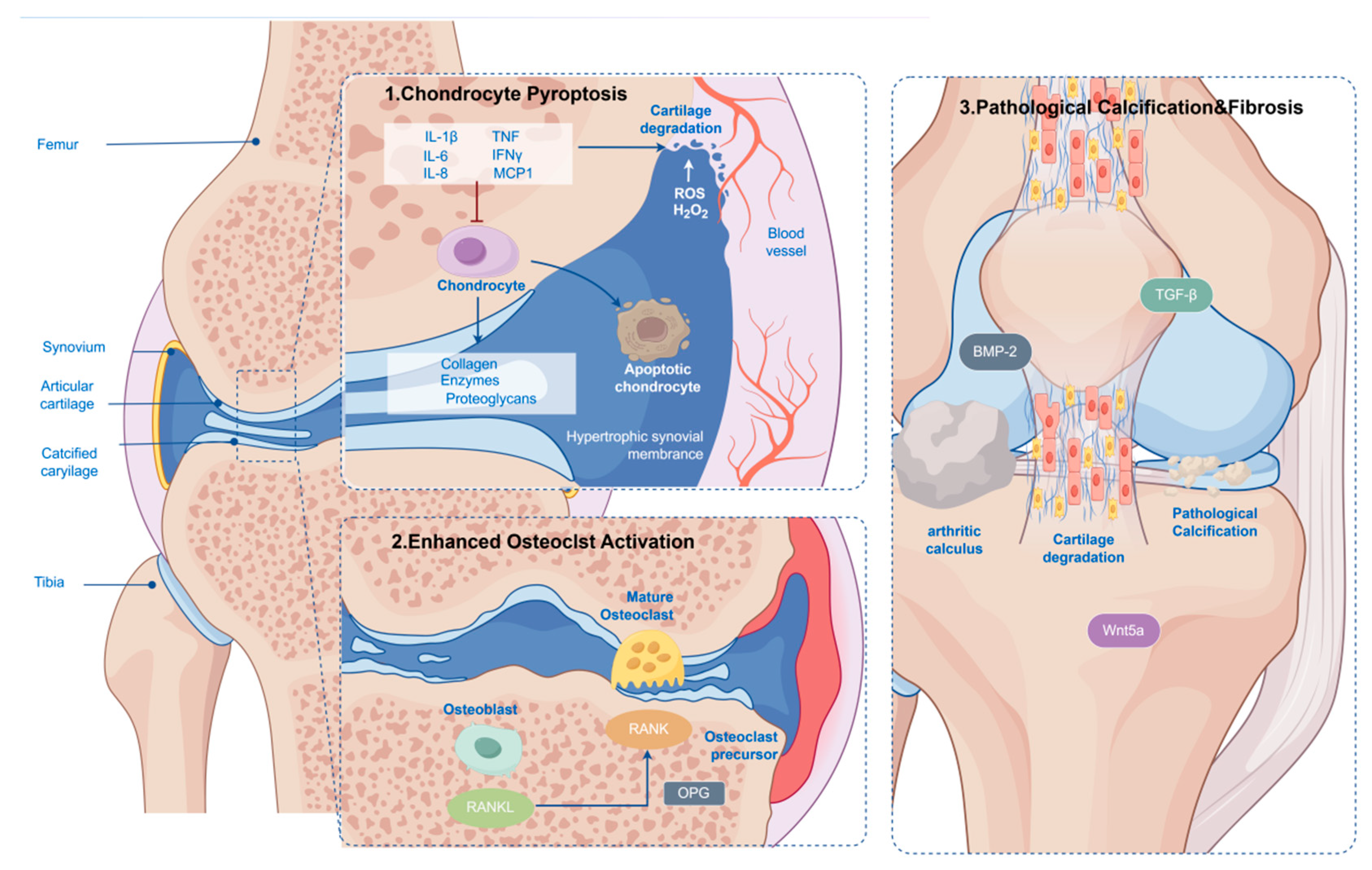
2.3.2. Triad of Osteoarticular Destruction

| Target Tissue | Core Mechanism | Key Effector Molecules/Pathways | Clinical/Imaging Correlation |
|---|---|---|---|
| Cartilage | Chondrocyte Pyroptosis and Matrix Degradation | Gasdermin D, Various Matrix Degrading Enzymes | Double contour sign on US; Cartilage erosion on MRI [30,37,57] |
| Bone | Enhanced Osteoclast Activation | RANKL/RANK/OPG System | Bone erosions and bone marrow edema detectable by DECT/MRI [30,44,69] |
| Tendons/Ligaments | Pathological Calcification, Fibrosis and Tophus Formation | BMP-2, Wnt5a, TGF-β | DECT allows volume quantification of urate deposits; US visualizes tophi and aggregates [29,37,58] |
| Target Tissue | Core Mechanism | Key Effector Molecules/Pathways | Clinical/Imaging Correlation |
3. Treatment Transformation
3.1. Phase-Specific Interventions
3.1.1. Targeted Intervention in the Acute Phase (<24 h)
3.1.2. Key Regulatory Mechanisms During the Transformation Period (24–72 h)
3.1.3. Chronic Phase Tissue Protection (>72 h)
3.2. Frontier Technology
4. Disputes and Prospects
4.1. The Unsolved Mystery: The Underlying Puzzle Revealed by the Model
4.1.1. The Mystery of Disease Resilience: Why Do Some Patients Not Progress to Chronicity
| Mechanism Category | Key Factors/Pathways | Proposed Protective Role | Research Status/Evidence Level |
|---|---|---|---|
| Genetic Buffering | CARD8 loss-of-function variants (e.g., p.C10X) | Disrupts stable NLRP3 inflammasome assembly, reducing IL-1β release. | GWAS-validated; functional studies support [113,114]. |
| IL1RN promoter SNPs | May increase baseline IL-1Ra expression, enhancing feedback inhibition of IL-1 signaling. | Association studies; mechanistic plausibility. | |
| ABCG2/SLC2A9 high-function variants | Promotes urate excretion, reducing intracellular urate load and crystallization risk. | Validated in multiple populations; functionally established [97,114]. | |
| Epigenetic Buffering | Enriched H3K27me3/reduced H3K4me3 at pro-inflammatory gene promoters | Maintains repressive chromatin state, resisting excessive activation by inflammatory signals. | Inferred from epigenomic concepts; analogy to other diseases [116]. |
| Non-coding RNAs (e.g., miR-146a) upregulation | Targets and inhibits signaling nodes (e.g., IRAK1, TRAF6), providing negative feedback. | Preliminary detection in gout; established in RA. | |
| Butyrate via HDAC inhibition | Enhances anti-inflammatory gene expression and suppresses pro-inflammatory cytokines. | Supported byin vitroexperiments [38,39,117]. | |
| Metabolic Buffering | Macrophage metabolic plasticity (rapid glycolysis → OXPHOS switch) | Prevents succinate accumulation, HIF-1α stabilization, and epigenetic dysregulation, favoring timely resolution. | Supported by metabolic flux analyses; pending validation in gout [35,36,61]. |
| Lower serum succinate/α-ketoglutarate ratio | Reflects TCA cycle integrity; may inversely correlate with chronicity risk. | Preliminary metabolomic cohort findings [98,118]. | |
| Systemic Buffering | Gut microbiota-derived butyrate | Promotes Treg differentiation via GPR109A/PPARγ, enhancing immune tolerance. | Animal model support; associative human data [119,120,121,122]. |
| Microbiota-immune axis homeostasis | Maintains systemic inflammatory threshold, reducing risk of excessive sterile inflammation. | Conceptual support; mechanisms require elucidation. |
4.1.2. Gut–Joint Axis: What Is the Precise Mechanism of Remote Regulation
- Metabolite-Mediated Communication: Gut microbiota-derived metabolites act as crucial systemic messengers. A key pathway involves short-chain fatty acids (SCFAs). Reduced levels of anti-inflammatory SCFAs (e.g., butyrate) in gout patients may weaken their inhibitory effects on peripheral immune cells. Butyrate has been shown to suppress MSU crystal-induced cytokine production in human monocytes via inhibition of class I histone deacetylases (HDACs) [2,39]. Conversely, other microbial metabolites may exert pro-inflammatory effects. For instance, succinate, which can be produced by certain gut bacteria, may reach the joint and exacerbate inflammation via the SUCNR1 receptor on macrophages, linking gut metabolism to in situ immunometabolic reprogramming [36,118]. Furthermore, the gut microbiome contributes to the host’s purine and uric acid pool through the metabolism of dietary nucleotides and the expression of microbial uricase, directly influencing hyperuricemia [124,125].
- Systemic Immune Cell Training: Microbial components or metabolites may systemically “train” innate immune cells, altering their baseline state and subsequent response to MSU crystals. This aligns with the broader concept of “trained immunity” [51]. For example, systemic exposure to microbial ligands may prime bone marrow myeloid precursors, leading to neutrophils with a heightened propensity for NETosis or monocytes/macrophages with a lower activation threshold upon encountering crystals [9,126]. This could explain the “hyper-responsive” phenotype observed in some gout patients.
- Barrier Integrity and Antigenic Mimicry: Intestinal dysbiosis is often associated with increased gut permeability (“leaky gut”). This may facilitate the translocation of microbial products (e.g., lipopolysaccharide, LPS) into the circulation, contributing to a low-grade systemic inflammatory state that could lower the threshold for acute gout flares [127]. A more speculative hypothesis involves molecular mimicry, where immune responses primed against gut microbial antigens cross-react with structurally similar components in joint tissues, potentially contributing to chronic synovitis [110].
- Future Imperative: Disentangling this complex axis requires an integrated multi-omics approach. Future studies should concurrently analyze the gut metagenome, serum metabolome (particularly microbial metabolites), and synovial immunome from the same patients across disease phases to move from association to causal understanding [51,106,118].
4.2. Future Directions: TOWARD Precision Prevention and Treatment
4.2.1. Spatiotemporal Multi-Omics Integration Analysis
4.2.2. Precision Stratification in Clinical Trial Enrollment
4.3. Limitations of the Current Evidence and the Temporal Programming Model
5. Summary
Supplementary Materials
Author Contributions
Funding
Data Availability Statement
Acknowledgments
Conflicts of Interest
Abbreviations
| MSU | monosodium urate |
| NLRP3 | NOD-like receptor thermal protein domain associated protein 3 |
| ROS | reactive oxygen species |
| IL-1β | interleukin-1β |
| NETs | neutrophil extracellular traps |
| TLR4 | Toll-like receptors 4 |
| MYD88 | Myeloid Differentiation Primary Response 88 |
| ASICs | acid-sensing ion channels |
| SYK | Spleen tyrosine kinase |
| MRGPRX2 | Mas-related G protein-coupled receptor member X2 |
| STING | stimulator of interferon genes |
| ASC | apoptosis-associated speck-like protein containing a CARD |
| NETosis | neutrophil extracellular trap |
| MPO-HOCl | myeloperoxidase-hypochlorous acid |
| NAD | Nicotinamide Adenine Dinucleotide |
| SIRT1 | silent information regulator 1 |
| NF-κB | nuclear factor kappa-B |
| HDACs | histone deacetylases |
| CD39 | Ectonucleoside triphosphate diphosphohydrolase-1 |
| FLSs | Fibroblast-like synoviocytes |
| SQSTM1/p62 | Sequestosome 1 |
| mTORC1 | Mechanistic Target of Rapamycin Complex 1 |
| GAS | gout activity score |
| HDL-C | High density lipoprotein cholesterol |
| NUMB | NUMB endocytic adaptor protein |
| ABCG2 | ATP binding cassette subfamily G member 2 Gene |
| TNF-α | tumor necrosis factor-α |
| IL-6 | interleukin-6 |
| H3K4me3 | Tri-methylation of lysine 4 on histone H3 |
| H3K27ac | H3 K27 acetylation |
| ox-LDL | oxidized low-density lipoprotein |
| hs-CRP | high-sensitivity C-reactive protein |
| TADs | topologically associating domains |
| NFIL3 | nuclear factor, interleukin 3 regulated Gene |
| REDD1 | Regulated in Development and DNA Damage Response 1 |
| mTOR | mammalian target of rapamycin |
| MRI | magnetic resonance imaging |
| RANKL | Tumor necrosis factor ligand superfamily member 11 |
| RANK | Tumor necrosis factor receptor superfamily member 11A |
| OPG | osteoclastogenesis inhibitory factor |
| BMP-2 | Bone Morphogenetic Protein 2 |
| DECT | Dual Energy Computed Tomography |
| WNT5A | Wnt family member 5A Gene |
| TGF-β | Transforming growth factor beta |
| T2T | treat-to-target |
| ROS-NLRP3 | reactive oxygen species- NOD-like receptor thermal protein domain associated protein 3 |
| MitoQ | Mitoquinone mesylate |
| PAD4 | peptidylarginine deiminase 4 |
| GSK484 | peptidyl arginine deiminase 4 inhibitors |
| AMPK | Adenosine 5′-monophosphate (AMP)-activated protein kinase |
| MPC | mitochondrial pyruvate carrier |
| MLT-MLP | macrophage membrane-coated melatonin-loaded liposomes |
| SUCNR1 | succinate receptor |
| BET | Bromodomain and extraterminal |
| JQ1 | BET protein inhibitor |
| UMOD | uromodulin |
| CT | computed tomography |
| CARD8 | caspase recruitment domain family member 8 Gene |
| TNF | tumor necrosis factor domains |
| SCFAs | short-chain fatty acids |
| TGF-β1 | Transforming Growth Factor β1 |
| COMP | artilage oligomeric matrix protein |
References
- So, A.K.; Martinon, F. Inflammation in gout: Mechanisms and therapeutic targets. Nat. Rev. Rheumatol. 2017, 13, 639–647. [Google Scholar] [CrossRef] [Scilit] [PubMed]
- Cleophas, M.C.; Crişan, T.O.; Lemmers, H.; Toenhake-Dijkstra, H.; Fossati, G.; Jansen, T.L.; Dinarello, C.A.; Netea, M.G.; Joosten, L.A. Suppression of monosodium urate crystal-induced cytokine production by butyrate is mediated by the inhibition of class I histone deacetylases. Ann. Rheum. Dis. 2016, 75, 593–600. [Google Scholar] [CrossRef] [Scilit]
- Zamudio-Cuevas, Y.; Hernández-Díaz, C.; Pineda, C.; Reginato, A.M.; Cerna-Cortés, J.F.; Ventura-Ríos, L.; López-Reyes, A. Molecular basis of oxidative stress in gouty arthropathy. Clin. Rheumatol. 2015, 34, 1667–1672. [Google Scholar] [CrossRef] [Scilit]
- Moilanen, L.J.; Hämäläinen, M.; Lehtimäki, L.; Nieminen, R.M.; Moilanen, E. Urate crystal induced inflammation and joint pain are reduced in transient receptor potential ankyrin 1 deficient mice–potential role for transient receptor potential ankyrin 1 in gout. PLoS ONE 2015, 10, e0117770. [Google Scholar] [CrossRef] [Scilit] [PubMed]
- Martinon, F.; Pétrilli, V.; Mayor, A.; Tardivel, A.; Tschopp, J. Gout-associated uric acid crystals activate the NALP3 inflammasome. Nature 2006, 440, 237–241. [Google Scholar] [CrossRef] [Scilit] [PubMed]
- Pope, R.M.; Tschopp, J. The role of interleukin-1 and the inflammasome in gout: Implications for therapy. Arthritis Rheum. 2007, 56, 3183–3188. [Google Scholar] [CrossRef] [Scilit]
- Xian, H.; Liu, Y.; Rundberg Nilsson, A.; Gatchalian, R.; Crother, T.R.; Tourtellotte, W.G.; Zhang, Y.; Aleman-Muench, G.R.; Lewis, G.; Chen, W.; et al. Metformin inhibition of mitochondrial ATP and DNA synthesis abrogates NLRP3 inflammasome activation and pulmonary inflammation. Immunity 2021, 54, 1463–1477.e11. [Google Scholar] [CrossRef] [Scilit]
- Kuo, C.F.; Grainge, M.J.; See, L.C.; Yu, K.H.; Luo, S.F.; Zhang, W.; Doherty, M. Epidemiology and management of gout in Taiwan: A nationwide population study. Arthritis Res. Ther. 2015, 17, 13. [Google Scholar] [CrossRef] [Scilit]
- Maueröder, C.; Kienhöfer, D.; Hahn, J.; Schauer, C.; Manger, B.; Schett, G.; Herrmann, M.; Hoffmann, M.H. How neutrophil extracellular traps orchestrate the local immune response in gout. J. Mol. Med. 2015, 93, 727–734. [Google Scholar] [CrossRef] [Scilit] [PubMed]
- Desai, J.; Kumar, S.V.; Mulay, S.R.; Konrad, L.; Romoli, S.; Schauer, C.; Herrmann, M.; Bilyy, R.; Müller, S.; Popper, B.; et al. PMA and crystal-induced neutrophil extracellular trap formation involves RIPK1-RIPK3-MLKL signaling. Eur. J. Immunol. 2016, 46, 223–229. [Google Scholar] [CrossRef] [Scilit]
- Schauer, C.; Janko, C.; Munoz, L.E.; Zhao, Y.; Kienhöfer, D.; Frey, B.; Lell, M.; Manger, B.; Rech, J.; Naschberger, E.; et al. Aggregated neutrophil extracellular traps limit inflammation by degrading cytokines and chemokines. Nat. Med. 2014, 20, 511–517. [Google Scholar] [CrossRef] [Scilit]
- Schlesinger, N.; Brunetti, L.; Androulakis, I.P. Does seasonality of the microbiota contribute to the seasonality of acute gout flare? Clin. Exp. Rheumatol. 2022, 40, 1793–1800. [Google Scholar] [CrossRef] [Scilit]
- Yang, C.S.; Kim, J.J.; Kim, T.S.; Lee, P.Y.; Kim, S.Y.; Lee, H.M.; Shin, D.M.; Nguyen, L.T.; Lee, M.S.; Jin, H.S.; et al. Small heterodimer partner interacts with NLRP3 and negatively regulates activation of the NLRP3 inflammasome. Nat. Commun. 2015, 6, 6115. [Google Scholar] [CrossRef] [Scilit] [PubMed]
- Emad, Y.; Ragab, Y.; El-Naggar, A.; El-Shaarawy, N.; Abd-Allah, M.A.; Gamal, R.M.; Fathy, A.; Hawass, M.; Rasker, J.J. Gadolinium-enhanced MRI features of acute gouty arthritis on top of chronic gouty involvement in different joints. Clin. Rheumatol. 2015, 34, 1939–1947. [Google Scholar] [CrossRef] [Scilit]
- Dalbeth, N.; Merriman, T.R.; Stamp, L.K. Gout. Lancet 2016, 388, 2039–2052. [Google Scholar] [CrossRef] [Scilit] [PubMed]
- Rees, F.; Doherty, M. Patients with gout can be cured in primary care. Practitioner 2014, 258, 15–19. [Google Scholar] [PubMed]
- Merriman, T.R. An update on the genetic architecture of hyperuricemia and gout. Arthritis Res. Ther. 2015, 17, 98. [Google Scholar] [CrossRef] [Scilit]
- Lim, H.; Min, D.S.; Park, H.; Kim, H.P. Flavonoids interfere with NLRP3 inflammasome activation. Toxicol. Appl. Pharmacol. 2018, 355, 93–102. [Google Scholar] [CrossRef] [Scilit]
- Maier, N.K.; Leppla, S.H.; Moayeri, M. The cyclopentenone prostaglandin 15d-PGJ2 inhibits the NLRP1 and NLRP3 inflammasomes. J. Immunol. 2015, 194, 2776–2785. [Google Scholar] [CrossRef] [Scilit]
- Gicquel, T.; Robert, S.; Loyer, P.; Victoni, T.; Bodin, A.; Ribault, C.; Gleonnec, F.; Couillin, I.; Boichot, E.; Lagente, V. IL-1β production is dependent on the activation of purinergic receptors and NLRP3 pathway in human macrophages. FASEB J. 2015, 29, 4162–4173. [Google Scholar] [CrossRef] [Scilit]
- Coiffier, G.; Albert, J.D. Physiopathologie des arthropathies microcristallines Gout and and calcium pyrophosphate crystal arthropathies: Pathophysiology. Rev. Prat. 2015, 65, 666–667, 669–670. (In French) [Google Scholar] [PubMed]
- Xu, H.; Zhang, B.; Chen, Y.; Zeng, F.; Wang, W.; Chen, Z.; Cao, L.; Shi, J.; Chen, J.; Zhu, X.; et al. Type II collagen facilitates gouty arthritis by regulating MSU crystallisation and inflammatory cell recruitment. Ann. Rheum. Dis. 2023, 82, 416–427. [Google Scholar] [CrossRef] [Scilit]
- Hornung, V.; Bauernfeind, F.; Halle, A.; Samstad, E.O.; Kono, H.; Rock, K.L.; Fitzgerald, K.A.; Latz, E. Silica crystals and aluminum salts activate the NALP3 inflammasome through phagosomal destabilization. Nat. Immunol. 2008, 9, 847–856. [Google Scholar] [CrossRef] [Scilit]
- Amaral, F.A.; Costa, V.V.; Tavares, L.D.; Sachs, D.; Coelho, F.M.; Fagundes, C.T.; Soriani, F.M.; Silveira, T.N.; Cunha, L.D.; Zamboni, D.S.; et al. NLRP3 inflammasome-mediated neutrophil recruitment and hypernociception depend on leukotriene B(4) in a murine model of gout. Arthritis Rheum. 2012, 64, 474–484. [Google Scholar] [CrossRef] [Scilit]
- Wang, B.; Chen, S.; Qian, H.; Zheng, Q.; Chen, R.; Liu, Y.; Shi, G. Role of T cells in the pathogenesis and treatment of gout. Int. Immunopharmacol. 2020, 88, 106877. [Google Scholar] [CrossRef] [Scilit]
- Park, H.K.; Lee, S.J. Treatment of gouty arthritis is associated with restoring the gut microbiota and promoting the production of short-chain fatty acids. Arthritis Res. Ther. 2022, 24, 51. [Google Scholar] [CrossRef] [Scilit]
- Belkaid, Y.; Hand, T.W. Role of the microbiota in immunity and inflammation. Cell 2014, 157, 121–141. [Google Scholar] [CrossRef] [Scilit]
- Cao, J.; Spielmann, M.; Qiu, X.; Huang, X.; Ibrahim, D.M.; Hill, A.J.; Zhang, F.; Mundlos, S.; Christiansen, L.; Steemers, F.J.; et al. The single-cell transcriptional landscape of mammalian organogenesis. Nature 2019, 566, 496–502. [Google Scholar] [CrossRef] [Scilit]
- Parathithasan, N.; Lee, W.K.; Pianta, M.; Oon, S.; Perera, W. Gouty arthropathy: Review of clinico-pathologic and imaging features. J. Med. Imaging Radiat. Oncol. 2016, 60, 9–20. [Google Scholar] [CrossRef] [Scilit] [PubMed]
- Pascart, T.; Grandjean, A.; Capon, B.; Legrand, J.; Namane, N.; Ducoulombier, V.; Motte, M.; Vandecandelaere, M.; Luraschi, H.; Godart, C.; et al. Monosodium urate burden assessed with dual-energy computed tomography predicts the risk of flares in gout: A 12-month observational study: MSU burden and risk of gout flare. Arthritis Res. Ther. 2018, 20, 210. [Google Scholar] [CrossRef] [Scilit] [PubMed]
- O’Neill, L.A.; Pearce, E.J. Immunometabolism governs dendritic cell and macrophage function. J. Exp. Med. 2016, 213, 15–23. [Google Scholar] [CrossRef] [Scilit]
- Chen, Y.; Ren, X.; Li, C.; Xing, S.; Fu, Z.; Yuan, Y.; Wang, R.; Wang, Y.; Lv, W. CARD8 rs2043211 polymorphism is associated with gout in a Chinese male population. Cell. Physiol. Biochem. 2015, 35, 1394–1400. [Google Scholar] [CrossRef] [Scilit]
- Rossaneis, A.C.; Longhi-Balbinot, D.T.; Bertozzi, M.M.; Fattori, V.; Segato-Vendrameto, C.Z.; Badaro-Garcia, S.; Zaninelli, T.H.; Staurengo-Ferrari, L.; Borghi, S.M.; Carvalho, T.T.; et al. Ru(bpy)2(NO)SO3(PF6), a Nitric Oxide Donating Ruthenium Complex, Reduces Gout Arthritis in Mice. Front. Pharmacol. 2019, 10, 229. [Google Scholar] [CrossRef] [Scilit]
- Chen, K.; Ha, S.; Xu, L.; Liu, C.; Liu, Y.; Wu, X.; Li, Z.; Wu, S.; Yang, B.; Chen, Z. Fluorinated hydroxyapatite conditions a favorable osteo-immune microenvironment via triggering metabolic shift from glycolysis to oxidative phosphorylation. J. Transl. Med. 2024, 22, 437, Erratum in J. Transl. Med. 2025, 23, 430.. [Google Scholar] [CrossRef] [Scilit]
- Mills, E.L.; Kelly, B.; Logan, A.; Costa, A.S.H.; Varma, M.; Bryant, C.E.; Tourlomousis, P.; Däbritz, J.H.M.; Gottlieb, E.; Latorre, I.; et al. Succinate Dehydrogenase Supports Metabolic Repurposing of Mitochondria to Drive Inflammatory Macrophages. Cell 2016, 167, 457–470.e13. [Google Scholar] [CrossRef] [Scilit] [PubMed]
- Tannahill, G.M.; Curtis, A.M.; Adamik, J.; Palsson-McDermott, E.M.; McGettrick, A.F.; Goel, G.; Frezza, C.; Bernard, N.J.; Kelly, B.; Foley, N.H.; et al. Succinate is an inflammatory signal that induces IL-1β through HIF-1α. Nature 2013, 496, 238–242. [Google Scholar] [CrossRef] [Scilit]
- Wang, J.; Shao, Q. An observational study of ultrasound semiquantitative scoring for predicting the risk of gout flare. Z. Rheumatol. 2024, 83, 321–328. (In English) [Google Scholar] [CrossRef] [Scilit]
- Skjødt, H.; Østergaard, M.; Hørslev-Petersen, K.; Vestergaard, A.; Pødenphant, J.; Ejbjerg, B.; Hetland, M.L.; Krogh, N.S.; Ellingsen, T.; Junker, P.; et al. 2016 ACR/ARHP Annual Meeting Abstract Supplement. Arthritis Rheumatol. 2016, 68, 1–4550. [Google Scholar] [CrossRef] [Scilit]
- Segain, J.P.; Raingeard de la Blétière, D.; Bourreille, A.; Leray, V.; Gervois, N.; Rosales, C.; Ferrier, L.; Bonnet, C.; Blottière, H.M.; Galmiche, J.P. Butyrate inhibits inflammatory responses through NFkappaB inhibition: Implications for Crohn’s disease. Gut 2000, 47, 397–403. [Google Scholar] [CrossRef] [Scilit]
- Bours, M.J.; Swennen, E.L.; Di Virgilio, F.; Cronstein, B.N.; Dagnelie, P.C. Adenosine 5′-triphosphate and adenosine as endogenous signaling molecules in immunity and inflammation. Pharmacol. Ther. 2006, 112, 358–404. [Google Scholar] [CrossRef] [Scilit] [PubMed]
- Butera, G.; Mullappilly, N.; Masetto, F.; Palmieri, M.; Scupoli, M.T.; Pacchiana, R.; Donadelli, M. Regulation of Autophagy by Nuclear GAPDH and Its Aggregates in Cancer and Neurodegenerative Disorders. Int. J. Mol. Sci. 2019, 20, 2062. [Google Scholar] [CrossRef] [Scilit] [PubMed]
- Peng, J.; Gu, Y.; Liu, J.; Yi, H.; Ruan, D.; Huang, H.; Shu, Y.; Zong, Z.; Wu, R.; Li, H. Identification of SOCS3 and PTGS2 as new biomarkers for the diagnosis of gout by cross-species comprehensive analysis. Heliyon 2024, 10, e30020. [Google Scholar] [CrossRef] [Scilit]
- Cai, F.; Wang, F.; Hong, X.; Xie, X.H.; Shi, R.; Xie, Z.Y.; Wu, X.T. Acid-sensing ion channel 1a regulates the survival of nucleus pulposus cells in the acidic environment of degenerated intervertebral discs. Iran. J. Basic Med. Sci. 2016, 19, 812–820. [Google Scholar]
- Sidari, A.; Hill, E. Diagnosis and Treatment of Gout and Pseudogout for Everyday Practice. Prim. Care 2018, 45, 213–236. [Google Scholar] [CrossRef] [Scilit]
- Pyo, J.Y.; Ha, Y.J.; Song, J.J.; Park, Y.B.; Lee, S.K.; Lee, S.W. Delta neutrophil index contributes to the differential diagnosis between acute gout attack and cellulitis within 24 h after hospitalization. Rheumatology 2017, 56, 795–801. [Google Scholar] [CrossRef] [Scilit]
- Wang, L.; Fan, Y.; Gui, Y.; Yang, X.; Ye, X.; Cao, Y.; Zhang, Z. Endoplasmic reticulum stress triggered autophagy and regulated the phenotype transformation of rheumatoid arthritis synovial fibroblasts via the IRE1/JNK pathway. Ann. Transl. Med. 2022, 10, 725. [Google Scholar] [CrossRef] [Scilit]
- Mizushima, N.; Komatsu, M. Autophagy: Renovation of cells and tissues. Cell 2011, 147, 728–741. [Google Scholar] [CrossRef] [Scilit]
- Levine, B.; Kroemer, G. Biological Functions of Autophagy Genes: A Disease Perspective. Cell 2019, 176, 11–42. [Google Scholar] [CrossRef] [Scilit] [PubMed]
- Cvan Durme, C.M.; Wechalekar, M.D.; Landewé, R.B. Nonsteroidal anti-inflammatory drugs for treatment of acute gout. JAMA 2015, 313, 2276–2277. [Google Scholar] [CrossRef] [Scilit] [PubMed]
- Khanna, P.P.; Gladue, H.S.; Singh, M.K.; FitzGerald, J.D.; Bae, S.; Prakash, S.; Kaldas, M.; Gogia, M.; Berrocal, V.; Townsend, W.; et al. Treatment of acute gout: A systematic review. Semin. Arthritis Rheum. 2014, 44, 31–38. [Google Scholar] [CrossRef] [Scilit]
- Netea, M.G.; Domínguez-Andrés, J.; Barreiro, L.B.; Chavakis, T.; Divangahi, M.; Fuchs, E.; Joosten, L.A.B.; van der Meer, J.W.M.; Mhlanga, M.M.; Mulder, W.J.M.; et al. Defining trained immunity and its role in health and disease. Nat. Rev. Immunol. 2020, 20, 375–388. [Google Scholar] [CrossRef] [Scilit] [PubMed]
- Hill, E.M.; Sky, K.; Sit, M.; Collamer, A.; Higgs, J. Does starting allopurinol prolong acute treated gout? A randomized clinical trial. J. Clin. Rheumatol. 2015, 21, 120–125. [Google Scholar] [CrossRef] [Scilit]
- Cleophas, M.C.; Crişan, T.O.; Joosten, L.A. Factors modulating the inflammatory response in acute gouty arthritis. Curr. Opin. Rheumatol. 2017, 29, 163–170. [Google Scholar] [CrossRef] [Scilit] [PubMed]
- Saeed, S.; Quintin, J.; Kerstens, H.H.; Rao, N.A.; Aghajanirefah, A.; Matarese, F.; Cheng, S.C.; Ratter, J.; Berentsen, K.; van der Ent, M.A.; et al. Epigenetic programming of monocyte-to-macrophage differentiation and trained innate immunity. Science 2014, 345, 1251086. [Google Scholar] [CrossRef] [Scilit] [PubMed]
- Singh, G.; Lingala, B.; Mithal, A. Gout and hyperuricaemia in the USA: Prevalence and trends. Rheumatology 2019, 58, 2177–2180. [Google Scholar] [CrossRef] [Scilit]
- Sellmer, A.; Stangl, H.; Beyer, M.; Grünstein, E.; Leonhardt, M.; Pongratz, H.; Eichhorn, E.; Elz, S.; Striegl, B.; Jenei-Lanzl, Z.; et al. Marbostat-100 Defines a New Class of Potent and Selective Antiinflammatory and Antirheumatic Histone Deacetylase 6 Inhibitors. J. Med. Chem. 2018, 61, 3454–3477. [Google Scholar] [CrossRef] [Scilit]
- Zhuang, H.; Ren, X.; Jiang, F.; Zhou, P. Indole-3-propionic acid alleviates chondrocytes inflammation and osteoarthritis via the AhR/NF-κB axis. Mol. Med. 2023, 29, 17. [Google Scholar] [CrossRef] [Scilit]
- Lories, R.J.; Luyten, F.P. The bone-cartilage unit in osteoarthritis. Nat. Rev. Rheumatol. 2011, 7, 43–49. [Google Scholar] [CrossRef] [Scilit]
- Han, T.; Chen, W.; Qiu, X.; Wang, W. Epidemiology of gout—Global burden of disease research from 1990 to 2019 and future trend predictions. Ther. Adv. Endocrinol. Metab. 2024, 15, 20420188241227295. [Google Scholar] [CrossRef] [Scilit]
- Hu, S.; Dalbeth, N.; Li, Z.; Chen, Y.; Dong, B.; Wang, C.; Sun, W.; Li, C.; Lu, J. Associations of the ALDH2 rs671 polymorphism and alcohol intake with early-onset gout in a Chinese male cohort. Jt. Bone Spine 2025, 92, 105876. [Google Scholar] [CrossRef] [Scilit]
- Zobbe, K.; Prieto-Alhambra, D.; Cordtz, R.; Højgaard, P.; Hindrup, J.S.; Kristensen, L.E.; Dreyer, L. Secular trends in the incidence and prevalence of gout in Denmark from 1995 to 2015: A nationwide register-based study. Rheumatology 2019, 58, 836–839. [Google Scholar] [CrossRef] [Scilit]
- Foster, S.L.; Hargreaves, D.C.; Medzhitov, R. Gene-specific control of inflammation by TLR-induced chromatin modifications. Nature 2007, 447, 972–978, Erratum in Nature 2008, 451, 102.. [Google Scholar] [CrossRef] [Scilit] [PubMed]
- Ostuni, R.; Piccolo, V.; Barozzi, I.; Polletti, S.; Termanini, A.; Bonifacio, S.; Curina, A.; Prosperini, E.; Ghisletti, S.; Natoli, G. Latent enhancers activated by stimulation in differentiated cells. Cell 2013, 152, 157–171. [Google Scholar] [CrossRef] [Scilit] [PubMed]
- Dixon, J.R.; Selvaraj, S.; Yue, F.; Kim, A.; Li, Y.; Shen, Y.; Hu, M.; Liu, J.S.; Ren, B. Topological domains in mammalian genomes identified by analysis of chromatin interactions. Nature 2012, 485, 376–380. [Google Scholar] [CrossRef] [Scilit]
- Zhang, S.; Zhang, Y.; Liu, P.; Zhang, W.; Ma, J.L.; Wang, J. Efficacy and safety of etoricoxib compared with NSAIDs in acute gout: A systematic review and a meta-analysis. Clin. Rheumatol. 2016, 35, 151–158. [Google Scholar] [CrossRef] [Scilit]
- Zhang, X.; Tang, Y.; Wang, M.; Wang, D.; Li, Q. The clinical efficacy of urate-lowering therapy in acute gout: A meta-analysis of randomized controlled trials. Clin. Rheumatol. 2021, 40, 701–710. [Google Scholar] [CrossRef] [Scilit] [PubMed]
- Singh, J.A.; Cleveland, J.D. Gout and the risk of myocardial infarction in older adults: A study of Medicare recipients. Arthritis Res. Ther. 2018, 20, 109. [Google Scholar] [CrossRef] [Scilit]
- Pavic, K.; Pandya, J.; Sebak, S.; Shetty, A.; Spencer, D.; Manolios, N. Acute arthritis: Predictive factors and current practice in the approach to diagnosis and management across two hospitals in Sydney. Intern. Med. J. 2018, 48, 1087–1095. [Google Scholar] [CrossRef] [Scilit]
- Yasuda, H. Discovery of the RANKL/RANK/OPG system. J. Bone Miner. Metab. 2021, 39, 2–11, Correction in J. Bone Miner. Metab. 2021, 39, 12.. [Google Scholar] [CrossRef] [Scilit]
- Zhou, R.; Yazdi, A.S.; Menu, P.; Tschopp, J. A role for mitochondria in NLRP3 inflammasome activation. Nature 2011, 469, 221–225, Erratum in Nature 2011, 475, 122. [Google Scholar] [CrossRef] [Scilit]
- Kelley, N.; Jeltema, D.; Duan, Y.; He, Y. The NLRP3 Inflammasome: An Overview of Mechanisms of Activation and Regulation. Int. J. Mol. Sci. 2019, 20, 3328. [Google Scholar] [CrossRef] [Scilit] [PubMed]
- Smith, R.A.; Murphy, M.P. Animal and human studies with the mitochondria-targeted antioxidant MitoQ. Ann. N. Y. Acad. Sci. 2010, 1201, 96–103. [Google Scholar] [CrossRef] [Scilit]
- Mao, P.; Manczak, M.; Shirendeb, U.P.; Reddy, P.H. MitoQ, a mitochondria-targeted antioxidant, delays disease progression and alleviates pathogenesis in an experimental autoimmune encephalomyelitis mouse model of multiple sclerosis. Biochim. Biophys. Acta. 2013, 1832, 2322–2331. [Google Scholar] [CrossRef] [Scilit]
- Pang, M.; Wang, S.; Shi, T.; Chen, J. Overview of MitoQ on prevention and management of cardiometabolic diseases: A scoping review. Front. Cardiovasc. Med. 2025, 12, 1506460. [Google Scholar] [CrossRef] [Scilit]
- Bu, W.J.; Li, S.S.; Liu, C.; Wang, Y.H.; Lu, J.R.; Dong, C.R.; Zheng, D.J.; Fan, Z.Y.; Yu, Y.; Zhang, W.; et al. Nepetin limits NLRP3 inflammasome activation and alleviates NLRP3-driven inflammatory diseases via PINK1-dependent mitophagy. Free Radic. Biol. Med. 2025, 227, 420–433. [Google Scholar] [CrossRef] [Scilit]
- Yang, S.; Huang, G.; Ting, J.P. Mitochondria and NLRP3: To die or inflame. Immunity 2025, 58, 5–7. [Google Scholar] [CrossRef] [Scilit]
- Lewis, H.D.; Liddle, J.; Coote, J.E.; Atkinson, S.J.; Barker, M.D.; Bax, B.D.; Bicker, K.L.; Bingham, R.P.; Campbell, M.; Chen, Y.H.; et al. Inhibition of PAD4 activity is sufficient to disrupt mouse and human NET formation. Nat. Chem. Biol. 2015, 11, 189–191. [Google Scholar] [CrossRef] [Scilit]
- Li, P.; Li, M.; Lindberg, M.R.; Kennett, M.J.; Xiong, N.; Wang, Y. PAD4 is essential for antibacterial innate immunity mediated by neutrophil extracellular traps. J. Exp. Med. 2010, 207, 1853–1862. [Google Scholar] [CrossRef] [Scilit] [PubMed]
- Ricciotti, E.; FitzGerald, G.A. Prostaglandins and inflammation. Arterioscler. Thromb. Vasc. Biol. 2011, 31, 986–1000. [Google Scholar] [CrossRef] [Scilit] [PubMed]
- Schlesinger, N.; Alten, R.E.; Bardin, T.; Schumacher, H.R.; Bloch, M.; Gimona, A.; Krammer, G.; Murphy, V.; Richard, D.; So, A.K. Canakinumab for acute gouty arthritis in patients with limited treatment options: Results from two randomised, multicentre, active-controlled, double-blind trials and their initial extensions. Ann. Rheum. Dis. 2012, 71, 1839–1848. [Google Scholar] [CrossRef] [Scilit]
- Cameron, A.R.; Morrison, V.L.; Levin, D.; Mohan, M.; Forteath, C.; Beall, C.; McNeilly, A.D.; Balfour, D.J.; Savinko, T.; Wong, A.K.; et al. Anti-Inflammatory Effects of Metformin Irrespective of Diabetes Status. Circ. Res. 2016, 119, 652–665. [Google Scholar] [CrossRef] [Scilit]
- Kelly, B.; O’Neill, L.A. Metabolic reprogramming in macrophages and dendritic cells in innate immunity. Cell Res. 2015, 25, 771–784. [Google Scholar] [CrossRef] [Scilit] [PubMed]
- Levy, J.M.M.; Towers, C.G.; Thorburn, A. Targeting autophagy in cancer. Nat. Rev. Cancer 2017, 17, 528–542. [Google Scholar] [CrossRef] [Scilit]
- Cleophas, M.C.P.; Crişan, T.O.; Klück, V.; Hoogerbrugge, N.; Netea-Maier, R.T.; Dinarello, C.A.; Netea, M.G.; Joosten, L.A.B. Romidepsin suppresses monosodium urate crystal-induced cytokine production through upregulation of suppressor of cytokine signaling 1 expression. Arthritis Res. Ther. 2019, 21, 50. [Google Scholar] [CrossRef] [Scilit]
- He, F.; Huang, Y.; Song, Z.; Zhou, H.J.; Zhang, H.; Perry, R.J.; Shulman, G.I.; Min, W. Mitophagy-mediated adipose inflammation contributes to type 2 diabetes with hepatic insulin resistance. J. Exp. Med. 2021, 218, e20201416, Correction in J. Exp. Med. 2025, 222, e2020141606022025c. [Google Scholar] [CrossRef] [Scilit]
- Martineau, X.; Abed, É.; Martel-Pelletier, J.; Pelletier, J.P.; Lajeunesse, D. Alteration of Wnt5a expression and of the non-canonical Wnt/PCP and Wnt/PKC-Ca2+ pathways in human osteoarthritis osteoblasts. PLoS ONE 2017, 12, e0180711. [Google Scholar] [CrossRef] [Scilit]
- Wang, Y.; Fan, X.; Xing, L.; Tian, F. Wnt signaling: A promising target for osteoarthritis therapy. Cell Commun. Signal. 2019, 17, 97. [Google Scholar] [CrossRef] [Scilit]
- Reinke, H.; Asher, G. Crosstalk between metabolism and circadian clocks. Nat. Rev. Mol. Cell Biol. 2019, 20, 227–241. [Google Scholar] [CrossRef] [Scilit]
- Becker, M.A.; Schumacher, H.R., Jr.; Wortmann, R.L.; MacDonald, P.A.; Eustace, D.; Palo, W.A.; Streit, J.; Joseph-Ridge, N. Febuxostat compared with allopurinol in patients with hyperuricemia and gout. N. Engl. J. Med. 2005, 353, 2450–2461. [Google Scholar] [CrossRef] [Scilit] [PubMed]
- Whangbo, M.; Ko, E.; Kim, D.; Jeon, C.; Jo, H.R.; Lee, S.H.; Youn, J.; Jo, S.; Kim, T.H. Wnt5a exacerbates pathological bone features and trabecular bone loss in curdlan-injected SKG mice via osteoclast activation. BMB Rep. 2025, 58, 75–81. [Google Scholar] [CrossRef] [Scilit] [PubMed]
- Bougault, C.; Briolay, A.; Boutet, M.A.; Pilet, P.; Delplace, S.; Le Goff, B.; Guicheux, J.; Blanchard, F.; Magne, D. Wnt5a is expressed in spondyloarthritis and exerts opposite effects on enthesis and bone in murine organ and cell cultures. Transl. Res. 2015, 166, 627–638. [Google Scholar] [CrossRef] [Scilit]
- Fan, M.; Liu, J.; Zhao, B.; Wu, X.; Li, X.; Gu, J.; Schlesinger, N. Comparison of efficacy and safety of urate-lowering therapies for hyperuricemic patients with gout: A meta-analysis of randomized, controlled trials. Clin. Rheumatol. 2021, 40, 683–692. [Google Scholar] [CrossRef] [Scilit]
- Schlesinger, N.; Lipsky, P.E. Pegloticase treatment of chronic refractory gout: Update on efficacy and safety. Semin. Arthritis Rheum. 2020, 50, S31–S38. [Google Scholar] [CrossRef] [Scilit]
- FitzGerald, J.D.; Dalbeth, N.; Mikuls, T.; Brignardello-Petersen, R.; Guyatt, G.; Abeles, A.M.; Gelber, A.C.; Harrold, L.R.; Khanna, D.; King, C.; et al. 2020 American College of Rheumatology Guideline for the Management of Gout. Arthritis Care Res. 2020, 72, 744–760. [Google Scholar] [CrossRef] [Scilit]
- Masters, S.L.; Simon, A.; Aksentijevich, I.; Kastner, D.L. Horror autoinflammaticus: The molecular pathophysiology of autoinflammatory disease. Annu. Rev. Immunol. 2009, 27, 621–668. [Google Scholar] [CrossRef] [Scilit]
- An, Z.; Zhang, L.; Liu, Y.; Zhao, H.; Zhang, Y.; Cao, Y.; Zhang, Y.; Pei, R. Injectable thioketal-containing hydrogel dressing accelerates skin wound healing with the incorporation of reactive oxygen species scavenging and growth factor release. Biomater. Sci. 2021, 10, 100–113. [Google Scholar] [CrossRef] [Scilit] [PubMed]
- Jiri, M.; Zhang, L.; Lan, B.; He, N.; Feng, T.; Liu, K.; Jin, T.; Kang, L. Genetic variation in the ABCG2 gene is associated with gout risk in the Chinese Han population. Clin. Rheumatol. 2016, 35, 159–163. [Google Scholar] [CrossRef] [Scilit] [PubMed]
- Wang, W.; Kou, J.; Zhang, M.; Wang, T.; Li, W.; Wang, Y.; Xie, Q.; Wei, M. A metabonomic study to explore potential markers of asymptomatic hyperuricemia and acute gouty arthritis. J. Orthop. Surg. Res. 2023, 18, 96. [Google Scholar] [CrossRef] [Scilit]
- Dalbeth, N.; House, M.E.; Aati, O.; Tan, P.; Franklin, C.; Horne, A.; Gamble, G.D.; Stamp, L.K.; Doyle, A.J.; McQueen, F.M. Urate crystal deposition in asymptomatic hyperuricaemia and symptomatic gout: A dual energy CT study. Ann. Rheum. Dis. 2015, 74, 908–911. [Google Scholar] [CrossRef] [Scilit] [PubMed]
- Yang, Y.; Guo, Y.; Yu, S.; Zou, B. Computed tomography and magnetic resonance imaging findings in gouty arthritis involving large joints of the upper extremities. BMC Med. Imaging 2022, 22, 167. [Google Scholar] [CrossRef] [Scilit]
- Qing, Y.F.; Zheng, J.X.; Tang, Y.P.; Dai, F.; Dong, Z.R.; Zhang, Q.B. LncRNAs Landscape in the patients of primary gout by microarray analysis. PLoS ONE 2021, 16, e0232918. [Google Scholar] [CrossRef] [Scilit]
- Sun, T.; He, X.; Li, Z. Digital twin in healthcare: Recent updates and challenges. Digit. Health 2023, 9, 20552076221149651. [Google Scholar] [CrossRef] [Scilit]
- Parodi, A.; Quattrocchi, N.; van de Ven, A.L.; Chiappini, C.; Evangelopoulos, M.; Martinez, J.O.; Brown, B.S.; Khaled, S.Z.; Yazdi, I.K.; Enzo, M.V.; et al. Synthetic nanoparticles functionalized with biomimetic leukocyte membranes possess cell-like functions. Nat. Nanotechnol. 2013, 8, 61–68. [Google Scholar] [CrossRef] [Scilit]
- Wang, Q.; Feng, K.; Wan, G.; Liao, W.; Jin, J.; Wang, P.; Sun, X.; Wang, W.; Jiang, Q. A ROS-responsive hydrogel encapsulated with matrix metalloproteinase-13 siRNA nanocarriers to attenuate osteoarthritis progression. J. Nanobiotechnol. 2025, 23, 18. [Google Scholar] [CrossRef] [Scilit]
- Kuang, Y.; Hua, B.; Ye, X.; Zhao, Y.; Yu, M.; Liu, X. Dual-functional ROS-responsive hydrogel alleviates temporomandibular joint osteoarthritis by enhancing cartilage repair and mitigating inflammation. Mater. Today Bio 2025, 33, 102103. [Google Scholar] [CrossRef] [Scilit] [PubMed]
- Ståhl, P.L.; Salmén, F.; Vickovic, S.; Lundmark, A.; Navarro, J.F.; Magnusson, J.; Giacomello, S.; Asp, M.; Westholm, J.O.; Huss, M.; et al. Visualization and analysis of gene expression in tissue sections by spatial transcriptomics. Science 2016, 353, 78–82. [Google Scholar] [CrossRef] [Scilit]
- Moses, L.; Pachter, L. Museum of spatial transcriptomics. Nat. Methods 2022, 19, 534–546. [Google Scholar] [CrossRef] [Scilit] [PubMed]
- Woodcock, J.; LaVange, L.M. Master Protocols to Study Multiple Therapies, Multiple Diseases, or Both. N. Engl. J. Med. 2017, 377, 62–70. [Google Scholar] [CrossRef] [Scilit]
- Wang, P.; Chow, S.C. Sample size re-estimation in clinical trials. Stat. Med. 2021, 40, 6133–6149. [Google Scholar] [CrossRef] [Scilit] [PubMed]
- Dipalma, G.; Inchingolo, A.M.; Inchingolo, F.; Palumbo, I.; Riccaldo, L.; Guglielmo, M.; Morolla, R.; Palermo, A.; Marinelli, G.; Inchingolo, A.D. The Precision Paradigm in Periodontology: A Multilevel Framework for Tailored Diagnosis, Treatment, and Prevention. J. Pers. Med. 2025, 15, 440. [Google Scholar] [CrossRef] [Scilit]
- Tse, J.J.; Kondro, D.A.; Kuczynski, M.T.; Pauchard, Y.; Veljkovic, A.; Holdsworth, D.W.; Frasson, V.; Manske, S.L.; MacMullan, P.; Salat, P. Assessing the Sensitivity of Dual-Energy Computed Tomography 3-Material Decomposition for the Detection of Gout. Investig. Radiol. 2022, 57, 613–619. [Google Scholar] [CrossRef] [Scilit]
- Fialho, S.; Trieu-Cuot, P.; Ferreira, P.; Oliveira, L. Could P2X7 receptor be a potencial target in neonatal sepsis? Int. Immunopharmacol. 2024, 142, 112969. [Google Scholar] [CrossRef] [Scilit]
- Crișan, T.O.; Cleophas, M.C.; Oosting, M.; Lemmers, H.; Toenhake-Dijkstra, H.; Netea, M.G.; Jansen, T.L.; Joosten, L.A. Soluble uric acid primes TLR-induced proinflammatory cytokine production by human primary cells via inhibition of IL-1Ra. Ann. Rheum. Dis. 2016, 75, 755–762. [Google Scholar] [CrossRef] [Scilit]
- Li, Z.; Zhou, Z.; Hou, X.; Lu, D.; Yuan, X.; Lu, J.; Wang, C.; Han, L.; Cui, L.; Liu, Z.; et al. Replication of Gout/Urate Concentrations GWAS Susceptibility Loci Associated with Gout in a Han Chinese Population. Sci. Rep. 2017, 7, 4094. [Google Scholar] [CrossRef] [Scilit]
- Yang, Q.; Köttgen, A.; Dehghan, A.; Smith, A.V.; Glazer, N.L.; Chen, M.H.; Chasman, D.I.; Aspelund, T.; Eiriksdottir, G.; Harris, T.B.; et al. Multiple genetic loci influence serum urate levels and their relationship with gout and cardiovascular disease risk factors. Circ. Cardiovasc. Genet. 2010, 3, 523–530. [Google Scholar] [CrossRef] [Scilit] [PubMed]
- Wolyncewicz, B.; Major, T.J.; Delahunt, B.; Thunders, M. The epigenome: Key to understanding and predicting gout flares. Pathology 2021, 53, 824–829. [Google Scholar] [CrossRef] [Scilit]
- Wang, L.; Ye, J. Commentary: Gut microbiota reduce the risk of hyperuricemia and gout in the human body. Acta Pharm. Sin. B 2024, 14, 433–435. [Google Scholar] [CrossRef] [Scilit]
- Rooks, M.G.; Garrett, W.S. Gut microbiota, metabolites and host immunity. Nat. Rev. Immunol. 2016, 16, 341–352. [Google Scholar] [CrossRef] [Scilit] [PubMed]
- Li, Z.; Su, Y.; Su, H.; Pan, J.; Li, S.; Lu, L.; Ji, G.; Xu, H. Serum uric acid and its metabolism-a vital factor in the inflammatory transformation of cancer. J. Adv. Res. 2025. [Google Scholar] [CrossRef] [Scilit] [PubMed]
- Joosten, L.A.; Crişan, T.O.; Azam, T.; Cleophas, M.C.; Koenders, M.I.; van de Veerdonk, F.L.; Netea, M.G.; Kim, S.; Dinarello, C.A. Alpha-1-anti-trypsin-Fc fusion protein ameliorates gouty arthritis by reducing release and extracellular processing of IL-1β and by the induction of endogenous IL-1Ra. Ann. Rheum. Dis. 2016, 75, 1219–1227. [Google Scholar] [CrossRef] [Scilit]
- Koh, A.; De Vadder, F.; Kovatcheva-Datchary, P.; Bäckhed, F. From Dietary Fiber to Host Physiology: Short-Chain Fatty Acids as Key Bacterial Metabolites. Cell 2016, 165, 1332–1345. [Google Scholar] [CrossRef] [Scilit] [PubMed]
- Vieira, A.T.; Galvão, I.; Macia, L.M.; Sernaglia, É.M.; Vinolo, M.A.; Garcia, C.C.; Tavares, L.P.; Amaral, F.A.; Sousa, L.P.; Martins, F.S.; et al. Dietary fiber and the short-chain fatty acid acetate promote resolution of neutrophilic inflammation in a model of gout in mice. J. Leucoc. Biol. 2017, 101, 275–284. [Google Scholar] [CrossRef] [Scilit] [PubMed]
- Wang, Q.; Clark, K.M.; Tiwari, R.; Raju, N.; Tharp, G.K.; Rogers, J.; Harris, R.A.; Raveendran, M.; Bosinger, S.E.; Burdo, T.H.; et al. The CARD8 inflammasome dictates HIV/SIV pathogenesis and disease progression. Cell 2024, 187, 1223–1237.e16. [Google Scholar] [CrossRef] [Scilit]
- Oliviero, F.; Scanu, A. How Factors Involved in the Resolution of Crystal-Induced Inflammation Target IL-1β. Front. Pharmacol. 2017, 8, 164. [Google Scholar] [CrossRef] [Scilit]
- Arts, R.J.W.; Joosten, L.A.B.; Netea, M.G. The Potential Role of Trained Immunity in Autoimmune and Autoinflammatory Disorders. Front. Imunol. 2018, 9, 298. [Google Scholar] [CrossRef] [Scilit]
- Schuijt, T.J.; Lankelma, J.M.; Scicluna, B.P.; de Sousa e Melo, F.; Roelofs, J.J.; de Boer, J.D.; Hoogendijk, A.J.; de Beer, R.; de Vos, A.; Belzer, C.; et al. The gut microbiota plays a protective role in the host defence against pneumococcal pneumonia. Gut 2016, 65, 575–583. [Google Scholar] [CrossRef] [Scilit]
- Sokol, H.; Leducq, V.; Aschard, H.; Pham, H.P.; Jegou, S.; Landman, C.; Cohen, D.; Liguori, G.; Bourrier, A.; Nion-Larmurier, I.; et al. Fungal microbiota dysbiosis in IBD. Gut 2017, 66, 1039–1048. [Google Scholar] [CrossRef] [Scilit]
- Grassi, W.; Okano, T.; Filippucci, E. Use of ultrasound for diagnosis and monitoring of outcomes in crystal arthropathies. Curr. Opin. Rheumatol. 2015, 27, 147–155. [Google Scholar] [CrossRef] [Scilit] [PubMed]
- MacParland, S.A.; Liu, J.C.; Ma, X.Z.; Innes, B.T.; Bartczak, A.M.; Gage, B.K.; Manuel, J.; Khuu, N.; Echeverri, J.; Linares, I.; et al. Single cell RNA sequencing of human liver reveals distinct intrahepatic macrophage populations. Nat. Commun. 2018, 9, 4383. [Google Scholar] [CrossRef] [Scilit]
- Stuart, T.; Satija, R. Integrative single-cell analysis. Nat. Rev. Genet. 2019, 20, 257–272. [Google Scholar] [CrossRef] [Scilit]
- Yen, J.H.; Lin, L.C.; Chen, M.C.; Sarang, Z.; Leong, P.Y.; Chang, I.C.; Hsu, J.D.; Chen, J.H.; Hsieh, Y.F.; Pallai, A.; et al. The metastatic tumor antigen 1-transglutaminase-2 pathway is involved in self-limitation of monosodium urate crystal-induced inflammation by upregulating TGF-β1. Arthritis Res. Ther. 2015, 17, 65. [Google Scholar] [CrossRef] [Scilit] [PubMed]
- Alduraibi, F.K.; Saleem, M.; Ricart, K.; Patel, R.P.; Szalai, A.J.; Singh, J.A. Clustering Patients With Gout Based on Comorbidities and Biomarkers: A Cross-Sectional Study. J. Rheumatol. 2023, 50, 817–826. [Google Scholar] [CrossRef] [Scilit]
- Grainger, R.; Dalbeth, N.; Keen, H.; Durcan, L.; Lawrence Edwards, N.; Perez-Ruiz, F.; Diaz-Torne, C.; Singh, J.A.; Khanna, D.; Simon, L.S.; et al. Imaging as an Outcome Measure in Gout Studies: Report from the OMERACT Gout Working Group. J. Rheumatol. 2015, 42, 2460–2464. [Google Scholar] [CrossRef] [Scilit]
- Stallard, N.; Hamborg, T.; Parsons, N.; Friede, T. Adaptive designs for confirmatory clinical trials with subgroup selection. J. Biopharm. Stat. 2014, 24, 168–187. [Google Scholar] [CrossRef] [Scilit]
- Coryell, P.R.; Diekman, B.O.; Loeser, R.F. Mechanisms and therapeutic implications of cellular senescence in osteoarthritis. Nat. Rev. Rheumatol. 2021, 17, 47–57. [Google Scholar] [CrossRef] [Scilit]
- Wu, X.; You, C. The biomarkers discovery of hyperuricemia and gout: Proteomics and metabolomics. PeerJ 2023, 11, e14554. [Google Scholar] [CrossRef] [Scilit]
- Rech, H.J.; Cavallaro, A. Dual-Energy-Computertomographie-Diagnostik bei Gicht Dual-energy computed tomography diagnostics for gout. Z. Rheumatol. 2017, 76, 580–588. (In German) [Google Scholar] [CrossRef] [Scilit]
- Dalbeth, N.; Gosling, A.L.; Gaffo, A.; Abhishek, A. Gout. Lancet 2021, 397, 1843–1855. [Google Scholar] [CrossRef] [Scilit]
- Stamp, L.; Dalbeth, N. Screening for hyperuricaemia and gout: A perspective and research agenda. Nat. Rev. Rheumatol. 2014, 10, 752–756. [Google Scholar] [CrossRef] [Scilit] [PubMed]
- Liu, S.; He, H.; Yu, R.; Han, L.; Wang, C.; Cui, Y.; Li, C. The rs7517847 polymorphism in the IL-23R gene is associated with gout in a Chinese Han male population. Mod. Rheumatol. 2015, 25, 449–452. [Google Scholar] [CrossRef] [Scilit] [PubMed]
- Zhang, Y.; Yang, R.; Dove, A.; Li, X.; Yang, H.; Li, S.; Wang, J.; Li, W.D.; Zhao, H.; Xu, W.; et al. Healthy lifestyle counteracts the risk effect of genetic factors on incident gout: A large population-based longitudinal study. BMC Med. 2022, 20, 138. [Google Scholar] [CrossRef] [Scilit]
- Fana, V.; Terslev, L. Ultrasound for the diagnosis of gout-the value of gout lesions as defined by the Outcome Measures in Rheumatology ultrasound group. Rheumatology 2021, 60, 239–249. [Google Scholar]
- Hainer, B.L.; Matheson, E.; Wilkes, R.T. Diagnosis, treatment, and prevention of gout. Am. Fam. Physician 2014, 90, 831–836. [Google Scholar] [PubMed]
- Vieira, A.T.; Macia, L.; Galvão, I.; Martins, F.S.; Canesso, M.C.; Amaral, F.A.; Garcia, C.C.; Maslowski, K.M.; De Leon, E.; Shim, D.; et al. A Role for Gut Microbiota and the Metabolite-Sensing Receptor GPR43 in a Murine Model of Gout. Arthritis Rheumatol. 2015, 67, 1646–1656. [Google Scholar] [CrossRef] [Scilit] [PubMed]
- Saag, K.G.; Whelton, A.; Becker, M.A.; MacDonald, P.; Hunt, B.; Gunawardhana, L. Impact of Febuxostat on Renal Function in Gout Patients with Moderate-to-Severe Renal Impairment. Arthritis Rheumatol. 2016, 68, 2035–2043. [Google Scholar] [CrossRef] [Scilit] [PubMed]


| Target | Intervention | Mechanism | Example Agent |
|---|---|---|---|
| SYK Kinase | Inhibitor | Blocks proximal signal transduction following crystal recognition | Fostamatinib |
| Mitochondrial ROS | Scavenger | Inhibits NLRP3 activation | MitoQ |
| NETosis | PAD4 inhibitor | Prevents histone citrullination | GSK484 |
| IL-1β | Inhibitor delivery | Localized cytokine blockade | ROS-hydrogel/IL-1β inhibitor |
| Target | Intervention | Mechanism | Example Agent |
|---|---|---|---|
| Macrophage Glycolysis | AMPK activator | Shifts M1 → M2 metabolism | Metformin |
| Succinate/SUCNR1 | Antagonist | Blocks inflammatory memory | SUCNR1 antagonist |
| Autophagy Flux | Inducer | Clears p62, inhibits mTORC1/fibrosis | Tat-Beclin1 peptide |
| Strategy Type | Target | Intervention | Mechanism | Example Agent |
|---|---|---|---|---|
| Epigenetic Modulation | BET proteins | Inhibitor | Resets proinflammatory chromatin | JQ1 |
| Stem Cell Protection | Wnt5a signaling | Monoclonal antibody | Blocks ectopic osteogenesis | Anti-Wnt5a mAb |
| Urate Excretion | ABCG2 pathway | Corrective therapy | Enhances uric acid clearance | Under development |
| Phenotype | Defining Biomarkers/Criteria | Potential Targeted Therapy |
|---|---|---|
| Metabolic Dysregulation | Elevated succinate/lactate; dysregulated nicotinamide metabolism | SUCNR1 antagonists, AMPK activators |
| High Fibrosis Risk | High COMP; DECT urate volume; mTORC1 activation | Autophagy inducers, anti-fibrotics |
| Epigenetic Dysregulation | High H3K4me3/H3K27ac; UMOD hypermethylation | BET inhibitors, HDAC inhibitors |
| Acute Inflammatory | High IL-1β, IL-6, neutrophil count | NLRP3 inhibitors, NETosis blockers |
Disclaimer/Publisher’s Note: The statements, opinions and data contained in all publications are solely those of the individual author(s) and contributor(s) and not of MDPI and/or the editor(s). MDPI and/or the editor(s) disclaim responsibility for any injury to people or property resulting from any ideas, methods, instructions or products referred to in the content. |
© 2026 by the authors. Licensee MDPI, Basel, Switzerland. This article is an open access article distributed under the terms and conditions of the Creative Commons Attribution (CC BY) license.
Share and Cite
Chen, X.; Zhang, C.; Zheng, H.; Shi, Q.; Chen, B.; Han, J. Gout Inflammation Time Programming: Molecular Clock from Crystal Triggering to Tissue Remodeling. Int. J. Mol. Sci. 2026, 27, 1523. https://doi.org/10.3390/ijms27031523
Chen X, Zhang C, Zheng H, Shi Q, Chen B, Han J. Gout Inflammation Time Programming: Molecular Clock from Crystal Triggering to Tissue Remodeling. International Journal of Molecular Sciences. 2026; 27(3):1523. https://doi.org/10.3390/ijms27031523
Chicago/Turabian StyleChen, Xin, Chunyuan Zhang, Hanwen Zheng, Qingping Shi, Beiyan Chen, and Jieru Han. 2026. "Gout Inflammation Time Programming: Molecular Clock from Crystal Triggering to Tissue Remodeling" International Journal of Molecular Sciences 27, no. 3: 1523. https://doi.org/10.3390/ijms27031523
APA StyleChen, X., Zhang, C., Zheng, H., Shi, Q., Chen, B., & Han, J. (2026). Gout Inflammation Time Programming: Molecular Clock from Crystal Triggering to Tissue Remodeling. International Journal of Molecular Sciences, 27(3), 1523. https://doi.org/10.3390/ijms27031523