The Chromaverse Is Colored by Triplexes Formed Through the Interactions of Noncoding RNAs with HNPRNPU, TP53, AGO, REL Proteins, Intrinsically-Disordered Regions, and Flipons


Abstract
1. Introduction
1.1. Protecting the Genome Against Invasive Replicants
1.1.1. PIWI and piRNAs
1.1.2. ADAR, ZBP1, and ZNAs
1.1.3. Alternative Processing of Krüppel Domain Protein RNAs
1.1.4. AGO Proteins and Nuclear miRNAs
1.2. EREs as Functional Elements in the Genome
1.2.1. EREs and eRNAs
1.2.2. EREs and Triplex Formation
1.3. ERE Transcripts, Triplexes, and Chromatin
2. Results
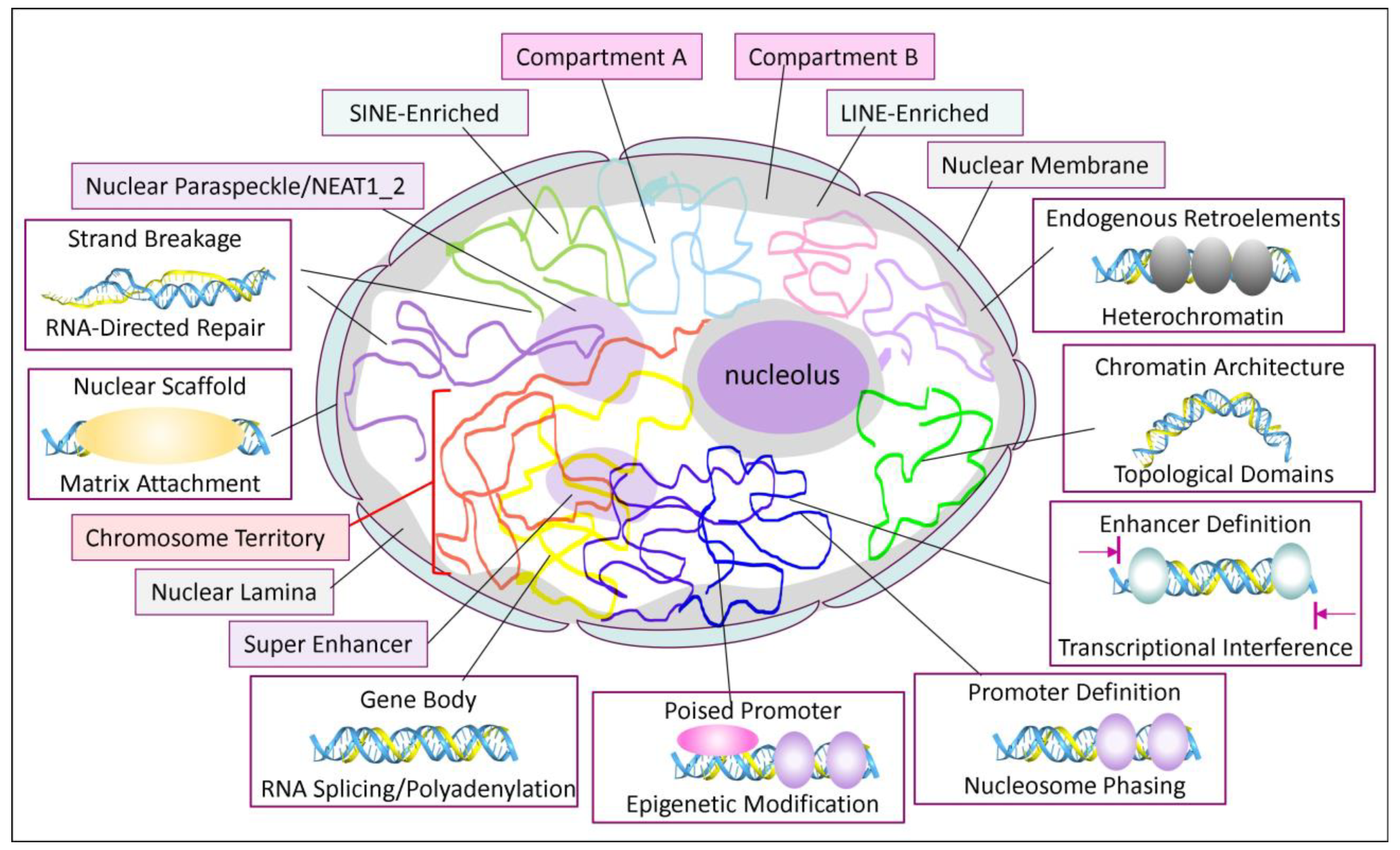
2.1. Nuclear Scaffolds
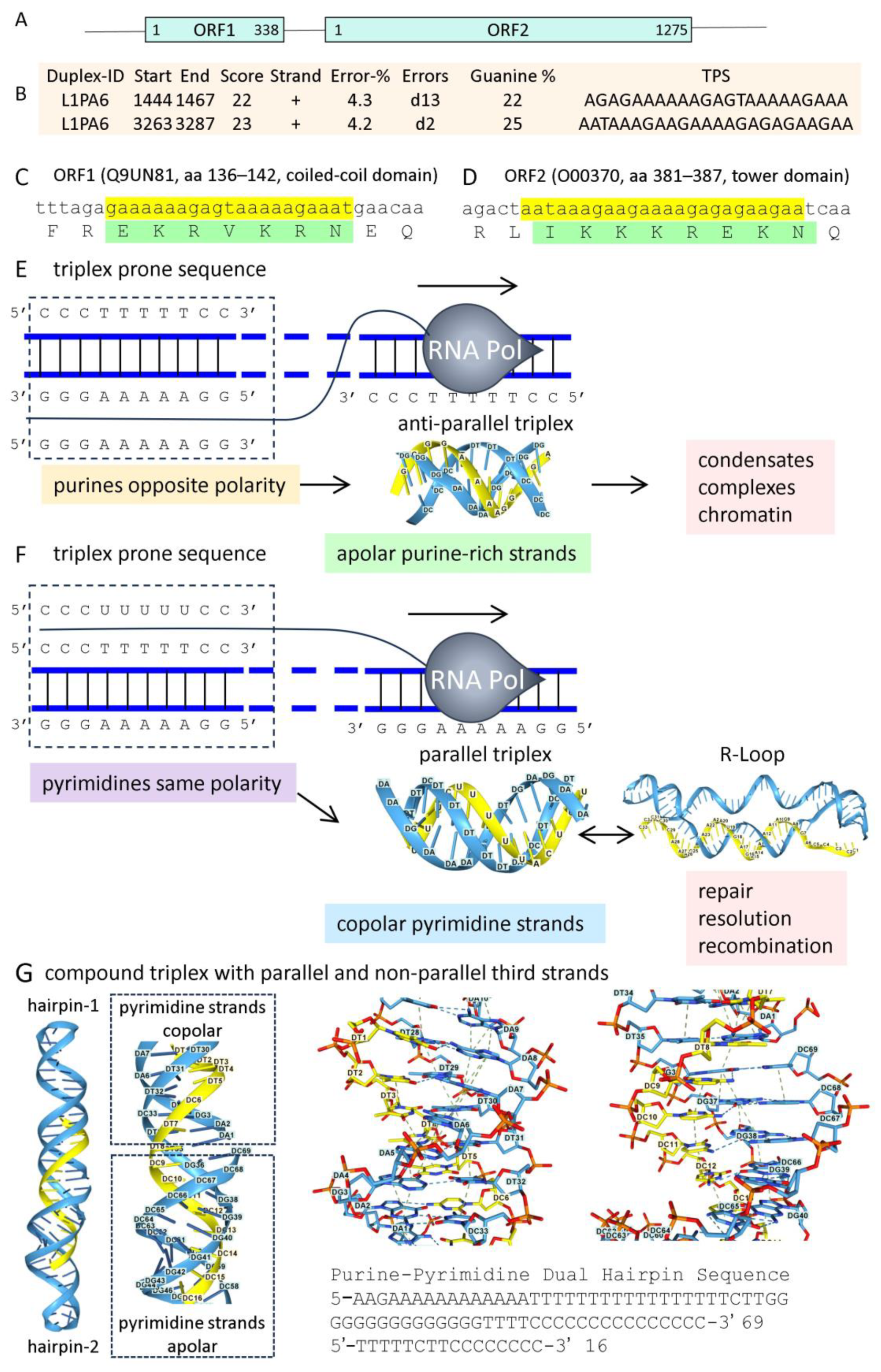
2.2. A Note on Copolar and Apolar TRX
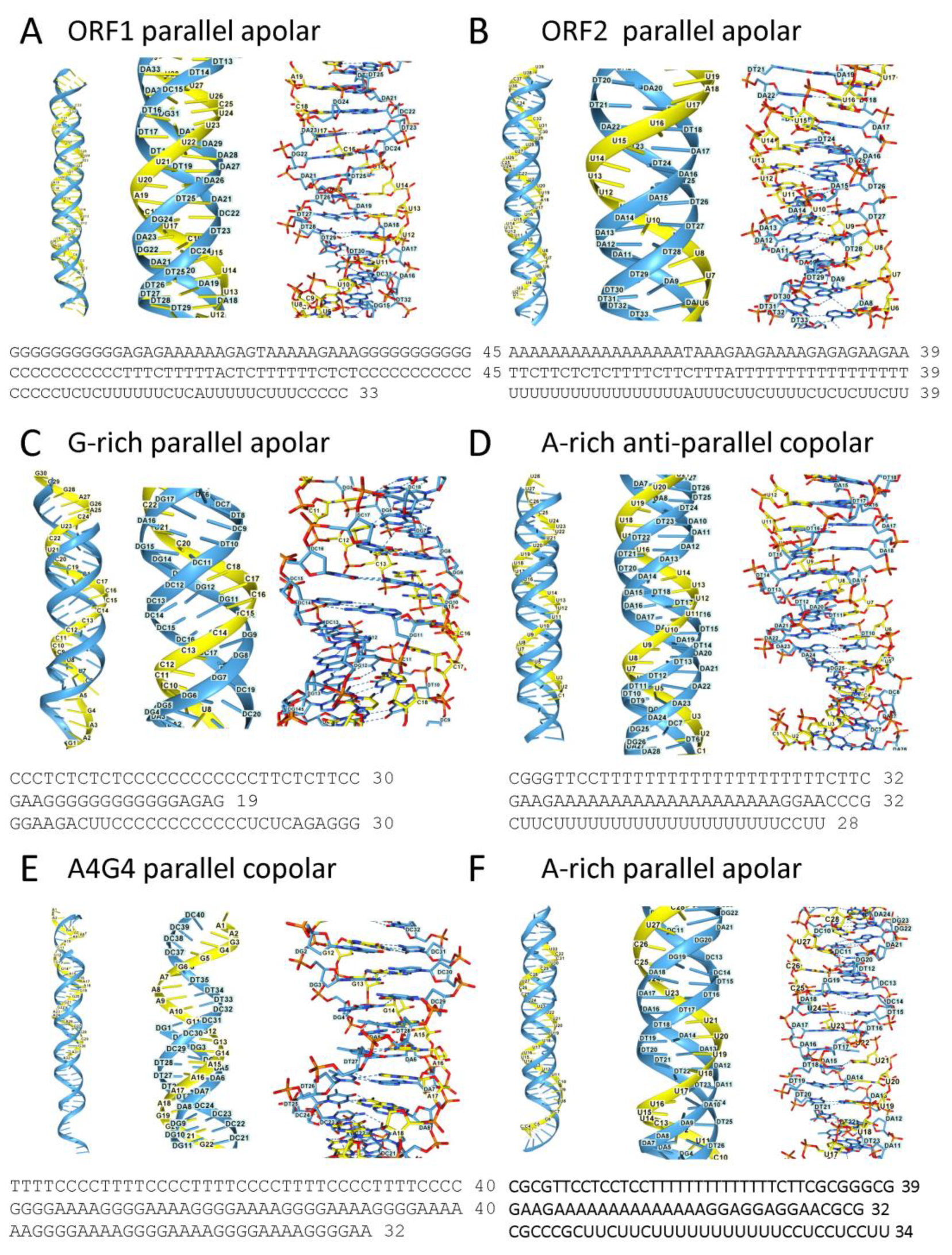
2.3. RNA:DNA Triplexes
2.4. Proteins That Bind Triplexes
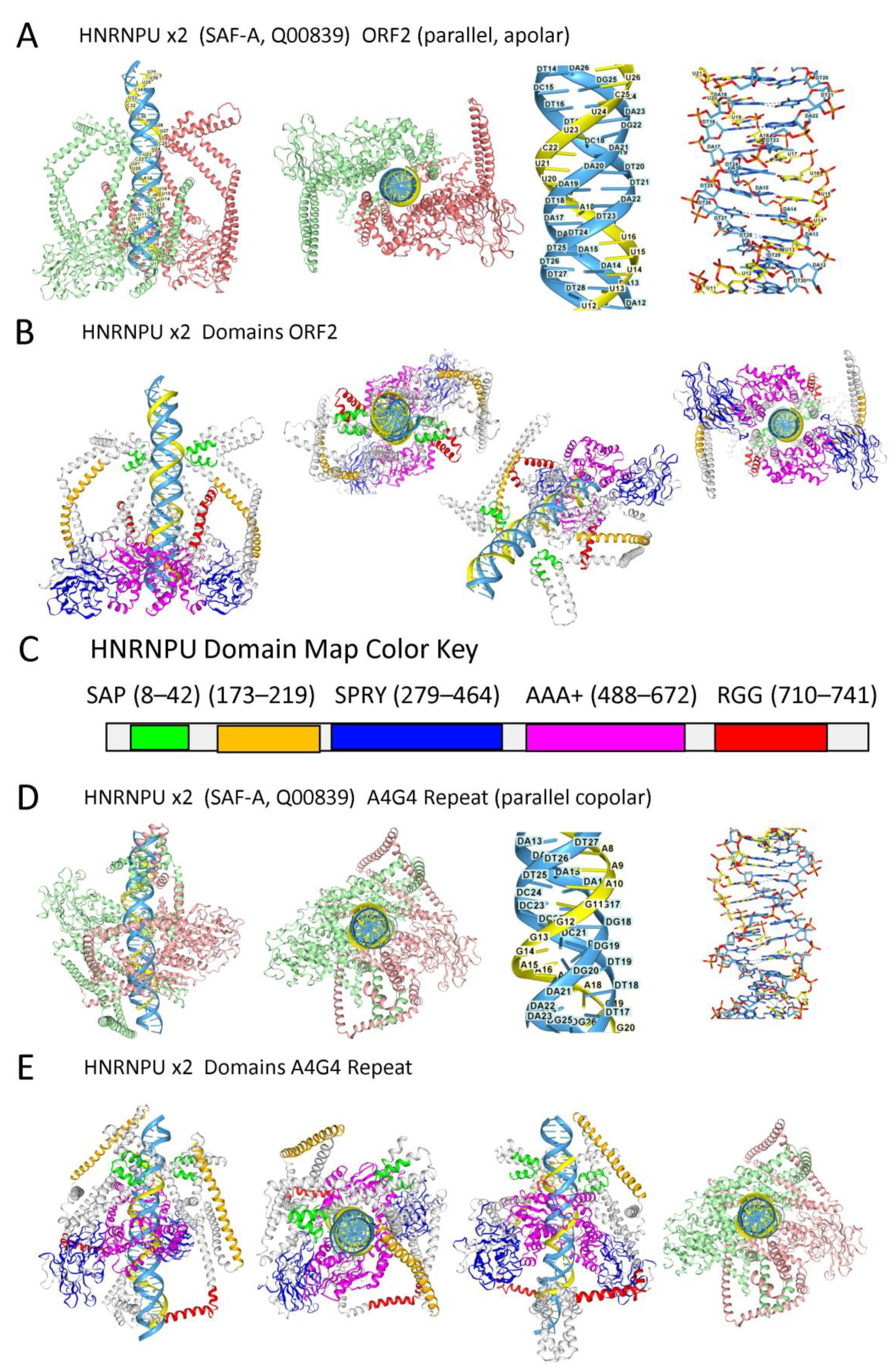
2.4.1. HNRNPU Triplex Models
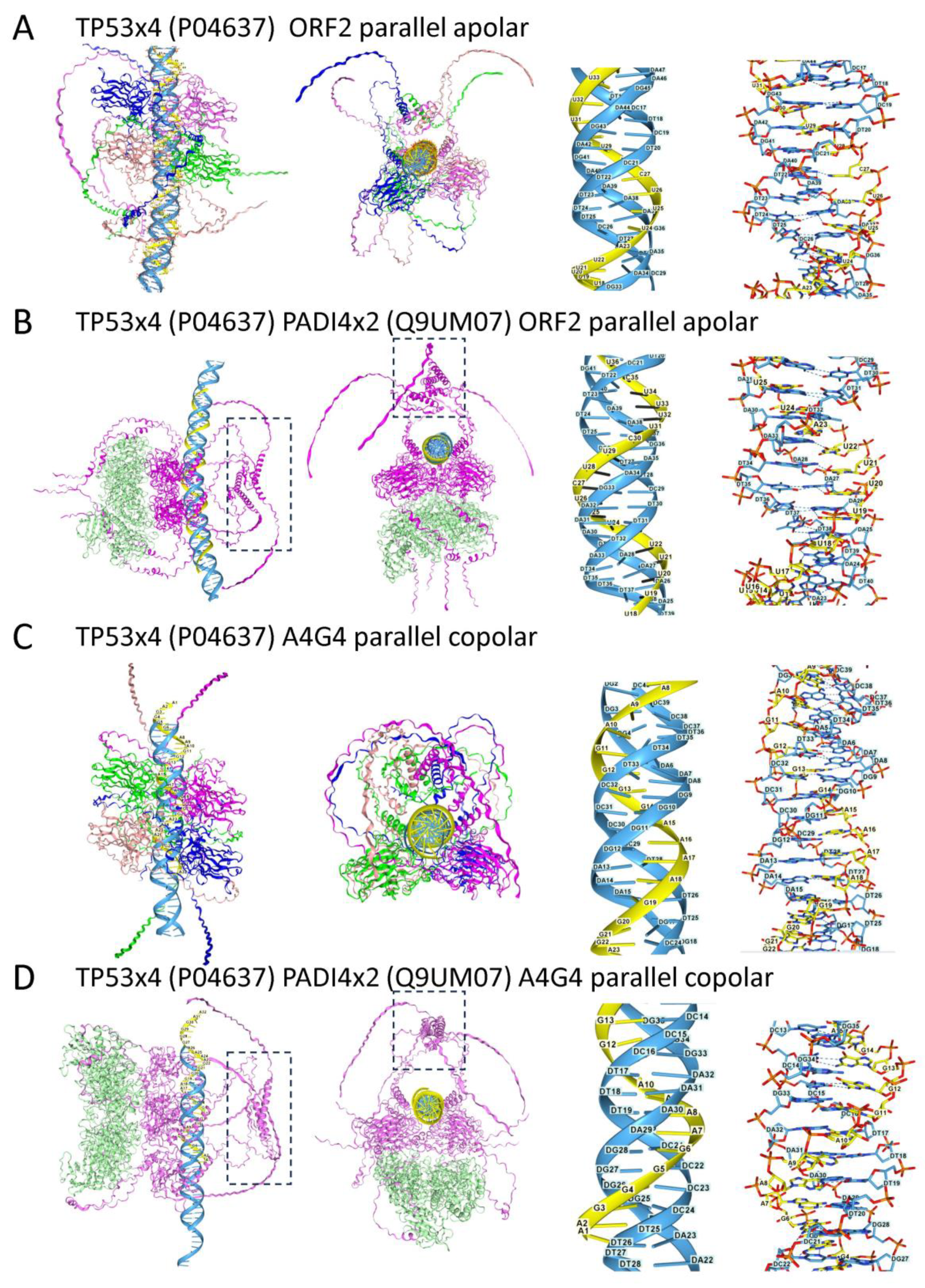
2.4.2. TP53 Triplex Models
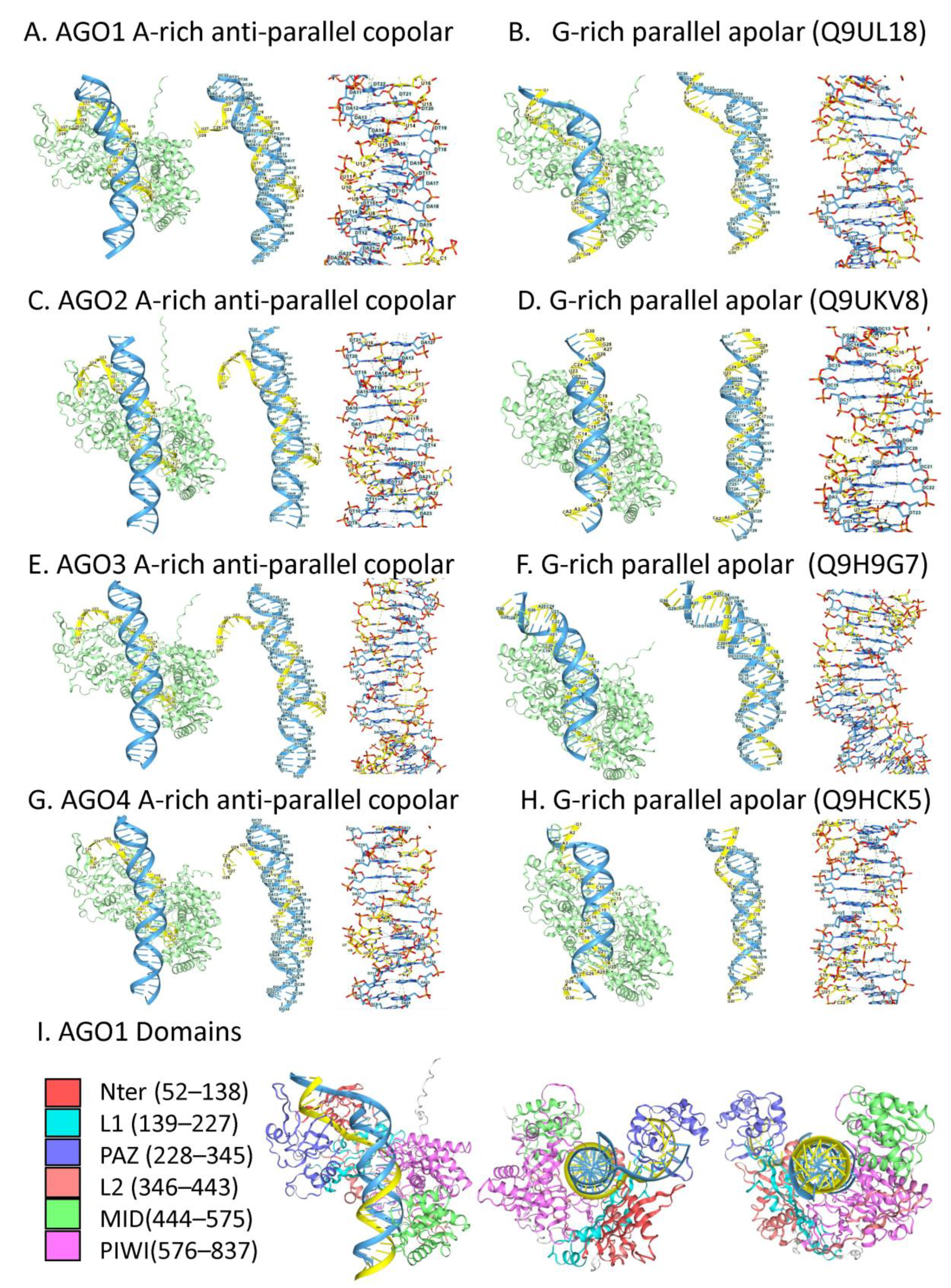
2.4.3. AGO Triplex Models
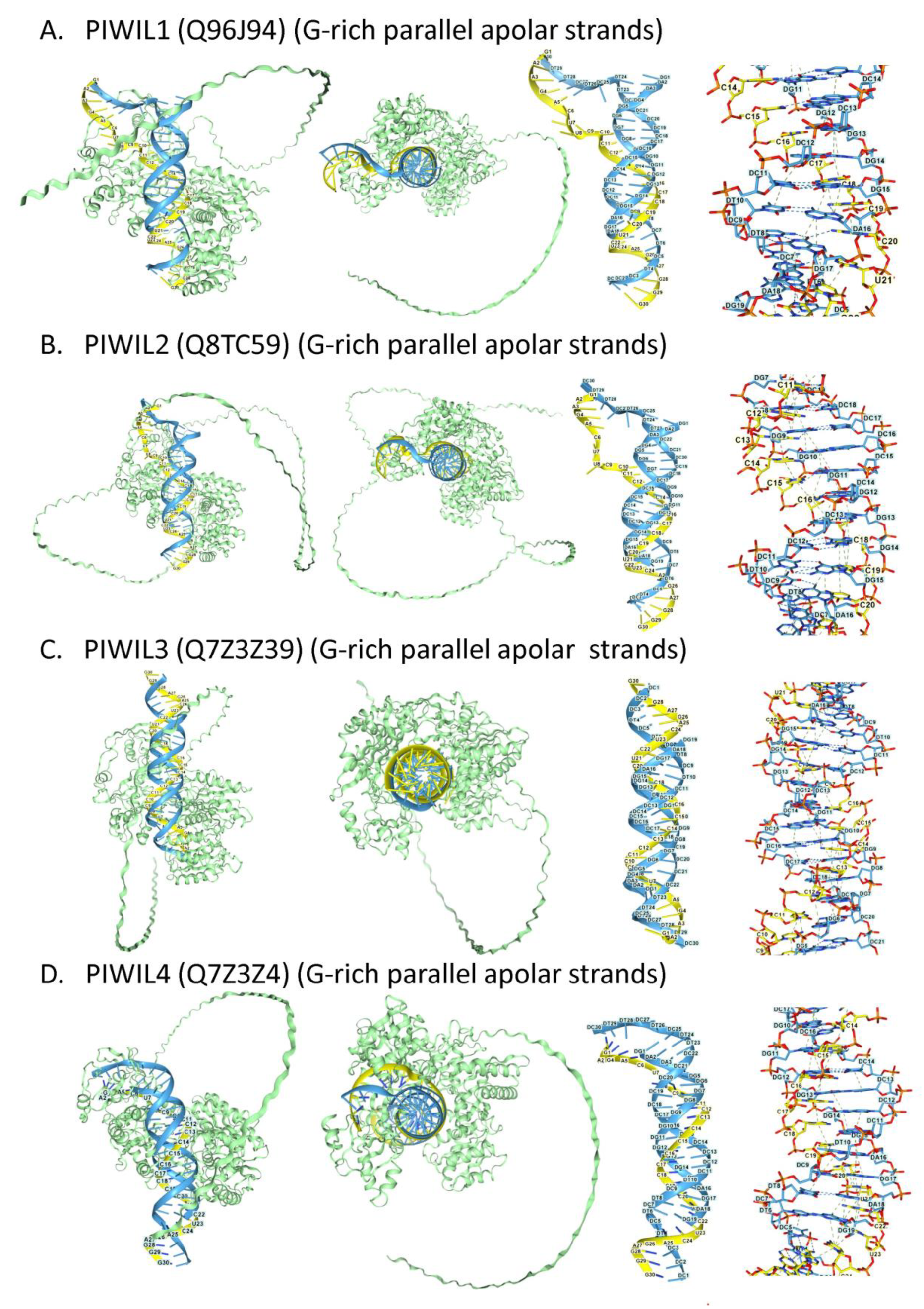
2.4.4. PIWI Triplex Models
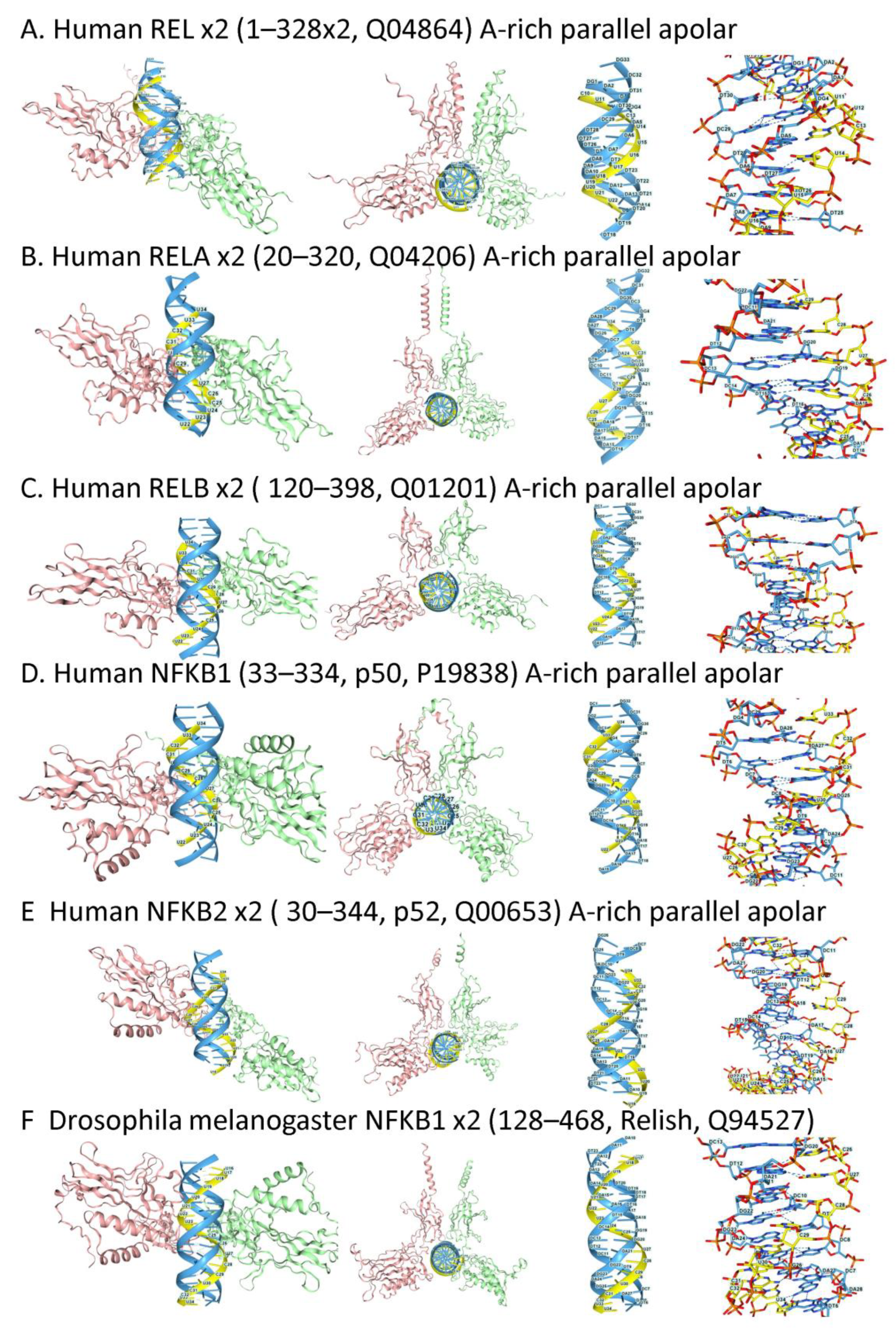
2.4.5. REL Domain Triplexes
2.5. Proteins That Modulate Triplexes
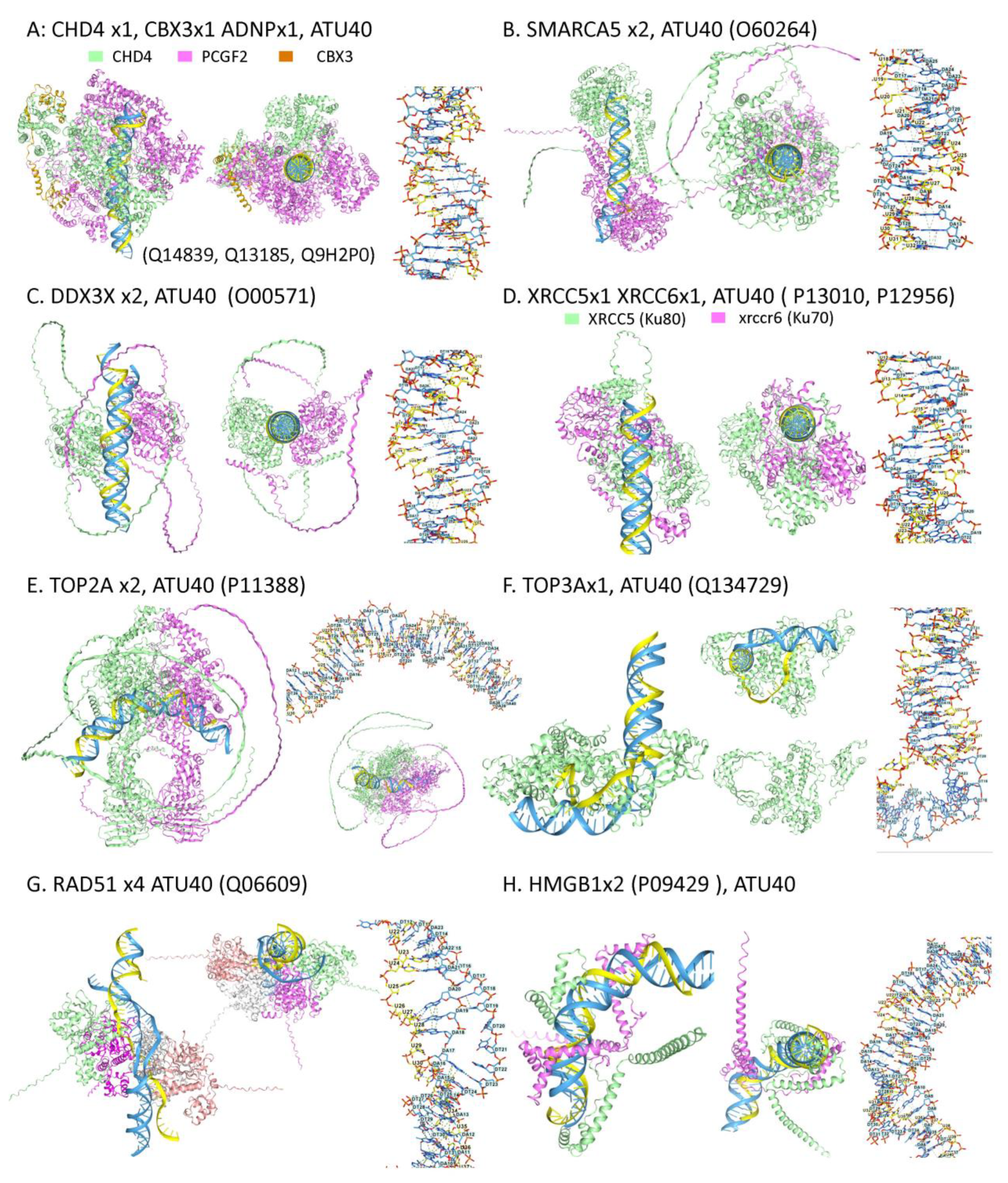
2.5.1. CHD4 Chromatin Remodelers
2.5.2. Imitation Switch Chromatin Remodelers
2.5.3. Helicases and TRXs
2.5.4. Topoisomerases and TRX
2.5.5. The RAD51 Recombinase and TRX
2.5.6. HMGB1 and TRX
2.6. Proteins That Modify Chromatin
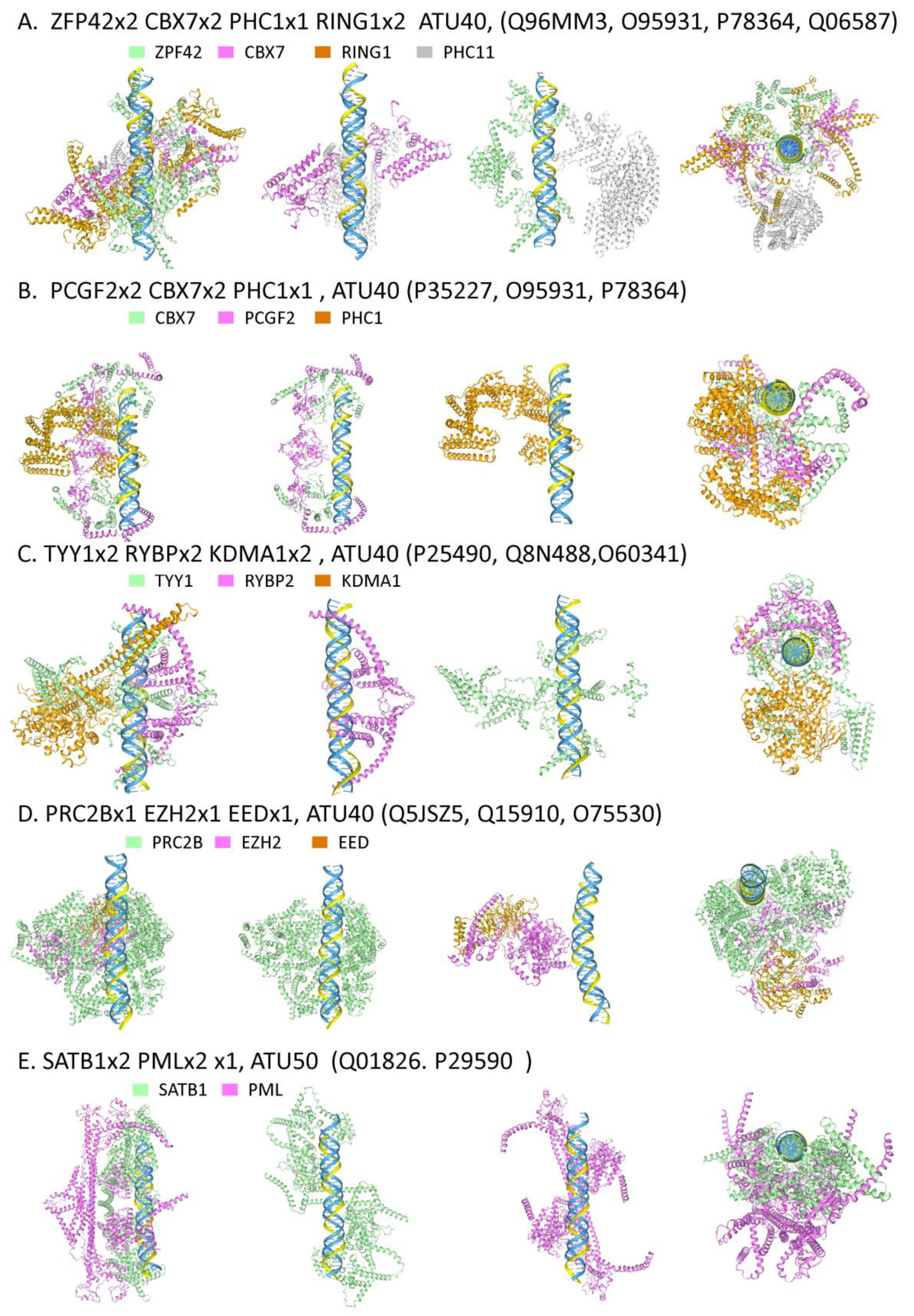
2.6.1. Polycomb Repressor Complexes
2.6.2. PML Bodies and SATB1
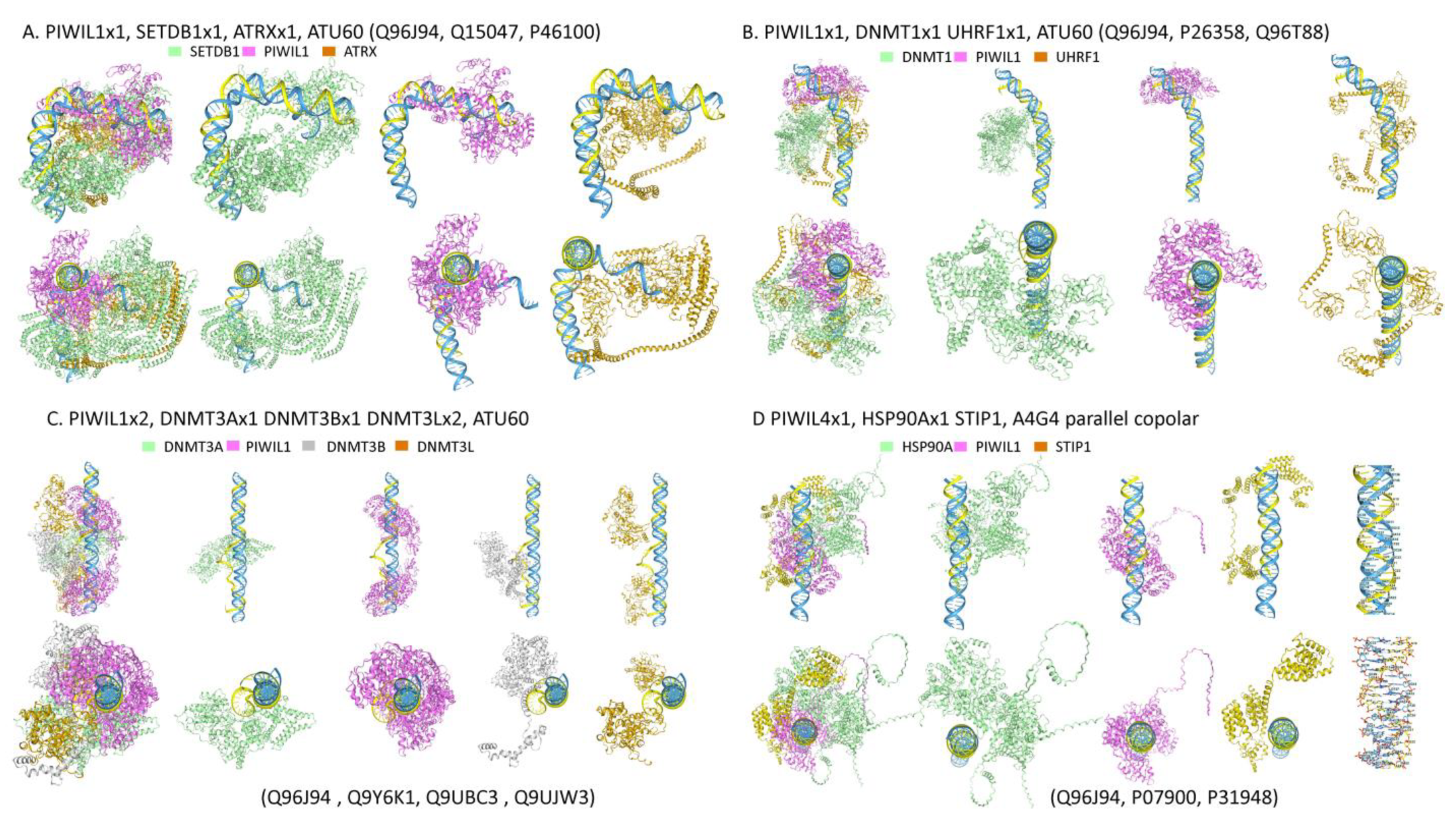
2.6.3. PIWI Chromatin Complexes
3. Discussion
The Role of TRX-Forming Flipons in Cellular Transactions
4. Methods
5. Conclusions
Supplementary Materials
Funding
Institutional Review Board Statement
Informed Consent Statement
Data Availability Statement
Conflicts of Interest
References
- Herbert, A. A Genetic Instruction Code Based on DNA Conformation. Trends Genet. 2019, 35, 887–890. [Google Scholar] [CrossRef] [Scilit]
- Herbert, A. Flipons and the origin of the genetic code. Biol. Lett. 2025, 21, 20240635. [Google Scholar] [CrossRef] [Scilit]
- Hasegawa, Y.; Struhl, K. Promoter-specific dynamics of TATA-binding protein association with the human genome. Genome Res. 2019, 29, 1939–1950. [Google Scholar] [CrossRef] [Scilit]
- Herbert, A. The Simple Biology of Flipons and Condensates Enhances the Evolution of Complexity. Molecules 2021, 26, 4881. [Google Scholar] [CrossRef] [Scilit]
- Reiter, F.; Wienerroither, S.; Stark, A. Combinatorial function of transcription factors and cofactors. Curr. Opin. Genet. Dev. 2017, 43, 73–81. [Google Scholar] [CrossRef] [Scilit]
- Ramaker, R.C.; Hardigan, A.A.; Goh, S.T.; Partridge, E.C.; Wold, B.; Cooper, S.J.; Myers, R.M. Dissecting the regulatory activity and sequence content of loci with exceptional numbers of transcription factor associations. Genome Res. 2020, 30, 939–950. [Google Scholar] [CrossRef] [Scilit]
- Partridge, E.C.; Chhetri, S.B.; Prokop, J.W.; Ramaker, R.C.; Jansen, C.S.; Goh, S.T.; Mackiewicz, M.; Newberry, K.M.; Brandsmeier, L.A.; Meadows, S.K.; et al. Occupancy maps of 208 chromatin-associated proteins in one human cell type. Nature 2020, 583, 720–728. [Google Scholar] [CrossRef] [Scilit] [PubMed]
- Spiegel, J.; Cuesta, S.M.; Adhikari, S.; Hansel-Hertsch, R.; Tannahill, D.; Balasubramanian, S. G-quadruplexes are transcription factor binding hubs in human chromatin. Genome Biol. 2021, 22, 117. [Google Scholar] [CrossRef] [Scilit] [PubMed]
- Herbert, A. Triplexes Color the Chromaverse by Modulating Nucleosome Phasing and Anchoring Chromatin Condensates. Int. J. Mol. Sci. 2025, 26, 4032. [Google Scholar] [CrossRef] [Scilit] [PubMed]
- Hale, C.R.; Zhao, P.; Olson, S.; Duff, M.O.; Graveley, B.R.; Wells, L.; Terns, R.M.; Terns, M.P. RNA-guided RNA cleavage by a CRISPR RNA-Cas protein complex. Cell 2009, 139, 945–956. [Google Scholar] [CrossRef] [Scilit]
- Saito, M.; Xu, P.; Faure, G.; Maguire, S.; Kannan, S.; Altae-Tran, H.; Vo, S.; Desimone, A.; Macrae, R.K.; Zhang, F. Fanzor is a eukaryotic programmable RNA-guided endonuclease. Nature 2023, 620, 660–668. [Google Scholar] [CrossRef] [Scilit]
- Nakamura, K.L.; Zhang, K.; Mestre, M.R.; Rojas-Montero, M.; Shipman, S.L. New retron systems from environmental bacteria identify triggers of anti-phage defense and expand tools for genome editing. PLoS Biol. 2025, 23, e3003042. [Google Scholar] [CrossRef] [Scilit]
- Hock, J.; Meister, G. The Argonaute protein family. Genome Biol. 2008, 9, 210. [Google Scholar] [CrossRef] [Scilit]
- Muotri, A.R.; Marchetto, M.C.; Coufal, N.G.; Gage, F.H. The necessary junk: New functions for transposable elements. Hum. Mol. Genet. 2007, 16, R159–R167. [Google Scholar] [CrossRef] [Scilit]
- Kapusta, A.; Kronenberg, Z.; Lynch, V.J.; Zhuo, X.; Ramsay, L.; Bourque, G.; Yandell, M.; Feschotte, C. Transposable elements are major contributors to the origin, diversification, and regulation of vertebrate long noncoding RNAs. PLoS Genet. 2013, 9, e1003470. [Google Scholar] [CrossRef] [Scilit] [PubMed]
- Chuong, E.B.; Elde, N.C.; Feschotte, C. Regulatory evolution of innate immunity through co-option of endogenous retroviruses. Science 2016, 351, 1083–1087. [Google Scholar] [CrossRef] [Scilit] [PubMed]
- Czech, B.; Munafo, M.; Ciabrelli, F.; Eastwood, E.L.; Fabry, M.H.; Kneuss, E.; Hannon, G.J. piRNA-Guided Genome Defense: From Biogenesis to Silencing. Annu. Rev. Genet. 2018, 52, 131–157. [Google Scholar] [CrossRef] [Scilit]
- Luo, S.; Lu, J. Silencing of Transposable Elements by piRNAs in Drosophila: An Evolutionary Perspective. Genom. Proteom. Bioinform. 2017, 15, 164–176. [Google Scholar] [CrossRef] [Scilit]
- Thapa, R.J.; Ingram, J.P.; Ragan, K.B.; Nogusa, S.; Boyd, D.F.; Benitez, A.A.; Sridharan, H.; Kosoff, R.; Shubina, M.; Landsteiner, V.J.; et al. DAI Senses Influenza A Virus Genomic RNA and Activates RIPK3-Dependent Cell Death. Cell Host Microbe 2016, 20, 674–681. [Google Scholar] [CrossRef] [Scilit] [PubMed]
- Maelfait, J.; Liverpool, L.; Bridgeman, A.; Ragan, K.B.; Upton, J.W.; Rehwinkel, J. Sensing of viral and endogenous RNA by ZBP1/DAI induces necroptosis. EMBO J. 2017, 36, 2529–2543. [Google Scholar] [CrossRef] [Scilit]
- Zhang, T.; Yin, C.; Boyd, D.F.; Quarato, G.; Ingram, J.P.; Shubina, M.; Ragan, K.B.; Ishizuka, T.; Crawford, J.C.; Tummers, B.; et al. Influenza Virus Z-RNAs Induce ZBP1-Mediated Necroptosis. Cell 2020, 180, 1115–1129. [Google Scholar] [CrossRef] [Scilit]
- Herbert, A. Z-DNA and Z-RNA in human disease. Commun. Biol. 2019, 2, 7. [Google Scholar]
- Jiao, H.; Wachsmuth, L.; Kumari, S.; Schwarzer, R.; Lin, J.; Eren, R.O.; Fisher, A.; Lane, R.; Young, G.R.; Kassiotis, G.; et al. Z-nucleic-acid sensing triggers ZBP1-dependent necroptosis and inflammation. Nature 2020, 580, 391–395, Correction in Nature 2020, 580, E10.. [Google Scholar] [CrossRef] [Scilit]
- Nichols, P.J.; Bevers, S.; Henen, M.; Kieft, J.S.; Vicens, Q.; Vogeli, B. Recognition of non-CpG repeats in Alu and ribosomal RNAs by the Z-RNA binding domain of ADAR1 induces A-Z junctions. Nat. Commun. 2021, 12, 793. [Google Scholar] [CrossRef] [Scilit] [PubMed]
- Zhang, T.; Yin, C.; Fedorov, A.; Qiao, L.; Bao, H.; Beknazarov, N.; Wang, S.; Gautam, A.; Williams, R.M.; Crawford, J.C.; et al. ADAR1 masks the cancer immunotherapeutic promise of ZBP1-driven necroptosis. Nature 2022, 606, 594–602. [Google Scholar] [CrossRef] [Scilit]
- Herbert, A. The ancient Z-DNA and Z-RNA specific Zalpha fold has evolved modern roles in immunity and transcription through the natural selection of flipons. R. Soc. Open Sci. 2024, 11, 240080. [Google Scholar] [CrossRef] [Scilit]
- Yin, C.; Fedorov, A.; Guo, H.; Crawford, J.C.; Rousseau, C.; Zhong, X.; Williams, R.M.; Gautam, A.; Koehler, H.S.; Whisnant, A.W.; et al. Host cell Z-RNAs activate ZBP1 during virus infections. Nature 2025, 648, 707–716. [Google Scholar] [CrossRef] [Scilit]
- Yang, Z.H.; Wu, P.; Zhang, B.X.; Yang, C.R.; Huang, J.; Wu, L.; Guo, S.H.; Zhou, Y.; Mao, Y.; Yin, Y.; et al. ZBP1 senses splicing aberration through Z-RNA to promote cell death. Mol. Cell 2025, 85, 1775–1789.e5. [Google Scholar] [CrossRef] [Scilit]
- Jiang, X.; Ma, X.; Zhou, Y.; Liu, X.; Zhang, T.; Kim, W.; Balachandran, S.; Canadas, I. Spliceosome inhibition induces Z-RNA and ZBP1-driven cell death in small cell lung cancer. Cell Rep. 2025, 44, 116384. [Google Scholar]
- Herbert, A.; Alfken, J.; Kim, Y.G.; Mian, I.S.; Nishikura, K.; Rich, A. A Z-DNA binding domain present in the human editing enzyme, double-stranded RNA adenosine deaminase. Proc. Natl. Acad. Sci. USA 1997, 94, 8421–8426. [Google Scholar] [CrossRef] [Scilit]
- Placido, D.; Brown, B.A., II; Lowenhaupt, K.; Rich, A.; Athanasiadis, A. A left-handed RNA double helix bound by the Z alpha domain of the RNA-editing enzyme ADAR1. Structure 2007, 15, 395–404. [Google Scholar] [CrossRef] [Scilit]
- Patterson, J.B.; Thomis, D.C.; Hans, S.L.; Samuel, C.E. Mechanism of interferon action: Double-stranded RNA-specific adenosine deaminase from human cells is inducible by alpha and gamma interferons. Virology 1995, 210, 508–511. [Google Scholar] [CrossRef] [Scilit]
- Jiao, H.; Wachsmuth, L.; Wolf, S.; Lohmann, J.; Nagata, M.; Kaya, G.G.; Oikonomou, N.; Kondylis, V.; Rogg, M.; Diebold, M.; et al. ADAR1 averts fatal type I interferon induction by ZBP1. Nature 2022, 607, 776–783. [Google Scholar] [CrossRef] [Scilit]
- Hubbard, N.W.; Ames, J.M.; Maurano, M.; Chu, L.H.; Somfleth, K.Y.; Gokhale, N.S.; Werner, M.; Snyder, J.M.; Lichauco, K.; Savan, R.; et al. ADAR1 mutation causes ZBP1-dependent immunopathology. Nature 2022, 607, 769–775. [Google Scholar] [CrossRef] [Scilit]
- de Reuver, R.; Verdonck, S.; Dierick, E.; Nemegeer, J.; Hessmann, E.; Ahmad, S.; Jans, M.; Blancke, G.; Van Nieuwerburgh, F.; Botzki, A.; et al. ADAR1 prevents autoinflammation by suppressing spontaneous ZBP1 activation. Nature 2022, 607, 784–789. [Google Scholar] [CrossRef] [Scilit]
- Herbert, A. Mendelian disease caused by variants affecting recognition of Z-DNA and Z-RNA by the Zα domain of the double-stranded RNA editing enzyme ADAR. Eur. J. Hum. Genet. 2020, 28, 114–117. [Google Scholar] [CrossRef] [Scilit]
- Wu, J.; Samara, N.L.; Kuraoka, I.; Yang, W. Evolution of Inosine-Specific Endonuclease V from Bacterial DNase to Eukaryotic RNase. Mol. Cell 2019, 76, 44–56.e3. [Google Scholar] [CrossRef] [Scilit]
- Bellefroid, E.J.; Poncelet, D.A.; Lecocq, P.J.; Revelant, O.; Martial, J.A. The evolutionarily conserved Kruppel-associated box domain defines a subfamily of eukaryotic multifingered proteins. Proc. Natl. Acad. Sci. USA 1991, 88, 3608–3612. [Google Scholar] [CrossRef] [Scilit]
- Lukic, S.; Nicolas, J.C.; Levine, A.J. The diversity of zinc-finger genes on human chromosome 19 provides an evolutionary mechanism for defense against inherited endogenous retroviruses. Cell Death Differ. 2014, 21, 381–387. [Google Scholar] [CrossRef] [Scilit]
- Umerenkov, D.; Herbert, A.; Konovalov, D.; Danilova, A.; Beknazarov, N.; Kokh, V.; Fedorov, A.; Poptsova, M. Z-flipon variants reveal the many roles of Z-DNA and Z-RNA in health and disease. Life Sci. Alliance 2023, 6, e202301962. [Google Scholar] [CrossRef] [Scilit]
- Castro-Diaz, N.; Ecco, G.; Coluccio, A.; Kapopoulou, A.; Yazdanpanah, B.; Friedli, M.; Duc, J.; Jang, S.M.; Turelli, P.; Trono, D. Evolutionally dynamic L1 regulation in embryonic stem cells. Genes Dev. 2014, 28, 1397–1409. [Google Scholar] [CrossRef] [Scilit]
- Hu, Q.; Tanasa, B.; Trabucchi, M.; Li, W.; Zhang, J.; Ohgi, K.A.; Rose, D.W.; Glass, C.K.; Rosenfeld, M.G. DICER- and AGO3-dependent generation of retinoic acid-induced DR2 Alu RNAs regulates human stem cell proliferation. Nat. Struct. Mol. Biol. 2012, 19, 1168–1175. [Google Scholar] [CrossRef] [Scilit]
- Morris, K.V.; Chan, S.W.; Jacobsen, S.E.; Looney, D.J. Small interfering RNA-induced transcriptional gene silencing in human cells. Science 2004, 305, 1289–1292. [Google Scholar] [CrossRef] [Scilit]
- Castanotto, D.; Zhang, X.; Alluin, J.; Zhang, X.; Ruger, J.; Armstrong, B.; Rossi, J.; Riggs, A.; Stein, C.A. A stress-induced response complex (SIRC) shuttles miRNAs, siRNAs, and oligonucleotides to the nucleus. Proc. Natl. Acad. Sci. USA 2018, 115, E5756–E5765. [Google Scholar] [CrossRef] [Scilit]
- Rentschler, M.; Chen, Y.; Pahl, J.; Soria-Martinez, L.; Braumuller, H.; Brenner, E.; Bischof, O.; Rocken, M.; Wieder, T. Nuclear Translocation of Argonaute 2 in Cytokine-Induced Senescence. Cell. Physiol. Biochem. 2018, 51, 1103–1118. [Google Scholar] [CrossRef] [Scilit]
- Johnson, K.C.; Kilikevicius, A.; Hofman, C.; Hu, J.; Liu, Y.; Aguilar, S.; Graswich, J.; Han, Y.; Wang, T.; Westcott, J.M.; et al. Nuclear localization of Argonaute 2 is affected by cell density and may relieve repression by microRNAs. Nucleic Acids Res. 2024, 52, 1930–1952. [Google Scholar] [CrossRef] [Scilit]
- Sala, L.; Kumar, M.; Prajapat, M.; Chandrasekhar, S.; Cosby, R.L.; La Rocca, G.; Macfarlan, T.S.; Awasthi, P.; Chari, R.; Kruhlak, M.; et al. AGO2 silences mobile transposons in the nucleus of quiescent cells. Nat. Struct. Mol. Biol. 2023, 30, 1985–1995. [Google Scholar] [CrossRef] [Scilit]
- Ghosh, S.; Guimaraes, J.C.; Lanzafame, M.; Schmidt, A.; Syed, A.P.; Dimitriades, B.; Borsch, A.; Ghosh, S.; Mittal, N.; Montavon, T.; et al. Prevention of dsRNA-induced interferon signaling by AGO1x is linked to breast cancer cell proliferation. EMBO J. 2020, 39, e103922. [Google Scholar] [CrossRef] [Scilit]
- Shuaib, M.; Parsi, K.M.; Thimma, M.; Adroub, S.A.; Kawaji, H.; Seridi, L.; Ghosheh, Y.; Fort, A.; Fallatah, B.; Ravasi, T.; et al. Nuclear AGO1 Regulates Gene Expression by Affecting Chromatin Architecture in Human Cells. Cell Syst. 2019, 9, 446–458.e6. [Google Scholar] [CrossRef] [Scilit]
- Chu, Y.; Yokota, S.; Liu, J.; Kilikevicius, A.; Johnson, K.C.; Corey, D.R. Argonaute binding within human nuclear RNA and its impact on alternative splicing. RNA 2021, 27, 991–1003. [Google Scholar] [CrossRef] [Scilit]
- Hofman, C.R.; Hu, J.; Bryl, R.; Tse, V.; Corey, D.R. Nuclear Argonaute:miRNA complexes recognize target sequences within chromatin-associated RNA and silence gene expression. Nucleic Acids Res. 2025, 53, gkaf800. [Google Scholar] [CrossRef] [Scilit] [PubMed]
- Sarshad, A.A.; Juan, A.H.; Muler, A.I.C.; Anastasakis, D.G.; Wang, X.; Genzor, P.; Feng, X.; Tsai, P.F.; Sun, H.W.; Haase, A.D.; et al. Argonaute-miRNA Complexes Silence Target mRNAs in the Nucleus of Mammalian Stem Cells. Mol. Cell 2018, 71, 1040–1050.e8. [Google Scholar] [CrossRef] [Scilit] [PubMed]
- Piriyapongsa, J.; Marino-Ramirez, L.; Jordan, I.K. Origin and evolution of human microRNAs from transposable elements. Genetics 2007, 176, 1323–1337. [Google Scholar] [CrossRef] [Scilit]
- Lehnert, S.; Van Loo, P.; Thilakarathne, P.J.; Marynen, P.; Verbeke, G.; Schuit, F.C. Evidence for co-evolution between human microRNAs and Alu-repeats. PLoS ONE 2009, 4, e4456. [Google Scholar] [CrossRef] [Scilit]
- Kelley, D.; Rinn, J. Transposable elements reveal a stem cell-specific class of long noncoding RNAs. Genome Biol. 2012, 13, R107. [Google Scholar] [CrossRef] [Scilit]
- Liang, L.; Cao, C.; Ji, L.; Cai, Z.; Wang, D.; Ye, R.; Chen, J.; Yu, X.; Zhou, J.; Bai, Z.; et al. Complementary Alu sequences mediate enhancer-promoter selectivity. Nature 2023, 619, 868–875, Correction in Nature 2023, 620, E26.. [Google Scholar] [CrossRef] [Scilit]
- Herbert, A. ALU non-B-DNA conformations, flipons, binary codes and evolution. R. Soc. Open Sci. 2020, 7, 200222. [Google Scholar] [CrossRef] [Scilit] [PubMed]
- DeMeis, J.D.; Roberts, J.T.; Delcher, H.A.; Godang, N.L.; Coley, A.B.; Brown, C.L.; Shaw, M.H.; Naaz, S.; Dahal, A.; Alqudah, S.Y.; et al. Long G4-rich enhancers target promoters via a G4 DNA-based mechanism. Nucleic Acids Res. 2025, 53, gkae1180. [Google Scholar] [CrossRef] [Scilit] [PubMed]
- Martianov, I.; Ramadass, A.; Serra Barros, A.; Chow, N.; Akoulitchev, A. Repression of the human dihydrofolate reductase gene by a non-coding interfering transcript. Nature 2007, 445, 666–670. [Google Scholar] [CrossRef] [Scilit]
- Postepska-Igielska, A.; Giwojna, A.; Gasri-Plotnitsky, L.; Schmitt, N.; Dold, A.; Ginsberg, D.; Grummt, I. LncRNA Khps1 Regulates Expression of the Proto-oncogene SPHK1 via Triplex-Mediated Changes in Chromatin Structure. Mol. Cell 2015, 60, 626–636. [Google Scholar] [CrossRef] [Scilit]
- Zhou, Z.; Giles, K.E.; Felsenfeld, G. DNA·RNA triple helix formation can function as a cis-acting regulatory mechanism at the human beta-globin locus. Proc. Natl. Acad. Sci. USA 2019, 116, 6130–6139. [Google Scholar] [CrossRef] [Scilit]
- Fan, S.; Tian, T.; Lv, X.; Lei, X.; Yang, Z.; Liu, M.; Liang, F.; Li, S.; Lin, X.; Lin, Z.; et al. lncRNA CISAL Inhibits BRCA1 Transcription by Forming a Tertiary Structure at Its Promoter. iScience 2020, 23, 100835. [Google Scholar] [CrossRef] [Scilit]
- Li, Y.; Syed, J.; Sugiyama, H. RNA-DNA Triplex Formation by Long Noncoding RNAs. Cell Chem. Biol. 2016, 23, 1325–1333. [Google Scholar] [CrossRef] [Scilit]
- Cecconello, A.; Magro, M.; Vianello, F.; Simmel, F.C. Rational design of hybrid DNA-RNA triplex structures as modulators of transcriptional activity in vitro. Nucleic Acids Res. 2022, 50, 13172–13182. [Google Scholar] [CrossRef] [Scilit]
- Mayer, C.; Neubert, M.; Grummt, I. The structure of NoRC-associated RNA is crucial for targeting the chromatin remodelling complex NoRC to the nucleolus. EMBO Rep. 2008, 9, 774–780. [Google Scholar] [CrossRef] [Scilit]
- Schmitz, K.M.; Mayer, C.; Postepska, A.; Grummt, I. Interaction of noncoding RNA with the rDNA promoter mediates recruitment of DNMT3b and silencing of rRNA genes. Genes Dev. 2010, 24, 2264–2269. [Google Scholar] [CrossRef] [Scilit] [PubMed]
- Cai, X.; Cullen, B.R. The imprinted H19 noncoding RNA is a primary microRNA precursor. RNA 2007, 13, 313–316. [Google Scholar] [CrossRef] [Scilit]
- Dey, B.K.; Pfeifer, K.; Dutta, A. The H19 long noncoding RNA gives rise to microRNAs miR-675-3p and miR-675-5p to promote skeletal muscle differentiation and regeneration. Genes Dev. 2014, 28, 491–501. [Google Scholar] [CrossRef] [Scilit] [PubMed]
- Liang, Y.; Zou, Q.; Yu, W. Steering Against Wind: A New Network of NamiRNAs and Enhancers. Genom. Proteom. Bioinform. 2017, 15, 331–337. [Google Scholar] [CrossRef] [Scilit]
- Ouvrard, J.; Muniz, L.; Nicolas, E.; Trouche, D. Small Interfering RNAs Targeting a Chromatin-Associated RNA Induce Its Transcriptional Silencing in Human Cells. Mol. Cell Biol. 2022, 42, e0027122. [Google Scholar] [CrossRef] [Scilit] [PubMed]
- Yap, K.L.; Li, S.; Munoz-Cabello, A.M.; Raguz, S.; Zeng, L.; Mujtaba, S.; Gil, J.; Walsh, M.J.; Zhou, M.M. Molecular interplay of the noncoding RNA ANRIL and methylated histone H3 lysine 27 by polycomb CBX7 in transcriptional silencing of INK4a. Mol. Cell 2010, 38, 662–674. [Google Scholar] [CrossRef] [Scilit]
- Alfeghaly, C.; Sanchez, A.; Rouget, R.; Thuillier, Q.; Igel-Bourguignon, V.; Marchand, V.; Branlant, C.; Motorin, Y.; Behm-Ansmant, I.; Maenner, S. Implication of repeat insertion domains in the trans-activity of the long non-coding RNA ANRIL. Nucleic Acids Res. 2021, 49, 4954–4970. [Google Scholar] [CrossRef] [Scilit]
- Pasmant, E.; Sabbagh, A.; Vidaud, M.; Bieche, I. ANRIL, a long, noncoding RNA, is an unexpected major hotspot in GWAS. FASEB J. 2011, 25, 444–448. [Google Scholar] [CrossRef] [Scilit]
- Holdt, L.M.; Hoffmann, S.; Sass, K.; Langenberger, D.; Scholz, M.; Krohn, K.; Finstermeier, K.; Stahringer, A.; Wilfert, W.; Beutner, F.; et al. Alu elements in ANRIL non-coding RNA at chromosome 9p21 modulate atherogenic cell functions through trans-regulation of gene networks. PLoS Genet. 2013, 9, e1003588. [Google Scholar] [CrossRef] [Scilit]
- Lu, J.Y.; Chang, L.; Li, T.; Wang, T.; Yin, Y.; Zhan, G.; Han, X.; Zhang, K.; Tao, Y.; Percharde, M.; et al. Homotypic clustering of L1 and B1/Alu repeats compartmentalizes the 3D genome. Cell Res. 2021, 31, 613–630. [Google Scholar] [CrossRef] [Scilit]
- Nickerson, J.A.; Krochmalnic, G.; Wan, K.M.; Penman, S. Chromatin architecture and nuclear RNA. Proc. Natl. Acad. Sci. USA 1989, 86, 177–181. [Google Scholar] [CrossRef] [Scilit]
- Creamer, K.M.; Kolpa, H.J.; Lawrence, J.B. Nascent RNA scaffolds contribute to chromosome territory architecture and counter chromatin compaction. Mol. Cell 2021, 81, 3509–3525.e5. [Google Scholar] [CrossRef] [Scilit] [PubMed]
- Vilborg, A.; Passarelli, M.C.; Yario, T.A.; Tycowski, K.T.; Steitz, J.A. Widespread Inducible Transcription Downstream of Human Genes. Mol. Cell 2015, 59, 449–461. [Google Scholar] [CrossRef] [Scilit] [PubMed]
- Sureka, R.; Avvaru, A.K.; Sowpati, D.T.; Pathak, R.U.; Mishra, R.K. Structural and developmental dynamics of Matrix associated regions in Drosophila melanogaster genome. BMC Genom. 2022, 23, 725. [Google Scholar] [CrossRef] [Scilit]
- Nozawa, R.S.; Boteva, L.; Soares, D.C.; Naughton, C.; Dun, A.R.; Buckle, A.; Ramsahoye, B.; Bruton, P.C.; Saleeb, R.S.; Arnedo, M.; et al. SAF-A Regulates Interphase Chromosome Structure through Oligomerization with Chromatin-Associated RNAs. Cell 2017, 169, 1214–1227.e18. [Google Scholar] [CrossRef] [Scilit] [PubMed]
- Hall, L.L.; Carone, D.M.; Gomez, A.V.; Kolpa, H.J.; Byron, M.; Mehta, N.; Fackelmayer, F.O.; Lawrence, J.B. Stable C0T-1 repeat RNA is abundant and is associated with euchromatic interphase chromosomes. Cell 2014, 156, 907–919. [Google Scholar] [CrossRef] [Scilit] [PubMed]
- Fan, H.; Lv, P.; Huo, X.; Wu, J.; Wang, Q.; Cheng, L.; Liu, Y.; Tang, Q.Q.; Zhang, L.; Zhang, F.; et al. The nuclear matrix protein HNRNPU maintains 3D genome architecture globally in mouse hepatocytes. Genome Res. 2018, 28, 192–202. [Google Scholar] [CrossRef] [Scilit] [PubMed]
- Kiledjian, M.; Dreyfuss, G. Primary structure and binding activity of the hnRNP U protein: Binding RNA through RGG box. EMBO J. 1992, 11, 2655–2664. [Google Scholar] [CrossRef] [Scilit]
- Xiao, R.; Tang, P.; Yang, B.; Huang, J.; Zhou, Y.; Shao, C.; Li, H.; Sun, H.; Zhang, Y.; Fu, X.D. Nuclear matrix factor hnRNP U/SAF-A exerts a global control of alternative splicing by regulating U2 snRNP maturation. Mol. Cell 2012, 45, 656–668. [Google Scholar] [CrossRef] [Scilit]
- Haeusler, A.R.; Donnelly, C.J.; Periz, G.; Simko, E.A.; Shaw, P.G.; Kim, M.S.; Maragakis, N.J.; Troncoso, J.C.; Pandey, A.; Sattler, R.; et al. C9orf72 nucleotide repeat structures initiate molecular cascades of disease. Nature 2014, 507, 195–200. [Google Scholar] [CrossRef] [Scilit]
- Kletzien, O.A.; Wuttke, D.S.; Batey, R.T. The RNA-binding Selectivity of the RGG/RG Motifs of hnRNP U is Abolished by Elements Within the C-terminal Intrinsically Disordered Region. J. Mol. Biol. 2024, 436, 168702. [Google Scholar] [CrossRef] [Scilit]
- Wulfridge, P.; Yan, Q.; Rell, N.; Doherty, J.; Jacobson, S.; Offley, S.; Deliard, S.; Feng, K.; Phillips-Cremins, J.E.; Gardini, A.; et al. G-quadruplexes associated with R-loops promote CTCF binding. Mol. Cell 2023, 83, 3064–3079.e5. [Google Scholar] [CrossRef] [Scilit]
- Kolpa, H.J.; Creamer, K.M.; Hall, L.L.; Lawrence, J.B. SAF-A mutants disrupt chromatin structure through dominant negative effects on RNAs associated with chromatin. Mamm. Genome 2022, 33, 366–381. [Google Scholar] [CrossRef] [Scilit]
- Dickinson, L.A.; Joh, T.; Kohwi, Y.; Kohwi-Shigematsu, T. A tissue-specific MAR/SAR DNA-binding protein with unusual binding site recognition. Cell 1992, 70, 631–645. [Google Scholar] [CrossRef] [Scilit]
- Bode, J.; Kohwi, Y.; Dickinson, L.; Joh, T.; Klehr, D.; Mielke, C.; Kohwi-Shigematsu, T. Biological significance of unwinding capability of nuclear matrix-associating DNAs. Science 1992, 255, 195–197. [Google Scholar] [CrossRef] [Scilit] [PubMed]
- Fernandes, J.D.; Zamudio-Hurtado, A.; Clawson, H.; Kent, W.J.; Haussler, D.; Salama, S.R.; Haeussler, M. The UCSC repeat browser allows discovery and visualization of evolutionary conflict across repeat families. Mob. DNA 2020, 11, 13. [Google Scholar] [CrossRef] [Scilit]
- Amatria-Barral, I.; Gonzalez-Dominguez, J.; Tourino, J. PATO: Genome-wide prediction of lncRNA-DNA triple helices. Bioinformatics 2023, 39, btad134. [Google Scholar] [CrossRef] [Scilit]
- Volders, P.J.; Anckaert, J.; Verheggen, K.; Nuytens, J.; Martens, L.; Mestdagh, P.; Vandesompele, J. LNCipedia 5: Towards a reference set of human long non-coding RNAs. Nucleic Acids Res. 2019, 47, D135–D139. [Google Scholar] [CrossRef] [Scilit]
- Zhang, J.; Fakharzadeh, A.; Pan, F.; Roland, C.; Sagui, C. Atypical structures of GAA/TTC trinucleotide repeats underlying Friedreich’s ataxia: DNA triplexes and RNA/DNA hybrids. Nucleic Acids Res. 2020, 48, 9899–9917. [Google Scholar] [CrossRef] [Scilit] [PubMed]
- Beal, P.A.; Dervan, P.B. Second Structural Motif for Recognition of DNA by Oligonucleotide-Directed Triple-Helix Formation. Science 1991, 251, 1360–1363. [Google Scholar] [CrossRef] [Scilit]
- Sun, J.-S.; Hélène, C. Oligonucleotide-directed triple-helix formation. Curr. Opin. Struct. Biol. 1993, 3, 345–356. [Google Scholar] [CrossRef] [Scilit]
- Cubero, E.; Avino, A.; de la Torre, B.G.; Frieden, M.; Eritja, R.; Luque, F.J.; Gonzalez, C.; Orozco, M. Hoogsteen-based parallel-stranded duplexes of DNA. Effect of 8-amino-purine derivatives. J. Am. Chem. Soc. 2002, 124, 3133–3142. [Google Scholar] [CrossRef] [Scilit] [PubMed]
- Tchurikov, N.A.; Chernov, B.K.; Golova, Y.B.; Nechipurenko, Y.D. Parallel DNA: Generation of a duplex between two Drosophila sequences in vitro. FEBS Lett. 1989, 257, 415–418. [Google Scholar] [CrossRef] [Scilit]
- Tchurikov, N.A.; Chistyakova, L.G.; Zavilgelsky, G.B.; Manukhov, I.V.; Chernov, B.K.; Golova, Y.B. Gene-specific silencing by expression of parallel complementary RNA in Escherichia coli. J. Biol. Chem. 2000, 275, 26523–26529. [Google Scholar] [CrossRef] [Scilit]
- Szabat, M.; Kierzek, R. Parallel-stranded DNA and RNA duplexes—Structural features and potential applications. FEBS J. 2017, 284, 3986–3998. [Google Scholar] [CrossRef] [Scilit]
- Guga, P.; Janicka, M.; Maciaszek, A.; Rebowska, B.; Nowak, G. Hoogsteen-paired homopurine [RP-PS]-DNA and homopyrimidine RNA strands form a thermally stable parallel duplex. Biophys. J. 2007, 93, 3567–3574. [Google Scholar] [CrossRef] [Scilit]
- Guga, P.; Boczkowska, M.; Janicka, M.; Maciaszek, A.; Kuberski, S.; Stec, W.J. Unusual thermal stability of RNA/[RP-PS]-DNA/RNA triplexes containing a homopurine DNA strand. Biophys. J. 2007, 92, 2507–2515. [Google Scholar] [CrossRef] [Scilit] [PubMed]
- Chen, J.; Tang, Q.; Guo, S.; Lu, C.; Le, S.; Yan, J. Parallel triplex structure formed between stretched single-stranded DNA and homologous duplex DNA. Nucleic Acids Res. 2017, 45, 10032–10041. [Google Scholar] [CrossRef] [Scilit] [PubMed]
- Roberts, R.W.; Crothers, D.M. Stability and properties of double and triple helices: Dramatic effects of RNA or DNA backbone composition. Science 1992, 258, 1463–1466. [Google Scholar] [CrossRef] [Scilit] [PubMed]
- Han, H.; Dervan, P.B. Sequence-specific recognition of double helical RNA and RNA.DNA by triple helix formation. Proc. Natl. Acad. Sci. USA 1993, 90, 3806–3810. [Google Scholar] [CrossRef] [Scilit]
- Senturk Cetin, N.; Kuo, C.C.; Ribarska, T.; Li, R.; Costa, I.G.; Grummt, I. Isolation and genome-wide characterization of cellular DNA:RNA triplex structures. Nucleic Acids Res. 2019, 47, 2306–2321. [Google Scholar] [CrossRef] [Scilit]
- Bou-Nader, C.; Bothra, A.; Garboczi, D.N.; Leppla, S.H.; Zhang, J. Structural basis of R-loop recognition by the S9.6 monoclonal antibody. Nat. Commun. 2022, 13, 1641. [Google Scholar] [CrossRef] [Scilit]
- Smolka, J.A.; Sanz, L.A.; Hartono, S.R.; Chedin, F. Recognition of RNA by the S9.6 antibody creates pervasive artifacts when imaging RNA:DNA hybrids. J. Cell Biol. 2021, 220, e202004079. [Google Scholar] [CrossRef] [Scilit]
- Rose, A.S.; Hildebrand, P.W. NGL Viewer: A web application for molecular visualization. Nucleic Acids Res. 2015, 43, W576–W579. [Google Scholar] [CrossRef] [Scilit]
- Brazda, V.; Cerven, J.; Bartas, M.; Mikyskova, N.; Coufal, J.; Pecinka, P. The Amino Acid Composition of Quadruplex Binding Proteins Reveals a Shared Motif and Predicts New Potential Quadruplex Interactors. Molecules 2018, 23, 2341. [Google Scholar] [CrossRef] [Scilit]
- Smit, A.F.; Riggs, A.D. MIRs are classic, tRNA-derived SINEs that amplified before the mammalian radiation. Nucleic Acids Res. 1995, 23, 98–102. [Google Scholar] [CrossRef] [Scilit]
- Tiwari, B.; Jones, A.E.; Abrams, J.M. Transposons, p53 and Genome Security. Trends Genet. 2018, 34, 846–855. [Google Scholar] [CrossRef] [Scilit]
- Tiwari, B.; Jones, A.E.; Caillet, C.J.; Das, S.; Royer, S.K.; Abrams, J.M. p53 directly represses human LINE1 transposons. Genes Dev. 2020, 34, 1439–1451. [Google Scholar] [CrossRef] [Scilit] [PubMed]
- Paul, P.; Kumar, A.; Parida, A.S.; De, A.K.; Bhadke, G.; Khatua, S.; Tiwari, B. p53-mediated regulation of LINE1 retrotransposon-derived R-loops. J. Biol. Chem. 2025, 301, 108200. [Google Scholar] [CrossRef] [Scilit] [PubMed]
- Wylie, A.; Jones, A.E.; D’Brot, A.; Lu, W.J.; Kurtz, P.; Moran, J.V.; Rakheja, D.; Chen, K.S.; Hammer, R.E.; Comerford, S.A.; et al. p53 genes function to restrain mobile elements. Genes Dev. 2016, 30, 64–77. [Google Scholar] [CrossRef] [Scilit]
- Brazdova, M.; Tichy, V.; Helma, R.; Bazantova, P.; Polaskova, A.; Krejci, A.; Petr, M.; Navratilova, L.; Ticha, O.; Nejedly, K.; et al. p53 Specifically Binds Triplex DNA In Vitro and in Cells. PLoS ONE 2016, 11, e0167439. [Google Scholar] [CrossRef] [Scilit] [PubMed]
- Tanikawa, C.; Ueda, K.; Nakagawa, H.; Yoshida, N.; Nakamura, Y.; Matsuda, K. Regulation of protein Citrullination through p53/PADI4 network in DNA damage response. Cancer Res. 2009, 69, 8761–8769. [Google Scholar] [CrossRef] [Scilit]
- Indeglia, A.; Valdespino, A.; Pantella, G.; Offley, S.; Hill, C.; Foster, M.; Casey, K.; Tang, H.Y.; Faustino, A.M.; Gardini, A.; et al. Targeted citrullination enables p53 binding to non-canonical sites. Mol. Cell 2025, 85, 3588–3604.e11. [Google Scholar] [CrossRef] [Scilit]
- Yang, Y.F.; Lee, C.Y.; Liu, G.Y.; Hsieh, J.Y.; Lin, Y.C.; Wang, L.W.; Chan, K.H.; Yen, W.S.; Chen, Y.C.; Lin, C.L.; et al. Citrullination negatively regulates the functions of the p53 protein and opposes its ubiquitination and degradation. Proc. Natl. Acad. Sci. USA 2025, 122, e2423526122. [Google Scholar] [CrossRef] [Scilit]
- Fischer, M.; Sammons, M.A. Determinants of p53 DNA binding, gene regulation, and cell fate decisions. Cell Death Differ. 2024, 31, 836–843. [Google Scholar] [CrossRef] [Scilit]
- Michail, C.; Rodrigues Lima, F.; Viguier, M.; Deshayes, F. Structure and function of the lysine methyltransferase SETD2 in cancer: From histones to cytoskeleton. Neoplasia 2025, 59, 101090. [Google Scholar]
- Toscano-Garibay, J.D.; Aquino-Jarquin, G. Transcriptional regulation mechanism mediated by miRNA-DNA*DNA triplex structure stabilized by Argonaute. Biochim. Biophys. Acta 2014, 1839, 1079–1083. [Google Scholar] [CrossRef] [Scilit]
- Paugh, S.W.; Coss, D.R.; Bao, J.; Laudermilk, L.T.; Grace, C.R.; Ferreira, A.M.; Waddell, M.B.; Ridout, G.; Naeve, D.; Leuze, M.; et al. MicroRNAs Form Triplexes with Double Stranded DNA at Sequence-Specific Binding Sites; a Eukaryotic Mechanism via which microRNAs Could Directly Alter Gene Expression. PLoS Comput. Biol. 2016, 12, e1004744. [Google Scholar]
- Genna, V.; Portella, G.; Sala, A.; Terrazas, M.; Serrano-Chacon, I.; Gonzalez, J.; Villegas, N.; Mateo, L.; Castellazzi, C.; Labrador, M.; et al. Systematic study of hybrid triplex topology and stability suggests a general triplex-mediated regulatory mechanism. Nucleic Acids Res. 2025, 53, gkaf170. [Google Scholar] [CrossRef] [Scilit]
- Maldonado, R.; Schwartz, U.; Silberhorn, E.; Langst, G. Nucleosomes Stabilize ssRNA-dsDNA Triple Helices in Human Cells. Mol. Cell 2019, 73, 1243–1254.e6. [Google Scholar] [CrossRef] [Scilit] [PubMed]
- Habibian, M.; Yahyaee-Anzahaee, M.; Lucic, M.; Moroz, E.; Martin-Pintado, N.; Di Giovanni, L.D.; Leroux, J.C.; Hall, J.; Gonzalez, C.; Damha, M.J. Structural properties and gene-silencing activity of chemically modified DNA-RNA hybrids with parallel orientation. Nucleic Acids Res. 2018, 46, 1614–1623. [Google Scholar] [CrossRef] [Scilit] [PubMed]
- Xie, G.; Du, X.; Hu, H.; Du, J. Molecular mechanisms of the RNA polymerases in plant RNA-directed DNA methylation. Trends Biochem. Sci. 2024, 49, 247–256. [Google Scholar]
- Meller, V.H.; Joshi, S.S.; Deshpande, N. Modulation of Chromatin by Noncoding RNA. Annu. Rev. Genet. 2015, 49, 673–695. [Google Scholar] [CrossRef] [Scilit] [PubMed]
- Krutzfeldt, J.; Rajewsky, N.; Braich, R.; Rajeev, K.G.; Tuschl, T.; Manoharan, M.; Stoffel, M. Silencing of microRNAs in vivo with ‘antagomirs’. Nature 2005, 438, 685–689. [Google Scholar] [CrossRef] [Scilit]
- Li, L.C.; Okino, S.T.; Zhao, H.; Pookot, D.; Place, R.F.; Urakami, S.; Enokida, H.; Dahiya, R. Small dsRNAs induce transcriptional activation in human cells. Proc. Natl. Acad. Sci. USA 2006, 103, 17337–17342. [Google Scholar] [CrossRef] [Scilit]
- Janowski, B.A.; Younger, S.T.; Hardy, D.B.; Ram, R.; Huffman, K.E.; Corey, D.R. Activating gene expression in mammalian cells with promoter-targeted duplex RNAs. Nat. Chem. Biol. 2007, 3, 166–173. [Google Scholar] [CrossRef] [Scilit]
- Reebye, V.; Saetrom, P.; Mintz, P.J.; Huang, K.W.; Swiderski, P.; Peng, L.; Liu, C.; Liu, X.; Lindkaer-Jensen, S.; Zacharoulis, D.; et al. Novel RNA oligonucleotide improves liver function and inhibits liver carcinogenesis in vivo. Hepatology 2014, 59, 216–227. [Google Scholar] [CrossRef] [Scilit]
- Gomez Acuna, L.I.; Nazer, E.; Rodriguez-Segui, S.A.; Pozzi, B.; Buggiano, V.; Marasco, L.E.; Agirre, E.; He, C.; Allo, M.; Kornblihtt, A.R. Nuclear role for human Argonaute-1 as an estrogen-dependent transcription coactivator. J. Cell Biol. 2020, 219, e201908097. [Google Scholar] [CrossRef] [Scilit]
- Lieberman-Aiden, E.; van Berkum, N.L.; Williams, L.; Imakaev, M.; Ragoczy, T.; Telling, A.; Amit, I.; Lajoie, B.R.; Sabo, P.J.; Dorschner, M.O.; et al. Comprehensive mapping of long-range interactions reveals folding principles of the human genome. Science 2009, 326, 289–293. [Google Scholar] [CrossRef] [Scilit]
- Gagnon, K.T.; Li, L.; Chu, Y.; Janowski, B.A.; Corey, D.R. RNAi factors are present and active in human cell nuclei. Cell Rep. 2014, 6, 211–221. [Google Scholar] [CrossRef] [Scilit]
- Bamezai, S.; Pulikkottil, A.J.; Yadav, T.; Vegi, N.M.; Mueller, J.; Mark, J.; Mandal, T.; Feder, K.; Ihme, S.; Song, C.; et al. A noncanonical enzymatic function of PIWIL4 maintains genomic integrity and leukemic growth in AML. Blood 2023, 142, 90–105, Correction in Blood 2024, 143, 184.. [Google Scholar] [CrossRef] [Scilit] [PubMed]
- Herbert, A.; Pavlov, F.; Konovalov, D.; Poptsova, M. Conserved microRNAs and Flipons Shape Gene Expression during Development by Altering Promoter Conformations. Int. J. Mol. Sci. 2023, 24, 4884. [Google Scholar] [CrossRef] [Scilit] [PubMed]
- Siomi, M.C.; Sato, K.; Pezic, D.; Aravin, A.A. PIWI-interacting small RNAs: The vanguard of genome defence. Nat. Rev. Mol. Cell Biol. 2011, 12, 246–258. [Google Scholar] [CrossRef] [Scilit]
- Pelinski, Y.; Hidaoui, D.; Stolz, A.; Hermetet, F.; Chelbi, R.; Diop, M.K.; Chioukh, A.M.; Porteu, F.; Elvira-Matelot, E. NF-kappaB signaling controls H3K9me3 levels at intronic LINE-1 and hematopoietic stem cell genes in cis. J. Exp. Med. 2022, 219, e20211356. [Google Scholar]
- Aporntewan, C.; Phokaew, C.; Piriyapongsa, J.; Ngamphiw, C.; Ittiwut, C.; Tongsima, S.; Mutirangura, A. Hypomethylation of intragenic LINE-1 represses transcription in cancer cells through AGO2. PLoS ONE 2011, 6, e17934. [Google Scholar]
- Djeghloul, D.; Kuranda, K.; Kuzniak, I.; Barbieri, D.; Naguibneva, I.; Choisy, C.; Bories, J.C.; Dosquet, C.; Pla, M.; Vanneaux, V.; et al. Age-Associated Decrease of the Histone Methyltransferase SUV39H1 in HSC Perturbs Heterochromatin and B Lymphoid Differentiation. Stem Cell Rep. 2016, 6, 970–984. [Google Scholar]
- Ameur, L.B.; Marie, P.; Thenoz, M.; Giraud, G.; Combe, E.; Claude, J.B.; Lemaire, S.; Fontrodona, N.; Polveche, H.; Bastien, M.; et al. Intragenic recruitment of NF-kappaB drives splicing modifications upon activation by the oncogene Tax of HTLV-1. Nat. Commun. 2020, 11, 3045. [Google Scholar] [CrossRef] [Scilit]
- Rachez, C.; Legendre, R.; Costallat, M.; Varet, H.; Yi, J.; Kornobis, E.; Muchardt, C. HP1gamma binding pre-mRNA intronic repeats modulates RNA splicing decisions. EMBO Rep. 2021, 22, e52320. [Google Scholar] [PubMed]
- Antonaki, A.; Demetriades, C.; Polyzos, A.; Banos, A.; Vatsellas, G.; Lavigne, M.D.; Apostolou, E.; Mantouvalou, E.; Papadopoulou, D.; Mosialos, G.; et al. Genomic analysis reveals a novel nuclear factor-kappaB (NF-kappaB)-binding site in Alu-repetitive elements. J. Biol. Chem. 2011, 286, 38768–38782. [Google Scholar] [CrossRef] [Scilit] [PubMed]
- Navarro, H.I.; Daly, A.E.; Rodriguez, B.; Wu, S.; Ngo, K.A.; Fraser, A.; Schiffman, A.; Liu, Y.; Smale, S.T.; Chia, J.J.; et al. NF-kappaB RelB suppresses the inflammatory gene expression programs of dendritic cells by competing with RelA for binding to target gene promoters. Cell Discov. 2025, 11, 13. [Google Scholar]
- Vickers, T.A.; Griffith, M.C.; Ramasamy, K.; Risen, L.M.; Freier, S.M. Inhibition of NF-kappa B specific transcriptional activation by PNA strand invasion. Nucleic Acids Res. 1995, 23, 3003–3008. [Google Scholar] [CrossRef] [Scilit]
- Xu, H.; Ye, J.; Zhang, K.X.; Hu, Q.; Cui, T.; Tong, C.; Wang, M.; Geng, H.; Shui, K.M.; Sun, Y.; et al. Chemoproteomic profiling unveils binding and functional diversity of endogenous proteins that interact with endogenous triplex DNA. Nat. Chem. 2024, 16, 1811–1821. [Google Scholar] [CrossRef] [Scilit] [PubMed]
- Economos, N.G.; Thapar, U.; Balasubramanian, N.; Karras, G.I.; Glazer, P.M. An ELISA-based platform for rapid identification of structure-dependent nucleic acid-protein interactions detects novel DNA triplex interactors. J. Biol. Chem. 2022, 298, 102398. [Google Scholar] [CrossRef] [Scilit]
- Reid, X.J.; Zhong, Y.; Mackay, J.P. How does CHD4 slide nucleosomes? Biochem. Soc. Trans. 2024, 52, 1995–2008. [Google Scholar] [CrossRef] [Scilit]
- Ostapcuk, V.; Mohn, F.; Carl, S.H.; Basters, A.; Hess, D.; Iesmantavicius, V.; Lampersberger, L.; Flemr, M.; Pandey, A.; Thoma, N.H.; et al. Activity-dependent neuroprotective protein recruits HP1 and CHD4 to control lineage-specifying genes. Nature 2018, 557, 739–743. [Google Scholar] [CrossRef] [Scilit]
- Kaaij, L.J.T.; Mohn, F.; van der Weide, R.H.; de Wit, E.; Buhler, M. The ChAHP Complex Counteracts Chromatin Looping at CTCF Sites that Emerged from SINE Expansions in Mouse. Cell 2019, 178, 1437–1451.e14. [Google Scholar] [CrossRef] [Scilit]
- Schmidt, D.; Schwalie, P.C.; Wilson, M.D.; Ballester, B.; Goncalves, A.; Kutter, C.; Brown, G.D.; Marshall, A.; Flicek, P.; Odom, D.T. Waves of retrotransposon expansion remodel genome organization and CTCF binding in multiple mammalian lineages. Cell 2012, 148, 335–348, Correction in Cell 2012, 148, 832.. [Google Scholar]
- Bains, W.; Temple-Smith, K. Similarity and divergence among rodent repetitive DNA sequences. J. Mol. Evol. 1989, 28, 191–199. [Google Scholar] [CrossRef] [Scilit]
- Ahel, J.; Pandey, A.; Schwaiger, M.; Mohn, F.; Basters, A.; Kempf, G.; Andriollo, A.; Kaaij, L.; Hess, D.; Buhler, M. ChAHP2 and ChAHP control diverse retrotransposons by complementary activities. Genes Dev. 2024, 38, 554–568. [Google Scholar]
- Schnabl-Baumgartner, J.; Mohn, F.; Schwaiger, M.; Ahel, J.; Steiner, J.; Shimada, Y.; Aluri, S.; Bühler, M. ChAHP Silences SINE Retrotransposons by Inhibiting TFIIIB Recruitment. BioRxiv 2025, 2025, 662776. [Google Scholar] [CrossRef] [Scilit]
- Lexa, M.; Steflova, P.; Martinek, T.; Vorlickova, M.; Vyskot, B.; Kejnovsky, E. Guanine quadruplexes are formed by specific regions of human transposable elements. BMC Genom. 2014, 15, 1032. [Google Scholar] [CrossRef] [Scilit]
- Sundaresan, S.; Uttamrao, P.P.; Kovuri, P.; Rathinavelan, T. Entangled World of DNA Quadruplex Folds. ACS Omega 2024, 9, 38696–38709. [Google Scholar] [CrossRef] [Scilit] [PubMed]
- Herbert, A. The Evolutionary Entanglement of Flipons with Zinc Fingers and Retroelements has Engendered a Large Family of Z-DNA and G-Quadruplex Binding Proteins. R. Soc. Open Biol. 2025, in press. [Google Scholar]
- Bomber, M.L.; Wang, J.; Liu, Q.; Barnett, K.R.; Layden, H.M.; Hodges, E.; Stengel, K.R.; Hiebert, S.W. Human SMARCA5 is continuously required to maintain nucleosome spacing. Mol. Cell 2023, 83, 507–522.e6. [Google Scholar] [CrossRef] [Scilit]
- Wiechens, N.; Singh, V.; Gkikopoulos, T.; Schofield, P.; Rocha, S.; Owen-Hughes, T. The Chromatin Remodelling Enzymes SNF2H and SNF2L Position Nucleosomes adjacent to CTCF and Other Transcription Factors. PLoS Genet. 2016, 12, e1005940, Correction in PLoS Genet. 2016, 12, e1006086.. [Google Scholar] [CrossRef] [Scilit] [PubMed]
- Barisic, D.; Stadler, M.B.; Iurlaro, M.; Schubeler, D. Mammalian ISWI and SWI/SNF selectively mediate binding of distinct transcription factors. Nature 2019, 569, 136–140. [Google Scholar] [CrossRef] [Scilit]
- Osato, N.; Suzuki, Y.; Ikeo, K.; Gojobori, T. Transcriptional interferences in cis natural antisense transcripts of humans and mice. Genetics 2007, 176, 1299–1306. [Google Scholar] [CrossRef] [Scilit]
- de Boer, C.G.; Hughes, T.R. Poly-dA:dT tracts form an in vivo nucleosomal turnstile. PLoS ONE 2014, 9, e110479. [Google Scholar] [CrossRef] [Scilit]
- Sahrhage, M.; Paul, N.B.; Beissbarth, T.; Haubrock, M. The importance of DNA sequence for nucleosome positioning in transcriptional regulation. Life Sci. Alliance 2024, 7, e202302380. [Google Scholar] [CrossRef] [Scilit]
- Herbert, A. A Compendium of G-Flipon Biological Functions That Have Experimental Validation. Int. J. Mol. Sci. 2024, 25, 10299. [Google Scholar] [CrossRef] [Scilit] [PubMed]
- Hainer, S.J.; Gu, W.; Carone, B.R.; Landry, B.D.; Rando, O.J.; Mello, C.C.; Fazzio, T.G. Suppression of pervasive noncoding transcription in embryonic stem cells by esBAF. Genes Dev. 2015, 29, 362–378. [Google Scholar] [CrossRef] [Scilit] [PubMed]
- Sharma, S. Non-B DNA Secondary Structures and Their Resolution by RecQ Helicases. J. Nucleic Acids 2011, 2011, 724215. [Google Scholar] [CrossRef] [Scilit]
- Mo, J.; Liang, H.; Su, C.; Li, P.; Chen, J.; Zhang, B. DDX3X: Structure, physiologic functions and cancer. Mol. Cancer 2021, 20, 38. [Google Scholar] [CrossRef] [Scilit]
- Anisenko, A.N.; Knyazhanskaya, E.S.; Zatsepin, T.S.; Gottikh, M.B. Human Ku70 protein binds hairpin RNA and double stranded DNA through two different sites. Biochimie 2017, 132, 85–93. [Google Scholar] [CrossRef] [Scilit] [PubMed]
- Zahid, S.; Seif El Dahan, M.; Iehl, F.; Fernandez-Varela, P.; Le Du, M.H.; Ropars, V.; Charbonnier, J.B. The Multifaceted Roles of Ku70/80. Int. J. Mol. Sci. 2021, 22, 4134. [Google Scholar] [CrossRef] [Scilit]
- Suzuki, J.; Yamaguchi, K.; Kajikawa, M.; Ichiyanagi, K.; Adachi, N.; Koyama, H.; Takeda, S.; Okada, N. Genetic evidence that the non-homologous end-joining repair pathway is involved in LINE retrotransposition. PLoS Genet. 2009, 5, e1000461. [Google Scholar] [CrossRef] [Scilit]
- Pommier, Y.; Nussenzweig, A.; Takeda, S.; Austin, C. Human topoisomerases and their roles in genome stability and organization. Nat. Rev. Mol. Cell Biol. 2022, 23, 407–427. [Google Scholar] [CrossRef] [Scilit]
- Tsai, S.; Fournier, L.A.; Chang, E.Y.; Wells, J.P.; Minaker, S.W.; Zhu, Y.D.; Wang, A.Y.; Wang, Y.; Huntsman, D.G.; Stirling, P.C. ARID1A regulates R-loop associated DNA replication stress. PLoS Genet. 2021, 17, e1009238. [Google Scholar] [CrossRef] [Scilit]
- Wilsker, D.; Patsialou, A.; Zumbrun, S.D.; Kim, S.; Chen, Y.; Dallas, P.B.; Moran, E. The DNA-binding properties of the ARID-containing subunits of yeast and mammalian SWI/SNF complexes. Nucleic Acids Res. 2004, 32, 1345–1353. [Google Scholar] [CrossRef] [Scilit]
- Uuskula-Reimand, L.; Wilson, M.D. Untangling the roles of TOP2A and TOP2B in transcription and cancer. Sci. Adv. 2022, 8, eadd4920. [Google Scholar] [CrossRef] [Scilit] [PubMed]
- Soibam, B.; Zhamangaraeva, A. LncRNA:DNA triplex-forming sites are positioned at specific areas of genome organization and are predictors for Topologically Associated Domains. BMC Genom. 2021, 22, 397. [Google Scholar] [CrossRef] [Scilit]
- Jalali, S.; Singh, A.; Maiti, S.; Scaria, V. Genome-wide computational analysis of potential long noncoding RNA mediated DNA:DNA:RNA triplexes in the human genome. J. Transl. Med. 2017, 15, 186. [Google Scholar] [CrossRef] [Scilit] [PubMed]
- Shukla, S.; Kavak, E.; Gregory, M.; Imashimizu, M.; Shutinoski, B.; Kashlev, M.; Oberdoerffer, P.; Sandberg, R.; Oberdoerffer, S. CTCF-promoted RNA polymerase II pausing links DNA methylation to splicing. Nature 2011, 479, 74–79. [Google Scholar] [CrossRef] [Scilit]
- Nanavaty, V.; Abrash, E.W.; Hong, C.; Park, S.; Fink, E.E.; Li, Z.; Sweet, T.J.; Bhasin, J.M.; Singuri, S.; Lee, B.H.; et al. DNA Methylation Regulates Alternative Polyadenylation via CTCF and the Cohesin Complex. Mol. Cell 2020, 78, 752–764.e6. [Google Scholar] [CrossRef] [Scilit] [PubMed]
- Manzo, S.G.; Hartono, S.R.; Sanz, L.A.; Marinello, J.; De Biasi, S.; Cossarizza, A.; Capranico, G.; Chedin, F. DNA Topoisomerase I differentially modulates R-loops across the human genome. Genome Biol. 2018, 19, 100. [Google Scholar] [CrossRef] [Scilit]
- Haber, J.E. DNA Repair: The Search for Homology. Bioessays 2018, 40, e1700229. [Google Scholar] [CrossRef] [Scilit]
- Piazza, A.; Shah, S.S.; Wright, W.D.; Gore, S.K.; Koszul, R.; Heyer, W.D. Dynamic Processing of Displacement Loops during Recombinational DNA Repair. Mol. Cell 2019, 73, 1255–1266.e4. [Google Scholar] [CrossRef] [Scilit]
- Joudeh, L.; Appleby, R.E.; Maman, J.D.; Pellegrini, L. Structural mechanism of strand exchange by the RAD51 filament. Elife 2025, 14, RP107114. [Google Scholar] [CrossRef] [Scilit]
- Liu, N.; Lee, C.H.; Swigut, T.; Grow, E.; Gu, B.; Bassik, M.C.; Wysocka, J. Selective silencing of euchromatic L1s revealed by genome-wide screens for L1 regulators. Nature 2018, 553, 228–232. [Google Scholar] [CrossRef] [Scilit]
- Gao, M.; Wei, W.; Li, M.M.; Wu, Y.S.; Ba, Z.; Jin, K.X.; Li, M.M.; Liao, Y.Q.; Adhikari, S.; Chong, Z.; et al. Ago2 facilitates Rad51 recruitment and DNA double-strand break repair by homologous recombination. Cell Res. 2014, 24, 532–541. [Google Scholar] [CrossRef] [Scilit]
- Wang, Q.; Goldstein, M. Small RNAs Recruit Chromatin-Modifying Enzymes MMSET and Tip60 to Reconfigure Damaged DNA upon Double-Strand Break and Facilitate Repair. Cancer Res. 2016, 76, 1904–1915. [Google Scholar] [CrossRef] [Scilit]
- Lang, F.; Li, X.; Zheng, W.; Li, Z.; Lu, D.; Chen, G.; Gong, D.; Yang, L.; Fu, J.; Shi, P.; et al. CTCF prevents genomic instability by promoting homologous recombination-directed DNA double-strand break repair. Proc. Natl. Acad. Sci. USA 2017, 114, 10912–10917. [Google Scholar] [CrossRef] [Scilit] [PubMed]
- Soullier, S.; Jay, P.; Poulat, F.; Vanacker, J.M.; Berta, P.; Laudet, V. Diversification pattern of the HMG and SOX family members during evolution. J. Mol. Evol. 1999, 48, 517–527. [Google Scholar] [CrossRef] [Scilit]
- Sanchez-Giraldo, R.; Acosta-Reyes, F.J.; Malarkey, C.S.; Saperas, N.; Churchill, M.E.; Campos, J.L. Two high-mobility group box domains act together to underwind and kink DNA. Acta Crystallogr. 2015, 71, 1423–1432. [Google Scholar] [CrossRef] [Scilit] [PubMed]
- Jaouen, S.; de Koning, L.; Gaillard, C.; Muselikova-Polanska, E.; Stros, M.; Strauss, F. Determinants of specific binding of HMGB1 protein to hemicatenated DNA loops. J. Mol. Biol. 2005, 353, 822–837. [Google Scholar] [CrossRef] [Scilit] [PubMed]
- Stros, M. HMGB proteins: Interactions with DNA and chromatin. Biochim. Biophys. Acta 2010, 1799, 101–113. [Google Scholar] [CrossRef] [Scilit]
- Hamada, H.; Bustin, M. Hierarchy of binding sites for chromosomal proteins HMG 1 and 2 in supercoiled deoxyribonucleic acid. Biochemistry 1985, 24, 1428–1433. [Google Scholar] [CrossRef] [Scilit]
- Dong, G.J.; Xu, J.L.; Qi, Y.R.; Yuan, Z.Q.; Zhao, W. Critical Roles of Polycomb Repressive Complexes in Transcription and Cancer. Int. J. Mol. Sci. 2022, 23, 9574. [Google Scholar] [CrossRef] [Scilit]
- Guallar, D.; Perez-Palacios, R.; Climent, M.; Martinez-Abadia, I.; Larraga, A.; Fernandez-Juan, M.; Vallejo, C.; Muniesa, P.; Schoorlemmer, J. Expression of endogenous retroviruses is negatively regulated by the pluripotency marker Rex1/Zfp42. Nucleic Acids Res. 2012, 40, 8993–9007. [Google Scholar] [CrossRef] [Scilit]
- Schoorlemmer, J.; Perez-Palacios, R.; Climent, M.; Guallar, D.; Muniesa, P. Regulation of Mouse Retroelement MuERV-L/MERVL Expression by REX1 and Epigenetic Control of Stem Cell Potency. Front. Oncol. 2014, 4, 14. [Google Scholar] [CrossRef] [Scilit]
- Trotman, J.B.; Braceros, K.C.A.; Cherney, R.E.; Murvin, M.M.; Calabrese, J.M. The control of polycomb repressive complexes by long noncoding RNAs. Wiley Interdiscip. Rev. RNA 2021, 12, e1657. [Google Scholar] [CrossRef] [Scilit] [PubMed]
- Owen, B.M.; Davidovich, C. DNA binding by polycomb-group proteins: Searching for the link to CpG islands. Nucleic Acids Res. 2022, 50, 4813–4839. [Google Scholar] [CrossRef] [Scilit]
- Ohno, S. Evolution by Gene Duplication, 1st ed.; Springer: Berlin/Heidelberg, Germany, 1970. [Google Scholar]
- Kim, J.D.; Faulk, C.; Kim, J. Retroposition and evolution of the DNA-binding motifs of YY1, YY2 and REX1. Nucleic Acids Res. 2007, 35, 3442–3452. [Google Scholar] [CrossRef] [Scilit] [PubMed]
- Kanno, M.; Hasegawa, M.; Ishida, A.; Isono, K.; Taniguchi, M. mel-18, a Polycomb group-related mammalian gene, encodes a transcriptional negative regulator with tumor suppressive activity. EMBO J. 1995, 14, 5672–5678. [Google Scholar] [CrossRef] [Scilit] [PubMed]
- Cai, L.; Liu, B.; Cao, Y.; Sun, T.; Li, Y. Unveiling the molecular structure and role of RBBP4/7: Implications for epigenetic regulation and cancer research. Front. Mol. Biosci. 2023, 10, 1276612. [Google Scholar] [CrossRef] [Scilit]
- Blackledge, N.P.; Klose, R.J. The molecular principles of gene regulation by Polycomb repressive complexes. Nat. Rev. Mol. Cell Biol. 2021, 22, 815–833. [Google Scholar] [CrossRef] [Scilit]
- Lallemand-Breitenbach, V.; de The, H. PML nuclear bodies. Cold Spring Harb. Perspect. Biol. 2010, 2, a000661. [Google Scholar] [CrossRef] [Scilit]
- Corpet, A.; Kleijwegt, C.; Roubille, S.; Juillard, F.; Jacquet, K.; Texier, P.; Lomonte, P. PML nuclear bodies and chromatin dynamics: Catch me if you can! Nucleic Acids Res. 2020, 48, 11890–11912. [Google Scholar] [CrossRef] [Scilit]
- Kohwi, Y.; Wong, X.; Grange, M.; Sexton, T.; Richards, H.W.; Kitagawa, Y.; Sakaguchi, S.; Liang, Y.C.; Chuong, C.M.; Botchkarev, V.A.; et al. Genome organization by SATB1 binding to base-unpairing regions (BURs) provides a scaffold for SATB1-regulated gene expression. eLife 2025, 14, RP105915. [Google Scholar] [CrossRef]
- Nora, E.P.; Goloborodko, A.; Valton, A.L.; Gibcus, J.H.; Uebersohn, A.; Abdennur, N.; Dekker, J.; Mirny, L.A.; Bruneau, B.G. Targeted Degradation of CTCF Decouples Local Insulation of Chromosome Domains from Genomic Compartmentalization. Cell 2017, 169, 930–944.e22. [Google Scholar] [CrossRef] [Scilit]
- Rao, S.S.P.; Huang, S.C.; Glenn St Hilaire, B.; Engreitz, J.M.; Perez, E.M.; Kieffer-Kwon, K.R.; Sanborn, A.L.; Johnstone, S.E.; Bascom, G.D.; Bochkov, I.D.; et al. Cohesin Loss Eliminates All Loop Domains. Cell 2017, 171, 305–320.e24. [Google Scholar] [CrossRef] [Scilit]
- Ulbricht, T.; Alzrigat, M.; Horch, A.; Reuter, N.; von Mikecz, A.; Steimle, V.; Schmitt, E.; Kramer, O.H.; Stamminger, T.; Hemmerich, P. PML promotes MHC class II gene expression by stabilizing the class II transactivator. J. Cell Biol. 2012, 199, 49–63. [Google Scholar] [CrossRef] [Scilit] [PubMed]
- Gainetdinov, I.; Vega-Badillo, J.; Cecchini, K.; Bagci, A.; Colpan, C.; De, D.; Bailey, S.; Arif, A.; Wu, P.H.; MacRae, I.J.; et al. Relaxed targeting rules help PIWI proteins silence transposons. Nature 2023, 619, 394–402. [Google Scholar] [CrossRef] [Scilit]
- Wang, X.; Ramat, A.; Simonelig, M.; Liu, M.F. Emerging roles and functional mechanisms of PIWI-interacting RNAs. Nat. Rev. Mol. Cell Biol. 2022, 24, 123–141, Correction in Nat. Rev. Mol. Cell Biol. 2022, 23, 771.. [Google Scholar] [CrossRef] [Scilit] [PubMed]
- Haase, A.D.; Ketting, R.F.; Lai, E.C.; van Rij, R.P.; Siomi, M.; Svoboda, P.; van Wolfswinkel, J.C.; Wu, P.H. PIWI-interacting RNAs: Who, what, when, where, why, and how. EMBO J. 2024, 43, 5335–5339. [Google Scholar] [CrossRef] [Scilit] [PubMed]
- Siddiqi, S.; Terry, M.; Matushansky, I. Hiwi mediated tumorigenesis is associated with DNA hypermethylation. PLoS ONE 2012, 7, e33711. [Google Scholar] [CrossRef] [Scilit]
- Jia, D.D.; Jiang, H.; Zhang, Y.F.; Zhang, Y.; Qian, L.L.; Zhang, Y.F. The regulatory function of piRNA/PIWI complex in cancer and other human diseases: The role of DNA methylation. Int. J. Biol. Sci. 2022, 18, 3358–3373. [Google Scholar] [CrossRef] [Scilit] [PubMed]
- Chandrasekhar, S.; Swope, T.; Fadaei, F.; Hollis, D.; Bricker, R.; Houser, D.; Portman, J.J.; Schmidt, T.L. BPS2025—Bending unwinds DNA. Biophys. J. 2025, 124, 251a. [Google Scholar] [CrossRef] [Scilit]
- Bostick, M.; Kim, J.K.; Esteve, P.O.; Clark, A.; Pradhan, S.; Jacobsen, S.E. UHRF1 plays a role in maintaining DNA methylation in mammalian cells. Science 2007, 317, 1760–1764. [Google Scholar] [CrossRef] [Scilit]
- Ooi, S.K.; Qiu, C.; Bernstein, E.; Li, K.; Jia, D.; Yang, Z.; Erdjument-Bromage, H.; Tempst, P.; Lin, S.P.; Allis, C.D.; et al. DNMT3L connects unmethylated lysine 4 of histone H3 to de novo methylation of DNA. Nature 2007, 448, 714–717. [Google Scholar] [CrossRef] [Scilit] [PubMed]
- Queitsch, C.; Sangster, T.A.; Lindquist, S. Hsp90 as a capacitor of phenotypic variation. Nature 2002, 417, 618–624. [Google Scholar] [CrossRef] [Scilit]
- Specchia, V.; Piacentini, L.; Tritto, P.; Fanti, L.; D’Alessandro, R.; Palumbo, G.; Pimpinelli, S.; Bozzetti, M.P. Hsp90 prevents phenotypic variation by suppressing the mutagenic activity of transposons. Nature 2010, 463, 662–665. [Google Scholar] [CrossRef] [Scilit]
- Gangaraju, V.K.; Yin, H.; Weiner, M.M.; Wang, J.; Huang, X.A.; Lin, H. Drosophila Piwi functions in Hsp90-mediated suppression of phenotypic variation. Nat. Genet. 2011, 43, 153–158. [Google Scholar] [CrossRef] [Scilit] [PubMed]
- Mentis, A.A.; Dardiotis, E.; Romas, N.A.; Papavassiliou, A.G. PIWI family proteins as prognostic markers in cancer: A systematic review and meta-analysis. Cell Mol. Life Sci. 2020, 77, 2289–2314. [Google Scholar] [CrossRef] [Scilit]
- Yang, H.; Zhou, C.; Dhar, A.; Pavletich, N.P. Mechanism of strand exchange from RecA-DNA synaptic and D-loop structures. Nature 2020, 586, 801–806. [Google Scholar] [CrossRef] [Scilit]
- Mazin, A.V.; Kowalczykowski, S.C. The function of the secondary DNA-binding site of RecA protein during DNA strand exchange. EMBO J. 1998, 17, 1161–1168. [Google Scholar] [CrossRef] [Scilit]
- Waddington, C.H. Canalization of Development and the Inheritance of Acquired Characters. Nature 1942, 150, 563–565. [Google Scholar] [CrossRef] [Scilit]
- Zeng, C.; Onoguchi, M.; Hamada, M. Association analysis of repetitive elements and R-loop formation across species. Mob. DNA 2021, 12, 3. [Google Scholar] [CrossRef] [Scilit]
- Munden, A.; Benton, M.L.; Capra, J.A.; Nordman, J.T. R-loop Mapping and Characterization During Drosophila Embryogenesis Reveals Developmental Plasticity in R-loop Signatures. J. Mol. Biol. 2022, 434, 167645. [Google Scholar] [CrossRef] [Scilit]
- Xu, W.; Liu, X.; Li, J.; Sun, C.; Chen, L.; Zhou, J.; Li, K.; Li, Q.; Meng, A.; Sun, Q. ULI-ssDRIP-seq revealed R-loop dynamics during vertebrate early embryogenesis. Cell Insight 2024, 3, 100179. [Google Scholar] [CrossRef] [Scilit]
- McClintock, B. The significance of responses of the genome to challenge. Science 1984, 226, 792–801. [Google Scholar] [CrossRef] [Scilit] [PubMed]
- Kidwell, M.G.; Ribeiro, J.M. Can transposable elements be used to drive disease refractoriness genes into vector populations? Parasitol. Today 1992, 8, 325–329. [Google Scholar] [CrossRef] [Scilit]
- Britten, R.J.; Davidson, E.H. Gene Regulation for Higher Cells: A Theory. Science 1969, 165, 349–357. [Google Scholar] [CrossRef] [Scilit] [PubMed]
- Brenner, S. Refuge of spandrels. Curr. Biol. 1998, 8, R669. [Google Scholar] [CrossRef] [Scilit] [PubMed]
- Dickson, E.; Robertson, H.D. Potential Regulatory Roles for RNA in Cellular Development1. Cancer Res. 1976, 36, 3387–3393. [Google Scholar]
- Ke, S.; Pandya-Jones, A.; Saito, Y.; Fak, J.J.; Vagbo, C.B.; Geula, S.; Hanna, J.H.; Black, D.L.; Darnell, J.E., Jr.; Darnell, R.B. m(6)A mRNA modifications are deposited in nascent pre-mRNA and are not required for splicing but do specify cytoplasmic turnover. Genes Dev. 2017, 31, 990–1006. [Google Scholar] [CrossRef] [Scilit]
- Grabski, D.F.; Broseus, L.; Kumari, B.; Rekosh, D.; Hammarskjold, M.L.; Ritchie, W. Intron retention and its impact on gene expression and protein diversity: A review and a practical guide. Wiley Interdiscip. Rev. RNA 2021, 12, e1631. [Google Scholar] [CrossRef] [Scilit] [PubMed]
- He, P.C.; He, C. m(6) A RNA methylation: From mechanisms to therapeutic potential. EMBO J. 2021, 40, e105977. [Google Scholar] [CrossRef] [Scilit] [PubMed]
- Brooks, F.P., Jr. No Silver Bullet Essence and Accidents of Software Engineering. Computer 1987, 20, 10–19. [Google Scholar] [CrossRef] [Scilit]
- Hernandez, A.J.; Zovoilis, A.; Cifuentes-Rojas, C.; Han, L.; Bujisic, B.; Lee, J.T. B2 and ALU retrotransposons are self-cleaving ribozymes whose activity is enhanced by EZH2. Proc. Natl. Acad. Sci. USA 2020, 117, 415–425. [Google Scholar] [CrossRef] [Scilit]
- Klage, D.; Muller, E.; Hartig, J.S. A comparative survey of the influence of small self-cleaving ribozymes on gene expression in human cell culture. RNA Biol. 2024, 21, 210–220. [Google Scholar] [CrossRef] [Scilit]
- Hezroni, H.; Koppstein, D.; Schwartz, M.G.; Avrutin, A.; Bartel, D.P.; Ulitsky, I. Principles of long noncoding RNA evolution derived from direct comparison of transcriptomes in 17 species. Cell Rep. 2015, 11, 1110–1122. [Google Scholar] [CrossRef] [Scilit]
- Herbert, A. The four Rs of RNA-directed evolution. Nat. Genet. 2004, 36, 19–25. [Google Scholar] [CrossRef] [Scilit]
- Frankle, J.; Carbin, M. The Lottery Ticket Hypothesis: Finding Sparse, Trainable Neural Networks. arXiv 2019, arXiv:1803.03635. [Google Scholar] [CrossRef] [Scilit]
- Abramson, J.; Adler, J.; Dunger, J.; Evans, R.; Green, T.; Pritzel, A.; Ronneberger, O.; Willmore, L.; Ballard, A.J.; Bambrick, J.; et al. Accurate structure prediction of biomolecular interactions with AlphaFold 3. Nature 2024, 630, 493–500. [Google Scholar] [CrossRef] [Scilit]
- Alderson, T.R.; Pritisanac, I.; Kolaric, D.; Moses, A.M.; Forman-Kay, J.D. Systematic identification of conditionally folded intrinsically disordered regions by AlphaFold2. Proc. Natl. Acad. Sci. USA 2023, 120, e2304302120. [Google Scholar] [CrossRef] [Scilit] [PubMed]
- Williams, C.J.; Chen, V.B.; Richardson, D.C.; Richardson, J.S. Categorizing prediction modes within low-pLDDT regions of AlphaFold2 structures: Near-predictive, pseudostructure and barbed wire. Acta Crystallogr. 2025, 81, 558–572. [Google Scholar] [CrossRef] [Scilit] [PubMed]
- Herbert, A.; Cherednichenko, O.; Lybrand, T.P.; Egli, M.; Poptsova, M. Zalpha and Zbeta Localize ADAR1 to Flipons That Modulate Innate Immunity, Alternative Splicing, and Nonsynonymous RNA Editing. Int. J. Mol. Sci. 2025, 26, 2422. [Google Scholar] [CrossRef] [Scilit]
- Kroft, C.W.; Krall, J.B.; Warchol, M.; Welty, R.; Herbert, A.; Henen, M.A.; Vogeli, B. Zalpha and Zbeta domains of ADAR1 and ZBP1 bind to G-quadruplexes with low micromolar affinity. bioRxiv 2025, preprint. [Google Scholar]
- Sommer, B.; Köhler, M.; Sprengel, R.; Seeburg, P.H. RNA editing in brain controls a determinant of ion flow in glutamate-gated channels. Cell 1991, 67, 11–19. [Google Scholar] [CrossRef] [Scilit] [PubMed]
- Herbert, A. Flipons enable genomes to learn by intermediating the exchange of energy for information. J. R. Soc. Interface 2025, 22, 20250049. [Google Scholar] [CrossRef] [Scilit] [PubMed]


Disclaimer/Publisher’s Note: The statements, opinions and data contained in all publications are solely those of the individual author(s) and contributor(s) and not of MDPI and/or the editor(s). MDPI and/or the editor(s) disclaim responsibility for any injury to people or property resulting from any ideas, methods, instructions or products referred to in the content. |
© 2026 by the author. Licensee MDPI, Basel, Switzerland. This article is an open access article distributed under the terms and conditions of the Creative Commons Attribution (CC BY) license.
Share and Cite
Herbert, A. The Chromaverse Is Colored by Triplexes Formed Through the Interactions of Noncoding RNAs with HNPRNPU, TP53, AGO, REL Proteins, Intrinsically-Disordered Regions, and Flipons. Int. J. Mol. Sci. 2026, 27, 1482. https://doi.org/10.3390/ijms27031482
Herbert A. The Chromaverse Is Colored by Triplexes Formed Through the Interactions of Noncoding RNAs with HNPRNPU, TP53, AGO, REL Proteins, Intrinsically-Disordered Regions, and Flipons. International Journal of Molecular Sciences. 2026; 27(3):1482. https://doi.org/10.3390/ijms27031482
Chicago/Turabian StyleHerbert, Alan. 2026. "The Chromaverse Is Colored by Triplexes Formed Through the Interactions of Noncoding RNAs with HNPRNPU, TP53, AGO, REL Proteins, Intrinsically-Disordered Regions, and Flipons" International Journal of Molecular Sciences 27, no. 3: 1482. https://doi.org/10.3390/ijms27031482
APA StyleHerbert, A. (2026). The Chromaverse Is Colored by Triplexes Formed Through the Interactions of Noncoding RNAs with HNPRNPU, TP53, AGO, REL Proteins, Intrinsically-Disordered Regions, and Flipons. International Journal of Molecular Sciences, 27(3), 1482. https://doi.org/10.3390/ijms27031482