Benzodiazepine Dependence: Clinical and Molecular Aspects, Preventive Strategies and Therapeutic Approaches

 ,
,  , and
, and 
Abstract
1. Introduction
2. A Brief Review of BZDs’ Pharmacology
3. Clinical Indications of BZDs
3.1. Anxiety Disorders and Anxiety Symptoms
3.2. Sleep Disorders (Insomnia)
3.3. Agitation
3.4. Catatonia
3.5. Alcohol Withdrawal Syndrome
3.6. Other Psychiatric Disorders
3.7. Other Medical Conditions
4. Complications Associated with BZDs Use
4.1. Psychomotor and Cognitive Effects
4.2. Cognitive Decline and Dementia
4.3. Risk of Falls
4.4. Impaired Driving
4.5. Disinhibition
4.6. Pregnancy and Breastfeeding
4.7. Risk of Death
5. Misuse and Abuse of BZDs—Clinical Aspects
5.1. BZD Intoxication
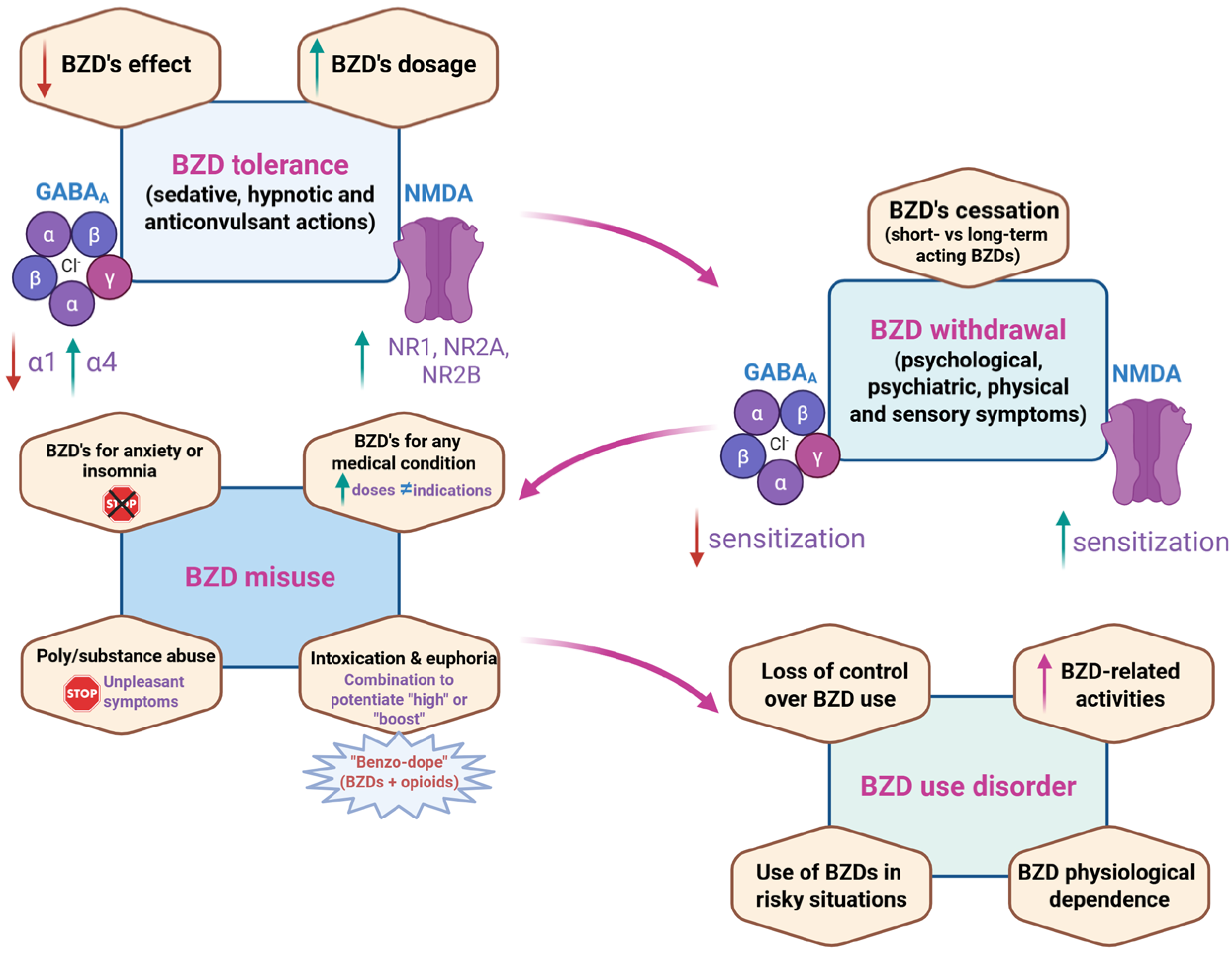
5.2. Tolerance to BZDs’ Effects
5.3. Discontinuation Syndromes
- Relapse is characterized by the return to the original anxiety or insomnia symptoms for which the BZD was prescribed. It begins gradually, over weeks or months, and follows a chronic or recurrent course.
- Rebound implies the abrupt reappearance of the symptoms of anxiety or insomnia for which the BZD was prescribed. They typically begin within a few days to a few weeks after BZD discontinuation and last up to 3 weeks. However, these symptoms are more intense than before the treatment was initiated.
- Withdrawal syndrome involves new autonomic arousal symptoms that were not present before the treatment with BZD was started and that have a variable intensity and duration.
5.4. BZD Withdrawal Syndrome
- Psychological and psychiatric symptoms include anxiety and panic attacks, restlessness and psychomotor agitation, mood swings and depression, lack of concentration, sleeping disorders, insomnia, and nightmares.
- Physical and sensory symptoms include loss of appetite, tachycardia, gastrointestinal symptoms (such as nausea or vomiting, diarrhea or abdominal distension), blurred vision, dry mouth, drowsiness, muscle tension, pain, cramps and spasms, weakness, tremors, sweating, shivering, paresthesia (characterized by a feeling of “pins and needles”), tinnitus, hyperacusis, photophobia, and dysesthesia.
5.5. BZD Misuse
- Patients for whom BZDs were prescribed because of anxiety or insomnia, and are unable to stop the BZD once the treatment period has finished, are using BZDs for more extended periods than recommended.
- Patients for whom BZDs were indicated for any medical or psychiatric reason, but who use higher doses and for different indications than those prescribed.
- Polysubstance abusers or subjects with substance or alcohol use disorders who use BZDs to mitigate unpleasant symptoms related to drug consumption, psychiatric comorbidity or withdrawal, such as anxiety and irritability, including self-treating opioid withdrawal (“fix”) and stimulant intoxication (“come down”).
- Recreational abuse refers to individuals, normally polysubstance abusers, who use BZDs because of their direct effects, such as intoxication or euphoria. Typically, these subjects do not use BZDs alone but combined with other drugs, especially opioids, trying to potentiate the “high” or “boost”. In addition, they use BZDs over therapeutic, prefer short-acting BZDs with a rapid onset of action and use BZDs by inhalation (“snorting”) or intravenously (which is associated with other medical risks, such as infections).
5.6. BZD Use Disorder (BUD)
- Loss of control over BZD use: thus, BZDs are used in larger doses or for a longer time than initially intended, continuing their use despite negative consequences associated with their consumption and failing during attempts to reduce or stop their use.
- Significant time and effort spent in BZD-related activities at the expense of other rewarding activities: for example, spending a lot of time/effort/money in acquiring the BZD or recovering from its effects, giving up on different activities in favor of BZD consumption, difficulties to focus on other activities due to craving and failure to achieve responsibilities at work, home, or academic and social settings because of BZD use.
- Use of BZDs in risky situations: BZDs are used recurrently in physically hazardous conditions, such as driving under the effects of these drugs or taking risks to acquire them.
- Development of BZD physiological dependence: development of tolerance and/or withdrawal.
6. Main Neuroadaptive Mechanisms Underlying the Adverse Effects of BZDs
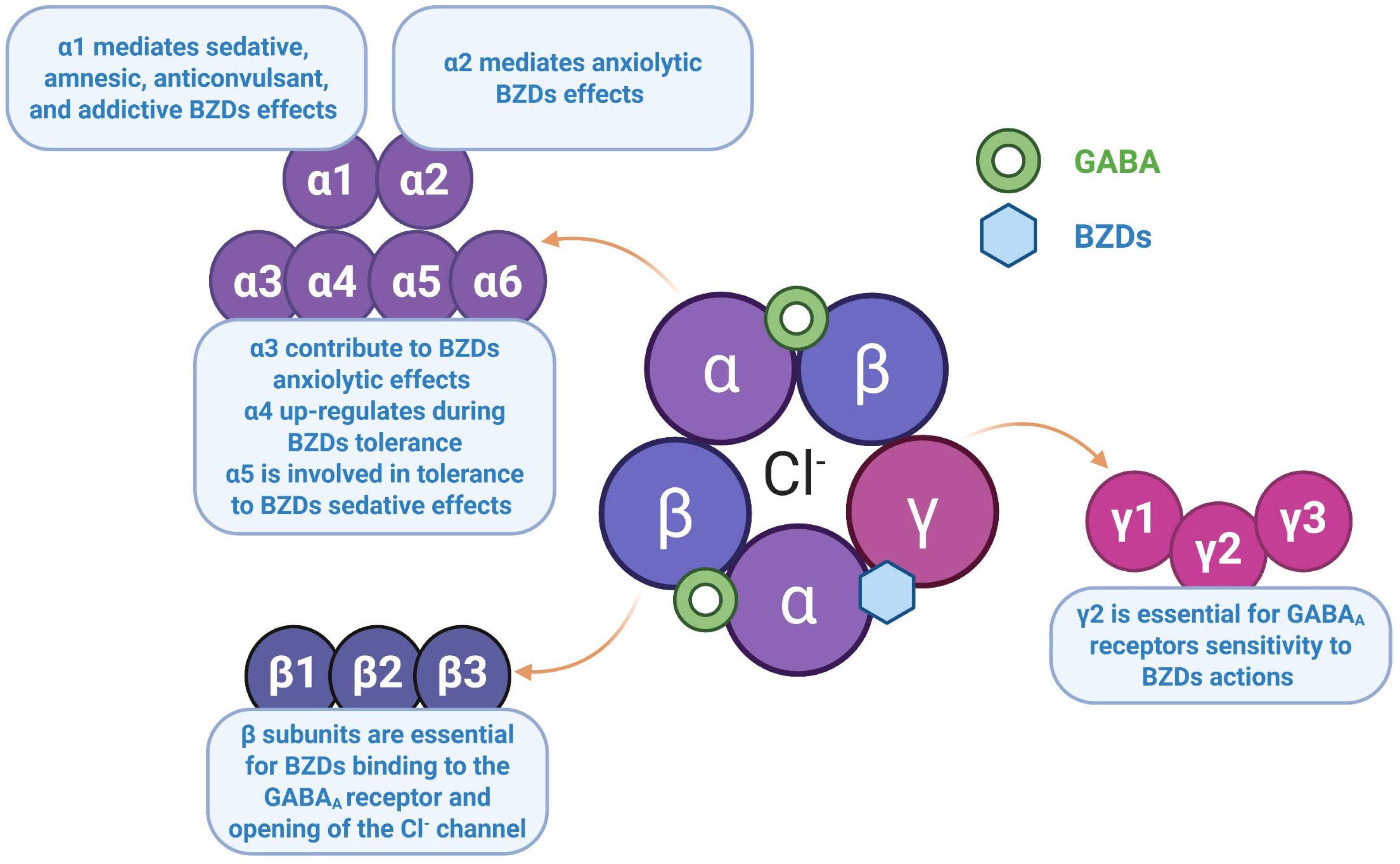
6.1. GABAergic System
6.2. Glutamatergic System
6.3. Endocannabinoid System
7. Preventive Strategies. Recommended Approaches to Promote an Adequate BZD Prescription, Use and Follow-Up
7.1. Recommended Approaches to Encourage Proper Prescription, Use and Follow-Up of BZDs
- BZDs should be used only for appropriate indications.
- BZDs should be employed at the minimum effective dose.
- BZDs should be prescribed in monotherapy, avoiding multiple prescriptions.
- BZDs should be only prescribed for acute disorders and for a short treatment duration. In general, it is recommended that BZD prescriptions should not exceed 2 to 4 weeks in the case of insomnia and 8 to 12 weeks in cases of anxiety, including the period for gradual tapering and withdrawal.
- When possible, non-pharmacological strategies, particularly psychological and behavioral therapies, should be considered before using BZDs in treating anxiety disorders and insomnia. Additionally, other pharmacological agents with lesser or non-abuse potential should be used as first-line treatments before considering BZD treatment.
- BZDs should be avoided in BZD-dependent high-risk patients (patients with a personal or family history of SUD, patients with chronic diseases, especially those associated with chronic pain, patients with chronic sleeping disorders and patients with psychiatric comorbidities). Additionally, BZDs should not be routinely used in special populations (in the elderly, children and adolescents, and pregnant and breastfeeding women).
- When withdrawing BZDs, abrupt discontinuation should be avoided. Gradual discontinuation is the recommended approach.
- The patient should be closely monitored for efficacy and potential adverse reactions to BZDs.
- The patient should be advised of the possibility of tolerance and dependence associated with long-term BZD use, reinforcing the importance of short-term use and BZD dose tapering. They should also be informed about side effects and withdrawal symptoms.
- The patient should be closely monitored for signs of misuse (drug-seeking behavior, need for increased dose, unwillingness to withdraw from treatment).
7.2. Other Pharmacological Strategies for Preventing BUD
7.2.1. Anxiety Disorders
7.2.2. Chronic Insomnia
8. Therapeutic Strategies for BUD
8.1. BZD Discontinuation and Withdrawal Management
8.2. BZD Inpatient Detoxification
- Patients who have not been able to complete an outpatient tapering process previously.
- Patients who are taking very high BZD doses (the equivalent of >100 mg diazepam per day).
- Patients with a more severe BUD.
- Patients with a very high risk of seizures or severe withdrawal.
- Patients with another comorbid SUD, especially when there is a comorbid use of alcohol and/or opioids.
- Patients who suffer from other psychiatric or medical conditions that could be destabilized during BZD withdrawal.
8.3. Adjunctive Pharmacological Agents and Biological Treatments for BZD Withdrawal and Relapse Prevention in BUD
8.3.1. Anticonvulsants
- Valproate
- Carbamazepine
- Pregabalin
- Gabapentin
8.3.2. Antidepressants
- Paroxetine
- Trazodone
- Tricyclic antidepressants
8.3.3. Hypnotics
- Melatonin
- Zopiclone
8.3.4. Anxiolytics
- Alpidem
- Buspirone
- Propranolol
- Captodiame
8.3.5. Other Agents
- Flumazenil
- Lithium
- Progesterone
- Magnesium aspartate
- Cyamemazine
- Ondansetron
8.3.6. Repetitive Transcranial Magnetic Stimulation
8.4. Psychological Treatments in BUD
- Psychoeducation and minimal brief interventions. Minimal, brief interventions in primary care can facilitate an initial reduction in BZD use.
- Motivational interviewing. It is based on the transtheoretical model of Prochaska and DiClemente.
- Cognitive-behavioral therapy (CBT). It is the most effective psychological treatment for BZD dependence. Its main objective is to prevent BZD relapse.
- Mindfulness-based interventions (MBI). In mindfulness-based relapse-prevention interventions, participants develop skills to manage discomfort and negative emotions, thereby broadening their repertoire of adaptive responses to situations that previously led to BZD use.
- Other psychological treatments. Other psychological therapies that have been explored in the management of BUD include self-control training, exposure to BZD cues to induce and manage craving, marital and familiar therapy (which considers that the patient suffering from a BUD reflects a dysfunctional family system such that the addictive behavior would be an attempt to regulate or control these dysfunctional relationships), and psychodynamic or psychoanalytic therapies (which consider addition as a failed attempt to self-healing and focus on frustration, poor problem-solving skills or low tolerance to negative emotions that could increase anxiety and hinder abstinence).
- Non-pharmacological strategies for treating sleeping disorders. They are based on stimulus control and sleep hygiene education, in which the patient learns to maintain a regular wake-sleep pattern, engage in relaxing activities before bedtime, and avoid stimulating activities.
9. Concluding Remarks
Author Contributions
Funding
Institutional Review Board Statement
Informed Consent Statement
Data Availability Statement
Acknowledgments
Conflicts of Interest
References
- International Narcotics Control Board. Annual Report 2019; United Nations: Vienna, Austria, 2020. [Google Scholar]
- International Narcotics Control Board. Annual Report 2023; United Nations: Vienna, Austria, 2023. [Google Scholar]
- Ma, T.T.; Wang, Z.; Qin, X.; Ju, C.; Lau, W.C.Y.; Man, K.K.C.; Castle, D.; Chung Chang, W.; Chan, A.Y.L.; Cheung, E.C.L.; et al. Global trends in the consumption of benzodiazepines and Z-drugs in 67 countries and regions from 2008 to 2018: A sales data analysis. Sleep 2023, 46, zsad124. [Google Scholar] [CrossRef]
- Yang, X.; Fang, Y.; Chen, H.; Zhang, T.; Yin, X.; Man, J.; Yang, L.; Lu, M. Global, regional and national burden of anxiety disorders from 1990 to 2019: Results from the Global Burden of Disease Study 2019. Epidemiol. Psychiatr. Sci. 2021, 30, e36. [Google Scholar] [CrossRef]
- Milani, S.A.; Raji, M.A.; Chen, L.; Kuo, Y.F. Trends in the Use of Benzodiazepines, Z-Hypnotics, and Serotonergic Drugs Among US Women and Men Before and During the COVID-19 Pandemic. JAMA Netw. Open 2021, 4, e2131012. [Google Scholar] [CrossRef] [PubMed]
- Lakhan, R.; Agrawal, A.; Sharma, M. Prevalence of Depression, Anxiety, and Stress during COVID-19 Pandemic. J. Neurosci. Rural. Pract. 2020, 11, 519–525. [Google Scholar] [CrossRef]
- Sirdifield, C.; Chipchase, S.Y.; Owen, S.; Siriwardena, A.N. A Systematic Review and Meta-Synthesis of Patients’ Experiences and Perceptions of Seeking and Using Benzodiazepines and Z-Drugs: Towards Safer Prescribing. Patient 2017, 10, 1–15. [Google Scholar] [CrossRef] [PubMed]
- Barboza Zanetti, M.O.; Dos Santos, I.; Durante, J.C.; Varallo, F.R.; Pereira, L.R.L.; Miasso, A.I. Consumption patterns and factors associated with inappropriate prescribing of benzodiazepines in Primary Health Care settings. PLoS ONE 2024, 19, e0309984. [Google Scholar] [CrossRef]
- Votaw, V.R.; Geyer, R.; Rieselbach, M.M.; McHugh, R.K. The epidemiology of benzodiazepine misuse: A systematic review. Drug Alcohol. Depend. 2019, 200, 95–114. [Google Scholar] [CrossRef]
- American Psychiatric Association. Diagnostic and Statistical Manual of Mental Disorders; American Psychiatric Association: Arlington, VA, USA, 2013. [Google Scholar]
- Brandt, J.; Bressi, J.; Le, M.L.; Neal, D.; Cadogan, C.; Witt-Doerring, J.; Witt-Doerring, M.; Wright, S. Prescribing and deprescribing guidance for benzodiazepine and benzodiazepine receptor agonist use in adults with depression, anxiety, and insomnia: An international scoping review. EClinicalMedicine 2024, 70, 102507. [Google Scholar] [CrossRef] [PubMed]
- Colado, M.-I.; Leza, J.-C.; Lizasoain, I. Drogodependencias, 4th ed.; Editorial Médica Panamericana, S.A.: Madrid, Spain, 2023. [Google Scholar]
- Flórez, J. Farmacología Humana, 6th ed.; Elsevier España: Madrid, Spain, 2014. [Google Scholar]
- James, M.; Ritter, R.J.F.; Henderson, G.; Loke, Y.K.; MacEwan, D. Rang y Dale Farmacología, 10th ed.; Elsevier España: Barcelona, Spain, 2024. [Google Scholar]
- Soyka, M. Treatment of Benzodiazepine Dependence. N. Engl. J. Med. 2017, 376, 1147–1157. [Google Scholar] [CrossRef]
- Vinkers, C.H.; Olivier, B. Mechanisms Underlying Tolerance after Long-Term Benzodiazepine Use: A Future for Subtype-Selective GABA(A) Receptor Modulators? Adv. Pharmacol. Sci. 2012, 2012, 416864. [Google Scholar] [CrossRef]
- Chagraoui, A.; Skiba, M.; Thuillez, C.; Thibaut, F. To what extent is it possible to dissociate the anxiolytic and sedative/hypnotic properties of GABAA receptors modulators? Prog. Neuropsychopharmacol. Biol. Psychiatry 2016, 71, 189–202. [Google Scholar] [CrossRef]
- Sigel, E.; Ernst, M. The Benzodiazepine Binding Sites of GABA(A) Receptors. Trends Pharmacol. Sci. 2018, 39, 659–671. [Google Scholar] [CrossRef]
- Laurence, L.; Brunton, R.H.-D.; Knollmann, B.C. Goodman & Gilman’s The Pharmacological Basis of Therapeutics, 13th ed.; McGraw-Hill Education: New York, NY, USA, 2018. [Google Scholar]
- Lorenzo, P.; Moro, M.Á.; Leza, J.-C.; Lizasoain, I.; Portolés, A. Velázquez Farmacología Básica y Clínica, 19th ed.; Editorial Médica Panamericana: Madrid, Spain, 2018. [Google Scholar]
- Auwärter, V.; Gallegos, A.; Evans-Brown, M.; Christie, R.; Jorge, R.; Sedefov, R. New Benzodiazepines in Europe—A Review; European Monitoring Centre for Drugs and Drug Addiction: Lisbon, Portugal, 2021. [Google Scholar]
- Yu, X.; Greenblatt, H.K.; Greenblatt, D.J. Designer benzodiazepines: An update. Expert. Rev. Clin. Pharmacol. 2023, 16, 109–117. [Google Scholar] [CrossRef]
- Orsolini, L.; Corkery, J.M.; Chiappini, S.; Guirguis, A.; Vento, A.; De Berardis, D.; Papanti, D.; Schifano, F. ‘New/Designer Benzodiazepines’: An Analysis of the Literature and Psychonauts’ Trip Reports. Curr. Neuropharmacol. 2020, 18, 809–837. [Google Scholar] [CrossRef]
- Bohnenberger, K.; Liu, M.T. Flubromazolam overdose: A review of a new designer benzodiazepine and the role of flumazenil. Ment. Health Clin. 2019, 9, 133–137. [Google Scholar] [CrossRef] [PubMed]
- Brunetti, P.; Giorgetti, R.; Tagliabracci, A.; Huestis, M.A.; Busardo, F.P. Designer Benzodiazepines: A Review of Toxicology and Public Health Risks. Pharmaceuticals 2021, 14, 560. [Google Scholar] [CrossRef]
- Chatterton, C.N.; Handy, R.P. Fentanyl concentrations in ligated femoral blood in the presence and absence of NPS benzodiazepine drugs. A review of over 1250 benzo-dope/fentanyl toxicity cases in Alberta, Canada. Forensic. Sci. Int. 2023, 350, 111777. [Google Scholar] [CrossRef] [PubMed]
- Kaye, A.D.; Tassin, J.P.; Upshaw, W.C.; Robichaux, C.M.; Frolov, M.V.; Dupaquier, M.M.; Fox, J.E.; Sterritt, J.; Mathew, J.; Shekoohi, S.; et al. Fake Xanax: Designer Emerging Benzodiazepine Epidemic Linked to Morbidity and Mortality a Narrative Review. Neurol. Ther. 2024, 13, 965–973. [Google Scholar] [CrossRef]
- Stevens; Brenner, C.W.; Stevens. Farmacología Básica, 6th ed.; Editorial Médica Panamericana: Madrid, Spain, 2023. [Google Scholar]
- Bandelow, B.; Michaelis, S.; Wedekind, D. Treatment of anxiety disorders. Dialogues Clin. Neurosci. 2017, 19, 93–107. [Google Scholar] [CrossRef] [PubMed]
- Stimpfl, J.N.; Mills, J.A.; Strawn, J.R. Pharmacologic predictors of benzodiazepine response trajectory in anxiety disorders: A Bayesian hierarchical modeling meta-analysis. CNS Spectr. 2023, 28, 53–60. [Google Scholar] [CrossRef]
- Mendez, E.M.; Mills, J.A.; Suresh, V.; Stimpfl, J.N.; Strawn, J.R. Trajectory and magnitude of response in adults with anxiety disorders: A Bayesian hierarchical modeling meta-analysis of selective serotonin reuptake inhibitors, serotonin norepinephrine reuptake inhibitors, and benzodiazepines. CNS Spectr. 2024, 29, 187–196. [Google Scholar] [CrossRef]
- Slee, A.; Nazareth, I.; Bondaronek, P.; Liu, Y.; Cheng, Z.; Freemantle, N. Pharmacological treatments for generalised anxiety disorder: A systematic review and network meta-analysis. Lancet 2019, 393, 768–777, Erratum in Lancet 2019, 393, 1698. https://doi.org/10.1016/S0140-6736(19)30857-8. [Google Scholar] [CrossRef]
- Chen, T.R.; Huang, H.C.; Hsu, J.H.; Ouyang, W.C.; Lin, K.C. Pharmacological and psychological interventions for generalized anxiety disorder in adults: A network meta-analysis. J. Psychiatr. Res. 2019, 118, 73–83. [Google Scholar] [CrossRef] [PubMed]
- Gomez, A.F.; Barthel, A.L.; Hofmann, S.G. Comparing the efficacy of benzodiazepines and serotonergic anti-depressants for adults with generalized anxiety disorder: A meta-analytic review. Expert. Opin. Pharmacother. 2018, 19, 883–894. [Google Scholar] [CrossRef] [PubMed]
- Guaiana, G.; Meader, N.; Barbui, C.; Davies, S.J.; Furukawa, T.A.; Imai, H.; Dias, S.; Caldwell, D.M.; Koesters, M.; Tajika, A.; et al. Pharmacological treatments in panic disorder in adults: A network meta-analysis. Cochrane Database Syst. Rev. 2023, 11, CD012729. [Google Scholar] [CrossRef]
- Edinoff, A.N.; Nix, C.A.; Hollier, J.; Sagrera, C.E.; Delacroix, B.M.; Abubakar, T.; Cornett, E.M.; Kaye, A.M.; Kaye, A.D. Benzodiazepines: Uses, Dangers, and Clinical Considerations. Neurol. Int. 2021, 13, 594–607. [Google Scholar] [CrossRef] [PubMed]
- Yue, J.L.; Chang, X.W.; Zheng, J.W.; Shi, L.; Xiang, Y.J.; Que, J.Y.; Yuan, K.; Deng, J.H.; Teng, T.; Li, Y.Y.; et al. Efficacy and tolerability of pharmacological treatments for insomnia in adults: A systematic review and network meta-analysis. Sleep. Med. Rev. 2023, 68, 101746. [Google Scholar] [CrossRef]
- Chang, Y.; Xie, X.; Liu, Y.; Liu, M.; Zhang, H. Exploring clinical applications and long-term effectiveness of benzodiazepines: An integrated perspective on mechanisms, imaging, and personalized medicine. Biomed. Pharmacother. 2024, 173, 116329. [Google Scholar] [CrossRef]
- de Mendonca, F.M.R.; de Mendonca, G.; Souza, L.C.; Galvao, L.P.; Paiva, H.S.; de Azevedo Marques Perico, C.; Torales, J.; Ventriglio, A.; Castaldelli-Maia, J.M.; Sousa Martins Silva, A. Benzodiazepines and Sleep Architecture: A Systematic Review. CNS Neurol. Disord. Drug Targets 2023, 22, 172–179. [Google Scholar] [CrossRef]
- De Crescenzo, F.; D’Alo, G.L.; Ostinelli, E.G.; Ciabattini, M.; Di Franco, V.; Watanabe, N.; Kurtulmus, A.; Tomlinson, A.; Mitrova, Z.; Foti, F.; et al. Comparative effects of pharmacological interventions for the acute and long-term management of insomnia disorder in adults: A systematic review and network meta-analysis. Lancet 2022, 400, 170–184. [Google Scholar] [CrossRef]
- Garriga, M.; Pacchiarotti, I.; Kasper, S.; Zeller, S.L.; Allen, M.H.; Vazquez, G.; Baldacara, L.; San, L.; McAllister-Williams, R.H.; Fountoulakis, K.N.; et al. Assessment and management of agitation in psychiatry: Expert consensus. World J. Biol. Psychiatry 2016, 17, 86–128. [Google Scholar] [CrossRef]
- Kousgaard, S.J.; Licht, R.W.; Nielsen, R.E. Effects of Intramuscular Midazolam and Lorazepam on Acute Agitation in Non-Elderly Subjects—A Systematic Review. Pharmacopsychiatry 2017, 50, 129–135. [Google Scholar] [CrossRef]
- Jaimes-Albornoz, W.; Ruiz de Pellon-Santamaria, A.; Nizama-Via, A.; Isetta, M.; Albajar, I.; Serra-Mestres, J. Catatonia in older adults: A systematic review. World J. Psychiatry 2022, 12, 348–367. [Google Scholar] [CrossRef]
- Pelzer, A.C.; van der Heijden, F.M.; den Boer, E. Systematic review of catatonia treatment. Neuropsychiatr. Dis. Treat. 2018, 14, 317–326. [Google Scholar] [CrossRef] [PubMed]
- Weintraub, S.J. Diazepam in the Treatment of Moderate to Severe Alcohol Withdrawal. CNS Drugs 2017, 31, 87–95. [Google Scholar] [CrossRef] [PubMed]
- Bahji, A.; Bach, P.; Danilewitz, M.; Crockford, D.; El-Guebaly, N.; Devoe, D.J.; Saitz, R. Comparative efficacy and safety of pharmacotherapies for alcohol withdrawal: A systematic review and network meta-analysis. Addiction 2022, 117, 2591–2601. [Google Scholar] [CrossRef] [PubMed]
- Maldonado, J.R. Novel Algorithms for the Prophylaxis and Management of Alcohol Withdrawal Syndromes-Beyond Benzodiazepines. Crit. Care Clin. 2017, 33, 559–599. [Google Scholar] [CrossRef]
- Airagnes, G.; Ducoutumany, G.; Laffy-Beaufils, B.; Le Faou, A.L.; Limosin, F. Alcohol withdrawal syndrome management: Is there anything new? Rev. Med. Interne 2019, 40, 373–379. [Google Scholar] [CrossRef]
- Benasi, G.; Guidi, J.; Offidani, E.; Balon, R.; Rickels, K.; Fava, G.A. Benzodiazepines as a Monotherapy in Depressive Disorders: A Systematic Review. Psychother. Psychosom. 2018, 87, 65–74. [Google Scholar] [CrossRef]
- Dubovsky, S.L.; Marshall, D. Benzodiazepines Remain Important Therapeutic Options in Psychiatric Practice. Psychother. Psychosom. 2022, 91, 307–334. [Google Scholar] [CrossRef]
- Ogawa, Y.; Takeshima, N.; Hayasaka, Y.; Tajika, A.; Watanabe, N.; Streiner, D.; Furukawa, T.A. Antidepressants plus benzodiazepines for adults with major depression. Cochrane Database Syst. Rev. 2019, 6, CD001026. [Google Scholar] [CrossRef]
- Lader, M. Benzodiazepines revisited—Will we ever learn? Addiction 2011, 106, 2086–2109. [Google Scholar] [CrossRef] [PubMed]
- Ettcheto, M.; Olloquequi, J.; Sanchez-Lopez, E.; Busquets, O.; Cano, A.; Manzine, P.R.; Beas-Zarate, C.; Castro-Torres, R.D.; Garcia, M.L.; Bullo, M.; et al. Benzodiazepines and Related Drugs as a Risk Factor in Alzheimer’s Disease Dementia. Front. Aging Neurosci. 2019, 11, 344. [Google Scholar] [CrossRef] [PubMed]
- Wu, C.S.; Wang, S.C.; Chang, I.S.; Lin, K.M. The association between dementia and long-term use of benzodiazepine in the elderly: Nested case-control study using claims data. Am. J. Geriatr. Psychiatry 2009, 17, 614–620. [Google Scholar] [CrossRef]
- Wu, C.S.; Ting, T.T.; Wang, S.C.; Chang, I.S.; Lin, K.M. Effect of benzodiazepine discontinuation on dementia risk. Am. J. Geriatr. Psychiatry 2011, 19, 151–159. [Google Scholar] [CrossRef] [PubMed]
- Billioti de Gage, S.; Moride, Y.; Ducruet, T.; Kurth, T.; Verdoux, H.; Tournier, M.; Pariente, A.; Begaud, B. Benzodiazepine use and risk of Alzheimer’s disease: Case-control study. BMJ 2014, 349, g5205. [Google Scholar] [CrossRef]
- Gomm, W.; von Holt, K.; Thome, F.; Broich, K.; Maier, W.; Weckbecker, K.; Fink, A.; Doblhammer, G.; Haenisch, B. Regular Benzodiazepine and Z-Substance Use and Risk of Dementia: An Analysis of German Claims Data. J. Alzheimers Dis. 2016, 54, 801–808. [Google Scholar] [CrossRef]
- Saarelainen, L.; Taipale, H.; Koponen, M.; Tanskanen, A.; Tolppanen, A.M.; Tiihonen, J.; Hartikainen, S. The Incidence of Benzodiazepine and Related Drug Use in Persons with and without Alzheimer’s Disease. J. Alzheimers Dis. 2016, 49, 809–818. [Google Scholar] [CrossRef]
- Tapiainen, V.; Taipale, H.; Tanskanen, A.; Tiihonen, J.; Hartikainen, S.; Tolppanen, A.M. The risk of Alzheimer’s disease associated with benzodiazepines and related drugs: A nested case-control study. Acta Psychiatr. Scand. 2018, 138, 91–100. [Google Scholar] [CrossRef]
- Gallacher, J.; Elwood, P.; Pickering, J.; Bayer, A.; Fish, M.; Ben-Shlomo, Y. Benzodiazepine use and risk of dementia: Evidence from the Caerphilly Prospective Study (CaPS). J. Epidemiol. Community Health 2012, 66, 869–873. [Google Scholar] [CrossRef]
- Lee, J.; Jung, S.J.; Choi, J.W.; Shin, A.; Lee, Y.J. Use of sedative-hypnotics and the risk of Alzheimer’s dementia: A retrospective cohort study. PLoS ONE 2018, 13, e0204413, Correction in PLoS ONE 2018, 13, e0206094. [Google Scholar] [CrossRef]
- Bierman, E.J.; Comijs, H.C.; Gundy, C.M.; Sonnenberg, C.; Jonker, C.; Beekman, A.T. The effect of chronic benzodiazepine use on cognitive functioning in older persons: Good, bad or indifferent? Int. J. Geriatr. Psychiatry 2007, 22, 1194–1200. [Google Scholar] [CrossRef]
- Boeuf-Cazou, O.; Bongue, B.; Ansiau, D.; Marquie, J.C.; Lapeyre-Mestre, M. Impact of long-term benzodiazepine use on cognitive functioning in young adults: The VISAT cohort. Eur. J. Clin. Pharmacol. 2011, 67, 1045–1052. [Google Scholar] [CrossRef]
- Tseng, L.Y.; Huang, S.T.; Peng, L.N.; Chen, L.K.; Hsiao, F.Y. Benzodiazepines, z-Hypnotics, and Risk of Dementia: Special Considerations of Half-Lives and Concomitant Use. Neurotherapeutics 2020, 17, 156–164. [Google Scholar] [CrossRef]
- Hou, J.H.; Sun, S.L.; Tan, C.C.; Huang, Y.M.; Tan, L.; Xu, W. Relationships of Hypnotics with Incident Dementia and Alzheimer’s Disease: A Longitudinal Study and Meta-Analysis. J. Prev. Alzheimers Dis. 2024, 11, 117–129. [Google Scholar] [CrossRef]
- Zhong, G.; Wang, Y.; Zhang, Y.; Zhao, Y. Association between Benzodiazepine Use and Dementia: A Meta-Analysis. PLoS ONE 2015, 10, e0127836. [Google Scholar] [CrossRef]
- Islam, M.M.; Iqbal, U.; Walther, B.; Atique, S.; Dubey, N.K.; Nguyen, P.A.; Poly, T.N.; Masud, J.H.; Li, Y.J.; Shabbir, S.A. Benzodiazepine Use and Risk of Dementia in the Elderly Population: A Systematic Review and Meta-Analysis. Neuroepidemiology 2016, 47, 181–191. [Google Scholar] [CrossRef] [PubMed]
- Lucchetta, R.C.; da Mata, B.P.M.; Mastroianni, P.C. Association between Development of Dementia and Use of Benzodiazepines: A Systematic Review and Meta-Analysis. Pharmacotherapy 2018, 38, 1010–1020. [Google Scholar] [CrossRef]
- Penninkilampi, R.; Eslick, G.D. A Systematic Review and Meta-Analysis of the Risk of Dementia Associated with Benzodiazepine Use, After Controlling for Protopathic Bias. CNS Drugs 2018, 32, 485–497. [Google Scholar] [CrossRef] [PubMed]
- He, Q.; Chen, X.; Wu, T.; Li, L.; Fei, X. Risk of Dementia in Long-Term Benzodiazepine Users: Evidence from a Meta-Analysis of Observational Studies. J. Clin. Neurol. 2019, 15, 9–19. [Google Scholar] [CrossRef] [PubMed]
- Billioti de Gage, S.; Pariente, A.; Begaud, B. Is there really a link between benzodiazepine use and the risk of dementia? Expert. Opin. Drug Saf. 2015, 14, 733–747. [Google Scholar] [CrossRef]
- Imfeld, P.; Bodmer, M.; Jick, S.S.; Meier, C.R. Benzodiazepine Use and Risk of Developing Alzheimer’s Disease or Vascular Dementia: A Case-Control Analysis. Drug Saf. 2015, 38, 909–919. [Google Scholar] [CrossRef]
- Gray, S.L.; Dublin, S.; Yu, O.; Walker, R.; Anderson, M.; Hubbard, R.A.; Crane, P.K.; Larson, E.B. Benzodiazepine use and risk of incident dementia or cognitive decline: Prospective population based study. BMJ 2016, 352, i90. [Google Scholar] [CrossRef]
- Bietry, F.A.; Pfeil, A.M.; Reich, O.; Schwenkglenks, M.; Meier, C.R. Benzodiazepine Use and Risk of Developing Alzheimer’s Disease: A Case-Control Study Based on Swiss Claims Data. CNS Drugs 2017, 31, 245–251. [Google Scholar] [CrossRef]
- Grande, G.; Tramacere, I.; Vetrano, D.L.; Pomati, S.; Mariani, C.; Filippini, G. Use of benzodiazepines and cognitive performance in primary care patients with first cognitive complaints. Int. Psychogeriatr. 2018, 30, 597–601. [Google Scholar] [CrossRef]
- Richardson, K.; Mattishent, K.; Loke, Y.K.; Steel, N.; Fox, C.; Grossi, C.M.; Bennett, K.; Maidment, I.; Boustani, M.; Matthews, F.E.; et al. History of Benzodiazepine Prescriptions and Risk of Dementia: Possible Bias Due to Prevalent Users and Covariate Measurement Timing in a Nested Case-Control Study. Am. J. Epidemiol. 2019, 188, 1228–1236. [Google Scholar] [CrossRef] [PubMed]
- Osler, M.; Jorgensen, M.B. Associations of Benzodiazepines, Z-Drugs, and Other Anxiolytics with Subsequent Dementia in Patients With Affective Disorders: A Nationwide Cohort and Nested Case-Control Study. Am. J. Psychiatry 2020, 177, 497–505. [Google Scholar] [CrossRef]
- Mura, T.; Proust-Lima, C.; Akbaraly, T.; Amieva, H.; Tzourio, C.; Chevassus, H.; Picot, M.C.; Jacqumin-Gadda, H.; Berr, C. Chronic use of benzodiazepines and latent cognitive decline in the elderly: Results from the Three-city study. Eur. Neuropsychopharmacol. 2013, 23, 212–223. [Google Scholar] [CrossRef] [PubMed]
- Chung, J.K.; Nakajima, S.; Shinagawa, S.; Plitman, E.; Chakravarty, M.M.; Iwata, Y.; Caravaggio, F.; Pollock, B.G.; Gerretsen, P.; Graff-Guerrero, A.; et al. Benzodiazepine Use Attenuates Cortical beta-Amyloid and is Not Associated with Progressive Cognitive Decline in Nondemented Elderly Adults: A Pilot Study Using F(18)-Florbetapir Positron Emission Tomography. Am. J. Geriatr. Psychiatry 2016, 24, 1028–1039. [Google Scholar] [CrossRef] [PubMed]
- Desmidt, T.; Delrieu, J.; Lebouvier, T.; Robert, G.; David, R.; Balageas, A.C.; Surget, A.; Belzung, C.; Arlicot, N.; Ribeiro, M.J.; et al. Benzodiazepine use and brain amyloid load in nondemented older individuals: A florbetapir PET study in the Multidomain Alzheimer Preventive Trial cohort. Neurobiol. Aging 2019, 84, 61–69. [Google Scholar] [CrossRef]
- Rivas, J.; Hernandez, M.; Erazo, J.M.; Martinez, M.J.; Gonzalez, C.; Cortes, M.P.; Munoz, J.; Miranda, C. Chronic Use of Benzodiazepine in Older Adults and Its Relationship with Dementia: A Systematic Review and Meta-Analysis. Harv. Rev. Psychiatry 2025, 33, 1–7. [Google Scholar] [CrossRef]
- Seppala, L.J.; Wermelink, A.M.; de Vries, M.; Ploegmakers, K.J.; van de Glind, E.M.; Daams, J.G.; van der Velde, N.; Blain, H.; Bousquet, J.; Bucht, G.; et al. Fall-Risk-Increasing Drugs: A Systematic Review and Meta-Analysis: II. Psychotropics. J. Am. Med. Dir. Assoc. 2018, 19, 371-e11. [Google Scholar] [CrossRef]
- Shao, L.; Shi, Y.; Xie, X.Y.; Wang, Z.; Wang, Z.A.; Zhang, J.E. Incidence and Risk Factors of Falls Among Older People in Nursing Homes: Systematic Review and Meta-Analysis. J. Am. Med. Dir. Assoc. 2023, 24, 1708–1717. [Google Scholar] [CrossRef]
- Grigoriadis, S.; Graves, L.; Peer, M.; Mamisashvili, L.; Ruthirakuhan, M.; Chan, P.; Hennawy, M.; Parikh, S.; Vigod, S.N.; Dennis, C.L.; et al. Pregnancy and Delivery Outcomes Following Benzodiazepine Exposure: A Systematic Review and Meta-analysis. Can. J. Psychiatry 2020, 65, 821–834. [Google Scholar] [CrossRef]
- Grigoriadis, S.; Alibrahim, A.; Mansfield, J.K.; Sullovey, A.; Robinson, G.E. Hypnotic benzodiazepine receptor agonist exposure during pregnancy and the risk of congenital malformations and other adverse pregnancy outcomes: A systematic review and meta-analysis. Acta Psychiatr. Scand. 2022, 146, 312–324. [Google Scholar] [CrossRef]
- Wu, H.N.; Liang, Y.; Li, L.L.; Jiang, H.Y.; Xu, L.L. The safety of benzodiazepines and related drugs during pregnancy: An updated meta-analysis of cohort studies. Arch. Gynecol. Obstet. 2024, 310, 45–54. [Google Scholar] [CrossRef]
- Grigoriadis, S.; Graves, L.; Peer, M.; Mamisashvili, L.; Dennis, C.L.; Vigod, S.N.; Steiner, M.; Brown, C.; Cheung, A.; Dawson, H.; et al. Benzodiazepine Use During Pregnancy Alone or in Combination with an Antidepressant and Congenital Malformations: Systematic Review and Meta-Analysis. J. Clin. Psychiatry 2019, 80, 1845. [Google Scholar] [CrossRef] [PubMed]
- Hestevik, C.H.; Evensen, L.H.; Kornor, H.; Skeie, I. The association between benzodiazepine co-prescription, opioid agonist treatment and mortality: A systematic review. BMC Psychiatry 2024, 24, 741. [Google Scholar] [CrossRef] [PubMed]
- Liu, S.; O’Donnell, J.; Gladden, R.M.; McGlone, L.; Chowdhury, F. Trends in Nonfatal and Fatal Overdoses Involving Benzodiazepines—38 States and the District of Columbia, 2019-2020. MMWR Morb. Mortal. Wkly. Rep. 2021, 70, 1136–1141. [Google Scholar] [CrossRef]
- Maust, D.T.; Petzold, K.; Strominger, J.; Kim, H.M.; Bohnert, A.S.B. Benzodiazepine Discontinuation and Mortality Among Patients Receiving Long-Term Benzodiazepine Therapy. JAMA Netw. Open 2023, 6, e2348557. [Google Scholar] [CrossRef] [PubMed]
- Gibbons, R.D.; Hur, K.; Quinn, P.D. Concomitant opioid and benzodiazepine use and risk of suicide attempt and intentional self-harm: Pharmacoepidemiologic study. Drug Alcohol. Depend. 2021, 228, 109046. [Google Scholar] [CrossRef]
- Khan, S.M.; Kasagga, A.; Verma, A.; Saraya, E.; Haque, M.S.; Senaratne, M.; Khan, S. Suicidal Ideation and Suicide Completion in Benzodiazepine Users: A Systematic Review of Current Evidence. Cureus 2025, 17, e84318. [Google Scholar] [CrossRef]
- Guina, J.; Merrill, B. Benzodiazepines I: Upping the Care on Downers: The Evidence of Risks, Benefits and Alternatives. J. Clin. Med. 2018, 7, 17. [Google Scholar] [CrossRef] [PubMed]
- Engin, E. GABA(A) receptor subtypes and benzodiazepine use, misuse, and abuse. Front. Psychiatry 2022, 13, 1060949. [Google Scholar] [CrossRef]
- Peng, L.; Morford, K.L.; Levander, X.A. Benzodiazepines and Related Sedatives. Med. Clin. North. Am. 2022, 106, 113–129. [Google Scholar] [CrossRef] [PubMed]
- Schmitz, A. Benzodiazepine use, misuse, and abuse: A review. Ment. Health Clin. 2016, 6, 120–126. [Google Scholar] [CrossRef]
- Kan, C.C.; Hilberink, S.R.; Breteler, M.H. Determination of the main risk factors for benzodiazepine dependence using a multivariate and multidimensional approach. Compr. Psychiatry 2004, 45, 88–94. [Google Scholar] [CrossRef] [PubMed]
- Maust, D.T.; Lin, L.A.; Blow, F.C. Benzodiazepine Use and Misuse Among Adults in the United States. Psychiatr. Serv. 2019, 70, 97–106. [Google Scholar] [CrossRef]
- Wafford, K.A. GABAA receptor subtypes: Any clues to the mechanism of benzodiazepine dependence? Curr. Opin. Pharmacol. 2005, 5, 47–52. [Google Scholar] [CrossRef]
- Gravielle, M.C. Activation-induced regulation of GABAA receptors: Is there a link with the molecular basis of benzodiazepine tolerance? Pharmacol. Res. 2016, 109, 92–100. [Google Scholar] [CrossRef]
- Nicholson, M.W.; Sweeney, A.; Pekle, E.; Alam, S.; Ali, A.B.; Duchen, M.; Jovanovic, J.N. Diazepam-induced loss of inhibitory synapses mediated by PLCdelta/Ca(2+)/calcineurin signalling downstream of GABAA receptors. Mol. Psychiatry 2018, 23, 1851–1867. [Google Scholar] [CrossRef]
- Uusi-Oukari, M.; Korpi, E.R. Regulation of GABA(A) receptor subunit expression by pharmacological agents. Pharmacol. Rev. 2010, 62, 97–135. [Google Scholar] [CrossRef]
- Holt, R.A.; Bateson, A.N.; Martin, I.L. Chronic treatment with diazepam or abecarnil differently affects the expression of GABAA receptor subunit mRNAs in the rat cortex. Neuropharmacology 1996, 35, 1457–1463. [Google Scholar] [CrossRef]
- Wu, Y.; Rosenberg, H.C.; Chiu, T.H.; Zhao, T.J. Subunit- and brain region-specific reduction of GABAA receptor subunit mRNAs during chronic treatment of rats with diazepam. J. Mol. Neurosci. 1994, 5, 105–120. [Google Scholar] [CrossRef] [PubMed]
- Pesold, C.; Caruncho, H.J.; Impagnatiello, F.; Berg, M.J.; Fritschy, J.M.; Guidotti, A.; Costa, E. Tolerance to diazepam and changes in GABA(A) receptor subunit expression in rat neocortical areas. Neuroscience 1997, 79, 477–487. [Google Scholar] [CrossRef] [PubMed]
- Follesa, P.; Cagetti, E.; Mancuso, L.; Biggio, F.; Manca, A.; Maciocco, E.; Massa, F.; Desole, M.S.; Carta, M.; Busonero, F.; et al. Increase in expression of the GABA(A) receptor alpha(4) subunit gene induced by withdrawal of, but not by long-term treatment with, benzodiazepine full or partial agonists. Brain Res. Mol. Brain Res. 2001, 92, 138–148. [Google Scholar] [CrossRef] [PubMed]
- Divljakovic, J.; Milic, M.; Namjoshi, O.A.; Tiruveedhula, V.V.; Timic, T.; Cook, J.M.; Savic, M.M. betaCCT, an antagonist selective for alpha(1)GABA(A) receptors, reverses diazepam withdrawal-induced anxiety in rats. Brain Res. Bull. 2013, 91, 1–7. [Google Scholar] [CrossRef]
- Katsura, M.; Shibasaki, M.; Kurokawa, K.; Tsujimura, A.; Ohkuma, S. Up-regulation of L-type high voltage-gated calcium channel subunits by sustained exposure to 1,4- and 1,5-benzodiazepines in cerebrocortical neurons. J. Neurochem. 2007, 103, 2518–2528. [Google Scholar] [CrossRef]
- Gonzalez Gomez, L.C.; Medina, N.B.; Sanz Blasco, S.; Gravielle, M.C. Diazepam-Induced Down-Regulation of the GABA(A) receptor alpha1 Subunit, as mediated by the activation of L-Type Voltage-Gated calcium Channel/Ca(2+)/Protein kinase a signaling cascade. Neurosci. Lett. 2023, 810, 137358. [Google Scholar] [CrossRef]
- Kralic, J.E.; O’Buckley, T.K.; Khisti, R.T.; Hodge, C.W.; Homanics, G.E.; Morrow, A.L. GABA(A) receptor alpha-1 subunit deletion alters receptor subtype assembly, pharmacological and behavioral responses to benzodiazepines and zolpidem. Neuropharmacology 2002, 43, 685–694. [Google Scholar] [CrossRef]
- van Rijnsoever, C.; Tauber, M.; Choulli, M.K.; Keist, R.; Rudolph, U.; Mohler, H.; Fritschy, J.M.; Crestani, F. Requirement of alpha5-GABAA receptors for the development of tolerance to the sedative action of diazepam in mice. J. Neurosci. 2004, 24, 6785–6790. [Google Scholar] [CrossRef]
- Zammit, G. Comparative tolerability of newer agents for insomnia. Drug Saf. 2009, 32, 735–748. [Google Scholar] [CrossRef]
- Perrault, G.; Morel, E.; Sanger, D.J.; Zivkovic, B. Lack of tolerance and physical dependence upon repeated treatment with the novel hypnotic zolpidem. J. Pharmacol. Exp. Ther. 1992, 263, 298–303. [Google Scholar] [CrossRef] [PubMed]
- Vinkers, C.H.; van Oorschot, R.; Nielsen, E.O.; Cook, J.M.; Hansen, H.H.; Groenink, L.; Olivier, B.; Mirza, N.R. GABA(A) receptor alpha subunits differentially contribute to diazepam tolerance after chronic treatment. PLoS ONE 2012, 7, e43054. [Google Scholar] [CrossRef]
- Cheng, T.; Wallace, D.M.; Ponteri, B.; Tuli, M. Valium without dependence? Individual GABA(A) receptor subtype contribution toward benzodiazepine addiction, tolerance, and therapeutic effects. Neuropsychiatr. Dis. Treat. 2018, 14, 1351–1361. [Google Scholar] [CrossRef] [PubMed]
- de Haas, S.L.; de Visser, S.J.; van der Post, J.P.; de Smet, M.; Schoemaker, R.C.; Rijnbeek, B.; Cohen, A.F.; Vega, J.M.; Agrawal, N.G.; Goel, T.V.; et al. Pharmacodynamic and pharmacokinetic effects of TPA023, a GABA(A) alpha(2,3) subtype-selective agonist, compared to lorazepam and placebo in healthy volunteers. J. Psychopharmacol. 2007, 21, 374–383. [Google Scholar] [CrossRef]
- Masiulis, S.; Desai, R.; Uchanski, T.; Serna Martin, I.; Laverty, D.; Karia, D.; Malinauskas, T.; Zivanov, J.; Pardon, E.; Kotecha, A.; et al. GABA(A) receptor signalling mechanisms revealed by structural pharmacology. Nature 2019, 565, 454–459, Correction in Nature 2019, 566, E8. [Google Scholar] [CrossRef] [PubMed]
- Tan, K.R.; Brown, M.; Labouebe, G.; Yvon, C.; Creton, C.; Fritschy, J.M.; Rudolph, U.; Luscher, C. Neural bases for addictive properties of benzodiazepines. Nature 2010, 463, 769–774. [Google Scholar] [CrossRef]
- Engin, E.; Bakhurin, K.I.; Smith, K.S.; Hines, R.M.; Reynolds, L.M.; Tang, W.; Sprengel, R.; Moss, S.J.; Rudolph, U. Neural basis of benzodiazepine reward: Requirement for alpha2 containing GABAA receptors in the nucleus accumbens. Neuropsychopharmacology 2014, 39, 1805–1815. [Google Scholar] [CrossRef]
- Allison, C.; Pratt, J.A. Neuroadaptive processes in GABAergic and glutamatergic systems in benzodiazepine dependence. Pharmacol. Ther. 2003, 98, 171–195. [Google Scholar] [CrossRef]
- Izzo, E.; Auta, J.; Impagnatiello, F.; Pesold, C.; Guidotti, A.; Costa, E. Glutamic acid decarboxylase and glutamate receptor changes during tolerance and dependence to benzodiazepines. Proc. Natl. Acad. Sci. USA 2001, 98, 3483–3488. [Google Scholar] [CrossRef]
- Almiron, R.S.; Perez, M.F.; Ramirez, O.A. MK-801 prevents the increased NMDA-NR1 and NR2B subunits mRNA expression observed in the hippocampus of rats tolerant to diazepam. Brain Res. 2004, 1008, 54–60. [Google Scholar] [CrossRef]
- File, S.E.; Fernandes, C. Dizocilpine prevents the development of tolerance to the sedative effects of diazepam in rats. Pharmacol. Biochem. Behav. 1994, 47, 823–826. [Google Scholar] [CrossRef]
- Khanna, J.M.; Chau, A.; Shah, G. Effect of NMDA antagonists on rapid tolerance to benzodiazepines. Brain Res. Bull. 1997, 42, 99–103. [Google Scholar] [CrossRef] [PubMed]
- Zaric Kontic, M.; Dragic, M.; Martinovic, J.; Mihajlovic, K.; Brkic, Z.; Mitrovic, N.; Grkovic, I. Prolonged Alprazolam Treatment Alters Components of Glutamatergic Neurotransmission in the Hippocampus of Male Wistar Rats-The Neuroadaptive Changes following Long-Term Benzodiazepine (Mis)Use. Pharmaceuticals 2023, 16, 331. [Google Scholar] [CrossRef] [PubMed]
- Van Sickle, B.J.; Xiang, K.; Tietz, E.I. Transient plasticity of hippocampal CA1 neuron glutamate receptors contributes to benzodiazepine withdrawal-anxiety. Neuropsychopharmacology 2004, 29, 1994–2006. [Google Scholar] [CrossRef]
- Tsuda, M.; Shimizu, N.; Yajima, Y.; Suzuki, T.; Misawa, M. Hypersusceptibility to DMCM-induced seizures during diazepam withdrawal in mice: Evidence for upregulation of NMDA receptors. Naunyn Schmiedebergs Arch. Pharmacol. 1998, 357, 309–315. [Google Scholar] [CrossRef] [PubMed]
- Song, J.; Shen, G.; Greenfield, L.J., Jr.; Tietz, E.I. Benzodiazepine withdrawal-induced glutamatergic plasticity involves up-regulation of GluR1-containing alpha-amino-3-hydroxy-5-methylisoxazole-4-propionic acid receptors in Hippocampal CA1 neurons. J. Pharmacol. Exp. Ther. 2007, 322, 569–581. [Google Scholar] [CrossRef]
- Das, P.; Lilly, S.M.; Zerda, R.; Gunning, W.T., 3rd; Alvarez, F.J.; Tietz, E.I. Increased AMPA receptor GluR1 subunit incorporation in rat hippocampal CA1 synapses during benzodiazepine withdrawal. J. Comp. Neurol. 2008, 511, 832–846. [Google Scholar] [CrossRef]
- Pakkhesal, S.; Shakouri, M.; Mosaddeghi-Heris, R.; Kiani Nasab, S.; Salehi, N.; Sharafi, A.; Ahmadalipour, A. Bridging the gap: The endocannabinoid system as a functional fulcrum for benzodiazepines in a novel frontier of anxiety pharmacotherapy. Pharmacol. Ther. 2025, 267, 108799. [Google Scholar] [CrossRef]
- Uriguen, L.; Perez-Rial, S.; Ledent, C.; Palomo, T.; Manzanares, J. Impaired action of anxiolytic drugs in mice deficient in cannabinoid CB1 receptors. Neuropharmacology 2004, 46, 966–973. [Google Scholar] [CrossRef]
- Naderi, N.; Haghparast, A.; Saber-Tehrani, A.; Rezaii, N.; Alizadeh, A.M.; Khani, A.; Motamedi, F. Interaction between cannabinoid compounds and diazepam on anxiety-like behaviour of mice. Pharmacol. Biochem. Behav. 2008, 89, 64–75. [Google Scholar] [CrossRef] [PubMed]
- Garcia-Gutierrez, M.S.; Manzanares, J. The cannabinoid CB1 receptor is involved in the anxiolytic, sedative and amnesic actions of benzodiazepines. J. Psychopharmacol. 2010, 24, 757–765. [Google Scholar] [CrossRef]
- Batista, L.A.; Moreira, F.A. Cannabinoid CB(1) receptors mediate the anxiolytic effects induced by systemic alprazolam and intra-periaqueductal gray 5-HT(1A) receptor activation. Neurosci. Lett. 2019, 703, 5–10. [Google Scholar] [CrossRef]
- Garcia-Gutierrez, M.S.; Manzanares, J. Overexpression of CB2 cannabinoid receptors decreased vulnerability to anxiety and impaired anxiolytic action of alprazolam in mice. J. Psychopharmacol. 2011, 25, 111–120. [Google Scholar] [CrossRef] [PubMed]
- Brett, J.; Murnion, B. Management of benzodiazepine misuse and dependence. Aust. Prescr. 2015, 38, 152–155. [Google Scholar] [CrossRef]
- Jakubovski, E.; Johnson, J.A.; Nasir, M.; Muller-Vahl, K.; Bloch, M.H. Systematic review and meta-analysis: Dose-response curve of SSRIs and SNRIs in anxiety disorders. Depress. Anxiety 2019, 36, 198–212. [Google Scholar] [CrossRef] [PubMed]
- Mitsui, N.; Fujii, Y.; Asakura, S.; Imai, H.; Yamada, H.; Yoshinaga, N.; Kanai, Y.; Inoue, T.; Shimizu, E. Antidepressants for social anxiety disorder: A systematic review and meta-analysis. Neuropsychopharmacol. Rep. 2022, 42, 398–409. [Google Scholar] [CrossRef]
- Fluyau, D.; Mitra, P.; Jain, A.; Kailasam, V.K.; Pierre, C.G. Selective serotonin reuptake inhibitors in the treatment of depression, anxiety, and post-traumatic stress disorder in substance use disorders: A Bayesian meta-analysis. Eur. J. Clin. Pharmacol. 2022, 78, 931–942. [Google Scholar] [CrossRef]
- Hong, J.S.W.; Atkinson, L.Z.; Al-Juffali, N.; Awad, A.; Geddes, J.R.; Tunbridge, E.M.; Harrison, P.J.; Cipriani, A. Gabapentin and pregabalin in bipolar disorder, anxiety states, and insomnia: Systematic review, meta-analysis, and rationale. Mol. Psychiatry 2022, 27, 1339–1349. [Google Scholar] [CrossRef]
- Cardoner, N.; Gutierrez-Rojas, L.; Saiz, P.; Lahera, G.; Alvarez-Mon, M.A.; Alonso Ortega, P.; Perez-Paramo, M. Does pregabalin offer potential as a first-line therapy for generalized anxiety disorder? A meta-analysis of efficacy, safety, and cost-effectiveness. Front. Pharmacol. 2025, 16, 1483770. [Google Scholar] [CrossRef] [PubMed]
- Palagini, L.; Brugnoli, R.; Dell’ Osso, B.M.; Di Nicola, M.; Maina, G.; Martinotti, G.; Maruani, J.; Mauries, S.; Serafini, G.; Mencacci, C.; et al. Clinical practice guidelines for switching or deprescribing hypnotic medications for chronic insomnia: Results of European neuropsychopharmacology and sleep expert’s consensus group. Sleep. Med. 2025, 128, 117–126. [Google Scholar] [CrossRef]
- Peng, L.; Meeks, T.W.; Blazes, C.K. Complex Persistent Benzodiazepine Dependence-When Benzodiazepine Deprescribing Goes Awry. JAMA Psychiatry 2022, 79, 639–640. [Google Scholar] [CrossRef] [PubMed]
- McGregor, C.; Machin, A.; White, J.M. In-patient benzodiazepine withdrawal: Comparison of fixed and symptom-triggered taper methods. Drug Alcohol. Rev. 2003, 22, 175–180. [Google Scholar] [CrossRef]
- Rickels, K.; Schweizer, E.; Garcia Espana, F.; Case, G.; DeMartinis, N.; Greenblatt, D. Trazodone and valproate in patients discontinuing long-term benzodiazepine therapy: Effects on withdrawal symptoms and taper outcome. Psychopharmacology 1999, 141, 1–5. [Google Scholar] [CrossRef] [PubMed]
- Schweizer, E.; Rickels, K.; Case, W.G.; Greenblatt, D.J. Carbamazepine treatment in patients discontinuing long-term benzodiazepine therapy. Effects on withdrawal severity and outcome. Arch. Gen. Psychiatry 1991, 48, 448–452. [Google Scholar] [CrossRef]
- Di Costanzo, E.; Rovea, A. The prophylaxis of benzodiazepine withdrawal syndrome in the elderly: The effectiveness of carbamazepine. Double-blind study vs. placebo. Minerva Psichiatr. 1992, 33, 301–304. [Google Scholar]
- Klein, E.; Colin, V.; Stolk, J.; Lenox, R.H. Alprazolam withdrawal in patients with panic disorder and generalized anxiety disorder: Vulnerability and effect of carbamazepine. Am. J. Psychiatry 1994, 151, 1760–1766. [Google Scholar] [CrossRef]
- Rubio, G.; Bobes, J.; Cervera, G.; Teran, A.; Perez, M.; Lopez-Gomez, V.; Rejas, J. Effects of pregabalin on subjective sleep disturbance symptoms during withdrawal from long-term benzodiazepine use. Eur. Addict. Res. 2011, 17, 262–270. [Google Scholar] [CrossRef]
- Hadley, S.J.; Mandel, F.S.; Schweizer, E. Switching from long-term benzodiazepine therapy to pregabalin in patients with generalized anxiety disorder: A double-blind, placebo-controlled trial. J. Psychopharmacol. 2012, 26, 461–470. [Google Scholar] [CrossRef]
- Mariani, J.J.; Malcolm, R.J.; Mamczur, A.K.; Choi, J.C.; Brady, R.; Nunes, E.; Levin, F.R. Pilot trial of gabapentin for the treatment of benzodiazepine abuse or dependence in methadone maintenance patients. Am. J. Drug Alcohol. Abuse 2016, 42, 333–340, Correction in Am. J. Drug Alcohol. Abuse 2021, 47, 521. [Google Scholar] [CrossRef]
- Zitman, F.G.; Couvee, J.E. Chronic benzodiazepine use in general practice patients with depression: An evaluation of controlled treatment and taper-off: Report on behalf of the Dutch Chronic Benzodiazepine Working Group. Br. J. Psychiatry 2001, 178, 317–324. [Google Scholar] [CrossRef]
- Nakao, M.; Takeuchi, T.; Nomura, K.; Teramoto, T.; Yano, E. Clinical application of paroxetine for tapering benzodiazepine use in non-major-depressive outpatients visiting an internal medicine clinic. Psychiatry Clin. Neurosci. 2006, 60, 605–610. [Google Scholar] [CrossRef]
- Zhang, H.J.; Jiang, X.F.; Ma, M.M.; Zhang, J.W. A control study on treatment for benzodiazepine dependence with trazodone. Chin. J. Contemp. Neurol. Neurosurg. 2013, 13, 411–415. [Google Scholar] [CrossRef]
- Tyrer, P.; Ferguson, B.; Hallstrom, C.; Michie, M.; Tyrer, S.; Cooper, S.; Caplan, R.; Barczak, P. A controlled trial of dothiepin and placebo in treating benzodiazepine withdrawal symptoms. Br. J. Psychiatry 1996, 168, 457–461. [Google Scholar] [CrossRef]
- Rickels, K.; DeMartinis, N.; Garcia-Espana, F.; Greenblatt, D.J.; Mandos, L.A.; Rynn, M. Imipramine and buspirone in treatment of patients with generalized anxiety disorder who are discontinuing long-term benzodiazepine therapy. Am. J. Psychiatry 2000, 157, 1973–1979. [Google Scholar] [CrossRef] [PubMed]
- Garfinkel, D.; Zisapel, N.; Wainstein, J.; Laudon, M. Facilitation of benzodiazepine discontinuation by melatonin: A new clinical approach. Arch. Intern. Med. 1999, 159, 2456–2460. [Google Scholar] [CrossRef] [PubMed]
- Peles, E.; Hetzroni, T.; Bar-Hamburger, R.; Adelson, M.; Schreiber, S. Melatonin for perceived sleep disturbances associated with benzodiazepine withdrawal among patients in methadone maintenance treatment: A double-blind randomized clinical trial. Addiction 2007, 102, 1947–1953. [Google Scholar] [CrossRef]
- Vissers, F.H.; Knipschild, P.G.; Crebolder, H.F. Is melatonin helpful in stopping the long-term use of hypnotics? A discontinuation trial. Pharm. World Sci. 2007, 29, 641–646. [Google Scholar] [CrossRef]
- Pat-Horenczyk, R.; Hacohen, D.; Herer, P.; Lavie, P. The effects of substituting zopiclone in withdrawal from chronic use of benzodiazepine hypnotics. Psychopharmacology (Berl) 1998, 140, 450–457. [Google Scholar] [CrossRef] [PubMed]
- Lader, M.; Farr, I.; Morton, S. A comparison of alpidem and placebo in relieving benzodiazepine withdrawal symptoms. Int. Clin. Psychopharmacol. 1993, 8, 31–36. [Google Scholar] [CrossRef]
- Cassano, G.; Petracca, A.; Borghi, C.; Chiroli, S.; Didoni, G.; Garreau, M. A randomized, double-blind study of alpidem vs placebo in the prevention and treatment of benzodiazepine withdrawal syndrome. Eur. Psychiatry 1996, 11, 93–99. [Google Scholar] [CrossRef]
- Udelman, H.D.; Udelman, D.L. Concurrent use of buspirone in anxious patients during withdrawal from alprazolam therapy. J. Clin. Psychiatry 1990, 51, 46–50. [Google Scholar]
- Morton, S.; Lader, M. Buspirone treatment as an aid to benzodiazepine withdrawal. J. Psychopharmacol. 1995, 9, 331–335. [Google Scholar] [CrossRef]
- Lader, M.; Olajide, D. A comparison of buspirone and placebo in relieving benzodiazepine withdrawal symptoms. J. Clin. Psychopharmacol. 1987, 7, 11–15. [Google Scholar] [CrossRef]
- Tyrer, P.; Rutherford, D.; Huggett, T. Benzodiazepine withdrawal symptoms and propranolol. Lancet 1981, 1, 520–522. [Google Scholar] [CrossRef] [PubMed]
- Baandrup, L.; Ebdrup, B.H.; Rasmussen, J.O.; Lindschou, J.; Gluud, C.; Glenthoj, B.Y. Pharmacological interventions for benzodiazepine discontinuation in chronic benzodiazepine users. Cochrane Database Syst. Rev. 2018, 3, CD011481. [Google Scholar] [CrossRef] [PubMed]
- Mercier-Guyon, C.; Chabannes, J.P.; Saviuc, P. The role of captodiamine in the withdrawal from long-term benzodiazepine treatment. Curr. Med. Res. Opin. 2004, 20, 1347–1355. [Google Scholar] [CrossRef] [PubMed]
- Gerra, G.; Marcato, A.; Caccavari, R.; Fertonani-Affini, G.; Fontanesi, B.; Zaimovic, A.; Avanzini, P.; Delsignore, R. Effectiveness of flumazenil (RO 15-1788) in the treatment of benzodiazepine withdrawal. Curr. Ther. Res. Clin. Exp. 1993, 54, 580–587. [Google Scholar] [CrossRef]
- Gerra, G.; Zaimovic, A.; Giusti, F.; Moi, G.; Brewer, C. Intravenous flumazenil versus oxazepam tapering in the treatment of benzodiazepine withdrawal: A randomized, placebo-controlled study. Addict. Biol. 2002, 7, 385–395. [Google Scholar] [CrossRef]
- Lecrubier, Y.; Fessard, N. Arrêt des benzodiazépines chez des consommateurs chroniques: Un essai en double insu du gluconate de lithium vs placebo. Ann. Med. Psychol. 2005, 163, 24–29. [Google Scholar] [CrossRef]
- Schweizer, E.; Case, W.G.; Garcia-Espana, F.; Greenblatt, D.J.; Rickels, K. Progesterone co-administration in patients discontinuing long-term benzodiazepine therapy: Effects on withdrawal severity and taper outcome. Psychopharmacology 1995, 117, 424–429. [Google Scholar] [CrossRef] [PubMed]
- Hantouche, E.G.; Guelfi, J.D.; Comet, D. [alpha-beta L-aspartate magnesium in treatment of chronic benzodiazepine abuse: Controlled and double-blind study versus placebo]. Encephale 1998, 24, 469–479. [Google Scholar] [PubMed]
- Lemoine, P.; Kermadi, I.; Garcia-Acosta, S.; Garay, R.P.; Dib, M. Double-blind, comparative study of cyamemazine vs. bromazepam in the benzodiazepine withdrawal syndrome. Prog. Neuropsychopharmacol. Biol. Psychiatry 2006, 30, 131–137. [Google Scholar] [CrossRef]
- Romach, M.K.; Kaplan, H.L.; Busto, U.E.; Somer, G.; Sellers, E.M. A controlled trial of ondansetron, a 5-HT3 antagonist, in benzodiazepine discontinuation. J. Clin. Psychopharmacol. 1998, 18, 121–131. [Google Scholar] [CrossRef]
- Caulfield, K.A.; Stern, A.P. Therapeutic High-Frequency Repetitive Transcranial Magnetic Stimulation Concurrently Improves Mood and Anxiety in Patients Using Benzodiazepines. Neuromodulation 2020, 23, 380–383. [Google Scholar] [CrossRef]
- Chen, J.; Chen, Z.; Zhang, Y.; Fan, X.; Zhang, C.; Zhu, J.; Song, C.; Zhang, S.; Zhang, D.; Tang, L.; et al. Effective alleviation of depressive and anxious symptoms and sleep disorders in benzodiazepine-dependent patients through repetitive transcranial magnetic stimulation. Addict. Biol. 2024, 29, e13425. [Google Scholar] [CrossRef]
- Barros, V.V.; Opaleye, E.S.; Demarzo, M.; Curado, D.F.; Bowen, S.; Hachul, H.; Noto, A.R. Effects of Mindfulness-Based Relapse Prevention on the Chronic use of Hypnotics in Treatment-Seeking Women with Insomnia: A Randomized Controlled Trial. Int. J. Behav. Med. 2022, 29, 266–277. [Google Scholar] [CrossRef]
- Saini, S.; Tahlan, S.; Minocha, N. Current Therapeutic Strategies for the Management of Benzodiazepine (BZD) Withdrawal Syndrome: A Review. Curr. Top. Med. Chem. 2024, 24, 1529–1541. [Google Scholar] [CrossRef]
- Darker, C.D.; Sweeney, B.P.; Barry, J.M.; Farrell, M.F.; Donnelly-Swift, E. Psychosocial interventions for benzodiazepine harmful use, abuse or dependence. Cochrane Database Syst. Rev. 2015, 2015, CD009652. [Google Scholar] [CrossRef]
- Takeshima, M.; Otsubo, T.; Funada, D.; Murakami, M.; Usami, T.; Maeda, Y.; Yamamoto, T.; Matsumoto, T.; Shimane, T.; Aoki, Y.; et al. Does cognitive behavioral therapy for anxiety disorders assist the discontinuation of benzodiazepines among patients with anxiety disorders? A systematic review and meta-analysis. Psychiatry Clin. Neurosci. 2021, 75, 119–127. [Google Scholar] [CrossRef] [PubMed]
- Soni, A.; Thiyagarajan, A.; Reeve, J. Feasibility and effectiveness of deprescribing benzodiazepines and Z-drugs: Systematic review and meta-analysis. Addiction 2023, 118, 7–16. [Google Scholar] [CrossRef] [PubMed]



| Subtype | Frequency | Localization |
|---|---|---|
| α1β2γ2 | Major (60%) synaptic | Cerebral cortex (layer I–VI), hippocampus, striatum, cerebellum, amygdala, brainstem |
| α2βnγ2 | Minor (15–20%) synaptic | Cerebral cortex (layers I–IV), hippocampus, striatum, hypothalamus, amygdala |
| α3βnγ2 | Minor (10–15%) synaptic | Cerebral cortex (layers V–VI), hippocampus, cerebellum, amygdala, brainstem (including raphe nuclei and locus coeruleus), spinal cord |
| α4βnδ/γ | Minor (<10%) extrasynaptic | Hippocampus (dentate gyrus), thalamus, cortex |
| α5βnγ2 | Minor (<5%) extrasynaptic | Cerebral cortex, hippocampus, amygdala, hypothalamus, spinal cord |
| α6βnγ2 /δ | Minor (<5%) extrasynaptic | Cerebellum |
| BZD | Route of ADMON | Onset of Action | Bioavailability (%) | VD (L/Kg) | PP Binding (%) | Elimination Half-Life (h) | Active Metabolites | Clinical Therapeutic Use |
|---|---|---|---|---|---|---|---|---|
| Ultra-Short Acting | ||||||||
| Midazolam | p.o. | 3–5 min | 30–70 | 50.2 | 96–98 | 1.5–2.5 | no | Anticonvulsant, sedative |
| Triazolam | p.o. | 15–30 min | 90–100 | 0.57–0.86 | 80–94 | 1.5–5.5 | no | Hypnotic |
| Short Acting | ||||||||
| Alprazolam | p.o. | 1 h | 80 | 0.72 | 80 | 12–15 | no | Anxiolytic |
| Lorazepam | p.o. | 20–40 min | 90 | 1–1.3 | 85 | 10–20 | no | Anxiolytic, hypnotic |
| Lormetazepam | p.o. | 20 min–1 h | 80 | 2.8–4.6 | 85 | 12–20 | no | Hypnotic |
| Oxazepam | p.o. | 20 min–1 h | - | - | 97 | 6–10 | no | Anxiolytic |
| Brotizolam | p.o. | 30 min–1 h | - | - | - | 3–6 | yes | Hypnotic |
| Remimazolam | i.v. | Very fast | - | - | - | - | yes | Anesthetic inducer, conscious sedation |
| Intermediate Acting | ||||||||
| Bromazepam | p.o. | 2–3 h | 60 | 50 | 70 | 11–22 | no | Anxiolytic |
| Ketazolam | p.o. | 2.5–3 h | 90–100 | 193.7 | 93 | 15–52 | yes | Anxiolytic, muscle relaxant |
| Flunitrazepam | p.o. | 0.5–2 h | - | - | - | - | yes | Hypnotic |
| Loprazolam | p.o. | 0.5–4 h | 90 | - | - | - | no | Hypnotic |
| Long Acting | ||||||||
| Clobazam | p.o. | 30–120 min | 100 | 100 | 80–90 | 36–42 | yes | Anxiolytic, Anticonvulsant |
| Clonazepam | p.o. | 20–60 min | 90 | 3 | 82–86 | 18–50 | no | Anxiolytic, Anticonvulsant |
| Clorazepate | p.o. | 30–60 min | 50 | 0.93–1.27 | 98 | 36–60 | yes | Anxiolytic, hypnotic |
| Clordiazepoxide | p.o. | 15–45 min | 100 | 0.27–0.33 | 85–95 | 40–100 | yes | Hypnotic |
| Diazepam | p.o. | 10–45 min | 80–100 | 0.8–1 | 98 | 40–200 | yes | Anxiolytic, anticonvulsant, muscle relaxant, sedative |
| Flurazepam | p.o. | 20 min | 30 | 1.4 | 97 | 50–160 | yes | Hypnotic |
| Quazepam | p.o. | 60 min | - | - | - | 40 | yes | Hypnotic |
| Medazepam | p.o. | 1–2 h | - | 0.9–1.2 | 98–99 | - | yes | Anxiolytic |
| Syndrome | Symptoms | Severity of Symptoms Compared to the Original Symptomatology | Progress |
|---|---|---|---|
| Relapse | Similar to originals | The same | Gradual onset No decline over time |
| Rebound | Similar to originals | Higher intensity | Abrupt onset Temporal course |
| Withdrawal | New symptoms | Variable | Variable 2–4 weeks duration |
| Persistent Symptoms | Frequent Symptoms | Rare Symptoms |
|---|---|---|
| Anxiety Insomnia Restlessness Agitation Irritability Muscle tension | Nausea Rhinitis Diaphoresis Lethargy Hyperacusis Blurred vision Depression Hyperreflexia Ataxia | Psychosis Seizures Tinnitus Confusion Delusions Hallucinations |
| Individuals Who Misuse BZDs Exhibit the Following Features: |
|---|
|
| A Problematic Pattern of Sedative, Hypnotic, or Anxiolytic Use Leading to Clinically Significant Impairment or Distress, as Manifested by at Least Two of the Following, Occurring Within 12 Months: |
|---|
|
| Category | Risk Factors |
|---|---|
| Drug-Related |
|
| Clinical Practice-Related |
|
| Individual |
|
| Intervention | Pharmacological Agents Suggested |
|---|---|
| BZD discontinuation | Valproate Tricyclic antidepressants |
| BZD withdrawal | Pregabalin Captodiame Paroxetine Tricyclic antidepressants Flumazenil |
| Anxiety | Carbamazepine Pregabalin Captodiame Paroxetine Flumazenil |
| Proportion of relapse to BZD use | Valproate Cyamemazine |
| Safety issues | Flumazenil: It can precipitate severe withdrawal syndrome |
| Worsening outcomes | Alpidem: It worsens discontinuing BZD and the intensity of withdrawal symptoms. Magnesium aspartate: It decreases the rates of BZD discontinuation. |
| Situation | Treatment Strategy | Level of Evidence |
|---|---|---|
| BZD discontinuation | Gradual tapering over several weeks or months | High |
| Psychotherapy | Cognitive-behavioral therapy | Good |
| Use of >1 BZD | Switch to only one BZD (diazepam) for detoxification. | Good |
| Concomitant pharmacotherapy for BZD discontinuation | Valproate Tricyclic antidepressants | Moderate/Low |
| Concomitant pharmacotherapy for BZD withdrawal | Pregabalin Captodiame Paroxetine Tricyclic antidepressants Flumazenil | Moderate/Low |
| Choice of BZD for detoxification | Switch to a long-acting BZD | Low |
Disclaimer/Publisher’s Note: The statements, opinions and data contained in all publications are solely those of the individual author(s) and contributor(s) and not of MDPI and/or the editor(s). MDPI and/or the editor(s) disclaim responsibility for any injury to people or property resulting from any ideas, methods, instructions or products referred to in the content. |
© 2026 by the authors. Licensee MDPI, Basel, Switzerland. This article is an open access article distributed under the terms and conditions of the Creative Commons Attribution (CC BY) license.
Share and Cite
Navarrete, F.; Marín-Mayor, M.; Martínez-Hostyn, L.; Rubio, G.; Manzanares, J. Benzodiazepine Dependence: Clinical and Molecular Aspects, Preventive Strategies and Therapeutic Approaches. Int. J. Mol. Sci. 2026, 27, 1430. https://doi.org/10.3390/ijms27031430
Navarrete F, Marín-Mayor M, Martínez-Hostyn L, Rubio G, Manzanares J. Benzodiazepine Dependence: Clinical and Molecular Aspects, Preventive Strategies and Therapeutic Approaches. International Journal of Molecular Sciences. 2026; 27(3):1430. https://doi.org/10.3390/ijms27031430
Chicago/Turabian StyleNavarrete, Francisco, Marta Marín-Mayor, Lorena Martínez-Hostyn, Gabriel Rubio, and Jorge Manzanares. 2026. "Benzodiazepine Dependence: Clinical and Molecular Aspects, Preventive Strategies and Therapeutic Approaches" International Journal of Molecular Sciences 27, no. 3: 1430. https://doi.org/10.3390/ijms27031430
APA StyleNavarrete, F., Marín-Mayor, M., Martínez-Hostyn, L., Rubio, G., & Manzanares, J. (2026). Benzodiazepine Dependence: Clinical and Molecular Aspects, Preventive Strategies and Therapeutic Approaches. International Journal of Molecular Sciences, 27(3), 1430. https://doi.org/10.3390/ijms27031430