Molecular Dynamics Insights into Cassia tora-Derived Phytochemicals as Dual Insecticidal and Antifungal Agents Against Tomato Tuta absoluta and Alternaria solani
 , ,
, ,
Abstract
1. Introduction
2. Results
2.1. Gas Chromatography-Mass Spectrometry
2.2. Binding Energy Analysis of C. tora Phyto-Compounds Against the Target Proteins of T. absoluta and A. solani
2.2.1. Docking Against T. absoluta Targets
2.2.2. Docking Against A. solani Targets
2.3. Residue-Level Interaction Profiles of Top C. tora Phyto-Compounds with T. absoluta and A. solani Targeted Proteins
2.3.1. T. absoluta
2.3.2. A. solani
2.4. Molecular Dynamics Simulations and MM-GBSA Calculations
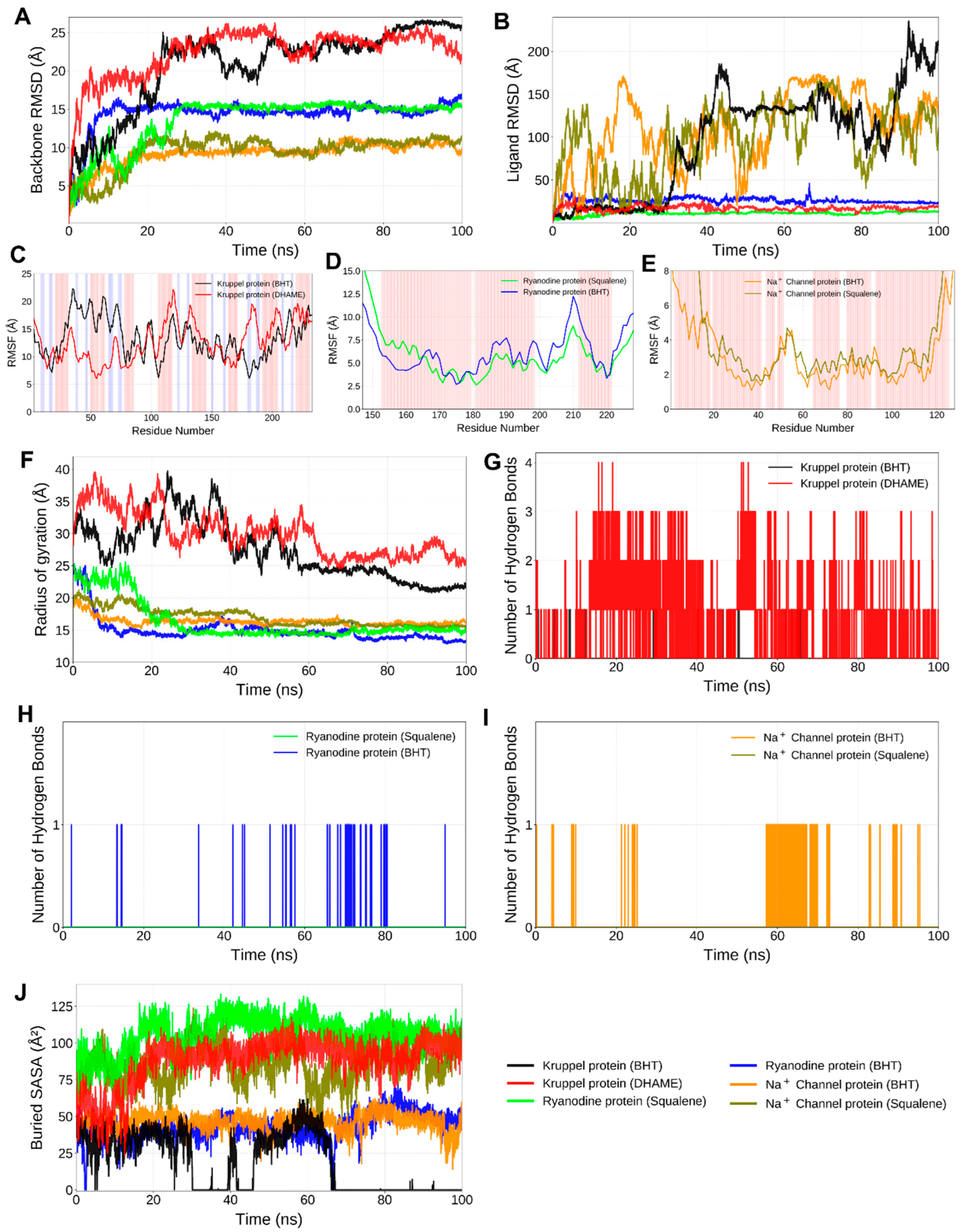
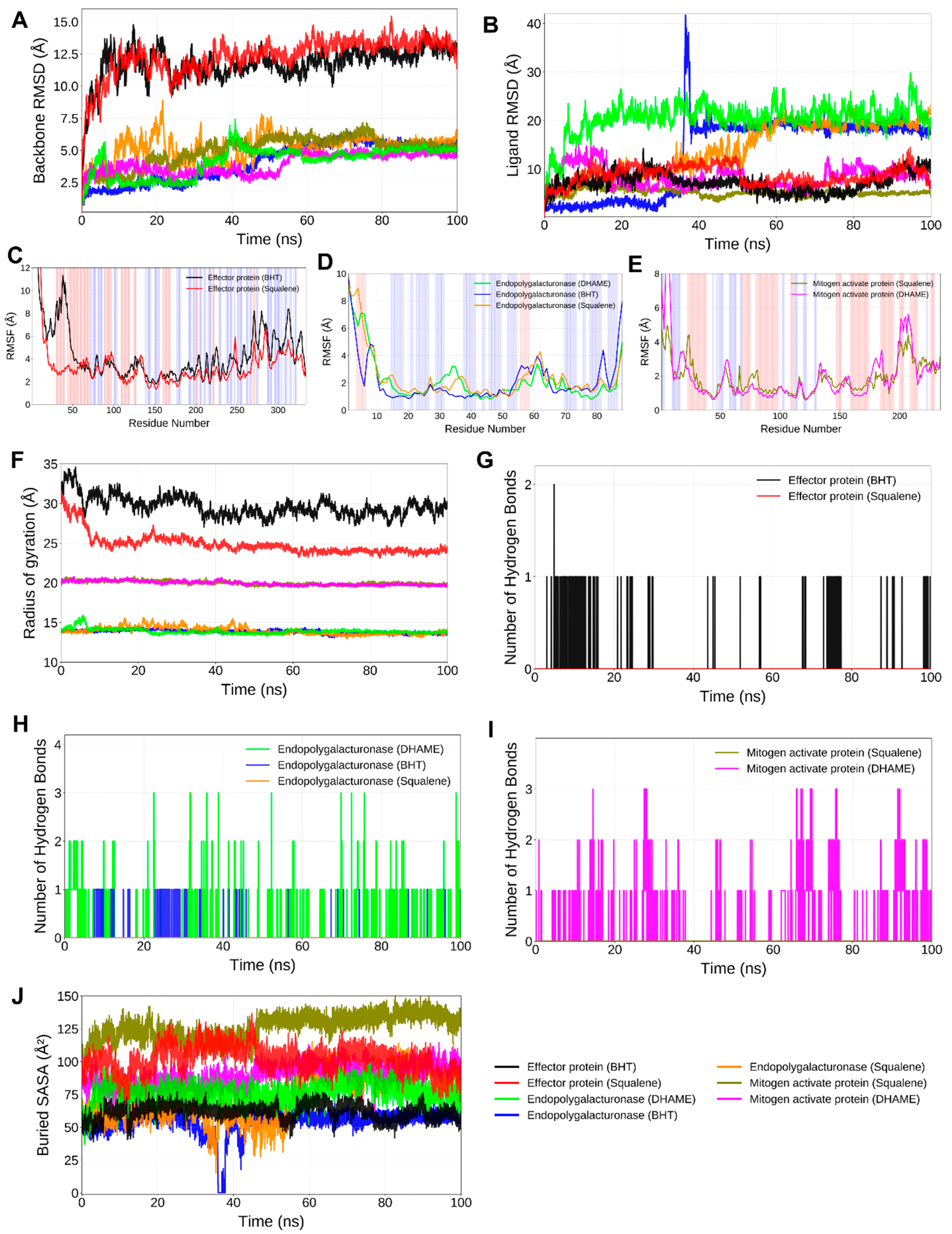
2.4.1. Dynamic Behaviour of T. absoluta and A. solani Protein–Ligand Complexes
Conformational Stability from RMSD
Residue Flexibility from RMSF
Compactness from Radius of Gyration
Hydrogen-Bond and Buried SASA Analyses
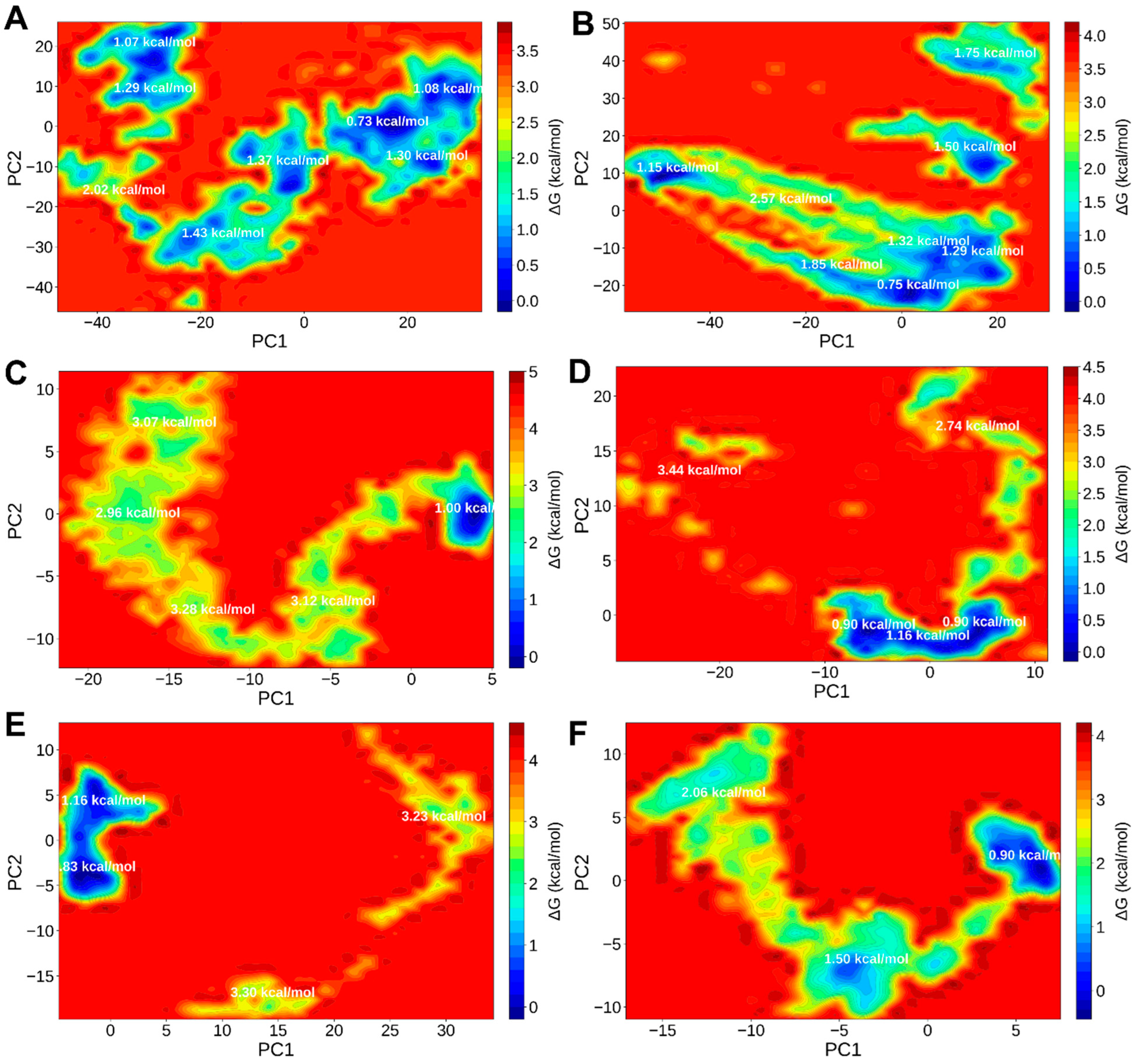
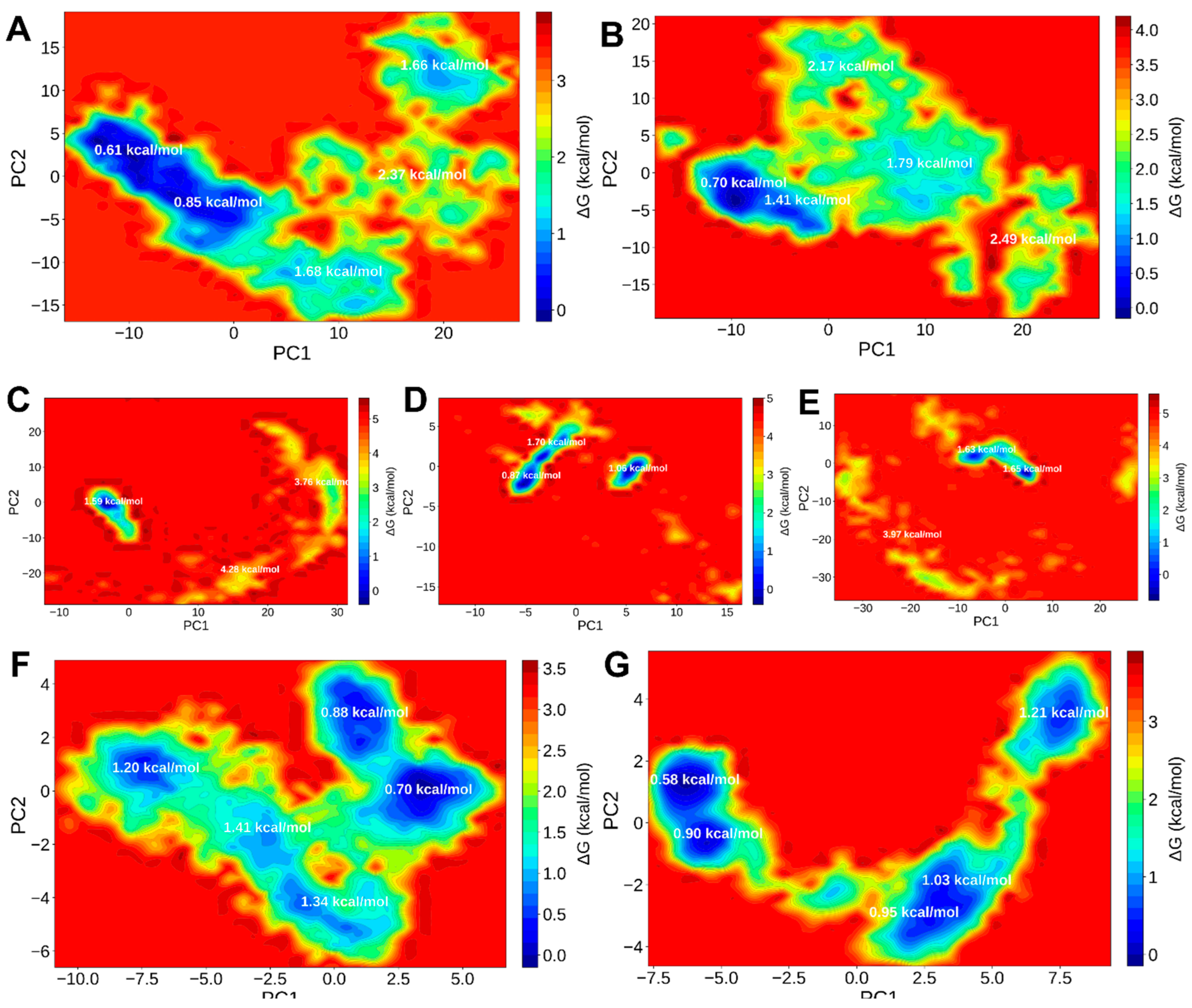
Gibbs Free-Energy Landscape (FEL)
2.5. Protein–Ligand Interaction Fingerprinting (ProLIF) Analysis
2.5.1. ProLIF Profiles of T. absoluta Complexes
2.5.2. ProLIF Profiles of A. solani Complexes
2.6. MM/GBSA Binding Free Energy
2.7. Toxicity Analysis
3. Discussion
4. Materials and Methods
4.1. Collection and Preparation of Plant Sample
4.2. Phytochemical Extraction and Identification
4.3. Ligand Retrieval and Preparation
4.4. Protein Preparation
4.5. Molecular Docking Analysis
4.6. Molecular Dynamic Simulation (MDS) Analysis
4.7. Toxicity Analysis
5. Conclusions
Supplementary Materials
Author Contributions
Funding
Data Availability Statement
Conflicts of Interest
References
- Chuqi, W.; Minhao, L.; Xinyu, D.; Tareq, A.-I.; Abdur, R.; Zidan, K.; Saikat, M.; Talha Bin, E.; Abdullah, S.M.A.; Fahad, A.A.; et al. Phytochemical and Nutritional Profiling of Tomatoes; Impact of Processing on Bioavailability—A Comprehensive Review. Food Rev. Int. 2022, 39, 5986–6010. [Google Scholar] [CrossRef]
- Efremov, D.P.; Zharkova, I.M.; Plotnikova, I.V.; Ivanchikov, D.S.; Gizatova, N.V. Tomatoes: Main uses in the food industry (review). Proc. Voronezh State Univ. Eng. Technol. 2022, 84, 181–195. [Google Scholar] [CrossRef]
- Khatun, T.; Razzak, A.; Islam, M.S.; Uddin, M.S. An extensive real-world in field tomato image dataset involving maturity classification and recognition of fresh and defect tomatoes. Data Brief 2023, 51, 109688. [Google Scholar] [CrossRef] [PubMed]
- Jaqueline, R.-T.; Ruth Belmares, C.; Mónica, L.C.-G.; Rosa, M.R.-J.; Sonia, A.L.-S.; Mayela, G.-S.; Araceli, L.-T. Importance of Certain Varieties of Cucurbits in Enhancing Health: A Review. Foods 2024, 13, 1142. [Google Scholar] [CrossRef]
- Adebayo, A.; Ayodeji, K.; Akeem, T.; Adeolu, A.; Oluwafunmilola, A.; Victoria, T.; Ayodeji, O.; Temitope, O. Impact of membership in agricultural cooperatives on yield of smallholder tomato farmers in Nigeria. Environ. Sustain. Indic. 2023, 20, 100313. [Google Scholar] [CrossRef]
- Akram, K.A.; Ahmed, E.-S.; Abdulrasoul, M.A.-O.; Abdulaziz, G.A.; Ibrahim, L.; Arafat, A. Responses of Tomato Crop and Water Productivity to Deficit Irrigation Strategies and Salinity Stress in Greenhouse. Agronomy 2023, 13, 3016. [Google Scholar] [CrossRef]
- Lutz, D.; Teresa, S.; Pepijn, S.; Mahin, S.; Krishnadas, M.; Nasir, U.; Peter, H. Tomato pests and diseases in Bangladesh and India: Farmers’ management and potential economic gains from insect resistant varieties and integrated pest management. Int. J. Pest Manag. 2025, 71, 552–566. [Google Scholar] [CrossRef]
- Fridah, C.; Beatrice Wambui, M.; Jackson, L.; Shepard, N.; Samira Abuelgasim, M.; Fathiya, K. Economic, health, and environmental burden of Tuta absoluta (Lepidoptera: Gelechiidae), in tomato production in Kenya and Uganda. J. Econ. Entomol. 2023, 116, 1529–1539. [Google Scholar] [CrossRef]
- Bauske, M.J.; Yellareddygari, S.K.R.; Gudmestad, N.C. Potential Impact of Fluopyram on the Frequency of the D123E Mutation in Alternaria solani. Plant Dis. 2018, 102, 656–665. [Google Scholar] [CrossRef]
- Einspanier, S.; Susanto, T.; Metz, N.; Wolters, P.J.; Vleeshouwers, V.; Lankinen, Å.; Liljeroth, E.; Landschoot, S.; Ivanović, Ž.; Hückelhoven, R.; et al. Whole-genome sequencing elucidates the species-wide diversity and evolution of fungicide resistance in the early blight pathogen Alternaria solani. Evol. Appl. 2022, 15, 1605–1620. [Google Scholar] [CrossRef]
- Gudmestad, N.C.; Arabiat, S.; Miller, J.S.; Pasche, J.S. Prevalence and Impact of SDHI Fungicide Resistance in Alternaria solani. Plant Dis. 2013, 97, 952–960. [Google Scholar] [CrossRef] [PubMed]
- Metz, N.; Adolf, B.; Chaluppa, N.; Hückelhoven, R.; Hausladen, H. Occurrence of sdh Mutations in German Alternaria solani Isolates and Potential Impact on Boscalid Sensitivity In Vitro, in the Greenhouse, and in the Field. Plant Dis. 2019, 103, 3065–3071. [Google Scholar] [CrossRef]
- Rajwinder, K.; Diksha, C.; Samriddhi, B.; Shubhdeep Singh, B.; Varinder, S.; Md Altamash, A.; Nidhi, R.; Thakur Gurjeet, S.; Balakumar, C. Pesticides: An alarming detrimental to health and environment. Sci. Total Environ. 2024, 915, 170113. [Google Scholar] [CrossRef]
- Mitzy, F.P.; Antonino, M.; Chanratha, A.; Kim Hian, S.; Ong, S.; George, N.; Sally, M.; Cristina, R.; Edwin, G.R.; Megan, E.O.R. An Integrated Pest Management Program Outperforms Conventional Practices for Tomato (Solanum lycopersicum) in Cambodia. Plant Health Prog. 2022, 23, 206–211. [Google Scholar] [CrossRef]
- Francis, O.; Beatrice, W.M.; Patience, M.M.; Fathiya, M.K.; Samira, A.M.; Shepard, N. Agro-Dealers’ Knowledge, Perception, and Willingness to Stock a Fungal-Based Biopesticide (ICIPE 20) for Management of Tuta absoluta in Kenya. Agriculture 2022, 12, 180. [Google Scholar] [CrossRef]
- Nicolas, D.; Peng, H.; Ramzi, M.; Judit, A.; Thierry, B.; Mateus, R.C.; Anais, C.; Raul, N.C.G.; Javad, K.; Kouassi Arthur, J.K.; et al. Integrated pest management of Tuta absoluta: Practical implementations across different world regions. J. Pest Sci. 2021, 95, 17–39. [Google Scholar] [CrossRef]
- Orlando, C.; Asma, C.; Michele, R.; Gaetano, S.; Kaouthar, G.-L.; Agatino, R.; Lorena, M.C.; Patrizia Di, P.; Cristina, S.; Nicolas, D.; et al. Citrus peel essential oil nanoformulations to control the tomato borer, Tuta absoluta: Chemical properties and biological activity. Sci. Rep. 2017, 7, 13036. [Google Scholar] [CrossRef] [PubMed]
- Priyakshi, B.; Dilip Kumar, S.; Paola, S.-C.; Ramasamy, S. Evaluation of Bio-Pesticides against the South American Tomato Leaf Miner, Tuta absoluta Meyrick (Lepidoptera: Gelechiidae) in India. Horticulturae 2021, 7, 325. [Google Scholar] [CrossRef]
- Tadele, S.; Emana, G. Evaluation of Bio-Pesticides on Integrated Management of Tomato Leafminer, Tuta absoluta (Meyrick) (Gelechiidae: Lepidoptera) on Tomato Crops in Western Shewa of Central Ethiopia. Entomol. Ornithol. Herpetol. Curr. Res. 2018, 7. [Google Scholar] [CrossRef]
- Amarildo, L.d.S.J.; Álefe, V.B.; Hiago Antonio, O.d.S.; Iris Carolina, H.L.L.; Kaique, S.A.; Lívia, S.d.M.; Lucas, M.d.A. Lipopeptide-enriched extracts of Bacillus velezensis B157 for controlling tomato early blight. Crop Prot. 2023, 172, 106317. [Google Scholar] [CrossRef]
- Maniraj, R.; Karthik, K.; Shweta, S.; Vinutha, T.; Vandna, R.; Debasis, P.; Rohini, S. Molecular Interaction-Based Exploration of the Broad Spectrum Efficacy of a Bacillus thuringiensis Insecticidal Chimeric Protein, Cry1AcF. Toxins 2019, 11, 143. [Google Scholar] [CrossRef]
- Rosalba, T.-R.; Martín Ernesto, T.-H.; Tania Elisa, G.-S.; Alberto, G.-L. Extracts and Plant-Derived Compounds as Natural Postharvest Fungicides. In Postharvest Pathology of Fresh Horticultural Produce; CRC Press: Boca Raton, FL, USA, 2019; pp. 633–658. [Google Scholar] [CrossRef]
- Ajay, Y.; Hariprasad, P. Employing molecular modelling and molecular dynamics simulations approach to understand the carbendazim and aptamer interaction. Mol. Simul. 2025, 51, 347–369. [Google Scholar] [CrossRef]
- Cortes-Hernandez, P.; Vázquez Nuñez, R.; Domínguez-Ramírez, L. Docking and Molecular Dynamics Predictions of Pesticide Binding to the Calyx of Bovine β-Lactoglobulin. Int. J. Mol. Sci. 2020, 21, 1988. [Google Scholar] [CrossRef]
- Ferenczy, G.G.; Kellermayer, M. Contribution of hydrophobic interactions to protein mechanical stability. Comput. Struct. Biotechnol. J. 2022, 20, 1946–1956. [Google Scholar] [CrossRef]
- Lin, L.; Wang, C.; Wang, W.; Jiang, H.; Murayama, T.; Kobayashi, T.; Hadiatullah, H.; Chen, Y.S.; Wu, S.; Wang, Y.; et al. Cryo-EM structures of ryanodine receptors and diamide insecticides reveal the mechanisms of selectivity and resistance. Nat. Commun. 2024, 15, 9056, Correction in Nat. Commun. 2024, 15, 9829. [Google Scholar] [CrossRef]
- Silver, K.S.; Du, Y.; Nomura, Y.; Oliveira, E.E.; Salgado, V.L.; Zhorov, B.S.; Dong, K. Voltage-Gated Sodium Channels as Insecticide Targets. Adv. Insect Physiol. 2014, 46, 389–433. [Google Scholar] [CrossRef]
- LeBlanc, E.V.; Polvi, E.J.; Veri, A.O.; Privé, G.G.; Cowen, L.E. Structure-guided approaches to targeting stress responses in human fungal pathogens. J. Biol. Chem. 2020, 295, 14458–14472. [Google Scholar] [CrossRef]
- Ingólfsson, H.I.; Thakur, P.; Herold, K.F.; Hobart, E.A.; Ramsey, N.B.; Periole, X.; de Jong, D.H.; Zwama, M.; Yilmaz, D.; Hall, K.; et al. Phytochemicals perturb membranes and promiscuously alter protein function. ACS Chem. Biol. 2014, 9, 1788–1798. [Google Scholar] [CrossRef]
- Ray, S.; Shaju, S.T. Bioaccumulation of pesticides in fish resulting toxicities in humans through food chain and forensic aspects. Environ. Anal. Health Toxicol. 2023, 38, e2023017. [Google Scholar] [CrossRef] [PubMed]
- Khursheed, A.; Rather, M.A.; Jain, V.; Wani, A.R.; Rasool, S.; Nazir, R.; Malik, N.A.; Majid, S.A. Plant based natural products as potential ecofriendly and safer biopesticides: A comprehensive overview of their advantages over conventional pesticides, limitations and regulatory aspects. Microb. Pathog. 2022, 173, 105854. [Google Scholar] [CrossRef] [PubMed]
- Lee, M.J.; Nho, J.H.; Yang, B.D.; Park, H.; Lee, H.J.; Lee, K.H.; Jang, J.H.; Jung, H.K.; Kim, S.R.; Cho, H.W.; et al. Subchronic toxicity evaluation of ethanol extract of Cassia tora L. seeds in rats. Regul. Toxicol. Pharmacol. 2019, 109, 104487. [Google Scholar] [CrossRef] [PubMed]
- Lohani, A.; Maurya, M.; Kumar, S.; Verma, N. IPN beads prepared by tailoring of cassia tora gum and sodium carboxymethyl cellulose using Al+++ for controlled drug delivery. J. Drug Deliv. Sci. Technol. 2023, 81, 104308. [Google Scholar] [CrossRef]
- Ayyaril, S.S.; Shanableh, A.; Bhattacharjee, S.; Rawas-Qalaji, M.; Cagliani, R.; Shabib, A.G.; Khan, M.I. Recent progress in micro and nano-encapsulation techniques for environmental applications: A review. Results Eng. 2023, 18, 101094. [Google Scholar] [CrossRef]
- Tadesse Mawcha, K.; Malinga, L.; Muir, D.; Ge, J.; Ndolo, D. Recent Advances in Biopesticide Research and Development with a Focus on Microbials. F1000Research 2024, 13, 1071. [Google Scholar] [CrossRef]
- O’Boyle, N.M.; Banck, M.; James, C.A.; Morley, C.; Vandermeersch, T.; Hutchison, G.R. Open Babel: An open chemical toolbox. J. Cheminf. 2011, 3, 33. [Google Scholar] [CrossRef]
- Gasteiger, E.; Gattiker, A.; Hoogland, C.; Ivanyi, I.; Appel, R.D.; Bairoch, A. ExPASy: The proteomics server for in-depth protein knowledge and analysis. Nucleic Acids Res. 2003, 31, 3784–3788. [Google Scholar] [CrossRef]
- Qing, R.; Hao, S.; Smorodina, E.; Jin, D.; Zalevsky, A.; Zhang, S. Protein Design: From the Aspect of Water Solubility and Stability. Chem. Rev. 2022, 122, 14085–14179. [Google Scholar] [CrossRef]
- Studer, G.; Rempfer, C.; Waterhouse, A.M.; Gumienny, R.; Haas, J.; Schwede, T. QMEANDisCo-distance constraints applied on model quality estimation. Bioinformatics 2020, 36, 1765–1771. [Google Scholar] [CrossRef] [PubMed]
- Waterhouse, A.; Bertoni, M.; Bienert, S.; Studer, G.; Tauriello, G.; Gumienny, R.; Heer, F.T.; de Beer, T.A.P.; Rempfer, C.; Bordoli, L.; et al. SWISS-MODEL: Homology modelling of protein structures and complexes. Nucleic Acids Res. 2018, 46, W296–W303. [Google Scholar] [CrossRef]
- Wallner, B.; Elofsson, A. Can correct protein models be identified? Protein Sci. 2003, 12, 1073–1086. [Google Scholar] [CrossRef]
- Kondapuram, S.K.; Sarvagalla, S.; Coumar, M.S. Docking-Based Virtual Screening Using PyRx Tool: Autophagy Target Vps34 as a Case Study. In Molecular Docking for Computer-Aided Drug Design; Coumar, M.S., Ed.; Academic Press: New Yrok, NY, USA, 2021; pp. 463–477. [Google Scholar]
- Dallakyan, S.; Olson, A.J. Small-Molecule Library Screening by Docking with PyRx. In Chemical Biology: Methods and Protocols; Hempel, J.E., Williams, C.H., Hong, C.C., Eds.; Springer: New York, NY, USA, 2015; pp. 243–250. [Google Scholar]
- Baroroh, U.; Biotek, M.; Muscifa, Z.S.; Destiarani, W.; Rohmatullah, F.G.; Yusuf, M. Molecular interaction analysis and visualization of protein-ligand docking using Biovia Discovery Studio Visualizer. Indones. J. Comput. Biol. 2023, 2, 22–30. [Google Scholar] [CrossRef]
- Abraham, M.J.; Murtola, T.; Schulz, R.; Páll, S.; Smith, J.C.; Hess, B.; Lindahl, E. GROMACS: High performance molecular simulations through multi-level parallelism from laptops to supercomputers. SoftwareX 2015, 1, 19–25. [Google Scholar] [CrossRef]
- Lindorff-Larsen, K.; Piana, S.; Palmo, K.; Maragakis, P.; Klepeis, J.L.; Dror, R.O.; Shaw, D.E. Improved side-chain torsion potentials for the Amber ff99SB protein force field. Proteins 2010, 78, 1950–1958. [Google Scholar] [CrossRef]
- Sousa da Silva, A.W.; Vranken, W.F. ACPYPE—AnteChamber PYthon Parser interfacE. BMC Res. Notes 2012, 5, 367. [Google Scholar] [CrossRef]
- Jorgensen, W.L.; Madura, J.D. Solvation and conformation of methanol in water. J. Am. Chem. Soc. 1983, 10, 1407–1413. [Google Scholar] [CrossRef]
- Petrova, S.S.; Solov’ev, A.D. The Origin of the Method of Steepest Descent. Hist. Math. 1997, 24, 361–375. [Google Scholar] [CrossRef]
- Hestenes, M.R. Iterative methods for solving linear equations. J. Optim. Theory Appl. 1973, 11, 323–334. [Google Scholar] [CrossRef]
- Bussi, G.; Donadio, D.; Parrinello, M. Canonical sampling through velocity rescaling. J. Chem. Phys. 2007, 126, 014101. [Google Scholar] [CrossRef]
- Berendsen, H.J.C.; Postma, J.P.M.; van Gunsteren, W.F.; DiNola, A.; Haak, J.R. Molecular dynamics with coupling to an external bath. J. Chem. Phys. 1984, 81, 3684–3690. [Google Scholar] [CrossRef]
- Parrinello, M.; Rahman, A. Polymorphic transitions in single crystals: A new molecular dynamics method. J. Appl. Phys. 1981, 52, 7182–7190. [Google Scholar] [CrossRef]
- Hess, B.; Bekker, H.; Berendsen, H.J.C.; Fraaije, J.G.E.M. LINCS: A linear constraint solver for molecular simulations. J. Comput. Chem. 1997, 18, 1463–1472. [Google Scholar] [CrossRef]
- Petersen, H.G. Accuracy and efficiency of the particle mesh Ewald method. J. Chem. Phys. 1995, 103, 3668–3679. [Google Scholar] [CrossRef]
- Pérez-Hernández, G.; Hildebrand, P.W. mdciao: Accessible Analysis and Visualization of Molecular Dynamics Simulation Data. bioRxiv 2022, 2022.2007.2015.500163. [Google Scholar] [CrossRef]
- Bouysset, C.; Fiorucci, S. ProLIF: A library to encode molecular interactions as fingerprints. J. Cheminf. 2021, 13, 72. [Google Scholar] [CrossRef] [PubMed]
- Sittel, F.; Jain, A.; Stock, G. Principal component analysis of molecular dynamics: On the use of Cartesian vs. internal coordinates. J. Chem. Phys. 2014, 141, 014111. [Google Scholar] [CrossRef] [PubMed]
- Maisuradze, G.G.; Liwo, A.; Scheraga, H.A. Relation between Free Energy Landscapes of Proteins and Dynamics. J. Chem. Theory Comput. 2010, 6, 583–595. [Google Scholar] [CrossRef]
- Valdés-Tresanco, M.S.; Valdés-Tresanco, M.E.; Valiente, P.A.; Moreno, E. gmx_MMPBSA: A New Tool to Perform End-State Free Energy Calculations with GROMACS. J. Chem. Theory Comput. 2021, 17, 6281–6291. [Google Scholar] [CrossRef]
- Banerjee, P.; Kemmler, E.; Dunkel, M.; Preissner, R. ProTox 3.0: A webserver for the prediction of toxicity of chemicals. Nucleic Acids Res. 2024, 52, W513–W520. [Google Scholar] [CrossRef]





| PK | RT | Area (%) | Library/ID | CID | Molecular Weight | Molecular Formula |
|---|---|---|---|---|---|---|
| 1 | 13.6387 | 0.2004 | Butylated Hydroxytoluene | 31404 | 220.35 | C15H24O |
| 2 | 15.4266 | 0.192 | 5-Octadecene, (E)- | 5364598 | 252.5 | C18H36 |
| 3 | 18.4259 | 0.9165 | 3-Butynylbenzene | 123360 | 130.19 | C10H10 |
| 4 | 19.9252 | 0.3641 | 1-Octadecene | 8217 | 252.5 | C18H36 |
| 5 | 22.7844 | 5.2233 | Pentadecanoic acid, 14-methyl-, methyl ester | 21205 | 270.5 | C17H34O2 |
| 6 | 23.5932 | 0.6823 | Dibutyl phthalate | 3026 | 278.34 | C16H22O4 |
| 7 | 24.0434 | 0.5886 | Trichloroacetic acid, pentadecyl ester | 522535 | 373.8 | C17H31Cl3O2 |
| 8 | 24.1261 | 1.1888 | Hexadecanoic acid, ethyl ester | 5284421 | 294.5 | C19H34O2 |
| 9 | 26.0593 | 6.5583 | 9,12-Octadecadienoic acid, methyl ester | 3931 | 280.4 | C18H32O2 |
| 10 | 26.1911 | 19.663 | 9-Octadecenoic acid (Z)-, methyl ester | 445639 | 282.5 | C18H34O2 |
| 11 | 26.6748 | 5.0828 | Methyl stearate | 8201 | 298.5 | C19H38O2 |
| 12 | 27.0888 | 0.5551 | Methyl 8,11,14,17-eicosatetraenoate | 14122970 | 318.5 | C21H34O2 |
| 13 | 27.2836 | 0.5665 | Linoleic acid ethyl ester | 5282184 | 308.5 | C20H36O2 |
| 14 | 27.393 | 2.8875 | (E)-9-Octadecenoic acid ethyl ester | 5364430 | 310.5 | C20H38O2 |
| 15 | 27.5007 | 0.6396 | Ethyl Oleate | 5363269 | 310.5 | C20H38O2 |
| 16 | 27.8197 | 0.4702 | 1-Docosene | 74138 | 308.6 | C22H44 |
| 17 | 27.8931 | 1.2984 | Octadecanoic acid, ethyl ester | 8122 | 312.5 | C20H40O2 |
| 18 | 29.0123 | 0.2513 | Methyl 9,12-heptadecadienoate | 14162504 | 280.4 | C18H32O2 |
| 19 | 29.108 | 3.3506 | n-Propyl 11-octadecenoate | 87131822 | 324.5 | C21H40O2 |
| 20 | 29.5913 | 0.9662 | Octadecanoic acid, propyl ester | 77190 | 326.6 | C21H42O2 |
| 21 | 29.7735 | 0.4278 | cis-11-Eicosenoic acid | 5282768 | 310.5 | C20H38O2 |
| 22 | 30.1177 | 0.3479 | 6-Butyl-1,4-cycloheptadiene | 556470 | 150.26 | C11H18 |
| 23 | 30.2541 | 13.5929 | cis-5,8,11,14,17-Eicosapentaenoic acid | 446284 | 302.5 | C20H30O2 |
| 24 | 30.6097 | 0.7136 | 7,10,13-Hexadecatrienoic acid, methyl ester | 556196 | 264.4 | C17H28O2 |
| 25 | 31.0307 | 0.2023 | Oleic Acid | 445639 | ||
| 26 | 31.2839 | 0.3775 | Heptadecyl heptafluorobutyrate | 545577 | 452.5 | C21H35F7O2 |
| 27 | 31.3444 | 0.439 | Ethanol, 2-(tetradecyloxy)- | 16491 | 258.44 | C16H34O2 |
| 28 | 32.4882 | 0.2459 | cis-Vaccenic acid | 5282761 | 282.5 | C18H34O2 |
| 29 | 33.1772 | 0.7821 | Erucic acid | 5281116 | 338.6 | C22H42O2 |
| 30 | 33.316 | 15.2724 | 4,7,10,13,16,19-Docosahexaenoic acid, methyl ester, (all-Z)- | 5353594 | 328.5 | C22H32O2 |
| 31 | 33.5667 | 4.5695 | Methyl 6,9,12,15,18-heneicosapentaenoate | 72733997 | 330.5 | C22H34O2 |
| 32 | 33.8723 | 1.705 | Diethyl Phthalate | 6781 | 222.24 | C12H14O4 |
| 33 | 34.0849 | 2.8543 | 3-Eicosene, (E)- | 5365051 | 280.5 | C20H40 |
| 34 | 34.296 | 0.5693 | 9-Eicosenoic acid, (Z)- | 5282767 | 310.5 | C20H38O2 |
| 35 | 34.3682 | 0.1159 | i-Propyl 9-tetradecenoate | 56936038 | 268.4 | C17H32O2 |
| 36 | 34.6783 | 0.2119 | 13-Octadecenal, (Z)- | 5364497 | 266.5 | C18H34O |
| 37 | 37.8522 | 1.3136 | Squalene | 638072 | 410.7 | C30H50 |
| 38 | 38.4314 | −0.1833 | 2-Methyl-Z,Z-3,13-octadecadienol | 5364412 | 280.5 | C19H36O |
| T. absolata Protein Ligand Complexes | Energy Component (kcal/mol) | ||||||||
|---|---|---|---|---|---|---|---|---|---|
| ENTROPY (−TΔS) | ΔVDWAALS | ΔEEL | ΔEGB | ΔESURF | ΔGGAS | ΔGSOLV | ΔTOTAL | ΔG Binding | |
| Complex of Kruppel-like protein 1 | |||||||||
| Butylated hydroxytoluene | 13.23 (0.0) | −5.18 (1.68) | −0.03 (0.05) | 0.53 (0.32) | −0.67 (0.38) | −5.22 (1.68) | −0.13 (0.50) | −5.35 (1.75) | 7.88 (7.95) |
| 4,7,10,13,16,19-docosahexaenoic acid, methyl ester | 40.80 0.05 | −40.22 0.15 | −3.34 0.32 | 6.63 0.17 | −6.27 0.10 | −43.56 0.36 | 0.35 0.19 | −43.21 0.41 | −2.40 ± 6.07 |
| Ryanodine receptor | |||||||||
| Squalene | 16.08 0.05 | −51.08 1.44 | −0.45 0.17 | 4.20 0.03 | −6.84 0.18 | −51.53 1.45 | −2.64 0.18 | −54.17 1.46 | −38.09 ± 4.99 |
| Butylated hydroxytoluene | 14.28 0.05 | −19.59 0.31 | −0.32 0.06 | 1.74 0.16 | −2.62 0.12 | −19.91 0.32 | −0.88 0.20 | −20.79 0.38 | −6.51 ± 6.68 |
| Sodium Channel Protein | |||||||||
| Butylated hydroxytoluene | 19.24 0.04 | −19.24 0.57 | −0.45 0.02 | 1.70 0.06 | −2.49 0.06 | −19.68 0.57 | −0.79 0.08 | −20.47 0.57 | −1.23 ± 7.26 |
| Squalene | 32.07 0.05 | −37.61 0.22 | −0.17 0.14 | 2.53 0.02 | −5.33 0.13 | −37.78 0.26 | −2.81 0.13 | −40.58 0.29 | −8.52 ± 8.56 |
| A. solani Protein Ligand Complexes | Energy Component (kcal/mol) | ||||||||
|---|---|---|---|---|---|---|---|---|---|
| ENTROPY (−TΔS) | ΔVDWAALS | ΔEEL | ΔEGB | ΔESURF | ΔGGAS | ΔGSOLV | ΔTOTAL | ΔG Binding | |
| Effector Protein AsCEP50 | |||||||||
| Butylated hydroxytoluene | 10.86 (0.05) | −28.21 (1.51) | −0.70 (0.03) | 2.82 (0.01) | −3.60 (0.09) | −28.90 (1.51) | −0.78 (0.09) | −29.68 (1.52) | −18.82 (3.73) |
| Squalene | 27.49 14.95 | −41.11 1.70 | −0.17 0.17 | 3.90 0.05 | −5.71 0.15 | −41.28 1.71 | −1.81 0.15 | −43.08 1.71 | −15.59 ± 16.29 |
| Polygalacturonase (endopolygalacturonase) | |||||||||
| 4,7,10,13,16,19-docosahexaenoic acid, methyl ester | 28.23 0.05 | −31.29 0.01 | −0.92 0.29 | 3.30 0.02 | −5.24 0.08 | −32.21 0.29 | −1.94 0.09 | −34.15 0.30 | −5.92 ± 6.86 |
| Butylated hydroxytoluene | 24.21 0.21 | −28.37 0.59 | −0.22 0.06 | 2.23 0.03 | −3.64 0.05 | −28.58 0.59 | −1.42 0.06 | −30.00 0.60 | −5.79 ± 3.86 |
| Squalene | 29.93 0.05 | −38.32 2.62 | −0.17 0.14 | 2.49 0.04 | −5.59 0.58 | −38.50 2.62 | −3.10 0.58 | −41.60 2.69 | −11.67 ± 12.14 |
| Mitogen-activated protein kinase HOG1 | |||||||||
| Squalene | 19.05 0.05 | −67.01 1.78 | −0.35 0.13 | 4.61 0.04 | −9.11 0.14 | −67.36 1.78 | −4.50 0.14 | −71.86 1.79 | −52.81 ± 5.82 |
| 4,7,10,13,16,19-docosahexaenoic acid, methyl ester | 13.66 0.05 | −42.91 0.27 | −2.32 0.51 | 5.49 0.69 | −6.57 0.04 | −45.23 0.58 | −1.08 0.69 | −46.31 0.90 | −32.65 ± 4.18 |
| Target | Squalene | Butylated Hydroxytoluene | DHAME | |||
|---|---|---|---|---|---|---|
| Prediction | Probability | Prediction | Probability | Prediction | Probability | |
| Hepatotoxicity | Inactive | 0.79 | Inactive | 0.78 | Active | 0.69 |
| Neurotoxicity | Inactive | 0.65 | Inactive | 0.50 | Active | 0.87 |
| Nephrotoxicity | Inactive | 0.88 | Inactive | 0.84 | Inactive | 0.90 |
| Respiratory toxicity | Inactive | 0.59 | Inactive | 0.93 | Active | 0.98 |
| Cardiotoxicity | Inactive | 0.79 | Inactive | 0.98 | Inactive | 0.77 |
| Carcinogenicity | Inactive | 0.76 | Inactive | 0.52 | Inactive | 0.62 |
| Immunotoxicity | Inactive | 0.99 | Inactive | 0.98 | Active | 0.96 |
| Mutagenicity | Inactive | 0.98 | Inactive | 0.99 | Inactive | 0.97 |
| Cytotoxicity | Inactive | 0.81 | Inactive | 0.91 | Inactive | 0.93 |
| BBB-barrier | Active | 0.97 | Active | 0.94 | Inactive | 1 |
| Ecotoxicity | Active | 0.62 | Active | 0.63 | Active | 0.73 |
| Clinical toxicity | Inactive | 0.77 | Inactive | 0.66 | Inactive | 0.56 |
| Nutritional toxicity | Inactive | 0.83 | Inactive | 0.96 | Inactive | 0.74 |
| Aryl hydrocarbon Receptor (AhR) | Inactive | 0.99 | Inactive | 1.0 | Inactive | 0.97 |
| Androgen Receptor (AR) | Inactive | 0.98 | Inactive | 1.0 | Inactive | 0.99 |
| Androgen Receptor Ligand Binding Domain (AR-LBD) | Inactive | 0.91 | Inactive | 1.0 | Inactive | 0.99 |
| Aromatase | Inactive | 1.0 | Inactive | 0.99 | Active | 1 |
| Estrogen Receptor Alpha (ER) | Inactive | 0.81 | Inactive | 1.0 | Active | 0.99 |
| Estrogen Receptor Ligand Binding Domain (ER-LBD) | Inactive | 0.89 | Inactive | 1.0 | Active | 1 |
| Peroxisome Proliferator Activated Receptor Gamma (PPAR-Gamma) | Inactive | 1.0 | Inactive | 1.0 | Inactive | 0.99 |
| Nuclear factor (erythroid-derived 2)-like 2/antioxidant responsive element (nrf2/ARE) | Active | 0.60 | Inactive | 1.0 | Inactive | 0.88 |
| Heat shock factor response element (HSE) | Active | 0.60 | Inactive | 1.0 | Inactive | 0.88 |
| Mitochondrial Membrane Potential (MMP) | Inactive | 0.99 | Active | 0.96 | Inactive | 0.70 |
| Phosphoprotein (Tumour Supressor) p53 | Inactive | 1.0 | Inactive | 0.99 | Inactive | 0.96 |
| ATPase family AAA domain-containing protein 5 (ATAD5) | Inactive | 1.0 | Inactive | 1.0 | Inactive | 0.99 |
| Thyroid hormone receptor alpha (THRα) | Inactive | 0.90 | Inactive | 0.90 | Inactive | 0.55 |
| Thyroid hormone receptor beta (THRβ) | Inactive | 0.78 | Inactive | 0.78 | Inactive | 0.75 |
| Transtyretrin (TTR) | Inactive | 0.97 | Inactive | 0.97 | Inactive | 0.75 |
| Ryanodine receptor (RYR) | Inactive | 0.98 | Inactive | 0.98 | Inactive | 0.93 |
| GABA receptor (GABAR) | Inactive | 0.96 | Inactive | 0.96 | Inactive | 0.76 |
| Glutamate N-methyl-D-aspartate receptor (NMDAR) | Inactive | 0.92 | Inactive | 0.92 | Inactive | 0.89 |
| alpha-amino-3-hydroxy-5-methyl-4-isoxazolepropionate receptor (AMPAR) | Inactive | 0.97 | Inactive | 0.97 | Inactive | 1 |
| Kainate receptor (KAR) | Inactive | 0.99 | Inactive | 0.99 | Inactive | 1 |
| Achetylcholinesterase (AchE) | Inactive | 0.79 | Inactive | 0.78 | Active | 0.60 |
| Constitutive androstane receptor (CAR) | Inactive | 0.98 | Inactive | 0.98 | Inactive | 0.99 |
| Pregnane X receptor (PXR) | Inactive | 0.92 | Inactive | 0.92 | Inactive | 0.69 |
| NADH-quinone oxidoreductase (NADHOX) | Inactive | 0.97 | Inactive | 0.97 | Inactive | 0.82 |
| Voltage gated sodium channel (VGSC) | Inactive | 0.95 | Inactive | 0.95 | Inactive | 0.64 |
| Na+/I− symporter (NIS) | Inactive | 0.98 | Inactive | 0.98 | Inactive | 0.79 |
| Cytochrome CYP1A2 | Inactive | 0.94 | Inactive | 0.93 | Inactive | 0.76 |
| Cytochrome CYP2C19 | Inactive | 0.94 | Inactive | 0.53 | Inactive | 0.87 |
| Cytochrome CYP2C9 | Active | 0.67 | Active | 0.70 | Active | 0.56 |
| Cytochrome CYP2D6 | Inactive | 0.77 | Inactive | 0.90 | Inactive | 0.63 |
| Cytochrome CYP3A4 | Inactive | 0.99 | Inactive | 0.98 | Active | 0.71 |
| Cytochrome CYP2E1 | Inactive | 0.96 | Inactive | 1.0 | Inactive | 0.98 |
| Parameter Squalene DHAME BHT | |||
|---|---|---|---|
| CAS | 000111-02-4 | 301-01-9 | 000128-37-0 |
| Molecular Weight | 410.719 | 342.516 | 220.351 |
| Molecular Formula | C30H50 | C23H34O2 | C15H24O |
| Predicted log Kow | 14.122 | 8.905 | 5.029 |
| Experimental Log Kow | - | - | 5.1 |
| Predicted Melting Point | 58.848 | 98.179 | 83.013 |
| Predicted Boiling Point | 452.899 | 416.847 | 296.493 |
| Experimental Boiling Point | - | - | 265 |
| Predicted Vapour Pressure (mmHg at 25 °C) | 1.14 × 10⁻⁶ | 6.28 × 10⁻⁷ | 0.002 |
| Predicted Vapour Pressure (Pa at 25 °C) | 1.52 × 10⁻⁴ | 8.37 × 10⁻⁵ | 0.236 |
| Predicted Sub-cooled Vapour Pressure (mmHg at 25 °C) | 1.14 × 10⁻⁶ | 3.23 × 10⁻⁶ | 0.005 |
| Predicted Sub-cooled Vapour Pressure (Pa at 25 °C) | 1.52 × 10⁻⁴ | 4.30 × 10⁻⁴ | 0.641 |
| Experimental Vapour Pressure (mmHg at 25 °C) | - | - | 0.005 |
| Predicted HLC, VP/WSOL Method (atm-m3/mol at 25 °C) | 925.962 | 0.002 | 0.002 |
| Predicted HLC, Bond Method (atm-m3/mol at 25 °C) | 341.538 | 0.023 | 4.12 × 10⁻⁶ |
| Predicted HLC, Group Method (atm-m3/mol at 25 °C) | 2.034 | 3.88 × 10⁻⁵ | 3.38 × 10⁻⁶ |
| Predicted Log Kaw | 1.92 | −2.80 × 100 | −9.92 × 10⁻¹ |
| Predicted Log Koa | 12.202 | 11.705 | 6.092 |
| Predicted Water Solubility, WSKow (mg/L) | 6.65 × 10⁻¹⁰ | 1.71 × 10⁻⁴ | 5.748 |
| Predicted Water Solubility, Water NT (mg/L) | 4.11 × 10⁻⁷ | 0.001 | 10.351 |
| Experimental Water Solubility (mg/L) | - | - | 0.6 |
| Base-Catalysed Rate Constant (L/mol-s at 25 °C) | - | 0.051 | - |
| Hydrolysis Half-Life in Days (ph7, base-catalysed) | - | 1.56 × 10³ | - |
| Hydrolysis Half-Life in Days (ph8, base-catalysed) | - | 155.913 | - |
| Volatilization Half-Life in Hours (Lake Model) | 192.523 | 480.815 | 144.814 |
| Volatilization Half-Life in Hours (River Model) | 2.069 | 29.848 | 1.864 |
| Dermal Absorbed Dose per Event (mg/cm2-event) | 0.122 | 16.63 | 380.959 |
| Dermal Absorbed Dose (mg/kg-day) | 12.904 | 1.76 × 10³ | 4.03 × 10⁴ |
| Bioconcentration Factor (L/kg wet-wt) | 4.31 | 1.55 × 10³ | 645.62 |
| Biotransformation Half Life in Days | 0.00 × 100 | 0.00 × 100 | 0.32 |
| Bioaccumulation Factor (L/kg wet-wt) | 33.11 | 4.63 × 10⁴ | 820.48 |
| BioWin1 (Linear Model Prediction) | 0.552 | 0.867 | 0.445 |
| BioWin2 (Non-Linear Model Prediction) | 0.056 | 0.983 | 0.111 |
| BioWin3 (Ultimate Biodegradation Timeframe) | 2.292 | 2.881 | 2.269 |
| BioWin4 (Primary Biodegradation Timeframe) | 3.255 | 3.852 | 3.194 |
| BioWin5 (MITI Linear Model Prediction) | 0.446 | 0.46 | 0.253 |
| BioWin6 (MITI Non-Linear Model Prediction) | 0.146 | 0.192 | 0.042 |
| BioWin7 (Anaerobic Model Prediction) | 0.018 | −1.43 × 10⁻¹ | −7.92 × 10⁻¹ |
| Hydrocarbon Biodegradation Half Life in Days | 2.182 | - | - |
| Predicted Log Koc (L/kg) | 8.003 | 5.719 | 4.169 |
| Predicted Photolytic/Hydroxyl Radical Reaction Rate Constant | 5.34 × 10⁻¹⁰ | 3.46 × 10⁻¹⁰ | 1.83 × 10⁻¹¹ |
| Predicted Atmospheric Half Life in Hours (Photolytic/Hydroxyl Radical Reaction, 1.5 × 10⁶ molecules/cm3) | 0.24 | 0.371 | 7.018 |
| Predicted Atmospheric Half Life in Days (Photolytic/Hydroxyl Radical Reaction, 12 h days, 1.5 × 10⁶ molecules/cm3) | 0.02 | 0.031 | 0.585 |
| Predicted Ozone Reaction Rate Constant | 2.58 × 10⁻¹⁵ | 1.38 × 10⁻¹⁶ | - |
| Predicted Atmospheric Half Life in Hours (Ozone Reaction, 7 × 10¹¹ molecules/cm3) | 0.107 | 0.353 | - |
| Predicted Atmospheric Half Life in Days (Ozone Reaction, 24 h days, 7 × 10¹¹ molecules/cm3) | 0.004 | 0.015 | - |
| Predicted Atmospheric Half Life in Hours (Hydroxyl and Ozone Reactions) | 0.074 | 0.181 | 7.018 |
| Fugacity Model Air Mass Percentage | 0.007 | 0.038 | 0.939 |
| Fugacity Model Water Mass Percentage | 1.789 | 6.66 | 8.477 |
| Fugacity Model Soil Mass Percentage | 27.442 | 35.572 | 83.349 |
| Fugacity Model Sediment Mass Percentage | 70.762 | 57.73 | 7.235 |
| STP Model Air Mass Percentage | 1.14 × 10⁻⁵ | 5.40 × 10⁻⁵ | 10.833 |
| STP Model Sludge Mass Percentage | 93.257 | 93.254 | 73.393 |
| STP Model Biodegradation Mass Percentage | 0.779 | 0.779 | 0.579 |
| STP Model Effluent Mass Percentage | 94.035 | 94.033 | 84.805 |
Disclaimer/Publisher’s Note: The statements, opinions and data contained in all publications are solely those of the individual author(s) and contributor(s) and not of MDPI and/or the editor(s). MDPI and/or the editor(s) disclaim responsibility for any injury to people or property resulting from any ideas, methods, instructions or products referred to in the content. |
© 2026 by the authors. Licensee MDPI, Basel, Switzerland. This article is an open access article distributed under the terms and conditions of the Creative Commons Attribution (CC BY) license.
Share and Cite
Mustapha, T.; Kwarau, N.L.; Patil, R.B.; Tang, H.; Abdullahi, M.-A.I.; Wu, S.-Y.; Hou, Y. Molecular Dynamics Insights into Cassia tora-Derived Phytochemicals as Dual Insecticidal and Antifungal Agents Against Tomato Tuta absoluta and Alternaria solani. Int. J. Mol. Sci. 2026, 27, 1410. https://doi.org/10.3390/ijms27031410
Mustapha T, Kwarau NL, Patil RB, Tang H, Abdullahi M-AI, Wu S-Y, Hou Y. Molecular Dynamics Insights into Cassia tora-Derived Phytochemicals as Dual Insecticidal and Antifungal Agents Against Tomato Tuta absoluta and Alternaria solani. International Journal of Molecular Sciences. 2026; 27(3):1410. https://doi.org/10.3390/ijms27031410
Chicago/Turabian StyleMustapha, Tijjani, Nathaniel Luka Kwarau, Rajesh B. Patil, Huatao Tang, Mai-Abba Ishiyaku Abdullahi, Sheng-Yen Wu, and Youming Hou. 2026. "Molecular Dynamics Insights into Cassia tora-Derived Phytochemicals as Dual Insecticidal and Antifungal Agents Against Tomato Tuta absoluta and Alternaria solani" International Journal of Molecular Sciences 27, no. 3: 1410. https://doi.org/10.3390/ijms27031410
APA StyleMustapha, T., Kwarau, N. L., Patil, R. B., Tang, H., Abdullahi, M.-A. I., Wu, S.-Y., & Hou, Y. (2026). Molecular Dynamics Insights into Cassia tora-Derived Phytochemicals as Dual Insecticidal and Antifungal Agents Against Tomato Tuta absoluta and Alternaria solani. International Journal of Molecular Sciences, 27(3), 1410. https://doi.org/10.3390/ijms27031410