The Inclusion of Dietary and Medicinal Mushrooms into Translational Oncology: Pros and Cons at the Molecular Level
 , , , , , and
Abstract
1. Introduction
2. Health Benefits and Antineoplastic Activity of Edible and Medical Mushrooms at a Glance
3. Immunomodulation by Mushroom Polysaccharides: Harnessing the Anti-Tumor Immune Response
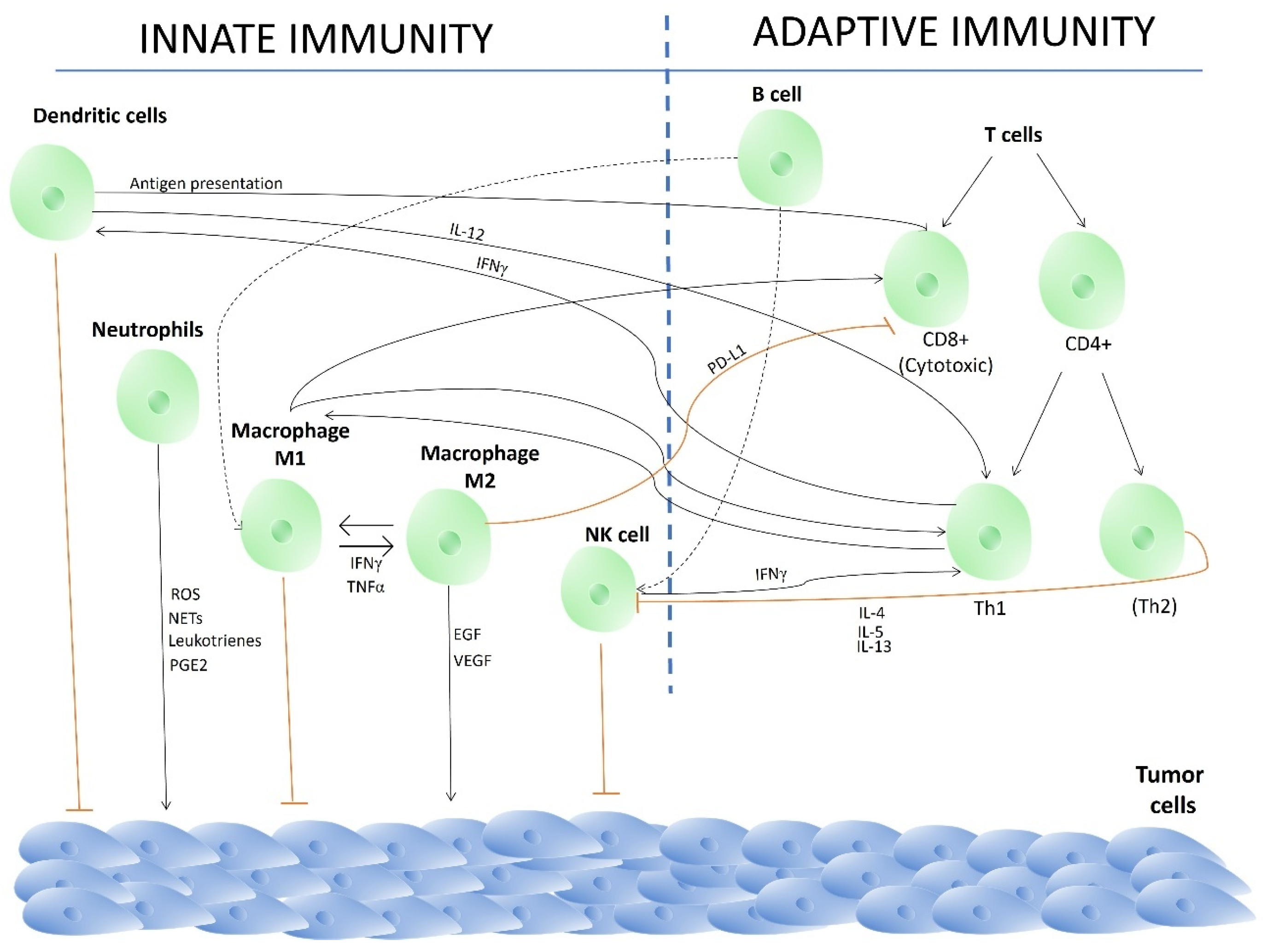
3.1. The Immune System in Cancer: A Dual-Role Framework
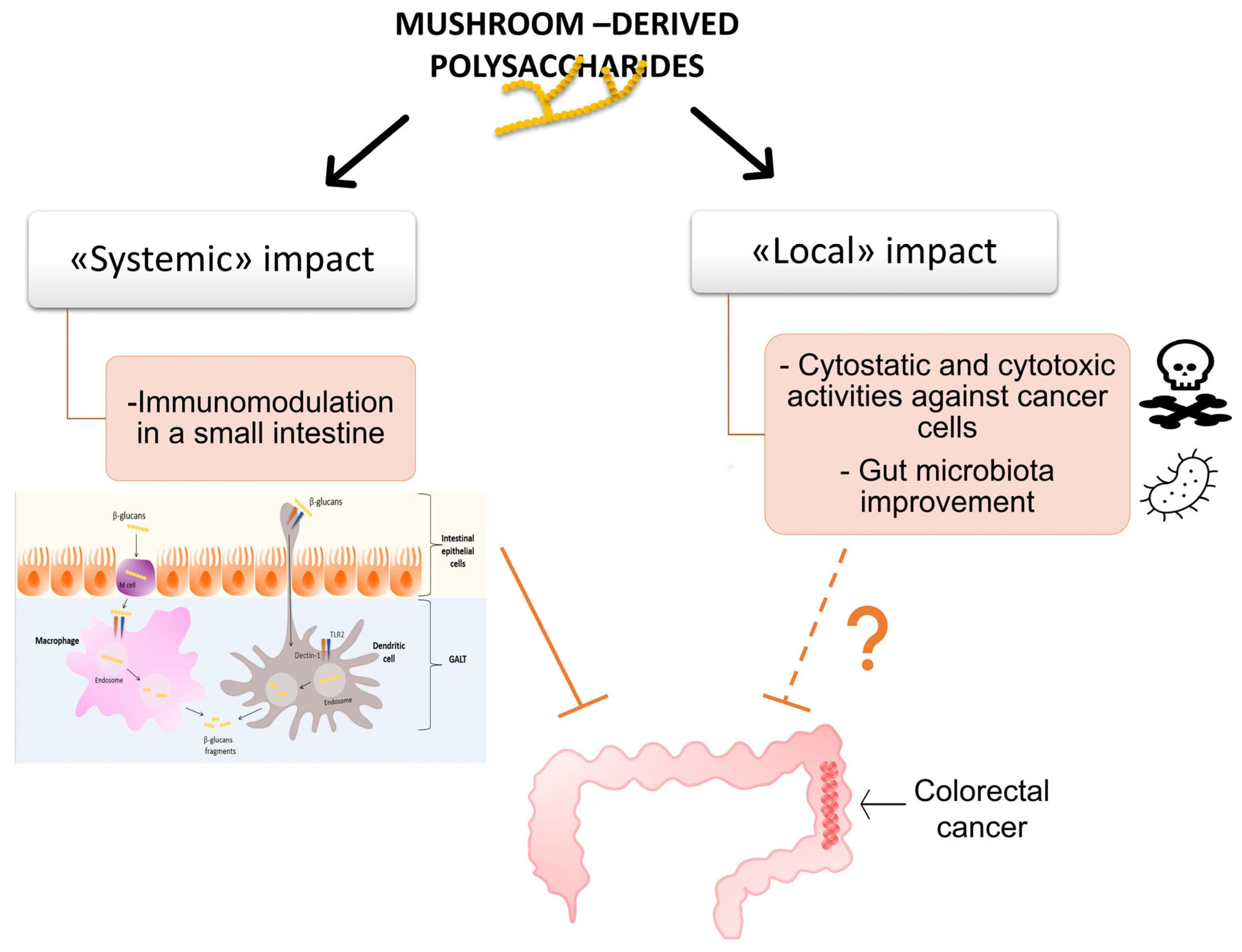
3.2. Mushroom Polysaccharides as Immune System Modulators
3.2.1. Key Bioactive Molecules: β-Glucans and Proteoglycans
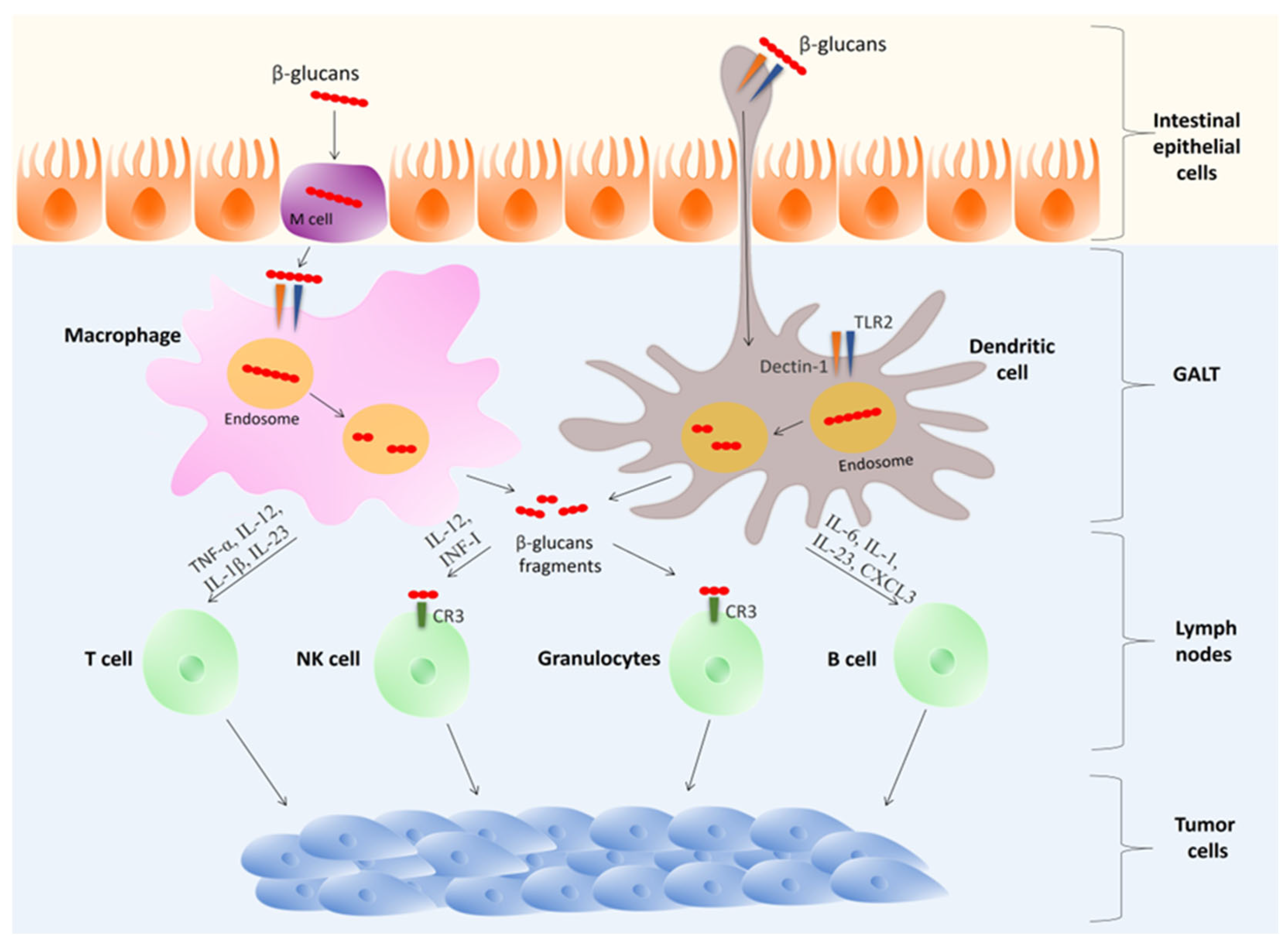
3.2.2. The Gateway: Uptake and Immune Priming in the GALT
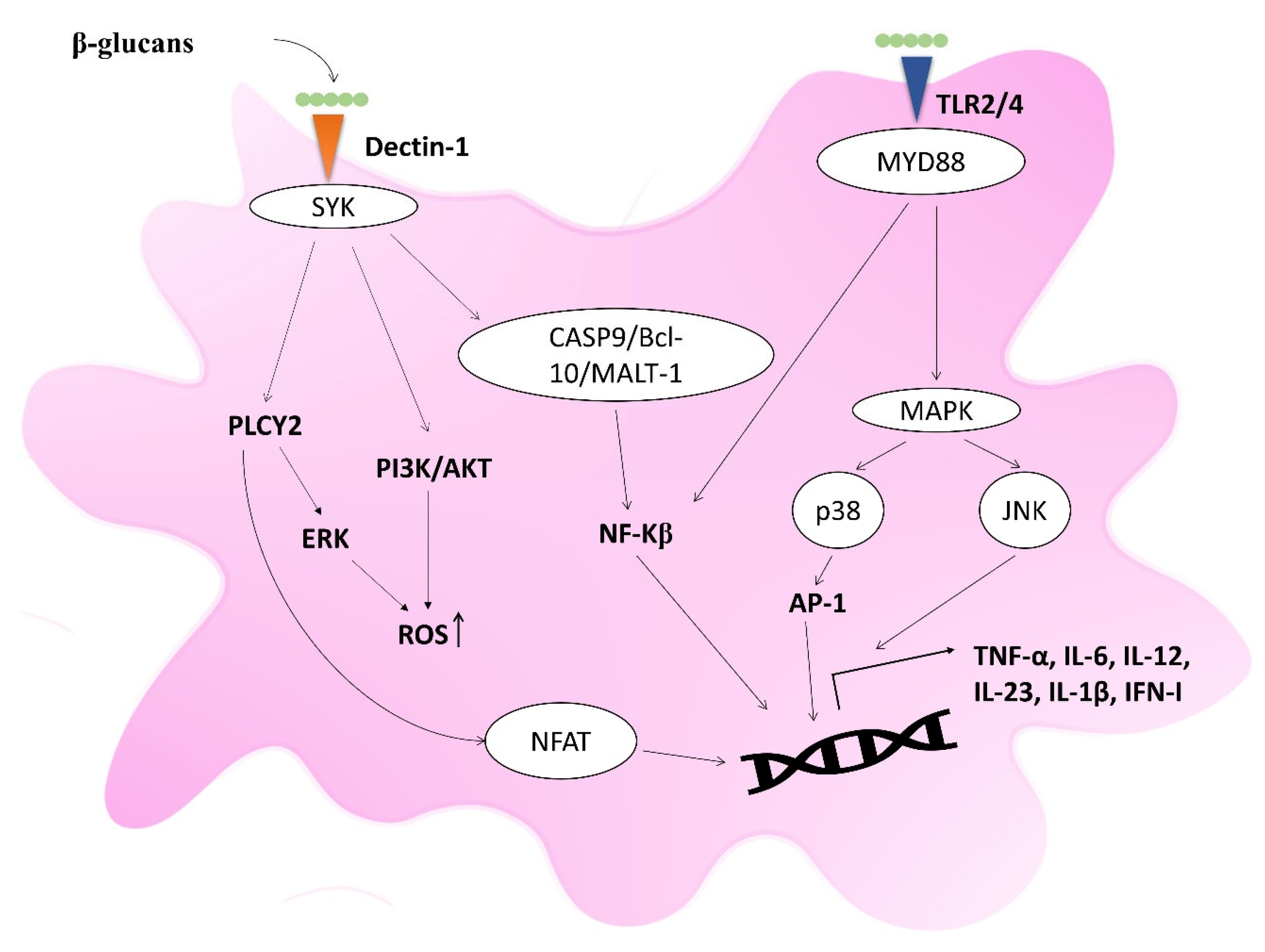
3.2.3. Molecular Triggers: Engagement of Pattern Recognition Receptors
3.2.4. Net Immunological Outcomes: From Molecular Binding to Anti-Tumor Efficacy
4. The Direct Antineoplastic Activity of Mushroom-Derived Polysaccharides and Proteoglycans
5. Mushroom-Derived Proteins with Antineoplastic Activities
6. Potential Low-Molecular-Weight Compounds from Mushrooms
6.1. Terpenes
6.1.1. Triterpenoides
6.1.2. Diterpenes
6.1.3. Sesquiterpenes
6.2. Phenolics and Other Compounds
7. Clinical Experience of Using Mushrooms in Oncology
8. Safety and Limitations of Using Medicinal Mushrooms in Clinic
9. Conclusions and Perspectives
Author Contributions
Funding
Data Availability Statement
Conflicts of Interest
References
- Kirdeeva, Y.; Fedorova, O.; Daks, A.; Barlev, N.; Shuvalov, O. How should the worldwide knowledge of traditional cancer healing be integrated with herbs and mushrooms into modern molecular pharmacology? Pharmaceuticals 2022, 15, 868. [Google Scholar] [CrossRef]
- Shuvalov, O.; Kirdeeva, Y.; Daks, A.; Fedorova, O.; Parfenyev, S.; Simon, H.-U.; Barlev, N.A. Phytochemicals target multiple metabolic pathways in cancer. Antioxidants 2023, 12, 2012. [Google Scholar] [CrossRef] [PubMed]
- Karpova, N.; Fefilova, E.; Daks, A.; Parfenyev, S.; Nazarov, A.; Barlev, N.A.; Shuvalov, O. Dietary polyphenol combinations have a multifaceted inhibitory effect on metabolic rewiring and signaling pathways in neuroblastoma. Pharmaceuticals 2025, 18, 1717. [Google Scholar] [CrossRef]
- Shuvalov, O.; Kirdeeva, Y.; Fefilova, E.; Netsvetay, S.; Zorin, M.; Vlasova, Y.; Fedorova, O.; Daks, A.; Parfenyev, S.; Barlev, N. 20-Hydroxyecdysone confers antioxidant and antineoplastic properties in human non-small cell lung cancer cells. Metabolites 2023, 13, 656. [Google Scholar] [CrossRef]
- Shuvalov, O.; Kirdeeva, Y.; Fefilova, E.; Daks, A.; Fedorova, O.; Parfenyev, S.; Nazarov, A.; Vlasova, Y.; Krasnov, G.S.; Barlev, N.A. 20-Hydroxyecdysone boosts energy production and biosynthetic processes in non-transformed mouse cells. Antioxidants 2024, 13, 1349. [Google Scholar] [CrossRef]
- Li, H.; Tian, Y.; Menolli, N., Jr.; Ye, L.; Karunarathna, S.C.; Perez-Moreno, J.; Rahman, M.M.; Rashid, M.H.; Phengsintham, P.; Rizal, L. Reviewing the world’s edible mushroom species: A new evidence-based classification system. Compr. Rev. Food Sci. Food Saf. 2021, 20, 1982–2014. [Google Scholar] [CrossRef] [PubMed]
- Dawadi, E.; Magar, P.B.; Bhandari, S.; Subedi, S.; Shrestha, S.; Shrestha, J. Nutritional and post-harvest quality preservation of mushrooms: A review. Heliyon 2022, 8, e12093. [Google Scholar] [CrossRef] [PubMed]
- Kumar, K.; Mehra, R.; Guiné, R.P.; Lima, M.J.; Kumar, N.; Kaushik, R.; Ahmed, N.; Yadav, A.N.; Kumar, H. Edible mushrooms: A comprehensive review on bioactive compounds with health benefits and processing aspects. Foods 2021, 10, 2996. [Google Scholar] [CrossRef]
- Venturella, G.; Ferraro, V.; Cirlincione, F.; Gargano, M.L. Medicinal mushrooms: Bioactive compounds, use, and clinical trials. Int. J. Mol. Sci. 2021, 22, 634. [Google Scholar] [CrossRef]
- Park, H.-J. Current uses of mushrooms in cancer treatment and their anticancer mechanisms. Int. J. Mol. Sci. 2022, 23, 10502. [Google Scholar] [CrossRef]
- Łysakowska, P.; Sobota, A.; Wirkijowska, A. Medicinal mushrooms: Their bioactive components, nutritional value and application in functional food production—A review. Molecules 2023, 28, 5393. [Google Scholar] [CrossRef]
- Chugh, R.M.; Mittal, P.; Mp, N.; Arora, T.; Bhattacharya, T.; Chopra, H.; Cavalu, S.; Gautam, R.K. Fungal mushrooms: A natural compound with therapeutic applications. Front. Pharmacol. 2022, 13, 925387. [Google Scholar] [CrossRef]
- Motta, F.; Gershwin, M.E.; Selmi, C. Mushrooms and immunity. J. Autoimmun. 2021, 117, 102576. [Google Scholar] [CrossRef]
- Panda, S.K.; Sahoo, G.; Swain, S.S.; Luyten, W. Anticancer activities of mushrooms: A neglected source for drug discovery. Pharmaceuticals 2022, 15, 176. [Google Scholar] [CrossRef] [PubMed]
- Comboni, L.M.; Uffelman, C.N.; Campbell, C.B.; Olson, M.R.; Campbell, W.W. Mushroom consumption impacts on biomarkers of cardiometabolic disease risk and immune function: A narrative review from a whole food perspective. Crit. Rev. Food Sci. Nutr. 2025, 1–15. [Google Scholar] [CrossRef]
- Xu, J.; Xu, D.; Hu, Q.; Ma, N.; Pei, F.; Su, A.; Ma, G. Immune regulatory functions of biologically active proteins from edible fungi. Front. Immunol. 2023, 13, 1034545. [Google Scholar] [CrossRef]
- Chen, S.N.; Nan, F.H.; Liu, M.W.; Yang, M.F.; Chang, Y.C.; Chen, S. Evaluation of immune modulation by β-1, 3; 1, 6 D-glucan derived from Ganoderma lucidum in healthy adult volunteers, a randomized controlled trial. Foods 2023, 12, 659. [Google Scholar] [CrossRef]
- Ba, D.M.; Ssentongo, P.; Beelman, R.B.; Muscat, J.; Gao, X.; Richie, J.P., Jr. Higher mushroom consumption is associated with lower risk of cancer: A systematic review and meta-analysis of observational studies. Adv. Nutr. 2021, 12, 1691–1704. [Google Scholar] [CrossRef]
- Lee, D.H.; Yang, M.; Keum, N.; Giovannucci, E.L.; Sun, Q.; Chavarro, J.E. Mushroom consumption and risk of total and site-specific cancer in two large US prospective cohorts. Cancer Prev. Res. 2019, 12, 517–526. [Google Scholar] [CrossRef] [PubMed]
- Lee, A.H.; Pasalich, M.; Su, D.; Tang, L.; Tran, V.D.; Binns, C.W. Mushroom intake and risk of epithelial ovarian cancer in southern Chinese women. Int. J. Gynecol. Cancer 2013, 23, 1400–1405. [Google Scholar] [CrossRef] [PubMed]
- Nowakowski, P.; Markiewicz-Żukowska, R.; Bielecka, J.; Mielcarek, K.; Grabia, M.; Socha, K. Treasures from the forest: Evaluation of mushroom extracts as anti-cancer agents. Biomed. Pharmacother. 2021, 143, 112106. [Google Scholar] [CrossRef]
- Wu, S.; Zhang, S.; Peng, B.; Tan, D.; Wu, M.; Wei, J.; Wang, Y.; Luo, H. Ganoderma lucidum: A comprehensive review of phytochemistry, efficacy, safety and clinical study. Food Sci. Hum. Wellness 2024, 13, 568–596. [Google Scholar] [CrossRef]
- Ahmad, I.; Arif, M.; Xu, M.; Zhang, J.; Ding, Y.; Lyu, F. Therapeutic values and nutraceutical properties of shiitake mushroom (Lentinula edodes): A review. Trends Food Sci. Technol. 2023, 134, 123–135. [Google Scholar] [CrossRef]
- Wu, J.-Y.; Siu, K.-C.; Geng, P. Bioactive ingredients and medicinal values of Grifola frondosa (Maitake). Foods 2021, 10, 95. [Google Scholar] [CrossRef] [PubMed]
- Camilleri, E.; Blundell, R.; Baral, B.; Karpiński, T.M.; Aruci, E.; Atrooz, O.M. A comprehensive review on the health benefits, phytochemicals, and enzymatic constituents for potential therapeutic and industrial applications of Turkey tail mushrooms. Discov. Appl. Sci. 2024, 6, 257. [Google Scholar] [CrossRef]
- Long, H.; Wu, Z. Immunoregulatory effects of Huaier (Trametes robiniophila Murr.) and relevant clinical applications. Front. Immunol. 2023, 14, 1147098. [Google Scholar] [CrossRef]
- Contato, A.G.; Conte-Junior, C.A. Lion’s Mane Mushroom (Hericium erinaceus): A neuroprotective fungus with antioxidant, anti-inflammatory, and antimicrobial potential—A narrative review. Nutrients 2025, 17, 1307. [Google Scholar] [CrossRef]
- Ern, P.T.Y.; Quan, T.Y.; Yee, F.S.; Yin, A.C.Y. Therapeutic properties of Inonotus obliquus (Chaga mushroom): A review. Mycology 2024, 15, 144–161. [Google Scholar] [CrossRef]
- Huang, K.; El-Seedi, H.R.; Xu, B. Critical review on chemical compositions and health-promoting effects of mushroom Agaricus blazei Murill. Curr. Res. Food Sci. 2022, 5, 2190–2203. [Google Scholar] [CrossRef]
- Apavaloaei, A.; Hardy, M.-P.; Thibault, P.; Perreault, C. The origin and immune recognition of tumor-specific antigens. Cancers 2020, 12, 2607. [Google Scholar] [CrossRef]
- Jiang, H.; Wei, Z.; Zhao, H. Immune surveillance as a pharmacological target in the early stages of cancer. Front. Mol. Biosci. 2025, 12, 1643024. [Google Scholar] [CrossRef]
- Tufail, M.; Jiang, C.-H.; Li, N. Immune evasion in cancer: Mechanisms and cutting-edge therapeutic approaches. Signal Transduct. Target. Ther. 2025, 10, 227. [Google Scholar] [CrossRef] [PubMed]
- Mattiola, I.; Diefenbach, A. Regulation of innate immune system function by the microbiome: Consequences for tumor immunity and cancer immunotherapy. In Seminars in Immunology; Academic Press: Cambridge, MA, USA, 2023; p. 101724. [Google Scholar]
- Mace, E.M. Human natural killer cells: Form, function, and development. J. Allergy Clin. Immunol. 2023, 151, 371–385. [Google Scholar] [CrossRef]
- Xue, J.S.; Ding, Z.N.; Meng, G.X.; Yan, L.J.; Liu, H.; Li, H.-C.; Yao, S.Y.; Tian, B.W.; Dong, Z.R.; Chen, Z.Q. The prognostic value of natural killer cells and their receptors/ligands in hepatocellular carcinoma: A systematic review and meta-analysis. Front. Immunol. 2022, 13, 872353. [Google Scholar] [CrossRef] [PubMed]
- Nersesian, S.; Schwartz, S.L.; Grantham, S.R.; MacLean, L.K.; Lee, S.N.; Pugh-Toole, M.; Boudreau, J.E. NK cell infiltration is associated with improved overall survival in solid cancers: A systematic review and meta-analysis. Transl. Oncol. 2021, 14, 100930. [Google Scholar] [CrossRef] [PubMed]
- Coënon, L.; Geindreau, M.; Ghiringhelli, F.; Villalba, M.; Bruchard, M. Natural killer cells at the frontline in the fight against cancer. Cell Death Dis. 2024, 15, 614. [Google Scholar] [CrossRef] [PubMed]
- Pu, Y.; Ji, Q. Tumor-associated macrophages regulate PD-1/PD-L1 immunosuppression. Front. Immunol. 2022, 13, 874589. [Google Scholar] [CrossRef]
- Yin, M.; Li, X.; Tan, S.; Zhou, H.J.; Ji, W.; Bellone, S.; Xu, X.; Zhang, H.; Santin, A.D.; Lou, G. Tumor-associated macrophages drive spheroid formation during early transcoelomic metastasis of ovarian cancer. J. Clin. Investig. 2016, 126, 4157–4173. [Google Scholar] [CrossRef]
- Chen, S.; Saeed, A.F.; Liu, Q.; Jiang, Q.; Xu, H.; Xiao, G.G.; Rao, L.; Duo, Y. Macrophages in immunoregulation and therapeutics. Signal Transduct. Target. Ther. 2023, 8, 207. [Google Scholar] [CrossRef] [PubMed]
- Na, H.Y.; Park, Y.; Nam, S.K.; Koh, J.; Kwak, Y.; Ahn, S.H.; Park, D.J.; Kim, H.H.; Lee, K.S.; Lee, H.S. Prognostic significance of natural killer cell-associated markers in gastric cancer: Quantitative analysis using multiplex immunohistochemistry. J. Transl. Med. 2021, 19, 529. [Google Scholar] [CrossRef]
- Zahorec, R. Neutrophil-to-lymphocyte ratio, past, present and future perspectives. Bratisl Lek Listy 2021, 122, 474–488. [Google Scholar] [CrossRef] [PubMed]
- Stefaniuk, P.; Szymczyk, A.; Podhorecka, M. The neutrophil to lymphocyte and lymphocyte to monocyte ratios as new prognostic factors in hematological malignancies–a narrative review. Cancer Manag. Res. 2020, 2961–2977. [Google Scholar] [CrossRef] [PubMed]
- Wculek, S.K.; Cueto, F.J.; Mujal, A.M.; Melero, I.; Krummel, M.F.; Sancho, D. Dendritic cells in cancer immunology and immunotherapy. Nat. Rev. Immunol. 2020, 20, 7–24. [Google Scholar] [CrossRef]
- Albert, M.L.; Sauter, B.; Bhardwaj, N. Dendritic cells acquire antigen from apoptotic cells and induce class I-restricted CTLs. Nature 1998, 392, 86–89. [Google Scholar] [CrossRef] [PubMed]
- Binnewies, M.; Mujal, A.M.; Pollack, J.L.; Combes, A.J.; Hardison, E.A.; Barry, K.C.; Tsui, J.; Ruhland, M.K.; Kersten, K.; Abushawish, M.A. Unleashing type-2 dendritic cells to drive protective antitumor CD4+ T cell immunity. Cell 2019, 177, 556–571.e16. [Google Scholar] [CrossRef]
- Yang, W.; Liu, S.; Mao, M.; Gong, Y.; Li, X.; Lei, T.; Liu, C.; Wu, S.; Hu, Q. T-cell infiltration and its regulatory mechanisms in cancers: Insights at single-cell resolution. J. Exp. Clin. Cancer Res. 2024, 43, 38. [Google Scholar] [CrossRef]
- Oliveira, G.; Wu, C.J. Dynamics and specificities of T cells in cancer immunotherapy. Nat. Rev. Cancer 2023, 23, 295–316. [Google Scholar] [CrossRef] [PubMed]
- Lu, D.; Chen, Y.; Jiang, M.; Wang, J.; Li, Y.; Ma, K.; Sun, W.; Zheng, X.; Qi, J.; Jin, W. KRAS G12V neoantigen specific T cell receptor for adoptive T cell therapy against tumors. Nat. Commun. 2023, 14, 6389. [Google Scholar] [CrossRef] [PubMed]
- Wu, D.; Yin, R.; Chen, G.; Ribeiro-Filho, H.V.; Cheung, M.; Robbins, P.F.; Mariuzza, R.A.; Pierce, B.G. Structural characterization and AlphaFold modeling of human T cell receptor recognition of NRAS cancer neoantigens. Sci. Adv. 2024, 10, eadq6150. [Google Scholar] [CrossRef] [PubMed]
- Basu, A.; Ramamoorthi, G.; Albert, G.; Gallen, C.; Beyer, A.; Snyder, C.; Koski, G.; Disis, M.L.; Czerniecki, B.J.; Kodumudi, K. Differentiation and regulation of TH cells: A balancing act for cancer immunotherapy. Front. Immunol. 2021, 12, 669474. [Google Scholar] [CrossRef]
- Qu, Y.; Yang, H.; Li, S.; Li, L.; Li, Y.; Wang, D. The involvement of Th1 cell differentiation in the anti-tumor effect of purified polysaccharide from Sanghuangporus vaninii in colorectal cancer via multi-omics analysis. Int. J. Biol. Macromol. 2023, 237, 123927. [Google Scholar] [CrossRef]
- Tan, R.; Nie, M.; Long, W. The role of B cells in cancer development. Front. Oncol. 2022, 12, 958756. [Google Scholar] [CrossRef]
- Challa-Malladi, M.; Lieu, Y.K.; Califano, O.; Holmes, A.B.; Bhagat, G.; Murty, V.V.; Dominguez-Sola, D.; Pasqualucci, L.; Dalla-Favera, R. Combined genetic inactivation of β2-Microglobulin and CD58 reveals frequent escape from immune recognition in diffuse large B cell lymphoma. Cancer Cell 2011, 20, 728–740. [Google Scholar] [CrossRef]
- Shukla, S.A.; Rooney, M.S.; Rajasagi, M.; Tiao, G.; Dixon, P.M.; Lawrence, M.S.; Stevens, J.; Lane, W.J.; Dellagatta, J.L.; Steelman, S. Comprehensive analysis of cancer-associated somatic mutations in class I HLA genes. Nat. Biotechnol. 2015, 33, 1152–1158. [Google Scholar] [CrossRef] [PubMed]
- Burr, M.L.; Sparbier, C.E.; Chan, K.L.; Chan, Y.-C.; Kersbergen, A.; Lam, E.Y.; Azidis-Yates, E.; Vassiliadis, D.; Bell, C.C.; Gilan, O. An evolutionarily conserved function of polycomb silences the MHC class I antigen presentation pathway and enables immune evasion in cancer. Cancer Cell 2019, 36, 385–401.e8. [Google Scholar] [CrossRef]
- Elemam, N.M.; Mekky, R.Y.; Rashid, G.; Braoudaki, M.; Youness, R.A. Pharmacogenomic and epigenomic approaches to untangle the enigma of IL-10 blockade in oncology. Expert Rev. Mol. Med. 2024, 26, e1. [Google Scholar] [CrossRef]
- Lin, X.; Kang, K.; Chen, P.; Zeng, Z.; Li, G.; Xiong, W.; Yi, M.; Xiang, B. Regulatory mechanisms of PD-1/PD-L1 in cancers. Mol. Cancer 2024, 23, 108. [Google Scholar] [CrossRef] [PubMed]
- Oliver, B.; Jackson, E.; Soliman, H. Immunostimulators and immunomodulators in cancer treatment. In Novel Approaches and Strategies for Biologics, Vaccines and Cancer Therapies; Elsevier: Amsterdam, The Netherlands, 2015; pp. 411–431. [Google Scholar]
- Cerletti, C.; Esposito, S.; Iacoviello, L. Edible mushrooms and beta-glucans: Impact on human health. Nutrients 2021, 13, 2195. [Google Scholar] [CrossRef]
- Maity, P.; Sen, I.K.; Chakraborty, I.; Mondal, S.; Bar, H.; Bhanja, S.K.; Mandal, S.; Maity, G.N. Biologically active polysaccharide from edible mushrooms: A review. Int. J. Biol. Macromol. 2021, 172, 408–417. [Google Scholar] [CrossRef] [PubMed]
- Xiao, Z.; Zhou, W.; Zhang, Y. Fungal polysaccharides. Adv. Pharmacol. 2020, 87, 277–299. [Google Scholar]
- Park, H.J.; Boo, S.; Park, I.; Shin, M.S.; Takahashi, T.; Takanari, J.; Homma, K.; Kang, I. AHCC®, a standardized extract of cultured Lentinula edodes mycelia, promotes the anti-tumor effect of dual immune checkpoint blockade effect in murine colon cancer. Front. Immunol. 2022, 13, 875872. [Google Scholar] [CrossRef] [PubMed]
- Masuda, Y.; Nakayama, Y.; Tanaka, A.; Naito, K.; Konishi, M. Antitumor activity of orally administered maitake α-glucan by stimulating antitumor immune response in murine tumor. PLoS ONE 2017, 12, e0173621. [Google Scholar] [CrossRef]
- Luo, Y.; Li, C.; He, T.; Huang, W.; Wang, Y.; Yu, D.B.; Ma, M.; Yu, R.; Zhu, J.; Song, L. A highly branched α-d-glucan facilitates antitumor immunity by reducing cancer cell CXCL5 expression. Int. J. Biol. Macromol. 2022, 209, 166–179. [Google Scholar] [CrossRef]
- Synytsya, A.; Novák, M. Structural diversity of fungal glucans. Carbohydr. Polym. 2013, 92, 792–809. [Google Scholar] [CrossRef]
- He, Z.; Lin, J.; He, Y.; Liu, S. Polysaccharide-peptide from Trametes versicolor: The potential medicine for colorectal cancer treatment. Biomedicines 2022, 10, 2841. [Google Scholar] [CrossRef]
- Singla, A.; Gupta, O.P.; Sagwal, V.; Kumar, A.; Patwa, N.; Mohan, N.; Ankush; Kumar, D.; Vir, O.; Singh, J. Beta-glucan as a soluble dietary fiber source: Origins, biosynthesis, extraction, purification, structural characteristics, bioavailability, biofunctional attributes, industrial utilization, and global trade. Nutrients 2024, 16, 900. [Google Scholar] [CrossRef]
- Hong, F.; Yan, J.; Baran, J.T.; Allendorf, D.J.; Hansen, R.D.; Ostroff, G.R.; Xing, P.X.; Cheung, N.-K.V.; Ross, G.D. Mechanism by which orally administered β-1, 3-glucans enhance the tumoricidal activity of antitumor monoclonal antibodies in murine tumor models. J. Immunol. 2004, 173, 797–806. [Google Scholar] [CrossRef] [PubMed]
- Yu, Y.; Liu, Z.; Song, K.; Li, L.; Chen, M. Medicinal value of edible mushroom polysaccharides: A review. J. Future Foods 2023, 3, 16–23. [Google Scholar] [CrossRef]
- Li, B.; Cai, Y.; Qi, C.; Hansen, R.; Ding, C.; Mitchell, T.C.; Yan, J. Orally administered particulate β-glucan modulates tumor-capturing dendritic cells and improves antitumor T-cell responses in cancer. Clin. Cancer Res. 2010, 16, 5153–5164. [Google Scholar] [CrossRef]
- de Graaff, P.; Govers, C.; Wichers, H.J.; Debets, R. Consumption of β-glucans to spice up T cell treatment of tumors: A review. Expert Opin. Biol. Ther. 2018, 18, 1023–1040. [Google Scholar] [CrossRef] [PubMed]
- Nishimoto, Y.; Kawai, J.; Mori, K.; Hartanto, T.; Komatsu, K.; Kudo, T.; Fukuda, S. Dietary supplement of mushrooms promotes SCFA production and moderately associates with IgA production: A pilot clinical study. Front. Nutr. 2023, 9, 1078060. [Google Scholar] [CrossRef]
- Batbayar, S.; Lee, D.H.; Kim, H.W. Immunomodulation of fungal β-glucan in host defense signaling by dectin-1. Biomol. Ther. 2012, 20, 433. [Google Scholar] [CrossRef]
- Mata-Martínez, P.; Bergón-Gutiérrez, M.; Del Fresno, C. Dectin-1 signaling update: New perspectives for trained immunity. Front. Immunol. 2022, 13, 812148. [Google Scholar] [CrossRef] [PubMed]
- Lee, D.H.; Kim, H.W. Innate immunity induced by fungal β-glucans via dectin-1 signaling pathway. Int. J. Med. Mushrooms 2014, 16, 1–16. [Google Scholar] [CrossRef] [PubMed]
- Wang, Y.; Fang, J.; Ni, X.; Li, J.; Liu, Q.; Dong, Q.; Duan, J.; Ding, K. Inducement of cytokine release by GFPBW2, a novel polysaccharide from fruit bodies of Grifola frondosa, through dectin-1 in macrophages. J. Agric. Food Chem. 2013, 61, 11400–11409. [Google Scholar] [CrossRef] [PubMed]
- Yamanaka, D.; Tada, R.; Adachi, Y.; Ishibashi, K.; Motoi, M.; Iwakura, Y.; Ohno, N. Agaricus brasiliensis-derived β-glucans exert immunoenhancing effects via a dectin-1-dependent pathway. Int. Immunopharmacol. 2012, 14, 311–319. [Google Scholar] [CrossRef]
- Kanno, T.; Tada, R.; Nakasone, T.; Okamatsu, S.; Iwakura, Y.; Tamura, K.; Miyaoka, H.; Adachi, Y. Cordyceps militaris fruit body activates myeloid dendritic cells via a dectin-1-mediated pathway. Mol. Immunol. 2024, 175, 112–120. [Google Scholar] [CrossRef]
- Sakaguchi, K.; Shirai, Y.; Itoh, T.; Mizuno, M. Lentinan exerts its anti-inflammatory activity by suppressing TNFR1 transfer to the surface of intestinal epithelial cells through dectin-1 in an in vitro and mice model. Immunome Res. 2018, 14, 3. [Google Scholar] [CrossRef]
- Minato, K.-i.; Oura, K.; Mizuno, M. The inhibitory effect of oral administration of lentinan on DSS-induced inflammation is exerted by the migration of T cells activated in the ileum to the colon. Eur. J. Pharmacol. 2023, 946, 175631. [Google Scholar] [CrossRef]
- Yin, Z.; Liang, Z.; Li, C.; Wang, J.; Ma, C.; Kang, W. Immunomodulatory effects of polysaccharides from edible fungus: A review. Food Sci. Hum. Wellness 2021, 10, 393–400. [Google Scholar] [CrossRef]
- Kim, H.S.; Kim, J.Y.; Kang, J.S.; Kim, H.M.; Kim, Y.O.; Hong, I.P.; Lee, M.K.; Hong, J.T.; Kim, Y.; Han, S.B. Cordlan polysaccharide isolated from mushroom Cordyceps militaris induces dendritic cell maturation through toll-like receptor 4 signalings. Food Chem. Toxicol. 2010, 48, 1926–1933. [Google Scholar] [CrossRef]
- Price, L.A.; Wenner, C.A.; Sloper, D.T.; Slaton, J.W.; Novack, J.P. Role for toll-like receptor 4 in TNF-alpha secretion by murine macrophages in response to polysaccharide Krestin, a Trametes versicolor mushroom extract. Fitoterapia 2010, 81, 914–919. [Google Scholar] [CrossRef]
- Lu, H.; Yang, Y.; Gad, E.; Inatsuka, C.; Wenner, C.A.; Disis, M.L.; Standish, L.J. TLR2 agonist PSK activates human NK cells and enhances the antitumor effect of HER2-targeted monoclonal antibody therapy. Clin. Cancer Res. 2011, 17, 6742–6753. [Google Scholar] [CrossRef]
- Cheng, H.; Sun, L.; Shen, D.; Ren, A.; Ma, F.; Tai, G.; Fan, L.; Zhou, Y. Beta-1, 6 glucan converts tumor-associated macrophages into an M1-like phenotype. Carbohydr. Polym. 2020, 247, 116715. [Google Scholar] [CrossRef] [PubMed]
- Liu, Y.; Zhang, L.; Zhu, X.; Wang, Y.; Liu, W.; Gong, W. Polysaccharide Agaricus blazei Murill stimulates myeloid derived suppressor cell differentiation from M2 to M1 type, which mediates inhibition of tumour immune-evasion via the Toll-like receptor 2 pathway. Immunology 2015, 146, 379–391. [Google Scholar] [CrossRef]
- Li, B.; Allendorf, D.J.; Hansen, R.; Marroquin, J.; Ding, C.; Cramer, D.E.; Yan, J. Yeast β-glucan amplifies phagocyte killing of iC3b-opsonized tumor cells via complement receptor 3-Syk-phosphatidylinositol 3-kinase pathway. J. Immunol. 2006, 177, 1661–1669. [Google Scholar] [CrossRef]
- Legentil, L.; Paris, F.; Ballet, C.; Trouvelot, S.; Daire, X.; Vetvicka, V.; Ferrières, V. Molecular interactions of β-(1→3)-glucans with their receptors. Molecules 2015, 20, 9745–9766. [Google Scholar] [CrossRef]
- Oka, M.; Hazama, S.; Suzuki, M.; Wang, F.; Wadamori, K.; Iizuka, N.; Takeda, S.; Akitomi, Y.; Ohba, Y.; Kajiwara, K. In vitro and in vivo analysis of human leukocyte binding by the antitumor polysaccharide, lentinan. Int. J. Immunopharmacol. 1996, 18, 211–216. [Google Scholar] [CrossRef] [PubMed]
- Bu, Y.; Liu, Q.; Shang, Y.; Zhao, Z.; Sun, H.; Chen, F.; Ma, Q.; Song, J.; Cui, L.; Sun, E. Ganoderma lucidum spores-derived particulate β-glucan treatment improves antitumor response by regulating myeloid-derived suppressor cells in triple-negative breast cancer. Int. J. Biol. Macromol. 2024, 270, 131949. [Google Scholar] [CrossRef] [PubMed]
- Masuda, Y.; Ito, K.; Konishi, M.; Nanba, H. A polysaccharide extracted from Grifola frondosa enhances the anti-tumor activity of bone marrow-derived dendritic cell-based immunotherapy against murine colon cancer. Cancer Immunol. Immunother. 2010, 59, 1531–1541. [Google Scholar] [CrossRef]
- Xu, Y.; Ma, J.; Zheng, Q.; Wang, Y.; Hu, M.; Ma, F.; Qin, Z.; Lei, N.; Tao, N. MPSSS impairs the immunosuppressive function of cancer-associated fibroblasts via the TLR4-NF-κB pathway. Biosci. Rep. 2019, 39, BSR20182171. [Google Scholar] [CrossRef] [PubMed]
- Chang, Y.H.; Yang, J.S.; Yang, J.L.; Wu, C.L.; Chang, S.J.; Lu, K.W.; Kuo, C.L.; Hsia, T.C.; Chung, J.G. Gandoderma lucidum extract promotes immune responses in normal BALB/c mice in vivo. In Vivo 2009, 23, 755–759. [Google Scholar] [PubMed]
- Masuda, Y.; Inoue, H.; Ohta, H.; Miyake, A.; Konishi, M.; Nanba, H. Oral administration of soluble β-glucans extracted from Grifola frondosa induces systemic antitumor immune response and decreases immunosuppression in tumor-bearing mice. Int. J. Cancer 2013, 133, 108–119. [Google Scholar] [CrossRef] [PubMed]
- Yang, A.; Fan, H.; Zhao, Y.; Chen, X.; Zhu, Z.; Zha, X.; Zhao, Y.; Chai, X.; Li, J.; Tu, P. An immune-stimulating proteoglycan from the medicinal mushroom Huaier up-regulates NF-κB and MAPK signaling via Toll-like receptor 4. J. Biol. Chem. 2019, 294, 2628–5268. [Google Scholar] [CrossRef]
- Jiang, S.; Shi, F.; Lin, H.; Ying, Y.; Luo, L.; Huang, D.; Luo, Z. Inonotus obliquus polysaccharides induces apoptosis of lung cancer cells and alters energy metabolism via the LKB1/AMPK axis. Int. J. Biol. Macromol. 2020, 151, 1277–1286. [Google Scholar] [CrossRef]
- Lee, K.R.; Lee, J.S.; Lee, S.; Son, Y.K.; Kim, G.R.; Sim, Y.C.; Song, J.E.; Ha, S.-J.; Hong, E.K. Polysaccharide isolated from the liquid culture broth of Inonotus obliquus suppresses invasion of B16-F10 melanoma cells via AKT/NF-κB signaling pathway. Mol. Med. Rep. 2016, 14, 4429–4435. [Google Scholar] [CrossRef]
- Wu, Q.C.; Zhang, Y.Y.; Li, Y.B.; Alitongbieke, G.; Xue, Y.; Li, X.M.; Lin, Z.C.; Huang, J.F.; Pan, T.; Pan, X.M. A novel cell-wall polysaccharide derived from the stipe of Agaricus bisporus inhibits mouse melanoma proliferation and metastasis. Arch. Biochem. Biophys. 2023, 744, 109678. [Google Scholar] [CrossRef]
- Wang, X.; Ha, D.; Mori, H.; Chen, S. White button mushroom (Agaricus bisporus) disrupts androgen receptor signaling in human prostate cancer cells and patient-derived xenograft. J. Nutr. Biochem. 2021, 89, 108580. [Google Scholar] [CrossRef]
- Yu, Y.; Qian, L.; Du, N.; Liu, Y.; Zhao, X.; Zhang, X. Ganoderma lucidum polysaccharide enhances radiosensitivity of hepatocellular carcinoma cell line HepG2 through Akt signaling pathway. Exp. Ther. Med. 2017, 14, 5903–5907. [Google Scholar] [CrossRef]
- Hsu, W.H.; Hua, W.J.; Qiu, W.L.; Tseng, A.J.; Cheng, H.C.; Lin, T.Y. WSG, a glucose-enriched polysaccharide from Ganoderma lucidum, suppresses tongue cancer cells via inhibition of EGFR-mediated signaling and potentiates cisplatin-induced apoptosis. Int. J. Biol. Macromol. 2021, 193, 1201–1208. [Google Scholar] [CrossRef]
- Wang, K.; Huang, H.; Zhan, Q.; Ding, H.; Li, Y. Toll-like receptors in health and disease. MedComm 2024, 5, e549. [Google Scholar] [CrossRef]
- Bhattacharyya, S.; Midwood, K.S.; Yin, H.; Varga, J. Toll-like receptor-4 signaling drives persistent fibroblast activation and prevents fibrosis resolution in scleroderma. Adv. Wound Care 2017, 6, 356–369. [Google Scholar] [CrossRef]
- Latorre, E.; Layunta, E.; Grasa, L.; Pardo, J.; García, S.; Alcalde, A.I.; Mesonero, J.E. Toll-like receptors 2 and 4 modulate intestinal IL-10 differently in ileum and colon. United Eur. Gastroenterol. J. 2018, 6, 446–453. [Google Scholar] [CrossRef]
- Di Lorenzo, A.; Bolli, E.; Tarone, L.; Cavallo, F.; Conti, L. Toll-like receptor 2 at the crossroad between cancer cells, the immune system, and the microbiota. Int. J. Mol. Sci. 2020, 21, 9418. [Google Scholar] [CrossRef]
- Mukherjee, S.; Patra, R.; Behzadi, P.; Masotti, A.; Paolini, A.; Sarshar, M. Toll-like receptor-guided therapeutic intervention of human cancers: Molecular and immunological perspectives. Front. Immunol. 2023, 14, 1244345. [Google Scholar] [CrossRef]
- Rice, P.J.; Adams, E.L.; Ozment-Skelton, T.; Gonzalez, A.J.; Goldman, M.P.; Lockhart, B.E.; Barker, L.A.; Breuel, K.F.; DePonti, W.K.; Kalbfleisch, J.H. Oral delivery and gastrointestinal absorption of soluble glucans stimulate increased resistance to infectious challenge. J. Pharmacol. Exp. Ther. 2005, 314, 1079–1086. [Google Scholar] [CrossRef]
- Hsin, I.L.; Chiu, L.Y.; Ou, C.C.; Wu, W.J.; Sheu, G.T.; Ko, J.L. CD133 inhibition via autophagic degradation in pemetrexed-resistant lung cancer cells by GMI, a fungal immunomodulatory protein from Ganoderma microsporum. Br. J. Cancer 2020, 123, 449–458. [Google Scholar] [CrossRef] [PubMed]
- Macharia, J.M.; Zhang, L.; Mwangi, R.W.; Rozmann, N.; Kaposztas, Z.; Varjas, T.; Sugár, M.; Alfatafta, H.; Pintér, M.; Bence, R.L. Are chemical compounds in medical mushrooms potent against colorectal cancer carcinogenesis and antimicrobial growth? Cancer Cell Int. 2022, 22, 379. [Google Scholar] [CrossRef] [PubMed]
- Lee, S.H.; Hwang, H.S.; Yun, J.W. Antitumor activity of water extract of a mushroom, Inonotus obliquus, against HT-29 human colon cancer cells. Phytother. Res. 2009, 23, 1784–1789. [Google Scholar] [CrossRef] [PubMed]
- Zhang, N.; Liu, Y.; Tang, F.-Y.; Yang, L.Y.; Wang, J.H. Structural characterization and in vitro anti-colon cancer activity of a homogeneous polysaccharide from Agaricus bisporus. Int. J. Biol. Macromol. 2023, 251, 126410. [Google Scholar] [CrossRef]
- Lemieszek, M.K.; Nunes, F.M.; Marques, G.; Rzeski, W. Cantharellus cibarius branched mannans inhibits colon cancer cells growth by interfering with signals transduction in NF-ĸB pathway. Int. J. Biol. Macromol. 2019, 134, 770–780. [Google Scholar] [CrossRef]
- Zhang, Y.; Zhang, Z.; Liu, H.; Wang, D.; Wang, J.; Liu, M.; Yang, Y.; Zhong, S. A natural selenium polysaccharide from Pleurotus ostreatus: Structural elucidation, anti-gastric cancer and anti-colon cancer activity in vitro. Int. J. Biol. Macromol. 2022, 201, 630–640. [Google Scholar] [CrossRef]
- Roca-Lema, D.; Martinez-Iglesias, O.; de Ana Portela, C.F.; Rodríguez-Blanco, A.; Valladares-Ayerbes, M.; Díaz-Díaz, A.; Casas-Pais, A.; Prego, C.; Figueroa, A. In vitro anti-proliferative and anti-invasive effect of polysaccharide-rich extracts from Trametes versicolor and Grifola frondosa in colon cancer cells. Int. J. Med. Sci. 2019, 16, 231. [Google Scholar] [CrossRef] [PubMed]
- Lemieszek, M.K.; Cardoso, C.; Nunes, F.H.F.M.; Marques, G.; Pożarowski, P.; Rzeski, W. Boletus edulis biologically active biopolymers induce cell cycle arrest in human colon adenocarcinoma cells. Food Funct. 2013, 4, 575–585. [Google Scholar] [CrossRef] [PubMed]
- Nowak, R.; Nowacka-Jechalke, N.; Juda, M.; Malm, A. The preliminary study of prebiotic potential of Polish wild mushroom polysaccharides: The stimulation effect on Lactobacillus strains growth. Eur. J. Nutr. 2018, 57, 1511–1521. [Google Scholar] [CrossRef] [PubMed]
- He, J.; Yang, A.; Zhao, X.; Liu, Y.; Liu, S.; Wang, D. Anti-colon cancer activity of water-soluble polysaccharides extracted from Gloeostereum incarnatum via Wnt/β-catenin signaling pathway. Food Sci. Hum. Wellness 2021, 10, 460–470. [Google Scholar] [CrossRef]
- Xu, Y.; Xu, T.; Huang, C.; Amakye, W.K.; Li, K.; Zhu, Y.; Ren, J. The age-dependent anticancer efficacy of Agaricus blazei Murill polysaccharide in colon cancer. Mol. Nutr. Food Res. 2025, 69, e202400733. [Google Scholar] [CrossRef]
- Wang, J.; Li, W.; Huang, X.; Liu, Y.; Li, Q.; Zheng, Z.; Wang, K. A polysaccharide from Lentinus edodes inhibits human colon cancer cell proliferation and suppresses tumor growth in athymic nude mice. Oncotarget 2016, 8, 610. [Google Scholar] [CrossRef]
- Song, K.S.; Li, G.; Kim, J.S.; Jing, K.; Kim, T.D.; Kim, J.P.; Seo, S.B.; Yoo, J.K.; Park, H.D.; Hwang, B.D. Protein-bound polysaccharide from Phellinus linteus inhibits tumor growth, invasion, and angiogenesis and alters Wnt/β-catenin in SW480 human colon cancer cells. BMC Cancer 2011, 11, 307. [Google Scholar] [CrossRef]
- Liu, N.; Zou, S.; Xie, C.; Meng, Y.; Xu, X. Effect of the β-glucan from Lentinus edodes on colitis-associated colorectal cancer and gut microbiota. Carbohydr. Polym. 2023, 316, 121069. [Google Scholar] [CrossRef]
- Ivanova, T.; Krupodorova, T.; Barshteyn, V.; Artamonova, A.; Shlyakhovenko, V. Anticancer substances of mushroom origin. Exp. Oncol. 2014, 36, 58–66. [Google Scholar]
- Drzewiecka, B.; Wessely-Szponder, J.; Świeca, M.; Espinal, P.; Fusté, E.; Fernández-De La Cruz, E. Bioactive peptides and other immunomodulators of mushroom origin. Biomedicines 2024, 12, 1483. [Google Scholar] [CrossRef] [PubMed]
- Liu, Y.; Bastiaan-Net, S.; Wichers, H.J. Current understanding of the structure and function of fungal immunomodulatory proteins. Front. Nutr. 2020, 7, 132. [Google Scholar] [CrossRef]
- Wang, X.F.; Su, K.Q.; Bao, T.W.; Cong, W.R.; Chen, Y.F.; Li, Q.Z.; Zhou, X.W. Immunomodulatory effects of fungal proteins. Curr. Top. Nutraceutical Res. 2012, 10, 100881. [Google Scholar]
- Ejike, U.C.; Chan, C.J.; Okechukwu, P.N.; Lim, R.L.H. New advances and potentials of fungal immunomodulatory proteins for therapeutic purposes. Crit. Rev. Biotechnol. 2020, 40, 1172–1190. [Google Scholar] [CrossRef]
- Lo, H.C.; Hua, W.J.; Yeh, H.; Lin, Z.H.; Huang, L.C.; Ciou, Y.R.; Ruan, R.; Lin, K.F.; Tseng, A.J.; Wu, A.T. GMI, a Ganoderma microsporum protein, abolishes focal adhesion network to reduce cell migration and metastasis of lung cancer. Life Sci. 2023, 335, 122255. [Google Scholar] [CrossRef]
- Kang, Y.T.; Chang, H.Y.; Hsieh, Y.C.; Chou, C.H.; Hsin, I.L.; Ko, J.L. Integrin αV inhibition by GMI, a Ganoderma microsporum immunomodulatory protein, abolish stemness and migration in EGFR-mutated lung cancer cells resistant to osimertinib. Environ. Toxicol. 2024, 39, 5238–5249. [Google Scholar] [CrossRef]
- Wang, T.Y.; Yu, C.C.; Hsieh, P.L.; Liao, Y.W.; Yu, C.H.; Chou, M.Y. GMI ablates cancer stemness and cisplatin resistance in oral carcinomas stem cells through IL-6/Stat3 signaling inhibition. Oncotarget 2017, 8, 70422. [Google Scholar] [CrossRef] [PubMed]
- Tseng, A.J.; Tu, T.H.; Hua, W.J.; Yeh, H.; Chen, C.J.; Lin, Z.H.; Hsu, W.H.; Chen, Y.L.; Hsu, C.C.; Lin, T.Y. GMI, Ganoderma microsporum protein, suppresses cell mobility and increases temozolomide sensitivity through induction of Slug degradation in glioblastoma multiforme cells. Int. J. Biol. Macromol. 2022, 219, 940–948. [Google Scholar] [CrossRef]
- Hua, W.J.; Yeh, H.; Lin, Z.H.; Tseng, A.J.; Huang, L.C.; Qiu, W.L.; Tu, T.H.; Wang, D.H.; Hsu, W.H.; Hwang, W.L. Ganoderma microsporum immunomodulatory protein as an extracellular epidermal growth factor receptor (EGFR) degrader for suppressing EGFR-positive lung cancer cells. Cancer Lett. 2023, 578, 216458. [Google Scholar] [CrossRef]
- Hua, W.J.; Hwang, W.L.; Yeh, H.; Lin, Z.H.; Hsu, W.H.; Lin, T.Y. Ganoderma microsporum immunomodulatory protein combined with KRASG12C inhibitor impedes intracellular AKT/ERK network to suppress lung cancer cells with KRAS mutation. Int. J. Biol. Macromol. 2024, 259, 129291. [Google Scholar] [CrossRef]
- Lin, T.Y.; Hsu, H.Y.; Sun, W.H.; Wu, T.H.; Tsao, S.M. Induction of Cbl-dependent epidermal growth factor receptor degradation in Ling Zhi-8 suppressed lung cancer. Int. J. Cancer 2017, 140, 2596–2607. [Google Scholar] [CrossRef]
- Lin, T.Y.; Hsu, H.Y. Ling Zhi-8 reduces lung cancer mobility and metastasis through disruption of focal adhesion and induction of MDM2-mediated Slug degradation. Cancer Lett. 2016, 375, 340–348. [Google Scholar] [CrossRef]
- Lin, C.C.; Yu, Y.L.; Shih, C.C.; Liu, K.J.; Ou, K.L.; Hong, L.Z.; Chen, J.D.; Chu, C.L. A novel adjuvant Ling Zhi-8 enhances the efficacy of DNA cancer vaccine by activating dendritic cells. Cancer Immunol. Immunother. 2011, 60, 1019–1027. [Google Scholar] [CrossRef]
- Lin, T.Y.; Hua, W.J.; Yeh, H.; Tseng, A.J. Functional proteomic analysis reveals that fungal immunomodulatory protein reduced expressions of heat shock proteins correlates to apoptosis in lung cancer cells. Phytomedicine 2021, 80, 153384. [Google Scholar] [CrossRef]
- Wu, J.R.; Hu, C.T.; You, R.I.; Ma, P.L.; Pan, S.M.; Lee, M.C.; Wu, W.S. Preclinical trials for prevention of tumor progression of hepatocellular carcinoma by LZ-8 targeting c-Met dependent and independent pathways. PLoS ONE 2015, 10, e0114495. [Google Scholar] [CrossRef] [PubMed]
- Su, Y.W.; Huang, W.Y.; Lin, S.H.; Yang, P.S. Effects of Reishimmune-S, a fungal immunomodulatory peptide supplement, on the quality of life and circulating natural killer cell profiles of patients with early breast cancer receiving adjuvant endocrine therapy. Integr. Cancer Ther. 2024, 23, 15347354241242120. [Google Scholar] [CrossRef] [PubMed]
- Lu, H.J.; Li, C.H.; Kang, Y.T.; Wu, C.M.; Wu, C.H.; Ko, J.L.; Wu, M.F. Efficacy of GMI, a fungal immunomodulatory protein, for head and neck cancer patients with chemotherapy-related oral mucositis: An open-labeled prospective single-arm study. Medicine 2022, 101, e29185. [Google Scholar] [CrossRef]
- Citores, L.; Ragucci, S.; Gay, C.C.; Russo, R.; Chambery, A.; Di Maro, A.; Iglesias, R.; Ferreras, J.M. Edodin: A new type of toxin from shiitake mushroom (Lentinula edodes) that inactivates mammalian ribosomes. Toxins 2024, 16, 185. [Google Scholar] [CrossRef] [PubMed]
- Wong, J.H.; Wang, H.; Ng, T. Marmorin, a new ribosome inactivating protein with antiproliferative and HIV-1 reverse transcriptase inhibitory activities from the mushroom Hypsizigus marmoreus. Appl. Microbiol. Biotechnol. 2008, 81, 669–674. [Google Scholar] [CrossRef]
- Yao, Q.Z.; Yu, M.M.; Ooi, L.S.; Ng, T.; Chang, S.; Sun, S.S.; Ooi, V.E. Isolation and characterization of a type 1 ribosome-inactivating protein from fruiting bodies of the edible mushroom (Volvariella volvacea). J. Agric. Food Chem. 1998, 46, 788–792. [Google Scholar] [CrossRef]
- Li, J.P.; Lee, Y.P.; Ma, J.C.; Liu, B.R.; Hsieh, N.T.; Chen, D.C.; Chu, C.L.; You, R.I. The enhancing effect of fungal immunomodulatory protein-volvariella volvacea (FIP-vvo) on maturation and function of mouse dendritic cells. Life 2021, 11, 471. [Google Scholar] [CrossRef]
- Agnihotri, C.; Singh, B.P.; Kamal, S.; Ram, H.; Oberoi, H.S.; Mostashari, P.; Khaneghah, A.M. Advancements in extraction and encapsulation of immunomodulatory mushroom biomolecules for enhanced food applications. Appl. Food Res. 2025, 5, 101322. [Google Scholar] [CrossRef]
- Kiewiet, M.B.; Faas, M.M.; De Vos, P. Immunomodulatory protein hydrolysates and their application. Nutrients 2018, 10, 904. [Google Scholar] [CrossRef] [PubMed]
- Harvey, A.J. Overview of cell signaling pathways in cancer. In Predictive Biomarkers in Oncology: Applications in Precision Medicine; Springer: Berlin/Heidelberg, Germany, 2018; pp. 167–182. [Google Scholar]
- Sanchez Vega, F.; Mina, M.; Armenia, J.; Chatila, W.K.; Luna, A.; La, K.C.; Dimitriadoy, S.; Liu, D.L.; Kantheti, H.S.; Saghafinia, S. Oncogenic signaling pathways in the cancer genome atlas. Cell 2018, 173, 321–337.e10. [Google Scholar] [CrossRef]
- Peng, Y.; Wang, Y.; Zhou, C.; Mei, W.; Zeng, C. PI3K/Akt/mTOR pathway and its role in cancer therapeutics: Are we making headway? Front. Oncol. 2022, 12, 819128. [Google Scholar] [CrossRef] [PubMed]
- Fedorova, O.; Daks, A.; Shuvalov, O.; Kizenko, A.; Petukhov, A.; Gnennaya, Y.; Barlev, N. Attenuation of p53 mutant as an approach for treatment Her2-positive cancer. Cell Death Discov. 2020, 6, 100. [Google Scholar] [CrossRef] [PubMed]
- de Boer, R.J.; de Jeude, J.F.v.L.; Heijmans, J. ER stress and the unfolded protein response in gastrointestinal stem cells and carcinogenesis. Cancer Lett. 2024, 587, 216678. [Google Scholar] [CrossRef] [PubMed]
- Fordjour, E.; Manful, C.F.; Javed, R.; Galagedara, L.W.; Cuss, C.W.; Cheema, M.; Thomas, R. Chaga mushroom: A super-fungus with countless facets and untapped potential. Front. Pharmacol. 2023, 14, 1273786. [Google Scholar] [CrossRef]
- Géry, A.; Dubreule, C.; André, V.; Rioult, J.-P.; Bouchart, V.; Heutte, N.; Eldin de Pécoulas, P.; Krivomaz, T.; Garon, D. Chaga (Inonotus obliquus), a future potential medicinal fungus in oncology? A chemical study and a comparison of the cytotoxicity against human lung adenocarcinoma cells (A549) and human bronchial epithelial cells (BEAS-2B). Integr. Cancer Ther. 2018, 17, 832–843. [Google Scholar] [CrossRef]
- Wold, C.W.; Gerwick, W.H.; Wangensteen, H.; Inngjerdingen, K.T. Bioactive triterpenoids and water-soluble melanin from Inonotus obliquus (Chaga) with immunomodulatory activity. J. Funct. Foods 2020, 71, 104025. [Google Scholar] [CrossRef]
- Zhao, F.; Mai, Q.; Ma, J.; Xu, M.; Wang, X.; Cui, T.; Qiu, F.; Han, G. Triterpenoids from Inonotus obliquus and their antitumor activities. Fitoterapia 2015, 101, 34–40. [Google Scholar] [CrossRef] [PubMed]
- Wang, J.; Beghelli, D.; Amici, A.; Sut, S.; Dall’Acqua, S.; Lupidi, G.; Dal Ben, D.; Bistoni, O.; Tomassoni, D.; Belletti, B. Chaga mushroom triterpenoids inhibit dihydrofolate reductase and act synergistically with conventional therapies in breast cancer. Biomolecules 2024, 14, 1454. [Google Scholar] [CrossRef] [PubMed]
- Shan, P.; Wang, C.; Chen, H.; Yu, J.; Zhang, H. Inonotsutriol E from Inonotus obliquus exhibits promising anti breast cancer activity via regulating the JAK2/STAT3 signaling pathway. Bioorg. Chem. 2023, 139, 106741. [Google Scholar] [CrossRef]
- Baek, J.; Roh, H.S.; Baek, K.H.; Lee, S.; Lee, S.; Song, S.S.; Kim, K.H. Bioactivity-based analysis and chemical characterization of cytotoxic constituents from Chaga mushroom (Inonotus obliquus) that induce apoptosis in human lung adenocarcinoma cells. J. Ethnopharmacol. 2018, 224, 63–75. [Google Scholar] [CrossRef]
- Nakata, T.; Yamada, T.; Taji, S.; Ohishi, H.; Wada, S.I.; Tokuda, H.; Sakuma, K.; Tanaka, R. Structure determination of inonotsuoxides A and B and in vivo anti-tumor promoting activity of inotodiol from the sclerotia of Inonotus obliquus. Bioorg. Med. Chem. 2007, 15, 257–264. [Google Scholar] [CrossRef]
- Nomura, M.; Takahashi, T.; Uesugi, A.; Tanaka, R.; Kobayashi, S. Inotodiol, a lanostane triterpenoid, from Inonotus obliquus inhibits cell proliferation through caspase-3-dependent apoptosis. Anticancer Res. 2008, 28, 2691–2696. [Google Scholar]
- Zhao, L.W.; Zhong, X.H.; Yang, S.Y.; Zhang, Y.Z.; Yang, N.J. Inotodiol inhabits proliferation and induces apoptosis through modulating expression of cyclinE, p27, bcl-2, and bax in human cervical cancer HeLa cells. Asian Pac. J. Cancer Prev. 2014, 15, 3195–3199. [Google Scholar] [CrossRef][Green Version]
- Zhang, S.D.; Yu, L.; Wang, P.; Kou, P.; Li, J.; Wang, L.T.; Wang, W.; Yao, L.P.; Zhao, X.H.; Fu, Y.J. Inotodiol inhibits cells migration and invasion and induces apoptosis via p53-dependent pathway in HeLa cells. Phytomedicine 2019, 60, 152957. [Google Scholar] [CrossRef]
- Zhang, X.; Bao, C.; Zhang, J. Inotodiol suppresses proliferation of breast cancer in rat model of type 2 diabetes mellitus via downregulation of β-catenin signaling. Biomed. Pharmacother. 2018, 99, 142–150. [Google Scholar] [CrossRef]
- Lee, M.G.; Kwon, Y.S.; Nam, K.S.; Kim, S.Y.; Hwang, I.H.; Kim, S.; Jang, H. Chaga mushroom extract induces autophagy via the AMPK-mTOR signaling pathway in breast cancer cells. J. Ethnopharmacol. 2021, 274, 114081. [Google Scholar] [CrossRef] [PubMed]
- Kim, J.H.; Gao, D.; Cho, C.W.; Hwang, I.; Kim, H.M.; Kang, J.S. A novel bioanalytical method for determination of inotodiol isolated from Inonotus obliquus and its application to pharmacokinetic study. Plants 2021, 10, 1631. [Google Scholar] [CrossRef]
- Nguyen, P.C.; Nguyen, M.T.T.; Truong, B.T.; Kim, D.R.; Shin, S.; Kim, J.E.; Park, K.B.; Park, J.H.; Tran, P.L.; Ban, S.Y. Isolation, physicochemical characterization, and biological properties of inotodiol, the potent pharmaceutical oxysterol from chaga mushroom. Antioxidants 2023, 12, 447. [Google Scholar] [CrossRef] [PubMed]
- Choi, K.O.; Kim, D.R.; Kwak, J.Y.; Lee, N.Y.; Nguyen, P.C.; Park, J.T. Enhancement of bioavailability and anti-inflammatory activity of inotodiol through complexation with γ-cyclodextrin. J. Drug Deliv. Sci. Technol. 2024, 91, 105288. [Google Scholar] [CrossRef]
- Wan, Y.L.; Wang, J.Z.; Yuan, Y.; Ye, W.Y.; Li, H.L.; Zhang, X.L.; Zhang, H.Q.; Li, L.E. Trametenolic acid inhibits migration and invasion of hepatocellular carcinoma HepG2. 2.15 cells via RhoC/ROCK1 pathway. Zhongguo Zhong Yao Za Zhi Zhongguo Zhongyao Zazhi China J. Chin. Mater. Medica 2024, 49, 185–196. [Google Scholar]
- Zhang, Q.; Wang, J.; He, H.; Liu, H.; Yan, X.; Zou, K. Trametenolic acid B reverses multidrug resistance in breast cancer cells through regulating the expression level of P-glycoprotein. Phytother. Res. 2014, 28, 1037–1044. [Google Scholar] [CrossRef]
- Farooqi, A.A.; Turgambayeva, A.; Tashenova, G.; Tulebayeva, A.; Bazarbayeva, A.; Kapanova, G.; Abzaliyeva, S. Multifunctional roles of betulinic acid in cancer chemoprevention: Spotlight on JAK/STAT, VEGF, EGF/EGFR, TRAIL/TRAIL-R, AKT/mTOR and non-coding RNAs in the inhibition of carcinogenesis and metastasis. Molecules 2022, 28, 67. [Google Scholar] [CrossRef]
- Xu, T.; Pang, Q.; Wang, Y.; Yan, X. Betulinic acid induces apoptosis by regulating PI3K/Akt signaling and mitochondrial pathways in human cervical cancer cells. Int. J. Mol. Med. 2017, 40, 1669–1678. [Google Scholar] [CrossRef]
- Liu, W.; Li, S.; Qu, Z.; Luo, Y.; Chen, R.; Wei, S.; Yang, X.; Wang, Q. Betulinic acid induces autophagy-mediated apoptosis through suppression of the PI3K/AKT/mTOR signaling pathway and inhibits hepatocellular carcinoma. Am. J. Transl. Res. 2019, 11, 6952. [Google Scholar]
- Chadalapaka, G.; Jutooru, I.; Burghardt, R.; Safe, S. Drugs that target specificity proteins downregulate epidermal growth factor receptor in bladder cancer cells. Mol. Cancer Res. 2010, 8, 739–750. [Google Scholar] [CrossRef]
- Yuan, D.Y.; Meng, Z.; Xu, K.; Li, Q.F.; Chen, C.; Li, K.Y.; Zhang, B. Betulinic acid increases radiosensitization of oral squamous cell carcinoma through inducing Sp1 sumoylation and PTEN expression. Oncol. Rep. 2017, 38, 2360–2368. [Google Scholar] [CrossRef]
- Sun, L.; Cao, J.; Chen, K.; Cheng, L.; Zhou, C.; Yan, B.; Qian, W.; Li, J.; Duan, W.; Ma, J. Betulinic acid inhibits stemness and EMT of pancreatic cancer cells via activation of AMPK signaling. Int. J. Oncol. 2018, 54, 98–110. [Google Scholar] [CrossRef]
- Quan, H.Y.; Kim, S.J.; Jo, H.K.; Kim, G.W.; Chung, S.H. Betulinic acid alleviates non-alcoholic fatty liver by inhibiting SREBP1 activity via the AMPK–mTOR–SREBP signaling pathway. Biochem. Pharmacol. 2013, 85, 1330–1340. [Google Scholar] [CrossRef] [PubMed]
- Kim, H.K.; Park, Y.; Shin, M.; Kim, J.M.; Go, G.W. Betulinic acid suppresses de novo lipogenesis by inhibiting insulin and IGF1 signaling as upstream effectors of the nutrient-sensing mTOR pathway. J. Agric. Food Chem. 2021, 69, 12465–12473. [Google Scholar] [CrossRef] [PubMed]
- Zeng, A.Q.; Yu, Y.; Yao, Y.Q.; Yang, F.F.; Liao, M.; Song, L.J.; Li, Y.L.; Yu, Y.; Li, Y.J.; Deng, Y.L. Betulinic acid impairs metastasis and reduces immunosuppressive cells in breast cancer models. Oncotarget 2017, 9, 3794. [Google Scholar] [CrossRef] [PubMed]
- Shen, H.; Liu, L.; Yang, Y.; Xun, W.; Wei, K.; Zeng, G. Betulinic acid inhibits cell proliferation in human oral squamous cell carcinoma via modulating ROS-regulated p53 signaling. Oncol. Res. 2017, 25, 1141. [Google Scholar] [CrossRef]
- Shin, J.; Lee, H.J.; Jung, D.B.; Jung, J.H.; Lee, H.J.; Lee, E.O.; Lee, S.G.; Shim, B.S.; Choi, S.H.; Ko, S.G. Suppression of STAT3 and HIF-1 alpha mediates anti-angiogenic activity of betulinic acid in hypoxic PC-3 prostate cancer cells. PLoS ONE 2011, 6, e21492. [Google Scholar] [CrossRef]
- Cai, Y.; Zheng, Y.; Gu, J.; Wang, S.; Wang, N.; Yang, B.; Zhang, F.; Wang, D.; Fu, W.; Wang, Z. Betulinic acid chemosensitizes breast cancer by triggering ER stress-mediated apoptosis by directly targeting GRP78. Cell Death Dis. 2018, 9, 636. [Google Scholar] [CrossRef]
- Zheng, Y.; Liu, P.; Wang, N.; Wang, S.; Yang, B.; Li, M.; Chen, J.; Situ, H.; Xie, M.; Lin, Y. Betulinic acid suppresses breast cancer metastasis by targeting GRP78-mediated glycolysis and ER stress apoptotic pathway. Oxidative Med. Cell. Longev. 2019, 2019, 8781690. [Google Scholar] [CrossRef]
- Jiao, L.; Wang, S.; Zheng, Y.; Wang, N.; Yang, B.; Wang, D.; Yang, D.; Mei, W.; Zhao, Z.; Wang, Z. Betulinic acid suppresses breast cancer aerobic glycolysis via caveolin-1/NF-κB/c-Myc pathway. Biochem. Pharmacol. 2019, 161, 149–162. [Google Scholar] [CrossRef]
- Coricovac, D.; Dehelean, C.A.; Pinzaru, I.; Mioc, A.; Aburel, O.M.; Macasoi, I.; Draghici, G.A.; Petean, C.; Soica, C.; Boruga, M. Assessment of betulinic acid cytotoxicity and mitochondrial metabolism impairment in a human melanoma cell line. Int. J. Mol. Sci. 2021, 22, 4870. [Google Scholar] [CrossRef]
- Heiss, E.H.; Kramer, M.P.; Atanasov, A.G.; Beres, H.; Schachner, D.; Dirsch, V.M. Glycolytic switch in response to betulinic acid in non-cancer cells. PLoS ONE 2014, 9, e115683. [Google Scholar] [CrossRef]
- Godugu, C.; Patel, A.R.; Doddapaneni, R.; Somagoni, J.; Singh, M. Approaches to improve the oral bioavailability and effects of novel anticancer drugs berberine and betulinic acid. PLoS ONE 2014, 9, e89919. [Google Scholar] [CrossRef] [PubMed]
- Udeani, G.O.; Zhao, G.M.; Geun Shin, Y.; Cooke, B.P.; Graham, J.; Beecher, C.W.; Kinghorn, A.D.; Pezzuto, J.M. Pharmacokinetics and tissue distribution of betulinic acid in CD-1 mice 1. Biopharm. Drug Dispos. 1999, 20, 379–383. [Google Scholar] [CrossRef] [PubMed]
- Ochoa Rodríguez, L.R.; Bravo Alfaro, D.A.; Treviño Quintanilla, C.D.; Esperon Rojas, A.A.; Ochoa Flores, A.A.; Mauricio Sánchez, R.A.; Gómez Lim, M.A.; Medina Torres, L.; Rodriguez Rodriguez, R.; Luna Bárcenas, G. Enhanced bioavailability of betulinic acid using a self-nanoemulsifying drug delivery system (SNEDDS) with fish oil. J. Drug Deliv. Sci. Technol. 2025, 110, 107080. [Google Scholar] [CrossRef]
- Adepoju, F.O.; Duru, K.C.; Li, E.; Kovaleva, E.G.; Tsurkan, M.V. Pharmacological potential of betulin as a multitarget compound. Biomolecules 2023, 13, 1105. [Google Scholar] [CrossRef]
- Han, Y.H.; Mun, J.G.; Jeon, H.D.; Kee, J.Y.; Hong, S.H. Betulin inhibits lung metastasis by inducing cell cycle arrest, autophagy, and apoptosis of metastatic colorectal cancer cells. Nutrients 2019, 12, 66. [Google Scholar] [CrossRef]
- Yim, N.H.; Jung, Y.P.; Kim, A.; Kim, T.; Ma, J.Y. Induction of apoptotic cell death by betulin in multidrug-resistant human renal carcinoma cells. Oncol. Rep. 2015, 34, 1058–1064. [Google Scholar] [CrossRef]
- Cheng, W.; Ji, S.; Zhang, H.; Han, Z.; Liu, Q.; Wang, J.; Ping, H. mTOR activation is critical for betulin treatment in renal cell carcinoma cells. Biochem. Biophys. Res. Commun. 2017, 482, 1030–1036. [Google Scholar] [CrossRef]
- Lin, Y.C.; Chen, H.Y.; Hsieh, C.P.; Huang, Y.F.; Chang, I.L. Betulin inhibits mTOR and induces autophagy to promote apoptosis in human osteosarcoma cell lines. Environ. Toxicol. 2020, 35, 879–887. [Google Scholar] [CrossRef]
- Yin, F.; Feng, F.; Wang, L.; Wang, X.; Li, Z.; Cao, Y. SREBP-1 inhibitor betulin enhances the antitumor effect of Sorafenib on hepatocellular carcinoma via restricting cellular glycolytic activity. Cell Death Dis. 2019, 10, 672. [Google Scholar] [CrossRef] [PubMed]
- Jäger, S.; Laszczyk, M.N.; Scheffler, A. A preliminary pharmacokinetic study of betulin, the main pentacyclic triterpene from extract of outer bark of birch (Betulae alba cortex). Molecules 2008, 13, 3224–3235. [Google Scholar] [CrossRef]
- Zhao, X.; Wang, W.; Zu, Y.; Zhang, Y.; Li, Y.; Sun, W.; Shan, C.; Ge, Y. Preparation and characterization of betulin nanoparticles for oral hypoglycemic drug by antisolvent precipitation. Drug Deliv. 2014, 21, 467–479. [Google Scholar] [CrossRef]
- Şoica, C.; Dehelean, C.; Danciu, C.; Wang, H.M.; Wenz, G.; Ambrus, R.; Bojin, F.; Anghel, M. Betulin complex in γ-cyclodextrin derivatives: Properties and antineoplasic activities in in vitro and in vivo tumor models. Int. J. Mol. Sci. 2012, 13, 14992–15011. [Google Scholar] [CrossRef]
- Buko, V.; Zavodnik, I.; Palecz, B.; Stepniak, A.; Kirko, S.; Shlyahtun, A.; Misiuk, W.; Belonovskaya, E.; Lukivskaya, O.; Naruta, E. Betulin/2-hydroxypropyl-β-cyclodextrin inclusion complex: Physicochemical characterization and hepatoprotective activity. J. Mol. Liq. 2020, 309, 113118. [Google Scholar] [CrossRef]
- Zhu, L.; Wu, M.; Li, P.; Zhou, Y.; Zhong, J.; Zhang, Z.; Li, Y.; Yao, W.; Xu, J. High-pressure supercritical CO2 extracts of Ganoderma lucidum fruiting body and their anti-hepatoma effect associated with the Ras/Raf/MEK/ERK signaling pathway. Front. Pharmacol. 2020, 11, 602702. [Google Scholar] [CrossRef]
- Hsu, S.C.; Ou, C.C.; Chuang, T.C.; Li, J.W.; Lee, Y.J.; Wang, V.; Liu, J.Y.; Chen, C.S.; Lin, S.C.; Kao, M.C. Ganoderma tsugae extract inhibits expression of epidermal growth factor receptor and angiogenesis in human epidermoid carcinoma cells: In vitro and in vivo. Cancer Lett. 2009, 281, 108–116. [Google Scholar] [CrossRef]
- Thyagarajan, A.; Jedinak, A.; Nguyen, H.; Terry, C.; Baldridge, L.A.; Jiang, J.; Sliva, D. Triterpenes from Ganoderma lucidum induce autophagy in colon cancer through the inhibition of p38 mitogen-activated kinase (p38 MAPK). Nutr. Cancer 2010, 62, 630–640. [Google Scholar] [CrossRef]
- Calviño, E.; Manjón, J.L.; Sancho, P.; Tejedor, M.C.; Herráez, A.; Diez, J.C. Ganoderma lucidum induced apoptosis in NB4 human leukemia cells: Involvement of Akt and Erk. J. Ethnopharmacol. 2010, 128, 71–78. [Google Scholar] [CrossRef] [PubMed]
- Kuo, H.P.; Hsu, S.C.; Ou, C.C.; Li, J.W.; Tseng, H.H.; Chuang, T.C.; Liu, J.Y.; Chen, S.J.; Su, M.H.; Cheng, Y.C. Ganoderma tsugae extract inhibits growth of HER2-overexpressing cancer cells via modulation of HER2/PI3K/Akt signaling pathway. Evid. Based Complement. Altern. Med. 2013, 2013, 219472. [Google Scholar] [CrossRef] [PubMed]
- Galappaththi, M.C.; Patabendige, N.M.; Premarathne, B.M.; Hapuarachchi, K.K.; Tibpromma, S.; Dai, D.Q.; Suwannarach, N.; Rapior, S.; Karunarathna, S.C. A review of Ganoderma triterpenoids and their bioactivities. Biomolecules 2022, 13, 24. [Google Scholar] [CrossRef]
- Liang, C.; Tian, D.; Liu, Y.; Li, H.; Zhu, J.; Li, M.; Xin, M.; Xia, J. Review of the molecular mechanisms of Ganoderma lucidum triterpenoids: Ganoderic acids A, C2, D, F, DM, X and Y. Eur. J. Med. Chem. 2019, 174, 130–141. [Google Scholar] [CrossRef] [PubMed]
- Ruan, W.; Lim, A.H.H.; Huang, L.G.; Popovich, D.G. Extraction optimisation and isolation of triterpenoids from Ganoderma lucidum and their effect on human carcinoma cell growth. Nat. Prod. Res. 2014, 28, 2264–2272. [Google Scholar] [CrossRef]
- Yang, Y.; Zhou, H.; Liu, W.; Wu, J.; Yue, X.; Wang, J.; Quan, L.; Liu, H.; Guo, L.; Wang, Z. Ganoderic acid A exerts antitumor activity against MDA-MB-231 human breast cancer cells by inhibiting the Janus kinase 2/signal transducer and activator of transcription 3 signaling pathway. Oncol. Lett. 2018, 16, 6515–6521. [Google Scholar] [CrossRef]
- Jia, Y.; Li, Y.; Shang, H.; Luo, Y.; Tian, Y. Ganoderic acid A and its amide derivatives as potential anti-cancer agents by regulating the p53-MDM2 pathway: Synthesis and biological evaluation. Molecules 2023, 28, 2374. [Google Scholar] [CrossRef] [PubMed]
- Fefilova, E.; Kirdeeva, Y.; Parfenyev, S.; Daks, A.; Fedorova, O.; Sorokina, M.; Ha, N.X.; Huong, T.T.; Loc, V.T.; Hai, P.T.; et al. MDM2 up-regulates the energy metabolism in NSCLC in a p53-independent manner. Biochem. Biophys. Res. Commun. 2025, 743, 151169. [Google Scholar] [CrossRef] [PubMed]
- Li, Y.; Li, G.; Zuo, C.; Wang, X.; Han, F.; Jia, Y.; Shang, H.; Tian, Y. Discovery of ganoderic acid A (GAA) PROTACs as MDM2 protein degraders for the treatment of breast cancer. Eur. J. Med. Chem. 2024, 270, 116367. [Google Scholar] [CrossRef]
- Abulizi, A.; Hu, L.; Ma, A.; Shao, F.Y.; Zhu, H.Z.; Lin, S.M.; Shao, G.Y.; Xu, Y.; Ran, J.H.; Li, J. Ganoderic acid alleviates chemotherapy-induced fatigue in mice bearing colon tumor. Acta Pharmacol. Sin. 2021, 42, 1703–1713. [Google Scholar] [CrossRef]
- Li, C.H.; Chen, P.Y.; Chang, U.M.; Kan, L.S.; Fang, W.H.; Tsai, K.S.; Lin, S.B. Ganoderic acid X, a lanostanoid triterpene, inhibits topoisomerases and induces apoptosis of cancer cells. Life Sci. 2005, 77, 252–265. [Google Scholar] [CrossRef]
- Das, A.; Miller, R.; Lee, P.; Holden, C.A.; Lindhorst, S.M.; Jaboin, J.; Vandergrift, W.A.; Banik, N.L.; Giglio, P.; Varma, A.K. A novel component from citrus, ginger, and mushroom family exhibits antitumor activity on human meningioma cells through suppressing the Wnt/β-catenin signaling pathway. Tumor Biol. 2015, 36, 7027–7034. [Google Scholar] [CrossRef]
- Shao, C.S.; Zhou, X.H.; Zheng, X.X.; Huang, Q. Ganoderic acid D induces synergistic autophagic cell death except for apoptosis in ESCC cells. J. Ethnopharmacol. 2020, 262, 113213. [Google Scholar] [CrossRef]
- Liu, Z.; Li, L.; Xue, B. Effect of ganoderic acid D on colon cancer Warburg effect: Role of SIRT3/cyclophilin D. Eur. J. Pharmacol. 2018, 824, 72–77. [Google Scholar] [CrossRef]
- Luo, B.; Song, L.; Chen, L.; Cai, Y.; Zhang, M.; Wang, S. Ganoderic acid D attenuates gemcitabine resistance of triple-negative breast cancer cells by inhibiting glycolysis via HIF-1α destabilization. Phytomedicine 2024, 129, 155675. [Google Scholar] [CrossRef]
- Song, Z.; Wang, C.; Ding, F.; Zou, H.; Liu, C. Ganoderic acid A enhances tumor suppression function of oxaliplatin via inducing the cytotoxicity of T cells. Anti-Cancer Agents Med. Chem. Anti-Cancer Agents 2023, 23, 832–838. [Google Scholar]
- Chen, S.; Chen, K.; Lin, Y.; Wang, S.; Yu, H.; Chang, C.; Cheng, T.; Hsieh, C.; Li, J.; Lai, H. Ganoderic acid T, a Ganoderma triterpenoid, modulates the tumor microenvironment and enhances the chemotherapy and immunotherapy efficacy through downregulating galectin-1 levels. Toxicol. Appl. Pharmacol. 2024, 491, 117069. [Google Scholar] [CrossRef] [PubMed]
- Teekachunhatean, S.; Sadja, S.; Ampasavate, C.; Chiranthanut, N.; Rojanasthien, N.; Sangdee, C. Pharmacokinetics of ganoderic acids A and F after oral administration of Ling Zhi preparation in healthy male volunteers. Evid. Based Complement. Altern. Med. 2012, 2012, 780892. [Google Scholar] [CrossRef] [PubMed]
- Wang, S.; Wang, L.; Shangguan, J.; Jiang, A.; Ren, A. Research progress on the biological activity of ganoderic acids in Ganoderma lucidum over the last five years. Life 2024, 14, 1339. [Google Scholar] [CrossRef]
- Jin, Z.; Wang, Y.; Ren, X.; Xie, H.; Gao, Y.; Wang, L.; Gao, S. Pharmacokinetics and oral bioavailability of ganoderic acid A by high performance liquid chromatography-tandem mass spectrometry. Int. J. Pharmacol. 2015, 11, 27–34. [Google Scholar] [CrossRef]
- Cheng, C.R.; Yang, M.; Guan, S.H.; Wu, X.H.; Pang, X.Y.; Wang, Y.; Yang, Y.; Ding, J.; Guo, D.A. Pharmacokinetics of ganoderic acid D and its main metabolite by liquid chromatography–tandem mass spectrometry. J. Chromatogr. B 2013, 930, 1–6. [Google Scholar] [CrossRef]
- Sui, Q.; Zhu, C.; Shi, S.; Xu, J.; Zhang, J.; Wang, A.; Chen, P.; Liang, G.; Zhang, Y. Ganoderic acid A: An in-depth review of pharmacological effects and molecular docking analysis. J. Ethnopharmacol. 2025, 349, 119868. [Google Scholar] [CrossRef]
- Bailly, C.; Gao, J.M. Erinacine A and related cyathane diterpenoids: Molecular diversity and mechanisms underlying their neuroprotection and anticancer activities. Pharmacol. Res. 2020, 159, 104953. [Google Scholar] [CrossRef]
- Prasher, P.; Sharma, M.; Sharma, A.K.; Sharifi-Rad, J.; Calina, D.; Hano, C.; Cho, W.C. Key oncologic pathways inhibited by erinacine A: A perspective for its development as an anticancer molecule. Biomed. Pharmacother. 2023, 160, 114332. [Google Scholar] [CrossRef]
- Lee, K.C.; Kuo, H.C.; Shen, C.H.; Lu, C.C.; Huang, W.S.; Hsieh, M.C.; Huang, C.Y.; Kuo, Y.H.; Hsieh, Y.Y.; Teng, C.C. A proteomics approach to identifying novel protein targets involved in erinacine A–mediated inhibition of colorectal cancer cells’ aggressiveness. J. Cell. Mol. Med. 2017, 21, 588–599. [Google Scholar] [CrossRef] [PubMed]
- Kuo, H.C.; Kuo, Y.R.; Lee, K.F.; Hsieh, M.C.; Huang, C.Y.; Hsieh, Y.Y.; Lee, K.C.; Kuo, H.L.; Lee, L.Y.; Chen, W.P. A comparative proteomic analysis of erinacine A’s inhibition of gastric cancer cell viability and invasiveness. Cell. Physiol. Biochem. 2017, 43, 195–208. [Google Scholar] [CrossRef]
- Lee, K.C.; Lee, K.F.; Tung, S.Y.; Huang, W.S.; Lee, L.Y.; Chen, W.P.; Chen, C.C.; Teng, C.C.; Shen, C.H.; Hsieh, M.C. Induction apoptosis of erinacine A in human colorectal cancer cells involving the expression of TNFR, Fas, and Fas ligand via the JNK/p300/p50 signaling pathway with histone acetylation. Front. Pharmacol. 2019, 10, 1174. [Google Scholar] [CrossRef] [PubMed]
- Tung, S.Y.; Lee, K.C.; Lee, K.F.; Yang, Y.L.; Huang, W.S.; Lee, L.Y.; Chen, W.P.; Chen, C.C.; Teng, C.C.; Shen, C.H. Apoptotic mechanisms of gastric cancer cells induced by isolated erinacine S through epigenetic histone H3 methylation of FasL and TRAIL. Food Funct. 2021, 12, 3455–3468. [Google Scholar] [CrossRef] [PubMed]
- Tsai, P.C.; Wu, Y.K.; Hu, J.H.; Li, I.C.; Lin, T.W.; Chen, C.C.; Kuo, C.F. Preclinical bioavailability, tissue distribution, and protein binding studies of erinacine A, a bioactive compound from Hericium erinaceus mycelia using validated LC-MS/MS method. Molecules 2021, 26, 4510. [Google Scholar] [CrossRef]
- Hu, J.H.; Li, I.C.; Lin, T.W.; Chen, W.P.; Lee, L.Y.; Chen, C.C.; Kuo, C.F. Absolute bioavailability, tissue distribution, and excretion of erinacine S in Hericium erinaceus mycelia. Molecules 2019, 24, 1624. [Google Scholar] [CrossRef]
- Van, C.A.; Son, N.T. The mushroom Albatrellus confluens: A minireview on phytochemistry, biosynthesis, synthesis and pharmacological activities. Curr. Top. Med. Chem. 2024, 24, 487–502. [Google Scholar] [CrossRef]
- Bouyahya, A.; El Allam, A.; Zeouk, I.; Taha, D.; Zengin, G.; Goh, B.H.; Catauro, M.; Montesano, D.; El Omari, N. Pharmacological effects of grifolin: Focusing on anticancer mechanisms. Molecules 2022, 27, 284. [Google Scholar] [CrossRef]
- Luo, X.; Yang, L.; Xiao, L.; Xia, X.; Dong, X.; Zhong, J.; Liu, Y.; Li, N.; Chen, L.; Li, H. Grifolin directly targets ERK1/2 to epigenetically suppress cancer cell metastasis. Oncotarget 2015, 6, 42704. [Google Scholar] [CrossRef]
- Wang, L.; Wang, Y.; Wang, Z.; Zhang, X.; Chen, H.; Lin, Q.; Wang, X.; Wen, Y.; Pan, X.; Guo, Z. Anticancer potential of grifolin in lung cancer treatment through PI3K/AKT pathway inhibition. Heliyon 2024, 10, e29447. [Google Scholar] [CrossRef] [PubMed]
- Han, Y.; Chen, Y.; Xiao, X.; Li, Z.; Shi, W.; Lin, Q. Exploring the mechanism of grifolin in inhibiting the malignant progression of colon cancer cells mediated by the PDGFRB/PI3K/AKT signaling pathway based on bioinformatics analysis and network pharmacology. Lett. Drug Des. Discov. 2025, 22, 100018. [Google Scholar] [CrossRef]
- Zhao, X.C.; Ma, R.F.; Liu, H.; Shan, P.; Bao, J.; Zhang, H. Grifolin induces cell death of human lung cancer A549 cell line via inhibiting KRAS-mediated multiple signaling pathways. Chem. Biodivers. 2024, 21, e202400792. [Google Scholar] [CrossRef]
- Che, X.; Yan, H.; Sun, H.; Dongol, S.; Wang, Y.; Lv, Q.; Jiang, J. Grifolin induces autophagic cell death by inhibiting the Akt/mTOR/S6K pathway in human ovarian cancer cells. Oncol. Rep. 2016, 36, 1041–1047. [Google Scholar] [CrossRef] [PubMed]
- Zhang, Z.; Wang, G.; Li, Y.; Lei, D.; Xiang, J.; Ouyang, L.; Wang, Y.; Yang, J. Recent progress in DNA methyltransferase inhibitors as anticancer agents. Front. Pharmacol. 2022, 13, 1072651. [Google Scholar] [CrossRef] [PubMed]
- Wang, L.; Wu, Y.; Li, Z.; Lan, T.; Zhao, X.; Lv, W.; Shi, F.; Luo, X.; Rao, Y.; Cao, Y. Design and synthesis of water-soluble grifolin prodrugs for DNA methyltransferase 1 (DNMT1) down-regulation. RSC Adv. 2021, 11, 38907–38914. [Google Scholar] [CrossRef]
- Lo, A.K.F.; Dawson, C.W.; Lung, H.L.; Wong, K.L.; Young, L.S. The role of EBV-encoded LMP1 in the NPC tumor microenvironment: From function to therapy. Front. Oncol. 2021, 11, 640207. [Google Scholar] [CrossRef]
- Luo, X.; Hong, L.; Cheng, C.; Li, N.; Zhao, X.; Shi, F.; Liu, J.; Fan, J.; Zhou, J.; Bode, A.M. DNMT1 mediates metabolic reprogramming induced by Epstein–Barr virus latent membrane protein 1 and reversed by grifolin in nasopharyngeal carcinoma. Cell Death Dis. 2018, 9, 619. [Google Scholar] [CrossRef]
- Sugiyama, K.; Kawagishi, H.; Tanaka, A.; Saeki, S.; Yoshida, S.; Sakamoto, H.; Ishiguro, Y. Isolation of plasma cholesterol-lowering components from ningyotake (Polyporus confluens) mushroom. J. Nutr. Sci. Vitaminol. 1992, 38, 335–342. [Google Scholar] [CrossRef]
- Abdelshafy, A.M.; Belwal, T.; Liang, Z.; Wang, L.; Li, D.; Luo, Z.; Li, L. A comprehensive review on phenolic compounds from edible mushrooms: Occurrence, biological activity, application and future prospective. Crit. Rev. Food Sci. Nutr. 2022, 62, 6204–6224. [Google Scholar] [CrossRef] [PubMed]
- Zhou, Y.; Chu, M.; Ahmadi, F.; Agar, O.T.; Barrow, C.J.; Dunshea, F.R.; Suleria, H.A. A comprehensive review on phytochemical profiling in mushrooms: Occurrence, biological activities, applications and future prospective. Food Rev. Int. 2024, 40, 924–951. [Google Scholar] [CrossRef]
- Chu, M.; Khan, R.D.; Zhou, Y.; Agar, O.T.; Barrow, C.J.; Dunshea, F.R.; Suleria, H.A. LC-ESI-QTOF-MS/MS characterization of phenolic compounds in common commercial mushrooms and their potential antioxidant activities. Processes 2023, 11, 1711. [Google Scholar] [CrossRef]
- Palacios, I.; Lozano, M.; Moro, C.; D’Arrigo, M.; Rostagno, M.; Martínez, J.A.; García Lafuente, A.; Guillamón, E.; Villares, A. Antioxidant properties of phenolic compounds occurring in edible mushrooms. Food Chem. 2011, 128, 674–678. [Google Scholar] [CrossRef]
- Kim, M.Y.; Seguin, P.; Ahn, J.K.; Kim, J.J.; Chun, S.C.; Kim, E.H.; Seo, S.H.; Kang, E.Y.; Kim, S.L.; Park, Y.J. Phenolic compound concentration and antioxidant activities of edible and medicinal mushrooms from Korea. J. Agric. Food Chem. 2008, 56, 7265–7270. [Google Scholar] [CrossRef]
- Angamuthu, V.; Shanmugavadivu, M.; Nagarajan, G.; Velmurugan, B.K. Pharmacological activities of antroquinonol-Mini review. Chem. Biol. Interact. 2019, 297, 8–15. [Google Scholar] [CrossRef]
- Ho, C.L.; Wang, J.L.; Lee, C.C.; Cheng, H.Y.; Wen, W.C.; Cheng, H.H.Y.; Chen, M.C.M. Antroquinonol blocks Ras and Rho signaling via the inhibition of protein isoprenyltransferase activity in cancer cells. Biomed. Pharmacother. 2014, 68, 1007–1014. [Google Scholar] [CrossRef]
- Chiang, P.C.; Lin, S.C.; Pan, S.L.; Kuo, C.H.; Tsai, I.L.; Kuo, M.T.; Wen, W.C.; Chen, P.; Guh, J.H. Antroquinonol displays anticancer potential against human hepatocellular carcinoma cells: A crucial role of AMPK and mTOR pathways. Biochem. Pharmacol. 2010, 79, 162–171. [Google Scholar] [CrossRef]
- Lin, H.C.; Lin, M.H.; Liao, J.H.; Wu, T.H.; Lee, T.H.; Mi, F.L.; Wu, C.H.; Chen, K.C.; Cheng, C.H.; Lin, C.W. Antroquinonol, a ubiquinone derivative from the mushroom Antrodia camphorata, inhibits colon cancer stem cell-like properties: Insights into the molecular mechanism and inhibitory targets. J. Agric. Food Chem. 2017, 65, 51–59. [Google Scholar] [CrossRef] [PubMed]
- Thiyagarajan, V.; Tsai, M.J.; Weng, C.-F. Antroquinonol targets FAK-signaling pathway suppressed cell migration, invasion, and tumor growth of C6 glioma. PLoS ONE 2015, 10, e0141285. [Google Scholar] [CrossRef] [PubMed]
- Lee, Y.C.; Ho, C.L.; Kao, W.Y.; Chen, Y.M. A phase I multicenter study of antroquinonol in patients with metastatic non-small-cell lung cancer who have received at least two prior systemic treatment regimens, including one platinum-based chemotherapy regimen. Mol. Clin. Oncol. 2015, 3, 1375–1380. [Google Scholar] [CrossRef]
- Shan, Y.S.; Li, C.P.; Khan, G.; Lee, W.J.; Choi, H.J.; Chang, H.M.; Lee, M.H.; Wallmark, J.M.; Chen, P.N. A Phase I/II Study of Antroquinonol in Combination with Nab-Paclitaxel and Gemcitabine for Patients with Metastatic Pancreatic Cancer; American Society of Clinical Oncology: Alexandria, VA, USA, 2024. [Google Scholar]
- Kong, Z.L.; He, J.L.; Sudirman, S.; Kuo, M.T.; Miao, S.; Chang, K.L.B.; Tsou, D. Nanoparticles of antroquinonol-rich extract from solid-state-cultured antrodia cinnamomea improve reproductive function in diabetic male rats. Int. J. Nanomed. 2020, 15, 4191–4203. [Google Scholar] [CrossRef] [PubMed]
- Sarfraz, A.; Rasul, A.; Sarfraz, I.; Shah, M.A.; Hussain, G.; Shafiq, N.; Masood, M.; Adem, Ş.; Sarker, S.D.; Li, X. Hispolon: A natural polyphenol and emerging cancer killer by multiple cellular signaling pathways. Environ. Res. 2020, 190, 110017. [Google Scholar] [CrossRef]
- Aanniz, T.; Zeouk, I.; Elouafy, Y.; Touhtouh, J.; Hassani, R.; Hammani, K.; Benali, T.; El-Shazly, M.; Khalid, A.; Abdalla, A.N. Initial report on the multiple biological and pharmacological properties of hispolon: Exploring stochastic mechanisms. Biomed. Pharmacother. 2024, 177, 117072. [Google Scholar] [CrossRef]
- Liao, K.F.; Chiu, T.L.; Chang, S.F.; Wang, M.J.; Chiu, S.C. Hispolon induces apoptosis, suppresses migration and invasion of glioblastoma cells and inhibits GBM xenograft tumor growth in vivo. Molecules 2021, 26, 4497. [Google Scholar] [CrossRef] [PubMed]
- Hsiao, P.C.; Hsieh, Y.H.; Chow, J.M.; Yang, S.F.; Hsiao, M.; Hua, K.T.; Lin, C.H.; Chen, H.Y.; Chien, M.H. Hispolon induces apoptosis through JNK1/2-mediated activation of a caspase-8,-9, and-3-dependent pathway in acute myeloid leukemia (AML) cells and inhibits AML xenograft tumor growth in vivo. J. Agric. Food Chem. 2013, 61, 10063–10073. [Google Scholar] [CrossRef] [PubMed]
- Yang, W.E.; Chen, Y.T.; Su, C.W.; Chen, M.K.; Yeh, C.M.; Chen, Y.L.; Tsai, M.Y.; Yang, S.F.; Lin, C.W. Hispolon induces apoptosis in oral squamous cell carcinoma cells through JNK/HO-1 pathway activation. J. Cell. Mol. Med. 2023, 27, 1250–1260. [Google Scholar] [CrossRef]
- Ho, H.Y.; Ho, Y.C.; Hsieh, M.J.; Yang, S.F.; Chuang, C.Y.; Lin, C.W.; Hsin, C.H. Hispolon suppresses migration and invasion of human nasopharyngeal carcinoma cells by inhibiting the urokinase-plasminogen activator through modulation of the Akt signaling pathway. Environ. Toxicol. 2017, 32, 645–655. [Google Scholar] [CrossRef]
- Hsin, M.C.; Hsieh, Y.H.; Wang, P.H.; Ko, J.L.; Hsin, I.L.; Yang, S.F. Hispolon suppresses metastasis via autophagic degradation of cathepsin S in cervical cancer cells. Cell Death Dis. 2017, 8, e3089. [Google Scholar] [CrossRef]
- Pangjantuk, A.; Chueaphromsri, P.; Kunhorm, P.; Phonchai, R.; Chumkiew, S.; Chaicharoenau-Domrung, N.; Noisa, P. Hispolon, a bioactive compound from Phellinus linteus, induces apoptosis of human breast cancer cells through the modulation of oxidative stress and autophagy. J. Biol. Act. Prod. Nat. 2023, 13, 1–11. [Google Scholar] [CrossRef]
- Masood, M.; Rasul, A.; Sarfraz, I.; Jabeen, F.; Liu, S.; Liu, X.; Wei, W.; Li, J.; Li, X. Hispolon induces apoptosis against prostate DU145 cancer cells via modulation of mitochondrial and STAT3 pathways. Pak. J. Pharm. Sci 2019, 32, 2237–2243. [Google Scholar]
- Al Saqr, A.; Majrashi, M.; Alrbyawi, H.; Govindarajulu, M.; Fujihashi, A.; Gottumukkala, S.; Poudel, I.; Arnold, R.D.; Babu, R.J.; Dhanasekaran, M. Elucidating the anti-melanoma effect and mechanisms of Hispolon. Life Sci. 2020, 256, 117702. [Google Scholar] [CrossRef]
- Lu, T.L.; Huang, G.J.; Wang, H.J.; Chen, J.L.; Hsu, H.P.; Lu, T.J. Hispolon promotes MDM2 downregulation through chaperone-mediated autophagy. Biochem. Biophys. Res. Commun. 2010, 398, 26–31. [Google Scholar] [CrossRef] [PubMed]
- Lu, T.L.; Huang, G.J.; Lu, T.J.; Wu, J.B.; Wu, C.H.; Yang, T.C.; Iizuka, A.; Chen, Y.F. Hispolon from Phellinus linteus has antiproliferative effects via MDM2-recruited ERK1/2 activity in breast and bladder cancer cells. Food Chem. Toxicol. 2009, 47, 2013–2021. [Google Scholar] [CrossRef] [PubMed]
- Huang, G.J.; Deng, J.S.; Huang, S.S.; Hu, M.L. Hispolon induces apoptosis and cell cycle arrest of human hepatocellular carcinoma Hep3B cells by modulating ERK phosphorylation. J. Agric. Food Chem. 2011, 59, 7104–7113. [Google Scholar] [CrossRef] [PubMed]
- Li, J.; Bao, J.; Wu, L.; Sun, T.; Zhao, J.; Luo, F.; Tao, F.; Liu, W. A bioinformatic strategy for investigating the mechanism of hispolon in the treatment of triple-negative breast cancer combined with in vitro experiments. Curr. Cancer Drug Targets 2025, 25, 984–999. [Google Scholar] [CrossRef]
- Jang, E.H.; Jang, S.Y.; Cho, I.H.; Hong, D.; Jung, B.; Park, M.J.; Kim, J.H. Hispolon inhibits the growth of estrogen receptor positive human breast cancer cells through modulation of estrogen receptor alpha. Biochem. Biophys. Res. Commun. 2015, 463, 917–922. [Google Scholar] [CrossRef]
- Wang, J.; Chen, B.; Hu, F.; Zou, X.; Yu, H.; Wang, J.; He, H.; Zhang, H.; Huang, W. Effect of hispolon from Phellinus lonicerinus (Agaricomycetes) on estrogen receptors, aromatase, and cyclooxygenase II in MCF-7 breast cancer cells. Int. J. Med. Mushrooms 2017, 19, 233–242. [Google Scholar] [CrossRef]
- Wang, J.; Hu, F.; Luo, Y.; Luo, H.; Huang, N.; Cheng, F.; Deng, Z.; Deng, W.; Zou, K. Estrogenic and anti-estrogenic activities of hispolon from Phellinus lonicerinus (Bond.) Bond. Et sing. Fitoterapia 2014, 95, 93–101. [Google Scholar] [CrossRef]
- Poudel, I.; Annaji, M.; Wibowo, F.S.; Arnold, R.D.; Fasina, O.; Via, B.; Rangari, V.; Peresin, M.S.; Smith, F.; Dhanasekaran, M. Hispolon cyclodextrin complexes and their inclusion in liposomes for enhanced delivery in melanoma cell lines. Int. J. Mol. Sci. 2022, 23, 14487. [Google Scholar] [CrossRef]
- Ansari, M.J.; Rahman, M.; Alharbi, K.S.; Altowayan, W.M.; Ali, A.M.A.; Almalki, W.H.; Barkat, M.A.; Singh, T.; Nasar, S.; Akhter, M.H. Hispolon-loaded liquid crystalline nanoparticles: Development, stability, in vitro delivery profile, and assessment of hepatoprotective activity in hepatocellular carcinoma. ACS Omega 2022, 7, 9452–9464. [Google Scholar] [CrossRef]
- Radhi, M.; Ashraf, S.; Lawrence, S.; Tranholm, A.A.; Wellham, P.A.D.; Hafeez, A.; Khamis, A.S.; Thomas, R.; McWilliams, D.; De Moor, C.H. A systematic review of the biological effects of cordycepin. Molecules 2021, 26, 5886. [Google Scholar] [CrossRef]
- Yoon, S.Y.; Park, S.J.; Park, Y.J. The anticancer properties of cordycepin and their underlying mechanisms. Int. J. Mol. Sci. 2018, 19, 3027. [Google Scholar] [CrossRef]
- Pan, B.S.; Wang, Y.K.; Lai, M.S.; Mu, Y.F.; Huang, B.M. Cordycepin induced MA-10 mouse Leydig tumor cell apoptosis by regulating p38 MAPKs and PI3K/AKT signaling pathways. Sci. Rep. 2015, 5, 13372. [Google Scholar] [CrossRef]
- Chang, M.M.; Pan, B.S.; Wang, C.Y.; Huang, B.M. Cordycepin-induced unfolded protein response-dependent cell death, and AKT/MAPK-mediated drug resistance in mouse testicular tumor cells. Cancer Med. 2019, 8, 3949–3964. [Google Scholar] [CrossRef] [PubMed]
- Cao, Z.P.; Dai, D.; Wei, P.J.; Han, Y.Y.; Guan, Y.Q.; Li, H.H.; Liu, W.X.; Xiao, P.; Li, C.H. Effects of cordycepin on spontaneous alternation behavior and adenosine receptors expression in hippocampus. Physiol. Behav. 2018, 184, 135–142. [Google Scholar] [CrossRef]
- Chen, Y.; Yang, S.H.; Hueng, D.Y.; Syu, J.P.; Liao, C.C.; Wu, Y.C. Cordycepin induces apoptosis of C6 glioma cells through the adenosine 2A receptor-p53-caspase-7-PARP pathway. Chem.-Biol. Interact. 2014, 216, 17–25. [Google Scholar] [CrossRef]
- Nakamura, K.; Yoshikawa, N.; Yamaguchi, Y.; Kagota, S.; Shinozuka, K.; Kunitomo, M. Antitumor effect of cordycepin (3′-deoxyadenosine) on mouse melanoma and lung carcinoma cells involves adenosine A3 receptor stimulation. Anticancer Res. 2006, 26, 43–47. [Google Scholar] [PubMed]
- Yoshikawa, N.; Yamada, S.; Takeuchi, C.; Kagota, S.; Shinozuka, K.; Kunitomo, M.; Nakamura, K. Cordycepin (3′-deoxyadenosine) inhibits the growth of B16-BL6 mouse melanoma cells through the stimulation of adenosine A 3 receptor followed by glycogen synthase kinase-3β activation and cyclin D 1 suppression. Naunyn-Schmiedeberg’s Arch. Pharmacol. 2008, 377, 591–595. [Google Scholar] [CrossRef] [PubMed]
- Cao, H.L.; Liu, Z.J.; Chang, Z. Cordycepin induces apoptosis in human bladder cancer cells via activation of A3 adenosine receptors. Tumor Biol. 2017, 39, 1010428317706915. [Google Scholar] [CrossRef]
- Van Kerkhove, O.; Verfaillie, S.; Maes, B.; Cuppens, K. The adenosinergic pathway in non-small cell lung cancer. Cancers 2024, 16, 3142. [Google Scholar] [CrossRef]
- Sui, Y.; Liu, J.; Zhang, J.; Zheng, Z.; Wang, Z.; Jia, Z.; Meng, Z. Expression and gene regulation network of adenosine receptor A2B in lung adenocarcinoma: A potential diagnostic and prognostic biomarker. Front. Mol. Biosci. 2021, 8, 663011. [Google Scholar] [CrossRef]
- Kaldjob Heinrich, L.; Nuciforo, S.; Lemke, S.; Stahl, A.; Czemmel, S.; Babaei, S.; Blukacz, L.; Meier, M.A.; Zhang, Y.; Schürch, C.M. Adenosine receptor 3 in liver cancer: Expression variability, epigenetic modulation, and enhanced histone deacetylase inhibitor effects. Gastro Hep Adv. 2025, 4, 100590. [Google Scholar] [CrossRef]
- Chen, Y.; Jiang, Y.; Huang, X.; Chen, L.; Yang, H.; Zhao, J.; Liang, B. Cordycepin inhibits the growth of hepatocellular carcinoma by regulating the pathway of aerobic glycolysis. Evid. Based Complement. Altern. Med. 2022, 2022, 6454482. [Google Scholar] [CrossRef]
- Kim, S.O.; Cha, H.J.; Park, C.; Lee, H.; Hong, S.H.; Jeong, S.J.; Park, S.H.; Kim, G.Y.; Leem, S.H.; Jin, C.Y. Cordycepin induces apoptosis in human bladder cancer T24 cells through ROS-dependent inhibition of the PI3K/Akt signaling pathway. Biosci. Trends 2019, 13, 324–333. [Google Scholar] [CrossRef]
- Bi, Y.; Li, H.; Yi, D.; Sun, Y.; Bai, Y.; Zhong, S.; Song, Y.; Zhao, G.; Chen, Y. Cordycepin augments the chemosensitivity of human glioma cells to temozolomide by activating AMPK and inhibiting the AKT signaling pathway. Mol. Pharm. 2018, 15, 4912–4925. [Google Scholar] [CrossRef] [PubMed]
- Li, H.B.; Chen, J.K.; Su, Z.X.; Jin, Q.L.; Deng, L.W.; Huang, G.; Shen, J.N. Cordycepin augments the chemosensitivity of osteosarcoma to cisplatin by activating AMPK and suppressing the AKT signaling pathway. Cancer Cell Int. 2021, 21, 706. [Google Scholar] [CrossRef]
- Wei, C.; Yao, X.; Jiang, Z.; Wang, Y.; Zhang, D.; Chen, X.; Fan, X.; Xie, C.; Cheng, J.; Fu, J. Cordycepin inhibits drug-resistance non-small cell lung cancer progression by activating AMPK signaling pathway. Pharmacol. Res. 2019, 144, 79–89. [Google Scholar] [CrossRef]
- Wang, Y.; Lv, Y.; Liu, T.S.; Di Yan, W.; Chen, L.Y.; Li, Z.H.; Piao, Y.S.; An, R.B.; Lin, Z.H.; Ren, X.S. Cordycepin suppresses cell proliferation and migration by targeting CLEC2 in human gastric cancer cells via Akt signaling pathway. Life Sci. 2019, 223, 110–119. [Google Scholar] [CrossRef] [PubMed]
- Zhou, X.; Li, Y.; Yang, C.; Chen, D.; Wang, T.; Liu, T.; Yan, W.; Su, Z.; Peng, B.; Ren, X. Cordycepin reprogramming lipid metabolism to block metastasis and EMT via ERO1A/mTOR/SREBP1 axis in cholangiocarcinoma. Life Sci. 2023, 327, 121698. [Google Scholar] [CrossRef] [PubMed]
- Wu, C.; Guo, Y.; Su, Y.; Zhang, X.; Luan, H.; Zhang, X.; Zhu, H.; He, H.; Wang, X.; Sun, G. Cordycepin activates AMP-activated protein kinase (AMPK) via interaction with the γ1 subunit. J. Cell. Mol. Med. 2014, 18, 293–304. [Google Scholar] [CrossRef]
- Yoon, S.Y.; Lindroth, A.M.; Kwon, S.; Park, S.J.; Park, Y.J. Adenosine derivatives from Cordyceps exert antitumor effects against ovarian cancer cells through ENT1-mediated transport, induction of AMPK signaling, and consequent autophagic cell death. Biomed. Pharmacother. 2022, 153, 113491. [Google Scholar] [CrossRef]
- Hawley, S.A.; Ross, F.A.; Russell, F.M.; Atrih, A.; Lamont, D.J.; Hardie, D.G. Mechanism of activation of AMPK by cordycepin. Cell Chem. Biol. 2020, 27, 214–222.e4. [Google Scholar] [CrossRef]
- Liu, C.; Qi, M.; Li, L.; Yuan, Y.; Wu, X.; Fu, J. Natural cordycepin induces apoptosis and suppresses metastasis in breast cancer cells by inhibiting the Hedgehog pathway. Food Funct. 2020, 11, 2107–2116. [Google Scholar] [CrossRef]
- Wu, W.; Li, X.; Qi, M.; Hu, X.; Cao, F.; Wu, X.; Fu, J. Cordycepin inhibits growth and metastasis formation of MDA-MB-231 xenografts in nude mice by modulating the hedgehog pathway. Int. J. Mol. Sci. 2022, 23, 10362. [Google Scholar] [CrossRef]
- Thepmalee, C.; Jenkham, P.; Ramwarungkura, B.; Suwannasom, N.; Khoothiam, K.; Thephinlap, C.; Sawasdee, N.; Panya, A.; Yenchitsomanus, P.-t. Enhancing cancer immunotherapy using cordycepin and Cordyceps militaris extract to sensitize cancer cells and modulate immune responses. Sci. Rep. 2024, 14, 21907. [Google Scholar] [CrossRef]
- Deng, Q.; Li, X.; Fang, C.; Li, X.; Zhang, J.; Xi, Q.; Li, Y.; Zhang, R. Cordycepin enhances anti-tumor immunity in colon cancer by inhibiting phagocytosis immune checkpoint CD47 expression. Int. Immunopharmacol. 2022, 107, 108695. [Google Scholar] [CrossRef]
- Jeong, M.H.; Lee, C.M.; Lee, S.W.; Seo, S.Y.; Seo, M.J.; Kang, B.W.; Jeong, Y.K.; Choi, Y.J.; Yang, K.M.; Jo, W.S. Cordycepin-enriched Cordyceps militaris induces immunomodulation and tumor growth delay in mouse-derived breast cancer. Oncol. Rep. 2013, 30, 1996–2002. [Google Scholar] [CrossRef] [PubMed]
- Tsai, Y.J.; Lin, L.C.; Tsai, T.H. Pharmacokinetics of adenosine and cordycepin, a bioactive constituent of Cordyceps sinensis in rat. J. Agric. Food Chem. 2010, 58, 4638–4643. [Google Scholar] [CrossRef] [PubMed]
- Chen, M.; Luo, J.; Jiang, W.; Chen, L.; Miao, L.; Han, C. Cordycepin: A review of strategies to improve the bioavailability and efficacy. Phytother. Res. 2023, 37, 3839–3858. [Google Scholar] [CrossRef] [PubMed]
- Lee, J.B.; Radhi, M.; Cipolla, E.; Gandhi, R.D.; Sarmad, S.; Zgair, A.; Kim, T.H.; Feng, W.; Qin, C.; Adrower, C. A novel nucleoside rescue metabolic pathway may be responsible for therapeutic effect of orally administered cordycepin. Sci. Rep. 2019, 9, 15760. [Google Scholar] [CrossRef] [PubMed]
- Linder, B.; Zoldakova, M.; Kornyei, Z.; Köhler, L.H.; Seibt, S.; Menger, D.; Wetzel, A.; Madarász, E.; Schobert, R.; Kögel, D. Antitumor effects of a new retinoate of the fungal cytotoxin illudin M in brain tumor models. Int. J. Mol. Sci. 2022, 23, 9056. [Google Scholar] [CrossRef]
- Le, P.; Nodwell, M.B.; Eirich, J.; Sieber, S.A. A chemical proteomic analysis of illudin-interacting proteins. Chem. A Eur. J. 2019, 25, 12644–12651. [Google Scholar] [CrossRef]
- Lohmann, G.; Vasyutina, E.; Bloehdorn, J.; Reinart, N.; Schneider, J.I.; Babu, V.; Knittel, G.; Crispatzu, G.; Mayer, P.; Prinz, C. Targeting transcription-coupled nucleotide excision repair overcomes resistance in chronic lymphocytic leukemia. Leukemia 2017, 31, 1177–1186. [Google Scholar] [CrossRef] [PubMed]
- Casimir, L.; Zimmer, S.; Racine-Brassard, F.; Jacques, P.-É.; Maréchal, A. The mutational impact of illudin S on human cells. DNA Repair 2023, 122, 103433. [Google Scholar] [CrossRef]
- Thomas, J.P.; Arzoomanian, R.; Alberti, D.; Feierabend, C.; Binger, K.; Tutsch, K.D.; Steele, T.; Marnocha, R.; Smith, C.; Smith, S. Phase I clinical and pharmacokinetic trial of irofulven. Cancer Chemother. Pharmacol. 2001, 48, 467–472. [Google Scholar] [CrossRef]
- Palkina, K.A.; Ipatova, D.A.; Shakhova, E.S.; Balakireva, A.V.; Markina, N.M. Therapeutic potential of hispidin—Fungal and plant polyketide. J. Fungi 2021, 7, 323. [Google Scholar] [CrossRef]
- Gonindard, C.; Bergonzi, C.; Denier, C.; Sergheraert, C.; Klaebe, A.; Chavant, L.; Hollande, E. Synthetic hispidin, a PKC inhibitor, is more cytotoxic toward cancer cells than normal cells in vitro. Cell Biol. Toxicol. 1997, 13, 141–153. [Google Scholar] [CrossRef]
- Lim, J.H.; Lee, Y.M.; Park, S.R.; Hye, K.D.; Lim, B.O. Anticancer activity of hispidin via reactive oxygen species-mediated apoptosis in colon cancer cells. Anticancer Res. 2014, 34, 4087–4093. [Google Scholar] [PubMed]
- Chan, K.C.; Basavaraj, P.; Tsai, J.C.; Viehoever, J.; Hsieh, B.Y.; Li, X.Y.; Huang, G.J.; Huang, W.C. Evaluating the therapeutic effect of hispidin on prostate cancer cells. Int. J. Mol. Sci. 2024, 25, 7857. [Google Scholar] [CrossRef]
- Wang, Y.J.; Hao, Y.Y.; Lee, D.H.; Guo, X.Y.; Sun, H.N.; Kwon, T. Hispidin increases cell apoptosis and ferroptosis in prostate cancer cells through phosphatidylinositol-3-kinase and mitogen-activated protein kinase signaling pathway. Anticancer Res. 2024, 44, 2533–2544. [Google Scholar] [CrossRef]
- Chandimali, N.; Jin, W.Y.; Kwon, T. Combination effects of hispidin and gemcitabine via inhibition of stemness in pancreatic cancer stem cells. Anticancer Res. 2018, 38, 3967–3975. [Google Scholar] [CrossRef] [PubMed]
- Chen, N.H.; Liu, J.W.; Zhong, J.J. Ganoderic acid T inhibits tumor invasion in vitro and in vivo through inhibition of MMP expression. Pharmacol. Rep. 2010, 62, 150–163. [Google Scholar] [CrossRef]
- Radwan, F.F.; Hossain, A.; God, J.M.; Leaphart, N.; Elvington, M.; Nagarkatti, M.; Tomlinson, S.; Haque, A. Reduction of myeloid-derived suppressor cells and lymphoma growth by a natural triterpenoid. J. Cell. Biochem. 2015, 116, 102–114. [Google Scholar] [CrossRef] [PubMed]
- Gong, E.; Pan, J.; Ye, Z.; Cai, X.; Zheng, H.; Yin, Z.; Jiang, Y.; Wang, X.; Cao, Z. Ganoderic acid A suppresses autophagy by regulating the circFLNA/miR-486-3p/CYP1A1/XRCC1 axis to strengthen the sensitivity of lung cancer cells to cisplatin. J. Pharm. Pharmacol. 2024, 76, 354–367. [Google Scholar] [CrossRef] [PubMed]
- Zheng, Q.; Sun, J.; Li, W.; Li, S.; Zhang, K. Cordycepin induces apoptosis in human tongue cancer cells in vitro and has antitumor effects in vivo. Arch. Oral Biol. 2020, 118, 104846. [Google Scholar] [CrossRef]
- Xue Ying, L.; Homng, T.; Can, J.; Zhen Yun, D.; Wen Feng, L.; Qing Jiu, T.; Kan, D. Cordycepin inhibits pancreatic cancer cell growth in vitro and in vivo via targeting FGFR2 and blocking ERK signaling. Chin. J. Nat. Med. 2020, 18, 345–355. [Google Scholar] [CrossRef]
- Narayanan, S.; de Mores, A.R.; Cohen, L.; Anwar, M.M.; Lazar, F.; Hicklen, R.; Lopez, G.; Yang, P.; Bruera, E. Medicinal mushroom supplements in cancer: A systematic review of clinical studies. Curr. Oncol. Rep. 2023, 25, 569–587. [Google Scholar] [CrossRef]
- Ito, G.; Tanaka, H.; Ohira, M.; Yoshii, M.; Muguruma, K.; Kubo, N.; Yashiro, M.; Yamada, N.; Maeda, K.; Sawada, T. Correlation between efficacy of PSK postoperative adjuvant immunochemotherapy for gastric cancer and expression of MHC class I. Exp. Ther. Med. 2012, 3, 925–930. [Google Scholar] [CrossRef]
- Zhang, M.; Zhang, Y.; Zhang, L.; Tian, Q. Mushroom polysaccharide lentinan for treating different types of cancers: A review of 12 years clinical studies in China. Prog. Mol. Biol. Transl. Sci. 2019, 163, 297–328. [Google Scholar]
- Zhou, G.; Liu, H.; Yuan, Y.; Wang, Q.; Wang, L.; Wu, J. Lentinan progress in inflammatory diseases and tumor diseases. Eur. J. Med. Res. 2024, 29, 8. [Google Scholar] [CrossRef]
- Ulbricht, C.; Brigham, A.; Bryan, J.K.; Catapang, M.; Chowdary, D.; Costa, D.; Culwell, S.; D’Auria, D.; Giese, N.; Iovin, R. An evidence-based systematic review of active hexose correlated compound (AHCC) by the natural standard research collaboration. J. Diet. Suppl. 2013, 10, 264–308. [Google Scholar] [CrossRef] [PubMed]
- Miura, T.; Kitadate, K.; Nishioka, H.; Wakame, K. Basic and clinical studies on active hexose correlated comp. In Biotechnology in Functional Foods and Nutraceuticals; CRC Press: Boca Raton, FL, USA, 2010; pp. 51–60. [Google Scholar]
- Yanagimoto, H.; Satoi, S.; Yamamoto, T.; Hirooka, S.; Yamaki, S.; Kotsuka, M.; Ryota, H.; Michiura, T.; Inoue, K.; Matsui, Y. Alleviating effect of active hexose correlated compound (AHCC) on chemotherapy-related adverse events in patients with unresectable pancreatic ductal adenocarcinoma. Nutr. Cancer 2016, 68, 234–240. [Google Scholar] [CrossRef]
- Saleh, M.H.; Rashedi, I.; Keating, A. Immunomodulatory properties of Coriolus versicolor: The role of polysaccharopeptide. Front. Immunol. 2017, 8, 1087. [Google Scholar] [CrossRef]
- Tanaka, H.; Muguruma, K.; Ohira, M.; Kubo, N.; Yamashita, Y.; Maeda, K.; Sawada, T.; Hirakawa, K. Impact of adjuvant immunochemotherapy using protein-bound polysaccharide-K on overall survival of patients with gastric cancer. Anticancer Res. 2012, 32, 3427–3433. [Google Scholar] [PubMed]
- Hsu, J.T.; Hsu, C.S.; Le, P.H.; Chen, T.C.; Chou, W.C.; Lin, C.Y.; Yeh, T.S. Immunochemotherapy benefits in gastric cancer patients stratified by programmed death-1 ligand-1. J. Surg. Res. 2017, 211, 30–38. [Google Scholar] [CrossRef] [PubMed]
- Ohwada, S.; Ikeya, T.; Yokomori, T.; Kusaba, T.; Roppongi, T.; Takahashi, T.; Nakamura, S.; Kakinuma, S.; Iwazaki, S.; Ishikawa, H. Adjuvant immunochemotherapy with oral Tegafur/Uracil plus PSK in patients with stage II or III colorectal cancer: A randomised controlled study. Br. J. Cancer 2004, 90, 1003–1010. [Google Scholar] [CrossRef]
- Eliza, W.L.Y.; Fai, C.K.; Chung, L.P. Efficacy of Yun Zhi (Coriolus versicolor) on survival in cancer patients: Systematic review and meta-analysis. Recent Pat. Inflamm. Allergy Drug Discov. 2012, 6, 78–87. [Google Scholar] [CrossRef]
- Sadahiro, S.; Suzuki, T.; Maeda, Y.; Tanaka, A.; Kamijo, A.; Murayama, C.; Nakayama, Y.; Akiba, T. Effects of preoperative immunochemoradiotherapy and chemoradiotherapy on immune responses in patients with rectal adenocarcinoma. Anticancer Res. 2010, 30, 993–999. [Google Scholar]
- Akagi, J.; Baba, H. PSK may suppress CD57+ T cells to improve survival of advanced gastric cancer patients. Int. J. Clin. Oncol. 2010, 15, 145–152. [Google Scholar] [CrossRef]
- Tang, H.; Yi, Y.; Yang, Y.; Dai, Q.; Zhao, Z.; Jiang, N.; Wang, H.; Li, K.; Liu, J.; Li, J. The potential therapeutic benefits of Huaier in digestive system cancer: Its chemical components, pharmacological applications and future direction. J. Funct. Foods 2024, 118, 106267. [Google Scholar] [CrossRef]
- Zhang, Y.; Wang, X.; Chen, T. Efficacy of Huaier granule in patients with breast cancer. Clin. Transl. Oncol. 2019, 21, 588–595. [Google Scholar] [CrossRef] [PubMed]
- Qi, J.; Xie, F.J.; Liu, S.; Yao, C.Y.; Liu, W.H.; Cai, G.Q.; Liao, G.Q. Huaier granule combined with tegafur gimeracil oteracil potassium promotes stage IIb gastric cancer prognosis and induces gastric cancer cell apoptosis by regulating livin. BioMed Res. Int. 2020, 2020, 2403595. [Google Scholar] [CrossRef]
- Zhou, L.; Pan, L.C.; Zheng, Y.G.; Du, G.S.; Fu, X.Q.; Zhu, Z.D.; Song, J.Y.; Liu, Z.J.; Su, X.Z.; Chen, W. Novel strategy of sirolimus plus thymalfasin and Huaier granule on tumor recurrence of hepatocellular carcinoma beyond the UCSF criteria following liver transplantation: A single center experience. Oncol. Lett. 2018, 16, 4407–4417. [Google Scholar] [CrossRef] [PubMed]
- Zhao, G.S.; Liu, Y.; Zhang, Q.; Li, C.; Zhang, Y.W.; Ren, Z.Z.; Zhou, J.; Zhang, M. Transarterial chemoembolization combined with Huaier granule for the treatment of primary hepatic carcinoma: Safety and efficacy. Medicine 2017, 96, e7589. [Google Scholar] [CrossRef]
- Chen, Q.; Shu, C.; Laurence, A.D.; Chen, Y.; Peng, B.G.; Zhen, Z.J.; Cai, J.Q.; Ding, Y.T.; Li, L.Q.; Zhang, Y.B. Effect of Huaier granule on recurrence after curative resection of HCC: A multicentre, randomised clinical trial. Gut 2018, 67, 2006–2016. [Google Scholar] [CrossRef] [PubMed]
- Luo, S.; Hu, H. Huaier granule prolongs overall survival after curative resection of hepatocarcinoma carcinoma: A propensity score analysis. J. Ethnopharmacol. 2023, 301, 115774. [Google Scholar] [CrossRef]
- Zang, Y.; Qiu, Y.; Sun, Y.; Fan, Y. Immunomodulatory effects of Huaier granule in cancer therapy: A meta-analysis of randomized controlled trials. Eur. J. Med. Res. 2024, 29, 467. [Google Scholar] [CrossRef]
- Zhong, Y.; Tan, P.; Lin, H.; Zhang, D.; Chen, X.; Pang, J.; Mu, R. A review of Ganoderma lucidum polysaccharide: Preparations, structures, physicochemical properties and application. Foods 2024, 13, 2665. [Google Scholar] [CrossRef]
- Gao, Y.; Dai, X.; Chen, G.; Ye, J.; Zhou, S. A randomized, placebo-controlled, multicenter study of Ganoderma lucidum (W. Curt.: Fr.) Lloyd (Aphyllophoromycetideae) polysaccharides (Ganopoly®) in patients with advanced lung cancer. Int. J. Med. Mushrooms 2003, 5, 369–382. [Google Scholar] [CrossRef]
- Gao, Y.; Zhou, S.; Jiang, W.; Huang, M.; Dai, X. Effects of Ganopoly® (A Ganoderma lucidum polysaccharide extract) on the immune functions in advanced-stage cancer patients. Immunol. Investig. 2003, 32, 201–215. [Google Scholar] [CrossRef]
- Ali, N.A.M.; Saeed, H.A.; Othman, R.T. Immunostimulatory and anti-inflammatory effect of Ganoderma lucidum on breast cancer patients. Asian Pac. J. Cancer Biol. 2018, 3, 51–57. [Google Scholar] [CrossRef]
- Jin, X.; Beguerie, J.R.; Sze, D.M.y.; Chan, G.C. Ganoderma lucidum (Reishi mushroom) for cancer treatment. Cochrane Database Syst. Rev. 2012, 13, CD007731. [Google Scholar]
- Takaku, T.; Kimura, Y.; Okuda, H. Isolation of an antitumor compound from Agaricus blazei Murill and its mechanism of action. J. Nutr. 2001, 131, 1409–1413. [Google Scholar] [CrossRef]
- Firenzuoli, F.; Gori, L.; Lombardo, G. The medicinal mushroom Agaricus blazei Murrill: Review of literature and pharmaco-toxicological problems. Evid. Based Complement. Altern. Med. 2008, 5, 3–15. [Google Scholar] [CrossRef] [PubMed]
- Ahn, W.S.; Kim, D.J.; Chae, G.T.; Lee, J.M.; Bae, S.M.; Sin, J.I.; Kim, Y.W.; Namkoong, S.E.; Lee, I. Natural killer cell activity and quality of life were improved by consumption of a mushroom extract, Agaricus blazei Murill Kyowa, in gynecological cancer patients undergoing chemotherapy. Int. J. Gynecol. Cancer 2004, 14, 589–594. [Google Scholar] [CrossRef]
- Tangen, J.M.; Tierens, A.; Caers, J.; Binsfeld, M.; Olstad, O.K.; Trøseid, A.M.S.; Wang, J.; Tjønnfjord, G.E.; Hetland, G. Immunomodulatory effects of the Agaricus blazei Murrill-Based mushroom extract andosan in patients with multiple myeloma undergoing high dose chemotherapy and autologous stem cell transplantation: A randomized, double blinded clinical study. BioMed Res. Int. 2015, 2015, 718539. [Google Scholar] [CrossRef]
- Lee, S.H.; Hwang, H.K.; Kang, C.M.; Lee, W.J. Potential impact of Phellinus linteus on adherence to adjuvant treatment after curative resection of pancreatic ductal adenocarcinoma: Outcomes of a propensity score–matched analysis. Integr. Cancer Ther. 2019, 18, 1534735418816825. [Google Scholar] [CrossRef]
- Okuno, K.; Aoyama, T.; Oba, K.; Yokoyama, N.; Matsuhashi, N.; Kunieda, K.; Nishimura, Y.; Akamatsu, H.; Kobatake, T.; Morita, S. Randomized phase III trial comparing surgery alone to UFT+ PSK for stage II rectal cancer (JFMC38 trial). Cancer Chemother. Pharmacol. 2018, 81, 65–71. [Google Scholar] [CrossRef]
- Wicks, S.M.; Tong, R.; Wang, C.-Z.; O’Connor, M.; Karrison, T.; Li, S.; Moss, J.; Yuan, C.-S. Safety and tolerability of Ganoderma lucidum in healthy subjects: A double-blind randomized placebo-controlled trial. Am. J. Chin. Med. 2007, 35, 407–414. [Google Scholar] [CrossRef]
- Wang, X.; Wang, X.; Zhao, L.; Zhou, F. Clinical evaluation of Ganoderma lucidum spore oil for triglyceride reduction: A randomized, double-blind, crossover study. Nutrients 2025, 17, 844. [Google Scholar] [CrossRef]
- Ma, Y.; Wu, X.; Yu, J.; Zhu, J.; Pen, X.; Meng, X. Can polysaccharide K improve therapeutic efficacy and safety in gastrointestinal cancer? A systematic review and network meta-analysis. Oncotarget 2017, 8, 89108. [Google Scholar] [CrossRef] [PubMed]
- Torkelson, C.J.; Sweet, E.; Martzen, M.R.; Sasagawa, M.; Wenner, C.A.; Gay, J.; Putiri, A.; Standish, L.J. Phase 1 clinical trial of Trametes versicolor in women with breast cancer. Int. Sch. Res. Not. 2012, 2012, 251632. [Google Scholar] [CrossRef]
- Shu, X.; Xu, D.; Qu, Y.; Shang, X.; Qiao, K.; Feng, C.; Cui, H.; Zhao, X.; Li, Y.; Peng, Y. Efficacy and safety of Cordyceps sinensis (Hirsutella sinensis, Cs-C-Q80) in chronic bronchitis. Front. Pharmacol. 2024, 15, 1428216. [Google Scholar] [CrossRef]
- Liu, J.; Mao, J.J.; Li, S.Q.; Lin, H. Preliminary efficacy and safety of reishi & privet formula on quality of life among non–small cell lung cancer patients undergoing chemotherapy: A randomized placebo-controlled trial. Integr. Cancer Ther. 2020, 19, 1534735420944491. [Google Scholar]
- Ohno, S.; Sumiyoshi, Y.; Hashine, K.; Shirato, A.; Kyo, S.; Inoue, M. Phase I clinical study of the dietary supplement, Agaricus blazei Murill, in cancer patients in remission. Evid. Based Complement. Altern. Med. 2011, 2011, 192381. [Google Scholar] [CrossRef] [PubMed]
- Hisamochi, A.; Kage, M.; Arinaga, T.; Ide, T.; Miyajima, I.; Ogata, K.; Kuwahara, R.; Koga, Y.; Kumashiro, R.; Sata, M. Drug-induced liver injury associated with Agaricus blazei Murill which is very similar to autoimmune hepatitis. Clin. J. Gastroenterol. 2013, 6, 139–144. [Google Scholar] [CrossRef] [PubMed]
- Thuy, N.H.L.; Tu, V.L.; Giang, T.T.; Huyen, D.T.K.; Loc, D.H.; Tam, D.N.H.; Phat, N.T.; Huynh, H.-H.; Truyen, T.T.T.T.; Nguyen, Q.-H. Pharmacological activities and safety of Ganoderma lucidum spores: A systematic review. Cureus 2023, 15, e44574. [Google Scholar] [CrossRef]
- Kikuchi, Y.; Seta, K.; Ogawa, Y.; Takayama, T.; Nagata, M.; Taguchi, T.; Yahata, K. Chaga mushroom-induced oxalate nephropathy. Clin. Nephrol. 2014, 81, 440–444. [Google Scholar] [CrossRef]
- Li, D.; Lin, Y.; Lv, X.; Wu, Y.; Han, C.; Cao, P.; Zhang, G.; Leng, A.; Zhou, J.; Wang, C. Triterpenoids from Ganoderma lucidum inhibit cytochrome P450 enzymes interfering with the metabolic process of specific clinical drugs. Front. Pharmacol. 2024, 15, 1485209, Erratum in Front. Pharmacol. 2024, 15, 1539089. [Google Scholar] [CrossRef]
- Wang, X.; Zhao, X.; Li, D.; Lou, Y.Q.; Lin, Z.B.; Zhang, G.L. Effects of Ganoderma lucidum polysaccharide on CYP2E1, CYP1A2 and CYP3A activities in BCG-immune hepatic injury in rats. Biol. Pharm. Bull. 2007, 30, 1702–1706. [Google Scholar] [CrossRef]
- Yeung, J.H.; Or, P.M. Polysaccharide peptides from Coriolus versicolor competitively inhibit model cytochrome P450 enzyme probe substrates metabolism in human liver microsomes. Phytomedicine 2012, 19, 457–463. [Google Scholar] [CrossRef] [PubMed]
- Engdal, S.; Nilsen, O.G. Inhibition of P-glycoprotein in Caco-2 cells: Effects of herbal remedies frequently used by cancer patients. Xenobiotica 2008, 38, 559–573. [Google Scholar] [CrossRef] [PubMed]
- Kumaran, S.; Palani, P.; Nishanthi, R.; Kaviyarasan, V. Studies on screening, isolation and purification of a fibrinolytic protease from an isolate (VK12) of Ganoderma lucidum and evaluation of its antithrombotic activity. Med. Mycol. J. 2011, 52, 153–162. [Google Scholar] [CrossRef] [PubMed]
- Manno, M.L.; Montinaro, A.M. Suspected interaction of Ganoderma lucidum on warfarin therapy in hemodialysis patient. La Riv. Ital. Della Med. Di Lab. 2020, 16, 305–308. [Google Scholar]
- Shulman, S.; Sharma, S.; Cracchiolo, B.; Shubhangi, K.; Sifonios, A. Intraoperative bleeding associated with preoperative use of Ganoderma lucidum supplements. Open J. Anesthesiol. 2014, 4, 119–122. [Google Scholar] [CrossRef][Green Version]
- Roszczyk, A.; Turło, J.; Zagożdżon, R.; Kaleta, B. Immunomodulatory properties of polysaccharides from Lentinula edodes. Int. J. Mol. Sci. 2022, 23, 8980. [Google Scholar] [CrossRef]
- Chen, L.; He, C.; Zhou, M.; Long, J.; Li, L. Research progress on the mechanisms of polysaccharides against gastric cancer. Molecules 2022, 27, 5828. [Google Scholar] [CrossRef]
- Lee, W.W.; Lee, N.; Fujii, H.; Kang, I. Active hexose correlated compound promotes T helper (Th) 17 and 1 cell responses via inducing IL-1β production from monocytes in humans. Cell. Immunol. 2012, 275, 19–23. [Google Scholar] [CrossRef][Green Version]
- Hangai, S.; Iwase, S.; Kawaguchi, T.; Kogure, Y.; Miyaji, T.; Matsunaga, T.; Nagumo, Y.; Yamaguchi, T. Effect of active hexose-correlated compound in women receiving adjuvant chemotherapy for breast cancer: A retrospective study. J. Altern. Complement. Med. 2013, 19, 905–910. [Google Scholar] [CrossRef]
- Guo, L.Y.; Zhang, S.Y.; Chen, C.; Zeng, H.X.; Li, F.Y.; Xu, Q.X. Lentinan combined with cisplatin and paclitaxel in the treatment of patients with ovarian cancer with ascites. Eur. J. Gynaecol. Oncol. 2018, 39, 615–620. [Google Scholar]
- Higashi, D.; Seki, K.; Ishibashi, Y.; Egawa, Y.; Koga, M.; Sasaki, T.; Hirano, K.; Mikami, K.; Futami, K.; Maekawa, T. The effect of lentinan combination therapy for unresectable advanced gastric cancer. Anticancer Res. 2012, 32, 2365–2368. [Google Scholar] [PubMed]
- Valadares, F.; Novaes, M.R.C.G.; Cañete, R. Effect of Agaricus sylvaticus supplementation on nutritional status and adverse events of chemotherapy of breast cancer: A randomized, placebo-controlled, double-blind clinical trial. Indian J. Pharmacol. 2013, 45, 217–222. [Google Scholar] [PubMed]
- Li, X.; Sun, L.; Chimonas, S.; Li, S.Q.; Feng, P.; Yang, Y.; Mao, J.J. Symptom improvements and adverse effects with Reishi mushroom use: A cross-sectional survey of cancer patients. Integr. Med. Res. 2024, 13, 101089. [Google Scholar] [CrossRef] [PubMed]
- Hanselin, M.R.; Vande Griend, J.P.; Linnebur, S.A. INR elevation with maitake extract in combination with warfarin. Ann. Pharmacother. 2010, 44, 223–224. [Google Scholar] [CrossRef]
- Deng, G.; Lin, H.; Seidman, A.; Fornier, M.; D’Andrea, G.; Wesa, K.; Yeung, S.; Cunningham Rundles, S.; Vickers, A.J.; Cassileth, B. A phase I/II trial of a polysaccharide extract from Grifola frondosa (Maitake mushroom) in breast cancer patients: Immunological effects. J. Cancer Res. Clin. Oncol. 2009, 135, 1215–1221. [Google Scholar] [CrossRef]

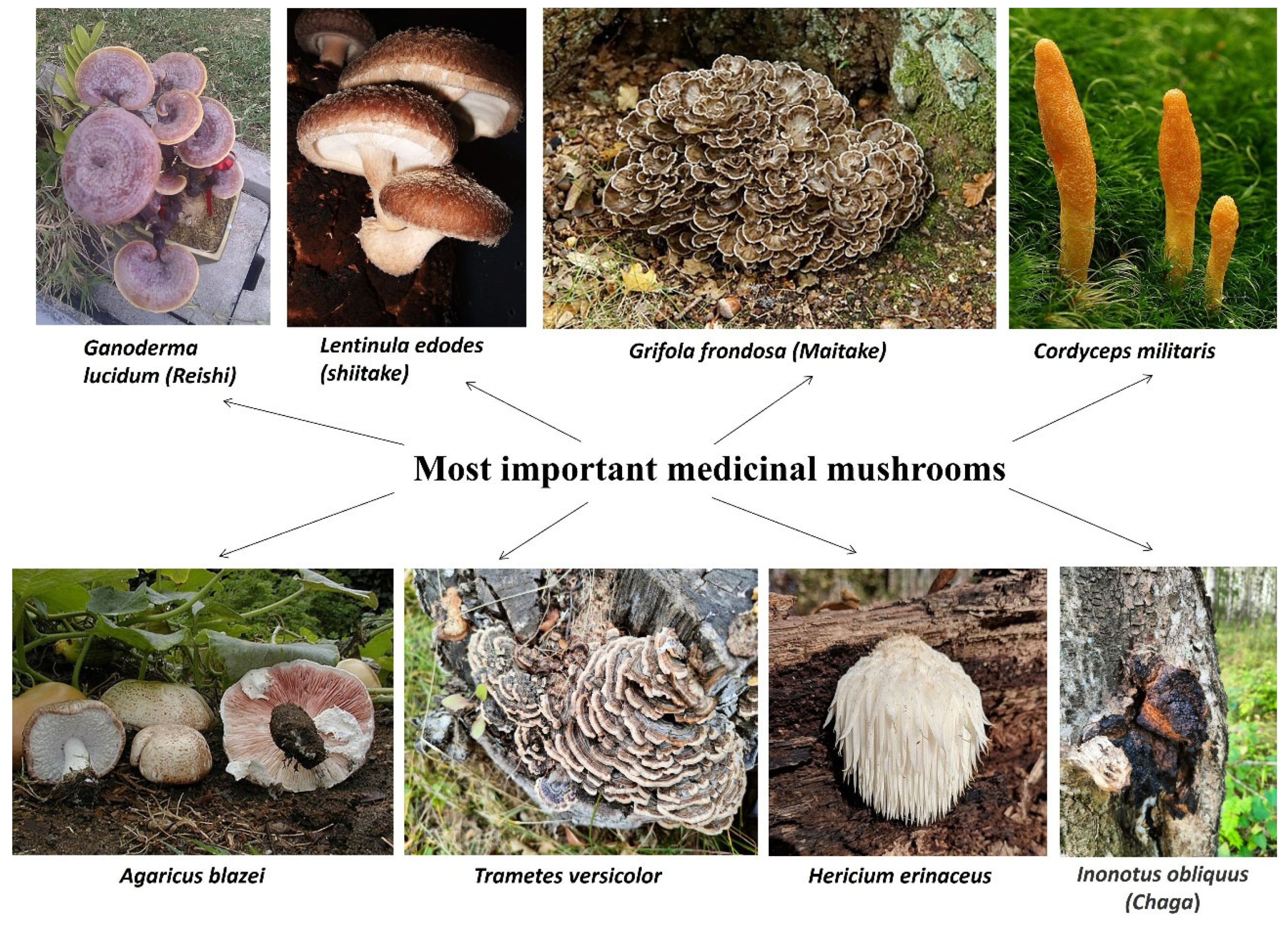



| Mushroom (Source) and Substance | Primary Immune Receptor(s) | Key Immune Cell Targets | Major Immunological Outcome(s) | Alterations in Cytokines/Cell Markers | Reference |
|---|---|---|---|---|---|
| Lentinula edodes (Shiitake)—Lentinan (β-glucan) 100 μg/mouse/day | Dectin-1, TLR4 | Intestinal epithelial cells, Macrophages, DCs, T cells | Th1 polarization, suppression of intestinal inflammation, enhanced antigen presentation. | ↑ IL-12, ↑ IFN-γ, ↓ TNF-α/IL-6 (in colitis), CD4+ Th1 differentiation. | [80,81] |
| Armillaria mellea β-(1→6)-glucans 10 mg/kg/day and 20 mg/kg/day, i.p., for a total of 10 days. | TLR2 | Macrophages (M2) | Shift from M2-like to M1-like macrophages. | Activation of Akt/NF-κB and MAPK pathways | [86] |
| Trametes versicolor (Turkey Tail)—PSK (Proteoglycan) 2 mg/mouse 3 times per week for 4 weeks | TLR4, TLR2 | Macrophages, DCs, NK cells, B cells, T cells | Macrophage activation, NK cell activation, B cell proliferation, support of CD8+ T cell activity. | ↑ TNF-α, ↑ IL-6, ↑ IgM/IgG1, ↑ NK cell activity. | [85] |
| Ganoderma lucid-um (Reishi) crude extract (3 and 6 mg/kg once daily for 2 weeks) | Splenocytes, Macrophages, NK cells | Enhanced splenocyte proliferation, increased macrophage phagocytosis, and elevated NK cell activity. | ↑ IL-6, ↑ IFN-γ | [94] | |
| Agaricus blazei—Polysaccharide fractions 2 mg/mouse 3 times per week for 4 weeks | TLR2, Dectin-1 | Macrophages, MDSCs | Repolarization of MDSCs/M2 macrophages to M1-like phenotype. | ↑ IL-6, ↑ IL-12, ↑ TNF-α, ↑ iNOS, ↑ CD86, ↑ MHC II, ↑ pSTAT1. | [87] |
| Grifola frondosa (Maitake)—D-fraction/Polysaccharides 20 mg/kg once every 19 days | Dectin-1 | Dendritic Cells (DCs), Macrophages, T cells | Systemic tumor-antigen specific T cell response, increased infiltration of activated T cells into tumor, decreased immunosuppressive cells (Tregs, MDSCs). | ↑ IL-12, ↑ IFN-γ, ↑ CD80/CD86/MHC-II on DCs, ↑ CD8+ T cell infiltration, ↓ Tregs, ↓ MDSCs, ↓ IL-10, ↓ TGF-β in tumor. | [95] |
| Grifola frondosa (Maitake Z-Fraction (MZF, Heteropolysaccharide) Injection of DCs treated with MZF (400 µg/mL) | Unknown (likely Dectin-1/TLR) | Dendritic Cells (DCs) | DC maturation, enhanced antigen presentation, induction of antigen-specific Th1 response. | ↑ CD80, ↑ CD86, ↑ CD83, ↑ MHC-II on DCs; ↑ IL-12 and TNF-α production by DCs; ↑ antigen-specific IFN-γ production by CD4+ T cells (IL-12 dependent). | [92] |
| Sanghuangporus vaninii—Purified polysaccharides | Unknown (likely TLR4) | Dendritic Cells (DCs), CD4+ T cells | DC-mediated antigen presentation, Th1 differentiation. | ↑ IFN-γ, ↑ TNF-α from Th1 cells, enhanced tumor sensitivity to CTLs. | [52] |
| Trametes robiniophila (Huaier)—Polysaccharides i.p., 60 mg/kg, once daily | TLR4 | Macrophages | Macrophage activation. | ↑ NO, ↑ TNF-α, ↑ IL-6 via TLR4-NF-κB/MAPK. | [96] |
| Substance/ Mushroom | Type of Research | Object | Effect | Reference |
|---|---|---|---|---|
| Hot water extract of Inonotus obliquus | In vitro | Colon cancer HT-29 cell line | The IC50 was approximately 1.0 mg/mL after a 48h treatment. Induction of the intrinsic pathway of apoptosis. | [111] |
| The neutral polysaccharide from Agaricus bisporus | In vitro | Colon cancer HT-29 cell line | Inhibition of proliferation and epithelial–mesenchymal transition, as well as induction of the intrinsic pathway of apoptosis. | [112] |
| Polysaccharide from Cantharellus cibarius | In vitro | Colon cancer cell line LS180 and colon epithelial cells CCD841 | Selectivity against colon cancer cells; induction of cell cycle arrest and DNA fragmentation; inhibition of the NF-κB signaling pathway. | [113] |
| Selenium-enriched Pleurotus ostreatus | In vitro | Colon cancer HCT-116 cell line and normal mucosal epithelial cells NCM460 | Selectivity against colon cancer cells; suppression of epithelial–mesenchymal transition; induction of apoptosis. | [114] |
| Polysaccharide-rich extracts from Trametes versicolor and Grifola frondosa | In vitro | LoVo and HT-29 colon cancer cells lines | Decreased proliferation, migration, and invasion capabilities; sensitization of colon cancer cells to 5-FU | [115] |
| Polysaccharides and proteoglycans from Boletus edulis | In vitro | Colon cancer cell line LS180 and colon epithelial cells | Selectivity against colon cancer cells; G0/G1 cell cycle arrest associated with the modulation of p16/cyclin D1/CDK4-6/pRb pathway | [116] |
| Polysaccharides from 53 wild-growing mushrooms | In vitro | Several Lactobacillus strains | The stronger stimulation of Lactobacillus growth than by commercially available prebiotics like inulin or fructooligosaccharides | [117] |
| Water-soluble polysaccharides from Gloeostereum incarnatum | In vivo | ApcMinC/Gpt mice (in situ colon cancer mouse model) | The eight-week administration of doses ranging from 30 to 90 mg/kg dramatically suppressed tumor growth, decreased IL-1β, IL-4, IL-6, IL-17, IL-22, and TNF-α, and mitigated the Wnt/β-catenin signaling pathway. | [118] |
| Polysaccharides from Agaricus blazei | In vivo | Syngeneic mouse model including colorectal adenocarcinoma MC38 cell line implanted into C57Bl/6 mice | Compared to 12-month-old tumor-bearing mice, ABMP has a stronger anti-tumor effect on 8-month-old mice. ABMP prevents weight change, lowers the amount of lipids in tumor tissues, and boosts the immune system. | [119] |
| Polysaccharides from Lentinula edodes | In vitro and In vivo | HT-29 cell line and HT-29 xenografts in nude mice | Induction of both intrinsic and extrinsic apoptotic pathways in vitro and in vivo; the inhibition of the NF-κB pathway; in vivo anticancer activity started from 0.2 mg/kg | [120] |
| Polysaccharides from Phellinus linteus | In vitro and In vivo | SW480 colon cancer and human umbilical vein endothelial cells (HUVEC); SW480 xenografts in athymic nude mice | A dose of 0.125–1 mg/mL inhibited proliferation, invasion, and motility, as well as down-regulating β-catenin and cyclin D levels. It also mitigated HUVEC proliferation and capillary tube formation, suppressed xenograft growth, and mitigated Wnt/β-catenin signaling in vivo. | [121] |
| β-glucans from Armillaria mellea and Lentinula edodes | In vitro and In vivo | Syngeneic mouse model including colon carcinoma CT26 cell line implanted into Balb/C mice | β-glucan reversed tumor-promoting M2-like macrophages into tumor-suppressing M1-like macrophages through the Akt/NF-κB and MAPK pathways. It also suppressed the viability of colon cancer cells in both in vitro and in vivo models. | [86] |
| Polysaccharides from Sanghuangporus vaninii | In vivo | B6/JGpt-Apcem1Cin (Min)/Gpt male (ApcMin/+) mice | Polysaccharides prevent dysbiosis of the gut microbiota and normalize their metabolic functions. They also improve antigen presentation in dendritic cells, activate CD4+ T cells, enhance Th1 differentiation, and increase IFN-γ and TNF-α. These cytokines target tumor cells and increase their susceptibility to cytotoxic T lymphocytes. | [52] |
| Polysaccharides from Grifola frondosa | In vitro and In vivo | Dendritic cells (DC); subcutaneous colon-26 tumor model | Polysaccharides induced the maturation of dendritic cells (DCs) and an antigen-specific Th1 response by enhancing IL-12 production by DCs. Activated DCs in vivo resulted in decreased tumor volume and prolonged survival. | [92] |
| β-glucans from Lentinula edodes | In vitro and In vivo | HT-29 and SW-480 cell lines; AOM/DSS model of colitis-associated colorectal carcinogenesis in mice | β-glucans displayed strong anti-inflammatory and anticancer activities in both in vitro and in vivo studies. They reconstructed the intestinal mucosal barrier, increased the content of short-chain fatty acids (SCFAs), regulated the metabolism of gut microbiota, and normalized the ratio of beneficial to detrimental microbiota. | [122] |
| Type of Neoplasia | Type of Research | Effect | Reference |
|---|---|---|---|
| GMI (Ganoderma microsporum immunomodulating protein) | |||
| Lung cancer Syngeneic model: LLC1-bearing mice | In vitro and in vivo | GMI inhibits EMT and cell migration by disrupting cell adhesion and downregulating integrins, thus blocking focal adhesion kinase (FAK). GMI slows cell mobility by downregulating Slug through FAK inhibition. This increases epithelial-related markers, reduces metastatic lesions, and prolongs survival in LLC1-bearing mice. | [128] |
| Lung cancer (H1975 cells harboring EGFR L858R/T790M double mutation; Osimertinib-resistant H1975 cell line; xenografts) | In vitro and in vivo | GMI suppresses tumor growth and migration in drug-resistant lung cancer cells by targeting integrin proteins. Specifically, GMI inhibits the expression of integrins αV and β1. This, in turn, suppresses cancer stemness and metastasis in epidermal growth factor receptor (EGFR)-mutated, osimertinib-resistant lung cancer. | [129] |
| Pemetrexed-resistant lung cancer cells and xenografts | In vitro and in vivo | GMI induced autophagy and decreased the viability of pemetrexed-resistant lung cancer cells. Furthermore, GMI reduced stemness by downregulating CD133, CD44, NANOG, and OCT4. GMI also suppressed the growth of xenografts. | [109] |
| Oral carcinomas and xenografts | In vitro and in vivo | GMI induces cell death and inhibits key cancer stem cell (CSC) properties, including self-renewal, expression of the CSC markers ALDH1 and CD44, migration, and invasion, in oral carcinoma stem cells. Furthermore, GMI reduces tumor growth in mice. Mechanistically, GMI inhibits the IL-6/Stat3 signaling pathway. | [130] |
| Glioblastoma multiforme (GBM) | In vitro | GMI significantly suppressed the migration and invasion of glioblastoma cells. It also acted synergistically with the chemotherapy drug temozolomide to inhibit cell motility. This anti-cancer effect occurred through GMI inducing the degradation of Slug, a transcription factor linked to metastasis. | [131] |
| Lung cancer cell lines and xenografts | In vitro and in vivo | GMI inhibits the growth of lung cancer cells by binding directly to the epidermal growth factor receptor (EGFR), which blocks its dimerization and triggers clathrin-dependent endocytosis and degradation. This process suppresses tumor growth in mouse models and is effective against cancer cells with wild-type or mutant forms of EGFR. | [132] |
| Lung cancer cell lines; Syngeneic model: LLC1-bearing mice; and xenografts | In vitro and in vivo | GMI suppressed tumor growth in mouse models and inhibited KRAS activation, as well as the downstream MAPK and PI3K-AKT signaling pathways, in lung cancer cells with various KRAS mutations. Notably, GMI exhibited a strong synergistic effect with the KRASG12C inhibitor AMG 510, enhancing apoptosis and leading to more durable inhibition of tumor growth and KRAS activity. | [133] |
| LZ-8 | |||
| Lung cancer cell lines and xenografts | In vitro and in vivo | The recombinant protein LZ-8 inhibits the progression of lung cancer by binding to the epidermal growth factor receptor (EGFR), triggering its ubiquitination and subsequent degradation. This ultimately induces cell cycle arrest and apoptosis. This effect has been demonstrated in cancer cells with wild-type and mutated forms of EGFR, and it has been validated in a mouse model, in which LZ-8 suppresses tumor growth. LZ-8 mechanistically induces the formation of EGFR/Cbl complexes. | [134] |
| Lung cancer Syngeneic model: LLC1-bearing mice | In vitro and in vivo | LZ-8 suppressed tumor metastasis and increased survival in a mouse model of lung cancer by inhibiting the epithelial–mesenchymal transition (EMT) process. This was achieved by inactivating focal adhesion kinase (FAK), which enhanced the ubiquitination and proteasomal degradation of the key EMT transcription factor Slug by MDM2. The degradation of Slug increased the expression of E-cadherin, an adhesion protein that ultimately represses cancer cell mobility. | [135] |
| MBT-2 syngeneic model (Bladder cancer) | In vivo | The recombinant protein LZ-8 acted as a potent adjuvant, greatly enhancing the therapeutic effect of a HER-2/neu DNA vaccine against tumors in mice. It did so by stimulating dendritic cells via the TLR4 pathway. This boosted vaccine-induced Th1 and CTL immune responses, resulting in superior antitumor activity. | [136] |
| Lung cancer Syngeneic model: LLC1-bearing mice | In vitro and in vivo | Treatment with LZ-8 significantly altered the proteomic profile of lung tumors in mice, most notably by downregulating the expression of heat shock proteins (HSPs) 60, 70, and 90. LZ-8 and its homolog GMI were also shown to reduce HSP levels in vitro, subsequently inhibiting cell migration and inducing apoptosis. | [137] |
| Patients-derived hepatocellular carcinoma cell lines and xenografts | In vitro and in vivo | LZ-8 suppressed tumor progression and intrahepatic metastasis in patient-derived hepatocellular carcinoma (HCC) models regardless of c-Met signaling status. LZ-8 mechanistically inhibited cell migration by suppressing the c-Met axis in c-Met-positive tumors and the epidermal growth factor receptor (EGFR) axis in c-Met-negative tumors. | [138] |
| Compound/Source | Type of Neoplasia/Type of Cancer | Effect | Reference |
|---|---|---|---|
| Triterpenoids | |||
| Betulinic acid from Inonotus obliquus | 4T1 breast cancer mouse model | Suppressed 4T1 tumor growth and blocked formation of pulmonary metastases without obvious side effects. Furthermore, histological and immunohistochemical analyses showed a decrease in MMP-9 positive cells, MMP-2 positive cells and Ki-67 positive cells and an increase in cleaved caspase-3 positive cells upon BA administration. Notably, BA reduced the number of myeloid-derived suppressor cells (MDSCs) in the lungs and tumors. | [178] |
| KB cells in BALB/c mice | BA dose-dependently reduced implanted tumor volume and induced mitochondrial apoptosis, as shown by increased TUNEL+ cells, caspase-3/9 activity, Bax expression, and decreased Bcl-2. BA also elevated ROS and p53 levels in tumor tissues, and NAC or p53 knockdown diminished these effects, indicating that BA suppresses tumor growth through ROS-p53-mediated apoptotic signaling. | [179] | |
| Betulin from Inonotus obliquus | CT26 lung metastasis model in BALB/c mice | Suppress the lung metastasis of CRC cells by inducing cell cycle arrest, apoptosis, and autophagy | [190] |
| Ganoderic acid T from Ganoderma lucidum | ES-2 orthotopic ovarian cancer model in a humanized mouse model | Significantly demonstrate cytotoxicity against various cancer cell lines and effectively remodeled the TME by reducing the α-SMA+ cell proportions, enhancing immune cell infiltration, and downregulating Gal-1 levels in the ES-2 orthotopic ovarian tumor model. Inhibition of Gal-1 expression via ubiquitination-induced protein degradation | [218] |
| Lewis Lung Carcinoma (LLC) bearing C57B/6 mice | Demonstrate that GA-T suppresses tumor growth and LLC metastasis and down-regulates MMP-2 and MMP-9 mRNA expression | [317] | |
| Ganoderic acid A from Ganoderma lucidum | EL4 syngeneic mouse model of metastatic lymphoma | Significantly prolonged survival of EL4 challenged mice and decreased tumor metastasis to the liver, an outcome accompanied by a marked down-regulation of STAT3 phosphorylation, reduction myeloid-derived suppressor cells (MDSCs), and enhancement of cytotoxic CD8+ T cells in the host | [318] |
| Female BALB/c nude mice A549 cells-bearing | Enhanced the DDP-induced increase in E-cadherin and further reduced N-cadherin and vimentin levels in tumor tissues, indicating a stronger inhibition of EMT. Additionally, GA-A reversed the DDP-induced upregulation of Beclin and LC3II/LC3I, showing suppression of autophagy in A549/DDP-derived tumors. | [319] | |
| Inotodiol and trametenolic acid-enriched fractions of Inonotus obliquus | 4T1 breast cancer mouse model | Significantly reduced tumor volume; suppressed mTOR signaling; induced AMPK-dependent autophagy; did not compromise cytotoxicity of conventional drugs | [164] |
| Inotodiol from Inonotus obliquus | Diabetic rat model with induced breast cancer | Reduced PCNA positivity; increased apoptotic cells; decreased β-catenin, c-Myc, and Cyclin D1; improved blood glucose, cholesterol, triglycerides, HDL levels, and glucose tolerance | [163] |
| P388 leukemia-bearing CDF1 mice | Intraperitoneal administration at 10 mg/kg significantly prolonged survival. %ILS: 20.8% at 10 mg/kg; 9.7% at 3 mg/kg. No apparent toxicity (no weight loss, no diarrhea). | [160] | |
| Diterpenoids | |||
| Erinacine A from Hericium erinaceus | Female athymic BALB/c-nu mice HCT-116 cells bearing | Significantly reduced tumor aggressiveness by decreasing cell proliferation and invasiveness, accompanied by increased ROS production and activation of the PI3K/mTOR/p70S6K and ROCK1/LIMK2/Cofilin signaling pathways. | [226] |
| DLD-1 cells bearing female athymic BALB/c-nu mice | Suppressed tumor growth in the xenograft mouse model, as evidenced by a significant increase in TNFR, Fas, and FasL expression and a clear enhancement of apoptosis within tumor tissues. | [228] | |
| Erinacine S from Hericium erinaceus | AGS cells bearing male athymic BALB/c-nu mice | Significantly reduced tumor burden while increasing FasL and TRAIL expression and lowering PCNA and cyclin D1 levels in xenograft tumors. | [229] |
| Sesquiterpenoids | |||
| Grifolin from Albatrellus confluens | A549 cells bearing male BALB/c nude mice | Decreased CDK4, CDK6, and CyclinD1 expression and significantly decreased PIK3CA and p-AKT expression in lung cancer cells. | [235] |
| 5–8F-Z cells bearing BABL/c nude mice | Suppressed lung metastasis in the 5–8F-Z metastatic mouse model, reducing the metastatic incidence from 60% (6/10) in the control group to 18.2% (2/11) following 25 days of daily treatment at 32 mg/kg, without observable adverse effects. | [234] | |
| Phenolics and other compounds | |||
| Antroquinonol from Antrodia camphorata | Phase I clinical trial: patients with metastatic non-small-cell lung cancer (NSCLC) who had failed ≥2 prior treatments | Safe and well tolerated at 50–600 mg daily. No dose-limiting toxicities (DLTs) observed; maximum tolerated dose (MTD) not reached. Best tumor response: stable disease in 3 patients; no treatment-related mortality. Pharmacokinetics: rapid absorption (Tmax 1–4 h), short half-life (1.3–4.33 h). | [254] |
| C6 rat glioma xenograft in nude mice | Significantly reduced C6 glioma xenograft tumor volume without affecting body weight, and histological analysis showed extensive tumor cell death with no detectable toxicity in major organs, indicating potent and well-tolerated antitumor activity. | [253] | |
| Cordycepin from Cordyceps militaris | Male nude BALB/c mice bearing CAL-27 cells | Markedly suppressed tumor growth, reducing tumor weight by up to 88.2% and increased apoptosis while lowering Ki67 and Bcl-2 levels | [320] |
| BxPC-3 cells bearing female BALB/cA nu/nu mice | Significantly suppressed xenograft tumor growth and weight without affecting body weight, while reducing Ki67 staining and downregulating Ras and ERK phosphorylation, indicating an antitumor effect mediated through inhibition of the FGFR/Ras/ERK pathway | [321] | |
| Hispolon from Phellinus linteus | DBTRG cells bearing NOD-SCID mice | Hispolon administered at 5 and 10 mg/kg every two days for 25 days markedly inhibited tumor growth, with the 10 mg/kg dose almost completely suppressing tumor expansion, and tumor tissues showing strong induction of cleaved caspase-3 | [259] |
| HL-60 cells bearing NSG mice | Hispolon (5 and 10 mg/kg) markedly suppressed tumor growth, reducing tumor weight by 29% and 34% and lowering Ki67 and procaspase-3 levels, indicating apoptosis-mediated antitumor activity in vivo. | [260] | |
Disclaimer/Publisher’s Note: The statements, opinions and data contained in all publications are solely those of the individual author(s) and contributor(s) and not of MDPI and/or the editor(s). MDPI and/or the editor(s) disclaim responsibility for any injury to people or property resulting from any ideas, methods, instructions or products referred to in the content. |
© 2026 by the authors. Licensee MDPI, Basel, Switzerland. This article is an open access article distributed under the terms and conditions of the Creative Commons Attribution (CC BY) license.
Share and Cite
Kirdeeva, Y.; Fefilova, E.; Karpova, N.; Parfenyev, S.; Daks, A.; Nazarov, A.; Semenov, O.; Anh, N.T.V.; Loc, V.T.; Cuong, N.M.; et al. The Inclusion of Dietary and Medicinal Mushrooms into Translational Oncology: Pros and Cons at the Molecular Level. Int. J. Mol. Sci. 2026, 27, 1312. https://doi.org/10.3390/ijms27031312
Kirdeeva Y, Fefilova E, Karpova N, Parfenyev S, Daks A, Nazarov A, Semenov O, Anh NTV, Loc VT, Cuong NM, et al. The Inclusion of Dietary and Medicinal Mushrooms into Translational Oncology: Pros and Cons at the Molecular Level. International Journal of Molecular Sciences. 2026; 27(3):1312. https://doi.org/10.3390/ijms27031312
Chicago/Turabian StyleKirdeeva, Yulia, Elizaveta Fefilova, Natalia Karpova, Sergey Parfenyev, Alexandra Daks, Alexander Nazarov, Oleg Semenov, Nguyen Thi Van Anh, Vu Thanh Loc, Nguyen Manh Cuong, and et al. 2026. "The Inclusion of Dietary and Medicinal Mushrooms into Translational Oncology: Pros and Cons at the Molecular Level" International Journal of Molecular Sciences 27, no. 3: 1312. https://doi.org/10.3390/ijms27031312
APA StyleKirdeeva, Y., Fefilova, E., Karpova, N., Parfenyev, S., Daks, A., Nazarov, A., Semenov, O., Anh, N. T. V., Loc, V. T., Cuong, N. M., & Shuvalov, O. (2026). The Inclusion of Dietary and Medicinal Mushrooms into Translational Oncology: Pros and Cons at the Molecular Level. International Journal of Molecular Sciences, 27(3), 1312. https://doi.org/10.3390/ijms27031312