Article

InCytokine, an Open-Source Software, Reveals a TREM2 Variant-Specific Cytokine Signature

1
Data and Genome Sciences, Merck & Co., Inc., Boston, MA 02115, USA
2
Applied Research and Innovation, MSD Czech Republic s.r.o., 150 00 Prague, Czech Republic
3
Data Science and Scientific Informatics, MSD Czech Republic s.r.o., 150 00 Prague, Czech Republic
*
Author to whom correspondence should be addressed.
These authors contributed equally to this work.
Int. J. Mol. Sci. 2026, 27(3), 1137; https://doi.org/10.3390/ijms27031137
Submission received: 20 November 2025 / Revised: 9 January 2026 / Accepted: 14 January 2026 / Published: 23 January 2026
(This article belongs to the Section Molecular Informatics)

Abstract

Cytokine and chemokine profiling is central to understanding inflammatory processes and the mechanisms driving diverse diseases. We introduce InCytokine, an open-source tool for semiquantitative analysis of cytokine and chemokine data generated by protein array technologies. InCytokine features robust and modular image-processing workflows, including automated spot detection, template alignment, normalization, quality control measures, and quantitative intensity summarization to deliver consistent and reliable readouts from profiling assays. We evaluated InCytokine by profiling wild-type microglia, TREM2 knockout, and Alzheimer’s disease-associated TREM2 R47H variant cells in response to lipopolysaccharide and sulfatide exposure. Differential expression analysis revealed unique sulfatide-specific and genotype-specific cytokine signatures in TREM2 variants. We also report an intriguing modulation of DPP4 and a divergent expression pattern of ENA-78 in TREM2 variants in response to lipopolysaccharide and sulfatide treatment. Such distinct expression signatures raise the possibility that TREM2 variants may play a role in modulating inflammatory signaling relevant to cardio-metabolic and Alzheimer’s disease. These signatures were corroborated using transcriptional profiling of the same microglia cells, revealing also a good concordance between protein array and RNA sequencing technologies. Taken together, InCytokine is an interactive, user-friendly web application for rapid, reproducible, and scalable analysis of protein array data, proven to generate meaningful insights for drug and biomarker discovery campaigns in pharmaceutical settings.

1. Introduction

Inflammation is a key driver of diverse diseases, including cancer, neurodegeneration, and aging, mediated through coordinated interplay between innate and adaptive immune responses [1,2,3,4,5]. Cytokines and chemokines orchestrate proliferation, differentiation, and migration, as well as the initiation, amplification, and resolution of immune responses. Chemokines specifically direct leukocyte positioning in homeostasis and inflammation [6,7,8]. Consequently, cytokine/chemokine profiles are widely used as biomarkers for early disease detection, therapeutic monitoring, and disease staging [9,10,11].
Alzheimer’s disease (AD), the leading cause of dementia (60–80% of cases), affected 6.2 million Americans aged ≥65 in 2021 and may approach 14 million by 2050. AD ranks among the top causes of death in the U.S., with mortality exceeding that of breast and prostate cancer combined [12]. Neuroinflammation is now recognized as a hallmark of AD, involving activation of microglia and astrocytes and release of cytokines and chemokines in response to infection, injury, and amyloid/tau pathology [3,13,14,15]. Chronic glial activation contributes to synaptic dysfunction, neuronal loss, and cognitive decline. Microglia exhibit context-dependent roles supporting synaptic pruning and debris clearance and, early in disease, aiding Aβ clearance, but later driving neurotoxicity via proinflammatory cytokines and reactive oxygen species [3,13,16,17]. These context-dependent dynamics underscore the value of systematic cytokine and chemokine profiling to elucidate underlying disease mechanisms and to identify novel therapeutic targets amenable to targeted intervention. Genetic studies across the genome have uncovered numerous susceptibility loci for late-onset Alzheimer’s disease (AD), many of which map to genes that are predominantly or uniquely expressed in microglia [18,19,20,21,22,23,24,25,26]. Among the most influential of these is Triggering Receptor Expressed on Myeloid Cells 2 (TREM2), a membrane-bound receptor essential for microglial viability, proliferation, and phagocytic function [27,28,29,30,31,32,33]. Rare heterozygous TREM2 variants, most notably R47H, elevate the risk of AD by roughly two- to four-fold, placing their effect size on par with that of the APOE ε4 allele [27,28,29,34,35]. TREM2 is thought to sense lipid patterns associated with apoptotic neurons and amyloid-β (Aβ) aggregates, triggering downstream signaling that mobilizes microglia toward sites of pathology [23,33]. A key consequence of this activation is the release of cytokines and chemokines such as IL-1B, TNF-alpha, and IL-6 from microglia, which allow it to perform various relevant functions, including cell movement, phagocytosis, and debris clearance. Given these well-established signaling pathways and responses to stimuli, we leveraged iPSC-derived microglia bearing various TREM2 genotypes to develop and characterize an automated cytokine analysis pipeline.
Multiple platforms enable such profiling with distinct tradeoffs. ELISA offers high specificity but is largely single-plex [36]. Multiplex bead-based immunoassays (e.g., Luminex) and cytometric bead arrays increase throughput and conserve sample volume but require control of cross-reactivity and standardized analysis [37,38]. Electrochemiluminescence immunoassays extend dynamic range and sensitivity but often depend on proprietary panels [39]. Proximity extension assays (Olink) and aptamer-based proteomics (SomaScan) support high-plex profiling with strong analytical sensitivity yet demand rigorous normalization and cross-platform calibration [40,41,42]. Ultrasensitive digital immunoassays (e.g., Simoa) reach sub-femtomolar detection, enabling low-abundance cytokine quantification with added analytical complexity [43]. Complementary modalities include flow cytometry for intracellular cytokines at single-cell resolution (workflow intensive) and mass spectrometry proteomics for unbiased surveys that remain challenged for very low abundance targets in plasma/CSF [37,44,45,46]. Membrane- and slide-based antibody arrays provide rapid, semi-quantitative chemiluminescent readouts across many analytes, but limited dynamic range, predefined panels, and subjective image analysis necessitate downstream quantitative validation [47,48,49].
Protein and peptide arrays have enabled rapid, semi-quantitative mapping of enzyme activity and specificity in kinase and chromatin biology, accelerating motif discovery and target deconvolution [50,51,52,53]. Chemiluminescent antibody arrays extend this paradigm to cytokines and chemokines, offering quick, multiplex snapshots of pathway perturbations. However, their constrained dynamic range together with fixed panels and batch effects limit absolute quantitation and cross-study comparability, motivating orthogonal validation (e.g., ELISA, multiplex immunoassays) [47,48]. Membrane-based cytokine arrays (e.g., Human Proteome Profiler) permit simultaneous but semi-quantitative detection across many analytes with low sample input, yet analysis often relies on subjective spot detection and heterogeneous vendor software [54,55]. A persistent bottleneck is the scarcity of open-source, manufacturer-agnostic and automated tools for robust image processing, normalization, and QC-capabilities essential for rapid, reproducible, and scalable cytokine/chemokine profiling.
To address this need, we introduce InCytokine, an open-source web application for rapid relative quantification of cytokine and protein arrays. InCytokine employs image processing techniques to provide robust and reproducible data insights, shortening the cycle-time from data collection to analysis. Using InCytokine, we uncovered an intriguing expression pattern of DPP4 and ENA-78 in response to sulfatide in TREM2 variants, raising the possibility of novel interplay with TREM2 and possible implications for the role of inflammation in cardio-metabolic and Alzheimer’s diseases.

2. Results

2.1. InCytokine—A Flexible Framework for Cytokine Array Analysis

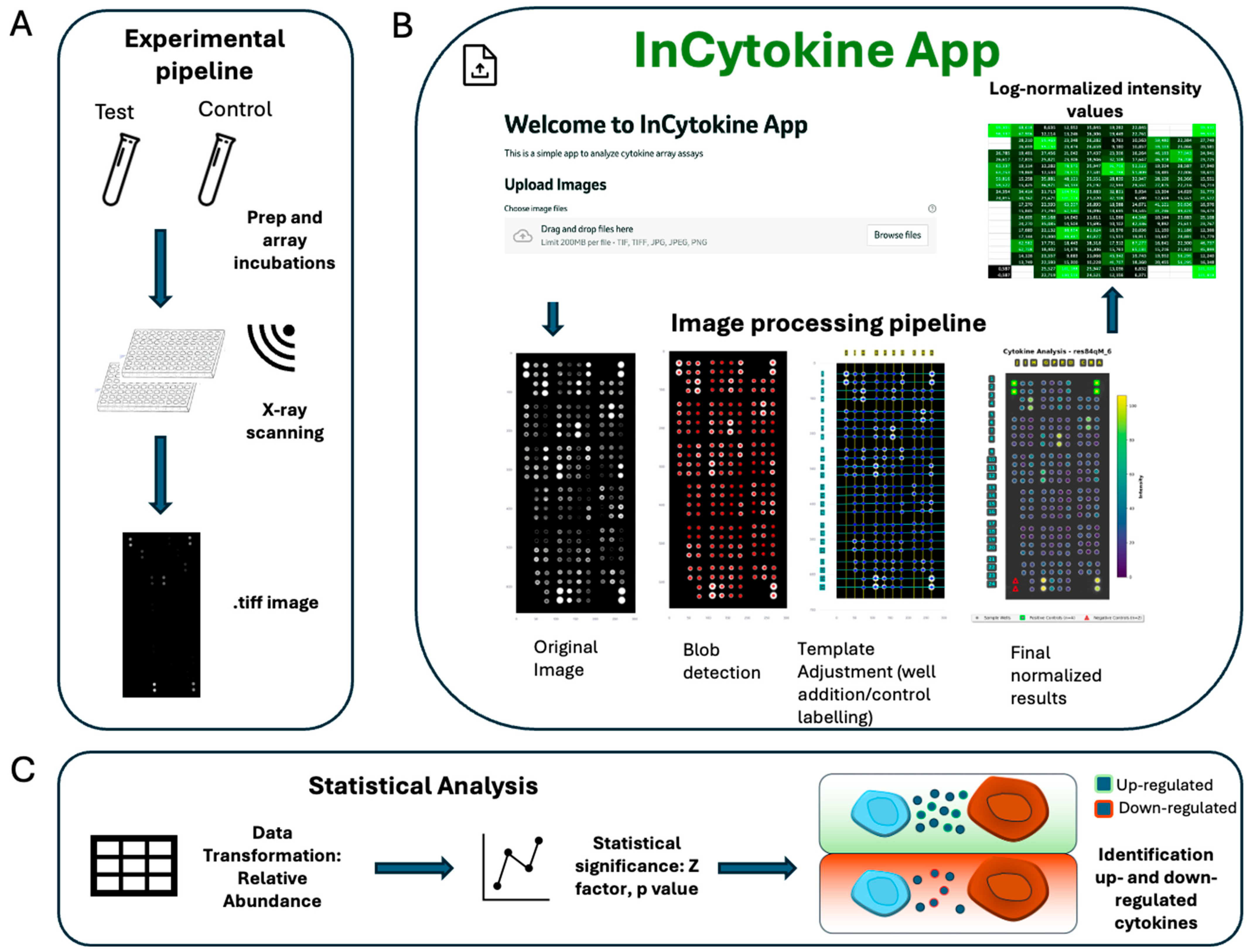
A workflow describing the experimental, analytical, and computational steps of InCytokine is shown in Figure 1. For illustration purposes, we used iPS-derived microglia-like (iMGL) cells treated with lipopolysaccharide (LPS) for 24 h, and cells treated with distilled water served as cognate controls. Supernatants from these treatments were incubated on a profiler array, where chemiluminescent reagents were added to generate an optical signal. A digital fluoroscopy imaging system was employed for scanning the array, resulting in the acquisition of .tiff images that were used subsequently for data processing and analysis (Figure 1A and Figures S1–S3). Raw .tiff images were processed using the InCytokine image analysis pipeline, which operates through three automated modules. The BlobDetector module identifies candidate spots in array images via percentile-based contrast enhancement and multi-scale Laplacian of Gaussian filtering, followed by spatial filtering and clustering to remove duplicates and outliers. The GridProcessor module reconstructs the array geometry by correcting rotation, defining grid lines, and generating a reusable grid template that captures the spatial organization of all detected centroids. The TemplateAligner module then refines the grid-to-image correspondence through global and local optimization combined with thin-plate spline deformation, achieving sub-pixel spatial alignment. Finally, the IntensityMeasurer module extracts and normalizes pixel intensities within each localized spot, generating quantitative measurements for downstream analysis. The resulting log-normalized intensity tables (CSV or XLSX format) provide the basis for statistical evaluation of relative cytokine abundance and enable the identification of differentially up- or down-regulated cytokines (Figure 1B,C). InCytokine offers an intuitive, user-friendly interface for scalable and reproducible image analysis of protein array scans. It features an automated, user-adjustable spot detection, template alignment, and quantitative intensity extraction, enabling reliable downstream differential abundance analysis of chemokines, cytokines, and proteins from profiling assays. In addition, the InCytokine backbone is modular and can be readily configured to analyze a wide variety of array-based methods.

2.2. TREM2 Mutations in iPSC-Derived Microglia-like Cells (iMGLs) Elicit Differential Cytokine Response

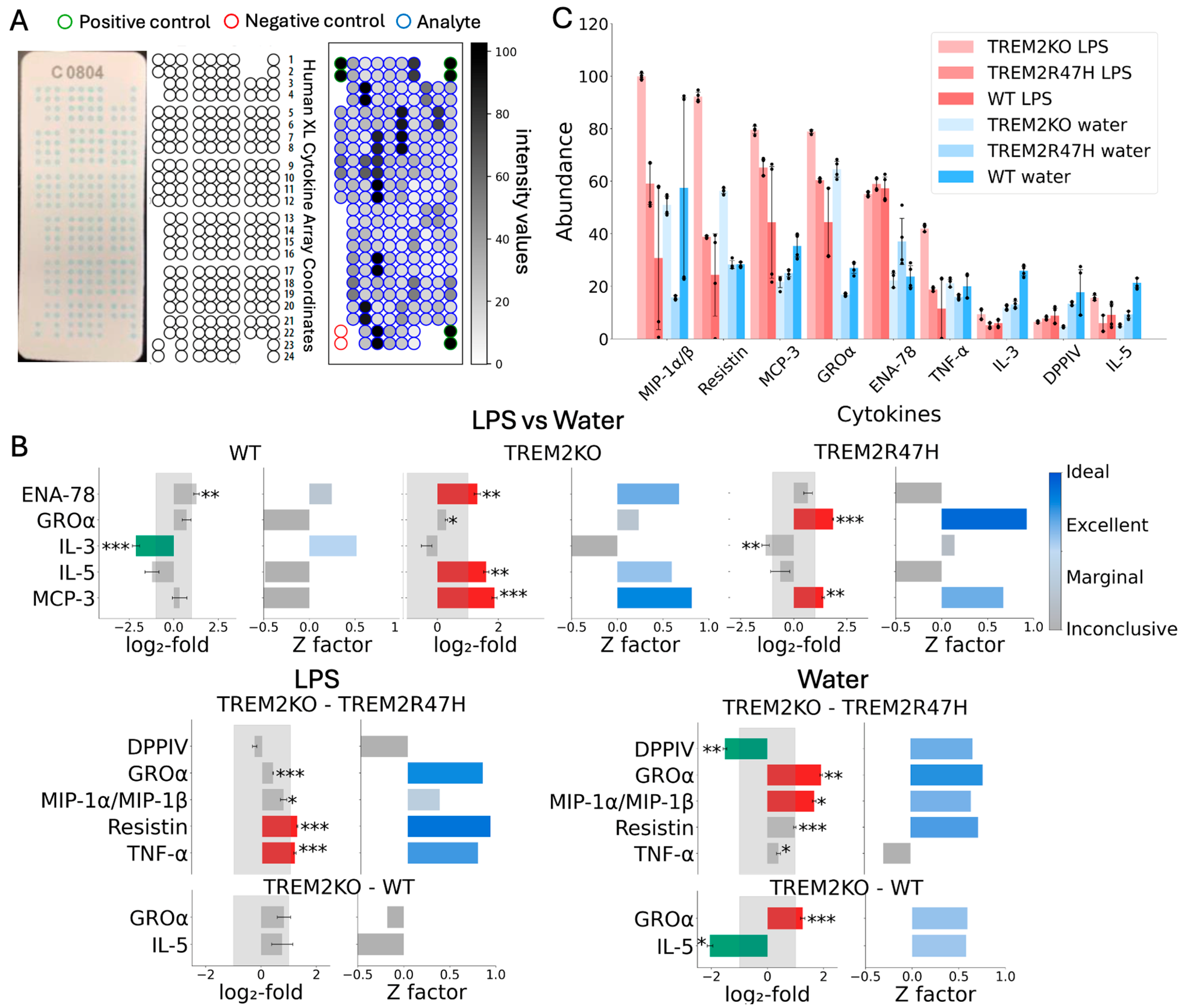
TREM2 is a human genetics-validated target for Alzheimer’s disease [19,27,28,30,35,56]. Variants in TREM2 increase the risk of AD, with an example being the TREM2 R47H variant [19,27,28,30,35,56]. We generated clonal iMGL lines with TREM2 knockout (KO) and TREM2 R47H (mono-allelic clone) with wild-type (WT) iMGL lines acting as controls. These cells were treated with LPS for 24 h and profiled on Proteome Profiler Human XL from R&D Systems, an ELISA-based plate capable of reporting on up to 105 cytokines, chemokines, growth factors, and other soluble proteins in tissue lysates simultaneously (Figure 2A). Analyte intensity values were calculated as averages over the whole spot area and normalized with respect to the positive and negative control spots (green and red spots, respectively, Figure 2A). Fold-changes (log2) in the relevant protein abundances for LPS-treated analytes in TREM2 KO, TREM2 R47H point-mutation, and WT cells were computed and compared to water-treated WT cells (Figure 2B, top panels). Relative abundances were computed as the ratio between the mean abundance of the test sample and the mean abundance of the reference sample, combining four test sample values with four reference values, while only cytokines with a fold-change greater than 2 in either direction (positive or negative) were considered significant (Figure 2B, top panels). The Z-factor values associated with log2 fold-changes were computed to determine the quality of the measurements. InCytokine provides both log2 fold-change and the Z-factor value for each cytokine in each treatment or genotype condition. To simplify the interpretation, both measures are used to classify the quality of the change into four distinct categories (‘ideal’, ‘excellent’, ‘marginal’, and ‘inconclusive’, Figure 2B, top panels). Using a cutoff of absolute log2 fold-change > 1 and Z-factor > 0.5 (excellent and above), we identified IL-3 down-regulation in WT cells and an up-regulation of ENA-78, IL-5, and MCP-3 in TREM2 KO cells in response to LPS (Figure 2B, top panels). Interestingly, TREM2 R47H showed an increase in GROα and MCP-3 in response to LPS (Figure 2B, right-most panel and Figure 2C). The distinct set of cytokines that were altered in TREM2 R47H relative to TREM2 KO (Figure 2B, bottom panels) suggests a distinct inflammatory state for the TREM2 R47H cells. Interestingly, DPP4 was down-regulated in water-treated microglia cells bearing TREM2 KO vs. TREM2 R47H, a role for DPP4 in TREM2 signaling or microglial biology that has not been shown before.
Together, we demonstrate the utility of InCytokine as an automated tool to detect changes in the secreted proteome and uncover relevant and novel biological insights.

2.3. Concordance Between Transcriptomics and Cytokine Abundance

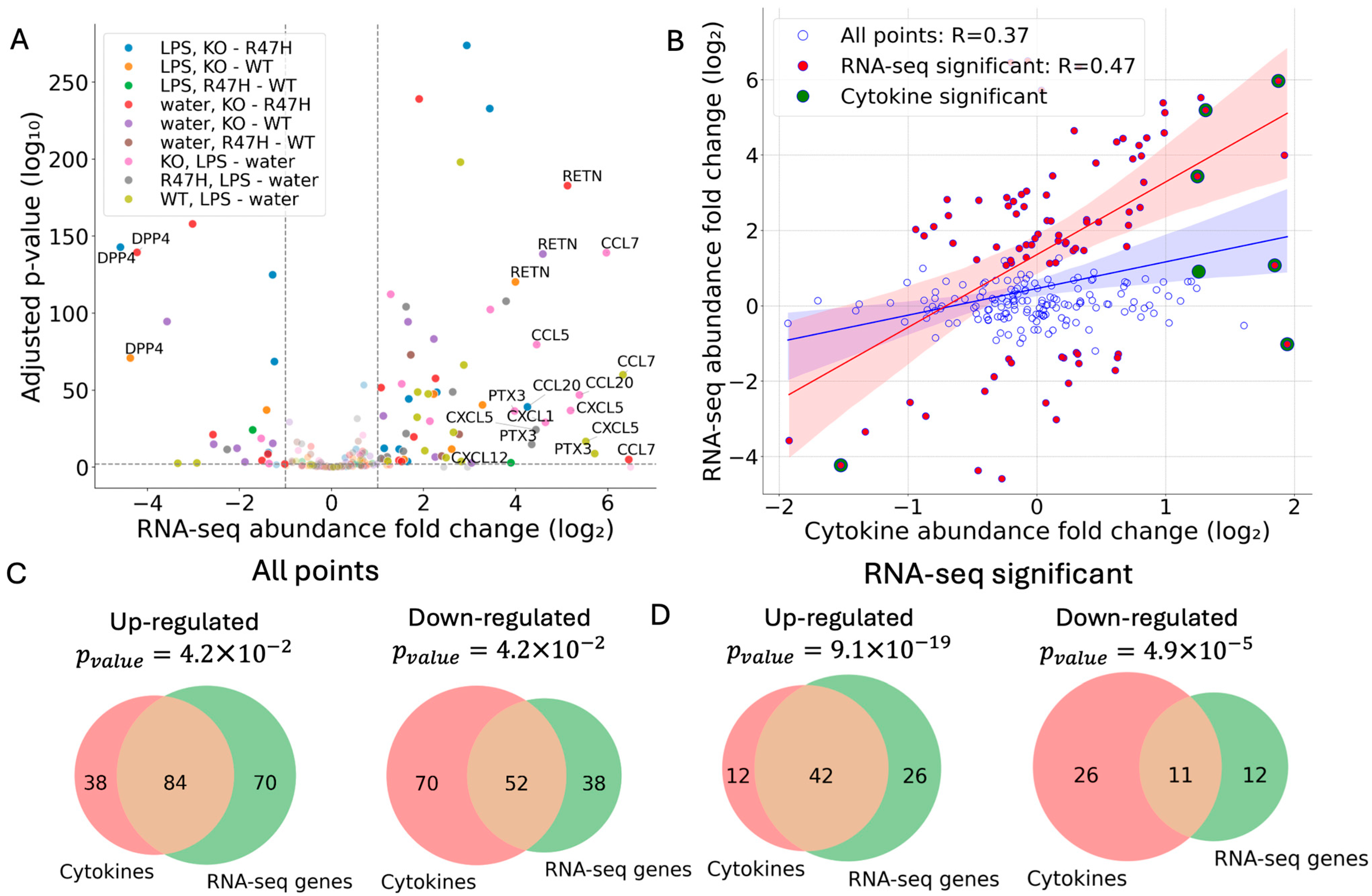
Differential protein abundance can occur due to transcriptional or post-transcriptional regulation. Therefore, we next sought to reveal whether differential cytokine abundance is the direct result of transcriptional alterations. To directly test this, we performed bulk-RNA sequencing on the same cells that we used to obtain the supernatant for our cytokine experiment. Differential expression analysis of TREM2 KO versus TREM2 R47H and WT controls, and TREM2 R47H versus WT controls, revealed a considerable number of cytokine transcripts that significantly fluctuated across treatments (LPS vs. water) and/or genotype conditions (Figure 3A, p < 0.01, |log2FC| > 1). Statistically significant differentially expressed transcripts that were identified across all genotype and treatment comparisons were then compared to their corresponding fold-change values as recorded on the protein arrays, showing a moderate positive correlation (Pearson’s coefficient R = 0.48, Figure 3B). Directionality remained positive even when all points with data recorded on both platforms were considered, irrespective of fold-change threshold (Pearson’s coefficient R = 0.36, Figure 3B). Concordance was also apparent and significant between the sets of all genes with expression values recorded on both platforms (Fisher’s Exact test, p < 0.05, Figure 3C), as well as between the statistically significant set of transcripts detected by RNA-seq and their cytokine array counterparts (Figure 3D). A slightly better correspondence between the two technologies was found when cells were treated with sulfatide (Pearson’s coefficient R = 0.59, Supplementary Figure S4).
Despite the fundamental differences between RNA-seq and protein array-based technologies, a moderate correlation was observed between differentially expressed transcripts and their corresponding protein array values. However, there were unique examples where the abundance changes did not translate across modalities, i.e., alterations in gene expression were not reflected in cytokine array abundance and vice versa. In such instances where differences do remain, these may represent either technical or biological effects. The latter may enhance our ability to identify transcripts for which protein expression is regulated post-transcriptionally.

2.4. Differential Response of TREM2 Mutants to Sulfatide

Recent studies have elucidated the complex interplay between sulfatide metabolism and TREM2-mediated microglial responses in the pathogenesis of Alzheimer’s disease and other neurodegenerative disorders. Sulfatide, sulfated galactocerebrosides highly enriched in myelin, are crucial for maintaining the structural and functional integrity of neuronal membranes and white matter. Early depletion of brain sulfatide levels is strongly associated with myelin disruptions that may amplify synaptic deficits and cognitive decline observed in AD [57,58]. Impaired sulfatide homeostasis has been linked to enhanced neuronal vulnerability, possibly by altering lipid rafts essential for cell signaling and amyloid precursor protein processing [59]. These findings underscore the critical role of sulfatide in neuronal health and highlight the potential consequences of its dysregulation in neurodegenerative diseases.
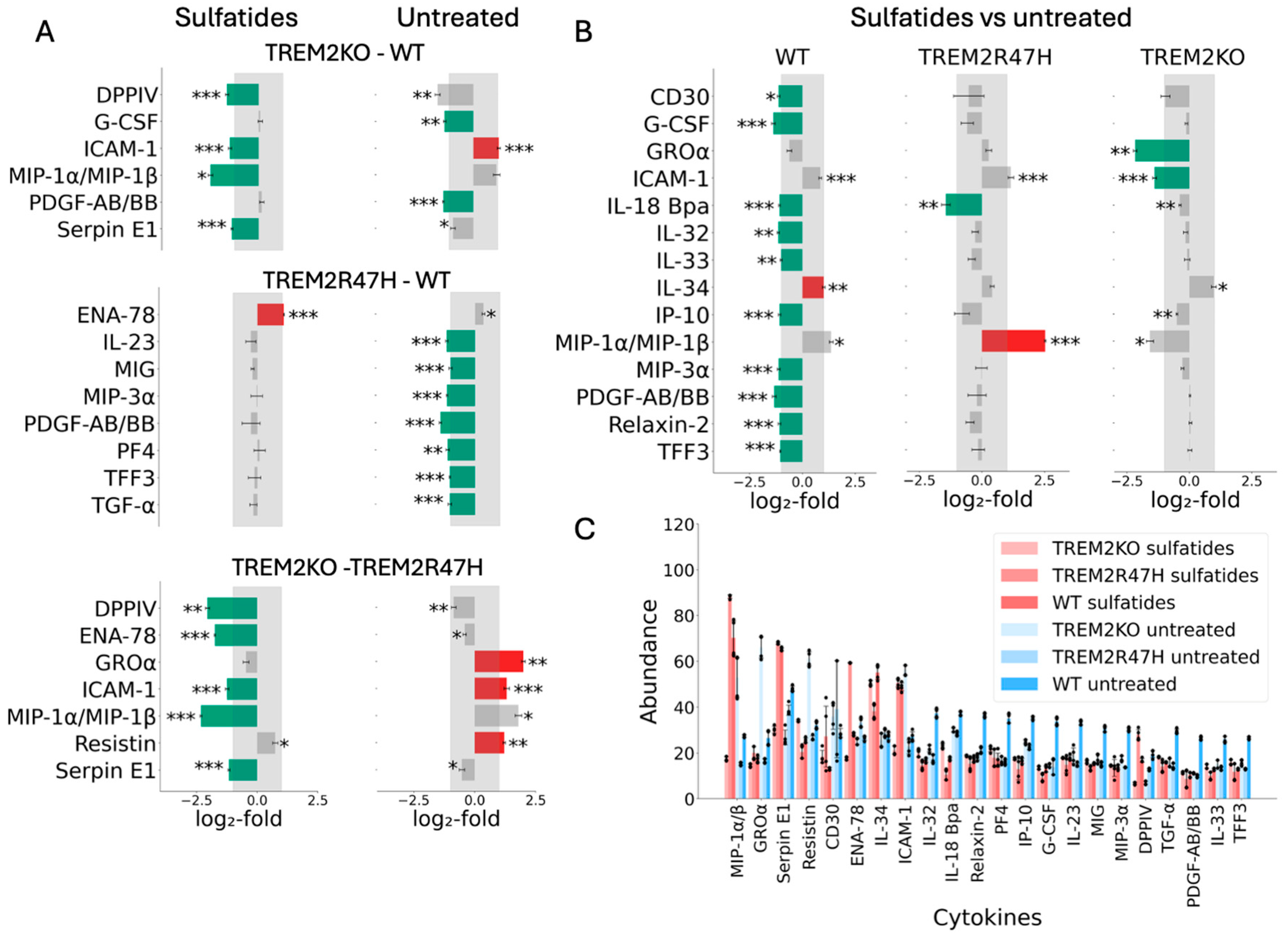
To understand the impact of TREM2 on sulfatide metabolism, we treated WT, TREM2 KO, or TREM2 R47H mutant iMGL cells with sulfatide and subjected them to cytokine array and transcriptomics profiling. In untreated cells, we noted an increase in ICAM-1 but a reduction in PDGF-AB/BB and G-CSF in TREM2 KO relative to WT cells (Figure 4A, top panel). However, when the same cells were treated with sulfatide, we noticed that TREM2 KO cells had significantly lower ICAM-1 expression along with other pro-inflammatory cytokines (Figure 4A, top panel). Lower ICAM-1 is consistent with the observed deficit in phagocytosis that is observed with TREM2 KO cells [60]. Reduced expression of pro-inflammatory cytokines like MIP-1α/MIP-1β with a concomitant reduction in ICAM-1 mediated phagocytosis highlights how TREM2 regulates sensing and clearance of various neurotoxic agents. We further noted that DPP4, an enzyme that cleaves glucagon-like peptide-1 (GLP-1) and glucose-dependent insulinotropic polypeptide (GIP), is significantly reduced in TREM2 KO relative to WT in both sulfatide-treated and untreated cells (Figure 4A, top panel). In contrast, TREM2 R47H has a distinct cytokine profile from TREM2 KO cells in both untreated and sulfatide-treated cells relative to WT. In untreated TREM2 R47H cells, cytokines and chemokines such as IL-23, MIG, MIP-3α, PDGF-AA/BB, PF4, TFF3, and TGF-α are significantly down-regulated compared to WT cells (Figure 4A, middle panel). In sulfatide-treated cells, TREM2 R47H up-regulated ENA-78, signifying an activation of the inflammatory signaling (Figure 4A, middle panel). Finally, TREM2 KO cells showed higher basal levels of GROα, ICAM-1, and resistin relative to TREM2 R47H in untreated cells but substantially lower levels of these molecules in response to sulfatide (Figure 4A bottom panel). In addition, we observed lower levels of pro-inflammatory proteins such as MIP-1α/MIP-1β and ENA-78 (CXCL5) when treated with sulfatide, further underscoring the inability of TREM2 R47H cells to respond to stimuli such as sulfatide (Figure 4A, bottom panel).
To further parse out the sulfatide-specific impact on each genotype, we compared the response of WT, TREM2 KO, and TREM2 R47H microglia to sulfatide. In addition to the genotype-specific impacts, we noted a sulfatide-specific response in WT, which was completely lacking in TREM2 KO and TREM2 R47H (Figure 4B,C). For example, WT cells down-regulated cytokines such as IL-32, IL-33, IP-10, and others, while up-regulating ICAM-1 to elicit an appropriate phagocytic response and resolve inflammation (Figure 4B,C). TREM2 KO down-regulated ICAM-1, and TREM2 R47H up-regulated MIP-1α/MIP-1β in response to sulfatide (Figure 4B), underscoring inefficient phagocytosis and hyper-inflammatory response, respectively.
In summary, we uncovered a unique cytokine signature associated with TREM2 R47H and with TREM2 KO, implying that the TREM2 R47H does not fully phenocopy TREM2 loss-of-function but provides evidence of additional functional impairments in the TREM2 pathway.

2.5. Novel Cytokines Are Differentially Altered in Response to Sulfatide

Sulfatide depletion is associated with demyelination of neurons, thus amplifying synaptic deficits and resulting in cognitive defects [57,58]. Additionally, misregulation of sulfatide may have impacts on cell signaling pathways and amyloid precursor processing pathways [59]. One such signaling pathway, which is intimately associated with Alzheimer’s disease and neuroinflammation, is the TREM2 pathway. Therefore, we next sought to identify cytokines and proteins that were differentially expressed in response to sulfatide stimulus and displayed different expression patterns in various TREM2 genotypes.
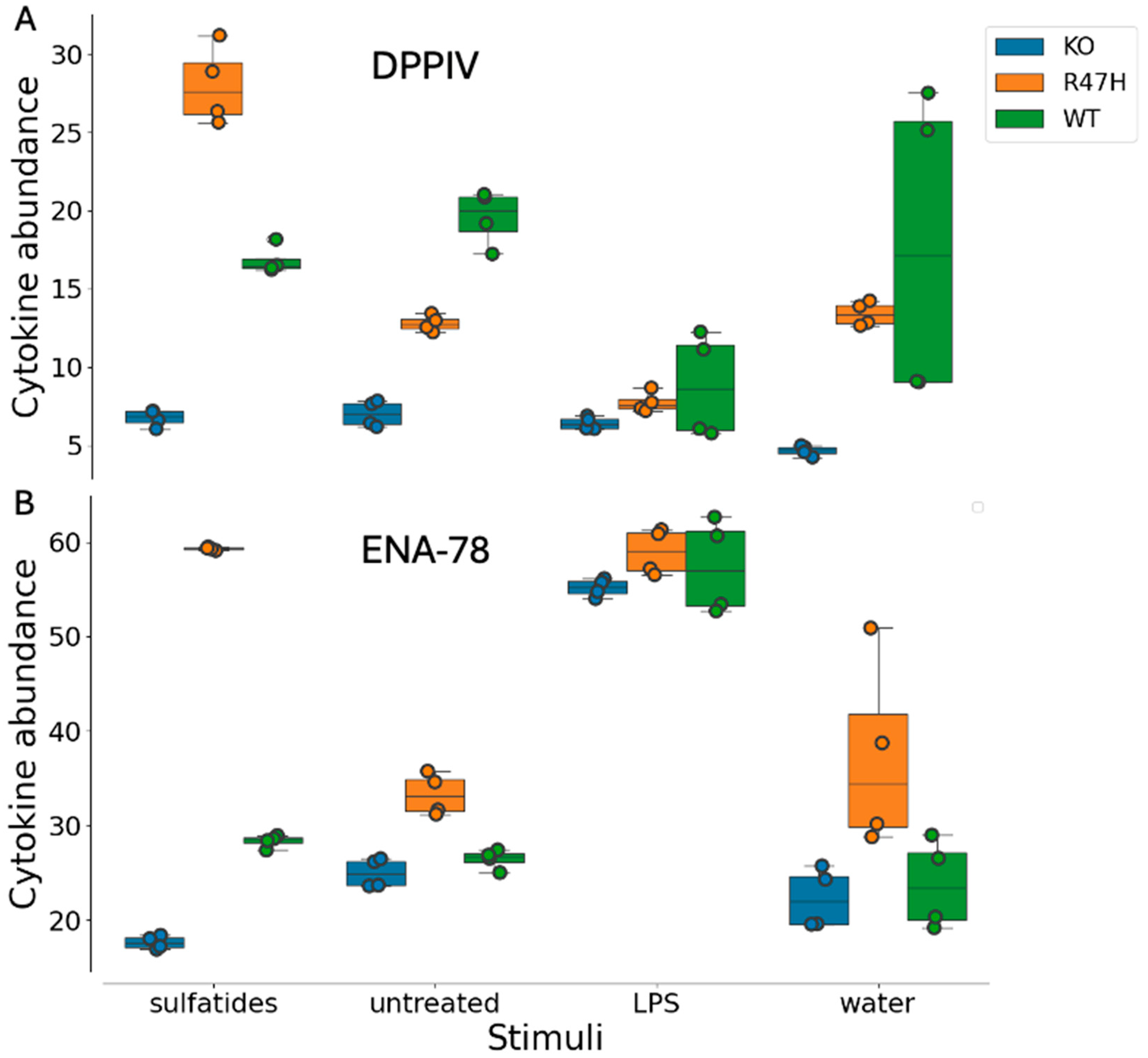
As described in the previous section, we noticed both a sulfatide-specific and a genotype-specific response (Figure 4). We focused our attention on two analytes that showed a very distinct profile: DPP4 and ENA-78. Dipeptidyl peptidase-4 (DPP-4, CD26) is a serine exopeptidase that cleaves incretin hormones and multiple chemokines, integrating metabolic and immune signaling [56,61]. The abundance of DPP4 across different genotypes (TREM2 KO, TREM2R47H, and WT) under various treatment conditions (sulfatide, untreated, LPS, and water) was considerably different (Table 1). While LPS treatment showed modest changes across genotypes, sulfatide treatment had significantly different impacts on DPP4 levels, and this was dependent on the genotype under consideration (Figure 5A). In TREM2 KO DPP4 (Figure 5A, blue) consistently exhibits the lowest levels across all treatments, with a log2 fold-change in transcript levels of ~−4.23 compared to the TREM2 R47H allele in the water treatment, and ~−6.90 compared to the TREM2 R47H variant in the sulfatide treatment (Table 1). DPP4 was also significantly down-regulated compared to WT after sulfatide treatment (Table 1, log2 fold-change ~−6.05). In contrast, TREM2 R47H (Figure 5A, orange) showed a considerable and significant increase in DPP4 transcript level ~2.33, particularly in response to sulfatide (Figure 5A, Table 1, Supplementary Table S1) but to a lesser extent on the protein level (log2 fold-change 1.13, Z-factor border significance < 0.48, Table 1), raising the possibility of an interplay between DPP4, TREM R47H in the context of sulfatide. Intriguingly, these patterns were captured at both the RNA and protein levels (Table 1), underscoring a unique, previously undescribed impact of TREM2 on DPP4, a key enzyme that regulates a plethora of immune-modulatory molecules.
A distinct expression pattern was also observed for ENA-78 chemokine, where expression level was significantly and dramatically increased in response to LPS compared to water treatment in TREM2 KO cells (log2 fold-change RNA-seq ~5.19, Table 1). ENA-78 showed a significant increase in TREM2 R47H compared to WT (log2 fold-change RNA-seq ~2.28, Table 1), and a dramatic decrease in TREM2 KO compared to TREM2 R47H in response to sulfatide (log2 fold-change RNA-seq ~−7.34, Figure 4B and Figure 5B, Table 1). Epithelial neutrophil-activating peptide 78 (ENA-78/CXCL5) is an ELR+ CXC chemokine produced by epithelial, endothelial, stromal, adipose, and immune cells in response to IL-1β and TNF-α, acting primarily through CXCR2 to recruit and activate neutrophils and to influence angiogenesis and tissue remodeling [62,63].
Together, sulfatide depletion is associated with neuronal demyelination and synaptic and cognitive deficits, and our results reveal genotype- and sulfatide-specific regulation of immune mediators. Notably, a TREM2-dependent modulation of DPP4 and a divergent ENA-78 response, possibly implicating TREM2 variants in modulating inflammatory signaling relevant to Alzheimer’s disease.

3. Discussion

Cytokine and chemokine profiling can shed light on the mechanisms underlying neurodegenerative diseases, and may help uncover novel therapeutic targets and, importantly, biomarkers. Here, we present InCytokine, a novel open-source tool for rapid, reproducible, and scalable semiquantitative analysis of cytokine and chemokine profiling data generated by protein array platforms. Notably, this tool is compatible with custom assays, provided that the assay follows a grid-based array layout. The workflow is assay-agnostic with respect to array content and operates on fluorescence intensity information extracted from array images. The primary input consists of high-resolution fluorescence images, with TIFF serving as the main and recommended format, as it represents the de facto standard for quantitative fluorescence imaging and preserves full spatial resolution and dynamic range. Additional lossless formats (e.g., PNG) are also supported, provided that image resolution and intensity fidelity are maintained.
InCytokine offers an automated yet user-adjustable spot detection and image analysis workflow that can be readily triggered via a user-friendly interface. The output files produced by InCytokine can be used for downstream statistical analyses to identify proteins that are differentially abundant across samples and conditions.
To demonstrate the tool’s utility, we profiled TREM2 knockout, AD-associated TREM2 R47H variant, and wild-type cells under lipopolysaccharide and sulfatide treatments using the Proteome Profiler array. Throughout the study, we applied stringent statistical thresholds to ensure biologically driven signatures over technical artifacts, accounting for measurement reliability, magnitude, and the significance of the change. We observed an intriguing relationship between an AD-associated risk variant in the TREM2 gene and cytokine expression. These findings were also supported by transcriptomic RNA-seq data, which together suggest a potential effect of the TREM2 R47H variant on levels of DPP4 and other inflammatory cytokines such as ENA-78/CXCL5. We also observed good concordance between RNA-seq and Proteome Profiler despite the substantial differences in experimental and data analysis workflows.
Given differences in experimental setup and imaging equipment, imaging protocols can vary, introducing variability into the evaluation of experimental outcomes from digital array scans. InCytokine streamlines and automates the image-analysis workflow, yielding a substantial speed-up in data processing and output generation, while enforcing a standardized procedure. This enables scientists to scale up experiments and devote more time to data analysis and results interpretation. Although some manufacturers may offer software for processing digital scans, those solutions are often limited in functionality or tied to specific devices. In contrast, InCytokine is open source, allowing customization and extension while preserving the advantages of a standardized, reproducible, and scalable image-processing protocol and faster experiment evaluation.
Our findings reveal that TREM2 R47H does not simply phenocopy TREM2 loss-of-function but rather exhibits a unique inflammatory signature, challenging the prevailing hypothesis that TREM2 R47H represents a simple hypomorphic allele [64,65]. The distinct cytokine profiles observed between TREM2 KO and TREM2 R47H variants, especially the differential regulation of GROα, MCP-3, and ENA-78, suggest that the TREM2 R47H mutation may confer both loss- and gain-of-function characteristics. This observation aligns with recent structural studies indicating that TREM2 R47H disrupts ligand binding while potentially altering downstream signaling in complex ways [66,67]. The up-regulation of ENA-78 (CXCL5) specifically in TREM2 R47H cells following sulfatide treatment represents a particularly intriguing finding. ENA-78 is a potent neutrophil chemoattractant that signals through CXCR2 and has been implicated in neuroinflammatory processes. The dramatic increase in ENA-78 in TREM2 R47H but not TREM2 KO cells in response to sulfatide suggests that this variant may promote a distinct neuroinflammatory environment that could contribute to AD pathogenesis through enhanced neutrophil recruitment and activation. This finding is consistent with recent evidence showing increased neutrophil infiltration in AD brain tissue [68,69]. The differential sulfatide responses across TREM2 genotypes reveal critical insights into lipid sensing and myelin homeostasis. Wild-type cells appropriately up-regulated ICAM-1, while suppressing inflammatory cytokines, indicative of effective phagocytic clearance with inflammation resolution. Conversely, TREM2 KO cells exhibited reduced ICAM-1 and inflammatory cytokine production, confirming impaired phagocytosis. Notably, TREM2 R47H cells showed sustained inflammation (elevated ENA-78) despite reduced phagocytic markers, uncoupling inflammation from debris clearance, a hallmark of AD pathology. Since sulfatide depletion occurs early in AD [70,71,72], the impaired response of TREM2 variant microglia to sulfatide-containing debris may accelerate disease progression.
Given the prominent role of TREM2 in regulating the metabolic fitness of microglia [73], we specifically looked at a panel of cytokines and chemokines directly or indirectly linked to metabolic states, including IL-6, TNF-α, IL-1β, IL-10, adiponectin, leptin, resistin, apolipoprotein A1, osteopontin, GDF-15, VEGF, CCL2/MCP-1, the PDGF family, MIF, CD14, complement factors, RAGE, IGFBPs, and TGF-α. We noted that, barring resistin (RETN), none of the other cytokines or chemokines showed significant enough alterations using our metrics. Most notably, resistin was elevated in TREM2 knockout (KO) cells at baseline and following LPS treatment (Figure 2B,C and Figure 4A, bottom panel). This pattern suggested that LPS promotes a more glycolytic, stress-associated metabolic state that is further exacerbated by loss of TREM2, consistent with prior reports [73,74].
Perhaps the most unexpected finding from our analysis is the identification of DPP4 as downstream of TREM2 signaling. The consistent down-regulation of DPP4 in TREM2 KO cells contrasted with its up-regulation in TREM2 R47H cells, particularly following sulfatide treatment, suggests a previously unrecognized regulatory relationship. DPP4, also known as CD26, is a multifunctional serine protease that cleaves various chemokines and incretin hormones, thereby modulating both immune and metabolic signaling [75,76,77]. The differential regulation of DPP4 between TREM2 variants may have profound implications for microglial function and AD pathogenesis. DPP4 inhibition has been shown to exert neuroprotective effects in various neurodegenerative disease models [78,79,80,81], and DPP4 inhibitors used clinically for diabetes management have been associated with reduced AD risk in epidemiological studies [82,83]. Based on the reduction in pro-inflammatory markers that are typically seen after DPP4 inhibition and based on data in animal models of cognitive defect, we speculate that overexpression of DPP4 will result in a more M1-like state of microglia, where they are hyper-inflammatory and are ineffective in phagocytic clearance. Consistent with this idea, Zhuge et al. showed that DPP4 regulated the M1/M2 microglial states upon LPS or IL-4 stimulation, and inhibition of DPP4 by linagliptin blocked the M1-state while inducing the M2-state. Our findings suggest that TREM2 status may influence the therapeutic potential of DPP4-targeted interventions, with TREM2 R47H carriers potentially showing different responses compared to individuals with normal TREM2 function.

4. Materials and Methods

4.1. InCytokine Tool Architecture

InCytokine was implemented in Python (version 3.11), integrating widely used open-source libraries for data science and image analysis. Numerical operations were performed with NumPy (version 2.4.1) and SciPy (version 1.17.0), while image preprocessing and manipulation used Pillow (PIL, version 12.1.0) and scikit-image (version 0.26.0). Feature extraction and spatial clustering relied on scikit-learn, including KDTree-based nearest-neighbor searches and DBSCAN clustering. Tabular data handling and downstream analyses were managed with pandas, visualization with matplotlib and seaborn, and the interactive interface with Streamlit (version 1.48.0), which allows users to inspect raw images, detection overlays, intensity profiles, and processed results directly within the application. The workflow is designed to generate precise and reproducible grid-aligned spot centroids that form the spatial foundation for all subsequent intensity measurements. It operates through a structured three-stage process encompassing blob detection, grid processing, and template alignment, followed by intensity measurement and normalization. The workflow is designed to generate precise and reproducible grid-aligned spot centroids that form the spatial foundation for all subsequent intensity measurements. It operates through a structured three-stage process encompassing blob detection, grid processing, and template alignment, followed by intensity measurement and normalization.

4.2. Image Processing: Grid Coordinate Extraction and Alignment

At the first stage, the BlobDetector module performs a four-step detection procedure: (1) percentile-based contrast enhancement rescales image intensities (parameters: contrast_lower, contrast_upper) to improve spot visibility under varying acquisition conditions; (2) multi-scale Laplacian of Gaussian filtering identifies circular features across a configurable sigma range (min_sigma, max_sigma, num_sigma, threshold); (3) KDTree-based spatial filtering removes overlapping detections, retaining the largest centroid within a given radius (radius_filter); and (4) DBSCAN clustering eliminates isolated outliers and organizes valid centroids into a grid-like structure. This stage yields an initial geometric layout of candidate spots.
At the second stage, the GridProcessor module refines the geometric consistency of the detected centroids and constructs a reusable grid template. Automatic rotation correction is achieved through coordinate variance minimization, where properly aligned grids exhibit minimal Y-variance within rows and X-variance within columns. A grid search over ±30° (0.1° steps) identifies the orientation yielding the lowest within-group variance, and a rotation is applied if the confidence exceeds 0.3. Grid structure detection is then performed using independent DBSCAN clustering on X and Y coordinates to remove outliers and assign spatial indices. Linear regression through the clustered centroids defines the row and column lines, and their intersections provide precise well positions. The resulting grid structure is stored as a GridTemplate containing centroid coordinates, grid indices, fitted line parameters, and the median blob radius
At the third stage, the TemplateAligner module aligns the detected centroids to the predefined grid template through a three-phase optimization strategy. Global optimization with differential evolution searches over rotation (±15°), translation (±50 px), and uniform scaling (±10%) to maximize centroid overlap without penalizing missing detections. Local refinement using the L-BFGS-B algorithm is then applied when the global solution achieves an objective score below 0.5, ensuring sub-pixel accuracy. Finally, a thin-plate spline deformation establishes point correspondences between template and detected centroids (minimum of 10 required), enabling local non-rigid warping and further improving alignment precision. The enhanced GridTemplate supports microplate-style well labeling (e.g., A1, B2, J23), orientation inversion, automatic remapping of control wells, and dynamic addition or removal of wells while preserving geometric consistency.

4.3. Image Processing: Intensity Measurement

Once all spots are detected and accurately aligned, the IntensityMeasurer module extracts and normalizes the fluorescence or colorimetric signal for each spot. Pixel intensities within each defined boundary are averaged to compute the measurement value, while control wells serve as reference points for normalization across arrays. Spurious detections are automatically excluded, and the resulting intensity matrix is exported together with visualization overlays and well labels. To maintain flexibility, each spot is represented by a two-dimensional Gaussian kernel of known diameter, and the grid is stored as a normalized coordinate template. This design allows extension to different array layouts by simply substituting the spot kernel and coordinate pattern, without altering the core detection–alignment–measurement workflow. The resulting architecture ensures that cytokine array coordinates remain consistent and reproducible across imaging conditions, providing a reliable basis for downstream quantitative analysis. These quantified values are displayed to the user through the application interface. As illustrated in Figure 1B and Supplementary Figures S1–S3, the workflow begins with the raw cytokine array image, proceeds through automated spot detection and grid alignment, and yields corrected coordinates ready for the final intensity quantification stage.

4.4. Statistical Analysis

The log2 fold-change (log2FC) of intensity values was obtained by comparing the base-2 logarithm of the mean absolute cytokine abundance of the 4 array analytes under either fixed treatment or genotype:
l o g 2 F C = log 2 v A v B
Analytes with a fold-change ≥2 were considered significant (|log2FC| > 1) up- and down-regulated expression. The Z-factor, a statistical measure of assay quality, was used to evaluate the reliability and separation of the assay measurements:
Z = 1 3 ( σ a + σ b ) | μ a μ b |
A Z-factor value greater than 0.5 was considered a reliable measurement, while values smaller than 0.5 were considered marginal. Furthermore, a Welch t-test was conducted to evaluate the statistical significance of the observed changes, with p-values categorized as follows: p < 0.01, p < 0.001, and p < 0.0001. RNA sequencing analysis was performed to assess concordance with cytokine array data. For RNA-seq, only transcripts with adjusted p-value (padj) < 0.01 were considered statistically significant. To evaluate concordance between the two platforms (RNA-seq and protein array), the results were pooled across treatments, genotypes, and controls, and analytes with concordant log2 fold-changes (i.e., directionally consistent up- or down-regulation) between RNA-seq and cytokine measurements were counted. Let Noverlap be the number of observations with concordant fold-change direction in both platforms (either both up or both down). Let Ncyt and NRNA be the number of observations that are up- or down-regulated only in the cytokine dataset and in the RNA-seq dataset, respectively. We computed the following contingency table:
N o v e r l a p N c y t N R N A N ( N o v e r l a p + N c y t + N R N A )
A one-sided Fisher’s exact test (alternative = “greater”) was used to assess whether the overlap count was larger than expected under the null hypothesis of independence between platforms. p-values < 0.05 were considered statistically significant.

4.5. Sample Preparation—Cytokine Arrays and RNA-Seq iMGL Culture

iMGLs were maintained in a complete differentiation medium prepared according to established protocols. The base medium consisted of phenol red-free DMEM/F12 (1:1), supplemented with human insulin (0.02 mg/mL), ITS-G (2% v/v), B27 (2% v/v), N2 (0.5% v/v), monothioglycerol (200 µM), GlutaMAX (1X), and NEAA (1X). This mixture was sterilized using a 0.22 µm filter. Immediately before use, the base medium was further supplemented with M-CSF (25 ng/mL) and IL-34 (100 ng/mL) to generate the complete differentiation medium. For culture, iMGLs were thawed in the base differentiation medium and centrifuged at 300× g for 5 min at room temperature. After discarding the supernatant, the cells were gently resuspended in the complete differentiation medium. Cultures were incubated at 37 °C in an environment containing 5% O2 and 5% CO2 for 2 to 4 days, with half of the medium replaced every 2 days.

4.6. iMGL Treatment

Six-well cell culture plates were prepared by coating each well with 1 mL of Matrigel (Corning, ref# 356231, Coning, NY, USA) at a concentration of 0.167 mg/mL in cold Advanced DMEM/F12 (Thermo Fisher, Cat# 12634010, Waltham, MA, USA). The plates were incubated overnight at 4 °C. The following day, iMGLs were seeded at a density of 1 × 10⁶ cells per well onto Matrigel-coated plates in complete differentiation medium. Cells were cultured for 2 days at 37 °C in an atmosphere of 5% O2 and 5% CO2. On the day of treatment, 0.5 mL of medium was replaced with fresh complete differentiation medium containing one of the following: water (control), LPS (1 mg/mL), sulfatide (1 mM), or left untreated. Cells were then incubated for an additional 24 h under the same conditions (37 °C, 5% O2, 5% CO2) before being collected for bulk RNA sequencing, while supernatants were collected for performing cytokine arrays.

4.7. Bulk RNA Sequencing

Bulk RNA-seq was performed by Azenta Life Science (Burlington, MA, USA). Total RNA was extracted and purified from 1,000,000 pelleted cells using the TrueSeq stranded total RNA Ribo-zero kit from Illumina (San Diego, CA, USA). For each sample, 100 ng of RNA was used to prepare the RNA library, which was then sequenced on an Illumina NovaSeq platform with a 2 × 100 bp configuration, targeting 6 Gb of data per sample. Raw FASTQ files were assessed using SeqPrep v1.2 and Omicsoft to version 11, which included adapter trimming and quality control checks. The data were then processed with Omicsoft version 11, using the OSA Alignment algorithm and the human genome reference std b38 ensmbl r108. Aligned reads were imported into DESeq2 v1.28.1 for normalization and differential expression analysis. Genes with low abundance (total gene count < 40 across all samples) were filtered out.

4.8. Cytokine Analysis Using Proteome Profiler Human XL Cytokine Array Kit

Supernatants collected from treated cells or controls were frozen at –80 °C before proceeding with cytokine analysis using the Proteome Profiler Human XL Cytokine Array Kit from R&D Systems (Minneapolis, MN, USA) according to the manufacturer’s instructions. Briefly, supernatants were collected after centrifuging the cells for 5 min at 1500 rpm, and then 100 uL of the supernatant was diluted with buffers from the Proteome profile kit, followed by shaking incubation in a cold room overnight. The next morning, washes were performed using the wash buffers provided in the kit, followed by developing the array using the near-infrared (NIR) fluorescence detection using the LI-COR Odyssey® Infrared Imaging System (Lincoln, NB, USA). R&D Systems provides a modified protocol for developing these arrays using specialized IRDye® 800 CW Streptavidin (Minneapolis, MN, USA).

5. Conclusions

In conclusion, InCytokine represents a powerful tool for systematic analysis of cytokine and chemokine profiles, enabling the discovery of novel biological insights into microglial function and neuroinflammation. Our identification of distinct inflammatory signatures for TREM2 variants, the possible novel role of DPP4 in TREM2 signaling, and the differential responses to sulfatide provide important new perspectives on TREM2 biology and its role in AD pathogenesis. These findings underscore the complexity of TREM2-mediated microglial responses and highlight the need for nuanced therapeutic approaches that consider both genotype and the specific inflammatory context. Future research should focus on elucidating the precise mechanisms by which TREM2 variants influence cytokine production and exploring the therapeutic potential of modulating TREM2 signaling in AD.

Supplementary Materials

The following supporting information can be downloaded at https://www.mdpi.com/article/10.3390/ijms27031137/s1.

Author Contributions

D.A.B., D.J., R.S.M., and V.P. conceived the study. D.A.B. and D.J. wrote the manuscript. A.V.-O., F.O., and M.A. also contributed to the method section of the manuscript. D.J. and S.L.F. prepared the samples and performed the experiments. F.O. and J.S. developed the first version of the image analysis workflow. M.V. developed a prototype of the user interface. A.V.-O. and I.P. implemented the final version of the software. A.V.-O. designed and developed the automated spot detection component. M.A. performed all the statistical data analysis and generated the figures. All authors have read and agreed to the published version of the manuscript.

Funding

This work was supported by Merck Sharp & Dohme LLC, a subsidiary of Merck & Co., Inc., Rahway, NJ, USA.

Institutional Review Board Statement

Not applicable.

Informed Consent Statement

Not applicable.

Data Availability Statement

All the code for this publication, along with cytokine image data, is available in the following GitHub repository: https://github.com/MSDLLCpapers/InCytokine (version 1.0.0, accessed on 13 January 2026).

Acknowledgments

We thank M. Isabel Agea for assistance with backend and user interface integration, and Jaroslav Cerman for preparing the code for open-source release. We also acknowledge Dave Pace, Jyoti Shah, Antong Chen, and Carol A. Rohl for supporting this work, and are grateful to Michael Wurst for his invaluable manuscript review and feedback.

Conflicts of Interest

All authors who are/were employees of Merck Sharp & Dohme LLC, a subsidiary of Merck & Co., Inc., Rahway, NJ, USA, may hold stocks and/or stock options in Merck & Co., Inc., Rahway, NJ, USA.

Abbreviations

ADAlzheimer’s disease
amyloid-beta
CSVcomma-separated values
CXCL5C-X-C motif chemokine ligand 5 (ENA-78)
DPP4dipeptidyl peptidase-4 (CD26)
ELISAenzyme-linked immunosorbent assay
ENA-78epithelial neutrophil-activating peptide-78 (CXCL5)
FCfold-change
FDR/padjfalse discovery rate/adjusted p-value
GLP-1glucagon-like peptide-1
GIPglucose-dependent insulinotropic polypeptide
iMGLinduced pluripotent stem cell-derived microglia-like cells
JSONJavaScript Object Notation
KDTreek-dimensional tree (nearest-neighbor data structure)
LPSlipopolysaccharide
NIRnear-infrared
OMIC(used here generically) omics/high-throughput molecular profiling
PDGFplatelet-derived growth factor
QCquality control
RNA-seqRNA sequencing (bulk)
TREM2triggering receptor expressed on myeloid cells 2
TIFF/.tiffTagged Image File Format

References

  1. Franceschi, C.; Campisi, J. Chronic inflammation (inflammaging) and its potential contribution to age-associated diseases. J. Gerontol. A Biol. Sci. Med. Sci. 2014, 69, S4–S9. [Google Scholar] [CrossRef]
  2. Hanahan, D. Hallmarks of Cancer: New Dimensions. Cancer Discov. 2022, 12, 31–46. [Google Scholar] [CrossRef] [PubMed]
  3. Heneka, M.T.; Carson, M.J.; El Khoury, J.; Landreth, G.E.; Brosseron, F.; Feinstein, D.L.; Jacobs, A.H.; Wyss-Coray, T.; Vitorica, J.; Ransohoff, R.M.; et al. Neuroinflammation in Alzheimer’s disease. Lancet Neurol. 2015, 14, 388–405. [Google Scholar] [CrossRef] [PubMed]
  4. Heneka, M.T.; Golenbock, D.T.; Latz, E. Innate immunity in Alzheimer’s disease. Nat. Immunol. 2015, 16, 229–236. [Google Scholar] [CrossRef]
  5. Medzhitov, R. Origin and physiological roles of inflammation. Nature 2008, 454, 428–435. [Google Scholar] [CrossRef]
  6. Griffith, J.W.; Sokol, C.L.; Luster, A.D. Chemokines and chemokine receptors: Positioning cells for host defense and immunity. Annu. Rev. Immunol. 2014, 32, 659–702. [Google Scholar] [CrossRef]
  7. O’Shea, J.J.; Murray, P.J. Cytokine signaling modules in inflammatory responses. Immunity 2008, 28, 477–487. [Google Scholar] [CrossRef] [PubMed]
  8. Zlotnik, A.; Yoshie, O. Chemokines: A new classification system and their role in immunity. Immunity 2000, 12, 121–127. [Google Scholar] [CrossRef]
  9. Donnelly, R.P.; Young, H.A.; Rosenberg, A.S. An overview of cytokines and cytokine antagonists as therapeutic agents. Ann. New York Acad. Sci. 2009, 1182, 1–13. [Google Scholar] [CrossRef]
  10. Qiu, Y.; Su, M.; Liu, L.; Tang, Y.; Pan, Y.; Sun, J. Clinical Application of Cytokines in Cancer Immunotherapy. Drug Des. Devel. Ther. 2021, 15, 2269–2287. [Google Scholar] [CrossRef]
  11. Tanaka, T.; Narazaki, M.; Kishimoto, T. IL-6 in inflammation, immunity, and disease. Cold Spring Harb. Perspect. Biol. 2014, 6, a016295. [Google Scholar] [CrossRef]
  12. Better, M.A. Alzheimer’s disease facts and figures. Alzheimers Dement. 2021, 17, 327–406. [Google Scholar]
  13. De Strooper, B.; Karran, E. The Cellular Phase of Alzheimer’s Disease. Cell 2016, 164, 603–615. [Google Scholar] [CrossRef]
  14. Heppner, F.L.; Ransohoff, R.M.; Becher, B. Immune attack: The role of inflammation in Alzheimer disease. Nat. Rev. Neurosci. 2015, 16, 358–372. [Google Scholar] [CrossRef] [PubMed]
  15. Jack, C.R., Jr.; Bennett, D.A.; Blennow, K.; Carrillo, M.C.; Dunn, B.; Haeberlein, S.B.; Holtzman, D.M.; Jagust, W.; Jessen, F.; Karlawish, J.; et al. NIA-AA Research Framework: Toward a biological definition of Alzheimer’s disease. Alzheimers Dement. 2018, 14, 535–562. [Google Scholar] [CrossRef] [PubMed]
  16. Hansen, D.V.; Hanson, J.E.; Sheng, M. Microglia in Alzheimer’s disease. J. Cell Biol. 2018, 217, 459–472. [Google Scholar] [CrossRef]
  17. Salter, M.W.; Stevens, B. Microglia emerge as central players in brain disease. Nat. Med. 2017, 23, 1018–1027. [Google Scholar] [CrossRef]
  18. Andrews, S.J.; Fulton-Howard, B.; Goate, A. Interpretation of risk loci from genome-wide association studies of Alzheimer’s disease. Lancet Neurol. 2020, 19, 326–335. [Google Scholar] [CrossRef] [PubMed]
  19. Cuyvers, E.; Sleegers, K. Genetic variations underlying Alzheimer’s disease: Evidence from genome-wide association studies and beyond. Lancet Neurol. 2016, 15, 857–868. [Google Scholar] [CrossRef]
  20. Efthymiou, A.G.; Goate, A.M. Late onset Alzheimer’s disease genetics implicates microglial pathways in disease risk. Mol. Neurodegener. 2017, 12, 43. [Google Scholar] [CrossRef]
  21. Jansen, I.E.; Savage, J.E.; Watanabe, K.; Bryois, J.; Williams, D.M.; Steinberg, S.; Sealock, J.; Karlsson, I.K.; Hagg, S.; Athanasiu, L.; et al. Genome-wide meta-analysis identifies new loci and functional pathways influencing Alzheimer’s disease risk. Nat. Genet. 2019, 51, 404–413, Erratum in Nat. Genet. 2020, 52, 354. [Google Scholar] [CrossRef] [PubMed]
  22. Kosoy, R.; Fullard, J.F.; Zeng, B.; Bendl, J.; Dong, P.; Rahman, S.; Kleopoulos, S.P.; Shao, Z.; Girdhar, K.; Humphrey, J.; et al. Genetics of the human microglia regulome refines Alzheimer’s disease risk loci. Nat. Genet. 2022, 54, 1145–1154. [Google Scholar] [CrossRef]
  23. Kunkle, B.W.; Grenier-Boley, B.; Sims, R.; Bis, J.C.; Damotte, V.; Naj, A.C.; Boland, A.; Vronskaya, M.; van der Lee, S.J.; Amlie-Wolf, A.; et al. Genetic meta-analysis of diagnosed Alzheimer’s disease identifies new risk loci and implicates Abeta, tau, immunity and lipid processing. Nat. Genet. 2019, 51, 414–430. [Google Scholar] [CrossRef]
  24. Lambert, J.C.; Ibrahim-Verbaas, C.A.; Harold, D.; Naj, A.C.; Sims, R.; Bellenguez, C.; DeStafano, A.L.; Bis, J.C.; Beecham, G.W.; Grenier-Boley, B.; et al. Meta-analysis of 74,046 individuals identifies 11 new susceptibility loci for Alzheimer’s disease. Nat. Genet. 2013, 45, 1452–1458. [Google Scholar] [CrossRef]
  25. Mrdjen, D.; Pavlovic, A.; Hartmann, F.J.; Schreiner, B.; Utz, S.G.; Leung, B.P.; Lelios, I.; Heppner, F.L.; Kipnis, J.; Merkler, D.; et al. High-Dimensional Single-Cell Mapping of Central Nervous System Immune Cells Reveals Distinct Myeloid Subsets in Health, Aging, and Disease. Immunity 2018, 48, 380–395. [Google Scholar] [CrossRef]
  26. Schwartzentruber, J.; Cooper, S.; Liu, J.Z.; Barrio-Hernandez, I.; Bello, E.; Kumasaka, N.; Young, A.M.H.; Franklin, R.J.M.; Johnson, T.; Estrada, K.; et al. Genome-wide meta-analysis, fine-mapping and integrative prioritization implicate new Alzheimer’s disease risk genes. Nat. Genet. 2021, 53, 392–402, Erratum in Nat. Genet. 2021, 53, 585–586. [Google Scholar] [CrossRef] [PubMed]
  27. Guerreiro, R.; Wojtas, A.; Bras, J.; Carrasquillo, M.; Rogaeva, E.; Majounie, E.; Cruchaga, C.; Sassi, C.; Kauwe, J.S.; Younkin, S.; et al. TREM2 variants in Alzheimer’s disease. N. Engl. J. Med. 2013, 368, 117–127. [Google Scholar] [CrossRef]
  28. Jiang, T.; Tan, L.; Chen, Q.; Tan, M.S.; Zhou, J.S.; Zhu, X.C.; Lu, H.; Wang, H.F.; Zhang, Y.D.; Yu, J.T. A rare coding variant in TREM2 increases risk for Alzheimer’s disease in Han Chinese. Neurobiol. Aging 2016, 217, e211–e213. [Google Scholar] [CrossRef]
  29. Jiao, B.; Liu, X.; Tang, B.; Hou, L.; Zhou, L.; Zhang, F.; Zhou, Y.; Guo, J.; Yan, X.; Shen, L. Investigation of TREM2, PLD3, and UNC5C variants in patients with Alzheimer’s disease from mainland China. Neurobiol. Aging 2014, 35, 2422.e9–2422.e11. [Google Scholar] [CrossRef] [PubMed]
  30. Jonsson, T.; Stefansson, H.; Steinberg, S.; Jonsdottir, I.; Jonsson, P.V.; Snaedal, J.; Bjornsson, S.; Huttenlocher, J.; Levey, A.I.; Lah, J.J.; et al. Variant of TREM2 associated with the risk of Alzheimer’s disease. N. Engl. J. Med. 2013, 368, 107–116. [Google Scholar] [CrossRef]
  31. Krasemann, S.; Madore, C.; Cialic, R.; Baufeld, C.; Calcagno, N.; El Fatimy, R.; Beckers, L.; O’Loughlin, E.; Xu, Y.; Fanek, Z.; et al. The TREM2-APOE Pathway Drives the Transcriptional Phenotype of Dysfunctional Microglia in Neurodegenerative Diseases. Immunity 2017, 47, 566–581.e569. [Google Scholar] [CrossRef] [PubMed]
  32. Sims, R.; van der Lee, S.J.; Naj, A.C.; Bellenguez, C.; Badarinarayan, N.; Jakobsdottir, J.; Kunkle, B.W.; Boland, A.; Raybould, R.; Bis, J.C.; et al. Rare coding variants in PLCG2, ABI3, and TREM2 implicate microglial-mediated innate immunity in Alzheimer’s disease. Nat. Genet. 2017, 49, 1373–1384. [Google Scholar] [CrossRef]
  33. Song, W.; Hooli, B.; Mullin, K.; Jin, S.C.; Cella, M.; Ulland, T.K.; Wang, Y.; Tanzi, R.E.; Colonna, M. Alzheimer’s disease-associated TREM2 variants exhibit either decreased or increased ligand-dependent activation. Alzheimers Dement. 2017, 13, 381–387. [Google Scholar] [CrossRef] [PubMed]
  34. Gratuze, M.; Leyns, C.E.; Sauerbeck, A.D.; St-Pierre, M.K.; Xiong, M.; Kim, N.; Serrano, J.R.; Tremblay, M.E.; Kummer, T.T.; Colonna, M.; et al. Impact of TREM2R47H variant on tau pathology-induced gliosis and neurodegeneration. J. Clin. Investig. 2020, 130, 4954–4968. [Google Scholar] [CrossRef] [PubMed]
  35. Korvatska, O.; Leverenz, J.B.; Jayadev, S.; McMillan, P.; Kurtz, I.; Guo, X.; Rumbaugh, M.; Matsushita, M.; Girirajan, S.; Dorschner, M.O.; et al. R47H Variant of TREM2 Associated with Alzheimer Disease in a Large Late-Onset Family: Clinical, Genetic, and Neuropathological Study. JAMA Neurol. 2015, 72, 920–927. [Google Scholar] [CrossRef]
  36. Lequin, R.M. Enzyme immunoassay (EIA)/enzyme-linked immunosorbent assay (ELISA). Clin. Chem. 2005, 51, 2415–2418. [Google Scholar] [CrossRef]
  37. Elshal, M.F.; McCoy, J.P. Multiplex bead array assays: Performance evaluation and comparison of sensitivity to ELISA. Methods 2006, 38, 317–323. [Google Scholar] [CrossRef]
  38. Vignali, D.A. Multiplexed particle-based flow cytometric assays. J. Immunol. Methods 2000, 243, 243–255. [Google Scholar] [CrossRef]
  39. Du, F.X.; Chen, Y.Q.; Meng, C.D.; Lou, B.H.; Zhang, W.; Xu, G.B. Recent advances in electrochemiluminescence immunoassay based on multiple-signal strategy. Curr. Opin. Electrochem. 2021, 28, 100725. [Google Scholar] [CrossRef]
  40. Assarsson, E.; Lundberg, M.; Holmquist, G.; Bjorkesten, J.; Thorsen, S.B.; Ekman, D.; Eriksson, A.; Rennel Dickens, E.; Ohlsson, S.; Edfeldt, G.; et al. Homogenous 96-plex PEA immunoassay exhibiting high sensitivity, specificity, and excellent scalability. PLoS ONE 2014, 9, e95192. [Google Scholar] [CrossRef]
  41. Gold, L.; Ayers, D.; Bertino, J.; Bock, C.; Bock, A.; Brody, E.N.; Carter, J.; Dalby, A.B.; Eaton, B.E.; Fitzwater, T.; et al. Aptamer-based multiplexed proteomic technology for biomarker discovery. PLoS ONE 2010, 5, e15004. [Google Scholar] [CrossRef]
  42. Rohloff, J.C.; Gelinas, A.D.; Jarvis, T.C.; Ochsner, U.A.; Schneider, D.J.; Gold, L.; Janjic, N. Nucleic Acid Ligands with Protein-like Side Chains: Modified Aptamers and Their Use as Diagnostic and Therapeutic Agents. Mol. Ther. Nucleic Acids 2014, 3, e201. [Google Scholar] [CrossRef]
  43. Rissin, D.M.; Kan, C.W.; Campbell, T.G.; Howes, S.C.; Fournier, D.R.; Song, L.; Piech, T.; Patel, P.P.; Chang, L.; Rivnak, A.J.; et al. Single-molecule enzyme-linked immunosorbent assay detects serum proteins at subfemtomolar concentrations. Nat. Biotechnol. 2010, 28, 595–599. [Google Scholar] [CrossRef]
  44. Geyer, P.E.; Kulak, N.A.; Pichler, G.; Holdt, L.M.; Teupser, D.; Mann, M. Plasma Proteome Profiling to Assess Human Health and Disease. Cell Syst. 2016, 2, 185–195. [Google Scholar] [CrossRef]
  45. Keshishian, H.; Burgess, M.W.; Gillette, M.A.; Mertins, P.; Clauser, K.R.; Mani, D.R.; Kuhn, E.W.; Farrell, L.A.; Gerszten, R.E.; Carr, S.A. Multiplexed, Quantitative Workflow for Sensitive Biomarker Discovery in Plasma Yields Novel Candidates for Early Myocardial Injury. Mol. Cell Proteom. 2015, 14, 2375–2393. [Google Scholar] [CrossRef]
  46. Schultz, C. Intracytoplasmic detection of proinflammatory cytokines and chemokines in monocytes by flow cytometry. Methods Mol. Biol. 2003, 215, 29–39. [Google Scholar] [PubMed]
  47. Kingsmore, S.F. Multiplexed protein measurement: Technologies and applications of protein and antibody arrays. Nat. Rev. Drug Discov. 2006, 5, 310–320. [Google Scholar] [CrossRef]
  48. Tighe, P.J.; Ryder, R.R.; Todd, I.; Fairclough, L.C. ELISA in the multiplex era: Potentials and pitfalls. Proteom. Clin. Appl. 2015, 9, 406–422. [Google Scholar] [CrossRef] [PubMed]
  49. Platchek, M.; Lu, Q.; Tran, H.; Xie, W. Comparative Analysis of Multiple Immunoassays for Cytokine Profiling in Drug Discovery. SLAS Discov. 2020, 25, 1197–1213. [Google Scholar] [CrossRef]
  50. Bantscheff, M.; Scholten, A.; Heck, A.J. Revealing promiscuous drug-target interactions by chemical proteomics. Drug Discov. Today 2009, 14, 1021–1029. [Google Scholar] [CrossRef] [PubMed]
  51. MacBeath, G.; Schreiber, S.L. Printing proteins as microarrays for high-throughput function determination. Science 2000, 289, 1760–1763. [Google Scholar] [CrossRef]
  52. Ptacek, J.; Devgan, G.; Michaud, G.; Zhu, H.; Zhu, X.; Fasolo, J.; Guo, H.; Jona, G.; Breitkreutz, A.; Sopko, R.; et al. Global analysis of protein phosphorylation in yeast. Nature 2005, 438, 679–684. [Google Scholar] [CrossRef]
  53. Lo, M.C.; Aulabaugh, A.; Jin, G.; Cowling, R.; Bard, J.; Malamas, M.; Ellestad, G. Evaluation of fluorescence-based thermal shift assays for hit identification in drug discovery. Anal. Biochem. 2004, 332, 153–159. [Google Scholar] [CrossRef] [PubMed]
  54. Huang, R.P. Detection of multiple proteins in an antibody-based protein microarray system. J. Immunol. Methods 2001, 255, 1–13. [Google Scholar] [CrossRef] [PubMed]
  55. Systems, R.D. Proteome Profiler Antibody Arrays: Technical Handbook, latest ed.; R&D Systems/Thermo Fisher Scientific: Minneapolis, MN, USA, 2025. [Google Scholar]
  56. Kober, D.L.; Alexander-Brett, J.M.; Karch, C.M.; Cruchaga, C.; Colonna, M.; Holtzman, M.J.; Brett, T.J. Neurodegenerative disease mutations in TREM2 reveal a functional surface and distinct loss-of-function mechanisms. eLife 2016, 5, 20391. [Google Scholar] [CrossRef]
  57. Svennerholm, L. Ganglioside Loss Is a Primary Event in Alzheimer-Disease Type-I. Prog. Brain Res. 1994, 101, 391–404. [Google Scholar]
  58. Gottfries, C.G.; Jungbjer, B.; Karlsson, I.; Svennerholm, L. Reductions in membrane proteins and lipids in basal ganglia of classic Alzheimer disease patients. Alz Dis. Assoc. Dis. 1996, 10, 77–81. [Google Scholar] [CrossRef]
  59. Mielke, M.M.; Haughey, N.J.; Bandaru, V.V.; Schech, S.; Carrick, R.; Carlson, M.C.; Mori, S.; Miller, M.I.; Ceritoglu, C.; Brown, T.; et al. Plasma ceramides are altered in mild cognitive impairment and predict cognitive decline and hippocampal volume loss. Alzheimers Dement. 2010, 6, 378–385. [Google Scholar] [CrossRef] [PubMed]
  60. Yeh, F.L.; Wang, Y.; Tom, I.; Gonzalez, L.C.; Sheng, M. TREM2 Binds to Apolipoproteins, Including APOE and CLU/APOJ, and Thereby Facilitates Uptake of Amyloid-Beta by Microglia. Neuron 2016, 91, 328–340. [Google Scholar] [CrossRef]
  61. Donath, M.Y.; Shoelson, S.E. Type 2 diabetes as an inflammatory disease. Nat. Rev. Immunol. 2011, 11, 98–107. [Google Scholar] [CrossRef]
  62. Bachelerie, F.; Ben-Baruch, A.; Burkhardt, A.M.; Combadiere, C.; Farber, J.M.; Graham, G.J.; Horuk, R.; Sparre-Ulrich, A.H.; Locati, M.; Luster, A.D.; et al. International Union of Basic and Clinical Pharmacology. [corrected]. LXXXIX. Update on the extended family of chemokine receptors and introducing a new nomenclature for atypical chemokine receptors. Pharmacol. Rev. 2014, 66, 1–79, Erratum in Pharmacol. Rev. 2014, 66, 467. [Google Scholar] [CrossRef] [PubMed]
  63. Zlotnik, A.; Yoshie, O. The chemokine superfamily revisited. Immunity 2012, 36, 705–716. [Google Scholar] [CrossRef] [PubMed]
  64. Colonna, M.; Wang, Y. TREM2 variants: New keys to decipher Alzheimer disease pathogenesis. Nat. Rev. Neurosci. 2016, 17, 201–207. [Google Scholar] [CrossRef]
  65. Ulrich, J.D.; Ulland, T.K.; Colonna, M.; Holtzman, D.M. Elucidating the Role of TREM2 in Alzheimer’s Disease. Neuron 2017, 94, 237–248. [Google Scholar] [CrossRef] [PubMed]
  66. Kober, D.L.; Brett, T.J. TREM2-Ligand Interactions in Health and Disease. J. Mol. Biol. 2017, 429, 1607–1629. [Google Scholar] [CrossRef]
  67. Sudom, A.; Talreja, S.; Danao, J.; Bragg, E.; Kegel, R.; Min, X.; Richardson, J.; Zhang, Z.; Sharkov, N.; Marcora, E.; et al. Molecular basis for the loss-of-function effects of the Alzheimer’s disease-associated R47H variant of the immune receptor TREM2. J. Biol. Chem. 2018, 293, 12634–12646. [Google Scholar] [CrossRef]
  68. Zenaro, E.; Pietronigro, E.; Della Bianca, V.; Piacentino, G.; Marongiu, L.; Budui, S.; Turano, E.; Rossi, B.; Angiari, S.; Dusi, S.; et al. Neutrophils promote Alzheimer’s disease-like pathology and cognitive decline via LFA-1 integrin. Nat. Med. 2015, 21, 880–886. [Google Scholar] [CrossRef]
  69. Dong, Y.; Lagarde, J.; Xicota, L.; Corne, H.; Chantran, Y.; Chaigneau, T.; Crestani, B.; Bottlaender, M.; Potier, M.C.; Aucouturier, P.; et al. Neutrophil hyperactivation correlates with Alzheimer’s disease progression. Ann. Neurol. 2018, 83, 387–405. [Google Scholar] [CrossRef]
  70. Han, X.D.M.H.; McKeel, D.W., Jr.; Kelley, J.; Morris, J.C. Substantial sulfatide deficiency and ceramide elevation in very early Alzheimer’s disease: Potential role in disease pathogenesis. J. Neurochem. 2002, 82, 809–818. [Google Scholar] [CrossRef]
  71. Zimmer, V.C.; Lauer, A.A.; Haupenthal, V.; Stahlmann, C.P.; Mett, J.; Grosgen, S.; Hundsdorfer, B.; Rothhaar, T.; Endres, K.; Eckhardt, M.; et al. A bidirectional link between sulfatide and Alzheimer’s disease. Cell Chem. Biol. 2024, 31, 265–283.e267. [Google Scholar] [CrossRef]
  72. Cheng, H.; Wang, M.; Li, J.L.; Cairns, N.J.; Han, X. Specific changes of sulfatide levels in individuals with pre-clinical Alzheimer’s disease: An early event in disease pathogenesis. J. Neurochem. 2013, 127, 733–738. [Google Scholar] [CrossRef] [PubMed]
  73. Ulland, T.K.; Song, W.M.; Huang, S.C.; Ulrich, J.D.; Sergushichev, A.; Beatty, W.L.; Loboda, A.A.; Zhou, Y.; Cairns, N.J.; Kambal, A.; et al. TREM2 Maintains Microglial Metabolic Fitness in Alzheimer’s Disease. Cell 2017, 170, 649–663.e613. [Google Scholar] [CrossRef] [PubMed]
  74. Zhang, N.; Ji, Q.; Chen, Y.; Wen, X.; Shan, F. TREM2 deficiency impairs the energy metabolism of Schwann cells and exacerbates peripheral neurological deficits. Cell Death Dis. 2024, 15, 193. [Google Scholar] [CrossRef]
  75. Waumans, Y.; Baerts, L.; Kehoe, K.; Lambeir, A.M.; De Meester, I. The Dipeptidyl Peptidase Family, Prolyl Oligopeptidase, and Prolyl Carboxypeptidase in the Immune System and Inflammatory Disease, Including Atherosclerosis. Front. Immunol. 2015, 6, 387. [Google Scholar] [CrossRef]
  76. Herman, G.A.; Stein, P.P.; Thornberry, N.A.; Wagner, J.A. Dipeptidyl peptidase-4 inhibitors for the treatment of type 2 diabetes: Focus on sitagliptin. Clin. Pharmacol. Ther. 2007, 81, 761–767. [Google Scholar] [CrossRef]
  77. Mentlein, R. Dipeptidyl-peptidase IV (CD26)—Role in the inactivation of regulatory peptides. Regul. Pept. 1999, 85, 9–24. [Google Scholar] [CrossRef]
  78. Kosaraju, J.; Gali, C.C.; Khatwal, R.B.; Dubala, A.; Chinni, S.; Holsinger, R.M.; Madhunapantula, V.S.; Muthureddy Nataraj, S.K.; Basavan, D. Saxagliptin: A dipeptidyl peptidase-4 inhibitor ameliorates streptozotocin induced Alzheimer’s disease. Neuropharmacology 2013, 72, 291–300. [Google Scholar] [CrossRef]
  79. Chen, S.; Zhou, M.; Sun, J.; Guo, A.; Fernando, R.L.; Chen, Y.; Peng, P.; Zhao, G.; Deng, Y. DPP-4 inhibitor improves learning and memory deficits and AD-like neurodegeneration by modulating the GLP-1 signaling. Neuropharmacology 2019, 157, 107668. [Google Scholar] [CrossRef]
  80. Zhuge, F.; Zheng, L.; Pan, Y.; Ni, L.; Fu, Z.; Shi, J.; Ni, Y. DPP-4 inhibition by linagliptin ameliorates age-related mild cognitive impairment by regulating microglia polarization in mice. Exp. Neurol. 2024, 373, 114689. [Google Scholar] [CrossRef]
  81. Khodir, S.A.; Faried, M.A.; Abd-Elhafiz, H.I.; Sweed, E.M. Sitagliptin Attenuates the Cognitive Deficits in L-Methionine-Induced Vascular Dementia in Rats. Biomed. Res. Int. 2022, 2022, 7222590. [Google Scholar] [CrossRef] [PubMed]
  82. Nauck, M.A.; Kahle, M.; Baranov, O.; Deacon, C.F.; Holst, J.J. Addition of a dipeptidyl peptidase-4 inhibitor, sitagliptin, to ongoing therapy with the glucagon-like peptide-1 receptor agonist liraglutide: A randomized controlled trial in patients with type 2 diabetes. Diabetes Obes. Metab. 2017, 19, 200–207. [Google Scholar] [CrossRef] [PubMed]
  83. Biessels, G.J.; Verhagen, C.; Janssen, J.; van den Berg, E.; Zinman, B.; Rosenstock, J.; Johansen, O.E. Effect of Linagliptin on Cognitive Performance in Patients with Type 2 Diabetes and Cardiorenal Comorbidities: The CARMELINA Randomized Trial. Diabetes Care 2019, 42, 1930–1938. [Google Scholar] [CrossRef] [PubMed]
Figure 1. InCytokine experimental, analytical, and computational workflow. (A) Treated samples (LPS/Sulfatide) and test samples (water) were prepared and incubated with the profiler array chemiluminescent reagents, which were added to produce an optical signal. A digital fluoroscopy imaging system is used to perform X-rays and .tiff images were acquired. (B) Images were processed by the InCytokine pipeline through a four-stage workflow: blob detection (Laplacian-of-Gaussian with DBSCAN filtering), template generation and alignment (rotation correction, grid registration, TPS deformation), and final intensity extraction yielding log-normalized output tables, illustrated here as a spreadsheet representing the final array of cytokine spot intensities. See also Supplementary Figures S1–S3. (C) InCytokine exportable files were used to compute relative cytokine abundance, and statistical tests were employed to evaluate the significance of up- and down-regulated cytokines across different conditions and genotypes.
Ijms 27 01137 g001
Figure 2. Cytokine abundance in TREM2 KO, TREM2 R47H, and WT cells in response to LPS. (A) Schematics of the Proteome Profiler array are an ELISA-based plate that can profile up to 105 cytokines simultaneously. On the left panel, the real array is shown; the middle panel shows the manufacturer’s schematics; and the right panel shows a processed representation of the array for a single experiment (TREM2 KO under LPS treatment). On the corners, 3 positive and 1 negative control spots are highlighted in green and red, respectively. Analyte intensity values were calculated as the average over the whole spot area, normalized with respect to the positive and negative control spots. (B) Top panel: log2 fold-change in the relevant cytokine abundances of LPS-treated analytes versus water for TREM2 KO, TREM2 R47H allele, and wild-type microglia cells. The Z factor evaluates the quality of the assay measurement. Only cytokines with an absolute fold-change greater than 2 with associated Z > 0.5 were considered significant. Log2 fold-change bars are colored green for significantly downregulated cytokine, red for significantly upregulated cytokines, and grey for non-significant fold changes. Bottom panel: significant cytokines identified by comparing TREM2 KO and TREM2 R47H as well as TREM2 KO and WT cells under LPS (bottom left) and water (bottom right). Note that TREM2 R47H versus WT resulted in no significant cytokines; hence, it is not shown. (C) Cytokine mean intensity values of the most significant cytokines (Z > 0.5, |log2FC| > 1). Statistical significance was calculated using the Welch t-test (*: p < 0.01, **: p < 0.001, ***: p < 0.0001).
Ijms 27 01137 g002
Figure 3. Concordance between RNA-Seq and the Proteome Profiler Human XL Cytokine Array. (A) Volcano plot showing differentially expressed transcripts of all the cytokines analyzed by InCytokine; data were aggregated for all the following experiments: TREM2 KO vs. TREM2 R47H mutation (blue), TREM2 KO vs. WT (orange), TREM2 R47H mutation vs. WT (green), KO (red), TREM2 R47H (purple), and WT (brown) in LPS versus water. RNA-seq statistical significance was determined using adjusted p-value < 0.01 and |log2FC| > 1. (B) RNA-seq correlation with cytokine relative abundance. Correlation between statistically significant transcripts (RNA-seq) and their respective cytokine abundance fold-changes (Pearson’s coefficient R = 0.48). Correlation remains positive when all points with data in both platforms were considered (Pearson’s coefficient R = 0.36). (C) The concordance of directionality of all genes and cytokines between the two platforms across all comparisons between different treatments, genotypes, and controls (as shown in the legend in panel A). (D) The overlap of statistically significant transcripts detected in RNA-seq with their counterparts on the cytokine array results was aggregated for all comparisons between treatments, genotypes, and controls as before. Fisher’s Exact test was used to evaluate the significance of the overlap; p-values are as indicated. See Supplementary Figure S4 for correspondence between the two platforms in sulfatide-treated and untreated cells.
Ijms 27 01137 g003
Figure 4. Cytokine profiling in response to sulfatide for TREM2 KO, TREM2 R47H variant, and wild-type cells: (A) Comparison between genotypes in treated and untreated cells. Cytokine symbols are as indicated on the y-axis; log2 values on the x-axis; red denotes up-regulation, green down-regulation, and grey non-significant fold changes; only statistically significant results are shown. Statistical significance was calculated using the Welch t-test p-value (only for Z > 0.5, |log2FC| > 1, *: p < 0.01, **: p < 0.001, ***: p < 0.0001). (B) The impact of sulfatide treatment across different genotypes. Comparison between sulfatide-treated and untreated cells for TREM2 KO, TREM2 R47H, and wild-type genotypes. (C) Mean of the absolute intensity values of statistically significant cytokines across all samples treated and untreated.
Ijms 27 01137 g004
Figure 5. Fluctuations of DPP4 (A) and ENA-78 (B) levels in sulfatide- and LPS-treated and untreated cells for TREM2 KO (blue), TREM2 R47H (orange), and WT (green) genotypes. Shown on the y-axis are the mean absolute intensity values.
Ijms 27 01137 g005
Table 1. Summary table of significantly up- and down-regulated transcripts and cytokines measured by RNA-Seq and Proteome Profiler Human XL Cytokine Array under LPS, sulfatide, and water treatments (criteria: |log2FC| > 1, adjusted p-value < 0.01, Z-score > 0.5). Concordantly regulated transcript–cytokine pairs are shown in bold; discordant pairs are shaded light gray. All RNA-Seq and cytokine values across conditions and genotypes are provided in Supplementary Table S1.
CytokineSYMBOLGenotypeTreatmentComparisonCytokine Abundance log2FCRNA-Seq Abundance log2FCZ-FactorAdjusted Cytokine p-ValueAdjusted RNA-Seq
p-Value
DPPIVDPP4 waterKO-R47H−1.52−4.230.670.00.0
ENA-78CXCL5KO LPS–water1.315.190.670.010−37
GROαCXCL1 waterKO-R47H1.94−1.020.780.010−2
GROαCXCL1R47H LPS–water1.851.080.931.9 × 10−910−6
MCP-3CCL7KO LPS–water1.875.970.811.1 × 10−60.0
MCP-3CCL7R47H LPS–water1.3812.770.670.010−25
ResistinRETN LPSKO-R47H1.253.440.881.4 × 10−50.0
CD30TNFRSF8WT Sulfatide-untreated−1.13−2.030.530.010−4
DPPIVDPP4 sulfatideKO-R47H−2.05−6.90.620.00.0
DPPIVDPP4 sulfatideKO-WT−1.32−6.050.627.9 × 10−50.0
DPPIVDPP4TREM2 R47H Sulfatide-untreated1.132.330.481.6 × 10−30.0
ENA-78CXCL5 sulfatideKO-R47H−1.75−7.340.952.5 × 10−60.0
ENA-78CXCL5 sulfatideR47H-WT1.072.280.932.7 × 10−60.0
GROαCXCL1TREM2 KO Sulfatide-untreated−2.181.880.690.010−5
MIP-3αCCL20WT Sulfatide-untreated−1.135.290.671.4 × 10−510−11
Disclaimer/Publisher’s Note: The statements, opinions and data contained in all publications are solely those of the individual author(s) and contributor(s) and not of MDPI and/or the editor(s). MDPI and/or the editor(s) disclaim responsibility for any injury to people or property resulting from any ideas, methods, instructions or products referred to in the content.