Uncovering Major Structural and Functional Features of Methyl-Coenzyme M Reductase (MCR) from Methanobrevibacter ruminantium in Complex with Two Substrates


Abstract
1. Introduction
2. Results
2.1. Molecular Basis of Substrate Recognition in the Mcroxi-silent Complexes
2.2. Decisive Functional Residues for Active-Site Ligand Binding in Mcrsilient State
3. Discussion
4. Materials and Methods
4.1. A Structure Model of Methyl-Coenzme M Reductase from Methanobrevibacter ruminantium
4.2. Complex Models of the Query Mcr Receptor with F430 and Substrates in Two Different Enzyme States
4.3. Evaluating the Mutation Effects on the Binding Affinity Between Molecular Partners in the Query Mcr Receptor Complexes
4.4. Creating Pharmacophore Features of HS-CoM and CoB-SH Substrates on the Mcr Receptor Complex Structures with the Ni-F430 Cofactor
5. Conclusions
Supplementary Materials
Author Contributions
Funding
Institutional Review Board Statement
Informed Consent Statement
Data Availability Statement
Conflicts of Interest
Abbreviations
| M. ruminantium | Methanobrevibacter ruminantium |
| Mcr | Methyl-coenzyme M reductase |
| Mcroxi-silent | Reduced Mcr bound to HS-CoM and CoB-SH inactive state |
| Mcrsilent | Oxidized Mcr bound to the heterodisulfide CoM-S-S CoB inactive state |
| VFAs | Volatile Fatty Acids |
| CH3-S-CoM | Methyl-Coenzyme M |
| HS-CoM | Coenzyme M |
| CoB-SH | Coenzyme B |
| Hdr | Heterodisulfide reductase |
| PME | Particle Mesh Ewald |
| DOPE | Discrete Optimized Protein Energy score |
| Probability Density Function energy | |
| WT | Wild-Type enzyme |
| GFA | Genetic Function Approximation |
| GB | Generalized Born model |
References
- Matthews, C.; Crispie, F.; Lewis, E.; Reid, M.; O’Toole, P.W.; Cotter, P.D. The rumen microbiome: A crucial consideration when optimising milk and meat production and nitrogen utilisation efficiency. Gut Microbes 2019, 10, 115–132. [Google Scholar] [CrossRef]
- Malmuthuge, N.; Liang, G.; Guan, L.L. Regulation of rumen development in neonatal ruminants through microbial metagenomes and host transcriptomes. Genome Biol. 2019, 20, 172. [Google Scholar] [CrossRef]
- Yeoman, C.J.; White, B.A. Gastrointestinal tract microbiota and probiotics in production animals. Annu. Rev. Anim. Biosci. 2014, 2, 469–486. [Google Scholar] [CrossRef]
- Cole, J.R.; Wang, Q.; Fish, J.A.; Chai, B.; McGarrell, D.M.; Sun, Y.; Brown, C.T.; Alfaro, A.P.; Kuske, C.R.; Tiedje, J.M. Ribosomal Database Project: Data and tools for high throughput rRNA analysis. Nucleic Acids Res. 2014, 42, D633–D642. [Google Scholar] [CrossRef]
- Malik, P.K.; Trivedi, S.; Mohapatra, A.; Kolte, A.P.; Sejian, V.; Bhatta, R.; Rahman, H. Comparison of enteric methane yield and diversity of ruminal methanogens in cattle and buffaloes fed on the same diet. PLoS ONE 2021, 16, e0256048. [Google Scholar] [CrossRef]
- Seshadri, R.; Leahy, S.C.; Attwood, G.T.; Teh, K.H.; Lambie, S.C.; Cookson, A.L.; Fadrosh, E.A.E.; Pavlopoulos, G.A.; Hadjithomas, M.; Varghese, N.J.; et al. Cultivation and sequencing of rumen microbiome members from the Hungate 1000 collection. Nat. Biotechnol. 2018, 36, 359–367. [Google Scholar]
- Beauchemin, K.A.; Ungerfeld, E.M.; Eckard, R.J.; Wang, M. Review: Fifty years of research on rumen methanogenesis: Lessons learned and future challenges for mitigation. Animal 2020, 14, S2–S16. [Google Scholar] [CrossRef]
- Patra, A.; Park, T.; Kim, M.; Yu, Z. Rumen methanogens and mitigation of methane emission by anti-methanogenic compounds and substances. J. Anim. Sci. Biotechnol. 2017, 8, 13. [Google Scholar] [CrossRef]
- Gerber, P.J.; Steinfeld, H.; Henderson, B.; Mottet, A.; Opio, C.; Dijkman, J.; Falcucci, A.; Tempio, G. Tacking Climate Change Through Livestock: A Global Assessment of Emissions and Mitigation Opportunities; Food and Agriculture Organization of the United Nations (FAO): Rome, Italy, 2013. [Google Scholar]
- Durocher, G.Y.; Allen, A.P.; Bastviken, D.; Conrad, R.; Gudasz, C.; Pierre, A.S.; Duc, N.T.; del Giorgio, P.A. Methane fluxes show consistent temperature dependence across microbial to ecosystem scales. Nature 2014, 507, 488–491. [Google Scholar] [CrossRef]
- Mei, R.; Kaneko, M.; Imachi, H.; Nobu, M.K. The origin and evolution of methanogenesis and Archaea are intertwined. PNAS Nexus 2023, 2, pgad023. [Google Scholar] [CrossRef]
- Leahy, S.C.; Kelly, W.J.; Altermann, E.; Ronimus, R.S.; Yeoman, C.J.; Pacheco, D.M.; Li, D.; Kong, Z.; McTavish, S.; Sang, C.; et al. The genome sequence of the rumen methanogen Methanobrevibacter ruminantium reveals new possibilities for controlling ruminant methane emissions. PLoS ONE 2010, 5, e8926. [Google Scholar]
- Meadows, R. Scientists try to curb livestock emissions. ACS Cent. Sci. 2022, 8, 1366–1368. [Google Scholar] [CrossRef]
- Volmer, J.G.; McRae, H.; Morrison, M. The evolving role of methanogenic archaea in mammalian microbiomes. Front. Microbiol. 2023, 14, 1268451. [Google Scholar] [CrossRef]
- Shi, W.; Moon, C.D.; Leahy, S.C.; Kang, D.; Froula, J.; Kittelmann, S.; Fan, C.; Deutsch, S.; Gagic, D.; Seedorf, H.; et al. Methane yield phenotypes linked to differential gene expression in the sheep rumen microbiome. Genome Res. 2014, 24, 1517–1525. [Google Scholar] [CrossRef]
- Martínez-Álvaro, M.; Auffret, M.D.; Stewart, R.D.; Dewhurst, R.J.; Duthie, C.A.; Rooke, J.A.; Wallace, R.J.; Shih, B.; Freeman, T.C.; Watson, M.; et al. Identification of complex rumen microbiome interaction within diverse functional niches as mechanisms affecting the variation of methane emissions in bovine. Front. Microbiol. 2020, 11, 659. [Google Scholar] [CrossRef] [PubMed]
- Shalvarjian, K.E.; Nayak, D.D. Transcriptional regulation of methanogenic metabolism in archaea. Curr. Opin. Microbiol. 2021, 60, 8–15. [Google Scholar] [CrossRef] [PubMed]
- Liu, Y.; Whitman, W.B. Metabolic, phylogenetic, and ecological diversity of the methanogenic archaea. Ann. N. Y. Acad. Sci. 2008, 1125, 171–189. [Google Scholar] [CrossRef]
- Huws, S.A.; Creevey, C.J.; Oyama, L.B.; Mizrahi, I.; Denman, S.E.; Popova, M.; Tamayo, R.M.; Forano, E.; Waters, S.M.; Hess, M.; et al. Addressing global ruminant agricultural challenges through understanding the rumen microbiome: Past, present, and future. Front. Microbiol. 2018, 9, 2161. [Google Scholar] [CrossRef] [PubMed]
- Huang, X.D.; Fernandez, G.M.; Padmanabha, J.; Long, R.; Denman, S.E.; McSweeney, C.S. Methanogen diversity in indigenous and introduced ruminant species on the Tibetan plateau. Archaea 2016, 2016, 5916067. [Google Scholar] [CrossRef]
- Wang, P.; Zhao, S.; Wang, X.; Zhang, Y.; Zheng, N.; Wang, J. Ruminal methanogen community in dairy cows fed agricultural residues of corn stover, rapeseed and cottonseed meals. J. Agric. Food Chem. 2016, 64, 5439–5445. [Google Scholar] [CrossRef]
- Leahy, S.C.; Kelly, W.J.; Ronimus, R.S.; Wedlock, N.; Altermann, E.; Attwood, G.T. Genome sequencing of rumen bacteria and archaea and its application to methane mitigation strategies. Animal 2013, 7, 235–243. [Google Scholar] [CrossRef]
- Scheller, S.; Geonrich, M.; Boecher, R.; Thauer, R.K.; Jaun, B. The key nickel enzyme of methanogenesis catalyses the anaerobic oxidation of methane. Nature 2010, 465, 606–608. [Google Scholar] [CrossRef]
- Wagner, T.; Wegner, C.E.; Kahnt, J.; Ermler, U.; Shima, S. Phylogenetic and structural comparisons of the three types of methyl-coenzyme M reductase from methanococcales and methanobacteriales. J. Bacteriol. 2017, 199, e00197-17. [Google Scholar] [PubMed]
- Hahn, C.J.; Lemaire, O.N.; Kahnt, J.; Engilberge, S.; Wegener, G.; Wagner, T. Crystal structure of a key enzyme for anaerobic ethane activation. Science 2021, 373, 118–121. [Google Scholar] [CrossRef]
- Scheller, S.; Goenirch, M.; Thauer, R.K.; Jaun, B. Methyl-coenzyme M reductase from methanogenic archaea: Isotope effects on label exchange and ethane formation with the homologous substrate ethyl-coenzyme M. J. Am. Chem. Soc. 2013, 135, 14985–14995. [Google Scholar] [CrossRef] [PubMed]
- Wang, Y.; Wegener, G.; Ruff, S.E.; Wang, F. Methyl/alkyl-coenzyme M reductase-based anaerobic alkane oxidation in archaea. Environ. Microbiol. 2021, 23, 530–541. [Google Scholar] [CrossRef] [PubMed]
- Thauer, R.K. Methyl(alkyl)-coenzyme M reductase: Nickel F430-containing enzymes involved in anaerobic methane formation and in anaerobic oxidation of methane or of short chain alkanes. Biochemistry 2019, 58, 5198–5220. [Google Scholar] [CrossRef]
- Bapteste, E.; Brochier, C.; Boucher, Y. Higher-level classification of the archaea: Evolution of methanogenesis and methanogens. Archaea 2005, 5, 353–363. [Google Scholar] [CrossRef]
- Wagner, T.; Kahnt, J.; Ermler, U.; Shima, S. Didehydroaspartate modification in methyl-coenzyme M reductase catalyzing methane formation. Angew. Chem. Int. Ed. Engl. 2016, 55, 10630–10633. [Google Scholar] [CrossRef]
- Fang, H.; Kang, J.; Zhang, D. Microbial production of vitamin B12: A review and future perspectives. Microb. Cell Fact. 2017, 16, 15. [Google Scholar]
- Li, J.; Chen, Q.; Fan, Y.; Wang, F.; Meng, J. Improved methane production of two-phase anaerobic digestion by cobalt: Efficiency and mechanism. Bioresour. Technol. 2023, 381, 129123. [Google Scholar] [CrossRef]
- Liu, Z.; Wang, K.; Nan, X.; Yang, L.; Wang, Y.; Zhang, F.; Cai, M.; Zhao, Y.; Xiong, B. Effects of combined addition of 3-nitrooxypropanol and vitamin B12 on methane and propionate production in dairy cows by in vitro-simulation fermentation. J. Dairy Sci. 2023, 106, 219–232. [Google Scholar] [CrossRef] [PubMed]
- Grabarse, W.; Mahlert, F.; Duin, E.C.; Goubeaud, M.; Shima, S.; Thauer, R.K.; Lamzin, V.; Ermler, U. On the mechanism of biological methane formation: Structural evidence for conformational changes in methyl-coenzyme M reductase upon substrate binding. J. Mol. Biol. 2001, 309, 315–330. [Google Scholar] [CrossRef]
- Grabarse, W.; Mahlert, F.; Shima, S.; Thauer, R.K.; Ermler, U. Comparison of three methyl-coenzyme M reductases from phylogenetically distant organisms: Unusual amino acid modification, conservation and adaptation. J. Mol. Biol. 2000, 303, 329–344. [Google Scholar] [CrossRef]
- Cedervall, P.E.; Dey, M.; Pearson, A.R.; Ragsdale, S.W.; Wilmot, C.M. Structural insight into methyl-coenzyme M reductase chemistry using coenzyme B analogues. Biochemistry 2010, 49, 7683–7693. [Google Scholar] [CrossRef]
- Wongnate, T.; Ragsdale, S.W. The reaction mechanism of methyl-coenzyme M reductase: How an enzyme enforces strict binding order. J. Biol. Chem. 2015, 290, 9322–9334. [Google Scholar] [CrossRef]
- Bonacker, L.G.; Baudner, S.; Mörschel, E.; Böcher, R.; Thauer, R.K. Properties of the two isoenzymes of methyl-coenzyme M reductase in Methanobacterium thermoautotrophicum. Eur. J. Biochem. 1993, 217, 587–595. [Google Scholar] [CrossRef] [PubMed]
- Lawton, T.J.; Rosenzweig, A.C. Methane make it or break it. Science 2016, 352, 892–893. [Google Scholar] [CrossRef] [PubMed]
- Ermler, U.; Grabarse, W.; Shima, S.; Goubeaud, M.; Thauer, R.K. Crystal structure of methyl-coenzyme M reductase: The key enzyme of biological methane formation. Science 1997, 278, 1457–1462. [Google Scholar] [CrossRef]
- Bowden, C.A. Fundermentals of Enzyme Kinetics, 4th ed.; Wiley-Blackwell: Weinheim, Germany, 2012; ISBN 978-3-527-33074-4. [Google Scholar]
- Horng, Y.C.; Becker, D.F.; Ragsdale, S.W. Mechanistic studies of methane biogenesis by methyl-coenzyme M reductase: Evidence that coenzyme B participates in cleaving the C-S bond of methyl-coenzyme M. Biochemistry 2001, 40, 12875–12885. [Google Scholar] [CrossRef] [PubMed]
- Patwardhan, A.; Sarangi, R.; Ginovska, B.; Raugei, S.; Ragsdale, S.W. Nickel-sulfonate mode of substrate binding for forward and reverse reactions of methyl-ScoM reductase suggest a radical mechanism involving long-range electron transfer. J. Am. Chem. Soc. 2021, 143, 5481–5496. [Google Scholar] [CrossRef]
- Smith, A.J.S.; Carbone, V.; Schofield, L.R.; Cronin, B.; Duin, E.C.; Ronimus, R.S. The crystal structure of methanogen McrD, a methyl-coenzyme M reductase associated protein. FEBS Open Bio 2024, 14, 1222–1229. [Google Scholar] [CrossRef] [PubMed]
- Monera, O.D.; Sereda, T.J.; Zhou, N.E.; Kay, C.M.; Hodges, R.S. Relationship of sidechain hydrophobicity and alpha-helical propensity on the stability of the single stranded amphipathic alpha-helix. J. Pept. Sci. 1995, 1, 319–329. [Google Scholar] [CrossRef]
- Maia, E.H.B.; Assis, L.C.; de Oliveira, T.A.; da Silva, A.M.; Taranto, A.G. Structure-based virtual screening: From classical to artificial intelligence. Front. Chem. 2020, 8, 343. [Google Scholar] [CrossRef] [PubMed]
- Schaller, D.; Šribar, D.; Noonan, T.; Deng, L.; Nguyen, T.N.; Pach, S.; Machalz, D.; Bermudez, M.; Wolber, G. Next generation 3D pharmacophore modeling. WIREs Comput. Mol. Sci. 2020, 10, e1468. [Google Scholar] [CrossRef]
- Kurth, J.M.; Camp, H.J.M.O.; Welte, C.U. Several ways one goal-methanogenesis from unconventional substrates. Appl. Microbiol. Biotechnol. 2020, 104, 6839–6854. [Google Scholar] [CrossRef] [PubMed]
- Kaster, A.K.; Goenrich, M.; Seedorf, H.; Liesegang, H.; Wollherr, A.; Gottschalk, G.; Thauer, R.K. More than 200 genes required for methane formation from H2 and CO2 and energy conservation are present in Methanothermobacter marburgensis and Methanothermobacter thermautotrophicus. Archaea 2011, 2011, 973848. [Google Scholar] [CrossRef]
- Dassault Systémes BIOVIA. Discovery Studio Modeling Environment, Release R2 Dassault Systems, San Diago 2017. Available online: https://biovia-discovery-studio-2017-r2.software.informer.com/ (accessed on 14 January 2026).
- Ye, Y.; Godzik, A. FATCAT: A web server for flexible structure comparison and structure similarity searching. Nucleic Acids Res. 2004, 32, W582–W585. [Google Scholar] [CrossRef]
- Darden, T.; Perera, L.; Li, L.; Pedersen, L. New tricks for modelers from the crystallography toolkit: The particle mesh Ewald algorithm and its use in nucleic acid simulations. Structure 1999, 7, R55–R60. [Google Scholar] [CrossRef]
- Shen, M.Y.; Sali, A. Statistical potential for assessment and prediction of protein structures. Protein Sci. 2006, 15, 2507–2524. [Google Scholar] [CrossRef]
- Sali, A.; Blundell, T.L. Comparative protein modelling by satisfaction of spatial restraints. J. Mol. Biol. 1993, 234, 779–815. [Google Scholar] [CrossRef]
- Ohmer, C.J.; Dasgupta, M.; Patwardhan, A.; Bogacz, I.; Kaminsky, C.; Doyle, M.D.; Chen, P.Y.T.; Keable, S.M.; Makita, H.; Simon, P.S.; et al. XFEL serial crystallography reveals the room temperature structure of methyl-coenzyme M reductase. J. Inorg. Biochem. 2022, 230, 111768. [Google Scholar] [CrossRef]
- Wu, G.; Robertson, D.H.; Vieth, C.L.B.M. Detailed analysis of grid-based molecular docking: A case study of CDOCKER-a CHARMm-based MD docking algorithm. J. Comput. Chem. 2003, 24, 1549–1562. [Google Scholar] [CrossRef] [PubMed]
- Wu, Y.; Iii, C.L.B. Covalent docking in CDOCKER. J. Comput. Aided Mol. Des. 2022, 36, 563–574. [Google Scholar] [CrossRef] [PubMed]
- Morrison, K.L.; Weiss, G.A. Combinational alanine-scanning. Curr. Opin. Chem. Biol. 2001, 5, 302–307. [Google Scholar] [CrossRef]
- Meslamani, J.; Li, J.; Sutter, J.; Stevens, A.; Bertrand, H.O.; Rognan, D. Protein-ligand based pharmacophores: Generation and utility assessment in computational ligand profiling. J. Chem. Inf. Model. 2012, 52, 943–955. [Google Scholar] [CrossRef] [PubMed]
- Spassov, V.Z.; Yan, L. pH-selective mutagenesis of protein-protein interfaces: In silico design of therapeutic antibodies with prolonged half-life. Proteins 2013, 81, 704–714. [Google Scholar] [CrossRef]
- Duin, E.C.; Wagner, T.; Shima, S.; Prakash, D.; Cronin, B.; Yáñez-Ruiz, D.R.; Duval, S.; Rümbeli, R.; Stemmler, R.T.; Thauer, R.K.; et al. Mode of action uncovered for the specific reduction of methane emissions from ruminants by the small molecule 3-nitroxypropanol. Proc. Natl. Acad. Sci. USA 2016, 113, 6172–6177, Erratum in Proc. Natl. Acad. Sci. USA 2016, 113, E3185. [Google Scholar] [CrossRef]
- Rives, J.T.; Jorgensen, W.L. Contribution of conformer focusing to the uncertainty in predicting free energies for protein-ligand binding. J. Med. Chem. 2006, 49, 5880–5884. [Google Scholar] [CrossRef]
- Im, W.; Lee, M.S.; Brooks, C.L., 3rd. Generalized born model with a simple smoothing function. J. Comput. Chem. 2003, 24, 1691–1702. [Google Scholar] [CrossRef]



| 2D-Interaction Coloration | Interaction Counterparts in the Mcrox1-silent |
|---|---|
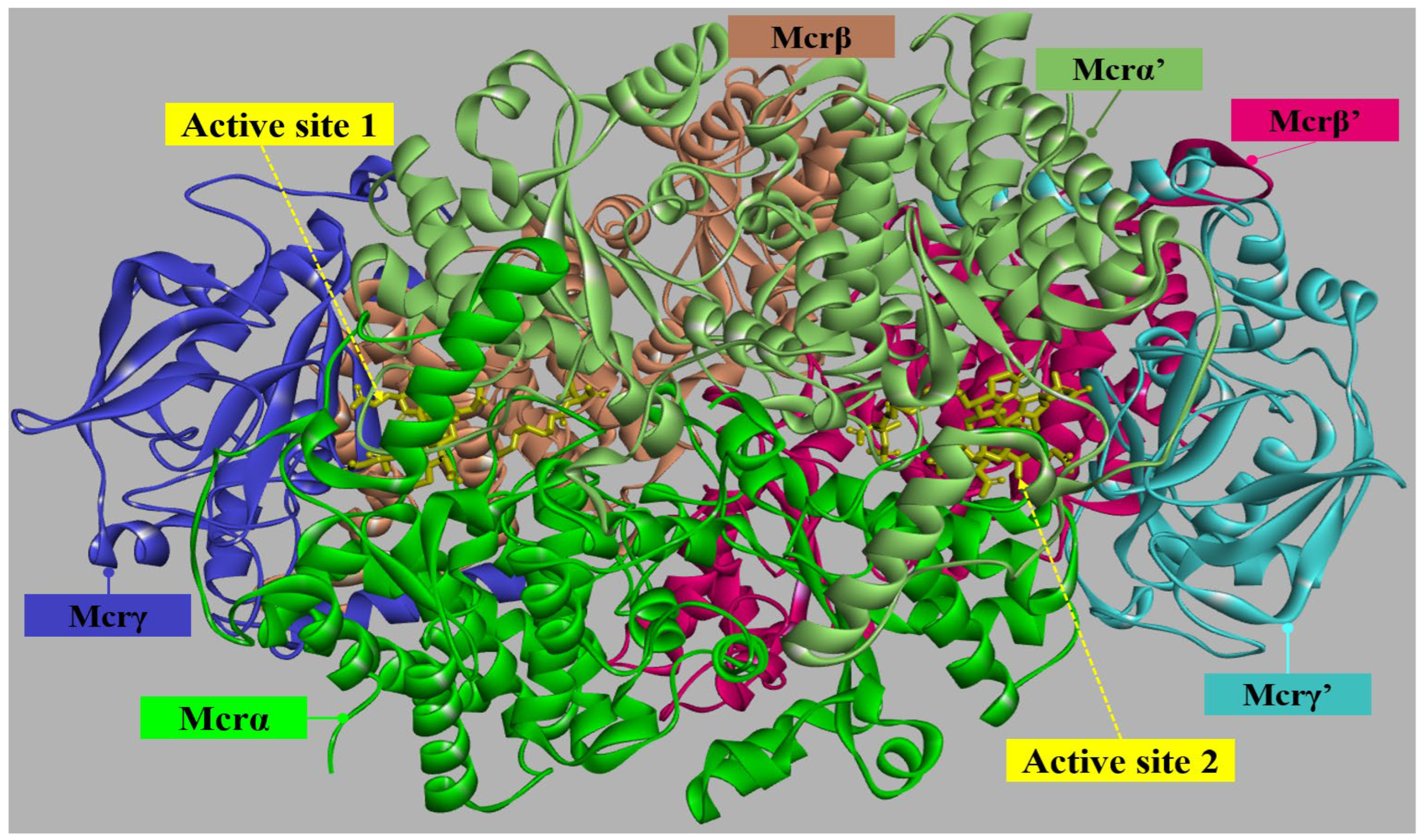
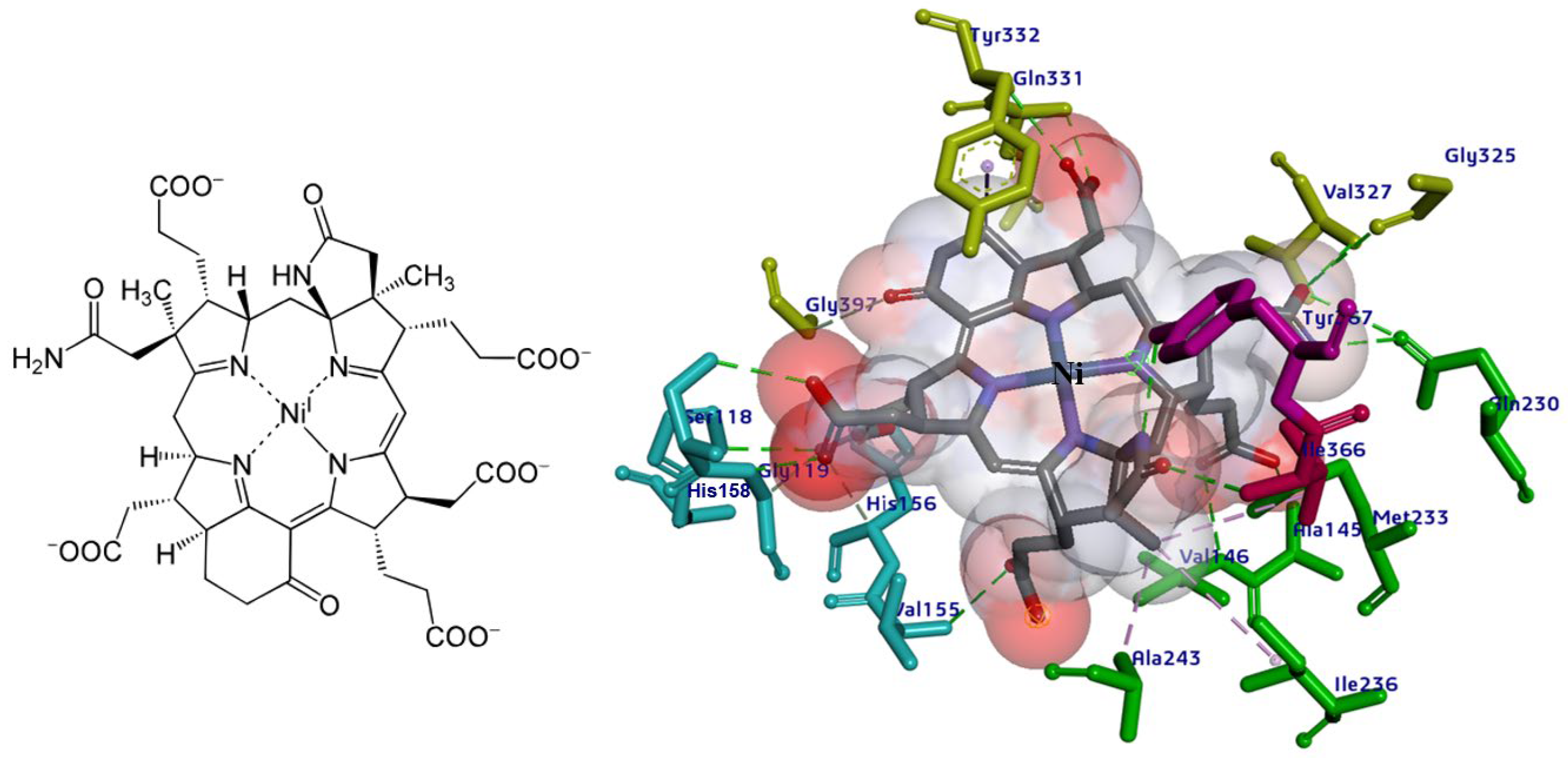
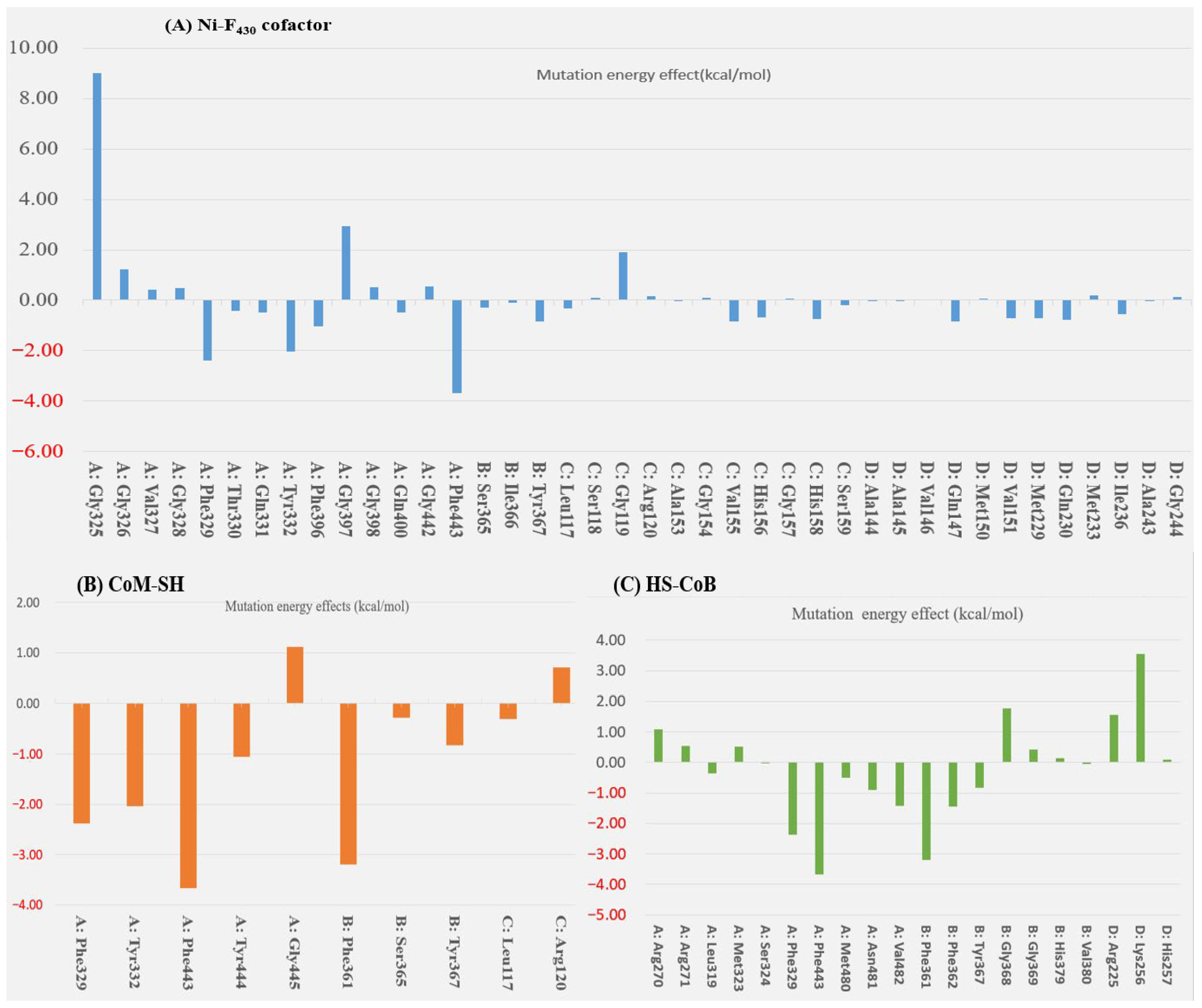
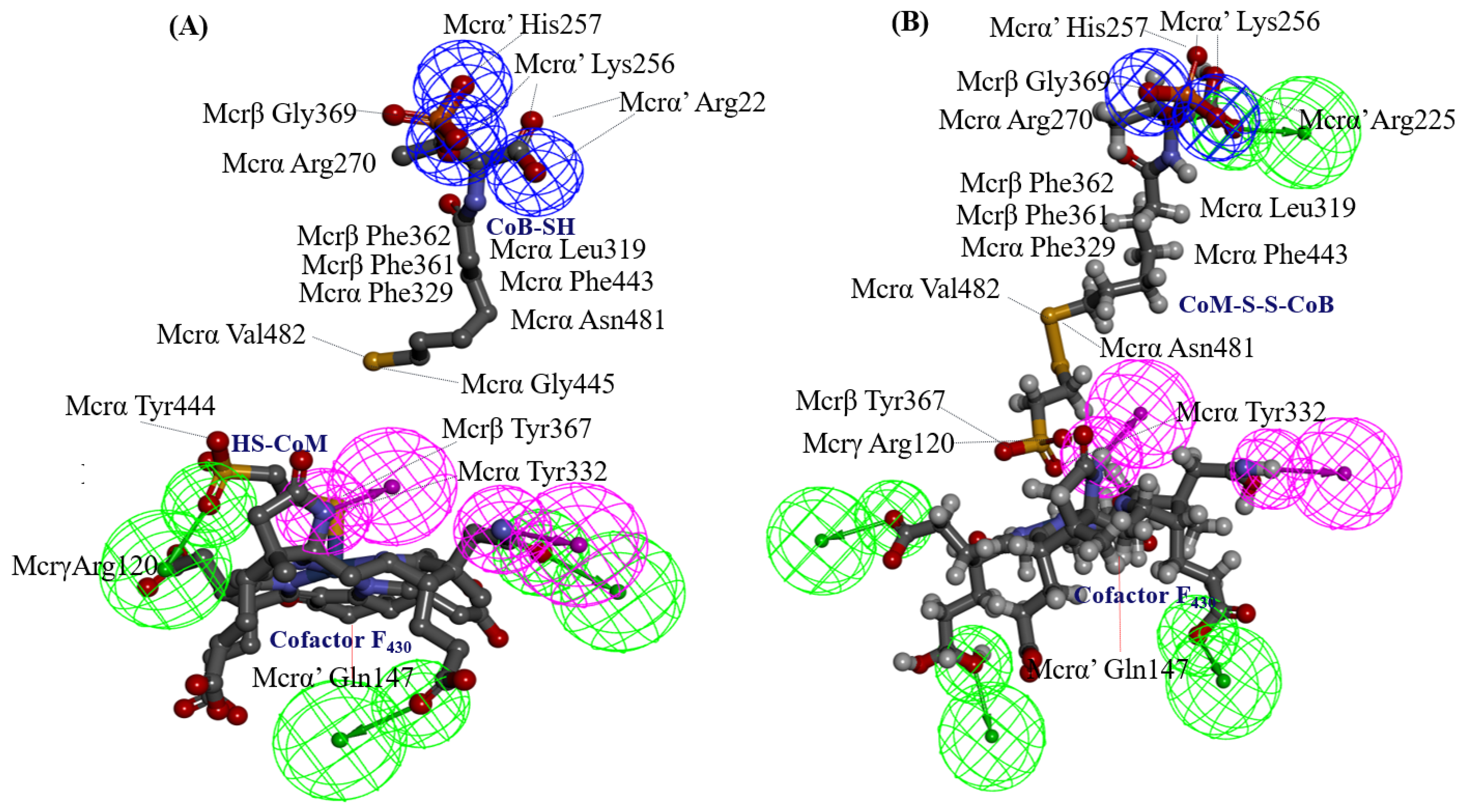
 | F430 cofactor Active site 1: (Mcrα) Gly325, Gly326, Val327, Gly328, Phe329, Thr330, Gln331, Tyr332, Phe396, Gly397, Gly398, Gln400, Gly442, Phe443 (Mcrβ) Ser365, Ile366, Tyr367 (Mcrγ) Leu117, Ser118, Gly119, Arg120, Ala153, Gly154, Val155, His156, Gly157, His158, Ser159 (Mcrα′) Ala144, Ala145, Val146, Gln147, Met150, Val151, Met229, Gln230, Met233, Ile236, Ala243, Gly244 Active site 2: (Mcrα) Ala144, Ala145, Val146, Gln147, Met150, Val151, Met229, Gln230, Met233, Gly244, ILE236, Ala243 (Mcrα′) Gly325, Gly326, Val327, Gly328, Phe329, Thr330, Gln331, Tyr332, Phe396, Gly397, Gly398, Gln400, Gly442, Phe443 (Mcrβ′) Ser365, Ile366, Tyr367 (Mcrγ′) Leu117, Ser118, Gly119, Arg120, Ala153, Gly154, Val155, His156, Gly157, His158, Ser159 |
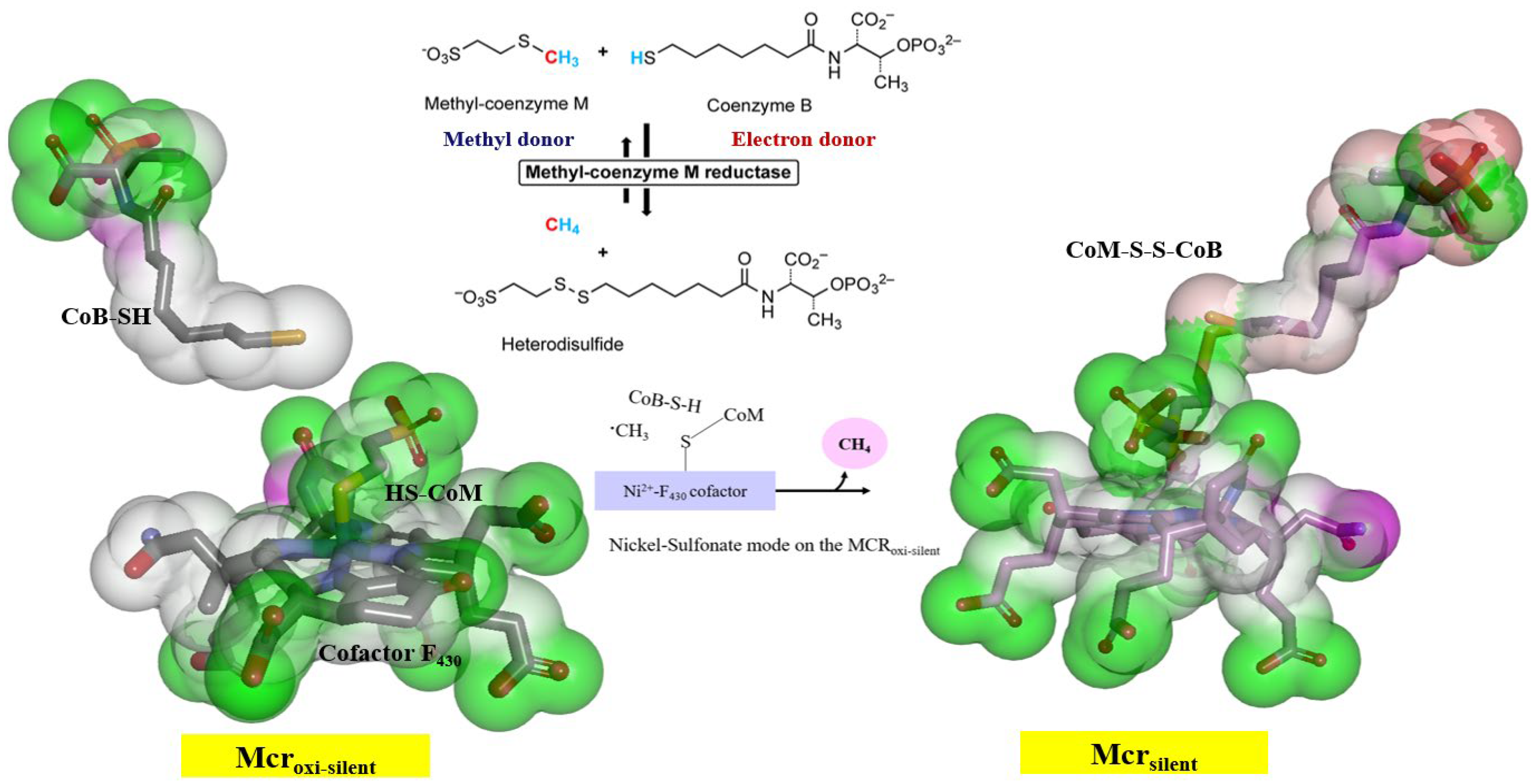
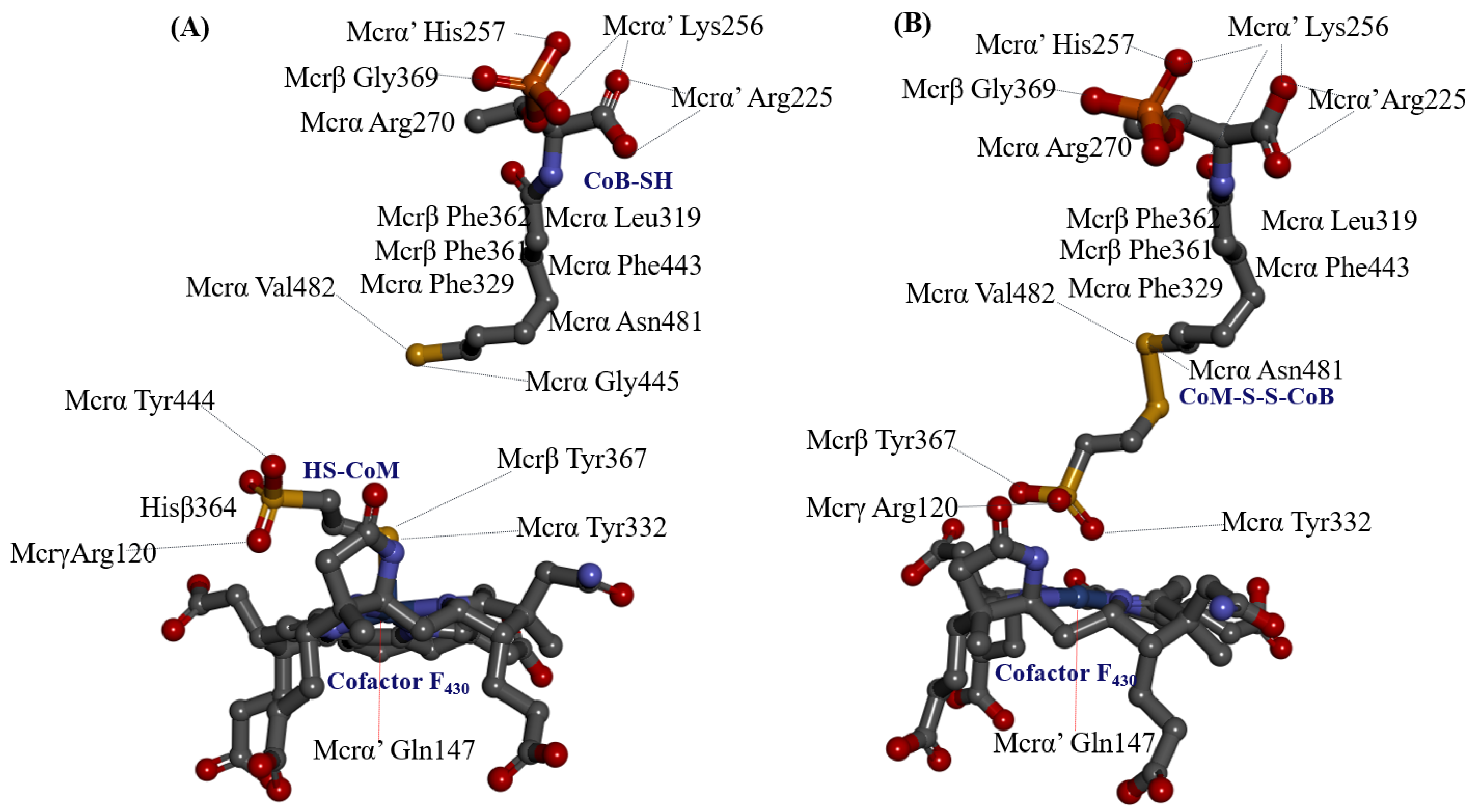
 | CoM-SH Active site 1: (Mcrα) Phe329, Tyr332, Phe443, Tyr444, Gly445 (Mcrβ) Phe361, Ser365, Tyr367 (Mcrγ) Leu117, Arg120 Active site 2: (Mcrα′) Phe329, Tyr332, Phe443, Tyr444, Gly445 (Mcrβ′) Phe361, Tyr367, Ser365 (Mcrγ′) Leu117, Arg120 |
 | CoB-SH Active site 1: (Mcrα) Arg270, Arg271, Leu319, Met323, Ser324, Phe329, Phe443, Met480, Asn481, Val482 (Mcrβ) Phe361, Phe362, Tyr367, Gly368, Gly369, His379, Val380, Val381 (Mcrα′) Arg225, Lys256, His257 Active site 2: (Mcrα) Arg225, Lys256, His257 (Mcrα′) Arg270, Arg271, Leu319, Met323, Ser324, Phe329, Phe443, Met480, Asn481, Val482 (Mcrβ′) Phe361, Phe362, Tyr367, Gly368, Gly369, His379, Val380, Val381 |
| 2D-Interaction Coloration | Interaction Counterparts in the Mcrsilent * |
|---|---|
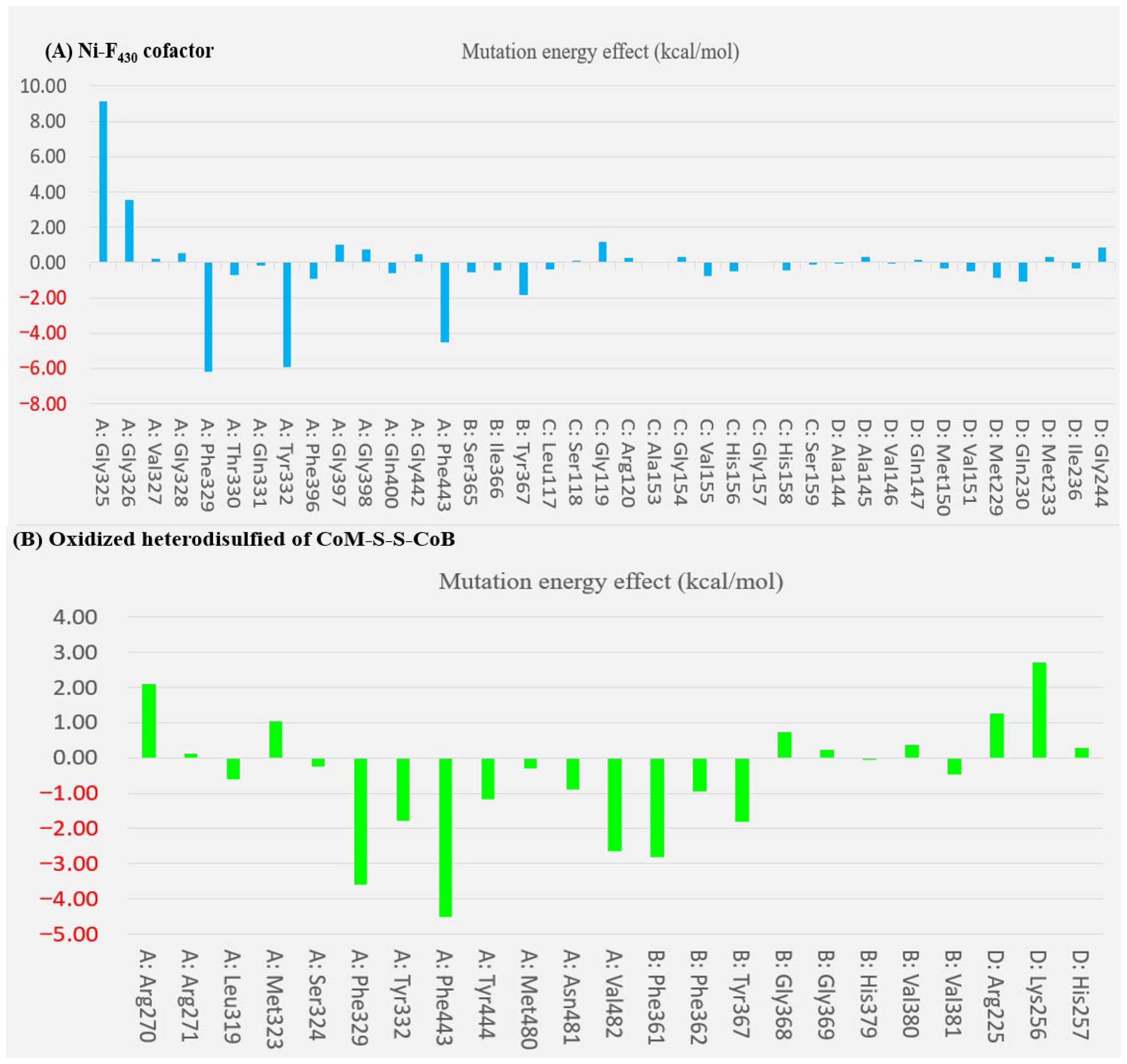
 | F430 cofactor Active site 1: (Mcrα) Gly325, Gly326, Val327, Gly328, Phe329, Thr330, Gln331, Tyr332, Phe396, Gly397, Gly398, Gln400, Gly442, Phe443 (Mcrβ) Ser365, Ile366, Tyr367 (Mcrγ) Leu117, Ser118, Gly119, Arg120, Ala153, Gly154, Val155, His156, Gly157, His158, Ser159 (Mcrα′) Ala144, Ala145, Val146, Gln147, Met150, Val151, Met229, Gln230, Ala243, Met233, Ile236, Gly244 Active site 2: (Mcrα) Ala144, Ala145, Val146, Gln147, Met150, Val151, Met229, Gln230, Met233, Ile236, Ala243, Gly244 (Mcrα′) Gly325, Gly326, Val327, Gly328, Phe329, Thr330, Gln331, Tyr332, Phe396, Gly397, Gly398, Gln400, Gly442, Phe443 (Mcrβ′) Ser365, Ile366, Tyr367 (Mcrγ′) Leu117, Ser118, Gly119, Arg120, Ala153, Gly154, Val155, His156, Gly157, His158, Ser159 |
 | CoM-S-S-CoB Active site 1: (Mcrα) Arg270, Arg271, Leu319, Met323, Ser324, Phe329, Tyr332, Phe443, Tyr444, Met480, Asn481, Val482 (Mcrβ) Phe361, Phe362, Tyr367, Gly368, Gly369, His379, Val380, Val381 (Mcrα′) Arg225, Lys256, His257 Active site 2: (Mcrα) Arg225, Lys256, His257 (Mcrα′) Arg270, Arg271, Leu319, Met323, Ser324, Phe329, Tyr332, Phe443, Tyr444, Met480, Asn481, Val482 (Mcrβ′) Phe361, Phe362, Tyr367, Gly368, Gly369, His379, Val380, Val381 (Mcrγ′) Leu117 |
| Ligand Name | Binding Energy | Ligand Energy | Protein Energy | Complex Energy | Entropic Energy | Complex Entropy | Protein Entropy | Ligand Entropy |
|---|---|---|---|---|---|---|---|---|
| F430 cofactor (Mcroxi-silent) | −305.64 | 591.78 | 321.87 | 322.16 | 22.02 | −36.75 | −35.75 | −22.03 |
| CoM-SH (Mcroxi-silent) | −19.06 | 0.60 | 321.87 | 321.85 | 17.02 | −35.75 | −35.75 | −17.02 |
| CoB-SH (Mcroxi-silent) | −804.56 | 43.49 | 321.87 | 321.11 | 19.69 | −35.75 | −35.75 | −19.68 |
| F430 cofactor (Mcrsilent state) | −186.34 | 93.51 | 322.36 | 322.26 | 21.96 | −35.76 | −35.75 | −21.97 |
| CoM-S-S-CoB (Mcrsilent state) | −486.16 | −120.13 | 322.36 | 321.75 | 21.06 | −35.78 | −35.75 | −21.06 |
Disclaimer/Publisher’s Note: The statements, opinions and data contained in all publications are solely those of the individual author(s) and contributor(s) and not of MDPI and/or the editor(s). MDPI and/or the editor(s) disclaim responsibility for any injury to people or property resulting from any ideas, methods, instructions or products referred to in the content. |
© 2026 by the authors. Licensee MDPI, Basel, Switzerland. This article is an open access article distributed under the terms and conditions of the Creative Commons Attribution (CC BY) license.
Share and Cite
Chai, H.-H.; Park, W.; Lim, D. Uncovering Major Structural and Functional Features of Methyl-Coenzyme M Reductase (MCR) from Methanobrevibacter ruminantium in Complex with Two Substrates. Int. J. Mol. Sci. 2026, 27, 995. https://doi.org/10.3390/ijms27020995
Chai H-H, Park W, Lim D. Uncovering Major Structural and Functional Features of Methyl-Coenzyme M Reductase (MCR) from Methanobrevibacter ruminantium in Complex with Two Substrates. International Journal of Molecular Sciences. 2026; 27(2):995. https://doi.org/10.3390/ijms27020995
Chicago/Turabian StyleChai, Han-Ha, Woncheoul Park, and Dajeong Lim. 2026. "Uncovering Major Structural and Functional Features of Methyl-Coenzyme M Reductase (MCR) from Methanobrevibacter ruminantium in Complex with Two Substrates" International Journal of Molecular Sciences 27, no. 2: 995. https://doi.org/10.3390/ijms27020995
APA StyleChai, H.-H., Park, W., & Lim, D. (2026). Uncovering Major Structural and Functional Features of Methyl-Coenzyme M Reductase (MCR) from Methanobrevibacter ruminantium in Complex with Two Substrates. International Journal of Molecular Sciences, 27(2), 995. https://doi.org/10.3390/ijms27020995