Diversity of Integration Sites of Bovine Leukemia Virus (BLV) and Roles of Genes Related to Development of BLV-Induced Lymphoma in a Large Cohort
 , , , ,
  and
and
Abstract
1. Introduction
2. Results
2.1. Distribution Analysis Revealed That BLV Proviruses Exhibit a Preference for Integration into Exon and Intron
2.2. Extraction of “IS-Related Genes” and Genetic Analysis Revealed That the Effects of BLV Integration near Cancer-Related Genes on the Onset of EBL Were Limited
2.3. GO Analysis of “IS-Related Gene” Revealed That a Subset of Related Genes Is Involved in Pathways for Oncogenesis
2.4. Analysis of “IS-Clustered Genes” Revealed That the Clustered Genes Were Strongly Associated with the Onset of EBL
2.5. GO Analysis Revealed That the “IS-Clustered Genes” Have a Role in the Onset of EBL
2.6. Discovery of “Common EBL-Related Clusters” Through Integrated Analysis of the “IS-Clustered Genes” and Previously Reported Genes
2.7. GO Analysis Revealed That “Common EBL-Related Clusters” Have Various Functions in the Onset of EBL
3. Discussion
4. Materials and Methods
4.1. Sample Collection and Extraction of Genomic DNA
4.2. NGS DNA Library Preparation and Library Enhancement by Viral-DNA Capture
4.3. High-Throughput Sequencing Data Analysis
4.4. Confirmation of Provirus ISs Using Sanger Sequencing
4.5. Gene Ontology Analysis
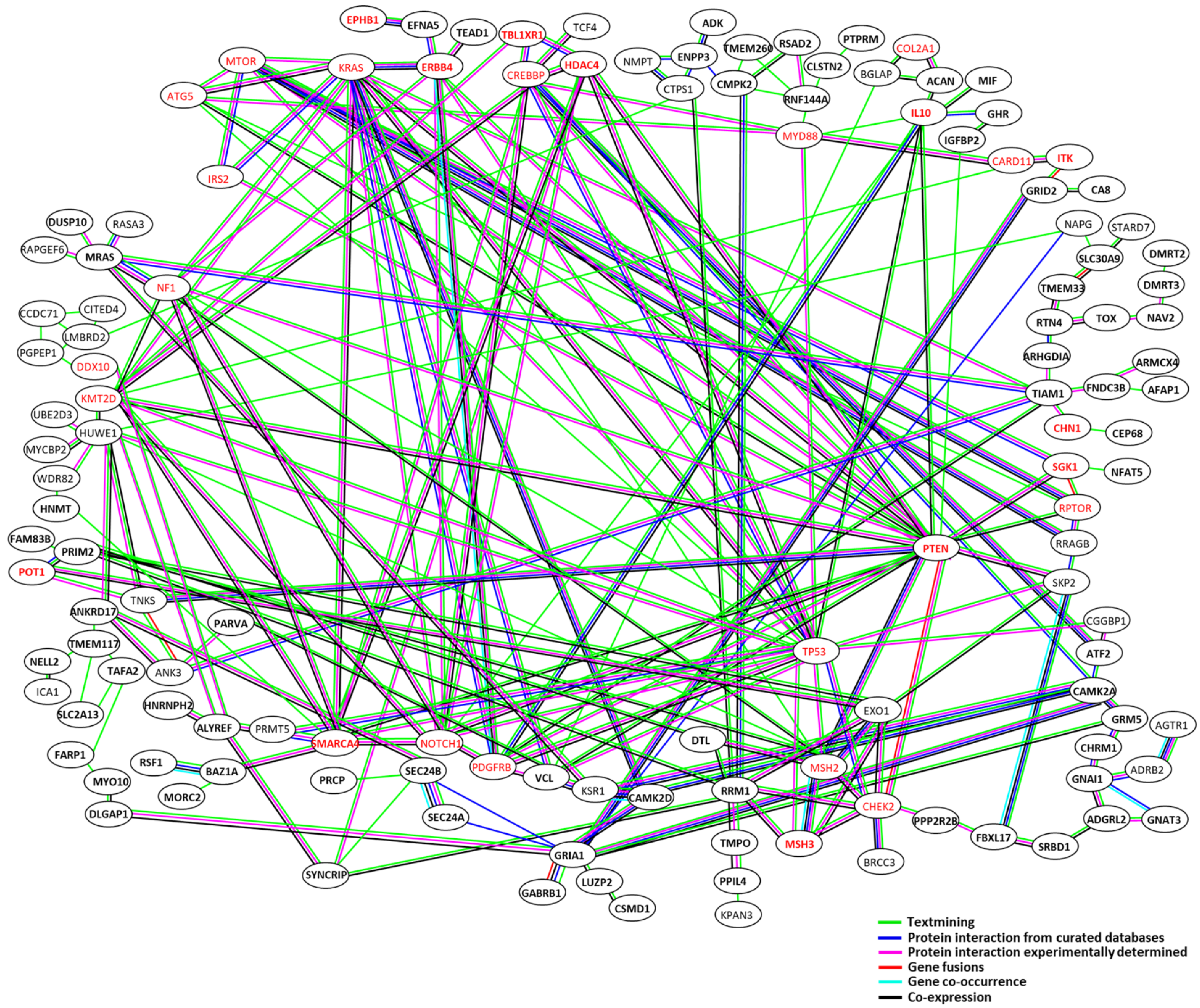
4.6. Protein Interaction Analysis
4.7. Statistical Analysis
5. Conclusions
Author Contributions
Funding
Institutional Review Board Statement
Informed Consent Statement
Data Availability Statement
Acknowledgments
Conflicts of Interest
Abbreviations
| BLV | Bovine leukemia virus |
| EBL | Enzootic bovine leucosis |
| CHEK2 | checkpoint kinase 2 |
| DAVID | Database for Annotation, Visualization, and Integrated Discovery |
| DNA | DNA repeat element |
| GO | Gene ontology |
| HTLV-1 | Human T-cell leukemia viruses type 1 |
| IS(s) | Integration site(s) |
| LINE | Long interspersed nuclear elements |
| LTR | Long terminal repeats |
| SINE | Short interspersed nuclear elements |
References
- Aida, Y.; Murakami, H.; Takahashi, M.; Takeshima, S.N. Mechanisms of pathogenesis induced by bovine leukemia virus as a model for human T-cell leukemia virus. Front. Microbiol. 2013, 4, 328. [Google Scholar] [CrossRef] [PubMed]
- Kettmann, R.; Portetelle, D.; Mammerickx, M.; Cleuter, Y.; Dekegel, D.; Galoux, M.; Ghysdael, J.; Burny, A.; Chantrenne, H. Bovine leukemia virus: An exogenous RNA oncogenic virus. Proc. Natl. Acad. Sci. USA 1976, 73, 1014–1018. [Google Scholar] [CrossRef] [PubMed]
- Depelchin, A.; Letesson, J.J.; Lostrie-Trussart, N.; Mammerickx, M.; Portetelle, D.; Burny, A. Bovine leukemia virus (BLV)-infected B-cells express a marker similar to the CD5 T cell marker. Immunol. Lett. 1989, 20, 69–76. [Google Scholar] [CrossRef] [PubMed]
- Jimba, M.; Takeshima, S.N.; Matoba, K.; Endoh, D.; Aida, Y. BLV-CoCoMo-qPCR: Quantitation of bovine leukemia virus proviral load using the CoCoMo algorithm. Retrovirology 2010, 7, 91. [Google Scholar] [CrossRef]
- Ohno, A.; Takeshima, S.N.; Matsumoto, Y.; Aida, Y. Risk factors associated with increased bovine leukemia virus proviral load in infected cattle in Japan from 2012 to 2014. Virus Res. 2015, 210, 283–290. [Google Scholar] [CrossRef]
- Murakami, H.; Todaka, H.; Uchiyama, J.; Sato, R.; Sogawa, K.; Sakaguchi, M.; Tsukamoto, K. A point mutation to the long terminal repeat of bovine leukemia virus related to viral productivity and transmissibility. Virology 2019, 537, 45–52. [Google Scholar] [CrossRef]
- Inoue, E.; Matsumura, K.; Soma, N.; Hirasawa, S.; Wakimoto, M.; Arakaki, Y.; Yoshida, T.; Osawa, Y.; Okazaki, K. L233P mutation of the Tax protein strongly correlated with leukemogenicity of bovine leukemia virus. Vet. Microbiol. 2013, 167, 364–371. [Google Scholar] [CrossRef]
- Borjigin, L.; Lo, C.W.; Bai, L.; Hamada, R.; Sato, H.; Yoneyama, S.; Yasui, A.; Yasuda, S.; Yamanaka, R.; Mimura, M.; et al. Risk Assessment of Bovine Major Histocompatibility Complex Class II DRB3 Alleles for Perinatal Transmission of Bovine Leukemia Virus. Pathogens 2021, 10, 502. [Google Scholar] [CrossRef]
- Miyasaka, T.; Takeshima, S.N.; Jimba, M.; Matsumoto, Y.; Kobayashi, N.; Matsuhashi, T.; Sentsui, H.; Aida, Y. Identification of bovine leukocyte antigen class II haplotypes associated with variations in bovine leukemia virus proviral load in Japanese Black cattle. Tissue Antigens 2013, 81, 72–82. [Google Scholar] [CrossRef]
- Takeshima, S.N.; Ohno, A.; Aida, Y. Bovine leukemia virus proviral load is more strongly associated with bovine major histocompatibility complex class II DRB3 polymorphism than with DQA1 polymorphism in Holstein cow in Japan. Retrovirology 2019, 16, 14. [Google Scholar] [CrossRef]
- Bai, L.; Borjigin, L.; Sato, H.; Takeshima, S.; Asaji, S.; Ishizaki, H.; Kawashima, K.; Obuchi, Y.; Sunaga, S.; Ando, A.; et al. Kinetic Study of BLV Infectivity in BLV Susceptible and Resistant Cattle in Japan from 2017 to 2019. Pathogens 2021, 10, 1281. [Google Scholar] [CrossRef] [PubMed]
- Lo, C.W.; Borjigin, L.; Saito, S.; Fukunaga, K.; Saitou, E.; Okazaki, K.; Mizutani, T.; Wada, S.; Takeshima, S.N.; Aida, Y. BoLA-DRB3 Polymorphism is Associated with Differential Susceptibility to Bovine Leukemia Virus-Induced Lymphoma and Proviral Load. Viruses 2020, 12, 352. [Google Scholar] [CrossRef] [PubMed]
- Lo, C.W.; Takeshima, S.N.; Okada, K.; Saitou, E.; Fujita, T.; Matsumoto, Y.; Wada, S.; Inoko, H.; Aida, Y. Association of Bovine Leukemia Virus-Induced Lymphoma with BoLA-DRB3 polymorphisms at DNA, amino acid, and binding pocket property levels. Pathogens 2021, 10, 437. [Google Scholar] [CrossRef] [PubMed]
- Nakatsuchi, A.; Watanuki, S.; Borjigin, L.; Sato, H.; Bai, L.; Matsuura, R.; Kuroda, M.; Murakami, H.; Sato, R.; Asaji, S.; et al. BoLA-DRB3 Polymorphism Controls Proviral Load and Infectivity of Bovine Leukemia Virus (BLV) in Milk. Pathogens 2022, 11, 210. [Google Scholar] [CrossRef]
- Maezawa, M.; Fujii, Y.; Akagami, M.; Kawakami, J.; Inokuma, H. BoLA-DRB3*15:01 allele is associated with susceptibility to early enzootic bovine leukosis onset in Holstein-Friesian and Japanese Black cattle. Vet. Microbiol. 2023, 284, 109829. [Google Scholar] [CrossRef]
- Lo, C.W.; Takeshima, S.N.; Wada, S.; Matsumoto, Y.; Aida, Y. Bovine major histocompatibility complex (BoLA) heterozygote advantage against the outcome of bovine leukemia virus infection. HLA 2021, 98, 132–139. [Google Scholar] [CrossRef]
- Dequiedt, F.; Kettmann, R.; Burny, A.; Willems, L. Mutations in the p53 tumor-suppressor gene are frequently associated with bovine leukemia virus-induced leukemogenesis in cattle but not in sheep. Virology 1995, 209, 676–683. [Google Scholar] [CrossRef]
- Komori, H.; Ishiguro, N.; Horiuchi, M.; Shinagawa, M.; Aida, Y. Predominant p53 mutations in enzootic bovine leukemic cell lines. Vet. Immunol. Immunopathol. 1996, 52, 53–63. [Google Scholar] [CrossRef]
- Ishiguro, N.; Furuoka, H.; Matsui, T.; Horiuchi, M.; Shinagawa, M.; Asahina, M.; Okada, K. p53 mutation as a potential cellular factor for tumor development in enzootic bovine leukosis. Vet. Immunol. Immunopathol. 1997, 55, 351–358. [Google Scholar] [CrossRef]
- Zhuang, W.; Tajima, S.; Okada, K.; Ikawa, Y.; Aida, Y. Point mutation of p53 tumor suppressor gene in bovine leukemia virus-induced lymphosarcoma. Leukemia 1997, 11, 344–346. [Google Scholar]
- Tajima, S.; Zhuang, W.Z.; Kato, M.V.; Okada, K.; Ikawa, Y.; Aida, Y. Function and Conformation of Wild-Type p53 Protein Are Influenced by Mutations in Bovine Leukemia Virus-Induced B-Cell Lymphosarcoma. Virology 1998, 243, 235–246. [Google Scholar] [CrossRef][Green Version]
- Nishimori, A.; Andoh, K.; Matsuura, Y.; Okagawa, T.; Konnai, S. Effect of C-to-T transition at CpG sites on tumor suppressor genes in tumor development in cattle evaluated by somatic mutation analysis in enzootic bovine leukosis. mSphere 2024, 9, e0021624. [Google Scholar] [CrossRef]
- Assi, W.; Hirose, T.; Wada, S.; Matsuura, R.; Takeshima, S.N.; Aida, Y. PRMT5 Is Required for Bovine Leukemia Virus Infection In Vivo and Regulates BLV Gene Expression, Syncytium Formation, and Glycosylation In Vitro. Viruses 2020, 12, 650. [Google Scholar] [CrossRef] [PubMed]
- Bai, L.; Hirose, T.; Assi, W.; Wada, S.; Takeshima, S.N.; Aida, Y. Bovine Leukemia Virus Infection Affects Host Gene Expression Associated with DNA Mismatch Repair. Pathogens 2020, 9, 909. [Google Scholar] [CrossRef] [PubMed]
- Murakami, H.; Yamada, T.; Suzuki, M.; Nakahara, Y.; Suzuki, K.; Sentsui, H. Bovine leukemia virus integration site selection in cattle that develop leukemia. Virus Res. 2011, 156, 107–112. [Google Scholar] [CrossRef] [PubMed]
- Miyasaka, T.; Oguma, K.; Sentsui, H. Distribution and characteristics of bovine leukemia virus integration sites in the host genome at three different clinical stages of infection. Arch. Virol. 2015, 160, 39–46. [Google Scholar] [CrossRef]
- Rosewick, N.; Durkin, K.; Artesi, M.; Marçais, A.; Hahaut, V.; Griebel, P.; Arsic, N.; Avettand-Fenoel, V.; Burny, A.; Charlier, C.; et al. Cis-perturbation of cancer drivers by the HTLV-1/BLV proviruses is an early determinant of leukemogenesis. Nat. Commun. 2017, 8, 15264. [Google Scholar] [CrossRef]
- Maezawa, M.; Inokuma, H. Analysis of bovine leukemia virus integration sites in cattle under 3 years old with enzootic bovine leukosis. Arch. Virol. 2020, 165, 179–183. [Google Scholar] [CrossRef]
- Ohnuki, N.; Kobayashi, T.; Matsuo, M.; Nishikaku, K.; Kusama, K.; Torii, Y.; Inagaki, Y.; Hori, M.; Imakawa, K.; Satou, Y. A target enrichment high throughput sequencing system for characterization of BLV whole genome sequence, integration sites, clonality and host SNP. Sci. Rep. 2021, 11, 4521. [Google Scholar] [CrossRef]
- Babii, A.V.; Arkhipova, A.L.; Kovalchuk, S.N. Identification of novel integration sites for bovine leukemia virus proviral DNA in cancer driver genes in cattle with persistent lymphocytosis. Virus Res. 2022, 317, 198813. [Google Scholar] [CrossRef]
- Yamanaka, M.P.; Saito, S.; Hosomichi, K.; Aida, Y. Comprehensive Comparison of Novel Bovine Leukemia Virus (BLV) Integration Sites between B-Cell Lymphoma Lines BLSC-KU1 and BLSC-KU17 Using the Viral DNA Capture High-Throughput Sequencing Method. Viruses 2022, 14, 995. [Google Scholar] [CrossRef] [PubMed]
- Saito, S.; Hosomichi, K.; Yamanaka, M.P.; Mizutani, T.; Takeshima, S.N.; Aida, Y. Visualization of clonal expansion after massive depletion of cells carrying the bovine leukemia virus (BLV) integration sites during the course of disease progression in a BLV naturally-infected cow: A case report. Retrovirology 2022, 19, 24. [Google Scholar] [CrossRef] [PubMed]
- Kubota, S.; Siomi, H.; Hatanaka, M.; Pomerantz, R.J. Cis/trans-activation of the interleukin-9 receptor gene in an HTLV-I-transformed human lymphocytic cell. Oncogene 1996, 12, 1441–1447. [Google Scholar] [PubMed]
- Ozawa, T.; Itoyama, T.; Sadamori, N.; Yamada, Y.; Hata, T.; Tomonaga, M.; Isobe, M. Rapid isolation of viral integration site reveals frequent integration of HTLV-1 into expressed loci. J. Hum. Genet. 2004, 49, 154–165. [Google Scholar] [CrossRef]
- Cook, L.B.; Melamed, A.; Niederer, H.; Valganon, M.; Laydon, D.; Foroni, L.; Taylor, G.P.; Matsuoka, M.; Bangham, C.R. The role of HTLV-1 clonality, proviral structure, and genomic integration site in adult T-cell leukemia/lymphoma. Blood 2014, 123, 3925–3931. [Google Scholar] [CrossRef]
- Venter, J.C.; Adams, M.D.; Myers, E.W.; Li, P.W.; Mural, R.J.; Sutton, G.G.; Smith, H.O.; Yandell, M.; Evans, C.A.; Holt, R.A.; et al. The sequence of the human genome. Science 2001, 291, 1304–1351. [Google Scholar] [CrossRef]
- Mouse Genome Sequencing Consortium. Initial sequencing and comparative analysis of the mouse genome. Nature 2002, 420, 520–562. [Google Scholar] [CrossRef]
- Willyard, C. New human gene tally reignites debate. Nature 2018, 558, 354–355. [Google Scholar] [CrossRef]
- Ohira, K.; Nakahara, A.; Konnai, S.; Okagawa, T.; Nishimori, A.; Maekawa, N.; Ikebuchi, R.; Kohara, J.; Murata, S.; Ohashi, K. Bovine leukemia virus reduces anti-viral cytokine activities and NK cytotoxicity by inducing TGF-β secretion from regulatory T cells. Immun. Inflamm. Dis. 2016, 4, 52–63. [Google Scholar] [CrossRef]
- Okagawa, T.; Shimakura, H.; Konnai, S.; Saito, M.; Matsudaira, T.; Nao, N.; Yamada, S.; Murakami, K.; Maekawa, N.; Murata, S.; et al. Diagnosis and Early Prediction of Lymphoma Using High-Throughput Clonality Analysis of Bovine Leukemia Virus-Infected Cells. Microbiol. Spectr. 2022, 10, e0259522. [Google Scholar] [CrossRef]
- Li, H.; Durbin, R. Fast and accurate short read alignment with Burrows-Wheeler transform. Bioinformatics 2009, 25, 1754–1760. [Google Scholar] [CrossRef]
- Li, H.; Handsaker, B.; Wysoker, A.; Fennell, T.; Ruan, J.; Homer, N.; Marth, G.; Abecasis, G.; Durbin, R. The Sequence Alignment/Map format and SAMtools. Bioinformatics 2009, 25, 2078–2079. [Google Scholar] [CrossRef]
- Robinson, J.T.; Thorvaldsdottir, H.; Winckler, W.; Guttman, M.; Lander, E.S.; Getz, G.; Mesirov, J.P. Integrative genomics viewer. Nat. Biotechnol. 2011, 29, 24–26. [Google Scholar] [CrossRef]



| (1) Exon | |||||||||
| ASB11 | ATXN3 | C25H16orf96 | ENPP3 | GABRB1 | IL10 | LPO | MEFV | ||
| (2) Intron | |||||||||
| ADK 2 | AFAP1 | AHCYL2 | ANKRD17 | CAMK2A | CAMK2D | CARTPT | CCDC178 | CLSTN2 2,3 | DNASE1L2 |
| DPYSL3 | DPYSL5 | DYSF | E2F5 | ELOVL6 | EPHB1 | ERBB4 | ETFDH | EXOC4 | FAM151B |
| FARP1 | FER | FNDC3B | GFPT1 | GON4L | GPM6B | GRID2 | GRM5 | HDAC4 | HIBADH |
| IBTK | IP6K3 | ITK | KCNQ5 | KUF27 | LDB2 | LOC789384 | LRP2 | MAST2 | MUCR1 |
| MFSD12 | MKLN1 | MORC2 | MRAS 2 | MROH2B | MRPL18 | MSH3 | MYO1E | MYO10 | NAV2 |
| NAV3 | NFAT5 | NFYC | NIDT9 | OSBPL3 | OUTD7A | PAFAH2 | PEBP4 | POT1 2 | PPP1R1C |
| PPP2R2B | PRCP | PRDM16 | PTEN | PTPRM | PYROXD1 | RNF144A | RNGTT | RRM1 | RSF1 |
| RTN4 | SBSPON | SEC24A | SEC24B | SGK1 | SHLD1 | SLC25A14 | SMARCA4 | SNED1 | SRBD1 |
| SRPK2 2 | SYN3 | TAFA2 | TBX19 | TCERG1L | TEX14 | TIAM1 | TMEM178B | TMEM260 | TPR |
| TRHDE 2,3 | TSPAN17 | UBE3D | VCL | ZNF407 | |||||
| (3) Intergenic | |||||||||
| ACAN | ADGRL2 | AKAIN1 | ALKAL2 | ALPK2 | ALYREF | APIP | ARHGDIA | ARHGEF10 | ARL14 |
| ARMC1 | ARMCX4 | ATF2 | ATXN7L3B | BAZ1 | C10H14orf39 | C23H6orf141 | C5AR1 | C5AR2 | CA8 |
| CCDC57 | CCDC62 | CDH7 | CDH10 | CDH19 | CDK5RAP2 | CEP68 | CHN1 | CHRM1 | CLSTN2 2,3 |
| CMPK2 | CNTNAP2 | COL22A1 | CSMD1 | CYLC1 | CYSTM1 | DLGAP1 | DMRT2 | DMRT3 | DPYD |
| DRD1 | DTL | DUSP10 | EFNA5 | ETV3 | FAM83B | FBXL17 | FBOX4 | FOXR2 2 | GHR |
| GLYATL3 | GNAI1 | GNAT3 | GPR158 | GRIA1 | GSTT4 | GSTZ1 2 | HECTD2 | HIP1R | HNMT |
| HNRNPH2 | HOXA2 | HYOU1 | IGFBP2 | IGIP | KCNE4 | KLF7 | KLHDC9 2 | LOC519202 | LOC540403 |
| LCO613444 | LOC782977 | LOC790004 | LRRC31 | LRRK2 | LUZP2 | MAGEH1 2 | MALT1 | MED27 | MID1IP1 |
| MIF | MIIP | MIR135A-2 | MIR2902 | MYO3A | NDUFV3 | NECTIN4 2 | NELL2 | NTNG2 | NUDCD1 |
| PARVA | PCDH7 | PHACTR1 | PLOD2 | PON1 | PON3 | POU3F3 | PPIL4 | PPM1A | PPP1R3C |
| PRIM2 | PTBP2 | PTTG1 | RAB23 | RAMP1 | RFX7 | RPL37A | RSAD2 | SAMD7 | SATB1 |
| SKAP2 | SLC1A4 | SLC2A13 | SLC16A3 | SLC30A9 | SLC37A4 | SPDYC | STPG2 | STUM | SYNCRIP |
| SYVN1 | TBC1D7 | TBL1XR1 | TEAD1 | TEF | TEX9 | TFAP2A | THSD7A | THSD7B | TIFAB |
| TINAG | TMED8 2 | TMEM33 | TMEM106B | TMEM117 | TMPO | TOB2 | TOX | TRHDE 2,3 | TRHR |
| TSNAX | TTLL7 | USP24 | WDR4 | ZNF365 |
| Term 1 | Gene 2 | p-Value |
|---|---|---|
| homophilic cell adhesion via plasma membrane adhesion molecules | CDH10, CDH19, CDH7, CLSTN2, NECTIN4, PTPRM, PCDH7 | 0.00344 |
| nervous system development | EPHB1, LDB2, SMARCA4, ENFA5, NAV2, NAV3, PTEN, TFAP2A | 0.00432 |
| positive regulation of receptor signaling pathway via JAK-STAT | CAMK2A, ERBB4, GHR, IL10 | 0.00843 |
| cell–cell adhesion mediated by cadherin | FER, CDH10, CDH19, CDH7 | 0.00843 |
| modulation of chemical synaptic transmission | DLGAP1, GRIA1, GRID2, NTNG2, RTN4 | 0.0104 |
| regulation of focal adhesion assembly | EFNA5, GPM6B, VCL | 0.011 |
| protein polyubiquitination | FBXL17, FBXO4, HECTD2, DTL, RNF144A, UBE3D | 0.0173 |
| regulation of neuron migration | CAMK2A, NTNG2, PHACTR1 | 0.0175 |
| carboxylic acid catabolic process | PON1, PON3 | 0.0214 |
| protein dephosphorylation | RNGTT, DUSP10, PTEN, PPM1A, PTPRM | 0.0285 |
| positive regulation of transcription by RNA polymerase II | LDB2, POU3F3, SMARCA4, TBL1XR1, TEAD1, TEF, CCDC32, HDAC4, HOXA2, IL10, RFX7, SLC30A9, TOX, TFAP2A, ZNF407 | 0.0298 |
| cell adhesion | EPHB1, FER, ACAN, CNTNAP2, NECTIN4, PARVA, PCDH7, TINAG, VCL | 0.0308 |
| actin cytoskeleton organization | FER, ARHGEF10, MKLN1, PARVA, THSD7A, THSD7B | 0.0309 |
| regulation of neuron projection development | GRID2, NTNG2, ZNF365 | 0.0316 |
| negative regulation of mast cell activation involved in immune response | FER, ENPP3 | 0.0319 |
| regulation of branching morphogenesis of a nerve | LRRK2, RTN4 | 0.0319 |
| lactone catabolic process | PON1, PON3 | 0.0319 |
| synaptic membrane adhesion | CDH10, EFNA5, NTNG2 | 0.0362 |
| chemical synaptic transmission | CARTPT, CHRM1, EXOC4, GABRB1, GRM5 | 0.0418 |
| dendrite arborization | PHACTR1, ZNF365 | 0.0423 |
| Neurogenesis | CDK5RAP2, ERBB4, NAV2, NAV3 | 0.0426 |
| Term | Gene 1 | p-Value |
|---|---|---|
| Dopaminergic synapse | GNAI1, ATF2, CAMK2A, CAMK2D, DRD1, GRIA1, PPP2R2B | 0.00394 |
| Amphetamine addiction | ATF2, CAMK2A, CAMK2D, DRD1, GRIA1 | 0.00708 |
| Axon guidance | EPHB1, GNAI1, CAMK2A, CAMK2D, DPYSL5, EFNA5, NTNG2 | 0.0151 |
| Pyrimidine metabolism | CMPK2, DPYD, ENPP3, RRM1 | 0.0274 |
| Cholinergic synapse | GNAI1, CAMK2A, CAMK2D, CHRM1, KCNQ5 | 0.0386 |
| Long-term potentiation | CAMK2A, CAMK2D, GRIA1, GRM5 | 0.0424 |
| Term 1 | Gene 2 | p-Value |
|---|---|---|
| positive regulation of receptor signaling pathway via JAK-STAT | CAMK2A, ERBB4, GHR, IL10 | 0.000479 |
| modulation of chemical synaptic transmission | DLGAP1, GRIA1, GRID2, RTN4 | 0.0037 |
| signal transduction | ADGRL2, CAMK2A, CAMK2D, CHN1, DUSP10, FAM83B, GABRB1, MYO10, PTPRM | 0.00394 |
| nervous system development | EPHB1, SMARCA4, EFNA5, NAV2, PTEN | 0.00639 |
| ephrin receptor signaling pathway | EPHB1, CHN1, EFNA5 | 0.00785 |
| positive regulation of synapse assembly | CLSTN2, EFNA5, GRID2 | 0.0135 |
| positive regulation of miRNA transcription | SMARCA4, TEAD1, IL10 | 0.0158 |
| NK T cell differentiation | ITK, ATF2 | 0.0195 |
| protein phosphorylation | EPHB1, ITK, CAMK2A, CAMK2D, ERBB4, SGK1 | 0.0235 |
| positive regulation of toll-like receptor 9 signaling pathway | RSAD2, RTN4 | 0.0271 |
| monoatomic ion transport | GABRB1, GRIA1, GRID2 | 0.0277 |
| cellular response to forskolin | GNAI1, EFNA5 | 0.0461 |
| regulation of neuronal synaptic plasticity | CAMK2A, CAMK2D | 0.0498 |
| Term1 | Gene 2 | p-Value |
|---|---|---|
| Dopaminergic synapse | GNAI1, ATF2, CAMK2A, CAMK2D, GRIA1, PPP2R2B | 0.000622 |
| PI3K-Akt signaling pathway | ATF2, CHRM1, EFNA5, ERBB4, GHR, PTEN, PPP2R2B, SGK1 | 0.00356 |
| Amphetamine addiction | ATF2, CAMK2A, CAMK2D, GRIA1 | 0.00522 |
| Long-term potentiation | CAMK2A, CAMK2D, GRIA1, GRM5 | 0.00543 |
| Adrenergic signaling in cardiomyocytes | GNAI1, ATF2, CAMK2A, CAMK2D, PPP2R2B | 0.00852 |
| cAMP signaling pathway | GNAI1, TIAM1, CAMK2A, CAMK2D, CHRM1, GRIA1 | 0.00888 |
| Nucleotide metabolism | ADK, CMPK2, ENPP3, RRM1 | 0.0102 |
| Axon guidance | EPHB1, GNAI1, CAMK2A, CAMK2D, EFNA5 | 0.0135 |
| Circadian entrainment | GNAI1, CAMK2A, CAMK2D, GRIA1 | 0.0148 |
| Proteoglycans in cancer | TIAM1, CAMK2A, CAMK2D, ERBB4, MRAS | 0.0204 |
| Cholinergic synapse | GNAI1, CAMK2A, CAMK2D, CHRM1 | 0.0209 |
| Glutamatergic synapse | DLGAP1, GNAI1, GRIA1, GRM5 | 0.0209 |
| Pyrimidine metabolism | CMPK2, ENPP3, RRM1 | 0.0365 |
| Long-term depression | GNAI1, GRIA1, GRID2 | 0.0412 |
| Retrograde endocannabinoid signaling | GNAI1, GABRB1, GRIA1, GRM5 | 0.044 |
| Calcium signaling pathway | CAMK2A, CAMK2D, CHRM1, ERBB4, GRM5 | 0.0455 |
| Cushing syndrome | GNAI1, ATF2, CAMK2A, CAMK2D | 0.0468 |
| Gene 1 | Reference |
|---|---|
| ADRB2, AGTR1, APOH, BGLAP, BSP1, CD99, CHGB, FAM83D, MTOR | [28] |
| ARHGEF4, BRCC3, CDX1, CGGBP1, COL2A1, DDX10, ELF2, FAM168B, FOXR2, GAS6, HUWE1, ICA1, IRS2, KLHL14, KPNA3, KSR1, LHPP, MSH2, MTCP1, MYCBP2, N4BP2, NAPG, NF1, OSBPL8, PDGFRB, PPP1R12C, PRPSAP2, RAPGEF6, RASA3, RRAGB, SCAF8, SEPT11, SNIIP1, SPOCK1, STARD7, TCF4, TMEM67, TNKS, UBASH3B, UBE2D3, WDR82 | [30] |
| ANK3, FAM135B, FAM92A | [32] |
| CCDC71, CITED4, CTPS1, LMBRD2, NAMPT, PGPEP1, SCFD2, SKP2 | [33] |
| PRTN4IP1, ATG5, RPTOR | [34] |
| CHEK2 | [35] |
| Gene 1 | References |
|---|---|
| TP53 | [17,18,19,20,21] |
| TP53, KMT2D, CREBBP, KRAS, PTEN, NOTCH1, MYD88, CARD11 | [25] |
| PRMT5 | [26] |
| EXO1, MSH2 | [27] |
| Term 1 | Gene 2 | p-Value |
|---|---|---|
| positive regulation of receptor signaling pathway via JAK-STAT | CAMK2A, ERBB4, GHR, IL10, NOTCH1 | 0.0000968 |
| positive regulation of transcription by RNA polymerase II | CREBBP, MYD88, SMARCA4, TBL1XR1, TEAD1, ADRB2, HDAC4, IL10, KMT2D, NAMPT, SLC30A9, TNKS, TOX, TXF4, TP53 | 0.000198 |
| Ras protein signal transduction | KRAS, RAPGEF6, KSR1, MRAS, TP53 | 0.000835 |
| protein phosphorylation | EPHB1, ITK, CAMK2A, CAMK2D, CHEK2, ERBB4, KSR1, MTOR, PDGFRB, SGK1 | 0.00111 |
| negative regulation of autophagy | RRAGB, IL10, MTOR, RPTOR | 0.00179 |
| positive regulation of miRNA transcription | SMARCA4, TEAD1, IL10, TP53 | 0.00345 |
| TORC1 signaling | CARD11, MTOR, RPTOR | 0.00378 |
| cellular response to leucine starvation | RRAGB, ATF2, MTOR | 0.00378 |
| mismatch repair | EXO1, MSH2, MSH3 | 0.00544 |
| Rac protein signal transduction | FARP1, KRAS, TIAM1 | 0.00605 |
| nervous system development | EPHB1, SMARCA4, EFNA5, NAV2, PTEN, RTN4IP1 | 0.00629 |
| circadian regulation of gene expression | HUWE1, MYCBP2, NAMPT, PRMT5 | 0.00639 |
| signal transduction | KRAS, ADGRL2, ANK3, CAMK2A, CAMK2D, CHN1, DUSP10, FAM83B, GABRB1, MYO10, PTPRM | 0.00719 |
| positive regulation of peptidyl-tyrosine phosphorylation | EFNA5, GHR, MTOR, TP53 | 0.0073 |
| positive regulation of calcium-mediated signaling | CA8, GRM5, PDGFRB | 0.00957 |
| protein polyubiquitination | FBXL17, HUWE1, DTL, RNF144A, TNKS | 0.0109 |
| oligodendrocyte differentiation | DUSP10, MTOR, NOTCH1 | 0.0112 |
| intrinsic apoptotic signaling pathway in response to hypoxia | ATF2, TP53 | 0.0123 |
| positive regulation of phosphatidylinositol 3-kinase/protein kinase B signal transduction | ERBB4, IRS2, PDGFRB, RTN4, TCF4 | 0.0129 |
| modulation of chemical synaptic transmission | DLGAP1, GRIA1, GRID2, RTN4 | 0.013 |
| outflow tract morphogenesis | SEC24B, ATF2, NOTCH1 | 0.0157 |
| positive regulation of G1/S transition of mitotic cell cycle | ANKRD17, RPTOR, RRM1 | 0.0167 |
| anterior head development | DDX10, COL2A1 | 0.0184 |
| ephrin receptor signaling pathway | EPHB1, CHN1, EFNA5 | 0.0187 |
| glucose homeostasis | CSMD1, BGLAP, PRCP, TCF4 | 0.02 |
| positive regulation of epithelial to mesenchymal transition | MTOR, NOTCH1, TCF4 | 0.0208 |
| protein import into nucleus | ATF2, KPNA3, NOTCH1, TP53 | 0.0223 |
| Cognition | BGLAP, CHRM1, NF1 | 0.0231 |
| maintenance of DNA repeat elements | MSH3, TCF4 | 0.0245 |
| NK T cell differentiation | ITK, ATF2 | 0.0305 |
| negative regulation of glial cell proliferation | NOTCH1, TP53 | 0.0305 |
| regulation of blood vessel endothelial cell migration | NF1, PRCP | 0.0305 |
| positive regulation of synapse assembly | CLSTN2, EFNA5, GRID2 | 0.0316 |
| mitotic recombination | MSH2, MSH3 | 0.0365 |
| regulation of somitogenesis | DMRT2, NOTCH1 | 0.0365 |
| cellular response to follicle-stimulating hormone stimulus | EFNA5, NOTCH1 | 0.0365 |
| DNA-templated transcription termination | WDR82, PRMT5 | 0.0365 |
| positive regulation of toll-like receptor 9 signaling pathway | RSAD2, RTN4 | 0.0425 |
| coronary artery morphogenesis | SEC24B, NOTCH1 | 0.0425 |
| skeletal system development | ACAN, COL2A1, HDAC4 | 0.047 |
| cardiac muscle cell apoptotic process | ATG5, TP53 | 0.0484 |
| positive regulation of transcription of nucleolar large rRNA by RNA polymerase I | SMARCA4, MTOR | 0.0484 |
| thymocyte apoptotic process | CHEK2, TP53 | 0.0484 |
| Term 1 | Gene 2 | p-Value |
|---|---|---|
| PI3K-Akt signaling pathway | KRAS, ATF2, CHRM1, COL2A1, EFNA5, ERBB4, GHR, MTOR, PTEN, PDGFRB, PPP2R2B, RPTOR, SGK1, TP53 | 0.0000292 |
| Glioma | KRAS, CAMK2A, CAMK2D, MTOR, PTEN, PDGFRB, TP53 | 0.0000554 |
| Longevity regulating pathway | KRAS, ATF2, ATG5, IRS2, MTOR, RPTOR, TP53 | 0.000124 |
| MicroRNAs in cancer | CREBBP, KRAS, EFNA5, HDAC4, IRS2, MTOR, NOTCH1, PTEN, PDGFRB, RPTOR, TP53 | 0.000227 |
| Long-term potentiation | CREBBP, KRAS, CAMK2A, CAMK2D, GRIA1, GRM5 | 0.000338 |
| Proteoglycans in cancer | KRAS, TIAM1, ANK3, CAMK2A, CAMK2D, ERBB4, MTOR, MRAS, TP53 | 0.000385 |
| Growth hormone synthesis, secretion and action | CREBBP, GNAI1, KRAS, ATF2, GHR, IRS2, MTOR | 0.00059 |
| Autophagy—animal | KRAS, RRAGB, ATG5, IRS2, MTOR, MRAS, PTEN, RPTOR | 0.000731 |
| Pathways in cancer | CREBBP, GNAI1, KRAS, SKP2, AGTR1, CAMK2A, CAMK2D, MTOR, MSH2, MSH3, NOTCH1, PTEN, PDGFRB, TP53 | 0.000926 |
| FoxO signaling pathway | CREBBP, KRAS, SKP2, IRS2, IL10, PTEN, SGK1 | 0.00109 |
| MAPK signaling pathway | KRAS, MYD88, ATF2, DUSP10, EFNA5, ERBB4, MRAS, NF1, PDGFRB, TP53 | 0.00111 |
| Prostate cancer | CREBBP, KRAS, MTOR, PTEN, PDGFRB, TP53 | 0.00164 |
| Longevity regulating pathway—multiple species | KRAS, ATG5, IRS2, MTOR, RPTOR | 0.00189 |
| Adrenergic signaling in cardiomyocytes | GNAI1, ATF2, ADRB2, AGTR1, CAMK2A, CAMK2D, PPP2R2B | 0.00244 |
| Central carbon metabolism in cancer | KRAS, MTOR, PTEN, PDGFRB, TP53 | 0.00297 |
| mTOR signaling pathway | KRAS, RRAGB, SKP2, MTOR, PTEN, RPTOR, SGK1 | 0.00303 |
| Ras signaling pathway | KRAS, RASA3, TIAM1, EFNA5, KSR1, MRAS, NF1, PDGFRB | 0.0055 |
| EGFR tyrosine kinase inhibitor resistance | KRAS, MTOR, NF1, PTEN, PDGFRB | 0.00551 |
| cAMP signaling pathway | CREBBP, GNAI1, TIAM1, ADRB2, CAMK2A, CAMK2D, CHRM1, GRIA1 | 0.00599 |
| Dopaminergic synapse | GNAI1, ATF2, CAMK2A, CAMK2D, GRIA1, PPP2R2B | 0.00645 |
| ErbB signaling pathway | KRAS, CAMK2A, CAMK2D, ERBB4, MTOR | 0.00652 |
| Nucleotide metabolism | CTPS1, ADK, CMPK2, ENPP3, RRM1 | 0.00707 |
| Calcium signaling pathway | ADRB2, AGTR1, CAMK2A, CAMK2D, CHRM1, ERBB4, GRM5, PDGFRB | 0.00784 |
| Apelin signaling pathway | GNAI1, KRAS, AGTR1, HDAC4, MTOR, MRAS | 0.00794 |
| Colorectal cancer | KRAS, MTOR, MSH2, MSH3, TP53 | 0.00825 |
| Phospholipase D signaling pathway | KRAS, AGTR1, GRM5, MTOR, MRAS, PDGFRB | 0.0107 |
| Rap1 signaling pathway | GNAI1, KRAS, RAPGEF6, TIAM1, EFNA5, MRAS, PDGFRB | 0.011 |
| Human papillomavirus infection | CREBBP, KRAS, COL2A1, MTOR, NOTCH1, PTEN, PDGFRB, PPP2R2B, TP53 | 0.0114 |
| Cushing syndrome | GNAI1, ATF2, AGTR1, CAMK2A, CAMK2D, KMT2D | 0.0119 |
| Melanogenesis | CREBBP, GNAI1, KRAS, CAMK2A, CAMK2D | 0.0122 |
| Cellular senescence | KRAS, CHEK2, MTOR, MRAS, PTEN, TP53 | 0.0138 |
| Pyrimidine metabolism | CTSP1, CMPK2, ENPP3, RRM1 | 0.0144 |
| Mismatch repair | EXO1, MSH2, MSH3 | 0.0167 |
| Long-term depression | GNAI1, KRAS, GRIA1, GRID2 | 0.0172 |
| Cholinergic synapse | GNAI1, KRAS, CAMK2A, CAMK2D, CHRM1 | 0.0176 |
| Axon guidance | EPHB1, GNAI1, KRAS, CAMK2A, CAMK2D, EFNA5 | 0.0203 |
| Thyroid hormone signaling pathway | CREBBP, KRAS, MTOR, NOTCH1, TP53 | 0.0213 |
| Amphetamine addiction | ATF2, CAMK2A, CAMK2D, GRIA1 | 0.0219 |
| Sphingolipid signaling pathway | GNAI1, KRAS, PTEN, PPP2R2B, TP53 | 0.0231 |
| Neurotrophin signaling pathway | KRAS, ARHGDIA, CAMK2A, CAMK2D, TP53 | 0.0231 |
| T cell receptor signaling pathway | ITK, KRAS, CARD11, IL10, PPP2R2B | 0.0249 |
| Melanoma | KRAS, PTEN, PDGFRB, TP53 | 0.0262 |
| Autophagy—other | ATG5, MTOR, RPTOR | 0.033 |
| Tuberculosis | CREBBP, MYD88, CAMK2A, CAMK2D, IL10, KSR1 | 0.0355 |
| Chemical carcinogenesis—receptor activation | GNAI1, KRAS, ATF2, ADRB2, KPNA3, MTOR | 0.0407 |
| Breast cancer | KRAS, MTOR, NOTCH1, PTEN, TP53 | 0.042 |
| Gap junction | GNAI1, KRAS, GRM5, PDGFRB | 0.0456 |
| Endocrine resistance | KRAS, MTOR, NOTCH1, TP53 | 0.0493 |
| PD-L1 expression and PD-1 checkpoint pathway in cancer | KRAS, MYD88, MTOR, PTEN | 0.0493 |
Disclaimer/Publisher’s Note: The statements, opinions and data contained in all publications are solely those of the individual author(s) and contributor(s) and not of MDPI and/or the editor(s). MDPI and/or the editor(s) disclaim responsibility for any injury to people or property resulting from any ideas, methods, instructions or products referred to in the content. |
© 2026 by the authors. Licensee MDPI, Basel, Switzerland. This article is an open access article distributed under the terms and conditions of the Creative Commons Attribution (CC BY) license.
Share and Cite
Matsuura, R.; Yamanaka, M.P.; Fukushi, N.; Saito, S.; Fukumoto, K.; Hosomichi, K.; Takeshima, S.-n.; Aida, Y. Diversity of Integration Sites of Bovine Leukemia Virus (BLV) and Roles of Genes Related to Development of BLV-Induced Lymphoma in a Large Cohort. Int. J. Mol. Sci. 2026, 27, 727. https://doi.org/10.3390/ijms27020727
Matsuura R, Yamanaka MP, Fukushi N, Saito S, Fukumoto K, Hosomichi K, Takeshima S-n, Aida Y. Diversity of Integration Sites of Bovine Leukemia Virus (BLV) and Roles of Genes Related to Development of BLV-Induced Lymphoma in a Large Cohort. International Journal of Molecular Sciences. 2026; 27(2):727. https://doi.org/10.3390/ijms27020727
Chicago/Turabian StyleMatsuura, Ryosuke, Meripet Polat Yamanaka, Noriko Fukushi, Susumu Saito, Keisuke Fukumoto, Kazuyoshi Hosomichi, Shin-nosuke Takeshima, and Yoko Aida. 2026. "Diversity of Integration Sites of Bovine Leukemia Virus (BLV) and Roles of Genes Related to Development of BLV-Induced Lymphoma in a Large Cohort" International Journal of Molecular Sciences 27, no. 2: 727. https://doi.org/10.3390/ijms27020727
APA StyleMatsuura, R., Yamanaka, M. P., Fukushi, N., Saito, S., Fukumoto, K., Hosomichi, K., Takeshima, S.-n., & Aida, Y. (2026). Diversity of Integration Sites of Bovine Leukemia Virus (BLV) and Roles of Genes Related to Development of BLV-Induced Lymphoma in a Large Cohort. International Journal of Molecular Sciences, 27(2), 727. https://doi.org/10.3390/ijms27020727