Modern Quantum Chemistry Methodology for Predicting 31P Nuclear Magnetic Resonance Chemical Shifts


Abstract
1. Introduction
2. Theoretical Basis for 31P NMR Chemical Shift Calculations
2.1. Quantum Chemical Representation of NMR Shielding Tensors
2.2. Gauge Origin Problem in Calculations of NMR Chemical Shifts
2.3. Brief Overview of the Main Quantum Chemistry Mehods Used in the Calculations of NMR Chemical Shifts
2.3.1. The Hartree–Fock Approximation
2.3.2. The Density Functional Theory
2.3.3. The Second-Order Møller–Plesset Approximation
2.3.4. The Coupled Cluster Formalism
3. Quantum Chemical Calculations of 31P NMR Chemical Shifts Using Conventional Approaches and Nonspecialized Tools
4. Specialized Basic Sets for Calculating 31P NMR Chemical Shifts
5. Geometry Factor Effect on 31P NMR Shielding Constants/Chemical Shifts
6. Solvent Effects on 31P NMR Shielding Constants/Chemical Shifts
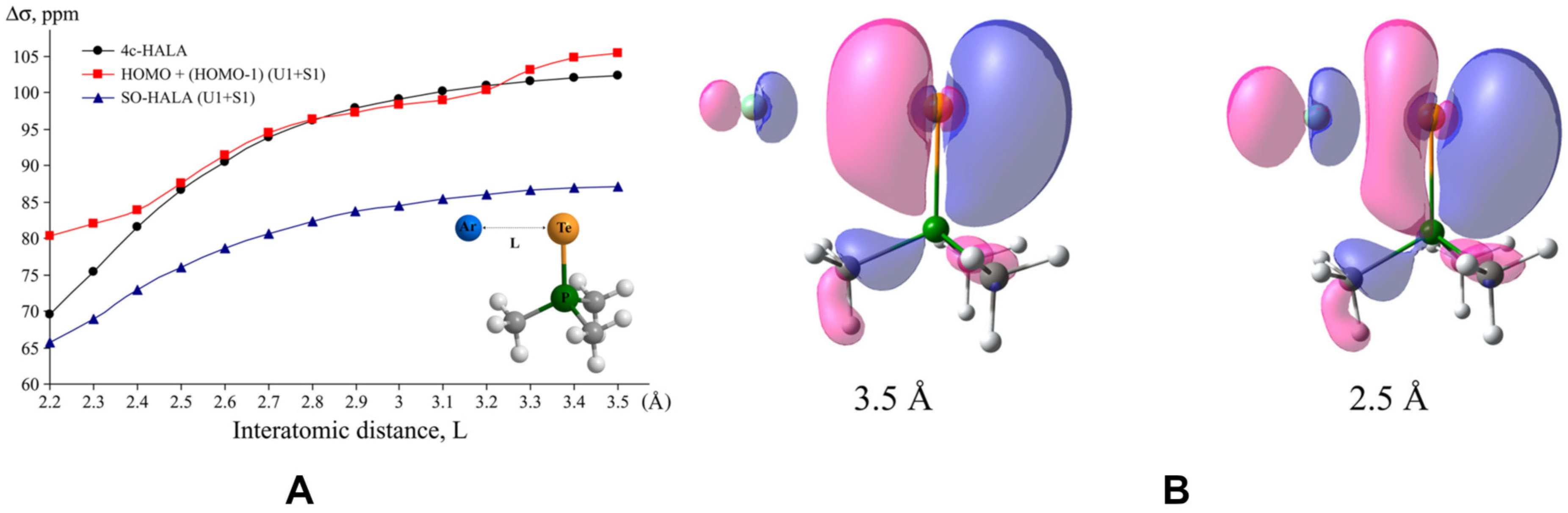
7. Relativistic Effects on 31P NMR Shielding Constants/Chemical Shifts
8. Vibrational Effects on 31P NMR Shielding Constants/Chemical Shifts
9. Popular Program Packages and Methods Allowing the NMR Shielding Constant Calculations
Author Contributions
Funding
Institutional Review Board Statement
Informed Consent Statement
Data Availability Statement
Conflicts of Interest
References
- Verkade, J.G.; Quin, L.D. (Eds.) Phosphorus 31NMR Spectroscopy in Stereochemical Analysis. In Methods in Stereochemical Analysis; VCH Publishers: Deerfield Beach, FL, USA, 1987; Volume 8, pp. 1–717. [Google Scholar]
- Ramsey, N.F. Magnetic shielding of nuclei in molecules. Phys. Rev. 1950, 78, 699–703. [Google Scholar] [CrossRef]
- Lamb, W.E., Jr. Internal Diamagnetic Fields. Phys. Rev. 1941, 60, 817–819. [Google Scholar] [CrossRef]
- Beveridge, D.L. Approximate Molecular Orbital Theory of Nuclear and Electron Magnetic Resonance Parameters. In Semiempirical Methods of Electronic Structure Calculation. Part B: Applications, 1st ed.; Segal, G.A., Ed.; Plenum Press: New York, NY, USA, 1977; pp. 163–214, Chapter 5. [Google Scholar]
- Harris, R.K.; Becker, E.D.; de Menezes, S.M.C.; Goodfellow, R.; Granger, P. NMR nomenclature. Nuclear spin properties and conventions for chemical shifts (IUPAC Recommendations 2001). Pure Appl. Chem. 2001, 73, 1795–1818. [Google Scholar] [CrossRef]
- Harris, R.K.; Becker, E.D.; de Menezes, S.M.C.; Granger, P.; Hoffman, R.E.; Zilm, K.W. Further conventions for NMR shielding and chemical shifts (IUPAC Recommendations 2008). Magn. Reson. Chem. 2008, 46, 582–598. [Google Scholar] [CrossRef]
- van Wüllen, C. A comparison of density functional methods for the calculation of phosphorus-31 NMR chemical shifts. Phys. Chem. Chem. Phys. 2000, 2, 2137–2144. [Google Scholar] [CrossRef]
- Franca, C.A.; Diez, R.P.; Jubert, A.H. On the calculation of 15N chemical shifts using linear regression formulae. A performance comparison of different methods. J. Mol. Struct. THEOCHEM 2008, 856, 1–8. [Google Scholar] [CrossRef]
- Holler, R.; Lischka, H. Coupled-Hartree-Fock calculations of susceptibilities and magnetic shielding constants. Mol. Phys. 1980, 41, 1017–1040. [Google Scholar] [CrossRef]
- Lazzeretti, P.; Zanasi, R. Theoretical determination of the magnetic properties of HCl, H2S, PH3, and SiH4 molecules. J. Chem. Phys. 1980, 72, 6768–6776. [Google Scholar] [CrossRef]
- London, F. Théorie quantique des courants interatomiques dans les combinaisons aromatiques. J. Phys. Radium 1937, 8, 397–409. [Google Scholar] [CrossRef]
- Epstein, S.T. Gauge Invariance of the Hartree-Fock Approximation. J. Chem. Phys. 1965, 42, 2897–2898. [Google Scholar] [CrossRef]
- Wolinski, K.; Hinton, J.F.; Pulay, P. Efficient implementation of the gauge-independent atomic orbital method for NMR chemical shift calculations. J. Am. Chem. Soc. 1990, 112, 8251–8260. [Google Scholar] [CrossRef]
- Schreckenbach, G. On the relation between a common gauge origin formulation and the GIAO formulation of the NMR shielding tensor. Theor. Chem. Acc. 2002, 108, 246–253. [Google Scholar] [CrossRef]
- Schreckenbach, G.; Ziegler, T. Calculation of NMR Shielding Tensors Using Gauge-Including Atomic Orbitals and Modern Density Functional Theory. J. Phys. Chem. 1995, 99, 606–611. [Google Scholar] [CrossRef]
- Schreckenbach, G.; Ziegler, T. Density functional calculations of NMR chemical shifts and ESR g-tensors. Theor. Chem. Acc. 1998, 99, 71–82. [Google Scholar] [CrossRef]
- Friedrich, K.; Seifert, G.; Großmann, G. Nuclear magnetic shielding in molecules. The application of GIAO’s in LCAO-X α-calculations. Z. Phys. D At. Mol. Clust. 1990, 17, 45–46. [Google Scholar] [CrossRef]
- Hameka, H.F. On the nuclear magnetic shielding in the hydrogen molecule. Mol. Phys. 1958, 1, 203–215. [Google Scholar] [CrossRef]
- Hameka, H.F. Berechnung der magnetischen Eigenschaften des Wasserstoffmoleküls. Z. Naturforsch. A 1959, 14, 599–602. [Google Scholar] [CrossRef]
- Ditchfield, R. Molecular orbital theory of magnetic shielding and magnetic susceptibility. J. Chem. Phys. 1972, 56, 5688–5691. [Google Scholar] [CrossRef]
- Cheesemann, J.R.; Trucks, G.W.; Keith, T.A.; Frisch, M.J. A comparison of models for calculating nuclear magnetic resonance shielding tensors. J. Chem. Phys. 1996, 104, 5497–5509. [Google Scholar] [CrossRef]
- Kutzelnigg, W.; Fleischer, U.; Schindler, M. The IGLO-Method: Ab-initio Calculation and Interpretation of NMR Chemical Shifts and Magnetic Susceptibilities. In Proceedings of the Deuterium and Shift Calculation; NMR Basic Principles and Progress; Springer-Verlag: Berlin/Heidelberg, Germany, 1990; Volume 23, pp. 165–262. [Google Scholar] [CrossRef]
- Keith, T.A.; Bader, R.F.W. Calculation of magnetic response properties using a continuous set of gauge transformations. Chem. Phys. Lett. 1993, 210, 223–231. [Google Scholar] [CrossRef]
- Keith, T.A.; Bader, R.F.W. Properties of atoms in molecules: Nuclear magnetic shielding. Can. J. Chem. 1996, 74, 185–200. [Google Scholar] [CrossRef]
- Lazzeretti, P. Methods of continuous translation of the origin of the current density revisited. Theor. Chem. Acc. 2012, 131, 1222, https://doi.org/10.1007/s00214-012-1222-y; Erratum in Theor. Chem. Acc. 2013, 132, 1317. [Google Scholar]
- Blinder, S.M. Chapter 1—Introduction to the Hartree-Fock method. In Mathematical Physics in Theoretical Chemistry; Elsevier: Amsterdam, The Netherlands, 2019; pp. 1–30. [Google Scholar] [CrossRef]
- Ditchfield, R. Self-consistent perturbation theory of diamagnetism. Mol. Phys. 1974, 27, 789–807. [Google Scholar] [CrossRef]
- Koch, W.; Holthausen, M.C. A Chemist’s Guide to Density Functional Theory, 2nd ed.; Wiley-VCH Verlag GmbH: Weinheim, Germany, 2001; pp. 1–313. [Google Scholar] [CrossRef]
- Dreizler, R.M.; Gross, E.K.U. Density Functional Theory. An Approach to the Quantum Many-Body Problem, 1st ed.; Springer: Berlin/Heidelberg, Germany, 1990; pp. 1–304. [Google Scholar] [CrossRef]
- Hohenberg, P.; Kohn, W. Inhomogeneous Electron Gas. Phys. Rev. 1964, 136, B864–B871. [Google Scholar] [CrossRef]
- Kohn, W.; Sham, L.J. Self-Consistent Equations Including Exchange and Correlation Effects. Phys. Rev. 1965, 140, A1133–A1138. [Google Scholar] [CrossRef]
- Dirac, P.A.M. Note on Exchange Phenomena in the Thomas Atom. Math. Proc. Camb. Philos. Soc. 1930, 26, 376–385. [Google Scholar] [CrossRef]
- Slater, J.C. The Self-Consistent Field for Molecules and Solids. In Quantum Theory of Molecules and Solids, 1st ed.; Slater, J.C., Ed.; McGraw-Hill: New York, NY, USA, 1974; Volume 4, pp. 1–565. [Google Scholar]
- Liu, S.; Parr, R.G. Homogeneities in density of various LDA energy functionals. J. Mol. Struct. THEOCHEM 2000, 501–502, 29–34. [Google Scholar] [CrossRef]
- Vosko, S.H.; Wilk, L.; Nusair, M. Accurate spin-dependent electron liquid correlation energies for local spin density calculations: A critical analysis. Can. J. Phys. 1980, 59, 1200–1211. [Google Scholar] [CrossRef]
- Becke, A.D. Density-functional exchange-energy approximation with correct asymptotic behavior. Phys. Rev. 1988, 38, 3098–3100. [Google Scholar] [CrossRef]
- Perdew, J.P. Density-functional approximation for the correlation energy of the inhomogeneous electron gas. Phys. Rev. B 1986, 33, 8822–8824, https://doi.org/10.1103/PhysRevB.33.8822; Erratum in Phys. Rev. B 1986, 34, 7406. [Google Scholar]
- Lee, C.; Yang, W.; Parr, R.G. Development of the Colle-Salvetti correlation-energy formula into a functional of the electron density. Phys. Rev. 1988, 37, 785–789. [Google Scholar] [CrossRef]
- Perdew, J.; Wang, Y. Accurate and simple analytic representation of the electron-gas correlation energy. Phys. Rev. B 1992, 45, 13244–13249, https://doi.org/10.1103/PhysRevB.45.13244; Erratum in Phys. Rev. B 1992, 45, 13244. [Google Scholar]
- Becke, A.D. Exchange-Correlation Approximations in Density Functional Theory. In Modern Electronic Structure Theory, Part II; Yarkony, D.R., Ed.; World Scientific: Singapore, 1995; Chapter 15, pp. 1022–1046. [Google Scholar]
- Becke, A.D. Density-functional thermochemistry. III. The role of exact exchange. J. Chem. Phys. 1993, 98, 5648–5652. [Google Scholar] [CrossRef]
- Tao, J.; Perdew, J.P.; Staroverov, V.N.; Scuseria, G.E. Climbing the Density Functional Ladder: Nonempirical Meta–Generalized Gradient Approximation Designed for Molecules and Solids. Phys. Rev. Lett. 2003, 91, 146401. [Google Scholar] [CrossRef]
- Grimme, S.; Antony, J.; Ehrlich, S.; Krieg, H. A consistent and accurate ab initio parametrization of density functional dispersion correction (DFT-D) for the 94 elements H-Pu. J. Chem. Phys. 2010, 132, 154104. [Google Scholar] [CrossRef] [PubMed]
- Mardirossian, N.; Head-Gordon, M. ωB97M-V: A combinatorially optimized, range-separated hybrid, meta-GGA density functional with VV10 nonlocal correlation. J. Chem. Phys. 2016, 144, 214110. [Google Scholar] [CrossRef]
- Peverati, R.; Truhlar, D.G. Quest for a universal density functional: The accuracy of density functionals across a broad spectrum of databases in chemistry and physics. Philos. Trans. A Math. Phys. Eng. Sci. 2014, 372, 20120476. [Google Scholar] [CrossRef] [PubMed]
- Hostas, J.; Řezáč, J. Accurate DFT-D3 Calculations in a Small Basis Set. J. Chem. Theory Comput. 2017, 13, 3575–3585. [Google Scholar] [CrossRef]
- Mardirossian, N.; Head-Gordon, M. Thirty years of density functional theory in computational chemistry: An overview and extensive assessment of 200 density functionals. Mol. Phys. 2017, 115, 2315–2372. [Google Scholar] [CrossRef]
- Brémond, É.; Tognetti, V.; Chermette, H.; Sancho-García, J.C.; Joubert, L.; Adamo, C. Electronic Energy and Local Property Errors at QTAIM Critical Points while Climbing Perdew’s Ladder of Density-Functional Approximations. J. Chem. Theory Comput. 2022, 18, 293–308. [Google Scholar] [CrossRef]
- Medvedev, M.G.; Bushmarinov, I.S.; Sun, J.; Perdew, J.P.; Lyssenko, K.A. Density functional theory is straying from the path toward the exact functional. Science 2017, 355, 49–52. [Google Scholar] [CrossRef]
- Mezei, P.D.; Csonka, G.I.; Kállay, M. Electron Density Errors and Density-Driven Exchange-Correlation Energy Errors in Approximate Density Functional Calculations. J. Chem. Theory Comput. 2017, 13, 4753–4764. [Google Scholar] [CrossRef]
- Su, N.Q.; Zhu, Z.; Xu, X. Doubly hybrid density functionals that correctly describe both density and energy for atoms. Proc. Natl. Acad. Sci. USA 2018, 115, 2287–2292. [Google Scholar] [CrossRef] [PubMed]
- Brémond, E.; Savarese, M.; Pérez-Jiménez, Á.J.; Sancho-García, J.C.; Adamo, C. Speed-Up of the Excited-State Benchmarking: Double-Hybrid Density Functionals as Test Cases. J. Chem. Theory Comput. 2017, 13, 5539–5551. [Google Scholar] [CrossRef]
- Mendes, R.A.; Haiduke, R.L.A. Performance of new exchange–correlation functionals in providing vertical excitation energies of metal complexes. Theor. Chem. Acc. 2021, 140, 146. [Google Scholar] [CrossRef]
- Goerigk, L.; Hansen, A.; Bauer, C.; Ehrlich, S.; Najibi, A.; Grimme, S. A look at the density functional theory zoo with the advanced GMTKN55 database for general main group thermochemistry, kinetics and noncovalent interactions. Phys. Chem. Chem. Phys. 2017, 19, 32184–32215. [Google Scholar] [CrossRef]
- Fadda, E.; Casida, M.E.; Salahub, D.R. NMR shieldings from sum-over-states density-functional-perturbation theory: Further testing of the “Loc.3” approximation. J. Chem. Phys. 2003, 118, 6758–6768. [Google Scholar] [CrossRef]
- Wilson, P.J.; Amos, R.D.; Handy, N.C. Toward coupled-cluster accuracy in the prediction of nuclear shielding constants: A simple and efficient DFT approach. Chem. Phys. Lett. 1999, 312, 475–484. [Google Scholar] [CrossRef]
- Helgaker, T.; Wilson, P.J.; Amos, R.D.; Handy, N.C. Nuclear shielding constants by density functional theory with gauge including atomic orbitals. J. Chem. Phys. 2000, 113, 2983–2989. [Google Scholar] [CrossRef]
- Malkin, V.G.; Malkina, O.L.; Casida, M.E.; Salahub, D.R. Nuclear Magnetic Resonance Shielding Tensors Calculated with a Sum-over-States Density Functional Perturbation Theory. J. Am. Chem. Soc. 1994, 116, 5898–5908. [Google Scholar] [CrossRef]
- Malkin, V.G.; Malkina, O.L.; Erikson, L.A.; Salahub, D.R. The calculation of NMR and ESR spectroscopy parameters using density functional theory. In Theoretical and Computational Chemistry, 1st ed.; Politzer, P., Seminario, J.M., Eds.; Elsevier: Amsterdam, The Netherlands, 1995; Volume 2, pp. 273–347. [Google Scholar] [CrossRef]
- Malkin, V.G.; Malkina, O.L.; Salahub, D.R. Calculations of NMR shielding constants beyond uncoupled density functional theory. IGLO approach. Chem. Phys. Lett. 1993, 204, 87–95. [Google Scholar] [CrossRef]
- Schreckenbach, G.; Ziegler, T. The calculation of NMR shielding tensors based on density functional theory and the frozen-core approximation. Int. J. Quantum Chem. 1996, 60, 753–766. [Google Scholar] [CrossRef]
- Schreckenbach, G.; Dickson, R.M.; Ruiz-Morales, Y.; Ziegler, T. The calculation of NMR parameters by density-functional theory—An approach based on gauge including atomic orbitals. In Chemical Applications of Density Functional Theory; Laird, B.B., Ross, R.B., Ziegler, T., Eds.; ACS Symposium Series, 629; American Chemical Society: Washington, DC, USA, 1996; pp. 328–341. [Google Scholar]
- Schreckenbach, G.; Ziegler, T. Calculation of NMR shielding tensors based on density functional theory and a scalar relativistic Pauli-type Hamiltonian. The application to transition metal complexes. Int. J. Quantum Chem. 1997, 61, 899–918. [Google Scholar] [CrossRef]
- Reimann, S.; Ekström, U.; Stopkowicz, S.; Teale, A.M.; Borgoo, A.; Helgaker, T. The importance of current contributions to shielding constants in density-functional theory. Phys. Chem. Chem. Phys. 2015, 17, 18834–18842. [Google Scholar] [CrossRef] [PubMed]
- Schattenberg, C.J.; Reiter, K.; Weigend, F.; Kaupp, M. An Efficient Coupled-Perturbed Kohn–Sham Implementation of NMR Chemical Shift Computations with Local Hybrid Functionals and Gauge-Including Atomic Orbitals. J. Chem. Theory Comput. 2020, 16, 931–943. [Google Scholar] [CrossRef] [PubMed]
- Schattenberg, C.J.; Kaupp, M. Effect of the Current Dependence of Tau-Dependent Exchange-Correlation Functionals on Nuclear Shielding Calculations. J. Chem. Theory Comput. 2021, 17, 1469–1479. [Google Scholar] [CrossRef]
- Schattenberg, C.J.; Kaupp, M. Implementation and Validation of Local Hybrid Functionals with Calibrated Exchange-Energy Densities for Nuclear Shielding Constants. J. Phys. Chem. A 2021, 125, 2697–2707. [Google Scholar] [CrossRef]
- Schattenberg, C.J.; Kaupp, M. Implementation and First Evaluation of Strong-Correlation-Corrected Local Hybrid Functionals for the Calculation of NMR Shieldings and Shifts. J. Phys. Chem. A 2024, 128, 2253–2271. [Google Scholar] [CrossRef]
- Schattenberg, C.J.; Lehmann, M.; Bühl, M.; Kaupp, M. Systematic Evaluation of Modern Density Functional Methods for the Computation of NMR Shifts of 3d Transition-Metal Nuclei. J. Chem. Theory Comput. 2022, 18, 273–292. [Google Scholar] [CrossRef]
- Grimme, S. Semiempirical GGA-type density functional constructed with a long-range dispersion correction. J. Comput. Chem. 2006, 27, 1787–1799. [Google Scholar] [CrossRef]
- Grimme, S.; Ehrlich, S.; Goerigk, L. Effect of the damping function in dispersion corrected density functional theory. J. Comput. Chem. 2011, 32, 1456–1465. [Google Scholar] [CrossRef]
- Binkley, J.S.; Pople, J.A. Møller–Plesset theory for atomic ground state energies. Int. J. Quantum Chem. 1975, 9, 229–236. [Google Scholar] [CrossRef]
- Bartlett, R.J.; Silver, D.M. Many-body perturbation theory applied to electron pair correlation energies. I. Closed-shell first-row diatomic hydrides. J. Chem. Phys. 1975, 62, 3258–3268. [Google Scholar] [CrossRef]
- Bartlett, R.J.; Silver, D.M. Correlation energy in LiH, BH, and HF with many-body perturbation theory using Slater-type atomic orbitals. Int. J. Quantum Chem. 1974, 8, 271–276. [Google Scholar] [CrossRef]
- Gauss, J.; Stanton, J.F. Electron-correlated approaches for the calculation of NMR chemical shifts. In Advances in Chemical Physics, 1st ed.; Prigogine, I., Rice, S.A., Eds.; JohnWiley & Sons, Inc.: New York, NY, USA, 2002; Volume 123, pp. 355–422. [Google Scholar]
- Pulay, P. Analytical derivative methods in quantum chemistry. In Advances in Chemical Physics: Ab Initio Methods in Quantum Chemistry Part 2, 1st ed.; Lawley, K.P., Ed.; JohnWiley & Sons Ltd.: New York, NY, USA, 1987; Volume 65, pp. 241–286. [Google Scholar]
- Gauss, J. GIAO-MBPT(3) and GIAO-SDQ-MBPT(4) calculations of nuclear magnetic shielding constants. Chem. Phys. Lett. 1994, 229, 198–203. [Google Scholar] [CrossRef]
- Bartlett, R.J.; Shavitt, I. Comparison of high-order many-body perturbation theory and configuration interaction for H2O. Chem. Phys. Lett. 1977, 50, 190–198. [Google Scholar] [CrossRef]
- Krishnan, R.; Pople, J.A. Approximate fourth-order perturbation theory of the electron correlation energy. Int. J. Quantum Chem. 1978, 14, 91–100. [Google Scholar] [CrossRef]
- Vahtras, O.; Almlöf, J.E.; Feyereisen, M.W. Integral approximations for LCAO-SCF calculations. Chem. Phys. Lett. 1993, 213, 514–518. [Google Scholar] [CrossRef]
- Weigend, F.; Häser, M. RI-MP2: First derivatives and global consistency. Theor. Chem. Acc. 1997, 97, 331–340. [Google Scholar] [CrossRef]
- Chesnut, D.B. An approximate infinite order perturbation theory prescription for isotropic NMR chemical shieldings. Chem. Phys. Lett. 1995, 246, 235–238. [Google Scholar] [CrossRef]
- Chesnut, D.B.; Byrd, E.F.C. The inclusion of correlation in the calculation of phosphorus NMR chemical shieldings. Heteroatom Chem. 1996, 7, 307–312. [Google Scholar] [CrossRef]
- Monkhorst, H.J. Calculation of properties with the coupled-cluster method. Int. J. Quantum Chem. Symp. 1977, 12, 421–432. [Google Scholar] [CrossRef]
- Dalgaard, E.; Monkhorst, H.J. Some aspects of the time-dependent coupled-cluster approach to dynamic response functions. Phys. Rev. 1983, 28, 1217–1222. [Google Scholar] [CrossRef]
- Takahashi, M.; Paldus, J. Time-dependent coupled cluster approach: Excitation energy calculation using an orthogonally spin-adapted formalism. J. Chem. Phys. 1986, 85, 1486–1501. [Google Scholar] [CrossRef]
- Koch, H.; Jørgensen, P. Coupled cluster response functions. J. Chem. Phys. 1990, 93, 3333–3344. [Google Scholar] [CrossRef]
- Koch, H.; Jensen, H.J.A.; Jørgensen, P.; Helgaker, T. Excitation energies from the coupled cluster singles and doubles linear response function (CCSDLR). Applications to Be, CH+, CO, and H2O. J. Chem. Phys. 1990, 93, 3345–3350. [Google Scholar] [CrossRef]
- Bartlett, R.J.; Purvis, G.D., III. Molecular Applications of Coupled Cluster and Many-Body Perturbation Methods. Phys. Scr. 1980, 21, 255. [Google Scholar] [CrossRef]
- Christiansen, O. Coupled Cluster Theory with Emphasis on Selected New Developments. Theor. Chem. Acc. 2006, 116, 106–123. [Google Scholar] [CrossRef]
- Gauss, J.; Stanton, J.F. Perturbative treatment of triple excitations in coupled-cluster calculations of nuclear magnetic shielding constants. J. Chem. Phys. 1996, 104, 2574–2583. [Google Scholar] [CrossRef]
- Koch, H.; de Merás, S.A.; Helgaker, T.; Christiansen, O. The integral-direct coupled cluster singles and doubles model. J. Chem. Phys. 1996, 104, 4157–4165. [Google Scholar] [CrossRef]
- Gauss, J.; Stanton, J.F. Analytic CCSD(T) second derivatives. Chem. Phys. Lett. 1997, 276, 70–77. [Google Scholar] [CrossRef]
- Christiansen, O.; Koch, H.; Jørgensen, P. The Second-Order Approximate Coupled Cluster Singles and Doubles Model CC2. Chem. Phys. Lett. 1995, 243, 409–418. [Google Scholar] [CrossRef]
- Purvis III, G.D.; Bartlett, R.J. A full coupled-cluster singles and doubles model: The inclusion of disconnected triples. J. Chem. Phys. 1982, 76, 1910–1918. [Google Scholar] [CrossRef]
- Bartlett, R.J.; Musiał, M. Coupled-cluster theory in quantum chemistry. Rev. Mod. Phys. 2007, 79, 291–352. [Google Scholar] [CrossRef]
- Geertsen, J.; Rittby, M.; Bartlett, R.J. The equation-of-motion coupled-cluster method: Excitation energies of Be and CO. Chem. Phys. Lett. 1989, 164, 57–62. [Google Scholar] [CrossRef]
- Stanton, J.F.; Bartlett, R.J. The equation of motion coupled-cluster method. A systematic biorthogonal approach to molecular excitation energies, transition probabilities, and excited state properties. J. Chem. Phys. 1993, 98, 7029–7039. [Google Scholar] [CrossRef]
- Bartlett, R.J. Many-body perturbation theory and coupled cluster theory for electron correlation in molecules. Annu. Rev. Phys. Chem. 1981, 32, 359–401. [Google Scholar] [CrossRef]
- Noga, J.; Bartlett, R.J. The full CCSDT model for molecular electronic structure. J. Chem. Phys. 1987, 86, 7041–7050, https://doi.org/10.1063/1.452353; Erratum in J. Chem. Phys. 1987, 86, 7041. [Google Scholar]
- Scuseria, G.E.; Schaefer, H.F., III. A new implementation of the full CCSDT model for molecular electronic structure. Chem. Phys. Lett. 1988, 152, 382–386. [Google Scholar] [CrossRef]
- Kucharski, S.A.; Bartlett, R.J. The coupled-cluster single, double, triple, and quadruple excitation method. J. Chem. Phys. 1992, 97, 4282–4288. [Google Scholar] [CrossRef]
- Oliphant, N.; Adamowicz, L. Coupled-cluster method truncated at quadruples. J. Chem. Phys. 1991, 95, 6645–6651. [Google Scholar] [CrossRef]
- Kucharski, S.A.; Bartlett, R.J. Recursive intermediate factorization and complete computational linearization of the coupled-cluster single, double, triple, and quadruple excitation equations. Theor. Chem. Acc. 1991, 80, 387–405. [Google Scholar] [CrossRef]
- Kállay, M.; Gauss, J. Analytic second derivatives for general coupled-cluster and configuration-interaction models. J. Chem. Phys. 2004, 120, 6841–6848. [Google Scholar] [CrossRef]
- Christiansen, O.; Koch, H.; Jørgensen, P. Response functions in the CC3 iterative triple excitation model. J. Chem. Phys. 1995, 103, 7429–7441. [Google Scholar] [CrossRef]
- Raghavachari, K.; Trucks, G.W.; Pople, J.A.; Head-Gordon, M. A fifth-order perturbation comparison of electron correlation theories. Chem. Phys. Lett. 1989, 157, 479–483. [Google Scholar] [CrossRef]
- Gauss, J.; Stanton, J.F. Gauge-invariant calculation of nuclear magnetic shielding constants at the coupled-cluster singles and doubles level. J. Chem. Phys. 1995, 102, 251–253. [Google Scholar] [CrossRef]
- Gauss, J.; Stanton, J.F. Coupled-cluster calculations of nuclear magnetic resonance chemical shifts. J. Chem. Phys. 1995, 103, 3561–3577. [Google Scholar] [CrossRef]
- Auer, A.A.; Gauss, J.; Stanton, J.F. Quantitative prediction of gas-phase 13C nuclear magnetic shielding constants. J. Chem. Phys. 2003, 118, 10407–10417. [Google Scholar] [CrossRef]
- Gauss, J. Analytic second derivatives for the full coupled-cluster singles, doubles, and triples model: Nuclear magnetic shielding constants for BH, HF, CO, N2, N2O, and O3. J. Chem. Phys. 2002, 116, 4773–4776. [Google Scholar] [CrossRef]
- Francl, M.M.; Pietro, W.J.; Hehre, W.J.; Binkley, J.S.; Gordon, M.S.; DeFrees, D.J.; Pople, J.A. Self-consistent molecular orbital methods. XXIII. A polarization-type basis set for second-row elements. J. Chem. Phys. 1982, 77, 3654–3665. [Google Scholar] [CrossRef]
- Gordon, M.S.; Binkley, J.S.; Pople, J.A.; Pietro, W.J.; Hehre, W.J. Self-consistent molecular-orbital methods. 22. Small split-valence basis sets for second-row elements. J. Am. Chem. Soc. 1982, 104, 2797–2803. [Google Scholar] [CrossRef]
- Hehre, W.J.; Ditchfield, R.; Pople, J.A. Self-Consistent Molecular Orbital Methods. XII. Further Extensions of Gaussian-Type Basis Sets for Use in Molecular Orbital Studies of Organic Molecules. J. Chem. Phys. 1972, 56, 2257–2261. [Google Scholar] [CrossRef]
- Krishnan, R.; Binkley, J.S.; Seeger, R.; Pople, J.A. Self-consistent molecular orbital methods. XX. A basis set for correlated wave functions. J. Chem. Phys. 1980, 72, 650–654. [Google Scholar] [CrossRef]
- Woon, D.E.; Dunning, T.H., Jr. Gaussian basis sets for use in correlated molecular calculations. III. The atoms aluminum through argon. J. Chem. Phys. 1993, 98, 1358–1371. [Google Scholar] [CrossRef]
- Kendall, R.A.; Dunning, T.H., Jr.; Harrison, R.J. Electron affinities of the first-row atoms revisited. Systematic basis sets and wave functions. J. Chem. Phys. 1992, 96, 6796–6806. [Google Scholar] [CrossRef]
- Gauss, J. Accurate Calculation of NMR Chemical Shifts. Ber. Bunsenges. Phys. Chem. 1995, 99, 1001–1008. [Google Scholar] [CrossRef]
- Rezaei-Sameti, M. Ab initio calculations of 31P NMR chemical shielding tensors in alkyl phosphorus compounds and comparison with experimental values. J. Mol. Struct. THEOCHEM 2008, 867, 122–124. [Google Scholar] [CrossRef]
- Tafazzoli, M.; Ebrahimi, H.P. Prediction of 31P-NMR chemical shifts using empirical models with modest methods and optimally selected basis sets. Phosphorus Sulfur Silicon 2011, 186, 1491–1500. [Google Scholar] [CrossRef]
- Perdew, J.P.; Burke, K.; Ernzerhof, M. Generalized Gradient Approximation Made Simple. Phys. Rev. Lett. 1996, 77, 3865–3868. [Google Scholar] [CrossRef]
- Adamo, C.; Barone, V. Toward reliable density functional methods without adjustable parameters: The PBE0 model. J. Chem. Phys. 1999, 110, 6158–6170. [Google Scholar] [CrossRef]
- Maryasin, B.; Zipse, H. Theoretical studies of 31P NMR spectral properties of phosphanes and related compounds in solution. Phys. Chem. Chem. Phys. 2011, 13, 5150–5158. [Google Scholar] [CrossRef]
- van Wüllen, C.; Kutzelnigg, W. The MC-IGLO method. Chem. Phys. Lett. 1993, 205, 563–571. [Google Scholar] [CrossRef]
- Lynch, B.J.; Fast, P.L.; Harris, M.; Truhlar, D.G. Adiabatic Connection for Kinetics. J. Phys. Chem. A 2000, 104, 4811–4815. [Google Scholar] [CrossRef]
- Chernyshev, K.A.; Krivdin, L.B. Quantum-chemical calculations of NMR chemical shifts of organic molecules: I. Phosphines, phosphine oxides, and phosphine sulfides. Russ. J. Org. Chem. 2010, 46, 785–790. [Google Scholar] [CrossRef]
- Keal, T.W.; Tozer, D.J.; Helgaker, T. GIAO shielding constants and indirect spin–spin coupling constants: Performance of density functional methods. Chem. Phys. Lett. 2004, 391, 374–379. [Google Scholar] [CrossRef]
- Keal, T.W.; Tozer, D.J. The exchange-correlation potential in Kohn–Sham nuclear magnetic resonance shielding calculations. J. Chem. Phys. 2003, 119, 3015–3024. [Google Scholar] [CrossRef]
- Keal, T.W.; Tozer, D.J. A semiempirical generalized gradient approximation exchange-correlation functional. J. Chem. Phys. 2004, 121, 5654–5660. [Google Scholar] [CrossRef]
- Perdew, J.P.; Ernzerhof, M.; Burke, K. Rationale for mixing exact exchange with density functional approximations. J. Chem. Phys. 1996, 105, 9982–9985. [Google Scholar] [CrossRef]
- Ernzerhof, M.; Scuseria, G.E. Assessment of the Perdew–Burke–Ernzerhof exchange-correlation functional. J. Chem. Phys. 1999, 110, 5029–5036. [Google Scholar] [CrossRef]
- Fedorov, S.V.; Rusakov, Y.Y.; Krivdin, L.B. Towards the versatile DFT and MP2 computational schemes for 31P NMR chemical shifts taking into account relativistic corrections. Magn. Reson. Chem. 2014, 52, 699–710. [Google Scholar] [CrossRef]
- Lantto, P.; Jackowski, K.; Makulski, W.; Olejniczak, M.; Jaszuński, M. NMR Shielding Constants in PH3, Absolute Shielding Scale, and the Nuclear Magnetic Moment of 31P. J. Phys. Chem. A 2011, 115, 10617–10623. [Google Scholar] [CrossRef]
- Perdew, J.P.; Chevary, J.A.; Vosko, S.H.; Jackson, K.A.; Pederson, M.R.; Singh, D.J.; Fiolhais, C. Atoms, molecules, solids, and surfaces: Applications of the generalized gradient approximation for exchange and correlation. Phys. Rev. B 1992, 46, 6671–6687, https://doi.org/10.1103/PhysRevB.46.6671; Erratum in Phys. Rev. B1993, 48, 4978. [Google Scholar]
- Jensen, F. Basis set convergence of nuclear magnetic shielding constants calculated by density functional methods. J. Chem. Theory Comput. 2008, 4, 719–727. [Google Scholar] [CrossRef] [PubMed]
- Latypov, S.K.; Polyancev, F.M.; Yakhvarov, D.G.; Sinyashin, O.G. Quantum chemical calculations of 31P NMR chemical shifts: Scopes and limitations. Phys. Chem. Chem. Phys. 2015, 17, 6976–6987. [Google Scholar] [CrossRef] [PubMed]
- Tomasi, J.; Bonaccorsi, R.; Cammi, R.; del Valle, F.J.O. Theoretical chemistry in solution. Some results and perspectives of the continuum methods and in particular of the polarizable continuum model. J. Mol. Struct. THEOCHEM 1991, 234, 401–424. [Google Scholar] [CrossRef]
- Fukal, J.; Páv, O.; Buděšínský, M.; Šebera, J.; Sychrovský, V. The benchmark of 31P NMR parameters in phosphate: A case study on structurally constrained and flexible phosphate. Phys. Chem. Chem. Phys. 2017, 19, 31830–31841. [Google Scholar] [CrossRef]
- Fukal, J.; Páv, O.; Buděšínský, M.; Rosenberg, I.; Šebera, J.; Sychrovský, V. Structural interpretation of the 31P NMR chemical shifts in thiophosphate and phosphate; key effects due to spin-orbit and explicit solvent. Phys. Chem. Chem. Phys. 2019, 21, 9924–9937. [Google Scholar] [CrossRef] [PubMed]
- Gorenstein, D.G. Phosphorous-31 NMR: Principles and Applications, 1st ed.; Academic Press: San Diego, CA, USA, 1984; pp. 1–604. [Google Scholar]
- Hersh, W.H.; Chan, T.-Y. Improving the accuracy of 31P NMR chemical shift calculations by use of scaling methods. Beilstein J. Org. Chem. 2023, 19, 36–56. [Google Scholar] [CrossRef]
- Gao, P.; Zhang, J.; Chen, H. A systematic benchmarking of 31P and 19F NMR chemical shift predictions using different DFT/GIAO methods and applying linear regression to improve the prediction accuracy. Int. J. Quantum Chem. 2021, 121, e26482. [Google Scholar] [CrossRef]
- Hirata, S. Higher-order equation-of-motion coupled-cluster methods. J. Chem. Phys. 2004, 121, 51–59. [Google Scholar] [CrossRef]
- Janowski, T.; Pulay, P. Efficient Parallel Implementation of the CCSD External Exchange Operator and the Perturbative Triples (T) Energy Calculation. J. Chem. Theory Comput. 2008, 4, 1585–1592. [Google Scholar] [CrossRef] [PubMed]
- Olson, R.M.; Bentz, J.L.; Kendall, R.A.; Schmidt, M.W.; Gordon, M.S. A Novel Approach to Parallel Coupled Cluster Calculations: Combining Distributed and Shared Memory Techniques for Modern Cluster Based Systems. J. Chem. Theory Comput. 2007, 3, 1312–1328. [Google Scholar] [CrossRef]
- Harding, M.E.; Metzroth, T.; Gauss, J.; Auer, A.A. Parallel Calculation of CCSD and CCSD(T) Analytic First and Second Derivatives. J. Chem. Theory Comput. 2008, 4, 64–74. [Google Scholar] [CrossRef]
- Kuś, T.; Lotrich, V.F.; Bartlett, R.J. Parallel implementation of the equation-of-motion coupled-cluster singles and doubles method and application for radical adducts of cytosine. J. Chem. Phys. 2009, 130, 124122. [Google Scholar] [CrossRef]
- Antušek, A.; Jaszuński, M.; Olejniczak, M. Ab initio study of NMR shielding constants and spin-rotation constants in N, P and As diatomic molecules. Comput. Theor. Chem. 2011, 970, 54–60. [Google Scholar] [CrossRef]
- Woon, D.E.; Dunning, T.H. Gaussian basis sets for Use in correlated molecular calculations. V. Core-valence basis sets for boron through neon. J. Chem. Phys. 1995, 103, 4572–4585. [Google Scholar] [CrossRef]
- Prochnow, E.; Auer, A.A. Quantitative prediction of gas-phase 15N and 31P nuclear magnetic shielding constants. J. Chem. Phys. 2010, 132, 064109. [Google Scholar] [CrossRef]
- Ahlrichs, A.; Bär, M.; Häser, M.; Horn, H.; Kölmel, C. Electronic structure calculations on workstation computers: The program system turbomole. Chem. Phys. Lett. 1989, 162, 165–169. [Google Scholar] [CrossRef]
- Teale, A.M.; Lutnæs, O.B.; Helgaker, T.; Tozer, D.J.; Gauss, J. Benchmarking density-functional theory calculations of NMR shielding constants and spin–rotation constants using accurate coupled-cluster calculations. J. Chem. Phys. 2013, 138, 024111. [Google Scholar] [CrossRef]
- Stoychev, G.L.; Auer, A.A.; Izsák, R.; Neese, F. Self-Consistent Field Calculation of Nuclear Magnetic Resonance Chemical Shielding Constants Using Gauge-Including Atomic Orbitals and Approximate Two-Electron Integrals. J. Chem. Theory Comput. 2018, 14, 619–637. [Google Scholar] [CrossRef]
- Field-Theodore, T.E.; Olejniczak, M.; Jaszuński, M.; Wilson, D.J.D. NMR shielding constants in group 15 trifluorides. Phys. Chem. Chem. Phys. 2018, 20, 23025–23033. [Google Scholar] [CrossRef]
- Kupka, T.; Leszczyńska, M.; Ejsmont, K.; Mnich, A.; Broda, M.; Thangavel, K.; Kaminský, J. Phosphorus mononitride: A difficult case for theory. Int. J. Quantum Chem. 2019, 119, e26032. [Google Scholar] [CrossRef]
- Rzepiela, K.; Kaminský, J.; Buczek, A.; Broda, M.A.; Kupka, T. Electron Correlation or Basis Set Quality: How to Obtain Converged and Accurate NMR Shieldings for the Third-Row Elements? Molecules 2022, 27, 8230. [Google Scholar] [CrossRef] [PubMed]
- Kupka, T. Theory and computation of nuclear shielding. Nucl. Magn. Reson. 2025, 51, 1–18. [Google Scholar] [CrossRef]
- Jensen, F. Segmented contracted basis sets optimized for nuclear magnetic shielding. J. Chem. Theory Comput. 2015, 11, 132–138. [Google Scholar] [CrossRef]
- Franzke, Y.J.; Treß, R.; Pazdera, T.M.; Weigend, F. Error-consistent segmented contracted all-electron relativistic basis sets of double- and triple-zeta quality for NMR shielding constants. Phys. Chem. Chem. Phys. 2019, 21, 16658–16664. [Google Scholar] [CrossRef] [PubMed]
- Jensen, F. Introduction to Computational Chemistry, 2nd ed.; John Wiley & Sons Ltd.: Chichester, UK, 2007; pp. 1–620. [Google Scholar]
- Jensen, F. The Basis Set Convergence of Spin-Spin Coupling Constants Calculated by Density Functional Methods. J. Chem. Theory Comput. 2006, 2, 1360–1369. [Google Scholar] [CrossRef]
- Helgaker, T.; Jaszuński, M.; Ruud, K. Ab Initio Methods for the Calculation of NMR Shielding and Indirect Spin-Spin Coupling Constants. Chem. Rev. 1999, 99, 293–352. [Google Scholar] [CrossRef]
- Rusakov, Y.Y.; Rusakova, I.L. New efficient pecS-n (n = 1, 2) basis sets for quantum chemical calculations of 31P NMR chemical shifts. Phys. Chem. Chem. Phys. 2023, 25, 18728. [Google Scholar] [CrossRef]
- Reeves, C.M.; Fletcher, R. Use of Gaussian Functions in the Calculation of Wavefunctions for Small Molecules. III. The Orbital Basis and Its Effect on Valence. J. Chem. Phys. 1965, 42, 4073–4081. [Google Scholar] [CrossRef]
- Chesnut, D.B.; Foley, C.K. A basis set study of the NMR chemical shift in PH3. J. Chem. Phys. 1986, 85, 2814–2820. [Google Scholar] [CrossRef]
- Jensen, F. Polarization consistent basis sets: Principles. J. Chem. Phys. 2001, 115, 9113–9125, https://doi.org/10.1063/1.1413524; Erratum in J. Chem. Phys. 2001, 115, 9113. [Google Scholar]
- Jensen, F. Polarization consistent basis sets. II. Estimating the Kohn-Sham basis set limit. J. Chem. Phys. 2002, 116, 7372–7379. [Google Scholar] [CrossRef]
- Jensen, F.; Helgaker, T. Polarization consistent basis sets. V. The elements Si-Cl. J. Chem. Phys. 2004, 121, 3463–3470. [Google Scholar] [CrossRef]
- Raffenetti, R.C. General contraction of Gaussian atomic orbitals: Core, valence, polarization, and diffuse basis sets; Molecular integral evaluation. J. Chem. Phys. 1973, 58, 4452–4458. [Google Scholar] [CrossRef]
- Dunning, T.H. Gaussian Basis Functions for Use in Molecular Calculations. I. Contraction of Atomic Basis Sets for the First-Row Atoms. J. Chem. Phys. 1970, 53, 2823–2833. [Google Scholar] [CrossRef]
- Jensen, F. Unifying General and Segmented Contracted Basis Sets. Segmented Polarization Consistent Basis Sets. J. Chem. Theory Comput. 2014, 10, 1074–1085. [Google Scholar] [CrossRef]
- Rusakov, Y.Y.; Rusakova, I.L. An efficient method for generating property-energy consistent basis sets. New pecJ-n (n = 1, 2) basis sets for high-quality calculations of indirect nuclear spin–spin coupling constants involving 1H, 13C, 15N, and 19F nuclei. Phys. Chem. Chem. Phys. 2021, 23, 14925. [Google Scholar] [CrossRef]
- Rusakov, Y.Y.; Rusakova, I.L. New pecS-n (n = 1, 2) basis sets for quantum chemical calculations of the NMR chemical shifts of H, C, N, and O nuclei. J. Chem. Phys. 2022, 156, 244112. [Google Scholar] [CrossRef]
- Rusakov, Y.Y.; Rusakova, I.L. New pecJ-n (n = 1, 2) Basis Sets for High-Quality Calculations of Indirect Nuclear Spin-Spin Coupling Constants Involving 31P and 29Si: The Advanced PEC Method. Molecules 2022, 27, 6145. [Google Scholar] [CrossRef]
- Rusakov, Y.Y.; Rusakova, I.L. New pecJ-n (n = 1, 2) Basis Sets for Selenium Atom Purposed for the Calculations of NMR Spin-Spin Coupling Constants Involving Selenium. Int. J. Mol. Sci. 2023, 24, 7841. [Google Scholar] [CrossRef]
- Rusakov, Y.Y.; Rusakova, I.L. An unusual way of augmenting one-electron basis sets: New aug-pecS-n (n = 1, 2) basis sets for H, C, N, and O atoms for NMR shielding constant calculations that require extra diffuse functions. J. Chem. Phys. 2025, 162, 164111. [Google Scholar] [CrossRef]
- Rusakov, Y.Y.; Nikurashina, Y.A.; Rusakova, I.L. Going beyond the routine consideration of solvent effects on 31P NMR shielding constants: A meticulous basis set study and new aug-pecS-n (n = 1 and 2) basis sets for phosphorus atoms. Phys. Chem. Chem. Phys. 2025, 27, 6730–6743. [Google Scholar] [CrossRef]
- Verbeke, J.; Cools, R. The Newton-Raphson method. Int. J. Math. Educ. Sci. Technol. 1995, 26, 177–193. [Google Scholar] [CrossRef]
- Manninen, P.; Vaara, J. Systematic Gaussian basis-set limit using completeness-optimized primitive sets. A case for magnetic properties. J. Comput. Chem. 2006, 27, 434–445. [Google Scholar] [CrossRef]
- Chong, D.P. Completeness profiles of one-electron basis sets. Can. J. Chem. 1995, 73, 79–83. [Google Scholar] [CrossRef]
- Lehtola, S.; Manninen, P.; Hakala, M.; Hämäläinen, K. Completeness-optimized basis sets: Application to ground-state electron momentum densities. J. Chem. Phys. 2012, 137, 104105. [Google Scholar] [CrossRef] [PubMed]
- Lehtola, S.; Manninen, P.; Hakala, M.; Hämäläinen, K. Contraction of completeness-optimized basis sets: Application to ground-state electron momentum densities. J. Chem. Phys. 2013, 138, 044109. [Google Scholar] [CrossRef] [PubMed]
- Lehtola, S. Automatic algorithms for completeness-optimization of Gaussian basis sets. J. Comput. Chem. 2015, 36, 335–347. [Google Scholar] [CrossRef]
- Pollak, P.; Weigend, F. Segmented contracted error-consistent basis sets of double- and triple-ζ valence quality for one- and two-component relativistic all-electron calculations. J. Chem. Theory Comput. 2017, 13, 3696–3705. [Google Scholar] [CrossRef]
- Chesnut, D.B.; Moore, K.D. Locally dense basis sets for chemical shift calculations. J. Comput. Chem. 1989, 10, 648–659. [Google Scholar] [CrossRef]
- Chesnut, D.B.; Byrd, E.F.C. The use of locally dense basis sets in correlated NMR chemical shielding calculations. Chem. Phys. 1996, 213, 153–158. [Google Scholar] [CrossRef]
- Reid, D.M.; Kobayashi, R.; Collins, M.A. Systematic study of locally dense basis sets for NMR shielding constants. J. Chem. Theory Comput. 2014, 10, 146–152. [Google Scholar] [CrossRef]
- Provasi, P.F.; Aucar, G.A.; Sauer, S.P.A. The use of locally dense basis sets in the calculation of indirect nuclear spin–spin coupling constants: The vicinal coupling constants in H3C-CH2X (X = F, Cl, Br, I). J. Chem. Phys. 2000, 112, 6201–6208. [Google Scholar] [CrossRef]
- Sanchez, M.; Provasi, P.F.; Aucar, G.A.; Sauer, S.P.A. On the Usage of Locally Dense Basis Sets in the Calculation of NMR Indirect Nuclear Spin–Spin Coupling Constants: Vicinal Fluorine–Fluorine Couplings. Adv. Quantum Chem. 2005, 48, 161–183. [Google Scholar] [CrossRef]
- Latypov, S.K.; Kondrashova, S.A.; Polyancev, F.M.; Sinyashin, O.G. Quantum chemical calculations of 31P NMR chemical shifts in nickel complexes: Scope and limitations. Organometallics 2020, 39, 1413–1422. [Google Scholar] [CrossRef]
- Kondrashova, S.A.; Polyancev, F.M.; Latypov, S.K. DFT calculations of 31P NMR chemical shifts in palladium complexes. Molecules 2022, 27, 2668. [Google Scholar] [CrossRef]
- Gorenstein, D.G.; Kar, D. 31P chemical shifts in phosphate diester monoanions. Bond angle and torsional angle effects. Biochem. Biophys. Res. Commun. 1975, 65, 1073–1080. [Google Scholar] [CrossRef]
- Giessner-Prettre, C.; Pullman, B.; Parado, F.R.; Cheng, D.M.; Iuorno, V.; Ts’O, P.O.P. Contributions of the PO ester and CO torsion angles of the phosphate group to 31P-nuclear magnetic shielding constant in nucleic acids: Theoretical and experimental study of model compounds. Biopolymers 1984, 23, 377–388. [Google Scholar] [CrossRef]
- Chesnut, D.B.; Foley, C.K. Chemical shifts and bond modification effects for some small first-row-atom molecules. J. Chem. Phys. 1986, 84, 852–861. [Google Scholar] [CrossRef]
- Purdela, D. Theory of 31P NMR chemical shifts. II. Bond-angle dependence. J. Magn. Reson. 1971, 5, 23–36. [Google Scholar] [CrossRef]
- Un, S.; Klein, M.P. Study of prosphorus-31 NMR chemical shift tensors and their correlation to molecular structure. J. Am. Chem. Soc. 1989, 111, 5119–5124. [Google Scholar] [CrossRef]
- Chesnut, D.B.; Quin, L.D. A study of NMR chemical shielding in 5-coordinate phosphorus compounds (phosphoranes). Tetrahedron 2005, 61, 12343–12349. [Google Scholar] [CrossRef]
- Helgaker, T.; Gauss, J.; Jørgensen, P.; Olsen, J. The prediction of molecular equilibrium structures by the standard electronic wave functions. J. Chem. Phys. 1997, 106, 6430–6440. [Google Scholar] [CrossRef]
- Rusakov, Y.Y.; Nikurashina, Y.A.; Rusakova, I.L. On the utmost importance of the geometry factor of accuracy in the quantum chemical calculations of 31P NMR chemical shifts: New efficient pecG-n (n = 1, 2) basis sets for the geometry optimization procedure. J. Chem. Phys. 2024, 160, 084109. [Google Scholar] [CrossRef] [PubMed]
- Rusakov, Y.Y.; Rusakova, I.L. Getaway from the Geometry Factor Error in the Molecular Property Calculations: Efficient pecG-n (n = 1, 2) Basis Sets for the Geometry Optimization of Molecules Containing Light p-Elements. J. Chem. Theory Comput. 2024, 20, 6661–6673. [Google Scholar] [CrossRef]
- Rusakov, Y.Y.; Rusakova, I.L. Efficient pecG-n (n = 1, 2) Basis Sets for Ga, Ge, As, Se, and Br Specialized for the Geometry Optimization of Molecular Structures. Int. J. Mol. Sci. 2025, 26, 8197. [Google Scholar] [CrossRef]
- Mayer, U.; Gutmann, V.; Gerger, W. The acceptor number—A quantitative empirical parameter for the electrophilic properties of solvents. Monatsh. Chem. 1975, 106, 1235–1257. [Google Scholar] [CrossRef]
- Gutmann, V. Empirical parameters for donor and acceptor properties of solvents. Electrochim. Acta 1976, 21, 661–670. [Google Scholar] [CrossRef]
- Cook, J.L.; Hunter, C.A.; Low, C.M.R.; Perez-Velasco, A.; Vinter, J.G. Solvent effects on hydrogen bonding. Angew. Chem. Int. Ed. Engl. 2007, 46, 3706–3709. [Google Scholar] [CrossRef]
- Cook, J.L.; Hunter, C.A.; Low, C.M.R.; Perez-Velasco, A.; Vinter, J.G. Preferential solvation and hydrogen bonding in mixed solvents. Angew. Chem. Int. Ed. Engl. 2008, 47, 6275–6277. [Google Scholar] [CrossRef]
- Castro, A.C.; Fliegl, H.; Cascella, M.; Helgaker, T.; Repisky, M.; Komorovsky, S.; Medrano, M.Á.; Quiroga, A.G.; Swart, M. Four-component relativistic 31P NMR calculations for trans-platinum(ii) complexes: Importance of the solvent and dynamics in spectral simulations. Dalton. Trans. 2019, 48, 8076–8083. [Google Scholar] [CrossRef]
- Buckingham, A.D.; Schaefer, T.; Schneider, W.G. Solvent Effects in Nuclear Magnetic Resonance Spectra. J. Chem. Phys. 1960, 32, 1227–1233. [Google Scholar] [CrossRef]
- Miertuš, S.; Scrocco, E.; Tomasi, J. Electrostatic interaction of a solute with a continuum. A direct utilizaion of AB initio molecular potentials for the prevision of solvent effects. Chem. Phys. 1981, 55, 117–129. [Google Scholar] [CrossRef]
- Cammi, R.; Tomasi, J. Remarks on the use of the apparent surface charges (ASC) methods in solvation problems: Iterative versus matrix-inversion procedures and the renormalization of the apparent charges. J. Comput. Chem. 1995, 16, 1449–1458. [Google Scholar] [CrossRef]
- Johnston, M.D.; Barfield, M. Theoretical studies of solvent effects on nuclear spin-spin coupling constants. I. the reaction field model. J. Chem. Phys. 1971, 54, 3083–3096. [Google Scholar] [CrossRef]
- Cancés, E.; Mennucci, B. Linear response theory for the polarizable continuum model. J. Chem. Phys. 1999, 110, 9877–9886. [Google Scholar] [CrossRef]
- Cancés, E.; Mennucci, B.; Tomasi, J. A new integral equation formalism for the polarizable continuum model: Theoretical background and applications to isotropic and anisotropic dielectrics. J. Chem. Phys. 1997, 107, 3032–3041. [Google Scholar] [CrossRef]
- Mennucci, B.; Cancés, E.; Tomasi, J. Evaluation of Solvent Effects in Isotropic and Anisotropic Dielectrics and in Ionic Solutions with a Unified Integral Equation Method: Theoretical Bases, Computational Implementation, and Numerical Applications. J. Phys. Chem. B 1997, 101, 10506–10517. [Google Scholar] [CrossRef]
- Tomasi, J.; Mennucci, B.; Cancès, E. The IEF version of the PCM solvation method: An overview of a new method addressed to study molecular solutes at the QM ab initio level. J. Mol. Struct. THEOCHEM 1999, 464, 211–226. [Google Scholar] [CrossRef]
- Tomasi, J.; Mennucci, B.; Cammi, R. Quantum Mechanical Continuum Solvation Models. Chem. Rev. 2005, 105, 2999–3094. [Google Scholar] [CrossRef] [PubMed]
- Onsager, L. Electric Moments of Molecules in Liquids. J. Am. Chem. Soc. 1936, 58, 1486–1493. [Google Scholar] [CrossRef]
- Cammi, R.; Mennucci, B.; Tomasi, J. Computational Modelling of the Solvent Effects on Molecular Properties: An Overview of the Polarizable Continuum Model (PCM) Approach. In Computational Chemistry: Reviews of Current Trends, 1st ed.; Leszczynski, J., Ed.; World Scientific: Hackensack, NJ, USA, 2003; Volume 8, pp. 1–79, Chapter 1. [Google Scholar] [CrossRef]
- Payard, P.-A.; Perego, L.A.; Grimaud, L.; Ciofini, I. A DFT Protocol for the Prediction of 31P NMR Chemical Shifts of Phosphine Ligands in First-Row Transition-Metal Complexes. Organometallics 2020, 39, 3121–3130. [Google Scholar] [CrossRef]
- Latypov, S.K.; Ganushevich, Y.S.; Kondrashova, S.A.; Kharlamov, S.V.; Milyukov, V.A.; Sinyashin, O.G. Structural diversity and dynamics of nickel complexes with ambidentate phosphorus heterocycles. Organometallics 2018, 37, 2348–2357. [Google Scholar] [CrossRef]
- Di Remigio, R.; Bast, R.; Frediani, L.; Saue, T. Four-Component Relativistic Calculations in Solution with the Polarizable Continuum Model of Solvation: Theory, Implementation, and Application to the Group 16 Dihydrides H2X (X = O, S, Se, Te, Po). J. Phys. Chem. 2015, 119, 5061–5077. [Google Scholar] [CrossRef] [PubMed]
- Saue, T.; Visscher, L.; Jensen, H.J.A.; Bast, R.; Severo Pereira Gomes, A.; Aucar, I.A.; Bakken, V.; Brandejs, J.; Chibueze, C.; Creutzberg, J.; et al. DIRAC, a Relativistic Ab Initio Electronic Structure Program, RELEASE DIRAC25. 2025. Available online: https://www.diracprogram.org (accessed on 6 January 2026).
- Klamt, A.; Schüürman, G. COSMO: A new approach to dielectric screening in solvents with explicit expressions for the screening energy and its gradient. J. Chem. Soc. Perkin Trans. 1993, 799–805. [Google Scholar] [CrossRef]
- Klamt, A. Conductor-like screening model for real solvents: A new approach to the quantitative calculation of solvation phenomena. J. Phys. Chem. 1995, 99, 2224–2235. [Google Scholar] [CrossRef]
- Pye, C.C.; Ziegler, T. An Implementation of the Conductor-Like Screening Model of Solvation within the Amsterdam Density Functional Package. Theor. Chem. Acc. 1999, 101, 396–408. [Google Scholar] [CrossRef]
- Cossi, M.; Rega, N.; Scalmani, G.; Barone, V. Energies, Structures, and Electronic Properties of Molecules in Solution with the C-PCM Solvation Model. J. Comput. Chem. 2003, 24, 669–681. [Google Scholar] [CrossRef]
- Du, J.; Hurd, J.; Seed, J.A.; Balázs, G.; Scheer, M.; Adams, R.W.; Lee, D.; Liddle, S.T. 31P Nuclear Magnetic Resonance Spectroscopy as a Probe of Thorium—Phosphorus Bond Covalency: Correlating Phosphorus Chemical Shift to Metal–Phosphorus Bond Order. J. Am. Chem. Soc. 2023, 145, 21766–21784. [Google Scholar] [CrossRef]
- Błażewska, K.; Paneth, P.; Gajda, T. The Assignment of the Absolute Configuration of Diethyl Hydroxy- and Aminophosphonates by 1H and 31P NMR Using Naproxen as a Reliable Chiral Derivatizing Agent. J. Org. Chem. 2007, 72, 878–887. [Google Scholar] [CrossRef]
- Mennucci, B.; Martínez, J.M.; Tomasi, J. Solvent Effects on Nuclear Shieldings: Continuum or Discrete Solvation Models to Treat Hydrogen Bond and Polarity Effects? J. Phys. Chem. A 2001, 105, 7287–7296. [Google Scholar] [CrossRef]
- Chernyshev, K.A.; Larina, L.I.; Chirkina, E.A.; Rozinov, V.G.; Krivdin, L.B. Quantum-chemical calculation of NMR chemical shifts of organic molecules: III. Intramolecular coordination effects on the 31P NMR chemical shifts of phosphorylated N-vinylazoles. Russ. J. Org. Chem. 2011, 47, 1859–1864. [Google Scholar] [CrossRef]
- Chernyshev, K.A.; Larina, L.I.; Chirkina, E.A.; Krivdin, L.B. The effects of intramolecular and intermolecular coordination on 31P nuclear shielding: Phosphorylated azoles. Magn. Reson. Chem. 2012, 50, 120–127. [Google Scholar] [CrossRef] [PubMed]
- Rusakov, Y.Y.; Rusakova, I.L.; Semenov, V.A.; Samultsev, D.O.; Fedorov, S.V.; Krivdin, L.B. Calculation of 15N and 31P NMR Chemical Shifts of Azoles, Phospholes, and Phosphazoles: A Gateway to Higher Accuracy at Less Computational Cost. J. Phys. Chem. A 2018, 122, 6746–6759. [Google Scholar] [CrossRef] [PubMed]
- Warshel, A.; Levitt, M. Theoretical studies of enzymic reactions: Dielectric, electrostatic and steric stabilization of the carbonium ion in the reaction of lysozyme. J. Mol. Biol. 1976, 103, 227–249. [Google Scholar] [CrossRef] [PubMed]
- Singh, U.C.; Kollman, P.A. A combined ab initio quantum mechanical and molecular mechanical method for carrying out simulations on complex molecular systems: Applications to the CH3Cl + Cl− exchange reaction and gas phase protonation of polyethers. J. Comput. Chem. 1986, 7, 718–730. [Google Scholar] [CrossRef]
- Field, M.J.; Bash, P.A.; Karplus, M. A combined quantum mechanical and molecular mechanical potential for molecular dynamics simulations. J. Comput. Chem. 1990, 11, 700–733. [Google Scholar] [CrossRef]
- Szántó, J.K.; Dietschreit, J.C.B.; Shein, M.; Schütz, A.K.; Ochsenfeld, C. Systematic QM/MM Study for Predicting 31P NMR Chemical Shifts of Adenosine Nucleotides in Solution and Stages of ATP Hydrolysis in a Protein Environment. J. Chem. Theory Comput. 2024, 20, 2433–2444. [Google Scholar] [CrossRef]
- Bakowies, D.; Thiel, W. Hybrid Models for Combined Quantum Mechanical and Molecular Mechanical Approaches. J. Phys. Chem. 1996, 100, 10580–10594. [Google Scholar] [CrossRef]
- Dapprich, S.; Komaromi, I.; Byun, K.S.; Morokuma, K.; Frisch, M.J. A new ONIOM implementation in Gaussian98. Part I. The calculation of energies, gradients, vibrational frequencies and electric field derivatives. J. Mol. Struct. THEOCHEM 1999, 461–462, 1–21. [Google Scholar] [CrossRef]
- Vreven, T.; Morokuma, K. On the application of the IMOMO (integrated molecular orbital + molecular orbital) method. J. Comput. Chem. 2000, 21, 1419–1432. [Google Scholar] [CrossRef]
- Vreven, T.; Morokuma, K. Chapter 3 Hybrid Methods: ONIOM(QM:MM) and QM/MM. Annu. Rep. Comput. Chem. 2006, 2, 35–51. [Google Scholar] [CrossRef]
- Wang, B.; Merz, K.M. A Fast QM/MM (Quantum Mechanical/Molecular Mechanical) Approach to Calculate Nuclear Magnetic Resonance Chemical Shifts for Macromolecules. J. Chem. Theory Comput. 2006, 2, 209–215. [Google Scholar] [CrossRef]
- Svensson, M.; Humbel, S.; Froese, R.D.J.; Matsubara, T.; Sieber, S.; Morokuma, K. ONIOM: A Multilayered Integrated MO + MM Method for Geometry Optimizations and Single Point Energy Predictions. A Test for Diels−Alder Reactions and Pt(P(t-Bu)3)2 + H2 Oxidative Addition. J. Phys. Chem. 1996, 100, 19357–19363. [Google Scholar] [CrossRef]
- Aminova, R.M.; Baisupova, E.R.; Aganov, A.V. Calculations of 31P magnetic shielding constants of derivatives of betaine and phosphine molecules dissolved in different solvents by using supermolecular model and combined methods of quantum chemistry and molecular mechanics. Appl. Magn. Reson. 2011, 40, 147–170. [Google Scholar] [CrossRef]
- Calcagno, F.; Maryasin, B.; Garavelli, M.; Avagliano, D.; Rivalta, I. Modeling solvent effects and convergence of 31P-NMR shielding calculations with COBRAMM. J. Comput. Chem. 2024, 45, 1562–1575. [Google Scholar] [CrossRef]
- Přecechtělová, J.; Novák, P.; Munzarová, M.L.; Kaupp, M.; Sklenář, V.J. Phosphorus Chemical Shifts in a Nucleic Acid Backbone from Combined Molecular Dynamics and Density Functional Calculations. Am. Chem. Soc. 2010, 132, 17139–17148. [Google Scholar] [CrossRef]
- Přecechtělová, J.; Munzarová, M.L.; Vaara, J.; Novotný, J.; Dračínský, M.; Sklenář, V. Toward Reproducing Sequence Trends in Phosphorus Chemical Shifts for Nucleic Acids by MD/DFT Calculations. J. Chem. Theory Comput. 2013, 9, 1641–1656. [Google Scholar] [CrossRef] [PubMed]
- Fukal, J.; Buděšínský, M.; Páv, O.; Jurečka, P.; Zgarbová, M.; Šebera, J.; Sychrovský, V. The Ad-MD method to calculate NMR shift including effects due to conformational dynamics: The 31P NMR shift in DNA. J. Comput. Chem. 2022, 43, 132–143. [Google Scholar] [CrossRef]
- Wolinski, K.; Haacke, R.; Hinton, J.F.; Pulay, P. Methods for parallel computation of SCF NMR chemical shifts by GIAO method: Efficient integral calculation, multi-Fock algorithm, and pseudodiagonalization. J. Comput. Chem. 1997, 18, 816–825. [Google Scholar] [CrossRef]
- Altoè, P.; Stenta, M.; Bottoni, A.; Garavelli, M. A tunable QM/MM approach to chemical reactivity, structure and physico-chemical properties prediction. Theor. Chem. Acc. 2007, 118, 219–240. [Google Scholar] [CrossRef]
- Weingart, O.; Nenov, A.; Altoè, P.; Rivalta, I.; Segarra-Martí, J.; Dokukina, I.; Garavelli, M. COBRAMM 2.0—A software interface for tailoring molecular electronic structure calculations and running nanoscale (QM/MM) simulations. J. Mol. Model. 2018, 24, 271. [Google Scholar] [CrossRef]
- Rusakov, Y.Y.; Rusakova, I.L.; Krivdin, L.B. Relativistic heavy atom effect on the 31P NMR parameters of phosphine chalcogenides. Part 1. Chemical shifts. Magn. Reson. Chem. 2018, 56, 1061–1073. [Google Scholar] [CrossRef]
- Rusakova, I.L.; Rusakov, Y.Y. On the heavy atom on light atom relativistic effect in the NMR shielding constants of phosphine tellurides. Magn. Reson. Chem. 2019, 57, 1071–1083. [Google Scholar] [CrossRef] [PubMed]
- Engesser, T.A.; Hrobárik, P.; Trapp, N.; Eiden, P.; Scherer, H.; Kaupp, M.; Krossing, I. [TeX3]+ Cations Stabilized by the Weakly Coordinating [Al(ORF)4]− Anion: FIR Spectra, Raman Spectra, and Evaluation of an Abnormal Halogen Dependence of the 125Te NMR Chemical Shifts. ChemPlusChem 2012, 77, 643–651. [Google Scholar] [CrossRef]
- Nomura, Y.; Takeuchi, Y.; Nakagawa, N. Substituent effects in aromatic proton NMR spectra. III substituent effects caused by halogens. Tetrahedron Lett. 1969, 10, 639–642. [Google Scholar] [CrossRef]
- Vícha, J.; Komorovsky, S.; Repisky, M.; Marek, R.; Straka, M. Relativistic Spin–Orbit Heavy Atom on the Light Atom NMR Chemical Shifts: General Trends Across the Periodic Table Explained. J. Chem. Theory Comput. 2018, 14, 3025–3039. [Google Scholar] [CrossRef] [PubMed]
- Vícha, J.; Novotný, J.; Komorovsky, S.; Straka, M.; Kaupp, M.; Marek, R. Relativistic Heavy-Neighbor-Atom Effects on NMR Shifts: Concepts and Trends Across the Periodic Table. Chem. Rev. 2020, 120, 7065–7103. [Google Scholar] [CrossRef] [PubMed]
- Rusakova, I.L.; Rusakov, Y.Y. Relativistic Effects from Heavy Main Group p-Elements on the NMR Chemical Shifts of Light Atoms: From Pioneering Studies to Recent Advances. Magnetochemistry 2023, 9, 24. [Google Scholar] [CrossRef]
- Rusakov, Y.Y.; Rusakova, I.L. Relativistic heavy atom effect on 13C NMR chemical shifts initiated by adjacent multiple chalcogens. Magn. Reson. Chem. 2018, 56, 716–726. [Google Scholar] [CrossRef]
- Rusakova, I.L.; Krivdin, L.B. Relativistic effects in the NMR spectra of compounds containing heavy chalcogens. Mendeleev Commun. 2018, 28, 1–13. [Google Scholar] [CrossRef]
- Rusakov, Y.Y.; Rusakova, I.L. Long-range relativistic heavy atom effect on 1H NMR chemical shifts of selenium- and tellurium-containing compounds. Int. J. Quantum Chem. 2019, 119, e25809. [Google Scholar] [CrossRef]
- Rusakov, Y.Y.; Rusakova, I.L.; Krivdin, L.B. On the significant relativistic heavy atom effect on 13C NMR chemical shifts of β- and γ-carbons in seleno- and telluroketones. Mol. Phys. 2017, 115, 3117–3127. [Google Scholar] [CrossRef]
- Chernyshev, K.A.; Krivdin, L.B. Quantum-chemical calculations of NMR chemical shifts of organic molecules: II. Influence of medium, relativistic effects, and vibrational corrections on phosphorus magnetic shielding constants in the simplest phos-phines and phosphine chalcogenides. Russ. J. Org. Chem. 2011, 47, 355–362. [Google Scholar] [CrossRef]
- Chernyshev, K.A.; Krivdin, L.B.; Fedorov, S.V.; Arbuzova, S.N.; Ivanova, N.I. Quantum chemical calculations of NMR chemical shifts of organic molecules: XI. Conformational and relativistic effects on the 31P and 77Se chemical shifts of phosphine selenides. Russ. J. Org. Chem. 2013, 49, 1420–1427. [Google Scholar] [CrossRef]
- Chernyshev, K.A.; Larina, L.I.; Chirkina, E.A.; Rozinov, V.G.; Krivdin, L.B. Quantum-chemical calculations of NMR chemical shifts of organic molecules: IV. Effect of intermolecular coordination on 31P NMR shielding constants and chemical shifts of molecular complexes of phosphorus pentachloride with azoles. Russ. J. Org. Chem. 2011, 47, 1865–1869. [Google Scholar] [CrossRef]
- Fukui, H.; Baba, T.; Inomata, H. Calculation of nuclear magnetic shieldings. X. Relativistic effects. J. Chem. Phys. 1996, 105, 3175–3186. [Google Scholar] [CrossRef]
- Manninen, P. Breit-Pauli Hamiltonian and Molecular Magnetic Resonance Properties. Ph.D. Thesis, University of Oulu, Oulu, Finland, 2 October 2004. [Google Scholar]
- Jaszuński, M.; Ruud, K. Nuclear magnetic resonance shielding constants in XH4 group XIV hydrides. Mol. Phys. 2006, 104, 2139–2148. [Google Scholar] [CrossRef]
- Manninen, P.; Lantto, P.; Vaara, J.; Ruud, K. Perturbational ab initio calculations of relativistic contributions to nuclear magnetic resonance shielding tensors. J. Chem. Phys. 2003, 119, 2623–2637. [Google Scholar] [CrossRef]
- Vaara, J.; Ruud, K.; Vahtras, O.; Ågren, H.; Jokisaari, J. Quadratic response calculations of the electronic spin-orbit contribution to nuclear shielding tensors. J. Chem. Phys. 1998, 109, 1212–1222. [Google Scholar] [CrossRef]
- Vaara, J.; Ruud, K.; Vahtras, O. Second- and third-order spin-orbit contributions to nuclear shielding tensors. J. Chem. Phys. 1999, 111, 2900–2909. [Google Scholar] [CrossRef]
- Bjorken, J.D.; Drell, S.D. Relativistic Quantum Mechanics. International Series in Pure and Applied Physics; McGrow-Hill, Inc.: New York, NY, USA, 1964. [Google Scholar]
- Autschbach, J. Calculation of heavy-nucleus chemical shifts. Relativistic all-electron methods. In Calculation of NMR and EPR Parameters. Theory and Applications, 1st ed.; Kaupp, M., Bühl, M., Malkin, V.G., Eds.; WILEY-VCH Verlag GmbH & Co. KGaA: Weinheim, Germany, 2004; pp. 227–248, Chapter 14. [Google Scholar]
- Autschbach, J. Perspective: Relativistic effects. J. Chem. Phys. 2012, 136, 150902. [Google Scholar] [CrossRef] [PubMed]
- Autschbach, J. Relativistic Effects on NMR Parameters. In High Resolution NMR Spectroscopy. Understanding Molecules and Their Electronic Structures, 1st ed.; Contreras, R.H., Ed.; Elsevier, B. V.: London, UK, 2013; Volume 3, pp. 69–117, Chapter 4. [Google Scholar]
- Autschbach, J.; Ziegler, T. Relativistic computation of NMR shieldings and spin-spin coupling constants. In Encyclopedia of Nuclear Magnetic Resonance: Advances in NMR, 1st ed.; Grant, D.M., Harris., R.K., Eds.; John Wiley and Sons: Chichester, UK, 2002; Volume 9, pp. 306–323. [Google Scholar]
- Oprea, C.I. Theoretical Calculations of Heavy Atom Effects in Magnetic Resonance Spectroscopy. Ph.D. Thesis, Theoretical Chemistry School of Biotechnology Royal Institute of Technology, Stockholm, Sweden, 2006. [Google Scholar]
- Autschbach, J. Relativistic calculations of magnetic resonance parameters: Background and some recent developments. Phil. Trans. R. Soc. A 2014, 372, 20120489. [Google Scholar] [CrossRef]
- Manninen, P.; Ruud, K.; Lantto, P.; Vaara, J. Leading-order relativistic effects on nuclear magnetic resonance shielding tensors. J. Chem. Phys. 2005, 122, 114107. [Google Scholar] [CrossRef]
- Kutzelnigg, W. Perturbation Theory of relativistic Effects. In Relativistic Electronic Structure Theory, Part 1: Fundamentals, 1st ed.; Schwerdtfeger, P., Ed.; Elsevier: Amsterdam, The Netherlands, 2002; Volume 11, pp. 664–757, Chapter 12. [Google Scholar]
- Vaara, J.; Manninen, P.; Lantto, P. Perturbational and ECP Calculation of Relativistic Effects in NMR Shielding and Spin-Spin Coupling. In Calculation of NMR and EPR Parameters. Theory and Applications; Kaupp, M., Bühl, M., Malkin, V.G., Eds.; Wiley-VCH: Weinheim, Germany, 2004; pp. 209–226, Chapter 13. [Google Scholar]
- Kaupp, M. Relativistic Effects on NMR Chemical Shifts. In Relativistic Electronic Structure Theory, Part 2: Applications Theoretical and Computational Chemistry, 1st ed.; Schwerdtfeger, P., Ed.; Elsevier, B.V.: Amsterdam, The Netherlands, 2004; Volume 14, pp. 552–597, Chapter 9. [Google Scholar]
- Jameson, C.J.; de Dios, A.; Jameson, A.K. Absolute shielding scale for 31P from gas-phase NMR studies. Chem. Phys. Lett. 1990, 167, 575–582. [Google Scholar] [CrossRef]
- Tattershall, B.W.; Kendall, N.L. NMR evidence for new phosphorus halides. Polyhedron 1994, 13, 1517–1521. [Google Scholar] [CrossRef]
- Peng, D.; Reiher, M. Exact decoupling of the relativistic Fock operator. Theor. Chem. Acc. 2012, 131, 1081. [Google Scholar] [CrossRef]
- Pyper, N.C. The relativistic theory of the chemical shift. Chem. Phys. Lett. 1983, 96, 204–210. [Google Scholar] [CrossRef]
- Pyper, N.C. Exact relativistic analogues of the non-relativistic hyperfine structure operators. Mol. Phys. 1988, 64, 933–961. [Google Scholar] [CrossRef]
- Pyper, N.C. Relativistic theory of nuclear shielding in one-electron atoms 1. Theoretical foundations and first-order terms. Mol. Phys. 1999, 97, 381–390. [Google Scholar] [CrossRef]
- Pyper, N.C.; Zhang, Z.C. Relativistic theory of nuclear shielding in one-electron atoms 2. Analytical and numerical results. Mol. Phys. 1999, 97, 391–413. [Google Scholar] [CrossRef]
- Pyykkö, P. On the relativistic theory of NMR chemical shifts. Chem. Phys. 1983, 74, 1–7. [Google Scholar] [CrossRef]
- Pyykkö, P.; Görling, A.; Rösch, N. A transparent interpretation of the relativistic contribution to the N.M.R. ‘heavy atom chemical shift’. Mol. Phys. 1987, 61, 195–205. [Google Scholar] [CrossRef]
- Zhang, Z.C.; Webb, G.A. On the relativistic molecular orbital theory of diamagnetism and NMR chemical shifts. J. Mol. Struct. Theochem. 1983, 104, 439–444. [Google Scholar] [CrossRef]
- Quiney, H.M.; Skaane, H.; Grant, I.P. Relativistic, quantum electrodynamic and many-body effects in the water molecule. Chem. Phys. Lett. 1998, 290, 473–480. [Google Scholar] [CrossRef]
- Quiney, H.M.; Skaane, H.; Grant, I.P. Ab initio relativistic quantum chemistry: Four-components good, two-components bad! Adv. Quantum Chem. 1998, 32, 1–49. [Google Scholar] [CrossRef]
- Grant, I.P.; Quiney, H.M. Application of relativistic theories and quantum electrodynamics to chemical problems. Int. J. Quantum Chem. 2000, 80, 283–297. [Google Scholar] [CrossRef]
- Aucar, G.A.; Aucar, I.A. Recent developments in absolute shielding scales for NMR spectroscopy. In Annual Reports on NMR Spectroscopy, 1st ed.; Webb, G., Ed.; Academic Press: London, UK, 2019; Volume 96, pp. 77–141, Chapter 3. [Google Scholar]
- Aucar, G.A.; Maldonado, A.F.; Montero, M.D.A.; Cruz, T.S. Theoretical developments and applications of polarization propagators. Int. J. Quantum Chem. 2019, 119, e25722. [Google Scholar] [CrossRef]
- Melo, J.I.; de Azua, M.C.R.; Giribet, C.G.; Aucar, G.A.; Provasi, P.F. Relativistic effects on nuclear magnetic shielding constants in HX and CH3X (X = Br, I) based on the linear response within the elimination of small component approach. J. Chem. Phys. 2004, 121, 6798–6808. [Google Scholar] [CrossRef]
- Gomez, S.S.; Romero, R.H.; Aucar, G.A. Fully relativistic calculation of nuclear magnetic shieldings and indirect nuclear spin-spin couplings in group-15 and -16 hydrides. J. Chem. Phys. 2002, 117, 7942–7946. [Google Scholar] [CrossRef]
- Maldonado, A.F.; Aucar, G.A.; Melo, J.I. Core-dependent and ligand-dependent relativistic corrections to the nuclear magnetic shieldings in MH4−nYn (n = 0–4; M = Si, Ge, Sn, and Y = H, F, Cl, Br, I) model compounds. J. Mol. Model. 2014, 20, 2417. [Google Scholar] [CrossRef] [PubMed]
- Aucar, G.A.; Saue, T.; Visscher, L.; Jensen, H.J.A. On the origin and contribution of the diamagnetic term in four-component relativistic calculations of magnetic properties. J. Chem. Phys. 1999, 110, 6208–6218. [Google Scholar] [CrossRef]
- Maldonado, A.F.; Aucar, G.A. The UKB prescription and the heavy atom effects on the nuclear magnetic shielding of vicinal heavy atoms. Phys. Chem. Chem. Phys. 2009, 11, 5615–5627. [Google Scholar] [CrossRef]
- Kozioł, K.; Aucar, I.A.; Aucar, G.A. Relativistic and QED effects on NMR magnetic shielding constant of neutral and ionized atoms and diatomic molecules. J. Chem. Phys. 2019, 150, 184301. [Google Scholar] [CrossRef] [PubMed]
- Antušek, A.; Pecul, M.; Sadlej, J. Relativistic calculation of NMR properties of XeF2, XeF4 and XeF6. Chem. Phys. Lett. 2006, 427, 281–288. [Google Scholar] [CrossRef]
- Komorovsky, S.; Repisky, M.; Malkina, O.L.; Malkin, V.G. Fully relativistic calculations of NMR shielding tensors using restricted magnetically balanced basis and gauge including atomic orbitals. J. Chem. Phys. 2010, 132, 154101. [Google Scholar] [CrossRef]
- Komorovsky, S.; Repisky, M.; Malkina, O.L.; Malkin, V.G.; Ondik, I.M.; Kaupp, M. A fully relativistic method for calculation of nuclear magnetic shielding tensors with a restricted magnetically balanced basis in the framework of the matrix Dirac–Kohn–Sham equation. J. Chem. Phys. 2008, 128, 104101. [Google Scholar] [CrossRef]
- Xiao, Y.; Peng, D.; Liu, W. Exact two-component relativistic theory for nuclear magnetic resonance parameters. J. Chem. Phys. 2007, 126, 081101. [Google Scholar] [CrossRef]
- Xiao, Y.; Liu, W.; Cheng, L.; Peng, D. Four-component relativistic theory for nuclear magnetic shielding constants: Critical assessments of different approaches. J. Chem. Phys. 2007, 126, 214101. [Google Scholar] [CrossRef]
- Sun, Q.; Xiao, Y.; Liu, W. Exact Two-Component Relativistic Theory for NMR Parameters: General Formulation and Pilot Application. J. Chem. Phys. 2012, 137, 174105–174106. [Google Scholar] [CrossRef]
- Dyall, K.G. Interfacing relativistic and nonrelativistic methods. I. Normalized elimination of the small component in the modified Dirac equation. J. Chem. Phys. 1997, 106, 9618–9626. [Google Scholar] [CrossRef]
- Dyall, K.G. Interfacing relativistic and nonrelativistic methods. II. Investigation of a low-order approximation. J. Chem. Phys. 1998, 109, 4201–4208. [Google Scholar] [CrossRef]
- Dyall, K.G.; Enevoldsen, T. Interfacing relativistic and nonrelativistic methods. III. Atomic 4-spinor expansions and integral approximations. J. Chem. Phys. 1999, 111, 10000–10007. [Google Scholar] [CrossRef]
- Dyall, K.G. Interfacing relativistic and nonrelativistic methods. IV. One- and two-electron scalar approximations. J. Chem. Phys. 2001, 115, 9136–9143. [Google Scholar] [CrossRef]
- Dyall, K.G. A systematic sequence of relativistic approximations. J. Comput. Chem. 2002, 23, 786–793. [Google Scholar] [CrossRef] [PubMed]
- Filatov, M.; Cremer, D. Representation of the exact relativistic electronic Hamiltonian within the regular approximation. J. Chem. Phys. 2003, 119, 11526–11540. [Google Scholar] [CrossRef]
- Filatov, M.; Cremer, D. Connection between the regular approximation and the normalized elimination of the small component in relativistic quantum theory. J. Chem. Phys. 2005, 122, 064104. [Google Scholar] [CrossRef] [PubMed]
- Zou, W.; Filatov, M.; Cremer, D. An improved algorithm for the normalized elimination of the small-component method. Theor. Chem. Acc. 2011, 130, 633–644. [Google Scholar] [CrossRef]
- Seino, J.; Hada, M. Magnetic shielding constants calculated by the infinite-order Douglas-Kroll-Hess method with electronelectron relativistic corrections. J. Chem. Phys. 2010, 132, 174105. [Google Scholar] [CrossRef] [PubMed]
- Barysz, M.; Sadlej, A.J. Two-component methods of relativistic quantum chemistry: From the Douglas-Kroll approximation to the exact two-component formalism. J. Mol. Struct. THEOCHEM 2001, 573, 181–200. [Google Scholar] [CrossRef]
- Barysz, M.; Sadlej, A.J. Infinite-order two-component theory for relativistic quantum chemistry. J. Chem. Phys. 2002, 116, 2696–2704. [Google Scholar] [CrossRef]
- Kedziera, D.; Barysz, M. Two-component relativistic methods for the heaviest elements. J. Chem. Phys. 2004, 121, 6719–6727. [Google Scholar] [CrossRef]
- Kedziera, D.; Barysz, M. Non-iterative approach to the infinite-order two-component (IOTC) relativistic theory and the nonsymmetric algebraic Riccati equation. Chem. Phys. Lett. 2007, 446, 176–181. [Google Scholar] [CrossRef]
- Wolff, S.K.; Ziegler, T.; van Lenthe, E.; Baerends, E.J. Density functional calculations of nuclear magnetic shieldings using the zeroth-order regular approximation (ZORA) for relativistic effects: ZORA nuclear magnetic resonance. J. Chem. Phys. 1999, 110, 7689–7698. [Google Scholar] [CrossRef]
- Chang, C.; Pelissier, M.; Durand, M. Regular Two-Component Pauli-like effective Hamiltonians in Dirac theory. Phys. Scr. 1986, 34, 394–404. [Google Scholar] [CrossRef]
- van Lenthe, E.; Baerends, E.J.; Snijders, J.G. Relativistic regular two-component Hamiltonians. J. Chem. Phys. 1993, 99, 4597–4610. [Google Scholar] [CrossRef]
- Hamaya, S.; Maeda, H.; Funaki, M.; Fukui, H. Relativistic calculation of nuclear magnetic shielding tensor using the regular approximation to the normalized elimination of the small component. III. Introduction of gauge-including atomic orbitals and a finite-size nuclear model. J. Chem. Phys. 2008, 129, 224103. [Google Scholar] [CrossRef] [PubMed]
- Hess, B.A. Relativistic electronic-structure calculations employing a two-component no-pair formalism with external-field projection operators. Phys. Rev. 1986, 33, 3742–3748. [Google Scholar] [CrossRef]
- Jensen, G.; Hess, B.A. Revision of the Douglas-Kroll transformation. Phys. Rev. A 1989, 39, 6016–6017. [Google Scholar] [CrossRef]
- Douglas, M.; Kroll, N.M. Quantum electrodynamical corrections to the fine structure of helium. Ann. Phys. 1974, 82, 89–155. [Google Scholar] [CrossRef]
- Reiher, M. Douglas-Kroll-Hess Theory: A relativistic electrons-only theory for chemistry. Theor. Chem. Acc. 2006, 116, 241–252. [Google Scholar] [CrossRef]
- Nakajima, T.; Hirao, K. The higher-order Douglas-Kroll transformation. J. Chem. Phys. 2000, 113, 7786–7789. [Google Scholar] [CrossRef]
- Nakajima, T.; Hirao, K. Numerical illustration of third-order Douglas-Kroll method: Atomic and molecular properties of superheavy element 112. Chem. Phys. Lett. 2000, 329, 511–516. [Google Scholar] [CrossRef]
- Wolf, A.; Reiher, M.; Hess, B.A. The generalized Douglas-Kroll transformation. J. Chem. Phys. 2002, 117, 9215–9226. [Google Scholar] [CrossRef]
- Van Wüllen, C. Relation between different variants of the generalized Douglas-Kroll transformation through sixth order. J. Chem. Phys. 2004, 120, 7307–7313. [Google Scholar] [CrossRef] [PubMed]
- Lantto, P.; Romero, R.H.; Gomez, S.S.; Aucar, G.A.; Vaara, J. Relativistic heavy-atom effects on heavy-atom nuclear shieldings. J. Chem. Phys. 2006, 125, 184113. [Google Scholar] [CrossRef]
- Chernyshev, K.A.; Larina, L.I.; Chirkina, E.A.; Rozinov, V.G.; Krivdin, L.B. Quantum-chemical calculations of chemical shifts in NMR spectra of organic molecules: V. Stereochemical structure of unsaturated phosphonic acids dichlorides from 31P NMR spectral data. Russ. J. Org. Chem. 2012, 48, 676–681. [Google Scholar] [CrossRef]
- Trofimov, B.A.; Rakhmatulina, T.N.; Gusarova, N.K.; Malysheva, S.F. Elemental phosphorus–strong base as a system for the synthesis of organophosphorus compounds. Russ. Chem. Rev. 1991, 60, 1360. [Google Scholar] [CrossRef]
- Malysheva, S.F.; Kuimov, V.A.; Gusarova, N.K.; Sukhov, B.G.; Smetannikov, Y.V.; Tarasova, N.P.; Trofimov, B.A. Reactions of elemental phosphorus and phosphine with electrophiles in superbasic systems: XX. Phosphorylation of 4-vinylbenzyl chloride with elemental phosphorus. Russ. J. Gen. Chem. 2007, 77, 1880–1886. [Google Scholar] [CrossRef]
- Gusarova, N.K.; Chernysheva, N.A.; Arbuzova, S.N.; Bogdanova, M.V.; Ivanova, N.I.; Kudryavtsev, A.A.; Trofimov, B.A. Thiol elimination from tris[2-(phenylthio)ethyl]phosphine oxide: A convenient route to trivinylphosphine oxide. Mendeleev Commun. 2006, 16, 31. [Google Scholar] [CrossRef]
- Gusarova, N.K.; Ivanova, N.I.; Bogdanova, M.V.; Sinegovskaya, L.M.; Gusarov, A.V.; Trofimov, B.A. Atom-Economic Synthesis of Tris[2-(organylthio)ethyl]phosphine Oxides from Phosphine and Vinyl Sulfides. Phosphorus Sulfur Silicon Relat. Elem. 2005, 180, 1749–1754. [Google Scholar] [CrossRef]
- Inoue, H.; Nagaoka, Y.; Tomioka, K. A New Methodology for Synthesis of a Chiral Phosphinocarboxylic Acid through Michael Cyclization−Aldol Tandem Reaction of Chiral α,β,χ,ψ-Unsaturated Bisphosphine Oxide and Application in Palladium-Catalyzed Asymmetric Allylic Alkylation. J. Org. Chem. 2002, 67, 5864–5867. [Google Scholar] [CrossRef]
- Grushin, V.V. Mixed Phosphine−Phosphine Oxide Ligands. Chem. Rev. 2004, 104, 1629–1662. [Google Scholar] [CrossRef]
- Dvorko, M.Y.; Glotova, T.E.; Ushakov, I.A.; Gusarova, N.K.; Trofimov, B.A. Chemoselective addition of secondary phosphine oxides to alkyl phenylethynyl ketones. Russ. J. Org. Chem. 2008, 44, 1245–1246. [Google Scholar] [CrossRef]
- Benito-Garagorri, D.; Wiedermann, J.; Pollak, M.; Mereiter, K.; Kirchner, K. Iron(II) Complexes Bearing Tridentate PNP Pincer-Type Ligands as Catalysts for the Selective Formation of 3-Hydroxyacrylates from Aromatic Aldehydes and Ethyldiazoacetate. Organometallics 2007, 26, 217–222. [Google Scholar] [CrossRef]
- Sashchiuk, A.; Amirav, L.; Bashouti, M.; Krueger, M.; Sivan, U.; Lifshitz, E. PbSe Nanocrystal Assemblies: Synthesis and Structural, Optical, and Electrical Characterization. Nano Lett. 2004, 4, 159–165. [Google Scholar] [CrossRef]
- Snee, P.T.; Somers, R.C.; Nair, G.; Zimmer, J.P.; Bawendi, M.G.; Nocera, D.G. A Ratiometric CdSe/ZnS Nanocrystal pH Sensor. J. Am. Chem. Soc. 2006, 128, 13320–13321. [Google Scholar] [CrossRef] [PubMed]
- Alguacil, F.J.; Alonso, M. Transport of Au(CN)2− across a supported liquid membrane using mixtures of amine Primene JMT and phosphine oxide Cyanex 923. Hydrometallurgy 2004, 74, 157–163. [Google Scholar] [CrossRef]
- Shan, Z.; Yan-Zhao, Y.; Tao, Z.; Jian, H.; Chang-Hong, L. Uranium(VI) extraction by Winsor II microemulsion systems using trialkyl phosphine oxide. J. Radioanal. Nucl. Chem. 2005, 265, 419–421. [Google Scholar] [CrossRef]
- Dunning, T.H. Gaussian basis sets for use in correlated molecular calculations. I. The atoms boron through neon and hydrogen. J. Chem. Phys. 1989, 90, 1007–1023. [Google Scholar] [CrossRef]
- de Jong, W.A.; Harrison, R.J.; Dixon, D.A. Parallel Douglas-Kroll energy and gradients in NWChem: Estimating scalar relativistic effects using Douglas-Kroll contracted basis sets. J. Chem. Phys. 2001, 114, 48–53. [Google Scholar] [CrossRef]
- Wilson, A.K.; Woon, D.E.; Peterson, K.A.; Dunning, T.H. Gaussian basis sets for use in correlated molecular calculations. IX. The atoms gallium through krypton. J. Chem. Phys. 1999, 110, 7667–7676. [Google Scholar] [CrossRef]
- Kaupp, M.; Malkina, O.L.; Malkin, V.G. The Role of π-Type Nonbonding Orbitals for Spin−Orbit Induced NMR Chemical Shifts: DFT Study of 13C and 19F Shifts in the Series CF3IFn (n = 0, 2, 4, 6). J. Comput. Chem. 1999, 20, 1304–1313. [Google Scholar] [CrossRef]
- Rusakov, Y.Y.; Rusakova, I.L.; Krivdin, L.B. On the HALA effect in the NMR carbon shielding constants of the compounds containing heavy p-elements. Int. J. Quantum Chem. 2016, 116, 1404–1412. [Google Scholar] [CrossRef]
- Rusakova, I.L.; Rusakov, Y.Y. On the utmost importance of the basis set choice for the calculations of the relativistic corrections to NMR shielding constants. Int. J. Mol. Sci. 2023, 24, 6231. [Google Scholar] [CrossRef] [PubMed]
- Schnack-Petersen, A.K.; Simmermacher, M.; Fasshauer, E.; Jensen, H.J.A.; Sauer, S.P.A. The second-order-polarization-propagator approximation (SOPPA) in a four-component spinor basis. J. Chem. Phys. 2020, 152, 134113. [Google Scholar] [CrossRef] [PubMed]
- Nielsen, H.H. The Vibration-Rotation Energies of Molecules. Rev. Mod. Phys. 1951, 23, 90–136. [Google Scholar] [CrossRef]
- Herman, R.C.; Shuler, K.E. Vibrational Intensities in Diatomic Infrared Transitions. The Vibrational Matrix Elements for CO. J. Chem. Phys. 1954, 22, 481–490. [Google Scholar] [CrossRef]
- Buckingham, A.D. Temperature-Dependent Chemical Shifts in the NMR Spectra of Gases. J. Chem. Phys. 1962, 36, 3096. [Google Scholar] [CrossRef]
- Buckingham, A.D.; Cordle, J.E. Nuclear motion corrections to some electric and magnetic properties of diatomic molecules. Mol. Phys. 1974, 28, 1037–1047. [Google Scholar] [CrossRef]
- Carney, G.D.; Sprandel, L.L.; Kern, C.W. Variational Approaches to Vibration-Rotation Spectroscopy for Polyatomic Molecules. Adv. Chem. Phys. 1978, 37, 305–379. [Google Scholar] [CrossRef]
- Whitehead, R.J.; Handy, N.C. Variational calculation of vibration-rotation energy levels for triatomic molecules. J. Mol. Spectrosc. 1975, 55, 356–373. [Google Scholar] [CrossRef]
- Handy, N.C. The calculation of vibrational energy levels by semiclassical and quantum methodology: A review. Int. Rev. Phys. Chem. 1988, 8, 275–288. [Google Scholar] [CrossRef]
- Åstrand, P.-O.; Ruud, K.; Taylor, P.R. Calculation of the vibrational wave function of polyatomic molecules. J. Chem. Phys. 2000, 112, 2655–2667. [Google Scholar] [CrossRef]
- Ruud, K.; Åstrand, P.-O.; Taylor, P.R. An efficient approach for calculating vibrational wave functions and zero-point vibrational corrections to molecular properties of polyatomic molecules. J. Chem. Phys. 2000, 112, 2668–2683. [Google Scholar] [CrossRef]
- Andersson, K.; Malmqvist, P.A.; Roos, B.O.; Sadlej, A.J.; Wolinski, K. Second-order perturbation theory with a CASSCF reference function. J. Phys. Chem. 1990, 94, 5483–5488. [Google Scholar] [CrossRef]
- Ruden, T.A.; Ruud, K. Ro-Vibrational Corrections to NMR Parameters. In Calculation of NMR and EPR Parameters: Theory and Applications, 1st ed.; Wiley-VCH: Weinheim, Germany, 2004; Chapter 10, pp. 153–173. [Google Scholar]
- Faber, R.; Kaminsky, J.; Sauer, S.P.A. Rovibrational and temperature effects in theoretical studies of NMR parameters. In Gas phase NMR, 1st ed.; Jackowski, K., Jaszuński, M., Eds.; Royal Society of Chemistry: London, UK, 2016; Chapter 7, pp. 218–266. [Google Scholar]
- Wang, J.M.; Wolf, R.M.; Caldwell, J.W.; Kollman, P.A.; Case, D.A. Development and testing of a general amber force field. J. Comput. Chem. 2004, 25, 1157–1174. [Google Scholar] [CrossRef] [PubMed]
- Mark, P.; Nilsson, L. Structure and Dynamics of the TIP3P, SPC, and SPC/E Water Models at 298 K. J. Phys. Chem. A 2001, 105, 9954–9960. [Google Scholar] [CrossRef]
- Sundholm, D.; Gauss, J.; Schäfer, A. Rovibrationally averaged nuclear magnetic shielding tensors calculated at the coupled-cluster level. J. Chem. Phys. 1996, 105, 11051–11059. [Google Scholar] [CrossRef]
- Minaev, B.; Vaara, J.; Ruud, K.; Vahtras, O.; Ågren, H. Internuclear distance dependence of the spin–orbit coupling contributions to proton NMR chemical shifts. Chem. Phys. Lett. 1998, 295, 455–461. [Google Scholar] [CrossRef]
- Cromp, B.; Carrington, T., Jr.; Salahub, D.R.; Malkina, O.L.; Malkin, V.G. Effect of rotation and vibration on nuclear magnetic resonance chemical shifts: Density functional theory calculations. J. Chem. Phys. 1999, 110, 7153–7159. [Google Scholar] [CrossRef]
- Lantto, P.; Kangasvieri, S.; Vaara, J. Electron correlation and relativistic effects in the secondary NMR isotope shifts of CSe2. Phys. Chem. Chem. Phys. 2013, 15, 17468–17478. [Google Scholar] [CrossRef]
- Lantto, P.; Vaara, J.; Kantola, A.M.; Telkki, V.-V.; Schimmelpfennig, B.; Ruud, K.; Jokisaari, J. Relativistic Spin-Orbit Coupling Effects on Secondary Isotope Shifts of 13C Nuclear Shielding in CX2 (X = O, S, Se, Te). J. Am. Chem. Soc. 2002, 124, 2762–2771. [Google Scholar] [CrossRef] [PubMed]
- Dransfeld, A. Isotope effects on nuclear magnetic shieldings calculated by including zero-point vibration corrections: The VMF approach. Chem. Phys. 2004, 298, 47–53. [Google Scholar] [CrossRef]
- Stanton, J.F.; Gauss, J.; Cheng, L.; Harding, M.E.; Matthews, D.A.; Szalay, P.G.; Stopkowicz, S.; Lipparini, F. CFOUR, a Quantum Chemical Program Package. Available online: http://www.cfour.de (accessed on 6 January 2026).
- Pople, J.A.; Krishnan, R.; Schlegel, H.B.; Binkley, J.S. Electron correlation theories and their application to the study of simple reaction potential surfaces. Int. J. Quantum Chem. 1978, 14, 545–560. [Google Scholar] [CrossRef]
- Noga, J.; Bartlett, R.J.; Urban, M. Towards a Full CCSDT Model for Electron Correlation. CCSDT-n Models. Chem. Phys. Lett. 1987, 134, 126–132. [Google Scholar] [CrossRef]
- Pople, J.A.; Head-Gordon, M.; Raghavachari, K. Quadratic configuration interaction. A general technique for determining electron correlation energies. J. Chem. Phys. 1987, 87, 5968–5975. [Google Scholar] [CrossRef]
- Pritchard, B.P.; Altarawy, D.; Didier, B.; Gibsom, T.D.; Windus, T.L. New Basis Set Exchange: An Open, Up-to-date Resource for the Molecular Sciences Community. J. Chem. Inf. Model. 2019, 59, 4814–4820. [Google Scholar] [CrossRef]
- Feller, D. The role of databases in support of computational chemistry calculations. J. Comput. Chem. 1996, 17, 1571–1586. [Google Scholar] [CrossRef]
- Schuchardt, K.L.; Didier, B.T.; Elsethagen, T.; Sun, L.; Gurumoorthi, V.; Chase, J.; Li, J.; Windus, T.L. Basis Set Exchange: A Community Database for Computational Sciences. J. Chem. Inf. Model. 2007, 47, 1045–1052. [Google Scholar] [CrossRef]
- Baerends, E.J.; Ziegler, T.; Atkins, A.J.; Autschbach, J.; Baseggio, O.; Bashford, D.; Bérces, A.; Bickelhaupt, F.M.; Bo, C.; Boerrigter, P.M.; et al. ADF 2025.1, SCM; Theoretical Chemistry; Vrije Universiteit: Amsterdam, The Netherlands, 2025; Available online: https://www.scm.com (accessed on 6 January 2026).
- Baerends, E.J.; Aguirre, N.F.; Austin, N.D.; Autschbach, J.; Bickelhaupt, F.M.; Bulo, R.; Cappelli, C.; van Duin, A.C.T.; Egidi, F.; Fonseca Guerra, C.; et al. The Amsterdam Modeling Suite. J. Chem. Phys. 2025, 162, 162501. [Google Scholar] [CrossRef]
- Reed, A.E.; Weinhold, F. Natural bond orbital analysis of near-Hartree–Fock water dimer. J. Chem. Phys. 1983, 78, 4066–4073. [Google Scholar] [CrossRef]
- Foster, J.P.; Weinhold, F. Natural hybrid orbitals. J. Am. Chem. Soc. 1980, 102, 7211–7218. [Google Scholar] [CrossRef]
- Lévy-Leblond, J.-M. Nonrelativistic particles and wave equations. Commun. Math. Phys. 1967, 6, 286–311. [Google Scholar] [CrossRef]
- Repisky, M.; Komorovsky, S.; Kadek, M.; Konecny, L.; Ekström, U.; Malkin, E.; Kaupp, M.; Ruud, K.; Malkina, O.L.; Malkin, V.G. ReSpect: Relativistic spectroscopy DFT program package. J. Chem. Phys. 2020, 152, 184101. [Google Scholar] [CrossRef]
- Neese, F. The ORCA Program System. WIRES Comput. Mol. Sci. 2012, 2, 73–78. [Google Scholar] [CrossRef]
- Marenich, A.V.; Cramer, C.J.; Truhlar, D.G. Universal Solvation Model Based on Solute Electron Density and on a Continuum Model of the Solvent Defined by the Bulk Dielectric Constant and Atomic Surface Tensions. J. Phys. Chem. B 2009, 113, 6378–6396. [Google Scholar] [CrossRef] [PubMed]
- Mills, N.S.; Llagostera, K.B. Summation of nucleus independent chemical shifts as a measure of aromaticity. J. Org. Chem. 2007, 72, 9163–9169. [Google Scholar] [CrossRef]
- Frisch, M.J.; Trucks, G.W.; Schlegel, H.B.; Scuseria, G.E.; Robb, M.A.; Cheeseman, J.R.; Scalmani, G.; Barone, V.; Petersson, G.A.; Nakatsuji, H.; et al. Gaussian 16, Revision C.01; Gaussian, Inc.: Wallingford, CT, USA, 2016. [Google Scholar]
- Shao, Y.; Gan, Z.; Epifanovsky, E.; Gilbert, A.T.B.; Wormit, M.; Kussmann, J.; Lange, A.W.; Behn, A.; Deng, J.; Feng, X.; et al. Advances in molecular quantum chemistry contained in the Q-Chem 4 program package. Mol. Phys. 2015, 113, 184–215. [Google Scholar] [CrossRef]
- Aidas, K.; Angeli, C.; Bak, K.L.; Bakken, V.; Bast, R.; Boman, L.; Christiansen, O.; Cimiraglia, R.; Coriani, S.; Dahle, P.; et al. The Dalton quantum chemistry program system. WIREs Comput. Mol. Sci. 2014, 4, 269–284. [Google Scholar] [CrossRef]
- Enevoldsen, T.; Oddershede, J.; Sauer, S.P.A. Correlated Calculations of Indirect Nuclear Spin-Spin Coupling Constants Using Second-Order Polarization Propagator Approximations: SOPPA and SOPPA(CCSD). Theor. Chem. Acc. 1998, 100, 275–284. [Google Scholar] [CrossRef]
- Kjær, H.; Sauer, S.P.A.; Kongsted, J. Benchmarking NMR Indirect Nuclear Spin-Spin Coupling Constants: SOPPA, SOPPA(CC2), and SOPPA(CCSD) Versus CCSD. J. Chem. Phys. 2010, 133, 144106. [Google Scholar] [CrossRef]
- Melo, J.I.; Ruiz de Azua, M.C.; Giribet, C.G.; Aucar, G.A.; Romero, R.H. Relativistic effects on the nuclear magnetic shielding tensor. J. Chem. Phys. 2003, 118, 471–486. [Google Scholar] [CrossRef]
- Aucar, G.A.; Melo, J.I.; Aucar, I.A.; Maldonado, A.F. Foundations of the LRESC model for response properties and some applications. Int. J. Quantum Chem. 2018, 118, e25487. [Google Scholar] [CrossRef]
- Melo, J.I.; Maldonado, A.F.; Aucar, G.A. Performance of the LRESC Model on top of DFT Functionals for Relativistic NMR Shielding Calculations. J. Chem. Inf. Model. 2020, 60, 722–730. [Google Scholar] [CrossRef] [PubMed]
- Zapata−Escobar, A.D.; Maldonado, A.F.; Aucar, G.A. The LRESC-Loc Model to Analyze Magnetic Shieldings with Localized Molecular Orbitals. J. Phys. Chem. A 2022, 126, 9519–9534. [Google Scholar] [CrossRef] [PubMed]
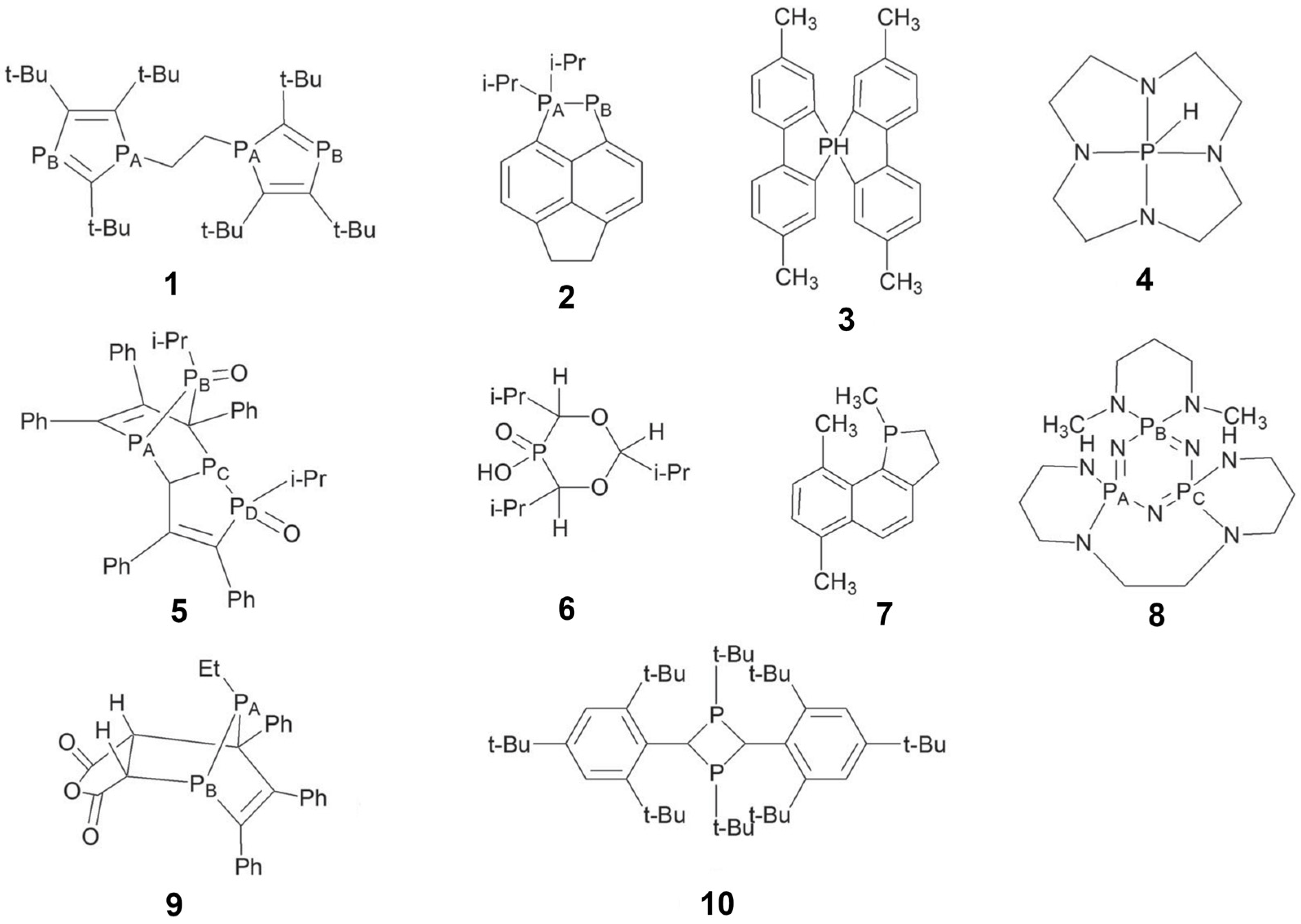



| Basis Set 2 | DFT (B3LYP) | CCSD (T) |
|---|---|---|
| PH3 | ||
| aug-cc-pCVXZ (Q–5) | 553.876 | 596.957 |
| aug-cc-pCVXZ (T–5) | 557.847 | 603.326 |
| aug-pcSseg-n (2–4) | 557.661 | 588.578 |
| PN | ||
| aug-cc-pCVXZ (Q–5) | −58.882 | 58.080 |
| aug-cc-pCVXZ (T–5) | −60.030 | 59.090 |
| aug-pcSseg-n (2–4) | −58.833 | 58.780 |
| Mol. | Level of Theory Used in the Force Field Calculations | Level of Theory Used in Shielding Derivative Calculations | ZPV Correction to σ(31P) | Ref. |
|---|---|---|---|---|
| PH3 | SVWN5/6-31+G(d) | SVWN5/6-31+G(d) | −9.2 | Dransfeld [373] |
| HF/cc-pVTZ | HF/qz3d1f | −9.5 | Prochnow et al. [150] | |
| MP2/cc-pVTZ | MP2/qz3d1f | −8.2 | ||
| CCSD(T)/cc-pVTZ | CCSD(T)/qz3d1f | −9.5 | ||
| CCSD(T)/u-wCV5Z a | CCSD(T)/u-wCV5Z a | −9.2 | Lantto [133] | |
| DFT(B3LYP)/aug-cc-pVQZ | DFT(B3LYP)/aug-cc-pVQZ | −10.8 | Kupka et al. [156] | |
| DFT(B3LYP)/cc-pVDZ | DFT(B3LYP)/cc-pVDZ | −3.2 | Chernyshev et al. [261] | |
| DFT(B3LYP)/IGLO-II | DFT(B3LYP)/IGLO-II | −3.9 | ||
| DFT(B3LYP)/IGLO-III | DFT(B3LYP)/IGLO-III | −4.3 | ||
| PN | DFT(B3LYP)/aug-cc-pCVTZ | B3LYP/aug-cc-pCVTZ | −6.9 | Teale et al. [152] |
| HF/cc-pVTZ | HF/qz3d1f | −9.6 | Prochnow et al. [150] | |
| MP2/cc-pVTZ | MP2/qz3d1f | (−)12.5 b | ||
| CCSD(T)/cc-pVTZ | CCSD(T)/qz3d1f | −4.4 | ||
| DFT(B3LYP)/aug-cc-pVTZ | DFT(B3LYP)/aug-cc-pVTZ | −7.6 | Kupka et al. [155] | |
| DFT(B3LYP)/aug-cc-pVQZ | DFT(B3LYP)/aug-cc-pVQZ | −7.0 | ||
| DFT(B3LYP)/aug-cc-pV5Z | DFT(B3LYP)/aug-cc-pV5Z | −7.5 | ||
| CCSD(T)/aug-cc-pVTZ | MP2/aug-cc-pVTZ | −16.5 | ||
| CCSD(T)/aug-cc-pVQZ | MP2/aug-cc-pVQZ | −14.2 | ||
| CCSD(T)/aug-cc-pV5Z | MP2/aug-cc-pV5Z | −14.7 | ||
| CCSD(T)/aug-cc-pVTZ | DFT(B3LYP)/aug-cc-pVTZ | −22.2 | ||
| CCSD(T)/aug-cc-pVQZ | DFT(B3LYP)/aug-cc-pVQZ | −20.5 | ||
| CCSD(T)/aug-cc-pV5Z | DFT(B3LYP)/aug-cc-pV5Z | −22.2 | ||
| DFT(B3LYP)/aug-cc-pVQZ | DFT(B3LYP)/aug-cc-pVQZ | −6.2 | Kupka et al. [156] | |
| PF3 | MP2/tz2p | MP2/tz2p | −2.6 | Field-Theodore et al. [154] |
| MP2/tz2p | MP2/qz2p | −2.6 | ||
| MP2/qz2p | MP2/qz2p | −2.5 | ||
| CCSD(T)/tz2p | CCSD(T)/tz2p | −2.6 | ||
| CCSD(T)/tz2p | CCSD(T)/qz2p | −2.50 | ||
| HF/cc-pVTZ | HF/qz3d1f | −1.4 | Prochnow et al. [150] | |
| MP2/cc-pVTZ | MP2/qz3d1f | −2.3 | ||
| CCSD(T)/cc-pVTZ | CCSD(T)/qz3d1f | −2.3 | ||
| HCP | SVWN5/6-31+G(d) | SVWN5/6-31+G(d) | −50.7 | Dransfeld [373] |
| B3LYP/aug-cc-pCVTZ | B3LYP/aug-cc-pCVTZ | −22.9 | Teale et al. [152] | |
| CH3PH2 | SVWN5/6-31+G(d) | SVWN5/6-31+G(d) | −44.7 | Dransfeld [373] |
| CH3CP | SVWN5/6-31+G(d) | SVWN5/6-31+G(d) | −24.0 | |
| P4 | HF/cc-pVTZ | HF/qz3d1f | −5.3 | Prochnow et al. [150] |
| MP2/cc-pVTZ | MP2/qz3d1f | −6.9 | ||
| CCSD(T)/cc-pVTZ | CCSD(T)/qz3d1f | −7.2 | ||
| Me3P | HF/cc-pVTZ | HF/qz3d1f | −13.5 | Prochnow et al. [150] |
| MP2/cc-pVTZ | MP2/qz3d1f | −15.1 | ||
| MP2/ADZP | MP2/ADZP | −16.3 | Rusakov et al. [250] | |
| DFT(B3LYP)/cc-pVDZ | DFT(B3LYP)/cc-pVDZ | −11.7 | Chernyshev et al. [261] | |
| DFT(B3LYP)/IGLO-II | DFT(B3LYP)/IGLO-II | (−)14.1 b | ||
| DFT(B3LYP)/IGLO-III | DFT(B3LYP)/IGLO-III | −14.9 | ||
| H3PO | DFT(B3LYP)/aug-cc-pVQZ | DFT(B3LYP)/aug-cc-pVQZ | −4.7 | Kupka et al. [156] |
| Me3PO | MP2/ADZP | MP2/ADZP | −4.6 | Rusakov et al. [250] |
| Me3PS | MP2/ADZP | MP2/ADZP | −6.8 | |
| Me3PSe | MP2/ADZP | MP2/ADZP | −7.5 c | |
| t-Bu3PSe | MP2/ADZP | MP2/ADZP | −7.5 c | |
| t-Bu3PTe | MP2/ADZP | MP2/ADZP | −8.6 c |
| Program Package | Available QC Methods | Available Basis Sets | Notes |
|---|---|---|---|
| CFOUR (Coupled-Cluster techniques for Computational Chemistry) [374] | Nonrelativistic HF-SCF; MPn (n = 2, 3, 4); CCD [375], CC2, CC3, CCSD, CCSD(T), CCSDT-n (n = 1–4) [376], CCSDT; QCISD, QCISD(T) [377]. | Apart from built-in standard GTO (Gaussian-Type Orbitals) energy-optimized basis sets, one can use specialized σ-oriented basis sets by preparing an external basis set file. The specialized basis sets can be taken from the literature sources or from the external library [378,379,380]. | CFOUR allows only gas-phase calculations that can be performed within the GIAO formalism. |
| ADF (Amsterdam Density Functional) [381,382] | The DFT with standard LDA and GGA potentials, implemented at the relativistic scalar-ZORA and SO-ZORA (or briefly ZORA) levels. | ADF commonly uses the basis sets of STOs (Slater-Type Orbitals). For shieldings, only standard relativistic and nonrelativistic energy-optimized basis sets of various levels and types can be applied. | The GIAO formalism is available. Solvent calculations can be performed with the IEF-PCM or COSMO model. The NBO (Natural Bond Orbital) [383,384] analysis of the NMR shielding tensor is available. |
| DIRAC (Program for Atomic and Molecular Direct Iterative Relativistic All-electron Calculations) [221] | HF-SCF and DFT with LDA and various GGA and hybrid XC functionals, implemented at the two-component (DKH2, BSS, and X2C) and four-component relativistic levels. | DIRAC includes a great many relativistic and nonrelativistic energy-optimized GTO-type basis sets. The specialized σ-oriented basis sets can be included through the external file. | The GIAO formalism is available. Relativistic IEF-PCM for taking into account the solvent corrections can be applied. Nonrelativistic regimes are simulated either within the Lévy-Leblond scheme [385] or by increasing the speed of light multiple times. The scalar calculations can be performed with the spin-free Hamiltonians. |
| ReSpect (Relativistic Spectroscopy DFT program package) [386] | Four-component Hartree–Fock (DHF) and four-component DFT (DKS) with LDA, GGA, hybrid, and range-separated XC functionals. | ReSpect provides a variety of built-in all-electron basis sets of the GTO-type suitable for relativistic calculations of elements across the periodic table (Z = 1–118). | Either common gauge origin (CGO) or GIAO formalism can be applied in combination with the restricted kinetic magnetic balance condition (RMB). |
| ORCA [387] | Nonrelativistic HF-SCF, RI-MP2, and DFT with LDA and various GGA, hybrid, meta-GGA, and double-hybrid XC functionals. | A restricted number of GTO basis set families are built in the ORCA program, which includes Ahlrichs, Dunning, and Pople’s basis sets of different levels. | The GIAO method is available. The SMD (Solvation Model based on Density) [388] or C-PCM (Conductor-like Continuum Polarization Model, factually, COSMO) models can be applied to model solvent. |
| TURBOMOLE [151] | Nonrelativistic HF-SCF and DFT with LDA, GGA, meta-GGA, and range-separated hybrid XC functionals. | TURBOMOLE has its own built-in basis set library. Available basis sets are of Ahlrichs GTO-type, given in segmented contracted form. | The GIAO formalism is implemented. The COSMO calculations can be performed to account for the solvent effects. Nuclear-independent chemical shifts (NICSs) [389] analysis is available. |
| Gaussian [390] | Nonrelativistic HF-SCF, MP2, and DFT with LDA, GGA, hybrid, and double-hybrid XC functionals. | Gaussian provides a great number of nonrelativistic energy-optimized GTO-type basis sets. The specialized σ-oriented basis sets can be implemented through the external file or via direct input. | The CSGT or GIAO formalisms are available. Standard solvation models such as IEF-PCM, C-PCM, COSMO, and SMD can be applied to account for solvent effects. The ONIOM (QM/MM method) of up to three layers is also available. |
| QChem [391] | Nonrelativistic HF-SCF and DFT with LDA, GGA, and hybrid XC functionals. | QChem supports the user-defined basis sets. | The GIAO formalism is implemented. |
| Dalton [392] | Nonrelativistic HF-SCF, DFT, MCSCF, and various CC levels of theory (through the response functions). The SOPPA [393], SOPPA(CC2) [394], and SOPPA(CCSD) [393,394] methods are applicable for shielding constants with the CTOCD formalism. Relativistic corrections can be calculated by means of the linear response with elimination of the small component method (LRESC) [395,396,397,398]. | Available basis sets are the same as in DIRAC program. The inclusion of the external basis sets is also feasible. | The GIAO and CTOCD formalisms are available. Solvent effects on NMR parameters can be approximated in the HF-SCF and DFT levels with the IEF-PCM. In addition, the QM/MM-type embedding models are applicable to the calculation of GIAO NMR shielding constant calculations. |
Disclaimer/Publisher’s Note: The statements, opinions and data contained in all publications are solely those of the individual author(s) and contributor(s) and not of MDPI and/or the editor(s). MDPI and/or the editor(s) disclaim responsibility for any injury to people or property resulting from any ideas, methods, instructions or products referred to in the content. |
© 2026 by the authors. Licensee MDPI, Basel, Switzerland. This article is an open access article distributed under the terms and conditions of the Creative Commons Attribution (CC BY) license.
Share and Cite
Rusakova, I.L.; Rusakov, Y.Y. Modern Quantum Chemistry Methodology for Predicting 31P Nuclear Magnetic Resonance Chemical Shifts. Int. J. Mol. Sci. 2026, 27, 704. https://doi.org/10.3390/ijms27020704
Rusakova IL, Rusakov YY. Modern Quantum Chemistry Methodology for Predicting 31P Nuclear Magnetic Resonance Chemical Shifts. International Journal of Molecular Sciences. 2026; 27(2):704. https://doi.org/10.3390/ijms27020704
Chicago/Turabian StyleRusakova, Irina L., and Yuriy Yu. Rusakov. 2026. "Modern Quantum Chemistry Methodology for Predicting 31P Nuclear Magnetic Resonance Chemical Shifts" International Journal of Molecular Sciences 27, no. 2: 704. https://doi.org/10.3390/ijms27020704
APA StyleRusakova, I. L., & Rusakov, Y. Y. (2026). Modern Quantum Chemistry Methodology for Predicting 31P Nuclear Magnetic Resonance Chemical Shifts. International Journal of Molecular Sciences, 27(2), 704. https://doi.org/10.3390/ijms27020704