Salivary Antioxidant and Peroxidase Activity as a Marker of Steroid Hormone Receptor Expression in Breast Cancer


Abstract
1. Introduction
2. Results


3. Discussion
4. Materials and Methods
4.1. Study Design
4.2. Saliva Biochemical Analysis
4.3. Statistical Analysis
5. Conclusions
Author Contributions
Funding
Institutional Review Board Statement
Informed Consent Statement
Data Availability Statement
Conflicts of Interest
References
- Ramírez-Expósito, M.J.; Sánchez-López, E.; Cueto-Ureña, C.; Dueñas, B.; Carrera-González, P.; Navarro-Cecilia, J.; Mayas, M.D.; Arias de Saavedra, J.M.; Sánchez-Agesta, R.; Martínez-Martos, J.M. Circulating oxidative stress parameters in pre- and post-menopausal healthy women and in women suffering from breast cancer treated or not with neoadjuvant chemotherapy. Exp. Gerontol. 2014, 58, 34–42. [Google Scholar] [CrossRef]
- Jelic, M.D.; Mandic, A.D.; Maricic, S.M.; Srdjenovic, B.U. Oxidative stress and its role in cancer. J. Cancer Res. Ther. 2021, 17, 22–28. [Google Scholar] [CrossRef]
- Alpay, M.; Backman, L.R.; Cheng, X.; Dukel, M.; Kim, W.J.; Ai, L.; Brown, K.D. Oxidative stress shapes breast cancer phenotype through chronic activation of ATM-dependent signaling. Breast Cancer Res. Treat. 2015, 151, 75–87. [Google Scholar] [CrossRef]
- Markovsky, A.V. Features of aminothiol metabolism and progression of breast cancer. Sib. J. Oncol. 2023, 22, 128–134. [Google Scholar] [CrossRef]
- Forman, H.J.; Zhang, H. Targeting oxidative stress in disease: Promise and limitations of antioxidant therapy. Nat. Rev. Drug Discov. 2021, 20, 689–709, Correction in Nat. Rev. Drug Discov. 2021, 20, 652. [Google Scholar] [CrossRef] [PubMed]
- Jomova, K.; Alomar, S.Y.; Valko, R.; Fresser, L.; Nepovimova, E.; Kuca, K.; Valko, M. Interplay of oxidative stress and antioxidant mechanisms in cancer development and progression. Arch. Toxicol. 2025; online ahead of print. [Google Scholar] [CrossRef]
- O’Leary, P.C.; Terrile, M.; Bajor, M.; Gaj, P.; Hennessy, B.T.; Mills, G.B.; Zagozdzon, A.; O’Connor, D.P.; Brennan, D.J.; Connor, K.; et al. Peroxiredoxin-1 protects estrogen receptor α from oxidative stress-induced suppression and is a protein biomarker of favorable prognosis in breast cancer. Breast Cancer Res. 2014, 16, R79. [Google Scholar] [CrossRef]
- Pan, S.Y.; Zhou, J.; Gibbons, L.; Morrison, H.; Wen, S.W. Canadian Cancer Registries Epidemiology Research Group [CCRERG]. Antioxidants and breast cancer risk- a population-based case-control study in Canada. BMC Cancer 2011, 11, 372. [Google Scholar] [CrossRef]
- Mencalha, A.; Victorino, V.J.; Cecchini, R.; Panis, C. Mapping oxidative changes in breast cancer: Understanding the basic to reach the clinics. Anticancer Res. 2014, 34, 1127–1140. [Google Scholar]
- Qebesy, H.S.; Zakhary, M.M.; Abd-Alaziz, M.A.; Abdel Ghany, A.A.; Maximus, D.W. Tissue levels of oxidative stress markers and antioxidants in breast cancer patients in relation to tumor grade. AAMJ 2015, 13, 10–17. [Google Scholar]
- Mazzuferi, G.; Bacchetti, T.; Islam, M.O.; Ferretti, G. High density lipoproteins and oxidative stress in breast cancer. Lipids Health Dis. 2021, 20, 143. [Google Scholar] [CrossRef] [PubMed]
- Ghafoor, D.D. Correlation between oxidative stress markers and cytokines in different stages of breast cancer. Cytokine 2023, 161, 156082. [Google Scholar] [CrossRef]
- Jablonska, E.; Gromadzinska, J.; Peplonska, B.; Fendler, W.; Reszka, E.; Krol, M.B.; Wieczorek, E.; Bukowska, A.; Gresner, P.; Galicki, M.; et al. Lipid peroxidation and glutathione peroxidase activity relationship in breast cancer depends on functional polymorphism of GPX1. BMC Cancer 2015, 15, 657. [Google Scholar] [CrossRef]
- Nourazarian, A.R.; Kangari, P.; Salmaninejad, A. Roles of oxidative stress in the development and progression of breast cancer. Asian Pac. J. Cancer Prev. 2014, 15, 4745–4751. [Google Scholar] [CrossRef]
- Hecht, F.; Pessoa, C.F.; Gentile, L.B.; Rosenthal, D.; Carvalho, D.P.; Fortunato, R.S. The role of oxidative stress on breast cancer development and therapy. Tumour Biol. 2016, 37, 4281–4291. [Google Scholar] [CrossRef] [PubMed]
- Bel’skaya, L.V.; Dyachenko, E.I. Oxidative Stress in Breast Cancer: A Biochemical Map of Reactive Oxygen Species Production. Curr. Issues Mol. Biol. 2024, 46, 4646–4687. [Google Scholar] [CrossRef]
- Nonaka, T.; Wong, D.T.W. Saliva diagnostics: Salivaomics, saliva exosomics, and saliva liquid biopsy. J. Am. Dent. Assoc. 2023, 154, 696–704. [Google Scholar] [CrossRef] [PubMed]
- Surdu, A.; Foia, L.G.; Luchian, I.; Trifan, D.; Tatarciuc, M.S.; Scutariu, M.M.; Ciupilan, C.; Budala, D.G. Saliva as a Diagnostic Tool for Systemic Diseases-A Narrative Review. Medicina 2025, 61, 243. [Google Scholar] [CrossRef] [PubMed]
- Carneiro, M.C.; da Silva, N.D.G.; Ventura, T.M.O.; da Silva Santos, P.S.; Buzalaf, M.A.R.; Freire, M. Salivary Proteome Role in Infection and Immunity. Adv. Exp. Med. Biol. 2026, 1492, 747–773. [Google Scholar]
- Li, Y.; Ou, Y.; Fan, K.; Liu, G. Salivary diagnostics: Opportunities and challenges. Theranostics 2024, 14, 6969–6990. [Google Scholar] [CrossRef]
- Mortazavi, H.; Yousefi-Koma, A.A.; Yousefi-Koma, H. Extensive comparison of salivary collection, transportation, preparation, and storage methods: A systematic review. BMC Oral Health 2024, 24, 168. [Google Scholar] [CrossRef]
- Schwartz, M.; Neiers, F.; Feron, G.; Canon, F. The Relationship Between Salivary Redox, Diet, and Food Flavor Perception. Front. Nutr. 2021, 7, 612735. [Google Scholar] [CrossRef] [PubMed]
- Tóthová, L.; Kamodyová, N.; Červenka, T.; Celec, P. Salivary markers of oxidative stress in oral diseases. Front. Cell. Infect. Microbiol. 2015, 5, 73. [Google Scholar] [CrossRef] [PubMed]
- Żukowski, P.; Maciejczyk, M.; Waszkiel, D. Sources of free radicals and oxidative stress in the oral cavity. Arch. Oral Biol. 2018, 92, 8–17. [Google Scholar] [CrossRef]
- Shlapakova, T.I.; Kostin, R.K.; Tyagunova, E.E. Reactive oxygen species: Their role in cellular processes and pathology. Bioorganic Chem. 2020, 46, 466–485. [Google Scholar]
- Cozza, G.; Rossetto, M.; Bosello-Travain, V.; Maiorino, M.; Roveri, A.; Toppo, S.; Zaccarin, M.; Zennaro, L.; Ursini, F. Glutathione peroxidase 4-catalyzed reduction of lipid hydroperoxides in membranes: The polar head of membrane phospholipids binds the enzyme and addresses the fatty acid hydroperoxide group toward the redox center. Free Radic. Biol. Med. 2017, 112, 1–11. [Google Scholar] [CrossRef]
- Gupta, R.K.; Patel, A.K.; Kumari, R.; Chugh, S.; Shrivastav, C.; Mehra, S.; Sharma, A.N. Interactions between oxidative stress, lipid profile and antioxidants in breast cancer: A case control study. Asian Pac. J. Cancer Prev. 2012, 13, 6295–6298. [Google Scholar] [CrossRef]
- Kedzierska, M.; Olas, B.; Wachowicz, B.; Jeziorski, A.; Piekarski, J. The lipid peroxidation in breast cancer patients. Gen. Physiol. Biophys. 2010, 29, 208–210. [Google Scholar]
- Ray, G.; Batra, S.; Shukla, N.K.; Deo, S.; Raina, V.; Ashok, S.; Husain, S.A. Lipid peroxidation, free radical production and antioxidant status in breast cancer. Breast Cancer Res. Treat. 2000, 59, 163–170. [Google Scholar] [CrossRef]
- Rajneesh, C.P.; Manimaran, A.; Sasikala, K.R.; Adaikappan, P. Lipid peroxidation and antioxidant status in patients with breast cancer. Singap. Med. J. 2008, 49, 640–643. [Google Scholar]
- Wang, C.; Yu, J.; Wang, H.; Zhang, J.; Wu, N. Lipid peroxidation and altered anti-oxidant status in breast adenocarcinoma patients. Drug Res. 2014, 64, 690–692. [Google Scholar] [CrossRef] [PubMed]
- Shen, L.; Huang, H.; Li, J.; Chen, W.; Yao, Y.; Hu, J.; Zhou, J.; Huang, F.; Ni, C. Exploration of prognosis and immunometabolism landscapes in ER+ breast cancer based on a novel lipid metabolism-related signature. Front. Immunol. 2023, 14, 1199465. [Google Scholar] [CrossRef]
- Li, D.; Heffernan, K.; Koch, F.C.; Peake, D.A.; Pascovici, D.; David, M.; Kehelpannala, C.; Mann, G.B.; Speakman, D.; Hurrell, J.; et al. Discovery of Plasma Lipids as Potential Biomarkers Distinguishing Breast Cancer Patients from Healthy Controls. Int. J. Mol. Sci. 2024, 25, 11559. [Google Scholar] [CrossRef]
- Zhang, Z.; Zhang, D. Circulating lipids, lipid-lowering drug targets, and breast cancer risk: Comprehensive evidence from Mendelian randomization and summary data-based Mendelian randomization. Cancer Causes Control 2024, 35, 983–994. [Google Scholar] [CrossRef]
- Caterino, M.; Fedele, R.; Carnovale, V.; Castaldo, A.; Gelzo, M.; Iacotucci, P.; Ruoppolo, M.; Castaldo, G. Lipidomic alterations in human saliva from cystic fibrosis patients. Sci. Rep. 2023, 13, 600. [Google Scholar] [CrossRef]
- Fineide, F.; Chen, X.; Bjellaas, T.; Vitelli, V.; Utheim, T.P.; Jensen, J.L.; Galtung, H.K. Characterization of lipids in saliva, tears and minor salivary glands of Sjögren’s syndrome patients using an HPLC/MS-based approach. Int. J. Mol. Sci. 2021, 22, 8997. [Google Scholar] [CrossRef]
- Matczuk, J.; Żendzian-Piotrowska, M.; Maciejczyk, M.; Kurek, K. Salivary lipids: A review. Adv. Clin. Exp. Med. 2017, 26, 1021–1029. [Google Scholar] [CrossRef]
- Zięba, S.; Błachnio-Zabielska, A.; Maciejczyk, M.; Pogodzińska, K.; Szuta, M.; Lo Giudice, G.; Lo Giudice, R.; Zalewska, A. Impact of Smoking on Salivary Lipid Profile and Oxidative Stress in Young Adults: A Comparative Analysis between Traditional Cigarettes, E-Cigarettes, and Heat-Not-Burn Products. Med. Sci. Monit. 2024, 30, e942507. [Google Scholar] [CrossRef]
- Smirnova, O.V.; Elmanova, N.G. Interconditionality of the effects of types I and II of inflammation on the processes of lipid peroxidation and antioxidant protection in patients with obstructive jaundice of gallstone origin in the postoperative period. Immunologiya 2020, 41, 354–362. [Google Scholar] [CrossRef]
- Plokhov, V.N.; Chesnokova, N.P. Patterns of paraneoplastic disorders in edematous-infiltrative form of breast cancer. Mod. Probl. Sci. Educ. 2008, 1, 13–19. [Google Scholar]
- Palanisamy, S. The impact of estrogen on periodontal tissue integrity and inflammation-a mini review. Front. Dent. Med. 2025, 6, 1455755. [Google Scholar] [CrossRef]
- Cornejo Ulloa, P.E.; Krom, B.P.; Schoonmade, L.J.; van der Veen, M.H. Sex steroid hormones: An overlooked yet fundamental factor in oral homeostasis in humans. Front. Endocrinol. 2024, 15, 1400640. [Google Scholar] [CrossRef]
- Maksimova, M.Y. Burning mouth syndrome in menopausal women. Russ. J. Pain. 2024, 22, 12–17. [Google Scholar] [CrossRef]
- Välimaa, H.; Savolainen, S.; Soukka, T.; Silvoniemi, P.; Mäkelä, S.; Kujari, H.; Gustafsson, J.A.; Laine, M. Estrogen receptor-beta is the predominant estrogen receptor subtype in human oral epithelium and salivary glands. J. Endocrinol. 2004, 180, 55–62. [Google Scholar] [CrossRef]
- Karihtala, P.; Kauppila, S.; Soini, Y.; Arja Jukkola, V. Oxidative stress and counteracting mechanisms in hormone receptor positive, triple-negative and basal-like breast carcinomas. BMC Cancer 2011, 11, 262–270. [Google Scholar] [CrossRef]
- Sastre-Serra, J.; Valle, A.; Company, M.M.; Garau, I.; Oliver, J.; Roca, P. Estrogen down-regulates uncoupling proteins and increases oxidative stress in breast cancer. Free Radic. Biol. Med. 2010, 48, 506–512. [Google Scholar] [CrossRef]
- Felty, Q.; Xiong, W.C.; Sun, D.; Sarkar, S.; Singh, K.P.; Parkash, J.; Roy, D. Estrogen-induced mitochondrial reactive oxygen species as signal-transducing messengers. Biochemistry 2005, 44, 6900–6909. [Google Scholar] [CrossRef]
- Okoh, V.; Deoraj, A.; Roy, D. Estrogen-induced reactive oxygen species-mediated signalings contribute to breast cancer. Biochim. Biophys. Acta. 2011, 1815, 115–133. [Google Scholar] [CrossRef]
- Yager, J.D.; Davidson, N.E. Estrogen carcinogenesis in breast cancer. N. Engl. J. Med. 2006, 354, 270–282. [Google Scholar] [CrossRef]
- Pedram, A.; Razandi, M.; Wallace, D.C.; Levin, E.R. Functional estrogen receptors in the mitochondria of breast cancer cells. Mol. Biol. Cell 2006, 17, 2125–2137. [Google Scholar] [CrossRef]
- Kushner, P.J.; Agard, D.A.; Greene, G.L.; Scanlan, T.S.; Shiau, A.K.; Uht, R.M.; Webb, P. Estrogen receptor pathways to AP-1. J. Steroid Biochem. Mol. Biol. 2000, 74, 311–317. [Google Scholar] [CrossRef]
- Cavalieri, E.L.; Rogan, E.G. A unifying mechanism in the initiation of cancer and other diseases by catechol quinones. Ann. N. Y. Acad. Sci. 2004, 1028, 247–257. [Google Scholar] [CrossRef]
- Roy, D.; Liehr, J.G. Estrogen, DNA damage and mutations. Mutat. Res. 1999, 424, 107–115. [Google Scholar] [CrossRef]
- Zowczak-Drabarczyk, M.M.; Murawa, D.; Kaczmarek, L.; Połom, K.; Litwiniuk, M. Total antioxidant status in plasma of breast cancer patients in relation to ERβ expression. Contemp. Oncol. 2013, 17, 499–503. [Google Scholar]
- Sivadasan, P.; Gupta, M.K.; Sathe, G.J.; Balakrishnan, L.; Palit, P.; Gowda, H.; Suresh, A.; Kuriakose, M.A.; Sirdeshmukh, R. Human salivary proteome—A resource of potential biomarkers for oral cancer. J. Proteom. 2015, 127, 89–95. [Google Scholar] [CrossRef]
- Grassl, N.; Kulak, N.A.; Pichler, G.; Geyer, P.E.; Jung, J.; Schubert, S.; Sinitcyn, P.; Cox, J.; Mann, M. Ultra-deep and quantitative saliva proteome reveals dynamics of the oral microbiome. Genome Med. 2016, 8, 44. [Google Scholar] [CrossRef]
- Pappa, E.; Vastardis, H.; Mermelekas, G.; Gerasimidi-Vazeou, A.; Zoidakis, J.; Vougas, K. Saliva proteomics analysis offers insights on type 1 diabetes pathology in a pediatric population. Front. Physiol. 2018, 9, 444. [Google Scholar] [CrossRef]
- Glorieux, C.; Calderon, P.B. Catalase, a remarkable enzyme: Targeting the oldest antioxidant enzyme to find a new cancer treatment approach. Biol. Chem. 2017, 398, 1095. [Google Scholar] [CrossRef]
- Carlsson, J. Salivary peroxidase: An important part of our defense against oxygen toxicity. J. Oral Pathol. Med. 1987, 16, 412–416. [Google Scholar] [CrossRef]
- Stone, J.R.; Yang, S. Hydrogen peroxide: A signaling messenger. Antioxid. Redox Signal. 2006, 8, 243–270. [Google Scholar] [CrossRef]
- Denny, P.; Hagen, F.K.; Hardt, M.; Liao, L.; Yan, W.; Arellanno, M.; Bassilian, S.; Bedi, G.S.; Boontheung, P.; Cociorva, D.; et al. The proteomes of human parotid and submandibular/sublingual gland salivas collected as the ductal secretions. J. Proteome Res. 2008, 7, 1994–2006. [Google Scholar] [CrossRef]
- Ihalin, R.; Loimaranta, V.; Tenovuo, J. Origin, structure, and biological activities of peroxidases in human saliva. Arch. Biochem. Biophys. 2006, 445, 261–268. [Google Scholar] [CrossRef]
- Schaffer, W.M.; Bronnikova, T.V. Peroxidase-ROS interactions. Nonlinear Dyn. 2012, 68, 413–430. [Google Scholar] [CrossRef]
- Wang, X.; Ashby, M.T. Reactive sulfur species: Kinetics and mechanism of the reaction of thiocarbamate-s-oxide with cysteine. Chem. Res. Toxicol. 2008, 21, 2120–2126. [Google Scholar] [CrossRef]
- Fabrini, R.; Bocedi, A.; Camerini, S.; Fusetti, M.; Ottaviani, F.; Passali, F.M.; Topazio, D.; Iavarone, F.; Francia, I.; Castagnola, M.; et al. Inactivation of human salivary glutathione transferase P1-1 by hypothiocyanite: A post-translational control system in search of a role. PLoS ONE 2014, 9, e0112797. [Google Scholar] [CrossRef][Green Version]
- Muro, P.; Zhang, L.; Li, S.; Zhao, Z.; Jin, T.; Mao, F.; Mao, Z. The emerging role of oxidative stress in inflammatory bowel disease. Front. Endocrinol. 2024, 15, 1390351. [Google Scholar] [CrossRef]
- Nijakowski, K.; Jankowski, J.; Gruszczyński, D.; Surdacka, A. Salivary Alterations of Myeloperoxidase in Patients with Systemic Diseases: A Systematic Review. Int. J. Mol. Sci. 2023, 24, 12078. [Google Scholar] [CrossRef]
- Sheikh, I.A.; Beg, M.A.; Yasir, M. Molecular Interactions of Carcinogenic Aromatic Amines, 4-Aminobiphenyl and 4,4′-Diaminobiphenyl, with Lactoperoxidase—Insight to Breast Cancer. Anticancer Res. 2017, 37, 6245–6249. [Google Scholar]
- Sarmiento-Salinas, F.L.; Delgado-Magallón, A.; Montes-Alvarado, J.B.; Ramírez-Ramírez, D.; Flores-Alonso, J.C.; Cortés-Hernández, P.; Reyes-Leyva, J.; Herrera-Camacho, I.; Anaya-Ruiz, M.; Pelayo, R.; et al. Breast Cancer Subtypes Present a Differential Production of Reactive Oxygen Species (ROS) and Susceptibility to Antioxidant Treatment. Front. Oncol. 2019, 9, 480. [Google Scholar] [CrossRef]
- Cavalieri, E.L.; Rogan, E.G. Unbalanced metabolism of endogenous estrogens in the etiology and prevention of human cancer. J. Steroid Biochem. Mol. Biol. 2011, 125, 169–180. [Google Scholar] [CrossRef]
- Maiti, S.; Nazmeen, A. Impaired redox regulation of estrogen metabolizing proteins is important determinant of human breast cancers. Cancer Cell Int. 2019, 19, 111. [Google Scholar] [CrossRef]
- Arumalla, K.K.; Haince, J.-F.; Bux, R.A.; Huang, G.; Tappia, P.S.; Ramjiawan, B.; Ford, W.R.; Vaida, M. Metabolomics-Based Machine Learning Models Accurately Predict Breast Cancer Estrogen Receptor Status. Int. J. Mol. Sci. 2024, 25, 13029. [Google Scholar] [CrossRef]
- Ghasemi, S.; Farokhpour, F.; Mortezagholi, B.; Movahed, E.; Ghaedi, A.; Gargari, M.K.; Khanzadeh, M.; Bazrgar, A.; Khanzadeh, S. Systematic review and meta-analysis of oxidative stress and antioxidant markers in recurrent aphthous stomatitis. BMC Oral Health 2023, 23, 960. [Google Scholar] [CrossRef]
- Lavrovskaya, Y.A.; Romanenko, I.G.; Lavrovskaya, O.M. Correction of antioxidant protection of the oral mucosa in chronic pancreatitis. Parodontologiya 2019, 24, 274–279. [Google Scholar] [CrossRef]
- Taichman, L.S.; Gomez, G.; Inglehart, M.R. Oral Health-Related Complications of Breast Cancer Treatment: Assessing Dental Hygienists’ Knowledge and Professional Practice. J. Dent. Hyg. 2015, 89, 22–37. [Google Scholar]
- Durnovo, E.A.; Kontorshhikova, K.N.; Shakhova, M.A.; Soloveva, A.G.; Tarakanova, V.A.; Galkina, E.S. Oxidation-reduction potential of tissues of the oral mucosal wound surface under the photodynamic action. Stomatologiia 2021, 100, 7–15. [Google Scholar] [CrossRef]
- Raza, A.; Karimyan, N.; Watters, A.; Emperumal, C.P.; Al-Eryani, K.; Enciso, R. Efficacy of oral and topical antioxidants in the prevention and management of oral mucositis in head and neck cancer patients: A systematic review and meta-analyses. Support. Care Cancer 2022, 30, 8689–8703. [Google Scholar] [CrossRef]
- Azimi, S.; Mansouri, Z.; Bakhtiari, S.; Tennant, M.; Kruger, E.; Rajabibazl, M.; Daraei, A. Does green tea consumption improve the salivary antioxidant status of smokers? Arch. Oral. Biol. 2017, 78, 1–5. [Google Scholar] [CrossRef]
- Gurer-Orhan, H.; Ince, E.; Konyar, D.; Saso, L.; Suzen, S. The Role of Oxidative Stress Modulators in Breast Cancer. Curr. Med. Chem. 2018, 25, 4084–4101. [Google Scholar] [CrossRef]
- Mdkhana, B.; Goel, S.; Saleh, M.A.; Siddiqui, R.; Khan, N.A.; Elmoselhi, A.B. Role of oxidative stress in angiogenesis and the therapeutic potential of antioxidants in breast cancer. Eur. Rev. Med. Pharmacol. Sci. 2022, 26, 4677–4692. [Google Scholar]
- Ilić, I.R.; Stojanovi’c, N.M.; Radulović, N.S.; Živković, V.V.; Randjelović, P.J.; Petrović, A.S.; Božić, M.; Ilić, R.S. The Quantitative ER Immunohistochemical Analysis in Breast Cancer: Detecting the 3 + 0, 4 + 0, and 5 + 0 Allred Score Cases. Medicina 2019, 55, 461. [Google Scholar] [CrossRef]
- Wolff, A.C.; Hammond, M.E.H.; Allison, K.H.; Harvey, B.E.; Mangu, P.B.; Bartlett, J.M.S.; Bilous, M.; Ellis, I.O.; Fitzgibbons, P.; Hanna, W.; et al. Human Epidermal Growth Factor Receptor 2 Testing in Breast Cancer: American Society of Clinical Oncology/College of American Pathologists Clinical Practice Guideline Focused Update. J. Clin. Oncol. 2018, 36, 2105–2122. [Google Scholar] [CrossRef]
- Stålhammar, G.; Robertson, S.; Wedlund, L.; Lippert, M.; Rantalainen, M.; Bergh, J.; Hartman, J. Digital image analysis of Ki67 in hot spots is superior to both manual Ki67 and mitotic counts in breast cancer. Histopathology 2018, 72, 974–989. [Google Scholar] [CrossRef]
- Dyachenko, E.I.; Bel’skaya, L.V. Salivary Metabolites in Breast Cancer and Fibroadenomas: Focus on Menopausal Status and BMI. Metabolites 2024, 14, 531. [Google Scholar] [CrossRef]
- Bel’skaya, L.V.; Sarf, E.A.; Solomatin, D.V.; Kosenok, V.K. Diagnostic and Prognostic Value of Salivary Biochemical Markers in Oral Squamous Cell Carcinoma. Diagnostics 2020, 10, 818. [Google Scholar] [CrossRef]
- Bel’skaya, L.V.; Kosenok, V.K.; Massard, G. Endogenous Intoxication and Saliva Lipid Peroxidation in Patients with Lung Cancer. Diagnostics 2016, 6, 39. [Google Scholar] [CrossRef]


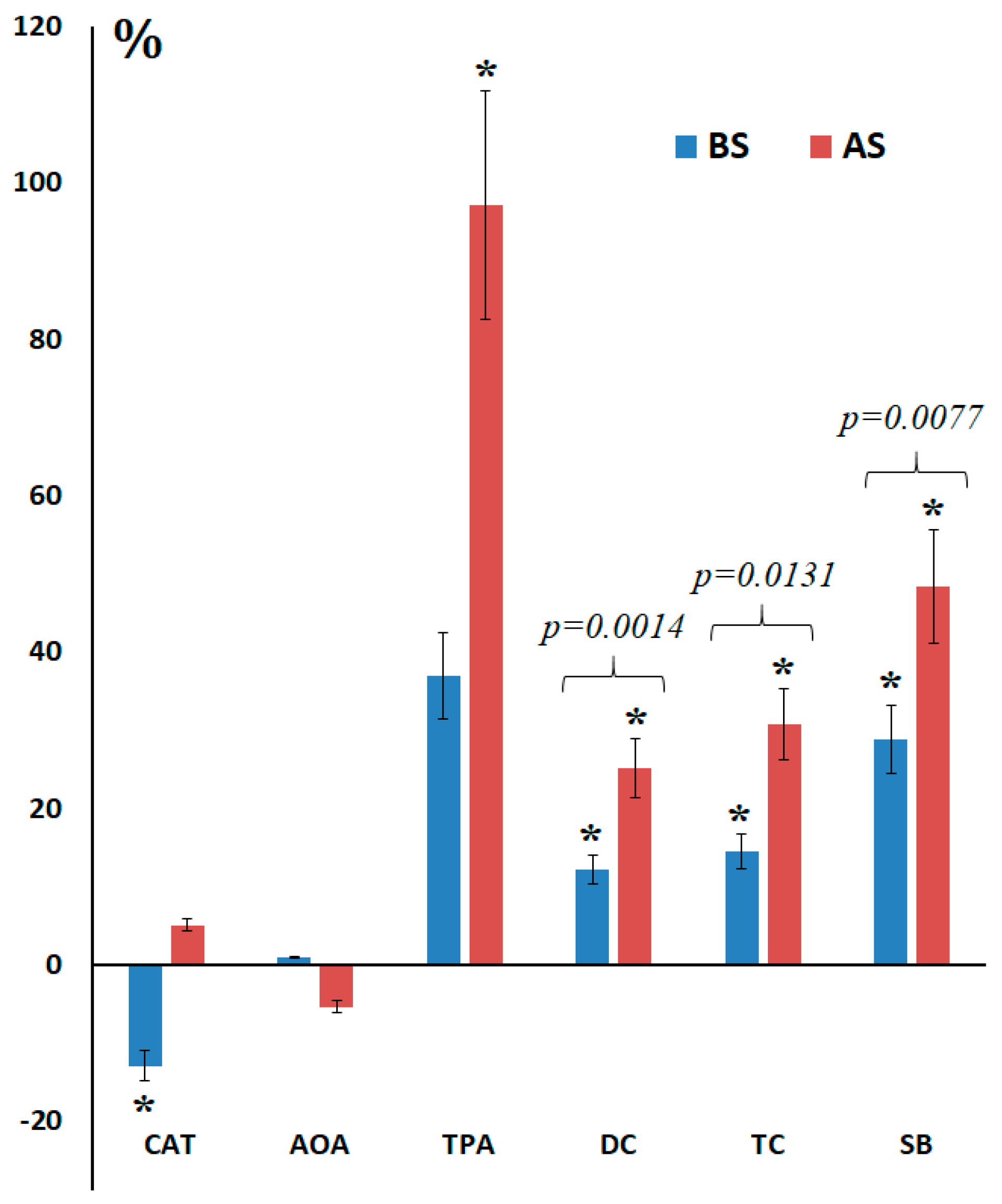
| Indicators | Breast Cancer | Healthy Controls (3) | |
|---|---|---|---|
| Before Surgery (1) | After Surgery (2) | ||
| Catalase, nkat/L | 2.90 [1.96; 3.99] | 3.50 [2.44; 3.98] | 3.33 [2.23; 4.31] |
| p1–3 = 0.0017 | - | p1–3 = 0.0017 | |
| AOA, mmol/L | 2.14 [1.74; 3.05] | 2.03 [1.83; 2.91] | 2.14 [1.75; 2.50] |
| TPA, c.u. | 1.48 [0.92; 2.86] | 2.13 [1.08; 3.63] | 1.08 [0.59; 2.14] |
| - | p2–3 = 0.0015 | p2–3 = 0.0015 | |
| DC, c.u. | 3.01 [2.72; 3.36] | 3.35 [3.05; 3.50] | 2.68 [2.59; 2.80] |
| p1–3 = 0.0156 | p2–3 = 0.0004 | p1–3 = 0.0156 | |
| p1–2 = 0.0014 | p1–2 = 0.0014 | p2–3 = 0.0004 | |
| TC, c.u. | 1.66 [1.44; 1.98] | 1.89 [1.66; 2.05] | 1.45 [1.24; 1.52] |
| p1–3 = 0.0135 | p2–3 = 0.0003 | p1–3 = 0.0135 | |
| p1–2 = 0.0131 | p1–2 = 0.0131 | p2–3 = 0.0003 | |
| SB, c.u. | 0.932 [0.835; 1.089] | 1.074 [0.940; 1.248] | 0.724 [0.665; 0.898] |
| p1–3 = 0.0047 | p2–3 = 0.0005 | p1–3 = 0.0047 | |
| p1–2 = 0.0077 | p1–2 = 0.0077 | p2–3 = 0.0005 | |
| Subgroups | Before Surgery, n (%) | After Surgery, n (%) | |
|---|---|---|---|
| Age, years | 58.7 ± 10.9 | 59.1 ± 10.2 | |
| Stage | |||
| IA + IB | 40 (34.8%) | 25 (47.2%) | |
| IIA + IIB | 45 (39.1%) | 19 (35.8%) | |
| IIIA + IIIB + IIIC | 26 (22.6%) | 9 (17.0%) | |
| IV | 4 (3.5%) | - | |
| Breast Cancer Phenotype | |||
| Luminal A = Lum A | 40 (34.8%) | 10 (18.9%) | |
| Luminal B HER2-negative = Lum B(−) | 36 (31.3%) | 25 (47.2%) | |
| Luminal B HER2-positive = Lum B(+) | 11 (9.6%) | 8 (15.0%) | |
| Non-luminal HER2-positive = Non-Lum | 10 (8.7%) | - | |
| Triple negative breast cancer = TNBC | 18 (15.6%) | 10 (18.9%) | |
Disclaimer/Publisher’s Note: The statements, opinions and data contained in all publications are solely those of the individual author(s) and contributor(s) and not of MDPI and/or the editor(s). MDPI and/or the editor(s) disclaim responsibility for any injury to people or property resulting from any ideas, methods, instructions or products referred to in the content. |
© 2026 by the authors. Licensee MDPI, Basel, Switzerland. This article is an open access article distributed under the terms and conditions of the Creative Commons Attribution (CC BY) license.
Share and Cite
Sarf, E.A.; Bel’skaya, L.V. Salivary Antioxidant and Peroxidase Activity as a Marker of Steroid Hormone Receptor Expression in Breast Cancer. Int. J. Mol. Sci. 2026, 27, 587. https://doi.org/10.3390/ijms27020587
Sarf EA, Bel’skaya LV. Salivary Antioxidant and Peroxidase Activity as a Marker of Steroid Hormone Receptor Expression in Breast Cancer. International Journal of Molecular Sciences. 2026; 27(2):587. https://doi.org/10.3390/ijms27020587
Chicago/Turabian StyleSarf, Elena A., and Lyudmila V. Bel’skaya. 2026. "Salivary Antioxidant and Peroxidase Activity as a Marker of Steroid Hormone Receptor Expression in Breast Cancer" International Journal of Molecular Sciences 27, no. 2: 587. https://doi.org/10.3390/ijms27020587
APA StyleSarf, E. A., & Bel’skaya, L. V. (2026). Salivary Antioxidant and Peroxidase Activity as a Marker of Steroid Hormone Receptor Expression in Breast Cancer. International Journal of Molecular Sciences, 27(2), 587. https://doi.org/10.3390/ijms27020587