

Oral Toxicity Profile of a Novel Silk Lutein Extract and Assessment of Its Cardiovascular Benefits in Rodents
Abstract
1. Introduction
2. Results and Discussion
2.1. Characterization of the SL Extract
2.2. Acute Oral Toxicity Study
2.2.1. Clinical Chemistry
2.2.2. Hematology
2.2.3. Histopathological Findings from Acute Oral Toxicity Study
2.3. Chronic Oral Toxicity Study
2.3.1. Body and Visceral Organ Weight
2.3.2. Clinical Chemistry
2.3.3. Hematology
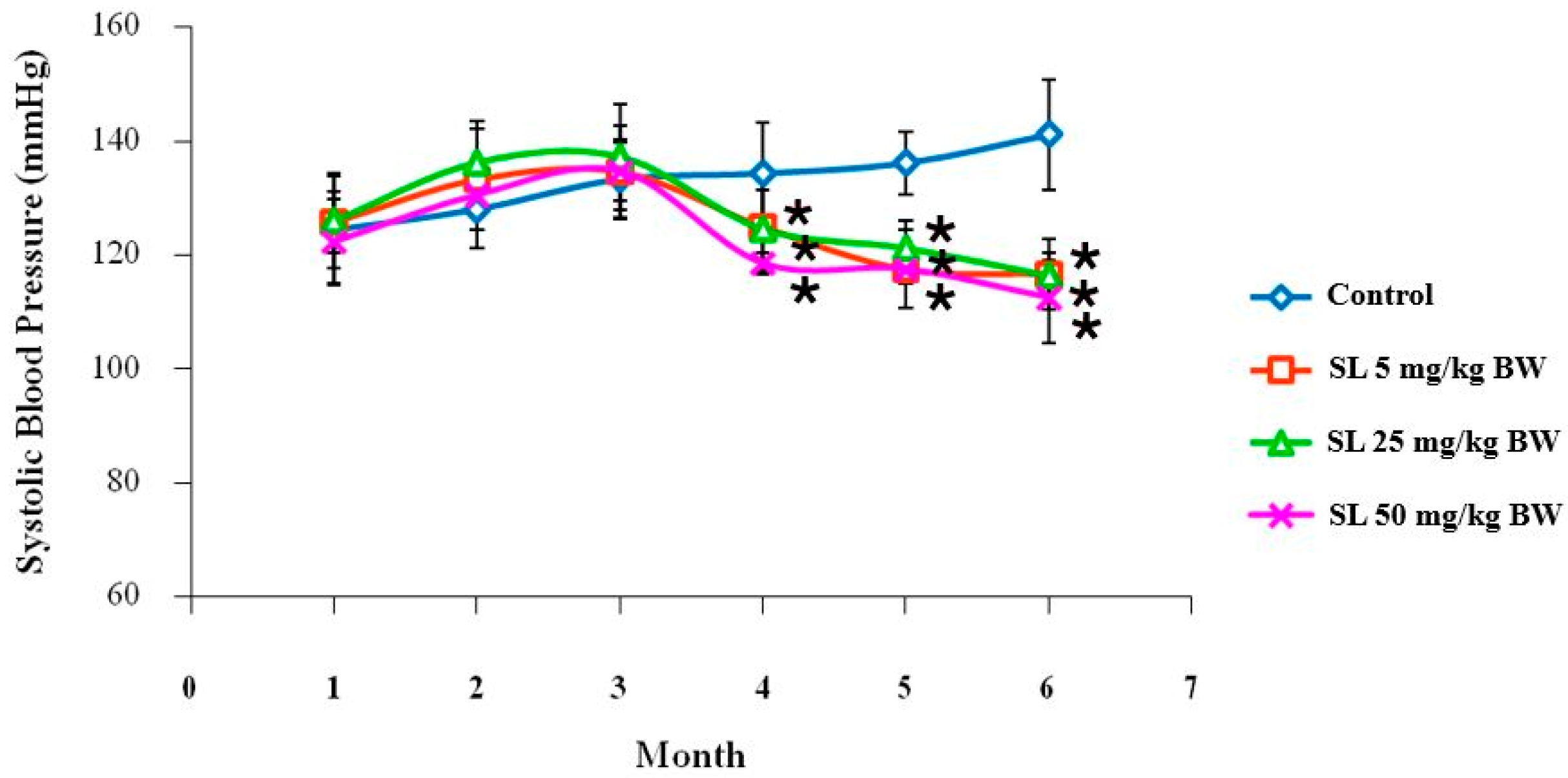
2.3.4. Effects on Blood Pressure and Blood Glucose Level
3. Materials and Methods
3.1. Test Materials
3.2. SL Extraction
3.3. Characterization and Analysis of SL Extract
3.3.1. Lutein Quantification by HPLC
3.3.2. Safety and Quality Assessment
3.3.3. Preparation for Animal Administration
3.4. Animals
3.5. Study Design
3.5.1. Acute Oral Toxicity Study
3.5.2. Chronic Oral Toxicity Study
3.6. In-Life Observations and Measurements During Chronic Oral Toxicity Study
3.7. Terminal Procedures and Analysis
3.7.1. Clinical Chemistry
3.7.2. Hematology
3.7.3. Histopathological Examination
3.8. Statistical Analysis
4. Conclusions
Supplementary Materials
Author Contributions
Funding
Institutional Review Board Statement
Informed Consent Statement
Data Availability Statement
Acknowledgments
Conflicts of Interest
References
- Wong, W.L.; Su, X.; Li, X.; Cheung, C.M.; Klein, R.; Cheng, C.Y.; Wong, T.Y. Global prevalence of age-related macular degeneration and disease burden projection for 2020 and 2040: A systematic review and meta-analysis. Lancet Glob. Health 2014, 2, e106–e116. [Google Scholar] [CrossRef] [PubMed]
- Ranard, K.M.; Jeon, S.; Mohn, E.S.; Griffiths, J.C.; Johnson, E.J.; Erdman, J.W., Jr. Dietary guidance for lutein: Consideration for intake recommendations is scientifically supported. Eur. J. Nutr. 2017, 56, 37–42. [Google Scholar] [CrossRef] [PubMed]
- Beatty, S.; Boulton, M.; Henson, D.; Koh, H.H.; Murray, I.J. Macular pigment and age related macular degeneration. Br. J. Ophthalmol. 1999, 83, 867–877. [Google Scholar] [CrossRef]
- Junghans, A.; Sies, H.; Stahl, W. Macular pigments lutein and zeaxanthin as blue light filters studied in liposomes. Arch. Biochem. Biophys. 2001, 391, 160–164. [Google Scholar] [CrossRef]
- Age-Related Eye Disease Study 2. Lutein + zeaxanthin and omega-3 fatty acids for age-related macular degeneration: The Age-Related Eye Disease Study 2 (AREDS2) randomized clinical trial. Jama 2013, 309, 2005–2015. [Google Scholar] [CrossRef]
- ŠIvel, M.; Kracmar, S.; Fišera, M.; Klejdus, B.; Kubáň, V. Lutein Content in Marigold Flower (Tagetes erecta L.) Concentrates used for Production of Food Supplements. Czech J. Food Sci. 2014, 32, 521–525. [Google Scholar] [CrossRef]
- Boon, C.S.; McClements, D.J.; Weiss, J.; Decker, E.A. Factors influencing the chemical stability of carotenoids in foods. Crit. Rev. Food Sci. Nutr. 2010, 50, 515–532. [Google Scholar] [CrossRef]
- Yao, Y.; Lin, J.J.; Chee, X.Y.J.; Liu, M.H.; Khan, S.A.; Kim, J.E. Encapsulation of Lutein via Microfluidic Technology: Evaluation of Stability and In Vitro Bioaccessibility. Foods 2021, 10, 2646. [Google Scholar] [CrossRef]
- Liu, Y.; Ma, L.; Zhang, Q.; Liu, Y.; Li, D. Construction of fatty acid-ovalbumin binary complexes to improve the water dispersibility, thermal/digestive stability and bioaccessibility of lutein: A comparative study of different fatty acids. Int. J. Biol. Macromol. 2024, 273, 133010. [Google Scholar] [CrossRef]
- Dursun Capar, T.; Yalcin, H. Conjugation prepared by wet-Maillard reactions improves the stability and properties of lutein and lycopene loaded nanoparticles. J. Food Sci. Technol. 2024, 61, 2008–2019. [Google Scholar] [CrossRef] [PubMed]
- Jouni, Z.E.; Wells, M.A. Purification and Partial Characterization of a Lutein-binding Protein from the Midgut of the Silkworm Bombyx mori*. J. Biol. Chem. 1996, 271, 14722–14726. [Google Scholar] [CrossRef]
- Liu, S.; Zhang, Q.; Zhou, H.; Zhang, B.; Yu, M.; Wang, Y.; Liu, Y.; Chai, C. The Potential of Natural Carotenoids-Containing Sericin of the Domestic Silkworm Bombyx mori. Int. J. Mol. Sci. 2024, 25, 3688. [Google Scholar] [CrossRef] [PubMed]
- Li, B.; Vachali, P.; Frederick, J.M.; Bernstein, P.S. Identification of StARD3 as a lutein-binding protein in the macula of the primate retina. Biochemistry 2011, 50, 2541–2549. [Google Scholar] [CrossRef] [PubMed]
- Bernstein, P.S.; Li, B.; Vachali, P.P.; Gorusupudi, A.; Shyam, R.; Henriksen, B.S.; Nolan, J.M. Lutein, zeaxanthin, and meso-zeaxanthin: The basic and clinical science underlying carotenoid-based nutritional interventions against ocular disease. Prog. Retin. Eye Res. 2016, 50, 34–66. [Google Scholar] [CrossRef]
- Manupa, W.; Wongthanyakram, J.; Jeencham, R.; Sutheerawattananonda, M. Storage stability and antioxidant activities of lutein extracted from yellow silk cocoons (Bombyx mori) in Thailand. Heliyon 2023, 9, e16805. [Google Scholar] [CrossRef] [PubMed]
- Sung, J.H.; Jo, Y.S.; Kim, S.J.; Ryu, J.S.; Kim, M.C.; Ko, H.J.; Sim, S.S. Effect of Lutein on L-NAME-Induced Hypertensive Rats. Korean J. Physiol. Pharmacol. 2013, 17, 339–345. [Google Scholar] [CrossRef]
- Singhrang, N.; Tocharus, C.; Thummayot, S.; Sutheerawattananonda, M.; Tocharus, J. Protective effects of silk lutein extract from Bombyx mori cocoons on β-Amyloid peptide-induced apoptosis in PC12 cells. Biomed. Pharmacother. = Biomed. Pharmacother. 2018, 103, 582–587. [Google Scholar] [CrossRef]
- Pongcharoen, S.; Warnnissorn, P.; Leŗtkajornsin, O.; Limpeanchob, N.; Sutheerawattananonda, M. Protective effect of silk lutein on ultraviolet B-irradiated human keratinocytes. Biol. Res. 2013, 46, 39–45. [Google Scholar] [CrossRef]
- Aonsri, C.; Sutheerawattananonda, M.; Limpeanchob, N. Protective Effect of Silk Lutein Extract on Hydrogen Peroxide Induced Retinal Pigment Epithelial Cells Damage. Thai J. Pharmacol. 2015, 37, 13–26. [Google Scholar]
- Promphet, P.; Bunarsa, S.; Sutheerawattananonda, M.; Kunthalert, D. Immune enhancement activities of silk lutein extract from Bombyx mori cocoons. Biol. Res. 2014, 47, 15. [Google Scholar] [CrossRef]
- Ministry of Public Health in Thailand. Notification of Ministry of Public Health (No. 414) B.E. 2563 (2020) Re: Standards for Contaminants in Food; Government Gazette: Bangkok, Thailand, 2020. [Google Scholar]
- Alves-Rodrigues, A.; Shao, A. The science behind lutein. Toxicol. Lett. 2004, 150, 57–83. [Google Scholar] [CrossRef]
- U.S. Environmental Protection Agency National Primary Drinking Water Regulations. Available online: https://www.epa.gov/ground-water-and-drinking-water/national-primary-drinking-water-regulations#Inorganics (accessed on 25 November 2025).
- Wong, C.; Roberts, S.M.; Saab, I.N. Review of regulatory reference values and background levels for heavy metals in the human diet. Regul. Toxicol. Pharmacol. 2022, 130, 105122. [Google Scholar] [CrossRef]
- Filippini, T.; Malagoli, C.; Wise, L.A.; Malavolti, M.; Pellacani, G.; Vinceti, M. Dietary cadmium intake and risk of cutaneous melanoma: An Italian population-based case-control study. J. Trace Elem. Med. Biol. 2019, 56, 100–106. [Google Scholar] [CrossRef]
- World Health Organization. Guidelines for Drinking-Water Quality: Fourth Edition Incorporating the First Addendum; World Health Organization: Geneva, Switzerland, 2017. [Google Scholar]
- Cabrera, Á.J. Zinc, aging, and immunosenescence: An overview. Pathobiol. Aging Age Relat. Dis. 2015, 5, 25592. [Google Scholar] [CrossRef]
- Manfredi, A.; Varrà, M.O.; Zanardi, E.; Vitellino, M.; Peloso, M.; Lorusso, P.; Ghidini, S.; Bonerba, E.; Accurso, D. Dietary exposure assessment to nickel through the consumption of poultry, beef, and pork meat for different age groups in the Italian population. Ital. J. Food Saf. 2025, 14, 13840. [Google Scholar] [CrossRef] [PubMed]
- OECD. Acute Oral toxicity—Acute Toxic Class Method; Test No. 423; OECD: Paris, France, 2002. [Google Scholar]
- Serfilippi, L.M.; Pallman, D.R.; Russell, B. Serum clinical chemistry and hematology reference values in outbred stocks of albino mice from three commonly used vendors and two inbred strains of albino mice. Contemp. Top. Lab. Anim. Sci. 2003, 42, 46–52. [Google Scholar] [PubMed]
- Liu, Z.; Que, S.; Xu, J.; Peng, T. Alanine aminotransferase-old biomarker and new concept: A review. Int. J. Med. Sci. 2014, 11, 925–935. [Google Scholar] [CrossRef]
- Nguyen, M.T.; Lian, A.; Guilford, F.T.; Venketaraman, V. A Literature Review of Glutathione Therapy in Ameliorating Hepatic Dysfunction in Non-Alcoholic Fatty Liver Disease. Biomedicines 2025, 13, 644. [Google Scholar] [CrossRef] [PubMed]
- Munteanu, C.; Schwartz, B. The Effect of Bioactive Aliment Compounds and Micronutrients on Non-Alcoholic Fatty Liver Disease. Antioxidants 2023, 12, 903. [Google Scholar] [CrossRef]
- Siddique, A.; Kowdley, K.V. Approach to a patient with elevated serum alkaline phosphatase. Clin. Liver Dis. 2012, 16, 199–229. [Google Scholar] [CrossRef]
- Thakur, S.; Kumar, V.; Das, R.; Sharma, V.; Mehta, D.K. Biomarkers of Hepatic Toxicity: An Overview. Curr. Ther. Res. 2024, 100, 100737. [Google Scholar] [CrossRef]
- Sellers, R.S.; Morton, D.; Michael, B.; Roome, N.; Johnson, J.K.; Yano, B.L.; Perry, R.; Schafer, K. Society of Toxicologic Pathology position paper: Organ weight recommendations for toxicology studies. Toxicol. Pathol. 2007, 35, 751–755. [Google Scholar] [CrossRef]
- Kunz, R.I.; Brancalhão, R.M.; Ribeiro, L.F.; Natali, M.R. Silkworm Sericin: Properties and Biomedical Applications. Biomed. Res. Int. 2016, 2016, 8175701. [Google Scholar] [CrossRef]
- Dzhalilova, D.S.; Kosyreva, A.M.; Diatroptov, M.E.; Zolotova, N.A.; Tsvetkov, I.S.; Mkhitarov, V.A.; Makarova, O.V.; Khochanskiy, D.N. Morphological Characteristics of the Thymus and Spleen and the Subpopulation Composition of Lymphocytes in Peripheral Blood during Systemic Inflammatory Response in Male Rats with Different Resistance to Hypoxia. Int. J. Inflam. 2019, 2019, 7584685. [Google Scholar] [CrossRef]
- Nidhi, B.; Baskaran, V. Acute and subacute toxicity assessment of lutein in lutein-deficient mice. J. Food Sci. 2013, 78, T1636–T1642. [Google Scholar] [CrossRef] [PubMed]
- Harikumar, K.B.; Nimita, C.V.; Preethi, K.C.; Kuttan, R.; Shankaranarayana, M.L.; Deshpande, J. Toxicity profile of lutein and lutein ester isolated from marigold flowers (Tagetes erecta). Int. J. Toxicol. 2008, 27, 1–9. [Google Scholar] [CrossRef]
- Palozza, P.; Catalano, A.; Simone, R.E.; Mele, M.C.; Cittadini, A. Effect of lycopene and tomato products on cholesterol metabolism. Ann. Nutr. Metab. 2012, 61, 126–134. [Google Scholar] [CrossRef] [PubMed]
- Bowen, P.E.; Herbst-Espinosa, S.M.; Hussain, E.A.; Stacewicz-Sapuntzakis, M. Esterification does not impair lutein bioavailability in humans. J. Nutr. 2002, 132, 3668–3673. [Google Scholar] [CrossRef] [PubMed]
- Ghasemi, F.; Navab, F.; Rouhani, M.H.; Amini, P.; Shokri-Mashhadi, N. The effect of lutein and Zeaxanthine on dyslipidemia: A meta-analysis study. Prostagland. Other Lipid Mediat. 2023, 164, 106691. [Google Scholar] [CrossRef]
- Murillo, A.G.; Hu, S.; Fernandez, M.L. Zeaxanthin: Metabolism, Properties, and Antioxidant Protection of Eyes, Heart, Liver, and Skin. Antioxidants 2019, 8, 390. [Google Scholar] [CrossRef]
- Wang, N.; Wang, D.; Luo, G.; Zhou, J.; Tan, Z.; Du, Y.; Xie, H.; Liu, L.; Yang, X.; Hao, L. Lutein attenuates excessive lipid accumulation in differentiated 3T3-L1 cells and abdominal adipose tissue of rats by the SIRT1-mediated pathway. Int. J. Biochem. Cell Biol. 2021, 133, 105932. [Google Scholar] [CrossRef] [PubMed]
- Cheng, J.; Liu, D.; Zhao, J.; Li, X.; Yan, Y.; Wu, Z.; Wang, H.; Wang, C. Lutein attenuates oxidative stress and inhibits lipid accumulation in free fatty acids-induced HepG2 cells by activating the AMPK pathway. J. Funct. Foods 2019, 60, 103445. [Google Scholar] [CrossRef]
- Alvi, S.S.; Iqbal, D.; Ahmad, S.; Khan, M.S. Molecular rationale delineating the role of lycopene as a potent HMG-CoA reductase inhibitor: In vitro and in silico study. Nat. Prod. Res. 2016, 30, 2111–2114. [Google Scholar] [CrossRef]
- Elseweidy, M.M.; Elawady, A.S.; Sobh, M.S.; Elnagar, G.M. Lycopene ameliorates hyperlipidemia via potentiation of AMP-activated protein kinase and inhibition of ATP-citrate lyase in diabetic hyperlipidemic rat model. Life Sci. 2022, 308, 120934. [Google Scholar] [CrossRef] [PubMed]
- Manabe, Y.; Ueda, M.; Sugawara, T. β-Carotene Suppresses Lipopolysaccharide-induced Nitric Oxide Production in Microglia via Retinoic Acid Receptor-dependent Mechanisms. J. Oleo Sci. 2025, 74, 845–857. [Google Scholar] [CrossRef]
- Lobo, G.P.; Amengual, J.; Li, H.N.; Golczak, M.; Bonet, M.L.; Palczewski, K.; von Lintig, J. Beta,beta-carotene decreases peroxisome proliferator receptor gamma activity and reduces lipid storage capacity of adipocytes in a beta,beta-carotene oxygenase 1-dependent manner. J. Biol. Chem. 2010, 285, 27891–27899. [Google Scholar] [CrossRef]
- Thapa, B.R.; Walia, A. Liver function tests and their interpretation. Indian. J. Pediatr. 2007, 74, 663–671. [Google Scholar] [CrossRef]
- Stocker, R.; Yamamoto, Y.; McDonagh, A.F.; Glazer, A.N.; Ames, B.N. Bilirubin is an antioxidant of possible physiological importance. Science 1987, 235, 1043–1046. [Google Scholar] [CrossRef]
- Ramaiah, S.K. A toxicologist guide to the diagnostic interpretation of hepatic biochemical parameters. Food Chem. Toxicol. 2007, 45, 1551–1557. [Google Scholar] [CrossRef]
- Tsao, R.; Yang, R.; Young, J.C.; Zhu, H.; Manolis, T. Separation of geometric isomers of native lutein diesters in marigold (Tagetes erecta L.) by high-performance liquid chromatography–mass spectrometry. J. Chromatogr. A 2004, 1045, 65–70. [Google Scholar] [CrossRef]
- Norkus, E.P.; Norkus, K.L.; Dharmarajan, T.S.; Schierle, J.; Schalch, W. Serum Lutein Response Is Greater from Free Lutein Than from Esterified Lutein during 4 Weeks of Supplementation in Healthy Adults. J. Am. Coll. Nutr. 2010, 29, 575–585. [Google Scholar] [CrossRef] [PubMed]
- Gleize, B.; Tourniaire, F.; Depezay, L.; Bott, R.; Nowicki, M.; Albino, L.; Lairon, D.; Kesse-Guyot, E.; Galan, P.; Hercberg, S.; et al. Effect of type of TAG fatty acids on lutein and zeaxanthin bioavailability. Br. J. Nutr. 2013, 110, 1–10. [Google Scholar] [CrossRef] [PubMed]
- Tocharus, C.; Prum, V.; Sutheerawattananonda, M. Oral Toxicity and Hypotensive Influence of Sericin-Derived Oligopeptides (SDOs) from Yellow Silk Cocoons of Bombyx mori in Rodent Studies. Foods 2024, 13, 3505. [Google Scholar] [CrossRef]
- Harris, A.; Siesky, B.; Huang, A.; Do, T.; Mathew, S.; Frantz, R.; Gross, J.; Januleviciene, I.; Verticchio Vercellin, A.C. Lutein Complex Supplementation Increases Ocular Blood Flow Biomarkers in Healthy Subjects. Int. J. Vitam. Nutr. Res. 2019, 89, 5–12. [Google Scholar] [CrossRef]
- Tukhovskaya, E.A.; Ismailova, A.M.; Perepechenova, N.A.; Slashcheva, G.A.; Palikov, V.A.; Palikova, Y.A.; Rzhevsky, D.I.; Rykov, V.A.; Novikova, N.I.; Dyachenko, I.A.; et al. Development and Worsening of Hypertension with Age in Male Wistar Rats as a Physiological Model of Age-Related Hypertension: Correction of Hypertension with Taxifolin. Int. J. Mol. Sci. 2024, 25, 11216. [Google Scholar] [CrossRef]
- Wadley, A.J.; Veldhuijzen van Zanten, J.J.; Aldred, S. The interactions of oxidative stress and inflammation with vascular dysfunction in ageing: The vascular health triad. Age 2013, 35, 705–718. [Google Scholar] [CrossRef]
- Hajizadeh-Sharafabad, F.; Ghoreishi, Z.; Maleki, V.; Tarighat-Esfanjani, A. Mechanistic insights into the effect of lutein on atherosclerosis, vascular dysfunction, and related risk factors: A systematic review of in vivo, ex vivo and in vitro studies. Pharmacol. Res. 2019, 149, 104477. [Google Scholar] [CrossRef] [PubMed]
- Wang, S.; Wang, M.; Zhang, S.; Zhao, L. Oxidative stress in rats with hyperhomo-cysteinemia and intervention effect of lutein. Eur. Rev. Med. Pharmacol. Sci. 2014, 18, 359–364. [Google Scholar]
- Han, H.; Cui, W.; Wang, L.; Xiong, Y.; Liu, L.; Sun, X.; Hao, L. Lutein prevents high fat diet-induced atherosclerosis in ApoE-deficient mice by inhibiting NADPH oxidase and increasing PPAR expression. Lipids 2015, 50, 261–273. [Google Scholar] [CrossRef]
- Varlamov, O.; Bethea, C.L.; Roberts, C.T., Jr. Sex-specific differences in lipid and glucose metabolism. Front. Endocrinol. 2014, 5, 241. [Google Scholar] [CrossRef]
- Wang, Z.; Yuexin, Y.; Xiang, X.; Zhu, Y.; Men, J.; He, M. Estimation of the normal range of blood glucose in rats. Wei Sheng Yan Jiu = J. Hyg. Res. 2010, 39, 133–137, 142. [Google Scholar]
- Gupte, A.A.; Pownall, H.J.; Hamilton, D.J. Estrogen: An emerging regulator of insulin action and mitochondrial function. J. Diabetes Res. 2015, 2015, 916585. [Google Scholar] [CrossRef]
- Le May, C.; Chu, K.; Hu, M.; Ortega, C.S.; Simpson, E.R.; Korach, K.S.; Tsai, M.J.; Mauvais-Jarvis, F. Estrogens protect pancreatic beta-cells from apoptosis and prevent insulin-deficient diabetes mellitus in mice. Proc. Natl. Acad. Sci. USA 2006, 103, 9232–9237. [Google Scholar] [CrossRef]
- Franconi, F.; Seghieri, G.; Canu, S.; Straface, E.; Campesi, I.; Malorni, W. Are the available experimental models of type 2 diabetes appropriate for a gender perspective? Pharmacol. Res. 2008, 57, 6–18. [Google Scholar] [CrossRef] [PubMed]
- Sharavana, G.; Joseph, G.S.; Baskaran, V. Lutein attenuates oxidative stress markers and ameliorates glucose homeostasis through polyol pathway in heart and kidney of STZ-induced hyperglycemic rat model. Eur. J. Nutr. 2017, 56, 2475–2485. [Google Scholar] [CrossRef]
- Kim, D.-S.; Kang, S.; Moon, N.-R.; Shin, B.-K.; Park, S. Zeaxanthin and Lutein Ameliorate Alzheimer’s Disease-like Pathology: Modulation of Insulin Resistance, Neuroinflammation, and Acetylcholinesterase Activity in an Amyloid-β Rat Model. Int. J. Mol. Sci. 2024, 25, 9828. [Google Scholar] [CrossRef]
- Reagan-Shaw, S.; Nihal, M.; Ahmad, N. Dose translation from animal to human studies revisited. Faseb J. 2008, 22, 659–661. [Google Scholar] [CrossRef]
- Chew, E.Y.; Clemons, T.; SanGiovanni, J.P.; Danis, R.; Domalpally, A.; McBee, W.; Sperduto, R.; Ferris, F.L. The Age-Related Eye Disease Study 2 (AREDS2): Study design and baseline characteristics (AREDS2 report number 1). Ophthalmology 2012, 119, 2282–2289. [Google Scholar] [CrossRef] [PubMed]
- Sutheerawattananonda, M.; Kaewkumsan, P.; Limpeanchob, N.; Kanthalert, D. Method for Extracting Silk Extract Containing Lutein. U.S. Patent US9018422, 28 April 2015. [Google Scholar]
- International Organization for Standardization; International Electrotechnical Commission. General Requirements for the Competence of Testing and Calibration Laboratories (ISO/IEC Standard No. 17025:2005). 2005. Available online: https://www.iso.org/obp/ui/#iso:std:iso-iec:17025:ed-2:v1:en (accessed on 25 November 2025).
- U.S. Environmental Protection Agency. Method 3052: Microwave Assisted Acid Digestion of Siliceous and Organically Based Matrices; U.S. Environmental Protection Agency: Washington, DC, USA, 1996. [Google Scholar]
- Food and Drug Administration. Bacteriological Analytical Manual, Chapter 4, Enumeration of Escherichia coli and the Coliform Bacteria; Food and Drug Administration: Silver Spring, MD, USA, 2017. [Google Scholar]
- ISO 11290-1:2017; Microbiology of the Food Chain—Horizontal Method for the Detection and Enumeration of Listeria Monocytogenes and of Listeria spp.—Part 1: Detection Method. International Organization for Standardization: Geneva, Switzerland, 2017.
- ISO 6579-1:2017; Microbiology of the Food Chain—Horizontal Method for the Detection, Enumeration and Serotyping of Salmonella—Part 1: Detection of Salmonella spp. International Organization for Standardization: Geneva, Switzerland, 2017.
- Food and Drug Administration. Bacteriological Analytical Manual, Chapter 12, Staphylococcus aureus; Food and Drug Administration: Silver Spring, MD, USA, 2016. [Google Scholar]
- Food and Drug Administration. Bacteriological Analytical Manual, Chapter 3, Aerobic Plate Count; Food and Drug Administration: Silver Spring, MD, USA, 2001. [Google Scholar]
- EN 15662:2018; Foods of Plant Origin—Multimethod for the Determination of Pesticide Residues Using GC- and LC-Based Analysis Following Acetonitrile Extraction/Partitioning and Clean-Up by Dispersive SPE—Modular QuEChERS-Method. European Standard: Brussels, Belgium, 2018.
- AOAC. Moisture and volatile matter in oils and fats (926.12-1926). In Official Methods of Analysis, 15th ed.; Association of Official Analytical Chemists: Washington, DC, USA, 1996. [Google Scholar]
- Li, C.; Wang, Z.; Li, G.; Wang, Z.; Yang, J.; Li, Y.; Wang, H.; Jin, H.; Qiao, J.; Wang, H.; et al. Acute and repeated dose 26-week oral toxicity study of 20(S)-ginsenoside Rg3 in Kunming mice and Sprague-Dawley rats. J. Ginseng Res. 2020, 44, 222–228. [Google Scholar] [CrossRef] [PubMed]
- Wang, D.; Zhang, W.; Ju, J.-X.; Wang, L.-J.; Huang, R.-Y.; Xu, Y.-F.; Zhang, H.-L.; Qi, J.-L. Gender differences in acute toxicity, toxicokinetic and tissue distribution of amphotericin B liposomes in rats. Toxicol. Lett. 2021, 338, 78–84. [Google Scholar] [CrossRef]
- Hubrecht, R.C.; Carter, E. The 3Rs and Humane Experimental Technique: Implementing Change. Animals 2019, 9, 754. [Google Scholar] [CrossRef]
- Tocharus, C.; Saelim, J.; Sutheerawattananonda, M. Consumption of Sericin Enhances the Bioavailability and Metabolic Efficacy of Chromium Picolinate in Rats. Int. J. Mol. Sci. 2025, 26, 11505. [Google Scholar] [CrossRef]
- Musa, A.H.; Gebru, G.; Debella, A.; Makonnen, E.; Asefa, M.; Woldekidan, S.; Lengiso, B.; Bashea, C. Chronic (52-week) oral toxicity study of herbal tea of Moringa stenopetala and Mentha spicata leaves formulation in Wistar albino rats. Int. J. Pharm. Sci. Dev. Res. 2022, 8, 13–22. [Google Scholar] [CrossRef]
- Chavalittumrong, P.; Chivapat, S.; Attawish, A.; Bansiddhi, J.; Phadungpat, S.; Chaorai, B.; Butraporn, R. Chronic toxicity study of Portulaca grandiflora Hook. J. Ethnopharmacol. 2004, 90, 375–380. [Google Scholar] [CrossRef] [PubMed]
- Crissman, J.W.; Goodman, D.G.; Hildebrandt, P.K.; Maronpot, R.R.; Prater, D.A.; Riley, J.H.; Seaman, W.J.; Thake, D.C. Best practices guideline: Toxicologic histopathology. Toxicol. Pathol. 2004, 32, 126–131. [Google Scholar] [CrossRef]
- Hair, H.; Macleod, M.R.; Sena, E.S. A randomised controlled trial of an Intervention to Improve Compliance with the ARRIVE guidelines (IICARus). Res. Integr. Peer Rev. 2019, 4, 12. [Google Scholar] [CrossRef]
- Tihanyi, D.K.; Szijarto, A.; Fülöp, A.; Denecke, B.; Lurje, G.; Neumann, U.P.; Czigany, Z.; Tolba, R. Systematic Review on Characteristics and Reporting Quality of Animal Studies in Liver Regeneration Triggered by Portal Vein Occlusion and Associating Liver Partition and Portal Vein Ligation for Staged Hepatectomy: Adherence to the ARRIVE Guidelines. J. Surg. Res. 2019, 235, 578–590. [Google Scholar] [CrossRef]
- Zhao, B.; Jiang, Y.; Zhang, T.; Shang, X.; Zhang, W.; Hu, K.; Chen, F.; Mei, F.; Gao, Q.; Zhao, L.; et al. Quality of interventional animal experiments in Chinese journals: Compliance with ARRIVE guidelines. BMC Vet. Res. 2020, 16, 460. [Google Scholar] [CrossRef] [PubMed]
- Han, S.; Olonisakin, T.F.; Pribis, J.P.; Zupetic, J.; Yoon, J.H.; Holleran, K.M.; Jeong, K.; Shaikh, N.; Rubio, D.M.; Lee, J.S. A checklist is associated with increased quality of reporting preclinical biomedical research: A systematic review. PLoS ONE 2017, 13, e0183591. [Google Scholar] [CrossRef]
- Chatzimanouil, M.K.T.; Wilkens, L.; Anders, H.-J. Quantity and Reporting Quality of Kidney Research. J. Am. Soc. Nephrol. 2019, 30, 13–22. [Google Scholar] [CrossRef] [PubMed]
- Leung, V.; Rousseau-Blass, F.; Beauchamp, G.; Pang, D.S.J. ARRIVE has not ARRIVEd: Support for the ARRIVE (Animal Research: Reporting of in vivo Experiments) guidelines does not improve the reporting quality of papers in animal welfare, analgesia or anesthesia. PLoS ONE 2018, 13, e0197882. [Google Scholar] [CrossRef] [PubMed]



| Items | Specifications | |
|---|---|---|
| Source | Silk cocoon | |
| Molecular Formula | C40H52O2 | |
| Molecular Weight | 568.88 | |
| Shelf Life | Nine months in dark packing at −20 °C [15] | |
| Total lutein in silk extract | 3.50–5.40% | |
| % Moisture | approx. 1 ± 0.13% | |
| Fat: | 94.86% | |
- Free fatty acid (C4–C24) | 9.84% | |
- Flavonoid (Kaempferol, Quercetin: C15) | Not Detected | |
- Free fatty acid (C > 24) | 84.99% | |
- Lutein (C40) | 4.12–6.35% | |
- Wax | 79.59–81.49% | |
| Other (Large Molecular Weight Wax) | approx. 4.14% | |
| Trace Metals: | (mg/kg crude extract) | Limits of Detection (LOD) (mg/kg) |
- Pb max | 0.740 | 0.025 |
- Cd max | 0.068 | 0.025 |
- Hg max | 0.803 | 0.025 |
- As max | 0.040 | 0.025 |
- Zn max | 16.505 | 0.250 |
- Ni max | 0.942 | 0.250 |
| Microbiology: | ||
- Standard plate counts | <1.0 cfu/g | |
- Yeast & Molds | <10 cfu/g | |
- E. coli | <3.0 MPN/g | |
- Salmonella spp. | Not Detected | |
| Pesticide Residue: | ||
- Organochlorine Group | Not Detected | |
- Organophosphate Group | Not Detected | |
- Pyrethroid Group | Not Detected | |
- Carbamate Group | Not Detected | |
| Trace Metal | TDI | Heavy Metal Contamination (in Lutein/6 mg) | Reference |
|---|---|---|---|
| Pb | 15 µg/day for greater than 7 years | 0.081–0.126 µg (0.54–0.84% of TDI) | Wong et al. (2022) [24] |
| 25 µg/day for pregnant women | (0.32–0.50% of TDI) | ||
| 75 µg/day for other adults | (0.11–0.17% of TDI) | ||
| Cd | 6 µg/day | 0.007–0.012 µg (0.12–0.20% of TDI) | Filippini et al. (2019) [25] |
| Hg | 2 µg/day | 0.088–0.137 µg (4.40–6.85% of TDI) | (USEPA, 2024) [23] |
| As | 10 µg/day | 0.004–0.007 µg (0.04–0.07% of TDI) | (WHO, 2017) [26] |
| Zn | 15,000 µg/day for men | 1.816–2.806 µg (0.01–0.02% of TDI) | Cabrera Á (2015) [27] |
| 12,000 µg/day for women | (0.01–0.02% of TDI) | ||
| Ni | 5 µg/kg BW/day | 0.103–0.160 µg (2.06–3.20% of TDI) | Manfredi et al. (2025) [28] |
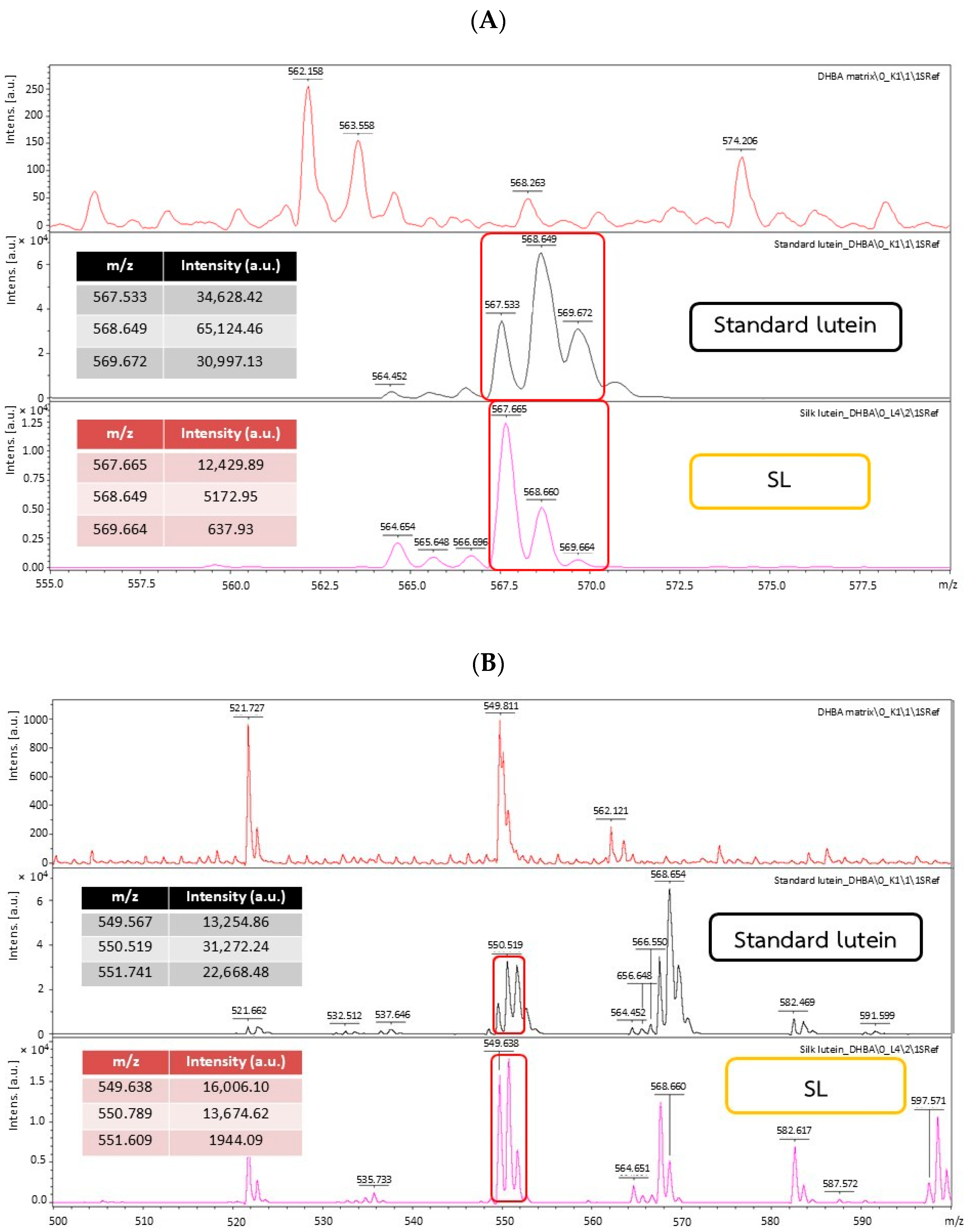
| Standard Lutein | m/z | 549.6 | 550.5 | 551.7 | 567.5 | 568.6 | 569.7 | - |
| Intensity | 13,255 | 31,272 | 22,668 | 34,628 | 65,124 | 30,997 | - | |
| SL | m/z | 549.6 | 550.8 | 551.6 | 567.7 | 568.7 | 569.7 | 598.5 |
| Intensity | 16,006 | 13,675 | 1944 | 12,430 | 5173 | 637.9 | 10,376 |
| Parameter | Female Wistar Rats | Female ICR Mice | ||
|---|---|---|---|---|
| Control | SL 2000 mg/kg BW | Control | SL 2000 mg/kg BW | |
| Initial body weight (g) | 198.33 ± 13.29 | 201.67 ± 9.83 | 22.83 ± 0.75 | 21.33 ± 1.51 |
| Final body weight (g) | 235.00 ± 21.68 | 245.00 ± 17.61 | 29.67 ± 0.82 | 29.50 ± 1.38 |
| Liver (g) | 7.40 ± 0.87 | 8.27 ± 1.65 | 1.46 ± 0.05 | 1.42 ± 0.04 |
| Kidney (g) | 1.44 ± 0.13 | 1.51 ± 0.13 | 0.37 ± 0.02 | 0.37 ± 0.02 |
| Adrenal gland (g) | 0.06 ± 0.01 | 0.06 ± 0.01 | 0.01 ± 0.00 | 0.01 ± 0.00 |
| Pancreas (g) | 0.63 ± 0.06 | 0.67 ± 0.06 | 0.20 ± 0.03 | 0.16 ± 0.03 |
| Parameter | Female Wistar Rats | Female ICR Mice | ||
|---|---|---|---|---|
| Control | SL 2000 mg/kg BW | Control | SL 2000 mg/kg BW | |
| Glucose (mg/dL) | 109.50 ± 4.76 | 107.17 ± 5.31 | 107.33 ± 3.56 | 104.17 ± 5.46 |
| BUN (mg/dL) | 35.92 ± 5.41 | 34.15 ± 3.14 | 22.38 ± 1.70 | 25.45 ± 1.04 * |
| Creatinine (mg/dL) | 0.69 ± 0.04 | 0.62 ± 0.05 * | 0.35 ± 0.04 | 0.34 ± 0.04 |
| Uric acid (mg/dL) | 1.85 ± 0.83 | 1.41 ± 0.48 | 3.71 ± 0.12 | 3.67 ± 0.20 |
| Cholesterol (mg/dL) | 58.33 ± 6.56 | 61.83 ± 3.49 | 85.50 ± 7.15 | 100.17 ± 5.12 * |
| HDL (mg/dL) | 24.90 ± 3.30 | 26.52 ± 1.25 | - | - |
| LDL (mg/dL) | 71.10 ± 9.10 | 77.62 ± 4.65 | - | - |
| Triglyceride (mg/dL) | 60.67 ± 12.86 | 53.67 ± 12.32 | - | - |
| Total protein (g/dL) | 5.51 ± 0.17 | 5.60 ± 0.46 | - | - |
| Albumin (g/dL) | 3.27 ± 0.51 | 3.37 ± 0.06 | - | - |
| Total bilirubin (mg/dL) | 0.36 ± 0.06 | 0.39 ± 0.08 | - | - |
| Direct bilirubin (mg/dL) | 0.27 ± 0.10 | 0.20 ± 0.11 | - | - |
| AST/SGOT (U/L) | 111.00 ± 11.56 | 124.00 ± 17.20 | 97.83 ± 7.19 | 94.17 ± 9.20 |
| ALT/SGPT (U/L) | 43.00 ± 2.00 | 33.50 ± 1.87 * | 21.67 ± 1.86 | 18.17 ± 2.14 * |
| ALP (U/L) | 85.50 ± 16.60 | 114.67 ± 25.56 * | - | - |
| Parameter | Female Wistar Rats | Female ICR Mice | ||
|---|---|---|---|---|
| Control | SL 2000 mg/kg BW | Control | SL 2000 mg/kg BW | |
| Hemoglobin (g/dL) | 13.43 ± 0.21 | 13.13 ± 0.55 | 12.57 ± 0.26 | 12.83 ± 0.42 |
| Hematocrit (%) | 41.33 ± 0.52 | 38.00 ± 4.00 | 40.67 ± 1.03 | 40.83 ± 1.17 |
| WBC (×103 cell/uL) | 1.80 ± 0.26 | 2.42 ± 0.56 * | 5.67 ± 0.44 | 5.50 ± 0.97 |
| Neutrophil (%) | 10.17 ± 2.32 | 6.50 ± 1.64 * | 8.17 ± 0.75 | 8.17 ± 1.47 |
| Lymphocyte (%) | 78.83 ± 2.93 | 81.17 ± 1.17 | 80.50 ± 1.52 | 79.17 ± 1.47 |
| Monocyte (%) | 10.33 ± 2.58 | 11.50 ± 0.55 | 10.67 ± 0.82 | 11.83 ± 0.98 * |
| Eosinophil (%) | 0.67 ± 0.82 | 0.83 ± 0.98 | 0.50 ± 0.55 | 0.50 ± 0.55 |
| Basophil (%) | 0.00 ± 0.00 | 0.00 ± 0.00 | 0.17 ± 0.41 | 0.33 ± 0.52 |
| Atypical lymphocyte (%) | 0.00 ± 0.00 | 0.00 ± 0.00 | 0.00 ± 0.00 | 0.00 ± 0.00 |
| Band form (%) | 0.00± 0.00 | 0.00± 0.00 | 0.00± 0.00 | 0.00± 0.00 |
| Platelet smear (%) | 0.00± 0.00 | 0.00± 0.00 | - | - |
| Platelet count (×103 cell/uL) | 530.33 ± 26.11 | 646.83 ± 51.83 * | 742.67 ± 100.47 | 829.83 ± 42.72 |
| MCV (fL) | 48.17 ± 1.17 | 49.50 ± 1.52 | 46.17 ± 0.75 | 46.67 ± 0.52 |
| MCH (pg) | 15.83 ± 0.41 | 16.00 ± 0.89 | 14.67 ± 0.52 | 15.00 ± 0.00 |
| MCHC (%) | 32.83 ± 0.41 | 32.67 ± 0.52 | 31.33 ± 0.52 | 31.50 ± 0.55 |
| RBC morphology | Normal | Normal | Normal | Normal |
| Parameter | Male Wistar Rats | Female Wistar Rats | ||||||
|---|---|---|---|---|---|---|---|---|
| Control | SL (mg/kg BW) | Control | SL (mg/kg BW) | |||||
| 5 | 25 | 50 | 5 | 25 | 50 | |||
| Initial body weight (g) | 232.17 ± 7.03 | 228.17 ± 3.49 | 228.00 ± 5.48 | 232.67 ± 5.32 | 202.83 ± 6.24 | 206.33 ± 8.55 | 211.00 ± 8.00 | 203.17 ± 7.68 |
| Final body weight (g) | 525.58 ± 47.56 | 527.57 ± 49.15 | 523.97 ± 35.85 | 525.76 ± 26.91 | 269.20 ± 11.56 | 279.97 ± 14.00 | 276.07 ± 20.87 | 267.60 ± 14.27 |
| Heart (g) | 1.23 ± 0.11 | 1.17 ± 0.14 | 1.31 ± 0.14 | 1.16 ± 0.08 | 0.78 ± 0.06 | 0.84 ± 0.03 | 0.83 ± 0.04 | 0.83 ± 0.07 |
| Lung (g) | 1.46 ± 0.16 | 1.38 ± 0.21 | 1.43 ± 0.17 | 1.42 ± 0.12 | 0.96 ± 0.06 | 1.02 ± 0.10 | 1.12 ± 0.25 | 1.04 ± 0.07 |
| Liver (g) | 14.52 ± 1.98 | 13.85 ± 1.43 | 13.59 ± 0.85 | 13.57 ± 0.22 | 7.24 ± 0.77 | 6.94 ± 0.55 | 6.84 ± 0.40 | 6.88 ± 0.67 |
| Kidney (g) | 2.24 ± 0.13 | 2.20 ± 0.22 | 2.23 ± 0.16 | 2.14 ± 0.06 | 1.35 ± 0.06 | 1.46 ± 0.09 * | 1.53 ± 0.07 * | 1.56 ± 0.11 * |
| Adrenal gland (g) | 0.06 ± 0.02 | 0.07 ± 0.01 | 0.07 ± 0.00 | 0.07 ± 0.02 | 0.07 ± 0.01 | 0.06 ± 0.01 | 0.07 ± 0.01 | 0.07 ± 0.02 |
| Pancreas (g) | 0.83 ± 0.15 | 0.82 ± 0.14 | 0.96 ± 0.09 | 0.77 ± 0.28 | 0.65 ± 0.12 | 0.64 ± 0.12 | 0.67 ± 0.12 | 0.56 ± 0.08 |
| Spleen (g) | 0.72 ± 0.11 | 0.74 ± 0.07 | 0.82 ± 0.08 | 0.74 ± 0.07 | 0.57 ± 0.06 | 0.57 ± 0.05 | 0.65 ± 0.10 | 0.55 ± 0.08 |
| Prostate gland (g) | 0.41 ± 0.09 | 0.32 ± 0.14 | 0.34 ± 0.10 | 0.32 ± 0.13 | - | - | - | - |
| Seminal vesicle (g) | 1.20 ± 0.25 | 1.33 ± 0.23 | 1.10 ± 0.19 | 1.19 ± 0.23 | - | - | - | - |
| Epididymis (g) | 1.43 ± 0.31 | 1.35 ± 0.16 | 1.38 ± 0.10 | 1.40 ± 0.18 | - | - | - | - |
| Testis (g) | 3.82 ± 0.33 | 3.60 ± 0.18 | 3.79 ± 0.11 | 3.80 ± 0.35 | - | - | - | - |
| Ovary (g) | - | - | - | - | 0.11 ± 0.04 | 0.16 ± 0.14 | 0.11 ± 0.03 | 0.09 ± 0.04 |
| Parameter | Male Wistar Rats | Female Wistar Rats | ||||||
|---|---|---|---|---|---|---|---|---|
| Control | SL (mg/kg BW) | Control | SL (mg/kg BW) | |||||
| 5 | 25 | 50 | 5 | 25 | 50 | |||
| BUN (mg/dL) | 28.50 ± 2.18 | 29.57 ± 2.28 | 29.97 ± 4.90 | 25.43 ± 2.81 | 34.33 ± 4.89 | 32.15 ± 4.82 | 35.95 ± 6.80 | 35.97 ± 8.75 |
| Creatinine (mg/dL) | 0.80 ± 0.12 | 0.73 ± 0.16 | 0.72 ± 0.04 | 0.73 ± 0.15 | 0.88 ± 0.05 | 0.83 ± 0.07 | 0.81 ± 0.24 | 0.74 ± 0.22 |
| Uric acid (mg/dL) | 1.81 ± 0.15 | 1.79 ± 0.07 | 1.77 ± 0.24 | 1.79 ± 0.14 | 2.22 ± 0.34 | 2.22 ± 0.37 | 2.28 ± 0.38 | 2.28 ± 0.33 |
| Cholesterol (mg/dL) | 52.00 ± 7.35 | 49.00 ± 7.67 | 42.50 ± 9.44 | 46.83 ± 7.55 | 32.33 ± 1.63 | 37.50 ± 3.39 | 35.67 ± 6.41 | 35.33 ± 6.77 |
| HDL (mg/dL) | 43.12 ± 2.73 | 42.42 ± 5.59 | 39.28 ± 5.82 | 38.00 ± 4.08 | 32.72 ± 2.96 | 35.30 ± 2.96 | 34.20 ± 4.90 | 36.40 ± 7.34 |
| Triglyceride (mg/dL) | 85.00 ± 9.76 | 79.67 ± 11.62 | 59.33 ± 17.65 * | 59.83 ± 15.45 * | 71.50 ± 9.91 | 58.50 ± 7.64 * | 52.00 ± 7.07 * | 45.33 ± 5.20 * |
| Total protein (g/dL) | 6.77 ± 0.23 | 6.71 ± 0.14 | 6.70 ± 0.25 | 6.50 ± 0.18 * | 6.40 ± 0.35 | 6.64 ± 0.30 | 6.70 ± 0.16 | 6.62 ± 0.36 |
| Albumin (g/dL) | 3.33 ± 0.38 | 3.54 ± 0.21 | 3.44 ± 0.27 | 3.40 ± 0.26 | 3.75 ± 0.30 | 3.53 ± 0.13 | 3.55 ± 0.30 | 3.55 ± 0.16 |
| Total bilirubin (mg/dL) | 0.64 ± 0.15 | 0.47 ± 0.17 | 0.48 ± 0.16 | 0.41 ± 0.15 * | 0.48 ± 0.06 | 0.62 ± 0.04 | 0.53 ± 0.19 | 0.56 ± 0.11 |
| Direct bilirubin (mg/dL) | 0.13 ± 0.03 | 0.08 ± 0.06 | 0.11 ± 0.07 | 0.11 ± 0.03 | 0.11 ± 0.04 | 0.16 ± 0.06 | 0.13 ± 0.03 | 0.15 ± 0.03 |
| AST/SGOT (U/L) | 96.67 ± 7.76 | 94.00 ± 5.62 | 95.00 ± 8.12 | 99.50 ± 6.89 | 106.00 ± 13.90 | 113.50 ± 21.34 | 121.83 ± 13.32 | 115.83 ± 13.50 |
| ALT/SGPT (U/L) | 38.00 ± 7.38 | 34.33 ± 7.81 | 37.17 ± 6.97 | 38.00 ± 5.59 | 32.33 ± 4.03 | 35.83 ± 4.22 | 34.83 ± 2.23 | 34.67 ± 3.08 |
| ALP (U/L) | 117.17 ± 10.63 | 110.50 ± 22.42 | 103.50 ± 18.96 | 107.83 ± 25.00 | 88.67 ± 3.83 | 83.00 ± 16.88 | 88.83 ± 15.32 | 82.50 ± 9.52 |
| Parameter | Male Wistar Rats | Female Wistar Rats | ||||||
|---|---|---|---|---|---|---|---|---|
| Control | SL (mg/kg BW) | Control | SL (mg/kg BW) | |||||
| 5 | 25 | 50 | 5 | 25 | 50 | |||
| Hemoglobin (g/dL) | 14.65 ± 0.52 | 15.18 ± 0.70 | 15.25 ± 0.32 | 15.47 ± 0.89 * | 14.57 ± 0.60 | 14.55 ± 1.22 | 14.58 ± 0.49 | 14.02 ± 0.29 |
| Hematocrit (%) | 44.00 ± 1.67 | 45.50 ± 2.43 | 45.83 ± 1.47 | 45.83 ± 2.79 | 42.17 ± 2.04 | 41.17 ± 1.94 | 42.33 ± 1.21 | 40.83 ± 1.33 |
| WBC (×103 cell/uL) | 3.30 ± 0.44 | 3.62 ± 0.33 | 2.40 ± 0.58 * | 2.58 ± 0.58 * | 2.02 ± 0.37 | 1.82 ± 0.23 | 1.87 ± 0.37 | 1.95 ± 0.29 |
| Neutrophil (%) | 9.17 ± 1.17 | 9.50 ± 1.22 | 10.67 ± 2.42 | 10.50 ± 1.76 | 11.00 ± 3.35 | 13.00 ± 2.28 | 15.50 ± 2.59 * | 15.83 ± 2.71 * |
| Lymphocyte (%) | 87.50 ± 3.67 | 89.33 ± 1.63 | 87.17 ± 2.23 | 84.17 ± 4.45 | 88.83 ± 4.54 | 85.00 ± 3.22 | 83.33 ± 1.86 | 80.33 ± 8.33 * |
| Monocyte (%) | 0.67 ± 0.52 | 0.50 ± 0.55 | 0.50 ± 0.55 | 0.50 ± 0.55 | 0.67 ± 0.52 | 0.67 ± 0.52 | 0.67 ± 0.82 | 0.67 ± 0.52 |
| Eosinophil (%) | 0.17 ± 0.41 | 0.17 ± 0.41 | 0.17 ± 0.41 | 0.17 ± 0.41 | 0.50 ± 0.55 | 0.33 ± 0.52 | 0.33 ± 0.52 | 0.33 ± 0.52 |
| Basophil (%) | 0.17 ± 0.41 | 0.00 ± 0.00 | 0.00 ± 0.00 | 0.00 ± 0.00 | 0.00 ± 0.00 | 0.00 ± 0.00 | 0.00 ± 0.00 | 0.00 ± 0.00 |
| Platelet count (×103 cell/µL) | 621.33 ± 37.68 | 614.67 ± 24.86 | 605.00 ± 37.33 | 598.67 ± 42.05 | 645.17 ± 75.28 | 669.33 ± 89.37 | 613.33 ± 57.74 | 593.83 ± 30.50 |
| MCV (fL) | 55.50 ± 1.38 | 55.67 ± 1.86 | 56.50 ± 0.55 | 55.83 ± 2.32 | 57.67 ± 1.21 | 56.83 ± 0.98 | 56.83 ± 1.72 | 56.33 ± 1.37 |
| MCH (pg) | 19.00 ± 0.63 | 18.67 ± 0.52 | 18.83 ± 0.41 | 19.00 ± 0.63 | 20.00 ± 0.63 | 19.50 ± 0.55 | 19.50 ± 0.84 | 19.67 ± 0.52 |
| MCHC (%) | 34.00 ± 0.00 | 33.67 ± 0.52 | 33.50 ± 0.84 | 33.83 ± 0.75 | 34.33 ± 0.52 | 34.33 ± 0.52 | 34.50 ± 0.55 | 34.83 ± 0.75 |
| Months | Blood Glucose (mg/dL) | |||||||
|---|---|---|---|---|---|---|---|---|
| Control | Male Wistar Rats | Control | Female Wistar Rats | |||||
| 5 | 25 | 50 | 5 | 25 | 50 | |||
| Initial | 73.33 ± 3.67 | 72.50 ± 3.02 | 72.67 ± 4.89 | 73.00 ± 3.52 | 65.33 ± 5.50 | 65.83 ± 4.58 | 64.33 ± 4.08 | 64.17 ± 5.38 |
| 1 | 83.67 ± 3.14 | 81.50 ± 5.65 | 75.50 ± 2.88 * | 71.67 ± 6.28 * | 66.83 ± 1.60 | 68.00 ± 5.14 | 65.33 ± 7.84 | 62.17 ± 5.12 |
| 2 | 68.17 ± 3.71 | 71.00 ± 3.95 | 67.67 ± 6.86 | 66.83 ± 7.36 | 67.83 ± 7.05 | 61.17 ± 6.46 | 65.17 ± 5.91 | 64.83 ± 7.99 |
| 3 | 73.33 ± 3.88 | 71.33 ± 5.72 | 68.33 ± 2.66 | 69.17 ± 4.88 | 62.67 ± 3.83 | 60.67 ± 3.39 | 60.50 ± 5.86 | 60.67 ± 3.83 |
| 4 | 79.17 ± 6.59 | 77.83 ± 8.98 | 68.67 ± 4.13 * | 68.17 ± 5.19 * | 55.33 ± 6.38 | 59.00 ± 5.48 | 58.83 ± 6.55 | 56.17 ± 2.04 |
| 5 | 70.83 ± 4.92 | 66.33 ± 7.12 | 64.17 ± 5.49 | 63.33 ± 4.23 * | 61.17 ± 8.68 | 60.50 ± 5.39 | 60.00 ± 10.08 | 63.67 ± 6.47 |
| 6 | 72.50 ± 3.62 | 67.83 ± 4.26 | 70.67 ± 5.72 | 63.67 ± 4.76 * | 63.67 ± 4.32 | 62.17 ± 5.08 | 60.67 ± 5.65 | 64.33 ± 6.12 |
Disclaimer/Publisher’s Note: The statements, opinions and data contained in all publications are solely those of the individual author(s) and contributor(s) and not of MDPI and/or the editor(s). MDPI and/or the editor(s) disclaim responsibility for any injury to people or property resulting from any ideas, methods, instructions or products referred to in the content. |
© 2026 by the authors. Licensee MDPI, Basel, Switzerland. This article is an open access article distributed under the terms and conditions of the Creative Commons Attribution (CC BY) license.
Share and Cite
Tocharus, C.; Sutheerawattananonda, M. Oral Toxicity Profile of a Novel Silk Lutein Extract and Assessment of Its Cardiovascular Benefits in Rodents. Int. J. Mol. Sci. 2026, 27, 577. https://doi.org/10.3390/ijms27020577
Tocharus C, Sutheerawattananonda M. Oral Toxicity Profile of a Novel Silk Lutein Extract and Assessment of Its Cardiovascular Benefits in Rodents. International Journal of Molecular Sciences. 2026; 27(2):577. https://doi.org/10.3390/ijms27020577
Chicago/Turabian StyleTocharus, Chainarong, and Manote Sutheerawattananonda. 2026. "Oral Toxicity Profile of a Novel Silk Lutein Extract and Assessment of Its Cardiovascular Benefits in Rodents" International Journal of Molecular Sciences 27, no. 2: 577. https://doi.org/10.3390/ijms27020577
APA StyleTocharus, C., & Sutheerawattananonda, M. (2026). Oral Toxicity Profile of a Novel Silk Lutein Extract and Assessment of Its Cardiovascular Benefits in Rodents. International Journal of Molecular Sciences, 27(2), 577. https://doi.org/10.3390/ijms27020577