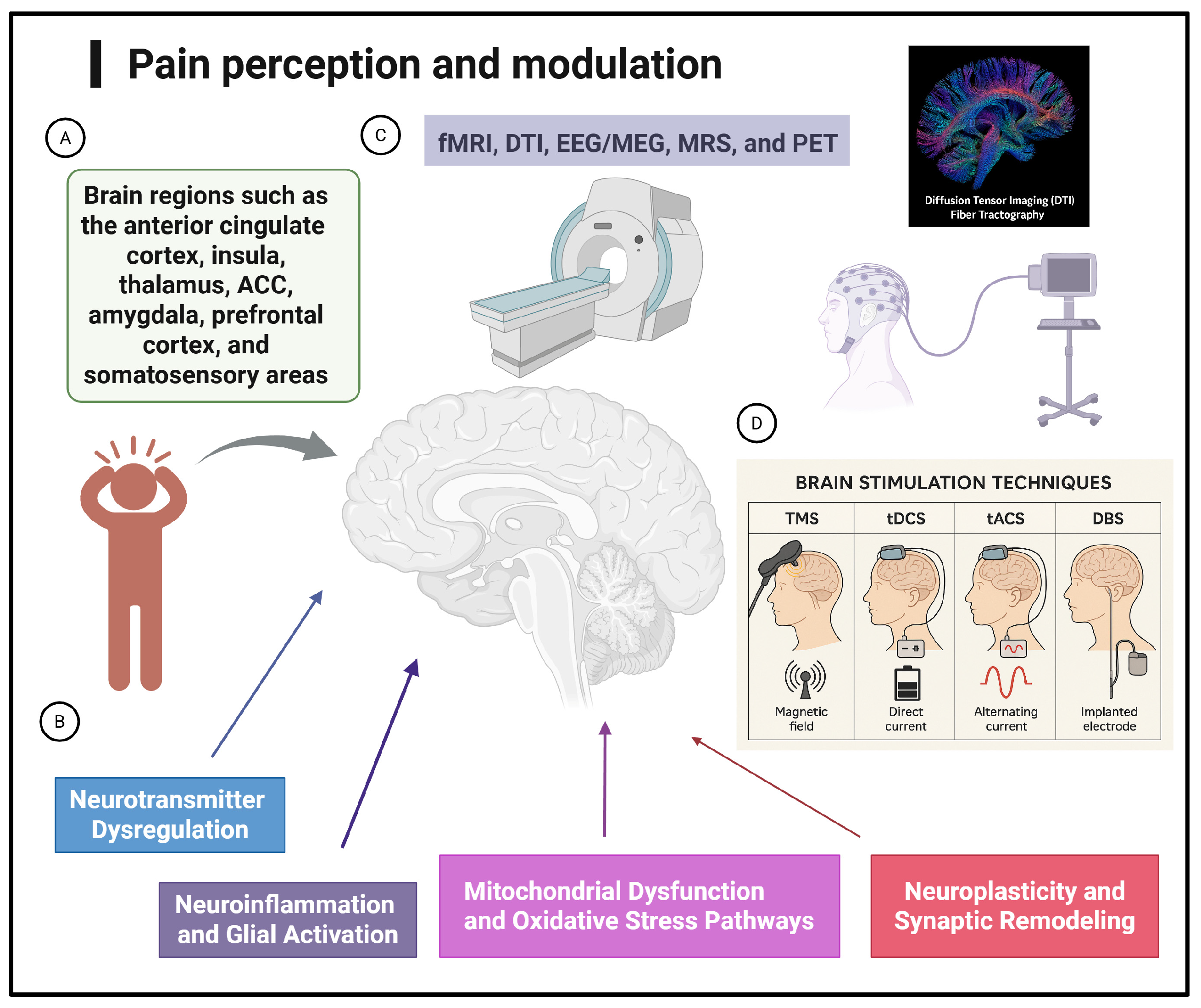
Neuroimaging-Guided Insights into the Molecular and Network Mechanisms of Chronic Pain and Neuromodulation



Abstract
1. Introduction
2. Molecular and Cellular Mechanisms of Chronic Pain Revealed by Neuroimaging
2.1. Neurotransmitter Dysregulation
2.2. Neuroinflammation and Glial Activation
2.3. Mitochondrial and Oxidative Stress Pathways
2.4. Neuroplasticity and Synaptic Remodeling
2.5. Integration of Molecular and Functional Imaging
2.6. Ion Channels and Excitability Checkpoints
2.7. Extracellular Vesicles and EV-miRNA Signaling
3. Network-Level Alterations in Chronic Pain: Insights from Functional and Structural Neuroimaging
3.1. Altered Functional Connectivity in Pain-Related Networks
3.2. Thalamocortical and Limbic Dysregulation
3.3. White Matter Microstructure and Structural Network Alterations
3.4. Dynamic Connectivity and Network Plasticity
4. Neuroimaging-Guided Neuromodulation: Mechanisms and Therapeutic Implications
4.1. TMS
4.2. tDCS
4.3. tACS
4.4. DBS
4.5. Brain–Computer Interfaces and Closed-Loop Neuromodulation
4.6. Neurobiological Substrates of Neuromodulation Analgesia: Neurotransmitter and Neuroimmune Mechanisms
4.7. Limitations and Future Directions
5. Conclusions
Author Contributions
Funding
Data Availability Statement
Conflicts of Interest
References
- Cohen, S.P.; Vase, L.; Hooten, W.M. Chronic pain: An update on burden, best practices, and new advances. Lancet 2021, 397, 2082–2097. [Google Scholar] [CrossRef]
- Zang, H.; Ji, X.; Yao, W.; Wan, L.; Zhang, C.; Zhu, C.; Liu, T. Role of efferocytosis in chronic pain—From molecular perspective. Neurobiol. Dis. 2025, 207, 106857. [Google Scholar] [CrossRef]
- Yang, S.; Chang, M.C. Chronic Pain: Structural and Functional Changes in Brain Structures and Associated Negative Affective States. Int. J. Mol. Sci. 2019, 20, 3130. [Google Scholar] [CrossRef] [PubMed]
- Nasir, A.; Afridi, M.; Afridi, O.K.; Khan, M.A.; Khan, A.; Zhang, J.; Qian, B. The persistent pain enigma: Molecular drivers behind acute-to-chronic transition. Neurosci. Biobehav. Rev. 2025, 173, 106162. [Google Scholar] [CrossRef] [PubMed]
- Li, Z.; Li, X.; Liu, J.; Sun, R.; Ye, Y.; Xiang, H.; Luo, F.; Li, S.; Luo, A. Molecular Mechanisms of Chronic Pain and Therapeutic Interventions. MedComm 2025, 6, e70325. [Google Scholar] [CrossRef] [PubMed]
- Mills, S.E.E.; Nicolson, K.P.; Smith, B.H. Chronic pain: A review of its epidemiology and associated factors in population-based studies. Br. J. Anaesth. 2019, 123, e273–e283. [Google Scholar] [CrossRef]
- Fillingim, M.; Tanguay-Sabourin, C.; Parisien, M.; Zare, A.; Guglietti, G.V.; Norman, J.; Petre, B.; Bortsov, A.; Ware, M.; Perez, J.; et al. Biological markers and psychosocial factors predict chronic pain conditions. Nat. Hum. Behav. 2025, 9, 1710–1725. [Google Scholar] [CrossRef]
- Cao, B.; Xu, Q.; Shi, Y.; Zhao, R.; Li, H.; Zheng, J.; Liu, F.; Wan, Y.; Wei, B. Pathology of pain and its implications for therapeutic interventions. Signal Transduct. Target. Ther. 2024, 9, 155. [Google Scholar] [CrossRef]
- Jayathilake, N.J.; Phan, T.T.; Kim, J.; Lee, K.P.; Park, J.M. Modulating neuroplasticity for chronic pain relief: Noninvasive neuromodulation as a promising approach. Exp. Mol. Med. 2025, 57, 501–514. [Google Scholar] [CrossRef]
- De Ridder, D.; Adhia, D.; Vanneste, S. The anatomy of pain and suffering in the brain and its clinical implications. Neurosci. Biobehav. Rev. 2021, 130, 125–146. [Google Scholar] [CrossRef]
- Kannan, S.; Patel, K.; Di Basilio, D.; Kirkby, A.; Sivan, M.; Jones, A.; Mohanraj, R.; Das, A. Shared neural signatures in Functional Neurological Disorder and Chronic Pain: A multimodal narrative review. BMJ Neurol Open 2025, 7, e001032. [Google Scholar] [CrossRef]
- Cohen, M.; Quintner, J.; Weisman, A. “Nociplastic Pain”: A Challenge to Nosology and to Nociception. J. Pain 2023, 24, 2131–2139. [Google Scholar] [CrossRef]
- Hyland, S.J.; Brockhaus, K.K.; Vincent, W.R.; Spence, N.Z.; Lucki, M.M.; Howkins, M.J.; Cleary, R.K. Perioperative Pain Management and Opioid Stewardship: A Practical Guide. Healthcare 2021, 9, 333. [Google Scholar] [CrossRef]
- Boccella, S.; De Filippis, L.; Giorgio, C.; Brandolini, L.; Jones, M.; Novelli, R.; Amorizzo, E.; Leoni, M.L.G.; Terranova, G.; Maione, S.; et al. Combination Drug Therapy for the Management of Chronic Neuropathic Pain. Biomolecules 2023, 13, 1802. [Google Scholar] [CrossRef]
- Kremer, M.; Salvat, E.; Muller, A.; Yalcin, I.; Barrot, M. Antidepressants and gabapentinoids in neuropathic pain: Mechanistic insights. Neuroscience 2016, 338, 183–206. [Google Scholar] [CrossRef]
- Shi, Y.; Wu, W. Multimodal non-invasive non-pharmacological therapies for chronic pain: Mechanisms and progress. BMC Med. 2023, 21, 372. [Google Scholar] [CrossRef]
- Wang, Y.; Aaron, R.; Attal, N.; Colloca, L. An update on non-pharmacological interventions for pain relief. Cell Rep. Med. 2025, 6, 101940. [Google Scholar] [CrossRef] [PubMed]
- Jaffal, S.M. Neuroplasticity in chronic pain: Insights into diagnosis and treatment. Korean J. Pain 2025, 38, 89–102. [Google Scholar] [CrossRef] [PubMed]
- Yen, C.; Chiang, M.-C. Trust me, if you can: A study on the factors that influence consumers’ purchase intention triggered by chatbots based on brain image evidence and self-reported assessments. Behav. Inf. Technol. 2021, 40, 1177–1194. [Google Scholar] [CrossRef]
- Yen, C.; Chiang, M.C. Examining the effect of online advertisement cues on human responses using eye-tracking, EEG, and MRI. Behav. Brain Res. 2021, 402, 113128. [Google Scholar] [CrossRef]
- Yen, C.; Lin, C.L.; Chiang, M.C. Exploring the Frontiers of Neuroimaging: A Review of Recent Advances in Understanding Brain Functioning and Disorders. Life 2023, 13, 1472. [Google Scholar] [CrossRef]
- Kong, Q.; Li, T.; Reddy, S.; Hodges, S.; Kong, J. Brain stimulation targets for chronic pain: Insights from meta-analysis, functional connectivity and literature review. Neurotherapeutics 2024, 21, e00297. [Google Scholar] [CrossRef] [PubMed]
- Meeker, T.J.; Jupudi, R.; Lenz, F.A.; Greenspan, J.D. New Developments in Non-invasive Brain Stimulation in Chronic Pain. Curr. Phys. Med. Rehabil. Rep. 2020, 8, 280–292. [Google Scholar] [CrossRef] [PubMed]
- Yen, C.; Valentine, E.P.; Chiang, M.C. The Use of Transcranial Magnetic Stimulation in Attention Optimization Research: A Review from Basic Theory to Findings in Attention-Deficit/Hyperactivity Disorder and Depression. Life 2024, 14, 329. [Google Scholar] [CrossRef] [PubMed]
- Song, Q.; Sihan, E.; Zhang, Z.; Liang, Y. Neuroplasticity in the transition from acute to chronic pain. Neurotherapeutics 2024, 21, e00464. [Google Scholar] [CrossRef]
- Ma, M.; Zhang, Y.; Tao, K.; Lu, Z. Neurochemical crossroads: Exploring the neurotransmitter network in chronic pain and depression comorbidity. Front. Mol. Neurosci. 2025, 18, 1675814. [Google Scholar] [CrossRef]
- Martucci, K.T.; Mackey, S.C. Neuroimaging of Pain: Human Evidence and Clinical Relevance of Central Nervous System Processes and Modulation. Anesthesiology 2018, 128, 1241–1254. [Google Scholar] [CrossRef]
- Wey, H.Y.; Catana, C.; Hooker, J.M.; Dougherty, D.D.; Knudsen, G.M.; Wang, D.J.; Chonde, D.B.; Rosen, B.R.; Gollub, R.L.; Kong, J. Simultaneous fMRI-PET of the opioidergic pain system in human brain. Neuroimage 2014, 102, 275–282. [Google Scholar] [CrossRef]
- Archibald, J.; MacMillan, E.L.; Enzler, A.; Jutzeler, C.R.; Schweinhardt, P.; Kramer, J.L.K. Excitatory and inhibitory responses in the brain to experimental pain: A systematic review of MR spectroscopy studies. NeuroImage 2020, 215, 116794. [Google Scholar] [CrossRef]
- Wang, X.; Li, X. Regulation of pain neurotransmitters and chondrocytes metabolism mediated by voltage-gated ion channels: A narrative review. Heliyon 2023, 9, e17989. [Google Scholar] [CrossRef]
- Zhou, Y.P.; Zhang, L.L.; Sun, Y.; Brugarolas, P. Imaging of Pain using Positron Emission Tomography. iRadiology 2024, 2, 339–361. [Google Scholar] [CrossRef]
- Stephenson, D.T.; Arneric, S.P. Neuroimaging of Pain: Advances and Future Prospects. J. Pain 2008, 9, 567–579. [Google Scholar] [CrossRef]
- Varrassi, G.; Leoni, M.L.G.; Fari, G.; Al-Alwany, A.A.; Al-Sharie, S.; Fornasari, D. Neuromodulatory Signaling in Chronic Pain Patients: A Narrative Review. Cells 2025, 14, 1320. [Google Scholar] [CrossRef]
- Jarcho, J.M.; Mayer, E.A.; Jiang, Z.K.; Feier, N.A.; London, E.D. Pain, affective symptoms, and cognitive deficits in patients with cerebral dopamine dysfunction. Pain 2012, 153, 744–754. [Google Scholar] [CrossRef]
- Hansen, T.M.; Muthulingam, J.A.; Drewes, A.M.; Olesen, S.S.; Frokjaer, J.B. Cingulate glutamate levels associate with pain in chronic pancreatitis patients. NeuroImage Clin. 2019, 23, 101925. [Google Scholar] [CrossRef] [PubMed]
- Huang, D.; Dong, Y.T.; He, L.X.; Zhou, R.Z.; Zhou, J.X.; Yang, S.; Yu, S.G. Decoding chronic pain: The glutamate-GABA tug of war in the cerebral cortex. Front. Mol. Neurosci. 2025, 18, 1572775. [Google Scholar] [CrossRef] [PubMed]
- Hiroyuki, A.; Akihiko, O. Serotonin circuits act cooperatively with pathophysiology of opioid use disorder. Addict. Neurosci. 2025, 14, 100187. [Google Scholar] [CrossRef]
- Heijmans, L.; Mons, M.R.; Joosten, E.A. A systematic review on descending serotonergic projections and modulation of spinal nociception in chronic neuropathic pain and after spinal cord stimulation. Mol. Pain 2021, 17, 17448069211043965. [Google Scholar] [CrossRef]
- Chaudhari, A.; Padmar, J.; Awathale, S.; Goyal, S.; Nakhate, K.; Sherikar, A. From glial cells to pain pathways: ICAM-1 as a central player in neuroinflammation and neuropathy. Discov. Neurosci. 2025, 20, 5. [Google Scholar] [CrossRef]
- Lu, H.J.; Gao, Y.J. Astrocytes in Chronic Pain: Cellular and Molecular Mechanisms. Neurosci. Bull. 2023, 39, 425–439. [Google Scholar] [CrossRef] [PubMed]
- Singh, P.; Adhikari, A.; Singh, D.; Gond, C.; Tiwari, A.K. The 18-kDa Translocator Protein PET Tracers as a Diagnostic Marker for Neuroinflammation: Development and Current Standing. ACS Omega 2022, 7, 14412–14429. [Google Scholar] [CrossRef]
- Janssen, B.; Vugts, D.J.; Windhorst, A.D.; Mach, R.H. PET Imaging of Microglial Activation-Beyond Targeting TSPO. Molecules 2018, 23, 607. [Google Scholar] [CrossRef]
- Loggia, M.L.; Chonde, D.B.; Akeju, O.; Arabasz, G.; Catana, C.; Edwards, R.R.; Hill, E.; Hsu, S.; Izquierdo-Garcia, D.; Ji, R.R.; et al. Evidence for brain glial activation in chronic pain patients. Brain 2015, 138, 604–615. [Google Scholar] [CrossRef]
- Jung, C.; Ichesco, E.; Ratai, E.M.; Gonzalez, R.G.; Burdo, T.; Loggia, M.L.; Harris, R.E.; Napadow, V. Magnetic resonance imaging of neuroinflammation in chronic pain: A role for astrogliosis? Pain 2020, 161, 1555–1564. [Google Scholar] [CrossRef] [PubMed]
- Betlazar, C.; Middleton, R.J.; Banati, R.; Liu, G.J. The Translocator Protein (TSPO) in Mitochondrial Bioenergetics and Immune Processes. Cells 2020, 9, 512. [Google Scholar] [CrossRef] [PubMed]
- Pannell, M.; Economopoulos, V.; Wilson, T.C.; Kersemans, V.; Isenegger, P.G.; Larkin, J.R.; Smart, S.; Gilchrist, S.; Gouverneur, V.; Sibson, N.R. Imaging of translocator protein upregulation is selective for pro-inflammatory polarized astrocytes and microglia. Glia 2020, 68, 280–297. [Google Scholar] [CrossRef]
- Coluzzi, F.; Zeboudj, L.; Scerpa, M.S.; Giorgio, A.; De Blasi, R.A.; Malcangio, M.; Rocco, M. Microglial Activation in Nociplastic Pain: From Preclinical Models to PET Neuroimaging and Implications for Targeted Therapeutic Strategies. Int. J. Mol. Sci. 2025, 26, 11861. [Google Scholar] [CrossRef] [PubMed]
- Sharma, A.; Behl, T.; Sharma, L.; Shah, O.P.; Yadav, S.; Sachdeva, M.; Rashid, S.; Bungau, S.G.; Bustea, C. Exploring the molecular pathways and therapeutic implications of angiogenesis in neuropathic pain. Biomed. Pharmacother. 2023, 162, 114693. [Google Scholar] [CrossRef]
- Weerasekera, A.; Knight, P.C.; Alshelh, Z.; Morrissey, E.J.; Kim, M.; Zhang, Y.; Napadow, V.; Anzolin, A.; Torrado-Carvajal, A.; Edwards, R.R.; et al. Thalamic neurometabolite alterations in chronic low back pain: A common phenomenon across musculoskeletal pain conditions? Pain 2024, 165, 126–134. [Google Scholar] [CrossRef]
- Willemen, H.; Santos Ribeiro, P.S.; Broeks, M.; Meijer, N.; Versteeg, S.; Tiggeler, A.; de Boer, T.P.; Malecki, J.M.; Falnes, P.O.; Jans, J.; et al. Inflammation-induced mitochondrial and metabolic disturbances in sensory neurons control the switch from acute to chronic pain. Cell Rep. Med. 2023, 4, 101265. [Google Scholar] [CrossRef]
- Qiu, S.; Chen, T.; Koga, K.; Guo, Y.Y.; Xu, H.; Song, Q.; Wang, J.J.; Descalzi, G.; Kaang, B.K.; Luo, J.H.; et al. An increase in synaptic NMDA receptors in the insular cortex contributes to neuropathic pain. Sci. Signal. 2013, 6, ra34. [Google Scholar] [CrossRef] [PubMed]
- Salter, M.W.; Pitcher, G.M. Dysregulated Src upregulation of NMDA receptor activity: A common link in chronic pain and schizophrenia. FEBS J. 2012, 279, 2–11. [Google Scholar] [CrossRef] [PubMed]
- Demchenko, I.; Tassone, V.K.; Kennedy, S.H.; Dunlop, K.; Bhat, V. Intrinsic Connectivity Networks of Glutamate-Mediated Antidepressant Response: A Neuroimaging Review. Front. Psychiatry 2022, 13, 864902. [Google Scholar] [CrossRef]
- Terumitsu, M.; Takado, Y.; Fukuda, K.I.; Kato, E.; Tanaka, S.; Tha, K.K. Altered Brain Functional Connectivity and Neurometabolite Correlations in Orofacial Chronic Pain with Central Sensitization. J. Pain Res. 2025, 18, 2849–2863. [Google Scholar] [CrossRef]
- Li, B.; Yu, K.; Zhou, X.; Sun, J.; Qi, L.; Li, W.; Yang, T.; Li, W.; Wang, N.; Gu, X.; et al. Increased TSPO alleviates neuropathic pain by preventing pyroptosis via the AMPK-PGC-1alpha pathway. J. Headache Pain 2025, 26, 16. [Google Scholar] [CrossRef]
- Stojanovic, B.; Milivojcevic Bevc, I.; Dimitrijevic Stojanovic, M.; Stojanovic, B.S.; Lazarevic, T.; Spasic, M.; Petrovic, M.; Stefanovic, I.; Markovic, M.; Nesic, J.; et al. Oxidative Stress, Inflammation, and Cellular Senescence in Neuropathic Pain: Mechanistic Crosstalk. Antioxidants 2025, 14, 1166. [Google Scholar] [CrossRef]
- Stevens, E.B.; Stephens, G.J. Recent advances in targeting ion channels to treat chronic pain. Br. J. Pharmacol. 2018, 175, 2133–2137. [Google Scholar] [CrossRef]
- Alles, S.R.A.; Smith, P.A. Peripheral Voltage-Gated Cation Channels in Neuropathic Pain and Their Potential as Therapeutic Targets. Front. Pain Res. 2021, 2, 750583. [Google Scholar] [CrossRef]
- Felix, R.; Corzo-Lopez, A.; Sandoval, A. Voltage-Gated Ion Channels in Neuropathic Pain Signaling. Life 2025, 15, 888. [Google Scholar] [CrossRef]
- Lee, Y.; Lee, C.-H.; Oh, U. Painful Channels in Sensory Neurons. Mol. Cells 2005, 20, 315–324. [Google Scholar] [CrossRef] [PubMed]
- Huang, Y.; Chen, S.R.; Pan, H.L. alpha2delta-1-Linked NMDA and AMPA Receptors in Neuropathic Pain and Gabapentinoid Action. J. Neurochem. 2025, 169, e70064. [Google Scholar] [CrossRef] [PubMed]
- Chiang, M.C.; Yang, Y.P.; Nicol, C.J.B.; Chiang, T.; Yen, C. Resveratrol-Enhanced Human Neural Stem Cell-Derived Exosomes Mitigate MPP+-Induced Neurotoxicity Through Activation of AMPK and Nrf2 Pathways and Inhibition of the NLRP3 Inflammasome in SH-SY5Y Cells. Life 2025, 15, 294. [Google Scholar] [CrossRef]
- Wang, Z.; Jiao, P. Roles of non-coding RNAs and exosomal non-coding RNAs, particularly microRNAs, long non-coding RNAs, and circular RNAs, in pathogenic mechanisms behind chronic pain: A review. Int. J. Biol. Macromol. 2025, 307, 141945. [Google Scholar] [CrossRef]
- Gao, X.; Gao, L.-f.; Zhang, Y.-n.; Kong, X.-q.; Jia, S.; Meng, C.-y. Huc-MSCs-derived exosomes attenuate neuropathic pain by inhibiting activation of the TLR2/MyD88/NF-κB signaling pathway in the spinal microglia by targeting Rsad2. Int. Immunopharmacol. 2023, 114, 109505. [Google Scholar] [CrossRef]
- Golmakani, H.; Azimian, A.; Golmakani, E. Newly discovered functions of miRNAs in neuropathic pain: Transitioning from recent discoveries to innovative underlying mechanisms. Mol. Pain 2024, 20, 17448069231225845. [Google Scholar] [CrossRef]
- Wei, Z.; Guo, C.; Zhou, H.; Wu, Y.; Zhou, X.; Chen, J.; Li, F. Exosome-mediated miRNA delivery: A molecular switch for reshaping neuropathic pain therapy. Front. Mol. Neurosci. 2025, 18, 1625943, Correction in Front. Mol. Neurosci. 2025, 18, 1668038. [Google Scholar] [CrossRef]
- Crofford, L.J. Chronic Pain: Where the Body Meets the Brain. Trans. Am. Clin. Climatol. Assoc. 2015, 126, 167–183. [Google Scholar]
- Luo, J.; Zhu, H.Q.; Gou, B.; Wang, X.Q. Neuroimaging Assessment of Pain. Neurotherapeutics 2022, 19, 1467–1488. [Google Scholar] [CrossRef]
- Zolezzi, D.M.; Alonso-Valerdi, L.M.; Ibarra-Zarate, D.I. Chronic neuropathic pain is more than a perception: Systems and methods for an integral characterization. Neurosci. Biobehav. Rev. 2022, 136, 104599. [Google Scholar] [CrossRef] [PubMed]
- Fiúza-Fernandes, J.; Pereira-Mendes, J.; Esteves, M.; Radua, J.; Picó-Pérez, M.; Leite-Almeida, H. Common neural correlates of chronic pain—A systematic review and meta-analysis of resting-state fMRI studies. Prog. Neuro-Psychopharmacol. Biol. Psychiatry 2025, 138, 111326. [Google Scholar] [CrossRef] [PubMed]
- Kucyi, A.; Moayedi, M.; Weissman-Fogel, I.; Goldberg, M.B.; Freeman, B.V.; Tenenbaum, H.C.; Davis, K.D. Enhanced medial prefrontal-default mode network functional connectivity in chronic pain and its association with pain rumination. J. Neurosci. 2014, 34, 3969–3975. [Google Scholar] [CrossRef]
- Sewaybricker, L.E.; Melhorn, S.J.; Askren, M.K.; Webb, M.F.; Tyagi, V.; De Leon, M.R.B.; Grabowski, T.J.; Seeley, W.W.; Schur, E.A. Salience network connectivity is reduced by a meal and influenced by genetic background and hypothalamic gliosis. Int. J. Obes. 2020, 44, 167–177. [Google Scholar] [CrossRef]
- Vachon-Presseau, E.; Centeno, M.V.; Ren, W.; Berger, S.E.; Tetreault, P.; Ghantous, M.; Baria, A.; Farmer, M.; Baliki, M.N.; Schnitzer, T.J.; et al. The Emotional Brain as a Predictor and Amplifier of Chronic Pain. J. Dent. Res. 2016, 95, 605–612. [Google Scholar] [CrossRef] [PubMed]
- Elman, I.; Borsook, D. Common Brain Mechanisms of Chronic Pain and Addiction. Neuron 2016, 89, 11–36. [Google Scholar] [CrossRef]
- Cai, B.; Wu, D.; Xie, H.; Chen, Y.; Wang, H.; Jin, S.; Song, Y.; Li, A.; Huang, S.; Wang, S.; et al. A direct spino-cortical circuit bypassing the thalamus modulates nociception. Cell Res. 2023, 33, 775–789. [Google Scholar] [CrossRef]
- Ong, W.Y.; Stohler, C.S.; Herr, D.R. Role of the Prefrontal Cortex in Pain Processing. Mol. Neurobiol. 2019, 56, 1137–1166. [Google Scholar] [CrossRef]
- Henn, A.T.; Larsen, B.; Frahm, L.; Xu, A.; Adebimpe, A.; Scott, J.C.; Linguiti, S.; Sharma, V.; Basbaum, A.I.; Corder, G.; et al. Structural imaging studies of patients with chronic pain: An anatomical likelihood estimate meta-analysis. Pain 2023, 164, e10–e24. [Google Scholar] [CrossRef] [PubMed]
- Lam, J.; Martensson, J.; Westergren, H.; Svensson, P.; Sundgren, P.C.; Alstergren, P. Structural MRI findings in the brain related to pain distribution in chronic overlapping pain conditions: An explorative case-control study in females with fibromyalgia, temporomandibular disorder-related chronic pain and pain-free controls. J. Oral Rehabil. 2024, 51, 2415–2426. [Google Scholar] [CrossRef] [PubMed]
- Li, M.; She, K.; Zhu, P.; Li, Z.; Liu, J.; Luo, F.; Ye, Y. Chronic Pain and Comorbid Emotional Disorders: Neural Circuitry and Neuroimmunity Pathways. Int. J. Mol. Sci. 2025, 26, 436. [Google Scholar] [CrossRef]
- Ghaderi, S.; Mohammadi, S.; Fatehi, F. A systematic review of diffusion microstructure imaging (DMI): Current and future applications in neurology research. Brain Disord. 2025, 19, 100238. [Google Scholar] [CrossRef]
- Zhang, Y.; Vakhtin, A.A.; Jennings, J.S.; Massaband, P.; Wintermark, M.; Craig, P.L.; Ashford, J.W.; Clark, J.D.; Furst, A.J. Diffusion tensor tractography of brainstem fibers and its application in pain. PLoS ONE 2020, 15, e0213952. [Google Scholar] [CrossRef] [PubMed]
- Bautin, P.; Fortier, M.-A.; Sean, M.; Little, G.; Martel, M.; Descoteaux, M.; Léonard, G.; Tétreault, P. What has brain diffusion magnetic resonance imaging taught us about chronic primary pain: A narrative review. Pain 2025, 166, 243–261. [Google Scholar] [CrossRef]
- Yang, S.; Kwon, S.; Chang, M.C. The Usefulness of Diffusion Tensor Tractography in Diagnosing Neuropathic Pain: A Narrative Review. Front. Neurosci. 2021, 15, 591018. [Google Scholar] [CrossRef]
- Zhu, Z.; Tang, D.; Qin, L.; Qian, Z.; Zhuang, J.; Liu, Y. Syncing the brain’s networks: Dynamic functional connectivity shifts from temporal interference. Front. Hum. Neurosci. 2024, 18, 1453638. [Google Scholar] [CrossRef]
- Heukamp, N.J.; Moliadze, V.; Misic, M.; Usai, K.; Loffler, M.; Flor, H.; Nees, F. Beyond the chronic pain stage: Default mode network perturbation depends on years lived with back pain. Pain 2025, 166, 160–170. [Google Scholar] [CrossRef]
- Miniussi, C.; Bortoletto, M. Harnessing neural variability: Implications for brain research and non-invasive brain stimulation. Neurosci. Biobehav. Rev. 2025, 176, 106312. [Google Scholar] [CrossRef]
- Bakhtiar, M.; Johari, K. The application of non-invasive neuromodulation in stuttering: Current status and future directions. J. Fluen. Disord. 2025, 83, 106100. [Google Scholar] [CrossRef]
- Mercer Lindsay, N.; Chen, C.; Gilam, G.; Mackey, S.; Scherrer, G. Brain circuits for pain and its treatment. Sci. Transl. Med. 2021, 13, eabj7360. [Google Scholar] [CrossRef] [PubMed]
- Davidson, B.; Bhattacharya, A.; Sarica, C.; Darmani, G.; Raies, N.; Chen, R.; Lozano, A.M. Neuromodulation techniques—From non-invasive brain stimulation to deep brain stimulation. Neurotherapeutics 2024, 21, e00330. [Google Scholar] [CrossRef] [PubMed]
- Huerta, P.T.; Volpe, B.T. Transcranial magnetic stimulation, synaptic plasticity and network oscillations. J. Neuroeng. Rehabil. 2009, 6, 7. [Google Scholar] [CrossRef]
- Galanis, C.; Hananeia, N.; Lenz, M.; Vasheghani Farahani, M.; Jedlicka, P.; Vlachos, A. Repetitive magnetic stimulation induces plasticity of excitatory synapses through cooperative pre- and postsynaptic activity. Brain Stimul. 2025, 18, 1641–1650. [Google Scholar] [CrossRef]
- Nardone, R.; Höller, Y.; Langthaler, P.B.; Lochner, P.; Golaszewski, S.; Schwenker, K.; Brigo, F.; Trinka, E. rTMS of the prefrontal cortex has analgesic effects on neuropathic pain in subjects with spinal cord injury. Spinal Cord 2017, 55, 20–25. [Google Scholar] [CrossRef]
- Yang, S.; Chang, M.C. Effect of Repetitive Transcranial Magnetic Stimulation on Pain Management: A Systematic Narrative Review. Front. Neurol. 2020, 11, 114. [Google Scholar] [CrossRef]
- Bai, Y.; Pacheco-Barrios, K.; Pacheco-Barrios, N.; Liang, G.; Fregni, F. Neurocircuitry basis of motor cortex-related analgesia as an emerging approach for chronic pain management. Nat. Ment. Health 2024, 2, 496–513. [Google Scholar] [CrossRef] [PubMed]
- Tik, M.; Woletz, M.; Schuler, A.L.; Vasileiadi, M.; Cash, R.F.H.; Zalesky, A.; Lamm, C.; Windischberger, C. Acute TMS/fMRI response explains offline TMS network effects—An interleaved TMS-fMRI study. NeuroImage 2023, 267, 119833. [Google Scholar] [CrossRef] [PubMed]
- Popovic, D.; Dragic, M. Repetitive transcranial magnetic stimulation as a universal modulator of synaptic plasticity: Bridging the gap between functional and structural plasticity. Neurochem. Int. 2025, 188, 106021. [Google Scholar] [CrossRef]
- Tomeh, A.; Yusof Khan, A.H.K.; Wan Sulaiman, W.A. Repetitive transcranial magnetic stimulation of the primary motor cortex in stroke survivors-more than motor rehabilitation: A mini-review. Front. Aging Neurosci. 2022, 14, 897837. [Google Scholar] [CrossRef] [PubMed]
- Brown, J.C.; Yuan, S.; DeVries, W.H.; Armstrong, N.M.; Korte, J.E.; Sahlem, G.L.; Carpenter, L.L.; George, M.S. NMDA-receptor agonist reveals LTP-like properties of 10-Hz rTMS in the human motor cortex. Brain Stimul. Basic Transl. Clin. Res. Neuromodul. 2021, 14, 619–621. [Google Scholar] [CrossRef]
- Jannati, A.; Oberman, L.M.; Rotenberg, A.; Pascual-Leone, A. Assessing the mechanisms of brain plasticity by transcranial magnetic stimulation. Neuropsychopharmacology 2023, 48, 191–208. [Google Scholar] [CrossRef]
- Tan, B.; Chen, J.; Liu, Y.; Lin, Q.; Wang, Y.; Shi, S.; Ye, Y.; Che, X. Differential analgesic effects of high-frequency or accelerated intermittent theta burst stimulation of M1 on experimental tonic pain: Correlations with cortical activity changes assessed by TMS-EEG. Neurotherapeutics 2024, 21, e00451. [Google Scholar] [CrossRef]
- Chung, S.W.; Sullivan, C.M.; Rogasch, N.C.; Hoy, K.E.; Bailey, N.W.; Cash, R.F.H.; Fitzgerald, P.B. The effects of individualised intermittent theta burst stimulation in the prefrontal cortex: A TMS-EEG study. Hum. Brain Mapp. 2019, 40, 608–627. [Google Scholar] [CrossRef]
- Mazzitelli, M.; Kiritoshi, T.; Presto, P.; Hurtado, Z.; Antenucci, N.; Ji, G.; Neugebauer, V. BDNF Signaling and Pain Modulation. Cells 2025, 14, 476. [Google Scholar] [CrossRef]
- Mohanan, A.G.; Gunasekaran, S.; Jacob, R.S.; Omkumar, R.V. Role of Ca(2+)/Calmodulin-Dependent Protein Kinase Type II in Mediating Function and Dysfunction at Glutamatergic Synapses. Front. Mol. Neurosci. 2022, 15, 855752. [Google Scholar] [CrossRef]
- Thibaut, A.; Zafonte, R.; Morse, L.R.; Fregni, F. Understanding Negative Results in tDCS Research: The Importance of Neural Targeting and Cortical Engagement. Front. Neurosci. 2017, 11, 707. [Google Scholar] [CrossRef] [PubMed]
- Teymoori, H.; Amiri, E.; Tahmasebi, W.; Hoseini, R.; Grospretre, S.; Machado, D. Effect of tDCS targeting the M1 or left DLPFC on physical performance, psychophysiological responses, and cognitive function in repeated all-out cycling: A randomized controlled trial. J. Neuroeng. Rehabil. 2023, 20, 97. [Google Scholar] [CrossRef]
- Tu, Y.; Cao, J.; Guler, S.; Chai-Zhang, T.; Camprodon, J.A.; Vangel, M.; Gollub, R.L.; Dougherty, D.D.; Kong, J. Perturbing fMRI brain dynamics using transcranial direct current stimulation. NeuroImage 2021, 237, 118100. [Google Scholar] [CrossRef] [PubMed]
- Mondino, M.; Ghumman, S.; Gane, C.; Renauld, E.; Whittingstall, K.; Fecteau, S. Effects of Transcranial Stimulation with Direct and Alternating Current on Resting-State Functional Connectivity: An Exploratory Study Simultaneously Combining Stimulation and Multiband Functional Magnetic Resonance Imaging. Front. Hum. Neurosci. 2019, 13, 474. [Google Scholar] [CrossRef] [PubMed]
- Thair, H.; Holloway, A.L.; Newport, R.; Smith, A.D. Transcranial Direct Current Stimulation (tDCS): A Beginner’s Guide for Design and Implementation. Front. Neurosci. 2017, 11, 641. [Google Scholar] [CrossRef]
- Ho, K.-A.; Taylor, J.L.; Chew, T.; Gálvez, V.; Alonzo, A.; Bai, S.; Dokos, S.; Loo, C.K. The Effect of Transcranial Direct Current Stimulation (tDCS) Electrode Size and Current Intensity on Motor Cortical Excitability: Evidence From Single and Repeated Sessions. Brain Stimul. 2016, 9, 1–7. [Google Scholar] [CrossRef]
- Nandi, T.; Puonti, O.; Clarke, W.T.; Nettekoven, C.; Barron, H.C.; Kolasinski, J.; Hanayik, T.; Hinson, E.L.; Berrington, A.; Bachtiar, V.; et al. tDCS induced GABA change is associated with the simulated electric field in M1, an effect mediated by grey matter volume in the MRS voxel. Brain Stimul. 2022, 15, 1153–1162. [Google Scholar] [CrossRef]
- Heimrath, K.; Brechmann, A.; Blobel-Lüer, R.; Stadler, J.; Budinger, E.; Zaehle, T. Transcranial direct current stimulation (tDCS) over the auditory cortex modulates GABA and glutamate: A 7 T MR-spectroscopy study. Sci. Rep. 2020, 10, 20111. [Google Scholar] [CrossRef]
- Rudroff, T.; Workman, C.D.; Fietsam, A.C.; Ponto, L.L.B. Imaging Transcranial Direct Current Stimulation (tDCS) with Positron Emission Tomography (PET). Brain Sci. 2020, 10, 236. [Google Scholar] [CrossRef]
- Yavari, F.; Nitsche, M.A.; Ekhtiari, H. Transcranial Electric Stimulation for Precision Medicine: A Spatiomechanistic Framework. Front. Hum. Neurosci. 2017, 11, 159. [Google Scholar] [CrossRef]
- DaSilva, A.F.; Zubieta, J.K.; DosSantos, M.F. Positron emission tomography imaging of endogenous mu-opioid mechanisms during pain and migraine. Pain Rep. 2019, 4, e769. [Google Scholar] [CrossRef] [PubMed]
- Ta Dinh, S.; Nickel, M.M.; Tiemann, L.; May, E.S.; Heitmann, H.; Hohn, V.D.; Edenharter, G.; Utpadel-Fischler, D.; Tolle, T.R.; Sauseng, P.; et al. Brain dysfunction in chronic pain patients assessed by resting-state electroencephalography. Pain 2019, 160, 2751–2765, Correction in Pain 2020, 161, 1684. [Google Scholar] [CrossRef] [PubMed]
- Ploner, M.; Sorg, C.; Gross, J. Brain Rhythms of Pain. Trends Cogn. Sci. 2017, 21, 100–110. [Google Scholar] [CrossRef] [PubMed]
- Madadi Asl, M.; Valizadeh, A. Entrainment by transcranial alternating current stimulation: Insights from models of cortical oscillations and dynamical systems theory. Phys. Life Rev. 2025, 53, 147–176. [Google Scholar] [CrossRef]
- Beppi, C.; Ribeiro Violante, I.; Scott, G.; Sandrone, S. EEG, MEG and neuromodulatory approaches to explore cognition: Current status and future directions. Brain Cogn. 2021, 148, 105677. [Google Scholar] [CrossRef]
- Chang, M.C.; Briand, M.M.; Boudier-Reveret, M.; Yang, S. Effectiveness of transcranial alternating current stimulation for controlling chronic pain: A systematic review. Front. Neurol. 2023, 14, 1323520. [Google Scholar] [CrossRef]
- Takeuchi, N. Pain control based on oscillatory brain activity using transcranial alternating current stimulation: An integrative review. Front. Hum. Neurosci. 2023, 17, 941979. [Google Scholar] [CrossRef]
- Williams, K.A.; Cabral-Calderin, Y.; Schmidt-Samoa, C.; Weinrich, C.A.; Dechent, P.; Wilke, M. Simultaneous Transcranial Alternating Current Stimulation and Functional Magnetic Resonance Imaging. J. Vis. Exp. 2017, 124, 55866. [Google Scholar] [CrossRef]
- Cirillo, J.; Hand, B.J.; Liao, W.Y.; Opie, G.M.; Sasaki, R.; Semmler, J.G. Influence of gamma transcranial alternating current stimulation frequency and intensity on motor cortex excitability in young and older adults. J. Neurophysiol. 2025, 134, 619–627. [Google Scholar] [CrossRef]
- Liao, W.Y.; Hand, B.J.; Cirillo, J.; Sasaki, R.; Opie, G.M.; Goldsworthy, M.R.; Semmler, J.G. Gamma Transcranial Alternating Current Stimulation Has Frequency-Dependent Effects on Human Motor Cortex Plasticity Induced by Theta-Burst Stimulation. Eur. J. Neurosci. 2025, 61, e70018. [Google Scholar] [CrossRef]
- Lozano, A.M.; Lipsman, N.; Bergman, H.; Brown, P.; Chabardes, S.; Chang, J.W.; Matthews, K.; McIntyre, C.C.; Schlaepfer, T.E.; Schulder, M.; et al. Deep brain stimulation: Current challenges and future directions. Nat. Rev. Neurol. 2019, 15, 148–160. [Google Scholar] [CrossRef] [PubMed]
- Neumann, W.-J.; Horn, A.; Kühn, A.A. Insights and opportunities for deep brain stimulation as a brain circuit intervention. Trends Neurosci. 2023, 46, 472–487. [Google Scholar] [CrossRef]
- Fontaine, D.; Leplus, A.; Donnet, A.; Darmon, N.; Balossier, A.; Giordana, B.; Simonet, B.; Isan, P.; Regis, J.; Lanteri-Minet, M. Safety and feasibility of deep brain stimulation of the anterior cingulate and thalamus in chronic refractory neuropathic pain: A pilot and randomized study. J. Headache Pain 2025, 26, 35. [Google Scholar] [CrossRef]
- Pereira, E.A.C.; Aziz, T.Z. Neuropathic Pain and Deep Brain Stimulation. Neurotherapeutics 2014, 11, 496–507. [Google Scholar] [CrossRef]
- Farrell, S.M.; Green, A.; Aziz, T. The Current State of Deep Brain Stimulation for Chronic Pain and Its Context in Other Forms of Neuromodulation. Brain Sci. 2018, 8, 158. [Google Scholar] [CrossRef]
- Pagano, R.L.; Dale, C.S.; Campos, A.C.P.; Hamani, C. Translational aspects of deep brain stimulation for chronic pain. Front. Pain Res. 2022, 3, 1084701. [Google Scholar] [CrossRef] [PubMed]
- Boonstra, J.T.; Genç, B. Neuroimaging in deep brain stimulation: Bridging technical progress with clinical practice. Deep Brain Stimul. 2025, 10, 41–49. [Google Scholar] [CrossRef]
- Li, J.; Zhang, W.; Liao, Y.; Qiu, Y.; Zhu, Y.; Zhang, X.; Wang, C. Neural decoding reliability: Breakthroughs and potential of brain–computer interfaces technologies in the treatment of neurological diseases. Phys. Life Rev. 2025, 55, 1–40. [Google Scholar] [CrossRef]
- Liu, X.Y.; Wang, W.L.; Liu, M.; Chen, M.Y.; Pereira, T.; Doda, D.Y.; Ke, Y.F.; Wang, S.Y.; Wen, D.; Tong, X.G.; et al. Recent applications of EEG-based brain-computer-interface in the medical field. Mil. Med. Res. 2025, 12, 14. [Google Scholar] [CrossRef]
- Demarest, P.; Rustamov, N.; Swift, J.; Xie, T.; Adamek, M.; Cho, H.; Wilson, E.; Han, Z.; Belsten, A.; Luczak, N.; et al. A novel theta-controlled vibrotactile brain-computer interface to treat chronic pain: A pilot study. Sci. Rep. 2024, 14, 3433. [Google Scholar] [CrossRef]
- Lavazza, A.; Balconi, M.; Ienca, M.; Minerva, F.; Pizzetti, F.G.; Reichlin, M.; Samorè, F.; Sironi, V.A.; Sosa Navarro, M.; Songhorian, S. Neuralink’s brain-computer interfaces: Medical innovations and ethical challenges. Front. Hum. Dyn. 2025, 7, 1553905. [Google Scholar] [CrossRef]
- Parikh, P.M.; Venniyoor, A. Neuralink and Brain-Computer Interface-Exciting Times for Artificial Intelligence. South Asian J. Cancer 2024, 13, 63–65. [Google Scholar] [CrossRef]
- Kim, S.; Stephenson, M.C.; Morris, P.G.; Jackson, S.R. tDCS-induced alterations in GABA concentration within primary motor cortex predict motor learning and motor memory: A 7T magnetic resonance spectroscopy study. NeuroImage 2014, 99, 237–243. [Google Scholar] [CrossRef] [PubMed]
- Zortea, M.; Ramalho, L.; Alves, R.L.; Alves, C.; Braulio, G.; Torres, I.; Fregni, F.; Caumo, W. Transcranial Direct Current Stimulation to Improve the Dysfunction of Descending Pain Modulatory System Related to Opioids in Chronic Non-cancer Pain: An Integrative Review of Neurobiology and Meta-Analysis. Front. Neurosci. 2019, 13, 1218. [Google Scholar] [CrossRef] [PubMed]
- Ossipov, M.H.; Morimura, K.; Porreca, F. Descending pain modulation and chronification of pain. Curr. Opin. Support. Palliat. Care 2014, 8, 143–151. [Google Scholar] [CrossRef] [PubMed]
- Tamagno, W.A.; Freeman, J.L. Glutamate-Mediated Neural Alterations in Lead Exposure: Mechanisms, Pathways, and Phenotypes. Toxics 2025, 13, 519. [Google Scholar] [CrossRef]
- Zhang, H.; Zheng, X.; Zhang, B. Anti-Inflammatory Pathways Mediating tDCS’s Effects on Neuropathic Pain. Biology 2025, 14, 892. [Google Scholar] [CrossRef]
- Takeda, I.; Yoshihara, K.; Cheung, D.L.; Kobayashi, T.; Agetsuma, M.; Tsuda, M.; Eto, K.; Koizumi, S.; Wake, H.; Moorhouse, A.J.; et al. Controlled activation of cortical astrocytes modulates neuropathic pain-like behaviour. Nat. Commun. 2022, 13, 4100. [Google Scholar] [CrossRef]
- Luo, J.; Feng, Y.; Li, M.; Yin, M.; Qin, F.; Hu, X. Repetitive Transcranial Magnetic Stimulation Improves Neurological Function and Promotes the Anti-inflammatory Polarization of Microglia in Ischemic Rats. Front. Cell. Neurosci. 2022, 16, 878345. [Google Scholar] [CrossRef]
- Bai, Y.W.; Yang, Q.H.; Chen, P.J.; Wang, X.Q. Repetitive transcranial magnetic stimulation regulates neuroinflammation in neuropathic pain. Front. Immunol. 2023, 14, 1172293. [Google Scholar] [CrossRef]
- Yang, G.; Xu, X.; Gao, W.; Wang, X.; Zhao, Y.; Xu, Y. Microglia-orchestrated neuroinflammation and synaptic remodeling: Roles of pro-inflammatory cytokines and receptors in neurodegeneration. Front. Cell. Neurosci. 2025, 19, 1700692. [Google Scholar] [CrossRef] [PubMed]
- Caylor, J.; Reddy, R.; Yin, S.; Cui, C.; Huang, M.; Huang, C.; Ramesh, R.; Baker, D.G.; Simmons, A.; Souza, D.; et al. Spinal cord stimulation in chronic pain: Evidence and theory for mechanisms of action. Bioelectron. Med. 2019, 5, 12. [Google Scholar] [CrossRef] [PubMed]
- Yu, J.; Wong, S.; Lin, Z.; Shan, Z.; Fan, C.; Xia, Z.; Cheung, M.; Zhu, X.; Liu, J.A.; Cheung, C.W. High-Frequency Spinal Stimulation Suppresses Microglial Kaiso-P2X7 Receptor Axis-Induced Inflammation to Alleviate Neuropathic Pain in Rats. Ann. Neurol. 2024, 95, 966–983. [Google Scholar] [CrossRef] [PubMed]
- Liu, F.J.; Wu, J.; Gong, L.J.; Yang, H.S.; Chen, H. Non-invasive vagus nerve stimulation in anti-inflammatory therapy: Mechanistic insights and future perspectives. Front. Neurosci. 2024, 18, 1490300. [Google Scholar] [CrossRef]
- Chen, Z.; Liu, K. Mechanism and Applications of Vagus Nerve Stimulation. Curr. Issues Mol. Biol. 2025, 47, 122. [Google Scholar] [CrossRef]
- Shao, P.; Li, H.; Jiang, J.; Guan, Y.; Chen, X.; Wang, Y. Role of Vagus Nerve Stimulation in the Treatment of Chronic Pain. Neuroimmunomodulation 2023, 30, 167–183. [Google Scholar] [CrossRef]


| Study | Effects | Reference |
|---|---|---|
| Huang D et al. (2025) | Chronic pain through the glutamate–GABA “tug-of-war” clarifies how molecular and glial mechanisms scale to network dysfunction and behavior, and points to precision, cortex-focused interventions that restore excitatory–inhibitory (E/I) balance. | [36] |
| Chaudhari A et al. (2025) | ICAM-1 (intercellular adhesion molecule-1) is a central regulator of neuroinflammation driving NP. Targeting ICAM-1–mediated neuroimmune crosstalk offers a pathway to disease-modifying therapies in NeP. | [39] |
| Singh P et al. (2022) | TSPO (18 kDa translocator protein) is a mitochondrial membrane protein (located at the outside-inside contact site) involved in steroid production, cholesterol transport, apoptosis, mitochondrial respiration, and cell proliferation. TSPO has been reported to be upregulated in neuroinflammatory states, brain injury, and systemic inflammation, thus serving as an essential target for in vivo imaging of neuroinflammatory conditions (including chronic pain and neuropathic pain). | [41] |
| Weerasekera A et al. (2024) | Thalamus MRI metabolites (decreased NAA, decreased Cho, increased mIns level) are potential cross-disease biomarkers for chronic musculoskeletal pain, including chronic lower back pain and knee osteoarthritis. | [49] |
| Willemen H et al. (2023) | The redox pathway of the target neuronal mitochondrial protein (ATPSc-KMT) may prevent or reverse chronic inflammatory pain, suggesting that mitochondrial dysfunction is a modifiable driver in the chronicity process. | [50] |
| Wey HY et al. (2014) | Simultaneous fMRI-PET can link neurochemistry and hemodynamics in vivo, providing a framework for identifying specific components of neurotransmitters and mapping how the dynamics of endogenous opioids affect neural network activation and neurovascular coupling. | [28] |
| Study | Effects | Reference |
|---|---|---|
| Fiúza-Fernandes J et al., 2025 | Resting-state fMRI studies of chronic pain were analyzed to compare patients with chronic pain and healthy controls. Chronic pain is characterized by maladaptive remodeling of intrinsic brain networks, particularly involving DMN nodes (mPFC, precuneus), insula, and descending pain control pathways. | [70] |
| Kucyi A et al., 2014 | Resting-state fMRI was used to investigate the relationship between the connectivity of the predefined pattern network (DMN) and pain-related rumination in individuals with chronic pain, with a focus on the medial prefrontal cortex (mPFC). In the patient group, higher pain rumination scores were associated with stronger connectivity between the mPFC and the posterior cingulate cortex/precuneus, posterior cingulate cortex, medial thalamus, and periaqueductal/perivectric gray matter. These results suggest that excessive communication within the DMN and between the DMN and descending regulatory structures is a neural mechanism supporting maladaptive rumination in chronic pain. | [71] |
| Ong WY et al., 2019 | The multifaceted role of the PFC in pain management is highlighted, emphasizing its rich connectivity and plasticity in both acute and chronic pain. The PFC participates in mediating the dynamics and treatability of pain dysfunction by projecting to other cortical areas, the hippocampus, thalamus, amygdala, basal ganglia, and especially the PAG. | [76] |
| Lam J et al., 2024 | An exploratory case–control structural and diffusion-weighted MRI study was conducted to investigate the relationship between brain morphology and pain distribution in patients with chronic overlapping pain disorders. Primary outcome measures included subcortical volume, cortical thickness, white matter microstructure, and whole-brain gray matter intensity. Compared to chronic pain patients and controls, patients had reduced right thalamic volume, and this smaller right thalamic volume was associated with higher pain intensity and more severe pain-related functional impairment. Compared to controls, the patient group also had reduced right prefrontal cortical thickness, and this thinner cortex was associated with higher pain intensity. | [78] |
| Zhang Y et al., 2020 | An automated DTI fiber tractography method was developed to reconstruct nine key brainstem fiber pathways associated with pain modulation and to test their correlation with pain severity. This study demonstrates the feasibility and physiological relevance of automated DTI fiber tractography for brainstem circuits involved in pain modulation. | [81] |
| Yang S et al., 2021 | The application of DTT in the diagnosis and understanding of NP focuses on the relationship between tract-level damage and the pathophysiology of NP. DTT can visualize and quantify nerve tract damage at the microscopic level, serving as an auxiliary diagnostic and mechanistic tool for NP. | [83] |
| Study | Effects | Reference |
|---|---|---|
| Kong Q et al., 2024 | Non-invasive brain stimulation (NIBS)—including TMS, tDCS, and related therapies—is increasingly being used to treat chronic pain. The bilateral M1, supplementary motor area (SMA), precentral tegmentum, and temporoparietal junction (TPJ) are promising target areas, while EEG mapping can help improve their clinical application value. | [22] |
| Galanis C et al., 2025 | Existing rTMS protocols show that 10 Hz repetitive magnetic stimulation drives BDNF/TrkB-dependent, STDP-like potentiation of excitatory synapses through cooperative pre- and postsynaptic activation, offering a mechanistic bridge between rTMS parameters and synaptic-level plasticity that can inform future experimental and clinical neuromodulation strategies. | [91] |
| Nardone R et al., 2017 | NP following spinal cord injury (SCI) is often severe and complex to treat. Studies have shown that 10 Hz rTMS of the motor cortex/DLPFC can alleviate NP in SCI patients, at least in the short-to-medium term. | [92] |
| Ho K-A et al., 2016 | tDCS delivers weak electrical currents to modulate cortical excitability. Its effects are strongly influenced by current density, which is determined by the following: Current intensity (e.g., 1 mA vs. 2 mA) and electrode size. Electrode size—not current intensity—is the primary determinant of tDCS-induced motor cortical excitability, with larger (35 cm2) electrodes producing more substantial and cumulative excitatory effects, highlighting the importance of careful electrode placement and field modeling in designing effective tDCS protocols. | [109] |
| Mondino M et al., 2019 | Even a single low-intensity (1 mA) session of tDCS or tACS over bilateral DLPFC can rapidly and measurably increase fronto-parietal resting-state connectivity, demonstrating that transcranial current stimulation modulates large-scale networks in vivo and underscoring the utility of concurrent tCS–fMRI approaches for mechanistic and translational work. | [107] |
| Ta Dinh S et al., 2019 | Chronic pain is highly prevalent and disabling, and current treatments are often inadequate. Chronic pain is characterized not by simple resting EEG power changes, but by increased theta and gamma synchrony and network reorganization in frontal regions, suggesting abnormal frontal connectivity as both a mechanical feature of chronic pain and a promising target for neuromodulation or neurofeedback. | [115] |
| Cirillo J et al., 2025 | Applying gamma-frequency tACS to the M1 reduces GABA-mediated intracortical inhibition, potentially enhancing cortical excitability. Applying gamma-frequency tACS to M1 selectively modulates GABA-A-mediated inhibition in a frequency- and intensity-dependent manner—most significantly at 75 Hz and 1.5–2.0 mA—but does not reliably alter motor excitability. This underscores the complex necessity of gamma-band neuromodulation and the need for exploratory frequencies across different age groups. | [122] |
| Liao WY et al., 2025 | Intermittent theta rhythmic stimulation (iTBS) of the M1 induces LTP-like plasticity, but its intensity varies among individuals. γ-tACS at 70 Hz enhances this plasticity, and recent studies suggest that this enhancement is frequency-specific, primarily concentrated in the mid-γ frequency range (60–90 Hz). Simultaneous γ-tACS and iTBS stimulation of M1 selectively enhances LTP-like plasticity, with the most substantial effect at 90 Hz. Furthermore, short-term inhibition (SICI) decreases across γ frequencies—highlighting the importance of frequency-specific optimization of γ-tACS to enhance motor cortical plasticity. | [123] |
| Fontaine D et al., 2025 | DBS for chronic pain primarily targets the sensory thalamus or periaqueductal gray matter, but its efficacy varies and is often unsatisfactory. In recent years, given the ACC’s role in the emotional dimension of pain, this area has been proposed as a novel target. DBS treatment of the anterior cingulate cortex, alone or in combination with thalamic DBS, is feasible and safe in treating chronic refractory NP and has been shown to improve patients’ quality of life. This supports further development of ACC-centered neural circuit intervention techniques for the treatment of intractable pain. | [126] |
| Demarest P et al., 2024 | EEG frontal theta modulation drives vibrotactile feedback; neurofeedback-BCI regulation of pain-related networks. Longitudinal open-label pilot (n = 6, chronic upper-extremity pain): Theta-gated neuromodulation is hypothesized to engage state-dependent plasticity and top-down control, reinforcing a pain relief–associated frontal theta state and potentially reweighting salience/affective network dynamics. | [133] |
Disclaimer/Publisher’s Note: The statements, opinions and data contained in all publications are solely those of the individual author(s) and contributor(s) and not of MDPI and/or the editor(s). MDPI and/or the editor(s) disclaim responsibility for any injury to people or property resulting from any ideas, methods, instructions or products referred to in the content. |
© 2026 by the authors. Licensee MDPI, Basel, Switzerland. This article is an open access article distributed under the terms and conditions of the Creative Commons Attribution (CC BY) license.
Share and Cite
Yen, C.; Chiang, M.-C. Neuroimaging-Guided Insights into the Molecular and Network Mechanisms of Chronic Pain and Neuromodulation. Int. J. Mol. Sci. 2026, 27, 1080. https://doi.org/10.3390/ijms27021080
Yen C, Chiang M-C. Neuroimaging-Guided Insights into the Molecular and Network Mechanisms of Chronic Pain and Neuromodulation. International Journal of Molecular Sciences. 2026; 27(2):1080. https://doi.org/10.3390/ijms27021080
Chicago/Turabian StyleYen, Chiahui, and Ming-Chang Chiang. 2026. "Neuroimaging-Guided Insights into the Molecular and Network Mechanisms of Chronic Pain and Neuromodulation" International Journal of Molecular Sciences 27, no. 2: 1080. https://doi.org/10.3390/ijms27021080
APA StyleYen, C., & Chiang, M.-C. (2026). Neuroimaging-Guided Insights into the Molecular and Network Mechanisms of Chronic Pain and Neuromodulation. International Journal of Molecular Sciences, 27(2), 1080. https://doi.org/10.3390/ijms27021080