ML281 Does Not Function as an STK33 Inhibitor but Modulates Proliferation and Differentiation of Keratinocytes Derived from Hypertrophic Scars


 ,
, 
Abstract
1. Introduction
2. Results
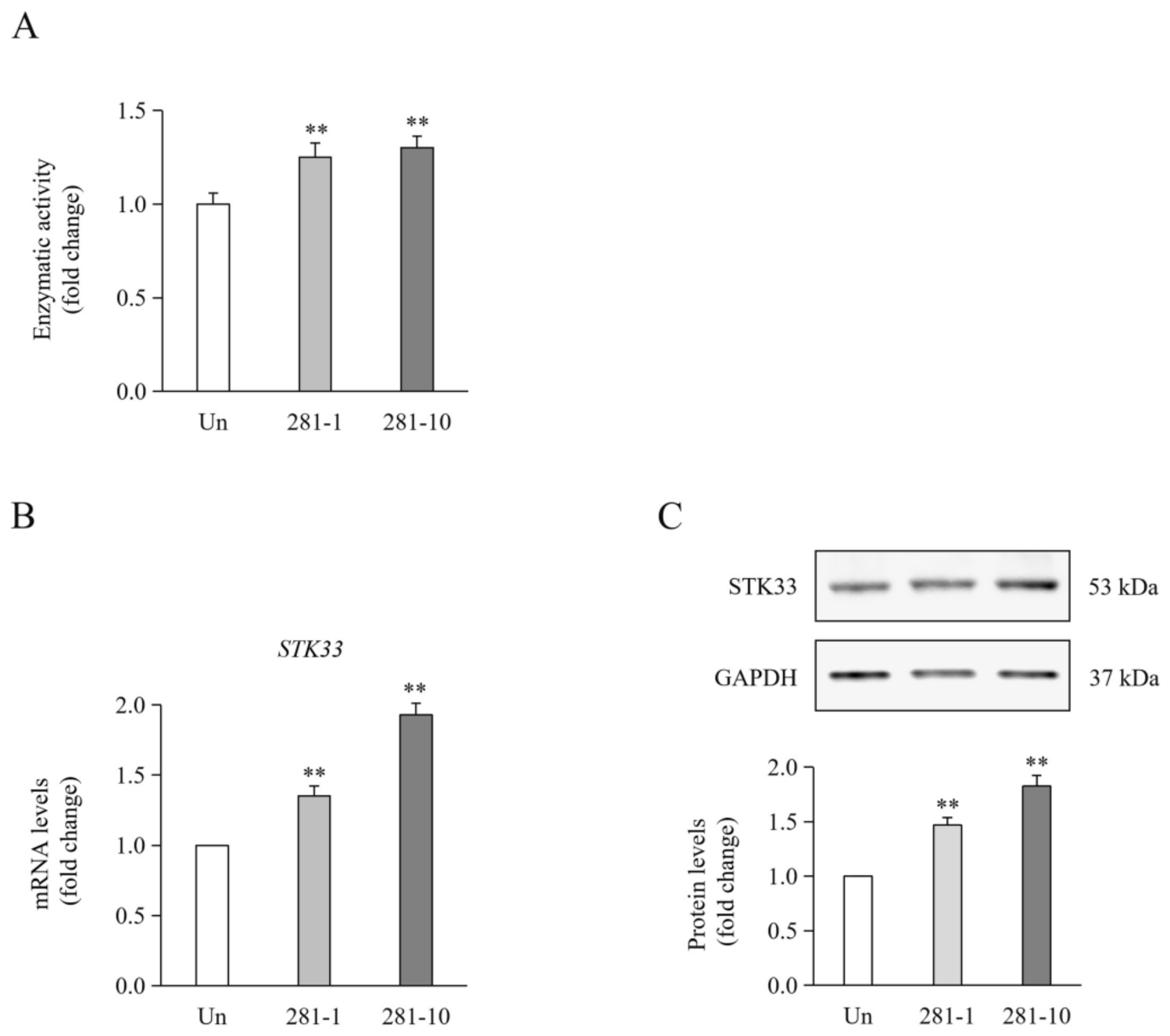
2.1. Effects of ML281 Treatment on STK33 Activity in HTSKs
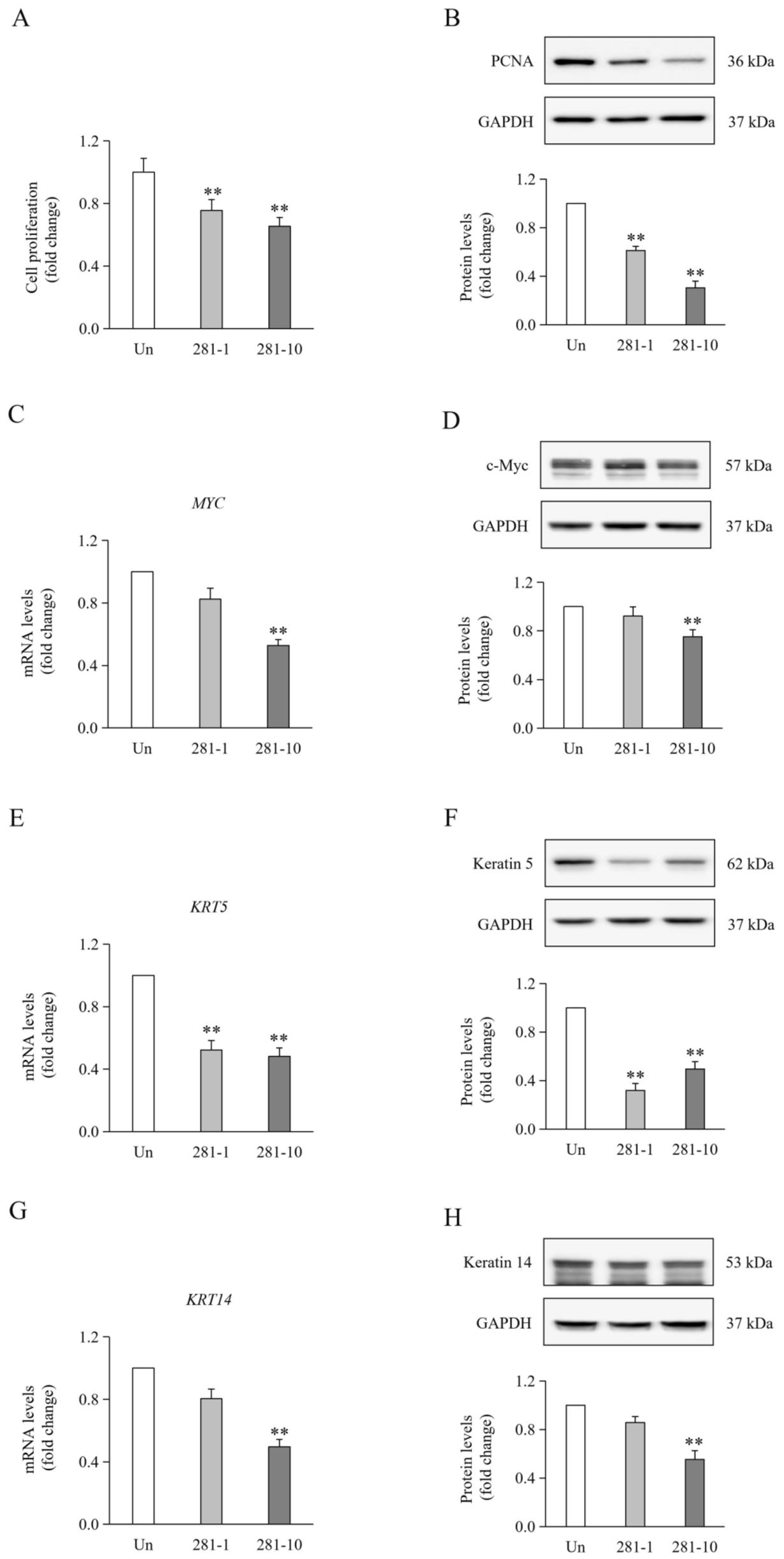
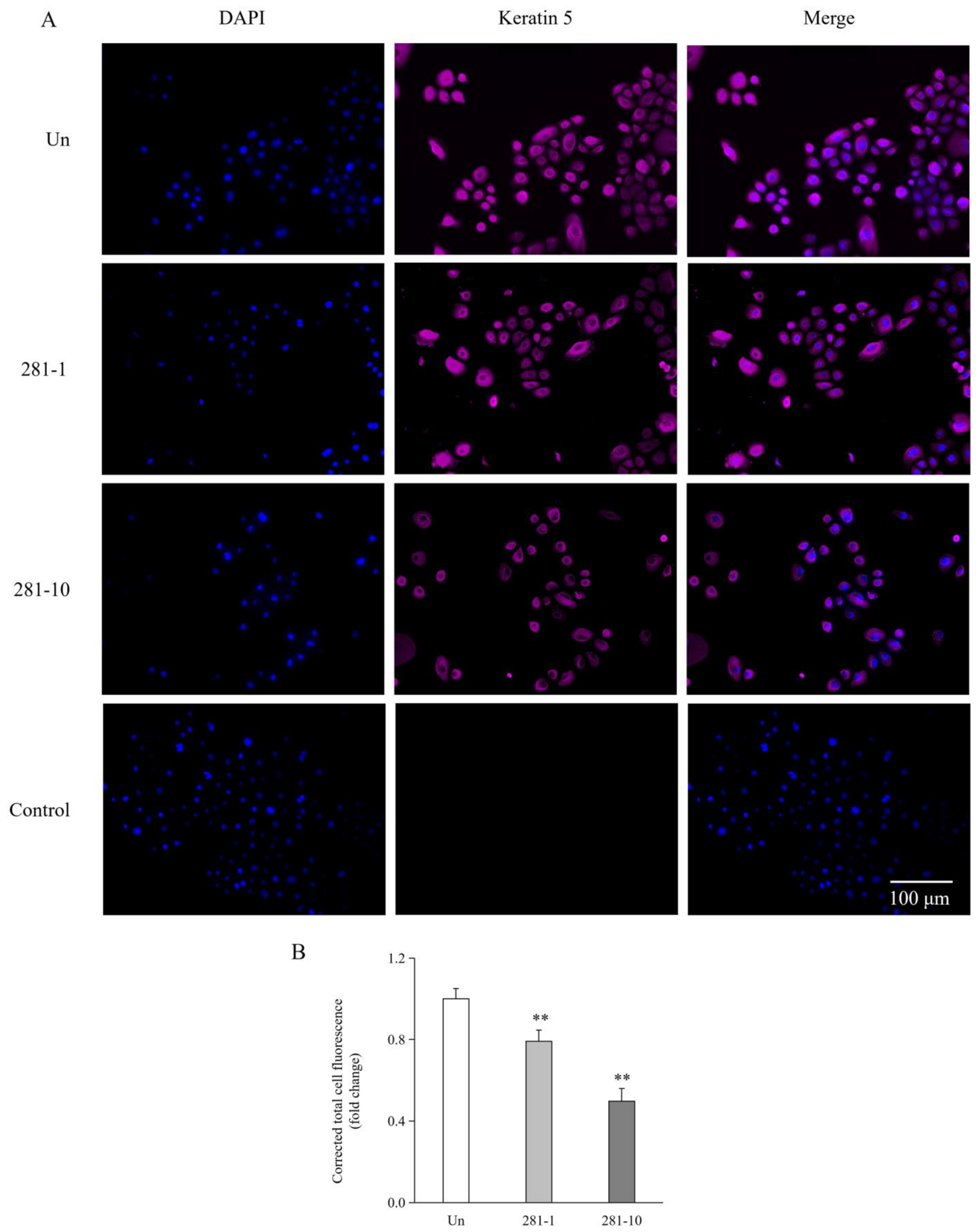
2.2. Effects of ML281 Treatment on Proliferation-Associated Markers in HTSKs
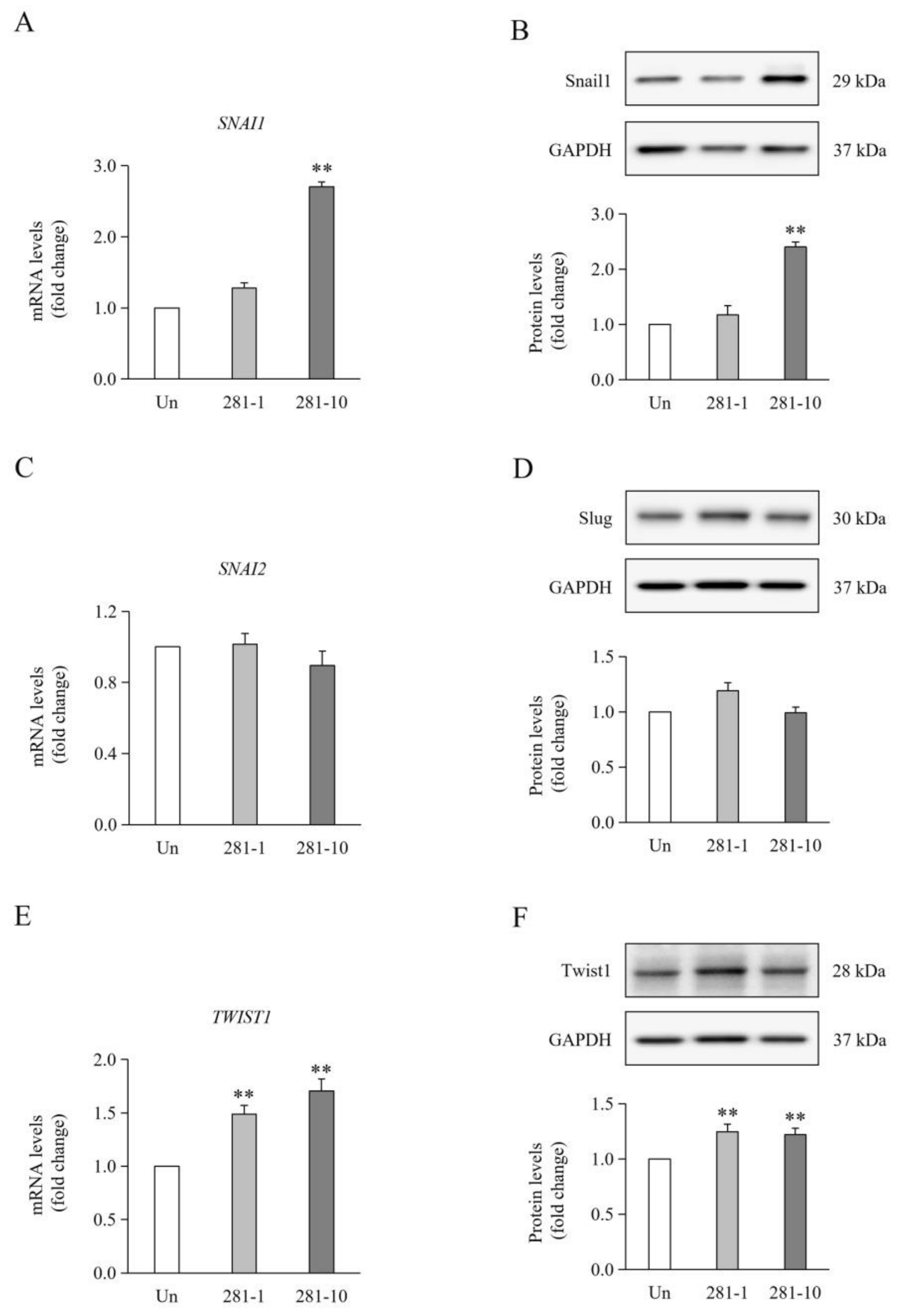
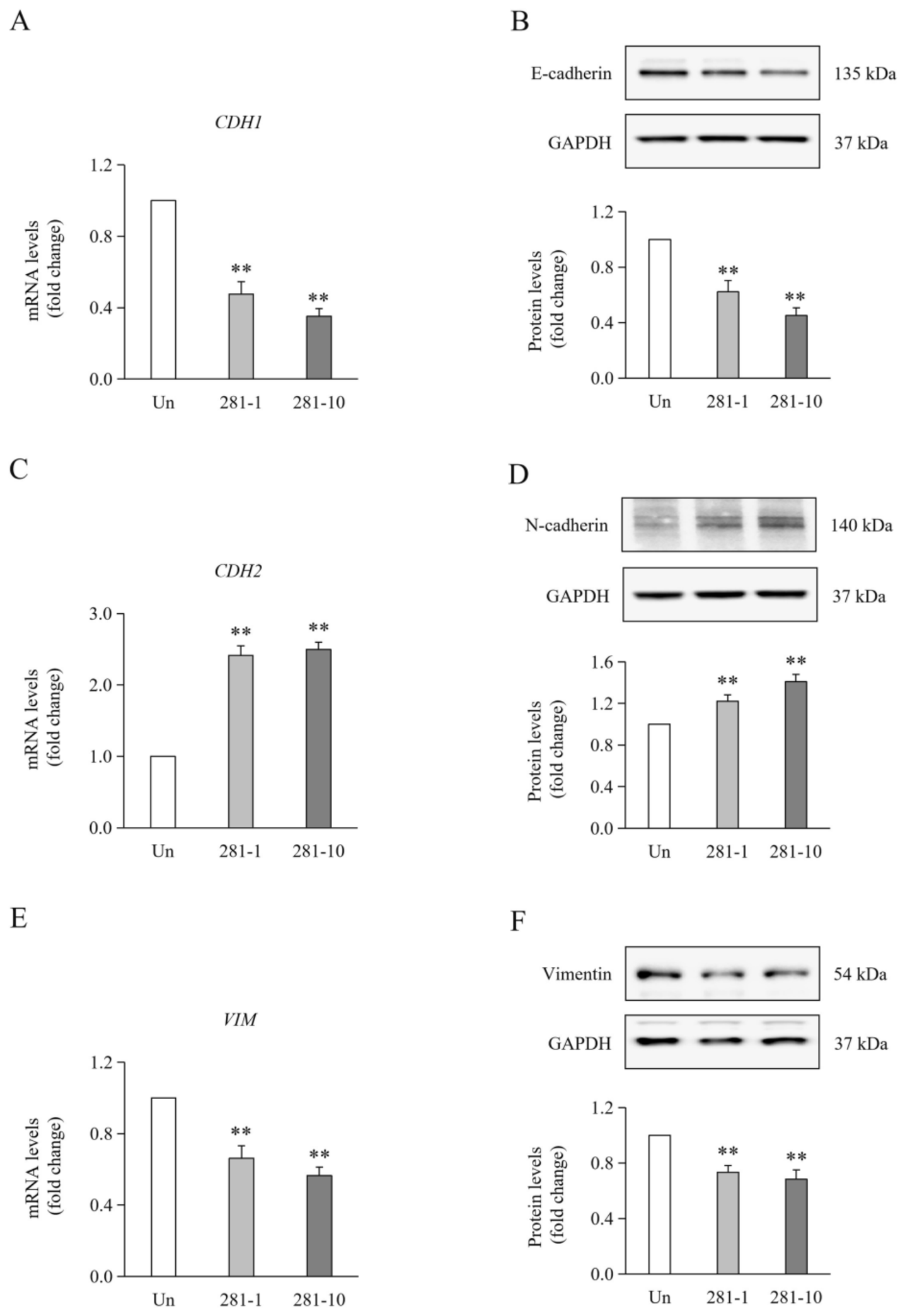
2.3. Effects of ML281 Treatment on EMT-Associated Markers in HTSKs
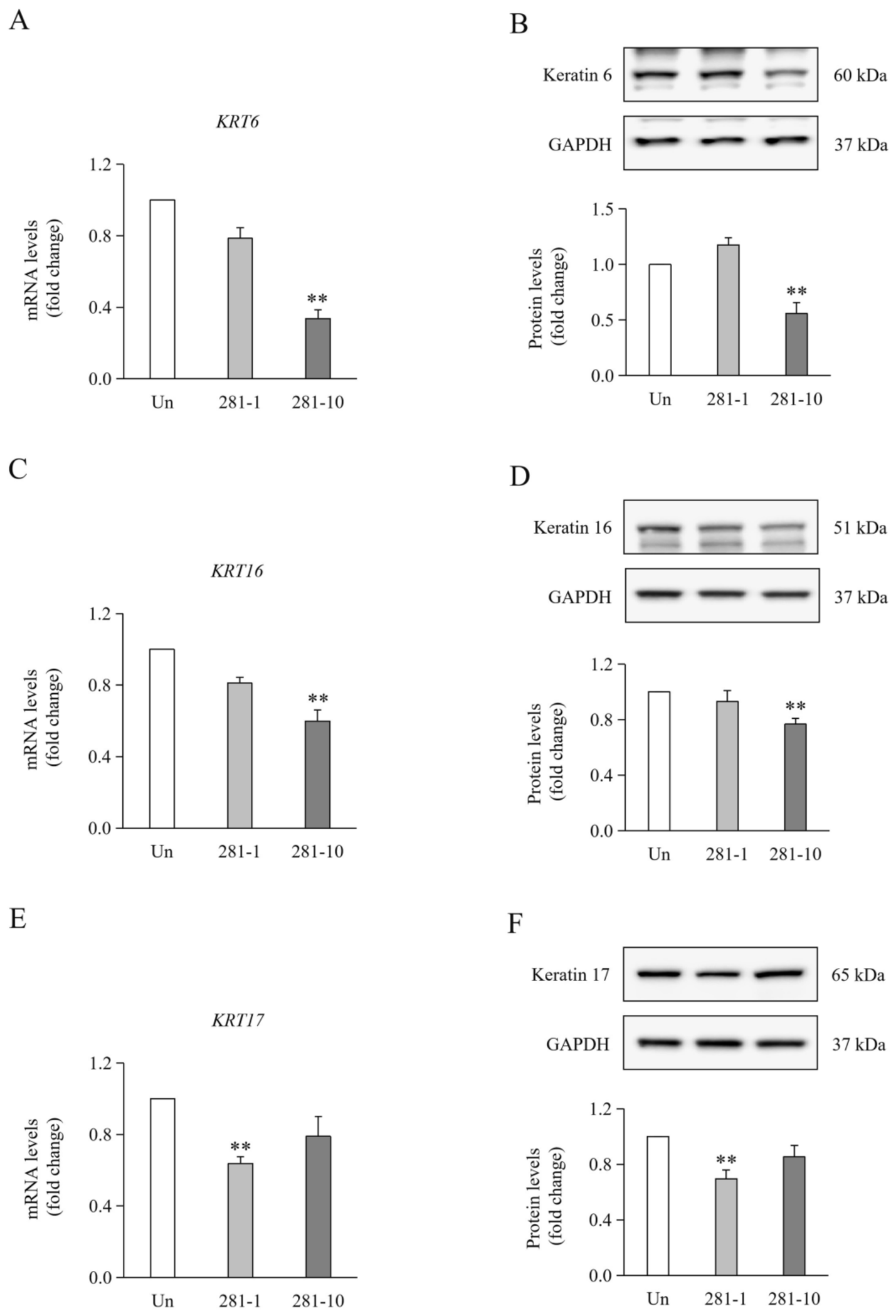
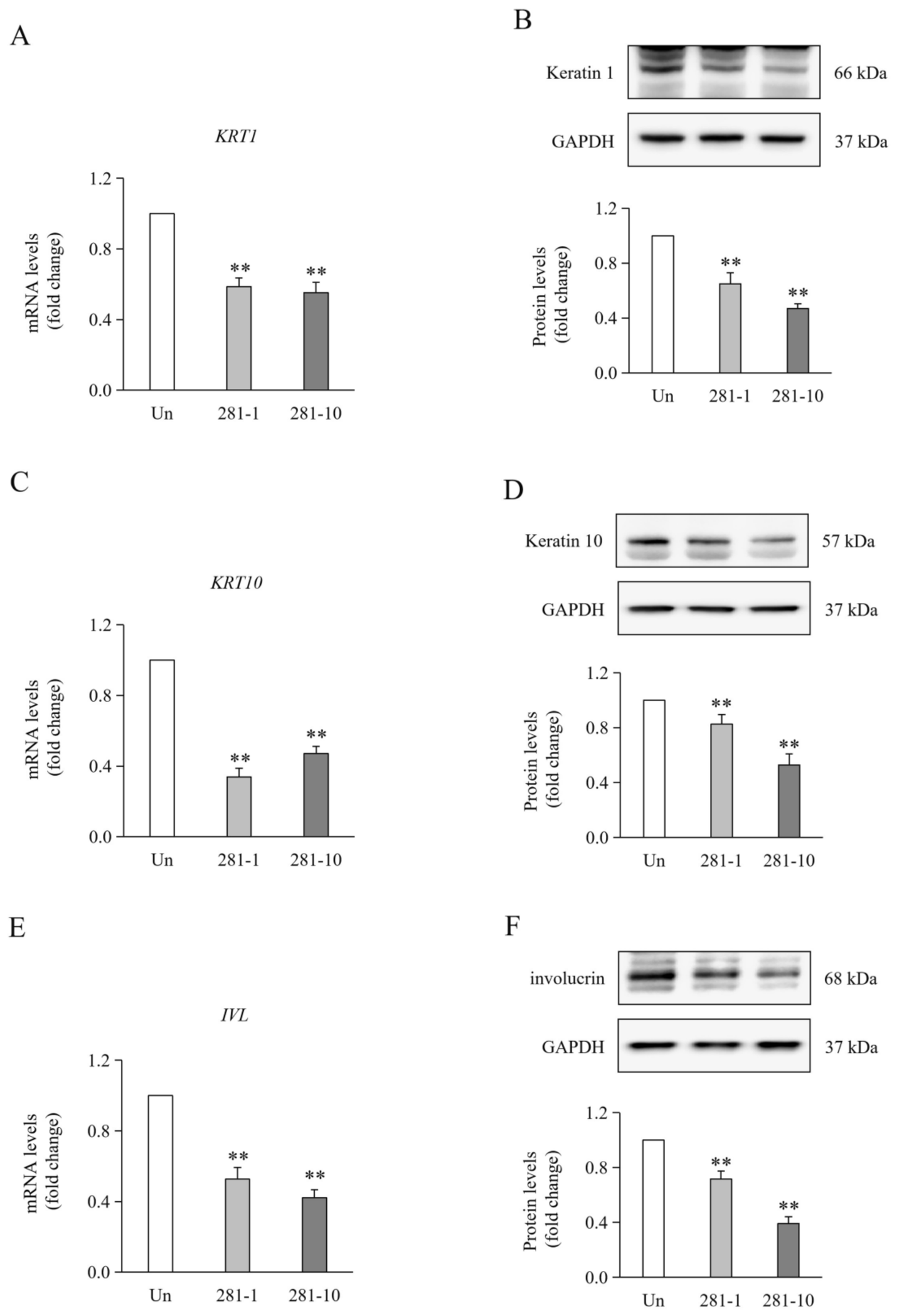
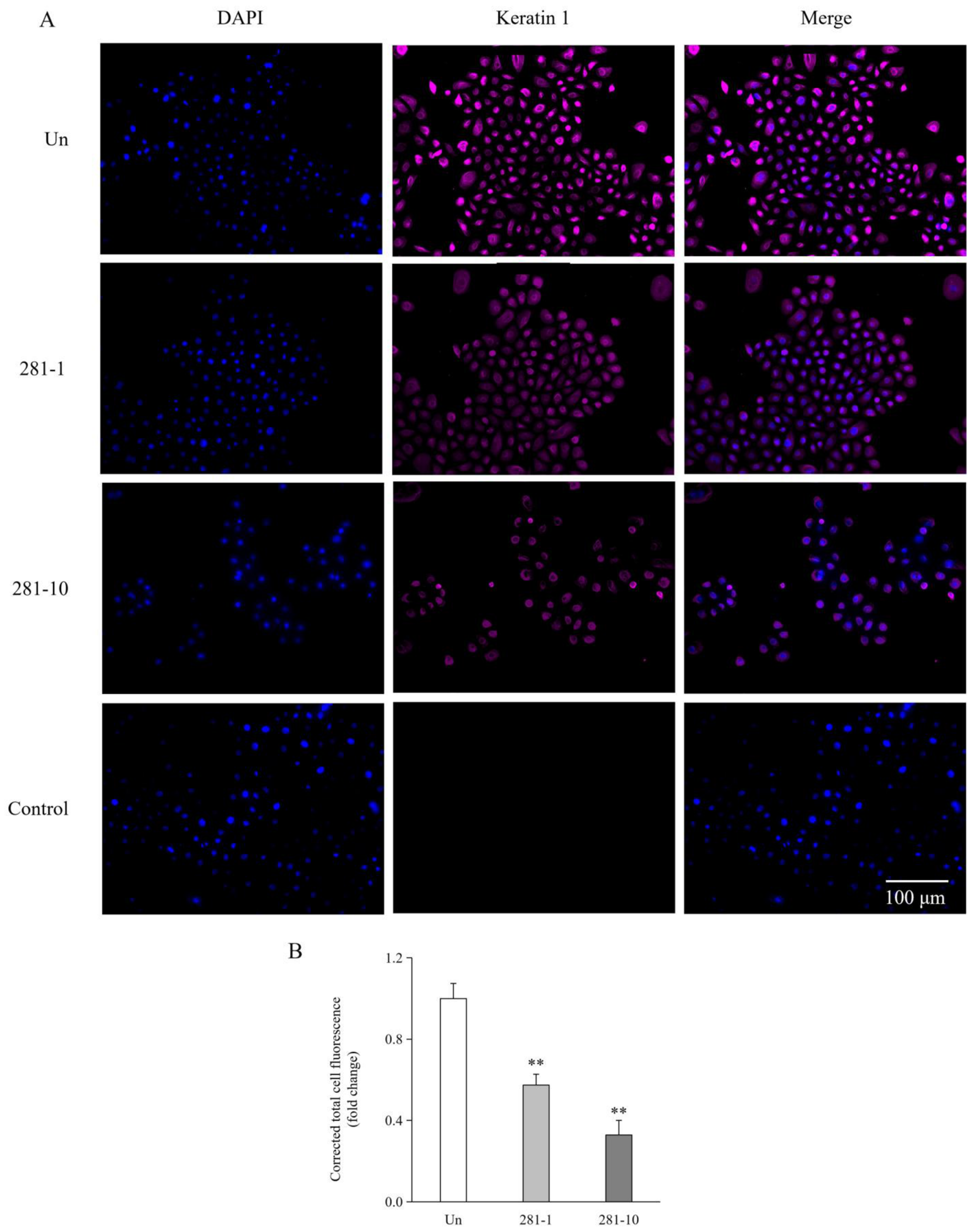
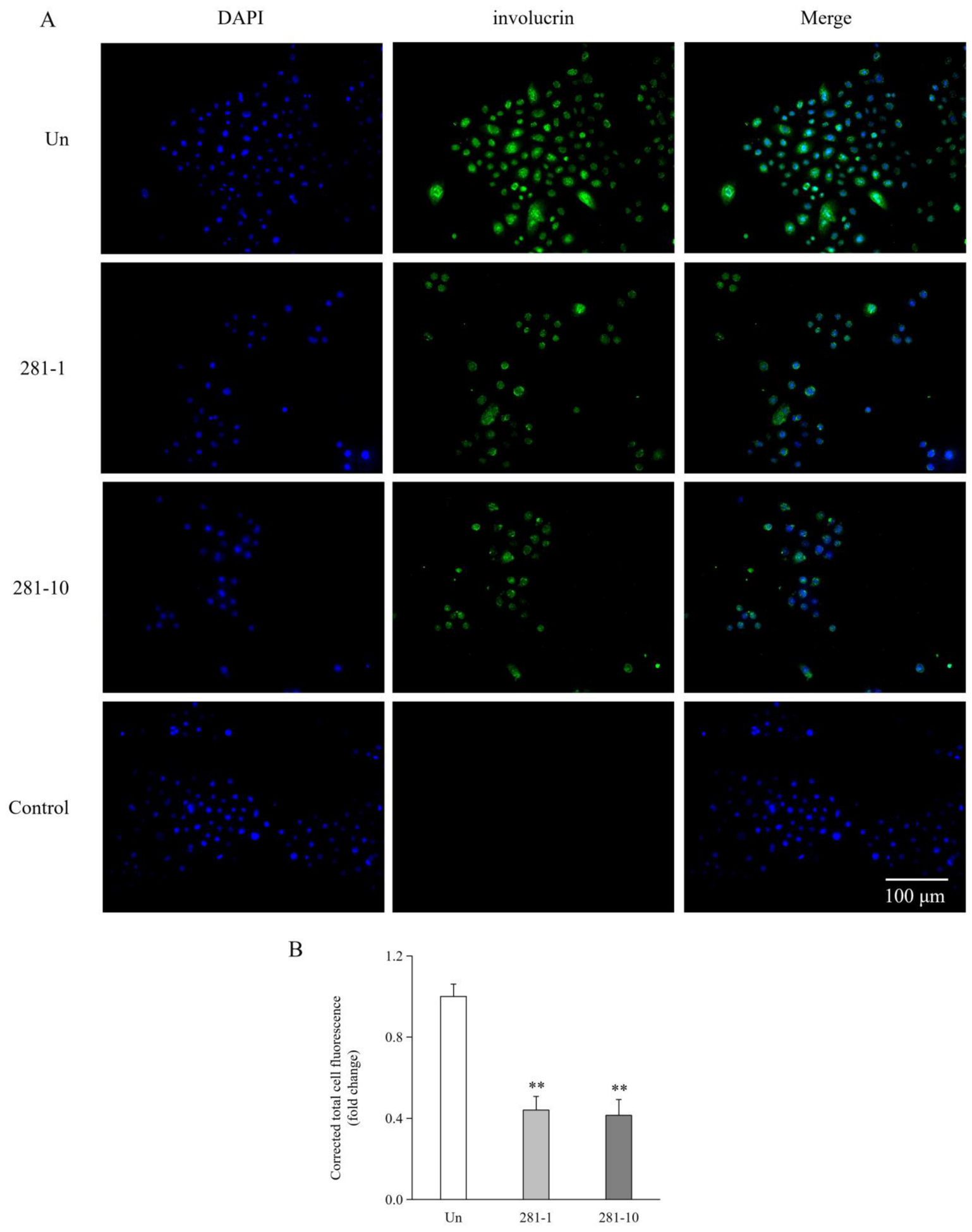
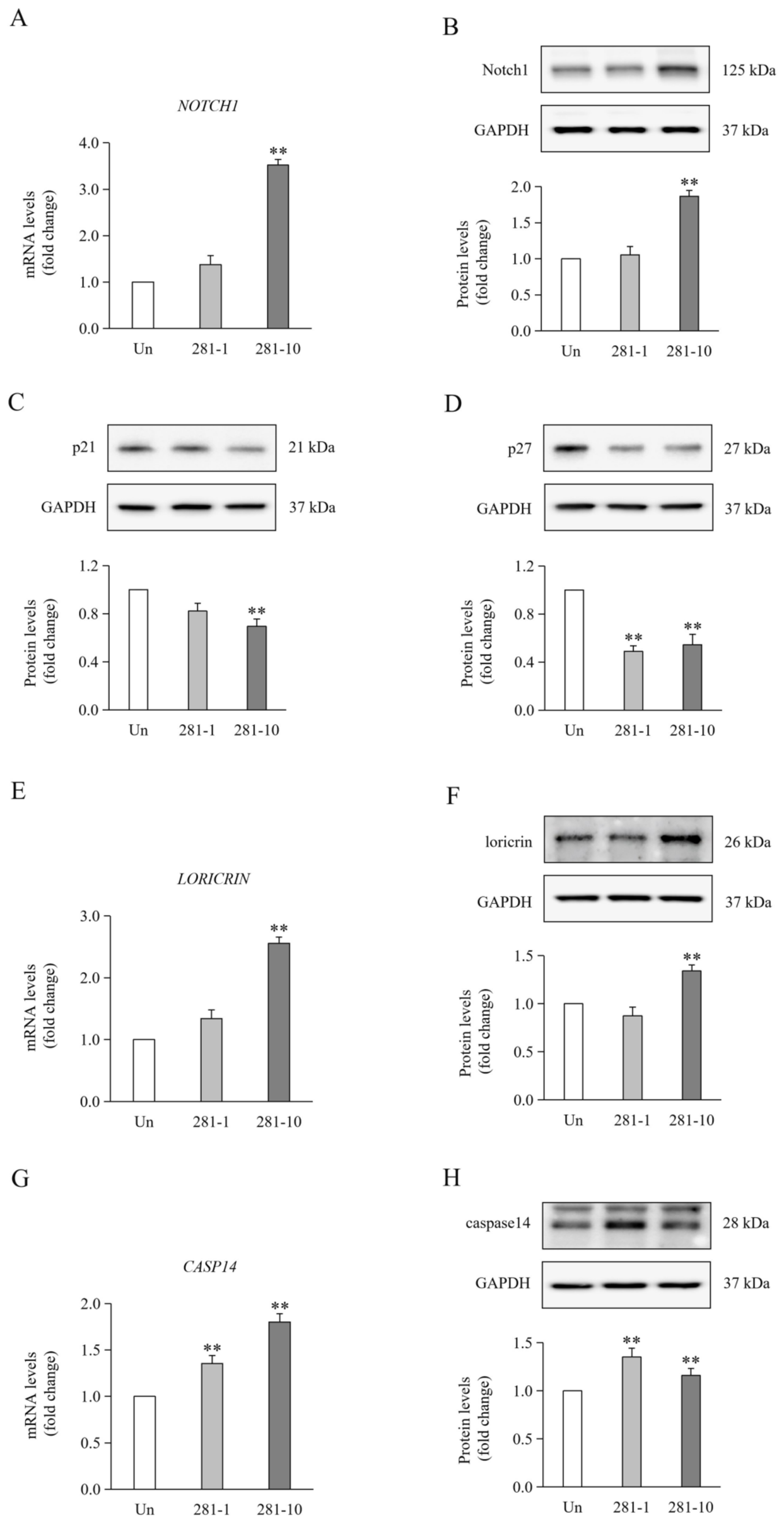
2.4. Effects of ML281 Treatment on Differentiation-Associated Markers in HTSKs
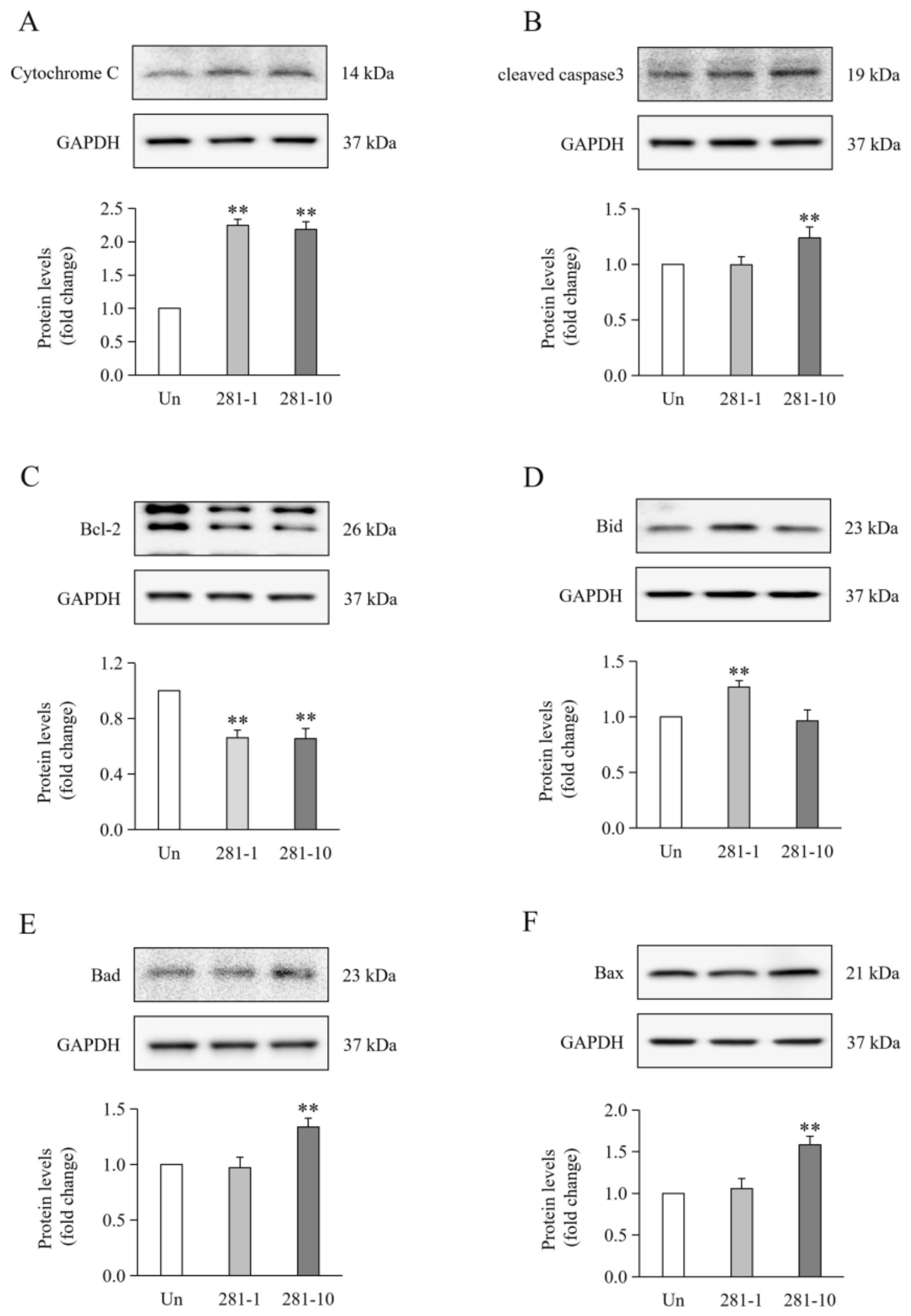
2.5. Effects of ML281 Treatment on Apoptosis-Associated Changes in HTSKs
3. Discussion
4. Materials and Methods
4.1. Keratinocyte Isolation and Culture
4.2. STK33 Activity Assay
4.3. Cell Proliferation Assay
4.4. ICC Staining
4.5. Reverse Transcription–Quantitative PCR (RT-qPCR)
4.6. Western Blotting
4.7. Statistical Analysis
5. Conclusions
Supplementary Materials
Author Contributions
Funding
Institutional Review Board Statement
Informed Consent Statement
Data Availability Statement
Conflicts of Interest
References
- Evers, L.H.; Bhavsar, D.; Mailänder, P. The biology of burn injury. Exp. Dermatol. 2010, 19, 777–783. [Google Scholar] [CrossRef] [Scilit] [PubMed]
- Wang, Y.; Beekman, J.; Hew, J.; Jackson, S.; Issler-Fisher, A.C.; Parungao, R.; Lajevardi, S.S.; Li, Z.; Maitz, P.K.M. Burn injury: Challenges and advances in burn wound healing, infection, pain and scarring. Adv. Drug Deliv. Rev. 2018, 123, 3–17. [Google Scholar] [CrossRef] [Scilit] [PubMed]
- Chung, B.Y.; Kim, H.B.; Jung, M.J.; Kang, S.Y.; Kwak, I.S.; Park, C.W.; Kim, H.O. Post-Burn Pruritus. Int. J. Mol. Sci. 2020, 21, 3880. [Google Scholar] [CrossRef] [Scilit] [PubMed]
- Blome-Eberwein, S.A. Emerging Technologies. Clin. Plast. Surg. 2024, 51, 355–363. [Google Scholar] [CrossRef] [Scilit] [PubMed]
- Yang, X.; Li, R.; Mao, X.; Gong, S.; Fan, Y.; Xu, C.; Wen, Q.; Xu, X.; Li, W. Non-surgical treatments for post-burn scars: A network meta-analysis. PLoS ONE 2025, 20, e0330428. [Google Scholar] [CrossRef] [Scilit] [PubMed]
- Takeo, M.; Lee, W.; Ito, M. Wound healing and skin regeneration. Cold Spring Harb. Perspect. Med. 2015, 5, a023267. [Google Scholar] [CrossRef] [Scilit] [PubMed]
- Baroni, A.; Buommino, E.; De Gregorio, V.; Ruocco, E.; Ruocco, V.; Wolf, R. Structure and function of the epidermis related to barrier properties. Clin. Dermatol. 2012, 30, 257–262. [Google Scholar] [CrossRef] [Scilit] [PubMed]
- Sanz-Gómez, N.; Freije, A.; Gandarillas, A. Keratinocyte Differentiation by Flow Cytometry. Methods Mol. Biol. 2020, 2109, 83–92. [Google Scholar] [CrossRef] [Scilit] [PubMed]
- Liu, Z.; Bian, X.; Luo, L.; Björklund, Å.K.; Li, L.; Zhang, L.; Chen, Y.; Guo, L.; Gao, J.; Cao, C.; et al. Spatiotemporal single-cell roadmap of human skin wound healing. Cell Stem Cell 2025, 32, 479–498.e8. [Google Scholar] [CrossRef] [Scilit] [PubMed]
- Nieto, M.A.; Huang, R.Y.; Jackson, R.A.; Thiery, J.P. EMT: 2016. Cell 2016, 166, 21–45. [Google Scholar] [CrossRef] [Scilit] [PubMed]
- Girard, D.; Laverdet, B.; Buhé, V.; Trouillas, M.; Ghazi, K.; Alexaline, M.M.; Egles, C.; Misery, L.; Coulomb, B.; Lataillade, J.J.; et al. Biotechnological Management of Skin Burn Injuries: Challenges and Perspectives in Wound Healing and Sensory Recovery. Tissue Eng. Part B Rev. 2017, 23, 59–82. [Google Scholar] [CrossRef] [Scilit] [PubMed]
- Cui, H.S.; Joo, S.Y.; Lee, S.Y.; Cho, Y.S.; Kim, D.H.; Seo, C.H. Effect of Hypertrophic Scar Fibroblast-Derived Exosomes on Keratinocytes of Normal Human Skin. Int. J. Mol. Sci. 2023, 24, 6132. [Google Scholar] [CrossRef] [Scilit] [PubMed]
- Hakvoort, T.E.; Altun, V.; Ramrattan, R.S.; van der Kwast, T.H.; Benner, R.; van Zuijlen, P.P.; Vloemans, A.F.; Prens, E.P. Epidermal participation in post-burn hypertrophic scar development. Virchows Arch. 1999, 434, 221–226. [Google Scholar] [CrossRef] [Scilit] [PubMed]
- El-Ghalbzouri, A.; Van Den Bogaerdt, A.J.; Kempenaar, J.; Ponec, M. Human adipose tissue-derived cells delay re-epithelialization in comparison with skin fibroblasts in organotypic skin culture. Br. J. Dermatol. 2004, 150, 444–454. [Google Scholar] [CrossRef] [Scilit] [PubMed]
- Stojadinovic, O.; Brem, H.; Vouthounis, C.; Lee, B.; Fallon, J.; Stallcup, M.; Merchant, A.; Galiano, R.D.; Tomic-Canic, M. Molecular pathogenesis of chronic wounds: The role of beta-catenin and c-myc in the inhibition of epithelialization and wound healing. Am. J. Pathol. 2005, 167, 59–69. [Google Scholar] [PubMed]
- Zhang, J.; Yang, P.; Liu, D.; Gao, M.; Wang, J.; Yu, T.; Zhang, X.; Liu, Y. Inhibiting Hyper-O-GlcNAcylation of c-Myc accelerate diabetic wound healing by alleviating keratinocyte dysfunction. Burn. Trauma 2021, 9, tkab031. [Google Scholar] [CrossRef] [Scilit] [PubMed]
- Kong, F.; Sun, T.; Kong, X.; Xie, D.; Li, Z.; Xie, K. Krüppel-like Factor 4 Suppresses Serine/Threonine Kinase 33 Activation and Metastasis of Gastric Cancer through Reversing Epithelial-Mesenchymal Transition. Clin. Cancer Res. 2018, 24, 2440–2451. [Google Scholar] [CrossRef] [Scilit] [PubMed]
- Scholl, C.; Fröhling, S.; Dunn, I.F.; Schinzel, A.C.; Barbie, D.A.; Kim, S.Y.; Silver, S.J.; Tamayo, P.; Wadlow, R.C.; Ramaswamy, S.; et al. Synthetic lethal interaction between oncogenic KRAS dependency and STK33 suppression in human cancer cells. Cell 2009, 137, 821–834. [Google Scholar] [CrossRef] [Scilit] [PubMed]
- Weïwer, M.; Spoonamore, J.; Wei, J.; Guichard, B.; Ross, N.T.; Masson, K.; Silkworth, W.; Dandapani, S.; Palmer, M.; Scherer, C.A.; et al. A Potent and Selective Quinoxalinone-Based STK33 Inhibitor Does Not Show Synthetic Lethality in KRAS-Dependent Cells. ACS Med. Chem. Lett. 2012, 3, 1034–1038. [Google Scholar] [CrossRef] [Scilit] [PubMed]
- Sun, E.L.; Liu, C.X.; Ma, Z.X.; Mou, X.Y.; Mu, X.A.; Ni, Y.H.; Li, X.L.; Zhang, D.; Ju, Y.R. Knockdown of human serine/threonine kinase 33 suppresses human small cell lung carcinoma by blocking RPS6/BAD signaling transduction. Neoplasma 2017, 64, 869–879. [Google Scholar] [CrossRef] [Scilit] [PubMed]
- Raj, D.; Brash, D.E.; Grossman, D. Keratinocyte apoptosis in epidermal development and disease. J. Investig. Dermatol. 2006, 126, 243–257. [Google Scholar] [CrossRef] [Scilit] [PubMed]
- Zhang, X.; Yin, M.; Zhang, L.J. Keratin 6, 16 and 17-Critical Barrier Alarmin Molecules in Skin Wounds and Psoriasis. Cells 2019, 8, 807. [Google Scholar] [CrossRef] [Scilit] [PubMed]
- Chen, T.; Zhang, B.; Xie, H.; Huang, C.; Wu, Q. GRHL2 regulates keratinocyte EMT-MET dynamics and scar formation during cutaneous wound healing. Cell Death Dis. 2024, 15, 748. [Google Scholar] [CrossRef] [Scilit] [PubMed]
- Watt, F.M. Involucrin and other markers of keratinocyte terminal differentiation. J. Investig. Dermatol. 1983, 81, 100s–103s. [Google Scholar] [CrossRef] [Scilit] [PubMed]
- Mehrel, T.; Hohl, D.; Rothnagel, J.A.; Longley, M.A.; Bundman, D.; Cheng, C.; Lichti, U.; Bisher, M.E.; Steven, A.C.; Steinert, P.M.; et al. Identification of a major keratinocyte cell envelope protein, loricrin. Cell 1990, 61, 1103–1112. [Google Scholar] [CrossRef] [Scilit] [PubMed]
- Denecker, G.; Ovaere, P.; Vandenabeele, P.; Declercq, W. Caspase-14 reveals its secrets. J. Cell Biol. 2008, 180, 451–458. [Google Scholar] [CrossRef] [Scilit] [PubMed]
- Lochhead, P.A.; Tucker, J.A.; Tatum, N.J.; Wang, J.; Oxley, D.; Kidger, A.M.; Johnson, V.P.; Cassidy, M.A.; Gray, N.S.; Noble, M.E.M.; et al. Paradoxical activation of the protein kinase-transcription factor ERK5 by ERK5 kinase inhibitors. Nat. Commun. 2020, 11, 1383. [Google Scholar] [CrossRef] [Scilit] [PubMed]
- Okuzumi, T.; Fiedler, D.; Zhang, C.; Gray, D.C.; Aizenstein, B.; Hoffman, R.; Shokat, K.M. Inhibitor hijacking of Akt activation. Nat. Chem. Biol. 2009, 5, 484–493. [Google Scholar] [CrossRef] [Scilit] [PubMed]
- Yang, T.; Song, B.; Zhang, J.; Yang, G.S.; Zhang, H.; Yu, W.F.; Wu, M.C.; Lu, J.H.; Shen, F. STK33 promotes hepatocellular carcinoma through binding to c-Myc. Gut 2016, 65, 124–133. [Google Scholar] [CrossRef] [Scilit] [PubMed]
- Luo, T.; Masson, K.; Jaffe, J.D.; Silkworth, W.; Ross, N.T.; Scherer, C.A.; Scholl, C.; Fröhling, S.; Carr, S.A.; Stern, A.M.; et al. STK33 kinase inhibitor BRD-8899 has no effect on KRAS-dependent cancer cell viability. Proc. Natl. Acad. Sci. USA 2012, 109, 2860–2865. [Google Scholar] [CrossRef] [Scilit] [PubMed]
- Babij, C.; Zhang, Y.; Kurzeja, R.J.; Munzli, A.; Shehabeldin, A.; Fernando, M.; Quon, K.; Kassner, P.D.; Ruefli-Brasse, A.A.; Watson, V.J.; et al. STK33 kinase activity is nonessential in KRAS-dependent cancer cells. Cancer Res. 2011, 71, 5818–5826. [Google Scholar] [CrossRef] [Scilit] [PubMed]
- Cui, H.S.; Joo, S.Y.; Cho, Y.S.; Park, J.H.; Ro, Y.M.; Kim, J.B.; Seo, C.H. Effect of extracorporeal shock wave therapy on keratinocytes derived from human hypertrophic scars. Sci. Rep. 2021, 11, 17296. [Google Scholar] [CrossRef] [Scilit] [PubMed]
- Javier, A.F.; Bata-Csorgo, Z.; Ellis, C.N.; Kang, S.; Voorhees, J.J.; Cooper, K.D. Rapamycin (sirolimus) inhibits proliferating cell nuclear antigen expression and blocks cell cycle in the G1 phase in human keratinocyte stem cells. J. Clin. Investig. 1997, 99, 2094–2099. [Google Scholar] [CrossRef] [Scilit] [PubMed]
- Li, B.; Gao, C.; Diao, J.S.; Wang, D.L.; Chu, F.F.; Li, Y.; Wang, G.; Guo, S.Z.; Xia, W. Aberrant Notch signalling contributes to hypertrophic scar formation by modulating the phenotype of keratinocytes. Exp. Dermatol. 2016, 25, 137–142. [Google Scholar] [CrossRef] [Scilit] [PubMed]
- Mammucari, C.; Tommasi di Vignano, A.; Sharov, A.A.; Neilson, J.; Havrda, M.C.; Roop, D.R.; Botchkarev, V.A.; Crabtree, G.R.; Dotto, G.P. Integration of Notch 1 and calcineurin/NFAT signaling pathways in keratinocyte growth and differentiation control. Dev. Cell 2005, 8, 665–676. [Google Scholar] [CrossRef] [Scilit] [PubMed]
- Kolly, C.; Suter, M.M.; Müller, E.J. Proliferation, cell cycle exit, and onset of terminal differentiation in cultured keratinocytes: Pre-programmed pathways in control of C-Myc and Notch1 prevail over extracellular calcium signals. J. Investig. Dermatol. 2005, 124, 1014–1025. [Google Scholar] [CrossRef] [Scilit] [PubMed]
- Missero, C.; Di Cunto, F.; Kiyokawa, H.; Koff, A.; Dotto, G.P. The absence of p21Cip1/WAF1 alters keratinocyte growth and differentiation and promotes ras-tumor progression. Genes Dev. 1996, 10, 3065–3075. [Google Scholar] [CrossRef] [Scilit] [PubMed]
- Topley, G.I.; Okuyama, R.; Gonzales, J.G.; Conti, C.; Dotto, G.P. p21WAF1/Cip1 functions as a suppressor of malignant skin tumor formation and a determinant of keratinocyte stem-cell potential. Proc. Natl. Acad. Sci. USA 1999, 96, 9089–9094. [Google Scholar] [CrossRef] [Scilit] [PubMed]
- Devgan, V.; Nguyen, B.C.; Oh, H.; Dotto, G.P. p21WAF1/Cip1 suppresses keratinocyte differentiation independently of the cell cycle through transcriptional up-regulation of the IGF-I gene. J. Biol. Chem. 2006, 281, 30463–30470. [Google Scholar] [CrossRef] [Scilit] [PubMed]
- Rangarajan, A.; Talora, C.; Okuyama, R.; Nicolas, M.; Mammucari, C.; Oh, H.; Aster, J.C.; Krishna, S.; Metzger, D.; Chambon, P.; et al. Notch signaling is a direct determinant of keratinocyte growth arrest and entry into differentiation. EMBO J. 2001, 20, 3427–3436. [Google Scholar] [CrossRef] [Scilit] [PubMed]
- Nie, J.; Fu, X.; Han, W. Microenvironment-dependent homeostasis and differentiation of epidermal basal undifferentiated keratinocytes and their clinical applications in skin repair. J. Eur. Acad. Dermatol. Venereol. 2013, 27, 531–535. [Google Scholar] [CrossRef] [Scilit] [PubMed]
- Foertsch, F.; Teichmann, N.; Kob, R.; Hentschel, J.; Laubscher, U.; Melle, C. S100A11 is involved in the regulation of the stability of cell cycle regulator p21CIP1/WAF1 in human keratinocyte HaCaT cells. FEBS J. 2013, 280, 3840–3853. [Google Scholar] [CrossRef] [Scilit] [PubMed]
- Zhou, B.; Xiang, J.; Zhan, C.; Liu, J.; Yan, S. STK33 Promotes the Growth and Progression of Human Pancreatic Neuroendocrine Tumour via Activation of the PI3K/AKT/mTOR Pathway. Neuroendocrinology 2020, 110, 307–320. [Google Scholar] [CrossRef] [Scilit] [PubMed]
- Li, X.; Lin, M.; Liu, M.; Ye, H.; Qin, S. Interaction between STK33 and autophagy promoted renal cell carcinoma metastasis by regulating mTOR/ULK1 signaling pathway. Mol. Biol. Rep. 2023, 50, 5059–5067. [Google Scholar] [CrossRef] [Scilit] [PubMed]
- Huang, L.; Chen, C.; Zhang, G.; Ju, Y.; Zhang, J.; Wang, H.; Li, J. STK33 overexpression in hypopharyngeal squamous cell carcinoma: Possible role in tumorigenesis. BMC Cancer 2015, 15, 13. [Google Scholar] [CrossRef] [Scilit] [PubMed]
- Zhou, M.; Sun, G.; Zhang, L.; Zhang, G.; Yang, Q.; Yin, H.; Li, H.; Liu, W.; Bai, X.; Li, J.; et al. STK33 alleviates gentamicin-induced ototoxicity in cochlear hair cells and House Ear Institute-Organ of Corti 1 cells. J. Cell. Mol. Med. 2018, 22, 5286–5299. [Google Scholar] [CrossRef] [Scilit] [PubMed]
- Wang, P.; Cheng, H.; Wu, J.; Yan, A.; Zhang, L. STK33 plays an important positive role in the development of human large cell lung cancers with variable metastatic potential. Acta Biochim. Biophys. Sin. 2015, 47, 214–223. [Google Scholar] [CrossRef] [Scilit] [PubMed]
- Karaosmanoğlu, O.; Banerjee, S.; Sivas, H. Identification of biomarkers associated with partial epithelial to mesenchymal transition in the secretome of slug over-expressing hepatocellular carcinoma cells. Cell. Oncol. 2018, 41, 439–453. [Google Scholar] [CrossRef] [Scilit] [PubMed]
- Virtakoivu, R.; Mai, A.; Mattila, E.; De Franceschi, N.; Imanishi, S.Y.; Corthals, G.; Kaukonen, R.; Saari, M.; Cheng, F.; Torvaldson, E.; et al. Vimentin-ERK Signaling Uncouples Slug Gene Regulatory Function. Cancer Res. 2015, 75, 2349–2362. [Google Scholar] [CrossRef] [Scilit] [PubMed]
- Cheng, F.; Shen, Y.; Mohanasundaram, P.; Lindström, M.; Ivaska, J.; Ny, T.; Eriksson, J.E. Vimentin coordinates fibroblast proliferation and keratinocyte differentiation in wound healing via TGF-β-Slug signaling. Proc. Natl. Acad. Sci. USA 2016, 113, E4320–E4327. [Google Scholar] [CrossRef] [Scilit] [PubMed]
- Koike, Y.; Yozaki, M.; Utani, A.; Murota, H. Fibroblast growth factor 2 accelerates the epithelial-mesenchymal transition in keratinocytes during wound healing process. Sci. Rep. 2020, 10, 18545. [Google Scholar] [CrossRef] [Scilit] [PubMed]
- Wilkins-Port, C.E.; Higgins, P.J. Regulation of extracellular matrix remodeling following transforming growth factor-beta1/epidermal growth factor-stimulated epithelial-mesenchymal transition in human premalignant keratinocytes. Cells Tissues Organs 2007, 185, 116–122. [Google Scholar] [CrossRef] [Scilit] [PubMed]
- Castro-Muñozledo, F.; Velez-DelValle, C.; Marsch-Moreno, M.; Hernández-Quintero, M.; Kuri-Harcuch, W. Vimentin is necessary for colony growth of human diploid keratinocytes. Histochem. Cell Biol. 2015, 143, 45–57. [Google Scholar] [CrossRef] [Scilit] [PubMed]
- Coelho-Rato, L.S.; Parvanian, S.; Modi, M.K.; Eriksson, J.E. Vimentin at the core of wound healing. Trends Cell Biol. 2024, 34, 239–254. [Google Scholar] [CrossRef] [Scilit] [PubMed]
- Schaeffer, D.; Somarelli, J.A.; Hanna, G.; Palmer, G.M.; Garcia-Blanco, M.A. Cellular migration and invasion uncoupled: Increased migration is not an inexorable consequence of epithelial-to-mesenchymal transition. Mol. Cell. Biol. 2014, 34, 3486–3499. [Google Scholar] [CrossRef] [Scilit] [PubMed][Green Version]
- Soszyńska, M.; Komorowski, M.; Łuszczyński, K.; Radziszewski, M.; Krześniak, N.; Shevchenko, K.; Górecki, D.C.; Malejczyk, J.; Ścieżyńska, A. Differential Effect of P2X7 Receptors on Proliferation and Migration of Human Keratinocytes and Dermal Fibroblasts. Int. J. Mol. Sci. 2025, 26, 8548. [Google Scholar] [CrossRef] [Scilit] [PubMed]
- Parzonko, A.; Filipek, A.; Równicki, M.; Kiss, A.K. Syringin (Sinapyl Alcohol 4-O-Glucoside) Improves the Wound Healing Capacity of Fibroblasts and Keratinocytes In Vitro. Int. J. Mol. Sci. 2025, 26, 7827. [Google Scholar] [CrossRef] [Scilit] [PubMed]
- Shin, S.M.; Baek, E.J.; Kim, K.H.; Kim, K.J.; Park, E.J. Polydeoxyribonucleotide exerts opposing effects on ERK activity in human skin keratinocytes and fibroblasts. Mol. Med. Rep. 2023, 28, 148. [Google Scholar] [CrossRef] [Scilit] [PubMed]







| Patients | Location of Specimens (Normal/Scar) | Age (Years) | Sex | Months Post-Burn |
|---|---|---|---|---|
| 1 | Abdomen/abdomen | 34 | Male | 13 |
| 2 | Chest/chest | 29 | Female | 12 |
| 3 | Thigh/thigh | 41 | Female | 13 |
| 4 | Flank/abdomen | 26 | Male | 15 |
| Gene | Forward (5′ → 3′) | Reverse (5′ → 3′) |
|---|---|---|
| S18 | GCAGAATCCACGCCAGTACAAG | GCTTGTTGTCCAGACCATTGGC |
| STK33 | GCGGTGAAGAAGCAAAGTAGGAG | CGACGCCTATGCTCCAAATGTC |
| MYC | CCTGGTGCTCCATGAGGAGAC | CAGACTCTGACCTTTTGCCAGG |
| KRT1 | CAGCATCATTGCTGAGGTCAAGG | CATGTCTGCCAGCAGTGATCTG |
| KRT5 | GCTGCCTACATGAACAAGGTGG | ATGGAGAGGACCACTGAGGTGT |
| KRT6 | TGAAGAAGGATGTGGATG | ATCATACAAGGCTCTCAG |
| KRT10 | CCTGCTTCAGATCGACAATGCC | ATCTCCAGGTCAGCCTTGGTCA |
| KRT14 | GCTGAGATCAAAGACTACA | AGAAGGACATTGGCATTG |
| KRT16 | CCTACTTCAAGACCATCG | CCTGGCATTGTCAATCTG |
| KRT17 | ATCCTGCTGGATGTGAAGACGC | TCCACAATGGTACGCACCTGAC |
| IVL | GGTCCAAGACATTCAACCAGCC | TCTGGACACTGCGGGTGGTTAT |
| NOTCH1 | AGCCTCAACGGGTACAAG | TTGACACAAGGGTTGGATTC |
| LORICRIN | GTCTGCGGAGGTGGTTCCTCT | TGCTGGGTCTGGTGGCAGATC |
| CASP14 | GGTGGATGTGTTCACGAAGAGG | CCTTCTTGAACCAGCTCTGCTTC |
| CDH1 | GCAGACCTTCCTCCCAATAC | TGGGTCGTTGTACTGAATGG |
| CDH2 | CCACCTTA AAATCTGCAGGC | CCATGTTACTGTCCAGTTCG |
| VIM | AAAGCGTGGCTGCCAAGAA | ACCTGTCTCCGGTACTCGTTTGA |
| SNAI1 | TGCCCTCAAGATGCACATCCGA | GGGACAGGAGAAGGGCTTCTC |
| SNAI2 | ATCTGCGGCAAGGCGTTTTCCA | GAGCCCTCAGATTTGACCTGTC |
| TWIST1 | GCCAGGTACATCGACTTCCTCT | TCCATCCTCCAGACCGAGAAGG |
| Target | Host | Dilution | Company (Cat. No.) |
|---|---|---|---|
| GAPDH | Rabbit | 1:1000 | Cell Signaling Technology (Danvers, MAK, USA) (2118S) |
| GAPDH | Mouse | 1:1000 | Santa Cruz Technology (Dallas, TX, USA) (sc-47724) |
| STK33 | Mouse | 1:500 | Santa Cruz Technology (sc-376498) |
| Keratin1 | Rabbit | 1:2000 | Abcam (Cambridge, UK) (ab93652) |
| Keratin5 | Rabbit | 1:2000 | Abcam (ab52635) |
| Keratin6 | Mouse | 1:2000 | Abcam (ab18586) |
| Keratin10 | Mouse | 1:500 | Santa Cruz Technology (sc-23877) |
| Keratin14 | Rabbit | 1:2000 | Abcam (ab181595) |
| Keratin16 | Rabbit | 1:2000 | Abcam (ab76416) |
| Keratin17 | Rabbit | 1:1000 | Cusabio Technology (Wuhan, Hubei, China) (CSB-442800) |
| Involucrin | Mouse | 1:500 | Santa Cruz Technology (sc-21748) |
| Notch1 | Rabbit | 1:1000 | Abcam (ab52627) |
| Loricrin | Rabbit | 1:1000 | Aviva Systems Biology (San Diego, CA, USA) (ARP41738_T100) |
| Caspase14 | Rabbit | 1:1000 | Abcam (ab174847) |
| c-Myc | Rabbit | 1:1000 | Cell Signaling Technology (9402) |
| PCNA | Mouse | 1:1000 | Cell Signaling Technology (2586S) |
| p21 | Rabbit | 1:1000 | Abcam (ab109199) |
| p27 | Rabbit | 1:1000 | Abcam (ab32034) |
| E-cadherin | Rabbit | 1:1000 | Cell Signaling Technology (3195S) |
| N-cadherin | Mouse | 1:1000 | Thermo Fisher Scientific (333900) |
| Vimentin | Mouse | 1:3000 | Abcam (ab92547) |
| Snail1 | Rabbit | 1:1000 | Millipore (Burlington, MA, USA) (ABD38) |
| Slug | Rabbit | 1:1000 | Cell Signaling Technology (9585S) |
| Twist1 | Rabbit | 1:1000 | Calbiochem (Burlington, MA, USA) (DR1088) |
| Cytochrome C | Rabbit | 1:1000 | Cell Signaling Technology (4272S) |
| Cleaved caspase3 | Rabbit | 1:1000 | Cell Signaling Technology (9661S) |
| Bcl-2 | Rabbit | 1:1000 | Abcam (ab196495) |
| Bad | Rabbit | 1:1000 | Cell Signaling Technology (9292S) |
| Bax | Rabbit | 1:1000 | Abcam (ab199677) |
| Bid | Rabbit | 1:1000 | Cell Signaling Technology (8762S) |
Disclaimer/Publisher’s Note: The statements, opinions and data contained in all publications are solely those of the individual author(s) and contributor(s) and not of MDPI and/or the editor(s). MDPI and/or the editor(s) disclaim responsibility for any injury to people or property resulting from any ideas, methods, instructions or products referred to in the content. |
© 2026 by the authors. Licensee MDPI, Basel, Switzerland. This article is an open access article distributed under the terms and conditions of the Creative Commons Attribution (CC BY) license.
Share and Cite
Zheng, Y.X.; Cui, H.S.; Lee, Y.R.; Joo, S.Y.; Cho, Y.S.; Kwak, I.S.; Seo, C.H. ML281 Does Not Function as an STK33 Inhibitor but Modulates Proliferation and Differentiation of Keratinocytes Derived from Hypertrophic Scars. Int. J. Mol. Sci. 2026, 27, 8273. https://doi.org/10.3390/ijms27188273
Zheng YX, Cui HS, Lee YR, Joo SY, Cho YS, Kwak IS, Seo CH. ML281 Does Not Function as an STK33 Inhibitor but Modulates Proliferation and Differentiation of Keratinocytes Derived from Hypertrophic Scars. International Journal of Molecular Sciences. 2026; 27(18):8273. https://doi.org/10.3390/ijms27188273
Chicago/Turabian StyleZheng, Ya Xin, Hui Song Cui, You Ra Lee, So Young Joo, Yoon Soo Cho, In Suk Kwak, and Cheong Hoon Seo. 2026. "ML281 Does Not Function as an STK33 Inhibitor but Modulates Proliferation and Differentiation of Keratinocytes Derived from Hypertrophic Scars" International Journal of Molecular Sciences 27, no. 18: 8273. https://doi.org/10.3390/ijms27188273
APA StyleZheng, Y. X., Cui, H. S., Lee, Y. R., Joo, S. Y., Cho, Y. S., Kwak, I. S., & Seo, C. H. (2026). ML281 Does Not Function as an STK33 Inhibitor but Modulates Proliferation and Differentiation of Keratinocytes Derived from Hypertrophic Scars. International Journal of Molecular Sciences, 27(18), 8273. https://doi.org/10.3390/ijms27188273