Theoretical Design of Near-Infrared-Absorbing D-A-π-A Dyes with Modified Hagfeldt Donors: A DFT/TDDFT Study

Abstract
1. Introduction
2. Results and Discussion
2.1. Geometric Configuration
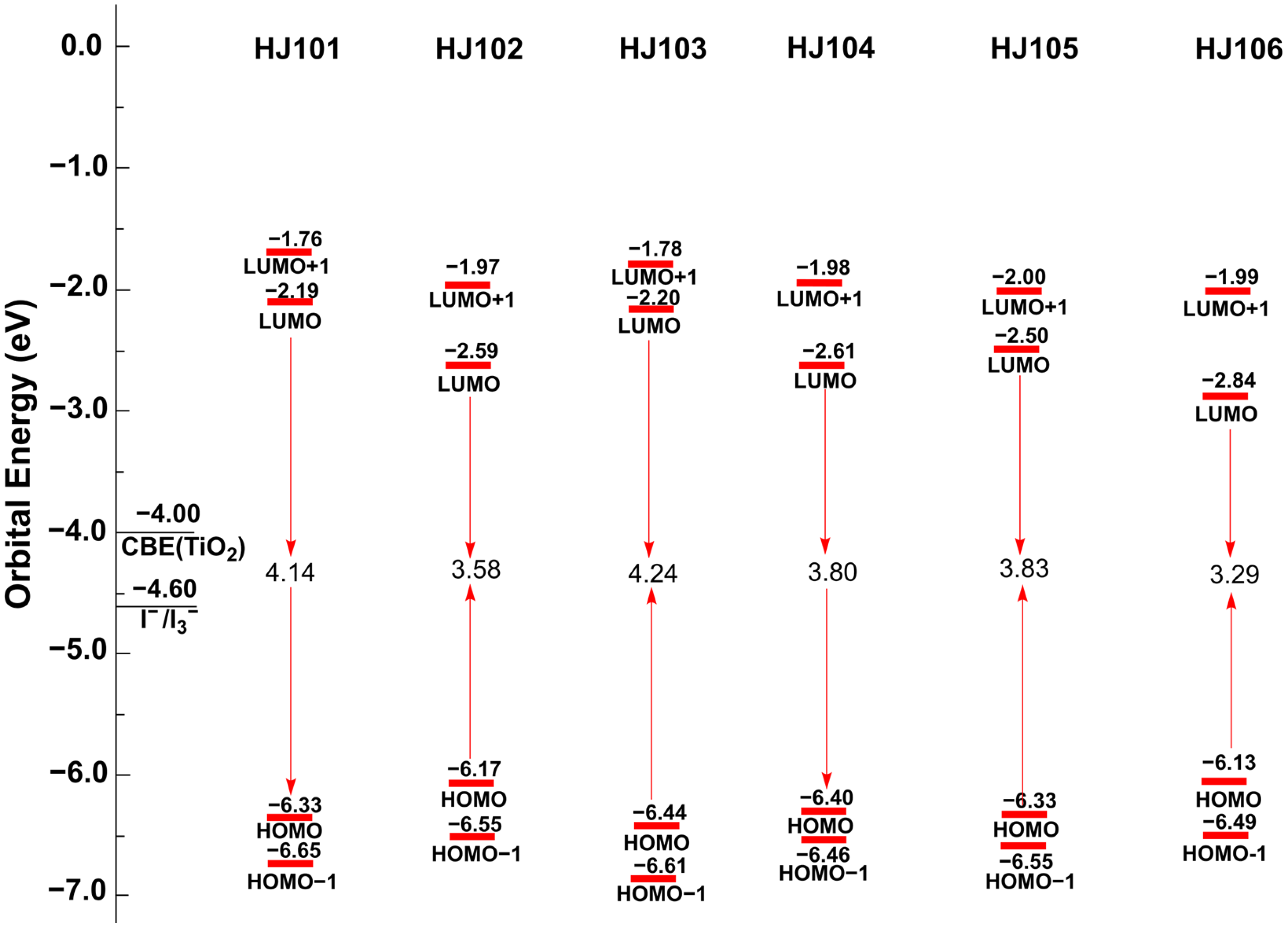
2.2. Frontier Molecular Orbital Analysis and Excited-State Configurations
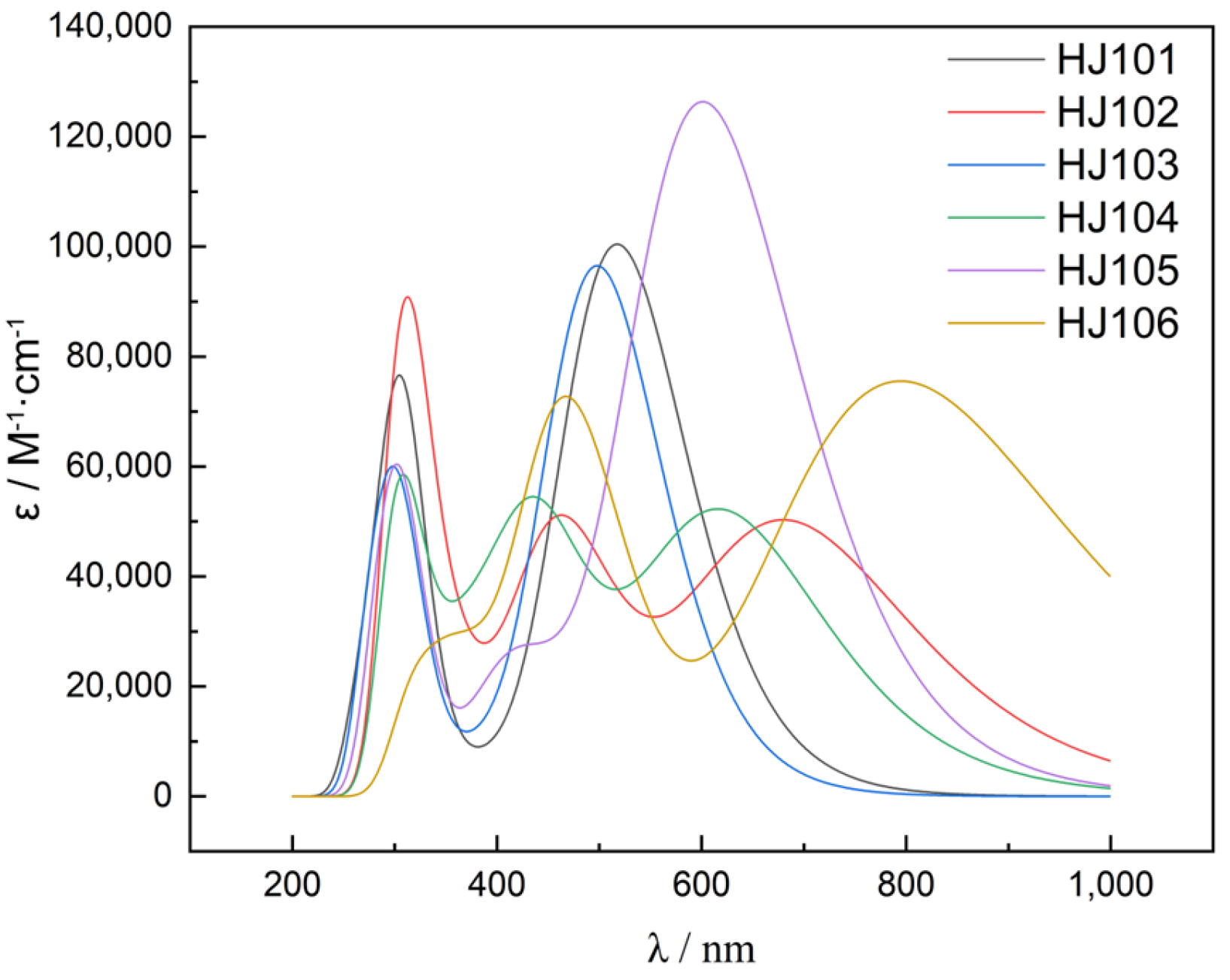
2.3. Absorption Spectra and Excited-State Parameters
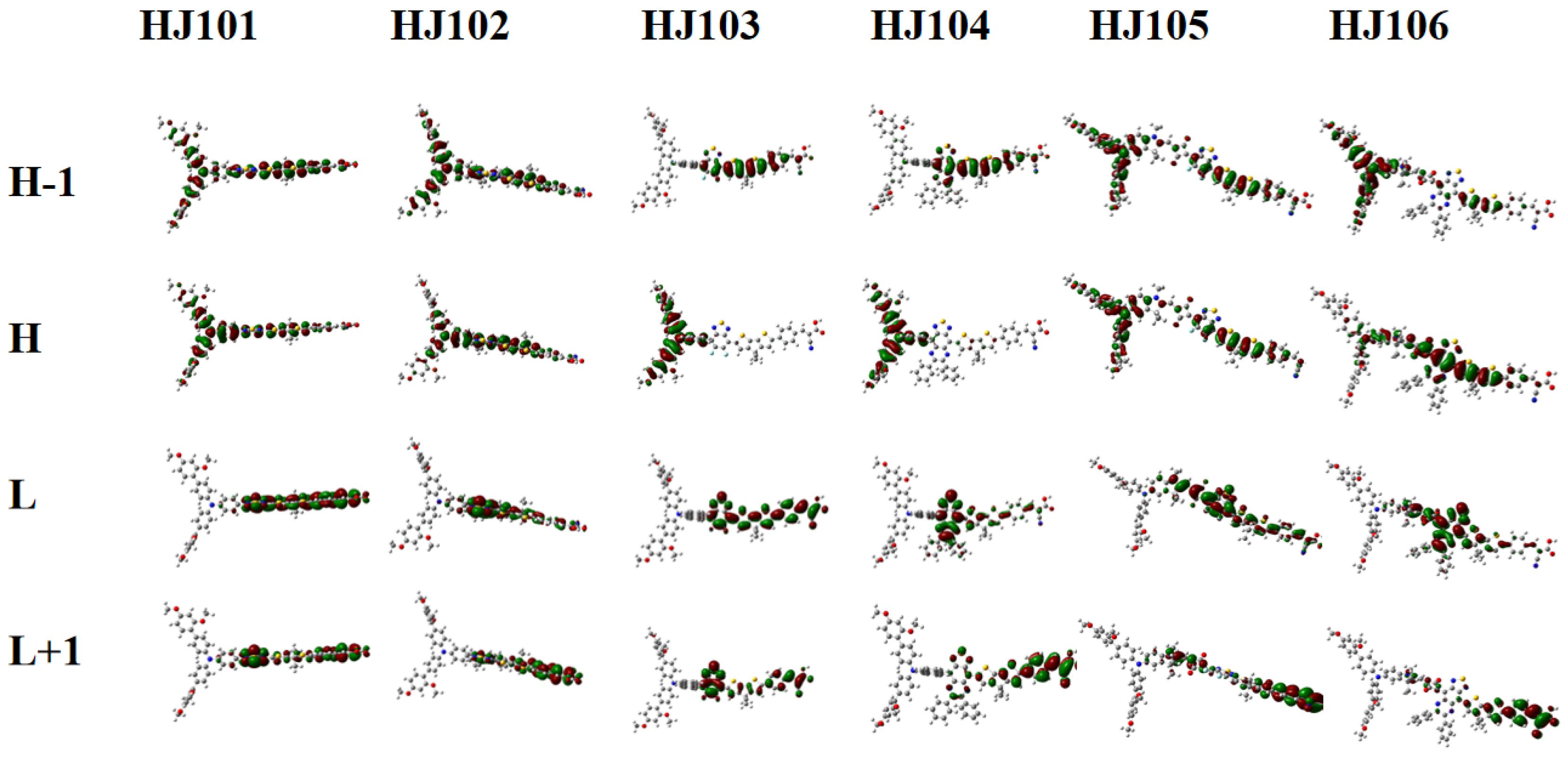
2.4. Molecular Orbital Analysis
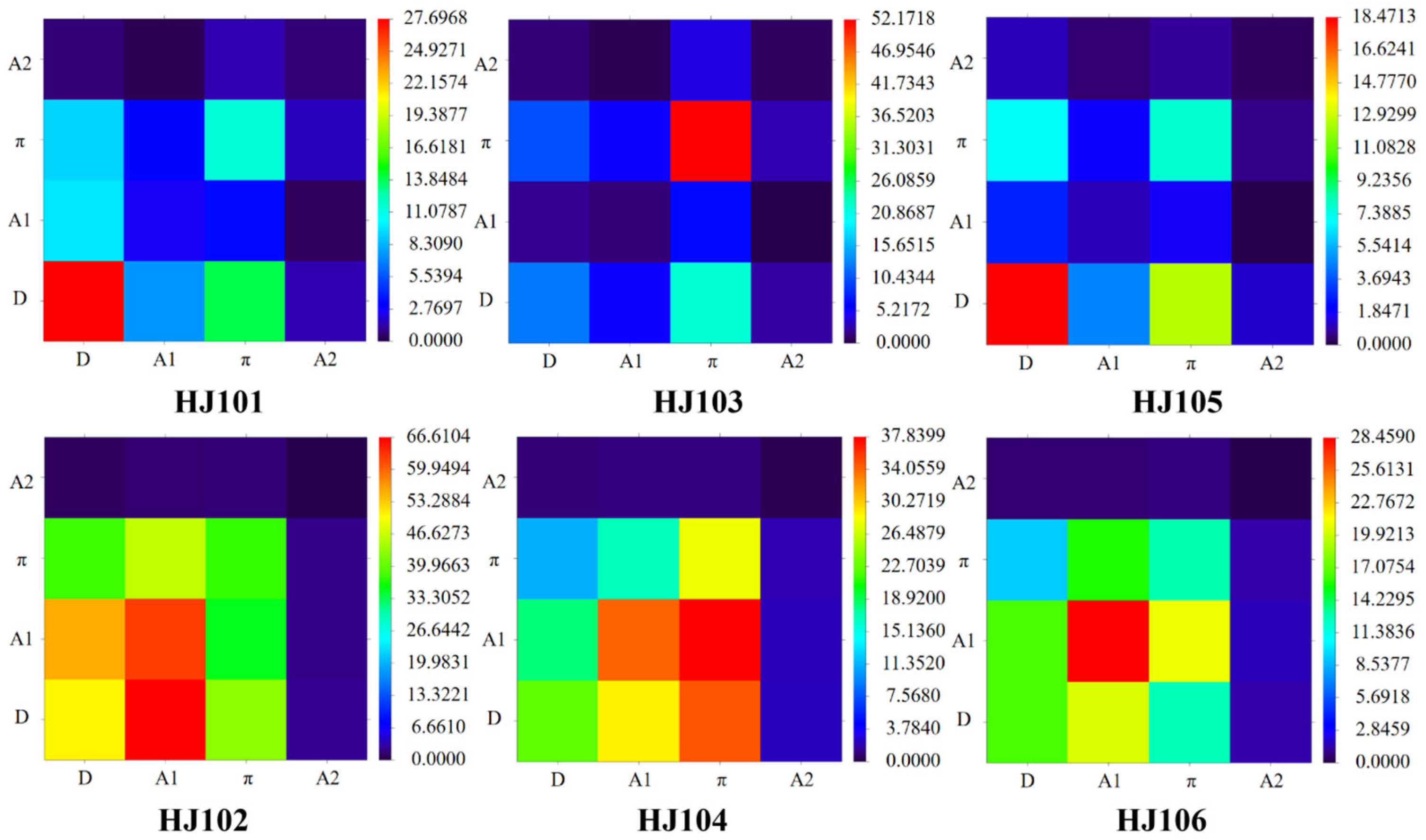
2.5. Transition Density Matrix (TDM) Analysis
2.6. Synthetic Feasibility of the Promising Candidates
3. Materials and Methods
3.1. Geometric Optimization
3.2. Excited-State Energy Calculations
3.3. Performance Calculations
4. Conclusions
Supplementary Materials
Author Contributions
Funding
Institutional Review Board Statement
Informed Consent Statement
Data Availability Statement
Conflicts of Interest
Abbreviations
| DSSCs | dye-sensitized solar cells |
| NIR | near-infrared |
| DFT | density functional theory |
| TDDFT | time-dependent density functional theory |
| HOMO | highest occupied molecular orbital |
| LUMO | lowest unoccupied molecular orbital |
| ICT | intramolecular charge transfer |
| CT | charge transfer |
| TDM | transition density matrix |
| LHE | light-harvesting efficiency |
| Voc | open-circuit voltage |
| Jsc | short-circuit current density |
| FF | fill factor |
| Pinc | incident light power intensity |
| η | power conversion efficiency |
| ∆Ginj | electron injection driving force |
| ∆Greg | dye regeneration driving force |
| IEFPCM | integral equation formalism polarizable continuum model |
| BTD | benzothiadiazole |
| DFBTD | 5,6-difluoro-2,1,3-benzothiadiazole |
| PBE0 | Perdew–Burke–Ernzerhof hybrid exchange-correlation functional (0-parameter hybrid variant) |
| CAM-B3LYP | Coulomb-attenuating method Becke, 3-parameter, Lee-Yang-Parr functional |
References
- Hagfeldt, A.; Boschloo, G.; Sun, L.; Kloo, L.; Pettersson, H. Dye-sensitized solar cells. Chem. Rev. 2010, 110, 6595–6663. [Google Scholar] [CrossRef] [Scilit]
- Hardin, B.; Snaith, H.; McGehee, M. The renaissance of dye-sensitized solar cells. Nat. Photonics 2012, 6, 162–169. [Google Scholar] [CrossRef] [Scilit]
- Aftabuzzaman, M.; Zhou, H.; Masud; Akman, E.; Boruah, B.D.; Al-Ahmed, A.; Kim, H.K. Progress in highly efficient and stable dye-sensitized solar cells: State-of-the-art materials and device fabrication. Coord. Chem. Rev. 2026, 563, 218020. [Google Scholar] [CrossRef] [Scilit]
- Baumann, A.; Curiac, C.; Delcamp, J.H. The Hagfeldt donor and use of next-generation bulky donor designs in dye-sensitized solar cells. ChemSusChem 2020, 13, 2503–2512. [Google Scholar] [CrossRef] [Scilit]
- Zhang, X.; Xu, Y.; Giordano, F.; Schreier, M.; Pellet, N.; Hu, Y.; Yi, C.; Robertson, N.; Hua, J.; Zakeeruddin, S.M.; et al. Molecular engineering of potent sensitizers for very efficient light harvesting in thin-film solid-state dye-sensitized solar cells. J. Am. Chem. Soc. 2016, 138, 10742–10745. [Google Scholar] [CrossRef] [Scilit]
- Cao, Y.; Liu, Y.; Zakeeruddin, S.M.; Hagfeldt, A.; Grätzel, M. Direct contact of selective charge extraction layers enables high-efficiency molecular photovoltaics. Joule 2018, 2, 1108–1117. [Google Scholar] [CrossRef] [Scilit]
- Mathew, S.; Yella, A.; Gao, P.; Humphry-Baker, R.; Curchod, B.F.E.; Ashari-Astani, N.; Tavernelli, I.; Rothlisberger, U.; Nazeeruddin, M.K.; Grätzel, M. Dye-sensitized solar cells with 13% efficiency achieved through the molecular engineering of porphyrin sensitizers. Nat. Chem. 2014, 6, 242–247. [Google Scholar] [CrossRef] [Scilit]
- Kakiage, K.; Aoyama, Y.; Yano, T.; Oya, K.; Fujisawa, J.-I.; Hanaya, M. Highly-efficient dye-sensitized solar cells with collaborative sensitization by silyl-anchor and carboxy-anchor dyes. Chem. Commun. 2015, 51, 15894–15897. [Google Scholar] [CrossRef] [Scilit]
- Kaur, H.; Goel, N. Engineering highly efficient porphyrin sensitizers through metal, ligand and bridge modification: A DFT study. Phys. Chem. Chem. Phys. 2024, 26, 29311–29327. [Google Scholar] [CrossRef] [Scilit]
- Zhang, X.; Li, Y.; Chen, W.; Wang, J.; Liu, Y.; Zhao, Z.; Tang, B.Z. Visible, far-red, and near-infrared active AIE luminogens for bioimaging and photodynamic therapy. ACS Appl. Electron. Mater. 2024, 7, 1461–1472. [Google Scholar] [CrossRef] [Scilit]
- Wang, Y.; Li, H.; Zhang, J.; Liu, Y.; Chen, C.; Li, Z. Recent advances in squaraine dyes for optoelectronic applications. Chin. J. Org. Chem. 2020, 40, 3589–3607. [Google Scholar] [CrossRef] [Scilit]
- Ilina, K.; MacCuaig, W.M.; Laramie, M.; Jeouty, J.N.; McNally, L.R.; Henary, M. Squaraine dyes: Molecular design for different applications and remaining challenges. Bioconjug. Chem. 2020, 31, 194–213. [Google Scholar] [CrossRef] [Scilit]
- Sarasiya, S.; Henary, M. Red-shifting squaraine dyes in the near-infrared region using perimidine heterocycles: Synthesis and optical properties. RSC Adv. 2026, 16, 16080–16087. [Google Scholar] [CrossRef] [Scilit]
- Marinescu, M.; Popa, C.V.; Tănase, M.A.; Soare, A.C.; Tablet, C.; Bala, D.; Cinteza, L.O.; Diţu, L.M.; Gifu, I.C.; Petcu, C. Synthesis, characterization, DFT study and antifungal activities of some novel 2-(phenyldiazenyl)phenol based azo dyes. Materials 2022, 15, 8162. [Google Scholar] [CrossRef] [Scilit]
- Meng, Z.; Wang, T.; Tu, J.; Han, Z.; Deng, Y.; Shi, C.; Zhang, L.; Zhen, Y. Thermally converted anthracene-based fully conjugated polymers for field-effect transistors via molecular doping. Dye. Pigm. 2025, 238, 112709. [Google Scholar] [CrossRef] [Scilit]
- Krishna, J.V.S.; Koteshwar, D.; Chowdhury, T.H.; Singh, S.P.; Bedja, I.; Islam, A.; Giribabu, L. Efficient near-IR porphyrins containing a triphenylamine-substituted anthryl donating group for dye-sensitized solar cells. J. Mater. Chem. C 2019, 7, 13594–13605. [Google Scholar] [CrossRef] [Scilit]
- Al-Muqammas, A.; Al-Jubouri, S.; Al-Saadi, A. Synthesis and characterization of new heterocyclic compounds derived from 4-aminoantipyrine as potential antimicrobial agents. Int. J. Photoenergy 2018, 2018, 4764830. [Google Scholar] [CrossRef] [Scilit]
- Shamsuddin, M.A.; Hassan, N.I.; Suait, M.S.; Ibrahim, S. Structural insights into additives for dye-sensitized solar cell (DSSC) electrolytes. Sol. Energy 2026, 304, 114199. [Google Scholar] [CrossRef] [Scilit]
- MacCuaig, W.M.; Wickizer, C.; Van, R.S.; Buabeng, E.R.; Lerner, M.R.; Grizzle, W.E.; Shao, Y.; Henary, M.; McNally, L.R. Influence of structural moieties in squaraine dyes on optoacoustic signal shape and intensity. Chem 2024, 10, 713–729. [Google Scholar] [CrossRef] [Scilit]
- Moustafa, M.; Etman, H.A.; Elmorsy, M.R.; Abdel-Latif, E.; Badawy, S.A. Design, synthesis, and theoretical analysis of anthracene-based sensitizers for enhanced dye-sensitized solar cell efficiency. Struct. Chem. 2026, 37, 417–429. [Google Scholar] [CrossRef] [Scilit]
- Ma, J.-G.; Zhang, C.-R.; Gong, J.-J.; Yang, B.; Zhang, H.-M.; Wang, W.; Wu, Y.-Z.; Chen, Y.-H.; Chen, H.-S. The adsorption of α-cyanoacrylic acid on anatase TiO2 (101) and (001) surfaces: A density functional theory study. J. Chem. Phys. 2014, 141, 234705. [Google Scholar] [CrossRef] [Scilit]
- Pastore, M.; De Angelis, F. Computational modelling of TiO2 surfaces sensitized by organic dyes with different anchoring groups: Adsorption modes, electronic structure and implication for electron injection/recombination. Phys. Chem. Chem. Phys. 2012, 14, 920–928. [Google Scholar] [CrossRef] [Scilit]
- Chen, W.-C.; Nachimuthu, S.; Jiang, J.-C. Revealing the influence of Cyano in Anchoring Groups of Organic Dyes on Adsorption Stability and Photovoltaic Properties for Dye-Sensitized Solar Cells. Sci. Rep. 2017, 7, 4979. [Google Scholar] [CrossRef] [Scilit]
- Koudjina, S.; Kumar, V.; Atohoun, G.Y.S.; Gbenou, J.D.; Chetti, P. Impact of organic dye-photosensitizer on TiO2 nanocrystalline surface for high performance organic electronic devices: A computational insight. J. Photochem. Photobiol. A Chem. 2023, 442, 114772. [Google Scholar] [CrossRef] [Scilit]
- De Angelis, F.; Di Valentin, C.; Fantacci, S.; Vittadini, A.; Selloni, A. Theoretical Studies on Anatase and Less Common TiO2 Phases: Bulk, Surfaces, and Nanomaterials. Chem. Rev. 2014, 114, 9708–9753. [Google Scholar] [CrossRef] [Scilit]
- Fan, W.-J.; Chang, Y.-Z.; Zhao, J.-L.; Xu, Z.-N.; Tan, D.-Z.; Chen, Y.-G. A theoretical study of fused thiophene modified anthracene-based organic dyes for dye-sensitized solar cell applications. New J. Chem. 2018, 42, 20163–20170. [Google Scholar] [CrossRef] [Scilit]
- Chattopadhyay, D.; Lastella, S.; Kim, S.; Papadimitrakopoulos, F. Length separation of zwitterion-functionalized single wall carbon nanotubes by GPC. J. Am. Chem. Soc. 2002, 124, 728–729. [Google Scholar] [CrossRef] [Scilit]
- Li, M.; Kou, L.; Diao, L.; Zhang, Q.; Li, Z.; Wu, Q.; Lu, W.; Pan, D.; Wei, Z. Theoretical study of WS-9-based organic sensitizers for unusual Vis/NIR absorption and highly efficient dye-sensitized solar cells. J. Phys. Chem. C 2015, 119, 9782–9790. [Google Scholar] [CrossRef] [Scilit]
- Islam, A.; Sugihara, H.; Arakawa, H. Molecular design of ruthenium(II) polypyridyl photosensitizers for efficient nanocrystalline TiO2 solar cells. J. Photochem. Photobiol. A Chem. 2003, 158, 131–138. [Google Scholar] [CrossRef] [Scilit]
- Najeeb, H.N.; Elzahra, Z.A.; Aljaberi, H.A.; Jasim, K.M.; Janabi, M.R.S.; Ameer, N.; Hadi, S.A. Influence of hydroxyl functionalization on the electronic properties and thermoelectric–photovoltaic performance of anthracene-based D–π–A systems. Chem. Phys. Impact 2026, 12, 101023, Erratum in Chem. Phys. Impact 2026, 12, 101068. [Google Scholar] [CrossRef] [Scilit]
- Faraghally, F.A.; Musa, A.F.; Chen, C.-C.; Chen, Y.-H.; Chen, Y.-D.; Yeh, C.-Y.; Wei, T.-C. Double anthracene-based sensitizers for high-efficiency dye-sensitized solar cells under both sunlight and indoor light. Small Struct. 2024, 5, 2400236. [Google Scholar] [CrossRef] [Scilit]
- Nawghare, I.S.; Deshmukh, S.S.; Joshi, K.; Krishnamurty, S.; Krishnamoorthy, K.; Nithyanandhan, J. Far-red active squaraine dye-sensitized photoanode for dye-sensitized solar cells with a copper (II/I) electrolyte. J. Photochem. Photobiol. A Chem. 2025, 459, 116086. [Google Scholar] [CrossRef] [Scilit]
- Fan, H.; Li, S.; Meng, X.; Pei, W.; Liu, T.; Wang, M.; Li, Y. Optoelectronic performance of anthracene-based dyes with modified Hagfeldt donors in dye-sensitized solar cells. Phys. Chem. Chem. Phys. 2026, 28, 10147–10168. [Google Scholar] [CrossRef] [Scilit]
- Frisch, M.J.; Trucks, G.W.; Schlegel, H.B.; Scuseria, G.E.; Robb, M.A.; Cheeseman, J.R.; Scalmani, G.; Barone, V.; Petersson, G.A.; Nakatsuji, H.; et al. Gaussian 16, Revision C.01; Gaussian, Inc.: Wallingford, CT, USA, 2016. [Google Scholar]
- Tomasi, J.; Mennucci, B.; Cancès, E. The IEF version of the PCM solvation method: An overview of a new method addressed to study molecular solutes at the QM ab initio level. J. Mol. Struct. Theochem 1999, 464, 211–226. [Google Scholar] [CrossRef] [Scilit]
- Iozzi, M.F.; Mennucci, B.; Tomasi, J.; Cammi, R. Excitation energy transfer (EET) between molecules in condensed matter: A novel application of the polarizable continuum model (PCM). J. Chem. Phys. 2004, 120, 7029. [Google Scholar] [CrossRef] [Scilit]
- Adamo, C.; Scuseria, G.E.; Barone, V. Accurate excitation energies from time-dependent density functional theory: Assessing the PBE0 model. J. Chem. Phys. 1999, 111, 2889–2899. [Google Scholar] [CrossRef] [Scilit]
- Huang, J.; Hu, J.; Fang, M.; Yang, L.; Zhang, G.; Li, Z. External electric field modulation of a high-performance D–A–π–A sensitizer for dye-sensitized solar cells: A DFT/TDDFT investigation. R. Soc. Open Sci. 2026, 13, 252305. [Google Scholar] [CrossRef] [Scilit]
- Huang, J.; Hu, J.; Zhang, G.; Fang, M. DFT/TDDFT study of electron-accepting groups on Hagfeldt donor-based dye sensitizers for solar cells. Proc. R. Soc. A 2026, 482, 20260215. [Google Scholar]
- Huang, J.; Yang, L.; Chen, Z.; Zhou, Y.; Zeng, S. DFT/TDDFT in silico design of ullazine-derived D-π-A-π-A dye photosensitiser. New J. Chem. 2023, 47, 11030–11039. [Google Scholar] [CrossRef] [Scilit]
- Huang, J.; Li, Z.; Yang, L.; Hu, R.; Shi, G. A comprehensive DFT/TDDFT investigation into the influence of electron acceptors on the photophysical properties of ullazine-based D-π-A-π-A photosensitizers. Sci. Rep. 2025, 15, 3101. [Google Scholar] [CrossRef] [Scilit]
- Huang, J.; Lv, Y.; Wu, J. Density functional theory calculations on the solvatochromism of covalent organic framework Py-TT cluster compounds. Proc. R. Soc. A 2025, 481, 20240768. [Google Scholar] [CrossRef] [Scilit]
- Huang, J.; Yang, L.; Zhou, Y.; Chen, Y.; Liu, Q.; Wu, W. Density functional theory/time-dependent density functional theory investigations on the color-structure relationship of biopigment molecules. J. Chem. Res. 2024, 48, 17475198231223654. [Google Scholar] [CrossRef] [Scilit]
- Yanai, T.; Tew, D.P.; Handy, N.C. A new hybrid exchange-correlation functional using the Coulomb-attenuating method (CAM-B3LYP). Chem. Phys. Lett. 2004, 393, 51–57. [Google Scholar] [CrossRef] [Scilit]
- Lu, T.; Chen, F.W. Multiwfn: A multifunctional wavefunction analyzer. J. Comput. Chem. 2012, 33, 580–592. [Google Scholar] [CrossRef] [Scilit]
- Al-Horaibi, S.A.; Al-Odayni, A.-B.; AlSaeedy, M.; Al-Ostoot, F.H.; Al-Salihy, A.; Alezzy, A.; Al-Adhreai, A.; Saif, F.A.; Yaseen, S.A.; Saeed, W.S. Exploring DSSC efficiency enhancement: SQI-F and SQI-Cl dyes with iodolyte electrolytes and CDCA optimization. Molecules 2023, 28, 7129. [Google Scholar] [CrossRef] [Scilit]
- Peach, M.J.G.; Benfield, P.; Helgaker, T.; Tozer, D.J. Excitation energies in density functional theory: An evaluation and a diagnostic test. J. Chem. Phys. 2008, 128, 044118. [Google Scholar] [CrossRef] [Scilit]
- Ma, W.; Jiao, Y.; Meng, S. Predicting energy conversion efficiency of dye solar cells from first principles. J. Phys. Chem. C 2014, 118, 16447–16457. [Google Scholar] [CrossRef] [Scilit]
- Zhou, M.; Zhong, X.; Wei, D.; Yang, K.; Chen, Y.; Jia, C.; Li, J. Highly efficient doping of titanium dioxide with sulfur using disulfide-linked macrocycles for hydrogen production under visible light. Green Chem. 2022, 24, 2557–2566. [Google Scholar] [CrossRef] [Scilit]
- Soroush, M.; Lau, K.K.S. Insights into dye-sensitized solar cells from macroscopic-scale first-principles mathematical modeling. In Dye-Sensitized Solar Cells; Academic Press: Cambridge, MA, USA, 2019; pp. 83–119. [Google Scholar]



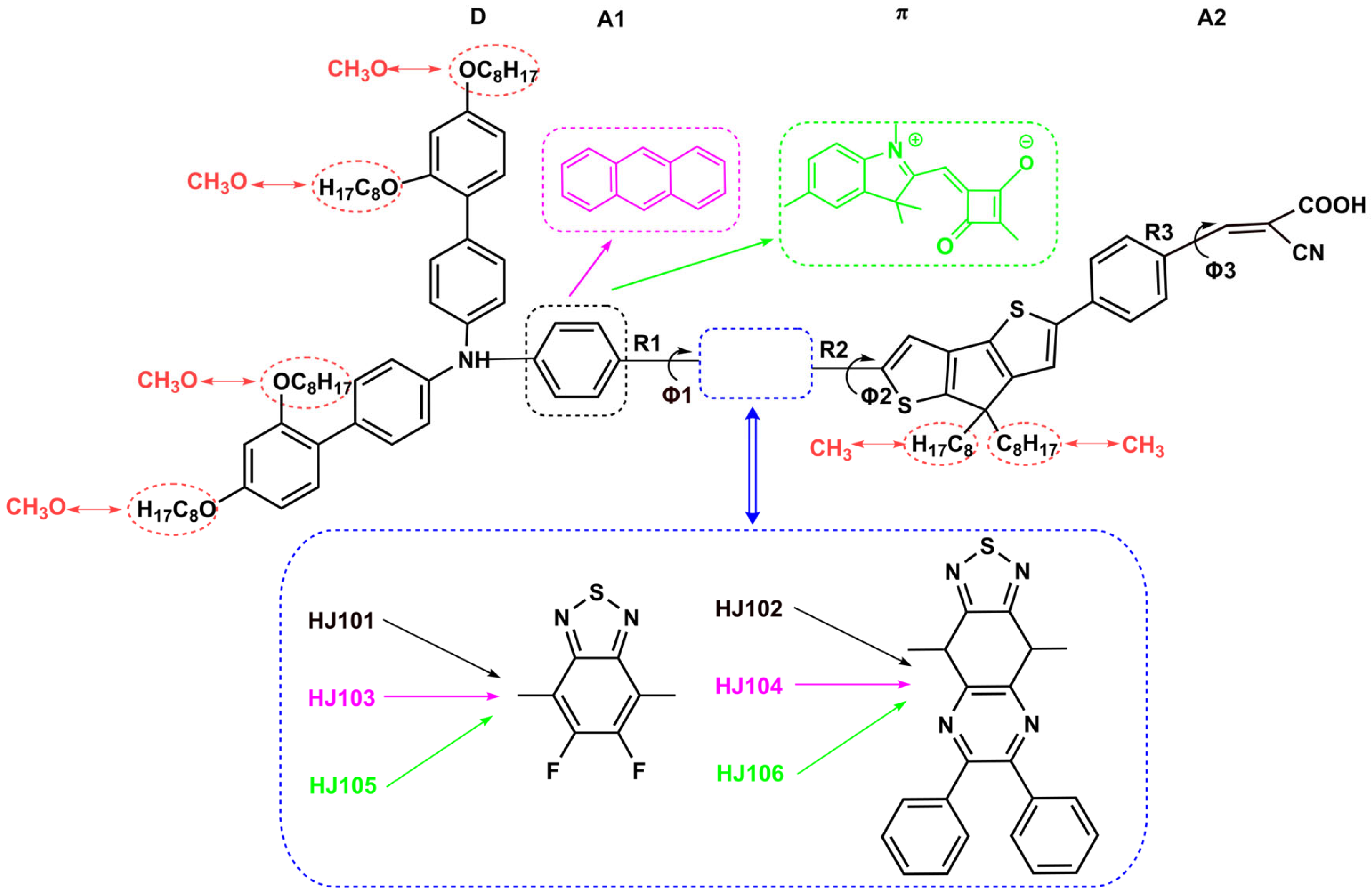
| Dyes | R1 (Å) | R2 (Å) | R3 (Å) | Φ1 a (°) | Φ2 a (°) | Φ3 a (°) |
|---|---|---|---|---|---|---|
| XY1 | 1.469 | 1.451 | 1.436 | 34.2 | 9.9 | 0.4 |
| HJ101 | 1.468 | 1.449 | 2.769 | 42.3 | 0.3 | 0.7 |
| HJ102 | 1.469 | 1.449 | 1.436 | 47.4 | 16.0 | 0.1 |
| HJ103 | 1.482 | 1.449 | 1.437 | 79.8 | 0.7 | 0.1 |
| HJ104 | 1.483 | 1.445 | 1.448 | 85.3 | 26.3 | 0.1 |
| HJ105 | 1.433 | 1.445 | 1.437 | 35.8 | 2.4 | 0.4 |
| HJ106 | 1.431 | 1.444 | 1.437 | 42.2 | 8.2 | 0.1 |
| Molecule | State (a) | ∆Eexc (b) (eV) | λosc (c) (nm) | F (d) | Orbital Contribution (%) (e) |
|---|---|---|---|---|---|
| XY1 | S1 | 2.32 | 534 | 2.3534 | H→L 53.6%, H−1→L 23.6%, H→L+1 12.1% |
| HJ101 | S1 | 2.39 | 518 | 2.4610 | H→L 50.4%, H−1→L 32.1%, H→ L+1 6.8% |
| HJ102 | S1 | 1.81 | 684 | 1.2232 | H→L 82.8%, H−1→L 9.0% |
| HJ103 | S1 | 2.48 | 499 | 2.3531 | H−1→L 81.1%, H−5→L+1 5.7% |
| HJ104 | S1 | 2.00 | 621 | 1.2632 | H−1→L 83.9%, H→L 6.1% |
| HJ105 | S1 | 2.06 | 602 | 3.1029 | H→L 69.6%, H−1→L 12.3% |
| HJ106 | S1 | 1.56 | 795 | 1.8634 | H→L 87.9% |
| Molecule | λmax (nm) | ε (104·M−1·cm−1) | LHE | τ (ns) |
|---|---|---|---|---|
| XY1 | 534 | 9.6756 | 0.996 | 1.819 |
| HJ101 | 518 | 10.0424 | 0.997 | 1.634 |
| HJ102 | 680 | 9.0837 | 0.940 | 5.667 |
| HJ103 | 498 | 9.6528 | 0.996 | 1.580 |
| HJ104 | 616 | 5.2286 | 0.945 | 4.503 |
| HJ105 | 601 | 12.6352 | 0.999 | 1.745 |
| HJ106 | 795 | 7.5539 | 0.986 | 5.084 |
| Molecule | ∆Ginj (eV) | ∆Greg (eV) |
|---|---|---|
| XY1 | −1.87 | −1.50 |
| HJ101 | −1.81 | −1.63 |
| HJ102 | −1.41 | −1.47 |
| HJ103 | −1.80 | −1.74 |
| HJ104 | −1.39 | −1.70 |
| HJ105 | −1.50 | −1.63 |
| HJ106 | −1.16 | −1.43 |
Disclaimer/Publisher’s Note: The statements, opinions and data contained in all publications are solely those of the individual author(s) and contributor(s) and not of MDPI and/or the editor(s). MDPI and/or the editor(s) disclaim responsibility for any injury to people or property resulting from any ideas, methods, instructions or products referred to in the content. |
© 2026 by the authors. Licensee MDPI, Basel, Switzerland. This article is an open access article distributed under the terms and conditions of the Creative Commons Attribution (CC BY) license.
Share and Cite
Huang, J.; Hu, Z. Theoretical Design of Near-Infrared-Absorbing D-A-π-A Dyes with Modified Hagfeldt Donors: A DFT/TDDFT Study. Int. J. Mol. Sci. 2026, 27, 7646. https://doi.org/10.3390/ijms27177646
Huang J, Hu Z. Theoretical Design of Near-Infrared-Absorbing D-A-π-A Dyes with Modified Hagfeldt Donors: A DFT/TDDFT Study. International Journal of Molecular Sciences. 2026; 27(17):7646. https://doi.org/10.3390/ijms27177646
Chicago/Turabian StyleHuang, Jing, and Zhixiang Hu. 2026. "Theoretical Design of Near-Infrared-Absorbing D-A-π-A Dyes with Modified Hagfeldt Donors: A DFT/TDDFT Study" International Journal of Molecular Sciences 27, no. 17: 7646. https://doi.org/10.3390/ijms27177646
APA StyleHuang, J., & Hu, Z. (2026). Theoretical Design of Near-Infrared-Absorbing D-A-π-A Dyes with Modified Hagfeldt Donors: A DFT/TDDFT Study. International Journal of Molecular Sciences, 27(17), 7646. https://doi.org/10.3390/ijms27177646