Particulate Matter-Induced Skin Injury: A Dual-Pathway AhR–Nrf2 Framework for Epidermal Homeostasis and Therapeutic Targeting

 ,
,  , , and
Abstract
1. Introduction
1.1. Environmental Particulate Matter as an Emerging Public Health Concern
1.2. The Skin as the Primary Defense Interface Against Environmental Pollutants
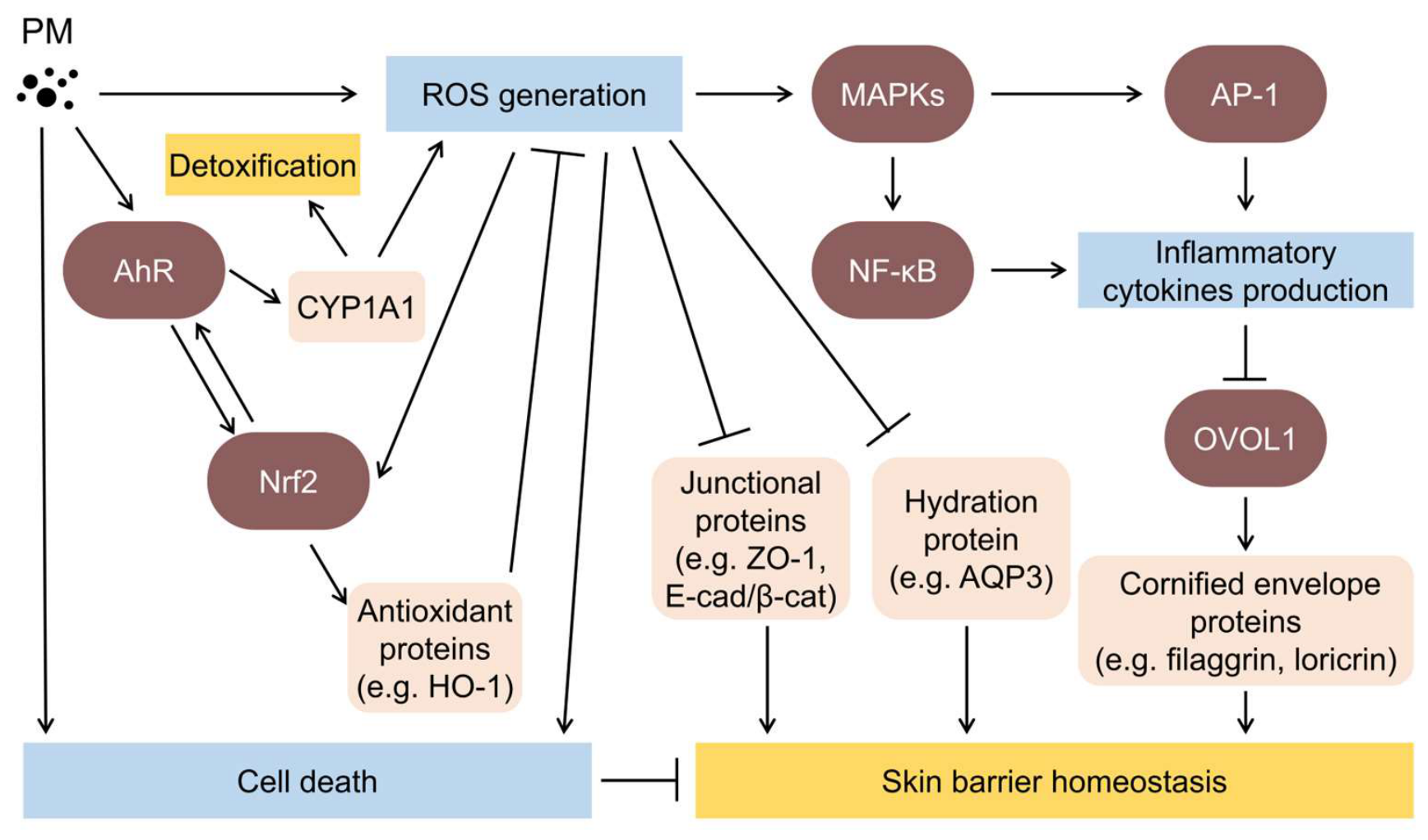
1.3. Mechanistic Overview of PM-Induced Skin Damage
2. Molecular Pathways Regulating Cellular Responses to PM Exposure
2.1. Oxidative Stress-Driven Mechanisms Underlying PM-Induced Skin Injury
2.2. Cellular and Molecular Consequences of PM Exposure
2.3. PM-Induced Disruption of Epidermal Barrier Integrity
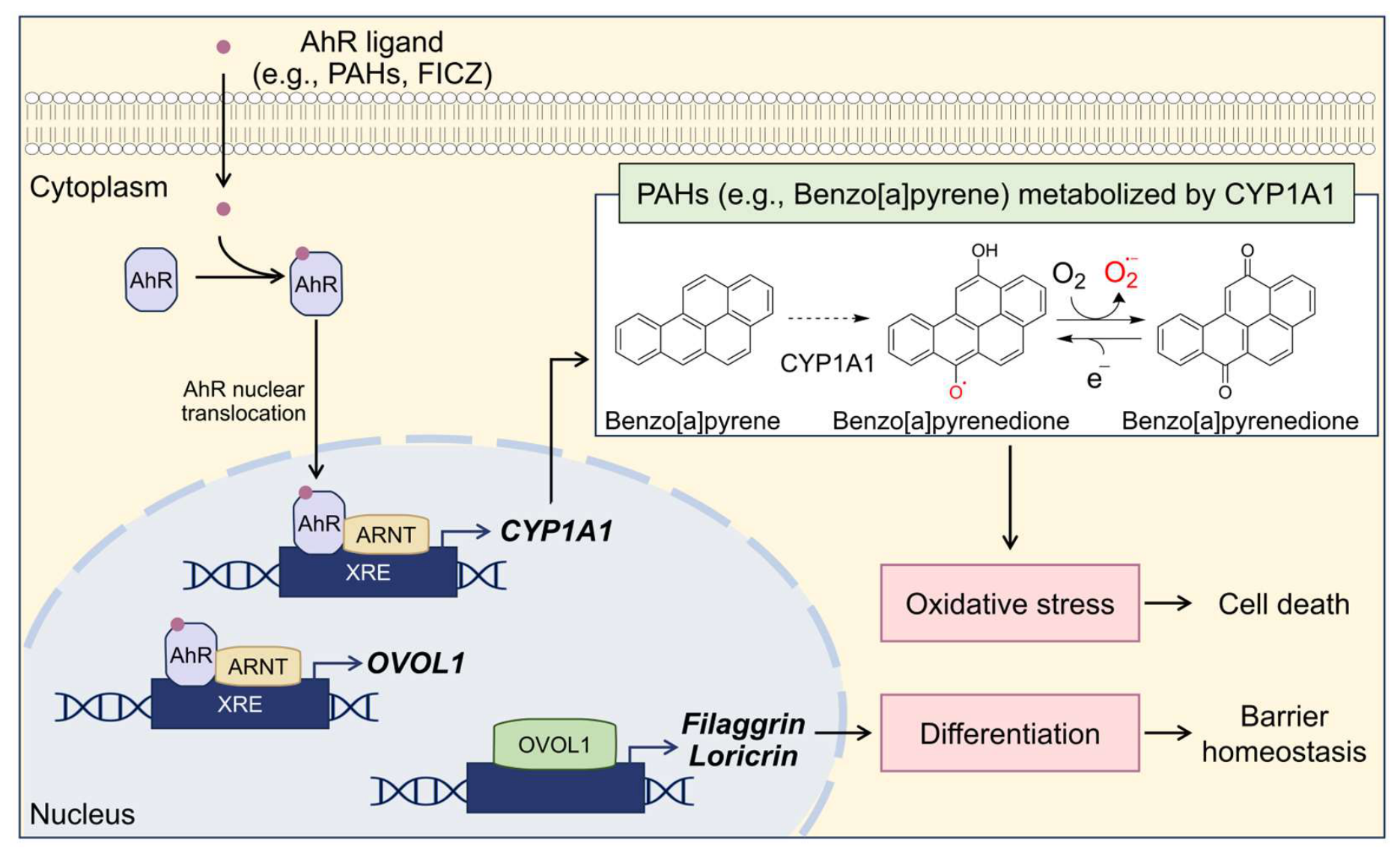
2.4. Context-Dependent Roles of the AhR in Skin Barrier Regulation

| Key Events | Molecular Targets/Biomarkers | References |
|---|---|---|
| Upstream stress sensing & xenobiotic response | ||
| ROS generation & stress signaling | TLR5 ↑, NOX4 ↑, ROS ↑, MAPKs activation, NF-κB/AP-1 activation | [73,120,121,122] |
| Xenobiotic metabolism | AhR nuclear translocation, CYP1A1 ↑, CYP1B1 ↑, AhRR ↑ | [32,63,122] |
| Keap1–Nrf2 antioxidant response | Nrf2 nuclear translocation, Nrf2 ↑, HO-1 ↑ | [32,123,124,125] |
| Oxidative stress & molecular damage | ||
| Redox imbalance | GSH ↓, GSH-Px ↓, GSTs ↑, SOD ↓, CAT ↓, GCLC ↓ | [100,123,124,126] |
| Lipid peroxidation & protein oxidation | Lipid oxidative stress DPPP ↑, protein carbonylation, MDA ↑, 4-HNE ↑ | [58,75,87,121,124,126,127,128] |
| DNA damage response | γH2AX ↑, DNA fragmentation, DNA tail ↑, 8-oxo-dG ↑, p53 activation | [58,63,80,121,126,129] |
| Organelle dysfunction | ||
| Mitochondrial dysfunction | ATP ↓, Δψm collapse, cytochrome c release | [80,121,124,126,130] |
| Autophagy–lysosomal dysfunction | LC3-II/LC3-I ratio ↑, p62/SQSTM1 ↓ | [86,93,121,129] |
| Plasma membrane damage | LDH release | [86,87,127] |
| Cell fate regulation | ||
| Cell-cycle arrest | G0/G1 arrest, Sub-G1 ↑, p16 ↑, p21 ↑, p27 ↑, Cyclin D1 ↓, Cyclin E ↓, CDK2 ↓, CDK4 ↓ | [80,84,121,129] |
| Programmed cell death | Bax ↑, Bcl-2 ↓, cytochrome c ↑, caspase-9/3 cleavage ↑, PARP cleavage ↑, apoptotic bodies ↑ | [80,87,90,121,124,126] |
| Senescence | p16 ↑, SA-β-gal ↑ | [82,94] |
| Tissue-level pathological outcomes | ||
| Inflammation | NF-κB/AP-1 nuclear translocation, NLRP1 inflammasome, IL-1β ↑, IL-6 ↑, TNF-α ↑, COX-2 ↑, iNOS ↑ | [65,122,127,128,131,132,133] |
| Skin barrier dysfunction |
| [32,63,64,65,90,108,109,134] |
| Skin hydration imbalance | TEWL ↑, AQP3 ↓, NMF ↓ | [65,90,109,135] |
| Melanogenesis | MITF ↑, TYR ↑, TRP-1 ↑, TRP-2 ↑ | [103,105] |
| Premature aging | MMP-1 ↑, MMP-3 ↑, MMP-9 ↑, collagen I ↓, elastin ↓ | [82,103,128,136] |
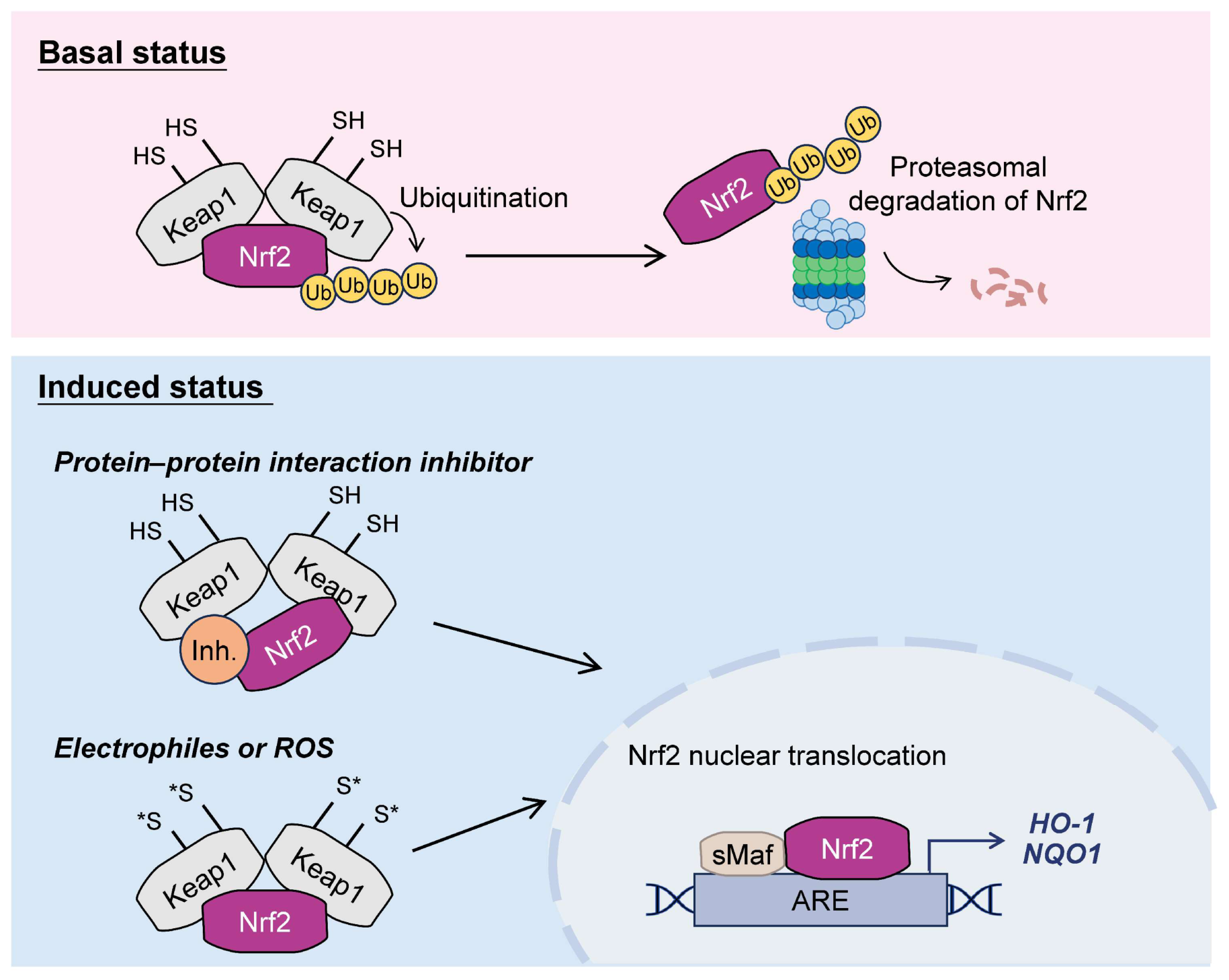
2.5. The Keap1–Nrf2–ARE Pathway: Antioxidant Defense and Cytoprotection
3. Mechanism-Based Strategies Targeting AhR and Nrf2 Pathways
3.1. Nrf2-Dominant Antioxidant Strategies
3.2. AhR-Dominant Epidermal Regulatory Strategies
3.3. Emerging Perspectives: Coordinated Regulation of AhR and Nrf2
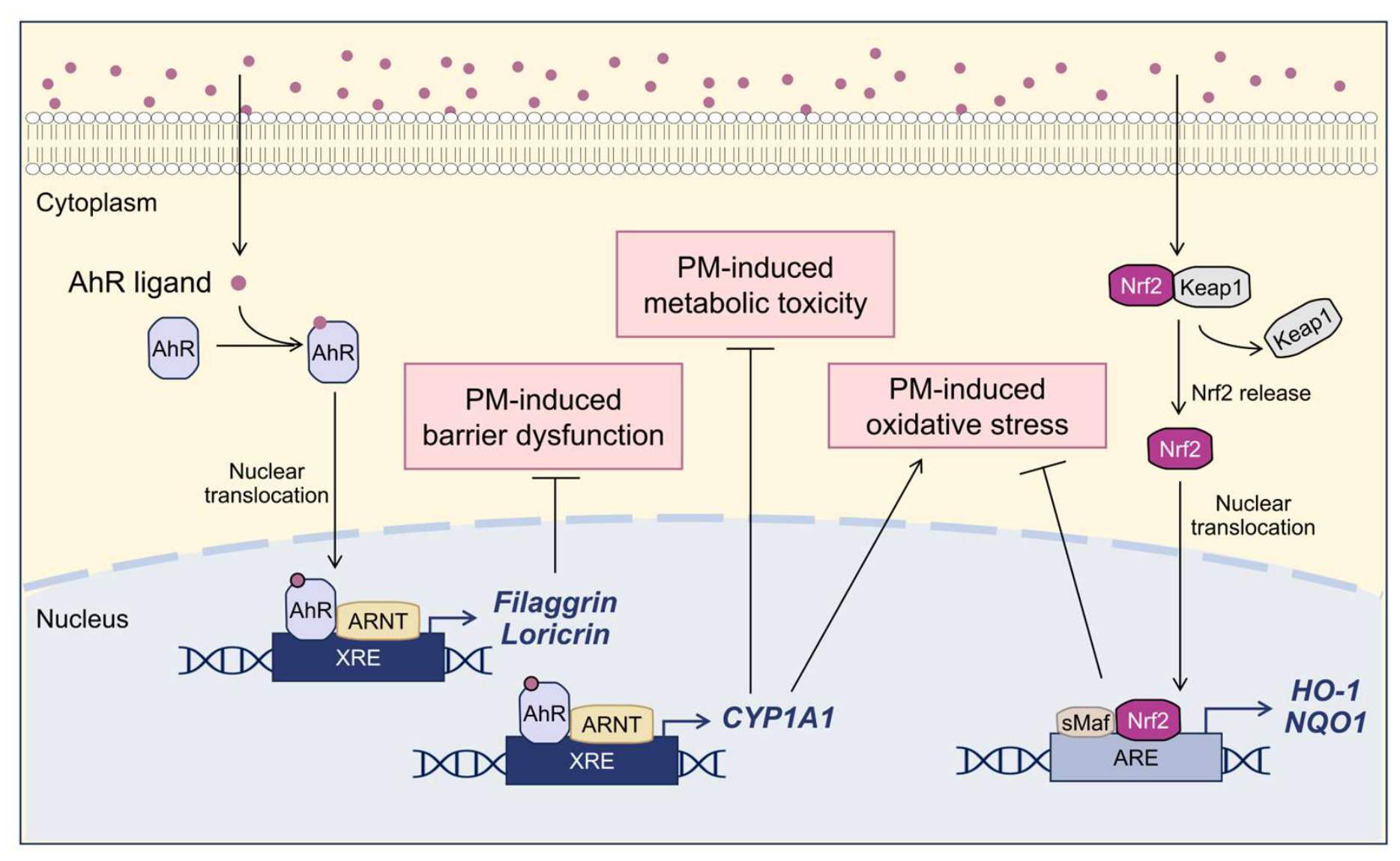
4. Conceptual Integration of AhR–Nrf2 Interplay in PM-Induced Skin Injury
5. Conclusions and Perspectives
Author Contributions
Funding
Data Availability Statement
Conflicts of Interest
Abbreviations
| AhR | aryl hydrocarbon receptor |
| AhRR | AhR repressor |
| AIP | AhR-interacting protein |
| AMPKα | AMP-activated protein kinase α |
| AP-1 | activator protein-1 |
| APAP | acetaminophen |
| AQP3 | aquaporin-3 |
| AREs | antioxidant response elements |
| ARNT | AhR nuclear translocator |
| BTB | Broad complex-Tramtrack-Bric-à-brac |
| COX-2 | cyclooxygenase-2 |
| Cul3 | Cullin-3 |
| CYP1A1 | cytochrome P450 1A1 |
| DHE | dihydroethidium |
| ECL | enhanced chemiluminescence |
| EGCG | epigallocatechin-3-gallate |
| FBMN | feature-based molecular networking |
| FDA | U.S. Food and Drug Administration |
| FICZ | 6-formylindolo [3,2-b]carbazole |
| FLG | filaggrin |
| GCL | glutamate–cysteine ligase |
| GCLC | glutamate–cysteine ligase catalytic subunit |
| GSH | glutathione |
| GSH-Px | glutathione peroxidase |
| GSS | glutathione synthetase |
| GSTs | glutathione S-transferases |
| γH2AX | phosphorylated histone H2AX |
| H2DCFDA | 2′,7′-dichlorodihydrofluorescein diacetate |
| 4-HNE | 4-hydroxynonenal |
| HO-1 | heme oxygenase 1 |
| HRNR | hornerin |
| HSP90 | 90 kDa heat shock protein |
| IFN-γ | interferon-γ |
| IL-1β | interleukin-1β |
| iNOS | inducible nitric oxide synthase |
| IVL | involucrin |
| IVR | intervening region |
| JDP2 | Jun dimerization protein 2 |
| Keap1 | Kelch-like ECH-associated protein 1 |
| LC3-I | cytosolic form of microtubule-associated protein 1 light chain 3 |
| LC3-II | lipidated form of microtubule-associated protein 1 light chain 3 |
| LDH | lactate dehydrogenase |
| LOR | loricrin |
| Δψm | mitochondrial membrane potential |
| MAPKs | mitogen-activated protein kinase |
| MDA | malondialdehyde |
| MITF | melanocyte inducing transcription factor |
| MMPs | matrix metalloproteinases |
| NF-κB | nuclear factor kappa-light-chain-enhancer of activated B cells |
| NLRP1 | NLR family pyrin domain containing 1 |
| NMF | natural moisturizing factor |
| NOX4 | NADPH oxidase 4 |
| NQO1 | NAD(P)H-quinone oxidoreductase 1 |
| Nrf2 | nuclear factor erythroid 2–related factor 2 |
| OVOL1 | ovo-like 1 |
| 8-oxo-dG | 8-oxo-2′-deoxyguanosine |
| PAHs | polycyclic aromatic hydrocarbons |
| PAI-1 | plasminogen activator inhibitor-1 |
| PARP | poly(ADP-ribose) polymerase |
| PI3K | phosphoinositide 3-kinases |
| PKC | protein kinase C |
| PM | particulate matter |
| PPI | protein–protein interaction |
| ROS | reactive oxygen species |
| SAhRMs | selective AhR modulators |
| SASP | senescence-associated secretory phenotype |
| SA-β-gal | senescence-associated β-galactosidase |
| sMaf | small musculoaponeurotic fibrosarcoma |
| SOD | superoxide dismutase |
| Tapinarof | 3,5-dihydroxy-4-isopropylstilbene |
| TBHQ | tert-butyl hydroquinone |
| TCDD | 2,3,7,8-tetrachlorodibenzo-p-dioxin |
| TER | transepithelial electrical resistance |
| TEWL | transepidermal water loss |
| TLR5 | toll-like receptor 5 |
| TNF-α | tumor necrosis factor-α |
| TRP-1 | tyrosinase-related protein 1 |
| Trx | thioredoxin |
| TrxR | thioredoxin reductase |
| TYR | tyrosinase |
| UFPs | ultrafine particles |
| USEPA | United States Environmental Protection Agency |
| UV | ultraviolet |
| WHO | World Health Organization |
| XREs | xenobiotic response elements |
| ZO-1 | zonula occludens-1 |
References
- Sangkham, S.; Phairuang, W.; Sherchan, S.P.; Pansakun, N.; Munkong, N.; Sarndhong, K.; Islam, M.A.; Sakunkoo, P. An update on adverse health effects from exposure to PM2.5. Environ. Adv. 2024, 18, 100603. [Google Scholar] [CrossRef] [Scilit]
- Li, T.; Yu, Y.; Sun, Z.; Duan, J. A comprehensive understanding of ambient particulate matter and its components on the adverse health effects based from epidemiological and laboratory evidence. Part. Fibre Toxicol. 2022, 19, 67. [Google Scholar] [CrossRef] [Scilit] [PubMed]
- U.S. EPA. Particulate Matter (PM) Basics. Available online: https://www.epa.gov/pm-pollution/particulate-matter-pm-basics (accessed on 19 November 2025).
- Anderson, J.O.; Thundiyil, J.G.; Stolbach, A. Clearing the air: A review of the effects of particulate matter air pollution on human health. J. Med. Toxicol. 2012, 8, 166–175. [Google Scholar] [CrossRef] [Scilit] [PubMed]
- Morawska, L.; Zhang, J.J. Combustion sources of particles. 1. Health relevance and source signatures. Chemosphere 2002, 49, 1045–1058. [Google Scholar] [CrossRef] [Scilit] [PubMed]
- Oberdörster, G.; Oberdörster, E.; Oberdörster, J. Nanotoxicology: An emerging discipline evolving from studies of ultrafine particles. Environ. Health Perspect. 2005, 113, 823–839. [Google Scholar] [CrossRef] [Scilit] [PubMed]
- Karakoti, A.S.; Hench, L.L.; Seal, S. The potential toxicity of nanomaterials—The role of surfaces. JOM 2006, 58, 77–82. [Google Scholar] [CrossRef] [Scilit]
- Chen, R.; Hu, B.; Liu, Y.; Xu, J.; Yang, G.; Xu, D.; Chen, C. Beyond PM2.5: The role of ultrafine particles on adverse health effects of air pollution. Biochim. Biophys. Acta 2016, 1860, 2844–2855. [Google Scholar] [CrossRef] [Scilit] [PubMed]
- Moreno-Ríos, A.L.; Tejeda-Benítez, L.P.; Bustillo-Lecompte, C.F. Sources, characteristics, toxicity, and control of ultrafine particles: An overview. Geosci. Front. 2022, 13, 101147. [Google Scholar] [CrossRef] [Scilit]
- Liu, L.; Urch, B.; Poon, R.; Szyszkowicz, M.; Speck, M.; Gold, D.R.; Wheeler, A.J.; Scott, J.A.; Brook, J.R.; Thorne, P.S.; et al. Effects of ambient coarse, fine, and ultrafine particles and their biological constituents on systemic biomarkers: A controlled human exposure study. Environ. Health Perspect. 2015, 123, 534–540. [Google Scholar] [CrossRef] [Scilit] [PubMed]
- Chen, Y.H.; Nguyen, D.; Brindley, S.; Ma, T.; Xia, T.; Brune, J.; Brown, J.M.; Tsai, C.S. The dependence of particle size on cell toxicity for modern mining dust. Sci. Rep. 2023, 13, 5101. [Google Scholar] [CrossRef] [Scilit] [PubMed]
- Li, N.; Sioutas, C.; Cho, A.; Schmitz, D.; Misra, C.; Sempf, J.; Wang, M.; Oberley, T.; Froines, J.; Nel, A. Ultrafine particulate pollutants induce oxidative stress and mitochondrial damage. Environ. Health Perspect. 2003, 111, 455–460. [Google Scholar] [CrossRef] [Scilit] [PubMed]
- Kim, S.T.; Saha, K.; Kim, C.; Rotello, V.M. The role of surface functionality in determining nanoparticle cytotoxicity. Acc. Chem. Res. 2013, 46, 681–691. [Google Scholar] [CrossRef] [Scilit] [PubMed]
- Pan, S.; Qiu, Y.; Li, M.; Yang, Z.; Liang, D. Recent developments in the determination of PM2.5 chemical composition. Bull. Environ. Contam. Toxicol. 2022, 108, 819–823. [Google Scholar] [CrossRef] [Scilit] [PubMed]
- Melzi, G.; Massimi, L.; Frezzini, M.A.; Iulini, M.; Tarallo, N.; Rinaldi, M.; Paglione, M.; Nozza, E.; Crova, F.; Valentini, S.; et al. Redox-activity and in vitro effects of regional atmospheric aerosol pollution: Seasonal differences and correlation between oxidative potential and in vitro toxicity of PM1. Toxicol. Appl. Pharmacol. 2024, 485, 116913. [Google Scholar] [CrossRef] [Scilit] [PubMed]
- Kim, K.H.; Kabir, E.; Kabir, S. A review on the human health impact of airborne particulate matter. Environ. Int. 2015, 74, 136–143. [Google Scholar] [CrossRef] [Scilit] [PubMed]
- Zhao, S.M.; Liu, W.X.; Miao, Q.Y.; Li, J.M.; Sun, L.M.; Wu, S.P. Emissions characteristics of polycyclic aromatic hydrocarbons, water-soluble heavy metals, and oxidative potential from indoor non-energy combustion sources. Environ. Sci. Pollut. Res. Int. 2025, 32, 15342–15358. [Google Scholar] [CrossRef] [Scilit] [PubMed]
- Wei, H.; Feng, Y.; Liang, F.; Cheng, W.; Wu, X.; Zhou, R.; Wang, Y. Role of oxidative stress and DNA hydroxymethylation in the neurotoxicity of fine particulate matter. Toxicology 2017, 380, 94–103. [Google Scholar] [CrossRef] [Scilit] [PubMed]
- Zhang, Y.; Hu, Q.; Fu, J.; Li, X.; Mao, H.; Wang, T. Influence of exposure pathways on tissue distribution and health impact of polycyclic aromatic hydrocarbon derivatives. Environ. Health 2023, 1, 150–167. [Google Scholar] [CrossRef] [Scilit] [PubMed]
- Menichetti, A.; Mordini, D.; Montalti, M. Penetration of microplastics and nanoparticles through skin: Effects of size, shape, and surface chemistry. J. Xenobiot. 2025, 15, 6. [Google Scholar] [CrossRef] [Scilit] [PubMed]
- Fuller, R.; Landrigan, P.J.; Balakrishnan, K.; Bathan, G.; Bose-O’Reilly, S.; Brauer, M.; Caravanos, J.; Chiles, T.; Cohen, A.; Corra, L.; et al. Pollution and health: A progress update. Lancet Planet. Health 2022, 6, e535–e547. [Google Scholar] [CrossRef] [Scilit] [PubMed]
- WHO. Air Pollution. Available online: https://www.who.int/health-topics/air-pollution#tab=tab_2 (accessed on 20 November 2025).
- Ruckerl, R.; Schneider, A.; Breitner, S.; Cyrys, J.; Peters, A. Health effects of particulate air pollution: A review of epidemiological evidence. Inhal. Toxicol. 2011, 23, 555–592. [Google Scholar] [CrossRef] [Scilit] [PubMed]
- Ngoc, L.T.N.; Park, D.; Lee, Y.; Lee, Y.C. Systematic review and meta-analysis of human skin diseases due to particulate matter. Int. J. Environ. Res. Public Health 2017, 14, 1458. [Google Scholar] [CrossRef] [Scilit] [PubMed]
- Weslock, N.; Drew, D.; Palanichami, D.; La, A.; Shoctor, H.; Amir, A.; Ramdass, P.; Mitchell, K. Association between fine particulate matter (PM2.5) and atopic dermatitis—A systematic review. Discov. Public Health 2025, 22, 117. [Google Scholar] [CrossRef] [Scilit]
- Hartung, F.; Krutmann, J.; Haarmann-Stemmann, T. Evidence that the aryl hydrocarbon receptor orchestrates oxinflammatory responses and contributes to airborne particulate matter-induced skin aging. Free Radic. Biol. Med. 2025, 233, 264–278. [Google Scholar] [CrossRef] [Scilit] [PubMed]
- Schuch, A.P.; Moreno, N.C.; Schuch, N.J.; Menck, C.F.M.; Garcia, C.C.M. Sunlight damage to cellular DNA: Focus on oxidatively generated lesions. Free Radic. Biol. Med. 2017, 107, 110–124. [Google Scholar] [CrossRef] [Scilit] [PubMed]
- Petracca, B.; Nadaban, A.; Eeman, M.; Gooris, G.S.; Bouwstra, J.A. Effects of ozone on stratum corneum lipid integrity and assembly. Chem. Phys. Lipids 2021, 240, 105121. [Google Scholar] [CrossRef] [Scilit] [PubMed]
- Manisalidis, I.; Stavropoulou, E.; Stavropoulos, A.; Bezirtzoglou, E. Environmental and health impacts of air pollution: A review. Front. Public Health 2020, 8, 14. [Google Scholar] [CrossRef] [Scilit] [PubMed]
- Plant, A.L.; Benson, D.M.; Smith, L.C. Cellular uptake and intracellular localization of benzo(a)pyrene by digital fluorescence imaging microscopy. J. Cell Biol. 1985, 100, 1295–1308. [Google Scholar] [CrossRef] [Scilit] [PubMed]
- Bejaoui, S.; Mercier, X.; Desgroux, P.; Therssen, E. Laser induced fluorescence spectroscopy of aromatic species produced in atmospheric sooting flames using UV and visible excitation wavelengths. Combust. Flame 2014, 161, 2479–2491. [Google Scholar] [CrossRef] [Scilit]
- Lin, C.H.; Ko, H.H.; Wu, J.Y.; Chang, H.S.; Yen, C.H.; Chiu, C.C.; Chen, Y.F. Dual activation of AhR and Nrf2 pathways by the natural stilbenoid tapinarof protects against particulate matter-induced skin barrier dysfunction. Toxicol. Appl. Pharmacol. 2025, 505, 117559. [Google Scholar] [CrossRef] [Scilit] [PubMed]
- Drakaki, E.; Dessinioti, C.; Antoniou, C.V. Air pollution and the skin. Front. Environ. Sci. 2014, 2, 11. [Google Scholar] [CrossRef] [Scilit]
- de Szalay, S.; Wertz, P.W. Protective barriers provided by the epidermis. Int. J. Mol. Sci. 2023, 24, 3145. [Google Scholar] [CrossRef] [Scilit] [PubMed]
- Kolarsick, P.A.J.; Kolarsick, M.A.; Goodwin, C. Anatomy and physiology of the skin. J. Dermatol. Nurses’ Assoc. 2011, 3, 203–213. [Google Scholar] [CrossRef] [Scilit]
- Edmondson, S.R.; Thumiger, S.P.; Werther, G.A.; Wraight, C.J. Epidermal homeostasis: The role of the growth hormone and insulin-like growth factor systems. Endocr. Rev. 2003, 24, 737–764. [Google Scholar] [CrossRef] [Scilit] [PubMed]
- Slominski, R.M.; Raman, C.; Jetten, A.M.; Slominski, A.T. Neuro-immuno-endocrinology of the skin: How environment regulates body homeostasis. Nat. Rev. Endocrinol. 2025, 21, 495–509. [Google Scholar] [CrossRef] [Scilit] [PubMed]
- Rawlings, A.V.; Harding, C.R. Moisturization and skin barrier function. Dermatol. Ther. 2004, 17, 43–48. [Google Scholar] [CrossRef] [Scilit] [PubMed]
- Bolzinger, M.-A.; Briançon, S.; Pelletier, J.; Chevalier, Y. Penetration of drugs through skin, a complex rate-controlling membrane. Curr. Opin. Colloid Interface Sci. 2012, 17, 156–165. [Google Scholar] [CrossRef] [Scilit]
- Fluhr, J.W.; Moore, D.J.; Lane, M.E.; Lachmann, N.; Rawlings, A.V. Epidermal barrier function in dry, flaky and sensitive skin: A narrative review. J. Eur. Acad. Dermatol. Venereol. 2024, 38, 812–820. [Google Scholar] [CrossRef] [Scilit] [PubMed]
- Proksch, E.; Brandner, J.M.; Jensen, J.M. The skin: An indispensable barrier. Exp. Dermatol. 2008, 17, 1063–1072. [Google Scholar] [CrossRef] [Scilit] [PubMed]
- Turksen, K.; Troy, T.C. Barriers built on claudins. J. Cell Sci. 2004, 117, 2435–2447. [Google Scholar] [CrossRef] [Scilit] [PubMed]
- Bäsler, K.; Bergmann, S.; Heisig, M.; Naegel, A.; Zorn-Kruppa, M.; Brandner, J.M. The role of tight junctions in skin barrier function and dermal absorption. J. Control. Release 2016, 242, 105–118. [Google Scholar] [CrossRef] [Scilit] [PubMed]
- Lefevre-Utile, A.; Braun, C.; Haftek, M.; Aubin, F. Five functional aspects of the epidermal barrier. Int. J. Mol. Sci. 2021, 22, 11676. [Google Scholar] [CrossRef] [Scilit] [PubMed]
- Sougrat, R.; Morand, M.; Gondran, C.; Barre, P.; Gobin, R.; Bonte, F.; Dumas, M.; Verbavatz, J.M. Functional expression of AQP3 in human skin epidermis and reconstructed epidermis. J. Investig. Dermatol. 2002, 118, 678–685. [Google Scholar] [CrossRef] [Scilit] [PubMed]
- Patel, R.; Kevin Heard, L.; Chen, X.; Bollag, W.B. Aquaporins in the skin. Adv. Exp. Med. Biol. 2017, 969, 173–191. [Google Scholar] [CrossRef] [Scilit] [PubMed]
- Hara-Chikuma, M.; Verkman, A.S. Aquaporin-3 functions as a glycerol transporter in mammalian skin. Biol. Cell 2005, 97, 479–486. [Google Scholar] [CrossRef] [Scilit] [PubMed]
- Tham, H.P.; Yip, K.Y.; Aitipamula, S.; Mothe, S.R.; Zhao, W.; Choong, P.S.; Benetti, A.A.; Gan, W.E.; Leong, F.Y.; Thoniyot, P.; et al. Influence of particle parameters on deposition onto healthy and damaged human hair. Int. J. Cosmet. Sci. 2025, 47, 58–72. [Google Scholar] [CrossRef] [Scilit] [PubMed]
- Jin, S.P.; Li, Z.; Choi, E.K.; Lee, S.; Kim, Y.K.; Seo, E.Y.; Chung, J.H.; Cho, S. Urban particulate matter in air pollution penetrates into the barrier-disrupted skin and produces ROS-dependent cutaneous inflammatory response in vivo. J. Dermatol. Sci. 2018, 91, 175–183. [Google Scholar] [CrossRef] [Scilit] [PubMed]
- Khunger, N.; Dash, A. Impact of air pollution on skin pigmentation: Mechanisms and protective strategies. Int. J. Dermatol. 2025, 64, 1788–1801. [Google Scholar] [CrossRef] [Scilit] [PubMed]
- Knorr, F.; Lademann, J.; Patzelt, A.; Sterry, W.; Blume-Peytavi, U.; Vogt, A. Follicular transport route—Research progress and future perspectives. Eur. J. Pharm. Biopharm. 2009, 71, 173–180. [Google Scholar] [CrossRef] [Scilit] [PubMed]
- Simon, K.; Bartsch, N.; Schneider, L.; van de Weijgert, V.; Hutzler, C.; Luch, A.; Roloff, A. Polycyclic aromatic hydrocarbon skin permeation efficiency in vitro is lower through human than pigskin and decreases with lipophilicity. Environ. Res. 2024, 255, 119118. [Google Scholar] [CrossRef] [Scilit] [PubMed]
- Schalka, S.; Silva, M.S.; Lopes, L.F.; de Freitas, L.M.; Baptista, M.S. The skin redoxome. J. Eur. Acad. Dermatol. Venereol. 2022, 36, 181–195. [Google Scholar] [CrossRef] [Scilit] [PubMed]
- Chen, Q.; Wang, T.; Wu, X.; Yuan, H.; Wei, Y.; Xiao, Y. The role of the cytochrome P450 superfamily in the skin. Expert Rev. Mol. Med. 2024, 26, e15. [Google Scholar] [CrossRef] [Scilit] [PubMed]
- Paik, K.; Na, J.I.; Huh, C.H.; Shin, J.W. Particulate matter and its molecular effects on skin: Implications for various skin diseases. Int. J. Mol. Sci. 2024, 25, 9888. [Google Scholar] [CrossRef] [Scilit] [PubMed]
- Chao, L.; Feng, B.; Liang, H.; Zhao, X.; Song, J. Particulate matter and inflammatory skin diseases: From epidemiological and mechanistic studies. Sci. Total Environ. 2023, 905, 167111. [Google Scholar] [CrossRef] [Scilit] [PubMed]
- Burczynski, M.E.; Penning, T.M. Genotoxic polycyclic aromatic hydrocarbon ortho-quinones generated by aldo-keto reductases induce CYP1A1 via nuclear translocation of the aryl hydrocarbon receptor. Cancer Res. 2000, 60, 908–915. [Google Scholar] [PubMed]
- Piao, M.J.; Ahn, M.J.; Kang, K.A.; Ryu, Y.S.; Hyun, Y.J.; Shilnikova, K.; Zhen, A.X.; Jeong, J.W.; Choi, Y.H.; Kang, H.K.; et al. Particulate matter 2.5 damages skin cells by inducing oxidative stress, subcellular organelle dysfunction, and apoptosis. Arch. Toxicol. 2018, 92, 2077–2091. [Google Scholar] [CrossRef] [Scilit] [PubMed]
- Maunjumpon, P.; Thamsermsang, O.; Panich, U. Mitigating PM2.5-induced skin injury and aging: Botanical strategies targeting redox and inflammatory pathways. Redox Rep. 2026, 31, 2629079. [Google Scholar] [CrossRef] [Scilit] [PubMed]
- Dinkova-Kostova, A.T.; Copple, I.M. Advances and challenges in therapeutic targeting of Nrf2. Trends Pharmacol. Sci. 2023, 44, 137–149. [Google Scholar] [CrossRef] [Scilit] [PubMed]
- Lee, E.S.; Kim, S.; Lee, S.W.; Jung, J.; Lee, S.H.; Na, H.W.; Kim, H.J.; Hong, Y.D.; Park, W.S.; Lee, T.G.; et al. Molecule-resolved visualization of particulate matter on human skin using multimodal nonlinear optical imaging. Int. J. Mol. Sci. 2021, 22, 5199. [Google Scholar] [CrossRef] [Scilit] [PubMed]
- Somayajulu, M.; Wright, R.; Muhammed, F.; McClellan, S.A.; Ibrahim, A.; Hazlett, L.D. PM10 dysregulates epithelial barrier function in human corneal epithelial cells that is restored by antioxidant SKQ1. Toxicol. Appl. Pharmacol. 2024, 492, 117122. [Google Scholar] [CrossRef] [Scilit] [PubMed]
- Tang, J.; Diao, P.; Pan, W.; Li, L.; Xiong, L. The cross-linking between DNA damage, oxidative stress and epidermal barrier in keratinocytes after exposure to particulate matters and carbon black. Exp. Dermatol. 2024, 33, e15048. [Google Scholar] [CrossRef] [Scilit] [PubMed]
- Hieda, D.S.; Anastacio da Costa Carvalho, L.; Vaz de Mello, B.; Oliveira, E.A.; Romano de Assis, S.; Wu, J.; Du-Thumm, L.; Viana da Silva, C.L.; Roubicek, D.A.; Maria-Engler, S.S.; et al. Air particulate matter induces skin barrier dysfunction and water transport alteration on a reconstructed human epidermis model. J. Investig. Dermatol. 2020, 140, 2343–2352.e3. [Google Scholar] [CrossRef] [Scilit] [PubMed]
- Park, S.; Lim, J.; Kim, S.; Jeon, M.; Baek, H.; Park, W.; Park, J.; Kim, S.N.; Kang, N.G.; Park, C.G.; et al. Anti-inflammatory artificial extracellular vesicles with notable inhibition of particulate matter-induced skin inflammation and barrier function impairment. ACS Appl. Mater. Interfaces 2023, 15, 59199–59208. [Google Scholar] [CrossRef] [Scilit] [PubMed]
- Esser, C.; Bargen, I.; Weighardt, H.; Haarmann-Stemmann, T.; Krutmann, J. Functions of the aryl hydrocarbon receptor in the skin. Semin. Immunopathol. 2013, 35, 677–691. [Google Scholar] [CrossRef] [Scilit]
- Li, Y.; Zeng, Y.; Chen, Z.; Tan, X.; Mei, X.; Wu, Z. The role of aryl hydrocarbon receptor in vitiligo: A review. Front. Immunol. 2024, 15, 1291556. [Google Scholar] [CrossRef] [Scilit] [PubMed]
- Lin, M.; Yu, J.Z. Oxidative potential of atmospheric particulate matter: A review of the role of metal-organic interactions, mechanistic insights, and key determinants. Environ. Sci. Technol. 2026, 60, 1546–1559. [Google Scholar] [CrossRef] [Scilit] [PubMed]
- Wispriyono, B.; Jalaludin, J.; Kusnoputranto, H.; Pakpahan, S.; Aryati, G.P.; Pratama, S.; Librianty, N.; Rozaliyani, A.; Taufik, F.F.; Novirsa, R. Glutathione (GSH) and superoxide dismutase (SOD) levels among junior high school students induced by indoor particulate matter 2.5 (PM2.5) and nitrogen dioxide (NO2) exposure. J. Public Health Res. 2021, 10, 2372. [Google Scholar] [CrossRef] [Scilit] [PubMed]
- Pardo, M.; Qiu, X.; Zimmermann, R.; Rudich, Y. Particulate matter toxicity is Nrf2 and mitochondria dependent: The roles of metals and polycyclic aromatic hydrocarbons. Chem. Res. Toxicol. 2020, 33, 1110–1120. [Google Scholar] [CrossRef] [Scilit] [PubMed]
- Rodrigo-Moreno, A.; Poschenrieder, C.; Shabala, S. Transition metals: A double edge sward in ROS generation and signaling. Plant Signal. Behav. 2013, 8, e23425. [Google Scholar] [CrossRef] [Scilit] [PubMed]
- Li, N.; Xia, T.; Nel, A.E. The role of oxidative stress in ambient particulate matter-induced lung diseases and its implications in the toxicity of engineered nanoparticles. Free Radic. Biol. Med. 2008, 44, 1689–1699. [Google Scholar] [CrossRef] [Scilit] [PubMed]
- Ryu, Y.S.; Kang, K.A.; Piao, M.J.; Ahn, M.J.; Yi, J.M.; Hyun, Y.M.; Kim, S.H.; Ko, M.K.; Park, C.O.; Hyun, J.W. Particulate matter induces inflammatory cytokine production via activation of NF-κB by TLR5-NOX4-ROS signaling in human skin keratinocyte and mouse skin. Redox Biol. 2019, 21, 101080. [Google Scholar] [CrossRef] [Scilit] [PubMed]
- Marsal, A.; Sauvain, J.J.; Thomas, A.; Lyon-Caen, S.; Borlaza, L.J.S.; Philippat, C.; Jaffrezo, J.L.; Boudier, A.; Darfeuil, S.; Elazzouzi, R.; et al. Effects of personal exposure to the oxidative potential of PM2.5 on oxidative stress biomarkers in pregnant women. Sci. Total Environ. 2024, 911, 168475. [Google Scholar] [CrossRef] [Scilit] [PubMed]
- Pecorelli, A.; Woodby, B.; Prieux, R.; Valacchi, G. Involvement of 4-hydroxy-2-nonenal in pollution-induced skin damage. BioFactors 2019, 45, 536–547. [Google Scholar] [CrossRef] [Scilit] [PubMed]
- Chahla, C.; Kovacic, H.; Ferhat, L.; Leloup, L. Pathological impact of redox post-translational modifications. Antioxid. Redox Signal 2024, 41, 152–180. [Google Scholar] [CrossRef] [Scilit] [PubMed]
- Hahm, J.Y.; Park, J.; Jang, E.S.; Chi, S.W. 8-Oxoguanine: From oxidative damage to epigenetic and epitranscriptional modification. Exp. Mol. Med. 2022, 54, 1626–1642. [Google Scholar] [CrossRef] [Scilit] [PubMed]
- Wei, Y.; Han, I.K.; Shao, M.; Hu, M.; Zhang, O.J.; Tang, X. PM2.5 constituents and oxidative DNA damage in humans. Environ. Sci. Technol. 2009, 43, 4757–4762. [Google Scholar] [CrossRef] [Scilit] [PubMed]
- Møller, P.; Folkmann, J.K.; Forchhammer, L.; Brӓuner, E.V.; Danielsen, P.H.; Risom, L.; Loft, S. Air pollution, oxidative damage to DNA, and carcinogenesis. Cancer Lett. 2008, 266, 84–97. [Google Scholar] [CrossRef] [Scilit] [PubMed]
- Fernando, P.D.S.M.; Piao, M.J.; Kang, K.A.; Herath, R.M.U.L.; Senavirathna, H.M.M.M.; Hyun, C.; Chae, S.; Park, J.; Hyun, J.W. Apigenin prevents oxidative stress and mitochondrial damage caused by particulate matter 2.5 in skin cells. Environ. Pollut. Bioavailab. 2025, 37, 2544014. [Google Scholar] [CrossRef] [Scilit]
- Karlsson, H.L.; Nygren, J.; Moller, L. Genotoxicity of airborne particulate matter: The role of cell-particle interaction and of substances with adduct-forming and oxidizing capacity. Mutat. Res. 2004, 565, 1–10. [Google Scholar] [CrossRef] [Scilit] [PubMed]
- Herath, H.; Piao, M.J.; Kang, K.A.; Zhen, A.X.; Fernando, P.; Kang, H.K.; Yi, J.M.; Hyun, J.W. Hesperidin exhibits protective effects against PM2.5-mediated mitochondrial damage, cell cycle arrest, and cellular senescence in human HaCaT keratinocytes. Molecules 2022, 27, 4800. [Google Scholar] [CrossRef] [Scilit] [PubMed]
- Zhen, A.X.; Piao, M.J.; Kang, K.A.; Fernando, P.D.; Herath, H.M.; Cho, S.J.; Hyun, J.W. 3-Bromo-4,5-dihydroxybenzaldehyde protects keratinocytes from particulate matter 2.5-induced damages. Antioxidants 2023, 12, 1307. [Google Scholar] [CrossRef] [Scilit] [PubMed]
- Qiao, Y.; Li, Q.; Du, H.Y.; Wang, Q.W.; Huang, Y.; Liu, W. Airborne polycyclic aromatic hydrocarbons trigger human skin cells aging through aryl hydrocarbon receptor. Biochem. Biophys. Res. Commun. 2017, 488, 445–452. [Google Scholar] [CrossRef] [Scilit] [PubMed]
- Gualtieri, M.; Ovrevik, J.; Mollerup, S.; Asare, N.; Longhin, E.; Dahlman, H.J.; Camatini, M.; Holme, J.A. Airborne urban particles (Milan winter-PM2.5) cause mitotic arrest and cell death: Effects on DNA, mitochondria, AhR binding and spindle organization. Mutat. Res. 2011, 713, 18–31. [Google Scholar] [CrossRef] [Scilit] [PubMed]
- Zhu, S.; Li, X.; Dang, B.; Wu, F.; Wang, C.; Lin, C. Lycium barbarum polysaccharide protects HaCaT cells from PM2.5-induced apoptosis via inhibiting oxidative stress, ER stress and autophagy. Redox Rep. 2022, 27, 32–44. [Google Scholar] [CrossRef] [Scilit] [PubMed]
- Hu, R.; Xie, X.Y.; Xu, S.K.; Wang, Y.N.; Jiang, M.; Wen, L.R.; Lai, W.; Guan, L. PM2.5 exposure elicits oxidative stress responses and mitochondrial apoptosis pathway activation in HaCaT keratinocytes. Chin. Med. J. 2017, 130, 2205–2214. [Google Scholar] [CrossRef] [Scilit] [PubMed]
- Herath, H.; Piao, M.J.; Kang, K.A.; Fernando, P.; Kang, H.K.; Koh, Y.S.; Hyun, J.W. The inhibitory effect of chlorogenic acid on oxidative stress and apoptosis induced by PM2.5 in HaCaT keratinocytes. J. Biochem. Mol. Toxicol. 2024, 38, e23806. [Google Scholar] [CrossRef] [Scilit] [PubMed]
- Fernando, P.; Piao, M.J.; Herath, H.; Kang, K.A.; Ha, K.S.; Chae, S.; Hyun, J.W. C-peptide ameliorates particulate matter 2.5-induced skin cell apoptosis by inhibiting NADPH oxidation. Biomol. Ther. 2025, 33, 221–230. [Google Scholar] [CrossRef] [Scilit] [PubMed]
- Pan, T.L.; Wang, P.W.; Aljuffali, I.A.; Huang, C.T.; Lee, C.W.; Fang, J.Y. The impact of urban particulate pollution on skin barrier function and the subsequent drug absorption. J. Dermatol. Sci. 2015, 78, 51–60. [Google Scholar] [CrossRef] [Scilit] [PubMed]
- Peixoto, M.S.; de Oliveira Galvao, M.F.; Batistuzzo de Medeiros, S.R. Cell death pathways of particulate matter toxicity. Chemosphere 2017, 188, 32–48. [Google Scholar] [CrossRef] [Scilit] [PubMed]
- Wang, Y.; Zhong, Y.; Liao, J.; Wang, G. PM2.5-related cell death patterns. Int. J. Med. Sci. 2021, 18, 1024–1029. [Google Scholar] [CrossRef] [Scilit] [PubMed]
- Dai, Y.; Wang, Y.; Lu, S.; Deng, X.; Niu, X.; Guo, Z.; Qian, R.; Zhou, M.; Peng, X. Autophagy attenuates particulate matter 2.5-induced damage in HaCaT cells. Ann. Transl. Med. 2021, 9, 978. [Google Scholar] [CrossRef] [Scilit] [PubMed]
- Ryu, Y.S.; Kang, K.A.; Piao, M.J.; Ahn, M.J.; Yi, J.M.; Bossis, G.; Hyun, Y.M.; Park, C.O.; Hyun, J.W. Particulate matter-induced senescence of skin keratinocytes involves oxidative stress-dependent epigenetic modifications. Exp. Mol. Med. 2019, 51, 1–14. [Google Scholar] [CrossRef] [Scilit] [PubMed]
- Reynolds, W.J.; Hanson, P.S.; Critchley, A.; Griffiths, B.; Chavan, B.; Birch-Machin, M.A. Exposing human primary dermal fibroblasts to particulate matter induces changes associated with skin aging. FASEB J. 2020, 34, 14725–14735. [Google Scholar] [CrossRef] [Scilit] [PubMed]
- Martic, I.; Jansen-Durr, P.; Cavinato, M. Effects of air pollution on cellular senescence and skin aging. Cells 2022, 11, 2220. [Google Scholar] [CrossRef] [Scilit] [PubMed]
- Lee, Y.I.; Choi, S.; Roh, W.S.; Lee, J.H.; Kim, T.G. Cellular senescence and inflammaging in the skin microenvironment. Int. J. Mol. Sci. 2021, 22, 3849. [Google Scholar] [CrossRef] [Scilit] [PubMed]
- Ajoolabady, A.; Pratico, D.; Bahijri, S.; Tuomilehto, J.; Uversky, V.N.; Ren, J. Hallmarks of cellular senescence: Biology, mechanisms, regulations. Exp. Mol. Med. 2025, 57, 1482–1491. [Google Scholar] [CrossRef] [Scilit] [PubMed]
- Herranz, N.; Gil, J. Mechanisms and functions of cellular senescence. J. Clin. Investig. 2018, 128, 1238–1246. [Google Scholar] [CrossRef] [Scilit] [PubMed]
- Zhen, A.X.; Kang, K.A.; Piao, M.J.; Madushan Fernando, P.D.S.; Lakmini Herath, H.M.U.; Hyun, J.W. Protective effects of astaxanthin on particulate matter 2.5-induced senescence in HaCaT keratinocytes via maintenance of redox homeostasis. Exp. Ther. Med. 2024, 28, 275. [Google Scholar] [CrossRef] [Scilit] [PubMed]
- Seong, S.H.; Kim, J.Y.; Kim, S.H.; Lee, J.; Lee, E.J.; Bae, Y.J.; Park, S.; Kwon, I.J.; Yoon, S.M.; Lee, J.; et al. Interleukin-24: A molecular mediator of particulate matter’s impact on skin aging. Ecotoxicol. Environ. Saf. 2024, 282, 116738. [Google Scholar] [CrossRef] [Scilit] [PubMed]
- Feng, C.; Chen, X.; Yin, X.; Jiang, Y.; Zhao, C. Matrix metalloproteinases on skin photoaging. J. Cosmet. Dermatol. 2024, 23, 3847–3862. [Google Scholar] [CrossRef] [Scilit] [PubMed]
- Ko, H.J.; Kim, J.H.; Lee, G.S.; Shin, T. Sulforaphane controls the release of paracrine factors by keratinocytes and thus mitigates particulate matter-induced premature skin aging by suppressing melanogenesis and maintaining collagen homeostasis. Phytomedicine 2020, 77, 153276. [Google Scholar] [CrossRef] [Scilit] [PubMed]
- Kubo, H.; Moriyama, M.; Goto, S.; Miyake, Y.; Nakamura, M.; Ozeki, Y.; Nakamura, Y.; Moriyama, H. Sage extract and ascorbic acid derivative inhibit melanogenesis via downregulating keratinocyte-derived GM-CSF. PLoS ONE 2025, 20, e0325242. [Google Scholar] [CrossRef] [Scilit] [PubMed]
- Shi, Y.; Zeng, Z.; Liu, J.; Pi, Z.; Zou, P.; Deng, Q.; Ma, X.; Qiao, F.; Xiong, W.; Zhou, C.; et al. Particulate matter promotes hyperpigmentation via AhR/MAPK signaling activation and by increasing α-MSH paracrine levels in keratinocytes. Environ. Pollut. 2021, 278, 116850. [Google Scholar] [CrossRef] [Scilit] [PubMed]
- Peng, F.; Tsuji, G.; Zhang, J.Z.; Chen, Z.; Furue, M. Potential role of PM2.5 in melanogenesis. Environ. Int. 2019, 132, 105063. [Google Scholar] [CrossRef] [Scilit] [PubMed]
- Bellei, B.; Picardo, M. Premature cell senescence in human skin: Dual face in chronic acquired pigmentary disorders. Ageing Res. Rev. 2020, 57, 100981. [Google Scholar] [CrossRef] [Scilit] [PubMed]
- Bae, Y.J.; Park, K.Y.; Han, H.S.; Kim, Y.S.; Hong, J.Y.; Han, T.Y.; Seo, S.J. Effects of particulate matter in a mouse model of oxazolone-induced atopic dermatitis. Ann. Dermatol. 2020, 32, 496–507. [Google Scholar] [CrossRef] [Scilit] [PubMed]
- Kim, B.E.; Kim, J.; Goleva, E.; Berdyshev, E.; Lee, J.; Vang, K.A.; Lee, U.H.; Han, S.; Leung, S.; Hall, C.F.; et al. Particulate matter causes skin barrier dysfunction. JCI Insight 2021, 6, e145185. [Google Scholar] [CrossRef] [Scilit] [PubMed]
- Teng, W.L.; Huang, P.H.; Wang, H.C.; Tseng, C.H.; Yen, F.L. Pterostilbene attenuates particulate matter-induced oxidative stress, inflammation and aging in keratinocytes. Antioxidants 2021, 10, 1552. [Google Scholar] [CrossRef] [Scilit] [PubMed]
- Yang, C.Y.; Pan, C.C.; Tseng, C.H.; Yen, F.L. Antioxidant, anti-inflammation and antiaging activities of Artocarpus altilis methanolic extract on urban particulate matter-induced HaCaT keratinocytes damage. Antioxidants 2022, 11, 2304. [Google Scholar] [CrossRef] [Scilit] [PubMed]
- Choudhary, V.; Olala, L.O.; Kagha, K.; Pan, Z.Q.; Chen, X.; Yang, R.; Cline, A.; Helwa, I.; Marshall, L.; Kaddour-Djebbar, I.; et al. Regulation of the glycerol transporter, aquaporin-3, by histone deacetylase-3 and p53 in keratinocytes. J. Investig. Dermatol. 2017, 137, 1935–1944. [Google Scholar] [CrossRef] [Scilit] [PubMed]
- Bock, K.W. From TCDD-mediated toxicity to searches of physiologic AhR functions. Biochem. Pharmacol. 2018, 155, 419–424. [Google Scholar] [CrossRef] [Scilit] [PubMed]
- Dawe, H.R.; Di Meglio, P. The aryl hydrocarbon receptor (AhR): Peacekeeper of the skin. Int. J. Mol. Sci. 2025, 26, 1618. [Google Scholar] [CrossRef] [Scilit] [PubMed]
- Rothhammer, V.; Quintana, F.J. The aryl hydrocarbon receptor: An environmental sensor integrating immune responses in health and disease. Nat. Rev. Immunol. 2019, 19, 184–197. [Google Scholar] [CrossRef] [Scilit] [PubMed]
- Fernandez-Gallego, N.; Sanchez-Madrid, F.; Cibrian, D. Role of AhR ligands in skin homeostasis and cutaneous inflammation. Cells 2021, 10, 3176. [Google Scholar] [CrossRef] [Scilit] [PubMed]
- Sondermann, N.C.; Fassbender, S.; Hartung, F.; Hatala, A.M.; Rolfes, K.M.; Vogel, C.F.A.; Haarmann-Stemmann, T. Functions of the aryl hydrocarbon receptor (AhR) beyond the canonical AhR/ARNT signaling pathway. Biochem. Pharmacol. 2023, 208, 115371. [Google Scholar] [CrossRef] [Scilit] [PubMed]
- Shang, Q.; Khorasanizadeh, S.; Diao, X.; Rastinejad, F.; Wu, D. Advances in understanding aryl hydrocarbon receptor structure, function, and modulation. Trends Biochem. Sci. 2026, 51, 507–523. [Google Scholar] [CrossRef] [Scilit] [PubMed]
- Evans, B.R.; Karchner, S.I.; Allan, L.L.; Pollenz, R.S.; Tanguay, R.L.; Jenny, M.J.; Sherr, D.H.; Hahn, M.E. Repression of aryl hydrocarbon receptor (AhR) signaling by AhR repressor: Role of DNA binding and competition for AhR nuclear translocator. Mol. Pharmacol. 2008, 73, 387–398. [Google Scholar] [CrossRef] [Scilit] [PubMed]
- Lee, C.W.; Lin, Z.C.; Hsu, L.F.; Fang, J.Y.; Chiang, Y.C.; Tsai, M.H.; Lee, M.H.; Li, S.Y.; Hu, S.C.; Lee, I.T.; et al. Eupafolin ameliorates COX-2 expression and PGE2 production in particulate pollutants-exposed human keratinocytes through ROS/MAPKs pathways. J. Ethnopharmacol. 2016, 189, 300–309. [Google Scholar] [CrossRef] [Scilit] [PubMed]
- Zhen, A.X.; Piao, M.J.; Hyun, Y.J.; Kang, K.A.; Madushan Fernando, P.D.S.; Cho, S.J.; Ahn, M.J.; Hyun, J.W. Diphlorethohydroxycarmalol attenuates fine particulate matter-induced subcellular skin dysfunction. Mar. Drugs 2019, 17, 95. [Google Scholar] [CrossRef] [Scilit] [PubMed]
- Choi, S.; Yang, S.; Kim, J.W.; Kwon, K.; Oh, S.W.; Yu, E.; Han, S.B.; Kang, S.H.; Lee, J.H.; Ha, H.; et al. Anti-pollutant effect of oleic acid against urban particulate matter is mediated via regulation of AhR- and TRPV1-mediated signaling in vitro. Environ. Toxicol. 2024, 39, 3500–3511. [Google Scholar] [CrossRef] [Scilit] [PubMed]
- Reynolds, W.J.; Bowman, A.; Hanson, P.S.; Critchley, A.; Griffiths, B.; Chavan, B.; Birch-Machin, M.A. Adaptive responses to air pollution in human dermal fibroblasts and their potential roles in aging. FASEB Bioadv. 2021, 3, 855–865. [Google Scholar] [CrossRef] [Scilit] [PubMed]
- Suo, D.; Zeng, S.; Zhang, J.; Meng, L.; Weng, L. PM2.5 induces apoptosis, oxidative stress injury and melanin metabolic disorder in human melanocytes. Exp. Ther. Med. 2020, 19, 3227–3238. [Google Scholar] [CrossRef] [Scilit] [PubMed]
- Patatian, A.; Delestre-Delacour, C.; Percoco, G.; Ramdani, Y.; Di Giovanni, M.; Peno-Mazzarino, L.; Bader, T.; Benard, M.; Driouich, A.; Lati, E.; et al. Skin biological responses to urban pollution in an ex vivo model. Toxicol. Lett. 2021, 348, 85–96. [Google Scholar] [CrossRef] [Scilit] [PubMed]
- Shilnikova, K.; Kang, K.A.; Piao, M.J.; Herath, H.; Fernando, P.; Boo, H.J.; Yoon, S.P.; Hyun, J.W. Shikonin protects skin cells against oxidative stress and cellular dysfunction induced by fine particulate matter. Cell Biol. Int. 2024, 48, 1836–1848. [Google Scholar] [CrossRef] [Scilit] [PubMed]
- Magnani, N.D.; Muresan, X.M.; Belmonte, G.; Cervellati, F.; Sticozzi, C.; Pecorelli, A.; Miracco, C.; Marchini, T.; Evelson, P.; Valacchi, G. Skin damage mechanisms related to airborne particulate matter exposure. Toxicol. Sci. 2016, 149, 227–236. [Google Scholar] [CrossRef] [Scilit] [PubMed]
- Ferrara, F.; Yan, X.; Pecorelli, A.; Guiotto, A.; Colella, S.; Pasqui, A.; Lynch, S.; Ivarsson, J.; Anderias, S.; Choudhary, H.; et al. Combined exposure to UV and PM affect skin oxinflammatory responses and it is prevented by antioxidant mix topical application: Evidences from clinical study. J. Cosmet. Dermatol. 2024, 23, 2644–2656. [Google Scholar] [CrossRef] [Scilit] [PubMed]
- Herath, H.; Piao, M.J.; Kang, K.A.; Fernando, P.; Hyun, J.W. Protective effect of 3-bromo-4,5-dihydroxybenzaldehyde against PM2.5-induced cell cycle arrest and autophagy in keratinocytes. Mol. Cells 2024, 47, 100066. [Google Scholar] [CrossRef] [Scilit] [PubMed]
- Piao, M.J.; Kang, K.A.; Zhen, A.X.; Fernando, P.; Ahn, M.J.; Koh, Y.S.; Kang, H.K.; Yi, J.M.; Choi, Y.H.; Hyun, J.W. Particulate matter 2.5 mediates cutaneous cellular injury by inducing mitochondria-associated endoplasmic reticulum stress: Protective effects of ginsenoside Rb1. Antioxidants 2019, 8, 383. [Google Scholar] [CrossRef] [Scilit] [PubMed]
- Lee, S.Y.; Lee, G.H.; Maeng, J.; Kim, S.Y.; Yun, H.Y.; Jeong, G.S.; Jeong, H.G. Anti-inflammasome effect of impressic acid on diesel exhaust particulate matter-induced NLRP1 inflammasome via the Keap1/p62/Nrf2-signaling pathway in keratinocytes. Antioxidants 2025, 14, 610. [Google Scholar] [CrossRef] [Scilit] [PubMed]
- Choi, H.; Shin, D.W.; Kim, W.; Doh, S.J.; Lee, S.H.; Noh, M. Asian dust storm particles induce a broad toxicological transcriptional program in human epidermal keratinocytes. Toxicol. Lett. 2011, 200, 92–99. [Google Scholar] [CrossRef] [Scilit] [PubMed]
- Kirindage, K.; Jayasinghe, A.M.K.; Cho, N.K.; Cho, S.H.; Yoo, H.M.; Jung, K.; Kim, J.S.; Ahn, G. Fucoidan refined from Saccharina japonica ameliorates ambient particulate matter-induced inflammation in keratinocytes, underlying fibroblasts, and 12-O-tetradecanoylphorbol 13-acetate-induced ear edema in mice. Int. J. Biol. Macromol. 2024, 277, 134324. [Google Scholar] [CrossRef] [Scilit] [PubMed]
- Choi, J.; Moon, M.Y.; Han, G.Y.; Chang, M.S.; Yang, D.; Cha, J. Phellodendron amurense extract protects human keratinocytes from PM2.5-induced inflammation via PAR-2 signaling. Biomolecules 2021, 11, 23. [Google Scholar] [CrossRef] [Scilit] [PubMed]
- Lin, C.H.; Wu, J.Y.; Gu, A.; Wu, H.C.; Chen, Y.F.; Ko, H.H. Flavonoid-rich Phyla nodiflora fraction promotes Keap1 degradation and Nrf2/HO-1 activation to attenuate particulate matter-induced oxidative stress in human keratinocytes. J. Ethnopharmacol. 2026, 360, 121168. [Google Scholar] [CrossRef] [Scilit] [PubMed]
- Park, S.Y.; Byun, E.J.; Lee, J.D.; Kim, S.; Kim, H.S. Air pollution, autophagy, and skin aging: Impact of particulate matter (PM10) on human dermal fibroblasts. Int. J. Mol. Sci. 2018, 19, 2727. [Google Scholar] [CrossRef] [Scilit] [PubMed]
- Tian, Y.; Rabson, A.B.; Gallo, M.A. Ah receptor and NF-κB interactions: Mechanisms and physiological implications. Chem. Biol. Interact. 2002, 141, 97–115. [Google Scholar] [CrossRef] [Scilit] [PubMed]
- Fu, J.; Nogueira, S.V.; Drongelen, V.V.; Coit, P.; Ling, S.; Rosloniec, E.F.; Sawalha, A.H.; Holoshitz, J. Shared epitope-aryl hydrocarbon receptor crosstalk underlies the mechanism of gene-environment interaction in autoimmune arthritis. Proc. Natl. Acad. Sci. USA 2018, 115, 4755–4760. [Google Scholar] [CrossRef] [Scilit] [PubMed]
- Ohtake, F.; Baba, A.; Takada, I.; Okada, M.; Iwasaki, K.; Miki, H.; Takahashi, S.; Kouzmenko, A.; Nohara, K.; Chiba, T.; et al. Dioxin receptor is a ligand-dependent E3 ubiquitin ligase. Nature 2007, 446, 562–566. [Google Scholar] [CrossRef] [Scilit] [PubMed]
- Haas, K.; Weighardt, H.; Deenen, R.; Kohrer, K.; Clausen, B.; Zahner, S.; Boukamp, P.; Bloch, W.; Krutmann, J.; Esser, C. Aryl hydrocarbon receptor in keratinocytes is essential for murine skin barrier integrity. J. Investig. Dermatol. 2016, 136, 2260–2269. [Google Scholar] [CrossRef] [Scilit] [PubMed]
- Chen, Z.; Dragan, M.; Sun, P.; Haensel, D.; Vu, R.; Cui, L.; Zhu, P.; Yang, N.; Shi, Y.; Dai, X. The AhR-OVOL1-ID1 regulatory axis in keratinocytes promotes epidermal and immune homeostasis in atopic dermatitis-like skin inflammation. Cell. Mol. Immunol. 2025, 22, 300–315. [Google Scholar] [CrossRef] [Scilit] [PubMed]
- Tsuji, G.; Hashimoto-Hachiya, A.; Kiyomatsu-Oda, M.; Takemura, M.; Ohno, F.; Ito, T.; Morino-Koga, S.; Mitoma, C.; Nakahara, T.; Uchi, H.; et al. Aryl hydrocarbon receptor activation restores filaggrin expression via OVOL1 in atopic dermatitis. Cell Death Dis. 2017, 8, e2931. [Google Scholar] [CrossRef] [Scilit] [PubMed]
- Hashimoto-Hachiya, A.; Tsuji, G.; Murai, M.; Yan, X.; Furue, M. Upregulation of FLG, LOR, and IVL expression by Rhodiola crenulata root extract via aryl hydrocarbon receptor: Differential involvement of OVOL1. Int. J. Mol. Sci. 2018, 19, 1654. [Google Scholar] [CrossRef] [Scilit] [PubMed]
- Wang, X.; Mao, D.; Jia, J.; Zhang, J. Benvitimod inhibits IL-4- and IL-13-induced tight junction impairment by activating AhR/ARNT pathway and inhibiting STAT6 phosphorylation in human keratinocytes. J. Investig. Dermatol. 2024, 144, 509–519. [Google Scholar] [CrossRef] [Scilit] [PubMed]
- Peng, G.; Tsukamoto, S.; Ikutama, R.; Nguyen, H.L.T.; Umehara, Y.; Trujillo-Paez, J.V.; Yue, H.; Takahashi, M.; Ogawa, T.; Kishi, R.; et al. Human β-defensin-3 attenuates atopic dermatitis-like inflammation through autophagy activation and the aryl hydrocarbon receptor signaling pathway. J. Clin. Investig. 2022, 132, e156501. [Google Scholar] [CrossRef] [Scilit] [PubMed]
- Tocmo, R.; Le, B.; Heun, A.; van Pijkeren, J.P.; Parkin, K.; Johnson, J.J. Prenylated xanthones from mangosteen (Garcinia mangostana) activate the AhR and Nrf2 pathways and protect intestinal barrier integrity in HT-29 cells. Free Radic. Biol. Med. 2021, 163, 102–115. [Google Scholar] [CrossRef] [Scilit] [PubMed]
- Haarmann-Stemmann, T.; Esser, C.; Krutmann, J. The Janus-Faced role of aryl hydrocarbon receptor signaling in the skin: Consequences for prevention and treatment of skin disorders. J. Investig. Dermatol. 2015, 135, 2572–2576. [Google Scholar] [CrossRef] [Scilit] [PubMed]
- Kiyomatsu-Oda, M.; Uchi, H.; Morino-Koga, S.; Furue, M. Protective role of 6-formylindolo[3,2-b]carbazole (FICZ), an endogenous ligand for arylhydrocarbon receptor, in chronic mite-induced dermatitis. J. Dermatol. Sci. 2018, 90, 284–294. [Google Scholar] [CrossRef] [Scilit] [PubMed]
- Wei, Y.D.; Helleberg, H.; Rannug, U.; Rannug, A. Rapid and transient induction of CYP1A1 gene expression in human cells by the tryptophan photoproduct 6-formylindolo[3,2-b]carbazole. Chem. Biol. Interact. 1998, 110, 39–55. [Google Scholar] [CrossRef] [Scilit] [PubMed]
- Rannug, A. How the AhR became important in intestinal homeostasis—A diurnal FICZ/AhR/CYP1A1 feedback controls both immunity and immunopathology. Int. J. Mol. Sci. 2020, 21, 5681. [Google Scholar] [CrossRef] [Scilit] [PubMed]
- Farmahin, R.; Crump, D.; O’Brien, J.M.; Jones, S.P.; Kennedy, S.W. Time-dependent transcriptomic and biochemical responses of 6-formylindolo[3,2-b]carbazole (FICZ) and 2,3,7,8-tetrachlorodibenzo-p-dioxin (TCDD) are explained by AhR activation time. Biochem. Pharmacol. 2016, 115, 134–143. [Google Scholar] [CrossRef] [Scilit] [PubMed]
- O’Driscoll, C.A.; Gallo, M.E.; Hoffmann, E.J.; Fechner, J.H.; Schauer, J.J.; Bradfield, C.A.; Mezrich, J.D. Polycyclic aromatic hydrocarbons (PAHs) present in ambient urban dust drive proinflammatory T cell and dendritic cell responses via the aryl hydrocarbon receptor (AhR) in vitro. PLoS ONE 2018, 13, e0209690. [Google Scholar] [CrossRef] [Scilit] [PubMed]
- Jin, H.; Lin, Z.; Pang, T.; Wu, J.; Zhao, C.; Zhang, Y.; Lei, Y.; Li, Q.; Yao, X.; Zhao, M.; et al. Effects and mechanisms of polycyclic aromatic hydrocarbons in inflammatory skin diseases. Sci. Total Environ. 2024, 925, 171492. [Google Scholar] [CrossRef] [Scilit] [PubMed]
- Cuadrado, A.; Rojo, A.I.; Wells, G.; Hayes, J.D.; Cousin, S.P.; Rumsey, W.L.; Attucks, O.C.; Franklin, S.; Levonen, A.L.; Kensler, T.W.; et al. Therapeutic targeting of the Nrf2 and Keap1 partnership in chronic diseases. Nat. Rev. Drug Discov. 2019, 18, 295–317. [Google Scholar] [CrossRef] [Scilit] [PubMed]
- Jeong, J.; Wahyudi, L.D.; Keum, Y.S.; Yang, H.; Kim, J.H. E-p-methoxycinnamoyl-α-L-rhamnopyranosyl ester, a phenylpropanoid isolated from Scrophularia buergeriana, increases nuclear factor erythroid-derived 2-related factor 2 stability by inhibiting ubiquitination in human keratinocytes. Molecules 2018, 23, 768. [Google Scholar] [CrossRef] [Scilit] [PubMed]
- Magesh, S.; Chen, Y.; Hu, L. Small molecule modulators of Keap1-Nrf2-ARE pathway as potential preventive and therapeutic agents. Med. Res. Rev. 2012, 32, 687–726. [Google Scholar] [CrossRef] [Scilit] [PubMed]
- Li, W.; Kong, A.N. Molecular mechanisms of Nrf2-mediated antioxidant response. Mol. Carcinog. 2009, 48, 91–104. [Google Scholar] [CrossRef] [Scilit] [PubMed]
- Abed, D.A.; Goldstein, M.; Albanyan, H.; Jin, H.; Hu, L. Discovery of direct inhibitors of Keap1-Nrf2 protein-protein interaction as potential therapeutic and preventive agents. Acta Pharm. Sin. B 2015, 5, 285–299. [Google Scholar] [CrossRef] [Scilit] [PubMed]
- Sihvola, V.; Levonen, A.L. Keap1 as the redox sensor of the antioxidant response. Arch. Biochem. Biophys. 2017, 617, 94–100. [Google Scholar] [CrossRef] [Scilit] [PubMed]
- Kim, M.J.; Jeon, J.H. Recent advances in understanding Nrf2 agonism and its potential clinical application to metabolic and inflammatory diseases. Int. J. Mol. Sci. 2022, 23, 2846. [Google Scholar] [CrossRef] [Scilit] [PubMed]
- Torrente, L.; DeNicola, G.M. Targeting Nrf2 and its downstream processes: Opportunities and challenges. Annu. Rev. Pharmacol. Toxicol. 2022, 62, 279–300. [Google Scholar] [CrossRef] [Scilit] [PubMed]
- Singh, S.; Vrishni, S.; Singh, B.K.; Rahman, I.; Kakkar, P. Nrf2-ARE stress response mechanism: A control point in oxidative stress-mediated dysfunctions and chronic inflammatory diseases. Free Radic. Res. 2010, 44, 1267–1288. [Google Scholar] [CrossRef] [Scilit] [PubMed]
- Habtemariam, S. The Nrf2/HO-1 axis as targets for flavanones: Neuroprotection by pinocembrin, naringenin, and eriodictyol. Oxid. Med. Cell. Longev. 2019, 2019, 4724920. [Google Scholar] [CrossRef] [Scilit] [PubMed]
- Ross, D.; Siegel, D. Functions of NQO1 in cellular protection and CoQ10 metabolism and its potential role as a redox sensitive molecular switch. Front. Physiol. 2017, 8, 595. [Google Scholar] [CrossRef] [Scilit] [PubMed]
- Ross, D.; Siegel, D. NQO1 in protection against oxidative stress. Curr. Opin. Toxicol. 2018, 7, 67–72. [Google Scholar] [CrossRef] [Scilit]
- Koch, M.; Ferrarese, L.; Ben-Yehuda Greenwald, M.; Werner, S. Dose-dependent effects of Nrf2 on the epidermis in chronic skin inflammation. Dis. Model. Mech. 2025, 18, dmm052126. [Google Scholar] [CrossRef] [Scilit] [PubMed]
- Wuputra, K.; Hsu, W.H.; Ku, C.C.; Yang, Y.H.; Kuo, K.K.; Yu, F.J.; Yu, H.S.; Nagata, K.; Wu, D.C.; Kuo, C.H.; et al. The AhR-Nrf2-JDP2 gene battery: Ligand-induced AhR transcriptional activation. Biochem. Pharmacol. 2025, 233, 116761. [Google Scholar] [CrossRef] [Scilit] [PubMed]
- Hwang, J.; Newton, E.M.; Hsiao, J.; Shi, V.Y. Aryl hydrocarbon receptor/nuclear factor E2-related factor 2 (AhR/Nrf2) signalling: A novel therapeutic target for atopic dermatitis. Exp. Dermatol. 2022, 31, 485–497. [Google Scholar] [CrossRef] [Scilit] [PubMed]
- Yeager, R.L.; Reisman, S.A.; Aleksunes, L.M.; Klaassen, C.D. Introducing the “TCDD-inducible AhR-Nrf2 gene battery”. Toxicol. Sci. 2009, 111, 238–246. [Google Scholar] [CrossRef] [Scilit] [PubMed]
- Vogel, C.F.A.; Van Winkle, L.S.; Esser, C.; Haarmann-Stemmann, T. The aryl hydrocarbon receptor as a target of environmental stressors- Implications for pollution mediated stress and inflammatory responses. Redox Biol. 2020, 34, 101530. [Google Scholar] [CrossRef] [Scilit] [PubMed]
- Diao, P.; He, H.; Tang, J.; Xiong, L.; Li, L. Natural compounds protect the skin from airborne particulate matter by attenuating oxidative stress. Biomed. Pharmacother. 2021, 138, 111534. [Google Scholar] [CrossRef] [Scilit] [PubMed]
- Jeayeng, S.; Kwanthongdee, J.; Jittreeprasert, R.; Runganantchai, K.; Naksavasdi, K.; Rirkkrai, R.; Wongcharoenthavorn, V.; Mahikul, W.; Chatsirisupachai, A. Natural products as promising therapeutics for fine particulate matter-induced skin damage: A review of pre-clinical studies on skin inflammation and barrier dysfunction. PeerJ 2025, 13, e19316. [Google Scholar] [CrossRef] [Scilit] [PubMed]
- Rachakonda, G.; Xiong, Y.; Sekhar, K.R.; Stamer, S.L.; Liebler, D.C.; Freeman, M.L. Covalent modification at cys151 dissociates the electrophile sensor Keap1 from the ubiquitin ligase CUL3. Chem. Res. Toxicol. 2008, 21, 705–710. [Google Scholar] [CrossRef] [Scilit] [PubMed]
- Liu, S.; Xu, S.; Wei, R.; Cui, Z.; Wu, X.; Wei, R.; Xie, L.; Zhou, Y.; Li, W.; Chen, W. Keap1 cystenine 151 as a potential target for artemisitene-induced Nrf2 activation. Biomed. Res. Int. 2019, 2019, 5198138. [Google Scholar] [CrossRef] [Scilit] [PubMed]
- Zhang, D.D.; Lo, S.C.; Cross, J.V.; Templeton, D.J.; Hannink, M. Keap1 is a redox-regulated substrate adaptor protein for a Cul3-dependent ubiquitin ligase complex. Mol. Cell. Biol. 2004, 24, 10941–10953. [Google Scholar] [CrossRef] [Scilit] [PubMed]
- Chen, W.; Li, S.; Li, J.; Zhou, W.; Wu, S.; Xu, S.; Cui, K.; Zhang, D.D.; Liu, B. Artemisitene activates the Nrf2-dependent antioxidant response and protects against bleomycin-induced lung injury. FASEB J. 2016, 30, 2500–2510. [Google Scholar] [CrossRef] [Scilit] [PubMed]
- Liu, P.; Guo, W.; Gao, X.; Yuwen, M.; Liu, Z.; Tan, R.; Liu, K.; Yang, Z.; Ba, J.; Bai, X.; et al. Capsaicin acts as a novel Nrf2 agonist to suppress ethanol induced gastric mucosa oxidative damage by directly disrupting the Keap1-Nrf2 interaction. eLife 2025, 13, RP97632. [Google Scholar] [CrossRef] [Scilit]
- Cai, F.; Zhou, K.; Wang, P.; Zhang, W.; Liu, L.; Yang, Y. A novel Keap1 inhibitor, tiliroside, activates Nrf2 to protect against acetaminophen-induced oxidative stress and acute liver injury. Hepatol. Commun. 2025, 9, e0658. [Google Scholar] [CrossRef] [Scilit] [PubMed]
- Ning, Y.; Yuan, Z.; Wang, Q.; He, J.; Zhu, W.; Ren, D.N.; Wo, D. Epigallocatechin-3-gallate promotes wound healing response in diabetic mice by activating keratinocytes and promoting re-epithelialization. Phytother. Res. 2024, 38, 1013–1027. [Google Scholar] [CrossRef] [Scilit] [PubMed]
- Kwack, M.H.; Bang, J.S.; Lee, W.J. Preventative effects of antioxidants against PM10 on serum IgE concentration, mast cell counts, inflammatory cytokines, and keratinocyte differentiation markers in DNCB-induced atopic dermatitis mouse model. Antioxidants 2022, 11, 1334. [Google Scholar] [CrossRef] [Scilit] [PubMed]
- Kundu, J.; Kim, D.H.; Kundu, J.K.; Chun, K.S. Thymoquinone induces heme oxygenase-1 expression in HaCaT cells via Nrf2/ARE activation: Akt and AMPKα as upstream targets. Food Chem. Toxicol. 2014, 65, 18–26. [Google Scholar] [CrossRef] [Scilit] [PubMed]
- Hur, W.; Sun, Z.; Jiang, T.; Mason, D.E.; Peters, E.C.; Zhang, D.D.; Luesch, H.; Schultz, P.G.; Gray, N.S. A small-molecule inducer of the antioxidant response element. Chem. Biol. 2010, 17, 537–547. [Google Scholar] [CrossRef] [Scilit] [PubMed]
- Lu, X.; Liu, M.; Dong, H.; Miao, J.; Stagos, D.; Liu, M. Dietary prenylated flavonoid xanthohumol alleviates oxidative damage and accelerates diabetic wound healing via Nrf2 activation. Food Chem. Toxicol. 2022, 160, 112813. [Google Scholar] [CrossRef] [Scilit] [PubMed]
- Han, E.H.; Hwang, Y.P.; Kim, H.G.; Choi, J.H.; Park, B.H.; Song, G.Y.; Lee, G.W.; Jeong, T.C.; Jeong, H.G. CCAAT/enhancer-binding protein β activation by capsaicin contributes to the regulation of CYP1A1 expression, mediated by the aryl hydrocarbon receptor. Br. J. Pharmacol. 2011, 164, 1600–1613. [Google Scholar] [CrossRef] [Scilit] [PubMed]
- Yin, Z.; Henry, E.C.; Gasiewicz, T.A. (−)-Epigallocatechin-3-gallate is a novel Hsp90 inhibitor. Biochemistry 2009, 48, 336–345. [Google Scholar] [CrossRef] [Scilit] [PubMed]
- Leskow, A.; Tarnowska, M.G.; Rosinczuk, J.; Dobrzynski, M.; Kaliszewski, K.; Majda, J.; Zybura-Wszol, A.K.; Sobolewska, S.; Diakowska, D. Xanthohumol effect on 2,3,7,8-tetrachlorodibenzo-p-dioxin-treated Japanese quails in terms of serum lipids, liver enzymes, estradiol, and thyroid hormones. ACS Omega 2020, 5, 24445–24452. [Google Scholar] [CrossRef] [Scilit] [PubMed]
- Ondrova, K.; Zuvalova, I.; Vyhlidalova, B.; Krasulova, K.; Mikova, E.; Vrzal, R.; Nadvornik, P.; Nepal, B.; Kortagere, S.; Kopecna, M.; et al. Monoterpenoid aryl hydrocarbon receptor allosteric antagonists protect against ultraviolet skin damage in female mice. Nat. Commun. 2023, 14, 2728. [Google Scholar] [CrossRef] [Scilit] [PubMed]
- Sim, W.-J.; Lee, E.; Yun, S.; Lim, W.; Lim, T.-G. Particulate matter-induced skin inflammation is suppressed by polyphenol-enriched dietary supplement via inhibition of the AhR/ARNT signaling pathway. J. Funct. Foods 2023, 106, 105593. [Google Scholar] [CrossRef] [Scilit]
- Lee, J.; Song, K.M.; Jung, C.H. Diosmin restores the skin barrier by targeting the aryl hydrocarbon receptor in atopic dermatitis. Phytomedicine 2021, 81, 153418. [Google Scholar] [CrossRef] [Scilit] [PubMed]
- Lin, C.H.; Chou, C.C.; Lee, Y.H.; Hung, C.C. Curcumin facilitates aryl hydrocarbon receptor activation to ameliorate inflammatory astrogliosis. Molecules 2022, 27, 2507. [Google Scholar] [CrossRef] [Scilit] [PubMed]
- Slominski, A.T.; Kim, T.-K.; Janjetovic, Z.; Slominski, R.M.; Li, W.; Jetten, A.M.; Indra, A.K.; Mason, R.S.; Tuckey, R.C. Biological effects of CYP11A1-derived vitamin D and lumisterol metabolites in the skin. J. Investig. Dermatol. 2024, 144, 2145–2161. [Google Scholar] [CrossRef] [Scilit] [PubMed]
- Slominski, A.T.; Kim, T.K.; Janjetovic, Z.; Ravichandran, S.; Song, Y.; Podgorska, E.; Slominski, R.M.; Ewendt, F.; Song, Y.; Szpotan, J.; et al. Metabolic activation of lumisterol to biologically active metabolites and their mechanism of action. Biochem. Pharmacol. 2026, 246, 117711. [Google Scholar] [CrossRef] [Scilit] [PubMed]
- Slominski, A.T.; Kim, T.K.; Slominski, R.M.; Song, Y.; Qayyum, S.; Placha, W.; Janjetovic, Z.; Kleszczynski, K.; Atigadda, V.; Song, Y.; et al. Melatonin and its metabolites can serve as agonists on the aryl hydrocarbon receptor and peroxisome proliferator-activated receptor gamma. Int. J. Mol. Sci. 2023, 24, 15496. [Google Scholar] [CrossRef] [Scilit] [PubMed]
- Shin, J.W.; Chun, K.S.; Kim, D.H.; Kim, S.J.; Kim, S.H.; Cho, N.C.; Na, H.K.; Surh, Y.J. Curcumin induces stabilization of Nrf2 protein through Keap1 cysteine modification. Biochem. Pharmacol. 2020, 173, 113820. [Google Scholar] [CrossRef] [Scilit] [PubMed]
- Salem, M.B.; El-Lakkany, N.M.; Seif El-Din, S.H.; Hammam, O.A.; Samir, S. Diosmin alleviates ulcerative colitis in mice by increasing Akkermansia muciniphila abundance, improving intestinal barrier function, and modulating the NF-κB and Nrf2 pathways. Heliyon 2024, 10, e27527. [Google Scholar] [CrossRef] [Scilit] [PubMed]
- Chaiprasongsuk, A.; Janjetovic, Z.; Kim, T.K.; Jarrett, S.G.; D’Orazio, J.A.; Holick, M.F.; Tang, E.K.Y.; Tuckey, R.C.; Panich, U.; Li, W.; et al. Protective effects of novel derivatives of vitamin D3 and lumisterol against UVB-induced damage in human keratinocytes involve activation of Nrf2 and p53 defense mechanisms. Redox Biol. 2019, 24, 101206. [Google Scholar] [CrossRef] [Scilit] [PubMed]
- Janjetovic, Z.; Jarrett, S.G.; Lee, E.F.; Duprey, C.; Reiter, R.J.; Slominski, A.T. Melatonin and its metabolites protect human melanocytes against UVB-induced damage: Involvement of Nrf2-mediated pathways. Sci. Rep. 2017, 7, 1274. [Google Scholar] [CrossRef] [Scilit] [PubMed]
- Dolciami, D.; Ballarotto, M.; Gargaro, M.; Lopez-Cara, L.C.; Fallarino, F.; Macchiarulo, A. Targeting aryl hydrocarbon receptor for next-generation immunotherapies: Selective modulators (SAhRMs) versus rapidly metabolized ligands (RMAhRLs). Eur. J. Med. Chem. 2020, 185, 111842. [Google Scholar] [CrossRef] [Scilit] [PubMed]
- Safe, S.; Jin, U.H.; Park, H.; Chapkin, R.S.; Jayaraman, A. Aryl hydrocarbon receptor (AhR) ligands as selective AhR modulators (SAhRMs). Int. J. Mol. Sci. 2020, 21, 6654. [Google Scholar] [CrossRef] [Scilit] [PubMed]
- Sumitomo, A.; Siriwach, R.; Higuchi, M.; Ngo, Q.A.; Tanaka, N.; Prasongtanakij, S.; Thumkeo, D.; Narumiya, S. Phenylalanine amide derivatives promote FLG expression via AhR activation in normal human epidermal keratinocytes. J. Pharmacol. Sci. 2025, 159, 44–53. [Google Scholar] [CrossRef] [Scilit] [PubMed]
- Silva-Palacios, A.; Ostolga-Chavarria, M.; Sanchez-Garibay, C.; Rojas-Morales, P.; Galvan-Arzate, S.; Buelna-Chontal, M.; Pavon, N.; Pedraza-Chaverri, J.; Konigsberg, M.; Zazueta, C. Sulforaphane protects from myocardial ischemia-reperfusion damage through the balanced activation of Nrf2/AhR. Free Radic. Biol. Med. 2019, 143, 331–340. [Google Scholar] [CrossRef] [Scilit] [PubMed]
- Hu, C.; Eggler, A.L.; Mesecar, A.D.; van Breemen, R.B. Modification of Keap1 cysteine residues by sulforaphane. Chem. Res. Toxicol. 2011, 24, 515–521. [Google Scholar] [CrossRef] [Scilit] [PubMed]
- Brennan, M.S.; Matos, M.F.; Li, B.; Hronowski, X.; Gao, B.; Juhasz, P.; Rhodes, K.J.; Scannevin, R.H. Dimethyl fumarate and monoethyl fumarate exhibit differential effects on Keap1, Nrf2 activation, and glutathione depletion in vitro. PLoS ONE 2015, 10, e0120254. [Google Scholar] [CrossRef] [Scilit] [PubMed]
- Takaya, K.; Suzuki, T.; Motohashi, H.; Onodera, K.; Satomi, S.; Kensler, T.W.; Yamamoto, M. Validation of the multiple sensor mechanism of the Keap1-Nrf2 system. Free Radic. Biol. Med. 2012, 53, 817–827. [Google Scholar] [CrossRef] [Scilit] [PubMed]
- Han, H.; Zhang, G.; Yang, Y.; Li, C.; Li, X.; Zhong, L.; Chen, Z.; Xiong, J.; Cai, T.; Zhang, L.; et al. Therapeutic potential of monomethyl fumarate and aluminum ion combination in alleviating inflammation and oxidative stress in psoriasis. Redox Biol. 2025, 79, 103482. [Google Scholar] [CrossRef] [Scilit] [PubMed]
- Gharavi, N.; El-Kadi, A.O.S. tert-Butylhydroquinone is a novel aryl hydrocarbon receptor ligand. Drug Metab. Dispos. 2005, 33, 365–372. [Google Scholar] [CrossRef] [Scilit] [PubMed]
- Taguchi, K.; Fujikawa, N.; Komatsu, M.; Ishii, T.; Unno, M.; Akaike, T.; Motohashi, H.; Yamamoto, M. Keap1 degradation by autophagy for the maintenance of redox homeostasis. Proc. Natl. Acad. Sci. USA 2012, 109, 13561–13566. [Google Scholar] [CrossRef] [Scilit] [PubMed]
- Landeck, L.; Asadullah, K.; Amasuno, A.; Pau-Charles, I.; Mrowietz, U. Dimethyl fumarate (DMF) vs. monoethyl fumarate (MEF) salts for the treatment of plaque psoriasis: A review of clinical data. Arch. Dermatol. Res. 2018, 310, 475–483. [Google Scholar] [CrossRef] [Scilit] [PubMed]
- Helwa, I.; Patel, R.; Karempelis, P.; Kaddour-Djebbar, I.; Choudhary, V.; Bollag, W.B. The antipsoriatic agent monomethylfumarate has antiproliferative, prodifferentiative, and anti-inflammatory effects on keratinocytes. J. Pharmacol. Exp. Ther. 2015, 352, 90–97. [Google Scholar] [CrossRef] [Scilit] [PubMed]
- Uchi, H.; Yasumatsu, M.; Morino-Koga, S.; Mitoma, C.; Furue, M. Inhibition of aryl hydrocarbon receptor signaling and induction of Nrf2-mediated antioxidant activity by cinnamaldehyde in human keratinocytes. J. Dermatol. Sci. 2017, 85, 36–43. [Google Scholar] [CrossRef] [Scilit] [PubMed]
- Jang, Y.S.; Jeong, S.; Kim, A.R.; Mok, B.R.; Son, S.J.; Ryu, J.S.; Son, W.S.; Yun, S.K.; Kang, S.; Kim, H.J.; et al. Cannabidiol mediates epidermal terminal differentiation and redox homeostasis through aryl hydrocarbon receptor (AhR)-dependent signaling. J. Dermatol. Sci. 2023, 109, 61–70. [Google Scholar] [CrossRef] [Scilit] [PubMed]
- Ganapathy, A.S.; Saha, K.; Wang, A.; Arumugam, P.; Dharmaprakash, V.; Yochum, G.; Koltun, W.; Nighot, M.; Perdew, G.; Thompson, T.A.; et al. Alpha-tocopherylquinone differentially modulates claudins to enhance intestinal epithelial tight junction barrier via AhR and Nrf2 pathways. Cell Rep. 2023, 42, 112705. [Google Scholar] [CrossRef] [Scilit] [PubMed]
- Groestlinger, J.; Spindler, V.; Pahlke, G.; Rychlik, M.; Del Favero, G.; Marko, D. Alternaria alternata mycotoxins activate the aryl hydrocarbon receptor and Nrf2-ARE pathway to alter the structure and immune response of colon epithelial cells. Chem. Res. Toxicol. 2022, 35, 731–749. [Google Scholar] [CrossRef] [Scilit] [PubMed]
- Silverberg, J.I.; Boguniewicz, M.; Quintana, F.J.; Clark, R.A.; Gross, L.; Hirano, I.; Tallman, A.M.; Brown, P.M.; Fredericks, D.; Rubenstein, D.S.; et al. Tapinarof validates the aryl hydrocarbon receptor as a therapeutic target: A clinical review. J. Allergy Clin. Immunol. 2024, 154, 1–10. [Google Scholar] [CrossRef] [Scilit] [PubMed]
- Smith, S.H.; Jayawickreme, C.; Rickard, D.J.; Nicodeme, E.; Bui, T.; Simmons, C.; Coquery, C.M.; Neil, J.; Pryor, W.M.; Mayhew, D.; et al. Tapinarof is a natural AhR agonist that resolves skin inflammation in mice and humans. J. Investig. Dermatol. 2017, 137, 2110–2119. [Google Scholar] [CrossRef] [Scilit] [PubMed]


| Compound | Model | Mechanism | Molecular Effects | Outcomes | References |
|---|---|---|---|---|---|
| Nrf2-dominant strategy | |||||
| Capsaicin (capsaicinoid) | Ethanol-induced oxidative injury in human gastric mucosal epithelial cells (GES-1) | Covalent modification of Keap1 cysteine residues |
| Preserves mitochondrial function and alleviates oxidative mucosal injury | [177] |
| EGCG (catechin) | High-fat, high-fructose diet-induced metabolic stress in C57BL/6 mice | Disruption of Keap1–Nrf2 interaction (supported by docking analysis) |
| Accelerates re-epithelialization and wound healing | [179] |
| Xanthohumol (prenylated flavonoid) |
|
|
| Reduces oxidative stress and promotes diabetic wound healing | [183] |
| AhR-dominant strategy | |||||
| S-Carvone (monoterpenoid) | UV- and/or BaP-induced skin inflammation in C57BL/6 mice | Noncompetitive AhR antagonism | Suppresses CYP1A1, CYP1A2, AhRR, and PAI-1 expression | Reduces UV- and BaP-induced inflammatory responses | [187] |
| Diosmin (flavone glycoside) | Th2 cytokine-induced barrier dysfunction in normal human epidermal keratinocytes | AhR agonism | Upregulates OVOL1, FLG, LOR, IVL, HRNR, and NQO1 | Promotes keratinocyte differentiation and improves epidermal barrier integrity | [189] |
| FICZ (carbazole) | Sodium dodecyl sulfate-induced atopic dermatitis in NC/Nga mice | AhR agonism |
| Reduces epidermal and dermal thickness and improves inflammation and TEWL | [148] |
| AhR and Nrf2 dual-targeting strategy | |||||
| Altertoxin II (mycotoxin) | IL-1β-induced inflammation in noncancerous colonic epithelial cells (HCEC-1CT) | Dual activation of AhR and Nrf2 |
| Maintains epithelial barrier integrity and modulates inflammatory responses | [213] |
| Cannabidiol (non-psychoactive cannabinoid) | tert-butyl hydroperoxide-induced oxidative stress in normal human epidermal keratinocytes | Dual activation of AhR and Nrf2 (AhR–Nrf2 axis) |
| Improves epidermal differentiation and redox balance | [211] |
| Cinnamaldehyde (phenylpropanoid) | BaP-induced oxidative stress in human keratinocytes (HaCaT) | AhR inhibition + Nrf2 activation |
| Protects keratinocytes from oxidative stress | [210] |
| Garcinone D (prenylated xanthones) | tert-butyl hydroperoxide-induced ROS production in human intestinal cells (HT-29) | Dual activation of AhR and Nrf2 |
| Improves barrier integrity and reduces oxidative stress | [146] |
| Tapinarof (stilbene) | Imiquimod-induced psoriasis-like dermatitis in Balb/c and C57Bl/6 mice |
|
| Enhances epidermal differentiation and reduces skin inflammation | [32,215] |
| α-Tocopherylquinone (quinone) | Dextran sodium sulfate-induced colitis in C57BL/6J mice |
|
| Improves TER and attenuates intestinal inflammation | [212] |
Disclaimer/Publisher’s Note: The statements, opinions and data contained in all publications are solely those of the individual author(s) and contributor(s) and not of MDPI and/or the editor(s). MDPI and/or the editor(s) disclaim responsibility for any injury to people or property resulting from any ideas, methods, instructions or products referred to in the content. |
© 2026 by the authors. Licensee MDPI, Basel, Switzerland. This article is an open access article distributed under the terms and conditions of the Creative Commons Attribution (CC BY) license.
Share and Cite
Lin, C.-H.; Yen, C.-H.; Wu, Y.-T.; Chang, H.-S.; Ko, H.-H.; Chen, Y.-F. Particulate Matter-Induced Skin Injury: A Dual-Pathway AhR–Nrf2 Framework for Epidermal Homeostasis and Therapeutic Targeting. Int. J. Mol. Sci. 2026, 27, 7573. https://doi.org/10.3390/ijms27177573
Lin C-H, Yen C-H, Wu Y-T, Chang H-S, Ko H-H, Chen Y-F. Particulate Matter-Induced Skin Injury: A Dual-Pathway AhR–Nrf2 Framework for Epidermal Homeostasis and Therapeutic Targeting. International Journal of Molecular Sciences. 2026; 27(17):7573. https://doi.org/10.3390/ijms27177573
Chicago/Turabian StyleLin, Chia-Hsuan, Chia-Hung Yen, Yu-Tse Wu, Hsun-Shuo Chang, Horng-Huey Ko, and Yih-Fung Chen. 2026. "Particulate Matter-Induced Skin Injury: A Dual-Pathway AhR–Nrf2 Framework for Epidermal Homeostasis and Therapeutic Targeting" International Journal of Molecular Sciences 27, no. 17: 7573. https://doi.org/10.3390/ijms27177573
APA StyleLin, C.-H., Yen, C.-H., Wu, Y.-T., Chang, H.-S., Ko, H.-H., & Chen, Y.-F. (2026). Particulate Matter-Induced Skin Injury: A Dual-Pathway AhR–Nrf2 Framework for Epidermal Homeostasis and Therapeutic Targeting. International Journal of Molecular Sciences, 27(17), 7573. https://doi.org/10.3390/ijms27177573