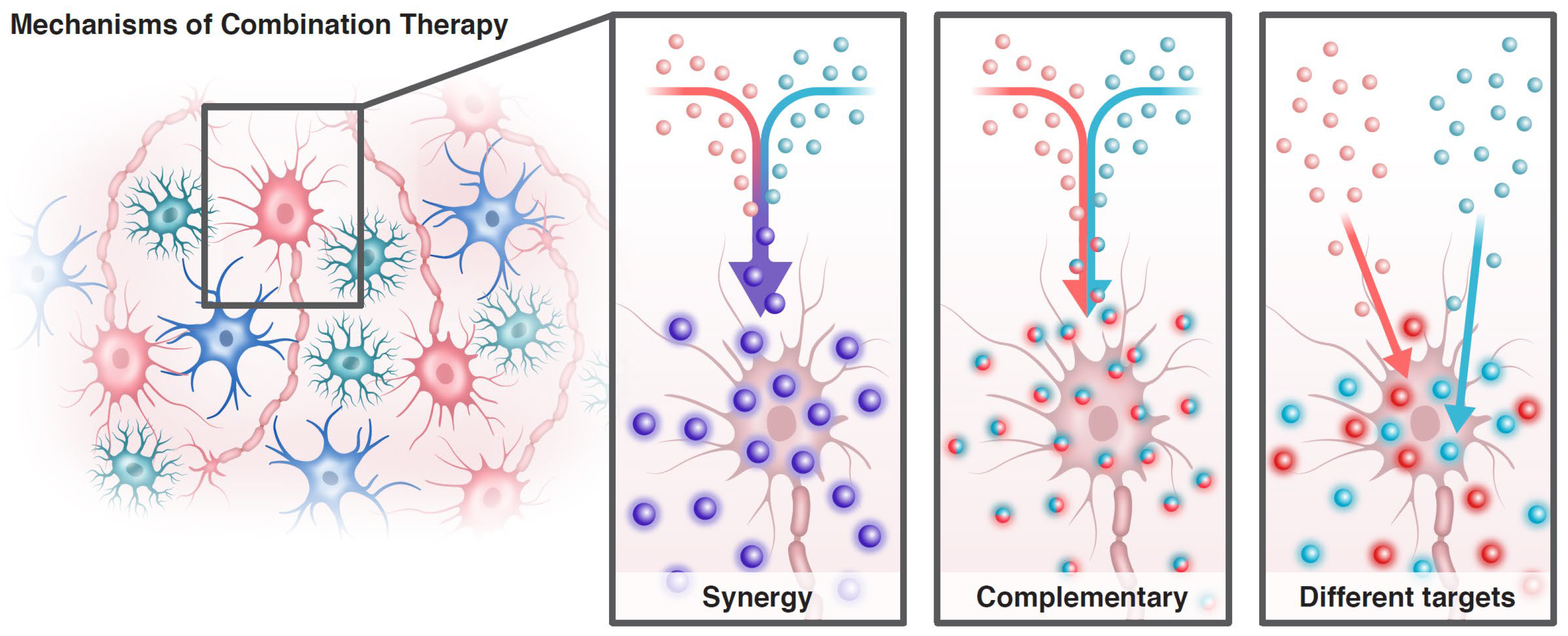
Combination Pharmacology for ALS: A Mechanistic Rationale


Abstract
1. Introduction
1.1. Rationale for Combination Approaches
1.2. Synergistic Drug Actions
1.3. Complementary Pharmacokinetics and Pharmacodynamics
1.4. Targeting Multiple Pathways and Emerging Combination Therapies
1.5. Design Implications for ALS Clinical Trials
- Multi-pathway targeting (e.g., inflammation, iron dysregulation, endoplasmic reticulum stress or mitochondrial dysfunction).
- Potential synergy and larger effect size than single-agent trials.
- Broader therapeutic efficacy as different pathological processes might be evident concurrently accounting for different stages of motor neuron loss.
- Attribution, as it may be difficult to know which component drives benefit or harm.
- Complex safety and pharmacokinetics/pharmacodynamics (PK/PD) monitoring: interactions and cumulative toxicity.
- Regulatory complexity: fixed-dose cocktails vs. separate approvals; labeling and reimbursement.
- Statistical and operational burden: larger sample sizes, more endpoints, and the need for careful modeling of background therapies.
2. Conclusions
Author Contributions
Funding
Data Availability Statement
Conflicts of Interest
References
- Rosenfeld, J. Rethinking Amyotrophic Lateral Sclerosis. Mayo Clin. Proc. 2018, 93, 1543–1545. [Google Scholar] [CrossRef] [Scilit] [PubMed]
- Rosenfeld, J.; Strong, M.J. Challenges in the Understanding and Treatment of Amyotrophic Lateral Sclerosis/Motor Neuron Disease. Neurotherapeutics 2015, 12, 317–325. [Google Scholar] [CrossRef] [Scilit] [PubMed]
- Su, X.W.; Simmons, Z.; Mitchell, R.M.; Kong, L.; Stephens, H.E.; Connor, J.R. Biomarker-based predictive models for prognosis in amyotrophic lateral sclerosis. JAMA Neurol. 2013, 70, 1505–1511. [Google Scholar] [CrossRef] [Scilit] [PubMed]
- Pilotto, F.; Toth, T.D.; Bond, S.; Schmitz, A.; Diab, R.; Tenlep, S.Y.N.; Mooney, B.; Erni, S.; Schobesberger, M.; Scheidegger, O.; et al. Engineered GM1 Intersects Between Mitochondrial and Synaptic Pathways to Ameliorate ALS Pathology. Adv. Sci. 2026, 13, e14128. [Google Scholar] [CrossRef] [Scilit] [PubMed]
- Moll, T.; Shaw, P.J.; Cooper-Knock, J. Disrupted glycosylation of lipids and proteins is a cause of neurodegeneration. Brain 2020, 143, 1332–1340. [Google Scholar] [CrossRef] [Scilit] [PubMed]
- Hulsmeier, A.J. Glycosphingolipids in neurodegeneration-Molecular mechanisms, cellular roles, and therapeutic perspectives. Neurobiol. Dis. 2025, 207, 106851. [Google Scholar] [CrossRef] [Scilit] [PubMed]
- Sipione, S.; Monyror, J.; Galleguillos, D.; Steinberg, N.; Kadam, V. Gangliosides in the Brain: Physiology, Pathophysiology and Therapeutic Applications. Front. Neurosci. 2020, 14, 572965. [Google Scholar] [CrossRef] [Scilit] [PubMed]
- Tsoi, P.S.; Quan, M.D.; Ferreon, J.C.; Ferreon, A.C.M. Aggregation of Disordered Proteins Associated with Neurodegeneration. Int. J. Mol. Sci. 2023, 24, 3380. [Google Scholar] [CrossRef] [Scilit] [PubMed]
- Lee, A.J.B.; Kittel, T.E.; Kim, R.B.; Bach, T.N.; Zhang, T.; Mitchell, C.S. Comparing therapeutic modulators of the SOD1 G93A Amyotrophic Lateral Sclerosis mouse pathophysiology. Front. Neurosci. 2022, 16, 1111763. [Google Scholar] [CrossRef] [Scilit] [PubMed]
- Cho, H.; Shukla, S. Role of Edaravone as a Treatment Option for Patients with Amyotrophic Lateral Sclerosis. Pharmaceuticals 2020, 14, 29. [Google Scholar] [CrossRef] [Scilit] [PubMed]
- Witzel, S.; Maier, A.; Steinbach, R.; Grosskreutz, J.; Koch, J.C.; Sarikidi, A.; Petri, S.; Gunther, R.; Wolf, J.; Hermann, A.; et al. Safety and Effectiveness of Long-term Intravenous Administration of Edaravone for Treatment of Patients with Amyotrophic Lateral Sclerosis. JAMA Neurol. 2022, 79, 121–130. [Google Scholar] [CrossRef] [Scilit] [PubMed]
- Kydd, J.; Jadia, R.; Velpurisiva, P.; Gad, A.; Paliwal, S.; Rai, P. Targeting Strategies for the Combination Treatment of Cancer Using Drug Delivery Systems. Pharmaceutics 2017, 9, 46. [Google Scholar] [CrossRef] [Scilit] [PubMed]
- Chou, T.C. Drug combination studies and their synergy quantification using the Chou-Talalay method. Cancer Res. 2010, 70, 440–446. [Google Scholar] [CrossRef] [Scilit] [PubMed]
- Milane, A.; Fernandez, C.; Vautier, S.; Bensimon, G.; Meininger, V.; Farinotti, R. Minocycline and riluzole brain disposition: Interactions with p-glycoprotein at the blood-brain barrier. J. Neurochem. 2007, 103, 164–173. [Google Scholar] [CrossRef] [Scilit] [PubMed]
- Milane, A.; Tortolano, L.; Fernandez, C.; Bensimon, G.; Meininger, V.; Farinotti, R. Brain and plasma riluzole pharmacokinetics: Effect of minocycline combination. J. Pharm. Pharm. Sci. 2009, 12, 209–217. [Google Scholar] [CrossRef] [Scilit] [PubMed]
- Carri, M.T. Minocycline for patients with ALS. Lancet Neurol. 2008, 7, 118–119. [Google Scholar] [CrossRef] [Scilit] [PubMed]
- Leigh, P.N.; Meininger, V.; Bensimon, G.; Cudkowicz, M.; Robberecht, W. Minocycline for patients with ALS. Lancet Neurol. 2008, 7, 119–120. [Google Scholar] [CrossRef] [Scilit] [PubMed]
- Oliva, C.F. Single and in combination antiepileptic drug therapy in children with epilepsy: How to use it. AIMS Med. Sci. 2021, 8, 138–146. [Google Scholar] [CrossRef] [Scilit]
- Margolis, J.M.; Chu, B.C.; Wang, Z.J.; Copher, R.; Cavazos, J.E. Effectiveness of antiepileptic drug combination therapy for partial-onset seizures based on mechanisms of action. JAMA Neurol. 2014, 71, 985–993. [Google Scholar] [CrossRef] [Scilit] [PubMed]
- Atri, A.; Molinuevo, J.L.; Lemming, O.; Wirth, Y.; Pulte, I.; Wilkinson, D. Memantine in patients with Alzheimer’s disease receiving donepezil: New analyses of efficacy and safety for combination therapy. Alzheimers Res. Ther. 2013, 5, 6. [Google Scholar] [CrossRef] [Scilit] [PubMed]
- Calhoun, A.; King, C.; Khoury, R.; Grossberg, G.T. An evaluation of memantine ER + donepezil for the treatment of Alzheimer’s disease. Expert. Opin. Pharmacother. 2018, 19, 1711–1717. [Google Scholar] [CrossRef] [Scilit] [PubMed]
- Cummings, J.L.; Tong, G.; Ballard, C. Treatment Combinations for Alzheimer’s Disease: Current and Future Pharmacotherapy Options. J. Alzheimer’s Dis. 2019, 67, 779–794. [Google Scholar] [CrossRef] [Scilit] [PubMed]
- Glinz, D.; Gloy, V.L.; Monsch, A.U.; Kressig, R.W.; Patel, C.; McCord, K.A.; Ademi, Z.; Tomonaga, Y.; Schwenkglenks, M.; Bucher, H.C.; et al. Acetylcholinesterase inhibitors combined with memantine for moderate to severe Alzheimer’s disease: A meta-analysis. Swiss Med. Wkly. 2019, 149, w20093. [Google Scholar] [CrossRef] [Scilit] [PubMed]
- Guo, J.; Wang, Z.; Liu, R.; Huang, Y.; Zhang, N.; Zhang, R. Memantine, Donepezil, or Combination Therapy-What is the best therapy for Alzheimer’s Disease? A Network Meta-Analysis. Brain Behav. 2020, 10, e01831. [Google Scholar] [CrossRef] [Scilit] [PubMed]
- Knorz, A.L.; Quante, A. Alzheimer’s Disease: Efficacy of Mono- and Combination Therapy. A Systematic Review. J. Geriatr. Psychiatry Neurol. 2022, 35, 475–486. [Google Scholar] [CrossRef] [Scilit] [PubMed]
- Koola, M.M. Galantamine-Memantine combination in the treatment of Alzheimer’s disease and beyond. Psychiatry Res. 2020, 293, 113409. [Google Scholar] [CrossRef] [Scilit] [PubMed]
- Lawler, E.; Avila, A. Alzheimer Disease: Monotherapy vs. Combination Therapy. Am. Fam. Physician 2017, 95, 452. [Google Scholar] [PubMed]
- Muayqil, T.; Camicioli, R. Systematic review and meta-analysis of combination therapy with cholinesterase inhibitors and memantine in Alzheimer’s disease and other dementias. Dement. Geriatr. Cogn. Dis. Extra 2012, 2, 546–572. [Google Scholar] [CrossRef] [Scilit] [PubMed]
- Chen, R.; Chan, P.T.; Chu, H.; Lin, Y.C.; Chang, P.C.; Chen, C.Y.; Chou, K.R. Treatment effects between monotherapy of donepezil versus combination with memantine for Alzheimer disease: A meta-analysis. PLoS Negl. Trop. Dis. 2017, 12, e0183586. [Google Scholar] [CrossRef] [Scilit] [PubMed]
- Abbruzzese, G.; Cossu, G.; Balocco, M.; Marchese, R.; Murgia, D.; Melis, M.; Galanello, R.; Barella, S.; Matta, G.; Ruffinengo, U.; et al. A pilot trial of deferiprone for neurodegeneration with brain iron accumulation. Haematologica 2011, 96, 1708–1711. [Google Scholar] [CrossRef] [Scilit] [PubMed]
- Velasco-Sanchez, D.; Aracil, A.; Montero, R.; Mas, A.; Jimenez, L.; O’Callaghan, M.; Tondo, M.; Capdevila, A.; Blanch, J.; Artuch, R.; et al. Combined therapy with idebenone and deferiprone in patients with Friedreich’s ataxia. Cerebellum 2011, 10, 1–8. [Google Scholar] [CrossRef] [Scilit] [PubMed]
- Mirea, A.; Shelby, E.S.; Axente, M.; Badina, M.; Padure, L.; Leanca, M.; Dima, V.; Sporea, C. Combination Therapy with Nusinersen and Onasemnogene Abeparvovec-xioi in Spinal Muscular Atrophy Type I. J. Clin. Med. 2021, 10, 5540. [Google Scholar] [CrossRef] [Scilit] [PubMed]
- Oechsel, K.F.; Cartwright, M.S. Combination therapy with onasemnogene and risdiplam in spinal muscular atrophy type 1. Muscle Nerve 2021, 64, 487–490. [Google Scholar] [CrossRef] [Scilit] [PubMed]
- Smith, R.; Pioro, E.; Myers, K.; Sirdofsky, M.; Goslin, K.; Meekins, G.; Yu, H.; Wymer, J.; Cudkowicz, M.; Macklin, E.A.; et al. Enhanced Bulbar Function in Amyotrophic Lateral Sclerosis: The Nuedexta Treatment Trial. Neurotherapeutics 2017, 14, 762–772, Erratum in Neurotherapeutics 2017, 14, 830. https://doi.org/10.1007/s13311-017-0517-z. [Google Scholar] [CrossRef] [Scilit] [PubMed]
- AVP-923. 2020. Available online: https://www.alzforum.org/therapeutics/avp-923 (accessed on 11 October 2025).
- Eskandari, K.; Belanger, S.M.; Lachance, V.; Kourrich, S. Repurposing Sigma-1 Receptor-Targeting Drugs for Therapeutic Advances in Neurodegenerative Disorders. Pharmaceuticals 2025, 18, 700. [Google Scholar] [CrossRef] [Scilit] [PubMed]
- Sun, Y.; Benatar, M.; Mascias Cadavid, J.; Ennist, D.; Wicks, P.; Staats, K.; Beauchamp, M.; Jhooty, S.; Pattee, G.; Brown, A.; et al. ALSUntangled #71: Nuedexta. Amyotroph. Lateral Scler. Front. Degener. 2024, 25, 218–222. [Google Scholar] [CrossRef] [Scilit] [PubMed]
- Heikkinen, H.; Nutt, J.G.; LeWitt, P.A.; Koller, W.C.; Gordin, A. The effects of different repeated doses of entacapone on the pharmacokinetics of L-Dopa and on the clinical response to L-Dopa in Parkinson’s disease. Clin. Neuropharmacol. 2001, 24, 150–157. [Google Scholar] [CrossRef] [Scilit] [PubMed]
- Liao, X.; Wu, N.; Liu, D.; Shuai, B.; Li, S.; Li, K. Levodopa/carbidopa/entacapone for the treatment of early Parkinson’s disease: A meta-analysis. Neurol. Sci. 2020, 41, 2045–2054. [Google Scholar] [CrossRef] [Scilit] [PubMed]
- Pharma Two B Announces Positive Topline Results from Its Pivotal Phase III Study of P2B001 in Early Parkinson’s Disease. 2021. Available online: https://www.globenewswire.com/news-release/2021/12/15/2352532/0/en/Pharma-Two-B-Announces-Positive-Topline-Results-from-its-Pivotal-Phase-III-Study-of-P2B001-in-Early-Parkinson-s-Disease.html (accessed on 8 January 2025).
- Finberg, J.P. Pharmacology of Rasagiline, a New MAO-B Inhibitor Drug for the Treatment of Parkinson’s Disease with Neuroprotective Potential. Rambam Maimonides Med. J. 2010, 1, e0003. [Google Scholar] [CrossRef] [Scilit] [PubMed]
- Hauser, R.A.; Giladi, N.; Poewe, W.; Brotchie, J.; Friedman, H.; Oren, S.; Litman, P. P2B001 (Extended Release Pramipexole and Rasagiline): A New Treatment Option in Development for Parkinson’s Disease. Adv. Ther. 2022, 39, 1881–1894. [Google Scholar] [CrossRef] [Scilit] [PubMed]
- Jiang, D.Q.; Wang, H.K.; Wang, Y.; Li, M.X.; Jiang, L.L.; Wang, Y. Rasagiline combined with levodopa therapy versus levodopa monotherapy for patients with Parkinson’s disease: A systematic review. Neurol. Sci. 2020, 41, 101–109. [Google Scholar] [CrossRef] [Scilit] [PubMed]
- Parkinson Study Group. A controlled trial of rasagiline in early Parkinson disease: The TEMPO Study. Arch. Neurol. 2002, 59, 1937–1943. [Google Scholar] [CrossRef] [Scilit] [PubMed]
- Parkinson Study Group. A randomized placebo-controlled trial of rasagiline in levodopa-treated patients with Parkinson disease and motor fluctuations: The PRESTO study. Arch. Neurol. 2005, 62, 241–248. [Google Scholar] [CrossRef] [Scilit] [PubMed]
- Rascol, O.; Brooks, D.J.; Melamed, E.; Oertel, W.; Poewe, W.; Stocchi, F.; Tolosa, E.; LARGO Study Group. Rasagiline as an adjunct to levodopa in patients with Parkinson’s disease and motor fluctuations (LARGO, Lasting effect in Adjunct therapy with Rasagiline Given Once daily, study): A randomised, double-blind, parallel-group trial. Lancet 2005, 365, 947–954. [Google Scholar] [CrossRef] [Scilit] [PubMed]
- Riederer, P.; Gerlach, M.; Muller, T.; Reichmann, H. Relating mode of action to clinical practice: Dopaminergic agents in Parkinson’s disease. Park. Relat. Disord. 2007, 13, 466–479. [Google Scholar] [CrossRef] [Scilit] [PubMed]
- Schapira, A.H. Treatment options in the modern management of Parkinson disease. Arch. Neurol. 2007, 64, 1083–1088. [Google Scholar] [CrossRef] [Scilit] [PubMed]
- Youdim, M.B.; Wadia, A.; Tatton, W.; Weinstock, M. The anti-Parkinson drug rasagiline and its cholinesterase inhibitor derivatives exert neuroprotection unrelated to MAO inhibition in cell culture and in vivo. Ann. N. Y. Acad. Sci. 2001, 939, 450–458. [Google Scholar] [CrossRef] [Scilit] [PubMed]
- Eisen, A.W.M. Treatment of amyotrophic lateral sclerosis. Drugs Aging 1999, 14, 173–196. [Google Scholar] [CrossRef] [Scilit] [PubMed]
- Ramaker, C.; Hilten, J.J. Bromocriptine/levodopa combined versus levodopa alone for early Parkinson’s disease. Cochrane Database Syst. Rev. 2002, CD003634. [Google Scholar] [CrossRef] [Scilit] [PubMed]
- Van der Schyf, C.J.; Geldenhuys, W.J.; Youdim, M.B. Multifunctional drugs with different CNS targets for neuropsychiatric disorders. J. Neurochem. 2006, 99, 1033–1048. [Google Scholar] [CrossRef] [Scilit] [PubMed]
- van Hilten, J.J.; Ramaker, C.C.; Stowe, R.; Ives, N.J. Bromocriptine/levodopa combined versus levodopa alone for early Parkinson’s disease. Cochrane Database Syst. Rev. 2007, 2007, CD003634. [Google Scholar] [CrossRef] [Scilit] [PubMed]
- Relyvrio Boston, MA2022. Available online: https://www.alzforum.org/therapeutics/search?therapeutic-name=relyvrio#results (accessed on 11 October 2025).
- Fels, J.A.; Dash, J.; Leslie, K.; Manfredi, G.; Kawamata, H. Effects of the investigational drug sodium phenylbutyrate-TUDCA (AMX0035) on the transcriptional and metabolic landscape of sporadic ALS fibroblasts. bioRxiv 2022. [Google Scholar] [CrossRef] [Scilit]
- Fonseca, I.; Gordino, G.; Moreira, S.; Nunes, M.J.; Azevedo, C.; Gama, M.J.; Rodrigues, E.; Rodrigues, C.M.P.; Castro-Caldas, M. Tauroursodeoxycholic Acid Protects Against Mitochondrial Dysfunction and Cell Death via Mitophagy in Human Neuroblastoma Cells. Mol. Neurobiol. 2017, 54, 6107–6119, Erratum in Mol. Neurobiol. 2017, 54, 6120. https://doi.org/10.1007/s12035-016-0228-1. [Google Scholar] [CrossRef] [Scilit] [PubMed]
- Kubota, K.; Niinuma, Y.; Kaneko, M.; Okuma, Y.; Sugai, M.; Omura, T.; Uesugi, M.; Uehara, T.; Hosoi, T.; Nomura, Y. Suppressive effects of 4-phenylbutyrate on the aggregation of Pael receptors and endoplasmic reticulum stress. J. Neurochem. 2006, 97, 1259–1268. [Google Scholar] [CrossRef] [Scilit] [PubMed]
- Ryu, H.; Smith, K.; Camelo, S.I.; Carreras, I.; Lee, J.; Iglesias, A.H.; Dangond, F.; Cormier, K.A.; Cudkowicz, M.E.; Brown, R.H., Jr.; et al. Sodium phenylbutyrate prolongs survival and regulates expression of anti-apoptotic genes in transgenic amyotrophic lateral sclerosis mice. J. Neurochem. 2005, 93, 1087–1098. [Google Scholar] [CrossRef] [Scilit] [PubMed]
- Wu, X.; Liu, C.; Chen, L.; Du, Y.F.; Hu, M.; Reed, M.N.; Long, Y.; Suppiramaniam, V.; Hong, H.; Tang, S.S. Protective effects of tauroursodeoxycholic acid on lipopolysaccharide-induced cognitive impairment and neurotoxicity in mice. Int. Immunopharmacol. 2019, 72, 166–175. [Google Scholar] [CrossRef] [Scilit] [PubMed]
- Cudkowicz, M.E.; Shefner, J.M.; Schoenfeld, D.A.; Zhang, H.; Andreasson, K.I.; Rothstein, J.D.; Drachman, D.B. Trial of celecoxib in amyotrophic lateral sclerosis. Ann. Neurol. 2006, 60, 22–31. [Google Scholar] [CrossRef] [Scilit] [PubMed]
- Goldshtein, H.; Muhire, A.; Petel Legare, V.; Pushett, A.; Rotkopf, R.; Shefner, J.M.; Peterson, R.T.; Armstrong, G.A.B.; Russek-Blum, N. Efficacy of Ciprofloxacin/Celecoxib combination in zebrafish models of amyotrophic lateral sclerosis. Ann. Clin. Transl. Neurol. 2020, 7, 1883–1897. [Google Scholar] [CrossRef] [Scilit] [PubMed]
- Salomon-Zimri, S.; Pushett, A.; Russek-Blum, N.; Van Eijk, R.P.A.; Birman, N.; Abramovich, B.; Eitan, E.; Elgrart, K.; Beaulieu, D.; Ennist, D.L.; et al. Combination of ciprofloxacin/celecoxib as a novel therapeutic strategy for ALS. Amyotroph. Lateral Scler. Front. Degener. 2023, 24, 263–271. [Google Scholar] [CrossRef] [Scilit] [PubMed]
- Thonhoff, J.R.; Beers, D.R.; Zhao, W.; Faridar, A.; Thome, A.; Wen, S.; Zhang, A.; Wang, J.; Appel, S.H. A phase 1 proof-of-concept study evaluating safety, tolerability, and biological marker responses with combination therapy of CTLA4-Ig and interleukin-2 in amyotrophic lateral sclerosis. Front. Neurol. 2024, 15, 1415106. [Google Scholar] [CrossRef] [Scilit] [PubMed]
- Mustafa, M.A.; Bansal, P.; Pallavi, M.S.; Panigrahi, R.; Nathiya, D.; Kumar, S.; Al-Hasnaawei, S.; Chauhan, A.S.; Singla, S. Exploring the Role of NLRP3 in Neurodegeneration: Cutting-Edge Therapeutic Strategies and Inhibitors. Dev. Neurobiol. 2025, 85, e22982. [Google Scholar] [CrossRef] [Scilit] [PubMed]
- Brodie, M.J.; Yuen, A.W. Lamotrigine substitution study: Evidence for synergism with sodium valproate? 105 Study Group. Epilepsy Res. 1997, 26, 423–432. [Google Scholar] [CrossRef] [Scilit] [PubMed]
- Makinen, J.; Rainesalo, S.; Raitanen, J.; Peltola, J. The effect of newer antiepileptic drugs in combination therapy. Epilepsy Res. 2017, 132, 15–20. [Google Scholar] [CrossRef] [Scilit] [PubMed]
- Joshi, R.; Tripathi, M.; Gupta, P.; Gulati, S.; Gupta, Y.K. Adverse effects & drug load of antiepileptic drugs in patients with epilepsy: Monotherapy versus polytherapy. Indian. J. Med. Res. 2017, 145, 317–326. [Google Scholar] [CrossRef] [Scilit] [PubMed]
- Lange, S.; Sauerland, S.; Lauterberg, J.; Windeler, J. The Range and Scientific Value of Randomized Trials. Dtsch. Arztebl. Int. 2017, 114, 635–640. [Google Scholar] [CrossRef] [Scilit] [PubMed]
- Nolan, E.; Wolfenden, L.; Benn, T.; Holliday, E.; Barker, D.; Oldmeadow, C.; Hall, A. Experimental designs used for optimising the effects of health interventions and implementation strategies: A scoping review. BMC Health Serv. Res. 2025, 25, 1129. [Google Scholar] [CrossRef] [Scilit] [PubMed]
- Pupillo, E.; Al-Chalabi, A.; Sassi, S.; Arippol, E.; Tinti, L.; Vitelli, E.; Copetti, M.; Leone, M.A.; Bianchi, E. Methodological Quality of Clinical Trials in Amyotrophic Lateral Sclerosis: A Systematic Review. J. Neuromuscul. Dis. 2024, 11, 749–765. [Google Scholar] [CrossRef] [Scilit] [PubMed]
- Weemering, D.N.; van Unnik, J.W.J.; Genge, A.; van den Berg, L.H.; van Eijk, R.P.A. Heterogeneity in the Analysis of the ALSFRS-R in ALS Clinical Trials and its Effect on the Validity and Precision of Trial Conclusions. Neurology 2026, 106, e214937. [Google Scholar] [CrossRef] [Scilit] [PubMed]
- Rosenfeld, J.; Abrahams, S.; McHutchinson, C.; Ajroud-Driss, S.; Weber, M.; Paganoni, S.; Mitsumoto, H.; Genge, A.; Grosskreutz, J.; Van Den Berg, L.; et al. Utility of patient subgrouping in ALS clinical trials: A World Federation of Neurology white paper. Amyotroph. Lateral Scler. Front. Degener. 2026, 27, 493–500. [Google Scholar] [CrossRef] [Scilit] [PubMed]
- Goyal, N.A.; Berry, J.D.; Windebank, A.; Staff, N.P.; Maragakis, N.J.; van den Berg, L.H.; Genge, A.; Miller, R.; Baloh, R.H.; Kern, R.; et al. Addressing heterogeneity in amyotrophic lateral sclerosis CLINICAL TRIALS. Muscle Nerve 2020, 62, 156–166. [Google Scholar] [CrossRef] [Scilit] [PubMed]


| Indication | Combination Regimen | Mechanistic Rationale | Key Outcomes |
|---|---|---|---|
| HIV | INSTI + 2 NRTIs | Multi-step viral life-cycle blockade | ↓ AIDS progression & mortality > 70% |
| Tuberculosis | INH + rifampin + pyrazinamide + ethambutol | Multi-target bacterial killing; resistance suppression | WHO cure rates > 90% |
| H. pylori | PPI + bismuth + tetracycline + metronidazole | Multi-mechanism eradication + acid suppression | Eradication > 90% |
| Pseudobulbar affect | Dextromethorphan + quinidine | CYP2D6 inhibition ↑ DM exposure; sigma-1/NMDA modulation | Significant symptom reduction |
| Epilepsy | Valproate + lamotrigine | Distinct ion-channel actions → pharmacodynamic synergy | Improved seizure control |
| B-cell lymphoma | R-CHOP | Cytotoxic + immunologic synergy | Survival benefit vs. CHOP |
| Hepatitis C | Sofosbuvir + ledipasvir | Parallel inhibition of viral replication machinery | SVR 95–100% |
| Drug Name | Active Ingredients | Indication/Use |
|---|---|---|
| Depakote ER + adjuncts (regional/under study) | Valproate + adjunctive agents | Epilepsy and bipolar disorder; some regions market co-packaged combinations |
| Stavzor + lamotrigine (co-packaged in select markets) | Valproic acid + lamotrigine | Epilepsy; commonly co-administered, occasionally marketed together |
| Tarka | Trandolapril + verapamil | Hypertension; verapamil also used off-label in migraine prophylaxis |
| Emerging Alzheimer’s combinations (clinical trials) | GLP-1 agonists + PDE5 inhibitors | Investigational regimens aimed at slowing cognitive decline |
| Xadago (co-administered with levodopa) | Safinamide + levodopa | Adjunct therapy for Parkinson’s disease |
| Nuedexta | Dextromethorphan + quinidine | Pseudobulbar affect (PBA) |
| Sinemet | Carbidopa + levodopa | Parkinson’s disease |
| Stalevo | Carbidopa + levodopa + entacapone | Parkinson’s disease; extends levodopa effect via COMT inhibition |
| Duopa | Carbidopa + levodopa (intestinal gel) | Advanced Parkinson’s disease requiring continuous jejunal infusion |
| Rytary | Carbidopa + levodopa (extended-release) | Parkinson’s disease; smoother pharmacokinetic profile |
| Namzaric | Memantine + donepezil | Alzheimer’s disease |
| Treximet | Sumatriptan + naproxen | Acute migraine |
| Midrin (legacy product) | Isometheptene + dichloralphenazone + acetaminophen | Migraine and tension headaches (less commonly used today) |
| Qsymia | Phentermine + topiramate | Obesity; topiramate also an antiepileptic |
Disclaimer/Publisher’s Note: The statements, opinions and data contained in all publications are solely those of the individual author(s) and contributor(s) and not of MDPI and/or the editor(s). MDPI and/or the editor(s) disclaim responsibility for any injury to people or property resulting from any ideas, methods, instructions or products referred to in the content. |
© 2026 by the authors. Licensee MDPI, Basel, Switzerland. This article is an open access article distributed under the terms and conditions of the Creative Commons Attribution (CC BY) license.
Share and Cite
Rosenfeld, J.; Salomon-Zimri, S.; Tracik, F. Combination Pharmacology for ALS: A Mechanistic Rationale. Int. J. Mol. Sci. 2026, 27, 7404. https://doi.org/10.3390/ijms27167404
Rosenfeld J, Salomon-Zimri S, Tracik F. Combination Pharmacology for ALS: A Mechanistic Rationale. International Journal of Molecular Sciences. 2026; 27(16):7404. https://doi.org/10.3390/ijms27167404
Chicago/Turabian StyleRosenfeld, Jeffrey, Shiran Salomon-Zimri, and Ferenc Tracik. 2026. "Combination Pharmacology for ALS: A Mechanistic Rationale" International Journal of Molecular Sciences 27, no. 16: 7404. https://doi.org/10.3390/ijms27167404
APA StyleRosenfeld, J., Salomon-Zimri, S., & Tracik, F. (2026). Combination Pharmacology for ALS: A Mechanistic Rationale. International Journal of Molecular Sciences, 27(16), 7404. https://doi.org/10.3390/ijms27167404