Article

Organocatalytic Thioesterification of a Conjugated α,β-Unsaturated Dialdehyde

1
Faculty of Chemistry, Adam Mickiewicz University in Poznań, Uniwersytetu Poznańskiego St. 8, 61-614 Poznań, Poland
2
Poznan Science and Technology Park, Adam Mickiewicz University Foundation, Rubiez St. 46, 61-612 Poznań, Poland
*
Author to whom correspondence should be addressed.
Int. J. Mol. Sci. 2026, 27(13), 5941; https://doi.org/10.3390/ijms27135941
Submission received: 21 May 2026 / Revised: 24 June 2026 / Accepted: 29 June 2026 / Published: 1 July 2026
(This article belongs to the Section Materials Science)

Abstract

Thioesterification of (2E,2′E)-3,3′-(1,4-phenylene)diacrylaldehyde with thiols has been performed using a bulky N-heterocyclic carbene (NHC) as an organocatalyst. This metal-free protocol enables efficient synthesis of new mono and difunctional acrolein derivatives in high isolated yields under mild conditions. Importantly, the reaction proceeds in the absence of external additives or oxidants, and requires only low organocatalyst loadings, thereby facilitating the straightforward isolation of structurally defined sulfur-containing acrolein derivatives in both symmetric and asymmetric forms. The resulting functional acrolein derivatives are the hitherto underexplored class of functional building blocks with promising potential for biomedical materials, including drug delivery systems and other biomaterials applications.

1. Introduction

The α,β-unsaturated carbonyl compounds represent an important class of bioactive structural motifs that are widely found in natural products and synthetic systems of biomedical relevance. Their well-defined electrophilic properties and controllable reactivity profiles make them highly suitable for applications in medicinal chemistry, chemical biology and biomaterials research. A broad range of α,β-unsaturated carbonyl derivatives have been used as functional components of many cosmetics [1] and pharmaceuticals [2], owing to their broad spectrum of biological activities, including antiviral [3,4,5], anti-inflammatory [6], antibacterial [7,8,9,10], antioxidative [11,12], anticancer [13,14], antidiabetic [15], antifungal [16], and antimalarial [17] effects. From a biomaterials perspective, the biomedical significance of α,β-unsaturated carbonyl compounds is not limited to their inherent bioactivity but also arises from their ability to modulate biological responses through covalent or reversible interactions with biomolecular targets. Notably, several members of this class have been shown to inhibit proteasomal activity [18] and to induce anti-proliferative and pro-apoptotic responses in cancer cells [18,19], making them valuable candidates for incorporation into anticancer delivery platforms. Their ability to interfere with mitochondrial function further contributes to antineoplastic efficacy [20]. Beyond oncology-related applications, α,β-unsaturated carbonyl derivatives can act as immunosuppressive agents that abolish the overactive immune system in autoimmune disease and augmentation agents that enhance the immunological response during viral infections [21]. Moreover, functionalized carbonyl derivatives have been reported to increase the efficacy of vaccines and improve the pharmacokinetic profiles of therapeutic agents, as demonstrated by curcumin-based delivery systems [21,22].
Despite many advantages, α,β-unsaturated carbonyl compounds are well known for their pronounced toxicity toward both environmental and biological systems. This reactivity is primarily associated with their ability to act as Michael acceptors, enabling covalent modification of nucleophilic biomolecules such as cysteine and selenocysteine residues in proteins, enzymes, and DNA [23,24,25]. As a consequence, exposure to these electrophiles may induce electrophilic stress, oxidative damage, and disruption of cellular redox homeostasis [23,24,25]. Among these compounds, acrolein and related acrylates are particularly well studied and have been implicated in a range of pathological processes, including sensory deficits, spinal cord injury, and broader neurotoxicity associated with neurodegenerative disorders [25,26,27]. In addition, endogenous formation of reactive aldehydes such as acrolein through lipid peroxidation has been recognized as a key contributor to oxidative stress-mediated cellular damage [27,28]. Recent studies further suggest their potential involvement in ferroptosis, an iron-dependent form of regulated cell death driven by lipid peroxidation processes [29,30]. Notably, although acrolein also contributes to antimicrobial activity in certain biological contexts, its high cytotoxicity and lack of selectivity significantly limit its direct biomedical applicability [31]. Therefore, strategies aimed at modulating or attenuating the intrinsic reactivity of these aldehydes while preserving their beneficial properties have attracted considerable attention. Various detoxification and functionalization approaches have been reported, including iron-mediated reduction processes [32] and the use of aldehyde scavengers for removal from biologically relevant systems [33]. From a synthetic perspective, one of the most common approaches for carbonyl functionalization involves nucleophilic addition reactions, including thioesterification. Traditionally, thioesters are synthesized by nucleophilic substitution of the carbonyl group of acyl chlorides, carboxylic acids or acid anhydrides with thiols or disulfides [34], or through transition-metal-catalyzed methods [35,36,37,38,39,40]. Unfortunately, all the above-mentioned methodologies suffer from notable drawbacks, including moderate efficiency, harsh reaction conditions, mandatory use of oxidants, long reaction time, and the use of toxic solvents [35,36,37,38,39,40]. These challenges continue to motivate the development of more efficient and sustainable approaches for thioester formation.
Organocatalysis offers a great alternative to thioester synthesis, as these derivatives can be synthesized through N-heterocyclic carbenes (NHC) catalysis. However, effective suppression of common limitations—such as elevated reaction temperatures and high catalyst loadings—often requires the use of bulky NHC catalysts [41,42,43]. This type of organocatalysts, featuring pronounced steric hindrance around the nitrogen atoms, can overcome many of these limitations by enabling highly chemoselective transformations under mild conditions with excellent efficiency and near-quantitative atom economy. Our research group has previously reported the successful application of bulky NHCs in the functionalization of α,β-unsaturated carbonyl compounds with a range of nucleophiles, yielding products of relevance to biologically oriented molecular design [44,45,46,47,48]. Building on these findings, we identified the derivatization of acroleins as a critical next step toward assessment of the further perspectives and possible limitations of bulky NHC-mediated organocatalysis.
Herein, we report a new organocatalytic strategy for the functionalization of p-phenylene-bridged dienal with a range of thiols, leading to a novel class of symmetric and unsymmetric bis-substituted sulfur-containing products. The presented methodology provides access to structurally diverse α,β-unsaturated carbonyl derivatives, which could be explored in the future for the development of functional biomolecules and bioactive materials.

2. Results and Discussion

2.1. Design and Optimization of the Reaction System

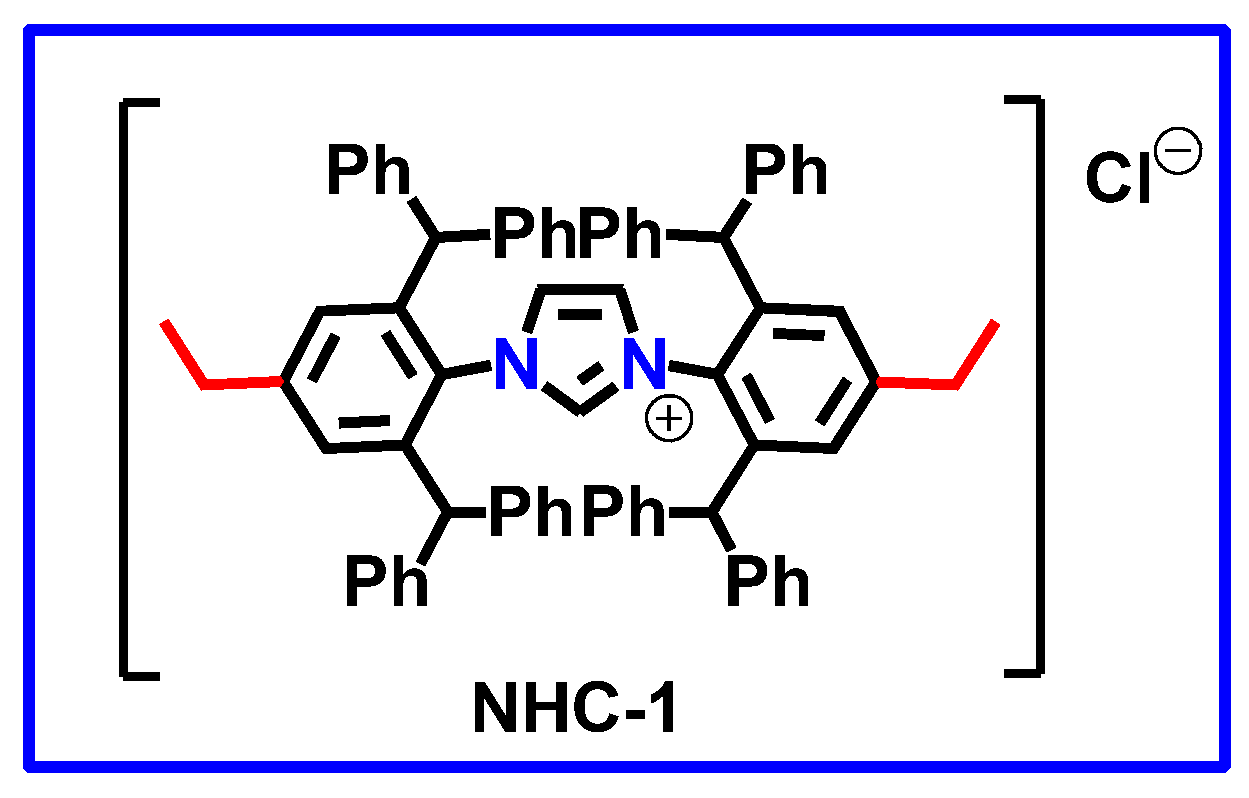
At the initial stage of the study, a series of catalytic experiments was conducted to determine the optimal conditions for the functionalization of (2E,2′E)-3,3′-(1,4-phenylene)diacrylaldehyde (1a). 4-Methoxythiophenol (2a) was chosen as the model reaction partner owing to its low cost and high commercial availability. The process was catalyzed by the NHC salt (NHC-1) containing sterically crowded substituents at the terminal nitrogen atoms of the imidazole ring, synthesized according to the procedure reported by Delaude’s group [45] (Figure 1). Based on our previous work, smaller NHCs lead to unsatisfactory results in the thioesterification process, and hence the catalysts comparison was omitted in this study [40].
The addition of reagents (1a, 2a) to an acetone solution containing 20 mol% of NHC-1 and 20 mol% of KHMDS, at 60 °C, resulted in a complete conversion of the substrates after 24 h. The 1H NMR analysis of the crude reaction mixture revealed the selective formation of the expected symmetrical bis-thioesterification product P1 in a quantitative yield (Table 1, Entry 1). Subsequently, NHC-1 loading was gradually decreased, and all reactions, except that with 2.5 mol% catalyst, achieved full conversion (Table 1, Entries 2–4). When the imidazolium salt concentration was lowered to 2.5 mol%, the conversion reached only 45% of both reagentw (Table 1, Entry 5). The experiment carried out without NHC-1 did not afford any products, even though the reaction time was extended to 72 h (Table 1, Entry 6). Having established the optimal catalyst loading, the effect of a base was investigated. From among the tested bases, KHMDS provided the most effective course of the reaction, as it ensured quantitative conversion of substrate 1a and led selectively to product P1 (Table 1, Entries 1–4). The process occurred selectively also in the presence of potassium carbonate, potassium t-butoxide and trimethylamine, but then the conversion of the substrates dropped down to 85%, 65% and 50%, respectively (Table 1, Entries 7–9). Control experiments confirmed that the presence of a base is essential for the reaction to proceed (Table 1, Entry 10). To gain further insight into its role, the reaction was carried out using the previously isolated carbene, which afforded high conversion (Table 1, Entry 11). Increasing the amount of the base to two equivalents had no noticeable effect on the reaction outcome (Table 1, Entry 12). These results indicate that the base serves only to generate the free carbene. As shown in Table 1, both the solvent and reaction temperature played a crucial role in determining the course of the reaction. The highest efficiency was obtained in acetone at 60 °C, while the use of i-PrOH, MBIK or EtOAc led to markedly lower substrate conversion (Table 1, Entry 4 vs. Entries 13–15). Lowering the temperature reduced the catalyst activity, affording 80% conversion at 40 °C and 65% at room temperature (Table 1, Entries 16–17). Further tests conducted under ambient atmosphere confirmed that an inert environment is required (Table 1, Entry 18). The final parameter optimized was the reaction time. The obtained results clearly confirmed that quantitative conversion of the substrates was achieved within only 15 min. (Table 1, Entry 20 vs. Entry 21). A further decrease in reaction time led to unsatisfactory substrates converions (Table 1, Entry 22). Overall, the conditions described in Entry 21 were determined to be optimal for this process.
In accordance with the standard practice of our laboratory, all catalytic tests were repeated three times and the obtained results indicated a high reproducibility of the method. To better verify the reproducibility of yields and reaction conditions, the model reaction was repeated five times. The standard deviation for the obtained yield values was calculated to be 1.52%. The results of the statistical analysis demonstrate good reproducibility and reliability of the described method (See ESI for details).

2.2. Scope of the Reaction

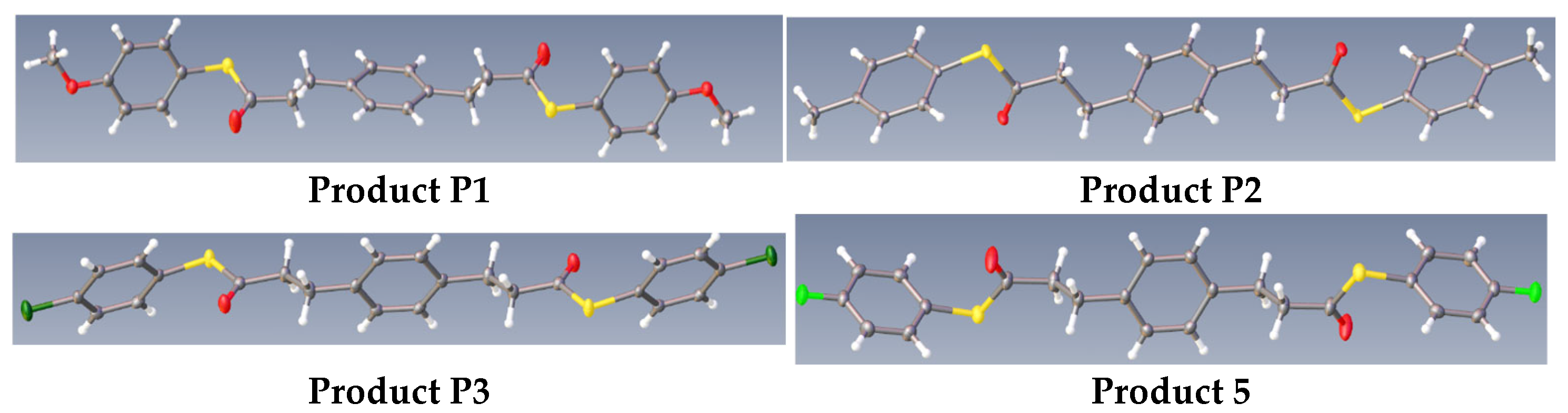
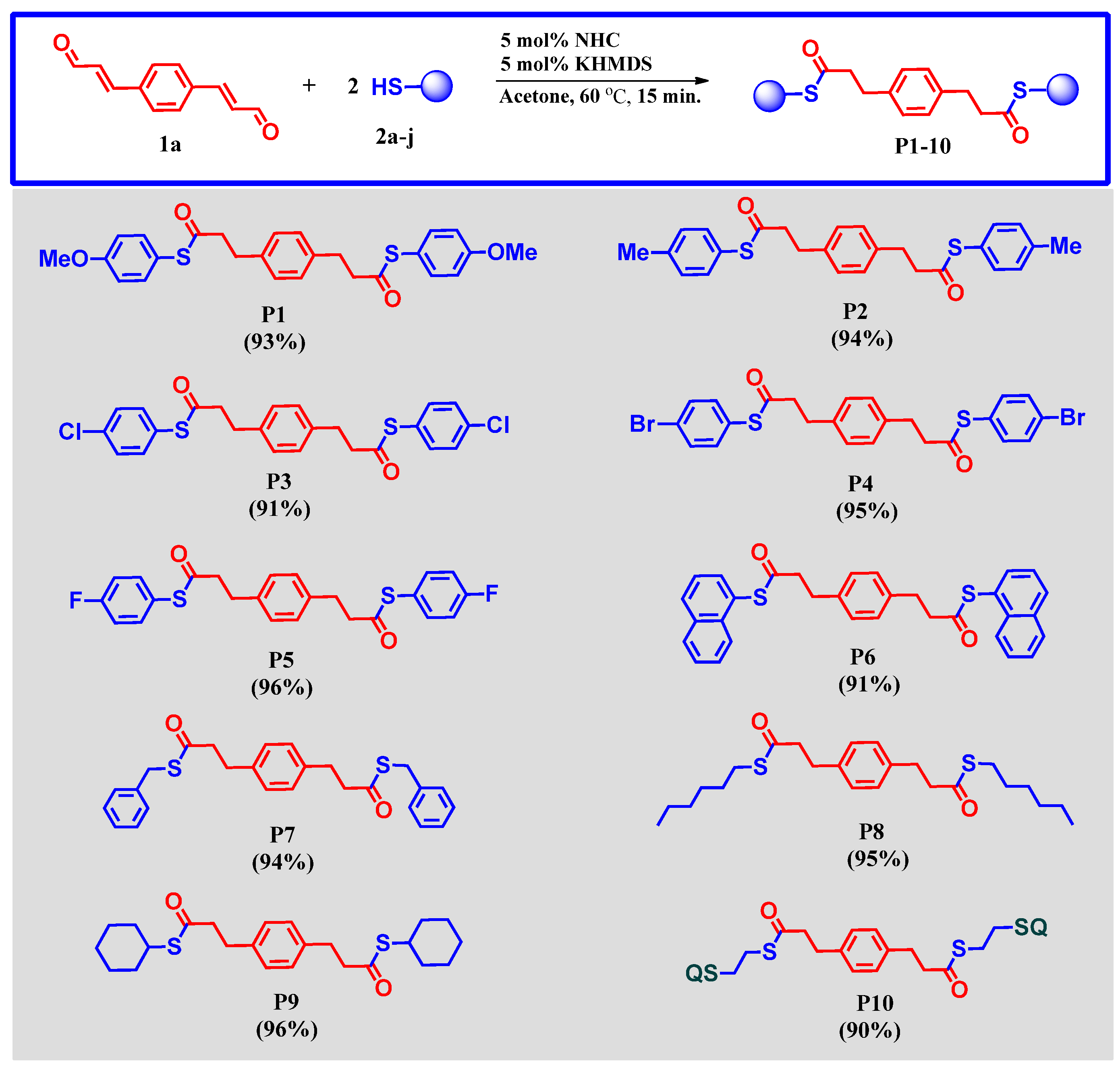
Following the identification of the optimal conditions, we investigated the scope of the designed organocatalytic system. The reactivity of 1a was evaluated with a range of commercially available thiols (Scheme 1). As shown above, the developed protocol proved applicable to aryl (2af), alkylaryl (2g), and alkyl (2hi) thiols. Interestingly, it was also effective for mercaptosubstituted silsesquioxane (2j). This compound was chosen because, to the best of our knowledge, there are no reports on the modification of acroleins with SQs. In addition, SQ-based materials exhibit unique properties that broaden the scope of their potential applications [20]. In all cases, nearly quantitative conversion of the substrates was achieved, affording the corresponding products in excellent isolated yields. No significant differences in the reaction efficiency were observed for aryl thiols bearing both electron-withdrawing and electron-donating substituents. Furthermore, no by-products were detected, indicating that the proposed method can be applied to a broad range of reagents. All products (P1P10) were purified by column chromatography on silica gel using DCM or a 1:1 (v/v) mixture of n-hexane and DCM as eluents. In addition, single crystals suitable for X-ray diffraction were obtained for the products formed in the reactions of (2E,2′E)-3,3′-(1,4-phenylene)diacrylaldehyde (1a) with 4-methoxythiophenol (2a), 4-methylthiophenol (2b), 4-chlorothiophenol (2c), and 4-fluorothiophenol (2e) (Figure 2). The crystals were grown by dissolving P1P3 and P5 in n-hexane/DCM mixture followed by slow evaporation of the solvents (See ESI for details).
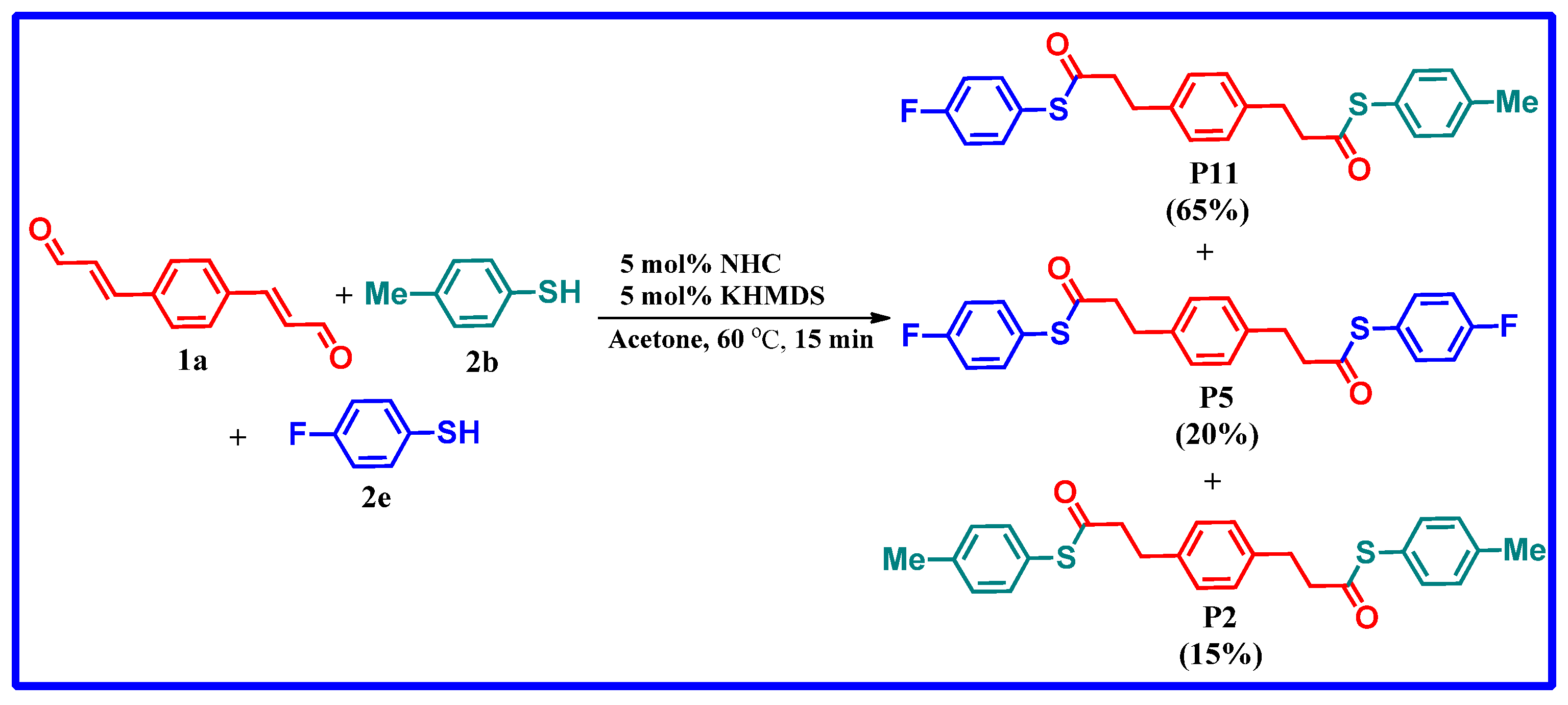
After the synthesis of symmetrically functionalized bis (thioesters), we explored the possibility of obtaining unsymmetrical products through the reaction of 1a with two different thiols (2aj). Addition of a 5.0 mol% of NHC-1 to an equimolar solution of 1a, 4-methylthiophenol (2b) and 4-fluorothiophenol (2e) in acetone, followed by stirring for 24 h, resulted in complete conversion of the substrates and the formation of a mixture of two symmetrical products (P2, P5) and an unsymmetrical one (P11) at the ratio of 20:15:65 (Scheme 2).
Because the thiols used in the synthesis of asymmetric products exhibit highly similar steric and electronic properties, the observed product distribution is not expected to arise from thermodynamic effects, but rather from statistical and minor kinetic factors. In a 1:1 dual-addition system, formation of the cross-product is statistically favored over either homodimer (2:1:1 baseline ratio), and the observed distribution (65:20:15) is consistent with this model, with a slight kinetic enhancement. This deviation may result from slightly different reactivity of the mono-functionalized intermediate formed after the first addition step, which can preferentially react with the second thiol rather than undergo self-coupling. These effects are commonly observed in sequential functionalization processes and reflect minor kinetic biases rather than thermodynamic control.
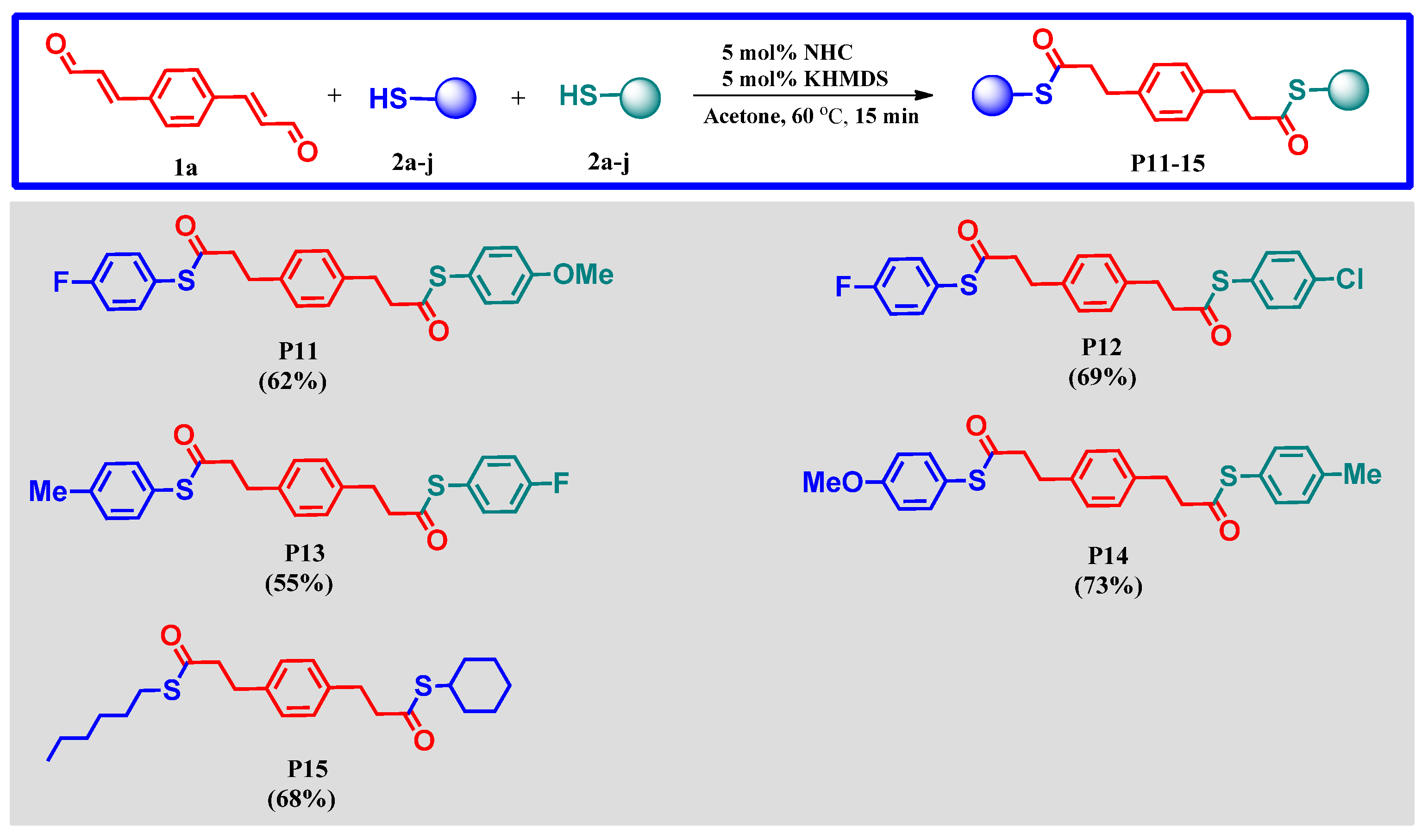
Despite the lack of complete selectivity, we decided to continue our investigations in this area, as the expected unsymmetrical substitution derivative was obtained as the major product and could be readily isolated form the reaction mixture. We also checked the possibility of first obtaining the mono-substituted product, followed by its modification through the addition of an equivalent of another thiol. However, this approach did not improve the selectivity of the process. Therefore, all subsequent experiments were carried out following the model reaction procedure, with all reagents introduced simultaneously into the reaction mixture. The results are summarized in Scheme 3. In all cases, we observed complete functionalization of the two internal C–C double bonds of p-phenylene-bridged dienal, with the expected unsymmetrical product formed in significant excess. All products were isolated by column chromatography and characterized using spectroscopic and mass spectrometric methods.
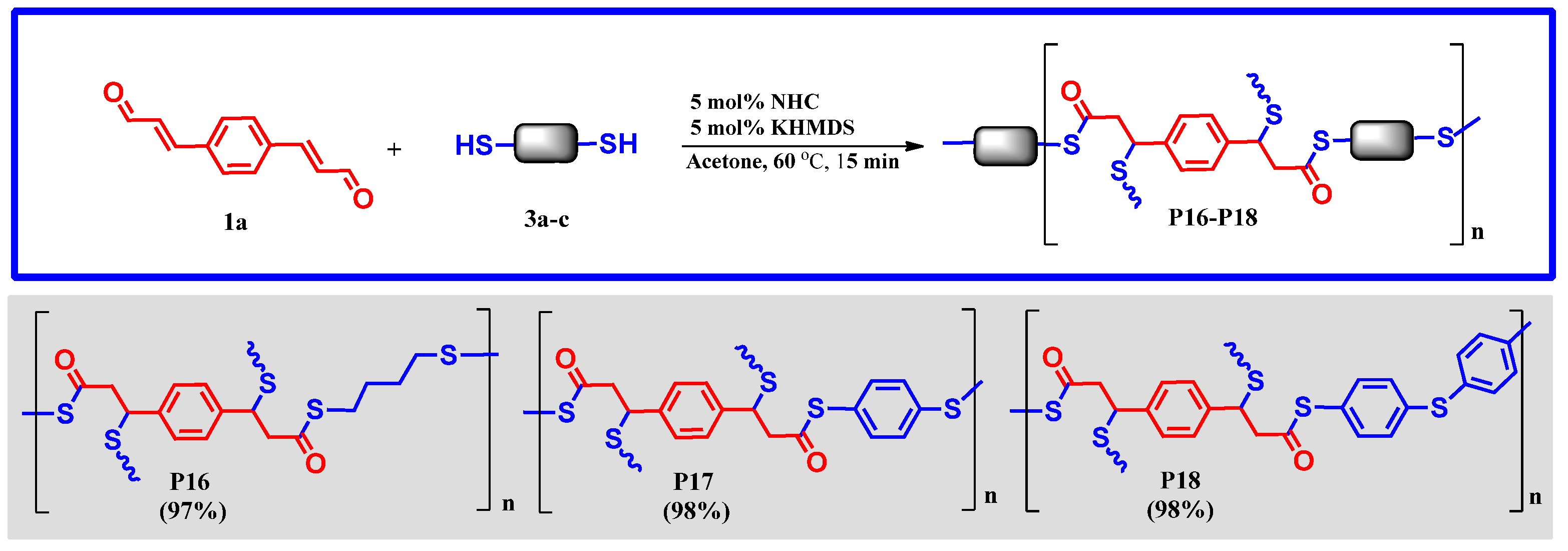
The successful NHC-catalyzed reactions of 1a with a series of thiols (2aj) prompted us to extend the study to dithiols in order to evaluate the applicability of the developed methodology for the synthesis of polymeric materials. Relevant tests were performed using equimolar amounts of 1a and 1,4-butanedithiol (3a), 1,4-benzenedithiol (3b), and 4,4′-thiobisbenzenethiol (3c) (Scheme 4).
In contrast to the previous experiments, precipitation was observed in all cases during the course of the reaction. The resulting products were insoluble, which prevented their analysis and structural confirmation using 1H and 13C NMR spectroscopies. For the same reason, GPC analysis, which is essential for polymer characterization, could not be performed to determine the molecular weight and molecular weight distribution of the obtained materials. Nevertheless, ATR FT-IR spectroscopy was employed to obtain structural information on the insoluble products, as this technique is suitable for the analysis of solid samples. The FT-IR spectra of samples P16P18 are presented in Figures S36–S38 (See ESI). Analysis of the spectra revealed a shift in the carbonyl (C=O) band maximum present in the spectrum of substrate 1a from 1658 cm−1 toward higher wavenumbers (1700–1684 cm−1), the absence of the bands at 1617 and 974 cm−1 characteristic of alkenyl C=C bonds, and the absence of the 1420 cm−1 band characteristic of C-H vibrations of alkenyl groups present in the spectrum of substrate 1a. In addition, no S-H stretching vibration bands, typically observed for the dithiols at approximately 2550 cm−1, were detected. At the same time, a new band with a maximum at 700 cm−1, characteristic of C-S vibrations in thioesters, was observed in the spectra of samples P16P18. These observations are consistent with the occurrence of the polymerization process according to the proposed mechanism involving β-protonation of α,β-unsaturated enals [44]. However, the FT-IR spectra also revealed additional bands with maxima at approximately 1259 cm−1 and low-intensity bands at approximately 607 cm−1, attributable to C-S-C and C-S vibrations, respectively, suggesting the formation of thioether linkages via a competing thia-Michael addition pathway. Further evidence of reduced selectivity in the polythioesterification process when dithiols were employed is provided by additional carbonyl (C=O) bands centered at approximately 1780 cm−1 and broad absorptions in the 3700–3200 cm−1 region, characteristic of O–H stretching vibrations. These features may indicate the presence of water in the investigated samples and/or the occurrence of oxidative side reactions during the polymerization. Taken together, the FT-IR results suggest that both the β-protonation of α,β-unsaturated enals and a competing thia-Michael addition pathway may occur during polymer formation. The coexistence of these processes could account for the formation of crosslinked polymer networks and the resulting insolubility of the obtained materials. The lower selectivity observed in the polymerization reactions involving dithiols, compared to analogous reactions using monothiols, may arise from diffusion limitations and steric effects associated with the growing polymer chains. However, further studies are required to verify this hypothesis and to elucidate the structure of these materials in greater detail.
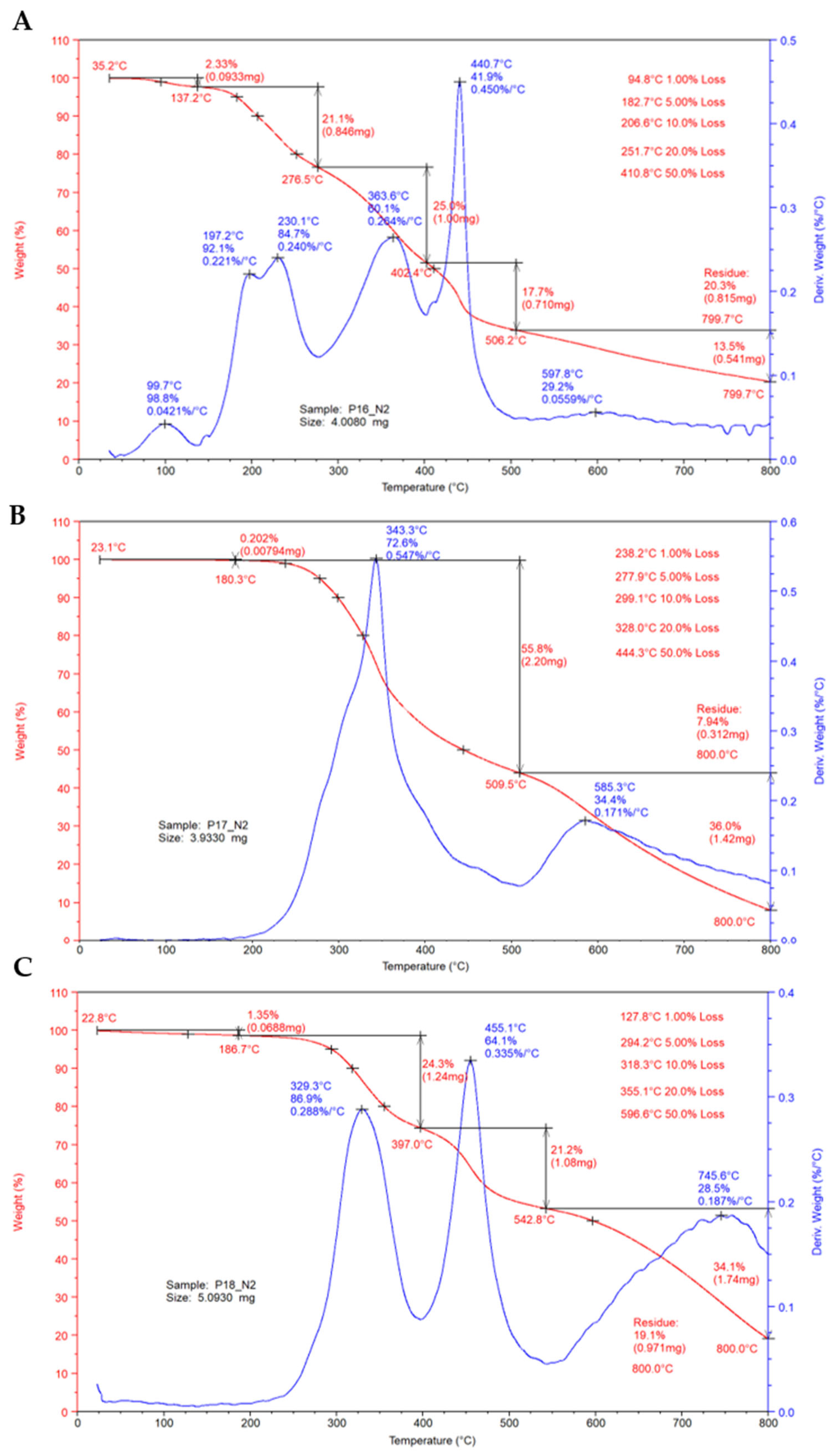
To further characterize the obtained materials, samples P16P18 were subjected to thermogravimetric analysis. The TG and DTG curves recorded under a N2 atmosphere up to 800 °C are presented in Figure 3. The thermal decomposition process of the polythioesters obtained in the reaction of 1a with dithiols 3ac strongly depends on the chemical structure of the segment derived from the dithiol. The general trend in the thermal stability of these polymers is an increase with increasing aromaticity and rigidity of the main chain.
Sample P16, containing a flexible aliphatic tetramethylene chain, exhibits the lowest thermal stability in the entire series. The presence of aliphatic C-H and C-C bonds facilitates degradation, with an onset temperature of 177 °C (the earlier observed weight loss is associated with the evaporation of occluded water). The decomposition process occurs mainly via β-hydrogen elimination or homolytic cleavage of aliphatic bonds, leading to rapid mass loss. Derivative P17, containing a rigid single p-phenylene ring directly connected to sulfur atoms, exhibits significantly higher thermal stability than polymer P16. The onset decomposition temperature was determined to be 274 °C. Rigidification of the main chain through the introduction of an aromatic ring increases the activation energy of the degradation process. The decomposition process is clearly shifted toward higher temperatures due to the presence of more stable Car-S bonds (resulting from the conjugation effect between the π electrons of the ring and the lone electron pairs on the sulfur atom). Derivative P18, containing an extended aromatic system composed of two phenylene rings connected by a sulfide bridge, is characterized by the highest onset decomposition temperature in the series (290 °C), and its decomposition process—especially at later stages—proceeds markedly more slowly. The high density of aromatic rings promotes thermal stabilization of the radicals formed during pyrolysis. In the process of high-temperature decomposition, this material is able to undergo intramolecular cyclization and secondary crosslinking, which slows down the release of volatile degradation products and results in a high residual mass at elevated temperatures.
Samples P16P18 were also subjected to DSC analysis in order to determine additional thermal parameters (glass transition, melting point, and crystallization temperatures). The recorded heat flow curves as a function of temperature for the second heating and cooling runs are presented in Figures S39–S41 (See ESI). Unfortunately, no changes in heat flow were observed in the temperature range from −30 to 180 °C, indicating their amorphous character.

2.3. The Preparative Scale of Synthesis of Product P1

Subsequently, to illustrate the synthetic utility of the developed protocol, a large-scale reaction of 1a with 2a was carried out (Scheme 5). To our great satisfaction, the reaction yielded the expected product P1, isolated in pure form in 96% yield. This result clearly demonstrates that the methodology possesses significant application potential.

2.4. Reaction Mechanism

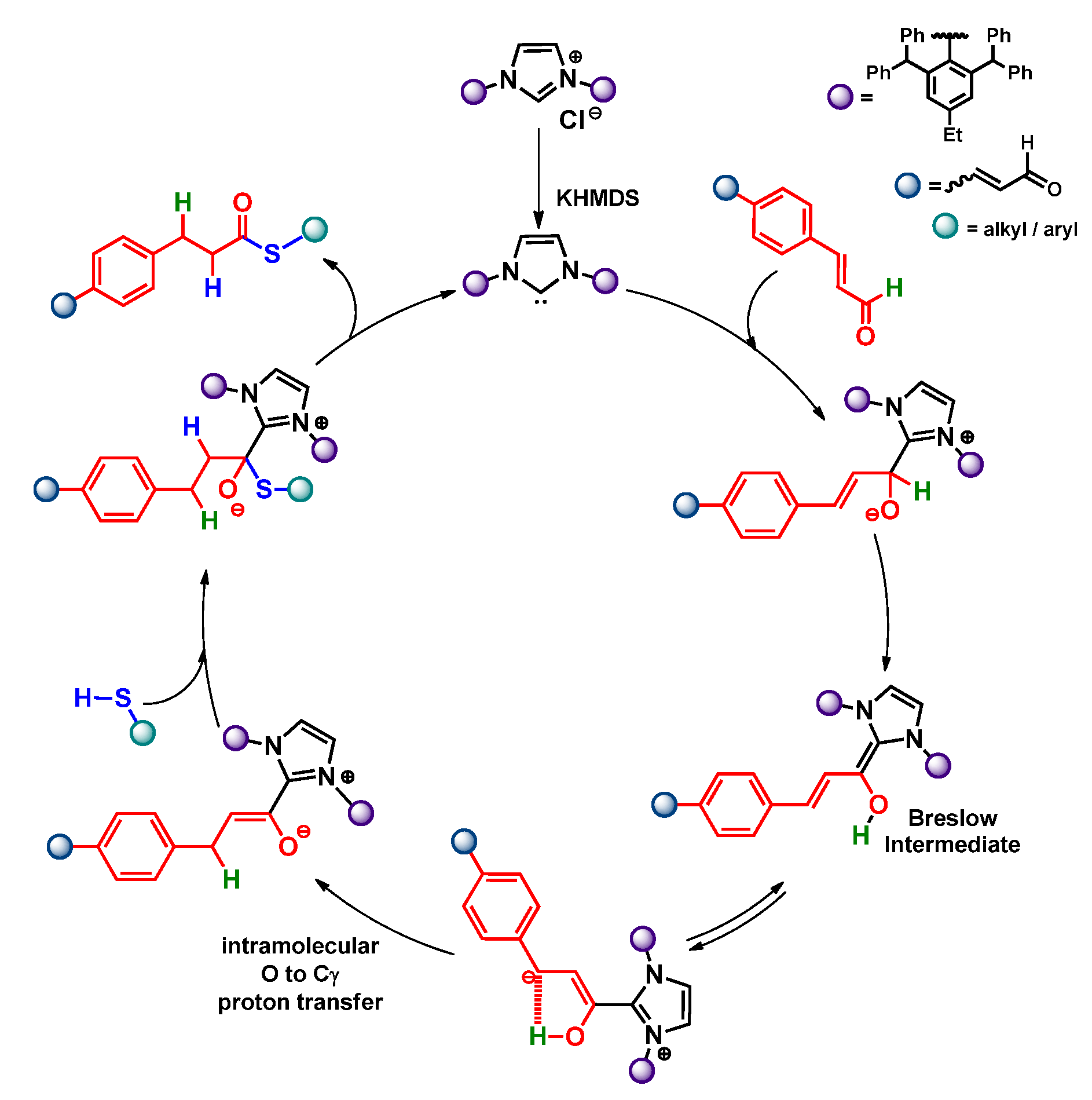
Based on our research on NHC-catalyzed thioesterification and the available literature, we propose the following mechanism for the described transformation [44,49,50,51,52,53,54,55] (Scheme 6). Deprotonation of the NHC precursor generates the free carbene, which adds to the α,β-unsaturated aldehyde to form the corresponding zwitterionic adduct. Following proton transfer, the Breslow intermediate is generated [56,57,58]. This species is in equilibrium with its homoenolate form [59]. Subsequent protonation at the β-position furnishes an enol intermediate that tautomerizes to the corresponding acyl azolium species [60,61]. Nucleophilic attack of the thiol on the acyl azolium intermediate then affords the thioester product with concomitant regeneration of the NHC catalyst.

3. Materials and Methods

3.1. General Methods and Chemicals

Unless otherwise indicated, all operations were carried out under argon. 1H NMR and 13C NMR spectra were recorded at 25 °C in CD Cl3 on a Varian 400 (Palo Alto, CA, USA) operating at 402.6 and 101.2 MHz, respectively. 29Si NMR were recorded on a Brucker Ascend 400 Nanobay (Bellerica, MA, USA) operating at 79.50 MHz. Chemical shifts are reported in ppm with reference to the residual solvent peaks for 1H and 13C NMR and to TMS for 29Si NMR. Thin layer chromatography (TLC) was conducted on plates coated with a 250 μm thick silica gel layer and column chromatography was performed on silica gel 60 (70–230 mesh). ESI-MS spectra were obtained using a Synapt Gs-S HDMS (Waters, Milford, MA, USA) mass spectrometer with electrospray ion source and quadrupole-time-of-flight analyzer with resolving power of FWMH 38,000. Acetonitrile was used as the sample solvent. The Capillary Voltage was set to 4.5 kV, the sampling was set to 40 and the source temperature was equal to 120 °C. The most abundant ions in the ESI-MS spectra were protonated or sodiated ions of desired products. Thermogravimetric analysis (TGA) of the prepared samples was carried out using a Q50-TGA thermobalance (TA Instruments, Inc., New Castle, DE, USA) under an N2 flow of 90 mL min−1. Samples (4–5 mg) loaded on a platinum pan were heated from RT to 800 °C at a rate of 10 °C min−1. Differential Scanning Calorimetry (DSC) of the prepared sample was carried out using a DSC-1 calorimeter (Mettler-Toledo International, Inc., Columbus, OH, USA) under an N2 flow of 30 mL min−1. Samples (3–7 mg) loaded to the 40 µL aluminum pan with a pierced lid were heated from −30 to 150 or 180 °C (depending on the sample) at a rate of 10 °C min−1.
NHC ligand was prepared according to the literature procedures [62]. All the other reagents were commercially available and used as received. The chemicals were purchased from the following sources: silsesquioxanes (Hybrid Plastic, Hattiesburg, MS, USA), thiols, (Chemat, Northridge, CA, USA), KHMDS (Sigma Aldrich, St. Louis, MO, USA), chloroform-d1 (Deutero, Kastellaun, Germany) and acetone, DCM, n-hexane (Fisher Chemical, Waltham, MA, USA). All the solvents used were dried over CaH2 prior to use and stored over 4Å molecular sieves under argon.

3.2. General Procedure for Synthesis of Products P1P10

An oven-dried 5 mL glass reactor equipped with a magnetic stirring bar was charged under argon with the NHC carbene precursor (13.10 mg, 1.34 × 10⁻⁵ mol), KHMDS (2.67 mg, 1.34 × 10⁻⁵ mol) and acetone (1 mL). The reaction mixture was stirred at 25 °C and after 30 min 2aj (2 equiv., 5.36 × 10⁻⁴ mol) and 1a (1 equiv., 50 mg, 2.68 × 10⁻⁴ mol) were added. The color change from navy blue to red to brown was observed within seconds. The mixture was stirred at 60 °C for the next 15 min. After that, the solvent was evaporated under vacuum. The residue was purified by column chromatography on silica gel using dichloromethane or a 1:1 v/v mixture of n-hexane and dichloromethane as eluents. Evaporation of the solvents afforded analytically pure compounds.

3.3. General Procedure for the Synthesis of Products P11P15

An oven-dried 5 mL glass reactor equipped with a magnetic stirring bar was charged under argon with the NHC precursor (13.10 mg, 1.34 × 10⁻⁵ mol), KHMDS (2.67 mg, 1.34 × 10⁻⁵ mol) and acetone (1 mL). The reaction mixture was stirred at RT and after 30 min two different thiols 2aj (1 equiv., 2.68 × 10⁻⁴ mol each) and 1a (1 equiv., 50 mg, 2.68 × 10⁻⁴ mol) were added. The color change from navy blue to red to brown was observed within seconds. The mixture was stirred at 60 °C for the next 15 min. After that, the solvent was evaporated under vacuum. The residue was purified by column chromatography on silica gel using gradient column chromatography with v/v mixture of n-hexane and dichloromethane in different v/v ratios (1:4, 1:2, 1:1, 2:1) as eluents. Evaporation of the solvents afforded analytically pure compounds.

3.4. General Procedure for the Synthesis of Products P16P18

An oven-dried 5 mL glass reactor equipped with a magnetic stirring bar was charged under argon with the NHC carbene precursor (13.10 mg, 1.34 × 10⁻⁵ mol), KHMDS (2.67 mg, 1.34 × 10⁻⁵ mol) and acetone (1 mL). The reaction mixture was stirred at RT and after 30 min 3ac (1 equiv., 2.68 × 10⁻⁴ mol) and 1a (1 equiv., 50 mg, 2.68 × 10⁻⁴ mol) were added. The color change from navy blue to red and then to brown was observed within seconds. The mixture was stirred at 60 °C for the next 15 min. After that, the solvent was evaporated under vacuum. The residue was purified by precipitation using methanol. Evaporation of the solvents afforded analytically pure compounds.

3.5. Synthesis of Product P1 on a Preparative Scale

An oven-dried 5 mL glass reactor equipped with a magnetic stirring bar was charged under argon with the NHC precursor (130.10 mg, 1.34 × 10⁻⁴ mol), KHMDS (26.78 mg, 1.34 × 10⁻⁴ mol) and acetone (1 mL). The reaction mixture was stirred at 25 °C and after 30 min 2a (2 equiv., 0.66 mL, 5.36 × 10⁻³ mol) and 1a (1 equiv., 500 mg, 2.68 × 10⁻³ mol) were added. The color change from navy blue to red to brown was observed within seconds. The mixture was stirred at 60 °C for the next 24 h. After that, the solvent was evaporated under vacuum. The residue was purified by column chromatography on silica gel using dichloromethane or a 1:1 v/v mixture of n-hexane and dichloromethane as eluents. Evaporation of the solvents afforded analytically pure compounds.

4. Conclusions

In summary, we have developed and optimized an efficient NHC-catalyzed protocol for the synthesis of functionalized acrolein-based derivatives from diacrylaldehyde and thiols. The catalytic system was successfully applied to various modifications of commercially available (2E,2′E)-3,3′-(1,4-phenylene)diacrylaldehyde, enabling the synthesis of both symmetric and asymmetric molecular derivatives, as well as functionalized silsesquioxanes and cross-linked polymers. The obtained polymeric materials were characterized as novel sulfur-containing networks exhibiting interesting thermal properties. The methodology also demonstrated excellent scalability, as evidenced by scaled-up reaction, and its utility was further confirmed through the formation of crosslinked polymeric materials. The main advantages of the proposed procedure include the absence of transition-metal complexes, the use of a green solvent (acetone), equimolar substrate ratios with complete conversion, short reaction time (15 min), a broad substrate scope, and facile isolation of the final products, thereby facilitating the elimination of additional operations and reduction in both production cost and time.

Supplementary Materials

The following supporting information can be downloaded at: https://www.mdpi.com/article/10.3390/ijms27135941/s1.

Author Contributions

Conceptualization, K.H., P.Ż.; methodology, K.H., P.Ż.; synthesis and isolation of products, K.H. and K.G.; formal analysis, P.Ż., M.D.; writing—original draft preparation, P.Ż., K.H. and M.D.; writing—review and editing, P.Ż.; visualization, K.H.; supervision, P.Ż.; funding acquisition, K.G. and K.H. All authors have read and agreed to the published version of the manuscript.

Funding

K.G. acknowledges the financial support from the Initiative of Excellence—Research University, grant number 155/34/ID-UB/0062. K.H. acknowledges the financial support from the National Science Centre (Poland) (Preludium No. 2024/53/N/ST4/02250).

Institutional Review Board Statement

Not applicable.

Informed Consent Statement

Not applicable.

Data Availability Statement

All data generated or analyzed during this study are included in this published article (and its Supplementary Information files: Analytical data of isolated products, NMR spectra of isolated products: Figures S1–S31, XRD analysis: Table S1, Figure S32–S35, FT-IR spectra of isolated products: Figures S36–S38 and DSC spectra: Figures S39–S41) [63,64,65,66,67,68].

Acknowledgments

K.H. is a recipient of the Adam Mickiewicz University Foundation scholarship for the academic year 2025/2026.

Conflicts of Interest

The authors declare no conflicts of interest. The funders had no role in the design of the study; in the collection, analyses, or interpretation of data; in the writing of the manuscript; or in the decision to publish the results.

References

  1. Kryst, J. Cosmetics containing turmeric in the light of the results of scientific research. Aesth. Cosmetol. Med. 2023, 12, 169–174. [Google Scholar] [CrossRef]
  2. Dhaliwal, J.S.; Moshawih, S.; Goh, K.W.; Loy, M.J.; Hossain, M.S.; Hermansyah, A.; Kotra, V.; Kifli, N.; Goh, H.P.; Dhaliwal, S.K.S.; et al. Pharmacotherapetutics Applications and Chemistry of Chalcone Derivatives. Molecules 2022, 27, 7062. [Google Scholar] [PubMed]
  3. Alagarasu, K.; Dhote, R.; Bagad, P.K.; Kharikar, D.; Patil, P.; Roy, D.; Shukla, S.; Cherian, S.; Senthilkumar, B.; Parashar, D. Effectiveness of 3-amino-2-thiocyanato-α, β-unsaturated carbonyl compounds against chikungunya virus. Future Med. Chem. 2025, 17, 1269–1279. [Google Scholar] [PubMed]
  4. Elkhalifa, D.; Al-Hashimi, I.; Al Moustafa, A.-E.; Khalil, A. A comprehensive review on the antiviral activities of chalcones. J. Drug Target. 2021, 29, 403–419. [Google Scholar] [PubMed]
  5. Marinov, R.; Markova, N.; Krumova, S.; Yotovska, K.; Zaharieva, M.M.; Genova-Kalou, P. Antiviral properties of chalcones and their synthetic derivatives: A mini review. Pharmacia 2020, 67, 325–337. [Google Scholar] [CrossRef]
  6. Wu, H.; Luo, J.; Chen, Y.; Zhang, J.; Han, T.; Tan, B.; Fang, D.; Deng, H.; Kang, A. Integrated chemometrics and biological validation assay to identify α,β-unsaturated carbonyl compounds as key anti-inflammatory and antioxidant agents in Aucklandiae Radix. Fitoterapia 2025, 186, 106797. [Google Scholar] [PubMed]
  7. Dey, S.; Rathod, S.; Gumphalwad, K.; Yadav, N.; Choudhari, P.; Rajakumara, E.; Mahuli, D. Exploring α, β-unsaturated carbonyl compounds against bacterial efflux pumps via computational approach. J. Biomol. Struct. Dyn. 2023, 42, 8427–8440. [Google Scholar] [CrossRef] [PubMed]
  8. Magaji, B.; Singh, P.; Skelton, A.A.; Martincigh, B.S. Synthesis, photostability and antibacterial activity of a series of symmetrical α,β-unsaturated ketones as potential UV filters. J. Photochem. Photobiol. A-Chem. 2023, 445, 115018. [Google Scholar]
  9. Dai, C.; Lin, J.; Li, H.; Shen, Z.; Wang, Y.; Velkov, T.; Shen, J. The Natural Product Curcumin as an Antibacterial Agent: Current Achievements and Problems. Antioxidants 2022, 11, 459. [Google Scholar] [CrossRef] [PubMed]
  10. Hussain, Y.; Alam, W.; Ullah, H.; Dacrema, M.; Daglia, M.; Khan, H.; Arciola, C.R. Antimicrobial Potential of Curcumin: Therapeutic Potential and Challenges to Clinical Applications. Antibiotics 2022, 11, 322. [Google Scholar] [CrossRef] [PubMed]
  11. Egbujor, M.C.; Buttari, B.; Profumo, E.; Telkoparan-Akillilar, P.; Saso, L. An Overview of NRF2-Activating Compounds Bearing α,β-Unsaturated Moiety and Their Antioxidant Effects. Int. J. Mol. Sci. 2022, 23, 8466. [Google Scholar] [PubMed]
  12. Jakubczyk, K.; Drużga, A.; Janda, K.; Skonieczna-Żydecka, K. Antioxidant Potential of Curcumin—A Meta-Analysis of Randomized Clinical Trails. Antioxidants 2020, 9, 1092. [Google Scholar] [PubMed]
  13. Qin, H.-L.; Leng, J.; Zhang, C.-P.; Jantan, I.; Amjad, M.W.; Sher, M.; Naemm-ul-Hassan, M.; Hussain, M.A.; Bukhari, S.N.A. Synthesis of α,β-Unsaturated Carbonyl-Based Compounds, Oxime and Oxime Ether Analogs as Potential Anticancer Agents for Overcoming Cancer Multidrug Resistance by Modulation of Efflux Pumps in Tumor Cells. J. Med. Chem. 2016, 59, 3549–3561. [Google Scholar] [PubMed]
  14. Ouyang, Y.; Chen, J.; Li, X.; Fu, X.; Sun, S.; Wu, Q. Chalcone Derivatives: Role in Anticancer Therapy. Biomolecules 2021, 11, 894. [Google Scholar] [CrossRef] [PubMed]
  15. Rocha, S.; Ribeiro, D.; Fernandes, F.; Freitas, M. A systematic review on anti-diabetic properties of chalcones. Curr. Med. Chem. 2020, 27, 2257–2321. [Google Scholar] [CrossRef] [PubMed]
  16. Yadav, C.S.; Krishna, A.; Singh, S.P.; Kishan, J.; Chopra, S.; Srivastava, K.; Guha, R.; Lohani, M.B.; Ahmad, V.; Alghamdi, A.A.; et al. Synthesis, characterization and bio-evaluation of novel series of pyrazoline derivatives as potential antifungal agents. Sci. Rep. 2025, 15, 14752. [Google Scholar] [CrossRef] [PubMed]
  17. Sinha, S.; Medhi, B.; Radotra, B.D.; Batovska, I.D.; Markova, N.; Bhalla, A.; Sehgal, R. Antimalarial and immunomodulatory potential of chalcone derivatives in experimental model of malaria. BMC Complement. Med. Ther. 2022, 22, 330. [Google Scholar] [CrossRef] [PubMed]
  18. Bazzaro, M.; Anchoori, R.K.; Mudiam, M.K.R.; Issaenko, O.; Kumar, S.; Karanam, B.; Lin, Z.; Vogel, R.I.; Gavioli, R.; Destro, F.; et al. α,β-Unsaturated Carbonyl System of Chalcone-Based Derivatives Is Responsible for Broad Inhibition of Proteasomal Activity and Preferential Killing of Human Papilloma Virus (HPV) Positive Cervical Cancer Cells. J. Med. Chem. 2011, 54, 449–456. [Google Scholar] [PubMed]
  19. Andrés, C.M.C.; Pérez de la Lastra, J.M.; Bustamante Munguira, E.; Andrés Juan, C.; Pérez-Lebena, E. Michael Acceptors as Anti-Cancer Compounds: Coincidence or Causality? Int. J. Mol. Sci. 2024, 25, 6099. [Google Scholar] [CrossRef] [PubMed]
  20. Hossain, M.; Das, U.; Dimmock, J.R. Recent advances in α,β-unsaturated carbonyl compounds as mitochondrial toxins. Eur. J. Med. Chem. 2019, 183, 111687. [Google Scholar] [PubMed]
  21. Arshad, L.; Jantan, I.; Bukhari, S.N.; Haque, M.A. Immunosuppressive Effects of Natural α,β-Unsaturated Carbonyl-Based Compounds, and Their Analogs and Derivatives, on Immune Cells: A Review. Front. Pharmacol. 2017, 8, 22. [Google Scholar] [PubMed]
  22. Anand, P.; Kunnumakkara, A.B.; Newman, R.A.; Aggarwal, B.B. Bioavailability of curcumin: Problems and promises. Mol. Pharm. 2007, 4, 807. [Google Scholar] [CrossRef] [PubMed]
  23. Kolvea, Y.K.; Madden, J.C.; Cronin, M.T.D. Toxicity of α,β-Unsaturated Carbonyl Compounds. Chem. Res. Toxicol. 2008, 21, 2300–2312. [Google Scholar]
  24. LoPachin, R.M.; Barber, D.S.; Gavin, T. Molecular mechanisms of the conjugated α, β-unsaturated carbonyl derivatives: Relevance to neurotoxicity and neurodegenerative diseases. Toxicol. Sci. 2008, 104, 235–249. [Google Scholar] [PubMed]
  25. LoPachin, R.M.; Gavin, T. Toxicology of electrophilic Michael acceptors: Relevance to neurotoxicity and cellular signaling. Toxicol. Sci. 2014, 142, 1–19. [Google Scholar]
  26. Park, J.; Muratori, B.; Shi, R. Acrolein as a novel therapeutic target for motor and sensory deficits in spinal cord injury. Neural Regen. Res. 2014, 9, 677–683. [Google Scholar] [CrossRef] [PubMed]
  27. Uchida, K. Role of reactive aldehydes in cardiovascular diseases. Free Radic. Biol. Med. 2000, 28, 1685–1696. [Google Scholar] [CrossRef] [PubMed]
  28. Esterbauer, H.; Schaur, R.J.; Zollner, H. Chemistry and biochemistry of 4-hydroxynonenal, malonaldehyde and related aldehydes. Free Radic. Biol. Med. 1991, 11, 81–128. [Google Scholar] [CrossRef] [PubMed]
  29. Horinouchi, T.; Mazaki, Y.; Miwa, S. Possible involvement of α, β-unsaturated carbonyl compounds in ferroptosis induce-d by the cigarette smoke extract of heated tobacco products in vascular smooth muscle cells. J. Pharmacol. Sci. 2025, 158, 8–12. [Google Scholar] [PubMed]
  30. Dixon, S.J.; Lemberg, K.M.; Lamprecht, M.R.; Skouta, R.; Zaitsev, E.M.; Gleason, C.E.; Patel, D.N.; Bauer, A.J.; Cantley, A.M.; Yang, W.S.; et al. Ferroptosis: An iron-dependent form of nonapoptotic cell death. Cell 2012, 149, 1060–1072. [Google Scholar] [CrossRef] [PubMed]
  31. Engels, C.; Schwab, C.; Zhang, J.; Stevens, M.J.A.; Bieri, C.; Ebert, M.-O.; McNeill, K.; Sturla, S.J.; Lacroix, C. Acrolein contributes strongly to antimicrobial and heterocyclic amine transformation activities of reuterin. Sci. Rep. 2016, 6, 36246. [Google Scholar] [CrossRef] [PubMed]
  32. Oh, S.Y.; Daniel, J.; Daniel, C.; Pei, C. Reduction of acrolein by elemental iron: Kinetics, pH effect, and detoxification. Environ. Sci. Technol. 2006, 40, 2765–2770. [Google Scholar] [CrossRef] [PubMed]
  33. Kecili, R.; Nivhede, D.; Billing, J.; Leeman, M.; Sellergren, B.; Yilmaz, E. Removal of acrolein from active pharmaceutical ingredients using aldehyde scavengers. Org. Process Res. Dev. 2012, 16, 1225–1229. [Google Scholar] [CrossRef]
  34. Kazemi, M.; Shiri, L. Thioesters synthesis: Recent adventures in the esterification of thiols. J. Sulfur Chem. 2015, 36, 613–623. [Google Scholar] [CrossRef]
  35. Jabarullah, N.H.; Jermisittiparset, K.; Melnikov, P.A.; Maseleno, A.; Hosseinian, A.; Vessaly, E. Methods for the direct synthesis of thioesters from aldehydes: A focus review. J. Sulfur Chem. 2020, 41, 96–115. [Google Scholar]
  36. Yi, C.L.; Huang, Y.T.; Lee, C.F. Synthesis of thioesters through copper-catalyzed coupling of aldehydes with thiols in water. Green Chem. 2013, 15, 2476–2484. [Google Scholar] [CrossRef]
  37. Huang, Y.T.; Lu, S.Y.; Yi, C.L.; Lee, C.F. Iron-catalyzed synthesis of thioesters from thiols and aldehydes in water. J. Org. Chem. 2014, 79, 4561–4568. [Google Scholar] [CrossRef] [PubMed]
  38. Jhuang, H.-S.; Liu, Y.-W.; Reddy, D.M.; Tzeng, Y.-Z.; Lin, W.Y.; Lee, C.-F. Microwave-assisted Synthesis of Thioesters from Aldehydes and Thiols in Water. J. Chin. Chem. Soc. 2018, 65, 24–27. [Google Scholar]
  39. Ai, H.-J.; Zhao, F.; Geng, H.-Q.; Wu, X.F. Palladium-Catalyzed Thiocarbonylation of Alkenes toward Linear Thioesters. ACS Catal. 2021, 11, 3614–3619. [Google Scholar] [CrossRef]
  40. Wang, X.; Wang, B.; Yin, X.; Yu, W.; Liao, Y.; Ye, J.; Wang, M.; Hu, L.; Liao, J. Palladium-Catalyzed Enantioselective Thiocarbonylation of Styrenes. Angew. Chem. Int. Ed. 2019, 58, 12264–12270. [Google Scholar]
  41. Uno, T.; Inokuma, T.; Takemoto, Y. NHC-catalyzed thioesterification of aldehydes by external redox activation. Chem. Commun. 2012, 48, 1901–1903. [Google Scholar] [CrossRef]
  42. Sing, S.; Yaday, L.D.S. The direct thioesterification of aldehydes with disulfides via NHC-catalyzed carbonyl umpolung strategy. Tetrahedron Lett. 2012, 53, 5136–5140. [Google Scholar] [CrossRef]
  43. Chung, J.; Seo, U.R.; Chun, S.; Chung, Y.K. Poly(3,4-dimethyl-5-vinylthiazolium)/DBU-Catalyzed Thioesterification of Aldehydes with Thiols. ChemCatChem 2016, 8, 318–321. [Google Scholar]
  44. Bołt, M.; Hanek, K.; Żak, P. Metal-free thioesterification of α,β-unsaturated aldehydes with thiols. Org. Chem. Front. 2022, 9, 4846–4853. [Google Scholar]
  45. Bołt, M.; Mermela, A.; Hanek, K.; Żak, P. Metal-free synthesis of unsymmetric bis(thioesters). Chem. Commun. 2023, 59, 956–959. [Google Scholar] [CrossRef]
  46. Bołt, M.; Hanek, K.; Frąckowiak, D.; Żak, P. Metal-free functionalization of SQs: A case of chemoselectivity and what ball-milling has got to do with it? Inorg. Chem. Front. 2023, 10, 4190–4196. [Google Scholar]
  47. Hanek, K.; Żak, P. Eco-Friendly Funtionalization of Ynals with Thiols under Mild Conditions. Int. J. Mol. Sci. 2024, 25, 9201. [Google Scholar] [PubMed]
  48. Mermela, A.; Bołt, M.; Mrzygłód, A.; Żak, P. Organocatalytic synthetic route to esters and their application in hydrosilylation process. Sci. Rep. 2024, 14, 19108. [Google Scholar] [CrossRef] [PubMed]
  49. Sohn, S.S.; Bode, J.W. Catalytic Generation of Activated Carboxylates from Enals: A Product-Determining Role for the Base. Org. Lett. 2005, 7, 3873–3876. [Google Scholar] [CrossRef] [PubMed]
  50. Chan, A.; Scheidt, K.A. Conversion of α,β-Unsaturated Aldehydes into Saturated Esters: An Umpolung Reaction Catalyzed by Nucleophilic Carbenes. Org. Lett. 2005, 7, 905–908. [Google Scholar] [PubMed]
  51. Maki, B.E.; Patterson, E.V.; Cramer, C.J.; Scheidt, K.A. Impact of Solvent Polarity on N-Heterocyclic Carbene-Catalyzed β-Protonations of Homoenolate Equivalents. Org. Lett. 2009, 11, 3942–3945. [Google Scholar] [PubMed]
  52. Wang, M.H.; Barsoum, D.; Schwamb, C.B.; Cohen, D.T.; Goess, B.C.; Riedrich, M.; Chan, A.; Maki, B.E.; Mishra, R.K.; Scheidt, K.A. Catalytic, Enantioselective β-Protonation through a Cooperative Activation Strategy. J. Org. Chem. 2017, 82, 4689–4702. [Google Scholar] [CrossRef] [PubMed]
  53. Wang, N.; Xu, J.; Lee, J.K. The importance of N-heterocyclic carbene basicity in organocatalysis. Org. Biomol. Chem. 2018, 16, 8230–8244. [Google Scholar] [CrossRef] [PubMed]
  54. Li, X.; Xu, J.; Li, S.-J.; Qu, L.-B.; Li, Z.; Chi, Y.R.; Wei, D.; Lan, Y. Prediction of NHC-catalyzed chemoselective functionalizations of carbonyl compounds: A general mechanistic map. Chem. Sci. 2020, 11, 7214–7225. [Google Scholar] [CrossRef] [PubMed]
  55. Biswas, A.; Neudorfl, J.M.; Schlorer, N.E.; Berkessel, A. Acyl Donor Intermediates in N-Heterocyclic Carbene Catalysis: Acyl Azolium or Azolium Enolate? Angew. Chem. Int. Ed. 2021, 60, 4557–4561. [Google Scholar]
  56. Pareek, M.; Reddi, Y.; Sunoj, R.B. Tale of the Breslow intermediate, a central player in N-heterocyclic carbene organocatalysis: Then and now. Chem. Sci. 2021, 12, 7973–7992. [Google Scholar] [CrossRef] [PubMed]
  57. Wessels, A.; Klußmann, M.; Breugst, M.; Schlorer, N.E.; Berkessel, A. Formation of Breslow Intermediates from N-Heterocyclic Carbenes and Aldehydes Involves Autocatalysis by the Breslow Intermediate, and a Hemiacetal. Angew. Chem. Int. Ed. 2022, 61, e202117682. [Google Scholar]
  58. Liu, S.-L.; Liu, X.; Wang, Y.; Wei, D. Unraveling the mechanism and substituent effects on the N-heterocyclic carbene-catalyzed transformation reaction of enals and imines. Mol. Catal. 2022, 519, 112122. [Google Scholar]
  59. Mahatthananchai, J.; Bode, J.W. The effect of the N-mesityl group in NHC-catalyzed reactions. Chem. Sci. 2012, 3, 192–197. [Google Scholar] [PubMed]
  60. Reddi, Y.; Sunoj, R.B. Origin of Stereoselectivity in a Chiral N-Heterocyclic Carbene-Catalyzed Desymmetrization of Substituted Cyclohexyl 1,3-Diketones. Org. Lett. 2012, 14, 2810–2813. [Google Scholar] [PubMed]
  61. Berkessel, A.; Yathan, V.R.; Elfert, S.; Neudorfl, J.M. Characterization of the Key Intermediates of Carbene-Catalyzed Umpolung by NMR Spectroscopy and X-Ray Diffraction: Breslow Intermediates, Homoenolates, and Azolium Enolates. Angew. Chem. Int. Ed. 2013, 52, 11158. [Google Scholar]
  62. Hans, M.; Lorkowski, J.; Demonceau, A.; Delaude, L. Efficient synthetic protocols for the preparation of common N-heterocyclic carbene precursors. Beilstein J. Org. Chem. 2015, 11, 2318–2325. [Google Scholar] [CrossRef] [PubMed]
  63. Bruker. SAINT, Version 8.41; Bruker AXS Inc.: Madison, WI, USA, 2012.
  64. Krause, L.; Herbst-Irmer, R.; Sheldrick, G.M.; Stalke, D. Comparison of silver and molybdenum microfocus X-ray sources for single-crystal structure determination. J. Appl. Cryst. 2015, 48, 3–10. [Google Scholar]
  65. Sheldrick, G.M. SHELXT–Integrated space-group and crystal-structure determination. Acta Cryst. 2015, A71, 3–8. [Google Scholar]
  66. Sheldrick, G.M. Crystal structure refinement with SHELXL. Acta Cryst. 2015, C71, 3–8. [Google Scholar] [CrossRef]
  67. Groom, C.R.; Bruno, I.J.; Lightfoot, M.P.; Ward, S.C. The Cambridge Structural Database. Acta Cryst. 2016, B72, 171–179. [Google Scholar] [CrossRef]
  68. Kratzert, D. FinalCif, (Bruker Edition). Available online: https://dkratzert.de/finalcif.html (accessed on 23 June 2026).
Figure 1. Structures of organocatalyst precursor NHC-1.
Ijms 27 05941 g001
Scheme 1. Functionalization of 1a with 2aj (conditions: acetone, 60 °C, (1a):(2aj) = 1:2, NHC-1 = IPr*OMe·HCl, [NHC-1] = [KHMDS] = 5 mol%, argon). Isolated yields are given under the structures. SQ—mercaptopropylisobutylsilsesquioxyl group.
Ijms 27 05941 sch001
Figure 2. Perspective views of the products P1P3 and P5.
Ijms 27 05941 g002
Scheme 2. Functionalization of 1a with 2b and 2e (conditions: acetone, 60 °C, (1a):(2b):(2e) = 1:1:1, NHC-1 = IPr*OMe·HCl, [NHC-1] = [KHMDS] = 5 mol%, argon). Yields are given in parentheses.
Ijms 27 05941 sch002
Scheme 3. Functionalization of 1a with two different thiols (2aj) (conditions: acetone, 60 °C, (1a):(2aj) = 1:1:1, NHC-1 = IPr*OMe·HCl, [NHC-1] = [KHMDS] = 5 mol%, argon). Isolated yields are given in parentheses.
Ijms 27 05941 sch003
Scheme 4. Functionalization of 1a with 3ac (conditions: acetone, 60 °C, (1a):(3ac) = 1:1, NHC-1 = IPr*OMe·HCl, [NHC-1] = [KHMDS] = 5 mol%, argon). Isolated yields are given in parentheses.
Ijms 27 05941 sch004
Figure 3. TG and DTG curves for products P16 (A), P17 (B) and P18 (C).
Ijms 27 05941 g003
Scheme 5. Scaled-up synthesis of P1.
Ijms 27 05941 sch005
Scheme 6. Proposed mechanism.
Ijms 27 05941 sch006
Table 1. Optimization of the reaction conditions.
Ijms 27 05941 i001
EntrySolventTemp.
[°C]
NHC-1
[mol%]
BaseTime
[h]
Conv. of 1a [d]
[%]
1Acetone6020KHMDS24100
2Acetone6015KHMDS24100
3Acetone6010KHMDS24100
4Acetone605KHMDS24100
5Acetone602.5KHMDS2445
6Acetone60-KHMDS720
7Acetone605K2CO32485
8Acetone605t-BuOK2465
9Acetone605NEt32455
10Acetone605-242
11 [a]Acetone605KHMDS24100
12 [b]Acetone605KHMDS24100
13i-PrOH605KHMDS2415
14MiBK605KHMDS2435
15EtOAc605KHMDS2428
16Acetone405KHMDS2480
17Acetone255KHMDS2465
18 [c]Acetone605KHMDS245
19Acetone605KHMDS1.0100
20Acetone605KHMDS0.5100
21Acetone605KHMDS0.25100
22Acetone605KHMDS0.12558
Reaction conditions: Argon, [1a]:[2a] = 1:2, [NHC-1]:[Base] = 1:1; [a] Freshly isolated carbene was used as a catalyst; [b] [NHC-1]:[KHMDS] = 1:2; [c] Reaction conducted under air; [d] Determined by 1H NMR spectroscopy of the crude reaction mixture.
Disclaimer/Publisher’s Note: The statements, opinions and data contained in all publications are solely those of the individual author(s) and contributor(s) and not of MDPI and/or the editor(s). MDPI and/or the editor(s) disclaim responsibility for any injury to people or property resulting from any ideas, methods, instructions or products referred to in the content.