Organ-Specific Phenolic Profiling and Integrated Antioxidant Evaluation of Cicer isauricum by LC–ESI–MS/MS and Multi-Assay Approach

Abstract
1. Introduction
2. Results and Discussion
2.1. Total Phenolic and Flavonoid Contents
2.2. LC–MS/MS Phenolic Profile
2.3. Antioxidant Activity
3. Materials and Methods
3.1. Plant Material
3.2. Methanol Extraction
3.3. Determination of the Phenolic Compositions of the Extracts
3.4. Biological Activity
3.5. Statistical Analysis
3.6. Use of Artificial Intelligence
4. Conclusions
Supplementary Materials
Author Contributions
Funding
Institutional Review Board Statement
Informed Consent Statement
Data Availability Statement
Conflicts of Interest
References
- Jukanti, A.K.; Gaur, P.M.; Gowda, C.L.L.; Chibbar, R.N. Nutritional quality and health benefits of chickpea (Cicer arietinum L.): A review. Br. J. Nutr. 2012, 108, S11–S26. [Google Scholar] [CrossRef] [PubMed]
- Lewis, G.P. Legumes of the World; Royal Botanic Gardens, Kew: Melbourne, Australia, 2005. [Google Scholar]
- Panche, A.N.; Diwan, A.D.; Chandra, S.R. Flavonoids: An overview. J. Nutr. Sci. 2016, 5, e47. [Google Scholar] [CrossRef] [PubMed]
- Shahidi, F.; Ambigaipalan, P. Phenolics and polyphenolics in foods, beverages and spices: Antioxidant activity and health effects—A review. J. Funct. Foods 2015, 18, 820–897. [Google Scholar] [CrossRef]
- Zia-Ul-Haq, M.; Iqbal, S.; Ahmad, S.; Imran, M.; Niaz, A.; Bhanger, M.I. Nutritional and compositional study of Desi chickpea (Cicer arietinum L.) cultivars grown in Punjab, Pakistan. Food Chem. 2007, 105, 1357–1363. [Google Scholar] [CrossRef]
- Xu, B.J.; Chang, S.K.C. A Comparative Study on Phenolic Profiles and Antioxidant Activities of Legumes as Affected by Extraction Solvents. J. Food Sci. 2007, 72, S159–S166. [Google Scholar] [CrossRef] [PubMed]
- Segev, A.; Badani, H.; Galili, L.; Hovav, R.; Kapulnik, Y.; Shomer, I.; Galili, S. Total phenolic content and antioxidant activity of chickpea (Cicer arietinum L.) as affected by soaking and cooking conditions. Food Nutr. Sci. 2011, 2, 724–730. [Google Scholar] [CrossRef]
- Vinatoru, M.; Mason, T.J.; Calinescu, I. Ultrasonically assisted extraction (UAE) and microwave assisted extraction (MAE) of functional compounds from plant materials. TrAC Trends Anal. Chem. 2017, 97, 159–178. [Google Scholar] [CrossRef]
- Chemat, F.; Rombaut, N.; Sicaire, A.-G.; Meullemiestre, A.; Fabiano-Tixier, A.-S.; Abert-Vian, M. Ultrasound assisted extraction of food and natural products. Mechanisms, techniques, combinations, protocols and applications. A review. Ultrason. Sonochem. 2017, 34, 540–560. [Google Scholar] [CrossRef] [PubMed]
- Do, Q.D.; Angkawijaya, A.E.; Tran-Nguyen, P.L.; Huynh, L.H.; Soetaredjo, F.E.; Ismadji, S.; Ju, Y.-H. Effect of extraction solvent on total phenol content, total flavonoid content, and antioxidant activity of Limnophila aromatica. J. Food Drug Anal. 2014, 22, 296–302. [Google Scholar] [CrossRef] [PubMed]
- Dai, J.; Mumper, R.J. Plant Phenolics: Extraction, Analysis and Their Antioxidant and Anticancer Properties. Molecules 2010, 15, 7313–7352. [Google Scholar] [CrossRef] [PubMed]
- Apak, R.; Özyürek, M.; Güçlü, K.; Çapanoğlu, E. Antioxidant Activity/Capacity Measurement. 1. Classification, Physicochemical Principles, Mechanisms, and Electron Transfer (ET)-Based Assays. J. Agric. Food Chem. 2016, 64, 997–1027. [Google Scholar] [CrossRef] [PubMed]
- Prior, R.L.; Wu, X.; Schaich, K. Standardized Methods for the Determination of Antioxidant Capacity and Phenolics in Foods and Dietary Supplements. J. Agric. Food Chem. 2005, 53, 4290–4302. [Google Scholar] [CrossRef] [PubMed]
- Cheynier, V.; Comte, G.; Davies, K.M.; Lattanzio, V.; Martens, S. Plant phenolics: Recent advances on their biosynthesis, genetics, and ecophysiology. Plant Physiol. Biochem. 2013, 72, 1–20. [Google Scholar] [CrossRef] [PubMed]
- Mandal, S.M.; Chakraborty, D.; Dey, S. Phenolic acids act as signaling molecules in plant-microbe symbioses. Plant Signal. Behav. 2010, 5, 359–368. [Google Scholar] [CrossRef] [PubMed]
- Agati, G.; Azzarello, E.; Pollastri, S.; Tattini, M. Flavonoids as antioxidants in plants: Location and functional significance. Plant Sci. 2012, 196, 67–76. [Google Scholar] [CrossRef] [PubMed]
- Segev, A.; Badani, H.; Kapulnik, Y.; Shomer, I.; Oren-Shamir, M.; Galili, S. Determination of Polyphenols, Flavonoids, and Antioxidant Capacity in Colored Chickpea (Cicer arietinum L.). J. Food Sci. 2010, 75, S115–S119. [Google Scholar] [CrossRef] [PubMed]
- Chen, P.X.; Tang, Y.; Marcone, M.F.; Pauls, P.K.; Zhang, B.; Liu, R.; Tsao, R. Characterization of free, conjugated and bound phenolics and lipophilic antioxidants in regular- and non-darkening cranberry beans (Phaseolus vulgaris L.). Food Chem. 2015, 185, 298–308. [Google Scholar] [CrossRef] [PubMed]
- Verma, N.; Shukla, S. Impact of various factors responsible for fluctuation in plant secondary metabolites. J. Appl. Res. Med. Aromat. Plants 2015, 2, 105–113. [Google Scholar] [CrossRef]
- Singh, B.; Singh, J.P.; Kaur, A.; Singh, N. Phenolic composition and antioxidant potential of grain legume seeds: A review. Food Res. Int. 2017, 101, 1–16. [Google Scholar] [CrossRef] [PubMed]
- Sreerama, Y.N.; Sashikala, V.B.; Pratape, V.M. Phenolic compounds in cowpea and horse gram flours in comparison to chickpea flour: Evaluation of their antioxidant and enzyme inhibitory properties associated with hyperglycemia and hypertension. Food Chem. 2012, 133, 156–162. [Google Scholar] [CrossRef]
- Attree, R.; Du, B.; Xu, B. Distribution of phenolic compounds in seed coat and cotyledon, and their contribution to antioxidant capacities of red and black seed coat peanuts (Arachis hypogaea L.). Ind. Crops Prod. 2015, 67, 448–456. [Google Scholar] [CrossRef]
- Kerem, Z.; Lev-Yadun, S.; Gopher, A.; Weinberg, P.; Abbo, S. Chickpea domestication in the Neolithic Levant through the nutritional perspective. J. Archaeol. Sci. 2007, 34, 1289–1293. [Google Scholar] [CrossRef]
- Karakuş, Z. Phytochemical profile, antioxidant capacity, and enzyme inhibitory properties of Alkanna tubulosa extract obtained via ultrasound-assisted extraction. Int. J. Second. Metab. 2026, 13, 36–46. [Google Scholar] [CrossRef]
- Karakus, Z. Phytochemical Characterisation and Bioactivity of Picnomon acarna Extracts: LC–MS/MS Profiling, Antioxidant Capacity and Enzyme Inhibition. Molecules 2026, 31, 1240. [Google Scholar] [CrossRef] [PubMed]
- Rice-Evans, C.A.; Miller, N.J.; Paganga, G. Structure-antioxidant activity relationships of flavonoids and phenolic acids. Free Radic. Biol. Med. 1996, 20, 933–956. [Google Scholar] [CrossRef] [PubMed]
- Sun, T.; Tanumihardjo, S. An integrated approach to evaluate food antioxidant capacity. J. Food Sci. 2007, 72, R159–R165. [Google Scholar] [CrossRef] [PubMed]
- Selvi, B. Comparative study of Pentanema verbascifolium extracts: Phytochemical composition, antioxidant potential, and enzyme inhibition across plant parts. Food Biosci. 2025, 68, 106607. [Google Scholar] [CrossRef]
- Karakus, Z.; Sarikurkcu, C. Organ-Specific LC–MS/MS Phenolic Profiling and Multifunctional Antioxidant and Enzyme Inhibitory Activities of Onosma sintenisii. Molecules 2026, 31, 840. [Google Scholar] [CrossRef] [PubMed]
- Zengin, G.; Uren, M.C.; Kocak, M.S.; Gungor, H.; Locatelli, M.; Aktumsek, A.; Sarikurkcu, C. Antioxidant and Enzyme Inhibitory Activities of Extracts from Wild Mushroom Species from Turkey. Int. J. Med. Mushrooms 2017, 19, 327–336. [Google Scholar] [CrossRef] [PubMed]
- Karakus, Z. Influence of Extraction Method on the Phytochemical Composition and Biofunctional Potential of Centaurea urvillei subsp. Stepposa: A Multi-Assay and In Silico Perspective. ChemistrySelect 2026, 11, e04699. [Google Scholar] [CrossRef]
- Cittan, M.; Çelik, A. Development and validation of an analytical methodology based on Liquid Chromatography–Electrospray Tandem Mass Spectrometry for the simultaneous determination of phenolic compounds in olive leaf extract. J. Chromatogr. Sci. 2018, 56, 336–343. [Google Scholar] [CrossRef] [PubMed]
- Prieto, P.; Pineda, M.; Aguilar, M. Spectrophotometric Quantitation of Antioxidant Capacity through the Formation of a Phosphomolybdenum Complex: Specific Application to the Determination of Vitamin E. Anal. Biochem. 1999, 269, 337–341. [Google Scholar] [CrossRef] [PubMed]
- Blois, M.S. Antioxidant Determinations by the Use of a Stable Free Radical. Nature 1958, 181, 1199–1200. [Google Scholar] [CrossRef]
- Re, R.; Pellegrini, N.; Proteggente, A.; Pannala, A.; Yang, M.; Rice-Evans, C. Antioxidant activity applying an improved ABTS radical cation decolorization assay. Free Radic. Biol. Med. 1999, 26, 1231–1237. [Google Scholar] [CrossRef] [PubMed]
- Dinis, T.C.P.; Madeira, V.M.C.; Almeida, L.M. Action of Phenolic Derivatives (Acetaminophen, Salicylate, and 5-Aminosalicylate) as Inhibitors of Membrane Lipid Peroxidation and as Peroxyl Radical Scavengers. Arch. Biochem. Biophys. 1994, 315, 161–169. [Google Scholar] [CrossRef] [PubMed]
- Apak, R.; Güçlü, K.; Özyürek, M.; Karademir, S.E. Novel Total Antioxidant Capacity Index for Dietary Polyphenols and Vitamins C and E, Using Their Cupric Ion Reducing Capability in the Presence of Neocuproine: CUPRAC Method. J. Agric. Food Chem. 2004, 52, 7970–7981. [Google Scholar] [CrossRef] [PubMed]
- Benzie, I.F.F.; Strain, J.J. The Ferric Reducing Ability of Plasma (FRAP) as a Measure of “Antioxidant Power”: The FRAP Assay. Anal. Biochem. 1996, 239, 70–76. [Google Scholar] [CrossRef] [PubMed]



| Class | Compound | Leaves | Stems | Roots |
|---|---|---|---|---|
| Hydroxybenzoic acids | Gallic acid | 3.10 ± 0.03 b | 9.92 ± 0.10 a | 3.23 ± 0.17 b |
| Protocatechuic acid | 28.72 ± 0.15 b | 85.58 ± 0.41 a | 30.16 ± 0.48 b | |
| 3-Hydroxybenzoic acid | 35.37 ± 1.35 b | 44.05 ± 0.35 a | 34.69 ± 0.69 b | |
| 4-Hydroxybenzoic acid | 56.05 ± 0.90 b | 75.03 ± 1.56 a | 57.43 ± 0.94 b | |
| Syringic acid | 22.81 ± 0.29 c | 73.21 ± 0.51 a | 36.29 ± 0.10 b | |
| Hydroxyphenylacetic acids | 3,4-Dihydroxyphenylacetic acid | 4.74 ± 0.37 b | 6.57 ± 0.15 a | 4.18 ± 0.03 b |
| Hydroxycinnamic acids | Chlorogenic acid | 3.68 ± 0.01 b | 8.67 ± 0.16 a | 2.84 ± 0.14 c |
| Caffeic acid | 4.48 ± 0.14 b | 9.05 ± 0.09 a | 1.59 ± 0.01 c | |
| Sinapic acid | 16.10 ± 0.15 a | 14.32 ± 0.59 b | 7.48 ± 0.27 c | |
| p-Coumaric acid | 29.34 ± 0.68 b | 49.62 ± 0.75 a | 8.99 ± 0.26 c | |
| Ferulic acid | 45.74 ± 0.10 b | 55.25 ± 0.52 a | 6.63 ± 0.06 c | |
| Rosmarinic acid | 4.61 ± 0.03 b | 9.31 ± 0.41 a | 4.87 ± 0.10 b | |
| 2-Hydroxycinnamic acid | nd | nd | nd | |
| Flavan-3-ols | (+)-Catechin | 6.35 ± 0.13 c | 13.80 ± 0.45 b | 355.93 ± 1.23 a |
| (−)-Epicatechin | 2.11 ± 0.01 c | 10.08 ± 0.78 b | 59.58 ± 0.38 a | |
| Flavanonols | Taxifolin | 8.16 ± 0.23 c | 84.04 ± 0.99 a | 20.95 ± 0.56 b |
| Flavanones | Eriodictyol | 58.02 ± 0.14 b | 434.03 ± 3.43 a | 30.93 ± 0.09 c |
| Flavanone glycosides | Hesperidin | 459.40 ± 10.55 a | 127.51 ± 1.03 b | nd |
| Flavonol glycosides | Hyperoside | 1162.42 ± 30.08 b | 2227.97 ± 5.54 a | 43.04 ± 0.30 c |
| Flavonols | Quercetin | 57.34 ± 0.31 b | 198.41 ± 1.16 a | 13.55 ± 0.38 c |
| Kaempferol | 182.88 ± 0.13 a | 150.09 ± 2.32 b | 33.64 ± 0.60 c | |
| Flavone glycosides | Luteolin 7-glucoside | 59.61 ± 0.12 b | 97.09 ± 1.68 a | 10.10 ± 0.15 c |
| Apigenin 7-glucoside | 7.41 ± 0.48 b | 8.97 ± 0.74 b | 109.34 ± 0.62 a | |
| Flavones | Luteolin | 110.52 ± 0.32 b | 298.22 ± 0.81 a | 18.18 ± 0.06 c |
| Apigenin | 24.48 ± 0.33 b | 63.55 ± 0.70 a | 10.81 ± 0.01 c | |
| Phenylethanoid glycosides | Verbascoside | 5.43 ± 0.05 b | 10.19 ± 0.14 a | 5.11 ± 0.01 b |
| Phenolic aldehydes | Vanillin | 40.71 ± 0.37 b | 130.54 ± 2.11 a | 43.62 ± 0.25 b |
| Lignans | Pinoresinol | 32.19 ± 0.51 a | 15.83 ± 0.42 b | 8.76 ± 0.25 c |
| Assays | Leaves | Stems | Roots | Trolox | EDTA |
|---|---|---|---|---|---|
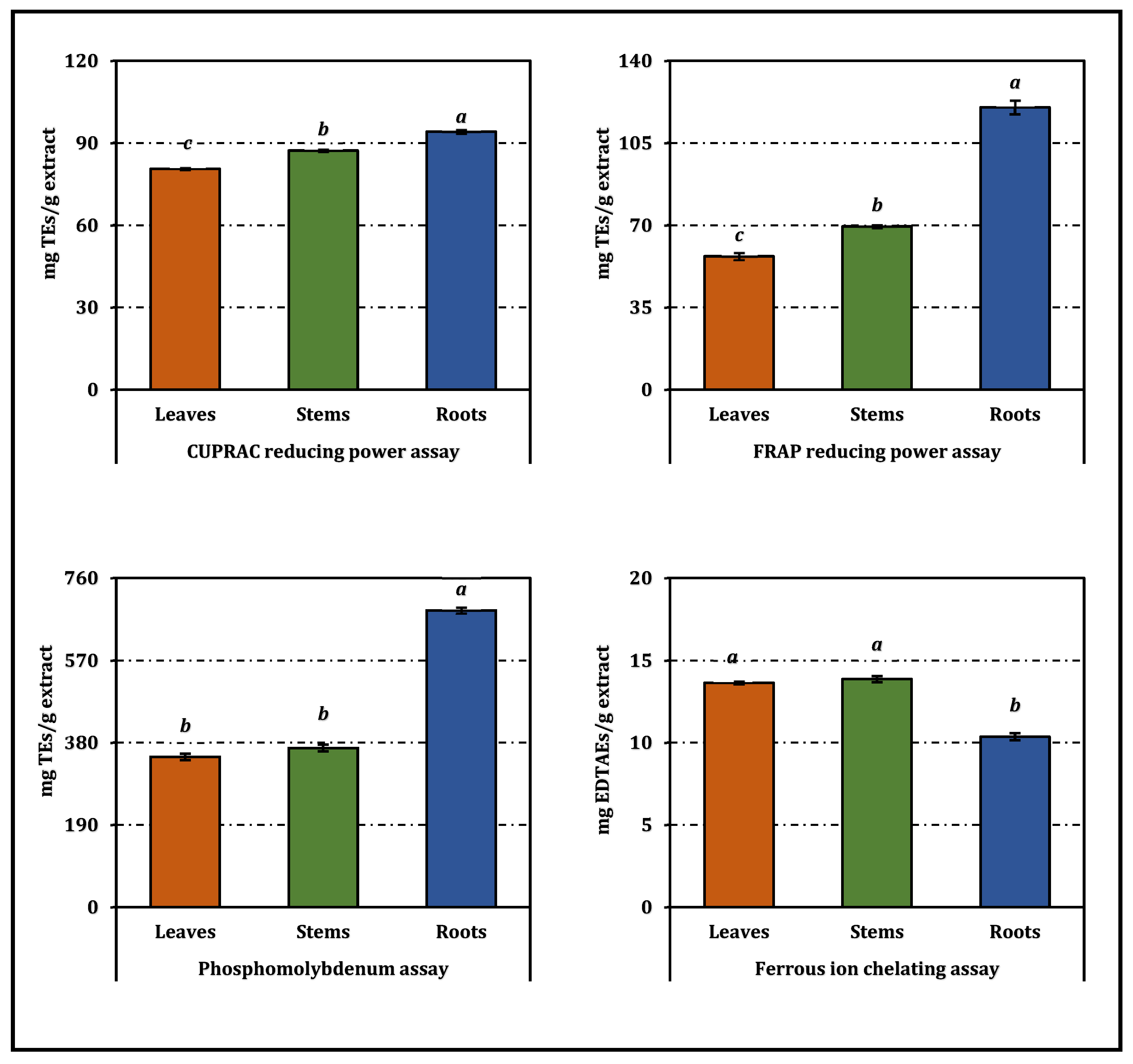
| Phosphomolybdenum (EC50: mg/mL) | 1.12 ± 0.02 c | 1.06 ± 0.02 c | 0.57 ± 0.01 b | 0.39 ± 0.02 a | - |
| CUPRAC reducing power (EC50: mg/mL) | 2.08 ± 0.01 d | 1.92 ± 0.01 c | 1.78 ± 0.01 b | 0.17 ± 0.01 a | - |
| FRAP reducing power (EC50: mg/mL) | 0.86 ± 0.02 d | 0.70 ± 0.01 c | 0.41 ± 0.01 b | 0.049 ± 0.001 a | - |
| DPPH radical (IC50: mg/mL) | 10.59 ± 0.07 d | 5.91 ± 0.06 c | 4.15 ± 0.07 b | 0.23 ± 0.01 a | - |
| ABTS radical cation (IC50: mg/mL) | 3.31 ± 0.19 c | 1.95 ± 0.31 b | 1.41 ± 0.02 b | 0.16 ± 0.003 a | - |
| Ferrous ion chelating (IC50: mg/mL) | 1.07 ± 0.01 b | 1.05 ± 0.01 b | 1.41 ± 0.03 c | - | 0.015 ± 0.0003 a |
| TAP | DPPH | ABTS | CUPRAC | FRAP | FICA | |
|---|---|---|---|---|---|---|
| DPPH | 0.884 | |||||
| ABTS | 0.859 | 0.981 | ||||
| CUPRAC | 0.891 | 0.998 | 0.970 | |||
| FRAP | 0.989 | 0.938 | 0.915 | 0.943 | ||
| FICA | −0.990 | −0.828 | −0.805 | −0.838 | −0.964 | |
| Total flavonoid | −0.962 | −0.966 | −0.927 | −0.972 | −0.981 | 0.931 |
| Total phenolic | 0.877 | 0.996 | 0.984 | 0.993 | 0.936 | −0.817 |
| Gallic acid | −0.437 | 0.031 | 0.056 | 0.010 | −0.311 | 0.530 |
| Protocatechuic acid | −0.432 | 0.036 | 0.061 | 0.014 | −0.304 | 0.528 |
| 3,4-Dihydroxyphenylacetic acid | −0.636 | −0.208 | −0.186 | −0.222 | −0.520 | 0.709 |
| (+)-Catechin | 0.999 | 0.868 | 0.839 | 0.877 | 0.984 | −0.994 |
| Chlorogenic acid | −0.567 | −0.119 | −0.089 | −0.141 | −0.450 | 0.650 |
| 3-Hydroxybenzoic acid | −0.503 | −0.050 | −0.039 | −0.072 | −0.389 | 0.594 |
| 4-Hydroxybenzoic acid | −0.390 | 0.080 | 0.113 | 0.055 | −0.265 | 0.484 |
| (−)-Epicatechin | 0.997 | 0.917 | 0.891 | 0.923 | 0.997 | −0.980 |
| Caffeic acid | −0.760 | −0.372 | −0.340 | −0.393 | −0.664 | 0.825 |
| Syringic acid | −0.207 | 0.271 | 0.287 | 0.250 | −0.071 | 0.313 |
| Vanillin | −0.427 | 0.042 | 0.062 | 0.021 | −0.299 | 0.524 |
| Verbascoside | −0.501 | −0.043 | −0.013 | −0.065 | −0.378 | 0.592 |
| Taxifolin | −0.306 | 0.170 | 0.189 | 0.149 | −0.173 | 0.410 |
| Sinapic acid | −0.989 | −0.940 | −0.925 | −0.941 | −0.998 | 0.964 |
| p-Coumaric acid | −0.838 | −0.489 | −0.462 | −0.506 | −0.756 | 0.891 |
| Ferulic acid | −0.971 | −0.749 | −0.716 | −0.763 | −0.929 | 0.988 |
| Luteolin 7-glucoside | −0.877 | −0.555 | −0.520 | −0.573 | −0.804 | 0.922 |
| Hesperidin | −0.751 | −0.971 | −0.957 | −0.963 | −0.833 | 0.671 |
| Hyperoside | −0.845 | −0.500 | −0.468 | −0.518 | −0.763 | 0.896 |
| Rosmarinic acid | −0.405 | 0.065 | 0.100 | 0.040 | −0.278 | 0.498 |
| Apigenin 7-glucoside | 0.999 | 0.865 | 0.834 | 0.874 | 0.983 | −0.994 |
| Pinoresinol | −0.768 | −0.977 | −0.964 | −0.970 | −0.846 | 0.691 |
| Eriodictyol | −0.505 | −0.047 | −0.023 | −0.068 | −0.382 | 0.596 |
| Quercetin | −0.642 | −0.213 | −0.186 | −0.234 | −0.531 | 0.722 |
| Kaempferol | −0.987 | −0.946 | −0.916 | −0.952 | −0.998 | 0.961 |
| Luteolin | −0.716 | −0.311 | −0.281 | −0.330 | −0.614 | 0.787 |
| Apigenin | −0.661 | −0.237 | −0.210 | −0.257 | −0.551 | 0.738 |
Disclaimer/Publisher’s Note: The statements, opinions and data contained in all publications are solely those of the individual author(s) and contributor(s) and not of MDPI and/or the editor(s). MDPI and/or the editor(s) disclaim responsibility for any injury to people or property resulting from any ideas, methods, instructions or products referred to in the content. |
© 2026 by the authors. Licensee MDPI, Basel, Switzerland. This article is an open access article distributed under the terms and conditions of the Creative Commons Attribution (CC BY) license.
Share and Cite
Akca, S.; Selvi, B. Organ-Specific Phenolic Profiling and Integrated Antioxidant Evaluation of Cicer isauricum by LC–ESI–MS/MS and Multi-Assay Approach. Int. J. Mol. Sci. 2026, 27, 5850. https://doi.org/10.3390/ijms27135850
Akca S, Selvi B. Organ-Specific Phenolic Profiling and Integrated Antioxidant Evaluation of Cicer isauricum by LC–ESI–MS/MS and Multi-Assay Approach. International Journal of Molecular Sciences. 2026; 27(13):5850. https://doi.org/10.3390/ijms27135850
Chicago/Turabian StyleAkca, Salih, and Bedrettin Selvi. 2026. "Organ-Specific Phenolic Profiling and Integrated Antioxidant Evaluation of Cicer isauricum by LC–ESI–MS/MS and Multi-Assay Approach" International Journal of Molecular Sciences 27, no. 13: 5850. https://doi.org/10.3390/ijms27135850
APA StyleAkca, S., & Selvi, B. (2026). Organ-Specific Phenolic Profiling and Integrated Antioxidant Evaluation of Cicer isauricum by LC–ESI–MS/MS and Multi-Assay Approach. International Journal of Molecular Sciences, 27(13), 5850. https://doi.org/10.3390/ijms27135850