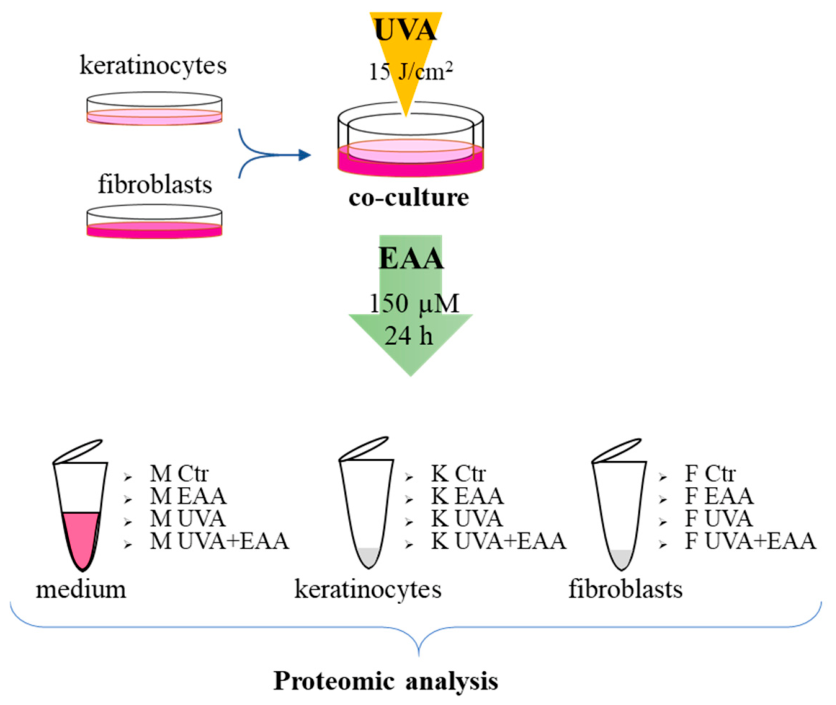
Skin Cells’ Protection Against UVA-Induced Changes in Co-Cultured Keratinocytes–Fibroblasts’ Proteome and Released Signaling Proteins by 3-O-Ethyl Ascorbic Acid



Abstract
1. Introduction
2. Results
3. Discussion
3.1. Changes in Pro-Inflammatory Protein Expression
3.2. Changes in Antioxidant Protein Levels
3.3. Changes in the Expression of Growth Factors
4. Materials and Methods
4.1. Cell Culture and Treatment
4.2. Viability Assay
4.3. Proteomic Analysis
4.4. Protein Identification and Label-Free Quantification
4.5. Statistical Analysis
5. Conclusions
Supplementary Materials
Author Contributions
Funding
Institutional Review Board Statement
Informed Consent Statement
Data Availability Statement
Acknowledgments
Conflicts of Interest
Abbreviations
| 4-HNE | 4-hydroxynonenal |
| AKT | protein kinase B |
| ANOVA | analysis of variance |
| CAT | catalase |
| cMYB/PI3K | transcription factor MYB/phosphoinositide-3-protein kinase |
| COX | cyclooxygenase |
| c-Rel | cellular homolog of v-Rel |
| EAA | 3-O-ethyl ascorbic acid |
| EGF | epidermal growth factor |
| GO | Gene Ontology |
| GSH-Px | glutathione peroxidase |
| HGF | hepatocyte growth factor |
| IFN | interferon |
| IL | interleukin |
| KGF | keratinocyte growth factor |
| LC/MS | liquid chromatography/mass spectrometry |
| LOX | lipoxygenase |
| LSD | least significant difference |
| MAPK | mitogen-activated protein kinase |
| MC1R | melanocortin 1 receptor |
| MDA | malondialdehyde |
| MMP | metalloproteinase |
| NFκB | nuclear factor kappa-light-chain-enhancer of activated B cells |
| Nrf2 | nuclear factor erythroid 2-related factor 2 |
| p38 | protein 38 |
| p50 | protein 50 |
| p52 | protein 52 |
| PBS | phosphate-buffered saline |
| PCA | principal component analysis |
| PKC | protein kinase C |
| PLA2 | phospholipase A2 |
| PUFA | polyunsaturated fatty acid |
| RelA | REL-associated protein A |
| ROS | reactive oxygen species |
| SOD | superoxide dismutase |
| TGF | transforming growth factor |
| TNF | tumor necrosis factor |
| TRP | transient receptor potential |
References
- Finlayson, L.; Barnard, I.R.M.; McMillan, L.; Ibbotson, S.H.; Brown, C.T.A.; Eadie, E.; Wood, K. Depth Penetration of Light into Skin as a Function of Wavelength from 200 to 1000 Nm. Photochem. Photobiol. 2022, 98, 974–981. [Google Scholar] [CrossRef] [PubMed]
- Souza, C.; Mônico, D.A.; Tedesco, A.C. Implications of Dichlorofluorescein Photoinstability for Detection of UVA-Induced Oxidative Stress in Fibroblasts and Keratinocyte Cells. Photochem. Photobiol. Sci. 2020, 19, 40–48. [Google Scholar] [CrossRef] [PubMed]
- Ryšavá, A.; Čížková, K.; Franková, J.; Roubalová, L.; Ulrichová, J.; Vostálová, J.; Vrba, J.; Zálešák, B.; Rajnochová Svobodová, A. Effect of UVA Radiation on the Nrf2 Signalling Pathway in Human Skin Cells. J. Photochem. Photobiol. B Biol. 2020, 209, 111948. [Google Scholar] [CrossRef] [PubMed]
- Jastrząb, A.; Jarocka-Karpowicz, I.; Markowska, A.; Wroński, A.; Gęgotek, A.; Skrzydlewska, E. Antioxidant and Anti-Inflammatory Effect of Cannabidiol Contributes to the Decreased Lipid Peroxidation of Keratinocytes of Rat Skin Exposed to UV Radiation. Oxidative Med. Cell. Longev. 2021, 2021, 6647222. [Google Scholar] [CrossRef]
- Zhao, H.-C.; Xiao, T.; Chen, Y.-J. Ultraviolet Induced Skin Inflammation. Int. J. Dermatol. Venereol. 2021, 4, 229–235. [Google Scholar] [CrossRef]
- Yuan, X.; Li, H.; Lee, J.S.; Lee, D.H. Role of Mitochondrial Dysfunction in UV-Induced Photoaging and Skin Cancers. Exp. Dermatol. 2025, 34, e70114. [Google Scholar] [CrossRef] [PubMed]
- Vasques, L.I.; Vendruscolo, C.W.; Leonardi, G.R. Topical Application of Ascorbic Acid and Its Derivatives: A ReviewConsidering Clinical Trials. Curr. Med. Chem. 2023, 30, 3272–3286. [Google Scholar] [CrossRef] [PubMed]
- Zerbinati, N.; Sommatis, S.; Maccario, C.; Di Francesco, S.; Capillo, M.C.; Rauso, R.; Herrera, M.; Bencini, P.L.; Guida, S.; Mocchi, R. The Anti-Ageing and Whitening Potential of a Cosmetic Serum Containing 3-O-Ethyl-l-Ascorbic Acid. Life 2021, 11, 406. [Google Scholar] [CrossRef] [PubMed]
- Iliopoulos, F.; Chapman, A.; Lane, M.E. A Comparison of the in Vitro Permeation of 3-O-Ethyl-l-Ascorbic Acid in Human Skin and in a Living Skin Equivalent (LabSkinTM). Int. J. Cosmet. Sci. 2021, 43, 107–112. [Google Scholar] [CrossRef] [PubMed]
- Jin, S.; Miao, X. 3-O-Ethyl-l-Ascorbic Acid. Acta Crystallogr. Sect. E 2008, 64, o860. [Google Scholar] [CrossRef] [PubMed]
- Golonka, I.; Oleksy, M.; Junka, A.; Matera-Witkiewicz, A.; Bartoszewicz, M.; Musiał, W. Selected Physicochemical and Biological Properties of Ethyl Ascorbic Acid Compared to Ascorbic Acid. Biol. Pharm. Bull. 2017, 40, 1199–1206. [Google Scholar] [CrossRef] [PubMed][Green Version]
- Iliopoulos, F.; Sil, B.C.; Moore, D.J.; Lucas, R.A.; Lane, M.E. 3-O-Ethyl-l-Ascorbic Acid: Characterisation and Investigation of Single Solvent Systems for Delivery to the Skin. Int. J. Pharm. X 2019, 1, 100025. [Google Scholar] [CrossRef] [PubMed]
- Gęgotek, A.; Mucha, M.; Skrzydlewska, E. Skin Cells Protection against UVA Radiation—The Comparison of Various Antioxidants and Viability Tests. Biomed. Pharmacother. 2024, 181, 117736. [Google Scholar] [CrossRef] [PubMed]
- Chen, S.J.; Hseu, Y.C.; Gowrisankar, Y.V.; Chung, Y.T.; Zhang, Y.Z.; Way, T.D.; Yang, H.L. The Anti-Melanogenic Effects of 3-O-Ethyl Ascorbic Acid via Nrf2-Mediated α-MSH Inhibition in UVA-Irradiated Keratinocytes and Autophagy Induction in Melanocytes. Free Radic. Biol. Med. 2021, 173, 151–169. [Google Scholar] [CrossRef] [PubMed]
- Gęgotek, A.; Jarocka-Karpowicz, I.; Ryšavá, A.; Žarković, N.; Skrzydlewska, E. Proteomic Analysis of the Combined Effects of Cannabigerol and 3-O-Ethyl Ascorbic Acid on Kinase-Dependent Signalling in UVB-Irradiated Human Keratinocytes. Sci. Rep. 2024, 14, 27799. [Google Scholar] [CrossRef] [PubMed]
- Gęgotek, A.; Jarocka-Karpowicz, I.; Atalay Ekiner, S.; Skrzydlewska, E. The Anti-Inflammatory Action of Cannabigerol Accompanied by the Antioxidant Effect of 3-O-Ethyl Ascorbic Acid in UVA-Irradiated Human Keratinocytes. J. Pharmacol. Exp. Ther. 2023, 387, 170–179. [Google Scholar] [CrossRef] [PubMed]
- Jarocka-Karpowicz, I.; Dobrzyńska, I.; Stasiewicz, A.; Skrzydlewska, E. 3-O-Ethyl Ascorbic Acid and Cannabigerol in Modulating the Phospholipid Metabolism of Keratinocytes. Antioxidants 2024, 13, 1285. [Google Scholar] [CrossRef] [PubMed]
- Miki, Y.; Ono, K.; Hata, S.; Suzuki, T.; Kumamoto, H.; Sasano, H. The Advantages of Co-Culture over Mono Cell Culture in Simulating in Vivo Environment. J. Steroid Biochem. Mol. Biol. 2012, 131, 68–75. [Google Scholar] [CrossRef] [PubMed]
- Jeon, Y.K.; Jang, Y.H.; Yoo, D.R.; Kim, S.N.; Lee, S.K.; Nam, M.J. Mesenchymal Stem Cells’ Interaction with Skin: Wound-Healing Effect on Fibroblast Cells and Skin Tissue. Wound Repair Regen. 2010, 18, 655–661. [Google Scholar] [CrossRef] [PubMed]
- Pajoum Shariati, S.R.; Shokrgozar, M.A.; Vossoughi, M.; Eslamifar, A. In Vitro Co-Culture of Human Skin Keratinocytes and Fibroblasts on a Biocompatible and Biodegradable Scaffold. Iran. Biomed. J. 2009, 13, 169–177. [Google Scholar] [PubMed]
- Andrade, T.A.M.; da Silva, V.A.; Scheck, K.; Garay, T.; Sharma, R.; Willerth, S.M. 3D Bioprinting a Novel Skin Co-Culture Model Using Human Keratinocytes and Fibroblasts. J. Biomed. Mater. Res. Part A 2025, 113, e37831. [Google Scholar] [CrossRef]
- Colwell, A.S.; Yun, R.; Krummel, T.M.; Longaker, M.T.; Lorenz, H.P. Keratinocytes Modulate Fetal and Postnatal Fibroblast Transforming Growth Factor-β and Smad Expression in Co-Culture. Plast. Reconstr. Surg. 2007, 119, 1440. [Google Scholar] [CrossRef] [PubMed]
- Spandidos Publications: Molecular Medicine Reports. Available online: https://www.spandidos-publications.com/mmr (accessed on 29 October 2025).
- Iyer, K.; Chen, Z.; Ganapa, T.; Wu, B.M.; Tawil, B.; Linsley, C.S. Keratinocyte Migration in a Three-Dimensional In Vitro Wound Healing Model Co-Cultured with Fibroblasts. Tissue Eng. Regen. Med. 2018, 15, 721–733. [Google Scholar] [CrossRef] [PubMed]
- Loo, A.E.K.; Halliwell, B. Effects of Hydrogen Peroxide in a Keratinocyte-Fibroblast Co-Culture Model of Wound Healing. Biochem. Biophys. Res. Commun. 2012, 423, 253–258. [Google Scholar] [CrossRef] [PubMed]
- Liu, L.; Xie, H.; Chen, X.; Shi, W.; Xiao, X.; Lei, D.; Li, J. Differential Response of Normal Human Epidermal Keratinocytes and HaCaT Cells to Hydrogen Peroxide-induced Oxidative Stress. Clin. Exp. Dermatol. 2012, 37, 772–780. [Google Scholar] [CrossRef] [PubMed]
- Pieńkowska, N.; Bartosz, G.; Pichla, M.; Grzesik-Pietrasiewicz, M.; Gruchala, M.; Sadowska-Bartosz, I. Effect of Antioxidants on the H2O2-Induced Premature Senescence of Human Fibroblasts. Aging 2020, 12, 1910–1927. [Google Scholar] [CrossRef] [PubMed]
- Romita, P.; Foti, C.; Barlusconi, C.; Mercurio, S.; Hansel, K.; Stingeni, L. Allergic Contact Dermatitis to 3-O-Ethyl-L-Ascorbic Acid: An Underrated Allergen in Cosmetics? Contact Dermat. 2020, 83, 63–64. [Google Scholar] [CrossRef] [PubMed]
- Suzuki, K.; Futamura, K.; Nishimura, A.; Matsunaga, K.; Yagami, A. Seven Cases of Allergic Contact Dermatitis Caused by Cosmetics Containing 3-O-Ethyl-L-Ascorbic Acid. Contact Dermat. 2022, 86, 421–423. [Google Scholar] [CrossRef] [PubMed]
- Salminen, A.; Kaarniranta, K.; Kauppinen, A. Photoaging: UV Radiation-Induced Inflammation and Immunosuppression Accelerate the Aging Process in the Skin. Inflamm. Res. 2022, 71, 817–831. [Google Scholar] [CrossRef] [PubMed]
- Gęgotek, A.; Biernacki, M.; Ambrożewicz, E.; Surażyński, A.; Wroński, A.; Skrzydlewska, E. The Cross-Talk between Electrophiles, Antioxidant Defence and the Endocannabinoid System in Fibroblasts and Keratinocytes after UVA and UVB Irradiation. J. Dermatol. Sci. 2016, 81, 107–117. [Google Scholar] [CrossRef] [PubMed]
- Clydesdale, G.J.; Dandie, G.W.; Muller, H.K. Ultraviolet Light Induced Injury: Immunological and Inflammatory Effects. Immunol. Cell Biol. 2001, 79, 547–568. [Google Scholar] [CrossRef] [PubMed]
- Bhartiya, P.; Masur, K.; Shome, D.; Kaushik, N.; Nguyen, L.N.; Kaushik, N.K.; Choi, E.H. Influence of Redox Stress on Crosstalk between Fibroblasts and Keratinocytes. Biology 2021, 10, 1338. [Google Scholar] [CrossRef] [PubMed]
- Dhaka, N.; Misra, S.; Sahoo, S.; Mukherjee, S.P. Biophysical Characterization of RelA-P52 NF-κB Dimer-A Link between the Canonical and the Non-Canonical NF-κB Pathway. Protein Sci. 2024, 33, e5184. [Google Scholar] [CrossRef] [PubMed]
- Perkins, N.D. The Diverse and Complex Roles of NF-κB Subunits in Cancer. Nat. Rev. Cancer 2012, 12, 121–132. [Google Scholar] [CrossRef] [PubMed]
- Istiqomah, N.; Nirwana, H.M.; Mulya, S.N.; Fransisca, F. Development of a Vitamin C Derivative Serum for Pre-Aging Skin: Raw Material Screening, Stability and Clinical Evaluation. J. Multidiscip. Appl. Nat. Sci. 2025, 5, 934–948. [Google Scholar] [CrossRef]
- Ryšavá, A.; Vostálová, J.; Rajnochová Svobodová, A. Effect of Ultraviolet Radiation on the Nrf2 Signaling Pathway in Skin Cells. Int. J. Radiat. Biol. 2021, 97, 1383–1403. [Google Scholar] [CrossRef] [PubMed]
- Jarocka-Karpowicz, I.; Stasiewicz, A.; Olchowik-Grabarek, E.; Sękowski, S.; Kacprowska, A.; Skrzydlewska, E. Antioxidant and Membrane-Protective Effects of the 3-O-Ethyl Ascorbic Acid-Cannabigerol System on UVB-Irradiated Human Keratinocytes. Free Radic. Biol. Med. 2025, 228, 251–266. [Google Scholar] [CrossRef] [PubMed]
- Menegon, S.; Columbano, A.; Giordano, S. The Dual Roles of NRF2 in Cancer. Trends Mol. Med. 2016, 22, 578–593. [Google Scholar] [CrossRef] [PubMed]
- Brand, K.A.; Hermfisse, U. Aerobic Glycolysis by Proliferating Cells: A Protective Strategy against Reactive Oxygen Species. FASEB J. 1997, 11, 388–395. [Google Scholar] [CrossRef] [PubMed]
- Sattler, U.G.A.; Mueller-Klieser, W. The Anti-Oxidant Capacity of Tumour Glycolysis. Int. J. Radiat. Biol. 2009, 85, 963–971. [Google Scholar] [CrossRef] [PubMed]
- Centeno, P.P.; Pavet, V.; Marais, R. The Journey from Melanocytes to Melanoma. Nat. Rev. Cancer 2023, 23, 372–390. [Google Scholar] [CrossRef] [PubMed]
- Hintsala, H.-R.; Soini, Y.; Haapasaari, K.-M.; Karihtala, P. Dysregulation of Redox-State-Regulating Enzymes in Melanocytic Skin Tumours and the Surrounding Microenvironment. Histopathology 2015, 67, 348–357. [Google Scholar] [CrossRef] [PubMed]
- Zhou, P.; Feng, H.; Qin, W.; Li, Q. KRT17 from Skin Cells with High Glucose Stimulation Promotes Keratinocytes Proliferation and Migration. Front. Endocrinol. 2023, 14, 1237048. [Google Scholar] [CrossRef] [PubMed]
- Grøn, B.; Stoltze, K.; Andersson, A.; Dabelsteen, E. Oral Fibroblasts Produce More HGF and KGF than Skin Fibroblasts in Response to Co-Culture with Keratinocytes. APMIS 2002, 110, 892–898. [Google Scholar] [CrossRef] [PubMed]
- Wang, Z.; Wang, Y.; Farhangfar, F.; Zimmer, M.; Zhang, Y. Enhanced Keratinocyte Proliferation and Migration in Co-Culture with Fibroblasts. PLoS ONE 2012, 7, e40951. [Google Scholar] [CrossRef] [PubMed]
- Shilov, V.N.; Sergienko, V.I. Oxidative Stress in Keratinocytes as an Etiopathogenetic Factor of Psoriasis. Bull. Exp. Biol. Med. 2000, 129, 309–313. [Google Scholar] [CrossRef] [PubMed]
- Medovic, M.V.; Jakovljevic, V.L.; Zivkovic, V.I.; Jeremic, N.S.; Jeremic, J.N.; Bolevich, S.B.; Ravic Nikolic, A.B.; Milicic, V.M.; Srejovic, I.M. Psoriasis between Autoimmunity and Oxidative Stress: Changes Induced by Different Therapeutic Approaches. Oxidative Med. Cell. Longev. 2022, 2022, 2249834. [Google Scholar] [CrossRef] [PubMed]
- Finch, P.W.; Murphy, F.; Cardinale, I.; Krueger, J.G. Altered Expression of Keratinocyte Growth Factor and Its Receptor in Psoriasis. Am. J. Pathol. 1997, 151, 1619–1628. [Google Scholar] [PubMed]
- McKay, I.A.; Leigh, I.M. Altered Keratinocyte Growth and Differentiation in Psoriasis. Clin. Dermatol. 1995, 13, 105–114. [Google Scholar] [CrossRef] [PubMed]
- El Ghalbzouri, A.; Lamme, E.; Ponec, M. Crucial Role of Fibroblasts in Regulating Epidermal Morphogenesis. Cell Tissue Res. 2002, 310, 189–199. [Google Scholar] [CrossRef] [PubMed]
- Wei, J.; Zhan, J.; Ji, H.; Xu, Y.; Xu, Q.; Zhu, X.; Liu, Y. Fibroblast Upregulation of Vitamin D Receptor Represents a Self-Protective Response to Limit Fibroblast Proliferation and Activation during Pulmonary Fibrosis. Antioxidants 2023, 12, 1634. [Google Scholar] [CrossRef] [PubMed]
- Mi, B.; Liu, G.; Zhou, W.; Lv, H.; Zha, K.; Liu, Y.; Wu, Q.; Liu, J. Bioinformatics Analysis of Fibroblasts Exposed to TGF-β at the Early Proliferation Phase of Wound Repair. Mol. Med. Rep. 2017, 16, 8146–8154. [Google Scholar] [CrossRef] [PubMed]
- Nakyai, W.; Saraphanchotiwitthaya, A.; Viennet, C.; Humbert, P.; Viyoch, J. An In Vitro Model for Fibroblast Photoaging Comparing Single and Repeated UVA Irradiations. Photochem. Photobiol. 2017, 93, 1462–1471. [Google Scholar] [CrossRef] [PubMed]
- Lan, C.-C.E.; Hung, Y.-T.; Fang, A.-H.; Ching-Shuang, W. Effects of Irradiance on UVA-Induced Skin Aging. J. Dermatol. Sci. 2019, 94, 220–228. [Google Scholar] [CrossRef] [PubMed]
- Tewari, A.; Grys, K.; Kollet, J.; Sarkany, R.; Young, A.R. Upregulation of MMP12 and Its Activity by UVA1 in Human Skin: Potential Implications for Photoaging. J. Investig. Dermatol. 2014, 134, 2598–2609. [Google Scholar] [CrossRef] [PubMed]
- Steinbrenner, H.; Ramos, M.C.; Stuhlmann, D.; Sies, H.; Brenneisen, P. UVA-Mediated Downregulation of MMP-2 and MMP-9 in Human Epidermal Keratinocytes. Biochem. Biophys. Res. Commun. 2003, 308, 486–491. [Google Scholar] [CrossRef] [PubMed]
- Liao, W.C.; Huang, Y.-T.; Lu, L.-P.; Huang, W.-Y. Antioxidant Ability and Stability Studies of 3-O-Ethyl Ascorbic Acid, a Cosmetic Tyrosinase Inhibitor. J. Cosmet. Sci. 2018, 69, 233–243. [Google Scholar] [PubMed]
- Bradford, M.M. A Rapid and Sensitive Method for the Quantitation of Microgram Quantities of Protein Utilizing the Principle of Protein-Dye Binding. Anal. Biochem. 1976, 72, 248–254. [Google Scholar] [CrossRef] [PubMed]
- Medzihradszky, K.F. In-Solution Digestion of Proteins for Mass Spectrometry. Methods Enzym. 2005, 405, 50–65. [Google Scholar] [CrossRef] [PubMed]
- Gęgotek, A.; Brańska-Januszewska, J.; Samocik, P.; Kozłowski, R.; Koda, M.; Zarkovic, N.; Skrzydlewska, E.; Ostrowska, H. Protein Modifications by Advanced Glycation End Products (AGEs) in Human Clear Cell Renal Cell Carcinoma. J. Transl. Med. 2025, 23, 914. [Google Scholar] [CrossRef] [PubMed]
- Pang, Z.; Lu, Y.; Zhou, G.; Hui, F.; Xu, L.; Viau, C.; Spigelman, A.F.; MacDonald, P.E.; Wishart, D.S.; Li, S.; et al. MetaboAnalyst 6.0: Towards a Unified Platform for Metabolomics Data Processing, Analysis and Interpretation. Nucleic Acids Res. 2024, 52, W398–W406. [Google Scholar] [CrossRef] [PubMed]
- Thomas, P.D.; Ebert, D.; Muruganujan, A.; Mushayahama, T.; Albou, L.-P.; Mi, H. PANTHER: Making Genome-Scale Phylogenetics Accessible to All. Protein Sci. 2022, 31, 8–22. [Google Scholar] [CrossRef] [PubMed]
- Szklarczyk, D.; Kirsch, R.; Koutrouli, M.; Nastou, K.; Mehryary, F.; Hachilif, R.; Gable, A.L.; Fang, T.; Doncheva, N.T.; Pyysalo, S.; et al. The STRING Database in 2023: Protein-Protein Association Networks and Functional Enrichment Analyses for Any Sequenced Genome of Interest. Nucleic Acids Res. 2023, 51, D638–D646. [Google Scholar] [CrossRef] [PubMed]
- Perez-Riverol, Y.; Bai, J.; Bandla, C.; García-Seisdedos, D.; Hewapathirana, S.; Kamatchinathan, S.; Kundu, D.J.; Prakash, A.; Frericks-Zipper, A.; Eisenacher, M.; et al. The PRIDE Database Resources in 2022: A Hub for Mass Spectrometry-Based Proteomics Evidences. Nucleic Acids Res. 2021, 50, D543–D552. [Google Scholar] [CrossRef] [PubMed]


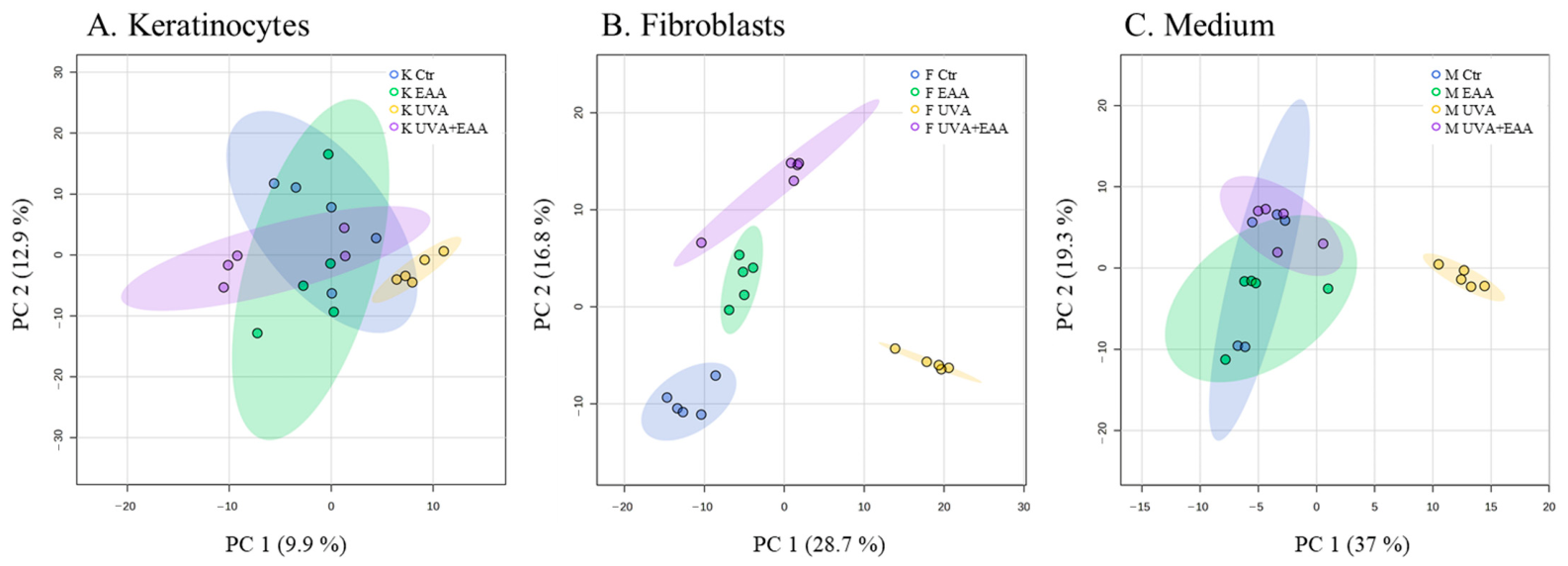


Disclaimer/Publisher’s Note: The statements, opinions and data contained in all publications are solely those of the individual author(s) and contributor(s) and not of MDPI and/or the editor(s). MDPI and/or the editor(s) disclaim responsibility for any injury to people or property resulting from any ideas, methods, instructions or products referred to in the content. |
© 2026 by the authors. Licensee MDPI, Basel, Switzerland. This article is an open access article distributed under the terms and conditions of the Creative Commons Attribution (CC BY) license.
Share and Cite
Gęgotek, A.; Jarocka-Karpowicz, I.; Mucha, M.; Skrzydlewska, E. Skin Cells’ Protection Against UVA-Induced Changes in Co-Cultured Keratinocytes–Fibroblasts’ Proteome and Released Signaling Proteins by 3-O-Ethyl Ascorbic Acid. Int. J. Mol. Sci. 2026, 27, 5551. https://doi.org/10.3390/ijms27125551
Gęgotek A, Jarocka-Karpowicz I, Mucha M, Skrzydlewska E. Skin Cells’ Protection Against UVA-Induced Changes in Co-Cultured Keratinocytes–Fibroblasts’ Proteome and Released Signaling Proteins by 3-O-Ethyl Ascorbic Acid. International Journal of Molecular Sciences. 2026; 27(12):5551. https://doi.org/10.3390/ijms27125551
Chicago/Turabian StyleGęgotek, Agnieszka, Iwona Jarocka-Karpowicz, Magda Mucha, and Elżbieta Skrzydlewska. 2026. "Skin Cells’ Protection Against UVA-Induced Changes in Co-Cultured Keratinocytes–Fibroblasts’ Proteome and Released Signaling Proteins by 3-O-Ethyl Ascorbic Acid" International Journal of Molecular Sciences 27, no. 12: 5551. https://doi.org/10.3390/ijms27125551
APA StyleGęgotek, A., Jarocka-Karpowicz, I., Mucha, M., & Skrzydlewska, E. (2026). Skin Cells’ Protection Against UVA-Induced Changes in Co-Cultured Keratinocytes–Fibroblasts’ Proteome and Released Signaling Proteins by 3-O-Ethyl Ascorbic Acid. International Journal of Molecular Sciences, 27(12), 5551. https://doi.org/10.3390/ijms27125551