Review

Ethnobotany, Phytochemistry, and Pharmacological Activities of Ocimum Species in Low- and Middle-Income Countries: A Systematic Review


by
Chikondi Maluwa
1,2,
Blecious Zinan’dala
1,3,
Hataichanok Chuljerm
1,
Wason Parklak
1 and
Kanokwan Kulprachakarn
1,*
1
School of Health Sciences Research, Research Institute for Health Sciences, Chiang Mai University, Chiang Mai 50200, Thailand
2
Department of Clinical Sciences, Malawi College of Health Sciences, Blantyre Campus, Blantyre Private Bag 396, Malawi
3
Department of Clinical Sciences, Malawi College of Health Sciences, Lilongwe Campus, Lilongwe P.O. Box 30368, Malawi
*
Author to whom correspondence should be addressed.
Int. J. Mol. Sci. 2026, 27(12), 5540; https://doi.org/10.3390/ijms27125540
Submission received: 18 May 2026 / Revised: 8 June 2026 / Accepted: 15 June 2026 / Published: 18 June 2026
(This article belongs to the Special Issue The Role of Medicinal Plants in Health and Diseases)

Abstract

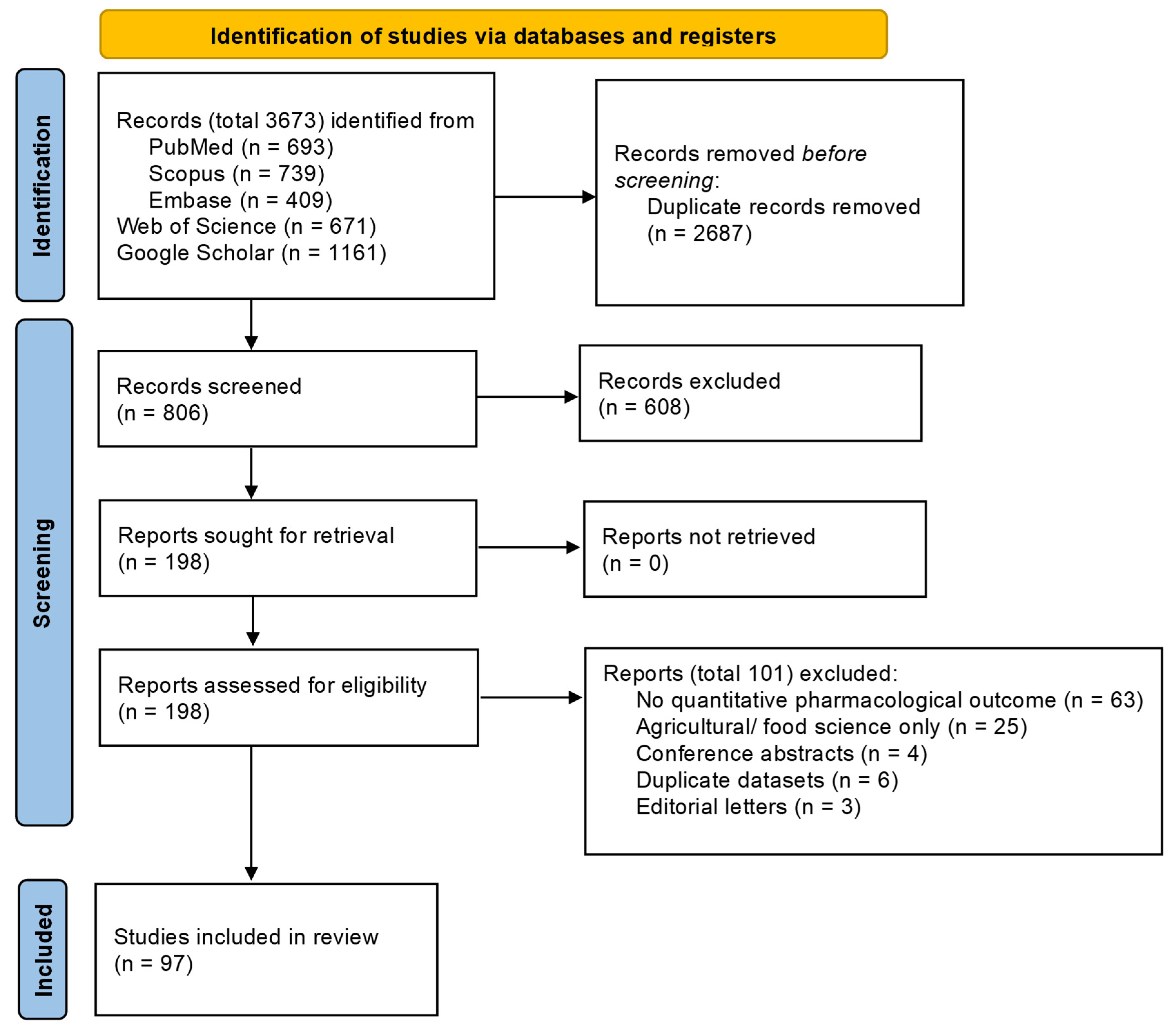
Ocimum species (family Lamiaceae) are among the most extensively utilized medicinal plants across low- and middle-income countries (LMICs), yet their pharmacological evidence base has not been comprehensively synthesized within an LMIC healthcare framework. A systematic review was conducted following PRISMA 2020 guidelines and a prospectively registered protocol (PROSPERO). Five electronic databases, PubMed, Scopus, Embase, Web of Science, and Google Scholar, were searched from January 2010 to December 2025. Studies reporting ethnobotanical, phytochemical, or pharmacological data on any Ocimum species were eligible. The study selection, quality assessment and data extraction were done by two independent reviewers utilizing Rayyan software. Findings were synthesized using a narrative approach. Ninety-seven studies were included. O. basilicum, O. tenuiflorum, and O. gratissimum were most studied. Key bioactive constituents rosmarinic acid, eugenol, linalool, β-caryophyllene, and ursolic acid, demonstrated consistent antimicrobial [minimum inhibitory concentration (MIC): 0.31–1.25 mg/mL], antioxidant [2,2-diphenyl-1-picrylhydrazyl (DPPH) IC50: 12.5–89.3 µg/mL], anti-inflammatory (35–55% edema reduction), and antidiabetic (α-glucosidase IC50: 0.3–1.5 mg/mL) activities. Larvicidal efficacy exceeding 90% against Anopheles spp. was demonstrated in field trials. The safety profile was broadly favorable (LD50 > 5000 mg/kg). Ocimum species represent a pharmacologically credible and preclinically well-supported botanical resource with practical relevance for LMIC health systems, particularly in antimicrobial, antidiabetic, anti-inflammatory, and vector-control applications. To realize their therapeutic potential, future research must prioritize LMIC-contextualized randomized controlled trials, standardized phytochemical reporting, and chemotype-aware product development.
Keywords: Ocimum; basil; ethnopharmacology; phytochemistry; essential oils; pharmacological activity; traditional medicine; systematic review; low- and middle-income countries Ocimum; basil; ethnopharmacology; phytochemistry; essential oils; pharmacological activity; traditional medicine; systematic review; low- and middle-income countries