This is an early access version, the complete PDF, HTML, and XML versions will be available soon.
Article

Systems Biology and Atomistic Simulations Reveal Multi-Target Modulation of Alzheimer’s Disease and Type 2 Diabetes by Caesalpinia sappan Bioactives

1
Department of Health Sciences, The Graduate School of Dong-A University, Busan 49315, Republic of Korea
2
Department of Food Science and Nutrition, Dong-A University, Busan 49315, Republic of Korea
3
Center for Food & Bio Innovation, DAU G-LAMP Project Group, Dong-A University, Busan 49315, Republic of Korea
*
Author to whom correspondence should be addressed.
These authors contributed equally to this work.
Int. J. Mol. Sci. 2026, 27(12), 5300; https://doi.org/10.3390/ijms27125300
Submission received: 24 April 2026 / Revised: 8 June 2026 / Accepted: 8 June 2026 / Published: 11 June 2026

Abstract

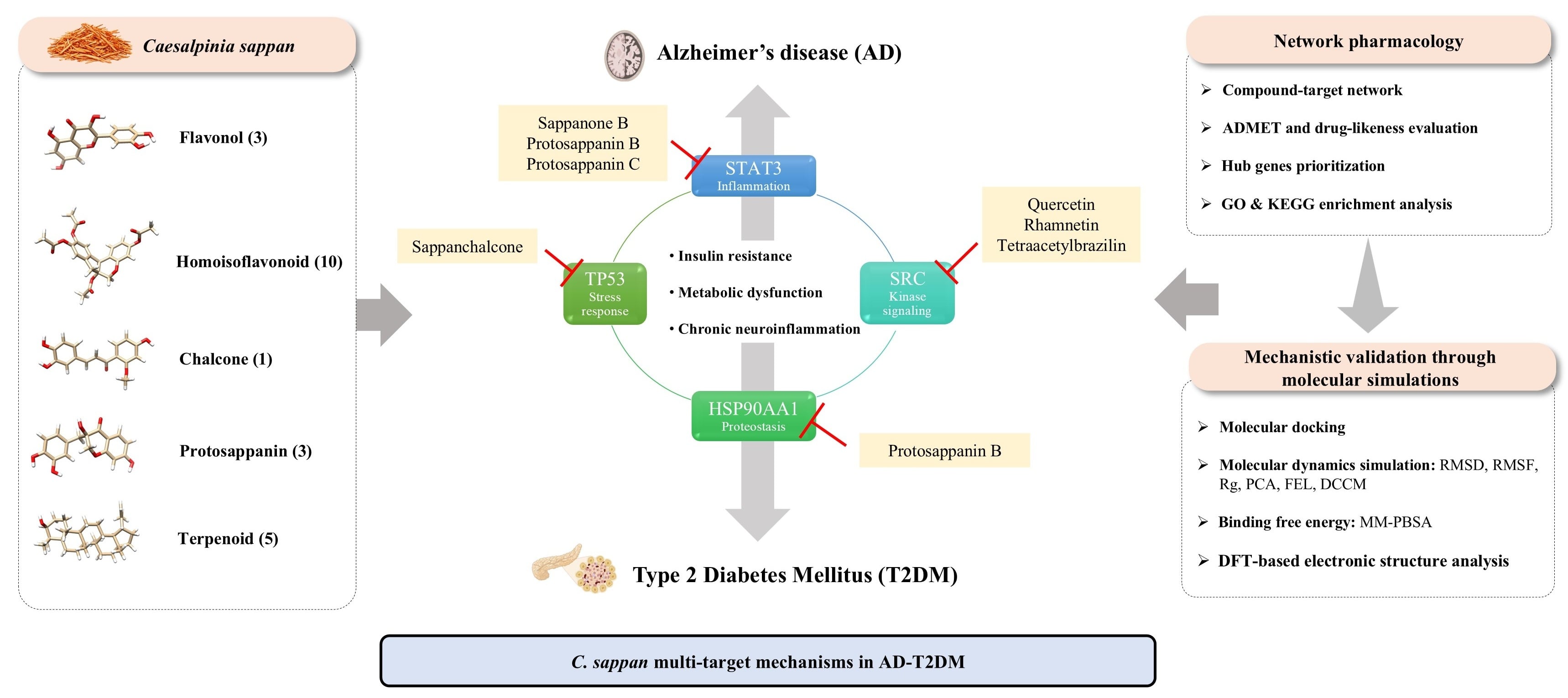
Alzheimer’s disease (AD) and type 2 diabetes mellitus (T2DM) are major global health burdens that share interconnected pathological mechanisms involving impaired insulin signaling, metabolic stress, and chronic neuroinflammation. This study applied an integrative systems biology and atomistic simulation framework to investigate bioactive compounds from Caesalpinia sappan L. targeting shared molecular regulators linking AD and T2DM. Network topology analysis identified four central hub genes, STAT3, SRC, HSP90AA1, and TP53, representing key regulatory nodes involved in inflammatory signaling, kinase regulation, proteostasis, and cellular stress responses. Compound-specific interaction analysis revealed distinct target preferences among phytochemical subclasses. Protosappanin B showed strong binding toward both STAT3 and HSP90α, whereas flavonols including quercetin and rhamnetin exhibited high affinity for SRC, and the chalcone derivative sappanchalcone preferentially interacted with TP53. Atomistic molecular dynamics simulations and MM-PBSA calculations supported stable protein ligand interactions and favorable binding energetics, while density functional theory analysis indicated electronic properties consistent with sustained intermolecular interactions. Collectively, these findings suggest that structurally distinct subclasses of C. sappan phytochemicals converge on complementary regulatory hubs within the shared AD and T2DM molecular network, supporting coordinated multi-target modulation of interconnected inflammatory, kinase signaling, proteostasis, and cellular stress pathways underlying AD–T2DM comorbidity.
Keywords: Alzheimer’s diseases; type 2 diabetes mellitus; Caesalpinia sappan; systems biology; molecular docking; molecular dynamics; density functional theory Alzheimer’s diseases; type 2 diabetes mellitus; Caesalpinia sappan; systems biology; molecular docking; molecular dynamics; density functional theory
Graphical Abstract