Review

Astragalus and Cordyceps Derivatives in the Treatment of Aging-Related Chronic Diseases and Neurodegenerative Disorders

1
Department of Physics, National Dong Hwa University, Hualien 97401, Taiwan
2
Department of Life Science, National Dong Hwa University, Hualien 974301, Taiwan
3
Department of Healthcare Administration, Asia University, Taichung 413305, Taiwan
4
Department of Pathology, Hualien Tzu Chi Hospital, Hualien 97002, Taiwan
5
Bioinnovation Center, Buddhist Tzu Chi Medical Foundation, Hualien 97002, Taiwan
6
Department of Neurology, Hualien Tzu Chi Hospital, Hualien 97002, Taiwan
7
Department of Medical Research, Hualien Tzu Chi Hospital, Buddhist Tzu Chi Medical Foundation, Hualien 97002, Taiwan
*
Authors to whom correspondence should be addressed.
Int. J. Mol. Sci. 2026, 27(12), 5273; https://doi.org/10.3390/ijms27125273
Submission received: 10 April 2026 / Revised: 17 May 2026 / Accepted: 27 May 2026 / Published: 10 June 2026

Abstract

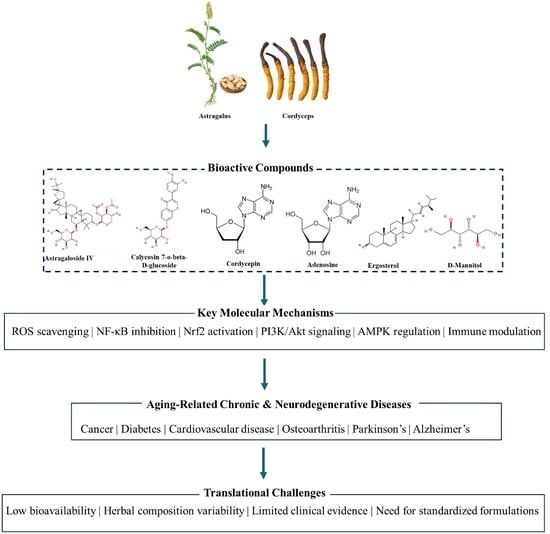
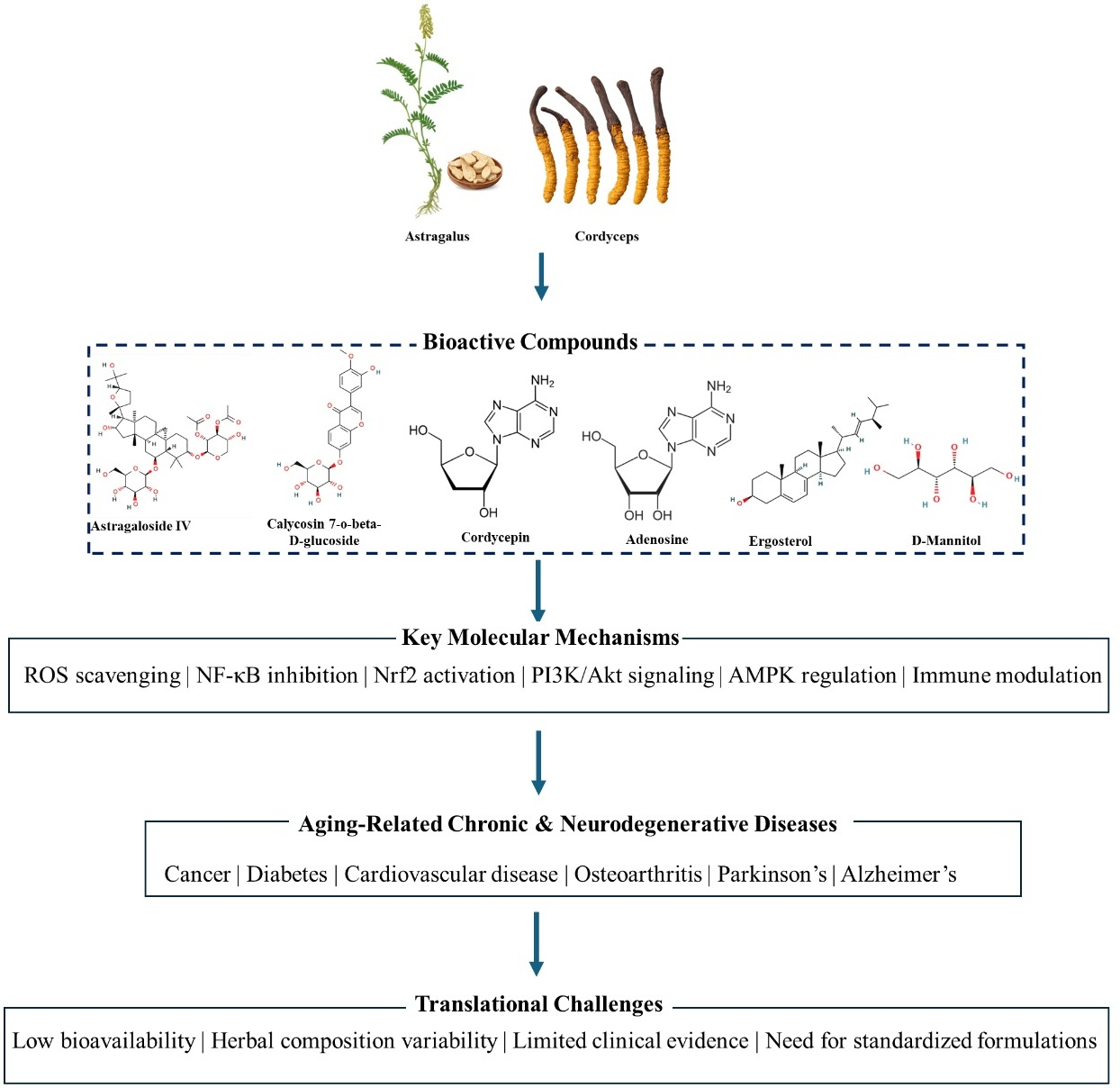
Aging is associated with a rising burden of chronic metabolic, cardiovascular, musculoskeletal, and neurodegenerative diseases that share interconnected pathological mechanisms, including oxidative stress, chronic inflammation, mitochondrial dysfunction, metabolic imbalance, and immune dysregulation. Because these disorders arise from complex and overlapping biological disturbances, conventional single-target therapies often provide only limited benefit. In this context, traditional Chinese herbal medicines, characterized by multi-component and multi-target actions, are being re-evaluated using modern pharmacological and systems biology approaches. Among these, Astragalus membranaceus and Cordyceps species have attracted attention as representative tonic medicines with long-standing traditional use and growing biomedical relevance. Their principal bioactive constituents, including polysaccharides, saponins, flavonoids, sterols, and nucleoside derivatives such as cordycepin, exert pleiotropic effects on inflammatory signaling, redox homeostasis, mitochondrial function, metabolic regulation, and immune responses. This review summarizes current evidence on bioactive derivatives from Astragalus and Cordyceps in aging-related chronic and neurodegenerative disorders, including diabetes, cardiovascular dysfunction, osteoarthritis, cancer, Alzheimer’s disease, and Parkinson’s disease. It focuses on mechanistic findings from cellular and animal studies and critically discusses key translational challenges, such as compositional variability, poor bioavailability, lack of standardized preparation, limited clinical validation, and safety concerns related to toxicity and herb–drug interactions.

Graphical Abstract

1. Introduction

Traditional Chinese herbal medicines have been widely used for centuries due to their long history, broad accessibility, and rich chemical diversity. Advances in modern extraction, purification, and analytical technologies now allow the isolation and characterization of complex bioactive compounds from medicinal plants according to their physicochemical properties. These developments have facilitated the identification of multiple classes of natural compounds, including polysaccharides, flavonoids, saponins, polyphenols, and nucleosides, which contribute to the pharmacological activities of herbal medicines [1,2,3,4].
Aging is accompanied by a progressive decline in cellular and organ function, leading to an increased incidence of chronic diseases and neurodegenerative disorders. Elderly individuals face elevated risks of conditions such as type 2 diabetes, cardiovascular diseases (including hypertension and atherosclerosis), osteoarthritis, osteoporosis, and neurodegenerative disorders such as Alzheimer’s disease and Parkinson’s disease. These conditions frequently coexist, and many individuals over the age of 60 present with multiple comorbidities that require combination therapies, which can complicate treatment strategies and increase the risk of drug interactions [5,6]. Importantly, these aging-related diseases share several convergent pathological mechanisms, including persistent oxidative stress, chronic inflammation, mitochondrial dysfunction, metabolic dysregulation, impaired proteostasis, and altered cellular signaling pathways. The multifactorial nature of these processes makes it difficult for single-target pharmacological agents to effectively address disease progression [7,8,9].
Accordingly, increasing attention has been directed toward therapeutic strategies that can regulate multiple interconnected pathways involved in aging-related diseases. Traditional Chinese Medicine (TCM) is especially relevant in this regard because herbal medicines typically contain multiple bioactive constituents that act on interconnected molecular and cellular networks. Unlike conventional drugs designed for a single target, herbal-derived compounds often exert pleiotropic effects across diverse biological pathways, allowing them to influence complex disease microenvironments in a context-dependent manner. Modern studies increasingly describe such medicines as “multi-component, multi-target, multi-pathway” therapeutics, and many reports suggest that they can modulate aging-related processes through coordinated effects on inflammation, oxidative injury, metabolism, and stress-response pathways [10,11,12].
Among the many herbs used in TCM, Astragalus membranaceus (Huangqi) and Cordyceps species were selected for this review because they provide a scientifically useful comparison of two distinct medicinal materials that converge on several aging-related pathological mechanisms. Astragalus contains polysaccharides, flavonoids, and saponins, whereas Cordyceps produces bioactive metabolites such as cordycepin, adenosine, polysaccharides, sterols, and peptides. Experimental studies have shown that these constituents possess antioxidant, anti-inflammatory, immunomodulatory, metabolic, and cytoprotective activities. Astragalus has demonstrated protective effects in models of cardiac, cerebral, renal, hepatic, and pulmonary injury, while cordycepin and related Cordyceps-derived compounds have shown promising neuroprotective and anti-inflammatory activities, including attenuation of mitochondrial dysfunction and inflammasome activation in Parkinson’s disease models [13,14,15,16,17]. Together, Astragalus and Cordyceps represent multi-component herbal agents with the potential to target several hallmarks of aging simultaneously.
Although Astragalus is a plant-derived medicine and Cordyceps is a fungus-derived medicine, both have been reported to regulate biological mechanisms closely associated with aging, including oxidative stress, chronic inflammation, mitochondrial dysfunction, metabolic imbalance, immune dysregulation, and neuroinflammatory injury [13,18]. Therefore, discussing these two medicines together allows a balanced comparison of how different natural product systems may influence similar aging-related pathological mechanisms.
From a traditional perspective, both herbs are regarded as restorative tonics used to improve vitality, resilience, and recovery from chronic weakness. Astragalus is primarily associated with qi tonification, whereas Cordyceps is traditionally linked to support of the lung and kidney systems. Although these traditional concepts are not directly equivalent to modern biomedical mechanisms, they provide a historical rationale for the continued investigation of these herbs in aging-related disorders. Increasingly, modern translational studies attempt to connect such traditional indications with measurable biological processes, including immune dysregulation, mitochondrial impairment, chronic inflammation, and reduced regenerative capacity [19].
This review evaluates the current literature on Astragalus and Cordyceps derivatives in aging-related chronic diseases and neurodegenerative disorders. We focus primarily on mechanistic evidence from in vitro and animal studies in models of diabetes, cardiovascular disease, osteoarthritis, cancer, Alzheimer’s disease, and Parkinson’s disease, while also considering available human studies with appropriate caution. In addition to therapeutic mechanisms, this review also considers safety profiles, dose-dependent toxicities, vulnerable patient populations, and potential herb–drug interactions. By emphasizing shared disease mechanisms and the multi-target pharmacology of these herbs, this review aims to provide an integrated and balanced overview of their therapeutic potential, current limitations, and translational prospects in modern biomedical research.

2. Background and Significance

2.1. From Traditional Chinese Medicine (TCM) to Systems-Level Pharmacology

The pharmacological interpretation of TCM differs from the reductionist paradigms that have historically dominated Western drug discovery. Conventional pharmaceutical development has largely followed the “one gene, one target, one disease” model, in which a single molecule acts on a specific molecular target to treat a defined pathology [20,21]. Although this approach has been effective for acute and well-defined conditions, it is often insufficient for multifactorial, chronic, and aging-related diseases, were pathology results from dysregulation across multiple biological pathways. In contrast, TCM formulations typically contain multiple herbs and chemically diverse constituents that collectively regulate interconnected biological processes and support physiological homeostasis [22,23]. This systems-oriented therapeutic philosophy aligns with modern views of complex disease biology and requires integrative analytical frameworks to clarify the mechanisms underlying TCM efficacy.
Polypharmacology refers to the ability of a single compound or a combination of compounds to interact with multiple biological targets and produce therapeutic effects [24]. This concept provides a mechanistic basis for TCM practice, where efficacy is often attributed to interactions among multiple constituents rather than isolated molecular actions. In aging-related disorders, including metabolic disease, cardiovascular dysfunction, and neurodegeneration, pathogenesis involves overlapping mechanisms such as oxidative stress, chronic inflammation, mitochondrial dysfunction, and immune dysregulation [22]. Therefore, multi-target modulation is particularly relevant for these complex diseases. Network pharmacology further extends this concept by integrating systems biology, computational modeling, and bioinformatics to map interactions between herbal constituents and disease-associated molecular networks [25]. This approach helps explain how complex botanical preparations influence biological networks and provides a rational framework for interpreting TCM interventions [23,26].
Beyond network-level interactions, allosteric modulation may provide additional insight into the regulatory actions of some herbal compounds. In this mechanism, ligands bind to sites distinct from the active site and induce conformational changes that fine-tune protein function [27]. Such effects may partly explain the mild and sustained physiological responses reported for certain phytochemicals, although allosteric modulation should not be viewed as a universal mechanism of TCM efficacy [28].
Another important dimension of TCM pharmacology is the interaction between orally administered herbal compounds and the gut microbiota. The gastrointestinal tract contains a complex microbial ecosystem that contributes to host metabolism, immune regulation, and inflammatory control. A bidirectional relationship exists between herbal medicines and the gut microbiome [29]. Herbal constituents such as polysaccharides and saponins can act as prebiotics, reshaping microbial composition and metabolic activity, while gut microbes can convert poorly absorbed parent compounds into bioactive metabolites with improved systemic availability [30,31]. This interaction is especially relevant to aging-related metabolic and inflammatory disorders, where microbiome dysbiosis is commonly observed. Short-chain fatty acids generated from microbial fermentation of polysaccharides can also exert immunomodulatory, anti-inflammatory, and metabolic effects. Therefore, the gut–microbiota axis represents a key interface through which herbal medicines may produce systemic effects [29,32,33,34,35].
In parallel, modernization of Chinese herbal medicine has been supported by advances in extraction, purification, and standardization technologies. These approaches help convert complex plant materials into more reproducible preparations suitable for pharmacological, mechanistic, efficacy, and safety studies [36].
Collectively, these systems-level mechanisms help explain the reported antioxidant, anti-inflammatory, metabolic, and immunomodulatory effects of Chinese herbal medicines in aging-related disorders.

2.2. Major Bioactive Compound Classes and Structural Considerations

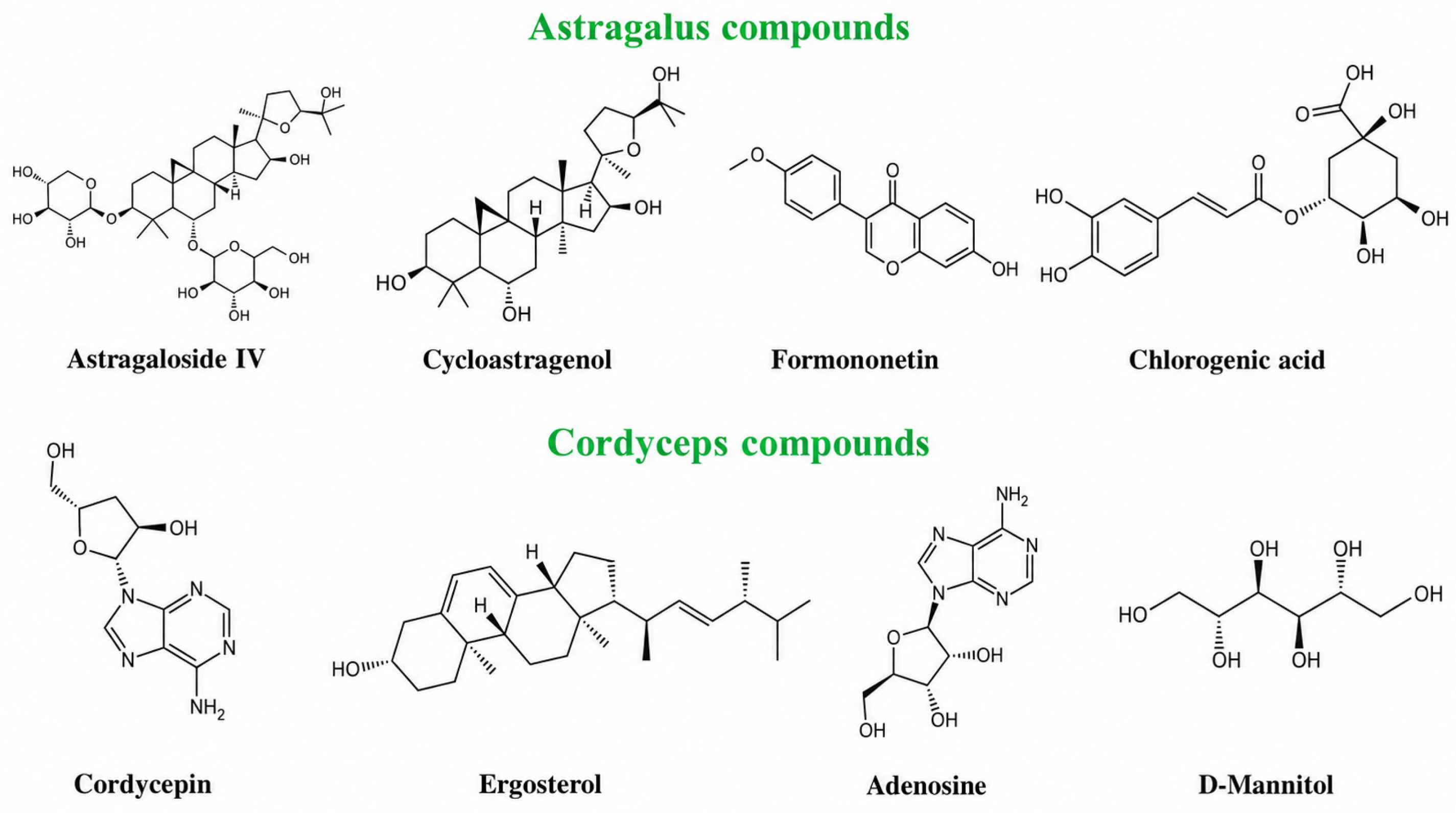
The therapeutic potential of medicinal herbs stems from a diverse array of bioactive compounds, each with distinct chemical structures that dictate their biological activities, pharmacokinetics, and mechanisms of action. Understanding the relationship between chemical structure and function is paramount for developing a rational basis for the use of herbs like Astragalus and Cordyceps. The major classes of compounds include saponins, polysaccharides, flavonoids, triterpenoids, organic acids, alkaloids, nucleosides, cyclic peptides, and sterols, representative examples of which are illustrated in Figure 1. Each class possesses characteristic structural motifs that influence its solubility, stability, interaction with biological systems, and suitability for different extraction strategies.

2.2.1. Saponins

Saponins are a prominent class of glycosides widely distributed in plants and fungi, including the roots of Astragalus and Panax ginseng, and are known for their diverse bioactivities such as immunostimulant, anti-inflammatory, and anticancer properties. Structurally, they are defined by a non-sugar component called an aglycone (or genin), which can be a triterpene or a steroid, linked to one or more sugar moieties (glycones) via glycosidic bonds. The triterpene backbone, composed of six isoprene units, forms the core scaffold of many plant saponins [37,38,39]. The presence of both a hydrophobic aglycone and a hydrophilic glycone makes saponins amphiphilic molecules. This dual nature is directly responsible for their ability to interact with cell membranes, a property that underlies many of their effects, including hemolytic activity and modulation of membrane transporters [28,39]. However, this same amphiphilicity, combined with their often large molecular weight due to extensive glycosylation, contributes significantly to their poor oral bioavailability. Consequently, the systemic effects of many saponins are contingent upon their metabolism by the gut microbiota. Bacterial enzymes in the colon cleave off the sugar residues, generating smaller, more lipophilic sapogenins that are better able to cross intestinal barriers and enter systemic circulation [40,41].

2.2.2. Polysaccharides

Polysaccharides represent another cornerstone of TCM pharmacology, recognized for their potent immunomodulatory and anti-inflammatory activities. They are found in high concentrations in herbs such as Astragalus membranaceus, Angelica sinensis, and Ophiopogon japonicus [42,43]. These compounds are polymers composed of repeating units of monosaccharides, and their structure is characterized by immense diversity in terms of molecular weight, monosaccharide composition, types of glycosidic linkages (e.g., α or β linkages), and degree of branching [37,44]. This structural variability directly correlates with their functional specificity. A critical consequence of their macromolecular structure is extremely limited oral absorption; the large size of intact polysaccharide chains prevents their passive diffusion across the intestinal epithelium [32]. Therefore, their primary mechanism of action is often indirect. Polysaccharides traverse the small intestine undigested and reach the colon, where they serve as substrates for fermentation by the resident gut microbiota [45]. This microbial degradation produces a range of bioactive metabolites, most notably short-chain fatty acids (SCFAs) like butyrate, propionate, and acetate. These SCFAs are readily absorbed and exert systemic effects by regulating immune cell function, modulating inflammatory pathways (e.g., NF-κB), and influencing host metabolism [31,34,46]. This gut-microbiota-polysaccharide axis highlights a key feature of TCM: the therapeutic effect is realized not by the parent compound itself, but by the community of metabolites it engenders.

2.2.3. Flavonoids

Flavonoids are a large and structurally diverse group of polyphenolic compounds found ubiquitously in plants, contributing to color, defense, and various pharmacological activities. Their core structure consists of a C6-C3-C6 skeleton, typically comprising two aromatic rings (A and B) connected by a three-carbon bridge, which is often part of a heterocyclic ring (C) [37,47]. The biological activity and bioavailability of flavonoids are profoundly influenced by their hydroxylation and glycosylation patterns. Glycosylation generally increases water solubility but decreases lipid permeability and can protect the aglycone from oxidation [48]. Upon ingestion, flavonoids undergo extensive Phase II metabolism in the liver and intestinal cells, involving conjugation reactions catalyzed by enzymes such as UDP-glucuronosyltransferases (UGTs) and sulfotransferases (SULTs). This process adds glucuronide or sulfate groups, making the compounds more hydrophilic for excretion but often diminishing their intrinsic biological activity [49]. Furthermore, flavonoids can interact with efflux transporters like P-glycoprotein (ABCB1), which can limit their net absorption by pumping them back into the gut lumen. This complex interplay of absorption, metabolism, and transporter interactions results in low and variable oral bioavailability for most dietary flavonoids, a key consideration in translating their promising in vitro activities into clinical efficacy [48,50].

2.2.4. Nucleosides

The bioactive compounds of Cordyceps, a fungus widely used in TCM, include a unique class of nucleoside analogues, among which cordycepin is a prominent example. Structurally, cordycepin is an adenosine analogue that lacks a hydroxyl group (–OH) at the 3′ position of its ribose sugar. Although this structural difference appears minor, it has profound pharmacological implications. The absence of the 3′-hydroxyl group makes cordycepin highly susceptible to phosphorylation by cellular kinases, resulting in its rapid conversion to cordycepin triphosphate. This active metabolite can be incorporated into RNA during transcription, leading to premature chain termination and disruption of RNA synthesis. This mechanism forms the basis of cordycepin’s antitumor and antimicrobial activities. However, the same susceptibility to phosphorylation also causes rapid intracellular metabolism and a very short half-life, which presents a major limitation for its therapeutic application [40,51,52]. This example clearly illustrates how a specific structural feature can determine a compound’s biological potency, selectivity, and pharmacokinetic profile. In addition to nucleoside analogues, other classes of compounds such as sterols, coumarins (e.g., those found in Angelica sinensis), and alkaloids further contribute to the chemical complexity of medicinal herbs. Many of these compounds exert their effects through the modulation of nuclear receptors and other cellular signaling pathways [38,53,54].

2.2.5. Organic Acids

Organic acids contribute significantly to the bioactivity of Astragalus and Cordyceps preparations. In Astragalus species, the organic acid fraction is dominated by phenolic acids such as syringic, gallic, chlorogenic, caffeic, ferulic, sinapic and *p-*coumaric acids [55]. These compounds share the defining structural motif of a substituted benzene ring bearing at least one phenolic hydroxyl group and a carboxylic acid moiety; chlorogenic and ferulic acids are hydroxycinnamates with extended conjugated side chains, whereas gallic and syringic acids are hydroxybenzoates. The conjugated aromatic system and phenolic substituents afford antioxidant activity, while the carboxyl group makes these molecules weak acids. The presence of multiple hydroxyl groups and a carboxylate confers moderate polarity and water/ethanol solubility; molecular weights range from ~170 to 200 Da. At physiological pH these acids are mostly dissociated, which limits passive diffusion across lipid membranes but allows formation of salts or conjugates [56,57,58,59]. Following ingestion they undergo extensive phase II metabolism (glucuronidation, sulfation and methylation) and microbial degradation before systemic absorption; their oral bioavailability therefore tends to be low, and metabolites such as ferulic acid glucuronide predominate in plasma [60].
In Cordyceps, low-molecular-mass carboxylic acids and polyols are abundant. NMR-based metabolomic profiling detected citric, acetic and fumaric acids together with glucose and mannitol (often termed cordycepic acid) in extracts of Cordyceps sinensis [61]. Citric acid has a tricarboxylic structure (C6H8O7) that is highly polar and fully ionised at physiological pH, whereas fumaric and acetic acids are small (C4H4O4 and C2H4O2), dicarboxylic and monocarboxylic acids. These molecules are highly water-soluble and enter central metabolic pathways (e.g., the tricarboxylic acid cycle); they have high oral bioavailability and are rapidly metabolised to carbon dioxide and water. D-mannitol (C6H14O6) is a six-carbon sugar alcohol with six hydroxyl groups and no carboxyl function. Although traditionally referred to as cordycepic acid, it is a neutral polyol that functions as a carbohydrate reserve for the fungus [62]. Mannitol is strongly hydrophilic, has a moderate molecular weight (~182 Da) and does not ionise. Its hydrophilicity allows easy extraction in hot water, but its lack of lipophilicity restricts membrane permeation and it is largely excreted unchanged in urine [63,64]. Together, these acids and polyols contribute to the osmotic activity and metabolic benefits of Cordyceps preparations.

2.2.6. Alkaloids

Compared with saponins and polysaccharides, alkaloids are less abundant in Astragalus and Cordyceps but impart distinctive pharmacological activities, such as anticancer and neuroprotective effects. Alkaloids are nitrogenous organic compounds that are typically heterocyclic and basic. Their basicity allows them to form salts with acids and exist in protonated or unprotonated forms depending on pH, which influences solubility and membrane permeation [62,65,66].
In Astragalus species, indolizidine and quinolizidine alkaloids have been reported. A comprehensive review of A. hamiensis found that this species contains the indolizidine alkaloid swainsonine and small amounts of the quinolizidine alkaloids ermopsine and anagyrine [67]. Indolizidines and quinolizidines are bicyclic systems derived from lysine; swainsonine contains a hydroxylated indolizidine ring that renders it moderately polar and allows hydrogen bonding, whereas ermopsine and anagyrine possess a quinolizidine skeleton that is more hydrophobic and tertiary amine functionality that imparts basicity. These alkaloids are uncharged at high pH but form cations in acidic media, which enhances solubility in polar solvents. Their lipophilicity allows passive diffusion through biological membranes; after absorption they are subject to hepatic oxidative metabolism and renal excretion. Swainsonine is a known α-mannosidase inhibitor and exhibits immunomodulatory and neurotoxic effects; bioavailability in humans has not been systematically studied, but animal models indicate good oral absorption and rapid distribution [67,68].
In Cordyceps, nucleoside-type alkaloids dominate. Cordycepin (3′-deoxyadenosine) comprises an adenine base linked to a ribose lacking the 3′-hydroxyl group; its structure closely resembles adenosine but the missing hydroxyl confers metabolic stability and allows incorporation into RNA, causing chain termination. N6-hydroxyethyl adenosine (HEA) has a hydroxyethyl group on the exocyclic nitrogen of the adenine ring [69]. These nucleoside analogues are neutral at physiological pH, highly hydrophilic due to the ribose and hydroxyethyl substituent and have moderate molecular weights (~267 Da); they are absorbed via nucleoside transporters and cross the blood–brain barrier. However, they are subject to rapid deamination by adenosine deaminase, reducing oral bioavailability; chemical or pharmaceutical modification (e.g., co-administration with deaminase inhibitors) is often required to enhance stability. Another group of Cordyceps alkaloids are militarinones, which consist of pyridine or tetramic acid (pyrrolidine-2,4-dione) cores appended to unsaturated side chains [62].
These molecules are moderately lipophilic and contain lactam or aromatic nitrogen atoms; they exist predominantly in the neutral form at physiological pH and can cross lipid membranes. Militarinones exhibit antimicrobial and cytotoxic activities and are susceptible to oxidative metabolism. Together, nucleoside and non-nucleoside alkaloids from Cordyceps provide diverse physicochemical profiles that influence their pharmacokinetics and therapeutic potential.
Many Astragalus and Cordyceps constituents regulate oxidative stress, inflammatory signaling, mitochondrial function, and apoptosis in cellular and animal models; however, their in vivo relevance depends on absorption, metabolic transformation, tissue distribution, and achievable systemic concentrations [70]. High-molecular-weight polysaccharides generally show poor direct intestinal absorption and may act mainly through gut microbiota-derived metabolites, short-chain fatty acid production, and gut–immune interactions rather than direct systemic exposure [71]. Similarly, saponins such as AS-IV may show limited oral bioavailability because of poor membrane permeability, intestinal metabolism, and microbial deglycosylation [72], while flavonoids are often extensively metabolized by glucuronidation, sulfation, methylation, and efflux transporter activity [73]. Cordyceps nucleoside derivatives, including cordycepin, may also undergo rapid enzymatic metabolism, which can reduce systemic persistence and alter tissue exposure [74]. Therefore, pathway-level findings should not be directly extrapolated to clinical efficacy without considering oral bioavailability, active metabolites, dose, formulation strategy, plasma concentration, tissue distribution, and target-organ exposure.

2.3. Extraction and Standardization of Bioactive Compounds

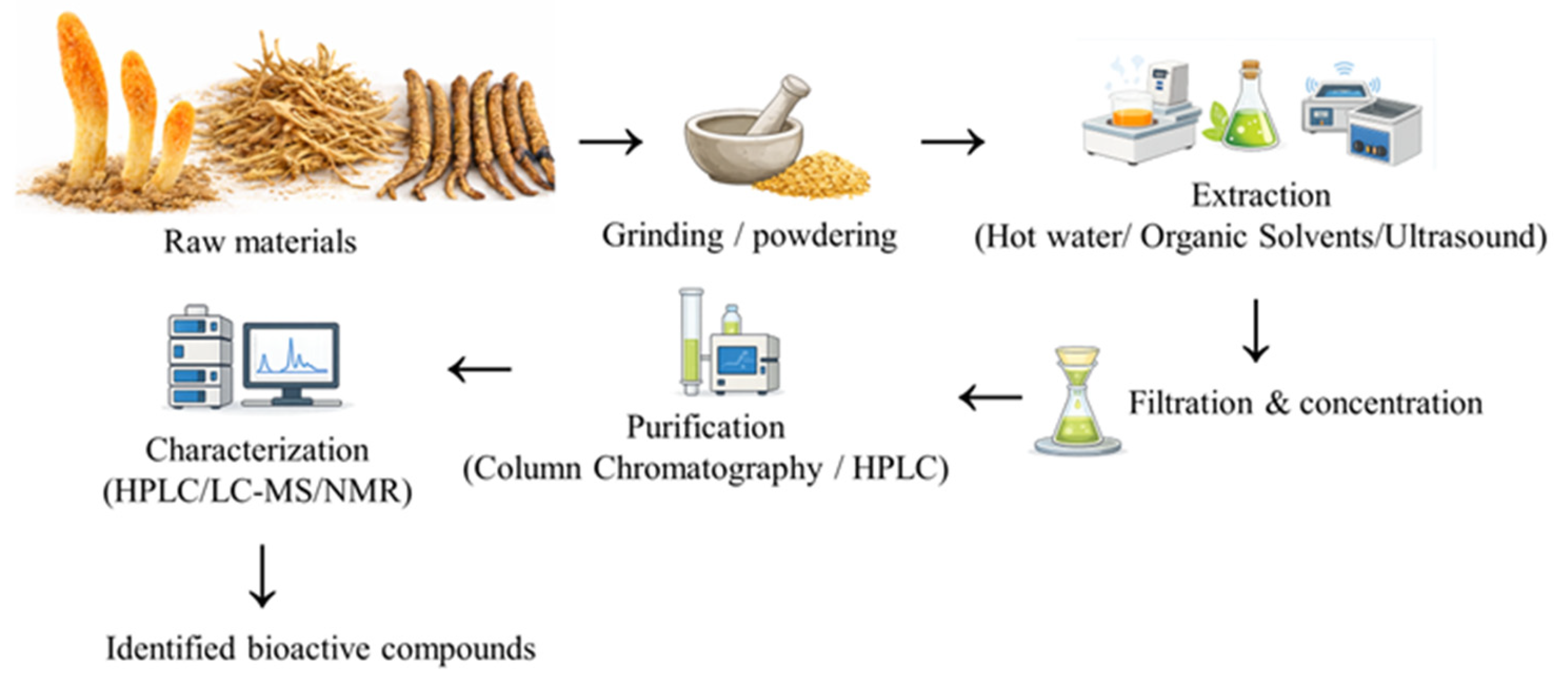
The extraction of bioactive compounds from Astragalus membranaceus and Cordyceps species depends primarily on the polarity, molecular size, and thermal stability of the target constituents [75]. Hydrophilic compounds such as polysaccharides and certain organic acids are generally soluble in polar solvents, whereas more lipophilic molecules, including some alkaloids and sterol derivatives, require less polar solvents for efficient extraction [76]. Therefore, the choice of extraction strategy must consider the physicochemical properties of the target compounds in order to preserve their structural integrity and biological activity.
A general workflow for the extraction, purification, and analytical characterization of Astragalus and Cordyceps bioactive compounds is illustrated in Figure 2.
Traditional hot-water decoction remains one of the most widely used extraction methods in Chinese herbal medicine. Boiling water efficiently extracts polar constituents such as polysaccharides, organic acids, and certain nucleoside derivatives from Astragalus and Cordyceps. For example, water extraction of Astragalus roots at elevated temperatures can yield significant amounts of Astragalus polysaccharides, although other compounds such as flavonoids and saponins may also be co-extracted [77]. Because some phenolic compounds are sensitive to prolonged heating, careful control of extraction time and temperature is necessary to minimize degradation.
Hydroalcoholic solvent extraction using aqueous ethanol or methanol (typically 50–70%) is commonly applied to isolate moderately polar compounds such as flavonoids, phenolic acids, and nucleoside derivatives including cordycepin. Compared with water extraction, hydroalcoholic solvents often improve extraction efficiency while reducing thermal degradation of sensitive compounds. In some cases, mild acidification of the solvent can enhance the recovery of basic alkaloids by promoting protonation and improving solubility [78,79].
In recent years, several assisted extraction techniques have been explored to improve extraction efficiency and reduce processing time. Ultrasound-assisted extraction (UAE), for example, enhances mass transfer through cavitation and disruption of plant or fungal cell structures, thereby increasing the recovery of bioactive molecules. Studies on Cordyceps militaris have reported improved cordycepin yield when ultrasound is combined with hydroalcoholic solvents under moderate temperatures [80]. Other approaches, such as microwave-assisted extraction or enzyme-assisted extraction, may also enhance the release of intracellular compounds while maintaining relatively mild extraction conditions [77,81].
More advanced techniques, including pulsed electric field treatment, supercritical carbon dioxide extraction, and pressurized hot-water extraction, have also been investigated for isolating specific compound classes. These methods may improve extraction efficiency for certain lipophilic or thermolabile constituents [82]; however, their application to Astragalus and Cordyceps remains relatively limited compared with conventional solvent-based extraction approaches.
Overall, the extraction strategy for Astragalus and Cordyceps derivatives must balance extraction efficiency with preservation of compound stability. Optimization of solvent polarity, temperature, and extraction conditions is essential for obtaining standardized extracts enriched in key bioactive compounds while maintaining their pharmacological activity.
The major classes of bioactive compounds present in Astragalus and Cordyceps, together with their structural characteristics, biological roles, and typical extraction techniques, are summarized in Table 1.

2.4. Bioactive Constituents and Pharmacological Profiles of Astragalus and Cordyceps

Astragalus membranaceus and Cordyceps species are traditional tonic medicines with distinct biological origins and chemical compositions. Astragalus is a plant-derived medicine mainly characterized by polysaccharides, triterpenoid saponins such as AS-IV, and flavonoids, whereas Cordyceps is a fungus-derived medicine containing cordycepin, adenosine-related nucleosides, polysaccharides, sterols, and other fungal metabolites. Despite these differences, both have been reported to exert pharmacological effects relevant to aging-associated chronic diseases and neurodegenerative disorders, including antioxidant, anti-inflammatory, immunomodulatory, mitochondrial-protective, anti-apoptotic, and neuroprotective activities. Therefore, these two medicines should not be regarded as chemically identical or interchangeable, but as useful comparative examples of distinct natural product systems that converge on overlapping aging-related disease processes [87,90,91,92,93].
The rationale for discussing them together is not based only on their traditional classification as tonic medicines, but also on their convergence in aging-associated disease contexts, including immune dysregulation, oxidative injury, chronic inflammation, metabolic imbalance, mitochondrial decline, tissue degeneration, and neuroinflammatory damage [9,90]. At the same time, their strengths are complementary. Astragalus has been more widely studied in immune regulation, cardiometabolic protection, and adjuvant cancer therapy, whereas Cordyceps has stronger relevance to energy metabolism, fatigue-related conditions, renal protection, mitochondrial function, and neuroimmune regulation [87,92,94]. Thus, their comparative evaluation allows a balanced assessment of two distinct plant- and fungus-derived medicinal systems across shared aging-related disease areas, while also highlighting differences in active constituents, pharmacokinetics, safety concerns, evidence strength, and translational readiness.

2.4.1. Cordyceps (Ophiocordyceps sinensis)

Ophiocordyceps sinensis, a parasitic fungus often referred to as Cordyceps, has a long history as a restorative tonic traditionally used to support vitality and stamina. Chemical investigations reveal a diverse array of secondary metabolites, including nucleosides (adenosine, inosine, guanosine, uridine and the unique 3′-deoxyadenosine cordycepin), sterols (ergosterol, ergosterol peroxide and campesterol), cyclic peptides, polyketides, phenolics and a variety of polysaccharides [95]. Cordycepin and D-mannitol, historically referred to as cordycepic acid, are prominent marker compounds; cordycepin differs from adenosine by lacking a 3′-hydroxyl group, enabling it to interfere with nucleic acid synthesis and activate adenosine receptors. Cordyceps polysaccharides, comprising glucans, mannans and heteroglycans, constitute 3–8% of the fruiting body and exhibit hypoglycemic, antitumor, immunomodulatory and antioxidant activities. The fungus also contains rare cyclic dipeptides, polyamines and unsaturated fatty acids with potential bioactivity [96].
Cordycepin may undergo rapid enzymatic metabolism; therefore, its reported effects on oxidative stress, inflammation, and mitochondrial regulation should be interpreted as exposure-dependent mechanisms rather than direct evidence of sustained systemic activity [97,98].
Traditional usage attributes Cordyceps with supporting vitality and respiratory function; modern pre-clinical studies support these claims by showing that C. militaris extracts promote neurite outgrowth, reverse scopolamine-induced memory deficits, reduce inflammatory markers (COX-2, iNOS) and oxidative stress, and upregulate dopaminergic pathways [62,99]. Polysaccharide-rich fractions lower blood glucose, suppress tumor growth and synergize with chemotherapeutic agents. In a rat model of ischemic stroke, butanolic Cordyceps extract decreased inflammatory cell infiltration and preserved the blood-spinal cord barrier, reflecting its anti-inflammatory and neuroprotective potential. Nevertheless, certain Cordyceps species produce immunosuppressive agents such as cyclosporine, and the concentrations of nucleosides and polysaccharides differ between wild C. sinensis and cultivated C. militaris [100,101,102].

2.4.2. Astragalus (Astragalus membranaceus)

Astragalus membranaceus (Huangqi) is a Qi-tonifying leguminous herb traditionally used to strengthen the spleen and lungs. Chemical analyses have identified more than 200 constituents, with major classes including water-soluble heteropolysaccharides (Astragalus polysaccharides, APS), triterpenoid saponins (astragalosides), flavonoids and other phenolics [18]. APS are complex polysaccharides composed of glucans and acidic heteropolysaccharides; they modulate immune cell activity, regulate PI3K/Akt signaling and suppress inflammatory mediator release.
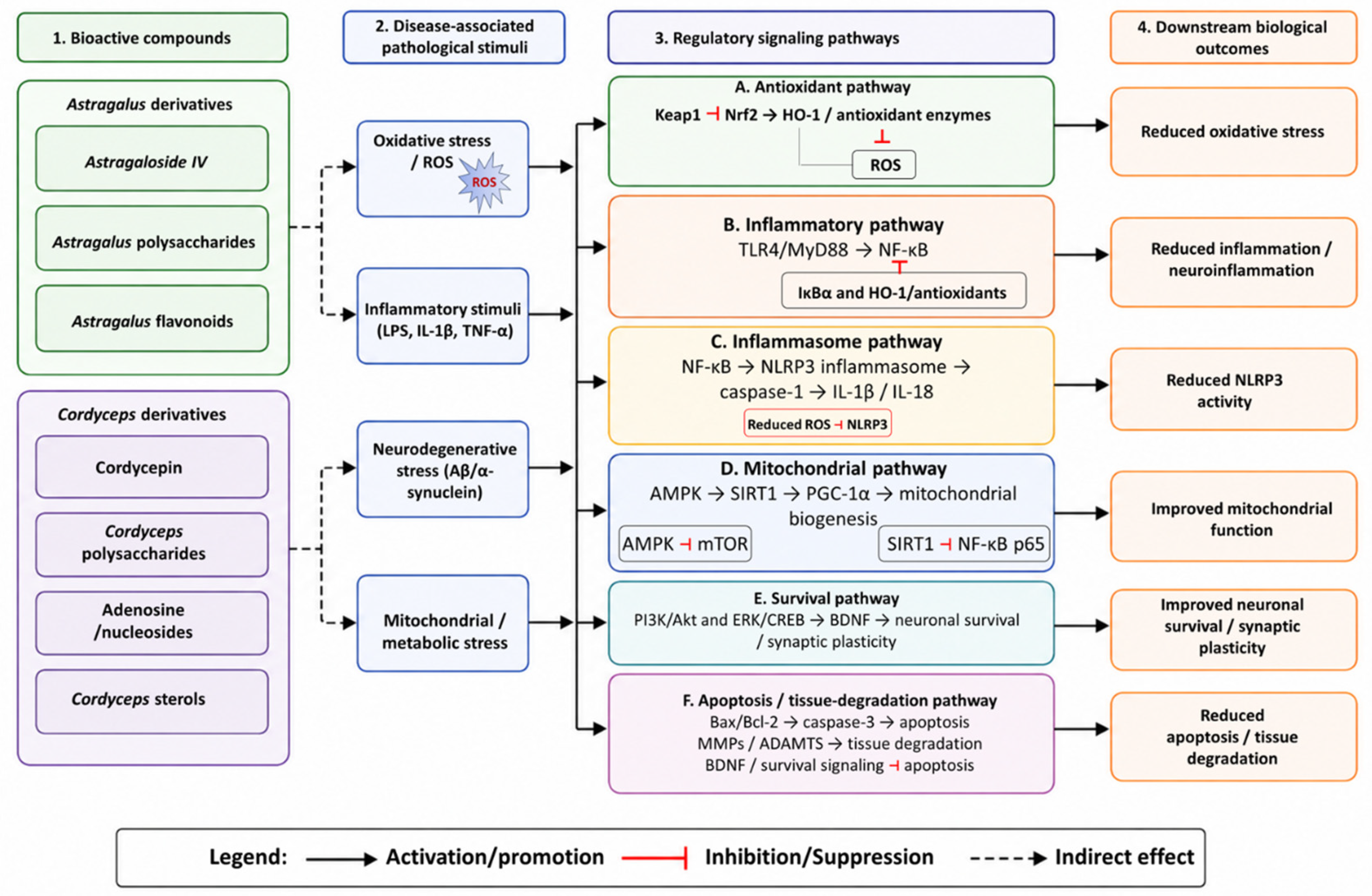
AS-IV, a cycloartane-type triterpenoid saponin isolated from Astragalus membranaceus, is the most extensively studied marker compound; it exerts anti-inflammatory and neuroprotective effects by suppressing oxidative stress, apoptosis, and neuroinflammation through modulation of multiple signalling pathways, including AMPK/mTOR, PPARγ/BDNF, and inflammatory cascades such as NF-κB-related responses [103,104,105,106]. Cycloastragenol, the aglycone metabolite of AS-IV, exhibits similar biological activities, including attenuation of inflammation and regulation of lipid metabolism, supporting its role as a bioactive derivative of AS-IV. Flavonoids present in A. membranaceus, such as quercetin and isorhamnetin, further contribute antioxidant and anti-inflammatory effects, complementing the pharmacological profile of the plant [94,107]. Because Astragalus polysaccharides, saponins, and flavonoids differ markedly in absorption and metabolism, their regulation of Nrf2, NF-κB, AMPK/mTOR, PI3K/Akt, and apoptosis-related pathways may reflect both parent compounds and bioactive metabolites [108].
Astragalus membranaceus has been used traditionally for chronic fatigue, diabetes, ulcers, and as an adjuvant in cancer therapy. Its major bioactive constituents, including APS, flavonoids, and saponins confer broad anti-inflammatory, antioxidant, immunomodulatory, hypoglycemic, and neuroprotective effects. Recent mechanistic analyses emphasize that AS-IV and APS mitigate neuroinflammation, oxidative stress, neuronal apoptosis, and ferroptosis, regulate autophagy, protect the blood–brain barrier, and modulate signalling pathways such as PI3K/Akt, Nrf2, and PPARγ, indicating a multi-target neuroprotective potential [77,109,110].
Preclinical studies demonstrate that APS improve cognitive function, reduce amyloid-β accumulation, and suppress neuroinflammation in experimental models of Alzheimer’s disease, while AS-IV enhances synaptic plasticity, attenuates tau-related and inflammatory pathology, and protects against cerebral ischemia–reperfusion injury [111,112,113]. Furthermore, increasing clinical and translational research interest has emerged regarding Astragalus membranaceus as a potential adjunctive therapy for Alzheimer’s disease; however, conclusive clinical evidence remains limited. Variability among Astragalus species and the structural complexity of polysaccharides continue to pose challenges for standardization and translational research.

2.5. Synergistic Effects of Different Herbal Extracts Combined with Other Therapeutic Agents in Disease Treatment

Combination therapy is a logical strategy for complex, multifactorial disorders because no single agent can simultaneously address the diverse pathological processes that drive chronic diseases. TCM has long promoted multi-component decoctions; modern pharmacology has adopted this concept to explore whether combinations of herbal extracts with conventional drugs can produce synergistic effects that enhance efficacy or reduce toxicity [114,115,116].
Synergy is particularly valuable when disease pathology involves inflammation, oxidative stress, immune dysregulation, and mitochondrial dysfunction, because these processes often interact through shared signalling pathways such as NF-κB, PI3K/Akt, and AMPK. This concept has been studied in cancer and metabolic diseases, where Chinese herbal medicines and related natural products may support conventional therapy by modulating inflammatory pathways, mitochondrial function, oxidative stress, and the tumour microenvironment [117,118,119]. These findings suggest that Astragalus-based combinations may contribute to therapeutic benefit through multi-target regulation and immune modulation; however, herb–drug interactions must be considered, and rigorous clinical trials are required to confirm safety and benefit.
Cordyceps preparations have been used as nephroprotective adjuvants to cyclosporin-based immunosuppression, and their combination improves renal function by reducing serum creatinine and blood urea nitrogen while mitigating microinflammatory states without compromising immunosuppression. These observations illustrate the capacity of herbal extracts to complement standard treatments while reducing adverse effects [120,121].
Synergy with anti-inflammatory drugs represents another important therapeutic avenue. In a septic rat model, APS combined with ibuprofen reduced plasma TNF-α and IL-6 levels more effectively than either agent alone, and increased expression of the α7 nicotinic acetylcholine receptor, implicating activation of the cholinergic anti-inflammatory pathway. Both Astragalus and Cordyceps down-regulate NF-κB signalling and NLRP3 inflammasome activation, leading to reduced production of pro-inflammatory cytokines [122,123]. By converging on shared inflammatory pathways, herbal extracts may potentiate the effects of non-steroidal anti-inflammatory drugs or corticosteroids while enabling dose reduction.
Metabolic and cardiovascular diseases are closely associated with oxidative stress and mitochondrial dysfunction. Meta-analyses indicate that Astragalus combined with renin–angiotensin–aldosterone system (RAAS) blockers improves therapeutic efficacy in diabetic nephropathy, significantly reducing urinary protein excretion, serum creatinine and blood urea nitrogen compared with RAAS blockade alone. These benefits arise from complementary mechanisms, whereby RAAS inhibitors reduce intraglomerular pressure while Astragalus exerts anti-inflammatory and antioxidant effects through Nrf2-related pathways [124,125]. Cordyceps-based formulations have been shown to improve hyperglycaemia, dyslipidaemia and renal dysfunction in diabetic models by down-regulating fibrosis-related proteins and up-regulating renoprotective factors such as Smad7 and Klotho [126].
Synergy with anticancer therapies is particularly notable in non-small-cell lung cancer. Astragalus formulations combined with platinum-based chemotherapy increase treatment efficacy and reduce adverse events. Preclinical studies demonstrate that APS enhances the antitumour activity of gemcitabine and adriamycin by promoting apoptosis and ferroptosis while modulating the tumour microenvironment. Combination therapy with APS and metformin suppresses lung adenocarcinoma cell proliferation through synergistic inhibition of the PI3K/Akt pathway and enhanced oxidative stress [123,127]. Although Cordyceps derivatives are less extensively studied in cancer combination therapy, their immunomodulatory and metabolic regulatory properties suggest potential for synergistic use with chemotherapy, radiotherapy and immunotherapy.
Representative examples of Astragalus membranaceus and Cordyceps sinensis extracts combined with conventional therapeutic agents, together with their proposed synergistic mechanisms and levels of evidence, are summarized in Table 2.
Mechanistically, synergistic effects arise from complementary actions at multiple biological levels. Astragalus and Cordyceps polysaccharides enhance innate and adaptive immune responses by promoting macrophage and microglial phagocytosis, increasing natural killer cell activity and shifting macrophage polarization toward an anti-inflammatory M2 phenotype. Both herbs suppress inflammatory signalling via inhibition of NF-κB, PI3K/Akt and MAPK pathways, while activating antioxidant defences through Nrf2/HO-1 signalling [139,140,141]. Mitochondrial protection is achieved through preservation of membrane potential, enhancement of respiratory chain activity and activation of AMPK-mediated energy sensing. The convergence of NF-κB, PI3K/Akt, AMPK, Nrf2 and ERK/CREB pathways provides a mechanistic framework for understanding how herbal extracts complement the selective actions of conventional drugs [142,143,144].
Despite promising results, herb–drug interactions remain a significant concern. Herbal constituents may alter pharmacokinetics by modulating cytochrome P450 enzymes or drug transporters, potentially affecting drug exposure and safety [145]. Most evidence for synergy derives from in vitro or animal studies, whereas high-quality randomized clinical trials remain limited. Therefore, combination therapy with herbal extracts should be pursued cautiously, with emphasis on dose optimization, pharmacokinetic monitoring and rigorous clinical validation.

2.6. Research and Clinical Applications of Herbal Extracts in Aging-Related and Neurodegenerative Diseases-Astragalus and Cordyceps as Case Studies

Astragalus membranaceus and Cordyceps sinensis are emblematic in TCM because they tonify Qi and support vitality, functions that align with modern concepts of metabolic and immune resilience. Both herbs contain diverse bioactive molecules including polysaccharides, saponins, flavonoids and nucleoside derivatives that act on multiple targets involved in inflammation, oxidative stress, mitochondrial function and neuronal survival. Their breadth of activity has made them focal points in research on aging-related chronic diseases and neurodegenerative disorders [146,147,148]. While preclinical studies demonstrate antioxidant, anti-inflammatory and neuroprotective effects, translation into clinical practice remains limited and the mechanisms are still being elucidated.
  • Astragalus (Astragalus membranaceus)
More than two hundred compounds have been identified in A. membranaceus, with three classes dominating its pharmacological profile: polysaccharides (notably Astragalus polysaccharides, APS), flavonoids (including isoflavones such as calycosin and formononetin) and triterpenoid saponins (particularly astragalosides such as AS-IV) [18]. APS comprises heteropolysaccharides with antioxidant and immunomodulatory properties; astragalosides are cycloartane-type saponins that modulate membrane fluidity and signal transduction; and flavonoids contribute to free radical scavenging and estrogen-like activity. APS and AS-IV activate Nrf2 and up-regulate antioxidant enzymes (SOD, CAT, GSH-Px) while suppressing NF-κB–dependent pro-inflammatory cytokines (TNF-α, IL-1β, IL-6) and the NLRP3 inflammasome. Formononetin and calycosin further enhance antioxidant defences by activating Nrf2 and protecting against oxidative damage [149,150,151,152]. These bioactive constituents collectively endow Astragalus with potent reactive oxygen species (ROS) scavenging capacity, immune enhancement, and anti-inflammatory activity.
Pharmacologically, Astragalus demonstrates significant potential for neuroprotection. Roasted Astragalus extracts reduce ROS accumulation and lipid peroxidation in neuronal cells by activating the Nrf2/HO-1 pathway and up-regulating the Akt/CREB/BDNF axis, leading to increased brain-derived neurotrophic factor expression and decreased apoptosis markers (Bax, cleaved caspase-3) [141]. AS-IV inhibits NF-κB and MAPK pathways and stabilises mitochondrial membrane potential, thereby preventing β-amyloid-induced mitochondrial permeability transition and neuronal apoptosis. APS also modulates immune responses by shifting microglia and macrophages toward an M2 phenotype and reducing the activation of the NLRP3 inflammasome [94,153,154]. These actions collectively contribute to attenuation of neuroinflammation and support synaptic plasticity, suggesting relevance to aging and neurodegenerative disorders. Preclinical studies provide compelling evidence, but clinical trials remain scarce; thus, the translational potential of Astragalus in neurodegeneration is promising yet still uncertain.
  • Cordyceps (Cordyceps sinensis)
Cordyceps sinensis contains a unique set of nucleoside analogues and polysaccharides, the most notable being cordycepin (3′-deoxyadenosine) and cordycepic acid. Cordycepin can act as a purine analogue that modulates adenosine receptors and influences energy metabolism, while cordycepic acid (D-mannitol) contributes to antioxidant and diuretic properties [155]. In addition to these primary constituents, Cordyceps produces polysaccharides with immunomodulatory activity and secondary metabolites such as ergosterol and sterol derivatives. Together, these compounds enable Cordyceps to regulate the immune system, reduce oxidative stress and inflammation, and support mitochondrial function [156]. For example, cordycepin decreases ROS production and restores mitochondrial membrane potential in neuronal cells exposed to β-amyloid by activating the ERK/CREB pathway. Cordyceps preparations also enhance vasodilation by increasing nitric oxide release and inhibiting low-density lipoprotein oxidation, explaining their use in cardiovascular and renal conditions [96,140].
Beyond antioxidant and anti-inflammatory actions, Cordyceps exhibits notable neuroprotective and anti-aging properties. A recent study demonstrated that cordycepin improves cognitive function in APP/PS1 Alzheimer’s model mice by reprogramming microglial metabolism: it activates hexokinase II and pyruvate dehydrogenase kinase 2, thereby enhancing both glycolysis and oxidative phosphorylation to promote microglial M2 polarization and alleviate mitochondrial damage [120,157]. Cordyceps derivatives have been used clinically as adjuncts to immunosuppressive therapy; for example, combining Cordyceps with cyclosporin A supports renal function during organ transplantation by reducing nephrotoxicity and modulating immune responses. Cordyceps militaris cultivated with Ginkgo biloba seeds improves hyperglycaemia and renal dysfunction in diabetic mice, reflecting synergy between Cordyceps metabolites and metabolic pathways [120,126]. These findings indicate that cordycepin and other Cordyceps compounds can influence metabolic and immune pathways relevant to aging and neurodegeneration; however, clinical evidence remains limited and additional studies are needed to evaluate safety and efficacy. The major signaling pathways through which Astragalus and Cordyceps exert anti-inflammatory, antioxidant, and neuroprotective effects are summarized in Figure 3.

2.6.1. Cancer

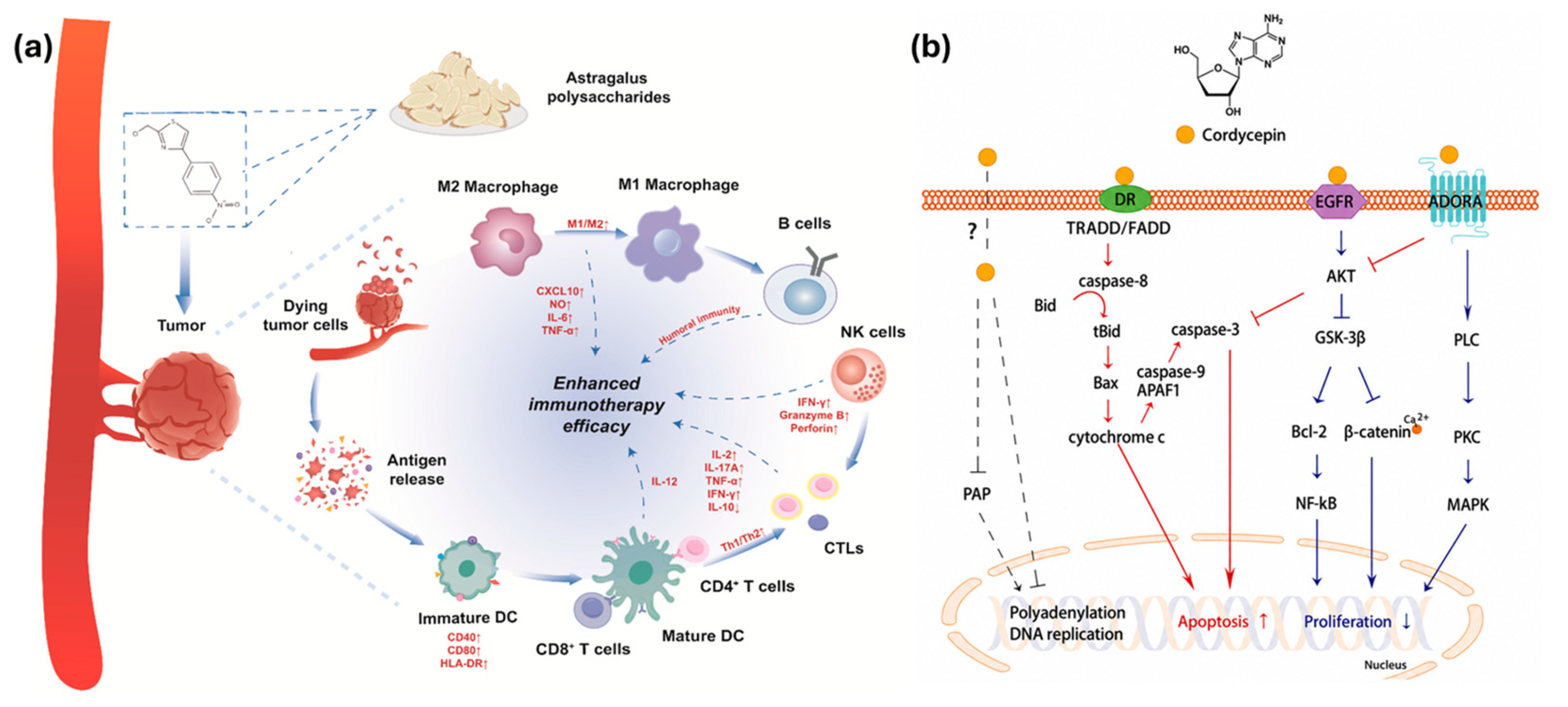
Cancer is a prototypical complex disease involving aberrant cell proliferation, immune evasion, tumor-promoting inflammation and metabolic reprogramming. Astragalus extracts, particularly APS, are widely used as adjuvant therapies in oncology. Meta-analyses and preclinical studies reveal that combining APS with chemotherapy or immunotherapy improves tumour remission rates, reduces tumour volume and prolongs survival while mitigating adverse effects such as neutropenia and neurotoxicity [158,159]. Mechanistically, APS may enhance antitumor immune responses by promoting tumor-cell death, antigen release, dendritic-cell maturation, and antigen presentation, including increased expression of costimulatory molecules such as CD40, CD80, and HLA-DR. This process supports CD8+ T-cell activation and may also enhance NK-cell activity through increased IFN-γ, granzyme B, and perforin expression. APS further modulates cytokine profiles by increasing IL-2, IFN-γ, TNF-α, and IL-12, reducing IL-10, and regulating IL-6 in a context-dependent manner. In addition, APS may promote a more antitumor immune microenvironment by influencing macrophage polarization and increasing the M1/M2 macrophage ratio (Figure 4) [122,123]. AS-IV and APS also inhibit NF-κB and PI3K/Akt pathways, promoting apoptosis and ferroptosis when combined with agents like gemcitabine or adriamycin.
In addition, cordycepin may promote apoptosis through death receptor- and caspase-related pathways and suppress cancer-cell proliferation through EGFR/Akt/GSK-3β/cyclin D1-related signaling (Figure 4b) [160]. Recent evidence also suggests that cordycepin and Cordyceps militaris extract may sensitize cancer cells and modulate immune responses, supporting their possible role in cancer immunotherapy-related strategies [160,161,162]. However, Cordyceps derivatives have not been extensively tested as anticancer adjuvants; their potential may lie in reducing chemotherapy-induced organ toxicity and supporting immune function, but more research is required. Although preliminary clinical evidence suggests benefits in patients with lung, breast, and colorectal cancers, most data derive from small trials or meta-analyses with heterogeneity, and high-quality randomised controlled trials are still needed [123,163].

2.6.2. Diabetes

Diabetes and its complications involve chronic inflammation, oxidative stress and metabolic dysfunction, making them suitable targets for multi-target therapies. Astragalus formulations combined with RAAS inhibitors significantly improve outcomes in diabetic nephropathy: co-administration reduces urinary protein excretion, serum creatinine and BUN, and improves glycaemic control compared with RAAS blockade alone. The synergy arises because RAAS inhibitors reduce intraglomerular pressure while Astragalus polysaccharides activate Nrf2, suppress NF-κB and enhance antioxidant capacity [124,125,144].
Shenkang injection plus RAAS inhibitors also lowers triglyceride and cholesterol levels and decreases pro-inflammatory cytokines, highlighting a complementary metabolic effect. Cordyceps militaris preparations cultivated with Ginkgo biloba seeds improve hyperglycaemia, dyslipidaemia and renal dysfunction in type2 diabetic mice by down-regulating fibrosis-related proteins and up-regulating renoprotective proteins such as Smad7 and Klotho [124,126,164,165]. Although these findings suggest that combining Astragalus or Cordyceps with antidiabetic drugs or RAAS blockers may enhance metabolic control and protect the kidneys, most evidence comes from preclinical or small clinical studies; robust randomised trials are needed to validate efficacy and safety.

2.6.3. Hypertension

Hypertension is tightly linked to vascular inflammation, oxidative stress and RAAS overactivation. Astragalus root is traditionally used as a diuretic and Qi-tonifying herb; modern studies indicate that its polysaccharides and flavonoids can moderately lower blood pressure by inhibiting angiotensin-converting enzyme, enhancing nitric oxide release and reducing oxidative stress. Combining Astragalus with antidiabetic or statin medications is proposed to provide additional cardiovascular benefits, but pharmacokinetic data suggest that such combinations may prolong drug exposure and necessitate dose adjustment [166]. Shenkang injection plus RAAS blockers has shown cardiorenal protection in patients with diabetic nephropathy, an effect that may also translate to essential hypertension; however, direct clinical evidence in hypertensive patients remains sparse [124]. Cordyceps produces vasodilatory and hypocholesterolaemic effects by increasing nitric oxide and suppressing low-density lipoprotein oxidation. Meta-analyses of Cordyceps preparations combined with Western medicines for renal dysfunction report improvements in serum creatinine and BUN and suggest that Cordyceps helps restore microinflammatory balance [96,120,167]. Although these findings hint at a role for Astragalus and Cordyceps in hypertension management and their potential synergy with antihypertensive drugs, high-quality clinical trials are lacking and caution is warranted regarding herb–drug interactions.

2.6.4. Osteoarthritis

Osteoarthritis is characterized by inflammatory degradation of articular cartilage and extracellular matrix. In vitro studies using human chondrocyte HTB-94 cells showed that a hydroalcoholic extract of A. membranaceus significantly reduced TNF-α-induced expression and secretion of pro-inflammatory mediators (IL-6, IL-1β, IL-8) and matrix-degrading enzymes (MMP-3, MMP-13, ADAMTS-5) without affecting basal levels. These results suggest that Astragalus extract can counteract inflammatory signalling and matrix degradation in chondrocytes, supporting its potential as a nutraceutical for joint health [168,169,170].
The mechanisms likely involve inhibition of NF-κB and activation of Nrf2 pathways, consistent with other tissues, though this remains speculative in cartilage. Astragalus-derived compounds such as formononetin and astragalin have been shown to inhibit IL-1β-induced inflammatory mediator production in chondrocytes through NF-κB and MAPK suppression [171,172]. Cordyceps has not been well studied in osteoarthritis; its anti-inflammatory and antioxidant properties could theoretically synergize with conventional anti-arthritic agents, but empirical evidence is currently minimal.

2.6.5. Parkinson’s Disease

Parkinson’s disease (PD) involves dopaminergic neuron loss, mitochondrial dysfunction and chronic neuroinflammation. Preclinical studies indicate that Astragalus saponins and polysaccharides attenuate neurotoxicity in PD models by reducing ROS, inhibiting NF-κB and MAPK signalling and activating Nrf2, thereby preserving mitochondrial integrity [173,174]. AS-IV modulates the Bax/Bcl-2 ratio, preventing neuronal apoptosis, and down-regulates microglial activation via NLRP3 inflammasome suppression. These effects translate to improved motor performance and dopaminergic neuron survival in animal models, but clinical studies are lacking. Cordycepin’s ability to reprogram microglial metabolism, enhance glycolysis and oxidative phosphorylation, and promote M2 polarization suggests potential for mitigating neuroinflammation in PD, though direct evidence in PD models is limited. Overall, both herbs offer promising neuroprotective mechanisms, yet their clinical efficacy in PD remains to be established [173,175,176,177].

2.6.6. Alzheimer’s Disease

Alzheimer’s disease (AD) is characterised by β-amyloid aggregation, tau pathology, synaptic loss and neuroinflammation. Roasted Astragalus extracts protect hippocampal neurons by activating Nrf2/HO-1 and Akt/CREB/BDNF pathways, reducing ROS and increasing BDNF levels, while decreasing pro-apoptotic proteins such as Bax and cleaved caspase-3 [141]. AS-IV prevents β-amyloid-induced mitochondrial permeability transition, reduces ROS production and improves cognitive behaviour in AD models [153,178]. More broadly, nutraceutical-based strategies have also been investigated for their ability to modulate β-amyloid aggregation and downstream neurotoxic pathways in Alzheimer’s disease, supporting the therapeutic relevance of multi-target natural compounds in neurodegenerative disorders [179].
APS inhibits microglial overactivation and NLRP3 inflammasome assembly, promotes M2 polarization and maintains blood–brain barrier integrity through PPARγ and Nrf2 pathways. Cordycepin significantly improves cognitive function in APP/PS1 mice by promoting metabolic reprogramming of microglia; activation of hexokinase II and pyruvate dehydrogenase kinase 2 enhances glycolysis and oxidative phosphorylation, shifting microglia toward an anti-inflammatory phenotype and mitigating mitochondrial damage [157,180]. The mechanistic evidence and evidence levels of Astragalus membranaceus and Cordyceps sinensis across disease models are summarized in Table 3.

3. Challenges and Limitations

Both Astragalus and Cordyceps species show marked variability in chemical composition depending on geographic origin, cultivation conditions and processing. A metabolomics study on Astragalus membranaceus roots found that age and origin significantly affected saponin and flavonoid profiles; AS-IV, commonly used as a quality marker, varied widely among samples, and older roots contained more flavonoids while saponins and isoflavonoids distinguished geographical origin [195]. Another study reported that Radix Astragali from Gansu province had lower active ingredients (astragaloside and calycosin) but higher yield compared with daodi (authentic) regions, emphasising the need for multi-index quality control. Adulteration with other Astragalus species further complicates quality assurance [195,196].
For Cordyceps, authentic Ophiocordyceps sinensis is rare and expensive; many preparations use cultured mycelia or related species (e.g., Cordyceps militaris), leading to variable levels of cordycepin, polysaccharides and peptides. Differences in fermentation conditions, substrates and harvest times affect bioactive content, yet these factors are seldom reported in clinical studies.

3.1. Standardization and Quality Control Challenges

Quality control typically relies on marker compounds (AS-IV for Astragalus and cordycepin for Cordyceps), but single markers do not capture the multi-component nature of the extracts. Fingerprinting methods using chromatographic or spectrometric profiles have been proposed [196], but batch-to-batch consistency remains problematic. The metabolomics study noted that different analytical techniques (TLC, HPLC, NMR, MS) yield variable results, underscoring difficulties in defining activity-related markers [195]. Without standardized preparation and reporting, reproducibility of pharmacological and clinical findings is limited.

3.2. Pharmacokinetic and Bioavailability Issues

Triterpenoid saponins such as AS-IV have poor intestinal permeability and low lipophilicity, resulting in low oral bioavailability (2–7%) [197,198]. Astragalus polysaccharides (APS) are large (10–50 kDa) and hydrophilic; their absorption efficiency is low because of poor intestinal permeability. APS are mainly metabolized by intestinal microbiota and distributed to the liver, kidneys, spleen and lungs. Nanocarrier formulations improve APS solubility and stability but have not been standardised in clinical trials [107]. Cordycepin has extremely short half-life (≈5 min) and is rapidly excreted; oral dosing yields minimal systemic exposure [199]. These pharmacokinetic challenges complicate dose determination, affect interactions with other drugs and may lead to unpredictable efficacy.
More importantly, these pharmacokinetic limitations also affect the interpretation of the mechanistic evidence discussed above. Although activation of Nrf2/HO-1, inhibition of NF-κB/NLRP3 signaling, modulation of AMPK/mTOR and PI3K/Akt pathways, and suppression of apoptosis are frequently reported in cell-based studies [142], these effects may not occur with the same intensity in vivo if active constituents do not reach sufficient concentrations in target tissues. Conversely, some in vivo effects may arise indirectly through gut microbiota remodeling, immune modulation, altered drug metabolism, or bioactive metabolites rather than direct action of the parent compounds [70]. Therefore, future studies should combine pharmacokinetic measurements with pathway analysis by identifying circulating metabolites, measuring tissue distribution, evaluating blood–brain barrier penetration where relevant, and correlating pathway modulation with exposure parameters such as Cmax, half-life, and area under the curve [70,142,200].

3.3. Limitations of Current Clinical Studies

Clinical evidence for Astragalus and Cordyceps derivatives in aging-related chronic and neurodegenerative diseases is limited. A 2025 review emphasised that current evidence is dominated by in vitro and animal studies; existing human trials have small sample sizes, short durations and inadequate controls, and long-term safety particularly at high doses or in vulnerable populations remains unclear [110]. In systematic reviews of Ophiocordyceps preparations for Hashimoto’s thyroiditis, most included studies were small, single-center trials with sample sizes of 47–120 participants; many lacked proper randomisation, blinding and protocol registration, and adverse events were rarely reported [201]. Meta-analyses of Bailing capsules for nephrotic syndrome highlight poor methodological quality, high heterogeneity due to differences in patient characteristics, treatment doses and duration, and small sample sizes, making it difficult to assess long-term safety [202]. Overall, the heterogeneity of formulations and the low quality of trials hamper evidence synthesis and translation to clinical practice.

3.4. Safety Profiles, Potential Toxicities, and Herb–Drug Interactions

Safety evaluation is a necessary extension of efficacy assessment for Astragalus and Cordyceps derivatives, particularly because the target populations often include older adults with chronic diseases, comorbidities, and polypharmacy. Although both herbs have long histories of use as traditional tonic medicines, historical use alone is insufficient to establish clinical safety, especially when preparations differ in species origin, extraction method, dose, treatment duration, route of administration, and chemical standardization. This is particularly relevant because Astragalus and Cordyceps products vary substantially in their polysaccharide, saponin, flavonoid, nucleoside, sterol, and other metabolite profiles, which may influence pharmacological activity, toxicity, and interaction risk [112,203,204].
For Astragalus derivatives, polysaccharide-rich preparations are commonly reported to have relatively low toxicity in experimental and clinical contexts; however, robust long-term safety data remain limited, and adverse-event monitoring is not always systematic across studies [205]. Mild gastrointestinal symptoms, including nausea, abdominal discomfort, or diarrhea, may occur with some herbal preparations, particularly at high doses or when extract composition is not well standardized [206]. Astragalus saponins, including AS-IV, should also be considered carefully because saponins possess amphiphilic structures that can interact with biological membranes; therefore, high exposure or poorly characterized extracts may increase the risk of nonspecific irritant or membrane-related effects, although direct clinical evidence for such toxicity remains limited. In addition, Astragalus has immunomodulatory activity, which may be beneficial in inflammatory, metabolic, or cancer-related contexts, but it also supports caution in patients with autoimmune diseases or in those receiving immunosuppressive therapy, where unintended pharmacodynamic interactions are possible [207,208].
Cordyceps derivatives present a distinct safety profile because their major bioactive compounds include nucleosides, polysaccharides, sterols, and other fungal metabolites. Cordycepin, a 3′-deoxyadenosine nucleoside analogue, has been linked to effects on adenosine-related signaling, RNA metabolism, and energy-regulatory pathways; these mechanisms support its therapeutic potential but also suggest that high systemic exposure, metabolic stabilization, or coadministration with agents affecting nucleoside metabolism could increase safety concerns [87,209]. Cordyceps preparations are also highly heterogeneous, and differences among wild Ophiocordyceps sinensis, cultured mycelial products, and Cordyceps militaris preparations may produce variable chemical composition and biological responses [96]. In renal and transplant-related settings, Cordyceps products have been investigated as adjuncts to conventional therapy, but systematic reviews indicate that adverse-event reporting has often been incomplete or poorly standardized; therefore, claims of safety should be interpreted cautiously rather than as proof of absence of risk [210,211,212].
Herb–drug interactions are clinically relevant but remain insufficiently characterized for Astragalus and Cordyceps derivatives. Potential herb–drug interactions require particular attention in aging-related diseases because patients with diabetes, cardiovascular disease, cancer, osteoarthritis, Alzheimer’s disease, or Parkinson’s disease often receive multiple conventional medications [5,213]. Several therapeutic combination contexts have been reported, including Astragalus with RAAS inhibitors in diabetic nephropathy, Astragalus-based preparations with chemotherapy, and Cordyceps with cyclosporine-related immunosuppressive therapy; however, most studies evaluated efficacy rather than detailed pharmacokinetic interactions or safety outcomes. Mechanistically, interaction risk is plausible because some herbal constituents may affect drug metabolism, phase II conjugation, transporter activity, or immune responses [125,214]. Therefore, future studies should specifically examine drug exposure, adverse events, dose adjustment, and safety monitoring when Astragalus or Cordyceps derivatives are used with conventional therapies.
In addition to general toxicity and herb–drug interaction concerns, specific physiological effects should be considered in vulnerable patients. Some Astragalus-derived preparations may influence vascular function and blood-pressure regulation; therefore, caution is required when they are used with antihypertensive drugs, because additive blood-pressure-lowering effects cannot be excluded [215,216]. Effects on blood rheology and coagulation should also be considered. Cordyceps militaris extracts and cordycepin-enriched preparations have been reported to show antiplatelet and antithrombotic activities in experimental systems, suggesting possible effects on platelet aggregation and thrombus formation [217]. These properties may be beneficial in cardiovascular contexts but may also increase safety concerns in patients receiving anticoagulant or antiplatelet therapy, individuals with bleeding disorders, or patients preparing for surgery. Allergic and immune-related reactions also require attention, particularly in patients with allergic tendencies, autoimmune diseases, or immunosuppressive therapy [218,219]. Therefore, future clinical studies should include blood-pressure monitoring, coagulation-related assessment, allergic reaction reporting, and careful documentation of concomitant medication use.
Product quality and standardization also represent major safety considerations. Batch-to-batch variability, species misidentification, cultivation conditions, extraction procedures, contamination, and adulteration may substantially alter the composition and safety profile of Astragalus and Cordyceps products [204,211,220]. Therefore, future investigations should incorporate chemical fingerprinting, marker-compound quantification, contaminant screening, and transparent reporting of extraction and manufacturing conditions. Clinical studies should also include systematic adverse-event monitoring, liver and kidney function assessment, dose–response evaluation, medication-history documentation, and post-treatment follow-up. Overall, Astragalus and Cordyceps derivatives represent promising adjunctive therapeutic candidates, but their safety profiles require continued rigorous evaluation before broad clinical implementation [210,221,222].

4. Discussion

4.1. Integrated Comparison of Astragalus and Cordyceps

Both Astragalus membranaceus and Ophiocordyceps sinensis possess multi-target mechanisms relevant to aging-related chronic diseases and neurodegeneration. Astragalus derivatives particularly AS-IV, calycosin and APS exert antioxidant, anti-inflammatory, immunomodulatory and metabolic effects via Nrf2, NF-κB, PPAR-γ and PI3K/AKT/mTOR pathways. APS regulate gut microbiota and promote insulin sensitivity and neuronal survival [107,223]. Cordyceps derivatives cordycepin, polysaccharides and peptides modulate energy metabolism, enhance mitochondrial function, suppress inflammation and improve renal and immune function. Cordycepin’s ability to cross the blood–brain barrier [224,225], suggests direct neuroprotective potential, whereas polysaccharide–peptide complexes stimulate antioxidant and immunoregulatory pathways.
Distinct mechanistic strengths arise from these compositions: Astragalus saponins target lipid metabolism and vascular inflammation, which is reflected in synergistic effects with statins in atherosclerosis models [226]. APS influence insulin signalling and microglial activation, making them attractive for metabolic and neurodegenerative conditions. Cordyceps nucleosides influence adenosine receptors and immune checkpoints; combination with renin–angiotensin system inhibitors improves renal hemodynamics and reduces proteinuria [227]. Cordycepin’s rapid metabolism, however, demands delivery systems or co-administration with adenosine deaminase inhibitors to maintain therapeutic levels.

4.2. Shared and Disease-Specific Signaling Pathways

The Nrf2/HO-1, NF-κB/NLRP3, AMPK–mitochondrial, PI3K/Akt/mTOR, PPARγ, and CREB/BDNF pathways were emphasized because they represent shared signaling nodes across oxidative stress, inflammation, metabolic imbalance, mitochondrial dysfunction, blood–brain barrier regulation, synaptic plasticity, and neuronal survival [18,190,228]. However, their inclusion should be interpreted as a framework for organizing mechanistic evidence, not as proof that all pathways are equally validated across all diseases.
The strength of evidence differs across compounds and disease contexts. Nrf2/HO-1 and NF-κB/NLRP3 have relatively strong preclinical support, especially for Astragalus polysaccharides and AS-IV. In contrast, cordycepin-related regulation of AMPK–mitochondrial function, microglial metabolism, and CREB/BDNF signaling is better supported in Alzheimer’s disease models than in Parkinson’s disease models, where disease-specific validation remains limited. Similarly, Cordyceps evidence in osteoarthritis remains comparatively weak and is mostly inferred from broader antioxidant and anti-inflammatory activity rather than strong OA-specific pathway validation [229,230,231].
These pathway findings should also be interpreted according to disease context. PI3K/Akt/mTOR is a useful example because it may support neuronal survival and autophagy regulation in neurodegenerative or ischemic models, but in cancer the same pathway may contribute to cell survival, proliferation, metastasis, and therapy resistance [232,233]. Therefore, future studies should connect pathway modulation with disease-specific functional outcomes instead of relying only on broad antioxidant or anti-inflammatory markers.

4.3. Relevance of Multi-Target Pharmacology to Aging Biology

Aging is characterised by interconnected processes oxidative stress, mitochondrial dysfunction, chronic inflammation, impaired autophagy and metabolic dysregulation that contribute to cardiovascular, metabolic and neurodegenerative diseases. Single-target drugs often fail to address this complexity. Multi-target agents such as Astragalus and Cordyceps derivatives act concurrently on antioxidant, anti-inflammatory, metabolic and immune pathways, offering a systems-level approach to delay or mitigate age-related pathologies. For example, AS-IV combined with atorvastatin synergistically modulated lipid profiles and inflammatory cytokines via complementary pathways, and Ophiocordyceps preparations added to ACE inhibitors improved both renal function and glycaemic control [226,234,235,236]. Such evidence suggests that multi-target herbal medicines can enhance the efficacy of conventional therapies while potentially reducing required doses and side-effects.

4.4. Translational Implications and Cautions

The preclinical and limited clinical data reviewed here support the realistic positioning of Astragalus and Cordyceps derivatives as adjuncts rather than standalone cures. Their complex pharmacology may complement existing drugs in managing dyslipidaemia, hypertension, renal dysfunction and neurodegenerative symptoms. However, translation into evidence-based practice faces several hurdles: poor bioavailability of saponins and nucleosides, variability of herbal materials, lack of standardized formulations, and inadequate clinical trial quality.
The limited oral bioavailability and short biological half-life of several active constituents restrict the extent to which efficacy can be claimed for crude or non-standardized raw materials [237]. For example, many flavonoids undergo extensive phase II metabolism and transporter-mediated efflux, polysaccharides are poorly absorbed as intact macromolecules and may act indirectly through gut microbiota-derived metabolites, and cordycepin is rapidly metabolized by adenosine deaminase [238,239]. Therefore, evidence obtained using purified compounds, high in vitro concentrations, injectable formulations, or optimized extracts cannot be directly extrapolated to ordinary dietary supplements or crude herbal powders. The current evidence supports pharmacological potential rather than confirmed clinical effectiveness. Stronger efficacy claims require standardized preparations, validated marker-compound content, pharmacokinetic data, dose–response studies, and controlled clinical trials [240,241,242,243].
Herb–drug interactions and pharmacokinetic uncertainty necessitate cautious co-administration and close monitoring [107,244]. The predominance of small, single-center trials with short follow-up and high risk of bias limits confidence in reported benefits [201]. These translational issues indicate that future research should move beyond broad efficacy claims and adopt more specific strategies for standardization, mechanistic validation, pharmacokinetic optimization, and disease-specific clinical evaluation, as outlined in the Conclusion.

4.5. Standardization, Exposure, and Biological Plausibility

The variability of Astragalus and Cordyceps-derived materials represents a major limitation for interpreting reported immunomodulatory and antitumor effects. Concentrations of putative active constituents can differ according to species, geographic origin, cultivation conditions, harvest time, postharvest processing, extraction solvent, extraction yield, and storage [99,245,246]. Consequently, pharmacological effects observed with purified compounds or chemically enriched extracts may not be reliably reproduced after ingestion of crude raw materials, particularly if systemic or local tissue concentrations remain below biologically active levels [247].
This issue is especially relevant for antitumor and immune-modulating effects, which are often demonstrated in vitro using concentrations that may exceed achievable plasma or tissue exposure after oral administration [248]. Therefore, the biological plausibility of these effects should be evaluated using pharmacokinetic and pharmacodynamic evidence [248]. For relatively small molecules, including cordycepin, adenosine-related nucleosides, flavonoids, and saponins or their metabolites, plasma concentration, half-life, metabolism, tissue distribution, and active metabolite formation are critical [249,250].
Future studies should report marker-compound concentrations, batch-to-batch variability, extraction yield, bioavailability, achievable plasma or tissue exposure, and exposure–response relationships to improve translational interpretation and reproducibility [251,252]. In the absence of such pharmacokinetic and standardization data, the reported immune-modulating and antitumor effects of orally consumed crude preparations should be interpreted cautiously and may be more appropriately considered indicative of mechanistic or preclinical potential rather than established in vivo efficacy.

5. Conclusions

Aging-related chronic diseases and neurodegenerative disorders are driven by complex and interdependent pathological processes, including oxidative stress, chronic inflammation, mitochondrial dysfunction, metabolic disturbance, and immune imbalance. Such biological complexity limits the effectiveness of single-target therapeutic strategies and highlights the need for interventions capable of modulating multiple disease-relevant pathways simultaneously. Within this context, traditional Chinese herbal medicines provide a valuable systems-oriented framework, and Astragalus membranaceus and Cordyceps species emerge as particularly important examples because of their long history of use, chemical diversity, and growing modern pharmacological support.
The evidence reviewed here indicates that Astragalus- and Cordyceps-derived compounds, especially polysaccharides, astragalosides, flavonoids, and cordycepin, can influence a wide range of mechanisms relevant to aging biology and degenerative disease, including NF-κB, PI3K/Akt, AMPK, Nrf2, mitochondrial bioenergetics, and inflammatory immune signaling. Across preclinical models, these herbs have shown promising effects in metabolic disorders, cardiovascular dysfunction, osteoarthritis, cancer, and neurodegenerative diseases such as Alzheimer’s and Parkinson’s disease. However, the current evidence base remains weighted toward in vitro and animal studies, while human data are still limited by small sample sizes, heterogeneous formulations, adjunctive-study designs, inconsistent endpoints, and insufficient pharmacokinetic characterization.
Currently, Astragalus and Cordyceps derivatives should be regarded primarily as adjunctive therapies rather than standalone replacements for established treatments, particularly within integrative therapeutic strategies. Future research should therefore move from broad efficacy claims toward specific, testable, and reproducible study designs. First, herbal preparations should be chemically characterized by consistently reporting established quality-control markers and compositional fingerprints. For Astragalus, future studies should quantify key constituents such as AS-IV, APS, calycosin, and formononetin, whereas Cordyceps studies should clearly report the species or strain, cultivation conditions, and levels of cordycepin, adenosine, polysaccharides, and sterol derivatives. Second, mechanistic studies should directly test pathway causality rather than only reporting pathway-associated changes. Major pathways discussed in this review, including Nrf2/HO-1, NF-κB/NLRP3, AMPK–mitochondrial signaling, PI3K/Akt/mTOR, PPARγ, and CREB/BDNF, should be validated using inhibitor-based, genetic, or rescue approaches. Third, pharmacokinetic and formulation studies should define plasma and tissue exposure, active metabolites, blood–brain barrier penetration, dose–response relationships, and strategies to improve the low bioavailability, limited systemic exposure, or rapid metabolism of key constituents such as AS-IV and cordycepin. The indirect actions of Astragalus polysaccharides through intestinal degradation and microbiota-mediated immunometabolic effects also require further clarification. Finally, clinical studies should be disease-specific and should include predefined endpoints, such as metabolic, cardiovascular, cognitive, motor, inflammatory, oxidative-stress, quality-of-life, and safety outcomes. In summary, Astragalus and Cordyceps derivatives hold therapeutic promise for aging-related chronic and neurodegenerative diseases, but their translation into safe and clinically meaningful practice will require standardized chemistry, pathway-specific validation, pharmacokinetic support, and indication-specific clinical evaluation.

Author Contributions

Conceptualization, C.-L.Y.; investigation, S.-X.H. and I.W.; writing—original draft preparation, K.R.K. and W.W.; writing—review and editing, K.R.K. and W.W.; visualization, K.R.K. and W.W.; supervision, H.-J.H., T.-W.C. and S.-Z.L.; project administration, S.-Z.L. and W.W. All authors have read and agreed to the published version of the manuscript.

Funding

This research received no external funding. This review was not funded or sponsored by any dietary supplement manufacturer or commercial entity involved in the production, marketing, or sale of Astragalus, Cordyceps, or related herbal products.

Data Availability Statement

No new data were created or analyzed in this study. Data sharing is not applicable to this article.

Acknowledgments

Figure was 2 created in BioRender. Lab, W. (2026) https://BioRender.com/0nu5j7l (accessed on 17 May 2026). Selected images/icons were adapted from CC0/public domain sources.

Conflicts of Interest

The authors declare no conflicts of interest.

References

  1. Xue, H.; Li, P.; Bian, J.; Gao, Y.; Sang, Y.; Tan, J. Extraction, purification, structure, modification, and biological activity of traditional Chinese medicine polysaccharides: A review. Front. Nutr. 2022, 9, 1005181. [Google Scholar] [CrossRef]
  2. Xue, H.; Zhang, P.; Zhang, C.; Gao, Y.; Tan, J. Research progress in the preparation, structural characterization, and biological activities of polysaccharides from traditional Chinese medicine. Int. J. Biol. Macromol. 2024, 262, 129923. [Google Scholar] [CrossRef]
  3. Zhang, P.; Tan, J.; Wang, W.; Zhang, J.; Gong, H.; Xue, H. Extraction, Separation, Purification, Chemical Characterizations, and Biological Activities of Polysaccharides from Chinese Herbal Medicine: A Review. Starch-Starke 2022, 74, 2200114. [Google Scholar] [CrossRef]
  4. Zeng, P.; Li, J.; Chen, Y.; Zhang, L. Chapter Seventeen—The structures and biological functions of polysaccharides from traditional Chinese herbs. In Progress in Molecular Biology and Translational Science; Zhang, L., Ed.; Academic Press: Cambridge, MA, USA, 2019; Volume 163, pp. 423–444. [Google Scholar]
  5. Guo, J.; Huang, X.; Dou, L.; Yan, M.; Shen, T.; Tang, W.; Li, J. Aging and aging-related diseases: From molecular mechanisms to interventions and treatments. Signal Transduct. Target. Ther. 2022, 7, 391. [Google Scholar] [CrossRef]
  6. Tenchov, R.; Sasso, J.M.; Wang, X.; Zhou, Q.A. Aging Hallmarks and Progression and Age-Related Diseases: A Landscape View of Research Advancement. ACS Chem. Neurosci. 2024, 15, 1–30. [Google Scholar] [CrossRef]
  7. Leyane, T.S.; Jere, S.W.; Houreld, N.N. Oxidative Stress in Ageing and Chronic Degenerative Pathologies: Molecular Mechanisms Involved in Counteracting Oxidative Stress and Chronic Inflammation. Int. J. Mol. Sci. 2022, 23, 7273. [Google Scholar] [CrossRef]
  8. Maldonado, E.; Morales-Pison, S.; Urbina, F.; Solari, A. Aging Hallmarks and the Role of Oxidative Stress. Antioxidants 2023, 12, 651. [Google Scholar] [CrossRef]
  9. Zhang, X.; Gao, Y.; Zhang, S.; Wang, Y.; Pei, X.; Chen, Y.; Zhang, J.; Zhang, Y.; Du, Y.; Hao, S.; et al. Mitochondrial dysfunction in the regulation of aging and aging-related diseases. Cell Commun. Signal. 2025, 23, 290. [Google Scholar] [CrossRef] [PubMed]
  10. Shibu, M.A.; Lin, Y.-J.; Chiang, C.-Y.; Lu, C.-Y.; Goswami, D.; Sundhar, N.; Agarwal, S.; Islam, M.N.; Lin, P.-Y.; Lin, S.-Z.; et al. Novel anti-aging herbal formulation Jing Si displays pleiotropic effects against aging associated disorders. Biomed. Pharmacother. 2022, 146, 112427. [Google Scholar] [CrossRef] [PubMed]
  11. Rodríguez Villanueva, J.; Martín Esteban, J.; Rodríguez Villanueva, L. Pharmacological Activities of Phytomedicines: A Challenge Horizon for Rational Knowledge. Challenges 2018, 9, 15. [Google Scholar] [CrossRef]
  12. Fernandes, F.; Barroso, M.F.; De Simone, A.; Emriková, E.; Dias-Teixeira, M.; Pereira, J.P.; Chlebek, J.; Fernandes, V.C.; Rodrigues, F.; Andrisano, V.; et al. Multi-target neuroprotective effects of herbal medicines for Alzheimer’s disease. J. Ethnopharmacol. 2022, 290, 115107. [Google Scholar] [CrossRef]
  13. Liu, P.; Zhao, H.; Luo, Y. Anti-Aging Implications of Astragalus membranaceus (Huangqi): A Well-Known Chinese Tonic. Aging Dis. 2017, 8, 868–886. [Google Scholar] [CrossRef]
  14. Lin, C.; Liu, H.; Dong, S.; Yang, L.; Kong, L.; Guan, Y.; Sun, H.; Yan, G.; Sun, Y.; Han, Y.; et al. Beyond Traditional Use: The Scientific Evidence for the Role of Astragali radix in Organ Protection via Modulating Oxidative Stress, Cell Death, and Immune Responses. Pharmaceuticals 2025, 18, 1448. [Google Scholar] [CrossRef] [PubMed]
  15. Yan, Y.-Q.; Fang, Y.; Zheng, R.; Pu, J.-L.; Zhang, B.-R. NLRP3 Inflammasomes in Parkinson’s disease and their Regulation by Parkin. Neuroscience 2020, 446, 323–334. [Google Scholar] [CrossRef] [PubMed]
  16. Zhang, X.-L.; Huang, W.-M.; Tang, P.-C.; Sun, Y.; Zhang, X.; Qiu, L.; Yu, B.-C.; Zhang, X.-Y.; Hong, Y.-X.; He, Y.; et al. Anti-inflammatory and neuroprotective effects of natural cordycepin in rotenone-induced PD models through inhibiting Drp1-mediated mitochondrial fission. NeuroToxicology 2021, 84, 1–13. [Google Scholar] [CrossRef] [PubMed]
  17. Wang, L.; Tian, S.; Ruan, S.; Wei, J.; Wei, S.; Chen, W.; Hu, H.; Qin, W.; Li, Y.; Yuan, H.; et al. Neuroprotective effects of cordycepin on MPTP-induced Parkinson’s disease mice via suppressing PI3K/AKT/mTOR and MAPK-mediated neuroinflammation. Free Radic. Biol. Med. 2024, 216, 60–77. [Google Scholar] [CrossRef]
  18. Sang, J.; Gao, J.; Zuo, H.; Yu, H.; Qin, Y.; Hu, J.; Hao, F. Exploring the Neuroprotective Potential of Astragalus membranaceus in Central Nervous System Diseases. Biomolecules 2025, 15, 1671. [Google Scholar] [CrossRef]
  19. WuLi, W.; Harn, H.-J.; Chiou, T.-W.; Lin, S.-Z. Chinese herbs and acupuncture to improve cognitive function in Alzheimer’s disease. Tzu Chi Med. J. 2021, 33, 122–127. [Google Scholar] [CrossRef]
  20. Zhang, G.-B.; Li, Q.-Y.; Chen, Q.-L.; Su, S.-B. Network Pharmacology: A New Approach for Chinese Herbal Medicine Research. Evid. Based Complement. Altern. Med. 2013, 2013, 621423. [Google Scholar] [CrossRef]
  21. Li, S.; Fan, T.-P.; Jia, W.; Lu, A.; Zhang, W. Network Pharmacology in Traditional Chinese Medicine. Evid. Based Complement. Altern. Med. 2014, 2014, 138460. [Google Scholar]
  22. Jude, S.; Gopi, S. 3—Multitarget approach for natural products in inflammation. In Inflammation and Natural Products; Gopi, S., Amalraj, A., Kunnumakkara, A., Thomas, S., Eds.; Academic Press: Cambridge, MA, USA, 2021; pp. 39–67. [Google Scholar]
  23. Li, S.; Zhang, B. Traditional Chinese medicine network pharmacology: Theory, methodology and application. Chin. J. Nat. Med. 2013, 11, 110–120. [Google Scholar] [CrossRef]
  24. Zhou, Z.; Chen, B.; Chen, S.; Lin, M.; Chen, Y.; Jin, S.; Chen, W.; Zhang, Y. Applications of Network Pharmacology in Traditional Chinese Medicine Research. Evid. Based Complement. Altern. Med. 2020, 2020, 1646905. [Google Scholar]
  25. Zhao, W.; Wang, B.; Li, S. Network pharmacology for traditional Chinese medicine in era of artificial intelligence. Chin. Herb. Med. 2024, 16, 558–560. [Google Scholar] [CrossRef]
  26. Yang, M.; Chen, J.-L.; Xu, L.-W.; Ji, G. Navigating Traditional Chinese Medicine Network Pharmacology and Computational Tools. Evid. Based Complemen. Altern. Med. 2013, 2013, 731969. [Google Scholar]
  27. Sieghart, W. Chapter Three—Allosteric Modulation of GABAA Receptors via Multiple Drug-Binding Sites. In Advances in Pharmacology; Rudolph, U., Ed.; Academic Press: Cambridge, MA, USA, 2015; Volume 72, pp. 53–96. [Google Scholar]
  28. Tsuchiya, H. Membrane Interactions of Phytochemicals as Their Molecular Mechanism Applicable to the Discovery of Drug Leads from Plants. Molecules 2015, 20, 18923–18966. [Google Scholar] [CrossRef] [PubMed]
  29. Hao, X.; Zhang, J.; Ma, R.; Yao, B.; Yang, W. Traditional Chinese medicine and gut microbiota: Biotransformation, interaction, and implications for chronic disease treatment. Drug Metab. Rev. 2025, 57, 338–361. [Google Scholar] [CrossRef] [PubMed]
  30. Lai, Y.; Yu, H.; Deng, H.; Fang, Q.; Lei, H.; Liu, L.; Wu, N.; Guo, X.; Song, C. Three main metabolites from Wolfiporia cocos (F. A. Wolf) Ryvarden & Gilb regulate the gut microbiota in mice: A comparative study using microbiome-metabolomics. Front. Pharmacol. 2022, 13, 911140. [Google Scholar] [CrossRef]
  31. Wang, L.; Zhu, X.; Liu, H.; Sun, B. Medicine and food homology substances: A review of bioactive ingredients, pharmacological effects and applications. Food Chem. 2025, 463, 141111. [Google Scholar] [CrossRef] [PubMed]
  32. Cheng, X.; Li, S.; Huang, C.; Yang, Y.; Liu, R.; Cao, S.; Luo, L.; Lu, B. Targeting the intestinal barrier with traditional Chinese medicine for non-alcoholic fatty liver disease: Mechanistic insights and therapeutic perspectives. Chin. Med. 2026, 21, 25. [Google Scholar] [CrossRef]
  33. Fan, Y.; Liu, Y.; Shao, C.; Jiang, C.; Wu, L.; Xiao, J.; Tang, L. Gut Microbiota-Targeted Therapeutics for Metabolic Disorders: Mechanistic Insights into the Synergy of Probiotic-Fermented Herbal Bioactives. Int. J. Mol. Sci. 2025, 26, 5486. [Google Scholar] [CrossRef]
  34. Yue, B.; Zong, G.; Tao, R.; Wei, Z.; Lu, Y. Crosstalk between traditional Chinese medicine-derived polysaccharides and the gut microbiota: A new perspective to understand traditional Chinese medicine. Phyther. Res. 2022, 36, 4125–4138. [Google Scholar] [CrossRef]
  35. An, X.; Bao, Q.; Di, S.; Zhao, Y.; Zhao, S.; Zhang, H.; Lian, F.; Tong, X. The interaction between the gut Microbiota and herbal medicines. Biomed. Pharmacother. 2019, 118, 109252. [Google Scholar] [CrossRef]
  36. Yagüe, E.; Sun, H.; Hu, Y. East Wind, West Wind: Toward the modernization of traditional Chinese medicine. Front. Neurosci. 2022, 16, 1057817. [Google Scholar] [CrossRef] [PubMed]
  37. Dong, M.; Li, J.; Yang, D.; Li, M.; Wei, J. Biosynthesis and Pharmacological Activities of Flavonoids, Triterpene Saponins and Polysaccharides Derived from Astragalus membranaceus. Molecules 2023, 28, 5018. [Google Scholar] [CrossRef] [PubMed]
  38. Sun, S.; Yu, W.; Zhang, G.; Li, X.; Song, L.; Lv, Y.; Chen, Y. Potential mechanism of traditional Chinese medicine intervention in gastric cancer: Targeted regulation of autophagy. Front. Pharmacol. 2025, 16, 1548672. [Google Scholar] [CrossRef] [PubMed]
  39. Sidana, J.; Singh, B.; Sharma, O.P. Saponins of Agave: Chemistry and bioactivity. Phytochemistry 2016, 130, 22–46. [Google Scholar] [CrossRef]
  40. Ma, Y.; Zhao, Y.; Luo, M.; Jiang, Q.; Liu, S.; Jia, Q.; Bai, Z.; Wu, F.; Xie, J. Advancements and challenges in pharmacokinetic and pharmacodynamic research on the traditional Chinese medicine saponins: A comprehensive review. Front. Pharmacol. 2024, 15, 1393409. [Google Scholar] [CrossRef]
  41. Kim, D.-H. Gut microbiota-mediated pharmacokinetics of ginseng saponins. J. Ginseng Res. 2018, 42, 255–263. [Google Scholar] [CrossRef]
  42. Wang, K.; Cao, P.; Wang, H.; Tang, Z.; Wang, N.; Wang, J.; Zhang, Y. Chronic administration of Angelica sinensis polysaccharide effectively improves fatty liver and glucose homeostasis in high-fat diet-fed mice. Sci. Rep. 2016, 6, 26229. [Google Scholar] [CrossRef]
  43. Tian, Y.; Shen, X.; Hu, T.; Liang, Z.; Ding, Y.; Dai, H.; Liu, X.; Lu, T.; Yin, F.; Shu, Y.; et al. Structural analysis and blood-enriching effects comparison based on biological potency of Angelica sinensis polysaccharides. Front. Pharmacol. 2024, 15, 1405342. [Google Scholar] [CrossRef]
  44. Chen, Y.; Li, H.; Lai, F.; Min, T.; Wu, H.; Zhan, Q. The Influence and Mechanisms of Natural Plant Polysaccharides on Intestinal Microbiota-Mediated Metabolic Disorders. Foods 2024, 13, 3882. [Google Scholar] [CrossRef]
  45. Zhang, X.; Wang, J.; Zhang, T.; Li, S.; Liu, J.; Li, M.; Lu, J.; Zhang, M.; Chen, H. Updated Progress on Polysaccharides with Anti-Diabetic Effects through the Regulation of Gut Microbiota: Sources, Mechanisms, and Structure–Activity Relationships. Pharmaceuticals 2024, 17, 456. [Google Scholar]
  46. Lai, Y.; Wang, Y.; Liu, C.; Lou, G.; Feng, J.; Li, Y. In vitro fermentation characteristics and prebiotic activity of herbal polysaccharides: A review. Front. Nutr. 2025, 12, 1687766. [Google Scholar] [CrossRef]
  47. Hasnat, H.; Shompa, S.A.; Islam, M.M.; Alam, S.; Richi, F.T.; Emon, N.U.; Ashrafi, S.; Ahmed, N.U.; Chowdhury, M.N.R.; Fatema, N.; et al. Flavonoids: A treasure house of prospective pharmacological potentials. Heliyon 2024, 10, e27533. [Google Scholar] [CrossRef] [PubMed]
  48. Shahidi, F.; Peng, H. Bioaccessibility and bioavailability of phenolic compounds. J. Food Bioact. 2018, 4, 11–68. [Google Scholar] [CrossRef]
  49. Taskinen, J.; Ethell, B.T.; Pihlavisto, P.; Hood, A.M.; Burchell, B.; Coughtrie, M.W.H. Conjugation of catechols by recombinant human sulfotransferases, UDP-glucuronosyltransferases, and soluble catechol O-methyltransferase: Structure-conjugation relationships and predictive models. Drug Metab. Dispos. 2003, 31, 1187–1197. [Google Scholar] [PubMed]
  50. Wang, X.; Wolkoff, A.W.; Morris, M.E. Flavonoids as a novel class of human organic anion-transporting polypeptide OATP1B1 (OATP-C) modulators. Drug Metab. Dispos. 2005, 33, 1666–1672. [Google Scholar]
  51. Lee, H.J.; Burger, P.; Vogel, M.; Friese, K.; Brüning, A. The nucleoside antagonist cordycepin causes DNA double strand breaks in breast cancer cells. Investig. New Drugs 2012, 30, 1917–1925. [Google Scholar] [CrossRef]
  52. Khan, M.A.; Tania, M. Cordycepin and kinase inhibition in cancer. Drug Discov. Today 2023, 28, 103481. [Google Scholar] [CrossRef]
  53. Kim, S.E.; Chung, G.; Kim, S.K. Phytochemical-based therapeutics from traditional eastern medicine: Analgesic effects and ion channel modulation. Front. Pain Res. 2025, 6, 1537154. [Google Scholar] [CrossRef]
  54. Li, L.; Bonneton, F.; Chen, X.Y.; Laudet, V. Botanical compounds and their regulation of nuclear receptor action: The case of traditional Chinese medicine. Mol. Cell. Endocrinol. 2015, 401, 221–237. [Google Scholar] [CrossRef]
  55. Hosaflioglu, I. Phytochemical Analysis and Biological Activity of Astragalus onobrychis: Quantitative Analysis of Phenolic Compounds, Antioxidants, and Antibacterial Activities. Food Sci. Nutr. 2025, 13, e70025. [Google Scholar] [CrossRef]
  56. Chen, J.; Yang, J.; Ma, L.; Li, J.; Shahzad, N.; Kim, C.K. Structure-antioxidant activity relationship of methoxy, phenolic hydroxyl, and carboxylic acid groups of phenolic acids. Sci. Rep. 2020, 10, 2611, Correction in Sci. Rep. 2020, 10, 5666. [Google Scholar] [CrossRef]
  57. İnci Özbağcı, D.; İlkar Erdağı, S.; Aydın, R. Plant-based phenolic acids: Exploring the interaction of digestive enzyme trypsin/DNA and antioxidant potential. J. Biomol. Struct. Dyn. 2025, 44, 3468–3487. [Google Scholar] [CrossRef]
  58. Sharafan, M.; Dziki, A.; Malinowska, M.A.; Sikora, E.; Szopa, A. Targeted Delivery Strategies for Hydrophilic Phytochemicals. Appl. Sci. 2025, 15, 7101. [Google Scholar] [CrossRef]
  59. Ghazi, S.; Tavakoli, H.; Omakele, E.; Martin, L.J.; Touaibia, M. Structure-Photoprotective Capacity Relationship of Phenolic Hydroxyl, Methoxy, and Ethenyl Linker Moieties of Phenolic Acids. Chem. Biodivers. 2025, 22, e01604. [Google Scholar] [CrossRef]
  60. Ciupei, D.; Colişar, A.; Leopold, L.; Stănilă, A.; Diaconeasa, Z.M. Polyphenols: From Classification to Therapeutic Potential and Bioavailability. Foods 2024, 13, 4131. [Google Scholar] [CrossRef] [PubMed]
  61. Lu, Y.; Zhi, Y.; Miyakawa, T.; Tanokura, M. Metabolic profiling of natural and cultured Cordyceps by NMR spectroscopy. Sci. Rep. 2019, 9, 7735. [Google Scholar] [CrossRef] [PubMed]
  62. Jędrejko, K.J.; Lazur, J.; Muszyńska, B. Cordyceps militaris: An Overview of Its Chemical Constituents in Relation to Biological Activity. Foods 2021, 10, 2634. [Google Scholar] [CrossRef]
  63. Ménard, S.; Cerf-Bensussan, N.; Heyman, M. Multiple facets of intestinal permeability and epithelial handling of dietary antigens. Mucosal Immunol. 2010, 3, 247–259. [Google Scholar] [CrossRef] [PubMed]
  64. Matsui, K. Biopharmaceutics Aspects of Sugar Alcohols: Implementation of Patient-Centricity in Pharmaceutical Development and Clinical Use. Mol. Pharm. 2025, 22, 1775–1789. [Google Scholar] [CrossRef] [PubMed]
  65. Dey, P.; Kundu, A.; Kumar, A.; Gupta, M.; Lee, B.M.; Bhakta, T.; Dash, S.; Kim, H.S. Chapter 15—Analysis of alkaloids (indole alkaloids, isoquinoline alkaloids, tropane alkaloids). In Recent Advances in Natural Products Analysis; Sanches Silva, A., Nabavi, S.F., Saeedi, M., Nabavi, S.M., Eds.; Elsevier: Amsterdam, The Netherlands, 2020; pp. 505–567. [Google Scholar]
  66. Zahari, A.; Ablat, A.; Omer, N.; Nafiah, M.A.; Sivasothy, Y.; Mohamad, J.; Khan, M.N.; Awang, K. Ultraviolet-visible study on acid-base equilibria of aporphine alkaloids with antiplasmodial and antioxidant activities from Alseodaphne corneri and Dehaasia longipedicellata. Sci. Rep. 2016, 6, 21517. [Google Scholar] [CrossRef] [PubMed]
  67. Li, X.; Qu, L.; Dong, Y.; Han, L.; Liu, E.; Fang, S.; Zhang, Y.; Wang, T. A Review of Recent Research Progress on the Astragalus Genus. Molecules 2014, 19, 18850–18880. [Google Scholar] [CrossRef] [PubMed]
  68. Somnuk, B.; Mami, Y.; Kazuki, S. Lysine-derived Alkaloids: Overview and Update on Biosynthesis and Medicinal Applications with Emphasis on Quinolizidine Alkaloids. Mini Rev. Med. Chem. 2017, 17, 1002–1012. [Google Scholar]
  69. Chiriví, J.; Danies, G.; Sierra, R.; Schauer, N.; Trenkamp, S.; Restrepo, S.; Sanjuan, T. Metabolomic profile and nucleoside composition of Cordyceps nidus sp. nov. (Cordycipitaceae): A new source of active compounds. PLoS ONE 2017, 12, e0179428. [Google Scholar] [CrossRef]
  70. Guo, Z.; Lou, Y.; Kong, M.; Luo, Q.; Liu, Z.; Wu, J. A Systematic Review of Phytochemistry, Pharmacology and Pharmacokinetics on Astragali Radix: Implications for Astragali Radix as a Personalized Medicine. Int. J. Mol. Sci. 2019, 20, 1463. [Google Scholar] [CrossRef]
  71. Cong, J.; Zhou, P.; Zhang, R. Intestinal Microbiota-Derived Short Chain Fatty Acids in Host Health and Disease. Nutrients 2022, 14, 1977. [Google Scholar] [CrossRef]
  72. Navarro del Hierro, J.; Herrera, T.; Fornari, T.; Reglero, G.; Martin, D. The gastrointestinal behavior of saponins and its significance for their bioavailability and bioactivities. J. Funct. Foods 2018, 40, 484–497. [Google Scholar] [CrossRef]
  73. Murota, K.; Nakamura, Y.; Uehara, M. Flavonoid metabolism: The interaction of metabolites and gut microbiota. Biosci. Biotechnol. Biochem. 2018, 82, 600–610. [Google Scholar] [CrossRef]
  74. Tuli, H.S.; Sharma, A.K.; Sandhu, S.S.; Kashyap, D. Cordycepin: A bioactive metabolite with therapeutic potential. Life Sci. 2013, 93, 863–869. [Google Scholar] [CrossRef]
  75. Yusoff, I.M.; Mat Taher, Z.; Rahmat, Z.; Chua, L.S. A review of ultrasound-assisted extraction for plant bioactive compounds: Phenolics, flavonoids, thymols, saponins and proteins. Food Res. Int. 2022, 157, 111268. [Google Scholar] [CrossRef]
  76. Lorenço, M.S.; de Abreu, D.J.M.; Araujo, E.d.S.; Zidanes, U.L.; Santos, L.d.J.d.; Carvalho, E.E.N.; Mori, F.A. Optimization of bioactive compound extraction from Brazilian forest bark species: Effects of solvent mixtures on metal ion chelation and urease enzyme inhibition. Biofuels Bioprod. Biorefining 2026, 20, 99–109. [Google Scholar] [CrossRef]
  77. Zheng, Y.; Ren, W.; Zhang, L.; Zhang, Y.; Liu, D.; Liu, Y. A Review of the Pharmacological Action of Astragalus Polysaccharide. Front. Pharmacol. 2020, 11, 349. [Google Scholar] [CrossRef]
  78. Dai, J.; Mumper, R.J. Plant Phenolics: Extraction, Analysis and Their Antioxidant and Anticancer Properties. Molecules 2010, 15, 7313–7352. [Google Scholar] [CrossRef]
  79. Do, Q.D.; Angkawijaya, A.E.; Tran-Nguyen, P.L.; Huynh, L.H.; Soetaredjo, F.E.; Ismadji, S.; Ju, Y.-H. Effect of extraction solvent on total phenol content, total flavonoid content, and antioxidant activity of Limnophila aromatica. J. Food Drug Anal. 2014, 22, 296–302. [Google Scholar] [CrossRef]
  80. Wang, H.-J.; Pan, M.-C.; Chang, C.-K.; Chang, S.-W.; Hsieh, C.-W. Optimization of Ultrasonic-Assisted Extraction of Cordycepin from Cordyceps militaris Using Orthogonal Experimental Design. Molecules 2014, 19, 20808–20820. [Google Scholar] [CrossRef]
  81. Yan, X.; Miao, J.; Zhang, B.; Liu, H.; Ma, H.; Sun, Y.; Liu, P.; Zhang, X.; Wang, R.; Kan, J.; et al. Study on semi-bionic extraction of Astragalus polysaccharide and its anti-aging activity in vivo. Front. Nutr. 2023, 10, 1201919. [Google Scholar] [CrossRef]
  82. Bisht, A.; Sahu, S.C.; Kumar, A.; Maqsood, S.; Barwant, M.M.; Jaiswal, S.G. Recent advances in conventional and innovative extraction techniques for recovery of high-added value compounds for food additives and nutraceuticals. Food Phys. 2025, 2, 100047. [Google Scholar] [CrossRef]
  83. Fordos, S.; Amin, S.; Abid, N.; Pasha, I.; Khan, M.K.I.; Amin, A.; Gulzar, M.; Subtain, M.; Abdi, G. Saponins: Advances in extraction techniques, functional properties, and industrial applications. Appl. Food Res. 2025, 5, 101146. [Google Scholar] [CrossRef]
  84. Tian, H.; An, L.; Wang, P.; Zhang, X.; Gao, W.; Li, X. Review of Astragalus membranaceus polysaccharides: Extraction process, structural features, bioactivities and applications. Chin. Herb. Med. 2025, 17, 56–69. [Google Scholar] [CrossRef]
  85. Sun, M.-G.; Chen, J.-J.; Xu, J.-M.; Chen, W.; Chen, X.-B.; Yang, D.-S. The Chemical Profiling and Immunological Activity of Polysaccharides from the Rhizome of Imperata cylindrica Using Hot Water Extraction. Molecules 2025, 30, 2635. [Google Scholar] [CrossRef]
  86. Chagas, M.d.S.S.; Behrens, M.D.; Moragas-Tellis, C.J.; Penedo, G.X.M.; Silva, A.R.; Gonçalves-de-Albuquerque, C.F. Flavonols and Flavones as Potential anti-Inflammatory, Antioxidant, and Antibacterial Compounds. Oxidative Med. Cell. Longev. 2022, 2022, 9966750. [Google Scholar] [CrossRef]
  87. Ashraf, S.A.; Elkhalifa, A.E.O.; Siddiqui, A.J.; Patel, M.; Awadelkareem, A.M.; Snoussi, M.; Ashraf, M.S.; Adnan, M.; Hadi, S. Cordycepin for Health and Wellbeing: A Potent Bioactive Metabolite of an Entomopathogenic Medicinal Fungus Cordyceps with Its Nutraceutical and Therapeutic Potential. Molecules 2020, 25, 2735. [Google Scholar] [CrossRef]
  88. Nunes, A.R.; Alves, G.; Falcão, A.; Lopes, J.A.; Silva, L.R. Phenolic Acids from Fruit By-Products as Therapeutic Agents for Metabolic Syndrome: A Review. Int. J. Mol. Sci. 2025, 26, 3834. [Google Scholar] [CrossRef]
  89. Wink, M. Modes of Action of Herbal Medicines and Plant Secondary Metabolites. Medicines 2015, 2, 251–286. [Google Scholar] [CrossRef]
  90. Sharma, H.; Sharma, N.; An, S.S.A. Unique Bioactives from Zombie Fungus (Cordyceps) as Promising Multitargeted Neuroprotective Agents. Nutrients 2024, 16, 102. [Google Scholar] [CrossRef]
  91. Shashidhar, M.G.; Giridhar, P.; Udaya Sankar, K.; Manohar, B. Bioactive principles from Cordyceps sinensis: A potent food supplement—A review. J. Funct. Foods 2013, 5, 1013–1030. [Google Scholar]
  92. Ng, T.B.; Wang, H.X. Pharmacological actions of Cordyceps, a prized folk medicine. J. Pharm. Pharmacol. 2005, 57, 1509–1519. [Google Scholar] [CrossRef]
  93. Zaman, Q.; Zhang, D.; Reddy, O.S.; Wong, W.-T.; Lai, W.-F. Roles and Mechanisms of Astragaloside IV in Combating Neuronal Aging. Aging Dis. 2022, 13, 1845–1861. [Google Scholar] [CrossRef]
  94. Ianara, M.C.; Francisca, O.V.L.; Luciana, C.B.F.; Bianca, N.; Francisca, I.N.; Rodrigo, D.A.; José, R.L.P.C.; Eudes, E.S.L.; Jeferson, S.C.; Amalia, C.M.R.; et al. Astragaloside IV Supplementation Promotes A Neuroprotective Effect in Experimental Models of Neurological Disorders: A Systematic Review. Curr. Neuropharmacol. 2019, 17, 648–665. [Google Scholar] [CrossRef]
  95. Pang, L.-Y.; Then, S.-M.; Lim, K.-H.; Ting, K.-N.; Fung, S.-Y. Biopharmaceutical Potential of Ophiocordyceps sinensis for Human Health. In Mushrooms with Therapeutic Potentials: Recent Advances in Research and Development; Agrawal, D.C., Dhanasekaran, M., Eds.; Springer Nature: Singapore, 2023; pp. 189–219. [Google Scholar]
  96. Das, G.; Shin, H.-S.; Leyva-Gómez, G.; Prado-Audelo, M.L.D.; Cortes, H.; Singh, Y.D.; Panda, M.K.; Mishra, A.P.; Nigam, M.; Saklani, S.; et al. Cordyceps spp.: A Review on Its Immune-Stimulatory and Other Biological Potentials. Front. Pharmacol. 2021, 11, 602364. [Google Scholar] [CrossRef]
  97. Chen, M.; Luo, J.; Jiang, W.; Chen, L.; Miao, L.; Han, C. Cordycepin: A review of strategies to improve the bioavailability and efficacy. Phytother. Res. 2023, 37, 3839–3858. [Google Scholar] [CrossRef]
  98. Lee, S.-C.; Alaali, L.; Kwon, H.; Rigi, M.; Eberhart, C.G. Cordycepin (3′-Deoxyadenosine) Suppresses Heat Shock Protein 90 Function and Targets Tumor Growth in an Adenosine Deaminase-Dependent Manner. Cancers 2022, 14, 3122. [Google Scholar] [CrossRef]
  99. Yuan, Q.; Xie, F.; Tan, J.; Yuan, Y.; Mei, H.; Zheng, Y.; Sheng, R. Extraction, structure and pharmacological effects of the polysaccharides from Cordyceps sinensis: A review. J. Funct. Foods 2022, 89, 104909. [Google Scholar] [CrossRef]
  100. Guo, R.; Chen, M.; Ding, Y.; Yang, P.; Wang, M.; Zhang, H.; He, Y.; Ma, H. Polysaccharides as Potential Anti-tumor Biomacromolecules —A Review. Front. Nutr. 2022, 9, 838179. [Google Scholar] [CrossRef]
  101. Lee, J.Y.; Choi, H.Y.; Baik, H.H.; Ju, B.G.; Kim, W.-K.; Yune, T.Y. Cordycepin-enriched WIB-801C from Cordyceps militaris improves functional recovery by attenuating blood-spinal cord barrier disruption after spinal cord injury. J. Ethnopharmacol. 2017, 203, 90–100. [Google Scholar] [CrossRef]
  102. Jiang, Y.; Liu, Z.; Hu, J.; Sun, S.; Xie, X.; Kong, X.; Tang, Y. Pharmacodynamic evaluation of Cordyceps sinensis (Berk.) Sacc. for ischemic stroke in rats and potential mechanism through network pharmacology and molecular docking. J. Tradit. Chin. Med. Sci. 2023, 10, 196–207. [Google Scholar] [CrossRef]
  103. He, T.; Zhou, X.; Wang, X.; Zhao, Y.; Liu, Z.; Gao, P.; Gao, W.; Jin, X. Astragaloside IV Ameliorates Cerebral Ischemic-Reperfusion Injury via Improving Mitochondrial Function and Inhibiting Neuronal Apoptosis. Curr. Issues Mol. Biol. 2025, 47, 597. [Google Scholar] [CrossRef]
  104. Zhang, Q.-L.; Qin, W.-X.; Li, X.-J.; Zhang, Y.-B.; Li, M.; Xu, J.-F.; Mao, Z.-N. Astragaloside IV is a potential natural neuroprotective agent for stroke: A review. Front. Pharmacol. 2026, 16, 1718700. [Google Scholar] [CrossRef]
  105. Zeng, M.; Zhang, R.; Yang, Q.; Guo, L.; Zhang, X.; Yu, B.; Gan, J.; Yang, Z.; Li, H.; Wang, Y.; et al. Pharmacological therapy to cerebral ischemia-reperfusion injury: Focus on saponins. Biomed. Pharmacother. 2022, 155, 113696. [Google Scholar] [CrossRef]
  106. Hsieh, H.-L.; Liu, S.-H.; Chen, Y.-L.; Huang, C.-Y.; Wu, S.-J. Astragaloside IV suppresses inflammatory response via suppression of NF-κB, and MAPK signalling in human bronchial epithelial cells. Arch. Physiol. Biochem. 2022, 128, 757–766. [Google Scholar] [CrossRef]
  107. Shi, Y.; Ma, P. Pharmacological effects of Astragalus polysaccharides in treating neurodegenerative diseases. Front. Pharmacol. 2024, 15, 1449101. [Google Scholar] [CrossRef]
  108. Zhang, J.; Feng, Q. Pharmacological Effects and Molecular Protective Mechanisms of Astragalus Polysaccharides on Nonalcoholic Fatty Liver Disease. Front. Pharmacol. 2022, 13, 854674. [Google Scholar] [CrossRef]
  109. Liu, Z.; Zhou, Z.; Ai, P.; Zhang, C.; Chen, J.; Wang, Y. Astragaloside IV attenuates ferroptosis after subarachnoid hemorrhage via Nrf2/HO-1 signaling pathway. Front. Pharmacol. 2022, 13, 924826. [Google Scholar] [CrossRef]
  110. Li, S.; Hu, X.; Liu, F.; Hu, W. Bioactive components and clinical potential of Astragalus species. Front. Pharmacol. 2025, 16, 1585697. [Google Scholar] [CrossRef]
  111. Jiang, L.; Lu, Y.; Yin, P.; Liu, D.; Duan, C.; Wang, Y. Astragaloside IV Improves Cognitive Impairment by Reducing β-Amyloid and Tau Protein Deposition in Hippocampal Tissue of db/db Mice: A PET/CT Imaging-Based Study. Diabetes Metab. Syndr. Obes. Targets Ther. 2025, 18, 3477–3490. [Google Scholar] [CrossRef]
  112. Cheng, Y.; Lin, L.; Huang, P.; Zhang, J.; Pan, X. Efficacy, safety, and response predictors of Astragalus in patients with mild to moderate Alzheimer’s disease: A study protocol of an assessor-blind, statistician-blind open-label randomized controlled trial. Contemp. Clin. Trials Commun. 2024, 41, 101339. [Google Scholar] [CrossRef]
  113. Lv, F.; Sun, M.; Qin, C.; Du, D.; Zheng, X.; Li, W. Study of the multitarget mechanism of Astragalus (HUANGQI) in the treatment of Alzheimer’s disease based on network pharmacology and molecular docking technology. Pharm. Biol. 2024, 62, 634–647. [Google Scholar] [CrossRef]
  114. Zhou, X.; Seto, S.W.; Chang, D.; Kiat, H.; Razmovski-Naumovski, V.; Chan, K.; Bensoussan, A. Synergistic Effects of Chinese Herbal Medicine: A Comprehensive Review of Methodology and Current Research. Front. Pharmacol. 2016, 7, 201. [Google Scholar] [CrossRef]
  115. Marshall, A.C. Traditional Chinese Medicine and Clinical Pharmacology. In Drug Discovery and Evaluation: Methods in Clinical Pharmacology; Hock, F.J., Gralinski, M.R., Eds.; Springer International Publishing: Cham, Switzerland, 2020; pp. 455–482. [Google Scholar]
  116. Gao, J.; Tan, W.; Yuan, L.; Wang, H.; Wen, J.; Sun, K.; Chen, X.; Wang, S.; Deng, W. Antitumour mechanisms of traditional Chinese medicine elicited by regulating tumour-associated macrophages in solid tumour microenvironments. Heliyon 2024, 10, e27220. [Google Scholar] [CrossRef]
  117. Bhuyan, D.J.; Perera, S.; Kaur, K.; Alsherbiny, M.A.; Low, M.; Seto, S.-W.; Li, C.-G.; Zhou, X. Synergistic Effects of Chinese Herbal Medicine and Biological Networks. In Approaching Complex Diseases: Network-Based Pharmacology and Systems Approach in Bio-Medicine; Bizzarri, M., Ed.; Springer International Publishing: Cham, Switzerland, 2020; pp. 393–436. [Google Scholar]
  118. Nesci, S.; Spagnoletta, A.; Oppedisano, F. Inflammation, Mitochondria and Natural Compounds Together in the Circle of Trust. Int. J. Mol. Sci. 2023, 24, 6106. [Google Scholar] [CrossRef] [PubMed]
  119. Tanaka, M.; Kishimoto, Y.; Sasaki, M.; Sato, A.; Kamiya, T.; Kondo, K.; Iida, K. Terminalia bellirica (Gaertn.) Roxb. Extract and Gallic Acid Attenuate LPS-Induced Inflammation and Oxidative Stress via MAPK/NF-κB and Akt/AMPK/Nrf2 Pathways. Oxidative Med. Cell. Longev. 2018, 2018, 9364364. [Google Scholar] [CrossRef]
  120. Wu, F.; Xu, C.; Si, X.; He, F.; Xu, K.; Zhang, Y.; Lin, S. Efficacy of traditional Chinese medicine Cordyceps sinensis as an adjunctive treatment in patients with renal dysfunction: A systematic-review and meta-analysis. Front. Med. 2025, 11, 1477569. [Google Scholar] [CrossRef]
  121. Li, Y.; Zhao, Y.; Shi, R.; Li, Y.; Chen, Y.-Y.; Zhou, Z.; Li, H.-F. Licoricidin Ameliorates Renal Function via Controlling Stress and Inflammation in Experimental Diabetic Nephropathy Animal Model. Pharmacogn. Mag. 2026, 22, 167–177. [Google Scholar] [CrossRef]
  122. Zhang, R.; Yang, Q.; Chen, Z.; Huang, J.; Zhang, G. Synergistic antitumor effects of astragalus polysaccharide: A preclinical systematic review and meta-analysis. Front. Pharmacol. 2025, 16, 1672450. [Google Scholar] [CrossRef]
  123. He, Z.; Liu, X.; Qin, S.; Yang, Q.; Na, J.; Xue, Z.; Zhong, L. Anticancer Mechanism of Astragalus Polysaccharide and Its Application in Cancer Immunotherapy. Pharmaceuticals 2024, 17, 636. [Google Scholar] [CrossRef]
  124. Zhang, X.; Lao, X.; Liao, S.; Ye, C.; Wang, C. Efficacy of Shenkang Injection combined with renin-angiotensin-aldosterone system blockers in diabetic nephropathy: A systematic review and meta-analysis of randomized controlled trials. Ren. Fail. 2025, 47, 2499231. [Google Scholar] [CrossRef]
  125. Lin, Y.-q.; Yu, F.; Chen, H.-j.; Deng, Y.-r.; Lin, J.; Xu, Y.; Zheng, X.; Zhang, J.-w.; Liu, J.-f. Efficacy of astragalus combined with renin-angiotensin-aldosterone system blockers in the treatment of stage III diabetic nephropathy: A systematic review and meta-analysis. Ren. Fail. 2024, 46, 2359033. [Google Scholar] [CrossRef]
  126. Lin, S.-Z.; Kuo, W.-W.; Tsai, B.C.-K.; Paul, C.R.; Kuo, C.-H.; Hsieh, D.J.-Y.; Kao, S.-W.; Pai, P.-Y.; Chen, S.-J.; Huang, C.-Y.; et al. Therapeutic potential of Cordyceps militaris cultivated with Ginkgo biloba seeds for alleviating western diet-induced type 2 diabetes and diabetic nephropathy. Front. Pharmacol. 2025, 16, 1562116. [Google Scholar] [CrossRef] [PubMed]
  127. Lee, I.-Y.; Wang, T.-C.; Kuo, Y.-J.; Shih, W.-T.; Yang, P.-R.; Hsu, C.-M.; Lin, Y.-S.; Kuo, R.-S.; Wu, C.-Y. Astragalus Polysaccharides and Metformin May Have Synergistic Effects on the Apoptosis and Ferroptosis of Lung Adenocarcinoma A549 Cells. Curr. Issues Mol. Biol. 2024, 46, 7782–7794. [Google Scholar] [CrossRef] [PubMed]
  128. Wang, X.; Hu, X.; Ye, C.; Zhao, J.; Tan, S.C.; Zhou, L.; Zhao, C.; Wu, K.H.; Yang, X.; Wei, J.; et al. Astragalus Polysaccharide Enhances Voriconazole Metabolism under Inflammatory Conditions through the Gut Microbiota. J. Clin. Transl. Hepatol. 2024, 12, 481–495. [Google Scholar] [CrossRef] [PubMed]
  129. Liu, J.; Wang, S.; Zhang, Y.; Fan, H.-T.; Lin, H.-S. Traditional Chinese medicine and cancer: History, present situation, and development. Thorac. Cancer 2015, 6, 561–569. [Google Scholar] [CrossRef]
  130. Shen, L.; Gwak, S.R.; Cui, Z.Y.; Joo, J.C.; Park, S.J. Astragalus-Containing Chinese Herbal Medicine Combined With Chemotherapy for Cervical Cancer: A Systematic Review and Meta-Analysis. Front. Pharmacol. 2021, 12, 587021. [Google Scholar] [CrossRef] [PubMed]
  131. Lai, S.-T.; Wang, Y.; Peng, F. Astragaloside IV sensitizes non-small cell lung cancer cells to cisplatin by suppressing endoplasmic reticulum stress and autophagy. J. Thorac. Dis. 2020, 12, 3715–3724. [Google Scholar] [CrossRef]
  132. Feng, C.; Chen, R.; Gao, X.; Fang, W.; Wu, S.; Chen, L.; Zheng, X.; Ji, X.; Yuan, M.; Fu, Y.; et al. Cordycepin enhances the Anticancer efficacy of PD-L1 blockade by modulating the tumor microenvironment of colon cancer. Eur. J. Pharmacol. 2024, 985, 177089. [Google Scholar] [CrossRef]
  133. He, Z.; Wang, Y.; Han, L.; Hu, Y.; Cong, X. The mechanism and application of traditional Chinese medicine extracts in the treatment of lung cancer and other lung-related diseases. Front. Pharmacol. 2023, 14, 1330518. [Google Scholar] [CrossRef]
  134. Lippi, L.; Turco, A.; Rudrappa, G.H.; Moalli, S.; de Sire, A.; Invernizzi, M. Astragalus membranaceus extract reduces functional knee joint pain: A randomized, double-blinded, placebo-controlled trial. Front. Pain Res. 2025, 6, 1595957. [Google Scholar] [CrossRef]
  135. Liu, D.; Li, X.; Zhang, L.; Hu, B.; Hu, S.; Zhang, X.; Hu, J. Small molecule inhibitors of osteoarthritis: Current development and future perspective. Front. Physiol. 2023, 14, 1156913. [Google Scholar] [CrossRef] [PubMed]
  136. Ying, X.; Peng, L.; Chen, H.; Shen, Y.; Yu, K.; Cheng, S. Cordycepin prevented IL-β-induced expression of inflammatory mediators in human osteoarthritis chondrocytes. Int. Orthop. 2014, 38, 1519–1526. [Google Scholar] [CrossRef]
  137. Li, S.; Shang, J.; Xing, W.; Zhou, M.; Qiu, S.; Liu, W.; Zhang, L.; Shi, H.; Niu, H.; Kuang, S.; et al. Astragalus membranaceus injection activates mitophagy and protects mitochondrial function in chronic heart failure via inhibiting AKT/mTOR pathway. Sci. Rep. 2025, 15, 42770. [Google Scholar] [CrossRef]
  138. Huang, J.; Li, J.-X.; Ma, L.-R.; Xu, D.-H.; Wang, P.; Li, L.-Q.; Yu, L.-L.; Li, Y.; Li, R.-Z.; Zhang, H.; et al. Traditional Herbal Medicine: A Potential Therapeutic Approach for Adjuvant Treatment of Non-small Cell Lung Cancer in the Future. Integr. Cancer Ther. 2022, 21, 15347354221144312. [Google Scholar] [CrossRef]
  139. Zhang, X.; Qu, X.; Zou, Y. The Effect of Astragalus on Humoral and Cellular Immune Response: A Systematic Review and Meta-Analysis of Human Studies. Complement. Med. Res. 2023, 30, 535–543. [Google Scholar] [CrossRef]
  140. Zhou, W.; Wang, C.; Tan, Y.; Lazarovici, P.; Wen, X.; Li, S.; Zheng, W. Cordycepin mediates neuroprotection against apoptosis via ERK/CREB signaling activation in Aβ1–42-induced neuronal cell models. Ibrain 2025, 11, 84–97. [Google Scholar] [CrossRef]
  141. Ji, Y.-J.; Kang, M.H.; Han, S.H.; Kim, G.-S.; Kim, H.D.; Jang, G.Y. Roasted Astragalus membranaceus Inhibits Aβ25–35-Induced Oxidative Stress in Neuronal Cells by Activating the Nrf2/HO-1 and AKT/CREB/BDNF Pathways. Antioxidants 2024, 13, 1311. [Google Scholar] [CrossRef]
  142. Zhang, J.; Wu, C.; Gao, L.; Du, G.; Qin, X. Chapter Four—Astragaloside IV derived from Astragalus membranaceus: A research review on the pharmacological effects. In Advances in Pharmacology; Du, G., Ed.; Academic Press: Cambridge, MA, USA, 2020; Volume 87, pp. 89–112. [Google Scholar]
  143. Yao, J.; Peng, T.; Shao, C.; Liu, Y.; Lin, H.; Liu, Y. The Antioxidant Action of Astragali radix: Its Active Components and Molecular Basis. Molecules 2024, 29, 1691. [Google Scholar] [CrossRef] [PubMed]
  144. Su, X.; Guo, H.; Zhou, Y.; Cao, A.; Shen, Q.; Zhu, B.; Yao, X.; Wang, Y.; Wang, H.; Wang, L. Astragaloside IV attenuates high glucose-induced NF-κB-mediated inflammation through activation of PI3K/AKT-ERK-dependent Nrf2/ARE signaling pathway in glomerular mesangial cells. Phytother. Res. 2023, 37, 4133–4148. [Google Scholar] [CrossRef] [PubMed]
  145. Fasinu, P.S.; Rapp, G.K. Herbal Interaction With Chemotherapeutic Drugs—A Focus on Clinically Significant Findings. Front. Oncol. 2019, 9, 1356. [Google Scholar] [CrossRef] [PubMed]
  146. Wu, X.; Li, X.; Chai, Y.; Tian, Y.; Wang, H.; Li, X.; Zhang, J.; Guang, C.; Hong, E.; Cheng, H.; et al. Cordyceps Sinensis Reduces Inflammation and Protects BEAS-2B Cells From LPS-Induced THP-1 Cell Injury. J. Inflamm. Res. 2025, 18, 4143–4156. [Google Scholar] [CrossRef]
  147. Auyeung, K.K.; Han, Q.-B.; Ko, J.K. Astragalus membranaceus: A Review of its Protection Against Inflammation and Gastrointestinal Cancers. Am. J. Chin. Med. 2016, 44, 1–22. [Google Scholar] [CrossRef]
  148. Lu, C.; Zeng, Y.; Wang, G.; Lou, B.; Wang, Y.; Liu, W.; Yan, Z.; Fu, H. The therapeutic potential of Astragalus membranaceus in atopic dermatitis: From traditional applications and modern pharmacological research to regulation of the Gut-Skin Axis. Front. Pharmacol. 2025, 16, 1685708. [Google Scholar] [CrossRef]
  149. Huang, D.; Shi, S.; Wang, Y.; Wang, X.; Shen, Z.; Wang, M.; Pei, C.; Wu, Y.; He, Y.; Wang, Z. Astragaloside IV alleviates PM2.5-caused lung toxicity by inhibiting inflammasome-mediated pyroptosis via NLRP3/caspase-1 axis inhibition in mice. Biomed. Pharmacother. 2022, 150, 112978. [Google Scholar] [CrossRef]
  150. Borowicz, K.K.; Jach, M.E. Astragalus Membranaceus—Can It Delay Cellular Aging? Nutrients 2025, 17, 1299. [Google Scholar] [CrossRef]
  151. Ding, Y.; Liu, S.; Zhang, M.; Su, M.; Shao, B. Suppression of NLRP3 inflammasome activation by astragaloside IV via promotion of mitophagy to ameliorate radiation-induced renal injury in mice. Transl. Androl. Urol. 2024, 13, 25–41. [Google Scholar] [CrossRef]
  152. Wang, B.; Wu, B.; Ma, Y.; Liu, X.; Tao, L.; Jia, L.; Ding, X.; Zhou, X. Astragalus polysaccharides: Structure-immunomodulation relationships, multi-target pharmacological activities, and cutting-edge applications in immune modulation. Front. Immunol. 2025, 16, 1714898. [Google Scholar] [CrossRef] [PubMed]
  153. Sun, Q.; Jia, N.; Wang, W.; Jin, H.; Xu, J.; Hu, H. Protective Effects of Astragaloside IV against Amyloid Beta1-42 Neurotoxicity by Inhibiting the Mitochondrial Permeability Transition Pore Opening. PLoS ONE 2014, 9, e98866. [Google Scholar] [CrossRef] [PubMed]
  154. Li, L.; Gan, H.; Jin, H.; Fang, Y.; Yang, Y.; Zhang, J.; Hu, X.; Chu, L. Astragaloside IV promotes microglia/macrophages M2 polarization and enhances neurogenesis and angiogenesis through PPARγ pathway after cerebral ischemia/reperfusion injury in rats. Int. Immunopharmacol. 2021, 92, 107335. [Google Scholar] [CrossRef]
  155. Sen, S.; Karati, D.; Priyadarshini, R.; Dua, T.K.; Paul, P.; Sahu, R.; Nandi, G. Cordyceps sinensis (yarsagumba): Pharmacological properties of a mushroom. Pharmacol. Res. Mod. Chin. Med. 2023, 8, 100294. [Google Scholar] [CrossRef]
  156. Bai, K.-C.; Sheu, F. A novel protein from edible fungi Cordyceps militaris that induces apoptosis. J. Food Drug Anal. 2018, 26, 21–30. [Google Scholar] [CrossRef] [PubMed]
  157. Zhong, X.; Gong, S.; Meng, L.; Yao, W.; Du, K.; Jiao, L.; Ma, G.; Liang, J.; Wei, B.; Jin, X.; et al. Cordycepin Modulates Microglial M2 Polarization Coupled with Mitochondrial Metabolic Reprogramming by Targeting HKII and PDK2. Adv. Sci. 2024, 11, e2304687. [Google Scholar] [CrossRef]
  158. Lin, S.; An, X.; Guo, Y.; Gu, J.; Xie, T.; Wu, Q.; Sui, X. Meta-Analysis of Astragalus-Containing Traditional Chinese Medicine Combined With Chemotherapy for Colorectal Cancer: Efficacy and Safety to Tumor Response. Front. Oncol. 2019, 9, 749. [Google Scholar] [CrossRef]
  159. Ye, T.; Yan, X.; Xiu, W.; Qin, C.; Yang, Y.; Yang, J.; Zhu, L.; Wang, X.; Xu, W.; Lu, Y. Astragalus Injection Enhances the Sensitivity of Clinical Cancer Patients to Chemotherapy: A Systematic meta-Analysis. Nat. Prod. Commun. 2024, 19, 1934578X241276966. [Google Scholar] [CrossRef]
  160. Yoon, S.Y.; Park, S.J.; Park, Y.J. The Anticancer Properties of Cordycepin and Their Underlying Mechanisms. Int. J. Mol. Sci. 2018, 19, 3027. [Google Scholar] [CrossRef] [PubMed]
  161. Thepmalee, C.; Jenkham, P.; Ramwarungkura, B.; Suwannasom, N.; Khoothiam, K.; Thephinlap, C.; Sawasdee, N.; Panya, A.; Yenchitsomanus, P.-T. Enhancing cancer immunotherapy using cordycepin and Cordyceps militaris extract to sensitize cancer cells and modulate immune responses. Sci. Rep. 2024, 14, 21907. [Google Scholar] [CrossRef]
  162. Nakamura, K.; Shinozuka, K.; Yoshikawa, N. Anticancer and antimetastatic effects of cordycepin, an active component of Cordyceps sinensis. J. Pharmacol. Sci. 2015, 127, 53–56. [Google Scholar] [CrossRef]
  163. Zhang, L.; Gao, J.; Li, Z.; Liu, J.; Zhang, C.; Liu, J.; Dong, H.; Mei, W. Astragaloside IV relieves IL-1β-induced human nucleus pulposus cells degeneration through modulating PI3K/Akt signaling pathway. Medicine 2023, 102, e34815. [Google Scholar] [CrossRef]
  164. Li, A.; Wei, M.; Wu, C.; Yin, D.; Tang, Y.; Jiang, Y.; Wang, C.; Guo, J.; Sun, A.; Gu, X.; et al. Comparative effectiveness of traditional Chinese medicine injections combined with ACEI/ARB for diabetic nephropathy: A systematic review and network meta-analysis. Front. Pharmacol. 2025, 16, 1543275. [Google Scholar] [CrossRef] [PubMed]
  165. Fu, B.; Yang, J.; Chen, J.; Lin, L.; Chen, K.; Zhang, W.; Zhang, J.; He, Y. Preventive effect of Shenkang injection against high glucose-induced senescence of renal tubular cells. Front. Med. 2019, 13, 267–276. [Google Scholar] [CrossRef]
  166. Liu, T.; Sun, Y.; Zhao, X. Research Progress on Chemical Components of Astragalus membranaceus and Treatment of Metabolic Syndrome. Molecules 2025, 30, 3721. [Google Scholar] [CrossRef]
  167. Zhang, H.W.; Lin, Z.X.; Tung, Y.S.; Kwan, T.H.; Mok, C.K.; Leung, C.; Chan, L.S. Cordyceps sinensis (a traditional Chinese medicine) for treating chronic kidney disease. Cochrane Database Syst. Rev. 2014, 2014, CD008353. [Google Scholar] [CrossRef]
  168. Li, W.; Tao, C.; Mao, M.; Zhu, K. The Nrf2/HMGB1/NF-κB axis modulates chondrocyte apoptosis and extracellular matrix degradation in osteoarthritis. Acta Biochim. Biophys. Sin. 2023, 55, 818–830. [Google Scholar] [CrossRef]
  169. Jia, C.; Hu, F.; Lu, D.; Jin, H.; Lu, H.; Xue, E.; Wu, D. Formononetin inhibits IL-1β-induced inflammation in human chondrocytes and slows the progression of osteoarthritis in rat model via the regulation of PTEN/AKT/NF-κB pathway. Int. Immunopharmacol. 2022, 113, 109309. [Google Scholar] [CrossRef]
  170. Mariano, A.; Russo, R.; Scotto d’Abusco, A.; Superti, F. Astragalus membranaceus Extract Attenuates Inflammatory Cytokines and Matrix-Degrading Enzymes in Human Chondrocytes: A Novel Nutraceutical Strategy for Joint Health. Curr. Issues Mol. Biol. 2025, 47, 731. [Google Scholar] [CrossRef]
  171. Ma, Z.; Piao, T.; Wang, Y.; Liu, J. Astragalin inhibits IL-1β-induced inflammatory mediators production in human osteoarthritis chondrocyte by inhibiting NF-κB and MAPK activation. Int. Immunopharmacol. 2015, 25, 83–87. [Google Scholar] [CrossRef]
  172. Shi, Y.; Chen, J.; Li, S.; Wu, Y.; Yu, C.; Ni, L.; Xiao, J.; Shao, Z.; Zhu, H.; Wang, J.; et al. Tangeretin suppresses osteoarthritis progression via the Nrf2/NF-κB and MAPK/NF-κB signaling pathways. Phytomedicine 2022, 98, 153928. [Google Scholar] [CrossRef]
  173. Yang, C.; Mo, Y.; Xu, E.; Wen, H.; Wei, R.; Li, S.; Zheng, J.; Li, W.; Le, B.; Chen, Y.; et al. Astragaloside IV ameliorates motor deficits and dopaminergic neuron degeneration via inhibiting neuroinflammation and oxidative stress in a Parkinson’s disease mouse model. Int. Immunopharmacol. 2019, 75, 105651. [Google Scholar] [CrossRef]
  174. Li, M.; Li, H.; Fang, F.; Deng, X.; Ma, S. Astragaloside IV attenuates cognitive impairments induced by transient cerebral ischemia and reperfusion in mice via anti-inflammatory mechanisms. Neurosci. Lett. 2017, 639, 114–119. [Google Scholar] [CrossRef]
  175. Zhu, X.-Y.; Xu, S.-Y.; Ren, W.-C.; Wang, Y.-Q.; Ma, W. New triterpenoid saponins from Astragalus membranaceus Bunge and their anti-neuroinflammatory activity. Nat. Prod. Res. 2025, 1–10. [Google Scholar] [CrossRef]
  176. Yu, J.; Guo, M.; Li, Y.; Zhang, H.; Chai, Z.; Wang, Q.; Yan, Y.; Yu, J.; Liu, C.; Zhang, G.; et al. Astragaloside IV protects neurons from microglia-mediated cell damage through promoting microglia polarization. Folia Neuropathol. 2019, 57, 170–181. [Google Scholar] [CrossRef]
  177. Xia, M.-L.; Xie, X.-H.; Ding, J.-H.; Du, R.-H.; Hu, G. Astragaloside IV inhibits astrocyte senescence: Implication in Parkinson’s disease. J. Neuroinflammation 2020, 17, 105. [Google Scholar] [CrossRef]
  178. He, L.; Sun, J.; Miao, Z.; Chen, S.; Yang, G. Astragaloside IV attenuates neuroinflammation and ameliorates cognitive impairment in Alzheimer’s disease via inhibiting NF-κB signaling pathway. Heliyon 2023, 9, e13411. [Google Scholar] [CrossRef]
  179. Kanubaddi, K.R.; Yang, S.H.; Wu, L.W.; Lee, C.H.; Weng, C.F. Nanoparticle-conjugated nutraceuticals exert prospectively palliative of amyloid aggregation. Int. J. Nanomed. 2018, 13, 8473–8485. [Google Scholar] [CrossRef]
  180. Liu, X.; Ma, J.; Ding, G.; Gong, Q.; Wang, Y.; Yu, H.; Cheng, X. Microglia Polarization from M1 toward M2 Phenotype Is Promoted by Astragalus Polysaccharides Mediated through Inhibition of miR-155 in Experimental Autoimmune Encephalomyelitis. Oxidative Med. Cell. Longev. 2021, 2021, 5753452. [Google Scholar] [CrossRef]
  181. Zhu, X.; Wang, S.; Xie, L.; Chen, D.; Zhao, M.; Liu, X.; Fan, Z.; Cheng, C. Application of Traditional Chinese Medicine in Inhibiting the PD-1/PD-L1 Pathway in the Treatment of Gastric and Colon Cancers. Nat. Prod. Commun. 2024, 19, 1934578X241258914. [Google Scholar] [CrossRef]
  182. Liu, J.; Wang, D.; Ren, N.; Zhang, L.; Wang, T. Metabolites of Astragalus membranaceus and their pro-apoptotic and cytotoxic activities: Insights into targeted metabolic pathways. Front. Pharmacol. 2025, 16, 1647958. [Google Scholar] [CrossRef]
  183. Liao, H.; Hu, L.; Cheng, X.; Wang, X.; Li, J.; Banbury, L.; Li, R. Are the Therapeutic Effects of Huangqi (Astragalus membranaceus) on Diabetic Nephropathy Correlated with Its Regulation of Macrophage iNOS Activity? J. Immunol. Res. 2017, 2017, 3780572. [Google Scholar] [CrossRef]
  184. Zhang, L.; Yang, L.; Shergis, J.; Zhang, L.; Zhang, A.L.; Guo, X.; Qin, X.; Johnson, D.; Liu, X.; Lu, C.; et al. Chinese herbal medicine for diabetic kidney disease: A systematic review and meta-analysis of randomised placebo-controlled trials. BMJ Open 2019, 9, e025653. [Google Scholar] [CrossRef]
  185. Tsai, Y.C.; Tsai, C.C.; Lin, Y.H.; Chang, H.H.; Kuo, C.Y. Chinese Herbal Medicine in the Treatment of Chronic Kidney Disease: A Narrative Review of Mechanisms and Therapeutic Potential. Iran. J. Pharm. Res. IJPR 2025, 24, e165904. [Google Scholar] [CrossRef]
  186. Zhang, Q.; Xiao, X.; Li, M.; Yu, M.; Ping, F. Bailing capsule (Cordyceps sinensis) ameliorates renal triglyceride accumulation through the PPARα pathway in diabetic rats. Front. Pharmacol. 2022, 13, 915592. [Google Scholar] [CrossRef]
  187. Tan, W.; Wang, Y.; Dai, H.; Deng, J.; Wu, Z.; Lin, L.; Yang, J. Potential Therapeutic Strategies for Renal Fibrosis: Cordyceps and Related Products. Front. Pharmacol. 2022, 13, 932172. [Google Scholar] [CrossRef]
  188. Dai, J.; Qiu, L.; Lu, Y.; Li, M. Recent advances of traditional Chinese medicine against cardiovascular disease: Overview and potential mechanisms. Front. Endocrinol. 2024, 15, 1366285. [Google Scholar] [CrossRef]
  189. Usuki, S.; Okada, N.; Takao, Y.; Fukunaga, T.; Iwata, K.; Nishimoto, T.; Nishi, S. Clinical effects of the oral administration of Astragali Radix extract in patients with chronic kidney disease. Ren. Replace. Ther. 2025, 11, 56. [Google Scholar] [CrossRef]
  190. Cong, Z.; Li, C.; Sun, M.; Yu, Y.; Zhang, X. Astragalus polysaccharide protects against neuron degeneration and mitochondrial dysfunction in Parkinson’s disease by upregulating CEND1. Histol. Histopathol. 2026, 25033. [Google Scholar]
  191. Sun, Y.; Huang, W.-M.; Tang, P.-C.; Zhang, X.; Zhang, X.-Y.; Yu, B.-C.; Fan, Y.-Y.; Ge, X.-Q.; Zhang, X.-L. Neuroprotective effects of natural cordycepin on LPS-induced Parkinson’s disease through suppressing TLR4/NF-κB/NLRP3-mediated pyroptosis. J. Funct. Foods 2020, 75, 104274. [Google Scholar] [CrossRef]
  192. Chen, J.; Xu, J.; Huang, P.; Luo, Y.; Shi, Y.; Ma, P. The potential applications of traditional Chinese medicine in Parkinson’s disease: A new opportunity. Biomed. Pharmacother. 2022, 149, 112866. [Google Scholar] [CrossRef]
  193. Yuan, G.; An, L.; Sun, Y.; Xu, G.; Du, P. Improvement of Learning and Memory Induced by Cordyceps Polypeptide Treatment and the Underlying Mechanism. Evid. Based Complement. Altern. Med. 2018, 2018, 9419264. [Google Scholar]
  194. Zuo, S.Q.; Li, C.; Liu, Y.L.; Tan, Y.H.; Wan, X.; Xu, T.; Li, Q.; Wang, L.; Wu, Y.L.; Deng, F.M.; et al. Cordycepin inhibits cell senescence by ameliorating lysosomal dysfunction and inducing autophagy through the AMPK and mTOR–p70S6K pathway. FEBS Open Bio 2021, 11, 2705–2714. [Google Scholar] [CrossRef]
  195. Zheng, L.; Wang, M.; Ibarra-Estrada, E.; Wu, C.; Wilson, E.G.; Verpoorte, R.; Klinkhamer, P.G.L.; Choi, Y.H. Investigation of Chemomarkers of Astragali Radix of Different Ages and Geographical Origin by NMR Profiling. Molecules 2015, 20, 3389–3405. [Google Scholar] [CrossRef]
  196. Bi, Y.; Bao, H.; Zhang, C.; Yao, R.; Li, M. Quality Control of Radix Astragali (The Root of Astragalus membranaceus var. mongholicus) Along Its Value Chains. Front. Pharmacol. 2020, 11, 562376. [Google Scholar] [CrossRef]
  197. Gu, Y.; Wang, G.; Pan, G.; Fawcett, J.P.; A, J.; Sun, J. Transport and Bioavailability Studies of Astragaloside IV, an Active Ingredient in Radix Astragali. Basic Clin. Pharmacol. Toxicol. 2004, 95, 295–298. [Google Scholar] [CrossRef]
  198. Yuan, F.; Yang, Y.; Liu, L.; Zhou, P.; Zhu, Y.; Chai, Y.; Chen, K.; Tang, W.; Huang, Q.; Zhang, C. Research progress on the mechanism of astragaloside IV in the treatment of asthma. Heliyon 2023, 9, e22149. [Google Scholar] [CrossRef]
  199. Zhang, J.; Yang, Z.; Zhao, Z.; Zhang, N. Structural and pharmacological insights into cordycepin for neoplasms and metabolic disorders. Front. Pharmacol. 2024, 15, 1367820. [Google Scholar] [CrossRef]
  200. Tuntland, T.; Ethell, B.; Kosaka, T.; Blasco, F.; Zang, R.X.; Jain, M.; Gould, T.; Hoffmaster, K. Implementation of pharmacokinetic and pharmacodynamic strategies in early research phases of drug discovery and development at Novartis Institute of Biomedical Research. Front. Pharmacol. 2014, 5, 174. [Google Scholar] [CrossRef]
  201. Wei, M.; Ma, W.; Zhang, W.; Yin, D.; Tang, Y.; Jia, W.; Jiang, Y.; Wang, C.; Gong, Y. Efficacy and safety of Ophiocordyceps sinensis in the treatment of Hashimoto’s thyroiditis: A systematic review and meta-analysis. Front. Pharmacol. 2023, 14, 1272124. [Google Scholar] [CrossRef]
  202. Xu, H.; Li, X.; Yuan, X.; Yuan, Q.; Chen, W.; Peng, Z.; Xiao, X.; Zhou, Q.J.A.o.P.M. A meta-analysis of the clinical efficacy and safety of Bailing capsules in the treatment of nephrotic syndrome. Ann. Palliat. Med. 2020, 9, 3170–3181. [Google Scholar] [CrossRef]
  203. Hu, Z.; Yang, X.; Ho, P.C.L.; Chan, S.Y.; Heng, P.W.S.; Chan, E.; Duan, W.; Koh, H.L.; Zhou, S. Herb-Drug Interactions. Drugs 2005, 65, 1239–1282. [Google Scholar] [CrossRef]
  204. Wenhao, C.; Kexin, X.; Siyang, W.; Yingfei, L. Herb-Drug Interactions and Their Impact on Pharmacokinetics: An Update. Curr. Drug Metab. 2023, 24, 28–69. [Google Scholar] [CrossRef]
  205. Tian, Q.E.; De Li, H.; Yan, M.; Cai, H.-L.; Tan, Q.-Y.; Zhang, W.-Y. Effects of Astragalus polysaccharides on P-glycoprotein efflux pump function and protein expression in H22 hepatoma cells in vitro. BMC Complement. Altern. Med. 2012, 12, 94. [Google Scholar] [CrossRef]
  206. Hota, D.; Srinivasan, A.; Panigrahi, M.K.; Dalua, S.S.; Tiwari, P.; Valavan, R. A clinical study on the efficacy and safety of poly-herbal formulation in managing functional dyspepsia. Phytomed. Plus 2025, 5, 100671. [Google Scholar] [CrossRef]
  207. Zhang, G.; Ou, R.; Li, F.; Wu, J.; Zheng, L.; Tong, Y.; Liu, Y.; Liu, Z.; Lu, L. Regulation of drug-metabolizing enzymes and efflux transporters by Astragali radix decoction and its main bioactive compounds: Implication for clinical drug–drug interactions. J. Ethnopharmacol. 2016, 180, 104–113. [Google Scholar]
  208. Santana, L.; de Oliveira Leal, V.; Leal, P.M.; de Mattos Manhães, L.; Mafra, D.; Borges, N.A. Herb-immunosuppressive drug interactions: Implications for kidney transplant recipients. Fitoterapia 2026, 188, 107039. [Google Scholar]
  209. Panossian, A. Pleiotropic Bioactivity of Caterpillar Fungus, Orange Cordyceps, and Cordycepin: Insight from Integrated Network Pharmacology and Food and Drug Regulatory Framework. Pharmaceuticals 2026, 19, 519. [Google Scholar] [CrossRef]
  210. Li, Y.; Xue, W.J.; Tian, P.X.; Ding, X.M.; Yan, H.; Pan, X.M.; Feng, X.S. Clinical Application of Cordyceps sinensis on Immunosuppressive Therapy in Renal Transplantation. Transplant. Proc. 2009, 41, 1565–1569. [Google Scholar] [CrossRef] [PubMed]
  211. Ong, B.Y.; Aziz, Z. Efficacy of Cordyceps sinensis as an adjunctive treatment in kidney transplant patients: A systematic-review and meta-analysis. Complement. Ther. Med. 2017, 30, 84–92. [Google Scholar] [CrossRef] [PubMed]
  212. Liu, M.; Cui, C.; Chang, T.; Zhou, Q.; Cui, Y.; Zhang, S.; Liao, X. Effects and safety of Ophiocordyceps sinensis preparation in the adjuvant treatment for dialysis patients: A systematic review and meta-analysis. Front. Pharmacol. 2024, 15, 1360997. [Google Scholar] [CrossRef] [PubMed]
  213. Brokaar, E.J.; van den Bos, F.; Portielje, J.E.A.; Visser, L.E. The prevalence of clinically relevant herb-drug interactions between herbal products and anti-cancer therapy in older adults with cancer—A cross-sectional study. Explor. Res. Clin. Soc. Pharm. 2025, 18, 100585. [Google Scholar] [CrossRef]
  214. Zhang, X.; Lin, B.; Wang, X.; Fanɡ, N.; Wu, L.; Wan, H.; Zhou, H. Research Progress on the Treatment of Related Diseases With Astragalus. Drug Des. Dev. Ther. 2025, 19, 2845–2862. [Google Scholar] [CrossRef]
  215. Han, C.; Jiang, Y.-H.; Li, W.; Liu, Y.; Qi, Z.-Q. Study on the Antihypertensive Mechanism of Astragalus membranaceus and Salvia miltiorrhiza Based on Intestinal Flora-Host Metabolism. Evid. Based Complement. Altern. Med. 2019, 2019, 5418796. [Google Scholar] [CrossRef]
  216. Francis, N.S.; Lim, Y.M.; Mat, S.; Loganathan, A. Effectiveness of herbs taken concurrently with antihypertensive drugs in managing hypertension and lipid outcomes. A systematic review and meta-analysis. Complement. Ther. Med. 2024, 83, 103058. [Google Scholar] [CrossRef]
  217. Kwon, H.-W.; Shin, J.-H.; Lim, D.H.; Ok, W.J.; Nam, G.S.; Kim, M.J.; Kwon, H.-K.; Noh, J.-H.; Lee, J.-Y.; Kim, H.-H.; et al. Antiplatelet and antithrombotic effects of cordycepin-enriched WIB-801CE from Cordyceps militaris ex vivo, in vivo, and in vitro. BMC Complement. Altern. Med. 2016, 16, 508. [Google Scholar] [CrossRef]
  218. Mashayekhi, Y.; Onsa, M.; Chadalavada, G.; Baba-Aissa, S.; Kakar, S.; Vinayak, S.; Younas, S.; Akram, M.Z.; Qureshi, M.A.; Shafique Ur Rehman, M. Effects of Antiplatelet and Anticoagulant Therapy on Emergency Surgical Outcomes in Orthopedic Trauma Patients With Cardiac Comorbidities. Cureus 2026, 18, e101322. [Google Scholar] [CrossRef]
  219. Rossi, C.M.; Lenti, M.V.; Merli, S.; Santacroce, G.; Di Sabatino, A. Allergic manifestations in autoimmune gastrointestinal disorders. Autoimmun. Rev. 2022, 21, 102958. [Google Scholar] [CrossRef]
  220. Wang, H.; Chen, Y.; Wang, L.; Liu, Q.; Yang, S.; Wang, C. Advancing herbal medicine: Enhancing product quality and safety through robust quality control practices. Front. Pharmacol. 2023, 14, 1265178. [Google Scholar] [CrossRef]
  221. Noviana, E.; Indrayanto, G.; Rohman, A. Advances in Fingerprint Analysis for Standardization and Quality Control of Herbal Medicines. Front. Pharmacol. 2022, 13, 853023. [Google Scholar] [CrossRef]
  222. Kreutz, R.; Canbay, A.; Haluzik, M.; Januszewicz, A.; Mendive, J.M.; Sarafidis, P.; Schattenberg, J.M. Assessment and management of cardiovascular–kidney–liver metabolic-syndrome in the primary care setting: A multidisciplinary consensus statement. Eur. J. Intern. Med. 2026, 106902. [Google Scholar] [CrossRef] [PubMed]
  223. Abd Elrahim Abd Elkader, H.-T.; Essawy, A.E.; Al-Shami, A.S. Astragalus species: Phytochemistry, biological actions and molecular mechanisms underlying their potential neuroprotective effects on neurological diseases. Phytochemistry 2022, 202, 113293. [Google Scholar] [CrossRef] [PubMed]
  224. Wei, P.; Wang, K.; Luo, C.; Huang, Y.; Misilimu, D.; Wen, H.; Jin, P.; Li, C.; Gong, Y.; Gao, Y. Cordycepin confers long-term neuroprotection via inhibiting neutrophil infiltration and neuroinflammation after traumatic brain injury. J. Neuroinflammation 2021, 18, 137. [Google Scholar] [CrossRef]
  225. Qi, S.; Guan, H.; Wang, Y.; Fang, Q.; Cheng, X.; Liu, P.; Wei, H.; Liu, W.; Wang, C. Simultaneous determination of cordycepin and its metabolite 3′-deoxyinosine in rat whole blood by ultra-high-performance liquid chromatography coupled with Q Exactive hybrid quadrupole orbitrap high-resolution accurate mass spectrometry and its application to accurate pharmacokinetic studies. J. Sep. Sci. 2023, 46, 2200602. [Google Scholar]
  226. Sun, B.; Rui, R.; Pan, H.; Zhang, L.; Wang, X. Effect of Combined Use of Astragaloside IV (AsIV) and Atorvastatin (AV) on Expression of PPAR-γ and Inflammation-Associated Cytokines in Atherosclerosis Rats. Med. Sci. Monit. Int. Med. J. Exp. Clin. Res. 2018, 24, 6229–6236. [Google Scholar] [CrossRef] [PubMed]
  227. Chen, W.; Liu, X.; Muñoz, V.R.; Kahn, C.R. Loss of insulin signaling in microglia impairs cellular uptake of Aβ and neuroinflammatory response exacerbating AD-like neuropathology. Proc. Natl. Acad. Sci. USA 2025, 122, e2501527122. [Google Scholar] [CrossRef]
  228. Ding, Y.; Jie, K.; Xin, L.; Shao, B. Astragaloside IV plays a neuroprotective role by promoting PPARγ in cerebral ischemia-reperfusion rats. Behav. Brain Res. 2025, 476, 115267. [Google Scholar] [CrossRef]
  229. Jiao, L.; Yu, Z.; Zhong, X.; Yao, W.; Xing, L.; Ma, G.; Shen, J.; Wu, Y.; Du, K.; Liu, J.; et al. Cordycepin improved neuronal synaptic plasticity through CREB-induced NGF upregulation driven by MG-M2 polarization: A microglia-neuron symphony in AD. Biomed. Pharmacother. 2023, 157, 114054. [Google Scholar] [CrossRef]
  230. Cheng, C.; Zhu, X. Cordycepin mitigates MPTP-induced Parkinson’s disease through inhibiting TLR/NF-κB signaling pathway. Life Sci. 2019, 223, 120–127. [Google Scholar] [CrossRef]
  231. Ashraf, S.; Radhi, M.; Gowler, P.; Burston, J.J.; Gandhi, R.D.; Thorn, G.J.; Piccinini, A.M.; Walsh, D.A.; Chapman, V.; de Moor, C.H. The polyadenylation inhibitor cordycepin reduces pain, inflammation and joint pathology in rodent models of osteoarthritis. Sci. Rep. 2019, 9, 4696. [Google Scholar] [CrossRef]
  232. Huang, J.; Chen, L.; Wu, J.; Ai, D.; Zhang, J.-Q.; Chen, T.-G.; Wang, L. Targeting the PI3K/AKT/mTOR Signaling Pathway in the Treatment of Human Diseases: Current Status, Trends, and Solutions. J. Med. Chem. 2022, 65, 16033–16061. [Google Scholar] [CrossRef]
  233. Zhan, J.; Jücker, M. The Role of PI3K/AKT/mTOR Signaling in Tumor Radioresistance and Advances in Inhibitor Research. Int. J. Mol. Sci. 2025, 26, 6853. [Google Scholar] [CrossRef]
  234. Liu, J.; Li, K.; Yi, Z.; Saqirile; Wang, C.; Yang, R. Oxidative–Inflammatory Crosstalk and Multi-Target Natural Agents: Decoding Diabetic Vascular Complications. Curr. Issues Mol. Biol. 2025, 47, 614. [Google Scholar] [CrossRef] [PubMed]
  235. Sobhon, P.; Savedvanich, G.; Weerakiet, S. Oxidative stress, inflammation, dysfunctional redox homeostasis and autophagy cause age-associated diseases. Explor. Med. 2023, 4, 45–70. [Google Scholar] [CrossRef]
  236. Xue, X.; Jin, X.-Y.; Ye, X.-L.; Li, K.-Y.; Li, J.-X.; Liu, X.-H.; Bai, J.; Liu, Q.; Zhang, B.-R.; Zou, X.-R.; et al. Ophiocordyceps sinensis preparations combined with the renin–angiotensin system inhibitor for diabetic kidney disease treatment: An umbrella review of systematic reviews and network meta-analysis. Front. Pharmacol. 2024, 15, 1360633. [Google Scholar] [CrossRef] [PubMed]
  237. Mukherjee, P.K.; Harwansh, R.K.; Bhattacharyya, S. Chapter 10—Bioavailability of Herbal Products: Approach Toward Improved Pharmacokinetics. In Evidence-Based Validation of Herbal Medicine; Mukherjee, P.K., Ed.; Elsevier: Boston, MA, USA, 2015; pp. 217–245. [Google Scholar]
  238. Oteiza, P.I.; Fraga, C.G.; Mills, D.A.; Taft, D.H. Flavonoids and the gastrointestinal tract: Local and systemic effects. Mol. Asp. Med. 2018, 61, 41–49. [Google Scholar] [CrossRef] [PubMed]
  239. Li, X.; Xie, E.; Sun, S.; Shen, J.; Ding, Y.; Wang, J.; Peng, X.; Zheng, R.; Farag, M.A.; Xiao, J. Flavonoids for gastrointestinal tract local and associated systemic effects: A review of clinical trials and future perspectives. J. Adv. Res. 2025, 77, 15–41. [Google Scholar] [CrossRef]
  240. Yong, M.; Min, Z.; Rongjin, S.; Ming, H. Disposition of Flavonoids Impacts their Efficacy and Safety. Curr. Drug Metab. 2014, 15, 841–864. [Google Scholar]
  241. Hu, M.; Wu, B.; Liu, Z. Bioavailability of Polyphenols and Flavonoids in the Era of Precision Medicine. Mol. Pharm. 2017, 14, 2861–2863. [Google Scholar] [CrossRef]
  242. Kruse, M.; Stankeviciute, S.; Perry, S. Clinical pharmacology—How it shapes the drug development journey. Eur. J. Clin. Pharmacol. 2025, 81, 597–604. [Google Scholar] [CrossRef]
  243. Espinoza, J.P.; Guajardo, V.; Rodríguez-Díaz, M.; Moreno, M.; Klagges, C.; Castillo-Ruiz, M.; Otero, M.C. Pharmacological Insights and Technological Innovations in Curcuma longa L. and Echinacea purpurea (L.) Moench as Plant-Derived Immunomodulators. Pharmaceuticals 2026, 19, 93. [Google Scholar] [CrossRef] [PubMed]
  244. Prasain, J.K. Chapter 13—Pharmacological Effects of Cordyceps and Its Bioactive Compounds. In Studies in Natural Products Chemistry; Atta ur, R., Ed.; Elsevier: Amsterdam, The Netherlands, 2013; Volume 40, pp. 453–468. [Google Scholar]
  245. Lee, C.-T.; Huang, K.-S.; Shaw, J.-F.; Chen, J.-R.; Kuo, W.-S.; Shen, G.; Grumezescu, A.M.; Holban, A.M.; Wang, Y.-T.; Wang, J.-S.; et al. Trends in the Immunomodulatory Effects of Cordyceps militaris: Total Extracts, Polysaccharides and Cordycepin. Front. Pharmacol. 2020, 11, 575704. [Google Scholar] [CrossRef] [PubMed]
  246. Liu, Y.; Guo, Z.-J.; Zhou, X.-W. Chinese Cordyceps: Bioactive Components, Antitumor Effects and Underlying Mechanism—A Review. Molecules 2022, 27, 6576. [Google Scholar] [CrossRef]
  247. Atul Bhattaram, V.; Graefe, U.; Kohlert, C.; Veit, M.; Derendorf, H. Pharmacokinetics and Bioavailability of Herbal Medicinal Products. Phytomedicine 2002, 9, 1–33. [Google Scholar] [CrossRef]
  248. Čunderlíková, B. Issues to be considered when studying cancer in vitro. Crit. Rev. Oncol./Hematol. 2013, 85, 95–111. [Google Scholar] [CrossRef]
  249. Xu, Q.; Cheng, W.; Wei, J.; Ou, Y.; Xiao, X.; Jia, Y. Synergist for antitumor therapy: Astragalus polysaccharides acting on immune microenvironment. Discov. Oncol. 2023, 14, 179. [Google Scholar] [CrossRef]
  250. Tsai, Y.-J.; Lin, L.-C.; Tsai, T.-H. Pharmacokinetics of Adenosine and Cordycepin, a Bioactive Constituent of Cordyceps sinensis in Rat. J. Agric. Food Chem. 2010, 58, 4638–4643. [Google Scholar] [CrossRef]
  251. Tejas, A.; Seema, G.; Saurabh, S.; Riya, C.; Pratiksha, B. Standardization of Herbal Medicines and the Guidelines for the Standardization. Curr. Nutraceuticals 2023, 4, 85–90. [Google Scholar] [CrossRef]
  252. Garg, V.; Dhar, V.J.; Sharma, A.; Dutt, R. Facts about standardization of herbal medicine: A review. J. Chin. Integr. Med. 2012, 10, 1077–1083. [Google Scholar] [CrossRef]
Figure 1. Representative bioactive compounds identified in Astragalus and Cordyceps. The upper panel shows selected Astragalus-derived compounds, including Astragaloside IV, Cycloastragenol, Formononetin, and Chlorogenic acid. The lower panel shows selected Cordyceps-derived compounds, including Cordycepin, Ergosterol, Adenosine, and D-Mannitol.
Ijms 27 05273 g001
Figure 2. Workflow illustrating the extraction, purification, and chemical characterization of bioactive compounds from Astragalus and Cordyceps. Some icons were created with BioRender.com.
Ijms 27 05273 g002
Figure 3. Integrated signaling network regulated by Astragalus and Cordyceps derivatives in aging-related disorders. The network includes antioxidant, inflammatory, inflammasome, mitochondrial, survival, and apoptosis/tissue-degradation pathways.
Ijms 27 05273 g003
Figure 4. Anticancer mechanisms of Astragalus and Cordyceps derivatives. (a) APS-mediated antitumor immunity through dendritic-cell maturation, CD8+ T-cell/NK-cell activation, and cytokine remodeling [123]. (b) Cordycepin-mediated apoptosis and proliferation control through caspase-related signaling and EGFR/Akt/GSK-3β/cyclin D1 regulation [160]. Adapted with permission from Refs. [123,160].
Ijms 27 05273 g004
Table 1. Extraction techniques for major bioactive compound classes in Astragalus and Cordyceps.
Compound ClassKey Structural FeaturesMajor Biological RoleTypical Extraction MethodReferences
SaponinsTriterpenoid or steroid aglycone linked to sugar moietiesAnti-inflammatory, immunomodulatory, metabolic regulationHot-water or aqueous ethanol extraction[83]
PolysaccharidesHigh-molecular-weight carbohydrate polymersImmunomodulation, antioxidant activityHot-water extraction; enzyme-assisted extraction[84,85]
FlavonoidsPolyphenolic C6-C3-C6 structureAntioxidant and anti-inflammatory effectsHydroalcoholic solvent extraction[86]
Nucleosides (e.g., cordycepin)Adenosine derivatives lacking 3′-OH groupNeuroprotective and metabolic regulationUltrasound-assisted or hydroalcoholic extraction[87]
Organic acidsSmall polar molecules with carboxyl groupsAntioxidant and metabolic modulationWater or mild solvent extraction[88]
Lipophilic alkaloids/sterolsHydrophobic heterocyclic or steroid structuresMembrane and signaling modulationNon-polar solvents or supercritical CO2 extraction[89]
Table 2. Synergistic Effects of Astragalus membranaceus and Cordyceps sinensis Extracts Combined with Conventional Therapies.
Herbal ExtractCo-Administered Drug or TherapyDisease IndicationProposed Synergistic MechanismLevel of Evidence
Astragalus membranaceus polysaccharides (APS)VoriconazoleAntifungal therapyRegulates voriconazole metabolism, potentially mitigating hepatotoxic effects [128].In vitro
Astragalus membranaceus (CHM formulas)Platinum-based chemotherapy (e.g., cisplatin)Advanced non-small cell lung cancer (NSCLC)Increased tumor response rate; reduced chemotherapy-induced toxicity, including nausea, vomiting, and myelosuppression [129].Phase II clinical trial
Astragalus membranaceus (CHM formulas)Chemotherapy (CT)Cervical cancerIncreased tumor response rate (CR/PR); improved Karnofsky performance status; reduced CT-induced toxicity (nausea/vomiting, alopecia, neurotoxicity, hepatic and renal toxicity) [130].Systematic review and meta-analysis of RCTs
AS-IVCisplatinNon-small cell lung cancer (NSCLC)Sensitizes cancer cells to cisplatin through modulation of intracellular signaling pathways [131].Animal model/In vitro
Cordyceps sinensis extract/CordycepinCisplatinNon-small cell lung cancer (NSCLC)Synergistic anti-proliferative effects; reversal of cisplatin resistance via AMPK activation and AKT inhibition [132,133].Animal model/In vitro
Astragalus membranaceus extract (Axtragyl®)Not applicableOsteoarthritis (OA)Anti-inflammatory and chondroprotective effects mediated by inhibition of NF-κB signaling, matrix metalloproteinases (MMPs), and pro-inflammatory cytokines [134].Human randomized controlled trial
Cordyceps sinensis/CordycepinInterleukin-1β (IL-1β)Osteoarthritis (OA)Suppresses inflammatory responses by inhibiting NF-κB pathway activation in chondrocytes [135,136].In vitro
Astragalus membranaceus injectionConventional heart failure therapyChronic heart failureActivates mitophagy and preserves mitochondrial function through inhibition of the AKT/mTOR pathway [137].Animal model
Astragalus membranaceus (CHM formulas)PaclitaxelAdvanced NSCLCAlleviates cancer-related fatigue and improves systemic inflammatory status [138].Clinical report
Astragalus membranaceus (CHM formulas)Immune checkpoint inhibitorsAdvanced solid cancersEnhances immunotherapy responsiveness via PD-1/PD-L1 axis modulation and gut microbiota regulation. Chinese Clinical Trial Registry; 2023. Registration No.: ChiCTR2300068896. Available from: https://www.chictr.org.cn/showprojEN.html?proj=189330 (accessed on 10 April 2026). Phase IV randomized clinical trial (registered; results pending)
Table 3. Mechanistic Evidence and Evidence Levels of Astragalus membranaceus and Cordyceps sinensis Across Disease Models.
DiseaseHerbal ExtractKey Bioactive CompoundsMechanistic TargetsEvidence Level
CancerAstragalus membranaceusAS-IV, Polysaccharides (APS)Immune modulation (↑ NK cell activity), PD-L1 inhibition, NF-κB pathway inhibition, apoptosis inductionPreclinical (cell/animal models) [130,181]; Clinical (Phase I/II trials) [182]
CancerCordyceps sinensisCordycepinImmune modulation (↓ PD-L1 expression), reversal of cisplatin resistance (AMPK activation, AKT inhibition), apoptosis inductionPreclinical (cell/animal models) [132,181]
Diabetes/Diabetic Kidney Disease (DKD)Astragalus membranaceusAS-IV, Polysaccharides (APS)Anti-inflammatory (↓ NF-κB), antioxidant activity, podocyte protection, anti-fibrotic effectsPreclinical (cell/animal models) [183]; Clinical (observational/Phase IV) [184,185]
Diabetes/Diabetic Kidney Disease (DKD)Cordyceps sinensisCordycepin, Bailing capsule (formulation)Anti-diabetic effects, prevention of metabolic syndrome, renoprotection in animal modelsPreclinical (animal models) [186]; Clinical (systematic reviews) [187]
HypertensionAstragalus membranaceusPolysaccharides (APS), flavonoidsVasodilation (NO-dependent), anti-inflammatory and antioxidant effects, calcium channel modulationPreclinical (animal models); Clinical (observational/pilot trials) [188,189].
Osteoarthritis (OA)Astragalus membranaceusPolysaccharides (APS), AS-IVNF-κB inhibition, ↓ MMP-3/13, ↓ pro-inflammatory cytokines (TNF-α, IL-1β, IL-6), chondroprotectionPreclinical (cell/animal models) [134,170]; Clinical (RCT) [134]
Osteoarthritis (OA)Cordyceps sinensisCordycepinNF-κB inhibition, ↓ MMP-13, ↓ inflammatory mediators (NO, PGE2)Preclinical (cell models) [135,136]
Parkinson’s Disease (PD)Astragalus membranaceusPolysaccharides (APS)Mitochondrial protection (↑ CEND1), ↓ oxidative stress, ↓ neuroinflammation, neuronal stabilizationPreclinical (animal models) [190].
Parkinson’s Disease (PD)Cordyceps sinensisCordycepinMitochondrial protection (↓ mitochondrial ROS), protection of dopaminergic neuronsPreclinical (cell/animal models) [191,192]
Alzheimer’s Disease (AD)Astragalus membranaceusRoasted extract, Polysaccharides (APS)Modulation of β-amyloid pathology, mitigation of neuroinflammation, oxidative stress reduction (Nrf2 pathway)Preclinical (animal models) [141,193]
Alzheimer’s Disease (AD)Cordyceps sinensisCordycepinNeuroprotection against Aβ-induced apoptosis, delay of cellular senescence, mitochondrial supportPreclinical (cell/animal models) [140,194].
↑ = Increase; ↓ = decrease.
Disclaimer/Publisher’s Note: The statements, opinions and data contained in all publications are solely those of the individual author(s) and contributor(s) and not of MDPI and/or the editor(s). MDPI and/or the editor(s) disclaim responsibility for any injury to people or property resulting from any ideas, methods, instructions or products referred to in the content.