Integrative Transcriptomic, Network, and Genomic Analysis of Peripheral Blood Mononuclear Cells Identifies Candidate Genes Associated with Dupilumab Clinical Response in Atopic Dermatitis Patients


Abstract
1. Introduction
2. Results
2.1. RNA Sequencing Analysis
2.2. Gene Ontology Analysis
2.3. Gene Scores and Association Testing
2.4. Weighted Gene Co-Expression Network Analysis
2.5. Genomic Profiling and Association Analysis
2.6. Exploratory External Dataset Comparison
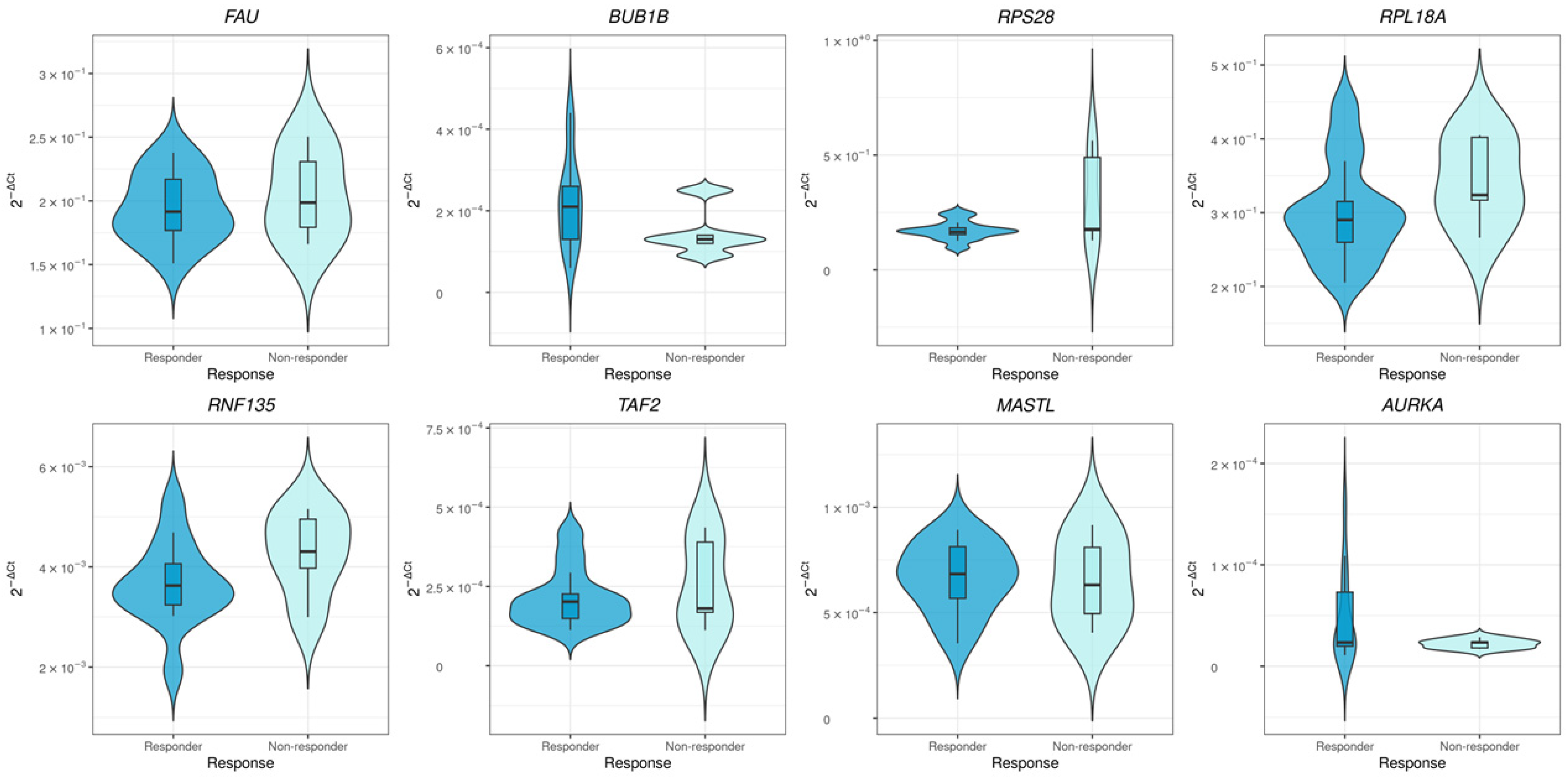
2.7. RT-qPCR Assessment of Candidate Genes
3. Discussion
4. Materials and Methods
4.1. Ethical Approval
4.2. Enrolled Subjects
4.3. DNA and RNA Isolation
4.4. RNA Sequencing and Differential Gene Expression Analysis
4.5. Gene Ontology Analysis
4.6. Gene Scores, Logistic Regression, and Weighted Gene Co-Expression Network Analysis
4.7. Genomic Profiling and Association Analysis
4.8. Exploratory External Dataset Comparison
4.9. RT-qPCR Assessment of Candidate Genes
Supplementary Materials
Author Contributions
Funding
Institutional Review Board Statement
Informed Consent Statement
Data Availability Statement
Acknowledgments
Conflicts of Interest
Abbreviations
| AD | Atopic dermatitis |
| AUC | Area under the curve |
| BSA | Body surface area |
| EASI | Eczema Area and Severity Index |
| eQTL | Tissue expression quantitative trait loci |
| GO | Gene ontology |
| MR | Mendelian randomization |
| ROC | Receiver operating characteristic |
| VAS | Visual analog scale |
| vIGA-AD | Validated Investigator Global Assessment for Atopic Dermatitis |
| WGCNA | Weighted Gene Co-Expression Network Analysis |
References
- Weidinger, S.; Novak, N. Atopic dermatitis. Lancet 2016, 387, 1109–1122. [Google Scholar] [CrossRef]
- Afshari, M.; Kolackova, M.; Rosecka, M.; Čelakovská, J.; Krejsek, J. Unraveling the skin; a comprehensive review of atopic dermatitis, current understanding, and approaches. Front. Immunol. 2024, 15, 1361005. [Google Scholar] [CrossRef]
- Meledathu, S.; Naidu, M.P.; Brunner, P.M. Update on atopic dermatitis. J. Allergy Clin. Immunol. 2025, 155, 1124–1132. [Google Scholar] [CrossRef]
- Carrascosa-Carrillo, J.M.; Aterido, A.; Li, T.; Guillén, Y.; Martinez, S.; Marsal, S.; Julià, A. Toward Precision Medicine in Atopic Dermatitis Using Molecular-Based Approaches. Actas Dermosifiliogr. 2024, 115, 66–75. [Google Scholar] [CrossRef]
- Asher, M.I.; Montefort, S.; Björkstén, B.; Lai, C.K.; Strachan, D.P.; Weiland, S.K.; Williams, H. Worldwide time trends in the prevalence of symptoms of asthma, allergic rhinoconjunctivitis, and eczema in childhood: ISAAC Phases One and Three repeat multicountry cross-sectional surveys. Lancet 2006, 368, 733–743. [Google Scholar] [CrossRef]
- Bonamonte, D.; Filoni, A.; Vestita, M.; Romita, P.; Foti, C.; Angelini, G. The Role of the Environmental Risk Factors in the Pathogenesis and Clinical Outcome of Atopic Dermatitis. BioMed Res. Int. 2019, 2019, 2450605. [Google Scholar] [CrossRef]
- Langan, S.M.; Irvine, A.D.; Weidinger, S. Atopic dermatitis. Lancet 2020, 396, 345–360. [Google Scholar] [CrossRef]
- Chrostowska-Plak, D.; Reich, A.; Szepietowski, J.C. Relationship between itch and psychological status of patients with atopic dermatitis. J. Eur. Acad. Dermatol. Venereol. 2013, 27, e239–e242. [Google Scholar] [CrossRef]
- Silverberg, J.I.; Gelfand, J.M.; Margolis, D.J.; Boguniewicz, M.; Fonacier, L.; Grayson, M.H.; Simpson, E.L.; Ong, P.Y.; Chiesa Fuxench, Z.C. Patient burden and quality of life in atopic dermatitis in US adults: A population-based cross-sectional study. Ann. Allergy Asthma Immunol. 2018, 121, 340–347. [Google Scholar] [CrossRef]
- Mastraftsi, S.; Vrioni, G.; Bakakis, M.; Nicolaidou, E.; Rigopoulos, D.; Stratigos, A.J.; Gregoriou, S. Atopic Dermatitis: Striving for Reliable Biomarkers. J. Clin. Med. 2022, 11, 4639. [Google Scholar] [CrossRef]
- Bakker, D.; de Bruin-Weller, M.; Drylewicz, J.; van Wijk, F.; Thijs, J. Biomarkers in atopic dermatitis. J. Allergy Clin. Immunol. 2023, 151, 1163–1168. [Google Scholar] [CrossRef]
- Simpson, E.L.; Guttman-Yassky, E.; Margolis, D.J.; Feldman, S.R.; Qureshi, A.; Hata, T.; Mastey, V.; Wei, W.; Eckert, L.; Chao, J.; et al. Association of Inadequately Controlled Disease and Disease Severity With Patient-Reported Disease Burden in Adults With Atopic Dermatitis. JAMA Dermatol. 2018, 154, 903–912. [Google Scholar] [CrossRef]
- Simpson, E.L.; Bieber, T.; Guttman-Yassky, E.; Beck, L.A.; Blauvelt, A.; Cork, M.J.; Silverberg, J.I.; Deleuran, M.; Kataoka, Y.; Lacour, J.P.; et al. Two Phase 3 Trials of Dupilumab versus Placebo in Atopic Dermatitis. N. Engl. J. Med. 2016, 375, 2335–2348. [Google Scholar] [CrossRef]
- Das, A.S.; Basu, A.; Mukhopadhyay, R. Ribosomal proteins: The missing piece in the inflammation puzzle? Mol. Cell Biochem. 2025, 480, 785–797. [Google Scholar] [CrossRef]
- Wolf, I.; Bouquet, C.; Melchers, F. cDNA-library testing identifies transforming genes cooperating with c-myc in mouse pre-B cells. Eur. J. Immunol. 2016, 46, 2555–2565. [Google Scholar] [CrossRef]
- Kader, H.A.; Sabih Ur Rehman, S.; Saraswathiamma, D.; Shiek, S.S.; Bencomo-Hernández, A.A.; Moorakkan, U.R.; Haider, M.T.; Munawar, N.; Iratni, R.; Serfling, E.; et al. NFATc1 deficiency in B cells ameliorates atopic dermatitis. Sci. Rep. 2025, 15, 25170. [Google Scholar] [CrossRef]
- Lee, D.; Jo, M.G.; Min, K.Y.; Choi, M.Y.; Kim, Y.M.; Kim, H.S.; Choi, W.S. IL-10(+) regulatory B cells mitigate atopic dermatitis by suppressing eosinophil activation. Sci. Rep. 2024, 14, 18164. [Google Scholar] [CrossRef]
- Lommatzsch, M.; Dost, M.; Jaishankar, N.; Weise, M.; Stoll, P.; Virchow, J.C.; Bratke, K. Dupilumab treatment increases transitional B cells in severe asthma. Allergy 2023, 78, 2055–2057. [Google Scholar] [CrossRef]
- Li, L.; Zhang, Y.; Wang, J.; Zhang, L.; Gao, Y.; Ji, X.; Wang, T.; Zhao, F. GZMA silencing inhibits JAK2/STAT1 pathway and improves allergic rhinitis. Gen. Physiol. Biophys. 2025, 44, 93–106. [Google Scholar] [CrossRef]
- Shi, H.Z.; Wang, M.W.; Huang, Y.S.; Liu, Z.; Li, L.; Wan, L.P. A telomere-related gene risk model for predicting prognosis and treatment response in acute myeloid leukemia. Heliyon 2024, 10, e31705. [Google Scholar] [CrossRef]
- Liu, X.; Lu, X.; Wang, L.; Du, Q.; Li, X.; Li, Y.; Ding, X.; Lai, Y.; Chen, X. Bioinformatics analysis of immune infiltration and cell cycle hub genes in atopic dermatitis. Biochem. Biophys. Rep. 2025, 44, 102253. [Google Scholar] [CrossRef]
- Shi, S.; Qiu, Y.; Jin, Z.; Zhou, J.; Yu, W.; Zhang, H. AURKA Identified as Potential Lung Cancer Marker through Comprehensive Bioinformatic Analysis and Experimental Verification. Crit. Rev. Eukaryot. Gene Expr. 2023, 33, 39–59. [Google Scholar] [CrossRef]
- Farid, A.A.; Afify, N.A.; Alsharnoby, A.A.; Abdelsameea, E.; Bedair, H.M. Predictive Role of AURKA rs 1047972 Gene Polymorphism and the Risk of Development of Hepatocellular Carcinoma. Immunol. Invest. 2022, 51, 1211–1221. [Google Scholar] [CrossRef]
- Taylor, N.J.; Bensen, J.T.; Poole, C.; Troester, M.A.; Gammon, M.D.; Luo, J.; Millikan, R.C.; Olshan, A.F. Genetic variation in cell cycle regulatory gene AURKA and association with intrinsic breast cancer subtype. Mol. Carcinog. 2015, 54, 1668–1677. [Google Scholar] [CrossRef]
- Tang, H.; Tang, X.; Guo, Z.; Cheng, H.; Zheng, X.; Chen, G.; Huang, H.; Wang, W.; Gao, J.; Sheng, Y.; et al. AURKA facilitates the psoriasis-related inflammation by impeding autophagy-mediated AIM2 inflammasome suppression. Immunol. Lett. 2021, 240, 98–105. [Google Scholar] [CrossRef]
- Luo, X.; Wei, Y.; Lin, H.; Xiao, N.; Zhao, W. BUB1B promotes homologous recombination-mediated DNA damage repair in breast cancer cells through the PI3K/AKT signaling pathway. Oncol. Rep. 2025, 54, 147. [Google Scholar] [CrossRef]
- Kumar, S.; Sharma, R.; Komal, K.; Kumar, D.; Ghosh, R.; Kumar, M. Unlocking the molecular pathway of atopic dermatitis: Journey so far and roads ahead. Inflammopharmacology 2025, 33, 5203–5234. [Google Scholar] [CrossRef]
- Huang, M.; Dong, L.; He, Y.; Cai, X.; Lu, Y.; Xu, J.; Xiao, F. YTHDF1 regulates the proliferation and differentiation of keratinocytes via the PI3K/AKT signaling pathway in atopic dermatitis. Allergol. Int. 2025, 74, 591–604. [Google Scholar] [CrossRef]
- Huang, T.; Lin, X.; Meng, X.; Lin, M. Phosphoinositide-3 kinase/protein kinase-B/mammalian target of rapamycin pathway in psoriasis pathogenesis. A potential therapeutic target? Acta Derm. Venereol. 2014, 94, 371–379. [Google Scholar] [CrossRef]
- Chen, S.; Li, C.; Tu, Z.; Cai, T.; Zhang, X.; Wang, L.; Tian, R.; Huang, J.; Gong, Y.; Yang, X.; et al. Off-label use of Baricitinib improves moderate and severe atopic dermatitis in China through inhibiting MAPK and PI3K/Akt/mTOR pathway via targeting JAK-STAT signaling of CD4(+) cells. Front. Pharmacol. 2024, 15, 1324892. [Google Scholar] [CrossRef]
- Yang, F.; Tanaka, M.; Wataya-Kaneda, M.; Yang, L.; Nakamura, A.; Matsumoto, S.; Attia, M.; Murota, H.; Katayama, I. Topical application of rapamycin ointment ameliorates Dermatophagoides farina body extract-induced atopic dermatitis in NC/Nga mice. Exp. Dermatol. 2014, 23, 568–572. [Google Scholar] [CrossRef]
- Bae, M.J.; Lim, S.; Lee, D.S.; Ko, K.R.; Lee, W.; Kim, S. Water soluble extracts from Actinidia arguta, PG102, attenuates house dust mite-induced murine atopic dermatitis by inhibiting the mTOR pathway with Treg generation. J. Ethnopharmacol. 2016, 193, 96–106. [Google Scholar] [CrossRef]
- Sanz-Castillo, B.; Hurtado, B.; Vara-Ciruelos, D.; El Bakkali, A.; Hermida, D.; Salvador-Barbero, B.; Martínez-Alonso, D.; González-Martínez, J.; Santiveri, C.; Campos-Olivas, R.; et al. The MASTL/PP2A cell cycle kinase-phosphatase module restrains PI3K-Akt activity in an mTORC1-dependent manner. Embo J. 2023, 42, e110833. [Google Scholar] [CrossRef]
- Roy, T.; Boateng, S.T.; Uddin, M.B.; Banang-Mbeumi, S.; Yadav, R.K.; Bock, C.R.; Folahan, J.T.; Siwe-Noundou, X.; Walker, A.L.; King, J.A.; et al. The PI3K-Akt-mTOR and Associated Signaling Pathways as Molecular Drivers of Immune-Mediated Inflammatory Skin Diseases: Update on Therapeutic Strategy Using Natural and Synthetic Compounds. Cells 2023, 12, 1671. [Google Scholar] [CrossRef]
- Sid, H.; Schusser, B. Advancing immunity and disease resistance in chickens through genome editing. J. Anim. Sci. Biotechnol. 2026, 17, 33. [Google Scholar] [CrossRef]
- Oshiumi, H.; Matsumoto, M.; Hatakeyama, S.; Seya, T. Riplet/RNF135, a RING finger protein, ubiquitinates RIG-I to promote interferon-beta induction during the early phase of viral infection. J. Biol. Chem. 2009, 284, 807–817. [Google Scholar] [CrossRef]
- Wallach, D.; Kovalenko, A. Phosphorylation and dephosphorylation of the RIG-I-like receptors: A safety latch on a fateful pathway. Immunity 2013, 38, 402–403. [Google Scholar] [CrossRef]
- Oshiumi, H.; Miyashita, M.; Inoue, N.; Okabe, M.; Matsumoto, M.; Seya, T. The ubiquitin ligase Riplet is essential for RIG-I-dependent innate immune responses to RNA virus infection. Cell Host Microbe 2010, 8, 496–509. [Google Scholar] [CrossRef]
- Chen, Y.; Chen, Y.; Shi, C.; Huang, Z.; Zhang, Y.; Li, S.; Li, Y.; Ye, J.; Yu, C.; Li, Z.; et al. SOAPnuke: A MapReduce acceleration-supported software for integrated quality control and preprocessing of high-throughput sequencing data. Gigascience 2018, 7, gix120. [Google Scholar] [CrossRef]
- Gorenjak, M.; Gole, B.; Goričan, L.; Jezernik, G.; Prosenc Zmrzljak, U.; Pernat, C.; Skok, P.; Potočnik, U. Single-Cell Transcriptomic and Targeted Genomic Profiling Adjusted for Inflammation and Therapy Bias Reveal CRTAM and PLCB1 as Novel Hub Genes for Anti-Tumor Necrosis Factor Alpha Therapy Response in Crohn’s Disease. Pharmaceutics 2024, 16, 835. [Google Scholar] [CrossRef]
- Gorenjak, M.; Zupin, M.; Jezernik, G.; Skok, P.; Potočnik, U. Omics data integration identifies ELOVL7 and MMD gene regions as novel loci for adalimumab response in patients with Crohn’s disease. Sci. Rep. 2021, 11, 5449. [Google Scholar] [CrossRef]
- Yu, G.; Wang, L.G.; Han, Y.; He, Q.Y. clusterProfiler: An R package for comparing biological themes among gene clusters. Omics 2012, 16, 284–287. [Google Scholar] [CrossRef] [PubMed]
- Wu, T.; Hu, E.; Xu, S.; Chen, M.; Guo, P.; Dai, Z.; Feng, T.; Zhou, L.; Tang, W.; Zhan, L.; et al. clusterProfiler 4.0: A universal enrichment tool for interpreting omics data. Innovation 2021, 2, 100141. [Google Scholar] [CrossRef]
- Kosmidis, I. R Package, Version 1.1.0; Brglm2: Bias Reduction in Generalized Linear Models; CRAN: Vienna, Austria, 2023.
- Langfelder, P.; Horvath, S. WGCNA: An R package for weighted correlation network analysis. BMC Bioinform. 2008, 9, 559. [Google Scholar] [CrossRef] [PubMed]
- Anderson, C.A.; Pettersson, F.H.; Clarke, G.M.; Cardon, L.R.; Morris, A.P.; Zondervan, K.T. Data quality control in genetic case-control association studies. Nat. Protoc. 2010, 5, 1564–1573. [Google Scholar] [CrossRef]
- Taliun, D.; Harris, D.N.; Kessler, M.D.; Carlson, J.; Szpiech, Z.A.; Torres, R.; Taliun, S.A.G.; Corvelo, A.; Gogarten, S.M.; Kang, H.M.; et al. Sequencing of 53,831 diverse genomes from the NHLBI TOPMed Program. Nature 2021, 590, 290–299. [Google Scholar] [CrossRef]
- Das, S.; Forer, L.; Schönherr, S.; Sidore, C.; Locke, A.E.; Kwong, A.; Vrieze, S.I.; Chew, E.Y.; Levy, S.; McGue, M.; et al. Next-generation genotype imputation service and methods. Nat. Genet. 2016, 48, 1284–1287. [Google Scholar] [CrossRef]
- Fuchsberger, C.; Abecasis, G.R.; Hinds, D.A. minimac2: Faster genotype imputation. Bioinformatics 2015, 31, 782–784. [Google Scholar] [CrossRef]
- Chang, C.C.; Chow, C.C.; Tellier, L.C.; Vattikuti, S.; Purcell, S.M.; Lee, J.J. Second-generation PLINK: Rising to the challenge of larger and richer datasets. Gigascience 2015, 4, 7. [Google Scholar] [CrossRef]
- Machiela, M.J.; Chanock, S.J. LDlink: A web-based application for exploring population-specific haplotype structure and linking correlated alleles of possible functional variants. Bioinformatics 2015, 31, 3555–3557. [Google Scholar] [CrossRef]
- Pruim, R.J.; Welch, R.P.; Sanna, S.; Teslovich, T.M.; Chines, P.S.; Gliedt, T.P.; Boehnke, M.; Abecasis, G.R.; Willer, C.J. LocusZoom: Regional visualization of genome-wide association scan results. Bioinformatics 2010, 26, 2336–2337. [Google Scholar] [CrossRef]
- Yavorska, O.O.; Burgess, S. MendelianRandomization: An R package for performing Mendelian randomization analyses using summarized data. Int. J. Epidemiol. 2017, 46, 1734–1739. [Google Scholar] [CrossRef] [PubMed]
- Möbus, L.; Rodriguez, E.; Harder, I.; Boraczynski, N.; Szymczak, S.; Hübenthal, M.; Stölzl, D.; Gerdes, S.; Kleinheinz, A.; Abraham, S.; et al. Blood transcriptome profiling identifies 2 candidate endotypes of atopic dermatitis. J. Allergy Clin. Immunol. 2022, 150, 385–395. [Google Scholar] [CrossRef] [PubMed]
- Ye, J.; Coulouris, G.; Zaretskaya, I.; Cutcutache, I.; Rozen, S.; Madden, T.L. Primer-BLAST: A tool to design target-specific primers for polymerase chain reaction. BMC Bioinform. 2012, 13, 134. [Google Scholar] [CrossRef] [PubMed]
- Untergasser, A.; Cutcutache, I.; Koressaar, T.; Ye, J.; Faircloth, B.C.; Remm, M.; Rozen, S.G. Primer3—New capabilities and interfaces. Nucleic Acids Res. 2012, 40, e115. [Google Scholar] [CrossRef]
- Gorenjak, M.; Repnik, K.; Jezernik, G.; Jurgec, S.; Skok, P.; Potočnik, U. Genetic prediction profile for adalimumab response in Slovenian Crohn’s disease patients. Z. Gastroenterol. 2019, 57, 1218–1225. [Google Scholar] [CrossRef]
- Livak, K.J.; Schmittgen, T.D. Analysis of relative gene expression data using real-time quantitative PCR and the 2(-Delta Delta C(T)) Method. Methods 2001, 25, 402–408. [Google Scholar] [CrossRef]


| Module | Module Color | Number of Genes in the Module | p-Value for the Module |
|---|---|---|---|
| 0 | gray | 14 | 0.0584 |
| 1 | turquoise | 109 | 0.0734 |
| 2 | blue | 104 | 0.0519 |
| 3 | brown | 53 | 0.0657 |
| 4 | yellow | 46 | 0.0551 |
| Chr | Base Pair (GRCh38) | dbSNP ID | A1 | Gene | p-Value |
|---|---|---|---|---|---|
| 19 | 17,831,128 | rs3212777 | G | RPL18A | 0.0339 |
| 19 | 8,315,265 | rs8110376 | C | RPS28 | 0.0454 |
| 11 | 65,157,627 | rs75018393 | T | FAU | 0.0432 |
| 10 | 27,250,013 | rs590142 | C | MASTL | 0.0409 |
| 20 | 56,295,713 | rs6069696 | A | AURKA | 0.0322 |
| 8 | 119,695,360 | rs9297602 | G | TAF2 | 0.0265 |
| 15 | 40,157,612 | rs55940969 | T | BUB1B | 0.0454 |
| 2 | 175,160,299 | rs2788522 | T | ATF2 | 0.0219 |
| 2 | 175,037,495 | rs12613111 | C | ATF2 | 0.0416 |
| 17 | 30,925,135 | rs11868576 | T | RNF135 | 0.0421 |
| dbSNP ID (Gene) | Proxy SNP | D’ | Tissue | p-Value |
|---|---|---|---|---|
| rs3212777 (RPL18A) | rs111922843 | 0.7083 | blood † | 6.60 × 10⁻¹³ |
| rs8110376 (RPS28) | rs2913944 | 1 | whole blood ‖ | 1.70 × 10⁻⁸ |
| rs75018393 (FAU) | rs2957879 | 1 | whole blood ‖ | 6.00 × 10⁻⁵ |
| rs590142 (MASTL) | / | / | whole blood ‖ | 5.20 × 10⁻¹⁴ |
| rs6069696 (AURKA) | rs2298016 | 0.9201 | macrophage: IFNg 18 h † | 6.88 × 10⁻¹⁰ |
| rs9297602 (TAF2) | rs16892938 | 1 | whole blood ‖ | 6.40 × 10⁻⁶ |
| rs55940969 (BUB1B) | rs62020025 | 1 | whole blood ‖ | 5.00 × 10⁻⁵ |
| rs11868576 (RNF135) | rs6505219 | 0.9047 | whole blood ‖ | 8.30 × 10⁻⁵ |
| Gene | log2FC | CI ‖ | p-Value |
|---|---|---|---|
| RPL18A | −0.4809 | −1.0318 to 0.0700 | 0.0855 |
| RPS28 | −0.8069 | −1.5704 to −0.0433 | 0.0388 |
| FAU | −0.4038 | −0.8955 to 0.0879 | 0.1051 |
| MASTL | 0.1165 | −0.1939 to 0.4270 | 0.4538 |
| AURKA | 0.2827 | −0.1012 to 0.6666 | 0.1451 |
| TAF2 | 0.3597 | −0.0347 to 0.7542 | 0.0729 |
| BUB1B | 0.4093 | −0.1405 to 0.9591 | 0.1408 |
| RNF135 | −0.0904 | −0.3090 to 0.1281 | 0.4091 |
| Gene | 2−ΔΔCt | Minimal Error | Maximal Error | p-Value ‖ |
|---|---|---|---|---|
| RPL18A | 1.149 | 0.963 | 1.372 | 0.139 |
| RPS28 | 1.526 | 0.778 | 2.995 | 0.299 |
| FAU | 1.050 | 0.885 | 1.245 | 0.562 |
| MASTL | 0.967 | 0.690 | 1.356 | 0.406 |
| AURKA | 0.655 | 0.529 | 0.812 | 0.386 |
| TAF2 | 1.128 | 0.630 | 2.020 | 0.803 |
| BUB1B | 0.724 | 0.503 | 1.042 | 0.099 |
| RNF135 | 1.179 | 0.950 | 1.463 | 0.326 |
| Naïve Patients (N = 18) | Long-Term Good Responders (N = 16) | Healthy Controls (N = 9) | |
|---|---|---|---|
| Mean age at time of sampling (SD) | 27.44 (9.20) | 31.88 (13.92) | 43.11 (6.58) |
| Sex, N (%) | |||
| Female | 6 (33.3%) | 7 (43.8%) | 4 (44.4%) |
| Male | 12 (66.7%) | 9 (56.3%) | 5 (55.6%) |
| Treatment outcome, N (%) | |||
| Response | 13 (72.2%) | ||
| Non-response | 5 (27.8%) |
| Naïve Patients (N = 18) | |||
|---|---|---|---|
| Baseline Parameters | Follow-Up Parameters | p-Value * | |
| BSA [%] | |||
| Mean (SD) | 30.39 (25.20) | 3.28 (4.06) | <0.001 |
| Median | 20 | 1.50 | |
| Minimum | 5 | 0 | |
| Maximum | 90 | 12 | |
| vIGA-AD | |||
| Mean (SD) | 2.81 (0.54) | 0.69 (0.70) | <0.001 |
| Median | 3 | 1 | |
| Minimum | 2 | 0 | |
| Maximum | 4 | 2 | |
| VAS pruritus | |||
| Mean (SD) | 7.44 (1.88) | 2.56 (2.20) | <0.001 |
| Median | 7.50 | 2.50 | |
| Minimum | 3 | 0 | |
| Maximum | 10 | 7 | |
| VAS sleep disturbance | |||
| Mean (SD) | 5.67 (3.42) | 0.72 (1.67) | 0.002 |
| Median | 8 | 0 | |
| Minimum | 0 | 0 | |
| Maximum | 10 | 6 | |
| EASI | |||
| Mean (SD) | 16.96 (9.09) | 1.60 (2.13) | <0.001 |
| Median | 15.85 | 0.55 | |
| Minimum | 5.10 | 0 | |
| Maximum | 39.50 | 5.70 | |
| Gene | Forward Primer (5′–3′) | Reverse Primer (5′–3′) |
|---|---|---|
| TAF2 | ACTTCTTCCGAGTTACAGGCA | TGGTGGGTTCTTAGTCAACATG |
| MASTL | TGCATCCAATAACTCAGAACCA | AATTCGCCCATCATCAACGG |
| FAU | CATTGCCCCGGAAGATCAAG | TAGCCCGACCTGTCTTCTTC |
| BUB1B | GATCATGTCCACGCTTCAGG | ACTCTCCTTCCCACCTTGAG |
| RNF135 | CAACGAACTGAGCATCCTGG | ATGGGCATGAGGAGGAAGAC |
| RPS28 | CGTGTGCAGCCTATCAAGC | CTCGCTCTGACTCCAAAAGG |
| RPL18A | GGAGATTGTCTACTGTGGGC | GCGATCTCCTCCACCTTCAT |
| AURKA | AATTCTTCCCAGCGCATTCC | AAGTCTTCCAAAGCCCACTG |
| B2M † | TTCTGGCCTGGAGGCTATC | TCAGGAAATTTGACTTTCCATTC |
| ACTB † | CATCGAGCACGGCATCGTCA | TAGCACAGCCTGGATAGCAAC |
Disclaimer/Publisher’s Note: The statements, opinions and data contained in all publications are solely those of the individual author(s) and contributor(s) and not of MDPI and/or the editor(s). MDPI and/or the editor(s) disclaim responsibility for any injury to people or property resulting from any ideas, methods, instructions or products referred to in the content. |
© 2026 by the authors. Licensee MDPI, Basel, Switzerland. This article is an open access article distributed under the terms and conditions of the Creative Commons Attribution (CC BY) license.
Share and Cite
Krušič, M.; Gorenjak, M.; Potočnik, U.; Marovt, M. Integrative Transcriptomic, Network, and Genomic Analysis of Peripheral Blood Mononuclear Cells Identifies Candidate Genes Associated with Dupilumab Clinical Response in Atopic Dermatitis Patients. Int. J. Mol. Sci. 2026, 27, 5147. https://doi.org/10.3390/ijms27115147
Krušič M, Gorenjak M, Potočnik U, Marovt M. Integrative Transcriptomic, Network, and Genomic Analysis of Peripheral Blood Mononuclear Cells Identifies Candidate Genes Associated with Dupilumab Clinical Response in Atopic Dermatitis Patients. International Journal of Molecular Sciences. 2026; 27(11):5147. https://doi.org/10.3390/ijms27115147
Chicago/Turabian StyleKrušič, Martina, Mario Gorenjak, Uroš Potočnik, and Maruška Marovt. 2026. "Integrative Transcriptomic, Network, and Genomic Analysis of Peripheral Blood Mononuclear Cells Identifies Candidate Genes Associated with Dupilumab Clinical Response in Atopic Dermatitis Patients" International Journal of Molecular Sciences 27, no. 11: 5147. https://doi.org/10.3390/ijms27115147
APA StyleKrušič, M., Gorenjak, M., Potočnik, U., & Marovt, M. (2026). Integrative Transcriptomic, Network, and Genomic Analysis of Peripheral Blood Mononuclear Cells Identifies Candidate Genes Associated with Dupilumab Clinical Response in Atopic Dermatitis Patients. International Journal of Molecular Sciences, 27(11), 5147. https://doi.org/10.3390/ijms27115147