Review

Cathepsin Z/X: Breaking Down the Known and Unknown

by
Kristina Zdravkova
1,
Milena Pavicević
2,
Olja Mijanović
3,
Ana Branković
2,
Polina M. Ilicheva
4,
Aleksandra Stankovski
5,
Jelena Karanović
6,
Dusan Pualić
7,
Aleksandr A. Rubel
3,
Ivan V. Rodionov
8,9,10,
Lyudmila V. Savvateeva
8,
Alessandro Parodi
10,11 and
Andrey A. Zamyatnin, Jr.
10,12,*
1
AD Alkaloid Skopje, Boulevard Alexander the Great 12, 1000 Skopje, North Macedonia
2
Department of Forensic Sciences, Faculty of Forensic Sciences and Engineering, University of Criminal Investigation and Police Studies, Cara Dusana 196, 11000 Belgrade, Serbia
3
Laboratory of Amyloid Biology, St. Petersburg State University, 199034 St. Petersburg, Russia
4
Institute of Chemistry, Saratov State University, 410012 Saratov, Russia
5
Biotest AG, Landsteinerstraße 5, 63303 Dreieich, Germany
6
Department for Human Molecular Genetics and Genomics, Institute of Molecular Genetics and Genetic Engineering, University of Belgrade, Vojvode Stepe 444A, 11042 Belgrade, Serbia
7
Military Medical Academy, Crnotravska 17, 11000 Belgrade, Serbia
8
Institute of Translational Medicine and Biotechnology, Sechenov First Moscow State Medical University, 119991 Moscow, Russia
9
Department of Biological Chemistry, Sechenov First Moscow State Medical University, 119991 Moscow, Russia
10
Faculty of Bioengineering and Bioinformatics, Lomonosov Moscow State University, 119234 Moscow, Russia
11
Scientific Center for Translation Medicine, Sirius University of Science and Technology, 354340 Sochi, Russia
12
Belozersky Institute of Physico-Chemical Biology, Lomonosov Moscow State University, 119992 Moscow, Russia
*
Author to whom correspondence should be addressed.
Int. J. Mol. Sci. 2026, 27(11), 5061; https://doi.org/10.3390/ijms27115061
Submission received: 30 April 2026 / Revised: 31 May 2026 / Accepted: 1 June 2026 / Published: 3 June 2026
(This article belongs to the Section Molecular Pathology, Diagnostics, and Therapeutics)

Abstract

Cathepsin Z/X (Cat Z/X) is a distinct member of the cysteine cathepsin family, known for its distinctive structural and functional properties, such as strict carboxypeptidase activity and integrin-binding motifs. These features set Cat Z/X apart from other cysteine proteases and underlie its involvement in diverse physiological and pathological processes, including immune regulation, cell signaling, and extracellular matrix remodeling. Dysregulated Cat Z/X expression and activity have been associated with various diseases, including cancer, neurodegenerative disorders, and metabolic conditions. This review summarizes current knowledge on Cat Z/X, focusing on its structural characteristics, biological functions, and roles in disease pathogenesis, particularly in malignancies, neuroinflammation, and metabolic disorders. It also explores natural and synthetic Cat Z/X inhibitors and their potential for therapeutic development. Despite growing research interest, the precise molecular mechanisms and context-specific functions of Cat Z/X are not yet fully understood. Further research is required to elucidate its regulatory networks, refine detection methods, and develop selective modulators targeting its proteolytic and non-proteolytic activities. A deeper understanding of Cat Z/X biology could pave the way for its application as a diagnostic biomarker and therapeutic target in numerous diseases.

1. Introduction

Cysteine cathepsins are lysosomal peptidases involved in intracellular protein turnover and various physiological and pathological processes, including antigen presentation, tissue remodeling, inflammation, and cell signaling. Beyond their traditional lysosomal functions, certain cathepsins also regulate processes at the cell surface or in the extracellular space, facilitating intercellular communication and contributing to disease progression. Extensive research has highlighted the functional diversity, regulation, and context-specific roles of cysteine cathepsins [1].
The accumulated body of research clearly shows that cathepsins play significant roles in the initiation, progression, and metastasis of tumors. Within the tumor microenvironment (TME), these enzymes participate in proteolytic remodeling, immune modulation, and signaling cascades that favor tumor survival and invasion [1].
Among them, cathepsin Z/X (Cat Z/X) has recently emerged as a peptidase of particular interest due to its distinctive structural characteristics, restricted tissue distribution, and involvement in several malignancies. As with other members of the cathepsin family, Cat Z/X undergoes a complex maturation process, progressing from pre-proenzyme forms to an active peptidase capable of executing diverse cellular functions [2]. However, despite these advances, the precise physiological and pathological roles of Cat Z/X remain insufficiently characterized. Current findings suggest that Cat Z/X may exert multifaceted effects within both intracellular and extracellular environments, potentially influencing systemic processes and tumor-associated signaling pathways. The extent to which Cat Z/X contributes to disease progression, therapeutic resistance, and patient outcomes continues to be a matter of active investigation [3].
Recent reviews have also discussed Cat Z/X [2,4,5]. Our review consolidates current knowledge on Cat Z/X, from its molecular characteristics and physiological functions to its roles in human disease and unresolved aspects of its biology. It provides an overview of Cat Z/X structure, maturation, and functions in cellular homeostasis, with particular emphasis on its emerging roles in cancer. The analysis distinguishes causal evidence from genetic and in vivo studies from purely correlative biomarker data and also summarizes current Cat Z/X inhibitors. The novelty of this work lies in connecting the structural features of Cat Z/X, including its strict carboxypeptidase activity and integrin-binding motifs, to its diverse pathophysiological roles and therapeutic potential across disease contexts.

2. Structure of Cathepsin Z/X

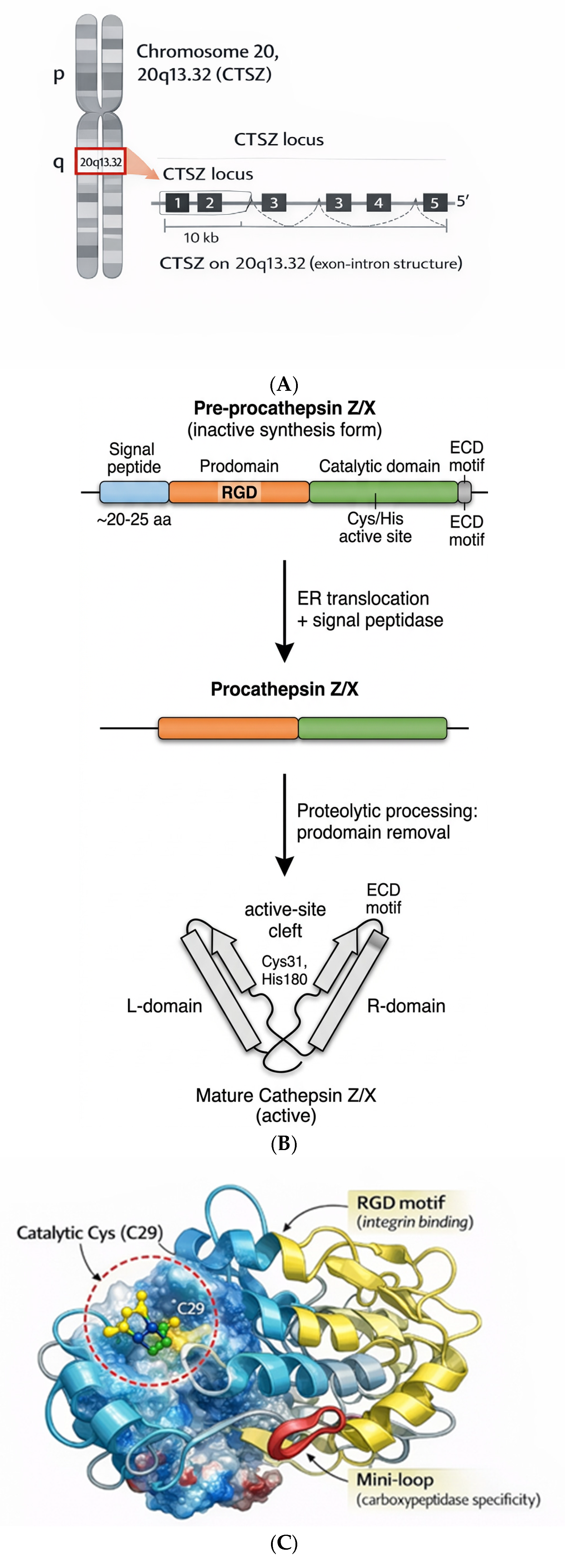
The CTSZ gene resides on chromosome 20q13 (Figure 1A), an atypical locus for human cysteine peptidases, as confirmed by in situ hybridization of PAC clones [6]. Cat Z/X was independently identified by several groups in the late 1990s, following partial sequencing of a bovine homolog in 1985 [7,8,9]. Isolation and characterization of a human brain cDNA involved comparison with the Expressed Sequence Tag (EST) database of known cysteine peptidases, revealing a 909-base-pair fragment with an open reading frame encoding 303 amino acids and a predicted molecular weight of 33.9 kDa [6]. Sequence comparisons show that Cat Z/X shares 34% identity with Cat C and 26% identity with Cat B [10]. Although it shares similarities with papain-family cysteine peptidases in its signal sequence, prodomain, and catalytic triad [11], Cat Z/X exhibits several features that distinguish it from other cathepsins.
Its structure includes three unique peptide insertions. The first, a tripeptide (His–Ile–Pro) adjacent to the glutamine residue forming the oxyanion hole, increases the distance to the catalytic cysteine, potentially influencing catalytic efficiency and substrate specificity. The others comprise an eight-residue insertion in the central region and a 14-residue insertion at the C-terminus: their functional roles remain unclear [10]. Mature Cat Z/X forms a biologically active homodimer, unlike most other monomeric lysosomal cysteine cathepsins, offering new insights into its roles in cellular processes and disease [12]. Unlike most cysteine cathepsins, which function predominantly as endopeptidases, Cat Z/X exhibits strict carboxypeptidase activity [13]. This specificity arises from a distinctive three-residue mini-loop that partially occludes the active-site cleft, restricting substrate access [14] and imposing steric constraints for carboxypeptidase reactions with negligible endopeptidase activity. This mechanism is functionally analogous to Cat B’s occluding loop [15], while the Cat Z/X mini-loop also hinders inhibition by cystatin C.
Cat Z/X is synthesized as an inactive precursor (proCat Z/X) with a short 38-residue prodomain that includes an integrin-binding Arg-Gly-Asp (RGD) motif, covalently tethered to the active site via an intramolecular disulfide bond [15]. Activation involves a regulated maturation process in which Cat L serves as a processing enzyme in vitro, though physiological mechanisms in vivo remain undefined [15]. The mature enzyme comprises 242 amino acids and contains a second integrin-binding motif, Glu-Cys-Asp (ECD) (Figure 1B,C) [15]. These motifs enable direct interactions with membrane-associated integrins and adhesion receptors, positioning Cat Z/X beyond a mere degradative peptidase [16,17]. Although CTSZ transcripts occur across different tissues, the protein is most abundant in immune cells (particularly macrophages, monocytes, veiled dendritic cells, bronchial epithelial cells, and alveolar type I cells), indicating roles in inflammation and immune responses [18]. It contributes to cell adhesion, bidirectional signal transduction, cell–matrix communication, and cell trafficking via binding to cell-surface heparan sulfate proteoglycans [19], with implications for tissue homeostasis and remodeling [10,20,21,22].

3. Physiological Functions of Cathepsin Z/X

Proteases function within intricate, interconnected networks, where modulating a single peptidase significantly impacts the activity, structure, specificity, localization, stability, and expression of others [23]. Cysteine cathepsins exemplify this through highly interconnected proteolytic networks, emphasizing their roles as signaling and regulatory enzymes rather than isolated degradative factors [5]. In a seminal study, Xu et al. [24] used chemical and genetic perturbation in dendritic cells to show that Cat Z/X deletion or inhibition alters Cat L processing and localization—including accumulation of pro- and intermediate forms alongside reduced nuclear Cat L activity. These indirect effects may reflect changes in lysosomal homeostasis (e.g., oxidative stress or pH) rather than direct proteolytic processing by Cat Z/X. Notably, these observations in defined cellular systems support a context-dependent regulatory relationship within protease networks, rather than a dominant physiological role for Cat Z/X in Cat L maturation in vivo; further studies across diverse cell types and organismal models are required [24].
Cat Z/X deficiency in murine and human fibroblasts induces accelerated cellular senescence, characterized by enlarged morphology, increased β-galactosidase activity, elevated senescence-associated markers (p16, p21, p53, caveolin), and reduced proliferative capacity. These changes accompany impaired cell migration and invasion; reintroduction of Cat Z/X reverses the senescent phenotype, confirming its essential role. Despite delayed S-phase progression in deficient cells, apoptosis does not increase, suggesting Cat Z/X promotes senescence bypass by facilitating proliferation and motility [25].
Cat Z/X critically regulates T-cell migration by modulating LFA-1 integrin activity [26]. Its overexpression increases T-cell motility on ICAM-1-expressing cells (e.g., endothelial cells) while reducing stable leukocyte adhesion. Mechanistically, Cat Z/X cleaves the β2 cytoplasmic tail of LFA-1 at C-terminal residues controlling α-actinin-1 binding—a cytoskeletal linker governing LFA-1 lateral mobility. Pharmacological inhibition or silencing reinforces LFA-1–ICAM-1 interactions, promoting adhesion and impairing migration. In activated T cells, Cat Z/X translocates to the plasma membrane, co-localizing and interacting with LFA-1 to post-translationally tune integrin function, influencing motility, proliferation, and immune activation [26,27]. The proenzyme of Cat Z/X also promotes T-cell adhesion, phagocytosis, and activation [22].
During dendritic cell (DC) maturation, extensive morphological remodeling occurs under multiple signaling pathways. Cat Z/X contributes by regulating podosome formation; upon plasma membrane translocation, it activates the integrin receptor Mac-1 (CD11b/CD18), facilitating substrate binding for full maturation [28]. Xu et al. showed Cat Z/X expression increases in immortalized murine Mutu DCs following TLR9 activation via IL-6 secretion [28]. Obermajer et al. [22] demonstrated that cysteine cathepsin inhibitors E-64 and CA-074, plus monoclonal antibody 2F12, attenuate U-937 cell adhesion to polystyrene- and fibrinogen-coated surfaces by inhibiting Mac-1. Procathepsin Z/X colocalizes with β2 and β3 integrin subunits, while the mature enzyme preferentially associates with β2 integrins [22].
Emerging evidence links Cat Z/X to NLRP3 inflammasome activation in macrophages: notably, secreted Cat Z/X binds α5β1 integrin on the cell surface, triggering caspase-1 processing and IL-1β production independently of its enzymatic activity. This non-proteolytic extracellular signaling enhances inflammasome responses to stimuli like silica crystals without altering pyroptosis or inflammasome gene expression, complementing Cat Z/X’s traditional proteolytic roles and underscoring its duality in inflammation [29,30]. These properties make Cat Z/X a promising target for selective inhibitors to elucidate its biological roles.

4. Cathepsin Z/X as a Diagnostic and Therapeutic Target in Cancer, Inflammation, and Other Diseases

4.1. Epigenetic Activation and Non-Proteolytic Cat Z/X Signaling in Cancer

Cat Z/X is a promising diagnostic and therapeutic target in cancer and inflammation. Advances in detection methods now allow in vivo monitoring of its precursor and mature forms [2,3]. Traditional detection methods (e.g., internally quenched fluorogenic substrates) often perform poorly in complex biological samples like cell lysates and plasma. To address this, Nägler et al. developed a highly specific and sensitive ELISA for quantifying human (pro)Cat Z/X in plasma and serum, enhancing its utility as a diagnostic marker [3]. Activity-based probes (ABPs) targeting active Cat Z/X—such as Cy5-DCG04, GB123, MGP140, and MGP302 (dimethyl sulfoxonium ylide electrophiles)—also show promise, though their sensitivity and specificity require further refinement [31,32]. The functional role of Cat Z/X remains somewhat elusive, primarily due to variable localization, different maturation states, and interactions with endogenous inhibitors.
Biotinylated suicide inhibitors combined with laser scanning confocal microscopy enable precise spatial and temporal visualization of Cat Z/X activity in living tissues. These inhibitors covalently bind the active site, irreversibly labeling only enzymatically active peptidases; when conjugated to tags such as biotin, they allow high-resolution imaging at cellular and subcellular levels in animal models. Gounaris et al. used this approach to visualize cysteine cathepsin activity during intestinal tumorigenesis in mice, revealing uneven distribution of Cat Z/X with enrichment in areas of focal inflammation, angiogenesis, and polyp growth [33]. Elevated activity of Cath B and Cat Z/X in these tissues suggests involvement in ECM remodeling, immune cell infiltration, and neovascularization—hallmarks of tumor progression. Schwenck et al. applied similar methods to study delayed-type hypersensitivity, demonstrating that cysteine cathepsins, including Cat Z/X, regulate the effector phase of inflammation through immune activation and tissue remodeling, thereby linking these proteases to tumorigenesis [33,34].
Epigenetic regulation, particularly DNA hypomethylation of the CTSZ promoter, drives Cat Z/X overexpression in cancer. In clear cell renal cell carcinoma (ccRCC), CTSZ hypomethylation correlates with poor chemotherapy response, higher mortality, and aggressive tumor behavior. Zhang et al. linked macrophage-derived cathepsins, including Cat Z/X, to ccRCC prognosis and tumor microenvironment composition; elevated Cat Z/X correlates with increased immune infiltration, enhanced tumor-associated macrophage activity, M2 polarization, pro-tumorigenic signaling, and immunosuppressive microenvironments that promote tumor progression, immune evasion, and therapy resistance [35].
Research on Cat Z/X can be broadly divided into two categories. Functional evidence (from cellular and in vivo models) shows that genetic deletion, knockdown, or targeted manipulation of Cat Z/X directly influences disease-relevant processes. Correlative data describe associations between Cat Z/X expression levels and pathological states, suggesting diagnostic/prognostic potential but not direct mechanistic involvement. Distinguishing between these approaches is essential to avoid overestimating Cat Z/X’s causal role in disease pathogenesis [21,29,36].
Cat Z/X is expressed in many human cancer cell lines and primary tumors, where increased levels associate with advanced disease stages and greater tumor aggressiveness [6,37]. In the PyMT mammary carcinoma model, Sevenich et al. showed that Cat Z/X deficiency leads to compensatory upregulation of Cat B, indicating synergistic relationships between these cathepsins [38]. Subsequent work highlights non-proteolytic functions: Akkari et al. reported that Cat Z/X promotes tumor cell invasion via integrin-mediated signaling rather than catalytic activity [39].
The prodomain of Cat Z/X contains an RGD motif removed upon enzymatic activation [15]. This motif mediates cell-surface binding and influences cell migration and adhesion. Cat Z/X has been implicated in epithelial–mesenchymal transition (EMT) and interacts with integrins including αvβ3 in immune-related processes such as dendritic cell maturation and lymphocyte activity [40]. In cancer cells, tumor-promoting effects are primarily mediated by the RGD-containing prodomain rather than proteolytic activity; deletion or mutation of this motif disrupts FAK–Src signaling and focal adhesion complex formation, impairing cell proliferation [39].
Kos et al. concluded that, contrary to expectations, Cat Z/X is not primarily involved in ECM degradation during tumor invasion and metastasis; instead, it plays roles in phagocytosis and immune regulation due to its restricted expression in immune cells [18]. Subsequent studies show that Cat Z/X regulates clathrin-mediated endocytosis through proteolytic processing of profilin-1, thereby influencing tumor cell migration and invasion [41].
Context-dependent functions are evident in immune cells. While Cat Z/X colocalizes with LFA-1 in T cells, it does not colocalize at the plasma membrane in NK-92 cells used for adoptive cellular immunotherapy [41]. Inhibition of Cat Z/X does not affect NK-92 immunoconjugate formation with target cells (an LFA-1-dependent process); instead, Cat Z/X redistributes to cytotoxic granules and is secreted during degranulation, indicating context-dependent roles in immune-mediated antitumor responses [42].
An additional layer of complexity involves peptidase expression and regulation within tumor-associated stromal cells (endothelial cells, fibroblasts, immune cells, mesenchymal stem cells) [43]. Stromal peptidase regulation often deviates from that in cancer cells, leading to context-dependent effects on tumor progression [44]. In the Rip1-Tag2 PanNET mouse model, Cat B and Cat S produced by tumor-associated macrophages were identified as primary catalysts of tumor growth, angiogenesis, and invasion in vivo [45]. These findings indicate that peptidases from stromal versus cancer cells can have differing, sometimes opposing, effects depending on the cancer type. Moreover, tumor heterogeneity and adaptive evolution shape peptidase networks within the tumor microenvironment, as selective pressures from cell–cell interactions can induce compensatory upregulation of other peptidases in response to loss or inhibition of specific peptidases [46].

4.2. Cancer Types Associated with Cat Z/X

Cat Z/X differs from other cathepsins, such as B, C, and S, in its roles in tumor and immune processes. As summarized in Table 1, Cat Z/X has been linked to both proteolytic and non-proteolytic functions in cancer progression and inflammation, whereas the other cathepsins are more defined roles in invasion, antigen presentation, and immune regulation [2,4,47]. Table 1 provides a concise overview of the main functional distinctions and disease associations discussed in this section. It should be noted that the available evidence for Cat Z/X is context dependent across cancer types. In breast cancer, reduced Cat Z/X expression has been associated with a potentially protective phenotype, whereas in gastric, colorectal, and lung cancers the evidence more consistently supports tumor-promoting roles [48]. Together, these findings suggest that the biological impact of Cat Z/X may vary according to tumor type, cellular context, and disease stage.
Gastric cancer. Cat Z/X is markedly upregulated during Helicobacter pylori infection and associated gastritis [49,50]. In patients who do not respond to antibiotic therapy, Cat Z/X levels are elevated. Cat Z/X may promote tumor progression by enhancing β2 integrin (Mac-1)-dependent immune activation, increasing MHC class II expression, and driving dysregulated cytokine signaling characterized by imbalanced IFN-γ and IL-4 production [46]. In addition Cat Z/X expression in monocytes is induced by soluble mediators from H. pylori-infected epithelial cells and correlates with increased cancer cell invasiveness [50]. Both macrophages and gastric epithelial cells upregulate Cat Z/X through CagA-dependent, cytokine-driven pathways involving ERK1/2 signalling in macrophages and JNK signalling in epithelial cells [51]. Cat Z/X knockdown induces G1 cell-cycle arrest and apoptosis, whereas interaction with ribosomal protein P0 confers anti-apoptotic effects [52].
Colorectal cancer. Fang et al. demonstrated that the histone methyltransferase KMT2A is overexpressed in colorectal cancer and promotes Cat Z/X transcription via H3K4 trimethylation of the Cat Z/X promoter, requiring p65-mediated KMT2A recruitment [53]. Serum Cat Z/X levels does not reliably distinguish colorectal cancer from healthy individuals or benign lesions [54], but higher serum levels correlate with shorter overall survival in stage I–III patients who did not receive chemotherapy [55]. Jechorek et al. found that Cat Z/X is associated with early tumorigenesis, with highest epithelial expression in high-grade intraepithelial neoplasia and early-stage carcinoma compared with adenoma and normal mucosa [56]. Loss of Cat Z/X expression is linked to tumor cell detachment, invasion, disease progression, and poorer survival, whereas expression in tumor-associated macrophages may reflect an antitumor immune response [56].
Breast cancer. Significantly lower levels of Cat Z/X and Cat H have been reported in inflammatory breast cancer [57]. Deficiencies in both Cat Z/X and Cat B produces stronger anticancer effects than loss of either enzyme alone, suggesting partial functional compensation [58]. Hypomethylation of the CTSZ gene in peripheral blood from young Chinese women may serve as a biomarker for early-stage breast cancer [57]. Additional studies suggest that Cat Z/X may be associated with a protective phenotype in in situ breast cancer through modulation of oncogenic drivers such as, PELATON, cryptochrome 2 (CRY2), and peroxiredoxins, and that coordinated changes with Cat F influence breast cancer risk and progression [48].
Pancreatic cancer. Silencing Cat Z/X significantly reduces pancreatic cancer cell adhesion by disrupting interactions with S100P-binding protein and RGD-binding integrins, particularly αvβ5 [59].
Hepatocellular carcinoma. Cat Z/X overexpression promotes metastasis by inducing epithelial–mesenchymal transition (EMT), with increased fibronectin and vimentin and reduced E-cadherin and α-catenin [60]. Quantitative proteomic analyses also show Cat Z/X upregulation in gallbladder cancer [61].
Skin cancer. Elevated Cat Z/X expression, together with osteonectin/SPARC and macrophage migration inhibitory factor, modulates melanoma cell-cycle progression and angiogenesis [62]. Co-culture studies with adipose-derived and bone marrow stromal cells show that increased Cat Z/X enhanced angiogenesis [74].
Lung cancer. Serum Cat Z/X and cystatin C are significantly elevated in lung cancer patients and correlate with adverse clinicopathological features, reduced overall survival, and poorer prognosis. Deguelin suppresses non-small cell lung cancer metastasis by inhibiting Cat Z/X–FAK signaling [63,64].
Prostate cancer. Cat Z/X protein levels rise in prostatic intraepithelial neoplasia and prostate carcinoma without matching mRNA changes, suggesting post-transcriptional regulation [65]. Reduced Cat Z/X mRNA in peripheral immune cells serves as a diagnostic/prognostic biomarker [66]. High Cat Z/X expression activates IGF/FAK signaling and correlates with advanced stage, higher Gleason score, increased tumor mutation burden, and poorer outcomes [67]. Cat Z/X suppression impairs proliferation, migration, invasion, and colony formation [68,69]. Mechanistically, Cat Z/X cleaves the C-terminal tyrosine of profilin 1, disrupting clathrin-mediated endocytosis and promoting motility; these effects are reversed by Cat Z/X inhibition or non-cleavable profilin 1 mutants [69].
Glioblastoma. Elevated Cat Z/X in glioblastoma correlates with reduced survival and poorer functional status [70,71]. Expression peaks in the mesenchymal subtype and shows heterogeneous distribution across tumor regions [72]. Cat Z/X is also present in CD133-positive stem cell niches around SDF-1α/CD68-expressing arterioles, suggesting a role in stem cell homing and niche regulation [72].
Kidney cancer. Comparative analyses of embryonic kidney cells and renal carcinoma lines show higher Cat Z/X expression and nuclear localization in tumor cells, with mature forms indicating enhanced proteolytic activity associated with malignant transformation [34,73,75]. High Cat Z/X also occurs in invasive somatotroph pituitary neuroendocrine tumors, where it promotes growth and invasion [76,77].
Accumulating evidence indicates that Cat Z/X, predominantly derived from immune cells, contributes to cancer progression through both proteolytic and non-proteolytic mechanisms. Its secretion may facilitate communication within the tumor microenvironment and has been linked to invasion, tumor progression, and cell-death regulation. These findings suggest that effective therapeutic strategies should target both catalytic activity and non-proteolytic, integrin-mediated functions.

4.3. Neurodegeneration and Neuroinflammation

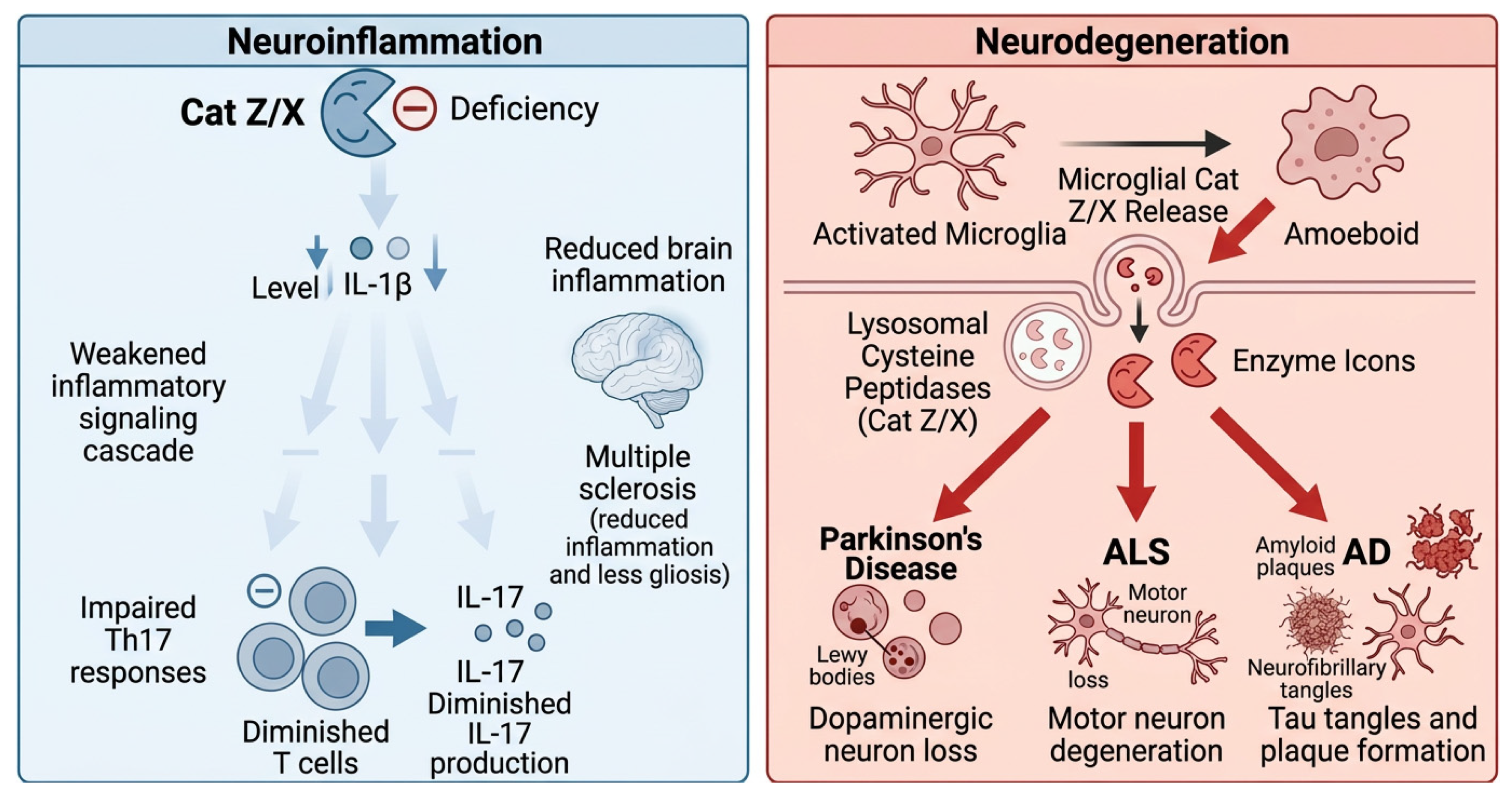
Neurodegenerative proteinopathies—including Alzheimer’s disease, Parkinson’s disease, frontotemporal dementia, Huntington’s disease, and ALS—feature toxic protein aggregates that activate microglia and trigger chronic neuroinflammatory cascades [78]. Activated microglia release lysosomal cysteine peptidases, including Cat Z/X, alongside IL-1β and TNF-α; concurrent endolysosomal dysfunction promotes accumulation of neurotoxic proteins and undegraded cathepsin substrates, amplifying neuronal injury (Figure 2) [4,79]. Conversely, Cat Z/X deficiency is associated with multiple sclerosis (MS), where reduced IL-1β production attenuates inflammatory signaling and Th17 responses—a key ameliorative mechanism [80].
Cat Z/X, highly expressed in immune and neural cells, links inflammation to neurodegeneration by modulating β2 integrin-dependent immune responses and by cleaving C-terminal dipeptides from α- and γ-enolase, thereby abolishing their neurotrophic support for neuronal survival and neurite outgrowth [36,81]. In oligodendroglial cells, Cat Z/X negatively regulates differentiation: its inhibition accelerates maturation to myelinating γ-enolase-active oligodendrocytes and enhances remyelination [4,36]. Cat Z/X-mediated truncation of γ-enolase also prevents its γ1-syntrophin-dependent plasma membrane translocation, dampening neurotrophic signaling, neuritogenesis, and neuronal survival; similar enolase alterations contribute to metabolic reprogramming and migration in cancer cells [81].
Genetic and experimental models further implicate Cat Z/X in specific diseases. In MS, Cat Z/X deficiency reduces IL-1β production, attenuates Th17 responses, and ameliorates inflammation [36]. In CLN7 neuronal ceroid lipofuscinosis, disturbed Cat Z/X synthesis and activity—together with SCMAS and saposin D accumulation—impair autophagy, leading to lipofuscin-like storage and ATP synthase subunit c buildup.
PD is a neurodegenerative disorder characterized by progressive loss of dopaminergic neurons in the substantia nigra pars compacta (SNc). Its pathogenesis involves glial activation, T-cell proliferation, and elevated pro-inflammatory cytokines; lysosomal peptidases such as Cat Z/X contribute to neuroinflammatory responses and neurotoxicity. In a 6-OHDA rat model of PD (unilateral medial forebrain bundle lesioning), Cat Z/X expression, protein levels, and enzymatic activity increase in the ipsilateral SNc. At early stages, it localizes primarily to neuronal lysosomes, coinciding with rapid loss of tyrosine hydroxylase (TH)-positive neurons. Within 12 h of 6-OHDA injection, Cat Z/X associates with microglial cells; after 4 weeks, it predominates in activated microglia concentrated in the SNc. These shifts confirm Cat Z/X as a proteolytic mediator of dopaminergic neurodegeneration [82].
Transcriptomic analyses of ALS mouse models reveal altered expression of lysosomal and proteolytic genes, including cathepsins, suggesting their involvement in disease pathology and utility as diagnostic biomarkers and therapeutic targets. ALS features progressive degeneration of upper and lower motor neurons, causing muscle weakness, paralysis, and impaired speech, swallowing, and respiration [83].
AD involves early neuroinflammation, Aβ plaques, microglial activation, and cytokine release (TNF-α, IL-1β), with Cat Z/X upregulated in microglia associating with plaques—supporting biomarker/therapeutic potential [84]. In a conditional PS1/PS2 double knockout mouse model, presenilin loss induces gliosis and elevates cathepsin S, Cat Z/X, chemokines (Ccl3/Ccl4), and complement (C1qb/C3/C4), triggering protease/immune neuroinflammation [85]. Long-term urolithin A—a mitophagy promoter—improves lysosomal function and normalizes Cat Z/X in APP/PS1 mice, highlighting therapeutic promise [86].
In Huntington’s disease and related polyglutamine disorders, cathepsin L and Cat Z/X contribute to proteolytic processing of polyglutamine-rich aggregates [87]; Cat Z/X, together with bleomycin hydrolase, has been proposed as both a disease biomarker and therapeutic target [88].
Diseases associated with Cat Z/X and their pathological features are summarized in Table 2.

4.4. Other Diseases Associated with Cat Z/X

Respiratory silicosis arises from the inhalation of crystalline silica particles into the lungs, causing chronic inflammation and impaired pulmonary function. Silica deposition activates alveolar macrophages, triggering inflammatory signaling pathways, including NLRP3 inflammasome activation and subsequent IL-1β secretion. Experimental studies demonstrate that extracellular Cat Z/X plays a critical role in silica-induced NLRP3 inflammasome activation and IL-1β production. Notably, while Cat Z/X−/− THP-1 macrophages induce an NLRP3-dependent response, NLRP3−/− THP-1 cells fail to secrete IL-1β despite Cat Z/X release. Co-culture of Cat Z/X−/− and NLRP3−/− THP-1 cells partially restores IL-1β production, underscoring Cat Z/X’s distinct contribution to inflammasome activation, likely mediated by its integrin-binding domain. Genetic ablation studies further confirm Cat Z/X’s pathological role: deficient mice show impaired inflammatory responses, including reduced IL-1β production and altered macrophage activation, indicating a specific contribution to immune-mediated pathology rather than redundant housekeeping activity [29].
Primary biliary cholangitis (PBC) is a chronic autoimmune liver disease characterized by progressive destruction of intrahepatic bile ducts, leading to cholestasis, cirrhosis, jaundice, and ultimately end-stage liver failure. Three clinical forms of PBC are recognized: a slowly progressive form with favorable survival; a progressive form that advances to cirrhosis or portal hypertension; and an advanced form that culminates in jaundice and hepatic failure. Genetic studies in the Japanese population have identified polymorphisms (rs13720 and rs163800) within the NELFCD/CAT Z/X locus that are associated with more severe disease progression [89]. Recent evidence indicates that Cat Z/X levels increase with advancing disease stage and correlate significantly with hepatic biochemical markers, including alanine aminotransferase, aspartate aminotransferase, platelet count, total bilirubin, and albumin. In late-stage PBC, Cat Z/X shows significant upregulation in hepatocytes and redistributes from the peribile canalicular membrane to the cytoplasm, accompanied by a loss of colocalization with the lysosomal marker LAMP1. Collectively, these observations suggest that dysregulated expression and subcellular localization of Cat Z/X contribute to cholestatic injury and disease progression in PBC [42].
Osteoporosis arises from an imbalance between bone-resorbing osteoclasts of monocytic origin and bone-forming osteoblasts derived from mesenchymal stem cells. Results showed that Cat Z/X levels were significantly higher in peripheral blood mononuclear cells (PBMCs) from women over 50 years of age with osteopenia or osteoporosis compared with age-matched controls without bone loss. These findings suggest that Cat Z/X may serve as a potential biomarker for the early detection of osteoporosis [90]. Proteases are also critical regulators of hematopoietic stem and progenitor cell (HSPC) mobilization from bone marrow niches [91].
Pulmonary arterial hypertension (PAH) is a chronic, progressive disorder characterized by elevated pulmonary arterial pressure, leading to right-sided heart failure and premature mortality. Epigenetic analyses have identified hypermethylation at three loci in PAH, including CTSZ (cg04917472), conserved oligomeric Golgi complex 6 COG6 (cg27396197), and zinc finger protein 678 ZNF678 (cg03144189) [92]. Hypermethylation of the CTSZ locus correlates with reduced CTSZ mRNA expression in peripheral blood mononuclear cells and is associated with increased caspase-3/7 activity and enhanced apoptosis. Reduced Cat Z/X levels may therefore contribute to endothelial cell loss and pulmonary vascular remodeling. These findings suggest that epigenetic silencing of CTSZ represents a molecular link between DNA methylation, apoptotic signaling, and vascular injury in PAH, positioning Cat Z/X as both a biomarker and potential pathogenic factor [92].
Obstructive sleep apnea (OSA) is a prevalent sleep-related breathing disorder characterized by recurrent upper airway obstruction and intermittent hypoxia. Data-independent acquisition quantitative proteomics identified multiple serum and urinary proteins with differential expression in children with OSA compared to healthy controls. Among these, Cat Z/X showed a positive correlation with disease severity, whereas sex hormone-binding globulin (SHBG) showed a negative correlation. Independent validation in an external cohort using ELISA confirmed strong diagnostic performance, with area under the curve (AUC) values of 0.863 for Cat Z/X and 0.738 for SHBG. These findings highlight the potential of Cat Z/X as a multifaceted biomarker for diagnosis and severity assessment in pediatric OSA [93].
As shown in Table 2, Cat Z/X contributes to multiple diseases via distinct mechanisms.

5. Inhibitors of Cat Z/X

Paulick & Bogyo and Sadaghiani et al. demonstrated that selective inhibition of Cat Z/X requires careful consideration of inhibitor specificity, as well as experimental conditions that minimize off-target effects on other lysosomal proteases [31,94].
It is important to note that a substantial body of evidence suggests that many physiological and pathological functions of Cat Z/X are independent of its catalytic activity. Instead, these functions rely on non-catalytic mechanisms, including integrin-mediated interactions at the cell surface [29,95,96]. Consequently, inhibition of enzymatic activity alone may not fully recapitulate the effects of genetic deletion or disruption of integrin-binding functions, underscoring the need to distinguish between catalytic and non-catalytic roles when interpreting inhibitor studies [5].
To date, no highly specific endogenous inhibitors of Cat Z/X have been identified, although some cystatins exhibit weak or context-dependent inhibition [96,97]. This reduced sensitivity to cystatins is consistent with the structural features of Cat Z/X. By comparison, monoclonal antibody 2F12, which targets the mature enzyme, has been shown to effectively inhibit Cat Z/X activity [18]. Additionally, Klemencic et al. reported inhibition of Cat Z/X by synthetic Cat B inhibitors CA-074 and GFG-semicarbazone [97], further demonstrating the potential for exogenous modulation [97]. In contrast to exopeptidases such as Cat B and Cat C, Cat Z/X exhibits reduced sensitivity to inhibition by the p41 fragment (thyropins) [98]. The partial resistance of Cat Z/X to cystatins and thyropins is explained by steric hindrance caused by the characteristic "mini-loop" residues projecting into the active-site cleft of the homodimer [12].
These findings confirm that endogenous protein inhibitors play no significant role in regulating Cat Z/X activity, distinguishing it from other cysteine cathepsins. This underscores the need for synthetic approaches to modulate its activity.
The first synthetic small-molecule irreversible inhibitor reported as having preferential selectivity for Cat Z/X is AMS 36, an epoxysuccinyl-based peptidomimetic with nanomolar potency [94]. Irreversible inhibitors act by covalent modification of the catalytic cysteine, providing potent and sustained target engagement, but they often show only moderate-to-low selectivity across papain-family proteases and carry a risk of off-target cysteine alkylation that can complicate interpretation of in vivo phenotypes. Cellular permeability of these compounds is variable and frequently limited by polar electrophilic warheads and peptidic backbones. Although long target residence time can be advantageous, the intrinsic reactivity and associated pharmacokinetic and safety liabilities complicate dosing and use [99]. AMS 36 demonstrates preferential activity against Cat Z/X but exhibits some cross-reactivity with Cat B in certain tissues [94]. Another E 64-derived compound, nPrNH-(2S,3S)-tEps-Ile-OH, has modest potency yet retains approximately tenfold selectivity over Cat B and Cat L [14].This pattern may reflect differences in reactivity: while the parent compound E64 shows weak inhibition of Cat Z/X, its derivatives (such as AMS 36) achieve higher potency through structural optimization [14,97]. Importantly, phenotypes observed in Cat Z/X-deficient models closely mirror those produced by pharmacological inhibition, suggesting on-target effects and supporting the therapeutic potential of selective Cat Z/X inhibitors in pathological inflammation, tumor migration, and neurodegeneration [100].
Reversible, selective triazole-based inhibitors of Cat Z/X have been described, with compound Z9 (also termed compound 22) exhibiting the lowest inhibition constant and good selectivity over Cat B, Cat L, Cat H, and Cat S [100]. These agents act via non-covalent binding to active-site pockets and subpockets, which enables finer selectivity tuning through structure–activity relationship studies and results in lower reactivity-related toxicity compared to covalent inhibitors [100,101]. Importantly, reversible scaffolds often demonstrate improved cellular permeability—they can be smaller and less polar—making them more amenable to optimization for robust cellular activity. Structure–activity relationship analyses further reveal that the central ketomethylenethio linker between the benzodioxine and triazole moieties is essential for potency, whereas substitutions on the triazole ring have limited impact [101]. In vivo, these reversible inhibitors are expected to offer improved safety and dose control. However, pharmacokinetic optimization remains necessary to ensure adequate exposure and target engagement, typically requiring medicinal chemistry efforts to enhance pharmacokinetics and cellular potency to match the efficacy of irreversible inhibitors [101].
Several Cat Z/X inhibitors have been evaluated beyond purified-enzyme assays and show clear functional effects in vivo. AMS-36 exerts protective effects against LPS-induced striatal degeneration in rodent models, consistent with modulation of neuroinflammatory pathways [102]. In breast cancer models (FVB/PyMT and MMTV-PyMT), chronic administration of the reversible inhibitor Z9 significantly impaired tumor progression, growth, and metastasis by reducing tumor cell migration and invasion [101]. In contrast, several newer triazole- and benzodioxine-derived inhibitors remain characterized primarily at the enzymatic level: they display reported selectivity and in vitro potency but lack demonstrated in vivo functional outcomes such as modulation of inflammation, tumor migration, or neuronal survival [100]. For mechanistic interpretation, it is therefore important to distinguish tools validated in vivo (e.g., AMS-36, Z9) from those restricted to biochemical and cell-based characterization [101,103].
Despite these advances, selective Cat Z/X inhibitors remain limited. Targeting Cat Z/X holds context-specific therapeutic promise for inflammatory, oncological, and neurodegenerative conditions, underscored by its lack of endogenous regulation—a feature that may enhance its targetability in specific pathological contexts [102]. An overview of key synthetic inhibitors is provided in Table 3.
Taken together, these findings indicate that therapeutic targeting of Cat Z/X is complex and highly context-dependent, varying by tissue type, disease stage, and cellular microenvironment. As many of its biological functions are mediated through non-proteolytic, integrin-dependent mechanisms, inhibiting catalytic activity alone is unlikely to fully recapitulate the effects observed in genetic deletion models. Therefore, future strategies should explicitly distinguish between its enzymatic and scaffolding functions—for example, by developing tools to selectively modulate each—and ensure rigorous validation in physiologically relevant disease models.

6. Conclusions

Cat Z/X is a distinctive cysteine peptidase with strict carboxypeptidase activity, integrin-binding motifs, and broad roles in diverse physiological and pathological processes. Knockout and inhibition studies underscore its therapeutic potential, and its dysregulation in cancer, neurodegenerative disorders, and metabolic disease positions it as both a biomarker and a drug target, highlighting its context-dependent nature and the need to consider both catalytic and non-catalytic functions. Although advances have clarified its structure and function, key gaps persist in understanding its molecular mechanisms, context-specific pathology, and non-catalytic signaling. To address these gaps, future work should adopt an integrated strategy: (i) Combine cell-type-resolved genetics (conditional knockouts/knock-ins, lineage tracing) with spatial and functional readouts (single-cell and spatial omics, activity-based probes) to disentangle immune vs. tumor cell effects in cancer and distinguish catalytic vs. non-catalytic roles; (ii) Develop advanced diagnostics that assess: (1) total abundance (immunoassays), (2) active fraction (activity-based probes), and (3) anatomical source (spatial profiling combined with plasma/serum measurements) to distinguish pro-forms from the active enzyme and local tissue activity from systemic levels; (iii) Design selective inhibitors that exploit unique structural features, such as the active-site “mini-loop,” to minimize off-target effects.
Prioritizing these efforts will sharpen mechanistic understanding and accelerate translation into clinical applications, especially in heterogeneous diseases like cancer where precise spatial and functional resolution is critical.

Author Contributions

Conceptualization: K.Z., O.M. and A.A.Z.J.; Writing—original draft preparation: K.Z., O.M., A.B., M.P., A.S., J.K., D.P. and P.M.I.; Writing—review and editing: A.A.R., A.B., O.M., I.V.R. and L.V.S.; Supervision: A.P. and A.A.Z.J.; Funding acquisition: A.A.R., A.P. and A.A.Z.J. All authors have read and agreed to the published version of the manuscript.

Funding

This study was conducted under the State Assignment of Lomonosov Moscow State University (Project No. 123063000002-7). A.A.R. and O.M. were supported by the State Assignment of St. Petersburg State University (Project No. 125021902561-6). A.P. was supported by the grant from Federal Territory “Sirius”, Russia No. 22-03, dated 27 September 2024.

Institutional Review Board Statement

Not applicable.

Informed Consent Statement

Not applicable.

Data Availability Statement

Data sharing doesn’t apply to this article as no datasets were created or analyzed during the current study. Data sharing not applicable—no new data generated.

Conflicts of Interest

The author Aleksandra Stankovski is an employee of Biotest AG and The author Kristina Zdravkova is an employee of AD Alkaloid Skopje. The remaining authors declare no conflicts of interest.

Abbreviations

The following abbreviations are used in this manuscript:
ADAlzheimer disease
ALSAmyotrophic lateral sclerosis
APPAmyloid precursor protein
AUCArea under the curve
Cat Cathepsin
CLIPClass II-associated invariant chain peptide
DCDendritic cell
ECMExtracellular matrix
ELISAEnzyme-linked immunosorbent assay
EMTEpithelial–mesenchymal transition
ERGIC-53ER-Golgi intermediate compartment protein 53
FAKFocal adhesion kinase
HCCHepatocellular carcinoma
HOGHuman oligodendroglioma cell
HSPCHematopoietic stem/progenitor cell
ICAM-1Intercellular adhesion molecule 1
IFN-γInterferon-γ
ILInterleukin
LAMP1Lysosome-associated membrane protein 1
LFA-1Lymphocyte function-associated antigen 1
Mac-1Integrin αMβ2 (CD11b/CD18)
MFBMedial forebrain bundle
MHCMajor histocompatibility complex
MSMultiple sclerosis
NLRP3NLR family pyrin domain-containing 3
OSAObstructive sleep apnea
PAHPulmonary arterial hypertension
PBMCPeripheral blood mononuclear cell
PDParkinson disease
PDZPDZ domain
PS1Presenilin 1
PS2Presenilin 2
RGDArg-Gly-Asp
SCMASSubunit c mitochondrial ATP synthase
SDF-1Stromal cell-derived factor 1 (CXCL12)
SNcSubstantia nigra pars compacta
THTyrosine hydroxylase
TLRToll-like receptor
TMETumor microenvironment

References

  1. Nägler, D.K.; Zhang, R.; Tam, W.; Sulea, T.; Purisima, E.O.; Ménard, R. Human Cathepsin X: A Cysteine Protease with Unique Carboxypeptidase Activity. Biochemistry 1999, 38, 12648–12654. [Google Scholar] [CrossRef]
  2. Fujii, Y.; Asadi, Z.; Mehla, K. Cathepsins: Emerging Targets in the Tumor Ecosystem to Overcome Cancers. Semin. Cancer Biol. 2025, 112, 150–166. [Google Scholar] [CrossRef] [PubMed]
  3. Nägler, D.K.; Lechner, A.M.; Oettl, A.; Kos, J. An Enzyme-Linked Immunosorbent Assay for Human Cathepsin X, a Potential New Inflammatory Marker. J. Immunol. Methods 2006, 308, 241–250. [Google Scholar] [CrossRef] [PubMed]
  4. Stoka, V.; Vasiljeva, O.; Nakanishi, H.; Turk, V. The Role of Cysteine Protease Cathepsins B, H, C, and X/Z in Neurodegenerative Diseases and Cancer. Int. J. Mol. Sci. 2023, 24, 15613. [Google Scholar] [CrossRef]
  5. Zamyatnin, A.A., Jr. Cysteine Cathepsins and Drug Discovery: Knowns and Unknowns. Biochemistry 2025, 90, 1757–1763. [Google Scholar] [CrossRef]
  6. Santamaría, I.; Velasco, G.; Pendás, A.M.; Fueyo, A.; López-Otín, C. Cathepsin Z, a Novel Human Cysteine Proteinase with a Short Propeptide Domain and a Unique Chromosomal Location. J. Biol. Chem. 1998, 273, 16816–16823. [Google Scholar] [CrossRef]
  7. Gay, N.J.; Walker, J.E. Molecular Cloning of a Bovine Cathepsin. Biochem. J. 1985, 225, 707–712. [Google Scholar] [CrossRef]
  8. Tung, J.S.; Sinha, S.; McConlogue, L.; Tatsuno, G.; Anderson, J.; Emko, C.M.F.; Chrysler, S. Cathepsin and Methods and Compositions for Inhibition Thereof. U.S. Patent US5783434A, 21 July 1998. [Google Scholar]
  9. Pungerčar, J.; Ivanovski, G. Identification and Molecular Cloning of Cathepsin P, a Novel Human Putative Cysteine Protease of the Papain Family. Pflug. Arch. 2000, 439, r116–r118. [Google Scholar] [CrossRef]
  10. Nägler, D.K.; Ménard, R. Human Cathepsin X: A Novel Cysteine Protease of the Papain Family with a Very Short Proregion and Unique Insertions. FEBS Lett. 1998, 434, 135–139. [Google Scholar] [CrossRef] [PubMed]
  11. Kamphuis, I.G.; Drenth, J.; Baker, E.N. Thiol Proteases. Comparative Studies Based on the High-Resolution Structures of Papain and Actinidin, and on Amino Acid Sequence Information for Cathepsins B and H, and Stem Bromelain. J. Mol. Biol. 1985, 182, 317–329. [Google Scholar] [CrossRef]
  12. Dolenc, I.; Štefe, I.; Turk, D.; Taler-Verčič, A.; Turk, B.; Turk, V.; Stoka, V. Human Cathepsin X/Z Is a Biologically Active Homodimer. Biochim. Biophys. Acta—Proteins Proteom. 2021, 1869, 140567. [Google Scholar] [CrossRef]
  13. Nägler, D.K.; Storer, A.C.; Portaro, F.C.; Carmona, E.; Juliano, L.; Ménard, R. Major Increase in Endopeptidase Activity of Human Cathepsin B upon Removal of Occluding Loop Contacts. Biochemistry 1997, 36, 12608–12615. [Google Scholar] [CrossRef] [PubMed]
  14. Therrien, C.; Lachance, P.; Sulea, T.; Purisima, E.O.; Qi, H.; Ziomek, E.; Alvarez-Hernandez, A.; Roush, W.R.; Ménard, R. Cathepsins X and B Can Be Differentiated through Their Respective Mono- and Dipeptidyl Carboxypeptidase Activities. Biochemistry 2001, 40, 2702–2711. [Google Scholar] [CrossRef]
  15. Sivaraman, J.; Nägler, D.K.; Zhang, R.; Ménard, R.; Cygler, M. Crystal Structure of Human Procathepsin X: A Cysteine Protease with the Proregion Covalently Linked to the Active Site Cysteine. J. Mol. Biol. 2000, 295, 939–951. [Google Scholar] [CrossRef]
  16. Obermajer, N.; Repnik, U.; Jevnikar, Z.; Turk, B.; Kreft, M.; Kos, J. Cysteine Protease Cathepsin X Modulates Immune Response via Activation of Beta2 Integrins. Immunology 2008, 124, 76–88. [Google Scholar] [CrossRef] [PubMed]
  17. Vidak, E.; Javoršek, U.; Vizovišek, M.; Turk, B. Cysteine Cathepsins and Their Extracellular Roles: Shaping the Microenvironment. Cells 2019, 8, 264. [Google Scholar] [CrossRef]
  18. Kos, J.; Sekirnik, A.; Premzl, A.; Zavasnik Bergant, V.; Langerholc, T.; Turk, B.; Werle, B.; Golouh, R.; Repnik, U.; Jeras, M.; et al. Carboxypeptidases Cathepsins X and B Display Distinct Protein Profile in Human Cells and Tissues. Exp. Cell Res. 2005, 306, 103–113. [Google Scholar] [CrossRef] [PubMed]
  19. Nascimento, F.D.; Rizzi, C.C.; Nantes, I.L.; Stefe, I.; Turk, B.; Carmona, A.K.; Nader, H.B.; Juliano, L.; Tersariol, I.L. Cathepsin X Binds to Cell Surface Heparan Sulfate Proteoglycans. Arch. Biochem. Biophys. 2005, 436, 323–332. [Google Scholar] [CrossRef]
  20. Lechner, A.M.; Assfalg-Machleidt, I.; Zahler, S.; Stoeckelhuber, M.; Machleidt, W.; Jochum, M.; Nägler, D.K. RGD-Dependent Binding of Procathepsin X to Integrin alphavbeta3 Mediates Cell-Adhesive Properties. J. Biol. Chem. 2006, 281, 39588–39597. [Google Scholar] [CrossRef]
  21. Kos, J.; Vižin, T.; Fonović, U.P.; Pišlar, A. Intracellular Signaling by Cathepsin X: Molecular Mechanisms and Diagnostic and Therapeutic Opportunities in Cancer. Semin. Cancer Biol. 2015, 31, 76–83. [Google Scholar] [CrossRef]
  22. Obermajer, N.; Premzl, A.; Bergant, T.Z.; Turk, B.; Kos, J. Carboxypeptidase Cathepsin X Mediates Beta2-Integrin-Dependent Adhesion of Differentiated U-937 Cells. Exp. Cell Res. 2006, 312, 2515–2527. [Google Scholar] [CrossRef]
  23. Shi, G.P.; Bryant, R.A.; Riese, R.; Verhelst, S.; Driessen, C.; Li, Z.; Bromme, D.; Ploegh, H.L.; Chapman, H.A. Role for Cathepsin F in Invariant Chain Processing and Major Histocompatibility Complex Class II Peptide Loading by Macrophages. J. Exp. Med. 2000, 191, 1177–1186. [Google Scholar] [CrossRef] [PubMed]
  24. Xu, B.; Anderson, B.M.; Mountford, S.J.; Thompson, P.E.; Mintern, J.D.; Edgington-Mitchell, L.E. Cathepsin X Deficiency Alters the Processing and Localisation of Cathepsin L and Impairs Cleavage of a Nuclear Cathepsin L Substrate. Biol. Chem. 2024, 405, 351–365. [Google Scholar] [CrossRef] [PubMed]
  25. Kraus, S.; Bunsen, T.; Schuster, S.; Cichoń, M.A.; Tacke, M.; Reinheckel, T.; Sommerhoff, C.P.; Jochum, M.; Nägler, D.K. Cellular Senescence Induced by Cathepsin X Downregulation. Eur. J. Cell Biol. 2011, 90, 678–686. [Google Scholar] [CrossRef]
  26. Jevnikar, Z.; Obermajer, N.; Pecar-Fonović, U.; Karaoglanovic-Carmona, A.; Kos, J. Cathepsin X Cleaves the Beta2 Cytoplasmic Tail of LFA-1 Inducing the Intermediate Affinity Form of LFA-1 and Alpha-Actinin-1 Binding. Eur. J. Immunol. 2009, 39, 3217–3227. [Google Scholar] [CrossRef] [PubMed]
  27. Obermajer, N.; Jevnikar, Z.; Doljak, B.; Sadaghiani, A.M.; Bogyo, M.; Kos, J. Cathepsin X-Mediated Beta2 Integrin Activation Results in Nanotube Outgrowth. Cell Mol. Life Sci. 2009, 66, 1126–1134. [Google Scholar] [CrossRef] [PubMed]
  28. Xu, B.; Anderson, B.M.; Mintern, J.D.; Edgington-Mitchell, L.E. TLR9-Dependent Dendritic Cell Maturation Promotes IL-6-Mediated Upregulation of Cathepsin X. Immunol. Cell Biol. 2024, 102, 787–800. [Google Scholar] [CrossRef]
  29. Campden, R.I.; Warren, A.L.; Greene, C.J.; Chiriboga, J.A.; Arnold, C.R.; Aggarwal, D.; McKenna, N.; Sandall, C.F.; MacDonald, J.A.; Yates, R.M. Extracellular Cathepsin Z Signals through the A5 Integrin and Augments NLRP3 Inflammasome Activation. J. Biol. Chem. 2022, 298, 101459. [Google Scholar] [CrossRef]
  30. Orlowski, G.M.; Colbert, J.D.; Sharma, S.; Bogyo, M.; Robertson, S.A.; Rock, K.L. Multiple Cathepsins Promote Pro-IL-1β Synthesis and NLRP3-Mediated IL-1β Activation. J. Immunol. 2015, 195, 1685–1697, Erratum in J. Immunol. 1950, 196, 503. https://doi.org/10.4049/jimmunol.1502363. [Google Scholar] [CrossRef]
  31. Paulick, M.G.; Bogyo, M. Development of Activity-Based Probes for Cathepsin X. ACS Chem. Biol. 2011, 6, 563–572. [Google Scholar] [CrossRef]
  32. Mountford, S.J.; Anderson, B.M.; Xu, B.; Tay, E.S.V.; Szabo, M.; Hoang, M.L.; Diao, J.; Aurelio, L.; Campden, R.I.; Lindström, E.; et al. Application of a Sulfoxonium Ylide Electrophile to Generate Cathepsin X-Selective Activity-Based Probes. ACS Chem. Biol. 2020, 15, 718–727. [Google Scholar] [CrossRef]
  33. Gounaris, E.; Tung, C.H.; Restaino, C.; Maehr, R.; Kohler, R.; Joyce, J.A.; Ploegh, H.L.; Barrett, T.A.; Weissleder, R.; Khazaie, K. Live Imaging of Cysteine-Cathepsin Activity Reveals Dynamics of Focal Inflammation, Angiogenesis, and Polyp Growth. PLoS ONE 2008, 3, e2916, Correction in PLoS ONE 2008, 3. https://doi.org/10.1371/annotation/499b225f-e661-4124-aa2f-60bef89bd14a. [Google Scholar] [CrossRef]
  34. Schwenck, J.; Maurer, A.; Fehrenbacher, B.; Mehling, R.; Knopf, P.; Mucha, N.; Haupt, D.; Fuchs, K.; Griessinger, C.M.; Bukala, D.; et al. Cysteine-Type Cathepsins Promote the Effector Phase of Acute Cutaneous Delayed-Type Hypersensitivity Reactions. Theranostics 2019, 9, 3903–3917. [Google Scholar] [CrossRef]
  35. Zhang, F.; Liang, J.; Lu, Y.; Tang, Y.; Liu, S.; Wu, K.; Zhang, F.; Lu, Y.; Liu, Z.; Wang, X. Macrophage-Specific Cathepsin as a Marker Correlated with Prognosis and Tumor Microenvironmental Characteristics of Clear Cell Renal Cell Carcinoma. J. Inflamm. Res. 2022, 15, 6275–6292. [Google Scholar] [CrossRef] [PubMed]
  36. Brandenstein, L.; Schweizer, M.; Sedlacik, J.; Fiehler, J.; Storch, S. Lysosomal Dysfunction and Impaired Autophagy in a Novel Mouse Model Deficient for the Lysosomal Membrane Protein Cln7. Hum. Mol. Genet. 2016, 25, 777–791. [Google Scholar] [CrossRef] [PubMed]
  37. Rudzińska, M.; Parodi, A.; Maslova, V.D.; Efremov, Y.M.; Gorokhovets, N.V.; Makarov, V.A.; Popkov, V.A.; Golovin, A.V.; Zernii, E.Y.; Zamyatnin, A.A. Cysteine Cathepsins Inhibition Affects Their Expression and Human Renal Cancer Cell Phenotype. Cancers 2020, 12, 1310. [Google Scholar] [CrossRef] [PubMed]
  38. Sevenich, L.; Bowman, R.L.; Mason, S.D.; Quail, D.F.; Rapaport, F.; Elie, B.T.; Brogi, E.; Brastianos, P.K.; Hahn, W.C.; Holsinger, L.J.; et al. Analysis of Tumour- and Stroma-Supplied Proteolytic Networks Reveals a Brain-Metastasis-Promoting Role for Cathepsin S. Nat. Cell Biol. 2014, 16, 876–888. [Google Scholar] [CrossRef]
  39. Akkari, L.; Gocheva, V.; Kester, J.C.; Hunter, K.E.; Quick, M.L.; Sevenich, L.; Wang, H.W.; Peters, C.; Tang, L.H.; Klimstra, D.S.; et al. Distinct Functions of Macrophage-Derived and Cancer Cell-Derived cathepsin Z Combine to Promote Tumor Malignancy via Interactions with the Extracellular Matrix. Genes. Dev. 2014, 28, 2134–2150. [Google Scholar] [CrossRef]
  40. Obermajer, N.; Svajger, U.; Bogyo, M.; Jeras, M.; Kos, J. Maturation of Dendritic Cells Depends on Proteolytic Cleavage by Cathepsin X. J. Leukoc. Biol. 2008, 84, 1306–1315. [Google Scholar] [CrossRef]
  41. Mitrović, A.; Fonović, U.P.; Kos, J. Cysteine Cathepsins B and X Promote Epithelial-Mesenchymal Transition of Tumor Cells. Eur. J. Cell Biol. 2017, 96, 622–631. [Google Scholar] [CrossRef]
  42. Jakoš, T.; Prunk, M.; Pišlar, A.; Kos, J. Cathepsin X Activity Does Not Affect NK-Target Cell Synapse but Is Rather Distributed to Cytotoxic Granules. Int. J. Mol. Sci. 2021, 22, 13495. [Google Scholar] [CrossRef]
  43. Hanahan, D.; Weinberg, R.A. Hallmarks of Cancer: The next Generation. Cell 2011, 144, 646–674. [Google Scholar] [CrossRef]
  44. Olson, O.C.; Joyce, J.A. Cysteine Cathepsin Proteases: Regulators of Cancer Progression and Therapeutic Response. Nat. Rev. Cancer 2015, 15, 712–729. [Google Scholar] [CrossRef]
  45. Gocheva, V.; Wang, H.W.; Gadea, B.B.; Shree, T.; Hunter, K.E.; Garfall, A.L.; Berman, T.; Joyce, J.A. IL-4 Induces Cathepsin Protease Activity in Tumor-Associated Macrophages to Promote Cancer Growth and Invasion. Genes. Dev. 2010, 24, 241–255. [Google Scholar] [CrossRef] [PubMed]
  46. Akkari, L.; Gocheva, V.; Quick, M.L.; Kester, J.C.; Spencer, A.K.; Garfall, A.L.; Bowman, R.L.; Joyce, J.A. Combined Deletion of Cathepsin Protease Family Members Reveals Compensatory Mechanisms in Cancer. Genes Dev. 2016, 30, 220–232. [Google Scholar] [CrossRef] [PubMed]
  47. McDowell, S.H.; Gallaher, S.A.; Burden, R.E.; Scott, C.J. Leading the Invasion: The Role of Cathepsin S in the Tumour Microenvironment. Biochim. Biophys. Acta (BBA) —Mol. Cell Res. 2020, 1867, 118781. [Google Scholar] [CrossRef] [PubMed]
  48. Zhou, S.; Sun, Y.; Zha, W.; Zhou, G. Investigating the Role of Cathepsins in Breast Cancer Progression: A Mendelian Randomization Study. Front. Oncol. 2025, 15, 1408723. [Google Scholar] [CrossRef]
  49. Bernhardt, A.; Kuester, D.; Roessner, A.; Reinheckel, T.; Krueger, S. Cathepsin X-Deficient Gastric Epithelial Cells in Co-Culture with Macrophages: Characterization of Cytokine Response and Migration Capability after Helicobacter Pylori Infection. J. Biol. Chem. 2010, 285, 33691–33700. [Google Scholar] [CrossRef] [PubMed]
  50. Krueger, S.; Kalinski, T.; Hundertmark, T.; Wex, T.; Küster, D.; Peitz, U.; Ebert, M.; Nägler, D.K.; Kellner, U.; Malfertheiner, P.; et al. Cathepsin X Upregulated in H. Pylori Gastritis and Gastric Cancer. J. Pathol. 2005, 207, 32–42. [Google Scholar] [CrossRef]
  51. Krueger, S.; Kuester, D.; Bernhardt, A.; Wex, T.; Roessner, A. Regulation of Cathepsin X Overexpression in H. Pylori-Infected Gastric Epithelial Cells and Macrophages. J. Pathol. 2009, 217, 581–588. [Google Scholar] [CrossRef]
  52. Teller, A.; Jechorek, D.; Hartig, R.; Adolf, D.; Reißig, K.; Roessner, A.; Franke, S. Dysregulation of Apoptotic Signaling Pathways by Interaction of RPLP0 and Cathepsin X/Z in Gastric Cancer. Pathol. Res. Pract. 2015, 211, 62–70. [Google Scholar] [CrossRef]
  53. Fang, Y.; Zhang, D.; Hu, T.; Zhao, H.; Zhao, X.; Lou, Z.; He, Y.; Qin, W.; Xia, J.; Zhang, X.; et al. KMT2A Histone Methyltransferase Contributes to Colorectal Cancer Development by Promoting Cathepsin Z Transcriptional Activation. Cancer Med. 2019, 8, 3544–3552. [Google Scholar] [CrossRef]
  54. Vizin, T.; Christensen, I.J.; Nielsen, H.J.; Kos, J. Cathepsin X in Serum from Patients with Colorectal Cancer: Relation to Prognosis. Radiol. Oncol. 2012, 46, 207–212. [Google Scholar] [CrossRef]
  55. Vižin, T.; Christensen, I.J.; Wilhelmsen, M.; Nielsen, H.J.; Kos, J. Prognostic and Predictive Value of Cathepsin X in Serum from Colorectal Cancer Patients. BMC Cancer 2014, 14, 259. [Google Scholar] [CrossRef]
  56. Jechorek, D.; Votapek, J.; Meyer, F.; Kandulski, A.; Roessner, A.; Franke, S. Characterization of Cathepsin X in Colorectal Cancer Development and Progression. Pathol. Res. Pract. 2014, 210, 822–829. [Google Scholar] [CrossRef]
  57. Decock, J.; Obermajer, N.; Vozelj, S.; Hendrickx, W.; Paridaens, R.; Kos, J. Cathepsin B, Cathepsin H, Cathepsin X and Cystatin C in Sera of Patients with Early-Stage and Inflammatory Breast Cancer. Int. J. Biol. Markers 2008, 23, 161–168. [Google Scholar] [CrossRef]
  58. Sevenich, L.; Schurigt, U.; Sachse, K.; Gajda, M.; Werner, F.; Müller, S.; Vasiljeva, O.; Schwinde, A.; Klemm, N.; Deussing, J.; et al. Synergistic Antitumor Effects of Combined Cathepsin B and Cathepsin Z Deficiencies on Breast Cancer Progression and Metastasis in Mice. Proc. Natl. Acad. Sci. USA 2010, 107, 2497–2502. [Google Scholar] [CrossRef]
  59. Lines, K.E.; Chelala, C.; Dmitrovic, B.; Wijesuriya, N.; Kocher, H.M.; Marshall, J.F.; Crnogorac-Jurcevic, T. S100P-Binding Protein, S100PBP, Mediates Adhesion through Regulation of Cathepsin Z in Pancreatic Cancer Cells. Am. J. Pathol. 2012, 180, 1485–1494. [Google Scholar] [CrossRef]
  60. Wang, J.; Chen, L.; Li, Y.; Guan, X.Y. Overexpression of Cathepsin Z Contributes to Tumor Metastasis by Inducing Epithelial-Mesenchymal Transition in Hepatocellular Carcinoma. PLoS ONE 2011, 6, e24967. [Google Scholar] [CrossRef]
  61. Sahasrabuddhe, N.A.; Barbhuiya, M.A.; Bhunia, S.; Subbannayya, T.; Gowda, H.; Advani, J.; Shrivastav, B.R.; Navani, S.; Leal, P.; Roa, J.C.; et al. Identification of Prosaposin and Transgelin as Potential Biomarkers for Gallbladder Cancer Using Quantitative Proteomics. Biochem. Biophys. Res. Commun. 2014, 446, 863–869. [Google Scholar] [CrossRef]
  62. Rumpler, G.; Becker, B.; Hafner, C.; McClelland, M.; Stolz, W.; Landthaler, M.; Schmitt, R.; Bosserhoff, A.; Vogt, T. Identification of Differentially Expressed Genes in Models of Melanoma Progression by cDNA Array Analysis: SPARC, MIF and a Novel Cathepsin Protease Characterize Aggressive Phenotypes. Exp. Dermatol. 2003, 12, 761–771. [Google Scholar] [CrossRef]
  63. Li, W.; Yu, X.; Ma, X.; Xie, L.; Xia, Z.; Liu, L.; Yu, X.; Wang, J.; Zhou, H.; Zhou, X.; et al. Deguelin Attenuates Non-Small Cell Lung Cancer Cell Metastasis through Inhibiting the CtsZ/FAK Signaling Pathway. Cell Signal 2018, 50, 131–141. [Google Scholar] [CrossRef] [PubMed]
  64. Zhang, X.; Hou, Y.; Niu, Z.; Li, W.; Meng, X.; Zhang, N.; Yang, S. Clinical Significance of Detection of Cathepsin X and Cystatin C in the Sera of Patients with Lung Cancer. Zhongguo Fei Ai Za Zhi 2013, 16, 411–416. [Google Scholar] [CrossRef] [PubMed]
  65. Nägler, D.K.; Krüger, S.; Kellner, A.; Ziomek, E.; Menard, R.; Buhtz, P.; Krams, M.; Roessner, A.; Kellner, U. Up-Regulation of Cathepsin X in Prostate Cancer and Prostatic Intraepithelial Neoplasia. Prostate 2004, 60, 109–119. [Google Scholar] [CrossRef] [PubMed]
  66. Batista, A.A.S.; Franco, B.M.; Perez, M.M.; Pereira, E.G.; Rodrigues, T.; Wroclawski, M.L.; Fonseca, F.L.A.; Suarez, E.R. Decreased Levels of Cathepsin Z mRNA Expressed by Immune Blood Cells: Diagnostic and Prognostic Implications in Prostate Cancer. Braz. J. Med. Biol. Res. 2021, 54, e11439. [Google Scholar] [CrossRef]
  67. Kraus, S.; Fruth, M.; Bunsen, T.; Nägler, D.K. IGF-I Receptor Phosphorylation Is Impaired in Cathepsin X-Deficient Prostate Cancer Cells. Biol. Chem. 2012, 393, 1457–1462. [Google Scholar] [CrossRef]
  68. Tao, J.; Chen, Y.; Bian, X.; Cai, T.; Song, C.; Liang, C.; Hao, Z.; Meng, J.; Ge, Q.; Zhou, J. Prognostic and Immunological Implications of Cathepsin Z Overexpression in Prostate Cancer. Front. Immunol. 2025, 16, 1618487. [Google Scholar] [CrossRef]
  69. Fonović, U.P.; Kos, J. Cathepsin X Cleaves Profilin 1 C-Terminal Tyr139 and Influences Clathrin-Mediated Endocytosis. PLoS ONE 2015, 10, e0137217. [Google Scholar] [CrossRef]
  70. Ding, X.; Zhang, C.; Chen, H.; Ren, M.; Liu, X. Cathepsins Trigger Cell Death and Regulate Radioresistance in Glioblastoma. Cells 2022, 11, 4108. [Google Scholar] [CrossRef]
  71. Majc, B.; Habič, A.; Novak, M.; Rotter, A.; Porčnik, A.; Mlakar, J.; Župunski, V.; Pečar Fonović, U.; Knez, D.; Zidar, N.; et al. Upregulation of Cathepsin X in Glioblastoma: Interplay with γ-Enolase and the Effects of Selective Cathepsin X Inhibitors. Int. J. Mol. Sci. 2022, 23, 1784. [Google Scholar] [CrossRef]
  72. Breznik, B.; Limback, C.; Porcnik, A.; Blejec, A.; Krajnc, M.K.; Bosnjak, R.; Kos, J.; Van Noorden, C.J.F.; Lah, T.T. Localization Patterns of Cathepsins K and X and Their Predictive Value in Glioblastoma. Radiol. Oncol. 2018, 52, 433–442. [Google Scholar] [CrossRef] [PubMed]
  73. Frolova, A.S.; Tikhomirova, N.K.; Kireev, I.I.; Zernii, E.Y.; Parodi, A.; Ivanov, K.I.; Zamyatnin, A.A., Jr. Expression, Intracellular Localization, and Maturation of Cysteine Cathepsins in Renal Embryonic and Cancer Cell Lines. Biochemistry 2023, 88, 1034–1044. [Google Scholar] [CrossRef] [PubMed]
  74. Kang, M.L.; Kim, J.E.; Im, G.I. Vascular Endothelial Growth Factor-Transfected Adipose-Derived Stromal Cells Enhance Bone Regeneration and Neovascularization from Bone Marrow Stromal Cells. J. Tissue Eng. Regen. Med. 2017, 11, 3337–3348. [Google Scholar] [CrossRef]
  75. Rudzinska-Radecka, M.; Frolova, A.S.; Balakireva, A.V.; Gorokhovets, N.V.; Pokrovsky, V.S.; Sokolova, D.V.; Korolev, D.O.; Potoldykova, N.V.; Vinarov, A.Z.; Parodi, A.; et al. In Silico, In Vitro, and Clinical Investigations of Cathepsin B and Stefin A mRNA Expression and a Correlation Analysis in Kidney Cancer. Cells 2022, 11, 1455. [Google Scholar] [CrossRef]
  76. Chen, M.; Duan, L.; Sun, W.; Guo, Z.; Miao, H.; Yu, N.; Yang, S.; Wang, L.; Gong, F.; Yao, Y.; et al. Clinical and Proteomic-Based Molecular Characterizations of Invasive and Noninvasive Somatotroph PitNETs. Neuroendocrinology 2023, 113, 971–986. [Google Scholar] [CrossRef]
  77. Syrocheva, A.O.; Ivanov, K.I.; Laktyushkin, V.S.; Gorokhovets, N.V.; Parodi, A.; Zamyatnin, A.A., Jr. Expression Interplay Between Cathepsin B and Its Natural Inhibitor Stefin A in Cancer and Embryonic Cell Lines. Cell Biol. Int. 2025, 49, 1629–1639. [Google Scholar] [CrossRef]
  78. Bayer, T.A. Proteinopathies, a Core Concept for Understanding and Ultimately Treating Degenerative Disorders? Eur. Neuropsychopharmacol. 2015, 25, 713–724. [Google Scholar] [CrossRef]
  79. Drobny, A.; Prieto Huarcaya, S.; Dobert, J.; Kluge, A.; Bunk, J.; Schlothauer, T.; Zunke, F. The Role of Lysosomal Cathepsins in Neurodegeneration: Mechanistic Insights, Diagnostic Potential and Therapeutic Approaches. Biochim. Biophys. Acta Mol. Cell Res. 2022, 1869, 119243. [Google Scholar] [CrossRef] [PubMed]
  80. Allan, E.R.O.; Campden, R.I.; Ewanchuk, B.W.; Tailor, P.; Balce, D.R.; McKenna, N.T.; Greene, C.J.; Warren, A.L.; Reinheckel, T.; Yates, R.M. A Role for Cathepsin Z in Neuroinflammation Provides Mechanistic Support for an Epigenetic Risk Factor in Multiple Sclerosis. J. Neuroinflamm. 2017, 14, 103. [Google Scholar] [CrossRef]
  81. Obermajer, N.; Doljak, B.; Jamnik, P.; Fonović, U.P.; Kos, J. Cathepsin X Cleaves the C-Terminal Dipeptide of Alpha- and Gamma-Enolase and Impairs Survival and Neuritogenesis of Neuronal Cells. Int. J. Biochem. Cell Biol. 2009, 41, 1685–1696. [Google Scholar] [CrossRef]
  82. Pišlar, A.; Tratnjek, L.; Glavan, G.; Živin, M.; Kos, J. Upregulation of Cysteine Protease Cathepsin X in the 6-Hydroxydopamine Model of Parkinson’s Disease. Front. Mol. Neurosci. 2018, 11, 412. [Google Scholar] [CrossRef]
  83. Gonzalez de Aguilar, J.L.; Niederhauser-Wiederkehr, C.; Halter, B.; De Tapia, M.; Di Scala, F.; Demougin, P.; Dupuis, L.; Primig, M.; Meininger, V.; Loeffler, J.P. Gene Profiling of Skeletal Muscle in an Amyotrophic Lateral Sclerosis Mouse Model. Physiol. Genom. 2008, 32, 207–218. [Google Scholar] [CrossRef]
  84. Thygesen, C.; Ilkjær, L.; Kempf, S.J.; Hemdrup, A.L.; von Linstow, C.U.; Babcock, A.A.; Darvesh, S.; Larsen, M.R.; Finsen, B. Diverse Protein Profiles in CNS Myeloid Cells and CNS Tissue From Lipopolysaccharide- and Vehicle-Injected APPSWE/PS1ΔE9 Transgenic Mice Implicate Cathepsin Z in Alzheimer’s Disease. Front. Cell Neurosci. 2018, 12, 397. [Google Scholar] [CrossRef]
  85. Peng, W.; Xie, Y.; Liao, C.; Bai, Y.; Wang, H.; Li, C. Spatiotemporal Patterns of Gliosis and Neuroinflammation in Presenilin 1/2 Conditional Double Knockout Mice. Front. Aging Neurosci. 2022, 14, 966153. [Google Scholar] [CrossRef]
  86. Hou, Y.; Chu, X.; Park, J.H.; Zhu, Q.; Hussain, M.; Li, Z.; Madsen, H.B.; Yang, B.; Wei, Y.; Wang, Y.; et al. Urolithin A Improves Alzheimer’s Disease Cognition and Restores Mitophagy and Lysosomal Functions. Alzheimer’s Dement. 2024, 20, 4212–4233. [Google Scholar] [CrossRef]
  87. Bhutani, N.; Piccirillo, R.; Hourez, R.; Venkatraman, P.; Goldberg, A.L. Cathepsins L and Z Are Critical in Degrading Polyglutamine-Containing Proteins within Lysosomes. J. Biol. Chem. 2012, 287, 17471–17482. [Google Scholar] [CrossRef]
  88. Ratovitski, T.; Chighladze, E.; Waldron, E.; Hirschhorn, R.R.; Ross, C.A. Cysteine Proteases Bleomycin Hydrolase and Cathepsin Z Mediate N-Terminal Proteolysis and Toxicity of Mutant Huntingtin. J. Biol. Chem. 2011, 286, 12578–12589. [Google Scholar] [CrossRef]
  89. Gulamhusein, A.F.; Hirschfield, G.M. Primary Biliary Cholangitis: Pathogenesis and Therapeutic Opportunities. Nat. Rev. Gastroenterol. Hepatol. 2020, 17, 93–110. [Google Scholar] [CrossRef] [PubMed]
  90. Dera, A.A.; Ranganath, L.; Barraclough, R.; Vinjamuri, S.; Hamill, S.; Barraclough, D.L. Cathepsin Z as a Novel Potential Biomarker for Osteoporosis. Sci. Rep. 2019, 9, 9752. [Google Scholar] [CrossRef] [PubMed]
  91. Staudt, N.D.; Maurer, A.; Spring, B.; Kalbacher, H.; Aicher, W.K.; Klein, G. Processing of CXCL12 by Different Osteoblast-Secreted Cathepsins. Stem Cells Dev. 2012, 21, 1924–1935. [Google Scholar] [CrossRef] [PubMed]
  92. Ulrich, A.; Wu, Y.; Draisma, H.; Wharton, J.; Swietlik, E.M.; Cebola, I.; Vasilaki, E.; Balkhiyarova, Z.; Jarvelin, M.R.; Auvinen, J.; et al. Blood DNA Methylation Profiling Identifies Cathepsin Z Dysregulation in Pulmonary Arterial Hypertension. Nat. Commun. 2024, 15, 330. [Google Scholar] [CrossRef] [PubMed]
  93. Wu, Y.; Li, M.; Zhang, K.; Ma, J.; Gozal, D.; Zhu, Y.; Xu, Z. Quantitative Proteomics Analysis of Serum and Urine With DIA Mass Spectrome-Try Reveals Biomarkers for Pediatric Obstructive Sleep Apnea. Arch. Bronconeumol. 2025, 61, 67–75. [Google Scholar] [CrossRef] [PubMed]
  94. Sadaghiani, A.M.; Verhelst, S.H.; Gocheva, V.; Hill, K.; Majerova, E.; Stinson, S.; Joyce, J.A.; Bogyo, M. Design, Synthesis, and Evaluation of in Vivo Potency and Selectivity of Epoxysuccinyl-Based Inhibitors of Papain-Family Cysteine Proteases. Chem. Biol. 2007, 14, 499–511. [Google Scholar] [CrossRef]
  95. Kos, J.; Jevnikar, Z.; Obermajer, N. The Role of Cathepsin X in Cell Signaling. Cell Adhes. Migr. 2009, 3, 164–166. [Google Scholar] [CrossRef] [PubMed]
  96. Fonović, U.P.; Nanut, M.P.; Zidar, N.; Lenarčič, B.; Kos, J. The Carboxypeptidase Activity of Cathepsin X Is Not Controlled by Endogenous Inhibitors. Acta Chim. Slov. 2019, 66, 58–61. [Google Scholar] [CrossRef]
  97. Klemencic, I.; Carmona, A.K.; Cezari, M.H.; Juliano, M.A.; Juliano, L.; Guncar, G.; Turk, D.; Krizaj, I.; Turk, V.; Turk, B. Biochemical Characterization of Human Cathepsin X Revealed That the Enzyme Is an Exopeptidase, Acting as Carboxymonopeptidase or Carboxydipeptidase. Eur. J. Biochem. 2000, 267, 5404–5412. [Google Scholar] [CrossRef]
  98. Mihelic, M.; Dobersek, A.; Guncar, G.; Turk, D. Inhibitory Fragment from the P41 Form of Invariant Chain Can Regulate Activity of Cysteine Cathepsins in Antigen Presentation. J. Biol. Chem. 2008, 283, 14453–14460. [Google Scholar] [CrossRef]
  99. Schmitz, J.; Gilberg, E.; Löser, R.; Bajorath, J.; Bartz, U.; Gütschow, M. Cathepsin B: Active Site Mapping with Peptidic Substrates and Inhibitors. Bioorganic Med. Chem. 2019, 27, 1–15. [Google Scholar] [CrossRef]
  100. Fonović, U.P.; Mitrović, A.; Knez, D.; Jakoš, T.; Pišlar, A.; Brus, B.; Doljak, B.; Stojan, J.; Žakelj, S.; Trontelj, J.; et al. Identification and Characterization of the Novel Reversible and Selective Cathepsin X Inhibitors. Sci. Rep. 2017, 7, 11459. [Google Scholar] [CrossRef]
  101. Mitrović, A.; Završnik, J.; Mikhaylov, G.; Knez, D.; Pečar Fonović, U.; Matjan Štefin, P.; Butinar, M.; Gobec, S.; Turk, B.; Kos, J. Evaluation of Novel Cathepsin-X Inhibitors in Vitro and in Vivo and Their Ability to Improve Cathepsin-B-Directed Antitumor Therapy. Cell Mol. Life Sci. 2022, 79, 34. [Google Scholar] [CrossRef]
  102. Fonović, U.P.; Knez, D.; Hrast, M.; Zidar, N.; Proj, M.; Gobec, S.; Kos, J. Structure-Activity Relationships of Triazole-Benzodioxine Inhibitors of Cathepsin X. Eur. J. Med. Chem. 2020, 193, 112218. [Google Scholar] [CrossRef]
  103. Pišlar, A.; Tratnjek, L.; Glavan, G.; Zidar, N.; Živin, M.; Kos, J. Neuroinflammation-Induced Upregulation of Glial Cathepsin X Expression and Activity in Vivo. Front. Mol. Neurosci. 2020, 13, 575453. [Google Scholar] [CrossRef]
Figure 1. Structural organization, genomic localization, and molecular architecture of Cat Z/X: (A) genomic localization of the CTSZ gene on human chromosome 20 (20q13.32), showing chromosomal position and exon–intron organization within the long (q) arm; (B) schematic of biosynthesis and domain organization, where Cat Z/X is synthesized as an inactive precursor (procathepsin Z/X) containing an N-terminal signal peptide, a prodomain with an RGD (Arg-Gly-Asp) motif (mediating integrin-dependent, non-proteolytic signaling at the cell surface upon prodomain release during secretion), and a catalytic domain; during maturation, proteolytic removal of the prodomain exposes the catalytic cysteine residue, yielding the mature enzyme with an ECD (Glu-Cys-Asp) motif for proteolytic activity; (C) three-dimensional structure of mature human Cat Z/X (PDB ID: 1EF7), showing the papain-like fold, with the active-site cysteine in the catalytic cleft driving proteolysis, the mini-loop partially occluding the substrate-binding site to confer carboxypeptidase specificity, and the RGD motif mediating integrin interactions.
Ijms 27 05061 g001
Figure 2. Schematic diagram illustrating the dual roles of Cat Z/X in neurodegeneration and neuroinflammation. Note: Parkinson’s disease and ALS feature intertwined neuroinflammation and neurodegeneration, and Cat Z/X contributes to both processes.
Ijms 27 05061 g002
Table 1. Malignancies associated with Cat Z/X.
Cancer TypeRole/MechanismKey FindingsEvidence LevelRefs.
GastricPromotes progression via immune activation, cytokine dysregulationUpregulated in H. pylori infection/cancer; knockdown induces G1 arrest/apoptosisBoth functional studies and clinical correlations[49,50,51,52]
ColorectalTranscriptional regulation; dual role (epithelial pro-tumor, macrophage anti-tumor)Promoter methylation via KMT2A; high serum → poor survival; loss → invasionPrimarily correlative, with limited mechanistic support[53,54,55,56]
Breast (inflammatory)Protective in situ; biomarker via hypomethylationLow Cat Z/X + Cat H/B → anticancer synergyLargely correlative, with additional support from deficiency and biomarker studies[48,57,58]
PancreaticTumor cell adhesion via integrins (αᵥβ5)Silencing reduces adhesionMainly based on in vitro functional studies[59]
HepatocellularEMT/metastasis promoter↑ Mesenchymal markers, ↓ epithelial; also ↑ in gallbladderFunctional evidence supported by proteomic data[60,61]
Skin (melanoma)Angiogenesis, cell-cycle modulationWith SPARC/MIF; stromal co-cultures enhance angiogenesisMainly on correlative expression data and in vitro co-culture models[62]
LungBiomarker; FAK signaling↑ Serum → poor prognosis; deguelin inhibits metastasisMixed correlative clinical data with functional findings from experimental metastasis models[63,64]
ProstateProliferation/invasion via profilin 1 cleavage, FAK/IGFPost-transcriptional ↑; suppression blocks motility/endocytosisFunctional data with clinical correlations[65,66,67,68,69]
Glioblastoma (mesenchymal)Progression, stem cell niche/homing↑ With Cat K; heterogeneous expressionPrimarily based on patient-derived and in silico data[70,71,72]
Kidney (renal carcinoma)Nuclear localization, proteolytic activityMature forms ↑ in transformation; also in pituitary NETsComparative expression studies and functional insights from tumor cell lines[73]
Abbreviations: ↑, increased/upregulated; ↓, decreased/downregulated; →, associated with or indicating direction of effect.
Table 2. Diseases Associated with Cat Z/X and Their Pathological Features.
DiseasePathological FeaturesRole of Cat Z/XRefs.
Neurodegenerative disorders (general)Proteinopathies (e.g., AD, PD, etc.) with microglial activation, lysosomal dysfunction, neurotoxic cascadesReleased by activated microglia; cleaves enolase (impairs neurotrophic activity, neuritogenesis); inhibits oligodendrocyte differentiation[4,79,81]
Alzheimer’s disease (AD)Early neuroinflammation, Aβ plaques, synaptic/neuronal loss, gliosis; PS1/PS2 mutations in familial casesUpregulated in microglia, associates with plaques; elevated in gliosis models; normalized by urolithin A[84,85,86]
Parkinson’s disease (PD)Progressive loss of dopaminergic neurons in substantia nigra; glial activation, T-cell proliferation, pro-inflammatory cytokinesElevated mRNA/protein/activity in SNc; localizes to neurons then microglia; proteolytic mediator[82]
Frontotemporal dementiaProteinopathies with misfolded protein accumulation.Released by microglia contributing to neuronal damage[78]
Huntington’s diseasePolyglutamine protein misfolding and aggregationCleaves polyglutamine aggregates; proposed biomarker/target[87,88]
Amyotrophic lateral sclerosis (ALS)Progressive degeneration of upper and lower motor neurons, leading to muscle weakness, paralysis, and impaired functions.Altered expression in transcriptomic analyses; potential biomarker/target[83]
Multiple sclerosis (MS)Diminished IL-1β production attenuates inflammatory signaling and Th17 responsesDeficiency ameliorates disease by reducing IL-1β and Th17 responses[80]
Neuronal ceroid lipofuscinosis type 7 (CLN7)Lysosomal dysfunction, accumulation of autofluorescent lipofuscin-like pigments, subunit c of ATP synthase, and impaired autophagyElevated expression with lysosomal dysfunction and impaired autophagy[36]
Respiratory silicosisInhalation of silica particles causes chronic lung inflammation, NLRP3 inflammasome activation, IL-1β secretion, and impaired pulmonary functionExtracellular Cat Z/X drives NLRP3 activation via integrin-binding domain; elevated in BALF; deficiency reduces IL-1β[29]
Primary biliary cholangitis (PBC)Autoimmune destruction of intrahepatic bile ducts leads to cholestasis, cirrhosis, jaundice, and liver failure; three clinical forms (slow, progressive, advanced)Genetic polymorphisms (rs13720, rs163800) linked to severe progression; upregulated in late stages, correlates with liver markers[42,89]
OsteoporosisImbalance of osteoclast bone resorption and osteoblast formation; elevated in postmenopausal women with osteopenia/osteoporosisHigher in PBMCs (early biomarker); pro-Cat Z/X reduces HSPC adhesion, regulates SDF-1[90,91]
Pulmonary arterial hypertension (PAH)Elevated pulmonary pressure causes right heart failure; involves vascular remodeling and endothelial apoptosisCTSZ hypermethylation reduces expression, links to apoptosis; biomarker/pathogenic[92]
Obstructive sleep apnea (OSA)Recurrent airway obstruction and hypoxia, especially in children; correlates with disease severityElevated serum/urinary levels correlate with severity; diagnostic biomarker (AUC 0.863)[93]
Table 3. Synthetic Inhibitors of Cat Z/X.
InhibitorTypeStructure/DescriptionKi/IC50Selectivity/EffectsRefs.
AMS-36IrreversibleEpoxysuccinyl peptidomimetic (naphthalene methylamine at P3, p-methyl phenylalanine at P2)<3 nM (reported)Specific for Cat Z/X carboxypeptidase; reduces microglial neuroinflammation, T-cell migration[94]
nPrNH-(2S,3S)-tEps-Ile-OHIrreversibleE-64 derivative ([L-3-trans-(propylcarbamoyl)oxirane-2-carbonyl]-L-isoleucine)Low μM range~10-fold over Cat B/L; modest potency[14]
Z9 (compound 22)Reversible1-(2,3-dihydrobenzo[b]febs.onlinelibrary.wiley + 1dioxin-6-yl)-2-((4-isopropyl-4H-1,2,4-triazol-3-yl)thio)ethan-1-oneKi = 2.45 ± 0.05 μMSelective vs. Cat B/L/H/S; inhibits tumor migration[100,102]
Compound 1ReversibleTriazole-benzodioxine derivativeKi = 38.4 ± 0.20 μMInitial screening hit[100]
Compound 2ReversibleTriazole-benzodioxine derivativeKi = 29.2 ± 2.44 μMPotent hit; reduces tumor migration[100]
Disclaimer/Publisher’s Note: The statements, opinions and data contained in all publications are solely those of the individual author(s) and contributor(s) and not of MDPI and/or the editor(s). MDPI and/or the editor(s) disclaim responsibility for any injury to people or property resulting from any ideas, methods, instructions or products referred to in the content.