Article

Influence of Very Short-Term Sexual Abstinence on Basic Semen Parameters and Sperm Chromatin Status: A Preliminary Study


by
Kamil Gill
1,*,
Mariusz Łukaszuk
2,
Tomasz Machałowski
3 and
Małgorzata Piasecka
1,*
1
Department of Histology and Developmental Biology, Faculty of Health Sciences, Pomeranian Medical University, 71-210 Szczecin, Poland
2
Novique—Aesthetic and Anti-Aging Medicine Clinic, 80-255 Gdańsk, Poland
3
Department of Perinatology, Obstetrics and Gynaecology, Faculty of Medicine, Pomeranian Medical University, 72-010 Police, Poland
*
Authors to whom correspondence should be addressed.
Int. J. Mol. Sci. 2026, 27(11), 5046; https://doi.org/10.3390/ijms27115046
Submission received: 12 May 2026 / Revised: 29 May 2026 / Accepted: 31 May 2026 / Published: 3 June 2026
(This article belongs to the Special Issue Molecular Research on Reproductive Physiology and Endocrinology)

Abstract

Infertility is a rising global medical problem that affects 15–20% of reproductive-age couples. Importantly, a male factor contributes to this issue in 30–50% of cases. Abnormalities in semen parameters, particularly sperm genome integrity, are major causes of male infertility. Recent reports indicate that the duration of sexual abstinence is a significant and easily modifiable factor that may influence semen quality. Therefore, this study was designed to evaluate the effects of very short-term sexual abstinence on standard semen parameters and sperm chromatin status. This study was conducted on semen samples obtained from adult men (n = 95) who were partners in couples with reproductive failure. Each participant provided two semen samples on the same day: the first after 2–7 days of sexual abstinence and the second after one hour of sexual abstinence. Semen analysis was performed according to the World Health Organization (2021) guidelines, and the sperm chromatin status was determined using three complementary assays: sperm chromatin dispersion test (SCDt), and aniline blue (ABt) and toluidine blue (TBt) stains. One-hour sexual abstinence significantly reduced the following parameters: ejaculate volume (median: 3.50 mL vs. 1.50 mL), total sperm count (median: 78.30 × 10⁶ sperm vs. 29.00 × 10⁶ sperm cells), number of sperm cells with DNA fragmentation (SDF index; SCDt; median: 19.00% vs. 16.50%), prevalence of subjects with an SDF index > 20% (44.18% vs. 24.46%) and odds ratio for an SDF index > 20% (OR = 0.4568). No significant differences were found in the results of the ABt or TBt. Our data indicate that a very short period of sexual abstinence negatively affects ejaculate volume and total sperm count but positively influences sperm genome integrity. Importantly, the sperm chromatin dispersion test can be considered a useful tool for verifying sperm DNA quality.

1. Introduction

Approximately 15–20% of couples of reproductive age suffer from infertility (over 12-month period of unsuccessful attempts), and it is estimated that male factors are recognized as a cause in 30–50% of infertile couples [1]. One of the most frequently diagnosed cause of decreased male fertility potential is idiopathic infertility (approximately 30% of cases), characterized by abnormalities in standard sperm characteristics of unknown aetiology, which significantly complicates therapeutic management [2]. Some reports indicate that the duration of sexual abstinence can be an effective and easily modifiable factor improving sperm parameters. Moreover, adjusting the abstinence period appears to be a safe medical approach, as it does not carry the risks associated with pharmacological treatments such as antioxidant therapy, which may increase the risk of reductive stress in the absence of oxidative stress—a phenomenon known as the “antioxidant paradox” [3,4,5,6,7,8].
Modification of the duration of sexual abstinence influences the time of sperm transit through the epididymis. It is generally estimated that epididymal transit in humans takes approximately 10–15 days [9]. However, some authors suggest that the duration of epididymal transit may vary considerably between individuals. In some cases, this transit appears to be relatively rapid, lasting only a few days (1–2 days), whereas in others it may take 2–6 days or even 10–15 days. This variability contrasts with the more consistent 10–12-day transit reported for laboratory and domestic animals [10,11,12,13,14]. During this passage, nearly 90% of the luminal fluid is reabsorbed, leading to a marked increase in the sperm concentration. Notably, the epididymal epithelium is involved in the creation of an optimal environment for sperm maturation [9,10,15,16,17]. Epididymal maturation is associated with structural, functional, and molecular changes in sperm cells. For example, when spermatozoa lose cytoplasmic droplets, the acrosome becomes narrower, resulting in the formation of disulfide bridges in proteins, including protamines, which is related to the epididymal compaction of chromatin [9,18,19]. Finally, the sperm cells acquire the ability to undergo progressive motility. Furthermore, antioxidant enzymes, such as superoxide dismutase, are secreted into the epididymal lumen to counteract oxidative stress and protect spermatozoa against reactive oxygen species (ROS). This is essential because of the high metabolic activity and generation of ROS by mitochondria in epididymal epithelial cells (electron leakage at the respiratory chain level), as well as by immature sperm cells (especially those with residual cytoplasm rich in NADPH oxidase (NOX5)) and by leukocytes (through respiratory bursts) [9,10,17].
According to World Health Organization (WHO) guidelines [20], for standardization of the semen analysis, the recommended period of sexual abstinence before routine semen analysis is 2–7 days. However, the European Society of Human Reproduction and Embryology (ESHRE) recommends a shorter abstinence period of 3–4 days [21]. Some studies have shown that prolonged sexual abstinence increases sperm exposure to ROS and promotes apoptosis, leading to decreased sperm function (motility and vitality) and impaired genome integrity [5,6,7,8,9,22]. Only a few publications [4,5,23,24,25] have described the pros and cons of very short intervals between ejaculations (1–4 h) in dependent groups of men (the same subjects). Therefore, the aim of this study was to verify the influence of very short-term sexual abstinence on standard semen parameters as well as on sperm chromatin integrity and maturity.

2. Results

2.1. Basic Semen Analysis

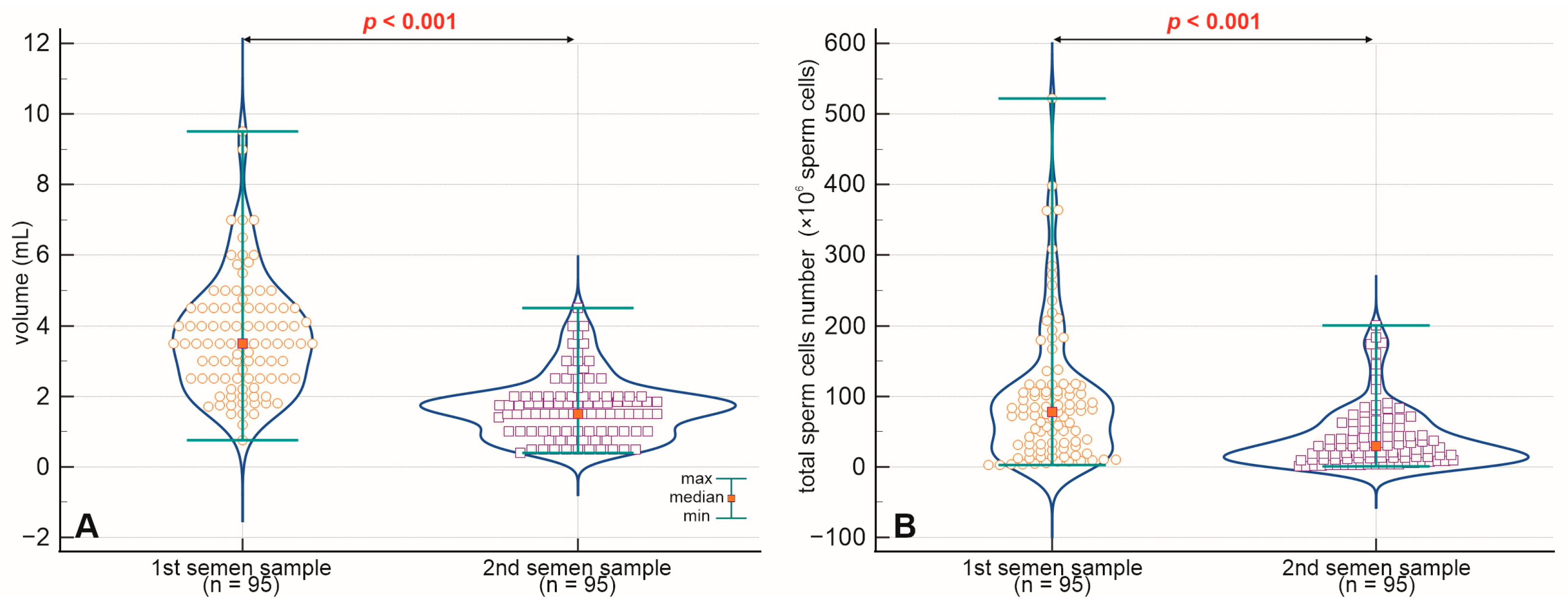
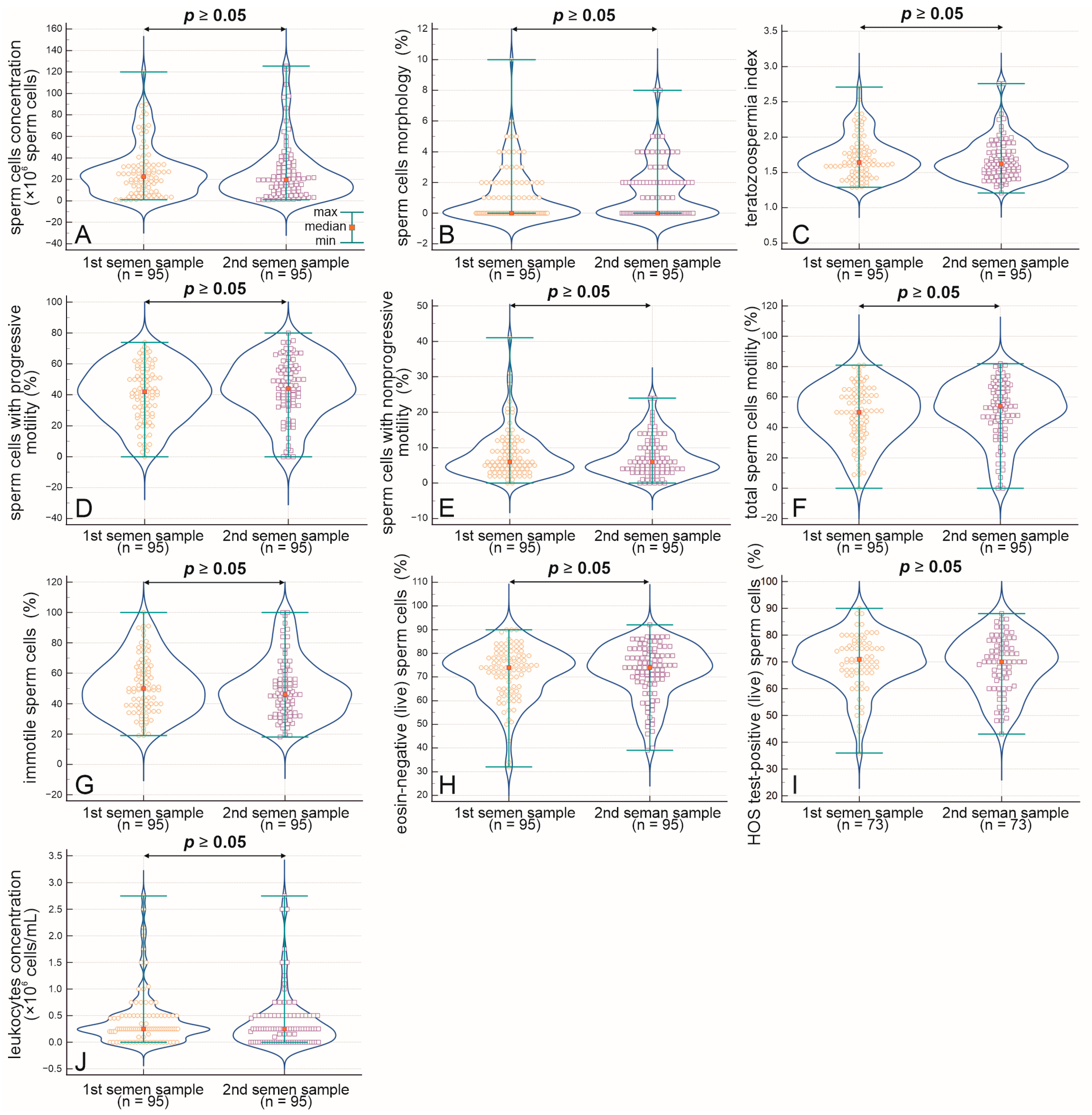
Comparison of standard semen parameters between the first (after 2–7 days of sexual abstinence) and the second (after 1 h of sexual abstinence) semen samples revealed a significant influence of very short-term sexual abstinence on the semen volume (median: 3.50 mL vs. 1.50 mL; Hodges–Lehmann estimator −1.88 mL) (Figure 1A; Supplementary Table S1) and total sperm cell number (median: 78.30 × 10⁶ sperm cells vs. 29.00 × 10⁶ sperm cells; Hodges–Lehmann estimator: −43.79 × 10⁶ sperm cells) (Figure 1B; Supplementary Table S2). However, there were no significant differences in terms of the sperm cell concentration (median: 22.41 × 10⁶ sperm cells/mL vs. 19.50 × 10⁶ sperm cells/mL; Hodges–Lehmann estimator: −1.33 × 10⁶ sperm cells/mL) (Figure 2A; Supplementary Table S3), sperm cell morphology (median: 0.00% vs. 0.00%; Hodges–Lehmann estimator: 0.00%) (Figure 2B; Supplementary Table S4), teratozoospermia index (TZI) (median: 1.64 vs. 1.62; Hodges–Lehmann estimator: −0.025) (Figure 2C; Supplementary Table S5), sperm cell progressive motility (median: 42.00% vs. 44.00%; Hodges–Lehmann estimator: 2.50%) (Figure 2D; Supplementary Table S6), sperm cell nonprogressive motility (median: 6.00% vs. 6.00%; Hodges–Lehmann estimator: −0.50%) (Figure 2E; Supplementary Table S7), or total sperm cell motility (median: 50.00% vs. 54.00%; Hodges–Lehmann estimator: 2.00%) (Figure 2F; Supplementary Table S8), immotile sperm (median: 50.00% vs. 46.00%; Hodges–Lehmann estimator: −2.00%) (Figure 2G; Supplementary Table S9), eosin-negative (live) sperm cells (median: 74.00% vs. 74.00%; Hodges–Lehmann estimator: 0.00%) (Figure 2H; Supplementary Table S10), hypo-osmotic swelling test (HOS test)-positive (live) sperm cells (median: 71.00% vs. 70.00%; Hodges–Lehmann estimator: −1.00%) (Figure 2I; Supplementary Table S11) or leukocyte concentration (median: 0.25 × 10⁶ cells/mL vs. 0.25 × 10⁶ cells/mL; Hodges–Lehmann estimator: 0.00 × 10⁶ cells/mL) (Figure 2J; Supplementary Table S12).

2.2. Sperm Chromatin Quality

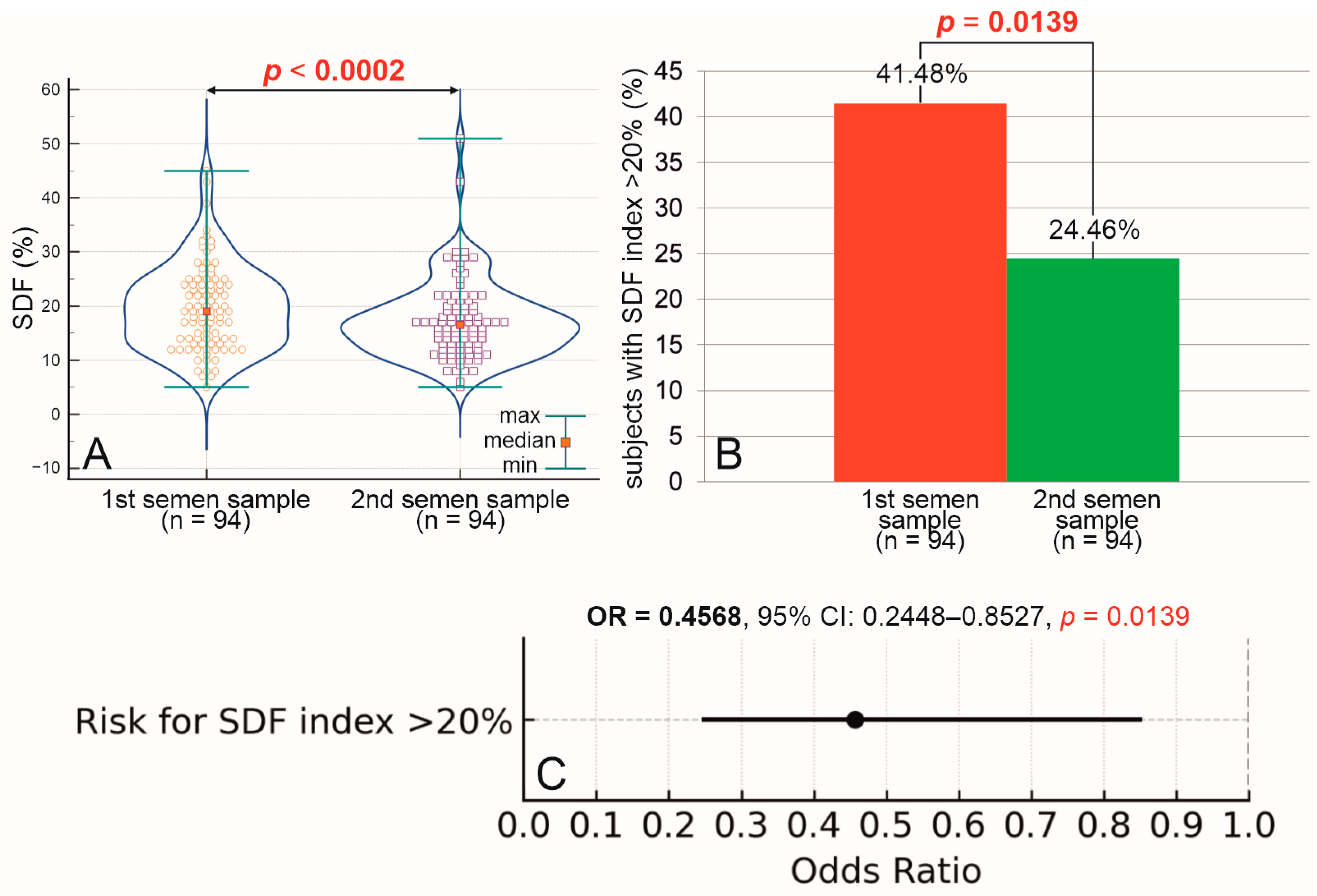
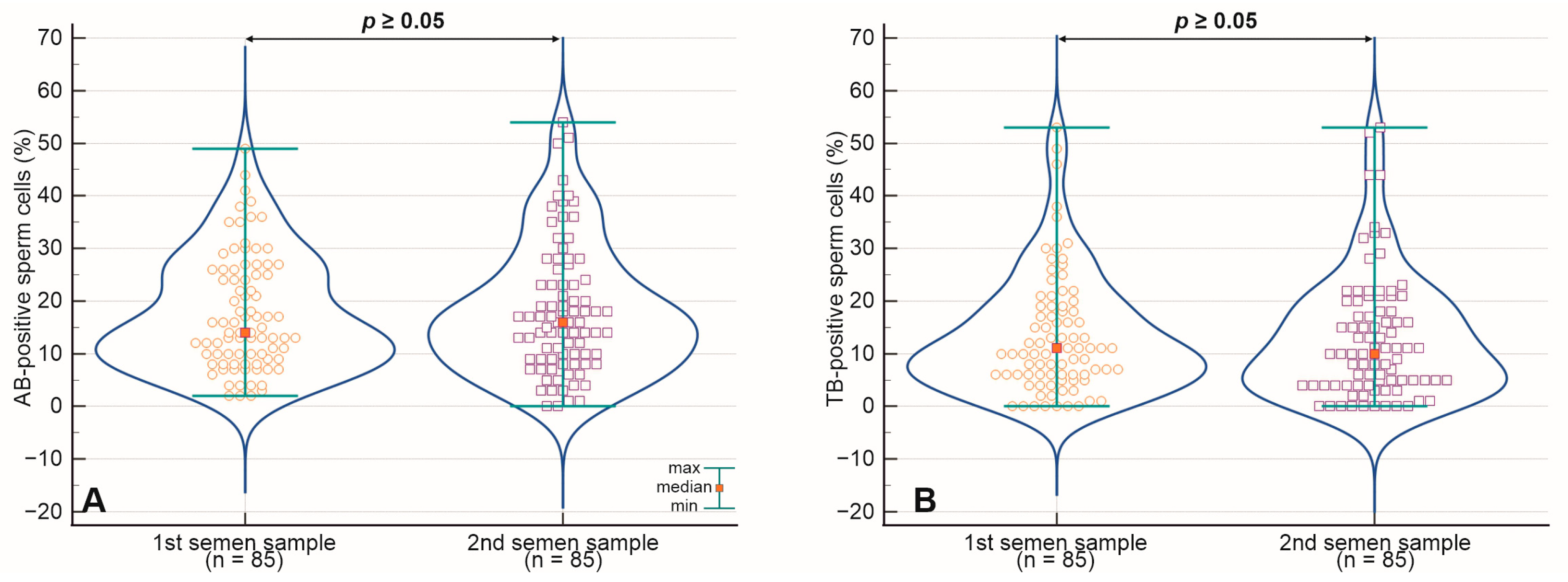
To comprehensively assess the effects of very short-term sexual abstinence on sperm chromatin quality/maturity sperm chromatin dispersion (SCDt), aniline blue (ABt) and toluidine bleu tests (TBt) were performed. Comparison of the obtained data revealed a significantly lower number of sperm cells with DNA fragmentation (SDF index) in the second semen sample (median: 19.00% vs. 16.50%; Hodges–Lehmann estimator: −2.00%) (Figure 3A; Supplementary Table S13), a significant decrease in the percentage of subjects with an SDF index > 20% (44.18% vs. 24.46%, difference: −19.72%) (Figure 3B) and an over 2-fold lower odds ratio (OR = 0.4568) for an SDF index > 20% (Figure 3C). There was no significant influence of the duration of sexual abstinence on the percentage of sperm cells exhibiting abnormal histone retention (AB index) (median: 14.00% vs. 16.00%; Hodges–Lehmann estimator: 0.50%) (Figure 4A; Supplementary Table S14) or the percentage of sperm cells with abnormal chromatin condensation (TB index) (median: 11.00% vs. 10.00%; Hodges–Lehmann estimator: −0.50%) (Figure 4B; Supplementary Table S15).

3. Discussion

Numerous studies have indicated that a prolonged period without ejaculation negatively affects semen parameters such as motility, vitality, and, crucially, sperm nuclear DNA integrity. Therefore, some authors recommend a period of sexual abstinence closer to 2 days rather than 7 days, especially in the context of the efficiency of assisted reproductive technology (ART) procedures [6,7,8,22,26]. Notably, most recent publications on the effect of sexual abstinence on semen parameters consider abstinence duration measured in days in independent groups of patients (different groups of subjects) [6,7,8,27,28,29]. Therefore, in this publication, we decided to focus on the influence of very short-term sexual abstinence (only one hour) on selected semen parameters, including a comprehensive assessment of sperm chromatin status.

3.1. Very Short Duration of Sexual Abstinence and Basic Semen Parameters

As expected, our results indicated that a very short duration of sexual abstinence (one hour) contributes to a significant decrease in ejaculate volume, which is consistent with the results of other authors [5,6,7,8]. We can assume that the decrease in semen volume resulted in a significantly reduced total number of spermatozoa. These findings have also been confirmed by other researchers [5,6,7,8,28]. However, no significant differences in the sperm concentration following one hour of sexual abstinence were observed in our study. We noted only a decreasing trend in this parameter (median: 22.41 × 10⁶ sperm cells/mL vs. 19.50 × 10⁶ sperm cells/mL). Other authors have shown that a shorter duration of sexual abstinence causes a decrease in the sperm concentration [6,7,8,25,27,29]. This decline can result from insufficient absorption of epididymal fluid during very short-term sexual abstinence [9,15]. Moreover, in our study, no significant changes in sperm morphology or the TZI were observed. Similarly, other researchers have demonstrated that modifying the duration of sexual abstinence is not a significant causative factor influencing sperm morphological features. Since sperm morphology primarily depends on testicular spermatogenesis, it is not significantly influenced by incidental changes in the duration of sexual abstinence [5,6,7,8]. However, Russo et al. [29] reported that in normozoospermic patients with 7 days of sexual abstinence, the number of sperm cells with normal morphology was significantly higher than that after 1 day, but it should be noted that this research was conducted on independent groups of men. It is also worth noting that the effect of a very short period of sexual abstinence (1 h) may depend on the semen phenotype. This was demonstrated by Manna et al. [30], who showed that, in group of normozoospermic men, very short-term sexual abstinence significantly increased the percentage of spermatozoa with normal morphology. In contrast, in group of oligoasthenozoospermic men, additionally a significant increase in the percentage of sperm cells with progressive motility was observed.
Unfortunately, despite our initial assumptions, a significant improvement in sperm motility after one hour of sexual abstinence was not observed. However, slight improvement in sperm progressive motility was noted (from 42% to 44%). Nevertheless, other authors [5,28] who analysed samples from the same patients on the same day also reported no significant influence of very short periods of sexual abstinence on the progressive motility of sperm. These data are interesting because the deterioration of sperm motility and vitality is most likely associated with the extensive exposure of sperm to reactive oxygen species and with increased apoptosis of male reproductive cells during prolonged sperm epididymal transit [6,7,8,25,29,31,32]. Moreover, regardless of time without ejaculation, oxidative stress (OS) in semen is associated with impaired semen quality, including reduced sperm motility, and may contribute to male infertility [33,34,35,36]. Hence, modifying the duration of sexual abstinence could provide an opportunity to significantly improve sperm motility and vitality by reducing the risk of oxidative stress and apoptosis in the epididymis [22,24,37]. On the other hand, as mentioned earlier, testicular spermatozoa are unable to undergo progressive motility, and sufficient time for epididymal maturation is necessary for sperm to acquire this ability [9,15,16].
The last of the assessed basic semen parameters was the leukocyte concentration. In our study, very short-term sexual abstinence did not significantly affect the concentration of peroxidase-positive cells. Notably, the men in our study had relatively low leukocyte concentrations (median 0.25 × 10⁶ cells/mL). Frequent ejaculation is recommended in cases of prostatitis to remove, among other factors, leukocytes and proinflammatory cytokines from the male reproductive system [38,39]. We can only speculate that in men with leukocytospermia, a shorter period of sexual abstinence might have a greater effect, resulting in a significant decrease in the number of inflammatory cells in the semen.

3.2. Very Short Duration of Sexual Abstinence and Sperm Chromatin Status

Notably, we clearly showed a dependency between a very short duration of sexual abstinence and sperm genomic integrity because we noted not only a decline in the median SDF index from 19.00% in the first sample to 16.50% in the second sample but also an almost two-fold reduction in the percentage of samples with an SDF index > 20% (from 44.18% to 24.46%). Consequently, OR analysis revealed an over two-fold decrease in the risk for an SDF index > 20% (OR: 0.4568) after very short-term sexual abstinence. It is worth noting that this threshold (20% SDF index) is currently recognized as the optimal value for predicting male fertility (to distinguish fertile men from infertile men) [40,41,42,43,44].
Similar results have been reported by other authors, who reported duration-dependent improvements in human sperm genome integrity [6,7,8,24,27,29,30]. We speculate that the sexual abstinence-dependent decrease in sperm DNA fragmentation may result from the shortening of the exposure time of the sperm to epididymal ROS. The epididymis is known to be a source of ROS generation [45].
On the other hand, our comprehensive analysis of sperm chromatin status did not reveal any significant effect of very short-term abstinence on the results of the ABt and TBt. The former test reveals the presence of residual nuclear histones in sperm chromatin, whereas the latter identifies chromatin structure abnormalities associated with accessible phosphate groups in immature sperm chromatin [46]. These results are not surprising because fundamental chromatin remodelling first occurs in the testes during spermiogenesis—the differentiation of round (early) spermatids to elongated (late) spermatids. This process involves the replacement of histones with sperm-specific chromatin proteins—protamines. This is required to compact genetic material to protect the sperm genome during the passage of male gametes through the male and female reproductive tracks [47,48]. Furthermore, final chromatin condensation (stabilization of chromatin structure—the formation of disulfide bridges in protamines) continues during epididymal sperm maturation [9,15,16]. Therefore, it is not surprising that we did not observe changes in the AB and TB indices. Additionally, other researchers [7] reported similar results with a sperm chromatin structure assay (SCSA). They exhibited associations between sperm DNA integrity and the duration of sexual abstinence, but no differences in chromatin structure/maturity were detected, as verified by a high DNA stainability (HDS) assay.

4. Materials and Methods

4.1. Participants

This study was carried out on semen samples obtained from adult participants (n = 95, median age: 33.00 years; range: 23.00–48.00 years) who were admitted to the Andrology Laboratory in the Department of Histology and Developmental Biology (Faculty of Health Sciences, Pomeranian Medical University in Szczecin, Poland). All the participants self-reported that they were partners in couples with reproductive failure (partners in couples who had not achieved pregnancy during at least 12 months of regular intercourse without contraception). Patients with cryptozoospermia or azoospermia were excluded from the study. The Ethics Committee of Pomeranian Medical University in Szczecin (Poland) approved the study protocol (ethical authorization number: KB-0012/43/2021). The subjects signed an informed consent form agreeing to take part in the research grant, in accordance with the Declaration of Helsinki.

4.2. Semen Sample Collection

The first semen sample of each participant was collected by masturbation after 2–7 days of sexual abstinence (median: 4 days, rang: 2–7 days, Q1: 3 days, Q3: 5 days, IQR: 2 days; 2 men reported 2 days of sexual abstinence, 28 men reported 3 days, 33 men reported 4 days, 18 men reported 5 days, 7 men reported 6 days, and 7 men reported 7 days) into a wide-mouth sterile plastic graded container (according to the 5th and 6th editions of the WHO guidelines [20,49]). The second semen sample was collected on the same day after 1 h of sexual abstinence. Both samples were collected in the laboratory and stored at 37 °C until the analyses were performed.

4.3. Assessment of Basic Semen Parameters

In accordance with the WHO guidelines [20], semen analysis was performed using fully liquefied samples (37 °C, 30 min). The following macroscopic parameters were evaluated: semen volume, liquefaction time, pH, and viscosity. In turn, the microscopic examination included the following: sperm concentration, motility, morphology, and viability and the leukocyte concentration. The light/phase-contrast microscope (DM500—Leica, Heerbrugg, Switzerland) was applied to assess the sperm concentration (×106 sperm cells/mL; an improved Neubauer counting chamber—Heinz Hernez Medizinalbedarf GmbH, Hamburg, Germany) in diluted semen and sperm motility in native semen (both at 400× magnification). The progressive motility (sperm moving in a mostly straight line or in wide circles), nonprogressive motility (any other movement), and immotile spermatozoa were distinguished. Total sperm motility was calculated as the sum of spermatozoa with progressive and nonprogressive motility. In turn, sperm viability was evaluated using two tests: the eosin test and the HOS test. Eosin-negative sperm cells and hypo-osmotically reactive sperm cells were considered viable. Both tests were performed under bright-field microscopy at 1000× magnification and an oil immersion lens. Sperm morphology (Papanicolaou staining) was calculated according to Strict Criteria recommended by the WHO [20] under a bright-field microscope with 1000× magnification and an oil immersion lens. Additionally, based on number of spermatozoa with at least one defect in the head, midpiece, and tail, as well as the presence of immature spermatozoa with residual cytoplasm, the TZI was calculated. The TZI indicates the average number of morphological abnormalities per spermatozoon. The leukocyte concentration (peroxidase-positive cells) was determined by means of the Endtz test (LeucoScreen Kit, FertiPro N.V., Beernem, Belgium). Leukocytes were quantified (×106 cells/mL) using an improved Neubauer counting chamber at 400× magnification under phase contrast illumination.
On the basis of the 5th centile (the lower reference limit) of standard semen parameters derived from fertile men whose partners achieved pregnancy within 12 months of attempting to conceive naturally [20,50,51], the following groups of men were distinguished:
  • Eleven men had a total sperm count, progressive motility, and morphology ≥ the 5th centile (≥39.00 × 10⁶ sperm cells per ejaculate, ≥30% progressively motile sperm cells, and ≥4% sperm cells with normal morphology, respectively). This group was classified as normozoospermic (N) (median of sexual abstinence: 4 days, rang: 3–5 days, Q1: 3 days, Q3: 5 days, IQR: 2 days).
  • Forty-five men had isolated sperm morphology < the 5th centile. This group was classified as teratozoospermic (T) median of sexual abstinence: 4 days, rang: 2–7 days, Q1: 3 days, Q3: 5 days, IQR: 2 days).
  • Nine men had both progressive motility and morphology of sperm < the 5th centile. This group was classified as asthenoteratozoospermic (AT) median of sexual abstinence: 4 days, rang: 3–7 days, Q1: 4 days, Q3: 4 days, IQR: 0 days).
  • Twelve men had both sperm count and morphology < the 5th centile. This group was classified as oligoasthenozoospermic (OT) median of sexual abstinence: 4 days, rang: 3–6 days, Q1: 3 days, Q3: 4.5 days, IQR: 1.5 days).
  • Eighteen men had sperm count, progressive motility, and morphology all < the 5th centile. This group was classified as oligoasthenoteratozoospermic (OAT) median of sexual abstinence: 4 days, rang: 2–7 days, Q1: 3 days, Q3: 5 days, IQR: 2 days).

4.4. Assessment of Sperm DNA Fragmentation (SDF) with the Sperm Chromatin Dispersion Test (SCDt)

The chromatin dispersion test (SCDt) is used to assess genome integrity by evaluating the susceptibility of the sperm nucleus to dispersed DNA loop formation. This test was performed using a Halo-sperm G2® kit (Halotech, Madrid, Spain). Sample preparation followed the manufacturer’s instructions provided with the kit. Briefly, the recommended sperm concentration for the assay should not exceed 20 × 106 cells/mL. If necessary, the semen samples were diluted in phosphate-buffered saline (PBS). The semen sample was gently mixed with melted agarose (in proportion 1:2, 37 °C). Subsequently, 8 µL of the suspension was dropped onto a supercoated slide and covered with a coverslip (4 °C, 5–10 min). After removing of the coverslip, the semen sample was treated with acid denaturation solution (DA) (room temperature, 7 min). In the next step, the DA was discarded and lysis solution (LS) was used (room temperature, 20 min) which following incubation was removed. The slides were then rinsed off with distilled water (room temperature, 5 min), dehydrated sequentially in 70% and 100% ethanol (room temperature, 2 min), and stained with eosin staining solution A and thiazine staining solution B (room temperature, 7 min).
Sperm DNA fragmentation (SDF) was evaluated manually using a brightfield microscope at 400× magnification (DM500 light microscope; Leica, Heerbrugg, Switzerland). An intact sperm genome was indicated by the presence of a visible halo of DNA loops surrounding the sperm head. In SCDt, SDF-negative spermatozoa were defined as those with halos greater than one-third of the core (related to the sperm head) diameter (medium halos) or halos larger than the core diameter (large halos). Spermatozoa exhibiting small halos, no halos, and irregular or weakly stained cores (degraded chromatin) were classified as SDF positive. The results are expressed as the proportion of SDF-positive cells relative to the total number of assessed spermatozoa and multiplied by 100. Therefore, the SDF index denotes the percentage of sperm with damaged/fragmented DNA. In accordance with the manufacturer’s protocol, the cut-off value for the SDF index is 20% for intrauterine insemination and 25% for in vitro fertilization procedures. According to most researchers, the threshold of 20% is considered the most useful for distinguishing between fertile and infertile men [40,41,42,43,44].

4.5. Assessment of Persistent Histones in the Sperm Chromatin: Aniline Blue Test (ABt)

Aniline blue is an acidic dye that selectively binds to lysine-rich histones in the sperm nucleus. This staining method enables the identification of spermatozoa with abnormally retained histones, which may adversely affect chromatin condensation within the sperm nucleus [46,52]. As such, sperm nuclei with loose chromatin packaging take up the stain and appear dark blue when viewed under a bright field microscope. Briefly, native semen samples (300–500 μL) were centrifuged at 600× g for 10 min. The supernatant was discarded, and the pellet was washed twice with 1 mL of PBS (centrifugation at 600× g for 10 min each). Air-dried smears were then fixed in 3% (v/v) buffered glutaraldehyde in PBS (pH 7.2) for 30 min. Following fixation, the smears were stained with 5% (w/v) aqueous aniline blue solution (Sigma-Aldrich Co., St. Louis, MO, USA) prepared in 4% acetic acid (pH 3.5) for 5 min. Then, the slides were rinsed with distilled water. Spermatozoa were evaluated under a bright-field microscope at 400× magnification using an oil immersion lens. The percentage of sperm cells exhibiting abnormal histone retention (aniline blue-positive spermatozoa) was calculated as the ratio of dark blue-stained sperm heads (partial or complete staining, indicating lysine-rich histones) to the total number of sperm heads analysed (both dark blue-stained and pale blue-stained, the latter representing mature chromatin), multiplied by 100 (AB index) [46].

4.6. Assessment of Abnormal Sperm Chromatin Condensation: Toluidine Blue Test (TBt)

Toluidine blue is a metachromatic dye that binds to DNA at sites with accessible phosphate groups. This staining method allows the identification of spermatozoa with decondensed chromatin, which may indicate compromised chromatin integrity within the sperm nucleus [46,53]. Native semen samples (300–500 μL) were centrifuged at 600× g for 10 min. The supernatant was discarded, and the pellet was washed twice with 1 mL of phosphate-buffered saline (PBS; pH 7.4) by centrifugation at 600× g for 10 min. Air-dried smears were fixed in freshly prepared 96% (v/v) ethanol–acetone solution (1:1, v/v) at 4 °C for 30 min and subsequently hydrolysed in 0.1 mol/L hydrochloric acid (HCl) at 4 °C for 5 min. After hydrolysis, the slides were rinsed three times in distilled water for 2 min each and then stained with 0.05% (w/v) toluidine blue (TB; Sigma-Aldrich Co., St. Louis, MO, USA) prepared in 50% McIlvaine’s citrate–phosphate buffer (pH 3.5) for 11 min at room temperature. The slides were then rinsed again in distilled water. Spermatozoa were evaluated under a bright-field microscope at 400× magnification using an oil immersion lens. The percentage of sperm cells with abnormal chromatin condensation (TB-positive cells) was calculated as the ratio of the number of spermatozoa with dark blue or deep violet (purple) staining (partial or complete staining of the sperm head) to the total number of spermatozoa analysed (including both TB-positive and pale blue-stained sperm heads with mature chromatin), multiplied by 100 (TB index) [46].

4.7. Statistics

The normality of continuous variables was assessed using the Shapiro–Wilk test. As the assumption of a normal distribution was rejected, comparisons between paired observations (the results of semen analysis from the first sample vs. the results of semen analysis from the second sample) were conducted using the nonparametric Wilcoxon rank test. Descriptive statistics included medians, 95% confidence intervals (95% CI) for medians, minimum and maximum values, quartile (Q), interquartile ranges (IQR), differences in medians (estimated using the Hodges–Lehmann estimator [median differences]), and two-sided p values for statistical significance. On the basis of the cut-off value of the SDF index (20%), the prevalence of subjects with an SDF index > 20% was calculated and compared between the two dependent groups using the chi-square test. Additionally, odds ratios (ORs) with 95% confidence intervals were calculated to assess the likelihood of an SDF index > 20% in the second sample relative to the first sample. A p value < 0.05 was considered to indicate statistical significance for all tests. Statistical analyses were performed using MedCalc version 22.009 (MedCalc Software Ltd., Ostend, Belgium) and Statistica version 13.0 (StatSoft, Cracow, Poland).

5. Strengths and Limitations of the Study

In our opinion, this research project, which examined the effects of very short-term sexual abstinence on semen parameters and sperm chromatin status, provides interesting and novel data that may be useful in the diagnostic and therapeutic management of infertility, particularly in the context of the increasing prevalence of male reproductive disorders. The present study demonstrated that a simple, safe, and cost-effective modification, like shortening the duration of sexual abstinence to one hour, may improve the genomic integrity of human sperm cells. Additionally, the strengths of this study include the relatively large number of participants, which allowed reliable statistical analyses to be performed, the use of a dependent-group study design, and the complement of standard semen analysis with a comprehensive assessment of sperm chromatin status using ABt, TBt, and SCDt. However, we are aware of certain limitations of the study. These undoubtedly include the heterogeneity of the study group, reflected both by differences in the duration of sexual abstinence before collection of the first semen sample (IQR: 2 days) and by the inclusion of men with different semen phenotypes, including normozoospermia as well as abnormalities in sperm count, motility, and morphology.

6. Conclusions

Our data indicate that, on the one hand, a very short period of sexual abstinence negatively affects ejaculate volume and total sperm count, which is fully understandable. On the other hand, it has a positive influence on sperm DNA integrity (the SDF index). The obtained chromatin integrity results show that the sperm chromatin dispersion test can be considered a useful tool for verifying sperm DNA quality. This conclusion is in line with most recent scientific papers and current trends in the diagnosis of male infertility [40,41,42,54,55,56].
Moreover, our results have practical implications, particularly for in vitro fertilization treatments. In the case of natural conception and intrauterine insemination (IUI), a very short period of sexual abstinence seems unjustified because reproductive success is partially dependent on a large number of spermatozoa in the ejaculate [57]. In the case of in vitro fertilization, the integrity of the sperm genome plays a particularly important role. Reduced sperm chromatin integrity is known to have detrimental effects on fertilization, early embryo development, implantation, and even offspring health and can be a risk factor for miscarriage. Therefore, we believe that very short-term sexual abstinence, which reduces sperm DNA fragmentation, could significantly improve in vitro fertilization outcomes. Notably, it is an effective, cost-free, and rapid approach for the management of DNA fragmentation in male reproductive cells. It may be worth considering the inclusion of abstinence-duration modifications in therapeutic algorithms [22,26,41,42,56,58,59,60].

Supplementary Materials

The following supporting information can be downloaded at: https://www.mdpi.com/article/10.3390/ijms27115046/s1.

Author Contributions

Conceptualization: K.G. and M.P. Methodology: K.G. and M.P. Investigation: K.G., M.P., T.M., and M.Ł. Formal analysis: K.G. and M.P. Writing—Original Draft Preparation: K.G. and M.P. Writing—Review and Editing: K.G. and M.P. Visualization: K.G. and M.P. Project Administration: M.P. Founding acquisition: M.P. Supervision: M.P. All authors have read and agreed to the published version of the manuscript.

Funding

This research and APC was funded by Pomeranian Medical University, Szczecin, Poland, grant number WNoZ-322/S/2026.

Institutional Review Board Statement

The study was conducted in accordance with the Declaration of Helsinki, and approved by the Ethics Committee of Pomeranian Medical University, Szczecin, Poland (protocol code: KB-0012/43/2021, date of approval: 26 April 2021).

Informed Consent Statement

Informed consent was obtained from all subjects involved in the study.

Data Availability Statement

The raw data supporting the conclusions of this article will be made available by the authors on request.

Conflicts of Interest

The authors declare no conflicts of interest.

Abbreviations

The following abbreviations are used in this manuscript:
ABaniline blue
ABtaniline blue test
ARTassisted reproductive technology
ATasthenoteratozoospermia
CIconfidence interval
DAdenaturation solution
DNAdeoxyribonucleic acid
ESHREEuropean Society of Human Reproduction and Embryology
HClhydrochloric acid
HDShigh DNA stainability
HOShypo-osmotic swelling
ICSIintracytoplasmic sperm injection
IUIintrauterine insemination
IQRinterquartile range
LSlysis solution
Nnormozoospermia
NADPHnicotinamide adenine dinucleotide phosphate
NOX5NADPH oxidase 5
OAToligoasthenoteratozoospermia
ORodds ratio
OSoxidative stress
OToligoteratozoospermia
PBSphosphate-buffered saline
Q1first quartile
Q3third quartile
ROSreactive oxygen species
SCDsperm chromatin dispersion
SCDtsperm chromatin dispersion test
SCSAsperm chromatin structure assay
SDFsperm DNA fragmentation
Tteratozoospermia
TBtoluidine blue
TBttoluidine blue test
TZIteratozoospermia index
WHOWorld Health Organization

References

  1. Black, K.; Ølgaard, S.; Khoei, A.A.; Glazer, C.; Ohl, D.A.; Jensen, C.F.S. The Genetic Landscape of Male Factor Infertility and Implications for Men’s Health and Future Generations. Uro 2025, 5, 2. [Google Scholar] [CrossRef]
  2. Minhas, S.; Boeri, L.; Capogrosso, P.; Cocci, A.; Corona, G.; Dinkelman-Smit, M.; Falcone, M.; Jensen, C.F.; Gül, M.; Kalkanli, A.; et al. European Association of Urology Guidelines on Male Sexual and Reproductive Health: 2025 Update on Male Infertility. Eur. Urol. 2025, 87, 601–616. [Google Scholar] [CrossRef]
  3. Dutta, S.; Sengupta, P.; Roychoudhury, S.; Chakravarthi, S.; Wang, C.W.; Slama, P. Antioxidant Paradox in Male Infertility: “A Blind Eye” on Inflammation. Antioxidants 2022, 11, 167. [Google Scholar] [CrossRef]
  4. Karavani, G.; Juvet, T.S.J.; Lau, S.; Lajkosz, K.; Mullen, B.; Lo, K.C.; Grober, E.D.; Akroof, B.; Kattan, M.S.; Jarvi, K. Improved Sperm DNA Fragmentation Levels in Infertile Men Following Very Short Abstinence of 3–4 Hours. Transl. Androl. Urol. 2023, 12, 1487496. [Google Scholar] [CrossRef]
  5. Poopaibool, N.; Tangprasittipap, A.; Chumchuen, S.; Satirapod, C.; Singwongsa, A. Effects of a Short Abstinence Period on Sperm Quality in Oligozoospermic Men. Clin. Exp. Reprod. Med. 2023, 50, 262–269. [Google Scholar] [CrossRef]
  6. Raditya, M.; Hari Soejono, A.; Siswanto, M.A.; Atmoko, W.; Shah, R.; Agarwal, A.; Situmorang, G.R.; Birowo, P.; Rasyid, N. Impact of Shorter Abstinence Periods on Semen Parameters: A Systematic Review and Meta-Analysis. World J. Men’s Health 2025, 43, 563–579. [Google Scholar] [CrossRef]
  7. Yao, G.; Qi, Q.; Dou, X.; Zhou, W.; Bai, S.; Zhang, X. Association of Abstinence Time with Semen Quality in Men Who Undergoing Fertility Evaluation: A Cross-Sectional Study from 3052 Participants. Front. Endocrinol. 2025, 16, 1472333. [Google Scholar] [CrossRef] [PubMed]
  8. Du, C.; Li, Y.; Yin, C.; Luo, X.; Pan, X. Association of Abstinence Time with Semen Quality and Fertility Outcomes: A Systematic Review and Dose-Response Meta-Analysis. Andrology 2024, 12, 1224–1235. [Google Scholar] [CrossRef] [PubMed]
  9. James, E.R.; Carrell, D.T.; Aston, K.I.; Jenkins, T.G.; Yeste, M.; Salas-Huetos, A. The Role of the Epididymis and the Contribution of Epididymosomes to Mammalian Reproduction. Int. J. Mol. Sci. 2020, 21, 5377. [Google Scholar] [CrossRef]
  10. Sullivan, R.; Légaré, C.; Lamontagne-Proulx, J.; Breton, S.; Soulet, D. Revisiting Structure/Functions of the Human Epididymis. Andrology 2019, 7, 748–757. [Google Scholar] [CrossRef]
  11. Sullivan, R.; Mieusset, R. The Human Epididymis: Its Function in Sperm Maturation. Hum. Reprod. Update 2016, 22, 574–587. [Google Scholar] [CrossRef] [PubMed]
  12. Weigel Muñoz, M.; Cohen, D.J.; Da Ros, V.G.; González, S.N.; Rebagliati Cid, A.; Sulzyk, V.; Cuasnicu, P.S. Physiological and Pathological Aspects of Epididymal Sperm Maturation. Mol. Asp. Med. 2024, 100, 101321. [Google Scholar] [CrossRef]
  13. Barbagallo, F.; Cannarella, R.; Crafa, A.; Manna, C.; La Vignera, S.; Condorelli, R.A.; Calogero, A.E. The Impact of a Very Short Abstinence Period on Conventional Sperm Parameters and Sperm DNA Fragmentation: A Systematic Review and Meta-Analysis. J. Clin. Med. 2022, 11, 7303. [Google Scholar] [CrossRef] [PubMed]
  14. Elbashir, S.; Magdi, Y.; Rashed, A.; Henkel, R.; Agarwal, A. Epididymal Contribution to Male Infertility: An Overlooked Problem. Andrologia 2021, 53, e13721. [Google Scholar] [CrossRef]
  15. Hart, H.M.; Nixon, B.; Martin, J.H.; Aitken, R.J.; De Iuliis, G.N. Improving Sperm Selection Strategies for Assisted Reproduction through Closing the Knowledge Gap in Sperm Maturation Mechanics. Hum. Reprod. Open 2025, 2025, hoaf040. [Google Scholar] [CrossRef]
  16. Zhou, W.; De Iuliis, G.N.; Dun, M.D.; Nixon, B. Characteristics of the Epididymal Luminal Environment Responsible for Sperm Maturation and Storage. Front. Endocrinol. 2018, 9, 59. [Google Scholar] [CrossRef]
  17. Chen, H.; Alves, M.B.R.; Belleannée, C. Contribution of Epididymal Epithelial Cell Functions to Sperm Epigenetic Changes and the Health of Progeny. Hum. Reprod. Update 2021, 28, 51–66. [Google Scholar] [CrossRef]
  18. Agudo-Rios, C.; Sanchez-Rodriguez, A.; Idrovo, I.I.D.; Laborda-Gomariz, J.Á.; Soler, A.J.; Valverde, A.; Teves, M.E.; Roldan, E.R.S. Epididymal Sperm Maturation in Mouse Species with Differing Levels of Sperm Competition. Biol. Reprod. 2026, 114, 905–918. [Google Scholar] [CrossRef]
  19. Rashki Ghaleno, L.; Alizadeh, A.; Drevet, J.R.; Shahverdi, A.; Valojerdi, M.R. Oxidation of Sperm DNA and Male Infertility. Antioxidants 2021, 10, 97. [Google Scholar] [CrossRef]
  20. WHO. WHO Laboratory Manual for the Examination and Processing of Human Semen, 6th ed. Available online: https://www.who.int/publications-detail-redirect/9789240030787 (accessed on 24 August 2022).
  21. Barratt, C.L.R.; Björndahl, L.; Menkveld, R.; Mortimer, D. ESHRE Special Interest Group for Andrology Basic Semen Analysis Course: A Continued Focus on Accuracy, Quality, Efficiency and Clinical Relevance. Hum. Reprod. 2011, 26, 3207–3212. [Google Scholar] [CrossRef] [PubMed]
  22. Farkouh, A.; Saleh, R.; Shah, R.; Agarwal, A. Sperm DNA Fragmentation in Male Infertility: From Bench to Bedside. Arab J. Urol. 2023, 21, 199–203. [Google Scholar] [CrossRef]
  23. Dahan, M.H.; Mills, G.; Khoudja, R.; Gagnon, A.; Tan, G.; Tan, S.L. Three Hour Abstinence as a Treatment for High Sperm DNA Fragmentation: A Prospective Cohort Study. J. Assist. Reprod. Genet. 2021, 38, 227–233. [Google Scholar] [CrossRef]
  24. Hosseini, A.; Borzouie, Z.; Khalili, P.; Vatanparast, M. The Effect of Consecutive Ejaculation on the Sperm Parameters in the Oligo-Astheno-Teratozoospermia (OAT) Men. Zygote 2025, 33, 38–44. [Google Scholar] [CrossRef]
  25. Alipour, H.; Duus, R.K.; Wimmer, R.; Dardmeh, F.; Du Plessis, S.S.; Jørgensen, N.; Christiansen, O.B.; Hnida, C.; Nielsen, H.I.; Van Der Horst, G. Seminal Plasma Metabolomics Profiles Following Long (4–7 Days) and Short (2 h) Sexual Abstinence Periods. Eur. J. Obstet. Gynecol. Reprod. Biol. 2021, 264, 178–183. [Google Scholar] [CrossRef]
  26. Sørensen, F.; Melsen, L.M.; Fedder, J.; Soltanizadeh, S. The Influence of Male Ejaculatory Abstinence Time on Pregnancy Rate, Live Birth Rate and DNA Fragmentation: A Systematic Review. J. Clin. Med. 2023, 12, 2219. [Google Scholar] [CrossRef] [PubMed]
  27. Lo Giudice, A.; Asmundo, M.G.; Cimino, S.; Cocci, A.; Falcone, M.; Capece, M.; Abdelhameed, A.S.; Capogrosso, P.; Morgado, A.; Tsampoukas, G.; et al. Effects of Long and Short Ejaculatory Abstinence on Sperm Parameters: A Meta-Analysis of Randomized-Controlled Trials. Front. Endocrinol. 2024, 15, 1373426. [Google Scholar] [CrossRef]
  28. Sertkaya, Z.; Akan, S.; Özdemir, H.; Ertaş, K.; Korkmaz, E.; Tokuç, E.; Şimşek, A. Effect of Sexual Arousal on Semen Parameters during Abstinence. Andrologia 2022, 54, e14513. [Google Scholar] [CrossRef] [PubMed]
  29. Russo, G.I.; Asmundo, M.G.; Cocci, A.; Abdelhameed, A.S.; Liprino, A.; Giacone, F.; Lombardo, D.; Guglielmino, A.; Chamayou, S. Ejaculatory Abstinence Duration Impacts Semen Parameters: Insights from a Retrospective Analysis in Male Infertility on 23,527 Analyses. Front. Endocrinol. 2025, 16, 1529262. [Google Scholar] [CrossRef] [PubMed]
  30. Manna, C.; Barbagallo, F.; Manzo, R.; Rahman, A.; Francomano, D.; Calogero, A.E. Sperm Parameters before and after Swim-Up of a Second Ejaculate after a Short Period of Abstinence. J. Clin. Med. 2020, 9, 1029. [Google Scholar] [CrossRef]
  31. Degirmenci, Y.; Demirdag, E.; Guler, I.; Yildiz, S.; Erdem, M.; Erdem, A. Impact of the Sexual Abstinence Period on the Production of Seminal Reactive Oxygen Species in Patients Undergoing Intrauterine Insemination: A Randomized Trial. J. Obstet. Gynaecol. Res. 2020, 46, 1133–1139. [Google Scholar] [CrossRef] [PubMed]
  32. Ayad, B.; Omolaoye, T.S.; Louw, N.; Ramsunder, Y.; Skosana, B.T.; Oyeipo, P.I.; Du Plessis, S.S. Oxidative Stress and Male Infertility: Evidence From a Research Perspective. Front. Reprod. Health 2022, 4, 822257. [Google Scholar] [CrossRef] [PubMed]
  33. Gill, K.; Machałowski, T.; Harasny, P.; Grabowska, M.; Duchnik, E.; Piasecka, M. Low Human Sperm Motility Coexists with Sperm Nuclear DNA Damage and Oxidative Stress in Semen. Andrology 2024, 12, 1154–1169. [Google Scholar] [CrossRef] [PubMed]
  34. Kurkowska, W.; Bogacz, A.; Janiszewska, M.; Gabryś, E.; Tiszler, M.; Bellanti, F.; Kasperczyk, S.; Machoń-Grecka, A.; Dobrakowski, M.; Kasperczyk, A. Oxidative Stress Is Associated with Reduced Sperm Motility in Normal Semen. Am. J. Men’s Health 2020, 14, 1557988320939731. [Google Scholar] [CrossRef]
  35. Rhouma, M.B.; Bahri, H.; Khalifa, M.B.; Sakly, M.; Rhouma, K.B.; Benkhalifa, M.; Tebourbi, O. Oxidative Stress and Its Correlation with Sperm Parameters in Different Semen Quality Groups. Clin. Exp. Reprod. Med. 2025, 52, 386–393. [Google Scholar] [CrossRef]
  36. Nowicka-Bauer, K.; Lepczynski, A.; Ozgo, M.; Kamieniczna, M.; Fraczek, M.; Stanski, L.; Olszewska, M.; Malcher, A.; Skrzypczak, W.; Kurpisz, M.K. Sperm Mitochondrial Dysfunction and Oxidative Stress as Possible Reasons for Isolated Asthenozoospermia. J. Physiol. Pharmacol. Off. J. Pol. Physiol. Soc. 2018, 69, 403–417. [Google Scholar] [CrossRef]
  37. Comar, V.A.; Petersen, C.G.; Mauri, A.L.; Mattila, M.; Vagnini, L.D.; Renzi, A.; Petersen, B.; Nicoletti, A.; Dieamant, F.; Oliveira, J.B.A.; et al. Influence of the Abstinence Period on Human Sperm Quality: Analysis of 2,458 Semen Samples. JBRA Assist. Reprod. 2017, 21, 306–312. [Google Scholar] [CrossRef]
  38. Branigan, E.F.; Muller, C.H. Efficacy of Treatment and Recurrence Rate of Leukocytospermia in Infertile Men with Prostatitis. Fertil. Steril. 1994, 62, 580–584. [Google Scholar] [CrossRef] [PubMed]
  39. Welliver, C.; Benson, A.D.; Frederick, L.; Leader, B.; Tirado, E.; Feustel, P.; Kontio, J.; McAsey, M.; Köhler, T.S. Analysis of Semen Parameters during 2 Weeks of Daily Ejaculation: A First in Humans Study. Transl. Androl. Urol. 2016, 5, 749–755. [Google Scholar] [CrossRef]
  40. Esteves, S.C.; Zini, A.; Coward, R.M.; Evenson, D.P.; Gosálvez, J.; Lewis, S.E.M.; Sharma, R.; Humaidan, P. Sperm DNA Fragmentation Testing: Summary Evidence and Clinical Practice Recommendations. Andrologia 2021, 53, e13874. [Google Scholar] [CrossRef]
  41. Farkouh, A.; Salvio, G.; Kuroda, S.; Saleh, R.; Vogiatzi, P.; Agarwal, A. Sperm DNA Integrity and Male Infertility: A Narrative Review and Guide for the Reproductive Physicians. Transl. Androl. Urol. 2022, 11, 1023–1044. [Google Scholar] [CrossRef]
  42. Andrabi, S.W.; Ara, A.; Saharan, A.; Jaffar, M.; Gugnani, N.; Esteves, S.C. Sperm DNA Fragmentation: Causes, Evaluation and Management in Male Infertility. JBRA Assist. Reprod. 2024, 28, 306–319. [Google Scholar] [CrossRef]
  43. Agarwal, A.; Farkouh, A.; Parekh, N.; Zini, A.; Arafa, M.; Kandil, H.; Tadros, N.; Busetto, G.M.; Ambar, R.; Parekattil, S.; et al. Sperm DNA Fragmentation: A Critical Assessment of Clinical Practice Guidelines. World J. Men’s Health 2022, 40, 30. [Google Scholar] [CrossRef]
  44. Santi, D.; Spaggiari, G.; Simoni, M. Sperm DNA Fragmentation Index as a Promising Predictive Tool for Male Infertility Diagnosis and Treatment Management—Meta-Analyses. Reprod. Biomed. Online 2018, 37, 315–326. [Google Scholar] [CrossRef]
  45. Sengupta, P.; Pinggera, G.; Calogero, A.E.; Agarwal, A. Oxidative Stress Affects Sperm Health and Fertility—Time to Apply Facts Learned at the Bench to Help the Patient: Lessons for Busy Clinicians. Reprod. Med. Biol. 2024, 23, e12598. [Google Scholar] [CrossRef]
  46. Gill, K.; Rosiak, A.; Gaczarzewicz, D.; Jakubik, J.; Kurzawa, R.; Kazienko, A.; Rymaszewska, A.; Laszczynska, M.; Grochans, E.; Piasecka, M. The Effect of Human Sperm Chromatin Maturity on ICSI Outcomes. Hum. Cell 2018, 31, 220–231. [Google Scholar] [CrossRef] [PubMed]
  47. Chhetri, K.B. DNA Compaction and Chromatin Dynamics: The Role of Cationic Polyamines and Proteins. Biochem. Biophys. Res. Commun. 2025, 756, 151538. [Google Scholar] [CrossRef]
  48. Cui, Y.; Deng, J.; Zhang, Y.; Du, L.; Jiang, F.; Li, C.; Chen, W.; Zhang, H.; He, Z. Epigenetic Regulation by DNA Methylation, Histone Modifications and Chromatin Remodeling Complexes in Controlling Spermatogenesis and Their Dysfunction with Male Infertility. Cell. Mol. Life Sci. CMLS 2025, 82, 343. [Google Scholar] [CrossRef]
  49. WHO Laboratory Manual for the Examination and Processing of Human Semen, 5th ed. Available online: https://www.who.int/publications/b/40087 (accessed on 12 December 2025).
  50. Björndahl, L.; Esteves, S.C.; Ferlin, A.; Jørgensen, N.; O’Flaherty, C. Improving Standard Practices in Studies Using Results from Basic Human Semen Examination. Andrology 2023, 11, 1225–1231. [Google Scholar] [CrossRef] [PubMed]
  51. Krausz, C.; Farnetani, G. Clinical Interpretation of Semen Analysis. In Practical Clinical Andrology; Bettocchi, C., Busetto, G.M., Carrieri, G., Cormio, L., Eds.; Springer International Publishing: Cham, Switzerland, 2023; pp. 173–184. ISBN 978-3-031-11701-5. [Google Scholar]
  52. Hallam, J.; Burton, P.; Sanders, K. Poor Sperm Chromatin Condensation Is Associated with Cryopreservation-Induced DNA Fragmentation and Cell Death in Human Spermatozoa. J. Clin. Med. 2024, 13, 4156. [Google Scholar] [CrossRef]
  53. Lahimer, M.; Gherissi, O.; Ben Salem, N.; Ben Mustapha, H.; Bach, V.; Khorsi-Cauet, H.; Khairi, H.; Ben Ali, H.; BenKhalifa, M.; Ajina, M. Effect of Micronutrients and L-Carnitine as Antioxidant on Sperm Parameters, Genome Integrity, and ICSI Outcomes: Randomized, Double-Blind, and Placebo-Controlled Clinical Trial. Antioxidants 2023, 12, 1937. [Google Scholar] [CrossRef] [PubMed]
  54. Ziouziou, I.; Rambhatla, A.; Shah, R.; Agarwal, A. Sperm DNA Fragmentation and Infertility: A Narrative Review. World J. Urol. 2024, 42, 408. [Google Scholar] [CrossRef] [PubMed]
  55. Agarwal, A.; Baskaran, S.; Parekh, N.; Cho, C.-L.; Henkel, R.; Vij, S.; Arafa, M.; Panner Selvam, M.K.; Shah, R. Male Infertility. Lancet 2021, 397, 319–333. [Google Scholar] [CrossRef]
  56. Stavros, S.; Potiris, A.; Molopodi, E.; Mavrogianni, D.; Zikopoulos, A.; Louis, K.; Karampitsakos, T.; Nazou, E.; Sioutis, D.; Christodoulaki, C.; et al. Sperm DNA Fragmentation: Unraveling Its Imperative Impact on Male Infertility Based on Recent Evidence. Int. J. Mol. Sci. 2024, 25, 10167. [Google Scholar] [CrossRef]
  57. Muthigi, A.; Jahandideh, S.; Bishop, L.A.; Naeemi, F.K.; Shipley, S.K.; O’Brien, J.E.; Shin, P.R.; Devine, K.; Tanrikut, C. Clarifying the Relationship between Total Motile Sperm Counts and Intrauterine Insemination Pregnancy Rates. Fertil. Steril. 2021, 115, 1454–1460. [Google Scholar] [CrossRef]
  58. Pardiñas, M.L.; de Celis, C.; Gil, J.; Ortega-Jaen, D.; Martin, A.; Mercader, A.; Jose de Los Santos, M. Oocyte-Mediated Repair of Sperm DNA Fragmentation: A Critical Determinant of Embryo Viability. Reprod. Biomed. Online 2025, 52, 105165. [Google Scholar] [CrossRef] [PubMed]
  59. Garrido, N.; Gül, M.; Jindal, S.; Vogiatzi, P.; Saleh, R.; Durairajanayagam, D.; Parmegiani, L.; Boitrelle, F.; Colpi, G.M.; Agarwal, A. How to Select Healthy Sperm for Intracytoplasmic Sperm Injection in Samples with High Sperm DNA Fragmentation? Panminerva Med. 2023, 65, 148–158. [Google Scholar] [CrossRef] [PubMed]
  60. Machałowski, T.; Machałowska, J.; Gill, K.; Ziętek, M.; Piasecka, M.; Mrugacz, G.; Ciepiela, P. Sperm DNA Fragmentation Impairs Early Embryo Development but Is Not Predictive of Pregnancy Outcomes: Insights from 870 ICSI Cycles. Int. J. Mol. Sci. 2025, 26, 7923. [Google Scholar] [CrossRef]
Figure 1. Comparison of the semen volume (A) and total sperm cell number (B) between the 1st semen sample (after 2–7 days of sexual abstinence) and the 2nd semen sample (after 1 h after sexual abstinence). The dependent groups of men were compared using the Wilcoxon test (median test); n, number of participants. A p value < 0.05 was considered to indicate statistical significance.
Ijms 27 05046 g001
Figure 2. Comparisons of the sperm cell concentration (A), morphology (B), teratozoospermia index (C), sperm cell progressive motility (D), nonprogressive motility (E), total motility (progressive + nonprogressive motility) (F), immotile sperm cells (G), eosin-negative (live) sperm cells (H), HOS test-positive (live) sperm cells (I) and leukocyte concentration (J) between the 1st semen sample (after 2–7 days of sexual abstinence) and the 2nd semen sample (after 1 h of sexual abstinence). The dependent groups of men were compared using the Wilcoxon test (median test); HOS test, hypo-osmotic swelling test; n, number of participants. A p value < 0.05 was considered to indicate statistical significance.
Ijms 27 05046 g002
Figure 3. Comparison of the sperm DNA fragmentation index (SDF index) (A) as well as the prevalence of subjects with an SDF index > 20% (B) between the 1st semen sample (after 2–7 days of sexual abstinence) and the 2nd semen sample (after 1 h after sexual abstinence) and odds ratio (OR) for an SDF index > 20% after 1 h of sexual abstinence with respect to the first semen sample (C). The SDF values were compared using the Wilcoxon test (median test), while the chi2 test was used to determine the significance of differences in the prevalence of men with an SDF index > 20%; 95% CI, 95% confidence interval; n, number of participants. A p value < 0.05 was considered to indicate statistical significance.
Ijms 27 05046 g003
Figure 4. Comparison of the AB index (A) and TB index (B) between the 1st semen sample (after 2–7 days of sexual abstinence) and the 2nd semen sample (after 1 h after sexual abstinence). The dependent groups of men were compared using the Wilcoxon test (median test); AB, aniline blue, n, number of participants, TB, toluidine blue. A p value < 0.05 was considered to indicate statistical significance.
Ijms 27 05046 g004
Disclaimer/Publisher’s Note: The statements, opinions and data contained in all publications are solely those of the individual author(s) and contributor(s) and not of MDPI and/or the editor(s). MDPI and/or the editor(s) disclaim responsibility for any injury to people or property resulting from any ideas, methods, instructions or products referred to in the content.