Homeostasis of Molybdenum, Xanthine Oxidase and Aldehyde Oxidase Activity Levels in the Livers of Patients with End-Stage Liver Failure and Healthy Controls

 ,
, 
 , , , ,
Abstract
1. Introduction
2. Results
2.1. Xanthine Oxidase and Aldehyde Oxidase Activity
2.2. Molybdenum Content
2.3. Comparison of Xanthine Oxidase Activity and Molybdenum Content
3. Discussion
3.1. Limitations
3.2. Strengths
3.3. Future Directions
4. Materials and Methods
4.1. Participants
4.2. Determination of the Activity of Xanthine Oxidase and Aldehyde Oxidase
4.3. Molybdenum Content Analysis
4.4. Statistics
5. Conclusions
Supplementary Materials
Author Contributions
Funding
Institutional Review Board Statement
Informed Consent Statement
Data Availability Statement
Conflicts of Interest
Abbreviations
| Mo | Molybdenum |
| MoCo | Molybdenum Cofactor |
| MPT | molybdopterin |
| MoCD | Molybdenum Cofactor Deficiency |
| XO | Xanthine Oxidase |
| AO | Aldehyde Oxidase |
| XOR | Xanthine Oxidoreductase |
| XDH | Xanthine Dehydrogenase |
| SOX | Sulphite Oxidase |
| mARC | Mitochondrial Amidoxime-reducing Component |
| MOT | Molybdate Transporter |
| mtDNA | Mitochondrial DNA |
| FAD | Flavin Adenine Dinucleotide |
| ESLF | End-stage Liver Failure |
| LD | Liver Donor |
| NAFLD | Non-alcoholic Fatty Liver Disease |
| HBV/HCV | Hepatitis Type B/C |
| PSC | Primary Sclerosing Cholangitis |
| PBC | Primary Biliary Cholangitis |
| WD | Wilson Disease |
| ALD | Alcohol-associated Liver Disease |
| LTx | Liver Transplantation |
| ALT | Alanine Aminotransferase |
References
- Schwarz, G. Molybdenum Cofactor and Human Disease. Curr. Opin. Chem. Biol. 2016, 31, 179–187. [Google Scholar] [CrossRef] [PubMed]
- Schwarz, G.; Mendel, R.R.; Ribbe, M.W. Molybdenum Cofactors, Enzymes and Pathways. Nature 2009, 460, 839–847. [Google Scholar] [CrossRef]
- Clement, B.; Struwe, M.A. The History of mARC. Molecules 2023, 28, 4713. [Google Scholar] [CrossRef]
- Mendel, R.R.; Schwarz, G. The History of Animal and Plant Sulfite Oxidase—A Personal View. Molecules 2023, 28, 6998. [Google Scholar] [CrossRef]
- Johannes, L.; Fu, C.-Y.; Schwarz, G. Molybdenum Cofactor Deficiency in Humans. Molecules 2022, 27, 6896. [Google Scholar] [CrossRef]
- Harrison, R. Structure and Function of Xanthine Oxidoreductase: Where Are We Now? Free Radic. Biol. Med. 2002, 33, 774–797. [Google Scholar] [CrossRef]
- Harrison, R. Physiological Roles of Xanthine Oxidoreductase. Drug Metab. Rev. 2004, 36, 363–375. [Google Scholar] [CrossRef] [PubMed]
- Hille, R. Xanthine Oxidase-A Personal History. Molecules 2023, 28, 1921. [Google Scholar] [CrossRef]
- Okamoto, K.; Kusano, T.; Nishino, T. Chemical Nature and Reaction Mechanisms of the Molybdenum Cofactor of Xanthine Oxidoreductase. Curr. Pharm. Des. 2013, 19, 2606–2614. [Google Scholar] [CrossRef]
- Adamus, J.P.; Ruszczyńska, A.; Wyczałkowska-Tomasik, A. Molybdenum’s Role as an Essential Element in Enzymes Catabolizing Redox Reactions: A Review. Biomolecules 2024, 14, 869. [Google Scholar] [CrossRef] [PubMed]
- Granger, D.N.; Rutili, G.; McCord, J.M. Superoxide Radicals in Feline Intestinal Ischemia. Gastroenterology 1981, 81, 22–29. [Google Scholar] [CrossRef]
- Parks, D.A.; Williams, T.K.; Beckman, J.S. Conversion of Xanthine Dehydrogenase to Oxidase in Ischemic Rat Intestine: A Reevaluation. Am. J. Physiol. 1988, 254, G768–G774. [Google Scholar] [CrossRef]
- Krenitsky, T.A.; Neil, S.M.; Elion, G.B.; Hitchings, G.H. A Comparison of the Specificities of Xanthine Oxidase and Aldehyde Oxidase. Arch. Biochem. Biophys. 1972, 150, 585–599. [Google Scholar] [CrossRef]
- Kitamura, S.; Sugihara, K.; Ohta, S. Drug-Metabolizing Ability of Molybdenum Hydroxylases. Drug Metab. Pharmacokinet. 2006, 21, 83–98. [Google Scholar] [CrossRef]
- Beedham, C. Enzyme Systems That Metabolise Drugs and Other Xenobiotics: Molybdenum Hydroxylases; Ioannides, C., Ed.; John Wiley & Sons: Hoboken, NJ, USA, 2002; ISBN 0470846305. [Google Scholar]
- Bruder, G.; Jarasch, E.D.; Heid, H.W. High Concentrations of Antibodies to Xanthine Oxidase in Human and Animal Sera. Molecular Characterization. J. Clin. Investig. 1984, 74, 783–794. [Google Scholar] [CrossRef]
- Adachi, T.; Fukushima, T.; Usami, Y.; Hirano, K. Binding of Human Xanthine Oxidase to Sulphated Glycosaminoglycans on the Endothelial-Cell Surface. Biochem. J. 1993, 289, 523–527. [Google Scholar] [CrossRef]
- Tejada-Jiménez, M.; Galván, A.; Fernández, E. Algae and Humans Share a Molybdate Transporter. Proc. Natl. Acad. Sci. USA 2011, 108, 6420–6425. [Google Scholar] [CrossRef] [PubMed]
- Mendel, R.R.; Kruse, T. Cell Biology of Molybdenum in Plants and Humans. Biochim. Biophys. Acta (BBA)-Mol. Cell Res. 2012, 1823, 1568–1579. [Google Scholar] [CrossRef] [PubMed]
- Novotny, J.A. Molybdenum Nutriture in Humans. J. Evid. Based. Integr. Med. 2011, 16, 164–168. [Google Scholar] [CrossRef]
- Moriwaki, Y.; Yamamoto, T.; Takahashi, S.; Tsutsumi, Z.; Hada, T. Widespread Cellular Distribution of Aldehyde Oxidase in Human Tissues Found by Immunohistochemistry Staining. Histol. Histopathol. 2001, 16, 745–753. [Google Scholar] [CrossRef]
- Guerciolini, R.; Szumlanski, C.; Weinshilboum, R.M. Human Liver Xanthine Oxidase: Nature and Extent of Individual Variation. Clin. Pharmacol. Ther. 1991, 50, 663–672. [Google Scholar] [CrossRef] [PubMed]
- Kooij, A.; Schijns, M.; Frederiks, W.M.; Noorden, C.J.F.; James, J. Distribution of Xanthine Oxidoreductase Activity in Human Tissues—A Histochemical and Biochemical Study. Virchows Arch. B Cell Pathol. Incl. Mol. Pathol. 1993, 63, 17–23. [Google Scholar] [CrossRef]
- Stirpe, F.; Ravaioli, M.; Battelli, M.G.; Musiani, S.; Grazi, G.L. Xanthine Oxidoreductase Activity in Human Liver Disease. Am. J. Gastroenterol. 2002, 97, 2079–2085. [Google Scholar] [CrossRef]
- McKelvey, T.G.; Hollwarth, M.E.; Granger, D.N.; Engerson, T.D.; Landler, U.; Jones, H.P. Mechanisms of Conversion of Xanthine Dehydrogenase to Xanthine Oxidase in Ischemic Rat Liver and Kidney. Am. J. Physiol. Gastrointest. Liver Physiol. 1988, 254, G753–G760. [Google Scholar] [CrossRef] [PubMed]
- Battelli, M.G.; Musiani, S.; Valgimigli, M.; Gramantieri, L.; Tomassoni, F.; Bolondi, L.; Stirpe, F. Serum Xanthine Oxidase in Human Liver Disease. Am. J. Gastroenterol. 2001, 96, 1194–1199. [Google Scholar] [CrossRef]
- Iwalokun, B.A.; Bamiro, S.B.; Ogunledun, A. Levels and Interactions of Plasma Xanthine Oxidase, Catalase and Liver Function Parameters in Nigerian Children with Plasmodium Falciparum Infection. APMIS 2006, 114, 842–850. [Google Scholar] [CrossRef] [PubMed]
- Xu, C.; Wan, X.; Xu, L.; Weng, H.; Yan, M.; Miao, M.; Sun, Y.; Xu, G.; Dooley, S.; Li, Y.; et al. Xanthine Oxidase in Non-Alcoholic Fatty Liver Disease and Hyperuricemia: One Stone Hits Two Birds. J. Hepatol. 2015, 62, 1412–1419. [Google Scholar] [CrossRef]
- Yagi, C.; Kusunoki, Y.; Tsunoda, T.; Murase, T.; Nakamura, T.; Osugi, K.; Ohigashi, M.; Morimoto, A.; Miyoshi, A.; Kakutani-Hatayama, M.; et al. Xanthine Oxidoreductase Activity Is Correlated with Hepatic Steatosis. Sci. Rep. 2022, 12, 12282. [Google Scholar] [CrossRef]
- Sato, K.; Naganuma, A.; Nagashima, T.; Arai, Y.; Mikami, Y.; Nakajima, Y.; Kanayama, Y.; Murakami, T.; Uehara, S.; Uehara, D.; et al. A Newly Developed Method-Based Xanthine Oxidoreductase Activities in Various Human Liver Diseases. Biomedicines 2023, 11, 1445. [Google Scholar] [CrossRef]
- Fu, C.; Di, L.; Han, X.; Soderstrom, C.; Snyder, M.; Troutman, M.D.; Obach, R.S.; Zhang, H. Aldehyde Oxidase 1 (AOX1) in Human Liver Cytosols: Quantitative Characterization of AOX1 Expression Level and Activity Relationship. Drug Metab. Dispos. 2013, 41, 1797–1804. [Google Scholar] [CrossRef]
- Obach, R.S.; Huynh, P.; Allen, M.C.; Beedham, C. Human Liver Aldehyde Oxidase: Inhibition by 239 Drugs. J. Clin. Pharmacol. 2004, 44, 7–19. [Google Scholar] [CrossRef] [PubMed]
- Samuel, D.; De Martin, E.; Berg, T.; Berenguer, M.; Burra, P.; Fondevila, C.; Heimbach, J.K.; Pageaux, G.-P.; Sanchez-Fueyo, A.; Toso, C. EASL Clinical Practice Guidelines on Liver Transplantation. J. Hepatol. 2024, 81, 1040–1086. [Google Scholar] [CrossRef]
- Poznański, J.; Sołdacki, D.; Czarkowska-Pączek, B.; Bonna, A.; Kornasiewicz, O.; Krawczyk, M.; Bal, W.; Pączek, L. Cirrhotic Liver of Liver Transplant Recipients Accumulate Silver and Co-Accumulate Copper. Int. J. Mol. Sci. 2021, 22, 1782. [Google Scholar] [CrossRef]
- Tejada-Jiménez, M.; Llamas, Á.; Sanz-Luque, E.; Galván, A.; Fernández, E. A High-Affinity Molybdate Transporter in Eukaryotes. Proc. Natl. Acad. Sci. USA 2007, 104, 20126–20130. [Google Scholar] [CrossRef] [PubMed]
- Leon-Miranda, E.; Tejada-Jimenez, M.; Llamas, A. Insertional Mutagenesis as a Strategy to Open New Paths in Microalgal Molybdenum and Nitrate Homeostasis. Curr. Issues Mol. Biol. 2025, 47, 396. [Google Scholar] [CrossRef]
- Giler, S.H.; Sperling, O.; Brosh, S.; Urca, I.; de Vries, A. Serum Xanthine Oxidase in Jaundice. Clin. Chim. Acta 1975, 63, 37–40. [Google Scholar] [CrossRef]
- Ramboer, C.; Piessens, F.; de Groote, J. Serum Xanthine Oxidase and Liver Disease. Digestion 1972, 7, 183–195. [Google Scholar] [CrossRef]
- Choughule, K.V.; Barnaba, C.; Joswig-Jones, C.A.; Jones, J.P. In Vitro Oxidative Metabolism of 6-Mercaptopurine in Human Liver: Insights into the Role of the Molybdoflavoenzymes Aldehyde Oxidase, Xanthine Oxidase, and Xanthine Dehydrogenase. Drug Metab. Dispos. 2014, 42, 1334–1340. [Google Scholar] [CrossRef] [PubMed]
- Garattini, E.; Terao, M. The Role of Aldehyde Oxidase in Drug Metabolism. Expert Opin. Drug Metab. Toxicol. 2012, 8, 487–503. [Google Scholar] [CrossRef]
- Riazi, K.; Azhari, H.; Charette, J.H.; Underwood, F.E.; King, J.A.; Afshar, E.E.; Swain, M.G.; Congly, S.E.; Kaplan, G.G.; Shaheen, A.A. The Prevalence and Incidence of NAFLD Worldwide: A Systematic Review and Meta-Analysis. Lancet Gastroenterol. Hepatol. 2022, 7, 851–861. [Google Scholar] [CrossRef]
- Marelja, Z.; Leimkühler, S.; Missirlis, F. Iron Sulfur and Molybdenum Cofactor Enzymes Regulate the Drosophila Life Cycle by Controlling Cell Metabolism. Front. Physiol. 2018, 9, 50. [Google Scholar] [CrossRef] [PubMed]
- Leimkühler, S.; Iobbi-Nivol, C. Bacterial Molybdoenzymes: Old Enzymes for New Purposes. FEMS Microbiol. Rev. 2016, 40, 1–18. [Google Scholar] [CrossRef] [PubMed]
- Schwarz, G.; Belaidi, A.A. Molybdenum in Human Health and Disease. Met. Ions Life Sci. 2013, 13, 415–450. [Google Scholar] [CrossRef]
- Hille, R. Molybdenum-Containing Hydroxylases. Arch. Biochem. Biophys. 2005, 433, 107–116. [Google Scholar] [CrossRef]
- Oskarsson, A.; Kippler, M. Molybdenum—A Scoping Review for Nordic Nutrition Recommendations 2023. Food Nutr. Res. 2023, 67, 10326. [Google Scholar] [CrossRef]
- De Renzo, E.C.; Kaleita, E.; Heytler, P.G.; Oleson, J.J.; Hutchings, B.L.; Williams, J.H. Identification of the Xanthine Oxidase Factor as Molybdenum. Arch. Biochem. Biophys. 1953, 45, 247–253. [Google Scholar] [CrossRef]
- Kramer, S.P.; Johnson, J.L.; Ribeiro, A.A.; Millington, D.S.; Rajagopalan, K.V. The Structure of the Molybdenum Cofactor. Characterization of Di-(Carboxamidomethyl)Molybdopterin from Sulfite Oxidase and Xanthine Oxidase. J. Biol. Chem. 1987, 262, 16357–16363. [Google Scholar] [CrossRef] [PubMed]
- Richert, D.A.; Westerfeld, W.W. Isolation and Identification of the Xanthine Oxidase Factor as Molybdenum. J. Biol. Chem. 1953, 203, 915–923. [Google Scholar] [CrossRef]
- Zhuang, Y.; Liu, P.; Wang, L.; Luo, J.; Zhang, C.; Guo, X.; Hu, G.; Cao, H. Mitochondrial Oxidative Stress-Induced Hepatocyte Apoptosis Reflects Increased Molybdenum Intake in Caprine. Biol. Trace Elem. Res. 2016, 170, 106–114. [Google Scholar] [CrossRef]
- Schroeder, H.A.; Balassa, J.J.; Tipton, I.H. Essential Trace Metals in Man: Molybdenum. J. Chronic Dis. 1970, 23, 481–499. [Google Scholar] [CrossRef]
- Selvanathan, A.; Kankananarachchi, I.; Bansal, S.; Fitzpatrick, E.; Lemonde, H.; Turner, C.; Fairbanks, L.; White, F.J.; Dhawan, A.; Schwahn, B.C. Early Postnatal Hepatocyte Transplantation in a Child with Molybdenum Cofactor Deficiency Type B. Mol. Genet. Metab. 2025, 145, 109079. [Google Scholar] [CrossRef]
- Versieck, J.; Hoste, J.; Vanballenberghe, L.; Barbier, F.; Cornelis, R.; Waelput, I. Serum Molybdenum in Diseases of the Liver and Biliary System. J. Lab. Clin. Med. 1981, 97, 535–544. [Google Scholar]
- Liu, M.; Ye, J.; Yang, F.; Dai, X.; Xing, C.; Chang, H.; Gao, F.; Chen, H.; Chen, J.; Cao, H. Based on the Sam50-MICOS-ATAD3-MtDNA Axis: Exploring Oligomeric Proanthocyanidins to Alleviate Molybdenum and Cadmium Co-Induced Liver Inflammation in Sheep. Int. J. Biol. Macromol. 2025, 304, 141035. [Google Scholar] [CrossRef]
- Nangliya, V.; Sharma, A.; Yadav, D.; Sunder, S.; Nijhawan, S.; Mishra, S. Study of Trace Elements in Liver Cirrhosis Patients and Their Role in Prognosis of Disease. Biol. Trace Elem. Res. 2015, 165, 35–40. [Google Scholar] [CrossRef]
- Pericleous, M.; Kelly, C.; Ala, A.; De Lusignan, S. The Role of the Chronic Care Model in Promoting the Management of the Patient with Rare Liver Disease. Expert Rev. Gastroenterol. Hepatol. 2018, 12, 829–841. [Google Scholar] [CrossRef]
- American Liver Foundation. Rare Liver Diseases. Available online: https://liverfoundation.org/about-your-liver/facts-about-liver-disease/rare-liver-diseases/ (accessed on 30 August 2024).
- Li, S.; Lv, J.; Yang, X.; Yang, C.; Yin, M. Inflammatory and Metabolic Markers Mediate the Association between Urinary Metals and Non-Alcoholic Fatty Liver Disease in U.S. Adults: A Cross-Sectional Study. Front. Public Health 2025, 13, 1564302. [Google Scholar] [CrossRef]
- George, J.; Tsutsumi, M.; Tsuchishima, M. Alteration of Trace Elements during Pathogenesis of N-Nitrosodimethylamine Induced Hepatic Fibrosis. Sci. Rep. 2019, 9, 708. [Google Scholar] [CrossRef]
- Karampelias, C.; Băloiu, B.; Rathkolb, B.; da Silva-Buttkus, P.; Bachar-Wikström, E.; Marschall, S.; Fuchs, H.; Gailus-Durner, V.; Chu, L.; Hrabě de Angelis, M.; et al. Examining the Liver–Pancreas Crosstalk Reveals a Role for the Molybdenum Cofactor in β-Cell Regeneration. Life Sci. Alliance 2024, 7, e202402771. [Google Scholar] [CrossRef]
- Białek, M.; Białek, A.; Ruszczyńska, A.; Bulska, E.; Zaworski, K.; Czauderna, M. Evaluation of the Influence of Diet Supplementation with Conjugated Linoleic Acid Isomers on Elemental Composition in the Cardio-Oncological Nutritional Programming Rat’ Model. J. Trace Elem. Med. Biol. 2021, 68, 126816. [Google Scholar] [CrossRef]



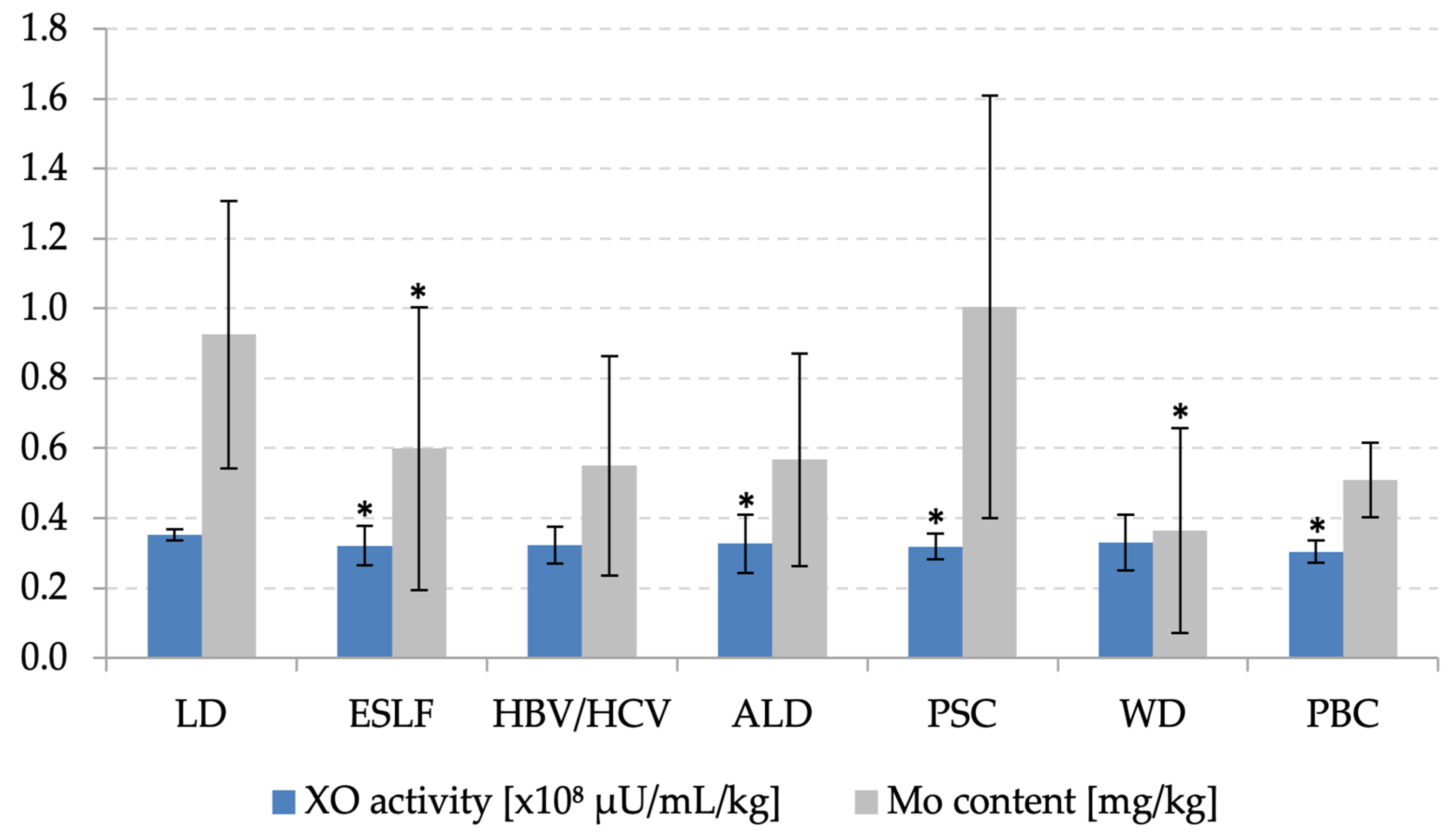
| GROUP | n | XO Activity | Mo Content | n | AO Activity | ||||||
|---|---|---|---|---|---|---|---|---|---|---|---|
| Mean | SD | p | Mean | SD | p | Mean | SD | p | |||
| [×108 µU/mL/kg] | [mg/kg] | [U/mL] | |||||||||
| LD | 10 | 0.352 | 0.0165 | – | 0.925 | 0.383 | – | 8 | 8.805 | 4.714 | – |
| HBV/HCV | 9 | 0.323 | 0.0523 | 0.438 | 0.550 | 0.313 | 0.058 | – | – | – | – |
| ALD | 6 | 0.327 | 0.0835 | 0.045 | 0.567 | 0.304 | 0.116 | 6 | 15.095 | 11.007 | 0.518 |
| PSC | 6 | 0.319 | 0.0358 | 0.020 | 1.004 | 0.604 | 0.871 | 6 | 6.614 | 2.480 | 0.651 |
| WD | 5 | 0.330 | 0.0788 | 0.098 | 0.365 | 0.293 | 0.011 | 5 | 14.126 | 8.450 | 0.478 |
| PBC | 4 | 0.304 | 0.0319 | 0.028 | 0.510 | 0.107 | 0.058 | – | – | – | – |
| ESLF (study) | 30 | 0.321 | 0.0566 | 0.012 | 0.599 | 0.405 | 0.035 | 17 | 11.817 | 8.572 | 0.522 |
Disclaimer/Publisher’s Note: The statements, opinions and data contained in all publications are solely those of the individual author(s) and contributor(s) and not of MDPI and/or the editor(s). MDPI and/or the editor(s) disclaim responsibility for any injury to people or property resulting from any ideas, methods, instructions or products referred to in the content. |
© 2026 by the authors. Licensee MDPI, Basel, Switzerland. This article is an open access article distributed under the terms and conditions of the Creative Commons Attribution (CC BY) license.
Share and Cite
Adamus, J.P.; Wyczałkowska-Tomasik, A.; Ruszczyńska, A.; Bulska, E.; Ząbek, Z.; Pastwa, K.; Sołdacki, D.; Pączek, L. Homeostasis of Molybdenum, Xanthine Oxidase and Aldehyde Oxidase Activity Levels in the Livers of Patients with End-Stage Liver Failure and Healthy Controls. Int. J. Mol. Sci. 2026, 27, 4998. https://doi.org/10.3390/ijms27114998
Adamus JP, Wyczałkowska-Tomasik A, Ruszczyńska A, Bulska E, Ząbek Z, Pastwa K, Sołdacki D, Pączek L. Homeostasis of Molybdenum, Xanthine Oxidase and Aldehyde Oxidase Activity Levels in the Livers of Patients with End-Stage Liver Failure and Healthy Controls. International Journal of Molecular Sciences. 2026; 27(11):4998. https://doi.org/10.3390/ijms27114998
Chicago/Turabian StyleAdamus, Jakub Piotr, Aleksandra Wyczałkowska-Tomasik, Anna Ruszczyńska, Ewa Bulska, Zuzanna Ząbek, Karolina Pastwa, Dariusz Sołdacki, and Leszek Pączek. 2026. "Homeostasis of Molybdenum, Xanthine Oxidase and Aldehyde Oxidase Activity Levels in the Livers of Patients with End-Stage Liver Failure and Healthy Controls" International Journal of Molecular Sciences 27, no. 11: 4998. https://doi.org/10.3390/ijms27114998
APA StyleAdamus, J. P., Wyczałkowska-Tomasik, A., Ruszczyńska, A., Bulska, E., Ząbek, Z., Pastwa, K., Sołdacki, D., & Pączek, L. (2026). Homeostasis of Molybdenum, Xanthine Oxidase and Aldehyde Oxidase Activity Levels in the Livers of Patients with End-Stage Liver Failure and Healthy Controls. International Journal of Molecular Sciences, 27(11), 4998. https://doi.org/10.3390/ijms27114998