ORAC: The Method of Choice for Determining Antioxidant Capacity of Food Products?



Abstract
1. Introduction
2. Principle of the ORAC Assay
3. Mechanism of the Assay
4. ORAC for Lipophilic Antioxidants (L-ORAC)
5. Technical Considerations
6. Some Miscellaneous Results
7. Importance, Use, and Abuse of ORAC Values of Food Products
8. Hydroxyl Radical Absorbance Capacity (HORAC), Peroxynitrite Absorbance Capacity (NORAC), Superoxide Anion Absorbance Capacity (SORAC), and Singlet Oxygen Absorbance Capacity (SOAC)
9. Conclusions
Funding
Institutional Review Board Statement
Informed Consent Statement
Data Availability Statement
Conflicts of Interest
Abbreviations
| AAPH | 2,2′-azobis(2-methylpropionamidine) dihydrochloride |
| AIPH | 2,2′-azobis[2-(2-imidazolin-2-yl)propane] |
| AMVN | 2,2′-azobis (2,4-dimethylvaleronitrile) |
| AUC | area under the curve |
| BDE | bond dissociation energy |
| BODIPY 581/591 C11 | 4,4-difluoro-5-(4-phenyl-1,3-butadienyl)-4-bora-3a,4a-diaza-s-indacene-3-undecanoic acid |
| 6-CFL | 6-carboxyfluorescein |
| DHE | dihydroethidium |
| DHR123 | dihydrorhodamine 123 |
| DCDHFL | 2′,7′-dichlorodihydrofluorescein |
| DOPC | dioleoylphosphatidylcholine |
| DTPA | diethylenetriaminepentaacetic acid |
| kd | decomposition rate constant |
| FL | fluorescein |
| HORAC | Hydroxyl Radical Absorbance Capacity |
| L-ORAC | Lipophilic ORAC |
| Meo-AMNV | 2,2′-azobis(4-methoxy-2,4-dimethylvaleronitrile) |
| NORAC | Peroxynitrite Absorbance Capacity |
| ORAC | Oxygen Radical Absorption Capacity |
| ORAC-BODIPY | ORAC employing 581/591 C11 as the probe |
| ORAC-DCDHFL | ORAC employing DCDHFL as the probe |
| ORAC-ERR | ORAC based on the EPR technique |
| ORAC-FL | ORAC employing fluorescein as the probe |
| ORAC-PC | ORAC employing phycocyanin as the probe |
| ORAC-PE | ORAC employing phycoerythrin as the probe |
| ORAC-PGR | ORAC employing Pyrogallol Red as the probe |
| ORAC-PYR | ORAC employing pyranine as the probe |
| PC | phosphatidylcholine |
| PE | phosphatidylethanolamine |
| PGR | Pyrogallol Red |
| Ri | rate of generation of peroxyl radicals |
| RMCD | randomly methylated cyclodextrins |
| SOAC | Singlet Oxygen Absorbance Capacity |
| SORAC | Superoxide Anion Absorbance Capacity |
| TAC | Total Antioxidant Capacity |
References
- Wayner, D.D.M.; Burton, G.W.; Ingold, K.U.; Locke, S. Quantitative measurement of the total, peroxyl radical-trapping antioxidant capability of human blood plasma by controlled peroxidation: The important contribution made by plasma proteins. FEBS Lett. 1985, 187, 33–37. [Google Scholar] [CrossRef] [PubMed]
- Bartosz, G. Total antioxidant capacity. Adv. Clin. Chem. 2003, 37, 219–292. [Google Scholar] [CrossRef]
- Fraga, C.G.; Oteiza, P.I.; Galleano, M. In vitro measurements and interpretation of total antioxidant capacity. Biochim. Biophys. Acta Gen. Subj. 2014, 1840, 931–934. [Google Scholar] [CrossRef] [PubMed]
- Pellegrini, N.; Vitaglione, P.; Granato, D.; Fogliano, V. Twenty-five years of total antioxidant capacity measurement of foods and biological fluids: Merits and limitations. J. Sci. Food Agric. 2020, 100, 5064–5078. [Google Scholar] [CrossRef]
- Silvestrini, A.; Meucci, E.; Ricerca, B.M.; Mancini, A. Total antioxidant capacity: Biochemical aspects and clinical significance. Int. J. Mol. Sci. 2023, 24, 10978. [Google Scholar] [CrossRef]
- Gupta, S.; Finelli, R.; Agarwal, A.; Henkel, R. Total antioxidant capacity—Relevance, methods and clinical implications. Andrologia 2021, 53, e13624. [Google Scholar] [CrossRef]
- Munteanu, I.G.; Apetrei, C. Analytical methods used in determining antioxidant activity: A review. Int. J. Mol. Sci. 2021, 22, 3380. [Google Scholar] [CrossRef]
- Girish, Y.R.; Sharathkumar, K.S.; Prashantha, K.; Rangappa, S.; Sudhanva, M.S. Significance of antioxidants and methods to evaluate their potency. Mater. Chem. Horiz. 2023, 2, 93–112. [Google Scholar] [CrossRef]
- De Oliveira, A.; de Oliveira, G.; Teixeira, V.M.C.; da Silva-Buzanello, R.A.; Bona, E. Conventional methods and new trends for antioxidant analyses. Talanta Open 2026, 13, 100636. [Google Scholar] [CrossRef]
- Özyürek, M.; Güçlü, K.; Tütem, E.; Başkan, K.S.; Erçağ, E.; Çelik, S.E.; Baki, S.; Yildiz, L.; Karaman, S.; Apak, R. A comprehensive review of CUPRAC methodology. Anal. Meth. 2011, 3, 2439–2453. [Google Scholar] [CrossRef]
- Benzie, I.F.; Strain, J.J. The ferric reducing ability of plasma (FRAP) as a measure of “antioxidant power”: The FRAP assay. Anal. Biochem. 1996, 239, 70–76. [Google Scholar] [CrossRef]
- Glazer, A.N. Fluorescence-based assay for reactive oxygen species: A protective role for creatinine. FASEB J. 1988, 2, 2487–2491. [Google Scholar] [CrossRef] [PubMed]
- Glazer, A.N. Phycoerythrin fluorescence-based assay for reactive oxygen species. Methods Enzymol. 1990, 186, 161–168. [Google Scholar] [CrossRef]
- Ghiselli, A.; Serafini, M.; Maiani, G.; Azzini, E.; Ferro-Luzzi, A. A fluorescence-based method for measuring total plasma antioxidant capability. Free Radic. Biol. Med. 1995, 18, 29–36. [Google Scholar] [CrossRef]
- Cao, G.; Alessio, H.M.; Cutler, R.G. Oxygen-radical absorbance capacity assay for antioxidants. Free Radic. Biol. Med. 1993, 14, 303–311. [Google Scholar] [CrossRef]
- Cao, G.; Prior, R.L. The measurement of oxygen radical absorbance capacity in biological samples. Methods Enzymol. 1999, 299, 50–62. [Google Scholar] [CrossRef]
- Huang, D.; Ou, B.; Hampsch-Woodill, M.; Flanagan, J.A.; Deemer, E.K. Development and validation of oxygen radical absorbance capacity assay for lipophilic antioxidants using randomly methylated β-cyclodextrin as the solubility enhancer. J. Agric. Food Chem. 2002, 50, 1815–1821. [Google Scholar] [CrossRef]
- Huang, D.; Ou, B.; Hampsch-Woodill, M.; Flanagan, J.; Prior, R.L. High throughput assay of oxygen radical absorbance capacity (ORAC) using a multichannel liquid handling system coupled with a microplate fluorescence reader in 96-well format. J. Agric. Food Chem. 2002, 50, 4437–4444. [Google Scholar] [CrossRef] [PubMed]
- Ou, B.; Hampsch-Woodill, M.; Prior, R.L. Development and validation of an improved oxygen radical absorbance capacity assay using fluorescein as the fluorescent probe. J. Agric. Food Chem. 2001, 49, 4619–4626. [Google Scholar] [CrossRef]
- Ou, B.; Hampsch-Woodill, M.; Flanagan, J.; Deemer, E.K.; Prior, R.L.; Huang, D. Novel fluorometric assay for hydroxyl radical prevention capacity using fluorescein as the probe. J. Agric. Food Chem. 2002, 50, 2772–2777. [Google Scholar] [CrossRef] [PubMed]
- Prior, R.L.; Hoang, H.; Gu, L.; Wu, X.; Bacchiocca, M.; Howard, L.; Hampsch-Woodill, M.; Huang, D.; Ou, B.; Jacob, R. Assays for hydrophilic and lipophilic antioxidant capacity (oxygen radical absorbance capacity (ORAC(FL))) of plasma and other biological and food samples. J. Agric. Food Chem. 2003, 51, 3273–3279. [Google Scholar] [CrossRef]
- Cao, G.; Verdon, C.P.; Wu, A.H.; Wang, H.; Prior, R.L. Automated assay of oxygen radical absorbance capacity with the COBAS FARA II. Clin. Chem. 1995, 41, 1738–1744. [Google Scholar] [CrossRef]
- Wu, X.; Gu, L.; Holden, J.; Haytowitz, D.B.; Gebhardt, S.E.; Beecher, G.; Prior, R.L. Development of a database for total antioxidant capacity in foods: A preliminary study. J. Food Compos. Anal. 2004, 17, 407–422. [Google Scholar] [CrossRef]
- Wu, X.; Beecher, G.R.; Holden, J.M.; Haytowitz, D.B.; Gebhardt, S.E.; Prior, R.L. Lipophilic and hydrophilic antioxidant capacities of common foods in the United States. J. Agric. Food Chem. 2004, 52, 4026–4037. [Google Scholar] [CrossRef] [PubMed]
- Wojtanowski, K.K.; Sawicki, R. Temperature-dependent kinetics of AAPH decomposition and peroxyl radical generation in aqueous media for oxidative stress studies. Thermochim. Acta 2025, 751, 180079. [Google Scholar] [CrossRef]
- Werber, J.; Wang, Y.J.; Milligan, M.; Li, X.; Ji, J.A. Analysis of 2, 2′-azobis (2-amidinopropane) dihydrochloride degradation and hydrolysis in aqueous solutions. J. Pharm. Sci. 2011, 100, 3307–3315. [Google Scholar] [CrossRef] [PubMed]
- Niki, E. Free-radical initiators as source of water-soluble or lipid-soluble peroxyl radicals. Methods Enzymol. 1990, 186, 100–108. [Google Scholar] [CrossRef]
- López-Alarcón, C.; Fuentes-Lemus, E.; Figueroa, J.D.; Dorta, E.; Schöneich, C.; Davies, M.J. Azocompounds as generators of defined radical species: Contributions and challenges for free radical research. Free Radic. Biol. Med. 2020, 160, 78–91. [Google Scholar] [CrossRef] [PubMed]
- Asma, U.; Bertotti, M.L.; Zamai, S.; Arnold, M.; Amorati, R.; Scampicchio, M. A kinetic approach to oxygen radical absorbance capacity (ORAC): Restoring order to the antioxidant activity of hydroxycinnamic acids and fruit juices. Antioxidants 2024, 13, 222. [Google Scholar] [CrossRef]
- Naguib, Y.M. A fluorometric method for measurement of peroxyl radical scavenging activities of lipophilic antioxidants. Anal. Biochem. 1998, 265, 290–298. [Google Scholar] [CrossRef]
- Becker, E.M.; Nissen, L.R.; Skibsted, L.H. Antioxidant evaluation protocols: Food quality or health effects. Eur. Food Res. Technol. 2004, 219, 561–571. [Google Scholar] [CrossRef]
- Li, L.; Chen, C.Y.; Chun, H.K.; Cho, S.M.; Park, K.M.; Lee-Kim, Y.C.; Blumberg, J.B.; Russell, R.M.; Yeum, K.J. A fluorometric assay to determine antioxidant activity of both hydrophilic and lipophilic components in plant foods. J. Nutr. Biochem. 2009, 20, 219–226. [Google Scholar] [CrossRef]
- Chen, C.; Sun-Waterhouse, D.; Zhao, M.; Sun, W. Beyond antioxidant actions: Insights into the antioxidant activities of Tyr-containing dipeptides in aqueous solution systems and liposomal systems. Int. J. Food Sci. Technol. 2020, 55, 3227–3234. [Google Scholar] [CrossRef]
- Atanasiu, R.L.; Stea, D.; Mateescu, M.A.; Vergely, C.; Dalloz, F.; Briot, F.; Maupoil, V.; Nadeau, R.; Rochette, L. Direct evidence of caeruloplasmin antioxidant properties. Mol. Cell. Biochem. 1998, 189, 127–135. [Google Scholar] [CrossRef]
- Sjöback, R.; Nygren, J.; Kubista, M. Absorption and fluorescence properties of fluorescein. Spectrochim. Acta A Mol. Biomol. Spectrosc. 1995, 51, L7–L21. [Google Scholar] [CrossRef]
- Magde, D.; Wong, R.; Seybold, P.G. Fluorescence quantum yields and their relation to lifetimes of rhodamine 6G and fluorescein in nine solvents: Improved absolute standards for quantum yields. Photochem. Photobiol. 2002, 75, 327–334. [Google Scholar] [CrossRef] [PubMed]
- Prior, R.L.; Wu, X.; Schaich, K. Standardized methods for the determination of antioxidant capacity and phenolics in foods and dietary supplements. J. Agric. Food Chem. 2005, 53, 4290–4302. [Google Scholar] [CrossRef] [PubMed]
- Prior, R.L. Oxygen radical absorbance capacity (ORAC): New horizons in relating dietary antioxidants/bioactives and health benefits. J. Funct. Foods 2015, 18, 797–810. [Google Scholar] [CrossRef]
- Naguib, Y.M. A fluorometric method for measurement of oxygen radical-scavenging activity of water-soluble antioxidants. Anal. Biochem. 2000, 284, 93–98. [Google Scholar] [CrossRef]
- López-Alarcón, C.; Lissi, E. A novel and simple ORAC methodology based on the interaction of Pyrogallol Red with peroxyl radicals. Free Rad. Res. 2006, 40, 979–985. [Google Scholar] [CrossRef]
- Ogawa, Y.; Omata, Y.; Nishio, K.; Saito, Y.; Yoshida, Y.; Niki, E. Assessment of antioxidative activity of extract from fermented grain food mixture using chemical and cellular systems. Biofactors 2007, 31, 237–248. [Google Scholar] [CrossRef]
- Omata, Y.; Ogawa, Y.; Saito, Y.; Yoshida, Y.; Niki, E. Assessment of the antioxidant capacity of a fermented grain food product, Antioxidant Biofactor (AOB), by using pyranine and pyrogallol red as a combined probe. Food Chem. 2009, 114, 429–433. [Google Scholar] [CrossRef]
- Morita, M.; Naito, Y.; Yoshikawa, T.; Niki, E. Antioxidant capacity of blueberry extracts: Peroxyl radical scavenging and inhibition of plasma lipid oxidation induced by multiple oxidants. J. Berry Res. 2017, 7, 1–9. [Google Scholar] [CrossRef]
- Takatsuka, M.; Goto, S.; Moritake, K.; Shimada, Y.; Tsuchida, T. Antioxidant capacity of edaravone, quercetin, and myricetin involving probabilistic fluctuations using eosin-Y and eosin-B as fluorescent probes in the ORAC assay. J. Photochem. Photobiol. A Chem. 2025, 460, 116142. [Google Scholar] [CrossRef]
- Godoy-Navajas, J.; Aguilar Caballos, M.P.; Gomez-Hens, A. Long-wavelength fluorimetric determination of food antioxidant capacity using Nile blue as reagent. J. Agric. Food Chem. 2011, 59, 2235–2240. [Google Scholar] [CrossRef] [PubMed]
- Guclu, K.; Kıbrıslıoğlu, G.; Ozyurek, M.; Apak, R. Development of a fluorescent probe for measurement of peroxyl radical scavenging activity in biological samples. J. Agric. Food Chem. 2014, 62, 1839–1845. [Google Scholar] [CrossRef]
- Kwak, H.K.; Blumberg, J.B.; Chen, C.Y.; Milbury, P.E. Microplate-based oxygen radical absorbance capacity (ORAC) assay of hydrophilic and lipophilic compartments in plasma. Nutr. Sci. 2006, 9, 48–54. [Google Scholar]
- Kohri, S.; Fujii, H.; Oowada, S.; Endoh, N.; Sueishi, Y.; Kusakabe, M.; Shimmei, M.; Kotake, Y. An oxygen radical absorbance capacity-like assay that directly quantifies the antioxidant’s scavenging capacity against AAPH-derived free radicals. Anal. Biochem. 2009, 386, 167–171. [Google Scholar] [CrossRef] [PubMed]
- Sueishi, Y.; Ishikawa, M.; Yoshioka, D.; Endoh, N.; Oowada, S.; Shimmei, M.; Fujii, H.; Kotake, Y. Oxygen radical absorbance capacity (ORAC) of cyclodextrin-solubilized flavonoids, resveratrol and astaxanthin as measured with the ORAC-EPR method. J. Clin. Biochem. Nutr. 2012, 50, 127–132. [Google Scholar] [CrossRef]
- Niki, E. Assessment of antioxidant capacity in vitro and in vivo. Free Radic. Biol. Med. 2010, 49, 503–515. [Google Scholar] [CrossRef]
- Schaich, K.M.; Tian, X.; Xie, J. Reprint of “Hurdles and pitfalls in measuring antioxidant efficacy: A critical evaluation of ABTS, DPPH, and ORAC assays”. J. Funct. Foods 2015, 18, 782–796. [Google Scholar] [CrossRef]
- Apak, R.; Ozyurek, M.; Guclu, K.; Çapanoğlu, E. Antioxidant activity/capacity measurement. 1. Classification, physicochemical principles, mechanisms, and electron transfer (ET)-based assays. J. Agric. Food Chem. 2016, 64, 997–1027. [Google Scholar] [CrossRef] [PubMed]
- Carvalho, J.R.B.; Meireles, A.N.; Marques, S.S.; Gregório, B.J.R.; Ramos, I.I.; Silva, E.M.P.; Barreiros, L.; Segundo, M.A. Exploiting kinetic features of ORAC assay for evaluation of radical scavenging capacity. Antioxidants 2023, 12, 505. [Google Scholar] [CrossRef] [PubMed]
- Huang, D.; Ou, B.; Prior, R.L. The chemistry behind antioxidant capacity assays. J. Agric. Food Chem. 2005, 53, 1841–1856. [Google Scholar] [CrossRef]
- Dorta, E.; Fuentes-Lemus, E.; Aspée, A.; Atala, E.; Speisky, H.; Bridi, R.; Lissi, E.; López-Alarcón, C. The ORAC (oxygen radical absorbance capacity) index does not reflect the capacity of antioxidants to trap peroxyl radicals. RSC Adv. 2015, 5, 39899–39902. [Google Scholar] [CrossRef]
- Buettner, G.R. The pecking order of free radicals and antioxidants: Lipid peroxidation, α-tocopherol, and ascorbate. Arch. Biochem. Biophys. 1993, 300, 535–543. [Google Scholar] [CrossRef]
- Furdak, P.; Kut, K.; Bartosz, G.; Sadowska-Bartosz, I. Comparison of various assays of antioxidant activity/capacity: Limited significance of redox potentials of oxidants/indicators. Int. J. Mol. Sci. 2025, 26, 7069. [Google Scholar] [CrossRef]
- Amorati, R.; Baschieri, A.; Morroni, G.; Gambino, R.; Valgimigli, L. Peroxyl radical reactions in water solution: A gym for proton-coupled electron-transfer theories. Chem. Eur. J. 2016, 22, 7924–7934. [Google Scholar] [CrossRef]
- Bisby, R.H.; Brooke, R.; Navaratnam, S. Effect of antioxidant oxidation potential in the oxygen radical absorption capacity (ORAC) assay. Food Chem. 2008, 108, 1002–1007. [Google Scholar] [CrossRef]
- Apak, R. Current issues in antioxidant measurement. J. Agric. Food Chem. 2019, 67, 9187–9202. [Google Scholar] [CrossRef]
- Selaković, M.; Aleksić, M.M.; Kotur-Stevuljević, J.; Rupar, J.; Ivković, B. Electrochemical characterisation and confirmation of antioxidative properties of ivermectin in biological medium. Molecules 2023, 28, 2113. [Google Scholar] [CrossRef]
- Queiroz, N.L.; Nascimento, J.A.; Nascimento, M.L.; Nascimento, V.B.; Oliveira, S.C.B. Oxidation mechanism of fluorescein at glassy carbon electrode. Electroanalysis 2017, 29, 489–496. [Google Scholar] [CrossRef]
- Teixeira, J.; Gaspar, A.; Garrido, E.M.; Garrido, J.; Borges, F. Hydroxycinnamic acid antioxidants: An electrochemical overview. BioMed Res. Int. 2013, 2013, 251754. [Google Scholar] [CrossRef]
- Takashima, M.; Horie, M.; Shichiri, M.; Hagihara, Y.; Yoshida, Y.; Niki, E. Assessment of antioxidant capacity for scavenging free radicals in vitro: A rational basis and practical application. Free Radic. Biol. Med. 2012, 52, 1242–1252. [Google Scholar] [CrossRef] [PubMed]
- Noguchi, N.; Yamashita, H.; Gotoh, N.; Yamamoto, Y.; Numano, R.; Niki, E. 2,2′-Azobis (4-methoxy-2,4-dimethylvaleronitrile), a new lipid-soluble azo initiator: Application to oxidations of lipids and low-density lipoprotein in solution and in aqueous dispersions. Free Radic. Biol. Med. 1998, 24, 259–268. [Google Scholar] [CrossRef] [PubMed]
- Sitarz, O.; Bartosz, G.; Sadowska-Bartosz, I. Interaction of red cabbage extract with exogenous antioxidants in ORAC Assay. Int. J. Mol. Sci. 2026, 27, 1859. [Google Scholar] [CrossRef]
- Pino, E.; Campos, A.M.; Lissi, E. 8-Hydroxy-1,3,6-pyrene trisulfonic acid (pyranine) bleaching by 2,2′-azobis(2-amidinopropane) derived peroxyl radicals. Int. J. Chem. Kinet. 2003, 35, 525–531. [Google Scholar] [CrossRef]
- Campos, A.; Sotomayor, C.P.; Pino, E.; Lissi, E. A pyranine based procedure for evaluation of the total antioxidant potential (TRAP) of polyphenols: A comparison with closely related methodologies. Biol. Res. 2004, 37, 287–292. [Google Scholar] [CrossRef]
- Forero-Girón, A.C.; Aliaga, M.E.; López-Alarcón, C. Pyranine as probe to assess antioxidant activity of free and peptide tryptophan and tyrosine residues towards peroxyl radicals. Appl. Sci. 2025, 15, 4241. [Google Scholar] [CrossRef]
- López-Alarcón, C.; Lissi, E. Interaction of pyrogallol red with peroxyl radicals. A basis for a simple methodology for the evaluation of antioxidant capabilities. Free Radic. Res. 2005, 39, 729–736. [Google Scholar] [CrossRef] [PubMed]
- Torres, P.; Galleguillos, P.; Lissi, E.; López-Alarcón, C. Antioxidant capacity of human blood plasma and human urine: Simultaneous evaluation of the ORAC index and ascorbic acid concentration employing pyrogallol red as probe. Bioorg. Med. Chem. 2008, 16, 9171–9175. [Google Scholar] [CrossRef] [PubMed]
- Alarcón, E.; Campos, A.M.; Edwards, A.M.; Lissi, E.; López-Alarcón, C. Antioxidant capacity of herbal infusions and tea extracts: A comparison of ORAC-fluorescein and ORAC-pyrogallol red methodologies. Food Chem. 2008, 107, 1114–1119. [Google Scholar] [CrossRef]
- Atala, E.; Vásquez, L.; Speisky, H.; Lissi, E.; López-Alarcón, C. Ascorbic acid contribution to ORAC values in berry extracts: An evaluation by the ORAC-pyrogallol red methodology. Food Chem. 2009, 113, 331–335. [Google Scholar] [CrossRef]
- Platzer, M.; Kiese, S.; Tybussek, T.; Herfellner, T.; Schneider, F.; Schweiggert-Weisz, U.; Eisner, P. Radical scavenging mechanisms of phenolic compounds: A quantitative structure-property relationship (QSPR) study. Front. Nutr. 2022, 9, 882458. [Google Scholar] [CrossRef]
- Sakurai, S.; Kawakami, Y.; Kuroki, M.; Gotoh, H. Structure–antioxidant activity (oxygen radical absorbance capacity) relationships of phenolic compounds. Struct. Chem. 2022, 33, 1055–1062. [Google Scholar] [CrossRef]
- Kim, H.; Choi, J.; Jung, S. Inclusion complexes of modified cyclodextrins with some flavonols. J. Incl. Phenom. Macrocycl. Chem. 2009, 64, 43–47. [Google Scholar] [CrossRef]
- Lucas-Abellán, C.; Mercader-Ros, M.T.; Zafrilla, M.P.; Fortea, M.I.; Gabaldón, J.A.; Núñez-Delicado, E. ORAC-fluorescein assay to determine the oxygen radical absorbance capacity of resveratrol complexed in cyclodextrins. J. Agric. Food Chem. 2008, 56, 2254–2259. [Google Scholar] [CrossRef] [PubMed]
- García-Padial, M.; Martínez-Ohárriz, M.C.; Navarro-Blasco, I.; Zornoza, A. The role of cyclodextrins in ORAC-fluorescence assays. Antioxidant capacity of tyrosol and caffeic acid with hydroxypropyl-β-cyclodextrin. J. Agric. Food Chem. 2013, 61, 12260–12264. [Google Scholar] [CrossRef]
- Navarro-Orcajada, S.; Conesa, I.; Matencio, A.; Rodríguez-Bonilla, P.; García-Carmona, F.; López-Nicolás, J.M. The use of cyclodextrins as solubility enhancers in the ORAC method may cause interference in the measurement of antioxidant activity. Talanta 2022, 243, 123336. [Google Scholar] [CrossRef]
- Cao, G.; Sofic, E.; Prior, R.L. Antioxidant capacity of tea and common vegetables. J. Agric. Food Chem. 1996, 44, 3426–3431. [Google Scholar] [CrossRef]
- Watanabe, J.; Oki, T.; Takebayashi, J.; Yamasaki, K.; Takano-Ishikawa, Y.; Hino, A.; Yasu, A. Method validation by interlaboratory studies of improved hydrophilic oxygen radical absorbance capacity methods for the determination of antioxidant capacities of antioxidant solutions and food extracts. Anal. Sci. 2012, 28, 159–165. [Google Scholar] [CrossRef] [PubMed]
- Beretta, G.; Granata, P.; Ferrero, M.; Orioli, M.; Facino, R.M. Standardization of antioxidant properties of honey by a combination of spectrophotometric/fluorimetric assays and chemometrics. Anal. Chim. Acta 2005, 533, 185–191. [Google Scholar] [CrossRef]
- Chaikham, P.; Kingwascharapong, P.; Pongsetkul, J.; Rawdkuen, S.; Jung, Y.H.; Zhang, W.; Yutsapremanon, S.; Sai-Ut, S. Comparative evaluation of drying techniques on quality attributes, phytochemicals, and antioxidant capacity of Coffea arabica var. typica pulp. J. Agric. Food Res. 2025, 23, 102274. [Google Scholar] [CrossRef]
- Ninfali, P.; Aluigi, G.; Bacchiocca, M.; Magnani, M. Antioxidant capacity of extra-virgin olive oils. J. Am. Oil Chem. Soc. 2001, 78, 243–247. [Google Scholar] [CrossRef]
- Howard, L.R.; Clark, J.R.; Brownmiller, C. Antioxidant capacity and phenolic content in blueberries as affected by genotype and growing season. J. Sci. Food Agric. 2003, 83, 1238–1247. [Google Scholar] [CrossRef]
- Henning, S.M.; Fajardo-Lira, C.; Lee, H.W.; Youssefian, A.A.; Go, V.L.; Heber, D. Catechin content of 18 teas and a green tea extract supplement correlates with the antioxidant capacity. Nutr. Cancer 2003, 45, 226–235. [Google Scholar] [CrossRef] [PubMed]
- Sharpe, E.; Farragher-Gnadt, A.P.; Igbanugo, M.; Huber, T.; Michelotti, J.C.; Milenkowic, A.; Ludlam, S.; Walker, M.; Hanes, D.; Bradley, R.; et al. Comparison of antioxidant activity and extraction techniques for commercially and laboratory prepared extracts from six mushroom species. J. Agric. Food Res. 2021, 4, 100130. [Google Scholar] [CrossRef]
- Tafulo, P.A.R.; Queirós, R.B.; Delerue-Matos, C.M.; Sales, M.G.F. Control and comparison of the antioxidant capacity of beers. Food Res. Int. 2010, 43, 1702–1709. [Google Scholar] [CrossRef]
- Rickards, L.; Lynn, A.; Barker, M.E.; Russell, M.; Ranchordas, M.K. Comparison of the polyphenol content and in vitro antioxidant capacity of fruit-based nutritional supplements commonly consumed by athletic and recreationally active populations. J. Int. Soc. Sports Nutr. 2022, 19, 336–348. [Google Scholar] [CrossRef]
- Wu, C.; Duckett, S.K.; Neel, J.P.S.; Fontenot, J.; Clapham, W.M. Influence of finishing systems on hydrophilic and lipophilic oxygen radical absorbance capacity (ORAC) in beef. Meat Sci. 2008, 80, 662–667. [Google Scholar] [CrossRef]
- Liao, H.; Banbury, L.K.; Leach, D.N. Antioxidant activity of 45 Chinese herbs and the relationship with their TCM characteristics. Evid. Based Complement. Altern. Med. 2008, 5, 429–434. [Google Scholar] [CrossRef] [PubMed]
- Bajomo, E.M.; Aing, M.S.; Ford, L.S.; Niemeyer, E.D. Chemotyping of commercially available basil (Ocimum basilicum L.) varieties: Cultivar and morphotype influence phenolic acid composition and antioxidant properties. NFS J. 2022, 26, 1–9. [Google Scholar] [CrossRef]
- Meyer, B.R.; White, H.M.; McCormack, J.D.; Niemeyer, E.D. Catechin composition, phenolic content, and antioxidant properties of commercially-available bagged, gunpowder, and matcha green teas. Plant Foods Hum. Nutr. 2023, 78, 662–669. [Google Scholar] [CrossRef] [PubMed]
- Rashidinejad, A.; Birch, E.J.; Sun-Waterhouse, D.; Everett, D.W. Effects of catechin on the phenolic content and antioxidant properties of low-fat cheese. Int. J. Food Sci. Technol. 2013, 48, 2448–2455. [Google Scholar] [CrossRef]
- Magalhães, L.M.; Ramos, I.I.; Reis, S.; Segundo, M.A. Antioxidant profile of commercial oenological tannins determined by multiple chemical assays. Aust. J. Grape Wine Res. 2014, 20, 72–79. [Google Scholar] [CrossRef]
- Dragović-Uzelac, V.; Levaj, B.; Bursać, D.; Pedisić, S.; Radojčić, I.; Biško, A. Total phenolics and antioxidant capacity assays of selected fruits. Agric. Conspec. Sci. 2007, 72, 279–284. [Google Scholar]
- Zulueta, A.; Esteve, M.J.; Frígola, A. ORAC and TEAC assays comparison to measure the antioxidant capacity of food products. Food Chem. 2009, 114, 310–316. [Google Scholar] [CrossRef]
- Ninfali, P.; Mea, G.; Giorgini, S.; Rocchi, M.; Bacchiocca, M. Antioxidant capacity of vegetables, spices and dressings relevant to nutrition. Br. J. Nutr. 2005, 93, 257–266. [Google Scholar] [CrossRef]
- Bani, C.; Penas, E.; Baron, G.; Martínez-Villaluenga, C.; Mercogliano, F.; Aldini, G.; Piazza, S.; Di Lorenzo, C.; Restani, P. Characterization of the phenolic profile and in vitro antioxidant potential of different varieties of common buckwheat (Fagopyrum esculentum Moench) and tartary buckwheat (Fagopyrum tataricum (L.) Gaertn.). LWT Food Sci. Technol. 2025, 215, 117261. [Google Scholar] [CrossRef]
- Andre, C.M.; Oufir, M.; Hoffmann, L.; Hausman, J.F.; Rogez, H.; Larondelle, Y.; Evers, D. Influence of environment and genotype on polyphenol compounds and in vitro antioxidant capacity of native Andean potatoes (Solanum tuberosum L.). J. Food Compos. Anal. 2009, 22, 517–524. [Google Scholar] [CrossRef]
- Chirinos, R.; Pedreschi, R.; Rogez, H.; Larondelle, Y.; Campos, D. Phenolic compound contents and antioxidant activity in plants with nutritional and/or medicinal properties from the Peruvian Andean region. Ind. Crops Prod. 2013, 47, 145–152. [Google Scholar] [CrossRef]
- Silva, E.M.; Souza, J.N.S.; Rogez, H.; Rees, J.F.; Larondelle, Y. Antioxidant activities and polyphenolic contents of fifteen selected plant species from the Amazonian region. Food Chem. 2007, 101, 1012–1018. [Google Scholar] [CrossRef]
- Fioroni, N.; Mouquet-Rivier, C.; Meudec, E.; Cheynier, V.; Boudard, F.; Hemery, Y.; Laurent-Babot, C. Antioxidant capacity of polar and non-polar extracts of four African green leafy vegetables and correlation with polyphenol and carotenoid contents. Antioxidants 2022, 11, 1726. [Google Scholar] [CrossRef]
- Liang, N.; Kitts, D.D.; Wang, X.; Hu, Z.; Sabier, M. Phenolic acid composition of coffee cascara in connection with antioxidant capacity: A geographic assessment. Antioxidants 2025, 14, 502. [Google Scholar] [CrossRef]
- Gillespie, K.M.; Chae, J.M.; Ainsworth, E.A. Rapid measurement of total antioxidant capacity in plants. Nat. Protoc. 2007, 2, 867–870. [Google Scholar] [CrossRef]
- Tai, A.; Sawano, T.; Yazama, F.; Ito, H. Evaluation of antioxidant activity of vanillin by using multiple antioxidant assays. Biochim. Biophys. Acta Gen. Subj. 2011, 1810, 170–177. [Google Scholar] [CrossRef] [PubMed]
- Xiao, L.; Liu, J.; Hua, M.Z.; Lu, X. Rapid determination of total phenolic content and antioxidant capacity of maple syrup using Raman spectroscopy and deep learning. Food Chem. 2025, 63, 141289. [Google Scholar] [CrossRef]
- Lizcano, L.J.; Bakkali, F.; Ruiz-Larrea, M.B.; Ruiz-Sanz, J.I. Antioxidant activity and polyphenol content of aqueous extracts from Colombian Amazonian plants with medicinal use. Food Chem. 2010, 119, 1566–1570. [Google Scholar] [CrossRef]
- Szydłowska-Czerniak, A.; Karlovits, G.; Dianoczki, C.; Recseg, K.; Szłyk, E. Comparison of two analytical methods for assessing antioxidant capacity of rapeseed and olive oils. J. Am. Oil Chem. Soc. 2008, 85, 141–149. [Google Scholar] [CrossRef]
- Mikami, I.; Yamaguchi, M.; Shinmoto, H.; Tsushida, T. Development and validation of a microplate-based β-carotene bleaching assay and comparison of antioxidant activity (AOA) in several crops measured by β-carotene bleaching, DPPH and ORAC assays. Food Sci. Technol. Res. 2009, 15, 171–178. [Google Scholar] [CrossRef]
- Grajeda-Iglesias, C.; Salas, E.; Barouh, N.; Baréa, B.; Panya, A.; Figueroa-Espinoza, M.C. Antioxidant activity of protocatechuates evaluated by DPPH, ORAC, and CAT methods. Food Chem. 2016, 194, 749–757. [Google Scholar] [CrossRef]
- Speisky, H.; López-Alarcón, C.; Gómez, M.; Fuentes, J.; Sandoval-Acuña, C. First web-based database on total phenolics and oxygen radical absorbance capacity (ORAC) of fruits produced and consumed within the south Andes region of South America. J. Agric. Food Chem. 2012, 60, 8851–8859. [Google Scholar] [CrossRef] [PubMed]
- Navarro, M.; Arnaez, E.; Moreira, I.; Quesada, S.; Azofeifa, G.; Wilhelm, K.; Vargas, F.; Chen, P. Polyphenolic characterization, antioxidant, and cytotoxic activities of Mangifera indica cultivars from Costa Rica. Foods 2019, 8, 384. [Google Scholar] [CrossRef]
- Garrett, A.R.; Murray, B.K.; Robison, R.A.; O’Neill, K.L. Measuring antioxidant capacity using the ORAC and TOSC assays. In Advanced Protocols in Oxidative Stress; Humana Press: Totowa, NJ, USA, 2009; Volume 2, pp. 251–262. [Google Scholar]
- Bacchiocca, M.; Biagiotti, E.; Ninfali, P. Nutritional and technological reasons for evaluating the antioxidant capacity of vegetable products. Ital. J. Food Sci. 2006, 18, 209–217. [Google Scholar]
- Nkhili, E.; Brat, P. Reexamination of the ORAC assay: Effect of metal ions. Anal. Bioanal. Chem. 2011, 400, 1451–1458. [Google Scholar] [CrossRef]
- Martínez, J.; Nieto, G.; Ros, G. Total antioxidant capacity of meat and meat products consumed in a reference ‘Spanish standard diet’. Int. J. Food Sci. Technol. 2014, 49, 2610–2618. [Google Scholar] [CrossRef]
- Wen, L.; Zhao, Y.; Jiang, Y.; Yu, L.; Zeng, X.; Yang, J.; Tian, M.; Liu, H.; Yang, B. Identification of a flavonoid C-glycoside as potent antioxidant. Free Radic. Biol. Med. 2017, 110, 92–101. [Google Scholar] [CrossRef] [PubMed]
- Villaruz, J.A.I.; Yao, K.B.P.; Calanasan, C.A.; Matias, R.R.; Pagcatipunan, R.S.; Policarpio, J.D.; Vilela, G.C. Total phenolic and flavonoid content and in vitro antioxidant activity of selected herbal products using Oxygen Radical Absorbance Capacity, Multi-radical (ORAC MR5) assays. Philipp. J. Sci. 2023, 152, 401–412. [Google Scholar] [CrossRef]
- Taver, I.B.; Spricigo, P.C.; Neto, H.B.; de Alencar, S.M.; Massarioli, A.P.; Jacomino, A.P. Bioactive compounds and in vitro antioxidant capacity of cambuci and uvaia: An extensive description of little-known fruits from the Myrtaceae family with high consumption potential. Foods 2022, 11, 2612. [Google Scholar] [CrossRef]
- Liu, W.Y.; Wang, X.; Ren, J.; Zheng, C.D.; Wu, H.S.; Meng, F.T.; Ling, K.; Qi, X.Y.; Zhou, M.; Wang, Y.; et al. Preparation, characterization, identification, and antioxidant properties of fermented acaí (Euterpe oleracea). Food Sci. Nutr. 2023, 11, 2925–2941. [Google Scholar] [CrossRef]
- Chirinos, R.; Campos, D.; Costa, N.; Arbizu, C.; Pedreschi, R.; Larondelle, Y. Phenolic profiles of Andean mashua (Tropaeolum tuberosum Ruíz & Pavón) tubers: Identification by HPLC-DAD and evaluation of their antioxidant activity. Food Chem. 2008, 106, 1285–1298. [Google Scholar] [CrossRef]
- Tavadyan, L.A.; Minasyan, S.H. Synergistic and antagonistic co-antioxidant effects of flavonoids with trolox or ascorbic acid in a binary mixture. J. Chem. Sci. 2019, 131, 40. [Google Scholar] [CrossRef]
- Migues, I.; Baenas, N.; Gironés-Vilaplana, A.; Cesio, M.V.; Heinzen, H.; Moreno, D.A. Phenolic profiling and antioxidant capacity of Eugenia uniflora L. (Pitanga) samples collected in different uruguayan locations. Foods 2018, 7, 67. [Google Scholar] [CrossRef]
- Tristán, A.I.; Abreu, A.C.; Aguilera-Sáez, L.M.; Peña, A.; Conesa-Bueno, A.; Fernández, I. Evaluation of ORAC, IR and NMR metabolomics for predicting ripening stage and variety in melon (Cucumis melo L.). Food Chem. 2022, 372, 131263. [Google Scholar] [CrossRef]
- Nayak, B.; Liu, R.H.; Berrios, J.D.J.; Tang, J.; Derito, C. Bioactivity of antioxidants in extruded products prepared from purple potato and dry pea flours. J. Agric. Food Chem. 2011, 59, 8233–8243. [Google Scholar] [CrossRef]
- Arion, C.M.; Tabart, J.; Kevers, C.; Niculaua, M.; Filimon, R.; Beceanu, D.; Dommes, J. Antioxidant potential of different plum cultivars during storage. Food Chem. 2014, 146, 485–491. [Google Scholar] [CrossRef]
- Tabart, J.; Kevers, C.; Pincemail, J.; Defraigne, J.O.; Dommes, J. Comparative antioxidant capacities of phenolic compounds measured by various tests. Food Chem. 2009, 113, 1226–1233. [Google Scholar] [CrossRef]
- Kettawan, A.; Chanlekha, K.; Kongkachuichai, R.; Charoensiri, R. Effects of cooking on antioxidant activities and polyphenol content of edible mushrooms commonly consumed in Thailand. Pak. J. Nutr. 2011, 10, 1094–1103. [Google Scholar] [CrossRef]
- Bentayeb, K.; Vera, P.; Rubio, C.; Nerín, C. The additive properties of Oxygen Radical Absorbance Capacity (ORAC) assay: The case of essential oils. Food Chem. 2014, 148, 204–208. [Google Scholar] [CrossRef] [PubMed]
- Cuenca-Ortolá, M.; Alegría, A.; Cilla, A. Valencian paella: Synergistic antioxidant properties of a complete dish versus its isolated ingredients. Biol. Life Sci. Forum 2023, 26, 55. [Google Scholar] [CrossRef]
- Smolskaitė, L.; Venskutonis, P.R.; Talou, T. Comprehensive evaluation of antioxidant and antimicrobial properties of different mushroom species. LWT Food Sci. Technol. 2015, 60, 462–471. [Google Scholar] [CrossRef]
- Babazadeh, A.; Taghvimi, A.; Hamishehkar, H.; Tabibiazar, M. Development of new ultrasonic–solvent assisted method for determination of trans-resveratrol from red grapes: Optimization, characterization, and antioxidant activity (ORAC assay). Food Biosci. 2017, 20, 36–42. [Google Scholar] [CrossRef]
- Ortiz, R.; Antilén, M.; Speisky, H.; Aliaga, M.E.; López-Alarcón, C. Analytical parameters of the microplate-based ORAC-pyrogallol red assay. J. AOAC Int. 2011, 94, 1562–1566. [Google Scholar] [CrossRef]
- Watanabe, J.; Oki, T.; Takebayashi, J.; Yamasaki, K.; Takano-Ishikawa, Y.; Hino, A.; Yasui, A. Improvement of the lipophilic-oxygen radical absorbance capacity (L-ORAC) method and single-laboratory validation. Biosci. Biotechnol. Biochem. 2013, 77, 857–859. [Google Scholar] [CrossRef] [PubMed]
- Knez, E.; Kadac-Czapska, K.; Grembecka, M. Evaluation of spectrophotometric methods for assessing antioxidant potential in plant food samples—A critical approach. Appl. Sci. 2025, 15, 5925. [Google Scholar] [CrossRef]
- Paillat, L.; Bordier, E.; Guepet, A.; Lima, J.; Boudah, S.; Murtaugh, A. Development and validation of an on-line HPLC-DAD-antioxidant assay (ORAC)/ESI-HRMS system to identify antioxidant compounds in complex mixtures. J. Chromatogr. Sci. 2023, 61, 530–538. [Google Scholar] [CrossRef]
- Jiménez-Morales, W.A.; del Pilar Cañizares-Macias, M.; Pedraza-Chaverri, J. Fast ORAC-SIA method for antioxidant capacity determination in food samples. Food Chem. 2022, 384, 132524. [Google Scholar] [CrossRef]
- Kevers, C.; Sipel, A.; Pincemail, J.; Dommes, J. Antioxidant capacity of hydrophilic food matrices: Optimization and validation of ORAC Assay. Food Anal. Methods 2014, 7, 409–416. [Google Scholar] [CrossRef]
- Mellado-Ortega, E.; Zabalgogeazcoa, I.; de Aldana, B.R.V.; Arellano, J.B. Solutions to decrease a systematic error related to AAPH addition in the fluorescence-based ORAC assay. Anal. Biochem. 207(519), 27–29. [CrossRef]
- Grzesik, M.; Bartosz, G.; Stefaniuk, I.; Pichla, M.; Namieśnik, J.; Sadowska-Bartosz, I. Dietary antioxidants as a source of hydrogen peroxide. Food Chem. 2019, 278, 692–699. [Google Scholar] [CrossRef] [PubMed]
- Sadowska-Bartosz, I.; Bartosz, G. Hydrogen peroxide: A ubiquitous component of beverages and food. Int. J. Mol. Sci. 2025, 26, 3397. [Google Scholar] [CrossRef]
- Pedrielli, P.; Pedulli, G.F.; Skibsted, L.H. Antioxidant mechanism of flavonoids. Solvent effect on rate constant for chain-breaking reaction of quercetin and epicatechin in autoxidation of methyl linoleate. J. Agric. Food Chem. 2001, 49, 3034–3040. [Google Scholar] [CrossRef]
- Su, L.; Yin, J.J.; Charles, D.; Zhou, K.; Moore, J.; Yu, L.L. Total phenolic contents, chelating capacities, and radical-scavenging properties of black peppercorn, nutmeg, rosehip, cinnamon and oregano leaf. Food Chem. 2007, 100, 990–997. [Google Scholar] [CrossRef]
- Su, D.; Zhang, R.; Hou, F.; Zhang, M.; Guo, J.; Huang, F.; Deng, Y.; Wei, Z. Comparison of the free and bound phenolic profiles and cellular antioxidant activities of litchi pulp extracts from different solvents. BMC Complement. Altern. Med. 2014, 14, 9. [Google Scholar] [CrossRef] [PubMed]
- Papaefthimiou, M.; Kontou, P.I.; Bagos, P.G.; Braliou, G.G. Integration of antioxidant activity assays data of Stevia leaf extracts: A systematic review and meta-analysis. Antioxidants 2024, 13, 692. [Google Scholar] [CrossRef]
- Gökmen, V.; Serpen, A.; Fogliano, V. Direct measurement of the total antioxidant capacity of foods: The ‘QUENCHER’ approach. Trends Food Sci. Technol. 2009, 20, 278–288. [Google Scholar] [CrossRef]
- Çelik, E.E.; Cömert, E.D.; Gökmen, V. The power of the QUENCHER method in measuring total antioxidant capacity of foods: Importance of interactions between different forms of antioxidants. Talanta 2024, 269, 125474. [Google Scholar] [CrossRef]
- Zhang, D.; Liu, Y.; Chu, L.; Wei, Y.; Wang, D.; Cai, S.; Zhou, F.; Ji, B. Relationship between the structures of flavonoids and oxygen radical absorbance capacity values: A quantum chemical analysis. J. Phys. Chem. A 2013, 117, 1784–1794. [Google Scholar] [CrossRef]
- Nenadis, N.; Lazaridou, O.; Tsimidou, M.Z. Use of reference compounds in antioxidant activity assessment. J. Agric. Food Chem. 2007, 55, 5452–5460. [Google Scholar] [CrossRef] [PubMed]
- Kariminezhad, Z.; Rahimi, M.; Fernandes, J.; Fahmi, H.; Benderdour, M. Protective effect of resolvin D1, D2, and their methyl esters on oxidative stress and hyaluronidase—Induced hyaluronic acid degradation. Antioxidants 2026, 15, 163. [Google Scholar] [CrossRef]
- Takatsuka, M.; Goto, S.; Kobayashi, K.; Otsuka, Y.; Shimada, Y. Leading individual features of antioxidant systematically classified by the ORAC assay and its single electron transfer and hydrogen atom transfer reactivities; analyzing ALS therapeutic drug Edaravone. BBA Adv. 2021, 1, 100030. [Google Scholar] [CrossRef]
- Romero, M.; Rojano, B.; Mella-Raipán, J.; Pessoa-Mahana, C.D.; Lissi, E.; López-Alarcón, C. Antioxidant capacity of pure compounds and complex mixtures evaluated by the ORAC-Pyrogallol red assay in the presence of Triton X-100 micelles. Molecules 2010, 5, 6152–6167. [Google Scholar] [CrossRef]
- Dávalos, A.; Gómez-Cordovés, C.; Bartolomé, B. Extending applicability of the oxygen radical absorbance capacity (ORAC-fluorescein) assay. J. Agric. Food Chem. 2004, 52, 48–54. [Google Scholar] [CrossRef]
- Perez, D.D.; Leighton, F.; Aspee, A.; Aliaga, C.; Lissi, E. A comparison of methods employed to evaluate antioxidant capabilities. Biol. Res. 2000, 33, 71–77. [Google Scholar] [CrossRef]
- Bakuradze, T.; Lang, R.; Hofmann, T.; Stiebitz, H.; Bytof, G.; Lantz, I.; Baum, M.; Eisenbrand, G.; Janzowski, C. Antioxidant effectiveness of coffee extracts and selected constituents in cell-free systems and human colon cell lines. Mol. Nutr. Food Res. 2010, 54, 1734–1743. [Google Scholar] [CrossRef]
- Bicas, J.L.; Neri-Numa, I.A.; Ruiz, A.L.T.G.; De Carvalho, J.E.; Pastore, G.M. Evaluation of the antioxidant and antiproliferative potential of bioflavors. Food Chem. Toxicol. 2011, 49, 1610–1615. [Google Scholar] [CrossRef]
- Rothe, J.; Fischer, R.; Cotterchio, C.; Gastl, M.; Becker, T. Analytical determination of antioxidant capacity of hop-derived compounds in beer using specific rapid assays (ORAC, FRAP) and ESR-spectroscopy. Eur. Food Res. Technol. 2023, 249, 81–93. [Google Scholar] [CrossRef]
- Zhao, D.; Liu, X. Purification, identification and evaluation of antioxidant peptides from pea protein hydrolysates. Molecules 2023, 28, 2952. [Google Scholar] [CrossRef]
- Lucas-Abellán, C.; Mercader-Ros, M.T.; Zafrilla, M.P.; Gabaldón, J.A.; Núñez-Delicado, E. Comparative study of different methods to measure antioxidant activity of resveratrol in the presence of cyclodextrins. Food Chem. Toxicol. 2011, 49, 1255–1260. [Google Scholar] [CrossRef]
- Figueroa, J.D.; Barroso-Torres, N.; Morales, M.; Herrera, B.; Aranda, M.; Dorta, E.; López-Alarcón, C. Antioxidant capacity of free and peptide tryptophan residues determined by the ORAC (oxygen radical absorbance capacity) assay is modulated by radical-radical reactions and oxidation products. Foods 2023, 12, 4360. [Google Scholar] [CrossRef]
- Prior, R.L.; Sintara, M.; Chang, T. Multi-radical (ORACMR5) antioxidant capacity of selected berries and effects of food processing. J. Berry Res. 2016, 6, 159–173. [Google Scholar] [CrossRef]
- Rezaire, A.; Robinson, J.C.; Bereau, D.; Verbaere, A.; Sommerer, N.; Khan, M.K.; Durand, P.; Prost, E.; Fils-Lycaon, B. Amazonian palm Oenocarpus bataua (“patawa”): Chemical and biological antioxidant activity–Phytochemical composition. Food Chem. 2014, 149, 62–70. [Google Scholar] [CrossRef]
- Haytowitz, D.B.; Bhagwat, S. USDA Database for the Oxygen Radical Absorbance Capacity (ORAC) of Selected Foods, Release 2; US Department of Agriculture: Washington, DC, USA, 2010; pp. 10–48. Available online: http://www.ars.usda.gov/nutrientdata (accessed on 2 October 2010).
- Cruz Lima, R.; Aparecida Lelis, C.; Craveiro de Andrade, J.; Conte-Junior, C.A. Investigating roasted açaí (Euterpe oleracea) seed powder as a coffee substitute: Effects of water temperature, milk addition, and in vitro digestion on phenolic content and antioxidant capacity. Foods 2025, 14, 2696. [Google Scholar] [CrossRef]
- Aniya; Nomura, Y.; Appiah, K.S.; Fuerdeng; Suzuki, Y.; Fujii, Y.; Xia, Q. Relationship between the antioxidant activity and allelopathic activities of 55 Chinese pharmaceutical plants. Plants 2022, 11, 2481. [Google Scholar] [CrossRef]
- Rocchetti, G.; Lucini, L.; Rodriguez, J.M.L.; Barba, F.J.; Giuberti, G. Gluten-free flours from cereals, pseudocereals and legumes: Phenolic fingerprints and in vitro antioxidant properties. Food Chem. 2019, 271, 157–164. [Google Scholar] [CrossRef]
- Pozzo, L.; Raffaelli, A.; Grande, T.; Frassinetti, S.; Longo, V.; Venturi, F.; Sanmartin, C.; Ferroni, G.; Flamini, G.; Toffanin, A. characterization of antioxidant and antimicrobial activity, phenolic compound profile, and VOCs of agresto from different winegrape varieties. Processes 2025, 13, 2174. [Google Scholar] [CrossRef]
- Onwasigwe, E.N.; Verghese, M.; Sunkara, R.; Shackelford, L.; Walker, L.T. In vitro analysis of the antioxidant effect of allspice. Food Nutr. Sci. 2017, 8, 778–792. [Google Scholar] [CrossRef]
- Zheng, W.; Wang, S.Y. Antioxidant activity and phenolic compounds in selected herbs. J. Agric. Food Chem. 2001, 49, 5165–5170. [Google Scholar] [CrossRef] [PubMed]
- Soare, L.C.; Ferdes, M.; Stefanov, S.; Denkova, Z.; Nicolova, R.; Denev, P.; Ungureanu, C. Antioxidant and antimicrobial properties of some plant extracts. Rev. Chim. Buchar. 2012, 63, 432–434. [Google Scholar]
- Denev, P.; Lojek, A.; Ciz, M.; Kratchanova, M. Antioxidant activity and polyphenol content of Bulgarian fruits. Bulg. J. Agric. Sci. 2013, 19, 22–27. [Google Scholar]
- Lutz, M.; Hernández, J.; Henríquez, C. Phenolic content and antioxidant capacity in fresh and dry fruits and vegetables grown in Chile. CyTA J. Food 2015, 13, 541–547. [Google Scholar]
- Mikami-Konishide, I.; Murakami, S.; Nakanishi, K.; Takahashi, Y.; Yamaguchi, M.; Shioya, T.; Watanabe, J.; Hino, A. Antioxidant capacity and polyphenol content of extracts from crops cultivated in Japan, and the effect of cultivation environment. Food Sci. Technol. Res. 2013, 19, 69–79. [Google Scholar] [CrossRef][Green Version]
- Isabelle, M.; Lee, B.L.; Lim, M.T.; Koh, W.P.; Huang, D.; Ong, C.N. Antioxidant activity and profiles of common vegetables in Singapore. Food Chem. 2010, 120, 993–1003. [Google Scholar] [CrossRef]
- Cuenca-Ortola, M.; Gandía, M.; Chaji, S.; El Mossaid, F.Z.; Ennahli, S.; Ajal, E.A.; Filice, S.; Ammar, A.; Gamero, A.; Cilla, A. Antioxidant capacity and polyphenolic profile of extractable and non-extractable fractions of traditional Mediterranean diet recipes from different regions. Antioxidants 2026, 15, 377. [Google Scholar] [CrossRef]
- Patthamakanokporn, O.; Puwastien, P.; Nitithamyong, A.; Sirichakwal, P.P. Changes of antioxidant activity and total phenolic compounds during storage of selected fruits. J. Food Compos. Anal. 2008, 21, 241–248. [Google Scholar] [CrossRef]
- Kratchanova, M.; Denev, P.; Ciz, M.; Lojek, A.; Mihailov, A. Evaluation of antioxidant activity of medicinal plants containing polyphenol compounds. Comparison of two extraction systems. Acta Biochim. Pol. 2010, 57, 229–234. [Google Scholar] [CrossRef] [PubMed]
- Xu, B.J.; Yuan, S.H.; Chang, S.K. Comparative analyses of phenolic composition, antioxidant capacity, and color of cool season legumes and other selected food legumes. J. Food Sci. 2007, 72, S167–S177. [Google Scholar] [CrossRef]
- Xu, B.J.; Chang, S.K. A comparative study on phenolic profiles and antioxidant activities of legumes as affected by extraction solvents. J. Food Sci. 2007, 72, S159–S166. [Google Scholar] [CrossRef]
- Číž, M.; Čížová, H.; Denev, P.; Kratchanova, M.; Slavov, A.; Lojek, A. Different methods for control and comparison of the antioxidant properties of vegetables. Food Control 2010, 21, 518–523. [Google Scholar] [CrossRef]
- Simon, M.; Kageruka, H.; Collin, S. Use of botanical ingredients: Nice opportunities to avoid premature oxidation of NABLABs by increasing their ORAC values strongly impacted by dealcoholization or pasteurization. Molecules 2024, 29, 2370. [Google Scholar] [CrossRef]
- Wang, C.; Fu, X.; Wang, J.; Yu, J.; Shi, Y.; Feng, X.; Liu, C.; Yang, Z.; Li, B.; Cao, W.; et al. Comprehensive characterization of Chinese beers based on chemical composition, antioxidant activity and volatile metabolomics. Sci. Rep. 2025, 15, 10204. [Google Scholar] [CrossRef]
- Kumazawa, S.; Kurihara, S.; Kubota, M.; Muto, H.; Hosoya, T. Anthocyanins and the antioxidant capacities of wild berries that grow in Shizuoka, Japan. Int. J. Fruit Sci. 2024, 24, 166–173. [Google Scholar] [CrossRef]
- Cronin, J.R. The biochemistry of alternative medicine: Comparing antioxidant values with the ORAC method. Altern. Complement. Ther. 2004, 10, 167–170. [Google Scholar] [CrossRef]
- Denev, P.; Kratchanova, M.; Ciz, M.; Lojek, A.; Vasicek, O.; Blazheva, D.; Nedelcheva, P.; Vitek, L.; Hyrsl, P. Antioxidant, antimicrobial and neutrophil-modulating activities of herb extracts. Acta Biochim. Pol. 2014, 61, 359–367. [Google Scholar] [CrossRef]
- Wada, L.; Ou, B. Antioxidant activity and phenolic content of Oregon caneberries. J. Agric. Food Chem. 2002, 50, 3495–3500. [Google Scholar] [CrossRef] [PubMed]
- Herrera-Hernández, M.G.; Guevara-Lara, F.; Reynoso-Camacho, R.; Guzmán-Maldonado, S.H. Effects of maturity stage and storage on cactus berry (Myrtillocactus geometrizans) phenolics, vitamin C, betalains and their antioxidant properties. Food Chem. 2011, 129, 1744–1750. [Google Scholar] [CrossRef]
- Rak, M.; Bartosz, G.; Sadowska-Bartosz, I. Effect of fermentation with and without the addition of carrots on the total antioxidant capacity of white and red cabbage. Processes 2025, 13, 2928. [Google Scholar] [CrossRef]
- Stintzing, F.C.; Herbach, K.M.; Mosshammer, M.R.; Carle, R.; Yi, W.; Sellappan, S.; Akoh, C.C.; Bunch, R.; Felker, P. Color, betalain pattern, and antioxidant properties of cactus pear (Opuntia spp.) clones. J. Agric. Food Chem. 2005, 53, 442–451. [Google Scholar] [CrossRef]
- López, M.D.; Baenas, N.; Retamal-Salgado, J.; Zapata, N.; Moreno, D.A. Underutilized native Biobio berries: Opportunities for foods and trade. Nat. Prod. Commun. 2018, 13, 1934578X1801301226. [Google Scholar] [CrossRef]
- Mahattanatawee, K.; Manthey, J.A.; Luzio, G.; Talcott, S.T.; Goodner, K.; Baldwin, E.A. Total antioxidant activity and fiber content of select Florida-grown tropical fruits. J. Agric. Food Chem. 2006, 54, 7355–7363. [Google Scholar] [CrossRef]
- Vitali, M.; Gandía, M.; González-Sarrías, A.; Vallejo, F.; Cilla, A.; Gamero, A. Impact of fermentation and in vitro gastrointestinal digestion on the bioaccessibility of phytochemicals and antioxidant capacity of tiger nut, carob and rice beverages. Food Chem. 2025, 495, 146562. [Google Scholar] [CrossRef] [PubMed]
- Gomez-Perez, L.S.; Poblete, J.; García, V.; Vidal, R.L. Cauchao berry (Amomyrtus luma) as a promising source of bioactive compounds: Optimized extraction, phytochemical characterization, and assessment of antioxidant and antidiabetic potential. Int. J. Mol. Sci. 2025, 26, 8391. [Google Scholar] [CrossRef]
- da Silva Marineli, R.; Moraes, É.A.; Lenquiste, S.A.; Godoy, A.T.; Eberlin, M.N.; Maróstica, M.R., Jr. Chemical characterization and antioxidant potential of Chilean chia seeds and oil (Salvia hispanica L.). LWT Food Sci. Technol. 2014, 59, 1304–1310. [Google Scholar] [CrossRef]
- Aguilera, J.M.; Moreno, M.C.; Toledo, T.; Matamala, C. Physicochemical characterization, bioactive compounds, and antioxidant activity of the wild berry Ribes magellanicum. Food Sci. Technol. Int. 2025, 32, 445–453. [Google Scholar] [CrossRef]
- Casettari, L.; Gennari, L.; Angelino, D.; Ninfali, P.; Castagnino, E. ORAC of chitosan and its derivatives. Food Hydrocoll. 2012, 28, 243–247. [Google Scholar] [CrossRef]
- Gu, L.; House, S.E.; Wu, X.; Ou, B.; Prior, R.L. Procyanidin and catechin contents and antioxidant capacity of cocoa and chocolate products. J. Agric. Food Chem. 2006, 54, 4057–4061. [Google Scholar] [CrossRef]
- Denev, P.; Číž, M.; Kratchanova, M.; Blazheva, D. Black chokeberry (Aronia melanocarpa) polyphenols reveal different antioxidant, antimicrobial and neutrophil-modulating activities. Food Chem. 2019, 284, 108–117. [Google Scholar] [CrossRef] [PubMed]
- Wu, X.; Gu, L.; Prior, R.L.; McKay, S. Characterization of anthocyanins and proanthocyanidins in some cultivars of Ribes, Aronia, and Sambucus and their antioxidant capacity. J. Agric. Food Chem. 2004, 52, 7846–7856. [Google Scholar] [CrossRef]
- Aravena-Sanhueza, F.; Pérez-Rivera, M.; Castillo-Felices, R.; Mundaca-Uribe, R.; Aranda Bustos, M.; Peña Farfal, C. Determination of antioxidant capacity (orac) of Greigia sphacelata and correlation with voltammetric methods. J. Chil. Chem. Soc. 2020, 65, 4925–4928. [Google Scholar] [CrossRef]
- Abeysekera, W.P.K.M.; Premakumara, G.A.S.; Ratnasooriya, W.D. In vitro antioxidant properties of leaf and bark extracts of ceylon cinnamon (Cinnamomum zeylanicum Blume). Trop. Agric. Res. 2013, 24, 128–138. [Google Scholar]
- Hájíček, J.; Hoca, G.; Várady, M.; Maršík, P.; Fraňková, A.; Tauchen, J. Comparative analysis of chemical composition and antioxidant activity in conventional, civet, and elephant coffees: Is there a definitive authentication marker of elephant coffee? Beverages 2025, 11, 79. [Google Scholar] [CrossRef]
- Yashin, A.; Yashin, Y.; Wang, J.Y.; Nemzer, B. Antioxidant and antiradical activity of coffee. Antioxidants 2013, 2, 230–245. [Google Scholar] [CrossRef]
- Arsa, S.; Wipatanawin, A.; Suwapanich, R.; Makkerdchoo, O.; Chatsuwan, N.; Kaewthong, P.; Pinsirodom, P.; Taprap, R.; Haruenkit, R.; Poovarodom, S.; et al. Properties of different varieties of durian. Appl. Sci. 2021, 11, 5653. [Google Scholar] [CrossRef]
- Nimalaratne, C.; Schieber, A.; Wu, J. Effects of storage and cooking on the antioxidant capacity of laying hen eggs. Food Chem. 2016, 194, 111–116. [Google Scholar] [CrossRef] [PubMed]
- Furdak, P.; Bartosz, G.; Sadowska-Bartosz, I. Effect of thermal treatment on the antiproliferative and antioxidant activities of garlic. Food Sci. Nutr. 2025, 13, e70375. [Google Scholar] [CrossRef] [PubMed]
- Chen, J.; Shu, Y.; Chen, Y.; Ge, Z.; Zhang, C.; Cao, J.; Li, X.; Wang, Y.; Sun, C. Evaluation of antioxidant capacity and gut microbiota modulatory effects of different kinds of berries. Antioxidants 2022, 11, 1020. [Google Scholar] [CrossRef]
- Milella, R.A.; De Rosso, M.; Gasparro, M.; Gigante, I.; Debiase, G.; Forleo, L.R.; Marsico, A.D.; Perniola, R.; Notarnicola, M.; Velasco, R.; et al. Correlation between antioxidant and anticancer activity and phenolic profile of new Apulian table grape genotypes (V. vinifera L.). Front. Plant Sci. 2023, 13, 1064023, Erratum in Front. Plant Sci. 2023, 14, 1187227. https://doi.org/10.3389/fpls.2023.1187227. [Google Scholar] [CrossRef] [PubMed] [PubMed Central]
- Pérez-Álvarez, E.P.; Intrigliolo, D.S.; Almajano, M.P.; Rubio-Bretón, P.; Garde-Cerdán, T. Effects of water deficit irrigation on phenolic composition and antioxidant activity of Monastrell grapes under semiarid conditions. Antioxidants 2021, 10, 1301. [Google Scholar] [CrossRef]
- Gorinstein, S.; Huang, D.; Leontowicz, H.; Leontowicz, M.; Yamamoto, K.; Soliva-Fortuny, R.; Belloso, O.M.; Martinez Ayala, A.L.; Trakhtenberg, S. Determination of naringin and hesperidin in citrus fruit by high-performance liquid chromatography. The antioxidant potential of citrus fruit. Acta Chromatogr. 2006, 17, 108–124. [Google Scholar]
- Thaipong, K.; Boonprakob, U.; Crosby, K.; Cisneros-Zevallos, L.; Byrne, D.H. Comparison of ABTS, DPPH, FRAP, and ORAC assays for estimating antioxidant activity from guava fruit extracts. J. Food Compos. Anal. 2006, 19, 669–675. [Google Scholar] [CrossRef]
- Manterola-Barroso, C.; Godoy Sanchez, K.; Scheuermann, E.; Padilla-Contreras, D.; Morina, F.; Meriño-Gergichevich, C. Antioxidant and physico-structural insights of walnut (Juglans regia) and hazelnut (Corylus avellana L.) shells: Implications for southern Chile by-product valorization. Resources 2025, 14, 82. [Google Scholar] [CrossRef]
- Gheldof, N.; Wang, X.H.; Engeseth, N.J. Identification and quantification of antioxidant components of honeys from various floral sources. J. Agric. Food Chem. 2002, 50, 5870–5877. [Google Scholar] [CrossRef]
- Aazza, S.; Lyoussi, B.; Antunes, D.; Miguel, M.G. Physicochemical characterization and antioxidant activity of commercial Portuguese honeys. J. Food Sci. 2013, 78, C1159–C1165. [Google Scholar] [CrossRef]
- Farkas, Á.; Balázs, V.L.; Kõszegi, T.; Csepregi, R.; Kerekes, E.; Horváth, G.; Szabó, P.; Gaál, K.; Kocsis, M. Antibacterial and biofilm degradation effects of Hungarian honeys linked with botanical origin, antioxidant capacity and mineral content. Front. Nutr. 2022, 9, 953470. [Google Scholar] [CrossRef] [PubMed]
- Mello, B.C.; Malarski, A.; Böhm, V. Bioactive compounds and antioxidant capacity of pulp, peel and seeds from Jeriva (Syagrus romanzoffiana). Antioxidants 2024, 13, 711. [Google Scholar] [CrossRef]
- Tangkanakul, P.; Auttaviboonkul, P.; Niyomwit, B.; Lowvitoon, N.; Charoenthamawat, P.; Trakoontivakorn, G. Antioxidant capacity, total phenolic content and nutritional composition of Asian foods after thermal processing. Int. Food Res. J. 2009, 16, 571–580. [Google Scholar]
- Da Silva Junior, J.C.; Magnani, M.; da Costa, W.K.A.; Madruga, M.S.; Olegário, L.S.; Borges, G.D.S.C.; Dantas, A.M.; dos Santos Lima, M.; de Lima, L.C.; de Lima Brito, I.; et al. Traditional and flavored kombuchas with pitanga and umbu-cajá pulps: Chemical properties, antioxidants, and bioactive compounds. Food Biosci. 2021, 44, 101380. [Google Scholar] [CrossRef]
- García-Salas, P.; Gómez-Caravaca, A.M.; Arráez-Román, D.; Segura-Carretero, A.; Guerra-Hernández, E.; García-Villanova, B.; Fernández-Gutiérrez, A. Influence of technological processes on phenolic compounds, organic acids, furanic derivatives, and antioxidant activity of whole-lemon powder. Food Chem. 2013, 141, 869–878. [Google Scholar] [CrossRef]
- Vergara-Castro, M.; Soto-Maldonado, C.; Zúñiga-Hansen, M.E.; Arancibia-Díaz, A.; Fuentes, P.; Altamirano, C. Chemical and biological antioxidant activity evaluation of extracts from berries pomaces. Appl. Food Res. 2025, 5, 100781. [Google Scholar] [CrossRef]
- Chirinos, R.; Rogez, H.; Campos, D.; Pedreschi, R.; Larondelle, Y. Optimization of extraction conditions of antioxidant phenolic compounds from mashua (Tropaeolum tuberosum Ruíz & Pavón) tubers. Sep. Purif. Technol. 2007, 55, 217–225. [Google Scholar] [CrossRef]
- Churchill, M.; Zawawi, H.; Elisia, I.; Seider, M.; Noseworthy, R.; Thompson, A.; Glenn, A.J.; Ramdath, D.; O’Connor, D.; Darling, P.; et al. The antioxidant capacity of breast milk and plasma of women with or without gestational diabetes mellitus. Antioxidants 2023, 12, 842. [Google Scholar] [CrossRef]
- Saenz, A.T.; Elisia, I.; Innis, S.M.; Friel, J.K.; Kitts, D.D. Use of ORAC to assess antioxidant capacity of human milk. J. Food Compos. Anal. 2009, 22, 694–698. [Google Scholar] [CrossRef]
- Dubost, N.J.; Ou, B.; Beelman, R.B. Quantification of polyphenols and ergothioneine in cultivated mushrooms and correlation to total antioxidant capacity. Food Chem. 2007, 105, 727–735. [Google Scholar] [CrossRef]
- Adebayo, E.A.; Martínez-Carrera, D.; Morales, P.; Sobal, M.; Escudero, H.; Meneses, M.E.; Avila-Nava, A.; Castillo, I.; Bonilla, M. Comparative study of antioxidant and antibacterial properties of the edible mushrooms Pleurotus levis, P. ostreatus, P. pulmonarius and P. tuber-regium. Int. J. Food Sci. Technol. 2018, 53, 1316–1350. [Google Scholar] [CrossRef]
- Vélez-Uribe, T.; Orozco-Agudelo, N.; Manjarrés-Pinzón, G.; Manjarrés-Pinzón, K.; Gil-González, J.; Rodríguez-Sandoval, E. Physicochemical, antioxidant, and technofunctional properties of mushroom (Pleurotus sp.) flour obtained by hot air drying. Dyna 2023, 90, 85–94. [Google Scholar] [CrossRef]
- Chen, C.; Wang, L.; Wang, R.; Luo, X.; Li, Y.; Li, J.; Li, Y.; Chen, Z. Phenolic contents, cellular antioxidant activity and antiproliferative capacity of different varieties of oats. Food Chem. 2018, 239, 260–267. [Google Scholar] [CrossRef]
- Siddiq, M.; Roidoung, S.; Sogi, D.S.; Dolan, K.D. Total phenolics, antioxidant properties and quality of fresh-cut onions (Allium cepa L.) treated with mild-heat. Food Chem. 2013, 136, 803–806. [Google Scholar] [CrossRef] [PubMed]
- Davis, J.P.; Dean, L.L.; Price, K.M.; Sanders, T.H. Roast effects on the hydrophilic and lipophilic antioxidant capacities of peanut flours, blanched peanut seed and peanut skins. Food Chem. 2010, 119, 539–547. [Google Scholar] [CrossRef]
- Elfalleh, W.; Tlili, N.; Nasri, N.; Yahia, Y.; Hannachi, H.; Chaira, N.; Ying, M.; Ferchichi, A. Antioxidant capacities of phenolic compounds and tocopherols from Tunisian pomegranate (Punica granatum) fruits. J. Food Sci. 2011, 76, C707–C713. [Google Scholar] [CrossRef]
- Lozano, F.; Chaquilla-Quilca, G.; Pérez-Falcon, F.L.; Terán-Hilares, F.; Sotelo-Méndez, A.H.; Vilcanqui-Perez, F. Morphological, Nutritional Characteristics, and Antioxidant Compounds of Ten (10) Native Potato Varieties from Apurímac-Perú Region. Potato Res. 2024, 67, 603–619. [Google Scholar] [CrossRef]
- Parker, T.L.; Wang, X.H.; Pazmiño, J.; Engeseth, N.J. Antioxidant capacity and phenolic content of grapes, sun-dried raisins, and golden raisins and their effect on ex vivo serum antioxidant capacity. J. Agric. Food Chem. 2007, 55, 8472–8477. [Google Scholar] [CrossRef]
- Fontanini, D.; Bulleri, F.; Ravaglioli, C.; Capocchi, A. A comparison of methods for assessing the antioxidant expression in Posidonia oceanica (L.) Delile. Molecules 2025, 30, 1828. [Google Scholar] [CrossRef]
- Barbosa, P.F.; Guedes, T.J.F.L.; Rajan, M.; Nogueira, J.P.; Andrade, J.K.S.; Narain, N. Extraction of bioactive compounds and potential antioxidant activity of peel, pulp, and seeds of Seriguela (Spondias purpurea L.) fruit at different maturation stages. Appl. Fruit Sci. 2025, 67, 183. [Google Scholar] [CrossRef]
- Zhou, L.; Lin, X.; Guo, R.; Li, T.; Brennan, C.; Fu, X.; Liu, R.H. Phytochemical compounds, antioxidant activity, and antiproliferative activity of sesame seeds as affected by simulated digestion. Food Chem. X 2025, 32, 103317. [Google Scholar] [CrossRef] [PubMed]
- Awika, J.M.; Rooney, L.W.; Wu, X.; Prior, R.L.; Cisneros-Zevallos, L. Screening methods to measure antioxidant activity of sorghum (Sorghum bicolor) and sorghum products. J. Agric. Food Chem. 2003, 51, 6657–6662. [Google Scholar] [CrossRef]
- Lemus-Mondaca, R.; Ah-Hen, K.; Vega-Gálvez, A.; Honores, C.; Moraga, N.O. Stevia rebaudiana leaves: Effect of drying process temperature on bioactive components, antioxidant capacity and natural sweeteners. Plant Foods Hum. Nutr. 2016, 71, 49–56. [Google Scholar] [CrossRef] [PubMed]
- Teow, C.C.; Truong, V.D.; McFeeters, R.F.; Thompson, R.L.; Pecota, K.V.; Yencho, G.C. Antioxidant activities, phenolic and β-carotene contents of sweet potato genotypes with varying flesh colours. Food Chem. 2007, 103, 829–838. [Google Scholar] [CrossRef]
- Moldoveanu, S.C.; Oden, R. Antioxidant character and levels of polyphenols in several tea samples. ACS Omega 2021, 6, 9982–9988. [Google Scholar] [CrossRef]
- Sajjaanantakul, T.; Likitwatanasade, T.; Idhipong, S.; Sakuanrungsiriku, S. Effect of storage conditions on phenolic compounds and antioxidant capacity of Thai yam (Dioscorea alata L.) tubers. In Proceedings of the 52nd Kasetsart University Annual Conference Agro-Industry, Bangkok, Thailand, 4–7 February 2014; pp. 114–121. [Google Scholar]
- Aleksieva, K.; Mladenova, R.; Taneva, S.; Denev, P.; Karakirova, Y. Effect of gamma irradiation on free radicals and the antioxidant properties of walnuts. Chemistry 2025, 7, 52. [Google Scholar] [CrossRef]
- Dalaka, E.; Politis, I.; Theodorou, G. Antioxidant activity of sweet whey derived from bovine, ovine and caprine milk obtained from various small-scale cheese plants in Greece before and after in vitro simulated gastrointestinal digestion. Antioxidants 2023, 12, 1676. [Google Scholar] [CrossRef]
- Litescu, S.C.; Eremia, S.A.; Tache, A.; Vasilescu, I.; Radu, G.L. The use of oxygen radical absorbance capacity (ORAC) and Trolox equivalent antioxidant capacity (TEAC) assays in the assessment of beverages’ antioxidant properties. In Processing and Impact on Antioxidants in Beverages; Academic Press: Cambridge, MA, USA, 2014; pp. 245–251. [Google Scholar]
- Dávalos, A.; Bartolomé, B.; Suberviola, J.; Gómez-Cordovés, C. ORAC-fluorescein as a model for evaluating antioxidant activity of wines. Pol. J. Food Nutr. Sci. 2003, 12, 133–136. [Google Scholar]
- Maldonado, F.; Yuri, J.A.; Neira, A.; Razmilic, I. Total phenolics, quercetin glycosides and antioxidant activity in organic and conventional orchards in three apple cultivars during fruit growth. Span. J. Agric. Res. 2022, 20, e0805. [Google Scholar] [CrossRef]
- Erdoğan, A.K.; Filiz, B.E. Menaquinone content and antioxidant properties of fermented cabbage products: Effect of different fermentation techniques and microbial cultures. J. Funct. Foods 2023, 102, 105467. [Google Scholar] [CrossRef]
- Zozio, S.; Servent, A.; Cazal, G.; Mbéguié-a-Mbéguié, D.; Ravion, S.; Pallet, D.; Abel, H. Changes in antioxidant activity during the ripening of jujube (Ziziphus mauritiana Lamk). Food Chem. 2014, 150, 448–456. [Google Scholar] [CrossRef]
- Mazur, K.; Martysiak-Żurowska, D.; Drążkowska, I.; Malinowska-Pańczyk, E. Antioxidant and microbiological status of raw human milk stored long-term under hyperbaric conditions compared to frozen pasteurized milk. J. Nutr. 2025, 155, 4408–4420. [Google Scholar] [CrossRef] [PubMed]
- Dekker, S.; Nardin, T.; Roman, T.; Tessadri, M.; Larcher, R. Evidence of the relationship between the oxygen radical absorbance capacity (ORAC) and the potential exposure of white wines to atypical aging (ATA). J. Agric. Food Chem. 2024, 72, 9330–9336. [Google Scholar] [CrossRef] [PubMed]
- Larcher, R.; Delaiti, S.; Roman Villegas, T.; Dekker, S.; Nardin, T. Investigating the link between antioxidant capacity and atypical aging in white wines: Orac as a predictive tool. In Proceedings of the XVII Congreso Latinoamericano de Viticultura y Enología, Santiago de Chile, Chile, 4–7 November 2025; p. 216. [Google Scholar]
- Ninfali, P.; Bacchiocca, M.; Biagiotti, E.; Servili, M.; Montedoro, G. Validation of the oxygen radical absorbance capacity (ORAC) parameter as a new index of quality and stability of virgin olive oil. J. Am. Oil Chem. Soc. 2002, 79, 977–982. [Google Scholar] [CrossRef]
- Bank, G.; Schauss, A. Antioxidant testing: An ORAC update. Nutraceuticals World 2004, 7, 68–71. [Google Scholar]
- Gifkins, D.; Olson, S.H.; Demissie, K.; Lu, S.E.; Kong, A.N.T.; Bandera, E.V. Total and individual antioxidant intake and endometrial cancer risk: Results from a population-based case–control study in New Jersey. Cancer Cause Control 2012, 23, 887–895. [Google Scholar] [CrossRef][Green Version]
- Jalali, S.; Heidari, Z.; de Courten, B.; Rashidkhani, B. Dietary total antioxidant capacity and odds of breast cancer: A case-control study. Nutr. Cancer 2022, 75, 302–309. [Google Scholar] [CrossRef]
- Farvid, M.S.; Homayouni, F.; Kashkalani, F.; Shirzadeh, L.; Valipour, G.; Farahnak, Z. The associations between oxygen radical absorbance capacity of dietary intake and hypertension in type 2 diabetic patients. J. Hum. Hypertens. 2013, 27, 164–168. [Google Scholar] [CrossRef] [PubMed]
- Taherkhani, M.; Montazerifar, F.; Hekmatdoost, A.; Rashidkhani, B.; Payandeh, A.; Karajibani, M. Association between dietary total antioxidant capacity and odds of preeclampsia: A case-control study. J. Nutr. Food Secur. 2025, 10, 69–80. [Google Scholar] [CrossRef]
- Pashayee-Khamene, F.; Hajimohammadebrahim-Ketabforoush, M.; Heidari, Z.; Yari, Z.; Karimi, S.; Saber-Firoozi, M.; Hatami, B.; Hekmatdoost, A. Dietary total antioxidant capacity in relation to disease severity and risk of mortality in cirrhosis; results from a cohort study. Heliyon 2024, 10, e37733. [Google Scholar] [CrossRef]
- Pendezza, E.; Nava, C.; Leone, A.; Riccaboni, F.; Bosetti, A.; Zuccotti, G.V.; Bertoli, S.; D’Auria, E. Antioxidant potential of the diet in Italian children with food allergies. Front. Nutr. 2023, 10, 1096288. [Google Scholar] [CrossRef]
- Madani, Z.; Moussavi Javardi, M.; Majdizadeh, G.; Mostafaei, Z.; Djazayeri, S.A.; Karandish, M.; Movahedi, A. Relationship between oxygen radical absorbance capacity (ORAC) index, body composition and blood biochemical markers in overweight/obese compared to normal weight subjects: A cross-sectional study. J. Health Popul. Nutr. 2025, 44, 222. [Google Scholar] [CrossRef]
- Prinelli, F.; Mastropietro, A.; Bernini, S.; Camboni, T.; Consolandi, C.; Conti, S.; Costa, A.; Cotta Ramusino, M.; Jesuthasan, N.; Pansarasa, O.; et al. NutBrain Study Working Group. Impacts of an antioxidant-rich diet and lifestyle factors on gut microbiota diversity and brain health: An exploratory analysis from the NutBrain study. Clin. Nutr. 2026, 58, 106585. [Google Scholar] [CrossRef] [PubMed]
- Halliwell, B. Understanding mechanisms of antioxidant action in health and disease. Nat. Rev. Mol. Cell Biol. 2024, 25, 13–33. [Google Scholar] [CrossRef] [PubMed]
- Nemzer, B.; Chang, T.; Xie, Z.; Pietrzkowski, Z.; Reyes, T.; Ou, B. Decrease of free radical concentrations in humans following consumption of a high antioxidant capacity natural product. Food Sci. Nutr. 2014, 2, 647–654. [Google Scholar] [CrossRef]
- Zhang, L.; Huang, D.; Kondo, M.; Fan, E.; Ji, H.; Kou, Y.; Ou, B. Novel high-throughput assay for antioxidant capacity against superoxide anion. J. Agric. Food Chem. 2009, 57, 2661–2667. [Google Scholar] [CrossRef]
- Ou, B.; Nemzer, B. ORAC using multiple radicals (ORAC-MR): New horizons in total antioxidant capacity measurement: There remains an interest in and need for valid, reliable in vitro antioxidant methods for R&D, product development and quality control purposes. Nutraceuticals World 2014, 17, 50–53. [Google Scholar]



| Step | Reaction | Kinetic Parameter |
|---|---|---|
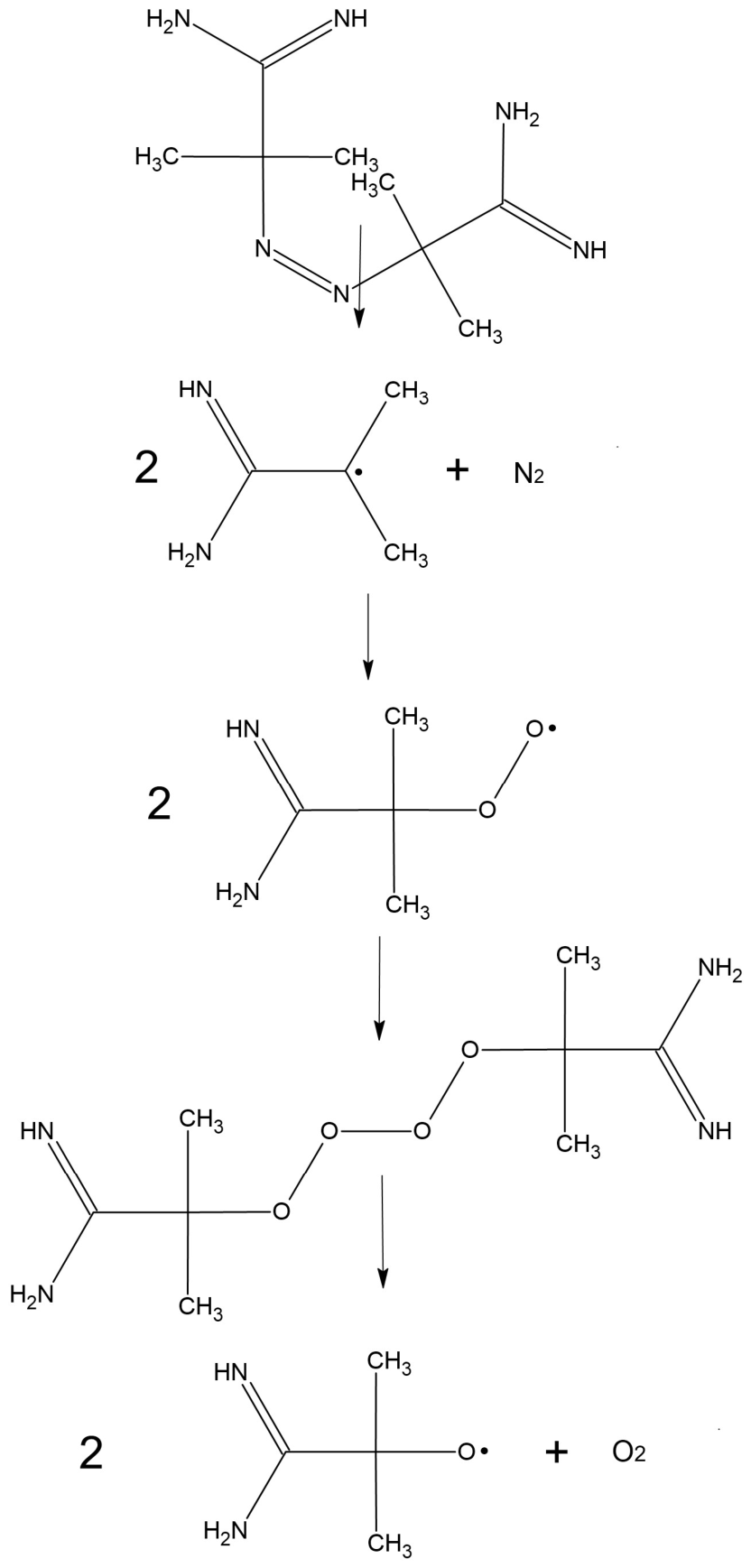
| Initiation (1) | AAPH + O2 → 2 ROO• | Ri = 1.36 × 10⁻⁶ × [AAPH] M s−1 |
| Peroxyl termination (2) | 2 ROO• → NRP | k2 = 1 × 10⁻⁶ M−1 s−1 |
| Alkoxyl formation (3) | 2 ROO• → 2 RO• + O2 | k3 = 5 × 10⁴ M−1 s−1 |
| Fluorescein bleaching (4) | RO• + FL-H → ROH + FL• | k4 = 1 × 10⁷ M−1 s−1 |
| Radical scavenging (5) | AH + ROO• → ROOH + A• | k5 = (1–40) × 104 M−1 s−1 (variable) |
| Fluorescein repair (6) | AH + FL• → A• + FL-H | K6 = k6/k−6 = 1–20 (variable) |
| Alkoxyl termination (7) | 2 RO• → NRP | k7 = 1 × 10⁹ M−1 s−1 |
| Antioxidant termination (8) | 2 A• → NRP | k8 = 1 × 10⁸ M−1 s−1 |
| Fluoresceinyl radical termination (9) | 2 FL• → NRP | k9 = 1 × 10⁸ M−1 s−1 |
| Conditions | Reference |
|---|---|
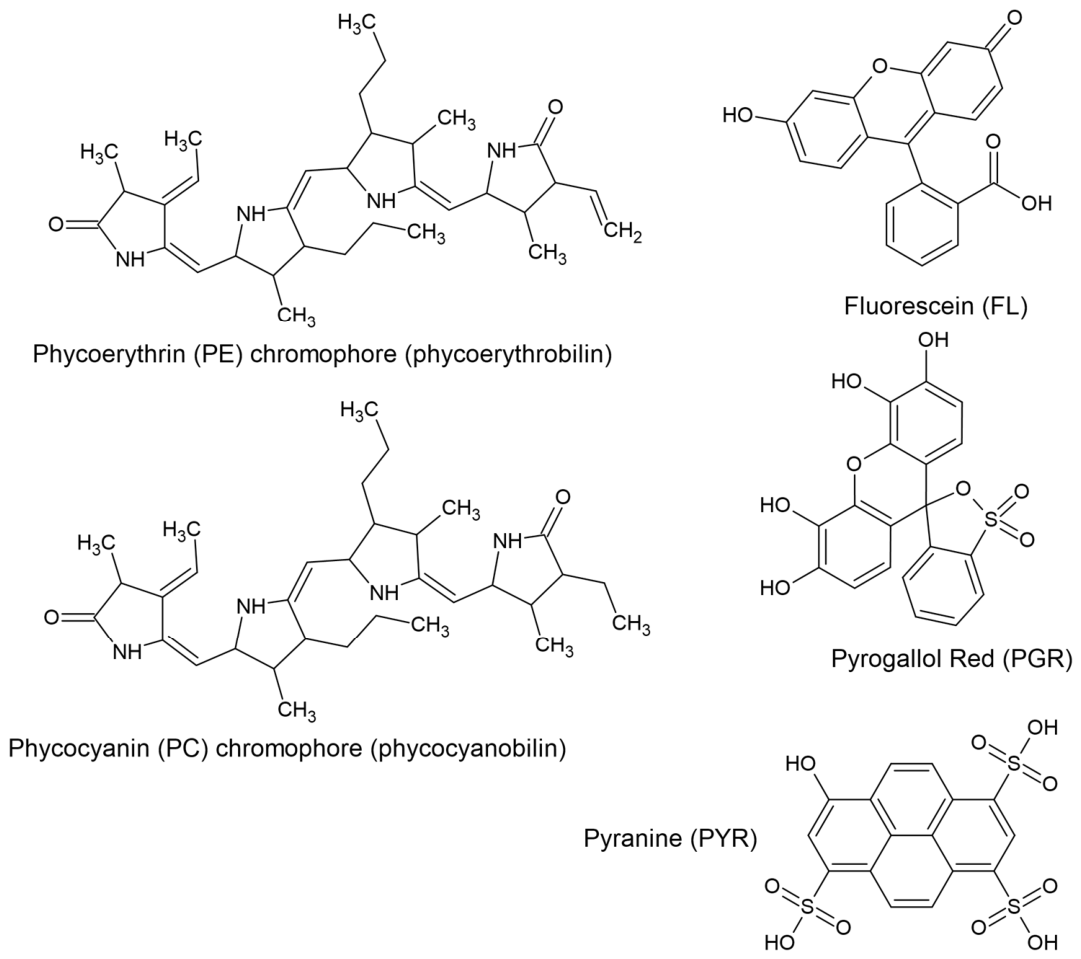
| Probe: β-phycoerythrin (β-PE) | |
| 16.7 nM β-PE, 3 mM AAPH, 75 mM phosphate buffer, pH 7.0, 37 °C, 540/565 nm | [15] |
| 16.7 nM β-PE, 8.11 mM AAPH, phosphate buffer, pH 7.0, 37 °C, 485/535 nm | [82] |
| 32 nM β-PE, 0.4 mM AAPH, 75 mM phosphate buffer, pH 7.0, 37 °C, 485/528 nm | [83] |
| 32 nM β-PE, 4 mM AAPH, 75 mM Na-K phosphate buffer, pH 7.0, 37 °C, 540/565 nm | [84] |
| 2.94 mg/L β-PE, 32 mM AAPH, 75 mM phosphate buffer, pH 7.0, 37 °C, 535/560 nm | [85] |
| 3.39 mg/L β-PE, 8 mM AAPH, 5 mM sodium acetate buffer, pH 5.5, 37 °C, 535/595 nm | [86] |
| Probe: β-phycocyanin (β-PE) | |
| 16.7 nM β-PC, 3 mM AAPH, 75 mM phosphate buffer, pH 7.0, 37 °C, 598/615 nm | [34] |
| Probe: fluorescein (FL) | |
| 0.107 nM FL, 27.3 mM AAPH, 37 °C, 485/520 nm | [87] |
| 0.47 nM FL, 2.72 mM AAPH, 75 mM phosphate buffer, pH 7.4, 485/523 nm | [88] |
| 2.67 nM FL, 17 mM AAPH, 75 mM Na/K phosphate buffer, pH 7.4, 37 °C, 485/530 nm | [89] |
| 3 nM FL, 19.1 mM AAPH | [90] |
| 3.75 nM FL, 14.5 mM AAPH, 75 mM buffer, pH 7.4, 37 °C, 485/535 nm | [91] |
| 6 nM FL, 9.4 mM AAPH, 75 mM phosphate buffer, pH 7.4, 37 °C, 485/528 nm | [92] |
| 6 nM FL, 18.8 mM AAPH, 75 mM phosphate buffer, pH 7.4, 37 °C, 485/528 nm | [93] |
| 7.5 nM FL, 19.1 mM AAPH, 75 mM phosphate buffer, pH 7.4, 37 °C, 485/527 nm | [94] |
| 23.4 nM FL, 20 µL, 24 mM AAPH, 75 mmol/L phosphate buffer, pH 7.4, 37 °C, 485/520 nm | [95] |
| 3 nM FL, 19.1 mM AAPH | [90] |
| 3.75 nM FL, 14.5 mM AAPH, 75 mM buffer, pH 7.4, 37 °C, 485/535 nm | [91] |
| 30 nM FL, 19 mM AAPH, 75 mM phosphate buffer, pH 7.0, 37 °C, 485/520 nm | [96] |
| 31.2 nM FL, 44.2 mM AAPH, 75 mM phosphate buffer, pH 7.0 | [97] |
| 35 nM FL, 12 mM AAPH, 75 mM phosphate buffer, pH 7.4, 37 °C, 485/520 nm | [53] |
| 40 nM FL, 17 mM AAPH, 37.5 mM phosphate buffer, pH 7.4, 37 °C, 480/520 nm | [59] |
| 41.3 nM FL, 0.42 mM AAPH, 75 mM sodium phosphate buffer, pH 7.0, 37 °C, 485/520 nm | [98] |
| 42 nM FL, 3.6 mM AAPH, 75 mM phosphate buffer, pH 7.4, 37 °C, 485/520 nm | [99] |
| 45.8 nM FL, 12.8 mM AAPH, 75 mM phosphate buffer, pH 7.4, 37 °C, 485/520 nm | [100,101] |
| 50 nM FL, 12.8 mM AAPH, 75 mM phosphate buffer, pH 7.0, 37 °C, 485/520 nm | [102] |
| 59.1 nM FL, 47.5 mM AAPH, 75 mM phosphate buffer, pH 7.4, 37 °C, 485/520 nm | [103] |
| 60 nM FL, 12 mM AAPH, 37 °C, 485/527 nm | [104] |
| 60 nM FL, 18.8 mM AAPH, 75 mM phosphate buffer, pH 7.0, 37 °C, 485/530 nm | [105] |
| 60 nM FL, 18.8 mM AAPH, 75 mM K-phosphate buffer, pH 7.4, 37 °C, 485/520 nm | [106] |
| 60 nM FL, 50 mM AAPH, 75 mM phosphate buffer, pH 7.4, 37 °C, 485/527 nm | [107] |
| 61.2 nM FL, 19.1 mM AAPH, 75 mM phosphate buffer, pH 7.4, 37 °C, 485/520 nm | [108] |
| 61.2 nM FL, 19.1 mM AAPH, 75 mM phosphate buffer, pH 7.0, 37 °C, 485/525 nm | [109] |
| 61.2 nM FL, 19.1 mM AAPH, 75 mM phosphate buffer, pH 7.4, 485/530 nm | [18] |
| 61.2 nM FL, 25 mM AAPH, 37 °C, 75 mM phosphate buffer, pH 7.0, 485/528 nm | [110] |
| 63 nM FL, 8 mM AAPH, phosphate buffer, pH 7.2, 37 °C, 490/515 nm | [111] |
| 63.7 nM FL, 7.93 mM AAPH, 75 mM phosphate buffer, pH 7.4, 37 °C, 485/528 nm | [81] |
| 70 nM FL, 3.33 mM AAPH, 75 mM phosphate buffer, pH 7.0, 37 °C, 485/520 nm | [112] |
| 70 nM FL, 10 mM AAPH, 75 mM phosphate buffer, pH 7.4, 37 °C, 493 nm/515 nm | [73] |
| 70 nM FL, 12 mM AAPH, 37 °C, 485/520 nm | [113] |
| 71.9 nM FL, 20.3 mM AAPH, 75 mM phosphate buffer, pH 7.4, 37 °C | [114] |
| 73.8 nM FL, 50.8 mM AAPH, 75 mM sodium phosphate buffer, pH 7.0, 485/520 nm | [115] |
| 78 nM FL, 12 mM AAPH, 75 mM phosphate buffer, pH 7.4, 37 °C, 485/520 nm | [116] |
| 79.2 nM FL, 6.63 mM AAPH, phosphate buffer, pH 7.4, 37 °C, 485/528 nm | [117] |
| 80 nM FL, 10 mM AAPH in 75 mM phosphate buffer, pH 7.4, 37 °C, 460/510 nm | [118] |
| 83.4 nM FL, 19.1 mM AAPH, 75 mM phosphate buffer, pH 7.2, 37 °C, 485/535 nm | [119] |
| 152.5 nM FL, 41.8 mM AAPH, 75 mM phosphate buffer, pH 7.4, 37 °C, 485/528 nm | [120] |
| 400 nM FL, 56.3 mM AAPH, 75 mM phosphate buffer, pH 7.4, 37 °C, 485/530 nm | [121] |
| 445.8 nM FL, 12.8 mM AAPH, 75 mM phosphate buffer, pH 7.0, 37 °C, 485/520 nm | [122] |
| 500 nM FL, 73 mM AAPH, 100 mM phosphate buffer, pH 7.4, 37 °C, 450/515 nm | [123] |
| 750 nM FL, 31.3 mM AAPH, 10 mM phosphate, pH 7.4, 37 °C, 485/520 nm | [124] |
| 750 nM FL, 31.3 mM AAPH, 75 mM phosphate buffer, pH 7.4, 37 °C, 485/520 nm | [125] |
| 800 nM FL, 9.9 mM AAPH, 75 mM K-phosphate buffer, pH 7.4, 37 °C, 485/538 nm | [126] |
| 3 µM FL, 21.6 mM AAPH, 37 °C, 75 mM phosphate buffer, pH 7.4, 485/520 nm | [127,128] |
| 3.14 μM FL, 153 mM AAPH, 0.5 mL, 75 mM phosphate buffer, pH 7.2, 37 °C, 493/515 nm | [129] |
| 3.70 µM FL, 8.4 mM AAPH, 75 mM sodium phosphate buffer, pH 7.0, 540/565 nm | [130] |
| 6.38 µM FL, 17.7 mM AAPH, 75 mM phosphate buffer, pH 7.4, 37 °C, 485/535 nm | [131] |
| 10.5 µM FL, 30 mM AAPH, 75 mM phosphate buffer, pH 7.4, 37 °C, 485/520 nm | [132] |
| 11.2 µM FL, 49.2 mM AAPH, Na-phosphate buffer, 32 °C, 540/565 nm | [133] |
| 14.0 µM FL, 4.8 mM AAPH, 75 mM phosphate buffer, pH 7.0, 37 °C | [21] |
| Probe: 6-carboxyfluorescein (6-CFL) | |
| 15 nM 6-CFL, 3 mM AAPH, 75 mM phosphate buffer, pH 7.0, 37 °C, 495/520 nm | [39] |
| Probe: 2′,7′-dichlorodihydrofluorescein (DCDHFL) | |
| 1 µM DCDHFL, 200 µM AAPH, PBS, 485/535 nm | [32] |
| Probe: Pyrogallol Red (PGR) | |
| 5 µM PGR, 10 mM AAPH, 75 mM phosphate buffer, pH 7.4, 37 °C, 540 nm | [40,73,134] |
| 20 µM PGR, 20 mM AAPH, 75 mM phosphate buffer, pH 7.4, 37 °C, 540 nm | [118] |
| Probe: pyranine (PYR) | |
| 5 µM PYR, 10 mM AAPH, 10 mM phosphate buffer, pH 7.0, 37 °C, 460/510 nm | [67,68] |
| 50 µM PYR, 50 mM AAPH, PBS, pH 7.4, 37 °C, 454 nm | [43] |
| Conditions | Reference |
|---|---|
| 3 nM FL, 19.1 mM AAPH, sample diluted in 7% RMCD in acetone/water (50%/50%, v/v) | [90] |
| 63.7 nM FL, 15.9 mM AAPH, samples diluted with 7% RMCD in 50% acetone, containing 10% DMSO; plate sealed with an RT-PCR sealing film | [135] |
| 14 µM FL, 9.6 mM AAPH solution, sample in 7% RMCD, 50% acetone/50% water v/v (final) 75 mM phosphate buffer, pH 7.0, 37 °C | [21] |
| 30 µM PGR, 30 mM AIPH, 0.5 M SDS containing methyl palmitate and methyl linoleate (0.5 vol % each) in PBS, pH 7.4, 37 °C, 540 nm | [41] |
| 50 µM PYR, 30 mM AIPH, 0.5 M SDS containing methyl palmitate and methyl linoleate (0.5 vol % each), PBS, pH 7.4, 37 °C, 454 nm | [41] |
| 1.3 nM BODIPY 581/591 C11, 0.26 M AMVN in octane:butyronitrile (9:1, v/v), 41 °C, 570/600 nm | [30] |
| 80 nM BODIPY 581/591 C11, 4 mM AMVN, 1.8 mM DOPC liposomes, 20 mM Tris–HCl buffer, pH 7.4, 42 °C, 540/600 nm | [30] |
| 2 µM BODIPY C11 581/591, 2 mM MeO-AMVN, PBS, 37 °C, 485/535 nm | [32] |
| Compound | Antioxidant Activity [mol TE/mol] |
|---|---|
| N-Acetylcysteine | 0.40ORAC-EPR [48] |
| Apigenin | 8.2ORAC-FL [55], 8.95ORAC-FL [149], 0.96ORAC-PGR [118], 0.97ORAC-PGR [149] |
| Ascorbic acid | 0.43ORAC-PE [19], 0.52ORAC-PE [15], 0.30ORAC-FL [150], 0.38ORAC-FL [116], 0.50ORAC-FL [128], 0.53ORAC-FL [53], 0.65ORAC-FL [151], 0.95ORAC-FL [19,20], 0.98ORAC-FL [123], 1.11ORAC-FL [152], 9.7ORAC-PGR [71], 10.3ORAC-PGR [153], 10ORAC-EPR [48] |
| Butylated hydroxytoluene (2,6-di-tert-butyl-p-cresol, BHT) | 0.20ORAC-FL [152], 5.53L-ORAC-FL [135] |
| t-Butylhydroxyanisol (BHA) | 2.43ORAC-FL [154] |
| Caffeic acid | 1.40ORAC-PE [19], 1.9ORAC-PC [155], 2.64ORAC-FL [150], 3.9ORAC-FL [156], 4.37ORAC-FL [20], 7.19ORAC-FL [81], 8.26ORAC-FL [53], 0.2ORAC-PGR [40], 0.42ORAC-PGR [153], 1.62ORAC-EPR [48] |
| 5-Caffeoylquinic acid | 3.5ORAC-FL [156] |
| Capsaicin | 5.03ORAC-FL [152] |
| α-Carotene | 0.51ORAC-BODIPY [30] |
| β-Carotene | 0.56ORAC-FL [148], 0.27ORAC-BODIPY [30] |
| Carvacrol | 1.35ORAC-FL [130] |
| Carvone | 0.12ORAC-FL [157] |
| Catechin | 2.57ORAC-PE [19], 1.5ORAC-PC [155], 6.40ORAC-FL, [20], 6.76ORAC-FL [19], 7.9ORAC-FL [128], 10.41ORAC-FL [81], 10.6ORAC-FL [149], 10.8ORAC-FL [158], 0.20ORAC-PGR [149], 1.32ORAC-PGR [40], 0.71ORAC-EPR [48] |
| Catechol | 3.4ORAC-FL [156] |
| Chlorogenic acid | 1.90ORAC-PE [19], 3.14ORAC-FL [20], 5.3ORAC-FL [128] |
| Cinnamic acid | 0.15ORAC-FL [158] |
| p-Coumaric acid | 4.1ORAC-FL [55], 5.00ORAC-FL [158] |
| Curcumin | 1.14ORAC-FL [152] |
| Cyanidin | 4.4ORAC-FL [128] |
| Cyanidin-3-O-galactoside | 5.8ORAC-FL [128] |
| Cyanidin-3-O-glucoside | 7.3ORAC-FL [128] |
| Cyanidin-3-O-rutinoside | 5.5ORAC-FL [128] |
| Cysteine | 0.40ORAC-FL [152] |
| Daidzein | 7.66ORAC-FL [149], 0.75ORAC-PGR [149] |
| Delphinidin | 3.8ORAC-FL [128] |
| Delphinidin-3-O-glucoside | 5.9ORAC-FL [128] |
| 2,3-Dihydroxybenzoic acid | 4.36ORAC-FL, 4.45ORAC-FL [17] |
| 2,4-Dihydroxybenzoic acid | 1.72ORAC-FL, 2.11ORAC-FL [17] |
| Epicatechin gallate (ECG) | 1.89ORAC-FL, 2.34ORAC-FL [17], 3.6ORAC-FL [20], 6.75ORAC-FL [149], 7.84ORAC-PGR [149] |
| Edavarone | 5.65ORAC-FL [152] |
| Epigallocatechin (EGC) | 2.5ORAC-FL [20], 3.1ORAC-FL [128] |
| Epigallocatechin gallate (EGCG) | 3.4ORAC-FL [128], 3.51ORAC-FL, 3.66ORAC-FL [17], 4.94ORAC-FL [20], 5.71ORAC-FL [149], 8.79ORAC-PGR [149] |
| Ellagic acid | 2.9ORAC-FL [128], 3.1ORAC-FL [55], |
| Epicatechin | 5.1ORAC-FL [128], 9.37ORAC-FL [158], 9.97ORAC-FL [149], 0.55ORAC-PGR [149], |
| Ethyl caffeate | 0.42ORAC-PGR [153] |
| Gallocatechin | 8.3ORAC-FL [128] |
| Genistein | 2.30ORAC-PE [19], 5.93ORAC-FL [19], 7.32ORAC-FL [149], 0.772ORAC-PGR [149], 0.43ORAC-EPR [48] |
| Glutathione | 0.32ORAC-PE [19], 0.48ORAC-FL [157], 0.49ORAC-FL [53], 0.50ORAC-FL [128], 0.62ORAC-FL [19], 5.62ORAC-PGR [71], 0.57ORAC-EPR [48] |
| Hesperetin | 4.56ORAC-FL [81], 7.97ORAC-FL [149], 0.36ORAC-PGR [149] |
| Hesperidin | 4.5ORAC-FL [128] |
| p-Hydroxybenzoic acid | 2.01ORAC-FL, 2.38ORAC-FL [17], 6.05ORAC-FL [158] |
| Hydrocortisone | 0.0054ORAC-FL [152] |
| Hydroxycinnamic acid | 2.05ORAC-FL, 2.16ORAC-FL [17] |
| Isoeugenol | 2.09ORAC-FL [150] |
| Isoquercitrin | 4.50ORAC-FL [20] |
| Isorhamnetin | 8.07ORAC-FL [149], 4.88ORAC-PGR [149] |
| Kaempferol | 2.57ORAC-PE [154], 2.29ORAC-FL, 2.75 ORAC-FL [17], 5.22ORAC-FL [20,155], 6.2ORAC-FL [128], 7.87ORAC-FL [149], 10.2ORAC-FL [154], 4.99ORAC-PGR [149], 8.8ORAC-PGR [154] |
| Kaempferol-3-O-glucoside | 6.6ORAC-FL [128] |
| R-(+)-Limonene | 0.05ORAC-FL [130] |
| Linalool | 0.28ORAC-FL [130] |
| Lutein | 0.42ORAC-BODIPY [30] |
| Methyl gallate | 12.0ORAC-PGR [153] |
| Morin | 3.19ORAC-FL [123] |
| Myricetin | 1.8ORAC-FL [55], 3.6ORAC-FL [128], 4.26ORAC-FL, 4.64ORAC-FL [17], 5.08ORAC-FL [152] |
| Myricetin-3-rhamnoside | 6.0ORAC-FL [128] |
| Naringenin | 5.6ORAC-FL [128], 8.04ORAC-FL [149], 0.542ORAC-PGR [149] |
| Naringin | 4.11ORAC-FL [123] |
| Octyl gallate | 9.82ORAC-PGR [153] |
| ϒ-Oryzanol | 12.4L-ORAC-FL [135] |
| Peptide YLVN | 1.12ORAC-FL [159] |
| Peptide EEHLCFR | 0.92ORAC-FL [159] |
| Peptide TFY | 0.37ORAC-FL [159] |
| Perillyl alcohol | 0.68ORAC-FL [157] |
| α-Pinene | 0.04ORAC-FL [130] |
| Probucol | 0.29–0.32ORAC-BODIPY [30] |
| Propyl gallate | 12.3ORAC-PGR [153] |
| Protocatechuic acid | 5.14ORAC-FL, 5.21ORAC-FL [20], 6.7ORAC-FL, 7.61ORAC-FL [158], 0.05ORAC-PGR [40] |
| Quercetin | 2.07ORAC-PE [19], 4.2ORAC-FL [128], 4.38ORAC-FL [20], 5.45ORAC-FL [123], 5.48ORAC-FL [151], 6.46ORAC-FL [17], 7.06ORAC-FL, 7.28ORAC-FL [19], 9.51ORAC-FL [149], 9.72ORAC-FL [116] 10.7ORAC-FL, 10.9ORAC-FL [152], 16.6ORAC-FL [53], 4.2–4.6ORAC-DCDHFL [39], 8.86ORAC-PGR [149], 8.92ORAC-PGR [118], 11.5ORAC-PGR [40], 11.9ORAC-PGR [153], 7.1ORAC-EPR [48] |
| Quercetrin | 2.70ORAC-PE [19], 3.5ORAC-PC [155], 6.47ORAC-FL [19] |
| Resveratrol | 12L-ORAC-FL [160] |
| Resolvin D1 | 1.22ORAC-FL [151] |
| Resolvin D1 methyl ester | 3.49ORAC-FL [151] |
| Resolvin D2 | 1.38ORAC-FL [151] |
| Resolvin D2 methyl ester | 1.45ORAC-FL [151] |
| Rutin | 1.95ORAC-PE [19], 2.3ORAC-PC [155], 3.80ORAC-FL [123], 4.28ORAC-FL [20], 4.6ORAC-FL [128], 6.01ORAC-FL [19], 7.40ORAC-FL [158], 3.5–4.3ORAC-DCDHFL, 0.12ORAC-PGR [40], 1.4ORAC-EPR [48] |
| Sinapic acid | 1.65ORAC-FL [150], 2.66ORAC-FL [158], 2.8ORAC-FL [55] |
| Syringic acid | 1.62ORAC-FL [158] |
| α-Terpineol | 2.72ORAC-FL [157] |
| Thymol | 1.37ORAC-FL [130] |
| α-Tocopherol | 0.72–0.76ORAC-BODIPY [30] |
| ϒ-Tocopherol | 6.28L-ORAC-FL [135] |
| Tryptophan | 2.5ORAC-FL [161] |
| Tyrosine | 0.004ORAC-PC [155] |
| Uric acid | 0.92ORAC-PE [15], 0.72ORAC-FL [150], 0.93–1.07ORAC-DCDHFL [39], 0.022ORAC-PGR [71], 2.2ORAC-EPR [48] |
| 2″-O-β-D-xylosylvitexin | 5.75ORAC-FL, 0.552ORAC-PGR [118] |
| Vanillic acid | 3.70ORAC-FL [158] |
| Material | Total Antioxidant Capacity |
|---|---|
| Açaí (Euterpe oleracea) berry, freeze-dried | 1027 d (FL) [51] |
| Açaí fruit pulp | 986 d (FL) [162], 4317 d (FL) [163] |
| Açaí juice, blend | 17.6 b (T-FL) [164] |
| Açaí seed powder extract | 31.5 d (FL) [165] |
| Adenia chevalieri, fruit | 121 d (FL) [166] |
| Adzuki bean (Vigna angularis), flour | 27.5 b (FL) [167] |
| Agave (Agave spp.), raw | 12.5 b (T-FL) [23], 12.9 b (T-FL) [164] |
| Agave, cooked | 29.4 b (T-FL) [23], 30.7 b (T-FL) [164] |
| Agave, dried | 72.7 b (T-FL) [23], 75.2 b (T-FL) [164] |
| Agresto from Vermentino grapes | 0.839 a (FL) [168] |
| Agresto from Sangiovese grapes | 0.400 a (FL) [168] |
| Alexandrian laurel (Calophyllum inophyllum), fruit | 110 d (FL) [166] |
| Alfalfa (Medicago sativa) sprouts | 15.1 b (FL) [115] |
| Allspice (Pimento dioica) | 0.441 b (FL) [169] |
| Almond (Prunus dulcis), seed | 44.5 b (T-FL) [24] |
| Almonds, unpeeled | 37.4 b (FL) [114] |
| Almonds, organic, unpeeled | 53.1 b (FL) [114] |
| Aloe (Aloe vera) | 1.88 b (PE) [170] |
| Alpine squill (Scilla bifolia), tepals | 59.5 b (FL) [171] |
| Amaranth (Amaranthus spp.), leaves | 92 d (FL) [103] |
| Amaranth, purple (Amaranthus cruentus) | 28.9 b (PE) [170] |
| Amaranth flour | 13.6 b (FL) [167] |
| Andean lupin (Lupinus mutabilis), seed | 89.7 d (FL) [101] |
| Apple (Malus domestica) | 13.8 b (FL) [172], 21.7 b (FL) [115], |
| Apple Braebum | 20.6 b (FL) [114] |
| Apple Fuji, raw, unpeeled | 26.8 b (FL) [114], 25.9 b (T-FL) [23] |
| Apple Gala, raw, unpeeled | 28.3 b (FL) [51], 28.3 b (T-FL) [23,164] |
| Apple Golden Delicious | 22.1 b (T-FL) [23], 26.4 b (FL) [117] |
| Apple Golden Delicious, raw, unpeeled | 26.7 b(T-FL) [164] |
| Apple Golden Delicious, peeled | 22.1 b(T-FL) [164] |
| Apple Golden Delicious, peel | 40.0 b (FL) [115] |
| Apple Golden Delicious, pulp | 7.07 b (FL) [115] |
| Apple Granny Smith, unpeeled | 12.5 b (FL) [172], 35.2 b (FL) [114], 39.0 b (T-FL) [23] |
| Apple Red | 39.2 b (FL) [114] |
| Apple Red, bulk, peeled | 26.5 b (FL) [114] |
| Apple Red, bulk, unpeeled | 36.1 b (FL) [114] |
| Apple Red Delicious, peeled | 29.4 b (T-FL) [23] |
| Apple Red Delicious, unpeeled | 42.8 b (T-FL) [23] |
| Apple Royal Deli | 41.8 b (FL) [114] |
| Apple Royal G | 27.3 b (FL) [114] |
| Apple Stark pulp | 10.2 b (FL) [115] |
| Apple Stark peel | 69.7 b (FL) [115] |
| Apple juice | 4.08 b (FL) [21], 4.14 b (FL) [164], 4.3, 5.0 a (FL) [21], 22.2 (FL) a, 31.78 (FL-EDTA) a [116], 8.9–14.3 a (PGR) [134] |
| Apple sauce | 19.7 b (FL) [23] |
| Apricot (Armeniaca vulgaris), fruit | 7.2 b (FL) [173], 10.6 b (FL) [115], 10.8 b (FL) [117], 82.7 d (FL) [166], 11.1 b (T-FL) [164], 13.4 b (T-FL) [23] |
| Apricot fruit, bulk, unpeeled | 31.6 b (FL) [114] |
| Apricot fruit, bulk, peeled | 18.4 b (FL) [114] |
| Apricot juice | 15.5 a (PGR) [134] |
| Artichoke (Cynara cardunculus) | 65.5 b (FL) [98], 92.8 b (T-FL) [23] |
| Artichoke hearts | 65.5 b (FL) [51] |
| Artichokes, Ocean Mist, boiled | 94.2 b (T-FL) [164] |
| Artichokes, Ocean Mist, Microwaved | 94.0 b (T-FL) [164] |
| Asian pear (Pyrus pyrifolia), unpeeled | 22.5 b (FL) [114] |
| Asian pear peeled | 8.57 b (FL) [114], 2.32 b (T-FL) [174] |
| Asparagus (Asparagus officinalis), raw | 11.4 b (FL) [175], 12.9 b (FL) [98], 11.5 b (T-FL) [174], 22.5 b (T-FL) [164], 29.2 b (T-FL) [23] |
| Asparagus, white, raw | 2.96 b (FL) [164] |
| Asparagus, cooked | 16.4 b (FL) [23] |
| Assidat zgougou (Tunisian dish) | 1065 d (FL) [176] |
| Athlete supplement, Active Edge Blueberry | 222 a (FL) [89] |
| Athlete supplement, Active Edge Capsule 2 × 435 mg capsules | 173 d (FL) [89] |
| Athlete supplement, Active Edge Cherry Bottle | 247 a (FL) [89] |
| Athlete supplement, Active Edge Cherry Sachet | 201 a (FL) [89] |
| Athlete supplement, Active Edge Pomegranate | 96.6 a (FL) [89] |
| Athlete supplement, CurraNZ 1 × 300 mg capsule | 3868 d (FL) [89] |
| Athlete supplement, Healthspan Elite Sour Cherry | 297 a (FL) [89] |
| Athlete supplement, PAS Cherry Bomb | 209 a (FL) [89] |
| Athlete supplement, POM Wonderful | 23.8 a (FL) [89] |
| Athlete supplement, SIS Rego Cherry Juice | 336 a (FL) [89] |
| Avocado (Persea americana) | 19.2 b (T-FL) [164], 19.3 b (T-FL) [24], 79.0 b (T-FL) [24] |
| Avocado, Bacon | 13.9 b (FL) [114] |
| Avocado, Edranol | 7.79 b (FL) [114] |
| Avocado, Ester | 17.9 b (FL) [114] |
| Avocado Fuerte | 13.9 b (FL) [114] |
| Avocado, Hass | 48.5 b (FL) [114], 19.3 b (T-FL) [23] |
| Avocado Negra TLC | 16.1 b (FL) [114] |
| Baby food, apple | 48.2 b (T-FL) [164] |
| Baby food, apple sauce (Gerber) | 41.2 b (FL) [23] |
| Baby food, apple blueberry (Gerber) | 48.2 b (FL) [23] |
| Baby food, banana (Gerber) | 26.6 b (FL) [23] |
| Baby food, peach (Heinz) | 62.6 b (FL) [23] |
| Baby food, pear (Gerber) | 25.5 b (FL) [23] |
| Baby food, pear juice | 4.1 b (FL) [164] |
| Balsam pear (Momordica charantia) | 3.43 b (PE) [170] |
| Banana (Musa spp.), fruit, raw | 8.0 b (T-FL) [164], 8.8 b (T-FL) [23] |
| Banana, Nam-wa variety | 2.6 b (FL) [177] |
| Basil (Ocymum basilicum), raw | 48.1 b (FL) [98] |
| Basil, dried | 611 d (FL) [51] |
| Basil leaves, dried | 675.5 d (T-FL) [23] |
| Basil, ‘Medinette’ leaves, dried | 402 d (FL) [178], 96.2 d (T-FL) [92] |
| Basil, Indian, leaves, dried | 157.7 d (T-FL) [92] |
| Basil, ‘Persian’ leaves, dried | 96.8 d (T-FL) [92] |
| Bastilla, mini chicken (Moroccan dish) | 1111 d (FL) [176] |
| Bean, common (Phaseolus vulgaris) | 4.30 b (FL) [175], 62.6 b (FL) [179] |
| Bean, black | 79.3 b (FL) [180] |
| Bean, black, mature seeds, raw | 80.4 b (T-FL) [23], 86.1 b (T-FL) [164] |
| Bean, black, mature seeds, boiled | 22.5 b (FL) [164] |
| Bean, black turtle soup, mature seeds, raw | 64.2 b (FL) [164], 80.4 b (FL) [51] |
| Bean, black, flour | 40.3 b (FL) [167] |
| Bean, green | 7.45 b (FL) [117], 14.5 b (FL) [181] |
| Bean, lima canned | 2.43 b (T-FL) [23] |
| Bean, navy, mature seeds, raw | 18.6 b (T-FL) [164] |
| Bean, navy, dry mature | 24.7 b (T-FL) [23] |
| Bean, pink, mature seeds, raw | 83.2 b (FL) [164] |
| Bean, pinto, mature seeds, dry | 123.6 b (T-FL) [23] |
| Bean, pinto, mature seeds, raw | 80.3 b (T-FL) [164] |
| Bean, pinto, mature seeds, boiled | 9.04 b (T-FL) [164] |
| Bean, red kidney, dry mature | 61.2 b (FL) [180], 86.1 b (FL) [51], 144.1 b (T-FL) [23] |
| Bean, red kidney, flour | 34.6 b (FL) [167] |
| Bean, small red, dry mature | 149.2 b (T-FL) [23] |
| Bean, snap raw | 2.67 b (T-FL) [23] |
| Bean, snap canned | 2.90 b (T-FL) [23] |
| Bean (Vigna radiata f. aureus) sprout | 16.1 b (FL) [175] |
| Beef, longissimus muscle | 31.9 d (FL), 1.29 d (L-FL) [90] |
| Beef, raw and cooked | 1.30 b and 1.58 b (L-FL) [90] |
| Beef steak, raw and broiled | 28.1 and 33.0 b (FL) [90] |
| Beef stew, French dish | 371.1 d (FL) [176] |
| Beer, ale, Belgian | 1.12–1.65 a (FL) [88] |
| Beer, bright lager | 4.61–5.92 a (FL) [158] |
| Beer, dry-hoped | 11.5 b (FL) [182] |
| Beer, India Pale Ale | 23.0 a (FL) [183] |
| Beer, lager | 10.2 b (FL) [182] |
| Beer, lager, Portuguese | 3.10–10.7 a (FL) [88] |
| Beer, low alcoholic | 2.01–7.91 b (FL) [182] |
| Beer, Premium lager | 3.70 a (FL) [183] |
| Beer, Stout | 26.7 a (FL) [183] |
| Beer, Trappist brown | 12.3 b (FL) [182] |
| Beet (Beta vulgaris, var. rubra), raw | 12.2 b (FL) [175], 12.6 b (FL) [181], 26.2 b (FL) [115], 27.2 b (FL) [98], 17.9 b (T-FL) [164], 19.5 b (T-FL) [164], 27.7 b (T-FL) [23] |
| Beet, green, frozen | 11.7 b (FL) [115] |
| Bilberry (Vaccinium myrtillus) | 767 d (FL) [162] |
| Bilberry juice | 12.51 (PE), 34.66 (FL) a [19] |
| Birch (Betula pendula), leaves | 1185 d (FL) [178] |
| Bissara, Moroccan dish | 128.4 d (FL) [176] |
| Bitter melon (Momordica charantia) | 6.90 b (T-FL) [174] |
| Black cherry (Prunus serotina), fruit | 26.8 d (FL) [101] |
| Blackberry (Rubus fruticosus) | 14.1 d (FL) [184], 20.4 b (FL) [185], 59.1 b (FL) [51], 53.5 b (T-FL) [23], 59.1 b (T-FL) [164], 32.7 b (PGR) [73] |
| Blackberry leaves | 1806 d (FL) [186] |
| Blackberry, organic | 423 d (FL) [162] |
| Blackberry (Rubus caesius) | 74.2 b (FL) [101] |
| Blackberry, evergreen (Rubus laciniatus) | 27.5 b (PE) [187] |
| Blackberry (Morus nigra) fruit | 63.7 b (FL) [173] |
| Blackthorn (Prunus spinosa) | 79.1 b (FL) [101], 68.8 b and 89.4 b (FL) [96] |
| Blue Candle cactus (Myrtillocactus geometrizans), fruit | 69.8 b (FL) [188] |
| Blue corn meal | 6.84 b (FL) [23] |
| Blueberry (Vaccinium spp.) | 35.9 b and 37.3 b (PE) [85], 22.3 b FL [185], 46.7 b (FL) [51], 54.8 b (FL) [114], 56.1 b (FL) [172], 98.8 b (FL) [101], 509 d, 880 d (FL) [162], 46.7 b (T-FL) [164], 62.2 b (T-FL) [24], 17.4 b (PGR) [73] |
| Blueberry, Aurora | 68.8 b (FL) [114] |
| Blueberry, Bluecrop | 71.3 b (FL) [114] |
| Blueberry, Bluegold | 87.6 b (FL) [114] |
| Blueberry, Brigitta | 55.4 b (FL) [114] |
| Blueberry, Duke | 48.6 b (FL) [114] |
| Blueberry, Elliot | 88.7 b (FL) [114] |
| Blueberry, juice | 7.51 (PE), 23.6 b (FL) [164], 23.8 (FL)a [19], 29.1 b (FL) [21], 32.7 a (FL) [21] |
| Blueberry, lowbush | 92.6 b (T-FL) [23] |
| Blueberry, nectar | 1.78 a (FL) [138] |
| Blueberry, organic | 618 d (FL) [162] |
| Blueberry, wild | 96.2 b (FL) [51] |
| Boldo (Peumus boldus), extract | 2728 c (FL), 53 c (PGR) [72] |
| Boysenberry (Rubus fruticosus x idaeus) | 42.2 b (PE) [187], 216 d (FL) [164] |
| Bread, butternut all whole grain wheat, Chicago Baking Co | 21.0 b (T-FL) [23] |
| Bread, Multi-Grain | 14.2 b (T-FL) [164] |
| Bread, oatnut | 12.2 b (FL) [117] |
| Bread, Oatnut, Brownberry | 13.2 b (T-FL) [23] |
| Bread, pumpernickel, Brownberry | 19.6 b (T-FL) [23] |
| Bread, whole grain Healthy Choice | 14.2 b (T-FL) [23] |
| Breakfast cereals, corn flakes, ready to eat | 23.0 b (FL) [117] |
| Breakfast cereals, granola with raisins, low-fat, Kellog’s, ready to eat | 22.9 b (T-FL) [23] |
| Breakfast cereals, Life, Quaker, ready to eat | 15.2 b (T-FL) [23] |
| Breakfast cereals, Original Shredded Wheat, Post, ready to eat, | 13.0 b (T-FL) [23] |
| Breakfast cereals, oat bran, Quaker, ready to eat | 18.9 b (T-FL) [23] |
| Breakfast cereals, oat, instant, fortified, plain, dry | 23.1 b (T-FL) [164] |
| Breakfast cereals, oat bran, Quaker, uncooked, hot | 24.8 b (T-FL) [23] |
| Breakfast cereals, oat, old-fashioned, Quaker, uncooked | 17.1 b (T-FL) [23] |
| Breakfast cereals, oat, quick, 1-min, Quaker, uncooked | 21.7 b (T-FL) [23] |
| Breakfast cereals, oatmeal, instant, Quaker, uncooked | 23.1 b (T-FL) [23] |
| Breakfast cereals, squares toasted oatmeal, Quaker, ready to eat | 21.4 b (T-FL) [23] |
| Breakfast cereals, Total, General Mills | 23.6 b (T-FL) [23] |
| Breakfast cereals, wheat, shredded, plain, sugar and salt free, ready-to-eat | 13.03 b (T-FL) [164] |
| Brier (Rosa canina) | 201.1 b (FL) [101] |
| Broad bean (Vicia faba), seed | 29.5 d (FL) [101] |
| Broccoli (Brassica oleracea var. italica), raw | 11.8 b (FL) [177], 16.1 b (FL) [181], 35.3 b (FL) [115], 35.3 b (FL) [98], 37.0 d (L-FL) [135], 15.9 b (T-FL) [23,24], 15.1 b (T-FL) [164] |
| Broccoli, boiled | 21.6 b (T-FL) [164] |
| Broccoli cooked | 12.6 b (T-FL) [23] |
| Broccoli, frozen | 4.96 b (FL) [115] |
| Broccoli, raab cooked | 15.6 b (T-FL) [23], 15.9 b (T-FL) [164] |
| Broccoli, raab raw | 30.8 b (T-FL) [23] |
| Buckwheat, common (Polygonum fagopyrum), flour | 17.9–109.1 b (FL) [99] |
| Buckwheat, tartary (Fagopyrum esculentum), flour | 81.8 b (FL) [167], 555.8 d (FL) [99] |
| Buddleia globosa extract | 2175 c (FL), 25 c (PGR) [72], |
| Burdock, greater (Arctium lappa), roots | 365 d (FL) [178], 67.5 b (T-FL) [174] |
| Cabbage (Brassica oleracea), green, raw | 5.1 b (FL) [189], 6.43 b (FL) [175], 5.29 b (T-FL) [164], 8.56 b (FL), [98], 13.6 b (T-FL) [23] |
| Cabbage, green, savoy (cv Sabauda), raw | 20.5 b (FL) [98] |
| Cabbage, green, savoy (cv Sabauda), boiled | 20.5 b (FL) [164] |
| Cabbage, boiled | 8.56 b (T-FL) [164] |
| Cabbage, Chinese celery (Brassica pekinensis var. cylindrica) | 6.19 b (FL) [175] |
| Cabbage, red (Brassica oleracea var. capitata f. rubra), raw | 23.1 b (FL) [175], 110.3 b (FL) [189], 22.5 b (T-FL) [23], 25.0 b (T-FL) [164], 34.7 b (T-FL) [174] |
| Cabbage, red, cooked | 31.5 b (FL) [23] |
| Cactus pear (Opuntia spp.), fruit pulp/juice, green orange red purple | 3.68 b/5.45 a (PE) [190] 4.36 b/5.83 a (PE) [190] 4.44 b/6.35 a (PE) [190] 8.16 b/11.2 a (PE) [190] |
| Calabash (Crescentia cujete) fruit | 11.8b (FL) [108] |
| Calafate (Berberis microphylla) berry | 256.6 b (FL) [114], 467.5 d (FL) [191] |
| Caltrop (Tribulus terrestris), aerial parts | 819 d (FL) [178] |
| Cambuci (Campomanesia phaea) fruit | 4.57–11.3 b (FL) [120] |
| Candies, chocolate, dark | 208.2 b (T-FL) [164] |
| Candies, milk chocolate | 75.2 b (T-FL) [164] |
| Candies, semisweet chocolate | 180.5 b (T-FL) [164] |
| Cantaloupe (Cucumis melo) | 3.1 b (T-FL) [24] |
| Carambola (Averrhoa carambola) | 12.9 b (FL) [192] |
| Caraway (Carum carvi) | 10.7 b (PE) [170] |
| Cardamom (Elettaria cardamomum) | 27.6 b (FL) [98], 56 b (FL) [182] |
| Carob (Ceratonia siliqua) beverage | 1.9 a (FL) [193] |
| Carrot (Daucus carota var. sativa), raw | 1.07 b (FL) [98], 2.47 b (FL) [175], 2.71 b (FL) [115], 3.3 b (FL) [172], 4.8 b (FL) [181], 4.07 b (T-FL) [174], 6.96 b (FL) [115], 8.13 d (L-FL) [135], 6.97 b(T-FL) [164], 12.2 b (T-FL) [23] |
| Carrot, baby, raw | 4.36 b (T-FL) [23,24] |
| Carrot, cooked | 4.99 b (FL) [115], 3.26 b (T-FL) [164], 3.71 b (T-FL) [23] |
| Carrot steamed | 2.63 b (FL) [115] |
| Cashew (Anacardium occidentale) | 7.8 b (FL) [108], 19.5 b (T-FL) [164], 20.0 b (T-FL) [23,24] |
| Cassava (Manihot esculenta), leaves | 470 d (FL) [103] |
| Cauchao (Amomyrtus luma) berry | 451.1 d (FL) [194] |
| Cauliflower (Brassica oleracea var. botrytis), raw | 8.28 b (FL) [175], 9.25 b (FL) [115], 9.25 b (FL) [98], 6.47 b (T-FL) [23], 8.70 b (T-FL) [164] |
| Cauliflower, boiled | 7.39 b (FL) [164] |
| Cauliflower, frozen | 6.20 b (T-FL) [164] |
| Cauliflower, green, raw | 1.36 b (T-FL) [164] |
| Cauliflower, green, cooked | 13.9 b (T-FL) [164] |
| Cauliflower, purple, raw | 20.8 b(T-FL) [164] |
| Cauliflower, purple, cooked | 22.1 b (T-FL) [164] |
| Cauliflower, steamed | 6.20 b (FL) [115] |
| Celery (Apium graveolens) | 3.43 b (FL) [98], 8.37 b (FL) [175], 5.52 b (T-FL) [164], 5.74 b (T-FL) [23,24] |
| Celery, leaves | 113.5 b (FL) [181] |
| Celery, root | 15.3 b (FL) [181] |
| Century plant (Agave americana), leaf | 70.3 d (FL) [101] |
| Chamomile (Matricaria chamomilla), flowers | 814 d (FL) [178] |
| Chenopodium ambrosioides extract | 395 c (FL) [72], 3.3 c (PGR) [72] |
| Chia (Salvia hispanica) seeds | 517.3 b (FL), 6.48 b (L-FL) [195] |
| Chinese hawthorn (Crataegus pinnatifida) | 1240 d (FL) [91] |
| Chinese sage (Salvia miltiorrhiza), herb | 1320 d (FL) [91] |
| Cherry (Prunus avium) | 25.8 b (FL) [101], 37.5 b (FL) [51], 202 d (FL) [162], 33.6 b (T-FL) [23] |
| Cherry, Bing | 61.2 b (FL) [114] |
| Cherry, Brooks | 55.7 b (FL) [114] |
| Cherry, Granel | 39.2 b (FL) [114] |
| Cherry, Lapins | 38.5 b (FL) [114] |
| Cherry, Rainier | 42.3 b (FL) [114] |
| Cherry, Tart | 149 d (FL) [162] |
| Cherry, Van | 37.3 b (FL) [114] |
| Cherry, black, juice | 23.7 b(FL) [164] |
| Chicken, roasted | 13.6 b (FL) [117] |
| Chicken Blood Vine (Spatholobus suberectus), herb | 1990 d (FL) [91] |
| Chickpea (Cicer arietinum) mature seeds, raw | 8.47 b (FL) [164], 9.26 b (FL) [179], 34.7 b (FL) [180] |
| Chickpea (black) flour | 17.1 b (FL) [167] |
| Chickpea, fruit | 104 d (FL) [166] |
| Chicory (Cichorium intybus), aerial parts | 398 d (FL) [178] |
| Chilchen (Red Berry Beverage) | 7.40 b (FL) [23] |
| Chilean blackcurrant (Ribes magellanicum) | 360 d (FL) [196] |
| Chilean strawberry (Fragaria chiloensis) | 313.1 d (FL) [191] |
| Chili (Capsicum annuum) green | 5.34 b (FL) [98], 18.4 b (FL) [175] |
| Chili, red | 5.09 b (FL) [98], 27.8 b (FL) [175] |
| Chili powder | 236.4 b (T-FL) [23] |
| Chinese angelica (Angelica sinensis), root | 80.7 d (FL) [166] |
| Chinese figwort (Scrophularia ningpoensis) | 77 d (FL) [91] |
| Chinese foxglove (Rehmannia glutinosa) | 65 d (FL) [91] |
| Chinese ground orchid (Bletilla striata) | 100 d (FL) [91] |
| Chinese honey locust (Gleditsia sinensis) | 570 d (FL) [91] |
| Chinese lantern (bladder cherry) (Physalis alkekengi) | 135 d (FL) [166] |
| Chinese mugwort (Artemisia argyi) | 1150 d (FL) [91] |
| Chinese peony (Paeonia lactiflora) | 350 d and 680 d (FL) [91] |
| Chinese rhubarb (Rheum officinale), root | 79.3 d (FL) [166] |
| Chips, Olestra tortilla | 15.5 b (T-FL) [164], 17.0 b (T-FL) [23] |
| Chips, tortilla, low fat, made with olestra, nacho cheese | 18.6 b (T-FL) [23], 15.5 b (T-FL) [164] |
| Chitosan (50–190 kDa) | 0.02 b (FL) [197] |
| Chives Allium schoenoprasum | 9.15 b (PE) [170], 20.9 b (FL) [98] |
| Chocolate, baking | 1039.7 b (T-FL) [23] |
| Chocolate, baking chips | 202 b (T-FL) [198] |
| Chocolate, baking unsweetened, squares | 499.4 b (T-FL) [164] |
| Chocolate, dark | 227 b (T-FL) [198] |
| Chocolate, dutched powder | 402 b (T-FL) [198] |
| Chocolate, milk | 80 b (T-FL) [198] |
| Chocolate, milk, candy bar | 81.7 b (T-FL) [23] |
| Chocolate, natural powder | 826 b (T-FL) [198] |
| Chocolate, syrup | 63.3 b (FL) [164] |
| Chocolate, unsweetened | 496 b (T-FL) [198] |
| Chokeberry (Aronia melanocarpa), fruit | 160.8 b (FL) [101], 2140 d (FL) [199], 160.6 b (T-FL) [200] |
| Chokeberry juice concentrate | 418 a (FL) [162] |
| Chokeberry, leaves | 1363 d (FL) [186] |
| Chorba, white (Algerian dish) | 391.4 d (FL) [176] |
| Chupón (Greigia sphacelata) fruit | 35.3 b (PGR) [201] |
| Cinnamon (Cinnamomum verum), bark | 22.1 b (FL) [202], 907 b (FL) [182] |
| Cinnamon, leaves | 44.8 b (FL) [202] |
| Cinnamon, ground | 1256 b (FL) [144], 1314 b (FL) [51], 2675.4 b (T-FL) [23] |
| Cinnamon essential oil | 7.71 b (FL) [130] |
| Clove (Syzygium aromaticum), ground | 2903 b (FL) [51], 3144.5 b (T-FL) [23] |
| Clove essential oil | 10.6 b (FL) [130] |
| Cocoa, dry powder | 4.85 b (FL) [117,164], 556.5 b (FL) [51] |
| Coffee (Coffea arabica), arabica, conventional | 290.0 b (FL) [203] |
| Coffee, arabica, pulp dried powder | 8400–12,000 d (PE) [83] |
| Coffee, cascara | 216–614 d (FL) [104] |
| Coffee, elephant | 250.9 b (FL) [203] |
| Coffee, extract | 9.59 a (FL) [138] |
| Coffee, powder | 735 and 823 d (FL) [204], 10,400 (FL)d and 12,800 (FL)d [18] |
| Cogon grass (Imperata cylindrica) | 130 d (FL) [91] |
| Cookie, oatmeal raisin, Pepperidge Farm | 20.0 b (T-FL) [23] |
| Coriander (Coriandrum sativum) | 273 b (FL) [182] |
| Coriander leaves, raw | 51.4 b (FL) [98], 60.5 b (FL) [175] |
| Corn (Zea mays), raw | 10.4 b (FL) [175], 7.28 b (T-FL) [23], 7.6 and 9.2 b (T-FL) [174] |
| Corn, sweet yellow, canned | 4.13 b (T-FL) [23] |
| Corn, sweet, yellow, frozen | 5.22 b (T-FL) [23] |
| Cornelian cherry (Cornus mas) | 49.0 b (FL) [101], 119.2 b and 175.9 b (FL) [96] |
| Cotton, Levant (Gossypium herbaceum), root | 122 d (FL) [166] |
| Couscous with meat and vegetables (Tunisian dish) | 431.2 d (FL) [176] |
| Courgette (Cucurbita pepo) | 1.80 b and 3.44 b (FL) [98] |
| Cowherb (Vaccaria segetalis) | 200 d (FL) [91] |
| Cowpea (Vigna sinensis) | 20.1 b (FL) [175] |
| Cowpea (Vigna unguiculata), mature | 43.4 b (T-FL) [164] |
| Cranberry (Vaccinium oxycoccos) | 70.0 b (FL) [101], 90.9 b (FL) [51], 94.6 b (T-FL) [23] |
| Cranberry juice | 14.5 b (FL) [164], 2.8 a (PGR) [134] |
| Cranberry juice, red | 8.65 b (FL) [164] |
| Cranberry juice, white | 2.32 b (FL) [164] |
| Creeping thistle (Cirsium setosum) | 370 d (FL) [91] |
| Cucumber (Cucumis sativus), unpeeled | 1.2 b (FL) [181], 1.82, 2.51 b (FL) [175], 2.52 b (FL) [98], 1.15 b (T-FL) [23], 2.32 b (T-FL) [164], 2.72 b (T-FL) [174] |
| Cucumber, peeled | 1.23 b (T-FL) [23], 1.40 b (T-FL) [164] |
| Cumin (Cuminum cyminum) | 768.0 b (FL) [98] |
| Cumin fruit | 125 d (FL) [166] |
| Cumin seed | 504 b (FL) [51] |
| Curly dock (Rumex crispus), leaves | 298.0 d (FL) [101] |
| Currant, black (Ribes nigrum) | 96.0 b (FL) [101], 100.6 b (FL) [200], 148 d (FL) [166], 389 d (FL) [162], 79.6 b (T-FL) [164] |
| Curry (Bergera koenigii), powder | 485 b (T-FL) [23] |
| Cyathula (Cyathula officinalis), root | 43 d (FL) [91] |
| Dandelion (Taraxacum officinale), aerial parts | 2.35 b (PE) [170], 381 d (FL) [178] |
| Dates (Phoenix dactylifera), Deglet Noor, dried | 39.0 b (T-FL) [23] |
| Dates, Medjool | 23.9 b (T-FL) [23] |
| Dendrobium, Noble (Dendrobium nobile), fruit | 120 d (FL) [166] |
| Dill (Anethum graveolens) | 29.1 b (PE) [170], 10.5 b (FL) [181], 43.9 b (FL) [98] |
| Diverse wormwood (Artemisia anomala) herb | 1400 d (FL) [91] |
| Durian (Durio zibethinus), fruit | (360.9–377.6)d (FL) [205] |
| Egg, chicken (Gallus gallus domesticus) yolk, raw | 147.1 d (FL) [206] |
| Egg, chicken yolk, boiled | 74.8 d (FL) [206] |
| Egg, chicken yolk, fried | 83.5 d (FL) [206] |
| Eggplant (Solanum melongena), raw | 3.44 b (FL) [115], 6.7 b (FL) [172], 9.32 b (FL) [164], 12.8 b (FL) [175], 16.2 b (FL) [181], 18.5 b and 21.7 b (T-FL) [174], 25.3 b (T-FL) [23] |
| Eggplant, Black beauty | 11.9 b (FL) [98] |
| Eggplant, Violetta lunga | 14.1 b (FL) [98] |
| Eggplant, boiled | 2.45 b (FL) [164] |
| Eggplant, frozen | 0.37 b (FL) [115] |
| Eggplant slices, raw | 3.81 b (FL) [115] |
| Eggplant slices, steamed | 2.45 b (FL) [115] |
| Elderberry (Sambucus nigra), fruit | 205.4 b (FL) [101], 953 d (FL) [162], 147.0 b (T-FL) [200] |
| Endive (Cichorium endivia ssp. Endivia) | 10.3 b (FL) [175] |
| Female ginseng (Angelica sinensis) | 78 d (FL) [91] |
| Fennel (Foeniculum vulgare) | 3.61 b (FL) [98] |
| Fennel, bulb, raw | 3.07 b (FL) [164], 5.88 b (PE) [170] |
| Fenugreek (Trigonella foenum-graecum), fruit | 75.2 d (FL) [166] |
| Fenugreek, seeds | 327 d (FL) [178] |
| Feverfew (Tanacetum parthenium) | 10.1 b (PE) [170] |
| Fig (Ficus carica), raw | 13.6 b (FL) [101], 11.0 b (T-FL) [174], 33.8 b (T-FL) [23] |
| Fish stew (French dish) | 1239 d (FL) [176] |
| Fortune’s Drynaria (Drynaria fortunei), rhizome | 700 d (FL) [91] |
| Frankincense (Boswellia carterii) | 49 d (FL) [91] |
| Garlic (Allium sativum), raw | 19.4 b (FL) [80], 22.4 b (FL) [175], 26.1 b (FL) [207], 53.5 b (FL) [98], 23.1 b (T-FL) [174], 57.1 b (T-FL) [164] |
| Garlic, purple | 67.8 b (FL) [117] |
| Garlic powder | 66.7 b (T-FL) [23] |
| Geranium, rose (Pelargonium graveolens) | 38.8 b (PE) [170] |
| Ginger (Zingiber officinalis), root, fresh | 31.6 b (FL) [175], 148.4 b (FL) [98], 187.4 b (FL) [110], 721 d (FL) [182], 22.0 and 27.9 b (T-FL) [174] |
| Ginger, ground | 288.1 b (T-FL) [23] |
| Goji berry (Wolfberry) (Lycium barbarum) | 32.9 b (T-FL) [164], 1377 d (FL) [208] |
| Goji berry, black (Lycium ruthenicum) | 141 d (FL) [166] |
| Gooseberry (Ribes uva-crispa) | 35.8 b (FL) [200], 33.3 b (T-FL) [164] |
| Goosefoot, oak-leaved (Chenopodium glaucum), leaves | 104 d (FL) [166] |
| Gourd, bitter (Momordica charantia) | 5.25 b (FL) [175] |
| Gourd, hairy (Benincasa hispida var. chiehqua) | 2.02 b (FL) [175] |
| Gourd, winter (Benincasa hispida) | 1.58 b (FL) [175] |
| Grape (Vitis vinifera), black | 17.5 b(FL) [164] |
| Grape, black, table, 9 new Apulian genotypes | 349.5–601.5 mmol/kg skin (FL) [209] |
| Grape, red | 12.6 b (FL) [23], 18.4 b(FL) [164], 26.8 b (FL) [101] |
| Grape, red, juice (market) | 7.81 a (FL), 10.91 a (FL-EDTA) [116] |
| Grape white or green | 6.3 b (FL) [101], 10.2 b(FL) [164] |
| Grape juice | 12.1 a (PE) and 31.4 (FL)a [19], 32.6 a, 33.7 a (FL) [18] |
| Grape, Gizil Ozoum | 4726.8 d (FL) [133] |
| Grape, Monastrell | 43.6 a (FL) [210] |
| Grape, Rezaie | 3543.4 d (FL) [133] |
| Grape, Shani-A | 2735.9 d (FL) [133] |
| Grape, Shirazi-A | 3821.9 d (FL) [133] |
| Grape, Shirazi-B | 3452.9 d (FL) [133] |
| Grape (red) juice | 19.1 a (FL) [21] |
| Grape (white) juice | 3.4, 12.4 a (FL) [21] |
| Grape (Concord) juice | 20.0 a (FL) [21], 23.9 b (FL) [164] |
| Grape nectar | 2.70 a (FL) [138] |
| Grapefruit (Citrus × paradisi), red | 16.1 b (FL) [211], 15.5 b (T-FL) [23] |
| Grapefruit, white | 14.5 b and 15.0 b (FL) [211] |
| Grapefruit juice | 12.9 a (FL) [23] |
| Grapefruit juice, white raw | 12.4 b(FL) [164] |
| Great burnet (Sanguisorba officinalis), root | 1940 d (FL) [91] |
| Green silk turmeric (Curcuma phaeocaulis) | 170 d (FL) [91] |
| Gulasch, German dish | 624.9 d (FL) [176] |
| Guava (Psidium guajava) fruit | 18.4 b (FL) [177], 16.7 b (FL) [192] |
| Guava, Fan Retief | 18.2–25.5 b (FL) [212] |
| Guava, red-fleshed | 19.9 b (T-FL) [164] |
| Guava, white-fleshed | 9.9 b (FL) [192], 25.2 b (T-FL) [164] |
| Guava Allahabad Safeda | 25.5 b (FL) [212] |
| Guava Ruby Supreme | 18.2 b (FL) [212] |
| Gumbo (Abelmoschus esculentus) | 14.6 b (FL) [181] |
| Hairy agrimony (Agrimonia pilosa), herb | 1440 d (FL) [91] |
| Ham, cured | 33.6 b (FL) [117] |
| Haplopappus baylahuen extract | 2250 c (FL), 47 c (PGR) [72] |
| Hardy kiwi (Actinidia arguta) | 94.2 b (T-FL) [174] |
| Harira, Moroccan dish | 1052.7 d (FL) [176] |
| Hawthorn (Crataegus monogyna), flowers + leaves | 2163 d (FL) [178] |
| Hawthorn, leaves | 1405 d (FL) [186] |
| Hawthorn (Crataegus mollis) | 153.6 b (FL) [101] |
| Hazelnuts (Corylus avellana) | 96.5 b (T-FL) [23] |
| He Shou Wu (Polygonum multiflorum) | 790 d (FL) [91] |
| Hibiscus (Hibiscus rosa-sinensis) | 477 b (FL) [182] |
| Hazelnut (Corylus avellana) shells | 3100–3282 b (FL) [213] |
| Hogweed (Heracleum scabridum), root | 104 d (FL) [166] |
| Honey, acacia | 2.12 b (PE) [82], 3.00 b (PE) [214] |
| Honey, buckwheat | 9.75 b (PE) [214], 11.6 b (PE) [82] |
| Honey, cardoon | 42.8 b (FL) [215] |
| Honey, chestnut | 8.90 b (PE) [82]; 20.2 b (FL) [216] |
| Honey, clover | 2.15 b (PE) [82], 6.34 b (PE) [214] |
| Honey, eucalyptus | 7.40 b (FL) [215] |
| Honey, fireweed | 3.09 b (PE) [214] |
| Honey, goldenrod | 15.4 b (FL) [216] |
| Honey, honeydew | 6.30 b (PE) [82] |
| Honey, linden | 44.3 b (FL) [216] |
| Honey, milkweed | 12.6 b (FL) [216] |
| Honey, soy | 8.34 b (PE) [214] |
| Honey, strawberry tree | 21.1 b (PE) [82], 39.6 b (FL) [215] |
| Honey, sunflower | 0.41 b (FL) [215] |
| Honey, thyme | 10.6 b (FL) [215] |
| Honey, tupelo | 6.48 b (PE) [214] |
| Honeydew melon (Cucumis melo inodorus) | 2.4 b (T-FL) [24], 2.3 b (FL) [101] |
| Honeysuckle, Dasystyle (Lonicera dasystyla), root | 103 d (FL) [166] |
| Hop (Humulus lupulus), flowers | 749 d (FL) [178] |
| Hyacinth (Hyacintus orientalis), tepals | 139.0 b (FL) [171] |
| Hyssop (Hyssopus officinalis) | 60.5 b (FL) [98] |
| Ice-cream bean (Inga edulis) | Fruit 17.5 b; Leaf 239.5 b; Bark 200.7 b; Seed 8.9 b (FL) [102] |
| Inca wheat (Chenopodium quinoa), grain | 15.9 d (FL) [101] |
| Indian gooseberry (Phyllanthus emblica), fruit | 86.5 d (FL) [166] |
| Indian madder (Rubia cordifolia) | 640 d (FL) [91] |
| Japanese Pagoda Tree (Sophora japonica), herb | 1300 d (FL) [91] |
| Japanese thistle (Cirsium japonicum) | 400 d (FL) [91] |
| Jeriva (Syagrus romanzoffiana) fruit | Pulp, 169 d; Peel, 146 d; Seeds, 109 d (FL) [217] |
| Jujube, Chinese date (Ziziphus jujuba), fruit | 105 d and 93.8 d (FL) [166], 40 d (FL) [91] |
| Jute mallow (Corchorus olitorius), leaves | 130 d (FL) [103], 101.7 b (T-FL) [174] |
| Kaeng Kari Gai (curry soup with coconut milk, potato and chicken, Thai dish) | 2.75 b (FL) [218] |
| Kale (Brassica oleracea var. alboglabra) | 17.7 b (FL) [80], 33.1 b (FL) [175] |
| Kamounia, Tunisian dish | 1036 d (FL) [176] |
| Ketchup | 5.78 b (T-FL) [23] |
| Khaoniaodam piak phueak (Black glutinous rice pudding, Thai dish) | 1.54 b (FL) [218] |
| Khua kling mu (stir-fried pork with herbs, Thai dish) | 15.0 b (FL) [218] |
| Kiwifruit (Actinidia chinensis), raw, fresh | 6.05 b (FL) [185], 8.38 b (FL) [117], 7.0 b (T-FL) [174], 8.62 b (T-FL) [164], 9.2 b (T-FL) [24] |
| Kiwi fruit, gold, raw | 12.1 b (T-FL) [164] |
| Kiwi juice (market) | 9.2 (FL), 12.14 (FL-EDTA) a [116] |
| Kombucha, traditional | 1.82 a (FL) [219] |
| Ladybells, strict (Adenophora stricta), fruit | 104 d (FL) [166] |
| Lady’s Finger (Abelmoschus esculentus) | 25.3 b (FL) [175], 18.9 b (T-FL) [174] |
| Lady’s mantle (Alchemilla glabra), leaves | 1337 d (FL) [186] |
| Laurel (Laurus nobilis), leaves | 31.7 b (PE) [170], 837 d (FL) [178] |
| Lavender, English (Lavandula angustifolia) | 16.2 b (PE) [170] |
| Leek Allium ampeloprasum var. porrum | 4.90 b (FL) [98], 5.69 b(FL) [164], 15.2 b (FL) [175] |
| Leek, Romana | 9.10 b (FL) [98] |
| Leek, Rossa di Trento | 33.2 b (FL) [98] |
| Leek sprouts | 8.21 b (FL) [115] |
| Lemon (Citrus limon), fruit, unpeeled | 13.5 b (T-FL) [164], 1043 d (FL) [220] |
| Lemon juice | 12.3 b (FL) [164], 12.6 a (FL) [23] |
| Lemon balm Melissa officinalis leaves | 9.54 b (PE) [170], 60.0 b (FL) [98], 476.6 d (FL) [101], 1121 d (FL) [178] |
| Lemon thyme (Thymus × citriodorus) | 13.3 b (PE) [170] |
| Lemon verbena (Aloysia triphylla) | 17.4 b (PE) [170], 38 c (PGR) [72] |
| Lentil (Lens culinaris), raw | 72.8 b (FL) [166], 80.8 b (FL) [179], 97.7 b (FL) [180] |
| Lentil, red, flour | 17.1 b (FL) [167] |
| Lettuce (Lactuga sativa), Catalogna | 10.5 b (FL) [98] |
| Lettuce, Cappuccio estiva ‘Kagnran’ | 9.56 b (FL) [98] |
| Lettuce, Cocarde | 21.3 b (FL) [98], 4.91 b (T-FL) [174] |
| Lettuce, butterhead | 14.2 b (T-FL) [23] |
| Lettuce, green leaf | 15.3 b (T-FL) [164], 15.5 b (T-FL) [23] |
| Lettuce, iceberg (Lactuca sativa var. capitata nidus jaggeri | 2.99 b (FL) [175], 4.06 b (FL) [117, 4.51 b (T-FL) [23] |
| Lettuce, red leaf | 10.5 d (L-FL) [135], 17.9 b (T-FL) [23], 24.3 b (T-FL) [164] |
| Lettuce, romaine | 9.89 b (T-FL) [23] |
| Licorice (Glycyrrhiza glabra), root | 212 b (FL) [182], 670 d (FL) [178] |
| Lime (Tilia cordata), flowers | 1020 d (FL) [178] |
| Lime (Citrus aurantifolia), fruit, raw | 0.82 b (T-FL) [164] |
| Lime juice | 8.23 b (FL) [164], 8.56 a (FL) [23] |
| Longan (Dimocarpus longan), fruit | 3.3 b (FL) [192], 75.0 d (FL) [166] |
| Loquat, Japanese plum (Eriobotrya japonica), fruit | 93.5 d (FL) [166] |
| Lotus (Nelumbo nuficera) root | 21.8 b (FL) [175], 77.0 b (FL) [110], 1300 d (FL) [91], 12.2 b (T-FL) [174] |
| Lovage (Levisticum officinale) | 21.5 b (PE) [170], 57.3 b (FL) [181] |
| Love-lies-bleeding (Amaranthus caudatus), grain | 6.5 d (FL) [101] |
| Lychee (Litchi chinensis) fruit | 5.4 b (FL) [192] |
| Lychee fruit pulp, peeled, de-seeded | 34.1 b (FL) [145] |
| Macadamia (Macadamia spp.) nuts | 17.0 b (T-FL) [23,24] |
| Madagascar periwinkle (Catharanthus roseus) | 22.3 b (PE) [170] |
| Magnolia vine (Schisandra chinensis), fruit | 112 d (FL) [166] |
| Maidenhair tree (Gingko biloba) | 13.2 b (PE) [170] |
| Makiang (Cleistocalyx nervosum var paniala), fruit, raw | 37.0 b (FL) [177] |
| Maloud (Elaeagnus latifolia), fruit, raw | 26.1 b (FL) [177] |
| Mamey sapote (Pouteria sapota) fruit | 6.6 b (FL) [192] |
| Mango (Mangifera indica), fruit | 2.2 b (ripe), 1.5 b (green) (FL) [192], 7.4 b, 21.0 b (FL) [177], 13.0 b (FL) [164], 10.0 b (T-FL) [23], |
| Mangosteen (Garcinia mangostana), fruit, raw | 25.1 b (FL) [177] |
| Maple (Acer spp.) syrup | 4.34 a (FL) [107] |
| Maqui (Aristotelia chilensis) berry | 198.5 b (FL) [114] |
| Maqui berry, concentrated powder | 750 b (FL) [51] |
| Maqui berry pomace | 10.6 b (FL) [221] |
| Marigold (Calendula officinalis), flowers | 407 d (FL) [178] |
| Marionberry (Rubus ursinus) | 28.0 b (PE) [187] |
| Marjoram (Origanum majorana) | 273.0 b (FL) [96] |
| Marple (Acer saccharum) syrup | 5.90 b (T-FL) [164] |
| Marrow (Cucurbita pepo) | 2.9 b (FL) [181] |
| Mashua (Tropaeolum tuberosum) tuber | 40.5 d (yellow), 260.9 d (purple) (FL) [101], 265 d and 402 d (FL) [222] |
| Meadowsweet (Filipendula ulmaria), leaves | 1555 d (FL) [186] |
| Meatballs with sauce, French dish | 451.0 d (FL) [176] |
| Meatballs, Königsberger, German dish | 1008 d (FL) [176] |
| Melon (Cucumis melo), cantaloupe, raw | 3.19 b (T-FL) [164], 2.22–3.54 b (T-FL) [174] |
| Melon, honeydew, raw | 2.53 b (T-FL) [164] |
| Melon, Andesu | 3.02 b (T-FL) [174] |
| Melon, Earl’s Favorite | 1.94 b (FL) [110] |
| Melon, Kinsho | 2.70 b (T-FL) [174] |
| Melon, Quincy | 3.54 b (T-FL) [174] |
| Melon, Takami | 2.22 b (T-FL) [174] |
| Mess apple (Bellucia grossularioides) fruit | 26.8 b (FL) [108] |
| Mexican oregano (Poliomintha longiflora) | 96.2 b (PE) [170] |
| Milk, cow’s, skimmed, 0.1% fat | 20.9 a [97] |
| Milk, semi-skimmed | 8.18 b (FL) [117] |
| Milk, 2%, chocolate-flavored | 12.63 a (FL) [23] |
| Milk, human | 1.83 a (FL) [223], 2.46 a (Winnipeg), 3.41 a (Vancouver) (FL) [224] |
| Mountain tea (Sideritis scardica), aerial parts | 778 d (FL) [178] |
| Mtewem, Algerian dish | 472.0 d (FL) [176] |
| Mu phat phrik khing (stir-fried pork with herbs, Thai dish) | 5.42 b (FL) [218] |
| Mulberry, white (Morus alba), fruit | 3001 d (FL) [208] |
| Mulberry, Himalayan (Morus macroura), fruit | 92.0 d (FL) [166] |
| Mulukhiya (Corchorus olitorius) | 83.5 b (FL) [110] |
| Murtilla (Ugni molinae) | 107.7 b (FL) [114] |
| Matricaria chamomilla extract | 431 c (FL) [72], 9 c (PGR) [72] |
| Mush, blue corn with ash | 6.84 b (FL) [164] |
| Mushroom, beech mushroom (Hypsizygus marmoreus) | 12.2 b (T-FL) [174] |
| Mushroom, abalone (Pleurotus cystidiosus), raw | 16.5 b (FL) [129] |
| Mushroom, abalone, boiled | 3.59 b (FL) [129] |
| Mushroom, chaga (Inonotus obliquus) | 630 d (FL) [87] |
| Mushroom, crimini (Agaricus bisporus) | 105.7 b (T-FL) [225] |
| Mushroom, Giant Panus (Pleurotus levis) | 3901 d (FL) [226] |
| Mushroom, golden needle (Flammulina velutipes), raw | 13.60 b (FL) [129], 6.66 b (FL) [175] |
| Mushroom, golden needle, boiled | 4.20 b (FL) [129] |
| Mushroom, Hydnellum ferrugineum | 90.7 b (FL) [132] |
| Mushroom, hygroscopic earthstar (Astraeus hygrometricus), raw | 25.1 b (FL) [129] |
| Mushroom, hygroscopic earthstar, boiled | 20.8 b (FL) [129] |
| Mushroom, Indian Oyster (Pleurotus pulmonarius) | 9555, 24,662 d (FL) [226] |
| Mushroom, Inonotus hispidus | 290.0 b (FL) [132] |
| Mushroom, jelly mushroom (Auricularia polytricha) | 1.60 b (FL) [175] |
| Mushroom, Jew’s ear (Auricularia auricula-judae), raw | 2.15 b (FL) [129] |
| Mushroom, Jew’s ear, boiled | 0.76 b (FL) [129] |
| Mushroom, King Oyster mushroom (Pleurotus eryngii) | 7.59 b (T-FL) [174], 11.7 b (FL) [129] |
| Mushroom, King Oyster mushroom, boiled | 4.82 b (FL) [129] |
| Mushroom, lion’s mane (Hericium erinaceus) | 26 d (FL) [87] |
| Mushroom, maitake (Grifola frondosa) | 39.3 b (T-FL) [225], 190 d (FL) [87] |
| Mushroom, Phaeolus schweinitzii | 340.0 b (FL) [132] |
| Mushroom, oyster mushroom (Pleurotus ostreatus) | 8.02 b (FL) [175], 13,5 d, 14,1 d (FL) [226], 90.7 b (FL) [132], 19.2 b (T-FL) [174], 55.3 b (T-FL) [225] |
| Mushroom Pleurotus sp. flour | 20.8 d (FL) [227] |
| Mushroom, portabella (Agaricus bisporus) | 138.3 b (T-FL) [225] |
| Mushroom, reishi (Ganoderma sp.) | 23 d (FL) [87] |
| Mushroom, sajor-caju (Lentinus sajor-caju), raw | 8.41 b (FL) [129] |
| Mushroom, sajor-caju, boiled | 1.92 b (FL) [129] |
| Mushroom, shiitake (Lentinula edodes) | 6.10 b (FL) [175], 16.4 b (FL) [129], 30 d (FL) [87], 62.7 b (T-FL) [225] |
| Mushroom, straw mushroom (Volvariella volvacea), raw | 16.5 b (FL) [129] |
| Mushroom, straw mushroom, boiled | 8.54 b (FL) [129] |
| Mushroom, tea tree mushroom (Cyclocybe cylindracea), raw | 27.7 b (FL) [129] |
| Mushroom, tea tree mushroom, boiled | 12.2 b (FL) [129] |
| Mushroom, Tricholoma caligatum | 158.0 b (FL) [132] |
| Mushroom, Tricholoma columbetta | 155.0 b (FL) [132] |
| Mushroom, turkey tail (Trametes versicolor) | 36 d (FL) [87] |
| Mushroom, white button (Agaricus bisporus) | 19.9 b (FL) [175], 65.8 b (FL) [132], 86.3 b (T-FL) [225] |
| Mushroom, white jelly fungus (Tremella fusiformis), raw | 1.96 b (FL) [129] |
| Mushroom, white jelly fungus, boiled | 0.91 b (FL) [129] |
| Mustard, white (Sinapis alba), fruit | 69.3 d (FL) [166] |
| Mustard seed, yellow, ground | 292.6 b (T-FL) [23] |
| Myoga (Zingiber mioga) | 6.78 b (T-FL) [174] |
| Myrrh (Commiphora molmol) | 96 d (FL) [91] |
| Nam phrik ong (curry dip with pork and herb, Thai dish) | 4.57 b (FL) [218] |
| Nance (Byrsonima crassifolia) | Leaf, 778.8 b; Bark, 590.8 b; Fruit, 11.8 b (FL) [102] |
| Narrowleaf cattail (Typha angustifolia) | 120 d (FL) [91] |
| Nectarine (Prunus persica var. nucipersica), fruit, raw | 7.49 b (T-FL) [23], 9.19 b (T-FL) [164] |
| Nettle (Urtica dioica), leaves | 162 d (FL) [178] |
| Noni (Morinda citrifolia) fruit, raw | 8.00 b (FL) [164] |
| Nutmeg (Myristica fragrans), ground | 696.4 b (T-FL) [164], 1187 b (FL) [144] |
| Oat (Avena sativa), flour bran | 17.1–21.2 d (FL) [228] 19.7–25.6 d (FL) [228] |
| Oca (Oxalis tuberosa) | 14.7 d (FL) [101] |
| Olive (Olea europoea), oil, extra virgin | 1.06–6.20 b (PE) [84], 3.72 b (FL) [164], 11.5 b (FL) [96] |
| Onion (Allium cepa), green | 14.7 b (FL) [181] |
| Onion, red raw | 15.2 b (FL) [164], 11.5 b (T-FL) [23],12.2 b (T-FL) [174] |
| Onion, sweet raw | 5.94 b (FL) [117], 6.14 b (T-FL) [164], 6.15 b (T-FL) [23] |
| Onion, yellow raw | 6.70 b (FL) [110], 16.9 b (FL) [175], 62.5 b (FL) [229], 9.13 b (T-FL) [164], 10.3 b (T-FL) [23], 7.59 b (T-FL) [174] |
| Onion, yellow cooked | 12.2 b (FL) [23] |
| Onion, yellow, sauteed | 12.2 b (FL) [164] |
| Onion, white raw | 8.63 b (FL) [164] |
| Onion, Bianca di maggio | 3.42 b (FL) [98] |
| Onion, Rossa di tropea | 15.2 b (FL) [98] |
| Onion powder | 42.9 b (T-FL) [164], 57.4 b (T-FL) [23] |
| Onion, spring (Allium fistulosum) | 13.0 b (FL) [175] |
| Orange (Citrus × sinensis) | 12.7 b and 19.0 b (FL) [211] |
| Orange, Navel | 18.1 b (T-FL) [24], 18.2 b(T-FL) [164] |
| Orange juice | 7.26 b (FL) [21], 7.64 b (FL) [117], 10.8 a (FL) [21], 11.38 a (FL), 16.02 a (FL-EDTA) [116], 1.3–21.6 a (PGR) [134] |
| Orange juice, canned | 7.03 b (FL) [164] |
| Orange, peel | 510 b (FL) [182] |
| Orange mint (Mentha aquatica) | 18.8 b (PE) [170] |
| Oregano (Origanum vulgare) fresh | 139.7 b (FL) [98] |
| Oregano leaf, dried | 1233 b (FL) [144], 1233 b and 2001.3 b (T-FL) [23], 1753 b (T-FL) [164] |
| Oregano essential oil | 9.03 b (FL) [130] |
| Oregano, Greek mountain (Origanum vulgare ssp. hirtum) | 64.7 b (PE) [170] |
| Oregano, Cuban (Plectranthus amboinicus) | 4.71 b (PE) [170] |
| Oriental arborvitae (Platycladus orientalis) | 940 d (FL) [91] |
| Paella, Valencian (Spanish dish) | 778.0 b (FL) [176] |
| Papaya (Carica papaya), fruit, raw | 3.0 b (FL) [175], 3.00 b(T-FL) [164] |
| Papaya, cv. Red Lady | 2.6 b (green), 5.3 b (ripe) (FL) [192] |
| Paprika (Capsicum annuum) | 179.2 b (T-FL) [23], 219.3 b (T-FL) [164] |
| Paprika, smoked | 192.1 b (FL) [117] |
| Parsley (Petroselium hortense) raw | 11.0 b (PE) [170], 13.0 b (FL) [98] |
| Parsley, dried | 736.7 b (FL) [51], 743.5 b (T-FL) [23] |
| Parsley leaves | 108.6 b (FL) [181] |
| Passion fruit (Passiflora mollissima), fruit | 205.0 d (FL) [101] |
| Patawa (Oenocarpus bataua), fruit, peeled | 1627 d (FL) [163] |
| Pea soup, German dish | 560.8 d (FL) [176] |
| Peach (Persica vulgaris), raw | 6.2 b (FL) [101], 15.9 b (FL) [115], 18.7 b (FL) [117], 85 d (FL) [91], 18.6 b (T-FL) [23], 19.2 b (T-FL) [164] |
| Peach, E. Lady, unpeeled | 31.3 b (FL) [114] |
| Peach, E. Lady, peeled | 19.5 b (FL) [114] |
| Peach, Zee Lady, unpeeled | 52.1 b (FL) [114] |
| Peach, Zee Lady, peeled | 15.8 b (FL) [114] |
| Peach canned, heavy syrup | 4.19 b (FL) [23], 4.36 b (FL) [164] |
| Peach juice | 16.0 a (PGR) [134] |
| Peanuts (Arachis hypogaea) | 31.7 b (T-FL) [23] |
| Peanut, raw-blanched | 30.4 b (T-FL) [230] |
| Peanut, roasted-blanched | 34.6 b (T-FL) [230] |
| Peanut flour | 59.1–79.9 b (T-FL) [230] |
| Peanut butter | 34.3 b (T-FL) [23] |
| Peanut seed oil | 1.1 b (FL) [98] |
| Pear (Pyrus spp.) | 29.4 b (FL) [115] |
| Pear, green cultivars, with peel, raw | 19.1 b (T-FL) [23], 21.5 b (FL) [117], 22.0 b (T-FL) [164] |
| Pear, Abate, peel | 83.6 b (FL) [115] |
| Pear, Abate, pulp | 9.21 b (FL) [115] |
| Pear, B. Bosc, unpeeled | 29.0 b (FL) [114] |
| Pear, B. Bosc, peeled | 15.8 b (FL) [114] |
| Pear, Conference, peel | 57.0 b (FL) [115] |
| Pear, Conference, pulp | 11.7 b (FL) [115] |
| Pear, Red Anjou | 17.5 b (T-FL) [164], 17.7 b (T-FL) [23] |
| Pear juice | 7.04 b (FL) [164] |
| Pea (Pisum sativum), split, mature seeds, raw | 5.24 b (FL) [164], 96.8 b (T-FL) [174] |
| Pea, blackeye, dried | 43.4 b (T-FL) [23] |
| Pea, green | 5.90 b (FL) [179], 40.3 b (FL) [180] |
| Pea, green, canned | 3.84 b (T-FL) [23] |
| Pea, green, frozen | 6.00 b (T-FL) [23] |
| Pea, yellow raw | 7.41 b (FL) [164], 8.35 b (FL) [179], 33.4 b (FL) [180] |
| Pea flour | 10.3 d (FL) [126] |
| Pecan (Carya illinoinensis) | 179.4 b (T-FL) [23,24] |
| Peony (Paeonia officinalis), petals | 555.2 b (FL) [171] |
| Pepper (Capsicum annum var. grossum), green | 5.35 b (FL) [175], 5.6 b (FL) [181], 10.6 b (FL) [98] |
| Pepper, green sweet, raw | 5.58 b (T-FL) [23], 9.35 b (T-FL) [164] |
| Pepper, green sweet, cooked | 6.15 b (FL) [23] |
| Pepper, orange sweet raw | 9.84 b (T-FL) [23] |
| Pepper, red | 8.42 b (FL) [98], 9.3 b (FL) [181], 12.7 b (FL) [175], 138 d (FL) [166], 196.7 b (T-FL) [164] |
| Pepper, red sweet, raw | 8.21 b (T-FL) [164], 9.01 b (T-FL) [23] |
| Pepper, red sweet, cooked | 8.47 b (FL) [23] |
| Pepper, yellow, raw | 9.50 b (FL) [115], 9.50 b (FL) [98], 10.2 b (T-FL) [23], 10.4 b (T-FL) [164] |
| Pepper, yellow, grilled | 6.94 b (FL) [115] |
| Pepper, white | 407.0 b (T-FL) [164] |
| Peppercorn, black (Piper nigrum) | 395 b (FL) [144], 301.4 b (T-FL) [23] |
| Peppercorn, black, ground | 250.99 b (T-FL) [23], 340.5 b (T-FL) [164] |
| Peppermint (Mentha piperita), fresh | 139.8 b (FL) [98],15.8 b (PE) [170] |
| Peppermint, leaves | 2917 d (FL) [178], 15.8 b (PE) [170] |
| Perilla (beefsteak plant) (Perilla frutescens), leaf | 107 d (FL) [166], 286.2 b (T-FL) [174] |
| Perilla, green | 318.0 b (T-FL) [174] |
| Perilla, red | 262.2 b (T-FL) [174] |
| Peruvian elderberry (Sambucus peruviana) | 361.3 d (FL) [101] |
| Peruvian ground apple (Smallanthus sonchifolius), root | 134.0 d (FL) [101] |
| Pine (Pinus pinea) nuts, dried | 7.19 b (T-FL) [23] |
| Pineapple (Ananas comosus) | 3.85 b (T-FL) [164], 7.93 b (T-FL) [23] |
| Pineapple, extra sweet variety, raw, | 9.43 b (T-FL) [164] |
| Pineapple, traditional varieties, raw | 5.62 b (T-FL) [164] |
| Pineapple juice | 5.68 b (FL) [164], 15.2 a (PGR) [134] |
| Pineapple juice, canned | 5.68 b (FL) [164] |
| Pineapple sage (Salvia elegans) | 11.6 b (PE) [170] |
| Pink arnebia (Arnebia euchroma) | 320 d (FL) [91] |
| Pistachio (Pistacia vera) nuts | 76.8 b (T-FL) [164], 79.8 b (T-FL) [23,24] |
| Pitaya (Hylocereus spp.) | 7.6 b (red), 3.0 b (white) (FL) [192] |
| Plantain, broadleaf (Plantago major), leaf | 620.9 d (FL) [101] |
| Plantain, Asian (Plantago asiatica), leaves | 93.7 d (FL) [166] |
| Plum (Prunus domestica), raw | 9.49 b (FL) [185], 10.8 b (FL) [101], 61.0 b (T-FL) [164], 62.4 b(T-FL) [24] |
| Plum, Black Diamond, with peel, raw | 75.8 b (FL) [51], 73.4 b (T-FL) [23] |
| Plum, Blackam, unpeeled | 48.6 b (FL) [114] |
| Plum, Blackam, peeled | 31.6 b (FL) [114] |
| Plum, Romanian summer varieties | 11.8–23.7 b (FL) [127] |
| Plum, Romanian autumn varieties | 15.1–34.4 b (FL) [127] |
| Plum tart, Luxembourg | 188.5 d (FL) [176] |
| Pomegranate (Punica granatum), raw | 19.7 b (FL) [101], 44.8 b (FL) [164], 14.3 b (T-FL) [174] |
| Pomegranate, peel | 149 d (FL) [166], 192.7–237.2 b (FL) [231] |
| Pomegranate, juice | 5.94–8.18 a (FL) [231] |
| Pomegranate juice, bottled | 26.8 b (FL) [164] |
| Popcorn, air-popped | 17.4 b (T-FL) [164] |
| Popcorn, buttered, premium | 17.4 b (T-FL) [23] |
| Poppy (Papaver rhoeas), seed | 4.80 b (T-FL) [23], 4.81 b (T-FL) [164] |
| Potato (Solanum tuberosum) | 5.07 b (FL) [110], 6.46 b (FL) [175], 10.3 b (FL) [181], 33.1–346.5 b (FL) [100], 6.28 b (T-FL) [174] |
| Potato, purple (‘Purple Majesty’), flour | 74.6 d (FL) [126] |
| Potato, russet, raw | 16.8 b (FL) [51], 13.2 b (T-FL) [23] |
| Potato, russet, cooked | 15.6 b (T-FL) [23], 16.8 b (T-FL) [164] |
| Potato, red, raw | 9.05 b (T-FL) [174], 11.0 b (T-FL) [23] |
| Potatoes, red, cooked | 13.3 b (T-FL) [23] |
| Potatoes, white, raw | 10.6 b (T-FL) [23] |
| Potatoes, white, cooked | 10.8 b (T-FL) [23], 11.4 b (T-FL) [164] |
| Potato, 10 varieties grown in Peru, raw | 57.0–357.8 d (FL) [232] |
| Potato omelet, Spain | 96.5 d (FL) [176] |
| Prickly pear cactus (Opuntia ficus indica) fruit | 45.6 d (FL) [101] |
| Prune juice, canned | 20.4 b (FL) [21] |
| Pummelo x grapefruit hybrid (Citrus paradisi var Jaffa Sweetie) | 16.7 b (FL) [211] |
| Pumpkin (Cucurbita pepo), raw | 4.9 b (FL) [101], 4.83 b (T-FL) [23], 8.44 d (L-FL) [135] |
| Pumpkin (Cucurbita maxima) | 9.58 b (FL) [110], 8.75 b (T-FL) [174] |
| Pumpkin, tropical (Cucurbita moschata) | 3.91 b (FL) [175] |
| Puncturevine, caltrop (Tribulus terrestris), fruit | 95.4 d (FL) [166] |
| Purple osier willow (Salix sinopurpurea), fruit | 77.4 d (FL) [166] |
| Quinoa (Chenopodium quinoa), black, flour | 32.4 b (FL) [167] |
| Quinoa red, flour | 27.5 b (FL) [167] |
| Quince, unpeeled | 60.1 b (FL) [114] |
| Quince, peeled | 42.9 b (FL) [114] |
| Radish Raphanus sativus, raw | 5.82 b (FL) [175], 23.6 b (FL) [181], 9.54 b (T-FL) [23,24], 17.5 b (T-FL) [164], 21.8 b and 25.1 b (T-FL) [174] |
| Radish, Jolly | 12.4 b (FL) [98] |
| Radish, Tondo | 36.0 b (FL) [98] |
| Radish, leaves | 24.7 b and 47.9 b (T-FL) [174] |
| Radish, sango sprouts | 35.8 b (FL) [115] |
| Radish sprouts | 21.8 b (FL) [115] |
| Raisins | 28.3 b (FL) [185], 30.4 b (T-FL) [23,24] |
| Raisin, golden | 104.55 b (FL) [233] |
| Raisin, seedless | 34.1 b (T-FL) [164] |
| Raisin, sun-dried | 37.4 b (FL) [233] |
| Raisin, white | 9.30 b (FL) [115] |
| Ramie (Bochmeria nivea) | 640 d (FL) [91] |
| Rapeseed (Brassica napus subsp. napus) oil, pressed, crude oil, extracted, crude oil, extracted, bleached | 6.82 b and 6.40 b (FL) [109] 9.94 b and 11.1 b (FL) [109] 3.02 b (FL) [109] |
| Raspberry, European red (Rubus idaeus) | 24.0 b (PE) [187], 5.5 d (FL) [184], 28.7 b (FL) and 38.9 b (FL) [101], 50.7 b (FL) [51], 129 d (FL) [166], 161 d (FL) [162], 49.3 b (T-FL) [24], 14.5 b (PGR) [73] |
| Raspberry, leaves | 1349 d (FL) [186] |
| Raspberry juice | 23.1 a (PE), 54.0 a (FL) [19] |
| Raspberry pomace | 10.8 b (FL) [221] |
| Raspberry, black (Rubus occidentalis) | 77.2 b (PE) [187], 192.2 b (FL) [164] |
| Raspberry, boysenberry (R. ursinus × idaeus) | 42.2 b (PE) [187] |
| Raspberry, evergreen (Rubus laciniatus) | 27.5 b (PE) [187] |
| Rechta, Algeria | 427.8 d (FL) [176] |
| Red chicory (Cichorium intybus)), fresh | 35.4 b (FL) [115] |
| Red chicory, cooked | 37.8 b (FL) [115] |
| Rhubarb (Rheum rhaponticum) | 13.2 b (T-FL) [176] |
| Rice (Oryza sativa), brown | 14.4 b and 17.5 b (T-FL) [174] |
| Rice bran, crude | 242.9 b (T-FL) [23,24] |
| Rice, Ermes, flour | 14.4 b (FL) [167] |
| Rice, Nerone, flour | 72.3 b (FL) [167] |
| Rice, orange, flour | 25.5 b (FL) [167] |
| Rice, wild, flour | 31.8 b (FL) [167] |
| Rice, black, flour | 39.6 b (FL) [167] |
| Rice, violet, flour | 117.8 b (FL) [167] |
| Rice beverage | 1.3 a (FL) [193] |
| Rice pudding with sugar and cinnamon, German dish | 571.3 d (FL) [176] |
| Rocket (arugula, Eruca vesicaria), raw | 19.0 b(FL) [164], 23.3 b (FL) [115], 23.7 b (FL) [98], 2319.0 b (FL) [164], 32.7 b (T-FL) [174] |
| Rocket, cooked | 10.1 b (FL) [115] |
| Rosehip (Rosa canina) | 961.5 b (T-FL) [164], 1085 b (FL) [144] |
| Roselle (Hibiscus sabdariffa), leaves | 340 d (FL) [103] |
| Rosemary (Rosmarinus officinalis) | 19.2 b (PE) [170], 2.90 b (FL) [98] |
| Rosemary dried | 1652.8 b (T-FL) [164] |
| Rosemary extract | 14,300 b and 18,200 b (FL) [18] |
| Rowanberry (Sorbus aucuparia) | 80.9 b (FL) [101] |
| Rubus hirsutus | 5.7 d (FL) [184] |
| Rubus microphyllus | 8.1 d (FL) [184] |
| Rubus palmatus | 5.6 d (FL) [184] |
| Rubus trifidus | 3.0 d (FL) [184] |
| Rubus × medius | 4.9 d (FL) [184] |
| Russian olive (Elaeagnus angustifolia), fruit | 90.6 d (FL) [166] |
| Sacha inchi (Plukenetia volubilis), seeds | 6.5–9.8 b (T-FL) [101] |
| Safflower (Carthamus tinctorius) | 370 d (FL) [91] |
| Sage (Salvia officinalis) | 13.3 b (PE) [168], 320 b (FL) [98] |
| Sage, ground | 1199.3 b (T-FL) [164] |
| Sage, leaves | 966 d (FL) [178] |
| Saint John’s wort (Hypericum perforatum), aerial parts | 16.8 b (PE) [170], 1141 d (FL) [178] |
| Salad burnet (Sanguisorba minor) | 8.33 b (PE) [170] |
| Salsa sauce | 10.0 b (T-FL) [23] |
| Saltwort (Salsola komarovii) | 45.9 b (T-FL) [174] |
| Sardine meatballs, Italian dish | 823.7 d (FL) [176] |
| Savory Santureja hortensis | 96.5 b (FL) [98] |
| Sea buckthorn (Hippophae rhamnoides), fruit | 168 d (FL) [166] |
| Seagrass (Posidonia oceanica) leaves | 104 d (FL) [234] |
| Seaweed (Porphyra yezoensis) | 61.1 d (FL) [175] |
| Seriguela (Spondias purpurea), fruit, pulp | 44.2 d (FL) [235] |
| Seriguela, fruit, peel | 31.0 d (FL) [235] |
| Seriguela, seed | 46.8 d (FL) [235] |
| Sesame (Sesamum indicum) seed, black | 78.4 d (FL) [236] |
| Sesame seed, white | 37.6 d FL) [236] |
| Shiny bugleweed (Lycopus lucidus) | 1220 d (FL) [91] |
| Sichuan pepper (Zanthoxylum spp.) | 1184.0 b (T-FL) [164] |
| Sicilian caponata (dish) | 404.8 d (FL) [176] |
| Simple-stem bur-reed (Sparganium stoloniferum) | 260 d (FL) [91] |
| Small red bean | 86.1 b (FL) [51] |
| Snack bar, chewy low-fat granola, Quaker | 16.7 b (T-FL) [23] |
| Snack bar, fruit and oatmeal, strawberry, Quaker | 19.6 b (T-FL) [23] |
| Society garlic (Tulbaghia violacea) | 7.50 b (PE) [170] |
| Sorghum (Sorghum bicolor), grain, white | 22.0 b (T-FL) [237] |
| Sorghum, grain, red | 140.0 b (T-FL) [237] |
| Sorghum, grain, black | 219.0 b (T-FL) [237] |
| Sorghum grain, hi-tannin | 454.0 b (T-FL) [51] |
| Sorghum, bran, white | 64.0 b (T-FL) [237] |
| Sorghum, white, flour | 22.4 b (FL) [167] |
| Sorghum, bran, red | 710 b (FL) [51], 704 b (T-FL) [237] |
| Sorghum, red, flour | 47.3 b (FL) [167] |
| Sorghum, bran, black | 1008.0 b (FL) [51], 2400 b (FL) [51] |
| Sorghum, bran, hi-tannin | 2400.0 b (FL) [51] |
| Sour cherry (Prunus cerasus), fruit | 58.6 b (FL) [101] |
| Sour cherry, cv. Marasca | 128.7 b (FL) [96] |
| Sour cherry, cv. Cigancica | 75.2 b (FL) [96] |
| Soybean Glycine max, mature seeds, raw | 54.1 b(FL) [164] |
| Soybean, black | 131.3 b (FL) [179], 162.5 b (FL) [180] |
| Soybean, yellow | 38.7 b (FL) [179], 86.8 b (FL) [180] |
| Soybean sprout | 9.62 b (FL) [115],15.7 b (T-FL) [174], 31.3 b (FL) [175] |
| Spearmint (Mentha spicata), leaves | 8.10 b (PE) [170], 748 d (FL) [178], |
| Spinach Spinacia oleracea, raw | 12.1 b (FL) [172],12.6 b (FL) [80], 15.1 b(FL) [164], 16.1 b (FL) [175] (FL) [115], 27.3 b (FL) [98], 26.4 b (T-FL) [23], 27.3 b and 71.0 d (L-FL) [135] |
| Spinach, Ceylon (Basella rubra) | 35.5 b (FL) [175] |
| Spinach, frozen | 16.9 b (FL) [115] |
| Spinach, leaves | 190 d (FL) [103] |
| Spinach, Chinese (Amaranthus tricolor) | 9.66 b (FL) [175] |
| Squash (Cucurbita pepo) | 3.96 b (FL) [98], 9.34 b (FL) [98] |
| Stachys geobombycis, root | 125 d (FL) [166] |
| Stevia (Stevia rebaudiana) leaves | 222.6 d (FL) [238] |
| Star anise (Illicium verum), fruit | 136 d (FL) [166] |
| Strawberry (Fragaria × ananassia) | 11.7 b (FL) [171], 35.8 b (T-FL) [24], 43.0 b (FL) [51], 47.2 b (FL) [101], 356 d (FL) [162], 445.1 b (T-FL) [24] |
| Strawberry, cv. Maya | 47.1 b (FL) [96] |
| Strawberry, cv. Queen Elisa | 49.4 b (FL) [96] |
| Strawberry extract | 53,900 b and 54,200 b (FL) [18] |
| Strawberry juice | 10.7 a (FL) [21], 10.7 a (FL) [21] |
| Sumac (Rhus spp.), bran, raw | 3124.0 b (FL) [51] |
| Sumac, grain, raw | 868.0 b (FL) [51] |
| Surinam cherry (Eugenia uniflora), fruit | 228.0–823.4 d (FL) [124] |
| Sweet basil (Ocimum basilicum) | 14.3 b (PE) [170] |
| Sweet granadilla (Passiflora ligularis) fruit | 50.3 d (FL) [101] |
| Sweet potato (Ipomoea batatas), raw | 6.77 b (FL) [110], 9.02 b(T-FL) [164], 16.4 b (FL) [175], 8.72 b (T-FL) [174] |
| Sweet potato, cooked, without skin | 7.66 b (T-FL) [23] |
| Sweet potato, dark purple-fleshed clones | 14.7–29.2 b [239] |
| Sweet potato, orange-fleshed clones | 5.89–10.3 b [239], 9.02 b (T-FL) [23] |
| Sweet potato, white- and yellow-fleshed clones | 2.72–3.33 b [239] |
| Szechuan lovage (Ligusticum chuanxiong) | 130 d (FL) [91] |
| Tagine with quinces and honey, Moroccan dish | 918.3 d (FL) [176] |
| Tangerine (Citrus tangerina) | 16.2 b (T-FL) [23] |
| Tangut Nitre-bush (desert cherry) (Nitraria tangutorum), leaves | 131 d (FL) [166] |
| Taro (Colocasia esculenta) | 13.0 b (FL) [175] |
| Tarragon (Artemisia dracunculus), fresh | 155.4 b (FL) [98] |
| Tarte tatin with vanilla ice cream, Luxembourg dish | 1286 d (FL) [176] |
| Tea (Camellia sinensis), black | 8.71 a (PE) [19], 3.13 b (FL) [164], 17.3 a [19],1566–1629 d (FL) [19], 52.90 (PGR) [40] |
| Tea, black | 728–1372 d (PE) [86] |
| Tea, black, decaffeinated | 507–618 d (PE) [86] |
| Tea, ceremonial matcha | 2142.0 d (FL) [93] |
| Tea, culinary matcha | 2399.1 d (FL) [93] |
| Tea, green | 632.4 d (FL) [93] |
| Tea, green | 1239–1686 d (PE) [86] |
| Tea, green, brewed | 12.53 b (FL) [164] |
| Tea, green, decaffeinated | 765–845 d (PE) [86] |
| Tea, green, ready-to-drink | 5.20 b (FL) [164] |
| Tea, iced | 0.6–6.7 a (PGR) [134] |
| Tea, white | 1721 c (FL) [72], 293 c (PGR) |
| Tea, white, ready-to-drink | 2.64 b (FL) [164] |
| Tea, London English Breakfast | 1089 d (FL), 1089 d (L-FL) [240] |
| Tea, Taylors Earl Gray | 1134 d (FL), 1604 d (L-FL) [240] |
| Tea, Twinings English Breakfast | 1377 d (FL), 1539 d (L-FL) [240] |
| Tea, Twinings Oolong | 934.0 d (FL), 1303 d (L-FL) [240] |
| Tea, Two Leaves High Chai | 653.2 d (FL), 784.9 d (L-FL) [240] |
| Teff (Eragrostis tef), flour | 26.6 b (FL) [167] |
| Thai yam, ube (Dioscorea alata) tuber | 24.5 b (FL) [241] |
| Thyme (Thymus vulgaris), fresh | 19.5 b (PE) [170], 274.3 b (FL) [98] |
| Thyme, dried | 1637 d (FL) [178], 1573.8 b (T-FL) [164] |
| Thyme, creeping (Thymus praecox ssp. arcticus) | 13.4 b (PE) [170] |
| Tielle sétoise, French dish | 307.4 d (FL) [176] |
| Tienchi (Panax notoginseng) | 75 d (FL) [91] |
| Tiger nut (Cyperus esculentus) beverage | 1.8 a (FL) [193] |
| Tiramisú, Italian dessert | 754.4 d (FL) [176] |
| Tomato (Solanum lycopersicum) raw | 3.89 b (FL) [175], 5.2 b (FL) [172], 5.4 b (FL) [181], 3.37 b (T-FL) [23,24], 4.18 b (T-FL) [174] |
| Tomato, red, rip | 3.64 b (FL) [117] |
| Tomato, S. Marzano | 6.97 b (FL) [98] |
| Tomato, Sarom | 3.95 b (FL) [98] |
| Tomato, cooked | 4.60 b (T-FL) [23] |
| Tomato, plum | 5.46 b (FL) [164], 4.23 b (T-FL) [164] |
| Tomato juice (canned) | 4.86 b (FL) [164] |
| Tomato juice (market) | 6.47 a (FL) [23] a and 7.03 a (FL), 7.62 a (FL-EDTA) [116] |
| Tomato sauce | 6.94 b (T-FL) [23] |
| Tree peony (Paeonia suffruticosa) | 470 d (FL) [91] |
| Tunisian lentil soup | 1015 d (FL) [176] |
| Turmeric (Curcuma longa), ground | 1270.7 b (FL) [51], 1592.8 b (T-FL) [23] |
| Turnip (Brassica rapa) | 1.81 b (FL) [108], 4.6 b and 11.0 b (T-FL) [174] |
| Turnip, leaves | 11.8 b (T-FL) [174] |
| Ubaia (Eugenia patrisii) | Fruit 32.3 b (FL) Leaf 354 b (FL) [109] |
| Uvaia (Eugenia pyriformis) fruit | 2.27–8.67 b (FL) [120] |
| Valencian hake (Spanish dish) | 1010.7 d (FL) [176] |
| Valencian titaina (Spanish dish) | 171.2 d (FL) [176] |
| Valerian (Valeriana officinalis) | 15.8 b (PE) [170] |
| Valerian (Valerianella locusta), raw | 22.6 b (FL) [115] |
| Valerian, cooked | 18.2 b (FL) [115] |
| Vanilla (Vanilla planifolia) beans, dried | 1224.0 b (T-FL) [164] |
| Vanilla extract (1g vanilla bean/25 mL 70% ethanol) | 43.5 a (FL) [138] |
| Vietnamese coriander (Polygonum odoratum) | 22.3 b (PE) [170] |
| Vinegar, apple | 5.6 b (FL) [98] |
| Vinegar, apple and honey | 2.7 b (FL) [98] |
| Vinegar, honey | 2.3 b (FL) [98] |
| Vinegar, red wine | 4.10 b (FL) [98] |
| Wajulew’s fritillary (Fritillaria wajulewii), fruit | 81.0 d (FL) [166] |
| Walnut (Juglans regia) | 135.4 b (T-FL) [23] |
| Walnut, defatted | 235 b (FL) [242] |
| Walnut shells | 4600–5500 b (FL) [213] |
| Water chestnut (Eleocharis dulcis) | 2.26 b (FL) [175] |
| Water cress (Nasturtium officinale) | 28.7 b (FL) [175] |
| Water spinach (Ipomoea aquatica) | 36.9 b (FL) [175], 39.0 b and 68.5 b (T-FL) [174] |
| Watermelon (Citrullus lanatus) | 13.8 b (FL) [101], 42 b (T-FL) [23] |
| Welsh onion (Allium fistulosum), blanched | 4.23 b (T-FL) [174] |
| Welsh onion, leaves | 7.00 b (T-FL) [174] |
| Wenyujin turmeric (Curcuma wenyujin) | 140 d (FL) [91] |
| Whey, sweet | 20.5 mmol TE/g protein (FL) [243] |
| Wine, white | 3.90 (PE) [40], 1.20 (PC) [155], 3.92 b (FL) [164] |
| Wine, red | 42.4 (PE) [40], 11. 0 (PC) [155], 31.4 b (FL) [117] |
| Wine, red, Burgundy | 89.0 a (FL) [244] |
| Wine, Cabernet Sauvignon | 50.3 b(FL) [245], 21.2–31.7 a (PGR) [134] |
| Wine, red, Carmeneré | 18.0 a (FL) [138] |
| Wine, red, Feteasca Neagra | 90.1 a (FL) [244] |
| Wine, red, Merlot | 20.2 a (FL) [138], 88.3 a (FL) [244] |
| Wine, red, Pinot | 87.3 a (FL) [244] |
| Wine, red, Zinfandel | 24 b (FL) [164] |
| Wine, table, rose | 10.1 b (FL) [245] |
| Wine, white, Sauvignon Blanc | 3.3–6.9 a (PGR) [134] |
| Winter savory (Satureja montana) | 0.79 b (PE) [170] |
| Wormwood, sweet (Artemisia annua) | 15.7 b (PE) [170] |
| Yacon (Samallanthus sonchifolius) | 6.19 b (FL) [110] |
| Yam bean (Pachyrrhizus erosus) | 2.60 b (FL) [175] |
| Yanhusuo (Corydalis yanhusuo) | 130 d (FL) [91] |
| Yarrow (Achillea millefolium), flowers | 842 d (FL) [178] |
| Zucchini (Cucurbita pepo), yellow | 3.02 b (T-FL) [174] |
| Zucchini, green | 4.70 b (T-FL) [174] |
| Assay | Conditions | Reference |
|---|---|---|
| HORAC | 62 nM FL, 27.5 mM H2O2, 230 µM Co(II) fluoride, 75 mM phosphate buffer, pH 7.4, 37 °C | [20] |
| NORAC | 5 µM DHR123, 50 mM Na-phosphate (pH 7.4) with 5 mM KCl and 100 µM DTPA, purged with nitrogen, 10 µM SIN-1 or 10 µM ONOO− in 0.3 M NaOH, 485/530 nm | [263] |
| SORAC | 74.1 µM xanthine/2.39 µM DHE, 150 µL/15.6 mU/mL XO, 75 mM phosphate buffer, pH 7.4, with 100 µM DTPA; control with SOD to ensure specificity | [264] |
| SOAC | 25 µM DHE 125 µL, 0.33 mM Na2MoO4, 1.64 mM H2O2 in N,N-dimethylacetamide, 530/620 nm | [263] |
Disclaimer/Publisher’s Note: The statements, opinions and data contained in all publications are solely those of the individual author(s) and contributor(s) and not of MDPI and/or the editor(s). MDPI and/or the editor(s) disclaim responsibility for any injury to people or property resulting from any ideas, methods, instructions or products referred to in the content. |
© 2026 by the authors. Licensee MDPI, Basel, Switzerland. This article is an open access article distributed under the terms and conditions of the Creative Commons Attribution (CC BY) license.
Share and Cite
Sadowska-Bartosz, I.; Bartosz, G. ORAC: The Method of Choice for Determining Antioxidant Capacity of Food Products? Int. J. Mol. Sci. 2026, 27, 4825. https://doi.org/10.3390/ijms27114825
Sadowska-Bartosz I, Bartosz G. ORAC: The Method of Choice for Determining Antioxidant Capacity of Food Products? International Journal of Molecular Sciences. 2026; 27(11):4825. https://doi.org/10.3390/ijms27114825
Chicago/Turabian StyleSadowska-Bartosz, Izabela, and Grzegorz Bartosz. 2026. "ORAC: The Method of Choice for Determining Antioxidant Capacity of Food Products?" International Journal of Molecular Sciences 27, no. 11: 4825. https://doi.org/10.3390/ijms27114825
APA StyleSadowska-Bartosz, I., & Bartosz, G. (2026). ORAC: The Method of Choice for Determining Antioxidant Capacity of Food Products? International Journal of Molecular Sciences, 27(11), 4825. https://doi.org/10.3390/ijms27114825