Synergistic Action of Antimicrobial Peptides and Antibiotics

 , ,
, ,  and
and
Abstract
1. Introduction
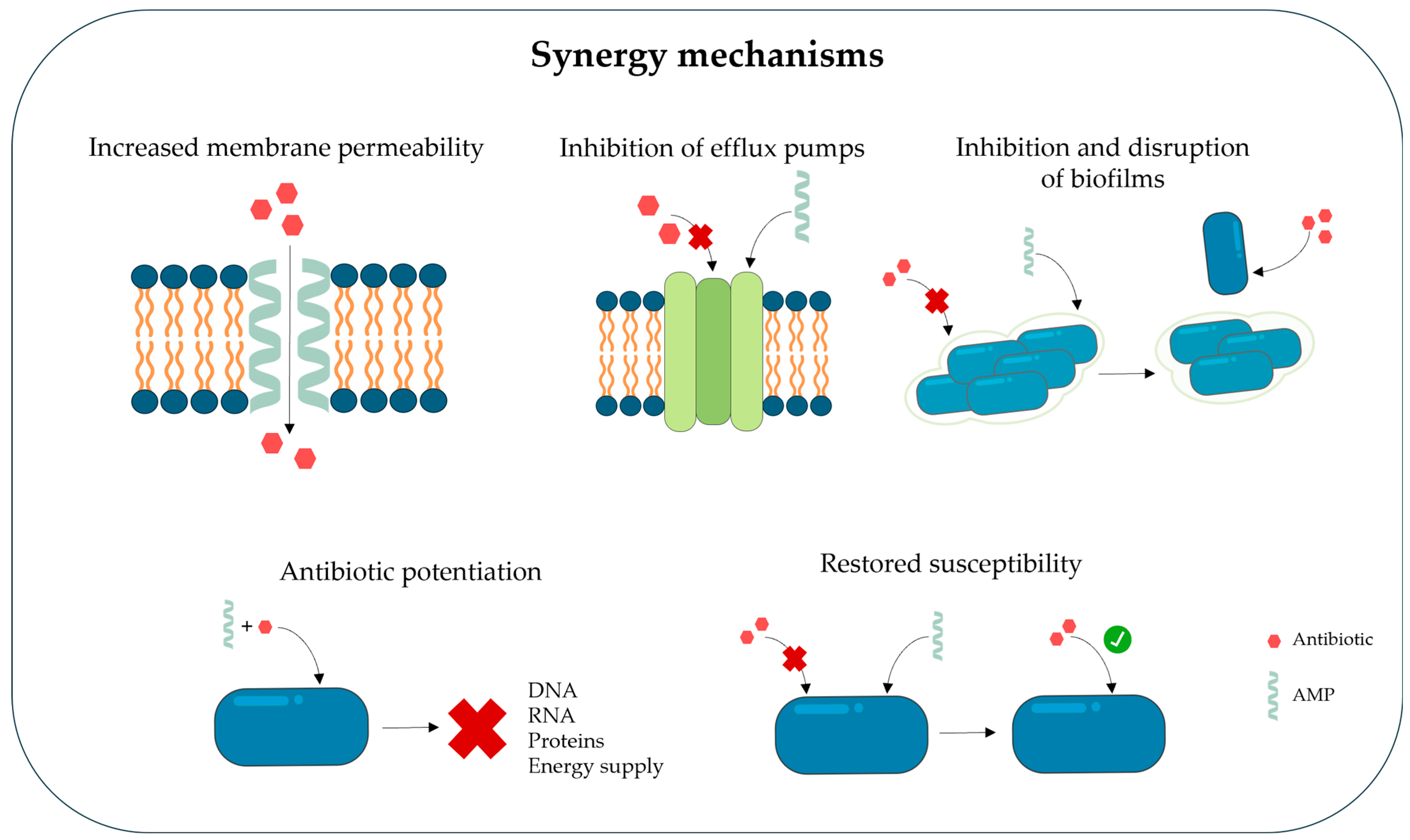
- Mechanism I: Increased Membrane Permeability: AMPs cause the breakdown of bacterial membranes by increasing permeability or causing structural defects, allowing antibiotics that might otherwise have difficulty reaching their targets to enter cells. This disruption compromises membrane integrity through mechanisms such as the carpet model, toroidal pore formation, or barrel-stave insertion.
- Mechanism II: Biofilm Inhibition and Disruption: AMPs exert their action on biofilms by preventing initial bacterial cell adhesion, degrading biofilm matrix components, and downregulating the expression of genes responsible for biofilm formation. This facilitates antibiotic access by promoting biofilm dispersal.
- Mechanism III: Direct Potentiation of Antibiotic Activity: Beyond membrane disruption, AMPs can penetrate bacterial cells to disrupt intracellular metabolic processes and interfere with the synthesis of essential components, such as DNA replication, RNA transcription, and protein synthesis.
- Mechanism IV: Inhibition of Resistance Mechanisms: AMPs can restore or enhance the activity of conventional antibiotics against multidrug-resistant bacteria by interfering with resistance mechanisms. For example, AMPs can directly block the action of efflux pumps or disrupt the proton-motive force that drives them, thereby enhancing intracellular antibiotic accumulation.
2. Antimicrobial Peptides and Antibiotics: Individual Modes of Action
3. Mechanisms Underlying Synergistic Interactions
4. Direct Potentiation of Antibiotic Activity
5. Inhibition of Resistance Mechanisms
6. Evidence from In Vitro Studies
7. Evidence from In Vivo Studies
8. Challenges and Limitations
9. Future Perspectives and Applications
10. Conclusions
Author Contributions
Funding
Institutional Review Board Statement
Informed Consent Statement
Data Availability Statement
Conflicts of Interest
References
- Baran, A.; Kwiatkowska, A.; Potocki, L. Antibiotics and Bacterial Resistance—A Short Story of an Endless Arms Race. Int. J. Mol. Sci. 2023, 24, 5777. [Google Scholar] [CrossRef] [PubMed]
- Fernandes, P.; Martens, E. Antibiotics in Late Clinical Development. Biochem. Pharmacol. 2017, 133, 152–163. [Google Scholar] [CrossRef]
- Zhu, M.; Tse, M.W.; Weller, J.; Chen, J.; Blainey, P.C. The Future of Antibiotics Begins with Discovering New Combinations. Ann. N. Y. Acad. Sci. 2021, 1496, 82–96. [Google Scholar] [CrossRef] [PubMed]
- Halawa, E.M.; Fadel, M.; Al-Rabia, M.W.; Behairy, A.; Nouh, N.A.; Abdo, M.; Olga, R.; Fericean, L.; Atwa, A.M.; El-Nablaway, M.; et al. Antibiotic Action and Resistance: Updated Review of Mechanisms, Spread, Influencing Factors, and Alternative Approaches for Combating Resistance. Front. Pharmacol. 2024, 14, 1305294. [Google Scholar] [CrossRef]
- Dini, I. Mechanisms of Bacterial Resistance and Innovative Strategies to Overcome Antimicrobial Resistance. Antibiotics 2026, 15, 319. [Google Scholar] [CrossRef] [PubMed]
- Yang, Q.; Gao, Y.; Ke, J.; Show, P.L.; Ge, Y.; Liu, Y.; Guo, R.; Chen, J. Antibiotics: An Overview on the Environmental Occurrence, Toxicity, Degradation, and Removal Methods. Bioengineered 2021, 12, 7376–7416. [Google Scholar] [CrossRef]
- Aslam, B.; Wang, W.; Arshad, M.I.; Khurshid, M.; Muzammil, S.; Rasool, M.H.; Nisar, M.A.; Alvi, R.F.; Aslam, M.A.; Qamar, M.U.; et al. Antibiotic Resistance: A Rundown of a Global Crisis. Infect. Drug Resist. 2018, 11, 1645–1658. [Google Scholar] [CrossRef]
- Frieri, M.; Kumar, K.; Boutin, A. Antibiotic Resistance. J. Infect. Public Health 2017, 10, 369–378. [Google Scholar] [CrossRef]
- Pulingam, T.; Parumasivam, T.; Gazzali, A.M.; Sulaiman, A.M.; Chee, J.Y.; Lakshmanan, M.; Chin, C.F.; Sudesh, K. Antimicrobial Resistance: Prevalence, Economic Burden, Mechanisms of Resistance and Strategies to Overcome. Eur. J. Pharm. Sci. 2022, 170, 106103. [Google Scholar] [CrossRef]
- World Health Organization. No Time to Wait: Securing the Future from Drug-Resistant Infections. Available online: https://www.who.int/publications/i/item/no-time-to-wait-securing-the-future-from-drug-resistant-infections (accessed on 9 February 2026).
- Taheri-Araghi, S. Synergistic Action of Antimicrobial Peptides and Antibiotics: Current Understanding and Future Directions. Front. Microbiol. 2024, 15, 1390765. [Google Scholar] [CrossRef] [PubMed]
- Baer, W.S. The Classic: The Treatment of Chronic Osteomyelitis with the Maggot (Larva of the Blow Fly), 1931. Clin. Orthop. 2011, 469, 920–944. [Google Scholar] [CrossRef] [PubMed]
- Yoon, K.A.; Kim, W.-J.; Cho, H.; Yoon, H.; Ahn, N.-H.; Lee, B.-H.; Lee, S.H. Characterization of Anti-Microbial Peptides and Proteins from Maggots of Calliphoridae and Sarcophagidae Fly Species (Diptera). Comp. Biochem. Physiol. Part C Toxicol. Pharmacol. 2022, 259, 109390. [Google Scholar] [CrossRef]
- Grigat, J.; Soruri, A.; Forssmann, U.; Riggert, J.; Zwirner, J. Chemoattraction of Macrophages, T Lymphocytes, and Mast Cells Is Evolutionarily Conserved within the Human α-Defensin Family. J. Immunol. 2007, 179, 3958–3965. [Google Scholar] [CrossRef]
- Lewies, A.; Du Plessis, L.H.; Wentzel, J.F. Antimicrobial Peptides: The Achilles’ Heel of Antibiotic Resistance? Probiotics Antimicrob. Proteins 2019, 11, 370–381. [Google Scholar] [CrossRef]
- Petrov, V.; Funderburg, N.; Weinberg, A.; Sieg, S. Human β Defensin-3 Induces Chemokines from Monocytes and Macrophages: Diminished Activity in Cells from HIV -infected Persons. Immunology 2013, 140, 413–420. [Google Scholar] [CrossRef]
- Karapetian, M.; Alimbarashvili, E.; Vishnepolsky, B.; Gabrielian, A.; Rosenthal, A.; Hurt, D.E.; Tartakovsky, M.; Mchedlishvili, M.; Arsenadze, D.; Pirtskhalava, M.; et al. Evaluation of the Synergistic Potential and Mechanisms of Action for de Novo Designed Cationic Antimicrobial Peptides. Heliyon 2024, 10, e27852. [Google Scholar] [CrossRef]
- Ali, M.; Garg, A.; Srivastava, A.; Arora, P.K. The Role of Antimicrobial Peptides in Overcoming Antibiotic Resistance. The Microbe 2025, 7, 100337. [Google Scholar] [CrossRef]
- Luo, Y.; Song, Y. Mechanism of Antimicrobial Peptides: Antimicrobial, Anti-Inflammatory and Antibiofilm Activities. Int. J. Mol. Sci. 2021, 22, 11401. [Google Scholar] [CrossRef]
- Fjell, C.D.; Hiss, J.A.; Hancock, R.E.W.; Schneider, G. Designing Antimicrobial Peptides: Form Follows Function. Nat. Rev. Drug Discov. 2012, 11, 37–51, Erratum in Nat. Rev. Drug. Discov. 2012, 11, 168. [Google Scholar] [CrossRef] [PubMed]
- Yang, R.; Ma, X.; Peng, F.; Wen, J.; Allahou, L.W.; Williams, G.R.; Knowles, J.C.; Poma, A. Advances in Antimicrobial Peptides: From Mechanistic Insights to Chemical Modifications. Biotechnol. Adv. 2025, 81, 108570. [Google Scholar] [CrossRef] [PubMed]
- Mhlongo, J.T.; Waddad, A.Y.; Albericio, F.; De La Torre, B.G. Antimicrobial Peptide Synergies for Fighting Infectious Diseases. Adv. Sci. 2023, 10, 2300472. [Google Scholar] [CrossRef]
- Bucataru, C.; Ciobanasu, C. Antimicrobial Peptides: Opportunities and Challenges in Overcoming Resistance. Microbiol. Res. 2024, 286, 127822. [Google Scholar] [CrossRef]
- Kumar, P.; Kizhakkedathu, J.; Straus, S. Antimicrobial Peptides: Diversity, Mechanism of Action and Strategies to Improve the Activity and Biocompatibility In Vivo. Biomolecules 2018, 8, 4. [Google Scholar] [CrossRef] [PubMed]
- Le, C.-F.; Fang, C.-M.; Sekaran, S.D. Intracellular Targeting Mechanisms by Antimicrobial Peptides. Antimicrob. Agents Chemother. 2017, 61, e02340-16. [Google Scholar] [CrossRef]
- Makowska, M.; Prahl, A.; Małuch, I. Charakterystyka peptydów przeciwdrobnoustrojowych oraz wpływ modyfikacji chemicznych na modulowanie ich aktywności biologicznej. Postępy Biochem. 2019, 65, 278–288. [Google Scholar] [CrossRef]
- Zhang, Q.-Y.; Yan, Z.-B.; Meng, Y.-M.; Hong, X.-Y.; Shao, G.; Ma, J.-J.; Cheng, X.-R.; Liu, J.; Kang, J.; Fu, C.-Y. Antimicrobial Peptides: Mechanism of Action, Activity and Clinical Potential. Mil. Med. Res. 2021, 8, 48. [Google Scholar] [CrossRef]
- Wu, X.; Li, Z.; Li, X.; Tian, Y.; Fan, Y.; Yu, C.; Zhou, B.; Liu, Y.; Xiang, R.; Yang, L. Synergistic Effects of Antimicrobial Peptide DP7 Combined with Antibiotics against Multidrug-Resistant Bacteria. Drug Des. Devel. Ther. 2017, 11, 939–946. [Google Scholar] [CrossRef]
- Pane, K.; Sgambati, V.; Zanfardino, A.; Smaldone, G.; Cafaro, V.; Angrisano, T.; Pedone, E.; Di Gaetano, S.; Capasso, D.; Haney, E.F.; et al. A New Cryptic Cationic Antimicrobial Peptide from Human Apolipoprotein E with Antibacterial Activity and Immunomodulatory Effects on Human Cells. FEBS J. 2016, 283, 2115–2131. [Google Scholar] [CrossRef]
- Torres, M.D.T.; Melo, M.C.R.; Flowers, L.; Crescenzi, O.; Notomista, E.; De La Fuente-Nunez, C. Mining for Encrypted Peptide Antibiotics in the Human Proteome. Nat. Biomed. Eng. 2021, 6, 67–75, Erratum in Nat Biomed. Eng. 2022, 6, 1451. [Google Scholar] [CrossRef] [PubMed]
- Yu, G.; Baeder, D.Y.; Regoes, R.R.; Rolff, J. Combination Effects of Antimicrobial Peptides. Antimicrob. Agents Chemother. 2016, 60, 1717–1724. [Google Scholar] [CrossRef] [PubMed]
- Doern, C.D. When Does 2 plus 2 Equal 5? A Review of Antimicrobial Synergy Testing. J. Clin. Microbiol. 2014, 52, 4124–4128. [Google Scholar] [CrossRef]
- Santos, C.; Rodrigues, G.R.; Lima, L.F.; dos Reis, M.C.G.; Cunha, N.B.; Dias, S.C.; Franco, O.L. Advances and Perspectives for Antimicrobial Peptide and Combinatory Therapies. Front. Bioeng. Biotechnol. 2022, 10, 1051456. [Google Scholar] [CrossRef]
- Gonçalves, R.M.; Monges, B.E.D.; Oshiro, K.G.N.; Cândido, E.D.S.; Pimentel, J.P.F.; Franco, O.L.; Cardoso, M.H. Advantages and Challenges of Using Antimicrobial Peptides in Synergism with Antibiotics for Treating Multidrug-Resistant Bacteria. ACS Infect. Dis. 2025, 11, 323–334. [Google Scholar] [CrossRef]
- Li, X.; Zuo, S.; Wang, B.; Zhang, K.; Wang, Y. Antimicrobial Mechanisms and Clinical Application Prospects of Antimicrobial Peptides. Molecules 2022, 27, 2675. [Google Scholar] [CrossRef]
- Boparai, J.K.; Sharma, P.K. Mini Review on Antimicrobial Peptides, Sources, Mechanism and Recent Applications. Protein Pept. Lett. 2019, 27, 4–16. [Google Scholar] [CrossRef]
- Haney, E.F.; Mansour, S.C.; Hancock, R.E.W. Antimicrobial Peptides: An Introduction. In Antimicrobial Peptides; Hansen, P.R., Ed.; Methods in Molecular Biology; Springer: New York, NY, USA, 2017; Volume 1548, pp. 3–22. ISBN 978-1-4939-6735-3. [Google Scholar]
- Mardirossian, M.; Barrière, Q.; Timchenko, T.; Müller, C.; Pacor, S.; Mergaert, P.; Scocchi, M.; Wilson, D.N. Fragments of the Nonlytic Proline-Rich Antimicrobial Peptide Bac5 Kill Escherichia coli Cells by Inhibiting Protein Synthesis. Antimicrob. Agents Chemother. 2018, 62, e00534-18. [Google Scholar] [CrossRef] [PubMed]
- Zhu, Y.; Weisshaar, J.C.; Mustafi, M. Long-Term Effects of the Proline-Rich Antimicrobial Peptide Oncocin112 on the Escherichia coli Translation Machinery. J. Biol. Chem. 2020, 295, 13314–13325. [Google Scholar] [CrossRef]
- Rahnamaeian, M. Antimicrobial Peptides: Modes of Mechanism, Modulation of Defense Responses. Plant Signal. Behav. 2011, 6, 1325–1332. [Google Scholar] [CrossRef] [PubMed]
- Huang, X.; Li, G. Antimicrobial Peptides and Cell-Penetrating Peptides: Non-Antibiotic Membrane-Targeting Strategies Against Bacterial Infections. Infect. Drug Resist. 2023, 16, 1203–1219. [Google Scholar] [CrossRef] [PubMed]
- Miteva, M.; Andersson, M.; Karshikoff, A.; Otting, G. Molecular Electroporation: A Unifying Concept for the Description of Membrane Pore Formation by Antibacterial Peptides, Exemplified with NK-lysin. FEBS Lett. 1999, 462, 155–158. [Google Scholar] [CrossRef]
- Jean-François, F.; Elezgaray, J.; Berson, P.; Vacher, P.; Dufourc, E.J. Pore Formation Induced by an Antimicrobial Peptide: Electrostatic Effects. Biophys. J. 2008, 95, 5748–5756. [Google Scholar] [CrossRef]
- Huang, H.W. DAPTOMYCIN, Its Membrane-Active Mechanism vs. That of Other Antimicrobial Peptides. Biochim. Biophys. Acta BBA Biomembr. 2020, 1862, 183395. [Google Scholar] [CrossRef]
- Grage, S.L.; Afonin, S.; Kara, S.; Buth, G.; Ulrich, A.S. Membrane Thinning and Thickening Induced by Membrane-Active Amphipathic Peptides. Front. Cell Dev. Biol. 2016, 4, 65. [Google Scholar] [CrossRef]
- Scocchi, M.; Mardirossian, M.; Runti, G.; Benincasa, M. Non-Membrane Permeabilizing Modes of Action of Antimicrobial Peptides on Bacteria. Curr. Top. Med. Chem. 2015, 16, 76–88. [Google Scholar] [CrossRef]
- Xuan, J.; Feng, W.; Wang, J.; Wang, R.; Zhang, B.; Bo, L.; Chen, Z.-S.; Yang, H.; Sun, L. Antimicrobial Peptides for Combating Drug-Resistant Bacterial Infections. Drug Resist. Updat. 2023, 68, 100954. [Google Scholar] [CrossRef]
- Uluseker, C.; Kaster, K.M.; Thorsen, K.; Basiry, D.; Shobana, S.; Jain, M.; Kumar, G.; Kommedal, R.; Pala-Ozkok, I. A Review on Occurrence and Spread of Antibiotic Resistance in Wastewaters and in Wastewater Treatment Plants: Mechanisms and Perspectives. Front. Microbiol. 2021, 12, 717809. [Google Scholar] [CrossRef]
- Keller, M.R.; Dörr, T. Bacterial Metabolism and Susceptibility to Cell Wall-Active Antibiotics. In Advances in Microbial Physiology; Elsevier: Amsterdam, The Netherlands, 2023; Volume 83, pp. 181–219. ISBN 978-0-443-19336-1. [Google Scholar]
- Dörr, T.; Moynihan, P.J.; Mayer, C. Editorial: Bacterial Cell Wall Structure and Dynamics. Front. Microbiol. 2019, 10, 2051. [Google Scholar] [CrossRef]
- Pancu, D.F.; Scurtu, A.; Macasoi, I.G.; Marti, D.; Mioc, M.; Soica, C.; Coricovac, D.; Horhat, D.; Poenaru, M.; Dehelean, C. Antibiotics: Conventional Therapy and Natural Compounds with Antibacterial Activity—A Pharmaco-Toxicological Screening. Antibiotics 2021, 10, 401. [Google Scholar] [CrossRef]
- Kapoor, G.; Saigal, S.; Elongavan, A. Action and Resistance Mechanisms of Antibiotics: A Guide for Clinicians. J. Anaesthesiol. Clin. Pharmacol. 2017, 33, 300. [Google Scholar] [CrossRef]
- Sohmen, D.; Harms, J.M.; Schlünzen, F.; Wilson, D.N. Enhanced SnapShot: Antibiotic Inhibition of Protein Synthesis II. Cell 2009, 139, 212–212.e1. [Google Scholar] [CrossRef]
- Arenz, S.; Wilson, D.N. Bacterial Protein Synthesis as a Target for Antibiotic Inhibition. Cold Spring Harb. Perspect. Med. 2016, 6, a025361. [Google Scholar] [CrossRef]
- Orelle, C.; Carlson, S.; Kaushal, B.; Almutairi, M.M.; Liu, H.; Ochabowicz, A.; Quan, S.; Pham, V.C.; Squires, C.L.; Murphy, B.T.; et al. Tools for Characterizing Bacterial Protein Synthesis Inhibitors. Antimicrob. Agents Chemother. 2013, 57, 5994–6004. [Google Scholar] [CrossRef]
- Shapiro, R.S. Antimicrobial-Induced DNA Damage and Genomic Instability in Microbial Pathogens. PLoS Pathog. 2015, 11, e1004678. [Google Scholar] [CrossRef]
- Peach, K.C.; Bray, W.M.; Winslow, D.; Linington, P.F.; Linington, R.G. Mechanism of Action-Based Classification of Antibiotics Using High-Content Bacterial Image Analysis. Mol. Biosyst. 2013, 9, 1837. [Google Scholar] [CrossRef]
- Eyler, R.F.; Shvets, K. Clinical Pharmacology of Antibiotics. Clin. J. Am. Soc. Nephrol. 2019, 14, 1080–1090. [Google Scholar] [CrossRef]
- Campbell, E.A.; Korzheva, N.; Mustaev, A.; Murakami, K.; Nair, S.; Goldfarb, A.; Darst, S.A. Structural Mechanism for Rifampicin Inhibition of Bacterial RNA Polymerase. Cell 2001, 104, 901–912. [Google Scholar] [CrossRef]
- Kohanski, M.A.; Dwyer, D.J.; Collins, J.J. How Antibiotics Kill Bacteria: From Targets to Networks. Nat. Rev. Microbiol. 2010, 8, 423–435. [Google Scholar] [CrossRef]
- Stokes, J.M.; Lopatkin, A.J.; Lobritz, M.A.; Collins, J.J. Bacterial Metabolism and Antibiotic Efficacy. Cell Metab. 2019, 30, 251–259. [Google Scholar] [CrossRef]
- Wong, F.; Stokes, J.M.; Bening, S.C.; Vidoudez, C.; Trauger, S.A.; Collins, J.J. Reactive Metabolic Byproducts Contribute to Antibiotic Lethality under Anaerobic Conditions. Mol. Cell 2022, 82, 3499–3512.e10. [Google Scholar] [CrossRef]
- Salam, M.A.; Al-Amin, M.Y.; Salam, M.T.; Pawar, J.S.; Akhter, N.; Rabaan, A.A.; Alqumber, M.A.A. Antimicrobial Resistance: A Growing Serious Threat for Global Public Health. Healthcare 2023, 11, 1946. [Google Scholar] [CrossRef]
- Ventola, C.L. The Antibiotic Resistance Crisis: Part 1: Causes and Threats. P T Peer-Rev. J. Formul. Manag. 2015, 40, 277–283. [Google Scholar]
- Fisher, R.A.; Gollan, B.; Helaine, S. Persistent Bacterial Infections and Persister Cells. Nat. Rev. Microbiol. 2017, 15, 453–464. [Google Scholar] [CrossRef]
- Lennard, P.R.; Hiemstra, P.S.; Nibbering, P.H. Complementary Activities of Host Defence Peptides and Antibiotics in Combating Antimicrobial Resistant Bacteria. Antibiotics 2023, 12, 1518. [Google Scholar] [CrossRef]
- Munk, J.K.; Ritz, C.; Fliedner, F.P.; Frimodt-Møller, N.; Hansen, P.R. Novel Method to Identify the Optimal Antimicrobial Peptide in a Combination Matrix, Using Anoplin as an Example. Antimicrob. Agents Chemother. 2014, 58, 1063–1070. [Google Scholar] [CrossRef]
- Wang, J.; Dou, X.; Song, J.; Lyu, Y.; Zhu, X.; Xu, L.; Li, W.; Shan, A. Antimicrobial Peptides: Promising Alternatives in the Post Feeding Antibiotic Era. Med. Res. Rev. 2019, 39, 831–859. [Google Scholar] [CrossRef]
- Cruz Orozco, K.; Ibarra Valencia, M.A.; Barrios Camacho, H.; Corzo Burguete, G.; Arenas Sosa, I. Antimicrobial and Antibiofilm Activity of Analogous Synthetic Peptides from Anoplin, Temporin, and Aurein. Int. J. Pept. Res. Ther. 2025, 31, 25. [Google Scholar] [CrossRef]
- Zhang, Q. Antimicrobial Peptides: From Discovery to Developmental Applications. Appl. Environ. Microbiol. 2025, 91, e02115–e02124. [Google Scholar] [CrossRef]
- Zhong, C.; Zou, J.; Mao, W.; Yang, P.; Zhang, J.; Gou, S.; Zhang, Y.; Liu, H.; Ni, J. Structure Modification of Anoplin for Fighting Resistant Bacteria. Eur. J. Med. Chem. 2024, 268, 116276. [Google Scholar] [CrossRef]
- Wang, Y.; Chen, J.; Zheng, X.; Yang, X.; Ma, P.; Cai, Y.; Zhang, B.; Chen, Y. Design of Novel Analogues of Short Antimicrobial Peptide Anoplin with Improved Antimicrobial Activity. J. Pept. Sci. 2014, 20, 945–951. [Google Scholar] [CrossRef]
- Liu, B.; Huang, H.; Yang, Z.; Liu, B.; Gou, S.; Zhong, C.; Han, X.; Zhang, Y.; Ni, J.; Wang, R. Design of Novel Antimicrobial Peptide Dimer Analogues with Enhanced Antimicrobial Activity In Vitro and In Vivo by Intermolecular Triazole Bridge Strategy. Peptides 2017, 88, 115–125. [Google Scholar] [CrossRef]
- Wojciechowska, M.; Macyszyn, J.; Miszkiewicz, J.; Grzela, R.; Trylska, J. Stapled Anoplin as an Antibacterial Agent. Front. Microbiol. 2021, 12, 772038. [Google Scholar] [CrossRef]
- Wani, N.A.; Singh, G.; Shankar, S.; Sharma, A.; Katoch, M.; Rai, R. Short Hybrid Peptides Incorporating β- and γ-Amino Acids as Antimicrobial Agents. Peptides 2017, 97, 46–53, Erratum in Peptides 2018, 104, 85. [Google Scholar] [CrossRef]
- Zhong, C.; Zhu, Y.; Zhu, N.; Liu, T.; Gou, S.; Zhang, F.; Yao, J.; Xie, J.; Ni, J. Synthesis and Anti-Pseudomonal Activity of New ß-Ala Modified Analogues of the Antimicrobial Peptide Anoplin. Int. J. Med. Microbiol. 2020, 310, 151433. [Google Scholar] [CrossRef] [PubMed]
- Ridyard, K.E.; Overhage, J. The Potential of Human Peptide LL-37 as an Antimicrobial and Anti-Biofilm Agent. Antibiotics 2021, 10, 650. [Google Scholar] [CrossRef] [PubMed]
- Leszczyńska, K.; Namiot, A.; Janmey, P.A.; Bucki, R. Modulation of Exogenous Antibiotic Activity by Host Cathelicidin LL-37. APMIS 2010, 118, 830–836. [Google Scholar] [CrossRef] [PubMed]
- Nuding, S.; Frasch, T.; Schaller, M.; Stange, E.F.; Zabel, L.T. Synergistic Effects of Antimicrobial Peptides and Antibiotics against Clostridium Difficile. Antimicrob. Agents Chemother. 2014, 58, 5719–5725. [Google Scholar] [CrossRef]
- Memariani, H.; Memariani, M. Antibiofilm Properties of Cathelicidin LL-37: An in-Depth Review. World J. Microbiol. Biotechnol. 2023, 39, 99. [Google Scholar] [CrossRef]
- Rabin, N.; Zheng, Y.; Opoku-Temeng, C.; Du, Y.; Bonsu, E.; Sintim, H.O. Biofilm Formation Mechanisms and Targets for Developing Antibiofilm Agents. Future Med. Chem. 2015, 7, 493–512, Erratum in Future Med. Chem. 2015, 7, 1362. [Google Scholar] [CrossRef]
- Zhao, A.; Sun, J.; Liu, Y. Understanding Bacterial Biofilms: From Definition to Treatment Strategies. Front. Cell. Infect. Microbiol. 2023, 13, 1137947. [Google Scholar] [CrossRef] [PubMed]
- Roy, R.; Tiwari, M.; Donelli, G.; Tiwari, V. Strategies for Combating Bacterial Biofilms: A Focus on Anti-Biofilm Agents and Their Mechanisms of Action. Virulence 2018, 9, 522–554. [Google Scholar] [CrossRef] [PubMed]
- Hussaini, I.M.; Oyewole, O.A.; Sulaiman, M.A.; Dabban, A.I.; Sulaiman, A.N.; Tarek, R. Microbial Anti-Biofilms: Types and Mechanism of Action. Res. Microbiol. 2024, 175, 104111. [Google Scholar] [CrossRef]
- Yasir, M.; Willcox, M.D.P.; Dutta, D. Action of Antimicrobial Peptides against Bacterial Biofilms. Materials 2018, 11, 2468. [Google Scholar] [CrossRef]
- Hancock, R.E.W.; Alford, M.A.; Haney, E.F. Antibiofilm Activity of Host Defence Peptides: Complexity Provides Opportunities. Nat. Rev. Microbiol. 2021, 19, 786–797. [Google Scholar] [CrossRef] [PubMed]
- Ridyard, K.E.; Elsawy, M.; Mattrasingh, D.; Klein, D.; Strehmel, J.; Beaulieu, C.; Wong, A.; Overhage, J. Synergy between Human Peptide LL-37 and Polymyxin B against Planktonic and Biofilm Cells of Escherichia coli and Pseudomonas aeruginosa. Antibiotics 2023, 12, 389. [Google Scholar] [CrossRef] [PubMed]
- Zharkova, M.S.; Orlov, D.S.; Golubeva, O.Y.; Chakchir, O.B.; Eliseev, I.E.; Grinchuk, T.M.; Shamova, O.V. Application of Antimicrobial Peptides of the Innate Immune System in Combination with Conventional Antibiotics—A Novel Way to Combat Antibiotic Resistance? Front. Cell. Infect. Microbiol. 2019, 9, 128. [Google Scholar] [CrossRef]
- Zhu, Y.; Hao, W.; Wang, X.; Ouyang, J.; Deng, X.; Yu, H.; Wang, Y. Antimicrobial Peptides, Conventional Antibiotics, and Their Synergistic Utility for the Treatment of Drug-resistant Infections. Med. Res. Rev. 2022, 42, 1377–1422. [Google Scholar] [CrossRef]
- Xiao, G.; Li, J.; Sun, Z. The Combination of Antibiotic and Non-Antibiotic Compounds Improves Antibiotic Efficacy against Multidrug-Resistant Bacteria. Int. J. Mol. Sci. 2023, 24, 15493. [Google Scholar] [CrossRef]
- Hilpert, K.; McLeod, B.; Yu, J.; Elliott, M.R.; Rautenbach, M.; Ruden, S.; Bürck, J.; Muhle-Goll, C.; Ulrich, A.S.; Keller, S.; et al. Short Cationic Antimicrobial Peptides Interact with ATP. Antimicrob. Agents Chemother. 2010, 54, 4480–4483. [Google Scholar] [CrossRef]
- Ruden, S.; Rieder, A.; Chis Ster, I.; Schwartz, T.; Mikut, R.; Hilpert, K. Synergy Pattern of Short Cationic Antimicrobial Peptides Against Multidrug-Resistant Pseudomonas aeruginosa. Front. Microbiol. 2019, 10, 2740. [Google Scholar] [CrossRef]
- McMillan, K.A.M.; Coombs, M.R.P. Investigating Potential Applications of the Fish Anti-Microbial Peptide Pleurocidin: A Systematic Review. Pharmaceuticals 2021, 14, 687. [Google Scholar] [CrossRef] [PubMed]
- Choi, H.; Lee, D.G. Antimicrobial Peptide Pleurocidin Synergizes with Antibiotics through Hydroxyl Radical Formation and Membrane Damage, and Exerts Antibiofilm Activity. Biochim. Biophys. Acta 2012, 1820, 1831–1838. [Google Scholar] [CrossRef]
- Li, D.; Yang, Y.; Tian, Z.; Lv, J.; Sun, F.; Wang, Q.; Liu, Y.; Xia, P. Synergistic Antibiotic Effect of Looped Antimicrobial Peptide CLP-19 with Bactericidal and Bacteriostatic Agents. Oncotarget 2017, 8, 55958–55966. [Google Scholar] [CrossRef] [PubMed]
- Sánchez-Gómez, S.; Japelj, B.; Jerala, R.; Moriyón, I.; Fernández Alonso, M.; Leiva, J.; Blondelle, S.E.; Andrä, J.; Brandenburg, K.; Lohner, K.; et al. Structural Features Governing the Activity of Lactoferricin-Derived Peptides That Act in Synergy with Antibiotics against Pseudomonas aeruginosa in Vitro and in Vivo. Antimicrob. Agents Chemother. 2011, 55, 218–228. [Google Scholar] [CrossRef] [PubMed]
- Hu, Y.; Liu, A.; Vaudrey, J.; Vaiciunaite, B.; Moigboi, C.; McTavish, S.M.; Kearns, A.; Coates, A. Combinations of β-Lactam or Aminoglycoside Antibiotics with Plectasin Are Synergistic against Methicillin-Sensitive and Methicillin-Resistant Staphylococcus aureus. PLoS ONE 2015, 10, e0117664. [Google Scholar] [CrossRef]
- Goldberg, K.; Sarig, H.; Zaknoon, F.; Epand, R.F.; Epand, R.M.; Mor, A. Sensitization of Gram-Negative Bacteria by Targeting the Membrane Potential. FASEB J. Off. Publ. Fed. Am. Soc. Exp. Biol. 2013, 27, 3818–3826. [Google Scholar] [CrossRef]
- Thappeta, K.R.V.; Vikhe, Y.S.; Yong, A.M.H.; Chan-Park, M.B.; Kline, K.A. Combined Efficacy of an Antimicrobial Cationic Peptide Polymer with Conventional Antibiotics to Combat Multidrug-Resistant Pathogens. ACS Infect. Dis. 2020, 6, 1228–1237. [Google Scholar] [CrossRef]
- Yang, J.; Zhang, J.; Feng, Z.; Ma, Y. The Role and Mechanisms of Antimicrobial Peptides in Overcoming Multidrug-Resistant Bacteria. Molecules 2024, 30, 128. [Google Scholar] [CrossRef]
- Cirioni, O.; Ghiselli, R.; Silvestri, C.; Kamysz, W.; Orlando, F.; Mocchegiani, F.; Di Matteo, F.; Riva, A.; Łukasiak, J.; Scalise, G.; et al. Efficacy of Tachyplesin III, Colistin, and Imipenem against a Multiresistant Pseudomonas aeruginosa Strain. Antimicrob. Agents Chemother. 2007, 51, 2005–2010. [Google Scholar] [CrossRef] [PubMed]
- Choi, H.; Lee, D.G. Synergistic Effect of Antimicrobial Peptide Arenicin-1 in Combination with Antibiotics against Pathogenic Bacteria. Res. Microbiol. 2012, 163, 479–486. [Google Scholar] [CrossRef]
- Naghmouchi, K.; Le Lay, C.; Baah, J.; Drider, D. Antibiotic and Antimicrobial Peptide Combinations: Synergistic Inhibition of Pseudomonas Fluorescens and Antibiotic-Resistant Variants. Res. Microbiol. 2012, 163, 101–108. [Google Scholar] [CrossRef]
- Rajasekaran, G.; Kim, E.Y.; Shin, S.Y. LL-37-Derived Membrane-Active FK-13 Analogs Possessing Cell Selectivity, Anti-Biofilm Activity and Synergy with Chloramphenicol and Anti-Inflammatory Activity. Biochim. Biophys. Acta Biomembr. 2017, 1859, 722–733. [Google Scholar] [CrossRef] [PubMed]
- Almaaytah, A.; Abualhaijaa, A.; Alqudah, O. The Evaluation of the Synergistic Antimicrobial and Antibiofilm Activity of AamAP1-Lysine with Conventional Antibiotics against Representative Resistant Strains of Both Gram-Positive and Gram-Negative Bacteria. Infect. Drug Resist. 2019, 12, 1371–1380. [Google Scholar] [CrossRef] [PubMed]
- Kampshoff, F.; Willcox, M.D.P.; Dutta, D. A Pilot Study of the Synergy between Two Antimicrobial Peptides and Two Common Antibiotics. Antibiotics 2019, 8, 60. [Google Scholar] [CrossRef]
- Morroni, G.; Simonetti, O.; Brenciani, A.; Brescini, L.; Kamysz, W.; Kamysz, E.; Neubauer, D.; Caffarini, M.; Orciani, M.; Giovanetti, E.; et al. In Vitro Activity of Protegrin-1, Alone and in Combination with Clinically Useful Antibiotics, against Acinetobacter Baumannii Strains Isolated from Surgical Wounds. Med. Microbiol. Immunol. 2019, 208, 877–883. [Google Scholar] [CrossRef] [PubMed]
- Shang, D.; Liu, Y.; Jiang, F.; Ji, F.; Wang, H.; Han, X. Synergistic Antibacterial Activity of Designed Trp-Containing Antibacterial Peptides in Combination With Antibiotics Against Multidrug-Resistant Staphylococcus Epidermidis. Front. Microbiol. 2019, 10, 2719. [Google Scholar] [CrossRef]
- Xiong, F.; Dai, X.; Li, Y.; Wei, R.; An, L.; Wang, Y.; Chen, Z. Effects of the Antimicrobial Peptide L12 against Multidrug-resistant Staphylococcus aureus. Mol. Med. Rep. 2019, 19, 3337–3344. [Google Scholar] [CrossRef] [PubMed]
- Barber, K.E.; Shammout, Z.; Smith, J.R.; Kebriaei, R.; Morrisette, T.; Rybak, M.J. Biofilm Time-Kill Curves to Assess the Bactericidal Activity of Daptomycin Combinations against Biofilm-Producing Vancomycin-Resistant Enterococcus faecium and faecalis. Antibiotics 2021, 10, 897. [Google Scholar] [CrossRef] [PubMed]
- Piers, K.L.; Brown, M.H.; Hancock, R.E. Improvement of Outer Membrane-Permeabilizing and Lipopolysaccharide-Binding Activities of an Antimicrobial Cationic Peptide by C-Terminal Modification. Antimicrob. Agents Chemother. 1994, 38, 2311–2316. [Google Scholar] [CrossRef]
- Giuliani, A.; Pirri, G.; Nicoletto, S. Antimicrobial Peptides: An Overview of a Promising Class of Therapeutics. Cent. Eur. J. Biol. 2007, 2, 1–33. [Google Scholar] [CrossRef]
- Wiegand, I.; Hilpert, K.; Hancock, R.E.W. Agar and Broth Dilution Methods to Determine the Minimal Inhibitory Concentration (MIC) of Antimicrobial Substances. Nat. Protoc. 2008, 3, 163–175. [Google Scholar] [CrossRef]
- Mercer, D.K.; Torres, M.D.T.; Duay, S.S.; Lovie, E.; Simpson, L.; Von Köckritz-Blickwede, M.; De La Fuente-Nunez, C.; O’Neil, D.A.; Angeles-Boza, A.M. Antimicrobial Susceptibility Testing of Antimicrobial Peptides to Better Predict Efficacy. Front. Cell. Infect. Microbiol. 2020, 10, 326. [Google Scholar] [CrossRef] [PubMed]
- Loffredo, M.R.; Savini, F.; Bobone, S.; Casciaro, B.; Franzyk, H.; Mangoni, M.L.; Stella, L. Inoculum Effect of Antimicrobial Peptides. Proc. Natl. Acad. Sci. USA 2021, 118, e2014364118. [Google Scholar] [CrossRef]
- Patrulea, V.; Borchard, G.; Jordan, O. An Update on Antimicrobial Peptides (AMPs) and Their Delivery Strategies for Wound Infections. Pharmaceutics 2020, 12, 840. [Google Scholar] [CrossRef]
- Moretta, A.; Scieuzo, C.; Petrone, A.M.; Salvia, R.; Manniello, M.D.; Franco, A.; Lucchetti, D.; Vassallo, A.; Vogel, H.; Sgambato, A.; et al. Antimicrobial Peptides: A New Hope in Biomedical and Pharmaceutical Fields. Front. Cell. Infect. Microbiol. 2021, 11, 668632. [Google Scholar] [CrossRef]
- Dijksteel, G.S.; Ulrich, M.M.W.; Middelkoop, E.; Boekema, B.K.H.L. Review: Lessons Learned from Clinical Trials Using Antimicrobial Peptides (AMPs). Front. Microbiol. 2021, 12, 616979. [Google Scholar] [CrossRef]
- Cresti, L.; Cappello, G.; Pini, A. Antimicrobial Peptides towards Clinical Application—A Long History to Be Concluded. Int. J. Mol. Sci. 2024, 25, 4870. [Google Scholar] [CrossRef]
- Tao, Q.; Lu, Y.; Liu, Q.; Chen, R.; Xu, Y.; Li, G.; Hu, X.; Ye, C.; Peng, L.; Fang, R. Antibacterial Activity of the Antimicrobial Peptide PMAP-36 in Combination with Tetracycline against Porcine Extraintestinal Pathogenic Escherichia coli in vitro and in vivo. Vet. Res. 2024, 55, 35. [Google Scholar] [CrossRef]
- Otvos, L., Jr.; Ostorhazi, E.; Szabo, D.; Zumbrun, S.D.; Miller, L.L.; Halasohoris, S.A.; Desai, P.D.; Int Veldt, S.M.; Kraus, C.N. Synergy Between Proline-Rich Antimicrobial Peptides and Small Molecule Antibiotics Against Selected Gram-Negative Pathogens in vitro and in vivo. Front. Chem. 2018, 6, 309. [Google Scholar] [CrossRef]
- Deshayes, C.; Arafath, M.N.; Apaire-Marchais, V.; Roger, E. Drug Delivery Systems for the Oral Administration of Antimicrobial Peptides: Promising Tools to Treat Infectious Diseases. Front. Med. Technol. 2022, 3, 778645. [Google Scholar] [CrossRef] [PubMed]
- Semple, F.; Webb, S.; Li, H.-N.; Patel, H.B.; Perretti, M.; Jackson, I.J.; Gray, M.; Davidson, D.J.; Dorin, J.R. Human Beta-Defensin 3 Has Immunosuppressive Activity in vitro and in vivo. Eur. J. Immunol. 2010, 40, 1073–1078. [Google Scholar] [CrossRef] [PubMed]
- Hirsch, T.; Spielmann, M.; Zuhaili, B.; Fossum, M.; Metzig, M.; Koehler, T.; Steinau, H.-U.; Yao, F.; Onderdonk, A.B.; Steinstraesser, L.; et al. Human Beta-Defensin-3 Promotes Wound Healing in Infected Diabetic Wounds. J. Gene Med. 2009, 11, 220–228. [Google Scholar] [CrossRef]
- Steinstraesser, L.; Hirsch, T.; Schulte, M.; Kueckelhaus, M.; Jacobsen, F.; Mersch, E.A.; Stricker, I.; Afacan, N.; Jenssen, H.; Hancock, R.E.W.; et al. Innate Defense Regulator Peptide 1018 in Wound Healing and Wound Infection. PLoS ONE 2012, 7, e39373. [Google Scholar] [CrossRef]
- Wei, X.; Zhou, D.; Xu, C.; Chen, P.; Chen, S.; Cheng, Z.; Jin, Y.; Jin, S.; Wu, W. Murepavadin Enhances the Killing Efficacy of Ciprofloxacin against Pseudomonas aeruginosa by Inhibiting Drug Efflux. Antibiotics 2024, 13, 810. [Google Scholar] [CrossRef]
- Gomes, D.; Santos, R.; Soares, R.S.; Reis, S.; Carvalho, S.; Rego, P.; Peleteiro, M.C.; Tavares, L.; Oliveira, M. Pexiganan in Combination with Nisin to Control Polymicrobial Diabetic Foot Infections. Antibiotics 2020, 9, 128. [Google Scholar] [CrossRef]
- Niemeyer-van Der Kolk, T.; Van Der Wall, H.; Hogendoorn, G.K.; Rijneveld, R.; Luijten, S.; Van Alewijk, D.C.J.G.; Van Den Munckhof, E.H.A.; De Kam, M.L.; Feiss, G.L.; Prens, E.P.; et al. Pharmacodynamic Effects of Topical Omiganan in Patients With Mild to Moderate Atopic Dermatitis in a Randomized, Placebo-Controlled, Phase II Trial. Clin. Transl. Sci. 2020, 13, 994–1003. [Google Scholar] [CrossRef] [PubMed]
- Bormann, N.; Koliszak, A.; Kasper, S.; Schoen, L.; Hilpert, K.; Volkmer, R.; Kikhney, J.; Wildemann, B. A Short Artificial Antimicrobial Peptide Shows Potential to Prevent or Treat Bone Infections. Sci. Rep. 2017, 7, 1506. [Google Scholar] [CrossRef]
- Ngashangva, N.; Huidrom, S.; Devi, I.S. Antimicrobial Peptides: Natural Templates for next-Generation Therapeutics against Antimicrobial Resistance. Front. Cell. Infect. Microbiol. 2026, 15, 1720027. [Google Scholar] [CrossRef]
- Bacalum, M.; Radu, M. Cationic Antimicrobial Peptides Cytotoxicity on Mammalian Cells: An Analysis Using Therapeutic Index Integrative Concept. Int. J. Pept. Res. Ther. 2015, 21, 47–55. [Google Scholar] [CrossRef]
- Ebenhan, T.; Gheysens, O.; Kruger, H.G.; Zeevaart, J.R.; Sathekge, M.M. Antimicrobial Peptides: Their Role as Infection-Selective Tracers for Molecular Imaging. BioMed Res. Int. 2014, 2014, 867381. [Google Scholar] [CrossRef] [PubMed]
- Wimley, W.C. Describing the Mechanism of Antimicrobial Peptide Action with the Interfacial Activity Model. ACS Chem. Biol. 2010, 5, 905–917. [Google Scholar] [CrossRef] [PubMed]
- Garvey, M. Antimicrobial Peptides Demonstrate Activity against Resistant Bacterial Pathogens. Infect. Dis. Rep. 2023, 15, 454–469. [Google Scholar] [CrossRef]
- Zheng, S.; Tu, Y.; Li, B.; Qu, G.; Li, A.; Peng, X.; Li, S.; Shao, C. Antimicrobial Peptide Biological Activity, Delivery Systems and Clinical Translation Status and Challenges. J. Transl. Med. 2025, 23, 292. [Google Scholar] [CrossRef] [PubMed]
- Talapko, J.; Meštrović, T.; Juzbašić, M.; Tomas, M.; Erić, S.; Horvat Aleksijević, L.; Bekić, S.; Schwarz, D.; Matić, S.; Neuberg, M.; et al. Antimicrobial Peptides—Mechanisms of Action, Antimicrobial Effects and Clinical Applications. Antibiotics 2022, 11, 1417. [Google Scholar] [CrossRef] [PubMed]
- Yan, H.; Hancock, R.E. Synergistic Interactions between Mammalian Antimicrobial Defense Peptides. Antimicrob. Agents Chemother. 2001, 45, 1558–1560. [Google Scholar] [CrossRef]
- Ye, Z.; Fu, L.; Li, S.; Chen, Z.; Ouyang, J.; Shang, X.; Liu, Y.; Gao, L.; Wang, Y. Synergistic Collaboration between AMPs and Non-Direct Antimicrobial Cationic Peptides. Nat. Commun. 2024, 15, 7319. [Google Scholar] [CrossRef]
- Kim, S.H.; Min, Y.-H.; Park, M.C. Antimicrobial Peptides: Current Status, Mechanisms of Action, and Strategies to Overcome Therapeutic Limitations. Microorganisms 2025, 13, 2574. [Google Scholar] [CrossRef] [PubMed]
- Kang, S.-J.; Nam, S.H.; Lee, B.-J. Engineering Approaches for the Development of Antimicrobial Peptide-Based Antibiotics. Antibiotics 2022, 11, 1338. [Google Scholar] [CrossRef]
- Chen, N.; Jiang, C. Antimicrobial Peptides: Structure, Mechanism, and Modification. Eur. J. Med. Chem. 2023, 255, 115377. [Google Scholar] [CrossRef]
- Han, Y.; Zhang, M.; Lai, R.; Zhang, Z. Chemical Modifications to Increase the Therapeutic Potential of Antimicrobial Peptides. Peptides 2021, 146, 170666. [Google Scholar] [CrossRef]
- Manteghi, R.; Pallagi, E.; Olajos, G.; Csóka, I. Pegylation and Formulation Strategy of Anti-Microbial Peptide (AMP) According to the Quality by Design Approach. Eur. J. Pharm. Sci. 2020, 144, 105197. [Google Scholar] [CrossRef]
- Li, W.; Separovic, F.; O’Brien-Simpson, N.M.; Wade, J.D. Chemically Modified and Conjugated Antimicrobial Peptides against Superbugs. Chem. Soc. Rev. 2021, 50, 4932–4973. [Google Scholar] [CrossRef]
- Zhang, H.; Lv, J.; Ma, Z.; Ma, J.; Chen, J. Advances in Antimicrobial Peptides: Mechanisms, Design Innovations, and Biomedical Potential. Molecules 2025, 30, 1529. [Google Scholar] [CrossRef]
- Azzopardi, E.A.; Ferguson, E.L.; Thomas, D.W. The Enhanced Permeability Retention Effect: A New Paradigm for Drug Targeting in Infection. J. Antimicrob. Chemother. 2013, 68, 257–274. [Google Scholar] [CrossRef] [PubMed]
- Fadaka, A.O.; Sibuyi, N.R.S.; Madiehe, A.M.; Meyer, M. Nanotechnology-Based Delivery Systems for Antimicrobial Peptides. Pharmaceutics 2021, 13, 1795. [Google Scholar] [CrossRef]
- Nikoletic, A.; Natsaridis, E.; Flathmann, T.; Quadros, D.P.C.; Gogniat, N.; Tagit, O. Soft Nanocarriers as Antimicrobial Co-Delivery Systems to Combat Resistant Infections. Adv. Healthc. Mater. 2025, 14, 2404540. [Google Scholar] [CrossRef]
- Khalil, I.; Burns, A.; Radecka, I.; Kowalczuk, M.; Khalaf, T.; Adamus, G.; Johnston, B.; Khechara, M. Bacterial-Derived Polymer Poly-y-Glutamic Acid (y-PGA)-Based Micro/Nanoparticles as a Delivery System for Antimicrobials and Other Biomedical Applications. Int. J. Mol. Sci. 2017, 18, 313. [Google Scholar] [CrossRef]
- Asif, F.; Zaman, S.U.; Arnab, M.K.H.; Hasan, M.; Islam, M.M. Antimicrobial Peptides as Therapeutics: Confronting Delivery Challenges to Optimize Efficacy. Microbe 2024, 2, 100051. [Google Scholar] [CrossRef]
- Li, H.; Niu, J.; Wang, X.; Niu, M.; Liao, C. The Contribution of Antimicrobial Peptides to Immune Cell Function: A Review of Recent Advances. Pharmaceutics 2023, 15, 2278. [Google Scholar] [CrossRef]
- Mahlapuu, M.; Håkansson, J.; Ringstad, L.; Björn, C. Antimicrobial Peptides: An Emerging Category of Therapeutic Agents. Front. Cell. Infect. Microbiol. 2016, 6, 194. [Google Scholar] [CrossRef] [PubMed]


| AMPs | Antibiotic | Organism | FICI | Reference |
|---|---|---|---|---|
| Tachyplesin III | imipenem | P. aeruginosa ATCC 27853 | 0.312 | [101] |
| LL-37 | amoxicillin with clavulanic acid | S. aureus (5 strains) | N/A | [78] |
| Pleurocidin | ampicillin | S. aureus ATCC 25923 | 0.5 | [94] |
| P. acnes ATCC 6919 | 0.375 | |||
| P. aeruginosa ATCC 27853 | 0.375 | |||
| E. coli ATCC 25922 | 0.5 | |||
| E. coli O-157 ATCC 43895 | 0.375 | |||
| erythromycin | S. aureus ATCC 25923 | 0.375 | ||
| P. acnes ATCC 6919 | 0.375 | |||
| E. faecium ATCC 19434 | 0.5 | |||
| P. aeruginosa ATCC 27853 | 0.375 | |||
| E. coli ATCC 25922 | 0.375 | |||
| E. coli O-157 ATCC 43895 | 0.5 | |||
| chloramphenicol | S. aureus ATCC 25923 | 0.5 | ||
| P. acnes ATCC 6919 | 0.375 | |||
| E. faecium ATCC 19434 | 0.5 | |||
| P. aeruginosa ATCC 27853 | 0.375 | |||
| E. coli ATCC 25922 | 0.5 | |||
| E. coli O-157 ATCC 43895 | 0.5 | |||
| Arenicin-1 | ampicillin | S. aureus ATCC 25923 | 0.5 | [102] |
| S. epidermidis KCTC 1917 | 0.5 | |||
| P. aeruginosa ATCC 27853 | 0.5 | |||
| E. coli ATCC 25922 | 0.375 | |||
| E. coli O-157 ATCC 43895 | 0.5 | |||
| erythromycin | S. aureus ATCC 25923 | 0.375 | ||
| S. epidermidis KCTC 1917 | 0.5 | |||
| E. faecium ATCC 19434 | 0.5 | |||
| P. aeruginosa ATCC 27853 | 0.5 | |||
| E. coli ATCC 25922 | 0.375 | |||
| E. coli O-157 ATCC 43895 | 0.5 | |||
| chloramphenicol | S. aureus ATCC 25923 | 0.5 | ||
| S. epidermidis KCTC 1917 | 0.375 | |||
| E. faecium ATCC 19434 | 0.375 | |||
| P. aeruginosa ATCC 27853 | 0.375 | |||
| E. coli ATCC 25922 | 0.5 | |||
| E. coli O-157 ATCC 43895 | 0.375 | |||
| Nisin Z | penicillin G | P. fluorescens LRC-R73 | ≤0.01 | [103] |
| streptomycin | ≤0.01 | |||
| lincomycin | ≤0.01 | |||
| vancomycin | ≤0.01 | |||
| lysozyme | 0.02 | |||
| kanamycin | 0.25 | |||
| rifampicin | 0.07 | |||
| chloramphenicol | ≤0.01 | |||
| Pediocin PA-1/AcH | penicillin G | ≤0.01 | ||
| streptomycin | ≤0.01 | |||
| lincomycin | 0.02 | |||
| vancomycin | ≤0.01 | |||
| lysozyme | 0.02 | |||
| kanamycin | 0.2 | |||
| rifampicin | 0.07 | |||
| chloramphenicol | 0.03 | |||
| C12(ω7)K-β12 | tetracycline, erythromycin | E. coli AG100 | N/A | [98] |
| NZ2114 | amoxicillin, penicillin, flucloxacillin, gentamicin, neomycin, amikacin | methicillin-sensitive S. aureus (MSSA) | N/A | [97] |
| methicillin-resistant S. aureus (MRSA) | ||||
| CLP-19 | ampicillin | E. coli ATCC 25922 | 0.375 | [95] |
| S. aureus ATCC 29213 | 0.5 | |||
| ceftazidime | E. coli ATCC 25922 | 0.5 | ||
| S. aureus ATCC 29213 | 0.5 | |||
| A. baumannii ATCC 19606 | 0.5 | |||
| levofloxacin | S. aureus ATCC 29213 | 0.5 | ||
| E. coli ATCC 25922 | 0.5 | |||
| FK-13-a1 FK-13-a7 | chloramphenicol | methicillin-resistant S. aureus CCARM 3095 | N/A | [104] |
| P. aeruginosa CCARM 2095 | ||||
| AamAP1-Lysine | rifampicin | S. aureus ATCC 29213 | 0.203 | [105] |
| S. aureus ATCC 33591 | 0.123 | |||
| erythromycin | S. aureus ATCC 29213 | 0.204 | ||
| levofloxacin | S. aureus ATCC 33591 | 0.103 | ||
| P. aeruginosa ATCC BAA2114 | 0.36 | |||
| chloramphenicol | P. aeruginosa ATCC BAA2114 | 0.36 | ||
| Melimine | ciprofloxacin | ciprofloxacin resistant P. aeruginosa 37 | 0.31–0.38 | [106] |
| Protegrin-1 | colistin | A. baumannii (21 strains) | N/A | [107] |
| fosfomycin | A. baumannii (9 strains) | |||
| meropenem | A. baumannii (9 strains) | |||
| tigecycline | A. baumannii (5 strains) | |||
| Indolicidin | polymyxin B | MDR P. aeruginosa PA 910 | 0.5 | [92] |
| tobramycin | 0.5 | |||
| gentamycin | 0.5 | |||
| amikacin | 0.5 | |||
| tetracyclin | 0.5 | |||
| Indopt 3 | polymyxin B | 0.38 | ||
| meropenem | 0.38 | |||
| tobramycin | 0.38 | |||
| gentamycin | 0.25 | |||
| amikacin | 0.31 | |||
| L11W | penicillin | MRSE S. epidermidis 1208 | 0.3121 | [108] |
| ampicillin | 0.2808 | |||
| erythromycin | 0.2808 | |||
| L12W | penicillin | 0.2808 | ||
| ampicillin | 0.2574 | |||
| erythromycin | 0.2808 | |||
| I4WL5W | penicillin | 0.1875 | ||
| ampicillin | 0.1562 | |||
| erythromycin | 0.3124 | |||
| I1WL5W | penicillin | 0.2812 | ||
| ampicillin | 0.2578 | |||
| erythromycin | 0.2812 | |||
| tetracycline | 0.2820 | |||
| L12 | vancomycin | MRSA S. aureus S26 | 0.375 | [109] |
| levofloxacin | 0.313 | |||
| vancomycin | MRSA S. aureus S49 | 0.188 | ||
| levofloxacin | 0.125 | |||
| Ano-1β | rifampicin | P. aeruginosa ATCC 27853 | 0.3125 | [76] |
| polymyxin B | 0.3125 | |||
| Ano-8β | rifampicin | 0.3125 | ||
| LL-37 | polymyxin B | E. coli MG1655 | 0.37 | [87] |
| P. aeruginosa PAO1 | 0.31 |
Disclaimer/Publisher’s Note: The statements, opinions and data contained in all publications are solely those of the individual author(s) and contributor(s) and not of MDPI and/or the editor(s). MDPI and/or the editor(s) disclaim responsibility for any injury to people or property resulting from any ideas, methods, instructions or products referred to in the content. |
© 2026 by the authors. Licensee MDPI, Basel, Switzerland. This article is an open access article distributed under the terms and conditions of the Creative Commons Attribution (CC BY) license.
Share and Cite
Matyjewicz, A.; Krakowska, A.; Műller, D.; Krakowski, J.; Paczosa-Bator, B.; Skalski, T. Synergistic Action of Antimicrobial Peptides and Antibiotics. Int. J. Mol. Sci. 2026, 27, 4553. https://doi.org/10.3390/ijms27104553
Matyjewicz A, Krakowska A, Műller D, Krakowski J, Paczosa-Bator B, Skalski T. Synergistic Action of Antimicrobial Peptides and Antibiotics. International Journal of Molecular Sciences. 2026; 27(10):4553. https://doi.org/10.3390/ijms27104553
Chicago/Turabian StyleMatyjewicz, Alicja, Agata Krakowska, Dominik Műller, Jakub Krakowski, Beata Paczosa-Bator, and Tomasz Skalski. 2026. "Synergistic Action of Antimicrobial Peptides and Antibiotics" International Journal of Molecular Sciences 27, no. 10: 4553. https://doi.org/10.3390/ijms27104553
APA StyleMatyjewicz, A., Krakowska, A., Műller, D., Krakowski, J., Paczosa-Bator, B., & Skalski, T. (2026). Synergistic Action of Antimicrobial Peptides and Antibiotics. International Journal of Molecular Sciences, 27(10), 4553. https://doi.org/10.3390/ijms27104553