Spatiotemporal APLNR Expression Dynamics During Oligodendroglial Remodeling of the Corpus Callosum in the Cuprizone Model

 ,
,  , , , ,
Abstract
1. Introduction
2. Results
2.1. Luxol Fast Blue (LFB)/Cresyl Violet Histological Assessment of CC
2.2. Immunohistochemical Assessment of CC
2.2.1. APLNR Immunoreactivity
2.2.2. GST-π Immunoreactivity
2.2.3. NG2 Immunoreactivity
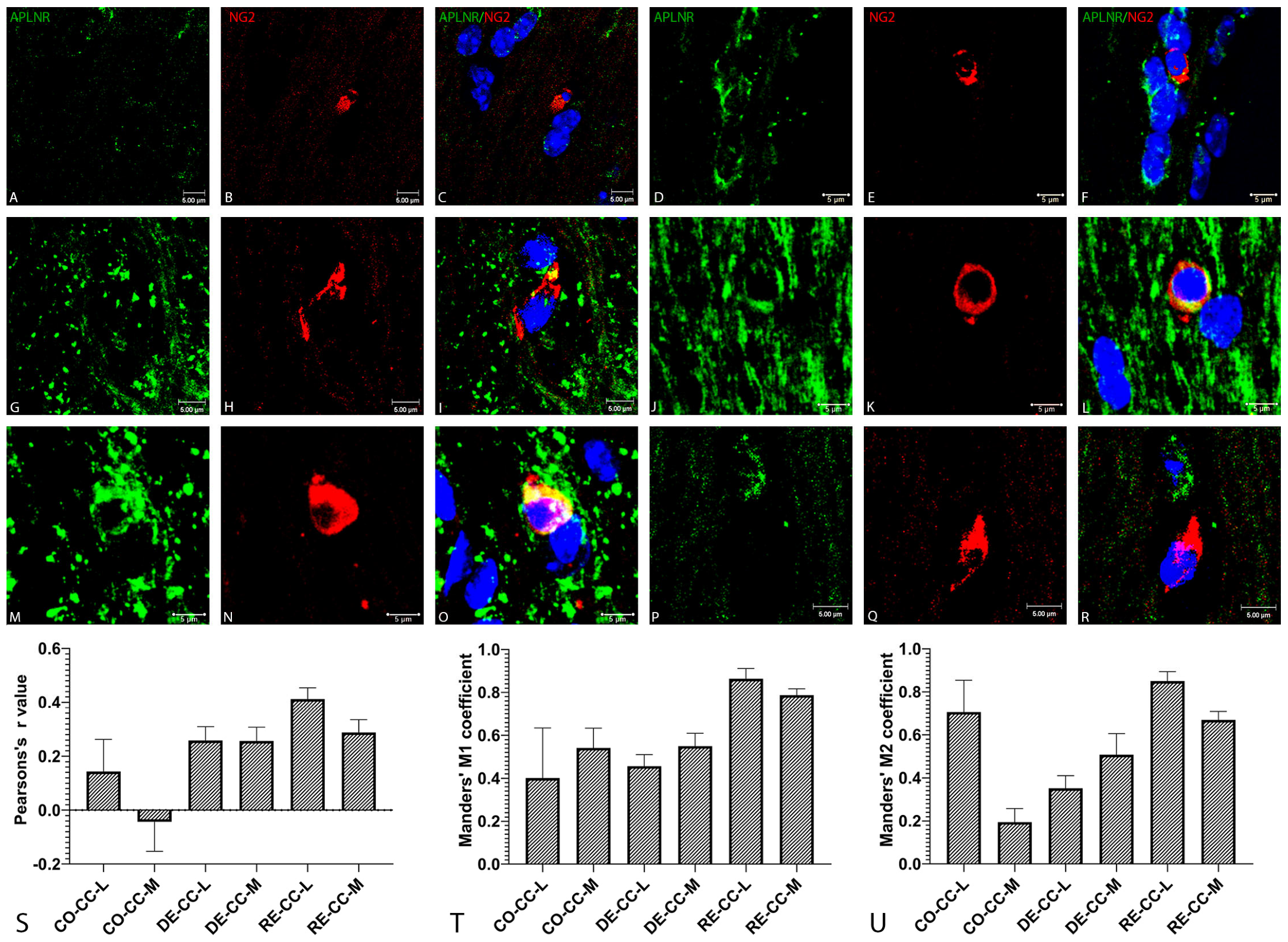
2.3. Confocal Microscopy
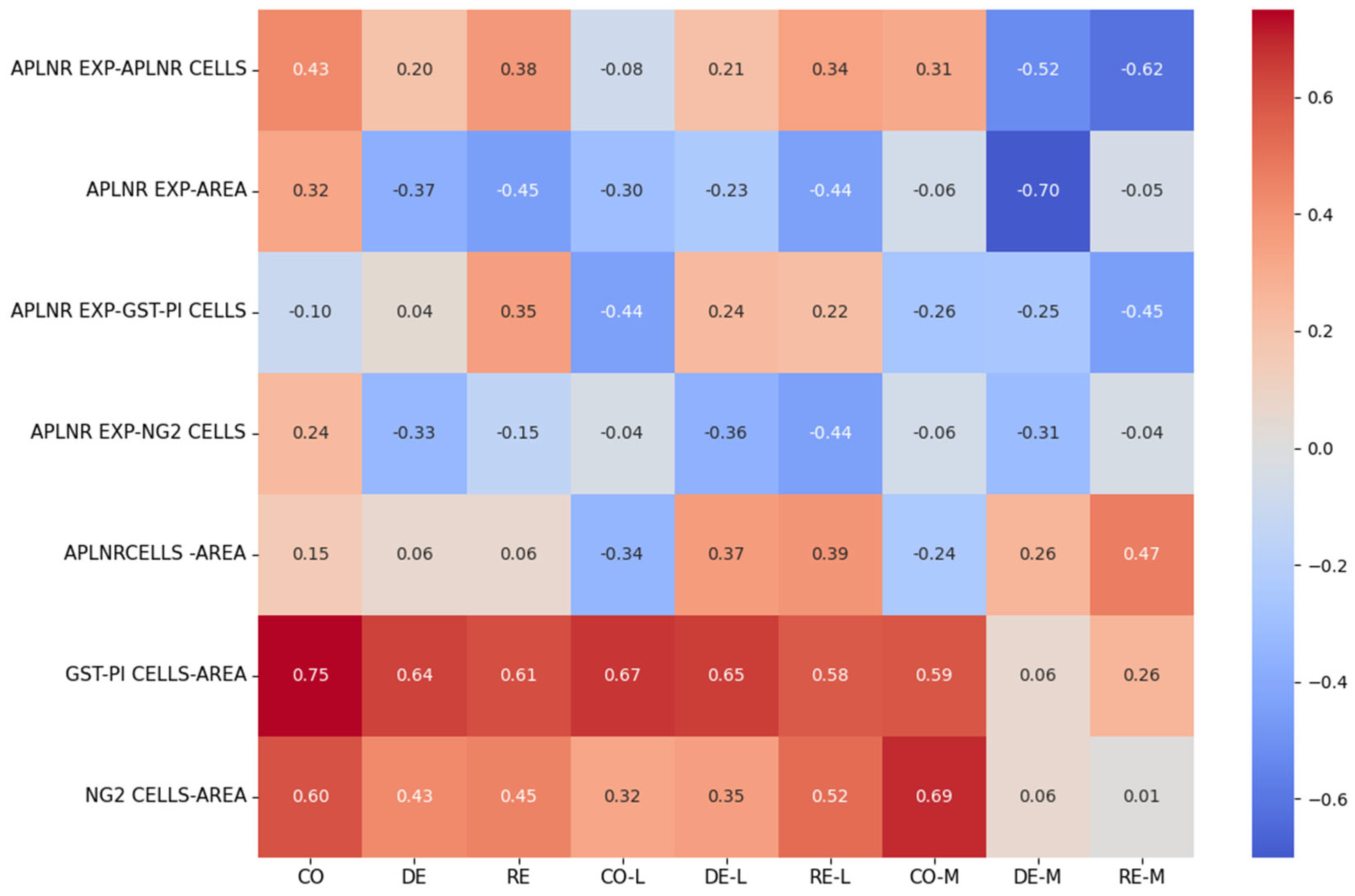
2.4. Correlation Analysis
3. Discussion
3.1. Histomorphometric Verification of Demyelination and Remyelination in the CC
3.2. GST-π Dynamics in Demyelination and Remyelination
3.3. NG2+ Cell Response and Proliferation
3.4. The Role of APLNR in Demyelination and Remyelination
3.5. Limitations
- Model-specific limitations
- 2.
- Correlative (non-causal) evidence
- 3.
- Reliance on immunohistochemistry and marker interpretation
- 4.
- Temporal and sampling constraints
- 5.
- Functional readouts missing
- 6.
- Potential technical confounders
- 7.
- Statistical power and multiple comparisons
- 8.
- Translational caveats
4. Materials and Methods
4.1. Experimental Animals
4.2. Cuprizone Model
4.3. Experimental Groups
- Control group—received plain drinking water.
- Demyelination group—cuprizone 0.2% in drinking water for 5 weeks.
- Remyelination group—cuprizone 0.2% for 5 weeks, followed by a 5-week period without cuprizone (remyelination).
4.4. Tissue Preparation
4.5. Histological Assessment with LFB/Cresyl Violet
4.6. Immunohistochemistry
4.7. Immunofluorescence
4.8. Digital Imaging Acquisition and Analysis
4.9. Statistical Analysis
5. Conclusions
Author Contributions
Funding
Institutional Review Board Statement
Informed Consent Statement
Data Availability Statement
Acknowledgments
Conflicts of Interest
Abbreviations
| APLNR | Apelin receptor |
| AREA | Corpus callosum area (morphometric measurement) |
| BFSA | Bulgarian Food Safety Agency |
| CC | Corpus callosum |
| CC-L | Lateral corpus callosum |
| CC-M | Medial corpus callosum |
| CNS | Central nervous system |
| CO | Control group |
| CPZ | Cuprizone |
| DE | Demyelination group |
| DE-L | Lateral demyelination group |
| DE-M | Medial demyelination group |
| DAB | 3,3′-Diaminobenzidine |
| EAE | Experimental autoimmune encephalomyelitis |
| GST | Glutathione S-transferase |
| GST-π | Glutathione S-transferase pi isoform |
| HRP | Horseradish peroxidase |
| LPC | Lysophosphatidylcholine (lysolecithin) |
| MOG | Myelin oligodendrocyte glycoprotein |
| MS | Multiple sclerosis |
| NG2 | Neural/glial antigen 2 (CSPG4 proteoglycan) |
| OPC | Oligodendrocyte progenitor |
References
- Walton, C.; King, R.; Rechtman, L.; Kaye, W.; Leray, E.; Marrie, R.A.; Robertson, N.; La Rocca, N.; Uitdehaag, B.; Van Der Mei, I.; et al. Rising prevalence of multiple sclerosis worldwide: Insights from the Atlas of MS, third edition. Mult. Scler. J. 2020, 26, 1816–1821. [Google Scholar] [CrossRef]
- Wegner, C. Recent insights into the pathology of multiple sclerosis and neuromyelitis optica. Clin. Neurol. Neurosurg. 2013, 115, S38–S41. [Google Scholar] [CrossRef] [PubMed]
- Brück, W. The pathology of multiple sclerosis is the result of focal inflammatory demyelination with axonal damage. J. Neurol. 2005, 252, v3–v9. [Google Scholar] [CrossRef] [PubMed]
- Toomey, L.M.; Papini, M.; Lins, B.; Wright, A.J.; Warnock, A.; McGonigle, T.; Hellewell, S.C.; Bartlett, C.A.; Anyaegbu, C.; Fitzgerald, M. Cuprizone feed formulation influences the extent of demyelinating disease pathology. Sci. Rep. 2021, 11, 22594. [Google Scholar] [CrossRef] [PubMed]
- Torkildsen, O.; Brunborg, L.A.; Myhr, K.M.; Bø, L. The cuprizone model for demyelination. Acta Neurol. Scand. 2008, 188, 72–76. [Google Scholar] [CrossRef]
- Praet, J.; Guglielmetti, C.; Berneman, Z.; Van der Linden, A.; Ponsaerts, P. Cellular and molecular neuropathology of the cuprizone mouse model: Clinical relevance for multiple sclerosis. Neurosci. Biobehav. Rev. 2014, 47, 485–505. [Google Scholar] [CrossRef]
- Zhang, Y.; Xu, H.; Jiang, W.; Xiao, L.; Yan, B.; He, J.; Wang, Y.; Bi, X.; Li, X.; Kong, J. Quetiapine alleviates the cuprizone-induced white matter pathology in the brain of C57BL/6 mouse. Schizophr. Res. 2008, 106, 182–191. [Google Scholar] [CrossRef]
- Morell, P.; Barrett, C.; Mason, J.; Toews, A.; Hostettler, J.; Knapp, G.; Matsushima, G. Gene expression in brain during cuprizone-induced demyelination and remyelination. Mol. Cell. Neurosci. 1998, 12, 220–227. [Google Scholar] [CrossRef]
- Hjelmström, P.; Penzotti, J.E.; Henne, R.M.; Lybrand, T.P. A molecular model of myelin oligodendrocyte glycoprotein. J. Neurochem. 1998, 71, 1742–1749. [Google Scholar] [CrossRef]
- Slavin, A.; Ewing, C.; Liu, J.; Ichikawa, M.; Slavin, J.; Bernard, C.C. Induction of a multiple sclerosis-like disease in mice with an immunodominant epitope of myelin oligodendrocyte glycoprotein. Autoimmunity 1998, 28, 109–120. [Google Scholar] [CrossRef]
- Kipp, M. How to Use the Cuprizone Model to Study De- and Remyelination. Int. J. Mol. Sci. 2024, 25, 1445. [Google Scholar] [CrossRef]
- Plemel, J.R.; Michaels, N.J.; Weishaupt, N.; Caprariello, A.V.; Keough, M.B.; Rogers, J.A.; Yukseloglu, A.; Lim, J.; Patel, V.V.; Rawji, K.S.; et al. Mechanisms of lysophosphatidylcholine-induced demyelination: A primary lipid disrupting myelinopathy. Glia 2018, 66, 327–347. [Google Scholar] [CrossRef]
- Constantinescu, C.S.; Farooqi, N.; O’Brien, K.; Gran, B. Experimental autoimmune encephalomyelitis (EAE) as a model for multiple sclerosis (MS). Br. J. Pharmacol. 2011, 164, 1079–1106. [Google Scholar] [CrossRef]
- Palumbo, S.; Pellegrini, S. Experimental In Vivo Models of Multiple Sclerosis: State of the Art. In Multiple Sclerosis: Perspectives in Treatment and Pathogenesis; Zagon, I.S., McLaughlin, P.J., Eds.; Codon Publications: Brisbane, Australia, 2017; Chapter 11. [Google Scholar]
- Gharagozloo, M.; Mace, J.W.; Calabresi, P.A. Animal models to investigate the effects of inflammation on remyelination in multiple sclerosis. Front. Mol. Neurosci. 2022, 3, 995477. [Google Scholar] [CrossRef] [PubMed]
- Gudi, V.; Gingele, S.; Skripuletz, T.; Stangel, M. Glial response during cuprizone-induced de- and remyelination in the CNS: Lessons learned. Front. Cell. Neurosci. 2014, 8, 73. [Google Scholar] [CrossRef]
- Hiremath, M.M.; Saito, Y.; Knapp, G.W.; Ting, J.P.; Suzuki, K.; Matsushima, G.K. Microglial/macrophage accumulation during cuprizone-induced demyelination in C57BL/6 mice. J. Neuroimmunol. 1998, 1, 38–49. [Google Scholar] [CrossRef]
- Lindner, M.; Fokuhl, J.; Linsmeier, F.; Trebst, C.; Stangel, M. Chronic Toxic Demyelination in the Central Nervous System Leads to Axonal Damage Despite Remyelination. Neurosci. Lett. 2009, 453, 120–125. [Google Scholar] [CrossRef] [PubMed]
- Steelman, A.J.; Thompson, J.P.; Li, J. Demyelination and remyelination in anatomically distinct regions of the corpus callosum following cuprizone intoxication. Neurosci. Res. 2012, 72, 32–42. [Google Scholar] [CrossRef]
- Song, S.-K.; Yoshino, J.; Le, T.Q.; Lin, S.-J.; Sun, S.-W.; Cross, A.H.; Armstrong, R.C. Demyelination increases radial diffusivity in corpus callosum of mouse brain. Neuroimage 2005, 26, 132–140. [Google Scholar] [CrossRef] [PubMed]
- Matsushima, G.K.; Morell, P. The neurotoxicant, cuprizone, as a model to study demyelination and remyelination in the central nervous system. Brain Pathol. 2001, 11, 107–116. [Google Scholar] [CrossRef]
- Yu, Q.; Hui, R.; Park, J.; Huang, Y.; Kusnecov, A.W.; Dreyfus, C.F.; Zhou, R. Strain differences in cuprizone induced demyelination. Cell Biosci. 2017, 7, 59. [Google Scholar] [CrossRef]
- Song, J.; Tang, J.; Zhang, Z.; Liu, Y.; Zhong, J. Targeting the Elabela/Apelin-Apelin Receptor Axis as a Novel Therapeutic Approach for Hypertension. Chin. Med. J. 2022, 135, 1019–1026. [Google Scholar] [CrossRef]
- Iliev, A.; Gaydarski, L.; Kotov, G.; Landzhov, B.; Kirkov, V.; Stanchev, S. The Vascular Footprint in Cardiac Homeostasis and Hypertensive Heart Disease: A Link Between Apelin Receptor, Vascular Endothelial Growth Factor, and Neuronal Nitric Oxide Synthase. Anat. Rec. 2024, 307, 3548–3563. [Google Scholar] [CrossRef]
- Gaydarski, L.; Dimitrova, I.N.; Stanchev, S.; Iliev, A.; Kotov, G.; Kirkov, V.; Stamenov, N.; Dikov, T.; Georgiev, G.P.; Landzhov, B. Unraveling the Complex Molecular Interplay and Vascular Adaptive Changes in Hypertension-Induced Kidney Disease. Biomedicines 2024, 12, 1723. [Google Scholar] [CrossRef]
- Stanchev, S.; Gaydarski, L.; Dimitrova, I.N.; Kotov, G.; Landzhov, B.; Kirkov, V.; Iliev, A. Renal Structural Changes and Apelin Receptor Expression in Spontaneously Hypertensive Rats: Implications for Hypertension-Induced Kidney Injury. Folia Morphol. 2024, 85, e01726022. [Google Scholar] [CrossRef]
- Reaux, A.; Gallatz, K.; Palkovits, M.; Llorens-Cortes, C. Distribution of Apelin-Synthesizing Neurons in the Adult Rat Brain. Neuroscience 2002, 113, 653–662. [Google Scholar] [CrossRef]
- Zhou, J.X.; Shuai, N.N.; Wang, B.; Jin, X.; Kuang, X.; Tian, S.W. Neuroprotective gain of Apelin/APJ system. Neuropeptides 2021, 87, 102131. [Google Scholar] [CrossRef]
- Landzhov, B.; Gaydarski, L.; Stanchev, S.; Kostadinova, I.; Iliev, A.; Kotov, G.; Rashev, P.; Mourdjeva, M.; Pupaki, D.; Stamenov, N. A Morphological and Behavioral Study of Demyelination and Remyelination in the Cuprizone Model: Insights into APLNR and NG2+ Cell Dynamics. Int. J. Mol. Sci. 2024, 25, 13011. [Google Scholar] [CrossRef]
- Board, P.G.; Coggan, M.; Chelvanayagam, G.; Easteal, S.; Jermiin, L.S.; Schulte, G.K.; Danley, D.E.; Hoth, L.R.; Griffor, M.C.; Kamath, A.V.; et al. Identification, characterization, and crystal structure of the Omega class glutathione transferases. J. Biol. Chem. 2000, 275, 24798–24806. [Google Scholar] [CrossRef]
- Tamura, Y.; Kataoka, Y.; Cui, Y.; Takamori, Y.; Watanabe, Y.; Yamada, H. Intracellular translocation of glutathione S-transferase pi during oligodendrocyte differentiation in adult rat cerebral cortex in vivo. Neuroscience 2007, 148, 535–540. [Google Scholar] [CrossRef]
- Cong, H.; Liang, M.; Wang, Y.; Chang, H.; Du, L.; Zhang, X.; Yin, L. Icariin ameliorates the cuprizone-induced acute brain demyelination and modulates the number of oligodendrocytes, microglia and astrocytes in the brain of C57BL/6J mice. Brain Res. Bull. 2021, 175, 37–47. [Google Scholar] [CrossRef]
- Hill, R.A.; Nishiyama, A. NG2 cells (polydendrocytes): Listeners to the neural network with diverse properties. Glia 2014, 62, 1195–1210. [Google Scholar] [CrossRef]
- Dimou, L.; Gallo, V. NG2-Glia and Their Functions in the Central Nervous System. Glia 2015, 63, 1429–1451. [Google Scholar] [CrossRef]
- Yang, Q.K.; Xiong, J.X.; Yao, Z.X. Neuron-NG2 Cell Synapses: Novel Functions for Regulating NG2 Cell Proliferation and Differentiation. BioMed Res. Int. 2013, 2013, 402843. [Google Scholar] [CrossRef]
- Wellman, S.M.; Guzman, K.; Stieger, K.C.; Brink, L.E.; Sridhar, S.; Dubaniewicz, M.T.; Li, L.; Cambi, F.; Kozai, T.D.Y. Cuprizone-Induced Oligodendrocyte Loss and Demyelination Impairs Recording Performance of Chronically Implanted Neural Interfaces. Biomaterials 2020, 239, 119842. [Google Scholar] [CrossRef]
- Acs, P.; Selak, M.A.; Komoly, S.; Kalman, B. Distribution of oligodendrocyte loss and mitochondrial toxicity in the cuprizone-induced experimental demyelination model. J. Neuroimmunol. 2013, 262, 128–131. [Google Scholar] [CrossRef]
- Chen, L.; Tao, Y.; Jiang, Y. Apelin activates the expression of inflammatory cytokines in microglial BV2 cells via PI-3K/Akt and MEK/Erk pathways. Sci. China Life Sci. 2015, 58, 531–540. [Google Scholar] [CrossRef]
- Kostadinova, I.; Landzhov, B.; Danchev, N.; Vezenkov, L.; Oskar, A. Effect of 4-Aminopyridine and Newly Synthesized Original 4-Aminopyridine Derivatives on Cuprizone-Induced Demyelination of Corpus Callosum in Mice. Comptes Rendus l’Acad. Bulg. Des Sci. 2020, 73, 8. [Google Scholar]
- Gaydarski, L.; Petrova, K.; Georiev, G.P.; Kostadinova, I. Spatial dynamics of cuprizone-induced myelin loss and recovery in the mouse corpus callosum. Acta Med. Bulg. 2026, 53, 52–57. [Google Scholar] [CrossRef]
- Schmidt, T.; Awad, H.; Slowik, A.; Beyer, C.; Kipp, M.; Clarner, T. Regional heterogeneity of cuprizone-induced demyelination: Topographical aspects of the midline of the corpus callosum. J. Mol. Neurosci. 2013, 49, 80–88. [Google Scholar] [CrossRef]
- Hochstrasser, T.; Rühling, S.; Hecher, K.; Fabisch, K.H.; Chrzanowski, U.; Brendel, M.; Eckenweber, F.; Sacher, C.; Schmitz, C.; Kipp, M. Stereological Investigation of Regional Brain Volumes after Acute and Chronic Cuprizone-Induced Demyelination. Cells 2019, 8, 1024. [Google Scholar] [CrossRef]
- Vega-Riquer, J.M.; Mendez-Victoriano, G.; Morales-Luckie, R.A.; Gonzalez-Perez, O. Five decades of cuprizone, an updated model to replicate demyelinating diseases. Curr. Neuropharmacol. 2019, 17, 129–141. [Google Scholar] [CrossRef]
- Tansey, F.A.; Cammer, W. A pi form of glutathione-S-transferase is a myelin- and oligodendrocyte-associated enzyme in mouse brain. J. Neurochem. 1991, 57, 95–102. [Google Scholar] [CrossRef] [PubMed]
- Wergeland, S.; Torkildsen, Ø.; Myhr, K.M.; Mørk, S.J.; Bø, L. The cuprizone model: Regional heterogeneity of pathology. APMIS 2012, 120, 648–657. [Google Scholar] [CrossRef]
- Mason, J.L.; Jones, J.J.; Taniike, M.; Morell, P.; Suzuki, K.; Matsushima, G.K. Mature oligodendrocyte apoptosis precedes IGF-1 production and oligodendrocyte progenitor accumulation in cuprizone-induced demyelination. J. Neurosci. Res. 2000, 61, 251–262. [Google Scholar] [CrossRef] [PubMed]
- Skripuletz, T.; Lindner, M.; Kotsiari, A.; Garde, N.; Fokuhl, J.; Linsmeier, F.; Trebst, C.; Stangel, M. Cortical demyelination is prominent in the murine cuprizone model and is strain-dependent. Am. J. Pathol. 2008, 172, 1053–1061. [Google Scholar] [CrossRef] [PubMed]
- Nishiyama, A.; Komitova, M.; Suzuki, R.; Zhu, X. Polydendrocytes (NG2 cells): Multifunctional cells with lineage plasticity. Nat. Rev. Neurosci. 2009, 10, 9–22. [Google Scholar] [CrossRef]
- Coppolino, G.T.; Marangon, D.; Negri, C.; Menichetti, G.; Fumagalli, M.; Gelosa, P.; Dimou, L.; Furlan, R.; Lecca, D.; Abbracchio, M.P. Differential local tissue permissiveness influences the final fate of GPR17-expressing oligodendrocyte precursors in two distinct models of demyelination. Glia 2018, 66, 1118–1130. [Google Scholar] [CrossRef]
- Nyamoya, S.; Leopold, P.; Becker, B.; Beyer, C.; Hustadt, F.; Schmitz, C.; Michel, A.; Kipp, M. G-Protein-Coupled Receptor Gpr17 Expression in Two Multiple Sclerosis Remyelination Models. Mol. Neurobiol. 2019, 56, 1109–1123. [Google Scholar] [CrossRef]
- Barriola, S.; Delgado-García, L.M.; Ojalvo-Sanz, A.C.; Pernia-Solanilla, C.; Figueres-Oñate, M.; López-Mascaraque, L. NG2-Glia Heterogeneity Across Cortical Layers. Glia 2025, 74, e70108. [Google Scholar] [CrossRef]
- Polito, A.; Reynolds, R. NG2-expressing cells as oligodendrocyte progenitors in the normal and demyelinated adult central nervous system. J. Anat. 2005, 207, 707–716. [Google Scholar] [CrossRef] [PubMed]
- Fancy, S.P.; Baranzini, S.E.; Zhao, C.; Yuk, D.I.; Irvine, K.A.; Kaing, S.; Sanai, N.; Franklin, R.J.; Rowitch, D.H. Dysregulation of the Wnt pathway inhibits timely myelination and remyelination in the mammalian CNS. Genes Dev. 2009, 23, 1571–1585. [Google Scholar] [CrossRef]
- Moyon, S.; Holloman, M.; Salzer, J.L. Neural stem cells and oligodendrocyte progenitor cells compete for remyelination in the corpus callosum. Front. Cell. Neurosci. 2023, 17, 1114781. [Google Scholar] [CrossRef] [PubMed]
- Luo, H.; Xiang, Y.; Qu, X.; Liu, H.; Liu, C.; Li, G.; Han, L.; Qin, X. Apelin-13 Suppresses Neuroinflammation Against Cognitive Deficit in a Streptozotocin-Induced Rat Model of Alzheimer’s Disease Through Activation of BDNF-TrkB Signaling Pathway. Front. Pharmacol. 2019, 10, 395. [Google Scholar] [CrossRef]
- Park, H.; Song, J.; Jeong, H.W.; Grönloh, M.L.B.; Koh, B.I.; Bovay, E.; Kim, K.P.; Klotz, L.; Thistlethwaite, P.A.; van Buul, J.D.; et al. Apelin modulates inflammation and leukocyte recruitment in experimental autoimmune encephalomyelitis. Nat. Commun. 2024, 15, 6282. [Google Scholar] [CrossRef]
- Liu, Q.; Zhou, S.; Wang, X.; Gu, C.; Guo, Q.; Li, X.; Zhang, C.; Zhang, N.; Zhang, L.; Huang, F. Apelin alleviated neuroinflammation and promoted endogenous neural stem cell proliferation and differentiation after spinal cord injury in rats. J. Neuroinflamm. 2022, 19, 160. [Google Scholar] [CrossRef]
- Ito, M.; Muramatsu, R.; Kato, Y.; Sharma, B.; Uyeda, A.; Tanabe, S.; Fujimura, H.; Kidoya, H.; Takakura, N.; Kawahara, Y.; et al. Age-dependent decline in remyelination capacity is mediated by apelin–APJ signaling. Nat. Aging 2021, 1, 284–294. [Google Scholar] [CrossRef]
- Zendedel, A.; Beyer, C.; Kipp, M. Cuprizone-induced demyelination as a tool to study remyelination and axonal protection. J. Mol. Neurosci. 2013, 51, 567–572. [Google Scholar] [CrossRef]
- Hill, R.A.; Patel, K.D.; Goncalves, C.M.; Grutzendler, J.; Nishiyama, A. Modulation of oligodendrocyte generation during a critical temporal window after NG2 cell division. Nat. Neurosci. 2014, 17, 1518–1527. [Google Scholar] [CrossRef]
- Guo, S.; Wang, H.; Yin, Y. Microglia Polarization from M1 to M2 in Neurodegenerative Diseases. Front. Aging Neurosci. 2022, 14, 815347. [Google Scholar] [CrossRef] [PubMed]
- Aguirre, A.; Chittajallu, R.; Belachew, S.; Gallo, V. NG2-Expressing Cells in the Subventricular Zone Are Type C-like Cells and Contribute to Interneuron Generation in the Postnatal Hippocampus. J. Cell Biol. 2004, 165, 575–589. [Google Scholar] [CrossRef]
- Komitova, M.; Zhu, X.; Serwanski, D.R.; Nishiyama, A. NG2 Cells Are Distinct from Neurogenic Cells in the Postnatal Mouse Subventricular Zone. J. Comp. Neurol. 2009, 512, 702–716. [Google Scholar] [CrossRef] [PubMed]
- Gaesser, J.M.; Fyffe-Maricich, S.L. Intracellular signaling pathway regulation of myelination and remyelination in the CNS. Exp. Neurol. 2016, 283, 501–511. [Google Scholar] [CrossRef]
- Tepavčević, V.; Lubetzki, C. Oligodendrocyte progenitor cell recruitment and remyelination in multiple sclerosis: The more, the merrier? Brain 2022, 145, 4178–4192. [Google Scholar] [CrossRef] [PubMed]
- Gao, Z.; Guo, M.; Chen, K.; Jiang, M.L.; Zhang, L.M.; Di Cesare Mannelli, L.; Zhang, C.J. Oligodendrocyte Precursor Cells in Demyelination Repair: Mechanisms, Crosstalk, and Therapeutic Frontiers. Med. Bull. 2025, 1, 104–120. [Google Scholar] [CrossRef]
- Paxinos, G.; Franklin, K. The Mouse Brain in Stereotaxic Coordinates, 2nd ed.; Academic Press: Cambridge, MA, USA, 2001; pp. 55–63. [Google Scholar]
- Yigit, N.; Gunal, A.; Kucukodaci, Z.; Karslioglu, Y.; Onguru, O.; Ozcan, A. Are we counting mitoses correctly? Ann. Diagn. Pathol. 2013, 17, 536–539. [Google Scholar] [CrossRef]
- Kipp, M.; Kiessling, M.C.; Hochstrasser, T.; Roggenkamp, C.; Schmitz, C. Design-based stereology for evaluation of histological parameters. J. Mol. Neurosci. 2017, 61, 325–342. [Google Scholar] [CrossRef]
- Dunn, K.W.; Kamocka, M.M.; McDonald, J.H. A practical guide to evaluating colocalization in biological microscopy. Am. J. Physiol. Cell Physiol. 2011, 300, C723–C742. [Google Scholar] [CrossRef] [PubMed]



| Comparison | Pearson’s r (p-Value) | Manders’ M1 (p-Value) | Manders’ M2 (p-Value) |
|---|---|---|---|
| CO-CC-L vs. CO-CC-M | <0.0001 | 0.0659 | <0.0001 |
| CO-CC-L vs. DE-CC-L | 0.0169 | 0.8743 | <0.0001 |
| CO-CC-L vs. DE-CC-M | 0.0199 | 0.0428 | <0.0001 |
| CO-CC-L vs. RE-CC-L | <0.0001 | <0.0001 | 0.0042 |
| CO-CC-L vs. RE-CC-M | 0.0013 | <0.0001 | 0.9289 |
| CO-CC-M vs. DE-CC-L | <0.0001 | 0.5187 | 0.0014 |
| CO-CC-M vs. DE-CC-M | <0.0001 | 1.0000 | <0.0001 |
| CO-CC-M vs. RE-CC-L | <0.0001 | <0.0001 | <0.0001 |
| CO-CC-M vs. RE-CC-M | <0.0001 | 0.0001 | <0.0001 |
| DE-CC-L vs. DE-CC-M | 1.0000 | 0.4105 | 0.0015 |
| DE-CC-L vs. RE-CC-L | 0.0006 | <0.0001 | <0.0001 |
| DE-CC-L vs. RE-CC-M | 0.9584 | <0.0001 | <0.0001 |
| DE-CC-M vs. RE-CC-L | 0.0005 | <0.0001 | <0.0001 |
| DE-CC-M vs. RE-CC-M | 0.9451 | 0.0002 | 0.0010 |
| RE-CC-L vs. RE-CC-M | 0.0087 | 0.6322 | 0.0002 |
| Dataset | Group | R (Correlation) | p-Value |
|---|---|---|---|
| APLNR EXP/AREA | CO | 0.3224 | 0.0328 |
| DE | −0.3703 | 0.0104 | |
| RE | −0.4477 | 0.0048 | |
| CO-L | −0.3040 | 0.1311 | |
| DE-L | −0.2259 | 0.1920 | |
| RE-L | −0.4374 | 0.0177 | |
| CO-M | −0.0575 | 0.8209 | |
| DE-M | −0.7040 | 0.0106 | |
| RE-M | −0.0496 | 0.8784 | |
| APLNR EXP/GST-π CELLS | CO | −0.0968 | 0.5320 |
| DE | 0.0363 | 0.8086 | |
| RE | 0.3517 | 0.0304 | |
| CO-L | −0.4422 | 0.0237 | |
| DE-L | 0.2431 | 0.1593 | |
| RE-L | 0.2172 | 0.2578 | |
| CO-M | −0.2605 | 0.2965 | |
| DE-M | −0.2503 | 0.4327 | |
| RE-M | −0.4460 | 0.1462 | |
| APLNR EXP/NG2 CELLS | CO | 0.2391 | 0.1181 |
| DE | −0.3279 | 0.0244 | |
| RE | −0.1494 | 0.3706 | |
| CO-L | −0.0381 | 0.8536 | |
| DE-L | −0.3646 | 0.0313 | |
| RE-L | −0.4351 | 0.0183 | |
| CO-M | −0.0572 | 0.8218 | |
| DE-M | −0.3055 | 0.3343 | |
| RE-M | −0.0384 | 0.9058 | |
| APLNR CELLS/AREA | CO | 0.1528 | 0.2480 |
| DE | 0.0632 | 0.6256 | |
| RE | 0.0605 | 0.6700 | |
| CO-L | −0.3364 | 0.0418 | |
| DE-L | 0.3658 | 0.0124 | |
| RE-L | 0.3897 | 0.0188 | |
| CO-M | −0.2393 | 0.2834 | |
| DE-M | 0.2609 | 0.3291 | |
| RE-M | 0.4654 | 0.0693 | |
| GST-π CELL/AREA | CO | 0.7544 | <0.0001 |
| DE | 0.6376 | <0.0001 | |
| RE | 0.6116 | <0.0001 | |
| CO-L | 0.6673 | <0.0001 | |
| DE-L | 0.6466 | <0.0001 | |
| RE-L | 0.5842 | <0.0001 | |
| CO-M | 0.5918 | <0.0001 | |
| DE-M | 0.0571 | 0.7063 | |
| RE-M | 0.2650 | 0.0602 | |
| NG2 CELLS/AREA | CO | 0.6001 | <0.0001 |
| DE | 0.4322 | 0.0001 | |
| RE | 0.4476 | 0.0002 | |
| CO-L | 0.3220 | 0.0273 | |
| DE-L | 0.3477 | 0.0155 | |
| RE-L | 0.5156 | 0.0006 | |
| CO-M | 0.6890 | 0.0001 | |
| DE-M | 0.0626 | 0.7663 | |
| RE-M | 0.0078 | 0.9706 |
Disclaimer/Publisher’s Note: The statements, opinions and data contained in all publications are solely those of the individual author(s) and contributor(s) and not of MDPI and/or the editor(s). MDPI and/or the editor(s) disclaim responsibility for any injury to people or property resulting from any ideas, methods, instructions or products referred to in the content. |
© 2026 by the authors. Licensee MDPI, Basel, Switzerland. This article is an open access article distributed under the terms and conditions of the Creative Commons Attribution (CC BY) license.
Share and Cite
Gaydarski, L.; Petrova, K.; Stamenov, N.; Iliev, A.; Stanchev, S.; Rashev, P.; Pupaki, D.; Mourdjeva, M.; Kostadinova, I.; Landzhov, B. Spatiotemporal APLNR Expression Dynamics During Oligodendroglial Remodeling of the Corpus Callosum in the Cuprizone Model. Int. J. Mol. Sci. 2026, 27, 4519. https://doi.org/10.3390/ijms27104519
Gaydarski L, Petrova K, Stamenov N, Iliev A, Stanchev S, Rashev P, Pupaki D, Mourdjeva M, Kostadinova I, Landzhov B. Spatiotemporal APLNR Expression Dynamics During Oligodendroglial Remodeling of the Corpus Callosum in the Cuprizone Model. International Journal of Molecular Sciences. 2026; 27(10):4519. https://doi.org/10.3390/ijms27104519
Chicago/Turabian StyleGaydarski, Lyubomir, Kristina Petrova, Nikola Stamenov, Alexandar Iliev, Stancho Stanchev, Pavel Rashev, Despina Pupaki, Milena Mourdjeva, Ivanka Kostadinova, and Boycho Landzhov. 2026. "Spatiotemporal APLNR Expression Dynamics During Oligodendroglial Remodeling of the Corpus Callosum in the Cuprizone Model" International Journal of Molecular Sciences 27, no. 10: 4519. https://doi.org/10.3390/ijms27104519
APA StyleGaydarski, L., Petrova, K., Stamenov, N., Iliev, A., Stanchev, S., Rashev, P., Pupaki, D., Mourdjeva, M., Kostadinova, I., & Landzhov, B. (2026). Spatiotemporal APLNR Expression Dynamics During Oligodendroglial Remodeling of the Corpus Callosum in the Cuprizone Model. International Journal of Molecular Sciences, 27(10), 4519. https://doi.org/10.3390/ijms27104519