Gut Microbiota as a Mediator of Dietary Salt Effects on Blood Pressure


Abstract
1. Introduction
2. Salt and Human Physiology
2.1. Dietary Sodium Consumption
2.2. The Gut as First Regulatory Barrier for Sodium
2.3. Sodium Handling by the Kidneys
2.4. Dietary Sodium and Blood Pressure Regulation
3. Sodium and the Gut Microbiome
3.1. The Effect of Sodium on Microbes
3.2. Mice Studies on Salt and the Gut Microbiome
3.3. Human Studies on Salt and the Gut Microbiome
4. Mechanistic Pathways Linking Salt, Microbes, and Cardiometabolic Disease
4.1. Microbe-Immune Interactions
4.2. Metabolite Production
4.3. Gut Barrier Integrity
5. Future Perspectives
6. Conclusions
Funding
Data Availability Statement
Acknowledgments
Conflicts of Interest
Abbreviations
| ADH | Antidiuretic hormone (vasopressin) |
| ATP | Adenosine triphosphate |
| cAMP | Cyclic adenosine monophosphate |
| cGMP | Cyclic guanosine monophosphate |
| DRA | Down-regulated in adenoma (SLC26A3) |
| ENaC | Epithelial sodium channel |
| eNOS | Endothelial nitric oxide synthase |
| FITC | Fluorescein isothiocyanate |
| FXR | Farnesoid X receptor |
| GPR41 | G-coupled protein receptor 41 |
| GPR43 | G-coupled protein receptor 43 |
| HDAC | Histone deacetylase |
| IFNγ | Interferon gamma |
| IL-17A | Interleukin-17A |
| IsoLG | Isolevuglandin |
| LPS | Lipopolysaccharide |
| NADPH | Nicotinamide adenine dinucleotide phosphate |
| NCC | Na+/Cl− cotransporter |
| NF-κB | Nuclear factor kappa light chain enhancer of activated B cells |
| NHE3 | Na+/H+ exchanger 3 |
| PEG | Polyethylene glycol |
| RAS | Renin-angiotensin system |
| SCFA | Short-chain fatty acids |
| SGLT1 | Sodium-glucose cotransporter 1 |
| TGR5 | Takeda G protein-coupled receptor 5 (GPBAR1) |
| Th17 | T helper 17 cell |
| TLR4 | Toll-like receptor 4 |
| TNFα | Tumour necrosis factor alpha |
| TonEBP | Tonicity-responsive enhancer binding protein |
| Treg | Regulatory T cell |
| VCAM-1 | Vascular cell adhesion molecule-1 |
| VEGF-C | Vascular endothelial growth factor C |
| WHO | World Health Organization |
References
- Zhou, B.; Carrillo-Larco, R.M.; Danaei, G.; Riley, L.M.; Paciorek, C.J.; Stevens, G.A.; Gregg, E.W.; Bennett, J.E.; Solomon, B.; Singleton, R.K.; et al. Worldwide trends in hypertension prevalence and progress in treatment and control from 1990 to 2019: A pooled analysis of 1201 population-representative studies with 104 million participants. Lancet 2021, 398, 957–980, Erratum in Lancet 2022, 399, 520.. [Google Scholar] [CrossRef]
- World Health Organization. Guideline: Sodium Intake for Adults and Children; World Health Organization: Geneva, Switzerland, 2012. [Google Scholar]
- World Health Organization. WHO Global Report on Sodium Intake Reduction; World Health Organization: Geneva, Switzerland, 2023. [Google Scholar]
- Bailey, M.A.; Dhaun, N. Salt sensitivity: Causes, consequences, and recent advances. Hypertension 2024, 81, 476–489. [Google Scholar] [CrossRef] [PubMed]
- He, F.J.; MacGregor, G.A. A comprehensive review on salt and health and current experience of worldwide salt reduction programmes. J. Hum. Hypertens. 2009, 23, 363–384. [Google Scholar] [CrossRef]
- Machnik, A.; Neuhofer, W.; Jantsch, J.; Dahlmann, A.; Tammela, T.; Machura, K.; Park, J.-K.; Beck, F.-X.; Müller, D.N.; Derer, W. Macrophages regulate salt-dependent volume and blood pressure by a vascular endothelial growth factor-C–dependent buffering mechanism. Nat. Med. 2009, 15, 545–552. [Google Scholar] [CrossRef]
- Kleinewietfeld, M.; Manzel, A.; Titze, J.; Kvakan, H.; Yosef, N.; Linker, R.A.; Muller, D.N.; Hafler, D.A. Sodium chloride drives autoimmune disease by the induction of pathogenic TH17 cells. Nature 2013, 496, 518–522. [Google Scholar] [CrossRef]
- Smiljanec, K.; Lennon, S.L. Sodium, hypertension, and the gut: Does the gut microbiota go salty? Am. J. Physiol. Heart Circ. Physiol. 2019, 317, H1173–H1182. [Google Scholar] [CrossRef] [PubMed]
- Wilck, N.; Matus, M.G.; Kearney, S.M.; Olesen, S.W.; Forslund, K.; Bartolomaeus, H.; Haase, S.; Mähler, A.; Balogh, A.; Markó, L.; et al. Salt-responsive gut commensal modulates TH17 axis and disease. Nature 2017, 551, 585–589. [Google Scholar] [CrossRef] [PubMed]
- Lin, Z.; Li, S.; Liu, M.; Li, J.; Liu, F.; Cao, J.; Chen, S.; Huang, K.; Wang, Y.; Li, H.; et al. Gut microbiota-derived metabolite isovalerylcarnitine modulates salt sensitivity of blood pressure and incident hypertension: A multicenter dietary salt intervention trial. Nat. Commun. 2025, 17, 808. [Google Scholar] [CrossRef]
- Ng, K.M.; Pannu, S.; Liu, S.; Burckhardt, J.C.; Hughes, T.; Van Treuren, W.; Nguyen, J.; Naqvi, K.; Nguyen, B.; Clayton, C.A.; et al. Single-strain behavior predicts responses to environmental pH and osmolality in the gut microbiota. mBio 2023, 14, e00753-23. [Google Scholar] [CrossRef]
- Tropini, C.; Moss, E.L.; Merrill, B.D.; Ng, K.M.; Higginbottom, S.K.; Casavant, E.P.; Gonzalez, C.G.; Fremin, B.; Bouley, D.M.; Elias, J.E.; et al. Transient Osmotic Perturbation Causes Long-Term Alteration to the Gut Microbiota. Cell 2018, 173, 1742–1754.e17. [Google Scholar] [CrossRef]
- Zimmerman, C.A.; Leib, D.E.; Knight, Z.A. Neural circuits underlying thirst and fluid homeostasis. Nat. Rev. Neurosci. 2017, 18, 459–469. [Google Scholar] [CrossRef] [PubMed]
- Roper, S.D.; Chaudhari, N. Taste buds: Cells, signals and synapses. Nat. Rev. Neurosci. 2017, 18, 485–497. [Google Scholar] [CrossRef]
- Rossier, B.C.; Baker, M.E.; Studer, R.A. Epithelial sodium transport and its control by aldosterone: The story of our internal environment revisited. Physiol. Rev. 2015, 95, 297–340. [Google Scholar] [CrossRef] [PubMed]
- Adrogué, H.J.; Madias, N.E. Hyponatremia. N. Engl. J. Med. 2000, 342, 1581–1589. [Google Scholar] [CrossRef]
- Verbalis, J.G.; Goldsmith, S.R.; Greenberg, A.; Korzelius, C.; Schrier, R.W.; Sterns, R.H.; Thompson, C.J. Diagnosis, evaluation, and treatment of hyponatremia: Expert panel recommendations. Am. J. Med. 2013, 126, S1–S42. [Google Scholar] [CrossRef] [PubMed]
- Gross, P.; Reimann, D.; Neidel, J.; Döke, C.; Prospert, F.; Decaux, G.; Verbalis, J.; Schrier, R.W. The treatment of severe hyponatremia. Kidney Int. Suppl. 1998, 64, S6–S11. [Google Scholar]
- Jackson, F.L. An evolutionary perspective on salt, hypertension, and human genetic variability. Hypertension 1991, 17, I129. [Google Scholar] [CrossRef][Green Version]
- Mancilha-Carvalho, J.d.J.; Silva, N.A.d.S.e. The Yanomami indians in the INTERSALT study. Arq. Bras. Cardiol. 2003, 80, 295–300. [Google Scholar] [CrossRef]
- Oliver, W.J.; Cohen, E.L.; Neel, J.V. Blood pressure, sodium intake, and sodium related hormones in the Yanomamo Indians, a “no-salt” culture. Circulation 1975, 52, 146–151. [Google Scholar] [CrossRef]
- Mattes, R.D.; Donnelly, D. Relative contributions of dietary sodium sources. J. Am. Coll. Nutr. 1991, 10, 383–393. [Google Scholar] [CrossRef]
- Koepsell, H. Glucose transporters in the small intestine in health and disease. Pflügers Arch.-Eur. J. Physiol. 2020, 472, 1207–1248. [Google Scholar] [CrossRef]
- Zachos, N.C.; Tse, M.; Donowitz, M. Molecular physiology of intestinal N+/H+ exchange. Annu. Rev. Physiol. 2005, 67, 411–443. [Google Scholar] [CrossRef]
- Ghishan, F.K.; Kiela, P.R. Small intestinal ion transport. Curr. Opin. Gastroenterol. 2012, 28, 130. [Google Scholar] [CrossRef]
- Priyamvada, S.; Gomes, R.; Gill, R.K.; Saksena, S.; Alrefai, W.A.; Dudeja, P.K. Mechanisms Underlying Dysregulation of Electrolyte Absorption in Inflammatory Bowel Disease-Associated Diarrhea. Inflamm. Bowel Dis. 2015, 21, 2926–2935. [Google Scholar] [CrossRef]
- Thiagarajah, J.R.; Donowitz, M.; Verkman, A.S. Secretory diarrhoea: Mechanisms and emerging therapies. Nat. Rev. Gastroenterol. Hepatol. 2015, 12, 446–457. [Google Scholar] [CrossRef]
- Rotin, D.; Staub, O. Function and Regulation of the Epithelial Na+ Channel ENaC. Compr. Physiol. 2021, 11, 2017–2045. [Google Scholar] [CrossRef]
- Harvey, B.J.; Alzamora, R.; Stubbs, A.K.; Irnaten, M.; McEneaney, V.; Thomas, W. Rapid responses to aldosterone in the kidney and colon. J. Steroid Biochem. Mol. Biol. 2008, 108, 310–317. [Google Scholar] [CrossRef] [PubMed]
- Rosenthal, R.; Günzel, D.; Krug, S.M.; Schulzke, J.-D.; Fromm, M.; Yu, A.S.L. Claudin-2-mediated cation and water transport share a common pore. Acta Physiol. 2017, 219, 521–536. [Google Scholar] [CrossRef]
- Eladari, D.; Chambrey, R.; Picard, N.; Hadchouel, J. Electroneutral absorption of NaCl by the aldosterone-sensitive distal nephron: Implication for normal electrolytes homeostasis and blood pressure regulation. Cell. Mol. Life Sci. 2014, 71, 2879–2895. [Google Scholar] [CrossRef] [PubMed]
- Dominguez Rieg, J.A.; de la Mora Chavez, S.; Rieg, T. Novel developments in differentiating the role of renal and intestinal sodium hydrogen exchanger 3. Am. J. Physiol. Regul. Integr. Comp. Physiol. 2016, 311, R1186–R1191. [Google Scholar] [CrossRef] [PubMed]
- Crajoinas, R.O.; Polidoro, J.Z.; Carneiro de Morais, C.P.; Castelo-Branco, R.C.; Girardi, A.C. Angiotensin II counteracts the effects of cAMP/PKA on NHE3 activity and phosphorylation in proximal tubule cells. Am. J. Physiol.-Cell Physiol. 2016, 311, C768–C776. [Google Scholar] [CrossRef]
- Lifton, R.P.; Gharavi, A.G.; Geller, D.S. Molecular Mechanisms of Human Hypertension. Cell 2001, 104, 545–556. [Google Scholar] [CrossRef]
- Farman, N. Na,K-pump expression and distribution in the nephron. Min. Electrolyte Metab. 1996, 22, 272–278. [Google Scholar]
- Ueda, K.; Shimosawa, T. Regulating distal nephron functions and salt sensitivity. Am. J. Physiol. Ren. Physiol. 2024, 327, F566–F580. [Google Scholar] [CrossRef]
- O’Donnell, M.; Mente, A.; Yusuf, S. Sodium intake and cardiovascular health. Circ. Res. 2015, 116, 1046–1057. [Google Scholar] [CrossRef] [PubMed]
- Titze, J.; Luft, F.C. Speculations on salt and the genesis of arterial hypertension. Kidney Int. 2017, 91, 1324–1335. [Google Scholar] [CrossRef]
- Hall, J.E.; Granger, J.P.; do Carmo, J.M.; da Silva, A.A.; Dubinion, J.; George, E.; Hamza, S.; Speed, J.; Hall, M.E. Hypertension: Physiology and Pathophysiology. Compr. Physiol. 2012, 2, 2393–2442. [Google Scholar] [CrossRef] [PubMed]
- Intersalt Cooperative Research Group. Intersalt: An international study of electrolyte excretion and blood pressure. Results for 24 hour urinary sodium and potassium excretion. Intersalt Cooperative Research Group. Br. Med. J. 1988, 297, 319–328. [Google Scholar] [CrossRef]
- Taylor, R.S.; Ashton, K.E.; Moxham, T.; Hooper, L.; Ebrahim, S. Reduced dietary salt for the prevention of cardiovascular disease: A meta-analysis of randomized controlled trials (Cochrane review). Am. J. Hypertens. 2011, 24, 843–853. [Google Scholar] [CrossRef] [PubMed]
- Greenwood, H.; Barnes, K.; Clark, J.; Ball, L.; Albarqouni, L. Long-Term Effect of Salt Substitution for Cardiovascular Outcomes: A Systematic Review and Meta-analysis. Ann. Intern. Med. 2024, 177, 643–655. [Google Scholar] [CrossRef]
- Choi, H.Y.; Park, H.C.; Ha, S.K. Salt Sensitivity and Hypertension: A Paradigm Shift from Kidney Malfunction to Vascular Endothelial Dysfunction. Electrolytes Blood Press 2015, 13, 7–16. [Google Scholar] [CrossRef] [PubMed]
- Nishimoto, M.; Griffin, K.A.; Wynne, B.M.; Fujita, T. Salt-Sensitive Hypertension and the Kidney. Hypertension 2024, 81, 1206–1217. [Google Scholar] [CrossRef]
- Kurtz, T.W.; DiCarlo, S.E.; Pravenec, M.; Morris, R.C.J. The pivotal role of renal vasodysfunction in salt sensitivity and the initiation of salt-induced hypertension. Curr. Opin. Nephrol. Hypertens. 2018, 27, 83. [Google Scholar] [CrossRef]
- Weinberger, M.H. Is salt-sensitivity of blood pressure a reproducible phenomenon-commentary. J. Hypertens. 1996, 14, 1461–1462. [Google Scholar] [CrossRef]
- Galletti, F.; Strazzullo, P. The blood pressure–salt sensitivity paradigm: Pathophysiologically sound yet of no practical value. Nephrol. Dial. Transplant. 2016, 31, 1386–1391. [Google Scholar] [CrossRef]
- Jose, P.A.; Raj, D. Gut microbiota in hypertension. Curr. Opin. Nephrol. Hypertens. 2015, 24, 403–409. [Google Scholar] [CrossRef] [PubMed]
- Mu, Y.-F.; Gao, Z.-X.; Mao, Z.-H.; Pan, S.-K.; Liu, D.-W.; Liu, Z.-S.; Wu, P. Perspectives on the involvement of the gut microbiota in salt-sensitive hypertension. Hypertens. Res. 2024, 47, 2351–2362. [Google Scholar] [CrossRef]
- Plata, A.A.; Otmanowski, E.B.; Zubcevic, J. Diet–microbiota–host interactions in regulation of cardiometabolic homeostasis: Emerging mechanisms and therapeutic potential. Microbiota Host 2025, 3, e250008. [Google Scholar] [CrossRef]
- Wood, J.M. Bacterial Osmoregulation: A Paradigm for the Study of Cellular Homeostasis. Annu. Rev. Microbiol. 2011, 65, 215–238. [Google Scholar] [CrossRef] [PubMed]
- Padan, E.; Schuldiner, S. Molecular physiology of Na+/H+ antiporters, key transporters in circulation of Na+ and H+ in cells. Biochim. Et. Biophys. Acta (BBA) Bioenerg. 1994, 1185, 129–151. [Google Scholar] [CrossRef]
- Häse, C.C.; Fedorova, N.D.; Galperin, M.Y.; Dibrov, P.A. Sodium Ion Cycle in Bacterial Pathogens: Evidence from Cross-Genome Comparisons. Microbiol. Mol. Biol. Rev. 2001, 65, 353–370. [Google Scholar] [CrossRef] [PubMed]
- Mulkidjanian, A.Y.; Dibrov, P.; Galperin, M.Y. The past and present of sodium energetics: May the sodium-motive force be with you. Biochim. Biophys. Acta (BBA) Bioenerg. 2008, 1777, 985–992. [Google Scholar] [CrossRef] [PubMed]
- Dimroth, P. Sodium ion transport decarboxylases and other aspects of sodium ion cycling in bacteria. Microbiol. Rev. 1987, 51, 320–340. [Google Scholar] [CrossRef]
- Müller, V.; Aufurth, S.; Rahlfs, S. The Na+ cycle in Acetobacterium woodii: Identification and characterization of a Na+ translocating F1F0-ATPase with a mixed oligomer of 8 and 16 kDa proteolipids. Biochim. Biophys. Acta (BBA) Bioenerg. 2001, 1505, 108–120. [Google Scholar] [CrossRef]
- Skulachev, V.P. Sodium bioenergetics. Trends Biochem. Sci. 1984, 9, 483–485. [Google Scholar] [CrossRef]
- Oren, A. Life at high salt concentrations, intracellular KCl concentrations, and acidic proteomes. Front. Microbiol. 2013, 4, 315. [Google Scholar] [CrossRef]
- Galinski, E.A.; Trüper, H.G. Microbial behaviour in salt-stressed ecosystems. FEMS Microbiol. Rev. 1994, 15, 95–108. [Google Scholar] [CrossRef]
- Padan, E.; Schuldiner, S. Na+/H+ antiporters, molecular devices that couple the Na+ and H+ circulation in cells. J. Bioenerg. Biomembr. 1993, 25, 647–669. [Google Scholar] [CrossRef]
- Karpel, R.; Alon, T.; Glaser, G.; Schuldiner, S.; Padan, E. Expression of a sodium proton antiporter (NhaA) in Escherichia coli is induced by Na+ and Li+ ions. J. Biol. Chem. 1991, 266, 21753–21759. [Google Scholar] [CrossRef] [PubMed]
- Pinner, E.; Padan, E.; Schuldiner, S. Kinetic properties of NhaB, a Na+/H+ antiporter from Escherichia coli. J. Biol. Chem. 1994, 269, 26274–26279. [Google Scholar] [CrossRef]
- Epstein, W. The roles and regulation of potassium in bacteria. Prog. Nucleic Acid. Res. Mol. Biol. 2003, 75, 293–320. [Google Scholar] [CrossRef]
- Sleator, R.D.; Gahan, C.G.; Abee, T.; Hill, C. Identification and disruption of BetL, a secondary glycine betaine transport system linked to the salt tolerance of Listeria monocytogenes LO28. Appl. Env. Microbiol. 1999, 65, 2078–2083. [Google Scholar] [CrossRef]
- Lucht, J.M.; Bremer, E. Adaptation of Escherichia coli to high osmolarity environments: Osmoregulation of the high-affinity glycine betaine transport system ProU. FEMS Microbiol. Rev. 1994, 14, 3–20. [Google Scholar] [CrossRef] [PubMed]
- Peters, P.; Galinski, E.; Trüper, H. The biosynthesis of ectoine. FEMS Microbiol. Lett. 1990, 71, 157–162. [Google Scholar] [CrossRef]
- Ono, H.; Sawada, K.; Khunajakr, N.; Tao, T.; Yamamoto, M.; Hiramoto, M.; Shinmyo, A.; Takano, M.; Murooka, Y. Characterization of biosynthetic enzymes for ectoine as a compatible solute in a moderately halophilic eubacterium, Halomonas elongata. J. Bacteriol. 1999, 181, 91–99. [Google Scholar] [CrossRef]
- Kuhlmann, A.U.; Bremer, E. Osmotically regulated synthesis of the compatible solute ectoine in Bacillus pasteurii and related Bacillus spp. Appl. Env. Microbiol. 2002, 68, 772–783. [Google Scholar] [CrossRef] [PubMed]
- Culligan, E.P.; Marchesi, J.R.; Hill, C.; Sleator, R.D. Mining the human gut microbiome for novel stress resistance genes. Gut Microbes 2012, 3, 394–397. [Google Scholar] [CrossRef]
- Aldea, M.; Garrido, T.; Hernández-Chico, C.; Vicente, M.; Kushner, S.R. Induction of a growth-phase-dependent promoter triggers transcription of bolA, an Escherichia coli morphogene. EMBO J. 1989, 8, 3923–3931. [Google Scholar] [CrossRef]
- Bohin, J.P. Osmoregulated periplasmic glucans in Proteobacteria. FEMS Microbiol. Lett. 2000, 186, 11–19. [Google Scholar] [CrossRef]
- Mizuno, T.; Mizushima, S. Signal transduction and gene regulation through the phosphorylation of two regulatory components: The molecular basis for the osmotic regulation of the porin genes. Mol. Microbiol. 1990, 4, 1077–1082. [Google Scholar] [CrossRef] [PubMed]
- Forst, S.; Delgado, J.; Inouye, M. Phosphorylation of OmpR by the osmosensor EnvZ modulates expression of the ompF and ompC genes in Escherichia coli. Proc. Natl. Acad. Sci. USA 1989, 86, 6052–6056. [Google Scholar] [CrossRef] [PubMed]
- Hengge-Aronis, R. Signal Transduction and Regulatory Mechanisms Involved in Control of the σS (RpoS) Subunit of RNA Polymerase. Microbiol. Mol. Biol. Rev. 2002, 66, 373–395. [Google Scholar] [CrossRef]
- Meury, J.; Kohiyama, M. Role of heat shock protein DnaK in osmotic adaptation of Escherichia coli. J. Bacteriol. 1991, 173, 4404–4410. [Google Scholar] [CrossRef]
- Bukau, B.; Horwich, A.L. The Hsp70 and Hsp60 Chaperone Machines. Cell 1998, 92, 351–366. [Google Scholar] [CrossRef]
- Hennequin, C.; Collignon, A.; Karjalainen, T. Analysis of expression of GroEL (Hsp60) of Clostridium difficile in response to stress. Microb. Pathog. 2001, 31, 255–260. [Google Scholar] [CrossRef]
- Bouvier, J.; Gordia, S.; Kampmann, G.; Lange, R.; Hengge-Aronis, R.; Gutierrez, C. Interplay between global regulators of Escherichia coli: Effect of RpoS, Lrp and H-NS on transcription of the gene osmC. Mol. Microbiol. 1998, 28, 971–980. [Google Scholar] [CrossRef] [PubMed]
- Hamad, I.; Cardilli, A.; Côrte-Real, B.F.; Dyczko, A.; Vangronsveld, J.; Kleinewietfeld, M. High-Salt Diet Induces Depletion of Lactic Acid-Producing Bacteria in Murine Gut. Nutrients 2022, 14, 1171. [Google Scholar] [CrossRef]
- Cardilli, A.; Hamad, I.; Dyczko, A.; Thijs, S.; Vangronsveld, J.; Müller, D.N.; Rosshart, S.P.; Kleinewietfeld, M. Impact of High Salt-Intake on a Natural Gut Ecosystem in Wildling Mice. Nutrients 2023, 15, 1565. [Google Scholar] [CrossRef] [PubMed]
- Miranda, P.M.; De Palma, G.; Serkis, V.; Lu, J.; Louis-Auguste, M.P.; McCarville, J.L.; Verdu, E.F.; Collins, S.M.; Bercik, P. High salt diet exacerbates colitis in mice by decreasing Lactobacillus levels and butyrate production. Microbiome 2018, 6, 57. [Google Scholar] [CrossRef]
- Engevik, M.A.; Aihara, E.; Montrose, M.H.; Shull, G.E.; Hassett, D.J.; Worrell, R.T. Loss of NHE3 alters gut microbiota composition and influences Bacteroides thetaiotaomicron growth. Am. J. Physiol. Gastrointest. Liver Physiol. 2013, 305, G697–G711. [Google Scholar] [CrossRef]
- Nagase, S.; Karashima, S.; Tsujiguchi, H.; Tsuboi, H.; Miyagi, S.; Kometani, M.; Aono, D.; Higashitani, T.; Demura, M.; Sakakibara, H.; et al. Impact of Gut Microbiome on Hypertensive Patients With Low-Salt Intake: Shika Study Results. Front. Med. 2020, 7, 475. [Google Scholar] [CrossRef]
- Verhaar, B.J.H.; van der Linden, E.L.; Hayfron-Benjamin, C.F.; Owusu-Dabo, E.; Darko, S.N.; Twumasi-Ankrah, S.; Henneman, P.; Beune, E.; Meeks, K.A.C.; Nieuwdorp, M.; et al. Gut microbiota shift in Ghanaian individuals along the migration axis: The RODAM-Pros cohort. Gut Microbes 2025, 17, 2471960. [Google Scholar] [CrossRef] [PubMed]
- Vinogradova, E.; Mukhanbetzhanov, N.; Nurgaziyev, M.; Jarmukhanov, Z.; Aipova, R.; Sailybayeva, A.; Bekbossynova, M.; Kozhakhmetov, S.; Kushugulova, A. Impact of urbanization on gut microbiome mosaics across geographic and dietary contexts. mSystems 2024, 9, e0058524. [Google Scholar] [CrossRef] [PubMed]
- Wang, Y.; Wang, H.; Howard, A.G.; Tsilimigras, M.C.; Avery, C.L.; Meyer, K.A.; Sha, W.; Sun, S.; Zhang, J.; Su, C.; et al. Associations of sodium and potassium consumption with the gut microbiota and host metabolites in a population-based study in Chinese adults. Am. J. Clin. Nutr. 2020, 112, 1599–1612. [Google Scholar] [CrossRef]
- Guzik, T.J.; Nosalski, R.; Maffia, P.; Drummond, G.R. Immune and inflammatory mechanisms in hypertension. Nat. Rev. Cardiol. 2024, 21, 396–416. [Google Scholar] [CrossRef] [PubMed]
- Vogt, L.; Marques, F.Z.; Fujita, T.; Hoorn, E.J.; Danser, A.H.J. Novel mechanisms of salt-sensitive hypertension. Kidney Int. 2023, 104, 690–697. [Google Scholar] [CrossRef]
- Kamat, N.V.; Thabet, S.R.; Xiao, L.; Saleh, M.A.; Kirabo, A.; Madhur, M.S.; Delpire, E.; Harrison, D.G.; McDonough, A.A. Renal Transporter Activation During Angiotensin-II Hypertension is Blunted in Interferon-γ−/− and Interleukin-17A−/− Mice. Hypertension 2015, 65, 569–576. [Google Scholar] [CrossRef]
- Barbaro, N.R.; Foss, J.D.; Kryshtal, D.O.; Tsyba, N.; Kumaresan, S.; Xiao, L.; Mernaugh, R.L.; Itani, H.A.; Loperena, R.; Chen, W.; et al. Dendritic Cell Amiloride-Sensitive Channels Mediate Sodium-Induced Inflammation and Hypertension. Cell Rep. 2017, 21, 1009–1020. [Google Scholar] [CrossRef]
- Kirabo, A.; Fontana, V.; de Faria, A.P.C.; Loperena, R.; Galindo, C.L.; Wu, J.; Bikineyeva, A.T.; Dikalov, S.; Xiao, L.; Chen, W.; et al. DC isoketal-modified proteins activate T cells and promote hypertension. J. Clin. Investig. 2014, 124, 4642–4656. [Google Scholar] [CrossRef]
- Ferguson, J.F.; Aden, L.A.; Barbaro, N.R.; Van Beusecum, J.P.; Xiao, L.; Simmons, A.J.; Warden, C.; Pasic, L.; Himmel, L.E.; Washington, M.K.; et al. High dietary salt-induced dendritic cell activation underlies microbial dysbiosis-associated hypertension. JCI Insight 2019, 5, e126241. [Google Scholar] [CrossRef]
- Plovier, H.; Everard, A.; Druart, C.; Depommier, C.; Van Hul, M.; Geurts, L.; Chilloux, J.; Ottman, N.; Duparc, T.; Lichtenstein, L.; et al. A purified membrane protein from Akkermansia muciniphila or the pasteurized bacterium improves metabolism in obese and diabetic mice. Nat. Med. 2017, 23, 107–113. [Google Scholar] [CrossRef] [PubMed]
- Sokol, H.; Pigneur, B.; Watterlot, L.; Lakhdari, O.; Bermúdez-Humarán, L.G.; Gratadoux, J.-J.; Blugeon, S.; Bridonneau, C.; Furet, J.-P.; Corthier, G.; et al. Faecalibacterium prausnitzii is an anti-inflammatory commensal bacterium identified by gut microbiota analysis of Crohn disease patients. Proc. Natl. Acad. Sci. USA 2008, 105, 16731–16736. [Google Scholar] [CrossRef]
- Holscher, H.D. Dietary fiber and prebiotics and the gastrointestinal microbiota. Gut Microbes 2017, 8, 172–184. [Google Scholar] [CrossRef]
- Parada Venegas, D.; De la Fuente, M.K.; Landskron, G.; González, M.J.; Quera, R.; Dijkstra, G.; Harmsen, H.J.M.; Faber, K.N.; Hermoso, M.A. Short Chain Fatty Acids (SCFAs)-Mediated Gut Epithelial and Immune Regulation and Its Relevance for Inflammatory Bowel Diseases. Front. Immunol. 2019, 10, 277, Erratum in Front. Immunol. 2019, 10, 1486. [Google Scholar] [CrossRef] [PubMed]
- Bier, A.; Braun, T.; Khasbab, R.; Di Segni, A.; Grossman, E.; Haberman, Y.; Leibowitz, A. A High Salt Diet Modulates the Gut Microbiota and Short Chain Fatty Acids Production in a Salt-Sensitive Hypertension Rat Model. Nutrients 2018, 10, 1154. [Google Scholar] [CrossRef]
- Pluznick, J.L.; Protzko, R.J.; Gevorgyan, H.; Peterlin, Z.; Sipos, A.; Han, J.; Brunet, I.; Wan, L.-X.; Rey, F.; Wang, T.; et al. Olfactory receptor responding to gut microbiota-derived signals plays a role in renin secretion and blood pressure regulation. Proc. Natl. Acad. Sci. USA 2013, 110, 4410–4415. [Google Scholar] [CrossRef]
- Natarajan, N.; Hori, D.; Flavahan, S.; Steppan, J.; Flavahan, N.A.; Berkowitz, D.E.; Pluznick, J.L. Microbial short chain fatty acid metabolites lower blood pressure via endothelial G protein-coupled receptor 41. Physiol. Genom. 2016, 48, 826–834. [Google Scholar] [CrossRef] [PubMed]
- Muralitharan, R.; Zheng, T.; Dinakis, E.; Xie, L.; Barbaro-Wahl, A.; Jama, H.A.; Nakai, M.; Paterson, M.; Leung, K.C.; McArdle, Z.; et al. Gut Microbiota Metabolites Sensed by Host GPR41/43 Protect Against Hypertension. Circ. Res. 2025, 136, e20–e33. [Google Scholar] [CrossRef]
- Li, M.; van Esch, B.C.A.M.; Henricks, P.A.J.; Folkerts, G.; Garssen, J. The Anti-inflammatory Effects of Short Chain Fatty Acids on Lipopolysaccharide- or Tumor Necrosis Factor α-Stimulated Endothelial Cells via Activation of GPR41/43 and Inhibition of HDACs. Front. Pharmacol. 2018, 9, 533. [Google Scholar] [CrossRef]
- Mathew, O.P.; Ranganna, K.; Yatsu, F.M. Butyrate, an HDAC inhibitor, stimulates interplay between different posttranslational modifications of histone H3 and differently alters G1-specific cell cycle proteins in vascular smooth muscle cells. Biomed. Pharmacother. 2010, 64, 733–740. [Google Scholar] [CrossRef] [PubMed]
- Verhaar, B.J.H.; Wijdeveld, M.; Wortelboer, K.; Rampanelli, E.; Levels, J.H.M.; Collard, D.; Cammenga, M.; Nageswaran, V.; Haghikia, A.; Landmesser, U.; et al. Effects of Oral Butyrate on Blood Pressure in Patients With Hypertension: A Randomized, Placebo-Controlled Trial. Hypertension 2024, 81, 2124–2136. [Google Scholar] [CrossRef]
- Jama, H.A.; Rhys-Jones, D.; Nakai, M.; Yao, C.K.; Climie, R.E.; Sata, Y.; Anderson, D.; Creek, D.J.; Head, G.A.; Kaye, D.M.; et al. Prebiotic intervention with HAMSAB in untreated essential hypertensive patients assessed in a phase II randomized trial. Nat. Cardiovasc. Res. 2023, 2, 35–43. [Google Scholar] [CrossRef]
- Ishimwe, J.A.; Dola, T.; Ertuglu, L.A.; Kirabo, A. Bile acids and salt-sensitive hypertension: A role of the gut-liver axis. Am. J. Physiol. Heart Circ. Physiol. 2022, 322, H636–H646. [Google Scholar] [CrossRef] [PubMed]
- Kida, T.; Tsubosaka, Y.; Hori, M.; Ozaki, H.; Murata, T. Bile acid receptor TGR5 agonism induces NO production and reduces monocyte adhesion in vascular endothelial cells. Arter. Thromb. Vasc. Biol. 2013, 33, 1663–1669. [Google Scholar] [CrossRef]
- Chiang, J.Y.L.; Ferrell, J.M. Bile acid receptors FXR and TGR5 signaling in fatty liver diseases and therapy. Am. J. Physiol. Gastrointest. Liver Physiol. 2020, 318, G554–G573. [Google Scholar] [CrossRef]
- Zeng, B.; Peng, X.; Chen, L.; Liu, J.; Xia, L. Bile Acid Metabolism Analysis Provides Insights into Vascular Endothelial Injury in Salt-Sensitive Hypertensive Rats. Metabolites 2024, 14, 452. [Google Scholar] [CrossRef] [PubMed]
- Hu, J.; Luo, H.; Wang, J.; Tang, W.; Lu, J.; Wu, S.; Xiong, Z.; Yang, G.; Chen, Z.; Lan, T.; et al. Enteric dysbiosis-linked gut barrier disruption triggers early renal injury induced by chronic high salt feeding in mice. Exp. Mol. Med. 2017, 49, e370. [Google Scholar] [CrossRef]
- Hajjar, R.; Richard, C.S.; Santos, M.M. The role of butyrate in surgical and oncological outcomes in colorectal cancer. Am. J. Physiol.-Gastrointest. Liver Physiol. 2021, 320, G601–G608. [Google Scholar] [CrossRef]
- Grylls, A.; Seidler, K.; Neil, J. Link between microbiota and hypertension: Focus on LPS/TLR4 pathway in endothelial dysfunction and vascular inflammation, and therapeutic implication of probiotics. Biomed. Pharmacother. 2021, 137, 111334. [Google Scholar] [CrossRef] [PubMed]
- Rahman, M.T.; Ghosh, C.; Hossain, M.; Linfield, D.; Rezaee, F.; Janigro, D.; Marchi, N.; van Boxel-Dezaire, A.H.H. IFN-γ, IL-17A, or zonulin rapidly increase the permeability of the blood-brain and small intestinal epithelial barriers: Relevance for neuro-inflammatory diseases. Biochem. Biophys. Res. Commun. 2018, 507, 274–279. [Google Scholar] [CrossRef]
- Bingham, S.A. Limitations of the Various Methods for Collecting Dietary Intake Data. Ann. Nutr. Metab. 1991, 35, 117–127. [Google Scholar] [CrossRef]
- Jimoh, M.A.; MacNaughtan, W.; Williams, H.E.L.; Greetham, D.; Linforth, R.L.; Fisk, I.D. Sodium ion interaction with psyllium husk (Plantago sp.). Food Funct. 2016, 7, 4041–4047. [Google Scholar] [CrossRef]
- Hanson, P.; Philp, C.J.; Randeva, H.S.; James, S.; O’Hare, J.P.; Meersmann, T.; Pavlovskaya, G.E.; Barber, T.M. Sodium in the dermis colocates to glycosaminoglycan scaffold, with diminishment in type 2 diabetes mellitus. J. Clin. Investig. 2021, 6, e145470. [Google Scholar] [CrossRef]
- Ji, H.; Kim, A.; Ebinger, J.E.; Niiranen, T.J.; Claggett, B.L.; Bairey Merz, C.N.; Cheng, S. Sex Differences in Blood Pressure Trajectories over the Life Course. JAMA Cardiol. 2020, 5, 255–262, Erratum in JAMA Cardiol. 2020, 5, 364. [Google Scholar] [CrossRef]
- Verhaar, B.J.H.; Mosterd, C.M.; Collard, D.; Galenkamp, H.; Muller, M.; Rampanelli, E.; van Raalte, D.H.; Nieuwdorp, M.; van den Born, B.-J.H. Sex differences in associations of plasma metabolites with blood pressure and heart rate variability: The HELIUS study. Atherosclerosis 2023, 384, 117147. [Google Scholar] [CrossRef]
- Haghmorad, D.; Amini, A.A.; Mahmoudi, M.B.; Rastin, M.; Hosseini, M.; Mahmoudi, M. Pregnancy level of estrogen attenuates experimental autoimmune encephalomyelitis in both ovariectomized and pregnant C57BL/6 mice through expansion of Treg and Th2 cells. J. Neuroimmunol. 2014, 277, 85–95. [Google Scholar] [CrossRef] [PubMed]
- Alanazi, H.; Zhang, Y.; Fatunbi, J.; Luu, T.; Kwak-Kim, J. The impact of reproductive hormones on T cell immunity; normal and assisted reproductive cycles. J. Reprod. Immunol. 2024, 165, 104295. [Google Scholar] [CrossRef]
- Vriend, E.M.C.; Galenkamp, H.; Herrema, H.; Nieuwdorp, M.; van den Born, B.-J.H.; Verhaar, B.J.H. Machine learning analysis of sex and menopausal differences in the gut microbiome in the HELIUS study. npj Biofilms Microbiomes 2024, 10, 152. [Google Scholar] [CrossRef] [PubMed]
- Burgermaster, M.; Rudel, R.; Seres, D. Dietary Sodium Restriction for Heart Failure: A Systematic Review of Intervention Outcomes and Behavioral Determinants. Am. J. Med. 2020, 133, 1391–1402. [Google Scholar] [CrossRef]



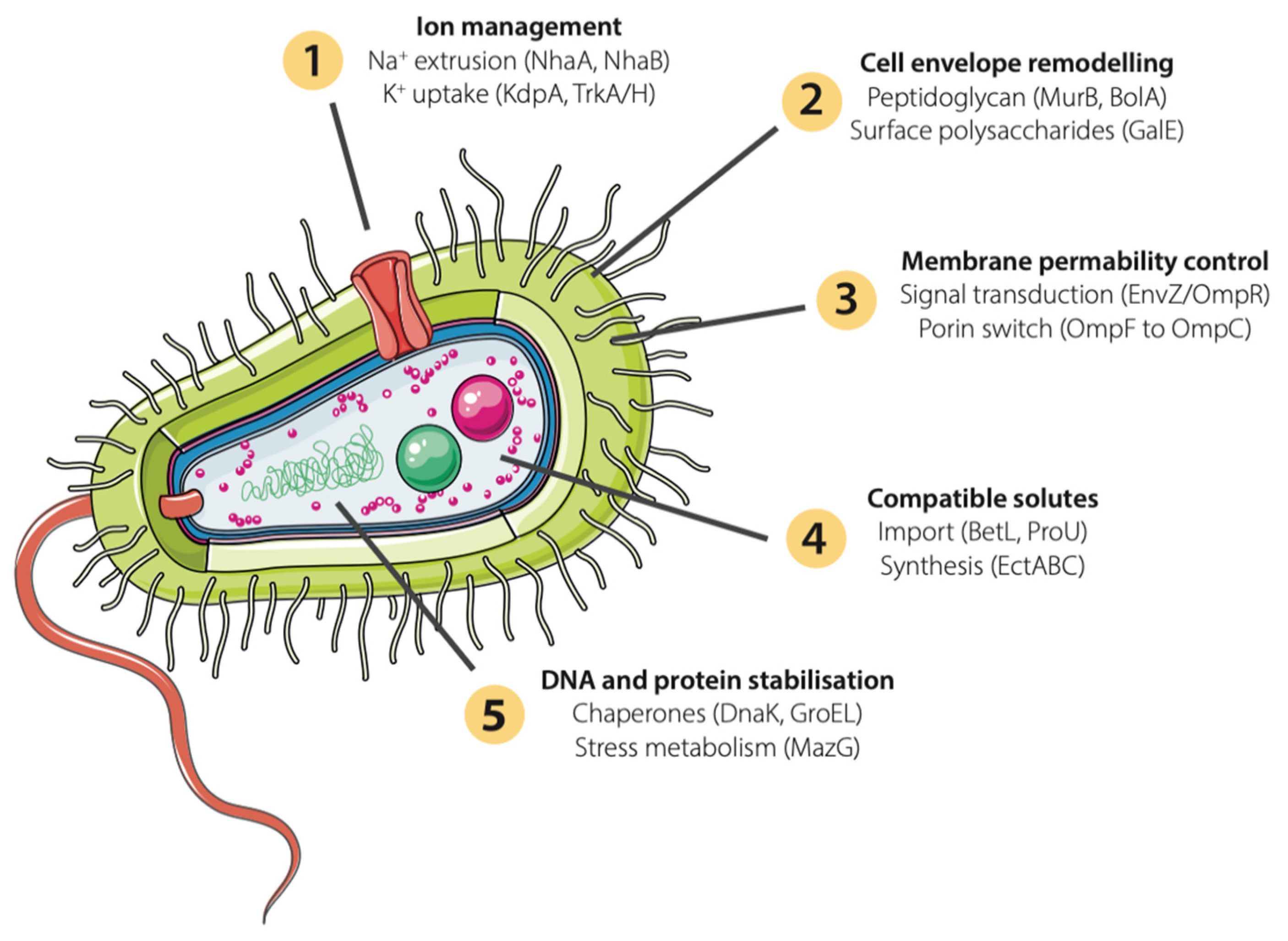
| Gene | Name | Category | Description | Ref. |
|---|---|---|---|---|
| nhaA | Na+/H+ antiporter A | Ion homeostasis | Extrudes Na+ in exchange for H+; maintains low intracellular Na+; induced by elevated Na+ and osmotic stress | [60,61] |
| nhaB | Na+/H+ antiporter B | Ion homeostasis | Secondary Na+/H+ antiporter contributing to Na+ extrusion and pH homeostasis | [62] |
| kdpA | K+-translocating ATPase subunit | K+ uptake | High-affinity K+ uptake system mediating the rapid first-phase osmotic compensation response | [63] |
| trkA/trkH | K+ transporter Trk | K+ uptake | Constitutive low-affinity K+ uptake; contributes to immediate osmotic balancing | [63] |
| betL | Glycine betaine transporter | Compatible solute import | Imports glycine betaine from the environment; primary osmostress response in many Firmicutes | [64] |
| proU | Glycine betaine/proline ABC transporter | Compatible solute import | High-affinity ABC transporter for glycine betaine and proline; strongly induced under osmotic stress | [65] |
| ectA | L-2,4-diaminobutyric acid acetyltransferase | Ectoine synthesis | First enzyme in the ectoine biosynthesis pathway | [66,67,68] |
| ectB | Diaminobutyric acid aminotransferase | Ectoine synthesis | Second enzyme in the ectoine biosynthesis pathway | [66,67,68] |
| ectC | Ectoine synthase | Ectoine synthesis | Converts N-acetyl-diaminobutyric acid to ectoine; final step in biosynthesis | [66,67,68] |
| murB | UDP-N-acetylenolpyruvylglucosamine reductase | Cell wall remodelling | Peptidoglycan biosynthesis enzyme upregulated under osmotic stress to reinforce the cell envelope | [69] |
| bolA | Morphoregulatory protein BolA | Cell wall remodelling | Regulates cell shape and peptidoglycan remodelling; induced under osmotic and other stresses | [70] |
| galE | UDP-glucose 4-epimerase | Surface polysaccharide remodelling | Interconverts UDP-glucose and UDP-galactose for LPS and exopolysaccharide biosynthesis; modifies surface carbohydrate structures to reduce ion flux | [69] |
| ompC | Outer membrane porin C | Membrane permeability | Small-pore porin induced at high osmolarity via EnvZ/OmpR; replaces OmpF to reduce membrane permeability to ions | [72] |
| ompF | Outer membrane porin F | Membrane permeability | Large-pore porin repressed at high osmolarity; shift from OmpF to OmpC reduces ion influx under osmotic stress | [72] |
| envZ | Osmosensor histidine kinase | Signal transduction | Membrane-spanning osmosensor; phosphorylates OmpR in response to osmotic changes | [73] |
| ompR | Transcriptional response regulator | Signal transduction | Phosphorylated by EnvZ; regulates ompC, ompF, and other osmotic stress genes | [73] |
| rpoS | RNA polymerase sigma factor σS | Stress signalling | Master regulator of the general stress response; controls a large osmotic stress regulon in enterobacteria and gut commensals | [74] |
| dnaK | Chaperone protein DnaK (Hsp70) | Protein quality control | Stabilises and refolds proteins misfolded under osmotic stress; part of the broader heat and osmotic stress response | [75,76] |
| groEL | Chaperonin GroEL (Hsp60) | Protein quality control | Assists refolding of stress-denatured proteins; co-induced with dnaK under osmotic stress | [76,77] |
| mazG | Nucleoside triphosphate pyrophosphohydrolase | Stress metabolism | Hydrolyses (p)ppGpp and other nucleotides during stress; links osmoadaptation to the stringent response and stress signalling | [69] |
| osmC | Osmotically inducible protein C | Oxidative stress protection | Induced under osmotic stress; provides protection against co-occurring oxidative stress | [78] |
Disclaimer/Publisher’s Note: The statements, opinions and data contained in all publications are solely those of the individual author(s) and contributor(s) and not of MDPI and/or the editor(s). MDPI and/or the editor(s) disclaim responsibility for any injury to people or property resulting from any ideas, methods, instructions or products referred to in the content. |
© 2026 by the author. Licensee MDPI, Basel, Switzerland. This article is an open access article distributed under the terms and conditions of the Creative Commons Attribution (CC BY) license.
Share and Cite
Verhaar, B.J.H. Gut Microbiota as a Mediator of Dietary Salt Effects on Blood Pressure. Int. J. Mol. Sci. 2026, 27, 4515. https://doi.org/10.3390/ijms27104515
Verhaar BJH. Gut Microbiota as a Mediator of Dietary Salt Effects on Blood Pressure. International Journal of Molecular Sciences. 2026; 27(10):4515. https://doi.org/10.3390/ijms27104515
Chicago/Turabian StyleVerhaar, Barbara J. H. 2026. "Gut Microbiota as a Mediator of Dietary Salt Effects on Blood Pressure" International Journal of Molecular Sciences 27, no. 10: 4515. https://doi.org/10.3390/ijms27104515
APA StyleVerhaar, B. J. H. (2026). Gut Microbiota as a Mediator of Dietary Salt Effects on Blood Pressure. International Journal of Molecular Sciences, 27(10), 4515. https://doi.org/10.3390/ijms27104515