Colchicine in Cardiovascular Disease: Evidence Structure, Clinical Efficacy, Safety, and Translational Positioning Across Cardiovascular Syndromes


Abstract
1. Introduction: Framing the Role of Colchicine in Cardiovascular Care
2. Trial Methodologies and Study Setup
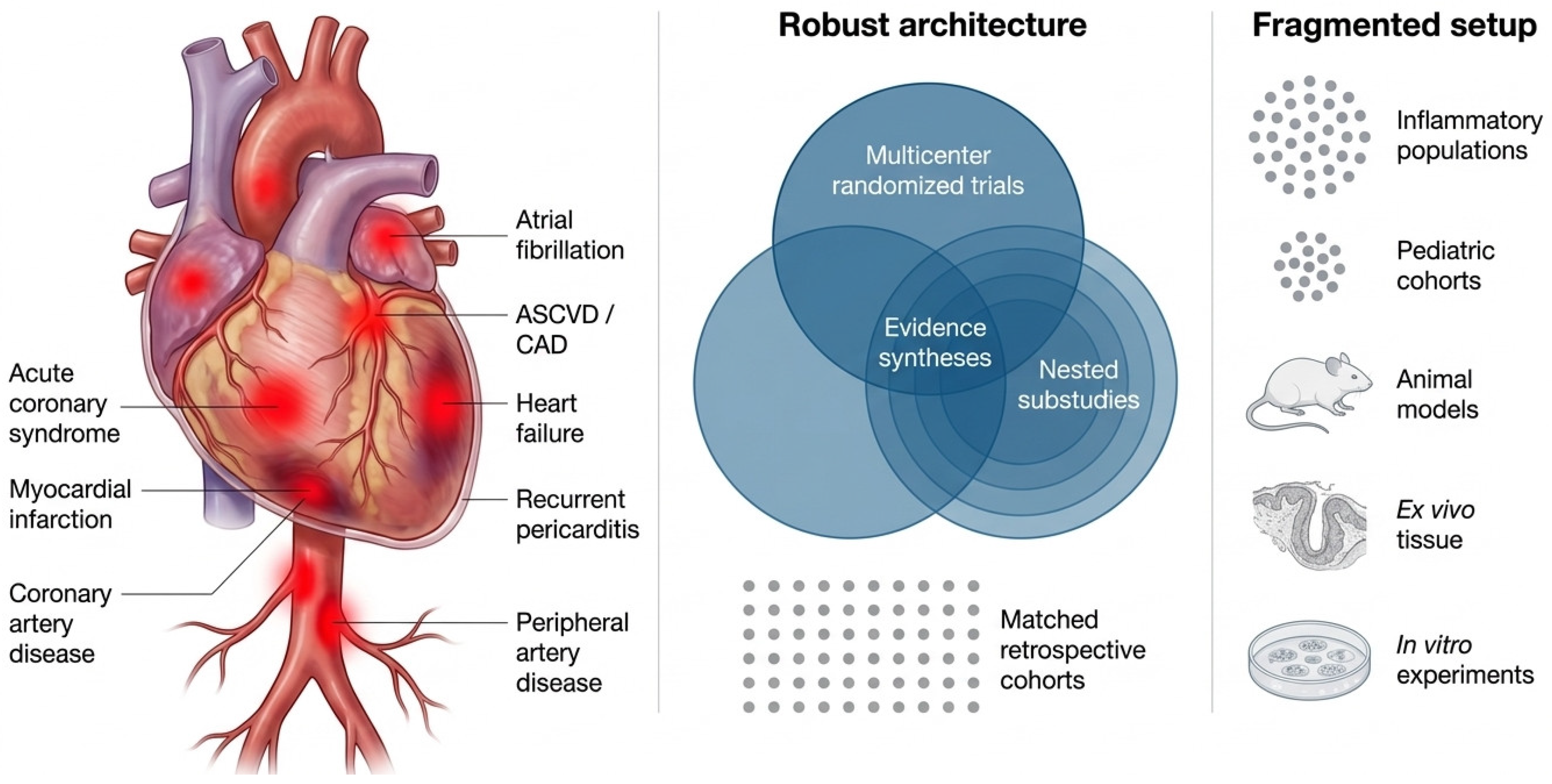
2.1. Clinical Populations and Trial Structures: A Hierarchy of Evidence
- Completed Post-MI/Chronic CAD Trials: The landmark LoDoCo2 trial enrolled 5522 patients with chronic CAD [45]. The CLEAR SYNERGY trial, a 2 × 2 factorial study, included 7062 post-STEMI patients across 104 centers in 14 countries [10]. The COLCOT enrolled 4745 patients within 30 days of an acute MI [73]. The COPS trial in 795 patients with colchicine started during an MI [74]. The COVERT-MI multicenter randomized, double-blind STEMI program enrolled 194 patients (with follow-up reported in 192) [8,75]. A prospective randomized double-blind ACS trial enrolled 249 patients with a 6-month follow-up [76].
- Completed Procedural/Electrophysiology Trials: The multicenter randomized PAPERS trial evaluated 139 post-ablation patients [77].
- Completed Targeted Phenotype Trials: The ViKCoVaC double-blind, 2 × 2 factorial trial enrolled 154 patients with diabetes and coronary calcification (149 completed a 3-month evaluation) [65].
- Ongoing/Planned RCTs: Significant ongoing efforts include the planned international COP-AF trial targeting 3200 surgical patients across 40 sites in 11 countries [9], the event-driven COL BE PCI trial aiming for 2770 PCI patients [11], and the COLICA multicenter randomized double-blind acute heart failure trial targeting 278 patients across 12 sites [15,24].
2.2. Observational Cohorts and Nested Sub-Studies
- A TriNetX retrospective TAVI analysis identifying 52,860 patients, matching 705 colchicine-exposed patients with 702 controls (1- and 6-month follow-up) [45].
- A propensity score-matched study of 1568 atrial fibrillation ablations in 1412 patients (275 matched patients per group; mean follow-up 34 months) [37].
- A retrospective, multicenter cohort of recurrent pericarditis patients followed for 12 months [66].
- A double-center retrospective myopericarditis cohort of 175 patients (73 matched pairs; median 25.3-month follow-up) [46].
- A target trial emulation in 1820 Medicare beneficiaries with peripheral artery disease and gout over 2 years [78].
- A retrospective real-world acute MI (AMI) cohort of 1796 patients [79].
- A Dutch nationwide pharmaco-epidemiologic study of 84,582 gout patients [80].
- A large propensity score-matched PAD cohort comparing 52,350 pairs over 10 years [47].
2.3. Evidence Syntheses and Modeling Studies
2.4. Preclinical, Ex Vivo, and Translational Models
- Preclinical In Vivo Models: These include porcine MI (27 pigs) [58], rabbit abdominal aortic atherosclerosis (20 animals) [59], rat coronary microembolization (40 Sprague–Dawley rats) [60], murine post-MI models (adult C57BL/6 mice; 32/group) [61], ApoE-/- aneurysm models [99], elastase/3-aminopropionitrile abdominal aortic aneurysm models (eight-week-old male C57BL6/J mice; 28 treated/29 control; 80-day follow-up) [62], CVB3 myocarditis in mice [100], sterile pericarditis rat models [63], doxorubicin-induced dilated cardiomyopathy models [101], and rat or mouse ischemia–reperfusion studies linked to STEMI patient analyses [102].
- Ex Vivo and In Vitro Work: This includes living myocardial slices perfused for 90 min [20], platelet aggregation studies in 35 chronic coronary syndrome patients (including 7 clopidogrel non-responders) [19], oxLDL-stimulated T-cell assays [103], cholesterol-crystal bench studies using in vitro and human plaque material [104], ex vivo human carotid plaque exposure experiments [23], and PCI-linked neutrophil studies in 60 patients with accompanying in vitro analyses in neutrophils from 10 ACS patients [22].
3. Intervention and Outcome Framework
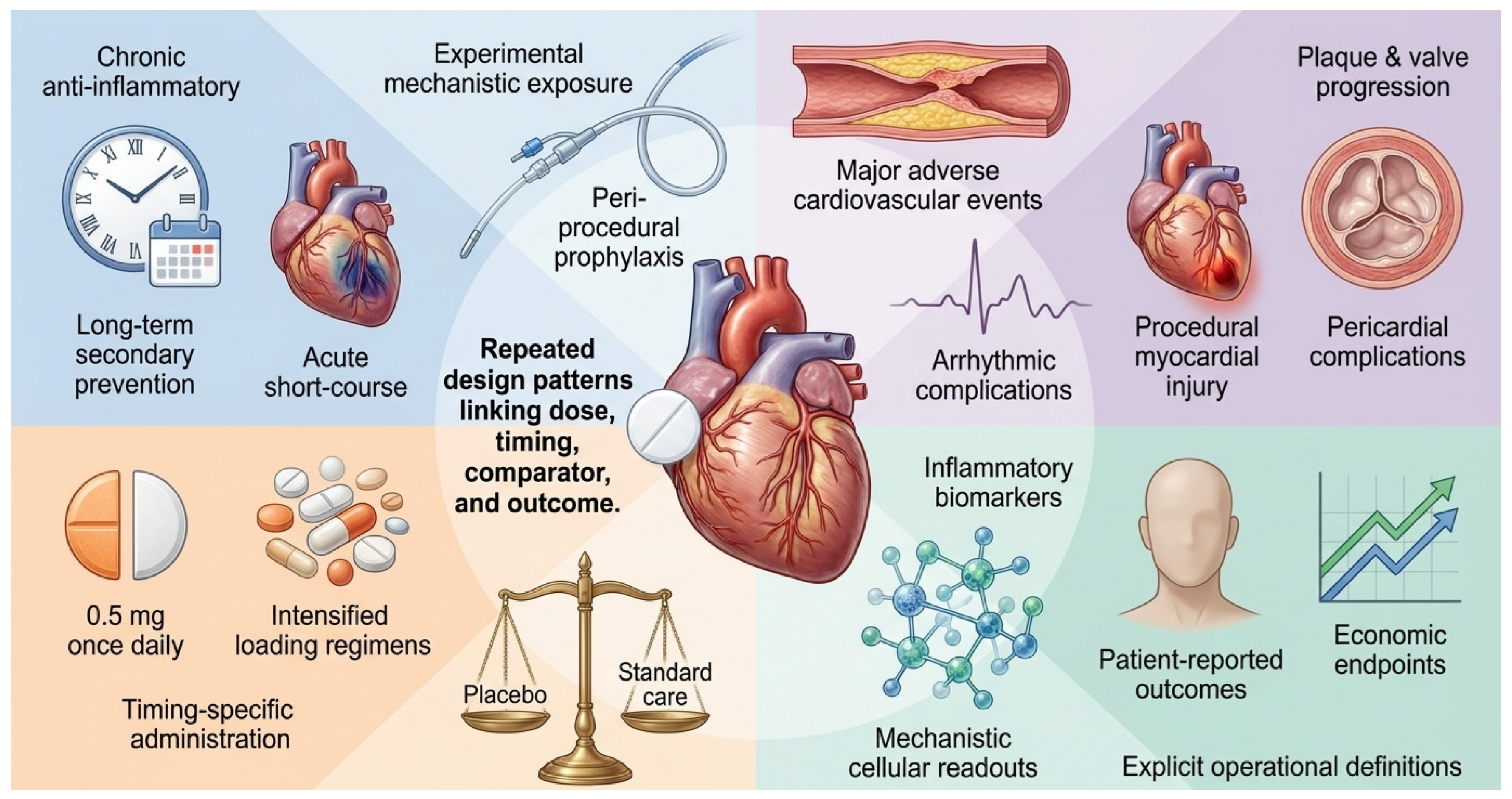
3.1. Colchicine Regimens and Comparators
- Periprocedural/Acute Use: Shorter intensified regimens were also frequent, including:
- PCI-Specific Strategies: Other PCI-related strategies included:
- ○
- A total of 1 mg then 0.5 mg given 6–24 h before PCI [40].
- ○
- A single 1.8 mg preprocedural dose [44].
- ○
- A total of 1 mg before PCI followed by 0.5 mg daily until discharge [39].
- ○
- A total of 0.6 mg daily initiated within 24 h after PCI, with continuation or discontinuation at 1 month determined by hs-CRP levels [112].
3.2. Outcome Assessment Frameworks
- Coronary and Post-MI: The predominant endpoints were Major Adverse Cardiovascular Events (MACEs) or related composite ischemic outcomes, typically comprising combinations of cardiovascular death, MI, stroke, urgent hospitalization for angina, ischemia-driven or repeat revascularization, cardiac arrest, and all-cause mortality [8,10,11,13,16,32,34,36,55,57,84,91,92].
- Arrhythmia and Procedure-Focused: Endpoints included clinical pericarditis within 14 days after ablation [77], AF recurrence (operationalized in one study as detection >30 s after a 3-month blanking period) [37], perioperative AF/flutter and myocardial injury after noncardiac surgery (MINS) [9], postoperative AF [54,86,109,121], no-reflow, periprocedural myocardial injury, coronary microvascular dysfunction, coronary flow reserve, resistive reserve ratio, constrictive physiology at 1 and 4 weeks after open-heart surgery, and post-procedural chest pain, pericardial effusion, emergency visits, and hospitalization for recurrence [39,40,41,43,110].
- Imaging: Endpoints included infarct size by cardiac magnetic resonance at 5 days and 3 months, microvascular obstruction, left ventricular ejection fraction (LVEF), left ventricular remodeling, global longitudinal strain, carotid–femoral pulse wave velocity, coronary maximum tissue-to-background ratio on F-18-NaF PET, low-attenuation plaque volume and total atheroma volume on coronary CT-angiography (CCTA), aortic valve calcium score, 18F-NaF uptake, mitral annular calcification, and peak aortic jet velocity [6,14,17,18,50,65,75,123,124,125].
- Biomarkers and Mechanistic Readouts: A substantial subset of studies focused on hs-CRP, IL-6, IL-1β, IL-10, IFN-γ, TNF-α, white blood cell and neutrophil counts, NT-proBNP, sST2, urine albumin-to-creatinine ratio, circulating microRNAs, extracellular-vesicle NLRP3, serum GPVI, platelet reactivity in PRU or ARU, aspirin and clopidogrel resistance, NET release, tubulin organization, tissue factor expression, FXa generation, pyroptosis-related markers, AMPK/SIRT1/NLRP3 signaling, NOX2/ROS and Ca2+ influx, S100A8/A9 signaling, PAD4-related activity, macrophage polarization, autophagy-related readouts, collagen degradation, myofibroblast activation, and cholesterol-crystal morphology [19,20,21,22,23,24,28,29,30,42,60,71,102,103,104,112,113,114,115,119,120,126,127]. Also assessed were plasma CRP, cardiac biomarkers, electrocardiographic indices of atrial activation, ventricular function, and fibrosis-related markers [12,46,66,100,101,122].
3.3. Limitations and Harmonization Needs
4. Findings: Efficacy, Mechanisms, and Safety
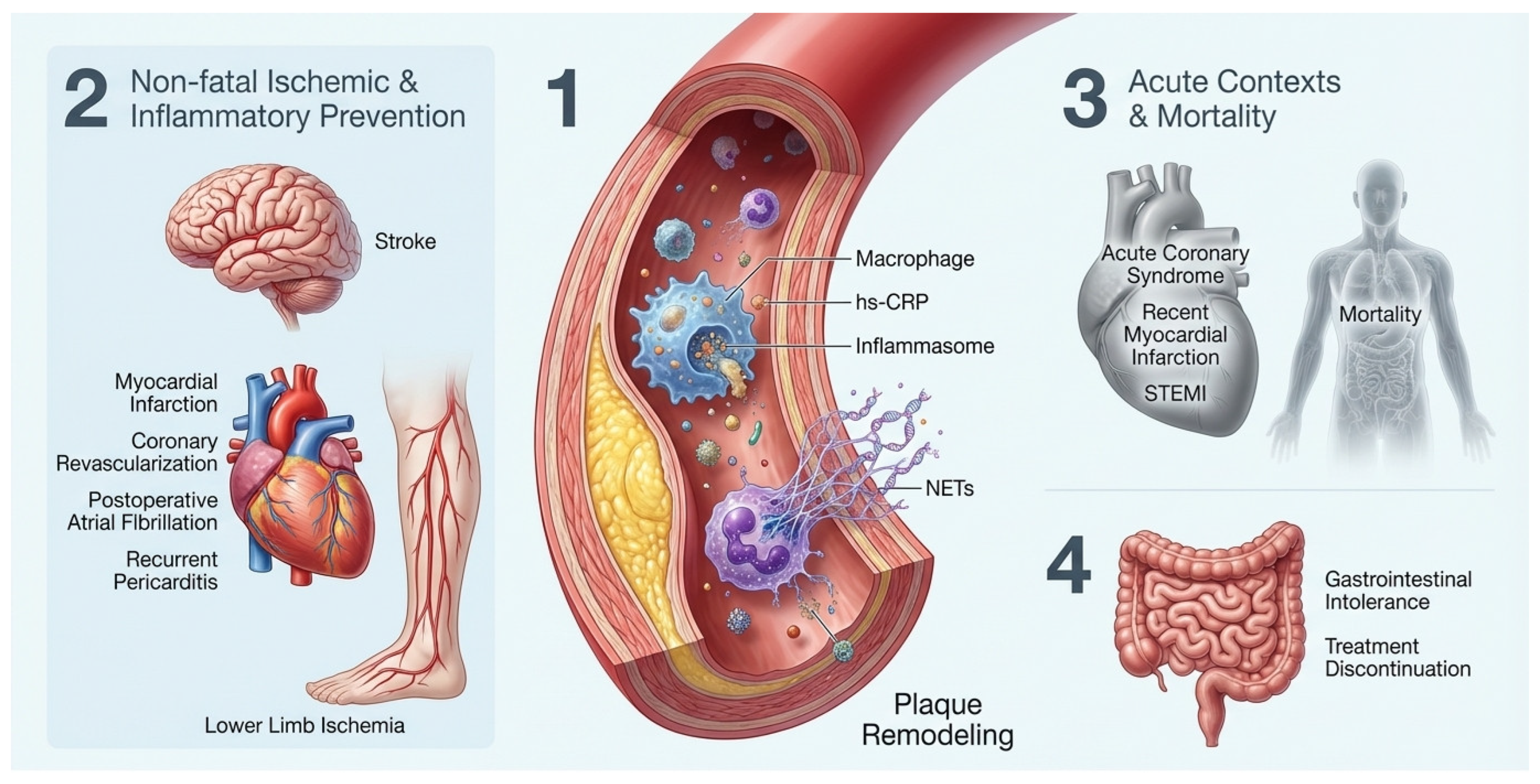
4.1. Cardiovascular Efficacy in Coronary and Vascular Disease
4.2. Arrhythmic, Pericardial, and Perioperative Outcomes
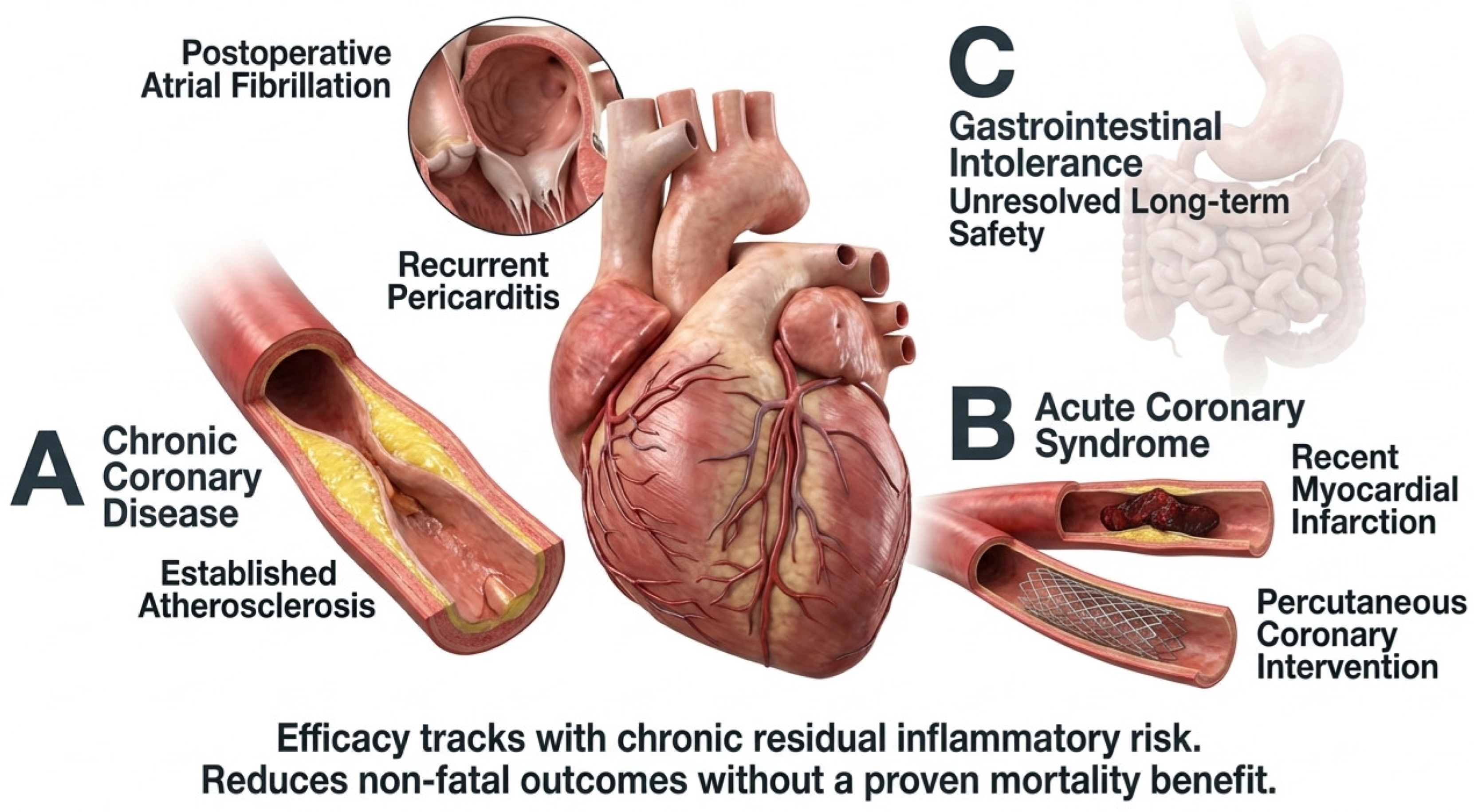
- Pericardial Disease (Strong RCT/Observational Evidence): In recurrent pericarditis, colchicine reduced recurrence (RR 0.46, 95% CI 0.37–0.58), treatment failure (RR 0.42, 95% CI 0.31–0.57), and rehospitalization (RR 0.26, 95% CI 0.10–0.70) [12]. In myopericarditis cohorts, recurrence was lower at 19.2% versus 43.8% (p = 0.001), with longer event-free survival (p = 0.005) [46]. Furthermore, in anakinra-treated patients with colchicine-resistant recurrent pericarditis, colchicine was still associated with lower recurrence (18.8% vs. 31.3%, p = 0.036) [66].
- AF Ablation (Mixed/Null Evidence): Results following AF ablation were less uniform. Colchicine was more consistently effective for postoperative AF prevention and recurrent pericardial disease than for AF ablation rhythm control [108]. In contrast to surgical settings, randomized and retrospective ablation studies reported no reduction in short-term atrial arrhythmia recurrence or several post-ablation clinical endpoints [12,37,38,43,46,48,54,66,108,109,121] (Table 3).
4.3. Biomarker, Plaque, and Mechanistic Findings
4.4. Safety and Harm
5. Interpretation and Evidence Value: Synthesizing the Clinical Hierarchy
6. Evidence-to-Practice Roadmap for Colchicine in Cardiovascular Disease
7. Conclusions: Defining the Therapeutic Scope
Author Contributions
Funding
Data Availability Statement
Acknowledgments
Conflicts of Interest
References
- Aimo, A.; Pascual-Figal, D.A.; Barison, A.; Cediel, G.; Vicente, A.H.; Saccaro, L.F.; Emdin, M.; Bayes-Genis, A. Colchicine for the treatment of coronary artery disease. Trends Cardiovasc. Med. 2021, 31, 497–504. [Google Scholar] [CrossRef]
- Andreotti, F.; Maggioni, A.P.; Campeggi, A.; Iervolino, A.; Scambia, G.; Massetti, M. Anti-inflammatory therapy in ischaemic heart disease: From canakinumab to colchicine. Eur. Heart J. Suppl. 2021, 23, E13–E18. [Google Scholar] [CrossRef]
- Di Fusco, S.A.; Imazio, M.; Rizzello, V.; Gatto, L.; Spinelli, A.; Aquilani, S.; Riccio, C.; Caldarola, P.; Nardi, F.; De Luca, L.; et al. ANMCO position paper: Colchicine as a therapeutic agent in coronary syndromes. G. Ital. Cardiol. 2023, 24, 665–674. [Google Scholar]
- PubChem CID. Available online: https://pubchem.ncbi.nlm.nih.gov/compound/6167#section=2D-Structure (accessed on 6 April 2026).
- Ahmed, M.; Hashmi, T.M.; Shafiq, A.; Ashraf, H.; Jain, H.; Khanji, M.Y.; Providencia, R.; Chahal, A.A.; Rana, J.S.; Farhan, M.; et al. Efficacy and safety of colchicine in patients with coronary artery disease: An updated meta-analysis of randomized controlled trials. Am. Heart J. Plus Cardiol. Res. Pract. 2025, 59, 100610. [Google Scholar] [CrossRef]
- Ammirati, E.; Cartella, I.; Ciabatti, M.; Colombo, G.; Masetti, M.; Pieroni, M.; Gallone, G.; Peretto, G.; Potena, L.; Scacciavillani, R.; et al. Colchicine in patients with chronic inflammatory cardiomyopathy: Rationale and design of the CMP-MYTHiC. ESC Heart Fail. 2026, 13, xvag058. [Google Scholar] [CrossRef] [PubMed]
- Ballacci, F.; Giordano, F.; Conte, C.; Telesca, A.; Collini, V.; Imazio, M. Colchicine for prevention of major adverse cardiovascular events: A meta-analysis of randomized clinical trials. J. Cardiovasc. Med. 2025, 26, 359–368. [Google Scholar] [CrossRef] [PubMed]
- Bresson, D.; Roubille, F.; Prieur, C.; Biere, L.; Ivanes, F.; Bouleti, C.; Dubreuil, O.; Rioufol, G.; Boutitie, F.; Sideris, G.; et al. Colchicine for Left Ventricular Infarct Size Reduction in Acute Myocardial Infarction: A Phase II, Multicenter, Randomized, Double-Blinded, Placebo-Controlled Study Protocol—The COVERT-MI Study. Cardiology 2021, 146, 151–160. [Google Scholar] [CrossRef]
- Conen, D.; Popova, E.; Wang, M.K.; Chan, M.T.V.; Landoni, G.; Reimer, C.; Srinathan, S.K.; Cata, J.P.; McLean, S.R.; Reyes, J.C.T.; et al. Rationale and design of the colchicine for the prevention of perioperative atrial fibrillation in patients undergoing major noncardiac thoracic surgery (COP-AF) trial. Am. Heart J. 2023, 259, 87–96. [Google Scholar] [CrossRef]
- d’Entremont, M.A.; Lee, S.F.; Mian, R.; Kedev, S.; Montalescot, G.; Cornel, J.H.; Stankovic, G.; Moreno, R.; Storey, R.F.; Henry, T.D.; et al. Design and rationale of the CLEAR SYNERGY (OASIS 9) trial: A 2 × 2 factorial randomized controlled trial of colchicine versus placebo and spironolactone vs placebo in patients with myocardial infarction. Am. Heart J. 2024, 275, 173–182. [Google Scholar] [CrossRef] [PubMed]
- De Cock, E.; Kautbally, S.; Timmermans, F.; Bogaerts, K.; Hanet, C.; Desmet, W.; Gurne, O.; Vranckx, P.; Hiltrop, N.; Dujardin, K.; et al. Low-dose colchicine for the prevention of cardiovascular events after percutaneous coronary intervention: Rationale and design of the COL BE PCI trial. Am. Heart J. 2024, 278, 61–71. [Google Scholar] [CrossRef]
- Ehsan, M.; Syed, A.B.; Mustafa, B.; Ikram, J.; Khan, M.H.; Cremer, P.C.; Imazio, M.; Wang, T.K.M.; Klein, A.L. Comparative Efficacy and Safety of Colchicine and Anti-Interleukin-1 Agents in Recurrent Pericarditis: A Pairwise and Network Meta-Analysis of Randomized Controlled Trials. J. Am. Heart Assoc. 2025, 14, e041007. [Google Scholar] [CrossRef]
- Li, H.Y.; Cheriyan, J.; Chan, T.K.; Yiu, K.H.; Tse, H.F.; Wilkinson, I.B.; Chan, Y.H. Colchicine for the Secondary Prevention of Cardiovascular Diseases: A Cumulative-Dose Meta-analysis of Randomized Controlled Trials including 31,397 Subjects Worldwide. Am. J. Cardiovasc. Drugs 2026, 26, 107–120. [Google Scholar] [CrossRef]
- Mohammadnia, N.; Vestjens, L.T.W.; Craig, N.J.; Tijssen, J.G.P.; Knol, R.J.J.; Lazarenko, S.; Duffels, M.G.J.; Focks, J.J.; Hemels, M.E.W.; Oving, I.; et al. The effects of low-dose colchicine on the progression of aortic valve stenosis: Rationale, design, and baseline characteristics of the Colchicine and Inflammation in Aortic Stenosis (CHIANTI) trial. Am. Heart J. 2025, 290, 297–309. [Google Scholar] [CrossRef] [PubMed]
- Pascual-Figal, D.; Núñez, J.; Pérez-Martínez, M.T.; González-Juanatey, J.R.; Taibo-Urquia, M.; Llàcer-Iborra, P.; Delgado, J.; Villar, S.; Mirabet, S.; Aimo, A.; et al. Colchicine in acutely decompensated heart failure: The COLICA trial. Eur. Heart J. 2024, 45, 4826–4836. [Google Scholar] [CrossRef]
- Tucker, B.; Tucker, W.J.; Chung, J.S.; Figtree, G.A.; Keech, A.; Patel, S. The efficacy and safety of low dose colchicine in atherosclerotic cardiovascular disease: A systematic review and meta-analysis. Eur. J. Prev. Cardiol. 2025, 33, 694–704. [Google Scholar] [CrossRef]
- Montarello, N.J.; Singh, K.; Sinhal, A.; Wong, D.T.L.; Alcock, R.; Rajendran, S.; Dautov, R.; Barlis, P.; Patel, S.; Nidorf, S.M.; et al. Assessing the Impact of Colchicine on Coronary Plaque Phenotype After Myocardial Infarction with Optical Coherence Tomography: Rationale and Design of the COCOMO-ACS Study. Cardiovasc. Drugs Ther. 2022, 36, 1175–1186. [Google Scholar] [CrossRef]
- Verghese, D.; Hamal, S.; Ghanem, A.; Kinninger, A.; Javier, D.; Ichikawa, K.; Benzing, T.; Krishnan, S.; Kianoush, S.; Hamidi, H.; et al. Effect of colchicine on progression of known coronary atherosclerosis in patients with STable CoROnary artery disease CoMpared to placebo (EKSTROM) trial-rationale and design. Am. Heart J. 2024, 277, 20–26. [Google Scholar] [CrossRef] [PubMed]
- Cirillo, P.; Taglialatela, V.; Pellegrino, G.; Morello, A.; Conte, S.; Di Serafino, L.; Cimmino, G. Effects of colchicine on platelet aggregation in patients on dual antiplatelet therapy with aspirin and clopidogrel. J. Thromb. Thrombolysis 2020, 50, 468–472. [Google Scholar] [CrossRef]
- Hancock, E.N.; Palmer, B.M.; Caporizzo, M.A. Microtubule destabilization with colchicine increases the work output of myocardial slices. J. Mol. Cell. Cardiol. Plus 2024, 7, 100066. [Google Scholar] [CrossRef]
- Pennings, G.J.; Reddel, C.J.; Chen, V.M.; Gnanenthiran, S.R.; Kritharides, L. Perspective: Collagen induced platelet activation via the GPVI receptor as a primary target of colchicine in cardiovascular disease. Front. Cardiovasc. Med. 2023, 9, 1104744. [Google Scholar] [CrossRef] [PubMed]
- Vaidya, K.; Tucker, B.; Kurup, R.; Khandkar, C.; Pandzic, E.; Barraclough, J.; Machet, J.; Misra, A.; Kavurma, M.; Martinez, G.; et al. Colchicine Inhibits Neutrophil Extracellular Trap Formation in Patients with Acute Coronary Syndrome After Percutaneous Coronary Intervention. J. Am. Heart Assoc. 2021, 10, e018993. [Google Scholar] [CrossRef] [PubMed]
- von Ehr, A.; Steenbuck, I.D.; Hafele, C.; Remmersmann, F.; Vico, T.A.; Ehlert, C.; Lindner, D.; Wolf, D.; Tholen, S.; Schilling, O.; et al. Experimental evidence on colchicine’s mode of action in human carotid artery plaques. Atherosclerosis 2025, 406, 119239. [Google Scholar] [CrossRef]
- Pascual-Figal, D.; Villota, J.N.; Pérez-Martínez, M.T.; González-Juanatey, J.R.; Taibo-Urquía, M.; Iborra, P.L.; González-Martín, J.; Villar, S.; Soler, M.; Mirabet, S.; et al. Colchicine in acute heart failure: Rationale and design of a randomized double-blind placebo-controlled trial (COLICA). Eur. J. Heart Fail. 2024, 26, 1999–2007. [Google Scholar] [CrossRef]
- Fiolet, A.T.L.; Lin, A.; Kwiecinski, J.; Nolthenius, J.T.; McElhinney, P.; Grodecki, K.; Kietselaer, B.; Opstal, T.S.; Cornel, J.H.; Knol, R.J.J.; et al. Effect of low-dose colchicine on pericoronary inflammation and coronary plaque composition in chronic coronary disease: A subanalysis of the LoDoCo2 trial. Heart 2025, 111, 1156–1163. [Google Scholar] [CrossRef]
- Mohammadnia, N.; Los, J.; Opstal, T.S.J.; Fiolet, A.T.L.; Eikelboom, J.W.; Mosterd, A.; Nidorf, S.M.; Budgeon, C.A.; Tijssen, J.G.P.; Thompson, P.L.; et al. Colchicine and diabetes in patients with chronic coronary artery disease: Insights from the LoDoCo2 randomized controlled trial. Front. Cardiovasc. Med. 2023, 10, 1244529. [Google Scholar] [CrossRef]
- Mohammadnia, N.; Xue, L.Y.; Vestjens, L.T.W.; Uddin, M.M.; Niroula, A.; De Kleijn, D.P.V.; Mosterd, A.; Fiolet, A.T.L.; Nakao, T.; Eikelboom, J.W.; et al. Colchicine and Longitudinal Dynamics of Clonal Hematopoiesis An Exploratory Substudy of the LoDoCo2 Trial. JACC-J. Am. Coll. Cardiol. 2025, 86, 1983–1996. [Google Scholar] [CrossRef]
- Silvis, M.J.M.; Fiolet, A.T.L.; Opstal, T.S.J.; Dekker, M.; Suquilanda, D.; Zivkovic, M.; Duyvendak, M.; The, S.H.K.; Timmers, L.; Bax, W.A.; et al. Colchicine reduces extracellular vesicle NLRP3 inflammasome protein levels in chronic coronary disease: A LoDoCo2 biomarker substudy. Atherosclerosis 2021, 334, 93–100. [Google Scholar] [CrossRef] [PubMed]
- Dubé, M.P.; Legault, M.A.; Lemaçon, A.; Perreault, L.P.L.; Fouodjio, R.; Waters, D.D.; Kouz, S.; Pinto, F.J.; Maggioni, A.P.; Diaz, R.; et al. Pharmacogenomics of the Efficacy and Safety of Colchicine in COLCOT. Circ. Genom. Precis. Med. 2021, 14, 223–229. [Google Scholar] [CrossRef]
- Sun, M.X.E.; Dube, M.P.; Hennessy, T.; Schultz, C.J.; Barhdadi, A.; Rhainds, D.; Hillis, G.S.; Tardif, J.C. Low-dose colchicine and high-sensitivity C-reactive protein after myocardial infarction: A combined analysis using individual patient data from the COLCOT and LoDoCo-MI studies. Int. J. Cardiol. 2022, 363, 20–22. [Google Scholar] [CrossRef]
- Opstal, T.S.J.; Nidorf, S.M.; Fiolet, A.T.L.; Eikelboom, J.W.; Mosterd, A.; Bax, W.A.; Budgeon, C.A.; Ronner, E.; Prins, F.J.; Tijssen, J.G.P.; et al. Drivers of mortality in patients with chronic coronary disease in the low-dose colchicine 2 trial. Int. J. Cardiol. 2023, 372, 1–5. [Google Scholar] [CrossRef] [PubMed]
- Bouabdallaoui, N.; Tardif, J.C.; Waters, D.D.; Pinto, F.J.; Maggioni, A.P.; Diaz, R.; Berry, C.; Koenig, W.; Lopez-Sendon, J.; Gamra, H.; et al. Time-to-treatment initiation of colchicine and cardiovascular outcomes after myocardial infarction in the Colchicine Cardiovascular Outcomes Trial (COLCOT). Eur. Heart J. 2020, 41, 4092–4099. [Google Scholar] [CrossRef] [PubMed]
- Budgeon, C.A.; Nidorf, S.; Mosterd, A.; Fiolet, A.; Eikelboom, J.; O’Halloran, S.; Joyce, D.; Schut, A.; Tijssen, J.; Cornel, J.H.; et al. Exploration of the regional effects of colchicine in the LoDoCo2 trial. Am. Heart J. 2024, 278, 186–194. [Google Scholar] [CrossRef]
- Opstal, T.S.J.; Fiolet, A.T.L.; van Broekhoven, A.; Mosterd, A.; Eikelboom, J.W.; Nidorf, S.M.; Thompson, P.L.; Duyvendak, M.; van Eck, J.W.M.; van Beek, E.A.; et al. Colchicine in Patients with Chronic Coronary Disease in Relation to Prior Acute Coronary Syndrome. JACC-J. Am. Coll. Cardiol. 2021, 78, 859–866. [Google Scholar] [CrossRef]
- Mohammadnia, N.; van Broekhoven, A.; Bax, W.A.; Eikelboom, J.W.; Mosterd, A.; Fiolet, A.T.L.; Tijssen, J.G.P.; Thompson, P.L.; de Kleijn, D.P.; Tsimikas, S.; et al. The effects of colchicine on lipoprotein(a)- and oxidized phospholipid-associated cardiovascular disease risk. Eur. J. Prev. Cardiol. 2025, 32, 758–765. [Google Scholar] [CrossRef]
- Mohammadnia, N.; Wesselink, B.E.; Bax, W.A.; Nidorf, S.M.; Mosterd, A.; Fiolet, A.T.L.; Cetinyurek-Yavuz, A.; Thompson, P.L.; Bangdiwala, S.I.; Eikelboom, J.W.; et al. Cardiovascular Benefit of Colchicine in Relation to Baseline Risk: A Secondary Analysis of the LoDoCo2 Trial. J. Am. Heart Assoc. 2025, 14, e038687. [Google Scholar] [CrossRef]
- Al-Sadawi, M.; Aslam, F.; Henriques, M.D.; Alsaiqali, M.; Gier, C.; Kim, P.; Almasry, I.; Singh, A.; Fan, R.; Rashba, E. Effect of low dose colchicine on long term recurrence after atrial fibrillation ablation. Int. J. Cardiol. 2025, 423, 132972. [Google Scholar] [CrossRef]
- Benz, A.P.; Amit, G.; Connolly, S.J.; Singh, J.; Acosta-Vélez, J.G.; Conen, D.; Deif, B.; Divakaramenon, S.; McIntyre, W.F.; Mtwesi, V.; et al. Colchicine to Prevent Atrial Fibrillation Recurrence After Catheter Ablation: A Randomized, Placebo-Controlled Trial. Circ. Arrhythmia Electrophysiol. 2024, 17, e01238. [Google Scholar] [CrossRef] [PubMed]
- Hosseini, S.H.; Talasaz, A.H.; Alidoosti, M.; Tajdini, M.; Van Tassell, B.W.; Etesamifard, N.; Kakavand, H.; Jalali, A.; Aghakouchakzadeh, M.; Gheymati, A.; et al. Preprocedural Colchicine in Patients with Acute ST-elevation Myocardial Infarction Undergoing Percutaneous Coronary Intervention: A Randomized Controlled Trial (PodCAST-PCI). J. Cardiovasc. Pharmacol. 2022, 80, 592–599. [Google Scholar] [CrossRef] [PubMed]
- Cole, J.; Htun, N.; Lew, R.; Freilich, M.; Quinn, S.; Layland, J. Colchicine to Prevent Periprocedural Myocardial Injury in Percutaneous Coronary Intervention The COPE-PCI Pilot Trial. Circ. Cardiovasc. Interv. 2021, 14, 483–490. [Google Scholar] [CrossRef]
- Cole, J.; Htun, N.; Lew, R.; Freilich, M.; Quinn, S.; Layland, J. COlchicine to Prevent PeriprocEdural Myocardial Injury in Percutaneous Coronary Intervention (COPE-PCI): Coronary Microvascular Physiology Pilot Substudy. J. Interv. Cardiol. 2022, 2022, 1098429–1098439. [Google Scholar] [CrossRef]
- Cole, J.; Htun, N.; Lewa, R.; Freilich, M.; Quinn, S.; Layland, J. COlchicine to Prevent PeriprocEdural Myocardial Injury in Percutaneous Coronary Intervention (COPE-PCI): A Descriptive Cytokine Pilot Sub-Study. Cardiovasc. Revascularization Med. 2022, 39, 84–89. [Google Scholar] [CrossRef]
- Iqbal, A.M.; Li, K.Y.; Gautam, S. Colchicine usage for prevention of post atrial fibrillation ablation pericarditis in patients undergoing high-power short-duration ablation. J. Cardiovasc. Electrophysiol. 2023, 34, 1370–1376. [Google Scholar] [CrossRef] [PubMed]
- Shah, B.; Pillinger, M.; Zhong, H.; Cronstein, B.; Xia, Y.H.; Lorin, J.D.; Smilowitz, N.R.; Feit, F.; Ratnapala, N.; Keller, N.M.; et al. Effects of Acute Colchicine Administration Prior to Percutaneous Coronary Intervention COLCHICINE-PCI Randomized Trial. Circ. Cardiovasc. Interv. 2020, 13, e008717. [Google Scholar] [CrossRef] [PubMed]
- Abdelsayed, K.; Amer, B.E.; Mohamed, A.A.; Fouad, M.; Amin, A.M.; Ibrahim, M.M.; Thangjui, S.; Abdelazeem, B.; Balla, S.; Latib, A. Preoperative Colchicine and Conduction Disturbances After Transcatheter Aortic Valve Implantation: A US Retrospective Cohort Analysis. J. Am. Heart Assoc. 2025, 14, e043791. [Google Scholar] [CrossRef]
- Collini, V.; De Martino, M.; Andreis, A.; De Biasio, M.; Gaspard, F.; Paneva, E.; Tomat, M.; Deferrari, G.M.; Isola, M.; Imazio, M. Efficacy and safety of colchicine for the treatment of myopericarditis. Heart 2024, 110, 735–739. [Google Scholar] [CrossRef] [PubMed]
- Tramujas, L.; Nogueira, A.; Felix, N.; Silva, P.; Abizaid, A.; Cavalcanti, A.B. Association of colchicine use with cardiovascular and limb events in peripheral artery disease: Insights from a retrospective cohort study. Atherosclerosis 2024, 398, 118563. [Google Scholar] [CrossRef]
- Campbell, K.B.; Eickman, S.D.; Truong, T.; Black-Maier, E.; Barnett, A.S.; Wang, A.L.; Green, C.L.; Daubert, J.P.; Lewis, R.K.; Atwater, B.D.; et al. Colchicine for the Prevention of Recurrent Arrhythmia After Catheter Ablation of Atrial Fibrillation: Results of a Single-Center, Retrospective Study. Am. J. Cardiovasc. Drugs 2023, 23, 709–719. [Google Scholar] [CrossRef]
- Yeh, J.J.; Hung, T.W.; Lin, C.L.; Chen, T.T.; Liw, P.X.; Yu, Y.L.; Kao, C.H. Colchicine Is a Weapon for Managing the Heart Disease Among Interstitial Lung Disease with Viral Infection: Have We Found the Holy Grail? Front. Cardiovasc. Med. 2022, 9, 925211. [Google Scholar] [CrossRef]
- Yu, M.; Yang, Y.; Dong, S.L.; Zhao, C.; Yang, F.; Yuan, Y.F.; Liao, Y.H.; He, S.L.; Liu, K.; Wei, F.; et al. Effect of Colchicine on Coronary Plaque Stability in Acute Coronary Syndrome as Assessed by Optical Coherence Tomography: The COLOCT Randomized Clinical Trial. Circulation 2024, 150, 981–993. [Google Scholar] [CrossRef]
- Mewton, N.; Roubille, F.; Bresson, D.; Prieur, C.; Bouleti, C.; Bochaton, T.; Ivanes, F.; Dubreuil, O.; Biere, L.; Hayek, A.; et al. Effect of Colchicine on Myocardial Injury in Acute Myocardial Infarction. Circulation 2021, 144, 859–869. [Google Scholar] [CrossRef]
- Andreis, A.; Imazio, M.; Avondo, S.; Casula, M.; Paneva, E.; Piroli, F.; De Ferrari, G.M. Adverse events of colchicine for cardiovascular diseases: A comprehensive meta-analysis of 14,188 patients from 21 randomized controlled trials. J. Cardiovasc. Med. 2021, 22, 637–644. [Google Scholar] [CrossRef]
- d’Entremont, M.A.; Poorthuis, M.H.F.; Fiolet, A.T.L.; Amarenco, P.; Boczar, K.E.; Buysschaert, I.; Chan, N.C.; Cornel, J.H.; Jannink, J.; Jansen, S.; et al. Colchicine for secondary prevention of vascular events: A meta-analysis of trials. Eur. Heart J. 2025, 46, 2564–2575. [Google Scholar] [CrossRef]
- Ge, P.B.; Fu, Y.; Su, Q.; Jin, M.D.; Guo, L.; Miao, C.L.; Zhu, S.; Zhuang, J.Q.; Zhang, Z.; Hong, J. Colchicine for prevention of post-operative atrial fibrillation: Meta-analysis of randomized controlled trials. Front. Cardiovasc. Med. 2022, 9, 1032116. [Google Scholar] [CrossRef]
- Moiz, A.; Zolotarova, T.; Eisenberg, M.J. Colchicine in Patients with Recent Myocardial Infarction: A Systematic Review and Meta-Analysis of Randomized Controlled Trials. J. Am. Heart Assoc. 2026, 15, e044241. [Google Scholar] [CrossRef] [PubMed]
- Cappannoli, L.; Fracassi, F.; Aurigemma, C.; Romagnoli, E.; Bianchini, F.; Lunardi, M.; Montone, R.A.; Paraggio, L.; Trani, C.; Liuzzo, G.; et al. Colchicine in Acute Coronary Syndromes: A Meta-Analysis of 12,602 Patients. J. Cardiovasc. Pharmacol. 2025, 86, 33–36. [Google Scholar] [CrossRef] [PubMed]
- Nogic, J.; Mehta, O.; Tong, D.V.; Brown, A.J.; Layland, J. Colchicine in the Management of Acute Coronary Syndrome: A Meta-analysis. Cardiol. Ther. 2023, 12, 171–181, Erratum in Cardiol. Ther. 2023, 12, 183–184. Erratum in Cardiol. Ther. 2023, 12, 539–541. [Google Scholar] [CrossRef]
- Aimo, A.; Martinez-Falguera, D.; Barison, A.; Musetti, V.; Masotti, S.; Morfino, P.; Passino, C.; Martinelli, G.; Pucci, A.; Crisostomo, V.; et al. Colchicine added to standard therapy further reduces fibrosis in pigs with myocardial infarction. J. Cardiovasc. Med. 2023, 24, 840–846. [Google Scholar] [CrossRef] [PubMed]
- Cecconi, A.; Vilchez-Tschischke, J.P.; Mateo, J.; Sanchez-Gonzalez, J.; España, S.; Fernandez-Jimenez, R.; Lopez-Melgar, B.; Friera, L.F.; López-Martín, G.J.; Fuster, V.; et al. Effects of Colchicine on Atherosclerotic Plaque Stabilization: A Multimodality Imaging Study in an Animal Model. J. Cardiovasc. Transl. Res. 2021, 14, 150–160. [Google Scholar] [CrossRef]
- Li, H.Q.; Yang, H.F.; Qin, Z.B.; Wang, Q.; Li, L. Colchicine ameliorates myocardial injury induced by coronary microembolization through suppressing pyroptosis via the AMPK/SIRT1/NLRP3 signaling pathway. BMC Cardiovasc. Disord. 2024, 24, 23. [Google Scholar] [CrossRef]
- Li, Y.W.; Chen, S.X.; Yang, Y.; Zhang, Z.H.; Zhou, W.B.; Huang, Y.N.; Huang, Z.Q.; He, J.Q.; Chen, T.F.; Wang, J.F.; et al. Colchicine Inhibits NETs and Alleviates Cardiac Remodeling after Acute Myocardial Infarction. Cardiovasc. Drugs Ther. 2024, 38, 31–41. [Google Scholar] [CrossRef]
- Phie, J.; Thanigaimani, S.; Huynh, P.; Anbalagan, R.; Moran, C.S.; Kinobe, R.; Moxon, J.; Field, M.A.; Krishna, S.M.; Golledge, J. Colchicine Does Not Reduce Abdominal Aortic Aneurysm Growth in a Mouse Model. Cardiovasc. Ther. 2022, 2022, 5299370. [Google Scholar] [CrossRef]
- Parent, S.; St Amant, J.; Van Remortel, S.; Kahn, S.; Vaka, R.; Courtman, D.; Stewart, D.J.; Davis, D.R. Atrial Fibrosis and Inflammation in Postoperative Atrial Fibrillation Comparative Effects of Amiodarone, Colchicine, or Exosomes. JACC-Clin. Electrophysiol. 2024, 10, 1037–1049. [Google Scholar] [CrossRef] [PubMed]
- Shen, L.; Huang, S.D.; Fan, H.Y.; Zhai, C.L. Colchicine Prevents Cardiac Rupture in Mice with Myocardial Infarction by Inhibiting P53-Dependent Apoptosis. Int. Heart J. 2024, 65, 905–912. [Google Scholar] [CrossRef]
- Bellinge, J.W.; Francis, R.J.; Lee, S.C.; Vickery, A.; Macdonald, W.; Gan, S.K.; Chew, G.T.; Phillips, M.; Lewis, J.R.; Watts, G.F.; et al. The effect of Vitamin-K1 and Colchicine on Vascular Calcification Activity in subjects with Diabetes Mellitus (ViKCoVaC): A double-blind 2x2 factorial randomized controlled trial. J. Nucl. Cardiol. 2022, 29, 1855–1866. [Google Scholar] [CrossRef] [PubMed]
- Collini, V.; Andreis, A.; De Biasio, M.; De Martino, M.; Isola, M.; Croatto, N.; Lepre, V.; Cantarini, L.; Merlo, M.; Sinagra, G.; et al. Efficacy of colchicine in addition to anakinra in patients with recurrent pericarditis. Open Heart 2024, 11, e002599. [Google Scholar] [CrossRef]
- Lazaros, G.; Antonopoulos, A.S.; Antonatou, K.; Skendros, P.; Ritis, K.; Hadziyannis, E.; Lazarou, E.; Leontsinis, I.; Simantiris, S.; Vlachopoulos, C.; et al. Hydroxychloroquine for colchicine-resistant glucocorticoid-dependent idiopathic recurrent pericarditis: A pilot observational prospective study. Int. J. Cardiol. 2020, 311, 77–82. [Google Scholar] [CrossRef]
- Rabbani, A.; Rafique, A.; Wang, X.Y.; Campbell, D.; Wang, D.N.; Brownell, N.; Capdevilla, K.; Garabedian, V.; Chaparro, S.; Herrera, R.; et al. Colchicine for the Treatment of Cardiac Injury in Hospitalized Patients with Coronavirus Disease-19. Front. Cardiovasc. Med. 2022, 9, 876718. [Google Scholar] [CrossRef]
- Goldstein, S.A.; Nolan, K.; Marchetti, K.; Stoscup, J.K.; Clewis, H.; Jarvis, K.; Halligan, N.L.N.; Dahmer, M.K.; Schumacher, K.R.; Rocchini, A. Colchicine in post-operative Fontan patients. Cardiol. Young 2023, 33, 910–916. [Google Scholar] [CrossRef]
- Landi, A.; Morici, N.; Vranckx, P.; Frigoli, E.; Bonacchini, L.; Omazzi, B.; Tresoldi, M.; Camponovo, C.; Moccetti, T.; Valgimigli, M. Edoxaban and/or colchicine in outpatients with COVID-19: Rationale and design of the CONVINCE trial. J. Cardiovasc. Med. 2023, 24, 920–930. [Google Scholar] [CrossRef] [PubMed]
- Shchendrygina, A.; Rachina, S.; Cherkasova, N.; Suvorov, A.; Komarova, I.; Mukhina, N.; Ananicheva, N.; Gasanova, D.; Sitnikova, V.; Koposova, A.; et al. Colchicine in patients with heart failure and preserved left ventricular ejection fraction: Rationale and design of a prospective, randomised, open-label, crossover clinical trial. Open Heart 2023, 10, e002360. [Google Scholar] [CrossRef]
- Cüre, O.; Durak, H.; Çetin, M.; Kizilkaya, B.; Topaloglu, M.S. Colchicine-Treated Familial Mediterranean Fever Patients Are Associated with a Lower Prevalence of Mitral Annular Calcification. Echocardiogr. A J. Cardiovasc. Ultrasound Allied Tech. 2026, 43, e70415. [Google Scholar] [CrossRef]
- Tardif, J.C.; Busque, L.; Geoffroy, S.; Sandoval, J.; Lemieux Perreault, L.P.; Mongrain, I.; Gagnon, M.F.; Valois, D.; Gaulin-Marion, M.J.; Buscarlet, M.; et al. Low-Dose Colchicine Attenuates Clonal Hematopoiesis in COLCOT. Circulation 2026, 153, 610–612. [Google Scholar] [CrossRef]
- Tong, D.C.; Quinn, S.; Nasis, A.; Hiew, C.; Roberts-Thomson, P.; Adams, H.; Sriamareswaran, R.; Htun, N.M.; Wilson, W.; Stub, D.; et al. Colchicine in Patients with Acute Coronary Syndrome the Australian COPS Randomized Clinical Trial. Circulation 2020, 142, 1890–1900. [Google Scholar] [CrossRef]
- Bouleti, C.; Viscogliosi, S.; Bresson, D.; Leboube, S.; Bochaton, T.; El-Jonhy, N.; Amaz, C.; Prunier, F.; Bidaux, G.; Roubille, F.; et al. Colchicine in acute myocardial infarction: Cardiovascular events at 1-year follow up. Open Heart 2024, 11, e002474. [Google Scholar] [CrossRef]
- Akrami, M.; Izadpanah, P.; Bazrafshan, M.; Hatamipour, U.; Nouraein, N.; Drissi, H.B.; Manafi, A. Effects of colchicine on major adverse cardiac events in next 6-month period after acute coronary syndrome occurrence, a randomized placebo-control trial. BMC Cardiovasc. Disord. 2021, 21, 583. [Google Scholar] [CrossRef] [PubMed]
- Ahmed, A.S.; Miller, J.; Foreman, J.; Golden, K.; Shah, A.K.; Field, J.; Gilge, J.; Clark, B.; Joshi, S.; Nair, G.; et al. Prophylactic Colchicine After Radiofrequency Ablation of Atrial Fibrillation. JACC-Clin. Electrophysiol. 2023, 9, 1060–1066. [Google Scholar] [CrossRef] [PubMed]
- Heindel, P.; Fitzgibbon, J.J.; Secemsky, E.; Bhatt, D.L.; Al-Omran, M.; Verma, S.; Almaghlouth, I.A.; Madenci, A.; Hussain, M.A. Colchicine for cardiovascular and limb risk reduction in Medicare beneficiaries with peripheral artery disease: Emulation of target trials. Eur. Heart J. Open 2024, 4, oeae062. [Google Scholar] [CrossRef] [PubMed]
- Marano, P.; Cheng, S.S.; Huang, T.Y.; Navarrette, J.; Botting, P.; Ebinger, J.E. Clinical Use and Effectiveness of Colchicine for Secondary Prevention Following Acute Myocardial Infarction. Am. J. Cardiol. 2026, 259, 220–227. [Google Scholar] [CrossRef]
- Peeters, I.R.; Wientjes, M.H.M.; Mackenzie, I.S.; Opdam, M.A.A.; Flendrie, M.; Popa, C.D.; van de Wiel, K.M.; Vojinovic, D.; Joosten, L.A.B.; Schouwenberg, B.; et al. Ischaemic cardiovascular risk with allopurinol and protective effect of colchicine in gout: A Dutch nationwide pharmaco-epidemiological study. Eur. J. Prev. Cardiol. 2025, 33, 682–690. [Google Scholar] [CrossRef]
- Tardif, J.C.; Kouz, S. Efficacy and safety of colchicine and spironolactone after myocardial infarction: The CLEAR-SYNERGY trial in perspective. Eur. Heart J. Acute Cardiovasc. Care 2024, 13, 843–844. [Google Scholar] [CrossRef]
- Misra, A.; Psaltis, P.J.; Mondal, A.R.; Nelson, A.J.; Nidorf, S.M. Implications and limitations of the CLEAR-SYNERGY trial for the use of low-dose colchicine in cardiovascular disease. Nat. Cardiovasc. Res. 2025, 4, 251–253. [Google Scholar] [CrossRef]
- Mensah, G.A.; Arnold, N.; OPrabhu, S.D.; Ridker, P.M.; Francine, K. Inflammation and Cardiovascular Disease: 2025 ACC Scientific Statement: A report for the American College of Cardiology. J. Am. Coll. Cardiol. 2025, 87, 1381–1404. [Google Scholar] [CrossRef] [PubMed]
- Andreis, A.; Imazio, M.; Piroli, F.; Avondo, S.; Casula, M.; Paneva, E.; De Ferrari, G.M. Efficacy and safety of colchicine for the prevention of major cardiovascular and cerebrovascular events in patients with coronary artery disease: A systematic review and meta-analysis on 12 869 patients. Eur. J. Prev. Cardiol. 2022, 28, 1916–1925. [Google Scholar] [CrossRef]
- Samuel, M.; Berry, C.; Dubé, M.P.; Koenig, W.; López-Sendón, J.; Maggioni, A.P.; Pinto, F.J.; Roubille, F.; Tardif, J.C. Long-term trials of colchicine for secondary prevention of vascular events: A meta-analysis. Eur. Heart J. 2025, 46, 2552–2563. [Google Scholar] [CrossRef] [PubMed]
- Rivera, F.B.; Cha, S.W.; Aparece, J.P.; Jariyatamkitti, S.; Mamas, M.A. Efficacy and Safety of Colchicine for the Prevention of Postoperative Atrial Fibrillation Among Patients Undergoing Major Cardiothoracic Surgery: A Meta-analysis and Meta-regression of Randomized Controlled Trials. J. Cardiovasc. Pharmacol. 2024, 83, 265–270. [Google Scholar] [CrossRef] [PubMed]
- Razavi, E.; Ramezani, A.; Kazemi, A.; Attar, A. Effect of Treatment with Colchicine after Acute Coronary Syndrome on Major Cardiovascular Events: A Systematic Review and Meta-Analysis of Clinical Trials. Cardiovasc. Ther. 2022, 2022, 8317011. [Google Scholar] [CrossRef]
- Aw, K.L.; Koh, A.; Lee, H.L.; Kudzinskas, A.; De Palma, R. Colchicine for symptomatic coronary artery disease after percutaneous coronary intervention. Open Heart 2022, 9, e001887. [Google Scholar] [CrossRef]
- Jiménez, C.E.S.; Sánchez, J.S.; Levine, M.B.; Hayat, F.; Chang, J.; García-García, H.M. Clinical outcomes of patients undergoing percutaneous coronary intervention treated with colchicine. REC-Interv. Cardiol. 2023, 5, 110–117. [Google Scholar] [CrossRef]
- Liao, C.F.; Liu, P.; Zhou, Y.; Lu, D.; Wu, Q. Colchicine for Coronary Heart Disease: A Meta-Analysis of Randomized Controlled Trials. Heart Surg. Forum 2021, 24, E863–E867. [Google Scholar] [CrossRef]
- Xia, M.; Yang, X.Y.; Qian, C. Meta-analysis Evaluating the Utility of Colchicine in Secondary Prevention of Coronary Artery Disease. Am. J. Cardiol. 2021, 140, 33–38. [Google Scholar] [CrossRef]
- Xu, H.Y.; Mao, L.; Liu, H.L.; Lin, Z.Y.; Zhang, Y.Y.; Yang, J. Colchicine for Secondary Prevention o f Coronary Artery Disease: A Meta-Analysis of Randomised Controlled Trials. Heart Lung Circ. 2022, 31, 685–695. [Google Scholar] [CrossRef] [PubMed]
- Boczar, K.E.; Beanlands, R.; Wells, G.; Coyle, D. Cost-Effectiveness of Colchicine for Recurrent Cardiovascular Events. CJC Open 2023, 5, 348–356. [Google Scholar] [CrossRef]
- Fiolet, A.T.L.; Keusters, W.; Blokzijl, J.; Nidorf, S.M.; Eikelboom, J.W.; Budgeon, C.A.; Tijssen, J.G.P.; Römer, T.; Westendorp, I.; Cornel, J.H.; et al. Cost-effectiveness of low-dose colchicine in patients with chronic coronary disease in The Netherlands. Eur. Heart J. Qual. Care Clin. Outcomes 2024, 11, 89–96. [Google Scholar] [CrossRef]
- Ponnana, S.R.; Mahalwar, G.; Holtrop, J.; Hageman, S.H.J.; Zhang, T.; Sirasapalli, S.K.; Moorthy, S.; Chen, Z.; Dazard, J.E.; Al-Kindi, S.; et al. Clinical benefit and cost effectiveness of adding life-time low-dose colchicine as secondary prevention following coronary artery bypass grafting surgery. Am. Heart J. Plus Cardiol. Res. Pract. 2025, 57, 100580. [Google Scholar] [CrossRef]
- Samuel, M.; Tardif, J.C.; Khairy, P.; Roubille, F.; Waters, D.D.; Grégoire, J.C.; Pinto, F.J.; Maggioni, A.P.; Diaz, R.; Berry, C.; et al. Cost-effectiveness of low-dose colchicine after myocardial infarction in the Colchicine Cardiovascular Outcomes Trial (COLCOT). Eur. Heart J. Qual. Care Clin. Outcomes 2021, 7, 486–495. [Google Scholar] [CrossRef]
- Buckley, L.F.; Chebrolu, B.; Al Zaria, M.; Blankstein, R.; Libby, P.; Weber, B.N. Potential Impact of Colchicine on Atherosclerotic Cardiovascular Disease in the United States. JACC-Adv. 2025, 4, 101622. [Google Scholar] [CrossRef]
- Burger, P.M.; Dorresteijn, J.A.N.; Fiolet, A.T.L.; Koudstaal, S.; Eikelboom, J.W.; Nidorf, S.M.; Thompson, P.L.; Cornel, J.H.; Budgeon, C.A.; Westendorp, I.C.D.; et al. Individual lifetime benefit from low-dose colchicine in patients with chronic coronary artery disease. Eur. J. Prev. Cardiol. 2023, 30, 1950–1962. [Google Scholar] [CrossRef]
- Okawa, H.; Yamawaki-Ogata, A.; Narita, Y.; Mutsuga, M. Effect of Oral Administration of Colchicine on Progression of Aortic Aneurysm in Mice. Circ. J. 2025, 89, 1874–1883. [Google Scholar] [CrossRef]
- Pappritz, K.; Lin, J.; El-Shafeey, M.; Fechner, H.; Kühl, U.; Alogna, A.; Spillmann, F.; Elsanhoury, A.; Schulz, R.; Tschöpe, C.; et al. Colchicine prevents disease progression in viral myocarditis via modulating the NLRP3 inflammasome in the cardiosplenic axis. ESC Heart Fail. 2022, 9, 925–941. [Google Scholar] [CrossRef] [PubMed]
- Sun, X.; Duan, J.F.; Gong, C.Y.; Feng, Y.T.; Hu, J.X.; Gu, R.; Xu, B. Colchicine Ameliorates Dilated Cardiomyopathy Via SIRT2-Mediated Suppression of NLRP3 Inflammasome Activation. J. Am. Heart Assoc. 2022, 11, e025266. [Google Scholar] [CrossRef] [PubMed]
- Tan, Y.; Bao, X.; Li, Y.Y.; Song, G.; Lu, H.; Sun, X.; Gu, R.; Kang, L.A.; Xu, B. Colchicine Attenuates Microvascular Obstruction after Myocardial Ischemia-Reperfusion Injury by Inhibiting the Proliferation of Neutrophil in Bone Marrow. Cardiovasc. Drugs Ther. 2025, 39, 259–273. [Google Scholar] [CrossRef]
- Cirillo, P.; Conte, S.; Pellegrino, G.; Barra, G.; De Palma, R.; Sugraliyev, A.; Golino, P.; Cimmino, G. Effects of colchicine on tissue factor in oxLDL-activated T-lymphocytes. J. Thromb. Thrombolysis 2022, 53, 739–749. [Google Scholar] [CrossRef]
- Ul Abideen, Z.; Pathak, D.R.; Sabanci, R.; Manu, M.; Abela, G.S. The effect of colchicine on cholesterol crystal formation, expansion and morphology: A potential mechanism in atherosclerosis. Front. Cardiovasc. Med. 2024, 11, 1345521. [Google Scholar] [CrossRef]
- Butt, J.H.; Docherty, K.F.; Claggett, B.L.; Desai, A.S.; Petersson, M.; Langkilde, A.M.; de Boer, R.A.; Hernandez, A.F.; Inzucchi, S.E.; Kosiborod, M.N.; et al. Association of Dapagliflozin Use with Clinical Outcomes and the Introduction of Uric Acid-Lowering Therapy and Colchicine in Patients with Heart Failure with and Without Gout A Patient-Level Pooled Meta-analysis of DAPA-HF and DELIVER. JAMA Cardiol. 2023, 8, 386–393. [Google Scholar] [CrossRef] [PubMed]
- d’Entremont, M.A.; Jolly, S.S.; Alharthi, F.; Shah, B.; Austin, D.; Yi, Q.L.; Storey, R.F.; Bossard, M.; Cornel, J.; Focks, J.J.; et al. Benefit-risk of colchicine and spironolactone in acute myocardial infarction: A prespecified generalised pairwise comparisons analysis of the CLEAR trial. Heart 2025, 112, 326–332. [Google Scholar] [CrossRef]
- Ou, Z.H.; Wang, F.C.; Chen, Y.L.; Liu, X.Y.; Ran, B.L.; Yin, Y.H.; Cui, K. Comparative Efficacy of Colchicine and Intensive Low-density Lipoprotein Cholesterol Lowering in Patients with Atherosclerotic Diseases receiving Statins: A Network Meta-analysis of Randomized Controlled Trials. Cardiovasc. Drugs Ther. 2025, 39, 811–822. [Google Scholar] [CrossRef] [PubMed]
- Mohanty, S.; Mohanty, P.; Kessler, D.; Gianni, C.; Baho, K.K.; Morris, T.; Yildiz, T.; Mayedo, A.Q.; Macdonald, B.; Della Rocca, D.G.; et al. Impact of Colchicine Monotherapy on the Risk of Acute Pericarditis Following Atrial Fibrillation Ablation. JACC-Clin. Electrophysiol. 2023, 9, 1051–1059. [Google Scholar] [CrossRef]
- Shvartz, V.; Le, T.; Enginoev, S.; Sokolskaya, M.; Ispiryan, A.; Shvartz, E.; Nudel, D.; Araslanova, N.; Petrosyan, A.; Donakanyan, S.; et al. Colchicine in Cardiac Surgery: The COCS Randomized Clinical Trial. J. Cardiovasc. Dev. Dis. 2022, 9, 363. [Google Scholar] [CrossRef]
- Shojaeifard, M.; Pakbaz, M.; Beheshti, R.; Bezanjani, F.N.; Ahangar, H.; Gohari, S.; Abadi, H.D.M.; Erami, S. The effect of colchicine on the echocardiographic constrictive physiology after coronary artery bypass graft surgery. Echocardiogr. J. Cardiovasc. Ultrasound Allied Tech. 2020, 37, 399–403. [Google Scholar] [CrossRef]
- Diakova, M.L.; Shipulin, V.M.; Svirko, Y.S.; Gusakova, A.M.; Podoksenov, Y.K.; Kamenshchikov, N.O.; Kozlov, B.N. Systemic inflammatory response in cardiac surgery: Possibilities of using colchicine. Kardiologiya 2023, 63, 39–46. [Google Scholar] [CrossRef] [PubMed]
- Jang, J.Y.; Suh, Y.; Kim, C.; Byoun, J.T.; Yun, K.H.; Lee, J.H.; Jeon, K.H.; Cho, S.; Yoon, H.J.; Kim, J.W.; et al. Efficacy and safety of mono antiplatelet therapy with colchicine in acute coronary syndrome patients following percutaneous coronary intervention: Rationale and design of the MACT II trial. Front. Cardiovasc. Med. 2025, 12, 1662392. [Google Scholar] [CrossRef]
- Toso, A.; Leoncini, M.; Magnaghi, G.; Biagini, F.; Martini, O.; Maioli, M.; Villani, S.; Comeglio, M.; Bellandi, F. Rationale and design of COLchicine On-admission to Reduce inflammation in Acute Coronary Syndrome (COLOR-ACS) study. J. Cardiovasc. Med. 2023, 24, 52–58. [Google Scholar] [CrossRef]
- Lee, S.Y.; Jeong, Y.H.; Yun, K.H.; Cho, J.Y.; Gorog, D.A.; Angiolillo, D.J.; Kim, J.W.; Jang, Y. P2Y12 Inhibitor Monotherapy Combined with Colchicine Following PCI in ACS Patients the MACT Pilot Study. JACC-Cardiovasc. Interv. 2023, 16, 1845–1855. [Google Scholar] [CrossRef]
- Barraclough, J.Y.; Joglekar, M.V.; Januszewski, A.S.; Martínez, G.; Celermajer, D.S.; Keech, A.C.; Hardikar, A.A.; Patel, S. A MicroRNA Signature in Acute Coronary Syndrome Patients and Modulation by Colchicine. J. Cardiovasc. Pharmacol. Ther. 2020, 25, 444–455. [Google Scholar] [CrossRef] [PubMed]
- Jain, H.; Patel, N.; Erum, M.; Odat, R.M.; Passey, S.; Khan, R.; Jain, J.; Cheema, A.H.; Fox, S.; Ahmed, R. Efficacy of colchicine in lower extremity peripheral arterial disease: A meta-analysis. Heart Lung 2025, 73, 42–47. [Google Scholar] [CrossRef]
- Taban-Sadeghi, M.; Khiali, S.; Karimi, M.; Shahidi, M.; Khani, E.; Mousavi, Z.; Entezari-Maleki, T. Effects of colchicine on depression scale scores of patients with chronic heart failure with reduced ejection fraction: A randomized clinical trial. J. Cardiovasc. Thorac. Res. 2025, 17, 206–211. [Google Scholar] [CrossRef]
- Romero, J.E.; Matos, C.D.; Garcia, F.; Enriquez, A.; Saenz, L.C.; Hoyos, C.; Alviz, I.; Gabr, M.; Moreno, F.; Peters, C.; et al. Intrapericardial Corticosteroids and Colchicine Prevent Pericarditis and Atrial Fibrillation After Epicardial Ablation of Ventricular Arrhythmias. JACC-Clin. Electrophysiol. 2025, 11, 498–508. [Google Scholar] [CrossRef] [PubMed]
- Pan, H.D.; Kong, Y.R.; Xu, L.; Liu, M.Y.; Lv, Z.K.; Matniyaz, Y.; Zhang, H.T.; Tang, Y.X.; Su, W.X.; Jiang, C.Y.; et al. Colchicine prevents perioperative myocardial injury in cardiac surgery by inhibiting the formation of neutrophil extracellular traps: Evidence from rat models. Eur. J. Cardio-Thorac. Surg. 2024, 66, ezae364. [Google Scholar] [CrossRef]
- Peng, Y.; Li, Z.G.; Zhang, J.C.; Dong, Y.S.; Zhang, C.L.; Dong, Y.M.; Zhai, Y.F.; Zheng, H.L.; Liu, M.D.; Zhao, J.; et al. Low-Dose Colchicine Ameliorates Doxorubicin Cardiotoxicity via Promoting Autolysosome Degradation. J. Am. Heart Assoc. 2024, 13, e033700. [Google Scholar] [CrossRef]
- Kirov, H.; Caldonazo, T.; Runkel, A.; Medin, D.; Fischer, J.; Dallan, L.R.; Mukharyamov, M.; Mejia, O.A.; Jatene, F.B.; Doenst, T. Colchicine in Patients with Coronary Disease Who Underwent Coronary Artery Bypass Surgery: A Meta- Analysis of Randomized Controlled Trials. Am. J. Cardiol. 2024, 231, 48–54. [Google Scholar] [CrossRef]
- Duran, M.; Alsancak, Y.; Ziyrek, M. Effects of oral colchicine administration as first-line adjunct therapy in myopericarditis. Herz 2022, 47, 166–174. [Google Scholar] [CrossRef]
- Baier, J.M.; Funck, K.L.; Vernstrom, L.; Gullaksen, S.; Laugesen, E.; Poulsen, P.L. Colchicine mitigates arterial stiffness in high-risk patients with type 2 diabetes: A randomized placebo-controlled trial. Eur. J. Prev. Cardiol. 2025, 33, 707–714. [Google Scholar] [CrossRef]
- Budoff, M.J.; Bhandari, M.; Iskander, B.; Ghanem, A.K.; Kinninger, A.; Stark, J.; Garikapati, V.; Chilukuri, S.; Hankil, V.; Krishnan, S.; et al. Effect of colchicine on progression of known coronary atherosclerosis in patients with stable coronary artery disease: EKSTROM randomized placebo controlled trial. Eur. Heart J. Cardiovasc. Imaging 2026, 27, 682–692. [Google Scholar] [CrossRef]
- Mostafa, M.A.R.; El Din, A.A.S.; El Etriby, S.A.M.; Khorshid, H.M. Colchicine for Preserving Left Ventricular Systolic Function in Patients with STEMI Following Successful Primary PCI: A Speckle-Tracking Echocardiography Study. Iran. Heart J. 2024, 25, 84–95. [Google Scholar]
- Seecheran, N.; Grimaldos, K.; McCallum, P.; Ramcharan, P.; Kawall, J.; Katwaroo, A.; Grimaldos, G.; Seecheran, V.; Jagdeo, C.L.; Rafeeq, S.; et al. The Effect of Colchicine on Platelet Function Profiles in Patients with Stable Coronary Artery Disease: The ECLIPSE Pilot Study. Cardiol. Ther. 2025, 14, 87–100. [Google Scholar] [CrossRef]
- Wang, L.; Peng, Y.F.; Song, L.J.; Xia, D.S.; Li, C.; Li, Z.Q.; Li, Q.; Yu, A.; Lu, C.Z.; Wang, Y.J. Colchicine-Containing Nanoparticles Attenuates Acute Myocardial Infarction Injury by Inhibiting Inflammation. Cardiovasc. Drugs Ther. 2022, 36, 1075–1089. [Google Scholar] [CrossRef] [PubMed]
- Dawson, L.P.; Quinn, S.; Tong, D.V.; Boyle, A.; Hamilton-Craig, C.; Adams, H.; Layland, J. Colchicine and Quality of Life in Patients with Acute Coronary Syndromes: Results from the COPS Randomized Trial. Cardiovasc. Revasc. Med. 2022, 44, 53–59. [Google Scholar] [CrossRef]
- Sen, S.; Karahan, E.; Buyukulas, C.; Polat, Y.O.; Üresin, A.Y. Colchicine for cardiovascular therapy: A drug interaction perspective and a safety meta-analysis. Anatol. J. Cardiol. 2021, 25, 753. [Google Scholar] [CrossRef] [PubMed]
- Tian, X.; Zhang, N.; Korantzopoulos, P.; Bazoukis, G.; Letsas, K.P.; Tse, G.; Liu, T. Efficacy and safety of colchicine for atrial fibrillation prevention: An updated meta-analysis of randomized controlled trials. Int. J. Cardiol. 2024, 406, 132068. [Google Scholar] [CrossRef] [PubMed]
- Yousefzadeh, M.; Khosrobeigi, A.; Salehi, A. Studying the efficacy of low-dose colchicine on clinical outcomes of patients with STEMI: A randomized controlled trial. Egypt. Heart J. 2024, 76, 85. [Google Scholar] [CrossRef]
- Jolly, S.S.; d’Entremont, M.A.; Lee, S.F.; Mian, R.; Tyrwhitt, J.; Kedev, S.; Montalescot, G.; Cornel, J.H.; Stanković, G.; Moreno, R.; et al. Colchicine in acute myocardial infarction. N. Engl. J. Med. 2025, 392, 633–642. [Google Scholar] [CrossRef]
- Alam, M.; Kontopantelis, E.; Mamas, M.A.; Savinova, O.V.; Jhaveri, A.; Siddiqui, E.; Jhamnani, S. Meta-analysis of the effect of colchicine on C-reactive protein in patients with acute and chronic coronary syndromes. Coron. Artery Dis. 2023, 34, 210–215. [Google Scholar] [CrossRef]
- Akl, E.; Sahami, N.; Labos, C.; Genest, J.; Zgheib, A.; Piazza, N.; Jolly, S. Meta-Analysis of Randomized Trials: Efficacy and Safety of Colchicine for Secondary Prevention of Cardiovascular Disease. J. Interv. Cardiol. 2024, 2024, 8646351. [Google Scholar] [CrossRef] [PubMed]
- Tardif, J.C.; Kouz, S.; Waters, D.D.; Bertrand, O.F.; Diaz, R.; Maggioni, A.P.; Pinto, F.J.; Ibrahim, R.; Gamra, H.; Kiwan, G.S.; et al. Efficacy and safety of low-dose colchicine after myocardial infarction. N. Engl. J. Med. 2019, 381, 2497–2505. [Google Scholar] [CrossRef]
- Al-Abdouh, A.; Barbarawi, M.; Khan, S.U.; Osman, M.; Upadhrasta, S.; Solipuram, V.; Abusnina, W.; Radaideh, Q.; Zhao, D.; Michos, E.D. Colchicine therapy in patients with coronary artery disease: A systematic review and meta-analysis of randomized controlled trials. Coron. Artery Dis. 2021, 32, 441–447. [Google Scholar] [CrossRef]
- Stamp, L.K.; Horsley, C.; Te Karu, L.; Dalbeth, N.; Barclay, M. Colchicine: The good, the bad, the ugly and how to minimize the risks. Rheumatology 2024, 63, 936–944. [Google Scholar] [CrossRef] [PubMed]
- Brophy, J.M. The Trials of Interpreting Clinical Trials-A Bayesian Perspective on Colchicine After an Acute Coronary Syndrome. Can. J. Cardiol. 2025, 41, 1929–1935. [Google Scholar] [CrossRef]
- Hamed, M.; Mohamed, S.A.; Abdelazeem, M.; Lieberman, E.; Ali, A.; Kumbhani, D.J.; Bavry, A.; Jneid, H.; Elgendy, I.Y.; Elbadawi, A. Colchicine Among Patients with Acute Coronary Syndrome: A Meta-Analysis of Randomized Trials. Cardiol. Ther. 2026, 15, 115–121. [Google Scholar] [CrossRef]
- Shah, B.; Smilowitz, N.R.; Xia, Y.H.; Feit, F.; Katz, S.D.; Zhong, J.; Cronstein, B.; Lorin, J.D.; Pillinger, M.H. Major Adverse Cardiovascular Events After Colchicine Administration Before Percutaneous Coronary Intervention: Follow-Up of the Colchicine-PCI Trial. Am. J. Cardiol. 2023, 204, 26–28. [Google Scholar] [CrossRef] [PubMed]



| Population/Study-Setup Pattern | Recurring Population Definition | Recurrent Structural Features | Quantitative Setup Markers | Reference(s) |
|---|---|---|---|---|
| High-Tier Evidence (Completed Parent Trials): Large chronic/post-MI coronary parent trials repeatedly served as source populations for secondary analyses. | Completed chronic coronary disease or recent MI populations were repeatedly reused for subgroup, biomarker, mortality, and treatment–timing analyses. | Randomized parent trials with subsequent secondary, post hoc, or sub-study analyses. | LoDoCo2 enrolled 5522 patients and generated sub-analyses in 1007 patients with T2DM, 1777 biomarker-profiled participants, 854 participants with 2047 observations, 278 EV-profiled patients, and 151 CT angiography participants. COLCOT contributed 4661 post-MI patients, including TTI strata of 1193, 720, and 2748, and a pooled post-MI analysis of 429 patients from COLCOT/LoDoCo-MI. | [25,26,27,28,29,30,31,32,33,34,35,36] |
| High-Tier Evidence (Major RCTs): Multicenter blinded randomized cardiovascular trials commonly enrolled mid-sized to very large interventional cohorts. | Populations included chronic inflammatory cardiomyopathy, STEMI, post-MI, PCI, acute heart failure, and thoracic surgery patients. | Multicenter, randomized, blinded designs were repeatedly used; several were placebo-controlled, and some were event-driven or factorial. | Planned/enrolled sample sizes were 80 in the planned CMP-MYTHiC, 194 in the completed COVERT-MI, 278 in the ongoing COLICA across 12 sites, 2770 in the ongoing COL BE PCI, 3200 in the planned COP-AF across 40 sites in 11 countries, and 7062 in the completed CLEAR trial across 104 centers in 14 countries. | [6,8,9,10,11,24] |
| Procedural and Pilot Studies: PCI- and ablation-based studies repeatedly used early follow-up windows and compact procedural cohorts. | Recurrent populations were patients undergoing PCI/PPCI or catheter ablation for AF. | Randomized pilot trials, retrospective comparative cohorts, and dedicated procedural sub-studies were common. | Sample sizes included 75 PCI patients with related 50-patient and 75-patient sub-studies; 321 STEMI patients undergoing PPCI; 714 patients referred for PCI, with 400 treated and a 280-patient biomarker sub-study; 139 radiofrequency ablation patients; 199 AF-ablation patients; 205 HPSD AF-ablation patients; and 1568 ablations in 1412 patients with a 275-per-group matched cohort. Follow-up was commonly 14 days, 30 days, 2 weeks/3 months, or 1 month. | [37,38,39,40,41,42,43,44] |
| Observational Evidence: Propensity-matched or matched retrospective cohorts were recurrent in nonrandomized cardiovascular settings. | TAVI, post-ablation arrhythmia, myopericarditis, and lower-limb PAD were repeatedly studied using matched comparisons. | Matching rather than randomization defined the comparison structure. | Matched sets included 705 colchicine-exposed versus 702 controls after TAVI, 90 versus 90 catheter-ablation patients, 73 matched myopericarditis pairs derived from 175 patients, and 52,350 PAD user/non-user pairs with 10-year follow-up. | [45,46,47,48,49] |
| Mechanistic/Imaging Trials: Coronary and structural heart imaging studies repeatedly selected smaller mechanistic cohorts with serial imaging follow-up. | Stable CAD, ACS/NSTEMI, moderate aortic stenosis, inflammatory cardiomyopathy, and STEMI populations were selected for assessment of anatomical or tissue characterization. | Serial CCTA, OCT, CT angiography, PET-CT, CMR, FDG-PET, and echocardiography were embedded in the trial design. | Imaging-focused cohorts included 84 EKSTROM participants with baseline/12-month CCTA, 64 COCOMO-ACS participants randomized 1:1 with serial OCT over 18 months, 128 ACS patients in COLOCT with 12-month OCT follow-up, 150 CHIANTI participants with baseline imaging and 24-month follow-up after a 2-week run-in, 80 planned CMP-MYTHiC patients diagnosed by CMRI or FDG-PET, 151 LoDoCo2 CT-sub-study participants, and 192 first-STEMI patients assessed by CMR at 5 days and 3 months. | [6,8,14,17,18,25,50,51] |
| Evidence Syntheses: Evidence synthesis frequently aggregated very large, randomized datasets rather than isolated single trials. | Most pooled populations were CAD, ACS/post-MI, PCI, secondary vascular prevention, postoperative AF, or recurrent pericarditis cohorts. | Systematic reviews, conventional meta-analyses, network meta-analyses, cumulative-dose meta-analyses, and pooled IPD analyses recurred. | Pooled sample sizes were 20,601 across 16 RCTs, 14,188 across 21 RCTs, 22,532 across 10 randomized trials, 30,659 across 9 randomized trials, 31,397 across 14 RCTs, and 30,808 across 11 RCTs; more focused syntheses included 12,602 across 3 ACS trials, 13,245 across 5 recent-MI trials, 5540 across 2 post-ACS trials, and 2274 across 12 postoperative AF trials. | [5,7,13,16,52,53,54,55,56,57] |
| Preclinical/Translational Models: Preclinical cardiovascular evidence repeatedly used small, controlled animal models and short, predefined observation periods. | Experimental populations modeled MI, coronary microembolization, aneurysm biology, myocarditis, atherosclerosis, perioperative myocardial injury, and dilated cardiomyopathy. | Controlled animal experiments, often with parallel treated/control groups, were a recurring architecture. | Sample sizes included 27 pigs (14 vs. 13), 20 rabbits randomized to colchicine/placebo, 40 rats in four groups, 32 mice per group in post-MI work, 28 versus 29 mice in AAA progression, and 46 versus 42 mice after LAD ligation; explicit follow-up windows included 30 days, 80 days, 7 days, 28 days, and 3 days after surgery in the sterile pericarditis model. | [58,59,60,61,62,63,64] |
| Lower-Tier/Emerging Clinical Evidence: Non-coronary and targeted inflammatory populations were usually studied in smaller, more selective cohorts than coronary secondary-prevention trials. | These populations included HFpEF, recurrent pericarditis, post-Fontan children, type 2 diabetes with coronary calcification, and acute heart failure. | Cross-sectional, pilot, open-label, crossover, observational, and factorial designs were more common than very large, blinded efficacy trials. | Cohort sizes were 154 in the ViKCoVaC factorial trial, 40 HFpEF patients in a crossover trial with two 12-week phases and a 2-week washout, 256 recurrent-pericarditis patients in a retrospective multicenter cohort, 15 treated plus 15 matched controls in refractory pericarditis, and pediatric Fontan populations of 9 (ITT) and 5 (per protocol) versus 25 controls. | [24,65,66,67,68,69,70,71,72] |
| Intervention/Outcome Pattern | Recurring Intervention Architecture | Core Comparator Structure | Recurrent Endpoint Framework and Technical Specifications | Reference(s) |
|---|---|---|---|---|
| High-Tier Clinical Efficacy: Long-term low-dose secondary prevention in coronary disease. | Completed large-scale trials utilizing 0.5 mg/day colchicine, typically added to standard therapy; follow-up reported at 12, 18, and 24 months, or event-driven long-term follow-up. | Placebo or standard care. | Composite cardiovascular endpoints centered on MACE/MACCE or time-to-first event, typically comprising CV death, MI, stroke, and coronary/ischemia-driven revascularization. | [7,10,11,34,36,91,92] |
| In Vivo Mechanistic/Imaging: Serial imaging trials using fixed low-dose colchicine. | Completed imaging sub-studies and trials utilizing 0.5 mg/day colchicine, with repeated imaging over 12 months, 18 months, or 24 months. | Placebo (or placebo/control within a randomized design). | Imaging-defined progression/stabilization endpoints: low-attenuation plaque volume, minimal fibrous cap thickness, total atheroma volume, remodeling index, aortic valve calcium score, aortic valve 18F-NaF uptake, and peak aortic jet velocity. | [14,17,18,50] |
| Acute/Procedural Settings (Mixed Evidence): Loading-dose/short-course peri-PCI or reperfusion regimens. | Completed and ongoing trials testing preprocedural or reperfusion-linked dosing with explicit loading strategies: 2 mg bolus then 0.5 mg twice daily for 5 days; 1 mg then 0.5 mg 6–24 h pre-PCI; 1.8 mg single preprocedural dose; 1 mg before PPCI then 0.5 mg daily until discharge. | Placebo or no colchicine/standard care. | Acute injury and procedural endpoints: infarct size by CMR at 5 days and/or 3 months, microvascular obstruction, PCI-related myocardial injury, hs-troponin-I change at 24 h, no-reflow, coronary flow reserve, and resistive reserve ratio. | [8,39,40,41,44,51] |
| Acute/Procedural Settings (Postoperative/Ablation): Short periprocedural prophylaxis around ablation or surgery. | Time-limited regimens clustered around procedures: 0.6 mg twice daily for 7 days after ablation; 0.6 mg twice daily for 10 days after thoracic surgery; 0.6 mg twice daily for 14 days after AF ablation; 500 μg 4 h before CABG then twice daily for 10 days; or colchicine from 7 days before to 1 month after ablation. | Placebo, standard care, no colchicine, or alternative timing strategy. | Procedure-related inflammatory and rhythm outcomes: clinical pericarditis within 14 days, acute pericarditis, perioperative AF/flutter, postoperative AF, AF recurrence, pericardial effusion, pericarditis pain/chest pain, ECG changes, and constrictive physiology at 1 and 4 weeks; one AF study defined recurrence as AF detection >30 s after a 3-month blanking period. | [9,37,38,43,77,108,109,110,111] |
| Clinical Biomarker Frameworks: Biomarker-centered anti-inflammatory monitoring. | Fixed daily regimens (0.5 mg/day, 0.6 mg/day, 0.5 mg twice daily) or PCI-linked dosing with serial laboratory sampling. | Placebo, standard care, or usual care. | Recurrent biomarker outcomes included hs-CRP, IL-6, IL-1β, IL-10, IFN-γ, TNF-α, WBC/neutrophils, NT-proBNP, sST2, and microRNA profiles; operational thresholds included hs-CRP ≥ 2 mg/L for high inflammation and hs-CRP ≤ 1.0 mg/L as a target post-treatment level. | [24,28,30,42,71,112,113,114,115] |
| Observational/Epidemiological Evidence: PAD/limb-event prevention frameworks extending beyond coronary composites. | Observational cohort exposure evaluated as user vs. non-user, or long-term vs. short-term use, spanning follow-ups from 2 years to 10 years. | NSAIDs, non-use, or matched control cohorts. | Expanded event structure: major adverse limb events (MALEs), major adverse cardiovascular and limb events, major amputations/any lower-limb amputation, revascularization for limb ischemia, plus MACEs and death. | [47,78,116] |
| Preclinical/Translational Frameworks: Concentration-based mechanistic systems in ex vivo/in vitro studies. | Explicit nonclinical exposure ranges: 10 μM, 25 nmol/L, 2 ng/mL, 10 ng/mL, or 0.05–5 mg/mL/g cholesterol; exposure windows included 90 min and 24 h. | Vehicle or untreated control. | Mechanistic readouts (rather than clinical composites): maximal platelet aggregation, GPVI signaling, NET release/stimulated NET formation, tubulin organization, tissue factor expression and FXa generation, force–length work loops, end-diastolic stiffness, collagen degradation, macrophage proliferation, myofibroblast activation, and cholesterol-crystal volume/morphology. | [19,20,21,22,23,103,104] |
| Emerging Clinical Indications: Heart failure/cardiomyopathy studies using divergent endpoints despite recurrent colchicine use. | Completed pilot and ongoing trials using regimens ranging from 0.5–1.0 mg/day to 0.5 mg twice daily, with a 2-mg loading dose followed by 0.5 mg twice daily for 8 weeks. | Placebo, usual care, standard care, vehicle, or saline. | Heterogeneous endpoint architecture: 6-month composite of clinical events + PVC burden increase ≥50% + LVEF reduction >10%; time-averaged NT-proBNP change to week 8; sST2 and hsCRP at 12 weeks; HDRS-21 over 12 weeks; and experimental measures of cardiac function, fibrosis, cytokines, neutrophil recruitment, and NLRP3-related signaling. | [6,24,71,101,117] |
| Specific Findings Pattern | Cross-Study Quantitative Signal | Key Contrast/Boundary of the Pattern | Reference(s) |
|---|---|---|---|
| High-Tier Clinical Efficacy: Chronic/stable coronary and atherosclerotic disease: recurrent reduction in non-fatal ischemic events | Completed pooled analyses showed lower MACEs: RR 0.67 (95% CI 0.56–0.80), RR 0.73 (95% CI 0.57–0.95), RR 0.83 (95% CI 0.73–0.95), RR 0.65 (95% CI 0.52–0.82), RR 0.64 (95% CI 0.51–0.80). MI rate was reduced in several analyses: RR 0.74 (95% CI 0.59–0.93); RR 0.76; RR 0.83 (95% CI 0.72–0.96); RR 0.78; RR 0.73 (95% CI 0.55–0.98). Revascularization was also reduced: RR 0.72 (95% CI 0.53–0.99), RR 0.61, RR 0.79 (95% CI 0.65–0.94). | Benefit is concentrated on non-fatal ischemic endpoints; effect sizes vary across meta-analyses. | [5,7,16,84,91,92] |
| High-Tier Efficacy Boundaries: Mortality: generally neutral across pooled coronary disease evidence. | No significant reduction in all-cause mortality or cardiovascular mortality in multiple completed pooled analyses: all-cause death RR 0.97 (95% CI 0.78–1.22), OR 0.93 (95% CI 0.63–1.36), RR 1.01, RR 0.96; cardiovascular death RR 0.98 (95% CI 0.79–1.21), RR 0.73, RR 0.94, RR 0.82. | Neutral mortality findings coexist with non-fatal ischemic benefit. | [5,7,16,84,90,92] |
| Timing/Sub-study Analyses: Early exposure/intensity may modify the benefit after acute atherothrombotic events. | Initiation within 3 days after MI reduced the primary endpoint (HR 0.52, 95% CI 0.32–0.84), urgent angina hospitalization (HR 0.35), and all coronary revascularization (HR 0.63). Separately, cumulative exposure ≥ 90 mg-days was associated with lower MACEs (OR 0.66, 95% CI 0.52–0.84). | Later initiation after MI was not significant: HR 0.36 (95% CI 0.53–1.75) at 4–7 days and HR 0.82 (95% CI 0.61–1.11) after 8 days. | [13,32] |
| Mixed Clinical Evidence: ACS/recent MI: overall effect remains inconsistent across randomized evidence | Some favorable signals were observed, including fewer MACEs in one completed ACS trial (8/120 vs. 28/129, p = 0.001) and a pooled ACS composite reduction of 5.5% vs. 7.6% (OR 0.67, 95% CI 0.46–0.98), with lower cerebrovascular events (OR 0.31, 95% CI 0.14–0.69). | Several other completed datasets were neutral: recent-MI meta-analysis RR 0.83 (95% CI 0.66–1.04); COPS primary composite 24 vs. 38 (p = 0.09); another STEMI trial showed no significant short-term clinical benefit. | [51,55,57,74,76,131,132] |
| Surgical Prophylaxis (Strong Evidence): Postoperative atrial fibrillation (POAF) prevention: consistent benefit in surgical settings | POAF was reduced across completed pooled and trial-level evidence: RR 0.65 (95% CI 0.56–0.75), RR 0.54 (95% CI 0.40–0.73), OR 0.515 (95% CI 0.281–0.943). | The benefit is surgical/procedural; it does not establish a uniform benefit for all AF-ablation settings. | [54,109,121] |
| Procedural/Ablation Outcomes (Mixed Evidence): AF ablation/peri ablation outcomes: anti-inflammatory benefit is more reproducible than rhythm-control benefit | Favorable findings included lower long-term AF recurrence in one matched study (HR 0.78, 95% CI 0.63–0.96; propensity-matched HR 0.71, 95% CI 0.53–0.96) and lower acute pericarditis with pre-/post-ablation colchicine (1.9% vs. 17.5%; post-only 7.5%; p < 0.001). | Several completed studies found no reduction in short-term arrhythmia recurrence, post-ablation pericarditis, chest pain, effusion, emergency visits, or hospitalization. | [37,38,43,48,108] |
| Pericardial Disease (Strong RCT/Cohort Evidence): Recurrent pericardial disease: convergent reduction in recurrence and related events | Recurrence was lower in completed pooled and cohort data: RR 0.46 (95% CI 0.37–0.58); treatment failure RR 0.42 (95% CI 0.31–0.57); rehospitalization RR 0.26 (95% CI 0.10–0.70). Combination therapy data showed recurrence rates of 18.8% vs. 31.3% and an HR of 0.52 (95% CI 0.29–0.91). Myopericarditis recurrence was 19.2% vs. 43.8%. | This is one of the most internally consistent clusters of clinical benefits in the evidence base. | [12,46,66] |
| Observational/Epidemiological Evidence: Peripheral arterial disease/limb-event prevention: favorable pooled and observational signals, but not uniform across designs | Major adverse limb events HR 0.84 (95% CI 0.75–0.94), MACE HR 0.90 (95% CI 0.82–0.98), major amputation HR 0.81, limb revascularization HR 0.81. A large, matched cohort found composite cardiovascular/limb events HR 0.90 (95% CI 0.88–0.92), amputation HR 0.84, ischemic revascularization HR 0.85, and all-cause mortality HR 0.90. | A target-trial emulation in older PAD patients found no conclusive benefit: risk ratio 0.95 (95% CI 0.83–1.07) versus NSAIDs and 0.92 (95% CI 0.70–1.16) for long- vs. short-term colchicine. | [47,78,116] |
| Clinical Biomarker Frameworks: Inflammatory biomarker attenuation: highly recurrent across clinical and mechanistic studies | hs-CRP reduction pooled as MD −1.59 (95% CI −2.40 to −0.79); odds of hs-CRP ≤ 1.0 mg/L after MI increased (OR 1.64, 95% CI 1.07–2.51). After PCI, IL-6 rose less with colchicine (76% vs. 338%, p = 0.02) and hs-CRP rose less (11% vs. 66%, p = 0.001). In MACT, hs-CRP declined from 6.1 mg/L to 0.6 mg/L, and hs-CRP ≥ 2 mg/L fell from 81.8% to 11.8% (both p < 0.001). | Biomarker improvement did not always translate into lower hard clinical event rates in PCI or reperfusion trials. | [28,30,44,114,133] |
| In Vivo Imaging/Mechanistic Evidence: Plaque stabilization/remodeling: favorable structural signals, but not all imaging endpoints improve | CT showed a thicker fibrous cap with colchicine (87.2 μm vs. 51.9 μm; difference 34.2 μm, p = 0.006), lower lipid arc (−35.7° vs. −25.2°, p = 0.004), and less macrophage extension (difference −6.0°, p = 0.044). CT-based studies showed lower total atheroma volume (0.3 vs. 1.4, p = 0.008) and lower follow-up values (0.3 vs. 1.4, p = 0.008); calcified plaque volume was higher in another study (169.6 mm3 vs. 113.1 mm3, p = 0.041). | Coronary calcification activity/Trax and some low-attenuation plaque measures were unchanged in other completed imaging studies. | [25,50,65,124] |
| Established Safety Profile: Gastrointestinal toxicity: the most consistent adverse-effect pattern | Across 21 completed RCTs, GI events occurred in 16.1% vs. 12.2% (RR 2.16, 95% CI 1.50–3.12), diarrhea in 12.5% vs. 8.1% (RR 2.77, 95% CI 1.55–4.94), and discontinuation in 4.8% vs. 3.4% (RR 1.54). Individual trials reported GI discomfort: 47% vs. 15%; diarrhea: 26% vs. 7%; and abdominal pain: 7.0% vs. 1.6%. | GI harm is consistent across settings and is the most reproducible countervailing finding. | [38,43,52,77,109] |
| Unresolved Safety Signals: Non-cardiovascular mortality signal: inconsistent and unresolved | Some analyses reported higher non-cardiovascular death: OR 1.54 (95% CI 1.10–2.15), RR 1.53 (95% CI 1.10–2.14), COPS non-cardiovascular death 5 vs. 0 (p = 0.024). LoDoCo2 cause-specific analysis showed non-cardiovascular death 1.9% vs. 1.3% (HR 1.51, 95% CI 0.99–2.31). | Other completed pooled analyses showed no significant increase in non-cardiovascular death; so, this pattern remains inconsistent rather than definitive. | [7,31,53,74,85,129,134] |
| Interpretation/Evidence Pattern | Evidence Cluster | Key Technical/Quantitative Signal | Meaningful Limitation/Contrast | Reference(s) |
|---|---|---|---|---|
| High-Tier Clinical Efficacy: Secondary prevention benefit is concentrated in non-fatal ischemic events in chronic coronary/atherosclerotic disease | Multiple completed meta-analyses and pooled syntheses consistently report lower MACEs with parallel reductions in MI, stroke, and/or coronary revascularization | MACEs: OR/RR 0.64–0.83; MI: OR/RR 0.73–0.84; stroke: OR/RR 0.47–0.55; revascularization: OR/RR 0.61–0.73 | Effect is recurrently driven by non-fatal events rather than mortality | [7,13,16,53,84,91] |
| High-Tier Efficacy Boundaries: Mortality benefit is not established despite recurrent event reduction | Across completed reviews/meta-analyses, CV death and all-cause death usually remain non-significant even when MACEs fall | All-cause death: RR/OR 0.93–1.01 in pooled analyses; CV death commonly non-significant, including RR 0.94, RR 0.96, and OR 0.82 | Supports adjunctive vascular-risk reduction, not proven survival gain | [5,7,16,53,85,90,91,92,136] |
| Mixed Clinical Evidence: Evidence in ACS/recent MI is directionally favorable in some datasets but overall inconsistent | Some completed ACS/post-MI syntheses report lower composite events or stroke; others report neutral primary outcomes or non-robust MACE effects | Neutral/uncertain results include RR 0.83 (95% CI 0.66–1.04) after recent MI and OR 0.82 (95% CI 0.63–1.07) in acute/recent coronary syndromes; modest ACS MACE reduction RR 0.73 (95% CI 0.54–0.99) lost robustness on sensitivity analysis; positive ACS composite OR 0.67 (95% CI 0.46–0.98) in a 2-trial meta-analysis. | Pattern supports heterogeneity by timing, population, or trial mix rather than stable post-ACS efficacy | [55,56,57,74,87,138,139] |
| Mechanistic vs. Clinical Translation: PCI/STEMI periprocedural use often changes inflammatory or physiologic markers more than hard outcomes | Completed trials and sub-studies repeatedly show reduced inflammatory biomarkers, neutrophil counts, troponin changes, or improved microvascular physiology, but neutral clinical endpoints in larger PCI/STEMI settings. | Less IL-6/hs-CRP rise after PCI [44]; lower post-PCI hs-troponin-I change and fewer periprocedural injuries [40]; higher post-PCI CFR and resistive reserve ratio [41]; yet no reduction in PCI-related myocardial injury or 30-day events [44], no long-term MACE benefit after single-dose pre-PCI colchicine [140], and no STEMI PPCI benefit for no-reflow, EF, or MACEs [39] | Mechanistic signal is reproducible, but clinical translation is inconsistent. | [22,39,40,41,42,44,131,140] |
| Strong RCT/Cohort Evidence: Recurrent pericarditis/myopericarditis is one of the strongest positive domains | Completed network/meta-analytic and observational evidence converges on fewer recurrences and lower treatment burden | Recurrence RR 0.46 (95% CI 0.37–0.58); treatment failure RR 0.42; rehospitalization RR 0.26; observational studies also report lower recurrence and longer event-free survival | More favorable and consistent than most non-coronary cardiovascular indications | [12,46,66,122] |
| Surgical Prophylaxis (Strong Evidence): Postoperative atrial fibrillation prevention is a repeatable positive signal, especially after cardiac surgery/CABG | Completed randomized trials and pooled analyses show lower POAF/AF incidence after surgery | RR 0.54 after CABG [121]; RR 0.65 across postoperative settings [54]; RR 0.75 in updated AF prevention meta-analysis [130]; OR 0.515 in the COCS trial [109] | Benefit is offset by more GI toxicity and is less clearly established outside cardiac surgical settings | [54,86,109,121,130] |
| Established Safety Profile: Gastrointestinal toxicity is the dominant recurring adverse-effect pattern | Safety meta-analyses and individual completed trials consistently show more diarrhea, GI discomfort, abdominal pain, and discontinuation | GI events RR 2.16; diarrhea RR 2.77; discontinuation RR 1.54 [52]; GI adverse events RR 1.67 with discontinuation RR 1.54 [84]; excess diarrhea/abdominal pain also reported in RCTs and periprocedural studies [38,43,86,109] | This is the most consistent practical constraint on net benefit | [38,43,52,84,86,109,110,130] |
| Unresolved Safety Signals: Non-cardiovascular mortality remains an unresolved safety signal rather than a settled harm. | Some completed pooled analyses and trials report excess non-CV death, whereas others do not confirm a significant increase. | on-CV death OR 1.54 in one meta-analysis [134]; higher non-CV death in COPS [74]; RR 1.53 in safety meta-analysis [129]; comparator network meta-analysis reported RR 1.48 vs. NPC1L1 inhibitors and RR 1.57 vs. PCSK9 inhibitors [107]; by contrast, LoDoCo2 cause-of-death analysis found no treatment association with specific causes of death [31], and pooled analyses reported no significant non-CV mortality increase [16,91] | Safety interpretation remains uncertain, limiting unequivocal routine endorsement. | [16,31,74,91,107,129,134] |
| Targeted Clinical Positioning: Evidence supports risk-targeted and exposure-dependent use, not indiscriminate use. | Completed sub-analyses suggest consistent relative benefit across risk strata, with greater absolute benefit in higher-risk/inflammation-enriched groups and after sustained exposure. | Absolute 10-year risk reduction 4.6% and 2.0 MACE-free life-years gain in individual-risk modeling [98]; cumulative exposure threshold ≥90 mg-days associated with benefit [13]; higher absolute benefit with elevated Lp(a) (4.4% vs. 2.4%) and significant interaction in highest OxPL-apoB tertile [35]; benefit consistent across baseline risk groups and prior ACS timing [34,36] | Supports selective deployment in chronic residual inflammatory risk rather than universal use in all patients | [13,34,35,36,98] |
| Health Economics & Modeling: Economic value is favorable where clinical efficacy is already supported | Cost-effectiveness models derived from completed post-MI, chronic coronary disease, and post-CABG trial populations consistently favor colchicine | Dominant vs. standard care after MI in Canadian models [93,96]; €12,176/QALY societal and €19,499/QALY healthcare-perspective in chronic coronary disease [94]; post-CABG ICER $26,684/QALY with median Monte Carlo ICER $19,598 [95] | These are model-based results and depend on the validity of underlying efficacy assumptions | [93,94,95,96] |
| What We Know (Current Evidence Base) | What We Do Not Yet Know (Knowledge Gaps) | What Researchers Should Do Next (Future Directions) |
|---|---|---|
| Mechanistic Rationale: Persistent low-grade inflammation is a central component of cardiovascular disease biology, including plaque evolution, destabilization, thrombogenicity, recurrent ischemic risk, and procedure-related injury. Colchicine, therefore, has a strong translational rationale in cardiovascular medicine. | The field still lacks clarity on which modifiable inflammatory axis truly drives specific cardiovascular syndromes and, therefore, is most suitable for targeted colchicine-based intervention. | Move from a broad inflammation hypothesis to syndrome-specific inflammatory risk models that define exactly where colchicine is biologically justified. |
| Breadth of Scope: Colchicine has been investigated across a wide cardiovascular spectrum, including chronic and ACS, post-MI care, revascularization, atrial fibrillation, pericardial disease, heart failure, PAD, and mechanistic translational settings. | Breadth of investigation does not equal uniform evidentiary maturity; many indications remain much less developed than coronary secondary prevention. | Avoid extrapolation across syndromes and prioritize rigorous, independent evidence development for each specific indication. |
| Hierarchy of Evidence: The most mature trial architecture is concentrated in chronic CAD, ACS, and post-MI settings, especially through large, completed randomized, placebo-controlled, multicenter trials. | Many non-coronary areas still depend on lower-tier evidence, such as smaller observational, pilot, crossover, mechanistic, retrospective, or nested analyses. Some literature is deepened by repeated analyses of the same parent trials rather than by analyses of new populations. | Build new independent multicenter cohorts and prospective randomized trials in underrepresented phenotypes. |
| Established Efficacy: The clearest benefits are the reduction in recurrent non-fatal ischemic events in chronic coronary and atherosclerotic disease, prevention of recurrent pericarditis, prevention of postoperative atrial fibrillation, and attenuation of inflammatory or plaque-related markers. | Benefit is less consistent in acute coronary syndromes, STEMI, PCI-related hard outcomes, heart failure, and several emerging indications; a definitive mortality benefit is generally not demonstrated. | Focus future trials on indications with unresolved efficacy, especially acute and periprocedural settings, rather than revisiting already established patterns without a new question. |
| Study Design: Colchicine has been operationalized through recurring design motifs: chronic low-dose prevention, short periprocedural or post-event use, and mechanistic or biomarker-enriched studies. | Although there is no single validated regimen across syndromes; timing, dose, loading strategy, duration, and discontinuation rules remain highly variable, the standard dose for secondary prevention of ASCVD is 0.5 mg once daily. | Standardize regimen architecture and reporting, especially for timing-sensitive settings such as MI, PCI, and ablation. |
| Outcome Frameworks: Outcome assessments have included clinical events, arrhythmic and procedural complications, biomarkers, imaging surrogates, mechanistic readouts, safety endpoints, and economic analyses. | Cross-study comparability is limited because outcomes are highly heterogeneous, and improvements in biomarkers or mechanisms do not consistently translate into hard clinical benefit. | Develop core outcome sets that seamlessly align surrogate and mechanistic measures with adjudicated clinical endpoints. |
| Biological Pathways: Mechanistic plausibility includes inflammasome-linked pathways, neutrophil activation, platelet-thromboinflammatory signaling, cytoskeletal regulation, and plaque-level biology. | It remains unresolved which of these mechanisms is dominant in specific clinical syndromes and whether mechanistic changes reliably identify treatment responders. | Prospectively integrate biomarker and imaging enrichment into adequately powered ongoing trials rather than relying mainly on isolated nested analyses. |
| Safety Profile: Gastrointestinal intolerance is the most consistent and reproducible adverse effect across completed studies. | Long-term safety remains incompletely defined, including discontinuation burden, drug–drug interactions, pharmacogenomic susceptibility, and the unresolved signal for non-cardiovascular mortality. | Strengthen prospective long-term safety evaluation, including treatment persistence, interaction profiles, and tracking of non-cardiovascular outcomes. |
| Clinical Positioning: The overall evidence supports colchicine as a targeted adjunct, not a universal cardiovascular therapy. Its most defensible role is in chronic coronary and established atherosclerotic disease, with additional value in recurrent pericarditis and selected postoperative inflammatory settings. | The threshold for routine use remains uncertain in acute coronary, periprocedural, heart-failure, PAD, and nonischemic inflammatory contexts. | Translate the field toward precision clinical positioning, defining where colchicine should be adopted, where it should remain investigational, and what level of evidence is required for each indication. |
Disclaimer/Publisher’s Note: The statements, opinions and data contained in all publications are solely those of the individual author(s) and contributor(s) and not of MDPI and/or the editor(s). MDPI and/or the editor(s) disclaim responsibility for any injury to people or property resulting from any ideas, methods, instructions or products referred to in the content. |
© 2026 by the authors. Licensee MDPI, Basel, Switzerland. This article is an open access article distributed under the terms and conditions of the Creative Commons Attribution (CC BY) license.
Share and Cite
Omidian, H.; Cubeddu, L.G.; Gill, E.J.; Cubeddu, L.X. Colchicine in Cardiovascular Disease: Evidence Structure, Clinical Efficacy, Safety, and Translational Positioning Across Cardiovascular Syndromes. Int. J. Mol. Sci. 2026, 27, 4419. https://doi.org/10.3390/ijms27104419
Omidian H, Cubeddu LG, Gill EJ, Cubeddu LX. Colchicine in Cardiovascular Disease: Evidence Structure, Clinical Efficacy, Safety, and Translational Positioning Across Cardiovascular Syndromes. International Journal of Molecular Sciences. 2026; 27(10):4419. https://doi.org/10.3390/ijms27104419
Chicago/Turabian StyleOmidian, Hossein, Luigi G. Cubeddu, Erma J. Gill, and Luigi X. Cubeddu. 2026. "Colchicine in Cardiovascular Disease: Evidence Structure, Clinical Efficacy, Safety, and Translational Positioning Across Cardiovascular Syndromes" International Journal of Molecular Sciences 27, no. 10: 4419. https://doi.org/10.3390/ijms27104419
APA StyleOmidian, H., Cubeddu, L. G., Gill, E. J., & Cubeddu, L. X. (2026). Colchicine in Cardiovascular Disease: Evidence Structure, Clinical Efficacy, Safety, and Translational Positioning Across Cardiovascular Syndromes. International Journal of Molecular Sciences, 27(10), 4419. https://doi.org/10.3390/ijms27104419