The Expression of Placental 17β-Hydroxysteroid Dehydrogenase Genes Is Associated with the Elevation of Active Androgens and Estrogens in Pregnant Women, but Does Not Affect 11-Oxygenated C19 Steroids

 , ,
, ,
Abstract
1. Introduction
2. Results
2.1. Expression of Placental Steroidogenic Genes During Gestation
2.2. Fluctuation of Plasma Sex Steroid Profiles During Pregnancy
3. Discussion
4. Materials and Methods
4.1. Human Placenta and Blood Sample Collection
4.2. Reverse Transcriptase-Polymerase Chain Reaction (RT-PCR) and Quantitative PCR (qPCR)
4.3. Measurements of Steroid Hormones by Liquid Chromatography-Tandem Spectrometry (LC-MS/MS)
4.4. Statistical Analyses
Supplementary Materials
Author Contributions
Funding
Institutional Review Board Statement
Informed Consent Statement
Data Availability Statement
Acknowledgments
Conflicts of Interest
References
- Carter, A.M. Evolution of Placental Hormones: Implications for Animal Models. Front. Endocrinol. 2022, 13, 891927. [Google Scholar] [CrossRef]
- Miller, W.L.; Auchus, R.J. The molecular biology, biochemistry, and physiology of human steroidogenesis and its disorders. Endocr. Rev. 2011, 32, 81–151. [Google Scholar] [CrossRef] [PubMed]
- Miller, W.L. Steroidogenesis: Unanswered Questions. Trends Endocrinol. Metab. TEM 2017, 28, 771–793. [Google Scholar] [CrossRef]
- Miller, W.L. Thirty years of StAR gazing. Expanding the universe of the steroidogenic acute regulatory protein. J. Endocrinol. 2025, 264, e240310. [Google Scholar] [CrossRef]
- Nara, A.; Inoue, A.; Aoyama, Y.; Yazawa, T. The ultrastructural function of MLN64 in the late endosome-mitochondria membrane contact sites in placental cells. Exp. Cell Res. 2023, 429, 113668. [Google Scholar] [CrossRef] [PubMed]
- Chatuphonprasert, W.; Jarukamjorn, K.; Ellinger, I. Physiology and Pathophysiology of Steroid Biosynthesis, Transport and Metabolism in the Human Placenta. Front. Pharmacol. 2018, 9, 1027. [Google Scholar] [CrossRef]
- Yazawa, T.; Islam, M.S.; Imamichi, Y.; Watanabe, H.; Yaegashi, K.; Ida, T.; Sato, T.; Kitano, T.; Matsuzaki, S.; Umezawa, A.; et al. Comparison of Placental HSD17B1 Expression and Its Regulation in Various Mammalian Species. Animals 2023, 13, 622. [Google Scholar] [CrossRef]
- Shozu, M.; Akasofu, K.; Harada, T.; Kubota, Y. A new cause of female pseudohermaphroditism: Placental aromatase deficiency. J. Clin. Endocrinol. Metab. 1991, 72, 560–566. [Google Scholar] [CrossRef]
- Belgorosky, A.; Guercio, G.; Pepe, C.; Saraco, N.; Rivarola, M.A. Genetic and clinical spectrum of aromatase deficiency in infancy, childhood and adolescence. Horm. Res. 2009, 72, 321–330. [Google Scholar] [CrossRef]
- Escobar, J.C.; Carr, B.R. The protein kinase a pathway regulates CYP17 expression and androgen production in the human placenta. J. Clin. Endocrinol. Metab. 2011, 96, 2869–2873. [Google Scholar] [CrossRef] [PubMed]
- Escobar, J.C.; Patel, S.S.; Beshay, V.E.; Suzuki, T.; Carr, B.R. The human placenta expresses CYP17 and generates androgens de novo. J. Clin. Endocrinol. Metab. 2011, 96, 1385–1392. [Google Scholar] [CrossRef] [PubMed]
- Hong, S.H.; Kim, S.C.; Park, M.N.; Jeong, J.S.; Yang, S.Y.; Lee, Y.J.; Bae, O.N.; Yang, H.S.; Seo, S.; Lee, K.S.; et al. Expression of steroidogenic enzymes in human placenta according to the gestational age. Mol. Med. Rep. 2019, 19, 3903–3911. [Google Scholar] [CrossRef] [PubMed]
- Imamichi, Y.; Yuhki, K.I.; Orisaka, M.; Kitano, T.; Mukai, K.; Ushikubi, F.; Taniguchi, T.; Umezawa, A.; Miyamoto, K.; Yazawa, T. 11-Ketotestosterone Is a Major Androgen Produced in Human Gonads. J. Clin. Endocrinol. Metab. 2016, 101, 3582–3591. [Google Scholar] [CrossRef]
- Rege, J.; Nakamura, Y.; Satoh, F.; Morimoto, R.; Kennedy, M.R.; Layman, L.C.; Honma, S.; Sasano, H.; Rainey, W.E. Liquid chromatography-tandem mass spectrometry analysis of human adrenal vein 19-carbon steroids before and after ACTH stimulation. J. Clin. Endocrinol. Metab. 2013, 98, 1182–1188. [Google Scholar] [CrossRef]
- Barnard, M.; Quanson, J.L.; Mostaghel, E.; Pretorius, E.; Snoep, J.L.; Storbeck, K.H. 11-Oxygenated androgen precursors are the preferred substrates for aldo-keto reductase 1C3 (AKR1C3): Implications for castration resistant prostate cancer. J. Steroid Biochem. Mol. Biol. 2018, 183, 192–201. [Google Scholar] [CrossRef]
- Karahoda, R.; Kallol, S.; Groessl, M.; Ontsouka, E.; Anderle, P.; Fluck, C.; Staud, F.; Albrecht, C. Revisiting Steroidogenic Pathways in the Human Placenta and Primary Human Trophoblast Cells. Int. J. Mol. Sci. 2021, 22, 1704. [Google Scholar] [CrossRef] [PubMed]
- Yoshida, T.; Matsumoto, K.; Miyado, M.; Miyashiro, Y.; Sago, H.; Horikawa, R.; Fukami, M. Quantification of androgens and their precursors in full-term human placenta. Eur. J. Endocrinol. 2021, 185, K7–K11. [Google Scholar] [CrossRef]
- Esposito, M.; Paulesu, L.; Mandalà, M. The role of placental hormones and metabolites in modulating uterine circulation in physiological and pathological pregnancies. Front. Endocrinol. 2025, 16, 1637570. [Google Scholar] [CrossRef]
- Conley, A.J.; Ball, B.A. Steroids in the establishment and maintenance of pregnancy and at parturition in the mare. Reproduction 2019, 158, R197–R208. [Google Scholar] [CrossRef]
- Pepe, G.J.; Albrecht, E.D. Regulation of the primate fetal adrenal cortex. Endocr. Rev. 1990, 11, 151–176. [Google Scholar] [CrossRef]
- Kaludjerovic, J.; Ward, W.E. The Interplay between Estrogen and Fetal Adrenal Cortex. J. Nutr. Metab. 2012, 2012, 837901. [Google Scholar] [CrossRef]
- Nanba, A.T.; Rege, J.; Ren, J.; Auchus, R.J.; Rainey, W.E.; Turcu, A.F. 11-Oxygenated C19 Steroids Do Not Decline With Age in Women. J. Clin. Endocrinol. Metab. 2019, 104, 2615–2622. [Google Scholar] [CrossRef]
- Turcu, A.F.; Rege, J.; Auchus, R.J.; Rainey, W.E. 11-Oxygenated androgens in health and disease. Nat. Rev. Endocrinol. 2020, 16, 284–296. [Google Scholar] [CrossRef]
- Charoensri, S.; Rege, J.; Lee, C.; Marko, X.; Sherk, W.; Sholinyan, J.; Rainey, W.E.; Turcu, A.F. Human Gonads Do Not Contribute to the Circulating Pool of 11-Oxygenated Androgens. J. Clin. Endocrinol. Metab. 2025, 110, 1398–1403. [Google Scholar] [CrossRef]
- Levin, G.; Elchalal, U.; Rottenstreich, A. The adrenal cortex: Physiology and diseases in human pregnancy. Eur. J. Obstet. Gynecol. Reprod. Biol. 2019, 240, 139–143. [Google Scholar] [CrossRef] [PubMed]
- Albrecht, E.D.; Pepe, G.J. Suppression of maternal adrenal dehydroepiandrosterone and dehydroepiandrosterone sulfate production by estrogen during baboon pregnancy. J. Clin. Endocrinol. Metab. 1995, 80, 3201–3208. [Google Scholar]
- Simon, J.A. Estrogen replacement therapy: Effects on the endogenous androgen milieu. Fertil. Steril. 2002, 77, S77–S82. [Google Scholar] [CrossRef] [PubMed]
- He, X.; Banker, M.; Puttabyatappa, M.; Padmanabhan, V.; Auchus, R.J. Maternal 11-Ketoandrostenedione Rises Through Normal Pregnancy and Is the Dominant 11-Oxygenated Androgen in Cord Blood. J. Clin. Endocrinol. Metab. 2022, 107, 660–667. [Google Scholar] [CrossRef] [PubMed]
- Karahoda, R.; Du Toit, T.; Fuenzalida, B.; Kallol, S.; Groessl, M.; Anderle, P.; Ontsouka, E.; Staud, F.; Flueck, C.E.; Albrecht, C. Landscape of Steroid Dynamics in Pregnancy: Insights From the Maternal-Placental-Fetal Unit and Placental Models. Mol. Cell. Proteom. MCP 2025, 24, 100976. [Google Scholar] [CrossRef]
- Castracane, V.D.; Asch, R.H. Testosterone and androstenedione in premature ovarian failure pregnancies: Evidence for an ovarian source of androgens in early pregnancy. Hum. Reprod. 1995, 10, 677–680. [Google Scholar] [CrossRef]
- Sugino, N. Molecular mechanisms of luteinization. Obstet. Gynecol. Sci. 2014, 57, 93–101. [Google Scholar] [CrossRef]
- Barnard, L.; Schiffer, L.; Louw du-Toit, R.; Tamblyn, J.A.; Chen, S.; Africander, D.; Arlt, W.; Foster, P.A.; Storbeck, K.H. 11-Oxygenated Estrogens Are a Novel Class of Human Estrogens but Do not Contribute to the Circulating Estrogen Pool. Endocrinology 2021, 162, bqaa231. [Google Scholar] [CrossRef] [PubMed]
- Rege, J.; Turcu, A.F.; Kasa-Vubu, J.Z.; Lerario, A.M.; Auchus, G.C.; Auchus, R.J.; Smith, J.M.; White, P.C.; Rainey, W.E. 11-Ketotestosterone Is the Dominant Circulating Bioactive Androgen During Normal and Premature Adrenarche. J. Clin. Endocrinol. Metab. 2018, 103, 4589–4598. [Google Scholar] [CrossRef]
- Walzer, D.; Turcu, A.F.; Jha, S.; Abel, B.S.; Auchus, R.J.; Merke, D.P.; Brown, R.J. Excess 11-Oxygenated Androgens in Women With Severe Insulin Resistance Are Mediated by Adrenal Insulin Receptor Signaling. J. Clin. Endocrinol. Metab. 2022, 107, 2626–2635. [Google Scholar] [CrossRef]
- Mody, A.P.; Lodish, M.B.; Auchus, R.J.; Turcu, A.F.; Jiang, F.; Huddleston, H.G. Exploring the Predictive Role of 11-Oxyandrogens in Diagnosing Polycystic Ovary Syndrome. Endocrinol. Diabetes Metab. 2025, 8, e70022. [Google Scholar] [CrossRef]
- Yoshida, T.; Matsuzaki, T.; Miyado, M.; Saito, K.; Iwasa, T.; Matsubara, Y.; Ogata, T.; Irahara, M.; Fukami, M. 11-oxygenated C19 steroids as circulating androgens in women with polycystic ovary syndrome. Endocr. J. 2018, 65, 979–990. [Google Scholar] [CrossRef] [PubMed]
- Nagasaki, K.; Takase, K.; Numakura, C.; Homma, K.; Hasegawa, T.; Fukami, M. Foetal virilisation caused by overproduction of non-aromatisable 11-oxygenated C19 steroids in maternal adrenal tumour. Hum. Reprod. 2020, 35, 2609–2612. [Google Scholar] [CrossRef] [PubMed]
- Yazawa, T.; Inaba, H.; Imamichi, Y.; Sekiguchi, T.; Uwada, J.; Islam, M.S.; Orisaka, M.; Mikami, D.; Ida, T.; Sato, T.; et al. Profiles of 5α-Reduced Androgens in Humans and Eels: 5α-Dihydrotestosterone and 11-Ketodihydrotestosterone Are Active Androgens Produced in Eel Gonads. Front. Endocrinol. 2021, 12, 657360. [Google Scholar] [CrossRef]
- Yazawa, T.; Imamichi, Y.; Kitano, T.; Islam, M.S.; Khan, M.R.I.; Takahashi, S.; Sekiguchi, T.; Suzuki, N.; Umezawa, A.; Uwada, J. Expression of Chrna9 is regulated by Tbx3 in undifferentiated pluripotent stem cells. Sci. Rep. 2023, 13, 1611. [Google Scholar] [CrossRef]
- Yazawa, T.; Mizutani, T.; Yamada, K.; Kawata, H.; Sekiguchi, T.; Yoshino, M.; Kajitani, T.; Shou, Z.; Umezawa, A.; Miyamoto, K. Differentiation of adult stem cells derived from bone marrow stroma into Leydig or adrenocortical cells. Endocrinology 2006, 147, 4104–4111. [Google Scholar] [CrossRef]
- Imamichi, Y.; Sekiguchi, T.; Kitano, T.; Kajitani, T.; Okada, R.; Inaoka, Y.; Miyamoto, K.; Uwada, J.; Takahashi, S.; Nemoto, T.; et al. Diethylstilbestrol administration inhibits theca cell androgen and granulosa cell estrogen production in immature rat ovary. Sci. Rep. 2017, 7, 8374. [Google Scholar] [CrossRef]
- Yazawa, T.; Sato, T.; Nemoto, T.; Nagata, S.; Imamichi, Y.; Kitano, T.; Sekiguchi, T.; Uwada, J.; Islam, M.S.; Mikami, D.; et al. 11-Ketotestosterone is a major androgen produced in porcine adrenal glands and testes. J. Steroid Biochem. Mol. Biol. 2021, 210, 105847. [Google Scholar] [CrossRef]



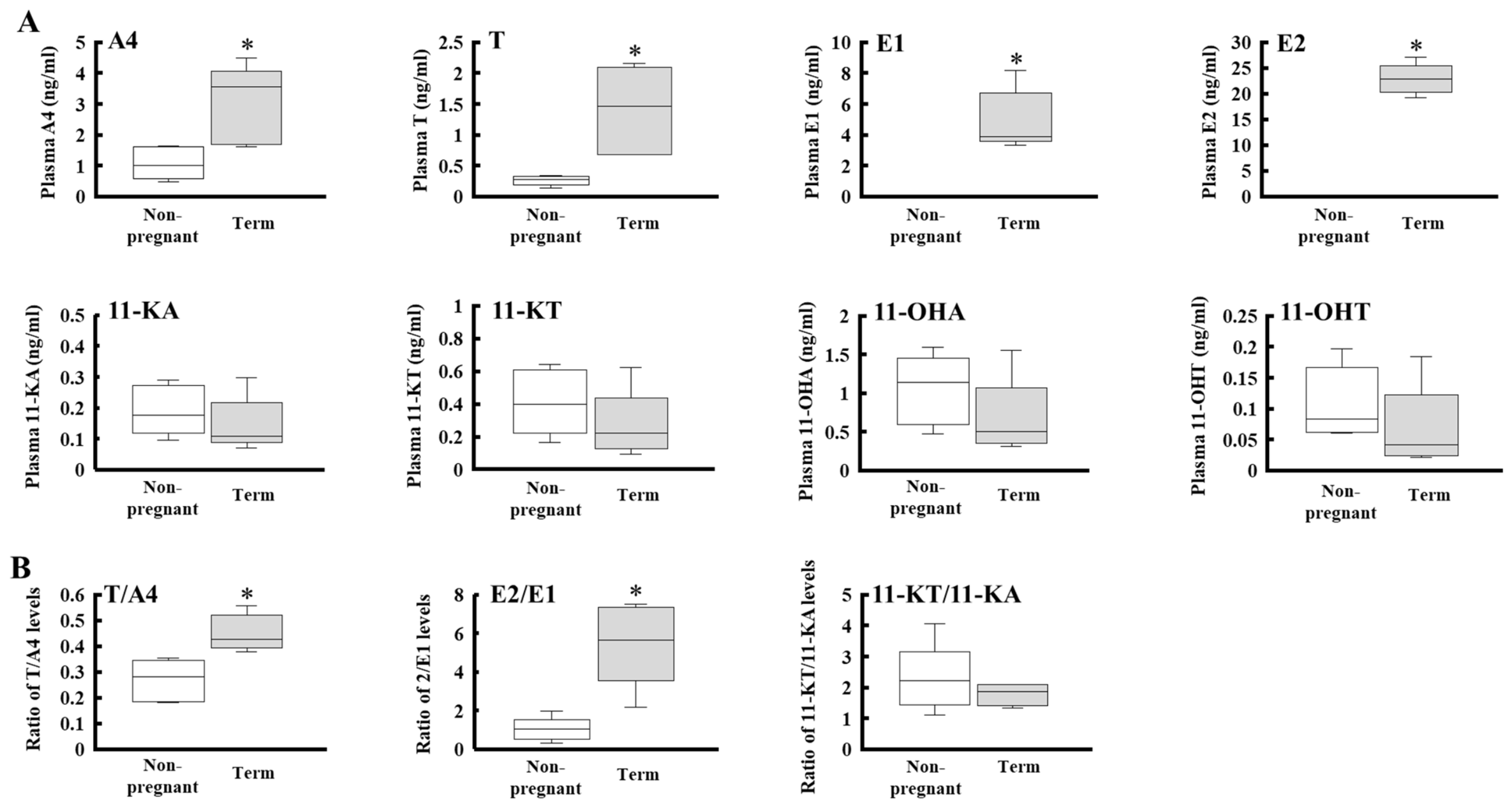
| Steroids (ng/mL) | Non-Pregnant Women | Pregnant Women | LLOQ (ng/mL) | Pregnant/ Non-Pregnant |
|---|---|---|---|---|
| Androstenedione (A4) | 1.0 (0.46–1.6) | 3.0 (1.6–4.5) | 0.01 | 2.82 |
| Testosterone (T) | 0.28 (0.13–0.34) | 1.5 (0.68–2.2) | 0.005 | 5.39 |
| Estrone (E1) | 0.02 (0.02–0.07) | 3.9 (3.3–8.2) | 0.005 | 154.9 |
| Estradiol (E2) | 0.02 (0.006–0.14) | 22.9 (19.3–27.1) | 0.005 | 545.2 |
| 11-KA | 0.18 (0.09–0.25) | 0.11 (0.07–0.30) | 0.01 | 0.75 |
| 11-KT | 0.4 (0.17–0.64) | 0.22 (0.09–0.62) | 0.005 | 0.65 |
| 11-OHA | 1.1 (0.47–1.6) | 0.50 (0.31–1.6) | 0.01 | 0.64 |
| 11-OHT | 0.08 (0.06–0.20) | 0.04 (0.02–0.18) | 0.005 | 0.62 |
| Ratios | ||||
| T/A4 | 0.28 (0.18–0.35) | 0.43 (0.38–0.56) | ||
| E2/E1 | 1.0 (0.30–2) | 5.7 (2.2–7.5) | ||
| 11-KT/11-KA | 2.2 (1.1–4.1) | 1.9 (1.3–2.1) |
Disclaimer/Publisher’s Note: The statements, opinions and data contained in all publications are solely those of the individual author(s) and contributor(s) and not of MDPI and/or the editor(s). MDPI and/or the editor(s) disclaim responsibility for any injury to people or property resulting from any ideas, methods, instructions or products referred to in the content. |
© 2026 by the authors. Licensee MDPI, Basel, Switzerland. This article is an open access article distributed under the terms and conditions of the Creative Commons Attribution (CC BY) license.
Share and Cite
Yokohama, Y.; Watanabe, Y.; Nakajima, K.-i.; Umezawa, A.; Takahashi, S.; Mori, Y.; Kato, Y.; Kawabe, J.-i.; Yazawa, T. The Expression of Placental 17β-Hydroxysteroid Dehydrogenase Genes Is Associated with the Elevation of Active Androgens and Estrogens in Pregnant Women, but Does Not Affect 11-Oxygenated C19 Steroids. Int. J. Mol. Sci. 2026, 27, 4290. https://doi.org/10.3390/ijms27104290
Yokohama Y, Watanabe Y, Nakajima K-i, Umezawa A, Takahashi S, Mori Y, Kato Y, Kawabe J-i, Yazawa T. The Expression of Placental 17β-Hydroxysteroid Dehydrogenase Genes Is Associated with the Elevation of Active Androgens and Estrogens in Pregnant Women, but Does Not Affect 11-Oxygenated C19 Steroids. International Journal of Molecular Sciences. 2026; 27(10):4290. https://doi.org/10.3390/ijms27104290
Chicago/Turabian StyleYokohama, Yuko, Yugo Watanabe, Ke-ichi Nakajima, Akihiro Umezawa, Satoru Takahashi, Yasuhiro Mori, Yasuhito Kato, Jun-ichi Kawabe, and Takashi Yazawa. 2026. "The Expression of Placental 17β-Hydroxysteroid Dehydrogenase Genes Is Associated with the Elevation of Active Androgens and Estrogens in Pregnant Women, but Does Not Affect 11-Oxygenated C19 Steroids" International Journal of Molecular Sciences 27, no. 10: 4290. https://doi.org/10.3390/ijms27104290
APA StyleYokohama, Y., Watanabe, Y., Nakajima, K.-i., Umezawa, A., Takahashi, S., Mori, Y., Kato, Y., Kawabe, J.-i., & Yazawa, T. (2026). The Expression of Placental 17β-Hydroxysteroid Dehydrogenase Genes Is Associated with the Elevation of Active Androgens and Estrogens in Pregnant Women, but Does Not Affect 11-Oxygenated C19 Steroids. International Journal of Molecular Sciences, 27(10), 4290. https://doi.org/10.3390/ijms27104290